<?xml version="1.0" encoding="ISO-8859-1"?><article xmlns:mml="http://www.w3.org/1998/Math/MathML" xmlns:xlink="http://www.w3.org/1999/xlink" xmlns:xsi="http://www.w3.org/2001/XMLSchema-instance">
<front>
<journal-meta>
<journal-id>0012-7353</journal-id>
<journal-title><![CDATA[DYNA]]></journal-title>
<abbrev-journal-title><![CDATA[Dyna rev.fac.nac.minas]]></abbrev-journal-title>
<issn>0012-7353</issn>
<publisher>
<publisher-name><![CDATA[Universidad Nacional de Colombia]]></publisher-name>
</publisher>
</journal-meta>
<article-meta>
<article-id>S0012-73532016000400006</article-id>
<article-id pub-id-type="doi">10.15446/dyna.v83n198.51766</article-id>
<title-group>
<article-title xml:lang="en"><![CDATA[Modeling and behavior of the simulation of electric propagation during deep brain stimulation]]></article-title>
<article-title xml:lang="es"><![CDATA[Modelado y comportamiento de la simulación de propagación eléctrica durante la estimulación cerebral profunda]]></article-title>
</title-group>
<contrib-group>
<contrib contrib-type="author">
<name>
<surname><![CDATA[Alvarado]]></surname>
<given-names><![CDATA[Pablo A.]]></given-names>
</name>
<xref ref-type="aff" rid="A01"/>
</contrib>
<contrib contrib-type="author">
<name>
<surname><![CDATA[Torres-Valencia]]></surname>
<given-names><![CDATA[Cristian A.]]></given-names>
</name>
<xref ref-type="aff" rid="A01"/>
</contrib>
<contrib contrib-type="author">
<name>
<surname><![CDATA[Orozco-Gutiérrez]]></surname>
<given-names><![CDATA[Álvaro A.]]></given-names>
</name>
<xref ref-type="aff" rid="A01"/>
</contrib>
<contrib contrib-type="author">
<name>
<surname><![CDATA[Álvarez]]></surname>
<given-names><![CDATA[Mauricio A.]]></given-names>
</name>
<xref ref-type="aff" rid="A01"/>
</contrib>
<contrib contrib-type="author">
<name>
<surname><![CDATA[Daza-Santacoloma]]></surname>
<given-names><![CDATA[Genaro]]></given-names>
</name>
<xref ref-type="aff" rid="A02"/>
</contrib>
<contrib contrib-type="author">
<name>
<surname><![CDATA[Carmona-Villada]]></surname>
<given-names><![CDATA[Hans]]></given-names>
</name>
<xref ref-type="aff" rid="A02"/>
</contrib>
</contrib-group>
<aff id="A01">
<institution><![CDATA[,Universidad Tecnológica de Pereira  ]]></institution>
<addr-line><![CDATA[Pereira ]]></addr-line>
<country>Colombia</country>
</aff>
<aff id="A02">
<institution><![CDATA[,Instituto de Epilepsia y Parkinson del Eje Cafetero  ]]></institution>
<addr-line><![CDATA[Pereira ]]></addr-line>
<country>Colombia</country>
</aff>
<pub-date pub-type="pub">
<day>00</day>
<month>09</month>
<year>2016</year>
</pub-date>
<pub-date pub-type="epub">
<day>00</day>
<month>09</month>
<year>2016</year>
</pub-date>
<volume>83</volume>
<numero>198</numero>
<fpage>49</fpage>
<lpage>58</lpage>
<copyright-statement/>
<copyright-year/>
<self-uri xlink:href="http://www.scielo.org.co/scielo.php?script=sci_arttext&amp;pid=S0012-73532016000400006&amp;lng=en&amp;nrm=iso"></self-uri><self-uri xlink:href="http://www.scielo.org.co/scielo.php?script=sci_abstract&amp;pid=S0012-73532016000400006&amp;lng=en&amp;nrm=iso"></self-uri><self-uri xlink:href="http://www.scielo.org.co/scielo.php?script=sci_pdf&amp;pid=S0012-73532016000400006&amp;lng=en&amp;nrm=iso"></self-uri><abstract abstract-type="short" xml:lang="en"><p><![CDATA[Deep brain stimulation (DBS) is an effective treatment for Parkinson's disease. In the literature, there are a wide variety of mathematical and computational models to describe electric propagation during DBS; however unfortunately, there is no clarity about the reasons that justify the use of a specific model. In this work, we present a detailed mathematical formulation of the DBS electric propagation that supports the use of a model based on the Laplace Equation. Moreover, we performed DBS simulations for several geometrical models of the brain in order to determine whether geometry size, shape and ground location influence electric stimulation prediction by using the Finite Element Method (FEM). Theoretical and experimental analysis show, firstly, that under the correct assumptions, the Laplace equation is a suitable alternative to describe the electric propagation, and secondly, that geometrical structure, size and grounding of the head volume affect the magnitude of the electric potential, particularly for monopolar stimulation. Results show that, for monopolar stimulation, basic and more realistic models can differ more than 2900%.]]></p></abstract>
<abstract abstract-type="short" xml:lang="es"><p><![CDATA[La Estimulación Cerebral Profunda (DBS) es un tratamiento efectivo para la enfermedad de Parkinson. Gran variedad de modelos matemáticos y computacionales para describir la propagación eléctrica debido a la DBS han sido propuestos, desafortunadamente, no existe claridad sobre las razones que justifican el uso de un modelo específico. En el presente trabajo se presenta una formulación matemática detallada de la propagación eléctrica debido a DBS que soporta un modelo basado en la ecuación de Laplace. Se realizan simulaciones para diferentes modelos geométricos del cerebro para determinar si la geometría, el tamaño y la ubicación de la tierra del modelo afectan la predicción de la estimulación eléctrica mediante el uso del Método de Elementos Finitos (FEM). Los análisis teórico y experimental muestran en primera instancia que la ecuación de Laplace es adecuada para describir la propagación eléctrica en el cerebro, y en segunda instancia que la estructura geométrica, tamaño y ubicación de la tierra afectan la magnitud del potencial eléctrico, particularmente para modos de estimulación monopolar. Los resultados muestran que para modelos básicos y más realistas pueden existir diferencias en la propagación de hasta un 2900%.]]></p></abstract>
<kwd-group>
<kwd lng="en"><![CDATA[DBS]]></kwd>
<kwd lng="en"><![CDATA[Parkinson disease]]></kwd>
<kwd lng="en"><![CDATA[electric brain propagation]]></kwd>
<kwd lng="en"><![CDATA[Laplace equation]]></kwd>
<kwd lng="en"><![CDATA[FEM]]></kwd>
<kwd lng="es"><![CDATA[Estimulación Cerebral Profunda]]></kwd>
<kwd lng="es"><![CDATA[Ecuación de Laplace]]></kwd>
<kwd lng="es"><![CDATA[Enfermedad de Parkinson]]></kwd>
<kwd lng="es"><![CDATA[FEM]]></kwd>
</kwd-group>
</article-meta>
</front><body><![CDATA[ <p><font size="1" face="Verdana, Arial, Helvetica, sans-serif"><b>DOI:</b> <a href="http://dx.doi.org/10.15446/dyna.v83n198.51766" target="_blank">http://dx.doi.org/10.15446/dyna.v83n198.51766</a></font></p>     <p align="center"><font size="4" face="Verdana, Arial, Helvetica, sans-serif"><b>Modeling   and behavior of the simulation of electric propagation during deep brain   stimulation</b></font></p>     <p align="center"><i><font size="3"><b><font face="Verdana, Arial, Helvetica, sans-serif">Modelado y   comportamiento de la simulaci&oacute;n de propagaci&oacute;n el&eacute;ctrica durante la   estimulaci&oacute;n cerebral profunda</font></b></font></i></p>     <p align="center">&nbsp;</p>     <p align="center"><font size="2" face="Verdana, Arial, Helvetica, sans-serif"><b>Pablo A. Alvarado <i><sup>a</sup>,</i> Cristian A. Torres-Valencia <i><sup>a</sup>,</i> &Aacute;lvaro A. Orozco-Guti&eacute;rrez <i><sup>a</sup>,</i> Mauricio A. &Aacute;lvarez <i><sup>a</sup>,</i> Genaro Daza-Santacoloma <i><sup>b</sup></i> &amp; Hans Carmona-Villada <i><sup>b</sup></i></b></font></p>     <p align="center">&nbsp;</p>     <p align="center"><font size="2" face="Verdana, Arial, Helvetica, sans-serif"><sup><i>a </i></sup><i>Universidad Tecnol&oacute;gica de Pereira, Pereira, Colombia. <a href="mailto:dapa@utp.edu.co">dapa@utp.edu.co</a>    <br>   <sup>b </sup>Instituto de Epilepsia y Parkinson del Eje Cafetero - Neurocentro, Pereira, Colombia</i></font></p>     <p align="center">&nbsp;</p>     <p align="center"><font size="2" face="Verdana, Arial, Helvetica, sans-serif"><b>Received:   July 8<sup>th</sup>, 2015. Received in revised form: February 23<sup>th</sup>,   2016. Accepted: Mach 7<sup>th</sup>, 2016</b></font></p>     ]]></body>
<body><![CDATA[<p align="center">&nbsp;</p>     <p align="center"><font size="1" face="Verdana, Arial, Helvetica, sans-seriff"><b>This work is licensed under a</b> <a rel="license" href="http://creativecommons.org/licenses/by-nc-nd/4.0/">Creative Commons Attribution-NonCommercial-NoDerivatives 4.0 International License</a>.</font><br />   <a rel="license" href="http://creativecommons.org/licenses/by-nc-nd/4.0/"><img style="border-width:0" src="https://i.creativecommons.org/l/by-nc-nd/4.0/88x31.png" /></a></p> <hr>     <p><font size="2" face="Verdana, Arial, Helvetica, sans-serif"><b>Abstract    <br>   </b></font><font size="2" face="Verdana, Arial, Helvetica, sans-serif">Deep brain   stimulation (DBS) is an effective treatment for Parkinson's disease. In the   literature, there are a wide variety of mathematical and computational models   to describe electric propagation during DBS; however unfortunately, there is no   clarity about the reasons that justify the use of a specific model. In this   work, we present a detailed mathematical formulation of the DBS electric   propagation that supports the use of a model based on the Laplace Equation.   Moreover, we performed DBS simulations for several geometrical models of the   brain in order to determine whether geometry size, shape and ground location   influence electric stimulation prediction by using the Finite Element Method   (FEM). Theoretical and experimental analysis show, firstly, that under the   correct assumptions, the Laplace equation is a suitable alternative to describe   the electric propagation, and secondly, that geometrical structure, size and   grounding of the head volume affect the magnitude of the electric potential,   particularly for monopolar stimulation. Results show that, for monopolar   stimulation, basic and more realistic models can differ more than 2900%.</font></p>     <p><font size="2" face="Verdana, Arial, Helvetica, sans-serif"><i>Keywords</i>: DBS; Parkinson disease; electric brain propagation; Laplace   equation; FEM.</font></p>     <p><font size="2" face="Verdana, Arial, Helvetica, sans-serif"><b>Resumen    <br>   </b></font><font size="2" face="Verdana, Arial, Helvetica, sans-serif">La Estimulaci&oacute;n Cerebral Profunda (DBS) es un tratamiento efectivo para la   enfermedad de Parkinson. Gran variedad de modelos matem&aacute;ticos y computacionales   para describir la propagaci&oacute;n el&eacute;ctrica debido a la DBS han sido propuestos,   desafortunadamente, no existe claridad sobre las razones que justifican el uso   de un modelo espec&iacute;fico. En el presente trabajo se presenta una formulaci&oacute;n   matem&aacute;tica detallada de la propagaci&oacute;n el&eacute;ctrica debido a DBS que soporta un   modelo basado en la ecuaci&oacute;n de Laplace. Se realizan simulaciones para   diferentes modelos geom&eacute;tricos del cerebro para determinar si la geometr&iacute;a, el   tama&ntilde;o y la ubicaci&oacute;n de la tierra del modelo afectan la predicci&oacute;n de la   estimulaci&oacute;n el&eacute;ctrica mediante el uso del M&eacute;todo de Elementos Finitos (FEM).   Los an&aacute;lisis te&oacute;rico y experimental muestran en primera instancia que la   ecuaci&oacute;n de Laplace es adecuada para describir la propagaci&oacute;n el&eacute;ctrica en el   cerebro, y en segunda instancia que la estructura geom&eacute;trica, tama&ntilde;o y   ubicaci&oacute;n de la tierra afectan la magnitud del potencial el&eacute;ctrico,   particularmente para modos de estimulaci&oacute;n monopolar. Los resultados muestran   que para modelos b&aacute;sicos y m&aacute;s realistas pueden existir diferencias en la   propagaci&oacute;n de hasta un 2900%.</font></p>     <p><font size="2" face="Verdana, Arial, Helvetica, sans-serif"><i>Palabras Clave: </i>Estimulaci&oacute;n Cerebral Profunda; Ecuaci&oacute;n de   Laplace; Enfermedad de Parkinson; FEM.</font></p> <hr>     <p>&nbsp;</p>     <p><font size="3" face="Verdana, Arial, Helvetica, sans-serif"><b>1. Introduction</b></font></p>     ]]></body>
<body><![CDATA[<p><font size="2" face="Verdana, Arial, Helvetica, sans-serif">Parkinson's   disease (PD) is a degenerative disorder of the central nervous system that   results in impaired motor skills and speech. Its most prevalent symptoms are   tremor and rigidity<img src="/img/revistas/dyna/v83n198/v83n198a06eq002.gif">. PD is the second most common neurodegenerative   disorder after Alzheimer's disease, often affecting the elderly population<img src="/img/revistas/dyna/v83n198/v83n198a06eq004.gif">.</font></p>     <p><font size="2" face="Verdana, Arial, Helvetica, sans-serif">Deep brain stimulation (DBS) is a clinically effective treatment for   medically intractable PD<img src="/img/revistas/dyna/v83n198/v83n198a06eq006.gif">. To improve all PD symptoms,   it is best for DBS to target the Subthalamic Nucleus (STN) <img src="/img/revistas/dyna/v83n198/v83n198a06eq008.gif">, the brain structure related   to sensorimotor, cognitive, and limbic functions<img src="/img/revistas/dyna/v83n198/v83n198a06eq010.gif">. The fundamental purpose of   DBS is to modulate neural activity with applied electric fields<img src="/img/revistas/dyna/v83n198/v83n198a06eq012.gif">. However, the mechanisms by   which DBS works are not yet well understood<img src="/img/revistas/dyna/v83n198/v83n198a06eq014.gif">. In this sense, DBS´s therapeutic   action seems to depend on the electrical excitation of neural elements<img src="/img/revistas/dyna/v83n198/v83n198a06eq016.gif">. Moreover, there are also   studies that support neuronal inhibition <img src="/img/revistas/dyna/v83n198/v83n198a06eq018.gif">. Other studies suggest that   DBS reduces the PD symptoms through the excitation of axons and the inhibition   of the dendritic activity<img src="/img/revistas/dyna/v83n198/v83n198a06eq020.gif"></font></p>     <p><font size="2" face="Verdana, Arial, Helvetica, sans-serif">To achieve successful stimulation, it is   necessary to excite the intended brain areas while preventing the unintended   excitation of other zones: the spread of current to non-motor areas of the STN   or adjacent structures is implicated in cognitive and cognitive-motor declines   &#91;12-14&#93;. The stimulation of the dorsolateral STN and the bottom (ventral) part   of the thalamus could reduce parkinsonian tremor and trigger dyskinesias,   whereas stimulation outside the STN could induce adverse effects<img src="/img/revistas/dyna/v83n198/v83n198a06eq022.gif">.</font></p>     <p><font size="2" face="Verdana, Arial, Helvetica, sans-serif">A suitable   stimulation protocol involves not only the accurate placement of the electrode   inside the brain, but also the proper configuration of some electrical and   geometrical parameters for the DBS device &#91;4&#93;. The electrical parameters for DBS are pulse width,   frequency and the voltage amplitude. Additionally, each of the lead´s   electrodes can be designated as anode or cathode &#91;4&#93;, To facilitate the   configuration of the DBS device it is propitious to employ computational models,   this allows the electric propagation of the stimulation to be predicted as a   function of the previously mentioned electrical and geometrical parameters.</font></p>     <p><font size="2" face="Verdana, Arial, Helvetica, sans-serif">These   computational simulations help to visualize the electric behavior of the   stimulus in the brain. In this sense, several works<img src="/img/revistas/dyna/v83n198/v83n198a06eq024.gif">have developed simulators of the electric activity   for DBS.</font></p>     <p><font size="2" face="Verdana, Arial, Helvetica, sans-serif">The mathematical and computational models found in the literature <img src="/img/revistas/dyna/v83n198/v83n198a06eq026.gif"> require information such as the conductivity   and permittivity of brain tissue, geometrical description of the head volume,   the physical laws that govern the system, and the associated equation   constraints. Most of the simulation approaches are specifically based on   electrostatic models. The electric potential is often computed using the Laplace <img src="/img/revistas/dyna/v83n198/v83n198a06eq028.gif"> or Poisson's <img src="/img/revistas/dyna/v83n198/v83n198a06eq030.gif"> equation. Unfortunately, there are no major justifications about the use of this   mathematical background, which is essential to define the scope, realism and   accuracy of the simulation. The core of these simulations is the Finite Element   Method (FEM) that has been widely used in DBS problems and other engineering   fields (see &#91;25&#93; and &#91;26&#93;).</font></p>     <p><font size="2" face="Verdana, Arial, Helvetica, sans-serif">Previous research undertaken by authors such as &#91;27&#93; and &#91;28&#93; address   some of the effects of the DBS that show some simulations from schemes   different to the one proposed in this work. In &#91;27&#93;, a latent force model was   developed in order to include the dynamics of the electric propagation in the   brain, unlike several state-of the-art works that only focus on the   quasi-static or static approach. In &#91;28&#93;, some propagation models following the   quasi-static approach were developed using an open source library of finite   element methods with no deep analysis of the physical laws that govern the DBS   problem. Additionally the results are difficult to compare against the state-of   the-art works due to the difference in the simulation tool used.</font></p>     <p><font size="2" face="Verdana, Arial, Helvetica, sans-serif">It is unusual to find academic discussions about the physical laws that   support the behavior of the deep brain electric fields induced by an external   source. In fact, there is no interpretation or explanation about the   consequences of most of the mathematical simplifications carried out by the   basic equations that describe the phenomenon. Moreover, in order to establish   which kind of representations are appropriate to describe the electric   propagation inside the human brain´s behavior, it is convenient to make a   quantitative comparison of several geometrical head models, taking into account   the ground positioning that is assumed by the computational algorithms.</font></p>     <p><font size="2" face="Verdana, Arial, Helvetica, sans-serif">In this work, we present a mathematical formulation of the electric   propagation during DBS. Indeed, we offer an argument that sustains the use of   an electrostatic propagation model based on the Laplace equation. The   theoretical framework is corroborated by a set of computer simulations of the   electric potential generated by DBS. Furthermore, the simulation analysis   indicates that, for monopolar stimulation, the geometrical structure, size and   grounding of the conducting head volume alter the magnitude of the electric   field. In fact, a voltage comparison between basic and more realistic models   can differ by more than 2900%.</font></p>     <p>&nbsp;</p>     ]]></body>
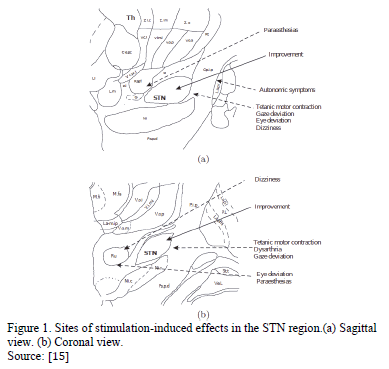
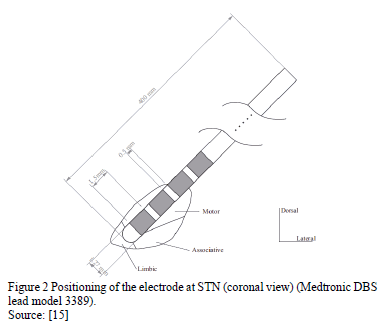
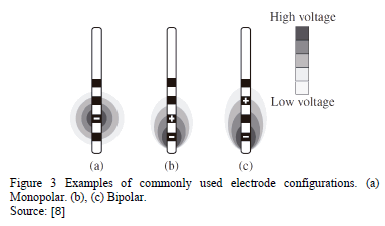
<body><![CDATA[<p><font size="3" face="Verdana, Arial, Helvetica, sans-serif"><b>2. Deep brain stimulation considerations</b></font></p>     <p><font size="2" face="Verdana, Arial, Helvetica, sans-serif">An accurate treatment of Parkinson's disease using DBS should analyze   the different effects of potential propagation around the objective structure,   that is the STN &#91;15&#93;. Adverse effects   could be produced from undesired potential propagation to non-motor regions of   the brain, as is   presented in <a href="#fig01">Fig. 1</a>. In order to improve the Parkinsonian motor symptoms, the   electrode must be placed at the motor section of the STN, as presented in <a href="#fig02">Fig.   2</a> &#91;15&#93;.</font></p>     <p align="center"><font size="2" face="Verdana, Arial, Helvetica, sans-serif"><a name="fig01"></a></font><img src="/img/revistas/dyna/v83n198/v83n198a06fig01.gif"></p>     <p align="center"><font size="2" face="Verdana, Arial, Helvetica, sans-serif"><a name="fig02"></a></font><img src="/img/revistas/dyna/v83n198/v83n198a06fig02.gif"></p>     <p><font size="2" face="Verdana, Arial, Helvetica, sans-serif">Given a specific electrode, e.g. the Medtronic DBS lead model 3389 that has   four configurable electrodes, there are several geometrical possible   arrangements to configure the stimulation parameters. In clinical practice,   usually one or two stimulation contacts are used at most. <a href="#fig03">Fig. 3</a> shows three   different monopolar (<a href="#fig03">Fig. 3(a)</a>) and bipolar (<a href="#fig03">Fig. 3(b)</a>-<a href="#fig03">(c)</a>) configurations and   their corresponding electric potential &#91;8&#93;.</font></p>     <p align="center"><font size="2" face="Verdana, Arial, Helvetica, sans-serif"><a name="fig03"></a></font><img src="/img/revistas/dyna/v83n198/v83n198a06fig03.gif"></p>     <p>&nbsp;</p>     <p><font size="3" face="Verdana, Arial, Helvetica, sans-serif"><b>3. Electric stimulation modeling</b></font></p>     <p><font size="2" face="Verdana, Arial, Helvetica, sans-serif">Electromagnetic   fields generated by DBS are dynamic since the source field or electric   stimulation is time-varying and has a fundamental frequency range from 130Hz to   185Hz <img src="/img/revistas/dyna/v83n198/v83n198a06eq042.gif">(the frequency commonly used is around 140Hz).   Moreover, the electric potential induced throughout the brain tissue close to   the stimulating electrode is commonly modeled using the Laplace equation, which   assumes a quasi-static or static field<img src="/img/revistas/dyna/v83n198/v83n198a06eq044.gif">.</font></p>     <p><font size="2" face="Verdana, Arial, Helvetica, sans-serif">It is worthwhile   mentioning that the quasi-static approximation is only valid when the   electrodynamic system analyzed is <i>a low   frequency time-varying</i> field<img src="/img/revistas/dyna/v83n198/v83n198a06eq046.gif">. In this section, we provide a detailed   explanation of how to derive the quasi-static model in order to support a DBS   propagation model based on the Laplace equation. This explanation involves the   use of generalized Maxwell's equations and some physical assumptions. We then   present the conditions which allow us to make a decision as to whether the   approximation is valid for DBS.</font></p>     ]]></body>
<body><![CDATA[<p><font size="2" face="Verdana, Arial, Helvetica, sans-serif"><b><i>3.1. Low frequency range, time-varying fields</i></b></font></p>     <p><font size="2" face="Verdana, Arial, Helvetica, sans-serif">The large   variety of electromagnetic phenomena can all be described by a unique system of   field equations known as Maxwell's equation<img src="/img/revistas/dyna/v83n198/v83n198a06eq048.gif">. Some particular forms of these   equations have been used by other authors to model the electric propagation produced   by DBS<img src="/img/revistas/dyna/v83n198/v83n198a06eq050.gif">. These equations can be simplified when slow   electromagnetic fields are analyzed, i.e. fields in the so called <i>low frequency range</i> (up to 30kHz), when   wave propagation does not play a fundamental role <img src="/img/revistas/dyna/v83n198/v83n198a06eq0522.gif">. Before defining the situations in   which wave propagation effects can be neglected, it is important to clarify   some electromagnetic waves properties.</font></p>     <p><font size="2" face="Verdana, Arial, Helvetica, sans-serif">Generally,   electromagnetic fields propagate with a finite velocity <i>c</i><img src="/img/revistas/dyna/v83n198/v83n198a06eq048.gif">, defined as <img src="/img/revistas/dyna/v83n198/v83n198a06eq054.gif">, where <img src="/img/revistas/dyna/v83n198/v83n198a06eq056.gif"> denotes   the permittivity and <img src="/img/revistas/dyna/v83n198/v83n198a06eq058.gif"> represents   the permeability of the brain tissue<img src="/img/revistas/dyna/v83n198/v83n198a06eq060.gif">. In addition to this, <img src="/img/revistas/dyna/v83n198/v83n198a06eq062.gif"> represents   the time required for the electromagnetic field to propagate at a distance <i>l</i> from one region to another in a volume   brain tissue, <img src="/img/revistas/dyna/v83n198/v83n198a06eq064.gif">. The wave propagation equation for the   electrodynamic scalar potential is defined as:</font></p>     <p><img src="/img/revistas/dyna/v83n198/v83n198a06eq01.gif"></p>     <p><font size="2" face="Verdana, Arial, Helvetica, sans-serif">Where<img src="/img/revistas/dyna/v83n198/v83n198a06eq068.gif"> is the   electric potential function, and <img src="/img/revistas/dyna/v83n198/v83n198a06eq070.gif"> denotes the   charge density<img src="/img/revistas/dyna/v83n198/v83n198a06eq072.gif">. If the field problem is considered with a   characteristic spatial dimension <i>l</i> and a characteristic time constant<img src="/img/revistas/dyna/v83n198/v83n198a06eq074.gif">, spatial and temporal differentiations can be   approximated by (1<i>/l</i>) and (1/<img src="/img/revistas/dyna/v83n198/v83n198a06eq074.gif">), respectively. In this case, <i>l </i>is related to the brain tissue volume considered, i.e. the STN   and its surroundings, whereas <img src="/img/revistas/dyna/v83n198/v83n198a06eq076.gif">is considered as the time interval for which   significant changes in the field quantities arise. For time-varying electric   stimulation, <img src="/img/revistas/dyna/v83n198/v83n198a06eq078.gif"> would be the   reciprocal of the excitation's angular frequency,<img src="/img/revistas/dyna/v83n198/v83n198a06eq080.gif"> <img src="/img/revistas/dyna/v83n198/v83n198a06eq082.gif">. If these previous considerations are applied,   equation (1) can be approximated by:</font></p>     <p><img src="/img/revistas/dyna/v83n198/v83n198a06eq011.gif"></p>     <p><font size="2" face="Verdana, Arial, Helvetica, sans-serif">For slow   time-varying fields, the characteristic time constant <img src="/img/revistas/dyna/v83n198/v83n198a06eq078.gif"> is supposed   to be much greater than the transit time <img src="/img/revistas/dyna/v83n198/v83n198a06eq062.gif">, i.e. <img src="/img/revistas/dyna/v83n198/v83n198a06eq086.gif">. If this expression holds, then <img src="/img/revistas/dyna/v83n198/v83n198a06eq088.gif">, and the propagation effects can be neglected.</font></p>     <p><font size="2" face="Verdana, Arial, Helvetica, sans-serif"><b><i>3.2. Static and quasi-static models</i></b></font></p>     <p><font size="2" face="Verdana, Arial, Helvetica, sans-serif">When wave   propagation does not play a fundamental role, the electromagnetic field   simulations of slow processes are carried out by using <img src="/img/revistas/dyna/v83n198/v83n198a06eq090.gif">.</font></p> <ul>       <li><font size="2" face="Verdana, Arial, Helvetica, sans-serif">a static model, i.e. <i>electrostatics or magnetostatics,</i> if all     variations in time can be neglected.</font></li>       ]]></body>
<body><![CDATA[<li><font size="2" face="Verdana, Arial, Helvetica, sans-serif">a quasi-static model, i.e. <i>electro quasistatics or magneto     quasistationary.</i></font></li>     </ul>     <p><font size="2" face="Verdana, Arial, Helvetica, sans-serif">The static   models are just special cases of the full Maxwell's equations, whereas the   quasi-static models are approximations that are not always valid<img src="/img/revistas/dyna/v83n198/v83n198a06eq092.gif">. The quasi-static models are obtained from Maxwell's   equations by neglecting either the magnetic induction, or the electric   displacement current, as well as the electromagnetic waves that result from   their coupling<img src="/img/revistas/dyna/v83n198/v83n198a06eq094.gif">.</font></p> <font size="2" face="Verdana, Arial, Helvetica, sans-serif"><i>3.2.1. Electro-quasistatic model</i></font>     <p><font size="2" face="Verdana, Arial, Helvetica, sans-serif">The   electro-quasistatic assumption establishes that the electric field<b> E</b> is essentially irrotational. In   general, the field of gradient <img src="/img/revistas/dyna/v83n198/v83n198a06eq098.gif"> (for any   scalar<img src="/img/revistas/dyna/v83n198/v83n198a06eq100.gif">) is purely irrotational since<img src="/img/revistas/dyna/v83n198/v83n198a06eq102.gif">, thus the irrotational field <b>E</b> can always be expressed in terms of a scalar field<img src="/img/revistas/dyna/v83n198/v83n198a06eq100.gif">, that is</font></p>     <p><img src="/img/revistas/dyna/v83n198/v83n198a06eq02.gif"></p>     <p><font size="2" face="Verdana, Arial, Helvetica, sans-serif">The negative   sign shows that the direction of <b>E</b> is opposite to the direction in which <img src="/img/revistas/dyna/v83n198/v83n198a06eq098.gif"> increases.   The electric field <b>E </b>looks like an   electrostatic field at any tissue point. Changes in the electric stimulation   will immediately take effect in the whole brain tissue volume under   consideration.</font></p>     <p><font size="2" face="Verdana, Arial, Helvetica, sans-serif"><b><i>3.2. Magneto-quasistationary model</i></b></font></p>     <p><font size="2" face="Verdana, Arial, Helvetica, sans-serif">Analogously, the   magneto-quasistationary models are characterized by setting the magnetic field <b>H</b> as solenoidal. This implies that the   divergence of current density <b>J</b> is zero,   i.e. </font></p>     <p><img src="/img/revistas/dyna/v83n198/v83n198a06eq021.gif"></p>     <p><font size="2" face="Verdana, Arial, Helvetica, sans-serif"><i>3.2.3. Laplace equation</i></font></p>     ]]></body>
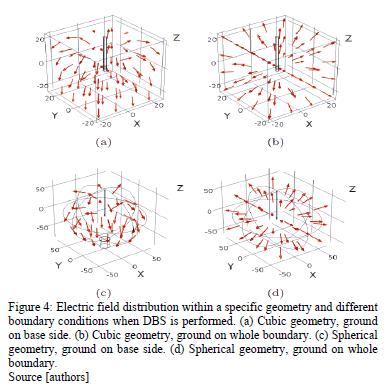
<body><![CDATA[<p><font size="2" face="Verdana, Arial, Helvetica, sans-serif">If   electro-quasistatic and magneto-quasistationary approximations are   simultaneously applied, then all temporal variations in Maxwell's equations are   neglected. This does not mean, however, that the sources, and hence the fields,   are not functions of time. But, given the sources at a certain instant, the   fields at that same instant are determined without regard for what the sources   of fields were an instant earlier. Using Maxwell's equations and Ohm's law, the   Laplace equation used to model the electric potential in DBS can be derived.   The current density<b> J</b> is related to   the electric field <b>E</b> by Ohm's law as   follows <img src="/img/revistas/dyna/v83n198/v83n198a06eq108.gif">:</font></p>     <p><img src="/img/revistas/dyna/v83n198/v83n198a06eq03.gif"></p>     <p><font size="2" face="Verdana, Arial, Helvetica, sans-serif">Where <img src="/img/revistas/dyna/v83n198/v83n198a06eq112.gif"> is the   tissue conductivity. It is measured in Siemens per meter (S/m). If the   divergence is applied on both sides of (3), we have<img src="/img/revistas/dyna/v83n198/v83n198a06eq114.gif">, and using (2) we get the Laplace equation:</font></p>     <p><img src="/img/revistas/dyna/v83n198/v83n198a06eq04.gif"></p>     <p><font size="2" face="Verdana, Arial, Helvetica, sans-serif">Equation (4)   corresponds to an inhomogeneous tissue. For a homogeneous tissue, equation (4)   becomes:</font></p>     <p><img src="/img/revistas/dyna/v83n198/v83n198a06eq05.gif"></p>     <p><font size="2" face="Verdana, Arial, Helvetica, sans-serif">In order to   obtain Equation (5), the conductivity <img src="/img/revistas/dyna/v83n198/v83n198a06eq112.gif"> is assumed   constant throughout the tissue region in which <img src="/img/revistas/dyna/v83n198/v83n198a06eq120.gif"> is defined.   The Laplacian operator <img src="/img/revistas/dyna/v83n198/v83n198a06eq122.gif"> can be   defined in Cartesian coordinates in the following way:</font></p>     <p><img src="/img/revistas/dyna/v83n198/v83n198a06eq051.gif"></p>     <p><font size="2" face="Verdana, Arial, Helvetica, sans-serif">The electric   potential calculation is based on a model with a homogeneous tissue medium to   reduce model complexity. Several authors have developed their experiments using   this assumption<img src="/img/revistas/dyna/v83n198/v83n198a06eq132.gif">. Furthermore, the STN is cytologically   homogeneous, i.e., neurons are identical in every part of the nucleus<img src="/img/revistas/dyna/v83n198/v83n198a06eq134.gif">. We will   now present four examples of the electric field (<b>E</b>) propagation obtained solving the Laplace equation (5) for a   finite, homogeneous, and isotropic volume tissue, using different geometries   and boundary conditions. The red arrows in <a href="#fig04">Fig. 4</a> correspond to the electric   field. <a href="#fig04">Fig.4 (a)</a> and <a href="#fig04">4(b)</a> show a cubic geometry, in <a href="#fig04">Fig. 4(a)</a> just one side of   the cube is grounded, in <a href="#fig04">Fig. 4(b)</a> all sides of the cube are grounded.   Likewise, <a href="#fig04">Fig. 4(c)</a> and <a href="#fig04">4(d)</a> show the electric field distribution (see Equation   (2)) obtained for a spherical geometry. In <a href="#fig04">Fig. 4(c)</a> a small base is grounded,   whereas in <a href="#fig04">Fig. 4(d)</a> all the external surface of the sphere is grounded.</font></p>     <p align="center"><font size="2" face="Verdana, Arial, Helvetica, sans-serif"><a name="fig04"></a></font><img src="/img/revistas/dyna/v83n198/v83n198a06fig04.gif"></p>     ]]></body>
<body><![CDATA[<p><font size="2" face="Verdana, Arial, Helvetica, sans-serif"><b><i>3.3. Conditions for the quasistatic approximation</i></b></font></p>     <p><font size="2" face="Verdana, Arial, Helvetica, sans-serif">The validity of   an approximation for a given slow time-varying field problem is determined by   an analysis based on significant time constants<img src="/img/revistas/dyna/v83n198/v83n198a06eq060.gif">. In this sense, two constants are defined, the   time constant of dielectric relaxation<img src="/img/revistas/dyna/v83n198/v83n198a06eq136.gif">, and the constant of magnetic diffusion<img src="/img/revistas/dyna/v83n198/v83n198a06eq138.gif">. In addition, the transit time <img src="/img/revistas/dyna/v83n198/v83n198a06eq140.gif"> is the   geometric average of <img src="/img/revistas/dyna/v83n198/v83n198a06eq142.gif"> and <img src="/img/revistas/dyna/v83n198/v83n198a06eq144.gif">.</font></p>     <p><img src="/img/revistas/dyna/v83n198/v83n198a06eq052.gif"></p>     <p><font size="2" face="Verdana, Arial, Helvetica, sans-serif">The   electro-quasistatic and magneto-quasistationary approximations can be used if   the relative error of the electric field and magnetic field calculated under   these approximations are much smaller than one. In order to estimate this   error, time derivatives in Maxwell's equations are substituted by<img src="/img/revistas/dyna/v83n198/v83n198a06eq148.gif">. Furthermore, only the scalar magnitudes of the   fields are considered. All properties of the brain tissue are assumed to be   homogeneous, linear and isotropic. The relative error <img src="/img/revistas/dyna/v83n198/v83n198a06eq150.gif"> of the   electric field within the electro-quasistatic approximation is defined as:</font></p>     <p><img src="/img/revistas/dyna/v83n198/v83n198a06eq06.gif"></p>     <p><font size="2" face="Verdana, Arial, Helvetica, sans-serif">If this   condition holds, electric fields can be calculated accurately by using the   electro-quasistatic approximation<img src="/img/revistas/dyna/v83n198/v83n198a06eq154.gif">Likewise, the relative error <img src="/img/revistas/dyna/v83n198/v83n198a06eq156.gif"> of the magnetic field within the   magneto-quasistationary approximation is</font></p>     <p><img src="/img/revistas/dyna/v83n198/v83n198a06eq07.gif"></p>     <p><font size="2" face="Verdana, Arial, Helvetica, sans-serif">Magnetic fields   can be calculated by using the magneto-quasistationary approximation if this   condition holds.</font></p>     <p>&nbsp;</p>     <p><font size="3" face="Verdana, Arial, Helvetica, sans-serif"><b>4. Experimental background</b></font></p>     ]]></body>
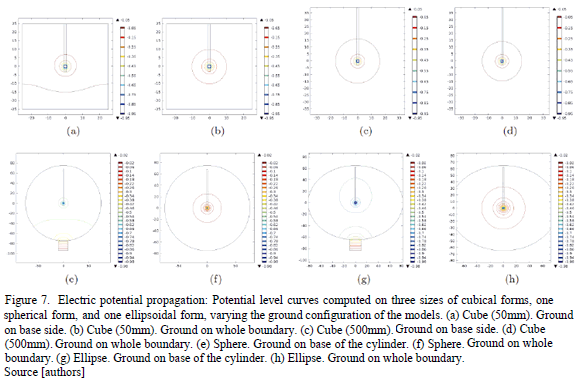
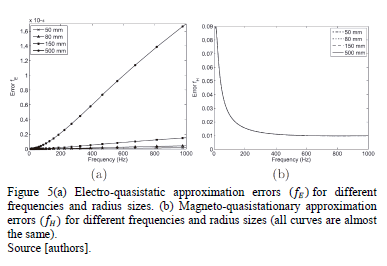
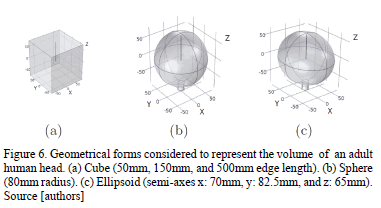
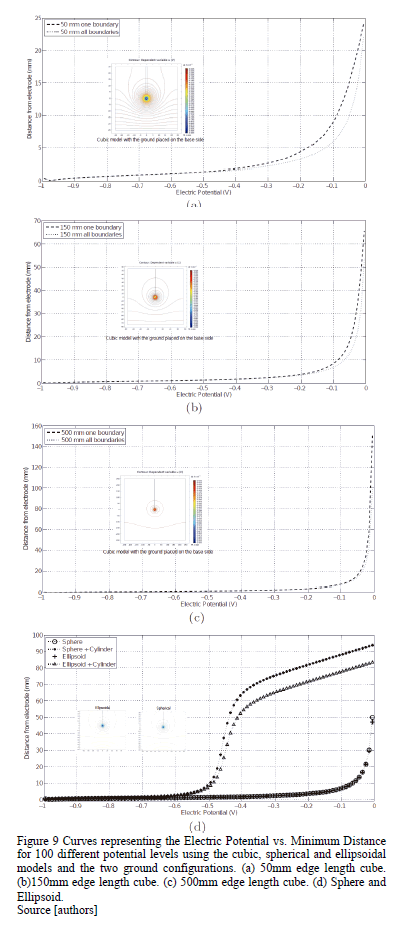
<body><![CDATA[<p><font size="2" face="Verdana, Arial, Helvetica, sans-serif">To be allowed to   use the electro-quasistatic and magneto-quasistationary approximations to model   the electric potential produced by DBS, the approximation errors<img src="/img/revistas/dyna/v83n198/v83n198a06eq150.gif"> (6) and <img src="/img/revistas/dyna/v83n198/v83n198a06eq156.gif"> (7) have to   be much less than one. To verify this, the approximation errors were calculated   for different<i> l</i> radius and   stimulation frequencies. The dielectric properties of the tissue are frequency   dependent<img src="/img/revistas/dyna/v83n198/v83n198a06eq160.gif">, and the electric field propagation time <img src="/img/revistas/dyna/v83n198/v83n198a06eq140.gif"> is a   function of the spatial quantity <i>l</i><img src="/img/revistas/dyna/v83n198/v83n198a06eq048.gif"><i>.</i> Therefore, the   errors <img src="/img/revistas/dyna/v83n198/v83n198a06eq150.gif"> (6) and <img src="/img/revistas/dyna/v83n198/v83n198a06eq156.gif"> (7) depend   on the stimulation frequency and the size of the brain tissue region   considered. The errors obtained for different frequencies (100Hz up to 1 kHz),   assuming a radius of <i>l</i> = 50mm, <i>l</i> = 80mm,<i> l</i> = 150mm and <i>l</i> = 500mm,   are shown in <a href="#fig05">Fig. 5</a>. According to the Andreuccetti online dataset<img src="/img/revistas/dyna/v83n198/v83n198a06eq162.gif">, white matter dielectric property values where   considered.. Based on <a href="#fig05">Fig. 5</a>, and assuming that all properties of the brain   tissue arehomogeneous, linear and isotropic, we can conclude that the   electro-quasistatic and magneto-quasistationary approximations are valid for a   radius of between <i>l </i>= 50mm and <i>l </i>= 500mm, and a frequency band from   100Hz to 1kHz.</font></p>     <p align="center"><font size="2" face="Verdana, Arial, Helvetica, sans-serif"><a name="fig05"></a></font><img src="/img/revistas/dyna/v83n198/v83n198a06fig05.gif"></p>     <p><font size="2" face="Verdana, Arial, Helvetica, sans-serif">Works such as <img src="/img/revistas/dyna/v83n198/v83n198a06eq164.gif"> and <img src="/img/revistas/dyna/v83n198/v83n198a06eq166.gif"> use several sizes of geometrical models in 2D and 3D. These include specifications of the DBS lead   shape that go into a monopolar configuration and the specification for the   tissue conductivity properties of the region analyzed. Usually, two different   ground configurations of the electrical models are used, one to define all the   boundaries of the geometrical model, such as the ground, and the other to   configure a specific area of the model, such as the ground <img src="/img/revistas/dyna/v83n198/v83n198a06eq168.gif">In<img src="/img/revistas/dyna/v83n198/v83n198a06eq170.gif">, one model is developed assuming an infinite   homogeneous and isotropic medium to compute the electric propagation in   different large frequencies. In <img src="/img/revistas/dyna/v83n198/v83n198a06eq172.gif">, a detailed model of the tissue surrounding the DBS   lead is built using information from magnetic resonance imaging (MRI). The   model is used to assess the influence of the tissue information when the   electric field surrounding the electrode is computed. It should be noted that,   for future work, the patient real head shape could be included and studied in   order to increase the model´s realism. Research such as &#91;42&#93; where a   reconstruction of the head from MRI is performed could be useful.</font></p>     <p>&nbsp;</p>     <p><font size="3" face="Verdana, Arial, Helvetica, sans-serif"><b>5. Results</b></font></p>     <p><font size="2" face="Verdana, Arial, Helvetica, sans-serif">The propagation of the electric potential in the simulated models is   obtained by solving the Laplace equation from the finite element method (FEM)   using Comsol Multiphysics (COMSOL Inc., Burlington, MA). As the theoretical analysis in section 2 demonstrated how the electric potential   propagation is conductivity independent when a homogeneous medium is   considered, the results obtained from these models allows for the geometry to   be analyzed and for building effects to be modeled in the Laplace equation   solution.. The main objective of this work is to present a detailed analysis of   the electrostatic process that governs the electric propagation during DBS.   Several DBS simulations based on the development of geometrical models of the brain that   confirm the theoretical analysis of the electric propagation were built. The   presented models include more realistic geometries that allow better analysis   of the stimulation results. Different ground configurations and boundary constraints   are proposed to determine the influence of the ground in terms of the electric   propagation results. The electrical conductivity of a homogeneous medium is not   taken into account because it has no influence over the solution obtained   through the Laplace equation. </font></p>     <p><font size="2" face="Verdana, Arial, Helvetica, sans-serif">Three geometrical forms are considered to represent the volume of an   adult human head. The first form is a cubic model (<a href="#fig06">Fig. 6(a)</a>), where the edge   length is fixed to 50mm, 150mm, and 500mm, in order to study the changes in the   electric propagation when the head volume is small, normal, and large. The   second geometry corresponds to a spherical model with a radius 80mm (see <a href="#fig06">Fig.   6(b)</a>). Finally, as in<img src="/img/revistas/dyna/v83n198/v83n198a06eq176.gif">, we created an ellipsoidal   model with semi-axes   measuring 70mm, 82.5mm and 65mm in the x, y, and z directions respectively (<a href="#fig06">Fig. 6(c)</a>).   The last two geometrical forms and sizes are more realistic representations of   the head, facilitating the interpretation of simulated electric potential   propagation during DBS. Moreover, a Medtronic 3389 DBS lead in monopolar   configuration with a stimulus voltage of -1V was used; other material   properties were discarded in the idealized FEM representation by using the   Laplace equation in a homogeneous medium.</font></p>     <p align="center"><font size="2" face="Verdana, Arial, Helvetica, sans-serif"><a name="fig06"></a></font><img src="/img/revistas/dyna/v83n198/v83n198a06fig06.gif"></p>     <p><font size="2" face="Verdana, Arial, Helvetica, sans-serif">All the cubic models were analyzed with two different ground configurations   following the Dirichlet boundary conditions; one uses the base of the cube as   ground and the second uses all the sides of the cube as ground. For the   spherical and ellipsoidal models, two ground configurations were used. The   first configuration has all the surface settled at <img src="/img/revistas/dyna/v83n198/v83n198a06eq178.gif">. For the second configuration, a cylinder (28 mm in diameter and 20mm   in height) on the base of the model was included. The cylinder   represents the path that the return current should follow to the reference   electrode placed in the chest cavity, then the base of the cylinder is   considered as ground. The models use an adaptive mesh refinement for the FEM in   order to improve the precision of particular small regions of the model: the   region closer to the electrode.</font></p>     <p><font size="2" face="Verdana, Arial, Helvetica, sans-serif">Results obtained from the solution of the Laplace equation using FEM are   presented as curves around the active contact of the electrode. These represent   ten different levels of potential as the distance from the electrode increases   in the y-z plane (coronal view). These potential curves are obtained for all   the models following the above mentioned ground configurations. <a href="#fig07">Fig.7 (a)</a> and <a href="#fig07">7(b)</a> show the results for the 50mm edge length cube. A large difference in the   potential levels between ground configuration models as function of the   distance is observed. When the base side of the cube is set to<img src="/img/revistas/dyna/v83n198/v83n198a06eq180.gif">, higher   electric potential levels can be found at larger distances from the electrode   in comparison with the case in which all the sides of the cube are set to<img src="/img/revistas/dyna/v83n198/v83n198a06eq180.gif">. Also, the   shape of the potential curves is influenced by the position of the ground. It   becomes a uniform circle when all the boundaries are used. The same calculations   are undertaken for the 150mm and 500mm edge length cubes. Similar behavior to   the electric potential levels is shown in <a href="#fig07">Fig.7(c)</a> and <a href="#fig07">7(d)</a>, which compares to   the results for the 50mm edge length cube.</font></p>     ]]></body>
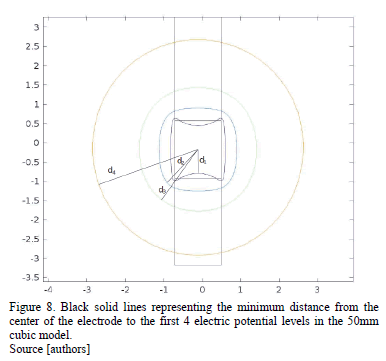
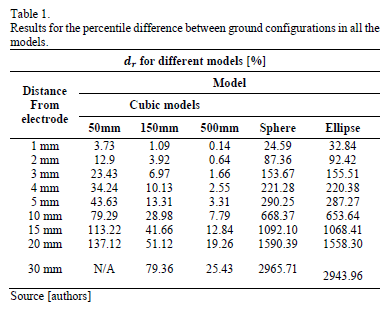
<body><![CDATA[<p align="center"><font size="2" face="Verdana, Arial, Helvetica, sans-serif"><a name="fig07"></a></font><img src="/img/revistas/dyna/v83n198/v83n198a06fig07.gif"></p>     <p><font size="2" face="Verdana, Arial, Helvetica, sans-serif">Moreover, when the size of the cube increases, the influence of the   ground configuration becomes less determinant in the shape and level of the   potential. <a href="#fig07">Fig. 7(f)</a> and <a href="#fig07">7(e)</a> show the results of ten potential curves for the   two different ground configurations of the spherical models. The same results are   presented in <a href="#fig07">Fig. 7(h)</a> and <a href="#fig07">7(g)</a> for the ellipsoidal model. The influence of the   ground when the cylinder configuration is used can be noticed, and it has   higher potential levels in farther regions from the electrode.</font></p>     <p><font size="2" face="Verdana, Arial, Helvetica, sans-serif">In order to better understand the results, a   quantitative assessment was developed to measure the electric potential in the   regions that surround the electrode in order to determine the change in the   electric propagation pattern according to different geometries. According to   the solution of the models, the distances from the center of the electrode to   each point of a single potential curve were computed. In order to measure the   distance of different potential levels in the analyzed region, the Euclidean   distance from the electrode to every point within a potential curve is   calculated using</font></p>     <p><img src="/img/revistas/dyna/v83n198/v83n198a06eq08.gif"></p>     <p><font size="2" face="Verdana, Arial, Helvetica, sans-serif">where <i>q</i> is the origin and <i>p</i> is one point placed on a potential   level curve from the coronal view; <img src="/img/revistas/dyna/v83n198/v83n198a06eq184.gif">, <img src="/img/revistas/dyna/v83n198/v83n198a06eq186.gif">, <img src="/img/revistas/dyna/v83n198/v83n198a06eq188.gif">, and <img src="/img/revistas/dyna/v83n198/v83n198a06eq190.gif"> are the components on the <img src="/img/revistas/dyna/v83n198/v83n198a06eq192.gif"> plane. This Euclidean distance is calculated   for every model, and 100 different potential levels of propagation are   analyzed. After the distance from the center of the electrode to each point of   the equipotential curve has been computed, the minimum distance for each   potential curve is selected (<a href="#fig08">Fig. 8</a> describes the methodology), using:</font></p>     <p align="center"><font size="2" face="Verdana, Arial, Helvetica, sans-serif"><a name="fig08"></a></font><img src="/img/revistas/dyna/v83n198/v83n198a06fig08.gif"></p>     <p><font size="2" face="Verdana, Arial, Helvetica, sans-serif"><a href="#fig09">Fig. 9(d)</a> shows the results from the spherical and ellipsoidal forms. In   the cylinder-base grounded models, the electric potential reaches higher values   at distances far from the electrode until an inflexion point is reached. After   the inflection point, the potential starts to decrease linearly alongside the   cylinder region. The analysis of the electric potential before the inflection   point shows that it is represented by a monotonically increasing function that   behaves similarly to the potential for the models without the cylinder ground   configuration.</font></p>     <p align="center"><font size="2" face="Verdana, Arial, Helvetica, sans-serif"><a name="fig09"></a></font><img src="/img/revistas/dyna/v83n198/v83n198a06fig09.gif"></p>     <p><font size="2" face="Verdana, Arial, Helvetica, sans-serif">Furthermore, <a href="#tab01">Table 1</a> presents the information regarding the percentile difference of   electric potential between each model's two boundary conditions at specific   distances (1, 2, 3, 4, 5, 10, 15, 20, and 30mm) from the center of the   electrode. This is computed as in Equation (10):</font></p>     <p><img src="/img/revistas/dyna/v83n198/v83n198a06eq10.gif"></p>     ]]></body>
<body><![CDATA[<p><font size="2" face="Verdana, Arial, Helvetica, sans-serif">where <img src="/img/revistas/dyna/v83n198/v83n198a06eq200.gif"> and <img src="/img/revistas/dyna/v83n198/v83n198a06eq202.gif"> represent   the value of the potential at a specific distance of the two different ground   configurations of the same model, <img src="/img/revistas/dyna/v83n198/v83n198a06eq200.gif"> for the   model with all the boundaries and <img src="/img/revistas/dyna/v83n198/v83n198a06eq202.gif"> for the   model with the ground placed on the base side.</font></p>     <p align="center"><font size="2" face="Verdana, Arial, Helvetica, sans-serif"><a name="tab01"></a></font><img src="/img/revistas/dyna/v83n198/v83n198a06tab01.gif"></p>     <p><font size="2" face="Verdana, Arial, Helvetica, sans-serif">The value of the   electric potential at the fixed distances from the electrode is obtained from   linear interpolation of the curves from the minimum distances. The size of the   model influences the propagation of the electric potential; lower levels of   potential are reached for the smaller models in comparison with the larger   models as the distance from the electrode increases. This result confirms that   building a realistic model of DBS should consider size and boundary conditions   due to the direct influence of these parameters on the final solution of the   electric potential propagation.</font></p>     <p>&nbsp;</p>     <p><font size="3" face="Verdana, Arial, Helvetica, sans-serif"><b>6. Discussion</b></font></p>     <p><font size="2" face="Verdana, Arial, Helvetica, sans-serif">The results   obtained in this work could be compared to studies such as &#91;17, 18&#93; and &#91;19&#93; in   which simulation models were built for the same DBS electrode; however, there   were a lack of real metrics that allowed a better understanding of the   simulation results such as the ones presented in this work. Additionally,   simulations for different ground configurations were not presented in the   previously mentioned state-of-the-art studies, but they were in this present   work.</font></p>     <p><font size="2" face="Verdana, Arial, Helvetica, sans-serif">Based on results, the size of the model and the ground configuration are   important parameters when modeling a specific DBS simulation. The boundary   conditions specified for the ground   configuration and the size of the different models directly affect the shape   and the magnitude of the electric potential in the region surrounding the   electrode. This can be seen in all the results for the different models in <a href="#fig07">Fig.   7</a>. For the smaller models, the pattern of propagation of the potential is more influenced   by the ground, more negative potential levels are reached far from the   electrode, in comparison to bigger sized models. The shape of the potential   levels around the electrode also changes for the two different ground   configurations. When all the model's surfaces are grounded (<a href="#fig07">Figs. 7(b)</a>, <a href="#fig07">7(d)</a>, <a href="#fig07">7(e)</a> and <a href="#fig07">7(h)</a>), a uniform potential distribution can be observed around the   electrode, and a non-uniform shape of the potential levels can be found when   the base side of the models is grounded (<a href="#fig07">Figs. 7(a)</a>, <a href="#fig07">7(c)</a>, <a href="#fig07">7(f)</a> and <a href="#fig07">7(g)</a>).</font></p>     <p><font size="2" face="Verdana, Arial, Helvetica, sans-serif">For   the quantification analysis presented in <a href="#fig09">Fig. 9</a>, it can be noticed that for the   models with the ground configured in the whole surface, the higher potential   levels reach shorter distances from the electrode than they do for the models   in which only the base side is settled to <img src="/img/revistas/dyna/v83n198/v83n198a06eq204.gif">.</font></p>     <p><img src="/img/revistas/dyna/v83n198/v83n198a06eq09.gif"></p>     <p><font size="2" face="Verdana, Arial, Helvetica, sans-serif">From <a href="#tab01">Table 1</a> it   is possible to determine that for the cubic models the larger the size of the   cube the less the influence of the ground configuration. In the case of the   spherical and ellipsoidal models, since the results of the potential level   propagation changes considerably when the base of the cylinder corresponds to   the ground, the percentile difference between the two configurations for these   models is larger than for the cubic models. Differences are reached of up to   2900% between the two different ground configurations for some distances from   the electrode. Even the comparative result shows a clear difference between the   ground configurations applied to the models. The development of a DBS realistic   model should include tissue, electrical properties and other boundary   conditions. From all of these assumptions, a DBS model could give more   realistic results. From the DBS modeling presented, several applications could   be derived; for example, a work presented by Michmizos et al. in &#91;43&#93; details the   process of predicting the Parkinsonian STN spikes using the local field   potentials that could be obtained using this approach.</font></p>     ]]></body>
<body><![CDATA[<p>&nbsp;</p>     <p><font size="3" face="Verdana, Arial, Helvetica, sans-serif"><b>7. Conclusion</b></font></p>     <p><font size="2" face="Verdana, Arial, Helvetica, sans-serif">We have   described the electromagnetic phenomena that take place during DBS using   classical electromagnetic theory. Moreover, we have shown that under the   correct assumptions, the Laplace equation is a suitable alternative to </font> <font size="2" face="Verdana, Arial, Helvetica, sans-serif">represent the   electrostatic field propagation generated after the stimulation. We have also   shown through different computer simulations how factors such as the   geometrical structure, size and the grounding of the conducting head volume   have dramatic effects over the magnitude of the electric field, particularly   for monopolar stimulation.</font></p>     <p>&nbsp;</p>     <p><font size="3" face="Verdana, Arial, Helvetica, sans-serif"><b>Acknowledgments</b></font></p>     <p><font size="2" face="Verdana, Arial, Helvetica, sans-serif">Author P.A.A was   funded by the program 617 &quot;J&oacute;venes Investigadores e Innovadores&quot;   funded by Colciencias. Author C.A.T. thanks the program &quot;Formaci&oacute;n de alto nivel para la   ciencia, la tecnolog&iacute;a la innovaci&oacute;n - Doctorado Nacional - Convoctoria 647 de   2014&quot; and the research project 111045426008 funded by Colciencias and UTP.   Author GDS was partially supported by &quot;Patrimonio Aut&oacute;nomo Fondo Nacional   de Financiamiento para la Ciencia, la Tecnolog&iacute;a y la Innovaci&oacute;n, Francisco   Jos&eacute; de Caldas&quot;, by project number 499153-530997. This work was also supported by the projects   111045426008 and 111056934461, both funded by Colciencias.</font></p>     <p>&nbsp;</p>     <p><font size="3" face="Verdana, Arial, Helvetica, sans-serif"><b>References</b></font></p>     <!-- ref --><p><font size="2" face="Verdana, Arial, Helvetica, sans-serif"><b>&#91;1&#93;</b> Benabid, A.L., Chabardes, S., Mitrofanis, J. and   Pollak, P., Deep brain stimulation of the subthalamic nucleus for the treatment   of Parkinson's disease. The Lancet Neurology, 8(1), pp.67-81, 2009.    &nbsp;&nbsp;&nbsp;&nbsp;&nbsp;&nbsp;&nbsp;&nbsp;[&#160;<a href="javascript:void(0);" onclick="javascript: window.open('/scielo.php?script=sci_nlinks&ref=1147491&pid=S0012-7353201600040000600001&lng=','','width=640,height=500,resizable=yes,scrollbars=1,menubar=yes,');">Links</a>&#160;]<!-- end-ref --></font></p>     ]]></body>
<body><![CDATA[<!-- ref --><p><font size="2" face="Verdana, Arial, Helvetica, sans-serif"><b>&#91;2&#93;</b> de Lau, L.M. and Breteler, M.M., Epidemiology of   parkinson's disease. The Lancet Neurology, 5(6), pp. 525-535, 2006. DOI:   10.1016/S1474-4422 (06)70471-9.    &nbsp;&nbsp;&nbsp;&nbsp;&nbsp;&nbsp;&nbsp;&nbsp;[&#160;<a href="javascript:void(0);" onclick="javascript: window.open('/scielo.php?script=sci_nlinks&ref=1147493&pid=S0012-7353201600040000600002&lng=','','width=640,height=500,resizable=yes,scrollbars=1,menubar=yes,');">Links</a>&#160;]<!-- end-ref --></font></p>     <!-- ref --><p><font size="2" face="Verdana, Arial, Helvetica, sans-serif"><b>&#91;3&#93;</b> Limousin, P., Pollak, P., Benazzouz, A., Hoffmann,   D., Bas, J.F.L., Perret, J., Benabid, A.L. and Broussolle, E., Effect on   parkinsonian signs and symptoms of bilateral subthalamic nucleus stimulation.   The Lancet Neurology, 345(8942), pp. 91-95, 1995. DOI: 10.1016/S0140-6736   (95)90062-4.    &nbsp;&nbsp;&nbsp;&nbsp;&nbsp;&nbsp;&nbsp;&nbsp;[&#160;<a href="javascript:void(0);" onclick="javascript: window.open('/scielo.php?script=sci_nlinks&ref=1147495&pid=S0012-7353201600040000600003&lng=','','width=640,height=500,resizable=yes,scrollbars=1,menubar=yes,');">Links</a>&#160;]<!-- end-ref --></font></p>     <!-- ref --><p><font size="2" face="Verdana, Arial, Helvetica, sans-serif"><b>&#91;4&#93;</b> Benabid, A.L., Deep brain   stimulation for parkinson's disease. Current Opinion in Neurobiology, 13(6),   pp. 696-706, 2003. DOI: 10.1016/j.conb.2003.11.001, URL <a href="http://www.sciencedirect.com/science/article/pii/S0959438803001739" target="_blank">http://www.sciencedirect.com/science/article/pii/S0959438803001739</a>.    &nbsp;&nbsp;&nbsp;&nbsp;&nbsp;&nbsp;&nbsp;&nbsp;[&#160;<a href="javascript:void(0);" onclick="javascript: window.open('/scielo.php?script=sci_nlinks&ref=1147497&pid=S0012-7353201600040000600004&lng=','','width=640,height=500,resizable=yes,scrollbars=1,menubar=yes,');">Links</a>&#160;]<!-- end-ref --></font></p>     <!-- ref --><p><font size="2" face="Verdana, Arial, Helvetica, sans-serif"><b>&#91;5&#93;</b> Visser-Vandewalle, Y.T., The   functional role of the subthalamic nucleus in cognitive and limbic circuits.   Progress in Neurobiology, 76, 2005. DOI: 10.1016/j.pneurobio.2005.09.005.    &nbsp;&nbsp;&nbsp;&nbsp;&nbsp;&nbsp;&nbsp;&nbsp;[&#160;<a href="javascript:void(0);" onclick="javascript: window.open('/scielo.php?script=sci_nlinks&ref=1147499&pid=S0012-7353201600040000600005&lng=','','width=640,height=500,resizable=yes,scrollbars=1,menubar=yes,');">Links</a>&#160;]<!-- end-ref --></font></p>     <!-- ref --><p><font size="2" face="Verdana, Arial, Helvetica, sans-serif"><b>&#91;6&#93;</b> Chaturvedi, A., Butson, C.R., Lempka, S.F., Cooper,   S.E. and McIntyre, C.C., Patient-specific models of deep brain stimulation:   Influence of field model complexity on neural activation predictions. Brain   Stimulation, 3, pp. 65-77, 2010.    &nbsp;&nbsp;&nbsp;&nbsp;&nbsp;&nbsp;&nbsp;&nbsp;[&#160;<a href="javascript:void(0);" onclick="javascript: window.open('/scielo.php?script=sci_nlinks&ref=1147501&pid=S0012-7353201600040000600006&lng=','','width=640,height=500,resizable=yes,scrollbars=1,menubar=yes,');">Links</a>&#160;]<!-- end-ref --></font></p>     ]]></body>
<body><![CDATA[<!-- ref --><p><font size="2" face="Verdana, Arial, Helvetica, sans-serif"><b>&#91;7&#93;</b> Kuncel,   A.M. and Grill, W.M., Selection of stimulus parameters for deep brain   stimulation. Clinical Neurophysiology, 115, pp. 2431-2441, 2004.    &nbsp;&nbsp;&nbsp;&nbsp;&nbsp;&nbsp;&nbsp;&nbsp;[&#160;<a href="javascript:void(0);" onclick="javascript: window.open('/scielo.php?script=sci_nlinks&ref=1147503&pid=S0012-7353201600040000600007&lng=','','width=640,height=500,resizable=yes,scrollbars=1,menubar=yes,');">Links</a>&#160;]<!-- end-ref --></font></p>     <!-- ref --><p><font size="2" face="Verdana, Arial, Helvetica, sans-serif"><b>&#91;8&#93;</b> Montgomery,   E.B., Deep brain stimulation programming. Principles and practice. Oxford   University Press, USA, 2010.    &nbsp;&nbsp;&nbsp;&nbsp;&nbsp;&nbsp;&nbsp;&nbsp;[&#160;<a href="javascript:void(0);" onclick="javascript: window.open('/scielo.php?script=sci_nlinks&ref=1147505&pid=S0012-7353201600040000600008&lng=','','width=640,height=500,resizable=yes,scrollbars=1,menubar=yes,');">Links</a>&#160;]<!-- end-ref --></font></p>     <!-- ref --><p><font size="2" face="Verdana, Arial, Helvetica, sans-serif"><b>&#91;9&#93;</b> Obeso,   J.A., Marin, C., Rodriguez-Oroz, C., Blesa, J., Benitez, B., Mena-Segovia, J.,   Rodr&iacute;guez, M. and Olanow, C.W., The basal ganglia in Parkinson's disease:   Current concepts and unexplained observations, Annals of Neurology, 64(S2), pp.   S30-S46, 2008. DOI 10.1002/ana.2148.    &nbsp;&nbsp;&nbsp;&nbsp;&nbsp;&nbsp;&nbsp;&nbsp;[&#160;<a href="javascript:void(0);" onclick="javascript: window.open('/scielo.php?script=sci_nlinks&ref=1147507&pid=S0012-7353201600040000600009&lng=','','width=640,height=500,resizable=yes,scrollbars=1,menubar=yes,');">Links</a>&#160;]<!-- end-ref --></font></p>     <!-- ref --><p><font size="2" face="Verdana, Arial, Helvetica, sans-serif"><b>&#91;10&#93;</b> Obeso,   J.A., Rodr&iacute;guez-Oroz, M.C., Benitez-Temino, B., Blesa, F.J., Guridi, J., Marin,   C. and Rodriguez, M., Functional organization of the basal ganglia: Therapeutic   implications for parkinson's disease, Movement Disorders, 23(S3), pp. S548-   S559, 2008. DOI 10.1002/mds.22062,    &nbsp;&nbsp;&nbsp;&nbsp;&nbsp;&nbsp;&nbsp;&nbsp;[&#160;<a href="javascript:void(0);" onclick="javascript: window.open('/scielo.php?script=sci_nlinks&ref=1147509&pid=S0012-7353201600040000600010&lng=','','width=640,height=500,resizable=yes,scrollbars=1,menubar=yes,');">Links</a>&#160;]<!-- end-ref --></font></p>     <!-- ref --><p><font size="2" face="Verdana, Arial, Helvetica, sans-serif"><b>&#91;11&#93;</b> Vitek,   J.L., Mechanisms of deep brain stimulation: Excitation or inhibition, Movement   Disorders, 17(S3), pp. S69-S72, 2002. DOI 10.1002/mds.10144.    &nbsp;&nbsp;&nbsp;&nbsp;&nbsp;&nbsp;&nbsp;&nbsp;[&#160;<a href="javascript:void(0);" onclick="javascript: window.open('/scielo.php?script=sci_nlinks&ref=1147511&pid=S0012-7353201600040000600011&lng=','','width=640,height=500,resizable=yes,scrollbars=1,menubar=yes,');">Links</a>&#160;]<!-- end-ref --></font></p>     ]]></body>
<body><![CDATA[<!-- ref --><p><font size="2" face="Verdana, Arial, Helvetica, sans-serif"><b>&#91;12&#93;</b> Volkmann,   J., Herzog, J., Kopper, F. and Deuschl, G., Introduction to the programming of   deep brain stimulators. Movement Disorders, 17(S3), pp. S181-S187, 2002. DOI:   10. 1002/mds.10162.    &nbsp;&nbsp;&nbsp;&nbsp;&nbsp;&nbsp;&nbsp;&nbsp;[&#160;<a href="javascript:void(0);" onclick="javascript: window.open('/scielo.php?script=sci_nlinks&ref=1147513&pid=S0012-7353201600040000600012&lng=','','width=640,height=500,resizable=yes,scrollbars=1,menubar=yes,');">Links</a>&#160;]<!-- end-ref --></font></p>     <!-- ref --><p><font size="2" face="Verdana, Arial, Helvetica, sans-serif"><b>&#91;13&#93;</b> Krack,   P., Fraix, V., Mendes, A., Benabid, A.L. and Pollak, P., Postoperative   management of subthalamic nucleus stimulation for parkinson's disease. Movement   Disorders, 17(S3), pp. S188-S197, 2002. DOI: 10.1002/mds.10163,    &nbsp;&nbsp;&nbsp;&nbsp;&nbsp;&nbsp;&nbsp;&nbsp;[&#160;<a href="javascript:void(0);" onclick="javascript: window.open('/scielo.php?script=sci_nlinks&ref=1147515&pid=S0012-7353201600040000600013&lng=','','width=640,height=500,resizable=yes,scrollbars=1,menubar=yes,');">Links</a>&#160;]<!-- end-ref --> </font></p>     <!-- ref --><p><font size="2" face="Verdana, Arial, Helvetica, sans-serif"><b>&#91;14&#93;</b> McIntyre, C.C., Frankenmolle, A.M., Wu, J.,   Noecker, A.M. and Alberts, J.L., Customizing deep brain stimulation to the   patient using computational models. In: 31st Annual International Conference of   the IEEE EMBS, Mineapolis, MN, USA, pp 4228-4229, 2009.    &nbsp;&nbsp;&nbsp;&nbsp;&nbsp;&nbsp;&nbsp;&nbsp;[&#160;<a href="javascript:void(0);" onclick="javascript: window.open('/scielo.php?script=sci_nlinks&ref=1147517&pid=S0012-7353201600040000600014&lng=','','width=640,height=500,resizable=yes,scrollbars=1,menubar=yes,');">Links</a>&#160;]<!-- end-ref --></font></p>     <!-- ref --><p><font size="2" face="Verdana, Arial, Helvetica, sans-serif"><b>&#91;15&#93;</b> Pollak, P., Krack, P., Fraix, V., Mendes, A., Moro,   E., Chabardes, S. and Benabid, A.L., Intraoperative micro- and   macroestimulation of the subthalamic nucleus in Parkinson's disease. Movement Disorders,   17(3), pp. S155-S16, 2002.    &nbsp;&nbsp;&nbsp;&nbsp;&nbsp;&nbsp;&nbsp;&nbsp;[&#160;<a href="javascript:void(0);" onclick="javascript: window.open('/scielo.php?script=sci_nlinks&ref=1147519&pid=S0012-7353201600040000600015&lng=','','width=640,height=500,resizable=yes,scrollbars=1,menubar=yes,');">Links</a>&#160;]<!-- end-ref --></font></p>     <!-- ref --><p><font size="2" face="Verdana, Arial, Helvetica, sans-serif"><b>&#91;16&#93;</b> McIntyre, C.C., Butson, C.R., Maks, C.B. and   Noecker, A., Optimizing deep brain stimulation parameter selection with   detailed models of the electrode-tissue interface. In: 28<sup>th </sup>Annual   International Conference of the IEEE EMBS, New York, NY, USA, pp 893-895, 2006.    &nbsp;&nbsp;&nbsp;&nbsp;&nbsp;&nbsp;&nbsp;&nbsp;[&#160;<a href="javascript:void(0);" onclick="javascript: window.open('/scielo.php?script=sci_nlinks&ref=1147521&pid=S0012-7353201600040000600016&lng=','','width=640,height=500,resizable=yes,scrollbars=1,menubar=yes,');">Links</a>&#160;]<!-- end-ref --></font></p>     ]]></body>
<body><![CDATA[<!-- ref --><p><font size="2" face="Verdana, Arial, Helvetica, sans-serif"><b>&#91;17&#93;</b> Grant, P.F. and Lowery, M.M., Electric field   distribution in a finite-volume head model of deep brain stimulation. Medical   Engineering &amp; Physics, 31, pp. 1095-1103, 2009.    &nbsp;&nbsp;&nbsp;&nbsp;&nbsp;&nbsp;&nbsp;&nbsp;[&#160;<a href="javascript:void(0);" onclick="javascript: window.open('/scielo.php?script=sci_nlinks&ref=1147523&pid=S0012-7353201600040000600017&lng=','','width=640,height=500,resizable=yes,scrollbars=1,menubar=yes,');">Links</a>&#160;]<!-- end-ref --></font></p>     <!-- ref --><p><font size="2" face="Verdana, Arial, Helvetica, sans-serif"><b>&#91;18&#93;</b> Schmidt, C. and van Rienen, U., Modeling the field   distribution in deep brain stimulation: The influence of anisotropy of brain   tissue. IEEE Transactions on Biomedical Engineering, 59(6), pp. 1583-1592,   2012.    &nbsp;&nbsp;&nbsp;&nbsp;&nbsp;&nbsp;&nbsp;&nbsp;[&#160;<a href="javascript:void(0);" onclick="javascript: window.open('/scielo.php?script=sci_nlinks&ref=1147525&pid=S0012-7353201600040000600018&lng=','','width=640,height=500,resizable=yes,scrollbars=1,menubar=yes,');">Links</a>&#160;]<!-- end-ref --></font></p>     <!-- ref --><p><font size="2" face="Verdana, Arial, Helvetica, sans-serif"><b>&#91;19&#93;</b> McIntyre, C.C., Morib, S., Shermanc, D.L., Thakorc,   N.V. and Vitek, J.L., Electric field and stimulating influence generated by   deep brain stimulation of the subthalamic nucleus. Clinical Neurophysiology,   115, pp. 589-595, 2004.    &nbsp;&nbsp;&nbsp;&nbsp;&nbsp;&nbsp;&nbsp;&nbsp;[&#160;<a href="javascript:void(0);" onclick="javascript: window.open('/scielo.php?script=sci_nlinks&ref=1147527&pid=S0012-7353201600040000600019&lng=','','width=640,height=500,resizable=yes,scrollbars=1,menubar=yes,');">Links</a>&#160;]<!-- end-ref --></font></p>     <!-- ref --><p><font size="2" face="Verdana, Arial, Helvetica, sans-serif"><b>&#91;20&#93;</b> Walckiers,   G., Fuchs, B., Thiran, J.P., Mosig, J.R. and Pollo, C., Influence of the   implanted pulse generator as reference electrode in finite element model of   monopolar deep brain stimulation. Journal of Neuroscience Methods, 186, pp.   90-96, 2010.    &nbsp;&nbsp;&nbsp;&nbsp;&nbsp;&nbsp;&nbsp;&nbsp;[&#160;<a href="javascript:void(0);" onclick="javascript: window.open('/scielo.php?script=sci_nlinks&ref=1147529&pid=S0012-7353201600040000600020&lng=','','width=640,height=500,resizable=yes,scrollbars=1,menubar=yes,');">Links</a>&#160;]<!-- end-ref --></font></p>     <!-- ref --><p><font size="2" face="Verdana, Arial, Helvetica, sans-serif"><b>&#91;21&#93;</b> Liberti,   M., Apollonio, F., Paffi, A., Parazzini, M., Maggio, F., Novellino, T.,   Ravazzani, P. and D'Inzeo, G., Fundamental electrical quantities in deep brain   stimulation: Influence of domain dimensions and boundary conditions. In: 29<sup>th</sup> Annual International Conference of the IEEE EMBS, Lyon, France, pp 6668-6671,   2007.    &nbsp;&nbsp;&nbsp;&nbsp;&nbsp;&nbsp;&nbsp;&nbsp;[&#160;<a href="javascript:void(0);" onclick="javascript: window.open('/scielo.php?script=sci_nlinks&ref=1147531&pid=S0012-7353201600040000600021&lng=','','width=640,height=500,resizable=yes,scrollbars=1,menubar=yes,');">Links</a>&#160;]<!-- end-ref --></font></p>     ]]></body>
<body><![CDATA[<!-- ref --><p><font size="2" face="Verdana, Arial, Helvetica, sans-serif"><b>&#91;22&#93;</b> McIntyre,   C.C. and Grill, W.M., Extracellular stimulation of central neurons: Influence   of stimulus waveform and frequency on neuronal output. Journal of   Neurophysiology, 88, pp. 1592-1604, 2002.    &nbsp;&nbsp;&nbsp;&nbsp;&nbsp;&nbsp;&nbsp;&nbsp;[&#160;<a href="javascript:void(0);" onclick="javascript: window.open('/scielo.php?script=sci_nlinks&ref=1147533&pid=S0012-7353201600040000600022&lng=','','width=640,height=500,resizable=yes,scrollbars=1,menubar=yes,');">Links</a>&#160;]<!-- end-ref --></font></p>     <!-- ref --><p><font size="2" face="Verdana, Arial, Helvetica, sans-serif"><b>&#91;23&#93;</b> Martens,   H., Toader, E., Decr, M., Anderson, D., Vetter, R., Kipke, D., Baker, K.B.,   Johnson, M.D. and Vitek, J.L., Quasi-stationary fields for microelectronic   applications. Clinical Neurophysiology, 122, pp. 558-566, 2011.    &nbsp;&nbsp;&nbsp;&nbsp;&nbsp;&nbsp;&nbsp;&nbsp;[&#160;<a href="javascript:void(0);" onclick="javascript: window.open('/scielo.php?script=sci_nlinks&ref=1147535&pid=S0012-7353201600040000600023&lng=','','width=640,height=500,resizable=yes,scrollbars=1,menubar=yes,');">Links</a>&#160;]<!-- end-ref --></font></p>     <!-- ref --><p><font size="2" face="Verdana, Arial, Helvetica, sans-serif"><b>&#91;24&#93;</b> Butson,   C.R. and McIntyre, C.C., Tissue and electrode capacitance reduce neural   activation volumes during deep brain stimulation. Clinical Neurophysiology,   116, pp. 2490-2500, 2005.    &nbsp;&nbsp;&nbsp;&nbsp;&nbsp;&nbsp;&nbsp;&nbsp;[&#160;<a href="javascript:void(0);" onclick="javascript: window.open('/scielo.php?script=sci_nlinks&ref=1147537&pid=S0012-7353201600040000600024&lng=','','width=640,height=500,resizable=yes,scrollbars=1,menubar=yes,');">Links</a>&#160;]<!-- end-ref --></font></p>     <!-- ref --><p><font size="2" face="Verdana, Arial, Helvetica, sans-serif"><b>&#91;25&#93;</b> Alvarez-Alvarez, D., Rosero-Garcia, J. and   Mombello, E., Core influence on the frequency response analysis (FRA) of power   transformers through the finite element method. Ingenier&iacute;a e Investigaci&oacute;n,   35(1Sup), pp. 110-117. 2015. DOI: 10.15446/ing.investig.v35n1Sup.53771.    &nbsp;&nbsp;&nbsp;&nbsp;&nbsp;&nbsp;&nbsp;&nbsp;[&#160;<a href="javascript:void(0);" onclick="javascript: window.open('/scielo.php?script=sci_nlinks&ref=1147539&pid=S0012-7353201600040000600025&lng=','','width=640,height=500,resizable=yes,scrollbars=1,menubar=yes,');">Links</a>&#160;]<!-- end-ref --></font></p>     <!-- ref --><p><font size="2" face="Verdana, Arial, Helvetica, sans-serif"><b>&#91;26&#93;</b> Linero-Segrera, D., Oliver, J. and Huespe, A.,   Numerical modelling of the fracture process in reinforced concrete by means of   a continuum strong discontinuity approach. Part II: application to shear   panels. Ingenier&iacute;a e Investigaci&oacute;n, 30(3), pp. 16-26, 2010.    &nbsp;&nbsp;&nbsp;&nbsp;&nbsp;&nbsp;&nbsp;&nbsp;[&#160;<a href="javascript:void(0);" onclick="javascript: window.open('/scielo.php?script=sci_nlinks&ref=1147541&pid=S0012-7353201600040000600026&lng=','','width=640,height=500,resizable=yes,scrollbars=1,menubar=yes,');">Links</a>&#160;]<!-- end-ref --></font></p>     ]]></body>
<body><![CDATA[<!-- ref --><p><font size="2" face="Verdana, Arial, Helvetica, sans-serif"><b>&#91;27&#93;</b> Alvarado, P.A., Alvarez, M.A.,   Daza-Santacoloma, G., Orozco, A. and Castellanos-Dominguez, G., A latent force model for describing   electric propagation in deep brain stimulation: A simulation study. In:   Engineering in Medicine and Biology Society (EMBC), 2014 36th Annual   International Conference of the IEEE, pp. 2617-2620, 2014.    &nbsp;&nbsp;&nbsp;&nbsp;&nbsp;&nbsp;&nbsp;&nbsp;[&#160;<a href="javascript:void(0);" onclick="javascript: window.open('/scielo.php?script=sci_nlinks&ref=1147543&pid=S0012-7353201600040000600027&lng=','','width=640,height=500,resizable=yes,scrollbars=1,menubar=yes,');">Links</a>&#160;]<!-- end-ref --></font></p>     <!-- ref --><p><font size="2" face="Verdana, Arial, Helvetica, sans-serif"><b>&#91;28&#93;</b> Torres-Valencia, C.A.,   Daza-Santacoloma, G., &Aacute;lvarez-L&oacute;pez, M.A. and Orozco-Guti&eacute;rrez, &Aacute;.&Aacute;.,   Deep brain stimulation modeling for several anatomical and electrical   considerations. Iteckne, 11(2), pp. 140-148. 2014.    &nbsp;&nbsp;&nbsp;&nbsp;&nbsp;&nbsp;&nbsp;&nbsp;[&#160;<a href="javascript:void(0);" onclick="javascript: window.open('/scielo.php?script=sci_nlinks&ref=1147545&pid=S0012-7353201600040000600028&lng=','','width=640,height=500,resizable=yes,scrollbars=1,menubar=yes,');">Links</a>&#160;]<!-- end-ref --></font></p>     <!-- ref --><p><font size="2" face="Verdana, Arial, Helvetica, sans-serif"><b>&#91;29&#93;</b> Volkmann, J., Herzog, J., Kopper, F. and Deuschl,   G., Introduction to the programming of deep brain stimulators. Mov Disord, 17,   pp. S181-S187, 2002.    &nbsp;&nbsp;&nbsp;&nbsp;&nbsp;&nbsp;&nbsp;&nbsp;[&#160;<a href="javascript:void(0);" onclick="javascript: window.open('/scielo.php?script=sci_nlinks&ref=1147547&pid=S0012-7353201600040000600029&lng=','','width=640,height=500,resizable=yes,scrollbars=1,menubar=yes,');">Links</a>&#160;]<!-- end-ref --></font></p>     <!-- ref --><p><font size="2" face="Verdana, Arial, Helvetica, sans-serif"><b>&#91;30&#93;</b> O'Suilleabhain,   P., Frawley, W., Giller, C. and Dewey, R., Tremor response to polarity,   voltage, pulsewidth and frequency of thalamic stimulation. Neurology, 60, pp.   786-790, 2003.    &nbsp;&nbsp;&nbsp;&nbsp;&nbsp;&nbsp;&nbsp;&nbsp;[&#160;<a href="javascript:void(0);" onclick="javascript: window.open('/scielo.php?script=sci_nlinks&ref=1147549&pid=S0012-7353201600040000600030&lng=','','width=640,height=500,resizable=yes,scrollbars=1,menubar=yes,');">Links</a>&#160;]<!-- end-ref --></font></p>     <!-- ref --><p><font size="2" face="Verdana, Arial, Helvetica, sans-serif"><b>&#91;31&#93;</b> Steinmetz, T., Kurz, S. and Clemens, M., Domains of   validity of quasistatic and quasistationary field approximations. In: 15th   International Symposium on Theoretical Electrical Engineering ISTET, Lubeck,   Germnay, pp 271-275, 2009.    &nbsp;&nbsp;&nbsp;&nbsp;&nbsp;&nbsp;&nbsp;&nbsp;[&#160;<a href="javascript:void(0);" onclick="javascript: window.open('/scielo.php?script=sci_nlinks&ref=1147551&pid=S0012-7353201600040000600031&lng=','','width=640,height=500,resizable=yes,scrollbars=1,menubar=yes,');">Links</a>&#160;]<!-- end-ref --></font></p>     ]]></body>
<body><![CDATA[<!-- ref --><p><font size="2" face="Verdana, Arial, Helvetica, sans-serif"><b>&#91;32&#93;</b> Schmidt, K., Sterz, O. and Hiptmair, R., Estimating   the eddy-current modelling error. IEEE Trans Magn, 44(6), pp. 686-689, 2008.    &nbsp;&nbsp;&nbsp;&nbsp;&nbsp;&nbsp;&nbsp;&nbsp;[&#160;<a href="javascript:void(0);" onclick="javascript: window.open('/scielo.php?script=sci_nlinks&ref=1147553&pid=S0012-7353201600040000600032&lng=','','width=640,height=500,resizable=yes,scrollbars=1,menubar=yes,');">Links</a>&#160;]<!-- end-ref --></font></p>     <!-- ref --><p><font size="2" face="Verdana, Arial, Helvetica, sans-serif"><b>&#91;33&#93;</b> Saville, D.A., Electrohydrodynamics: The taylor   melcher leaky dielectric model. Annual Rev Fluid Mech, 29, pp. 27-64, 1997.    &nbsp;&nbsp;&nbsp;&nbsp;&nbsp;&nbsp;&nbsp;&nbsp;[&#160;<a href="javascript:void(0);" onclick="javascript: window.open('/scielo.php?script=sci_nlinks&ref=1147555&pid=S0012-7353201600040000600033&lng=','','width=640,height=500,resizable=yes,scrollbars=1,menubar=yes,');">Links</a>&#160;]<!-- end-ref --></font></p>     <!-- ref --><p><font size="2" face="Verdana, Arial, Helvetica, sans-serif"><b>&#91;34&#93;</b> Dirks,   H.K., Quasi-stationary fields for microelectronic applications. Electrical   Engineering, 79, pp. 145-155, 1997.    &nbsp;&nbsp;&nbsp;&nbsp;&nbsp;&nbsp;&nbsp;&nbsp;[&#160;<a href="javascript:void(0);" onclick="javascript: window.open('/scielo.php?script=sci_nlinks&ref=1147557&pid=S0012-7353201600040000600034&lng=','','width=640,height=500,resizable=yes,scrollbars=1,menubar=yes,');">Links</a>&#160;]<!-- end-ref --></font></p>     <!-- ref --><p><font size="2" face="Verdana, Arial, Helvetica, sans-serif"><b>&#91;35&#93;</b> Sadiku, M.N.O., Elements of electromagnetics.   Oxford University Press, USA, 2002.    &nbsp;&nbsp;&nbsp;&nbsp;&nbsp;&nbsp;&nbsp;&nbsp;[&#160;<a href="javascript:void(0);" onclick="javascript: window.open('/scielo.php?script=sci_nlinks&ref=1147559&pid=S0012-7353201600040000600035&lng=','','width=640,height=500,resizable=yes,scrollbars=1,menubar=yes,');">Links</a>&#160;]<!-- end-ref --></font></p>     <!-- ref --><p><font size="2" face="Verdana, Arial, Helvetica, sans-serif"><b>&#91;36&#93;</b> Ostrowski,   J., Hiptmair, R., Kramer, F., Smajic, J. and Steinmetz, T., Transient full   Maxwell computation of slow processes. In: 8th Scientific Computation in   Electrical Engineering conference SCEE, Toulouse, France, pp 87-95, 2010.    &nbsp;&nbsp;&nbsp;&nbsp;&nbsp;&nbsp;&nbsp;&nbsp;[&#160;<a href="javascript:void(0);" onclick="javascript: window.open('/scielo.php?script=sci_nlinks&ref=1147561&pid=S0012-7353201600040000600036&lng=','','width=640,height=500,resizable=yes,scrollbars=1,menubar=yes,');">Links</a>&#160;]<!-- end-ref --></font></p>     ]]></body>
<body><![CDATA[<!-- ref --><p><font size="2" face="Verdana, Arial, Helvetica, sans-serif"><b>&#91;37&#93;</b> Carpenter, M., Anatomy of the corpus striatum and   brain stem integrating systems. John Wiley &amp; Sons, Inc., 1981.    &nbsp;&nbsp;&nbsp;&nbsp;&nbsp;&nbsp;&nbsp;&nbsp;[&#160;<a href="javascript:void(0);" onclick="javascript: window.open('/scielo.php?script=sci_nlinks&ref=1147563&pid=S0012-7353201600040000600037&lng=','','width=640,height=500,resizable=yes,scrollbars=1,menubar=yes,');">Links</a>&#160;]<!-- end-ref --></font></p>     <!-- ref --><p><font size="2" face="Verdana, Arial, Helvetica, sans-serif"><b>&#91;38&#93;</b> </b>Bossetti, C.A., Birdno, M.J. and Grill, W.M.,   Analysis of the quasi-static approximation for calculating potentials generated   by neural stimulation. Journal of Neural Engineering, 59(5), pp. 44-53, 2008.    &nbsp;&nbsp;&nbsp;&nbsp;&nbsp;&nbsp;&nbsp;&nbsp;[&#160;<a href="javascript:void(0);" onclick="javascript: window.open('/scielo.php?script=sci_nlinks&ref=1147565&pid=S0012-7353201600040000600038&lng=','','width=640,height=500,resizable=yes,scrollbars=1,menubar=yes,');">Links</a>&#160;]<!-- end-ref --></font></p>     <!-- ref --><p><font size="2" face="Verdana, Arial, Helvetica, sans-serif"><b>&#91;39&#93;</b> Andreuccetti,   D., Fossi, R. and Petrucci, C., An internet resource for the calculation of the   dielectric properties of body tissues in the frequency range 10 hz - 100 ghz.   IFAC-CNR, Florence, Italy, 1997, pp 87-95.    &nbsp;&nbsp;&nbsp;&nbsp;&nbsp;&nbsp;&nbsp;&nbsp;[&#160;<a href="javascript:void(0);" onclick="javascript: window.open('/scielo.php?script=sci_nlinks&ref=1147567&pid=S0012-7353201600040000600039&lng=','','width=640,height=500,resizable=yes,scrollbars=1,menubar=yes,');">Links</a>&#160;]<!-- end-ref --></font></p>     <!-- ref --><p><font size="2" face="Verdana, Arial, Helvetica, sans-serif"><b>&#91;40&#93;</b> Hofmanis, J., Louis-Dorr, V., Cecchin, T., Caspary,   O. and Koessler, L., Propagation of electrical field in the brain using   electrical intra-cerebral stimulations. In: Engineering in Medicine and Biology   Society, EMBC, 2011 Annual International Conference of the IEEE, pp 3888-3891,   2011. DOI 10.1109/IEMBS.2011.6090966.    &nbsp;&nbsp;&nbsp;&nbsp;&nbsp;&nbsp;&nbsp;&nbsp;[&#160;<a href="javascript:void(0);" onclick="javascript: window.open('/scielo.php?script=sci_nlinks&ref=1147569&pid=S0012-7353201600040000600040&lng=','','width=640,height=500,resizable=yes,scrollbars=1,menubar=yes,');">Links</a>&#160;]<!-- end-ref --></font></p>     <!-- ref --><p><font size="2" face="Verdana, Arial, Helvetica, sans-serif"><b>&#91;41&#93;</b> </b>Iacono, M.I., Makris, N., Mainardi, L.T., Angelone,   L.M. and Bonmassar, G., Mri-based multiscale model for electromagnetic analysis   in the human head with implanted dbs. Comp Math Methods in Medicine &#91;Online&#93;.   2013. Available at: <a href="http://dblp.uni-trier.de/db/journals/cmmm/cmmm2013.html#IaconoMMAB13" target="_blank">http://dblp.uni-trier.de/db/journals/cmmm/cmmm2013.html#IaconoMMAB13</a></font>&nbsp;&nbsp;&nbsp;&nbsp;&nbsp;&nbsp;&nbsp;&nbsp;[&#160;<a href="javascript:void(0);" onclick="javascript: window.open('/scielo.php?script=sci_nlinks&ref=1147571&pid=S0012-7353201600040000600041&lng=','','width=640,height=500,resizable=yes,scrollbars=1,menubar=yes,');">Links</a>&#160;]<!-- end-ref --><!-- ref --><p><font size="2" face="Verdana, Arial, Helvetica, sans-serif"><b>&#91;42&#93;</b> Forero, M. and Zulanga, D., Medical station for   image processing and visualization of the brain electrical activity on a   three-dimensional reconstruction of the patient's head. Ingenier&iacute;a e   Investigaci&oacute;n, 23(3), pp. 31-38, 2010.    &nbsp;&nbsp;&nbsp;&nbsp;&nbsp;&nbsp;&nbsp;&nbsp;[&#160;<a href="javascript:void(0);" onclick="javascript: window.open('/scielo.php?script=sci_nlinks&ref=1147572&pid=S0012-7353201600040000600042&lng=','','width=640,height=500,resizable=yes,scrollbars=1,menubar=yes,');">Links</a>&#160;]<!-- end-ref --></font></p>     <!-- ref --><p><font size="2" face="Verdana, Arial, Helvetica, sans-serif"><b>&#91;43&#93;</b> Michmizos, K., Sakas, D. and Nikita, K., Prediction   of the timing and the rhythm of the parkinsonian subthalamic nucleus neural   spikes using the local field potentials. Information Technology in Biomedicine,   IEEE Transactions on, 16(2), pp. 190-197, 2012. DOI 10.1109/TITB.2011.2158549.    &nbsp;&nbsp;&nbsp;&nbsp;&nbsp;&nbsp;&nbsp;&nbsp;[&#160;<a href="javascript:void(0);" onclick="javascript: window.open('/scielo.php?script=sci_nlinks&ref=1147574&pid=S0012-7353201600040000600043&lng=','','width=640,height=500,resizable=yes,scrollbars=1,menubar=yes,');">Links</a>&#160;]<!-- end-ref --></font></p>     <p>&nbsp; </p>     <p><font size="2" face="Verdana, Arial, Helvetica, sans-serif"><b>P.A. Alvarado, </b>is   interested in probabilistic approaches for modeling music signals, with a focus   on Gaussian processes and kernel methods. Alvarado holds an Electronic   Engineering degree from Universidad Tecnol&oacute;gica de Pereira, Colombia, and a MSc   in Electric Engineering from the UTP. Alvarado is currently a member of Centre   for Digital Music pursuing a PhD at Queen Mary University of London. ORCID: 0000-0002-9347-5093</font></p>     <p><font size="2" face="Verdana, Arial, Helvetica, sans-serif"><b>C.A. Torres-Valencia, </b>received his BSc. in Electronic Engineering in 2010   from the Universidad del Quind&iacute;o, his MSc. in Electric Engineering in 2013 from   the Universidad Tecnol&oacute;gica de Pereira, Colombia. From 2011 to date, he has   been working in the Automatics research group at the Universidad Tecnol&oacute;gica de   Pereira. Currently he is a Doctoral student at the Universidad Tecnol&oacute;gica de   Pereira and funded by Colciencias´ &quot;Doctorado Nacional - 647&quot; program. His   research interests include image processing, biosignal processing,   neuroengineering and machine learning. ORCID: 0000-0001-7568-6148</font></p>     <p><font size="2" face="Verdana, Arial, Helvetica, sans-serif"><b>A.A. Orozco-Gutierrez, </b>received   a degree Electric Engineering in 1985, a MSc. degree in Electric Engineering in   2004, both from the Universidad Tecnol&oacute;gica de Pereira, and a PhD in   Bioengineering from the Universidad Polit&eacute;cnica de Valencia in 2009. He is   currently an Associate Professor at the Universidad Tecnol&oacute;gica de Pereira. His   research interests include instrumentation and control, bioengineering and   biosignal processing.  ORCID: 0000-0002-1167-1446</font></p>     <p><font size="2" face="Verdana, Arial, Helvetica, sans-serif"><b>M.A. &Aacute;lvarez L&oacute;pez, </b>received   a degree BSc. in Electronic Engineering from the Universidad Nacional de   Colombia in 2004, a MSc. degree in Electrical Engineering from the Universidad   Tecnol&oacute;gica de Pereira, Colombia, and a PhD in Computer Science from the   University of Manchester, UK, in 2011. He is currently an associate professor   at the Universidad Tecnol&oacute;gica de Pereira, Colombia. His research interests   include probabilistic models, kernel methods and stochastic processes. ORCID: 0000-0002-8980-4472</font></p>     <p><font size="2" face="Verdana, Arial, Helvetica, sans-serif"><b>G. Daza-Santacoloma</b> received a BSc. in Electronic Engineering in 2005,   a MSc. in Engineering Industrial Automation with honors in 2007, and a PhD. in   Engineering - Automatics with honors in 2010, from the Universidad Nacional de   Colombia. Currently, he is the R&amp;D Manager at Neurocentro (Pereira -   Colombia) where he is researching Neuroengineering. His research interests   include neuroscience, feature extraction/selection for training pattern   recognition systems, artificial vision, and machine learning. ORCID: 0000-0002-1429-5925</font></p>     <p><font size="2" face="Verdana, Arial, Helvetica, sans-serif"><b>H. Carmona-Villada, </b>received a Medical degree in 1995 from the   Universidad Tecnologica de Pereria, an MSc in Neurosurgery in 1999 from the   Universidad Catolica de Chile, and a Subspecialist degree in functional   neurosurgery in 2002, from the Albert Ludwig University from Freiburg, Germany.   Currently, he is the Scientific Manager at Neurocentro (Pereira - Colombia) and   the head of the functional neurosurgery program in Neurocentro and Colombia´s   Neurological Institute where he undertakes movement disorder surgery, epilepsy   surgery and pain surgery. His research interests include neuromodulation,   neuroengineering, brain mapping, intraoperative monitoring. ORCID: 0000-0002-8099-9461</font></p>     ]]></body>
<body><![CDATA[ ]]></body><back>
<ref-list>
<ref id="B1">
<label>1</label><nlm-citation citation-type="journal">
<person-group person-group-type="author">
<name>
<surname><![CDATA[Benabid]]></surname>
<given-names><![CDATA[A.L.]]></given-names>
</name>
<name>
<surname><![CDATA[Chabardes]]></surname>
<given-names><![CDATA[S.]]></given-names>
</name>
<name>
<surname><![CDATA[Mitrofanis]]></surname>
<given-names><![CDATA[J.]]></given-names>
</name>
<name>
<surname><![CDATA[Pollak]]></surname>
<given-names><![CDATA[P.]]></given-names>
</name>
</person-group>
<article-title xml:lang="en"><![CDATA[Deep brain stimulation of the subthalamic nucleus for the treatment of Parkinson's disease]]></article-title>
<source><![CDATA[The Lancet Neurology]]></source>
<year>2009</year>
<volume>8</volume>
<numero>1</numero>
<issue>1</issue>
<page-range>67-81</page-range></nlm-citation>
</ref>
<ref id="B2">
<label>2</label><nlm-citation citation-type="journal">
<person-group person-group-type="author">
<name>
<surname><![CDATA[de Lau]]></surname>
<given-names><![CDATA[L.M.]]></given-names>
</name>
<name>
<surname><![CDATA[Breteler]]></surname>
<given-names><![CDATA[M.M.]]></given-names>
</name>
</person-group>
<article-title xml:lang="en"><![CDATA[Epidemiology of parkinson's disease.]]></article-title>
<source><![CDATA[The Lancet Neurology]]></source>
<year>2006</year>
<volume>5</volume>
<numero>6</numero>
<issue>6</issue>
<page-range>525-535</page-range></nlm-citation>
</ref>
<ref id="B3">
<label>3</label><nlm-citation citation-type="journal">
<person-group person-group-type="author">
<name>
<surname><![CDATA[Limousin]]></surname>
<given-names><![CDATA[P.]]></given-names>
</name>
<name>
<surname><![CDATA[Pollak]]></surname>
<given-names><![CDATA[P.]]></given-names>
</name>
<name>
<surname><![CDATA[Benazzouz]]></surname>
<given-names><![CDATA[A.]]></given-names>
</name>
<name>
<surname><![CDATA[Hoffmann]]></surname>
<given-names><![CDATA[D.]]></given-names>
</name>
<name>
<surname><![CDATA[Bas]]></surname>
<given-names><![CDATA[J.F.L.]]></given-names>
</name>
<name>
<surname><![CDATA[Perret]]></surname>
<given-names><![CDATA[J.]]></given-names>
</name>
<name>
<surname><![CDATA[Benabid]]></surname>
<given-names><![CDATA[A.L.]]></given-names>
</name>
<name>
<surname><![CDATA[Broussolle]]></surname>
<given-names><![CDATA[E.]]></given-names>
</name>
</person-group>
<article-title xml:lang="en"><![CDATA[Effect on parkinsonian signs and symptoms of bilateral subthalamic nucleus stimulation.]]></article-title>
<source><![CDATA[The Lancet Neurology]]></source>
<year>1995</year>
<volume>345</volume>
<numero>8942</numero>
<issue>8942</issue>
<page-range>91-95</page-range></nlm-citation>
</ref>
<ref id="B4">
<label>4</label><nlm-citation citation-type="journal">
<person-group person-group-type="author">
<name>
<surname><![CDATA[Benabid]]></surname>
<given-names><![CDATA[A.L.]]></given-names>
</name>
</person-group>
<article-title xml:lang="en"><![CDATA[Deep brain stimulation for parkinson's disease]]></article-title>
<source><![CDATA[Current Opinion in Neurobiology]]></source>
<year>2003</year>
<volume>13</volume>
<numero>6</numero>
<issue>6</issue>
<page-range>696-706</page-range></nlm-citation>
</ref>
<ref id="B5">
<label>5</label><nlm-citation citation-type="journal">
<person-group person-group-type="author">
<name>
<surname><![CDATA[Visser-Vandewalle]]></surname>
<given-names><![CDATA[Y.T.]]></given-names>
</name>
</person-group>
<article-title xml:lang="en"><![CDATA[The functional role of the subthalamic nucleus in cognitive and limbic circuits.]]></article-title>
<source><![CDATA[Progress in Neurobiology]]></source>
<year>2005</year>
<numero>76</numero>
<issue>76</issue>
</nlm-citation>
</ref>
<ref id="B6">
<label>6</label><nlm-citation citation-type="journal">
<person-group person-group-type="author">
<name>
<surname><![CDATA[Chaturvedi]]></surname>
<given-names><![CDATA[A.]]></given-names>
</name>
<name>
<surname><![CDATA[Butson]]></surname>
<given-names><![CDATA[C.R.]]></given-names>
</name>
<name>
<surname><![CDATA[Lempka]]></surname>
<given-names><![CDATA[S.F.]]></given-names>
</name>
<name>
<surname><![CDATA[Cooper]]></surname>
<given-names><![CDATA[S.E.]]></given-names>
</name>
<name>
<surname><![CDATA[McIntyre]]></surname>
<given-names><![CDATA[C.C.]]></given-names>
</name>
</person-group>
<article-title xml:lang="en"><![CDATA[Patient-specific models of deep brain stimulation: Influence of field model complexity on neural activation predictions]]></article-title>
<source><![CDATA[Brain Stimulation]]></source>
<year>2010</year>
<numero>3</numero>
<issue>3</issue>
<page-range>65-77</page-range></nlm-citation>
</ref>
<ref id="B7">
<label>7</label><nlm-citation citation-type="journal">
<person-group person-group-type="author">
<name>
<surname><![CDATA[Kuncel]]></surname>
<given-names><![CDATA[A.M.]]></given-names>
</name>
<name>
<surname><![CDATA[Grill]]></surname>
<given-names><![CDATA[W.M.]]></given-names>
</name>
</person-group>
<article-title xml:lang="en"><![CDATA[Selection of stimulus parameters for deep brain stimulation]]></article-title>
<source><![CDATA[Clinical Neurophysiology]]></source>
<year>2004</year>
<numero>115</numero>
<issue>115</issue>
<page-range>2431-2441</page-range></nlm-citation>
</ref>
<ref id="B8">
<label>8</label><nlm-citation citation-type="book">
<person-group person-group-type="author">
<name>
<surname><![CDATA[Montgomery]]></surname>
<given-names><![CDATA[E.B.]]></given-names>
</name>
</person-group>
<source><![CDATA[Deep brain stimulation programming: Principles and practice.]]></source>
<year>2010</year>
<publisher-name><![CDATA[Oxford University Press]]></publisher-name>
</nlm-citation>
</ref>
<ref id="B9">
<label>9</label><nlm-citation citation-type="journal">
<person-group person-group-type="author">
<name>
<surname><![CDATA[Obeso]]></surname>
<given-names><![CDATA[J.A.]]></given-names>
</name>
<name>
<surname><![CDATA[Marin]]></surname>
<given-names><![CDATA[C.]]></given-names>
</name>
<name>
<surname><![CDATA[Rodriguez-Oroz]]></surname>
<given-names><![CDATA[C.]]></given-names>
</name>
<name>
<surname><![CDATA[Blesa]]></surname>
<given-names><![CDATA[J.]]></given-names>
</name>
<name>
<surname><![CDATA[Benitez]]></surname>
<given-names><![CDATA[B.]]></given-names>
</name>
<name>
<surname><![CDATA[Mena-Segovia]]></surname>
<given-names><![CDATA[J.]]></given-names>
</name>
<name>
<surname><![CDATA[Rodríguez]]></surname>
<given-names><![CDATA[M.]]></given-names>
</name>
<name>
<surname><![CDATA[Olanow]]></surname>
<given-names><![CDATA[C.W.]]></given-names>
</name>
</person-group>
<article-title xml:lang="en"><![CDATA[The basal ganglia in Parkinson's disease: Current concepts and unexplained observations]]></article-title>
<source><![CDATA[Annals of Neurology]]></source>
<year>2008</year>
<volume>64</volume>
<numero>S2</numero>
<issue>S2</issue>
<page-range>S30-S46</page-range></nlm-citation>
</ref>
<ref id="B10">
<label>10</label><nlm-citation citation-type="journal">
<person-group person-group-type="author">
<name>
<surname><![CDATA[Obeso]]></surname>
<given-names><![CDATA[J.A.]]></given-names>
</name>
<name>
<surname><![CDATA[Rodríguez-Oroz]]></surname>
<given-names><![CDATA[M.C.]]></given-names>
</name>
<name>
<surname><![CDATA[Benitez-Temino]]></surname>
<given-names><![CDATA[B.]]></given-names>
</name>
<name>
<surname><![CDATA[Blesa]]></surname>
<given-names><![CDATA[F.J.]]></given-names>
</name>
<name>
<surname><![CDATA[Guridi]]></surname>
<given-names><![CDATA[J.]]></given-names>
</name>
<name>
<surname><![CDATA[Marin]]></surname>
<given-names><![CDATA[C.]]></given-names>
</name>
<name>
<surname><![CDATA[Rodriguez]]></surname>
<given-names><![CDATA[M.]]></given-names>
</name>
</person-group>
<article-title xml:lang="en"><![CDATA[Functional organization of the basal ganglia: Therapeutic implications for parkinson's disease]]></article-title>
<source><![CDATA[Movement Disorders]]></source>
<year>2008</year>
<volume>23</volume>
<numero>S3</numero>
<issue>S3</issue>
<page-range>S548- S559</page-range></nlm-citation>
</ref>
<ref id="B11">
<label>11</label><nlm-citation citation-type="journal">
<person-group person-group-type="author">
<name>
<surname><![CDATA[Vitek]]></surname>
<given-names><![CDATA[J.L.]]></given-names>
</name>
</person-group>
<article-title xml:lang="en"><![CDATA[Mechanisms of deep brain stimulation: Excitation or inhibition]]></article-title>
<source><![CDATA[Movement Disorders]]></source>
<year>2002</year>
<volume>17</volume>
<numero>S3</numero>
<issue>S3</issue>
<page-range>S69-S72</page-range></nlm-citation>
</ref>
<ref id="B12">
<label>12</label><nlm-citation citation-type="journal">
<person-group person-group-type="author">
<name>
<surname><![CDATA[Volkmann]]></surname>
<given-names><![CDATA[J.]]></given-names>
</name>
<name>
<surname><![CDATA[Herzog]]></surname>
<given-names><![CDATA[J.]]></given-names>
</name>
<name>
<surname><![CDATA[Kopper]]></surname>
<given-names><![CDATA[F.]]></given-names>
</name>
<name>
<surname><![CDATA[Deuschl]]></surname>
<given-names><![CDATA[G.]]></given-names>
</name>
</person-group>
<article-title xml:lang="en"><![CDATA[Introduction to the programming of deep brain stimulators.]]></article-title>
<source><![CDATA[Movement Disorders]]></source>
<year>2002</year>
<volume>17</volume>
<numero>S3</numero>
<issue>S3</issue>
<page-range>S181-S187</page-range></nlm-citation>
</ref>
<ref id="B13">
<label>13</label><nlm-citation citation-type="journal">
<person-group person-group-type="author">
<name>
<surname><![CDATA[Krack]]></surname>
<given-names><![CDATA[P.]]></given-names>
</name>
<name>
<surname><![CDATA[Fraix]]></surname>
<given-names><![CDATA[V.]]></given-names>
</name>
<name>
<surname><![CDATA[Mendes]]></surname>
<given-names><![CDATA[A.]]></given-names>
</name>
<name>
<surname><![CDATA[Benabid]]></surname>
<given-names><![CDATA[A.L.]]></given-names>
</name>
<name>
<surname><![CDATA[Pollak]]></surname>
<given-names><![CDATA[P.]]></given-names>
</name>
</person-group>
<article-title xml:lang="en"><![CDATA[Postoperative management of subthalamic nucleus stimulation for parkinson's disease]]></article-title>
<source><![CDATA[Movement Disorders]]></source>
<year>2002</year>
<volume>17</volume>
<numero>S3</numero>
<issue>S3</issue>
<page-range>S188-S197</page-range></nlm-citation>
</ref>
<ref id="B14">
<label>14</label><nlm-citation citation-type="confpro">
<person-group person-group-type="author">
<name>
<surname><![CDATA[McIntyre]]></surname>
<given-names><![CDATA[C.C.]]></given-names>
</name>
<name>
<surname><![CDATA[Frankenmolle]]></surname>
<given-names><![CDATA[A.M.]]></given-names>
</name>
<name>
<surname><![CDATA[Wu]]></surname>
<given-names><![CDATA[J.]]></given-names>
</name>
<name>
<surname><![CDATA[Noecker]]></surname>
<given-names><![CDATA[A.M.]]></given-names>
</name>
<name>
<surname><![CDATA[Alberts]]></surname>
<given-names><![CDATA[J.L.]]></given-names>
</name>
</person-group>
<article-title xml:lang="en"><![CDATA[Customizing deep brain stimulation to the patient using computational models]]></article-title>
<source><![CDATA[]]></source>
<year>2009</year>
<conf-name><![CDATA[31st Annual International Conference of the IEEE EMBS]]></conf-name>
<conf-loc>Mineapolis MN</conf-loc>
<page-range>4228-4229</page-range></nlm-citation>
</ref>
<ref id="B15">
<label>15</label><nlm-citation citation-type="journal">
<person-group person-group-type="author">
<name>
<surname><![CDATA[Pollak]]></surname>
<given-names><![CDATA[P.]]></given-names>
</name>
<name>
<surname><![CDATA[Krack]]></surname>
<given-names><![CDATA[P.]]></given-names>
</name>
<name>
<surname><![CDATA[Fraix]]></surname>
<given-names><![CDATA[V.]]></given-names>
</name>
<name>
<surname><![CDATA[Mendes]]></surname>
<given-names><![CDATA[A.]]></given-names>
</name>
<name>
<surname><![CDATA[Moro]]></surname>
<given-names><![CDATA[E.]]></given-names>
</name>
<name>
<surname><![CDATA[Chabardes]]></surname>
<given-names><![CDATA[S.]]></given-names>
</name>
<name>
<surname><![CDATA[Benabid]]></surname>
<given-names><![CDATA[A.L.]]></given-names>
</name>
</person-group>
<article-title xml:lang="en"><![CDATA[Intraoperative micro- and macroestimulation of the subthalamic nucleus in Parkinson's disease]]></article-title>
<source><![CDATA[Movement Disorders]]></source>
<year>2002</year>
<volume>17</volume>
<numero>3</numero>
<issue>3</issue>
<page-range>S155-S16</page-range></nlm-citation>
</ref>
<ref id="B16">
<label>16</label><nlm-citation citation-type="confpro">
<person-group person-group-type="author">
<name>
<surname><![CDATA[McIntyre]]></surname>
<given-names><![CDATA[C.C.]]></given-names>
</name>
<name>
<surname><![CDATA[Butson]]></surname>
<given-names><![CDATA[C.R.]]></given-names>
</name>
<name>
<surname><![CDATA[Maks]]></surname>
<given-names><![CDATA[C.B.]]></given-names>
</name>
<name>
<surname><![CDATA[Noecker]]></surname>
<given-names><![CDATA[A.]]></given-names>
</name>
</person-group>
<article-title xml:lang="en"><![CDATA[Optimizing deep brain stimulation parameter selection with detailed models of the electrode-tissue interface]]></article-title>
<source><![CDATA[]]></source>
<year>2006</year>
<conf-name><![CDATA[28th Annual International Conference of the IEEE EMBS]]></conf-name>
<conf-loc>New York NY</conf-loc>
<page-range>893-895</page-range></nlm-citation>
</ref>
<ref id="B17">
<label>17</label><nlm-citation citation-type="journal">
<person-group person-group-type="author">
<name>
<surname><![CDATA[Grant]]></surname>
<given-names><![CDATA[P.F.]]></given-names>
</name>
<name>
<surname><![CDATA[Lowery]]></surname>
<given-names><![CDATA[M.M.]]></given-names>
</name>
</person-group>
<article-title xml:lang="en"><![CDATA[Electric field distribution in a finite-volume head model of deep brain stimulation]]></article-title>
<source><![CDATA[Medical Engineering & Physics]]></source>
<year>2009</year>
<numero>31</numero>
<issue>31</issue>
<page-range>1095-1103</page-range></nlm-citation>
</ref>
<ref id="B18">
<label>18</label><nlm-citation citation-type="journal">
<person-group person-group-type="author">
<name>
<surname><![CDATA[Schmidt]]></surname>
<given-names><![CDATA[C.]]></given-names>
</name>
<name>
<surname><![CDATA[van Rienen]]></surname>
<given-names><![CDATA[U.]]></given-names>
</name>
</person-group>
<article-title xml:lang="en"><![CDATA[Modeling the field distribution in deep brain stimulation: The influence of anisotropy of brain tissue]]></article-title>
<source><![CDATA[IEEE Transactions on Biomedical Engineering]]></source>
<year>2012</year>
<volume>59</volume>
<numero>6</numero>
<issue>6</issue>
<page-range>1583-1592</page-range></nlm-citation>
</ref>
<ref id="B19">
<label>19</label><nlm-citation citation-type="journal">
<person-group person-group-type="author">
<name>
<surname><![CDATA[McIntyre]]></surname>
<given-names><![CDATA[C.C.]]></given-names>
</name>
<name>
<surname><![CDATA[Morib]]></surname>
<given-names><![CDATA[S.]]></given-names>
</name>
<name>
<surname><![CDATA[Shermanc]]></surname>
<given-names><![CDATA[D.L.]]></given-names>
</name>
<name>
<surname><![CDATA[Thakorc]]></surname>
<given-names><![CDATA[N.V.]]></given-names>
</name>
<name>
<surname><![CDATA[Vitek]]></surname>
<given-names><![CDATA[J.L.]]></given-names>
</name>
</person-group>
<article-title xml:lang="en"><![CDATA[Electric field and stimulating influence generated by deep brain stimulation of the subthalamic nucleus]]></article-title>
<source><![CDATA[Clinical Neurophysiology]]></source>
<year>2004</year>
<numero>115</numero>
<issue>115</issue>
<page-range>589-595</page-range></nlm-citation>
</ref>
<ref id="B20">
<label>20</label><nlm-citation citation-type="journal">
<person-group person-group-type="author">
<name>
<surname><![CDATA[Walckiers]]></surname>
<given-names><![CDATA[G.]]></given-names>
</name>
<name>
<surname><![CDATA[Fuchs]]></surname>
<given-names><![CDATA[B.]]></given-names>
</name>
<name>
<surname><![CDATA[Thiran]]></surname>
<given-names><![CDATA[J.P.]]></given-names>
</name>
<name>
<surname><![CDATA[Mosig]]></surname>
<given-names><![CDATA[J.R.]]></given-names>
</name>
<name>
<surname><![CDATA[Pollo]]></surname>
<given-names><![CDATA[C.]]></given-names>
</name>
</person-group>
<article-title xml:lang="en"><![CDATA[Influence of the implanted pulse generator as reference electrode in finite element model of monopolar deep brain stimulation.]]></article-title>
<source><![CDATA[Journal of Neuroscience Methods]]></source>
<year>2010</year>
<numero>186</numero>
<issue>186</issue>
<page-range>90-96</page-range></nlm-citation>
</ref>
<ref id="B21">
<label>21</label><nlm-citation citation-type="confpro">
<person-group person-group-type="author">
<name>
<surname><![CDATA[Liberti]]></surname>
<given-names><![CDATA[M.]]></given-names>
</name>
<name>
<surname><![CDATA[Apollonio]]></surname>
<given-names><![CDATA[F.]]></given-names>
</name>
<name>
<surname><![CDATA[Paffi]]></surname>
<given-names><![CDATA[A.]]></given-names>
</name>
<name>
<surname><![CDATA[Parazzini]]></surname>
<given-names><![CDATA[M.]]></given-names>
</name>
<name>
<surname><![CDATA[Maggio]]></surname>
<given-names><![CDATA[F.]]></given-names>
</name>
<name>
<surname><![CDATA[Novellino]]></surname>
<given-names><![CDATA[T.]]></given-names>
</name>
<name>
<surname><![CDATA[Ravazzani]]></surname>
<given-names><![CDATA[P.]]></given-names>
</name>
<name>
<surname><![CDATA[D'Inzeo]]></surname>
<given-names><![CDATA[G.]]></given-names>
</name>
</person-group>
<article-title xml:lang="en"><![CDATA[Fundamental electrical quantities in deep brain stimulation: Influence of domain dimensions and boundary conditions]]></article-title>
<source><![CDATA[]]></source>
<year>2007</year>
<conf-name><![CDATA[29th Annual International Conference of the IEEE EMBS]]></conf-name>
<conf-loc>Lyon </conf-loc>
<page-range>6668-6671</page-range></nlm-citation>
</ref>
<ref id="B22">
<label>22</label><nlm-citation citation-type="journal">
<person-group person-group-type="author">
<name>
<surname><![CDATA[McIntyre]]></surname>
<given-names><![CDATA[C.C.]]></given-names>
</name>
<name>
<surname><![CDATA[Grill]]></surname>
<given-names><![CDATA[W.M.]]></given-names>
</name>
</person-group>
<article-title xml:lang="en"><![CDATA[Extracellular stimulation of central neurons: Influence of stimulus waveform and frequency on neuronal output]]></article-title>
<source><![CDATA[Journal of Neurophysiology]]></source>
<year>2002</year>
<numero>88</numero>
<issue>88</issue>
<page-range>1592-1604</page-range></nlm-citation>
</ref>
<ref id="B23">
<label>23</label><nlm-citation citation-type="journal">
<person-group person-group-type="author">
<name>
<surname><![CDATA[Martens]]></surname>
<given-names><![CDATA[H.]]></given-names>
</name>
<name>
<surname><![CDATA[Toader]]></surname>
<given-names><![CDATA[E.]]></given-names>
</name>
<name>
<surname><![CDATA[Decr]]></surname>
<given-names><![CDATA[M.]]></given-names>
</name>
<name>
<surname><![CDATA[Anderson]]></surname>
<given-names><![CDATA[D.,]]></given-names>
</name>
<name>
<surname><![CDATA[Vetter]]></surname>
<given-names><![CDATA[R]]></given-names>
</name>
<name>
<surname><![CDATA[Kipke]]></surname>
<given-names><![CDATA[D.]]></given-names>
</name>
<name>
<surname><![CDATA[Baker]]></surname>
<given-names><![CDATA[K.B.]]></given-names>
</name>
<name>
<surname><![CDATA[Johnson]]></surname>
<given-names><![CDATA[M.D.]]></given-names>
</name>
<name>
<surname><![CDATA[Vitek]]></surname>
<given-names><![CDATA[J.L.]]></given-names>
</name>
</person-group>
<article-title xml:lang="en"><![CDATA[Quasi-stationary fields for microelectronic applications]]></article-title>
<source><![CDATA[Clinical Neurophysiology]]></source>
<year>2011</year>
<numero>122</numero>
<issue>122</issue>
<page-range>558-566</page-range></nlm-citation>
</ref>
<ref id="B24">
<label>24</label><nlm-citation citation-type="journal">
<person-group person-group-type="author">
<name>
<surname><![CDATA[Butson]]></surname>
<given-names><![CDATA[C.R.]]></given-names>
</name>
<name>
<surname><![CDATA[McIntyre]]></surname>
<given-names><![CDATA[C.C.]]></given-names>
</name>
</person-group>
<article-title xml:lang="en"><![CDATA[Tissue and electrode capacitance reduce neural activation volumes during deep brain stimulation.]]></article-title>
<source><![CDATA[Clinical Neurophysiology]]></source>
<year>2005</year>
<numero>116</numero>
<issue>116</issue>
<page-range>2490-2500</page-range></nlm-citation>
</ref>
<ref id="B25">
<label>25</label><nlm-citation citation-type="journal">
<person-group person-group-type="author">
<name>
<surname><![CDATA[Alvarez-Alvarez]]></surname>
<given-names><![CDATA[D.]]></given-names>
</name>
<name>
<surname><![CDATA[Rosero-Garcia]]></surname>
<given-names><![CDATA[J.]]></given-names>
</name>
<name>
<surname><![CDATA[Mombello]]></surname>
<given-names><![CDATA[E.]]></given-names>
</name>
</person-group>
<article-title xml:lang="en"><![CDATA[Core influence on the frequency response analysis (FRA) of power transformers through the finite element method.]]></article-title>
<source><![CDATA[Ingeniería e Investigación]]></source>
<year>2015</year>
<volume>35</volume>
<numero>1Sup</numero>
<issue>1Sup</issue>
<page-range>110-117</page-range></nlm-citation>
</ref>
<ref id="B26">
<label>26</label><nlm-citation citation-type="journal">
<person-group person-group-type="author">
<name>
<surname><![CDATA[Linero-Segrera]]></surname>
<given-names><![CDATA[D.]]></given-names>
</name>
<name>
<surname><![CDATA[Oliver]]></surname>
<given-names><![CDATA[J.]]></given-names>
</name>
<name>
<surname><![CDATA[Huespe]]></surname>
<given-names><![CDATA[A.]]></given-names>
</name>
</person-group>
<article-title xml:lang="en"><![CDATA[Numerical modelling of the fracture process in reinforced concrete by means of a continuum strong discontinuity approach.: Part II: application to shear panels.]]></article-title>
<source><![CDATA[Ingeniería e Investigación]]></source>
<year>2010</year>
<volume>30</volume>
<numero>3</numero>
<issue>3</issue>
<page-range>16-26</page-range></nlm-citation>
</ref>
<ref id="B27">
<label>27</label><nlm-citation citation-type="confpro">
<person-group person-group-type="author">
<name>
<surname><![CDATA[Alvarado]]></surname>
<given-names><![CDATA[P.A.]]></given-names>
</name>
<name>
<surname><![CDATA[Alvarez]]></surname>
<given-names><![CDATA[M.A.]]></given-names>
</name>
<name>
<surname><![CDATA[Daza-Santacoloma]]></surname>
<given-names><![CDATA[G.]]></given-names>
</name>
<name>
<surname><![CDATA[Orozco]]></surname>
<given-names><![CDATA[A.]]></given-names>
</name>
<name>
<surname><![CDATA[Castellanos-Dominguez]]></surname>
<given-names><![CDATA[G.]]></given-names>
</name>
</person-group>
<article-title xml:lang="en"><![CDATA[A latent force model for describing electric propagation in deep brain stimulation: A simulation study]]></article-title>
<collab>Engineering in Medicine and Biology Society</collab>
<source><![CDATA[]]></source>
<year>2014</year>
<conf-name><![CDATA[36th Annual International Conference of the IEEE]]></conf-name>
<conf-loc> </conf-loc>
<page-range>2617-2620</page-range></nlm-citation>
</ref>
<ref id="B28">
<label>28</label><nlm-citation citation-type="journal">
<person-group person-group-type="author">
<name>
<surname><![CDATA[Torres-Valencia]]></surname>
<given-names><![CDATA[C.A.]]></given-names>
</name>
<name>
<surname><![CDATA[Daza-Santacoloma]]></surname>
<given-names><![CDATA[G.]]></given-names>
</name>
<name>
<surname><![CDATA[Álvarez-López]]></surname>
<given-names><![CDATA[M.A.]]></given-names>
</name>
<name>
<surname><![CDATA[Orozco-Gutiérrez]]></surname>
<given-names><![CDATA[Á.Á.]]></given-names>
</name>
</person-group>
<article-title xml:lang="en"><![CDATA[Deep brain stimulation modeling for several anatomical and electrical considerations]]></article-title>
<source><![CDATA[Iteckne]]></source>
<year>2014</year>
<volume>11</volume>
<numero>2</numero>
<issue>2</issue>
<page-range>140-148</page-range></nlm-citation>
</ref>
<ref id="B29">
<label>29</label><nlm-citation citation-type="journal">
<person-group person-group-type="author">
<name>
<surname><![CDATA[Volkmann]]></surname>
<given-names><![CDATA[J.]]></given-names>
</name>
<name>
<surname><![CDATA[Herzog]]></surname>
<given-names><![CDATA[J.]]></given-names>
</name>
<name>
<surname><![CDATA[Kopper]]></surname>
<given-names><![CDATA[F.]]></given-names>
</name>
<name>
<surname><![CDATA[Deuschl]]></surname>
<given-names><![CDATA[G.]]></given-names>
</name>
</person-group>
<article-title xml:lang="en"><![CDATA[Introduction to the programming of deep brain stimulators]]></article-title>
<source><![CDATA[Mov Disord]]></source>
<year>2002</year>
<numero>17</numero>
<issue>17</issue>
<page-range>S181-S187</page-range></nlm-citation>
</ref>
<ref id="B30">
<label>30</label><nlm-citation citation-type="journal">
<person-group person-group-type="author">
<name>
<surname><![CDATA[O'Suilleabhain]]></surname>
<given-names><![CDATA[P.]]></given-names>
</name>
<name>
<surname><![CDATA[Frawley]]></surname>
<given-names><![CDATA[W.]]></given-names>
</name>
<name>
<surname><![CDATA[Giller]]></surname>
<given-names><![CDATA[C.]]></given-names>
</name>
<name>
<surname><![CDATA[Dewey]]></surname>
<given-names><![CDATA[R.]]></given-names>
</name>
</person-group>
<article-title xml:lang="en"><![CDATA[Tremor response to polarity, voltage, pulsewidth and frequency of thalamic stimulation]]></article-title>
<source><![CDATA[Neurology]]></source>
<year>2003</year>
<numero>60</numero>
<issue>60</issue>
<page-range>786-790</page-range></nlm-citation>
</ref>
<ref id="B31">
<label>31</label><nlm-citation citation-type="confpro">
<person-group person-group-type="author">
<name>
<surname><![CDATA[Steinmetz]]></surname>
<given-names><![CDATA[T.]]></given-names>
</name>
<name>
<surname><![CDATA[Kurz]]></surname>
<given-names><![CDATA[S.]]></given-names>
</name>
<name>
<surname><![CDATA[Clemens]]></surname>
<given-names><![CDATA[M.]]></given-names>
</name>
</person-group>
<article-title xml:lang="en"><![CDATA[Domains of validity of quasistatic and quasistationary field approximations]]></article-title>
<source><![CDATA[]]></source>
<year>2009</year>
<conf-name><![CDATA[15th International Symposium on Theoretical Electrical Engineering ISTET]]></conf-name>
<conf-loc>Lubeck </conf-loc>
<page-range>271-275</page-range></nlm-citation>
</ref>
<ref id="B32">
<label>32</label><nlm-citation citation-type="journal">
<person-group person-group-type="author">
<name>
<surname><![CDATA[Schmidt]]></surname>
<given-names><![CDATA[K.]]></given-names>
</name>
<name>
<surname><![CDATA[Sterz]]></surname>
<given-names><![CDATA[O.]]></given-names>
</name>
<name>
<surname><![CDATA[Hiptmair]]></surname>
<given-names><![CDATA[R.]]></given-names>
</name>
</person-group>
<article-title xml:lang="en"><![CDATA[Estimating the eddy-current modelling error]]></article-title>
<source><![CDATA[IEEE Trans Magn]]></source>
<year>2008</year>
<volume>44</volume>
<numero>6</numero>
<issue>6</issue>
<page-range>686-689</page-range></nlm-citation>
</ref>
<ref id="B33">
<label>33</label><nlm-citation citation-type="journal">
<person-group person-group-type="author">
<name>
<surname><![CDATA[Saville]]></surname>
<given-names><![CDATA[D.A.]]></given-names>
</name>
</person-group>
<article-title xml:lang="en"><![CDATA[Electrohydrodynamics: The taylor melcher leaky dielectric model]]></article-title>
<source><![CDATA[Annual Rev Fluid Mech]]></source>
<year>1997</year>
<numero>29</numero>
<issue>29</issue>
<page-range>27-64</page-range></nlm-citation>
</ref>
<ref id="B34">
<label>34</label><nlm-citation citation-type="journal">
<person-group person-group-type="author">
<name>
<surname><![CDATA[Dirks]]></surname>
<given-names><![CDATA[H.K.]]></given-names>
</name>
</person-group>
<article-title xml:lang="en"><![CDATA[Quasi-stationary fields for microelectronic applications]]></article-title>
<source><![CDATA[Electrical Engineering]]></source>
<year>1997</year>
<numero>79</numero>
<issue>79</issue>
<page-range>145-155</page-range></nlm-citation>
</ref>
<ref id="B35">
<label>35</label><nlm-citation citation-type="book">
<person-group person-group-type="author">
<name>
<surname><![CDATA[Sadiku]]></surname>
<given-names><![CDATA[M.N.O.]]></given-names>
</name>
</person-group>
<source><![CDATA[Elements of electromagnetics.]]></source>
<year>2002</year>
<publisher-name><![CDATA[Oxford University Press]]></publisher-name>
</nlm-citation>
</ref>
<ref id="B36">
<label>36</label><nlm-citation citation-type="confpro">
<person-group person-group-type="author">
<name>
<surname><![CDATA[Ostrowski]]></surname>
<given-names><![CDATA[J.]]></given-names>
</name>
<name>
<surname><![CDATA[Hiptmair]]></surname>
<given-names><![CDATA[R.]]></given-names>
</name>
<name>
<surname><![CDATA[Kramer]]></surname>
<given-names><![CDATA[F.]]></given-names>
</name>
<name>
<surname><![CDATA[Smajic]]></surname>
<given-names><![CDATA[J.]]></given-names>
</name>
<name>
<surname><![CDATA[Steinmetz]]></surname>
<given-names><![CDATA[T.]]></given-names>
</name>
</person-group>
<article-title xml:lang="en"><![CDATA[Transient full Maxwell computation of slow processes]]></article-title>
<source><![CDATA[]]></source>
<year>2010</year>
<conf-name><![CDATA[8th Scientific Computation in Electrical Engineering conference SCEE]]></conf-name>
<conf-loc>Toulouse </conf-loc>
<page-range>87-95</page-range></nlm-citation>
</ref>
<ref id="B37">
<label>37</label><nlm-citation citation-type="book">
<person-group person-group-type="author">
<name>
<surname><![CDATA[Carpenter]]></surname>
<given-names><![CDATA[M.]]></given-names>
</name>
</person-group>
<source><![CDATA[Anatomy of the corpus striatum and brain stem integrating systems.]]></source>
<year>1981</year>
<publisher-name><![CDATA[John Wiley & Sons, Inc.]]></publisher-name>
</nlm-citation>
</ref>
<ref id="B38">
<label>38</label><nlm-citation citation-type="journal">
<person-group person-group-type="author">
<name>
<surname><![CDATA[Bossetti]]></surname>
<given-names><![CDATA[C.A.]]></given-names>
</name>
<name>
<surname><![CDATA[Birdno]]></surname>
<given-names><![CDATA[M.J.]]></given-names>
</name>
<name>
<surname><![CDATA[Grill]]></surname>
<given-names><![CDATA[W.M.]]></given-names>
</name>
</person-group>
<article-title xml:lang="en"><![CDATA[Analysis of the quasi-static approximation for calculating potentials generated by neural stimulation.]]></article-title>
<source><![CDATA[Journal of Neural Engineering]]></source>
<year>2008</year>
<volume>59</volume>
<numero>5</numero>
<issue>5</issue>
<page-range>44-53</page-range></nlm-citation>
</ref>
<ref id="B39">
<label>39</label><nlm-citation citation-type="confpro">
<person-group person-group-type="author">
<name>
<surname><![CDATA[Andreuccetti]]></surname>
<given-names><![CDATA[D.]]></given-names>
</name>
<name>
<surname><![CDATA[Fossi]]></surname>
<given-names><![CDATA[R.]]></given-names>
</name>
<name>
<surname><![CDATA[Petrucci]]></surname>
<given-names><![CDATA[C.]]></given-names>
</name>
</person-group>
<article-title xml:lang="en"><![CDATA[An internet resource for the calculation of the dielectric properties of body tissues in the frequency range 10 hz - 100 ghz]]></article-title>
<source><![CDATA[]]></source>
<year></year>
<conf-name><![CDATA[ IFAC-CNR]]></conf-name>
<conf-date>1997</conf-date>
<conf-loc>Florence </conf-loc>
<page-range>87-95</page-range></nlm-citation>
</ref>
<ref id="B40">
<label>40</label><nlm-citation citation-type="confpro">
<person-group person-group-type="author">
<name>
<surname><![CDATA[Hofmanis]]></surname>
<given-names><![CDATA[J.]]></given-names>
</name>
<name>
<surname><![CDATA[Louis-Dorr]]></surname>
<given-names><![CDATA[V.]]></given-names>
</name>
<name>
<surname><![CDATA[Cecchin]]></surname>
<given-names><![CDATA[T.]]></given-names>
</name>
<name>
<surname><![CDATA[Caspary]]></surname>
<given-names><![CDATA[O.]]></given-names>
</name>
<name>
<surname><![CDATA[Koessler]]></surname>
<given-names><![CDATA[L.]]></given-names>
</name>
</person-group>
<article-title xml:lang="en"><![CDATA[Propagation of electrical field in the brain using electrical intra-cerebral stimulations.]]></article-title>
<collab>Engineering in Medicine and Biology Society</collab>
<source><![CDATA[]]></source>
<year>2011</year>
<month>20</month>
<day>11</day>
<conf-name><![CDATA[ Annual International Conference of the IEEE]]></conf-name>
<conf-loc> </conf-loc>
<page-range>3888-3891</page-range></nlm-citation>
</ref>
<ref id="B41">
<label>41</label><nlm-citation citation-type="journal">
<person-group person-group-type="author">
<name>
<surname><![CDATA[Iacono]]></surname>
<given-names><![CDATA[M.I.]]></given-names>
</name>
<name>
<surname><![CDATA[Makris]]></surname>
<given-names><![CDATA[N.]]></given-names>
</name>
<name>
<surname><![CDATA[Mainardi]]></surname>
<given-names><![CDATA[L.T.]]></given-names>
</name>
<name>
<surname><![CDATA[Angelone]]></surname>
<given-names><![CDATA[L.M.]]></given-names>
</name>
<name>
<surname><![CDATA[Bonmassar]]></surname>
<given-names><![CDATA[G.]]></given-names>
</name>
</person-group>
<article-title xml:lang="en"><![CDATA[Mri-based multiscale model for electromagnetic analysis in the human head with implanted dbs]]></article-title>
<source><![CDATA[Comp Math Methods in Medicine]]></source>
<year>2013</year>
</nlm-citation>
</ref>
<ref id="B42">
<label>42</label><nlm-citation citation-type="journal">
<person-group person-group-type="author">
<name>
<surname><![CDATA[Forero]]></surname>
<given-names><![CDATA[M.]]></given-names>
</name>
<name>
<surname><![CDATA[Zulanga]]></surname>
<given-names><![CDATA[D.]]></given-names>
</name>
</person-group>
<article-title xml:lang="en"><![CDATA[Medical station for image processing and visualization of the brain electrical activity on a three-dimensional reconstruction of the patient's head]]></article-title>
<source><![CDATA[Ingeniería e Investigación]]></source>
<year>2010</year>
<volume>23</volume>
<numero>3</numero>
<issue>3</issue>
<page-range>31-38</page-range></nlm-citation>
</ref>
<ref id="B43">
<label>43</label><nlm-citation citation-type="journal">
<person-group person-group-type="author">
<name>
<surname><![CDATA[Michmizos]]></surname>
<given-names><![CDATA[K.]]></given-names>
</name>
<name>
<surname><![CDATA[Sakas]]></surname>
<given-names><![CDATA[D.]]></given-names>
</name>
<name>
<surname><![CDATA[Nikita]]></surname>
<given-names><![CDATA[K.]]></given-names>
</name>
</person-group>
<article-title xml:lang="en"><![CDATA[Prediction of the timing and the rhythm of the parkinsonian subthalamic nucleus neural spikes using the local field potentials]]></article-title>
<source><![CDATA[Information Technology in Biomedicine, IEEE Transactions on]]></source>
<year>2012</year>
<volume>16</volume>
<numero>2</numero>
<issue>2</issue>
<page-range>190-197</page-range></nlm-citation>
</ref>
</ref-list>
</back>
</article>