<?xml version="1.0" encoding="ISO-8859-1"?><article xmlns:mml="http://www.w3.org/1998/Math/MathML" xmlns:xlink="http://www.w3.org/1999/xlink" xmlns:xsi="http://www.w3.org/2001/XMLSchema-instance">
<front>
<journal-meta>
<journal-id>0012-7353</journal-id>
<journal-title><![CDATA[DYNA]]></journal-title>
<abbrev-journal-title><![CDATA[Dyna rev.fac.nac.minas]]></abbrev-journal-title>
<issn>0012-7353</issn>
<publisher>
<publisher-name><![CDATA[Universidad Nacional de Colombia]]></publisher-name>
</publisher>
</journal-meta>
<article-meta>
<article-id>S0012-73532016000400008</article-id>
<article-id pub-id-type="doi">10.15446/dyna.v83n198.44532</article-id>
<title-group>
<article-title xml:lang="en"><![CDATA[Characterization of supply chain problems]]></article-title>
<article-title xml:lang="es"><![CDATA[Caracterización de las problemáticas de la cadena de abastecimiento]]></article-title>
</title-group>
<contrib-group>
<contrib contrib-type="author">
<name>
<surname><![CDATA[García-Cáceres]]></surname>
<given-names><![CDATA[Rafael Guillermo]]></given-names>
</name>
<xref ref-type="aff" rid="A01"/>
</contrib>
<contrib contrib-type="author">
<name>
<surname><![CDATA[Escobar]]></surname>
<given-names><![CDATA[John Wilmer]]></given-names>
</name>
<xref ref-type="aff" rid="A02"/>
</contrib>
</contrib-group>
<aff id="A01">
<institution><![CDATA[,Universitaria Agustiniana  ]]></institution>
<addr-line><![CDATA[Bogota ]]></addr-line>
<country>Colombia</country>
</aff>
<aff id="A02">
<institution><![CDATA[,Universidad del Valle Departamento de Contabilidad y Finanzas ]]></institution>
<addr-line><![CDATA[Cali ]]></addr-line>
<country>Colombia</country>
</aff>
<pub-date pub-type="pub">
<day>00</day>
<month>09</month>
<year>2016</year>
</pub-date>
<pub-date pub-type="epub">
<day>00</day>
<month>09</month>
<year>2016</year>
</pub-date>
<volume>83</volume>
<numero>198</numero>
<fpage>68</fpage>
<lpage>78</lpage>
<copyright-statement/>
<copyright-year/>
<self-uri xlink:href="http://www.scielo.org.co/scielo.php?script=sci_arttext&amp;pid=S0012-73532016000400008&amp;lng=en&amp;nrm=iso"></self-uri><self-uri xlink:href="http://www.scielo.org.co/scielo.php?script=sci_abstract&amp;pid=S0012-73532016000400008&amp;lng=en&amp;nrm=iso"></self-uri><self-uri xlink:href="http://www.scielo.org.co/scielo.php?script=sci_pdf&amp;pid=S0012-73532016000400008&amp;lng=en&amp;nrm=iso"></self-uri><abstract abstract-type="short" xml:lang="en"><p><![CDATA[The current contribution intends to identify, characterize and provide context to the most usual supply chain problems. One hundred and twenty three SC problems were identified and addressed in a specific area that locates them within the context of the fundamental SC components. The conceptual framework developed here identifies different degrees of similarity among SC problems. Finally, as a practical example, the production scheduling problem is characterized. By making the interactions among SC problems and the implications of the available decisions that are likely to solve them clear, the present contribution is not only a useful scorecard for decision makers, but it is also an upgraded conceptual development for theoreticians on the topic. As they are the central object of business competitiveness, SC improvements such as the present one are greatly valuable in terms of the social and economic profit of more efficient chains, sustainable organizations and wealthy stakeholders.]]></p></abstract>
<abstract abstract-type="short" xml:lang="es"><p><![CDATA[El trabajo identifica 123 problemáticas cada una de las cuales es vinculada en la estructura mediante una notación. Para ilustrar el desarrollo de trabajos futuros se usa como ejemplo de caracterización el problema de programación de la producción. La estructura aquí definida establece una base que facilita el despliegue teórico de nuevos desarrollos en gerencia de la cadena de abastecimiento y a su vez facilita la labor de los tomadores de decisión. El trabajo representa un esfuerzo por establecer una visión holística para el estudio de la cadena y su mejoramiento en términos de competitividad y sostenibilidad en pro del beneficio de sus stakeholders.]]></p></abstract>
<kwd-group>
<kwd lng="en"><![CDATA[supply chain management]]></kwd>
<kwd lng="en"><![CDATA[logistics]]></kwd>
<kwd lng="es"><![CDATA[gerencia de la cadena de abastecimiento]]></kwd>
<kwd lng="es"><![CDATA[logística]]></kwd>
</kwd-group>
</article-meta>
</front><body><![CDATA[ <p><font size="1" face="Verdana, Arial, Helvetica, sans-serif"><b>DOI:</b> <a href="http://dx.doi.org/10.15446/dyna.v83n198.44532" target="_blank">http://dx.doi.org/10.15446/dyna.v83n198.44532</a></font></p>     <p align="center"><font size="4" face="Verdana, Arial, Helvetica, sans-serif"><b>Characterization   of supply chain problems</b></font></p>     <p align="center"><i><font size="3"><b><font face="Verdana, Arial, Helvetica, sans-serif">Caracterizaci&oacute;n de las   problem&aacute;ticas de la cadena de abastecimiento</font></b></font></i></p>     <p align="center">&nbsp;</p>     <p align="center"><font size="2" face="Verdana, Arial, Helvetica, sans-serif"><b>Rafael Guillermo Garc&iacute;a-C&aacute;ceres <i><sup>a</sup></i> &amp; John Wilmer Escobar <i><sup>b</sup></i></b></font></p>     <p align="center">&nbsp;</p>     <p align="center"><font size="2" face="Verdana, Arial, Helvetica, sans-serif"><sup><i>a</i></sup><i> Universitaria Agustiniana - Uniagustiniana, Bogota, Colombia. <a href="mailto:rafael.garcia@uniagustiniana.edu.co">rafael.garcia@uniagustiniana.edu.co</a>    <br>   <sup>b</sup> Departamento de Contabilidad y Finanzas, Universidad del Valle,   Cali, Colombia. <a href="mailto:john.wilmer.escobar@correounivalle.edu.co">john.wilmer.escobar@correounivalle.edu.co</a></i></font></p>     <p align="center">&nbsp;</p>     <p align="center"><font size="2" face="Verdana, Arial, Helvetica, sans-serif"><b>Received: July 22<sup>th</sup>, 2014.   Received in revised form: January 16<sup>th</sup>, 2016. Accepted: April 12<sup>th</sup>,   2016.</b></font></p>     ]]></body>
<body><![CDATA[<p align="center">&nbsp;</p>     <p align="center"><font size="1" face="Verdana, Arial, Helvetica, sans-seriff"><b>This work is licensed under a</b> <a rel="license" href="http://creativecommons.org/licenses/by-nc-nd/4.0/">Creative Commons Attribution-NonCommercial-NoDerivatives 4.0 International License</a>.</font><br />   <a rel="license" href="http://creativecommons.org/licenses/by-nc-nd/4.0/"><img style="border-width:0" src="https://i.creativecommons.org/l/by-nc-nd/4.0/88x31.png" /></a></p> <hr>     <p><font size="2" face="Verdana, Arial, Helvetica, sans-serif"><b>Abstract    <br>   </b></font><font size="2" face="Verdana, Arial, Helvetica, sans-serif">The current contribution intends to identify, characterize   and provide context to the most usual supply chain problems. One hundred and   twenty three SC problems were identified and addressed in a specific area that   locates them within the context of the fundamental SC components. The   conceptual framework developed here identifies different degrees of similarity   among SC problems. Finally, as a practical example, the production scheduling   problem is characterized. By making the interactions among SC problems and the   implications of the available decisions that are likely to solve them clear,   the present contribution is not only a useful scorecard for decision makers,   but it is also an upgraded conceptual development for theoreticians on the topic.   As they are the central object of business competitiveness, SC improvements   such as the present one are greatly valuable in terms of the social and   economic profit of more efficient chains, sustainable organizations and wealthy   stakeholders.</font></p>     <p><font size="2" face="Verdana, Arial, Helvetica, sans-serif"><i>Keywords</i>: supply chain management; logistics.</font></p>     <p><font size="2" face="Verdana, Arial, Helvetica, sans-serif"><b>Resumen    <br>   </b></font><font size="2" face="Verdana, Arial, Helvetica, sans-serif">El trabajo identifica 123 problem&aacute;ticas cada una de   las cuales es vinculada en la estructura mediante una notaci&oacute;n. Para ilustrar   el desarrollo de trabajos futuros se usa como ejemplo de caracterizaci&oacute;n el   problema de programaci&oacute;n de la producci&oacute;n. La estructura aqu&iacute; definida   establece una base que facilita el despliegue te&oacute;rico de nuevos desarrollos en   gerencia de la cadena de abastecimiento y a su vez facilita la labor de los   tomadores de decisi&oacute;n. El trabajo representa un esfuerzo por establecer una   visi&oacute;n hol&iacute;stica para el estudio de la cadena y su mejoramiento en t&eacute;rminos de   competitividad y sostenibilidad en pro del beneficio de sus <i>stakeholders</i>.</font></p>     <p><font size="2" face="Verdana, Arial, Helvetica, sans-serif"><i>Palabras clave</i>: gerencia de la cadena de   abastecimiento; log&iacute;stica.</font></p> <hr>     <p>&nbsp;</p>     <p><font size="3" face="Verdana, Arial, Helvetica, sans-serif"><b>1. Introduction</b></font></p>     ]]></body>
<body><![CDATA[<p><font size="2" face="Verdana, Arial, Helvetica, sans-serif">The Supply Chain (SC) can be seen as an   integrated process in which raw materials are transformed into a final product   that is delivered to the consumer through distribution centers, retailers or by   both &#91;1&#93;. The SC has traditionally been understood as having three stages,   namely suppliers (related to procurement), manufacturers (production) and   retailers - consumers (delivery). Each of these stages may take place at   several facilities or companies distributed in echelons, which are homogeneous   groups of specific facilities &#91;2&#93;. Companies and materials within the SC, as   well as the information and financial resources flowing through them, are   integrated in such a way that changes in one of them affect the performance of   the whole chain &#91;1,3&#93;. </font></p>     <p><font size="2" face="Verdana, Arial, Helvetica, sans-serif">The   importance of the SC lies in its comprehensive and holistic character, which   intends to generate and add value. The possibilities of improving the SC are   related to effectively managing competitiveness, an aspect the remarkable   impact of which has made it object that is sought to constantly be improved. SC   management seeks to impact value generation by promoting both efficiency and   customer service, which implies component operation and coordination   improvement.</font></p>     <p><font size="2" face="Verdana, Arial, Helvetica, sans-serif">Supply   chain management (SCM) promotes the efficient planning, execution and control   of these systems' operations. The SC is currently becoming more and more   complex because of continuous changes in customer needs, the emergence of a   global economy and, overall, because the demands set on its performance have been   increasing due to rapid escalation of competitiveness; all of these constitute   a major management challenge. SCM encompasses raw material storage and   movement, stock processing, and finished product handling until final delivery   &#91;4,5&#93;. It always wants to benefit the stakeholders and efficiently fulfill the   chain's purpose.</font></p>     <p><font size="2" face="Verdana, Arial, Helvetica, sans-serif">One of the   main objectives of SCM is promoting SC performance improvement. Deficiencies in   problem identification and in measuring the performance of solutions have been   recognized as being some of the main current limitations of the management   processes &#91;6,7&#93;. Conversely, improvements in troublesome areas have been found   to improve the whole system &#91;8&#93;.</font></p>     <p><font size="2" face="Verdana, Arial, Helvetica, sans-serif">SCM   requires a deep understanding of the problems and implications of the SC. Thus,   establishing an effective SCM system requires the fundamental characterization   of an adequate decision framework to face SC problems, which is actually a   basic scorecard that allows for broad contextual vision and controlled and   effective management. From this current work's standpoint, the control of SC   processes implies that the relation between the different problems they deal   with be determined &#91;9&#93;. The SC problems are present at three decision levels,   namely strategic, tactical and operational. Strategy influences higher decision   levels, frequently requiring thorough research into areas such as business   policy, financial planning, competitiveness and organizational goal   achievement. Tactical problems deals with two functions: the assignation of resources   and the development of strategic objectives. Problem solving at this level   requires valuable information about middle level decision management. In turn,   the solution to operational problems requires precise data to evaluate the   impact of those decisions taken by low-level administrative personnel. This   paper intends to develop a comprehensive framework for the decision-making of   specific SC problems. This framework allows not only for SC problems to be   determined together with their implications and interrelations, but also it   identifies gaps in the literature on SCM and provides an new approach to   solving them. After a thorough literature review, the first part of the paper   defines the fundamental units of the SC, while the second part introduces the   characterization of potential SC problems within the framework mentioned.</font></p>     <p>&nbsp;</p>     <p><font size="3" face="Verdana, Arial, Helvetica, sans-serif"><b>2. State of the art</b></font></p>     <p><font size="2" face="Verdana, Arial, Helvetica, sans-serif">We conducted a thorough literature search   on the SC problems in question, and we found 82 relevant books from the   1993-2011 period. These are shown in <a href="#tab01">Table 1</a>.</font></p>     <p align="center"><font size="2" face="Verdana, Arial, Helvetica, sans-serif"><a name="tab01"></a></font><img src="/img/revistas/dyna/v83n198/v83n198a08tab01.gif"></p>     <p><font size="2" face="Verdana, Arial, Helvetica, sans-serif">In summary, these works present concepts,   definitions, functionalities, planning processes and case developments, among   other considerations. Nevertheless, none of them includes a framework that   allows the problems confronted by the SC to be identified and organized. </font></p>     ]]></body>
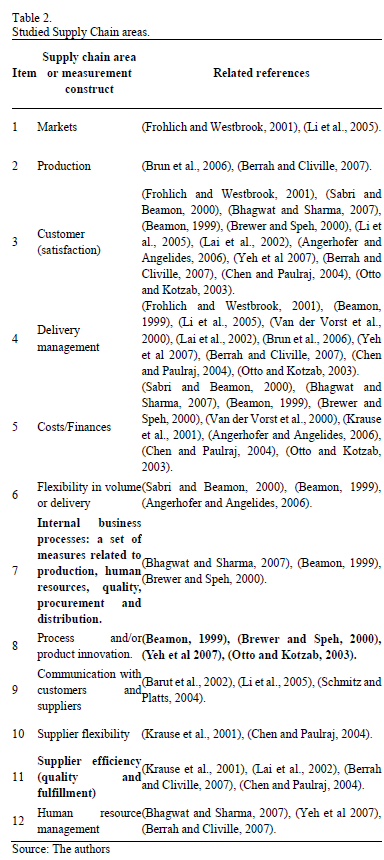
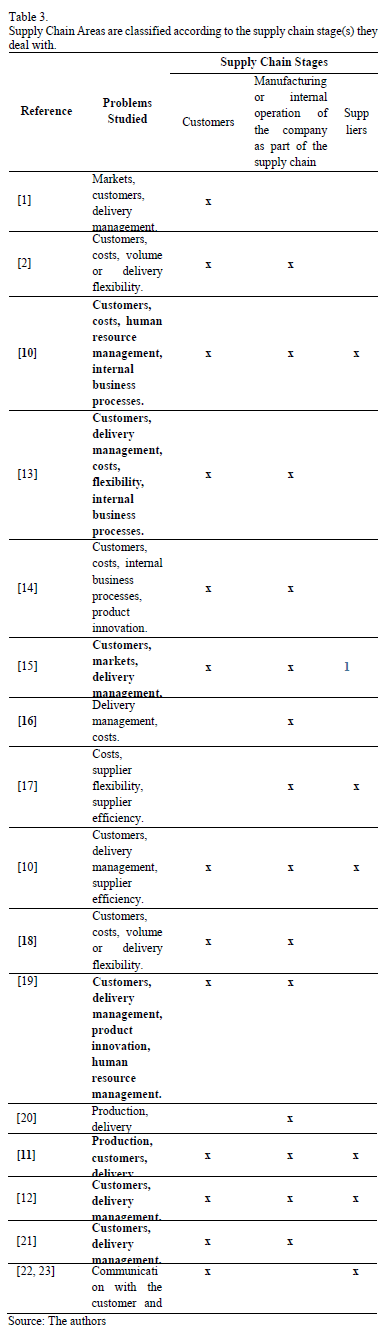
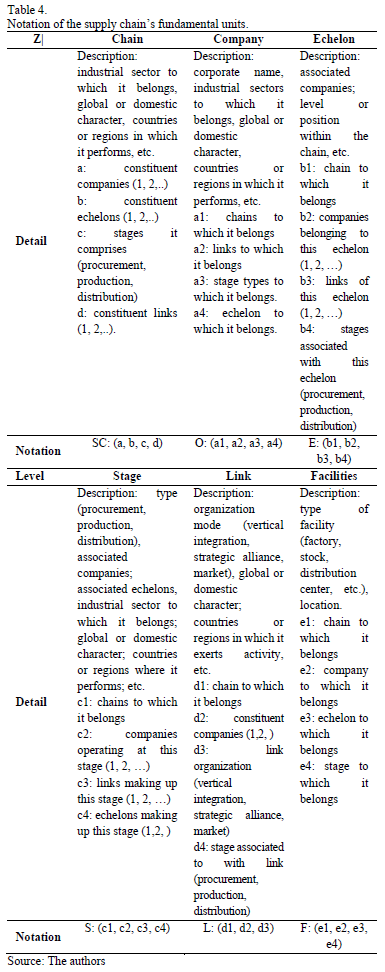
<body><![CDATA[<p><font size="2" face="Verdana, Arial, Helvetica, sans-serif">According to the literature review   presented in <a href="#tab02">Table 2</a>, the most frequent problems that are associated with the   SC are: (i) customer satisfaction, (ii) delivery management, and (iii)   costs/finances. The least covered areas are those dealing with markets and   production.</font></p>     <p align="center"><font size="2" face="Verdana, Arial, Helvetica, sans-serif"><a name="tab02"></a></font><img src="/img/revistas/dyna/v83n198/v83n198a08tab02.gif"></p>     <p><font size="2" face="Verdana, Arial, Helvetica, sans-serif">A few works cover the three stages of the   SC (delivery, manufacturing and procurement). When they do, they usually focus   on a specific logistic or manufacturing area &#91;8,10-12&#93;. <a href="#tab03">Table 3</a> classifies SCM   contributions according to the stage of the chain they deal with, namely   customers, suppliers or internal functioning of the company.</font></p>     <p align="center"><font size="2" face="Verdana, Arial, Helvetica, sans-serif"><a name="tab03"></a></font><img src="/img/revistas/dyna/v83n198/v83n198a08tab03.gif"></p>     <p><font size="2" face="Verdana, Arial, Helvetica, sans-serif">The work of   &#91;24&#93; identifies a hierarchy of decisions within the SC and analyzes the   relations between them, without specifying the associated problem. The said   hierarchy, which is further developed throughout this paper through additional   dimensions is comprised of: (i) necessary previous conditions for a given   choice (upstream decisions); (ii) considerations on the impact of some   decisions on others (downstream decisions); and (iii) an approach to the   information required by the process. However, the fact it focuses on decisions   and not on the challenges faced by the system certainly limits its scope.   However, these authors' work constitutes part of the current development, which   includes the focus of this paper.</font></p>     <p><font size="2" face="Verdana, Arial, Helvetica, sans-serif">The   literature review revealed the lack of studies that seek to develop a broad and   comprehensive perspective of the SC and cover a significant part of its   components. Likewise, no works have been found that propose a formal structure   capable of characterizing the SC's problems. Such a structure would be useful   in those cases whose specificities call for a more detailed study; this is when   more formal and technical decision-making proves to be useful.</font></p>     <p>&nbsp;</p>     <p><font size="3" face="Verdana, Arial, Helvetica, sans-serif"><b>3. Characterization of supply chain problems</b></font></p>     <p><font size="2" face="Verdana, Arial, Helvetica, sans-serif">The current   SC problem is divided in two parts: the first one identifies a series of   logistic units within the chain and proposes a corresponding notation system.   The second one outlines troublesome instances and, from a SC standpoint,   introduces the notation that situates a given problem within the chain.</font></p>     <p><font size="2" face="Verdana, Arial, Helvetica, sans-serif"><b><i>3.1. Fundamental units</i></b></font></p>     ]]></body>
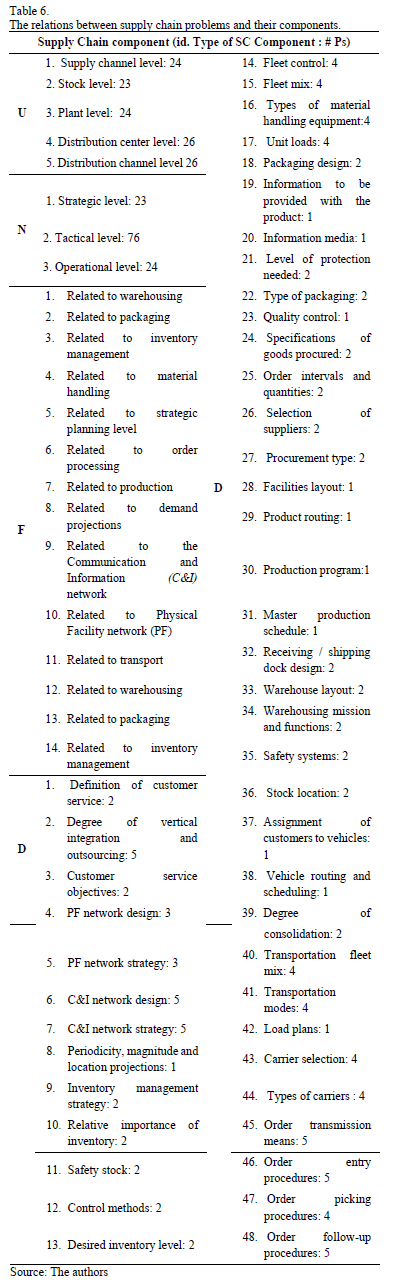
<body><![CDATA[<p><font size="2" face="Verdana, Arial, Helvetica, sans-serif">The fundamental units are the entities   through which the SC actually performs, that is, the objects of their activity   and decisions. In turn, these fundamental units address type, quantity and size   specifications of the goods (or services) produced by the chain, as well as the   location of the productive activities in question. The fundamental units   identified by the current research are: the SC itself, companies, echelons,   stages, links and facilities. <a href="#tab04">Table 4</a> presents the notation system in question.</font></p>     <p align="center"><font size="2" face="Verdana, Arial, Helvetica, sans-serif"><a name="tab04"></a></font><img src="/img/revistas/dyna/v83n198/v83n198a08tab04.gif"></p>     <p><font size="2" face="Verdana, Arial, Helvetica, sans-serif"><b><i>3.2. Problem set featuring notation</i></b></font></p>     <p><font size="2" face="Verdana, Arial, Helvetica, sans-serif">Pursuing the social   objective of the SC implies adequate management of its constitutive units and   diverse functions, as well as the timely making of decisions in terms of   problematic aspects. Many of these problems are associated with each SC unit -   they are organizational and functional in nature. Two concepts have been coined   to characterize them, namely level of decision &#91;25,26&#93; and characteristic   matter: product flows (both, finished products and raw materials) and   information flows &#91;27&#93;. The independent or coupled application of these   concepts modulates the approach to the specific problems faced by the SC.</font></p>     <p><font size="2" face="Verdana, Arial, Helvetica, sans-serif">Decision-making   within the SC is based on a clear notion of the specific nature of the problems   that are to be solved. According to Decision Theory, this implies conceiving a   structure made up of alternatives and associated criteria in which the latter   intends to describe and even weigh up the former. A qualified decision making   process must also include a mechanism to measure or estimate the criteria and   look after the internal consistency of the information and the correct   selection of the Decision Support System (DSS). </font></p>     <p><font size="2" face="Verdana, Arial, Helvetica, sans-serif">Although the logistic   unit, the organizational function and the characterizing concepts are the main   components used to define a problem, they are not the only ones. The full set   of problem featuring components is the following: the elemental unit (U), the   logistic functions (F), the characterizing concept defining a given set of   problems (C), the levels of decision (N) and/or the characteristic flows (L),   the decision (D), the previous conditions (B), the impact (I) and the   descriptive alternatives, criteria and/or assumptions (J). Among these   components, U and F are independent; C depends on the latter two and D depends   on all the three of these, while B, I, and J depend on all of the above   mentioned components.</font></p>     <p><font size="2" face="Verdana, Arial, Helvetica, sans-serif">This set of characterizing features intends to   provide a comprehensive framework to fully characterize the SC problems in   their own context, through the following detailed notation: P<sup>i</sup><sub>(U,   F, C, D, B, I, J)</sub>,</font></p>     <p><font size="2" face="Verdana, Arial, Helvetica, sans-serif">Where super index i   is the label of a particular problem P. Although not all the different fields   of a particular P label (U, F, C, D, B, I, J) are always active, the first four ones must be. <a href="#tab05">Table 5</a> shows the Ps   associated with the SC's logistic functions, as reported in the literature   review. </font></p>     <p align="center"><font size="2" face="Verdana, Arial, Helvetica, sans-serif"><a name="tab05"></a></font><img src="/img/revistas/dyna/v83n198/v83n198a08tab05.gif"></p>     <p><font size="2" face="Verdana, Arial, Helvetica, sans-serif">As an example, we   shall analyze P71: the scheduling problem, which has been an object of study   for decades and remains a very active research field. Several reviews have   contributed to this field   &#91;28-32&#93;, which include more than 200 papers that featuring this P:</font></p>     ]]></body>
<body><![CDATA[<blockquote>       <p><font size="2" face="Verdana, Arial, Helvetica, sans-serif">U: Plant    <br>     </font><font size="2" face="Verdana, Arial, Helvetica, sans-serif">F: Production    <br>     </font><font size="2" face="Verdana, Arial, Helvetica, sans-serif">C: Operational     (associated to N: the decision level)    <br>     </font><font size="2" face="Verdana, Arial, Helvetica, sans-serif">D: Decision     (scheduling)    <br>     </font><font size="2" face="Verdana, Arial, Helvetica, sans-serif">B: Production     planning, layout, routing of materials    <br>     </font><font size="2" face="Verdana, Arial, Helvetica, sans-serif">I: Carrier type,     handling of materials, determination of Stock Keep Units - SKUs)    <br>     </font><font size="2" face="Verdana, Arial, Helvetica, sans-serif">J: Determined from     notation by &#91;33&#93;:</font></p> </blockquote>     <p><font size="2" face="Verdana, Arial, Helvetica, sans-serif">The alternatives are:   - work stations combinations (and associated machines) used to undertake the   works (items) that could satisfy the problem's requirements.</font></p>     <p><font size="2" face="Verdana, Arial, Helvetica, sans-serif">Objective (makespan criteria to be   optimized): total finishing time, total delay, total weighted delay (taking   into account the relative importance of the client).</font></p>     ]]></body>
<body><![CDATA[<p><font size="2" face="Verdana, Arial, Helvetica, sans-serif">Parameters:</font></p> <ul>       <li><font size="2" face="Verdana, Arial, Helvetica, sans-serif">Number of stations</font></li>       <li><font size="2" face="Verdana, Arial, Helvetica, sans-serif">Number and homogeneity of     parallel machines per station.</font></li>       <li><font size="2" face="Verdana, Arial, Helvetica, sans-serif">Processing times</font></li>     </ul>     <p><font size="2" face="Verdana, Arial, Helvetica, sans-serif">Assumptions and restrictions:</font></p> <ul>       <li><font size="2" face="Verdana, Arial, Helvetica, sans-serif">Any work that can only be     executed by one machine at a time.</font></li>       <li><font size="2" face="Verdana, Arial, Helvetica, sans-serif"> Any machine that can only execute     one work at a time.</font></li>       <li><font size="2" face="Verdana, Arial, Helvetica, sans-serif"> Machines are constantly     available.</font></li>       <li><font size="2" face="Verdana, Arial, Helvetica, sans-serif"> Any work that can and should     only be processed once at any station.</font></li>       ]]></body>
<body><![CDATA[<li><font size="2" face="Verdana, Arial, Helvetica, sans-serif"> No work can be dismounted from     the machine before it has been finished.</font></li>       <li><font size="2" face="Verdana, Arial, Helvetica, sans-serif"> Storage capacity among stations     is unlimited.</font></li>       <li><font size="2" face="Verdana, Arial, Helvetica, sans-serif"> All works must follow the same     route: from station 1 to station 2, and so on. </font></li>       <li><font size="2" face="Verdana, Arial, Helvetica, sans-serif"> The sequence in which works are     processed must be the same at all stations. </font></li>       <li><font size="2" face="Verdana, Arial, Helvetica, sans-serif"> From time zero, all works are     available to enter the sequence</font></li>       <li><font size="2" face="Verdana, Arial, Helvetica, sans-serif"> DSS has traditionally     corresponded to heuristics and metaheuristics that have adequate CPU time     solutions but only moderate acceptable optimality gaps. </font></li>     </ul>     <p><font size="2" face="Verdana, Arial, Helvetica, sans-serif">The following section presents the   decision framework in which each one of the problems is characterized. For   practical purposes, <a href="#tab05">Table 5</a> does not include elements B, I and J, which can be   found in &#91;24&#93;. The table shows that the most frequent characterizing concept is   &quot;level&quot;, while &quot;flow&quot; is rarely taken into account. Through the literature   review we detected 123 Ps that are associated with five fundamental units (that   are in turn related to facilities), three decision levels, 12 logistic   functions and the 48 decisions determined by &#91;24&#93;. <a href="#tab05">Table 5</a> shows the problem   featuring framework that was determined:</font></p>     <p><font size="2" face="Verdana, Arial, Helvetica, sans-serif"><a href="#tab05">Table 5</a> also shows how any given decision   is often associated with the same logistic function (column 4), but not always   with the same decision level (column 3). Only 11 decisions (8, 19, 20, 23, 28,   29, 30, 31, 37, 38 and 42) hold univocal relations with Ps, whereas the rest   are associated with more than one P, but never exceed five. <a href="#tab06">Table 6</a> shows the   relation between the Ps and their components. Columns 1 and 3 show the SC components, while columns 2 and 4 present   the typologies of each component, their labels, and the number of related   problems.</font></p>     <p align="center"><font size="2" face="Verdana, Arial, Helvetica, sans-serif"><a name="tab06"></a></font><img src="/img/revistas/dyna/v83n198/v83n198a08tab06.gif"></p>     ]]></body>
<body><![CDATA[<p><font size="2" face="Verdana, Arial, Helvetica, sans-serif">Finally, the concept of supply chain   orientation (SCO) has been recently introduced as a philosophical approach to   the implications of flow management in the supply chain &#91;34&#93;. However, flow   management has been addressed independently of this philosophical approach, as   can be observed in Arrupindi et al.'s work (1999). This can also be seen in Li   et al.'s (2011) work on financial flow risk. SCO has been conceived as &quot;the   recognition, on the part of companies, of the systemic and strategic   implications of the activities and processes involved in the management of the   diverse flows of a supply chain&quot;. This concept has been slowly making its way   in practical contexts, and has ended up becoming a significant SCM support. In   this regard, one of the most relevant achievements has been the study of the   implications of SCO on the procurement function through Key Supplier   Relationship Management (KSRM). This approach has led to better Organizational   Buying Effectiveness (OBE) as a way of measuring effective procurement   behavior. SCO has also been incorporated to the supply chain structure through   emphasizing the willingness of the companies to conceive the structure as an   integrated entity &#91;36&#93;. Additionally, SCO has been used to manage uncertainty   in business environments, in which it has been applied to the development of   more efficient and flexible supply chains &#91;37&#93;; and to promoting a better   willingness to &quot;satisfy its needs by traveling along a common path&quot; &#91;38&#93;   among the supply chain agents. The Supply Chain Orientation concept and its   framework have been developed since twenty-first century &#91;39&#93;. To summarize,   the study of supply chain flow issues identified in the current work   corresponds to the SCO paradigm. Finally, the characterization of supply chains   as a research tendency has only emerged in the last decade &#91;40&#93;. </font></p>     <p>&nbsp;</p>     <p><font size="3" face="Verdana, Arial, Helvetica, sans-serif"><b>4. Conclusions</b></font></p>     <p><font size="2" face="Verdana, Arial, Helvetica, sans-serif">The current paper proposes a SC problem   featuring a holistic framework that is intended as a SC management and   organization support tool, in which each P conveys an issue to be dealt with in   the SC. This particular notation system not only allows the P in question to be   specified within the context it shares with other SC aspects, but it also   synthesizes its most outstanding features and sets the foundations for future   developments in technical decision-making. This implies that the development of   information parameterization systems allow adequate links between the inputs   and outputs that modulate the SC P featuring framework. Future research   perspectives are the following: the characterization of the Ps that are studied   here or that may be identified in the future; the introduction of new Ps and   elements into previously defined Ps; the development of specialized DSSs for SC   issues; and the development of methodologies to identify P featuring   parameters.</font></p>     <p>&nbsp;</p>     <p><font size="3" face="Verdana, Arial, Helvetica, sans-serif"><b>Acknowledgements</b></font></p>     <p><font size="2" face="Verdana, Arial, Helvetica, sans-serif">The work presented in this paper was   supported by the Colombian Department of Science, Technology and Innovation   (Colciencias) under grant 369-2012 (project # 1220-569-35242) and by the   Escuela Colombiana de Ingenier&iacute;a Julio Garavito.</font></p>     <p>&nbsp;</p>     <p><font size="3" face="Verdana, Arial, Helvetica, sans-serif"><b>References</b></font></p>     <!-- ref --><p><font size="2" face="Verdana, Arial, Helvetica, sans-serif"><b>&#91;1&#93;</b> Frohlich, M.T. and Westbrook,   R., Arcs of integration: an international study of supply chain strategies.   Journal of Operations Management, 19(2), pp 185-200, 2001. DOI:   10.1016/S0272-6963(00)00055-3.    &nbsp;&nbsp;&nbsp;&nbsp;&nbsp;&nbsp;&nbsp;&nbsp;[&#160;<a href="javascript:void(0);" onclick="javascript: window.open('/scielo.php?script=sci_nlinks&ref=1148466&pid=S0012-7353201600040000800001&lng=','','width=640,height=500,resizable=yes,scrollbars=1,menubar=yes,');">Links</a>&#160;]<!-- end-ref --></font></p>     <!-- ref --><p><font size="2" face="Verdana, Arial, Helvetica, sans-serif"><b>&#91;2&#93;</b> Sabri, E.H. and Beamon, B.M., A   multi-objective approach to simultaneous strategic and operational planning in   supply chain design. Omega, 28(5), pp 581-598, 2000. DOI:   10.1016/S0305-0483(99)00080-8</font>&nbsp;&nbsp;&nbsp;&nbsp;&nbsp;&nbsp;&nbsp;&nbsp;[&#160;<a href="javascript:void(0);" onclick="javascript: window.open('/scielo.php?script=sci_nlinks&ref=1148468&pid=S0012-7353201600040000800002&lng=','','width=640,height=500,resizable=yes,scrollbars=1,menubar=yes,');">Links</a>&#160;]<!-- end-ref --><!-- ref --><p><font size="2" face="Verdana, Arial, Helvetica, sans-serif"><b>&#91;3&#93;</b> Özbayrak, M., Papadopoulou,   T.C. and Akgun, M., Systems dynamics modelling of a manufacturing supply chain   system. Simulation Modelling Practice and Theory, 15(10), pp 1338-1355, 2007.   DOI: 10.1016/J.SIMPAT.2007.09.007.    &nbsp;&nbsp;&nbsp;&nbsp;&nbsp;&nbsp;&nbsp;&nbsp;[&#160;<a href="javascript:void(0);" onclick="javascript: window.open('/scielo.php?script=sci_nlinks&ref=1148469&pid=S0012-7353201600040000800003&lng=','','width=640,height=500,resizable=yes,scrollbars=1,menubar=yes,');">Links</a>&#160;]<!-- end-ref --></font></p>     <!-- ref --><p><font size="2" face="Verdana, Arial, Helvetica, sans-serif"><b>&#91;4&#93;</b> CSCMP., Council of Supply Chain   Management Professionals, &#91;On line&#93;, pp. 3-17, 2007. &#91;Accessed on June 20<sup>th</sup> of 2013&#93;. Available at: <a href="http://cscmp.org" target="_blank">http://cscmp.org</a>.    &nbsp;&nbsp;&nbsp;&nbsp;&nbsp;&nbsp;&nbsp;&nbsp;[&#160;<a href="javascript:void(0);" onclick="javascript: window.open('/scielo.php?script=sci_nlinks&ref=1148471&pid=S0012-7353201600040000800004&lng=','','width=640,height=500,resizable=yes,scrollbars=1,menubar=yes,');">Links</a>&#160;]<!-- end-ref --></font></p>     <!-- ref --><p><font size="2" face="Verdana, Arial, Helvetica, sans-serif"><b>&#91;5&#93;</b> Simchi-Levi, D., Kaminsky, P.   and Simchi-Levi, E., Managing the supply chain: The definitive guide for the   business professional, McGraw-Hill, New York, 2004, pp 4-18.    &nbsp;&nbsp;&nbsp;&nbsp;&nbsp;&nbsp;&nbsp;&nbsp;[&#160;<a href="javascript:void(0);" onclick="javascript: window.open('/scielo.php?script=sci_nlinks&ref=1148473&pid=S0012-7353201600040000800005&lng=','','width=640,height=500,resizable=yes,scrollbars=1,menubar=yes,');">Links</a>&#160;]<!-- end-ref --></font></p>     <!-- ref --><p><font size="2" face="Verdana, Arial, Helvetica, sans-serif"><b>&#91;6&#93;</b> Davenport, T.H., Jarvenpaa,   S.L. and Beers, M.C., Improving knowledge work processes. Sloan Management   Review, 37, pp 53-66, 1996. DOI: 10.1016/0024-6301(93)90316-8.    &nbsp;&nbsp;&nbsp;&nbsp;&nbsp;&nbsp;&nbsp;&nbsp;[&#160;<a href="javascript:void(0);" onclick="javascript: window.open('/scielo.php?script=sci_nlinks&ref=1148475&pid=S0012-7353201600040000800006&lng=','','width=640,height=500,resizable=yes,scrollbars=1,menubar=yes,');">Links</a>&#160;]<!-- end-ref --></font></p>     ]]></body>
<body><![CDATA[<!-- ref --><p><font size="2" face="Verdana, Arial, Helvetica, sans-serif"><b>&#91;7&#93;</b> Dreyer, D.E., Performance   measurement: A practitioner's perspective. Supply Chain Management Review,   4(4). pp. 63-68, 2000. DOI: 10.1108/13598541211258573</font>&nbsp;&nbsp;&nbsp;&nbsp;&nbsp;&nbsp;&nbsp;&nbsp;[&#160;<a href="javascript:void(0);" onclick="javascript: window.open('/scielo.php?script=sci_nlinks&ref=1148477&pid=S0012-7353201600040000800007&lng=','','width=640,height=500,resizable=yes,scrollbars=1,menubar=yes,');">Links</a>&#160;]<!-- end-ref --><!-- ref --><p><font size="2" face="Verdana, Arial, Helvetica, sans-serif"><b>&#91;8&#93;</b> Bhagwat, R. and Sharma, M.K.,   Performance measurement of supply chain management: A balanced scorecard   approach. Computers &amp; Industrial Engineering, 53(1), pp 43-62, 2007. DOI:   10.1016/j.cie.2007.04.001</font>&nbsp;&nbsp;&nbsp;&nbsp;&nbsp;&nbsp;&nbsp;&nbsp;[&#160;<a href="javascript:void(0);" onclick="javascript: window.open('/scielo.php?script=sci_nlinks&ref=1148478&pid=S0012-7353201600040000800008&lng=','','width=640,height=500,resizable=yes,scrollbars=1,menubar=yes,');">Links</a>&#160;]<!-- end-ref --><!-- ref --><p><font size="2" face="Verdana, Arial, Helvetica, sans-serif"><b>&#91;9&#93;</b> Gunasekaran, A., Patel, C. and   McGaughey, R.E., A framework for supply chain performance measurement.   International Journal of Production Economics, 87(3), pp 333-347, 2004. DOI:   10.1016/J.IJPE.2003.08.003</font>&nbsp;&nbsp;&nbsp;&nbsp;&nbsp;&nbsp;&nbsp;&nbsp;[&#160;<a href="javascript:void(0);" onclick="javascript: window.open('/scielo.php?script=sci_nlinks&ref=1148479&pid=S0012-7353201600040000800009&lng=','','width=640,height=500,resizable=yes,scrollbars=1,menubar=yes,');">Links</a>&#160;]<!-- end-ref --><!-- ref --><p><font size="2" face="Verdana, Arial, Helvetica, sans-serif"><b>&#91;10&#93;</b> Lai, K., Ngai, E.W.T. and   Cheng, T.C.E., Measures for evaluating supply chain performance in transport   logistics. Transportation Research Part E: Logistics and Transportation Review,   38(6), pp 439-456, 2002. DOI: 10.1016/S1366-5545(02)00019-4</font>&nbsp;&nbsp;&nbsp;&nbsp;&nbsp;&nbsp;&nbsp;&nbsp;[&#160;<a href="javascript:void(0);" onclick="javascript: window.open('/scielo.php?script=sci_nlinks&ref=1148480&pid=S0012-7353201600040000800010&lng=','','width=640,height=500,resizable=yes,scrollbars=1,menubar=yes,');">Links</a>&#160;]<!-- end-ref --><!-- ref --><p><font size="2" face="Verdana, Arial, Helvetica, sans-serif"><b>&#91;11&#93;</b> Berrah, L. and Cliville, V.,   Towards an aggregation performance measurement system model in a supply chain   context. Computers in Industry, 58(7), pp 709-719, 2007. DOI:   10.1016/j.compind.2007.05.012</font>&nbsp;&nbsp;&nbsp;&nbsp;&nbsp;&nbsp;&nbsp;&nbsp;[&#160;<a href="javascript:void(0);" onclick="javascript: window.open('/scielo.php?script=sci_nlinks&ref=1148481&pid=S0012-7353201600040000800011&lng=','','width=640,height=500,resizable=yes,scrollbars=1,menubar=yes,');">Links</a>&#160;]<!-- end-ref --><!-- ref --><p><font size="2" face="Verdana, Arial, Helvetica, sans-serif"><b>&#91;12&#93;</b> Chen, I.J. and Paulraj, A.,   Towards a theory of supply chain management: the constructs and measurements.   Journal of Operations Management, 22(2), pp 119-150, 2004. DOI:   10.1016/j.jom.2003.12.007</font>&nbsp;&nbsp;&nbsp;&nbsp;&nbsp;&nbsp;&nbsp;&nbsp;[&#160;<a href="javascript:void(0);" onclick="javascript: window.open('/scielo.php?script=sci_nlinks&ref=1148482&pid=S0012-7353201600040000800012&lng=','','width=640,height=500,resizable=yes,scrollbars=1,menubar=yes,');">Links</a>&#160;]<!-- end-ref --><!-- ref --><p><font size="2" face="Verdana, Arial, Helvetica, sans-serif"><b>&#91;13&#93;</b> Beamon, B.M., Measuring supply   chain performance. International Journal of Operations and Production   Management, 19(3), pp 275-292, 1999. DOI:   10.1108/01443579910249714</font>&nbsp;&nbsp;&nbsp;&nbsp;&nbsp;&nbsp;&nbsp;&nbsp;[&#160;<a href="javascript:void(0);" onclick="javascript: window.open('/scielo.php?script=sci_nlinks&ref=1148483&pid=S0012-7353201600040000800013&lng=','','width=640,height=500,resizable=yes,scrollbars=1,menubar=yes,');">Links</a>&#160;]<!-- end-ref --><!-- ref --><p><font size="2" face="Verdana, Arial, Helvetica, sans-serif"><b>&#91;14&#93;</b> Brewer, P.C. and Speh, T.W.,   Using the balanced scorecard to measure supply chain performance. Journal of   Business Logistics, 21(1), pp 75-94, 2000. DOI: 10.1111.jbl.    &nbsp;&nbsp;&nbsp;&nbsp;&nbsp;&nbsp;&nbsp;&nbsp;[&#160;<a href="javascript:void(0);" onclick="javascript: window.open('/scielo.php?script=sci_nlinks&ref=1148484&pid=S0012-7353201600040000800014&lng=','','width=640,height=500,resizable=yes,scrollbars=1,menubar=yes,');">Links</a>&#160;]<!-- end-ref --></font></p>     <!-- ref --><p><font size="2" face="Verdana, Arial, Helvetica, sans-serif"><b>&#91;15&#93;</b> Li, S., Subba Rao, S.,   Ragu-Nathan, T.S. and Ragu-Nathan, B., Development and validation of a   measurement instrument for studying supply chain management practices. Journal   of Operations Management, 23(6), pp 618-641, 2005. DOI:   10.1016/j.jom.2005.01.002.    &nbsp;&nbsp;&nbsp;&nbsp;&nbsp;&nbsp;&nbsp;&nbsp;[&#160;<a href="javascript:void(0);" onclick="javascript: window.open('/scielo.php?script=sci_nlinks&ref=1148486&pid=S0012-7353201600040000800015&lng=','','width=640,height=500,resizable=yes,scrollbars=1,menubar=yes,');">Links</a>&#160;]<!-- end-ref --></font></p>     <!-- ref --><p><font size="2" face="Verdana, Arial, Helvetica, sans-serif"><b>&#91;16&#93;</b> Van der Vorst, J.G., Beulens,   A.J. and van Beek, P., Modelling and simulating multi-echelon food systems.   European Journal of Operational Research, 122(2), pp 354-366, 2000. DOI:   10.1016/S0377-2217(99)00238-6</font>&nbsp;&nbsp;&nbsp;&nbsp;&nbsp;&nbsp;&nbsp;&nbsp;[&#160;<a href="javascript:void(0);" onclick="javascript: window.open('/scielo.php?script=sci_nlinks&ref=1148488&pid=S0012-7353201600040000800016&lng=','','width=640,height=500,resizable=yes,scrollbars=1,menubar=yes,');">Links</a>&#160;]<!-- end-ref --><!-- ref --><p><font size="2" face="Verdana, Arial, Helvetica, sans-serif"><b>&#91;17&#93;</b> Krause, D.R., Pagell, M. and   Curkovic, S., Toward a measure of competitive priorities for purchasing.   Journal of Operations Management, 19(4), 497-512, 2001. DOI:   10.1016/S0272-6963(01)00047-X</font>&nbsp;&nbsp;&nbsp;&nbsp;&nbsp;&nbsp;&nbsp;&nbsp;[&#160;<a href="javascript:void(0);" onclick="javascript: window.open('/scielo.php?script=sci_nlinks&ref=1148489&pid=S0012-7353201600040000800017&lng=','','width=640,height=500,resizable=yes,scrollbars=1,menubar=yes,');">Links</a>&#160;]<!-- end-ref --><!-- ref --><p><font size="2" face="Verdana, Arial, Helvetica, sans-serif"><b>&#91;18&#93;</b> Angerhofer, BJ. and Angelides,   M.C., A model and a performance measurement system for collaborative supply   chains. Decision Support Systems, 42(1), pp 283-301, 2006. DOI:   10.1016/j.dss.2004.12.005</font>&nbsp;&nbsp;&nbsp;&nbsp;&nbsp;&nbsp;&nbsp;&nbsp;[&#160;<a href="javascript:void(0);" onclick="javascript: window.open('/scielo.php?script=sci_nlinks&ref=1148490&pid=S0012-7353201600040000800018&lng=','','width=640,height=500,resizable=yes,scrollbars=1,menubar=yes,');">Links</a>&#160;]<!-- end-ref --><!-- ref --><p><font size="2" face="Verdana, Arial, Helvetica, sans-serif"><b>&#91;19&#93;</b> Yeh, D.Y., Cheng, C.H. and Chi,   M.L., A modified two-tuple FLC model for evaluating the performance of SCM: By   the Six Sigma DMAIC process. Applied Soft Computing, 7(3), pp 1027-1034, 2007.   DOI: 10.1016/j.asoc.2006.06.008</font>&nbsp;&nbsp;&nbsp;&nbsp;&nbsp;&nbsp;&nbsp;&nbsp;[&#160;<a href="javascript:void(0);" onclick="javascript: window.open('/scielo.php?script=sci_nlinks&ref=1148491&pid=S0012-7353201600040000800019&lng=','','width=640,height=500,resizable=yes,scrollbars=1,menubar=yes,');">Links</a>&#160;]<!-- end-ref --><!-- ref --><p><font size="2" face="Verdana, Arial, Helvetica, sans-serif"><b>&#91;20&#93;</b> Brun, A., Caridi, M., Salama,   K.F. and Ravelli, I., Value and risk assessment of supply chain management   improvement projects. International Journal of Production Economics, 99(1), pp   186-201, 2006. DOI: 10.1016/j.ijpe.2004.12.016</font>&nbsp;&nbsp;&nbsp;&nbsp;&nbsp;&nbsp;&nbsp;&nbsp;[&#160;<a href="javascript:void(0);" onclick="javascript: window.open('/scielo.php?script=sci_nlinks&ref=1148492&pid=S0012-7353201600040000800020&lng=','','width=640,height=500,resizable=yes,scrollbars=1,menubar=yes,');">Links</a>&#160;]<!-- end-ref --><!-- ref --><p><font size="2" face="Verdana, Arial, Helvetica, sans-serif"><b>&#91;21&#93;</b> Otto, A. and Kotzab, H., Does   supply chain management really pay? Six perspectives to measure the performance   of managing a supply chain. European Journal of Operational Research, 144(2),   pp 306-320, 2003. DOI: 10.1016/S0377-2217(02)00396-X</font>&nbsp;&nbsp;&nbsp;&nbsp;&nbsp;&nbsp;&nbsp;&nbsp;[&#160;<a href="javascript:void(0);" onclick="javascript: window.open('/scielo.php?script=sci_nlinks&ref=1148493&pid=S0012-7353201600040000800021&lng=','','width=640,height=500,resizable=yes,scrollbars=1,menubar=yes,');">Links</a>&#160;]<!-- end-ref --><!-- ref --><p><font size="2" face="Verdana, Arial, Helvetica, sans-serif"><b>&#91;22&#93;</b> Barut, M., Faisst, W. and   Kanet, J.J., Measuring supply chain coupling: An information system   perspective. European Journal of Purchasing &amp; Supply Management, 8(3), pp   161-171, 2002. DOI: 10.1016/S0969-7012(02)00006-0</font>&nbsp;&nbsp;&nbsp;&nbsp;&nbsp;&nbsp;&nbsp;&nbsp;[&#160;<a href="javascript:void(0);" onclick="javascript: window.open('/scielo.php?script=sci_nlinks&ref=1148494&pid=S0012-7353201600040000800022&lng=','','width=640,height=500,resizable=yes,scrollbars=1,menubar=yes,');">Links</a>&#160;]<!-- end-ref --><!-- ref --><p><font size="2" face="Verdana, Arial, Helvetica, sans-serif"><b>&#91;23&#93;</b> Schmitz, J. and Platts, K.W.,   Supplier logistics performance measurement: Indications from a study in the   automotive industry. International Journal of Production Economics, 89(2), pp   231-243, 2004. DOI: 10.1016/S0925-5273(02)00469-3</font>&nbsp;&nbsp;&nbsp;&nbsp;&nbsp;&nbsp;&nbsp;&nbsp;[&#160;<a href="javascript:void(0);" onclick="javascript: window.open('/scielo.php?script=sci_nlinks&ref=1148495&pid=S0012-7353201600040000800023&lng=','','width=640,height=500,resizable=yes,scrollbars=1,menubar=yes,');">Links</a>&#160;]<!-- end-ref --><!-- ref --><p><font size="2" face="Verdana, Arial, Helvetica, sans-serif"><b>&#91;24&#93;</b> Riopel, D., Langevin, A.   and Campbell, J.F., The network of logistics decisions. In Langevinand, A. and   Riopel, D. (eds.). Logistics Systems: Design and optimization. New York:   Springer, 2005, pp. 1-38. DOI: 10.1007/0-387-24977-X_1</font>&nbsp;&nbsp;&nbsp;&nbsp;&nbsp;&nbsp;&nbsp;&nbsp;[&#160;<a href="javascript:void(0);" onclick="javascript: window.open('/scielo.php?script=sci_nlinks&ref=1148496&pid=S0012-7353201600040000800024&lng=','','width=640,height=500,resizable=yes,scrollbars=1,menubar=yes,');">Links</a>&#160;]<!-- end-ref --><!-- ref --><p><font size="2" face="Verdana, Arial, Helvetica, sans-serif"><b>&#91;25&#93;</b> Miller, T.C., Hierarchical   operations and supply chain planning. London: Springer Verlag, 2002. DOI: 10.1007/978-1-4471-0305-9</font>&nbsp;&nbsp;&nbsp;&nbsp;&nbsp;&nbsp;&nbsp;&nbsp;[&#160;<a href="javascript:void(0);" onclick="javascript: window.open('/scielo.php?script=sci_nlinks&ref=1148497&pid=S0012-7353201600040000800025&lng=','','width=640,height=500,resizable=yes,scrollbars=1,menubar=yes,');">Links</a>&#160;]<!-- end-ref --><!-- ref --><p><font size="2" face="Verdana, Arial, Helvetica, sans-serif"><b>&#91;26&#93;</b> Stadtler, H. and Kilger,   C., Supply chain management and advanced planning: Concepts, models, software   and case studies&quot; (4<sup>th</sup>ed.). Berlin: Springer, 2008. DOI: 10.1007/b106298</font>&nbsp;&nbsp;&nbsp;&nbsp;&nbsp;&nbsp;&nbsp;&nbsp;[&#160;<a href="javascript:void(0);" onclick="javascript: window.open('/scielo.php?script=sci_nlinks&ref=1148498&pid=S0012-7353201600040000800026&lng=','','width=640,height=500,resizable=yes,scrollbars=1,menubar=yes,');">Links</a>&#160;]<!-- end-ref --><!-- ref --><p><font size="2" face="Verdana, Arial, Helvetica, sans-serif"><b>&#91;27&#93;</b> Stewart, G., Supply-chain   operations reference model (SCOR): The first cross-industry framework for   integrated supply-chain management. Logistics Information Management, 10(2), pp   62-67, 1997. DOI: 10.1108/09576059710815716</font>&nbsp;&nbsp;&nbsp;&nbsp;&nbsp;&nbsp;&nbsp;&nbsp;[&#160;<a href="javascript:void(0);" onclick="javascript: window.open('/scielo.php?script=sci_nlinks&ref=1148499&pid=S0012-7353201600040000800027&lng=','','width=640,height=500,resizable=yes,scrollbars=1,menubar=yes,');">Links</a>&#160;]<!-- end-ref --><!-- ref --><p><font size="2" face="Verdana, Arial, Helvetica, sans-serif"><b>&#91;28&#93;</b> Linn, R. and Zhang, W., Hybrid   flow shop scheduling: A survey. Computers and Industrial Engineering, 37(1), pp   57-61, 1999. DOI: 10.1016/S0360-8352(99)00023-6</font>&nbsp;&nbsp;&nbsp;&nbsp;&nbsp;&nbsp;&nbsp;&nbsp;[&#160;<a href="javascript:void(0);" onclick="javascript: window.open('/scielo.php?script=sci_nlinks&ref=1148500&pid=S0012-7353201600040000800028&lng=','','width=640,height=500,resizable=yes,scrollbars=1,menubar=yes,');">Links</a>&#160;]<!-- end-ref --><!-- ref --><p><font size="2" face="Verdana, Arial, Helvetica, sans-serif"><b>&#91;29&#93;</b> Kis, T. and Pesch, E., A review   of exact solution methods for the non-preemptive multiprocessor flowshop   problem. European Journal of Operational Research, 164(3), pp 592-608, 2005.   DOI: 10.1016/j.ejor.2003.12.026</font>&nbsp;&nbsp;&nbsp;&nbsp;&nbsp;&nbsp;&nbsp;&nbsp;[&#160;<a href="javascript:void(0);" onclick="javascript: window.open('/scielo.php?script=sci_nlinks&ref=1148501&pid=S0012-7353201600040000800029&lng=','','width=640,height=500,resizable=yes,scrollbars=1,menubar=yes,');">Links</a>&#160;]<!-- end-ref --><!-- ref --><p><font size="2" face="Verdana, Arial, Helvetica, sans-serif"><b>&#91;30&#93;</b> Quadt, D. and Kuhn, H., A   taxonomy of flexible flow line scheduling procedures. European Journal of   Operational Research, 178(3), pp 686-698, 2007. DOI: 10.1016/j.ejor.2006.01.042</font>&nbsp;&nbsp;&nbsp;&nbsp;&nbsp;&nbsp;&nbsp;&nbsp;[&#160;<a href="javascript:void(0);" onclick="javascript: window.open('/scielo.php?script=sci_nlinks&ref=1148502&pid=S0012-7353201600040000800030&lng=','','width=640,height=500,resizable=yes,scrollbars=1,menubar=yes,');">Links</a>&#160;]<!-- end-ref --><!-- ref --><p><font size="2" face="Verdana, Arial, Helvetica, sans-serif"><b>&#91;31&#93;</b> Ribas, I., Leisten, R. and   Frami&ntilde;an, J., Review and classification of hybrid flow shop scheduling problems   from a production system and a solutions procedure perspective. Computers &amp;   Operations Research, 37(8), pp 1439-1454, 2010. DOI: 10.1016/j.cor.2009.11.001</font>&nbsp;&nbsp;&nbsp;&nbsp;&nbsp;&nbsp;&nbsp;&nbsp;[&#160;<a href="javascript:void(0);" onclick="javascript: window.open('/scielo.php?script=sci_nlinks&ref=1148503&pid=S0012-7353201600040000800031&lng=','','width=640,height=500,resizable=yes,scrollbars=1,menubar=yes,');">Links</a>&#160;]<!-- end-ref --><!-- ref --><p><font size="2" face="Verdana, Arial, Helvetica, sans-serif"><b>&#91;32&#93;</b> Ruiz, R. and V&aacute;zquez-Rodr&iacute;guez,   J. ,The hybrid flow shop scheduling problem. European Journal of Operational   Research, 205(1). pp. 1-18, 2010. DOI: 10.1016/j.ejor.2009.09.024</font>&nbsp;&nbsp;&nbsp;&nbsp;&nbsp;&nbsp;&nbsp;&nbsp;[&#160;<a href="javascript:void(0);" onclick="javascript: window.open('/scielo.php?script=sci_nlinks&ref=1148504&pid=S0012-7353201600040000800032&lng=','','width=640,height=500,resizable=yes,scrollbars=1,menubar=yes,');">Links</a>&#160;]<!-- end-ref --><!-- ref --><p><font size="2" face="Verdana, Arial, Helvetica, sans-serif"><b>&#91;33&#93;</b> Graham, R.L., Lawler, E.L.,   Lenstra, J.K. and Rinnoo Kan, A.H.G., Optimization and approximation in   deterministic sequencing and scheduling: A survey. Annals of Discrete   Mathematics, 5, pp 287-326, 1979. DOI: 10.1016/S0167-5060(08)70356-X</font>&nbsp;&nbsp;&nbsp;&nbsp;&nbsp;&nbsp;&nbsp;&nbsp;[&#160;<a href="javascript:void(0);" onclick="javascript: window.open('/scielo.php?script=sci_nlinks&ref=1148505&pid=S0012-7353201600040000800033&lng=','','width=640,height=500,resizable=yes,scrollbars=1,menubar=yes,');">Links</a>&#160;]<!-- end-ref --><!-- ref --><p><font size="2" face="Verdana, Arial, Helvetica, sans-serif"><b>&#91;34&#93;</b> Mentzer, J.T., Supply chain   management. Thousand Oaks, CA, USA: Sage Publications Inc. 2001.    &nbsp;&nbsp;&nbsp;&nbsp;&nbsp;&nbsp;&nbsp;&nbsp;[&#160;<a href="javascript:void(0);" onclick="javascript: window.open('/scielo.php?script=sci_nlinks&ref=1148506&pid=S0012-7353201600040000800034&lng=','','width=640,height=500,resizable=yes,scrollbars=1,menubar=yes,');">Links</a>&#160;]<!-- end-ref --></font></p>     <!-- ref --><p><font size="2" face="Verdana, Arial, Helvetica, sans-serif"><b>&#91;35&#93;</b> Miocevic, D. and   Crnjak-Karanovic, B., The mediating role of key supplier relationship   management practices on supply chain orientation - The organizational buying   effectiveness link. Industrial Marketing Management, 41(1), pp. 115-124. 2011.   DOI: 10.1016/j.indmarman.2011.11.015</font>&nbsp;&nbsp;&nbsp;&nbsp;&nbsp;&nbsp;&nbsp;&nbsp;[&#160;<a href="javascript:void(0);" onclick="javascript: window.open('/scielo.php?script=sci_nlinks&ref=1148508&pid=S0012-7353201600040000800035&lng=','','width=640,height=500,resizable=yes,scrollbars=1,menubar=yes,');">Links</a>&#160;]<!-- end-ref --><!-- ref --><p><font size="2" face="Verdana, Arial, Helvetica, sans-serif"><b>&#91;36&#93;</b> Mello, J. and Stank, T.,   Linking firm culture and orientation to supply chain succes. International.   Journal of Physical Distribution &amp; Logistics Management, 35(8), pp. 542-554.   2005. DOI: 10.1108/09600030510623320</font>&nbsp;&nbsp;&nbsp;&nbsp;&nbsp;&nbsp;&nbsp;&nbsp;[&#160;<a href="javascript:void(0);" onclick="javascript: window.open('/scielo.php?script=sci_nlinks&ref=1148509&pid=S0012-7353201600040000800036&lng=','','width=640,height=500,resizable=yes,scrollbars=1,menubar=yes,');">Links</a>&#160;]<!-- end-ref --><!-- ref --><p><font size="2" face="Verdana, Arial, Helvetica, sans-serif"><b>&#91;37&#93;</b> Shanmugan, J. and Kabiraj,   S.A., Case study approach for understanding supply chain orientation in Indian   pharmaceutical firms. Kuwait Chapter of Arabian Journal of Business and   Management Review, 1(9), pp. 45-78. 2012. DOI: 10.4172/2224-8358.10000106</font>&nbsp;&nbsp;&nbsp;&nbsp;&nbsp;&nbsp;&nbsp;&nbsp;[&#160;<a href="javascript:void(0);" onclick="javascript: window.open('/scielo.php?script=sci_nlinks&ref=1148510&pid=S0012-7353201600040000800037&lng=','','width=640,height=500,resizable=yes,scrollbars=1,menubar=yes,');">Links</a>&#160;]<!-- end-ref --><!-- ref --><p><font size="2" face="Verdana, Arial, Helvetica, sans-serif"><b>&#91;38&#93;</b> Hult, G.T., Ketchen, D.J.,   Adams, G.L. and Mena, J.A., Supply chain orientation and balance scorecard   performance. Journal of Managerial Issues, &#91;Online&#93;. 20(4), pp. 526-544. 2008.   Available at: <a href="http://labs.jstor.org/demo/stable/40604627" target="_blank">http://labs.jstor.org/demo/stable/40604627</a></font>&nbsp;&nbsp;&nbsp;&nbsp;&nbsp;&nbsp;&nbsp;&nbsp;[&#160;<a href="javascript:void(0);" onclick="javascript: window.open('/scielo.php?script=sci_nlinks&ref=1148511&pid=S0012-7353201600040000800038&lng=','','width=640,height=500,resizable=yes,scrollbars=1,menubar=yes,');">Links</a>&#160;]<!-- end-ref --><!-- ref --><p><font size="2" face="Verdana, Arial, Helvetica, sans-serif"><b>&#91;39&#93;</b> Esper, T.L., Defee, C.C. and Mentzer, J.T., A framework of supply chain   orientation, The International Journal of Logistics Management, 21(2), pp.   161-179, . 2010. DOI: 10.1108/09574091011071906</font>&nbsp;&nbsp;&nbsp;&nbsp;&nbsp;&nbsp;&nbsp;&nbsp;[&#160;<a href="javascript:void(0);" onclick="javascript: window.open('/scielo.php?script=sci_nlinks&ref=1148512&pid=S0012-7353201600040000800039&lng=','','width=640,height=500,resizable=yes,scrollbars=1,menubar=yes,');">Links</a>&#160;]<!-- end-ref --><!-- ref --><p><font size="2" face="Verdana, Arial, Helvetica, sans-serif"><b>&#91;40&#93;</b> Garc&iacute;a-C&aacute;ceres, R.G., Perdomo, A., Ortiz, O.O., Beltr&aacute;n, P. and   L&oacute;pez, K., Characterization of the supply and value chains of Colombian cocoa.   DYNA, 81(187), pp. 30-40, 2014. DOI: 10.15446/dyna.v81n187.39555</font>&nbsp;&nbsp;&nbsp;&nbsp;&nbsp;&nbsp;&nbsp;&nbsp;[&#160;<a href="javascript:void(0);" onclick="javascript: window.open('/scielo.php?script=sci_nlinks&ref=1148513&pid=S0012-7353201600040000800040&lng=','','width=640,height=500,resizable=yes,scrollbars=1,menubar=yes,');">Links</a>&#160;]<!-- end-ref --><p>&nbsp;</p>     <p><font size="2" face="Verdana, Arial, Helvetica, sans-serif"><b>R.G. Garc&iacute;a-C&aacute;ceres</b>, is Ph.D, MSc, II., Vice-president   for Research - Universitaria Agustiniana (UNIAGUSTINIANA), Bogota Colombia. ORCID:   0000-0003-0902-1038</font></p>     <p><font size="2" face="Verdana, Arial, Helvetica, sans-serif"><b>J.W. Escobar</b>, is Ph.D., MSc, II., Associated professor, Universidad del Valle, Cali, Colombia. ORCID: 0000-0001-6175-955</font></p>     ]]></body>
<body><![CDATA[ ]]></body><back>
<ref-list>
<ref id="B1">
<label>1</label><nlm-citation citation-type="journal">
<person-group person-group-type="author">
<name>
<surname><![CDATA[Frohlich]]></surname>
<given-names><![CDATA[M.T.]]></given-names>
</name>
<name>
<surname><![CDATA[Westbrook]]></surname>
<given-names><![CDATA[R.]]></given-names>
</name>
</person-group>
<article-title xml:lang="en"><![CDATA[Arcs of integration: an international study of supply chain strategies]]></article-title>
<source><![CDATA[Journal of Operations Management]]></source>
<year>2001</year>
<volume>19</volume>
<numero>2</numero>
<issue>2</issue>
<page-range>185-200</page-range></nlm-citation>
</ref>
<ref id="B2">
<label>2</label><nlm-citation citation-type="journal">
<person-group person-group-type="author">
<name>
<surname><![CDATA[Sabri]]></surname>
<given-names><![CDATA[E.H.]]></given-names>
</name>
<name>
<surname><![CDATA[Beamon]]></surname>
<given-names><![CDATA[B.M.]]></given-names>
</name>
</person-group>
<article-title xml:lang="en"><![CDATA[A multi-objective approach to simultaneous strategic and operational planning in supply chain design]]></article-title>
<source><![CDATA[Omega]]></source>
<year>2000</year>
<volume>28</volume>
<numero>5</numero>
<issue>5</issue>
<page-range>581-598</page-range></nlm-citation>
</ref>
<ref id="B3">
<label>3</label><nlm-citation citation-type="journal">
<person-group person-group-type="author">
<name>
<surname><![CDATA[Özbayrak]]></surname>
<given-names><![CDATA[M.]]></given-names>
</name>
<name>
<surname><![CDATA[Papadopoulou]]></surname>
<given-names><![CDATA[T.C.]]></given-names>
</name>
<name>
<surname><![CDATA[Akgun]]></surname>
<given-names><![CDATA[M.]]></given-names>
</name>
</person-group>
<article-title xml:lang="en"><![CDATA[Systems dynamics modelling of a manufacturing supply chain system.]]></article-title>
<source><![CDATA[Simulation Modelling Practice and Theory]]></source>
<year>2007</year>
<volume>15</volume>
<numero>10</numero>
<issue>10</issue>
<page-range>1338-1355</page-range></nlm-citation>
</ref>
<ref id="B4">
<label>4</label><nlm-citation citation-type="">
<collab>CSCMP</collab>
<source><![CDATA[Council of Supply Chain Management Professionals]]></source>
<year>2007</year>
<page-range>3-17</page-range></nlm-citation>
</ref>
<ref id="B5">
<label>5</label><nlm-citation citation-type="book">
<person-group person-group-type="author">
<name>
<surname><![CDATA[Simchi-Levi]]></surname>
<given-names><![CDATA[D.]]></given-names>
</name>
<name>
<surname><![CDATA[Kaminsky]]></surname>
<given-names><![CDATA[P.]]></given-names>
</name>
<name>
<surname><![CDATA[Simchi-Levi]]></surname>
<given-names><![CDATA[E.]]></given-names>
</name>
</person-group>
<source><![CDATA[Managing the supply chain: The definitive guide for the business professional]]></source>
<year>2004</year>
<page-range>4-18</page-range><publisher-loc><![CDATA[New York ]]></publisher-loc>
<publisher-name><![CDATA[McGraw-Hill]]></publisher-name>
</nlm-citation>
</ref>
<ref id="B6">
<label>6</label><nlm-citation citation-type="journal">
<person-group person-group-type="author">
<name>
<surname><![CDATA[Davenport]]></surname>
<given-names><![CDATA[T.H.]]></given-names>
</name>
<name>
<surname><![CDATA[Jarvenpaa]]></surname>
<given-names><![CDATA[S.L.]]></given-names>
</name>
<name>
<surname><![CDATA[Beers]]></surname>
<given-names><![CDATA[M.C.]]></given-names>
</name>
</person-group>
<article-title xml:lang="en"><![CDATA[Improving knowledge work processes]]></article-title>
<source><![CDATA[Sloan Management Review]]></source>
<year>1996</year>
<numero>37</numero>
<issue>37</issue>
<page-range>53-66</page-range></nlm-citation>
</ref>
<ref id="B7">
<label>7</label><nlm-citation citation-type="journal">
<person-group person-group-type="author">
<name>
<surname><![CDATA[Dreyer]]></surname>
<given-names><![CDATA[D.E.]]></given-names>
</name>
</person-group>
<article-title xml:lang="en"><![CDATA[Performance measurement: A practitioner's perspective]]></article-title>
<source><![CDATA[Supply Chain Management Review]]></source>
<year>2000</year>
<volume>4</volume>
<numero>4</numero>
<issue>4</issue>
<page-range>63-68</page-range></nlm-citation>
</ref>
<ref id="B8">
<label>8</label><nlm-citation citation-type="journal">
<person-group person-group-type="author">
<name>
<surname><![CDATA[Bhagwat]]></surname>
<given-names><![CDATA[R.]]></given-names>
</name>
<name>
<surname><![CDATA[Sharma]]></surname>
<given-names><![CDATA[M.K.]]></given-names>
</name>
</person-group>
<article-title xml:lang="en"><![CDATA[Performance measurement of supply chain management: A balanced scorecard approach]]></article-title>
<source><![CDATA[Computers & Industrial Engineering]]></source>
<year>2007</year>
<volume>53</volume>
<numero>1</numero>
<issue>1</issue>
<page-range>43-62</page-range></nlm-citation>
</ref>
<ref id="B9">
<label>9</label><nlm-citation citation-type="journal">
<person-group person-group-type="author">
<name>
<surname><![CDATA[Gunasekaran]]></surname>
<given-names><![CDATA[A.]]></given-names>
</name>
<name>
<surname><![CDATA[Patel]]></surname>
<given-names><![CDATA[C.]]></given-names>
</name>
<name>
<surname><![CDATA[McGaughey]]></surname>
<given-names><![CDATA[R.E.]]></given-names>
</name>
</person-group>
<article-title xml:lang="en"><![CDATA[A framework for supply chain performance measurement.]]></article-title>
<source><![CDATA[International Journal of Production Economics]]></source>
<year>2004</year>
<volume>87</volume>
<numero>3</numero>
<issue>3</issue>
<page-range>333-347</page-range></nlm-citation>
</ref>
<ref id="B10">
<label>10</label><nlm-citation citation-type="journal">
<person-group person-group-type="author">
<name>
<surname><![CDATA[Lai]]></surname>
<given-names><![CDATA[K.]]></given-names>
</name>
<name>
<surname><![CDATA[Ngai]]></surname>
<given-names><![CDATA[E.W.T.]]></given-names>
</name>
<name>
<surname><![CDATA[Cheng]]></surname>
<given-names><![CDATA[T.C.E.]]></given-names>
</name>
</person-group>
<article-title xml:lang="en"><![CDATA[Measures for evaluating supply chain performance in transport logistics.]]></article-title>
<source><![CDATA[Transportation Research Part E: Logistics and Transportation Review]]></source>
<year>2002</year>
<volume>38</volume>
<numero>6</numero>
<issue>6</issue>
<page-range>439-456</page-range></nlm-citation>
</ref>
<ref id="B11">
<label>11</label><nlm-citation citation-type="journal">
<person-group person-group-type="author">
<name>
<surname><![CDATA[Berrah]]></surname>
<given-names><![CDATA[L.]]></given-names>
</name>
<name>
<surname><![CDATA[Cliville]]></surname>
<given-names><![CDATA[V.]]></given-names>
</name>
</person-group>
<article-title xml:lang="en"><![CDATA[Towards an aggregation performance measurement system model in a supply chain context]]></article-title>
<source><![CDATA[Computers in Industry]]></source>
<year>2007</year>
<volume>58</volume>
<numero>7</numero>
<issue>7</issue>
<page-range>709-719</page-range></nlm-citation>
</ref>
<ref id="B12">
<label>12</label><nlm-citation citation-type="journal">
<person-group person-group-type="author">
<name>
<surname><![CDATA[Chen]]></surname>
<given-names><![CDATA[I.J.]]></given-names>
</name>
<name>
<surname><![CDATA[Paulraj]]></surname>
<given-names><![CDATA[A.]]></given-names>
</name>
</person-group>
<article-title xml:lang="en"><![CDATA[Towards a theory of supply chain management: the constructs and measurements]]></article-title>
<source><![CDATA[Journal of Operations Management]]></source>
<year>2004</year>
<volume>22</volume>
<numero>2</numero>
<issue>2</issue>
<page-range>119-150</page-range></nlm-citation>
</ref>
<ref id="B13">
<label>13</label><nlm-citation citation-type="journal">
<person-group person-group-type="author">
<name>
<surname><![CDATA[Beamon]]></surname>
<given-names><![CDATA[B.M.]]></given-names>
</name>
</person-group>
<article-title xml:lang="en"><![CDATA[Measuring supply chain performance]]></article-title>
<source><![CDATA[International Journal of Operations and Production Management]]></source>
<year>1999</year>
<volume>19</volume>
<numero>3</numero>
<issue>3</issue>
<page-range>275-292</page-range></nlm-citation>
</ref>
<ref id="B14">
<label>14</label><nlm-citation citation-type="journal">
<person-group person-group-type="author">
<name>
<surname><![CDATA[Brewer]]></surname>
<given-names><![CDATA[P.C.]]></given-names>
</name>
<name>
<surname><![CDATA[Speh]]></surname>
<given-names><![CDATA[T.W.]]></given-names>
</name>
</person-group>
<article-title xml:lang="en"><![CDATA[Using the balanced scorecard to measure supply chain performance]]></article-title>
<source><![CDATA[Journal of Business Logistics]]></source>
<year>2000</year>
<volume>21</volume>
<numero>1</numero>
<issue>1</issue>
<page-range>75-94</page-range></nlm-citation>
</ref>
<ref id="B15">
<label>15</label><nlm-citation citation-type="journal">
<person-group person-group-type="author">
<name>
<surname><![CDATA[Li]]></surname>
<given-names><![CDATA[S.]]></given-names>
</name>
<name>
<surname><![CDATA[Subba Rao]]></surname>
<given-names><![CDATA[S.]]></given-names>
</name>
<name>
<surname><![CDATA[Ragu-Nathan]]></surname>
<given-names><![CDATA[T.S.]]></given-names>
</name>
<name>
<surname><![CDATA[Ragu-Nathan]]></surname>
<given-names><![CDATA[B.]]></given-names>
</name>
</person-group>
<article-title xml:lang="en"><![CDATA[Development and validation of a measurement instrument for studying supply chain management practices]]></article-title>
<source><![CDATA[Journal of Operations Management]]></source>
<year>2005</year>
<volume>23</volume>
<numero>6</numero>
<issue>6</issue>
<page-range>618-641</page-range></nlm-citation>
</ref>
<ref id="B16">
<label>16</label><nlm-citation citation-type="journal">
<person-group person-group-type="author">
<name>
<surname><![CDATA[Van der Vorst]]></surname>
<given-names><![CDATA[J.G.]]></given-names>
</name>
<name>
<surname><![CDATA[Beulens]]></surname>
<given-names><![CDATA[A.J.]]></given-names>
</name>
<name>
<surname><![CDATA[van Beek]]></surname>
<given-names><![CDATA[P.]]></given-names>
</name>
</person-group>
<article-title xml:lang="en"><![CDATA[Modelling and simulating multi-echelon food systems.]]></article-title>
<source><![CDATA[European Journal of Operational Research]]></source>
<year>2000</year>
<volume>122</volume>
<numero>2</numero>
<issue>2</issue>
<page-range>354-366</page-range></nlm-citation>
</ref>
<ref id="B17">
<label>17</label><nlm-citation citation-type="journal">
<person-group person-group-type="author">
<name>
<surname><![CDATA[Krause]]></surname>
<given-names><![CDATA[D.R.]]></given-names>
</name>
<name>
<surname><![CDATA[Pagell]]></surname>
<given-names><![CDATA[M.]]></given-names>
</name>
<name>
<surname><![CDATA[Curkovic]]></surname>
<given-names><![CDATA[S.]]></given-names>
</name>
</person-group>
<article-title xml:lang="en"><![CDATA[Toward a measure of competitive priorities for purchasing]]></article-title>
<source><![CDATA[Journal of Operations Management]]></source>
<year>2001</year>
<volume>19</volume>
<numero>4</numero>
<issue>4</issue>
<page-range>497-512</page-range></nlm-citation>
</ref>
<ref id="B18">
<label>18</label><nlm-citation citation-type="journal">
<person-group person-group-type="author">
<name>
<surname><![CDATA[Angerhofer]]></surname>
<given-names><![CDATA[BJ.]]></given-names>
</name>
<name>
<surname><![CDATA[Angelides]]></surname>
<given-names><![CDATA[M.C.]]></given-names>
</name>
</person-group>
<article-title xml:lang="en"><![CDATA[A model and a performance measurement system for collaborative supply chains.]]></article-title>
<source><![CDATA[Decision Support Systems]]></source>
<year>2006</year>
<volume>42</volume>
<numero>1</numero>
<issue>1</issue>
<page-range>283-301</page-range></nlm-citation>
</ref>
<ref id="B19">
<label>19</label><nlm-citation citation-type="journal">
<person-group person-group-type="author">
<name>
<surname><![CDATA[Yeh]]></surname>
<given-names><![CDATA[D.Y.]]></given-names>
</name>
<name>
<surname><![CDATA[Cheng]]></surname>
<given-names><![CDATA[C.H.]]></given-names>
</name>
<name>
<surname><![CDATA[Chi]]></surname>
<given-names><![CDATA[M.L.]]></given-names>
</name>
</person-group>
<article-title xml:lang="en"><![CDATA[A modified two-tuple FLC model for evaluating the performance of SCM: By the Six Sigma DMAIC process]]></article-title>
<source><![CDATA[Applied Soft Computing]]></source>
<year>2007</year>
<volume>7</volume>
<numero>3</numero>
<issue>3</issue>
<page-range>1027-1034</page-range></nlm-citation>
</ref>
<ref id="B20">
<label>20</label><nlm-citation citation-type="journal">
<person-group person-group-type="author">
<name>
<surname><![CDATA[Brun]]></surname>
<given-names><![CDATA[A.]]></given-names>
</name>
<name>
<surname><![CDATA[Caridi]]></surname>
<given-names><![CDATA[M.]]></given-names>
</name>
<name>
<surname><![CDATA[Salama]]></surname>
<given-names><![CDATA[K.F.]]></given-names>
</name>
<name>
<surname><![CDATA[Ravelli]]></surname>
<given-names><![CDATA[I.]]></given-names>
</name>
</person-group>
<article-title xml:lang="en"><![CDATA[Value and risk assessment of supply chain management improvement projects.]]></article-title>
<source><![CDATA[International Journal of Production Economics]]></source>
<year>2006</year>
<volume>99</volume>
<numero>1</numero>
<issue>1</issue>
<page-range>186-201</page-range></nlm-citation>
</ref>
<ref id="B21">
<label>21</label><nlm-citation citation-type="journal">
<person-group person-group-type="author">
<name>
<surname><![CDATA[Otto]]></surname>
<given-names><![CDATA[A.]]></given-names>
</name>
<name>
<surname><![CDATA[Kotzab]]></surname>
<given-names><![CDATA[H.]]></given-names>
</name>
</person-group>
<article-title xml:lang="en"><![CDATA[Does supply chain management really pay? Six perspectives to measure the performance of managing a supply chain.]]></article-title>
<source><![CDATA[European Journal of Operational Research]]></source>
<year>2003</year>
<volume>144</volume>
<numero>2</numero>
<issue>2</issue>
<page-range>306-320</page-range></nlm-citation>
</ref>
<ref id="B22">
<label>22</label><nlm-citation citation-type="journal">
<person-group person-group-type="author">
<name>
<surname><![CDATA[Barut]]></surname>
<given-names><![CDATA[M.]]></given-names>
</name>
<name>
<surname><![CDATA[Faisst]]></surname>
<given-names><![CDATA[W.]]></given-names>
</name>
<name>
<surname><![CDATA[Kanet]]></surname>
<given-names><![CDATA[J.J.]]></given-names>
</name>
</person-group>
<article-title xml:lang="en"><![CDATA[Measuring supply chain coupling: An information system perspective]]></article-title>
<source><![CDATA[European Journal of Purchasing & Supply Management]]></source>
<year>2002</year>
<volume>8</volume>
<numero>3</numero>
<issue>3</issue>
<page-range>161-171</page-range></nlm-citation>
</ref>
<ref id="B23">
<label>23</label><nlm-citation citation-type="journal">
<person-group person-group-type="author">
<name>
<surname><![CDATA[Schmitz]]></surname>
<given-names><![CDATA[J.]]></given-names>
</name>
<name>
<surname><![CDATA[Platts]]></surname>
<given-names><![CDATA[K.W.]]></given-names>
</name>
</person-group>
<article-title xml:lang="en"><![CDATA[Supplier logistics performance measurement: Indications from a study in the automotive industry]]></article-title>
<source><![CDATA[International Journal of Production Economics]]></source>
<year>2004</year>
<volume>89</volume>
<numero>2</numero>
<issue>2</issue>
<page-range>231-243</page-range></nlm-citation>
</ref>
<ref id="B24">
<label>24</label><nlm-citation citation-type="book">
<person-group person-group-type="author">
<name>
<surname><![CDATA[Riopel]]></surname>
<given-names><![CDATA[D.]]></given-names>
</name>
<name>
<surname><![CDATA[Langevin]]></surname>
<given-names><![CDATA[A.]]></given-names>
</name>
<name>
<surname><![CDATA[Campbell]]></surname>
<given-names><![CDATA[J.F.]]></given-names>
</name>
</person-group>
<article-title xml:lang="en"><![CDATA[The network of logistics decisions]]></article-title>
<person-group person-group-type="editor">
<name>
<surname><![CDATA[Langevinand]]></surname>
<given-names><![CDATA[A.]]></given-names>
</name>
<name>
<surname><![CDATA[Riopel]]></surname>
<given-names><![CDATA[D.]]></given-names>
</name>
</person-group>
<source><![CDATA[Logistics Systems: Design and optimization]]></source>
<year>2005</year>
<page-range>1-38</page-range><publisher-loc><![CDATA[New York ]]></publisher-loc>
<publisher-name><![CDATA[Springer]]></publisher-name>
</nlm-citation>
</ref>
<ref id="B25">
<label>25</label><nlm-citation citation-type="book">
<person-group person-group-type="author">
<name>
<surname><![CDATA[Miller]]></surname>
<given-names><![CDATA[T.C.]]></given-names>
</name>
</person-group>
<source><![CDATA[Hierarchical operations and supply chain planning.]]></source>
<year>2002</year>
<publisher-loc><![CDATA[London ]]></publisher-loc>
<publisher-name><![CDATA[Springer Verlag]]></publisher-name>
</nlm-citation>
</ref>
<ref id="B26">
<label>26</label><nlm-citation citation-type="book">
<person-group person-group-type="author">
<name>
<surname><![CDATA[Stadtler]]></surname>
<given-names><![CDATA[H.]]></given-names>
</name>
<name>
<surname><![CDATA[Kilger]]></surname>
<given-names><![CDATA[C.]]></given-names>
</name>
</person-group>
<source><![CDATA[Supply chain management and advanced planning: Concepts, models, software and case studies]]></source>
<year>2008</year>
<edition>4th</edition>
<publisher-loc><![CDATA[Berlin ]]></publisher-loc>
<publisher-name><![CDATA[Springer]]></publisher-name>
</nlm-citation>
</ref>
<ref id="B27">
<label>27</label><nlm-citation citation-type="journal">
<person-group person-group-type="author">
<name>
<surname><![CDATA[Stewart]]></surname>
<given-names><![CDATA[G.]]></given-names>
</name>
</person-group>
<article-title xml:lang="en"><![CDATA[Supply-chain operations reference model (SCOR): The first cross-industry framework for integrated supply-chain management]]></article-title>
<source><![CDATA[Logistics Information Management]]></source>
<year>1997</year>
<volume>10</volume>
<numero>2</numero>
<issue>2</issue>
<page-range>62-67</page-range></nlm-citation>
</ref>
<ref id="B28">
<label>28</label><nlm-citation citation-type="journal">
<person-group person-group-type="author">
<name>
<surname><![CDATA[Linn]]></surname>
<given-names><![CDATA[R.]]></given-names>
</name>
<name>
<surname><![CDATA[Zhang]]></surname>
<given-names><![CDATA[W.]]></given-names>
</name>
</person-group>
<article-title xml:lang="en"><![CDATA[Hybrid flow shop scheduling: A survey]]></article-title>
<source><![CDATA[Computers and Industrial Engineering]]></source>
<year>1999</year>
<volume>37</volume>
<numero>1</numero>
<issue>1</issue>
<page-range>57-61</page-range></nlm-citation>
</ref>
<ref id="B29">
<label>29</label><nlm-citation citation-type="journal">
<person-group person-group-type="author">
<name>
<surname><![CDATA[Kis]]></surname>
<given-names><![CDATA[T.]]></given-names>
</name>
<name>
<surname><![CDATA[Pesch]]></surname>
<given-names><![CDATA[E.]]></given-names>
</name>
</person-group>
<article-title xml:lang="en"><![CDATA[A review of exact solution methods for the non-preemptive multiprocessor flowshop problem]]></article-title>
<source><![CDATA[European Journal of Operational Research]]></source>
<year>2005</year>
<volume>164</volume>
<numero>3</numero>
<issue>3</issue>
<page-range>592-608</page-range></nlm-citation>
</ref>
<ref id="B30">
<label>30</label><nlm-citation citation-type="journal">
<person-group person-group-type="author">
<name>
<surname><![CDATA[Quadt]]></surname>
<given-names><![CDATA[D.]]></given-names>
</name>
<name>
<surname><![CDATA[Kuhn]]></surname>
<given-names><![CDATA[H.]]></given-names>
</name>
</person-group>
<article-title xml:lang="en"><![CDATA[A taxonomy of flexible flow line scheduling procedures.]]></article-title>
<source><![CDATA[European Journal of Operational Research]]></source>
<year>2007</year>
<volume>178</volume>
<numero>3</numero>
<issue>3</issue>
<page-range>686-698</page-range></nlm-citation>
</ref>
<ref id="B31">
<label>31</label><nlm-citation citation-type="journal">
<person-group person-group-type="author">
<name>
<surname><![CDATA[Ribas]]></surname>
<given-names><![CDATA[I.]]></given-names>
</name>
<name>
<surname><![CDATA[Leisten]]></surname>
<given-names><![CDATA[R.]]></given-names>
</name>
<name>
<surname><![CDATA[Framiñan]]></surname>
<given-names><![CDATA[J.]]></given-names>
</name>
</person-group>
<article-title xml:lang="en"><![CDATA[Review and classification of hybrid flow shop scheduling problems from a production system and a solutions procedure perspective]]></article-title>
<source><![CDATA[Computers & Operations Research]]></source>
<year>2010</year>
<volume>37</volume>
<numero>8</numero>
<issue>8</issue>
<page-range>1439-1454</page-range></nlm-citation>
</ref>
<ref id="B32">
<label>32</label><nlm-citation citation-type="journal">
<person-group person-group-type="author">
<name>
<surname><![CDATA[Ruiz]]></surname>
<given-names><![CDATA[R.]]></given-names>
</name>
<name>
<surname><![CDATA[Vázquez-Rodríguez]]></surname>
<given-names><![CDATA[J.]]></given-names>
</name>
</person-group>
<article-title xml:lang="en"><![CDATA[The hybrid flow shop scheduling problem]]></article-title>
<source><![CDATA[European Journal of Operational Research]]></source>
<year>2010</year>
<volume>205</volume>
<numero>1</numero>
<issue>1</issue>
<page-range>1-18</page-range></nlm-citation>
</ref>
<ref id="B33">
<label>33</label><nlm-citation citation-type="journal">
<person-group person-group-type="author">
<name>
<surname><![CDATA[Graham]]></surname>
<given-names><![CDATA[R.L.]]></given-names>
</name>
<name>
<surname><![CDATA[Lawler]]></surname>
<given-names><![CDATA[E.L.]]></given-names>
</name>
<name>
<surname><![CDATA[Lenstra]]></surname>
<given-names><![CDATA[J.K.]]></given-names>
</name>
<name>
<surname><![CDATA[Rinnoo Kan]]></surname>
<given-names><![CDATA[A.H.G.]]></given-names>
</name>
</person-group>
<article-title xml:lang="en"><![CDATA[Optimization and approximation in deterministic sequencing and scheduling: A survey]]></article-title>
<source><![CDATA[Annals of Discrete Mathematics]]></source>
<year>1979</year>
<numero>5</numero>
<issue>5</issue>
<page-range>287-326</page-range></nlm-citation>
</ref>
<ref id="B34">
<label>34</label><nlm-citation citation-type="book">
<person-group person-group-type="author">
<name>
<surname><![CDATA[Mentzer]]></surname>
<given-names><![CDATA[J.T.]]></given-names>
</name>
</person-group>
<source><![CDATA[Supply chain management]]></source>
<year>2001</year>
<publisher-loc><![CDATA[Thousand Oaks^eCA CA]]></publisher-loc>
<publisher-name><![CDATA[Sage Publications Inc.]]></publisher-name>
</nlm-citation>
</ref>
<ref id="B35">
<label>35</label><nlm-citation citation-type="journal">
<person-group person-group-type="author">
<name>
<surname><![CDATA[Miocevic]]></surname>
<given-names><![CDATA[D.]]></given-names>
</name>
<name>
<surname><![CDATA[Crnjak-Karanovic]]></surname>
<given-names><![CDATA[B.]]></given-names>
</name>
</person-group>
<article-title xml:lang="en"><![CDATA[The mediating role of key supplier relationship management practices on supply chain orientation: The organizational buying effectiveness link]]></article-title>
<source><![CDATA[Industrial Marketing Management]]></source>
<year>2011</year>
<volume>41</volume>
<numero>1</numero>
<issue>1</issue>
<page-range>115-124</page-range></nlm-citation>
</ref>
<ref id="B36">
<label>36</label><nlm-citation citation-type="journal">
<person-group person-group-type="author">
<name>
<surname><![CDATA[Mello]]></surname>
<given-names><![CDATA[J.]]></given-names>
</name>
<name>
<surname><![CDATA[Stank]]></surname>
<given-names><![CDATA[T.]]></given-names>
</name>
</person-group>
<article-title xml:lang="en"><![CDATA[Linking firm culture and orientation to supply chain succes.]]></article-title>
<source><![CDATA[International. Journal of Physical Distribution & Logistics Management]]></source>
<year>2005</year>
<volume>35</volume>
<numero>8</numero>
<issue>8</issue>
<page-range>542-554</page-range></nlm-citation>
</ref>
<ref id="B37">
<label>37</label><nlm-citation citation-type="journal">
<person-group person-group-type="author">
<name>
<surname><![CDATA[Shanmugan]]></surname>
<given-names><![CDATA[J.]]></given-names>
</name>
<name>
<surname><![CDATA[Kabiraj]]></surname>
<given-names><![CDATA[S.A.]]></given-names>
</name>
</person-group>
<article-title xml:lang="en"><![CDATA[Case study approach for understanding supply chain orientation in Indian pharmaceutical firms]]></article-title>
<source><![CDATA[Kuwait Chapter of Arabian Journal of Business and Management Review]]></source>
<year>2012</year>
<volume>1</volume>
<numero>9</numero>
<issue>9</issue>
<page-range>45-78</page-range></nlm-citation>
</ref>
<ref id="B38">
<label>38</label><nlm-citation citation-type="journal">
<person-group person-group-type="author">
<name>
<surname><![CDATA[Hult]]></surname>
<given-names><![CDATA[G.T.]]></given-names>
</name>
<name>
<surname><![CDATA[Ketchen]]></surname>
<given-names><![CDATA[D.J.]]></given-names>
</name>
<name>
<surname><![CDATA[Adams]]></surname>
<given-names><![CDATA[G.L.]]></given-names>
</name>
<name>
<surname><![CDATA[Mena]]></surname>
<given-names><![CDATA[J.A.]]></given-names>
</name>
</person-group>
<article-title xml:lang="en"><![CDATA[Supply chain orientation and balance scorecard performance]]></article-title>
<source><![CDATA[Journal of Managerial Issues]]></source>
<year>2008</year>
<volume>20</volume>
<numero>4</numero>
<issue>4</issue>
<page-range>526-544</page-range></nlm-citation>
</ref>
<ref id="B39">
<label>39</label><nlm-citation citation-type="journal">
<person-group person-group-type="author">
<name>
<surname><![CDATA[Esper]]></surname>
<given-names><![CDATA[T.L.]]></given-names>
</name>
<name>
<surname><![CDATA[Defee]]></surname>
<given-names><![CDATA[C.C.]]></given-names>
</name>
<name>
<surname><![CDATA[Mentzer]]></surname>
<given-names><![CDATA[J.T.]]></given-names>
</name>
</person-group>
<article-title xml:lang="en"><![CDATA[A framework of supply chain orientation]]></article-title>
<source><![CDATA[The International Journal of Logistics Management]]></source>
<year>2010</year>
<volume>21</volume>
<numero>2</numero>
<issue>2</issue>
<page-range>161-179</page-range></nlm-citation>
</ref>
<ref id="B40">
<label>40</label><nlm-citation citation-type="journal">
<person-group person-group-type="author">
<name>
<surname><![CDATA[García-Cáceres]]></surname>
<given-names><![CDATA[R.G.]]></given-names>
</name>
<name>
<surname><![CDATA[Perdomo]]></surname>
<given-names><![CDATA[A.]]></given-names>
</name>
<name>
<surname><![CDATA[Ortiz]]></surname>
<given-names><![CDATA[O.O.]]></given-names>
</name>
<name>
<surname><![CDATA[Beltrán]]></surname>
<given-names><![CDATA[P.]]></given-names>
</name>
<name>
<surname><![CDATA[López]]></surname>
<given-names><![CDATA[K.]]></given-names>
</name>
</person-group>
<article-title xml:lang="en"><![CDATA[Characterization of the supply and value chains of Colombian cocoa]]></article-title>
<source><![CDATA[DYNA]]></source>
<year>2014</year>
<volume>81</volume>
<numero>187</numero>
<issue>187</issue>
<page-range>30-40</page-range></nlm-citation>
</ref>
</ref-list>
</back>
</article>