<?xml version="1.0" encoding="ISO-8859-1"?><article xmlns:mml="http://www.w3.org/1998/Math/MathML" xmlns:xlink="http://www.w3.org/1999/xlink" xmlns:xsi="http://www.w3.org/2001/XMLSchema-instance">
<front>
<journal-meta>
<journal-id>0012-7353</journal-id>
<journal-title><![CDATA[DYNA]]></journal-title>
<abbrev-journal-title><![CDATA[Dyna rev.fac.nac.minas]]></abbrev-journal-title>
<issn>0012-7353</issn>
<publisher>
<publisher-name><![CDATA[Universidad Nacional de Colombia]]></publisher-name>
</publisher>
</journal-meta>
<article-meta>
<article-id>S0012-73532016000400016</article-id>
<article-id pub-id-type="doi">10.15446/dyna.v83n198.55559</article-id>
<title-group>
<article-title xml:lang="en"><![CDATA[The mechanical properties of Portland cement mortars blended with carbon nanotubes and nanosilica: A study by experimental design]]></article-title>
<article-title xml:lang="es"><![CDATA[Propiedades mecánicas de morteros de cemento Portland adicionados con nanotubos de carbono y nanosilica: Estudio por diseño de experimentos]]></article-title>
</title-group>
<contrib-group>
<contrib contrib-type="author">
<name>
<surname><![CDATA[Mendoza-Reales]]></surname>
<given-names><![CDATA[Oscar A.]]></given-names>
</name>
<xref ref-type="aff" rid="A01"/>
</contrib>
<contrib contrib-type="author">
<name>
<surname><![CDATA[Sierra-Gallego]]></surname>
<given-names><![CDATA[Germán]]></given-names>
</name>
<xref ref-type="aff" rid="A01"/>
</contrib>
<contrib contrib-type="author">
<name>
<surname><![CDATA[Tobón]]></surname>
<given-names><![CDATA[Jorge I.]]></given-names>
</name>
<xref ref-type="aff" rid="A01"/>
</contrib>
</contrib-group>
<aff id="A01">
<institution><![CDATA[,Universidad Nacional de Colombia Facultad de Minas ]]></institution>
<addr-line><![CDATA[Medellín ]]></addr-line>
<country>Colombia</country>
</aff>
<aff id="A">
<institution><![CDATA[,geasierraga@unal.edu.co  ]]></institution>
<addr-line><![CDATA[ ]]></addr-line>
</aff>
<aff id="A">
<institution><![CDATA[,jitobon@unal.edu.co  ]]></institution>
<addr-line><![CDATA[ ]]></addr-line>
</aff>
<pub-date pub-type="pub">
<day>00</day>
<month>09</month>
<year>2016</year>
</pub-date>
<pub-date pub-type="epub">
<day>00</day>
<month>09</month>
<year>2016</year>
</pub-date>
<volume>83</volume>
<numero>198</numero>
<fpage>136</fpage>
<lpage>141</lpage>
<copyright-statement/>
<copyright-year/>
<self-uri xlink:href="http://www.scielo.org.co/scielo.php?script=sci_arttext&amp;pid=S0012-73532016000400016&amp;lng=en&amp;nrm=iso"></self-uri><self-uri xlink:href="http://www.scielo.org.co/scielo.php?script=sci_abstract&amp;pid=S0012-73532016000400016&amp;lng=en&amp;nrm=iso"></self-uri><self-uri xlink:href="http://www.scielo.org.co/scielo.php?script=sci_pdf&amp;pid=S0012-73532016000400016&amp;lng=en&amp;nrm=iso"></self-uri><abstract abstract-type="short" xml:lang="en"><p><![CDATA[The pozzolanic effect of nanosilica (NS) particles when combined with Multi Walled Carbon Nanotubes (MWCNT) was studied in Ca(OH)2 pastes and Portland cement mortars. Experimental design techniques were used to plan the experiments and identify the effect of the nanoparticles on the properties of the cementing matrices by means of Analysis of Variance (ANOVA). Samples were prepared with different combinations of NS and MWCNT. Ca(OH)2 pastes were used to study the effect the nanoparticles had on the Calcium-Silicate-Hydrate (C-S-H) production. Portland cement mortars were used to study the effect of the nanoparticles on the compressive and flexural strength of the cementing matrices. We found that only NS had a significant effect on the C-S-H formation for up to 21 days of hydration, and that MWCNT did not present a positive effect on the mechanical strength of mortars due to the effects of reagglomeration.]]></p></abstract>
<abstract abstract-type="short" xml:lang="en"><p><![CDATA[El efecto puzolánico de partículas de nanosílice (NS) combinadas con Nanotubos de Carbono de Pared Múltiple (MWCNT) fue estudiado en pastas de Ca(OH)2 y morteros de cemento Pórtland. Técnicas de diseño experimental fueron aplicadas para planear los experimentos e identificar el efecto de las nanopartículas sobre las propiedades de las matrices cementantes usando Análisis de Varianza (ANOVA). Se prepararon muestras con diferentes combinaciones de NS y MWCNT. Las pastas de Ca(OH)2 fueron usadas para estudiar el efecto de las naopartículas en la producción de Silicato de Calcio Hidratado (C-S-H), y los morteros de cemento Pórtland se usaron para estudiar el efecto de las nanopartículas en las resistencias a compresión y flexo-tracción de las matrices. Se encontró que solo la NS tuvo un efecto significativo sobre la producción de C-S-H hasta 21 días de hidratación, y que los MWCNT no presentaron un efecto positivo sobre las propiedades mecánicas de los morteros debido a efectos de reagomeración.]]></p></abstract>
<kwd-group>
<kwd lng="en"><![CDATA[Carbon nanotubes]]></kwd>
<kwd lng="en"><![CDATA[nanosilica]]></kwd>
<kwd lng="en"><![CDATA[hybrid effect]]></kwd>
<kwd lng="en"><![CDATA[pozzolanic activity]]></kwd>
<kwd lng="en"><![CDATA[strength]]></kwd>
<kwd lng="en"><![CDATA[Nanotubos de carbono]]></kwd>
<kwd lng="en"><![CDATA[nanosílice]]></kwd>
<kwd lng="en"><![CDATA[efecto híbrido]]></kwd>
<kwd lng="en"><![CDATA[actividad puzolánica]]></kwd>
<kwd lng="en"><![CDATA[resistencia mecánica]]></kwd>
</kwd-group>
</article-meta>
</front><body><![CDATA[ <p><font size="1" face="Verdana, Arial, Helvetica, sans-serif"><b>DOI:</b> <a href="http://dx.doi.org/10.15446/dyna.v83n198.55559" target="_blank">http://dx.doi.org/10.15446/dyna.v83n198.55559</a></font></p>     <p align="center"><font size="4" face="Verdana, Arial, Helvetica, sans-serif"><b>The   mechanical properties of Portland cement mortars blended with carbon nanotubes   and nanosilica: A study by experimental design</b></font></p>     <p align="center"><i><b><font size="3" face="Verdana, Arial, Helvetica, sans-serif">Propiedades mec&aacute;nicas de morteros   de cemento Portland adicionados con nanotubos de carbono y nanosilica: Estudio   por dise&ntilde;o de experimentos</font></b></i></p>     <p align="center">&nbsp;</p>     <p align="center"><b><font size="2" face="Verdana, Arial, Helvetica, sans-serif">Oscar A. Mendoza-Reales <i><sup>a</sup></i>,   Germ&aacute;n Sierra-Gallego<i><sup> a</sup></i> &amp;   Jorge I. Tob&oacute;n <i><sup>a</sup></i></font></b></p>     <p align="center">&nbsp;</p>     <p align="center"><font size="2" face="Verdana, Arial, Helvetica, sans-serif"><sup><i>a </i></sup><i>Facultad de Minas, Universidad Nacional de Colombia, Medell&iacute;n,   Colombia. <a href="mailto:oamendoz@unal.edu.co">oamendoz@unal.edu.co</a>, <a href="mailto:geasierraga@unal.edu.co">geasierraga@unal.edu.co</a>, <a href="mailto:jitobon@unal.edu.co">jitobon@unal.edu.co</a></i></font></p>     <p align="center">&nbsp;</p>     <p align="center"><font size="2" face="Verdana, Arial, Helvetica, sans-serif"><b>Received:   February 2<sup>nd</sup>, 2016. Received in revised form: April 07<sup>th</sup>,   2016. Accepted: May 11<sup>th</sup>, 2016.</b></font></p>     <p align="center">&nbsp;</p>     ]]></body>
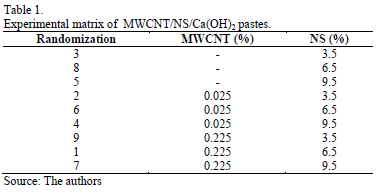
<body><![CDATA[<p align="center"><font size="1" face="Verdana, Arial, Helvetica, sans-seriff"><b>This work is licensed under a</b> <a rel="license" href="http://creativecommons.org/licenses/by-nc-nd/4.0/">Creative Commons Attribution-NonCommercial-NoDerivatives 4.0 International License</a>.</font><br />   <a rel="license" href="http://creativecommons.org/licenses/by-nc-nd/4.0/"><img style="border-width:0" src="https://i.creativecommons.org/l/by-nc-nd/4.0/88x31.png" /></a></p> <hr>     <p><font size="2" face="Verdana, Arial, Helvetica, sans-serif"><b>Abstract    <br>   </b></font><font size="2" face="Verdana, Arial, Helvetica, sans-serif">The pozzolanic effect of nanosilica   (NS) particles when combined with Multi Walled Carbon Nanotubes (MWCNT) was   studied in Ca(OH)<sub>2</sub> pastes and Portland cement mortars. Experimental   design techniques were used to plan the experiments and identify the effect of   the nanoparticles on the properties of the cementing matrices by means of   Analysis of Variance (ANOVA). Samples were prepared with different combinations   of NS and MWCNT. Ca(OH)<sub>2</sub> pastes were used to study the effect the   nanoparticles had on the Calcium-Silicate-Hydrate (C-S-H) production. Portland   cement mortars were used to study the effect of the nanoparticles on the   compressive and flexural strength of the cementing matrices. We found that only   NS had a significant effect on the C-S-H formation for up to 21 days of   hydration, and that MWCNT did not present a positive effect on the mechanical   strength of mortars due to the effects of reagglomeration.</font></p>     <p><font size="2" face="Verdana, Arial, Helvetica, sans-serif"><i>Keywords</i>: Carbon   nanotubes; nanosilica; hybrid effect; pozzolanic activity; strength.</font></p>     <p><font size="2" face="Verdana, Arial, Helvetica, sans-serif"><b>Resumen    <br>   </b></font><font size="2" face="Verdana, Arial, Helvetica, sans-serif">El   efecto puzol&aacute;nico de part&iacute;culas de nanos&iacute;lice (NS) combinadas con Nanotubos de   Carbono de Pared M&uacute;ltiple (MWCNT) fue estudiado en pastas de Ca(OH)<sub>2</sub> y morteros de cemento P&oacute;rtland. T&eacute;cnicas de dise&ntilde;o experimental fueron   aplicadas para planear los experimentos e identificar el efecto de las   nanopart&iacute;culas sobre las propiedades de las matrices cementantes usando   An&aacute;lisis de Varianza (ANOVA). Se prepararon muestras con diferentes   combinaciones de NS y MWCNT. Las pastas de Ca(OH)<sub>2</sub> fueron usadas   para estudiar el efecto de las naopart&iacute;culas en la producci&oacute;n de Silicato de   Calcio Hidratado (C-S-H), y los morteros de cemento P&oacute;rtland se usaron para   estudiar el efecto de las nanopart&iacute;culas en las resistencias a compresi&oacute;n y   flexo-tracci&oacute;n de las matrices. Se encontr&oacute; que solo la NS tuvo un efecto   significativo sobre la producci&oacute;n de C-S-H hasta 21 d&iacute;as de hidrataci&oacute;n, y que   los MWCNT no presentaron un efecto positivo sobre las propiedades mec&aacute;nicas de   los morteros debido a efectos de reagomeraci&oacute;n.</font></p>     <p><font size="2" face="Verdana, Arial, Helvetica, sans-serif"><i>Palabras   clave</i>: Nanotubos de carbono; nanos&iacute;lice; efecto   h&iacute;brido; actividad puzol&aacute;nica; resistencia mec&aacute;nica.</font></p> <hr>     <p>&nbsp;</p>     <p><font size="3" face="Verdana, Arial, Helvetica, sans-serif"><b>1. Introduction</b></font></p>     <p><font size="2" face="Verdana, Arial, Helvetica, sans-serif">It is known   that the main contribution to the mechanical properties of a hydrated Porltand   cement matrix comes from calcium-silicate-hydrate (C-S-H) &#91;1&#93;, which is   nanometric by nature. Due to the nanometric character of C-S-H, nanoparticles   with pozzolanic or reinforcing properties have the most adequate size scale to   modify its properties &#91;2&#93;. Additions of nanosilica (NS) are widely recognized   for their positive effects on the properties of mortars, especially on its   compressive strength &#91;3&#93;. Also, it has been found that the main interaction of   carbon nanotubes within a cement matrix is via the C-S-H, which generates a   &quot;bridge effect&quot; that improves the tensile load distribution within the matrix   and its overall flexural strength &#91;4&#93;.</font></p>     ]]></body>
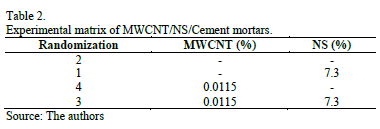
<body><![CDATA[<p><font size="2" face="Verdana, Arial, Helvetica, sans-serif">To improve the properties of a cement   based matrix using nanoparticles, one of the main issues that has to be      addressed is the adequate dispersion of the nanoparticles throughout the matrix   &#91;5&#93;. Depending on the type, amount and pH of the media, among other factors,   nanoparticles are more prone to form agglomerations &#91;6-7&#93;. When the   nanoparticles are not adequately dispersed in the matrix, they act as filler in   the nano pores. When properly dispersed, nanoparticles act as nucleation spots   for hydration products, accelerating the hydration process, increasing the   viscosity of the suspension, helping to maintain the cement grains and   aggregates suspended, decreasing the vulnerability to segregation, and   increasing the workability of the system &#91;1&#93;. In some cases, it has been   reported that poorly dispersed nanoparticles have a tendency to worsen the   properties of the cement based matrices &#91;8&#93;.</font></p>     <p><font size="2" face="Verdana, Arial, Helvetica, sans-serif">Previous research has been carried out   with multi walled carbon nanotubes (MWCNT) dispersed in water using a   policarboxilate based superplasticizer (SP) as a dispersing agent. In this   research it has been found that alkaline environments, such as those formed   during the hydration of cement, which are rich in Ca(OH)2, affect the stability   of the MWCNT dispersions and generate agglomeration phenomena due to an   interaction between MWCNT and the Ca(OH)2. This interaction prevents   electrostatic repulsion between the functional groups on the MWCNT and the SP   molecules &#91;9&#93;. Additionally, it has been found that the MWCNT and NS   combinations have an accelerating effect on the kinetics of the hydration   reaction during the first 24 hours. This has been associated with MWCNT working   as nucleation spots for the hydration products generated by the NS. Due to the   presence of Ca(OH)2 in the media since the first hours of hydration, the MWCNT   dispersed in water will suffer a reagglomeration process. This decreases the   specific surface area available for the MWCNT to work as nucleation spots and   eventually inhibits the pozzolanic activity of NS. This is reflected in the   amount of C-S-H produced and the amount of heat released during the hydration   reaction &#91;9-10&#93;. This work studies the effect of NS and MWCNT combinations on   the pozzolanic activity of NS and the mechanical properties of Portland cement   using factorial experimental designs as a statistical tool to interpret the   analysis and the results.</font></p>     <p>&nbsp;</p>     <p><font size="3" face="Verdana, Arial, Helvetica, sans-serif"><b>2. Methodology</b></font></p>     <p><font size="2" face="Verdana, Arial, Helvetica, sans-serif">The materials used in the experimental   campaign were multi walled carbon nanotubes (MWCNT) functionalized with acid   groups produced by Nanoamor, nanosilica particles (NS) dispersed in water   produced by BASF Chemicals, reactive grade Ca(OH)<sub>2</sub> produced by   Merck, a superplasticizer additive (SP) produced by BASF Chemicals, and type   III Portland cement (Cto) produced by Cementos Argos. Aqueous dispersions of   MWCNT with a solids concentration of 0.25% wt were produced using an ultrasonic   tip processor and SP as a dispersing agent in a 4:1 proportion of SP to MWCNT.   The aqueous dispersions were sonicated in 20 second on/off cycles to avoid any   overheating until a total amount of energy of 40,000 J was applied to the   system. Details of how the dispersions parameters were determined as well as   the quantification of the obtained dispersion degree have been published   separately &#91;9&#93;.</font></p>     <p><font size="2" face="Verdana, Arial, Helvetica, sans-serif">Ca(OH)<sub>2</sub> pastes with a   water-to-Ca(OH)<sub>2</sub> ratio of 1 were produced to identify the influence   of MWCNT and NS on the production of C-S-H due to the pozzolanic activity of   the NS particles. Due to the fact that both MWCNT and NS were dispersed in   water, there is a maximum amount of solid nanoparticles that can be added to   the Ca(OH)<sub>2</sub> paste without surpassing the fixed water-to-Ca(OH)<sub>2</sub> ratio. Taking into account that the solid concentration of the aqueous MWCNT   dispersion was 0.25%, and the solid concentration of the NS aqueous dispersion   was 49.5%, it was calculated that the maximum possible solid additions of MWCNT   and NS were 0.025% and 9.5%, respectively. The pastes were prepared first by   mixing the liquid components in a glass beaker and later by adding Ca(OH)2,   which was hand-mixed with a spatula until a homogeneous paste was obtained.   Finally, the samples were stored in airtight plastic containers that were to be   tested after 1, 3, 7, and 21 days of hydration. At each testing age the   hydration of the pastes was stopped by grinding them in acetone, oven drying at   them at 60 °C, and sieving them though a No 200 mesh. The response variable   chosen was the mass loss at 230°C, which was measured in a Precisa Master XM 60   moisture analyzer. Each sample was heated at a rate of 85 °C/min up to the   maximum temperature, which was held constant for 3.5 minutes or until the   sample reached constant mass. We considered that the sample reached constant   mass when in a period of 60 seconds the sample lost 2.0 mg or less.</font></p>     <p><font size="2" face="Verdana, Arial, Helvetica, sans-serif">The experiment was planned using a 23   factorial experimental design with two factors and three levels for each   factor. The first factor was the amount of MWCNT, and the levels were 0.00%,   0.025% and 0.225%. The second factor was the amount of NS and the levels were   3.5%, 6.5% and 9.5%. The experimental matrix and the randomization of the   experimental runs are presented in <a href="#tab01">Table 1</a>. This design was repeated and   analyzed separately for the four different curing ages.</font></p>     <p align=center><font size="2" face="Verdana, Arial, Helvetica, sans-serif"><a name="tab01"></a></font><img src="/img/revistas/dyna/v83n198/v83n198a16tab01.gif"></p>     <p><font size="2" face="Verdana, Arial, Helvetica, sans-serif">Mortars with a water-to-cementing material ratio of 0.5 were   prepared according to the procedure established in the ASTM C109/C109M   standard. Immediately after mixing, the flow of each mortar was measured using   a flow table, following the procedure established in the ASTM 1437 standard. A   necessary amount of SP was added to each mortar to obtain a 110 ± 5% flow. For   each experimental run and each testing age (1, 3, 7 and 28 days), three   4.0x4.0x16.0 cm prisms were molded. After 24 hours, the prisms were removed   from the molds and cured by submersion in lime</font> <font size="2" face="Verdana, Arial, Helvetica, sans-serif">saturated water   until they reached the testing age. When the testing age was reached, each set   of samples was taken out of the curing water and immediately tested for   compressive and flexural strength according to the procedure established in the   ASTM C348 y C349 standards. The experiments were carried out using a factorial   2<sup>2</sup> experimental design with two factors (MWCNT and NS), and each   factor had two levels (0%NS, 7.3%NS, 0%MWCNT and 0.115%MWCNT). The experimental   matrix and the randomization of the experiments are presented in <a href="#tab02">Table 2</a>. This   design was repeated and analyzed separately for the four different curing ages.</font></p>     <p align="center"><font size="2" face="Verdana, Arial, Helvetica, sans-serif"><a name="tab02"></a></font><img src="/img/revistas/dyna/v83n198/v83n198a16tab02.gif"></p>     ]]></body>
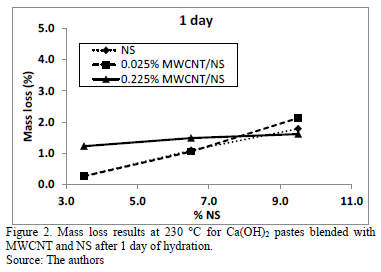
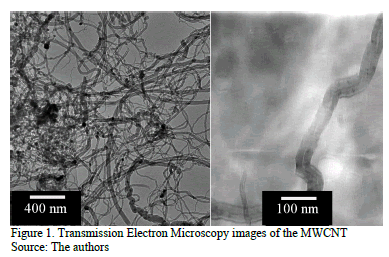
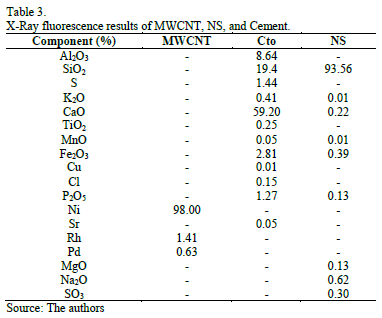
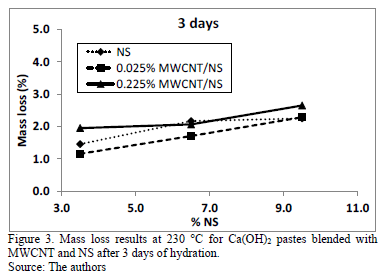
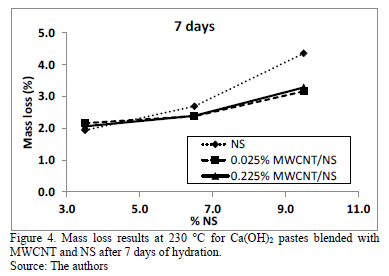
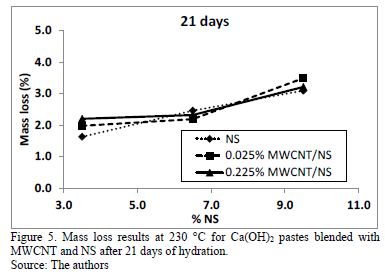
<body><![CDATA[<p>&nbsp;</p>     <p><font size="3" face="Verdana, Arial, Helvetica, sans-serif"><b>3. Results and discussion</b></font></p>     <p><font size="2" face="Verdana, Arial, Helvetica, sans-serif">This section presents the results   obtained in the experimental campaigns and is divided into the following   sub-sections: materials characterization, pozzolanic activity, superplasticizer   demand and mechanical properties.</font></p>     <p><font size="2" face="Verdana, Arial, Helvetica, sans-serif"><b><i>3.1. Materials characterization</i></b></font></p>     <p><font size="2" face="Verdana, Arial, Helvetica, sans-serif">Images were taken of MWCNT using   transmission electronic microscopy (TEM) in a model TECNAI 20kV FEI microscope   that was operated at 200 kV. The sample was dispersed in ethanol and sonicated   in an ultrasonic bath for 30 seconds, then a drop of the sample was placed in a   No 300 Formvar cupper mesh. The images obtained are presented in <a href="#fig01">Fig. 1</a>. The   structures of MWCNT were confirmed and found to be nanometric in diameter and   micrometric in length. MWCNT formed agglomerations and entanglements as a   consequence of the Van der Waals forces that cause them to attract and   agglomerate &#91;11&#93;. A more detailed characterization of the MWCNT and NS that   were used in this research can be found in previous publications &#91;9-10&#93;.</font></p>     <p align="center"><font size="2" face="Verdana, Arial, Helvetica, sans-serif"><a name="fig01"></a></font><img src="/img/revistas/dyna/v83n198/v83n198a16fig01.gif"></p>     <p><font size="2" face="Verdana, Arial, Helvetica, sans-serif">The chemical composition of MWCNT, NS,   and cement was studied by X-Ray fluorescence (FRX), using portable FRX   equipment from Bruker model S1. Tests were performed in powder samples without   further preparation. The results obtained are presented in <a href="#tab03">Table 3</a>. The main   component of MWCNT is carbon, which is not detected by the FRX equipment. From   the elements that were detected, the main constituent was Ni, which was used as   a precursor in the production of the nanotubes &#91;9&#93;. As expected, cement was   found to be composed mainly of CaO, SiO<sub>2,</sub> and Al<sub>2</sub>O<sub>3</sub>.   NS was found to be mainly SiO<sub>2</sub>.</font></p>     <p align=center><font size="2" face="Verdana, Arial, Helvetica, sans-serif"><a name="tab03"></a></font><img src="/img/revistas/dyna/v83n198/v83n198a16tab03.gif"></p>     <p><font size="2" face="Verdana, Arial, Helvetica, sans-serif"><b><i>3.2. Pozzolanic activity</i></b></font></p>     <p><font size="2" face="Verdana, Arial, Helvetica, sans-serif">Ca(OH)<sub>2</sub> pastes blended with NS and MWCNT in the amounts   presented in <a href="#tab01">Table 1</a> were produced according to the procedure described in the   methodology section. After 1, 3, 7, and 21 days of curing, the mass loss of   each paste at 230 °C was measured using a moisture analyzer. The results   obtained are presented in <a href="#fig02">Figs. 2</a>-<a href="#fig05">5</a>. To validate the use of the moisture   analyzer as a method to identify pozzolanic activity, Ca(OH)<sub>2</sub> pastes   that were blended with different types and different amounts of pozzolans were produced. After the different curing   ages the mass loss of each paste was tested at the same temperature by   thermogravimetry analysis and by a moisture analyzer. Statistical analysis   showed a good correlation between the two testing methods. This validation has   been separately published and details can be found in reference &#91;12&#93;.</font></p>     ]]></body>
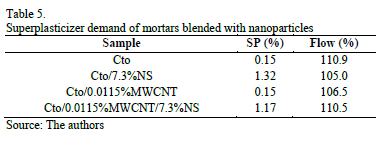
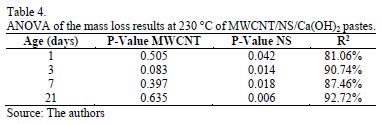
<body><![CDATA[<p align="center"><font size="2" face="Verdana, Arial, Helvetica, sans-serif"><a name="fig02"></a></font><img src="/img/revistas/dyna/v83n198/v83n198a16fig02.gif"></p>     <p align="center"><font size="2" face="Verdana, Arial, Helvetica, sans-serif"><a name="fig03"></a></font><img src="/img/revistas/dyna/v83n198/v83n198a16fig03.gif"></p>     <p align="center"><font size="2" face="Verdana, Arial, Helvetica, sans-serif"><a name="fig04"></a><img src="/img/revistas/dyna/v83n198/v83n198a16fig04" /></font></p>     <p align="center"><font size="2" face="Verdana, Arial, Helvetica, sans-serif"><a name="fig05"></a></font><img src="/img/revistas/dyna/v83n198/v83n198a16fig05.gif"></p>     <p><font size="2" face="Verdana, Arial, Helvetica, sans-serif">The   mass loss results show that for the four ages studied, the higher the amount of   NS the higher the mass loss of the pastes. This is caused by the pozzolanic   activity of NS, whish is identified as a function of the amount of C-S-H formed   by the fixation of Ca(OH)<sub>2</sub> by NS &#91;13&#93;. Additionally, for all the NS   and MWCNT amounts studied, the mass loss stabilizes at between 2 and 3% from   the 7<sup>th</sup> to the 21<sup>st</sup> day of hydration. This indicates that   in this time interval all the NS reacted to form C-S-H. The addition, MWCNT   does not seem to affect the pozzolanic activity of the NS. To confirm this   statement, an analysis of variance (ANOVA) was performed, and its results are   presented in <a href="#tab04">Table 4</a>.</font></p>     <p align="center"><font size="2" face="Verdana, Arial, Helvetica, sans-serif"><a name="tab04"></a></font><img src="/img/revistas/dyna/v83n198/v83n198a16tab04.gif"></p>     <p><font size="2" face="Verdana, Arial, Helvetica, sans-serif">For the   ANOVA, the null hypothesis is that the factors MWCNT and NS do not have any   effect over the mass loss of the pastes, and the alternative hypothesis is that   the factors do have a significant effect over the mass loss. For a significance   of <font face="Symbol">a</font> = 0.05 and an associate confidence <font face="Symbol">b</font> = 95%, it can be said that   if a P-value is lower than <font face="Symbol">a</font>, the null hypothesis is rejected. For all the   studied ages, the P-value of the factor MWCNT is always higher than 0.05   (accepting the </font><font size="2" face="Verdana, Arial, Helvetica, sans-serif">null hypothesis), and the P-Value of the factor NS is lower that 0.005   (rejecting the null hypothesis). This indicates that, with a 95% confidence for   the all the tested ages, the addition of MWCNT did not have an effect on the   mass loss of the pastes, and all the effects identified are from NS's pozzolanic   activity. The experiments presented an average R<sup>2</sup> of 88%, which   means that the statistical model was capable of accounting for 88% of the   variability of the results.</font></p>     <p><font size="2" face="Verdana, Arial, Helvetica, sans-serif">To verify the correct sampling and statistical analysis of the results,   the residue plots were verified for the assumptions of normality, constant   variance, and independence of the response variable. These plots are not   presented here due to space issues. For all the ages, it was concluded that the   statistical model was valid because the plot of normal probability was linear,   the histogram was Gauss shaped, and the residue versus order and adjustment   plots did not show a tendency.</font></p>     <p><font size="2" face="Verdana, Arial, Helvetica, sans-serif"><b><i>3.3. Super plasticizer demand</i></b></font></p>     <p><font size="2" face="Verdana, Arial, Helvetica, sans-serif">To guarantee that the measured strengths   of all mortars were comparable, the flow of each mortar was standardized to a   110 ± 5 % value using a superplasticizer (SP), according to the ASTM 1437   standard. The SP demand of each mortar is presented in <a href="#tab05">Table 5</a>. It was found   that the samples with NS presented a higher SP demand due to the high specific   surface area of the nanoparticles. Mortars with MWCNT did not present a   significant SP demand when compared to the plain cement sample because they   already contained SP as a dispersing agent. Mortars blended with NS and MWCNT   presented a SP demand similar to that of mortars blended only with NS. This   indicates that the additive demand of NS is dominant over the presence of SP in   MWCNT aqueous dispersion. </font></p>     ]]></body>
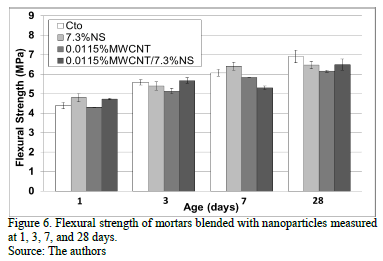
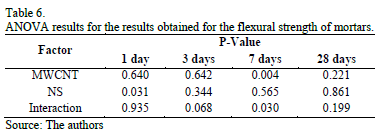
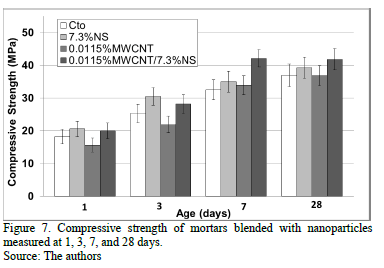
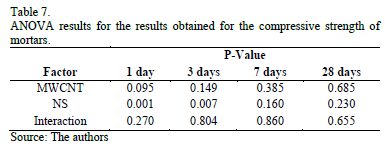
<body><![CDATA[<p align="center"><font size="2" face="Verdana, Arial, Helvetica, sans-serif"><a name="tab05"></a></font><img src="/img/revistas/dyna/v83n198/v83n198a16tab05.gif"></p>     <p><font size="2" face="Verdana, Arial, Helvetica, sans-serif"><b><i>3.4. Mechanical strength</i></b></font></p>     <p><font size="2" face="Verdana, Arial, Helvetica, sans-serif">The four samples' flexural strength   results for the four testing ages are presented in <a href="#fig06">Fig. 6</a>. Each strength result   is presented with error bars of one standard deviation. These results were   statistically studied using ANOVA. A summary of the P-values obtained for each   factor and its interaction are presented in <a href="#tab06">Table 6</a>. For this given ANOVA, the null   hypothesis is that the factors MWCNT and NS do not have any effect over the   flexural strength of the mortars. The alternative hypothesis is that the   factors MWCNT and NS do have a significant effect over the flexural strength of   the mortars.</font></p>     <p align="center"><font size="2" face="Verdana, Arial, Helvetica, sans-serif"><a name="fig06"></a></font><img src="/img/revistas/dyna/v83n198/v83n198a16fig06.gif"></p>     <p align="center"><font size="2" face="Verdana, Arial, Helvetica, sans-serif"><a name="tab06"></a></font><img src="/img/revistas/dyna/v83n198/v83n198a16tab06.gif"></p>     <p><font size="2" face="Verdana, Arial, Helvetica, sans-serif">For a significance <font face="Symbol">a</font> = 0.05, i.e.   with a confidence <font face="Symbol">b</font> = 95%, it can be said that if the obtained P-value is   smaller than <font face="Symbol">a</font>, the hull hypothesis is rejected. This means that the MWCNT   did not have any statistically significant effect on the flexural strength at   any testing age, while NS only presented an improvement after 1 day of   hydration. The MWCNT-NS interaction was statistically significant only after 7   days of hydration. Also, from <a href="#fig06">Fig. 6</a> it can be seen that its effect was   decreasing rather than increasing the flexural strength of the mortar.</font></p>     <p><font size="2" face="Verdana, Arial, Helvetica, sans-serif">The statistical analysis indicates that   during the first day of hydration the MWCNT accelerated the pozzolanic activity   of NS, which generated an improvement in the flexural strength by working as   nucleation points. However, after 3 days of hydration, the improvement   disappeared, and after 7 days it there was a decrease in strength. This can be   explained by the reagglomeration process of the MWCNT &#91;9-10&#93;, which inhibited   the activity of the NS by decreasing its available surface area to react. After   7 and 28 days, not only the pozzolanic activity of NS was completely inhibited,   but also the hydration process of cement was affected. This decreased the   overall strength of the matrix.</font></p>     <p><font size="2" face="Verdana, Arial, Helvetica, sans-serif">Compressive strength results for the 4   samples at the 4 testing ages are presented in <a href="#fig07">Fig. 7</a>. As with the flexural   strength, all results are presented with error bars of one standard deviation.   The statistical analysis was carried out with the same null and alternative   hypotheses used for the flexural strength results. A summary of the P-values   obtained for each factor and their interaction are presented in <a href="#tab07">Table 7</a>.</font></p>     <p align="center"><font size="2" face="Verdana, Arial, Helvetica, sans-serif"><a name="fig07"></a></font><img src="/img/revistas/dyna/v83n198/v83n198a16fig07.gif"></p>     <p align="center"><font size="2" face="Verdana, Arial, Helvetica, sans-serif"><a name="tab07"></a></font><img src="/img/revistas/dyna/v83n198/v83n198a16tab07.gif"></p>     ]]></body>
<body><![CDATA[<p><font size="2" face="Verdana, Arial, Helvetica, sans-serif">The addition of MWCNT did not have any   statistically significant effect on the compressive strength of the samples at   any testing age while NS presented a significant improvement only after 1 and 3   days of hydration. Again, this behavior can be explained by the reagglomeration   process of the MWCNT. The pozzolanic activity of NS was probably inhibited by the   MWCNT agglomeration after 7 and 28 days of hydration.</font></p>     <p>&nbsp;</p>     <p><font size="3" face="Verdana, Arial, Helvetica, sans-serif"><b>4. General discussion</b></font></p>     <p><font size="2" face="Verdana, Arial, Helvetica, sans-serif">From the results, it was verified that   only NS presented a significant Ca(OH)<sub>2</sub> fixation that translated   into a higher C-S-H production; MWCNT had no effect. This confirms the fact   that MWCNT have no chemical affinity with the hydration products of cement   &#91;14&#93;, and any mechanical improvement caused by the MWCNT is a consequence of   physical effects such as nucleation or load distribution through a &quot;bridge   effect&quot; &#91;4&#93;. </font></p>     <p><font size="2" face="Verdana, Arial, Helvetica, sans-serif">Only during early ages were flexural and   compressive strengths of the mortars improved by the combination of   nanoparticles. At later ages the presence of the combination of nanoparticles   was even found to be detrimental. These results are in agreement with previous   reports that found that a predominance of a reaglomeration process of MWCNT   inhibited the pozzolanic activity of NS and hindered the hydration reaction of   cement at ages greater than 24 hours of curing &#91;9-10&#93;. This reagglomeration can   account for the decrease in mechanical properties at later ages. The expected   positive effects of the MWCNT on the mechanical properties of the cement matrix   may have occurred before 1 day of hydration and were not detected in the   experiments carried out due to a rapid reagglomeration of the MWCNT.</font></p>     <p>&nbsp;</p>     <p><font size="3" face="Verdana, Arial, Helvetica, sans-serif"><b>5. Conclusions</b></font></p> <ul>       <li><font size="2" face="Verdana, Arial, Helvetica, sans-serif">NS particles maintained their     pozzolanic activity up to the 7<sup>th</sup> day of hydration in Ca(OH)<sub>2</sub> pastes while MWCNT did not have any effect on it at any age.</font></li>       <li><font size="2" face="Verdana, Arial, Helvetica, sans-serif">Mortars with MWCNT did not     present a SP demand higher than that of plain cement ones. This is consequence     of the presence of SP in the MWCNT as a dispersing agent.</font></li>       <li><font size="2" face="Verdana, Arial, Helvetica, sans-serif">The addition of MWCNT did not     have any significant effect on the compressive strength at any curing age while     NS presented a significant improvement after 1 and 3 days of hydration.</font></li>       ]]></body>
<body><![CDATA[<li><font size="2" face="Verdana, Arial, Helvetica, sans-serif">MWCNT did not present positive     effects on the mechanical strength of mortars. After 3 days of hydration, they     inhibited the pozzolanic activity of NS due to their reagglomeration process,     which translated into a decrease in mechanical strength.</font></li>     </ul>     <p>&nbsp;</p>     <p><font size="3" face="Verdana, Arial, Helvetica, sans-serif"><b>References</b></font></p>     <!-- ref --><p><font size="2" face="Verdana, Arial, Helvetica, sans-serif"><b>&#91;1&#93;</b> Tob&oacute;n, J.I., Pay&aacute;, J.J.,   Borrachero, M.V. and Restrepo, O.J., Mineralogical evolution of Portland cement   blended with silica nanoparticles and its effect on mechanical strength.   Construction and Building Materials, 36, pp. 736-742, 2012. DOI:   10.1016/j.conbuildmat.2012.06.043</font>&nbsp;&nbsp;&nbsp;&nbsp;&nbsp;&nbsp;&nbsp;&nbsp;[&#160;<a href="javascript:void(0);" onclick="javascript: window.open('/scielo.php?script=sci_nlinks&ref=1163599&pid=S0012-7353201600040001600001&lng=','','width=640,height=500,resizable=yes,scrollbars=1,menubar=yes,');">Links</a>&#160;]<!-- end-ref --><!-- ref --><p><font size="2" face="Verdana, Arial, Helvetica, sans-serif"><b>&#91;2&#93;</b> Sanchez, F. and Sobolev, K.,   Nanotechnology in concrete - A review. Construction and Building Materials,   24(11), pp. 2060-2071, 2010. DOI: 10.1016/j.conbuildmat.2010.03.014</font>&nbsp;&nbsp;&nbsp;&nbsp;&nbsp;&nbsp;&nbsp;&nbsp;[&#160;<a href="javascript:void(0);" onclick="javascript: window.open('/scielo.php?script=sci_nlinks&ref=1163600&pid=S0012-7353201600040001600002&lng=','','width=640,height=500,resizable=yes,scrollbars=1,menubar=yes,');">Links</a>&#160;]<!-- end-ref --><!-- ref --><p><font size="2" face="Verdana, Arial, Helvetica, sans-serif"><b>&#91;3&#93;</b> Hewlett, P., Lea's Chemistry   of Cement and Concrete, 4th edition, Oxford: Elsevier Science &amp; Technology   Books, 2004.    &nbsp;&nbsp;&nbsp;&nbsp;&nbsp;&nbsp;&nbsp;&nbsp;[&#160;<a href="javascript:void(0);" onclick="javascript: window.open('/scielo.php?script=sci_nlinks&ref=1163601&pid=S0012-7353201600040001600003&lng=','','width=640,height=500,resizable=yes,scrollbars=1,menubar=yes,');">Links</a>&#160;]<!-- end-ref --></font></p>     <!-- ref --><p><font size="2" face="Verdana, Arial, Helvetica, sans-serif"><b>&#91;4&#93;</b> Li, G., Wang, P. and Zhao. X.,   Mechanical behavior and microstructure of cement composites incorporating   surface-treated multi-walled carbon nanotubes. Carbon, 43(6), pp. 1239-1245,   2005. DOI: 10.1016/j.carbon.2004.12.017</font>&nbsp;&nbsp;&nbsp;&nbsp;&nbsp;&nbsp;&nbsp;&nbsp;[&#160;<a href="javascript:void(0);" onclick="javascript: window.open('/scielo.php?script=sci_nlinks&ref=1163603&pid=S0012-7353201600040001600004&lng=','','width=640,height=500,resizable=yes,scrollbars=1,menubar=yes,');">Links</a>&#160;]<!-- end-ref --><!-- ref --><p><font size="2" face="Verdana, Arial, Helvetica, sans-serif"><b>&#91;5&#93;</b> Yazdanbakhsh, A., Grasley, Z.,   Tyson, B. and Abu Al-Rub. R.K., Dispersion quantification of inclusions in   composites. Composites Part A: Applied Science and Manufacturing, 42(1), pp.   75-83, 2011. DOI: 10.1016/j.compositesa.2010.10.005</font>&nbsp;&nbsp;&nbsp;&nbsp;&nbsp;&nbsp;&nbsp;&nbsp;[&#160;<a href="javascript:void(0);" onclick="javascript: window.open('/scielo.php?script=sci_nlinks&ref=1163604&pid=S0012-7353201600040001600005&lng=','','width=640,height=500,resizable=yes,scrollbars=1,menubar=yes,');">Links</a>&#160;]<!-- end-ref --><!-- ref --><p><font size="2" face="Verdana, Arial, Helvetica, sans-serif"><b>&#91;6&#93;</b> Shih, J., Chang, T. and Hsiao,   T., Effect of nanosilica on characterization of Portland cement composite.   Materials Science and Engineering: A, 424, pp. 266-274, 2006. DOI:   10.1016/j.msea.2006.03.010</font>&nbsp;&nbsp;&nbsp;&nbsp;&nbsp;&nbsp;&nbsp;&nbsp;[&#160;<a href="javascript:void(0);" onclick="javascript: window.open('/scielo.php?script=sci_nlinks&ref=1163605&pid=S0012-7353201600040001600006&lng=','','width=640,height=500,resizable=yes,scrollbars=1,menubar=yes,');">Links</a>&#160;]<!-- end-ref --><!-- ref --><p><font size="2" face="Verdana, Arial, Helvetica, sans-serif"><b>&#91;7&#93;</b> Srinivasan, S., Barbhuiya, S.,   Charan, D. and Pandey, S.P., Characterising cement-superplasticiser interaction   using zeta potential measurements. Construction and Building Materials, 24(12),   pp. 2517-2521, 2010. DOI: 10.1016/j.conbuildmat.2010.06.005</font>&nbsp;&nbsp;&nbsp;&nbsp;&nbsp;&nbsp;&nbsp;&nbsp;[&#160;<a href="javascript:void(0);" onclick="javascript: window.open('/scielo.php?script=sci_nlinks&ref=1163606&pid=S0012-7353201600040001600007&lng=','','width=640,height=500,resizable=yes,scrollbars=1,menubar=yes,');">Links</a>&#160;]<!-- end-ref --><!-- ref --><p><font size="2" face="Verdana, Arial, Helvetica, sans-serif"><b>&#91;8&#93;</b> Morsy, M.S., Alsayed, S.H. and Aqel,   M., Hybrid effect of carbon nanotube and nano-clay on physico-mechanical   properties of cement mortar. Construction and Building Materials, 25(1), pp.   145-149, 2011. DOI: 10.1016/j.conbuildmat.2010.06.046</font>&nbsp;&nbsp;&nbsp;&nbsp;&nbsp;&nbsp;&nbsp;&nbsp;[&#160;<a href="javascript:void(0);" onclick="javascript: window.open('/scielo.php?script=sci_nlinks&ref=1163607&pid=S0012-7353201600040001600008&lng=','','width=640,height=500,resizable=yes,scrollbars=1,menubar=yes,');">Links</a>&#160;]<!-- end-ref --><!-- ref --><p><font size="2" face="Verdana, Arial, Helvetica, sans-serif"><b>&#91;9&#93;</b> Mendoza, O., Sierra, G. and   Tob&oacute;n, J.I., Influence of super plasticizer and Ca(OH)<sub>2</sub> on the   stability of functionalized multi-walled carbon nanotubes dispersions for   cement composites applications. Construction and Building Materials, 47, pp.   771-778, 2013. DOI: 10.1016/j.conbuildmat.2013.05.100</font>&nbsp;&nbsp;&nbsp;&nbsp;&nbsp;&nbsp;&nbsp;&nbsp;[&#160;<a href="javascript:void(0);" onclick="javascript: window.open('/scielo.php?script=sci_nlinks&ref=1163608&pid=S0012-7353201600040001600009&lng=','','width=640,height=500,resizable=yes,scrollbars=1,menubar=yes,');">Links</a>&#160;]<!-- end-ref --><!-- ref --><p><font size="2" face="Verdana, Arial, Helvetica, sans-serif"><b>&#91;10&#93;</b> Mendoza, O., Sierra, G. and   Tob&oacute;n, J.I., Effect of the reagglomeration process of multi-walled carbon   nanotubes dispersions on the early activity of nanosilica in cement composites.   Construction and Building Materials, 54, pp. 550-557, 2014. DOI: 10.1016/j.conbuildmat.2013.12.084</font>&nbsp;&nbsp;&nbsp;&nbsp;&nbsp;&nbsp;&nbsp;&nbsp;[&#160;<a href="javascript:void(0);" onclick="javascript: window.open('/scielo.php?script=sci_nlinks&ref=1163609&pid=S0012-7353201600040001600010&lng=','','width=640,height=500,resizable=yes,scrollbars=1,menubar=yes,');">Links</a>&#160;]<!-- end-ref --><!-- ref --><p><font size="2" face="Verdana, Arial, Helvetica, sans-serif"><b>&#91;11&#93;</b> Rausch, J., Zhuang, RC. and   Mäder, E., Surfactant assisted dispersion of functionalized multi-walled carbon   nanotubes in aqueous media. Composites Part A: Applied Science and   Manufacturing, 41(9), pp, 1038-1046, 2010. DOI: 10.1016/j.compositesa.2010.03.007</font>&nbsp;&nbsp;&nbsp;&nbsp;&nbsp;&nbsp;&nbsp;&nbsp;[&#160;<a href="javascript:void(0);" onclick="javascript: window.open('/scielo.php?script=sci_nlinks&ref=1163610&pid=S0012-7353201600040001600011&lng=','','width=640,height=500,resizable=yes,scrollbars=1,menubar=yes,');">Links</a>&#160;]<!-- end-ref --><!-- ref --><p><font size="2" face="Verdana, Arial, Helvetica, sans-serif"><b>&#91;12&#93;</b> Mendoza, O. and Tob&oacute;n, J.I., An   alternative thermal method for identification of pozzolanic activity in Ca(OH)<sub>2</sub>/pozzolan   pastes. Journal of Thermal Analysis and Calorimetry, 114, pp 589-596, 2013.   DOI: 10.1007/s10973-013-2973-y</font>&nbsp;&nbsp;&nbsp;&nbsp;&nbsp;&nbsp;&nbsp;&nbsp;[&#160;<a href="javascript:void(0);" onclick="javascript: window.open('/scielo.php?script=sci_nlinks&ref=1163611&pid=S0012-7353201600040001600012&lng=','','width=640,height=500,resizable=yes,scrollbars=1,menubar=yes,');">Links</a>&#160;]<!-- end-ref --><!-- ref --><p><font size="2" face="Verdana, Arial, Helvetica, sans-serif"><b>&#91;13&#93;</b> Frias,   M., Villar-Coci&ntilde;a, E., Sa&aacute;nchez, M.I. and Valencia-Morales. E., The effect that different pozzolanic activity methods has on the   kinetic constants of the pozzolanic reaction in sugar cane straw-clay ash/lime   systems: Application of a kinetic-diffusive model. Cement and Concrete   Research, 35(11), pp. 2137-2142, 2005. DOI: 10.1016/j.cemconres.2005.07.005</font>&nbsp;&nbsp;&nbsp;&nbsp;&nbsp;&nbsp;&nbsp;&nbsp;[&#160;<a href="javascript:void(0);" onclick="javascript: window.open('/scielo.php?script=sci_nlinks&ref=1163612&pid=S0012-7353201600040001600013&lng=','','width=640,height=500,resizable=yes,scrollbars=1,menubar=yes,');">Links</a>&#160;]<!-- end-ref --><!-- ref --><p><font size="2" face="Verdana, Arial, Helvetica, sans-serif"><b>&#91;14&#93;</b> Makar, J.M. and Chan, G.W.,   Growth of cement hydration products on single-walled carbon nanotubes. Journal   of the American Ceramic Society, 92(6), pp. 1303-1310, 2009. DOI:   10.1111/j.1551-2916.2009.03055.x</font>&nbsp;&nbsp;&nbsp;&nbsp;&nbsp;&nbsp;&nbsp;&nbsp;[&#160;<a href="javascript:void(0);" onclick="javascript: window.open('/scielo.php?script=sci_nlinks&ref=1163613&pid=S0012-7353201600040001600014&lng=','','width=640,height=500,resizable=yes,scrollbars=1,menubar=yes,');">Links</a>&#160;]<!-- end-ref --><p>&nbsp;</p>     ]]></body>
<body><![CDATA[<p><font size="2" face="Verdana, Arial, Helvetica, sans-serif"><b>O.A. Mendoza-Reales,</b> received a BSc. in Civil Engineering in 2009 and an MSc in Materials   Engineering in 2013, both from the Universidad Nacional de Colombia. Medellin,   Colombia. Currently he is a doctoral candidate in the Civil Engineering program   at the Universidade Federal do Rio de Janeiro, Rio de Janeiro, Brazil. His   research interests include: chemistry of cement, cement hydration,   nanotechnology, pozzolanic materials, carbon nanotubes, oil well cementing   pastes and environmental impact of cement based materials. ORCID:   0000-0002-4241-1321</font></p>     <p><font size="2" face="Verdana, Arial, Helvetica, sans-serif"><b>G. Sierra-Gallego,</b> received a BSc. in Chemical Engineering in 1991, an MSc in Chemical Sciences in   2003 both from the Universidad de Antioquia, Colombia and a PhD in 2007 from   Poitiers University. Currently, he is a Professor in the Materials and Minerals   Department, Facultad de Minas, Universidad Nacional de Colombia. His research   interests include: materials sciences, synthesis of carbon nanotubes,   heterogeneous catalytic processes, biofuels and energetic evaluation of   byproducts. ORCID:   0000-0001-7981-2041</font></p>     <p><font size="2" face="Verdana, Arial, Helvetica, sans-serif"><b>J.I. Tob&oacute;n,</b> received a   BSc. in Geological Engineering in 1992, an MSc in Engineering in 2003, and a   PhD in Science and Technology of Materials in 2011, all from the Universidad   Nacional de Colombia, Medellin, Colombia. From 1992 to 1995, he worked for   different companies in mining and oil; from 1995 to 1999 he worked for Cementos   Argos S.A., at the same time from 1993 to 1999 he worked for the Universidad   Nacional de Colombia as a part-time Professor, and since 1999 he has worked for   the Universidad Nacional de Colombia on a full-time basis. Currently, he is a   full professor in the Materials and Minerals Department, Facultad de Minas,   Universidad Nacional de Colombia. His research interests include: industrial   application of minerals and rocks, chemistry and mineralogy of cements,   nanotechnology in construction materials, alternative cementitious materials,   and high performance cements and concretes. ORCID:   0000-0002-1451-1309</font></p>      ]]></body><back>
<ref-list>
<ref id="B1">
<label>1</label><nlm-citation citation-type="journal">
<person-group person-group-type="author">
<name>
<surname><![CDATA[Tobón]]></surname>
<given-names><![CDATA[J.I.]]></given-names>
</name>
<name>
<surname><![CDATA[Payá]]></surname>
<given-names><![CDATA[J.J.]]></given-names>
</name>
<name>
<surname><![CDATA[Borrachero]]></surname>
<given-names><![CDATA[M.V.]]></given-names>
</name>
<name>
<surname><![CDATA[Restrepo]]></surname>
<given-names><![CDATA[O.J.]]></given-names>
</name>
</person-group>
<article-title xml:lang="en"><![CDATA[Mineralogical evolution of Portland cement blended with silica nanoparticles and its effect on mechanical strength]]></article-title>
<source><![CDATA[Construction and Building Materials]]></source>
<year>2012</year>
<numero>36</numero>
<issue>36</issue>
<page-range>736-742</page-range></nlm-citation>
</ref>
<ref id="B2">
<label>2</label><nlm-citation citation-type="journal">
<person-group person-group-type="author">
<name>
<surname><![CDATA[Sanchez]]></surname>
<given-names><![CDATA[F.]]></given-names>
</name>
<name>
<surname><![CDATA[Sobolev]]></surname>
<given-names><![CDATA[K.]]></given-names>
</name>
</person-group>
<article-title xml:lang="en"><![CDATA[Nanotechnology in concrete: A review]]></article-title>
<source><![CDATA[Construction and Building Materials]]></source>
<year>2010</year>
<volume>24</volume>
<numero>11</numero>
<issue>11</issue>
<page-range>2060-2071</page-range></nlm-citation>
</ref>
<ref id="B3">
<label>3</label><nlm-citation citation-type="book">
<person-group person-group-type="author">
<name>
<surname><![CDATA[Hewlett]]></surname>
<given-names><![CDATA[P.]]></given-names>
</name>
</person-group>
<source><![CDATA[Lea's Chemistry of Cement and Concrete]]></source>
<year>2004</year>
<edition>4th</edition>
<publisher-loc><![CDATA[Oxford ]]></publisher-loc>
<publisher-name><![CDATA[Elsevier Science & Technology Books,]]></publisher-name>
</nlm-citation>
</ref>
<ref id="B4">
<label>4</label><nlm-citation citation-type="journal">
<person-group person-group-type="author">
<name>
<surname><![CDATA[Li]]></surname>
<given-names><![CDATA[G.]]></given-names>
</name>
<name>
<surname><![CDATA[Wang]]></surname>
<given-names><![CDATA[P.]]></given-names>
</name>
<name>
<surname><![CDATA[Zhao.]]></surname>
<given-names><![CDATA[X.]]></given-names>
</name>
</person-group>
<article-title xml:lang="en"><![CDATA[Mechanical behavior and microstructure of cement composites incorporating surface-treated multi-walled carbon nanotubes]]></article-title>
<source><![CDATA[Carbon]]></source>
<year>2005</year>
<volume>43</volume>
<numero>6</numero>
<issue>6</issue>
<page-range>1239-1245</page-range></nlm-citation>
</ref>
<ref id="B5">
<label>5</label><nlm-citation citation-type="journal">
<person-group person-group-type="author">
<name>
<surname><![CDATA[Yazdanbakhsh]]></surname>
<given-names><![CDATA[A.]]></given-names>
</name>
<name>
<surname><![CDATA[Grasley]]></surname>
<given-names><![CDATA[Z.]]></given-names>
</name>
<name>
<surname><![CDATA[Tyson]]></surname>
<given-names><![CDATA[B.]]></given-names>
</name>
<name>
<surname><![CDATA[Abu Al-Rub.]]></surname>
<given-names><![CDATA[R.K.]]></given-names>
</name>
</person-group>
<article-title xml:lang="en"><![CDATA[Dispersion quantification of inclusions in composites.]]></article-title>
<source><![CDATA[Composites Part A: Applied Science and Manufacturing]]></source>
<year>2011</year>
<volume>42</volume>
<numero>1</numero>
<issue>1</issue>
<page-range>75-83</page-range></nlm-citation>
</ref>
<ref id="B6">
<label>6</label><nlm-citation citation-type="journal">
<person-group person-group-type="author">
<name>
<surname><![CDATA[Shih]]></surname>
<given-names><![CDATA[J.]]></given-names>
</name>
<name>
<surname><![CDATA[Chang]]></surname>
<given-names><![CDATA[T.]]></given-names>
</name>
<name>
<surname><![CDATA[Hsiao]]></surname>
<given-names><![CDATA[T.]]></given-names>
</name>
</person-group>
<article-title xml:lang="en"><![CDATA[Effect of nanosilica on characterization of Portland cement composite.]]></article-title>
<source><![CDATA[Materials Science and Engineering: A]]></source>
<year>2006</year>
<numero>424</numero>
<issue>424</issue>
<page-range>266-274</page-range></nlm-citation>
</ref>
<ref id="B7">
<label>7</label><nlm-citation citation-type="journal">
<person-group person-group-type="author">
<name>
<surname><![CDATA[Srinivasan]]></surname>
<given-names><![CDATA[S.]]></given-names>
</name>
<name>
<surname><![CDATA[Barbhuiya]]></surname>
<given-names><![CDATA[S.]]></given-names>
</name>
<name>
<surname><![CDATA[Charan]]></surname>
<given-names><![CDATA[D.]]></given-names>
</name>
<name>
<surname><![CDATA[Pandey]]></surname>
<given-names><![CDATA[S.P.]]></given-names>
</name>
</person-group>
<article-title xml:lang="en"><![CDATA[Characterising cement-superplasticiser interaction using zeta potential measurements.]]></article-title>
<source><![CDATA[Construction and Building Materials]]></source>
<year></year>
<volume>24</volume>
<numero>12</numero>
<issue>12</issue>
<page-range>2517-2521</page-range><page-range>2010</page-range></nlm-citation>
</ref>
<ref id="B8">
<label>8</label><nlm-citation citation-type="journal">
<person-group person-group-type="author">
<name>
<surname><![CDATA[Morsy]]></surname>
<given-names><![CDATA[M.S.]]></given-names>
</name>
<name>
<surname><![CDATA[Alsayed]]></surname>
<given-names><![CDATA[S.H.]]></given-names>
</name>
<name>
<surname><![CDATA[Aqel]]></surname>
<given-names><![CDATA[M.]]></given-names>
</name>
</person-group>
<article-title xml:lang="en"><![CDATA[Hybrid effect of carbon nanotube and nano-clay on physico-mechanical properties of cement mortar]]></article-title>
<source><![CDATA[Construction and Building Materials]]></source>
<year>2011</year>
<volume>25</volume>
<numero>1</numero>
<issue>1</issue>
<page-range>145-149</page-range></nlm-citation>
</ref>
<ref id="B9">
<label>9</label><nlm-citation citation-type="journal">
<person-group person-group-type="author">
<name>
<surname><![CDATA[Mendoza]]></surname>
<given-names><![CDATA[O.]]></given-names>
</name>
<name>
<surname><![CDATA[Sierra]]></surname>
<given-names><![CDATA[G.]]></given-names>
</name>
<name>
<surname><![CDATA[Tobón]]></surname>
<given-names><![CDATA[J.I.]]></given-names>
</name>
</person-group>
<article-title xml:lang="en"><![CDATA[Influence of super plasticizer and Ca(OH)2 on the stability of functionalized multi-walled carbon nanotubes dispersions for cement composites applications.]]></article-title>
<source><![CDATA[Construction and Building Materials]]></source>
<year>2013</year>
<numero>47</numero>
<issue>47</issue>
<page-range>771-778</page-range></nlm-citation>
</ref>
<ref id="B10">
<label>10</label><nlm-citation citation-type="journal">
<person-group person-group-type="author">
<name>
<surname><![CDATA[Mendoza]]></surname>
<given-names><![CDATA[O.]]></given-names>
</name>
<name>
<surname><![CDATA[Sierra]]></surname>
<given-names><![CDATA[G.]]></given-names>
</name>
<name>
<surname><![CDATA[Tobón]]></surname>
<given-names><![CDATA[J.I.]]></given-names>
</name>
</person-group>
<article-title xml:lang="en"><![CDATA[Effect of the reagglomeration process of multi-walled carbon nanotubes dispersions on the early activity of nanosilica in cement composites]]></article-title>
<source><![CDATA[Construction and Building Materials]]></source>
<year>2014</year>
<numero>54</numero>
<issue>54</issue>
<page-range>550-557</page-range></nlm-citation>
</ref>
<ref id="B11">
<label>11</label><nlm-citation citation-type="journal">
<person-group person-group-type="author">
<name>
<surname><![CDATA[Rausch]]></surname>
<given-names><![CDATA[J.]]></given-names>
</name>
<name>
<surname><![CDATA[Zhuang]]></surname>
<given-names><![CDATA[RC.]]></given-names>
</name>
<name>
<surname><![CDATA[Mäder]]></surname>
<given-names><![CDATA[E.]]></given-names>
</name>
</person-group>
<article-title xml:lang="en"><![CDATA[Surfactant assisted dispersion of functionalized multi-walled carbon nanotubes in aqueous media.]]></article-title>
<source><![CDATA[Composites Part A Applied Science and Manufacturing]]></source>
<year>2010</year>
<volume>41</volume>
<numero>9</numero>
<issue>9</issue>
<page-range>1038-1046</page-range></nlm-citation>
</ref>
<ref id="B12">
<label>12</label><nlm-citation citation-type="journal">
<person-group person-group-type="author">
<name>
<surname><![CDATA[Mendoza]]></surname>
<given-names><![CDATA[O.]]></given-names>
</name>
<name>
<surname><![CDATA[Tobón]]></surname>
<given-names><![CDATA[J.I.]]></given-names>
</name>
</person-group>
<article-title xml:lang="en"><![CDATA[An alternative thermal method for identification of pozzolanic activity in Ca(OH)2/pozzolan pastes]]></article-title>
<source><![CDATA[Journal of Thermal Analysis and Calorimetry]]></source>
<year>2013</year>
<numero>114</numero>
<issue>114</issue>
<page-range>589-596</page-range></nlm-citation>
</ref>
<ref id="B13">
<label>13</label><nlm-citation citation-type="journal">
<person-group person-group-type="author">
<name>
<surname><![CDATA[Frias]]></surname>
<given-names><![CDATA[M.]]></given-names>
</name>
<name>
<surname><![CDATA[Villar-Cociña]]></surname>
<given-names><![CDATA[E.,]]></given-names>
</name>
<name>
<surname><![CDATA[Saánchez]]></surname>
<given-names><![CDATA[M.I.]]></given-names>
</name>
<name>
<surname><![CDATA[Valencia-Morales.]]></surname>
<given-names><![CDATA[E.]]></given-names>
</name>
</person-group>
<article-title xml:lang="en"><![CDATA[The effect that different pozzolanic activity methods has on the kinetic constants of the pozzolanic reaction in sugar cane straw-clay ash/lime systems: Application of a kinetic-diffusive model]]></article-title>
<source><![CDATA[Cement and Concrete Research]]></source>
<year>2005</year>
<volume>35</volume>
<numero>11</numero>
<issue>11</issue>
<page-range>2137-2142</page-range></nlm-citation>
</ref>
<ref id="B14">
<label>14</label><nlm-citation citation-type="journal">
<person-group person-group-type="author">
<name>
<surname><![CDATA[Makar]]></surname>
<given-names><![CDATA[J.M.]]></given-names>
</name>
<name>
<surname><![CDATA[Chan]]></surname>
<given-names><![CDATA[G.W.]]></given-names>
</name>
</person-group>
<article-title xml:lang="en"><![CDATA[Growth of cement hydration products on single-walled carbon nanotubes.]]></article-title>
<source><![CDATA[Journal of the American Ceramic Society]]></source>
<year>2009</year>
<volume>92</volume>
<numero>6</numero>
<issue>6</issue>
<page-range>1303-1310</page-range></nlm-citation>
</ref>
</ref-list>
</back>
</article>