<?xml version="1.0" encoding="ISO-8859-1"?><article xmlns:mml="http://www.w3.org/1998/Math/MathML" xmlns:xlink="http://www.w3.org/1999/xlink" xmlns:xsi="http://www.w3.org/2001/XMLSchema-instance">
<front>
<journal-meta>
<journal-id>0012-7353</journal-id>
<journal-title><![CDATA[DYNA]]></journal-title>
<abbrev-journal-title><![CDATA[Dyna rev.fac.nac.minas]]></abbrev-journal-title>
<issn>0012-7353</issn>
<publisher>
<publisher-name><![CDATA[Universidad Nacional de Colombia]]></publisher-name>
</publisher>
</journal-meta>
<article-meta>
<article-id>S0012-73532016000400021</article-id>
<article-id pub-id-type="doi">10.15446/dyna.v83n198.56106</article-id>
<title-group>
<article-title xml:lang="en"><![CDATA[Adsorption and catalytic oxidation of asphaltenes in fumed silica nanoparticles: Effect of the surface acidity]]></article-title>
<article-title xml:lang="es"><![CDATA[Adsorción y oxidación catalítica de asfaltenos en nanopartículas de sílice fumárica: Efecto de la acidez superficial]]></article-title>
</title-group>
<contrib-group>
<contrib contrib-type="author">
<name>
<surname><![CDATA[Franco-Ariza]]></surname>
<given-names><![CDATA[Camilo Andrés]]></given-names>
</name>
<xref ref-type="aff" rid="A01"/>
</contrib>
<contrib contrib-type="author">
<name>
<surname><![CDATA[Guzmán-Calle]]></surname>
<given-names><![CDATA[Juan David]]></given-names>
</name>
<xref ref-type="aff" rid="A01"/>
</contrib>
<contrib contrib-type="author">
<name>
<surname><![CDATA[Cortés-Correa]]></surname>
<given-names><![CDATA[Farid Bernardo]]></given-names>
</name>
<xref ref-type="aff" rid="A01"/>
</contrib>
</contrib-group>
<aff id="A01">
<institution><![CDATA[,Universidad Nacional de Colombia Facultad de Minas ]]></institution>
<addr-line><![CDATA[Medellín ]]></addr-line>
<country>Colombia</country>
</aff>
<aff id="A">
<institution><![CDATA[,jdguzmanc@unal.edu.co  ]]></institution>
<addr-line><![CDATA[ ]]></addr-line>
</aff>
<aff id="A">
<institution><![CDATA[,fbcortes@unal.edu.co  ]]></institution>
<addr-line><![CDATA[ ]]></addr-line>
</aff>
<pub-date pub-type="pub">
<day>00</day>
<month>09</month>
<year>2016</year>
</pub-date>
<pub-date pub-type="epub">
<day>00</day>
<month>09</month>
<year>2016</year>
</pub-date>
<volume>83</volume>
<numero>198</numero>
<fpage>171</fpage>
<lpage>179</lpage>
<copyright-statement/>
<copyright-year/>
<self-uri xlink:href="http://www.scielo.org.co/scielo.php?script=sci_arttext&amp;pid=S0012-73532016000400021&amp;lng=en&amp;nrm=iso"></self-uri><self-uri xlink:href="http://www.scielo.org.co/scielo.php?script=sci_abstract&amp;pid=S0012-73532016000400021&amp;lng=en&amp;nrm=iso"></self-uri><self-uri xlink:href="http://www.scielo.org.co/scielo.php?script=sci_pdf&amp;pid=S0012-73532016000400021&amp;lng=en&amp;nrm=iso"></self-uri><abstract abstract-type="short" xml:lang="en"><p><![CDATA[This study aims to evaluate the effect of surface acidity of fumed silica nanoparticles in adsorption and subsequent thermal cracking of Colombian asphaltenes. The acidities of the surfaces were established through Temperature Programed Desorption (TPD) experiments. The adsorption equilibrium of asphaltenes was determined using a static batch method, and the data obtained was fitted using the Langmuir model, the Freundlich model and the SLE Model. Asphaltenes catalytic oxidation experiments were conducted, and it was found that this process was surface nature dependent. In all cases, the temperature of asphaltenes oxidation was reduced regarding the virgin asphaltene sample. The effective activation energies were estimated with the iso-conversional OFW method. This energy was found to be related to adsorption affinity and asphaltenes self-association on nanoparticles surface.]]></p></abstract>
<abstract abstract-type="short" xml:lang="es"><p><![CDATA[Este trabajo busca evaluar el efecto de la acides superficial de nanopartículas de sílice fumárica en la adsorción y craqueo térmico de asfaltenos colombianos. La acidez de las superficies fue determinada a través de pruebas TPD. Los experimentos de adsorción fueron elaborados utilizando un método por lotes y los datos obtenidos fueron ajustados al modelo de Langmuir, al modelo de Freundlich y al modelo SLE. Se llevó a cabo la oxidación catalítica de los asfaltenos y se encontró que este proceso era dependiente de la superficie en que se llevaba a cabo. En todos los casos, la temperatura de oxidación de los asfaltenos fue reducida en consideración con los asfaltenos vírgenes. Las energías de activación fueron estimadas con el método isoconversional OFW. Se encontró que esta energía está relacionada con la afinidad del proceso adsortivo y la auto-asociación de los asfaltenos en la superficie de la nanopartícula]]></p></abstract>
<kwd-group>
<kwd lng="en"><![CDATA[asphaltenes]]></kwd>
<kwd lng="en"><![CDATA[adsorption isotherms]]></kwd>
<kwd lng="en"><![CDATA[thermal cracking]]></kwd>
<kwd lng="en"><![CDATA[nanoparticles]]></kwd>
<kwd lng="en"><![CDATA[superficial modification]]></kwd>
<kwd lng="es"><![CDATA[asfaltenos]]></kwd>
<kwd lng="es"><![CDATA[isotermas de adsorción]]></kwd>
<kwd lng="es"><![CDATA[craqueo térmico]]></kwd>
<kwd lng="es"><![CDATA[nanopartículas]]></kwd>
<kwd lng="es"><![CDATA[modificación superficial]]></kwd>
</kwd-group>
</article-meta>
</front><body><![CDATA[ <p><font size="1" face="Verdana, Arial, Helvetica, sans-serif"><b>DOI:</b> <a href="http://dx.doi.org/10.15446/dyna.v83n198.56106" target="_blank">http://dx.doi.org/10.15446/dyna.v83n198.56106</a></font></p>     <p align="center"><font size="4" face="Verdana, Arial, Helvetica, sans-serif"><b>Adsorption   and catalytic oxidation of asphaltenes in fumed silica nanoparticles: Effect of   the surface acidity</b></font></p>     <p align="center"><font size="3"><i><b><font face="Verdana, Arial, Helvetica, sans-serif">Adsorci&oacute;n y oxidaci&oacute;n catal&iacute;tica de asfaltenos   en nanopart&iacute;culas de s&iacute;lice fum&aacute;rica: Efecto de la acidez superficial</font></b></i></font></p>     <p align="center">&nbsp;</p>     <p align="center"><font size="2" face="Verdana, Arial, Helvetica, sans-serif"><b>Camilo Andr&eacute;s Franco-Ariza<i>, </i>Juan   David Guzm&aacute;n-Calle &amp; Farid Bernardo Cort&eacute;s-Correa</b></font></p>     <p align="center">&nbsp;</p>     <p align="center"><font size="2" face="Verdana, Arial, Helvetica, sans-serif"><i>Facultad de Minas, Universidad   Nacional de Colombia, Medell&iacute;n, Colombia. <a href="mailto:caafrancoar@unal.edu.co">caafrancoar@unal.edu.co</a>, <a href="mailto:jdguzmanc@unal.edu.co">jdguzmanc@unal.edu.co</a>, <a href="mailto:fbcortes@unal.edu.co">fbcortes@unal.edu.co</a></i></font></p>     <p align="center">&nbsp;</p>     <p align="center"><font size="2" face="Verdana, Arial, Helvetica, sans-serif"><b>Received: March 11<sup>th</sup>, 2016. Received   in revised form: April 15<sup>th</sup>, 2016. Accepted: May 25<sup>th</sup>,   2016</b></font></p>     <p align="center">&nbsp;</p>     ]]></body>
<body><![CDATA[<p align="center"><font size="1" face="Verdana, Arial, Helvetica, sans-seriff"><b>This work is licensed under a</b> <a rel="license" href="http://creativecommons.org/licenses/by-nc-nd/4.0/">Creative Commons Attribution-NonCommercial-NoDerivatives 4.0 International License</a>.</font><br />   <a rel="license" href="http://creativecommons.org/licenses/by-nc-nd/4.0/"><img style="border-width:0" src="https://i.creativecommons.org/l/by-nc-nd/4.0/88x31.png" /></a></p> <hr>     <p><font size="2" face="Verdana, Arial, Helvetica, sans-serif"><b>Abstract    <br>   </b></font><font size="2" face="Verdana, Arial, Helvetica, sans-serif">This   study aims to evaluate the effect of surface acidity of fumed silica   nanoparticles in adsorption and subsequent thermal cracking of Colombian   asphaltenes. The acidities of the surfaces were established through Temperature   Programed Desorption (TPD) experiments. The adsorption equilibrium of   asphaltenes was determined using a static batch method, and the data obtained   was fitted using the Langmuir model, the Freundlich model and the SLE Model.   Asphaltenes catalytic oxidation experiments were conducted, and it was found   that this process was surface nature dependent. In all cases, the temperature   of asphaltenes oxidation was reduced regarding the virgin asphaltene sample.   The effective activation energies were estimated with the iso-conversional OFW   method. This energy was found to be related to adsorption affinity and   asphaltenes self-association on nanoparticles surface.</font></p>     <p><font size="2" face="Verdana, Arial, Helvetica, sans-serif"><i>Keywords</i>: asphaltenes;   adsorption isotherms; thermal cracking; nanoparticles; superficial   modification.</font></p>     <p><font size="2" face="Verdana, Arial, Helvetica, sans-serif"><b>Resumen    <br>   </b></font><font size="2" face="Verdana, Arial, Helvetica, sans-serif">Este trabajo busca evaluar el efecto de la   acides superficial de nanopart&iacute;culas de s&iacute;lice fum&aacute;rica en la adsorci&oacute;n y   craqueo t&eacute;rmico de asfaltenos colombianos. La acidez de las superficies fue   determinada a trav&eacute;s de pruebas TPD. Los experimentos de adsorci&oacute;n fueron   elaborados utilizando un m&eacute;todo por lotes y los datos obtenidos fueron   ajustados al modelo de Langmuir, al modelo de Freundlich y al modelo SLE. Se   llev&oacute; a cabo la oxidaci&oacute;n catal&iacute;tica de los asfaltenos y se encontr&oacute; que este   proceso era dependiente de la superficie en que se llevaba a cabo. En todos los   casos, la temperatura de oxidaci&oacute;n de los asfaltenos fue reducida en   consideraci&oacute;n con los asfaltenos v&iacute;rgenes. Las energ&iacute;as de activaci&oacute;n fueron   estimadas con el m&eacute;todo isoconversional OFW. Se encontr&oacute; que esta energ&iacute;a est&aacute;   relacionada con la afinidad del proceso adsortivo y la auto-asociaci&oacute;n de los   asfaltenos en la superficie de la nanopart&iacute;cula</font></p>     <p><font size="2" face="Verdana, Arial, Helvetica, sans-serif"><i>Palabras clave</i>: asfaltenos; isotermas de adsorci&oacute;n; craqueo   t&eacute;rmico; nanopart&iacute;culas; modificaci&oacute;n superficial.</font></p> <hr>     <p>&nbsp;</p>     <p><font size="3" face="Verdana, Arial, Helvetica, sans-serif"><b>1. Introduction</b></font></p>     <p><font size="2" face="Verdana, Arial, Helvetica, sans-serif">According to a projection made   by the Organization of the Petroleum Exporting Countries (OPEC), a growth in   energetic global demand of at least 50% is expected over the next decades &#91;1&#93;.   Demand will increase from 267.6 million barrels of oil equivalent per day   (mboe/d) in 2013 to 399.4 mboe/d in 2040 &#91;1&#93;. In this year it is also expected   that 53% of this demand will be supplied by hydrocarbon industry &#91;1&#93;. In this   scenario, it is worthwhile noting that Extra-Heavy Oil (EHO) reserves   correspond to 32% of world oil reserves &#91;2&#93;; therefore, it is necessary to   investigate about this kind of crude oil could as an alternative to supplying   the energy demand. EHO have a lot of heavy hydrocarbon compounds such as   asphaltenes that reduce the American Petroleum Institute gravity (°API) and   drastically increase oil viscosity &#91;3,4&#93;. Therefore, asphaltenes are defined as   the heaviest fraction of the crude oil soluble in aromatics hydrocarbons, but   it is insoluble in alkanes such as n-pentane and n-heptane &#91;5, 6&#93;. Generally,   it has a polyaromatic core that is attached to alkyl chains and heteroatoms   like O, N, S, Ni, V and Fe &#91;7-10&#93;. Some problems associated with these   compounds are the reduction of oil mobility at reservoir conditions, changes in   the reservoir wettability, and their deposition over refining equipment &#91;11&#93;.   Typically, asphaltenes are removed by solvent injection, vapor injection, or   mechanically &#91;12-14&#93;, but these techniques, in most the cases, can lead to   re-deposition and then a lower Energy Return On Investment (EROI) &#91;15&#93;. In   summary, the presence of asphaltenes can affect production, transportation and   the refinery processes, involving a large amount of capital and operational   costs because conventional recovery techniques cannot be used effectively   &#91;16&#93;. </font></p>     ]]></body>
<body><![CDATA[<p><font size="2" face="Verdana, Arial, Helvetica, sans-serif">In this sense, new cost-effective and   environmentally friendly technologies that enhance EHO from unconventional   resources with lower operational and capital costs are a priority. As such,   nanoparticles have recently become an area of research that is attractive for   the oil industry &#91;5, 16-26&#93;. The adsorption and subsequent thermal   decomposition of asphaltenes onto surfaces of nanoparticles was first   introduced by Nassar and colleagues &#91;5,16,17,26-31&#93;. In his earlier study &#91;5&#93;,   he investigated the effect of different metal oxides in the adsorption process   and post-oxidation, pyrolysis or gasification of asphaltenes. He found that   these processes are adsorbent specific. Recently, at the Universidad Nacional   de Colombia, several studies have been conducted on functionalized   nanoparticles for asphaltenes adsorption and post-decomposition &#91;19,20,23,25&#93;. </font></p>     <p><font size="2" face="Verdana, Arial, Helvetica, sans-serif">A in-depth and extensive investigation into different   key variables, such as asphaltenes' chemical structure and nanoparticles   functionalities will provide insight into the mechanism and behavior of   nanoparticles' efficiency as catalysts and inhibitors. This will result in   enhanced oil recovery techniques and quality improvements. For this reason,   this paper is the continuation of our work, and its primary objective is to   modify the fumed silica nanoparticles surface in order to obtain different   acidities and then evaluate their effect on the adsorption and catalytic   oxidation of asphaltenes. Also, a correlation between the calculated effective   activation energies and the Langmuir model, the Freundlich model, and the SLE   model parameters are presented to provide a better understanding of the role of   the adsorption process in asphaltenes catalytic decomposition.</font></p>     <p>&nbsp;</p>     <p><font size="3" face="Verdana, Arial, Helvetica, sans-serif"><b>2. Materials and methods</b></font></p>     <p><font size="2" face="Verdana, Arial, Helvetica, sans-serif"><b><i>2.1. Materials </i></b></font></p>     <p><font size="2" face="Verdana, Arial, Helvetica, sans-serif">A Colombian crude oil with 7.9°API, a   viscosity of 595688 cP at 25°C, and approximately 13 wt% of asphaltenes content   is used as the asphaltenes source. These were extracted by n-Heptane (99%,   Sigma-Aldrich, St. Louis, MO). Toluene (99.5%, MerkK GaG, Germany) was used to   prepare heavy oil model solutions. Fumed silica nanoparticles, HCl (37%), and   NH<sub>4</sub>OH (28%) were used for superficial modifications and were   purchased from Sigma-Aldrich (St. Louis, MO). To determine superficial acidity,   10% NH<sub>3</sub>/He and He (99.9%) gasses were provided by Linde (Medell&iacute;n,   Colombia).</font></p>     <p><font size="2" face="Verdana, Arial, Helvetica, sans-serif"><b><i>2.2. Methods</i></b></font></p>     <p><font size="2" face="Verdana, Arial, Helvetica, sans-serif"><i>2.2.1. Asphaltenes extraction </i></font></p>     <p><font size="2" face="Verdana, Arial, Helvetica, sans-serif">Solid <i>n</i>-C<sub>7</sub> asphaltene was extracted   from the crude oil by adding an excess amount of <i>n-</i>heptane following a standard procedure described in previous   studies &#91;5, 19&#93;<i>.</i> 40 mL of <i>n-</i>heptane are added to the crude oil per   every gram of it that was used. The mixture is sonicated for 2 h at 25°C and   then stirred at 300 rpm for 20 h. Samples are further centrifuged at 5000 rpm   for 15 min. The precipitated is filtered through 8 <font face="Symbol">m</font>m Whatman filter paper   and washed with <i>n-</i>heptane until the   color of the asphaltenes became shiny black. Finally, the asphaltenes obtained   were homogenized and fined using a mortar and left to dry in a vacuum oven at   room temperature (RT) for 12 h.</font></p>     <p><font size="2" face="Verdana, Arial, Helvetica, sans-serif"><i>2.2.2. Nanoparticles surface modification</i></font></p>     ]]></body>
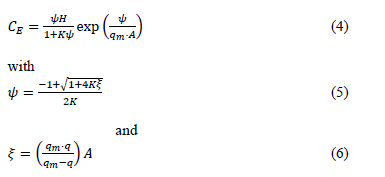
<body><![CDATA[<p><font size="2" face="Verdana, Arial, Helvetica, sans-serif">The nanoparticles' surface is modified to   neutral, basic or acidic by adding the nanoparticles to aqueous solutions with   different pH values of 3, 7 and 10. The pH is adjusted by adding aliquots of   HCl or NaOH at 0.1N. The mixture is sonicated at (RT) for 2 hours. Then, the   nanoparticles are separated and washed with deionized water until the pH value of   the residue remains constant. Finally, the product is dried at 120°C for 6   hours to eliminate any humidity.</font></p>     <p><font size="2" face="Verdana, Arial, Helvetica, sans-serif"><i>2.2.3. Particle size and surface area measurements </i></font></p>     <p><font size="2" face="Verdana, Arial, Helvetica, sans-serif">The sizes of the nanoparticles were   obtained using an XPert PRO MPD X-ray diffractometer (PANalytical, Almelo, Netherlands) with Cu K<font face="Symbol">a</font> radiation operating at 60 kV and 40 mA with a <font face="Symbol">q</font>/2<font face="Symbol">q</font> goniometer. The   mean nanoparticle diameter (crystallite size) was determined by applying the   Scherrer equation to the principal diffraction peak. Additionally, the surface   areas (S<sub>BET</sub>) were measured using a ChemBET 3000 (Quantachrome   Instruments, Florida, USA) by employing the Brunauer-Emmet-Teller (BET) method &#91;32,33&#93;.   This was undertaken by degassing the samples overnight at 140<sup>o</sup>C   under a N<sub>2</sub> flow and after performing nitrogen adsorption-desorption   at -196<sup> o</sup>C.</font></p>     <p><font size="2" face="Verdana, Arial, Helvetica, sans-serif"><i>2.2.4. Temperature Programmed Desorption</i></font></p>     <p><font size="2" face="Verdana, Arial, Helvetica, sans-serif">NH<sub>3</sub> temperature programmed   desorption (TPD) measurements were carried out with 0.1 g samples at a flow   rate of 80 mL/min. Before the TPD measurements were made, nanomaterials were   pretreated in a flow of Helium at 110°C for 3 h. Then, samples were treated   with 10% NH<sub>3</sub>/He at 100°C for 1 h ensuring NH<sub>3</sub> saturation   and purged with He for 1 h. TPD runs were carried out between 100°C to 900°C at   a heating rate of 10°C/min. The online ChemBet 3000 (Quantachrome Instruments,   Florida, USA) with a Thermal Conductivity Detector (TCD) was used to monitor   the desorbed NH<sub>3</sub>. </font></p>     <p><font size="2" face="Verdana, Arial, Helvetica, sans-serif"><i>2.2.5. Equilibrium adsorption isotherms</i></font></p>     <p><font size="2" face="Verdana, Arial, Helvetica, sans-serif">Model solutions for the batch adsorption   experiments are prepared by dissolving a desired amount of the obtained   asphaltenes in toluene. All samples were made from a stock solution that was   prepared at a maximum concentration (<i>C<sub>max</sub></i>)   of 5000 mg/L without asphaltenes precipitation. The initial concentration of asphaltene solutions used in the adsorption   experiments ranged from 500 mg/L to <i>C<sub>max</sub></i>.   Before the experiments were undertaken, a calibration curve of absorbance   against concentration was constructed at a wavelength of 295 nm &#91;34&#93;, using a   Genesys 10S UV-VIS spectrophotometer (Thermo Scientific, Waltham, MA).   Nanoparticles are added to the solutions in a relation of 100mg/10 mL. The   solutions are stirred at 300 rpm for 24 h at 25°C to ensure that they were in   equilibrium. The amount adsorbed <i>q</i> in   units of mg of asphaltenes / m<sup>2</sup> of nanoparticles surface area is   estimated according to eq. (1):</font></p>     <p><img src="/img/revistas/dyna/v83n198/v83n198a21eq01.gif"></p>     <p><font size="2" face="Verdana, Arial, Helvetica, sans-serif">where <i>C<sub>0</sub></i> (mg/L) and <i>C<sub>E</sub></i> (mg/L) are   the initial concentration of asphaltenes in the solution and the equilibrium   concentrations of asphaltenes in the supernatant, respectively; <i>V</i> (L) the solution volume and <i>A</i> (m<sup>2</sup>) the nanoparticles' dry   surface areas. </font></p>     <p><font size="2" face="Verdana, Arial, Helvetica, sans-serif"><i>2.2.6. Thermogravimetric analysis</i></font></p>     ]]></body>
<body><![CDATA[<p><font size="2" face="Verdana, Arial, Helvetica, sans-serif">After the adsorption experiments, the   nanoparticles with asphaltenes adsorbed are extracted from the solutions by   centrifugation for 15 min at 4000 rpm using a Hermle Z 306 Universal Centrifuge   (Labnet, NJ) and dried overnight in a vacuum oven. Thermogravimetric analysis   is performed on a fixed amount of asphaltenes that adsorbed 0.2 mg/m<sup>2 </sup>using   a Q50 Thermogravimetric Analyzer (TGA) made by TA Instruments, Inc. (New   Castle, DE). The TGA analyzer is coupled to an IRAffinity-1 FTIR device   (Shimadzu, Japan) that is equipped with a gas cell to analyze the outcome gasses.   The samples (nanoparticles with asphaltene adsorbed and virgin nanoparticles)   are heated in an air atmosphere from 30 to 1000°C at the following different   heating rates: 5, 10, and 20°C/min. The air-flow was kept at a constant 100   mL/min during the experiment. It is worthwhile mentioning that the sample mass   was kept low at approximately 5 mg to avoid any diffusion limitations &#91;19, 35,   36&#93;.</font></p>     <p><font size="2" face="Verdana, Arial, Helvetica, sans-serif"><b><i>2.3. Modeling</i></b></font></p>     <p><font size="2" face="Verdana, Arial, Helvetica, sans-serif">The experimental data obtained for   adsorption isotherms were modeled using two commonly used adsorption models:   the Langmuir model and the Freundlich model &#91;37, 38&#93;. Likewise,   the experimental results were modeled using a novel Solid-Liquid Equilibrium   model &#91;39&#93;. For the kinetic oxidation of the asphaltenes on nanoparticles, the   Ozawa-Flyn-Wall (OFW) method was applied. This allows the reaction kinetics to   be described and the effective activation energy to be estimated &#91;40&#93;.</font></p>     <p><font size="2" face="Verdana, Arial, Helvetica, sans-serif"><i>2.3.1. The Langmuir model</i></font></p>     <p><font size="2" face="Verdana, Arial, Helvetica, sans-serif">The Langmuir model has been widely used   since it was published in 1916 to correlate experimental data on equilibrium   adsorption &#91;37&#93;. In order to do this, monolayer adsorption takes place on a   homogeneous surface and it was derived by taking into account the fact that   equilibrium is obtained when the rates of adsorption and desorption are   equivalent. The Langmuir equation can be expressed as follows:</font></p>     <p><img src="/img/revistas/dyna/v83n198/v83n198a21eq02.gif"></p>     <p><font size="2" face="Verdana, Arial, Helvetica, sans-serif">where <i>N<sub>ads,max</sub></i> (mg/m<sup>2</sup>) is the amount of asphaltenes adsorbed onto the   nanoparticles, <i>C<sub>E</sub></i> (mg/L)   is the equilibrium concentration of asphaltenes in the supernatant, <i>K<sub>L</sub></i> (L/mg) is the Langmuir   equilibrium adsorption constant related to the affinity of binding sites, and <i>N<sub>ads,max</sub></i> (mg/m<sup>2</sup>)   is defined as the monolayer saturation capacity. The latter represents the   maximum amount of asphaltenes adsorbed per unit of nanoparticle surface area   for complete monolayer coverage.</font></p>     <p><font size="2" face="Verdana, Arial, Helvetica, sans-serif"><i>2.3.2. The Freundlich model</i></font></p>     <p><font size="2" face="Verdana, Arial, Helvetica, sans-serif">The Freundlich approach was created in   1906. It is an empirical expression that represents the isothermal variation of   the adsorption of a quantity of mass, which is adsorbed by unit of surface area   (of solid adsorbent) at equilibrium concentration &#91;38&#93;:</font></p>     <p><img src="/img/revistas/dyna/v83n198/v83n198a21eq03.gif"></p>     ]]></body>
<body><![CDATA[<p><font size="2" face="Verdana, Arial, Helvetica, sans-serif">where <i>K<sub>F</sub></i>((mg/m<sup>2</sup>)/(L/mg)<sup>1/n</sup>)) is the Freundlich constant   related to the adsorption capacity, and <i>1/n</i> (unitless) is the adsorption intensity factor.</font></p>     <p><font size="2" face="Verdana, Arial, Helvetica, sans-serif"><i>2.3.3. The Solid-Liquid Equilibrium (SLE) model</i></font></p>     <p><font size="2" face="Verdana, Arial, Helvetica, sans-serif">Recently, Montoya et al. &#91;39&#93; proposed a   three-parameter model to describe the adsorption isotherms of asphaltene by   non-porous materials. The model is based on a theoretical framework of   adsorption by self-associated asphaltenes on solid surfaces. The SLE model   equation is expressed as follows:</font></p>     <p><img src="/img/revistas/dyna/v83n198/v83n198a21eq0406.gif"> </p>     <p><font size="2" face="Verdana, Arial, Helvetica, sans-serif">where <i>q</i> (mg/m<sup>2</sup>) is the amount of asphaltenes adsorbed by the nanoparticle   surface, <i>q<sub>m </sub></i>(mg/m<sup>2</sup>)   is the maximum adsorption capacity of the nanoparticles, <i>A </i>(m<sup>2</sup>/mg) is the measured surface area per mass of   nanoparticles and <i>C<sub>E</sub></i> (mg/g) is the equilibrium concentration of asphaltenes in the supernatant. <i>K </i>(g/g) is the reaction constant related   to the asphaltenes' degree of association on the nanoparticles surface, and <i>H </i>(mg/g) is the Henry's law constant   linked to the asphaltenes' preference for being in the liquid phase or the   adsorbed phase &#91;39&#93;. The <i>H</i>, <i>K </i>and <i>q<sub>m</sub></i> SLE parameters were estimated by model fitting.</font></p>     <p><font size="2" face="Verdana, Arial, Helvetica, sans-serif">For the three adsorption models, the correlation coefficient (<i>R<sup>2</sup></i>)   and a nonlinear chi-square (<i><font face="Symbol">c</font><sup>2</sup></i>)   analysis were used to estimate the goodness of fit using the Solvent feature   that is part of the Excel package &#91;41&#93;.</font></p>     <p><font size="2" face="Verdana, Arial, Helvetica, sans-serif"><i>2.3.4. OFW model</i></font></p>     <p><font size="2" face="Verdana, Arial, Helvetica, sans-serif">After TGA   experiments were performed at different heating rates, the OFW method can be   used to estimate the effective activation energies &#91;40,42&#93;. The   Ozawa-Flynn-Wall method (OFW) gave us an estimate of the effective activation   energies, assuming that for a constant reaction conversion, the reaction rate,   eq. (7), is a function of the temperature and the state. </font></p>     <p><img src="/img/revistas/dyna/v83n198/v83n198a21eq07.gif"></p>     <p><font size="2" face="Verdana, Arial, Helvetica, sans-serif">where <i>K<sub><font face="Symbol">a</font></sub></i> (1/s) is the pre-exponential factor, <i>E<sub><font face="Symbol">a</font></sub></i>(kJ/mol) is the effective activation energy for a constant conversion, <i>R </i>(J/mol·K) is the ideal gas constant, <i>T </i>(K) is the reaction temperature and <i><font face="Symbol">a</font></i> is the reaction conversion   described by the next equation:</font></p>     ]]></body>

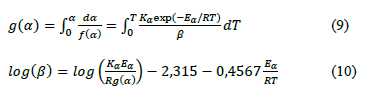
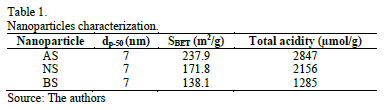
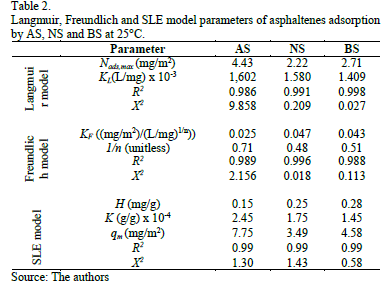
<body><![CDATA[<p><img src="/img/revistas/dyna/v83n198/v83n198a21eq08.gif"></p>     <p><font size="2" face="Verdana, Arial, Helvetica, sans-serif">with <i>m<sub>0</sub></i>as the initial mass of the sample; <i>m<sub>f</sub></i>the final mass of the sample and <i>m<sub>T</sub></i>the mass at a given temperature. Eq. (9) can be obtained when the heating   rate is defined as <i><font face="Symbol">b</font> = dT/dt </i>and   integrating. Using the Doyle approximation &#91;43&#93;, the effective activation   energy can by estimated from the slope of the linear fit from the plot of log   (<font face="Symbol">b</font>) against 1/T, according to eq. (10)&#91;35&#93;:</font></p>     <p><img src="/img/revistas/dyna/v83n198/v83n198a21eq0910.gif"></p>     <p>&nbsp;</p>     <p><font size="3" face="Verdana, Arial, Helvetica, sans-serif"><b>3. Results and discussion</b></font></p>     <p><font size="2" face="Verdana, Arial, Helvetica, sans-serif"><b><i>3.1. Characterization of nanoparticles</i></b></font></p>     <p><font size="2" face="Verdana, Arial, Helvetica, sans-serif">Silica nanoparticules are usually   synthetized through Sol-Gel method &#91;44,45&#93;. As mentioned above, commercial   silica nanoparticles were used. After the superficial modification process that   was described above, the acidic silica nanoparticles (AS), the neutral (NS) and   basic silica nanoparticles (BS) show the same particle diameter (dp); this can   be seen in <a href="#tab01">Table 1</a>. It can be seen that the superficial modification apparently   has no effect on the size of the nanoparticle. On the other hand, the surface area   (S<sub>BET</sub>) decreased when the particle became more acidic. This was   determined with total acidity that is related to the amount of NH<sub>3</sub> adsorbed by each nanoparticle. In this case, it can be noticed that superficial   treatments were effective because AS is the most acidic of three materials.</font></p>     <p align="center"><font size="2" face="Verdana, Arial, Helvetica, sans-serif"><a name="tab01"></a></font><img src="/img/revistas/dyna/v83n198/v83n198a21tab01.gif"></p>     <p><font size="2" face="Verdana, Arial, Helvetica, sans-serif"><b><i>3.2. Asphaltenes adsorption isotherms</i></b></font></p>     <p><font size="2" face="Verdana, Arial, Helvetica, sans-serif"><a href="#fig01">Fig. 1a</a> shows the obtained adsorption   isotherms of asphaltenes by AS, NS and BS that were constructed at 25°C on surface   area basis. It can be observed that the trend of the amount adsorbed at CE of   464 mg/L, where the isotherms can be compared, follows the order AS &gt; BS   &gt; NS, which indicates that the surface is selective to determined functional   groups that are present in the asphaltenes structure.</font></p>     ]]></body>
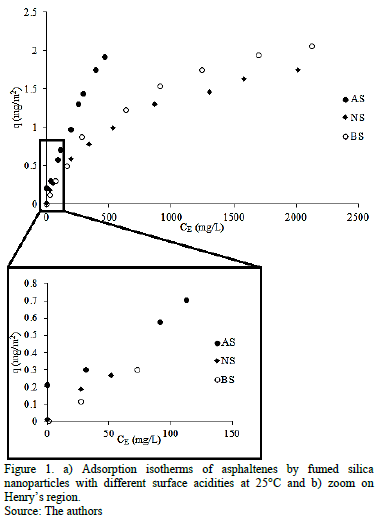
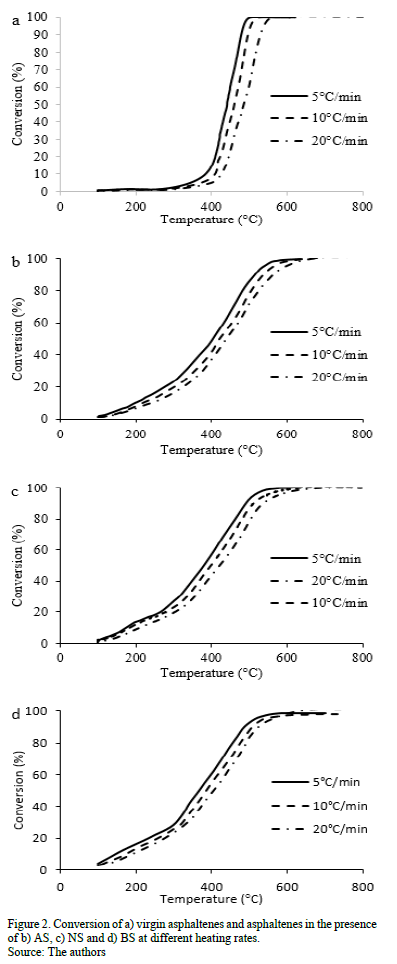
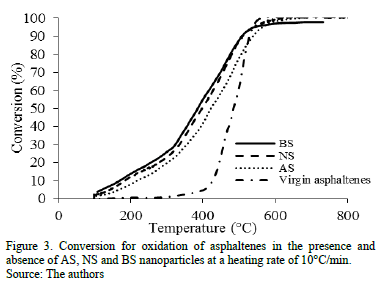
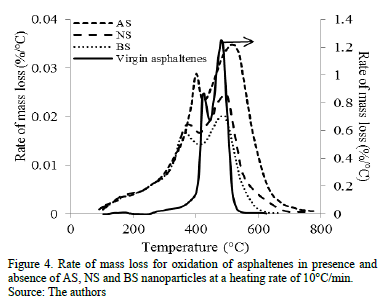
<body><![CDATA[<p align="center"><font size="2" face="Verdana, Arial, Helvetica, sans-serif"><a name="fig01"></a></font><img src="/img/revistas/dyna/v83n198/v83n198a21fig01.gif"></p>     <p><font size="2" face="Verdana, Arial, Helvetica, sans-serif">Also, <a href="#fig01">Fig. 1b</a> shows that in the Henry's   region, the adsorption affinity is also surface specific. As the Langmuir model <i>K<sub>L</sub></i>is related to the   affinity of binding sites, larger values implied more adsorption affinity &#91;17,19,20&#93;.   In the empirical model proposed by Freundlich, this affinity cannot be seen so   clearly. Hence, frequently <i>K<sub>F</sub></i> is taken as a rough indicator of the adsorption capacity and <i>1/n</i> is the adsorption intensity factor.   A larger <i>K<sub>F</sub></i> value suggests   greater adsorption capacity, and a lower <i>1/n</i> indicates stronger adsorption strength &#91;17,19&#93;. Furthermore, the reciprocal of   the parameter </font><font size="2" face="Verdana, Arial, Helvetica, sans-serif"><i>H</i> in the SLE model is a   clear indicator of the adsorption affinity. A smaller <i>H</i> value implies greater adsorption affinity &#91;21,39&#93;. In this   regard, we can see in <a href="#tab02">Table 2</a> that the adjusted parameters for the Langmuir and   SLE models indicate higher adsorption affinity with the most acidic nature of   the surface of the nanoparticle. Also, the SLE model tells us that the trend   followed by the <i>K</i> parameter is   opposite to the one observed for the <i>H</i> parameter, meaning that BS nanoparticles lead to a lower degree of asphaltenes   self-association over its surface. Freundlich model's parameters do not show a   direct relationship with the acidic nature of the surface.</font></p>     <p align="center"><font size="2" face="Verdana, Arial, Helvetica, sans-serif"><a name="tab02"></a></font><img src="/img/revistas/dyna/v83n198/v83n198a21tab02.gif"></p>     <p><font size="2" face="Verdana, Arial, Helvetica, sans-serif"><b><i>3.3. Catalytic Oxidation of Asphaltenes</i></b></font></p>     <p><font size="2" face="Verdana, Arial, Helvetica, sans-serif">The TGA experiments for asphaltenes oxidation   were conducted at three different heating rates: 5, 10 and 20°C/min with an oxygen   flow at 100 cm3/min. <a href="#fig02">Fig. 2a-d</a> shows the conversion for oxidation of a) virgin   asphaltenes and asphaltenes in the presence of b) AS, c) NS and d) BS. For all   systems, it can be observed that the percentage of conversion decreases as the   heating rate increases.</font></p>     <p align="center"><font size="2" face="Verdana, Arial, Helvetica, sans-serif"><a name="fig02"></a></font><img src="/img/revistas/dyna/v83n198/v83n198a21fig02.gif"></p>     <p><font size="2" face="Verdana, Arial, Helvetica, sans-serif">To show a comparison, <a href="#fig03">Fig. 3</a> shows the   conversion of asphaltenes in the presence and absence of the evaluated   nanoparticles at a fixed heating rate of 10°C/min. It is observed that for a   fixed value of conversion, the temperature increases in the order of BS &lt; NS   &lt; AS &lt; virgin asphaltenes. This confirms the catalytic effect of the   nanoparticles and shows that catalytic oxidation of the asphaltenes is specific   to the adsorbent surface conditions. It can also be noted that the catalytic effect of the   surface is related to the adsorption affinity and asphaltenes self-association.   As lower signifies adsorption affinity (higher value of H at SLE model) and as   lower signifies asphaltenes self-association (lower value of K at SLE model),   higher is the catalytic behavior of the surface.</font></p>     <p align="center"><font size="2" face="Verdana, Arial, Helvetica, sans-serif"><a name="fig03"></a></font><img src="/img/revistas/dyna/v83n198/v83n198a21fig03.gif"></p>     <p><font size="2" face="Verdana, Arial, Helvetica, sans-serif"><a href="#fig04">Fig. 4</a> shows the rate of mass loss for   virgin asphaltenes oxidation and asphaltenes oxidation in the presence of AS,   NS and BS. It can be seen in <a href="#fig04">Fig. 4</a> that asphaltenes oxidation starts before   for those asphaltenes adsorbed onto the nanoparticles, in comparison with the   virgin asphaltenes. It is worthwhile mentioning that the virgin nanoparticles   were also submitted for TGA analysis. For the virgin asphaltenes, two peaks are   observed at approximately 422 and 479 &deg;C. The first peak temperature is   considerably reduced by the nanoparticles at 38, 52 and 67&deg;C. This indicates   that the catalytic activity of the BS is higher than that of the other two   nanoparticles. These results agree with the estimated values of the <i>H </i>and <i>K </i>parameters of the SLE model.</font></p>     <p align="center"><font size="2" face="Verdana, Arial, Helvetica, sans-serif"><a name="fig04"></a></font><img src="/img/revistas/dyna/v83n198/v83n198a21fig04.gif"></p>     ]]></body>
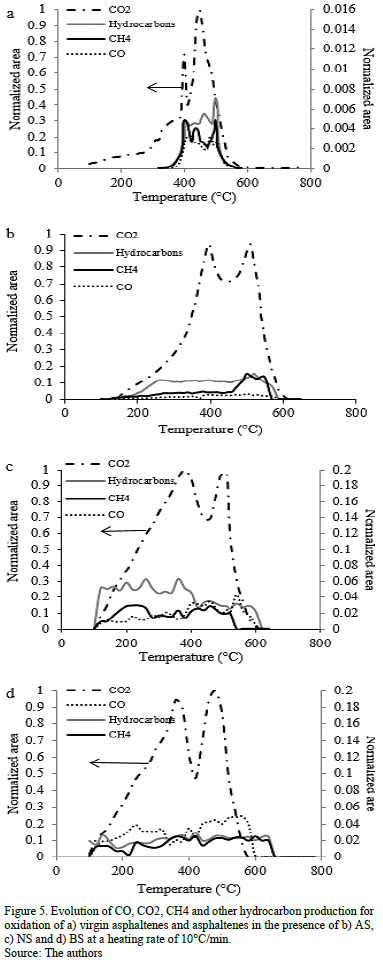
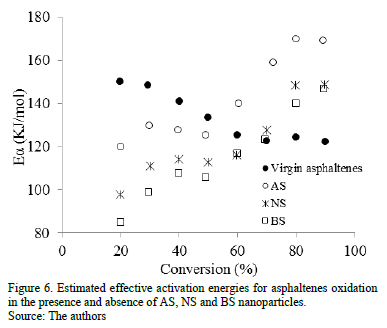
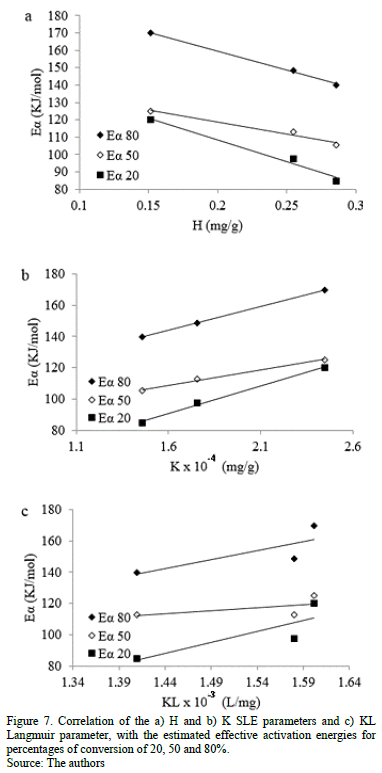
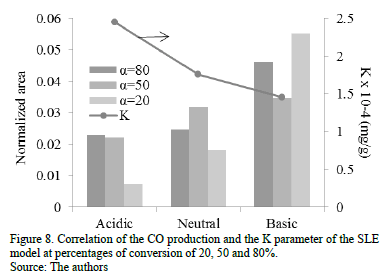
<body><![CDATA[<p><font size="2" face="Verdana, Arial, Helvetica, sans-serif">The   evolution of gas production was also evaluated using an FTIR device coupled   with the TGA analyzer. <a href="#fig05">Figs. 5a-d</a> show the evolution of CO, CO<sub>2</sub>, CH<sub>4 </sub>and other light hydrocarbon production to oxidize a) virgin asphaltenes   and asphaltenes in the presence of b) AS, c) NS and d) BS at a fixed heating   rate of 10°C/min. It is worthwhile mentioning that the results are normalized   based on the signal with the highest intensity that corresponds to the CO<sub>2</sub> production. In all cases, it is observed that the major production corresponds   to the CO<sub>2</sub>. Except for the system with BS, the trend of effluent   production increases in the order of CO &lt; CH<sub>4</sub> &lt; Hydrocarbons   &lt; CO<sub>2</sub>. However, for the BS, the trend followed is CH<sub>4</sub> &lt; Hydrocarbons &lt; CO &lt; CO<sub>2</sub>.</font></p>     <p align="center"><font size="2" face="Verdana, Arial, Helvetica, sans-serif"><a name="fig05"></a></font><img src="/img/revistas/dyna/v83n198/v83n198a21fig05.gif"></p>     <p><font size="2" face="Verdana, Arial, Helvetica, sans-serif"><b><i>3.4. Estimation of activation energies</i></b></font></p>     <p><font size="2" face="Verdana, Arial, Helvetica, sans-serif">The results for the effective activation   energies (EAE) are shown in <a href="#fig06">Fig. 6</a>. The asphaltenes follow an increasing trend in the presence of the nanoparticles, which increase as the asphaltenes   conversion increases. This could be due to addition reactions that occur in the   process. However, for the virgin asphaltenes, the trend observed is the   opposite. Both behaviors are indicative of the fact that asphaltene oxidation   in the presence and absence of the nanoparticles is not a single-step process   and it involves more than one mechanism. <a href="#fig06">Fig. 6</a> shows that higher EAE are   obtained for AS, followed by NS, and the lower values are obtained for BS.   Also, the pathway followed by the EAE is similar for the three nanoparticles,   indicating that the reaction order is possibly similar for the three catalysts.</font></p>     <p align="center"><font size="2" face="Verdana, Arial, Helvetica, sans-serif"><a name="fig06"></a></font><img src="/img/revistas/dyna/v83n198/v83n198a21fig06.gif"></p>     <p><font size="2" face="Verdana, Arial, Helvetica, sans-serif"><a href="#fig07">Fig. 7</a> shows the correlation of   parameters <i>H</i> and <i>K</i> from the SLE model and <i>K<sub>L</sub></i> from the Langmuir model. These have the estimated EAE for the following percentages   of conversion: 20, 50 and 80%. It can be observed that as the adsorption   affinity increases (i.e. the <i>H</i> parameter decreases in the SLE model and the <i>K<sub>L</sub></i> parameter increases in the Langmuir model), the EAE   increases. This indicates that an over attachment of the asphaltenes in the   catalysts surface would lead to a decrease in the catalytic activity of the   nanoparticles. However, the correlation observed for the <i>K</i> parameter indicates that as the degree of asphaltenes   self-association increases the catalytic activity of the nanoparticles   decreases. This is also shown in <a href="#fig08">Fig. 8</a> where the evolution of CO is correlated   with the <i>K</i> parameter for different   degrees of conversion. It is observed that as the degree of asphaltenes   self-association decreases, the production of CO increases. This could be due   to bigger asphaltenes aggregates tending to hide some active sites that are   released as asphaltenes are oxidized. This leads the CO to be chemisorbed over   the nanoparticle surfaces to form CO<sub>2</sub>. </font></p>     <p align="center"><font size="2" face="Verdana, Arial, Helvetica, sans-serif"><a name="fig07"></a></font><img src="/img/revistas/dyna/v83n198/v83n198a21fig07.gif"></p>     <p align="center"><font size="2" face="Verdana, Arial, Helvetica, sans-serif"><a name="fig08"></a></font><img src="/img/revistas/dyna/v83n198/v83n198a21fig08.gif"></p>     <p>&nbsp;</p>     <p><font size="3" face="Verdana, Arial, Helvetica, sans-serif"><b>4. Conclusions </b></font></p>     ]]></body>
<body><![CDATA[<p><font size="2" face="Verdana, Arial, Helvetica, sans-serif">The surface   modification process effectively modified the acidity of nanoparticle surfaces,   as can be seen in TPD experiments. Through batch adsorption experiments, the   isotherms of asphaltenes adsorption onto fumed silica with different surface   acidities were successfully constructed. The Langmuir model, the Freundlich   model, and the SLE model have an excellent adjustment for the experimental   results of the adsorption isotherms. The first and the third of these models,   allow us to conclude that the acidic surface creates a greater affinity for the   asphaltenes in the adsorption process, but it leads to higher EAE and to   disfavor catalytic activity. Also, if the asphaltenes self-association is   higher on the nanoparticle surface, represented in parameter K of the SLE   model, the catalytic activity is lower. In this sense, the BS showed a better   performance in the catalytic oxidation of asphaltenes. Also, it was possible to   detect the effluent gasses in the oxidation process by using a coupled FTIR   device, which showed that they are surface nature dependent.</font></p>     <p>&nbsp;</p>     <p><font size="3" face="Verdana, Arial, Helvetica, sans-serif"><b>References</b></font></p>     <!-- ref --><p><font size="2" face="Verdana, Arial, Helvetica, sans-serif"><b>&#91;1&#93;</b> OPEC, 2015 World Oil Outlook,   Vienna, Austria, OPEC Secretariat, 2015, pp. 29-88.    &nbsp;&nbsp;&nbsp;&nbsp;&nbsp;&nbsp;&nbsp;&nbsp;[&#160;<a href="javascript:void(0);" onclick="javascript: window.open('/scielo.php?script=sci_nlinks&ref=1148612&pid=S0012-7353201600040002100001&lng=','','width=640,height=500,resizable=yes,scrollbars=1,menubar=yes,');">Links</a>&#160;]<!-- end-ref --></font></p>     <!-- ref --><p><font size="2" face="Verdana, Arial, Helvetica, sans-serif"><b>&#91;2&#93;</b> IEA, World Energy Outlook 2012,   Paris, France, International Energy Agency, 2012, pp. 81-120.    &nbsp;&nbsp;&nbsp;&nbsp;&nbsp;&nbsp;&nbsp;&nbsp;[&#160;<a href="javascript:void(0);" onclick="javascript: window.open('/scielo.php?script=sci_nlinks&ref=1148614&pid=S0012-7353201600040002100002&lng=','','width=640,height=500,resizable=yes,scrollbars=1,menubar=yes,');">Links</a>&#160;]<!-- end-ref --></font></p>     <!-- ref --><p><font size="2" face="Verdana, Arial, Helvetica, sans-serif"><b>&#91;3&#93;</b> Ghanavati, M., Shojaei, M.-J.   and Ramazani, A., Effects of asphaltene content and temperature on viscosity of   Iranian heavy crude oil: experimental and modeling study<i>.</i> Energy &amp; Fuels, 27(12), pp. 7217-7232, 2013. DOI:   10.1021/ef400776h.    &nbsp;&nbsp;&nbsp;&nbsp;&nbsp;&nbsp;&nbsp;&nbsp;[&#160;<a href="javascript:void(0);" onclick="javascript: window.open('/scielo.php?script=sci_nlinks&ref=1148616&pid=S0012-7353201600040002100003&lng=','','width=640,height=500,resizable=yes,scrollbars=1,menubar=yes,');">Links</a>&#160;]<!-- end-ref --></font></p>     <!-- ref --><p><font size="2" face="Verdana, Arial, Helvetica, sans-serif"><b>&#91;4&#93;</b> Leontaritis, K., Amaefule, J.   and Charles, R., A systematic approach for the prevention and treatment of   formation damage caused by asphaltene deposition<i>.</i> SPE Production &amp; Facilities, 9(03), pp. 157-164, 1994. DOI:   10.2118/23810-PA.    &nbsp;&nbsp;&nbsp;&nbsp;&nbsp;&nbsp;&nbsp;&nbsp;[&#160;<a href="javascript:void(0);" onclick="javascript: window.open('/scielo.php?script=sci_nlinks&ref=1148618&pid=S0012-7353201600040002100004&lng=','','width=640,height=500,resizable=yes,scrollbars=1,menubar=yes,');">Links</a>&#160;]<!-- end-ref --></font></p>     <!-- ref --><p><font size="2" face="Verdana, Arial, Helvetica, sans-serif"><b>&#91;5&#93;</b> Nassar, N.N., Asphaltene   adsorption onto alumina nanoparticles: kinetics and thermodynamic studies<i>.</i> Energy &amp; Fuels, 24(8), pp.   4116-4122, 2010. DOI: 10.1021/ef100458g.    &nbsp;&nbsp;&nbsp;&nbsp;&nbsp;&nbsp;&nbsp;&nbsp;[&#160;<a href="javascript:void(0);" onclick="javascript: window.open('/scielo.php?script=sci_nlinks&ref=1148620&pid=S0012-7353201600040002100005&lng=','','width=640,height=500,resizable=yes,scrollbars=1,menubar=yes,');">Links</a>&#160;]<!-- end-ref --></font></p>     <!-- ref --><p><font size="2" face="Verdana, Arial, Helvetica, sans-serif"><b>&#91;6&#93;</b> Fergoug, T. and Bouhadda, Y.,   Determination of Hassi Messaoud asphaltene aromatic structure from 1 H &amp; 13   C NMR analysis<i>.</i> Fuel, 115, pp.   521-526, 2014. DOI: 10.1016/j.fuel.2013.07.055.    &nbsp;&nbsp;&nbsp;&nbsp;&nbsp;&nbsp;&nbsp;&nbsp;[&#160;<a href="javascript:void(0);" onclick="javascript: window.open('/scielo.php?script=sci_nlinks&ref=1148622&pid=S0012-7353201600040002100006&lng=','','width=640,height=500,resizable=yes,scrollbars=1,menubar=yes,');">Links</a>&#160;]<!-- end-ref --></font></p>     <!-- ref --><p><font size="2" face="Verdana, Arial, Helvetica, sans-serif"><b>&#91;7&#93;</b> Acevedo, S., Castro, A.,   Negrin, J.G., Fern&aacute;ndez, A., Escobar, G., Piscitelli, V., Delolme, F. and   Dessalces, G., Relations between asphaltene structures and their physical and   chemical properties: The rosary-type structure<i>.</i> Energy &amp; fuels, 21(4), pp. 2165-2175, 2007. DOI:   10.1021/ef070089v.    &nbsp;&nbsp;&nbsp;&nbsp;&nbsp;&nbsp;&nbsp;&nbsp;[&#160;<a href="javascript:void(0);" onclick="javascript: window.open('/scielo.php?script=sci_nlinks&ref=1148624&pid=S0012-7353201600040002100007&lng=','','width=640,height=500,resizable=yes,scrollbars=1,menubar=yes,');">Links</a>&#160;]<!-- end-ref --></font></p>     <!-- ref --><p><font size="2" face="Verdana, Arial, Helvetica, sans-serif"><b>&#91;8&#93;</b> Groenzin, H. and Mullins, O.C.,   Asphaltene molecular size and structure<i>.</i> The Journal of Physical Chemistry A, 103(50), pp. 11237-11245, 1999. DOI:   10.1021/jp992609w.    &nbsp;&nbsp;&nbsp;&nbsp;&nbsp;&nbsp;&nbsp;&nbsp;[&#160;<a href="javascript:void(0);" onclick="javascript: window.open('/scielo.php?script=sci_nlinks&ref=1148626&pid=S0012-7353201600040002100008&lng=','','width=640,height=500,resizable=yes,scrollbars=1,menubar=yes,');">Links</a>&#160;]<!-- end-ref --></font></p>     <!-- ref --><p><font size="2" face="Verdana, Arial, Helvetica, sans-serif"><b>&#91;9&#93;</b> Mullins, O.C., The asphaltenes<i>.</i> Annual Review of Analytical Chemistry,   4, pp. 393-418, 2011. DOI: 10.1146/annurev-anchem-061010-113849.    &nbsp;&nbsp;&nbsp;&nbsp;&nbsp;&nbsp;&nbsp;&nbsp;[&#160;<a href="javascript:void(0);" onclick="javascript: window.open('/scielo.php?script=sci_nlinks&ref=1148628&pid=S0012-7353201600040002100009&lng=','','width=640,height=500,resizable=yes,scrollbars=1,menubar=yes,');">Links</a>&#160;]<!-- end-ref --></font></p>     <!-- ref --><p><font size="2" face="Verdana, Arial, Helvetica, sans-serif"><b>&#91;10&#93;</b> Mullins, O.C., Sabbah, H.,   Eyssautier, J.l., Pomerantz, A.E., Barr&eacute;, L., Andrews, A.B.,   Ruiz-Morales, Y., Mostowfi, F., McFarlane, R. and Goual, L., Advances in   asphaltene science and the Yen-Mullins model<i>.</i> Energy &amp; Fuels, 26(7), pp. 3986-4003, 2012. DOI: 10.1021/ef300185p.    &nbsp;&nbsp;&nbsp;&nbsp;&nbsp;&nbsp;&nbsp;&nbsp;[&#160;<a href="javascript:void(0);" onclick="javascript: window.open('/scielo.php?script=sci_nlinks&ref=1148630&pid=S0012-7353201600040002100010&lng=','','width=640,height=500,resizable=yes,scrollbars=1,menubar=yes,');">Links</a>&#160;]<!-- end-ref --></font></p>     <!-- ref --><p><font size="2" face="Verdana, Arial, Helvetica, sans-serif"><b>&#91;11&#93;</b> Adams, J.J., Asphaltene   adsorption, a literature review<i>.</i> Energy &amp; Fuels, 28(5), pp. 2831-2856, 2014. DOI: 10.1021/ef500282p.    &nbsp;&nbsp;&nbsp;&nbsp;&nbsp;&nbsp;&nbsp;&nbsp;[&#160;<a href="javascript:void(0);" onclick="javascript: window.open('/scielo.php?script=sci_nlinks&ref=1148632&pid=S0012-7353201600040002100011&lng=','','width=640,height=500,resizable=yes,scrollbars=1,menubar=yes,');">Links</a>&#160;]<!-- end-ref --></font></p>     <!-- ref --><p><font size="2" face="Verdana, Arial, Helvetica, sans-serif"><b>&#91;12&#93;</b> Cenegy, L.M., Survey of successful   world-wide asphaltene inhibitor treatments in oil production fields. in SPE   Annual Technical Conference and Exhibition (2001, New Orleans, Louisiana).   Society of Petroleum Engineers, New Orleans, Louisiana, 2001, P. 7. DOI:   10.2118/71542-MS.    &nbsp;&nbsp;&nbsp;&nbsp;&nbsp;&nbsp;&nbsp;&nbsp;[&#160;<a href="javascript:void(0);" onclick="javascript: window.open('/scielo.php?script=sci_nlinks&ref=1148634&pid=S0012-7353201600040002100012&lng=','','width=640,height=500,resizable=yes,scrollbars=1,menubar=yes,');">Links</a>&#160;]<!-- end-ref --></font></p>     <!-- ref --><p><font size="2" face="Verdana, Arial, Helvetica, sans-serif"><b>&#91;13&#93;</b> Allenson, S.J. and Walsh, M.A.,   A novel way to treat asphaltene deposition problems found in oil production. in   SPE international symposium on oilfield chemistry (1997, Houston, Texas).   Society of Petroleum Engineers, Houston, Texas, 1997, pp. 699-702. DOI: 10.2118/37286-MS.    &nbsp;&nbsp;&nbsp;&nbsp;&nbsp;&nbsp;&nbsp;&nbsp;[&#160;<a href="javascript:void(0);" onclick="javascript: window.open('/scielo.php?script=sci_nlinks&ref=1148636&pid=S0012-7353201600040002100013&lng=','','width=640,height=500,resizable=yes,scrollbars=1,menubar=yes,');">Links</a>&#160;]<!-- end-ref --></font></p>     <!-- ref --><p><font size="2" face="Verdana, Arial, Helvetica, sans-serif"><b>&#91;14&#93;</b> Torres, C.A., Treint, F.,   Alonso, C.I., Milne, A. and Lecomte, A., Asphaltenes pipeline cleanout: A   horizontal challenge for coiled tubing. in SPE/ICoTA coiled tubing conference   and exhibition (2005, The Woodlands, Texas). Society of Petroleum Engineers,   The Woodlands, Texas, 2005, P. 19. DOI: 10.2118/93272-MS.    &nbsp;&nbsp;&nbsp;&nbsp;&nbsp;&nbsp;&nbsp;&nbsp;[&#160;<a href="javascript:void(0);" onclick="javascript: window.open('/scielo.php?script=sci_nlinks&ref=1148638&pid=S0012-7353201600040002100014&lng=','','width=640,height=500,resizable=yes,scrollbars=1,menubar=yes,');">Links</a>&#160;]<!-- end-ref --></font></p>     <!-- ref --><p><font size="2" face="Verdana, Arial, Helvetica, sans-serif"><b>&#91;15&#93;</b> Zabala, R., Acuna, H.M., Cortes,   F., Patino, J.E., Cespedes-Chavarro, C., Mora, E., Botero, O.F. and Guarin, L.,   Application and evaluation of a nanofluid containing nanoparticles for asphaltenes   inhibition in well CPSXL4. in OTC Brasil (2013, Rio de Janeiro, Brazil).   Offshore Technology Conference, Rio de Janeiro, Brazil, 2013, P. 14. DOI:   10.4043/24310-MS.    &nbsp;&nbsp;&nbsp;&nbsp;&nbsp;&nbsp;&nbsp;&nbsp;[&#160;<a href="javascript:void(0);" onclick="javascript: window.open('/scielo.php?script=sci_nlinks&ref=1148640&pid=S0012-7353201600040002100015&lng=','','width=640,height=500,resizable=yes,scrollbars=1,menubar=yes,');">Links</a>&#160;]<!-- end-ref --></font></p>     <!-- ref --><p><font size="2" face="Verdana, Arial, Helvetica, sans-serif"><b>&#91;16&#93;</b> Nassar, N.N., Hassan, A. and   Pereira-Almao, P., Application of nanotechnology for heavy oil upgrading:   catalytic steam gasification/cracking of asphaltenes<i>.</i> Energy &amp; Fuels, 25(4), pp. 1566-1570, 2011. DOI:   10.1021/ef2001772.    &nbsp;&nbsp;&nbsp;&nbsp;&nbsp;&nbsp;&nbsp;&nbsp;[&#160;<a href="javascript:void(0);" onclick="javascript: window.open('/scielo.php?script=sci_nlinks&ref=1148642&pid=S0012-7353201600040002100016&lng=','','width=640,height=500,resizable=yes,scrollbars=1,menubar=yes,');">Links</a>&#160;]<!-- end-ref --></font></p>     <!-- ref --><p><font size="2" face="Verdana, Arial, Helvetica, sans-serif"><b>&#91;17&#93;</b> Nassar, N.N., Hassan, A. and   Pereira-Almao, P. Effect of surface acidity and basicity of aluminas on   asphaltene adsorption and oxidation<i>.</i> Journal of colloid and interface science, 360 (1), pp 233-238, 2011. DOI:   10.1016/j.jcis.2011.04.056.    &nbsp;&nbsp;&nbsp;&nbsp;&nbsp;&nbsp;&nbsp;&nbsp;[&#160;<a href="javascript:void(0);" onclick="javascript: window.open('/scielo.php?script=sci_nlinks&ref=1148644&pid=S0012-7353201600040002100017&lng=','','width=640,height=500,resizable=yes,scrollbars=1,menubar=yes,');">Links</a>&#160;]<!-- end-ref --></font></p>     <!-- ref --><p><font size="2" face="Verdana, Arial, Helvetica, sans-serif"><b>&#91;18&#93;</b> Franco, C.A., Nassar, N.N. and   Cort&eacute;s, F.B., Removal of oil from oil-in-saltwater emulsions by adsorption onto   nano-alumina functionalized with petroleum vacuum residue<i>.</i> Journal of colloid and interface science, 433, pp. 58-67, 2014.   DOI: 10.1016/j.jcis.2014.07.011.    &nbsp;&nbsp;&nbsp;&nbsp;&nbsp;&nbsp;&nbsp;&nbsp;[&#160;<a href="javascript:void(0);" onclick="javascript: window.open('/scielo.php?script=sci_nlinks&ref=1148646&pid=S0012-7353201600040002100018&lng=','','width=640,height=500,resizable=yes,scrollbars=1,menubar=yes,');">Links</a>&#160;]<!-- end-ref --></font></p>     <!-- ref --><p><font size="2" face="Verdana, Arial, Helvetica, sans-serif"><b>&#91;19&#93;</b> Franco, C.A., Montoya, T.,   Nassar, N.N., Pereira-Almao, P. and Cort&eacute;s, F.B., Adsorption and   subsequent oxidation of colombian asphaltenes onto nickel and/or palladium   oxide supported on fumed silica nanoparticles<i>.</i> Energy &amp; Fuels, 27(12), pp. 7336-7347, 2013. DOI:   10.1021/ef4018543.    &nbsp;&nbsp;&nbsp;&nbsp;&nbsp;&nbsp;&nbsp;&nbsp;[&#160;<a href="javascript:void(0);" onclick="javascript: window.open('/scielo.php?script=sci_nlinks&ref=1148648&pid=S0012-7353201600040002100019&lng=','','width=640,height=500,resizable=yes,scrollbars=1,menubar=yes,');">Links</a>&#160;]<!-- end-ref --></font></p>     <!-- ref --><p><font size="2" face="Verdana, Arial, Helvetica, sans-serif"><b>&#91;20&#93;</b> Franco, C.A., Nassar, N.N.,   Ruiz, M.A., Pereira-Almao, P. and Cort&eacute;s, F.B., Nanoparticles for   inhibition of asphaltenes damage: adsorption study and displacement test on   porous media<i>.</i> Energy &amp; Fuels,   27(6), pp. 2899-2907, 2013. DOI: 10.1021/ef4000825.    &nbsp;&nbsp;&nbsp;&nbsp;&nbsp;&nbsp;&nbsp;&nbsp;[&#160;<a href="javascript:void(0);" onclick="javascript: window.open('/scielo.php?script=sci_nlinks&ref=1148650&pid=S0012-7353201600040002100020&lng=','','width=640,height=500,resizable=yes,scrollbars=1,menubar=yes,');">Links</a>&#160;]<!-- end-ref --></font></p>     <!-- ref --><p><font size="2" face="Verdana, Arial, Helvetica, sans-serif"><b>&#91;21&#93;</b> Franco, C.A., Nassar, N.N.,   Montoya, T., Ru&iacute;z, M.A. and Cort&eacute;s, F.B., Influence of asphaltene aggregation   on the adsorption and catalytic behavior of nanoparticles<i>.</i> Energy &amp; Fuels, 29(3), pp. 1610-1621, 2015. DOI:   10.1021/ef502786e.    &nbsp;&nbsp;&nbsp;&nbsp;&nbsp;&nbsp;&nbsp;&nbsp;[&#160;<a href="javascript:void(0);" onclick="javascript: window.open('/scielo.php?script=sci_nlinks&ref=1148652&pid=S0012-7353201600040002100021&lng=','','width=640,height=500,resizable=yes,scrollbars=1,menubar=yes,');">Links</a>&#160;]<!-- end-ref --></font></p>     <!-- ref --><p><font size="2" face="Verdana, Arial, Helvetica, sans-serif"><b>&#91;22&#93;</b> Hamedi-Shokrlu, Y. and   Babadagli, T., In-situ upgrading of heavy oil/bitumen during steam injection by   use of metal nanoparticles: A study on in-situ catalysis and catalyst   transportation<i>.</i> SPE Reservoir   Evaluation &amp; Engineering, 16(03), pp. 333-344, 2013. DOI:   10.2118/146661-PA.    &nbsp;&nbsp;&nbsp;&nbsp;&nbsp;&nbsp;&nbsp;&nbsp;[&#160;<a href="javascript:void(0);" onclick="javascript: window.open('/scielo.php?script=sci_nlinks&ref=1148654&pid=S0012-7353201600040002100022&lng=','','width=640,height=500,resizable=yes,scrollbars=1,menubar=yes,');">Links</a>&#160;]<!-- end-ref --></font></p>     <!-- ref --><p><font size="2" face="Verdana, Arial, Helvetica, sans-serif"><b>&#91;23&#93;</b> Cort&eacute;s, F.B., Mej&iacute;a,   J.M., Ruiz, M.A., Benjumea, P. and Riffel, D.B., Sorption of asphaltenes onto   nanoparticles of nickel oxide supported on nanoparticulated silica gel<i>.</i> Energy &amp; Fuels, 26(3), pp.   1725-1730, 2012. DOI: 10.1021/ef201658c.    &nbsp;&nbsp;&nbsp;&nbsp;&nbsp;&nbsp;&nbsp;&nbsp;[&#160;<a href="javascript:void(0);" onclick="javascript: window.open('/scielo.php?script=sci_nlinks&ref=1148656&pid=S0012-7353201600040002100023&lng=','','width=640,height=500,resizable=yes,scrollbars=1,menubar=yes,');">Links</a>&#160;]<!-- end-ref --></font></p>     <!-- ref --><p><font size="2" face="Verdana, Arial, Helvetica, sans-serif"><b>&#91;24&#93;</b> Hashemi, R., Nassar, N.N. and   Pereira-Almao, P., Transport behavior of multimetallic ultradispersed nanoparticles   in an oil-sands-packed bed column at a high temperature and pressure<i>.</i> Energy &amp; Fuels, 26(3), pp.   1645-1655, 2012. DOI: 10.1021/ef201939f.    &nbsp;&nbsp;&nbsp;&nbsp;&nbsp;&nbsp;&nbsp;&nbsp;[&#160;<a href="javascript:void(0);" onclick="javascript: window.open('/scielo.php?script=sci_nlinks&ref=1148658&pid=S0012-7353201600040002100024&lng=','','width=640,height=500,resizable=yes,scrollbars=1,menubar=yes,');">Links</a>&#160;]<!-- end-ref --></font></p>     <!-- ref --><p><font size="2" face="Verdana, Arial, Helvetica, sans-serif"><b>&#91;25&#93;</b> Nassar, N.N., Hassan, A. and   Vitale, G., Comparing kinetics and mechanism of adsorption and thermo-oxidative      decomposition of Athabasca asphaltenes onto TiO 2, ZrO 2, and CeO 2   nanoparticles<i>.</i> Applied Catalysis A:   General, 484, pp. 161-171, 2014. DOI: 10.1016/j.apcata.2014.07.017.    &nbsp;&nbsp;&nbsp;&nbsp;&nbsp;&nbsp;&nbsp;&nbsp;[&#160;<a href="javascript:void(0);" onclick="javascript: window.open('/scielo.php?script=sci_nlinks&ref=1148660&pid=S0012-7353201600040002100025&lng=','','width=640,height=500,resizable=yes,scrollbars=1,menubar=yes,');">Links</a>&#160;]<!-- end-ref --></font></p>     <!-- ref --><p><font size="2" face="Verdana, Arial, Helvetica, sans-serif"><b>&#91;26&#93;</b> Nassar, N.N., Hassan, A. and   Pereira-Almao, P., Effect of the particle size on asphaltene adsorption and   catalytic oxidation onto alumina particles<i>.</i> Energy &amp; Fuels, 25(9), pp. 3961-3965, 2011. DOI: 10.1021/ef2008387.    &nbsp;&nbsp;&nbsp;&nbsp;&nbsp;&nbsp;&nbsp;&nbsp;[&#160;<a href="javascript:void(0);" onclick="javascript: window.open('/scielo.php?script=sci_nlinks&ref=1148662&pid=S0012-7353201600040002100026&lng=','','width=640,height=500,resizable=yes,scrollbars=1,menubar=yes,');">Links</a>&#160;]<!-- end-ref --></font></p>     <!-- ref --><p><font size="2" face="Verdana, Arial, Helvetica, sans-serif"><b>&#91;27&#93;</b> Nassar, N.N., Hassan, A. and   Pereira-Almao, P., Clarifying the catalytic role of NiO nanoparticles in the   oxidation of asphaltenes<i>.</i> Applied   Catalysis A: General, 462(463), pp. 116-120, 2013. DOI:   10.1016/j.apcata.2013.04.033.    &nbsp;&nbsp;&nbsp;&nbsp;&nbsp;&nbsp;&nbsp;&nbsp;[&#160;<a href="javascript:void(0);" onclick="javascript: window.open('/scielo.php?script=sci_nlinks&ref=1148664&pid=S0012-7353201600040002100027&lng=','','width=640,height=500,resizable=yes,scrollbars=1,menubar=yes,');">Links</a>&#160;]<!-- end-ref --></font></p>     <!-- ref --><p><font size="2" face="Verdana, Arial, Helvetica, sans-serif"><b>&#91;28&#93;</b> Hassan, A., Lopez-Linares, F.,   Nassar, N.N., Carbognani-Arambarri, L. and Pereira-Almao, P., Development of a   support for a NiO catalyst for selective adsorption and post-adsorption   catalytic steam gasification of thermally converted asphaltenes<i>.</i> Catalysis Today, 207(0), pp. 112-118,   2013. DOI: 10.1016/j.cattod.2012.05.010.    &nbsp;&nbsp;&nbsp;&nbsp;&nbsp;&nbsp;&nbsp;&nbsp;[&#160;<a href="javascript:void(0);" onclick="javascript: window.open('/scielo.php?script=sci_nlinks&ref=1148666&pid=S0012-7353201600040002100028&lng=','','width=640,height=500,resizable=yes,scrollbars=1,menubar=yes,');">Links</a>&#160;]<!-- end-ref --></font></p>     <!-- ref --><p><font size="2" face="Verdana, Arial, Helvetica, sans-serif"><b>&#91;29&#93;</b> Nassar, N.N., Hassan, A.,   Carbognani, L., Lopez-Linares, F. and Pereira-Almao, P., Iron oxide   nanoparticles for rapid adsorption and enhanced catalytic oxidation of   thermally cracked asphaltenes<i>.</i> Fuel,   95, pp. 257-262, 2012. DOI: 10.1016/j.fuel.2011.09.022.    &nbsp;&nbsp;&nbsp;&nbsp;&nbsp;&nbsp;&nbsp;&nbsp;[&#160;<a href="javascript:void(0);" onclick="javascript: window.open('/scielo.php?script=sci_nlinks&ref=1148668&pid=S0012-7353201600040002100029&lng=','','width=640,height=500,resizable=yes,scrollbars=1,menubar=yes,');">Links</a>&#160;]<!-- end-ref --></font></p>     <!-- ref --><p><font size="2" face="Verdana, Arial, Helvetica, sans-serif"><b>&#91;30&#93;</b> Nassar, N.N., Hassan, A. and   Pereira-Almao, P., Comparative oxidation of adsorbed asphaltenes onto   transition metal oxide nanoparticles<i>.</i> Colloids and Surfaces A: Physicochemical and Engineering Aspects, 384(1-3), pp.   145-149, 2011. DOI: 10.1016/j.colsurfa.2011.03.049.    &nbsp;&nbsp;&nbsp;&nbsp;&nbsp;&nbsp;&nbsp;&nbsp;[&#160;<a href="javascript:void(0);" onclick="javascript: window.open('/scielo.php?script=sci_nlinks&ref=1148670&pid=S0012-7353201600040002100030&lng=','','width=640,height=500,resizable=yes,scrollbars=1,menubar=yes,');">Links</a>&#160;]<!-- end-ref --></font></p>     <!-- ref --><p><font size="2" face="Verdana, Arial, Helvetica, sans-serif"><b>&#91;31&#93;</b> Nassar, N.N., Hassan, A. and   Pereira-Almao, P., Metal oxide nanoparticles for asphaltene adsorption and   oxidation<i>.</i> Energy &amp; Fuels, 25(3),   pp. 1017-1023, 2011. DOI: 10.1021/ef101230g.    &nbsp;&nbsp;&nbsp;&nbsp;&nbsp;&nbsp;&nbsp;&nbsp;[&#160;<a href="javascript:void(0);" onclick="javascript: window.open('/scielo.php?script=sci_nlinks&ref=1148672&pid=S0012-7353201600040002100031&lng=','','width=640,height=500,resizable=yes,scrollbars=1,menubar=yes,');">Links</a>&#160;]<!-- end-ref --></font></p>     <!-- ref --><p><font size="2" face="Verdana, Arial, Helvetica, sans-serif"><b>&#91;32&#93;</b> Brunauer, S., Emmett, P.H. and   Teller, E., Adsorption of gases in multimolecular layers<i>.</i> Journal of the American Chemical Society, 60(2), pp. 309-319,   1938.    &nbsp;&nbsp;&nbsp;&nbsp;&nbsp;&nbsp;&nbsp;&nbsp;[&#160;<a href="javascript:void(0);" onclick="javascript: window.open('/scielo.php?script=sci_nlinks&ref=1148674&pid=S0012-7353201600040002100032&lng=','','width=640,height=500,resizable=yes,scrollbars=1,menubar=yes,');">Links</a>&#160;]<!-- end-ref --></font></p>     <!-- ref --><p><font size="2" face="Verdana, Arial, Helvetica, sans-serif"><b>&#91;33&#93;</b> Rouquerol, F., Rouquerol, J.   and Sing, K.S.W., Adsorption by powders and porous solids; principles,   Methodology and Applications, London, U.K., Academic Press, 1999.    &nbsp;&nbsp;&nbsp;&nbsp;&nbsp;&nbsp;&nbsp;&nbsp;[&#160;<a href="javascript:void(0);" onclick="javascript: window.open('/scielo.php?script=sci_nlinks&ref=1148676&pid=S0012-7353201600040002100033&lng=','','width=640,height=500,resizable=yes,scrollbars=1,menubar=yes,');">Links</a>&#160;]<!-- end-ref --></font></p>     <!-- ref --><p><font size="2" face="Verdana, Arial, Helvetica, sans-serif"><b>&#91;34&#93;</b> Goncalves, S., Castillo, J.,   Fernandez, A. and Hung, J., Absorbance and fluorescence spectroscopy on the   aggregation behavior of asphaltene-toluene solutions<i>.</i> Fuel, 83(13), pp. 1823-1828, 2004.    &nbsp;&nbsp;&nbsp;&nbsp;&nbsp;&nbsp;&nbsp;&nbsp;[&#160;<a href="javascript:void(0);" onclick="javascript: window.open('/scielo.php?script=sci_nlinks&ref=1148678&pid=S0012-7353201600040002100034&lng=','','width=640,height=500,resizable=yes,scrollbars=1,menubar=yes,');">Links</a>&#160;]<!-- end-ref --></font></p>     <!-- ref --><p><font size="2" face="Verdana, Arial, Helvetica, sans-serif"><b>&#91;35&#93;</b> Nassar, N.N., Hassan, A., Luna,   G. and Pereira-Almao, P., Comparative study on thermal cracking of Athabasca   bitumen<i>.</i> Journal of thermal analysis   and calorimetry, 114(2), pp. 465-472, 2013.    &nbsp;&nbsp;&nbsp;&nbsp;&nbsp;&nbsp;&nbsp;&nbsp;[&#160;<a href="javascript:void(0);" onclick="javascript: window.open('/scielo.php?script=sci_nlinks&ref=1148680&pid=S0012-7353201600040002100035&lng=','','width=640,height=500,resizable=yes,scrollbars=1,menubar=yes,');">Links</a>&#160;]<!-- end-ref --></font></p>     <!-- ref --><p><font size="2" face="Verdana, Arial, Helvetica, sans-serif"><b>&#91;36&#93;</b> Mateus, F.A.D., Chaves, A.,   Maradei, M.P., Fuentes, D.A., Guzman, A. and Picon, H.J., Kinetic analysis of   the termal decomposition of colombian vacuum residua by termogravimetry<i>.</i> Ingenier&iacute;a e Investigaci&oacute;n, 35(3), pp.   19, 2015. DOI: 10.15446/ing.investig.v35n3.49498.    &nbsp;&nbsp;&nbsp;&nbsp;&nbsp;&nbsp;&nbsp;&nbsp;[&#160;<a href="javascript:void(0);" onclick="javascript: window.open('/scielo.php?script=sci_nlinks&ref=1148682&pid=S0012-7353201600040002100036&lng=','','width=640,height=500,resizable=yes,scrollbars=1,menubar=yes,');">Links</a>&#160;]<!-- end-ref --></font></p>     <!-- ref --><p><font size="2" face="Verdana, Arial, Helvetica, sans-serif"><b>&#91;37&#93;</b> Langmuir, I., The constitution   and fundamental properties of solids and liquids. Part I. Solids<i>.</i> Journal of the American Chemical   Society, 38(11), pp. 2221-2295, 1916.    &nbsp;&nbsp;&nbsp;&nbsp;&nbsp;&nbsp;&nbsp;&nbsp;[&#160;<a href="javascript:void(0);" onclick="javascript: window.open('/scielo.php?script=sci_nlinks&ref=1148684&pid=S0012-7353201600040002100037&lng=','','width=640,height=500,resizable=yes,scrollbars=1,menubar=yes,');">Links</a>&#160;]<!-- end-ref --></font></p>     <!-- ref --><p><font size="2" face="Verdana, Arial, Helvetica, sans-serif"><b>&#91;38&#93;</b> Freundlich, H., Over the   adsorption in solution<i>.</i> J. Phys.   Chem, 57(385), pp. 385-470, 1906.    &nbsp;&nbsp;&nbsp;&nbsp;&nbsp;&nbsp;&nbsp;&nbsp;[&#160;<a href="javascript:void(0);" onclick="javascript: window.open('/scielo.php?script=sci_nlinks&ref=1148686&pid=S0012-7353201600040002100038&lng=','','width=640,height=500,resizable=yes,scrollbars=1,menubar=yes,');">Links</a>&#160;]<!-- end-ref --></font></p>     <!-- ref --><p><font size="2" face="Verdana, Arial, Helvetica, sans-serif"><b>&#91;39&#93;</b> Montoya, T., Coral, D., Franco,   C.A., Nassar, N.N. and Cort&eacute;s, F.B., A novel solid-liquid equilibrium model for   describing the adsorption of associating asphaltene molecules onto solid   surfaces based on the &quot;Chemical Theory&quot;<i>.</i> Energy &amp; Fuels, 28(8), pp. 4963-4975, 2014.    &nbsp;&nbsp;&nbsp;&nbsp;&nbsp;&nbsp;&nbsp;&nbsp;[&#160;<a href="javascript:void(0);" onclick="javascript: window.open('/scielo.php?script=sci_nlinks&ref=1148688&pid=S0012-7353201600040002100039&lng=','','width=640,height=500,resizable=yes,scrollbars=1,menubar=yes,');">Links</a>&#160;]<!-- end-ref --></font></p>     <!-- ref --><p><font size="2" face="Verdana, Arial, Helvetica, sans-serif"><b>&#91;40&#93;</b> Ozawa, T., A new method of   analyzing thermogravimetric data<i>.</i> Bulletin of the chemical society of Japan, 38(11), pp. 1881-1886, 1965.    &nbsp;&nbsp;&nbsp;&nbsp;&nbsp;&nbsp;&nbsp;&nbsp;[&#160;<a href="javascript:void(0);" onclick="javascript: window.open('/scielo.php?script=sci_nlinks&ref=1148690&pid=S0012-7353201600040002100040&lng=','','width=640,height=500,resizable=yes,scrollbars=1,menubar=yes,');">Links</a>&#160;]<!-- end-ref --></font></p>     <!-- ref --><p><font size="2" face="Verdana, Arial, Helvetica, sans-serif"><b>&#91;41&#93;</b> Montgomery, D.C. and Runger,   G.C., Applied statistics and probability for engineers, John Wiley &amp; Sons,   2010.    &nbsp;&nbsp;&nbsp;&nbsp;&nbsp;&nbsp;&nbsp;&nbsp;[&#160;<a href="javascript:void(0);" onclick="javascript: window.open('/scielo.php?script=sci_nlinks&ref=1148692&pid=S0012-7353201600040002100041&lng=','','width=640,height=500,resizable=yes,scrollbars=1,menubar=yes,');">Links</a>&#160;]<!-- end-ref --></font></p>     <!-- ref --><p><font size="2" face="Verdana, Arial, Helvetica, sans-serif"><b>&#91;42&#93;</b> Flynn, J.H. and Wall, L.A., A   quick, direct method for the determination of activation energy from thermogravimetric   data<i>.</i> Journal of Polymer Science Part   B: Polymer Letters, 4(5), pp. 323-328, 1966.    &nbsp;&nbsp;&nbsp;&nbsp;&nbsp;&nbsp;&nbsp;&nbsp;[&#160;<a href="javascript:void(0);" onclick="javascript: window.open('/scielo.php?script=sci_nlinks&ref=1148694&pid=S0012-7353201600040002100042&lng=','','width=640,height=500,resizable=yes,scrollbars=1,menubar=yes,');">Links</a>&#160;]<!-- end-ref --></font></p>     <!-- ref --><p><font size="2" face="Verdana, Arial, Helvetica, sans-serif"><b>&#91;43&#93;</b> Doyle, C., Synthesis and evaluation of thermally stable polymers. II<i>.</i> Polymer evaluation. Appl Polym Sci, 5,   pp. 285-292, 1961.    &nbsp;&nbsp;&nbsp;&nbsp;&nbsp;&nbsp;&nbsp;&nbsp;[&#160;<a href="javascript:void(0);" onclick="javascript: window.open('/scielo.php?script=sci_nlinks&ref=1148696&pid=S0012-7353201600040002100043&lng=','','width=640,height=500,resizable=yes,scrollbars=1,menubar=yes,');">Links</a>&#160;]<!-- end-ref --></font></p>     <!-- ref --><p><font size="2" face="Verdana, Arial, Helvetica, sans-serif"><b>&#91;44&#93;</b> Fajardo,   C.A.G. y Castellanos, F.J.S., S&iacute;ntesis de catalizadores de Fe-Mo soportados   sobre s&iacute;lice para la oxidaci&oacute;n selectiva de metano hasta formaldeh&iacute;do<i>.</i> Ingenier&iacute;a e   Investigaci&oacute;n, 29(1), pp. 53-59, 2009.    &nbsp;&nbsp;&nbsp;&nbsp;&nbsp;&nbsp;&nbsp;&nbsp;[&#160;<a href="javascript:void(0);" onclick="javascript: window.open('/scielo.php?script=sci_nlinks&ref=1148698&pid=S0012-7353201600040002100044&lng=','','width=640,height=500,resizable=yes,scrollbars=1,menubar=yes,');">Links</a>&#160;]<!-- end-ref --></font></p>     <!-- ref --><p><font size="2" face="Verdana, Arial, Helvetica, sans-serif"><b>&#91;45&#93;</b> Stöber, W., Fink, A. and Bohn,   E., Controlled growth of monodisperse silica spheres in the micron size range<i>.</i> Journal of colloid and interface   science, 26(1), pp. 62-69, 1968. DOI: 10.1016/0021-9797(68)90272-5.    &nbsp;&nbsp;&nbsp;&nbsp;&nbsp;&nbsp;&nbsp;&nbsp;[&#160;<a href="javascript:void(0);" onclick="javascript: window.open('/scielo.php?script=sci_nlinks&ref=1148700&pid=S0012-7353201600040002100045&lng=','','width=640,height=500,resizable=yes,scrollbars=1,menubar=yes,');">Links</a>&#160;]<!-- end-ref --></font></p>     <p>&nbsp;</p>     <p><font size="2" face="Verdana, Arial, Helvetica, sans-serif"><b>C.A. Franco-Ariza, </b>is a BSc. in Petroleum Engineer in 2012 and obtained a PhD   degree in Energy Systems in 2015, both from the Universidad Nacional de   Colombia, Medell&iacute;n, Colombia. He has   since dedicated his professional and research activities to nanotechnology   applied to the oil &amp; gas industry in different areas such as formation   damage, heavy oil upgrading, EOR/IOR processes and wastewater remediation.   Currently he is a researcher in the Chemistry and Petroleum Engineering   Department, Facultad de Minas, Universidad Nacional de Colombia. Dr. Franco is   the author of more than 20 published articles and presentations, and more than   10 International Conferences and Seminars. ORCID: 0000-0002-6886-8338</font></p>     <p><font size="2" face="Verdana, Arial, Helvetica, sans-serif"><b>J.D. Guzm&aacute;n-Calle, </b>is a BSc. an Economist in 2012 and as Petroleum Engineer in   2015 from Universidad de Antioquia and Universidad Nacional de Colombia,   respectively, both in Medell&iacute;n, Colombia. For the past three years he has been   dedicated to research activities relating to development and application of   nanotechnology in the oil and gas industry, specifically in different areas   such as formation damage, heavy oil upgrading, fracking fluids, EOR/IOR   processes and wastewater remediation. Currently he is pursuing a MSc degree in   Petroleum Engineering, Facultad de Minas, Universidad Nacional de Colombia. ORCID: 0000-0002-3144-7337</font></p>     <p><font size="2" face="Verdana, Arial, Helvetica, sans-serif"><b>F.B. Cort&eacute;s-Correa, </b>is a BSc. in Chemical Engineer in 2004 from the Universidad   Nacional de Colombia, Medell&iacute;n, Colombia. Later, he graduated with an MSc. in   Chemical Engineering and a PhD. in 2006 and 2009, respectively. Currently, he   is an associate professor at the Department of Chemical and Petroleum Engineering   in the Universidad Nacional de Colombia, Medell&iacute;n, Colombia, and has been since   2011. He is the author of more than 40 published articles. ORCID:   0000-0003-1207-3859</font></p>      ]]></body><back>
<ref-list>
<ref id="B1">
<label>1</label><nlm-citation citation-type="book">
<collab>OPEC</collab>
<source><![CDATA[World Oil Outlook]]></source>
<year>2015</year>
<month>20</month>
<day>15</day>
<page-range>29-88</page-range><publisher-loc><![CDATA[Vienna ]]></publisher-loc>
<publisher-name><![CDATA[OPEC Secretariat]]></publisher-name>
</nlm-citation>
</ref>
<ref id="B2">
<label>2</label><nlm-citation citation-type="book">
<collab>IEA</collab>
<source><![CDATA[World Energy Outlook 2012]]></source>
<year>2012</year>
<page-range>81-120</page-range><publisher-loc><![CDATA[Paris ]]></publisher-loc>
<publisher-name><![CDATA[International Energy Agency]]></publisher-name>
</nlm-citation>
</ref>
<ref id="B3">
<label>3</label><nlm-citation citation-type="journal">
<person-group person-group-type="author">
<name>
<surname><![CDATA[Ghanavati]]></surname>
<given-names><![CDATA[M.]]></given-names>
</name>
<name>
<surname><![CDATA[Shojaei]]></surname>
<given-names><![CDATA[M.-J.]]></given-names>
</name>
<name>
<surname><![CDATA[Ramazani]]></surname>
<given-names><![CDATA[A.]]></given-names>
</name>
</person-group>
<article-title xml:lang="en"><![CDATA[Effects of asphaltene content and temperature on viscosity of Iranian heavy crude oil: experimental and modeling study]]></article-title>
<source><![CDATA[Energy & Fuels]]></source>
<year>2013</year>
<volume>27</volume>
<numero>12</numero>
<issue>12</issue>
<page-range>7217-7232</page-range></nlm-citation>
</ref>
<ref id="B4">
<label>4</label><nlm-citation citation-type="journal">
<person-group person-group-type="author">
<name>
<surname><![CDATA[Leontaritis]]></surname>
<given-names><![CDATA[K.]]></given-names>
</name>
<name>
<surname><![CDATA[Amaefule]]></surname>
<given-names><![CDATA[J.]]></given-names>
</name>
<name>
<surname><![CDATA[Charles]]></surname>
<given-names><![CDATA[R.]]></given-names>
</name>
</person-group>
<article-title xml:lang="en"><![CDATA[A systematic approach for the prevention and treatment of formation damage caused by asphaltene deposition.]]></article-title>
<source><![CDATA[SPE Production & Facilities]]></source>
<year>1994</year>
<volume>9</volume>
<numero>03</numero>
<issue>03</issue>
<page-range>157-164</page-range></nlm-citation>
</ref>
<ref id="B5">
<label>5</label><nlm-citation citation-type="journal">
<person-group person-group-type="author">
<name>
<surname><![CDATA[Nassar]]></surname>
<given-names><![CDATA[N.N.]]></given-names>
</name>
</person-group>
<article-title xml:lang="en"><![CDATA[Asphaltene adsorption onto alumina nanoparticles: kinetics and thermodynamic studies]]></article-title>
<source><![CDATA[Energy & Fuels]]></source>
<year>2010</year>
<volume>24</volume>
<numero>8</numero>
<issue>8</issue>
<page-range>4116-4122</page-range></nlm-citation>
</ref>
<ref id="B6">
<label>6</label><nlm-citation citation-type="journal">
<person-group person-group-type="author">
<name>
<surname><![CDATA[Fergoug]]></surname>
<given-names><![CDATA[T.]]></given-names>
</name>
<name>
<surname><![CDATA[Bouhadda]]></surname>
<given-names><![CDATA[Y.]]></given-names>
</name>
</person-group>
<article-title xml:lang="en"><![CDATA[Determination of Hassi Messaoud asphaltene aromatic structure from 1 H & 13 C NMR analysis.]]></article-title>
<source><![CDATA[Fuel]]></source>
<year>2014</year>
<numero>115</numero>
<issue>115</issue>
<page-range>521-526</page-range></nlm-citation>
</ref>
<ref id="B7">
<label>7</label><nlm-citation citation-type="journal">
<person-group person-group-type="author">
<name>
<surname><![CDATA[Acevedo]]></surname>
<given-names><![CDATA[S.]]></given-names>
</name>
<name>
<surname><![CDATA[Castro]]></surname>
<given-names><![CDATA[A.]]></given-names>
</name>
<name>
<surname><![CDATA[Negrin]]></surname>
<given-names><![CDATA[J.G.]]></given-names>
</name>
<name>
<surname><![CDATA[Fernández]]></surname>
<given-names><![CDATA[A.]]></given-names>
</name>
<name>
<surname><![CDATA[Escobar]]></surname>
<given-names><![CDATA[G.]]></given-names>
</name>
<name>
<surname><![CDATA[Piscitelli]]></surname>
<given-names><![CDATA[V.]]></given-names>
</name>
<name>
<surname><![CDATA[Delolme]]></surname>
<given-names><![CDATA[F.]]></given-names>
</name>
<name>
<surname><![CDATA[Dessalces]]></surname>
<given-names><![CDATA[G.]]></given-names>
</name>
</person-group>
<article-title xml:lang="en"><![CDATA[Relations between asphaltene structures and their physical and chemical properties: The rosary-type structure]]></article-title>
<source><![CDATA[Energy & fuels]]></source>
<year>2007</year>
<volume>21</volume>
<numero>4</numero>
<issue>4</issue>
<page-range>2165-2175</page-range></nlm-citation>
</ref>
<ref id="B8">
<label>8</label><nlm-citation citation-type="journal">
<person-group person-group-type="author">
<name>
<surname><![CDATA[Groenzin]]></surname>
<given-names><![CDATA[H.]]></given-names>
</name>
<name>
<surname><![CDATA[Mullins]]></surname>
<given-names><![CDATA[O.C.]]></given-names>
</name>
</person-group>
<article-title xml:lang="en"><![CDATA[Asphaltene molecular size and structure]]></article-title>
<source><![CDATA[The Journal of Physical Chemistry A]]></source>
<year>1999</year>
<volume>103</volume>
<numero>50</numero>
<issue>50</issue>
<page-range>11237-11245</page-range></nlm-citation>
</ref>
<ref id="B9">
<label>9</label><nlm-citation citation-type="journal">
<person-group person-group-type="author">
<name>
<surname><![CDATA[Mullins]]></surname>
<given-names><![CDATA[O.C.]]></given-names>
</name>
</person-group>
<article-title xml:lang="en"><![CDATA[The asphaltenes]]></article-title>
<source><![CDATA[Annual Review of Analytical Chemistry]]></source>
<year>2011</year>
<numero>4</numero>
<issue>4</issue>
<page-range>393-418</page-range></nlm-citation>
</ref>
<ref id="B10">
<label>10</label><nlm-citation citation-type="journal">
<person-group person-group-type="author">
<name>
<surname><![CDATA[Mullins]]></surname>
<given-names><![CDATA[O.C.]]></given-names>
</name>
<name>
<surname><![CDATA[Sabbah]]></surname>
<given-names><![CDATA[H.]]></given-names>
</name>
<name>
<surname><![CDATA[Eyssautier]]></surname>
<given-names><![CDATA[J.l.]]></given-names>
</name>
<name>
<surname><![CDATA[Pomerantz]]></surname>
<given-names><![CDATA[A.E.]]></given-names>
</name>
<name>
<surname><![CDATA[Barré]]></surname>
<given-names><![CDATA[L.]]></given-names>
</name>
<name>
<surname><![CDATA[Andrews]]></surname>
<given-names><![CDATA[A.B.]]></given-names>
</name>
<name>
<surname><![CDATA[Ruiz-Morales]]></surname>
<given-names><![CDATA[Y.]]></given-names>
</name>
<name>
<surname><![CDATA[Mostowfi]]></surname>
<given-names><![CDATA[F.]]></given-names>
</name>
<name>
<surname><![CDATA[McFarlane]]></surname>
<given-names><![CDATA[R.]]></given-names>
</name>
<name>
<surname><![CDATA[Goual]]></surname>
<given-names><![CDATA[L.]]></given-names>
</name>
</person-group>
<article-title xml:lang="en"><![CDATA[Advances in asphaltene science and the Yen-Mullins model]]></article-title>
<source><![CDATA[Energy & Fuels]]></source>
<year>2012</year>
<volume>26</volume>
<numero>7</numero>
<issue>7</issue>
<page-range>3986-4003</page-range></nlm-citation>
</ref>
<ref id="B11">
<label>11</label><nlm-citation citation-type="journal">
<person-group person-group-type="author">
<name>
<surname><![CDATA[Adams]]></surname>
<given-names><![CDATA[J.J.]]></given-names>
</name>
</person-group>
<article-title xml:lang="en"><![CDATA[Asphaltene adsorption, a literature review]]></article-title>
<source><![CDATA[Energy & Fuels]]></source>
<year>2014</year>
<volume>28</volume>
<numero>5</numero>
<issue>5</issue>
<page-range>2831-2856</page-range></nlm-citation>
</ref>
<ref id="B12">
<label>12</label><nlm-citation citation-type="confpro">
<person-group person-group-type="author">
<name>
<surname><![CDATA[Cenegy]]></surname>
<given-names><![CDATA[L.M.]]></given-names>
</name>
</person-group>
<article-title xml:lang="en"><![CDATA[Survey of successful world-wide asphaltene inhibitor treatments in oil production fields.]]></article-title>
<source><![CDATA[]]></source>
<year>2001</year>
<conf-name><![CDATA[ SPE Annual Technical Conference and Exhibition]]></conf-name>
<conf-date>2001</conf-date>
<conf-loc>New Orleans Louisiana</conf-loc>
<publisher-loc><![CDATA[New Orleans^eLouisiana Louisiana]]></publisher-loc>
<publisher-name><![CDATA[Society of Petroleum Engineers]]></publisher-name>
</nlm-citation>
</ref>
<ref id="B13">
<label>13</label><nlm-citation citation-type="confpro">
<person-group person-group-type="author">
<name>
<surname><![CDATA[Allenson]]></surname>
<given-names><![CDATA[S.J.]]></given-names>
</name>
<name>
<surname><![CDATA[Walsh]]></surname>
<given-names><![CDATA[M.A.]]></given-names>
</name>
</person-group>
<article-title xml:lang="en"><![CDATA[A novel way to treat asphaltene deposition problems found in oil production]]></article-title>
<source><![CDATA[]]></source>
<year>1997</year>
<conf-name><![CDATA[ SPE international symposium on oilfield chemistry]]></conf-name>
<conf-date>1997</conf-date>
<conf-loc>Houston Texas</conf-loc>
<page-range>699-702</page-range><publisher-loc><![CDATA[Houston^eTexas Texas]]></publisher-loc>
<publisher-name><![CDATA[Society of Petroleum Engineers]]></publisher-name>
</nlm-citation>
</ref>
<ref id="B14">
<label>14</label><nlm-citation citation-type="confpro">
<person-group person-group-type="author">
<name>
<surname><![CDATA[Torres]]></surname>
<given-names><![CDATA[C.A.]]></given-names>
</name>
<name>
<surname><![CDATA[Treint]]></surname>
<given-names><![CDATA[F.]]></given-names>
</name>
<name>
<surname><![CDATA[Alonso]]></surname>
<given-names><![CDATA[C.I.]]></given-names>
</name>
<name>
<surname><![CDATA[Milne]]></surname>
<given-names><![CDATA[A.]]></given-names>
</name>
<name>
<surname><![CDATA[Lecomte]]></surname>
<given-names><![CDATA[A.]]></given-names>
</name>
</person-group>
<article-title xml:lang="en"><![CDATA[Asphaltenes pipeline cleanout: A horizontal challenge for coiled tubing]]></article-title>
<source><![CDATA[]]></source>
<year>2005</year>
<conf-name><![CDATA[ SPE/ICoTA coiled tubing conference and exhibition]]></conf-name>
<conf-date>2005</conf-date>
<conf-loc>The Woodlands Texas</conf-loc>
<publisher-loc><![CDATA[The Woodlands^eTexas Texas]]></publisher-loc>
<publisher-name><![CDATA[Society of Petroleum Engineers]]></publisher-name>
</nlm-citation>
</ref>
<ref id="B15">
<label>15</label><nlm-citation citation-type="confpro">
<person-group person-group-type="author">
<name>
<surname><![CDATA[Zabala]]></surname>
<given-names><![CDATA[R.]]></given-names>
</name>
<name>
<surname><![CDATA[Acuna]]></surname>
<given-names><![CDATA[H.M.]]></given-names>
</name>
<name>
<surname><![CDATA[Cortes]]></surname>
<given-names><![CDATA[F.]]></given-names>
</name>
<name>
<surname><![CDATA[Patino]]></surname>
<given-names><![CDATA[J.E.]]></given-names>
</name>
<name>
<surname><![CDATA[Cespedes-Chavarro]]></surname>
<given-names><![CDATA[C.]]></given-names>
</name>
<name>
<surname><![CDATA[Mora]]></surname>
<given-names><![CDATA[E.]]></given-names>
</name>
<name>
<surname><![CDATA[Botero]]></surname>
<given-names><![CDATA[O.F.]]></given-names>
</name>
<name>
<surname><![CDATA[Guarin]]></surname>
<given-names><![CDATA[L.]]></given-names>
</name>
</person-group>
<article-title xml:lang="en"><![CDATA[Application and evaluation of a nanofluid containing nanoparticles for asphaltenes inhibition in well CPSXL4]]></article-title>
<source><![CDATA[]]></source>
<year>2013</year>
<conf-name><![CDATA[ OTC Brasil]]></conf-name>
<conf-date>2013</conf-date>
<conf-loc>Rio de Janeiro </conf-loc>
<publisher-loc><![CDATA[Rio de Janeiro ]]></publisher-loc>
<publisher-name><![CDATA[Offshore Technology Conference]]></publisher-name>
</nlm-citation>
</ref>
<ref id="B16">
<label>16</label><nlm-citation citation-type="journal">
<person-group person-group-type="author">
<name>
<surname><![CDATA[Nassar]]></surname>
<given-names><![CDATA[N.N.]]></given-names>
</name>
<name>
<surname><![CDATA[Hassan]]></surname>
<given-names><![CDATA[A.]]></given-names>
</name>
<name>
<surname><![CDATA[Pereira-Almao]]></surname>
<given-names><![CDATA[P.]]></given-names>
</name>
</person-group>
<article-title xml:lang="en"><![CDATA[Application of nanotechnology for heavy oil upgrading: catalytic steam gasification/cracking of asphaltenes]]></article-title>
<source><![CDATA[Energy & Fuels]]></source>
<year>2011</year>
<volume>25</volume>
<numero>4</numero>
<issue>4</issue>
<page-range>1566-1570</page-range></nlm-citation>
</ref>
<ref id="B17">
<label>17</label><nlm-citation citation-type="journal">
<person-group person-group-type="author">
<name>
<surname><![CDATA[Nassar]]></surname>
<given-names><![CDATA[N.N.]]></given-names>
</name>
<name>
<surname><![CDATA[Hassan]]></surname>
<given-names><![CDATA[A.]]></given-names>
</name>
<name>
<surname><![CDATA[Pereira-Almao]]></surname>
<given-names><![CDATA[P.]]></given-names>
</name>
</person-group>
<article-title xml:lang="en"><![CDATA[Effect of surface acidity and basicity of aluminas on asphaltene adsorption and oxidation]]></article-title>
<source><![CDATA[Journal of colloid and interface science]]></source>
<year>2011</year>
<volume>360</volume>
<numero>1</numero>
<issue>1</issue>
<page-range>233-238</page-range></nlm-citation>
</ref>
<ref id="B18">
<label>18</label><nlm-citation citation-type="journal">
<person-group person-group-type="author">
<name>
<surname><![CDATA[Franco]]></surname>
<given-names><![CDATA[C.A.]]></given-names>
</name>
<name>
<surname><![CDATA[Nassar]]></surname>
<given-names><![CDATA[N.N.]]></given-names>
</name>
<name>
<surname><![CDATA[Cortés]]></surname>
<given-names><![CDATA[F.B.]]></given-names>
</name>
</person-group>
<article-title xml:lang="en"><![CDATA[Removal of oil from oil-in-saltwater emulsions by adsorption onto nano-alumina functionalized with petroleum vacuum residue.]]></article-title>
<source><![CDATA[Journal of colloid and interface science]]></source>
<year>2014</year>
<numero>433</numero>
<issue>433</issue>
<page-range>58-67</page-range></nlm-citation>
</ref>
<ref id="B19">
<label>19</label><nlm-citation citation-type="journal">
<person-group person-group-type="author">
<name>
<surname><![CDATA[Franco]]></surname>
<given-names><![CDATA[C.A.]]></given-names>
</name>
<name>
<surname><![CDATA[Montoya]]></surname>
<given-names><![CDATA[T.]]></given-names>
</name>
<name>
<surname><![CDATA[Nassar]]></surname>
<given-names><![CDATA[N.N.]]></given-names>
</name>
<name>
<surname><![CDATA[Pereira-Almao]]></surname>
<given-names><![CDATA[P.]]></given-names>
</name>
</person-group>
<source><![CDATA[Energy & Fuels]]></source>
<year>2013</year>
<volume>27</volume>
<numero>12</numero>
<issue>12</issue>
<page-range>7336-7347</page-range></nlm-citation>
</ref>
<ref id="B20">
<label>20</label><nlm-citation citation-type="journal">
<person-group person-group-type="author">
<name>
<surname><![CDATA[Franco]]></surname>
<given-names><![CDATA[C.A.]]></given-names>
</name>
<name>
<surname><![CDATA[Nassar]]></surname>
<given-names><![CDATA[N.N.]]></given-names>
</name>
<name>
<surname><![CDATA[Pereira-Almao]]></surname>
<given-names><![CDATA[P.]]></given-names>
</name>
<name>
<surname><![CDATA[Cortés]]></surname>
<given-names><![CDATA[F.B.]]></given-names>
</name>
</person-group>
<article-title xml:lang="en"><![CDATA[Nanoparticles for inhibition of asphaltenes damage: adsorption study and displacement test on porous media]]></article-title>
<source><![CDATA[Energy & Fuels]]></source>
<year>2013</year>
<volume>27</volume>
<numero>6</numero>
<issue>6</issue>
<page-range>2899-2907</page-range></nlm-citation>
</ref>
<ref id="B21">
<label>21</label><nlm-citation citation-type="journal">
<person-group person-group-type="author">
<name>
<surname><![CDATA[Franco]]></surname>
<given-names><![CDATA[C.A.]]></given-names>
</name>
<name>
<surname><![CDATA[Nassar]]></surname>
<given-names><![CDATA[N.N.]]></given-names>
</name>
<name>
<surname><![CDATA[Montoya]]></surname>
<given-names><![CDATA[T.]]></given-names>
</name>
<name>
<surname><![CDATA[Ruíz]]></surname>
<given-names><![CDATA[M.A.]]></given-names>
</name>
<name>
<surname><![CDATA[Cortés]]></surname>
<given-names><![CDATA[F.B.]]></given-names>
</name>
</person-group>
<article-title xml:lang="en"><![CDATA[Influence of asphaltene aggregation on the adsorption and catalytic behavior of nanoparticles]]></article-title>
<source><![CDATA[Energy & Fuels]]></source>
<year>2015</year>
<volume>29</volume>
<numero>3</numero>
<issue>3</issue>
<page-range>1610-1621</page-range></nlm-citation>
</ref>
<ref id="B22">
<label>22</label><nlm-citation citation-type="journal">
<person-group person-group-type="author">
<name>
<surname><![CDATA[Hamedi-Shokrlu]]></surname>
<given-names><![CDATA[Y.]]></given-names>
</name>
<name>
<surname><![CDATA[Babadagli]]></surname>
<given-names><![CDATA[T.]]></given-names>
</name>
</person-group>
<article-title xml:lang="en"><![CDATA[In-situ upgrading of heavy oil/bitumen during steam injection by use of metal nanoparticles: A study on in-situ catalysis and catalyst transportation]]></article-title>
<source><![CDATA[SPE Reservoir Evaluation & Engineering]]></source>
<year>2013</year>
<volume>16</volume>
<numero>03</numero>
<issue>03</issue>
<page-range>333-344</page-range></nlm-citation>
</ref>
<ref id="B23">
<label>23</label><nlm-citation citation-type="journal">
<person-group person-group-type="author">
<name>
<surname><![CDATA[Cortés]]></surname>
<given-names><![CDATA[F.B.]]></given-names>
</name>
<name>
<surname><![CDATA[Mejía]]></surname>
<given-names><![CDATA[J.M.]]></given-names>
</name>
<name>
<surname><![CDATA[Ruiz]]></surname>
<given-names><![CDATA[M.A.]]></given-names>
</name>
<name>
<surname><![CDATA[Benjumea]]></surname>
<given-names><![CDATA[P.]]></given-names>
</name>
<name>
<surname><![CDATA[Riffel]]></surname>
<given-names><![CDATA[D.B.]]></given-names>
</name>
</person-group>
<article-title xml:lang="en"><![CDATA[Sorption of asphaltenes onto nanoparticles of nickel oxide supported on nanoparticulated silica gel]]></article-title>
<source><![CDATA[Energy & Fuels]]></source>
<year>2012</year>
<volume>26</volume>
<numero>3</numero>
<issue>3</issue>
<page-range>1725-1730</page-range></nlm-citation>
</ref>
<ref id="B24">
<label>24</label><nlm-citation citation-type="journal">
<person-group person-group-type="author">
<name>
<surname><![CDATA[Hashemi]]></surname>
<given-names><![CDATA[R.]]></given-names>
</name>
<name>
<surname><![CDATA[Nassar]]></surname>
<given-names><![CDATA[N.N.]]></given-names>
</name>
<name>
<surname><![CDATA[Pereira-Almao]]></surname>
<given-names><![CDATA[P.]]></given-names>
</name>
</person-group>
<article-title xml:lang="en"><![CDATA[Transport behavior of multimetallic ultradispersed nanoparticles in an oil-sands-packed bed column at a high temperature and pressure]]></article-title>
<source><![CDATA[Energy & Fuels]]></source>
<year>2012</year>
<volume>26</volume>
<numero>3</numero>
<issue>3</issue>
<page-range>1645-1655</page-range></nlm-citation>
</ref>
<ref id="B25">
<label>25</label><nlm-citation citation-type="journal">
<person-group person-group-type="author">
<name>
<surname><![CDATA[Nassar]]></surname>
<given-names><![CDATA[N.N.]]></given-names>
</name>
<name>
<surname><![CDATA[Hassan]]></surname>
<given-names><![CDATA[A.]]></given-names>
</name>
<name>
<surname><![CDATA[Vitale]]></surname>
<given-names><![CDATA[G.]]></given-names>
</name>
</person-group>
<article-title xml:lang="en"><![CDATA[Comparing kinetics and mechanism of adsorption and thermo-oxidative decomposition of Athabasca asphaltenes onto TiO 2, ZrO 2, and CeO 2 nanoparticles.]]></article-title>
<source><![CDATA[Applied Catalysis A: General]]></source>
<year>2014</year>
<numero>484</numero>
<issue>484</issue>
<page-range>161-171</page-range></nlm-citation>
</ref>
<ref id="B26">
<label>26</label><nlm-citation citation-type="journal">
<person-group person-group-type="author">
<name>
<surname><![CDATA[Nassar]]></surname>
<given-names><![CDATA[N.N.]]></given-names>
</name>
<name>
<surname><![CDATA[Hassan]]></surname>
<given-names><![CDATA[A.]]></given-names>
</name>
<name>
<surname><![CDATA[Pereira-Almao]]></surname>
<given-names><![CDATA[P.]]></given-names>
</name>
</person-group>
<article-title xml:lang="en"><![CDATA[Effect of the particle size on asphaltene adsorption and catalytic oxidation onto alumina particles]]></article-title>
<source><![CDATA[Energy & Fuels]]></source>
<year>2011</year>
<volume>25</volume>
<numero>9</numero>
<issue>9</issue>
<page-range>3961-3965</page-range></nlm-citation>
</ref>
<ref id="B27">
<label>27</label><nlm-citation citation-type="journal">
<person-group person-group-type="author">
<name>
<surname><![CDATA[Nassar]]></surname>
<given-names><![CDATA[N.N.]]></given-names>
</name>
<name>
<surname><![CDATA[Hassan]]></surname>
<given-names><![CDATA[A.]]></given-names>
</name>
<name>
<surname><![CDATA[Pereira-Almao]]></surname>
<given-names><![CDATA[P.]]></given-names>
</name>
</person-group>
<article-title xml:lang="en"><![CDATA[Clarifying the catalytic role of NiO nanoparticles in the oxidation of asphaltenes]]></article-title>
<source><![CDATA[Applied Catalysis A: General]]></source>
<year>2013</year>
<volume>462</volume>
<numero>463</numero>
<issue>463</issue>
<page-range>116-120</page-range></nlm-citation>
</ref>
<ref id="B28">
<label>28</label><nlm-citation citation-type="journal">
<person-group person-group-type="author">
<name>
<surname><![CDATA[Hassan]]></surname>
<given-names><![CDATA[A.]]></given-names>
</name>
<name>
<surname><![CDATA[Lopez-Linares]]></surname>
<given-names><![CDATA[F.]]></given-names>
</name>
<name>
<surname><![CDATA[Nassar]]></surname>
<given-names><![CDATA[N.N.]]></given-names>
</name>
<name>
<surname><![CDATA[Carbognani-Arambarri]]></surname>
<given-names><![CDATA[L.]]></given-names>
</name>
<name>
<surname><![CDATA[Pereira-Almao]]></surname>
<given-names><![CDATA[P.]]></given-names>
</name>
</person-group>
<article-title xml:lang="en"><![CDATA[Development of a support for a NiO catalyst for selective adsorption and post-adsorption catalytic steam gasification of thermally converted asphaltenes.]]></article-title>
<source><![CDATA[Catalysis Today]]></source>
<year>2013</year>
<volume>207</volume>
<numero>0</numero>
<issue>0</issue>
<page-range>112-118</page-range></nlm-citation>
</ref>
<ref id="B29">
<label>29</label><nlm-citation citation-type="journal">
<person-group person-group-type="author">
<name>
<surname><![CDATA[Nassar]]></surname>
<given-names><![CDATA[N.N.]]></given-names>
</name>
<name>
<surname><![CDATA[Hassan]]></surname>
<given-names><![CDATA[A.]]></given-names>
</name>
<name>
<surname><![CDATA[Carbognani]]></surname>
<given-names><![CDATA[L.]]></given-names>
</name>
<name>
<surname><![CDATA[Lopez-Linares]]></surname>
<given-names><![CDATA[F.]]></given-names>
</name>
<name>
<surname><![CDATA[Pereira-Almao]]></surname>
<given-names><![CDATA[P.]]></given-names>
</name>
</person-group>
<article-title xml:lang="en"><![CDATA[Iron oxide nanoparticles for rapid adsorption and enhanced catalytic oxidation of thermally cracked asphaltenes.]]></article-title>
<source><![CDATA[Fuel]]></source>
<year>2012</year>
<numero>95</numero>
<issue>95</issue>
<page-range>257-262</page-range></nlm-citation>
</ref>
<ref id="B30">
<label>30</label><nlm-citation citation-type="journal">
<person-group person-group-type="author">
<name>
<surname><![CDATA[Nassar]]></surname>
<given-names><![CDATA[N.N.]]></given-names>
</name>
<name>
<surname><![CDATA[Hassan]]></surname>
<given-names><![CDATA[A.]]></given-names>
</name>
<name>
<surname><![CDATA[Pereira-Almao]]></surname>
<given-names><![CDATA[P.]]></given-names>
</name>
</person-group>
<article-title xml:lang="en"><![CDATA[Comparative oxidation of adsorbed asphaltenes onto transition metal oxide nanoparticles.]]></article-title>
<source><![CDATA[Colloids and Surfaces A: Physicochemical and Engineering Aspects]]></source>
<year>2011</year>
<volume>384</volume>
<numero>1-3</numero>
<issue>1-3</issue>
<page-range>145-149</page-range></nlm-citation>
</ref>
<ref id="B31">
<label>31</label><nlm-citation citation-type="journal">
<person-group person-group-type="author">
<name>
<surname><![CDATA[Nassar]]></surname>
<given-names><![CDATA[N.N.]]></given-names>
</name>
<name>
<surname><![CDATA[Hassan]]></surname>
<given-names><![CDATA[A.]]></given-names>
</name>
<name>
<surname><![CDATA[Pereira-Almao]]></surname>
<given-names><![CDATA[P.]]></given-names>
</name>
</person-group>
<article-title xml:lang="en"><![CDATA[Metal oxide nanoparticles for asphaltene adsorption and oxidation]]></article-title>
<source><![CDATA[Energy & Fuels]]></source>
<year>2011</year>
<volume>25</volume>
<numero>3</numero>
<issue>3</issue>
<page-range>1017-1023</page-range></nlm-citation>
</ref>
<ref id="B32">
<label>32</label><nlm-citation citation-type="journal">
<person-group person-group-type="author">
<name>
<surname><![CDATA[Brunauer]]></surname>
<given-names><![CDATA[S.]]></given-names>
</name>
<name>
<surname><![CDATA[Emmett]]></surname>
<given-names><![CDATA[P.H.]]></given-names>
</name>
<name>
<surname><![CDATA[Teller]]></surname>
<given-names><![CDATA[E.]]></given-names>
</name>
</person-group>
<article-title xml:lang="en"><![CDATA[Adsorption of gases in multimolecular layers.]]></article-title>
<source><![CDATA[Journal of the American Chemical Society]]></source>
<year>1938</year>
<volume>60</volume>
<numero>2</numero>
<issue>2</issue>
<page-range>309-319</page-range></nlm-citation>
</ref>
<ref id="B33">
<label>33</label><nlm-citation citation-type="book">
<person-group person-group-type="author">
<name>
<surname><![CDATA[Rouquerol]]></surname>
<given-names><![CDATA[F.]]></given-names>
</name>
<name>
<surname><![CDATA[Rouquerol]]></surname>
<given-names><![CDATA[J.]]></given-names>
</name>
<name>
<surname><![CDATA[Sing]]></surname>
<given-names><![CDATA[K.S.W.]]></given-names>
</name>
</person-group>
<source><![CDATA[Adsorption by powders and porous solids; principles, Methodology and Applications]]></source>
<year>1999</year>
<publisher-loc><![CDATA[London ]]></publisher-loc>
<publisher-name><![CDATA[Academic Press]]></publisher-name>
</nlm-citation>
</ref>
<ref id="B34">
<label>34</label><nlm-citation citation-type="journal">
<person-group person-group-type="author">
<name>
<surname><![CDATA[Goncalves]]></surname>
<given-names><![CDATA[S.]]></given-names>
</name>
<name>
<surname><![CDATA[Castillo]]></surname>
<given-names><![CDATA[J.]]></given-names>
</name>
<name>
<surname><![CDATA[Fernandez]]></surname>
<given-names><![CDATA[A.]]></given-names>
</name>
<name>
<surname><![CDATA[Hung]]></surname>
<given-names><![CDATA[J.]]></given-names>
</name>
</person-group>
<article-title xml:lang="en"><![CDATA[Absorbance and fluorescence spectroscopy on the aggregation behavior of asphaltene-toluene solutions]]></article-title>
<source><![CDATA[Fuel]]></source>
<year>2004</year>
<volume>83</volume>
<numero>13</numero>
<issue>13</issue>
<page-range>1823-1828</page-range></nlm-citation>
</ref>
<ref id="B35">
<label>35</label><nlm-citation citation-type="journal">
<person-group person-group-type="author">
<name>
<surname><![CDATA[Nassar]]></surname>
<given-names><![CDATA[N.N.]]></given-names>
</name>
<name>
<surname><![CDATA[Hassan]]></surname>
<given-names><![CDATA[A.]]></given-names>
</name>
<name>
<surname><![CDATA[Luna]]></surname>
<given-names><![CDATA[G.]]></given-names>
</name>
<name>
<surname><![CDATA[Pereira-Almao]]></surname>
<given-names><![CDATA[P.]]></given-names>
</name>
</person-group>
<article-title xml:lang="en"><![CDATA[Comparative study on thermal cracking of Athabasca bitumen]]></article-title>
<source><![CDATA[Journal of thermal analysis and calorimetry]]></source>
<year>2013</year>
<volume>114</volume>
<numero>2</numero>
<issue>2</issue>
<page-range>465-472</page-range></nlm-citation>
</ref>
<ref id="B36">
<label>36</label><nlm-citation citation-type="journal">
<person-group person-group-type="author">
<name>
<surname><![CDATA[Mateus]]></surname>
<given-names><![CDATA[F.A.D.]]></given-names>
</name>
<name>
<surname><![CDATA[Chaves]]></surname>
<given-names><![CDATA[A.]]></given-names>
</name>
<name>
<surname><![CDATA[Maradei]]></surname>
<given-names><![CDATA[M.P.]]></given-names>
</name>
<name>
<surname><![CDATA[Fuentes]]></surname>
<given-names><![CDATA[D.A.]]></given-names>
</name>
<name>
<surname><![CDATA[Guzman]]></surname>
<given-names><![CDATA[A.]]></given-names>
</name>
<name>
<surname><![CDATA[Picon]]></surname>
<given-names><![CDATA[H.J.]]></given-names>
</name>
</person-group>
<article-title xml:lang="en"><![CDATA[Kinetic analysis of the termal decomposition of colombian vacuum residua by termogravimetry]]></article-title>
<source><![CDATA[Ingeniería e Investigación]]></source>
<year>2015</year>
<volume>35</volume>
<numero>3</numero>
<issue>3</issue>
<page-range>19</page-range></nlm-citation>
</ref>
<ref id="B37">
<label>37</label><nlm-citation citation-type="journal">
<person-group person-group-type="author">
<name>
<surname><![CDATA[Langmuir]]></surname>
<given-names><![CDATA[I.]]></given-names>
</name>
</person-group>
<article-title xml:lang="en"><![CDATA[The constitution and fundamental properties of solids and liquids.: Part I. Solids]]></article-title>
<source><![CDATA[Journal of the American Chemical Society]]></source>
<year>1916</year>
<volume>38</volume>
<numero>11</numero>
<issue>11</issue>
<page-range>2221-2295</page-range></nlm-citation>
</ref>
<ref id="B38">
<label>38</label><nlm-citation citation-type="journal">
<person-group person-group-type="author">
<name>
<surname><![CDATA[Freundlich]]></surname>
<given-names><![CDATA[H.]]></given-names>
</name>
</person-group>
<article-title xml:lang="en"><![CDATA[Over the adsorption in solution]]></article-title>
<source><![CDATA[J. Phys. Chem]]></source>
<year>1906</year>
<volume>57</volume>
<numero>385</numero>
<issue>385</issue>
<page-range>385-470</page-range></nlm-citation>
</ref>
<ref id="B39">
<label>39</label><nlm-citation citation-type="journal">
<person-group person-group-type="author">
<name>
<surname><![CDATA[Montoya]]></surname>
<given-names><![CDATA[T.]]></given-names>
</name>
<name>
<surname><![CDATA[Coral]]></surname>
<given-names><![CDATA[D.]]></given-names>
</name>
<name>
<surname><![CDATA[Franco]]></surname>
<given-names><![CDATA[C.A.]]></given-names>
</name>
<name>
<surname><![CDATA[Nassar]]></surname>
<given-names><![CDATA[N.N.]]></given-names>
</name>
<name>
<surname><![CDATA[Cortés]]></surname>
<given-names><![CDATA[F.B.]]></given-names>
</name>
</person-group>
<article-title xml:lang="en"><![CDATA[A novel solid-liquid equilibrium model for describing the adsorption of associating asphaltene molecules onto solid surfaces based on the "Chemical Theory"]]></article-title>
<source><![CDATA[Energy & Fuels]]></source>
<year>2014</year>
<volume>28</volume>
<numero>8</numero>
<issue>8</issue>
<page-range>4963-4975</page-range></nlm-citation>
</ref>
<ref id="B40">
<label>40</label><nlm-citation citation-type="journal">
<person-group person-group-type="author">
<name>
<surname><![CDATA[Ozawa]]></surname>
<given-names><![CDATA[T.]]></given-names>
</name>
</person-group>
<article-title xml:lang="en"><![CDATA[A new method of analyzing thermogravimetric data]]></article-title>
<source><![CDATA[Bulletin of the chemical society of Japan]]></source>
<year>1965</year>
<volume>38</volume>
<numero>11</numero>
<issue>11</issue>
<page-range>1881-1886</page-range></nlm-citation>
</ref>
<ref id="B41">
<label>41</label><nlm-citation citation-type="book">
<person-group person-group-type="author">
<name>
<surname><![CDATA[Montgomery]]></surname>
<given-names><![CDATA[D.C.]]></given-names>
</name>
<name>
<surname><![CDATA[Runger]]></surname>
<given-names><![CDATA[G.C.]]></given-names>
</name>
</person-group>
<source><![CDATA[Applied statistics and probability for engineers]]></source>
<year>2010</year>
<publisher-name><![CDATA[John Wiley & Sons]]></publisher-name>
</nlm-citation>
</ref>
<ref id="B42">
<label>42</label><nlm-citation citation-type="journal">
<person-group person-group-type="author">
<name>
<surname><![CDATA[Flynn]]></surname>
<given-names><![CDATA[J.H.]]></given-names>
</name>
<name>
<surname><![CDATA[Wall]]></surname>
<given-names><![CDATA[L.A.]]></given-names>
</name>
</person-group>
<article-title xml:lang="en"><![CDATA[A quick, direct method for the determination of activation energy from thermogravimetric data]]></article-title>
<source><![CDATA[Journal of Polymer Science Part B: Polymer Letters]]></source>
<year>1966</year>
<volume>4</volume>
<numero>5</numero>
<issue>5</issue>
<page-range>323-328</page-range></nlm-citation>
</ref>
<ref id="B43">
<label>43</label><nlm-citation citation-type="journal">
<person-group person-group-type="author">
<name>
<surname><![CDATA[Doyle]]></surname>
<given-names><![CDATA[C.]]></given-names>
</name>
</person-group>
<article-title xml:lang="en"><![CDATA[Synthesis and evaluation of thermally stable polymers.: II. Polymer evaluation.]]></article-title>
<source><![CDATA[Appl Polym Sci]]></source>
<year>1961</year>
<numero>5</numero>
<issue>5</issue>
<page-range>285-292</page-range></nlm-citation>
</ref>
<ref id="B44">
<label>44</label><nlm-citation citation-type="journal">
<person-group person-group-type="author">
<name>
<surname><![CDATA[Fajardo]]></surname>
<given-names><![CDATA[C.A.G.]]></given-names>
</name>
<name>
<surname><![CDATA[Castellanos]]></surname>
<given-names><![CDATA[F.J.S.]]></given-names>
</name>
</person-group>
<article-title xml:lang="en"><![CDATA[Síntesis de catalizadores de Fe-Mo soportados sobre sílice para la oxidación selectiva de metano hasta formaldehído]]></article-title>
<source><![CDATA[Ingeniería e Investigación]]></source>
<year>2009</year>
<volume>29</volume>
<numero>^s1</numero>
<issue>^s1</issue>
<supplement>1</supplement>
<page-range>53-59</page-range></nlm-citation>
</ref>
<ref id="B45">
<label>45</label><nlm-citation citation-type="journal">
<person-group person-group-type="author">
<name>
<surname><![CDATA[Stöber]]></surname>
<given-names><![CDATA[W.]]></given-names>
</name>
<name>
<surname><![CDATA[Fink]]></surname>
<given-names><![CDATA[A.]]></given-names>
</name>
<name>
<surname><![CDATA[Bohn]]></surname>
<given-names><![CDATA[E.]]></given-names>
</name>
</person-group>
<article-title xml:lang="en"><![CDATA[Controlled growth of monodisperse silica spheres in the micron size range.]]></article-title>
<source><![CDATA[Journal of colloid and interface science]]></source>
<year>1968</year>
<volume>26</volume>
<numero>1</numero>
<issue>1</issue>
<page-range>62-69</page-range></nlm-citation>
</ref>
</ref-list>
</back>
</article>