<?xml version="1.0" encoding="ISO-8859-1"?><article xmlns:mml="http://www.w3.org/1998/Math/MathML" xmlns:xlink="http://www.w3.org/1999/xlink" xmlns:xsi="http://www.w3.org/2001/XMLSchema-instance">
<front>
<journal-meta>
<journal-id>0012-7353</journal-id>
<journal-title><![CDATA[DYNA]]></journal-title>
<abbrev-journal-title><![CDATA[Dyna rev.fac.nac.minas]]></abbrev-journal-title>
<issn>0012-7353</issn>
<publisher>
<publisher-name><![CDATA[Universidad Nacional de Colombia]]></publisher-name>
</publisher>
</journal-meta>
<article-meta>
<article-id>S0012-73532016000400024</article-id>
<article-id pub-id-type="doi">10.15446/dyna.v83n198.47374</article-id>
<title-group>
<article-title xml:lang="en"><![CDATA[An online algorithm for the container stacking problem]]></article-title>
<article-title xml:lang="es"><![CDATA[Un algoritmo en línea para el problema de apilamiento de contenedores]]></article-title>
</title-group>
<contrib-group>
<contrib contrib-type="author">
<name>
<surname><![CDATA[Guerra-Olivares]]></surname>
<given-names><![CDATA[Roberto]]></given-names>
</name>
<xref ref-type="aff" rid="A01"/>
</contrib>
<contrib contrib-type="author">
<name>
<surname><![CDATA[Smith]]></surname>
<given-names><![CDATA[Neale R.]]></given-names>
</name>
<xref ref-type="aff" rid="A01"/>
</contrib>
<contrib contrib-type="author">
<name>
<surname><![CDATA[González-Ramírez]]></surname>
<given-names><![CDATA[Rosa G.]]></given-names>
</name>
<xref ref-type="aff" rid="A02"/>
</contrib>
</contrib-group>
<aff id="A01">
<institution><![CDATA[,Tecnológico de Monterrey Centro de Calidad y Manufactura ]]></institution>
<addr-line><![CDATA[Monterrey ]]></addr-line>
<country>México</country>
</aff>
<aff id="A">
<institution><![CDATA[,nsmith@itesm.mx  ]]></institution>
<addr-line><![CDATA[ ]]></addr-line>
</aff>
<aff id="A02">
<institution><![CDATA[,Universidad de Los Andes Facultad de Ingeniería y Ciencias Aplicadas ]]></institution>
<addr-line><![CDATA[Santiago de Chile ]]></addr-line>
<country>Chile</country>
</aff>
<pub-date pub-type="pub">
<day>00</day>
<month>09</month>
<year>2016</year>
</pub-date>
<pub-date pub-type="epub">
<day>00</day>
<month>09</month>
<year>2016</year>
</pub-date>
<volume>83</volume>
<numero>198</numero>
<fpage>195</fpage>
<lpage>204</lpage>
<copyright-statement/>
<copyright-year/>
<self-uri xlink:href="http://www.scielo.org.co/scielo.php?script=sci_arttext&amp;pid=S0012-73532016000400024&amp;lng=en&amp;nrm=iso"></self-uri><self-uri xlink:href="http://www.scielo.org.co/scielo.php?script=sci_abstract&amp;pid=S0012-73532016000400024&amp;lng=en&amp;nrm=iso"></self-uri><self-uri xlink:href="http://www.scielo.org.co/scielo.php?script=sci_pdf&amp;pid=S0012-73532016000400024&amp;lng=en&amp;nrm=iso"></self-uri><abstract abstract-type="short" xml:lang="en"><p><![CDATA[Efficient cargo handling is a key element for a maritime port to compete and provide good service levels to its users. The performance of a port is related to ship-turnaround, which is conditioned by the ships loading and unloading operational efficiency. At the yard, containers are temporarily stacked in order to later either load them onto a ship or dispatch them to external users. Stacking has a strong impact on ships' service times. This paper proposes a container stacking policy, considering the particular characteristics of a container terminal in Chile. In order to measure the performance of the procedure, an upper bound for the number of re-handles of containers is estimated as a function of the block's capacity. Numerical results are provided in comparison to an upper bound, and a good performance by the proposed procedure is demonstrated.]]></p></abstract>
<abstract abstract-type="short" xml:lang="es"><p><![CDATA[El manejo eficiente de carga es un elemento clave para un puerto marítimo pueda competir y proveer adecuados niveles de servicio a sus usuarios. El desempeño de un puerto depende del tiempo de permanencia de la nave, que está condicionado por la eficiencia en las operaciones de carga y descarga de las naves. En el patio, los contenedores son almacenados temporalmente para ser cargados a la nave o despachados a los usuarios externos con un alto impacto en los tiempos de atención de las naves. Este artículo propone una política para stacking de contenedores, considerando las características particulares de un terminal de contenedores en Chile. Para medir el desempeño de este procedimiento, se propone una cota superior para el número de despejes de un contenedor en función de la capacidad de los bloques. Se presentan resultados numéricos en comparación con la cota superior, mostrando un buen desempeño del procedimiento propuesto.]]></p></abstract>
<kwd-group>
<kwd lng="en"><![CDATA[Container Terminal]]></kwd>
<kwd lng="en"><![CDATA[Yard Management]]></kwd>
<kwd lng="en"><![CDATA[Container stacking problem]]></kwd>
<kwd lng="es"><![CDATA[Terminal de Contenedores]]></kwd>
<kwd lng="es"><![CDATA[Gestión del Patio]]></kwd>
<kwd lng="es"><![CDATA[Problema de Stacking de Contenedores]]></kwd>
</kwd-group>
</article-meta>
</front><body><![CDATA[ <p><font size="1" face="Verdana, Arial, Helvetica, sans-serif"><b>DOI:</b> <a href="http://dx.doi.org/10.15446/dyna.v83n198.47374" target="_blank">http://dx.doi.org/10.15446/dyna.v83n198.47374</a></font></p>     <p align="center"><font size="4" face="Verdana, Arial, Helvetica, sans-serif"><b>An   online algorithm for the container stacking problem</b></font></p>     <p align="center"><b><font size="3" face="Verdana, Arial, Helvetica, sans-serif"><i>Un algoritmo en l&iacute;nea para el problema de   apilamiento de contenedores</i></font></b></p>     <p align="center">&nbsp;</p>     <p align="center"><b><font size="2" face="Verdana, Arial, Helvetica, sans-serif">Roberto   Guerra-Olivares <i><sup>a</sup>,</i> Neale   R. Smith <i><sup>a </sup></i>&amp; Rosa G.   Gonz&aacute;lez-Ram&iacute;rez <i><sup>b</sup></i></font></b></p>     <p align="center">&nbsp;</p>     <p align="center"><font size="2" face="Verdana, Arial, Helvetica, sans-serif"><sup><i>a </i></sup><i>Centro de Calidad y Manufactura, Tecnol&oacute;gico de Monterrey,   Monterrey, M&eacute;xico <a href="mailto:roberto.guerra@itesm.mx">roberto.guerra@itesm.mx</a> <a href="mailto:nsmith@itesm.mx">nsmith@itesm.mx</a>    <br>   <sup>b </sup>Facultad de Ingenier&iacute;a y Ciencias Aplicadas, Universidad de Los   Andes, Santiago de Chile, Chile, <a href="mailto:rgonzalez@uandes.cl">rgonzalez@uandes.cl</a></i></font></p>     <p align="center">&nbsp;</p>     <p align="center"><font size="2" face="Verdana, Arial, Helvetica, sans-serif"><b>Received: November 18<sup>th</sup>, 2014.   Received in revised form: October 20<sup>th</sup>, 2015. Accepted: May 12<sup>th</sup>,   2016.</b></font></p>     ]]></body>
<body><![CDATA[<p align="center">&nbsp;</p>     <p align="center"><font size="1" face="Verdana, Arial, Helvetica, sans-seriff"><b>This work is licensed under a</b> <a rel="license" href="http://creativecommons.org/licenses/by-nc-nd/4.0/">Creative Commons Attribution-NonCommercial-NoDerivatives 4.0 International License</a>.</font><br />   <a rel="license" href="http://creativecommons.org/licenses/by-nc-nd/4.0/"><img style="border-width:0" src="https://i.creativecommons.org/l/by-nc-nd/4.0/88x31.png" /></a></p> <hr>     <p><font size="2" face="Verdana, Arial, Helvetica, sans-serif"><b>Abstract    <br>   </b></font><font size="2" face="Verdana, Arial, Helvetica, sans-serif">Efficient   cargo handling is a key element for a maritime port to compete and provide good   service levels to its users. The performance of a port is related to   ship-turnaround, which is conditioned by the ships loading and unloading   operational efficiency. At the yard, containers are temporarily stacked in   order to later either load them onto a ship or dispatch them to external users.   Stacking has a strong impact on ships' service times. This paper proposes a   container stacking policy, considering the particular characteristics of a   container terminal in Chile. In order to measure the performance of the   procedure, an upper bound for the number of re-handles of containers is   estimated as a function of the block's capacity. Numerical results are provided   in comparison to an upper bound, and a good performance by the proposed   procedure is demonstrated.</font></p>     <p><font size="2" face="Verdana, Arial, Helvetica, sans-serif"><i>Keywords</i>: Container   Terminal, Yard Management, Container stacking problem.</font></p>     <p><font size="2" face="Verdana, Arial, Helvetica, sans-serif"><b>Resumen    <br>   </b></font><font size="2" face="Verdana, Arial, Helvetica, sans-serif">El manejo eficiente de carga es un elemento   clave para un puerto mar&iacute;timo pueda competir y proveer adecuados niveles de   servicio a sus usuarios. El desempe&ntilde;o de un puerto depende del tiempo de   permanencia de la nave, que est&aacute; condicionado por la eficiencia en las   operaciones de carga y descarga de las naves. En el patio, los contenedores son   almacenados temporalmente para ser cargados a la nave o despachados a los usuarios externos con un   alto impacto en los tiempos de atenci&oacute;n de las naves. Este art&iacute;culo propone una   pol&iacute;tica para stacking de contenedores, considerando las caracter&iacute;sticas   particulares de un terminal de contenedores en Chile. Para medir el desempe&ntilde;o   de este procedimiento, se propone una cota superior para el n&uacute;mero de despejes   de un contenedor en funci&oacute;n de la capacidad de los bloques. Se presentan   resultados num&eacute;ricos en comparaci&oacute;n con la cota superior, mostrando un buen   desempe&ntilde;o del procedimiento propuesto.</font></p>     <p><font size="2" face="Verdana, Arial, Helvetica, sans-serif"><i>Palabras clave</i>: Terminal de Contenedores, Gesti&oacute;n   del Patio, Problema de Stacking de Contenedores</font></p> <hr>     <p>&nbsp;</p>     <p><font size="3" face="Verdana, Arial, Helvetica, sans-serif"><b>1. Introduction and literature review</b></font></p>     ]]></body>
<body><![CDATA[<p><font size="2" face="Verdana, Arial, Helvetica, sans-serif">Containerization has lowered shipping   costs and significantly increased productivity of operations related to   international trade. Port terminals play a crucial role as intermodal   interfaces and act as a linking node with other inland transport modes.   International trade has been increasing over recent years, and with the   increasing number of container shipments competition between port terminals has   also increased. This means that there has been a greater demand for better   service levels and value-added services to the users. </font></p>     <p><font size="2" face="Verdana, Arial, Helvetica, sans-serif">The competitiveness of a container   seaport strongly relies on the service time of the ships and, hence, the   minimization of the time a ship is at the berth is an overall objective with   respect to terminal operations. </font></p>     <p><font size="2" face="Verdana, Arial, Helvetica, sans-serif">In order to guarantee low service times   for the ships, efficient cargo handling is required, especially considering   that a higher number of containers are received by the terminal due to the   tendency of increasing ship sizes. The previous have motivated research and   development of methods and tools to support decisions related to operations   management in port terminals. Steenken   et al. &#91;1&#93; and Stahlbock and Voß &#91;2&#93; provide a comprehensive survey of the   state of the art of operations at container terminals as well as some models   and methods that have been proposed in the literature to optimize import and   export operations.</font></p>     <p><font size="2" face="Verdana, Arial, Helvetica, sans-serif">Port terminals consist of three main   areas: the quay or seaside interface, the yard, and the gate or landside   interface. The quay is the area where ships are berthed and quay cranes are   used to transfer containers from and to the ships. There may also be some ships   that have their own cranes to transfer cargo. The gate is the interface to landside, where the containers are received   or dispatched to the external users by trucks, trains or barges. The yard act   as a buffer for the terminal, and it is the place where containers are   temporarily stored during the interval of time in which they are received and   loaded on the ship (export containers), or they are unloaded from the ship and   dispatched to external carriers (import containers). </font></p>     <p><font size="2" face="Verdana, Arial, Helvetica, sans-serif">The arrangement of containers within the   yard clearly influences the operational continuity of the quay cranes, and   hence, the operational efficiency of the port terminal. In this work we   consider the problem of assigning storage space, particularly for export   containers that arrive at the yard, with the aim of enhancing quay cranes   productivity. In order to do this, we propose a heuristic procedure that   assigns storage space to containers based on minimizing container relocation.   This takes place when containers need to be moved so as a container can be   reached that will be loaded onto a ship or dispatched to an external carrier. </font></p>     <p><font size="2" face="Verdana, Arial, Helvetica, sans-serif">International trade operations in Chile   have shown a high level of dynamism: evidence from the current integration with   world markets with a significant growth in the volume of trade over the past   decade. Maritime transport is the most significant mode of transportation in   Chile; more than 90% of the cargo is transferred through maritime port   terminals. Chile is the economy that has the highest number of containers per   capita in Latin America, and it is ranks as the 4<sup>th</sup> economy that has   the highest amount of container traffic in Latin America and the Caribbean   region &#91;3&#93;. In &#91;4&#93;, the evolution of the port system in LAC is presented. Chile   shows high level of dynamism with the emergence of secondary ports and a   greater geographical spread of ports towards the south of the country. </font></p>     <p><font size="2" face="Verdana, Arial, Helvetica, sans-serif">The Port System in Chile can be   classified into three main regions: northern, central, and southern. The   central region of Chile contains more than 60% of the volume transferred in   Chile, the ports of Valparaiso and San Antonio being the most significant in   terms of TEUs. According to the port ranking provided by UN-ECLAC &#91;5&#93;, in 2013   Chile presented a 6% positive increase of container movements in contrast to   other Latin American countries that had a decreasing rate. The Port of San   Antonio is positioned in 12<sup>th</sup> place in the ranking with 1,196,844   TEUs, and the Port of Valparaiso is in 16<sup>th</sup> place with 910,780 TEUs.   Both ports share the same hinterland, which is comprised of the Metropolitan   Region of Santiago, the Fifth and Sixth Regions of Chile, to a smaller extent   from the Fourth and Seventh regions, as well as the Cuyo Region in   Argentina. </font></p>     <p><font size="2" face="Verdana, Arial, Helvetica, sans-serif">The research presented in this paper is   motivated by the current operations of the San Antonio International Terminal   (STI for its acronym in Spanish). STI is the main terminal in the port of San   Antonio, and one of the main containerized terminals in the country. </font></p>     <p><font size="2" face="Verdana, Arial, Helvetica, sans-serif"><b><i>1.1. Literature review</i></b></font></p>     <p><font size="2" face="Verdana, Arial, Helvetica, sans-serif">Research into container terminal   operations has attracted the attention of academics since the 1990s. Up until   now, more than 6,000 articles related to container handling have been published   in different international journals. The work that deals with either automated   or non-automated container terminals can be distinguished in the literature,   and most of the work found addresses tactical and operational planning   decisions. </font></p>     ]]></body>
<body><![CDATA[<p><font size="2" face="Verdana, Arial, Helvetica, sans-serif">On a strategic decision-making level, we   can find several contributions related to the location of a facility in the   global supply chain network. For instance, Osorio-Ram&iacute;rez et al. &#91;6&#93; present an   evolutionary algorithm to locate container yards for a 3PL provider. </font></p>     <p><font size="2" face="Verdana, Arial, Helvetica, sans-serif">Several authors have addressed related   problems in terms of yard management operations. One of the earliest works is   by Kim &#91;7&#93;, who estimated the number of moves to retrieve one container, both   analytically and by simulation. Kim and   Kim &#91;8&#93; extended previous study and incorporated yard cranes allocation   decisions. Kim and Bae &#91;9&#93; present a model to minimize the number of export   containers to be moved in the shortest possible traveling distance, considering   a remarshaling strategy (containers are relocated in a dedicated space, near to   the place in which the ship will be berthed). This paper does not consider a   remarshaling strategy. However, the heuristic procedure proposed could be   implemented for both a direct and remarshaling of containers storage space   policy.</font></p>     <p><font size="2" face="Verdana, Arial, Helvetica, sans-serif">Kim and Kim   &#91;10&#93; consider the storage space allocation problem for import containers and   analyze cases with a constant, cyclic and dynamic arrival rate of import   containers; the main objective is to minimize the expected number of   re-handles. This work differs mainly in that we consider export containers. Kim   et al. &#91;11&#93; use dynamic programming to determine the storage locations of   export containers, grouping containers by weight. The aim of the procedure is   to reduce the total number of re-handling or relocations. Previous work mainly   differs in that the policy that we propose is based on a known loading sequence   of containers that are to be loaded based on an estimated stowage plan. </font></p>     <p><font size="2" face="Verdana, Arial, Helvetica, sans-serif">Zhang et al. &#91;12&#93; formulated the storage   space allocation problem (SSAP) for the Container Terminals´ storage yards.   They first determine the number of containers to be placed at each block in the   yard, and aim to balance the workload among blocks. They then define the number   of containers associated with each vessel in terms of the total number of   containers in each block and each period; the objective is to minimize the   total distance traveled. The exact location of containers at the block is not   defined, which is the main difference between previous research and this paper.</font></p>     <p><font size="2" face="Verdana, Arial, Helvetica, sans-serif">Bazzazi et al. &#91;13&#93; extend the model   proposed in &#91;12&#93; in order to consider different types of containers. However,   the authors only consider import containers, and they propose a genetic   algorithm to solve the problem. Park et   al. &#91;14&#93; present a stacking policy for incoming containers at an automated   terminal. They propose an online search algorithm that dynamically adjusts and   optimizes a stacking policy by generating variants of stacking policies and   evaluates them while they are actually being applied, in order to determine   stacking positions. The main difference with respect to this work is that we do   not consider an automated terminal, and we assume that yard cranes are   reach-stackers. The equipment employed at the yard significantly influences the   policies that will be implemented to assign space to containers and potential   container relocations. </font></p>     <p><font size="2" face="Verdana, Arial, Helvetica, sans-serif">Tapia et al.   &#91;15&#93; present a mathematical model for the storage space allocation problem that   extends upon the basic ideas proposed in &#91;12&#93;, but goes further in considering   objective functions, assigning close locations in the yard to containers that   belong to the same group or segregation of containers. Ries et al. &#91;16&#93; propose an online algorithm   to help stack of containers at the yard, based on a fuzzy logic framework. In   this work, we address the same problem but we propose a heuristic algorithm in   which the rules are defined based on crispy values rather than fuzzy logic   rules. Another important difference in the strategy employed herein, is that we   consider the current practices of the Port Terminal in which they assign   storage space to containers in a two phase approach. In this approach, blocks   are pre-assigned to a block, prior to the beginning of each shift, and the   exact location (bay and tier) of each container is assigned in real time.   Another related work is presented by Vald&eacute;s-Gonz&aacute;lez et al. &#91;17&#93;, which   proposes a fuzzy-based strategy for the container stacking problem. It   specifically considers the case study of the Port of Valpara&iacute;so in Chile. The   main difference with this paper is the methodology used, which is similar to   that used in &#91;16&#93;. Another important difference is that the Port of San Antonio   and Valpara&iacute;so are very different in terms of the logistics operations; the   Port of Valparaiso has a pre-terminal where all trucks are directed, and also,   the port terminals have more control on the sequence of truck arrivals to their   gates. A complementary problem related to the relocation of export containers   incurred during the ship´s loading operations is presented by Guerra-Olivares   et al. &#91;18&#93;.</font></p>     <p><font size="2" face="Verdana, Arial, Helvetica, sans-serif">The remainder of the manuscript is   organized as follows: Section 2 presents a description of the problem and   practical concerns. Section 3 presents the policy description, and an   estimation of an upper bound is presented in section 4. Section 5 presents   numerical experiments and results. Conclusions and recommendations for future   research are given in section 6.</font></p>     <p>&nbsp;</p>     <p><font size="3" face="Verdana, Arial, Helvetica, sans-serif"><b>2. Problem description and practical considerations</b></font></p>     <p><font size="2" face="Verdana, Arial, Helvetica, sans-serif">The container yard serves as a temporary   buffer for intermodal transportation systems. The export containers must be   stored in the yard for the period of time between the container drop off at the   yard by external trucks and the time when the container is loaded onto the   ship. Based on STI current operations, the typical time window for the stacking   of export containers is around 72 hours prior to the arrival of the ship. In   general, containers arrive during that time window interval in a random   sequence, that is unless the terminal has implemented an appointment system,   which is not the case for the STI at present. </font></p>     ]]></body>
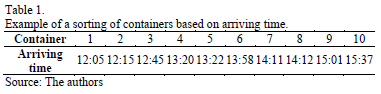
<body><![CDATA[<p><font size="2" face="Verdana, Arial, Helvetica, sans-serif">We assume   that the yard is operated by RTGs (Rubber Tyred Gantry) cranes, although in   practice, only certain sectors of the yard use this handling equipment. The   yard manager should decide where to allocate those containers at the yard so   that a continuous flow of containers to the ship may be guaranteed in order to   ensure good service times. The need for a good pre-specified space allocation   policy for the containers is fundamental for the overall efficiency of the   port. During the service time of a ship, it is desirable to have a continuous   flow of containers between the yard and the quay. </font></p>     <p><font size="2" face="Verdana, Arial, Helvetica, sans-serif">Particularly   for export operations, which are the focus of this work, it is desirable that   the rate at which the containers are retrieved from the yard be equal to the   rate at which the quay crane loads containers onto the vessel. If the container retrieval rate is slower,   the quay crane will have idle time, and the service time of the ship will be   increased. Despite the random arrivals   of the containers to the port, the port has advanced knowledge of at least a   preliminary version of the loading sequence of containers to the vessel. Hence,   a basic assumption that we consider is that the stowage plan is a piece of   input data and is already known, even if it is a preliminary version that may   be updated once the ship has arrived at the terminal. </font></p>     <p><font size="2" face="Verdana, Arial, Helvetica, sans-serif">Typically,   the container storage area of a port yard is constituted by blocks divided into   Bays, Rows and Tiers according to the BAROTI system. A slot is defined as a   BAROTI coordinate in which a TEU (Twenty-Foot Equivalent Unit) is stored. The   blocks may be subdivided into sub-blocks of bays for space allocation purposes.   A sub-block of bays is a set of adjacent bays. The containers are arranged based on common characteristics like   destination port, weight, type, and size. A group of containers with the same   characteristics is known as segregation. It is attractive to store all the   containers with the same segregation in the same sub-block of bays or in   consecutive ones as this may minimize the relocation or re-handling of   containers during the loading operation. </font></p>     <p><font size="2" face="Verdana, Arial, Helvetica, sans-serif">The procedures to store export containers   vary among port terminals. The flow of containers could be directly from the   yard stack to the quay side during the loading process, or in other cases, the   containers could be organized in another area (marshaling space) in which   containers are sorted according to the sequence of the stowage plan. This   minimizes the ship service time, but also increases the number of movements. In   this work, we assume the current practice of STI in which the managers define a   specific area for export containers to be stacked during the time window that   has been defined prior to the arrival of the ship. There are, therefore, no   pre-marshaling areas, and hence, containers are located directly to position in   the yard from which they will later be retrieved to be loaded onto the ship. </font></p>     <p>&nbsp;</p>     <p><font size="3" face="Verdana, Arial, Helvetica, sans-serif"><b>3. Proposed policy description </b></font></p>     <p><font size="2" face="Verdana, Arial, Helvetica, sans-serif">Considering a   two-stage procedure for the space assignment policy, we will focus on the   online or real time assignment of space, assuming that the port manager has   pre-assigned a block position for each container to be segregated in the yard.   In &#91;16&#93;, a mathematical model to support the pre-assignment of block positions   to segregations is proposed. In this paper, we focus on the assignment of   containers in real time to a pre-specified block, as we will further describe. </font></p>     <p><font size="2" face="Verdana, Arial, Helvetica, sans-serif"><b><i>3.1. Basic policy description and notation</i></b></font></p>     <p><font size="2" face="Verdana, Arial, Helvetica, sans-serif">The policy   to allocate containers within the port yard consists of a set of criteria to   assign a location to each arriving export container (BAROTI coordinate). We propose a heuristic procedure based on the   corresponding ship´s stowage plan. Consider the particular instance of 10   containers with their arrival times, as shown in <a href="#tab01">Table 1</a>. </font></p>     <p align="center"><font size="2" face="Verdana, Arial, Helvetica, sans-serif"><a name="tab01"></a></font><img src="/img/revistas/dyna/v83n198/v83n198a24tab01.gif"></p>     ]]></body>
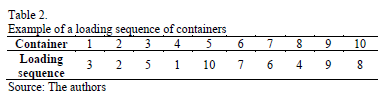
<body><![CDATA[<p><font size="2" face="Verdana, Arial, Helvetica, sans-serif">The   sequence in which containers will be loaded to the ship is shown in the <a href="#tab02">Table   2</a>.</font></p>     <p align="center"><font size="2" face="Verdana, Arial, Helvetica, sans-serif"><a name="tab02"></a></font><img src="/img/revistas/dyna/v83n198/v83n198a24tab02.gif"></p>     <p><font size="2" face="Verdana, Arial, Helvetica, sans-serif">As we can   observe from the <a href="#tab01">Tables 1</a> and <a href="#tab02">2</a>, the loading sequence of containers does not   follow a FIFO (first in-first out) policy, and hence, the arrival order of   containers does not define the sequence in which they are loaded. The   horizontal dimension of the block can be used as an indicator of how early a   specific container should be loaded to the ship, according to the stowage plan.   For instance let <i>p<sub>k</sub></i> be the   loading sequence according to the stowage plan of the <i>k<sup>th</sup></i> container to arrive at the port. Therefore, a high <i>p<sub>k</sub></i> value indicates that the   container will be loaded later than a container with a low <i>p<sub>k</sub></i>. <a href="#fig01">Fig. 1</a> illustrates the sub-block space allocation   depending on the containers´ loading sequence).</font></p>     <p align="center"><font size="2" face="Verdana, Arial, Helvetica, sans-serif"><a name="fig01"></a></font><img src="/img/revistas/dyna/v83n198/v83n198a24fig01.gif"></p>     <p><font size="2" face="Verdana, Arial, Helvetica, sans-serif">Thus, the   main principle of the proposed policy is that containers to be first loaded on   to the ship, should be allocated nearer to the right hand side of the block,   and the containers to be loaded later should be allocated closer to the left   hand side of the block. </font></p>     <p><font size="2" face="Verdana, Arial, Helvetica, sans-serif"><b><i>3.1. Algorithm description</i></b></font></p>     <p><font size="2" face="Verdana, Arial, Helvetica, sans-serif">The following notation is defined: </font></p> <ul>       <li><font size="2" face="Verdana, Arial, Helvetica, sans-serif">Let<i> N </i>be the number of available bays in the block,</font></li>       <li><font size="2" face="Verdana, Arial, Helvetica, sans-serif">Let<i> n</i> be the number of sub-blocks into which <i>N</i> bays are subdivided.<sub><img src="/img/revistas/dyna/v83n198/v83n198a24eq004.gif"></sub>,</font></li>       <li><font size="2" face="Verdana, Arial, Helvetica, sans-serif">Let<i> N<sub>j </sub></i>be the     number of bays assigned to sub-block <i>j</i>, <sub><img src="/img/revistas/dyna/v83n198/v83n198a24eq006.gif"></sub>,</font></li>       ]]></body>
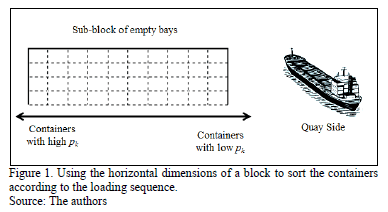
<body><![CDATA[<li><font size="2" face="Verdana, Arial, Helvetica, sans-serif">Let<i> A</i> be the total number of containers to be allocated,</font></li>       <li><font size="2" face="Verdana, Arial, Helvetica, sans-serif">Let<i> A<sub>j</sub></i> be the number of containers assigned to the     sub-block <i>j</i>, <sub><img src="/img/revistas/dyna/v83n198/v83n198a24eq006.gif"></sub>,</font></li>       <li><font size="2" face="Verdana, Arial, Helvetica, sans-serif">Let<i> ran<sub>j</sub></i> be the range of <i>p<sub>k</sub></i> stored in sub-block <i>j</i>, <sub><img src="/img/revistas/dyna/v83n198/v83n198a24eq006.gif"></sub>, </font></li>       <li><font size="2" face="Verdana, Arial, Helvetica, sans-serif">Let<i> sb<sub>k</sub></i> be the sub-block that stores container <i>k</i>, <sub><img src="/img/revistas/dyna/v83n198/v83n198a24eq008.gif"></sub>,</font></li>       <li><font size="2" face="Verdana, Arial, Helvetica, sans-serif">Let<i> u<sub>i</sub></i> be the number of containers stored at bay <i>i</i><sub><img src="/img/revistas/dyna/v83n198/v83n198a24eq010.gif"></sub>,</font></li>       <li><font size="2" face="Verdana, Arial, Helvetica, sans-serif">Let<i> Q</i> be the maximum bay capacity, and</font></li>       <li><font size="2" face="Verdana, Arial, Helvetica, sans-serif">Let<i> B<sub>j</sub></i> the set of opened bays in sub-block j, <sub><img src="/img/revistas/dyna/v83n198/v83n198a24eq006.gif"></sub>.</font></li>     </ul>     <p><font size="2" face="Verdana, Arial, Helvetica, sans-serif"><i>3.2.1. Parameters Estimation</i></font></p>     <p><font size="2" face="Verdana, Arial, Helvetica, sans-serif">Some   parameters should be determined prior to the execution of the algorithm. This   is described by the following subsections:</font></p>     ]]></body>
<body><![CDATA[<p><font size="2" face="Verdana, Arial, Helvetica, sans-serif">a) Minimum bay capacity to store the containers. Due to random container arrivals the   position of each container <i>k</i> must be   identified according to its position in the stowage plan, <i>p<sub>k</sub></i>. Let <i>d*</i> be   the minimum bay capacity to store <i>A</i> containers   in the yard. Assuming that an equal number of containers is allocated to each   Bay, this may be computed in the way that is shown in the following equation:</font></p>     <p><img src="/img/revistas/dyna/v83n198/v83n198a24eq01.gif"></p>     <p><font size="2" face="Verdana, Arial, Helvetica, sans-serif">b) Number of bays that will conform each sub-block (<i>N<sub>j</sub></i>). The procedure to compute <i>N<sub>j</sub></i> is as follows: The number   of sub-blocks (<i>n</i>) is an input parameter,   so &#91;<sub><img src="/img/revistas/dyna/v83n198/v83n198a24eq014.gif"></sub>&#93;bays are allocated to each sub-block. To complete allocating   all the bays of each sub-block, one extra bay should be allocated to the first   mod(<i>N</i>, <i>n</i>) bays. For example, with <i>N</i> = 20 bays and <i>n</i> = 3 sub-blocks, each   of the 3 sub-blocks will contain 6 bays.   Since mod(20, 3) = 2, sub-blocks 1 and 2 will each be assigned one extra bay.   The final bay allocation to each sub-block is shown in <a href="#tab03">Table 3</a>. The sub-blocks are sorted according to their   proximity to quay. In this example, sub-block number 1 is the closest to the   quay while sub-block number 3 is the farthest from the quay.</font></p>     <p align="center"><font size="2" face="Verdana, Arial, Helvetica, sans-serif"><a name="tab03"></a></font><img src="/img/revistas/dyna/v83n198/v83n198a24tab03.gif"></p>     <p><font size="2" face="Verdana, Arial, Helvetica, sans-serif">c) Number of   containers to be allocated to sub-block <i>j </i>(<i>Aj</i> ). For each sub-block <i>j</i>, the product of the minimum bay   capacity and the number of bays assigned to the sub-block <i>j</i></font><font size="2" face="Verdana, Arial, Helvetica, sans-serif"> gives the number of   containers assigned to each sub-block, <img src="/img/revistas/dyna/v83n198/v83n198a24eq016.gif">. If this value is not an integer, it should be adjusted   based on the following considerations:</font></p> <ul>       <li><font size="2" face="Verdana, Arial, Helvetica, sans-serif">For the sub-blocks with the     minimum the value of <i>A<sub>j</sub></i> will be equal to <sub><img src="/img/revistas/dyna/v83n198/v83n198a24eq018.gif"></sub>.</font></li>       <li><font size="2" face="Verdana, Arial, Helvetica, sans-serif">For the sub-blocks with the     maximum <i>N<sub>j</sub></i>, the value of <i>A<sub>j</sub></i> will be equal to <sub><img src="/img/revistas/dyna/v83n198/v83n198a24eq020.gif"></sub>.</font></li>     </ul>     <p><font size="2" face="Verdana, Arial, Helvetica, sans-serif">Additional   adjustment of <i>A<sub>j</sub></i> may be   required if<sub><img src="/img/revistas/dyna/v83n198/v83n198a24eq022.gif"></sub>. When the total number of containers   assigned to all <i>n </i>sub-blocks is   greater than <i>A</i>, the <i>A<sub>j</sub></i> for the sub-block with the   maximum container allocation should decrease by <sub><img src="/img/revistas/dyna/v83n198/v83n198a24eq024.gif"></sub> units. </font></p> <ul>       <li><font size="2" face="Verdana, Arial, Helvetica, sans-serif">Equivalently,     when the total number of containers assigned to all <i>n</i> sub-blocks is less than <i>A</i>,     the <i>Aj </i>for the sub-block with the     minimum container allocation should increase by </font><img src="/img/revistas/dyna/v83n198/v83n198a24eq011.gif"><font size="2" face="Verdana, Arial, Helvetica, sans-serif">units. </font></li>     ]]></body>

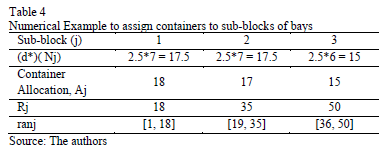
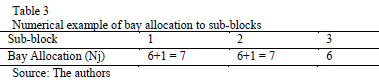
<body><![CDATA[</ul>     <p><font size="2" face="Verdana, Arial, Helvetica, sans-serif">Once <i>Aj</i> is defined, parameter <i>ranj</i> can be   determined as follows: </font></p> <ul>       <li><font size="2" face="Verdana, Arial, Helvetica, sans-serif">Let <i>Rj</i> be the accumulate value of <i>Aj</i>:</font></li>     </ul>     <blockquote>       <p><img src="/img/revistas/dyna/v83n198/v83n198a24eq0111.gif"></p> </blockquote> <ul>       <li><font size="2" face="Verdana, Arial, Helvetica, sans-serif">Sub-blocks     with <i>j</i> = 1 store the containers with <i>pk</i> in the range ran1= &#91;1, <i>R1</i>&#93;.</font></li>       <li><font size="2" face="Verdana, Arial, Helvetica, sans-serif">Sub-blocks     with <i>j</i> = {2, 3, …, n} store containers with <i>pk</i> in the range ranj = &#91;<i>Rj</i>-1 + 1, <i>Rj</i>&#93;</font></li>     </ul>     <p><font size="2" face="Verdana, Arial, Helvetica, sans-serif">In order to illustrate previous   procedure, consider the case with a value of <i>A</i> = 50 containers, <i>N</i> = 20   Bays, <i>d*</i> = 2.5 and <i>n</i> = 3 sub-blocks. After applying the   previous steps, the final container allocation of each sub-block is presented   in the <a href="#tab04">Table 4</a>.</font></p>     ]]></body>
<body><![CDATA[<p align="center"><font size="2" face="Verdana, Arial, Helvetica, sans-serif"><a name="tab04"></a></font><img src="/img/revistas/dyna/v83n198/v83n198a24tab04.gif"></p>     <p><font size="2" face="Verdana, Arial, Helvetica, sans-serif"><b><i>3.4. Heuristic description</i></b></font></p>     <p><font size="2" face="Verdana, Arial, Helvetica, sans-serif">A heuristic procedure is designed to   assign containers to bays. The block of bays is subdivided into <i>n</i> sub-blocks and instances; different   values of <i>n </i>were generated to examine   the dependence of the number of re-handles with this parameter. The heuristic proceeds   to fill the bays by allocating containers from the left to the right of the   sub-block and from the back to the front of the sub-block. The algorithm   assumes that the sub-blocks of bays are empty at the beginning and that each   sub-block is filled up with containers according to <i>ran<sub>j</sub></i>. When a new container arrives it is allocated   either in an opened sub-block bay or in a new empty sub-block bay. The   containers are allocated so that the number of re-handles required to load them   onto the ship are minimized. </font></p>     <p><font size="2" face="Verdana, Arial, Helvetica, sans-serif">The parameters that define an instance of   the problem are the number of sub-blocks in which the block of bays will be   subdivided (<i>n</i>), and the maximum   tolerable difference between loading sequences in the stowage plan (<i>Cr<sub>max</sub></i>). Thus, one instance   consists of the following parameters:</font></p> <ul>       <li><font size="2" face="Verdana, Arial, Helvetica, sans-serif">Number of containers, <i>A</i>.</font></li>       <li><font size="2" face="Verdana, Arial, Helvetica, sans-serif">Number of bays, <i>N.</i></font></li>       <li><font size="2" face="Verdana, Arial, Helvetica, sans-serif">Number of sub-blocks, <i>n.</i></font></li>       <li><font size="2" face="Verdana, Arial, Helvetica, sans-serif">Maximum capacity of the bay, <i>Q.</i></font></li>       <li><font size="2" face="Verdana, Arial, Helvetica, sans-serif">Maximum tolerable difference <i>Cr<sub>max</sub></i>.</font></li>     </ul>     ]]></body>
<body><![CDATA[<p><font size="2" face="Verdana, Arial, Helvetica, sans-serif">Suppose the first container to arrive at   the port yard has <i>p<sub>k</sub></i> = <i>p<sub>1</sub></i> and is allocated in the   upper left corner of the corresponding sub-block. Due to random arrivals,   suppose that the second has <i>p<sub>k</sub></i> = <i>p<sub>2</sub></i> with <i>p<sub>2</sub></i> &lt; <i>p<sub>1</sub></i>; so the second   container could be located in front of the first. To retrieve both containers   will not necessarily involve any re-handle movement. However, all the   containers having <i>p<sub>k</sub></i> between <i>p<sub>2</sub></i> and <i>p<sub>1</sub></i> should be located   somewhere else, and the total delayed time to load all the containers onto the   ship will increase due to crane displacement to different sectors of the   sub-block. To avoid the previous situation we estimate the difference between   the last container allocated in each opened bay of the sub-block <i>j</i> and the container waiting to be   allocated as shown in the following equation: </font></p>     <p><img src="/img/revistas/dyna/v83n198/v83n198a24eq02.gif"></p>     <p><font size="2" face="Verdana, Arial, Helvetica, sans-serif">Where:</font></p> <ul>       <li><font size="2" face="Verdana, Arial, Helvetica, sans-serif"><i>pik-1</i> is the loading sequence of the     last container allocated to bay <i>i</i>,</font></li>       <li><font size="2" face="Verdana, Arial, Helvetica, sans-serif"><i>pk</i> is the loading sequence of the arriving container, and,</font></li>       <li><font size="2" face="Verdana, Arial, Helvetica, sans-serif"><i>Bj</i> is the set of all opened bays in     sub-block <i>j</i>.</font></li>     </ul>     <p><font size="2" face="Verdana, Arial, Helvetica, sans-serif">A <i>Cr<sub>i</sub></i> difference should be computed between the loading sequence of the incoming   container and the loading sequence of the last container assigned to each   opened bay in the sub-block. We are   interested only in negative values of <i>Cr<sub>i</sub></i> because they indicate that no re-handles will be required if the incoming   container is allocated in bay <i>i</i>. The   value of <i>Cr<sub>i</sub></i> is restricted   to a maximum tolerable value, defined as <i>Cr<sub>max</sub></i>.   If the value of <i>Cr<sub>i</sub></i> is   greater to or equal than <i>Cr<sub>max,</sub></i> the container can be located in bay <i>i</i>. </font></p>     <p><font size="2" face="Verdana, Arial, Helvetica, sans-serif">The methodology can be summarized by the   following series of steps: </font></p>     <blockquote>       ]]></body>
<body><![CDATA[<p><font size="2" face="Verdana, Arial, Helvetica, sans-serif">1. Sort the containers according     to their arrival order <sub><img src="/img/revistas/dyna/v83n198/v83n198a24eq032.gif"></sub>.</font></p>       <p><font size="2" face="Verdana, Arial, Helvetica, sans-serif">2. Match the containers with the     stowage plan and determine <i>p<sub>k..</sub></i></font></p>       <p><font size="2" face="Verdana, Arial, Helvetica, sans-serif">3. Determine <i>sb<sub>k</sub></i> <sub><img src="/img/revistas/dyna/v83n198/v83n198a24eq034.gif"></sub>by matching with <i>ran<sub>j.</sub></i>.</font></p>       <p><font size="2" face="Verdana, Arial, Helvetica, sans-serif">4. Initialize<sub><img src="/img/revistas/dyna/v83n198/v83n198a24eq036.gif"></sub> .</font></p>       <p><font size="2" face="Verdana, Arial, Helvetica, sans-serif">5. Initialize <i>u<sub>i</sub></i> = 0<sub><img src="/img/revistas/dyna/v83n198/v83n198a24eq038.gif"></sub>.</font></p>       <p><font size="2" face="Verdana, Arial, Helvetica, sans-serif">6. Set <i>k </i>= 1.</font></p>       <p><font size="2" face="Verdana, Arial, Helvetica, sans-serif">7. If <i>sb<sub>k</sub></i> is empty, open the first bay of <i>sb<sub>k</sub></i>and go to     step 8,     otherwise go to step 9. </font></p>       <p><font size="2" face="Verdana, Arial, Helvetica, sans-serif">8. Allocate the container in the     bay opened in step 7 and     add the bay to <i>B<sub>sbk</sub></i>, then     go to step 17.</font></p>       <p><font size="2" face="Verdana, Arial, Helvetica, sans-serif">9. Calculate <i>cr<sub>i</sub></i><sub><img src="/img/revistas/dyna/v83n198/v83n198a24eq040.gif"></sub>.</font></p>       <p><font size="2" face="Verdana, Arial, Helvetica, sans-serif">10. Determine the maximum negative     element of <i>cr<sub>i</sub></i>. If no     element of <i>cr<sub>i</sub></i> is negative     go to step 12.</font></p>       ]]></body>
<body><![CDATA[<p><font size="2" face="Verdana, Arial, Helvetica, sans-serif">11. If the <i>cr<sub>i</sub></i> obtained in step 10 is     greater or equal than <i>Cr<sub>max</sub></i>,     allocate the container in the bay <i>i </i>and     go to step 17. If     not, proceed to step 12.</font></p>       <p><font size="2" face="Verdana, Arial, Helvetica, sans-serif">12. If possible, open a new bay in     the sub-block and add the bay to <i>B<sub>sbk</sub></i>.     If all bays of the sub-block are already opened, go to step 14. </font></p>       <p><font size="2" face="Verdana, Arial, Helvetica, sans-serif">13. Allocate the container in the block opened in step 12, and     then go to step 17.</font></p>       <p><font size="2" face="Verdana, Arial, Helvetica, sans-serif">14. Calculate <i>cr<sub>i</sub></i><sub><img src="/img/revistas/dyna/v83n198/v83n198a24eq041.gif"></sub> for any container with arrival order <i>m, </i>with<sub><img src="/img/revistas/dyna/v83n198/v83n198a24eq043.gif"></sub>,and <i>sb<sub>m</sub></i> = <i>sb<sub>k</sub></i>.</font></p>       <p><font size="2" face="Verdana, Arial, Helvetica, sans-serif">15. Reserve bay <i>i</i> when a negative value of <i>cr<sub>i</sub></i> is found. </font></p>       <p><font size="2" face="Verdana, Arial, Helvetica, sans-serif">16. Allocate the container <i>k</i> in the emptiest and unreserved bay of <i>sb<sub>k</sub></i>. </font></p>       <p><font size="2" face="Verdana, Arial, Helvetica, sans-serif">17. Set <i>k</i> = <i>k</i> + 1 and <i>u<sub>i</sub></i> = <i>u<sub>i</sub></i> +1.</font></p>       <p><font size="2" face="Verdana, Arial, Helvetica, sans-serif">18. If <i>u<sub>i</sub></i> = <i>Q</i>, remove the bay <i>i</i> from <i>B<sub>sbk</sub></i>.</font></p>       <p><font size="2" face="Verdana, Arial, Helvetica, sans-serif">19. If <sub><img src="/img/revistas/dyna/v83n198/v83n198a24eq045.gif"></sub> go to step 7, otherwise go to step 20.</font></p>       <p><font size="2" face="Verdana, Arial, Helvetica, sans-serif">20. End of the algorithm.</font></p> </blockquote>     ]]></body>
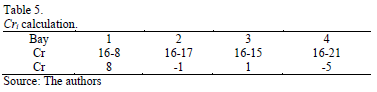
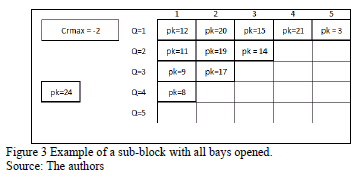
<body><![CDATA[<p><font size="2" face="Verdana, Arial, Helvetica, sans-serif">To illustrate the methodology, we provide   a numerical example. <a href="#fig02">Figure   2</a> shows a graphical representation of a block of 5 bays, each one has a   maximum capacity of 5 containers. The bay number 5 has not yet been opened.   There are 9 containers already in the block, and the tenth container to arrive   to the port has a <i>p<sub>k</sub></i> = 16. <i>Cr<sub>i</sub></i> values for bays 1, 2,   3 and 4 should be calculated in order to determine in which bays the incoming   container can be assigned. </font></p>     <p align="center"><font size="2" face="Verdana, Arial, Helvetica, sans-serif"><a name="fig02" id="fig02"></a></font><img src="/img/revistas/dyna/v83n198/v83n198a24fig02.gif"></p>     <p><font size="2" face="Verdana, Arial, Helvetica, sans-serif">The value of <i>Cr</i> for the bay 1 is calculated as follows: <i>Cr<sub>1</sub></i> = 16 - 8 = 8. <a href="#tab05">Table   5</a> shows the <i>Cr<sub>i</sub></i> differences of all opened bays. Some <i>Cr<sub>i</sub></i> differences are positive and others are negative. A <i>Cr<sub>i</sub></i> greater than 0, such as the <i>Cr</i> of bay numbers 1 and 3, indicates that if the container with <i>p<sub>k</sub></i> = 16 is allocated in any   of those a re-handle movement will be required to retrieve the container.</font></p>     <p align="center"><font size="2" face="Verdana, Arial, Helvetica, sans-serif"><a name="tab05"></a></font><img src="/img/revistas/dyna/v83n198/v83n198a24tab05.gif"></p>     <p><font size="2" face="Verdana, Arial, Helvetica, sans-serif">According to the algorithm, the bays that   are allowed to receive a container are those with a negative <i>Cr<sub>i</sub></i> value. <a href="#tab05">Table 5</a> shows the <i>Cr<sub>i</sub></i> values for   all opened bays. In this example, bays 2 and 5 are possible candidates to   receive the container. The <i>Cr<sub>max</sub></i> is equal to -2, so bays with a value of <i>Cr</i>=   -1 or <i>Cr</i> = -2 can be chosen. The   algorithm will compare the <i>Cr<sub>i</sub></i> value of all candidates with the <i>Cr<sub>max,</sub></i> and the final decision will be to allocate the container in bay number 2.</font></p>     <p><font size="2" face="Verdana, Arial, Helvetica, sans-serif">As can be observed in <a href="#tab05">Table 5</a>, a   value of <i>Cr</i> = -1 implies that the   containers have consecutive values of <i>p<sub>k, </sub></i>and in general, a negative value indicates that no re-handles are   required to retrieve the pair of containers. The decision to open a new bay   must be taken only when all the <i>Cr<sub>i</sub></i> differences are positive or there is no longer a negative <i>Cr</i> greater or equal than <i>Cr<sub>max</sub></i> for all opened bays in the block.</font></p>     <p><font size="2" face="Verdana, Arial, Helvetica, sans-serif">To open or use a new bay there must be at   least one empty bay in the sub-block. When a container arrives, but it is not   possible to open a new bay due to all bays being opened in the sub-block, the   following methodology is performed:</font></p> <ul>       <li><font size="2" face="Verdana, Arial, Helvetica, sans-serif">Inspect if there is any <i>Cr<sub>i</sub></i> &lt; 0 for any container     that has not yet arrived from the sub-block. </font></li>       <li><font size="2" face="Verdana, Arial, Helvetica, sans-serif">When a <i>Cr<sub>i</sub></i> &lt; 0 is found, reserve the bay for that container.</font></li>       <li><font size="2" face="Verdana, Arial, Helvetica, sans-serif">Allocate the newcomer container     in the emptiest and a bay that is not reserved in the sub-block.</font></li>     ]]></body>
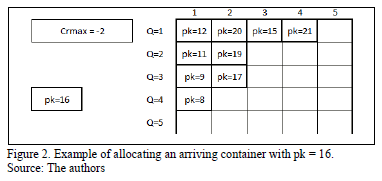
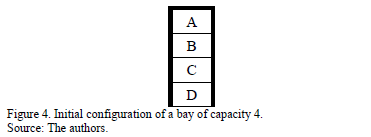
<body><![CDATA[</ul>     <p><font size="2" face="Verdana, Arial, Helvetica, sans-serif"><a href="#fig03">Fig. 3</a> shows a numerical example of this situation. For the container with <i>p<sub>k</sub></i> = 24, the <i>Cr<sub>i</sub></i> vector is: {16, 7, 10, 3,   21}. Neither component of the vector is negative, so the algorithm will verify   if there is a negative <i>Cr<sub>i</sub></i> for any not container that has not arrived. </font></p>     <p align="center"><font size="2" face="Verdana, Arial, Helvetica, sans-serif"><a name="fig03"></a></font><img src="/img/revistas/dyna/v83n198/v83n198a24fig03.gif"></p>     <p>&nbsp;</p>     <p><font size="3" face="Verdana, Arial, Helvetica, sans-serif"><b>4. Upper bound estimation </b></font></p>     <p><font size="2" face="Verdana, Arial, Helvetica, sans-serif">In this section we present an estimation   of an upper bound on the maximum and an expected number of re-handles of a bay   with capacity <i>Q</i>. In order to estimate   the number of re-handles, we assume that containers are retrieved by a   reach-stacker crane. The reach stacker crane can retrieve containers only from   the front side of the stack, and the maximum stack height reached by the   equipment is five. We assume that all the containers that need to be moved to   retrieve the container are relocated in the same configuration as they were   previously stacked in the block. Consider a bay with a capacity of 4 containers, as is illustrated in <a href="#fig04">Figure 4</a>.</font></p>     <p align="center"><font size="2" face="Verdana, Arial, Helvetica, sans-serif"><a name="fig04"></a></font><img src="/img/revistas/dyna/v83n198/v83n198a24fig04.gif"></p>     <p><font size="2" face="Verdana, Arial, Helvetica, sans-serif">Suppose that the sequence to retrieve the   containers according to the stowage plan is {A, B, C, D}. Three re-handles (D,   C, B) are required to retrieve container A. Once container A was retrieved, two   additional re-handles are required to retrieve container B. Then, one additional re-handle should be made   to retrieve container C. The last container to be retrieved does not require re-handles,   so the total re-handles required to retrieve all the containers are: 3+2+1 = 6.   This configuration is the worst one possible due to the order of retrieving the   containers being exactly the opposite of the order of the containers allocated   in the bay. </font></p>     <p><font size="2" face="Verdana, Arial, Helvetica, sans-serif">Let <i>Max_Rhand</i> be the upper bound in the number of re-handles of a Bay with capacity <i>Q</i>. The maximum number of re-handles of a   bay with capacity <i>Q</i> provides an upper   bound (the worst case) for the number of re-handles that may be used to   evaluate the effectiveness of the algorithm, which is expressed in the   following equation:</font></p>     <p><img src="/img/revistas/dyna/v83n198/v83n198a24eq03.gif"></p>     ]]></body>
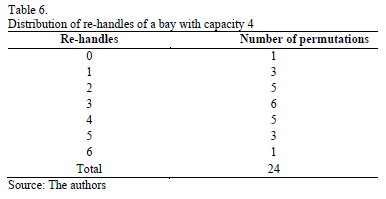
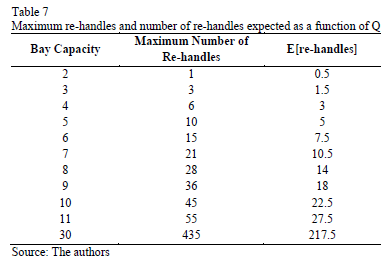
<body><![CDATA[<p><font size="2" face="Verdana, Arial, Helvetica, sans-serif">We may also use for comparison purposes   the expected value of the number of re-handles for a bay with capacity <i>Q</i>. To define this value we compute the   distribution of the number of interferences and the number of permutations. For   example, the same bay in the previous example with capacity 4 has 4! = 24   possible permutations. The minimum number of re-handles that can be obtained is   0 when the order of retrieving the containers is exactly the same as the order   of the containers allocated in the bay. By generating the 24 permutations and   the number of re-handles in each permutation, the corresponding distribution   obtained is that shown in <a href="#tab06">Table 6</a>.</font></p>     <p align="center"><font size="2" face="Verdana, Arial, Helvetica, sans-serif"><a name="tab06"></a></font><img src="/img/revistas/dyna/v83n198/v83n198a24tab06.gif"></p>     <p><font size="2" face="Verdana, Arial, Helvetica, sans-serif">Assuming an equal occurrence probability   for each permutation, the expected value of the number of re-handles can be   obtained by the weighted average as follows:</font></p>     <p><img src="/img/revistas/dyna/v83n198/v83n198a24eq04.gif"></p>     <p><font size="2" face="Verdana, Arial, Helvetica, sans-serif">The previous procedure was applied to   different values of the capacity of a bay in order to obtain the corresponding   value of the maximum and expected number of re-handles, as shown in <a href="#tab07">Table 7</a>.</font></p>     <p align="center"><font size="2" face="Verdana, Arial, Helvetica, sans-serif"><a name="tab07"></a></font><img src="/img/revistas/dyna/v83n198/v83n198a24tab07.gif"></p>     <p><font size="2" face="Verdana, Arial, Helvetica, sans-serif">A polynomial trend line was fitted to the   data, and we obtained the following expression to determine the expected number   of re-handles: </font></p>     <p><img src="/img/revistas/dyna/v83n198/v83n198a24eq05.gif"></p>     <p>&nbsp;</p>     <p><font size="3" face="Verdana, Arial, Helvetica, sans-serif"><b>5. Numerical results and experimentation</b></font></p>     ]]></body>

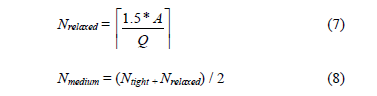
<body><![CDATA[<p><font size="2" face="Verdana, Arial, Helvetica, sans-serif"><b><i>5.1. Instance generation</i></b></font></p>     <p><font size="2" face="Verdana, Arial, Helvetica, sans-serif">We consider three types of instance   sizes, according to the relationship between the number of containers and the   total available slots to allocate the containers: Tight, Medium and Relaxed. We   defined the values of the capacity of each bay as the product of the number of   rows and tiers. Typical values based on the case study of STI are 6 and 5   respectively, which corresponds to a value of <i>Q </i>= 30. These are also the values considered for the instances   generated. The number of sub-blocks could be any integer in the range of (1, <i>N</i>), where the extreme cases are   represented by the values of 1 and <i>N w</i>hen <i>n</i> = 1. The entire block is treated as   the unique sub-block in the instance while if <i>n</i> = <i>N</i> each single bay of   the block is treated as a sub-block. </font></p>     <p><font size="2" face="Verdana, Arial, Helvetica, sans-serif">We define a range of values for each   parameter that will later be described. Based on the historical data of the   port terminal under consideration we assume that, on average, 90 trucks per   hour arrive at the port terminal during the first and second shift in the day.   We will consider therefore, that for a congested operational day, there is a   maximum arrival of 1500 trucks. For an uncongested day, we will consider that   800 trucks arrive: thus, <i>A</i>Î{800, 1500}. The rest of the parameters are defined as: <i>N</i>Î {tight, medium, relaxed}; <i>n</i> Î{1, 3, 20, <i>N</i>}; <i>Q</i>Î {30} and <i>Cr<sub>max </sub></i>Î {2, 4}.</font></p>     <p><font size="2" face="Verdana, Arial, Helvetica, sans-serif">By considering previous values for each   parameter we generate a total of 2x3x4x2=48 types of instances. The values of <i>N</i> corresponding to tight, relaxed, and   medium ranges are estimated as follows: </font></p>     <p><img src="/img/revistas/dyna/v83n198/v83n198a24eq06.gif"></p>     <p><img src="/img/revistas/dyna/v83n198/v83n198a24eq0708.gif"></p>     <p><font size="2" face="Verdana, Arial, Helvetica, sans-serif"><b><i>5.2. Numerical experiments</i></b></font></p>     <p><font size="2" face="Verdana, Arial, Helvetica, sans-serif">The numerical experimentation was   performed on an Intel Core i5 Computer with 2.50 GHz and 6.0 GB of RAM. The   maximum number of re-handles in a bay with a capacity of 30 containers is   defined as:</font></p>     <p><img src="/img/revistas/dyna/v83n198/v83n198a24eq09.gif"></p>     <p><font size="2" face="Verdana, Arial, Helvetica, sans-serif">While the expected value of <i>Re-handles</i> is defined as:</font></p>     ]]></body>

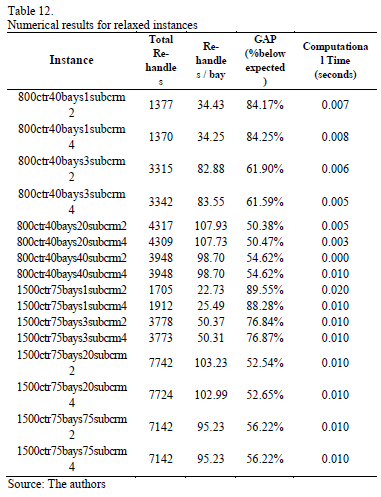
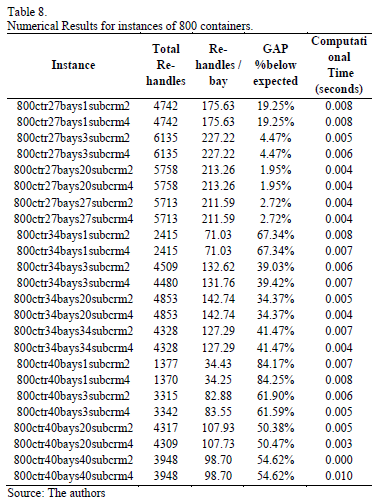
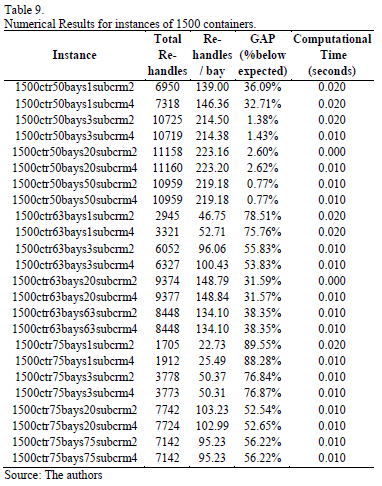
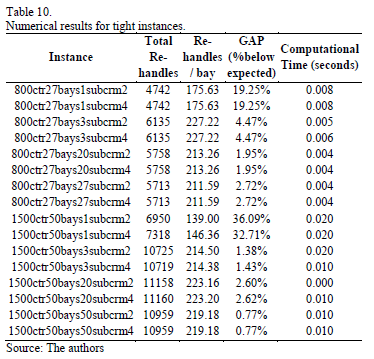
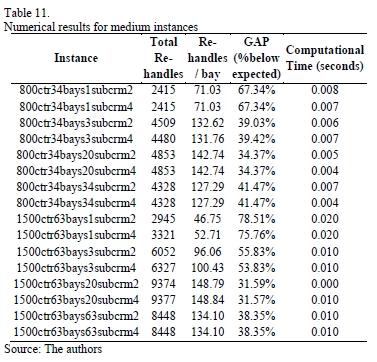
<body><![CDATA[<p><img src="/img/revistas/dyna/v83n198/v83n198a24eq10.gif"></p>     <p><font size="2" face="Verdana, Arial, Helvetica, sans-serif">Considering the solution provided by the   algorithm, we determined the number of re-handles per bay (<i>R_bay</i>) and compared this number to the upper bound that can be   defined as the expected number of re-handles, as shown in the following   equation: </font></p>     <p><img src="/img/revistas/dyna/v83n198/v83n198a24eq11.gif"></p>     <p><font size="2" face="Verdana, Arial, Helvetica, sans-serif">The value of the gap obtained may be   interpreted as the percentage below the expected value of Re-handles. The   bigger the gap, the better the algorithm performs. <a href="#tab08">Tables 8</a> and <a href="#tab09">9</a> show the results for the 800   size and 1500 size instances respectively. We consider a single replicate for   the 48 types of instances, which are refereed based on the values of its   parameters. For example, the &quot;<i>800ctr27bays1subcrm2&quot;</i> is an instance with 800 containers, 27 bays, 1 sub-block and <i>Cr<sub>max</sub></i> = 2. The tables present   the total number of re-handles obtained by the solution, the number of   re-handles per bay and the corresponding gaps and computation times. Gaps are   expressed as a percentage value below the expected number of re-handles. </font></p>     <p align="center"><font size="2" face="Verdana, Arial, Helvetica, sans-serif"><a name="tab08"></a></font><img src="/img/revistas/dyna/v83n198/v83n198a24tab08.gif"></p>     <p align="center"><font size="2" face="Verdana, Arial, Helvetica, sans-serif"><a name="tab09"></a></font><img src="/img/revistas/dyna/v83n198/v83n198a24tab09.gif"></p>     <p><font size="2" face="Verdana, Arial, Helvetica, sans-serif">As can be observed in the tables, all   instances found a number of re-handles that were less than the expected number   of re-handles that was estimated as an upper bound. As we previously defined,   positive gaps indicate a better performance of the heuristic procedure. From   the above tables, the 800 size instances obtained an average gap of 38.48% and   the 1500 size instances an average gap of 42.97%. This indicates that for both   instance sizes the heuristic performs on average similar. Also, there are no   big differences with respect to the size of the instance in terms of the number   of containers is observed. </font></p>     <p><font size="2" face="Verdana, Arial, Helvetica, sans-serif">Moreover, for both sizes of containers,   we observe that gaps increase proportionally as the instances are less restricted.   Also, the best results are obtained when all the block of bays are treated as a   single sub-block, e.g. with <i>n</i> = 1. Execution time for all the   instances is less than 0.1 second, which is a very short computational time due   to the polynomial characteristics of the algorithm that is proposed. Smaller   computational times are observed for the 800 size instances, but even for the   1500 size these are quite small and adequate for an online procedure. <a href="#tab10">Tables 10</a>, <a href="#tab11">11</a> and <a href="#tab12">12</a> present results that are summarized by   the type of instance: tight, medium, and relaxed, respectively. </font></p>     <p align="center"><font size="2" face="Verdana, Arial, Helvetica, sans-serif"><a name="tab10"></a></font><img src="/img/revistas/dyna/v83n198/v83n198a24tab10.gif"></p>     <p align="center"><font size="2" face="Verdana, Arial, Helvetica, sans-serif"><a name="tab11"></a></font><img src="/img/revistas/dyna/v83n198/v83n198a24tab11.gif"></p>     ]]></body>

<body><![CDATA[<p align="center"><font size="2" face="Verdana, Arial, Helvetica, sans-serif"><a name="tab12"></a></font><img src="/img/revistas/dyna/v83n198/v83n198a24tab12.gif"></p>     <p><font size="2" face="Verdana, Arial, Helvetica, sans-serif">As we can observe from previous tables,   tight instances present the lower gaps, with an average gap of 8.45%, and a   maximum gap of 36%, which shows that are the hardest instances to be solved and   the number of re-handles is closer to the expected number computed as an upper   bound. It is important to notice that for this type of instance, better results   are obtained for the 1500 size instances than for the 800 size. </font></p>     <p><font size="2" face="Verdana, Arial, Helvetica, sans-serif">In the case of the 800 tight instances,   no difference on the results obtained for different values of <i>Cr<sub>max</sub></i> are observed. On the   other hand, the relaxed instances show the best results (higher gaps), with an   average value of 65%. Medium instances have an average gap of 48%, which is an   intermediate value with respect to the relaxed and tight instances.</font></p>     <p>&nbsp;</p>     <p><font size="3" face="Verdana, Arial, Helvetica, sans-serif"><b>6. Conclusions and recommendations for further   research </b></font></p>     <p><font size="2" face="Verdana, Arial, Helvetica, sans-serif">We have proposed a heuristic procedure   for the allocation of storage space for export containers arriving at a Port   Terminal. We specifically consider the case in which the terminal defines a   specific area in which export containers are stacked during the time window   that is fixed prior to the arrival of the ship. Containers that arrive with   more anticipation are allocated to other spaces from which they are relocated   to the stacking area during the time window period.</font></p>     <p><font size="2" face="Verdana, Arial, Helvetica, sans-serif">The aim of the procedure is to minimize   the number of potential re-handles of containers once they are retrieved from   the yard to be loaded onto the ship. The heuristic consists of a set of   criteria to assign a location in a space within the yard based on the sequence   in which the container will be loaded to the ship, and as is indicated in the   stowage plan. We present computational results with a set of different sized   instances and the restrictiveness that were generated. </font></p>     <p><font size="2" face="Verdana, Arial, Helvetica, sans-serif">An upper bound on the number of expected   re-handles of containers as a function of the capacity of a bay was determined   in order to measure the performance of the heuristic procedure. Results show   that the heuristic always finds lower values of the number of re-handles with   respect to the upper bound. The instances that turned out to be more difficult   are the tight type in which the gap with respect to the upper bound is not as   high as for the rest of the instances. Computation times are very small with   lower values of 0.1 seconds. </font></p>     <p><font size="2" face="Verdana, Arial, Helvetica, sans-serif">For further research, we propose that the   algorithm to the import containers that are unloaded from the ship in extended   in order to minimize the number of re-handles when they are dispatched to   external trucks. We also consider an extension of the procedure in which the   number of sub-blocks of bays (<i>n</i>) may   be determined instead of considering it as a parameter to be another area of   future research. </font></p>     <p>&nbsp;</p>     ]]></body>
<body><![CDATA[<p><font size="3" face="Verdana, Arial, Helvetica, sans-serif"><b>References</b></font></p>     <!-- ref --><p><font size="2" face="Verdana, Arial, Helvetica, sans-serif"><b>&#91;1&#93;</b> Steenken, D., Voß, S. and   Stahlbock, R., Container terminal operations and operations research-A   classification and literature review. OR Spectrum vol. 26, pp. 3-49, 2004. DOI 10.1007/s00291-003-0157-z.    &nbsp;&nbsp;&nbsp;&nbsp;&nbsp;&nbsp;&nbsp;&nbsp;[&#160;<a href="javascript:void(0);" onclick="javascript: window.open('/scielo.php?script=sci_nlinks&ref=1149041&pid=S0012-7353201600040002400001&lng=','','width=640,height=500,resizable=yes,scrollbars=1,menubar=yes,');">Links</a>&#160;]<!-- end-ref --></font></p>     <!-- ref --><p><font size="2" face="Verdana, Arial, Helvetica, sans-serif"><b>&#91;2&#93;</b> Stahlbock, R., and Voß, S., Operations research at container   terminals: A literature update. OR Spectrum, 30, pp. 1-52, 2008. DOI   10.1007/s00291-007-0100-9.    &nbsp;&nbsp;&nbsp;&nbsp;&nbsp;&nbsp;&nbsp;&nbsp;[&#160;<a href="javascript:void(0);" onclick="javascript: window.open('/scielo.php?script=sci_nlinks&ref=1149043&pid=S0012-7353201600040002400002&lng=','','width=640,height=500,resizable=yes,scrollbars=1,menubar=yes,');">Links</a>&#160;]<!-- end-ref --></font></p>     <!-- ref --><p><font size="2" face="Verdana, Arial, Helvetica, sans-serif"><b>&#91;3&#93;</b> Rodriguez, J.-P., The benefits of logistics investments:   Opportunities for Latin America and the Caribbean. Technical notes, Inter-American   Development Bank, 2012. IDB-TN-395.    &nbsp;&nbsp;&nbsp;&nbsp;&nbsp;&nbsp;&nbsp;&nbsp;[&#160;<a href="javascript:void(0);" onclick="javascript: window.open('/scielo.php?script=sci_nlinks&ref=1149045&pid=S0012-7353201600040002400003&lng=','','width=640,height=500,resizable=yes,scrollbars=1,menubar=yes,');">Links</a>&#160;]<!-- end-ref --></font></p>     <!-- ref --><p><font size="2" face="Verdana, Arial, Helvetica, sans-serif"><b>&#91;4&#93;</b> Wilsmeier, G., Monios, J. and P&eacute;rez-Salas, G., Port system evolution   in Latin America and the Caribbean. Journal of Transport Geography, 39, pp.   208-221, 2014. DOI: 10.1016/j.jtrangeo.2014.07.007</font>&nbsp;&nbsp;&nbsp;&nbsp;&nbsp;&nbsp;&nbsp;&nbsp;[&#160;<a href="javascript:void(0);" onclick="javascript: window.open('/scielo.php?script=sci_nlinks&ref=1149047&pid=S0012-7353201600040002400004&lng=','','width=640,height=500,resizable=yes,scrollbars=1,menubar=yes,');">Links</a>&#160;]<!-- end-ref --><!-- ref --><p><font size="2" face="Verdana, Arial, Helvetica, sans-serif"><b>&#91;5&#93;</b> Doerr, O., Latin American and the Caribbean Container port   throughput, Ranking 2013. Infrastructure Services Unit |NRID| ECLAC | United   Nations, 2013 </font>&nbsp;&nbsp;&nbsp;&nbsp;&nbsp;&nbsp;&nbsp;&nbsp;[&#160;<a href="javascript:void(0);" onclick="javascript: window.open('/scielo.php?script=sci_nlinks&ref=1149048&pid=S0012-7353201600040002400005&lng=','','width=640,height=500,resizable=yes,scrollbars=1,menubar=yes,');">Links</a>&#160;]<!-- end-ref --><!-- ref --><p><font size="2" face="Verdana, Arial, Helvetica, sans-serif"><b>&#91;6&#93;</b> Osorio-Ram&iacute;rez, C., Arango-Serna, M.D., Adarme-Jaimes, W.,   Implementing an evolutionary algorithm for locating container yards of a 3PL   provider. DYNA, 81(187), pp. 49-55, 2014. DOI: 10.15446/dyna.v81n187.40044.    &nbsp;&nbsp;&nbsp;&nbsp;&nbsp;&nbsp;&nbsp;&nbsp;[&#160;<a href="javascript:void(0);" onclick="javascript: window.open('/scielo.php?script=sci_nlinks&ref=1149049&pid=S0012-7353201600040002400006&lng=','','width=640,height=500,resizable=yes,scrollbars=1,menubar=yes,');">Links</a>&#160;]<!-- end-ref --></font></p>     <!-- ref --><p><font size="2" face="Verdana, Arial, Helvetica, sans-serif"><b>&#91;7&#93;</b> Kim, K.H., Evaluation of the number of re-handles in container yards.   Computers and Industrial Engineering, 32(4), pp. 701-711, 1997. DOI   10.1016/S0360-8352(97)00024-7.    &nbsp;&nbsp;&nbsp;&nbsp;&nbsp;&nbsp;&nbsp;&nbsp;[&#160;<a href="javascript:void(0);" onclick="javascript: window.open('/scielo.php?script=sci_nlinks&ref=1149051&pid=S0012-7353201600040002400007&lng=','','width=640,height=500,resizable=yes,scrollbars=1,menubar=yes,');">Links</a>&#160;]<!-- end-ref --></font></p>     <!-- ref --><p><font size="2" face="Verdana, Arial, Helvetica, sans-serif"><b>&#91;8&#93;</b> Kim, K.H. and Kim, H.B., The   optimal determination of the space requirement and the number of transfer   cranes for import containers. Computers and Industrial Engineering, 35(3-4),   pp. 427-430, 1998. DOI: 10.1016/S0360-8352(98)00125-9.    &nbsp;&nbsp;&nbsp;&nbsp;&nbsp;&nbsp;&nbsp;&nbsp;[&#160;<a href="javascript:void(0);" onclick="javascript: window.open('/scielo.php?script=sci_nlinks&ref=1149053&pid=S0012-7353201600040002400008&lng=','','width=640,height=500,resizable=yes,scrollbars=1,menubar=yes,');">Links</a>&#160;]<!-- end-ref --></font></p>     <!-- ref --><p><font size="2" face="Verdana, Arial, Helvetica, sans-serif"><b>&#91;9&#93;</b> Kim, K.H. ans Bae, J.W., Re-marshaling export containers in port   container terminals. Computers and Industrial Engineering, 35(3-4), pp.   655-658, 1998. DOI: 10.1016/S0360-8352(98)00182-X.    &nbsp;&nbsp;&nbsp;&nbsp;&nbsp;&nbsp;&nbsp;&nbsp;[&#160;<a href="javascript:void(0);" onclick="javascript: window.open('/scielo.php?script=sci_nlinks&ref=1149055&pid=S0012-7353201600040002400009&lng=','','width=640,height=500,resizable=yes,scrollbars=1,menubar=yes,');">Links</a>&#160;]<!-- end-ref --></font></p>     <!-- ref --><p><font size="2" face="Verdana, Arial, Helvetica, sans-serif"><b>&#91;10&#93;</b> Kim, K.H. and Kim, H.B., Segregating space allocation models for   container inventories in port container terminals. International Journal of   Production Economics, 59, pp. 415-423, 1999. DOI: 10.1016/S0925-5273(98)00028-0</font>&nbsp;&nbsp;&nbsp;&nbsp;&nbsp;&nbsp;&nbsp;&nbsp;[&#160;<a href="javascript:void(0);" onclick="javascript: window.open('/scielo.php?script=sci_nlinks&ref=1149057&pid=S0012-7353201600040002400010&lng=','','width=640,height=500,resizable=yes,scrollbars=1,menubar=yes,');">Links</a>&#160;]<!-- end-ref --><!-- ref --><p><font size="2" face="Verdana, Arial, Helvetica, sans-serif"><b>&#91;11&#93;</b> Kim, K.H., Park, Y.M. and Ryu, K.-R., Deriving decision rules to   locate export containers in container yards, European Journal of Operational   Research, 124, pp. 89-101, 2000. DOI: 10.1016/S0377-2217(99)00116-2</font>&nbsp;&nbsp;&nbsp;&nbsp;&nbsp;&nbsp;&nbsp;&nbsp;[&#160;<a href="javascript:void(0);" onclick="javascript: window.open('/scielo.php?script=sci_nlinks&ref=1149058&pid=S0012-7353201600040002400011&lng=','','width=640,height=500,resizable=yes,scrollbars=1,menubar=yes,');">Links</a>&#160;]<!-- end-ref --><!-- ref --><p><font size="2" face="Verdana, Arial, Helvetica, sans-serif"><b>&#91;12&#93;</b> Zhang, C., Wan, Y.-W., Liu, J. and Linn, J.R., Dynamic crane   deployment in container storage yards, Transportation Research Part B, 36, pp.   537-555, 2003. DOI: 10.1016/S0191-2615(01)00017-0</font>&nbsp;&nbsp;&nbsp;&nbsp;&nbsp;&nbsp;&nbsp;&nbsp;[&#160;<a href="javascript:void(0);" onclick="javascript: window.open('/scielo.php?script=sci_nlinks&ref=1149059&pid=S0012-7353201600040002400012&lng=','','width=640,height=500,resizable=yes,scrollbars=1,menubar=yes,');">Links</a>&#160;]<!-- end-ref --><!-- ref --><p><font size="2" face="Verdana, Arial, Helvetica, sans-serif"><b>&#91;13&#93;</b> Bazzazi, M., Safaei, N. and   Javadian, N., A genetic algorithm to solve the storage space allocation problem   in a container terminal. Computers &amp; Industrial Engineering, 56, pp. 44-52, 2009. DOI:   10.1016/j.cie.2008.03.012</font>&nbsp;&nbsp;&nbsp;&nbsp;&nbsp;&nbsp;&nbsp;&nbsp;[&#160;<a href="javascript:void(0);" onclick="javascript: window.open('/scielo.php?script=sci_nlinks&ref=1149060&pid=S0012-7353201600040002400013&lng=','','width=640,height=500,resizable=yes,scrollbars=1,menubar=yes,');">Links</a>&#160;]<!-- end-ref --><!-- ref --><p><font size="2" face="Verdana, Arial, Helvetica, sans-serif"><b>&#91;14&#93;</b> Park, T., Choe, R., Kim, Y. H. and Ryu, K.R., Dynamic adjustment of   container stacking policy in an automated container terminal, International   Journal of Production Economics, 133, pp. 385-392, 2011. DOI:   10.1016/j.ijpe.2010.03.024</font>&nbsp;&nbsp;&nbsp;&nbsp;&nbsp;&nbsp;&nbsp;&nbsp;[&#160;<a href="javascript:void(0);" onclick="javascript: window.open('/scielo.php?script=sci_nlinks&ref=1149061&pid=S0012-7353201600040002400014&lng=','','width=640,height=500,resizable=yes,scrollbars=1,menubar=yes,');">Links</a>&#160;]<!-- end-ref --><!-- ref --><p><font size="2" face="Verdana, Arial, Helvetica, sans-serif"><b>&#91;15&#93;</b> Tapia, F., Covarrubias, R., Miranda, P. and Gonz&aacute;lez-Ram&iacute;rez R.G., On   the storage space allocation problem. Proceedings of 22<sup>nd</sup> International Conference on Production Research (ICPR), Brazil, 2013.    &nbsp;&nbsp;&nbsp;&nbsp;&nbsp;&nbsp;&nbsp;&nbsp;[&#160;<a href="javascript:void(0);" onclick="javascript: window.open('/scielo.php?script=sci_nlinks&ref=1149062&pid=S0012-7353201600040002400015&lng=','','width=640,height=500,resizable=yes,scrollbars=1,menubar=yes,');">Links</a>&#160;]<!-- end-ref --> </font></p>     <!-- ref --><p><font size="2" face="Verdana, Arial, Helvetica, sans-serif"><b>&#91;16&#93;</b> Ries, J., Gonz&aacute;lez-Ram&iacute;rez, R.G. and Miranda, P., A fuzzy logic model   for the container stacking problem at the container terminal. Lecture Notes in   Computers Sciences, LNCS 8760, pp. 93-111, 2014. DOI: 10.1007/978-3-319-11421-7_7</font>&nbsp;&nbsp;&nbsp;&nbsp;&nbsp;&nbsp;&nbsp;&nbsp;[&#160;<a href="javascript:void(0);" onclick="javascript: window.open('/scielo.php?script=sci_nlinks&ref=1149064&pid=S0012-7353201600040002400016&lng=','','width=640,height=500,resizable=yes,scrollbars=1,menubar=yes,');">Links</a>&#160;]<!-- end-ref --><!-- ref --><p><font size="2" face="Verdana, Arial, Helvetica, sans-serif"><b>&#91;17&#93;</b> Vald&eacute;s-Gonz&aacute;lez, H., Reyes-Bozo, L., Vyhmeister, E., Salazar, J.L.,   Sep&uacute;lveda, P.E. and Mosca-Arestiz&aacute;bal, M., Container stacking revenue   management system: A fuzzy-based strategy for Valparaiso port. DYNA 82(190),   pp. 38-45. DOI: 10.15446/dyna.v82n190.42311</font>&nbsp;&nbsp;&nbsp;&nbsp;&nbsp;&nbsp;&nbsp;&nbsp;[&#160;<a href="javascript:void(0);" onclick="javascript: window.open('/scielo.php?script=sci_nlinks&ref=1149065&pid=S0012-7353201600040002400017&lng=','','width=640,height=500,resizable=yes,scrollbars=1,menubar=yes,');">Links</a>&#160;]<!-- end-ref --><!-- ref --><p><font size="2" face="Verdana, Arial, Helvetica, sans-serif"><b>&#91;18&#93;</b> Guerra-Olivares, R., Gonz&aacute;lez-Ram&iacute;rez, R.G. and Smith, N., A heuristic   procedure for the outbound container relocation problem during export loading   operations. Mathematical Problems in Engineering, Article ID 201749, 2015, 13   P. DOI: 10.1155/2015/201749</font>&nbsp;&nbsp;&nbsp;&nbsp;&nbsp;&nbsp;&nbsp;&nbsp;[&#160;<a href="javascript:void(0);" onclick="javascript: window.open('/scielo.php?script=sci_nlinks&ref=1149066&pid=S0012-7353201600040002400018&lng=','','width=640,height=500,resizable=yes,scrollbars=1,menubar=yes,');">Links</a>&#160;]<!-- end-ref --><p>&nbsp;</p>     <p><font size="2" face="Verdana, Arial, Helvetica, sans-serif"><b>R. Guerra-Olivares,</b> is an Operations   Analyst at Madisa-Cat in Monterrey, Mexico. He holds a Ph.D in Engineering   Science from the Tecnol&oacute;gico de Monterrey, Monterrey Campus in Mexico. He holds   a BSc. in Chemical Engineering from the Tecnol&oacute;gico de Monterrey and a MSc. in   Energy Engineering from the same university. He also holds a MSc. degree in Industrial Engineering from the   Pontificia Universidad Cat&oacute;lica de Valpara&iacute;so, Chile. He has one book published   in LAP LAMBERT Academic Publishing GmBH &amp; Co. KG and several papers in proceedings of national   and international seminars. ORCID: orcid.org/0000-0001-6929-800X.</font></p>     <p><font size="2" face="Verdana, Arial, Helvetica, sans-serif"><b>N.R. Smith, </b>is an associate professor at   the Quality and Manufacturing Center at the Tecnol&oacute;gico de Monterey, Campus   Monterrey in Mexico where he currently directs the Doctoral Program in   Engineering Science. He holds a BSc. in Industrial Engineering from the   University of Arizona and MSc. and PhD degrees in Industrial Engineering from   Georgia Tech. He has taught both   undergraduate and graduate level courses in operations research, logistics and   supply chain management. His research interests are in the areas of operations   research and logistics and he has advised and co-advised both Master's and PhD   theses. He has published in journals   such as the International Journal of Production Research and the European Journal   of Operational Research, among others. Before pursuing an academic career, he was a consultant and implemented   logistics-related solutions for numerous companies. ORCID: orcid.org/0000-0002-1477-8388</font></p>     ]]></body>
<body><![CDATA[<p><font size="2" face="Verdana, Arial, Helvetica, sans-serif"><b>R.G. Gonz&aacute;lez-Ram&iacute;rez, </b>is a professor   and researcher in the Faculty of Engineering and Applied Sciences at the   Universidad de Los Andes, Chile. She holds a BSc. in Industrial Engineering   from the Technologic Institute of Morelia, a MSc. in Industrial Engineering   from Arizona State University, a MSc. in Quality and Productivity Systems and a   PhD. in Engineering Sciences from the Tecnol&oacute;gico de Monterrey in Mexico. Her   research includes port logistics and intermodal transport of cargo, supply   chain management, trade facilitation and optimization techniques. She has been   working in applied research projects and is currently an active researcher in   the Program Digital and Collaborative Network of Ports in Latin America and the   Caribbean leaded by the Economic System of Latin America and the Caribbean,   SELA and the Latin America Development Bank CAF. ORCID: orcid.org/0000-0001-8029-5432.</font></p>      ]]></body><back>
<ref-list>
<ref id="B1">
<label>1</label><nlm-citation citation-type="journal">
<person-group person-group-type="author">
<name>
<surname><![CDATA[Steenken]]></surname>
<given-names><![CDATA[D.]]></given-names>
</name>
<name>
<surname><![CDATA[Voß]]></surname>
<given-names><![CDATA[S.]]></given-names>
</name>
<name>
<surname><![CDATA[Stahlbock]]></surname>
<given-names><![CDATA[R.]]></given-names>
</name>
</person-group>
<article-title xml:lang="en"><![CDATA[Container terminal operations and operations research: A classification and literature review]]></article-title>
<source><![CDATA[OR Spectrum]]></source>
<year>2004</year>
<volume>26</volume>
<page-range>3-49</page-range></nlm-citation>
</ref>
<ref id="B2">
<label>2</label><nlm-citation citation-type="journal">
<person-group person-group-type="author">
<name>
<surname><![CDATA[Stahlbock]]></surname>
<given-names><![CDATA[R.]]></given-names>
</name>
<name>
<surname><![CDATA[Voß]]></surname>
<given-names><![CDATA[S.]]></given-names>
</name>
</person-group>
<article-title xml:lang="en"><![CDATA[Operations research at container terminals: A literature update]]></article-title>
<source><![CDATA[OR Spectrum]]></source>
<year>2008</year>
<numero>30</numero>
<issue>30</issue>
<page-range>1-52</page-range></nlm-citation>
</ref>
<ref id="B3">
<label>3</label><nlm-citation citation-type="book">
<person-group person-group-type="author">
<name>
<surname><![CDATA[Rodriguez]]></surname>
<given-names><![CDATA[J.-P.]]></given-names>
</name>
</person-group>
<source><![CDATA[The benefits of logistics investments: Opportunities for Latin America and the Caribbean]]></source>
<year>2012</year>
<publisher-name><![CDATA[Inter-American Development Bank]]></publisher-name>
</nlm-citation>
</ref>
<ref id="B4">
<label>4</label><nlm-citation citation-type="journal">
<person-group person-group-type="author">
<name>
<surname><![CDATA[Wilsmeier]]></surname>
<given-names><![CDATA[G.]]></given-names>
</name>
<name>
<surname><![CDATA[Monios]]></surname>
<given-names><![CDATA[J.]]></given-names>
</name>
<name>
<surname><![CDATA[Pérez-Salas]]></surname>
<given-names><![CDATA[G.]]></given-names>
</name>
</person-group>
<article-title xml:lang="en"><![CDATA[Port system evolution in Latin America and the Caribbean]]></article-title>
<source><![CDATA[Journal of Transport Geography]]></source>
<year>2014</year>
<numero>39</numero>
<issue>39</issue>
<page-range>208-221</page-range></nlm-citation>
</ref>
<ref id="B5">
<label>5</label><nlm-citation citation-type="book">
<person-group person-group-type="author">
<name>
<surname><![CDATA[Doerr]]></surname>
<given-names><![CDATA[O.]]></given-names>
</name>
</person-group>
<source><![CDATA[Latin American and the Caribbean Container port throughput, Ranking 2013]]></source>
<year>2013</year>
<publisher-name><![CDATA[Infrastructure Services UnitNRIDECLACUnited Nations]]></publisher-name>
</nlm-citation>
</ref>
<ref id="B6">
<label>6</label><nlm-citation citation-type="journal">
<person-group person-group-type="author">
<name>
<surname><![CDATA[Osorio-Ramírez]]></surname>
<given-names><![CDATA[C.]]></given-names>
</name>
<name>
<surname><![CDATA[Arango-Serna]]></surname>
<given-names><![CDATA[M.D.]]></given-names>
</name>
<name>
<surname><![CDATA[Adarme-Jaimes]]></surname>
<given-names><![CDATA[W.]]></given-names>
</name>
</person-group>
<article-title xml:lang="en"><![CDATA[Implementing an evolutionary algorithm for locating container yards of a 3PL provider]]></article-title>
<source><![CDATA[DYNA]]></source>
<year>2014</year>
<volume>81</volume>
<numero>187</numero>
<issue>187</issue>
<page-range>49-55</page-range></nlm-citation>
</ref>
<ref id="B7">
<label>7</label><nlm-citation citation-type="journal">
<person-group person-group-type="author">
<name>
<surname><![CDATA[Kim]]></surname>
<given-names><![CDATA[K.H.]]></given-names>
</name>
</person-group>
<article-title xml:lang="en"><![CDATA[Evaluation of the number of re-handles in container yards]]></article-title>
<source><![CDATA[Computers and Industrial Engineering]]></source>
<year>1997</year>
<volume>32</volume>
<numero>4</numero>
<issue>4</issue>
<page-range>701-711</page-range></nlm-citation>
</ref>
<ref id="B8">
<label>8</label><nlm-citation citation-type="journal">
<person-group person-group-type="author">
<name>
<surname><![CDATA[Kim]]></surname>
<given-names><![CDATA[K.H.]]></given-names>
</name>
<name>
<surname><![CDATA[Kim]]></surname>
<given-names><![CDATA[H.B.]]></given-names>
</name>
</person-group>
<article-title xml:lang="en"><![CDATA[The optimal determination of the space requirement and the number of transfer cranes for import containers]]></article-title>
<source><![CDATA[Computers and Industrial Engineering]]></source>
<year>1998</year>
<volume>35</volume>
<numero>3-4</numero>
<issue>3-4</issue>
<page-range>427-430</page-range></nlm-citation>
</ref>
<ref id="B9">
<label>9</label><nlm-citation citation-type="journal">
<person-group person-group-type="author">
<name>
<surname><![CDATA[Kim]]></surname>
<given-names><![CDATA[K.H.]]></given-names>
</name>
<name>
<surname><![CDATA[Bae]]></surname>
<given-names><![CDATA[J.W.]]></given-names>
</name>
</person-group>
<article-title xml:lang="en"><![CDATA[Re-marshaling export containers in port container terminals]]></article-title>
<source><![CDATA[Computers and Industrial Engineering]]></source>
<year>1998</year>
<volume>35</volume>
<numero>3-4</numero>
<issue>3-4</issue>
<page-range>655-658</page-range></nlm-citation>
</ref>
<ref id="B10">
<label>10</label><nlm-citation citation-type="journal">
<person-group person-group-type="author">
<name>
<surname><![CDATA[Kim]]></surname>
<given-names><![CDATA[K.H.]]></given-names>
</name>
<name>
<surname><![CDATA[Kim]]></surname>
<given-names><![CDATA[H.B.]]></given-names>
</name>
</person-group>
<article-title xml:lang="en"><![CDATA[Segregating space allocation models for container inventories in port container terminals]]></article-title>
<source><![CDATA[International Journal of Production Economics]]></source>
<year>1999</year>
<numero>59</numero>
<issue>59</issue>
<page-range>415-423</page-range></nlm-citation>
</ref>
<ref id="B11">
<label>11</label><nlm-citation citation-type="journal">
<person-group person-group-type="author">
<name>
<surname><![CDATA[Kim]]></surname>
<given-names><![CDATA[K.H.]]></given-names>
</name>
<name>
<surname><![CDATA[Park]]></surname>
<given-names><![CDATA[Y.M.]]></given-names>
</name>
<name>
<surname><![CDATA[Ryu]]></surname>
<given-names><![CDATA[K.-R.]]></given-names>
</name>
</person-group>
<article-title xml:lang="en"><![CDATA[Deriving decision rules to locate export containers in container yards]]></article-title>
<source><![CDATA[European Journal of Operational Research]]></source>
<year>2000</year>
<numero>124</numero>
<issue>124</issue>
<page-range>89-101</page-range></nlm-citation>
</ref>
<ref id="B12">
<label>12</label><nlm-citation citation-type="journal">
<person-group person-group-type="author">
<name>
<surname><![CDATA[Zhang]]></surname>
<given-names><![CDATA[C.]]></given-names>
</name>
<name>
<surname><![CDATA[Wan]]></surname>
<given-names><![CDATA[Y.-W.]]></given-names>
</name>
<name>
<surname><![CDATA[Liu]]></surname>
<given-names><![CDATA[J.]]></given-names>
</name>
<name>
<surname><![CDATA[Linn]]></surname>
<given-names><![CDATA[J.R.]]></given-names>
</name>
</person-group>
<article-title xml:lang="en"><![CDATA[Dynamic crane deployment in container storage yards]]></article-title>
<source><![CDATA[Transportation Research Part B]]></source>
<year>2003</year>
<numero>36</numero>
<issue>36</issue>
<page-range>537-555</page-range></nlm-citation>
</ref>
<ref id="B13">
<label>13</label><nlm-citation citation-type="journal">
<person-group person-group-type="author">
<name>
<surname><![CDATA[Bazzazi]]></surname>
<given-names><![CDATA[M.]]></given-names>
</name>
<name>
<surname><![CDATA[Safaei]]></surname>
<given-names><![CDATA[N.]]></given-names>
</name>
<name>
<surname><![CDATA[Javadian]]></surname>
<given-names><![CDATA[N.]]></given-names>
</name>
</person-group>
<article-title xml:lang="en"><![CDATA[A genetic algorithm to solve the storage space allocation problem in a container terminal]]></article-title>
<source><![CDATA[Computers & Industrial Engineering]]></source>
<year>2009</year>
<numero>56</numero>
<issue>56</issue>
<page-range>44-52</page-range></nlm-citation>
</ref>
<ref id="B14">
<label>14</label><nlm-citation citation-type="journal">
<person-group person-group-type="author">
<name>
<surname><![CDATA[Park]]></surname>
<given-names><![CDATA[T.]]></given-names>
</name>
<name>
<surname><![CDATA[Choe]]></surname>
<given-names><![CDATA[R.]]></given-names>
</name>
<name>
<surname><![CDATA[Kim]]></surname>
<given-names><![CDATA[Y. H.]]></given-names>
</name>
<name>
<surname><![CDATA[Ryu]]></surname>
<given-names><![CDATA[K.R.]]></given-names>
</name>
</person-group>
<article-title xml:lang="en"><![CDATA[Dynamic adjustment of container stacking policy in an automated container terminal]]></article-title>
<source><![CDATA[International Journal of Production Economics]]></source>
<year>2011</year>
<numero>133</numero>
<issue>133</issue>
<page-range>385-392</page-range></nlm-citation>
</ref>
<ref id="B15">
<label>15</label><nlm-citation citation-type="confpro">
<person-group person-group-type="author">
<name>
<surname><![CDATA[Tapia]]></surname>
<given-names><![CDATA[F.]]></given-names>
</name>
<name>
<surname><![CDATA[Covarrubias]]></surname>
<given-names><![CDATA[R.]]></given-names>
</name>
<name>
<surname><![CDATA[Miranda]]></surname>
<given-names><![CDATA[P.]]></given-names>
</name>
<name>
<surname><![CDATA[González-Ramírez]]></surname>
<given-names><![CDATA[R.G.]]></given-names>
</name>
</person-group>
<article-title xml:lang="en"><![CDATA[On the storage space allocation problem]]></article-title>
<source><![CDATA[]]></source>
<year></year>
<conf-name><![CDATA[22nd International Conference on Production Research (ICPR)]]></conf-name>
<conf-date>2013</conf-date>
<conf-loc> </conf-loc>
</nlm-citation>
</ref>
<ref id="B16">
<label>16</label><nlm-citation citation-type="">
<person-group person-group-type="author">
<name>
<surname><![CDATA[Ries]]></surname>
<given-names><![CDATA[J.]]></given-names>
</name>
<name>
<surname><![CDATA[González-Ramírez]]></surname>
<given-names><![CDATA[R.G.]]></given-names>
</name>
<name>
<surname><![CDATA[Miranda]]></surname>
<given-names><![CDATA[P.]]></given-names>
</name>
</person-group>
<source><![CDATA[A fuzzy logic model for the container stacking problem at the container terminal: Lecture Notes in Computers Sciences]]></source>
<year>2014</year>
<page-range>93-111</page-range></nlm-citation>
</ref>
<ref id="B17">
<label>17</label><nlm-citation citation-type="journal">
<person-group person-group-type="author">
<name>
<surname><![CDATA[Valdés-González]]></surname>
<given-names><![CDATA[H.]]></given-names>
</name>
<name>
<surname><![CDATA[Reyes-Bozo]]></surname>
<given-names><![CDATA[L.]]></given-names>
</name>
<name>
<surname><![CDATA[Vyhmeister]]></surname>
<given-names><![CDATA[E.]]></given-names>
</name>
<name>
<surname><![CDATA[Salazar]]></surname>
<given-names><![CDATA[J.L.]]></given-names>
</name>
<name>
<surname><![CDATA[Sepúlveda]]></surname>
<given-names><![CDATA[P.E.]]></given-names>
</name>
<name>
<surname><![CDATA[Mosca-Arestizábal]]></surname>
<given-names><![CDATA[M.]]></given-names>
</name>
</person-group>
<article-title xml:lang="en"><![CDATA[Container stacking revenue management system: A fuzzy-based strategy for Valparaiso port]]></article-title>
<source><![CDATA[DYNA]]></source>
<year></year>
<volume>82</volume>
<numero>190</numero>
<issue>190</issue>
<page-range>38-45</page-range></nlm-citation>
</ref>
<ref id="B18">
<label>18</label><nlm-citation citation-type="journal">
<person-group person-group-type="author">
<name>
<surname><![CDATA[Guerra-Olivares]]></surname>
<given-names><![CDATA[R.]]></given-names>
</name>
<name>
<surname><![CDATA[González-Ramírez]]></surname>
<given-names><![CDATA[R.G.]]></given-names>
</name>
<name>
<surname><![CDATA[Smith]]></surname>
<given-names><![CDATA[N.]]></given-names>
</name>
</person-group>
<article-title xml:lang="en"><![CDATA[A heuristic procedure for the outbound container relocation problem during export loading operations]]></article-title>
<source><![CDATA[Mathematical Problems in Engineering]]></source>
<year>2015</year>
</nlm-citation>
</ref>
</ref-list>
</back>
</article>