<?xml version="1.0" encoding="ISO-8859-1"?><article xmlns:mml="http://www.w3.org/1998/Math/MathML" xmlns:xlink="http://www.w3.org/1999/xlink" xmlns:xsi="http://www.w3.org/2001/XMLSchema-instance">
<front>
<journal-meta>
<journal-id>0012-7353</journal-id>
<journal-title><![CDATA[DYNA]]></journal-title>
<abbrev-journal-title><![CDATA[Dyna rev.fac.nac.minas]]></abbrev-journal-title>
<issn>0012-7353</issn>
<publisher>
<publisher-name><![CDATA[Universidad Nacional de Colombia]]></publisher-name>
</publisher>
</journal-meta>
<article-meta>
<article-id>S0012-73532016000400025</article-id>
<article-id pub-id-type="doi">10.15446/dyna.v83n198.50065</article-id>
<title-group>
<article-title xml:lang="en"><![CDATA[Marine safety: Asbestos in the maritime industry]]></article-title>
<article-title xml:lang="es"><![CDATA[Seguridad marítima: Asbestos en la industria marítima]]></article-title>
</title-group>
<contrib-group>
<contrib contrib-type="author">
<name>
<surname><![CDATA[Fraguela-Formoso]]></surname>
<given-names><![CDATA[José Ángel]]></given-names>
</name>
<xref ref-type="aff" rid="A01"/>
</contrib>
<contrib contrib-type="author">
<name>
<surname><![CDATA[Fernández-Soto]]></surname>
<given-names><![CDATA[José Luís]]></given-names>
</name>
<xref ref-type="aff" rid="A02"/>
</contrib>
<contrib contrib-type="author">
<name>
<surname><![CDATA[Fariñas-Alvariño]]></surname>
<given-names><![CDATA[Pablo]]></given-names>
</name>
<xref ref-type="aff" rid="A01"/>
</contrib>
<contrib contrib-type="author">
<name>
<surname><![CDATA[Carral-Couce]]></surname>
<given-names><![CDATA[Luís]]></given-names>
</name>
<xref ref-type="aff" rid="A01"/>
</contrib>
</contrib-group>
<aff id="A01">
<institution><![CDATA[,University of A Coruña  ]]></institution>
<addr-line><![CDATA[ ]]></addr-line>
<country>Spain</country>
</aff>
<aff id="A">
<institution><![CDATA[,pfarina@udc.es  ]]></institution>
<addr-line><![CDATA[ ]]></addr-line>
</aff>
<aff id="A">
<institution><![CDATA[,lcarral@udc.es  ]]></institution>
<addr-line><![CDATA[ ]]></addr-line>
</aff>
<aff id="A02">
<institution><![CDATA[,Germanischer Lloyd Spain  ]]></institution>
<addr-line><![CDATA[ ]]></addr-line>
<country>Spain</country>
</aff>
<pub-date pub-type="pub">
<day>00</day>
<month>09</month>
<year>2016</year>
</pub-date>
<pub-date pub-type="epub">
<day>00</day>
<month>09</month>
<year>2016</year>
</pub-date>
<volume>83</volume>
<numero>198</numero>
<fpage>205</fpage>
<lpage>212</lpage>
<copyright-statement/>
<copyright-year/>
<self-uri xlink:href="http://www.scielo.org.co/scielo.php?script=sci_arttext&amp;pid=S0012-73532016000400025&amp;lng=en&amp;nrm=iso"></self-uri><self-uri xlink:href="http://www.scielo.org.co/scielo.php?script=sci_abstract&amp;pid=S0012-73532016000400025&amp;lng=en&amp;nrm=iso"></self-uri><self-uri xlink:href="http://www.scielo.org.co/scielo.php?script=sci_pdf&amp;pid=S0012-73532016000400025&amp;lng=en&amp;nrm=iso"></self-uri><abstract abstract-type="short" xml:lang="en"><p><![CDATA[Over the last decade the International Maritime Organization (IMO) has highlighted the negative effect for human health of exposure to asbestos. The process they undertook has culminated in the amendment of the relevant SOLAS regulations. Changes came into force on January 1st, 2011; in these changes the new installation of asbestos containing materials (ACMs) on ships has been forbidden. This work analyses the evolution of the international regulations related to this change. The involvement of the implied parts (ship owners, shipyards, etc.) in the fulfillment of these standards, as well as the presence and treatment of these materials onboard are also considered.]]></p></abstract>
<abstract abstract-type="short" xml:lang="es"><p><![CDATA[En la última década la Organización Marítima Internacional (OMI) ha puesto de relieve el efecto negativo para la salud humana de la exposición al amianto. El proceso ha culminado con la modificación de los reglamentos pertinentes del Convenio SOLAS. Los cambios que entraron en vigor el 1 de enero de 2011 han prohibido la instalación de materiales que contengan asbesto en los buques. En este artículo se presta atención a la evolución de las regulaciones internacionales relacionadas con este. A bordo también se consideran la participación de las partes implicadas (armadores, astilleros, etc…) en el cumplimiento de estas normas, así como la presencia y el tratamiento de estos materiales.]]></p></abstract>
<kwd-group>
<kwd lng="en"><![CDATA[safety]]></kwd>
<kwd lng="en"><![CDATA[ships]]></kwd>
<kwd lng="en"><![CDATA[asbestos]]></kwd>
<kwd lng="en"><![CDATA[removal]]></kwd>
<kwd lng="en"><![CDATA[rules]]></kwd>
<kwd lng="es"><![CDATA[seguridad]]></kwd>
<kwd lng="es"><![CDATA[buques]]></kwd>
<kwd lng="es"><![CDATA[amianto]]></kwd>
<kwd lng="es"><![CDATA[eliminación]]></kwd>
<kwd lng="es"><![CDATA[normas]]></kwd>
</kwd-group>
</article-meta>
</front><body><![CDATA[ <p><font size="1" face="Verdana, Arial, Helvetica, sans-serif"><b>DOI:</b> <a href="http://dx.doi.org/10.15446/dyna.v83n198.50065" target="_blank">http://dx.doi.org/10.15446/dyna.v83n198.50065</a></font></p>     <p align="center"><font size="4" face="Verdana, Arial, Helvetica, sans-serif"><b>Marine safety: Asbestos in the   maritime industry</b></font></p>     <p align="center"><i><font size="3"><b><font face="Verdana, Arial, Helvetica, sans-serif">Seguridad   mar&iacute;tima: Asbestos en la industria mar&iacute;tima</font></b></font></i></p>     <p align="center">&nbsp;</p>     <p align="center"><b><font size="2" face="Verdana, Arial, Helvetica, sans-serif">Jos&eacute; &Aacute;ngel Fraguela-Formoso <i><sup>a</sup></i>, Jos&eacute; Lu&iacute;s Fern&aacute;ndez-Soto <i><sup>b</sup></i>, Pablo Fari&ntilde;as-Alvari&ntilde;o <i><sup>a </sup></i>&amp; Lu&iacute;s Carral-Couce <i><sup>a</sup></i></font></b></p>     <p align="center">&nbsp;</p>     <p align="center"><font size="2" face="Verdana, Arial, Helvetica, sans-serif"><sup><i>a</i></sup><i> E.P.S. Ferrol. University of A Coru&ntilde;a, Spain.   E-mail: <a href="mailto:jafraguela@udc.es">jafraguela@udc.es</a>, <a href="mailto:pfarina@udc.es">pfarina@udc.es</a>, <a href="mailto:lcarral@udc.es">lcarral@udc.es</a>    <br>   <sup>b</sup> Germanischer Lloyd Spain, Ltd., Spain. E-mail: <a href="mailto:jlfernandezsoto@gmail.com">jlfernandezsoto@gmail.com</a></i></font></p>     <p align="center">&nbsp;</p>     <p align="center"><font size="2" face="Verdana, Arial, Helvetica, sans-serif"><b>Received: April 4<sup>th</sup>, 2015.   Received in revised form: November 20<sup>th</sup>, 2015. Accepted: March 30<sup>th</sup>,   2016.</b></font></p>     ]]></body>
<body><![CDATA[<p align="center">&nbsp;</p>     <p align="center"><font size="1" face="Verdana, Arial, Helvetica, sans-seriff"><b>This work is licensed under a</b> <a rel="license" href="http://creativecommons.org/licenses/by-nc-nd/4.0/">Creative Commons Attribution-NonCommercial-NoDerivatives 4.0 International License</a>.</font><br />   <a rel="license" href="http://creativecommons.org/licenses/by-nc-nd/4.0/"><img style="border-width:0" src="https://i.creativecommons.org/l/by-nc-nd/4.0/88x31.png" /></a></p> <hr>     <p><font size="2" face="Verdana, Arial, Helvetica, sans-serif"><b>Abstract    <br>   </b></font><font size="2" face="Verdana, Arial, Helvetica, sans-serif">Over the last decade the International Maritime Organization (IMO) has highlighted the negative effect for human health of exposure   to asbestos. The process they undertook has   culminated in the amendment of the relevant SOLAS regulations. Changes came into force on January 1st, 2011; in these changes the new installation of asbestos containing materials (ACMs) on ships has been forbidden. This work analyses the evolution of the   international regulations related to this change. The involvement of the implied   parts (ship owners, shipyards, etc.) in the fulfillment of these standards, as well as the   presence and treatment of these materials onboard are also considered.</font></p>     <p><font size="2" face="Verdana, Arial, Helvetica, sans-serif"><i>Keywords:</i> safety;   ships; asbestos; removal; rules.</font></p>     <p><font size="2" face="Verdana, Arial, Helvetica, sans-serif"><b>Resumen    <br>   </b></font><font size="2" face="Verdana, Arial, Helvetica, sans-serif">En la &uacute;ltima d&eacute;cada la Organizaci&oacute;n Mar&iacute;tima Internacional (OMI) ha   puesto de relieve el efecto negativo para la salud humana de la exposici&oacute;n al   amianto. El proceso ha culminado con la modificaci&oacute;n de los reglamentos   pertinentes del Convenio SOLAS. Los cambios que entraron en vigor el 1 de enero   de 2011 han prohibido la instalaci&oacute;n de materiales que contengan asbesto en los   buques. En este art&iacute;culo se presta atenci&oacute;n a la evoluci&oacute;n de las regulaciones   internacionales relacionadas con este. A bordo tambi&eacute;n se consideran la   participaci&oacute;n de las partes implicadas (armadores, astilleros, etc…) en el   cumplimiento de estas normas, as&iacute; como la presencia y el tratamiento de estos   materiales.</font></p>     <p><font size="2" face="Verdana, Arial, Helvetica, sans-serif"><i>Palabras clave:</i> seguridad; buques; amianto; eliminaci&oacute;n; normas.</font></p> <hr>     <p>&nbsp;</p>     <p><font size="3" face="Verdana, Arial, Helvetica, sans-serif"><b>1. Introduction</b></font></p>     ]]></body>
<body><![CDATA[<p><font size="2" face="Verdana, Arial, Helvetica, sans-serif">World   Health Assembly Resolution 58.22 from 2005 on cancer prevention and control &#91;1&#93;   urged Member States to pay special attention to cancers for which avoidable   exposure is a factor, particularly exposure to chemicals at the workplace.</font></p>     <p><font size="2" face="Verdana, Arial, Helvetica, sans-serif">Worker   exposure to asbestos occurs through inhalation. The World Health Organization   (WHO) estimates that over 107.000 people die each year due to asbestos-related   diseases from occupational exposure.</font></p>     <p><font size="2" face="Verdana, Arial, Helvetica, sans-serif">In   terms of the European Community Directive 2009/148/EC &#91;2&#93;, &quot;asbestos&quot;   is understood to be the following group of fibrous silicates, identified by   their number in the register of the Chemical Abstract Service (CAS): actinolite   asbestos (CAS No. 77536-66-4), grunerite asbestos (amosite) (CAS No.   12172-73-5), anthophyllite asbestos (CAS No. 77536-67-5) chrysotile (CAS No.   12001-29-5), crocidolite (CAS No. 12001-28-4), and tremolite asbestos (CAS No.   77536-68-6). Chrysotile -also   known as white asbestos- is the most commonly used (up to 90%), followed by   crocidolite (blue asbestos), and then amosite (brown asbestos). The wide range   of commercial applications of these materials is due to their excellent tensile   strength, low thermal conductivity and significant resistance to chemical   attack.</font></p>     <p><font size="2" face="Verdana, Arial, Helvetica, sans-serif">The   maritime industry is concerned as the risk of being affected by the harmful   effects of these materials not only lies with the people handling such   materials during assembly, but also the crews that inhabit the ship during its   operation. Even people from outside the ship (agents, inspectors, shipyard   personnel, passengers, etc.) who occasionally visit facilities where such materials   are present may be also affected.</font></p>     <p><font size="2" face="Verdana, Arial, Helvetica, sans-serif">To   reduce risks of exposure, the International Maritime Organization (IMO), under SOLAS regulation II-1/3-5 &#91;3&#93;, which   has been in force since July 1st, 2002, prohibited any materials from being   installed that containing asbestos on board a ship, except for some specific   exceptional cases. This regulation must be applied to all materials used for   the structure, machinery, electrical installations and equipment covered by the   Convention. For ships built before that date, the presence of asbestos was   allowed as long as its installation on board does not imply a risk for their   crews' health. In addition, in the MSC/Circ.1045 &#91;5&#93; that was published the   same year, a maintenance and supervision program of the ACM on a ship was established   in order to minimize any person on board's exposure to asbestos fibers from.</font></p>     <p><font size="2" face="Verdana, Arial, Helvetica, sans-serif">Subsequently,   successive amendments to the regulation &#91;3&#93; culminated in the prohibition,   without exception, of the on board installation of asbestos containing materials;   this has been in force since January 1st, 2011 &#91;4&#93;. </font></p>     <p><font size="2" face="Verdana, Arial, Helvetica, sans-serif">However,   despite this tightening of regulations, the IMO has identified serious   contraventions, as stated in MSC.1/Circ. 1374 &#91;6&#93;. In some vessels certified as   &quot;asbestos free&quot;, dangerous materials have been found on board as a   result of repairs having been carried out in shipyards or purchases of spare   parts after the issuance of such certification.</font></p>     <p><font size="2" face="Verdana, Arial, Helvetica, sans-serif">Because of the serious risks to   crewmembers, inspectors, and shipyard workers' health, every action must be   taken to remove ACMs within a maximum of 3 years from the date found at which it was found on board.   This task must be developed in close consultation with and be under the   supervision of the Flag State concerned.</font></p>     <p>&nbsp;</p>     <p><font size="3" face="Verdana, Arial, Helvetica, sans-serif"><b>2. Impact of exposure to asbestos on health</b></font></p>     ]]></body>
<body><![CDATA[<p><font size="2" face="Verdana, Arial, Helvetica, sans-serif">Handling   materials containing asbestos in assembly operations, cutting, maintaining,   repairing and dismantling of facilities, etc., may rise asbestos fibers, which   then remain suspended in the air. People present in the working area may then   be at risk of inhaling these fibers.</font></p>     <p><font size="2" face="Verdana, Arial, Helvetica, sans-serif">The   International Agency for Research on Cancer (IARC) has classified all asbestos   fibers as &quot;carcinogenic to humans&quot;. Asbestos is one of the most important   occupational carcinogens, causing about half of all deaths from occupational   cancer.</font></p>     <p><font size="2" face="Verdana, Arial, Helvetica, sans-serif">Asbestos is especially resistant to the   internal defenses of the human body. Once inhaled and lodged inside the lungs, most fibers will not   break up or dissolve, and they cannot be neutralized or removed. The most common asbestos related diseases are   lung cancer, mesothelioma and asbestosis. Lung cancer is the major cause of   death for workers exposed to inhaling asbestos. Its latency period is very   long, as it manifests itself between 15 and 40 years after exposure.   Mesothelioma is a malignant nodular cancer type in the membranes that line the   lung cavity (80% in the pleura and 20% in the peritoneum). Generally, there is   a latency period of 25 to 30 years. Asbestosis or pulmonary fibrosis is a   thickening and scarring of lung tissue, which causes difficulty breathing. It   usually has a latency period of 20 years.</font></p>     <p><font size="2" face="Verdana, Arial, Helvetica, sans-serif">There   is no safe level of exposure to asbestos. The   risk of occurrence of a disease associated with   asbestos is related to the concentration of fibers in the air, exposure   duration, exposure frequency, the size of inhaled fibers, and the elapsed time   since the initial exposure. The   higher the dose of exposure to asbestos, the greater the risk of asbestos   related diseases. However, the amount of asbestos in a product is not   necessarily related to an increased health risk. </font></p>     <p><font size="2" face="Verdana, Arial, Helvetica, sans-serif">According   to the International Labour Office (ILO) &#91;7&#93;, it is estimated that 4% of global   gross domestic (incomings) product is lost in direct and indirect costs   resulting from accidents, occupational diseases and deaths.</font></p>     <p><font size="2" face="Verdana, Arial, Helvetica, sans-serif">The   dose-response related to asbestos exposure was not well known when this   material was introduced into the industry. Thus,   in Spain, in 1961 asbestosis was considered as the disease   associated with exposure to asbestos; it was not recognized as carcinogen until   1978.</font></p>     <p><font size="2" face="Verdana, Arial, Helvetica, sans-serif">The   regulation of occupational diseases is relatively recent. In Appendix III of   &#91;7&#93;, lung cancer and mesothelioma caused by asbestos appear as occupational   diseases.</font></p>     <p><font size="2" face="Verdana, Arial, Helvetica, sans-serif">With European Commission Recommendation 2003/670/EC &#91;8&#93;, the EU aims to   improve understanding of asbestos-related diseases. Preventive guides for   exposed workers are also given and it tries to relate the dose-response between   exposure to a particular agent and disease. Annex I presents mesothelioma,   pleura fibrotic diseases with respiratory restriction, and lung cancer, as well   as diseases caused by inhaling asbestos dust. Annex II deals with lung cancer.</font></p>     <p><font size="2" face="Verdana, Arial, Helvetica, sans-serif">Directive 2009/148/EC &#91;2&#93; assumes that,   in addition to the above, diseases such as bronchial carcinoma and gastro-intestinal   carcinoma may also be associated with exposure to asbestos.</font></p>     <p><font size="2" face="Verdana, Arial, Helvetica, sans-serif">International medical research has   concluded that there is no level of exposure to asbestos below which clinical effects do not occur. The risks associated with low levels   of cumulative exposure are, so far, not well known. Since asbestos fibers do accumulate in the lungs, and since the risk of developing   disease does increase as the cumulative dose increases, exposure to asbestos   should be controlled or avoided whenever possible. </font></p>     ]]></body>
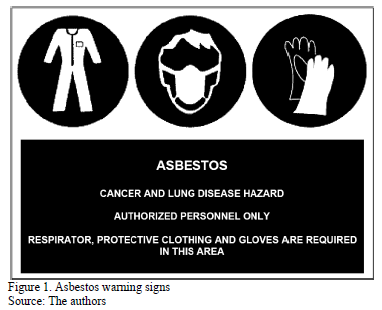
<body><![CDATA[<p><font size="2" face="Verdana, Arial, Helvetica, sans-serif">According to the International Ban   Asbestos Secretariat (IBAS), the use of asbestos is forbidden in 54 countries throughout the world, most of them industrialized; however, it   is still extensively used in emerging countries.</font></p>     <p>&nbsp;</p>     <p><font size="3" face="Verdana, Arial, Helvetica, sans-serif"><b>3. The influence of international standards on   preventive asbestos actions</b></font></p>     <p><font size="2" face="Verdana, Arial, Helvetica, sans-serif">According   to the American Industrial Hygiene Association (AIHA), Industrial Hygiene is a   science and art devoted to the anticipation, recognition, evaluation,   prevention, and control of those environmental factors or stresses arising in or from the workplace. These   may cause sickness, impaired health and well being, or create significant   discomfort among workers or citizens in the community.</font></p>     <p align="center"><font size="2" face="Verdana, Arial, Helvetica, sans-serif"><a name="fig01"></a></font><img src="/img/revistas/dyna/v83n198/v83n198a25fig01.gif"></p>     <p><font size="2" face="Verdana, Arial, Helvetica, sans-serif">In   the Industrial Hygiene field, preventive techniques are applied to the   technical and human factors present in the workplace. However, those techniques   can only be applied in accordance with up-to-date knowledge on the harmful   effects of the materials used in a particular industrial process on people. </font></p>     <p><font size="2" face="Verdana, Arial, Helvetica, sans-serif">International   laws consider aspects related to restrictions on the trading and use of certain   dangerous substances &#91;9-12&#93;, asbestos measurement methods and assessment in   workplaces &#91;13-15&#93;, analysis &#91;14,16-18&#93; as well as prevention and protection of   workers exposed to this risk &#91;19-25&#93;.</font></p>     <p><font size="2" face="Verdana, Arial, Helvetica, sans-serif">European   Directive 2003/18/EC on the protection of workers from risks related to   exposure to asbestos at work &#91;24&#93; contains the following elements: general   provisions of employer obligations, exposure limits and prohibitions,   evaluation and control of working environments, general organization and   technical measures for prevention, personal hygiene, personal protection   equipment for respiratory specific situations and certain activities,   development and processing of working plans and training, information,   consultation, participation, and monitoring of workers health.</font></p>     <p><font size="2" face="Verdana, Arial, Helvetica, sans-serif">This   directive includes the maintenance, repair and removal of existing asbestos   containing materials in equipment, units (such as ships), facilities and   structures.</font></p>     <p><font size="2" face="Verdana, Arial, Helvetica, sans-serif">Worker   exposure is allowed up to a concentration of airborne asbestos at or below the   Permissible Exposure Level (PEL) of 0.1 fibers per cubic centimeter (f/cm<sup>3</sup>),   as an 8-hour time-weighted average (TWA).</font></p>     ]]></body>
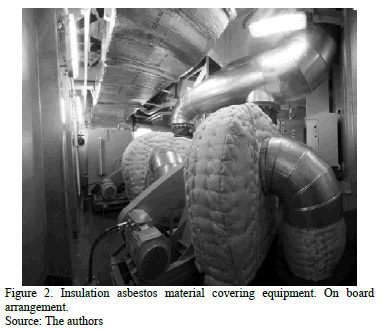
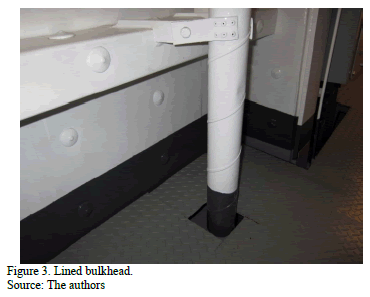
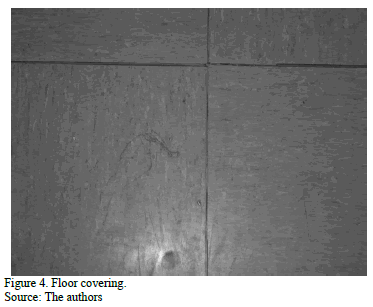
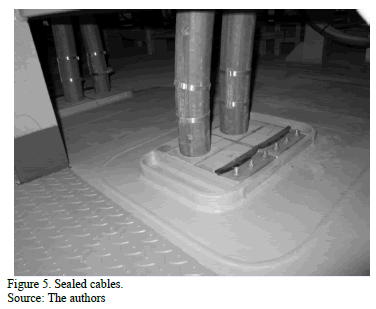
<body><![CDATA[<p><font size="2" face="Verdana, Arial, Helvetica, sans-serif">Since   January 1<sup>st</sup>, 2011, the new installation of materials containing   asbestos has been prohibited for all ships covered by SOLAS Convention, and,   consequently, the PEL has been limited to 0.0 f/cm<sup>3 </sup>onboard vessels.</font></p>     <p><font size="2" face="Verdana, Arial, Helvetica, sans-serif">The   present restricted exposure levels have been reached based on the results   obtained by medical research into asbestos-related diseases, which has strongly   recommended reducing exposure levels. EU countries have followed this tendency   over the last 50 years. As a matter of comparative interest, in Spain, the   original permissible exposure level in 1961 was 175 f/cm<sup>3 </sup>for all   varieties of asbestos. In 1982 it was reduced to 2.0 f/cm<sup>3</sup>. In 1984   the PEL was once again reduced to 1.0 f/cm<sup>3</sup> for all varieties except for crocidolite or blue asbestos, the latter having been reduced to 0.0 f/cm<sup>3 </sup>for. In 1993, the PEL was fixed at 0.6 f/cm<sup>3 </sup>for   chrysotile, 0.3 f/cm<sup>3 </sup>for   other varieties, and 0.0 f/cm<sup>3</sup> for crocidolite or blue asbestos.   Although the PEL is now fixed at 0.1 f/cm<sup>3</sup> in a working environment,   there are still an estimated significant number of between 3 and 4   asbestos-related deaths per 1000 workers.</font></p>     <p>&nbsp;</p>     <p><font size="3" face="Verdana, Arial, Helvetica, sans-serif"><b>4. Presence of ACMs on board ships</b></font></p>     <p><font size="2" face="Verdana, Arial, Helvetica, sans-serif">Due to the particular characteristics of asbestos, its   most frequent applications on board ships are the following: bulkhead and deck   insulation (blankets, panels and sprayed insulation); wall and ceiling panels   (sandwich type); floating floors; floor tiles; cement, adhesive-like glue   (e.g., mastics) and fillers; packing in pipe/cable penetrations; seals and sealing   putty; gaskets (in pipe flanges and manhole covers of tanks); strings fastening   insulation around valves in pipes; textile fabric in HVAC ducts as vibration   dampener material; boiler insulation; steam pipe insulation; exhaust duct   insulation; vanes used in rotary vane compressors; vanes used in rotary vane   vacuum pumps; electrical cable material and fuses; friction material of brakes;   paintings; fire blankets.</font></p>     <p><font size="2" face="Verdana, Arial, Helvetica, sans-serif">Since the largest amount of ACMs on board are   installed as bulkhead/deck/pipe insulation, the most common places in which   this material can be found is in the accommodation (or living area) and in the   engine room.</font></p>     <p><font size="2" face="Verdana, Arial, Helvetica, sans-serif">Asbestos containing materials can be classified into   two categories: friable and non-friable. The friable ACMs have their fibers   weakly bound and, when dry, can be easily crumbled, pulverized and reduced to   powder by hand pressure. When these microscopic mineral fibers are released   into the air, human health can be negatively impacted via inhalation. </font></p>     <p><font size="2" face="Verdana, Arial, Helvetica, sans-serif">This type of asbestos is commonly used as insulation   on exhaust pipes, as insulation in blanket forms on bulkheads and decks, as a   rope for fastening isolation around valves, and as the filling material in wall   and ceiling panels &#91;<a href="#fig02">Figs. 2</a> and <a href="#fig03">3</a>&#93;. The effect of typical vessel vibrations can   cause the small fibers arising from asbestos or ACMs to remain suspended in the   air.</font></p>     <p align="center"><font size="2" face="Verdana, Arial, Helvetica, sans-serif"><a name="fig02"></a></font><img src="/img/revistas/dyna/v83n198/v83n198a25fig02.gif"></p>     <p align="center"><font size="2" face="Verdana, Arial, Helvetica, sans-serif"><a name="fig03"></a></font><img src="/img/revistas/dyna/v83n198/v83n198a25fig03.gif"></p>     ]]></body>
<body><![CDATA[<p><font size="2" face="Verdana, Arial, Helvetica, sans-serif">In the following void spaces on ships, the content of   fibers or asbestos dust in the air is likely to be high: the backside of   partition walls in front of bulkheads; the space between partition walls; the   space between ceilings and upper decks; the space between floating floors and   decks; and inside escape trunks.</font></p>     <p><font size="2" face="Verdana, Arial, Helvetica, sans-serif">As these spaces are not for regular crew   access, they are usually not ventilated and friable   ACMs with no cover are used in them. With ship vibrations, the fibers tend to   release accumulating asbestos inside these spaces and create hazardous   atmospheres that pose a serious risk when opening walls, ceilings or floors.</font></p>     <p><font size="2" face="Verdana, Arial, Helvetica, sans-serif">Moreover,   non-friable ACMs are characterized by greater compactness of their fibers. Due   to this, they cannot be simply pulverized by hand pressure. Hence, their level   of danger to health is lower than for the friable, non-releasing fibers with   the ship vibrations.</font></p>     <p><font size="2" face="Verdana, Arial, Helvetica, sans-serif">However,   the non-friable asbestos can become friable and release fibers into the air   when it are subjected to mechanical works such as sanding, cutting, grinding,   drilling, especially when these are carried out with inadequate tools, or when   they are burned or welded &#91;<a href="#fig04">Figs. 4</a> and <a href="#fig05">5</a>&#93;. </font></p>     <p align="center"><font size="2" face="Verdana, Arial, Helvetica, sans-serif"><a name="fig04"></a></font><img src="/img/revistas/dyna/v83n198/v83n198a25fig04.gif"></p>     <p align="center"><font size="2" face="Verdana, Arial, Helvetica, sans-serif"><a name="fig05"></a></font><img src="/img/revistas/dyna/v83n198/v83n198a25fig05.gif"></p>     <p><font size="2" face="Verdana, Arial, Helvetica, sans-serif">This type of asbestos is often used as   gaskets in pipe flanges and as manhole covers of tanks, in floor tiles (see <a href="#fig04">Fig. 4</a>), and paintings. The packing used in cable   penetrations (see <a href="#fig05">Fig. 5</a>) and pipe penetrations is also non-friable.</font></p>     <p>&nbsp;</p>     <p><font size="3" face="Verdana, Arial, Helvetica, sans-serif"><b>5. Treatment of materials on board</b></font></p>     <p><font size="2" face="Verdana, Arial, Helvetica, sans-serif">In order to study   the treatment and control of ACMs on board a ship, we will distinguish between   two different cases: </font></p> <ol type="I">       ]]></body>
<body><![CDATA[<li><font size="2" face="Verdana, Arial, Helvetica, sans-serif">Ships containing     ACMs that do not breach the SOLAS regulation II-1/3-5 &#91;3&#93;, either because they     were constructed before July 1st, 2002 and their ACMs do not pose a risk to the     crew's health, or because, having being built later, the ACMs are on the list     of the exceptions allowed by the regulation issued on that date. </font></li>       <li><font size="2" face="Verdana, Arial, Helvetica, sans-serif">Vessels that     contain ACMs on-board, are breaching the SOLAS regulations II-1/3-5. This means     ships built on or after July 1st, 2002 and that contain ACMs not covered by the     exceptions of this rule, or those ships built on or after January 1st, 2011 and     that contain any type of ACMs on board, are clearly in contravention of &#91;4&#93;.</font> </li>     </ol>     <p></p>     <p><font size="2" face="Verdana, Arial, Helvetica, sans-serif">In   compliance with MSC/Circ.1045 &#91;5&#93;, which was dated on May 28th, 2002, ships   belonging to <i>group I </i>should implement   in their Safety Management System (developed in compliance with the ISM Code) a   maintenance and control of ACMs program on board in order to minimize the   exposure to asbestos of any person on board (passengers, crew, port stevedores,   surveyors, etc.) while the vessel is &quot;in service&quot;. The shipping   company must identify and locate the presence of ACMs on board and make an assessment   of their condition. This assessment is to be completed using an evaluation   checklist shown in Circular Appendix 1 in Annex 1. This includes the materials   accessibility, their protection characteristics, their degree of degradation,   their exposure to shocks and vibration, and the presence of air currents in the   area. Then, using Appendix 2 in Annex 1, a diagnosis of the conservation state   of these materials shall be drawn up. Based on this diagnosis, the materials   will be subject to a periodic check of the conservation state, to a monitoring   of asbestos dust levels in the surrounding area, and to on board protection,   repairing, or removal works.</font></p>     <p><font size="2" face="Verdana, Arial, Helvetica, sans-serif">When   the material conservation or the asbestos fiber levels into the air make it   appropriate, the following precautions are necessary: control (abatement   actions) fiber release (friable asbestos) and maintain a safe health   environment without resorting to remove onboard material. These actions   include:</font></p> <ul>       <li><font size="2" face="Verdana, Arial, Helvetica, sans-serif"><b>Enclose asbestos in some airtight     material.</b> This could be a     plastic wrapping taped over steam pipes, a new floor over an existing one, a     steel plate put up over the exposed fibers of an insulation panel, etc.</font></li>       <li><font size="2" face="Verdana, Arial, Helvetica, sans-serif"><b>Encapsulate asbestos in a material     that will solidify and make them it friable.</b> This strategy only works when the surface of the ACM is     slightly porous. A penetrating material should be used for the first layer. The     finished material should be sprayed on rather than rolled or brushed to reduce     the chances of altering the asbestos.</font></li>     </ul>     <p><font size="2" face="Verdana, Arial, Helvetica, sans-serif">None   of these methods should be used as a substitute for asbestos dismantling and   removal in the case that it is in an advanced state of deterioration. They   should be used only when asbestos is in a good state of repair.</font></p>     ]]></body>
<body><![CDATA[<p><font size="2" face="Verdana, Arial, Helvetica, sans-serif">Ships   in <i>group II</i> are generally those that   either, as a result of a repair made in a country where the asbestos is not   prohibited, or an error in the provision of spare parts for the ship, have ACMs   on board. The SOLAS regulation II-1/3-5 &#91;4&#93; is therefore broken. In this case, and according to MSC.1/Circ.1374 &#91;6&#93;, the removal of such   materials must be made within a period not exceeding 3 years from the date at   which the infringement was detected. This action must be developed under the guidance and supervision of the   Flag State.</font></p>     <p>&nbsp;</p>     <p><font size="3" face="Verdana, Arial, Helvetica, sans-serif"><b>6. Asbestos removal and recycling</b></font></p>     <p><font size="2" face="Verdana, Arial, Helvetica, sans-serif">Due to the danger in the direct contact with ACMs, asbestos   dismantling and removal should be conducted by specialized companies that   handling these materials, or by shipyard workers who have received special   training.</font></p>     <p><font size="2" face="Verdana, Arial, Helvetica, sans-serif">Asbestos is listed in Annex VIII (List A) of the Basel   Convention &#91;26&#93;, and it is considered a hazardous waste for health, and   therefore, should not be re-used or re-cycled. The potential health impacts   associated with the use of ACMs are of such a serious nature that it is   necessary to take extreme caution when drawing and handling these materials. Precautions   include: protection of workers when removing   asbestos from the vessel; management of asbestos as waste; and measures to prevent asbestos from being used in other   applications.</font></p>     <p><font size="2" face="Verdana, Arial, Helvetica, sans-serif">It is   recommended that shipyards belonging to countries whose national laws do not address the above precautions implement a management plan for   asbestos in their waste management plan. This plan will include an inventory of   ACMs on board the vessel so that they can be located, quantified and identified   before being removed (instead of extracting samples for analysis in a   laboratory of all materials suspected of containing asbestos, it might be more   feasible and economical to assume that such materials contain asbestos). In   addition, this plan should include personal protective equipment (PPE) for   workers removing the material and procedures for both removal and disposal.   National legislation should determine the maximum permissible exposure levels   (PEL).</font></p>     <p><font size="2" face="Verdana, Arial, Helvetica, sans-serif">Workers   involved in the removal and management of ACMs will have to use certified   personal protective equipment (PPE) with appropriate respiratory protective   equipment (RPE) as well as protective clothing such as overalls, gloves and   head coverings, face shield or vented goggles, and appropriate footwear. To   comply with the rules of hygiene at work, the yard should have decontamination   areas, equipped with a room to leave the equipment and work clothes, a shower   area, and a dining room.</font></p>     <p><font size="2" face="Verdana, Arial, Helvetica, sans-serif">In   asbestos extraction or removal works on a ship it is essential to keep the   asbestos wet during such operations in order to avoid dispersion of fibers into   the air. Thus, in this type of work, two people should be involved: one will   ensure that asbestos is wet during removal, and the other one will be in charge   of the extraction work.</font></p>     <p><font size="2" face="Verdana, Arial, Helvetica, sans-serif">The ACMs removed from a vessel will be   introduced in airtight containers with lids and labeled for the transport to the disposal area. Generally, the ACMs are disposed of in   landfills where they are buried underground.</font></p>     <p>&nbsp;</p>     ]]></body>
<body><![CDATA[<p><font size="3" face="Verdana, Arial, Helvetica, sans-serif"><b>7. Actions to be taken by the   port state control inspectors (PSC) and classification society surveyors</b></font></p>     <p><font size="2" face="Verdana, Arial, Helvetica, sans-serif">MSC.1/Circ.1374 &#91;6&#93; underlines the importance of the proper   training of inspectors/surveyors in the identification of ACMs on board ships. Asbestos can be   found throughout ships from the top of the bridge to the bilge. Identifying the   location and type of asbestos and assessing its condition involve qualified   inspectors/surveyors. They should know the precautions to be taken in the   presence of this material and should also be trained in taking samples.</font></p>     <p><font size="2" face="Verdana, Arial, Helvetica, sans-serif">As in many cases when there are suspicions that a particular   material may contain asbestos (see Fig. 8), the visual identification of asbestos is not   easy. If sampling and analysis of such material by experts cannot be conducted, both crew and inspectors/surveyors should consider the material to be an   ACM in order to avoid possible health risks.</font></p>     <p><font size="2" face="Verdana, Arial, Helvetica, sans-serif">In the aforementioned Circular it is also recommended that   inspectors make sure that whenever a new material is installed on board, it is delivered with a   statement of compliance with a SOLAS regulation II-1/3-5, or similar. This may   take the form of an &quot;asbestos free declaration&quot;.</font></p>     <p><font size="2" face="Verdana, Arial, Helvetica, sans-serif">The following precautions should be adhered to if   inspectors/surveyors have to undertake their work on a ship on which repairs or   other work such as grinding, welding or blasting is being carried out, and   consequently, friable and non-friable ACMs may be affected.</font></p> <ul>       <li><font size="2" face="Verdana, Arial, Helvetica, sans-serif">Do not enter in those atmospheres that may contain asbestos     fiber concentrations in suspension until they have been properly ventilated. To     ensure that the level of fibers in the air is within the levels permitted by     local laws, measurements will be taken by experts.</font></li>       <li><font size="2" face="Verdana, Arial, Helvetica, sans-serif">The inspectors/surveyors will carry a particle filtering     half mask and disposable overalls as PPE to protect themselves in case they     walk in an area containing high levels of asbestos fibers. In this case, the     PPE will be used to leave immediately the area.</font></li>       <li><font size="2" face="Verdana, Arial, Helvetica, sans-serif">The above PPE should not be ever considered as protective     equipment for inspectors/surveyors who intend to enter a contaminated area and     stay there performing their inspection work. Entry into these spaces will be     reserved for specialized companies.</font></li>       <li><font size="2" face="Verdana, Arial, Helvetica, sans-serif">Sampling and analysis of ACMs will be left to experts. The analysis of a sample to detect whether it is an ACM or not     should be performed in a laboratory.</font></li>     </ul>     ]]></body>
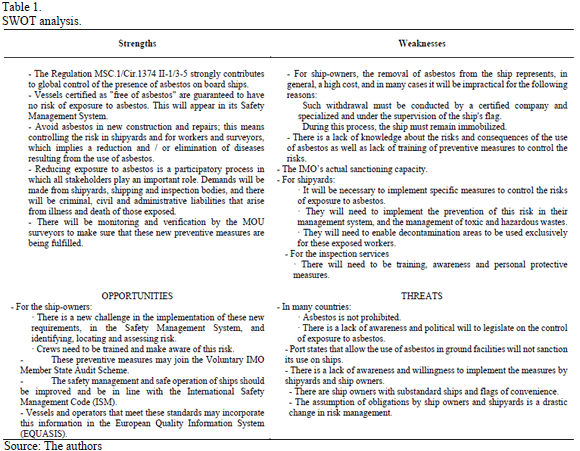
<body><![CDATA[<p>&nbsp;</p>     <p><font size="3" face="Verdana, Arial, Helvetica, sans-serif"><b>8. Conclusions</b></font></p>     <p><font size="2" face="Verdana, Arial, Helvetica, sans-serif">Research in recent years on the health effects of workers'   exposure to asbestos has shown that this is a carcinogenic material and, therefore, poses   a serious risk to health. As most industrialized countries have becoming aware   of this, they have regulated the use of this material, which has had drastic   reductions in the permissible level of exposure (PEL). <i>This pattern of reduction in both the level of exposure and the use of   these materials in the industry is the expected trend in the coming years.</i></font></p>     <p><font size="2" face="Verdana, Arial, Helvetica, sans-serif">In the field of shipping, the recent appearance of ACMs on   ships certified as &quot;asbestos free&quot; has made alarms bells ring out, pushing the   IMO to take a decisive step with their prohibition of the new installation of   ACMs on board all ships on January 1st, 2011. In the fulfillment of this new   regulation ship-owners will play a key role. <i>Asbestos will have a significant entry   path into the vessels through shipyard repairs or purchases of spare parts in   countries that are not Member States of the IMO or whose national laws do not   control the use of these materials</i>.   Therefore, in these cases, it is the ship-owners responsibility to be alert and   to prevent asbestos from accessing their ships.</font></p>     <p><font size="2" face="Verdana, Arial, Helvetica, sans-serif">Owners of vessels that contain asbestos (vessels belonging to   group I of item 5) will have to identify their type and location, assess their   condition, and comply with a maintenance and control program. The friable ACMs   are the most dangerous and the tendency is to wrap them into other material or encapsulate them   while they are in an acceptable condition and then remove them from the ship   when they deteriorate. Thus, void spaces on the backside of partition walls and   above ceilings are areas likely to contain high concentration of airborne   fibers, this being a considerable potential risk.</font></p>     <p><font size="2" face="Verdana, Arial, Helvetica, sans-serif">Inspectors/surveyors obtaining proper qualifications to be   able to identify asbestos is another crucial point in tackling the challenge of getting ships asbestos free. Once identified on board, a professional decision   should be taken as to whether to remove, encapsulate, or leave the asbestos   undisturbed. If samples are taken, they shall be subsequently analyzed in duly   equipped laboratories.</font></p>     <p><font size="2" face="Verdana, Arial, Helvetica, sans-serif">Captains and officers must know and be concerned about the   importance of the presence of asbestos on board. Crews and workers on board   should take into account authorities' recommendations. It is the responsibility   of captains and officers to inform crew and workers as they sometimes do not   have complete information regarding asbestos.</font></p>     <p><font size="2" face="Verdana, Arial, Helvetica, sans-serif">Asbestos removal operations requires the preparation of specific   working protocols, workers specially trained and informed of the risks they are   exposed to, and finally, its treatment by managers trained in hazardous wastes. The flag State of the vessel surveyors must be   involved in its removal.</font></p>     <p><font size="2" face="Verdana, Arial, Helvetica, sans-serif">Despite great   advances over the last decade, the war against asbestos in the maritime sector will not   be won until there is full global commitment for asbestos control from all   stakeholders, especially from the governments of the least developed countries.</font></p>     <p><font size="2" face="Verdana, Arial, Helvetica, sans-serif">A SWOT analysis   (Strengths, Weaknesses, Opportunities, and Threats) permits the strengths, weaknesses, threats and opportunities, of the   implementation of the measures contained in <a href="#tab01">Table 1</a> to be determined.</font></p>     ]]></body>
<body><![CDATA[<p align="center"><font size="2" face="Verdana, Arial, Helvetica, sans-serif"><a name="tab01"></a></font><img src="/img/revistas/dyna/v83n198/v83n198a25tab01.gif"></p>     <p><font size="2" face="Verdana, Arial, Helvetica, sans-serif">According to previous analysis, it is   possible to determine the most appropriate   strategies to reach a successful conclusion of the   IMO rules.</font></p>     <p><font size="2" face="Verdana, Arial, Helvetica, sans-serif">Offensive   strategies (strengths &amp; opportunities): Assumption   by ship-owners, shipyards, the MOU surveyors and operators,   goodness and necessity of implementation of these preventive measures.</font></p>     <p><font size="2" face="Verdana, Arial, Helvetica, sans-serif">Defensive strategy (weaknesses &amp;   threats): with the conviction that these preventive measures will   favor the health of crews, it will be possible to conduct risk assessments for   exposure to asbestos, specific medical examinations in shipyard workers, crews   and surveyors, and monitor the implementation of preventive measures.</font></p>     <p><font size="2" face="Verdana, Arial, Helvetica, sans-serif">Reorientation strategy (weaknesses &amp;   opportunities): the change in the provisions of the IMO should be used to manage these risks by all   parties, and in particular by carriers with international information systems   on improving the management of their vessels.</font></p>     <p><font size="2" face="Verdana, Arial, Helvetica, sans-serif">Survival Strategy (weaknesses &amp; threats): the steps initiated by the IMO confirmed that there was   a bad situation in terms of working conditions with asbestos. It is necessary to exploit the   MSC.1/Cir.1374 II-1/3-5 and promote a change in the way of thinking, working   procedures, and the use of new available materials that do not contain   asbestos. Maritime organizations' sanction capabilities of IMO member states   should be fully exploited.</font></p>     <p>&nbsp;</p>     <p><font size="3" face="Verdana, Arial, Helvetica, sans-serif"><b>References</b></font></p>     <!-- ref --><p><font size="2" face="Verdana, Arial, Helvetica, sans-serif"><b>&#91;1&#93;</b> WHO, Summary Consensus Report   of WHO Workshop on mechanisms of fibre carcinogenesis and assessment of   chrysotile asbestos substitutes, Lyon, France. Geneve, World Health   Organitation, 8-12 November.2005.    &nbsp;&nbsp;&nbsp;&nbsp;&nbsp;&nbsp;&nbsp;&nbsp;[&#160;<a href="javascript:void(0);" onclick="javascript: window.open('/scielo.php?script=sci_nlinks&ref=1149465&pid=S0012-7353201600040002500001&lng=','','width=640,height=500,resizable=yes,scrollbars=1,menubar=yes,');">Links</a>&#160;]<!-- end-ref --></font></p>     ]]></body>
<body><![CDATA[<!-- ref --><p><font size="2" face="Verdana, Arial, Helvetica, sans-serif"><b>&#91;2&#93;</b> European Union, Directive   2009/148/EC of the European Parlament and of the Council on the protection of   workers from the risks related to exposure to asbestos at work, 30.11. 2009.    &nbsp;&nbsp;&nbsp;&nbsp;&nbsp;&nbsp;&nbsp;&nbsp;[&#160;<a href="javascript:void(0);" onclick="javascript: window.open('/scielo.php?script=sci_nlinks&ref=1149467&pid=S0012-7353201600040002500002&lng=','','width=640,height=500,resizable=yes,scrollbars=1,menubar=yes,');">Links</a>&#160;]<!-- end-ref --></font></p>     <!-- ref --><p><font size="2" face="Verdana, Arial, Helvetica, sans-serif"><b>&#91;3&#93;</b> SOLAS, regulation II-1/3-5, New   installation of materials containing asbestos, July1st. 2002.    &nbsp;&nbsp;&nbsp;&nbsp;&nbsp;&nbsp;&nbsp;&nbsp;[&#160;<a href="javascript:void(0);" onclick="javascript: window.open('/scielo.php?script=sci_nlinks&ref=1149469&pid=S0012-7353201600040002500003&lng=','','width=640,height=500,resizable=yes,scrollbars=1,menubar=yes,');">Links</a>&#160;]<!-- end-ref --></font></p>     <!-- ref --><p><font size="2" face="Verdana, Arial, Helvetica, sans-serif"><b>&#91;4&#93;</b> SOLAS, regulation II-1/3-5, New   installation of materials containing asbestos, January1st. 2011.    &nbsp;&nbsp;&nbsp;&nbsp;&nbsp;&nbsp;&nbsp;&nbsp;[&#160;<a href="javascript:void(0);" onclick="javascript: window.open('/scielo.php?script=sci_nlinks&ref=1149471&pid=S0012-7353201600040002500004&lng=','','width=640,height=500,resizable=yes,scrollbars=1,menubar=yes,');">Links</a>&#160;]<!-- end-ref --></font></p>     <!-- ref --><p><font size="2" face="Verdana, Arial, Helvetica, sans-serif"><b>&#91;5&#93;</b> International Maritime   Organization (IMO). MSC/Circ.1045, Guidelines for maintenance and monitoring of   on-board materials containing asbestos, 28.05.2002.    &nbsp;&nbsp;&nbsp;&nbsp;&nbsp;&nbsp;&nbsp;&nbsp;[&#160;<a href="javascript:void(0);" onclick="javascript: window.open('/scielo.php?script=sci_nlinks&ref=1149473&pid=S0012-7353201600040002500005&lng=','','width=640,height=500,resizable=yes,scrollbars=1,menubar=yes,');">Links</a>&#160;]<!-- end-ref --></font></p>     <!-- ref --><p><font size="2" face="Verdana, Arial, Helvetica, sans-serif"><b>&#91;6&#93;</b> International Maritime Organization   (IMO), MSC.1/Circ.1374, Information on prohibiting the use of asbestos on board   ships, 03.12.2010.    &nbsp;&nbsp;&nbsp;&nbsp;&nbsp;&nbsp;&nbsp;&nbsp;[&#160;<a href="javascript:void(0);" onclick="javascript: window.open('/scielo.php?script=sci_nlinks&ref=1149475&pid=S0012-7353201600040002500006&lng=','','width=640,height=500,resizable=yes,scrollbars=1,menubar=yes,');">Links</a>&#160;]<!-- end-ref --></font></p>     ]]></body>
<body><![CDATA[<!-- ref --><p><font size="2" face="Verdana, Arial, Helvetica, sans-serif"><b>&#91;7&#93;</b> International Labour Office   Geneva, International Labour Conference, 90. to Session 2002, Report V (1),   Recording and reporting of accidents work and occupational diseases and ILO   list occupational diseases, Geneva. 2001</font>&nbsp;&nbsp;&nbsp;&nbsp;&nbsp;&nbsp;&nbsp;&nbsp;[&#160;<a href="javascript:void(0);" onclick="javascript: window.open('/scielo.php?script=sci_nlinks&ref=1149477&pid=S0012-7353201600040002500007&lng=','','width=640,height=500,resizable=yes,scrollbars=1,menubar=yes,');">Links</a>&#160;]<!-- end-ref --><!-- ref --><p><font size="2" face="Verdana, Arial, Helvetica, sans-serif"><b>&#91;8&#93;</b> European Union, Commission   Recommendation 2003/670/EC of 19 September 2003 on the European list of   occupational diseases &#91;Notified under document number C (2003) 3297&#93;</b> (Text with   EEA relevance), Official Journal L 238, 25.09.2003.    &nbsp;&nbsp;&nbsp;&nbsp;&nbsp;&nbsp;&nbsp;&nbsp;[&#160;<a href="javascript:void(0);" onclick="javascript: window.open('/scielo.php?script=sci_nlinks&ref=1149478&pid=S0012-7353201600040002500008&lng=','','width=640,height=500,resizable=yes,scrollbars=1,menubar=yes,');">Links</a>&#160;]<!-- end-ref --></font></p>     <!-- ref --><p><font size="2" face="Verdana, Arial, Helvetica, sans-serif"><b>&#91;9&#93;</b> European Union, Directive   76/769/EEC Council of 27 July 1976 on the approximation of the laws,   regulations and administrative provisions of the Member States relating to   restrictions on the marketing and use of certain dangerous substances and   preparations, OJ L 262, 27.9.1976.    &nbsp;&nbsp;&nbsp;&nbsp;&nbsp;&nbsp;&nbsp;&nbsp;[&#160;<a href="javascript:void(0);" onclick="javascript: window.open('/scielo.php?script=sci_nlinks&ref=1149480&pid=S0012-7353201600040002500009&lng=','','width=640,height=500,resizable=yes,scrollbars=1,menubar=yes,');">Links</a>&#160;]<!-- end-ref --></font></p>     <!-- ref --><p><font size="2" face="Verdana, Arial, Helvetica, sans-serif"><b>&#91;10&#93;</b> European Union, Council   Directive 83/478/EEC of 19 September 1983 amending for the fifth time   (asbestos) Directive 76/769/EEC on the approximation of the laws, regulations   and administrative provisions of the Member States relating to restrictions on   the marketing and use of certain dangerous substances and preparations. OJ L   263, 24.9.1983.    &nbsp;&nbsp;&nbsp;&nbsp;&nbsp;&nbsp;&nbsp;&nbsp;[&#160;<a href="javascript:void(0);" onclick="javascript: window.open('/scielo.php?script=sci_nlinks&ref=1149482&pid=S0012-7353201600040002500010&lng=','','width=640,height=500,resizable=yes,scrollbars=1,menubar=yes,');">Links</a>&#160;]<!-- end-ref --></font></p>     <!-- ref --><p><font size="2" face="Verdana, Arial, Helvetica, sans-serif"><b>&#91;11&#93;</b> European Union, Commission   Directive 91/659/EEC of 3 December 1991 adapting to technical progress Annex I   to Council Directive 76/769/EEC on the approximation of the laws, regulations   and administrative provisions of the Member States relating to restrictions on   the marketing and use of certain dangerous substances and preparations   (asbestos), OJ L 363, 31.12.1991.    &nbsp;&nbsp;&nbsp;&nbsp;&nbsp;&nbsp;&nbsp;&nbsp;[&#160;<a href="javascript:void(0);" onclick="javascript: window.open('/scielo.php?script=sci_nlinks&ref=1149484&pid=S0012-7353201600040002500011&lng=','','width=640,height=500,resizable=yes,scrollbars=1,menubar=yes,');">Links</a>&#160;]<!-- end-ref --></font></p>     <!-- ref --><p><font size="2" face="Verdana, Arial, Helvetica, sans-serif"><b>&#91;12&#93;</b> European Union, Commission   Directive 1999/77/EC of 26 July 1999 adapting to technical progress for the   sixth time Annex I to Council Directive 76/769/EEC on the approximation of the   laws, regulations and administrative provisions of the Member States relating   to restrictions on the marketing and use of certain dangerous substances and   preparations (asbestos), Official Journal of the European Communities 6. 8.   1999</font>&nbsp;&nbsp;&nbsp;&nbsp;&nbsp;&nbsp;&nbsp;&nbsp;[&#160;<a href="javascript:void(0);" onclick="javascript: window.open('/scielo.php?script=sci_nlinks&ref=1149486&pid=S0012-7353201600040002500012&lng=','','width=640,height=500,resizable=yes,scrollbars=1,menubar=yes,');">Links</a>&#160;]<!-- end-ref --><!-- ref --><p><font size="2" face="Verdana, Arial, Helvetica, sans-serif"><b>&#91;13&#93;</b> Asbestos International   Association (A.I.A.), Reference method for the determination of airborne   asbestos fibre concentrations at workplaces by ligth microscopy (Membrane   filter method). Recommended technical method number 1. 1982.    &nbsp;&nbsp;&nbsp;&nbsp;&nbsp;&nbsp;&nbsp;&nbsp;[&#160;<a href="javascript:void(0);" onclick="javascript: window.open('/scielo.php?script=sci_nlinks&ref=1149487&pid=S0012-7353201600040002500013&lng=','','width=640,height=500,resizable=yes,scrollbars=1,menubar=yes,');">Links</a>&#160;]<!-- end-ref --></font></p>     <!-- ref --><p><font size="2" face="Verdana, Arial, Helvetica, sans-serif"><b>&#91;14&#93;</b> Ministerio   de Trabajo y Asuntos Sociales de Espa&ntilde;a. MTA/MA-051/A04, Determinaci&oacute;n de   fibras de amianto y otras fibras en aire. M&eacute;todo del filtro de membrana.   Microscop&iacute;a &oacute;ptica de contraste de fases. (M&eacute;todo   multifibra).    &nbsp;&nbsp;&nbsp;&nbsp;&nbsp;&nbsp;&nbsp;&nbsp;[&#160;<a href="javascript:void(0);" onclick="javascript: window.open('/scielo.php?script=sci_nlinks&ref=1149489&pid=S0012-7353201600040002500014&lng=','','width=640,height=500,resizable=yes,scrollbars=1,menubar=yes,');">Links</a>&#160;]<!-- end-ref --></font></p>     <!-- ref --><p><font size="2" face="Verdana, Arial, Helvetica, sans-serif"><b>&#91;15&#93;</b> Ministerio   de Trabajo y Asuntos Sociales de Espa&ntilde;a. Criterio/Recomendaci&oacute;n CR-02/2005.   Medida fiable de las concentraciones de fibras de amianto en aire. Aplicaci&oacute;n   del m&eacute;todo de toma de muestras y an&aacute;lisis MTA/MA-051/A04.    &nbsp;&nbsp;&nbsp;&nbsp;&nbsp;&nbsp;&nbsp;&nbsp;[&#160;<a href="javascript:void(0);" onclick="javascript: window.open('/scielo.php?script=sci_nlinks&ref=1149491&pid=S0012-7353201600040002500015&lng=','','width=640,height=500,resizable=yes,scrollbars=1,menubar=yes,');">Links</a>&#160;]<!-- end-ref --></font></p>     <!-- ref --><p><font size="2" face="Verdana, Arial, Helvetica, sans-serif"><b>&#91;16&#93;</b> National Institute for   Occupational Safety and Health (NIOSH). Analysis method 7400. Asbestos fibres.   1984.    &nbsp;&nbsp;&nbsp;&nbsp;&nbsp;&nbsp;&nbsp;&nbsp;[&#160;<a href="javascript:void(0);" onclick="javascript: window.open('/scielo.php?script=sci_nlinks&ref=1149493&pid=S0012-7353201600040002500016&lng=','','width=640,height=500,resizable=yes,scrollbars=1,menubar=yes,');">Links</a>&#160;]<!-- end-ref --></font></p>     <!-- ref --><p><font size="2" face="Verdana, Arial, Helvetica, sans-serif"><b>&#91;17&#93;</b> Schlecht., P.C. and Shulman,   S.A., Performance of asbestos fiber counting laboratories in the NIOSH   proficiency analytical testing (PAT) program, American Industrial Hygiene   Association Journal, 47(5), pp 259-269, 1986. DOI: 10.1080/15298668691389748</font>&nbsp;&nbsp;&nbsp;&nbsp;&nbsp;&nbsp;&nbsp;&nbsp;[&#160;<a href="javascript:void(0);" onclick="javascript: window.open('/scielo.php?script=sci_nlinks&ref=1149495&pid=S0012-7353201600040002500017&lng=','','width=640,height=500,resizable=yes,scrollbars=1,menubar=yes,');">Links</a>&#160;]<!-- end-ref --><!-- ref --><p><font size="2" face="Verdana, Arial, Helvetica, sans-serif"><b>&#91;18&#93;</b> Baron, P.A., Shulman, S.A., Evaluation   of the magiscan image analyzer for asbestos fiber counting, American Industrial   Hygiene Association Journal, 48, pp. 39-46,1987. DOI: 10.1080/15298668791384346</font>&nbsp;&nbsp;&nbsp;&nbsp;&nbsp;&nbsp;&nbsp;&nbsp;[&#160;<a href="javascript:void(0);" onclick="javascript: window.open('/scielo.php?script=sci_nlinks&ref=1149496&pid=S0012-7353201600040002500018&lng=','','width=640,height=500,resizable=yes,scrollbars=1,menubar=yes,');">Links</a>&#160;]<!-- end-ref --><!-- ref --><p><font size="2" face="Verdana, Arial, Helvetica, sans-serif"><b>&#91;19&#93;</b> European Union, Council Directive   83/477/EEC of 19 September 1983 on the protection of workers from the risks   related to exposure to asbestos at work (second individual Directive within the   meaning of Article 8 of Directive 80/1107/EEC), Official Journal L 263,   24.09.1983.    &nbsp;&nbsp;&nbsp;&nbsp;&nbsp;&nbsp;&nbsp;&nbsp;[&#160;<a href="javascript:void(0);" onclick="javascript: window.open('/scielo.php?script=sci_nlinks&ref=1149497&pid=S0012-7353201600040002500019&lng=','','width=640,height=500,resizable=yes,scrollbars=1,menubar=yes,');">Links</a>&#160;]<!-- end-ref --></font></p>     <!-- ref --><p><font size="2" face="Verdana, Arial, Helvetica, sans-serif"><b>&#91;20&#93;</b> European Union, Council   Directive 90/394/CE, of 28 June 1990 on the protection of workers from risks   related to exposure to carcinogens at work (Sixth individual Directive under   paragraph 1 of Article 16 of Directive 89/391/EEC), Official Journal L 196,   26.07.1990.    &nbsp;&nbsp;&nbsp;&nbsp;&nbsp;&nbsp;&nbsp;&nbsp;[&#160;<a href="javascript:void(0);" onclick="javascript: window.open('/scielo.php?script=sci_nlinks&ref=1149499&pid=S0012-7353201600040002500020&lng=','','width=640,height=500,resizable=yes,scrollbars=1,menubar=yes,');">Links</a>&#160;]<!-- end-ref --></font></p>     <!-- ref --><p><font size="2" face="Verdana, Arial, Helvetica, sans-serif"><b>&#91;21&#93;</b> European Union, Council   Directive 97/42/EC of 27 June 1997 amending for the first time Directive   90/394/EEC on the protection of workers from risks related to exposure to   carcinogens at work (Sixth individual Directive under paragraph 1 of Article 16   of Directive 89/391/EEC), Official Journal L 179, 08.07.1997.    &nbsp;&nbsp;&nbsp;&nbsp;&nbsp;&nbsp;&nbsp;&nbsp;[&#160;<a href="javascript:void(0);" onclick="javascript: window.open('/scielo.php?script=sci_nlinks&ref=1149501&pid=S0012-7353201600040002500021&lng=','','width=640,height=500,resizable=yes,scrollbars=1,menubar=yes,');">Links</a>&#160;]<!-- end-ref --></font></p>     <!-- ref --><p><font size="2" face="Verdana, Arial, Helvetica, sans-serif"><b>&#91;22&#93;</b> European Union, Directive   1999/38/EC of 29 April 1999 the second time Directive 90/394/EEC on the   protection of workers from exposure to carcinogens at work and extending it to   mutagens, Official Journal L 138.OJ. 1.6.1999</font>&nbsp;&nbsp;&nbsp;&nbsp;&nbsp;&nbsp;&nbsp;&nbsp;[&#160;<a href="javascript:void(0);" onclick="javascript: window.open('/scielo.php?script=sci_nlinks&ref=1149503&pid=S0012-7353201600040002500022&lng=','','width=640,height=500,resizable=yes,scrollbars=1,menubar=yes,');">Links</a>&#160;]<!-- end-ref --><!-- ref --><p><font size="2" face="Verdana, Arial, Helvetica, sans-serif"><b>&#91;23&#93;</b> European Union, Council   Directive 91/382/EEC of 25 June 1991 amending Directive 83/477/EEC on the   protection of workers from the risks related to exposure to asbestos at work   (second individual Directive within the meaning of Article 8 of Directive   80/1107/EEC), OJ L 206, p. 16-18. 29.7.1991</font>&nbsp;&nbsp;&nbsp;&nbsp;&nbsp;&nbsp;&nbsp;&nbsp;[&#160;<a href="javascript:void(0);" onclick="javascript: window.open('/scielo.php?script=sci_nlinks&ref=1149504&pid=S0012-7353201600040002500023&lng=','','width=640,height=500,resizable=yes,scrollbars=1,menubar=yes,');">Links</a>&#160;]<!-- end-ref --><!-- ref --><p><font size="2" face="Verdana, Arial, Helvetica, sans-serif"><b>&#91;24&#93;</b> European Union, Directive 2003/18/EC of   the European Parliament and of the Council of 27 March 32003 amending Council   Directive 83/477/EC on the protection of workers from the risks related to exposure   to asbestos at work (Text with EEA relevance) OJ L 97, 15.4.2003</font>&nbsp;&nbsp;&nbsp;&nbsp;&nbsp;&nbsp;&nbsp;&nbsp;[&#160;<a href="javascript:void(0);" onclick="javascript: window.open('/scielo.php?script=sci_nlinks&ref=1149505&pid=S0012-7353201600040002500024&lng=','','width=640,height=500,resizable=yes,scrollbars=1,menubar=yes,');">Links</a>&#160;]<!-- end-ref --><!-- ref --><p><font size="2" face="Verdana, Arial, Helvetica, sans-serif"><b>&#91;25&#93;</b> International Labour   Organisation (ILO). C162 Convention, concerning Safety in the Use of Asbestos.   1986.    &nbsp;&nbsp;&nbsp;&nbsp;&nbsp;&nbsp;&nbsp;&nbsp;[&#160;<a href="javascript:void(0);" onclick="javascript: window.open('/scielo.php?script=sci_nlinks&ref=1149506&pid=S0012-7353201600040002500025&lng=','','width=640,height=500,resizable=yes,scrollbars=1,menubar=yes,');">Links</a>&#160;]<!-- end-ref --></font></p>     <!-- ref --><p><font size="2" face="Verdana, Arial, Helvetica, sans-serif"><b>&#91;26&#93;</b> United Nations Environment Programme (UNEP).   Basel Convention on the Control of Transboundary Movements of Hazardous Wastes   and their Disposal, Sixth meeting, Geneva, 9-13.12.2002.    &nbsp;&nbsp;&nbsp;&nbsp;&nbsp;&nbsp;&nbsp;&nbsp;[&#160;<a href="javascript:void(0);" onclick="javascript: window.open('/scielo.php?script=sci_nlinks&ref=1149508&pid=S0012-7353201600040002500026&lng=','','width=640,height=500,resizable=yes,scrollbars=1,menubar=yes,');">Links</a>&#160;]<!-- end-ref --></font></p>     <p>&nbsp;</p>     <p><font size="2" face="Verdana, Arial, Helvetica, sans-serif"><b>L.M.Carral-Couce</b> holds a PhD. in Naval   Architecture and Marine Engineering from the Universidad Polit&eacute;cnica de Madrid   (Technical Univ. of Madrid) and a MSc.in Maritime Law and Port Administration   from the University of Coruna, Spain. He has worked in the former navy shipyard   of Bazan (now Navantia) prior to entering the EPS-Ferrol at the University of   Coruna, Spain, as a Professor. At the University he is part of the GII (a   multidisciplinary research group) and he has promoted several Masters' degrees   such as Design, Production and Inspection of Motor and Sailing Craft, and   Transport &amp; Logistics. He has also been Chairman of the Spanish Association   of Naval Architects in the region of Galicia for several years. ORCID 0000 - 0003 - 1109 - 1131</font></p>     <p><font size="2" face="Verdana, Arial, Helvetica, sans-serif"><b>J.A. Fraguela-Formoso,</b> PhD in Naval Architecture and Marine Engineer   from the Polytechnic University of Madrid, is Professor at the University of A   Coru&ntilde;a, Spain. Quality deputy director   of the Polytechnic School of the University of A Coru&ntilde;a. Director Course at   Second University Cycle of the University of A Coru&ntilde;a Degree in Management of   Prevention, Quality and Environment, from 2000 to 2010. Creator, Organizer and   Director 10 Masters in Prevention Labor risks of the University of a Coru&ntilde;a,   two of them in Ibero America. Creator, Organizer and Manager 7 Masters in   Integrated Quality Management, Environment and Occupational Health and Safety   at the University of A Coru&ntilde;a. He has   been head of the Services Occupational Health and Safety and Occupational   Health at the National Military Baz&aacute;n company Construcciones Navales S.A.   Ferrol. Chairman of ENOGA (Association of Enxe&ntilde;eiros Navais and Oceania   Galicia), IPEN-SPAIN (Pan American Institute of Naval Engineering). Member of   the Advisory Council of IPEN-AMERICAS. Member of the Editorial Board of IPEN   digital JOURNAL (ISSN 1011-5951) of the Pan American Institute of Naval   Architecture and Marine Engineering. ORCID   0000-0002-5308-387X</font></p>     <p><font size="2" face="Verdana, Arial, Helvetica, sans-serif"><b>P. Fari&ntilde;as-Alvari&ntilde;o</b>, is PhD. Naval Architect and Marine Engineer from   Universidade da Coru&ntilde;a, Spain, since 2004. He has been professor in Heat   Engines, Fluid Mechanics and Shipbuilding. Currently he is professor of naval   hydrodynamics and computational hydrodynamics. Develops research work in   transport phenomena in fluids focused mainly to energy transport. In recent   years he has developed own models for CFD study of nanotechnology applied to   fluid mechanics for the study of suspensions. ORCID 0000-0002-9598-5249</font></p>     <p><font size="2" face="Verdana, Arial, Helvetica, sans-serif"><b>J.L. Fern&aacute;ndez-Soto</b>, is PhD. Naval Architect and Marine Engineer from the   University of La Coruna, has developed its activity in the EN Baz&aacute;n (Navantia)   and is now surveyor of the company DNV - GL. ORCID 0000 - 0002   - 9807 - 2007</font></p>      ]]></body><back>
<ref-list>
<ref id="B1">
<label>1</label><nlm-citation citation-type="book">
<collab>WHO</collab>
<source><![CDATA[Summary Consensus Report of WHO Workshop on mechanisms of fibre carcinogenesis and assessment of chrysotile asbestos substitutes]]></source>
<year>2005</year>
<publisher-loc><![CDATA[Lyon ]]></publisher-loc>
<publisher-name><![CDATA[World Health Organitation]]></publisher-name>
</nlm-citation>
</ref>
<ref id="B2">
<label>2</label><nlm-citation citation-type="">
<collab>European Union</collab>
<source><![CDATA[Directive 2009/148/EC of the European Parlament and of the Council on the protection of workers from the risks related to exposure to asbestos at work]]></source>
<year>30.1</year>
<month>1.</month>
<day> 2</day>
</nlm-citation>
</ref>
<ref id="B3">
<label>3</label><nlm-citation citation-type="">
<collab>SOLAS</collab>
<source><![CDATA[regulation II-1/3-5: New installation of materials containing asbestos]]></source>
<year>July</year>
<month>1s</month>
<day>t.</day>
</nlm-citation>
</ref>
<ref id="B4">
<label>4</label><nlm-citation citation-type="">
<collab>SOLAS</collab>
<source><![CDATA[regulation II-1/3-5: New installation of materials containing asbestos]]></source>
<year>Janu</year>
<month>ar</month>
<day>y1</day>
</nlm-citation>
</ref>
<ref id="B5">
<label>5</label><nlm-citation citation-type="">
<collab>International Maritime Organization (IMO)</collab>
<source><![CDATA[MSC/Circ.1045: Guidelines for maintenance and monitoring of on-board materials containing asbestos]]></source>
<year>28.0</year>
<month>5.</month>
<day>20</day>
</nlm-citation>
</ref>
<ref id="B6">
<label>6</label><nlm-citation citation-type="">
<collab>International Maritime Organization</collab>
<source><![CDATA[MSC.1/Circ.1374: Information on prohibiting the use of asbestos on board ships]]></source>
<year>03.1</year>
<month>2.</month>
<day>20</day>
</nlm-citation>
</ref>
<ref id="B7">
<label>7</label><nlm-citation citation-type="">
<collab>International Labour Office Geneva</collab>
<source><![CDATA[International Labour Conference, 90. to Session 2002: Recording and reporting of accidents work and occupational diseases and ILO list occupational diseases]]></source>
<year>2001</year>
<publisher-loc><![CDATA[Geneva ]]></publisher-loc>
</nlm-citation>
</ref>
<ref id="B8">
<label>8</label><nlm-citation citation-type="journal">
<collab>European Union</collab>
<article-title xml:lang="en"><![CDATA[Commission Recommendation 2003/670/EC of 19 September 2003 on the European list of occupational diseases: Notified under document number C (2003) 3297]]></article-title>
<source><![CDATA[Official Journal L]]></source>
<year>25.0</year>
<month>9.</month>
<day>20</day>
<numero>238</numero>
<issue>238</issue>
</nlm-citation>
</ref>
<ref id="B9">
<label>9</label><nlm-citation citation-type="journal">
<collab>European Union</collab>
<article-title xml:lang="en"><![CDATA[Directive 76/769/EEC Council of 27 July 1976 on the approximation of the laws, regulations and administrative provisions of the Member States relating to restrictions on the marketing and use of certain dangerous substances and preparations]]></article-title>
<source><![CDATA[OJ L]]></source>
<year>27.9</year>
<month>.1</month>
<day>97</day>
<numero>262</numero>
<issue>262</issue>
</nlm-citation>
</ref>
<ref id="B10">
<label>10</label><nlm-citation citation-type="journal">
<collab>European Union</collab>
<article-title xml:lang="en"><![CDATA[Council Directive 83/478/EEC of 19 September 1983 amending for the fifth time (asbestos) Directive 76/769/EEC on the approximation of the laws, regulations and administrative provisions of the Member States relating to restrictions on the marketing and use of certain dangerous substances and preparations]]></article-title>
<source><![CDATA[OJ L]]></source>
<year>24.9</year>
<month>.1</month>
<day>98</day>
<numero>263</numero>
<issue>263</issue>
</nlm-citation>
</ref>
<ref id="B11">
<label>11</label><nlm-citation citation-type="journal">
<collab>European Union</collab>
<article-title xml:lang="en"><![CDATA[Commission Directive 91/659/EEC of 3 December 1991 adapting to technical progress Annex I to Council Directive 76/769/EEC on the approximation of the laws, regulations and administrative provisions of the Member States relating to restrictions on the marketing and use of certain dangerous substances and preparations (asbestos)]]></article-title>
<source><![CDATA[OJ L]]></source>
<year>31.1</year>
<month>2.</month>
<day>19</day>
<numero>363</numero>
<issue>363</issue>
</nlm-citation>
</ref>
<ref id="B12">
<label>12</label><nlm-citation citation-type="journal">
<collab>European Union</collab>
<article-title xml:lang="en"><![CDATA[Commission Directive 1999/77/EC of 26 July 1999 adapting to technical progress for the sixth time Annex I to Council Directive 76/769/EEC on the approximation of the laws, regulations and administrative provisions of the Member States relating to restrictions on the marketing and use of certain dangerous substances and preparations (asbestos)]]></article-title>
<source><![CDATA[Official Journal of the European Communities]]></source>
<year>6. 8</year>
<month>. </month>
<day>19</day>
</nlm-citation>
</ref>
<ref id="B13">
<label>13</label><nlm-citation citation-type="">
<collab>Asbestos International Association</collab>
<source><![CDATA[Reference method for the determination of airborne asbestos fibre concentrations at workplaces by ligth microscopy (Membrane filter method).]]></source>
<year>1982</year>
</nlm-citation>
</ref>
<ref id="B14">
<label>14</label><nlm-citation citation-type="">
<collab>Ministerio de Trabajo y Asuntos Sociales de España</collab>
<source><![CDATA[MTA/MA-051/A04, Determinación de fibras de amianto y otras fibras en aire.: Método del filtro de membrana. Microscopía óptica de contraste de fases.]]></source>
<year></year>
</nlm-citation>
</ref>
<ref id="B15">
<label>15</label><nlm-citation citation-type="">
<collab>Ministerio de Trabajo y Asuntos Sociales de España</collab>
<source><![CDATA[Criterio/Recomendación CR-02/2005. Medida fiable de las concentraciones de fibras de amianto en aire.: Aplicación del método de toma de muestras y análisis MTA/MA-051/A04]]></source>
<year></year>
</nlm-citation>
</ref>
<ref id="B16">
<label>16</label><nlm-citation citation-type="">
<collab>National Institute for Occupational Safety and Health</collab>
<source><![CDATA[Analysis method 7400. Asbestos fibres]]></source>
<year>1984</year>
</nlm-citation>
</ref>
<ref id="B17">
<label>17</label><nlm-citation citation-type="journal">
<person-group person-group-type="author">
<name>
<surname><![CDATA[Schlecht.]]></surname>
<given-names><![CDATA[P.C.]]></given-names>
</name>
<name>
<surname><![CDATA[Shulman]]></surname>
<given-names><![CDATA[S.A.]]></given-names>
</name>
</person-group>
<article-title xml:lang="en"><![CDATA[Performance of asbestos fiber counting laboratories in the NIOSH proficiency analytical testing (PAT) program]]></article-title>
<source><![CDATA[American Industrial Hygiene Association Journal]]></source>
<year>1986</year>
<volume>47</volume>
<numero>5</numero>
<issue>5</issue>
<page-range>259-269</page-range></nlm-citation>
</ref>
<ref id="B18">
<label>18</label><nlm-citation citation-type="journal">
<person-group person-group-type="author">
<name>
<surname><![CDATA[Baron]]></surname>
<given-names><![CDATA[P.A.]]></given-names>
</name>
<name>
<surname><![CDATA[Shulman]]></surname>
<given-names><![CDATA[S.A.]]></given-names>
</name>
</person-group>
<article-title xml:lang="en"><![CDATA[Evaluation of the magiscan image analyzer for asbestos fiber counting]]></article-title>
<source><![CDATA[American Industrial Hygiene Association Journal]]></source>
<year>1987</year>
<numero>48</numero>
<issue>48</issue>
<page-range>39-46</page-range></nlm-citation>
</ref>
<ref id="B19">
<label>19</label><nlm-citation citation-type="journal">
<collab>European Union</collab>
<article-title xml:lang="en"><![CDATA[Council Directive 83/477/EEC of 19 September 1983 on the protection of workers from the risks related to exposure to asbestos at work (second individual Directive within the meaning of Article 8 of Directive 80/1107/EEC)]]></article-title>
<source><![CDATA[Official Journal L]]></source>
<year>24.0</year>
<month>9.</month>
<day>19</day>
<numero>263</numero>
<issue>263</issue>
</nlm-citation>
</ref>
<ref id="B20">
<label>20</label><nlm-citation citation-type="journal">
<collab>European Union</collab>
<article-title xml:lang="en"><![CDATA[Council Directive 90/394/CE, of 28 June 1990 on the protection of workers from risks related to exposure to carcinogens at work (Sixth individual Directive under paragraph 1 of Article 16 of Directive 89/391/EEC)]]></article-title>
<source><![CDATA[Official Journal L]]></source>
<year>26.0</year>
<month>7.</month>
<day>19</day>
<numero>196</numero>
<issue>196</issue>
</nlm-citation>
</ref>
<ref id="B21">
<label>21</label><nlm-citation citation-type="journal">
<collab>European Union</collab>
<article-title xml:lang="en"><![CDATA[Council Directive 97/42/EC of 27 June 1997 amending for the first time Directive 90/394/EEC on the protection of workers from risks related to exposure to carcinogens at work (Sixth individual Directive under paragraph 1 of Article 16 of Directive 89/391/EEC)]]></article-title>
<source><![CDATA[Official Journal L]]></source>
<year>08.0</year>
<month>7.</month>
<day>19</day>
<numero>179</numero>
<issue>179</issue>
</nlm-citation>
</ref>
<ref id="B22">
<label>22</label><nlm-citation citation-type="journal">
<collab>European Union</collab>
<article-title xml:lang="en"><![CDATA[Directive 1999/38/EC of 29 April 1999 the second time Directive 90/394/EEC on the protection of workers from exposure to carcinogens at work and extending it to mutagens]]></article-title>
<source><![CDATA[Official Journal L]]></source>
<year>1.6.</year>
<month>19</month>
<day>99</day>
<numero>138</numero>
<issue>138</issue>
</nlm-citation>
</ref>
<ref id="B23">
<label>23</label><nlm-citation citation-type="journal">
<collab>European Union</collab>
<article-title xml:lang="en"><![CDATA[Council Directive 91/382/EEC of 25 June 1991 amending Directive 83/477/EEC on the protection of workers from the risks related to exposure to asbestos at work (second individual Directive within the meaning of Article 8 of Directive 80/1107/EEC)]]></article-title>
<source><![CDATA[OJ L]]></source>
<year>29.7</year>
<month>.1</month>
<day>99</day>
<numero>206</numero>
<issue>206</issue>
<page-range>16-18</page-range></nlm-citation>
</ref>
<ref id="B24">
<label>24</label><nlm-citation citation-type="journal">
<collab>European Union</collab>
<article-title xml:lang="en"><![CDATA[Directive 2003/18/EC of the European Parliament and of the Council of 27 March 32003 amending Council Directive 83/477/EC on the protection of workers from the risks related to exposure to asbestos at work (Text with EEA relevance)]]></article-title>
<source><![CDATA[OJ L]]></source>
<year>15.4</year>
<month>.2</month>
<day>00</day>
<numero>97</numero>
<issue>97</issue>
</nlm-citation>
</ref>
<ref id="B25">
<label>25</label><nlm-citation citation-type="">
<collab>International Labour Organisation</collab>
<source><![CDATA[C162 Convention, concerning Safety in the Use of Asbestos]]></source>
<year>1986</year>
</nlm-citation>
</ref>
<ref id="B26">
<label>26</label><nlm-citation citation-type="">
<collab>United Nations Environment Programme</collab>
<source><![CDATA[Basel Convention on the Control of Transboundary Movements of Hazardous Wastes and their Disposal]]></source>
<year>9-13</year>
<month>.1</month>
<day>2.</day>
<publisher-loc><![CDATA[Geneva ]]></publisher-loc>
</nlm-citation>
</ref>
</ref-list>
</back>
</article>