<?xml version="1.0" encoding="ISO-8859-1"?><article xmlns:mml="http://www.w3.org/1998/Math/MathML" xmlns:xlink="http://www.w3.org/1999/xlink" xmlns:xsi="http://www.w3.org/2001/XMLSchema-instance">
<front>
<journal-meta>
<journal-id>0012-7353</journal-id>
<journal-title><![CDATA[DYNA]]></journal-title>
<abbrev-journal-title><![CDATA[Dyna rev.fac.nac.minas]]></abbrev-journal-title>
<issn>0012-7353</issn>
<publisher>
<publisher-name><![CDATA[Universidad Nacional de Colombia]]></publisher-name>
</publisher>
</journal-meta>
<article-meta>
<article-id>S0012-73532016000500003</article-id>
<article-id pub-id-type="doi">10.15446/dyna.v83n199.54360</article-id>
<title-group>
<article-title xml:lang="en"><![CDATA[A college degree recommendation model]]></article-title>
<article-title xml:lang="es"><![CDATA[Modelo de recomendación de carreras univeristarias]]></article-title>
</title-group>
<contrib-group>
<contrib contrib-type="author">
<name>
<surname><![CDATA[Maridueña-Arroyave]]></surname>
<given-names><![CDATA[Milton Rafael]]></given-names>
</name>
<xref ref-type="aff" rid="A01"/>
</contrib>
<contrib contrib-type="author">
<name>
<surname><![CDATA[Febles-Estrada]]></surname>
<given-names><![CDATA[Ailyn]]></given-names>
</name>
<xref ref-type="aff" rid="A02"/>
</contrib>
</contrib-group>
<aff id="A01">
<institution><![CDATA[,Universidad de Guayaquil  ]]></institution>
<addr-line><![CDATA[Guayas ]]></addr-line>
<country>Ecuador</country>
</aff>
<aff id="A02">
<institution><![CDATA[,Universidad de las Ciencias Informáticas  ]]></institution>
<addr-line><![CDATA[Habana ]]></addr-line>
<country>Cuba</country>
</aff>
<pub-date pub-type="pub">
<day>00</day>
<month>12</month>
<year>2016</year>
</pub-date>
<pub-date pub-type="epub">
<day>00</day>
<month>12</month>
<year>2016</year>
</pub-date>
<volume>83</volume>
<numero>199</numero>
<fpage>29</fpage>
<lpage>34</lpage>
<copyright-statement/>
<copyright-year/>
<self-uri xlink:href="http://www.scielo.org.co/scielo.php?script=sci_arttext&amp;pid=S0012-73532016000500003&amp;lng=en&amp;nrm=iso"></self-uri><self-uri xlink:href="http://www.scielo.org.co/scielo.php?script=sci_abstract&amp;pid=S0012-73532016000500003&amp;lng=en&amp;nrm=iso"></self-uri><self-uri xlink:href="http://www.scielo.org.co/scielo.php?script=sci_pdf&amp;pid=S0012-73532016000500003&amp;lng=en&amp;nrm=iso"></self-uri><abstract abstract-type="short" xml:lang="en"><p><![CDATA[Selecting a profession suitable to students' expectations implies taking into account multiple factors. Despite its usefulness and high impact, there are shortcomings in current university major recommendation models. Among these limitations are the lack of flexible models, the dependence on historical information and the inadequate weighting of the factors involved. In this paper, a new college degree recommendation model based on psychological student profiling and the analytical hierarchical process is presented. It includes database construction, student profiling, college degree information filtering and recommendation generation. Its implementation made it possible to improve reliability in the recommendation process of college degree. A case study is shown to demonstrate the model applicability.]]></p></abstract>
<abstract abstract-type="short" xml:lang="es"><p><![CDATA[Con vistas a la elección de una profesión futura que resulte adecuada a las expectativas de una persona es necesario tomar en cuenta múltiples factores. A pesar de su potencial impacto persisten insuficiencias en el tratamiento del proceso de recomendación de las carreras universitarias. Entre ellas se destacan la falta de modelos flexibles no dependientes de datos históricos, y la correcta ponderación de los distintos factores que intervienen en la elección de la carrera. En el presente trabajo se propone un modelo para la recomendación de carreras universitarias basado en el perfilado psicológico del estudiante y en el proceso de jerarquía analítica. Su implementación posibilita mejorar la fiabilidad de las recomendaciones de carreras universitarias. Se desarrolla un estudio de caso real con especial énfasis en carreras relacionadas con las ciencias de la salud y de la información con el propósito de demostrar la aplicabilidad del modelo.]]></p></abstract>
<kwd-group>
<kwd lng="en"><![CDATA[recommender systems]]></kwd>
<kwd lng="en"><![CDATA[college degree recommendation]]></kwd>
<kwd lng="en"><![CDATA[AHP]]></kwd>
<kwd lng="en"><![CDATA[student profile]]></kwd>
<kwd lng="es"><![CDATA[sistemas de recomendación]]></kwd>
<kwd lng="es"><![CDATA[recomendación de carreras universitarias]]></kwd>
<kwd lng="es"><![CDATA[AHP]]></kwd>
<kwd lng="es"><![CDATA[perfil del estudiante]]></kwd>
</kwd-group>
</article-meta>
</front><body><![CDATA[ <p><font size="1" face="Verdana, Arial, Helvetica, sans-serif"><b>DOI:</b> <a href="http://dx.doi.org/10.15446/dyna.v83n199.54360" target="_blank">http://dx.doi.org/10.15446/dyna.v83n199.54360</a></font></p>    <p align="center"><font size="4" face="Verdana, Arial, Helvetica, sans-serif"><b>A college degree recommendation  model</b></font></p>     <p align="center"><i><b><font size="3" face="Verdana, Arial, Helvetica, sans-serif">Modelo de recomendaci&oacute;n de carreras univeristarias</font></b></i></p>     <p align="center">&nbsp;</p>     <p align="center"><b><font size="2" face="Verdana, Arial, Helvetica, sans-serif">Milton Rafael Maridue&ntilde;a-Arroyave <i><sup>a</sup></i> &amp; Ailyn Febles-Estrada <i><sup>b</sup></i></font></b></p>     <p align="center">&nbsp;</p>     <p align="center"><font size="2" face="Verdana, Arial, Helvetica, sans-serif"><sup><i>a </i></sup><i>Universidad de Guayaquil, Guayaquil, Guayas, Ecuador, <a href="mailto:milton.mariduenaa@ug.edu.ec">milton.mariduenaa@ug.edu.ec</a>    <br>       <sup>b</sup> Universidad de las Ciencias Inform&aacute;ticas, Habana, Cuba. <a href="mailto:ailyn@uci.cu">ailyn@uci.cu</a></i></font></p>     <p align="center">&nbsp;</p>     <p align="center"><font size="2" face="Verdana, Arial, Helvetica, sans-serif"><b>Received:   November 25<sup>th</sup>, de 2015. Received in revised form: May 20<sup>th</sup>,   2016. Accepted: June 2<sup>nd</sup>, 2016</b></font></p>     ]]></body>
<body><![CDATA[<p align="center">&nbsp;</p>     <p align="center"><font size="1" face="Verdana, Arial, Helvetica, sans-seriff"><b>This work is licensed under a</b> <a rel="license" href="http://creativecommons.org/licenses/by-nc-nd/4.0/">Creative Commons Attribution-NonCommercial-NoDerivatives 4.0 International License</a>.</font><br /><a rel="license" href="http://creativecommons.org/licenses/by-nc-nd/4.0/"><img style="border-width:0" src="https://i.creativecommons.org/l/by-nc-nd/4.0/88x31.png" /></a></p><hr>     <p><font size="2" face="Verdana, Arial, Helvetica, sans-serif"><b>Abstract    <br> </b></font><font size="2" face="Verdana, Arial, Helvetica, sans-serif">Selecting  a profession suitable to students' expectations implies taking into account  multiple factors. Despite its usefulness and high impact, there are  shortcomings in current university major recommendation models. Among these  limitations are the lack of flexible models, the dependence on historical  information and the inadequate weighting of the factors involved. In this  paper, a new college degree recommendation model based on psychological student  profiling and the analytical hierarchical process is presented. It includes  database construction, student profiling, college degree information filtering  and recommendation generation. Its implementation made it possible to improve  reliability in the recommendation process of college degree. A case study is shown to demonstrate the model applicability.</font></p>     <p><font size="2" face="Verdana, Arial, Helvetica, sans-serif"><i>Keywords: </i>recommender  systems, college degree recommendation, AHP, student profile.</font></p>     <p><font size="2" face="Verdana, Arial, Helvetica, sans-serif"><b>Resumen    <br> </b></font><font size="2" face="Verdana, Arial, Helvetica, sans-serif">Con vistas a  la elecci&oacute;n de una profesi&oacute;n futura que resulte adecuada a las expectativas de  una persona es necesario tomar en cuenta m&uacute;ltiples factores. A pesar de su  potencial impacto persisten insuficiencias en el tratamiento del proceso de  recomendaci&oacute;n de las carreras universitarias. Entre ellas se destacan la falta  de modelos flexibles no dependientes de datos hist&oacute;ricos, y la correcta  ponderaci&oacute;n de los distintos factores que intervienen en la elecci&oacute;n de la  carrera. En el presente trabajo se propone un modelo para la recomendaci&oacute;n de  carreras universitarias basado en el perfilado psicol&oacute;gico del estudiante y en  el proceso de jerarqu&iacute;a anal&iacute;tica. Su implementaci&oacute;n posibilita mejorar la  fiabilidad de las recomendaciones de carreras universitarias. Se desarrolla un  estudio de caso real con especial &eacute;nfasis en carreras relacionadas con las  ciencias de la salud y de la informaci&oacute;n con el prop&oacute;sito de demostrar la aplicabilidad del modelo. </font></p>     <p><font size="2" face="Verdana, Arial, Helvetica, sans-serif"><i>Palabras clave: </i>sistemas de recomendaci&oacute;n, recomendaci&oacute;n de  carreras universitarias, AHP, perfil del estudiante</font></p> <hr>     <p>&nbsp;</p>     <p><font size="3" face="Verdana, Arial, Helvetica, sans-serif"><b>1. Introduction </b></font></p>     ]]></body>
<body><![CDATA[<p><font size="2" face="Verdana, Arial, Helvetica, sans-serif">Selecting a future career is a complex  decision process involving preferences, aptitudes, interests and qualities.  Current process based solely on  multicriteria decision models allows to handle only a limited number of options (college degrees) &#91;1&#93;. Recommendation models are more adequate due to the relative  easiness to take into account users profiles and expectations &#91;2&#93;. Despite the high impact and usefulness of recommending a college  degree, there is a group of limitations such as:</font></p> <ul>       <li><font size="2" face="Verdana, Arial, Helvetica, sans-serif">Current models are based mainly     on collaborative filtering &#91;3-5&#93; or data mining, like association rules and     decision trees &#91;6-8&#93;,     nevertheless very frequently, there is a lack of historical information making     impossible to use these approaches. For example when dealing with new students,     they do not have information about them, and they are then unable to generate     recommendations.</font></li>       <li><font size="2" face="Verdana, Arial, Helvetica, sans-serif">Another shortcoming is that     current approaches are based solely on specific subject recommendation, not on     whole college degrees.</font></li>       <li><font size="2" face="Verdana, Arial, Helvetica, sans-serif">Similarity calculation is based     in weighted averaging of features. This operator does not take into account     interaction like compensation, orness and bipolarity &#91;9-11&#93;.</font></li>       <li><font size="2" face="Verdana, Arial, Helvetica, sans-serif">Models lack dealing with the psychological profile of     students &#91;12&#93; to reach a more reliable recommendation .</font></li>       <li><font size="2" face="Verdana, Arial, Helvetica, sans-serif">In this paper a new model of     college degree recommendation is presented using a flexible similarity     calculation based on weights obtained from the analytic     hierarchy process (AHP), a     hierarchical aggregation process using the weighted power mean &#91;13&#93; and the student's psychological profiling.</font></li>     </ul>     <p><font size="2" face="Verdana, Arial, Helvetica, sans-serif">The outline of this paper is as follows:  Section II is dedicated to recommendation models, Section III to AHP. The  proposed framework is presented in Section IV. A case study is discussed in  Section V. The paper closes with concluding remarks, and the discussion of  future work in Section VI.</font></p>     <p>&nbsp;</p>     <p><b><font size="3" face="Verdana, Arial, Helvetica, sans-serif">2. Recommendation models</font></b></p>     ]]></body>
<body><![CDATA[<p><font size="2" face="Verdana, Arial, Helvetica, sans-serif">Recommendation systems are useful in  decision making process providing the user with a group of options hoping to meet expectations &#91;2&#93;. Based on the information they use and the algorithms used to  generate the recommendations, we can distinguish the following techniques &#91;14, 15&#93;:</font></p> <ul>       <li><font size="2" face="Verdana, Arial, Helvetica, sans-serif">Collaborative Filtering     Recommender Systems: they use users' ratings to recommend items to a specific     user. They aggregate preferences of the other users' preferences to generate     new recommendations. </font></li>       <li><font size="2" face="Verdana, Arial, Helvetica, sans-serif">Content-based Recommender     Systems: They learn a user profile based on the features of the items that the     user had liked. The user profile could be completed based on psychologic user     profiling techniques. </font></li>       <li><font size="2" face="Verdana, Arial, Helvetica, sans-serif">Knowledge Based Recommender     Systems: these systems use the knowledge about users' necessities to infer     recommendations. They use cased based reasoning techniques frequently.</font></li>       <li><font size="2" face="Verdana, Arial, Helvetica, sans-serif">Utility Based Recommender     Systems: they make recommendations by computing a utility value. </font></li>     </ul>     <p><font size="2" face="Verdana, Arial, Helvetica, sans-serif">In the specific case of the systems for  vocational guidance, existing proposals rely fundamentally on collaborative  filtering approaches &#91;3-5&#93; or  data mining techniques &#91;6-8&#93;. But  often there is not historical information which makes it impossible to adopt  these approaches. Within these systems the Degree Compass System of Austin Peay  State University &#91;16&#93; stands out. However, this system shares a common limitation with  the rest of the systems studied related to focusing only in the recommendation  of specific courses rather than college degrees entirely.</font></p>     <p><font size="2" face="Verdana, Arial, Helvetica, sans-serif">It is possible to improve the reliability  of the recommendations obtaining a student profile based on their psychological  traits &#91;17&#93;. This profile allows developing recommendations based on content  given the similarity of shared characteristics between the object to be  recommended and the student profile &#91;12&#93;.</font></p>     <p align="center">&nbsp;</p>     <p><font size="3"><b><font face="Verdana, Arial, Helvetica, sans-serif">3. Analytic Hierarchy Process</font></b></font></p>     ]]></body>
<body><![CDATA[<p><font size="2" face="Verdana, Arial, Helvetica, sans-serif">The Analytic Hierarchy Process is a  technique created by Tom Saaty &#91;18&#93; for making complex decision based on mathematics and psychology.  The steps for implementing the AHP proposed model are:</font></p> <ol>       <li><font size="2" face="Verdana, Arial, Helvetica, sans-serif">Decompose the problem into a hierarchy of goal, criteria,     sub-criteria and alternatives.</font></li>       <li><font size="2" face="Verdana, Arial, Helvetica, sans-serif">Collect data from experts or decision-makers corresponding to the     hierarchic structure, in the pairwise comparison of alternatives on a     qualitative scale.</font></li>       <li><font size="2" face="Verdana, Arial, Helvetica, sans-serif">Assign a weight to criteria and sub-criteria.</font></li>       <li><font size="2" face="Verdana, Arial, Helvetica, sans-serif">Calculate the score for each of the alternatives through pairwise     comparison.</font></li>     </ol>     <p><font size="2" face="Verdana, Arial, Helvetica, sans-serif">AHP can be used in addition to the group  assessment &#91;19&#93;. In this case to obtain the final value, the weighted geometric  mean &#91;20&#93; is used. The weighting could give different weights to the criteria  of the specialists taking into account various factors such as authority,  expertise, effort, etc.</font></p>     <p><font size="2" face="Verdana, Arial, Helvetica, sans-serif">The integration of AHP model with  university degrees recommendation allows to assign a weight to each of the  factors involved in the suggestion of a college career, doing this more in line  with reality and therefore more reliable.</font></p>     <p>&nbsp;</p>     <p><font size="3" face="Verdana, Arial, Helvetica, sans-serif"><b>4. Proposed framework</b></font></p>     ]]></body>
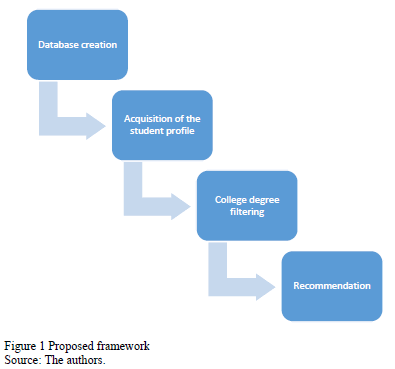
<body><![CDATA[<p><font size="2" face="Verdana, Arial, Helvetica, sans-serif">The  proposed framework is presented in <a href="#fig01">Fig. 1</a>. It is based mainly on the proposal  made by Cordon &#91;15&#93; for recommendation systems based on content/knowledge  adapted to the characteristics of the application domain and allowing  flexibility in the aggregation of the similarity of the characteristics in the  user profile with respect to ideal profiles of the college degree.</font></p>     <p align="center"><font size="2" face="Verdana, Arial, Helvetica, sans-serif"><a name="fig01"></a></font><img src="/img/revistas/dyna/v83n199/v83n199a03fig01.gif"></p>     <p><font size="2" face="Verdana, Arial, Helvetica, sans-serif"><b><i>4.1. Database creation</i></b></font></p>     <p><font size="2" face="Verdana, Arial, Helvetica, sans-serif">A key for a recommendation model is the  creation of the database. Each university degree <img src="/img/revistas/dyna/v83n199/v83n199a03eq004.gif"> will be described by a set  of characteristics that make up the profile: </font></p>     <p><img src="/img/revistas/dyna/v83n199/v83n199a03eq01.gif"></p>     <p><font size="2" face="Verdana, Arial, Helvetica, sans-serif">Each of the features which are reflected  in the psychological profile may be composed of sub-features.</font></p>     <p><font size="2" face="Verdana, Arial, Helvetica, sans-serif">Each university degree will be described by  a vector of features:</font></p>     <p><img src="/img/revistas/dyna/v83n199/v83n199a03eq02.gif"></p>     <p><font size="2" face="Verdana, Arial, Helvetica, sans-serif">There are techniques for generating these  profiles automatically or semi-automatically for recommendation systems based  on psychological profiles &#91;21&#93;. In this case, an expert or group of experts is suggested.</font></p>     <p><font size="2" face="Verdana, Arial, Helvetica, sans-serif">Having described the university degrees  in this set:</font></p>     ]]></body>

<body><![CDATA[<p><img src="/img/revistas/dyna/v83n199/v83n199a03eq03.gif"></p>     <p><font size="2" face="Verdana, Arial, Helvetica, sans-serif">Then, it is stored in a database.</font></p>     <p><font size="2" face="Verdana, Arial, Helvetica, sans-serif"><b><i>4.2. Acquisition of the user profile</i></b></font></p>     <p><font size="2" face="Verdana, Arial, Helvetica, sans-serif">The  proposed framework presents a fundamental difference with previous proposals,  it is focused in the fact that most of this information may be collected by  psychological tests and can be supplied by psychologists to advise the student.</font></p>     <p><font size="2" face="Verdana, Arial, Helvetica, sans-serif">The student  profile corresponds to his psychological profile. In this activity, this  information is stored in the database.</font></p>     <p><img src="/img/revistas/dyna/v83n199/v83n199a03eq04.gif"></p>     <p><font size="2" face="Verdana, Arial, Helvetica, sans-serif">This profile will be composed of a set of attributes:</font></p>     <p><img src="/img/revistas/dyna/v83n199/v83n199a03eq05.gif"></p>     <p><font size="2" face="Verdana, Arial, Helvetica, sans-serif">Features such as skills and emotional  intelligence are included. </font></p>     <p><font size="2" face="Verdana, Arial, Helvetica, sans-serif"><b><i>4.3. College degree filtering</i></b></font></p>     ]]></body>
<body><![CDATA[<p><font size="2" face="Verdana, Arial, Helvetica, sans-serif">In this activity, college degrees  according to the similarity with the user profile are filtered to find out  which are the most appropriate for the student.</font></p>     <p><font size="2" face="Verdana, Arial, Helvetica, sans-serif">The similarity between user profile, <img src="/img/revistas/dyna/v83n199/v83n199a03eq016.gif">, and each ideal college degree profile <img src="/img/revistas/dyna/v83n199/v83n199a03eq018.gif"> is calculated. For the calculation of the overall similarity a  hierarchical aggregation is used taking into account the following factors:</font></p> <ul>       <li><font size="2" face="Verdana, Arial, Helvetica, sans-serif">Degree of simultaneity.</font></li>       <li><font size="2" face="Verdana, Arial, Helvetica, sans-serif">Relative importance of the     inputs (weights).</font></li>     </ul>     <p><font size="2" face="Verdana, Arial, Helvetica, sans-serif">Aggregation function &#91;22&#93;: <img src="/img/revistas/dyna/v83n199/v83n199a03eq020.gif"> is obtained by a process of hierarchical  aggregation. The weighted mean power, (WPM) as in the Logic Scoring of  Preference (LSP) method &#91;22&#93; is used. The rth average power is defined as follows:</font></p>     <p><img src="/img/revistas/dyna/v83n199/v83n199a03eq06.gif"></p>     <p><font size="2" face="Verdana, Arial, Helvetica, sans-serif">where <img src="/img/revistas/dyna/v83n199/v83n199a03eq024.gif"> y <img src="/img/revistas/dyna/v83n199/v83n199a03eq026.gif"> and r can be selected to  achieve desired logical properties. For determining each feature and  sub-features weights AHP method &#91;18&#93; is used. </font></p>     <p><font size="2" face="Verdana, Arial, Helvetica, sans-serif"><b><i>4.4. Recommendation</i></b></font></p>     <p><font size="2" face="Verdana, Arial, Helvetica, sans-serif">For the calculation of the similarity  measures the following expression is used:</font></p>     ]]></body>
<body><![CDATA[<p><img src="/img/revistas/dyna/v83n199/v83n199a03eq07.gif"></p>     <p><font size="2" face="Verdana, Arial, Helvetica, sans-serif">Where</font></p>     <p><img src="/img/revistas/dyna/v83n199/v83n199a03eq071.gif"></p>     <p><font size="2" face="Verdana, Arial, Helvetica, sans-serif">is a vector containing the similarity of  all user profile attributes regarding the description of the college degree <img src="/img/revistas/dyna/v83n199/v83n199a03eq032.gif">.</font></p>     <p><font size="2" face="Verdana, Arial, Helvetica, sans-serif">The similarity measure can be obtained  from a distance measurement, if <img src="/img/revistas/dyna/v83n199/v83n199a03eq034.gif"> then&#91;23&#93; :</font></p>     <p><img src="/img/revistas/dyna/v83n199/v83n199a03eq08.gif"></p>     <p><font size="2" face="Verdana, Arial, Helvetica, sans-serif">In case of ordered lists, such as  characterology, interest and professional competencies, Kendal Tau distance is used &#91;24, 25&#93;.</font></p>     <p><font size="2" face="Verdana, Arial, Helvetica, sans-serif"><b><i>4.5. Recommending</i></b></font></p>     <p><font size="2" face="Verdana, Arial, Helvetica, sans-serif">In this activity, a set of college degrees  that match with the students profiles is suggested. After calculating the  similarity between the student profile and each college degree profile in the  database each college degree is ordered and is represented with the following  similarity vector:</font></p>     <p><img src="/img/revistas/dyna/v83n199/v83n199a03eq09.gif"></p>     ]]></body>

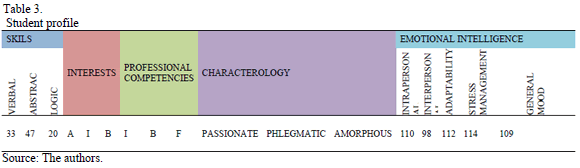
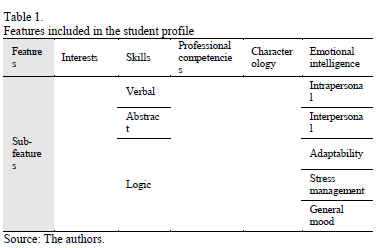
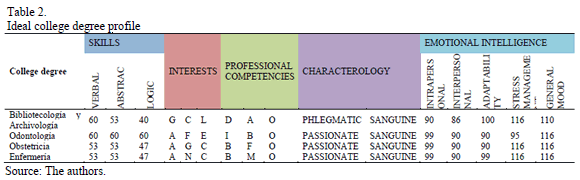
<body><![CDATA[<p><font size="2" face="Verdana, Arial, Helvetica, sans-serif">The best are those that best meet the  needs of the student profile (greater similarity).</font></p>     <p>&nbsp;</p>     <p><font size="3" face="Verdana, Arial, Helvetica, sans-serif"><b>5. Case study</b></font></p>     <p><font size="2" face="Verdana, Arial, Helvetica, sans-serif">To show the applicability of the model, a  case study at the University of Guayaquil is developed. College degree ideal  profiles was acquired from experts taking into account features and  sub-features as it is shown in <a href="#tab01">Table 1</a>. </font></p>     <p align="center"><font size="2" face="Verdana, Arial, Helvetica, sans-serif"><a name="tab01"></a></font><img src="/img/revistas/dyna/v83n199/v83n199a03tab01.gif"></p>     <p><font size="2" face="Verdana, Arial, Helvetica, sans-serif">Ideal college degree profiles are  obtained in a group of college degree in Health and Information Sciences (<a href="#tab02">Table  2</a>). They are composed by numerical scores (skills, emotional intelligence) and  ordered lists (interests, professional competencies, characterology)  information.</font></p>     <p align="center"><font size="2" face="Verdana, Arial, Helvetica, sans-serif"><a name="tab02"></a></font><img src="/img/revistas/dyna/v83n199/v83n199a03tab02.gif"></p>     <p><font size="2" face="Verdana, Arial, Helvetica, sans-serif">In the case  of interest A, B, C, E, F, G, I, L and N correspond to Science Professionals  (health areas), Technology sub-professional (engineering areas), Consumer  Economics (business), Job Office (commerce and secretarial), Professional Art  (design, general arts), Professional Social Service (related to providing services  and care areas), sub-professional technologies (technologies, technical),  Communication (use of language as part of the job) and Social Service  sub-professionals (personal care) respectively.</font></p>     <p><font size="2" face="Verdana, Arial, Helvetica, sans-serif">In the case of professional skills A, B,  D, F, I, M and O correspond to Politics and Law (jurisprudence), Biomedical  (medical sciences), Education (educational sciences), Biotechnology (chemical  sciences) Oral health (dentistry), Communication and Service (media) and  Psychosocial Health (psychology) respectively.</font></p>     <p><font size="2" face="Verdana, Arial, Helvetica, sans-serif">Later, the  psychologist obtained a student profile which is shown in <a href="#tab03">Table 3</a>, based on  observation and psychological tests.</font></p>     ]]></body>
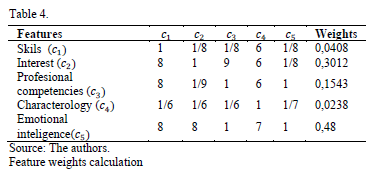
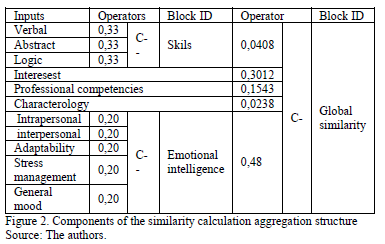
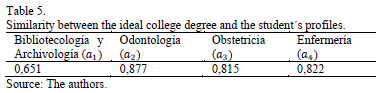
<body><![CDATA[<p align="center"><font size="2" face="Verdana, Arial, Helvetica, sans-serif"><a name="tab03"></a></font><img src="/img/revistas/dyna/v83n199/v83n199a03tab03.gif"></p>     <p><font size="2" face="Verdana, Arial, Helvetica, sans-serif">Using the AHP method the following  weights structure (<a href="#tab04">Table 4</a>) was obtained. These are translated into weight  vector associated with the features V = (0.0408, 0.3012, 0.1543, 0.0238, 0.48).  In this case, equal weight to the sub-attributes are set.</font></p>     <p align="center"><font size="2" face="Verdana, Arial, Helvetica, sans-serif"><a name="tab04"></a></font><img src="/img/revistas/dyna/v83n199/v83n199a03tab04.gif"></p>     <p><font size="2" face="Verdana, Arial, Helvetica, sans-serif">Then, the aggregation structure is  obtained (<a href="#fig02">Fig. 2</a>). Aggregation operators that reflect simultaneity as  established LSP &#91;26, 27&#93; were used.</font></p>     <p align="center"><font size="2" face="Verdana, Arial, Helvetica, sans-serif"><a name="fig02"></a></font><img src="/img/revistas/dyna/v83n199/v83n199a03fig02.gif"></p>     <p><font size="2" face="Verdana, Arial, Helvetica, sans-serif">These operators reflect specific  requirements and logic conditions, such as simultaneity and replaceability.</font></p>     <p><font size="2" face="Verdana, Arial, Helvetica, sans-serif">Then, the aggregation structure is  obtained (<a href="#fig02">Fig. 2</a>). Aggregation operators that reflect simultaneity as  established LSP &#91;26, 27&#93; were used.</font></p>     <p><font size="2" face="Verdana, Arial, Helvetica, sans-serif">These operators reflect specific  requirements and logic conditions, such as simultaneity and replaceability.</font></p>     <p><font size="2" face="Verdana, Arial, Helvetica, sans-serif">The similarity of the ideal profile to  different college degrees gives the following result.</font></p>     <p><font size="2" face="Verdana, Arial, Helvetica, sans-serif">In the phase of recommendation,  those college degrees that come closest to student profile will be recommended.  An ordering based on this comparison is:</font></p>     ]]></body>
<body><![CDATA[<p><img src="/img/revistas/dyna/v83n199/v83n199a03eq091.gif"></p>     <p><font size="2" face="Verdana, Arial, Helvetica, sans-serif">If the system recommend the three college  degrees more similar to the student profile, they would be the following: Odontology,  Nursery and Obstetrics; which coincide with the actual recommendations given by  the department of student welfare.</font></p>     <p align="center"><a name="tab05"></a><img src="/img/revistas/dyna/v83n199/v83n199a03tab05.gif"></p>     <p>&nbsp;</p>     <p><font size="3" face="Verdana, Arial, Helvetica, sans-serif"><b>6. Conclusions</b></font></p>     <p><font size="2" face="Verdana, Arial, Helvetica, sans-serif">Despite the impact along life of deciding  what career to pursue, shortcomings persist in treating recommendation process  of college degrees. This paper presents a model for recommendation of college  degrees following the content-based approach. It is based on the psychological  student profiling and the database of ideal college degree profiles. </font></p>     <p><font size="2" face="Verdana, Arial, Helvetica, sans-serif">The AHP method allows a correct weighting  of different factors involved. Additionally, the LSP method of aggregation  operators permits to reflect simultaneity and replaceability in the process.  The previous elements and the inclusion of the psychological profiling of  students allows to reach a more reliable recommendation. </font></p>     <p><font size="2" face="Verdana, Arial, Helvetica, sans-serif">Future work will be related to the  inclusion of context information in the model creation of the database from  multiple experts, as well as obtaining the weights of the features using group  assessments. Other areas of future work will be related to the management of  heterogeneous information and the development of a software tool.</font></p>     <p>&nbsp;</p>     <p><font size="3" face="Verdana, Arial, Helvetica, sans-serif"><b>References</b></font></p>     ]]></body>
<body><![CDATA[<!-- ref --><p><font size="2" face="Verdana, Arial, Helvetica, sans-serif"><b>&#91;1&#93;</b> Rana, S., Dey, P.K. and Ghosh,  D., Best engineering college selection through fuzzy multi-criteria decision  making approach: a case study. UNIASCIT Journal, 2(2), pp. 246-256. 2012.    &nbsp;&nbsp;&nbsp;&nbsp;&nbsp;&nbsp;&nbsp;&nbsp;[&#160;<a href="javascript:void(0);" onclick="javascript: window.open('/scielo.php?script=sci_nlinks&ref=1142773&pid=S0012-7353201600050000300001&lng=','','width=640,height=500,resizable=yes,scrollbars=1,menubar=yes,');">Links</a>&#160;]<!-- end-ref --></font></p>     <!-- ref --><p><font size="2" face="Verdana, Arial, Helvetica, sans-serif"><b>&#91;2&#93;</b> Leiva, J.L., et al., Realidad  aumentada y sistemas de recomendaci&oacute;n grupales: Una nueva perspectiva en  sistemas de destinos tur&iacute;sticos. Estudios y  perspectivas en turismo, 23(1), pp. 40-59. 2014.    &nbsp;&nbsp;&nbsp;&nbsp;&nbsp;&nbsp;&nbsp;&nbsp;[&#160;<a href="javascript:void(0);" onclick="javascript: window.open('/scielo.php?script=sci_nlinks&ref=1142775&pid=S0012-7353201600050000300002&lng=','','width=640,height=500,resizable=yes,scrollbars=1,menubar=yes,');">Links</a>&#160;]<!-- end-ref --></font></p>     <!-- ref --><p><font size="2" face="Verdana, Arial, Helvetica, sans-serif"><b>&#91;3&#93;</b> Castellano, E.J. and Mart&iacute;nez-Orieb, L., A Crs for academic orientation  using qualitative assessments. in e-Learning, 2008.    &nbsp;&nbsp;&nbsp;&nbsp;&nbsp;&nbsp;&nbsp;&nbsp;[&#160;<a href="javascript:void(0);" onclick="javascript: window.open('/scielo.php?script=sci_nlinks&ref=1142777&pid=S0012-7353201600050000300003&lng=','','width=640,height=500,resizable=yes,scrollbars=1,menubar=yes,');">Links</a>&#160;]<!-- end-ref --></font></p>     <!-- ref --><p><font size="2" face="Verdana, Arial, Helvetica, sans-serif"><b>&#91;4&#93;</b> Castellano,  E.J., Mart&iacute;nez, L. y Barranco, M., Recomendaci&oacute;n de perfiles acad&eacute;micos  mediante algoritmos colaborativos basados en el expediente. in IADIS  Ibero-Americana, 2007.    &nbsp;&nbsp;&nbsp;&nbsp;&nbsp;&nbsp;&nbsp;&nbsp;[&#160;<a href="javascript:void(0);" onclick="javascript: window.open('/scielo.php?script=sci_nlinks&ref=1142779&pid=S0012-7353201600050000300004&lng=','','width=640,height=500,resizable=yes,scrollbars=1,menubar=yes,');">Links</a>&#160;]<!-- end-ref --></font></p>     <!-- ref --><p><font size="2" face="Verdana, Arial, Helvetica, sans-serif"><b>&#91;5&#93;</b> Denley, T., Degree compass: A course recommendation system. Educause  Review Online, 2013.    &nbsp;&nbsp;&nbsp;&nbsp;&nbsp;&nbsp;&nbsp;&nbsp;[&#160;<a href="javascript:void(0);" onclick="javascript: window.open('/scielo.php?script=sci_nlinks&ref=1142781&pid=S0012-7353201600050000300005&lng=','','width=640,height=500,resizable=yes,scrollbars=1,menubar=yes,');">Links</a>&#160;]<!-- end-ref --></font></p>     ]]></body>
<body><![CDATA[<!-- ref --><p><font size="2" face="Verdana, Arial, Helvetica, sans-serif"><b>&#91;6&#93;</b> Bendakir, N. and Aïmeur, E., Using association rules for course  recommendation. in Proceedings of the AAAI Workshop on Educational Data Mining.  2006.    &nbsp;&nbsp;&nbsp;&nbsp;&nbsp;&nbsp;&nbsp;&nbsp;[&#160;<a href="javascript:void(0);" onclick="javascript: window.open('/scielo.php?script=sci_nlinks&ref=1142783&pid=S0012-7353201600050000300006&lng=','','width=640,height=500,resizable=yes,scrollbars=1,menubar=yes,');">Links</a>&#160;]<!-- end-ref --></font></p>     <!-- ref --><p><font size="2" face="Verdana, Arial, Helvetica, sans-serif"><b>&#91;7&#93;</b> Lin, C.F., et al., Data mining for providing a personalized learning  path in creativity: An application of decision trees. Computers &amp;  Education, 68, pp. 199-210. 2013. DOI: 10.1016/J.COMPEDU.2013.05.009</font>&nbsp;&nbsp;&nbsp;&nbsp;&nbsp;&nbsp;&nbsp;&nbsp;[&#160;<a href="javascript:void(0);" onclick="javascript: window.open('/scielo.php?script=sci_nlinks&ref=1142785&pid=S0012-7353201600050000300007&lng=','','width=640,height=500,resizable=yes,scrollbars=1,menubar=yes,');">Links</a>&#160;]<!-- end-ref --><!-- ref --><p><font size="2" face="Verdana, Arial, Helvetica, sans-serif"><b>&#91;8&#93;</b> Whitten, L. and Sanders, A., Data-mining and predicting academic  success: A recommendation system for college students. Educational Technology, 53(4),  pp. 40-42, 2013.    &nbsp;&nbsp;&nbsp;&nbsp;&nbsp;&nbsp;&nbsp;&nbsp;[&#160;<a href="javascript:void(0);" onclick="javascript: window.open('/scielo.php?script=sci_nlinks&ref=1142786&pid=S0012-7353201600050000300008&lng=','','width=640,height=500,resizable=yes,scrollbars=1,menubar=yes,');">Links</a>&#160;]<!-- end-ref --></font></p>     <!-- ref --><p><font size="2" face="Verdana, Arial, Helvetica, sans-serif"><b>&#91;9&#93;</b> Wang, X. and Yeung, D., Using fuzzy integral to modeling case based  reasoning with feature interaction. in Systems, Man, and Cybernetics, 2000 IEEE  International Conference on. IEEE. 2000. DOI: 10.1109/ICSMC.2000.886578</font>&nbsp;&nbsp;&nbsp;&nbsp;&nbsp;&nbsp;&nbsp;&nbsp;[&#160;<a href="javascript:void(0);" onclick="javascript: window.open('/scielo.php?script=sci_nlinks&ref=1142788&pid=S0012-7353201600050000300009&lng=','','width=640,height=500,resizable=yes,scrollbars=1,menubar=yes,');">Links</a>&#160;]<!-- end-ref --><!-- ref --><p><font size="2" face="Verdana, Arial, Helvetica, sans-serif"><b>&#91;10&#93;</b> Yager, R.R., Soft aggregation methods in case based reasoning. Applied  Intelligence, 21(3), pp. 277-288. 2004. DOI: 10.1023/B:APIN.0000043560.57137.20</font>&nbsp;&nbsp;&nbsp;&nbsp;&nbsp;&nbsp;&nbsp;&nbsp;[&#160;<a href="javascript:void(0);" onclick="javascript: window.open('/scielo.php?script=sci_nlinks&ref=1142789&pid=S0012-7353201600050000300010&lng=','','width=640,height=500,resizable=yes,scrollbars=1,menubar=yes,');">Links</a>&#160;]<!-- end-ref --><!-- ref --><p><font size="2" face="Verdana, Arial, Helvetica, sans-serif"><b>&#91;11&#93;</b> Beliakov, G., Calvo, T. and James, S., Aggregation of preferences in  recommender systems, in Recommender systems handbook Springer. pp. 705-734. 2011. DOI: 10.1007/978-0-387-85820-3_22</font>&nbsp;&nbsp;&nbsp;&nbsp;&nbsp;&nbsp;&nbsp;&nbsp;[&#160;<a href="javascript:void(0);" onclick="javascript: window.open('/scielo.php?script=sci_nlinks&ref=1142790&pid=S0012-7353201600050000300011&lng=','','width=640,height=500,resizable=yes,scrollbars=1,menubar=yes,');">Links</a>&#160;]<!-- end-ref --><!-- ref --><p><font size="2" face="Verdana, Arial, Helvetica, sans-serif"><b>&#91;12&#93;</b> Carrillo, G. y Ochoa, X.,  Recomendaci&oacute;n de objetos de aprendizaje basada en el perfil del usuario y la  informaci&oacute;n de atenci&oacute;n contextualizada, en: LACLO 2013-Octava Conferencia  Latinoamericana de Objetos y Tecnolog&iacute;as de Aprendizaje. 2013.    &nbsp;&nbsp;&nbsp;&nbsp;&nbsp;&nbsp;&nbsp;&nbsp;[&#160;<a href="javascript:void(0);" onclick="javascript: window.open('/scielo.php?script=sci_nlinks&ref=1142791&pid=S0012-7353201600050000300012&lng=','','width=640,height=500,resizable=yes,scrollbars=1,menubar=yes,');">Links</a>&#160;]<!-- end-ref --></font></p>     ]]></body>
<body><![CDATA[<!-- ref --><p><font size="2" face="Verdana, Arial, Helvetica, sans-serif"><b>&#91;13&#93;</b> Hatch, K., Dragi&#263;evi&#263;, S. and Dujmovi&#263;, J., Logic  scoring of preference and spatial multicriteria evaluation for urban  residential land use analysis, in Geographic Information Science. Springer. pp.  64-80. 2014. DOI: 10.1007/978-3-319-11593-1_5</font>&nbsp;&nbsp;&nbsp;&nbsp;&nbsp;&nbsp;&nbsp;&nbsp;[&#160;<a href="javascript:void(0);" onclick="javascript: window.open('/scielo.php?script=sci_nlinks&ref=1142793&pid=S0012-7353201600050000300013&lng=','','width=640,height=500,resizable=yes,scrollbars=1,menubar=yes,');">Links</a>&#160;]<!-- end-ref --><!-- ref --><p><font size="2" face="Verdana, Arial, Helvetica, sans-serif"><b>&#91;14&#93;</b> Jannach, D., Tutorial: Recommender systems, in International Joint  Conference on Artificial Intelligence Beijing, August 4, 2013.    &nbsp;&nbsp;&nbsp;&nbsp;&nbsp;&nbsp;&nbsp;&nbsp;[&#160;<a href="javascript:void(0);" onclick="javascript: window.open('/scielo.php?script=sci_nlinks&ref=1142794&pid=S0012-7353201600050000300014&lng=','','width=640,height=500,resizable=yes,scrollbars=1,menubar=yes,');">Links</a>&#160;]<!-- end-ref --> </font></p>     <!-- ref --><p><font size="2" face="Verdana, Arial, Helvetica, sans-serif"><b>&#91;15&#93;</b> Cord&oacute;n, L.G.P., Modelos de  recomendaci&oacute;n con falta de informaci&oacute;n. Aplicaciones al sector tur&iacute;stico., Universidad de Ja&eacute;n. 2008</font>&nbsp;&nbsp;&nbsp;&nbsp;&nbsp;&nbsp;&nbsp;&nbsp;[&#160;<a href="javascript:void(0);" onclick="javascript: window.open('/scielo.php?script=sci_nlinks&ref=1142796&pid=S0012-7353201600050000300015&lng=','','width=640,height=500,resizable=yes,scrollbars=1,menubar=yes,');">Links</a>&#160;]<!-- end-ref --><!-- ref --><p><font size="2" face="Verdana, Arial, Helvetica, sans-serif"><b>&#91;16&#93;</b> Denley, T., Austin Peay State University: Degree Compass. Educause  Review &#91;Online&#93;. Available at: <a href="http://www.educause. edu/ero/article/austin-peay-state-university-degree-compass," target="_blank">http://www.educause.  edu/ero/article/austin-peay-state-university-degree-compass,</a> 2012.    &nbsp;&nbsp;&nbsp;&nbsp;&nbsp;&nbsp;&nbsp;&nbsp;[&#160;<a href="javascript:void(0);" onclick="javascript: window.open('/scielo.php?script=sci_nlinks&ref=1142797&pid=S0012-7353201600050000300016&lng=','','width=640,height=500,resizable=yes,scrollbars=1,menubar=yes,');">Links</a>&#160;]<!-- end-ref --></font></p>     <!-- ref --><p><font size="2" face="Verdana, Arial, Helvetica, sans-serif"><b>&#91;17&#93;</b> Nunes, M.A.S.N. and Cerri, S.A., Recommender systems based on human  psychological reputation. in Recommenders' 06. com-The Present and Future of  Recommender Syste MS. MyStrands. 2006.    &nbsp;&nbsp;&nbsp;&nbsp;&nbsp;&nbsp;&nbsp;&nbsp;[&#160;<a href="javascript:void(0);" onclick="javascript: window.open('/scielo.php?script=sci_nlinks&ref=1142799&pid=S0012-7353201600050000300017&lng=','','width=640,height=500,resizable=yes,scrollbars=1,menubar=yes,');">Links</a>&#160;]<!-- end-ref --></font></p>     <!-- ref --><p><font size="2" face="Verdana, Arial, Helvetica, sans-serif"><b>&#91;18&#93;</b> Saaty, T.L., What is the analytic hierarchy process?, in  Mathematical models for decision support. Springer. pp. 109-121. 1988.  DOI: 10.1007/978-3-642-83555-1_5</font>&nbsp;&nbsp;&nbsp;&nbsp;&nbsp;&nbsp;&nbsp;&nbsp;[&#160;<a href="javascript:void(0);" onclick="javascript: window.open('/scielo.php?script=sci_nlinks&ref=1142801&pid=S0012-7353201600050000300018&lng=','','width=640,height=500,resizable=yes,scrollbars=1,menubar=yes,');">Links</a>&#160;]<!-- end-ref --><!-- ref --><p><font size="2" face="Verdana, Arial, Helvetica, sans-serif"><b>&#91;19&#93;</b> Aguar&oacute;n, J., Escobar, M.T. and Moreno-Jim&eacute;nez, J.M., The precise  consistency consensus matrix in a local AHP-group decision making context. Annals  of Operations Research, pp. 1-15. 2014. DOI: 10.1007/s10479-014-1576-8</font>&nbsp;&nbsp;&nbsp;&nbsp;&nbsp;&nbsp;&nbsp;&nbsp;[&#160;<a href="javascript:void(0);" onclick="javascript: window.open('/scielo.php?script=sci_nlinks&ref=1142802&pid=S0012-7353201600050000300019&lng=','','width=640,height=500,resizable=yes,scrollbars=1,menubar=yes,');">Links</a>&#160;]<!-- end-ref --><!-- ref --><p><font size="2" face="Verdana, Arial, Helvetica, sans-serif"><b>&#91;20&#93;</b> Xu, Z., On consistency of the weighted geometric mean complex  judgement matrix in AHP. European Journal of Operational Research, 126(3), pp.  683-687. 2000. DOI: 10.1016/S0377-2217(99)00082-X</font>&nbsp;&nbsp;&nbsp;&nbsp;&nbsp;&nbsp;&nbsp;&nbsp;[&#160;<a href="javascript:void(0);" onclick="javascript: window.open('/scielo.php?script=sci_nlinks&ref=1142803&pid=S0012-7353201600050000300020&lng=','','width=640,height=500,resizable=yes,scrollbars=1,menubar=yes,');">Links</a>&#160;]<!-- end-ref --><!-- ref --><p><font size="2" face="Verdana, Arial, Helvetica, sans-serif"><b>&#91;21&#93;</b> Nunes, M.A.S., Cerri, S.A. and Blanc, N., Towards user psychological  profile. in Proceedings of the VIII Brazilian Symposium on Human Factors in  Computing Systems. Sociedade Brasileira de Computação. 2008.    &nbsp;&nbsp;&nbsp;&nbsp;&nbsp;&nbsp;&nbsp;&nbsp;[&#160;<a href="javascript:void(0);" onclick="javascript: window.open('/scielo.php?script=sci_nlinks&ref=1142804&pid=S0012-7353201600050000300021&lng=','','width=640,height=500,resizable=yes,scrollbars=1,menubar=yes,');">Links</a>&#160;]<!-- end-ref --></font></p>     <!-- ref --><p><font size="2" face="Verdana, Arial, Helvetica, sans-serif"><b>&#91;22&#93;</b> P&eacute;rez-Teruel, K., Leyva-V&aacute;zquez, M. and Estrada-Sent&iacute;, V., Mental  models consensus process using fuzzy cognitive maps and computing with words. Ingenier&iacute;a  y Universidad, 19, pp. 173-188. 2015. DOI: 10.1007/s10479-014-1576-8</font>&nbsp;&nbsp;&nbsp;&nbsp;&nbsp;&nbsp;&nbsp;&nbsp;[&#160;<a href="javascript:void(0);" onclick="javascript: window.open('/scielo.php?script=sci_nlinks&ref=1142806&pid=S0012-7353201600050000300022&lng=','','width=640,height=500,resizable=yes,scrollbars=1,menubar=yes,');">Links</a>&#160;]<!-- end-ref --><!-- ref --><p><font size="2" face="Verdana, Arial, Helvetica, sans-serif"><b>&#91;23&#93;</b> Bonillo, M.L., Razonamiento basado  en casos aplicado a problemas de clasificaci&oacute;n. Tesis de grado. Universidad de Granada, Espa&ntilde;a, 2003.    &nbsp;&nbsp;&nbsp;&nbsp;&nbsp;&nbsp;&nbsp;&nbsp;[&#160;<a href="javascript:void(0);" onclick="javascript: window.open('/scielo.php?script=sci_nlinks&ref=1142807&pid=S0012-7353201600050000300023&lng=','','width=640,height=500,resizable=yes,scrollbars=1,menubar=yes,');">Links</a>&#160;]<!-- end-ref --></font></p>     <!-- ref --><p><font size="2" face="Verdana, Arial, Helvetica, sans-serif"><b>&#91;24&#93;</b> Ha, V. and Haddawy, P., Similarity of personal preferences:  Theoretical foundations and empirical analysis. Artificial Intelligence, 146(2),  pp. 149-173. 2003. DOI: 10.1016/S0004-3702(03)00013-4</font>&nbsp;&nbsp;&nbsp;&nbsp;&nbsp;&nbsp;&nbsp;&nbsp;[&#160;<a href="javascript:void(0);" onclick="javascript: window.open('/scielo.php?script=sci_nlinks&ref=1142809&pid=S0012-7353201600050000300024&lng=','','width=640,height=500,resizable=yes,scrollbars=1,menubar=yes,');">Links</a>&#160;]<!-- end-ref --><!-- ref --><p><font size="2" face="Verdana, Arial, Helvetica, sans-serif"><b>&#91;25&#93;</b> Knight, W.R., A computer method for calculating Kendall's tau with  ungrouped data. Journal of the American Statistical Association, 61(314), pp.  436-439. 1966. DOI: 10.1080/01621459.1966.10480879</font>&nbsp;&nbsp;&nbsp;&nbsp;&nbsp;&nbsp;&nbsp;&nbsp;[&#160;<a href="javascript:void(0);" onclick="javascript: window.open('/scielo.php?script=sci_nlinks&ref=1142810&pid=S0012-7353201600050000300025&lng=','','width=640,height=500,resizable=yes,scrollbars=1,menubar=yes,');">Links</a>&#160;]<!-- end-ref --><!-- ref --><p><font size="2" face="Verdana, Arial, Helvetica, sans-serif"><b>&#91;26&#93;</b> Tapia-Rosero, A., et al., Fusion of preferences from different  perspectives in a decision-making context. Information Fusion, 2016.29: pp.  120-131. DOI: 10.1016/J.INFFUS.2015.07.006</font>&nbsp;&nbsp;&nbsp;&nbsp;&nbsp;&nbsp;&nbsp;&nbsp;[&#160;<a href="javascript:void(0);" onclick="javascript: window.open('/scielo.php?script=sci_nlinks&ref=1142811&pid=S0012-7353201600050000300026&lng=','','width=640,height=500,resizable=yes,scrollbars=1,menubar=yes,');">Links</a>&#160;]<!-- end-ref --><!-- ref --><p><font size="2" face="Verdana, Arial, Helvetica, sans-serif"><b>&#91;27&#93;</b> Dujmovi&#263;, J.J. and Nagashima, H., LSP method and its use for evaluation  of Java IDEs. International journal of approximate reasoning, 41(1), pp. 3-22.  2006. DOI: 10.1016/J.IJAR.2005.06.006</font>&nbsp;&nbsp;&nbsp;&nbsp;&nbsp;&nbsp;&nbsp;&nbsp;[&#160;<a href="javascript:void(0);" onclick="javascript: window.open('/scielo.php?script=sci_nlinks&ref=1142812&pid=S0012-7353201600050000300027&lng=','','width=640,height=500,resizable=yes,scrollbars=1,menubar=yes,');">Links</a>&#160;]<!-- end-ref --><p>&nbsp;</p>     <p><font size="2" face="Verdana, Arial, Helvetica, sans-serif"><b>M.R. Maridue&ntilde;a-Arroyave,</b> es Dr. (Ph.D.) en  Ciencias Pedag&oacute;gicas, Candidato a Dr. (Ph.D.) en Ciencias Inform&aacute;ticas, MSc. en Docencia  Universitaria e Investigaci&oacute;n Educativa, Candidato a MSc. en Investigaci&oacute;n  Matem&aacute;tica, Ingeniero en Computaci&oacute;n. Profesor con 18 a&ntilde;os de experiencia  docente universitaria en carreras de Ingenier&iacute;a en Sistemas Computacionales,  Inform&aacute;tica y Networking. Actualmente Director de Investigaciones y Proyectos  Acad&eacute;micos - DIPA de la Universidad de Guayaquil, Ecuador. ORCID:  0000-0002-8876-1896</font></p>     <p><font size="2" face="Verdana, Arial, Helvetica, sans-serif"><b>A. Febles-Estrada,</b> es Lic. en Ciencias de  la Computaci&oacute;n de la Universidad de La Habana, Cuba. Dra. en Ciencias T&eacute;cnicas  (Ph.D.) del Instituto Superior Polit&eacute;cnico Jos&eacute; Antonio Echeverr&iacute;a. Profesora  de la Universidad de las Ciencias Inform&aacute;ticas, La Habana, Cuba. ORCID: 0000-0002-9678-2230</font></p>      ]]></body><back>
<ref-list>
<ref id="B1">
<label>1</label><nlm-citation citation-type="journal">
<person-group person-group-type="author">
<name>
<surname><![CDATA[Rana]]></surname>
<given-names><![CDATA[S.]]></given-names>
</name>
<name>
<surname><![CDATA[Dey]]></surname>
<given-names><![CDATA[P.K.]]></given-names>
</name>
<name>
<surname><![CDATA[Ghosh]]></surname>
<given-names><![CDATA[D.]]></given-names>
</name>
</person-group>
<article-title xml:lang="en"><![CDATA[Best engineering college selection through fuzzy multi-criteria decision making approach: a case study]]></article-title>
<source><![CDATA[UNIASCIT Journal]]></source>
<year>2012</year>
<volume>2</volume>
<numero>2</numero>
<issue>2</issue>
<page-range>246-256</page-range></nlm-citation>
</ref>
<ref id="B2">
<label>2</label><nlm-citation citation-type="journal">
<person-group person-group-type="author">
<name>
<surname><![CDATA[Leiva]]></surname>
<given-names><![CDATA[J.L.]]></given-names>
</name>
</person-group>
<article-title xml:lang="es"><![CDATA[Realidad aumentada y sistemas de recomendación grupales: Una nueva perspectiva en sistemas de destinos turísticos.]]></article-title>
<source><![CDATA[Estudios y perspectivas en turismo]]></source>
<year>2014</year>
<volume>23</volume>
<numero>1</numero>
<issue>1</issue>
<page-range>40-59</page-range></nlm-citation>
</ref>
<ref id="B3">
<label>3</label><nlm-citation citation-type="">
<person-group person-group-type="author">
<name>
<surname><![CDATA[Castellano]]></surname>
<given-names><![CDATA[E.J.]]></given-names>
</name>
<name>
<surname><![CDATA[Martínez-Orieb]]></surname>
<given-names><![CDATA[L.]]></given-names>
</name>
</person-group>
<article-title xml:lang="en"><![CDATA[A Crs for academic orientation using qualitative assessments. in e-Learning]]></article-title>
<source><![CDATA[]]></source>
<year>2008</year>
</nlm-citation>
</ref>
<ref id="B4">
<label>4</label><nlm-citation citation-type="journal">
<person-group person-group-type="author">
<name>
<surname><![CDATA[Castellano]]></surname>
<given-names><![CDATA[E.J.]]></given-names>
</name>
<name>
<surname><![CDATA[Martínez]]></surname>
<given-names><![CDATA[L.]]></given-names>
</name>
<name>
<surname><![CDATA[Barranco]]></surname>
<given-names><![CDATA[M.]]></given-names>
</name>
</person-group>
<article-title xml:lang="es"><![CDATA[Recomendación de perfiles académicos mediante algoritmos colaborativos basados en el expediente.]]></article-title>
<source><![CDATA[IADIS Ibero-Americana]]></source>
<year>2007</year>
</nlm-citation>
</ref>
<ref id="B5">
<label>5</label><nlm-citation citation-type="book">
<person-group person-group-type="author">
<name>
<surname><![CDATA[Denley]]></surname>
<given-names><![CDATA[T.]]></given-names>
</name>
</person-group>
<source><![CDATA[Degree compass: A course recommendation system]]></source>
<year>2013</year>
<publisher-name><![CDATA[Educause Review Online]]></publisher-name>
</nlm-citation>
</ref>
<ref id="B6">
<label>6</label><nlm-citation citation-type="confpro">
<person-group person-group-type="author">
<name>
<surname><![CDATA[Bendakir]]></surname>
<given-names><![CDATA[N.]]></given-names>
</name>
<name>
<surname><![CDATA[Aïmeur]]></surname>
<given-names><![CDATA[E.]]></given-names>
</name>
</person-group>
<article-title xml:lang="en"><![CDATA[Using association rules for course recommendation.]]></article-title>
<source><![CDATA[]]></source>
<year></year>
<conf-name><![CDATA[ AAAI Workshop on Educational Data Mining]]></conf-name>
<conf-date>2006</conf-date>
<conf-loc> </conf-loc>
</nlm-citation>
</ref>
<ref id="B7">
<label>7</label><nlm-citation citation-type="journal">
<person-group person-group-type="author">
<name>
<surname><![CDATA[Lin]]></surname>
<given-names><![CDATA[C.F.]]></given-names>
</name>
</person-group>
<article-title xml:lang="en"><![CDATA[Data mining for providing a personalized learning path in creativity: An application of decision trees]]></article-title>
<source><![CDATA[Computers & Education]]></source>
<year>2013</year>
<numero>68</numero>
<issue>68</issue>
<page-range>199-210</page-range></nlm-citation>
</ref>
<ref id="B8">
<label>8</label><nlm-citation citation-type="journal">
<person-group person-group-type="author">
<name>
<surname><![CDATA[Whitten]]></surname>
<given-names><![CDATA[L.]]></given-names>
</name>
<name>
<surname><![CDATA[Sanders]]></surname>
<given-names><![CDATA[A.]]></given-names>
</name>
</person-group>
<article-title xml:lang="en"><![CDATA[Data-mining and predicting academic success: A recommendation system for college students.]]></article-title>
<source><![CDATA[Educational Technology]]></source>
<year>2013</year>
<volume>53</volume>
<numero>4</numero>
<issue>4</issue>
<page-range>40-42</page-range></nlm-citation>
</ref>
<ref id="B9">
<label>9</label><nlm-citation citation-type="confpro">
<person-group person-group-type="author">
<name>
<surname><![CDATA[Wang]]></surname>
<given-names><![CDATA[X.]]></given-names>
</name>
<name>
<surname><![CDATA[Yeung]]></surname>
<given-names><![CDATA[D.]]></given-names>
</name>
</person-group>
<article-title xml:lang="en"><![CDATA[Using fuzzy integral to modeling case based reasoning with feature interaction.]]></article-title>
<source><![CDATA[]]></source>
<year>2000</year>
<conf-name><![CDATA[ Systems, Man, and Cybernetics]]></conf-name>
<conf-date>2000</conf-date>
<conf-loc> </conf-loc>
</nlm-citation>
</ref>
<ref id="B10">
<label>10</label><nlm-citation citation-type="journal">
<person-group person-group-type="author">
<name>
<surname><![CDATA[Yager]]></surname>
<given-names><![CDATA[R.R.]]></given-names>
</name>
</person-group>
<article-title xml:lang="en"><![CDATA[Soft aggregation methods in case based reasoning]]></article-title>
<source><![CDATA[Applied Intelligence]]></source>
<year>2004</year>
<volume>21</volume>
<numero>3</numero>
<issue>3</issue>
<page-range>277-288</page-range></nlm-citation>
</ref>
<ref id="B11">
<label>11</label><nlm-citation citation-type="book">
<person-group person-group-type="author">
<name>
<surname><![CDATA[Beliakov]]></surname>
<given-names><![CDATA[G.]]></given-names>
</name>
<name>
<surname><![CDATA[Calvo]]></surname>
<given-names><![CDATA[T.]]></given-names>
</name>
<name>
<surname><![CDATA[James]]></surname>
<given-names><![CDATA[S.]]></given-names>
</name>
</person-group>
<article-title xml:lang="en"><![CDATA[Aggregation of preferences in recommender systems]]></article-title>
<source><![CDATA[Recommender systems handbook]]></source>
<year>2011</year>
<page-range>705-734</page-range><publisher-name><![CDATA[Springer]]></publisher-name>
</nlm-citation>
</ref>
<ref id="B12">
<label>12</label><nlm-citation citation-type="confpro">
<person-group person-group-type="author">
<name>
<surname><![CDATA[Carrillo]]></surname>
<given-names><![CDATA[G.]]></given-names>
</name>
<name>
<surname><![CDATA[Ochoa]]></surname>
<given-names><![CDATA[X.]]></given-names>
</name>
</person-group>
<article-title xml:lang="es"><![CDATA[Recomendación de objetos de aprendizaje basada en el perfil del usuario y la información de atención contextualizada]]></article-title>
<source><![CDATA[]]></source>
<year></year>
<conf-name><![CDATA[Octava Conferencia Latinoamericana de Objetos y Tecnologías de Aprendizaje.]]></conf-name>
<conf-date>2013</conf-date>
<conf-loc> </conf-loc>
</nlm-citation>
</ref>
<ref id="B13">
<label>13</label><nlm-citation citation-type="journal">
<person-group person-group-type="author">
<name>
<surname><![CDATA[Hatch]]></surname>
<given-names><![CDATA[K.]]></given-names>
</name>
<name>
<surname><![CDATA[Dragi&#263;evi&#263;]]></surname>
<given-names><![CDATA[S.]]></given-names>
</name>
<name>
<surname><![CDATA[Dujmovi&#263;]]></surname>
<given-names><![CDATA[J.]]></given-names>
</name>
</person-group>
<article-title xml:lang="en"><![CDATA[Logic scoring of preference and spatial multicriteria evaluation for urban residential land use analysis]]></article-title>
<source><![CDATA[Geographic Information Science]]></source>
<year>2014</year>
<page-range>64-80</page-range><publisher-name><![CDATA[Springer]]></publisher-name>
</nlm-citation>
</ref>
<ref id="B14">
<label>14</label><nlm-citation citation-type="confpro">
<person-group person-group-type="author">
<name>
<surname><![CDATA[Jannach]]></surname>
<given-names><![CDATA[D.]]></given-names>
</name>
</person-group>
<article-title xml:lang="en"><![CDATA[Tutorial: Recommender systems]]></article-title>
<source><![CDATA[]]></source>
<year></year>
<conf-name><![CDATA[ International Joint Conference on Artificial Intelligence]]></conf-name>
<conf-date>August 4, 2013</conf-date>
<conf-loc>Beijing </conf-loc>
</nlm-citation>
</ref>
<ref id="B15">
<label>15</label><nlm-citation citation-type="book">
<person-group person-group-type="author">
<name>
<surname><![CDATA[Cordón]]></surname>
<given-names><![CDATA[L.G.P.]]></given-names>
</name>
</person-group>
<source><![CDATA[Modelos de recomendación con falta de información: Aplicaciones al sector turístico]]></source>
<year>2008</year>
<publisher-name><![CDATA[Universidad de Jaén]]></publisher-name>
</nlm-citation>
</ref>
<ref id="B16">
<label>16</label><nlm-citation citation-type="journal">
<person-group person-group-type="author">
<name>
<surname><![CDATA[Denley]]></surname>
<given-names><![CDATA[T.]]></given-names>
</name>
</person-group>
<article-title xml:lang="en"><![CDATA[Austin Peay State University: Degree Compass]]></article-title>
<source><![CDATA[Educause Review]]></source>
<year>2012</year>
</nlm-citation>
</ref>
<ref id="B17">
<label>17</label><nlm-citation citation-type="confpro">
<person-group person-group-type="author">
<name>
<surname><![CDATA[Nunes]]></surname>
<given-names><![CDATA[M.A.S.N.]]></given-names>
</name>
<name>
<surname><![CDATA[Cerri]]></surname>
<given-names><![CDATA[S.A.]]></given-names>
</name>
</person-group>
<article-title xml:lang="en"><![CDATA[Recommender systems based on human psychological reputation]]></article-title>
<source><![CDATA[]]></source>
<year></year>
<conf-name><![CDATA[ Recommenders' 06. com-The Present and Future of Recommender Syste MS. MyStrands]]></conf-name>
<conf-date>2006</conf-date>
<conf-loc> </conf-loc>
</nlm-citation>
</ref>
<ref id="B18">
<label>18</label><nlm-citation citation-type="journal">
<person-group person-group-type="author">
<name>
<surname><![CDATA[Saaty]]></surname>
<given-names><![CDATA[T.L.]]></given-names>
</name>
</person-group>
<article-title xml:lang="en"><![CDATA[What is the analytic hierarchy process?]]></article-title>
<source><![CDATA[Mathematical models for decision support.]]></source>
<year>1988</year>
<page-range>109-121</page-range><publisher-name><![CDATA[Springer]]></publisher-name>
</nlm-citation>
</ref>
<ref id="B19">
<label>19</label><nlm-citation citation-type="journal">
<person-group person-group-type="author">
<name>
<surname><![CDATA[Aguarón]]></surname>
<given-names><![CDATA[J.]]></given-names>
</name>
<name>
<surname><![CDATA[Escobar]]></surname>
<given-names><![CDATA[M.T.]]></given-names>
</name>
<name>
<surname><![CDATA[Moreno-Jiménez]]></surname>
<given-names><![CDATA[J.M.]]></given-names>
</name>
</person-group>
<article-title xml:lang="en"><![CDATA[The precise consistency consensus matrix in a local AHP-group decision making context.]]></article-title>
<source><![CDATA[Annals of Operations Research]]></source>
<year>2014</year>
<page-range>1-15</page-range></nlm-citation>
</ref>
<ref id="B20">
<label>20</label><nlm-citation citation-type="journal">
<person-group person-group-type="author">
<name>
<surname><![CDATA[Xu]]></surname>
<given-names><![CDATA[Z.]]></given-names>
</name>
</person-group>
<article-title xml:lang="en"><![CDATA[On consistency of the weighted geometric mean complex judgement matrix in AHP]]></article-title>
<source><![CDATA[European Journal of Operational Research]]></source>
<year>2000</year>
<volume>126</volume>
<numero>3</numero>
<issue>3</issue>
<page-range>683-687</page-range></nlm-citation>
</ref>
<ref id="B21">
<label>21</label><nlm-citation citation-type="confpro">
<person-group person-group-type="author">
<name>
<surname><![CDATA[Nunes]]></surname>
<given-names><![CDATA[M.A.S.]]></given-names>
</name>
<name>
<surname><![CDATA[Cerri]]></surname>
<given-names><![CDATA[S.A.]]></given-names>
</name>
<name>
<surname><![CDATA[Blanc]]></surname>
<given-names><![CDATA[N.]]></given-names>
</name>
</person-group>
<article-title xml:lang="en"><![CDATA[Towards user psychological profile]]></article-title>
<source><![CDATA[]]></source>
<year></year>
<conf-name><![CDATA[VIII Brazilian Symposium on Human Factors in Computing Systems]]></conf-name>
<conf-date>2008</conf-date>
<conf-loc> </conf-loc>
</nlm-citation>
</ref>
<ref id="B22">
<label>22</label><nlm-citation citation-type="journal">
<person-group person-group-type="author">
<name>
<surname><![CDATA[Pérez-Teruel]]></surname>
<given-names><![CDATA[K.]]></given-names>
</name>
<name>
<surname><![CDATA[Leyva-Vázquez]]></surname>
<given-names><![CDATA[M.]]></given-names>
</name>
<name>
<surname><![CDATA[Estrada-Sentí]]></surname>
<given-names><![CDATA[V.]]></given-names>
</name>
</person-group>
<article-title xml:lang="en"><![CDATA[Mental models consensus process using fuzzy cognitive maps and computing with words]]></article-title>
<source><![CDATA[Ingeniería y Universidad]]></source>
<year>2015</year>
<numero>19</numero>
<issue>19</issue>
<page-range>173-188</page-range></nlm-citation>
</ref>
<ref id="B23">
<label>23</label><nlm-citation citation-type="">
<person-group person-group-type="author">
<name>
<surname><![CDATA[Bonillo]]></surname>
<given-names><![CDATA[M.L.]]></given-names>
</name>
</person-group>
<source><![CDATA[Razonamiento basado en casos aplicado a problemas de clasificación.]]></source>
<year></year>
</nlm-citation>
</ref>
<ref id="B24">
<label>24</label><nlm-citation citation-type="journal">
<person-group person-group-type="author">
<name>
<surname><![CDATA[Ha]]></surname>
<given-names><![CDATA[V.]]></given-names>
</name>
<name>
<surname><![CDATA[Haddawy]]></surname>
<given-names><![CDATA[P.]]></given-names>
</name>
</person-group>
<article-title xml:lang="en"><![CDATA[Similarity of personal preferences: Theoretical foundations and empirical analysis]]></article-title>
<source><![CDATA[Artificial Intelligence]]></source>
<year>2003</year>
<volume>146</volume>
<numero>2</numero>
<issue>2</issue>
<page-range>149-173</page-range></nlm-citation>
</ref>
<ref id="B25">
<label>25</label><nlm-citation citation-type="journal">
<person-group person-group-type="author">
<name>
<surname><![CDATA[Knight]]></surname>
<given-names><![CDATA[W.R.]]></given-names>
</name>
</person-group>
<article-title xml:lang="en"><![CDATA[A computer method for calculating Kendall's tau with ungrouped data]]></article-title>
<source><![CDATA[Journal of the American Statistical Association]]></source>
<year>1966</year>
<volume>61</volume>
<numero>314</numero>
<issue>314</issue>
<page-range>436-439</page-range></nlm-citation>
</ref>
<ref id="B26">
<label>26</label><nlm-citation citation-type="journal">
<person-group person-group-type="author">
<name>
<surname><![CDATA[Tapia-Rosero]]></surname>
<given-names><![CDATA[A.]]></given-names>
</name>
</person-group>
<article-title xml:lang="en"><![CDATA[Fusion of preferences from different perspectives in a decision-making context]]></article-title>
<source><![CDATA[Information Fusion]]></source>
<year></year>
<volume>2016</volume>
<numero>29</numero>
<issue>29</issue>
<page-range>120-131</page-range></nlm-citation>
</ref>
<ref id="B27">
<label>27</label><nlm-citation citation-type="journal">
<person-group person-group-type="author">
<name>
<surname><![CDATA[Dujmovi&#263;]]></surname>
<given-names><![CDATA[J.J.]]></given-names>
</name>
<name>
<surname><![CDATA[Nagashima]]></surname>
<given-names><![CDATA[H.]]></given-names>
</name>
</person-group>
<article-title xml:lang="en"><![CDATA[LSP method and its use for evaluation of Java IDEs.]]></article-title>
<source><![CDATA[International journal of approximate reasoning]]></source>
<year>2006</year>
<volume>41</volume>
<numero>1</numero>
<issue>1</issue>
<page-range>3-22</page-range></nlm-citation>
</ref>
</ref-list>
</back>
</article>