<?xml version="1.0" encoding="ISO-8859-1"?><article xmlns:mml="http://www.w3.org/1998/Math/MathML" xmlns:xlink="http://www.w3.org/1999/xlink" xmlns:xsi="http://www.w3.org/2001/XMLSchema-instance">
<front>
<journal-meta>
<journal-id>0012-7353</journal-id>
<journal-title><![CDATA[DYNA]]></journal-title>
<abbrev-journal-title><![CDATA[Dyna rev.fac.nac.minas]]></abbrev-journal-title>
<issn>0012-7353</issn>
<publisher>
<publisher-name><![CDATA[Universidad Nacional de Colombia]]></publisher-name>
</publisher>
</journal-meta>
<article-meta>
<article-id>S0012-73532016000500007</article-id>
<article-id pub-id-type="doi">10.15446/dyna.v83n199.54578</article-id>
<title-group>
<article-title xml:lang="en"><![CDATA[Automated detection of photoreceptors in in-vivo retinal images]]></article-title>
<article-title xml:lang="es"><![CDATA[Detección automatizada de fotorreceptores en imágenes retinianas in-vivo]]></article-title>
</title-group>
<contrib-group>
<contrib contrib-type="author">
<name>
<surname><![CDATA[Rangel-Fonseca]]></surname>
<given-names><![CDATA[Piero]]></given-names>
</name>
<xref ref-type="aff" rid="A01"/>
</contrib>
<contrib contrib-type="author">
<name>
<surname><![CDATA[Gomez-Vieyra]]></surname>
<given-names><![CDATA[Armando]]></given-names>
</name>
<xref ref-type="aff" rid="A03"/>
</contrib>
<contrib contrib-type="author">
<name>
<surname><![CDATA[Malacara-Hernandez]]></surname>
<given-names><![CDATA[Daniel]]></given-names>
</name>
<xref ref-type="aff" rid="A01"/>
</contrib>
<contrib contrib-type="author">
<name>
<surname><![CDATA[Wilson]]></surname>
<given-names><![CDATA[Mario C.]]></given-names>
</name>
<xref ref-type="aff" rid="A04"/>
</contrib>
</contrib-group>
<aff id="A01">
<institution><![CDATA[,Centro de Investigaciones en Óptica  ]]></institution>
<addr-line><![CDATA[León Guanajuato]]></addr-line>
<country>México</country>
</aff>
<aff id="A">
<institution><![CDATA[,dmalacara@cio.mx  ]]></institution>
<addr-line><![CDATA[ ]]></addr-line>
</aff>
<aff id="A02">
<institution><![CDATA[,Universidad de Guanajuato Laboratorio de Visión Robótica e Inteligencia Artificial ]]></institution>
<addr-line><![CDATA[Salamanca Guanajuato]]></addr-line>
<country>México</country>
</aff>
<aff id="A03">
<institution><![CDATA[,Universidad Autónoma Metropolitana Departamento de Ciencias Básicas Laboratorio de Sistemas Complejos]]></institution>
<addr-line><![CDATA[Azcapotzalco ]]></addr-line>
<country>México</country>
</aff>
<aff id="A04">
<institution><![CDATA[,CICESE CONACYT Centro de Investigaciones en Óptica]]></institution>
<addr-line><![CDATA[Ensenada ]]></addr-line>
<country>México</country>
</aff>
<pub-date pub-type="pub">
<day>00</day>
<month>12</month>
<year>2016</year>
</pub-date>
<pub-date pub-type="epub">
<day>00</day>
<month>12</month>
<year>2016</year>
</pub-date>
<volume>83</volume>
<numero>199</numero>
<fpage>57</fpage>
<lpage>62</lpage>
<copyright-statement/>
<copyright-year/>
<self-uri xlink:href="http://www.scielo.org.co/scielo.php?script=sci_arttext&amp;pid=S0012-73532016000500007&amp;lng=en&amp;nrm=iso"></self-uri><self-uri xlink:href="http://www.scielo.org.co/scielo.php?script=sci_abstract&amp;pid=S0012-73532016000500007&amp;lng=en&amp;nrm=iso"></self-uri><self-uri xlink:href="http://www.scielo.org.co/scielo.php?script=sci_pdf&amp;pid=S0012-73532016000500007&amp;lng=en&amp;nrm=iso"></self-uri><abstract abstract-type="short" xml:lang="en"><p><![CDATA[The inclusion of adaptive optics (AO) into ophthalmic imaging technology has allowed the study of histological elements of retina in-vivo, such as photoreceptors, retinal pigment epithelium (RPE) cells, retinal nerve fiber layer and ganglion cells. The high-resolution images obtained with ophthalmic AO imaging devices are rich with information that is difficult and/or tedious to quantify using manual methods. Thus, robust, automated analysis tools that can provide reproducible quantitative information about the tissue under examination are required. Automated algorithms have been developed to detect the position of individual photoreceptor cells and characterize the RPE mosaic. In this work, an algorithm is presented for the detection of photoreceptors. The algorithm has been tested in synthetic and real images acquired with an Adaptive Optics Scanning Laser Ophthalmoscope (AOSLO) and compared with the one developed by Li and Roorda. It is shown that both algorithms have similar performance on synthetic and cones-only images, but the one here proposed shows more accurate measurements when it is used for cones-rods detection in real images.]]></p></abstract>
<abstract abstract-type="short" xml:lang="es"><p><![CDATA[La inclusión de la óptica adaptativa (adaptive optics, AO) en la tecnología de imágenes oftálmicas ha permitido el estudio in-vivo de los elementos histológicos de retina, como los fotorreceptores, células del epitelio pigmentario de la retina (retinal pigment ephitelium, RPE), la capa de fibras nerviosas de la retina y células ganglionares. Las imágenes de alta resolución obtenidas con dispositivos oftálmicos con AO son ricos en información, que es difícil y/o tediosa de cuantificar por medio de métodos manuales. Por lo tanto, se requieren herramientas de análisis automatizadas robustas que puedan proporcionar información cuantitativa reproducible del tejido bajo examen. Algoritmos automatizados han sido desarrollados para detectar la posición de células individuales fotorreceptoras y caracterizar el mosaico RPE. En este trabajo, se presenta un algoritmo para la detección de los fotorreceptores. El algoritmo ha sido probado en imágenes sintéticas y reales adquiridas con un oftalmoscopio de barrido láser con óptica adaptativa (Adaptive Optics Scanning Laser Ophthalmoscope, AOSLO) y comparado con el desarrollado por Li y Roorda. Se muestra que ambos algoritmos tienen un rendimiento similar en imágenes sintéticas e imágenes con sólo conos, pero el algoritmo propuesto muestra mediciones más precisas cuando se utiliza para la detección de conos-bastones en imágenes reales.]]></p></abstract>
<kwd-group>
<kwd lng="en"><![CDATA[Photoreceptor]]></kwd>
<kwd lng="en"><![CDATA[adaptive optics]]></kwd>
<kwd lng="en"><![CDATA[image processing]]></kwd>
<kwd lng="es"><![CDATA[Fotorreceptores]]></kwd>
<kwd lng="es"><![CDATA[óptica adaptativa]]></kwd>
<kwd lng="es"><![CDATA[procesamiento de imágenes]]></kwd>
</kwd-group>
</article-meta>
</front><body><![CDATA[ <p><font size="1" face="Verdana, Arial, Helvetica, sans-serif"><b>DOI:</b> <a href="http://dx.doi.org/10.15446/dyna.v83n199.54578" target="_blank">http://dx.doi.org/10.15446/dyna.v83n199.54578</a></font></p>    <p align="center"><b><font size="4" face="Verdana, Arial, Helvetica, sans-serif">Automated  detection of photoreceptors in <i>in-vivo</i> retinal images</font></b></p>     <p align="center"><i><font size="3"><b><font face="Verdana, Arial, Helvetica, sans-serif">Detecci&oacute;n automatizada de fotorreceptores en im&aacute;genes retinianas in-vivo</font></b></font></i></p>     <p align="center">&nbsp;</p>     <p align="center"><font size="2" face="Verdana, Arial, Helvetica, sans-serif"><b>Piero Rangel-Fonseca <i><sup>a,b</sup></i>, Armando Gomez-Vieyra<i><sup> c</sup></i>, Daniel Malacara-Hernandez <i><sup>a </sup></i>&amp; Mario C.   Wilson <i><sup>d</sup></i></b></font></p>     <p align="center">&nbsp;</p>     <p align="center"><font size="2" face="Verdana, Arial, Helvetica, sans-serif"><sup><i>a </i></sup><i>Centro de Investigaciones en &Oacute;ptica, Le&oacute;n, Guanajuato, M&eacute;xico. <a href="mailto:pierorf@gmail.com">pierorf@gmail.com</a>,       <a href="mailto:dmalacara@cio.mx">dmalacara@cio.mx</a>    <br>   <sup>b </sup>Laboratorio de Visi&oacute;n Rob&oacute;tica e Inteligencia Artificial,     Universidad de Guanajuato, Salamanca, Guanajuato, M&eacute;xico. <a href="mailto:piero@laviria.org">piero@laviria.org</a>    <br>     <sup>c </sup>Laboratorio de Sistemas Complejos,       Departamento de Ciencias B&aacute;sicas, Universidad Aut&oacute;noma Metropolitana,       Azcapotzalco, D.F., M&eacute;xico. <a href="mailto:agvte@correo.azc.uam.mx">agvte@correo.azc.uam.mx</a>    <br>       <sup>d </sup>Centro de Investigaciones en &Oacute;ptica, Le&oacute;n, Guanajuato, 37150,         M&eacute;xico. CONACYT - CICESE, Ensenada, B.C. M&eacute;xico. <a href="mailto:mwilson@cicese.mx">mwilson@cicese.mx</a> </i></font></p>     ]]></body>
<body><![CDATA[<p align="center">&nbsp;</p>     <p align="center"><font size="2" face="Verdana, Arial, Helvetica, sans-serif"><b>Received: December 8<sup>th</sup>, de 2015. Received in revised form: August 8<sup>th</sup>, 2016.   Accepted: August 26<sup>th</sup>, 2016</b></font></p>     <p align="center">&nbsp;</p>     <p align="center"><font size="1" face="Verdana, Arial, Helvetica, sans-seriff"><b>This work is licensed under a</b> <a rel="license" href="http://creativecommons.org/licenses/by-nc-nd/4.0/">Creative Commons Attribution-NonCommercial-NoDerivatives 4.0 International License</a>.</font><br /><a rel="license" href="http://creativecommons.org/licenses/by-nc-nd/4.0/"><img style="border-width:0" src="https://i.creativecommons.org/l/by-nc-nd/4.0/88x31.png" /></a></p><hr>     <p><font size="2" face="Verdana, Arial, Helvetica, sans-serif"><b>Abstract    <br> </b></font><font size="2" face="Verdana, Arial, Helvetica, sans-serif">The inclusion of adaptive optics (AO) into  ophthalmic imaging technology has allowed the study of histological elements of  retina <i>in-vivo</i>, such as photoreceptors, retinal pigment epithelium (RPE)  cells, retinal nerve fiber layer and ganglion cells. The high-resolution images  obtained with ophthalmic AO imaging devices are rich with information that is  difficult and/or tedious to quantify using manual methods. Thus, robust,  automated analysis tools that can provide reproducible quantitative information  about the tissue under examination are required. Automated algorithms have been  developed to detect the position of individual photoreceptor cells and  characterize the RPE mosaic. In this work, an algorithm is presented for the  detection of photoreceptors. The algorithm has been tested in synthetic and  real images acquired with an Adaptive Optics Scanning Laser Ophthalmoscope  (AOSLO) and compared with the one developed by Li and Roorda. It is shown that  both algorithms have similar performance on synthetic and cones-only images,  but the one here proposed shows more accurate measurements when it is used for cones-rods detection in real images. </font></p>     <p><font size="2" face="Verdana, Arial, Helvetica, sans-serif"><i>Keywords</i>: <i>Photoreceptor; adaptive optics; image  processing</i>.</font></p>     <p><font size="2" face="Verdana, Arial, Helvetica, sans-serif"><b>Resumen    <br> </b></font><font size="2" face="Verdana, Arial, Helvetica, sans-serif">La inclusi&oacute;n de la &oacute;ptica adaptativa (adaptive  optics, AO) en la tecnolog&iacute;a de im&aacute;genes oft&aacute;lmicas  ha permitido el estudio <i>in-vivo</i> de  los elementos histol&oacute;gicos de retina, como los fotorreceptores, c&eacute;lulas del epitelio  pigmentario de la retina (retinal pigment ephitelium, RPE), la capa de fibras  nerviosas de la retina y c&eacute;lulas ganglionares. Las im&aacute;genes de alta resoluci&oacute;n  obtenidas con dispositivos oft&aacute;lmicos con AO son ricos en informaci&oacute;n, que es  dif&iacute;cil y/o tediosa de cuantificar por medio de m&eacute;todos manuales. Por lo tanto,  se requieren herramientas de an&aacute;lisis automatizadas robustas que puedan  proporcionar informaci&oacute;n cuantitativa reproducible del tejido bajo examen.  Algoritmos automatizados han sido desarrollados para detectar la posici&oacute;n de  c&eacute;lulas individuales fotorreceptoras y caracterizar el mosaico RPE. En este  trabajo, se presenta un algoritmo para la detecci&oacute;n de los fotorreceptores. El  algoritmo ha sido probado en im&aacute;genes sint&eacute;ticas y reales adquiridas con un  oftalmoscopio de barrido l&aacute;ser con &oacute;ptica adaptativa (Adaptive Optics Scanning Laser Ophthalmoscope, AOSLO) y comparado con el desarrollado por Li y Roorda.  Se muestra que ambos algoritmos tienen un rendimiento similar en im&aacute;genes  sint&eacute;ticas e im&aacute;genes con s&oacute;lo conos, pero el algoritmo propuesto muestra  mediciones m&aacute;s precisas cuando se utiliza para la detecci&oacute;n de conos-bastones en im&aacute;genes reales.</font></p>     <p><font size="2" face="Verdana, Arial, Helvetica, sans-serif"><i>Palabras clave</i>: Fotorreceptores; &oacute;ptica adaptativa;  procesamiento de im&aacute;genes.</font></p> <hr>     ]]></body>
<body><![CDATA[<p>&nbsp;</p>     <p><font size="3" face="Verdana, Arial, Helvetica, sans-serif"><b>1. Introduction</b></font></p>     <p><font size="2" face="Verdana, Arial, Helvetica, sans-serif">Typically, the  retina is shown to have several layers: inner limiting membrane, retinal nerve  fiber layer (RNFL), retinal ganglion cell layer, inner plexiform layer, inner  nuclear layer, outer plexiform layer, outer nuclear layer, external limiting  membrane, photoreceptor layer and retinal pigment epithelium (RPE) layer &#91;1&#93;.  The RNFL conducts signals from the eye. The ganglion cell layer contains the  cell bodies of ganglion cells and displaced amacrine cells; the ganglion cell  dendrites are in the plexiform layer, where they receive bipolar cell and  amacrine cell inputs, while their axons are in the RNFL. The photoreceptors are  responsible for visual transduction, the transformation of light energy into  electrical energy, a process called isomerization &#91;2,3&#93;. Finally, the RPE is  vital for the maintenance of photoreceptor function, since it contains  nutrients and enzymes &#91;4&#93;.</font></p>     <p><font size="2" face="Verdana, Arial, Helvetica, sans-serif">In the retina,  there are two types of photoreceptors: cones and rods. Structurally, the  photoreceptors are different in shape, as their names indicate, and in size, rods  being longer than cones, and cones wider than rods; they also have different  functional properties that affect our perception. Cones cover all the retina, although higher  density is in the fovea, where there are no rods. There are about 120 million rods, and they are in  the periphery of the retina &#91;2,4,5&#93;.</font></p>     <p><font size="2" face="Verdana, Arial, Helvetica, sans-serif">It is very  important to know where the photoreceptors, cones and rods, are located and how many photoreceptors there are in the  retina, which could be used to monitor the evolution of therapies for ocular  globe diseases. A method previously used for cell detection and their characterization is shown in &#91;6&#93;; it uses  adaptive optics scanning light ophthalmoscopy (AOSLO), which has become an  important tool for the study of retinal diseases &#91;6-22&#93;. Our interest is  primarily in detecting the cones and rods. Since changes in the photoreceptor  mosaic may precede cell death, it is possible that morphometric changes can be  measured before larger damages are observed, allowing early therapeutic  intervention.</font></p>     <p><font size="2" face="Verdana, Arial, Helvetica, sans-serif">Accuracy in the detection and  classification of patterns in biomedical images is central to detecting and  monitoring tissue damage, as well as to quantifying its extent.  Hence, it is necessary to have robust and reliable methods for classifying and  quantifying retinal structures in in-vivo retinal images. This is the reason  why, in recent years, there has been an increased attention to this area &#91;6-8,22-29&#93;,  and it spurred our interest in developing a more efficient algorithm for the  detection of retinal cones and rods. The algorithm that we propose quantifies  and locates the photoreceptors using the local maximum value, maximum absolute  deviation and binary operations.</font></p>     <p><font size="2" face="Verdana, Arial, Helvetica, sans-serif">This paper  is organized as follows. In section 2, the methods used for the development of  the algorithm, as well as the generation of synthetic and real AO images, are  discussed. In section 3, the comparison between the algorithm proposed by Li and  Roorda and the one here presented is undertaken. Finally, the main discussion  and conclusions are in section 4.</font></p>     <p>&nbsp;</p>     <p><font size="3" face="Verdana, Arial, Helvetica, sans-serif"><b>2. Method</b></font></p>     <p><b><font size="2" face="Verdana, Arial, Helvetica, sans-serif"><i>2.1. Algorithm</i></font></b></p>     ]]></body>
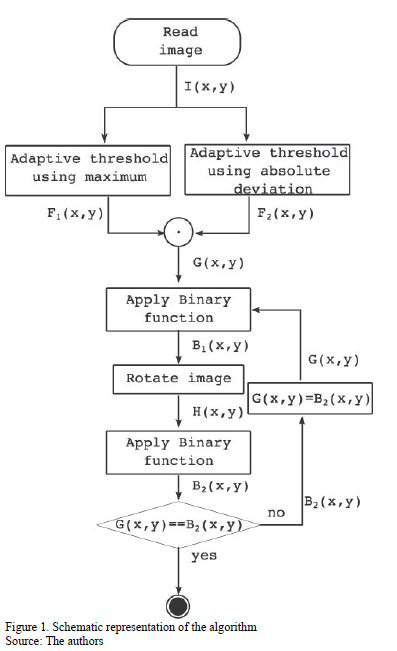
<body><![CDATA[<p><font size="2" face="Verdana, Arial, Helvetica, sans-serif">The aim of the algorithm is to quantify  and locate photoreceptors in in-vivo retinal images. <a href="#fig01">Fig. 1</a> shows the schematic  representation of the algorithm.</font></p>     <p align="center"><font size="2" face="Verdana, Arial, Helvetica, sans-serif"><a name="fig01"></a></font><img src="/img/revistas/dyna/v83n199/v83n199a07fig01.gif"></p>     <p><font size="2" face="Verdana, Arial, Helvetica, sans-serif"><i>2.1.1<b>. </b> Adaptive threshold using local maximum values</i></font></p>     <p><font size="2" face="Verdana, Arial, Helvetica, sans-serif">Let <i>I</i>(<i>x</i>,<i>y</i>)  be a bidimensional intensity function (a matrix) where <i>x</i> and <i>y</i> are the spatial  coordinates of a pixel; let <i>I<sub>max</sub></i>(<i>x</i>,<i>y</i>)  be the local maximum value within a window of 3x3 pixels, being:</font></p>     <p><img src="/img/revistas/dyna/v83n199/v83n199a07eq01.gif"></p>     <p><font size="2" face="Verdana, Arial, Helvetica, sans-serif">Thereby, <i>F</i><sub>1</sub>(<i>x</i>,<i>y</i>) is defined as follows:</font></p>     <p><img src="/img/revistas/dyna/v83n199/v83n199a07eq02.gif"></p>     <p><font size="2" face="Verdana, Arial, Helvetica, sans-serif">2.1.2<b>. </b> Adaptive threshold using absolute deviation</font></p>     <p><font size="2" face="Verdana, Arial, Helvetica, sans-serif">Let <i>M</i>(<i>x</i>,<i>y</i>)  be the maximum absolute deviation (Eq. 3), which determines the sufficient  variance in intensity, with <i>n</i> being  the number of elements, and let <i>I<sub>max</sub></i>(<i>x</i>,<i>y</i>)  be the local maximum value (Eq. 1). Then, let m be a threshold that determines  the sufficient variance in intensity of <i>I</i>(<i>x</i>,<i>y</i>).</font></p>     <p><img src="/img/revistas/dyna/v83n199/v83n199a07eq03.gif"></p>     ]]></body>
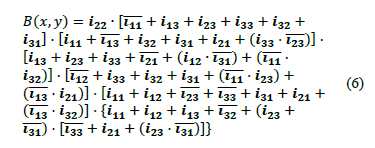
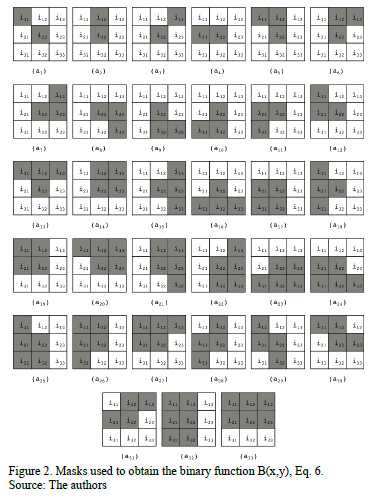
<body><![CDATA[<p><font size="2" face="Verdana, Arial, Helvetica, sans-serif">Thereby, <i>F</i><sub>2</sub>(<i>x</i>,<i>y</i>) is defined as shown in Eq. 4. </font></p>     <p><img src="/img/revistas/dyna/v83n199/v83n199a07eq04.gif"></p>     <p><font size="2" face="Verdana, Arial, Helvetica, sans-serif">The next step in this stage is the generation  of a binary image G(x,y) using Eq. 5, through the logic operation AND of the  results from Eqs. 2 and 4.</font></p>     <p><img src="/img/revistas/dyna/v83n199/v83n199a07eq05.gif"></p>     <p><font size="2" face="Verdana, Arial, Helvetica, sans-serif"><i>2.1.3<b>. </b> Binary operations</i></font></p>     <p><font size="2" face="Verdana, Arial, Helvetica, sans-serif">Eq. 6 is a  binary function that works within a window of 3 X 3 pixels; it was designed to reduced over-detection of cells, where  over-detection of a cell can be represented as elements a1, a2, …, a33 shown in <a href="#fig02">Figs. 2</a>. Element a1 from Fig. X can be represented by  a binary function <img src="/img/revistas/dyna/v83n199/v83n199a07eq014.gif">; where <img src="/img/revistas/dyna/v83n199/v83n199a07eq016.gif">, <img src="/img/revistas/dyna/v83n199/v83n199a07eq018.gif">, <img src="/img/revistas/dyna/v83n199/v83n199a07eq020.gif">, <img src="/img/revistas/dyna/v83n199/v83n199a07eq022.gif">, <img src="/img/revistas/dyna/v83n199/v83n199a07eq024.gif">, <img src="/img/revistas/dyna/v83n199/v83n199a07eq026.gif">, <img src="/img/revistas/dyna/v83n199/v83n199a07eq028.gif">, <img src="/img/revistas/dyna/v83n199/v83n199a07eq030.gif"> and <img src="/img/revistas/dyna/v83n199/v83n199a07eq032.gif">; which means that the central element <img src="/img/revistas/dyna/v83n199/v83n199a07eq034.gif"> is  eliminated to avoid over-detection. Thus, every element from <a href="#fig02">Fig. 2</a> can be  represented by a binary function where the central element<img src="/img/revistas/dyna/v83n199/v83n199a07eq036.gif"> has been  eliminated, and it is based on that fact that every element can be represented  by a binary function, and the combination of all these functions yields cell  location. This  equation was reduced by the Quine-McCluskey method; afterward, Postulates and  Theorems of Boolean Algebra were used to minimize it. This binary function is  applied onto the image I(x,y). Later, the obtained image is rotated 180  degrees, H(x,y) = rotate180(B(x,y)), with the goal of eliminating the multiple  detection in the opposite direction. Then, Eq. 6 is applied onto the rotated  image H(x,y). Finally, the result is rotated back to the original orientation.  This process is performed until algorithm convergence is reached.</font></p>     <p><img src="/img/revistas/dyna/v83n199/v83n199a07eq06.gif"></p>     <p align="center"><font size="2" face="Verdana, Arial, Helvetica, sans-serif"><a name="fig02"></a></font><img src="/img/revistas/dyna/v83n199/v83n199a07fig02.gif"></p>     <p><font size="2" face="Verdana, Arial, Helvetica, sans-serif"><b><i>2.2. Synthetic images</i></b></font></p>     <p><font size="2" face="Verdana, Arial, Helvetica, sans-serif">The synthetic images were generated using  a pre-determined number of pseudo-photoreceptors, which in turn were generated  through the use of a Gaussian function and an elliptical one &#91;30&#93;. The  pseudo-photoreceptors varied at random in terms of size and reflectance, and  they were symmetrically (in equidistant square and hexagonal arrays) and  randomly distributed. Background illumination was added to each of the  generated images, which corresponds to the illumination in the real images  acquired with the AOSLO utilized at the University of Rochester &#91;18&#93;.</font></p>     ]]></body>

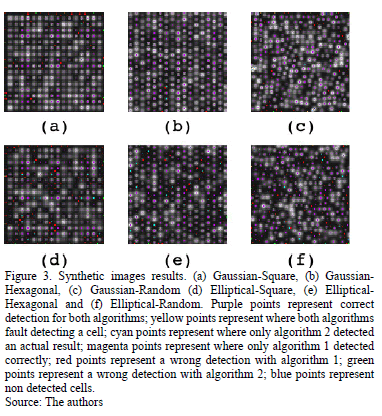
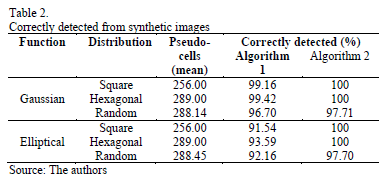
<body><![CDATA[<p><font size="2" face="Verdana, Arial, Helvetica, sans-serif"><b><i>2.3. Real AO images</i></b></font></p>     <p><font size="2" face="Verdana, Arial, Helvetica, sans-serif">We used AOSLO images obtained for current  and previous experiments at the Center for Visual Science of the University of Rochester  to test the algorithm. Data shown from human participants are from experiments  that were approved by the Research Subjects Review Board at the University of  Rochester and adhered to the tenets of the Declaration of Helsinki.  Participants gave informed written consent after the nature of the experiments  and any possible risks were explained both verbally and in writing.</font></p>     <p>&nbsp;</p>     <p><font size="3" face="Verdana, Arial, Helvetica, sans-serif"><b>3. Results</b></font></p>     <p><font size="2" face="Verdana, Arial, Helvetica, sans-serif">The  algorithm developed by Li and Roorda &#91;6&#93; (Algorithm 1) and the algorithm here  proposed (Algorithm 2) have been tested on synthetic and real images, <a href="#fig03">Fig. 3</a> shows the results obtained with both algorithms on synthetic images. In the  caption, we show the color code that was used to identify where a pseudo-cell  was positioned and the results obtained by each algorithm.</font></p>     <p align="center"><font size="2" face="Verdana, Arial, Helvetica, sans-serif"><a name="fig03"></a></font><img src="/img/revistas/dyna/v83n199/v83n199a07fig03.gif"></p>     <p><font size="2" face="Verdana, Arial, Helvetica, sans-serif">For each function-distribution  combination, 1000 synthetic images of 100x100 pixels in size were generated. To  those images, we applied algorithms 1 and 2, and the results obtained were  later evaluated. The outcome of such evaluation is shown in <a href="#tab01">Tables 1</a> and <a href="#tab02">2</a>.  <a href="#tab01">Table 1</a> shows the relative error obtained for each of the combinations, whereas  <a href="#tab02">Table 2</a> shows the number of cells that were correctly detected as corresponding  exactly with the place where the center of the pseudo-cells had been  positioned.</font></p>     <p align="center"><font size="2" face="Verdana, Arial, Helvetica, sans-serif"><a name="tab01"></a></font><img src="/img/revistas/dyna/v83n199/v83n199a07tab01.gif"></p>     <p align="center"><font size="2" face="Verdana, Arial, Helvetica, sans-serif"><a name="tab02"></a></font><img src="/img/revistas/dyna/v83n199/v83n199a07tab02.gif"></p>     <p>&nbsp;</p>     ]]></body>
<body><![CDATA[<p><font size="3" face="Verdana, Arial, Helvetica, sans-serif"><b>4<i>. </i> Discussion and conclusions</b></font></p>     <p><font size="2" face="Verdana, Arial, Helvetica, sans-serif">For all the  images, both real and synthetic, a threshold m = 2.0 was used to calculate the  maximum absolute deviation M<sub>ij</sub>, and it was determined empirically;  it is based on different tests that we conducted. If m &gt; 2.0, we have a very  prominent peak, but if m &lt; 2.0, there is a tendency to flatness. The manual  count presented in <a href="#tab03">Table 3</a> was carried out on the basis of the authors'  appreciation. For algorithm &#91;6&#93;, cut_off_frequency = 0.61p and threshold = 0 were used to test  the all the images.</font></p>     <p align="center"><font size="2" face="Verdana, Arial, Helvetica, sans-serif"><a name="tab03"></a></font><img src="/img/revistas/dyna/v83n199/v83n199a07tab03.gif"></p>     <p><font size="2" face="Verdana, Arial, Helvetica, sans-serif"><a href="#fig04">Fig. 4</a> shows  the results obtained on real images. In the caption, we describe the color code  used to identify the outcome of the algorithm that was utilized in each case.     <a href="#tab03">Table 3</a> shows the number of cells that were manually detected by the authors  and those detected by each algorithm. </font></p>     <p align="center"><font size="2" face="Verdana, Arial, Helvetica, sans-serif"><a name="fig04"></a></font><img src="/img/revistas/dyna/v83n199/v83n199a07fig04.gif"></p>     <p><font size="2" face="Verdana, Arial, Helvetica, sans-serif">As shown in <a href="#tab01">Tables 1</a> and <a href="#tab02">2</a> and in <a href="#fig03">Fig. 3</a>,  both algorithms exhibited similar performances on synthetic images. </font></p>     <p><font size="2" face="Verdana, Arial, Helvetica, sans-serif">When the  algorithm was applied to real images that included cones, rods and vascular  tissue, <a href="#fig04">Fig. 4</a> (a - c), the algorithm developed by Li and Roorda &#91;6&#93; showed  detection of cells in the vascular tissue, as well as poor detection of rods.  It is evident that there are photoreceptors in these zones, but since the  vessels cause the photoreceptor layer to be below or above the blood vessel, it  cannot be stated that photoreceptor detection in this zone is adequate.</font></p>     <p><font size="2" face="Verdana, Arial, Helvetica, sans-serif">Both  algorithms exhibited similar performances on real images that included only cones,     <a href="#fig04">Fig. 4</a> (d, e). It is worth mentioning that Li and Roorda's algorithm does not  show multiple detection for a single photoreceptor, whereas ours does.</font></p>     <p><font size="2" face="Verdana, Arial, Helvetica, sans-serif">As aforementioned, it is very important  and useful to know where photoreceptors are located and how many photoreceptors  there are in the retina, because that information could be used for the  analysis of the distribution and orientation of cones and rods in-vivo as well  as to monitor the evolution of therapies for retinal diseases.</font></p>     <p>&nbsp;</p>     ]]></body>
<body><![CDATA[<p><font size="3" face="Verdana, Arial, Helvetica, sans-serif"><b>Acknowledgments</b></font></p>     <p><font size="2" face="Verdana, Arial, Helvetica, sans-serif">The authors thank Alfredo Dubra, PhD, and  Ethan Rossi, PhD, for the AOSLO images they kindly provided. We also  acknowledge the support of CONACYT through grant 162031 and projects 166326 and  166070. M. W. Acknowledges FONDECYT Nº 3140387. </font></p>     <p>&nbsp;</p>     <p><font size="3" face="Verdana, Arial, Helvetica, sans-serif"><b>References</b></font></p>     <!-- ref --><p><font size="2" face="Verdana, Arial, Helvetica, sans-serif"><b>&#91;1&#93;</b> Oyster,  C.W., Eye. Sinauer Associates,  1<sup>st</sup> ed, 1999. DOI: 10.1046/j.1475-1313.2000.00552.x</font>&nbsp;&nbsp;&nbsp;&nbsp;&nbsp;&nbsp;&nbsp;&nbsp;[&#160;<a href="javascript:void(0);" onclick="javascript: window.open('/scielo.php?script=sci_nlinks&ref=1142202&pid=S0012-7353201600050000700001&lng=','','width=640,height=500,resizable=yes,scrollbars=1,menubar=yes,');">Links</a>&#160;]<!-- end-ref --><!-- ref --><p><font size="2" face="Verdana, Arial, Helvetica, sans-serif"><b>&#91;2&#93;</b> Goldstein, E.B., Sensation and perception. Wadsworthm, 6<sup>th</sup> ed, 2002.    &nbsp;&nbsp;&nbsp;&nbsp;&nbsp;&nbsp;&nbsp;&nbsp;[&#160;<a href="javascript:void(0);" onclick="javascript: window.open('/scielo.php?script=sci_nlinks&ref=1142203&pid=S0012-7353201600050000700002&lng=','','width=640,height=500,resizable=yes,scrollbars=1,menubar=yes,');">Links</a>&#160;]<!-- end-ref --> </font></p>     <!-- ref --><p><font size="2" face="Verdana, Arial, Helvetica, sans-serif"><b>&#91;3&#93;</b> Rodieck, R.W., The first steps in seeing. Sinauer Associates, 1<sup>st</sup> ed., 1999.    &nbsp;&nbsp;&nbsp;&nbsp;&nbsp;&nbsp;&nbsp;&nbsp;[&#160;<a href="javascript:void(0);" onclick="javascript: window.open('/scielo.php?script=sci_nlinks&ref=1142205&pid=S0012-7353201600050000700003&lng=','','width=640,height=500,resizable=yes,scrollbars=1,menubar=yes,');">Links</a>&#160;]<!-- end-ref --></font></p>     <!-- ref --><p><font size="2" face="Verdana, Arial, Helvetica, sans-serif"><b>&#91;4&#93;</b> Levin, L.A., Nilsson, S.F.E., Hoeve, J.V., Wu, S., Kaufman, P.L. and  Alm, A., Adlers physiology of the eye. Elsevier, 11<sup>th</sup> ed., 2011.  DOI: <a href="http://dx.doi.org/10.1016/S0039-6257(03)00069-9" target="_blank">http://dx.doi.org/10.1016/S0039-6257(03)00069-9</a></font>&nbsp;&nbsp;&nbsp;&nbsp;&nbsp;&nbsp;&nbsp;&nbsp;[&#160;<a href="javascript:void(0);" onclick="javascript: window.open('/scielo.php?script=sci_nlinks&ref=1142207&pid=S0012-7353201600050000700004&lng=','','width=640,height=500,resizable=yes,scrollbars=1,menubar=yes,');">Links</a>&#160;]<!-- end-ref --><!-- ref --><p><font size="2" face="Verdana, Arial, Helvetica, sans-serif"><b>&#91;5&#93;</b> Curcio, C.A., Sloan, K.R., Kalina R.E. and Hendrickson, A.E., Human  photoreceptor topography. The Journal of Comparative Neurology, 292, pp.  497-523, 1990. DOI: 10.1002/cne.902920402</font>&nbsp;&nbsp;&nbsp;&nbsp;&nbsp;&nbsp;&nbsp;&nbsp;[&#160;<a href="javascript:void(0);" onclick="javascript: window.open('/scielo.php?script=sci_nlinks&ref=1142208&pid=S0012-7353201600050000700005&lng=','','width=640,height=500,resizable=yes,scrollbars=1,menubar=yes,');">Links</a>&#160;]<!-- end-ref --><!-- ref --><p><font size="2" face="Verdana, Arial, Helvetica, sans-serif"><b>&#91;6&#93;</b> Li, K.Y. and Roorda, A., Automated identification of cone  photoreceptors in adaptive optics retinal images. J. Opt. Soc. Am. A, 24, pp.  1358-1363, 2007. DOI: 10.1364/JOSAA.24.001358.    &nbsp;&nbsp;&nbsp;&nbsp;&nbsp;&nbsp;&nbsp;&nbsp;[&#160;<a href="javascript:void(0);" onclick="javascript: window.open('/scielo.php?script=sci_nlinks&ref=1142209&pid=S0012-7353201600050000700006&lng=','','width=640,height=500,resizable=yes,scrollbars=1,menubar=yes,');">Links</a>&#160;]<!-- end-ref --></font></p>     <!-- ref --><p><font size="2" face="Verdana, Arial, Helvetica, sans-serif"><b>&#91;7&#93;</b> Doble, N., Choi, S.S., Codona, J.L., Christou, J., Enoch J.M. and  Williams, D.R., In vivo imaging of rod photoreceptor mosaic. Opt. Lett., 36,  pp. 31-33, 2011. DOI: 10.1364/OL.36.000031.    &nbsp;&nbsp;&nbsp;&nbsp;&nbsp;&nbsp;&nbsp;&nbsp;[&#160;<a href="javascript:void(0);" onclick="javascript: window.open('/scielo.php?script=sci_nlinks&ref=1142211&pid=S0012-7353201600050000700007&lng=','','width=640,height=500,resizable=yes,scrollbars=1,menubar=yes,');">Links</a>&#160;]<!-- end-ref --></font></p>     <!-- ref --><p><font size="2" face="Verdana, Arial, Helvetica, sans-serif"><b>&#91;8&#93;</b> Putnam, N.M., Hammer, D.X., Zhang, Y., Merino, D. and Roorda, A.,  Modeling the foveal cone mosaic imaged with adaptive optics scanning laser  ophthalmoscopy. Opt. Express, 18, pp. 24902-24916, 2010. DOI:  10.1364/OE.18.024902</font>&nbsp;&nbsp;&nbsp;&nbsp;&nbsp;&nbsp;&nbsp;&nbsp;[&#160;<a href="javascript:void(0);" onclick="javascript: window.open('/scielo.php?script=sci_nlinks&ref=1142213&pid=S0012-7353201600050000700008&lng=','','width=640,height=500,resizable=yes,scrollbars=1,menubar=yes,');">Links</a>&#160;]<!-- end-ref --><!-- ref --><p><font size="2" face="Verdana, Arial, Helvetica, sans-serif"><b>&#91;9&#93;</b> Fisher, J.B., Jacobs, D.A., Markowitz, C.E., Galetta, S.L., Volpe,  N.J., Nano-Schiavi, M.L., Baier, M.L., Frohman, E.M., Winslow, H., Frohman,  T.C., Calabresi, P.A., Maguire, M.G., Cutter, G.R. and Balcer, L.J., Relation  of visual function to retinal nerve fiber layer thickness in multiple  scleriosis. Ophthalmology, 113, pp. 324-332, 2006. DOI:  10.1016/j.ophtha.2005.10.040.    &nbsp;&nbsp;&nbsp;&nbsp;&nbsp;&nbsp;&nbsp;&nbsp;[&#160;<a href="javascript:void(0);" onclick="javascript: window.open('/scielo.php?script=sci_nlinks&ref=1142214&pid=S0012-7353201600050000700009&lng=','','width=640,height=500,resizable=yes,scrollbars=1,menubar=yes,');">Links</a>&#160;]<!-- end-ref --></font></p>     <!-- ref --><p><font size="2" face="Verdana, Arial, Helvetica, sans-serif"><b>&#91;10&#93;</b> Miller, D.T., Willliams, D.R., Morris, G.M. and Liang, J., Images of  cone photoreceptors in the living human eye. Vision Research, 36, pp.  1067-1079, 1996. DOI: <a href="http://dx.doi.org/10.1016/0042-6989(95)00225-1" target="_blank">http://dx.doi.org/10.1016/0042-6989(95)00225-1</a></font>&nbsp;&nbsp;&nbsp;&nbsp;&nbsp;&nbsp;&nbsp;&nbsp;[&#160;<a href="javascript:void(0);" onclick="javascript: window.open('/scielo.php?script=sci_nlinks&ref=1142216&pid=S0012-7353201600050000700010&lng=','','width=640,height=500,resizable=yes,scrollbars=1,menubar=yes,');">Links</a>&#160;]<!-- end-ref --><!-- ref --><p><font size="2" face="Verdana, Arial, Helvetica, sans-serif"><b>&#91;11&#93;</b> Takayama, K., Ooto, S., Hangai, M., Arakawa, N., Oshima, S.,  Shibata, N., Hanebuchi, M., Inoue, T. and Yoshimura, N., High-resolution  imaging of the retinal nerve fiber layer in normal eyes using adaptive optics  scanning laser ophthalmoscopy. PLoS ONE, 7, e33158, 2012. DOI:  <a href="http://dx.doi.org/10.1371/journal.pone.0033158" target="_blank">http://dx.doi.org/10.1371/journal.pone.0033158</a>.    &nbsp;&nbsp;&nbsp;&nbsp;&nbsp;&nbsp;&nbsp;&nbsp;[&#160;<a href="javascript:void(0);" onclick="javascript: window.open('/scielo.php?script=sci_nlinks&ref=1142217&pid=S0012-7353201600050000700011&lng=','','width=640,height=500,resizable=yes,scrollbars=1,menubar=yes,');">Links</a>&#160;]<!-- end-ref --> </font></p>     <!-- ref --><p><font size="2" face="Verdana, Arial, Helvetica, sans-serif"><b>&#91;12&#93;</b> Hunter, J.J., Masella, B., Dubra, A., Sharma, R., Yin, L., Merigan,  W.H., Palczewska, G., Palczewski, K. and Williams, D.R., Images of  photoreceptors in living primate eyes using adaptive optics two-photon  ophthalmoscopy. Biomed. Opt. Express, 2, pp. 139-148, 2011. DOI:  10.1364/BOE.2.000139</font>&nbsp;&nbsp;&nbsp;&nbsp;&nbsp;&nbsp;&nbsp;&nbsp;[&#160;<a href="javascript:void(0);" onclick="javascript: window.open('/scielo.php?script=sci_nlinks&ref=1142219&pid=S0012-7353201600050000700012&lng=','','width=640,height=500,resizable=yes,scrollbars=1,menubar=yes,');">Links</a>&#160;]<!-- end-ref --><!-- ref --><p><font size="2" face="Verdana, Arial, Helvetica, sans-serif"><b>&#91;13&#93;</b> Liang, J., Williams, D.R. and Miller, D.T., Supernormal vision and  high-resolution retinal imaging through adaptive optics. J. Opt. Soc. Am. A,  14, pp. 2884-2892, 1997. DOI: 10.1364/JOSAA.14.002884</font>&nbsp;&nbsp;&nbsp;&nbsp;&nbsp;&nbsp;&nbsp;&nbsp;[&#160;<a href="javascript:void(0);" onclick="javascript: window.open('/scielo.php?script=sci_nlinks&ref=1142220&pid=S0012-7353201600050000700013&lng=','','width=640,height=500,resizable=yes,scrollbars=1,menubar=yes,');">Links</a>&#160;]<!-- end-ref --><!-- ref --><p><font size="2" face="Verdana, Arial, Helvetica, sans-serif"><b>&#91;14&#93;</b> Jonnal, R.S., Rha, J., Zhang, Y., Cense, B., Gao, W. and Miller, D.T.,  In vivo functional imaging of human cone photoreceptors. Opt. Express, 15, pp.  16141-16160, 2007. DOI: 10.1364/OE.15.016141</font>&nbsp;&nbsp;&nbsp;&nbsp;&nbsp;&nbsp;&nbsp;&nbsp;[&#160;<a href="javascript:void(0);" onclick="javascript: window.open('/scielo.php?script=sci_nlinks&ref=1142221&pid=S0012-7353201600050000700014&lng=','','width=640,height=500,resizable=yes,scrollbars=1,menubar=yes,');">Links</a>&#160;]<!-- end-ref --><!-- ref --><p><font size="2" face="Verdana, Arial, Helvetica, sans-serif"><b>&#91;15&#93;</b> Baraas, R.C., Caroll, J., Gunther, K.L., Chung, M., Williams, D.R.,  Foster, D.H. and Neitz, M., Adaptive optics retinal imaging reveals s-cone  dystrophy in tritan color-vision deficiency. J. Opt. Soc. Am. A, 24, pp.  1438-1447, 2007. doi: 10.1364/JOSAA.24.001438.    &nbsp;&nbsp;&nbsp;&nbsp;&nbsp;&nbsp;&nbsp;&nbsp;[&#160;<a href="javascript:void(0);" onclick="javascript: window.open('/scielo.php?script=sci_nlinks&ref=1142222&pid=S0012-7353201600050000700015&lng=','','width=640,height=500,resizable=yes,scrollbars=1,menubar=yes,');">Links</a>&#160;]<!-- end-ref --></font></p>     <!-- ref --><p><font size="2" face="Verdana, Arial, Helvetica, sans-serif"><b>&#91;16&#93;</b> Morgan, J.I.W., Dubra, A., Wolfe, R., Merigan, W.H. and Williams, D.R.,  In vivo autofluorescence imaging of and macaque retinal pigment epithelial cell  mosaic. Investigative Ophthalmology &amp; Visual Science, 50, pp. 1350-1359,  2009. DOI: 10.1167/iovs.08-2618 </font>&nbsp;&nbsp;&nbsp;&nbsp;&nbsp;&nbsp;&nbsp;&nbsp;[&#160;<a href="javascript:void(0);" onclick="javascript: window.open('/scielo.php?script=sci_nlinks&ref=1142224&pid=S0012-7353201600050000700016&lng=','','width=640,height=500,resizable=yes,scrollbars=1,menubar=yes,');">Links</a>&#160;]<!-- end-ref --><!-- ref --><p><font size="2" face="Verdana, Arial, Helvetica, sans-serif"><b>&#91;17&#93;</b> Carroll, J., Choi, S.S. and Williams, D.R., In vivo imaging of the  photoreceptor mosaic of a rod monochromat. Vision Research, 48, pp. 2564-2568,  2008. DOI: 10.1016/j.visres.2008.04.006</font>&nbsp;&nbsp;&nbsp;&nbsp;&nbsp;&nbsp;&nbsp;&nbsp;[&#160;<a href="javascript:void(0);" onclick="javascript: window.open('/scielo.php?script=sci_nlinks&ref=1142225&pid=S0012-7353201600050000700017&lng=','','width=640,height=500,resizable=yes,scrollbars=1,menubar=yes,');">Links</a>&#160;]<!-- end-ref --><!-- ref --><p><font size="2" face="Verdana, Arial, Helvetica, sans-serif"><b>&#91;18&#93;</b> Rossi, E.A., Chung, M., Dubra, A., Hunter, S.S., Merigan, W.H. and  Williams, D.R., Imaging retinal mosaics in the living eye. Eye, 25, pp.  301-308, 2011. DOI: 10.1038/eye.2010.221</font>&nbsp;&nbsp;&nbsp;&nbsp;&nbsp;&nbsp;&nbsp;&nbsp;[&#160;<a href="javascript:void(0);" onclick="javascript: window.open('/scielo.php?script=sci_nlinks&ref=1142226&pid=S0012-7353201600050000700018&lng=','','width=640,height=500,resizable=yes,scrollbars=1,menubar=yes,');">Links</a>&#160;]<!-- end-ref --><!-- ref --><p><font size="2" face="Verdana, Arial, Helvetica, sans-serif"><b>&#91;19&#93;</b> Williams, D.R., Imaging single cells in the living retina. Vision  Research, 51, pp. 1379-1396, 2011. DOI: 10.1016/j.visres.2011.05.002.    &nbsp;&nbsp;&nbsp;&nbsp;&nbsp;&nbsp;&nbsp;&nbsp;[&#160;<a href="javascript:void(0);" onclick="javascript: window.open('/scielo.php?script=sci_nlinks&ref=1142227&pid=S0012-7353201600050000700019&lng=','','width=640,height=500,resizable=yes,scrollbars=1,menubar=yes,');">Links</a>&#160;]<!-- end-ref --></font></p>     <!-- ref --><p><font size="2" face="Verdana, Arial, Helvetica, sans-serif"><b>&#91;20&#93;</b> Morgan, J.I.W., Hunter, J.J., Masella, B., Wolfe, R., Gray, D.C.,  Merigan, W.H., Delori, F.C. and Williams, D.R., Light-induced retinal changes  observed with high-resolution autofluorescence imaging of the retinal pigment  epithelium. Visual Science, 49, pp. 3715-3729, 2008. DOI: 10.1167/iovs.07-1430</font>&nbsp;&nbsp;&nbsp;&nbsp;&nbsp;&nbsp;&nbsp;&nbsp;[&#160;<a href="javascript:void(0);" onclick="javascript: window.open('/scielo.php?script=sci_nlinks&ref=1142229&pid=S0012-7353201600050000700020&lng=','','width=640,height=500,resizable=yes,scrollbars=1,menubar=yes,');">Links</a>&#160;]<!-- end-ref --><!-- ref --><p><font size="2" face="Verdana, Arial, Helvetica, sans-serif"><b>&#91;21&#93;</b> Roorda, A., Zhang, Y. and Duncan, J.L., High-resolution in vivo  imaging of the rpe mosaic in eyes with retinal disease. Investigative  Ophthalmology &amp; Visual Science, 48, pp. 2297-2303, 2007. DOI: 10.1167/iovs.06-1450</font>&nbsp;&nbsp;&nbsp;&nbsp;&nbsp;&nbsp;&nbsp;&nbsp;[&#160;<a href="javascript:void(0);" onclick="javascript: window.open('/scielo.php?script=sci_nlinks&ref=1142230&pid=S0012-7353201600050000700021&lng=','','width=640,height=500,resizable=yes,scrollbars=1,menubar=yes,');">Links</a>&#160;]<!-- end-ref --><!-- ref --><p><font size="2" face="Verdana, Arial, Helvetica, sans-serif"><b>&#91;22&#93;</b> Rossi, E.A., Rangel-Fonseca, P., Parkins, K., Fischer, W., Latchney,  L. R., Folwell, M.A., Williams, D.R., Dubra, A. and Chung, M.M., In vivo  imaging of retinal pigment epithelium cells in age related macular  degeneration. Biomed. Opt. Express, 4, 2527-2539, 2013. DOI:  10.1364/BOE.4.002527</font>&nbsp;&nbsp;&nbsp;&nbsp;&nbsp;&nbsp;&nbsp;&nbsp;[&#160;<a href="javascript:void(0);" onclick="javascript: window.open('/scielo.php?script=sci_nlinks&ref=1142231&pid=S0012-7353201600050000700022&lng=','','width=640,height=500,resizable=yes,scrollbars=1,menubar=yes,');">Links</a>&#160;]<!-- end-ref --><!-- ref --><p><font size="2" face="Verdana, Arial, Helvetica, sans-serif"><b>&#91;23&#93;</b> Organisciak, D.T. and Vaughan, D.K., Retinal light damage:  Mechanisms and protection. Progress in Retinal and Eye Research, 29, pp.  113-134, 2010. DOI: 10.1016/j.preteyeres.2009.11.004</font>&nbsp;&nbsp;&nbsp;&nbsp;&nbsp;&nbsp;&nbsp;&nbsp;[&#160;<a href="javascript:void(0);" onclick="javascript: window.open('/scielo.php?script=sci_nlinks&ref=1142232&pid=S0012-7353201600050000700023&lng=','','width=640,height=500,resizable=yes,scrollbars=1,menubar=yes,');">Links</a>&#160;]<!-- end-ref --><!-- ref --><p><font size="2" face="Verdana, Arial, Helvetica, sans-serif"><b>&#91;24&#93;</b> Garrioch, R., Langlo, C., Dubis, A.M., Cooper, R.F., Dubra, A. and  Carroll, J., Repeatability of in vivo parafoveal cone density and spacing  measurements. Optometry and Vision Science, 85, pp. 632-643, 2012. DOI: 10.1097/OPX.0b013e3182540562</font>&nbsp;&nbsp;&nbsp;&nbsp;&nbsp;&nbsp;&nbsp;&nbsp;[&#160;<a href="javascript:void(0);" onclick="javascript: window.open('/scielo.php?script=sci_nlinks&ref=1142233&pid=S0012-7353201600050000700024&lng=','','width=640,height=500,resizable=yes,scrollbars=1,menubar=yes,');">Links</a>&#160;]<!-- end-ref --><!-- ref --><p><font size="2" face="Verdana, Arial, Helvetica, sans-serif"><b>&#91;25&#93;</b> Wojtas, D.H., Wu B., Ahnelt, P.K., Bones, P.J. and Millane, R.P.  Automated analysis of differential interference contrast microscopy images of  the foveal cone mosaic. J. Opt. Soc. Am. A, 25, pp. 1181-1189, 2008. DOI:  10.1364/JOSAA.25.001181</font>&nbsp;&nbsp;&nbsp;&nbsp;&nbsp;&nbsp;&nbsp;&nbsp;[&#160;<a href="javascript:void(0);" onclick="javascript: window.open('/scielo.php?script=sci_nlinks&ref=1142234&pid=S0012-7353201600050000700025&lng=','','width=640,height=500,resizable=yes,scrollbars=1,menubar=yes,');">Links</a>&#160;]<!-- end-ref --><!-- ref --><p><font size="2" face="Verdana, Arial, Helvetica, sans-serif"><b>&#91;26&#93;</b> Sekhar, S., El-Samie, F.E.A., Yu, P., Al-Nuaimy, W. and Nandi, A.K.,  Automated localization of retinal features. App. Opt., 50, pp. 3064-3075, 2011.  DOI: 10.1364/AO.50.003064.    &nbsp;&nbsp;&nbsp;&nbsp;&nbsp;&nbsp;&nbsp;&nbsp;[&#160;<a href="javascript:void(0);" onclick="javascript: window.open('/scielo.php?script=sci_nlinks&ref=1142235&pid=S0012-7353201600050000700026&lng=','','width=640,height=500,resizable=yes,scrollbars=1,menubar=yes,');">Links</a>&#160;]<!-- end-ref --></font></p>     <!-- ref --><p><font size="2" face="Verdana, Arial, Helvetica, sans-serif"><b>&#91;27&#93;</b> Takayama, K., Ooto, S., Hangai, M., Ueda-Arakawa, N., Yoshida, S.,  Akagi, T., Ikeda, H.O., Nonaka, A., Hanebuchi, M., Inoue, T. and Yoshimura, N.,  High-resolution imaging of retinal nerve fiber bundles in glaucoma using  adaptive optics scanning laser ophthalmoscopy. Am. J Ophthalmology, 155(e3),  pp. 870-881, 2013. DOI: 10.1016/j.ajo.2012.11.016.    &nbsp;&nbsp;&nbsp;&nbsp;&nbsp;&nbsp;&nbsp;&nbsp;[&#160;<a href="javascript:void(0);" onclick="javascript: window.open('/scielo.php?script=sci_nlinks&ref=1142237&pid=S0012-7353201600050000700027&lng=','','width=640,height=500,resizable=yes,scrollbars=1,menubar=yes,');">Links</a>&#160;]<!-- end-ref --></font></p>     <!-- ref --><p><font size="2" face="Verdana, Arial, Helvetica, sans-serif"><b>&#91;28&#93;</b> Rangel-Fonseca, P., G&oacute;mez-Vieyra, A., Malacara-Hern&aacute;ndez, D.,  Wilson, M.C., Williams, D.R. and Rossi, E.A., Automated segmentation of retinal  pigment epithelium cells in fluorescence adaptive optics images. J. Opt. Soc.  Am. A, 30, pp. 2595-2604, 2013. DOI: 10.1364/JOSAA.30.002595.    &nbsp;&nbsp;&nbsp;&nbsp;&nbsp;&nbsp;&nbsp;&nbsp;[&#160;<a href="javascript:void(0);" onclick="javascript: window.open('/scielo.php?script=sci_nlinks&ref=1142239&pid=S0012-7353201600050000700028&lng=','','width=640,height=500,resizable=yes,scrollbars=1,menubar=yes,');">Links</a>&#160;]<!-- end-ref --></font></p>     <!-- ref --><p><font size="2" face="Verdana, Arial, Helvetica, sans-serif"><b>&#91;29&#93;</b> Chiu, S.J., Toth, C.A., Rickman, C.B., Izatt, J.A. and Farsiu, S.,  Automatic segmentation of closed-contour features in ophthalmic images using  graph theory and dynamic programming. Biomed. Opt. Express, 3, pp. 1127-1140,  2012. DOI: 10.1364/BOE.3.001127 </font>&nbsp;&nbsp;&nbsp;&nbsp;&nbsp;&nbsp;&nbsp;&nbsp;[&#160;<a href="javascript:void(0);" onclick="javascript: window.open('/scielo.php?script=sci_nlinks&ref=1142241&pid=S0012-7353201600050000700029&lng=','','width=640,height=500,resizable=yes,scrollbars=1,menubar=yes,');">Links</a>&#160;]<!-- end-ref --><!-- ref --><p><font size="2" face="Verdana, Arial, Helvetica, sans-serif"><b>&#91;30&#93;</b> Valencia-Estrada,  J.C. and Bedoya-Calle, A.H., Trigonometr&iacute;a el&iacute;ptica para su uso en ingenier&iacute;a.  Jornada de Investigaci&oacute;n EIA (Escuela de Ingenier&iacute;a de Antioqu&iacute;a), 2, pp.  84-92, 2009.    &nbsp;&nbsp;&nbsp;&nbsp;&nbsp;&nbsp;&nbsp;&nbsp;[&#160;<a href="javascript:void(0);" onclick="javascript: window.open('/scielo.php?script=sci_nlinks&ref=1142242&pid=S0012-7353201600050000700030&lng=','','width=640,height=500,resizable=yes,scrollbars=1,menubar=yes,');">Links</a>&#160;]<!-- end-ref --></font></p>     <p>&nbsp;</p>     <p><font size="2" face="Verdana, Arial, Helvetica, sans-serif"><b>P. Rangel-Fonseca,</b> is PhD candidate, received his BSc. of  Electronics Engineering in 2003, in 2005 he received his MSc. in Electrical  Engineering, at Universidad de Guanajuato, Mexico. Currently he is working  towards on his PhD. Degree at Centro de Investigaciones en Optica A.C. His main  research interest is image processing application in the biomedical area. ORCID: http://orcid.org/0000-0002-6254-0550 </font></p>     <p><font size="2" face="Verdana, Arial, Helvetica, sans-serif"><b>A. G&oacute;mez-Vieyra, </b>is PhD,  received obtained his BSc. of Electronics Engineering in 2004 at Universidad  Autonoma Metropolitana, Mexico, in 2005 he received his MSc and in 2010 he received  his PhD in Optics at Centro de Investigaciones en Optica A.C. His current  research interest includes vision science and optical engineering. ORCID: http://orcid.org/0000-0003-0290-1518 </font></p>     <p><font size="2" face="Verdana, Arial, Helvetica, sans-serif"><b>D. Malacara-Hern&aacute;ndez, </b>his  PhD. in Optics in 1965 from the University of Rochester. He has published more  than one hundred and thirty refereed papers in Optical Engineering optics  journals. He is a Fellow, both of the <i>Optical Society of America</i> and <i>The  International Society for Optical Engineering</i> (SPIE). In 1987 he was  elected a Vice-president of the <i>SPIE - International Commission for  Optics</i>. He has served the <i>Optical Society of America</i> as a  Topical Editor for <i>Applied Optics</i> from 1989 to 1992<i>.</i>He  also has served <i>SPIE - The International Society for Optical  Engineering</i>, as a member of the Board of Governors from 1990 to 1991.In  1989 he was granted the <i>Rudolf and Hilda Kingslake Chair in Optical  Engineering,</i> at the Institute of Optics of the University of  Rochester. He also received in 1994 the A. E. Conrady Award for Scientific Achievement  by <i>SPIE</i>.-<i>International Society for Optical Engineers</i> and  in 1996 the Galileo Galilei Award<i>,</i> by the <i>International  Commission for Optics</i>, and the Joseph Fraunhofer Award.-Robert M. Burley,  from the <i>Optical Society of America</i> in 2002. He also received  in 2012 the Gold Medal Award by <i>SPIE</i> - <i>International  Society for Optical Engineers</i>. ORCID: http://  orcid.org/0000-0001-8564-0119</font></p>     ]]></body>
<body><![CDATA[<p><font size="2" face="Verdana, Arial, Helvetica, sans-serif"><b>M. C. Wilson,</b> is PhD., in  Optics in 2011 at Centro de Investigaciones en &Oacute;ptica A.C. His main research  interests are Nonlinear Optics, Fiber Optics Sensors, Vision and Geothermal  Sciences. He is  referee of Optics and Physics Journals. ORCID: http://orcid.org/0000-0001-9261-2589</font></p>      ]]></body><back>
<ref-list>
<ref id="B1">
<label>1</label><nlm-citation citation-type="book">
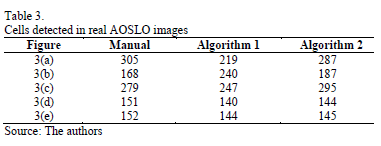
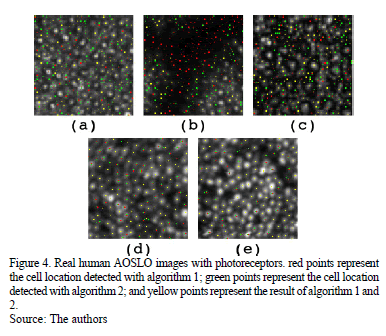
<person-group person-group-type="author">
<name>
<surname><![CDATA[Oyster]]></surname>
<given-names><![CDATA[C.W.]]></given-names>
</name>
</person-group>
<source><![CDATA[Eye]]></source>
<year>1999</year>
<edition>1st</edition>
<publisher-name><![CDATA[Sinauer Associates]]></publisher-name>
</nlm-citation>
</ref>
<ref id="B2">
<label>2</label><nlm-citation citation-type="book">
<person-group person-group-type="author">
<name>
<surname><![CDATA[Goldstein]]></surname>
<given-names><![CDATA[E.B.]]></given-names>
</name>
</person-group>
<source><![CDATA[Sensation and perception]]></source>
<year>2002</year>
<edition>6th</edition>
<publisher-name><![CDATA[Wadsworthm]]></publisher-name>
</nlm-citation>
</ref>
<ref id="B3">
<label>3</label><nlm-citation citation-type="book">
<person-group person-group-type="author">
<name>
<surname><![CDATA[Rodieck]]></surname>
<given-names><![CDATA[R.W.]]></given-names>
</name>
</person-group>
<source><![CDATA[The first steps in seeing]]></source>
<year>1999</year>
<edition>1st</edition>
<publisher-name><![CDATA[Sinauer Associates]]></publisher-name>
</nlm-citation>
</ref>
<ref id="B4">
<label>4</label><nlm-citation citation-type="book">
<person-group person-group-type="author">
<name>
<surname><![CDATA[Levin]]></surname>
<given-names><![CDATA[L.A.]]></given-names>
</name>
<name>
<surname><![CDATA[Nilsson]]></surname>
<given-names><![CDATA[S.F.E.]]></given-names>
</name>
<name>
<surname><![CDATA[Hoeve]]></surname>
<given-names><![CDATA[J.V.]]></given-names>
</name>
<name>
<surname><![CDATA[Wu]]></surname>
<given-names><![CDATA[S.]]></given-names>
</name>
<name>
<surname><![CDATA[Kaufman]]></surname>
<given-names><![CDATA[P.L.]]></given-names>
</name>
<name>
<surname><![CDATA[Alm]]></surname>
<given-names><![CDATA[A.]]></given-names>
</name>
</person-group>
<source><![CDATA[Adlers physiology of the eye.]]></source>
<year>2011</year>
<edition>11th</edition>
<publisher-name><![CDATA[Elsevier]]></publisher-name>
</nlm-citation>
</ref>
<ref id="B5">
<label>5</label><nlm-citation citation-type="journal">
<person-group person-group-type="author">
<name>
<surname><![CDATA[Curcio]]></surname>
<given-names><![CDATA[C.A.]]></given-names>
</name>
<name>
<surname><![CDATA[Sloan]]></surname>
<given-names><![CDATA[K.R.]]></given-names>
</name>
<name>
<surname><![CDATA[Kalina]]></surname>
<given-names><![CDATA[R.E.]]></given-names>
</name>
<name>
<surname><![CDATA[Hendrickson]]></surname>
<given-names><![CDATA[A.E.]]></given-names>
</name>
</person-group>
<article-title xml:lang="en"><![CDATA[Human photoreceptor topography]]></article-title>
<source><![CDATA[The Journal of Comparative Neurology]]></source>
<year>1990</year>
<numero>292</numero>
<issue>292</issue>
<page-range>497-523</page-range></nlm-citation>
</ref>
<ref id="B6">
<label>6</label><nlm-citation citation-type="journal">
<person-group person-group-type="author">
<name>
<surname><![CDATA[Li]]></surname>
<given-names><![CDATA[K.Y.]]></given-names>
</name>
<name>
<surname><![CDATA[Roorda]]></surname>
<given-names><![CDATA[A.]]></given-names>
</name>
</person-group>
<article-title xml:lang="en"><![CDATA[Automated identification of cone photoreceptors in adaptive optics retinal images]]></article-title>
<source><![CDATA[J. Opt. Soc. Am. A]]></source>
<year>2007</year>
<numero>24</numero>
<issue>24</issue>
<page-range>1358-1363</page-range></nlm-citation>
</ref>
<ref id="B7">
<label>7</label><nlm-citation citation-type="journal">
<person-group person-group-type="author">
<name>
<surname><![CDATA[Doble]]></surname>
<given-names><![CDATA[N.]]></given-names>
</name>
<name>
<surname><![CDATA[Choi]]></surname>
<given-names><![CDATA[S.S.]]></given-names>
</name>
<name>
<surname><![CDATA[Codona]]></surname>
<given-names><![CDATA[J.L.]]></given-names>
</name>
<name>
<surname><![CDATA[Christou]]></surname>
<given-names><![CDATA[J.]]></given-names>
</name>
<name>
<surname><![CDATA[Enoch]]></surname>
<given-names><![CDATA[J.M.]]></given-names>
</name>
<name>
<surname><![CDATA[Williams]]></surname>
<given-names><![CDATA[D.R.]]></given-names>
</name>
</person-group>
<article-title xml:lang="en"><![CDATA[In vivo imaging of rod photoreceptor mosaic]]></article-title>
<source><![CDATA[Opt. Lett.]]></source>
<year>2011</year>
<numero>36</numero>
<issue>36</issue>
<page-range>31-33</page-range></nlm-citation>
</ref>
<ref id="B8">
<label>8</label><nlm-citation citation-type="journal">
<person-group person-group-type="author">
<name>
<surname><![CDATA[Putnam]]></surname>
<given-names><![CDATA[N.M.]]></given-names>
</name>
<name>
<surname><![CDATA[Hammer]]></surname>
<given-names><![CDATA[D.X.]]></given-names>
</name>
<name>
<surname><![CDATA[Zhang]]></surname>
<given-names><![CDATA[Y.]]></given-names>
</name>
<name>
<surname><![CDATA[Merino]]></surname>
<given-names><![CDATA[D.]]></given-names>
</name>
<name>
<surname><![CDATA[Roorda]]></surname>
<given-names><![CDATA[A.]]></given-names>
</name>
</person-group>
<article-title xml:lang="en"><![CDATA[Modeling the foveal cone mosaic imaged with adaptive optics scanning laser ophthalmoscopy.]]></article-title>
<source><![CDATA[Opt. Express]]></source>
<year>2010</year>
<numero>18</numero>
<issue>18</issue>
<page-range>24902-24916</page-range></nlm-citation>
</ref>
<ref id="B9">
<label>9</label><nlm-citation citation-type="journal">
<person-group person-group-type="author">
<name>
<surname><![CDATA[Fisher]]></surname>
<given-names><![CDATA[J.B.]]></given-names>
</name>
<name>
<surname><![CDATA[Jacobs]]></surname>
<given-names><![CDATA[D.A.]]></given-names>
</name>
<name>
<surname><![CDATA[Markowitz]]></surname>
<given-names><![CDATA[C.E.]]></given-names>
</name>
<name>
<surname><![CDATA[Galetta]]></surname>
<given-names><![CDATA[S.L.]]></given-names>
</name>
<name>
<surname><![CDATA[Volpe]]></surname>
<given-names><![CDATA[N.J.]]></given-names>
</name>
<name>
<surname><![CDATA[Nano-Schiavi]]></surname>
<given-names><![CDATA[M.L.]]></given-names>
</name>
<name>
<surname><![CDATA[Baier]]></surname>
<given-names><![CDATA[M.L.]]></given-names>
</name>
<name>
<surname><![CDATA[Frohman]]></surname>
<given-names><![CDATA[E.M]]></given-names>
</name>
<name>
<surname><![CDATA[Winslow]]></surname>
<given-names><![CDATA[H.]]></given-names>
</name>
<name>
<surname><![CDATA[Frohman]]></surname>
<given-names><![CDATA[T.C.]]></given-names>
</name>
<name>
<surname><![CDATA[Calabresi]]></surname>
<given-names><![CDATA[P.A.]]></given-names>
</name>
<name>
<surname><![CDATA[Maguire]]></surname>
<given-names><![CDATA[M.G]]></given-names>
</name>
<name>
<surname><![CDATA[Cutter]]></surname>
<given-names><![CDATA[G.R.]]></given-names>
</name>
<name>
<surname><![CDATA[Balcer]]></surname>
<given-names><![CDATA[L.J.]]></given-names>
</name>
</person-group>
<article-title xml:lang="en"><![CDATA[Relation of visual function to retinal nerve fiber layer thickness in multiple scleriosis]]></article-title>
<source><![CDATA[Ophthalmology]]></source>
<year>2006</year>
<numero>113</numero>
<issue>113</issue>
<page-range>324-332</page-range></nlm-citation>
</ref>
<ref id="B10">
<label>10</label><nlm-citation citation-type="journal">
<person-group person-group-type="author">
<name>
<surname><![CDATA[Miller]]></surname>
<given-names><![CDATA[D.T.]]></given-names>
</name>
<name>
<surname><![CDATA[Willliams]]></surname>
<given-names><![CDATA[D.R.]]></given-names>
</name>
<name>
<surname><![CDATA[Morris]]></surname>
<given-names><![CDATA[G.M.]]></given-names>
</name>
<name>
<surname><![CDATA[Liang]]></surname>
<given-names><![CDATA[J.]]></given-names>
</name>
</person-group>
<article-title xml:lang="en"><![CDATA[Images of cone photoreceptors in the living human eye]]></article-title>
<source><![CDATA[Vision Research]]></source>
<year>1996</year>
<numero>36</numero>
<issue>36</issue>
<page-range>1067-1079</page-range></nlm-citation>
</ref>
<ref id="B11">
<label>11</label><nlm-citation citation-type="journal">
<person-group person-group-type="author">
<name>
<surname><![CDATA[Takayama]]></surname>
<given-names><![CDATA[K.]]></given-names>
</name>
<name>
<surname><![CDATA[Ooto]]></surname>
<given-names><![CDATA[S.]]></given-names>
</name>
<name>
<surname><![CDATA[Hangai]]></surname>
<given-names><![CDATA[M.]]></given-names>
</name>
<name>
<surname><![CDATA[Arakawa]]></surname>
<given-names><![CDATA[N.]]></given-names>
</name>
<name>
<surname><![CDATA[Oshima]]></surname>
<given-names><![CDATA[S.]]></given-names>
</name>
<name>
<surname><![CDATA[Shibata]]></surname>
<given-names><![CDATA[N.]]></given-names>
</name>
<name>
<surname><![CDATA[Hanebuchi]]></surname>
<given-names><![CDATA[M.]]></given-names>
</name>
<name>
<surname><![CDATA[Inoue]]></surname>
<given-names><![CDATA[T.]]></given-names>
</name>
<name>
<surname><![CDATA[Yoshimura]]></surname>
<given-names><![CDATA[N.]]></given-names>
</name>
</person-group>
<article-title xml:lang="en"><![CDATA[High-resolution imaging of the retinal nerve fiber layer in normal eyes using adaptive optics scanning laser ophthalmoscopy]]></article-title>
<source><![CDATA[PLoS ONE]]></source>
<year>2012</year>
<numero>7</numero>
<issue>7</issue>
</nlm-citation>
</ref>
<ref id="B12">
<label>12</label><nlm-citation citation-type="journal">
<person-group person-group-type="author">
<name>
<surname><![CDATA[Hunter]]></surname>
<given-names><![CDATA[J.J.]]></given-names>
</name>
<name>
<surname><![CDATA[Masella]]></surname>
<given-names><![CDATA[B.]]></given-names>
</name>
<name>
<surname><![CDATA[Dubra]]></surname>
<given-names><![CDATA[A.]]></given-names>
</name>
<name>
<surname><![CDATA[Sharma]]></surname>
<given-names><![CDATA[R.]]></given-names>
</name>
<name>
<surname><![CDATA[Yin]]></surname>
<given-names><![CDATA[L.]]></given-names>
</name>
<name>
<surname><![CDATA[Merigan]]></surname>
<given-names><![CDATA[W.H.]]></given-names>
</name>
<name>
<surname><![CDATA[Palczewska]]></surname>
<given-names><![CDATA[G.]]></given-names>
</name>
<name>
<surname><![CDATA[Palczewski]]></surname>
<given-names><![CDATA[K.]]></given-names>
</name>
<name>
<surname><![CDATA[Williams]]></surname>
<given-names><![CDATA[D.R.]]></given-names>
</name>
</person-group>
<article-title xml:lang="en"><![CDATA[Images of photoreceptors in living primate eyes using adaptive optics two-photon ophthalmoscopy]]></article-title>
<source><![CDATA[Biomed. Opt. Express]]></source>
<year>2011</year>
<numero>2</numero>
<issue>2</issue>
<page-range>139-148</page-range></nlm-citation>
</ref>
<ref id="B13">
<label>13</label><nlm-citation citation-type="journal">
<person-group person-group-type="author">
<name>
<surname><![CDATA[Liang]]></surname>
<given-names><![CDATA[J.]]></given-names>
</name>
<name>
<surname><![CDATA[Williams]]></surname>
<given-names><![CDATA[D.R.]]></given-names>
</name>
<name>
<surname><![CDATA[Miller]]></surname>
<given-names><![CDATA[D.T.]]></given-names>
</name>
</person-group>
<article-title xml:lang="en"><![CDATA[Supernormal vision and high-resolution retinal imaging through adaptive optics]]></article-title>
<source><![CDATA[J. Opt. Soc. Am. A]]></source>
<year>1997</year>
<numero>14</numero>
<issue>14</issue>
<page-range>2884-2892</page-range></nlm-citation>
</ref>
<ref id="B14">
<label>14</label><nlm-citation citation-type="journal">
<person-group person-group-type="author">
<name>
<surname><![CDATA[Jonnal]]></surname>
<given-names><![CDATA[R.S.]]></given-names>
</name>
<name>
<surname><![CDATA[Rha]]></surname>
<given-names><![CDATA[J.]]></given-names>
</name>
<name>
<surname><![CDATA[Zhang]]></surname>
<given-names><![CDATA[Y.]]></given-names>
</name>
<name>
<surname><![CDATA[Cense]]></surname>
<given-names><![CDATA[B.]]></given-names>
</name>
<name>
<surname><![CDATA[Gao]]></surname>
<given-names><![CDATA[W.]]></given-names>
</name>
<name>
<surname><![CDATA[Miller]]></surname>
<given-names><![CDATA[D.T.]]></given-names>
</name>
</person-group>
<article-title xml:lang="en"><![CDATA[In vivo functional imaging of human cone photoreceptors]]></article-title>
<source><![CDATA[Opt. Express]]></source>
<year>2007</year>
<numero>15</numero>
<issue>15</issue>
<page-range>16141-16160</page-range></nlm-citation>
</ref>
<ref id="B15">
<label>15</label><nlm-citation citation-type="journal">
<person-group person-group-type="author">
<name>
<surname><![CDATA[Baraas]]></surname>
<given-names><![CDATA[R.C.]]></given-names>
</name>
<name>
<surname><![CDATA[Caroll]]></surname>
<given-names><![CDATA[J.]]></given-names>
</name>
<name>
<surname><![CDATA[Gunther]]></surname>
<given-names><![CDATA[K.L.]]></given-names>
</name>
<name>
<surname><![CDATA[Chung]]></surname>
<given-names><![CDATA[M.]]></given-names>
</name>
<name>
<surname><![CDATA[Williams]]></surname>
<given-names><![CDATA[D.R.]]></given-names>
</name>
<name>
<surname><![CDATA[Foster]]></surname>
<given-names><![CDATA[D.H.]]></given-names>
</name>
<name>
<surname><![CDATA[Neitz]]></surname>
<given-names><![CDATA[M.]]></given-names>
</name>
</person-group>
<article-title xml:lang="en"><![CDATA[Adaptive optics retinal imaging reveals s-cone dystrophy in tritan color-vision deficiency]]></article-title>
<source><![CDATA[J. Opt. Soc. Am. A]]></source>
<year>2007</year>
<numero>24</numero>
<issue>24</issue>
<page-range>1438-1447</page-range></nlm-citation>
</ref>
<ref id="B16">
<label>16</label><nlm-citation citation-type="journal">
<person-group person-group-type="author">
<name>
<surname><![CDATA[Morgan]]></surname>
<given-names><![CDATA[J.I.W.]]></given-names>
</name>
<name>
<surname><![CDATA[Dubra]]></surname>
<given-names><![CDATA[A.]]></given-names>
</name>
<name>
<surname><![CDATA[Merigan]]></surname>
<given-names><![CDATA[W.H.]]></given-names>
</name>
<name>
<surname><![CDATA[Williams]]></surname>
<given-names><![CDATA[D.R.]]></given-names>
</name>
</person-group>
<article-title xml:lang="en"><![CDATA[In vivo autofluorescence imaging of and macaque retinal pigment epithelial cell mosaic]]></article-title>
<source><![CDATA[Investigative Ophthalmology & Visual Science]]></source>
<year>2009</year>
<numero>50</numero>
<issue>50</issue>
<page-range>1350-1359</page-range></nlm-citation>
</ref>
<ref id="B17">
<label>17</label><nlm-citation citation-type="journal">
<person-group person-group-type="author">
<name>
<surname><![CDATA[Carroll]]></surname>
<given-names><![CDATA[J.]]></given-names>
</name>
<name>
<surname><![CDATA[Choi]]></surname>
<given-names><![CDATA[S.S.]]></given-names>
</name>
<name>
<surname><![CDATA[Williams]]></surname>
<given-names><![CDATA[D.R.]]></given-names>
</name>
</person-group>
<article-title xml:lang="en"><![CDATA[In vivo imaging of the photoreceptor mosaic of a rod monochromat]]></article-title>
<source><![CDATA[Vision Research]]></source>
<year>2008</year>
<numero>48</numero>
<issue>48</issue>
<page-range>2564-2568</page-range></nlm-citation>
</ref>
<ref id="B18">
<label>18</label><nlm-citation citation-type="journal">
<person-group person-group-type="author">
<name>
<surname><![CDATA[Rossi]]></surname>
<given-names><![CDATA[E.A.]]></given-names>
</name>
<name>
<surname><![CDATA[Chung]]></surname>
<given-names><![CDATA[M.]]></given-names>
</name>
<name>
<surname><![CDATA[Dubra]]></surname>
<given-names><![CDATA[A.]]></given-names>
</name>
<name>
<surname><![CDATA[Hunter]]></surname>
<given-names><![CDATA[S.S.]]></given-names>
</name>
<name>
<surname><![CDATA[Merigan]]></surname>
<given-names><![CDATA[W.H.]]></given-names>
</name>
<name>
<surname><![CDATA[Williams]]></surname>
<given-names><![CDATA[D.R.]]></given-names>
</name>
</person-group>
<article-title xml:lang="en"><![CDATA[Imaging retinal mosaics in the living eye]]></article-title>
<source><![CDATA[Eye]]></source>
<year>2011</year>
<numero>25</numero>
<issue>25</issue>
<page-range>301-308</page-range></nlm-citation>
</ref>
<ref id="B19">
<label>19</label><nlm-citation citation-type="journal">
<person-group person-group-type="author">
<name>
<surname><![CDATA[Williams]]></surname>
<given-names><![CDATA[D.R.]]></given-names>
</name>
</person-group>
<article-title xml:lang="en"><![CDATA[Imaging single cells in the living retina]]></article-title>
<source><![CDATA[Vision Research]]></source>
<year>2011</year>
<numero>51</numero>
<issue>51</issue>
<page-range>1379-1396</page-range></nlm-citation>
</ref>
<ref id="B20">
<label>20</label><nlm-citation citation-type="journal">
<person-group person-group-type="author">
<name>
<surname><![CDATA[Morgan]]></surname>
<given-names><![CDATA[J.I.W.]]></given-names>
</name>
<name>
<surname><![CDATA[Hunter]]></surname>
<given-names><![CDATA[J.J.]]></given-names>
</name>
<name>
<surname><![CDATA[Masella]]></surname>
<given-names><![CDATA[B.]]></given-names>
</name>
<name>
<surname><![CDATA[Wolfe]]></surname>
<given-names><![CDATA[R.]]></given-names>
</name>
<name>
<surname><![CDATA[Gray]]></surname>
<given-names><![CDATA[D.C.]]></given-names>
</name>
<name>
<surname><![CDATA[Merigan]]></surname>
<given-names><![CDATA[W.H.]]></given-names>
</name>
<name>
<surname><![CDATA[Williams]]></surname>
<given-names><![CDATA[D.R.]]></given-names>
</name>
</person-group>
<article-title xml:lang="en"><![CDATA[Light-induced retinal changes observed with high-resolution autofluorescence imaging of the retinal pigment epithelium.]]></article-title>
<source><![CDATA[Visual Science]]></source>
<year>2008</year>
<numero>49</numero>
<issue>49</issue>
<page-range>3715-3729</page-range></nlm-citation>
</ref>
<ref id="B21">
<label>21</label><nlm-citation citation-type="journal">
<person-group person-group-type="author">
<name>
<surname><![CDATA[Roorda]]></surname>
<given-names><![CDATA[A.]]></given-names>
</name>
<name>
<surname><![CDATA[Zhang]]></surname>
<given-names><![CDATA[Y.]]></given-names>
</name>
<name>
<surname><![CDATA[Duncan]]></surname>
<given-names><![CDATA[J.L.]]></given-names>
</name>
</person-group>
<article-title xml:lang="en"><![CDATA[High-resolution in vivo imaging of the rpe mosaic in eyes with retinal disease]]></article-title>
<source><![CDATA[Investigative Ophthalmology & Visual Science]]></source>
<year>2007</year>
<numero>48</numero>
<issue>48</issue>
<page-range>2297-2303</page-range></nlm-citation>
</ref>
<ref id="B22">
<label>22</label><nlm-citation citation-type="journal">
<person-group person-group-type="author">
<name>
<surname><![CDATA[Rossi]]></surname>
<given-names><![CDATA[E.A.]]></given-names>
</name>
<name>
<surname><![CDATA[Rangel-Fonseca]]></surname>
<given-names><![CDATA[P.]]></given-names>
</name>
<name>
<surname><![CDATA[Parkins]]></surname>
<given-names><![CDATA[K.]]></given-names>
</name>
<name>
<surname><![CDATA[Fischer]]></surname>
<given-names><![CDATA[W.]]></given-names>
</name>
<name>
<surname><![CDATA[Latchney]]></surname>
<given-names><![CDATA[L. R.]]></given-names>
</name>
<name>
<surname><![CDATA[Folwell]]></surname>
<given-names><![CDATA[M.A.]]></given-names>
</name>
<name>
<surname><![CDATA[Williams]]></surname>
<given-names><![CDATA[D.R.]]></given-names>
</name>
<name>
<surname><![CDATA[Dubra]]></surname>
<given-names><![CDATA[A.]]></given-names>
</name>
<name>
<surname><![CDATA[Chung]]></surname>
<given-names><![CDATA[M.M.]]></given-names>
</name>
</person-group>
<article-title xml:lang="en"><![CDATA[In vivo imaging of retinal pigment epithelium cells in age related macular degeneration.]]></article-title>
<source><![CDATA[Biomed. Opt. Express]]></source>
<year>2013</year>
<numero>4</numero>
<issue>4</issue>
<page-range>2527-2539</page-range></nlm-citation>
</ref>
<ref id="B23">
<label>23</label><nlm-citation citation-type="journal">
<person-group person-group-type="author">
<name>
<surname><![CDATA[Organisciak]]></surname>
<given-names><![CDATA[D.T.]]></given-names>
</name>
<name>
<surname><![CDATA[Vaughan]]></surname>
<given-names><![CDATA[D.K.]]></given-names>
</name>
</person-group>
<article-title xml:lang="en"><![CDATA[Retinal light damage: Mechanisms and protection]]></article-title>
<source><![CDATA[Progress in Retinal and Eye Research]]></source>
<year>2010</year>
<numero>29</numero>
<issue>29</issue>
<page-range>113-134</page-range></nlm-citation>
</ref>
<ref id="B24">
<label>24</label><nlm-citation citation-type="journal">
<person-group person-group-type="author">
<name>
<surname><![CDATA[Garrioch]]></surname>
<given-names><![CDATA[R.]]></given-names>
</name>
<name>
<surname><![CDATA[Langlo]]></surname>
<given-names><![CDATA[C.]]></given-names>
</name>
<name>
<surname><![CDATA[Dubis]]></surname>
<given-names><![CDATA[A.M.]]></given-names>
</name>
<name>
<surname><![CDATA[Cooper]]></surname>
<given-names><![CDATA[R.F.]]></given-names>
</name>
<name>
<surname><![CDATA[Dubra]]></surname>
<given-names><![CDATA[A.]]></given-names>
</name>
<name>
<surname><![CDATA[Carroll]]></surname>
<given-names><![CDATA[J.]]></given-names>
</name>
</person-group>
<article-title xml:lang="en"><![CDATA[Repeatability of in vivo parafoveal cone density and spacing measurements]]></article-title>
<source><![CDATA[Optometry and Vision Science]]></source>
<year>2012</year>
<numero>85</numero>
<issue>85</issue>
<page-range>632-643</page-range></nlm-citation>
</ref>
<ref id="B25">
<label>25</label><nlm-citation citation-type="journal">
<person-group person-group-type="author">
<name>
<surname><![CDATA[Wojtas]]></surname>
<given-names><![CDATA[D.H.]]></given-names>
</name>
<name>
<surname><![CDATA[Wu]]></surname>
<given-names><![CDATA[B.]]></given-names>
</name>
<name>
<surname><![CDATA[Ahnelt]]></surname>
<given-names><![CDATA[P.K.]]></given-names>
</name>
<name>
<surname><![CDATA[Bones]]></surname>
<given-names><![CDATA[P.J.]]></given-names>
</name>
<name>
<surname><![CDATA[Millane]]></surname>
<given-names><![CDATA[R.P.]]></given-names>
</name>
</person-group>
<article-title xml:lang="en"><![CDATA[Automated analysis of differential interference contrast microscopy images of the foveal cone mosaic]]></article-title>
<source><![CDATA[J. Opt. Soc. Am. A]]></source>
<year>2008</year>
<numero>25</numero>
<issue>25</issue>
<page-range>1181-1189</page-range></nlm-citation>
</ref>
<ref id="B26">
<label>26</label><nlm-citation citation-type="journal">
<person-group person-group-type="author">
<name>
<surname><![CDATA[Sekhar]]></surname>
<given-names><![CDATA[S.]]></given-names>
</name>
<name>
<surname><![CDATA[El-Samie]]></surname>
<given-names><![CDATA[F.E.A.]]></given-names>
</name>
<name>
<surname><![CDATA[Yu]]></surname>
<given-names><![CDATA[P.]]></given-names>
</name>
<name>
<surname><![CDATA[Al-Nuaimy]]></surname>
<given-names><![CDATA[W.]]></given-names>
</name>
<name>
<surname><![CDATA[Nandi]]></surname>
<given-names><![CDATA[A.K.]]></given-names>
</name>
</person-group>
<article-title xml:lang="en"><![CDATA[Automated localization of retinal features.]]></article-title>
<source><![CDATA[App. Opt.]]></source>
<year>2011</year>
<numero>50</numero>
<issue>50</issue>
<page-range>3064-3075</page-range></nlm-citation>
</ref>
<ref id="B27">
<label>27</label><nlm-citation citation-type="journal">
<person-group person-group-type="author">
<name>
<surname><![CDATA[Takayama]]></surname>
<given-names><![CDATA[K.]]></given-names>
</name>
<name>
<surname><![CDATA[Ooto]]></surname>
<given-names><![CDATA[S.]]></given-names>
</name>
<name>
<surname><![CDATA[Hangai]]></surname>
<given-names><![CDATA[M.]]></given-names>
</name>
<name>
<surname><![CDATA[Arakawa]]></surname>
<given-names><![CDATA[N.]]></given-names>
</name>
<name>
<surname><![CDATA[Yoshida]]></surname>
<given-names><![CDATA[S.]]></given-names>
</name>
<name>
<surname><![CDATA[Akagi]]></surname>
<given-names><![CDATA[T.]]></given-names>
</name>
<name>
<surname><![CDATA[Ikeda]]></surname>
<given-names><![CDATA[H.O.]]></given-names>
</name>
<name>
<surname><![CDATA[Nonaka]]></surname>
<given-names><![CDATA[A.]]></given-names>
</name>
<name>
<surname><![CDATA[Hanebuchi]]></surname>
<given-names><![CDATA[M.]]></given-names>
</name>
<name>
<surname><![CDATA[Inoue]]></surname>
<given-names><![CDATA[T.]]></given-names>
</name>
<name>
<surname><![CDATA[Yoshimura]]></surname>
<given-names><![CDATA[N.]]></given-names>
</name>
</person-group>
<article-title xml:lang="en"><![CDATA[High-resolution imaging of retinal nerve fiber bundles in glaucoma using adaptive optics scanning laser ophthalmoscopy]]></article-title>
<source><![CDATA[Am. J, Ophthalmology]]></source>
<year>2013</year>
<volume>155</volume>
<numero>e3</numero>
<issue>e3</issue>
<page-range>870-881</page-range></nlm-citation>
</ref>
<ref id="B28">
<label>28</label><nlm-citation citation-type="journal">
<person-group person-group-type="author">
<name>
<surname><![CDATA[Rangel-Fonseca]]></surname>
<given-names><![CDATA[P.]]></given-names>
</name>
<name>
<surname><![CDATA[Gómez-Vieyra]]></surname>
<given-names><![CDATA[A.]]></given-names>
</name>
<name>
<surname><![CDATA[Malacara-Hernández]]></surname>
<given-names><![CDATA[D.]]></given-names>
</name>
<name>
<surname><![CDATA[Wilson]]></surname>
<given-names><![CDATA[M.C.]]></given-names>
</name>
<name>
<surname><![CDATA[Williams]]></surname>
<given-names><![CDATA[D.R.]]></given-names>
</name>
<name>
<surname><![CDATA[Rossi]]></surname>
<given-names><![CDATA[E.A.]]></given-names>
</name>
</person-group>
<article-title xml:lang="en"><![CDATA[Automated segmentation of retinal pigment epithelium cells in fluorescence adaptive optics images]]></article-title>
<source><![CDATA[J. Opt. Soc. Am. A]]></source>
<year>2013</year>
<numero>30</numero>
<issue>30</issue>
<page-range>2595-2604</page-range></nlm-citation>
</ref>
<ref id="B29">
<label>29</label><nlm-citation citation-type="journal">
<person-group person-group-type="author">
<name>
<surname><![CDATA[Chiu]]></surname>
<given-names><![CDATA[S.J.]]></given-names>
</name>
<name>
<surname><![CDATA[Toth]]></surname>
<given-names><![CDATA[C.A.]]></given-names>
</name>
<name>
<surname><![CDATA[Rickman]]></surname>
<given-names><![CDATA[C.B.]]></given-names>
</name>
<name>
<surname><![CDATA[Izatt]]></surname>
<given-names><![CDATA[J.A.]]></given-names>
</name>
<name>
<surname><![CDATA[Farsiu]]></surname>
<given-names><![CDATA[S.]]></given-names>
</name>
</person-group>
<article-title xml:lang="en"><![CDATA[Automatic segmentation of closed-contour features in ophthalmic images using graph theory and dynamic programming.]]></article-title>
<source><![CDATA[Biomed. Opt. Express]]></source>
<year>2012</year>
<numero>3</numero>
<issue>3</issue>
<page-range>1127-1140</page-range></nlm-citation>
</ref>
<ref id="B30">
<label>30</label><nlm-citation citation-type="journal">
<person-group person-group-type="author">
<name>
<surname><![CDATA[Valencia-Estrada]]></surname>
<given-names><![CDATA[J.C.]]></given-names>
</name>
<name>
<surname><![CDATA[Bedoya-Calle]]></surname>
<given-names><![CDATA[A.H.]]></given-names>
</name>
</person-group>
<article-title xml:lang="es"><![CDATA[Trigonometría elíptica para su uso en ingeniería]]></article-title>
<source><![CDATA[Jornada de Investigación EIA]]></source>
<year>2009</year>
<numero>2</numero>
<issue>2</issue>
<page-range>84-92</page-range><publisher-name><![CDATA[Escuela de Ingeniería de Antioquía]]></publisher-name>
</nlm-citation>
</ref>
</ref-list>
</back>
</article>