<?xml version="1.0" encoding="ISO-8859-1"?><article xmlns:mml="http://www.w3.org/1998/Math/MathML" xmlns:xlink="http://www.w3.org/1999/xlink" xmlns:xsi="http://www.w3.org/2001/XMLSchema-instance">
<front>
<journal-meta>
<journal-id>0012-7353</journal-id>
<journal-title><![CDATA[DYNA]]></journal-title>
<abbrev-journal-title><![CDATA[Dyna rev.fac.nac.minas]]></abbrev-journal-title>
<issn>0012-7353</issn>
<publisher>
<publisher-name><![CDATA[Universidad Nacional de Colombia]]></publisher-name>
</publisher>
</journal-meta>
<article-meta>
<article-id>S0012-73532016000500008</article-id>
<article-id pub-id-type="doi">10.15446/dyna.v83n199.56192</article-id>
<title-group>
<article-title xml:lang="en"><![CDATA[Effect of amplitude and pulse in low frequency ultrasound on oil/water emulsions]]></article-title>
<article-title xml:lang="es"><![CDATA[Efecto de la amplitud y pulsación en ultrasonido de sonda a baja frecuencia sobre emulsiones aceite/agua]]></article-title>
</title-group>
<contrib-group>
<contrib contrib-type="author">
<name>
<surname><![CDATA[Cabrera-Trujillo]]></surname>
<given-names><![CDATA[María Alejandra]]></given-names>
</name>
<xref ref-type="aff" rid="A01"/>
</contrib>
<contrib contrib-type="author">
<name>
<surname><![CDATA[Sotelo-Díaz]]></surname>
<given-names><![CDATA[Luz Indira]]></given-names>
</name>
<xref ref-type="aff" rid="A02"/>
</contrib>
<contrib contrib-type="author">
<name>
<surname><![CDATA[Quintanilla-Carvajal]]></surname>
<given-names><![CDATA[María Ximena]]></given-names>
</name>
<xref ref-type="aff" rid="A01"/>
</contrib>
</contrib-group>
<aff id="A01">
<institution><![CDATA[,Universidad de La Sabana Facultad de Ingeniería ]]></institution>
<addr-line><![CDATA[Bogotá ]]></addr-line>
<country>Colombia</country>
</aff>
<aff id="A">
<institution><![CDATA[,maria.quintanilla1@unisabana.edu.co  ]]></institution>
<addr-line><![CDATA[ ]]></addr-line>
</aff>
<aff id="A02">
<institution><![CDATA[,Universidad de La Sabana  ]]></institution>
<addr-line><![CDATA[Bogotá ]]></addr-line>
<country>Colombia</country>
</aff>
<pub-date pub-type="pub">
<day>00</day>
<month>12</month>
<year>2016</year>
</pub-date>
<pub-date pub-type="epub">
<day>00</day>
<month>12</month>
<year>2016</year>
</pub-date>
<volume>83</volume>
<numero>199</numero>
<fpage>63</fpage>
<lpage>68</lpage>
<copyright-statement/>
<copyright-year/>
<self-uri xlink:href="http://www.scielo.org.co/scielo.php?script=sci_arttext&amp;pid=S0012-73532016000500008&amp;lng=en&amp;nrm=iso"></self-uri><self-uri xlink:href="http://www.scielo.org.co/scielo.php?script=sci_abstract&amp;pid=S0012-73532016000500008&amp;lng=en&amp;nrm=iso"></self-uri><self-uri xlink:href="http://www.scielo.org.co/scielo.php?script=sci_pdf&amp;pid=S0012-73532016000500008&amp;lng=en&amp;nrm=iso"></self-uri><abstract abstract-type="short" xml:lang="en"><p><![CDATA[The application of ultrasound within advanced or emerging technologies requires selecting parameters that depend on the target application. This study evaluated pulse and amplitude parameters of oil/water emulsions (20:80% w/w) using low frequency probe ultrasound equipment (20 KHz). A categorical multilevel factorial design was used with Design Expert® in which the following pulse treatments were defined: continuous, pulse 20:20 (on:off) and pulse 30:30 (on:off), for five minutes. Six amplitudes (30, 36, 42, 48, 54 and 60 µm) were evaluated for the following response variables: separation of phases in emulsion, temperature and accumulated power. The results showed that the best condition to obtain an emulsion with less phase separation was the 20:20 (on:off) treatment with an amplitude of 42 µm. The ultrasound probe application parameters that were obtained will enable the design of stable products from low-fat emulsions.]]></p></abstract>
<abstract abstract-type="short" xml:lang="es"><p><![CDATA[La aplicación de ultrasonido dentro del concepto de tecnologías avanzadas o emergentes, requiere de la selección de parámetros según sea el objetivo de su aplicación. En esta investigación fueron evaluados parámetros de pulsación y amplitud para mezclas aceite/agua (20:80 % p/p), empleando un equipo de ultrasonido de sonda de baja frecuencia (20KHz). Los tratamientos de pulsación utilizados fueron: continuo, pulsación 20:20 (on:off) y pulsación 30:30 (on:off) durante cinco minutos; se evaluaron seis amplitudes (30, 36, 42, 48, 54 y 60 µm) sobre las variables de respuesta: separación de fases en la mezcla, temperatura y potencia acumulada. Los resultados obtenidos analizados por Design Expert® por medio de un diseño factorial multinivel categórico mostraron que la mejor condición para obtener una mezcla con menor separación, fue el tratamiento 20:20 (on:off), con una amplitud de 42 µm.Lo anterior evidencia el uso de ultrasonido de sonda como una metodología potencial para la homogenización de mezclas.]]></p></abstract>
<kwd-group>
<kwd lng="en"><![CDATA[Ultrasound probe]]></kwd>
<kwd lng="en"><![CDATA[low frequency]]></kwd>
<kwd lng="en"><![CDATA[emulsion]]></kwd>
<kwd lng="en"><![CDATA[pulse]]></kwd>
<kwd lng="en"><![CDATA[amplitude]]></kwd>
<kwd lng="en"><![CDATA[phase separation]]></kwd>
<kwd lng="es"><![CDATA[Sonda de ultrasonido]]></kwd>
<kwd lng="es"><![CDATA[baja frecuencia]]></kwd>
<kwd lng="es"><![CDATA[emulsión]]></kwd>
<kwd lng="es"><![CDATA[pulsación]]></kwd>
<kwd lng="es"><![CDATA[amplitud]]></kwd>
<kwd lng="es"><![CDATA[separación de fases]]></kwd>
</kwd-group>
</article-meta>
</front><body><![CDATA[ <p><font size="1" face="Verdana, Arial, Helvetica, sans-serif"><b>DOI:</b> <a href="http://dx.doi.org/10.15446/dyna.v83n199.56192" target="_blank">http://dx.doi.org/10.15446/dyna.v83n199.56192</a></font></p>    <p align="center"><font size="4" face="Verdana, Arial, Helvetica, sans-serif"><b>Effect of amplitude and pulse in  low frequency ultrasound on oil/water emulsions</b></font></p>     <p align="center"><i><font size="3"><b><font face="Verdana, Arial, Helvetica, sans-serif">Efecto de la amplitud y pulsaci&oacute;n en ultrasonido de sonda a baja frecuencia sobre emulsiones aceite/agua</font></b></font></i></p>     <p align="center">&nbsp;</p>     <p align="center"><font size="2" face="Verdana, Arial, Helvetica, sans-serif"><b>Mar&iacute;a Alejandra Cabrera-Trujillo <i><sup>a</sup></i>, Luz Indira Sotelo-D&iacute;az <i><sup>b</sup>,</i> Mar&iacute;a Ximena Quintanilla-Carvajal <i><sup>a</sup></i></b></font></p>     <p align="center">&nbsp;</p>     <p align="center"><font size="2" face="Verdana, Arial, Helvetica, sans-serif"><sup><i>a</i></sup> <i>Maestr&iacute;a en Dise&ntilde;o y Gesti&oacute;n de   Procesos, Facultad de Ingenier&iacute;a, Universidad de La Sabana, Campus Puente del   Com&uacute;n, Bogot&aacute;, Colombia. <a href="mailto:maria.cabrera1@unisabana.edu.co">maria.cabrera1@unisabana.edu.co</a>;   <a href="mailto:maria.quintanilla1@unisabana.edu.co">maria.quintanilla1@unisabana.edu.co</a>    <br>   <sup>b</sup> Programa     Gastronom&iacute;a. EICEA Universidad de La Sabana, Puente del Com&uacute;n, Bogot&aacute;, Colombia. <a href="mailto:indira.sotelo@unisabana.edu.co">indira.sotelo@unisabana.edu.co</a></i></font></p>     <p align="center">&nbsp;</p>     <p align="center"><font size="2" face="Verdana, Arial, Helvetica, sans-serif"><b>Received:   March 14<sup>th</sup>, de 2016. Received in revised form: August 8<sup>th</sup>,   2016. Accepted: August 31th, 2016</b></font></p>     ]]></body>
<body><![CDATA[<p align="center">&nbsp;</p>     <p align="center"><font size="1" face="Verdana, Arial, Helvetica, sans-seriff"><b>This work is licensed under a</b> <a rel="license" href="http://creativecommons.org/licenses/by-nc-nd/4.0/">Creative Commons Attribution-NonCommercial-NoDerivatives 4.0 International License</a>.</font><br /><a rel="license" href="http://creativecommons.org/licenses/by-nc-nd/4.0/"><img style="border-width:0" src="https://i.creativecommons.org/l/by-nc-nd/4.0/88x31.png" /></a></p><hr>     <p><font size="2" face="Verdana, Arial, Helvetica, sans-serif"><b>Abstract    <br> </b></font><font size="2" face="Verdana, Arial, Helvetica, sans-serif">The application of ultrasound within advanced or emerging technologies requires selecting  parameters that depend on  the target application. This  study evaluated pulse and amplitude parameters of oil/water  emulsions (20:80% w/w)  using low frequency probe ultrasound  equipment (20 KHz). A categorical multilevel factorial design was  used with Design Expert® in  which the following pulse treatments were  defined: continuous, pulse 20:20 (on:off) and pulse 30:30 (on:off), for  five minutes. Six amplitudes (30, 36, 42, 48, 54  and 60 µm) were evaluated for the following response  variables: separation of phases  in emulsion, temperature and accumulated  power. The results  showed that the best condition to  obtain an emulsion with less phase  separation was the 20:20 (on:off) treatment with  an amplitude of 42 µm. The  ultrasound probe application  parameters that were obtained will enable the design of stable products from low-fat emulsions.</font></p>     <p><font size="2" face="Verdana, Arial, Helvetica, sans-serif"><i>Keywords:</i> Ultrasound probe, low frequency; emulsion; pulse; amplitude; phase  separation.</font></p>     <p><font size="2" face="Verdana, Arial, Helvetica, sans-serif"><b>Resumen    <br> </b></font><font size="2" face="Verdana, Arial, Helvetica, sans-serif">La aplicaci&oacute;n de ultrasonido dentro del  concepto de tecnolog&iacute;as avanzadas o emergentes, requiere de la selecci&oacute;n de  par&aacute;metros seg&uacute;n sea el objetivo de su aplicaci&oacute;n. En esta investigaci&oacute;n fueron  evaluados par&aacute;metros de pulsaci&oacute;n y amplitud para mezclas aceite/agua (20:80 %  p/p), empleando un equipo de ultrasonido de sonda de baja frecuencia (20KHz).  Los tratamientos de pulsaci&oacute;n utilizados fueron: continuo, pulsaci&oacute;n 20:20  (on:off) y pulsaci&oacute;n 30:30 (on:off) durante cinco minutos; se evaluaron seis  amplitudes (30, 36, 42, 48, 54 y 60 µm) sobre las variables de respuesta:  separaci&oacute;n de fases en la mezcla, temperatura y potencia acumulada. Los resultados  obtenidos analizados por Design Expert® por medio de un dise&ntilde;o factorial  multinivel categ&oacute;rico mostraron que la mejor condici&oacute;n para obtener una mezcla  con menor separaci&oacute;n, fue el tratamiento 20:20 (on:off), con una amplitud de 42  µm.Lo anterior evidencia el uso de ultrasonido de sonda como una metodolog&iacute;a potencial para la homogenizaci&oacute;n de mezclas.</font></p>     <p><font size="2" face="Verdana, Arial, Helvetica, sans-serif"><i>Palabras clave</i>: Sonda de ultrasonido, baja frecuencia; emulsi&oacute;n; pulsaci&oacute;n; amplitud; separaci&oacute;n de fases.</font></p> <hr>     <p>&nbsp;</p>     <p><font size="3" face="Verdana, Arial, Helvetica, sans-serif"><b>1. Introduction</b></font></p>     ]]></body>
<body><![CDATA[<p><font size="2" face="Verdana, Arial, Helvetica, sans-serif">Ultrasound is characterized by the  generation of acoustic waves, which require a medium to propagate at a rate  that is characteristic to the nature of the wave and the medium through which  it propagates &#91;1&#93;.  Usually ultrasonic waves are classified according to the human hearing limit by  frequency ( ~20 kHz) &#91;2-6&#93;.  Ultrasound parameters include 1) the frequency, which is defined as the number  of cycles completed by the wave per unit time <img src="/img/revistas/dyna/v83n199/v83n199a08eq002.gif">, and 2) the intensity, which is defined as the average energy  transmitted through unit area that is perpendicular to the direction of wave  propagation <img src="/img/revistas/dyna/v83n199/v83n199a08eq004.gif"> , where I corresponds to the  acoustic intensity (W/m2), PA is the maximum pressure (atm), <font face="Symbol">r</font> is the  density (kg/m3), and c is the wave velocity in the medium (m/s). The acoustic  power is the total energy irradiated by a source per unit time <img src="/img/revistas/dyna/v83n199/v83n199a08eq006.gif"> where S represents the  surface radiant area (m2), and W represents the acoustic power (W). &#91;7&#93;. </font></p>     <p><font size="2" face="Verdana, Arial, Helvetica, sans-serif">The effect of high power ultrasound  (frequency &gt;20 kHz) is due to wave propagation through materials of  different natures, inducing compressions and decompressions of the propagation  medium that generate the acoustic cavitation phenomenon. This phenomenon is  transmitted through waves that compress and extend the molecular structure of  the medium through which waves pass, and this cavitation generates high  temperatures and pressures in the medium, generating bubbles &#91;5,8&#93;.  Cavitation has been identified as transitory at low ultrasonic frequencies  (&lt;100 kHz) where cavitation causes the rapid growth of bubbles, leading them  to collapse &#91;7&#93;.</font></p>     <p><font size="2" face="Verdana, Arial, Helvetica, sans-serif">Low frequency and high power ultrasound  (&lt;20 kHz) is known in the food industry because it changes the physical and  chemical properties of food. Different applications of ultrasound in food  matrices were studied by &#91;9-12&#93;,  among which emulsification, an anti-foaming effect, microbiological  inactivation, extraction, colour change, and lipid oxidation, among others,  have been found. Thus, power ultrasound applications have been considered to be  emerging technologies, and they are considered a green technology that offers  great potential for a variety of processes &#91;13&#93;. One  of the main uses of high-power ultrasound is the application in designing  emulsions with a minimum amount of surfactant, wherein the effect depends on  the characteristics of the matrix on which it is applied. For example, in the  case of two immiscible liquids, if a bubble collapses near the phase boundary  of the liquid, the resulting shock wave can provide a very effective mixing of  the layers, causing them to require fewer surfactants and producing emulsions,  with smaller drop sizes within a size distribution, i.e., producing micro or  nanoemulsions, compared to other methods &#91;6,9&#93;.</font></p>     <p><font size="2" face="Verdana, Arial, Helvetica, sans-serif">The mixing of  two insoluble  substances, generally oil in  water, can produce emulsions as liquid-liquid dispersing  systems. However, these type of emulsions constitute thermodynamically  unstable systems and show phase separation or degradation due to temperature changes with phenomena such as flocculation, creaming and coalescence. The above characteristics mean that the system requires energy to disperse a liquid phase (dispersed phase) as droplets into a second phase (continuous  phase) &#91;14-17&#93;. However, the use of ultrasound in mixtures as acoustic emulsification systems has been described by &#91;13&#93;, in which stable particles were  produced in the submicron range with a very  narrow particle size  distribution, permitting the use of a suitable emulsifier ratio with less energy. Thus, for the food industry, ultrasonic emulsification is of interest for the treatment of  products such as fruit juices, mayonnaise,  sauces, and salad dressings and for the encapsulation of aromas &#91;6&#93;. The effect of the power of the ultrasound on the</font></p>     <p><font size="2" face="Verdana, Arial, Helvetica, sans-serif">emulsification process was explained by M.A.T.J. Mason &#91;8&#93; as a process of successive disintegration that consists of two stages. In the first stage, the instability of the oil-water  interface appears, as illustrated by large  oil drops with a diameter of  approximately 70 microns, and in the second stage, these large drops  breakdown via shockwaves that are  produced by cavitation bubbles. Chemat, Zill-E-Huma, and Khan &#91;24&#93; stated that the energy required to  produce emulsions via acoustic  waves is less than that needed via conventional methods that are used in mechanical emulsification, such as rotor-stator systems and high-pressure homogenizers &#91;14&#93;.</font></p>     <p><font size="2" face="Verdana, Arial, Helvetica, sans-serif">C&aacute;rcel &#91;7&#93; and  Peshkovsky and Bystryak &#91;18&#93; studied the importance of selecting different parameters, such as the frequency,  wavelength, intensity, amplitude and  power, for ultrasound applications to achieve more stable emulsions over  time to preserve their properties and physical  characteristics to scale up to the industrial level. The  probe size was found to affect the intensity of the emitted wave, and this is a challenge for this technology scaling. Thus, food processing is constantly evolving, which is represented  by the different challenges that the food industry should address. The evaluation of ultrasound application  parameters, depending on the stability  and accumulated power, is necessary to obtain stable emulsions for food applications. Thus,  the aim of this study was to  choose the amplitude and pulse conditions in a  probe-type system for applying continuous or pulsed power  ultrasound, depending on oil/water (O/W) emulsion stability, which was defined by the phase separation time. </font></p>     <p>&nbsp;</p>     <p><font size="3" face="Verdana, Arial, Helvetica, sans-serif"><b>2. Materials and methods</b></font></p>     <p><font size="2" face="Verdana, Arial, Helvetica, sans-serif"><b><i>2.1. Materials</i></b></font></p>     <p><font size="2" face="Verdana, Arial, Helvetica, sans-serif">Borges® extra virgin olive oil, which was  purchased at a local supermarket in Bogota,  and type I ultrapure deionised water that had a resistance of 18.2 M<font face="Symbol">W</font>-cm  (PURELAB option-Q) were used to prepare the O/W emulsions. The samples were  placed in 50 ml falcon tubes.</font></p>     ]]></body>

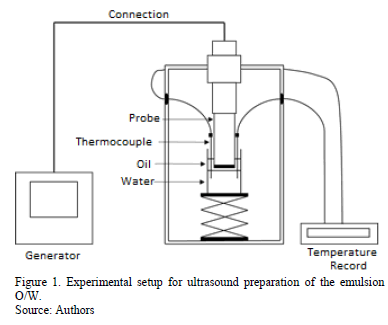
<body><![CDATA[<p><b><i><font size="2" face="Verdana, Arial, Helvetica, sans-serif">2.2. Preparation of the O/W emulsion</font></i></b></p>     <p><font size="2" face="Verdana, Arial, Helvetica, sans-serif">The O/W  emulsion (w/w) was prepared using 80% water and 20% olive oil.</font></p>     <p><font size="2" face="Verdana, Arial, Helvetica, sans-serif"><b><i>2.3. Ultrasound application </i></b></font></p>     <p><font size="2" face="Verdana, Arial, Helvetica, sans-serif">Ultrasound was applied to the O/W  emulsion in an ultrasound device (Qs&oacute;nica®, Q700 sonicator, 700 W RMS,  USA) at 20 kHz for 5 minutes via a continuous and pulsed process, this time was selected in order to avoid the  overheating &#91;19&#93;. The ultrasound probe was placed inside a sound-reduction box whose interior walls were coated with water-resistant acoustic foam (<a href="#fig01">Fig 1</a>).  A 25.4 mm titanium alloy probe with a  cylindrical diameter and geometry was used. The probe was placed 10 mm below  the surface of the O/W emulsion with a height of 100 mm, and the amplitudes levels were changed between 30, 36, 42, 48, 54 and 60 µm (50%, 60%, 70%, 80%, 90%  and 100%, respectively) in the continuous  and pulsed processes. Two pulsed treatments were applied: one 20:20 on/off and another 30:30  on/off. These treatments were performed  in triplicate. </font></p>     <p align="center"><font size="2" face="Verdana, Arial, Helvetica, sans-serif"><a name="fig01"></a></font><img src="/img/revistas/dyna/v83n199/v83n199a08fig01.gif"></p>     <p><font size="2" face="Verdana, Arial, Helvetica, sans-serif">The  temperature increase for the sonication time for each of the pulse and  amplitude conditions was determined using two thermocouples (Digisense®) at a  distance of 1 cm from the probe (<a href="#fig01">Fig 1</a>). The following fixed variables were  defined: (i) Two types of pulses - continuous pulses in which the wave was  transmitted without intermittence, and 20:20 and 30:30 on/off pulses in which  the wave was intermittent in time. In the case of  the 20:20 (on/off) pulsation,  intermittency occurred for 20 seconds during  which the wave propagated through  the medium and for 20 seconds in which the  wave stopped its propagation  through the medium. For the 30:30 (on/off) condition, intermittency occurred for  30 seconds during which the wave  propagated through the medium and for 30  seconds during which the wave propagation stopped &#91;3&#93;. (ii) Six amplitude  levels (30, 36, 42, 48, 54  and 60 µm) were used for the three evaluated  pulses. (iii) A sonication  time of five minutes was defined as a fixed  factor &#91;20-23&#93;</font></p>     <p align="center"><font size="2" face="Verdana, Arial, Helvetica, sans-serif"><a name="fig02"></a></font><img src="/img/revistas/dyna/v83n199/v83n199a08fig02.gif"></p>     <p><font size="2" face="Verdana, Arial, Helvetica, sans-serif"><b><i>2.4. Application of ultrasound treatments </i></b></font></p>     <p><font size="2" face="Verdana, Arial, Helvetica, sans-serif">The O/W emulsion was subjected to continuous ultrasound  treatment for five minutes for each amplitude. Pulse treatments of 20:20 and 30:30 on-off were  performed. Each treatment was  evaluated for five minutes for  the chosen amplitudes. The temperature (°C) and energy (J) values were recorded for every minute. </font></p>     <p><font size="2" face="Verdana, Arial, Helvetica, sans-serif">After the pulsed or continuous sonication time, the  emulsions were kept at room  temperature (19 °C) forthe next three hours for the phase  separation measurement.</font></p>     ]]></body>
<body><![CDATA[<p>&nbsp;</p>     <p><font size="2" face="Verdana, Arial, Helvetica, sans-serif"><b><i>2.5. Response variables </i></b></font></p>     <p><font size="2" face="Verdana, Arial, Helvetica, sans-serif"><i>2.5.1. Phase separation</i></font></p>     <p><font size="2" face="Verdana, Arial, Helvetica, sans-serif">The time required for the phase  separation was evaluated for each treatment during the three hours after sonication. A visible mark on the outer surface of the falcon tubes that contained the samples was labelled every 30 minutes, and an image was captured with  a 13 Mpx camera. The images were analysed using ImageJ®.</font></p>     <p><font size="2" face="Verdana, Arial, Helvetica, sans-serif"><i>2.5.2. Temperature record</i></font></p>     <p><font size="2" face="Verdana, Arial, Helvetica, sans-serif">The temperature was measured using a Digi-Sense Scanning Thermometer (model 92000-0). The temperature was recorded every minute for  the continuous ultrasound, after 20 seconds in the on position for the 20:20  pulsed ultrasound, and after 30 seconds in the on position for the 30:30 pulsed  ultrasound. </font></p>     <p><font size="2" face="Verdana, Arial, Helvetica, sans-serif"><i>2.5.3. Accumulated power</i></font></p>     <p><font size="2" face="Verdana, Arial, Helvetica, sans-serif">The power (P) was calculated based on the power dissipated in all of the samples according to the different evaluated amplitude and pulse conditions. The  calorimetric method was used for the P calculation using the ratio presented in equation (1):</font></p>     <p><img src="/img/revistas/dyna/v83n199/v83n199a08eq01.gif"></p>     <p><font size="2" face="Verdana, Arial, Helvetica, sans-serif">where &quot;m&quot; is the mass of  the sample (kg), Cp is the specific heat of the emulsion (kJ/kg °C), and <font face="Symbol">D</font>T/<font face="Symbol">D</font>t is the temperature change over time (°C/s) &#91;19&#93;. The Cp was calculated using the method by Choi and Okos (1986). The accumulated  power was calculated as the sum  of the power that dissipated at each measurement point.</font></p>     ]]></body>
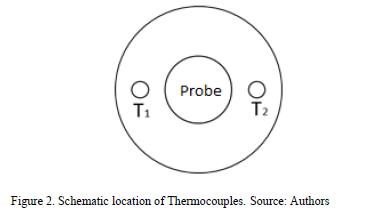
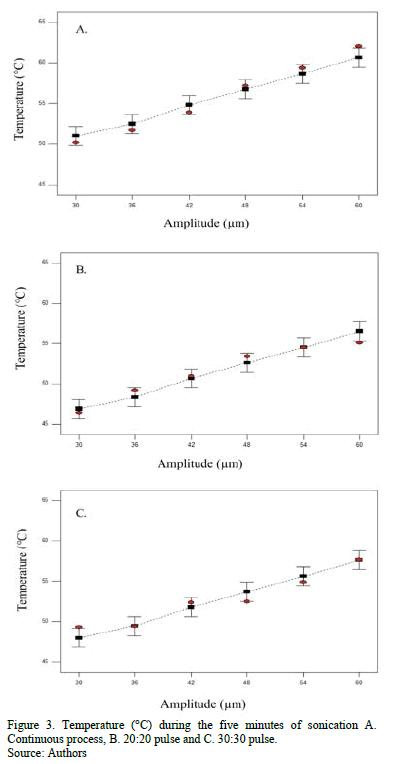
<body><![CDATA[<p><font size="2" face="Verdana, Arial, Helvetica, sans-serif"><i>2.5.4. Experimental design</i></font></p>     <p><font size="2" face="Verdana, Arial, Helvetica, sans-serif">The effects of different pulses (continuous, 20:20 and 30:30) and amplitudes (30, 36,42,48,54 and 60 µm) were evaluated in the O/W emulsion. A multilevel categorical factorial design was performed using the statistical software Design Expert Version 9 (Statease Inc., Minneapolis, USA) to process the data. The pulsation and  amplitude were the two categorical factors that were defined at different levels. <a href="#tab01">Table 1</a> shows the experimental design in which analysis of variance (ANOVA) was  performed to find significant  differences for the pulses and amplitudes in the results of the phase separation. The fit of the model was evaluated using the R2 and adjusted R2 values.</font></p>     <p align="center"><font size="2" face="Verdana, Arial, Helvetica, sans-serif"><a name="tab01"></a></font><img src="/img/revistas/dyna/v83n199/v83n199a08tab01.gif"></p>     <p align="center">&nbsp;</p>     <p><font size="3" face="Verdana, Arial, Helvetica, sans-serif"><b>3. Results and discussion</b></font></p>     <p><font size="2" face="Verdana, Arial, Helvetica, sans-serif">The selection of parameters as  power, frequency and pulse type, helps to define the different effects that are produced by high-power ultrasound when it passes through a medium, which demonstrates their significance depending  on the features of the material &#91;6&#93;. Therefore, the density difference between both phases under the influence of gravity leads to phase separation &#91;25&#93;. The  following effects are described in our study: (1) the effect of amplitude on the medium temperature and phase separation, (2) the accumulated power during the sonication time, and (3)  the effect of the treatment on the phase separation. As stated by Gaikwad and Pandit &#91;26&#93;, the  use of ultrasonic emulsification can be described using four characteristics: (1) a minimum intensity is required to  start the emulsification process, (2) an  increase in the power emitted to  the matrix enhances the emulsion  stability, (3) an increase in the sonication time decreases the dispersed phase droplet size, favouring the formation of microjets,  and (4) the forces responsible for the emulsification are the ratio of the force acting on the droplets and the surface tension, which represent the physicochemical properties of the system. </font></p>     <p><font size="2" face="Verdana, Arial, Helvetica, sans-serif"><b><i>3.1. Effect of  amplitude and pulse type on temperature</i></b></font></p>     <p><font size="2" face="Verdana, Arial, Helvetica, sans-serif">The effect of different amplitudes  on the temperature for each ultrasound pulse treatment was  evaluated for the three types of pulse. Thus, <a href="#fig03">Fig 3</a> shows  the temperature increase during  the 5 minutes of treatment for  each type of pulse. This increase has been widely described by Shanmugam, Chandrapala,  and Ashokkumar &#91;26&#93; and Pingret, Fabiano-Tixier, and  Chemat &#91;27&#93; as being caused by the cavitation  phenomenon. Thus, the ultrasound generates a strong resonance in the pulses that are  represented in bubbles in the  form of micro-jets, which  significantly influences the acoustic environment of the liquid &#91;29&#93;. However, amplitude conditions are directly related to temperature increases; thus, the highest temperature was obtained in the range of 60 <font face="Symbol">m</font>mfor the pulse treatments in continuous 62°C, 20:20 pulse 55.1°C and  30:30 pulse 57.7°C. This allowed  some of the acoustic energy to be  degraded as heat, leading to an  increase in medium temperature due to the direct relation between the temperature and the solubility of water and oil &#91;7,30&#93;. The pulse and amplitude were found to be significant regarding the effect of the pulses for each amplitude on the temperature (P&lt;0.05). </font></p>     <p align="center"><font size="2" face="Verdana, Arial, Helvetica, sans-serif"><a name="fig03"></a></font><img src="/img/revistas/dyna/v83n199/v83n199a08fig03.gif"></p>     <p><font size="2" face="Verdana, Arial, Helvetica, sans-serif"><a href="#fig03">Figure 3</a> shows that the 20:20 and 30:30 pulsed  treatments have a lower temperature increase compared to the continuous  treatment due to the off period of the pulsed wave effect.</font></p>     ]]></body>
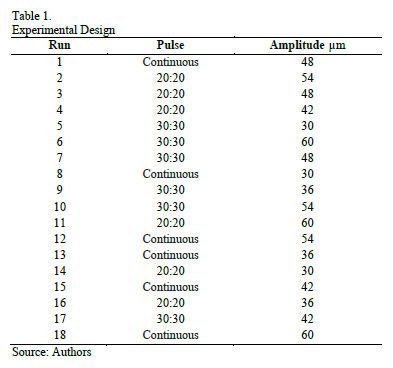
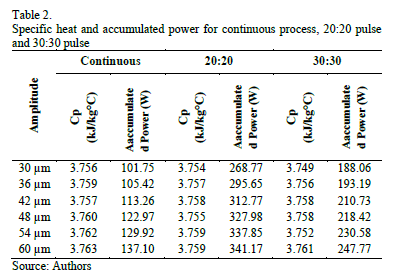
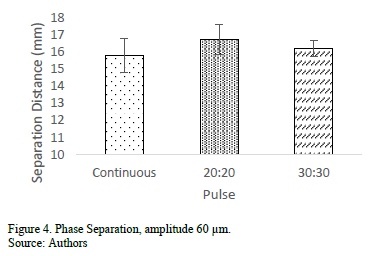
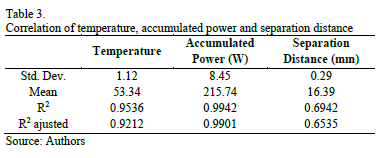
<body><![CDATA[<p><font size="2" face="Verdana, Arial, Helvetica, sans-serif"><b><i>3.2. Power accumulated during the sonication time</i></b></font></p>     <p><font size="2" face="Verdana, Arial, Helvetica, sans-serif"><a href="#tab02">Table 2</a> shows the accumulated power, as calculated from equation (1). An increased accumulated power in relation to the increase in amplitude for all  the pulses showed significant differences (P&lt;  0.05) between the treatments. The 20:20 pulsed treatment with the amplitude of 60 µm accumulated the largest power during the five minutes of experimentation, which is explained by the stronger and more violent cavitation of bubble collapse in the on:off pulsation moments that generated more  power. Anihouvi, Danthine, Kegelaers, Dombree, and Blecker &#91;31&#93; reported that cavitation is the most significant mechanism of power dissipation in a low frequency  ultrasound system; thus, changes in cavitation intensity can be related directly to changes in power.</font></p>     <p align="center"><font size="2" face="Verdana, Arial, Helvetica, sans-serif"><a name="tab02"></a></font><img src="/img/revistas/dyna/v83n199/v83n199a08tab02.gif"></p>     <p><font size="2" face="Verdana, Arial, Helvetica, sans-serif"><b><i>3.3. Effect of treatments on phase separation</i></b></font></p>     <p><font size="2" face="Verdana, Arial, Helvetica, sans-serif">The homogenization  technology in emulsions has a relevant role in the stability of its phase, and  this can be measurement as the minima distance of separation. As shown in <a href="#fig04">Fig 4</a>, the lowest phase separation occurs in the continuous treatment followed by the 30:30 pulsed treatment to 60 µm, with significant differences between them (P&lt;0.05). </font></p>     <p align="center"><font size="2" face="Verdana, Arial, Helvetica, sans-serif"><a name="fig04"></a></font><img src="/img/revistas/dyna/v83n199/v83n199a08fig04.gif"></p>     <p><font size="2" face="Verdana, Arial, Helvetica, sans-serif">However, in relationship with the  temperature smaller increases benefit O/W  emulsion stability over time; </font><font size="2" face="Verdana, Arial, Helvetica, sans-serif">nevertheless an increase in O/W emulsion temperature leads  to a cavitation decrease. Therefore,  it is necessary to maintain the lowest temperature possible for O/W emulsification processes, which is why the 20:20  pulsed treatment in this experiment exhibited  a smaller increase in temperature of 27.4&deg;C, 30.2&deg;C, 32&deg;C, 34.4&deg;C, 35.5&deg;C, and 36.1&deg;C for each of the evaluated amplitudes.</font></p>     <p><font size="2" face="Verdana, Arial, Helvetica, sans-serif"><b><i>3.4. Results of the correlation</i></b></font></p>     <p><font size="2" face="Verdana, Arial, Helvetica, sans-serif"><a href="#tab03">Table 3</a> shows the correlation of the response variables, temperature, accumulated power and separation  distance. We observed a high correlation with accumulated power, followed by a correlation with temperature and, finally,  with the separation distance.</font></p>     <p align="center"><font size="2" face="Verdana, Arial, Helvetica, sans-serif"><a name="tab03"></a></font><img src="/img/revistas/dyna/v83n199/v83n199a08tab03.gif"></p>     ]]></body>
<body><![CDATA[<p>&nbsp;</p>     <p><font size="3" face="Verdana, Arial, Helvetica, sans-serif"><b>4. Conclusions</b></font></p>     <p><font size="2" face="Verdana, Arial, Helvetica, sans-serif">The use of technologies such as ultrasound to obtain O/W emulsions requires analysis of the parameters for improved application. Transient cavitation that is generated by the pulse that is related to the temperature during the emulsification process is highlighted. The relevance of the cavitation that is generated by low frequency ultrasonic waves contributes to the degradation of the acoustic energy into heat, favouring the increase in the emulsion temperature. However, smaller temperature increases that do not favour emulsion stability were found due to the  accumulation of more power; thus, emulsions exhibiting less separation were  obtained with continuous pulsing. This study helped to define the application parameters of ultrasound at a frequency of 20 kHz with a continuous pulse with an amplitude of 60 µm for a tip  of 25.4 mm on O/W (20:80) emulsions. These results will allow the application of an advanced and emerging technology with less use  of surfactants for low oil-content emulsions that can be the basis for low-fat food  products. The aim of this work was to select the best conditions for  emulsification, but it must be considered the formulation and the process time  because shelf-life of emulsions is determined by lipid oxidation; fat/oil has  an important role in determining the properties of emulsions, it influences the  appearance (optical properties), sensory evaluation, texture (rheology) and  stability</font></p>     <p>&nbsp;</p>     <p><font size="3" face="Verdana, Arial, Helvetica, sans-serif"><b>References</b></font></p>     <!-- ref --><p><font size="2" face="Verdana, Arial, Helvetica, sans-serif"><b>&#91;1&#93;</b> Guillaume, C., Katline, L., Benoit, A.T, and Stefan, M., Changes in ultrasound velocity  and attenuation indicate freezing of xylem sap, Agric. For. Meteorol., 185, pp. 20-25, 2014.DOI: 10.1016/j.agrformet.2013.10.009</font>&nbsp;&nbsp;&nbsp;&nbsp;&nbsp;&nbsp;&nbsp;&nbsp;[&#160;<a href="javascript:void(0);" onclick="javascript: window.open('/scielo.php?script=sci_nlinks&ref=1143695&pid=S0012-7353201600050000800001&lng=','','width=640,height=500,resizable=yes,scrollbars=1,menubar=yes,');">Links</a>&#160;]<!-- end-ref --><!-- ref --><p><font size="2" face="Verdana, Arial, Helvetica, sans-serif"><b>&#91;2&#93;</b> Canselier, J.P., Delmas, H., Wilhelm, A.M.  and Abismaïl, B., Ultrasound emulsification - An overview, J. Dispers. Sci. Technol., 23(1-3),  pp. 333-349, 2002.DOI: 10.1080/01932690208984209</font>&nbsp;&nbsp;&nbsp;&nbsp;&nbsp;&nbsp;&nbsp;&nbsp;[&#160;<a href="javascript:void(0);" onclick="javascript: window.open('/scielo.php?script=sci_nlinks&ref=1143696&pid=S0012-7353201600050000800002&lng=','','width=640,height=500,resizable=yes,scrollbars=1,menubar=yes,');">Links</a>&#160;]<!-- end-ref --><!-- ref --><p><font size="2" face="Verdana, Arial, Helvetica, sans-serif"><b>&#91;3&#93;</b> Coupland, J.N., Low intensity ultrasound, Food Res. Int., 37, pp. 537-43, 2004.DOI: 10.1016/j.foodres.2004.01.011</font>&nbsp;&nbsp;&nbsp;&nbsp;&nbsp;&nbsp;&nbsp;&nbsp;[&#160;<a href="javascript:void(0);" onclick="javascript: window.open('/scielo.php?script=sci_nlinks&ref=1143697&pid=S0012-7353201600050000800003&lng=','','width=640,height=500,resizable=yes,scrollbars=1,menubar=yes,');">Links</a>&#160;]<!-- end-ref --><!-- ref --><p><font size="2" face="Verdana, Arial, Helvetica, sans-serif"><b>&#91;4&#93;</b> C&aacute;rcel, J.A., Garc&iacute;a-P&eacute;rez, J.V., Riera, E.  and Mulet, A., Influence of high intensity ultrasound on drying kinetics of persimmon, Dry. Technol., 25, pp. 185-193, 2007.DOI: 10.1080/07373930601161070</font>&nbsp;&nbsp;&nbsp;&nbsp;&nbsp;&nbsp;&nbsp;&nbsp;[&#160;<a href="javascript:void(0);" onclick="javascript: window.open('/scielo.php?script=sci_nlinks&ref=1143698&pid=S0012-7353201600050000800004&lng=','','width=640,height=500,resizable=yes,scrollbars=1,menubar=yes,');">Links</a>&#160;]<!-- end-ref --><!-- ref --><p><font size="2" face="Verdana, Arial, Helvetica, sans-serif"><b>&#91;5&#93;</b> Patist, A. and Bates, D., Ultrasonic innovations in the  food industry: From the laboratory to commercial production, Innov. Food Sci. Emerg. Technol.,  9(2), pp. 147-154, 2008.DOI:  10.1016/j.ifset.2007.07.004</font>&nbsp;&nbsp;&nbsp;&nbsp;&nbsp;&nbsp;&nbsp;&nbsp;[&#160;<a href="javascript:void(0);" onclick="javascript: window.open('/scielo.php?script=sci_nlinks&ref=1143699&pid=S0012-7353201600050000800005&lng=','','width=640,height=500,resizable=yes,scrollbars=1,menubar=yes,');">Links</a>&#160;]<!-- end-ref --><!-- ref --><p><font size="2" face="Verdana, Arial, Helvetica, sans-serif"><b>&#91;6&#93;</b> C&aacute;rcel, J.A., Garc&iacute;a-P&eacute;rez, J.V., Benedito, J. and Mulet, A., Food process innovation through new technologies: Use of ultrasound, J. Food Eng., 110(2), pp. 200-207, 2012.DOI: 10.1016/j.jfoodeng.2011.05.038</font>&nbsp;&nbsp;&nbsp;&nbsp;&nbsp;&nbsp;&nbsp;&nbsp;[&#160;<a href="javascript:void(0);" onclick="javascript: window.open('/scielo.php?script=sci_nlinks&ref=1143700&pid=S0012-7353201600050000800006&lng=','','width=640,height=500,resizable=yes,scrollbars=1,menubar=yes,');">Links</a>&#160;]<!-- end-ref --><!-- ref --><p><font size="2" face="Verdana, Arial, Helvetica, sans-serif"><b>&#91;7&#93;</b> C&aacute;rcel, J.A., Influencia  de los ultrasonidos de potencia en procesos de transferencia de materia., Tesis  Doctorado Departamento de Tecnolog&iacute;a de Alimentos. Universidad Polit&eacute;cnica de Valencia. Espa&ntilde;a, 2003.    &nbsp;&nbsp;&nbsp;&nbsp;&nbsp;&nbsp;&nbsp;&nbsp;[&#160;<a href="javascript:void(0);" onclick="javascript: window.open('/scielo.php?script=sci_nlinks&ref=1143701&pid=S0012-7353201600050000800007&lng=','','width=640,height=500,resizable=yes,scrollbars=1,menubar=yes,');">Links</a>&#160;]<!-- end-ref --></font></p>     <!-- ref --><p><font size="2" face="Verdana, Arial, Helvetica, sans-serif"><b>&#91;8&#93;</b> Mason, M.A.T.J. and Chemat, F., Power ultrasonics for food processing,  Chapter 6. In  Ultrasound of Food Processing. London: Blackie Academic &amp; Professional. 1998.    &nbsp;&nbsp;&nbsp;&nbsp;&nbsp;&nbsp;&nbsp;&nbsp;[&#160;<a href="javascript:void(0);" onclick="javascript: window.open('/scielo.php?script=sci_nlinks&ref=1143703&pid=S0012-7353201600050000800008&lng=','','width=640,height=500,resizable=yes,scrollbars=1,menubar=yes,');">Links</a>&#160;]<!-- end-ref --></font></p>     <!-- ref --><p><font size="2" face="Verdana, Arial, Helvetica, sans-serif"><b>&#91;9&#93;</b> Mason, T., The uses of ultrasound in food technology, Ultrason. Sonochem., 3(3), pp.  S253-S260, 1996.DOI:  10.1016/S1350-4177(96)00034-X</font>&nbsp;&nbsp;&nbsp;&nbsp;&nbsp;&nbsp;&nbsp;&nbsp;[&#160;<a href="javascript:void(0);" onclick="javascript: window.open('/scielo.php?script=sci_nlinks&ref=1143705&pid=S0012-7353201600050000800009&lng=','','width=640,height=500,resizable=yes,scrollbars=1,menubar=yes,');">Links</a>&#160;]<!-- end-ref --><!-- ref --><p><font size="2" face="Verdana, Arial, Helvetica, sans-serif"><b>&#91;10&#93;</b> Soria, A.C. and Villamiel, M., Effect of ultrasound on the  technological properties and bioactivity of food: A review, Trends Food Sci. Technol., 21(7), pp.  323-331, 2010.DOI: 10.1016/j.tifs.2010.04.003</font>&nbsp;&nbsp;&nbsp;&nbsp;&nbsp;&nbsp;&nbsp;&nbsp;[&#160;<a href="javascript:void(0);" onclick="javascript: window.open('/scielo.php?script=sci_nlinks&ref=1143706&pid=S0012-7353201600050000800010&lng=','','width=640,height=500,resizable=yes,scrollbars=1,menubar=yes,');">Links</a>&#160;]<!-- end-ref --><!-- ref --><p><font size="2" face="Verdana, Arial, Helvetica, sans-serif"><b>&#91;11&#93;</b> Awad, T.S., Moharram, H.A., Shaltout, O.E.,  Asker, D. and Youssef, M.M., Applications of ultrasound in analysis, processing  and quality control of food: A review, Food  Res. Int., 48(2), pp. 410-427, 2012. DOI: 10.1016/j.foodres.2012.05.004</font>&nbsp;&nbsp;&nbsp;&nbsp;&nbsp;&nbsp;&nbsp;&nbsp;[&#160;<a href="javascript:void(0);" onclick="javascript: window.open('/scielo.php?script=sci_nlinks&ref=1143707&pid=S0012-7353201600050000800011&lng=','','width=640,height=500,resizable=yes,scrollbars=1,menubar=yes,');">Links</a>&#160;]<!-- end-ref --><!-- ref --><p><font size="2" face="Verdana, Arial, Helvetica, sans-serif"><b>&#91;12&#93;</b> Pingret, D., Fabiano-Tixier, A.S. and Chemat, F., Degradation during application of ultrasound in  food processing: A review, Food  Control, 31(2), pp. 593-606, 2013.DOI: 10.1016/j.foodcont.2012.11.039 </font>&nbsp;&nbsp;&nbsp;&nbsp;&nbsp;&nbsp;&nbsp;&nbsp;[&#160;<a href="javascript:void(0);" onclick="javascript: window.open('/scielo.php?script=sci_nlinks&ref=1143708&pid=S0012-7353201600050000800012&lng=','','width=640,height=500,resizable=yes,scrollbars=1,menubar=yes,');">Links</a>&#160;]<!-- end-ref --><!-- ref --><p><font size="2" face="Verdana, Arial, Helvetica, sans-serif"><b>&#91;13&#93;</b> Gallego-Ju&aacute;rez, J.A., Rodriguez, G.,  Acosta, V. and Riera, E.,  Power ultrasonic transducers with extensive radiators for industrial  processing, Ultrason. Sonochem.,  17(6), pp. 953-964, 2010.DOI: 10.1016/j.ultsonch.2009.11.006</font>&nbsp;&nbsp;&nbsp;&nbsp;&nbsp;&nbsp;&nbsp;&nbsp;[&#160;<a href="javascript:void(0);" onclick="javascript: window.open('/scielo.php?script=sci_nlinks&ref=1143709&pid=S0012-7353201600050000800013&lng=','','width=640,height=500,resizable=yes,scrollbars=1,menubar=yes,');">Links</a>&#160;]<!-- end-ref --><!-- ref --><p><font size="2" face="Verdana, Arial, Helvetica, sans-serif"><b>&#91;14&#93;</b> Behrend, O., Ax, K. and Schubert, H., &quot;nfluence of continuous phase viscosity on  emulsification by ultrasound, Ultrason.  Sonochem., 7(2), pp. 77-85, 2000.DOI:  10.1016/S1350-4177(99)00029-2</font>&nbsp;&nbsp;&nbsp;&nbsp;&nbsp;&nbsp;&nbsp;&nbsp;[&#160;<a href="javascript:void(0);" onclick="javascript: window.open('/scielo.php?script=sci_nlinks&ref=1143710&pid=S0012-7353201600050000800014&lng=','','width=640,height=500,resizable=yes,scrollbars=1,menubar=yes,');">Links</a>&#160;]<!-- end-ref --><!-- ref --><p><font size="2" face="Verdana, Arial, Helvetica, sans-serif"><b>&#91;15&#93;</b> McClements, D.J., Food Emulsions: Principles, Practices, and Techniques. New York:  CRC Press, 2005.    &nbsp;&nbsp;&nbsp;&nbsp;&nbsp;&nbsp;&nbsp;&nbsp;[&#160;<a href="javascript:void(0);" onclick="javascript: window.open('/scielo.php?script=sci_nlinks&ref=1143711&pid=S0012-7353201600050000800015&lng=','','width=640,height=500,resizable=yes,scrollbars=1,menubar=yes,');">Links</a>&#160;]<!-- end-ref --></font></p>     <!-- ref --><p><font size="2" face="Verdana, Arial, Helvetica, sans-serif"><b>&#91;16&#93;</b> McClements, D.J., Edible nanoemulsions: fabrication, properties,  and functional performance, Soft  Matter, 7(6), pp. 2297-2298, 2011.DOI: 10.1039/C0SM00549E</font>&nbsp;&nbsp;&nbsp;&nbsp;&nbsp;&nbsp;&nbsp;&nbsp;[&#160;<a href="javascript:void(0);" onclick="javascript: window.open('/scielo.php?script=sci_nlinks&ref=1143713&pid=S0012-7353201600050000800016&lng=','','width=640,height=500,resizable=yes,scrollbars=1,menubar=yes,');">Links</a>&#160;]<!-- end-ref --><!-- ref --><p><font size="2" face="Verdana, Arial, Helvetica, sans-serif"><b>&#91;17&#93;</b> Mancinelli, R., Bruni, F., Ricci, M.A. and Imberti, S., Microscopic structure of water in a water / oil emulsion, 204503, pp.  1-8, 2013. DOI: 10.1063/1.4807601.    &nbsp;&nbsp;&nbsp;&nbsp;&nbsp;&nbsp;&nbsp;&nbsp;[&#160;<a href="javascript:void(0);" onclick="javascript: window.open('/scielo.php?script=sci_nlinks&ref=1143714&pid=S0012-7353201600050000800017&lng=','','width=640,height=500,resizable=yes,scrollbars=1,menubar=yes,');">Links</a>&#160;]<!-- end-ref --></font></p>     <!-- ref --><p><font size="2" face="Verdana, Arial, Helvetica, sans-serif"><b>&#91;18&#93;</b> Peshkovsky, A.S. and Bystryak, S., Continuous-flow production of a  pharmaceutical nanoemulsion by high-amplitude ultrasound: Process scale-up, Chem. Eng. Process. Process Intensif.,  82, pp. 132-136, 2014.DOI:  10.1016/j.cep.2014.05.007</font>&nbsp;&nbsp;&nbsp;&nbsp;&nbsp;&nbsp;&nbsp;&nbsp;[&#160;<a href="javascript:void(0);" onclick="javascript: window.open('/scielo.php?script=sci_nlinks&ref=1143716&pid=S0012-7353201600050000800018&lng=','','width=640,height=500,resizable=yes,scrollbars=1,menubar=yes,');">Links</a>&#160;]<!-- end-ref --><!-- ref --><p><font size="2" face="Verdana, Arial, Helvetica, sans-serif"><b>&#91;19&#93;</b> Abbas, S., Bashari, M., Akhtar, W., Li, W.W. and Zhang, X., Process optimization of ultrasound-assisted  curcumin nanoemulsions stabilized by OSA-modified starch, Ultrason. Sonochem.,  21(4), pp. 1265-1274, 2014 DOI:  10.1016/j.ultsonch.2013.12.017</font>&nbsp;&nbsp;&nbsp;&nbsp;&nbsp;&nbsp;&nbsp;&nbsp;[&#160;<a href="javascript:void(0);" onclick="javascript: window.open('/scielo.php?script=sci_nlinks&ref=1143717&pid=S0012-7353201600050000800019&lng=','','width=640,height=500,resizable=yes,scrollbars=1,menubar=yes,');">Links</a>&#160;]<!-- end-ref --><!-- ref --><p><font size="2" face="Verdana, Arial, Helvetica, sans-serif"><b>&#91;20&#93;</b> Kiokias, S., Dimakou, C. and Oreopoulou,  V., Activity of natural carotenoid preparations against the autoxidative  deterioration of sunflower oil-in-water emulsions, Food Chem., 114(4), pp. 1278-1284, 2009. DOI: 10.1016/j.foodchem.2008.10.087</font>&nbsp;&nbsp;&nbsp;&nbsp;&nbsp;&nbsp;&nbsp;&nbsp;[&#160;<a href="javascript:void(0);" onclick="javascript: window.open('/scielo.php?script=sci_nlinks&ref=1143718&pid=S0012-7353201600050000800020&lng=','','width=640,height=500,resizable=yes,scrollbars=1,menubar=yes,');">Links</a>&#160;]<!-- end-ref --><!-- ref --><p><font size="2" face="Verdana, Arial, Helvetica, sans-serif"><b>&#91;21&#93;</b> Kaltsa, O., Michon, C., Yanniotis, S. and Mandala, I., Ultrasonic  energy input influence on the production of sub-micron o/w emulsions containing  whey protein and common stabilizers, Ultrason.  Sonochem., 20(3), pp. 881-891, 2013.DOI: 10.1016/j.ultsonch.2012.11.011</font>&nbsp;&nbsp;&nbsp;&nbsp;&nbsp;&nbsp;&nbsp;&nbsp;[&#160;<a href="javascript:void(0);" onclick="javascript: window.open('/scielo.php?script=sci_nlinks&ref=1143719&pid=S0012-7353201600050000800021&lng=','','width=640,height=500,resizable=yes,scrollbars=1,menubar=yes,');">Links</a>&#160;]<!-- end-ref --><!-- ref --><p><font size="2" face="Verdana, Arial, Helvetica, sans-serif"><b>&#91;22&#93;</b> Shanmugam, A. and Ashokkumar, M.,  Functional properties of ultrasonically generated flaxseed oil-dairy emulsions, Ultrason. Sonochem., 21(5), pp.  1649-1657, 2014. DOI:  10.1016/j.ultsonch.2014.03.020</font>&nbsp;&nbsp;&nbsp;&nbsp;&nbsp;&nbsp;&nbsp;&nbsp;[&#160;<a href="javascript:void(0);" onclick="javascript: window.open('/scielo.php?script=sci_nlinks&ref=1143720&pid=S0012-7353201600050000800022&lng=','','width=640,height=500,resizable=yes,scrollbars=1,menubar=yes,');">Links</a>&#160;]<!-- end-ref --><!-- ref --><p><font size="2" face="Verdana, Arial, Helvetica, sans-serif"><b>&#91;23&#93;</b> Paradiso, V.M., Giarnetti, M., Summo, C.  Pasqualone, A., Minervini, F. and Caponio, F., Production and  characterization of emulsion filled gels based on inulin and extra virgin olive  oil, Food Hydrocoll., 45, pp.  30-40, 2015.DOI:  10.1016/j.foodhyd.2014.10.027</font>&nbsp;&nbsp;&nbsp;&nbsp;&nbsp;&nbsp;&nbsp;&nbsp;[&#160;<a href="javascript:void(0);" onclick="javascript: window.open('/scielo.php?script=sci_nlinks&ref=1143721&pid=S0012-7353201600050000800023&lng=','','width=640,height=500,resizable=yes,scrollbars=1,menubar=yes,');">Links</a>&#160;]<!-- end-ref --><!-- ref --><p><font size="2" face="Verdana, Arial, Helvetica, sans-serif"><b>&#91;24&#93;</b> Chemat, F., Zill, E-H. and Khan, M.K. Applications of ultrasound in  food technology: Processing, preservation and extraction, Ultrason. Sonochem., 18(4), pp.  813-835, 2011.DOI:  10.1016/j.ultsonch.2010.11.023</font>&nbsp;&nbsp;&nbsp;&nbsp;&nbsp;&nbsp;&nbsp;&nbsp;[&#160;<a href="javascript:void(0);" onclick="javascript: window.open('/scielo.php?script=sci_nlinks&ref=1143722&pid=S0012-7353201600050000800024&lng=','','width=640,height=500,resizable=yes,scrollbars=1,menubar=yes,');">Links</a>&#160;]<!-- end-ref --><!-- ref --><p><font size="2" face="Verdana, Arial, Helvetica, sans-serif"><b>&#91;25&#93;</b> Anihouvi, P.P., Danthine, S., Kegelaers, Y., Dombree, A. and Blecker, C., Comparison of the physicochemical behavior of  model oil-in-water emulsions based on different lauric vegetal fats, Food Res. Int., 53(1), pp. 156-163,  2013.DOI: 10.1016/j.foodres.2013.04.011</font>&nbsp;&nbsp;&nbsp;&nbsp;&nbsp;&nbsp;&nbsp;&nbsp;[&#160;<a href="javascript:void(0);" onclick="javascript: window.open('/scielo.php?script=sci_nlinks&ref=1143723&pid=S0012-7353201600050000800025&lng=','','width=640,height=500,resizable=yes,scrollbars=1,menubar=yes,');">Links</a>&#160;]<!-- end-ref --><!-- ref --><p><font size="2" face="Verdana, Arial, Helvetica, sans-serif"><b>&#91;26&#93;</b> Gaikwad S.G. and Pandit, A.B., Ultrasound  emulsification: Effect of ultrasonic and physicochemical properties on  dispersed phase volume and droplet size, Ultrason.  Sonochem., 15(4), pp. 554-563, 2008. DOI: 10.1016/j.ultsonch.2007.06.011</font>&nbsp;&nbsp;&nbsp;&nbsp;&nbsp;&nbsp;&nbsp;&nbsp;[&#160;<a href="javascript:void(0);" onclick="javascript: window.open('/scielo.php?script=sci_nlinks&ref=1143724&pid=S0012-7353201600050000800026&lng=','','width=640,height=500,resizable=yes,scrollbars=1,menubar=yes,');">Links</a>&#160;]<!-- end-ref --><!-- ref --><p><font size="2" face="Verdana, Arial, Helvetica, sans-serif"><b>&#91;27&#93;</b> Shanmugam, A., Chandrapala, J. and  Ashokkumar, M., The effect of ultrasound on the physical and functional  properties of skim milk. Innov. Food  Sci. Emerg. Technol., 16, pp. 251-258, 2012. DOI: 10.1016/j.ifset.2012.06.005</font>&nbsp;&nbsp;&nbsp;&nbsp;&nbsp;&nbsp;&nbsp;&nbsp;[&#160;<a href="javascript:void(0);" onclick="javascript: window.open('/scielo.php?script=sci_nlinks&ref=1143725&pid=S0012-7353201600050000800027&lng=','','width=640,height=500,resizable=yes,scrollbars=1,menubar=yes,');">Links</a>&#160;]<!-- end-ref --><!-- ref --><p><font size="2" face="Verdana, Arial, Helvetica, sans-serif"><b>&#91;28&#93;</b> Pingret, D., Fabiano-Tixier, A.-S. and Chemat, F., Degradation during application of ultrasound in  food processing: A review, Food  Control, 31(2), pp. 593-606, 2013.DOI: 10.1016/j.foodcont.2012.11.039</font>&nbsp;&nbsp;&nbsp;&nbsp;&nbsp;&nbsp;&nbsp;&nbsp;[&#160;<a href="javascript:void(0);" onclick="javascript: window.open('/scielo.php?script=sci_nlinks&ref=1143726&pid=S0012-7353201600050000800028&lng=','','width=640,height=500,resizable=yes,scrollbars=1,menubar=yes,');">Links</a>&#160;]<!-- end-ref --><!-- ref --><p><font size="2" face="Verdana, Arial, Helvetica, sans-serif"><b>&#91;29&#93;</b> Leighton, T.G., What is ultrasound?, Prog. Biophys. Mol. Biol., 93(1-3), pp. 3-83, 2007.DOI: 10.1016/j.pbiomolbio.2006.07.026</font>&nbsp;&nbsp;&nbsp;&nbsp;&nbsp;&nbsp;&nbsp;&nbsp;[&#160;<a href="javascript:void(0);" onclick="javascript: window.open('/scielo.php?script=sci_nlinks&ref=1143727&pid=S0012-7353201600050000800029&lng=','','width=640,height=500,resizable=yes,scrollbars=1,menubar=yes,');">Links</a>&#160;]<!-- end-ref --><!-- ref --><p><font size="2" face="Verdana, Arial, Helvetica, sans-serif"><b>&#91;30&#93;</b> Jim&eacute;nez-Mungu&iacute;a,  C.E.K.M.T., Factores principales que intervienen en la estabilidad de una emulsi&oacute;n doble, &#91;En l&iacute;nea&#93;. 2, pp. 1-18, 2012. Temas selectos de Ingenier&iacute;a de Alimentos. Disponible en: <a href="http://web.udlap.mx/tsia/files/2013/12/TSIA-62Kosegarten-Conde-et-al-2012.pdf" target="_blank">http://web.udlap.mx/tsia/files/2013/12/TSIA-62Kosegarten-Conde-et-al-2012.pdf</a> </font>&nbsp;&nbsp;&nbsp;&nbsp;&nbsp;&nbsp;&nbsp;&nbsp;[&#160;<a href="javascript:void(0);" onclick="javascript: window.open('/scielo.php?script=sci_nlinks&ref=1143728&pid=S0012-7353201600050000800030&lng=','','width=640,height=500,resizable=yes,scrollbars=1,menubar=yes,');">Links</a>&#160;]<!-- end-ref --><!-- ref --><p><font size="2" face="Verdana, Arial, Helvetica, sans-serif"><b>&#91;31&#93;</b> Leong, T.S.H., Wooster, T.J., Kentish, S.E. and Ashokkumar,  M., Minimising oil droplet size using ultrasonic emulsification, Ultrason. Sonochem., 16(6), pp.  721-727, 2009.DOI.: 10.1016/j.ultsonch.2009.02.008</font>&nbsp;&nbsp;&nbsp;&nbsp;&nbsp;&nbsp;&nbsp;&nbsp;[&#160;<a href="javascript:void(0);" onclick="javascript: window.open('/scielo.php?script=sci_nlinks&ref=1143729&pid=S0012-7353201600050000800031&lng=','','width=640,height=500,resizable=yes,scrollbars=1,menubar=yes,');">Links</a>&#160;]<!-- end-ref --><p>&nbsp;</p>     <p><font size="2" face="Verdana, Arial, Helvetica, sans-serif"><b>L.I. Sotelo-D&iacute;az,</b> received  her BSc in Food Engineering in 1992, at the Universidad Jorge Tadeo Lozano,  Bogot&aacute;, Colombia. She was Dra. in Food Science and Technology in 2000, at the  Universidad Polit&eacute;cnica de Valencia, Spain. Is associate researcher Colciencias  in Agroindustrial Process Group. She works as professor in Food science and  Technology at the Universidad de La Sabana in the programs: Gastronomia, Master  of Process Management and Design and  Biociencias Doctorate. Her main research topics are the applications of  traditional and emerging technologies in design food products and food process. ORCID: 0000-0002-6594-2539</font></p>     <p><font size="2" face="Verdana, Arial, Helvetica, sans-serif"><b>M.X. Quintanilla-Carvajal, </b>received  her BSc in Agroindustrial Production Engineering in 2007, at the Universidad de  La Sabana, Bogot&aacute;, Colombia. She was Dra. in Food  Science in 2011, at the Instituto Polit&eacute;cnico Nacional de M&eacute;xico. She works as  professor in Agroindustrial Processes at the Universidad de La Sabana in the  programs: Agroindustrial Production Engineer, Master of Process Management and  Design and Biociencias Doctorate. Her main research topics are focuses on Food  and Beverage, Production Engineering, Nanoprocesses (Nanoscale applications)  and nanomaterials (Production and Properties). ORCID: 0000-0001-8219-7246</font></p>     <p><font size="2" face="Verdana, Arial, Helvetica, sans-serif"><b>M.A. Cabrera-Trujillo, </b>received her BSc in Agroindustrial  Production Engineering in 2013, at the Universidad de La Sabana,  Bogot&aacute;, Colombia. She is currently finishing her studies in the Master of Process Management and Design with Food Emphasis at the University of La Sabana. ORCID: 0000-0003-4178-6946</font></p>      ]]></body><back>
<ref-list>
<ref id="B1">
<label>1</label><nlm-citation citation-type="journal">
<person-group person-group-type="author">
<name>
<surname><![CDATA[Guillaume]]></surname>
<given-names><![CDATA[C.]]></given-names>
</name>
<name>
<surname><![CDATA[Katline]]></surname>
<given-names><![CDATA[L.]]></given-names>
</name>
<name>
<surname><![CDATA[Benoit]]></surname>
<given-names><![CDATA[A.T]]></given-names>
</name>
<name>
<surname><![CDATA[Stefan]]></surname>
<given-names><![CDATA[M.]]></given-names>
</name>
</person-group>
<article-title xml:lang="en"><![CDATA[Changes in ultrasound velocity and attenuation indicate freezing of xylem sap]]></article-title>
<source><![CDATA[Agric. For. Meteorol.]]></source>
<year>2014</year>
<numero>185</numero>
<issue>185</issue>
<page-range>20-25</page-range></nlm-citation>
</ref>
<ref id="B2">
<label>2</label><nlm-citation citation-type="journal">
<person-group person-group-type="author">
<name>
<surname><![CDATA[Canselier]]></surname>
<given-names><![CDATA[J.P.]]></given-names>
</name>
<name>
<surname><![CDATA[Delmas]]></surname>
<given-names><![CDATA[H.]]></given-names>
</name>
<name>
<surname><![CDATA[Wilhelm]]></surname>
<given-names><![CDATA[A.M.]]></given-names>
</name>
<name>
<surname><![CDATA[Abismaïl]]></surname>
<given-names><![CDATA[B.]]></given-names>
</name>
</person-group>
<article-title xml:lang="en"><![CDATA[Ultrasound emulsification: An overview]]></article-title>
<source><![CDATA[J. Dispers. Sci. Technol.]]></source>
<year>2002</year>
<volume>23</volume>
<numero>1-3</numero>
<issue>1-3</issue>
<page-range>333-349</page-range></nlm-citation>
</ref>
<ref id="B3">
<label>3</label><nlm-citation citation-type="journal">
<person-group person-group-type="author">
<name>
<surname><![CDATA[Coupland]]></surname>
<given-names><![CDATA[J.N.]]></given-names>
</name>
</person-group>
<article-title xml:lang="en"><![CDATA[Low intensity ultrasound]]></article-title>
<source><![CDATA[Food Res. Int.]]></source>
<year>2004</year>
<numero>37</numero>
<issue>37</issue>
<page-range>537-43</page-range></nlm-citation>
</ref>
<ref id="B4">
<label>4</label><nlm-citation citation-type="journal">
<person-group person-group-type="author">
<name>
<surname><![CDATA[Cárcel]]></surname>
<given-names><![CDATA[J.A.]]></given-names>
</name>
<name>
<surname><![CDATA[García-Pérez]]></surname>
<given-names><![CDATA[J.V.]]></given-names>
</name>
<name>
<surname><![CDATA[Riera]]></surname>
<given-names><![CDATA[E.]]></given-names>
</name>
<name>
<surname><![CDATA[Mulet]]></surname>
<given-names><![CDATA[A.]]></given-names>
</name>
</person-group>
<article-title xml:lang="en"><![CDATA[Influence of high intensity ultrasound on drying kinetics of persimmon]]></article-title>
<source><![CDATA[Dry. Technol.]]></source>
<year>2007</year>
<numero>25</numero>
<issue>25</issue>
<page-range>185-193</page-range></nlm-citation>
</ref>
<ref id="B5">
<label>5</label><nlm-citation citation-type="journal">
<person-group person-group-type="author">
<name>
<surname><![CDATA[Patist]]></surname>
<given-names><![CDATA[A.]]></given-names>
</name>
<name>
<surname><![CDATA[Bates]]></surname>
<given-names><![CDATA[D.]]></given-names>
</name>
</person-group>
<article-title xml:lang="en"><![CDATA[Ultrasonic innovations in the food industry: From the laboratory to commercial production]]></article-title>
<source><![CDATA[Innov. Food Sci. Emerg. Technol.]]></source>
<year>2008</year>
<volume>9</volume>
<numero>2</numero>
<issue>2</issue>
<page-range>147-154</page-range></nlm-citation>
</ref>
<ref id="B6">
<label>6</label><nlm-citation citation-type="journal">
<person-group person-group-type="author">
<name>
<surname><![CDATA[Cárcel]]></surname>
<given-names><![CDATA[J.A.]]></given-names>
</name>
<name>
<surname><![CDATA[García-Pérez]]></surname>
<given-names><![CDATA[J.V.]]></given-names>
</name>
<name>
<surname><![CDATA[Benedito]]></surname>
<given-names><![CDATA[J.]]></given-names>
</name>
<name>
<surname><![CDATA[Mulet]]></surname>
<given-names><![CDATA[A.]]></given-names>
</name>
</person-group>
<article-title xml:lang="en"><![CDATA[Food process innovation through new technologies: Use of ultrasound]]></article-title>
<source><![CDATA[J. Food Eng.]]></source>
<year>2012</year>
<volume>110</volume>
<numero>2</numero>
<issue>2</issue>
<page-range>200-207</page-range></nlm-citation>
</ref>
<ref id="B7">
<label>7</label><nlm-citation citation-type="">
<person-group person-group-type="author">
<name>
<surname><![CDATA[Cárcel]]></surname>
<given-names><![CDATA[J.A.]]></given-names>
</name>
</person-group>
<source><![CDATA[Influencia de los ultrasonidos de potencia en procesos de transferencia de materia]]></source>
<year></year>
</nlm-citation>
</ref>
<ref id="B8">
<label>8</label><nlm-citation citation-type="book">
<person-group person-group-type="author">
<name>
<surname><![CDATA[Mason]]></surname>
<given-names><![CDATA[M.A.T.J.]]></given-names>
</name>
<name>
<surname><![CDATA[Chemat]]></surname>
<given-names><![CDATA[F.]]></given-names>
</name>
</person-group>
<article-title xml:lang="en"><![CDATA[Power ultrasonics for food processing: Chapter 6]]></article-title>
<source><![CDATA[Ultrasound of Food Processing]]></source>
<year>1998</year>
<publisher-loc><![CDATA[London ]]></publisher-loc>
<publisher-name><![CDATA[Blackie Academic & Professional]]></publisher-name>
</nlm-citation>
</ref>
<ref id="B9">
<label>9</label><nlm-citation citation-type="journal">
<person-group person-group-type="author">
<name>
<surname><![CDATA[Mason]]></surname>
<given-names><![CDATA[T.]]></given-names>
</name>
</person-group>
<article-title xml:lang="en"><![CDATA[The uses of ultrasound in food technology]]></article-title>
<source><![CDATA[Ultrason. Sonochem.]]></source>
<year>1996</year>
<volume>3</volume>
<numero>3</numero>
<issue>3</issue>
<page-range>S253-S260</page-range></nlm-citation>
</ref>
<ref id="B10">
<label>10</label><nlm-citation citation-type="journal">
<person-group person-group-type="author">
<name>
<surname><![CDATA[Soria]]></surname>
<given-names><![CDATA[A.C.]]></given-names>
</name>
<name>
<surname><![CDATA[Villamiel]]></surname>
<given-names><![CDATA[M.]]></given-names>
</name>
</person-group>
<article-title xml:lang="en"><![CDATA[Effect of ultrasound on the technological properties and bioactivity of food: A review]]></article-title>
<source><![CDATA[Trends Food Sci. Technol.]]></source>
<year>2010</year>
<volume>21</volume>
<numero>7</numero>
<issue>7</issue>
<page-range>323-331</page-range></nlm-citation>
</ref>
<ref id="B11">
<label>11</label><nlm-citation citation-type="journal">
<person-group person-group-type="author">
<name>
<surname><![CDATA[Awad]]></surname>
<given-names><![CDATA[T.S.]]></given-names>
</name>
<name>
<surname><![CDATA[Moharram]]></surname>
<given-names><![CDATA[H.A.]]></given-names>
</name>
<name>
<surname><![CDATA[Shaltout]]></surname>
<given-names><![CDATA[O.E.]]></given-names>
</name>
<name>
<surname><![CDATA[Asker]]></surname>
<given-names><![CDATA[D.]]></given-names>
</name>
<name>
<surname><![CDATA[Youssef]]></surname>
<given-names><![CDATA[M.M.]]></given-names>
</name>
</person-group>
<article-title xml:lang="en"><![CDATA[Applications of ultrasound in analysis, processing and quality control of food: A review]]></article-title>
<source><![CDATA[Food Res. Int.]]></source>
<year>2012</year>
<volume>48</volume>
<numero>2</numero>
<issue>2</issue>
<page-range>410-427</page-range></nlm-citation>
</ref>
<ref id="B12">
<label>12</label><nlm-citation citation-type="journal">
<person-group person-group-type="author">
<name>
<surname><![CDATA[Pingret]]></surname>
<given-names><![CDATA[D.]]></given-names>
</name>
<name>
<surname><![CDATA[Fabiano-Tixier]]></surname>
<given-names><![CDATA[A.S.]]></given-names>
</name>
<name>
<surname><![CDATA[Chemat]]></surname>
<given-names><![CDATA[F.]]></given-names>
</name>
</person-group>
<article-title xml:lang="en"><![CDATA[Degradation during application of ultrasound in food processing: A review]]></article-title>
<source><![CDATA[Food Control]]></source>
<year>2013</year>
<volume>31</volume>
<numero>2</numero>
<issue>2</issue>
<page-range>593-606</page-range></nlm-citation>
</ref>
<ref id="B13">
<label>13</label><nlm-citation citation-type="journal">
<person-group person-group-type="author">
<name>
<surname><![CDATA[Gallego-Juárez]]></surname>
<given-names><![CDATA[J.A.]]></given-names>
</name>
<name>
<surname><![CDATA[Rodriguez]]></surname>
<given-names><![CDATA[G.]]></given-names>
</name>
<name>
<surname><![CDATA[Acosta]]></surname>
<given-names><![CDATA[V.]]></given-names>
</name>
<name>
<surname><![CDATA[Riera]]></surname>
<given-names><![CDATA[E.]]></given-names>
</name>
</person-group>
<article-title xml:lang="en"><![CDATA[Power ultrasonic transducers with extensive radiators for industrial processing]]></article-title>
<source><![CDATA[Ultrason. Sonochem.]]></source>
<year>2010</year>
<volume>17</volume>
<numero>6</numero>
<issue>6</issue>
<page-range>953-964</page-range></nlm-citation>
</ref>
<ref id="B14">
<label>14</label><nlm-citation citation-type="journal">
<person-group person-group-type="author">
<name>
<surname><![CDATA[Behrend]]></surname>
<given-names><![CDATA[O.]]></given-names>
</name>
<name>
<surname><![CDATA[Ax]]></surname>
<given-names><![CDATA[K.]]></given-names>
</name>
<name>
<surname><![CDATA[Schubert]]></surname>
<given-names><![CDATA[H.]]></given-names>
</name>
</person-group>
<article-title xml:lang="en"><![CDATA[nfluence of continuous phase viscosity on emulsification by ultrasound]]></article-title>
<source><![CDATA[Ultrason. Sonochem.]]></source>
<year>2000</year>
<volume>7</volume>
<numero>2</numero>
<issue>2</issue>
<page-range>77-85</page-range></nlm-citation>
</ref>
<ref id="B15">
<label>15</label><nlm-citation citation-type="book">
<person-group person-group-type="author">
<name>
<surname><![CDATA[McClements]]></surname>
<given-names><![CDATA[D.J.]]></given-names>
</name>
</person-group>
<source><![CDATA[Food Emulsions: Principles, Practices, and Techniques]]></source>
<year>2005</year>
<publisher-loc><![CDATA[New York ]]></publisher-loc>
<publisher-name><![CDATA[CRC Press]]></publisher-name>
</nlm-citation>
</ref>
<ref id="B16">
<label>16</label><nlm-citation citation-type="journal">
<person-group person-group-type="author">
<name>
<surname><![CDATA[McClements]]></surname>
<given-names><![CDATA[D.J.]]></given-names>
</name>
</person-group>
<article-title xml:lang="en"><![CDATA[Edible nanoemulsions: fabrication, properties, and functional performance]]></article-title>
<source><![CDATA[Soft Matter]]></source>
<year>2011</year>
<volume>7</volume>
<numero>6</numero>
<issue>6</issue>
<page-range>2297-2298</page-range></nlm-citation>
</ref>
<ref id="B17">
<label>17</label><nlm-citation citation-type="">
<person-group person-group-type="author">
<name>
<surname><![CDATA[Mancinelli]]></surname>
<given-names><![CDATA[R.]]></given-names>
</name>
<name>
<surname><![CDATA[Bruni]]></surname>
<given-names><![CDATA[F.]]></given-names>
</name>
<name>
<surname><![CDATA[Ricci]]></surname>
<given-names><![CDATA[M.A.]]></given-names>
</name>
<name>
<surname><![CDATA[Imberti]]></surname>
<given-names><![CDATA[S.]]></given-names>
</name>
</person-group>
<source><![CDATA[Microscopic structure of water in a water / oil emulsion]]></source>
<year>2013</year>
<page-range>1-8</page-range></nlm-citation>
</ref>
<ref id="B18">
<label>18</label><nlm-citation citation-type="journal">
<person-group person-group-type="author">
<name>
<surname><![CDATA[Peshkovsky]]></surname>
<given-names><![CDATA[A.S.]]></given-names>
</name>
<name>
<surname><![CDATA[Bystryak]]></surname>
<given-names><![CDATA[S.]]></given-names>
</name>
</person-group>
<article-title xml:lang="en"><![CDATA[Continuous-flow production of a pharmaceutical nanoemulsion by high-amplitude ultrasound: Process scale-up]]></article-title>
<source><![CDATA[Chem. Eng. Process. Process Intensif.]]></source>
<year>2014</year>
<numero>82</numero>
<issue>82</issue>
<page-range>132-136</page-range></nlm-citation>
</ref>
<ref id="B19">
<label>19</label><nlm-citation citation-type="journal">
<person-group person-group-type="author">
<name>
<surname><![CDATA[Abbas]]></surname>
<given-names><![CDATA[S.]]></given-names>
</name>
<name>
<surname><![CDATA[Bashari]]></surname>
<given-names><![CDATA[M.]]></given-names>
</name>
<name>
<surname><![CDATA[Akhtar]]></surname>
<given-names><![CDATA[W.]]></given-names>
</name>
<name>
<surname><![CDATA[Li]]></surname>
<given-names><![CDATA[W.W.]]></given-names>
</name>
<name>
<surname><![CDATA[Zhang]]></surname>
<given-names><![CDATA[X.]]></given-names>
</name>
</person-group>
<article-title xml:lang="en"><![CDATA[Process optimization of ultrasound-assisted curcumin nanoemulsions stabilized by OSA-modified starch]]></article-title>
<source><![CDATA[Ultrason. Sonochem.]]></source>
<year>2014</year>
<volume>21</volume>
<numero>4</numero>
<issue>4</issue>
<page-range>1265-1274</page-range></nlm-citation>
</ref>
<ref id="B20">
<label>20</label><nlm-citation citation-type="journal">
<person-group person-group-type="author">
<name>
<surname><![CDATA[Kiokias]]></surname>
<given-names><![CDATA[S.]]></given-names>
</name>
<name>
<surname><![CDATA[Dimakou]]></surname>
<given-names><![CDATA[C.]]></given-names>
</name>
<name>
<surname><![CDATA[Oreopoulou]]></surname>
<given-names><![CDATA[V.]]></given-names>
</name>
</person-group>
<article-title xml:lang="en"><![CDATA[Activity of natural carotenoid preparations against the autoxidative deterioration of sunflower oil-in-water emulsions]]></article-title>
<source><![CDATA[Food Chem.]]></source>
<year>2009</year>
<volume>114</volume>
<numero>4</numero>
<issue>4</issue>
<page-range>1278-1284</page-range></nlm-citation>
</ref>
<ref id="B21">
<label>21</label><nlm-citation citation-type="journal">
<person-group person-group-type="author">
<name>
<surname><![CDATA[Kaltsa]]></surname>
<given-names><![CDATA[O.]]></given-names>
</name>
<name>
<surname><![CDATA[Michon]]></surname>
<given-names><![CDATA[C.]]></given-names>
</name>
<name>
<surname><![CDATA[Yanniotis]]></surname>
<given-names><![CDATA[S.]]></given-names>
</name>
<name>
<surname><![CDATA[Mandala]]></surname>
<given-names><![CDATA[I.]]></given-names>
</name>
</person-group>
<article-title xml:lang="en"><![CDATA[Ultrasonic energy input influence on the production of sub-micron o/w emulsions containing whey protein and common stabilizers]]></article-title>
<source><![CDATA[Ultrason. Sonochem.]]></source>
<year>2013</year>
<volume>20</volume>
<numero>3</numero>
<issue>3</issue>
<page-range>881-891</page-range></nlm-citation>
</ref>
<ref id="B22">
<label>22</label><nlm-citation citation-type="journal">
<person-group person-group-type="author">
<name>
<surname><![CDATA[Shanmugam]]></surname>
<given-names><![CDATA[A.]]></given-names>
</name>
<name>
<surname><![CDATA[Ashokkumar]]></surname>
<given-names><![CDATA[M.]]></given-names>
</name>
</person-group>
<article-title xml:lang="en"><![CDATA[Functional properties of ultrasonically generated flaxseed oil-dairy emulsions]]></article-title>
<source><![CDATA[Ultrason. Sonochem.]]></source>
<year>2014</year>
<volume>21</volume>
<numero>5</numero>
<issue>5</issue>
<page-range>1649-1657</page-range></nlm-citation>
</ref>
<ref id="B23">
<label>23</label><nlm-citation citation-type="journal">
<person-group person-group-type="author">
<name>
<surname><![CDATA[Paradiso]]></surname>
<given-names><![CDATA[V.M.]]></given-names>
</name>
<name>
<surname><![CDATA[Giarnetti]]></surname>
<given-names><![CDATA[M.]]></given-names>
</name>
<name>
<surname><![CDATA[Summo]]></surname>
<given-names><![CDATA[C.]]></given-names>
</name>
<name>
<surname><![CDATA[Pasqualone]]></surname>
<given-names><![CDATA[A.]]></given-names>
</name>
<name>
<surname><![CDATA[Minervini]]></surname>
<given-names><![CDATA[F.]]></given-names>
</name>
<name>
<surname><![CDATA[Caponio]]></surname>
<given-names><![CDATA[F.]]></given-names>
</name>
</person-group>
<article-title xml:lang="en"><![CDATA[Production and characterization of emulsion filled gels based on inulin and extra virgin olive oil]]></article-title>
<source><![CDATA[Food Hydrocoll.]]></source>
<year>2015</year>
<numero>45</numero>
<issue>45</issue>
<page-range>30-40</page-range></nlm-citation>
</ref>
<ref id="B24">
<label>24</label><nlm-citation citation-type="journal">
<person-group person-group-type="author">
<name>
<surname><![CDATA[Chemat]]></surname>
<given-names><![CDATA[F.]]></given-names>
</name>
<name>
<surname><![CDATA[Zill]]></surname>
<given-names><![CDATA[E-H.]]></given-names>
</name>
<name>
<surname><![CDATA[Khan]]></surname>
<given-names><![CDATA[M.K.]]></given-names>
</name>
</person-group>
<article-title xml:lang="en"><![CDATA[Applications of ultrasound in food technology: Processing, preservation and extraction]]></article-title>
<source><![CDATA[Ultrason. Sonochem.]]></source>
<year>2011</year>
<volume>18</volume>
<numero>4</numero>
<issue>4</issue>
<page-range>813-835</page-range></nlm-citation>
</ref>
<ref id="B25">
<label>25</label><nlm-citation citation-type="journal">
<person-group person-group-type="author">
<name>
<surname><![CDATA[Anihouvi]]></surname>
<given-names><![CDATA[P.P.]]></given-names>
</name>
<name>
<surname><![CDATA[Danthine]]></surname>
<given-names><![CDATA[S.]]></given-names>
</name>
<name>
<surname><![CDATA[Kegelaers]]></surname>
<given-names><![CDATA[Y.]]></given-names>
</name>
<name>
<surname><![CDATA[Dombree]]></surname>
<given-names><![CDATA[A.]]></given-names>
</name>
<name>
<surname><![CDATA[Blecker]]></surname>
<given-names><![CDATA[C.]]></given-names>
</name>
</person-group>
<article-title xml:lang="en"><![CDATA[Comparison of the physicochemical behavior of model oil-in-water emulsions based on different lauric vegetal fats]]></article-title>
<source><![CDATA[Food Res. Int.]]></source>
<year>2013</year>
<volume>53</volume>
<numero>1</numero>
<issue>1</issue>
<page-range>156-163</page-range></nlm-citation>
</ref>
<ref id="B26">
<label>26</label><nlm-citation citation-type="journal">
<person-group person-group-type="author">
<name>
<surname><![CDATA[Gaikwad]]></surname>
<given-names><![CDATA[S.G.]]></given-names>
</name>
<name>
<surname><![CDATA[Pandit]]></surname>
<given-names><![CDATA[A.B.]]></given-names>
</name>
</person-group>
<article-title xml:lang="en"><![CDATA[Ultrasound emulsification: Effect of ultrasonic and physicochemical properties on dispersed phase volume and droplet size]]></article-title>
<source><![CDATA[Ultrason. Sonochem.]]></source>
<year>2008</year>
<volume>15</volume>
<numero>4</numero>
<issue>4</issue>
<page-range>554-563</page-range></nlm-citation>
</ref>
<ref id="B27">
<label>27</label><nlm-citation citation-type="journal">
<person-group person-group-type="author">
<name>
<surname><![CDATA[Shanmugam]]></surname>
<given-names><![CDATA[A.]]></given-names>
</name>
<name>
<surname><![CDATA[Chandrapala]]></surname>
<given-names><![CDATA[J.]]></given-names>
</name>
<name>
<surname><![CDATA[Ashokkumar]]></surname>
<given-names><![CDATA[M.]]></given-names>
</name>
</person-group>
<article-title xml:lang="en"><![CDATA[The effect of ultrasound on the physical and functional properties of skim milk]]></article-title>
<source><![CDATA[Innov. Food Sci. Emerg. Technol.]]></source>
<year>2012</year>
<numero>16</numero>
<issue>16</issue>
<page-range>251-258</page-range></nlm-citation>
</ref>
<ref id="B28">
<label>28</label><nlm-citation citation-type="journal">
<person-group person-group-type="author">
<name>
<surname><![CDATA[Pingret]]></surname>
<given-names><![CDATA[D.]]></given-names>
</name>
<name>
<surname><![CDATA[Fabiano-Tixier]]></surname>
<given-names><![CDATA[A.-S.]]></given-names>
</name>
<name>
<surname><![CDATA[Chemat]]></surname>
<given-names><![CDATA[F.]]></given-names>
</name>
</person-group>
<article-title xml:lang="en"><![CDATA[Degradation during application of ultrasound in food processing: A review]]></article-title>
<source><![CDATA[Food Control]]></source>
<year>2013</year>
<volume>31</volume>
<numero>2</numero>
<issue>2</issue>
<page-range>593-606</page-range></nlm-citation>
</ref>
<ref id="B29">
<label>29</label><nlm-citation citation-type="journal">
<person-group person-group-type="author">
<name>
<surname><![CDATA[Leighton]]></surname>
<given-names><![CDATA[T.G.]]></given-names>
</name>
</person-group>
<article-title xml:lang="en"><![CDATA[What is ultrasound?]]></article-title>
<source><![CDATA[Prog. Biophys. Mol. Biol.]]></source>
<year>2007</year>
<volume>93</volume>
<numero>1-3</numero>
<issue>1-3</issue>
<page-range>3-83</page-range></nlm-citation>
</ref>
<ref id="B30">
<label>30</label><nlm-citation citation-type="journal">
<person-group person-group-type="author">
<name>
<surname><![CDATA[Jiménez-Munguía]]></surname>
<given-names><![CDATA[C.E.K.M.T.]]></given-names>
</name>
</person-group>
<article-title xml:lang="es"><![CDATA[Factores principales que intervienen en la estabilidad de una emulsión doble]]></article-title>
<source><![CDATA[Temas selectos de Ingeniería de Alimentos]]></source>
<year>2012</year>
<page-range>1-18</page-range></nlm-citation>
</ref>
<ref id="B31">
<label>31</label><nlm-citation citation-type="journal">
<person-group person-group-type="author">
<name>
<surname><![CDATA[Leong]]></surname>
<given-names><![CDATA[T.S.H.]]></given-names>
</name>
<name>
<surname><![CDATA[Wooster]]></surname>
<given-names><![CDATA[T.J.]]></given-names>
</name>
<name>
<surname><![CDATA[Kentish]]></surname>
<given-names><![CDATA[S.E.]]></given-names>
</name>
<name>
<surname><![CDATA[Ashokkumar]]></surname>
<given-names><![CDATA[M.]]></given-names>
</name>
</person-group>
<article-title xml:lang="en"><![CDATA[Minimising oil droplet size using ultrasonic emulsification]]></article-title>
<source><![CDATA[Ultrason. Sonochem.]]></source>
<year>2009</year>
<volume>16</volume>
<numero>6</numero>
<issue>6</issue>
<page-range>721-727</page-range></nlm-citation>
</ref>
</ref-list>
</back>
</article>