<?xml version="1.0" encoding="ISO-8859-1"?><article xmlns:mml="http://www.w3.org/1998/Math/MathML" xmlns:xlink="http://www.w3.org/1999/xlink" xmlns:xsi="http://www.w3.org/2001/XMLSchema-instance">
<front>
<journal-meta>
<journal-id>0012-7353</journal-id>
<journal-title><![CDATA[DYNA]]></journal-title>
<abbrev-journal-title><![CDATA[Dyna rev.fac.nac.minas]]></abbrev-journal-title>
<issn>0012-7353</issn>
<publisher>
<publisher-name><![CDATA[Universidad Nacional de Colombia]]></publisher-name>
</publisher>
</journal-meta>
<article-meta>
<article-id>S0012-73532016000500011</article-id>
<article-id pub-id-type="doi">10.15446/dyna.v83n199.57382</article-id>
<title-group>
<article-title xml:lang="en"><![CDATA[Influence of the mixing ratio on the anaerobic co-digestion of municipal biowaste with domestic wastewater sludge on methane production]]></article-title>
<article-title xml:lang="es"><![CDATA[Influencia de la proporción de mezcla en la codigestión anaerobia de biorresiduos municipales con lodos de aguas residuales domésticas sobre la producción de metano]]></article-title>
</title-group>
<contrib-group>
<contrib contrib-type="author">
<name>
<surname><![CDATA[Parra-Orobio]]></surname>
<given-names><![CDATA[Brayan Alexis]]></given-names>
</name>
<xref ref-type="aff" rid="A01"/>
</contrib>
<contrib contrib-type="author">
<name>
<surname><![CDATA[Torres-Lozada]]></surname>
<given-names><![CDATA[Patricia]]></given-names>
</name>
<xref ref-type="aff" rid="A01"/>
</contrib>
<contrib contrib-type="author">
<name>
<surname><![CDATA[Marmolejo-Rebellón]]></surname>
<given-names><![CDATA[Luis Fernando]]></given-names>
</name>
<xref ref-type="aff" rid="A01"/>
</contrib>
</contrib-group>
<aff id="A01">
<institution><![CDATA[,Universidad del Valle Facultad de Ingeniería Escuela de Ingeniería de Recursos Naturales y del Ambiente]]></institution>
<addr-line><![CDATA[Cali ]]></addr-line>
<country>Colombia</country>
</aff>
<aff id="A">
<institution><![CDATA[,patricia.torres@correounivalle.edu.co  ]]></institution>
<addr-line><![CDATA[ ]]></addr-line>
</aff>
<aff id="A">
<institution><![CDATA[,luis.marmolejo@correounivalle.edu.co  ]]></institution>
<addr-line><![CDATA[ ]]></addr-line>
</aff>
<pub-date pub-type="pub">
<day>00</day>
<month>12</month>
<year>2016</year>
</pub-date>
<pub-date pub-type="epub">
<day>00</day>
<month>12</month>
<year>2016</year>
</pub-date>
<volume>83</volume>
<numero>199</numero>
<fpage>86</fpage>
<lpage>93</lpage>
<copyright-statement/>
<copyright-year/>
<self-uri xlink:href="http://www.scielo.org.co/scielo.php?script=sci_arttext&amp;pid=S0012-73532016000500011&amp;lng=en&amp;nrm=iso"></self-uri><self-uri xlink:href="http://www.scielo.org.co/scielo.php?script=sci_abstract&amp;pid=S0012-73532016000500011&amp;lng=en&amp;nrm=iso"></self-uri><self-uri xlink:href="http://www.scielo.org.co/scielo.php?script=sci_pdf&amp;pid=S0012-73532016000500011&amp;lng=en&amp;nrm=iso"></self-uri><abstract abstract-type="short" xml:lang="en"><p><![CDATA[Anaerobic co-digestion (A-Co) is a viable option to overcome the disadvantages of mono-digestion. This research presents the results of biochemical methane potential assays (BMPs) assessing the A-Co of municipal biowastes (MBW) from one city which perform source separation and selective collection with domestic wastewater sludge (DWS) from a municipal wastewater treatment plant (WWTP) in different DWS: MBW mixing ratios. Besides methane production, it was evaluated the hydrolysis (through a first-order kinetics model and the modified Gompertz model), since this is the limiting step of the A-Co of solid wastes. The results showed that A-Co of DWS with MBW is feasible and that DWS: MBW mixing ratio generated a synergistic effect in the process. The mixing ratio DWS:MBW that produced the largest quantities of methane (105.6 mLCH4·gVS-1), optimal hydrolysis constants (Kh) and shortest lag phase (under 3.3 days) was 20:80.]]></p></abstract>
<abstract abstract-type="short" xml:lang="es"><p><![CDATA[La codigestión anaerobia (CA) es una de las opciones viables para superar las desventajas de la mono-digestión. Esta investigación presenta los resultados del Potencial Bioquímico de Metano (PBM) donde se evaluó la CA de biorresiduos municipales (BM) de una localidad que realiza separación en la fuente y recolección selectiva con lodos de aguas residuales domésticas (LARD) provenientes de una planta de tratamiento de aguas residuales en diferentes proporciones de mezcla. Se evaluó la producción de metano mediante el modelo modificado de Gompertz y la hidrólisis a través del modelo cinético de primer orden, ya que esta es la etapa limitante en la CA de residuos sólidos. La proporción de mezcla LARD:BM donde se lograron las mayores producciones de metano (105.6 mLCH4·gSV-1), mejores constantes de hidrólisis (Kh) y fases de latencia cortas (menores a 3.3 días) fue 20:80.]]></p></abstract>
<kwd-group>
<kwd lng="en"><![CDATA[Anaerobic co-digestion]]></kwd>
<kwd lng="en"><![CDATA[Hydrolysis]]></kwd>
<kwd lng="en"><![CDATA[Municipal biowaste]]></kwd>
<kwd lng="en"><![CDATA[Primary sludge]]></kwd>
<kwd lng="en"><![CDATA[Renewable energy]]></kwd>
<kwd lng="es"><![CDATA[Biorresiduos municipales]]></kwd>
<kwd lng="es"><![CDATA[Codigestión anaerobia]]></kwd>
<kwd lng="es"><![CDATA[Energía renovable]]></kwd>
<kwd lng="es"><![CDATA[Hidrólisis]]></kwd>
<kwd lng="es"><![CDATA[Lodo primario]]></kwd>
</kwd-group>
</article-meta>
</front><body><![CDATA[ <p><font size="1" face="Verdana, Arial, Helvetica, sans-serif"><b>DOI:</b> <a href="http://dx.doi.org/10.15446/dyna.v83n199.57382" target="_blank">http://dx.doi.org/10.15446/dyna.v83n199.57382</a></font></p>    <p align="center"><font size="4" face="Verdana, Arial, Helvetica, sans-serif"><b>Influence  of the mixing ratio on the anaerobic co-digestion of municipal biowaste with  domestic wastewater sludge on methane production</b></font></p>     <p align="center"><i><b><font size="3" face="Verdana, Arial, Helvetica, sans-serif">Influencia de la proporci&oacute;n de mezcla en la  codigesti&oacute;n anaerobia de biorresiduos municipales con lodos de aguas residuales dom&eacute;sticas sobre la producci&oacute;n de metano</font></b></i></p>     <p align="center">&nbsp;</p>     <p align="center"><b><font size="2" face="Verdana, Arial, Helvetica, sans-serif">Brayan Alexis Parra-Orobio, Patricia Torres-Lozada &amp; Luis Fernando   Marmolejo-Rebell&oacute;n </font></b><font size="2" face="Verdana, Arial, Helvetica, sans-serif"></font></p>     <p align="center">&nbsp;</p>     <p align="center"><font size="2" face="Verdana, Arial, Helvetica, sans-serif"><i>Grupo de Investigaci&oacute;n Estudio y   Control de la Contaminaci&oacute;n Ambiental - ECCA, Escuela de Ingenier&iacute;a de Recursos   Naturales y del Ambiente, Facultad de Ingenier&iacute;a, Universidad del Valle, Cali,   Colombia. <a href="mailto:brayan.parra@correounivalle.edu.co">brayan.parra@correounivalle.edu.co</a>,   <a href="mailto:patricia.torres@correounivalle.edu.co">patricia.torres@correounivalle.edu.co</a>, <a href="mailto:luis.marmolejo@correounivalle.edu.co">luis.marmolejo@correounivalle.edu.co</a></i> </font></p>     <p align="center">&nbsp;</p>     <p align="center"><font size="2" face="Verdana, Arial, Helvetica, sans-serif"><b>Received: May 11<sup>th</sup>, de 2016. Received in   revised form: August 22th, 2016. Accepted: September 12<sup>th</sup>, 2016</b></font></p>     <p align="center">&nbsp;</p>     ]]></body>
<body><![CDATA[<p align="center"><font size="1" face="Verdana, Arial, Helvetica, sans-seriff"><b>This work is licensed under a</b> <a rel="license" href="http://creativecommons.org/licenses/by-nc-nd/4.0/">Creative Commons Attribution-NonCommercial-NoDerivatives 4.0 International License</a>.</font><br /><a rel="license" href="http://creativecommons.org/licenses/by-nc-nd/4.0/"><img style="border-width:0" src="https://i.creativecommons.org/l/by-nc-nd/4.0/88x31.png" /></a></p><hr>     <p><font size="2" face="Verdana, Arial, Helvetica, sans-serif"><b>Abstract    <br> </b></font><font size="2" face="Verdana, Arial, Helvetica, sans-serif">Anaerobic co-digestion (A-Co) is a viable option to  overcome the disadvantages of mono-digestion. This research presents the  results of biochemical methane potential assays (BMPs) assessing the A-Co of  municipal biowastes (MBW) from one city which perform source separation and  selective collection with domestic wastewater sludge (DWS) from a municipal  wastewater treatment plant (WWTP) in different DWS: MBW mixing ratios. Besides  methane production, it was evaluated the hydrolysis (through a first-order  kinetics model and the modified Gompertz model), since this is the limiting  step of the A-Co of solid wastes. The results showed that A-Co of DWS with MBW  is feasible and that DWS: MBW mixing ratio generated a synergistic effect in  the process. The mixing ratio DWS:MBW that produced the largest quantities of  methane (105.6 mLCH<sub>4</sub>·gVS<sup>-1</sup>),  optimal hydrolysis constants (K<sub>h</sub>) and shortest lag phase (under 3.3 days) was 20:80.</font></p>     <p><font size="2" face="Verdana, Arial, Helvetica, sans-serif"><i>Keywords</i>: Anaerobic co-digestion; Hydrolysis; Municipal biowaste; Primary  sludge; Renewable energy.</font></p>     <p><font size="2" face="Verdana, Arial, Helvetica, sans-serif"><b>Resumen    <br> </b></font><font size="2" face="Verdana, Arial, Helvetica, sans-serif">La codigesti&oacute;n anaerobia (CA) es una de las opciones viables para superar  las desventajas de la mono-digesti&oacute;n. Esta investigaci&oacute;n presenta los  resultados del Potencial Bioqu&iacute;mico de Metano (PBM) donde se evalu&oacute; la CA de  biorresiduos municipales (BM) de una localidad que realiza separaci&oacute;n en la  fuente y recolecci&oacute;n selectiva con lodos de aguas residuales dom&eacute;sticas (LARD)  provenientes de una planta de tratamiento de aguas residuales en diferentes  proporciones de mezcla. Se evalu&oacute; la  producci&oacute;n de metano mediante el modelo modificado de Gompertz y la hidr&oacute;lisis  a trav&eacute;s del modelo cin&eacute;tico de primer orden, ya que esta es la etapa limitante  en la CA de residuos s&oacute;lidos. La proporci&oacute;n de mezcla LARD:BM donde se lograron  las mayores producciones de metano (105.6 mLCH<sub>4</sub>·gSV<sup>-1</sup>),  mejores constantes de hidr&oacute;lisis (K<sub>h</sub>) y fases de latencia cortas (menores a 3.3 d&iacute;as) fue 20:80. </font></p>     <p><font size="2" face="Verdana, Arial, Helvetica, sans-serif"><i>Palabras clave</i>: Biorresiduos municipales; Codigesti&oacute;n anaerobia;  Energ&iacute;a renovable; Hidr&oacute;lisis; Lodo primario</font></p> <hr>     <p>&nbsp;</p>     <p><font size="3" face="Verdana, Arial, Helvetica, sans-serif"><b>1. Introduction</b></font></p>     <p><font size="2" face="Verdana, Arial, Helvetica, sans-serif">Growing urbanization generates a  continuous and progressive amount of many types of wastes (wastewater and solid  waste). Therefore, it is important to find alternatives for the treatment and  final disposal of such wastes &#91;1&#93;. In Latin America, municipal biowaste (MBW)  accounts for 50-70% of the municipal solid waste (MSW), whereas in Colombia, it  accounts for 65% &#91;2,3&#93;. Treatment approaches have changed in recent years, and  rather than disposing these type of wastes, they can be used as an alternative  source of energy, being the biological processes the most appropriate process since  it contribute to mitigate the effects of associated greenhouse gases and  environmental impacts, such as the proliferation of vectors, production of  leachates and loss of land value for landfills &#91;2&#93;.</font></p>     ]]></body>
<body><![CDATA[<p><font size="2" face="Verdana, Arial, Helvetica, sans-serif">The  anaerobic digestion (AD) of single substrates (mono-digestion) presents some  drawbacks linked to substrate properties as: i. Sewage Sludge (SS),  characterized by low organic loads; ii. the organic fraction of municipal solid  waste (MBW) could have contained improper materials as well as a high  concentration of heavy metals, among others. The anaerobic co-digestion (A-Co) is the simultaneous AD of two or more  substrates, is a feasible option to overcome the drawbacks of mono-digestion  and to improve the economic viability of AD facilities due to higher methane  production which is an important source of renewable energy &#91;4,5&#93;.</font></p>     <p><font size="2" face="Verdana, Arial, Helvetica, sans-serif">In addition,  A-Co focused on mixing substrates favors positive interactions, i.e. macro- and  micronutrient equilibrium, moisture balance and/or dilute inhibitory or toxic  compounds, increased digestion rate, improved substrate stabilization, improved  buffer capacity of the process, optimized rheological properties of the waste  and improves economic conditions due to the potential of combining different  flows and large amounts of waste in the same treatment system &#91;6,7&#93;.</font></p>     <p><font size="2" face="Verdana, Arial, Helvetica, sans-serif">According  to Hartmann et al. &#91;7&#93;, A-Co can be used for different types of waste.  Currently, transport cost of the co-substrate from the generation point to the  AD plant is the first selection criteria. Despite this fact, it is still  important to choose the best co-substrate and to select the best mixing ratio  with the aim of promoting synergies, diluting harmful compounds, optimize the  methane production and not disrupt digestate quality &#91;4&#93;.</font></p>     <p><font size="2" face="Verdana, Arial, Helvetica, sans-serif">Mata-Alvarez, et al. &#91;5&#93; reported that  the MBW has typically been used as co-substrate for domestic wastewater sludge  (DWS) because, in many towns, WWTP were already equipped with anaerobic  digesters. Indeed, A-Co of MBW and DWS is reflected as a way to reduce  significantly the treatment costs of both wastes. For this reason, the  A-Co of MBW and DWS has the potential to provide significant production of  renewable energy, enhances the economic viability of the wastewater treatment  plants (WWTP) and generates some economic and environmental benefits on  municipal biowaste (MBW) disposal in sanitary landfills. </font></p>     <p><font size="2" face="Verdana, Arial, Helvetica, sans-serif">The proportion of substrates required by  A-Co in order to produce renewable energy has been widely studied. Although it  has been reported that these ratios have a different influence on A-Co  depending on the nature of the substrates, the optimal values depend on their  characteristics and should be assessed for each case and inoculum used. Lesteur  et al. &#91;8&#93; stated that the optimal substrate ratio depends on aspects such as  the potential production of volatile fatty acids (VFAs), buffer capacity and  contribution of nutrients. Pons&aacute; et al. &#91;9&#93; evaluated the 83:17 ratio of MBW  using vegetable oil, animal fat, cellulose and protein as co-substrates and  confirmed that the production of biogas by A-Co decreased notably when the  waste contained high amounts of fat and protein.</font></p>     <p><font size="2" face="Verdana, Arial, Helvetica, sans-serif">On the other hand, Callaghan et al. &#91;10&#93;  assessed A-Co from pig manure and MBW at four mixing ratios (80:20, 70:30,  60:40 and 50:50) and found that the mix with the highest MBW content produced  the best results regarding biogas production. Tandukar et al. &#91;11&#93; evaluated  the effect of the organic load on the A-Co of primary sludge with restaurant  grease traps, waste activated sludge and gum waste. They achieved greater  methane production and better quality of digestate, especially in the content  of nitrogen.</font></p>     <p><font size="2" face="Verdana, Arial, Helvetica, sans-serif">The hydrolysis is the limiting step in  the AD, has been identified, as a major difficulty that occurs during this  stage is the solubility of the substrate. This restricts the rate and extent of  degradation of the particulate organic matter present in solid waste, which  causes interference in the overall efficiency of the process in terms of  methane production &#91;12&#93;.</font></p>     <p><font size="2" face="Verdana, Arial, Helvetica, sans-serif">Studies of the biochemical and  physicochemical processes that occur during A-Co of MBW with DWS showed that  hydrolysis is the main limiting stage of the process and indicated that the  biological process is affected by several factors that should be investigated  experimentally and required the use of kinetics models &#91;13-15&#93;.</font></p>     <p><font size="2" face="Verdana, Arial, Helvetica, sans-serif">Most kinetics models correspond to  first-order kinetics. Krishna et al. &#91;16&#93; recommend the use of these models to  enhance the study of hydrolysis and the modified Gompertz model is the most  frequently used for such studies. These models can infer A-Co performance  during important stages, such as acidogenesis and acetogenesis, and provide an  understanding of biomass dynamics within the bioreactors.</font></p>     <p><font size="2" face="Verdana, Arial, Helvetica, sans-serif">In the literature there are few studies  on DWS from WWTP with chemically assisted primary treatment (CAPT) technology,  despite the fact that this technology predominates in developing countries as a  solution to improve treatment efficiency of wastewater to solve their problems  regarding sanitation, only around 6% of these achieved an acceptable treatment&#91;12&#93;. The use of CAPT significantly improves BOD removal (&gt;55%)  although the sludge amount increases &#91;13,14&#93; due  to the use of coagulants, which may affect the physicochemical properties of  the sludge and therefore can affect the A-Co thereof.</font></p>     ]]></body>
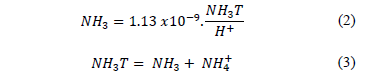
<body><![CDATA[<p><font size="2" face="Verdana, Arial, Helvetica, sans-serif">This research shows the A-Co as an  alternative to improve treatment of DWS, using the MBW as a co-substrate. In  addition, were evaluated different mixing ratios in order to identify both the  synergistic or antagonistic effect such as the methane production.</font></p>     <p>&nbsp;</p>     <p><font size="3" face="Verdana, Arial, Helvetica, sans-serif"><b>2. Methodology</b></font></p>     <p><font size="2" face="Verdana, Arial, Helvetica, sans-serif"><b><i>2.1. Experimental location</i></b></font></p>     <p><font size="2" face="Verdana, Arial, Helvetica, sans-serif">The assays  were performed at an altitude of 970 m above the sea level. The room  temperature was 23.6şC on average, and the controlled temperature of the  experiment was 30 ± 0.5şC.</font></p>     <p><font size="2" face="Verdana, Arial, Helvetica, sans-serif"><b><i>2.2. Experimental stage</i></b></font></p>     <p><font size="2" face="Verdana, Arial, Helvetica, sans-serif"><i>2.2.1<b>. </b> Characterization of  substrates (MBW and DWS) and inoculum</i></font></p>     <p><font size="2" face="Verdana, Arial, Helvetica, sans-serif">The MBW were collected from a solid waste  treatment plant (SWTP) in a Colombian city where integrated MSW management was  held, including source separation and selective collection of waste. On  average, 10200 kg·week<sup>-1</sup> of MSW are generated, and MBW  accounted for 66% of the total waste, which is equivalent to 6732 kg·week<sup>-1</sup>&#91;3&#93;. The sampling and characterization of MBW were  performed following the recommendations of Sakurai &#91;17&#93;. The DWS was obtained  from a municipal WWTP that employs ferric chloride in the chemically enhanced  primary treatment.</font></p>     <p><font size="2" face="Verdana, Arial, Helvetica, sans-serif">Prior to  physicochemical characterization and BMP testing, all inert material (stones,  metal, charcoal, bone) and slowly degrading material (plastic, rubber, and  leather) were removed from the MBW samples &#91;18&#93;. Afterwards, the materials were  subjected to grinding as recommended by Sharma et al. &#91;19&#93; using a Waring  Commercial CB15 blender at a speed of 15800 rpm for 1 minute (standard  equipment speed).</font></p>     <p><font size="2" face="Verdana, Arial, Helvetica, sans-serif">The  physicochemical characterization of the substrates was performed according to  ICONTEC &#91;20&#93; and APHA &#91;21&#93;. The variables used for the characterization were pH  (Units), humidity (%), total alkalinity TA, total bicarbonate alkalinity TBA  (mgCaCO<sub>3</sub>·L<sup>-1</sup>), VFAs (mg·L<sup>-1</sup>), acetic acid (mg·L<sup>-1</sup>),  propionic acid (mg·L<sup>-1</sup>), butyric acid (mg·L<sup>-1</sup>), palmitic acid (mg·L<sup>-1</sup>),  oleic acid (mg·L<sup>-1</sup>), total and oxidizable carbon (%), UV<sub>254</sub> (cm<sup>-1</sup>),  total and filtered chemical oxygen demand (COD, mg·L<sup>-1</sup>), biological oxygen  demand (BOD, mg·L<sup>-1</sup>), total nitrogen (%), total ammonia nitrogen (mg·L<sup>-1</sup>),  cellulose (%), starch (%), lignin (%), ether extract (mg kg<sup>-1</sup>),  proteins (%), carbohydrates, (%), raw fiber (%), total solids TS and volatiles  VS (mg·L<sup>-1</sup>).</font></p>     ]]></body>
<body><![CDATA[<p><font size="2" face="Verdana, Arial, Helvetica, sans-serif">The biodegradable fraction (BF) of the  MBW and TPS was determined according to the methodology suggested by Espinosa  et al. &#91;22&#93; (Eq. 1):</font></p>     <p><img src="/img/revistas/dyna/v83n199/v83n199a11eq01.gif"></p>     <p><font size="2" face="Verdana, Arial, Helvetica, sans-serif">Where BF is  the biodegradable fraction in relation to the volatile matter (VM); 0.83 and  0.028 are empirical constants; and LC is the lignin content in the VM,  expressed as a dry weight percentage.</font></p>     <p><font size="2" face="Verdana, Arial, Helvetica, sans-serif">Additionally, the non-ionized ammoniacal  nitrogen and ammonium ion present in the substrates were quantified using Eqs.  (2) and (3) as suggested by Sterling et al. &#91;23&#93;:</font></p>     <p><img src="/img/revistas/dyna/v83n199/v83n199a11eq0203.gif"></p>     <p><font size="2" face="Verdana, Arial, Helvetica, sans-serif">Where NH<sub>3</sub> is the non-ionized  ammoniacal nitrogen (mg·L<sup>-1</sup>); NH<sub>3</sub>T is the total  ammoniacal nitrogen (mg·L<sup>-1</sup>); H<sup>+</sup> is the  concentration of hydrogen ions (mol·L<sup>-1</sup>); and NH<sub>4</sub><sup>+</sup> is the ammonium ion (mg·L<sup>-1</sup>).</font></p>     <p><font size="2" face="Verdana, Arial, Helvetica, sans-serif">In order to ensure favorable conditions  for A-Co, an inoculum concentration of 1.5 gVS·L<sup>-1</sup> was used in the BMP assays &#91;24&#93;. The inoculum was obtained from an anaerobic  digester of the municipal WWTP of DWS, and was characterized in terms of  physicochemical variables determined from the substrates. Additionally, Specific Methanogenic Activity-SMA (gCOD·gVS<sup>-1</sup>·d<sup>-1</sup>) test were carried  out &#91;25&#93;. The MBW, DWS and inoculum were preserved at temperatures below 4°C  for periods shorter than seven days until the assays were performed.</font></p>     <p><font size="2" face="Verdana, Arial, Helvetica, sans-serif">The results for physicochemical characteristics  of the substrates and inoculums were processed by descriptive statistical  methods.</font></p>     <p><font size="2" face="Verdana, Arial, Helvetica, sans-serif"><i>2.2.2. Influence of DWS:MBW mixing ratios on methane production</i></font></p>     <p><font size="2" face="Verdana, Arial, Helvetica, sans-serif">The biogas  was quantified according to the manometric method using an OxiTop® instrument  to monitor the pressure. This equipment consists of a 250 mL reactor with a  measuring head that is inserted in the reactor mouthpiece as well as a control  that uses an infrared interface to transfer the data. The assays were performed  in a WTW TS 606-G/2-i incubator with manual intermittent mixing during 20 days.  The sample volume was 200 mL, and 50 mL were retained in the reactor for  storage of the produced biogas as recommended by Aquino et al. &#91;25&#93;.</font></p>     ]]></body>
<body><![CDATA[<p><font size="2" face="Verdana, Arial, Helvetica, sans-serif">The techniques to determine methane  production are standardized methods used to provide improved conditions for the  AD of the substrates. A solution of macronutrients and micronutrients was used  to maintain stable conditions during the BMP assays &#91;26&#93;, with a pH adjusted to  7.0 using NaHCO<sub>3</sub> solution at 4%.To capture CO<sub>2</sub> of biogas,  NaOH pearls were used and composition  of biogas was determined by gas  chromatography (Chromatograph GC2014).</font></p>     <p><font size="2" face="Verdana, Arial, Helvetica, sans-serif">The volume  of methane for standard conditions (SC) was determined according to the  methodology proposed by Gim&eacute;nez et al. &#91;27&#93;. Thus, the fraction of dissolved  methane in the experimental units was considered. The substrate-inoculum (S/I)  ratio was 0.25 gVS<sub>substrate</sub>·gVS<sub>inoculum</sub><sup>-1</sup> for all the  experimental units. Moreover, the concentration of inoculums was maintained at  a constant value, following the recommendations of Raposo et al. &#91;28&#93; for BMP  assays without continuous stirring.</font></p>     <p><font size="2" face="Verdana, Arial, Helvetica, sans-serif">Only the mixing ratios were modified  while maintaining the same organic load. The DWS:MBW mixing ratios assessed  were 100:00, 80:20, 60:40, 40:60, 20:80 and 00:100, respectively. Each mixing  ratios were replicated (n=2), and an additional unit that only contained  inoculum with distilled water was used as the control for the determination of  endogenous methane production.</font></p>     <p><font size="2" face="Verdana, Arial, Helvetica, sans-serif">The synergistic effect of co-digestion  could be estimated as an additional methane yield for co-substrates over the  weighted average of the individual substrate's BMP. If the differential (BMP-Weighted  BMP) was positive and greater than the standard deviation (SD) of BMP, the  synergistic effect could be confirmed. The weighted BMP of co-substrates were  calculated with Eq. (4) &#91;29&#93;:</font></p>     <p><img src="/img/revistas/dyna/v83n199/v83n199a11eq04.gif"></p>     <p><font size="2" face="Verdana, Arial, Helvetica, sans-serif">Where weighted BMP is the weighted  average of BMP for co-substrates (mLCH<sub>4</sub>·gVS<sup>-1</sup>);  BMP<sub>DWS</sub> and BMP<sub>MBW</sub> are the experimental methane yields for  DWS and MBW, respectively (mLCH<sub>4</sub>·gVS<sup>-1</sup>);  P<sub>DWS</sub> and P<sub>MBW</sub> are the percentage of DWS and MBW,  respectively on a VS basis.</font></p>     <p><font size="2" face="Verdana, Arial, Helvetica, sans-serif">The C/N ratio was determined in each  reactor according to the recommendations of Chiumenti &#91;30&#93; using Eq. (5):</font></p>     <p><img src="/img/revistas/dyna/v83n199/v83n199a11eq05.gif"></p>     <p><font size="2" face="Verdana, Arial, Helvetica, sans-serif">Where C/N<sub>M</sub> is the C/N ratio in the substrate mixture for each reactor; M<sub>total</sub> is the mass of the substrate mixture in each reactor (gVS); C/N<sub>MBW</sub> is the C/N ratio in the MBW; M<sub>MBW</sub> is the MBW mass in each reactor  (gVS); C/N<sub>DWS</sub> is the C/N ratio in the DWS; and M<sub>DWS</sub> is  the DWS mass in each reactor (gVS).</font></p>     <p><font size="2" face="Verdana, Arial, Helvetica, sans-serif"><i>2.2.3. Kinetic Models</i></font></p>     ]]></body>
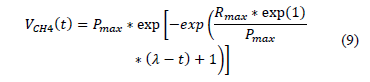
<body><![CDATA[<p><font size="2" face="Verdana, Arial, Helvetica, sans-serif">In order to determine the effect of the  different mixing ratios on the BMP assay, an analysis of variance (ANOVA) and  Tukey's test at <i>p</i>&lt;0.05 were  applied by using the software R (i386 3.0.2). The response variable was the  BMP. A statistical mixed model (Eq. 6) was used to determine the effect of the  different ratios using the software Polymath 5.0:</font></p>     <p><img src="/img/revistas/dyna/v83n199/v83n199a11eq06.gif"></p>     <p><font size="2" face="Verdana, Arial, Helvetica, sans-serif">Where y is  the response variable (BMP), <font face="Symbol">e</font> is the random error, <font face="Symbol">b</font><sub>0</sub> is  the coefficient associated with ratio 1 of the quantitative predictor variable,  <font face="Symbol">b</font><sub>1</sub> is the coefficient associated with ratio 2, <font face="Symbol">b</font><sub>2 </sub>is  the coefficient associated with ratio 3 and so on. Then, to validate this  model, a variance analysis was performed.</font></p>     <p><font size="2" face="Verdana, Arial, Helvetica, sans-serif">In order to analyze hydrolysis as a  limiting stage, a first-order kinetics model &#91;31&#93; and the modified Gompertz model were applied. In the first-order  kinetics model, Eqs. (7) and (8) were applied in order to obtain the  concentration (mol· L<sup>-1</sup>) from the pressure and the  hydrolysis constant, respectively.</font></p>     <p><img src="/img/revistas/dyna/v83n199/v83n199a11eq07.gif"></p>     <p><font size="2" face="Verdana, Arial, Helvetica, sans-serif">Where M(t) is the methane concentration  at time t (mol·L<sup>-1</sup>); P(t) is the pressure  registered by the OxiTop® instrument (atm) at time t; R is the ideal gas  constant (atm· L·mol<sup>-1</sup>·K<sup>-1</sup>); and T is the experiment temperature (K). </font></p>     <p><img src="/img/revistas/dyna/v83n199/v83n199a11eq08.gif"></p>     <p><font size="2" face="Verdana, Arial, Helvetica, sans-serif">Where LN is the natural logarithm; t is  the time (d); Mu is the methane production at the end of the experiment (mol· L<sup>-1</sup>); M is the remaining gas production over time  (M=Mu-M(t)); and K<sub>h</sub> is the hydrolysis constant (d<sup>-1</sup>). </font></p>     <p><font size="2" face="Verdana, Arial, Helvetica, sans-serif">The  modified Gompertz model can identify significant parameters related to the  hydrolysis stage of anaerobic digestion, such as the maximum production rate,  maximum production and lag phase, which emphasizes the time when the substrate  is transformed and its relation to the stage of the methane production. So as  to apply this model, the volume data obtained for each mixing ratio assessed  during the experiment were used. The model corresponds to a sigmoid function  expressing methane production in the reactor as a function of time (Eq. 9)&#91;32&#93;: </font></p>     <p><img src="/img/revistas/dyna/v83n199/v83n199a11eq09.gif"></p>     ]]></body>


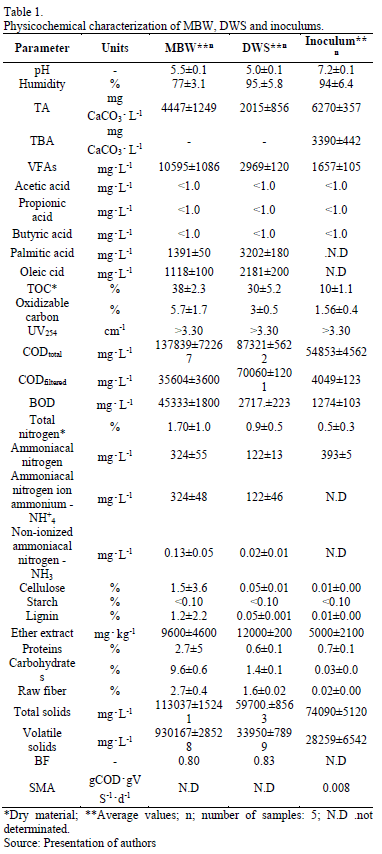
<body><![CDATA[<p><font size="2" face="Verdana, Arial, Helvetica, sans-serif">Where V<sub>CH4(t) </sub>is the cumulative methane production (mL·h<sup>-1</sup>); P<sub>max</sub> is the  maximum cumulative production at the end of the experiment (mL); R<sub>max </sub>is  the maximum rate of methane production (mL·h<sup>-1</sup>), <font face="Symbol">l</font> is the lag phase  (hours); and t is the methane generation time (hours).The determination  coefficient (R<sup>2</sup>) was used as criterion to assess the fitted models through the software Polymath  5.0 and Microsoft Excel 2007.</font></p>     <p>&nbsp;</p>     <p><font size="3" face="Verdana, Arial, Helvetica, sans-serif"><b>3. Results and discussion</b></font></p>     <p><font size="2" face="Verdana, Arial, Helvetica, sans-serif"><a href="#tab01">Table 1</a> shows the results of the  physicochemical analysis for the substrates (MBW and DWS) and inoculum.</font></p>     <p align="center"><font size="2" face="Verdana, Arial, Helvetica, sans-serif"><a name="tab01"></a></font><img src="/img/revistas/dyna/v83n199/v83n199a11tab01.gif"></p>     <p><font size="2" face="Verdana, Arial, Helvetica, sans-serif">Generally, the values for pH, humidity,  TA, TBA and VFAs of the MBW listed in <a href="#tab01">Table 1</a> correspond to the normal values  for acidified waste and are similar to those obtained by other authors, such as Pesta &#91;33&#93; and Zupan&#269;i&#269; et al. &#91;34&#93;. The low pH values  are related to the high contents of humidity (because of the high amounts of  raw food waste), which favors the production of VFAs and low alkalinity,  indicating that an alkaline solution with enough buffer capacity should be used  to neutralize the acidity during A-Co of MBW&#91;35&#93;.  Additionally, a chromatography analysis of the VFAs shows that long-chain and  branched-chain fatty acids are more abundant (palmitic acid and oleic acid),  and this result could extend the time required for hydrolysis and microbial  acclimatization&#91;36&#93;. </font></p>     <p><font size="2" face="Verdana, Arial, Helvetica, sans-serif">All the organic matter indicators  determined for the MBW show high values due to the physical composition of the  MBW according to Oviedo et al. &#91;3&#93;. Additionally, the  ratio of COD<sub>filtered</sub> to COD<sub>total</sub> (0.26) showed high  quantities of particulate material that can affect the stage of hydrolysis of  the organic matter.</font></p>     <p><font size="2" face="Verdana, Arial, Helvetica, sans-serif">pH determines the dominant form of  nitrogen and it is an important factor in biological processes because of the  probable inhibition of microbial activity&#91;33&#93;. In MBW, the dominant compounds of nitrogen corresponded to  ammoniacal nitrogen in two forms: NH<sub>4</sub><sup>+</sup> (324.32 mg·L<sup>-1</sup>) and NH<sub>3</sub> (0.13 mg·L<sup>-1</sup>),  which is the most toxic form. Based on the buffer capacity, Parawira et al. &#91;37&#93; and other authors  recommend nitrogen concentrations of 1100 mg·L<sup>-1</sup> so as to maintain an adequate A-Co of this type of waste.</font></p>     <p><font size="2" face="Verdana, Arial, Helvetica, sans-serif">The MBW presented a C/N ratio ranged from  20 to 30, which has positive effects on the A-Co and may be related to the high  contents of protein &#91;38&#93;. The values of the VS/TS ratio (0.82) and BF ratio (0.80) also  indicated high contents of organic matter and low contents of material of  vegetable origin that is difficult to degrade, such as lignin &#91;39&#93;. These results are similar to those obtained by Chen et al. &#91;40&#93;. </font></p>     <p><font size="2" face="Verdana, Arial, Helvetica, sans-serif">Generally, cellulose and lignin contents  of MBW goes from 40 to 60% and from 10 to 15%, respectively&#91;41&#93;. However, the values obtained in this study were lower because of  the source separation of waste, thus reducing the paper, diaper and pruning  waste. The starch content was also low, which was possibly caused by the  storage time in housings (between 3 and 4 days), which favors fermentation and  sucrose formation. Other compounds, such as ether extract (lipids), proteins,  raw fiber and carbohydrates, were present in quantities similar to those  reported by Chen, et al. &#91;40&#93; for this type of  waste. </font></p>     ]]></body>
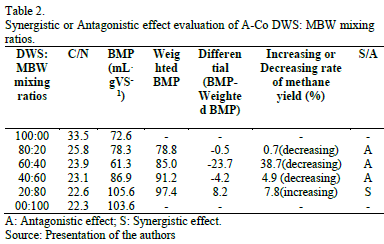
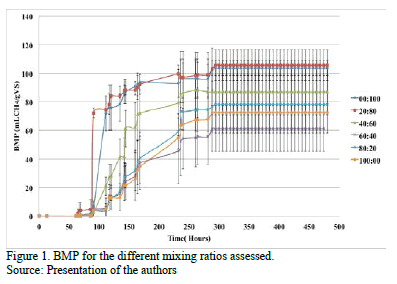
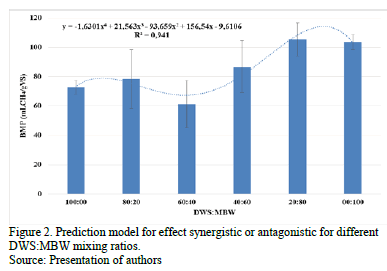
<body><![CDATA[<p><font size="2" face="Verdana, Arial, Helvetica, sans-serif">The DWS presented normal values of pH,  humidity, TA, TBA and VFAs&#91;42&#93;. Compared to the MBW, the DWS presented different characteristics  in terms of VFA composition (dominance of long-chain VFAs&#91;43&#93;) and high contents of organic matter. However, other variables,  such as humidity, COD<sub>filtered</sub>, COD<sub>total</sub>, and VS/TS and  C/N ratios, were different due to the substrate composition (e.g., low protein  content, higher amount of water, etc.). The higher contents of ether extract  can affect the hydrolysis process and methane production, which was reported by Cirne, et al. &#91;43&#93; for waste with high lipid contents.</font></p>     <p><font size="2" face="Verdana, Arial, Helvetica, sans-serif">The DWS:MBW mixing ratios may facilitate  the A-Co due to the synergy among nutrients, which favors the enzymatic  processes that occur during the hydrolytic stage and transformations in the  subsequent stages &#91;7&#93;. </font></p>     <p><font size="2" face="Verdana, Arial, Helvetica, sans-serif">The inoculum presented values typical of  anaerobic sludge from municipal WWTP, which uses chemically assisted primary treatment with values of pH, AT, and BA that are indicative of a good buffer capacity  that favors A-Co&#91;33&#93;. The value of the VS/TS ratio is low from the point of  view of the activity of the biomass present in the sludge, although it is  typical of anaerobic reactors at municipal WWTP, which uses chemically assisted primary  treatment. Nevertheless, it is important to understand  that the VS/TS ratio alone is not a good indicator of the inoculum quality, due  to the microbial diversity present in the sludge&#91;44&#93;.</font></p>     <p><font size="2" face="Verdana, Arial, Helvetica, sans-serif"><b><i>3.1. Influence of the DWS: MBW ratios on methane  production</i></b></font></p>     <p><font size="2" face="Verdana, Arial, Helvetica, sans-serif"><a href="#fig01">Fig.1</a> illustrates the BMP during A-Co of  the DWS and MBW, which lasted 20 days (480 hours). The CH<sub>4</sub> produced  for the different mixing ratios ranged from 61.28 to 105.6mLCH<sub>4</sub>·gVS<sup>-1</sup>. The CH<sub>4</sub> produced at 5 days (120 hours)  for the 00:100 and 20:80 mixing ratios accounted for more than 70% of the  total; in contrast, the mixing ratios 40:60, 60:40, 80:20 and 100:00 only  represented 48, 15, 15 and 12% respectively of the methane production. This behavior can be attributed to the high  content of long chain fatty acids and lipids in DWS (palmitic and oleic acid),  which according to Hidalgo et al. &#91;24&#93; and Esposito et al. &#91;45&#93;, destabilizes the  metabolic process performed by methanogenic microbial consortium and reduces  methane production. </font></p>     <p align="center"><font size="2" face="Verdana, Arial, Helvetica, sans-serif"><a name="fig01"></a></font><img src="/img/revistas/dyna/v83n199/v83n199a11fig01.gif"></p>     <p><font size="2" face="Verdana, Arial, Helvetica, sans-serif">The results of the ANOVA (<i>p</i>&lt;0.05) showed significant  differences between the BMP for the mixing ratios assessed. This variable has  an important influence on the activity of the microorganisms involved along the  different stages, especially during methane production. The effect of mixing  ratios can also be observed in the lag phase, which were 2.6 and 3 days,  respectively for 00:100 and 20:80 ratios, whereas for the remaining mixing  ratios, the duration ranged from 4 to 7 days. </font></p>     <p><font size="2" face="Verdana, Arial, Helvetica, sans-serif">Moreover, Tukey's test (<i>p</i>&gt;0.05) evidenced no significant  differences between the 00:100 and 80:20 or between the 40:60, 60:40, 80:20 and  100:00 mixing ratios. However, significant</font> <font size="2" face="Verdana, Arial, Helvetica, sans-serif">differences were  observed for the remaining cases, which indicates that MBW concentrations over  80% produce similar positive impacts on methane production during A-Co of DWS,  thereby favoring digestion of the DWS, which has a high content of long-chain  VFA's and are characterized by reduced methane production&#91;46&#93;. </font></p>     <p><font size="2" face="Verdana, Arial, Helvetica, sans-serif">Regarding synergistic or antagonistic  effect showed in <a href="#fig02">Fig. 2</a> (R<sup>2</sup>=0.94) it was observed strong synergistic  effects in the process for different DWS:MBW mixing ratios. The BMP is affected  when higher quantities of DWS are used, and the lowest methane production is  obtained for mixing ratio 60:40 (<a href="#tab02">Table 2</a>). These results are similar to those  obtained by Esposito et al. &#91;45&#93;, who stated that  higher MBW contents in the A-Co process produce a greater amount of methane,  which is attributed to the high biodegradability of the substrate. </font></p>     <p align="center"><font size="2" face="Verdana, Arial, Helvetica, sans-serif"><a name="fig02"></a></font><img src="/img/revistas/dyna/v83n199/v83n199a11fig02.gif"></p>     ]]></body>
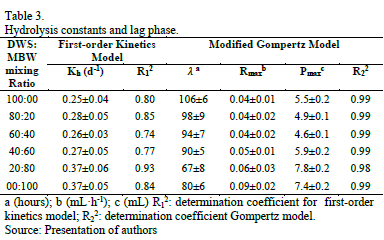
<body><![CDATA[<p align="center"><font size="2" face="Verdana, Arial, Helvetica, sans-serif"><a name="tab02"></a></font><img src="/img/revistas/dyna/v83n199/v83n199a11tab02.gif"></p>     <p><font size="2" face="Verdana, Arial, Helvetica, sans-serif"><a href="#tab02">Table 2</a> shows the BMP and C/N ratios when  different DWS and MBW mixing ratios are used. The range of optimal values for  A-Co is indicated and corresponds to ratios between 20 and 30.</font></p>     <p><font size="2" face="Verdana, Arial, Helvetica, sans-serif">According to <a href="#tab02">Table 2</a>, the C/N ratios in  each experimental unit ranged from 22.6 to 25.8, indicating that the  contribution of C and N by the different substrates was within the required  range for co-digestion processes. Therefore, these substrate ratios presented improved  pH, alkalinity, VFA and the necessary nutrients conditions to allow growth of  the microbes that perform the biological processes&#91;38&#93;. However, the DWS:MBW proportion 100:00 presented C/N ratios that  were outside the range of AD, which indicates lower or higher contents of  carbon than required. Therefore, it is  evidenced the synergistic effect which is generated by incorporating MWB in  A-Co of DWS, thus improving methane production and also ensuring a balance of  nutrients necessary for the process.</font></p>     <p><font size="2" face="Verdana, Arial, Helvetica, sans-serif"><b><i>3.2. Influence of  the different proportions on hydrolysis during the A-Co of DWS and MBW</i></b></font></p>     <p><font size="2" face="Verdana, Arial, Helvetica, sans-serif"><a href="#tab03">Table 3</a> presents the results for the  hydrolysis constants and lag phase for the different DWS:MBW mixing ratios.</font></p>     <p align="center"><font size="2" face="Verdana, Arial, Helvetica, sans-serif"><a name="tab03"></a></font><img src="/img/revistas/dyna/v83n199/v83n199a11tab03.gif"></p>     <p><font size="2" face="Verdana, Arial, Helvetica, sans-serif">With regard to the first-order kinetics  model, the hydrolysis constants were within the range of values corresponding  to the digestion of substrates containing high amounts of carbohydrates, which  are found in sludges from municipal WWTP &#91;15&#93;.  However, the hydrolysis constant values were dependent of DWS:MBW mixing ratio.  Therefore, the highest values of the hydrolysis constant were obtained for the  00:100 and 20:80 mixing ratio. </font></p>     <p><font size="2" face="Verdana, Arial, Helvetica, sans-serif">The K<sub>h</sub> value was 0.37, which  represents a higher conversion rate of substrate into methane, whereas the  other proportions presented K<sub>h</sub> values ranging between 0.25 and 0.28  d<sup>-1</sup>. The decreasing trend in K<sub>h</sub> values can be explained  by the increase in the fat concentration related to the higher amounts of DWS  in each reactor. This result was suggested by Iacovidou et al. &#91;47&#93;, who stated that  the presence of lipids contributes to the formation of long-chain VFAs  characterized by their toxicity to AD processes. Furthemore, Kim et al. &#91;48&#93; indicated that the  addition of MBW to the A-Co process with DWS causes an increase in the values  of K<sub>h</sub>, which was found in the present study.</font></p>     <p><font size="2" face="Verdana, Arial, Helvetica, sans-serif">Concerning the adjustment to the  nonlinear regression Gompertz model, an inversely proportional relationship was  observed between the length of the lag phase and methane production (similar to  what was observed in the case of K<sub>h</sub>). The shortest lag phase was  observed when substrate ratios of 00:100 and 20:80 were used, which produced  corresponding values of 80 h (3.3 d) and 67 h (2.8 d). This result can be  explained due to MBW contain organic matter with high quantities of  carbohydrates that are easily assimilated by the microorganisms during this  stage and promote rapid acclimatization to the substrate, which can be observed  in the methane production.</font></p>     <p><font size="2" face="Verdana, Arial, Helvetica, sans-serif">The values for the lag phase process  obtained for 40:60, 60:40, 80:20 and 100:00 mixing ratios were over 90 h. These  results show that if the proportion of DWS is high, a longer residence time in  the reactor is required in order to ensure that hydrolysis occurs; in addition,  larger reactor volumes and higher costs during implementation and operation are  also required.</font></p>     ]]></body>
<body><![CDATA[<p><font size="2" face="Verdana, Arial, Helvetica, sans-serif">The results of R<sub>max</sub> and P<sub>max</sub> obtained for the ratios with 80% MBW were 0.064 mL·h<sup>-1</sup> and 7.8 mL, respectively. These values are expected for the different stages of  methane production, which can be observed in the BMP results. In the reactors  where the amount of MBW accounted for less than 80%, the results obtained for R<sub>max</sub> and P<sub>max</sub> ranged from 0.04 to 0.050 mL·h<sup>-1</sup> and 4.6 to 5.9 mL, respectively, which is related to the low methane  production. </font></p>     <p>&nbsp;</p>     <p><font size="3" face="Verdana, Arial, Helvetica, sans-serif"><b>4. Conclusions</b></font></p>     <p><font size="2" face="Verdana, Arial, Helvetica, sans-serif">The A-Co of DWS and MBW is based on a  synergic effect related to the supplied nutrients, especially C and N. For the mixing ratios with 20% of MBW the  ratios C/N were between 22.6 and 25.8, which makes this process suitable for  its use with this type of waste produced by the communities of the country. </font></p>     <p><font size="2" face="Verdana, Arial, Helvetica, sans-serif">The DWS:MBW mixing ratio affects the  A-Co. When the amount of MBW accounted for more than 80% of the mixture, the  co-digestion performance was optimal. In contrast, the use of lower quantities  of MBW destabilizes the process, most likely due to limitations in the  hydrolysis of the organic matter and inhibition processes related to VFA  accumulation (especially long-chain), which may be toxic for the microbial  consortia involved in methane production. When the amount of DWS used accounts  for more than 20% of the mixture, the co-digestion of DWS and MBW entails  higher implementation costs (larger reactor volumes) and operational  complexity.</font></p>     <p><font size="2" face="Verdana, Arial, Helvetica, sans-serif">Although the values of the hydrolysis  constant of DWS and MBW (K<sub>h</sub>) were within the usual range of values  obtained in the literature, the K<sub>h</sub> was affected by the substrate  ratio. In the present study, the optimal conditions corresponded to 20:80  mixing ratio; under these circumstances, the length of the lag phase was  shorter (less than 3.3 days), and faster substrate degradation as well as  higher methane production were also obtained. </font></p>     <p>&nbsp;</p>     <p><font size="3" face="Verdana, Arial, Helvetica, sans-serif"><b>Acknowledgment</b></font></p>     <p><font size="2" face="Verdana, Arial, Helvetica, sans-serif">The authors thank to Universidad del  Valle for the technical and financial support required for the development of  this study, which was provided by the project entitled: &quot;Utilization of Organic  Fraction of Municipal Solid Waste for Methane Production as a Source of  Renewable Energy-CI2856&quot;.</font></p>     <p>&nbsp;</p>     ]]></body>
<body><![CDATA[<p><font size="3" face="Verdana, Arial, Helvetica, sans-serif"><b>References</b></font></p>     <!-- ref --><p><font size="2" face="Verdana, Arial, Helvetica, sans-serif"><b>&#91;1&#93;</b> Jingura, R. and Matengaifa, R.,  Optimization of biogas production by anaerobic digestion for sustainable energy  development in Zimbabwe. Renewable and Sustainable Energy Reviews, 13(5), pp.  1116-1120, 2009. DOI: 10.1016/j.rser.2007.06.015</font>&nbsp;&nbsp;&nbsp;&nbsp;&nbsp;&nbsp;&nbsp;&nbsp;[&#160;<a href="javascript:void(0);" onclick="javascript: window.open('/scielo.php?script=sci_nlinks&ref=1150145&pid=S0012-7353201600050001100001&lng=','','width=640,height=500,resizable=yes,scrollbars=1,menubar=yes,');">Links</a>&#160;]<!-- end-ref --><!-- ref --><p><font size="2" face="Verdana, Arial, Helvetica, sans-serif"><b>&#91;2&#93;</b> Wang, H. and Wang, C.,  Municipal solid waste management in Beijing: characteristics and challenges. Waste  Management &amp; Research, 31(1), pp. 67-72, 2013.  DOI: 10.1177/0734242X12468199</font>&nbsp;&nbsp;&nbsp;&nbsp;&nbsp;&nbsp;&nbsp;&nbsp;[&#160;<a href="javascript:void(0);" onclick="javascript: window.open('/scielo.php?script=sci_nlinks&ref=1150146&pid=S0012-7353201600050001100002&lng=','','width=640,height=500,resizable=yes,scrollbars=1,menubar=yes,');">Links</a>&#160;]<!-- end-ref --><!-- ref --><p><font size="2" face="Verdana, Arial, Helvetica, sans-serif"><b>&#91;3&#93;</b> Oviedo-Oca&ntilde;a, R.,  Marmolejo-Rebell&oacute;n, L. and Torres-Lozada, P. Evaluation of the adittion of wood  ashes to control the pH of substrates in municipal biowaste composting.  Ingenier&iacute;a, Investigaci&oacute;n y Tecnolog&iacute;a, 15(3), pp. 469-478, 2014. DOI: 10.1016/S1405-7743(14)70355-5</font>&nbsp;&nbsp;&nbsp;&nbsp;&nbsp;&nbsp;&nbsp;&nbsp;[&#160;<a href="javascript:void(0);" onclick="javascript: window.open('/scielo.php?script=sci_nlinks&ref=1150147&pid=S0012-7353201600050001100003&lng=','','width=640,height=500,resizable=yes,scrollbars=1,menubar=yes,');">Links</a>&#160;]<!-- end-ref --><!-- ref --><p><font size="2" face="Verdana, Arial, Helvetica, sans-serif"><b>&#91;4&#93;</b> Mart&iacute;n-Gonz&aacute;lez, L., Colturato,  L., Font, X. and Vicent, T. Anaerobic co-digestion of the organic fraction of  municipal solid waste with FOG waste from a sewage treatment plant: Recovering  a wasted methane potential and enhancing the biogas yield. Waste Management,  30(10), pp. 1854-1859, 2010. DOI: 10.1016/j.wasman.2010.03.029 </font>&nbsp;&nbsp;&nbsp;&nbsp;&nbsp;&nbsp;&nbsp;&nbsp;[&#160;<a href="javascript:void(0);" onclick="javascript: window.open('/scielo.php?script=sci_nlinks&ref=1150148&pid=S0012-7353201600050001100004&lng=','','width=640,height=500,resizable=yes,scrollbars=1,menubar=yes,');">Links</a>&#160;]<!-- end-ref --><!-- ref --><p><font size="2" face="Verdana, Arial, Helvetica, sans-serif"><b>&#91;5&#93;</b> Mata-Alvarez, J., Dosta, J.,  Romero-Güiza, M., Fonoll, X., Peces, M. and Astals, S., A critical review on  anaerobic co-digestion achievements between 2010 and 2013. Renewable and  Sustainable Energy Reviews, 36, pp. 412-427, 2014.  DOI: 10.1016/j.rser.2014.04.039</font>&nbsp;&nbsp;&nbsp;&nbsp;&nbsp;&nbsp;&nbsp;&nbsp;[&#160;<a href="javascript:void(0);" onclick="javascript: window.open('/scielo.php?script=sci_nlinks&ref=1150149&pid=S0012-7353201600050001100005&lng=','','width=640,height=500,resizable=yes,scrollbars=1,menubar=yes,');">Links</a>&#160;]<!-- end-ref --><!-- ref --><p><font size="2" face="Verdana, Arial, Helvetica, sans-serif"><b>&#91;6&#93;</b> Balussou, D., Kleyböcker, A.,  McKenna, R., Möst, D. and Fichtner, W., An economic analysis of three  operational co-digestion biogas plants in Germany. Waste and Biomass  Valorization, 3(1), pp, 23-41, 2012. DOI  10.1007/s12649-011-9094-2</font>&nbsp;&nbsp;&nbsp;&nbsp;&nbsp;&nbsp;&nbsp;&nbsp;[&#160;<a href="javascript:void(0);" onclick="javascript: window.open('/scielo.php?script=sci_nlinks&ref=1150150&pid=S0012-7353201600050001100006&lng=','','width=640,height=500,resizable=yes,scrollbars=1,menubar=yes,');">Links</a>&#160;]<!-- end-ref --><!-- ref --><p><font size="2" face="Verdana, Arial, Helvetica, sans-serif"><b>&#91;7&#93;</b> Hartmann, H. and Ahring, B.,  Anaerobic digestion of the organic fraction of municipal solid waste: Influence  of co-digestion with manure. Water Research, 39(8), pp. 1543-1552, 2005. DOI: 10.1016/j.watres.2005.02.001</font>&nbsp;&nbsp;&nbsp;&nbsp;&nbsp;&nbsp;&nbsp;&nbsp;[&#160;<a href="javascript:void(0);" onclick="javascript: window.open('/scielo.php?script=sci_nlinks&ref=1150151&pid=S0012-7353201600050001100007&lng=','','width=640,height=500,resizable=yes,scrollbars=1,menubar=yes,');">Links</a>&#160;]<!-- end-ref --><!-- ref --><p><font size="2" face="Verdana, Arial, Helvetica, sans-serif"><b>&#91;8&#93;</b> Lesteur, M., Bellon-Maurel, V.,  Gonzalez, C., Latrille, E., Roger, J., Junqua, G. and Steyer, J., Alternative  methods for determining anaerobic biodegradability: a review. Process  Biochemistry, 45(4), pp. 431-440, 2010. DOI: 10.1016/j.procbio.2009.11.018</font>&nbsp;&nbsp;&nbsp;&nbsp;&nbsp;&nbsp;&nbsp;&nbsp;[&#160;<a href="javascript:void(0);" onclick="javascript: window.open('/scielo.php?script=sci_nlinks&ref=1150152&pid=S0012-7353201600050001100008&lng=','','width=640,height=500,resizable=yes,scrollbars=1,menubar=yes,');">Links</a>&#160;]<!-- end-ref --><!-- ref --><p><font size="2" face="Verdana, Arial, Helvetica, sans-serif"><b>&#91;9&#93;</b> Pons&aacute;, S., Gea, T. and S&aacute;nchez,  A., Anaerobic co-digestion of theorganic fraction of municipal solid waste with  several pure organic co-substrates. Biosystems Engineering, 108(4), pp.  352-360, 2011. DOI: 10.1016/j.biosystemseng.2011.01.007</font>&nbsp;&nbsp;&nbsp;&nbsp;&nbsp;&nbsp;&nbsp;&nbsp;[&#160;<a href="javascript:void(0);" onclick="javascript: window.open('/scielo.php?script=sci_nlinks&ref=1150153&pid=S0012-7353201600050001100009&lng=','','width=640,height=500,resizable=yes,scrollbars=1,menubar=yes,');">Links</a>&#160;]<!-- end-ref --><!-- ref --><p><font size="2" face="Verdana, Arial, Helvetica, sans-serif"><b>&#91;10&#93;</b> Callaghan, F., Wase, D.,  Thayanity, K. and Forster, C., Continuous co-digestion of cattle slurry with  fruit and vegetable wastes and chicken manure, Biomass Bioenergy, 22(1), pp.  71-77, 2002. DOI: 10.1016/S0961-9534(01)00057-5</font>&nbsp;&nbsp;&nbsp;&nbsp;&nbsp;&nbsp;&nbsp;&nbsp;[&#160;<a href="javascript:void(0);" onclick="javascript: window.open('/scielo.php?script=sci_nlinks&ref=1150154&pid=S0012-7353201600050001100010&lng=','','width=640,height=500,resizable=yes,scrollbars=1,menubar=yes,');">Links</a>&#160;]<!-- end-ref --><!-- ref --><p><font size="2" face="Verdana, Arial, Helvetica, sans-serif"><b>&#91;11&#93;</b> Tandukar, M. and Pavlostathis, S., Co-digestion of municipal sludge  and external organic wastes for enhanced biogas production under realistic  plant constraints. Water Research, 87, pp. 432-445, 2015. DOI: 10.1016/j.watres.2015.04.031</font>&nbsp;&nbsp;&nbsp;&nbsp;&nbsp;&nbsp;&nbsp;&nbsp;[&#160;<a href="javascript:void(0);" onclick="javascript: window.open('/scielo.php?script=sci_nlinks&ref=1150155&pid=S0012-7353201600050001100011&lng=','','width=640,height=500,resizable=yes,scrollbars=1,menubar=yes,');">Links</a>&#160;]<!-- end-ref --><!-- ref --><p><font size="2" face="Verdana, Arial, Helvetica, sans-serif"><b>&#91;12&#93;</b> Zhang, P., Estudio y propuesta de mejora  del proceso de depuraci&oacute;n de la EDAR de Zhongyuan (China). Tesisi de Grado en Ciencias  Ambientales, Escuela Politecnica Superior de Gandia, Universidad Politecnica de  Valencia, Valencia, Espa&ntilde;a, 2013.    &nbsp;&nbsp;&nbsp;&nbsp;&nbsp;&nbsp;&nbsp;&nbsp;[&#160;<a href="javascript:void(0);" onclick="javascript: window.open('/scielo.php?script=sci_nlinks&ref=1150156&pid=S0012-7353201600050001100012&lng=','','width=640,height=500,resizable=yes,scrollbars=1,menubar=yes,');">Links</a>&#160;]<!-- end-ref --></font></p>     <!-- ref --><p><font size="2" face="Verdana, Arial, Helvetica, sans-serif"><b>&#91;13&#93;</b> Xu, G., Yan, Z., Wang, Y. and  Wang, N., Recycle of Alum recovered from water treatment sludge in chemically  enhanced primary treatment. Journal of Hazardous Materials, 161(2-3), pp.  663-669, 2009. DOI: 10.1016/j.jhazmat.2008.04.008</font>&nbsp;&nbsp;&nbsp;&nbsp;&nbsp;&nbsp;&nbsp;&nbsp;[&#160;<a href="javascript:void(0);" onclick="javascript: window.open('/scielo.php?script=sci_nlinks&ref=1150158&pid=S0012-7353201600050001100013&lng=','','width=640,height=500,resizable=yes,scrollbars=1,menubar=yes,');">Links</a>&#160;]<!-- end-ref --><!-- ref --><p><font size="2" face="Verdana, Arial, Helvetica, sans-serif"><b>&#91;14&#93;</b> Poon, C. and, Chu, C., The use  of ferric chloride and anionic polymer in the chemically assisted primary  sedimentation process. Chemosphere, 39(10), pp. 1573-1582, 1999. DOI: 10.1016/S0045-6535(99)00055-7</font>&nbsp;&nbsp;&nbsp;&nbsp;&nbsp;&nbsp;&nbsp;&nbsp;[&#160;<a href="javascript:void(0);" onclick="javascript: window.open('/scielo.php?script=sci_nlinks&ref=1150159&pid=S0012-7353201600050001100014&lng=','','width=640,height=500,resizable=yes,scrollbars=1,menubar=yes,');">Links</a>&#160;]<!-- end-ref --><!-- ref --><p><font size="2" face="Verdana, Arial, Helvetica, sans-serif"><b>&#91;15&#93;</b> Trzcinski, A. and Stuckey, D.,  Determination of the hydrolysis constant in the biochemical methane potential  test of municipal solid waste. Environmental Engineering Science, 29(9), pp.  848-854, 2012. DOI: 10.1089/ees.2011.0105</font>&nbsp;&nbsp;&nbsp;&nbsp;&nbsp;&nbsp;&nbsp;&nbsp;[&#160;<a href="javascript:void(0);" onclick="javascript: window.open('/scielo.php?script=sci_nlinks&ref=1150160&pid=S0012-7353201600050001100015&lng=','','width=640,height=500,resizable=yes,scrollbars=1,menubar=yes,');">Links</a>&#160;]<!-- end-ref --><!-- ref --><p><font size="2" face="Verdana, Arial, Helvetica, sans-serif"><b>&#91;16&#93;</b> Kafle, G., Kim, S. and Sung, K., Ensiling of fish industry waste for  biogas production: A lab scale evaluation of biochemical methane potential  (BMP) and kinetics. Bioresoruce Technology, 127, pp. 326-336, 2013. DOI: 10.1016/j.biortech.2012.09.032</font>&nbsp;&nbsp;&nbsp;&nbsp;&nbsp;&nbsp;&nbsp;&nbsp;[&#160;<a href="javascript:void(0);" onclick="javascript: window.open('/scielo.php?script=sci_nlinks&ref=1150161&pid=S0012-7353201600050001100016&lng=','','width=640,height=500,resizable=yes,scrollbars=1,menubar=yes,');">Links</a>&#160;]<!-- end-ref --><!-- ref --><p><font size="2" face="Verdana, Arial, Helvetica, sans-serif"><b>&#91;17&#93;</b> Sakurai, K., M&eacute;todo sencillo del an&aacute;lisis  de residuos s&oacute;lidos, Lima-Peru, CEPIS/OPS, Peru, 2000.    &nbsp;&nbsp;&nbsp;&nbsp;&nbsp;&nbsp;&nbsp;&nbsp;[&#160;<a href="javascript:void(0);" onclick="javascript: window.open('/scielo.php?script=sci_nlinks&ref=1150162&pid=S0012-7353201600050001100017&lng=','','width=640,height=500,resizable=yes,scrollbars=1,menubar=yes,');">Links</a>&#160;]<!-- end-ref --></font></p>     ]]></body>
<body><![CDATA[<!-- ref --><p><font size="2" face="Verdana, Arial, Helvetica, sans-serif"><b>&#91;18&#93;</b> Mukherjee, S., Kumar, S. and  Devotta, S., Influence of Nitrogen of Anaerobic Digestion of Municipal Solid  Waste in a Laboratory Scale. Journal of the IPHE &#91;Online&#93;. 9(4), 2008. &#91;date of reference March 25<sup>th</sup> of 2016&#93;. Available at: <a href="http://indiaenvironmentportal.org.in/files/Influence%20of%20nitrogen.pdf" target="_blank">http://indiaenvironmentportal.org.in/files/Influence%20of%20nitrogen.pdf </a></font>&nbsp;&nbsp;&nbsp;&nbsp;&nbsp;&nbsp;&nbsp;&nbsp;[&#160;<a href="javascript:void(0);" onclick="javascript: window.open('/scielo.php?script=sci_nlinks&ref=1150164&pid=S0012-7353201600050001100018&lng=','','width=640,height=500,resizable=yes,scrollbars=1,menubar=yes,');">Links</a>&#160;]<!-- end-ref --><!-- ref --><p><font size="2" face="Verdana, Arial, Helvetica, sans-serif"><b>&#91;19&#93;</b> Sharma, K., Mishra, I., Sharma, M. and Saini, J., Effect of Particle  Size on Biogas Generation from Biomass Residues. Biomass,  17(4), pp. 251-263, 1988. DOI: 10.1016/0144-4565(88)90107-2 </font>&nbsp;&nbsp;&nbsp;&nbsp;&nbsp;&nbsp;&nbsp;&nbsp;[&#160;<a href="javascript:void(0);" onclick="javascript: window.open('/scielo.php?script=sci_nlinks&ref=1150165&pid=S0012-7353201600050001100019&lng=','','width=640,height=500,resizable=yes,scrollbars=1,menubar=yes,');">Links</a>&#160;]<!-- end-ref --><!-- ref --><p><font size="2" face="Verdana, Arial, Helvetica, sans-serif"><b>&#91;20&#93;</b> ICONTEC., Norma T&eacute;cnica Colombiana 5167.  Productos para la Industria Agr&iacute;cola, Productos Org&aacute;nicos Usados como Abonos o  Fertilizantes y Enmiendas de Suelo, Colombia, 2004, 32 P.    &nbsp;&nbsp;&nbsp;&nbsp;&nbsp;&nbsp;&nbsp;&nbsp;[&#160;<a href="javascript:void(0);" onclick="javascript: window.open('/scielo.php?script=sci_nlinks&ref=1150166&pid=S0012-7353201600050001100020&lng=','','width=640,height=500,resizable=yes,scrollbars=1,menubar=yes,');">Links</a>&#160;]<!-- end-ref --></font></p>     <!-- ref --><p><font size="2" face="Verdana, Arial, Helvetica, sans-serif"><b>&#91;21&#93;</b> APHA. Standard methods for  examination of water and wastewater, Washington D.C., A.W.W.A.a.W.E.  Federation, Estados Unidos, 2005.    &nbsp;&nbsp;&nbsp;&nbsp;&nbsp;&nbsp;&nbsp;&nbsp;[&#160;<a href="javascript:void(0);" onclick="javascript: window.open('/scielo.php?script=sci_nlinks&ref=1150168&pid=S0012-7353201600050001100021&lng=','','width=640,height=500,resizable=yes,scrollbars=1,menubar=yes,');">Links</a>&#160;]<!-- end-ref --></font></p>     <!-- ref --><p><font size="2" face="Verdana, Arial, Helvetica, sans-serif"><b>&#91;22&#93;</b> Espinosa,  M., L&oacute;pez, M., Pell&oacute;n, A., Mayar&iacute;, R. y Fern&aacute;ndez, A., La fracci&oacute;n org&aacute;nica de  los residuos s&oacute;lidos urbanos como fuente potencial de producci&oacute;n de biog&aacute;s. Revista CENIC Ciencias Biol&oacute;gicas &#91;Online&#93;. 38(1), 2007. &#91;date of reference March 25<sup>th</sup> of 2016&#93;. Available at: <a href="http://www.redalyc.org/articulo.oa?id=181221557003" target="_blank">http://www.redalyc.org/articulo.oa?id=181221557003</a> </font>&nbsp;&nbsp;&nbsp;&nbsp;&nbsp;&nbsp;&nbsp;&nbsp;[&#160;<a href="javascript:void(0);" onclick="javascript: window.open('/scielo.php?script=sci_nlinks&ref=1150170&pid=S0012-7353201600050001100022&lng=','','width=640,height=500,resizable=yes,scrollbars=1,menubar=yes,');">Links</a>&#160;]<!-- end-ref --><!-- ref --><p><font size="2" face="Verdana, Arial, Helvetica, sans-serif"><b>&#91;23&#93;</b> Sterling, M., Lacey, R.,  Engler, C. and Ricke, S., Effects of Ammonia Nitrogen on H2 and CH4 production  during anaerobic digestion of dairy cattle manure. Bioresource Technology,  77(1), pp. 9-18, 2001. DOI: 10.1016/S0960-8524(00)00138-3</font>&nbsp;&nbsp;&nbsp;&nbsp;&nbsp;&nbsp;&nbsp;&nbsp;[&#160;<a href="javascript:void(0);" onclick="javascript: window.open('/scielo.php?script=sci_nlinks&ref=1150171&pid=S0012-7353201600050001100023&lng=','','width=640,height=500,resizable=yes,scrollbars=1,menubar=yes,');">Links</a>&#160;]<!-- end-ref --><!-- ref --><p><font size="2" face="Verdana, Arial, Helvetica, sans-serif"><b>&#91;24&#93;</b> Hidalgo, D. and Mart&iacute;n-Marroqu&iacute;na, J., Effects of inoculum source  and co-digestion strategies on anaerobic digestion of residues generated in the  treatment of waste vegetable oils. Journal of Environmental Management, 142, pp.  17-22, 2014. DOI: 10.1016/j.jenvman.2014.04.004</font>&nbsp;&nbsp;&nbsp;&nbsp;&nbsp;&nbsp;&nbsp;&nbsp;[&#160;<a href="javascript:void(0);" onclick="javascript: window.open('/scielo.php?script=sci_nlinks&ref=1150172&pid=S0012-7353201600050001100024&lng=','','width=640,height=500,resizable=yes,scrollbars=1,menubar=yes,');">Links</a>&#160;]<!-- end-ref --><!-- ref --><p><font size="2" face="Verdana, Arial, Helvetica, sans-serif"><b>&#91;25&#93;</b> Aquino,  S., Chernicharo, C., Foresti, E. Florencio, M. e Monteggia, L., Metodologias  para determinaçăo da atividade metanogęnica espec&iacute;fica (Ame) em lodos anaer&oacute;bios. Engenharia Sanitaria e Ambiental, 12(2), pp. 192-201, 2007. DOI: 10.1590/S1413-41522007000200010 </font>&nbsp;&nbsp;&nbsp;&nbsp;&nbsp;&nbsp;&nbsp;&nbsp;[&#160;<a href="javascript:void(0);" onclick="javascript: window.open('/scielo.php?script=sci_nlinks&ref=1150173&pid=S0012-7353201600050001100025&lng=','','width=640,height=500,resizable=yes,scrollbars=1,menubar=yes,');">Links</a>&#160;]<!-- end-ref --><!-- ref --><p><font size="2" face="Verdana, Arial, Helvetica, sans-serif"><b>&#91;26&#93;</b> Owen, W., Stuckey, D., Healy,  J., Young, L. and McCarty, P., Bioassay for Monitoring Biochemical Methane  Potential and Anaerobic Toxicity. Water Research, 13(6), pp. 485-492, 1979. DOI: 10.1016/0043-1354(79)90043-5</font>&nbsp;&nbsp;&nbsp;&nbsp;&nbsp;&nbsp;&nbsp;&nbsp;[&#160;<a href="javascript:void(0);" onclick="javascript: window.open('/scielo.php?script=sci_nlinks&ref=1150174&pid=S0012-7353201600050001100026&lng=','','width=640,height=500,resizable=yes,scrollbars=1,menubar=yes,');">Links</a>&#160;]<!-- end-ref --><!-- ref --><p><font size="2" face="Verdana, Arial, Helvetica, sans-serif"><b>&#91;27&#93;</b> Gim&eacute;nez, J., Mart&iacute;, N., Ferrer,  J. and Seco, A., Methane recovery efficiency in a submerged anaerobic membrane  bioreactor (SANMBR) treating sulphate-rich urban wastewater: Evaluation of  methane losses with the effluent. Bioresoruce Technology, 118, pp. 67-72, 2012. DOI: 10.1016/j.biortech.2012.05.019</font>&nbsp;&nbsp;&nbsp;&nbsp;&nbsp;&nbsp;&nbsp;&nbsp;[&#160;<a href="javascript:void(0);" onclick="javascript: window.open('/scielo.php?script=sci_nlinks&ref=1150175&pid=S0012-7353201600050001100027&lng=','','width=640,height=500,resizable=yes,scrollbars=1,menubar=yes,');">Links</a>&#160;]<!-- end-ref --><!-- ref --><p><font size="2" face="Verdana, Arial, Helvetica, sans-serif"><b>&#91;28&#93;</b> Raposo, F., Banks, C., Siegert,  I., Heaven, S. and Borja, R., Influence of inoculum to substrate ratio on the  biochemical methane potential of maize in batch tests. Process Biochemistry, 41(6),  pp. 1444-1450, 2006. DOI: 10.1016/j.procbio.2006.01.012</font>&nbsp;&nbsp;&nbsp;&nbsp;&nbsp;&nbsp;&nbsp;&nbsp;[&#160;<a href="javascript:void(0);" onclick="javascript: window.open('/scielo.php?script=sci_nlinks&ref=1150176&pid=S0012-7353201600050001100028&lng=','','width=640,height=500,resizable=yes,scrollbars=1,menubar=yes,');">Links</a>&#160;]<!-- end-ref --><!-- ref --><p><font size="2" face="Verdana, Arial, Helvetica, sans-serif"><b>&#91;29&#93;</b> Chen, X., Yan, W., Sheng, K. and  Sanati, M., Comparison of high-solids to liquid anaerobic co-digestion of food  waste and green waste. Bioresource Technology, 154, pp. 215-221, 2014. DOI: 10.1016/j.biortech.2013.12.054</font>&nbsp;&nbsp;&nbsp;&nbsp;&nbsp;&nbsp;&nbsp;&nbsp;[&#160;<a href="javascript:void(0);" onclick="javascript: window.open('/scielo.php?script=sci_nlinks&ref=1150177&pid=S0012-7353201600050001100029&lng=','','width=640,height=500,resizable=yes,scrollbars=1,menubar=yes,');">Links</a>&#160;]<!-- end-ref --><!-- ref --><p><font size="2" face="Verdana, Arial, Helvetica, sans-serif"><b>&#91;30&#93;</b> Chiumenti, A., Modern composting technologies. USA:  Emmaus, PA: JG Press., 2005.    &nbsp;&nbsp;&nbsp;&nbsp;&nbsp;&nbsp;&nbsp;&nbsp;[&#160;<a href="javascript:void(0);" onclick="javascript: window.open('/scielo.php?script=sci_nlinks&ref=1150178&pid=S0012-7353201600050001100030&lng=','','width=640,height=500,resizable=yes,scrollbars=1,menubar=yes,');">Links</a>&#160;]<!-- end-ref --></font></p>     <!-- ref --><p><font size="2" face="Verdana, Arial, Helvetica, sans-serif"><b>&#91;31&#93;</b> Liew, L., Shi, J. and Li, Y.,  Methane production from solid-state anaerobic digestion of lignocellulosic  biomass, Biomass and Bioenergy, 46, pp. 125-132, 2012. DOI: 10.1016/j.biombioe.2012.09.014</font>&nbsp;&nbsp;&nbsp;&nbsp;&nbsp;&nbsp;&nbsp;&nbsp;[&#160;<a href="javascript:void(0);" onclick="javascript: window.open('/scielo.php?script=sci_nlinks&ref=1150180&pid=S0012-7353201600050001100031&lng=','','width=640,height=500,resizable=yes,scrollbars=1,menubar=yes,');">Links</a>&#160;]<!-- end-ref --><!-- ref --><p><font size="2" face="Verdana, Arial, Helvetica, sans-serif"><b>&#91;32&#93;</b> Lay, J., Li, Y., Noike, T., Endo,  J. and Ishimoto, S., Analysis of enviomental factors affecting methane  production from high-solids organic. Water Science and Technology, 36(6-7), pp.  493-500, 1997. DOI: 10.1016/S0273-1223(97)00560-X</font>&nbsp;&nbsp;&nbsp;&nbsp;&nbsp;&nbsp;&nbsp;&nbsp;[&#160;<a href="javascript:void(0);" onclick="javascript: window.open('/scielo.php?script=sci_nlinks&ref=1150181&pid=S0012-7353201600050001100032&lng=','','width=640,height=500,resizable=yes,scrollbars=1,menubar=yes,');">Links</a>&#160;]<!-- end-ref --><!-- ref --><p><font size="2" face="Verdana, Arial, Helvetica, sans-serif"><b>&#91;33&#93;</b> Pesta, G., Anaerobic digestion  of organic residues and waste, USA: Springer New York, 2007.    &nbsp;&nbsp;&nbsp;&nbsp;&nbsp;&nbsp;&nbsp;&nbsp;[&#160;<a href="javascript:void(0);" onclick="javascript: window.open('/scielo.php?script=sci_nlinks&ref=1150182&pid=S0012-7353201600050001100033&lng=','','width=640,height=500,resizable=yes,scrollbars=1,menubar=yes,');">Links</a>&#160;]<!-- end-ref --></font></p>     ]]></body>
<body><![CDATA[<!-- ref --><p><font size="2" face="Verdana, Arial, Helvetica, sans-serif"><b>&#91;34&#93;</b> Zupan&#269;i&#269;, G. and Roš,  M., Determination of chemical oxygen demand in substrates from anaerobic  treatment of solid organic waste. Waste and Biomass Valorization, 3(1), pp.  89-98, 2012. DOI: 10.1007/s12649-011-9087-1</font>&nbsp;&nbsp;&nbsp;&nbsp;&nbsp;&nbsp;&nbsp;&nbsp;[&#160;<a href="javascript:void(0);" onclick="javascript: window.open('/scielo.php?script=sci_nlinks&ref=1150184&pid=S0012-7353201600050001100034&lng=','','width=640,height=500,resizable=yes,scrollbars=1,menubar=yes,');">Links</a>&#160;]<!-- end-ref --><!-- ref --><p><font size="2" face="Verdana, Arial, Helvetica, sans-serif"><b>&#91;35&#93;</b> Abdulkarim, B.I. and Abdullahi,  M.E., Effect of buffer (NaHCO<sub>3</sub>) and waste type in high solid  thermophilic anaerobic digestion, International Journal of ChemTech Research,  2, pp. 980-984, 2010</font>&nbsp;&nbsp;&nbsp;&nbsp;&nbsp;&nbsp;&nbsp;&nbsp;[&#160;<a href="javascript:void(0);" onclick="javascript: window.open('/scielo.php?script=sci_nlinks&ref=1150185&pid=S0012-7353201600050001100035&lng=','','width=640,height=500,resizable=yes,scrollbars=1,menubar=yes,');">Links</a>&#160;]<!-- end-ref --><!-- ref --><p><font size="2" face="Verdana, Arial, Helvetica, sans-serif"><b>&#91;36&#93;</b> Sundberg, C., Franke-Whittle,  I., Kauppi, S., Yu, D., Romantschuk, M., Insam, H. and Jönsson, H.,  Characterisation of source-separated household waste intended for composting.  Bioresource Technology, 102(3), pp. 2859-2867, 2011. DOI: 10.1016/j.biortech.2010.10.075</font>&nbsp;&nbsp;&nbsp;&nbsp;&nbsp;&nbsp;&nbsp;&nbsp;[&#160;<a href="javascript:void(0);" onclick="javascript: window.open('/scielo.php?script=sci_nlinks&ref=1150186&pid=S0012-7353201600050001100036&lng=','','width=640,height=500,resizable=yes,scrollbars=1,menubar=yes,');">Links</a>&#160;]<!-- end-ref --><!-- ref --><p><font size="2" face="Verdana, Arial, Helvetica, sans-serif"><b>&#91;37&#93;</b> Parawira, W., Murto, M.,  Zvauya, R. and Mattiasson, B., Anaerobic batch digestion of solid potato waste  alone and in combination with sugar beet leaves. Renewable Energy, 29(11), pp.  1811-1823, 2004. DOI: 10.1016/j.renene.2004.02.005</font>&nbsp;&nbsp;&nbsp;&nbsp;&nbsp;&nbsp;&nbsp;&nbsp;[&#160;<a href="javascript:void(0);" onclick="javascript: window.open('/scielo.php?script=sci_nlinks&ref=1150187&pid=S0012-7353201600050001100037&lng=','','width=640,height=500,resizable=yes,scrollbars=1,menubar=yes,');">Links</a>&#160;]<!-- end-ref --><!-- ref --><p><font size="2" face="Verdana, Arial, Helvetica, sans-serif"><b>&#91;38&#93;</b> Mata-Alvarez, J., Mac&eacute;, S. and  Llabares, P., Anaerobic digestion of organic solid wastes. An overview of  research achievements and perspectives. Bioresoruce Technology, 74(1), pp.  3-16, 2000. DOI: 10.1016/S0960-8524(00)00023-7</font>&nbsp;&nbsp;&nbsp;&nbsp;&nbsp;&nbsp;&nbsp;&nbsp;[&#160;<a href="javascript:void(0);" onclick="javascript: window.open('/scielo.php?script=sci_nlinks&ref=1150188&pid=S0012-7353201600050001100038&lng=','','width=640,height=500,resizable=yes,scrollbars=1,menubar=yes,');">Links</a>&#160;]<!-- end-ref --><!-- ref --><p><font size="2" face="Verdana, Arial, Helvetica, sans-serif"><b>&#91;39&#93;</b> Tak&aacute;&#269;ov&aacute;, A.,  Macklu&#318;ak, T., Smolinsk&aacute;, M., Hut&#328;an, M. and Olejn&iacute;kov&aacute;, P.,  Influence of selected biowaste materials pre-treatment on their anaerobic  digestion. Chemical Paper, 66(2), pp. 129-137, 2012. DOI: 10.2478/s11696-011-0107-1</font>&nbsp;&nbsp;&nbsp;&nbsp;&nbsp;&nbsp;&nbsp;&nbsp;[&#160;<a href="javascript:void(0);" onclick="javascript: window.open('/scielo.php?script=sci_nlinks&ref=1150189&pid=S0012-7353201600050001100039&lng=','','width=640,height=500,resizable=yes,scrollbars=1,menubar=yes,');">Links</a>&#160;]<!-- end-ref --><!-- ref --><p><font size="2" face="Verdana, Arial, Helvetica, sans-serif"><b>&#91;40&#93;</b> Chen, X., Romano, R. and Zhang,  R., Anaerobic digestion of food wastes for biogas production. International  Journal of Agricultural and Biological Engineering, 3(4), pp. 61-71, 2010. DOI: 10.3965/j.issn.1934-6344.2010.04.0-0</font>&nbsp;&nbsp;&nbsp;&nbsp;&nbsp;&nbsp;&nbsp;&nbsp;[&#160;<a href="javascript:void(0);" onclick="javascript: window.open('/scielo.php?script=sci_nlinks&ref=1150190&pid=S0012-7353201600050001100040&lng=','','width=640,height=500,resizable=yes,scrollbars=1,menubar=yes,');">Links</a>&#160;]<!-- end-ref --><!-- ref --><p><font size="2" face="Verdana, Arial, Helvetica, sans-serif"><b>&#91;41&#93;</b> Juanga, J., Optimizing dry  anaerobic digestion of organic fraction of municipal solid waste, MSc. Thesis,  School of Environment, Resources and Development, Asian Institute of  Technology, Bangkok, Thailand, 2005.    &nbsp;&nbsp;&nbsp;&nbsp;&nbsp;&nbsp;&nbsp;&nbsp;[&#160;<a href="javascript:void(0);" onclick="javascript: window.open('/scielo.php?script=sci_nlinks&ref=1150191&pid=S0012-7353201600050001100041&lng=','','width=640,height=500,resizable=yes,scrollbars=1,menubar=yes,');">Links</a>&#160;]<!-- end-ref --></font></p>     <!-- ref --><p><font size="2" face="Verdana, Arial, Helvetica, sans-serif"><b>&#91;42&#93;</b> Torres-Lozada, P.,  D&iacute;az-Granados, J. and Parra-Orobio, B.A., Effects of the incorporation of  drinking water sludge on the anaerobic digestion of domestic wastewater sludge  for methane production. Water Science and Technology, 72(6), pp. 1016-1021,  2015. DOI: 10.2166/wst.2015.291</font>&nbsp;&nbsp;&nbsp;&nbsp;&nbsp;&nbsp;&nbsp;&nbsp;[&#160;<a href="javascript:void(0);" onclick="javascript: window.open('/scielo.php?script=sci_nlinks&ref=1150193&pid=S0012-7353201600050001100042&lng=','','width=640,height=500,resizable=yes,scrollbars=1,menubar=yes,');">Links</a>&#160;]<!-- end-ref --><!-- ref --><p><font size="2" face="Verdana, Arial, Helvetica, sans-serif"><b>&#91;43&#93;</b> Cirne, D., Paloumet, X.,  Björnsson, L., Alves, M. and Mattiasson, B., Anaerobic Digestion of Lipid-Rich  Waste-Effects of Lipid Concentration. Renewable Energy, 32(6), pp. 965-975, 2007. DOI: 10.1016/j.renene.2006.04.003</font>&nbsp;&nbsp;&nbsp;&nbsp;&nbsp;&nbsp;&nbsp;&nbsp;[&#160;<a href="javascript:void(0);" onclick="javascript: window.open('/scielo.php?script=sci_nlinks&ref=1150194&pid=S0012-7353201600050001100043&lng=','','width=640,height=500,resizable=yes,scrollbars=1,menubar=yes,');">Links</a>&#160;]<!-- end-ref --><!-- ref --><p><font size="2" face="Verdana, Arial, Helvetica, sans-serif"><b>&#91;44&#93;</b> Demirel, B. and Scherer, P.,  The Roles of acetotrophic and hydrogenotrophic methanogens during anaerobic  conversion of biomass to methane: A review. Reviews in Environmental Science  and Bio/Technology, 7(2), pp. 173-190, 2008. DOI:  10.1007/s11157-008-9131-1</font>&nbsp;&nbsp;&nbsp;&nbsp;&nbsp;&nbsp;&nbsp;&nbsp;[&#160;<a href="javascript:void(0);" onclick="javascript: window.open('/scielo.php?script=sci_nlinks&ref=1150195&pid=S0012-7353201600050001100044&lng=','','width=640,height=500,resizable=yes,scrollbars=1,menubar=yes,');">Links</a>&#160;]<!-- end-ref --><!-- ref --><p><font size="2" face="Verdana, Arial, Helvetica, sans-serif"><b>&#91;45&#93;</b> Esposito, G., Frunzo, L.,  Giordano, A., Liotta, F., Panico, A. and Pirozzi, F., Anaerobic co-digestion of  organic wastes. Reviews in Environmental Science and Bio/Technology, 11(4), pp.  325-341, 2012. DOI: 10.1007/s11157-012-9277-8</font>&nbsp;&nbsp;&nbsp;&nbsp;&nbsp;&nbsp;&nbsp;&nbsp;[&#160;<a href="javascript:void(0);" onclick="javascript: window.open('/scielo.php?script=sci_nlinks&ref=1150196&pid=S0012-7353201600050001100045&lng=','','width=640,height=500,resizable=yes,scrollbars=1,menubar=yes,');">Links</a>&#160;]<!-- end-ref --><!-- ref --><p><font size="2" face="Verdana, Arial, Helvetica, sans-serif"><b>&#91;46&#93;</b> Davidsson, Ĺ., Lövstedt, C., la  Cour Jansen, J., Gruvberger, C. and Aspegren, H., Co-digestion of grease trap  sludge and sewage sludge. Waste Management, 28(6), pp. 986-992, 2008. DOI: 10.1016/j.wasman.2007.03.024</font>&nbsp;&nbsp;&nbsp;&nbsp;&nbsp;&nbsp;&nbsp;&nbsp;[&#160;<a href="javascript:void(0);" onclick="javascript: window.open('/scielo.php?script=sci_nlinks&ref=1150197&pid=S0012-7353201600050001100046&lng=','','width=640,height=500,resizable=yes,scrollbars=1,menubar=yes,');">Links</a>&#160;]<!-- end-ref --><!-- ref --><p><font size="2" face="Verdana, Arial, Helvetica, sans-serif"><b>&#91;47&#93;</b> Iacovidou, E., Ohandja, D. and  Voulvoulis, N., Food waste co-digestion with sewage sludge - Realising its  potential in the UK. Journal of Environmental Management, 112, pp. 267-274,  2012. DOI: 10.1016/j.jenvman.2012.07.029</font>&nbsp;&nbsp;&nbsp;&nbsp;&nbsp;&nbsp;&nbsp;&nbsp;[&#160;<a href="javascript:void(0);" onclick="javascript: window.open('/scielo.php?script=sci_nlinks&ref=1150198&pid=S0012-7353201600050001100047&lng=','','width=640,height=500,resizable=yes,scrollbars=1,menubar=yes,');">Links</a>&#160;]<!-- end-ref --><!-- ref --><p><font size="2" face="Verdana, Arial, Helvetica, sans-serif"><b>&#91;48&#93;</b> Kim, H., Han, S. and Shin, H.,  Anaerobic co-digestion of sewage sludge and food waste using temperature-phased  anaerobic digestion process. Water Science and Technology &#91;Online&#93;. 50(9),  2004. &#91;date of reference March 25<sup>th</sup> of  2016&#93;. Available at: <a href="http://www.ncbi.nlm.nih.gov/pubmed/15581001" target="_blank">http://www.ncbi.nlm.nih.gov/pubmed/15581001</a> </font>&nbsp;&nbsp;&nbsp;&nbsp;&nbsp;&nbsp;&nbsp;&nbsp;[&#160;<a href="javascript:void(0);" onclick="javascript: window.open('/scielo.php?script=sci_nlinks&ref=1150199&pid=S0012-7353201600050001100048&lng=','','width=640,height=500,resizable=yes,scrollbars=1,menubar=yes,');">Links</a>&#160;]<!-- end-ref --><p>&nbsp;</p>     <p><font size="2" face="Verdana, Arial, Helvetica, sans-serif"><b>B.A. Parra-Orobio,</b> gained his BSc. in  Sanitary Engineering in 2012 and his MSc. degree in Sanitary and Environmental  Engineering in 2014, both from the Universidad del Valle (Colombia). Currently  a doctoral student in Sanitary and Environmental Engineering in the same university. ORCID: 0000-0001-9256-6797</font></p>     <p><font size="2" face="Verdana, Arial, Helvetica, sans-serif"><b>P. Torres-Lozada,</b> gained her BSc. in  Sanitary Engineering in 1988 in the Universidad del Valle (Colombia), his MSc.  degree in Hydraulic and Sanitation Engineering in 1993 and his PhD. degree in  Hydraulic and Sanitation Engineering in 2001, both from the Universidad de Săo  Paulo (Brazil). ORCID: 0000-0001-9323-6677</font></p>     <p><font size="2" face="Verdana, Arial, Helvetica, sans-serif"><b>L.F.  Marmolejo-Rebell&oacute;n,</b> gained his BSc. in Sanitary Engineering in 1989, his MBA in Health Administration in 1995 and his PhD. Degree in Sanitary and Environmental  Engineering in 2011, all in the Universidad del Valle (Colombia). ORCID: 0000-0001-9993-2841.</font></p>     ]]></body>
<body><![CDATA[ ]]></body><back>
<ref-list>
<ref id="B1">
<label>1</label><nlm-citation citation-type="journal">
<person-group person-group-type="author">
<name>
<surname><![CDATA[Jingura]]></surname>
<given-names><![CDATA[R.]]></given-names>
</name>
<name>
<surname><![CDATA[Matengaifa]]></surname>
<given-names><![CDATA[R.]]></given-names>
</name>
</person-group>
<article-title xml:lang="en"><![CDATA[Optimization of biogas production by anaerobic digestion for sustainable energy development in Zimbabwe]]></article-title>
<source><![CDATA[Renewable and Sustainable Energy Reviews]]></source>
<year>2009</year>
<volume>13</volume>
<numero>5</numero>
<issue>5</issue>
<page-range>1116-1120</page-range></nlm-citation>
</ref>
<ref id="B2">
<label>2</label><nlm-citation citation-type="journal">
<person-group person-group-type="author">
<name>
<surname><![CDATA[Wang]]></surname>
<given-names><![CDATA[H.]]></given-names>
</name>
<name>
<surname><![CDATA[Wang]]></surname>
<given-names><![CDATA[C.]]></given-names>
</name>
</person-group>
<article-title xml:lang="en"><![CDATA[Municipal solid waste management in Beijing: characteristics and challenges]]></article-title>
<source><![CDATA[Waste Management & Research]]></source>
<year>2013</year>
<volume>31</volume>
<numero>1</numero>
<issue>1</issue>
<page-range>67-72</page-range></nlm-citation>
</ref>
<ref id="B3">
<label>3</label><nlm-citation citation-type="journal">
<person-group person-group-type="author">
<name>
<surname><![CDATA[Oviedo-Ocańa]]></surname>
<given-names><![CDATA[R.]]></given-names>
</name>
<name>
<surname><![CDATA[Marmolejo-Rebellón]]></surname>
<given-names><![CDATA[L.]]></given-names>
</name>
<name>
<surname><![CDATA[Torres-Lozada]]></surname>
<given-names><![CDATA[P.]]></given-names>
</name>
</person-group>
<article-title xml:lang="en"><![CDATA[Evaluation of the adittion of wood ashes to control the pH of substrates in municipal biowaste composting]]></article-title>
<source><![CDATA[Ingeniería, Investigación y Tecnología]]></source>
<year>2014</year>
<volume>15</volume>
<numero>3</numero>
<issue>3</issue>
<page-range>469-478</page-range></nlm-citation>
</ref>
<ref id="B4">
<label>4</label><nlm-citation citation-type="journal">
<person-group person-group-type="author">
<name>
<surname><![CDATA[Martín-González]]></surname>
<given-names><![CDATA[L.]]></given-names>
</name>
<name>
<surname><![CDATA[Colturato]]></surname>
<given-names><![CDATA[L.]]></given-names>
</name>
<name>
<surname><![CDATA[Font]]></surname>
<given-names><![CDATA[X.]]></given-names>
</name>
<name>
<surname><![CDATA[Vicent]]></surname>
<given-names><![CDATA[T.]]></given-names>
</name>
</person-group>
<article-title xml:lang="en"><![CDATA[Anaerobic co-digestion of the organic fraction of municipal solid waste with FOG waste from a sewage treatment plant: Recovering a wasted methane potential and enhancing the biogas yield]]></article-title>
<source><![CDATA[Waste Management]]></source>
<year>2010</year>
<volume>30</volume>
<numero>10</numero>
<issue>10</issue>
<page-range>1854-1859</page-range></nlm-citation>
</ref>
<ref id="B5">
<label>5</label><nlm-citation citation-type="journal">
<person-group person-group-type="author">
<name>
<surname><![CDATA[Mata-Alvarez]]></surname>
<given-names><![CDATA[J.]]></given-names>
</name>
<name>
<surname><![CDATA[Dosta]]></surname>
<given-names><![CDATA[J.]]></given-names>
</name>
<name>
<surname><![CDATA[Romero-Güiza]]></surname>
<given-names><![CDATA[M.]]></given-names>
</name>
<name>
<surname><![CDATA[Fonoll]]></surname>
<given-names><![CDATA[X.]]></given-names>
</name>
<name>
<surname><![CDATA[Peces]]></surname>
<given-names><![CDATA[M.]]></given-names>
</name>
<name>
<surname><![CDATA[Astals]]></surname>
<given-names><![CDATA[S.]]></given-names>
</name>
</person-group>
<article-title xml:lang="en"><![CDATA[A critical review on anaerobic co-digestion achievements between 2010 and 2013]]></article-title>
<source><![CDATA[Renewable and Sustainable Energy Reviews]]></source>
<year>2014</year>
<numero>36</numero>
<issue>36</issue>
<page-range>412-427</page-range></nlm-citation>
</ref>
<ref id="B6">
<label>6</label><nlm-citation citation-type="journal">
<person-group person-group-type="author">
<name>
<surname><![CDATA[Balussou]]></surname>
<given-names><![CDATA[D.]]></given-names>
</name>
<name>
<surname><![CDATA[Kleyböcker]]></surname>
<given-names><![CDATA[A.]]></given-names>
</name>
<name>
<surname><![CDATA[McKenna]]></surname>
<given-names><![CDATA[R.]]></given-names>
</name>
<name>
<surname><![CDATA[Möst]]></surname>
<given-names><![CDATA[D.]]></given-names>
</name>
<name>
<surname><![CDATA[Fichtner]]></surname>
<given-names><![CDATA[W.]]></given-names>
</name>
</person-group>
<article-title xml:lang="en"><![CDATA[An economic analysis of three operational co-digestion biogas plants in Germany]]></article-title>
<source><![CDATA[Waste and Biomass Valorization]]></source>
<year>2012</year>
<volume>3</volume>
<numero>1</numero>
<issue>1</issue>
<page-range>23-41</page-range></nlm-citation>
</ref>
<ref id="B7">
<label>7</label><nlm-citation citation-type="journal">
<person-group person-group-type="author">
<name>
<surname><![CDATA[Hartmann]]></surname>
<given-names><![CDATA[H.]]></given-names>
</name>
<name>
<surname><![CDATA[Ahring]]></surname>
<given-names><![CDATA[B.]]></given-names>
</name>
</person-group>
<article-title xml:lang="en"><![CDATA[Anaerobic digestion of the organic fraction of municipal solid waste: Influence of co-digestion with manure]]></article-title>
<source><![CDATA[Water Research]]></source>
<year>2005</year>
<volume>39</volume>
<numero>8</numero>
<issue>8</issue>
<page-range>1543-1552</page-range></nlm-citation>
</ref>
<ref id="B8">
<label>8</label><nlm-citation citation-type="journal">
<person-group person-group-type="author">
<name>
<surname><![CDATA[Lesteur]]></surname>
<given-names><![CDATA[M.]]></given-names>
</name>
<name>
<surname><![CDATA[Bellon-Maurel]]></surname>
<given-names><![CDATA[V.]]></given-names>
</name>
<name>
<surname><![CDATA[Gonzalez]]></surname>
<given-names><![CDATA[C.]]></given-names>
</name>
<name>
<surname><![CDATA[Latrille]]></surname>
<given-names><![CDATA[E.]]></given-names>
</name>
<name>
<surname><![CDATA[Roger]]></surname>
<given-names><![CDATA[J.]]></given-names>
</name>
<name>
<surname><![CDATA[Junqua]]></surname>
<given-names><![CDATA[G.]]></given-names>
</name>
<name>
<surname><![CDATA[Steyer]]></surname>
<given-names><![CDATA[J.]]></given-names>
</name>
</person-group>
<article-title xml:lang="en"><![CDATA[Alternative methods for determining anaerobic biodegradability: a review]]></article-title>
<source><![CDATA[Process Biochemistry]]></source>
<year>2010</year>
<volume>45</volume>
<numero>4</numero>
<issue>4</issue>
<page-range>431-440</page-range></nlm-citation>
</ref>
<ref id="B9">
<label>9</label><nlm-citation citation-type="journal">
<person-group person-group-type="author">
<name>
<surname><![CDATA[Ponsá]]></surname>
<given-names><![CDATA[S.]]></given-names>
</name>
<name>
<surname><![CDATA[Gea]]></surname>
<given-names><![CDATA[T.]]></given-names>
</name>
<name>
<surname><![CDATA[Sánchez]]></surname>
<given-names><![CDATA[A.]]></given-names>
</name>
</person-group>
<article-title xml:lang="en"><![CDATA[Anaerobic co-digestion of theorganic fraction of municipal solid waste with several pure organic co-substrates]]></article-title>
<source><![CDATA[Biosystems Engineering]]></source>
<year>2011</year>
<volume>108</volume>
<numero>4</numero>
<issue>4</issue>
<page-range>352-360</page-range></nlm-citation>
</ref>
<ref id="B10">
<label>10</label><nlm-citation citation-type="journal">
<person-group person-group-type="author">
<name>
<surname><![CDATA[Callaghan]]></surname>
<given-names><![CDATA[F.]]></given-names>
</name>
<name>
<surname><![CDATA[Wase]]></surname>
<given-names><![CDATA[D.]]></given-names>
</name>
<name>
<surname><![CDATA[Thayanity]]></surname>
<given-names><![CDATA[K.]]></given-names>
</name>
<name>
<surname><![CDATA[Forster]]></surname>
<given-names><![CDATA[C.]]></given-names>
</name>
</person-group>
<article-title xml:lang="en"><![CDATA[Continuous co-digestion of cattle slurry with fruit and vegetable wastes and chicken manure]]></article-title>
<source><![CDATA[Biomass Bioenergy]]></source>
<year>2002</year>
<volume>22</volume>
<numero>1</numero>
<issue>1</issue>
<page-range>71-77</page-range></nlm-citation>
</ref>
<ref id="B11">
<label>11</label><nlm-citation citation-type="journal">
<person-group person-group-type="author">
<name>
<surname><![CDATA[Tandukar]]></surname>
<given-names><![CDATA[M.]]></given-names>
</name>
<name>
<surname><![CDATA[Pavlostathis]]></surname>
<given-names><![CDATA[S.]]></given-names>
</name>
</person-group>
<article-title xml:lang="en"><![CDATA[Co-digestion of municipal sludge and external organic wastes for enhanced biogas production under realistic plant constraints]]></article-title>
<source><![CDATA[Water Research]]></source>
<year>2015</year>
<numero>87</numero>
<issue>87</issue>
<page-range>432-445</page-range></nlm-citation>
</ref>
<ref id="B12">
<label>12</label><nlm-citation citation-type="">
<person-group person-group-type="author">
<name>
<surname><![CDATA[Zhang]]></surname>
<given-names><![CDATA[P.]]></given-names>
</name>
</person-group>
<source><![CDATA[Estudio y propuesta de mejora del proceso de depuración de la EDAR de Zhongyuan (China)]]></source>
<year></year>
</nlm-citation>
</ref>
<ref id="B13">
<label>13</label><nlm-citation citation-type="journal">
<person-group person-group-type="author">
<name>
<surname><![CDATA[Xu]]></surname>
<given-names><![CDATA[G.]]></given-names>
</name>
<name>
<surname><![CDATA[Yan]]></surname>
<given-names><![CDATA[Z.]]></given-names>
</name>
<name>
<surname><![CDATA[Wang]]></surname>
<given-names><![CDATA[Y.]]></given-names>
</name>
<name>
<surname><![CDATA[Wang]]></surname>
<given-names><![CDATA[N.]]></given-names>
</name>
</person-group>
<article-title xml:lang="en"><![CDATA[Recycle of Alum recovered from water treatment sludge in chemically enhanced primary treatment]]></article-title>
<source><![CDATA[Journal of Hazardous Materials]]></source>
<year>2009</year>
<volume>161</volume>
<numero>2-3</numero>
<issue>2-3</issue>
<page-range>663-669</page-range></nlm-citation>
</ref>
<ref id="B14">
<label>14</label><nlm-citation citation-type="journal">
<person-group person-group-type="author">
<name>
<surname><![CDATA[Poon]]></surname>
<given-names><![CDATA[C.]]></given-names>
</name>
<name>
<surname><![CDATA[Chu]]></surname>
<given-names><![CDATA[C.]]></given-names>
</name>
</person-group>
<article-title xml:lang="en"><![CDATA[The use of ferric chloride and anionic polymer in the chemically assisted primary sedimentation process]]></article-title>
<source><![CDATA[Chemosphere]]></source>
<year>1999</year>
<volume>39</volume>
<numero>10</numero>
<issue>10</issue>
<page-range>1573-1582</page-range></nlm-citation>
</ref>
<ref id="B15">
<label>15</label><nlm-citation citation-type="journal">
<person-group person-group-type="author">
<name>
<surname><![CDATA[Trzcinski]]></surname>
<given-names><![CDATA[A.]]></given-names>
</name>
<name>
<surname><![CDATA[Stuckey]]></surname>
<given-names><![CDATA[D.]]></given-names>
</name>
</person-group>
<article-title xml:lang="en"><![CDATA[Determination of the hydrolysis constant in the biochemical methane potential test of municipal solid waste]]></article-title>
<source><![CDATA[Environmental Engineering Science]]></source>
<year>2012</year>
<volume>29</volume>
<numero>9</numero>
<issue>9</issue>
<page-range>848-854</page-range></nlm-citation>
</ref>
<ref id="B16">
<label>16</label><nlm-citation citation-type="journal">
<person-group person-group-type="author">
<name>
<surname><![CDATA[Kafle]]></surname>
<given-names><![CDATA[G.]]></given-names>
</name>
<name>
<surname><![CDATA[Kim]]></surname>
<given-names><![CDATA[S.]]></given-names>
</name>
<name>
<surname><![CDATA[Sung]]></surname>
<given-names><![CDATA[K.]]></given-names>
</name>
</person-group>
<article-title xml:lang="en"><![CDATA[Ensiling of fish industry waste for biogas production: A lab scale evaluation of biochemical methane potential (BMP) and kinetics]]></article-title>
<source><![CDATA[Bioresoruce Technology]]></source>
<year>2013</year>
<numero>127</numero>
<issue>127</issue>
<page-range>326-336</page-range></nlm-citation>
</ref>
<ref id="B17">
<label>17</label><nlm-citation citation-type="book">
<person-group person-group-type="author">
<name>
<surname><![CDATA[Sakurai]]></surname>
<given-names><![CDATA[K.]]></given-names>
</name>
</person-group>
<source><![CDATA[Método sencillo del análisis de residuos sólidos]]></source>
<year>2000</year>
<publisher-loc><![CDATA[Lima ]]></publisher-loc>
<publisher-name><![CDATA[CEPIS/OPS]]></publisher-name>
</nlm-citation>
</ref>
<ref id="B18">
<label>18</label><nlm-citation citation-type="journal">
<person-group person-group-type="author">
<name>
<surname><![CDATA[Mukherjee]]></surname>
<given-names><![CDATA[S.]]></given-names>
</name>
<name>
<surname><![CDATA[Kumar]]></surname>
<given-names><![CDATA[S.]]></given-names>
</name>
<name>
<surname><![CDATA[Devotta]]></surname>
<given-names><![CDATA[S.]]></given-names>
</name>
</person-group>
<article-title xml:lang="en"><![CDATA[Influence of Nitrogen of Anaerobic Digestion of Municipal Solid Waste in a Laboratory Scale.]]></article-title>
<source><![CDATA[Journal of the IPHE]]></source>
<year>2008</year>
<volume>9</volume>
<numero>4</numero>
<issue>4</issue>
</nlm-citation>
</ref>
<ref id="B19">
<label>19</label><nlm-citation citation-type="journal">
<person-group person-group-type="author">
<name>
<surname><![CDATA[Sharma]]></surname>
<given-names><![CDATA[K.]]></given-names>
</name>
<name>
<surname><![CDATA[Mishra]]></surname>
<given-names><![CDATA[I.]]></given-names>
</name>
<name>
<surname><![CDATA[Sharma]]></surname>
<given-names><![CDATA[M.]]></given-names>
</name>
<name>
<surname><![CDATA[Saini]]></surname>
<given-names><![CDATA[J.]]></given-names>
</name>
</person-group>
<article-title xml:lang="en"><![CDATA[Effect of Particle Size on Biogas Generation from Biomass Residues]]></article-title>
<source><![CDATA[Biomass]]></source>
<year>1988</year>
<volume>17</volume>
<numero>4</numero>
<issue>4</issue>
<page-range>251-263</page-range></nlm-citation>
</ref>
<ref id="B20">
<label>20</label><nlm-citation citation-type="">
<collab>ICONTEC</collab>
<source><![CDATA[Norma Técnica Colombiana 5167: Productos para la Industria Agrícola, Productos Orgánicos Usados como Abonos o Fertilizantes y Enmiendas de Suelo]]></source>
<year>2004</year>
</nlm-citation>
</ref>
<ref id="B21">
<label>21</label><nlm-citation citation-type="book">
<collab>APHA</collab>
<source><![CDATA[Standard methods for examination of water and wastewater]]></source>
<year>2005</year>
<publisher-loc><![CDATA[Washington D.C. ]]></publisher-loc>
<publisher-name><![CDATA[A.W.W.A.a.W.E. Federation]]></publisher-name>
</nlm-citation>
</ref>
<ref id="B22">
<label>22</label><nlm-citation citation-type="journal">
<person-group person-group-type="author">
<name>
<surname><![CDATA[Espinosa]]></surname>
<given-names><![CDATA[M.]]></given-names>
</name>
<name>
<surname><![CDATA[López]]></surname>
<given-names><![CDATA[M.]]></given-names>
</name>
<name>
<surname><![CDATA[Pellón]]></surname>
<given-names><![CDATA[A.]]></given-names>
</name>
<name>
<surname><![CDATA[Mayarí]]></surname>
<given-names><![CDATA[R.]]></given-names>
</name>
<name>
<surname><![CDATA[Fernández]]></surname>
<given-names><![CDATA[A.]]></given-names>
</name>
</person-group>
<article-title xml:lang="es"><![CDATA[La fracción orgánica de los residuos sólidos urbanos como fuente potencial de producción de biogás]]></article-title>
<source><![CDATA[Revista CENIC Ciencias Biológicas]]></source>
<year>2007</year>
<volume>38</volume>
<numero>1</numero>
<issue>1</issue>
</nlm-citation>
</ref>
<ref id="B23">
<label>23</label><nlm-citation citation-type="journal">
<person-group person-group-type="author">
<name>
<surname><![CDATA[Sterling]]></surname>
<given-names><![CDATA[M.]]></given-names>
</name>
<name>
<surname><![CDATA[Lacey]]></surname>
<given-names><![CDATA[R.]]></given-names>
</name>
<name>
<surname><![CDATA[Engler]]></surname>
<given-names><![CDATA[C.]]></given-names>
</name>
<name>
<surname><![CDATA[Ricke]]></surname>
<given-names><![CDATA[S.]]></given-names>
</name>
</person-group>
<article-title xml:lang="en"><![CDATA[Effects of Ammonia Nitrogen on H2 and CH4 production during anaerobic digestion of dairy cattle manure]]></article-title>
<source><![CDATA[Bioresource Technology]]></source>
<year>2001</year>
<volume>77</volume>
<numero>1</numero>
<issue>1</issue>
<page-range>9-18</page-range></nlm-citation>
</ref>
<ref id="B24">
<label>24</label><nlm-citation citation-type="journal">
<person-group person-group-type="author">
<name>
<surname><![CDATA[Hidalgo]]></surname>
<given-names><![CDATA[D.]]></given-names>
</name>
<name>
<surname><![CDATA[Martín-Marroquína]]></surname>
<given-names><![CDATA[J.]]></given-names>
</name>
</person-group>
<article-title xml:lang="en"><![CDATA[Effects of inoculum source and co-digestion strategies on anaerobic digestion of residues generated in the treatment of waste vegetable oils.]]></article-title>
<source><![CDATA[Journal of Environmental Management]]></source>
<year>2014</year>
<numero>142</numero>
<issue>142</issue>
<page-range>17-22</page-range></nlm-citation>
</ref>
<ref id="B25">
<label>25</label><nlm-citation citation-type="journal">
<person-group person-group-type="author">
<name>
<surname><![CDATA[Aquino]]></surname>
<given-names><![CDATA[S.]]></given-names>
</name>
<name>
<surname><![CDATA[Chernicharo]]></surname>
<given-names><![CDATA[C.]]></given-names>
</name>
<name>
<surname><![CDATA[Foresti]]></surname>
<given-names><![CDATA[E.]]></given-names>
</name>
<name>
<surname><![CDATA[Florencio]]></surname>
<given-names><![CDATA[M.]]></given-names>
</name>
<name>
<surname><![CDATA[Monteggia]]></surname>
<given-names><![CDATA[L.]]></given-names>
</name>
</person-group>
<article-title xml:lang="pt"><![CDATA[Metodologias para determinaçăo da atividade metanogęnica específica (Ame) em lodos anaeróbios]]></article-title>
<source><![CDATA[Engenharia Sanitaria e Ambiental]]></source>
<year>2007</year>
<volume>12</volume>
<numero>2</numero>
<issue>2</issue>
<page-range>192-201</page-range></nlm-citation>
</ref>
<ref id="B26">
<label>26</label><nlm-citation citation-type="journal">
<person-group person-group-type="author">
<name>
<surname><![CDATA[Owen]]></surname>
<given-names><![CDATA[W.]]></given-names>
</name>
<name>
<surname><![CDATA[Stuckey]]></surname>
<given-names><![CDATA[D.]]></given-names>
</name>
<name>
<surname><![CDATA[Healy]]></surname>
<given-names><![CDATA[J.]]></given-names>
</name>
<name>
<surname><![CDATA[Young]]></surname>
<given-names><![CDATA[L.]]></given-names>
</name>
<name>
<surname><![CDATA[McCarty]]></surname>
<given-names><![CDATA[P.]]></given-names>
</name>
</person-group>
<article-title xml:lang="en"><![CDATA[Bioassay for Monitoring Biochemical Methane Potential and Anaerobic Toxicity]]></article-title>
<source><![CDATA[Water Research]]></source>
<year>1979</year>
<volume>13</volume>
<numero>6</numero>
<issue>6</issue>
<page-range>485-492</page-range></nlm-citation>
</ref>
<ref id="B27">
<label>27</label><nlm-citation citation-type="journal">
<person-group person-group-type="author">
<name>
<surname><![CDATA[Giménez]]></surname>
<given-names><![CDATA[J.]]></given-names>
</name>
<name>
<surname><![CDATA[Martí]]></surname>
<given-names><![CDATA[N.]]></given-names>
</name>
<name>
<surname><![CDATA[Ferrer]]></surname>
<given-names><![CDATA[J.]]></given-names>
</name>
<name>
<surname><![CDATA[Seco]]></surname>
<given-names><![CDATA[A.]]></given-names>
</name>
</person-group>
<article-title xml:lang="en"><![CDATA[Methane recovery efficiency in a submerged anaerobic membrane bioreactor (SANMBR) treating sulphate-rich urban wastewater: Evaluation of methane losses with the effluent]]></article-title>
<source><![CDATA[Bioresoruce Technology]]></source>
<year>2012</year>
<numero>118</numero>
<issue>118</issue>
<page-range>67-72</page-range></nlm-citation>
</ref>
<ref id="B28">
<label>28</label><nlm-citation citation-type="journal">
<person-group person-group-type="author">
<name>
<surname><![CDATA[Raposo]]></surname>
<given-names><![CDATA[F.]]></given-names>
</name>
<name>
<surname><![CDATA[Banks]]></surname>
<given-names><![CDATA[C.]]></given-names>
</name>
<name>
<surname><![CDATA[Siegert]]></surname>
<given-names><![CDATA[I.]]></given-names>
</name>
<name>
<surname><![CDATA[Heaven]]></surname>
<given-names><![CDATA[S.]]></given-names>
</name>
<name>
<surname><![CDATA[Borja]]></surname>
<given-names><![CDATA[R.]]></given-names>
</name>
</person-group>
<article-title xml:lang="en"><![CDATA[Influence of inoculum to substrate ratio on the biochemical methane potential of maize in batch tests]]></article-title>
<source><![CDATA[Process Biochemistry]]></source>
<year>2006</year>
<volume>41</volume>
<numero>6</numero>
<issue>6</issue>
<page-range>1444-1450</page-range></nlm-citation>
</ref>
<ref id="B29">
<label>29</label><nlm-citation citation-type="journal">
<person-group person-group-type="author">
<name>
<surname><![CDATA[Chen]]></surname>
<given-names><![CDATA[X.]]></given-names>
</name>
<name>
<surname><![CDATA[Yan]]></surname>
<given-names><![CDATA[W.]]></given-names>
</name>
<name>
<surname><![CDATA[Sheng]]></surname>
<given-names><![CDATA[K.]]></given-names>
</name>
<name>
<surname><![CDATA[Sanati]]></surname>
<given-names><![CDATA[M.]]></given-names>
</name>
</person-group>
<article-title xml:lang="en"><![CDATA[Comparison of high-solids to liquid anaerobic co-digestion of food waste and green waste]]></article-title>
<source><![CDATA[Bioresource Technology]]></source>
<year>2014</year>
<numero>154</numero>
<issue>154</issue>
<page-range>215-221</page-range></nlm-citation>
</ref>
<ref id="B30">
<label>30</label><nlm-citation citation-type="book">
<person-group person-group-type="author">
<name>
<surname><![CDATA[Chiumenti]]></surname>
<given-names><![CDATA[A.]]></given-names>
</name>
</person-group>
<source><![CDATA[Modern composting technologies.]]></source>
<year>2005</year>
<publisher-name><![CDATA[JG Press]]></publisher-name>
</nlm-citation>
</ref>
<ref id="B31">
<label>31</label><nlm-citation citation-type="journal">
<person-group person-group-type="author">
<name>
<surname><![CDATA[Liew]]></surname>
<given-names><![CDATA[L.]]></given-names>
</name>
<name>
<surname><![CDATA[Shi]]></surname>
<given-names><![CDATA[J.]]></given-names>
</name>
<name>
<surname><![CDATA[Li]]></surname>
<given-names><![CDATA[Y.]]></given-names>
</name>
</person-group>
<article-title xml:lang="en"><![CDATA[Methane production from solid-state anaerobic digestion of lignocellulosic biomass]]></article-title>
<source><![CDATA[Biomass and Bioenergy]]></source>
<year>2012</year>
<numero>46</numero>
<issue>46</issue>
<page-range>125-132</page-range></nlm-citation>
</ref>
<ref id="B32">
<label>32</label><nlm-citation citation-type="journal">
<person-group person-group-type="author">
<name>
<surname><![CDATA[Lay]]></surname>
<given-names><![CDATA[J.]]></given-names>
</name>
<name>
<surname><![CDATA[Li]]></surname>
<given-names><![CDATA[Y.]]></given-names>
</name>
<name>
<surname><![CDATA[Noike]]></surname>
<given-names><![CDATA[T.]]></given-names>
</name>
<name>
<surname><![CDATA[Endo]]></surname>
<given-names><![CDATA[J.]]></given-names>
</name>
<name>
<surname><![CDATA[Ishimoto]]></surname>
<given-names><![CDATA[S.]]></given-names>
</name>
</person-group>
<article-title xml:lang="en"><![CDATA[Analysis of enviomental factors affecting methane production from high-solids organic]]></article-title>
<source><![CDATA[Water Science and Technology]]></source>
<year>1997</year>
<volume>36</volume>
<numero>6-7</numero>
<issue>6-7</issue>
<page-range>493-500</page-range></nlm-citation>
</ref>
<ref id="B33">
<label>33</label><nlm-citation citation-type="book">
<person-group person-group-type="author">
<name>
<surname><![CDATA[Pesta]]></surname>
<given-names><![CDATA[G.]]></given-names>
</name>
</person-group>
<source><![CDATA[Anaerobic digestion of organic residues and waste]]></source>
<year>2007</year>
<publisher-name><![CDATA[Springer New York]]></publisher-name>
</nlm-citation>
</ref>
<ref id="B34">
<label>34</label><nlm-citation citation-type="journal">
<person-group person-group-type="author">
<name>
<surname><![CDATA[Zupan&#269;i&#269;]]></surname>
<given-names><![CDATA[G.]]></given-names>
</name>
<name>
<surname><![CDATA[Roš]]></surname>
<given-names><![CDATA[M.]]></given-names>
</name>
</person-group>
<article-title xml:lang="en"><![CDATA[Determination of chemical oxygen demand in substrates from anaerobic treatment of solid organic waste]]></article-title>
<source><![CDATA[Waste and Biomass Valorization]]></source>
<year>2012</year>
<volume>3</volume>
<numero>1</numero>
<issue>1</issue>
<page-range>89-98</page-range></nlm-citation>
</ref>
<ref id="B35">
<label>35</label><nlm-citation citation-type="journal">
<person-group person-group-type="author">
<name>
<surname><![CDATA[Abdulkarim]]></surname>
<given-names><![CDATA[B.I.]]></given-names>
</name>
<name>
<surname><![CDATA[Abdullahi]]></surname>
<given-names><![CDATA[M.E.]]></given-names>
</name>
</person-group>
<article-title xml:lang="en"><![CDATA[Effect of buffer (NaHCO3) and waste type in high solid thermophilic anaerobic digestion]]></article-title>
<source><![CDATA[International Journal of ChemTech Research]]></source>
<year>2010</year>
<numero>2</numero>
<issue>2</issue>
<page-range>980-984</page-range></nlm-citation>
</ref>
<ref id="B36">
<label>36</label><nlm-citation citation-type="journal">
<person-group person-group-type="author">
<name>
<surname><![CDATA[Sundberg]]></surname>
<given-names><![CDATA[C.]]></given-names>
</name>
<name>
<surname><![CDATA[Franke-Whittle]]></surname>
<given-names><![CDATA[I.]]></given-names>
</name>
<name>
<surname><![CDATA[Kauppi]]></surname>
<given-names><![CDATA[S.]]></given-names>
</name>
<name>
<surname><![CDATA[Yu]]></surname>
<given-names><![CDATA[D.]]></given-names>
</name>
<name>
<surname><![CDATA[Romantschuk]]></surname>
<given-names><![CDATA[M.]]></given-names>
</name>
<name>
<surname><![CDATA[Insam]]></surname>
<given-names><![CDATA[H.]]></given-names>
</name>
<name>
<surname><![CDATA[Jönsson]]></surname>
<given-names><![CDATA[H.]]></given-names>
</name>
</person-group>
<article-title xml:lang="en"><![CDATA[Characterisation of source-separated household waste intended for composting]]></article-title>
<source><![CDATA[Bioresource Technology]]></source>
<year>2011</year>
<volume>102</volume>
<numero>3</numero>
<issue>3</issue>
<page-range>2859-2867</page-range></nlm-citation>
</ref>
<ref id="B37">
<label>37</label><nlm-citation citation-type="journal">
<person-group person-group-type="author">
<name>
<surname><![CDATA[Parawira]]></surname>
<given-names><![CDATA[W.]]></given-names>
</name>
<name>
<surname><![CDATA[Murto]]></surname>
<given-names><![CDATA[M.]]></given-names>
</name>
<name>
<surname><![CDATA[Zvauya]]></surname>
<given-names><![CDATA[R.]]></given-names>
</name>
<name>
<surname><![CDATA[Mattiasson]]></surname>
<given-names><![CDATA[B.]]></given-names>
</name>
</person-group>
<article-title xml:lang="en"><![CDATA[Anaerobic batch digestion of solid potato waste alone and in combination with sugar beet leaves]]></article-title>
<source><![CDATA[Renewable Energy]]></source>
<year>2004</year>
<volume>29</volume>
<numero>11</numero>
<issue>11</issue>
<page-range>1811-1823</page-range></nlm-citation>
</ref>
<ref id="B38">
<label>38</label><nlm-citation citation-type="journal">
<person-group person-group-type="author">
<name>
<surname><![CDATA[Mata-Alvarez]]></surname>
<given-names><![CDATA[J.]]></given-names>
</name>
<name>
<surname><![CDATA[Macé]]></surname>
<given-names><![CDATA[S.]]></given-names>
</name>
<name>
<surname><![CDATA[Llabares]]></surname>
<given-names><![CDATA[P.]]></given-names>
</name>
</person-group>
<article-title xml:lang="en"><![CDATA[Anaerobic digestion of organic solid wastes.: An overview of research achievements and perspectives]]></article-title>
<source><![CDATA[Bioresoruce Technology]]></source>
<year>2000</year>
<volume>74</volume>
<numero>1</numero>
<issue>1</issue>
<page-range>3-16</page-range></nlm-citation>
</ref>
<ref id="B39">
<label>39</label><nlm-citation citation-type="journal">
<person-group person-group-type="author">
<name>
<surname><![CDATA[Taká&#269;ová]]></surname>
<given-names><![CDATA[A.]]></given-names>
</name>
<name>
<surname><![CDATA[Macklu&#318;ak]]></surname>
<given-names><![CDATA[T.]]></given-names>
</name>
<name>
<surname><![CDATA[Smolinská]]></surname>
<given-names><![CDATA[M.]]></given-names>
</name>
<name>
<surname><![CDATA[Hut&#328;an]]></surname>
<given-names><![CDATA[M.]]></given-names>
</name>
<name>
<surname><![CDATA[Olejníková]]></surname>
<given-names><![CDATA[P.]]></given-names>
</name>
</person-group>
<article-title xml:lang="en"><![CDATA[Influence of selected biowaste materials pre-treatment on their anaerobic digestion]]></article-title>
<source><![CDATA[Chemical Paper]]></source>
<year>2012</year>
<volume>66</volume>
<numero>2</numero>
<issue>2</issue>
<page-range>129-137</page-range></nlm-citation>
</ref>
<ref id="B40">
<label>40</label><nlm-citation citation-type="journal">
<person-group person-group-type="author">
<name>
<surname><![CDATA[Chen]]></surname>
<given-names><![CDATA[X.]]></given-names>
</name>
<name>
<surname><![CDATA[Romano]]></surname>
<given-names><![CDATA[R.]]></given-names>
</name>
<name>
<surname><![CDATA[Zhang]]></surname>
<given-names><![CDATA[R.]]></given-names>
</name>
</person-group>
<article-title xml:lang="en"><![CDATA[Anaerobic digestion of food wastes for biogas production]]></article-title>
<source><![CDATA[International Journal of Agricultural and Biological Engineering]]></source>
<year>2010</year>
<volume>3</volume>
<numero>4</numero>
<issue>4</issue>
<page-range>61-71</page-range></nlm-citation>
</ref>
<ref id="B41">
<label>41</label><nlm-citation citation-type="">
<person-group person-group-type="author">
<name>
<surname><![CDATA[Juanga]]></surname>
<given-names><![CDATA[J.]]></given-names>
</name>
</person-group>
<source><![CDATA[Optimizing dry anaerobic digestion of organic fraction of municipal solid waste]]></source>
<year></year>
</nlm-citation>
</ref>
<ref id="B42">
<label>42</label><nlm-citation citation-type="journal">
<person-group person-group-type="author">
<name>
<surname><![CDATA[Torres-Lozada]]></surname>
<given-names><![CDATA[P.]]></given-names>
</name>
<name>
<surname><![CDATA[Díaz-Granados]]></surname>
<given-names><![CDATA[J.]]></given-names>
</name>
<name>
<surname><![CDATA[Parra-Orobio]]></surname>
<given-names><![CDATA[B.A.]]></given-names>
</name>
</person-group>
<article-title xml:lang="en"><![CDATA[Effects of the incorporation of drinking water sludge on the anaerobic digestion of domestic wastewater sludge for methane production]]></article-title>
<source><![CDATA[Water Science and Technology]]></source>
<year>2015</year>
<volume>72</volume>
<numero>6</numero>
<issue>6</issue>
<page-range>1016-1021</page-range></nlm-citation>
</ref>
<ref id="B43">
<label>43</label><nlm-citation citation-type="journal">
<person-group person-group-type="author">
<name>
<surname><![CDATA[Cirne]]></surname>
<given-names><![CDATA[D.]]></given-names>
</name>
<name>
<surname><![CDATA[Paloumet]]></surname>
<given-names><![CDATA[X.]]></given-names>
</name>
<name>
<surname><![CDATA[Björnsson]]></surname>
<given-names><![CDATA[L.]]></given-names>
</name>
<name>
<surname><![CDATA[Alves]]></surname>
<given-names><![CDATA[M.]]></given-names>
</name>
<name>
<surname><![CDATA[Mattiasson]]></surname>
<given-names><![CDATA[B.]]></given-names>
</name>
</person-group>
<article-title xml:lang="en"><![CDATA[Anaerobic Digestion of Lipid-Rich Waste-Effects of Lipid Concentration.]]></article-title>
<source><![CDATA[Renewable Energy]]></source>
<year>2007</year>
<volume>32</volume>
<numero>6</numero>
<issue>6</issue>
<page-range>965-975</page-range></nlm-citation>
</ref>
<ref id="B44">
<label>44</label><nlm-citation citation-type="journal">
<person-group person-group-type="author">
<name>
<surname><![CDATA[Demirel]]></surname>
<given-names><![CDATA[B.]]></given-names>
</name>
<name>
<surname><![CDATA[Scherer]]></surname>
<given-names><![CDATA[P.]]></given-names>
</name>
</person-group>
<article-title xml:lang="en"><![CDATA[The Roles of acetotrophic and hydrogenotrophic methanogens during anaerobic conversion of biomass to methane: A review]]></article-title>
<source><![CDATA[Reviews in Environmental Science and Bio/Technology]]></source>
<year>2008</year>
<volume>7</volume>
<numero>2</numero>
<issue>2</issue>
<page-range>173-190</page-range></nlm-citation>
</ref>
<ref id="B45">
<label>45</label><nlm-citation citation-type="journal">
<person-group person-group-type="author">
<name>
<surname><![CDATA[Esposito]]></surname>
<given-names><![CDATA[G.]]></given-names>
</name>
<name>
<surname><![CDATA[Frunzo]]></surname>
<given-names><![CDATA[L.]]></given-names>
</name>
<name>
<surname><![CDATA[Giordano]]></surname>
<given-names><![CDATA[A.]]></given-names>
</name>
<name>
<surname><![CDATA[Liotta]]></surname>
<given-names><![CDATA[F.]]></given-names>
</name>
<name>
<surname><![CDATA[Panico]]></surname>
<given-names><![CDATA[A.]]></given-names>
</name>
<name>
<surname><![CDATA[Pirozzi]]></surname>
<given-names><![CDATA[F.]]></given-names>
</name>
</person-group>
<article-title xml:lang="en"><![CDATA[Anaerobic co-digestion of organic wastes.]]></article-title>
<source><![CDATA[Reviews in Environmental Science and Bio/Technology]]></source>
<year>2012</year>
<volume>11</volume>
<numero>4</numero>
<issue>4</issue>
<page-range>325-341</page-range></nlm-citation>
</ref>
<ref id="B46">
<label>46</label><nlm-citation citation-type="journal">
<person-group person-group-type="author">
<name>
<surname><![CDATA[Davidsson]]></surname>
<given-names><![CDATA[Ĺ.]]></given-names>
</name>
<name>
<surname><![CDATA[Lövstedt]]></surname>
<given-names><![CDATA[C.]]></given-names>
</name>
<name>
<surname><![CDATA[la Cour Jansen]]></surname>
<given-names><![CDATA[J.]]></given-names>
</name>
<name>
<surname><![CDATA[Gruvberger]]></surname>
<given-names><![CDATA[C.]]></given-names>
</name>
<name>
<surname><![CDATA[Aspegren]]></surname>
<given-names><![CDATA[H.]]></given-names>
</name>
</person-group>
<article-title xml:lang="en"><![CDATA[Co-digestion of grease trap sludge and sewage sludge]]></article-title>
<source><![CDATA[Waste Management]]></source>
<year>2008</year>
<volume>28</volume>
<numero>6</numero>
<issue>6</issue>
<page-range>986-992</page-range></nlm-citation>
</ref>
<ref id="B47">
<label>47</label><nlm-citation citation-type="journal">
<person-group person-group-type="author">
<name>
<surname><![CDATA[Iacovidou]]></surname>
<given-names><![CDATA[E.]]></given-names>
</name>
<name>
<surname><![CDATA[Ohandja]]></surname>
<given-names><![CDATA[D.]]></given-names>
</name>
<name>
<surname><![CDATA[Voulvoulis]]></surname>
<given-names><![CDATA[N.]]></given-names>
</name>
</person-group>
<article-title xml:lang="en"><![CDATA[Food waste co-digestion with sewage sludge: Realising its potential in the UK]]></article-title>
<source><![CDATA[Journal of Environmental Management]]></source>
<year>2012</year>
<numero>112</numero>
<issue>112</issue>
<page-range>267-274</page-range></nlm-citation>
</ref>
<ref id="B48">
<label>48</label><nlm-citation citation-type="journal">
<person-group person-group-type="author">
<name>
<surname><![CDATA[Kim]]></surname>
<given-names><![CDATA[H.]]></given-names>
</name>
<name>
<surname><![CDATA[Han]]></surname>
<given-names><![CDATA[S.]]></given-names>
</name>
<name>
<surname><![CDATA[Shin]]></surname>
<given-names><![CDATA[H.]]></given-names>
</name>
</person-group>
<article-title xml:lang="en"><![CDATA[Anaerobic co-digestion of sewage sludge and food waste using temperature-phased anaerobic digestion process]]></article-title>
<source><![CDATA[Water Science and Technology]]></source>
<year></year>
<volume>50</volume>
<numero>9</numero>
<issue>9</issue>
<page-range>2004</page-range></nlm-citation>
</ref>
</ref-list>
</back>
</article>