<?xml version="1.0" encoding="ISO-8859-1"?><article xmlns:mml="http://www.w3.org/1998/Math/MathML" xmlns:xlink="http://www.w3.org/1999/xlink" xmlns:xsi="http://www.w3.org/2001/XMLSchema-instance">
<front>
<journal-meta>
<journal-id>0012-7353</journal-id>
<journal-title><![CDATA[DYNA]]></journal-title>
<abbrev-journal-title><![CDATA[Dyna rev.fac.nac.minas]]></abbrev-journal-title>
<issn>0012-7353</issn>
<publisher>
<publisher-name><![CDATA[Universidad Nacional de Colombia]]></publisher-name>
</publisher>
</journal-meta>
<article-meta>
<article-id>S0012-73532016000500018</article-id>
<article-id pub-id-type="doi">10.15446/dyna.v83n199.52529</article-id>
<title-group>
<article-title xml:lang="en"><![CDATA[The behavior of a foundation transversally loaded at the top over highly porous and collapsible soil]]></article-title>
<article-title xml:lang="es"><![CDATA[Comportamiento de cimentación cargada transversalmente en su cabeza en suelo altamente poroso y colapsable]]></article-title>
</title-group>
<contrib-group>
<contrib contrib-type="author">
<name>
<surname><![CDATA[Kassouf]]></surname>
<given-names><![CDATA[Roberto]]></given-names>
</name>
<xref ref-type="aff" rid="A01"/>
</contrib>
<contrib contrib-type="author">
<name>
<surname><![CDATA[Carvalho]]></surname>
<given-names><![CDATA[David de]]></given-names>
</name>
<xref ref-type="aff" rid="A02"/>
</contrib>
<contrib contrib-type="author">
<name>
<surname><![CDATA[Albuquerque]]></surname>
<given-names><![CDATA[Paulo José Rocha-de]]></given-names>
</name>
<xref ref-type="aff" rid="A02"/>
</contrib>
</contrib-group>
<aff id="A01">
<institution><![CDATA[,Kassouf Engineering  ]]></institution>
<addr-line><![CDATA[Itatiba ]]></addr-line>
<country>Brasil</country>
</aff>
<aff id="A02">
<institution><![CDATA[,Universidade Estadual de Campinas  ]]></institution>
<addr-line><![CDATA[Campinas ]]></addr-line>
<country>Brasil</country>
</aff>
<aff id="A">
<institution><![CDATA[,pjra@fec.unicamp.br  ]]></institution>
<addr-line><![CDATA[ ]]></addr-line>
</aff>
<pub-date pub-type="pub">
<day>00</day>
<month>12</month>
<year>2016</year>
</pub-date>
<pub-date pub-type="epub">
<day>00</day>
<month>12</month>
<year>2016</year>
</pub-date>
<volume>83</volume>
<numero>199</numero>
<fpage>134</fpage>
<lpage>139</lpage>
<copyright-statement/>
<copyright-year/>
<self-uri xlink:href="http://www.scielo.org.co/scielo.php?script=sci_arttext&amp;pid=S0012-73532016000500018&amp;lng=en&amp;nrm=iso"></self-uri><self-uri xlink:href="http://www.scielo.org.co/scielo.php?script=sci_abstract&amp;pid=S0012-73532016000500018&amp;lng=en&amp;nrm=iso"></self-uri><self-uri xlink:href="http://www.scielo.org.co/scielo.php?script=sci_pdf&amp;pid=S0012-73532016000500018&amp;lng=en&amp;nrm=iso"></self-uri><abstract abstract-type="short" xml:lang="en"><p><![CDATA[In geotechnical engineering, the use of caisson foundations transversally loaded at the top is common. This type of foundation is frequently used on high-porosity and collapsible soils, which are common in many regions in Brazil. Because of the limited information available in the literature, two loading tests were performed with transversal loading in a caisson built at full scale (0.8 m diameter, 9.0 m depth, 1.6 m base diameter). A load test was performed with the soil in its natural humidity condition, and another load test was performed after the previous soil flooding. Load vs horizontal displacement curves and the horizontal direction coefficient of the soil were obtained. The results permitted the verification of the applicability of behavior-predicting theoretical formulae in addition to the proposal of parameters for use on the studied soil. Before executing the load tests, laboratory and in-situ tests were performed to investigate the local subsoil.]]></p></abstract>
<abstract abstract-type="short" xml:lang="es"><p><![CDATA[En la práctica de la ingeniería geotécnica es común el empleo de fundaciones por pilas cargadas transversalmente en la parte superior. Frecuentemente este tipo de fundación es ejecutada en suelos de alta porosidad y colapsables, comunes en varias regiones de Brasil. Debido a la poca información disponible en la literatura, se realizaron dos pruebas de carga con cargamento transversal en una pila (diám. 0,8 m; prof. 9,0m; diám. base 1,60m). Se realizó una prueba de carga estando el suelo en su condición de humedad natural y otra después de la previa inundación. Fueron obtenidas las curvas carga x desplazamiento horizontal y los coeficientes de reacción horizontal. Los resultados permitieron verificar la aplicabilidad de fórmulas teóricas de previsión de comportamiento, así como proponer parámetros a ser utilizados para el suelo. Previo a la realización de las pruebas de carga fueron realizados ensayos de laboratorio y campo para la investigación del subsuelo.]]></p></abstract>
<kwd-group>
<kwd lng="en"><![CDATA[transversal loading]]></kwd>
<kwd lng="en"><![CDATA[caisson]]></kwd>
<kwd lng="en"><![CDATA[porous soil]]></kwd>
<kwd lng="en"><![CDATA[collapsible soil]]></kwd>
<kwd lng="es"><![CDATA[carga transversal]]></kwd>
<kwd lng="es"><![CDATA[pila]]></kwd>
<kwd lng="es"><![CDATA[suelo poroso]]></kwd>
<kwd lng="es"><![CDATA[suelo colapsable]]></kwd>
</kwd-group>
</article-meta>
</front><body><![CDATA[ <p><font size="1" face="Verdana, Arial, Helvetica, sans-serif"><b>DOI:</b> <a href="http://dx.doi.org/10.15446/dyna.v83n199.52529" target="_blank">http://dx.doi.org/10.15446/dyna.v83n199.52529</a></font></p>    <p align="center"><font size="4" face="Verdana, Arial, Helvetica, sans-serif"><b>The  behavior of a foundation transversally loaded at the top over highly porous and  collapsible soil</b></font></p>     <p align="center"><i><b><font size="3" face="Verdana, Arial, Helvetica, sans-serif">Comportamiento de cimentaci&oacute;n cargada transversalmente en su cabeza en suelo altamente poroso y colapsable</font></b></i></p>     <p align="center">&nbsp;</p>     <p align="center"><b><font size="2" face="Verdana, Arial, Helvetica, sans-serif">Roberto Kassouf <i><sup>a</sup></i>,   David de Carvalho <i><sup>b </sup></i>&amp;   Paulo Jos&eacute; Rocha-de Albuquerque <i><sup>b</sup></i></font></b></p>     <p align="center">&nbsp;</p>     <p align="center"><font size="2" face="Verdana, Arial, Helvetica, sans-serif"><sup><i>a </i></sup><i>Kassouf   Engineering, Itatiba,   Brasil. <a href="mailto:kassouf.engenharia@kassouf.com.br">kassouf.engenharia@kassouf.com.br</a>    <br>   <sup>b </sup>Universidade Estadual de Campinas, Campinas, Brasil.     <a href="mailto:d33c@uol.com.br">d33c@uol.com.br</a>, <a href="mailto:pjra@fec.unicamp.br">pjra@fec.unicamp.br</a></i></font></p>     <p align="center">&nbsp;</p>     <p align="center"><font size="2" face="Verdana, Arial, Helvetica, sans-serif"><b>Received: August 17<sup>th</sup>, 2015.   Received in revised form: February 15<sup>th</sup>, 2016. Accepted: October 3<sup>rd</sup>,   2016.</b></font></p>     ]]></body>
<body><![CDATA[<p align="center">&nbsp;</p>     <p align="center"><font size="1" face="Verdana, Arial, Helvetica, sans-seriff"><b>This work is licensed under a</b> <a rel="license" href="http://creativecommons.org/licenses/by-nc-nd/4.0/">Creative Commons Attribution-NonCommercial-NoDerivatives 4.0 International License</a>.</font><br /><a rel="license" href="http://creativecommons.org/licenses/by-nc-nd/4.0/"><img style="border-width:0" src="https://i.creativecommons.org/l/by-nc-nd/4.0/88x31.png" /></a></p><hr>     <p><font size="2" face="Verdana, Arial, Helvetica, sans-serif"><b>Abstract    <br> </b></font><font size="2" face="Verdana, Arial, Helvetica, sans-serif">In  geotechnical engineering, the use of caisson foundations transversally loaded  at the top is common. This type of foundation is frequently used on  high-porosity and collapsible soils, which are common in many regions in  Brazil. Because of the limited information available in the literature, two  loading tests were performed with transversal loading in a caisson built at  full scale (0.8 m diameter, 9.0 m depth, 1.6 m base diameter). A load test was  performed with the soil in its natural humidity condition, and another load  test was performed after the previous soil flooding. Load <i>vs</i> horizontal displacement curves and the horizontal direction  coefficient of the soil were obtained. The results permitted the verification  of the applicability of behavior-predicting theoretical formulae in addition to  the proposal of parameters for use on the studied soil. Before executing the  load tests, laboratory and in-situ tests were performed to investigate the local subsoil.</font></p>     <p><font size="2" face="Verdana, Arial, Helvetica, sans-serif"><i>Keywords</i>: transversal loading,  caisson, porous soil, collapsible soil.</font></p>     <p><font size="2" face="Verdana, Arial, Helvetica, sans-serif"><b>Resumen    <br> </b></font><font size="2" face="Verdana, Arial, Helvetica, sans-serif">En la pr&aacute;ctica de la ingenier&iacute;a  geot&eacute;cnica es com&uacute;n el empleo de fundaciones por pilas cargadas  transversalmente en la parte superior. Frecuentemente este tipo de fundaci&oacute;n es  ejecutada en suelos de alta porosidad y colapsables, comunes en varias regiones  de Brasil. Debido a la poca informaci&oacute;n disponible en la literatura, se  realizaron dos pruebas de carga con cargamento transversal en una pila (di&aacute;m. 0,8 m; prof. 9,0m; di&aacute;m. base  1,60m). Se realiz&oacute; una prueba de carga estando el suelo en su condici&oacute;n de humedad  natural y otra despu&eacute;s de la previa inundaci&oacute;n. Fueron obtenidas las curvas  carga x desplazamiento horizontal y los coeficientes de reacci&oacute;n horizontal.  Los resultados permitieron verificar la aplicabilidad de f&oacute;rmulas te&oacute;ricas de  previsi&oacute;n de comportamiento, as&iacute; como proponer par&aacute;metros a ser utilizados para  el suelo. Previo a la realizaci&oacute;n de las pruebas de carga fueron realizados ensayos de laboratorio y campo para la investigaci&oacute;n del subsuelo.</font></p>     <p><font size="2" face="Verdana, Arial, Helvetica, sans-serif"><i>Palabras clave</i>: carga transversal, pila, suelo poroso, suelo colapsable.</font></p> <hr>     <p>&nbsp;</p>     <p><font size="3" face="Verdana, Arial, Helvetica, sans-serif"><b>1. Introduction</b></font></p>     ]]></body>
<body><![CDATA[<p><font size="2" face="Verdana, Arial, Helvetica, sans-serif">The deep foundation design planner, in  addition to the executive-system-related aspects and the type of material  employed, is concerned with the loading system, which can be translated due to  an axial load, transversal load (horizontal) and bending moments. Regarding the  horizontal loading, generally, foundations are subject to forces at the top,  for example, in bridges, viaducts, transmission line towers, wind power  generation towers, or along a shaft, as for the earth's pressure. In countries  with seismic activities, the construction code requires the consideration of  the horizontal load in foundation designs, thus minimizing the consequences of a  possible earthquake.</font></p>     <p><font size="2" face="Verdana, Arial, Helvetica, sans-serif">In the dimensioning of foundations to  resist horizontal loads, the project criteria involve not the capacity of the  ultimate horizontal loading but the maximum or pre-established displacement  that can be reached. Currently, there are many mathematical methods for the  prediction of the horizontal displacement of a pile. The common difficulty  among these methods concerns the adoption of the geotechnical parameters to be  used in the calculations. </font></p>     <p><font size="2" face="Verdana, Arial, Helvetica, sans-serif">The main parameter used is the modulus of  the horizontal reaction (n<sub>h</sub>), which is defined as the soil  resistance along the foundation divided by its deflection at a point.  Simplified mathematical models have been created for the analysis because the  modeling of the horizontal action problem is tridimensional and extremely  complex for routine solutions by the project planners. The most well-known and  diffused theory for the evaluation of these actions is the &quot;Theory of the  Horizontal Reaction of the Soil&quot;, where the n<sub>h</sub> factor represents the  proportionality between the reaction and displacement acting on the soil mass.  However, this factor is difficult to theoretically estimate. Nevertheless, this  factor can be &quot;measured&quot; using load tests and obtaining a reliable value for  the horizontal resistance of the soil where the construction will occur. </font></p>     <p><font size="2" face="Verdana, Arial, Helvetica, sans-serif">The soil's reaction is a function of many  factors, such as pile properties, soil stress <i>vs.</i> strain, depth of the analyzed point, foundation displacement  level, etc. Because of the difficulty of establishing a function including all  of these factors, the simplified Winkler's hypothesis is normally used, where  the soil's reaction is proportional to the pile's displacement. </font></p>     <p><font size="2" face="Verdana, Arial, Helvetica, sans-serif">For the  horizontal loading, in the first few meters, the superficial soil has great  influence over the load <i>vs.</i> horizontal displacement of the foundation's behavior. To predict the behavior  of horizontally loaded foundations, theoretical approaches are available in the  literature &#91;1, 2, 3, 4&#93;; however, parameters determined for the local soil are  necessary for its application. </font></p>     <p><font size="2" face="Verdana, Arial, Helvetica, sans-serif">Superficial  soils with porosities higher than 50% cover great area extensions in Midwest  Brazil. Because of their large void volumes, these soils undergo great  deformations under loads. In addition, many of these soils are collapsible,  i.e., when the soils are under loads and when a significant increase in the  moisture content or soil saturation occurs, the structure collapses, which  results in unacceptable displacement values for the edifices &#91;5&#93;. </font></p>     <p><font size="2" face="Verdana, Arial, Helvetica, sans-serif">Given  the lack of available information in the literature concerning horizontally  loaded caissons on highly porous collapsible diabase soil, this study was developed  to examine the performance of two load tests in a caisson, with soil at its  natural and after-flooding.</font></p>     <p><font size="2" face="Verdana, Arial, Helvetica, sans-serif">Based  on the horizontal loading tests, the effect of soil flooding on the load <i>vs.</i> horizontal displacement curve and  the values for the horizontal reaction coefficient for the soil's conditions at  its natural and pre-flooded were verified. The results obtained for the  horizontal reaction coefficient were compared  with the results for other types of foundations on similar soils. </font></p>     <p><font size="2" face="Verdana, Arial, Helvetica, sans-serif">The  acting stresses and displacements on a pile under bending moments and  horizontal loadings were determined using the theory of horizontal soil  reaction, which is based on the model proposed by Winkler. The soil behavior  under horizontal forces is simulated by a set of independent, identical and  equally spaced springs. Thus, the soil's reaction is considered proportional to  the displacement of the analyzed point. This supposition simplifies the  problem, considering that the relation between the pressure of contact at the  base of the foundation and its corresponding consolidation is the same for any  support area. Using the model proposed by Winkler, the concept of the modulus  of horizontal reaction, K, was introduced by &#91;6&#93;. It is defined as the relation between the soil's  reaction (in units of applied force by the pile's length) and the corresponding  displacement (eq. 1):</font></p>     <p><img src="/img/revistas/dyna/v83n199/v83n199a18eq01.gif"></p>     ]]></body>
<body><![CDATA[<p><font size="2" face="Verdana, Arial, Helvetica, sans-serif">where: K = the  modulus of horizontal reaction (FL<sup>-2</sup>), p = the applied pressure (FL<sup>-1</sup>)  and y = the horizontal displacement (L). </font></p>     <p><font size="2" face="Verdana, Arial, Helvetica, sans-serif">This notation presents the advantage of  being independent of the diameter of the foundation. Therefore, the eq. 2 can  be rewritten as:</font></p>     <p><img src="/img/revistas/dyna/v83n199/v83n199a18eq02.gif"></p>     <p><font size="2" face="Verdana, Arial, Helvetica, sans-serif">where: k<sub>h</sub> = the horizontal reaction coefficient (FL<sup>-3</sup>) and D = the diameter of the foundation (L).</font></p>     <p><font size="2" face="Verdana, Arial, Helvetica, sans-serif">For pure sands, the elasticity modulus  increases (approximately) linearly with depth. Therefore, the soil reaction to  the load applied to the pile is assumed to also linearly increase with depth  (eq. 3):</font></p>     <p><img src="/img/revistas/dyna/v83n199/v83n199a18eq03.gif"></p>     <p><font size="2" face="Verdana, Arial, Helvetica, sans-serif">where: n<sub>h</sub> = the modulus of the horizontal reaction of the soil (FL<sup>-3</sup>) and z = the depth (L). </font></p>     <p><font size="2" face="Verdana, Arial, Helvetica, sans-serif">It is necessary to understand the  variation of K throughout the foundation for the analysis of its behavior based  on the theory of soil reaction. Refinements and sophistications in the reaction  modulus function by depth are not justified because the errors in the results  of the calculations are very small compared with the ones involved in the  estimation of numerical values of the modulus of the soil reaction. &#91;7&#93;  completely agree with this assessment because the results are satisfactory and  can be obtained for the majority of practical cases as simple forms of  variation of the reaction modulus with depth. Additionally, in practical  problems, the uncertainty inherent to the soil's behavior estimate based on  conventional tests is generally compatible with the small errors that can be  introduced by the depth using a simple form of the soil reaction modulus  function. </font></p>     <p><font size="2" face="Verdana, Arial, Helvetica, sans-serif">&#91;8&#93;  were the precursors to the presentation of curves obtained for horizontal loads  tests on sandy soils. They presented these curves in the form of n<sub>h</sub> at the y-axis and the displacement y<sub>0 </sub>at  the x-axis. To create these curves, the cited authors used eq. (4) by &#91;9&#93; for  the displacement for the application of only one horizontal load parallel to  the ground surface, i.e.: </font></p>     <p><img src="/img/revistas/dyna/v83n199/v83n199a18eq04.gif"></p>     ]]></body>

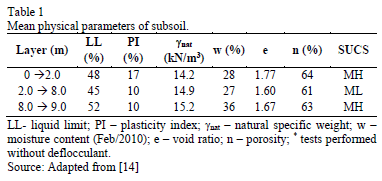
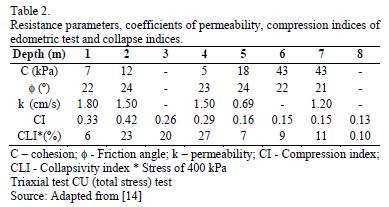
<body><![CDATA[<p><font size="2" face="Verdana, Arial, Helvetica, sans-serif">Where:T is the relative  stiffness between the pile and the soil, and for soils with sandy behavior and  normally consolidated clays. It is defined by eq. 5: </font></p>     <p><img src="/img/revistas/dyna/v83n199/v83n199a18eq05.gif"></p>     <p><font size="2" face="Verdana, Arial, Helvetica, sans-serif">To calculate n<sub>h</sub>,  eq. 6 is used:</font></p>     <p><img src="/img/revistas/dyna/v83n199/v83n199a18eq06.gif"></p>     <p><font size="2" face="Verdana, Arial, Helvetica, sans-serif">In the present study, the soil  characteristics are analyzed using geotechnical laboratory tests and in-situ  tests, with the aim of predicting its behavior in terms of deformability,  resistance and collapsibility. To determine the horizontal reaction coefficient (n<sub>h</sub>), the curves of  the horizontal reaction coefficients(n<sub>h</sub>) <i>vs.</i> the horizontal displacement at the surface (y<sub>o</sub>) were obtained based  on the performed load tests adopting a range of horizontal displacement values.  &#91;8&#93; proposed the curves (n<sub>h</sub>) <i>vs</i>.  (y<sub>o</sub>) using values in the 6.35 to 12.70 mm range. Based on these  authors' studies but making a small modification in the range, the range  between 6.0 mm and 12.0 mm was adopted, which was used by &#91;10, 11, 12, 13&#93;. The  curves of the horizontal reaction coefficients <i>vs.</i> horizontal displacement were divided into two groups: load  tests performed with natural soil moisture content and load tests performed  with pre-flooding.</font></p>     <p>&nbsp;</p>     <p><font size="3" face="Verdana, Arial, Helvetica, sans-serif"><b>2. Materials and Methods</b></font></p>     <p><font size="2" face="Verdana, Arial, Helvetica, sans-serif">The  aims of this study were achieved based on geotechnical analysis of the soil  under investigation, execution of caissons, conduction of load tests in a  caisson and analysis of the obtained data.</font></p>     <p><font size="2" face="Verdana, Arial, Helvetica, sans-serif"><b><i>2.1. Geological and  Geotechnical Characteristics</i></b></font></p>     <p><font size="2" face="Verdana, Arial, Helvetica, sans-serif">The study was conducted at the  experimental site located at the School of Civil Engineering, Architecture and  Urban Studies (Faculdade de Engenharia Civil, Arquitetura e Urbanismo) of the  University of Campinas (Universidade Estadual de Campinas - Unicamp) in the  municipality of Campinas, State of São Paulo, Brazil. The subsoil geotechnical  properties were determined by the removal of undisturberd samples up to 8 m in  depth and disturbed samples up to 9 m of depth (impenetrable). In-situ tests  were performed: the standard penetration test (SPT) and the electric cone  penetration test (CPT). The simple characterization tests are presented in  <a href="#tab01">Table 1</a>, and the results for the triaxial tests, permeability tests,  consolidation tests and the collapse index are presented in <a href="#tab02">Table 2</a>.</font></p>     ]]></body>
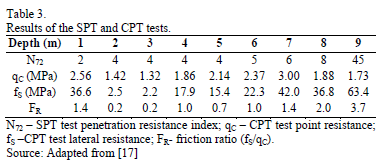
<body><![CDATA[<p align="center"><font size="2" face="Verdana, Arial, Helvetica, sans-serif"><a name="tab01"></a></font><img src="/img/revistas/dyna/v83n199/v83n199a18tab01.gif"></p>     <p align="center"><font size="2" face="Verdana, Arial, Helvetica, sans-serif"><a name="tab02"></a></font><img src="/img/revistas/dyna/v83n199/v83n199a18tab02.gif"></p>     <p><font size="2" face="Verdana, Arial, Helvetica, sans-serif">The  edometric tests conducted on undisturbed samples with flooding at different  stress levels indicate the collapsible characteristics of the soil. Tests  performed with tensions of 100 kPa, 200 kPa and 400  kPa. According to &#91;15&#93;, indicated that the representative sample at 1 m of  depth was observed to be collapsible, with a very elevated index for all the  flooding stresses. For the 2 m and 3 m deep layers, it was possible to observe  the low collapsibility index for the 100 kPa and 200 kPa stress, which in turn  had a high index for the 400 kPa stress. Based on the data obtained for the 100  kPa stress, only the 1 m, 4 m and 8 m depths were observed to be collapsible.  However, for the 200 kPa stress, only the 2 m and 3 m depths were not  collapsible. Finally, for the flooding stress of 400 kPa, all of the depths  were observed to be collapsible, with the exception of the 8 m depth. With the  conduction of triaxial tests (CU), numerical values were obtained for the angle  of friction and the cohesion intercepts (<a href="#tab02">Table 2</a>) for each depth. &#91;16&#93; verified  a significant reduction of these values with the soil saturation. </font></p>     <p><font size="2" face="Verdana, Arial, Helvetica, sans-serif">The  results for the SPT and CPT tests performed at 0.50 m from the caisson axis are  presented in <a href="#tab03">Table 3</a>.</font></p>     <p align="center"><font size="2" face="Verdana, Arial, Helvetica, sans-serif"><a name="tab03"></a></font><img src="/img/revistas/dyna/v83n199/v83n199a18tab03.gif"></p>     <p><font size="2" face="Verdana, Arial, Helvetica, sans-serif">The grain size analysis indicates that the soil is  mostly composed of silt and clay. However, its permeability characteristics  with coefficients of the order of 1.5 x 10<sup>-3</sup> cm/s</font> <font size="2" face="Verdana, Arial, Helvetica, sans-serif">and its characterization  through results of the CPT test, when using classification graphs, indicate  that its behavior is that of a sandy soil. Therefore, the analysis will be  performed based on parameters proposed for the soil of granular behavior. </font></p>     <p><font size="2" face="Verdana, Arial, Helvetica, sans-serif">The information obtained based on the  cone penetration test (CPT) and the standard penetration test (SPT) regarding  the resistance parameters, soil type and unsaturated condition allow the  prediction of a low resistance and most likely collapsible soil.</font></p>     <p><font size="2" face="Verdana, Arial, Helvetica, sans-serif"><b><i>2.2. Preparation of  Caissons</i></b></font></p>     <p><font size="2" face="Verdana, Arial, Helvetica, sans-serif">Three  caissons were built to perform the load tests: one to undergo the transversal  load and two to serve as a reaction to the applied load. All of the caissons  had lengths of 9 m, shaft diameters of 0.8 m, base diameters of 1.6 m and base  heights of 0.7 m. The caissons were set up along the depth with 15 bars with f=25.0  mm and stirrups with f=10.0 mm, spaced every 15 cm in  steel with fyk=500 MPa. The concrete used exhibited fck=20 MPa, and the slump  test was equal to 22 mm. The caissons were built using a manual excavation  process. The caissons were constructed in a manner in which they would not  undergo significant structural strains when subjected to loadings.</font></p>     <p><font size="2" face="Verdana, Arial, Helvetica, sans-serif"><b><i>2.3. Load Tests</i></b></font></p>     ]]></body>
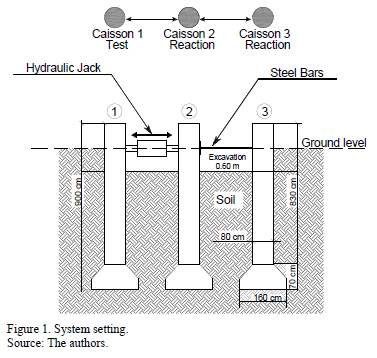
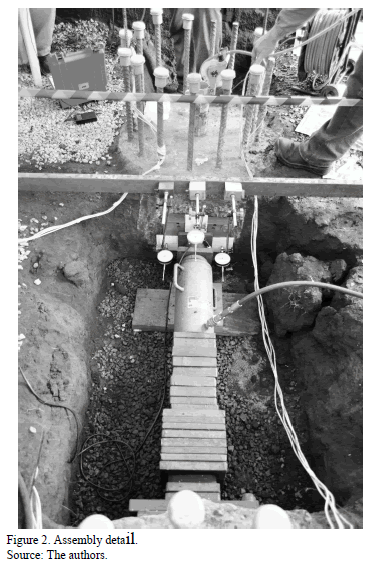
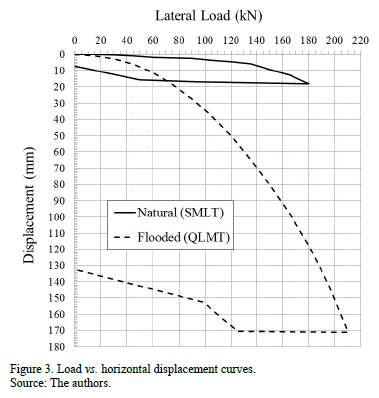
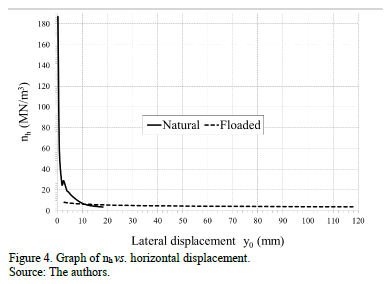
<body><![CDATA[<p><font size="2" face="Verdana, Arial, Helvetica, sans-serif">Before the execution of load tests,  trenches were excavated between the caissons at a depth of 0.60 m under the  caisson top for alignment with the application axis of the horizontal load. The  load tests were performed using a hydraulic jack with 500 kN capacity with a  pump, applying the load on the test caisson at one side and reacting against  two other caissons at the other side, as the model displays in <a href="#fig01">Figs. 1</a> and <a href="#fig02">2</a>.</font></p>     <p align="center"><font size="2" face="Verdana, Arial, Helvetica, sans-serif"><a name="fig01"></a></font><img src="/img/revistas/dyna/v83n199/v83n199a18fig01.gif"></p>     <p align="center"><font size="2" face="Verdana, Arial, Helvetica, sans-serif"><a name="fig02"></a></font><img src="/img/revistas/dyna/v83n199/v83n199a18fig02.gif"></p>     <p><font size="2" face="Verdana, Arial, Helvetica, sans-serif">To determine the load applied at the top  of the caisson, a 500 kN load cell was used, and three deflectometers, with  0.01 mm precision, fixed on a reference beam were used for the measurement of  the displacements. In two of the deflectometers, the readings were taken at the  same level of the load application (horizontal), and in the third, the reading  was taken along the vertical axis of the load. </font></p>     <p><font size="2" face="Verdana, Arial, Helvetica, sans-serif">Two load tests were performed in the same  caisson following the guidelines of the standard &#91;18&#93;. The first test was of  the slow maintained load type, with the soil in its natural moisture content  state. The second, of the quick maintained load type, was performed after the  superficial soil flooding with a pit for 48 h. The slow test was conducted with  loads applied in equally increasing values, with readings of the displacements  taken at pre-determined time intervals until the stabilization of the  displacements, when a new load was increased, never more than 20% of the  predicted working load. The consolidation was considered stabilized when the  value read between the two successive times did not surpass 5% of the total  consolidation of the loading stage. To perform the quick test, the load was  maintained for 10 min, reading the initial and final stage values. The total  load with an increase not higher than 10% of the working load proceeded until  reaching twice the predicted working load for the caisson. Unloading was  performed soon after the last loading stage in four load levels.</font></p>     <p>&nbsp;</p>     <p><font size="3" face="Verdana, Arial, Helvetica, sans-serif"><b>3. Results and Analysis</b></font></p>     <p><font size="2" face="Verdana, Arial, Helvetica, sans-serif">Based on the performance of the load  tests, the load <i>vs.</i> horizontal  displacement curves were obtained. Plots of the horizontal reaction coefficient <i>vs. </i>horizontal displacement are  presented in <a href="#fig03">Figs. 3</a> and <a href="#fig04">4</a>.</font></p>     <p align="center"><font size="2" face="Verdana, Arial, Helvetica, sans-serif"><a name="fig03"></a></font><img src="/img/revistas/dyna/v83n199/v83n199a18fig03.gif"></p>     <p align="center"><font size="2" face="Verdana, Arial, Helvetica, sans-serif"><a name="fig04"></a></font><img src="/img/revistas/dyna/v83n199/v83n199a18fig04.gif"></p>     ]]></body>
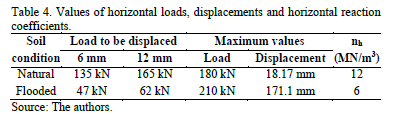
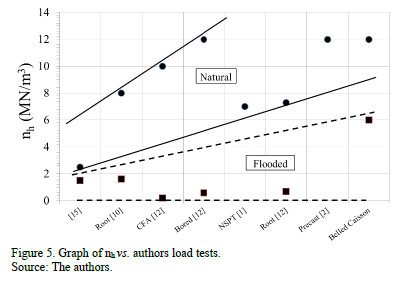
<body><![CDATA[<p><font size="2" face="Verdana, Arial, Helvetica, sans-serif">By  analyzing <a href="#fig03">Fig. 3</a>, the displacement for each applied load level can be verified.  For the admissible structure load of the caisson (140 kN), the horizontal  displacement at the caisson top was observed to be 9 mm. The observations  indicate that the curve obtained for the pre-flooded soil exhibited greater  horizontal displacement for the same load applied. </font></p>     <p><font size="2" face="Verdana, Arial, Helvetica, sans-serif">The  analyzed soil was lateritic and highly porous and unsaturated; its sand  particles were cemented by clay and silt lumps, where the main minerals present  were kaolinite and gibbsite. Hence, this soil had matrix potential because of  the </font><font size="2" face="Verdana, Arial, Helvetica, sans-serif">suction, which  was lost when the soil is flooded, leading to a reduction in the resistance.  This phenomenon can be observed in the analysis of <a href="#fig03">Fig. 3</a> and <a href="#fig04">4</a>, where the loss  of stability can be noted in the presence of water, thus reducing its  resistance characteristics. Note that the n<sub>h</sub> values in the pre-flooded  situation practically do not vary, which demonstrates a resistance loss of the  soil from the beginning of loading (<a href="#fig04">Fig. 4</a>). <a href="#tab04">Table 4</a> presents the load and  horizontal displacement values in addition to the results for the horizontal  reaction coefficients as a function of the subsoil condition.</font></p>     <p align="center"><font size="2" face="Verdana, Arial, Helvetica, sans-serif"><a name="tab04"></a></font><img src="/img/revistas/dyna/v83n199/v83n199a18tab04.gif"></p>     <p><font size="2" face="Verdana, Arial, Helvetica, sans-serif">The  pre-flooding of the soil caused a pronounced increase in the displacements for  the same load applied in the tests with natural soil. The results proved that  the pre-flooding caused a reduction of the applied load by 2.5 to 3 fold to  reach displacements of 6 and 12 mm. These results demonstrate the intensity of  the effect of the variation of the soil moisture on the horizontal displacement  characteristics of the pile. </font></p>     <p><font size="2" face="Verdana, Arial, Helvetica, sans-serif">The values for the horizontal reaction  coefficients obtained in the literature for different types of deep foundations  built on soil with similar behavior to the one from the present study (under  natural and pre-flooded conditions) are presented in <a href="#fig05">Fig. 5</a>. </font></p>     <p align="center"><font size="2" face="Verdana, Arial, Helvetica, sans-serif"><a name="fig05"></a></font><img src="/img/revistas/dyna/v83n199/v83n199a18fig05.gif"></p>     <p><font size="2" face="Verdana, Arial, Helvetica, sans-serif">By  analyzing <a href="#fig05">Fig. 5</a>, it is verified that in piles built on similar soils (sandy  behavior, unsaturated and lateritic), the values for the horizontal reaction  coefficient vary between 2 and 12 MN/m<sup>3</sup>. With the exception of the  precast concrete pile with 0.18 m and the foundation in this paper (belled  caisson) with 0.8 m, the other piles exhibited diameters of 0.4 m. The  observations indicate that the execution process of the pile did not affect the  results. On the same graph (<a href="#fig03">Fig. 3</a>), the pre-flooding effect on the soil can be  evaluated, with the reduction of n<sub>h</sub> values, in some cases obtaining  values lower than 1 MN/m<sup>3</sup>. Generally, the values were reduced by at  least 50%.</font></p>     <p>&nbsp;</p>     <p><b><font size="3" face="Verdana, Arial, Helvetica, sans-serif">4. Conclusions</font></b></p>     <p><font size="2" face="Verdana, Arial, Helvetica, sans-serif">Based on the results obtained and the  analysis performed, the following can be concluded:</font></p> <ul>       ]]></body>
<body><![CDATA[<li><font size="2" face="Verdana, Arial, Helvetica, sans-serif">Because the first few meters of     the soil have a great effect on the horizontal loading, their proper     geotechnical characterization in terms of porosity, resistance and     collapsibility is important.</font></li>       <li><font size="2" face="Verdana, Arial, Helvetica, sans-serif">The laboratory and field tests     indicated a highly porous, collapsible and low resistance soil, allowing the     prediction of low n<sub>h</sub> values and the great effect of the variation in     the soil's moisture content.</font></li>       <li><font size="2" face="Verdana, Arial, Helvetica, sans-serif">The horizontal reaction     coefficient obtained for the soil at its natural moisture content was 12 MN/m<sup>3</sup>,     a higher value when compared with the literature for soils of high porosity,     which suggests values of 2 MN/m<sup>3</sup>, thus indicating the importance of     its determination for each type of soil and therefore avoiding generalizations.</font></li>       <li><font size="2" face="Verdana, Arial, Helvetica, sans-serif">The loads for pre-flooded soil     to reach certain displacement levels were observed to be on average three times     smaller than the ones for the soil at its natural moisture content. For the     horizontal reaction coefficient of the soil, the pre-flooded values were     approximately 50% lower than the ones for the soil at its natural moisture     content. </font></li>       <li><font size="2" face="Verdana, Arial, Helvetica, sans-serif">For the collapsible soils, the     analysis of the possibility of saturation or great humidity variation of the     superficial soil during its construction service life was of fundamental     importance in the determination of project parameters. </font></li>     </ul>     <p>&nbsp;</p>     <p><font size="3" face="Verdana, Arial, Helvetica, sans-serif"><b>References </b></font></p>     <!-- ref --><p><font size="2" face="Verdana, Arial, Helvetica, sans-serif"><b>&#91;1&#93;</b> D&eacute;court, L., Load-deflection  prediction for laterally loaded piles based on N-SPT, Proceedings of  International Conference on Piling and Deep Foundations, 4(1), pp. 549-555,  1991.    &nbsp;&nbsp;&nbsp;&nbsp;&nbsp;&nbsp;&nbsp;&nbsp;[&#160;<a href="javascript:void(0);" onclick="javascript: window.open('/scielo.php?script=sci_nlinks&ref=1151323&pid=S0012-7353201600050001800001&lng=','','width=640,height=500,resizable=yes,scrollbars=1,menubar=yes,');">Links</a>&#160;]<!-- end-ref --></font></p>     ]]></body>
<body><![CDATA[<!-- ref --><p><font size="2" face="Verdana, Arial, Helvetica, sans-serif"><b>&#91;2&#93;</b> Carvalho, D., Albuquerque, P.J.R., Claro, A.T.  e Ferreira, C.V., An&aacute;lise de estaca carregada transversalmente no topo, em solo  residual de diab&aacute;sio, Semin&aacute;rio de Engenharia de Fundações Especiais (SEFE 3), 1, pp. 145-154. 1996.    &nbsp;&nbsp;&nbsp;&nbsp;&nbsp;&nbsp;&nbsp;&nbsp;[&#160;<a href="javascript:void(0);" onclick="javascript: window.open('/scielo.php?script=sci_nlinks&ref=1151325&pid=S0012-7353201600050001800002&lng=','','width=640,height=500,resizable=yes,scrollbars=1,menubar=yes,');">Links</a>&#160;]<!-- end-ref --></font></p>     <!-- ref --><p><font size="2" face="Verdana, Arial, Helvetica, sans-serif"><b>&#91;3&#93;</b> Velloso,  D.A. e Lopes, F.R., Fundações - Volume 2. Rio de Janeiro: COPPE-UFRJ, 2002</font>&nbsp;&nbsp;&nbsp;&nbsp;&nbsp;&nbsp;&nbsp;&nbsp;[&#160;<a href="javascript:void(0);" onclick="javascript: window.open('/scielo.php?script=sci_nlinks&ref=1151327&pid=S0012-7353201600050001800003&lng=','','width=640,height=500,resizable=yes,scrollbars=1,menubar=yes,');">Links</a>&#160;]<!-- end-ref --><!-- ref --><p><font size="2" face="Verdana, Arial, Helvetica, sans-serif"><b>&#91;4&#93;</b> Reese, L.C. and Van Impe, W.F.,  Single piles and piles groups under lateral loading. London: CRC Press - Taylor  and Francis Group, 2011.    &nbsp;&nbsp;&nbsp;&nbsp;&nbsp;&nbsp;&nbsp;&nbsp;[&#160;<a href="javascript:void(0);" onclick="javascript: window.open('/scielo.php?script=sci_nlinks&ref=1151328&pid=S0012-7353201600050001800004&lng=','','width=640,height=500,resizable=yes,scrollbars=1,menubar=yes,');">Links</a>&#160;]<!-- end-ref --></font></p>     <!-- ref --><p><font size="2" face="Verdana, Arial, Helvetica, sans-serif"><b>&#91;5&#93;</b> Valencia,  Y, Camapum, J. y Lara, L., Aplicaciones adicionales de los resultados de  pruebas de carga est&aacute;ticas en el dise&ntilde;o geot&eacute;cnico de cimentaciones. Revista DYNA &#91;Online&#93;, 79(175), 2012. &#91;date of reference August 5<sup>th</sup> of 2016&#93;</b> Avaliable at:  <a href="http://www.revistas.unal.edu.co/index.php/dyna/article/view/28167/43527" target="_blank">http://www.revistas.unal.edu.co/index.php/dyna/article/view/28167/43527</a></font>&nbsp;&nbsp;&nbsp;&nbsp;&nbsp;&nbsp;&nbsp;&nbsp;[&#160;<a href="javascript:void(0);" onclick="javascript: window.open('/scielo.php?script=sci_nlinks&ref=1151330&pid=S0012-7353201600050001800005&lng=','','width=640,height=500,resizable=yes,scrollbars=1,menubar=yes,');">Links</a>&#160;]<!-- end-ref --><!-- ref --><p><font size="2" face="Verdana, Arial, Helvetica, sans-serif"><b>&#91;6&#93;</b> Terzaghi, K., Evaluation of  coefficients of subgrade reaction. G&eacute;otechnique, 5(4), pp. 297-326. 1955.    &nbsp;&nbsp;&nbsp;&nbsp;&nbsp;&nbsp;&nbsp;&nbsp;[&#160;<a href="javascript:void(0);" onclick="javascript: window.open('/scielo.php?script=sci_nlinks&ref=1151331&pid=S0012-7353201600050001800006&lng=','','width=640,height=500,resizable=yes,scrollbars=1,menubar=yes,');">Links</a>&#160;]<!-- end-ref --></font></p>     <!-- ref --><p><font size="2" face="Verdana, Arial, Helvetica, sans-serif"><b>&#91;7&#93;</b> Matlock, H. and Reese,  L.C. Generalized solutions for laterally  loaded piles. Journal of Soil Mechanics and Foundation Engineering Division -  ASCE, 86 (SM5), pp. 63-91, 1960.    &nbsp;&nbsp;&nbsp;&nbsp;&nbsp;&nbsp;&nbsp;&nbsp;[&#160;<a href="javascript:void(0);" onclick="javascript: window.open('/scielo.php?script=sci_nlinks&ref=1151333&pid=S0012-7353201600050001800007&lng=','','width=640,height=500,resizable=yes,scrollbars=1,menubar=yes,');">Links</a>&#160;]<!-- end-ref --></font></p>     ]]></body>
<body><![CDATA[<!-- ref --><p><font size="2" face="Verdana, Arial, Helvetica, sans-serif"><b>&#91;8&#93;</b> Alizadeh, M. and Davisson,  M.T., Lateral Load Tests on Piles - Arkansas River Project. Journal of the Soil  Mechanics and Foundation Division - ASCE, 96 (SM5), pp. 1583-1604, 1970.    &nbsp;&nbsp;&nbsp;&nbsp;&nbsp;&nbsp;&nbsp;&nbsp;[&#160;<a href="javascript:void(0);" onclick="javascript: window.open('/scielo.php?script=sci_nlinks&ref=1151335&pid=S0012-7353201600050001800008&lng=','','width=640,height=500,resizable=yes,scrollbars=1,menubar=yes,');">Links</a>&#160;]<!-- end-ref --></font></p>     <!-- ref --><p><font size="2" face="Verdana, Arial, Helvetica, sans-serif"><b>&#91;9&#93;</b> Matlock, H. and Reese, L.C.,  Foundation analysis of offshore pile supported structures. Proceedings of  International Conference on Soil Mechanics and Geotechnical Engineering, 5(2),  pp. 91-97, 1961.    &nbsp;&nbsp;&nbsp;&nbsp;&nbsp;&nbsp;&nbsp;&nbsp;[&#160;<a href="javascript:void(0);" onclick="javascript: window.open('/scielo.php?script=sci_nlinks&ref=1151337&pid=S0012-7353201600050001800009&lng=','','width=640,height=500,resizable=yes,scrollbars=1,menubar=yes,');">Links</a>&#160;]<!-- end-ref --></font></p>     <!-- ref --><p><font size="2" face="Verdana, Arial, Helvetica, sans-serif"><b>&#91;10&#93;</b> Miguel,  M.G., Execução e an&aacute;lise de provas de carga horizontal em estacas em solo  colaps&iacute;vel, MSc. Thesis, Departament of Geotechcnics,  University of São Paulo, São Carlos, Brasil, 1996.    &nbsp;&nbsp;&nbsp;&nbsp;&nbsp;&nbsp;&nbsp;&nbsp;[&#160;<a href="javascript:void(0);" onclick="javascript: window.open('/scielo.php?script=sci_nlinks&ref=1151339&pid=S0012-7353201600050001800010&lng=','','width=640,height=500,resizable=yes,scrollbars=1,menubar=yes,');">Links</a>&#160;]<!-- end-ref --></font></p>     <!-- ref --><p><font size="2" face="Verdana, Arial, Helvetica, sans-serif"><b>&#91;11&#93;</b> Menezes, S.M., Carvalho, D., Sampaio, F.M.T. e  Ribeiro, K.D., Provas de carga horizontais em estacas pr&eacute;-moldadas de concreto  cravadas em solo de alta porosidade. Semin&aacute;rio de  Engenharia de Fundações Especiais (SEFE 5), 2, pp. 500-506. 2004.    &nbsp;&nbsp;&nbsp;&nbsp;&nbsp;&nbsp;&nbsp;&nbsp;[&#160;<a href="javascript:void(0);" onclick="javascript: window.open('/scielo.php?script=sci_nlinks&ref=1151341&pid=S0012-7353201600050001800011&lng=','','width=640,height=500,resizable=yes,scrollbars=1,menubar=yes,');">Links</a>&#160;]<!-- end-ref --></font></p>     <!-- ref --><p><font size="2" face="Verdana, Arial, Helvetica, sans-serif"><b>&#91;12&#93;</b> Miranda  J&uacute;nior, G., Estacas submetidas a esforços horizontais em solos colaps&iacute;veis do  interior de são paulo nas condições natural, melhorada e inundada. PhD. Dissertation, Faculty of Agricultural Engineering, University  of Campinas, Campinas, Brasil, 2006.    &nbsp;&nbsp;&nbsp;&nbsp;&nbsp;&nbsp;&nbsp;&nbsp;[&#160;<a href="javascript:void(0);" onclick="javascript: window.open('/scielo.php?script=sci_nlinks&ref=1151343&pid=S0012-7353201600050001800012&lng=','','width=640,height=500,resizable=yes,scrollbars=1,menubar=yes,');">Links</a>&#160;]<!-- end-ref --> </font></p>     ]]></body>
<body><![CDATA[<!-- ref --><p><font size="2" face="Verdana, Arial, Helvetica, sans-serif"><b>&#91;13&#93;</b> Zammataro,  B.B., Estudo de comportamento de estacas tipo escavadas e h&eacute;lice cont&iacute;nua  submetidas a esforços horizontais, MSc. Thesis,  Departament of Geotechcnics and Transportation, University of Campinas,  Campinas, Brasil, 2007.    &nbsp;&nbsp;&nbsp;&nbsp;&nbsp;&nbsp;&nbsp;&nbsp;[&#160;<a href="javascript:void(0);" onclick="javascript: window.open('/scielo.php?script=sci_nlinks&ref=1151345&pid=S0012-7353201600050001800013&lng=','','width=640,height=500,resizable=yes,scrollbars=1,menubar=yes,');">Links</a>&#160;]<!-- end-ref --> </font></p>     <!-- ref --><p><font size="2" face="Verdana, Arial, Helvetica, sans-serif"><b>&#91;14&#93;</b> Gon, F.S.,  Caracterização geot&eacute;cnica atrav&eacute;s de ensaios de laborat&oacute;rio de um solo de  diab&aacute;sio da região de Campinas/ SP, M.S Thesis, Departament of Geotechcnics and  Transportation, University of Campinas, Campinas, Brasil, 2011.    &nbsp;&nbsp;&nbsp;&nbsp;&nbsp;&nbsp;&nbsp;&nbsp;[&#160;<a href="javascript:void(0);" onclick="javascript: window.open('/scielo.php?script=sci_nlinks&ref=1151347&pid=S0012-7353201600050001800014&lng=','','width=640,height=500,resizable=yes,scrollbars=1,menubar=yes,');">Links</a>&#160;]<!-- end-ref --> </font></p>     <!-- ref --><p><font size="2" face="Verdana, Arial, Helvetica, sans-serif"><b>&#91;15&#93;</b> Vargas, M, Introdução à Mecânica dos Solos.São Paulo: McGraw -Hill do Brasil, 1978.    &nbsp;&nbsp;&nbsp;&nbsp;&nbsp;&nbsp;&nbsp;&nbsp;[&#160;<a href="javascript:void(0);" onclick="javascript: window.open('/scielo.php?script=sci_nlinks&ref=1151349&pid=S0012-7353201600050001800015&lng=','','width=640,height=500,resizable=yes,scrollbars=1,menubar=yes,');">Links</a>&#160;]<!-- end-ref --></font></p>     <!-- ref --><p><font size="2" face="Verdana, Arial, Helvetica, sans-serif"><b>&#91;16&#93;</b> Paschoalin-Filho,  J.A., Estudo do comportamento à tração axial de diferentes tipos de estacas  executadas em solo de diab&aacute;sio da região de Campinas-SP. PhD. Dissertation, Faculty of Agricultural Engineering, University  of Campinas, Campinas, Brasil, 2008.    &nbsp;&nbsp;&nbsp;&nbsp;&nbsp;&nbsp;&nbsp;&nbsp;[&#160;<a href="javascript:void(0);" onclick="javascript: window.open('/scielo.php?script=sci_nlinks&ref=1151351&pid=S0012-7353201600050001800016&lng=','','width=640,height=500,resizable=yes,scrollbars=1,menubar=yes,');">Links</a>&#160;]<!-- end-ref --></font></p>     <!-- ref --><p><font size="2" face="Verdana, Arial, Helvetica, sans-serif"><b>&#91;17&#93;</b> Rodriguez,  T.G., Caracterização geot&eacute;cnica de um solo de diab&aacute;sio por meio de ensaios SPT  e CPT M.S. Thesis, Departament of Geotechcnics and Transportation, University  of Campinas, Campinas, Brasil, 2013.    &nbsp;&nbsp;&nbsp;&nbsp;&nbsp;&nbsp;&nbsp;&nbsp;[&#160;<a href="javascript:void(0);" onclick="javascript: window.open('/scielo.php?script=sci_nlinks&ref=1151353&pid=S0012-7353201600050001800017&lng=','','width=640,height=500,resizable=yes,scrollbars=1,menubar=yes,');">Links</a>&#160;]<!-- end-ref --> </font></p>     ]]></body>
<body><![CDATA[<!-- ref --><p><font size="2" face="Verdana, Arial, Helvetica, sans-serif"><b>&#91;18&#93;</b> Associação  Brasileira de Normas T&eacute;cnicas. NBR 12131: Estacas - Prova de Carga Est&aacute;tica. Rio de Janeiro: ABNT, 2006.    &nbsp;&nbsp;&nbsp;&nbsp;&nbsp;&nbsp;&nbsp;&nbsp;[&#160;<a href="javascript:void(0);" onclick="javascript: window.open('/scielo.php?script=sci_nlinks&ref=1151355&pid=S0012-7353201600050001800018&lng=','','width=640,height=500,resizable=yes,scrollbars=1,menubar=yes,');">Links</a>&#160;]<!-- end-ref --></font></p>     <p>&nbsp;</p>     <p><font size="2" face="Verdana, Arial, Helvetica, sans-serif"><b>R. Kassouf,</b> received the BSc. In Civil  Engineer in 1986, MSc. in Geothecnical Engineering in 2012, He is currently director -  Roberto Kassouf Engenharia Ltd, since 1986. Professor of the Faculty of  Integrated Metropolitan Campinas (Metrocamp) course in Foundations of Civil  Engineering disciplines I and II and Soil Mechanics. Master in Civil  Engineering from Unicamp - University of Campinas. Works in the area of Civil  Engineering, with emphasis on Geotechnical, acting on the following topics:  geotechnical investigation, deep foundations and foundation pathology. ORCID: 0000-0002-2963-2883</font></p>     <p><font size="2" face="Verdana, Arial, Helvetica, sans-serif"><b>D. Carvalho,</b> received the BSc. In Civil  Engineer in 1978, MSc. in Engineering in 1985, PhD. in Geothecnical Engineering  in 1991. He is Associate Professor at University of Campinas since 1998,  developing researches in Foundations, Soil Mechanics and In-Situ tests. He  guided several students in geotechnical researches and has published papers in conferences  and technical journals. Currently teaches classes for Civil Engineering,  Agricultural Engineering and Geology. ORCID: 0000-0002-5270-3627</font></p>     <p><font size="2" face="Verdana, Arial, Helvetica, sans-serif"><b>P.J.R. Albuquerque,</b> received the BSc. In Civil  Engineer in 1993, MSc. in Engineering in 1996, PhD. in Soil and Foundation  Engineering in 2001 and postdoctoral in 2010 at the Polytechnic University of  Catalunya in Barcelona/Spain. He is Associate Professor at University of  Campinas since 2001, teaching  and researching, with emphasis in in-Situ tests, laboratory tests and  foundations. He was the secretary of the Technical Commission of In-Situ Tests  of the Brazilian Association of Soil Mechanics (ABMS) between 2007-2010 and the  president for the Biennium 2011/2012. He is secretary of the Technical  Commission of Foundation of the Brazilian Association of Soil Mechanics for the  Biennium 2013-2016. In biennia 2013-2016 will act as Vice-President of the  Regional Center of São Paulo (ABMS). Since 2015 is Brazilian representant of  ABMS on TC102 Technical Commission of Foundations of ISSMGE. ORCID: 0000-0003-0726-7165</font></p>      ]]></body><back>
<ref-list>
<ref id="B1">
<label>1</label><nlm-citation citation-type="journal">
<person-group person-group-type="author">
<name>
<surname><![CDATA[Décourt]]></surname>
<given-names><![CDATA[L.]]></given-names>
</name>
</person-group>
<article-title xml:lang="en"><![CDATA[Load-deflection prediction for laterally loaded piles based on N-SPT]]></article-title>
<source><![CDATA[Proceedings of International Conference on Piling and Deep Foundations]]></source>
<year>1991</year>
<volume>4</volume>
<numero>1</numero>
<issue>1</issue>
<page-range>549-555</page-range></nlm-citation>
</ref>
<ref id="B2">
<label>2</label><nlm-citation citation-type="confpro">
<person-group person-group-type="author">
<name>
<surname><![CDATA[Carvalho]]></surname>
<given-names><![CDATA[D.]]></given-names>
</name>
<name>
<surname><![CDATA[Albuquerque]]></surname>
<given-names><![CDATA[P.J.R.]]></given-names>
</name>
<name>
<surname><![CDATA[Claro]]></surname>
<given-names><![CDATA[A.T.]]></given-names>
</name>
<name>
<surname><![CDATA[Ferreira]]></surname>
<given-names><![CDATA[C.V.]]></given-names>
</name>
</person-group>
<article-title xml:lang="pt"><![CDATA[Análise de estaca carregada transversalmente no topo, em solo residual de diabásio]]></article-title>
<source><![CDATA[]]></source>
<year></year>
<conf-name><![CDATA[ Seminário de Engenharia de Fundações Especiais (SEFE 3)]]></conf-name>
<conf-date>1996</conf-date>
<conf-loc> </conf-loc>
</nlm-citation>
</ref>
<ref id="B3">
<label>3</label><nlm-citation citation-type="book">
<person-group person-group-type="author">
<name>
<surname><![CDATA[Velloso]]></surname>
<given-names><![CDATA[D.A.]]></given-names>
</name>
<name>
<surname><![CDATA[Lopes]]></surname>
<given-names><![CDATA[F.R.]]></given-names>
</name>
</person-group>
<source><![CDATA[Fundações]]></source>
<year>2002</year>
<volume>2</volume>
<publisher-loc><![CDATA[Rio de Janeiro ]]></publisher-loc>
<publisher-name><![CDATA[COPPE-UFRJ]]></publisher-name>
</nlm-citation>
</ref>
<ref id="B4">
<label>4</label><nlm-citation citation-type="book">
<person-group person-group-type="author">
<name>
<surname><![CDATA[Reese]]></surname>
<given-names><![CDATA[L.C.]]></given-names>
</name>
<name>
<surname><![CDATA[Van Impe]]></surname>
<given-names><![CDATA[W.F.]]></given-names>
</name>
</person-group>
<source><![CDATA[Single piles and piles groups under lateral loading.]]></source>
<year>2011</year>
<publisher-loc><![CDATA[London ]]></publisher-loc>
<publisher-name><![CDATA[CRC Press - Taylor and Francis Group]]></publisher-name>
</nlm-citation>
</ref>
<ref id="B5">
<label>5</label><nlm-citation citation-type="journal">
<person-group person-group-type="author">
<name>
<surname><![CDATA[Valencia]]></surname>
<given-names><![CDATA[Y]]></given-names>
</name>
<name>
<surname><![CDATA[Camapum]]></surname>
<given-names><![CDATA[J.]]></given-names>
</name>
<name>
<surname><![CDATA[Lara]]></surname>
<given-names><![CDATA[L.]]></given-names>
</name>
</person-group>
<article-title xml:lang="es"><![CDATA[Aplicaciones adicionales de los resultados de pruebas de carga estáticas en el diseño geotécnico de cimentaciones.]]></article-title>
<source><![CDATA[Revista DYNA]]></source>
<year>2012</year>
<volume>79</volume>
<numero>175</numero>
<issue>175</issue>
</nlm-citation>
</ref>
<ref id="B6">
<label>6</label><nlm-citation citation-type="journal">
<person-group person-group-type="author">
<name>
<surname><![CDATA[Terzaghi]]></surname>
<given-names><![CDATA[K.]]></given-names>
</name>
</person-group>
<article-title xml:lang="en"><![CDATA[Evaluation of coefficients of subgrade reaction]]></article-title>
<source><![CDATA[Géotechnique]]></source>
<year>1955</year>
<volume>5</volume>
<numero>4</numero>
<issue>4</issue>
<page-range>297-326</page-range></nlm-citation>
</ref>
<ref id="B7">
<label>7</label><nlm-citation citation-type="journal">
<person-group person-group-type="author">
<name>
<surname><![CDATA[Matlock]]></surname>
<given-names><![CDATA[H.]]></given-names>
</name>
<name>
<surname><![CDATA[Reese]]></surname>
<given-names><![CDATA[L.C.]]></given-names>
</name>
</person-group>
<article-title xml:lang="en"><![CDATA[Generalized solutions for laterally loaded piles]]></article-title>
<source><![CDATA[Journal of Soil Mechanics and Foundation Engineering Division - ASCE]]></source>
<year>1960</year>
<volume>86</volume>
<numero>SM5</numero>
<issue>SM5</issue>
<page-range>63-91</page-range></nlm-citation>
</ref>
<ref id="B8">
<label>8</label><nlm-citation citation-type="journal">
<person-group person-group-type="author">
<name>
<surname><![CDATA[Alizadeh]]></surname>
<given-names><![CDATA[M.]]></given-names>
</name>
<name>
<surname><![CDATA[Davisson]]></surname>
<given-names><![CDATA[M.T.]]></given-names>
</name>
</person-group>
<article-title xml:lang="en"><![CDATA[Lateral Load Tests on Piles: Arkansas River Project.]]></article-title>
<source><![CDATA[Journal of the Soil Mechanics and Foundation Division - ASCE]]></source>
<year>1970</year>
<volume>96</volume>
<numero>SM5</numero>
<issue>SM5</issue>
<page-range>1583-1604</page-range></nlm-citation>
</ref>
<ref id="B9">
<label>9</label><nlm-citation citation-type="journal">
<person-group person-group-type="author">
<name>
<surname><![CDATA[Matlock]]></surname>
<given-names><![CDATA[H.]]></given-names>
</name>
<name>
<surname><![CDATA[Reese]]></surname>
<given-names><![CDATA[L.C.]]></given-names>
</name>
</person-group>
<article-title xml:lang="en"><![CDATA[Foundation analysis of offshore pile supported structures]]></article-title>
<source><![CDATA[Proceedings of International Conference on Soil Mechanics and Geotechnical Engineering]]></source>
<year>1961</year>
<volume>5</volume>
<numero>2</numero>
<issue>2</issue>
<page-range>91-97</page-range></nlm-citation>
</ref>
<ref id="B10">
<label>10</label><nlm-citation citation-type="">
<person-group person-group-type="author">
<name>
<surname><![CDATA[Miguel]]></surname>
<given-names><![CDATA[M.G.]]></given-names>
</name>
</person-group>
<source><![CDATA[Execução e análise de provas de carga horizontal em estacas em solo colapsível]]></source>
<year></year>
</nlm-citation>
</ref>
<ref id="B11">
<label>11</label><nlm-citation citation-type="confpro">
<person-group person-group-type="author">
<name>
<surname><![CDATA[Menezes]]></surname>
<given-names><![CDATA[S.M.]]></given-names>
</name>
<name>
<surname><![CDATA[Carvalho]]></surname>
<given-names><![CDATA[D.]]></given-names>
</name>
<name>
<surname><![CDATA[Sampaio]]></surname>
<given-names><![CDATA[F.M.T.]]></given-names>
</name>
<name>
<surname><![CDATA[Ribeiro]]></surname>
<given-names><![CDATA[K.D.]]></given-names>
</name>
</person-group>
<article-title xml:lang="pt"><![CDATA[Provas de carga horizontais em estacas pré-moldadas de concreto cravadas em solo de alta porosidade.]]></article-title>
<source><![CDATA[]]></source>
<year>2004</year>
<volume>2</volume>
<conf-name><![CDATA[ Seminário de Engenharia de Fundações Especiais (SEFE 5)]]></conf-name>
<conf-loc> </conf-loc>
<page-range>500-506</page-range></nlm-citation>
</ref>
<ref id="B12">
<label>12</label><nlm-citation citation-type="">
<person-group person-group-type="author">
<name>
<surname><![CDATA[Miranda Júnior]]></surname>
<given-names><![CDATA[G.]]></given-names>
</name>
</person-group>
<source><![CDATA[Estacas submetidas a esforços horizontais em solos colapsíveis do interior de são paulo nas condições natural, melhorada e inundada.]]></source>
<year></year>
</nlm-citation>
</ref>
<ref id="B13">
<label>13</label><nlm-citation citation-type="">
<person-group person-group-type="author">
<name>
<surname><![CDATA[Zammataro]]></surname>
<given-names><![CDATA[B.B.]]></given-names>
</name>
</person-group>
<source><![CDATA[Estudo de comportamento de estacas tipo escavadas e hélice contínua submetidas a esforços horizontais]]></source>
<year></year>
</nlm-citation>
</ref>
<ref id="B14">
<label>14</label><nlm-citation citation-type="">
<person-group person-group-type="author">
<name>
<surname><![CDATA[Gon]]></surname>
<given-names><![CDATA[F.S.]]></given-names>
</name>
</person-group>
<source><![CDATA[Caracterização geotécnica através de ensaios de laboratório de um solo de diabásio da região de Campinas/ SP]]></source>
<year></year>
</nlm-citation>
</ref>
<ref id="B15">
<label>15</label><nlm-citation citation-type="book">
<person-group person-group-type="author">
<name>
<surname><![CDATA[Vargas]]></surname>
<given-names><![CDATA[M]]></given-names>
</name>
</person-group>
<source><![CDATA[Introdução à Mecânica dos Solos]]></source>
<year>1978</year>
<publisher-loc><![CDATA[São Paulo ]]></publisher-loc>
<publisher-name><![CDATA[McGraw -Hill do Brasil]]></publisher-name>
</nlm-citation>
</ref>
<ref id="B16">
<label>16</label><nlm-citation citation-type="">
<person-group person-group-type="author">
<name>
<surname><![CDATA[Paschoalin-Filho]]></surname>
<given-names><![CDATA[J.A.]]></given-names>
</name>
</person-group>
<source><![CDATA[Estudo do comportamento à tração axial de diferentes tipos de estacas executadas em solo de diabásio da região de Campinas-SP.]]></source>
<year></year>
</nlm-citation>
</ref>
<ref id="B17">
<label>17</label><nlm-citation citation-type="">
<person-group person-group-type="author">
<name>
<surname><![CDATA[Rodriguez]]></surname>
<given-names><![CDATA[T.G.]]></given-names>
</name>
</person-group>
<source><![CDATA[Caracterização geotécnica de um solo de diabásio por meio de ensaios SPT e CPT]]></source>
<year></year>
</nlm-citation>
</ref>
<ref id="B18">
<label>18</label><nlm-citation citation-type="book">
<collab>Associação Brasileira de Normas Técnicas.</collab>
<source><![CDATA[NBR 12131: Estacas - Prova de Carga Estática.]]></source>
<year>2006</year>
<publisher-loc><![CDATA[Rio de Janeiro ]]></publisher-loc>
<publisher-name><![CDATA[ABNT]]></publisher-name>
</nlm-citation>
</ref>
</ref-list>
</back>
</article>