<?xml version="1.0" encoding="ISO-8859-1"?><article xmlns:mml="http://www.w3.org/1998/Math/MathML" xmlns:xlink="http://www.w3.org/1999/xlink" xmlns:xsi="http://www.w3.org/2001/XMLSchema-instance">
<front>
<journal-meta>
<journal-id>0012-7353</journal-id>
<journal-title><![CDATA[DYNA]]></journal-title>
<abbrev-journal-title><![CDATA[Dyna rev.fac.nac.minas]]></abbrev-journal-title>
<issn>0012-7353</issn>
<publisher>
<publisher-name><![CDATA[Universidad Nacional de Colombia]]></publisher-name>
</publisher>
</journal-meta>
<article-meta>
<article-id>S0012-73532016000500022</article-id>
<article-id pub-id-type="doi">10.15446/dyna.v83n199.53832</article-id>
<title-group>
<article-title xml:lang="en"><![CDATA[RWA: Optical Networks with Heuristics Algorithms]]></article-title>
<article-title xml:lang="es"><![CDATA[RWA: Redes Ópticas con Algoritmos Heurísticos]]></article-title>
</title-group>
<contrib-group>
<contrib contrib-type="author">
<name>
<surname><![CDATA[Rodríguez-García]]></surname>
<given-names><![CDATA[Arturo Benito]]></given-names>
</name>
<xref ref-type="aff" rid="A01"/>
</contrib>
<contrib contrib-type="author">
<name>
<surname><![CDATA[Ramírez-López]]></surname>
<given-names><![CDATA[Leonardo Juan]]></given-names>
</name>
<xref ref-type="aff" rid="A02"/>
</contrib>
<contrib contrib-type="author">
<name>
<surname><![CDATA[Espinoza-Oyarzún]]></surname>
<given-names><![CDATA[Jaime César]]></given-names>
</name>
<xref ref-type="aff" rid="A01"/>
</contrib>
</contrib-group>
<aff id="A01">
<institution><![CDATA[,Universidad de Santiago de Chile Faculty of Technology ]]></institution>
<addr-line><![CDATA[ ]]></addr-line>
<country>Chile</country>
</aff>
<aff id="A">
<institution><![CDATA[,jaime.espinoza@usach.cl  ]]></institution>
<addr-line><![CDATA[ ]]></addr-line>
</aff>
<aff id="A02">
<institution><![CDATA[,Universidad Militar de Nueva Granada Faculty of Engineering ]]></institution>
<addr-line><![CDATA[ ]]></addr-line>
<country>Colombia</country>
</aff>
<pub-date pub-type="pub">
<day>00</day>
<month>12</month>
<year>2016</year>
</pub-date>
<pub-date pub-type="epub">
<day>00</day>
<month>12</month>
<year>2016</year>
</pub-date>
<volume>83</volume>
<numero>199</numero>
<fpage>165</fpage>
<lpage>171</lpage>
<copyright-statement/>
<copyright-year/>
<self-uri xlink:href="http://www.scielo.org.co/scielo.php?script=sci_arttext&amp;pid=S0012-73532016000500022&amp;lng=en&amp;nrm=iso"></self-uri><self-uri xlink:href="http://www.scielo.org.co/scielo.php?script=sci_abstract&amp;pid=S0012-73532016000500022&amp;lng=en&amp;nrm=iso"></self-uri><self-uri xlink:href="http://www.scielo.org.co/scielo.php?script=sci_pdf&amp;pid=S0012-73532016000500022&amp;lng=en&amp;nrm=iso"></self-uri><abstract abstract-type="short" xml:lang="en"><p><![CDATA[The increase in demand for data transport through WDM (Wavelength Division Multiplexing) networks has led to the emerging problems related to finding routes and assigning wavelengths in these networks, which are solved through algorithmic processes. Conventional algorithms only satisfy the conditions of static traffic. However, the heuristic algorithms may be processed in dynamic traffic scenarios. This paper proposes a comprehensive strategy to address DLE (Dynamic Lightpath Establishment), i.e., without dividing the problem, using several heuristic algorithms. The results shown indicate that the heuristic algorithms respond better under stress in dynamic scenarios, but with high network use.]]></p></abstract>
<abstract abstract-type="short" xml:lang="es"><p><![CDATA[El aumento de la demanda en el transporte de datos a través de las redes ópticas WDM (Wavelength Division Multiplexing) ha llevado a nuevos problemas relacionados con la búsqueda de rutas y la asignación de longitudes de onda en estas redes, estos problemas se resuelven a través de procesos algorítmicos que pueden ser convencionales o heurísticos. Los algoritmos convencionales sólo satisfacen los requerimientos en condiciones de tráfico estático. Sin embargo, los algoritmos heurísticos pueden ser procesados en escenarios de tráfico dinámico. Este documento propone una estrategia global para hacer frente al DLE (Establecimiento de Caminos de Luz dinámicos), es decir, sin dividir el problema, utilizando varios algoritmos heurísticos. Los resultados mostrados indican que los algoritmos heurísticos responden mejor bajo estrés en escenarios dinámicos, pero con un uso de la red alto.]]></p></abstract>
<kwd-group>
<kwd lng="en"><![CDATA[Simulated Annealing]]></kwd>
<kwd lng="en"><![CDATA[Genetic Algorithm]]></kwd>
<kwd lng="en"><![CDATA[NSFNET]]></kwd>
<kwd lng="en"><![CDATA[Wavelength]]></kwd>
<kwd lng="en"><![CDATA[Tabú Search]]></kwd>
<kwd lng="es"><![CDATA[Simulado]]></kwd>
<kwd lng="es"><![CDATA[Algoritmo genético]]></kwd>
<kwd lng="es"><![CDATA[NSFNET]]></kwd>
<kwd lng="es"><![CDATA[Longitud de onda]]></kwd>
<kwd lng="es"><![CDATA[Búsqueda Tabú]]></kwd>
</kwd-group>
</article-meta>
</front><body><![CDATA[ <p><font size="1" face="Verdana, Arial, Helvetica, sans-serif"><b>DOI:</b> <a href="http://dx.doi.org/10.15446/dyna.v83n199.53832" target="_blank">http://dx.doi.org/10.15446/dyna.v83n199.53832</a></font></p>    <p align="center"><font size="4" face="Verdana, Arial, Helvetica, sans-serif"><b>RWA: Optical Networks with Heuristics Algorithms</b></font></p>     <p align="center"><i><b><font size="3" face="Verdana, Arial, Helvetica, sans-serif">RWA: Redes &Oacute;pticas con Algoritmos Heur&iacute;sticos</font></b></i></p>     <p align="center">&nbsp;</p>     <p align="center"><b><font size="2" face="Verdana, Arial, Helvetica, sans-serif">Arturo Benito   Rodr&iacute;guez-Garc&iacute;a <i><sup>a</sup></i>, Leonardo Juan Ram&iacute;rez-L&oacute;pez <i><sup>b</sup></i> &amp; Jaime C&eacute;sar   Espinoza-Oyarz&uacute;n <i><sup>a</sup></i></font></b></p>     <p align="center">&nbsp;</p>     <p align="center"><font size="2" face="Verdana, Arial, Helvetica, sans-serif"><sup><i>a </i></sup><i>Faculty of   Technology, Universidad de Santiago de Chile, Chile. <a href="mailto:arturo.rodriguez@usach.cl">arturo.rodriguez@usach.cl</a>,   <a href="mailto:jaime.espinoza@usach.cl">jaime.espinoza@usach.cl</a>    <br>   <sup>b </sup>Faculty of     Engineering, Universidad Militar de Nueva Granada, Colombia.     <a href="mailto:leonardo.ramirez@unimilitar.edu.co">leonardo.ramirez@unimilitar.edu.co</a></i></font></p>     <p align="center">&nbsp;</p>     <p align="center"><font size="2" face="Verdana, Arial, Helvetica, sans-serif"><b>Received: October 27<sup>th</sup>, 2015. Received   in revised form: March 20<sup>th</sup>, 2016. Accepted: July 21th, 2016.</b></font></p>     ]]></body>
<body><![CDATA[<p align="center">&nbsp;</p>     <p align="center"><font size="1" face="Verdana, Arial, Helvetica, sans-seriff"><b>This work is licensed under a</b> <a rel="license" href="http://creativecommons.org/licenses/by-nc-nd/4.0/">Creative Commons Attribution-NonCommercial-NoDerivatives 4.0 International License</a>.</font><br /><a rel="license" href="http://creativecommons.org/licenses/by-nc-nd/4.0/"><img style="border-width:0" src="https://i.creativecommons.org/l/by-nc-nd/4.0/88x31.png" /></a></p><hr>     <p><font size="2" face="Verdana, Arial, Helvetica, sans-serif"><b>Abstract    <br> </b></font><font size="2" face="Verdana, Arial, Helvetica, sans-serif">The increase  in demand for data transport through WDM (Wavelength Division Multiplexing)  networks has led to the emerging problems related to finding routes and  assigning wavelengths in these networks, which are solved through algorithmic  processes. Conventional algorithms only satisfy the conditions of static  traffic. However, the heuristic algorithms may be processed in dynamic traffic  scenarios. This paper proposes a comprehensive strategy to address DLE (Dynamic  Lightpath Establishment), i.e., without dividing the problem, using several  heuristic algorithms. The results shown indicate that the heuristic algorithms respond better under stress in dynamic scenarios, but with high network use. </font></p>     <p><font size="2" face="Verdana, Arial, Helvetica, sans-serif"><i>Keywords:</i> Simulated  Annealing; Genetic Algorithm; NSFNET; Wavelength; Tab&uacute; Search.</font></p>     <p><font size="2" face="Verdana, Arial, Helvetica, sans-serif"><b>Resumen    <br> </b></font><font size="2" face="Verdana, Arial, Helvetica, sans-serif">El aumento de la demanda en el transporte de datos a trav&eacute;s de las redes  &oacute;pticas WDM (Wavelength Division Multiplexing) ha llevado a nuevos problemas  relacionados con la b&uacute;squeda de rutas y la asignaci&oacute;n de longitudes de onda en  estas redes, estos problemas se resuelven a trav&eacute;s de procesos algor&iacute;tmicos que  pueden ser convencionales o heur&iacute;sticos. Los algoritmos convencionales s&oacute;lo  satisfacen los requerimientos en condiciones de tr&aacute;fico est&aacute;tico. Sin embargo,  los algoritmos heur&iacute;sticos pueden ser procesados en escenarios de tr&aacute;fico  din&aacute;mico. Este documento propone una estrategia global para hacer frente al DLE  (Establecimiento de Caminos de Luz din&aacute;micos), es decir, sin dividir el  problema, utilizando varios algoritmos heur&iacute;sticos. Los resultados mostrados  indican que los algoritmos heur&iacute;sticos responden mejor bajo estr&eacute;s en escenarios din&aacute;micos, pero con un uso de la red alto.</font></p>     <p><font size="2" face="Verdana, Arial, Helvetica, sans-serif"><i>Palabras calve:</i> Simulado; Algoritmo gen&eacute;tico; NSFNET; Longitud  de onda; B&uacute;squeda Tab&uacute;.</font></p> <hr>     <p>&nbsp;</p>     <p><font size="3" face="Verdana, Arial, Helvetica, sans-serif"><b>1. Introduction</b></font></p>     ]]></body>
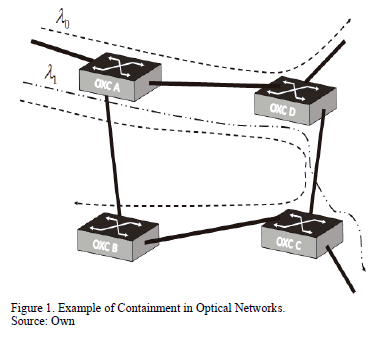
<body><![CDATA[<p><font size="2" face="Verdana, Arial, Helvetica, sans-serif">Data transport networks have enabled the  development of diverse technology, reaching photonic networks. The latter,  operated through SDH/SONET, allow up to 2.5 Gbps for wavelength and at greater  longitudes, WDM (Wavelength Division Multiplexing) appears. </font></p>     <p><font size="2" face="Verdana, Arial, Helvetica, sans-serif">One of the  most important networks that uses these methodologies is NSFNET (National  Science Foundation NETwork). The most important problems in these networks is  the RWA (Routing Wavelength Assignment) solution, with continuity constraints  of wavelength and reusing wavelength, the latter not having been studied because  the offer of the service is higher than the demand and reusing the wavelength  does not substantially improve the current solutions &#91;1&#93;.</font></p>     <p><font size="2" face="Verdana, Arial, Helvetica, sans-serif">In photonic  networks, switching becomes relevant compared to routing, which for now is  relegated to providing access to transport networks. For this reason, switching  has prevailed, due to its control simplicity and response speed &#91;2&#93;. In the  future, IP layer continuity seems weak because access technology will evolve  toward optic connectivity &#91;22&#93;. In transport, traffic is evolving rapidly from  static to dynamic. This implies a change in the solution universes,  transforming from an optimizable one, with conventional algorithms to a  non-optimizable one with heuristic algorithms &#91;3&#93;.</font></p>     <p><font size="2" face="Verdana, Arial, Helvetica, sans-serif">Therefore, the current research is  directed toward dynamic traffic studies, where the RWA problem is present, with  wavelength reuse &#91;4,5&#93;. The latter carries a reconnection time increase, so it  is not widely used. To route the  information, a path and a wavelength is necessary in each link of the  lightpath. In literature there are two strategies. The first divides the  problem in two parts (path search and wavelength assigning) and the second  solves the problem in only one algorithm process, that is, comprehensively  (without separating the problem). Of course, this has advantages such as  obtaining more paths, but not necessarily available wavelengths, and the second  obtains paths and wavelengths but at higher computer costs. The algorithms  studied in this article work under conditions of restricted wavelength  continuity (CCW). This guarantees that in each link of the selected route uses  the same wavelength, but it has the disadvantage of reducing the universe of  possible solutions and with low connection establishing time &#91;4,5&#93;. In general, this problem has been solved by  subdividing the problem in two parts. The first solves the path based on  minimizing a pre-established condition such as cost, retardation, etc. The second  solves the wavelength assigning problem through algorithms like First Fit (FF),  Next Fit (NF), among others &#91;4-6&#93;. There are other proposals that solve the  problem comprehensively, achieving good results under conditions of stress  &#91;7-9&#93;. The article compares the results  of different heuristics through simulation and makes visible better dynamic  traffic conditions for optical networks.</font></p>     <p>&nbsp;</p>     <p><font size="3" face="Verdana, Arial, Helvetica, sans-serif"><b>2. The optical network problem</b></font></p>     <p><font size="2" face="Verdana, Arial, Helvetica, sans-serif">The  increase in demand continues its path toward accelerating connection requests,  driving the quest for paths and related wavelengths that are increasingly  faster and more numerous to strengthen transport of optical networks. The  routes ate made up of one or more links between OXC (Optical Cross Connect) of  the network; wavelengths are luminous signals that pass through links at  different frequencies. <a href="#fig01">Fig. 1</a> shows part of an optical network where OXC are  differentiated as A, B, C and D are connected with optical fiber links that  support both wavelengths (<font face="Symbol">l</font><sub>0</sub> and <font face="Symbol">l</font><sub>1</sub>).</font></p>     <p align="center"><font size="2" face="Verdana, Arial, Helvetica, sans-serif"><a name="fig01"></a></font><img src="/img/revistas/dyna/v83n199/v83n199a22fig01.gif"></p>     <p><font size="2" face="Verdana, Arial, Helvetica, sans-serif">Depending  on the OXC technology, these may commute fibers, wavelengths, wavelength bands,  TDM time channels.</font></p>     <p><font size="2" face="Verdana, Arial, Helvetica, sans-serif">For  this case, wavelengths will be commuted. Optical fiber routes are made up of optical links that are directed  toward light rays (data) through the same wavelength according to CCW, the pair  (R, <font face="Symbol">l</font>), is called lightpath (LP) &#91;10&#93;, where R is the set of conforming  links and <font face="Symbol">l</font> is the wavelength used in the route.</font></p>     ]]></body>
<body><![CDATA[<p><font size="2" face="Verdana, Arial, Helvetica, sans-serif">However,  the possibility of finding available LP is exhausted when the demand outstrips  the availability. This is when the request is blocked. Routing systems have been developed reusing  wavelength, where the change in <font face="Symbol">l</font> is allowed, however, studies have not  shown meaningful changes in the performance of the routing &#91;11&#93;. </font></p>     <p><font size="2" face="Verdana, Arial, Helvetica, sans-serif"><a href="#fig01">Fig. 1</a> shows 4 OXC that are part of a greater system, the established routes (LP) with  their respective wavelength (scripted) are (A-D, <font face="Symbol">l</font><sub>0</sub>) and  (A-D-C, <font face="Symbol">l</font><sub>1</sub>). It is observed that a service request reaches node  A toward node B. Node A has a path A-D-C-B, therefore a wavelength must be  assigned, however, it is observed that link A-D does not have available  wavelength, so another wavelength must be used, or a different route must be  found. This problem is called containment.</font></p>     <p>&nbsp;</p>     <p><font size="3" face="Verdana, Arial, Helvetica, sans-serif"><b>3. Modeling demand </b></font></p>     <p><font size="2" face="Verdana, Arial, Helvetica, sans-serif">The  network has current traffic, future demand or request that determines the  static and dynamic simulation scenario, the RWA problem is called SLE (Static  Lightpath Establishment) if the traffic is static and DLE (Dynamic Ligthpath  Establishment) if the traffic is dynamic &#91;5&#93;. Traffic is dynamic when average  requested connection time (<b><i>t<sub>C</sub></i></b>) is lower than the  average of received service requests (<b><i>t<sub>LL</sub></i></b>).</font></p>     <p><font size="2" face="Verdana, Arial, Helvetica, sans-serif">The  scenario is not optimizable (NP-Complete), therefore heuristic algorithms are  used and of which most offer solutions that are not necessarily optimum.  Computer complexity is an important element of this problem, because when it is  subdivided, it able to be reduced. On the other hand, multiple paths that  obtain heuristic algorithms are of great support, when the problem of  containment is presented, and this way, avoiding executing a new algorithm  process. The characteristics of the  demand variables are similar to those used in the works &#91;3-5&#93;.</font></p>     <p><font size="2" face="Verdana, Arial, Helvetica, sans-serif"><b><i>3.1. Network demand</i></b></font></p>     <p><font size="2" face="Verdana, Arial, Helvetica, sans-serif">The  edge nodes (Edge OXC) receive requests (with Poisson distribution, however  different probability scenarios could be studied). These requests carry 3  parameters to be satisfied, or else the request must be blocked.</font></p>     <p><img src="/img/revistas/dyna/v83n199/v83n199a22eq01.gif"></p>     <p><font size="2" face="Verdana, Arial, Helvetica, sans-serif">Where:</font></p>     ]]></body>
<body><![CDATA[<blockquote>       <p><font size="2" face="Verdana, Arial, Helvetica, sans-serif"><img src="/img/revistas/dyna/v83n199/v83n199a22eq006.gif"> Is the vector that represents the i-     number of demand </font><font size="2" face="Verdana, Arial, Helvetica, sans-serif">Reaches       the s-number edge node.    <br>  </font><font size="2" face="Verdana, Arial, Helvetica, sans-serif"><img src="/img/revistas/dyna/v83n199/v83n199a22eq008.gif"> Identification number of the origin    node of the </font><font size="2" face="Verdana, Arial, Helvetica, sans-serif">Incoming      demand.    <br>  </font><font size="2" face="Verdana, Arial, Helvetica, sans-serif"><img src="/img/revistas/dyna/v83n199/v83n199a22eq010.gif"> Identification number of the    destination node of the </font><font size="2" face="Verdana, Arial, Helvetica, sans-serif">Incoming      demand.    <br>  </font><font size="2" face="Verdana, Arial, Helvetica, sans-serif"><img src="/img/revistas/dyna/v83n199/v83n199a22eq014.gif"> Number of connections requested    towards<sub><img src="/img/revistas/dyna/v83n199/v83n199a22eq016.gif"></sub>.    <br>  </font><font size="2" face="Verdana, Arial, Helvetica, sans-serif"><img src="/img/revistas/dyna/v83n199/v83n199a22eq018.gif"> Connection time requested for the    pair <img src="/img/revistas/dyna/v83n199/v83n199a22eq020.gif">.</font></p> </blockquote>     <p><font size="2" face="Verdana, Arial, Helvetica, sans-serif">The problem is to  establish paths and wavelengths, observing the indicators used in the works  &#91;3&#93;-&#91;5&#93;, as least probability of request blockage and network use.</font></p>     <p>&nbsp;</p>     <p><font size="3" face="Verdana, Arial, Helvetica, sans-serif"><b>4. Heuristics used</b></font></p>     <p><font size="2" face="Verdana, Arial, Helvetica, sans-serif">The problem is to establish paths and  wavelengths, observing the indicators used in the works &#91;3-5&#93;, as least  probability of request blockage and network use. The research is based on DLE,  the same that has been tested under different strategies and heuristics to  satisfy the demand of an optical network and has used optimization criteria and  algorithms described in &#91;3,7&#93;.</font></p>     ]]></body>
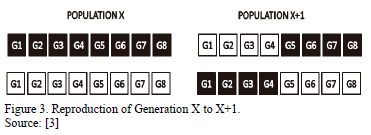
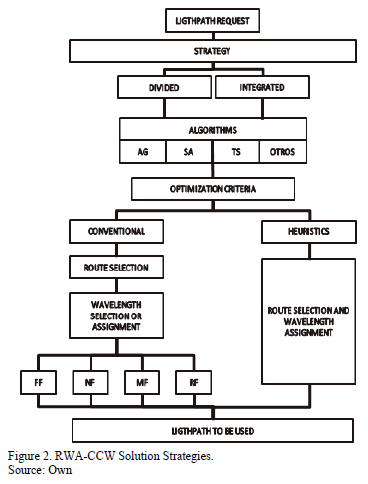
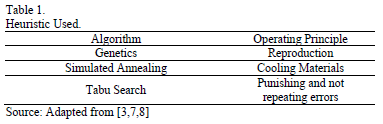
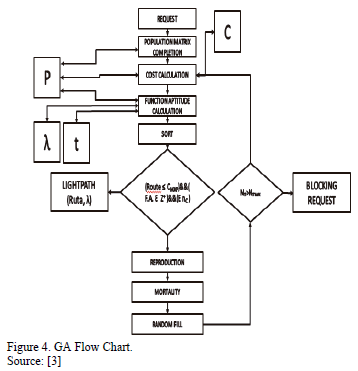
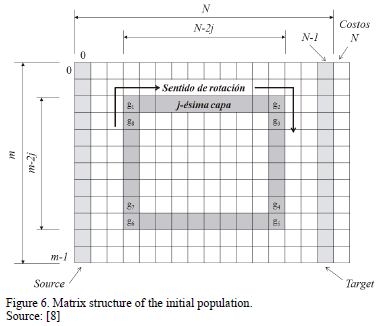
<body><![CDATA[<p><font size="2" face="Verdana, Arial, Helvetica, sans-serif"><a href="#fig02">Fig. 2</a> shows a classification of the  strategies found in literature, to solve the problems of SLE and DLE, such as:  Ant &#91;12-14&#93;, Genetic &#91;3,7&#93;, Tab&uacute; Search &#91;1,15-19&#93; and Simulated Annealing &#91;8&#93;,  all work with the strategy of dividing the problem in 2 parts, except, &#91;3,7,8&#93; that do it comprehensively that is,  without dividing the problem and solving it in only one algorithm process.  Also, other heuristic algorithms are found, one of which is mimetic algorithm  Snake One, based on the displacement of cost in the matrix and its similarity  with snake movement &#91;23&#93;.</font></p>     <p align="center"><a name="fig02"></a><img src="/img/revistas/dyna/v83n199/v83n199a22fig02.gif"></p>     <p><font size="2" face="Verdana, Arial, Helvetica, sans-serif">The diagram of <a href="#fig03">Fig. 3</a> also shows the  processes found in literature to solve the RWA problem. As observed, it will use the division  strategy until it is completely solved, using different criteria and holistic  algorithms to obtain a path and a wavelength. It should be noted that in  optical networks, optimization is not necessarily sought, but a path that works  without generating an important increase in the probability of blockage without  increasing network usage. <a href="#tab01">Table 1</a>, shows the studied heuristic algorithms.</font></p>     <p align="center"><font size="2" face="Verdana, Arial, Helvetica, sans-serif"><a name="tab01"></a></font><img src="/img/revistas/dyna/v83n199/v83n199a22tab01.gif"></p>     <p align="center"><font size="2" face="Verdana, Arial, Helvetica, sans-serif"><a name="fig03"></a></font><img src="/img/revistas/dyna/v83n199/v83n199a22fig03.gif"></p>     <p><font size="2" face="Verdana, Arial, Helvetica, sans-serif"><b><i>4.1. Genetic  Algorithm (GA)</i></b></font></p>     <p><font size="2" face="Verdana, Arial, Helvetica, sans-serif">In this algorithm, the nodes are arranged  in a vector of N elements, where N is the number of Nodes in the Network. This  vector represents the Chromosome and each element represents the genes. For example, the optical network with 6  nodes, labeled from 0 to 5. </font></p>     <p><font size="2" face="Verdana, Arial, Helvetica, sans-serif">One chromosome filled randomly could be  (3,2,0,2,3,5), where the first and the last element represent the origin and destination  of the sought path. A set of chromosomes form a two-dimensional matrix, with  the objective of finding the solution vector named population. The population  is subjected to change that come from exchanging genes of adjacent chromosomes  and each time the cost of the path is evaluated and ordered from lowest to  highest costing path.</font></p>     <p><font size="2" face="Verdana, Arial, Helvetica, sans-serif">Then, a threshold of population mortality  is established, where the most apt chromosomes prevail, that is, the ones that  generate the least cost. As the algorithm is repeated, the chromosomes will  reproduce within the lowest costing paths.</font></p>     <p><font size="2" face="Verdana, Arial, Helvetica, sans-serif">This way, in some cases the resulting  route is the absolute minimum and in most cases it is the local minimum. More  information regarding algorithms may be found in &#91;3,6-8,24&#93;. In <a href="#fig03">Fig. 3</a> and <a href="#fig04">Fig.  4</a> the reproduction process of the genetic algorithm may be observed.</font></p>     ]]></body>
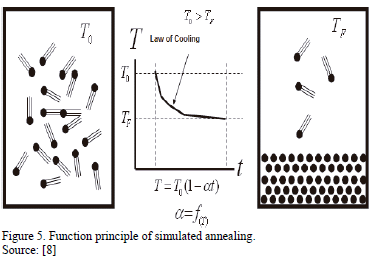
<body><![CDATA[<p align="center"><font size="2" face="Verdana, Arial, Helvetica, sans-serif"><a name="fig03"></a></font><img src="/img/revistas/dyna/v83n199/v83n199a22fig03.gif"></p>     <p align="center"><font size="2" face="Verdana, Arial, Helvetica, sans-serif"><a name="fig04"></a></font><img src="/img/revistas/dyna/v83n199/v83n199a22fig04.gif"></p>     <p><font size="2" face="Verdana, Arial, Helvetica, sans-serif"><b><i>4.2. Simulated Annealing (SA) Algorithm</i></b></font></p>     <p><font size="2" face="Verdana, Arial, Helvetica, sans-serif">This algorithm uses the molecular  behavior of bodies as they slowly cool, reaching a molecular order that  generally improves its physical properties. <a href="#fig05">Fig. 5</a> this behavior.</font></p>     <p align="center"><font size="2" face="Verdana, Arial, Helvetica, sans-serif"><a name="fig05"></a></font><img src="/img/revistas/dyna/v83n199/v83n199a22fig05.gif"></p>     <p><font size="2" face="Verdana, Arial, Helvetica, sans-serif">In this case the body is treated as a very active  gas element obeying general laws within its volume.</font></p>     <p><font size="2" face="Verdana, Arial, Helvetica, sans-serif"><a href="#fig06">Fig. 6</a> shows a matrix that is considered as a material with its heat energy  distributed by layers, with the coldest in the center and the hottest toward  the ends, <i>N </i>represents the number of  nodes of the network, <i>m </i>the number of  elements of the population matrix and <i>j </i>the  position of the layer in rotation.</font></p>     <p align="center"><font size="2" face="Verdana, Arial, Helvetica, sans-serif"><a name="fig06"></a></font><img src="/img/revistas/dyna/v83n199/v83n199a22fig06.gif"></p>     <p align="center"><font size="2" face="Verdana, Arial, Helvetica, sans-serif"><a name="fig07"></a></font><img src="/img/revistas/dyna/v83n199/v83n199a22fig07.gif"></p>     <p><font size="2" face="Verdana, Arial, Helvetica, sans-serif">This way,  the layers will move at different speeds due to heat transfer. The costs of the  routes are calculated at all times, obtaining a final route that is not  necessarily the absolute minimum. More information of generic algorithms may be  seen in &#91;8,9&#93;.</font></p>     ]]></body>
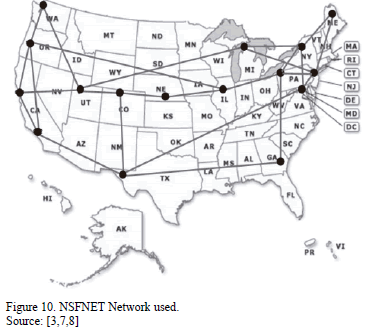
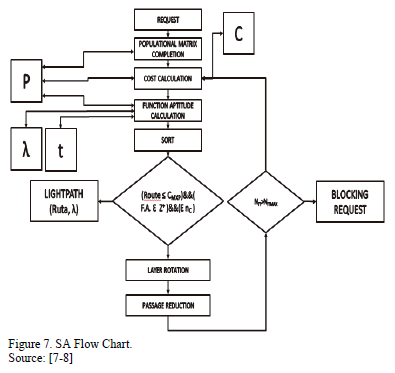
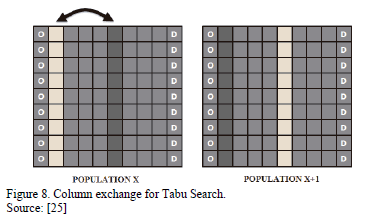
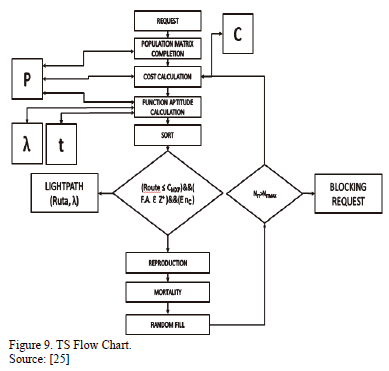
<body><![CDATA[<p><font size="2" face="Verdana, Arial, Helvetica, sans-serif"><b><i>4.3. Tab&uacute; Search (TS) Algorithm</i></b></font></p>     <p><font size="2" face="Verdana, Arial, Helvetica, sans-serif">The TS  algorithm was developed by Dr. Fred Glover (1989). It was not until 1990 that the algorithm  became popular for the approximate solution of optimization problems. The advantage of the algorithm is that once a  possible solution is found it converges quickly. This convergence is because  actions that stray from the local solutions are punished, and neighbors with  high probabilities of having a solution are preserved. Basically it is sustained that more is  learned from errors, generating information so they are not repeated. TS has  established new records in searches for the best solution to problems in  production planning and programming, resource assigning, network design,  routing, financial analysis, telecommunications, portfolio planning, supply  chain management, agent based modeling, business process design, provision,  automatic learning, data mining, etc. &#91;20,21&#93;.</font></p>     <p><font size="2" face="Verdana, Arial, Helvetica, sans-serif"><a href="#fig08">Fig. 8</a> shows the column exchange of the  population matrix. This process is registered as beneficial when the aptitude  function decreases and as not beneficial when it increases and is therefore  punished so it is not repeated.</font></p>     <p align="center"><font size="2" face="Verdana, Arial, Helvetica, sans-serif"><a name="fig08"></a></font><img src="/img/revistas/dyna/v83n199/v83n199a22fig08.gif"></p>     <p><font size="2" face="Verdana, Arial, Helvetica, sans-serif"><a href="#fig04">Figs, 4</a>, <a href="#fig07">7</a> and <a href="#fig09">9</a> show the flow chart of  the used algorithms where the request is blocked after a number of iterations  given as threshold, for computer efficiency of the process.</font></p>     <p align="center"><font size="2" face="Verdana, Arial, Helvetica, sans-serif"><a name="fig09"></a></font><img src="/img/revistas/dyna/v83n199/v83n199a22fig09.gif"></p>     <p>&nbsp;</p>     <p><font size="3" face="Verdana, Arial, Helvetica, sans-serif"><b>5. Comparison scenario</b></font></p>     <p><font size="2" face="Verdana, Arial, Helvetica, sans-serif">Once the simulation was conducted it was  compared with 4 works &#91;3&#93; and &#91;8&#93; under comprehensive solution conditions and  &#91;4-5&#93; under conditions of subdivision of the problem.</font></p>     <p><font size="2" face="Verdana, Arial, Helvetica, sans-serif">The NSFNET Network used for the test has  14 nodes and 21 optical fiber links (see <a href="#fig10">Fig. 10</a>). The parameters used were  similar to those presented in &#91;5&#93;. Probability comparisons of</font> <font size="2" face="Verdana, Arial, Helvetica, sans-serif">blockage  and network use were conducted, varying the charge in the interval &#91;0,180&#93; with  increases of 10 Erlangs. The number of connections made during the simulation  in &#91;4,5&#93; of this work were 10<sup>8</sup> connection requests.</font></p>     ]]></body>
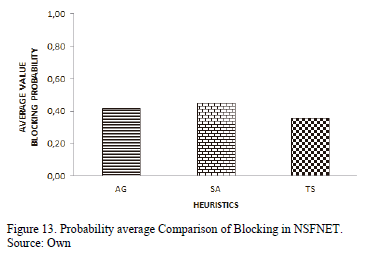
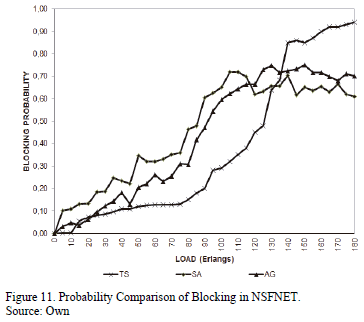
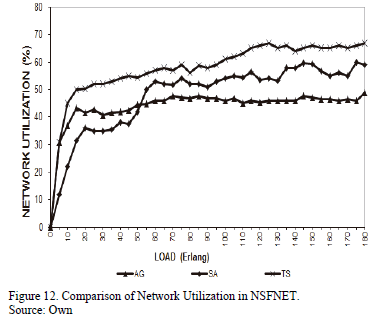
<body><![CDATA[<p align="center"><font size="2" face="Verdana, Arial, Helvetica, sans-serif"><a name="fig10"></a></font><img src="/img/revistas/dyna/v83n199/v83n199a22fig10.gif"></p>     <p>&nbsp;</p>     <p><font size="3" face="Verdana, Arial, Helvetica, sans-serif"><b>6. Results</b></font></p>     <p><font size="2" face="Verdana, Arial, Helvetica, sans-serif">In the comparison of heuristics with indicators such as  the blocking probability and network use, it is observed that the studied  algorithms tend to improve blocking probability in high load dynamic traffic,  especially over 100 Erlangs, as observed in <a href="#fig11">figs. 11</a> and <a href="#fig12">12</a>. However, the  network use resulted higher and this is a problem for network availability.  Fig. 12 shows the blocking probability (BP) and it is observed that TS has a  low BP up to 120 Erlangs, outperforming the rest of the algorithms. This is  mainly because TS finds LP passing through a neighborhood of solutions that is  lower than the rest of the algorithms, but over 120 Erlangs, TS is not the  best, determined for high loads of incoming traffic TS does not perform better  than the rest of the algorithms.</font></p>     <p align="center"><font size="2" face="Verdana, Arial, Helvetica, sans-serif"><a name="fig11"></a></font><img src="/img/revistas/dyna/v83n199/v83n199a22fig11.gif"></p>     <p align="center"><font size="2" face="Verdana, Arial, Helvetica, sans-serif"> <a name="fig12"></a></font><img src="/img/revistas/dyna/v83n199/v83n199a22fig12.gif"></p>     <p><font size="2" face="Verdana, Arial, Helvetica, sans-serif">It is important to mention that the  studies shown were conducted with 8 wavelengths and reaching 180 Erlangs. </font></p>     <p><font size="2" face="Verdana, Arial, Helvetica, sans-serif"><a href="#fig12">Fig. 12</a> shows the characteristics of the algorithms  compared to the network usage (NU). The TS algorithm is not the best one and  quickly uses many network resources.</font></p>     <p><font size="2" face="Verdana, Arial, Helvetica, sans-serif">The other   algorithms have a much lower NU, which leads to the reflection on the routes   obtained by the TS algorithm has many more jumps compared to the other   algorithms, which consequently results in higher network usage.</font></p>     <p><font size="2" face="Verdana, Arial, Helvetica, sans-serif"><a href="#fig13">Fig. 13</a> shoes the average values of the  blocking probability to facilitate its comparison, observing that the Tab&uacute;  Search (TS) heuristics performs the best.</font></p>     ]]></body>
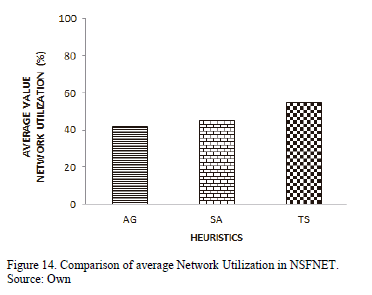
<body><![CDATA[<p align="center"><font size="2" face="Verdana, Arial, Helvetica, sans-serif"><a name="fig13"></a></font><img src="/img/revistas/dyna/v83n199/v83n199a22fig13.gif"></p>     <p><font size="2" face="Verdana, Arial, Helvetica, sans-serif"><a href="#fig14">Fig. 14</a> shows the average network use   value, observing that the evolutionary heuristics (GA) use network resources   the least. In <a href="#fig13">Fig. 13</a> and <a href="#fig14">Fig. 14</a>, the Blocking Probability and the Network   Utilization are inversely proportional; while one increases, the other   decreases. That is to say, if the blocking probability improves, this is done   at the cost of elevating the network utilization, and vice-versa.</font></p>     <p align="center"><font size="2" face="Verdana, Arial, Helvetica, sans-serif"><a name="fig14"></a></font><img src="/img/revistas/dyna/v83n199/v83n199a22fig14.gif"></p>     <p>&nbsp;</p>     <p><b><font size="3" face="Verdana, Arial, Helvetica, sans-serif">7. Conclusions</font></b></p>     <p><font size="2" face="Verdana, Arial, Helvetica, sans-serif">It is established that heuristic  algorithms tend to use more network resources, increasing the NU (Network  Utilization) indicator, but in high load dynamic traffic scenarios their  behavior is stable resulting in relatively low blocking probability. This  observation leads to modifying the comprehensive strategy, to improve the NU  and BP (Blocking Probability) indicators simultaneously. This new solution  strategy is called Localized Integral Strategy (LIS). The results of this new  strategy may be observed in future publications with a new heuristic proposal  called SNAKE and GEAR, proposed by both New Technology Research Group (GINT,  its acronym for its name in Spanish, Grupo de Investigaci&oacute;n de Nuevas  Tecnolog&iacute;as) of the Faculty of Technology of Universidad de Santiago de Chile,  and Telemedicine Research Group (TIGUM, its acronym for its name in Spanish,  Grupo de Investigaci&oacute;n en Telemedicina) of the Faculty of Engineering of  Universidad Militar Nueva Granada of Bogot&aacute;, Colombia.</font></p>     <p><font size="2" face="Verdana, Arial, Helvetica, sans-serif">It is established that heuristic  algorithms tend to use more network resources, increasing the NU (Network  Utilization) indicator, but in high load dynamic traffic scenarios their  behavior is stable resulting in a relatively low BP (Blocking Probability)  indicator. Both indicators have an inversely proportional behavior, i.e., if  one increases, the other decreases. This observation leads to the need to modify  the comprehensive strategy, to simultaneously improve the NU and BP indicators.</font></p>     <p><font size="2" face="Verdana, Arial, Helvetica, sans-serif">This new solution strategy is called  Localized Integral Strategy (LIS) or Estrategia Integral Localizada (EIL). The  results of this new strategy will be seen in upcoming publications, together  with other heuristic proposals called Snake One, Snake Two and Snake Three.</font></p>     <p>&nbsp;</p>     <p><font size="3" face="Verdana, Arial, Helvetica, sans-serif"><b>Acknowledgements</b></font></p>     ]]></body>
<body><![CDATA[<p><font size="2" face="Verdana, Arial, Helvetica, sans-serif">Special appreciation is expressed to the  DICYT Program of Universidad de Santiago de Chile - USACH (Project DICYT N°  061572RG), for its important support in research and development, and  particularly to the New Technologies Research Group (GINT-DTI-USACH).</font></p>     <p>&nbsp;</p>     <p><font size="3" face="Verdana, Arial, Helvetica, sans-serif"><b>References</b></font></p>     <!-- ref --><p><font size="2" face="Verdana, Arial, Helvetica, sans-serif"><b>&#91;1&#93;</b> Charbonneau, N. and Vokkarane,  V., Tabu searach meta-heuristic for  static manycast routing and wavelength assignement over wavelength-routed  optical WDM networks, Proceedings of Communications (ICC), 2010 IEEE  International Conference on, 2010, pp. 1-5. DOI: 10.1109/ICC.2010.5502241</font>&nbsp;&nbsp;&nbsp;&nbsp;&nbsp;&nbsp;&nbsp;&nbsp;[&#160;<a href="javascript:void(0);" onclick="javascript: window.open('/scielo.php?script=sci_nlinks&ref=1149374&pid=S0012-7353201600050002200001&lng=','','width=640,height=500,resizable=yes,scrollbars=1,menubar=yes,');">Links</a>&#160;]<!-- end-ref --><!-- ref --><p><font size="2" face="Verdana, Arial, Helvetica, sans-serif"><b>&#91;2&#93;</b> Al-Momin, M. and Cosmas, J.,  The impact of content oriented routing on openflow burst switched optical  networks, Proceedings of Advanced Information Networking and Applications  Workshops (WAINA), 2013 27<sup>th</sup> International Conference on, 2013, pp.  965 -970. DOI: 10.1109/WAINA.2013.139</font>&nbsp;&nbsp;&nbsp;&nbsp;&nbsp;&nbsp;&nbsp;&nbsp;[&#160;<a href="javascript:void(0);" onclick="javascript: window.open('/scielo.php?script=sci_nlinks&ref=1149375&pid=S0012-7353201600050002200002&lng=','','width=640,height=500,resizable=yes,scrollbars=1,menubar=yes,');">Links</a>&#160;]<!-- end-ref --><!-- ref --><p><font size="2" face="Verdana, Arial, Helvetica, sans-serif"><b>&#91;3&#93;</b> Rodriguez,  A. y Saavedra, F., Enrutamiento y asignaci&oacute;n de longitudes de onda en redes  WDM: Soluci&oacute;n simult&aacute;nea basada en algoritmos gen&eacute;ticos, Proceedings of XVI  Congreso Internacional de Ingenier&iacute;a El&eacute;ctrica, Electr&oacute;nica y Sistemas (IEEE  INTERCON2009), 2009.    &nbsp;&nbsp;&nbsp;&nbsp;&nbsp;&nbsp;&nbsp;&nbsp;[&#160;<a href="javascript:void(0);" onclick="javascript: window.open('/scielo.php?script=sci_nlinks&ref=1149376&pid=S0012-7353201600050002200003&lng=','','width=640,height=500,resizable=yes,scrollbars=1,menubar=yes,');">Links</a>&#160;]<!-- end-ref --> </font></p>     <!-- ref --><p><font size="2" face="Verdana, Arial, Helvetica, sans-serif"><b>&#91;4&#93;</b> Chu, X., Li, B. and Zhang Z., A  Dynamic RWA algorithm in a wavelength-routed all-optical network with  wavelength converters, Proceedings of INFOCOM 2003. Twenty-Second Annual Joint  Conference of the IEEE Computer and Communications. IEEE Societies, 3, pp.  1795-1804. 2003, DOI: 10.1109/INFCOM.2003.1209202</font>&nbsp;&nbsp;&nbsp;&nbsp;&nbsp;&nbsp;&nbsp;&nbsp;[&#160;<a href="javascript:void(0);" onclick="javascript: window.open('/scielo.php?script=sci_nlinks&ref=1149378&pid=S0012-7353201600050002200004&lng=','','width=640,height=500,resizable=yes,scrollbars=1,menubar=yes,');">Links</a>&#160;]<!-- end-ref --><!-- ref --><p><font size="2" face="Verdana, Arial, Helvetica, sans-serif"><b>&#91;5&#93;</b> Zang, H. and Jue, J., Dynamic  lightpath establishment in wavelength-routed WDM networks, IEEE Communications  Magazine, 39(1), pp. 100-108, 2001. DOI: 10.1109/35.948897</font>&nbsp;&nbsp;&nbsp;&nbsp;&nbsp;&nbsp;&nbsp;&nbsp;[&#160;<a href="javascript:void(0);" onclick="javascript: window.open('/scielo.php?script=sci_nlinks&ref=1149379&pid=S0012-7353201600050002200005&lng=','','width=640,height=500,resizable=yes,scrollbars=1,menubar=yes,');">Links</a>&#160;]<!-- end-ref --><!-- ref --><p><font size="2" face="Verdana, Arial, Helvetica, sans-serif"><b>&#91;6&#93;</b> Barpanda, R., Turuk, A., Sahoo,  B. and Majhi, B., Genetic algorithm techniques to solve routing and wavelength  assignment problem in wavelength division multiplexing all-optical network,  Proceedings of Communication Systems and Networks (COMSNETS), 2011 Third  International Conference on, 2011, pp. 1-8. DOI: 10.1109/COMSNETS.2011.5716507</font>&nbsp;&nbsp;&nbsp;&nbsp;&nbsp;&nbsp;&nbsp;&nbsp;[&#160;<a href="javascript:void(0);" onclick="javascript: window.open('/scielo.php?script=sci_nlinks&ref=1149380&pid=S0012-7353201600050002200006&lng=','','width=640,height=500,resizable=yes,scrollbars=1,menubar=yes,');">Links</a>&#160;]<!-- end-ref --><!-- ref --><p><font size="2" face="Verdana, Arial, Helvetica, sans-serif"><b>&#91;7&#93;</b> Rodr&iacute;guez,  A. y Saavedra, F., Soluci&oacute;n simult&aacute;nea del enrutamiento y asignaci&oacute;n de  longitud de onda en redes WDM con algoritmos gen&eacute;ticos. Proceedings of IEEE  COLCOM, pp. 91-94, 2008.    &nbsp;&nbsp;&nbsp;&nbsp;&nbsp;&nbsp;&nbsp;&nbsp;[&#160;<a href="javascript:void(0);" onclick="javascript: window.open('/scielo.php?script=sci_nlinks&ref=1149381&pid=S0012-7353201600050002200007&lng=','','width=640,height=500,resizable=yes,scrollbars=1,menubar=yes,');">Links</a>&#160;]<!-- end-ref --></font></p>     <!-- ref --><p><font size="2" face="Verdana, Arial, Helvetica, sans-serif"><b>&#91;8&#93;</b> Rodr&iacute;guez, A., Saavedra, F. y Ramirez, L.,  Simulated annealing, una propuesta de soluci&oacute;n al problema RWA en redes  fot&oacute;nicas, Proceedings of XVIII Congreso Internacional De Ingenier&iacute;a El&eacute;ctrica,  Electr&oacute;nica, Sistemas Y Ramas Afines (IEEE InterconUNI), 2011.    &nbsp;&nbsp;&nbsp;&nbsp;&nbsp;&nbsp;&nbsp;&nbsp;[&#160;<a href="javascript:void(0);" onclick="javascript: window.open('/scielo.php?script=sci_nlinks&ref=1149383&pid=S0012-7353201600050002200008&lng=','','width=640,height=500,resizable=yes,scrollbars=1,menubar=yes,');">Links</a>&#160;]<!-- end-ref --></font></p>     <!-- ref --><p><font size="2" face="Verdana, Arial, Helvetica, sans-serif"><b>&#91;9&#93;</b> Guenduez, H. and Kadir, H., A  well-arranged simulated annealing approach for the location-routing problem  with time windows, Proceedings of System Sciences (HICSS), 2013 46<sup>th</sup> Hawaii International Conference on, pp. 1144-1153, 2013. DOI:  10.1109/HICSS.2013.69</font>&nbsp;&nbsp;&nbsp;&nbsp;&nbsp;&nbsp;&nbsp;&nbsp;[&#160;<a href="javascript:void(0);" onclick="javascript: window.open('/scielo.php?script=sci_nlinks&ref=1149385&pid=S0012-7353201600050002200009&lng=','','width=640,height=500,resizable=yes,scrollbars=1,menubar=yes,');">Links</a>&#160;]<!-- end-ref --><!-- ref --><p><font size="2" face="Verdana, Arial, Helvetica, sans-serif"><b>&#91;10&#93;</b> Kuri, J., Puech, N., Gagnaire,  M., Dotaro, E. and Douville, R., Routing and wavelength assignement of  scheduled lightpath demands, IEEE Journal On Selected Areas in Communications,  21(1), pp. 1231-1240, 2003. DOI: 10.1109/JSAC.2003.816622</font>&nbsp;&nbsp;&nbsp;&nbsp;&nbsp;&nbsp;&nbsp;&nbsp;[&#160;<a href="javascript:void(0);" onclick="javascript: window.open('/scielo.php?script=sci_nlinks&ref=1149386&pid=S0012-7353201600050002200010&lng=','','width=640,height=500,resizable=yes,scrollbars=1,menubar=yes,');">Links</a>&#160;]<!-- end-ref --><!-- ref --><p><font size="2" face="Verdana, Arial, Helvetica, sans-serif"><b>&#91;11&#93;</b> Yi-Jen, C., Tsu-Hsiu, W. and  Jui-Pin, W., High-speed semiconductor all-optical conversiondevice based on  field-driven quantum well, Proceedings of Advanced Infocomm Technology (ICAIT),  2013 6<sup>th</sup> International Conference on, pp. 147-148, 2013. DOI:  10.1109/ICAIT.2013.6621538</font>&nbsp;&nbsp;&nbsp;&nbsp;&nbsp;&nbsp;&nbsp;&nbsp;[&#160;<a href="javascript:void(0);" onclick="javascript: window.open('/scielo.php?script=sci_nlinks&ref=1149387&pid=S0012-7353201600050002200011&lng=','','width=640,height=500,resizable=yes,scrollbars=1,menubar=yes,');">Links</a>&#160;]<!-- end-ref --><!-- ref --><p><font size="2" face="Verdana, Arial, Helvetica, sans-serif"><b>&#91;12&#93;</b> Bhaskaran, K., Triay, J.  and Vokkarane, V., Dynamic anycast  routing and wavelength assignment in WDM networks using ant colony optimization  (ACO), Proceedings of Communications (ICC), 2011 IEEE International Conference  on, pp. 1-6, 2011. DOI: 10.1109/icc.2011.5962826</font>&nbsp;&nbsp;&nbsp;&nbsp;&nbsp;&nbsp;&nbsp;&nbsp;[&#160;<a href="javascript:void(0);" onclick="javascript: window.open('/scielo.php?script=sci_nlinks&ref=1149388&pid=S0012-7353201600050002200012&lng=','','width=640,height=500,resizable=yes,scrollbars=1,menubar=yes,');">Links</a>&#160;]<!-- end-ref --><!-- ref --><p><font size="2" face="Verdana, Arial, Helvetica, sans-serif"><b>&#91;13&#93;</b> Ramesh, T., Amrutha, N., Madhu, A., Saumya,  K. and Vaya, P., A proactive and self-regulated ant-based RWA protocol for all-optical WDM  networks, Proceedings of Process Automation, Control and Computing (PACC), 2011  International Conference on, pp. 1-5, 2011. DOI: 10.1109/PACC.2011.5978978</font>&nbsp;&nbsp;&nbsp;&nbsp;&nbsp;&nbsp;&nbsp;&nbsp;[&#160;<a href="javascript:void(0);" onclick="javascript: window.open('/scielo.php?script=sci_nlinks&ref=1149389&pid=S0012-7353201600050002200013&lng=','','width=640,height=500,resizable=yes,scrollbars=1,menubar=yes,');">Links</a>&#160;]<!-- end-ref --><!-- ref --><p><font size="2" face="Verdana, Arial, Helvetica, sans-serif"><b>&#91;14&#93;</b> Zeng, P. and Yu, H., An  ant-based routing algorithm to achieve the lifetime bound for target tracking  sensor networks, Proceedings of Communications, 2006. ICC '06. IEEE International Conference on, 8, pp.  3444-3449, 2006. DOI: 10.1109/ICC.2006.255605</font>&nbsp;&nbsp;&nbsp;&nbsp;&nbsp;&nbsp;&nbsp;&nbsp;[&#160;<a href="javascript:void(0);" onclick="javascript: window.open('/scielo.php?script=sci_nlinks&ref=1149390&pid=S0012-7353201600050002200014&lng=','','width=640,height=500,resizable=yes,scrollbars=1,menubar=yes,');">Links</a>&#160;]<!-- end-ref --><!-- ref --><p><font size="2" face="Verdana, Arial, Helvetica, sans-serif"><b>&#91;15&#93;</b> Skorin-Kapov, N., Heuristic  algorithms for the routing and wavelength assignment of scheduled lightpath  demands in optical networks, Selected Areas in Communications, IEEE Journal,  24(1), pp. 2-15, 2006. DOI: 10.1109/JSAC.2006.1677251</font>&nbsp;&nbsp;&nbsp;&nbsp;&nbsp;&nbsp;&nbsp;&nbsp;[&#160;<a href="javascript:void(0);" onclick="javascript: window.open('/scielo.php?script=sci_nlinks&ref=1149391&pid=S0012-7353201600050002200015&lng=','','width=640,height=500,resizable=yes,scrollbars=1,menubar=yes,');">Links</a>&#160;]<!-- end-ref --><!-- ref --><p><font size="2" face="Verdana, Arial, Helvetica, sans-serif"><b>&#91;16&#93;</b> O'Brien, D., Chatelain, B.,  Gagnon, F. and Tremblay, C., A dual metaheuristic solution to the Min-RWA  problem, Proceedings of Optical Fiber communication/National Fiber Optic  Engineers Conference (OFC/NFOEC), pp. 1-3, 2008. DOI: 10.1109/OFC.2008.4528114</font>&nbsp;&nbsp;&nbsp;&nbsp;&nbsp;&nbsp;&nbsp;&nbsp;[&#160;<a href="javascript:void(0);" onclick="javascript: window.open('/scielo.php?script=sci_nlinks&ref=1149392&pid=S0012-7353201600050002200016&lng=','','width=640,height=500,resizable=yes,scrollbars=1,menubar=yes,');">Links</a>&#160;]<!-- end-ref --><!-- ref --><p><font size="2" face="Verdana, Arial, Helvetica, sans-serif"><b>&#91;17&#93;</b> Dzongang, C., Galinier, P. and  Pierre, S., A tabu search heuristic for the routing and wavelength assignment  problem in optical networks, IEEE Communications Letters, 9(1), pp. 426-428,  2005. DOI: 10.1109/LCOMM.2005.05011</font>&nbsp;&nbsp;&nbsp;&nbsp;&nbsp;&nbsp;&nbsp;&nbsp;[&#160;<a href="javascript:void(0);" onclick="javascript: window.open('/scielo.php?script=sci_nlinks&ref=1149393&pid=S0012-7353201600050002200017&lng=','','width=640,height=500,resizable=yes,scrollbars=1,menubar=yes,');">Links</a>&#160;]<!-- end-ref --><!-- ref --><p><font size="2" face="Verdana, Arial, Helvetica, sans-serif"><b>&#91;18&#93;</b> Khyda, D., Chamberland, S. and  Pierre, S., Improvement of routing and wavelength assignment in WDM networks  using tabu search, Proceedings of Electrical and Computer Engineering Canadian  Conference on (IEEE CCECE), 2, pp. 765-768, 2003. DOI:  10.1109/CCECE.2003.1226007</font>&nbsp;&nbsp;&nbsp;&nbsp;&nbsp;&nbsp;&nbsp;&nbsp;[&#160;<a href="javascript:void(0);" onclick="javascript: window.open('/scielo.php?script=sci_nlinks&ref=1149394&pid=S0012-7353201600050002200018&lng=','','width=640,height=500,resizable=yes,scrollbars=1,menubar=yes,');">Links</a>&#160;]<!-- end-ref --><!-- ref --><p><font size="2" face="Verdana, Arial, Helvetica, sans-serif"><b>&#91;19&#93;</b> Ying, W., Tee, C. and Meng, L.,  A tabu search algorithm for static routing and wavelength assignment problem,  IEEE Communications Letters, 9(1), pp. 841-843, 2005. DOI:  10.1109/LCOMM.2005.1506721</font>&nbsp;&nbsp;&nbsp;&nbsp;&nbsp;&nbsp;&nbsp;&nbsp;[&#160;<a href="javascript:void(0);" onclick="javascript: window.open('/scielo.php?script=sci_nlinks&ref=1149395&pid=S0012-7353201600050002200019&lng=','','width=640,height=500,resizable=yes,scrollbars=1,menubar=yes,');">Links</a>&#160;]<!-- end-ref --><!-- ref --><p><font size="2" face="Verdana, Arial, Helvetica, sans-serif"><b>&#91;20&#93;</b> Glover, F., Tabu search, Part  I, ORSA Journal on Computing, 1(3), pp.190-206, 1989.    &nbsp;&nbsp;&nbsp;&nbsp;&nbsp;&nbsp;&nbsp;&nbsp;[&#160;<a href="javascript:void(0);" onclick="javascript: window.open('/scielo.php?script=sci_nlinks&ref=1149396&pid=S0012-7353201600050002200020&lng=','','width=640,height=500,resizable=yes,scrollbars=1,menubar=yes,');">Links</a>&#160;]<!-- end-ref --> </font></p>     <!-- ref --><p><font size="2" face="Verdana, Arial, Helvetica, sans-serif"><b>&#91;21&#93;</b> Glover, F., Tabu Search, Part  II, ORSA Journal on Computing, 2(1), pp. 4-32. 1990.    &nbsp;&nbsp;&nbsp;&nbsp;&nbsp;&nbsp;&nbsp;&nbsp;[&#160;<a href="javascript:void(0);" onclick="javascript: window.open('/scielo.php?script=sci_nlinks&ref=1149398&pid=S0012-7353201600050002200021&lng=','','width=640,height=500,resizable=yes,scrollbars=1,menubar=yes,');">Links</a>&#160;]<!-- end-ref --></font></p>     <!-- ref --><p><font size="2" face="Verdana, Arial, Helvetica, sans-serif"><b>&#91;22&#93;</b> Rodr&iacute;guez,  A., Ram&iacute;rez, L., Espinoza, J. Ampuero, L. y Ram&iacute;rez, C., Enrutamiento y  asignaci&oacute;n de longitud de onda: Algoritmos heur&iacute;sticos bajo tr&aacute;fico din&aacute;mico en  redes WDM, Proceedings of XXI Congreso Internacional de Ingenier&iacute;a Electr&oacute;nica,  El&eacute;ctrica y Computaci&oacute;n (INTERCON2014), pp. 265-270, 2014.    &nbsp;&nbsp;&nbsp;&nbsp;&nbsp;&nbsp;&nbsp;&nbsp;[&#160;<a href="javascript:void(0);" onclick="javascript: window.open('/scielo.php?script=sci_nlinks&ref=1149400&pid=S0012-7353201600050002200022&lng=','','width=640,height=500,resizable=yes,scrollbars=1,menubar=yes,');">Links</a>&#160;]<!-- end-ref --></font></p>     <!-- ref --><p><font size="2" face="Verdana, Arial, Helvetica, sans-serif"><b>&#91;23&#93;</b> Montoya, J., Solano, E. and  Dur&aacute;n, C., Memetic algorithm to minimize costs of activities in RCPSP, Dyna,  79(179), pp. 86-95, 2012.    &nbsp;&nbsp;&nbsp;&nbsp;&nbsp;&nbsp;&nbsp;&nbsp;[&#160;<a href="javascript:void(0);" onclick="javascript: window.open('/scielo.php?script=sci_nlinks&ref=1149402&pid=S0012-7353201600050002200023&lng=','','width=640,height=500,resizable=yes,scrollbars=1,menubar=yes,');">Links</a>&#160;]<!-- end-ref --> </font></p>     <!-- ref --><p><font size="2" face="Verdana, Arial, Helvetica, sans-serif"><b>&#91;24&#93;</b> Navarro,  R., Puris, A. y Bello, R., Desempe&ntilde;o de algunas meta-heur&iacute;sticas en problemas  continuos analizados seg&uacute;n la posici&oacute;n del &oacute;ptimo en el espacio de b&uacute;squeda,  Dyna 80(180), pp. 60-66, 2013.    &nbsp;&nbsp;&nbsp;&nbsp;&nbsp;&nbsp;&nbsp;&nbsp;[&#160;<a href="javascript:void(0);" onclick="javascript: window.open('/scielo.php?script=sci_nlinks&ref=1149404&pid=S0012-7353201600050002200024&lng=','','width=640,height=500,resizable=yes,scrollbars=1,menubar=yes,');">Links</a>&#160;]<!-- end-ref --> </font></p>     <!-- ref --><p><font size="2" face="Verdana, Arial, Helvetica, sans-serif"><b>&#91;25&#93;</b> Rodriguez, A., Ramirez L,  Rivera L. and Gutierrez A., Routing wavelength assignement: A solution with  tabu search in dynamic traffic. In: Ingeniare. Rev. Chil. Ing., 22(4), pp.  495-503, 2014. DOI: 10.4067/S0718-33052014000400005</font>&nbsp;&nbsp;&nbsp;&nbsp;&nbsp;&nbsp;&nbsp;&nbsp;[&#160;<a href="javascript:void(0);" onclick="javascript: window.open('/scielo.php?script=sci_nlinks&ref=1149406&pid=S0012-7353201600050002200025&lng=','','width=640,height=500,resizable=yes,scrollbars=1,menubar=yes,');">Links</a>&#160;]<!-- end-ref --><p>&nbsp;</p>     <p><font size="2" face="Verdana, Arial, Helvetica, sans-serif"><b>A.B. Rodr&iacute;guez-Garc&iacute;a,</b> Received a BSC. degree in Mechanical-Electrical Engineering in  2000, a MSc. degree in Telecommunications in 2003, and a PhD. in Engineering  Sciences in 2007, the first of the Universidad Nacional de Ingenier&iacute;a, Lima,  Peru and the rest of the Universidad de Santiago de Chile, Santiago, Chile.  From 2000 to 2003, he worked as an academic at several state universities in  Peru and Chile, from 2004 he has worked at Universidad de Santiago de Chile as  a researcher in the area of telecommunications, specializing in fiber optic  networks. Academic and research group director of new technologies at the  Faculty of Technology of Universidad de Santiago de Chile. His research  interests include simulation modeling photonic network devices; luminous  routing heuristics and optimization of optical networks using metaheuristics. ORCID: 0000-0002-8383-6561</font></p>     <p><font size="2" face="Verdana, Arial, Helvetica, sans-serif"><b>L.J. Ram&iacute;rez-L&oacute;pez,</b> Received his BSC. degree in Electronic Engineering from University  Antonio Nari&ntilde;o in 1997. In 2002, he received the Electronic Instrumentation  Specialist award. In 2006 he obtained a MSc. degree in Engineering Systems at  the National University of Colombia. PhD of Mogi das Cruzes of Sao Paulo,  Brazil. Director of Telemedicine Research Group of New Granada Military  University, is co-investigator of the Research Group on Communications and  Security Informatics, Faculty of Engineering, Engineering program in  Telecommunications of Military University Nueva Granada. Bogot&aacute;, Colombia. ORCID: 0000-0002-6473-5685</font></p>     <p><font size="2" face="Verdana, Arial, Helvetica, sans-serif"><b>J.C. Espinoza-Oyarz&uacute;n,</b> Received of State Professor of Chemistry, Natural Sciences  Merceologia in 1971 from Universidad Tecnica del Estado (UTE). MSc. in  Education, Curriculum and Evaluation mention 2008 from Universidad de Santiago  de Chile (UTE). Specialization  Diploma in Plastics in 1980 at Instituto de Ciencia y Tecnolog&iacute;a de Pol&iacute;meros,  Madrid, Spain. Diploma in Innovation and Technology in  the Context of Strategic Management in 1998 from Universidad de Santiago de  Chile and Instituto Tecnologico de Monterrey, Mexico. Deputy Dean of the  Faculty Teaching Technology, 2010 at Universidad de Chile. ORCID: 0000-0003-2572-338X</font></p>     ]]></body>
<body><![CDATA[ ]]></body><back>
<ref-list>
<ref id="B1">
<label>1</label><nlm-citation citation-type="confpro">
<person-group person-group-type="author">
<name>
<surname><![CDATA[Charbonneau]]></surname>
<given-names><![CDATA[N.]]></given-names>
</name>
<name>
<surname><![CDATA[Vokkarane]]></surname>
<given-names><![CDATA[V.]]></given-names>
</name>
</person-group>
<article-title xml:lang="en"><![CDATA[Tabu searach meta-heuristic for static manycast routing and wavelength assignement over wavelength-routed optical WDM networks]]></article-title>
<source><![CDATA[]]></source>
<year></year>
<conf-name><![CDATA[ Communications (ICC), 2010 IEEE International Conference on]]></conf-name>
<conf-date>2010</conf-date>
<conf-loc> </conf-loc>
<page-range>1-5</page-range></nlm-citation>
</ref>
<ref id="B2">
<label>2</label><nlm-citation citation-type="confpro">
<person-group person-group-type="author">
<name>
<surname><![CDATA[Al-Momin]]></surname>
<given-names><![CDATA[M.]]></given-names>
</name>
<name>
<surname><![CDATA[Cosmas]]></surname>
<given-names><![CDATA[J.]]></given-names>
</name>
</person-group>
<article-title xml:lang="en"><![CDATA[The impact of content oriented routing on openflow burst switched optical networks]]></article-title>
<source><![CDATA[]]></source>
<year></year>
<conf-name><![CDATA[ Advanced Information Networking and Applications Workshops (WAINA)]]></conf-name>
<conf-date>2013</conf-date>
<conf-loc> </conf-loc>
<page-range>965 -970</page-range></nlm-citation>
</ref>
<ref id="B3">
<label>3</label><nlm-citation citation-type="confpro">
<person-group person-group-type="author">
<name>
<surname><![CDATA[Rodriguez]]></surname>
<given-names><![CDATA[A.]]></given-names>
</name>
<name>
<surname><![CDATA[Saavedra]]></surname>
<given-names><![CDATA[F.]]></given-names>
</name>
</person-group>
<article-title xml:lang="es"><![CDATA[Enrutamiento y asignación de longitudes de onda en redes WDM: Solución simultánea basada en algoritmos genéticos]]></article-title>
<source><![CDATA[]]></source>
<year></year>
<conf-name><![CDATA[XVI Congreso Internacional de Ingeniería Eléctrica, Electrónica y Sistemas (IEEE INTERCON2009)]]></conf-name>
<conf-date>2009</conf-date>
<conf-loc> </conf-loc>
</nlm-citation>
</ref>
<ref id="B4">
<label>4</label><nlm-citation citation-type="confpro">
<person-group person-group-type="author">
<name>
<surname><![CDATA[Chu]]></surname>
<given-names><![CDATA[X.]]></given-names>
</name>
<name>
<surname><![CDATA[Li]]></surname>
<given-names><![CDATA[B.]]></given-names>
</name>
<name>
<surname><![CDATA[Zhang]]></surname>
<given-names><![CDATA[Z.]]></given-names>
</name>
</person-group>
<article-title xml:lang="en"><![CDATA[A Dynamic RWA algorithm in a wavelength-routed all-optical network with wavelength converters]]></article-title>
<source><![CDATA[]]></source>
<year>2003</year>
<volume>3</volume>
<conf-name><![CDATA[Twenty-Second INFOCOM 2003]]></conf-name>
<conf-loc> </conf-loc>
<page-range>1795-1804</page-range></nlm-citation>
</ref>
<ref id="B5">
<label>5</label><nlm-citation citation-type="journal">
<person-group person-group-type="author">
<name>
<surname><![CDATA[Zang]]></surname>
<given-names><![CDATA[H.]]></given-names>
</name>
<name>
<surname><![CDATA[Jue]]></surname>
<given-names><![CDATA[J.]]></given-names>
</name>
</person-group>
<article-title xml:lang="en"><![CDATA[Dynamic lightpath establishment in wavelength-routed WDM networks]]></article-title>
<source><![CDATA[IEEE Communications Magazine]]></source>
<year>2001</year>
<volume>39</volume>
<numero>1</numero>
<issue>1</issue>
<page-range>100-108</page-range></nlm-citation>
</ref>
<ref id="B6">
<label>6</label><nlm-citation citation-type="confpro">
<person-group person-group-type="author">
<name>
<surname><![CDATA[Barpanda]]></surname>
<given-names><![CDATA[R.]]></given-names>
</name>
<name>
<surname><![CDATA[Turuk]]></surname>
<given-names><![CDATA[A.]]></given-names>
</name>
<name>
<surname><![CDATA[Sahoo]]></surname>
<given-names><![CDATA[B.]]></given-names>
</name>
<name>
<surname><![CDATA[Majhi]]></surname>
<given-names><![CDATA[B.]]></given-names>
</name>
<name>
<surname><![CDATA[network]]></surname>
<given-names><![CDATA[Genetic algorithm techniques to solve routing and wavelength assignment problem in wavelength division multiplexing all-optical]]></given-names>
</name>
</person-group>
<source><![CDATA[]]></source>
<year></year>
<conf-name><![CDATA[ Communication Systems and Networks (COMSNETS)]]></conf-name>
<conf-date>2011</conf-date>
<conf-loc> </conf-loc>
<page-range>1-8</page-range></nlm-citation>
</ref>
<ref id="B7">
<label>7</label><nlm-citation citation-type="">
<person-group person-group-type="author">
<name>
<surname><![CDATA[Rodríguez]]></surname>
<given-names><![CDATA[A.]]></given-names>
</name>
<name>
<surname><![CDATA[Saavedra]]></surname>
<given-names><![CDATA[F.]]></given-names>
</name>
</person-group>
<source><![CDATA[]]></source>
<year></year>
</nlm-citation>
</ref>
<ref id="B8">
<nlm-citation citation-type="confpro">
<person-group person-group-type="author">
<name>
<surname><![CDATA[Rodríguez]]></surname>
<given-names><![CDATA[A.]]></given-names>
</name>
<name>
<surname><![CDATA[Saavedra]]></surname>
<given-names><![CDATA[F.]]></given-names>
</name>
<name>
<surname><![CDATA[Ramirez]]></surname>
<given-names><![CDATA[L.]]></given-names>
</name>
</person-group>
<article-title xml:lang="es"><![CDATA[Simulated annealing, una propuesta de solución al problema RWA en redes fotónicas]]></article-title>
<source><![CDATA[]]></source>
<year></year>
<conf-name><![CDATA[XVIII Congreso Internacional De Ingeniería Eléctrica, Electrónica, Sistemas Y Ramas Afines (IEEE InterconUNI)]]></conf-name>
<conf-date>2011</conf-date>
<conf-loc> </conf-loc>
</nlm-citation>
</ref>
<ref id="B9">
<label>9</label><nlm-citation citation-type="confpro">
<person-group person-group-type="author">
<name>
<surname><![CDATA[Guenduez]]></surname>
<given-names><![CDATA[H.]]></given-names>
</name>
<name>
<surname><![CDATA[Kadir]]></surname>
<given-names><![CDATA[H.]]></given-names>
</name>
</person-group>
<article-title xml:lang="en"><![CDATA[A well-arranged simulated annealing approach for the location-routing problem with time windows]]></article-title>
<source><![CDATA[]]></source>
<year>2013</year>
<conf-name><![CDATA[ System Sciences (HICSS)]]></conf-name>
<conf-date>2013</conf-date>
<conf-loc>Hawaii </conf-loc>
<page-range>1144-1153</page-range></nlm-citation>
</ref>
<ref id="B10">
<label>10</label><nlm-citation citation-type="journal">
<person-group person-group-type="author">
<name>
<surname><![CDATA[Kuri]]></surname>
<given-names><![CDATA[J.]]></given-names>
</name>
<name>
<surname><![CDATA[Puech]]></surname>
<given-names><![CDATA[N.]]></given-names>
</name>
<name>
<surname><![CDATA[Gagnaire]]></surname>
<given-names><![CDATA[M.]]></given-names>
</name>
<name>
<surname><![CDATA[Dotaro]]></surname>
<given-names><![CDATA[E.]]></given-names>
</name>
<name>
<surname><![CDATA[Douville]]></surname>
<given-names><![CDATA[R.]]></given-names>
</name>
</person-group>
<article-title xml:lang="en"><![CDATA[Routing and wavelength assignement of scheduled lightpath demands]]></article-title>
<source><![CDATA[IEEE Journal On Selected Areas in Communications]]></source>
<year>2003</year>
<volume>21</volume>
<numero>1</numero>
<issue>1</issue>
<page-range>1231-1240</page-range></nlm-citation>
</ref>
<ref id="B11">
<label>11</label><nlm-citation citation-type="confpro">
<person-group person-group-type="author">
<name>
<surname><![CDATA[Yi-Jen]]></surname>
<given-names><![CDATA[C.]]></given-names>
</name>
<name>
<surname><![CDATA[Tsu-Hsiu]]></surname>
<given-names><![CDATA[W.]]></given-names>
</name>
<name>
<surname><![CDATA[Jui-Pin]]></surname>
<given-names><![CDATA[W.]]></given-names>
</name>
</person-group>
<article-title xml:lang="en"><![CDATA[High-speed semiconductor all-optical conversiondevice based on field-driven quantum well]]></article-title>
<source><![CDATA[]]></source>
<year>2013</year>
<conf-name><![CDATA[ Advanced Infocomm Technology (ICAIT)]]></conf-name>
<conf-date>2013</conf-date>
<conf-loc> </conf-loc>
<page-range>147-148</page-range></nlm-citation>
</ref>
<ref id="B12">
<label>12</label><nlm-citation citation-type="confpro">
<person-group person-group-type="author">
<name>
<surname><![CDATA[Bhaskaran]]></surname>
<given-names><![CDATA[K.]]></given-names>
</name>
<name>
<surname><![CDATA[Triay]]></surname>
<given-names><![CDATA[J.]]></given-names>
</name>
<name>
<surname><![CDATA[Vokkarane]]></surname>
<given-names><![CDATA[V.]]></given-names>
</name>
</person-group>
<article-title xml:lang="en"><![CDATA[Dynamic anycast routing and wavelength assignment in WDM networks using ant colony optimization (ACO)]]></article-title>
<source><![CDATA[]]></source>
<year>2011</year>
<conf-name><![CDATA[ Communications (ICC)]]></conf-name>
<conf-date>2011</conf-date>
<conf-loc> </conf-loc>
<page-range>1-6</page-range></nlm-citation>
</ref>
<ref id="B13">
<label>13</label><nlm-citation citation-type="confpro">
<person-group person-group-type="author">
<name>
<surname><![CDATA[Ramesh]]></surname>
<given-names><![CDATA[T.]]></given-names>
</name>
<name>
<surname><![CDATA[Amrutha]]></surname>
<given-names><![CDATA[N.]]></given-names>
</name>
<name>
<surname><![CDATA[Madhu]]></surname>
<given-names><![CDATA[A.]]></given-names>
</name>
<name>
<surname><![CDATA[Saumya]]></surname>
<given-names><![CDATA[K.]]></given-names>
</name>
<name>
<surname><![CDATA[Vaya]]></surname>
<given-names><![CDATA[P.]]></given-names>
</name>
</person-group>
<article-title xml:lang="en"><![CDATA[A proactive and self-regulated ant-based RWA protocol for all-optical WDM networks]]></article-title>
<source><![CDATA[]]></source>
<year>2011</year>
<conf-name><![CDATA[ Process Automation, Control and Computing (PACC)]]></conf-name>
<conf-date>2011</conf-date>
<conf-loc> </conf-loc>
<page-range>1-5</page-range></nlm-citation>
</ref>
<ref id="B14">
<label>14</label><nlm-citation citation-type="confpro">
<person-group person-group-type="author">
<name>
<surname><![CDATA[Zeng]]></surname>
<given-names><![CDATA[P.]]></given-names>
</name>
<name>
<surname><![CDATA[Yu]]></surname>
<given-names><![CDATA[H.]]></given-names>
</name>
</person-group>
<article-title xml:lang="en"><![CDATA[An ant-based routing algorithm to achieve the lifetime bound for target tracking sensor networks]]></article-title>
<source><![CDATA[]]></source>
<year>2006</year>
<volume>8</volume>
<conf-name><![CDATA[ ICC '06]]></conf-name>
<conf-date>2006</conf-date>
<conf-loc> </conf-loc>
<page-range>3444-3449</page-range></nlm-citation>
</ref>
<ref id="B15">
<label>15</label><nlm-citation citation-type="journal">
<person-group person-group-type="author">
<name>
<surname><![CDATA[Skorin-Kapov]]></surname>
<given-names><![CDATA[N.]]></given-names>
</name>
</person-group>
<article-title xml:lang="en"><![CDATA[Heuristic algorithms for the routing and wavelength assignment of scheduled lightpath demands in optical networks]]></article-title>
<source><![CDATA[Selected Areas in Communications, IEEE Journal]]></source>
<year>2006</year>
<volume>24</volume>
<numero>1</numero>
<issue>1</issue>
<page-range>2-15</page-range></nlm-citation>
</ref>
<ref id="B16">
<label>16</label><nlm-citation citation-type="confpro">
<person-group person-group-type="author">
<name>
<surname><![CDATA[O'Brien]]></surname>
<given-names><![CDATA[D.]]></given-names>
</name>
<name>
<surname><![CDATA[Chatelain]]></surname>
<given-names><![CDATA[B.]]></given-names>
</name>
<name>
<surname><![CDATA[Gagnon]]></surname>
<given-names><![CDATA[F.]]></given-names>
</name>
<name>
<surname><![CDATA[Tremblay]]></surname>
<given-names><![CDATA[C.]]></given-names>
</name>
</person-group>
<article-title xml:lang="en"><![CDATA[A dual metaheuristic solution to the Min-RWA problem]]></article-title>
<source><![CDATA[]]></source>
<year>2008</year>
<conf-name><![CDATA[ Optical Fiber communication/National Fiber Optic Engineers Conference (OFC/NFOEC)]]></conf-name>
<conf-loc> </conf-loc>
<page-range>1-3</page-range></nlm-citation>
</ref>
<ref id="B17">
<label>17</label><nlm-citation citation-type="journal">
<person-group person-group-type="author">
<name>
<surname><![CDATA[Dzongang]]></surname>
<given-names><![CDATA[C.]]></given-names>
</name>
<name>
<surname><![CDATA[Galinier]]></surname>
<given-names><![CDATA[P.]]></given-names>
</name>
<name>
<surname><![CDATA[Pierre]]></surname>
<given-names><![CDATA[S.]]></given-names>
</name>
</person-group>
<article-title xml:lang="en"><![CDATA[A tabu search heuristic for the routing and wavelength assignment problem in optical networks]]></article-title>
<source><![CDATA[IEEE Communications Letters]]></source>
<year>2005</year>
<volume>9</volume>
<numero>1</numero>
<issue>1</issue>
<page-range>426-428</page-range></nlm-citation>
</ref>
<ref id="B18">
<label>18</label><nlm-citation citation-type="confpro">
<person-group person-group-type="author">
<name>
<surname><![CDATA[Khyda]]></surname>
<given-names><![CDATA[D.]]></given-names>
</name>
<name>
<surname><![CDATA[Chamberland]]></surname>
<given-names><![CDATA[S.]]></given-names>
</name>
<name>
<surname><![CDATA[Pierre]]></surname>
<given-names><![CDATA[S.]]></given-names>
</name>
</person-group>
<article-title xml:lang="en"><![CDATA[Improvement of routing and wavelength assignment in WDM networks using tabu search]]></article-title>
<source><![CDATA[]]></source>
<year>2003</year>
<volume>2</volume>
<conf-name><![CDATA[ Electrical and Computer Engineering Canadian Conference on (IEEE CCECE)]]></conf-name>
<conf-loc> </conf-loc>
<page-range>765-768</page-range></nlm-citation>
</ref>
<ref id="B19">
<label>19</label><nlm-citation citation-type="journal">
<person-group person-group-type="author">
<name>
<surname><![CDATA[Ying]]></surname>
<given-names><![CDATA[W.]]></given-names>
</name>
<name>
<surname><![CDATA[Tee]]></surname>
<given-names><![CDATA[C.]]></given-names>
</name>
<name>
<surname><![CDATA[Meng]]></surname>
<given-names><![CDATA[L.]]></given-names>
</name>
</person-group>
<article-title xml:lang="en"><![CDATA[A tabu search algorithm for static routing and wavelength assignment problem]]></article-title>
<source><![CDATA[IEEE Communications Letters]]></source>
<year>2005</year>
<volume>9</volume>
<numero>1</numero>
<issue>1</issue>
<page-range>841-843</page-range></nlm-citation>
</ref>
<ref id="B20">
<label>20</label><nlm-citation citation-type="journal">
<person-group person-group-type="author">
<name>
<surname><![CDATA[Glover]]></surname>
<given-names><![CDATA[F.]]></given-names>
</name>
</person-group>
<article-title xml:lang="en"><![CDATA[Tabu search, Part I]]></article-title>
<source><![CDATA[ORSA Journal on Computing]]></source>
<year>1989</year>
<volume>1</volume>
<numero>3</numero>
<issue>3</issue>
<page-range>190-206</page-range></nlm-citation>
</ref>
<ref id="B21">
<label>21</label><nlm-citation citation-type="journal">
<person-group person-group-type="author">
<name>
<surname><![CDATA[Glover]]></surname>
<given-names><![CDATA[F.]]></given-names>
</name>
</person-group>
<article-title xml:lang="en"><![CDATA[Tabu Search, Part II]]></article-title>
<source><![CDATA[ORSA Journal on Computing]]></source>
<year>1990</year>
<volume>2</volume>
<numero>^s1</numero>
<issue>^s1</issue>
<supplement>1</supplement>
<page-range>4-32</page-range></nlm-citation>
</ref>
<ref id="B22">
<label>22</label><nlm-citation citation-type="confpro">
<person-group person-group-type="author">
<name>
<surname><![CDATA[Rodríguez]]></surname>
<given-names><![CDATA[A.]]></given-names>
</name>
<name>
<surname><![CDATA[Ramírez]]></surname>
<given-names><![CDATA[L.]]></given-names>
</name>
<name>
<surname><![CDATA[Espinoza]]></surname>
<given-names><![CDATA[J.]]></given-names>
</name>
<name>
<surname><![CDATA[Ampuero]]></surname>
<given-names><![CDATA[L.]]></given-names>
</name>
<name>
<surname><![CDATA[Ramírez]]></surname>
<given-names><![CDATA[C.]]></given-names>
</name>
</person-group>
<article-title xml:lang="en"><![CDATA[Enrutamiento y asignación de longitud de onda: Algoritmos heurísticos bajo tráfico dinámico en redes WDM]]></article-title>
<source><![CDATA[]]></source>
<year>2014</year>
<conf-name><![CDATA[XXI Congreso Internacional de Ingeniería Electrónica, Eléctrica y Computación (INTERCON2014)]]></conf-name>
<conf-loc> </conf-loc>
<page-range>265-270</page-range></nlm-citation>
</ref>
<ref id="B23">
<label>23</label><nlm-citation citation-type="journal">
<person-group person-group-type="author">
<name>
<surname><![CDATA[Montoya]]></surname>
<given-names><![CDATA[J.]]></given-names>
</name>
<name>
<surname><![CDATA[Solano]]></surname>
<given-names><![CDATA[E.]]></given-names>
</name>
<name>
<surname><![CDATA[Durán]]></surname>
<given-names><![CDATA[C.]]></given-names>
</name>
</person-group>
<article-title xml:lang="en"><![CDATA[Memetic algorithm to minimize costs of activities in RCPSP]]></article-title>
<source><![CDATA[Dyna]]></source>
<year>2012</year>
<volume>79</volume>
<numero>179</numero>
<issue>179</issue>
<page-range>86-95</page-range></nlm-citation>
</ref>
<ref id="B24">
<label>24</label><nlm-citation citation-type="journal">
<person-group person-group-type="author">
<name>
<surname><![CDATA[Navarro]]></surname>
<given-names><![CDATA[R.]]></given-names>
</name>
<name>
<surname><![CDATA[Puris]]></surname>
<given-names><![CDATA[A.]]></given-names>
</name>
<name>
<surname><![CDATA[Bello]]></surname>
<given-names><![CDATA[R.]]></given-names>
</name>
</person-group>
<article-title xml:lang="es"><![CDATA[Desempeño de algunas meta-heurísticas en problemas continuos analizados según la posición del óptimo en el espacio de búsqueda]]></article-title>
<source><![CDATA[Dyna]]></source>
<year>2013</year>
<volume>80</volume>
<numero>180</numero>
<issue>180</issue>
<page-range>60-66</page-range></nlm-citation>
</ref>
<ref id="B25">
<label>25</label><nlm-citation citation-type="journal">
<person-group person-group-type="author">
<name>
<surname><![CDATA[Rodriguez]]></surname>
<given-names><![CDATA[A.]]></given-names>
</name>
<name>
<surname><![CDATA[Ramirez]]></surname>
<given-names><![CDATA[L]]></given-names>
</name>
<name>
<surname><![CDATA[Rivera]]></surname>
<given-names><![CDATA[L.]]></given-names>
</name>
<name>
<surname><![CDATA[Gutierrez]]></surname>
<given-names><![CDATA[A.]]></given-names>
</name>
</person-group>
<article-title xml:lang="en"><![CDATA[Routing wavelength assignement: A solution with tabu search in dynamic traffic]]></article-title>
<source><![CDATA[Ingeniare. Rev. Chil. Ing.]]></source>
<year>2014</year>
<volume>22</volume>
<numero>4</numero>
<issue>4</issue>
<page-range>495-503</page-range></nlm-citation>
</ref>
</ref-list>
</back>
</article>