<?xml version="1.0" encoding="ISO-8859-1"?><article xmlns:mml="http://www.w3.org/1998/Math/MathML" xmlns:xlink="http://www.w3.org/1999/xlink" xmlns:xsi="http://www.w3.org/2001/XMLSchema-instance">
<front>
<journal-meta>
<journal-id>0012-7353</journal-id>
<journal-title><![CDATA[DYNA]]></journal-title>
<abbrev-journal-title><![CDATA[Dyna rev.fac.nac.minas]]></abbrev-journal-title>
<issn>0012-7353</issn>
<publisher>
<publisher-name><![CDATA[Universidad Nacional de Colombia]]></publisher-name>
</publisher>
</journal-meta>
<article-meta>
<article-id>S0012-73532016000500026</article-id>
<article-id pub-id-type="doi">10.15446/dyna.v83n199.54843</article-id>
<title-group>
<article-title xml:lang="en"><![CDATA[Gully erosion, land uses, water and soil dynamics: A case study of Nazareno (Minas Gerais, Brazil)]]></article-title>
<article-title xml:lang="es"><![CDATA[Erosión, usos del suelo, la dinámica del agua y del suelo: Un estudio de caso de Nazareno (Minas Gerais, Brasil)]]></article-title>
</title-group>
<contrib-group>
<contrib contrib-type="author">
<name>
<surname><![CDATA[Sampaio]]></surname>
<given-names><![CDATA[Ligia de Freitas]]></given-names>
</name>
<xref ref-type="aff" rid="A01"/>
</contrib>
<contrib contrib-type="author">
<name>
<surname><![CDATA[Oliveira]]></surname>
<given-names><![CDATA[Maria Paula Pires de]]></given-names>
</name>
<xref ref-type="aff" rid="A01"/>
</contrib>
<contrib contrib-type="author">
<name>
<surname><![CDATA[Cassaro]]></surname>
<given-names><![CDATA[Raul]]></given-names>
</name>
<xref ref-type="aff" rid="A01"/>
</contrib>
<contrib contrib-type="author">
<name>
<surname><![CDATA[Rodrigues]]></surname>
<given-names><![CDATA[Valéria Guimarães Silvestre]]></given-names>
</name>
<xref ref-type="aff" rid="A01"/>
</contrib>
<contrib contrib-type="author">
<name>
<surname><![CDATA[Pejon]]></surname>
<given-names><![CDATA[Osni José]]></given-names>
</name>
<xref ref-type="aff" rid="A01"/>
</contrib>
<contrib contrib-type="author">
<name>
<surname><![CDATA[Sígolo]]></surname>
<given-names><![CDATA[Joel Barbujiani]]></given-names>
</name>
<xref ref-type="aff" rid="A02"/>
</contrib>
<contrib contrib-type="author">
<name>
<surname><![CDATA[Ferreira]]></surname>
<given-names><![CDATA[Vinicius Martins]]></given-names>
</name>
<xref ref-type="aff" rid="A03"/>
</contrib>
</contrib-group>
<aff id="A01">
<institution><![CDATA[,Universidade de São Paulo Departamento de Geotecnia ]]></institution>
<addr-line><![CDATA[São Paulo ]]></addr-line>
<country>Brasil</country>
</aff>
<aff id="A">
<institution><![CDATA[,mapaula.oliveira@gmail.com  ]]></institution>
<addr-line><![CDATA[ ]]></addr-line>
</aff>
<aff id="A">
<institution><![CDATA[,raulcassaro@gmail.com  ]]></institution>
<addr-line><![CDATA[ ]]></addr-line>
</aff>
<aff id="A">
<institution><![CDATA[,valguima@usp.br  ]]></institution>
<addr-line><![CDATA[ ]]></addr-line>
</aff>
<aff id="A">
<institution><![CDATA[,pejon@sc.usp.br  ]]></institution>
<addr-line><![CDATA[ ]]></addr-line>
</aff>
<aff id="A02">
<institution><![CDATA[,Universidade de São Paulo Instituto de Geociências Departamento de Geologia Sedimentar e Ambiental]]></institution>
<addr-line><![CDATA[São Paulo ]]></addr-line>
<country>Brasil</country>
</aff>
<aff id="A03">
<institution><![CDATA[,Centro Regional Integrado de Desenvolvimento Sustentável Projeto Maria de Barro ]]></institution>
<addr-line><![CDATA[Nazareno ]]></addr-line>
<country>Brasil</country>
</aff>
<pub-date pub-type="pub">
<day>00</day>
<month>12</month>
<year>2016</year>
</pub-date>
<pub-date pub-type="epub">
<day>00</day>
<month>12</month>
<year>2016</year>
</pub-date>
<volume>83</volume>
<numero>199</numero>
<fpage>198</fpage>
<lpage>206</lpage>
<copyright-statement/>
<copyright-year/>
<self-uri xlink:href="http://www.scielo.org.co/scielo.php?script=sci_arttext&amp;pid=S0012-73532016000500026&amp;lng=en&amp;nrm=iso"></self-uri><self-uri xlink:href="http://www.scielo.org.co/scielo.php?script=sci_abstract&amp;pid=S0012-73532016000500026&amp;lng=en&amp;nrm=iso"></self-uri><self-uri xlink:href="http://www.scielo.org.co/scielo.php?script=sci_pdf&amp;pid=S0012-73532016000500026&amp;lng=en&amp;nrm=iso"></self-uri><abstract abstract-type="short" xml:lang="en"><p><![CDATA[Gully erosion is a critical issue worldwide. To correctly understand the association that the environmental data (such as climate, vegetation cover, etc.) has with soil erosion susceptibility and land uses remains a challenge in land management. This paper evaluates land use interactions with macroscopic dynamics and microscopic soil properties in terms of soil's susceptibility to erosion. We examine the reactivation of a stabilized gully in Nazareno (Brazil) by comparing field assessments with laboratory experiments, using two types of soil (well-developed soil and granite-gneiss saprolite). Both of these showed that the macroscopic behavior of soils is connected with microscopic characteristics. Well-developed soil is more erosion resistant than granite-gneiss saprolite, but the surrounding land uses do not respect these differences. These analyses enable us to explain why this and other gullies in the municipality are apparently stabilized, but soil loss continues to occur. This paper demonstrates that urban and rural expansion played a major role in triggering gully and soil losses.]]></p></abstract>
<abstract abstract-type="short" xml:lang="es"><p><![CDATA[Erosión es un problema crítico en todo el mundo. Este documento evalúa las interacciones de los usos del suelo con la dinámica macroscópica y propiedades microscópicas del suelo frente a la susceptibilidad su erosión. Examinamos la reativación de una cárcava recuperada en la ciudad de Nazareno (Brasil), comparando la evaluación de campo con experimentos de laboratorio utilizando dos tipos de suelo (suelo bien desenvuelto y granito-gneiss saprolito). Ambos demostraron que el comportamiento macroscópico de los suelos esta relacionado con las características microscópicas. Suelo bien desenvuelto es más resistente a la erosión que granito-gneiss saprolito, pero los usos de la tierra de los alrededores no respeta estas diferencias. Estos análisis han permitido explicar por qué este y otras cárcavas del municipio aparentemente se estabilizaron, pero las pierdas de suelo siguen ocurriendo. Se ha demostrado que la expansión urbana y rural desempeñó un papel importante en el desencadenamiento de estas erosiones y pierdas de suelo.]]></p></abstract>
<kwd-group>
<kwd lng="en"><![CDATA[soil loss]]></kwd>
<kwd lng="en"><![CDATA[prevention]]></kwd>
<kwd lng="en"><![CDATA[gullies]]></kwd>
<kwd lng="en"><![CDATA[environmental planning]]></kwd>
<kwd lng="es"><![CDATA[pierda del suelo]]></kwd>
<kwd lng="es"><![CDATA[prevención]]></kwd>
<kwd lng="es"><![CDATA[cárcavas]]></kwd>
<kwd lng="es"><![CDATA[planeamiento ambiental]]></kwd>
</kwd-group>
</article-meta>
</front><body><![CDATA[ <p><font size="1" face="Verdana, Arial, Helvetica, sans-serif"><b>DOI:</b> <a href="http://dx.doi.org/10.15446/dyna.v83n199.54843" target="_blank">http://dx.doi.org/10.15446/dyna.v83n199.54843</a></font></p>    <p align="center"><font size="4" face="Verdana, Arial, Helvetica, sans-serif"><b>Gully erosion, land uses, water and soil  dynamics: A case study of Nazareno (Minas Gerais, Brazil)</b></font></p>     <p align="center"><i><b><font size="3" face="Verdana, Arial, Helvetica, sans-serif">Erosi&oacute;n, usos del  suelo, la din&aacute;mica del agua y del suelo: Un estudio de caso de Nazareno (Minas Gerais, Brasil)</font></b></i></p>     <p align="center">&nbsp;</p>     <p align="center"><b><font size="2" face="Verdana, Arial, Helvetica, sans-serif">Ligia de Freitas  Sampaio <i><sup>a</sup></i>, Maria Paula  Pires de Oliveira <i><sup>a</sup></i>, Raul  Cassaro <i><sup>a</sup></i></font>, <font size="2" face="Verdana, Arial, Helvetica, sans-serif">Val&eacute;ria Guimarães   Silvestre Rodrigues <i><sup>a</sup></i>, Osni   Jos&eacute; Pejon <i><sup>a</sup></i>, Joel   Barbujiani S&iacute;golo <i><sup>b</sup> &amp; </i>Vinicius Martins Ferreira <i><sup>c</sup></i></font></b></p>     <p align="center">&nbsp;</p>     <p align="center"><font size="2" face="Verdana, Arial, Helvetica, sans-serif"><sup><i>a </i></sup><i>Departamento de Geotecnia, Escola de Engenharia   de São Carlos, Universidade de São Paulo, São Carlos, São Paulo, Brasil. <a href="mailto:ligia.sampaio@usp.br">ligia.sampaio@usp.br</a>; <a href="mailto:mapaula.oliveira@gmail.com">mapaula.oliveira@gmail.com</a>; <a href="mailto:raulcassaro@gmail.com">raulcassaro@gmail.com</a>; <a href="mailto:valguima@usp.br">valguima@usp.br</a>; <a href="mailto:pejon@sc.usp.br">pejon@sc.usp.br</a>    <br>   <sup>b </sup>Departamento de Geologia Sedimentar e Ambiental,     Instituto de Geociências, Universidade de São Paulo, São Paulo, Brasil,     <a href="mailto:jbsigolo@usp.br">jbsigolo@usp.br</a>    <br>     <sup>c </sup>Projeto Maria de Barro, Centro       Regional Integrado de Desenvolvimento Sustent&aacute;vel, Nazareno, Minas Gerais,       Brasil. <a href="mailto:vocorocas1@yahoo.com.br">vocorocas1@yahoo.com.br</a></i></font></p>     <p align="center">&nbsp;</p>     ]]></body>
<body><![CDATA[<p align="center"><font size="2" face="Verdana, Arial, Helvetica, sans-serif"><b>Received: December 21<sup>th</sup>, 2015.   Received in revised form: March 20<sup>th</sup>, 2016. Accepted: July 22<sup>th</sup>,   2016.</b></font></p>     <p align="center">&nbsp;</p>     <p align="center"><font size="1" face="Verdana, Arial, Helvetica, sans-seriff"><b>This work is licensed under a</b> <a rel="license" href="http://creativecommons.org/licenses/by-nc-nd/4.0/">Creative Commons Attribution-NonCommercial-NoDerivatives 4.0 International License</a>.</font><br /><a rel="license" href="http://creativecommons.org/licenses/by-nc-nd/4.0/"><img style="border-width:0" src="https://i.creativecommons.org/l/by-nc-nd/4.0/88x31.png" /></a></p><hr>     <p><font size="2" face="Verdana, Arial, Helvetica, sans-serif"><b>Abstract    <br> </b></font><font size="2" face="Verdana, Arial, Helvetica, sans-serif">Gully erosion is a  critical issue worldwide. To correctly understand the association that the  environmental data (such as climate, vegetation cover, etc.) has with soil  erosion susceptibility and land uses remains a challenge in land management. This paper evaluates  land use interactions with macroscopic dynamics and microscopic soil properties  in terms of soil's susceptibility to erosion. We examine the  reactivation of a stabilized gully in Nazareno (Brazil) by comparing field  assessments with laboratory experiments, using two types of soil  (well-developed soil and granite-gneiss saprolite). Both of these showed that  the macroscopic behavior of soils is connected with microscopic  characteristics. Well-developed soil is more erosion resistant than  granite-gneiss saprolite, but the surrounding land uses do not respect these  differences. These analyses enable us to explain why this and other gullies in  the municipality are apparently stabilized, but soil loss continues to occur.  This paper demonstrates that urban and rural expansion played a major role in triggering gully and soil losses.</font></p>     <p><font size="2" face="Verdana, Arial, Helvetica, sans-serif"><i>Keywords</i>: soil loss;  prevention; gullies; environmental planning.</font></p>     <p><font size="2" face="Verdana, Arial, Helvetica, sans-serif"><b>Resumen    <br> </b></font><font size="2" face="Verdana, Arial, Helvetica, sans-serif">Erosi&oacute;n  es un problema cr&iacute;tico en todo el mundo. Este documento eval&uacute;a las interacciones de los  usos del suelo con la din&aacute;mica macrosc&oacute;pica y propiedades microsc&oacute;picas del  suelo frente a la susceptibilidad su erosi&oacute;n. Examinamos la reativaci&oacute;n de una c&aacute;rcava recuperada en la ciudad de Nazareno  (Brasil), comparando la evaluaci&oacute;n de campo con experimentos de laboratorio  utilizando dos tipos de suelo (suelo bien desenvuelto y granito-gneiss  saprolito). Ambos demostraron que el comportamiento macrosc&oacute;pico de los suelos  esta relacionado con las caracter&iacute;sticas microsc&oacute;picas. Suelo bien desenvuelto  es m&aacute;s resistente a la erosi&oacute;n que granito-gneiss saprolito, pero los usos de  la tierra de los alrededores no respeta estas diferencias. Estos an&aacute;lisis han  permitido explicar por qu&eacute; este y otras c&aacute;rcavas del municipio aparentemente se  estabilizaron, pero las pierdas de suelo siguen ocurriendo. Se ha demostrado  que la expansi&oacute;n urbana y rural desempe&ntilde;&oacute; un papel importante en el desencadenamiento de estas erosiones y pierdas de suelo.</font></p>     <p><font size="2" face="Verdana, Arial, Helvetica, sans-serif"><i>Palabras clave</i>: pierda del suelo; prevenci&oacute;n;  c&aacute;rcavas; planeamiento ambiental.</font></p> <hr>     <p>&nbsp;</p>     ]]></body>
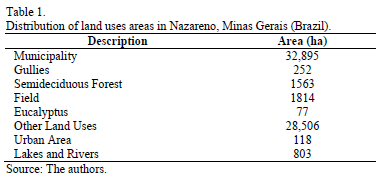
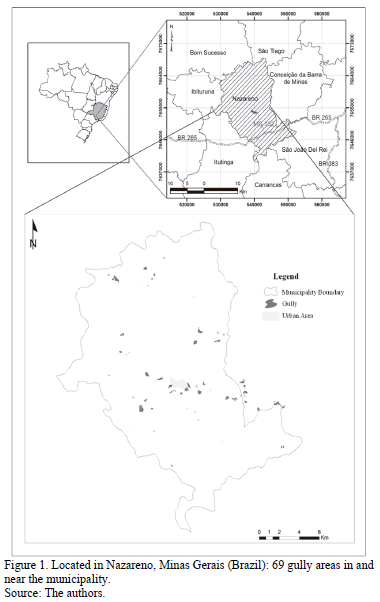
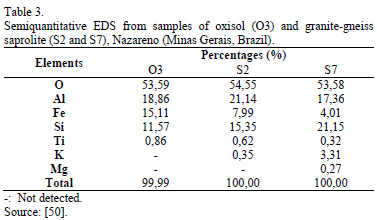
<body><![CDATA[<p><font size="3" face="Verdana, Arial, Helvetica, sans-serif"><b>1. Introduction</b></font></p>     <p><font size="2" face="Verdana, Arial, Helvetica, sans-serif"><b><i>1.1. Gully erosion: An environmental or social  problem?</i></b></font></p>     <p><font size="2" face="Verdana, Arial, Helvetica, sans-serif">Soil erosion is a natural phenomenon; however, when accelerated, it  causes social, environment and economic losses &#91;1&#93;. It affects not only the  area itself, but there are also off-site impacts &#91;2&#93;. Several studies show the  triggering, development and effects of gullies (complex soil erosion) and  reclamation solutions &#91;2-15&#93;.</font></p>     <p><font size="2" face="Verdana, Arial, Helvetica, sans-serif">Over the  past several decades, gullies have become a very important issue worldwide. The  acceleration in the number of gullies is connected with human interference  beginning in the 18<sup>th</sup> century, which has modified and intensified  natural rates of soil removal and deposits &#91;16&#93;.</font></p>     <p><font size="2" face="Verdana, Arial, Helvetica, sans-serif">In India,  this problem is related to improper management of runoff, deforestation,  overgrazing and incorrect agricultural activities &#91;17&#93;; the lack of rural  conservative practices and the excess of mechanization are the causes seen in  Latin America &#91;18&#93;; and in Europe, the USA, China and Africa, many studies have  shown a high level of soil loss in gullies over years &#91;19&#93;.</font></p>     <p><font size="2" face="Verdana, Arial, Helvetica, sans-serif">Although this type of erosion is associated with runoff and steep  slopes, it mostly occurs by subterranean flow and in soils that are susceptible  to crusting or piping &#91;20&#93;. Even activities that at first were considered  unable to interfere in environmental dynamics (such as cattle trails or ditches  to separate rural properties, whose origins are connected with human  necessities) can initiate gully erosion &#91;21&#93;. Once developed, their natural  recovery could take decades &#91;22&#93;. Therefore, reclamation projects may try to  return the environment to its condition before erosion (restoration) or give a  different function to the site (rehabilitation) &#91;23&#93;. However, in Brazil the  choice of reclamation technique is likely to be based on the most commonly used  one or the cheapest one. In those cases, the results are not satisfactory, and  the process can even become worse &#91;15&#93;.</font></p>     <p><font size="2" face="Verdana, Arial, Helvetica, sans-serif">There is  a great quantity of water erosion processes (gullies) in Southern Minas Gerais'  state (Brazil). These gullies affect productive areas and can be found on both  public and private properties &#91;27&#93;. Approximately 1,700 gullies are located in  the Alto Rio Grande watershed. This represents about 2,700 ha of soil loss  &#91;24-26&#93;. Gully evolution is caused by deforestation and human land uses, such  as old road building, mining and ditch openings as properties' divisions &#91;14,27&#93;.  These gullies promote soil degradation and fertility loss &#91;28&#93;.</font></p>     <p><font size="2" face="Verdana, Arial, Helvetica, sans-serif">Recovery  measures have been taken in Nazareno city and region by the Projeto Maria de  Barro (a Nazareno NGO) to reduce the impact of gullies &#91;26&#93;. However, some  gullies show signs of destabilization due to reactivation and enlargement by  processes such as landslides. A financially and technically viable project for  gully reclamation in developing countries, like Brazil, is almost impossible.  Even though studies and efforts have been made to mitigate the degradation,  interactions between soil properties (macro and micro scales) and land uses  remains necessary; studying these are the primary goal of this research. In  conjunction with the Maria de Barro NGO, the next goal is to help provide  assistance to land management practices (prevention activities) and gully  reclamation projects (correction activities) to Nazareno. We observed that some  gullies are in a similar situation, for example, in terms of the same  environmental conditions (types of soil) and water flow concentration by roads.  This paper presents the case study of Cravo Stream gully located at Nazareno  city.</font></p>     <p><font size="2" face="Verdana, Arial, Helvetica, sans-serif"><b><i>1.2. Study area</i></b></font></p>     <p><font size="2" face="Verdana, Arial, Helvetica, sans-serif">Nazareno is located in the Southeast of Brazil (<a href="#fig01">Fig.1</a>), in the Campos  das Vertentes region (44<sup>°</sup>61'W, 21<sup>°</sup>21'S). The municipality  covers an area of 324 km<sup>2</sup> and the mean level above sea level is 935  m &#91;29&#93;. The Nazareno region can be classified as an environment that is  susceptible to soil erosion &#91;29&#93;. There are more than 60 erosion features in  the area &#91;27&#93;. Over the last decade, several studies have been made to explain  the region's soil erosion &#91;13,25-27,30,31&#93;. These studies showed that soil  erosion is accelerated by the combination between environmental fragility and  human activity (<a href="#tab01">Table 1</a>).</font></p>     ]]></body>
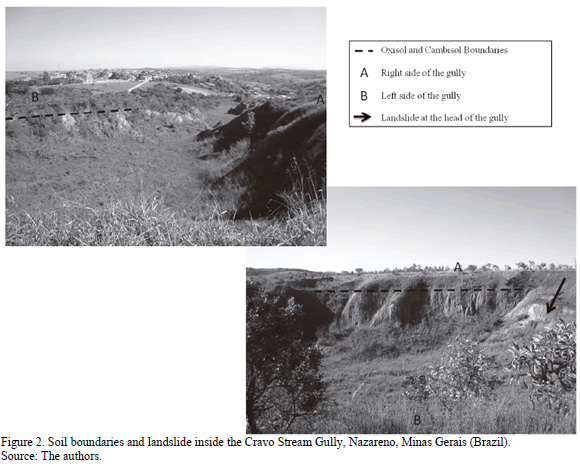
<body><![CDATA[<p align="center"><font size="2" face="Verdana, Arial, Helvetica, sans-serif"><a name="fig01"></a></font><img src="/img/revistas/dyna/v83n199/v83n199a26tab01.gif"></p>     <p align="center"><font size="2" face="Verdana, Arial, Helvetica, sans-serif"><a name="tab01"></a></font><img src="/img/revistas/dyna/v83n199/v83n199a26fig01.gif"></p>     <p><font size="2" face="Verdana, Arial, Helvetica, sans-serif">The region lies in the São Francisco Craton, which was predominantly  formed by granite-gneiss territories of between the Archean and the  Paleoproterozoic, Archean Greenstone Belts successions and Metasedimentary  rocks &#91;32,33&#93;. The study area is located on the Barbacena Greestone Belt, which  is limited by granite-gneiss terrains, presented discontinuously. The  structures have NE-SW directions that follow regional patterns &#91;34&#93;. There is a shear zone  (Lenheiro Shear Zone) near the study area &#91;35&#93;.</font></p>     <p><font size="2" face="Verdana, Arial, Helvetica, sans-serif">In terms of soil description, &#91;24,25,36-38&#93; it is noted that  well-developed soil (oxisol, or latosol, in Brazil) and granite-gneiss  saprolites (<a href="#fig02">Fig. 2</a>) are predominant in the municipality. The well-developed  soils in the study area have a granular structure and present gibbsite with  high iron (Fe) levels. These characteristics induced an elevated porosity and  permeability. On the other hand, granite-gneiss saprolites are predominantly  caulinitic, presenting a block structure; these characteristics induced low porosity and   permeability. Saprolites are derived from granite-gneiss, quartzite,   micaschists and talc schists, granite-gneiss prevailing &#91;39&#93;. Therefore, there   are more gullies in granite-gneiss saprolites (higher relation gully/square  kilometer) in the study area &#91;27&#93;.</font></p>     <p align="center"><font size="2" face="Verdana, Arial, Helvetica, sans-serif"><a name="fig02"></a></font><img src="/img/revistas/dyna/v83n199/v83n199a26fig02.gif"></p>     <p><font size="2" face="Verdana, Arial, Helvetica, sans-serif">The Nazareno region consists of hills   with a convex-concave top and steep slopes, which lie at elevations of between   839 m and 1140 m above sea level. The steepest slopes and the higher elevations  are situated in the northeast of the municipality &#91;36-38&#93;.</font></p>     <p><font size="2" face="Verdana, Arial, Helvetica, sans-serif">The   climate vary from Cwa and Cwb (Köppen classification), with average   temperatures ranging from 18 to 22°C in the rainy season and from 15 to 19°C in the dry season. The average precipitation ranges from  between 1200 mm and 1500 mm &#91;38&#93;.</font></p>     <p>&nbsp;</p>     <p><font size="3" face="Verdana, Arial, Helvetica, sans-serif"><b>2. Materials and methods</b></font></p>     <p><font size="2" face="Verdana, Arial, Helvetica, sans-serif">We used   the topographic map (Nazareno, SF-23-X-C-I-2 -   1:50,000) that dated   back to 1975, from the Brazilian Geographic and Statistic Institute (IBGE) with GIS software (ArcGIS<sup>®</sup> - ArcMap), to  assess the environmental information at the study area.</font></p>     ]]></body>
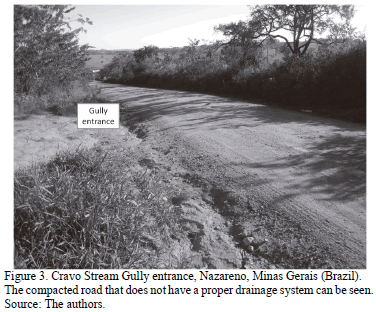
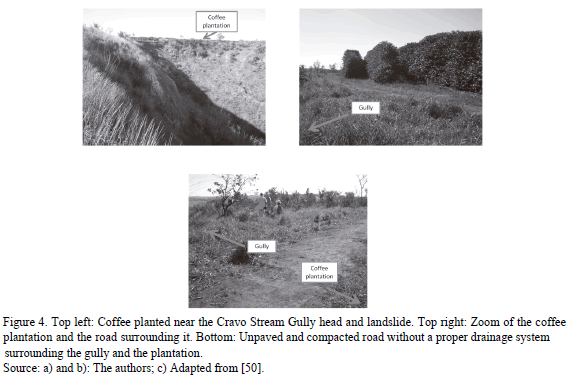
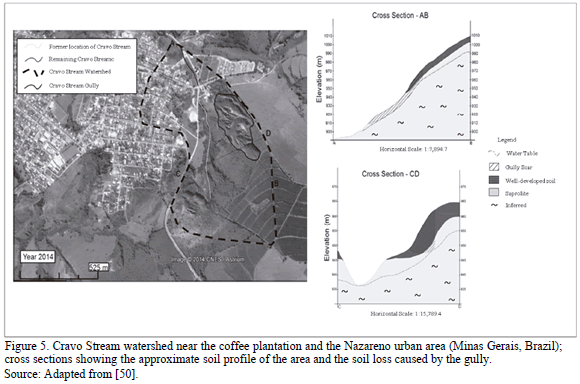
<body><![CDATA[<p><font size="2" face="Verdana, Arial, Helvetica, sans-serif">Land uses were analyzed at the gully   perimeter. Both oxisol   (O, well-developed soil) and granite-gneiss saprolite (S) were sampled and taken to the laboratory for physical (tropical soil   characterization, soil particle size analyses and erodibility test, based on &#91;40-46&#93; standards) and chemical (pH, delta pH, electric conductivity, Eh, based on   &#91;47&#93;, organic matter - OM, based on &#91;48&#93;, and Cation Exchange Capacity (CEC),   based on &#91;46&#93;) experiments at the Geotechnical Department of São Paulo   University - (USP). Scanning Electron Microscopy (SEM) and Energy Dispersive Spectroscopy (EDS) were   also performed at USP's Chemistry Institute - IQSC. This analysis was   undertaken to compare the different behaviors of the two types of soil and to   connect them to land uses. Some samples were not used in all experiments  because it was not possible or easy to obtain them in the field.</font></p>     <p>&nbsp;</p>     <p><font size="3" face="Verdana, Arial, Helvetica, sans-serif"><b>3. Results and discussion</b></font></p>     <p><font size="2" face="Verdana, Arial, Helvetica, sans-serif"><a href="#fig03">Fig. 3</a> shows the entrance to Cravo Stream gully. An improper drainage   system along the compacted road can be seen. Due to this, the speed and the   strength of the concentrated flow have been increased, and, the water flows   down the road directly inside the gully removing soil particles. This runoff   increases the rate of erosion in its end part. We can see, therefore, the   importance of constructing a suitable superficial drainage system in terms of  land management.</font></p>     <p align="center"><font size="2" face="Verdana, Arial, Helvetica, sans-serif"><a name="fig03"></a></font><img src="/img/revistas/dyna/v83n199/v83n199a26fig03.gif"></p>     <p><font size="2" face="Verdana, Arial, Helvetica, sans-serif">We observed a coffee plantation with a compacted unpaved road   without a proper drainage system close to the gully's limits (<a href="#fig04">Fig. 4</a>). The   plantation itself, if managed with conservative practices, could even help to   reduce erosion, by improving soil cover and infiltration. But, in this case, as   <a href="#fig05">Fig. 5</a> shows, there is another erosion feature inside the plantation area,   indicating that conservative practices were not adequately performed. Besides,  the unpaved road also contributes to the flow concentration towards the gully.</font></p>     <p align="center"><font size="2" face="Verdana, Arial, Helvetica, sans-serif"><a name="fig04"></a></font><img src="/img/revistas/dyna/v83n199/v83n199a26fig04.gif"></p>     <p align="center"><font size="2" face="Verdana, Arial, Helvetica, sans-serif"><a name="fig05"></a></font><img src="/img/revistas/dyna/v83n199/v83n199a26fig05.gif"></p>     <p><font size="2" face="Verdana, Arial, Helvetica, sans-serif">In 2012,   landslides occurred inside the gully &#91;49&#93;. The top left of <a href="#fig04">Fig. 4</a> shows one of   them. We can see that, even with reclamation measures, there is still soil  instability, which is associated with water flow.</font></p>     <p><font size="2" face="Verdana, Arial, Helvetica, sans-serif"><a href="#fig05">Fig. 5</a>  also shows two cross sections made with Cravo Stream watershed data. The   granite-gneiss saprolite exposure was formed by deforestation, and its removal   from subterranean water flow causes the gully slopes to become unstable, thus   facilitating landslide processes. Whenever there is exposure of granite-gneiss saprolite and other parts of well-developed   soil, runoff removes them, adding instability to the system. This removal   process is slow, and may, therefore, deceive the population about gully's  stability.</font></p> <font size="2" face="Verdana, Arial, Helvetica, sans-serif">     ]]></body>
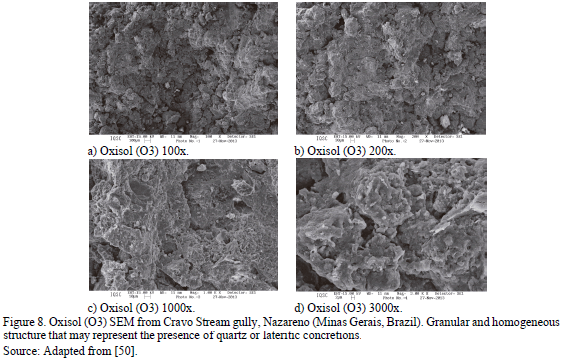
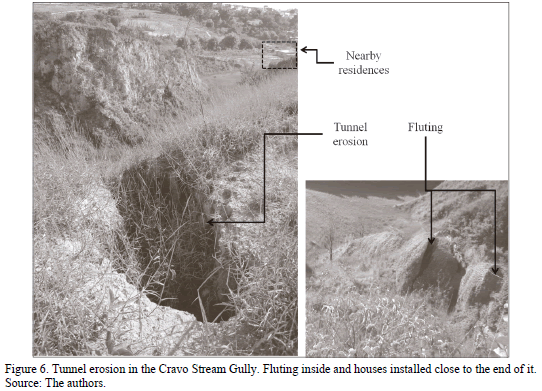
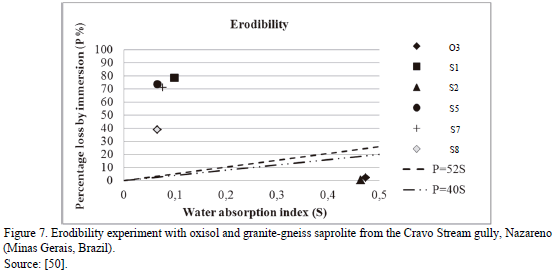
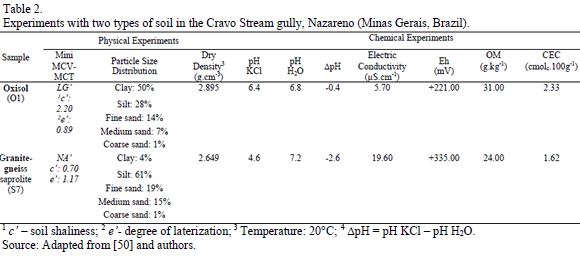
<body><![CDATA[<p>We observed fluting and tunnel erosions (<a href="#fig06">Fig.   6</a>), which shows that the subterranean flow plays an important part as well as   runoff on soil removal. The water table varies greatly with rain because it is   already exposed. This, combined with the exposure of saprolite, creates   instability within slope toes, causing piping and landslides. These complex   subterranean water movements contribute to the enlargement of the gully towards   its head. Houses were built at the end of the gully (nearby residences - <a href="#fig06">Fig.   6</a>) on erosion susceptible material. Thus, they might be affected by the soil  that is removed from the gully and deposited there.</p> </font><font face="Verdana, Arial, Helvetica, sans-serif">     <p align="center"><font size="2"><a name="fig06"></a></font><img src="/img/revistas/dyna/v83n199/v83n199a26fig06.gif"></p>     <p><font size="2">Land uses that do not consider soil    properties and its susceptibility to erosion in this region, such as    deforestation, mining, urban expansion and road construction without adequate    drainage systems, as well as overgrazing exposes the soil. They also alter the    drainage conditions of catchments and accelerate erosion creating gullies  &#91;29-31&#93;.</font></p>     <p><font size="2">Currently,    the Cravo Stream gully is surrounded by anthropogenic land uses and erosion    features (<a href="#fig05">Figures 5</a> and <a href="#fig06">6</a>). This shows an absence of both urban and rural  planning. Similar situations can be observed all over the region. </font></p>  </font><font size="2" face="Verdana, Arial, Helvetica, sans-serif">    <p>The well-developed soil (O) and granite-gneiss saprolite (S) samples   were analyzed, both in chemical and physical aspects (<a href="#tab02">Table 2</a>). The results   show that well-developed soil has 78% fine particles, mostly clay. It may also   have lateritic concretions. It has predominantly negative charges and a low   electric conductivity (and, therefore, a lower salt concentration) with an   oxidant behavior. These characteristics improve soil resistance to removal. The   granite-gneiss saprolite shows a non-lateritic behavior of silty sands, which   are less cohesive and more susceptible to soil removal than the oxisol. &#91;29&#93;   assessed that granite-gneiss saprolite have fine sand and silt, which can   promote crusting. As a result, infiltration is reduced and soil particles are   removed within rainwater erosive forces. Soil moisture is influenced by   texture: clay soils tend to retain water. The average granite-gneiss  saprolite's moisture is about 11%, and oxisol's is about 26% &#91;27&#93;.</p>      <p>Above the two line criteria (P), we can observe that S1, S5, S7 and S8   are more erodible than the other samples (O3 and S2) (<a href="#fig07">Fig. 7</a>). &#91;39&#93; ascertained   that soil losses were lower in oxisols than in granite-gneiss saprolites; this  supports our findings.</p>  </font>      <p align="center"><font size="2" face="Verdana, Arial, Helvetica, sans-serif"><a name="fig07"></a></font><img src="/img/revistas/dyna/v83n199/v83n199a26fig07.gif"></p>  <font size="2" face="Verdana, Arial, Helvetica, sans-serif">     <p>Both well-developed soil (oxisol) and granite-gneiss saprolite present   neutral to acid pH, low organic matter (O.M.) and low Cation Exchange Capacity   (CEC) (<a href="#tab02">Table 2</a>). These characteristics are limited to vegetation growth on eroded  lands &#91;29&#93;.</p>  </font>      <p align="center"><font size="2" face="Verdana, Arial, Helvetica, sans-serif"><a name="tab02"></a></font><img src="/img/revistas/dyna/v83n199/v83n199a26tab02.gif"></p>  <font size="2" face="Verdana, Arial, Helvetica, sans-serif">      <p>The results from the Scanning Electron Microscopy (SEM) are presented in    <a href="#fig08">Figures 8</a>, <a href="#fig09">9</a> and <a href="#fig10">10</a>. The well-developed soil sample (O3) is more homogeneous   and its particles are uniformly connected with lateritic concretions. S2   sample, which is the transition of the two types of soil, showed a union of   homogeneous particles with some rock weathered parts as S7 keeps weathered   mineral structures and kaolinite. We associate the less cohesive structure in   the microscopic scale to the susceptibility to erosive behavior of   granite-gneiss saprolite. The homogeneous connection between oxisol particles   makes them more resistant to soil removal. <a href="#fig10">Fig. 10</a> shows distinct and sparse   particles compared with the other samples that have mica and kaolinite, which  can probably be related to soil removal.</p>  </font>      ]]></body>
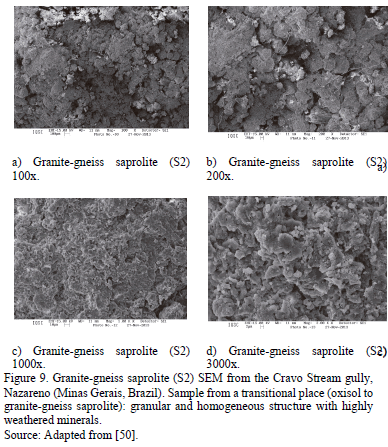
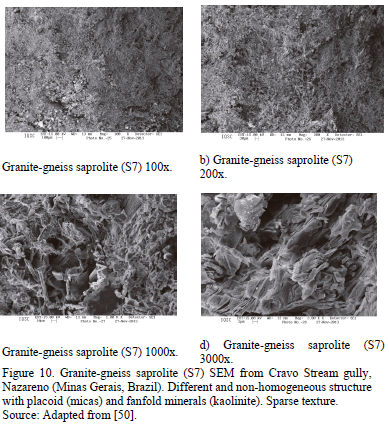
<body><![CDATA[<p align="center"><font size="2" face="Verdana, Arial, Helvetica, sans-serif"><a name="fig08"></a></font><font size="2" face="Verdana, Arial, Helvetica, sans-serif"> </font><img src="/img/revistas/dyna/v83n199/v83n199a26fig08.gif"></p>  <font size="2" face="Verdana, Arial, Helvetica, sans-serif"> </font>      <p align="center"><font size="2" face="Verdana, Arial, Helvetica, sans-serif"><a name="fig09"></a></font><img src="/img/revistas/dyna/v83n199/v83n199a26fig09.gif"></p>      <p align="center"><font size="2" face="Verdana, Arial, Helvetica, sans-serif"><a name="fig10"></a></font><img src="/img/revistas/dyna/v83n199/v83n199a26fig10.gif"></p> <font size="2" face="Verdana, Arial, Helvetica, sans-serif">     <p>The samples' Energy Dispersive Spectroscopy (EDS) (<a href="#tab03">Table 3</a>) confirm the   weathering evolution that was previously cited. Elements such as aluminum and   iron oxides are associated with laterization. &#91;43&#93; noted that lateritic   concretions may not be very easy to distinguish from clay clods, and could be  linked to magnetite, ilmenite, hematite and quartz minerals.</p> </font>     <p align="center"><font size="2" face="Verdana, Arial, Helvetica, sans-serif"><a name="tab03"></a></font><img src="/img/revistas/dyna/v83n199/v83n199a26tab03.gif"></p> <font size="2" face="Verdana, Arial, Helvetica, sans-serif">     <p>The results   showed that certain land uses and the exposure of granite-gneiss saprolite can bring   back soil erosion to an area, even if it seems to be stable or if the   well-developed soil is above the granite-gneiss saprolite. Despite the fact   that well-developed soil is resistant, it can be erodible in intense flow   conditions. Soil loss is increased when the increase of runoff is combined with   subterranean water flow dynamics. This results in degradation and expansion of   the gully area. Under intense rains and when landslides occur inside the gully,  this process is accelerated.</p> </font>     <p>&nbsp;</p>     <p><font size="3" face="Verdana, Arial, Helvetica, sans-serif"><b>4. Conclusions</b></font></p>     <p><font size="2" face="Verdana, Arial, Helvetica, sans-serif">The Cravo  Stream gully in Nazareno (Minas Gerais, Brazil) shows an example of how  microscopic structures and characteristics reflect macroscopic environmental  behaviors as well as how land uses could influence and accelerate erosion  processes in these soils. The results showed that the well-developed soil  (oxisol) is more homogeneous, cohesive and well formed with lateritic behavior;  these aspects can enhance soil resistance to erosion. The granite-gneiss  saprolite structure has weathered minerals and other elements, such as  kaolinite, which is associated with a different stage of formation. It is less  cohesive, which may decrease its resistance to erosion. All of this can be  connected to its distinct erodibility.</font></p>     <p><font size="2" face="Verdana, Arial, Helvetica, sans-serif">Land use,  such as compact roads without a proper drainage system, and rural and urban  expansion, are contributing to the acceleration of erosion features by  directing runoff to the more erodible and fragile soil (saprolite) and, in some  cases, removing resistant soil (oxisol) and exposing the susceptible one. Even  if new gullies are not created now, the old ones (such as Cravo Stream gully)  may gradually and slowly continue to remove material. Landslides (circular on  oxisol and planar on saprolite) and subterranean instability (such as fluting  and tunnel erosion) are proof that these features are not stable and are still  negatively interacting with land uses.</font></p>     ]]></body>
<body><![CDATA[<p><font size="2" face="Verdana, Arial, Helvetica, sans-serif">An  appropriate drainage system must be considered in every case (urban and rural  areas); water flow should be diverted from the erodible soil. Besides,  conservative practices may help to prevent and to mitigate gullies' problems in  rural areas. This article can be used as a basis for reclamation projects and  land use planning, not only for Nazareno itself, but for other areas in Minas  Gerais state that have similar  environmental conditions.</font></p>     <p>&nbsp;</p>     <p><font size="3" face="Verdana, Arial, Helvetica, sans-serif"><b>Acknowledgements</b></font></p>     <p><font size="2" face="Verdana, Arial, Helvetica, sans-serif">We would  like to thank CAPES and CNPq for their financial support. We would also like to  thank the Maria de Barro Project, CRIDES, Vinicius Ferreira and Rog&eacute;rio  Ferreira for their assistance.</font></p>     <p>&nbsp;</p>     <p><font size="3" face="Verdana, Arial, Helvetica, sans-serif"><b>References</b></font></p>     <!-- ref --><p><font size="2" face="Verdana, Arial, Helvetica, sans-serif"><b>&#91;1&#93;</b> Lal, R., Soil degradation by erosion. Land Degradation &amp;  Development, 12(6), pp. 519-539, 2001. DOI: 10.1002/ldr.472.    &nbsp;&nbsp;&nbsp;&nbsp;&nbsp;&nbsp;&nbsp;&nbsp;[&#160;<a href="javascript:void(0);" onclick="javascript: window.open('/scielo.php?script=sci_nlinks&ref=1154785&pid=S0012-7353201600050002600001&lng=','','width=640,height=500,resizable=yes,scrollbars=1,menubar=yes,');">Links</a>&#160;]<!-- end-ref --></font></p>     <!-- ref --><p><font size="2" face="Verdana, Arial, Helvetica, sans-serif"><b>&#91;2&#93;</b> Boardman, J., Soil  erosion science: Reflections on the limitations of current approaches. Catena,  68(2-3), pp. 73-86, 2006. DOI: 10.1016/j.catena.2006.03.007</font>&nbsp;&nbsp;&nbsp;&nbsp;&nbsp;&nbsp;&nbsp;&nbsp;[&#160;<a href="javascript:void(0);" onclick="javascript: window.open('/scielo.php?script=sci_nlinks&ref=1154787&pid=S0012-7353201600050002600002&lng=','','width=640,height=500,resizable=yes,scrollbars=1,menubar=yes,');">Links</a>&#160;]<!-- end-ref --><!-- ref --><p><font size="2" face="Verdana, Arial, Helvetica, sans-serif"><b>&#91;3&#93;</b> Beasley, R.P.,  Erosion and sediment pollution control. Iowa: The Iowa State University Press,  1972.    &nbsp;&nbsp;&nbsp;&nbsp;&nbsp;&nbsp;&nbsp;&nbsp;[&#160;<a href="javascript:void(0);" onclick="javascript: window.open('/scielo.php?script=sci_nlinks&ref=1154788&pid=S0012-7353201600050002600003&lng=','','width=640,height=500,resizable=yes,scrollbars=1,menubar=yes,');">Links</a>&#160;]<!-- end-ref --></font></p>     <!-- ref --><p><font size="2" face="Verdana, Arial, Helvetica, sans-serif"><b>&#91;4&#93;</b> Frenzel, A., Medidas preventivas contra os processos  erosivos. Proceedings of Simp&oacute;sio sobre o controle de erosão. Curitiba:  Associação Brasileira de Geologia de Engenharia (ABGE), 1980. pp. 201-213.    &nbsp;&nbsp;&nbsp;&nbsp;&nbsp;&nbsp;&nbsp;&nbsp;[&#160;<a href="javascript:void(0);" onclick="javascript: window.open('/scielo.php?script=sci_nlinks&ref=1154790&pid=S0012-7353201600050002600004&lng=','','width=640,height=500,resizable=yes,scrollbars=1,menubar=yes,');">Links</a>&#160;]<!-- end-ref --></font></p>     <!-- ref --><p><font size="2" face="Verdana, Arial, Helvetica, sans-serif"><b>&#91;5&#93;</b> Higgins, C.G., Higgins, C.G. and  Coates, D.R., Gully development - Groundwater geomorphology: The role of  subsurface water in earth-surface processes and landforms. Boulder: Geological  Society of America, 1990. pp. 139-155.    &nbsp;&nbsp;&nbsp;&nbsp;&nbsp;&nbsp;&nbsp;&nbsp;[&#160;<a href="javascript:void(0);" onclick="javascript: window.open('/scielo.php?script=sci_nlinks&ref=1154792&pid=S0012-7353201600050002600005&lng=','','width=640,height=500,resizable=yes,scrollbars=1,menubar=yes,');">Links</a>&#160;]<!-- end-ref --></font></p>     <!-- ref --><p><font size="2" face="Verdana, Arial, Helvetica, sans-serif"><b>&#91;6&#93;</b> Barrow, C.J., Land  degradation: development and breakdown of terrestrial environments. Cambridge  University Press, 1991.    &nbsp;&nbsp;&nbsp;&nbsp;&nbsp;&nbsp;&nbsp;&nbsp;[&#160;<a href="javascript:void(0);" onclick="javascript: window.open('/scielo.php?script=sci_nlinks&ref=1154794&pid=S0012-7353201600050002600006&lng=','','width=640,height=500,resizable=yes,scrollbars=1,menubar=yes,');">Links</a>&#160;]<!-- end-ref --></font></p>     <!-- ref --><p><font size="2" face="Verdana, Arial, Helvetica, sans-serif"><b>&#91;7&#93;</b> Morgan,  R.P.C., Soil erosion and its control. Nova York: Longman, 1995.    &nbsp;&nbsp;&nbsp;&nbsp;&nbsp;&nbsp;&nbsp;&nbsp;[&#160;<a href="javascript:void(0);" onclick="javascript: window.open('/scielo.php?script=sci_nlinks&ref=1154796&pid=S0012-7353201600050002600007&lng=','','width=640,height=500,resizable=yes,scrollbars=1,menubar=yes,');">Links</a>&#160;]<!-- end-ref --></font></p>     <!-- ref --><p><font size="2" face="Verdana, Arial, Helvetica, sans-serif"><b>&#91;8&#93;</b> Grissinger, E.H., Reclamation of gullies and channel  erosion. - Agassi, M. Soil erosion, conservation and rehabilitation. Marcel Dekker Inc. 1996.    &nbsp;&nbsp;&nbsp;&nbsp;&nbsp;&nbsp;&nbsp;&nbsp;[&#160;<a href="javascript:void(0);" onclick="javascript: window.open('/scielo.php?script=sci_nlinks&ref=1154798&pid=S0012-7353201600050002600008&lng=','','width=640,height=500,resizable=yes,scrollbars=1,menubar=yes,');">Links</a>&#160;]<!-- end-ref --></font></p>     <!-- ref --><p><font size="2" face="Verdana, Arial, Helvetica, sans-serif"><b>&#91;9&#93;</b> Fendrich, R., Obladen, N.L., Aisse, M.M. e Garcias, C.M.,  Drenagem e controle da erosão urbana. Curitiba: Champagnat, 1997.    &nbsp;&nbsp;&nbsp;&nbsp;&nbsp;&nbsp;&nbsp;&nbsp;[&#160;<a href="javascript:void(0);" onclick="javascript: window.open('/scielo.php?script=sci_nlinks&ref=1154800&pid=S0012-7353201600050002600009&lng=','','width=640,height=500,resizable=yes,scrollbars=1,menubar=yes,');">Links</a>&#160;]<!-- end-ref --></font></p>     <!-- ref --><p><font size="2" face="Verdana, Arial, Helvetica, sans-serif"><b>&#91;10&#93;</b> Carrijo, B.R. e Baccaro, C.A.D., An&aacute;lise sobre a erosão h&iacute;drica na &aacute;rea  urbana de Uberlândia (MG). Uberlândia: Caminhos de Geografia &#91;online&#93;, 1(2),  pp. 70-83, 2000. Available at: <a href="http://www.seer.ufu.br/index.php/caminhosdegeografia/article/view/15254/8555" target="_blank">http://www.seer.ufu.br/index.php/caminhosdegeografia/article/view/15254/8555</a></font>&nbsp;&nbsp;&nbsp;&nbsp;&nbsp;&nbsp;&nbsp;&nbsp;[&#160;<a href="javascript:void(0);" onclick="javascript: window.open('/scielo.php?script=sci_nlinks&ref=1154802&pid=S0012-7353201600050002600010&lng=','','width=640,height=500,resizable=yes,scrollbars=1,menubar=yes,');">Links</a>&#160;]<!-- end-ref --><!-- ref --><p><font size="2" face="Verdana, Arial, Helvetica, sans-serif"><b>&#91;11&#93;</b> Bertoni,  J. and Lombardi-Neto, F., Conservação do solo. São Paulo: Editora &Iacute;cone, 2005.    &nbsp;&nbsp;&nbsp;&nbsp;&nbsp;&nbsp;&nbsp;&nbsp;[&#160;<a href="javascript:void(0);" onclick="javascript: window.open('/scielo.php?script=sci_nlinks&ref=1154803&pid=S0012-7353201600050002600011&lng=','','width=640,height=500,resizable=yes,scrollbars=1,menubar=yes,');">Links</a>&#160;]<!-- end-ref --></font></p>     <!-- ref --><p><font size="2" face="Verdana, Arial, Helvetica, sans-serif"><b>&#91;12&#93;</b> Ide, D.M., Investigação geot&eacute;cnica e estudo de um  processo erosivo causado por ocupação urbana. Msc. Thesis, Engineering School  of São Carlos, University of São Paulo, São Carlos, São Paulo, Brazil. 2009.    &nbsp;&nbsp;&nbsp;&nbsp;&nbsp;&nbsp;&nbsp;&nbsp;[&#160;<a href="javascript:void(0);" onclick="javascript: window.open('/scielo.php?script=sci_nlinks&ref=1154805&pid=S0012-7353201600050002600012&lng=','','width=640,height=500,resizable=yes,scrollbars=1,menubar=yes,');">Links</a>&#160;]<!-- end-ref --></font></p>     <!-- ref --><p><font size="2" face="Verdana, Arial, Helvetica, sans-serif"><b>&#91;13&#93;</b> Ferreira, R.R.M., Ferreira, V.M., Tavares-Filho, J. e  Ralisch, R., Origem e evolução de voçorocas em cambissolos da bacia Alto Rio  Grande, Minas Gerais. Proceedings of XXXI Congresso Brasileiro de Ciência do  Solo, Gramado-RS. 2007. 5P.    &nbsp;&nbsp;&nbsp;&nbsp;&nbsp;&nbsp;&nbsp;&nbsp;[&#160;<a href="javascript:void(0);" onclick="javascript: window.open('/scielo.php?script=sci_nlinks&ref=1154807&pid=S0012-7353201600050002600013&lng=','','width=640,height=500,resizable=yes,scrollbars=1,menubar=yes,');">Links</a>&#160;]<!-- end-ref --></font></p>     ]]></body>
<body><![CDATA[<!-- ref --><p><font size="2" face="Verdana, Arial, Helvetica, sans-serif"><b>&#91;14&#93;</b> Araujo,  G.H.S., Almeida, J.R. e Guerra, A.J.T., Gestão ambiental de &aacute;reas degradadas. Rio de Janeiro. Bertrand Brasil. 7ª  Ed. 2011.    &nbsp;&nbsp;&nbsp;&nbsp;&nbsp;&nbsp;&nbsp;&nbsp;[&#160;<a href="javascript:void(0);" onclick="javascript: window.open('/scielo.php?script=sci_nlinks&ref=1154809&pid=S0012-7353201600050002600014&lng=','','width=640,height=500,resizable=yes,scrollbars=1,menubar=yes,');">Links</a>&#160;]<!-- end-ref --> </font></p>     <!-- ref --><p><font size="2" face="Verdana, Arial, Helvetica, sans-serif"><b>&#91;15&#93;</b> Rotta,  C.M.S. and Zuquette, L.V., Erosion feature reclamation in urban areas: typical  unsuccessful examples from Brazil. Environmental Earth Sciences, 72(2), pp.  535-555, 2013. DOI: 10.1007/s12665-013-2974-y</font>&nbsp;&nbsp;&nbsp;&nbsp;&nbsp;&nbsp;&nbsp;&nbsp;[&#160;<a href="javascript:void(0);" onclick="javascript: window.open('/scielo.php?script=sci_nlinks&ref=1154811&pid=S0012-7353201600050002600015&lng=','','width=640,height=500,resizable=yes,scrollbars=1,menubar=yes,');">Links</a>&#160;]<!-- end-ref --><!-- ref --><p><font size="2" face="Verdana, Arial, Helvetica, sans-serif"><b>&#91;16&#93;</b> Rotta, C.M.S. e Zuquette, L.V., Processos erosivos. pp. 114 - 151. In:  Zuquette, L.V. Geotecnia Ambiental. São Paulo. Ed. Campus. 1ª Ed.  2015.    &nbsp;&nbsp;&nbsp;&nbsp;&nbsp;&nbsp;&nbsp;&nbsp;[&#160;<a href="javascript:void(0);" onclick="javascript: window.open('/scielo.php?script=sci_nlinks&ref=1154812&pid=S0012-7353201600050002600016&lng=','','width=640,height=500,resizable=yes,scrollbars=1,menubar=yes,');">Links</a>&#160;]<!-- end-ref --></font></p>     <!-- ref --><p><font size="2" face="Verdana, Arial, Helvetica, sans-serif"><b>&#91;17&#93;</b> Haigh, M.J., Ravine erosion and reclamation in India. Geoforum, 15(4), pp. 543-561, 1984. DOI: 10.1016/0016-7185(84)90024-1</font>&nbsp;&nbsp;&nbsp;&nbsp;&nbsp;&nbsp;&nbsp;&nbsp;[&#160;<a href="javascript:void(0);" onclick="javascript: window.open('/scielo.php?script=sci_nlinks&ref=1154814&pid=S0012-7353201600050002600017&lng=','','width=640,height=500,resizable=yes,scrollbars=1,menubar=yes,');">Links</a>&#160;]<!-- end-ref --><!-- ref --><p><font size="2" face="Verdana, Arial, Helvetica, sans-serif"><b>&#91;18&#93;</b> Lal,  R., Soil erosion impact on agronomic productivity and environment quality.  Critical Reviewers in Plant Sciences, 17(4). pp. 319-464, 1998. DOI: 10.1016/S0735-2689(98)00363-3</font>&nbsp;&nbsp;&nbsp;&nbsp;&nbsp;&nbsp;&nbsp;&nbsp;[&#160;<a href="javascript:void(0);" onclick="javascript: window.open('/scielo.php?script=sci_nlinks&ref=1154815&pid=S0012-7353201600050002600018&lng=','','width=640,height=500,resizable=yes,scrollbars=1,menubar=yes,');">Links</a>&#160;]<!-- end-ref --><!-- ref --><p><font size="2" face="Verdana, Arial, Helvetica, sans-serif"><b>&#91;19&#93;</b> Poesen, J., Nachtergaele, J., Verstraeten, G. and Valentin,  C., Gully erosion and environmental change: Importance and research needs.  Catena, 50(2-4), pp. 91-133, 2003. DOI: 10.1016/S0341-8162(02)00143-1</font>&nbsp;&nbsp;&nbsp;&nbsp;&nbsp;&nbsp;&nbsp;&nbsp;[&#160;<a href="javascript:void(0);" onclick="javascript: window.open('/scielo.php?script=sci_nlinks&ref=1154816&pid=S0012-7353201600050002600019&lng=','','width=640,height=500,resizable=yes,scrollbars=1,menubar=yes,');">Links</a>&#160;]<!-- end-ref --><!-- ref --><p><font size="2" face="Verdana, Arial, Helvetica, sans-serif"><b>&#91;20&#93;</b> Valentin, C., Poesen, J. and Li, Y., Gully erosion:  Impacts, factors and control. Catena, 63(2-3), 2005,  pp. 132-153. DOI: 10.1016/j.catena.2005.06.001</font>&nbsp;&nbsp;&nbsp;&nbsp;&nbsp;&nbsp;&nbsp;&nbsp;[&#160;<a href="javascript:void(0);" onclick="javascript: window.open('/scielo.php?script=sci_nlinks&ref=1154817&pid=S0012-7353201600050002600020&lng=','','width=640,height=500,resizable=yes,scrollbars=1,menubar=yes,');">Links</a>&#160;]<!-- end-ref --><!-- ref --><p><font size="2" face="Verdana, Arial, Helvetica, sans-serif"><b>&#91;21&#93;</b> Rodrigues, J.E., Estudo de  fenômenos erosivos acelerados - boçorocas. PhD. dissertation, Engineering  School of São Carlos, University of São Paulo, São Carlos, São Paulo, Brazil.  1982.    &nbsp;&nbsp;&nbsp;&nbsp;&nbsp;&nbsp;&nbsp;&nbsp;[&#160;<a href="javascript:void(0);" onclick="javascript: window.open('/scielo.php?script=sci_nlinks&ref=1154818&pid=S0012-7353201600050002600021&lng=','','width=640,height=500,resizable=yes,scrollbars=1,menubar=yes,');">Links</a>&#160;]<!-- end-ref --></font></p>     <!-- ref --><p><font size="2" face="Verdana, Arial, Helvetica, sans-serif"><b>&#91;22&#93;</b> Morgan, R.P.C., Soil erosion  and conservation. Blackwell Publishing, 2005.    &nbsp;&nbsp;&nbsp;&nbsp;&nbsp;&nbsp;&nbsp;&nbsp;[&#160;<a href="javascript:void(0);" onclick="javascript: window.open('/scielo.php?script=sci_nlinks&ref=1154820&pid=S0012-7353201600050002600022&lng=','','width=640,height=500,resizable=yes,scrollbars=1,menubar=yes,');">Links</a>&#160;]<!-- end-ref --></font></p>     <!-- ref --><p><font size="2" face="Verdana, Arial, Helvetica, sans-serif"><b>&#91;23&#93;</b> ABNT (Associação Brasileira de Normas T&eacute;cnicas)  NBR-10703: Degradação do solo: Terminologia. Rio de Janeiro. Brazil. 1989. 45P.    &nbsp;&nbsp;&nbsp;&nbsp;&nbsp;&nbsp;&nbsp;&nbsp;[&#160;<a href="javascript:void(0);" onclick="javascript: window.open('/scielo.php?script=sci_nlinks&ref=1154822&pid=S0012-7353201600050002600023&lng=','','width=640,height=500,resizable=yes,scrollbars=1,menubar=yes,');">Links</a>&#160;]<!-- end-ref --></font></p>     <!-- ref --><p><font size="2" face="Verdana, Arial, Helvetica, sans-serif"><b>&#91;24&#93;</b> Silva, A.C.,  Relação entre voçorocas e solos na região de Lavras (MG). MSc. Thesis, College of Agriculture  of Lavras, Minas Gerais, Brazil, 1990.    &nbsp;&nbsp;&nbsp;&nbsp;&nbsp;&nbsp;&nbsp;&nbsp;[&#160;<a href="javascript:void(0);" onclick="javascript: window.open('/scielo.php?script=sci_nlinks&ref=1154824&pid=S0012-7353201600050002600024&lng=','','width=640,height=500,resizable=yes,scrollbars=1,menubar=yes,');">Links</a>&#160;]<!-- end-ref --></font></p>     <!-- ref --><p><font size="2" face="Verdana, Arial, Helvetica, sans-serif"><b>&#91;25&#93;</b> Ferreira,  V.M., Voçorocas no munic&iacute;pio de Nazareno, MG: origem, uso da terra e atributos  do solo. MSc. Thesis, Federal University of Lavras, Minas Gerais, Brazil, 2005.    &nbsp;&nbsp;&nbsp;&nbsp;&nbsp;&nbsp;&nbsp;&nbsp;[&#160;<a href="javascript:void(0);" onclick="javascript: window.open('/scielo.php?script=sci_nlinks&ref=1154826&pid=S0012-7353201600050002600025&lng=','','width=640,height=500,resizable=yes,scrollbars=1,menubar=yes,');">Links</a>&#160;]<!-- end-ref --></font></p>     <!-- ref --><p><font size="2" face="Verdana, Arial, Helvetica, sans-serif"><b>&#91;26&#93;</b> Ferreira, R.R.M. e Ferreira, V.M., Apostila t&eacute;cnica de  estabilização de voçorocas. Projeto Tecendo a Rede Voçorocas, Centro de  Regional Integrado de Desenvolvimento Sustent&aacute;vel, Nazareno, Minas Gerais,  Brazil, 2009, 20¨P. Available at:  <a href="http://api.ning.com/files/i1z8SFkiR-zEjfWIdr4gLWluIW6UqXX5Ohx*uz9-DmNZp0da06Z-e7wIMVSYH*M*z3-noZXhIyHuboQ8zM1DIcCh*vaa3H5-/apostila3revvoorocas.pdf" target="_blank">http://api.ning.com/files/i1z8SFkiR-zEjfWIdr4gLWluIW6UqXX5Ohx*uz9-DmNZp0da06Z-e7wIMVSYH*M*z3-noZXhIyHuboQ8zM1DIcCh*vaa3H5-/apostila3revvoorocas.pdf</a></font>&nbsp;&nbsp;&nbsp;&nbsp;&nbsp;&nbsp;&nbsp;&nbsp;[&#160;<a href="javascript:void(0);" onclick="javascript: window.open('/scielo.php?script=sci_nlinks&ref=1154828&pid=S0012-7353201600050002600026&lng=','','width=640,height=500,resizable=yes,scrollbars=1,menubar=yes,');">Links</a>&#160;]<!-- end-ref --><!-- ref --><p><font size="2" face="Verdana, Arial, Helvetica, sans-serif"><b>&#91;27&#93;</b> Gomide, P.H.O., Silva, M.L.N.  e Soares, C.R.F.S., Atributos  f&iacute;sicos, qu&iacute;micos e biol&oacute;gicos do solo em ambientes de voçorocas no munic&iacute;pio  de Lavras - MG. Revista Brasileira de Ciência do Solo &#91;online&#93;. 35(2), pp.  567-577, 2011. DOI: 10.1590/S0100-06832011000200026.    &nbsp;&nbsp;&nbsp;&nbsp;&nbsp;&nbsp;&nbsp;&nbsp;[&#160;<a href="javascript:void(0);" onclick="javascript: window.open('/scielo.php?script=sci_nlinks&ref=1154829&pid=S0012-7353201600050002600027&lng=','','width=640,height=500,resizable=yes,scrollbars=1,menubar=yes,');">Links</a>&#160;]<!-- end-ref --></font></p>     <!-- ref --><p><font size="2" face="Verdana, Arial, Helvetica, sans-serif"><b>&#91;28&#93;</b> Sampaio,  L.F., Oliveira, M.P.P., Rodrigues, V.G.S. and Pejon, O.J., Review of soil  degradation in the region of Nazareno, Minas Gerais: Brazil. in Lollino G. et  al. Engineering Geology for Society and Territory - Volume 5, Urban Geology,  Sustainable Planning and Landscape Exploitation, Springer, 2015, pp. 433-437. DOI: 10.1007/978-3-319-09048-1</font>&nbsp;&nbsp;&nbsp;&nbsp;&nbsp;&nbsp;&nbsp;&nbsp;[&#160;<a href="javascript:void(0);" onclick="javascript: window.open('/scielo.php?script=sci_nlinks&ref=1154831&pid=S0012-7353201600050002600028&lng=','','width=640,height=500,resizable=yes,scrollbars=1,menubar=yes,');">Links</a>&#160;]<!-- end-ref --><!-- ref --><p><font size="2" face="Verdana, Arial, Helvetica, sans-serif"><b>&#91;29&#93;</b> Ferreira, V.M., Silva, M.L.N., Curi, N., Oliviera, A.H.,  Silva, M.A. e Avanzi, J.C., Influência antr&oacute;pica e atributos de solo:  inter-relações em ambientes de voçorocas na mesorregião Campos das Vertentes,  MG. Geografia, 36(1), pp. 209-219,  2011. Available at:  <a href="http://www.dcs.ufla.br/site/_adm/upload/file/pdf/Prof%20Marx/Aula%202/Art%20leitura/Ferreira%20et%20al%202011.pdf" target="_blank">http://www.dcs.ufla.br/site/_adm/upload/file/pdf/Prof%20Marx/Aula%202/Art%20leitura/Ferreira%20et%20al%202011.pdf</a></font>&nbsp;&nbsp;&nbsp;&nbsp;&nbsp;&nbsp;&nbsp;&nbsp;[&#160;<a href="javascript:void(0);" onclick="javascript: window.open('/scielo.php?script=sci_nlinks&ref=1154832&pid=S0012-7353201600050002600029&lng=','','width=640,height=500,resizable=yes,scrollbars=1,menubar=yes,');">Links</a>&#160;]<!-- end-ref --><!-- ref --><p><font size="2" face="Verdana, Arial, Helvetica, sans-serif"><b>&#91;30&#93;</b> Horta, I.M.F.,  Levantamento dos solos e ocupação da superf&iacute;cie do munic&iacute;pio de Nazareno, MG.  MSc. Thesis, Federal University of Lavras, Minas Gerais, Brazil, 2006.    &nbsp;&nbsp;&nbsp;&nbsp;&nbsp;&nbsp;&nbsp;&nbsp;[&#160;<a href="javascript:void(0);" onclick="javascript: window.open('/scielo.php?script=sci_nlinks&ref=1154833&pid=S0012-7353201600050002600030&lng=','','width=640,height=500,resizable=yes,scrollbars=1,menubar=yes,');">Links</a>&#160;]<!-- end-ref --></font></p>     <!-- ref --><p><font size="2" face="Verdana, Arial, Helvetica, sans-serif"><b>&#91;31&#93;</b> Ferreira, R.R.M., Qualidade f&iacute;sica de cambissolos  sobre dois materiais de origem com pastagens extensivas. PhD Dissertation,  State University of Londrina, Paran&aacute;, Brazil, 2008.    &nbsp;&nbsp;&nbsp;&nbsp;&nbsp;&nbsp;&nbsp;&nbsp;[&#160;<a href="javascript:void(0);" onclick="javascript: window.open('/scielo.php?script=sci_nlinks&ref=1154835&pid=S0012-7353201600050002600031&lng=','','width=640,height=500,resizable=yes,scrollbars=1,menubar=yes,');">Links</a>&#160;]<!-- end-ref --></font></p>     <!-- ref --><p><font size="2" face="Verdana, Arial, Helvetica, sans-serif"><b>&#91;32&#93;</b> Toledo,  C.L.B., Evolução geol&oacute;gica das rochas m&aacute;ficas e ultram&aacute;ficas no <i>Greenstone Belt</i> Barbacena, região de  Nazareno, MG. PhD Dissertation, Institute of Geosciences, State  University of Campinas, São Paulo, Brazil, 2002.    &nbsp;&nbsp;&nbsp;&nbsp;&nbsp;&nbsp;&nbsp;&nbsp;[&#160;<a href="javascript:void(0);" onclick="javascript: window.open('/scielo.php?script=sci_nlinks&ref=1154837&pid=S0012-7353201600050002600032&lng=','','width=640,height=500,resizable=yes,scrollbars=1,menubar=yes,');">Links</a>&#160;]<!-- end-ref --></font></p>     ]]></body>
<body><![CDATA[<!-- ref --><p><font size="2" face="Verdana, Arial, Helvetica, sans-serif"><b>&#91;33&#93;</b> Teixeira,  W., &Aacute;vila, C.A. e Nunes, L.C., Nd-Sr isotopic geochemistry and U-Pb  geochronology of the granitic gneiss and Lajedo granodiorite: Implications for  Paleoproterozoic evolution of the Mineiro belt, southern São Francisco Craton,  Brazil. Geologia USP S&eacute;rie Cient&iacute;fica, 8(1), pp. 53-74, 2008. Available at:  <a href="http://www.igc.usp.br/?id=geologiausp" target="_blank">http://www.igc.usp.br/?id=geologiausp</a></font>&nbsp;&nbsp;&nbsp;&nbsp;&nbsp;&nbsp;&nbsp;&nbsp;[&#160;<a href="javascript:void(0);" onclick="javascript: window.open('/scielo.php?script=sci_nlinks&ref=1154839&pid=S0012-7353201600050002600033&lng=','','width=640,height=500,resizable=yes,scrollbars=1,menubar=yes,');">Links</a>&#160;]<!-- end-ref --><!-- ref --><p><font size="2" face="Verdana, Arial, Helvetica, sans-serif"><b>&#91;34&#93; </b>Teixeira, W. and Figueiredo, M.C.H., An outline  of Early Proterozoic crustal evolution in the São Francisco craton, Brazil: a  review. Precambrian Research, 53(1-2), pp. 1-22, 1991. DOI: 10.1016/0301-9268(91)90003-S</font>&nbsp;&nbsp;&nbsp;&nbsp;&nbsp;&nbsp;&nbsp;&nbsp;[&#160;<a href="javascript:void(0);" onclick="javascript: window.open('/scielo.php?script=sci_nlinks&ref=1154840&pid=S0012-7353201600050002600034&lng=','','width=640,height=500,resizable=yes,scrollbars=1,menubar=yes,');">Links</a>&#160;]<!-- end-ref --><!-- ref --><p><font size="2" face="Verdana, Arial, Helvetica, sans-serif"><b>&#91;35&#93;</b> Nunes, L.C., Geocronologia, geoqu&iacute;mica isot&oacute;pica e  litoqu&iacute;mica do plutonismo dior&iacute;tico-gran&iacute;tico entre Lavras e Conselheiro  Lafaiete: implicações para a evolução Paleoproteroz&oacute;ica da parte central do  Cinturão Mineiro. MSc. Thesis, Institute of Geosciences, University of São  Paulo, São Paulo, Brazil, 2007.    &nbsp;&nbsp;&nbsp;&nbsp;&nbsp;&nbsp;&nbsp;&nbsp;[&#160;<a href="javascript:void(0);" onclick="javascript: window.open('/scielo.php?script=sci_nlinks&ref=1154841&pid=S0012-7353201600050002600035&lng=','','width=640,height=500,resizable=yes,scrollbars=1,menubar=yes,');">Links</a>&#160;]<!-- end-ref --></font></p>     <!-- ref --><p><font size="2" face="Verdana, Arial, Helvetica, sans-serif"><b>&#91;36&#93;</b> Baruqui, A.M., Naime, U.J., Motta, P E.F. e Carvalho-Filho,  A., Levantamento de reconhecimento de m&eacute;dia intensidade dos solos da Zona  Campos das Vertentes - MG. Boletim de Pesquisa e Desenvolvimento, 96, Empresa  Brasileira de Pesquisa Agropecu&aacute;ria (Embrapa Solos), Rio de Janeiro. 2006. 326P.    &nbsp;&nbsp;&nbsp;&nbsp;&nbsp;&nbsp;&nbsp;&nbsp;[&#160;<a href="javascript:void(0);" onclick="javascript: window.open('/scielo.php?script=sci_nlinks&ref=1154843&pid=S0012-7353201600050002600036&lng=','','width=640,height=500,resizable=yes,scrollbars=1,menubar=yes,');">Links</a>&#160;]<!-- end-ref --></font></p>     <!-- ref --><p><font size="2" face="Verdana, Arial, Helvetica, sans-serif"><b>&#91;37&#93;</b> Naime, U.J., Motta, P.E.F., Carvalho-Filho, A. e  Baruqui, A.M., Avaliação da aptidão agr&iacute;cola das terras da zona campos das  vertentes - MG. Boletim de Pesquisa e Desenvolvimento, 91, Empresa Brasileira  de Pesquisa Agropecu&aacute;ria (Embrapa Solos), Rio de Janeiro. 2006. 62P.    &nbsp;&nbsp;&nbsp;&nbsp;&nbsp;&nbsp;&nbsp;&nbsp;[&#160;<a href="javascript:void(0);" onclick="javascript: window.open('/scielo.php?script=sci_nlinks&ref=1154845&pid=S0012-7353201600050002600037&lng=','','width=640,height=500,resizable=yes,scrollbars=1,menubar=yes,');">Links</a>&#160;]<!-- end-ref --></font></p>     <!-- ref --><p><font size="2" face="Verdana, Arial, Helvetica, sans-serif"><b>&#91;38&#93;</b> Horta, I.M.F., Pereira, J.A.A., Marques, J.J. e  Carvalho, L.M.T., Digital  reconnaissance soil survey of Nazareno, state of Minas Gerais. Ciência e  Agrotecnologia, 33(E), pp. 1940-1947, 2009. Available at:  <a href="http://www.editora.ufla.br/index.php/revistas/ciencia-e-agrotecnologia/artigos-publicados" target="_blank">http://www.editora.ufla.br/index.php/revistas/ciencia-e-agrotecnologia/artigos-publicados</a></font>&nbsp;&nbsp;&nbsp;&nbsp;&nbsp;&nbsp;&nbsp;&nbsp;[&#160;<a href="javascript:void(0);" onclick="javascript: window.open('/scielo.php?script=sci_nlinks&ref=1154847&pid=S0012-7353201600050002600038&lng=','','width=640,height=500,resizable=yes,scrollbars=1,menubar=yes,');">Links</a>&#160;]<!-- end-ref --><!-- ref --><p><font size="2" face="Verdana, Arial, Helvetica, sans-serif"><b>&#91;39&#93;</b> Silva, A.M., Silva, M.L.N., Curi, N., Lima, J.M.,  Barreto, V.C.M. e Silva, T.F., Perdas por erosão e erodibilidade de cambissolo  e latossolo roxo no sul de Minas Gerais - Resultados preliminares. Proceedings  of VII Simp&oacute;sio Nacional de Controle de Erosão. Goiânia (GO), 2001, pp. 1-8.    &nbsp;&nbsp;&nbsp;&nbsp;&nbsp;&nbsp;&nbsp;&nbsp;[&#160;<a href="javascript:void(0);" onclick="javascript: window.open('/scielo.php?script=sci_nlinks&ref=1154848&pid=S0012-7353201600050002600039&lng=','','width=640,height=500,resizable=yes,scrollbars=1,menubar=yes,');">Links</a>&#160;]<!-- end-ref --></font></p>     <!-- ref --><p><font size="2" face="Verdana, Arial, Helvetica, sans-serif"><b>&#91;40&#93;</b> MT - Departamento Nacional de Estradas de Rodagem.  DNER - ME 228/94. Solos - compactação em equipamento miniatura. Available  at:  <a href="http://ipr.dnit.gov.br/normas-e-manuais/normas/meetodo-de-ensaio-me/dner-me228-94.pdf" target="_blank">http://ipr.dnit.gov.br/normas-e-manuais/normas/meetodo-de-ensaio-me/dner-me228-94.pdf</a></font>&nbsp;&nbsp;&nbsp;&nbsp;&nbsp;&nbsp;&nbsp;&nbsp;[&#160;<a href="javascript:void(0);" onclick="javascript: window.open('/scielo.php?script=sci_nlinks&ref=1154850&pid=S0012-7353201600050002600040&lng=','','width=640,height=500,resizable=yes,scrollbars=1,menubar=yes,');">Links</a>&#160;]<!-- end-ref --><!-- ref --><p><font size="2" face="Verdana, Arial, Helvetica, sans-serif"><b>&#91;41&#93;</b> MT -  Departamento Nacional de Estradas de Rodagem. DNER - ME 258/94. Solos  compactados em equipamento miniatura - Mini-MCV. Available at:  <a href="http://ipr.dnit.gov.br/normas-e-manuais/normas/meetodo-de-ensaio-me/dner-me258-94.pdf" target="_blank">http://ipr.dnit.gov.br/normas-e-manuais/normas/meetodo-de-ensaio-me/dner-me258-94.pdf</a></font>&nbsp;&nbsp;&nbsp;&nbsp;&nbsp;&nbsp;&nbsp;&nbsp;[&#160;<a href="javascript:void(0);" onclick="javascript: window.open('/scielo.php?script=sci_nlinks&ref=1154851&pid=S0012-7353201600050002600041&lng=','','width=640,height=500,resizable=yes,scrollbars=1,menubar=yes,');">Links</a>&#160;]<!-- end-ref --><!-- ref --><p><font size="2" face="Verdana, Arial, Helvetica, sans-serif"><b>&#91;42&#93;</b> MT -  Departamento Nacional de Estradas de Rodagem. DNER - ME 256/94. Solos  compactados com equipamento miniatura-determinação da perda. Available  at: <a href="http://ipr.dnit.gov.br/normas-e-manuais/normas/meetodo-de-ensaio-me/dner-me256-94.pdf" target="_blank">http://ipr.dnit.gov.br/normas-e-manuais/normas/meetodo-de-ensaio-me/dner-me256-94.pdf</a></font>&nbsp;&nbsp;&nbsp;&nbsp;&nbsp;&nbsp;&nbsp;&nbsp;[&#160;<a href="javascript:void(0);" onclick="javascript: window.open('/scielo.php?script=sci_nlinks&ref=1154852&pid=S0012-7353201600050002600042&lng=','','width=640,height=500,resizable=yes,scrollbars=1,menubar=yes,');">Links</a>&#160;]<!-- end-ref --><!-- ref --><p><font size="2" face="Verdana, Arial, Helvetica, sans-serif"><b>&#91;43&#93;</b> Nogami, J.S. e Villibor, D.F., Pavimentação de baixo  custo com solos later&iacute;ticos, Editora Vilibor, 1995.    &nbsp;&nbsp;&nbsp;&nbsp;&nbsp;&nbsp;&nbsp;&nbsp;[&#160;<a href="javascript:void(0);" onclick="javascript: window.open('/scielo.php?script=sci_nlinks&ref=1154853&pid=S0012-7353201600050002600043&lng=','','width=640,height=500,resizable=yes,scrollbars=1,menubar=yes,');">Links</a>&#160;]<!-- end-ref --></font></p>     <!-- ref --><p><font size="2" face="Verdana, Arial, Helvetica, sans-serif"><b>&#91;44&#93;</b> ABNT (Associação Brasileira de Normas T&eacute;cnicas)  NBR-6508: Grãos de solos que passam na peneira de 4,8 mm - Determinação da  massa espec&iacute;fica. Rio de Janeiro. Brazil. 1984. 8P.    &nbsp;&nbsp;&nbsp;&nbsp;&nbsp;&nbsp;&nbsp;&nbsp;[&#160;<a href="javascript:void(0);" onclick="javascript: window.open('/scielo.php?script=sci_nlinks&ref=1154855&pid=S0012-7353201600050002600044&lng=','','width=640,height=500,resizable=yes,scrollbars=1,menubar=yes,');">Links</a>&#160;]<!-- end-ref --></font></p>     <!-- ref --><p><font size="2" face="Verdana, Arial, Helvetica, sans-serif"><b>&#91;45&#93;</b> ABNT (Associação  Brasileira de Normas T&eacute;cnicas) NBR-7181: Solo - An&aacute;lise Granulom&eacute;trica. Rio de  Janeiro. Brazil. 1984. 13P.    &nbsp;&nbsp;&nbsp;&nbsp;&nbsp;&nbsp;&nbsp;&nbsp;[&#160;<a href="javascript:void(0);" onclick="javascript: window.open('/scielo.php?script=sci_nlinks&ref=1154857&pid=S0012-7353201600050002600045&lng=','','width=640,height=500,resizable=yes,scrollbars=1,menubar=yes,');">Links</a>&#160;]<!-- end-ref --></font></p>     ]]></body>
<body><![CDATA[<!-- ref --><p><font size="2" face="Verdana, Arial, Helvetica, sans-serif"><b>&#91;46&#93;</b> Pejon, O.J., Mapeamento geot&eacute;cnico da folha de  Piracicaba-SP (escala 1:100.000): Estudo de aspectos metodol&oacute;gicos, de  caracterização e de apresentação dos atributos. PhD Dissertation, Engineering  School of São Carlos, University of São Paulo, São Carlos, São Paulo, Brazil. 1992.    &nbsp;&nbsp;&nbsp;&nbsp;&nbsp;&nbsp;&nbsp;&nbsp;[&#160;<a href="javascript:void(0);" onclick="javascript: window.open('/scielo.php?script=sci_nlinks&ref=1154859&pid=S0012-7353201600050002600046&lng=','','width=640,height=500,resizable=yes,scrollbars=1,menubar=yes,');">Links</a>&#160;]<!-- end-ref --></font></p>     <!-- ref --><p><font size="2" face="Verdana, Arial, Helvetica, sans-serif"><b>&#91;47&#93;</b> Claessen,  M.E., Barreto, W.O., Paula, J.L. e Duarte, M.N., Manual de m&eacute;todos de an&aacute;lise  de solo. Empresa Brasileira de Pesquisa Agropecu&aacute;ria (Embrapa). Centro Nacional  de Pesquisa de Solos, Rio de Janeiro, Brazil, 1997. Available at: <a href="http://www.agencia.cnptia.embrapa.br/Repositorio/Manual+de+Metodos_000fzvhotqk02wx5ok0q43a0ram31wtr.pdf" target="_blank">http://www.agencia.cnptia.embrapa.br/Repositorio/Manual+de+Metodos_000fzvhotqk02wx5ok0q43a0ram31wtr.pdf</a></font>&nbsp;&nbsp;&nbsp;&nbsp;&nbsp;&nbsp;&nbsp;&nbsp;[&#160;<a href="javascript:void(0);" onclick="javascript: window.open('/scielo.php?script=sci_nlinks&ref=1154861&pid=S0012-7353201600050002600047&lng=','','width=640,height=500,resizable=yes,scrollbars=1,menubar=yes,');">Links</a>&#160;]<!-- end-ref --><!-- ref --><p><font size="2" face="Verdana, Arial, Helvetica, sans-serif"><b>&#91;48&#93;</b> Eusterhues,  K., Rumpel, C. and Kögel-Knabner, I., Stabilization of soil organic matter  isolated via oxidative degradation. Organic Geochemistry, 36(11), pp. 1567-1575,  2005. DOI: 10.1016/j.orggeochem.2005.06.010</font>&nbsp;&nbsp;&nbsp;&nbsp;&nbsp;&nbsp;&nbsp;&nbsp;[&#160;<a href="javascript:void(0);" onclick="javascript: window.open('/scielo.php?script=sci_nlinks&ref=1154862&pid=S0012-7353201600050002600048&lng=','','width=640,height=500,resizable=yes,scrollbars=1,menubar=yes,');">Links</a>&#160;]<!-- end-ref --><!-- ref --><p><font size="2" face="Verdana, Arial, Helvetica, sans-serif"><b>&#91;49&#93;</b> Oliveira,  M.P.P., Sampaio, L.F., Rodrigues, V.G.S., Ferreira, V.M. e Pejon, O.J.,  Caracterização preliminar da boçoroca do C&oacute;rrego do Cravo, Nazareno/MG -  Brasil. Proceedings  of: VII Congreso Uruguayo de Geolog&iacute;a. 2013. pp. 96-100.    &nbsp;&nbsp;&nbsp;&nbsp;&nbsp;&nbsp;&nbsp;&nbsp;[&#160;<a href="javascript:void(0);" onclick="javascript: window.open('/scielo.php?script=sci_nlinks&ref=1154863&pid=S0012-7353201600050002600049&lng=','','width=640,height=500,resizable=yes,scrollbars=1,menubar=yes,');">Links</a>&#160;]<!-- end-ref --></font></p>     <!-- ref --><p><font size="2" face="Verdana, Arial, Helvetica, sans-serif"><b>&#91;50&#93;</b> Sampaio,  L.F., Geological and geotechnical study  of erosive processes and proposition of a macro-drainage system: C&oacute;rrego do  Cravo Gully (Nazareno-MG, Brazil). MSc.  Thesis, Engineering School of São Carlos, University of São Paulo, São Carlos, São  Paulo, Brazil, 2014.    &nbsp;&nbsp;&nbsp;&nbsp;&nbsp;&nbsp;&nbsp;&nbsp;[&#160;<a href="javascript:void(0);" onclick="javascript: window.open('/scielo.php?script=sci_nlinks&ref=1154865&pid=S0012-7353201600050002600050&lng=','','width=640,height=500,resizable=yes,scrollbars=1,menubar=yes,');">Links</a>&#160;]<!-- end-ref --></font></p>     <p>&nbsp;</p>     <p><font size="2" face="Verdana, Arial, Helvetica, sans-serif"><b>L.F. Sampaio,</b> She is currently a PhD.  student on the Geotechnical Post-graduate Program at the Engineering School of São Carlos,  University of São Paulo, São Carlos, São Paulo, Brazil. She undertakes research  studies in environmental geotechnics focusing on degraded  land reclamation. ORCID: 0000-0001-8341-1136</font></p>     ]]></body>
<body><![CDATA[<p><font size="2" face="Verdana, Arial, Helvetica, sans-serif"><b>M. .P. Oliveira,</b> She has an MSc. in Sciences from the  Geotechnical Post-graduate Program at the Engineering School of São  Carlos, University of São Paulo, São Carlos, São Paulo, Brazil. She is currently working with degraded land  reclamation, environmental education and solid waste management. ORCID:  0000-0003-4834-7954</font></p>     <p><font size="2" face="Verdana, Arial, Helvetica, sans-serif"><b>R. Cassaro, </b>He is currently an MSc. student on the Geotechnical Post-graduate  Program at the São  Carlos Engineering School, University of São Paulo, São Carlos, São Paulo,  Brazil. ORCID:  0000-0002-4630-307X</font></p>     <p><font size="2" face="Verdana, Arial, Helvetica, sans-serif"><b>V.G.S. Rodrigues.,</b> She has a PhD. in  Geosciences (Geochemistry and Geotectonic Post-graduate Program) from the  University of São Paulo (2007). Currently she is a professor at the Engineering School of São Carlos,  University of São Paulo (Geotechnical Department), São  Carlos, Brazil. Her research and experience in geosciences focuses on  environmental geology and geotechnics. ORCID:  0000-0001-8937-839X</font></p>     <p><font size="2" face="Verdana, Arial, Helvetica, sans-serif"><b>O.J. Pejon, </b>He has a PhD in Geotechnics  from the University of São Paulo (1992). He is currently a professor at the  Engineering School of São Carlos, University of São Paulo (Geotechnical  Department), São Carlos, Brazil. He has research and experience in civil  engineering, focusing on Geotechnics. ORCID:  0000-0001-6452-0978</font></p>     <p><font size="2" face="Verdana, Arial, Helvetica, sans-serif"><b>J.B. S&iacute;golo, </b>He has a PhD. (1988) in  General and Application Geology, which was undertaken on the Post-graduate  Program at the Geoscience Institute, University of São Paulo. He is currently a  professor at the University of São Paulo, Brazil. He has research and  experience in geochemistry and environmental geology. ORCID: 0000-0002-1921-8857</font></p>     <p><font size="2" face="Verdana, Arial, Helvetica, sans-serif"><b>V.M. Ferreira, </b>He has an MSc. in Soil and Water Conservation from the Federal  University of Lavras, Minas Gerais, Brazil. He has worked with gully  reclamation since 1999 and is currently the coordinator of the Maria de Barro  Project. ORCID: 0000-0002-3725-0201</font></p>      ]]></body><back>
<ref-list>
<ref id="B1">
<label>1</label><nlm-citation citation-type="journal">
<person-group person-group-type="author">
<name>
<surname><![CDATA[Lal]]></surname>
<given-names><![CDATA[R.]]></given-names>
</name>
</person-group>
<article-title xml:lang="en"><![CDATA[Soil degradation by erosion]]></article-title>
<source><![CDATA[Land Degradation & Development]]></source>
<year>2001</year>
<volume>12</volume>
<numero>6</numero>
<issue>6</issue>
<page-range>519-539</page-range></nlm-citation>
</ref>
<ref id="B2">
<label>2</label><nlm-citation citation-type="journal">
<person-group person-group-type="author">
<name>
<surname><![CDATA[Boardman]]></surname>
<given-names><![CDATA[J.]]></given-names>
</name>
</person-group>
<article-title xml:lang="en"><![CDATA[Soil erosion science: Reflections on the limitations of current approaches]]></article-title>
<source><![CDATA[Catena]]></source>
<year>2006</year>
<volume>68</volume>
<numero>2-3</numero>
<issue>2-3</issue>
<page-range>73-86</page-range></nlm-citation>
</ref>
<ref id="B3">
<label>3</label><nlm-citation citation-type="book">
<person-group person-group-type="author">
<name>
<surname><![CDATA[Beasley]]></surname>
<given-names><![CDATA[R.P.]]></given-names>
</name>
</person-group>
<source><![CDATA[Erosion and sediment pollution control]]></source>
<year>1972</year>
<publisher-loc><![CDATA[Iowa ]]></publisher-loc>
<publisher-name><![CDATA[The Iowa State University Press]]></publisher-name>
</nlm-citation>
</ref>
<ref id="B4">
<label>4</label><nlm-citation citation-type="confpro">
<person-group person-group-type="author">
<name>
<surname><![CDATA[Frenzel]]></surname>
<given-names><![CDATA[A.]]></given-names>
</name>
</person-group>
<article-title xml:lang="pt"><![CDATA[Medidas preventivas contra os processos erosivos.]]></article-title>
<source><![CDATA[]]></source>
<year></year>
<conf-name><![CDATA[ Simpósio sobre o controle de erosão]]></conf-name>
<conf-date>1980</conf-date>
<conf-loc>Curitiba </conf-loc>
<page-range>201-213</page-range></nlm-citation>
</ref>
<ref id="B5">
<label>5</label><nlm-citation citation-type="book">
<person-group person-group-type="author">
<name>
<surname><![CDATA[Higgins]]></surname>
<given-names><![CDATA[C.G.]]></given-names>
</name>
<name>
<surname><![CDATA[Higgins]]></surname>
<given-names><![CDATA[C.G.]]></given-names>
</name>
<name>
<surname><![CDATA[Coates]]></surname>
<given-names><![CDATA[D.R.]]></given-names>
</name>
</person-group>
<source><![CDATA[Gully development - Groundwater geomorphology: The role of subsurface water in earth-surface processes and landforms]]></source>
<year>1990</year>
<page-range>139-155</page-range><publisher-loc><![CDATA[Boulder ]]></publisher-loc>
<publisher-name><![CDATA[Geological Society of America]]></publisher-name>
</nlm-citation>
</ref>
<ref id="B6">
<label>6</label><nlm-citation citation-type="book">
<person-group person-group-type="author">
<name>
<surname><![CDATA[Barrow]]></surname>
<given-names><![CDATA[C.J.]]></given-names>
</name>
</person-group>
<source><![CDATA[Land degradation: development and breakdown of terrestrial environments]]></source>
<year>1991</year>
<publisher-name><![CDATA[Cambridge University Press]]></publisher-name>
</nlm-citation>
</ref>
<ref id="B7">
<label>7</label><nlm-citation citation-type="book">
<person-group person-group-type="author">
<name>
<surname><![CDATA[Morgan]]></surname>
<given-names><![CDATA[R.P.C.]]></given-names>
</name>
</person-group>
<source><![CDATA[Soil erosion and its control]]></source>
<year>1995</year>
<publisher-loc><![CDATA[Nova York ]]></publisher-loc>
<publisher-name><![CDATA[Longman]]></publisher-name>
</nlm-citation>
</ref>
<ref id="B8">
<label>8</label><nlm-citation citation-type="book">
<person-group person-group-type="author">
<name>
<surname><![CDATA[Grissinger]]></surname>
<given-names><![CDATA[E.H.]]></given-names>
</name>
</person-group>
<article-title xml:lang="en"><![CDATA[Reclamation of gullies and channel erosion]]></article-title>
<person-group person-group-type="editor">
<name>
<surname><![CDATA[Agassi]]></surname>
<given-names><![CDATA[M.]]></given-names>
</name>
</person-group>
<source><![CDATA[Soil erosion, conservation and rehabilitation]]></source>
<year>1996</year>
<publisher-name><![CDATA[Marcel Dekker Inc.]]></publisher-name>
</nlm-citation>
</ref>
<ref id="B9">
<label>9</label><nlm-citation citation-type="book">
<person-group person-group-type="author">
<name>
<surname><![CDATA[Fendrich]]></surname>
<given-names><![CDATA[R.]]></given-names>
</name>
<name>
<surname><![CDATA[Obladen]]></surname>
<given-names><![CDATA[N.L.]]></given-names>
</name>
<name>
<surname><![CDATA[Aisse]]></surname>
<given-names><![CDATA[M.M.]]></given-names>
</name>
<name>
<surname><![CDATA[Garcias]]></surname>
<given-names><![CDATA[C.M.]]></given-names>
</name>
</person-group>
<source><![CDATA[Drenagem e controle da erosão urbana.]]></source>
<year>1997</year>
<publisher-loc><![CDATA[Curitiba ]]></publisher-loc>
<publisher-name><![CDATA[Champagnat]]></publisher-name>
</nlm-citation>
</ref>
<ref id="B10">
<label>10</label><nlm-citation citation-type="journal">
<person-group person-group-type="author">
<name>
<surname><![CDATA[Carrijo]]></surname>
<given-names><![CDATA[B.R.]]></given-names>
</name>
<name>
<surname><![CDATA[Baccaro]]></surname>
<given-names><![CDATA[C.A.D.]]></given-names>
</name>
</person-group>
<article-title xml:lang="pt"><![CDATA[Análise sobre a erosão hídrica na área urbana de Uberlândia (MG)]]></article-title>
<source><![CDATA[Uberlândia: Caminhos de Geografia]]></source>
<year>2000</year>
<volume>1</volume>
<numero>2</numero>
<issue>2</issue>
<page-range>70-83</page-range></nlm-citation>
</ref>
<ref id="B11">
<label>11</label><nlm-citation citation-type="book">
<person-group person-group-type="author">
<name>
<surname><![CDATA[Bertoni]]></surname>
<given-names><![CDATA[J.]]></given-names>
</name>
<name>
<surname><![CDATA[Lombardi-Neto]]></surname>
<given-names><![CDATA[F.]]></given-names>
</name>
</person-group>
<source><![CDATA[Conservação do solo.]]></source>
<year>2005</year>
<publisher-loc><![CDATA[São Paulo ]]></publisher-loc>
<publisher-name><![CDATA[Editora Ícone]]></publisher-name>
</nlm-citation>
</ref>
<ref id="B12">
<label>12</label><nlm-citation citation-type="">
<person-group person-group-type="author">
<name>
<surname><![CDATA[Ide]]></surname>
<given-names><![CDATA[D.M.]]></given-names>
</name>
</person-group>
<source><![CDATA[Investigação geotécnica e estudo de um processo erosivo causado por ocupação urbana.]]></source>
<year></year>
</nlm-citation>
</ref>
<ref id="B13">
<label>13</label><nlm-citation citation-type="confpro">
<person-group person-group-type="author">
<name>
<surname><![CDATA[Ferreira]]></surname>
<given-names><![CDATA[R.R.M.]]></given-names>
</name>
<name>
<surname><![CDATA[Ferreira]]></surname>
<given-names><![CDATA[V.M.]]></given-names>
</name>
<name>
<surname><![CDATA[Tavares-Filho]]></surname>
<given-names><![CDATA[J.]]></given-names>
</name>
<name>
<surname><![CDATA[Ralisch]]></surname>
<given-names><![CDATA[R.]]></given-names>
</name>
</person-group>
<article-title xml:lang="pt"><![CDATA[Origem e evolução de voçorocas em cambissolos da bacia Alto Rio Grande, Minas Gerais]]></article-title>
<source><![CDATA[]]></source>
<year></year>
<conf-name><![CDATA[XXXI Congresso Brasileiro de Ciência do Solo]]></conf-name>
<conf-date>2007</conf-date>
<conf-loc>Gramado RS</conf-loc>
</nlm-citation>
</ref>
<ref id="B14">
<label>14</label><nlm-citation citation-type="">
<person-group person-group-type="author">
<name>
<surname><![CDATA[Araujo]]></surname>
<given-names><![CDATA[G.H.S.]]></given-names>
</name>
<name>
<surname><![CDATA[Almeida]]></surname>
<given-names><![CDATA[J.R.]]></given-names>
</name>
<name>
<surname><![CDATA[Guerra]]></surname>
<given-names><![CDATA[A.J.T.]]></given-names>
</name>
</person-group>
<source><![CDATA[Gestão ambiental de áreas degradadas.]]></source>
<year>2011</year>
<edition>7ª</edition>
<publisher-loc><![CDATA[Rio de Janeiro^eBertrand Bertrand]]></publisher-loc>
</nlm-citation>
</ref>
<ref id="B15">
<label>15</label><nlm-citation citation-type="journal">
<person-group person-group-type="author">
<name>
<surname><![CDATA[Rotta]]></surname>
<given-names><![CDATA[C.M.S.]]></given-names>
</name>
<name>
<surname><![CDATA[Zuquette]]></surname>
<given-names><![CDATA[L.V.]]></given-names>
</name>
</person-group>
<article-title xml:lang="en"><![CDATA[Erosion feature reclamation in urban areas: typical unsuccessful examples from Brazil]]></article-title>
<source><![CDATA[Environmental Earth Sciences]]></source>
<year>2013</year>
<volume>72</volume>
<numero>^s2</numero>
<issue>^s2</issue>
<supplement>2</supplement>
<page-range>535-555</page-range></nlm-citation>
</ref>
<ref id="B16">
<label>16</label><nlm-citation citation-type="book">
<person-group person-group-type="author">
<name>
<surname><![CDATA[Rotta]]></surname>
<given-names><![CDATA[C.M.S.]]></given-names>
</name>
<name>
<surname><![CDATA[Zuquette]]></surname>
<given-names><![CDATA[L.V.]]></given-names>
</name>
</person-group>
<article-title xml:lang="pt"><![CDATA[Processos erosivos]]></article-title>
<person-group person-group-type="editor">
<name>
<surname><![CDATA[Zuquette]]></surname>
<given-names><![CDATA[L.V.]]></given-names>
</name>
</person-group>
<source><![CDATA[Geotecnia Ambiental]]></source>
<year>2015</year>
<edition>1ª</edition>
<page-range>114 - 151</page-range><publisher-loc><![CDATA[São Paulo ]]></publisher-loc>
<publisher-name><![CDATA[Campus]]></publisher-name>
</nlm-citation>
</ref>
<ref id="B17">
<label>17</label><nlm-citation citation-type="journal">
<person-group person-group-type="author">
<name>
<surname><![CDATA[Haigh]]></surname>
<given-names><![CDATA[M.J.]]></given-names>
</name>
</person-group>
<article-title xml:lang="en"><![CDATA[Ravine erosion and reclamation in India]]></article-title>
<source><![CDATA[Geoforum]]></source>
<year>1984</year>
<volume>15</volume>
<numero>4</numero>
<issue>4</issue>
<page-range>543-561</page-range></nlm-citation>
</ref>
<ref id="B18">
<label>18</label><nlm-citation citation-type="journal">
<person-group person-group-type="author">
<name>
<surname><![CDATA[Lal]]></surname>
<given-names><![CDATA[R.]]></given-names>
</name>
</person-group>
<article-title xml:lang="en"><![CDATA[Soil erosion impact on agronomic productivity and environment quality]]></article-title>
<source><![CDATA[Critical Reviewers in Plant Sciences]]></source>
<year>1998</year>
<volume>17</volume>
<numero>4</numero>
<issue>4</issue>
<page-range>319-464</page-range></nlm-citation>
</ref>
<ref id="B19">
<label>19</label><nlm-citation citation-type="journal">
<person-group person-group-type="author">
<name>
<surname><![CDATA[Poesen]]></surname>
<given-names><![CDATA[J.]]></given-names>
</name>
<name>
<surname><![CDATA[Nachtergaele]]></surname>
<given-names><![CDATA[J.]]></given-names>
</name>
<name>
<surname><![CDATA[Verstraeten]]></surname>
<given-names><![CDATA[G.]]></given-names>
</name>
<name>
<surname><![CDATA[Valentin]]></surname>
<given-names><![CDATA[C.]]></given-names>
</name>
</person-group>
<article-title xml:lang="en"><![CDATA[Gully erosion and environmental change: Importance and research needs]]></article-title>
<source><![CDATA[Catena]]></source>
<year>2003</year>
<volume>50</volume>
<numero>2-4</numero>
<issue>2-4</issue>
<page-range>91-133</page-range></nlm-citation>
</ref>
<ref id="B20">
<label>20</label><nlm-citation citation-type="journal">
<person-group person-group-type="author">
<name>
<surname><![CDATA[Valentin]]></surname>
<given-names><![CDATA[C.]]></given-names>
</name>
<name>
<surname><![CDATA[Poesen]]></surname>
<given-names><![CDATA[J.]]></given-names>
</name>
<name>
<surname><![CDATA[Li]]></surname>
<given-names><![CDATA[Y.]]></given-names>
</name>
</person-group>
<article-title xml:lang="en"><![CDATA[Gully erosion: Impacts, factors and control.]]></article-title>
<source><![CDATA[Catena]]></source>
<year>2005</year>
<volume>63</volume>
<numero>2-3</numero>
<issue>2-3</issue>
<page-range>132-153</page-range></nlm-citation>
</ref>
<ref id="B21">
<label>21</label><nlm-citation citation-type="">
<person-group person-group-type="author">
<name>
<surname><![CDATA[Rodrigues]]></surname>
<given-names><![CDATA[J.E.]]></given-names>
</name>
</person-group>
<source><![CDATA[Estudo de fenômenos erosivos acelerados - boçorocas]]></source>
<year></year>
</nlm-citation>
</ref>
<ref id="B22">
<label>22</label><nlm-citation citation-type="book">
<person-group person-group-type="author">
<name>
<surname><![CDATA[Morgan]]></surname>
<given-names><![CDATA[R.P.C.]]></given-names>
</name>
</person-group>
<source><![CDATA[Soil erosion and conservation]]></source>
<year>2005</year>
<publisher-name><![CDATA[Blackwell Publishing]]></publisher-name>
</nlm-citation>
</ref>
<ref id="B23">
<label>23</label><nlm-citation citation-type="">
<collab>ABNT</collab>
<source><![CDATA[NBR-10703: Degradação do solo: Terminologia]]></source>
<year>1989</year>
<publisher-loc><![CDATA[Rio de Janeiro ]]></publisher-loc>
</nlm-citation>
</ref>
<ref id="B24">
<label>24</label><nlm-citation citation-type="">
<person-group person-group-type="author">
<name>
<surname><![CDATA[Silva]]></surname>
<given-names><![CDATA[A.C.]]></given-names>
</name>
</person-group>
<source><![CDATA[Relação entre voçorocas e solos na região de Lavras (MG)]]></source>
<year></year>
</nlm-citation>
</ref>
<ref id="B25">
<label>25</label><nlm-citation citation-type="">
<person-group person-group-type="author">
<name>
<surname><![CDATA[Ferreira]]></surname>
<given-names><![CDATA[V.M.]]></given-names>
</name>
</person-group>
<source><![CDATA[Voçorocas no município de Nazareno, MG: origem, uso da terra e atributos do solo.]]></source>
<year></year>
</nlm-citation>
</ref>
<ref id="B26">
<label>26</label><nlm-citation citation-type="">
<person-group person-group-type="author">
<name>
<surname><![CDATA[Ferreira]]></surname>
<given-names><![CDATA[R.R.M.]]></given-names>
</name>
<name>
<surname><![CDATA[Ferreira]]></surname>
<given-names><![CDATA[V.M.]]></given-names>
</name>
</person-group>
<source><![CDATA[Apostila técnica de estabilização de voçorocas.]]></source>
<year>2009</year>
<publisher-loc><![CDATA[Nazareno^eMinas Gerais Minas Gerais]]></publisher-loc>
</nlm-citation>
</ref>
<ref id="B27">
<label>27</label><nlm-citation citation-type="journal">
<person-group person-group-type="author">
<name>
<surname><![CDATA[Gomide]]></surname>
<given-names><![CDATA[P.H.O.]]></given-names>
</name>
<name>
<surname><![CDATA[Silva]]></surname>
<given-names><![CDATA[M.L.N.]]></given-names>
</name>
<name>
<surname><![CDATA[Soares]]></surname>
<given-names><![CDATA[C.R.F.S.]]></given-names>
</name>
</person-group>
<article-title xml:lang="pt"><![CDATA[Atributos físicos, químicos e biológicos do solo em ambientes de voçorocas no município de Lavras - MG]]></article-title>
<source><![CDATA[Revista Brasileira de Ciência do Solo]]></source>
<year>2011</year>
<volume>35</volume>
<numero>2</numero>
<issue>2</issue>
<page-range>567-577</page-range></nlm-citation>
</ref>
<ref id="B28">
<label>28</label><nlm-citation citation-type="book">
<person-group person-group-type="author">
<name>
<surname><![CDATA[Sampaio]]></surname>
<given-names><![CDATA[L.F.]]></given-names>
</name>
<name>
<surname><![CDATA[Oliveira]]></surname>
<given-names><![CDATA[M.P.P.]]></given-names>
</name>
<name>
<surname><![CDATA[Rodrigues]]></surname>
<given-names><![CDATA[V.G.S.]]></given-names>
</name>
<name>
<surname><![CDATA[Pejon]]></surname>
<given-names><![CDATA[O.J.]]></given-names>
</name>
</person-group>
<article-title xml:lang="en"><![CDATA[Review of soil degradation in the region of Nazareno, Minas Gerais: Brazil]]></article-title>
<person-group person-group-type="editor">
<name>
<surname><![CDATA[Lollino]]></surname>
<given-names><![CDATA[G.]]></given-names>
</name>
</person-group>
<collab>Engineering Geology for Society and Territory</collab>
<source><![CDATA[Urban Geology, Sustainable Planning and Landscape Exploitation]]></source>
<year>2015</year>
<volume>5</volume>
<page-range>433-437</page-range><publisher-name><![CDATA[Springer]]></publisher-name>
</nlm-citation>
</ref>
<ref id="B29">
<label>29</label><nlm-citation citation-type="journal">
<person-group person-group-type="author">
<name>
<surname><![CDATA[Ferreira]]></surname>
<given-names><![CDATA[V.M.]]></given-names>
</name>
<name>
<surname><![CDATA[Silva]]></surname>
<given-names><![CDATA[M.L.N.]]></given-names>
</name>
<name>
<surname><![CDATA[Curi]]></surname>
<given-names><![CDATA[N.]]></given-names>
</name>
<name>
<surname><![CDATA[Oliviera]]></surname>
<given-names><![CDATA[A.H.]]></given-names>
</name>
<name>
<surname><![CDATA[Silva]]></surname>
<given-names><![CDATA[M.A.]]></given-names>
</name>
<name>
<surname><![CDATA[Avanzi]]></surname>
<given-names><![CDATA[J.C.]]></given-names>
</name>
</person-group>
<article-title xml:lang="pt"><![CDATA[Influência antrópica e atributos de solo: inter-relações em ambientes de voçorocas na mesorregião Campos das Vertentes, MG.]]></article-title>
<source><![CDATA[Geografia]]></source>
<year>2011</year>
<volume>36</volume>
<numero>1</numero>
<issue>1</issue>
<page-range>209-219</page-range></nlm-citation>
</ref>
<ref id="B30">
<label>30</label><nlm-citation citation-type="">
<person-group person-group-type="author">
<name>
<surname><![CDATA[Horta]]></surname>
<given-names><![CDATA[I.M.F.]]></given-names>
</name>
</person-group>
<source><![CDATA[Levantamento dos solos e ocupação da superfície do município de Nazareno, MG.]]></source>
<year></year>
</nlm-citation>
</ref>
<ref id="B31">
<label>31</label><nlm-citation citation-type="">
<person-group person-group-type="author">
<name>
<surname><![CDATA[Ferreira]]></surname>
<given-names><![CDATA[R.R.M.]]></given-names>
</name>
</person-group>
<source><![CDATA[Qualidade física de cambissolos sobre dois materiais de origem com pastagens extensivas]]></source>
<year></year>
</nlm-citation>
</ref>
<ref id="B32">
<label>32</label><nlm-citation citation-type="">
<person-group person-group-type="author">
<name>
<surname><![CDATA[Toledo]]></surname>
<given-names><![CDATA[C.L.B.]]></given-names>
</name>
</person-group>
<source><![CDATA[Evolução geológica das rochas máficas e ultramáficas no Greenstone Belt Barbacena, região de Nazareno, MG.]]></source>
<year></year>
</nlm-citation>
</ref>
<ref id="B33">
<label>33</label><nlm-citation citation-type="journal">
<person-group person-group-type="author">
<name>
<surname><![CDATA[Teixeira]]></surname>
<given-names><![CDATA[W.]]></given-names>
</name>
<name>
<surname><![CDATA[Ávila]]></surname>
<given-names><![CDATA[C.A.]]></given-names>
</name>
<name>
<surname><![CDATA[Nunes]]></surname>
<given-names><![CDATA[L.C.]]></given-names>
</name>
</person-group>
<article-title xml:lang="pt"><![CDATA[Nd-Sr isotopic geochemistry and U-Pb geochronology of the granitic gneiss and Lajedo granodiorite: Implications for Paleoproterozoic evolution of the Mineiro belt, southern São Francisco Craton, Brazil.]]></article-title>
<source><![CDATA[Geologia USP Série Científica]]></source>
<year>2008</year>
<volume>8</volume>
<numero>1</numero>
<issue>1</issue>
<page-range>53-74</page-range></nlm-citation>
</ref>
<ref id="B34">
<label>34</label><nlm-citation citation-type="journal">
<person-group person-group-type="author">
<name>
<surname><![CDATA[Teixeira]]></surname>
<given-names><![CDATA[W.]]></given-names>
</name>
<name>
<surname><![CDATA[Figueiredo]]></surname>
<given-names><![CDATA[M.C.H.]]></given-names>
</name>
</person-group>
<article-title xml:lang="en"><![CDATA[An outline of Early Proterozoic crustal evolution in the São Francisco craton, Brazil: a review]]></article-title>
<source><![CDATA[Precambrian Research]]></source>
<year>1991</year>
<volume>53</volume>
<numero>1-2</numero>
<issue>1-2</issue>
<page-range>1-22</page-range></nlm-citation>
</ref>
<ref id="B35">
<label>35</label><nlm-citation citation-type="">
<person-group person-group-type="author">
<name>
<surname><![CDATA[Nunes]]></surname>
<given-names><![CDATA[L.C.]]></given-names>
</name>
</person-group>
<source><![CDATA[Geocronologia, geoquímica isotópica e litoquímica do plutonismo diorítico-granítico entre Lavras e Conselheiro Lafaiete: implicações para a evolução Paleoproterozóica da parte central do Cinturão Mineiro]]></source>
<year></year>
</nlm-citation>
</ref>
<ref id="B36">
<label>36</label><nlm-citation citation-type="journal">
<person-group person-group-type="author">
<name>
<surname><![CDATA[Baruqui]]></surname>
<given-names><![CDATA[A.M.]]></given-names>
</name>
<name>
<surname><![CDATA[Naime]]></surname>
<given-names><![CDATA[U.J.]]></given-names>
</name>
<name>
<surname><![CDATA[Motta]]></surname>
<given-names><![CDATA[P E.F.]]></given-names>
</name>
<name>
<surname><![CDATA[Carvalho-Filho]]></surname>
<given-names><![CDATA[A.]]></given-names>
</name>
</person-group>
<article-title xml:lang="pt"><![CDATA[Levantamento de reconhecimento de média intensidade dos solos da Zona Campos das Vertentes - MG]]></article-title>
<source><![CDATA[Boletim de Pesquisa e Desenvolvimento]]></source>
<year>2006</year>
<numero>96</numero>
<issue>96</issue>
<publisher-loc><![CDATA[Rio de Janeiro ]]></publisher-loc>
<publisher-name><![CDATA[Empresa Brasileira de Pesquisa Agropecuária]]></publisher-name>
</nlm-citation>
</ref>
<ref id="B37">
<label>37</label><nlm-citation citation-type="journal">
<person-group person-group-type="author">
<name>
<surname><![CDATA[Naime]]></surname>
<given-names><![CDATA[U.J.]]></given-names>
</name>
<name>
<surname><![CDATA[Carvalho-Filho]]></surname>
<given-names><![CDATA[A.]]></given-names>
</name>
<name>
<surname><![CDATA[Baruqui]]></surname>
<given-names><![CDATA[A.M.]]></given-names>
</name>
</person-group>
<article-title xml:lang="pt"><![CDATA[Avaliação da aptidão agrícola das terras da zona campos das vertentes - MG]]></article-title>
<source><![CDATA[Boletim de Pesquisa e Desenvolvimento]]></source>
<year>2006</year>
<numero>91</numero>
<issue>91</issue>
<publisher-loc><![CDATA[Rio de Janeiro ]]></publisher-loc>
<publisher-name><![CDATA[Empresa Brasileira de Pesquisa Agropecuária]]></publisher-name>
</nlm-citation>
</ref>
<ref id="B38">
<label>38</label><nlm-citation citation-type="journal">
<person-group person-group-type="author">
<name>
<surname><![CDATA[Horta]]></surname>
<given-names><![CDATA[I.M.F.]]></given-names>
</name>
<name>
<surname><![CDATA[Pereira]]></surname>
<given-names><![CDATA[J.A.A.]]></given-names>
</name>
<name>
<surname><![CDATA[Marques]]></surname>
<given-names><![CDATA[J.J.]]></given-names>
</name>
<name>
<surname><![CDATA[Carvalho]]></surname>
<given-names><![CDATA[L.M.T.]]></given-names>
</name>
</person-group>
<article-title xml:lang="en"><![CDATA[Digital reconnaissance soil survey of Nazareno, state of Minas Gerais]]></article-title>
<source><![CDATA[Ciência e Agrotecnologia]]></source>
<year>2009</year>
<volume>33</volume>
<page-range>1940-1947</page-range></nlm-citation>
</ref>
<ref id="B39">
<label>39</label><nlm-citation citation-type="confpro">
<person-group person-group-type="author">
<name>
<surname><![CDATA[Silva]]></surname>
<given-names><![CDATA[A.M.]]></given-names>
</name>
<name>
<surname><![CDATA[Silva]]></surname>
<given-names><![CDATA[M.L.N.]]></given-names>
</name>
<name>
<surname><![CDATA[Curi]]></surname>
<given-names><![CDATA[N.]]></given-names>
</name>
<name>
<surname><![CDATA[Lima]]></surname>
<given-names><![CDATA[J.M.]]></given-names>
</name>
<name>
<surname><![CDATA[Barreto]]></surname>
<given-names><![CDATA[V.C.M.]]></given-names>
</name>
<name>
<surname><![CDATA[Silva]]></surname>
<given-names><![CDATA[T.F.]]></given-names>
</name>
</person-group>
<article-title xml:lang="pt"><![CDATA[Perdas por erosão e erodibilidade de cambissolo e latossolo roxo no sul de Minas Gerais: Resultados preliminares]]></article-title>
<source><![CDATA[]]></source>
<year></year>
<conf-name><![CDATA[VII Simpósio Nacional de Controle de Erosão.]]></conf-name>
<conf-date>2001</conf-date>
<conf-loc>Goiânia GO</conf-loc>
</nlm-citation>
</ref>
<ref id="B40">
<label>40</label><nlm-citation citation-type="">
<collab>Departamento Nacional de Estradas de Rodagem</collab>
<source><![CDATA[DNER - ME 228/94: Solos - compactação em equipamento miniatura.]]></source>
<year></year>
</nlm-citation>
</ref>
<ref id="B41">
<label>41</label><nlm-citation citation-type="">
<collab>Departamento Nacional de Estradas de Rodagem</collab>
<source><![CDATA[DNER - ME 258/94.: Solos compactados em equipamento miniatura - Mini-MCV]]></source>
<year></year>
</nlm-citation>
</ref>
<ref id="B42">
<label>42</label><nlm-citation citation-type="">
<collab>Departamento Nacional de Estradas de Rodagem</collab>
<source><![CDATA[DNER - ME 256/94: Solos compactados com equipamento miniatura-determinação da perda.]]></source>
<year></year>
</nlm-citation>
</ref>
<ref id="B43">
<label>43</label><nlm-citation citation-type="book">
<person-group person-group-type="author">
<name>
<surname><![CDATA[Nogami]]></surname>
<given-names><![CDATA[J.S.]]></given-names>
</name>
<name>
<surname><![CDATA[Villibor]]></surname>
<given-names><![CDATA[D.F.]]></given-names>
</name>
</person-group>
<source><![CDATA[Pavimentação de baixo custo com solos lateríticos]]></source>
<year>1995</year>
<publisher-name><![CDATA[Editora Vilibor]]></publisher-name>
</nlm-citation>
</ref>
<ref id="B44">
<label>44</label><nlm-citation citation-type="">
<collab>Associação Brasileira de Normas Técnicas</collab>
<source><![CDATA[NBR-6508: Grãos de solos que passam na peneira de 4,8 mm: Determinação da massa específica]]></source>
<year>1984</year>
<publisher-loc><![CDATA[Rio de Janeiro ]]></publisher-loc>
</nlm-citation>
</ref>
<ref id="B45">
<label>45</label><nlm-citation citation-type="">
<collab>Associação Brasileira de Normas Técnicas</collab>
<source><![CDATA[NBR-7181: Solo - Análise Granulométrica]]></source>
<year>1984</year>
<publisher-loc><![CDATA[Rio de Janeiro ]]></publisher-loc>
</nlm-citation>
</ref>
<ref id="B46">
<label>46</label><nlm-citation citation-type="">
<person-group person-group-type="author">
<name>
<surname><![CDATA[Pejon]]></surname>
<given-names><![CDATA[O.J.]]></given-names>
</name>
</person-group>
<source><![CDATA[Mapeamento geotécnico da folha de Piracicaba-SP (escala 1:100.000): Estudo de aspectos metodológicos, de caracterização e de apresentação dos atributos.]]></source>
<year></year>
</nlm-citation>
</ref>
<ref id="B47">
<label>47</label><nlm-citation citation-type="book">
<person-group person-group-type="author">
<name>
<surname><![CDATA[Claessen]]></surname>
<given-names><![CDATA[M.E.]]></given-names>
</name>
<name>
<surname><![CDATA[Barreto]]></surname>
<given-names><![CDATA[W.O.]]></given-names>
</name>
<name>
<surname><![CDATA[Paula]]></surname>
<given-names><![CDATA[J.L.]]></given-names>
</name>
<name>
<surname><![CDATA[Duarte]]></surname>
<given-names><![CDATA[M.N.]]></given-names>
</name>
</person-group>
<source><![CDATA[Manual de métodos de análise de solo]]></source>
<year>1997</year>
<publisher-loc><![CDATA[Rio de Janeiro ]]></publisher-loc>
<publisher-name><![CDATA[Empresa Brasileira de Pesquisa Agropecuária]]></publisher-name>
</nlm-citation>
</ref>
<ref id="B48">
<label>48</label><nlm-citation citation-type="journal">
<person-group person-group-type="author">
<name>
<surname><![CDATA[Eusterhues]]></surname>
<given-names><![CDATA[K.]]></given-names>
</name>
<name>
<surname><![CDATA[Rumpel]]></surname>
<given-names><![CDATA[C.]]></given-names>
</name>
<name>
<surname><![CDATA[Kögel-Knabner]]></surname>
<given-names><![CDATA[I.]]></given-names>
</name>
</person-group>
<article-title xml:lang="en"><![CDATA[Stabilization of soil organic matter isolated via oxidative degradation]]></article-title>
<source><![CDATA[Organic Geochemistry]]></source>
<year>2005</year>
<volume>36</volume>
<numero>11</numero>
<issue>11</issue>
<page-range>1567-1575</page-range></nlm-citation>
</ref>
<ref id="B49">
<label>49</label><nlm-citation citation-type="confpro">
<person-group person-group-type="author">
<name>
<surname><![CDATA[Oliveira]]></surname>
<given-names><![CDATA[M.P.P.]]></given-names>
</name>
<name>
<surname><![CDATA[Sampaio]]></surname>
<given-names><![CDATA[L.F.]]></given-names>
</name>
<name>
<surname><![CDATA[Rodrigues]]></surname>
<given-names><![CDATA[V.G.S.]]></given-names>
</name>
<name>
<surname><![CDATA[Ferreira]]></surname>
<given-names><![CDATA[V.M.]]></given-names>
</name>
<name>
<surname><![CDATA[Pejon]]></surname>
<given-names><![CDATA[O.J.]]></given-names>
</name>
</person-group>
<article-title xml:lang="pt"><![CDATA[Caracterização preliminar da boçoroca do Córrego do Cravo, Nazareno/MG - Brasil]]></article-title>
<source><![CDATA[]]></source>
<year></year>
<conf-name><![CDATA[VII Congreso Uruguayo de Geología]]></conf-name>
<conf-date>2013</conf-date>
<conf-loc> </conf-loc>
</nlm-citation>
</ref>
<ref id="B50">
<label>50</label><nlm-citation citation-type="">
<person-group person-group-type="author">
<name>
<surname><![CDATA[Sampaio]]></surname>
<given-names><![CDATA[L.F.]]></given-names>
</name>
</person-group>
<source><![CDATA[Geological and geotechnical study of erosive processes and proposition of a macro-drainage system: Córrego do Cravo Gully (Nazareno-MG, Brazil).]]></source>
<year></year>
</nlm-citation>
</ref>
</ref-list>
</back>
</article>