<?xml version="1.0" encoding="ISO-8859-1"?><article xmlns:mml="http://www.w3.org/1998/Math/MathML" xmlns:xlink="http://www.w3.org/1999/xlink" xmlns:xsi="http://www.w3.org/2001/XMLSchema-instance">
<front>
<journal-meta>
<journal-id>0012-7353</journal-id>
<journal-title><![CDATA[DYNA]]></journal-title>
<abbrev-journal-title><![CDATA[Dyna rev.fac.nac.minas]]></abbrev-journal-title>
<issn>0012-7353</issn>
<publisher>
<publisher-name><![CDATA[Universidad Nacional de Colombia]]></publisher-name>
</publisher>
</journal-meta>
<article-meta>
<article-id>S0012-73532016000500029</article-id>
<article-id pub-id-type="doi">10.15446/dyna.v83n199.51385</article-id>
<title-group>
<article-title xml:lang="en"><![CDATA[Gaussian clarification based on sign function]]></article-title>
<article-title xml:lang="es"><![CDATA[Clarificación gaussiana basado en la función signo]]></article-title>
</title-group>
<contrib-group>
<contrib contrib-type="author">
<name>
<surname><![CDATA[Medel-Juárez]]></surname>
<given-names><![CDATA[José de Jesús]]></given-names>
</name>
<xref ref-type="aff" rid="A01"/>
</contrib>
<contrib contrib-type="author">
<name>
<surname><![CDATA[Espinosa-Santiago]]></surname>
<given-names><![CDATA[Mario]]></given-names>
</name>
<xref ref-type="aff" rid="A01"/>
</contrib>
<contrib contrib-type="author">
<name>
<surname><![CDATA[Fernández-Muñoz]]></surname>
<given-names><![CDATA[José Luis]]></given-names>
</name>
<xref ref-type="aff" rid="A02"/>
</contrib>
</contrib-group>
<aff id="A01">
<institution><![CDATA[,Instituto Politécnico Nacional Centro de Investigación en Computación ]]></institution>
<addr-line><![CDATA[ ]]></addr-line>
<country>México</country>
</aff>
<aff id="A">
<institution><![CDATA[,xxmesxx@gmail.com  ]]></institution>
<addr-line><![CDATA[ ]]></addr-line>
</aff>
<aff id="A02">
<institution><![CDATA[,Instituto Politécnico Nacional U. Legaría Centro de Investigación en Ciencia Aplicada y Tecnología Avanzada]]></institution>
<addr-line><![CDATA[ ]]></addr-line>
<country>México</country>
</aff>
<pub-date pub-type="pub">
<day>00</day>
<month>12</month>
<year>2016</year>
</pub-date>
<pub-date pub-type="epub">
<day>00</day>
<month>12</month>
<year>2016</year>
</pub-date>
<volume>83</volume>
<numero>199</numero>
<fpage>225</fpage>
<lpage>228</lpage>
<copyright-statement/>
<copyright-year/>
<self-uri xlink:href="http://www.scielo.org.co/scielo.php?script=sci_arttext&amp;pid=S0012-73532016000500029&amp;lng=en&amp;nrm=iso"></self-uri><self-uri xlink:href="http://www.scielo.org.co/scielo.php?script=sci_abstract&amp;pid=S0012-73532016000500029&amp;lng=en&amp;nrm=iso"></self-uri><self-uri xlink:href="http://www.scielo.org.co/scielo.php?script=sci_pdf&amp;pid=S0012-73532016000500029&amp;lng=en&amp;nrm=iso"></self-uri><abstract abstract-type="short" xml:lang="en"><p><![CDATA[This paper presents a clarification model in the fuzzy sense based on the Membership Inverse Function (MIF), in Control Theory. It is considered as an identification and requires bounded input and output signals. The sign function and its derivative is regarded as a Gaussian function into the mathematical Membership description. Specifically, the sign function considers the difference between the absolute state variable values and its centroid, rather than remaining in the triangle inequality. Therefore, the theoretical result applied in Matlab® using the reference values as an identification process in an Auto Regressive Moving Average (ARMA) (1, 1) model describes the performance. The clarification converging in almost all points of the desired signal depends on the different initial conditions. The convergence obtained by the functional error built by the second probability moment was also used and applied in the same software giving an illustrative description.]]></p></abstract>
<abstract abstract-type="short" xml:lang="es"><p><![CDATA[Este artículo presenta un modelo de clarificación en el sentido difuso basado en la función de membresía inversa como proceso de identificación para un sistema tipo caja negra con Una Entrada y Una Salida (UEUS). La función signo y su derivada para la función gaussiana, permite la descripción matemática del estado a identificar. Específicamente, la función signo aplica la diferencia entre los valores absolutos de la variable de estado y su centroide, en vez de la desigualdad del triángulo. El resultado teórico estuvo aplicado en Matlab®, usando como valores de referencia a los resultados del modelo Auto-Regresivo de Promedios Móviles (ARPM) (1, 1); permitiendo la clarificación y su convergencia en casi todos los puntos a la señal de referencia con diferentes condiciones iniciales entre ellos. La convergencia de forma ilustrativa se describió por el funcional del error a través del segundo momento de probabilidad usando el mismo software.]]></p></abstract>
<kwd-group>
<kwd lng="en"><![CDATA[Clarification]]></kwd>
<kwd lng="en"><![CDATA[Fuzzy Logic]]></kwd>
<kwd lng="en"><![CDATA[Identification]]></kwd>
<kwd lng="en"><![CDATA[Stochastic Process]]></kwd>
<kwd lng="es"><![CDATA[Clarificación]]></kwd>
<kwd lng="es"><![CDATA[Lógica Difusa]]></kwd>
<kwd lng="es"><![CDATA[Identificación]]></kwd>
<kwd lng="es"><![CDATA[Proceso Estocástico]]></kwd>
</kwd-group>
</article-meta>
</front><body><![CDATA[ <p><font size="1" face="Verdana, Arial, Helvetica, sans-serif"><b>DOI:</b> <a href="http://dx.doi.org/10.15446/dyna.v83n199.51385" target="_blank">http://dx.doi.org/10.15446/dyna.v83n199.51385</a></font></p>    <p align="center"><font size="4" face="Verdana, Arial, Helvetica, sans-serif"><b>Gaussian clarification based on sign function</b></font></p>     <p align="center"><b><font size="3" face="Verdana, Arial, Helvetica, sans-serif"><i>Clarificaci&oacute;n gaussiana basado en la funci&oacute;n signo</i></font></b></p>     <p align="center">&nbsp;</p>     <p align="center"><b><font size="2" face="Verdana, Arial, Helvetica, sans-serif">Jos&eacute; de Jes&uacute;s Medel-Ju&aacute;rez <i><sup>a</sup>, </i>Mario Espinosa-Santiago <i><sup>a</sup></i> &amp; Jos&eacute; Luis Fern&aacute;ndez-Mu&ntilde;oz <i><sup>b</sup></i></font></b></p>     <p align="center">&nbsp;</p>     <p align="center"><font size="2" face="Verdana, Arial, Helvetica, sans-serif"><sup><i>a </i></sup><i>Centro de Investigaci&oacute;n en Computaci&oacute;n, Instituto Polit&eacute;cnico   Nacional, M&eacute;xico. <a href="mailto:jjmedelj@yahoo.com.mx">jjmedelj@yahoo.com.mx</a>, <a href="mailto:xxmesxx@gmail.com">xxmesxx@gmail.com</a>    <br>   <sup>b </sup>Centro de Investigaci&oacute;n en Ciencia Aplicada y Tecnolog&iacute;a Avanzada,     U. Legar&iacute;a, Instituto Polit&eacute;cnico Nacional, M&eacute;xico. <a href="mailto:jlfernandezmu@gmail.com">jlfernandezmu@gmail.com</a></i></font></p>     <p align="center">&nbsp;</p>     <p align="center"><font size="2" face="Verdana, Arial, Helvetica, sans-serif"><b>Received: June 18<sup>th</sup>, 2015.   Received in revised form: March 16<sup>th</sup>, 2016. Accepted: May 25<sup>th</sup>,   2016.</b></font></p>     ]]></body>
<body><![CDATA[<p align="center">&nbsp;</p>     <p align="center"><font size="1" face="Verdana, Arial, Helvetica, sans-seriff"><b>This work is licensed under a</b> <a rel="license" href="http://creativecommons.org/licenses/by-nc-nd/4.0/">Creative Commons Attribution-NonCommercial-NoDerivatives 4.0 International License</a>.</font><br /><a rel="license" href="http://creativecommons.org/licenses/by-nc-nd/4.0/"><img style="border-width:0" src="https://i.creativecommons.org/l/by-nc-nd/4.0/88x31.png" /></a></p><hr>     <p><font size="2" face="Verdana, Arial, Helvetica, sans-serif"><b>Abstract    <br> </b></font><font size="2" face="Verdana, Arial, Helvetica, sans-serif">This paper presents a clarification  model in the fuzzy sense based on the Membership Inverse Function (MIF), in  Control Theory. It is considered as an  identification and requires bounded input and output signals. The sign function  and its derivative is regarded as a Gaussian function into the mathematical Membership  description. Specifically, the sign function considers the difference between  the absolute state variable values and its centroid, rather than remaining in  the triangle inequality. Therefore, the theoretical result applied in Matlab®  using the reference values as an identification process in an Auto Regressive  Moving Average (ARMA) (1, 1) model describes the performance. The clarification  converging in almost all points of the desired signal depends on the different  initial conditions. The convergence obtained by the functional error built by  the second probability moment was also used and applied in the same software giving an illustrative description.</font></p>     <p><font size="2" face="Verdana, Arial, Helvetica, sans-serif"><i>Keywords</i>: Clarification; Fuzzy Logic; Identification; Stochastic Process.</font></p>     <p><font size="2" face="Verdana, Arial, Helvetica, sans-serif"><b>Resumen    <br> </b></font><font size="2" face="Verdana, Arial, Helvetica, sans-serif">Este  art&iacute;culo presenta un modelo de clarificaci&oacute;n en el sentido difuso basado en la  funci&oacute;n de membres&iacute;a inversa como proceso de identificaci&oacute;n para un sistema  tipo caja negra con Una Entrada y Una Salida (UEUS). La funci&oacute;n signo y su  derivada para la funci&oacute;n gaussiana, permite la descripci&oacute;n matem&aacute;tica del  estado a identificar. Espec&iacute;ficamente, la funci&oacute;n signo aplica la diferencia  entre los valores absolutos de la variable de estado y su centroide, en vez de  la desigualdad del tri&aacute;ngulo. El resultado te&oacute;rico estuvo aplicado en Matlab®,  usando como valores de referencia a los resultados del modelo Auto-Regresivo de  Promedios M&oacute;viles (ARPM) (1, 1); permitiendo la clarificaci&oacute;n y su convergencia  en casi todos los puntos a la se&ntilde;al de referencia con diferentes condiciones  iniciales entre ellos. La convergencia de forma ilustrativa se describi&oacute; por el  funcional del error a trav&eacute;s del segundo momento de probabilidad usando el mismo software.</font></p>     <p><font size="2" face="Verdana, Arial, Helvetica, sans-serif"><i>Palabras clave</i>: Clarificaci&oacute;n; L&oacute;gica Difusa; Identificaci&oacute;n; Proceso Estoc&aacute;stico.</font></p> <hr>     <p>&nbsp;</p>     <p><font size="3" face="Verdana, Arial, Helvetica, sans-serif"><b>1. Introduction</b></font></p>     ]]></body>
<body><![CDATA[<p><font size="2" face="Verdana, Arial, Helvetica, sans-serif">&quot;The world is not black and white  but only shades of gray.&quot; In 1965, Zadeh &#91;1&#93; wrote a seminal paper in  which he introduced fuzzy sets with smooth boundaries. These sets are  considered gray areas rather than black and white in contrast to classical  sets, which form the basis of Boolean or binary logic. Fuzzy set theory and  fuzzy logic are convenient tools for handling imprecise, or unmolded data in intelligent  decision-making systems. It has also found many applications in the areas of information sciences and control systems. </font></p>     <p><font size="2" face="Verdana, Arial, Helvetica, sans-serif">In many  science areas, the identification process used internal system states for  description, reconstruction or prediction. The techniques developed, give the  average answer regarding its internal states such as the centroid method (in  fuzzy logic) or the analytical methods based on stochastic gradient. The identification is known as clarification in the fuzzy logic sense &#91;2&#93;. The clarification  methods according to performance have similar structures &#91;3&#93;, and generate an  equivalent signal compared with a reference, without indicating the associated  properties &#91;4&#93;. The common strategies such as Gaussian Membership Function (GMF)  and Polynomial Transformation (PT) are combined, obtaining better performance  compared with the existing algorithms &#91;5&#93;. Another strategy is the distance  between two fuzzy sets resulting in a clarification value without the index  determining the original fuzzy number &#91;6&#93;. Control Theory (CT) suggests the  Fuzzy Clarification Method (FCM) &#91;7&#93; instead of Least Squares Method (LSM)  &#91;8-9&#93;, Instrumental Variable (IV) &#91;10-11&#93;, Forgetting Factor (FF) &#91;12-13&#93;,  Stochastic Gradient (SG) &#91;14-17&#93;, Kalman Filter (KF) &#91;18-19&#93;, and Deconvolution  &#91;20-23&#93;. The control systems commonly have unwanted conditions or operations  and the clarification process involved gives poor results because its average  answer requires using Artificial Neural Networks (ANN) with stability conditions  applied during the identification process &#91;24&#93;, obtaining better results in  simulation &#91;25-26&#93;. In &#91;27&#93;, a clarification algorithm was applied into a fuzzy  adaptive controller deciding it necessary to know the internal state value,  bounded by a GMF. The Membership Inverse Function (MIF) transforms the fuzzy  results into identified states without indicating the technique used &#91;28&#93;. The  statistical properties such as Mean, and Standard Deviation according to &#91;27-32&#93; accomplish the Main Membership Function (MMF).</font></p>     <p><font size="2" face="Verdana, Arial, Helvetica, sans-serif">The Membership Inverse Function (MIF) as a clarification process approximating this result to the real reference value.</font></p>     <p><font size="2" face="Verdana, Arial, Helvetica, sans-serif">According to previous results, we develop  the clarification process for stochastic signals using the signal system sign function  considered bounded by a Membership Gaussian Function (MGF). Section 2 gives the  main results. Section 3, presents the simulations and in the conclusions are developed in Section 4 describing the advantages and the references applied.</font></p>     <p>&nbsp;</p>     <p><font size="3" face="Verdana, Arial, Helvetica, sans-serif"><b>2. Main results</b></font></p>     <p><font size="2" face="Verdana, Arial, Helvetica, sans-serif">The clarification process has a natural description  using the sign function properties applied into Membership Gaussian Function  (MGF) according to Theorem 1. Thus, the Black-box system response is described  through the clarification process knowing only the Membership Function (MF) and its two first probability moments. </font></p>     <p><font size="2" face="Verdana, Arial, Helvetica, sans-serif">With <img src="/img/revistas/dyna/v83n199/v83n199a29eq002.gif"> as the input and <img src="/img/revistas/dyna/v83n199/v83n199a29eq004.gif"> the output, satisfying<img src="/img/revistas/dyna/v83n199/v83n199a29eq006.gif">,<img src="/img/revistas/dyna/v83n199/v83n199a29eq008.gif"> here, <img src="/img/revistas/dyna/v83n199/v83n199a29eq010.gif"> is the sequence index and <img src="/img/revistas/dyna/v83n199/v83n199a29eq012.gif"> is the time system state with<img src="/img/revistas/dyna/v83n199/v83n199a29eq014.gif"><i>.</i></font></p>     <p><font size="2" face="Verdana, Arial, Helvetica, sans-serif"><b>Theorem  1. </b>Let <img src="/img/revistas/dyna/v83n199/v83n199a29eq016.gif"> be described in eq. (1), as the Membership Gaussian Function (MGF) for a fuzzy system.</font></p>     <p><img src="/img/revistas/dyna/v83n199/v83n199a29eq01.gif"></p>     ]]></body>
<body><![CDATA[<p><font size="2" face="Verdana, Arial, Helvetica, sans-serif">The clarification state <img src="/img/revistas/dyna/v83n199/v83n199a29eq020.gif"> in  eq. (2) is based on sign function accomplished with <img src="/img/revistas/dyna/v83n199/v83n199a29eq022.gif">0,<img src="/img/revistas/dyna/v83n199/v83n199a29eq024.gif">.</font></p>     <p><img src="/img/revistas/dyna/v83n199/v83n199a29eq02.gif"></p>     <p><font size="2" face="Verdana, Arial, Helvetica, sans-serif">With<img src="/img/revistas/dyna/v83n199/v83n199a29eq028.gif">, <img src="/img/revistas/dyna/v83n199/v83n199a29eq030.gif"> are the Centroid and Standard Deviation respectively, with a time occurrence system state <img src="/img/revistas/dyna/v83n199/v83n199a29eq012.gif"> into sequence states <img src="/img/revistas/dyna/v83n199/v83n199a29eq032.gif">, allows associating a Membership Function (MF) <img src="/img/revistas/dyna/v83n199/v83n199a29eq016.gif"> . With slope <img src="/img/revistas/dyna/v83n199/v83n199a29eq034.gif">and<img src="/img/revistas/dyna/v83n199/v83n199a29eq036.gif"> the sequence index.</font></p>     <p><font size="2" face="Verdana, Arial, Helvetica, sans-serif"><b>Proof. </b>Let eq. (3) be a description of sign function</font></p>     <p><img src="/img/revistas/dyna/v83n199/v83n199a29eq03.gif"></p>     <p><font size="2" face="Verdana, Arial, Helvetica, sans-serif">The <img src="/img/revistas/dyna/v83n199/v83n199a29eq040.gif"> considering in eq. (4), is a Membership Gaussian Function (MGF) with slope <img src="/img/revistas/dyna/v83n199/v83n199a29eq042.gif"> , instead of absolute value.</font></p>     <p><img src="/img/revistas/dyna/v83n199/v83n199a29eq04.gif"></p>     <p><font size="2" face="Verdana, Arial, Helvetica, sans-serif">Eq. (5) applies the logarithm of the Gaussian function according to eq.(3).</font></p>     <p><img src="/img/revistas/dyna/v83n199/v83n199a29eq05.gif"></p>     <p><font size="2" face="Verdana, Arial, Helvetica, sans-serif">Eq. (6) presents the simplified result of eq. (5).</font></p>     ]]></body>
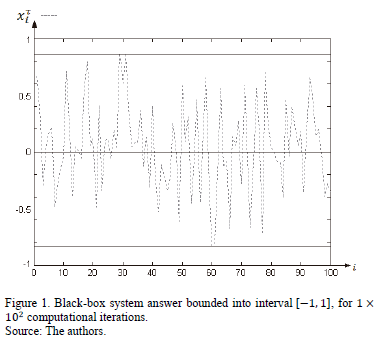
<body><![CDATA[<p><img src="/img/revistas/dyna/v83n199/v83n199a29eq06.gif"></p>     <p><font size="2" face="Verdana, Arial, Helvetica, sans-serif">Eq. (7), without denominator having the equality to 0.</font></p>     <p><img src="/img/revistas/dyna/v83n199/v83n199a29eq07.gif"></p>     <p><font size="2" face="Verdana, Arial, Helvetica, sans-serif">Eq. (8) presents  the evaluation of <img src="/img/revistas/dyna/v83n199/v83n199a29eq052.gif"> as<img src="/img/revistas/dyna/v83n199/v83n199a29eq054.gif"> in eqs. (3) and (4) into eq. (7).</font></p>     <p><img src="/img/revistas/dyna/v83n199/v83n199a29eq08.gif"></p>     <p><font size="2" face="Verdana, Arial, Helvetica, sans-serif">Eq. (9) develops the clarification (<img src="/img/revistas/dyna/v83n199/v83n199a29eq020.gif">) with respect to Membership Gaussian Function in agreement to eq. (8).</font></p>     <p><img src="/img/revistas/dyna/v83n199/v83n199a29eq09.gif"></p>     <p>&nbsp;</p>     <p><font size="3" face="Verdana, Arial, Helvetica, sans-serif"><b>3. Simulation </b></font></p>     <p><font size="2" face="Verdana, Arial, Helvetica, sans-serif">The digital Black-box system described by an ARMA (1, 1) technique &#91;15&#93; with State Space<img src="/img/revistas/dyna/v83n199/v83n199a29eq060.gif">; its evolution is depicted in <a href="#fig04">Fig. 4</a> for<img src="/img/revistas/dyna/v83n199/v83n199a29eq062.gif">. </font></p>     ]]></body>
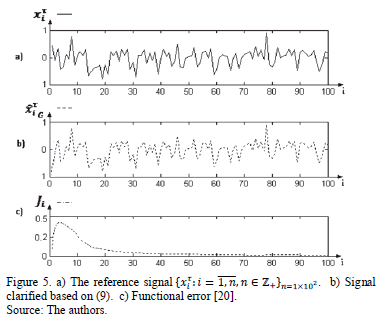
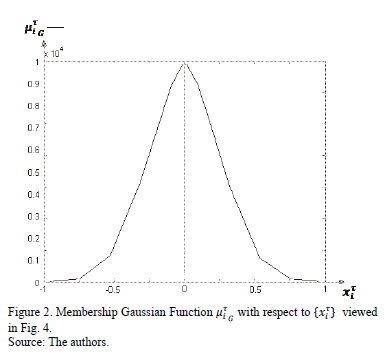
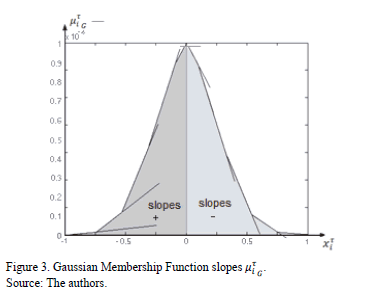
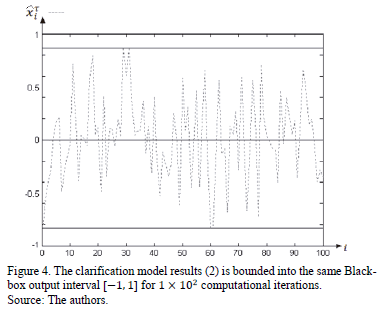
<body><![CDATA[<p align="center"><font size="2" face="Verdana, Arial, Helvetica, sans-serif"><a name="fig01"></a></font><img src="/img/revistas/dyna/v83n199/v83n199a29fig01.gif"></p>     <p><font size="2" face="Verdana, Arial, Helvetica, sans-serif">The system proposed bounded by a Normal Distribution  &#91;32&#93; is depicted in <a href="#fig02">Fig. 2</a> with a Membership Gaussian Function (MGF) &#91;33&#93;. The  slopes presented in <a href="#fig03">Fig. 3</a> used the eqs. (3) and (4) into MGF. <a href="#fig05">Fig. 5</a> shows the clarification state (2) <img src="/img/revistas/dyna/v83n199/v83n199a29eq020.gif"> justifying Theorem 1 through (9).</font></p>     <p align="center"><font size="2" face="Verdana, Arial, Helvetica, sans-serif"><a name="fig02"></a></font><img src="/img/revistas/dyna/v83n199/v83n199a29fig02.gif"></p>     <p align="center"><font size="2" face="Verdana, Arial, Helvetica, sans-serif"><a name="fig03"></a></font><img src="/img/revistas/dyna/v83n199/v83n199a29fig03.gif"></p>     <p>&nbsp;</p>     <p><font size="2" face="Verdana, Arial, Helvetica, sans-serif"><a href="#fig02">Fig. 2</a> shows the Gaussian Membership function <img src="/img/revistas/dyna/v83n199/v83n199a29eq016.gif"> based on ARMA (1, 1) technique. </font></p>     <p><font size="2" face="Verdana, Arial, Helvetica, sans-serif"><a href="#fig02">Fig. 3</a> presents the slopes <img src="/img/revistas/dyna/v83n199/v83n199a29eq080.gif">according to eq. (3) and taking into account the information content in <a href="#fig02">Fig. 2</a>.</font></p>     <p><font size="2" face="Verdana, Arial, Helvetica, sans-serif"><a href="#fig04">Fig. 4</a>, describes the clarification result viewed by<img src="/img/revistas/dyna/v83n199/v83n199a29eq082.gif">, function.</font></p>     <p align="center"><font size="2" face="Verdana, Arial, Helvetica, sans-serif"><a name="fig04"></a></font><img src="/img/revistas/dyna/v83n199/v83n199a29fig04.gif"></p>     <p><font size="2" face="Verdana, Arial, Helvetica, sans-serif"><a href="#fig05">Fig. 5</a>, includes the system evolution and  its clarification, observing both signals converging regardlees of different initial conditions.</font></p>     ]]></body>
<body><![CDATA[<p align="center"><font size="2" face="Verdana, Arial, Helvetica, sans-serif"><a name="fig05"></a></font><img src="/img/revistas/dyna/v83n199/v83n199a29fig05.gif"></p>     <p>&nbsp;</p>     <p><font size="3" face="Verdana, Arial, Helvetica, sans-serif"><b>4. Conclusions</b></font></p>     <p><font size="2" face="Verdana, Arial, Helvetica, sans-serif">The  output system bounded by a Membership Gaussian Function (MGF) required a novel  clarification technique justified in (9). The model developed and applied  considered eqs. (4) and (5) properties applied in (8). The defuzzification  strategy used a unit vector concept and its derivate properties applied on Membership  Function (MF), achieving the clarification strategy. The theoretical results were developed </font></p>     <p><font size="2" face="Verdana, Arial, Helvetica, sans-serif">by the stochastic system bounded by a  Gaussian distribution. The identification process or clarification consists of  the Membership Inverse Function (MIF) developed in an analytical manner in eq. (2) and validated theoretically in eq. (9). </font></p>     <p><font size="2" face="Verdana, Arial, Helvetica, sans-serif">Therefore, this description for the  clarification process was based on Membership Gaussian Inverse Function (MGIF) with the sign function and its derivative properties, obtaining the description <img src="/img/revistas/dyna/v83n199/v83n199a29eq092.gif">state.</font></p>     <p>&nbsp;</p>     <p><font size="3" face="Verdana, Arial, Helvetica, sans-serif"><b>References</b></font></p>     <!-- ref --><p><font size="2" face="Verdana, Arial, Helvetica, sans-serif"><b>&#91;1&#93;</b> M. Oussalah, On the   compatibility between defuzzification and fuzzy arithmetic operations, Fuzzy Sets and Systems, 128(2), pp. 247-260, 2002.    &nbsp;&nbsp;&nbsp;&nbsp;&nbsp;&nbsp;&nbsp;&nbsp;[&#160;<a href="javascript:void(0);" onclick="javascript: window.open('/scielo.php?script=sci_nlinks&ref=1150672&pid=S0012-7353201600050002900001&lng=','','width=640,height=500,resizable=yes,scrollbars=1,menubar=yes,');">Links</a>&#160;]<!-- end-ref --></font></p>     ]]></body>
<body><![CDATA[<!-- ref --><p><font size="2" face="Verdana, Arial, Helvetica, sans-serif"><b>&#91;2&#93;</b> Saletic., D.Z. and  Popovich.,U., On possible constraints in applications of basic defuzzification  techniques, Proceeding of the 8th Seminar on neural network applications in electrical engineering, NEUREL, pp. 225-230, 2006.    &nbsp;&nbsp;&nbsp;&nbsp;&nbsp;&nbsp;&nbsp;&nbsp;[&#160;<a href="javascript:void(0);" onclick="javascript: window.open('/scielo.php?script=sci_nlinks&ref=1150674&pid=S0012-7353201600050002900002&lng=','','width=640,height=500,resizable=yes,scrollbars=1,menubar=yes,');">Links</a>&#160;]<!-- end-ref --></font></p>     <!-- ref --><p><font size="2" face="Verdana, Arial, Helvetica, sans-serif"><b>&#91;3&#93;</b> Jung, S.H., Cho., K.H., Kim.,  T.G. and Park., K.H., Defuzzification method for multi-shaped output fuzzy sets, Electronics Letters, 30(9), pp. 740-742, 1994.    &nbsp;&nbsp;&nbsp;&nbsp;&nbsp;&nbsp;&nbsp;&nbsp;[&#160;<a href="javascript:void(0);" onclick="javascript: window.open('/scielo.php?script=sci_nlinks&ref=1150676&pid=S0012-7353201600050002900003&lng=','','width=640,height=500,resizable=yes,scrollbars=1,menubar=yes,');">Links</a>&#160;]<!-- end-ref --></font></p>     <!-- ref --><p><font size="2" face="Verdana, Arial, Helvetica, sans-serif"><b>&#91;4&#93;</b> Jiang., T. and Li., Y.,  Generalized defuzzification strategies and their parameter learning procedures, IEEE Transactions on Fuzzy Systems, 4(1), pp. 64-71, 1996.    &nbsp;&nbsp;&nbsp;&nbsp;&nbsp;&nbsp;&nbsp;&nbsp;[&#160;<a href="javascript:void(0);" onclick="javascript: window.open('/scielo.php?script=sci_nlinks&ref=1150678&pid=S0012-7353201600050002900004&lng=','','width=640,height=500,resizable=yes,scrollbars=1,menubar=yes,');">Links</a>&#160;]<!-- end-ref --></font></p>     <!-- ref --><p><font size="2" face="Verdana, Arial, Helvetica, sans-serif"><b>&#91;5&#93;</b> Ma, M., Kandel, A. and  Friedman, M., A new approach for defuzzification, Fuzzy Sets and Systems, 111(3), pp. 351-356, 2000.    &nbsp;&nbsp;&nbsp;&nbsp;&nbsp;&nbsp;&nbsp;&nbsp;[&#160;<a href="javascript:void(0);" onclick="javascript: window.open('/scielo.php?script=sci_nlinks&ref=1150680&pid=S0012-7353201600050002900005&lng=','','width=640,height=500,resizable=yes,scrollbars=1,menubar=yes,');">Links</a>&#160;]<!-- end-ref --></font></p>     <!-- ref --><p><font size="2" face="Verdana, Arial, Helvetica, sans-serif"><b>&#91;6&#93;</b> Runkler, T.A., Extended  defuzzification methods and their properties, Proceedings of the 5th IEEE International Conference on Fuzzy Systems, 1, pp. 694-700, 1996.    &nbsp;&nbsp;&nbsp;&nbsp;&nbsp;&nbsp;&nbsp;&nbsp;[&#160;<a href="javascript:void(0);" onclick="javascript: window.open('/scielo.php?script=sci_nlinks&ref=1150682&pid=S0012-7353201600050002900006&lng=','','width=640,height=500,resizable=yes,scrollbars=1,menubar=yes,');">Links</a>&#160;]<!-- end-ref --></font></p>     ]]></body>
<body><![CDATA[<!-- ref --><p><font size="2" face="Verdana, Arial, Helvetica, sans-serif"><b>&#91;7&#93;</b> Liu, F., Wang, J. and Peng, Y.,  A new approach to parameters identification of fuzzy regression models,  Proceedings of the 5th International Conference on Fuzzy Systems and Knowledge Discovery, 1, pp. 127-131, 2008.    &nbsp;&nbsp;&nbsp;&nbsp;&nbsp;&nbsp;&nbsp;&nbsp;[&#160;<a href="javascript:void(0);" onclick="javascript: window.open('/scielo.php?script=sci_nlinks&ref=1150684&pid=S0012-7353201600050002900007&lng=','','width=640,height=500,resizable=yes,scrollbars=1,menubar=yes,');">Links</a>&#160;]<!-- end-ref --></font></p>     <!-- ref --><p><font size="2" face="Verdana, Arial, Helvetica, sans-serif"><b>&#91;8&#93;</b> Mastorocostas, P. and  Theocharis, J., Orthogonal least squares fuzzy modeling of nonlinear dynamical  systems, Proceedings of the 6th IEEE International Conference on Fuzzy Systems, 2, pp. 1147-1152, 1997.    &nbsp;&nbsp;&nbsp;&nbsp;&nbsp;&nbsp;&nbsp;&nbsp;[&#160;<a href="javascript:void(0);" onclick="javascript: window.open('/scielo.php?script=sci_nlinks&ref=1150686&pid=S0012-7353201600050002900008&lng=','','width=640,height=500,resizable=yes,scrollbars=1,menubar=yes,');">Links</a>&#160;]<!-- end-ref --></font></p>     <!-- ref --><p><font size="2" face="Verdana, Arial, Helvetica, sans-serif"><b>&#91;9&#93;</b> Dai, H., Sinha, Naresh, K.,  Iterative instrumental variable method for robust identification of systems, IEEE Transactions on Industrial Electronics, 42(5), pp. 480-486, 1995.    &nbsp;&nbsp;&nbsp;&nbsp;&nbsp;&nbsp;&nbsp;&nbsp;[&#160;<a href="javascript:void(0);" onclick="javascript: window.open('/scielo.php?script=sci_nlinks&ref=1150688&pid=S0012-7353201600050002900009&lng=','','width=640,height=500,resizable=yes,scrollbars=1,menubar=yes,');">Links</a>&#160;]<!-- end-ref --></font></p>     <!-- ref --><p><font size="2" face="Verdana, Arial, Helvetica, sans-serif"><b>&#91;10&#93;</b> Yinao, W., Aiqing, R. and  Zhihui. Z., The numerical simulation of improving parameter estimation by  instrumental variable method, Proceeding of the IEEE International Conference Grey Systems and Intelligent Services (GSIS), pp. 811-815, 2011.    &nbsp;&nbsp;&nbsp;&nbsp;&nbsp;&nbsp;&nbsp;&nbsp;[&#160;<a href="javascript:void(0);" onclick="javascript: window.open('/scielo.php?script=sci_nlinks&ref=1150690&pid=S0012-7353201600050002900010&lng=','','width=640,height=500,resizable=yes,scrollbars=1,menubar=yes,');">Links</a>&#160;]<!-- end-ref --></font></p>     <!-- ref --><p><font size="2" face="Verdana, Arial, Helvetica, sans-serif"><b>&#91;11&#93;</b> Chen-Sen, O., Naijing, K. and  Po-Jen, C., Recursive SVD-Based Least squares algorithm with forgetting factors  for neuro-fuzzy modeling, Proceeding of the 14<sup>th</sup> International  Conference on Software Engineering, Artificial Intelligence, Networking and Parallel/Distributed Computing (SNPD), pp. 575-580, 2013.    &nbsp;&nbsp;&nbsp;&nbsp;&nbsp;&nbsp;&nbsp;&nbsp;[&#160;<a href="javascript:void(0);" onclick="javascript: window.open('/scielo.php?script=sci_nlinks&ref=1150692&pid=S0012-7353201600050002900011&lng=','','width=640,height=500,resizable=yes,scrollbars=1,menubar=yes,');">Links</a>&#160;]<!-- end-ref --></font></p>     ]]></body>
<body><![CDATA[<!-- ref --><p><font size="2" face="Verdana, Arial, Helvetica, sans-serif"><b>&#91;12&#93;</b> Paleologu, C., Benesty, J. and  Ciochina, S., A robust variable forgetting factor recursive least squares  algorithm for system identification, IEEE Signal Processing Letters, 15, pp. 597-600, 2008.    &nbsp;&nbsp;&nbsp;&nbsp;&nbsp;&nbsp;&nbsp;&nbsp;[&#160;<a href="javascript:void(0);" onclick="javascript: window.open('/scielo.php?script=sci_nlinks&ref=1150694&pid=S0012-7353201600050002900012&lng=','','width=640,height=500,resizable=yes,scrollbars=1,menubar=yes,');">Links</a>&#160;]<!-- end-ref --></font></p>     <!-- ref --><p><font size="2" face="Verdana, Arial, Helvetica, sans-serif"><b>&#91;13&#93;</b> Medel, J.J. and Zagaceta, M.T., Estimaci&oacute;n-identificaci&oacute;n como filtro digital integrado: descripci&oacute;n e implementaci&oacute;n recursiva. Rev. Mex. Fis., 56(1), pp. 1-8, 2010.    &nbsp;&nbsp;&nbsp;&nbsp;&nbsp;&nbsp;&nbsp;&nbsp;[&#160;<a href="javascript:void(0);" onclick="javascript: window.open('/scielo.php?script=sci_nlinks&ref=1150696&pid=S0012-7353201600050002900013&lng=','','width=640,height=500,resizable=yes,scrollbars=1,menubar=yes,');">Links</a>&#160;]<!-- end-ref --></font></p>     <!-- ref --><p><font size="2" face="Verdana, Arial, Helvetica, sans-serif"><b>&#91;14&#93;</b> Ding, F., Liu, G. and Liu.,  X.P., Partially coupled stochastic gradient identification methods for  non-uniformly sampled systems, IEEE Transactions on Automatic Control, 55(8), pp. 1976-1981, 2010.    &nbsp;&nbsp;&nbsp;&nbsp;&nbsp;&nbsp;&nbsp;&nbsp;[&#160;<a href="javascript:void(0);" onclick="javascript: window.open('/scielo.php?script=sci_nlinks&ref=1150698&pid=S0012-7353201600050002900014&lng=','','width=640,height=500,resizable=yes,scrollbars=1,menubar=yes,');">Links</a>&#160;]<!-- end-ref --></font></p>     <!-- ref --><p><font size="2" face="Verdana, Arial, Helvetica, sans-serif"><b>&#91;15&#93;</b> Chang, S.L. and Ogunfunmi, T.,  Stochastic gradient based on 3rd order Volterra system identification by  nonlinear Wiener adaptive algorithm, IEE Proceedings of the Vision, Image and Signal Processing, 150(2), pp. 90-98, 2003.    &nbsp;&nbsp;&nbsp;&nbsp;&nbsp;&nbsp;&nbsp;&nbsp;[&#160;<a href="javascript:void(0);" onclick="javascript: window.open('/scielo.php?script=sci_nlinks&ref=1150700&pid=S0012-7353201600050002900015&lng=','','width=640,height=500,resizable=yes,scrollbars=1,menubar=yes,');">Links</a>&#160;]<!-- end-ref --></font></p>     <!-- ref --><p><font size="2" face="Verdana, Arial, Helvetica, sans-serif"><b>&#91;16&#93;</b> Bershad, N.J., Celka, P. and  Vesin, J., Stochastic analysis of gradient adaptive identification of nonlinear  systems with memory for Gaussian data and noisy input and output measurements, IEEE Transactions on Signal Processing, 47(3), pp. 675-689, 1999.    &nbsp;&nbsp;&nbsp;&nbsp;&nbsp;&nbsp;&nbsp;&nbsp;[&#160;<a href="javascript:void(0);" onclick="javascript: window.open('/scielo.php?script=sci_nlinks&ref=1150702&pid=S0012-7353201600050002900016&lng=','','width=640,height=500,resizable=yes,scrollbars=1,menubar=yes,');">Links</a>&#160;]<!-- end-ref --></font></p>     ]]></body>
<body><![CDATA[<!-- ref --><p><font size="2" face="Verdana, Arial, Helvetica, sans-serif"><b>&#91;17&#93;</b> Wei, C.L., Tsai, J.S.H., Guo,  S.M. and Shieh., L.S., Universal predictive Kalman filter based on fault  estimator and tracker for sampled-data non-linear time-varying systems, Control Theory &amp; Applications, IET, 5(1), pp. 203-220, 2011.    &nbsp;&nbsp;&nbsp;&nbsp;&nbsp;&nbsp;&nbsp;&nbsp;[&#160;<a href="javascript:void(0);" onclick="javascript: window.open('/scielo.php?script=sci_nlinks&ref=1150704&pid=S0012-7353201600050002900017&lng=','','width=640,height=500,resizable=yes,scrollbars=1,menubar=yes,');">Links</a>&#160;]<!-- end-ref --></font></p>     <!-- ref --><p><font size="2" face="Verdana, Arial, Helvetica, sans-serif"><b>&#91;18&#93;</b> Chafaa, K., Ghanai, M. and  Benmahammed, K., Fuzzy modeling using Kalman filter, Control Theory &amp; Applications, IET, 1(1), pp. 58-64, 2007.    &nbsp;&nbsp;&nbsp;&nbsp;&nbsp;&nbsp;&nbsp;&nbsp;[&#160;<a href="javascript:void(0);" onclick="javascript: window.open('/scielo.php?script=sci_nlinks&ref=1150706&pid=S0012-7353201600050002900018&lng=','','width=640,height=500,resizable=yes,scrollbars=1,menubar=yes,');">Links</a>&#160;]<!-- end-ref --></font></p>     <!-- ref --><p><font size="2" face="Verdana, Arial, Helvetica, sans-serif"><b>&#91;19&#93;</b> Medel, J.J. y Garc&iacute;a, C.V.,  Estimaci&oacute;n de par&aacute;metros usando la deconvoluci&oacute;n y la pseudo-inversa: descripci&oacute;n e implementaci&oacute;n recursiva. Rev. Mex. Fis., 56(1), pp. 54-60, 2010.    &nbsp;&nbsp;&nbsp;&nbsp;&nbsp;&nbsp;&nbsp;&nbsp;[&#160;<a href="javascript:void(0);" onclick="javascript: window.open('/scielo.php?script=sci_nlinks&ref=1150708&pid=S0012-7353201600050002900019&lng=','','width=640,height=500,resizable=yes,scrollbars=1,menubar=yes,');">Links</a>&#160;]<!-- end-ref --></font></p>     <!-- ref --><p><font size="2" face="Verdana, Arial, Helvetica, sans-serif"><b>&#91;20&#93;</b> Erdogmus, D., Hild., K.E.,  Principe, J.C., Lazaro, M. and Santamaria, I., Adaptive blind deconvolution of  linear channels using Renyi's entropy with Parzen window estimation, IEEE Transactions on Signal Processing, 52(6), pp. 1489-1498, 2004.    &nbsp;&nbsp;&nbsp;&nbsp;&nbsp;&nbsp;&nbsp;&nbsp;[&#160;<a href="javascript:void(0);" onclick="javascript: window.open('/scielo.php?script=sci_nlinks&ref=1150710&pid=S0012-7353201600050002900020&lng=','','width=640,height=500,resizable=yes,scrollbars=1,menubar=yes,');">Links</a>&#160;]<!-- end-ref --></font></p>     <!-- ref --><p><font size="2" face="Verdana, Arial, Helvetica, sans-serif"><b>&#91;21&#93;</b> Chen, L. and Kim-Hui, Y., A  soft double regularization approach to parametric blind image deconvolution, IEEE Transactions on Image Processing, 14(5), pp. 624-633, 2005.    &nbsp;&nbsp;&nbsp;&nbsp;&nbsp;&nbsp;&nbsp;&nbsp;[&#160;<a href="javascript:void(0);" onclick="javascript: window.open('/scielo.php?script=sci_nlinks&ref=1150712&pid=S0012-7353201600050002900021&lng=','','width=640,height=500,resizable=yes,scrollbars=1,menubar=yes,');">Links</a>&#160;]<!-- end-ref --></font></p>     ]]></body>
<body><![CDATA[<!-- ref --><p><font size="2" face="Verdana, Arial, Helvetica, sans-serif"><b>&#91;22&#93;</b> Depeyrot, M., Linear System  identification using real-time deconvolution, IEEE Transactions on Computers, C-1(12), pp. 1139-1145, 1970.    &nbsp;&nbsp;&nbsp;&nbsp;&nbsp;&nbsp;&nbsp;&nbsp;[&#160;<a href="javascript:void(0);" onclick="javascript: window.open('/scielo.php?script=sci_nlinks&ref=1150714&pid=S0012-7353201600050002900022&lng=','','width=640,height=500,resizable=yes,scrollbars=1,menubar=yes,');">Links</a>&#160;]<!-- end-ref --></font></p>     <!-- ref --><p><font size="2" face="Verdana, Arial, Helvetica, sans-serif"><b>&#91;23&#93;</b> Meng-Xin, L., Cheng-dong, W.  and Feng, J., A vision-based inspection system using fuzzy rough neural network  method, Proceeding of the International Conference on Machine Learning and Cybernetics, pp. 3228-3232, 2006.    &nbsp;&nbsp;&nbsp;&nbsp;&nbsp;&nbsp;&nbsp;&nbsp;[&#160;<a href="javascript:void(0);" onclick="javascript: window.open('/scielo.php?script=sci_nlinks&ref=1150716&pid=S0012-7353201600050002900023&lng=','','width=640,height=500,resizable=yes,scrollbars=1,menubar=yes,');">Links</a>&#160;]<!-- end-ref --></font></p>     <!-- ref --><p><font size="2" face="Verdana, Arial, Helvetica, sans-serif"><b>&#91;24&#93;</b> Sivanandam, S.N., Deepa, S.N.  and Sumathi, S., Introduction to Fuzzy logic using MATLAB®, Springer, pp. 95 - 108, 2007.    &nbsp;&nbsp;&nbsp;&nbsp;&nbsp;&nbsp;&nbsp;&nbsp;[&#160;<a href="javascript:void(0);" onclick="javascript: window.open('/scielo.php?script=sci_nlinks&ref=1150718&pid=S0012-7353201600050002900024&lng=','','width=640,height=500,resizable=yes,scrollbars=1,menubar=yes,');">Links</a>&#160;]<!-- end-ref --></font></p>     <!-- ref --><p><font size="2" face="Verdana, Arial, Helvetica, sans-serif"><b>&#91;25&#93;</b> Nguyen, H.T., Prasad, N.R.,  Walker., C.L. and Walker, E.A., A 1st course in Fuzzy and neural Control, (Chapman and Hall/CRC, (2002), Ed. 1, pp. 120-123.    &nbsp;&nbsp;&nbsp;&nbsp;&nbsp;&nbsp;&nbsp;&nbsp;[&#160;<a href="javascript:void(0);" onclick="javascript: window.open('/scielo.php?script=sci_nlinks&ref=1150720&pid=S0012-7353201600050002900025&lng=','','width=640,height=500,resizable=yes,scrollbars=1,menubar=yes,');">Links</a>&#160;]<!-- end-ref --></font></p>     <!-- ref --><p><font size="2" face="Verdana, Arial, Helvetica, sans-serif"><b>&#91;26&#93;</b> Kosinski, W., Evolutionary  algorithm determining defuzzyfication operators, Engineering Applications of Artificial Intelligence, 20(5), pp. 619-627, 2007.    &nbsp;&nbsp;&nbsp;&nbsp;&nbsp;&nbsp;&nbsp;&nbsp;[&#160;<a href="javascript:void(0);" onclick="javascript: window.open('/scielo.php?script=sci_nlinks&ref=1150722&pid=S0012-7353201600050002900026&lng=','','width=640,height=500,resizable=yes,scrollbars=1,menubar=yes,');">Links</a>&#160;]<!-- end-ref --></font></p>     ]]></body>
<body><![CDATA[<!-- ref --><p><font size="2" face="Verdana, Arial, Helvetica, sans-serif"><b>&#91;27&#93;</b> Urbanski, K. and Wasowski, J., Fuzzy measurement theory, Measurements, 41(4), pp. 391-402, 2008.    &nbsp;&nbsp;&nbsp;&nbsp;&nbsp;&nbsp;&nbsp;&nbsp;[&#160;<a href="javascript:void(0);" onclick="javascript: window.open('/scielo.php?script=sci_nlinks&ref=1150724&pid=S0012-7353201600050002900027&lng=','','width=640,height=500,resizable=yes,scrollbars=1,menubar=yes,');">Links</a>&#160;]<!-- end-ref --></font></p>     <!-- ref --><p><font size="2" face="Verdana, Arial, Helvetica, sans-serif"><b>&#91;28&#93;</b> Jang, J.S.R., Sun, C.T. and  Mizutani, E., Neuro-fuzzy and soft computing: a computational approach to learning and machine intelligence, Prentice-Hall, 1997, pp. 24 - 28.    &nbsp;&nbsp;&nbsp;&nbsp;&nbsp;&nbsp;&nbsp;&nbsp;[&#160;<a href="javascript:void(0);" onclick="javascript: window.open('/scielo.php?script=sci_nlinks&ref=1150726&pid=S0012-7353201600050002900028&lng=','','width=640,height=500,resizable=yes,scrollbars=1,menubar=yes,');">Links</a>&#160;]<!-- end-ref --></font></p>     <!-- ref --><p><font size="2" face="Verdana, Arial, Helvetica, sans-serif"><b>&#91;29&#93;</b> Shin, Y.C. and Xu, C.,  Intelligent systems: modeling, optimization, and control. Section 2.1.3. CRC Press, 2008.    &nbsp;&nbsp;&nbsp;&nbsp;&nbsp;&nbsp;&nbsp;&nbsp;[&#160;<a href="javascript:void(0);" onclick="javascript: window.open('/scielo.php?script=sci_nlinks&ref=1150728&pid=S0012-7353201600050002900029&lng=','','width=640,height=500,resizable=yes,scrollbars=1,menubar=yes,');">Links</a>&#160;]<!-- end-ref --></font></p>     <!-- ref --><p><font size="2" face="Verdana, Arial, Helvetica, sans-serif"><b>&#91;30&#93;</b> Slotine, J.J. and Li, W., Applied nonlinear control, Prentice-Hall, 1991, 1, pp. 290-306.    &nbsp;&nbsp;&nbsp;&nbsp;&nbsp;&nbsp;&nbsp;&nbsp;[&#160;<a href="javascript:void(0);" onclick="javascript: window.open('/scielo.php?script=sci_nlinks&ref=1150730&pid=S0012-7353201600050002900030&lng=','','width=640,height=500,resizable=yes,scrollbars=1,menubar=yes,');">Links</a>&#160;]<!-- end-ref --></font></p>     <!-- ref --><p><font size="2" face="Verdana, Arial, Helvetica, sans-serif"><b>&#91;31&#93;</b> Shtessel, Y., Edwards, C.,  Fridman, L. and Levant, A., Sliding Mode control and observation, Control Engineering, Birkhäuser, pp. 18-19, 2013.    &nbsp;&nbsp;&nbsp;&nbsp;&nbsp;&nbsp;&nbsp;&nbsp;[&#160;<a href="javascript:void(0);" onclick="javascript: window.open('/scielo.php?script=sci_nlinks&ref=1150732&pid=S0012-7353201600050002900031&lng=','','width=640,height=500,resizable=yes,scrollbars=1,menubar=yes,');">Links</a>&#160;]<!-- end-ref --></font></p>     ]]></body>
<body><![CDATA[<!-- ref --><p><font size="2" face="Verdana, Arial, Helvetica, sans-serif"><b>&#91;32&#93;</b> Vel&aacute;squez-Henao, J.D. and  Branch-Bedoya, J.W., Examples in the classroom: Pattern classification using the R language, DYNA, 79(173), pp. 81-88, 2012.    &nbsp;&nbsp;&nbsp;&nbsp;&nbsp;&nbsp;&nbsp;&nbsp;[&#160;<a href="javascript:void(0);" onclick="javascript: window.open('/scielo.php?script=sci_nlinks&ref=1150734&pid=S0012-7353201600050002900032&lng=','','width=640,height=500,resizable=yes,scrollbars=1,menubar=yes,');">Links</a>&#160;]<!-- end-ref --></font></p>     <!-- ref --><p><font size="2" face="Verdana, Arial, Helvetica, sans-serif"><b>&#91;33&#93;</b> Vel&aacute;squez-Henao, J. D.,  Rueda-Mej&iacute;a, V.M. and Franco-Cardona, J.D. Electricity demand forecasting using  a SARIMA- multiplicative single neuron hybrid model, DYNA, 80(180), pp. 4-8, 2013.    &nbsp;&nbsp;&nbsp;&nbsp;&nbsp;&nbsp;&nbsp;&nbsp;[&#160;<a href="javascript:void(0);" onclick="javascript: window.open('/scielo.php?script=sci_nlinks&ref=1150736&pid=S0012-7353201600050002900033&lng=','','width=640,height=500,resizable=yes,scrollbars=1,menubar=yes,');">Links</a>&#160;]<!-- end-ref --> </font></p>     <!-- ref --><p><font size="2" face="Verdana, Arial, Helvetica, sans-serif"><b>&#91;34&#93;</b> Roy-Chowdhury, S. and Pedrycz,  W., A survey of defuzzification strategies, Int. J. Intel. Syst, pp. 679-695, 2001.    &nbsp;&nbsp;&nbsp;&nbsp;&nbsp;&nbsp;&nbsp;&nbsp;[&#160;<a href="javascript:void(0);" onclick="javascript: window.open('/scielo.php?script=sci_nlinks&ref=1150738&pid=S0012-7353201600050002900034&lng=','','width=640,height=500,resizable=yes,scrollbars=1,menubar=yes,');">Links</a>&#160;]<!-- end-ref --></font></p>     <p>&nbsp;</p>     <p><font size="2" face="Verdana, Arial, Helvetica, sans-serif"><b>J. de J. Medel-Ju&aacute;rez,</b> is a Professor  working on- intelligent estimation and identification applied in hybrid  filters. He is an Aeronautics Engineer (1994), MSc. in sciences in Automatic  Control (1996), and also a PhD in Automatic Control (1998), Member of National  Council for Science and Technology (1999), member of the Mexican Academy of  Sciences. Actually, he is a Full Time Professor and Researcher in the Computer  Research Center (CIC). His researches include Digital filtering, Control, Real-time, among others. ORCID: 0000-0002-1257-1711</font></p>     <p><font size="2" face="Verdana, Arial, Helvetica, sans-serif"><b>M.Espinosa-Santiago,</b> is a MSc. in  Computer Research Center (CIC) and Eng. in Electronics and Communications at  the Mechanical and Electrical School at National Polytechnic Institute (ESIME  Zacatenco IPN). Currently he works at the Technical Center for Research and Development Carso, (CTQ-CIDEC). ORCID: 0000-0003- 0449-9382</font></p>     <p><font size="2" face="Verdana, Arial, Helvetica, sans-serif"><b>J.L. Fern&aacute;ndez-Mu&ntilde;oz,</b> is a Full Time  Professor working on Applied Intelligent Systems. He is PhD. in Physics and has  MSc. in Physics (1998). Member of the National Researchers System. He is a  researcher at Research Center of Science and Advanced Technology (CICATA-IPN) in the Laboratory of Condensed Matter. ORCID: 0000-0002-2039-3222</font></p>     ]]></body>
<body><![CDATA[ ]]></body><back>
<ref-list>
<ref id="B1">
<label>1</label><nlm-citation citation-type="journal">
<person-group person-group-type="author">
<name>
<surname><![CDATA[Oussalah]]></surname>
</name>
</person-group>
<article-title xml:lang="en"><![CDATA[On the compatibility between defuzzification and fuzzy arithmetic operations]]></article-title>
<source><![CDATA[Fuzzy Sets and Systems]]></source>
<year>2002</year>
<volume>128</volume>
<numero>2</numero>
<issue>2</issue>
<page-range>247-260</page-range></nlm-citation>
</ref>
<ref id="B2">
<label>2</label><nlm-citation citation-type="confpro">
<person-group person-group-type="author">
<name>
<surname><![CDATA[Saletic.]]></surname>
<given-names><![CDATA[D.Z.]]></given-names>
</name>
<name>
<surname><![CDATA[Popovich]]></surname>
<given-names><![CDATA[U.]]></given-names>
</name>
</person-group>
<article-title xml:lang="en"><![CDATA[On possible constraints in applications of basic defuzzification techniques]]></article-title>
<source><![CDATA[]]></source>
<year></year>
<conf-name><![CDATA[8th Seminar on neural network applications in electrical engineering, NEUREL]]></conf-name>
<conf-date>2006</conf-date>
<conf-loc> </conf-loc>
</nlm-citation>
</ref>
<ref id="B3">
<label>3</label><nlm-citation citation-type="journal">
<person-group person-group-type="author">
<name>
<surname><![CDATA[Jung]]></surname>
<given-names><![CDATA[S.H.]]></given-names>
</name>
<name>
<surname><![CDATA[Cho.]]></surname>
<given-names><![CDATA[K.H.]]></given-names>
</name>
<name>
<surname><![CDATA[Kim.]]></surname>
<given-names><![CDATA[T.G.]]></given-names>
</name>
<name>
<surname><![CDATA[Park.]]></surname>
<given-names><![CDATA[K.H.]]></given-names>
</name>
</person-group>
<article-title xml:lang="en"><![CDATA[Defuzzification method for multi-shaped output fuzzy sets]]></article-title>
<source><![CDATA[Electronics Letters]]></source>
<year>1994</year>
<volume>30</volume>
<numero>9</numero>
<issue>9</issue>
<page-range>740-742</page-range></nlm-citation>
</ref>
<ref id="B4">
<label>4</label><nlm-citation citation-type="journal">
<person-group person-group-type="author">
<name>
<surname><![CDATA[Jiang.]]></surname>
<given-names><![CDATA[T.]]></given-names>
</name>
<name>
<surname><![CDATA[Li.]]></surname>
<given-names><![CDATA[Y.]]></given-names>
</name>
</person-group>
<article-title xml:lang="en"><![CDATA[Generalized defuzzification strategies and their parameter learning procedures]]></article-title>
<source><![CDATA[IEEE Transactions on Fuzzy Systems]]></source>
<year>1996</year>
<volume>4</volume>
<numero>1</numero>
<issue>1</issue>
<page-range>64-71</page-range></nlm-citation>
</ref>
<ref id="B5">
<label>5</label><nlm-citation citation-type="journal">
<person-group person-group-type="author">
<name>
<surname><![CDATA[Ma]]></surname>
<given-names><![CDATA[M.]]></given-names>
</name>
<name>
<surname><![CDATA[Kandel]]></surname>
<given-names><![CDATA[A.]]></given-names>
</name>
<name>
<surname><![CDATA[Friedman]]></surname>
<given-names><![CDATA[M.]]></given-names>
</name>
</person-group>
<article-title xml:lang="en"><![CDATA[A new approach for defuzzification]]></article-title>
<source><![CDATA[Fuzzy Sets and Systems]]></source>
<year>2000</year>
<volume>111</volume>
<numero>3</numero>
<issue>3</issue>
<page-range>351-356</page-range></nlm-citation>
</ref>
<ref id="B6">
<label>6</label><nlm-citation citation-type="confpro">
<person-group person-group-type="author">
<name>
<surname><![CDATA[Runkler]]></surname>
<given-names><![CDATA[T.A.]]></given-names>
</name>
</person-group>
<article-title xml:lang="en"><![CDATA[Extended defuzzification methods and their properties]]></article-title>
<source><![CDATA[]]></source>
<year></year>
<conf-name><![CDATA[5th IEEE International Conference on Fuzzy Systems]]></conf-name>
<conf-date>1996</conf-date>
<conf-loc> </conf-loc>
</nlm-citation>
</ref>
<ref id="B7">
<label>7</label><nlm-citation citation-type="confpro">
<person-group person-group-type="author">
<name>
<surname><![CDATA[Liu]]></surname>
<given-names><![CDATA[F.]]></given-names>
</name>
<name>
<surname><![CDATA[Wang]]></surname>
<given-names><![CDATA[J.]]></given-names>
</name>
<name>
<surname><![CDATA[Peng]]></surname>
<given-names><![CDATA[Y.]]></given-names>
</name>
</person-group>
<article-title xml:lang="en"><![CDATA[A new approach to parameters identification of fuzzy regression models]]></article-title>
<source><![CDATA[]]></source>
<year></year>
<conf-name><![CDATA[5th International Conference on Fuzzy Systems and Knowledge Discovery]]></conf-name>
<conf-date>2008</conf-date>
<conf-loc> </conf-loc>
</nlm-citation>
</ref>
<ref id="B8">
<label>8</label><nlm-citation citation-type="confpro">
<person-group person-group-type="author">
<name>
<surname><![CDATA[Mastorocostas]]></surname>
<given-names><![CDATA[P.]]></given-names>
</name>
<name>
<surname><![CDATA[Theocharis]]></surname>
<given-names><![CDATA[J.]]></given-names>
</name>
</person-group>
<article-title xml:lang="en"><![CDATA[Orthogonal least squares fuzzy modeling of nonlinear dynamical systems]]></article-title>
<source><![CDATA[]]></source>
<year></year>
<conf-name><![CDATA[6th IEEE International Conference on Fuzzy Systems]]></conf-name>
<conf-date>1997</conf-date>
<conf-loc> </conf-loc>
</nlm-citation>
</ref>
<ref id="B9">
<label>9</label><nlm-citation citation-type="journal">
<person-group person-group-type="author">
<name>
<surname><![CDATA[Dai]]></surname>
<given-names><![CDATA[H.]]></given-names>
</name>
<name>
<surname><![CDATA[Sinha]]></surname>
</name>
<name>
<surname><![CDATA[Naresh]]></surname>
<given-names><![CDATA[K.]]></given-names>
</name>
</person-group>
<article-title xml:lang="en"><![CDATA[Iterative instrumental variable method for robust identification of systems]]></article-title>
<source><![CDATA[IEEE Transactions on Industrial Electronics]]></source>
<year>1995</year>
<volume>42</volume>
<numero>5</numero>
<issue>5</issue>
<page-range>480-486</page-range></nlm-citation>
</ref>
<ref id="B10">
<label>10</label><nlm-citation citation-type="confpro">
<person-group person-group-type="author">
<name>
<surname><![CDATA[Yinao]]></surname>
<given-names><![CDATA[W.]]></given-names>
</name>
<name>
<surname><![CDATA[Aiqing]]></surname>
<given-names><![CDATA[R.]]></given-names>
</name>
<name>
<surname><![CDATA[Zhihui.]]></surname>
<given-names><![CDATA[Z.]]></given-names>
</name>
</person-group>
<article-title xml:lang="en"><![CDATA[The numerical simulation of improving parameter estimation by instrumental variable method]]></article-title>
<source><![CDATA[]]></source>
<year></year>
<conf-name><![CDATA[ IEEE International Conference Grey Systems and Intelligent Services]]></conf-name>
<conf-date>2011</conf-date>
<conf-loc> </conf-loc>
</nlm-citation>
</ref>
<ref id="B11">
<label>11</label><nlm-citation citation-type="confpro">
<person-group person-group-type="author">
<name>
<surname><![CDATA[Chen-Sen]]></surname>
<given-names><![CDATA[O.]]></given-names>
</name>
<name>
<surname><![CDATA[Naijing]]></surname>
<given-names><![CDATA[K.]]></given-names>
</name>
<name>
<surname><![CDATA[Po-Jen]]></surname>
<given-names><![CDATA[C.]]></given-names>
</name>
</person-group>
<article-title xml:lang="en"><![CDATA[Recursive SVD-Based Least squares algorithm with forgetting factors for neuro-fuzzy modeling]]></article-title>
<source><![CDATA[]]></source>
<year></year>
<conf-name><![CDATA[14th International Conference on Software Engineering, Artificial Intelligence, Networking and Parallel/Distributed Computing]]></conf-name>
<conf-date>2013</conf-date>
<conf-loc> </conf-loc>
</nlm-citation>
</ref>
<ref id="B12">
<label>12</label><nlm-citation citation-type="journal">
<person-group person-group-type="author">
<name>
<surname><![CDATA[Paleologu]]></surname>
<given-names><![CDATA[C.]]></given-names>
</name>
<name>
<surname><![CDATA[Benesty]]></surname>
<given-names><![CDATA[J.]]></given-names>
</name>
<name>
<surname><![CDATA[Ciochina]]></surname>
<given-names><![CDATA[S.]]></given-names>
</name>
</person-group>
<article-title xml:lang="en"><![CDATA[A robust variable forgetting factor recursive least squares algorithm for system identification]]></article-title>
<source><![CDATA[IEEE Signal Processing Letters]]></source>
<year>2008</year>
<numero>15</numero>
<issue>15</issue>
<page-range>597-600</page-range></nlm-citation>
</ref>
<ref id="B13">
<label>13</label><nlm-citation citation-type="journal">
<person-group person-group-type="author">
<name>
<surname><![CDATA[Medel]]></surname>
<given-names><![CDATA[J.J.]]></given-names>
</name>
<name>
<surname><![CDATA[Zagaceta]]></surname>
<given-names><![CDATA[M.T.]]></given-names>
</name>
</person-group>
<article-title xml:lang="es"><![CDATA[Estimación-identificación como filtro digital integrado: descripción e implementación recursiva]]></article-title>
<source><![CDATA[Rev. Mex. Fis.]]></source>
<year>2010</year>
<volume>56</volume>
<numero>1</numero>
<issue>1</issue>
<page-range>1-8</page-range></nlm-citation>
</ref>
<ref id="B14">
<label>14</label><nlm-citation citation-type="journal">
<person-group person-group-type="author">
<name>
<surname><![CDATA[Ding]]></surname>
<given-names><![CDATA[F.]]></given-names>
</name>
<name>
<surname><![CDATA[Liu]]></surname>
<given-names><![CDATA[G.]]></given-names>
</name>
<name>
<surname><![CDATA[Liu.]]></surname>
<given-names><![CDATA[X.P.]]></given-names>
</name>
</person-group>
<article-title xml:lang="en"><![CDATA[Partially coupled stochastic gradient identification methods for non-uniformly sampled systems]]></article-title>
<source><![CDATA[IEEE Transactions on Automatic Control]]></source>
<year>2010</year>
<volume>55</volume>
<numero>8</numero>
<issue>8</issue>
<page-range>1976-1981</page-range></nlm-citation>
</ref>
<ref id="B15">
<label>15</label><nlm-citation citation-type="journal">
<person-group person-group-type="author">
<name>
<surname><![CDATA[Chang]]></surname>
<given-names><![CDATA[S.L.]]></given-names>
</name>
<name>
<surname><![CDATA[Ogunfunmi]]></surname>
<given-names><![CDATA[T.]]></given-names>
</name>
</person-group>
<article-title xml:lang="en"><![CDATA[Stochastic gradient based on 3rd order Volterra system identification by nonlinear Wiener adaptive algorithm]]></article-title>
<source><![CDATA[IEE Proceedings of the Vision, Image and Signal Processing]]></source>
<year>2003</year>
<volume>150</volume>
<numero>2</numero>
<issue>2</issue>
<page-range>90-98</page-range></nlm-citation>
</ref>
<ref id="B16">
<label>16</label><nlm-citation citation-type="journal">
<person-group person-group-type="author">
<name>
<surname><![CDATA[Bershad]]></surname>
<given-names><![CDATA[N.J.]]></given-names>
</name>
<name>
<surname><![CDATA[Celka]]></surname>
<given-names><![CDATA[P.]]></given-names>
</name>
<name>
<surname><![CDATA[Vesin]]></surname>
<given-names><![CDATA[J.]]></given-names>
</name>
</person-group>
<article-title xml:lang="en"><![CDATA[Stochastic analysis of gradient adaptive identification of nonlinear systems with memory for Gaussian data and noisy input and output measurements]]></article-title>
<source><![CDATA[IEEE Transactions on Signal Processing]]></source>
<year>1999</year>
<volume>47</volume>
<numero>3</numero>
<issue>3</issue>
<page-range>675-689</page-range></nlm-citation>
</ref>
<ref id="B17">
<label>17</label><nlm-citation citation-type="journal">
<person-group person-group-type="author">
<name>
<surname><![CDATA[Wei]]></surname>
<given-names><![CDATA[C.L.]]></given-names>
</name>
<name>
<surname><![CDATA[Tsai]]></surname>
<given-names><![CDATA[J.S.H.]]></given-names>
</name>
<name>
<surname><![CDATA[Guo]]></surname>
<given-names><![CDATA[S.M.]]></given-names>
</name>
<name>
<surname><![CDATA[Shieh.]]></surname>
<given-names><![CDATA[L.S.]]></given-names>
</name>
</person-group>
<article-title xml:lang="en"><![CDATA[Universal predictive Kalman filter based on fault estimator and tracker for sampled-data non-linear time-varying systems]]></article-title>
<source><![CDATA[Control Theory & Applications, IET]]></source>
<year>2011</year>
<volume>5</volume>
<numero>1</numero>
<issue>1</issue>
<page-range>203-220</page-range></nlm-citation>
</ref>
<ref id="B18">
<label>18</label><nlm-citation citation-type="journal">
<person-group person-group-type="author">
<name>
<surname><![CDATA[Chafaa]]></surname>
<given-names><![CDATA[K.]]></given-names>
</name>
<name>
<surname><![CDATA[Ghanai]]></surname>
<given-names><![CDATA[M.]]></given-names>
</name>
<name>
<surname><![CDATA[Benmahammed]]></surname>
<given-names><![CDATA[K.]]></given-names>
</name>
</person-group>
<article-title xml:lang="en"><![CDATA[Fuzzy modeling using Kalman filter]]></article-title>
<source><![CDATA[Control Theory & Applications, IET]]></source>
<year>2007</year>
<volume>1</volume>
<numero>1</numero>
<issue>1</issue>
<page-range>58-64</page-range></nlm-citation>
</ref>
<ref id="B19">
<label>19</label><nlm-citation citation-type="journal">
<person-group person-group-type="author">
<name>
<surname><![CDATA[Medel]]></surname>
<given-names><![CDATA[J.J.]]></given-names>
</name>
<name>
<surname><![CDATA[García]]></surname>
<given-names><![CDATA[C.V.]]></given-names>
</name>
</person-group>
<article-title xml:lang="es"><![CDATA[Estimación de parámetros usando la deconvolución y la pseudo-inversa: descripción e implementación recursiva]]></article-title>
<source><![CDATA[Rev. Mex. Fis.]]></source>
<year>2010</year>
<volume>56</volume>
<numero>1</numero>
<issue>1</issue>
<page-range>54-60</page-range></nlm-citation>
</ref>
<ref id="B20">
<label>20</label><nlm-citation citation-type="journal">
<person-group person-group-type="author">
<name>
<surname><![CDATA[Erdogmus]]></surname>
<given-names><![CDATA[D.]]></given-names>
</name>
<name>
<surname><![CDATA[Hild.]]></surname>
<given-names><![CDATA[K.E.]]></given-names>
</name>
<name>
<surname><![CDATA[Principe]]></surname>
<given-names><![CDATA[J.C.]]></given-names>
</name>
<name>
<surname><![CDATA[Lazaro]]></surname>
<given-names><![CDATA[M.]]></given-names>
</name>
<name>
<surname><![CDATA[Santamaria]]></surname>
<given-names><![CDATA[I.]]></given-names>
</name>
</person-group>
<article-title xml:lang="en"><![CDATA[Adaptive blind deconvolution of linear channels using Renyi's entropy with Parzen window estimation]]></article-title>
<source><![CDATA[IEEE Transactions on Signal Processing]]></source>
<year>2004</year>
<volume>52</volume>
<numero>6</numero>
<issue>6</issue>
<page-range>1489-1498</page-range></nlm-citation>
</ref>
<ref id="B21">
<label>21</label><nlm-citation citation-type="journal">
<person-group person-group-type="author">
<name>
<surname><![CDATA[Chen]]></surname>
<given-names><![CDATA[L.]]></given-names>
</name>
<name>
<surname><![CDATA[Kim-Hui]]></surname>
<given-names><![CDATA[Y.]]></given-names>
</name>
</person-group>
<article-title xml:lang="en"><![CDATA[A soft double regularization approach to parametric blind image deconvolution]]></article-title>
<source><![CDATA[IEEE Transactions on Image Processing]]></source>
<year>2005</year>
<volume>14</volume>
<numero>5</numero>
<issue>5</issue>
<page-range>624-633</page-range></nlm-citation>
</ref>
<ref id="B22">
<label>22</label><nlm-citation citation-type="journal">
<person-group person-group-type="author">
<name>
<surname><![CDATA[Depeyrot]]></surname>
<given-names><![CDATA[M.]]></given-names>
</name>
</person-group>
<article-title xml:lang="en"><![CDATA[Linear System identification using real-time deconvolution]]></article-title>
<source><![CDATA[IEEE Transactions on Computers]]></source>
<year>1970</year>
<volume>C-1</volume>
<numero>12</numero>
<issue>12</issue>
<page-range>1139-1145</page-range></nlm-citation>
</ref>
<ref id="B23">
<label>23</label><nlm-citation citation-type="confpro">
<person-group person-group-type="author">
<name>
<surname><![CDATA[Meng-Xin]]></surname>
<given-names><![CDATA[L.]]></given-names>
</name>
<name>
<surname><![CDATA[Cheng-dong]]></surname>
<given-names><![CDATA[W.]]></given-names>
</name>
<name>
<surname><![CDATA[Feng]]></surname>
<given-names><![CDATA[J.]]></given-names>
</name>
</person-group>
<article-title xml:lang="en"><![CDATA[A vision-based inspection system using fuzzy rough neural network method]]></article-title>
<source><![CDATA[]]></source>
<year></year>
<conf-name><![CDATA[ International Conference on Machine Learning and Cybernetics]]></conf-name>
<conf-date>2006</conf-date>
<conf-loc> </conf-loc>
</nlm-citation>
</ref>
<ref id="B24">
<label>24</label><nlm-citation citation-type="book">
<person-group person-group-type="author">
<name>
<surname><![CDATA[Sivanandam]]></surname>
<given-names><![CDATA[S.N.]]></given-names>
</name>
<name>
<surname><![CDATA[Deepa]]></surname>
<given-names><![CDATA[S.N.]]></given-names>
</name>
<name>
<surname><![CDATA[Sumathi]]></surname>
<given-names><![CDATA[S.]]></given-names>
</name>
</person-group>
<source><![CDATA[Introduction to Fuzzy logic using MATLAB®]]></source>
<year>2007</year>
<page-range>95 - 108</page-range><publisher-name><![CDATA[Springer]]></publisher-name>
</nlm-citation>
</ref>
<ref id="B25">
<label>25</label><nlm-citation citation-type="book">
<person-group person-group-type="author">
<name>
<surname><![CDATA[Nguyen]]></surname>
<given-names><![CDATA[H.T.]]></given-names>
</name>
<name>
<surname><![CDATA[Prasad]]></surname>
<given-names><![CDATA[N.R.]]></given-names>
</name>
<name>
<surname><![CDATA[Walker.]]></surname>
<given-names><![CDATA[C.L.]]></given-names>
</name>
<name>
<surname><![CDATA[Walker]]></surname>
<given-names><![CDATA[E.A.]]></given-names>
</name>
</person-group>
<source><![CDATA[A 1st course in Fuzzy and neural Control]]></source>
<year>2002</year>
<edition>1</edition>
<page-range>120-123</page-range><publisher-name><![CDATA[Chapman and Hall/CRC]]></publisher-name>
</nlm-citation>
</ref>
<ref id="B26">
<label>26</label><nlm-citation citation-type="journal">
<person-group person-group-type="author">
<name>
<surname><![CDATA[Kosinski]]></surname>
<given-names><![CDATA[W.]]></given-names>
</name>
</person-group>
<article-title xml:lang="en"><![CDATA[Evolutionary algorithm determining defuzzyfication operators]]></article-title>
<source><![CDATA[Engineering Applications of Artificial Intelligence]]></source>
<year>2007</year>
<volume>20</volume>
<numero>5</numero>
<issue>5</issue>
<page-range>619-627</page-range></nlm-citation>
</ref>
<ref id="B27">
<label>27</label><nlm-citation citation-type="journal">
<person-group person-group-type="author">
<name>
<surname><![CDATA[Urbanski]]></surname>
<given-names><![CDATA[K.]]></given-names>
</name>
<name>
<surname><![CDATA[Wasowski]]></surname>
<given-names><![CDATA[J.]]></given-names>
</name>
</person-group>
<article-title xml:lang="en"><![CDATA[Fuzzy measurement theory]]></article-title>
<source><![CDATA[Measurements]]></source>
<year>2008</year>
<volume>41</volume>
<numero>4</numero>
<issue>4</issue>
<page-range>391-402</page-range></nlm-citation>
</ref>
<ref id="B28">
<label>28</label><nlm-citation citation-type="book">
<person-group person-group-type="author">
<name>
<surname><![CDATA[Jang]]></surname>
<given-names><![CDATA[J.S.R.]]></given-names>
</name>
<name>
<surname><![CDATA[Sun]]></surname>
<given-names><![CDATA[C.T.]]></given-names>
</name>
<name>
<surname><![CDATA[Mizutani]]></surname>
<given-names><![CDATA[E.]]></given-names>
</name>
</person-group>
<source><![CDATA[Neuro-fuzzy and soft computing: a computational approach to learning and machine intelligence]]></source>
<year>1997</year>
<page-range>24 - 28</page-range><publisher-name><![CDATA[Prentice-Hall]]></publisher-name>
</nlm-citation>
</ref>
<ref id="B29">
<label>29</label><nlm-citation citation-type="book">
<person-group person-group-type="author">
<name>
<surname><![CDATA[Shin]]></surname>
<given-names><![CDATA[Y.C.]]></given-names>
</name>
<name>
<surname><![CDATA[Xu]]></surname>
<given-names><![CDATA[C.]]></given-names>
</name>
</person-group>
<source><![CDATA[Intelligent systems: modeling, optimization, and control]]></source>
<year>2008</year>
<publisher-name><![CDATA[CRC Press]]></publisher-name>
</nlm-citation>
</ref>
<ref id="B30">
<label>30</label><nlm-citation citation-type="book">
<person-group person-group-type="author">
<name>
<surname><![CDATA[Slotine]]></surname>
<given-names><![CDATA[J.J.]]></given-names>
</name>
<name>
<surname><![CDATA[Li]]></surname>
<given-names><![CDATA[W.]]></given-names>
</name>
</person-group>
<source><![CDATA[Applied nonlinear control]]></source>
<year>1991</year>
<page-range>290-306</page-range><publisher-name><![CDATA[Prentice-Hall]]></publisher-name>
</nlm-citation>
</ref>
<ref id="B31">
<label>31</label><nlm-citation citation-type="journal">
<person-group person-group-type="author">
<name>
<surname><![CDATA[Shtessel]]></surname>
<given-names><![CDATA[Y.]]></given-names>
</name>
<name>
<surname><![CDATA[Edwards]]></surname>
<given-names><![CDATA[C.]]></given-names>
</name>
<name>
<surname><![CDATA[Fridman]]></surname>
<given-names><![CDATA[L.]]></given-names>
</name>
<name>
<surname><![CDATA[Levant]]></surname>
<given-names><![CDATA[A.]]></given-names>
</name>
</person-group>
<article-title xml:lang="en"><![CDATA[Sliding Mode control and observation]]></article-title>
<source><![CDATA[Control Engineering]]></source>
<year>2013</year>
<page-range>18-19</page-range></nlm-citation>
</ref>
<ref id="B32">
<label>32</label><nlm-citation citation-type="journal">
<person-group person-group-type="author">
<name>
<surname><![CDATA[Velásquez-Henao]]></surname>
<given-names><![CDATA[J.D.]]></given-names>
</name>
<name>
<surname><![CDATA[Branch-Bedoya]]></surname>
<given-names><![CDATA[J.W.]]></given-names>
</name>
</person-group>
<article-title xml:lang="en"><![CDATA[Examples in the classroom: Pattern classification using the R language]]></article-title>
<source><![CDATA[DYNA]]></source>
<year>2012</year>
<volume>79</volume>
<numero>173</numero>
<issue>173</issue>
<page-range>81-88</page-range></nlm-citation>
</ref>
<ref id="B33">
<label>33</label><nlm-citation citation-type="journal">
<person-group person-group-type="author">
<name>
<surname><![CDATA[Velásquez-Henao]]></surname>
<given-names><![CDATA[J. D.]]></given-names>
</name>
<name>
<surname><![CDATA[Rueda-Mejía]]></surname>
<given-names><![CDATA[V.M.]]></given-names>
</name>
<name>
<surname><![CDATA[Franco-Cardona]]></surname>
<given-names><![CDATA[J.D.]]></given-names>
</name>
</person-group>
<article-title xml:lang="en"><![CDATA[Electricity demand forecasting using a SARIMA: multiplicative single neuron hybrid model]]></article-title>
<source><![CDATA[DYNA]]></source>
<year>2013</year>
<volume>80</volume>
<numero>180</numero>
<issue>180</issue>
<page-range>4-8</page-range></nlm-citation>
</ref>
<ref id="B34">
<label>34</label><nlm-citation citation-type="journal">
<person-group person-group-type="author">
<name>
<surname><![CDATA[Roy-Chowdhury]]></surname>
<given-names><![CDATA[S.]]></given-names>
</name>
<name>
<surname><![CDATA[Pedrycz]]></surname>
<given-names><![CDATA[W.]]></given-names>
</name>
</person-group>
<article-title xml:lang="en"><![CDATA[A survey of defuzzification strategies]]></article-title>
<source><![CDATA[Int. J. Intel. Syst]]></source>
<year>2001</year>
<page-range>679-695</page-range></nlm-citation>
</ref>
</ref-list>
</back>
</article>