<?xml version="1.0" encoding="ISO-8859-1"?><article xmlns:mml="http://www.w3.org/1998/Math/MathML" xmlns:xlink="http://www.w3.org/1999/xlink" xmlns:xsi="http://www.w3.org/2001/XMLSchema-instance">
<front>
<journal-meta>
<journal-id>0034-7434</journal-id>
<journal-title><![CDATA[Revista Colombiana de Obstetricia y Ginecología]]></journal-title>
<abbrev-journal-title><![CDATA[Rev Colomb Obstet Ginecol]]></abbrev-journal-title>
<issn>0034-7434</issn>
<publisher>
<publisher-name><![CDATA[Federación Colombiana de Obstetricia y GinecologíaRevista Colombiana de Obstetricia y Ginecología]]></publisher-name>
</publisher>
</journal-meta>
<article-meta>
<article-id>S0034-74342014000100005</article-id>
<article-id pub-id-type="doi">10.18597/rcog.77</article-id>
<title-group>
<article-title xml:lang="en"><![CDATA[Effectiveness and safety of the combination of fluconazole and secnidazole for the treatment of symptomatic vaginal discharge: Bogotá, Colombia]]></article-title>
<article-title xml:lang="es"><![CDATA[Efectividad y seguridad de la combinación fluconazol más secnidazol para el tratamiento de flujo vaginal sintomático. Bogotá, Colombia]]></article-title>
</title-group>
<contrib-group>
<contrib contrib-type="author">
<name>
<surname><![CDATA[Ángel-Müller]]></surname>
<given-names><![CDATA[Edith]]></given-names>
</name>
<xref ref-type="aff" rid="A01"/>
</contrib>
<contrib contrib-type="author">
<name>
<surname><![CDATA[Rubio-Romero]]></surname>
<given-names><![CDATA[Jorge Andrés]]></given-names>
</name>
<xref ref-type="aff" rid="A02"/>
</contrib>
<contrib contrib-type="author">
<name>
<surname><![CDATA[Rodríguez-Hernández]]></surname>
<given-names><![CDATA[Andrea]]></given-names>
</name>
<xref ref-type="aff" rid="A03"/>
</contrib>
<contrib contrib-type="author">
<name>
<surname><![CDATA[Ruiz-Parra]]></surname>
<given-names><![CDATA[Ariel]]></given-names>
</name>
<xref ref-type="aff" rid="A04"/>
</contrib>
</contrib-group>
<aff id="A01">
<institution><![CDATA[,Universidad Nacional de Colombia Department of Obstetrics and Gynecology ]]></institution>
<addr-line><![CDATA[Bogotá ]]></addr-line>
<country>Colombia</country>
</aff>
<aff id="A02">
<institution><![CDATA[,Universidad Nacional de Colombia Clinical Research Institute Department of Obstetrics and Gynecology]]></institution>
<addr-line><![CDATA[Bogotá ]]></addr-line>
<country>Colombia</country>
</aff>
<aff id="A03">
<institution><![CDATA[,Universidad Nacional de Colombia Clinical Research Institute Investigation]]></institution>
<addr-line><![CDATA[Bogotá ]]></addr-line>
<country>Colombia</country>
</aff>
<aff id="A04">
<institution><![CDATA[,Universidad Nacional de Colombia Clinical Research Institute Department of Obstetrics and Gynecology]]></institution>
<addr-line><![CDATA[Bogotá ]]></addr-line>
<country>Colombia</country>
</aff>
<pub-date pub-type="pub">
<day>00</day>
<month>03</month>
<year>2014</year>
</pub-date>
<pub-date pub-type="epub">
<day>00</day>
<month>03</month>
<year>2014</year>
</pub-date>
<volume>65</volume>
<numero>1</numero>
<fpage>32</fpage>
<lpage>40</lpage>
<copyright-statement/>
<copyright-year/>
<self-uri xlink:href="http://www.scielo.org.co/scielo.php?script=sci_arttext&amp;pid=S0034-74342014000100005&amp;lng=en&amp;nrm=iso"></self-uri><self-uri xlink:href="http://www.scielo.org.co/scielo.php?script=sci_abstract&amp;pid=S0034-74342014000100005&amp;lng=en&amp;nrm=iso"></self-uri><self-uri xlink:href="http://www.scielo.org.co/scielo.php?script=sci_pdf&amp;pid=S0034-74342014000100005&amp;lng=en&amp;nrm=iso"></self-uri><abstract abstract-type="short" xml:lang="en"><p><![CDATA[Objectives: To describe the safety and the clinical and microbiological efficacy of a single oral dose of a combined treatment with secnidazole plus fluconazole for the syndromic management of symptomatic vaginal discharge. Materials and methods: A clinical trial without control group study was conducted including women with symptomatic vaginal discharge who assisted to a secondary level hospital in Bogota, Colombia. 118 women were included in a consecutive convenience sample who received the study treatment according to syndromic diagnosis approach. Microbiological diagnosis of bacterial vaginosis (BV) was confirmed by Nugent score, yeast infection by candida culture and trichomoniasis by wet mount. Prevalence, clinical and microbioogical efficacy and safety of the secnidazole and fluconazole combination pill was determined and a sensitivity analysis for treatment efficacy was performed. Results: The following infections were found: BV in 57.1%, candidiasis in 28.8%, and mixed infections in 10.8%. In 8.5% of the patients, the microbiology tests were negative. No trichomonas were found. The clinical cure rate was 90.4%, and the microbiological cure rate was 94.1% with the study medication. Twelve cases (12.90%) presented drug-related non serious adverse events. Conclusion: The most prevalent infection was BV, followed by candidiasis and mixed infection. The combination of a single dose of secnidazole plus fluconazole combined pill had an efficacy rate over 90% and was safe for the treatment of symptomatic women with vaginal discharge.]]></p></abstract>
<abstract abstract-type="short" xml:lang="es"><p><![CDATA[Objetivos: describir la seguridad y la eficacia clínica y microbiológica del tratamiento combinado de secnidazol mas fluconazol oral, dosis única, para el manejo del flujo vaginal sintomático. Materiales y métodos: ensayo clínico sin grupo control, realizado en mujeres sintomáticas con flujo vaginal en un hospital de mediana complejidad localizado en la ciudad de Bogotá, Colombia. Se incluyeron 118 mujeres por muestreo consecutivo por conveniencia quienes recibieron el tratamiento de acuerdo con el diagnóstico sindrómico. El diagnóstico microbiológico se estableció usando el puntaje de Nugent para vaginosis bacteriana (VB), el cultivo para cándida y el frotis directo en fresco para tricomonas. Se estimaron la prevalencia, la efectividad clínica y microbiológica, y la seguridad del tratamiento combinado de secnidazol con fluconazol en mono dosis, y se realizó un análisis de sensibilidad para la eficacia del tratamiento. Resultados: la prevalencia de VB fue del 57,1%, de candidiasis fue del 28,8% y de la infección mixta 10,8%. No se encontró infección por tricomonas. En 8,5% de las pacientes los resultados microbiológicos fueron negativos. La tasa de curación clínica con secnidazol más fluconazol fue de 90,4%, y la tasa de curación microbiológica fue de 94,1%. Doce pacientes (12,90%) presentaron eventos adversos no serios relacionados con el medicamento. Conclusión: la VB fue la infección más común en este estudio, seguida por la candidiasis y las infecciones mixtas. La combinación secnidazol más fluconazol es una intervención efectiva para alcanzar la cura clínica y microbiológica en las pacientes con síndrome de flujo vaginal, con una baja frecuencia de eventos adversos no serios.]]></p></abstract>
<kwd-group>
<kwd lng="en"><![CDATA[Vaginosis]]></kwd>
<kwd lng="en"><![CDATA[bacterial]]></kwd>
<kwd lng="en"><![CDATA[candidiasis]]></kwd>
<kwd lng="en"><![CDATA[vulvovaginal]]></kwd>
<kwd lng="en"><![CDATA[vaginal discharge]]></kwd>
<kwd lng="en"><![CDATA[therapeutics]]></kwd>
<kwd lng="en"><![CDATA[secnidazole]]></kwd>
<kwd lng="en"><![CDATA[fluconazole]]></kwd>
<kwd lng="en"><![CDATA[vaginosis bacteriana]]></kwd>
<kwd lng="en"><![CDATA[candidiasis vulvovaginal]]></kwd>
<kwd lng="en"><![CDATA[síndrome de flujo vaginal]]></kwd>
<kwd lng="en"><![CDATA[tratamiento]]></kwd>
<kwd lng="en"><![CDATA[secnidazol]]></kwd>
<kwd lng="en"><![CDATA[fluconazol]]></kwd>
</kwd-group>
</article-meta>
</front><body><![CDATA[  <font face="verdana" size="2">     <p>DOI: <a href="http://dx.doi.org/10.18597/rcog.77" target="_blank">http://dx.doi.org/10.18597/rcog.77</a></p>  <font size="4">      <center>   <b>Effectiveness and safety of the combination of fluconazole and secnidazole    for the treatment of symptomatic vaginal discharge. Bogot&aacute;, Colombia</b>  </center> </font>      <p></p>     <p>      <center>       <p>Edith &Aacute;ngel-M&uuml;ller, MD<sup>1</sup>; Jorge Andr&eacute;s Rubio-Romero,      MD, MSc<sup>2</sup>; Andrea Rodr&iacute;guez-Hern&aacute;ndez, MD, MSc<sup>3</sup>;      Ariel Ruiz-Parra, MD, MSc<sup>4</sup></p> </center></p>     <p>      <center>       <p>Recibido: enero 23/14 - Aceptado: marzo 25/14</p> </center></p>     ]]></body>
<body><![CDATA[<p><sup>1</sup>Associate professor Department of Obstetrics and Gynecology, Universidad    Nacional de Colombia. Bogot&aacute;, Colombia. <a href="mailto:eangelm@unal.edu.co">eangelm@unal.edu.co</a></p>     <p><sup>2</sup>Associate professor, Department of Obstetrics and Gynecology, Clinical    Research Institute, Universidad Nacional de Colombia. Bogot&aacute;, Colombia.</p>     <p><sup>3</sup>Investigator, Clinical Research Institute, Universidad Nacional    de Colombia. Bogot&aacute;, Colombia.</p>     <p><sup>4</sup>Titular professor, Department of Obstetrics and Gynecology, Clinical    Research Institute, Universidad Nacional de Colombia. Bogot&aacute;, Colombia.  </p>     <p><b>ABSTRACT </b></p>     <p><b>Objectives</b>: To describe the safety and the clinical and microbiological    efficacy of a single oral dose of a combined treatment with secnidazole plus    fluconazole for the syndromic management of symptomatic vaginal discharge.</p>     <p><b>Materials and methods</b>: A clinical trial without control group study    was conducted including women with symptomatic vaginal discharge who assisted    to a secondary level hospital in Bogota, Colombia. 118 women were included in    a consecutive convenience sample who received the study treatment according    to syndromic diagnosis approach. Microbiological diagnosis of bacterial vaginosis    (BV) was confirmed by Nugent score, yeast infection by candida culture and trichomoniasis    by wet mount. Prevalence, clinical and microbioogical efficacy and safety of    the secnidazole and fluconazole combination pill was determined and a sensitivity    analysis for treatment efficacy was performed.</p>     <p><b>Results</b>: The following infections were found: BV in 57.1%, candidiasis    in 28.8%, and mixed infections in 10.8%. In 8.5% of the patients, the microbiology    tests were negative. No trichomonas were found. The clinical cure rate was 90.4%,    and the microbiological cure rate was 94.1% with the study medication. Twelve    cases (12.90%) presented drug-related non serious adverse events. </p>     <p><b>Conclusion:</b> The most prevalent infection was BV, followed by candidiasis    and mixed infection. The combination of a single dose of secnidazole plus fluconazole    combined pill had an efficacy rate over 90% and was safe for the treatment of    symptomatic women with vaginal discharge. </p>     <p><b>Key words: </b>Vaginosis, bacterial, candidiasis, vulvovaginal, vaginal    discharge, therapeutics, secnidazole, fluconazole.</p> <font size="4">      ]]></body>
<body><![CDATA[<center>   <b>Efectividad y seguridad de la combinaci&oacute;n fluconazol m&aacute;s secnidazol    para el tratamiento de flujo vaginal sintom&aacute;tico. Bogot&aacute;, Colombia</b>  </center> </font>      <p></p>     <p><b>RESUMEN</b></p>     <p><b>Objetivos</b>: describir la seguridad y la eficacia cl&iacute;nica y microbiol&oacute;gica    del tratamiento combinado de secnidazol mas fluconazol oral, dosis &uacute;nica,    para el manejo del flujo vaginal sintom&aacute;tico.</p>     <p><b>Materiales y m&eacute;todos</b>: ensayo cl&iacute;nico sin grupo control,    realizado en mujeres sintom&aacute;ticas con flujo vaginal en un hospital de    mediana complejidad localizado en la ciudad de Bogot&aacute;, Colombia. Se incluyeron    118 mujeres por muestreo consecutivo por conveniencia quienes recibieron el    tratamiento de acuerdo con el diagn&oacute;stico sindr&oacute;mico. El diagn&oacute;stico    microbiol&oacute;gico se estableci&oacute; usando el puntaje de Nugent para    vaginosis bacteriana (VB), el cultivo para c&aacute;ndida y el frotis directo    en fresco para tricomonas. Se estimaron la prevalencia, la efectividad cl&iacute;nica    y microbiol&oacute;gica, y la seguridad del tratamiento combinado de secnidazol    con fluconazol en mono dosis, y se realiz&oacute; un an&aacute;lisis de sensibilidad    para la eficacia del tratamiento. </p>     <p><b>Resultados</b>: la prevalencia de VB fue del 57,1%, de candidiasis fue del    28,8% y de la infecci&oacute;n mixta 10,8%. No se encontr&oacute; infecci&oacute;n    por tricomonas. En 8,5% de las pacientes los resultados microbiol&oacute;gicos    fueron negativos. La tasa de curaci&oacute;n cl&iacute;nica con secnidazol m&aacute;s    fluconazol fue de 90,4%, y la tasa de curaci&oacute;n microbiol&oacute;gica    fue de 94,1%. Doce pacientes (12,90%) presentaron eventos adversos no serios    relacionados con el medicamento. </p>     <p><b>Conclusi&oacute;n: </b>la VB fue la infecci&oacute;n m&aacute;s com&uacute;n    en este estudio, seguida por la candidiasis y las infecciones mixtas.<b> </b>La    combinaci&oacute;n<b> </b>secnidazol m&aacute;s fluconazol es una intervenci&oacute;n    efectiva para alcanzar la cura cl&iacute;nica y microbiol&oacute;gica en las    pacientes con s&iacute;ndrome de flujo vaginal, con una baja frecuencia de eventos    adversos no serios. </p>     <p><b>Palabras clave</b>: vaginosis bacteriana, candidiasis vulvovaginal, s&iacute;ndrome    de flujo vaginal, tratamiento, secnidazol, fluconazol.</p>     <p><b>INTRODUCTION</b></p>     <p>Genital tract infections (GTIs) have increased in the past decade and there    is an association between sexually transmitted infections (STIs) and HIV transmission    (1). It has also been suggested that other GTIs, such as bacterial vaginosis    (BV) (2) and trichomoniasis (3) are associated with HIV transmission. </p>     ]]></body>
<body><![CDATA[<p>In an effort to reduce the transmission of GTIs, the World Health Organization    (WHO) proposed a syndromic diagnostic approach as a low cost alternative in    places with no access to laboratory diagnostic tests (4, 5). This approach was    initially applied in sub-Saharan Africa and was particularly effective in men    and women with genital ulcers. However, its effectiveness has been controversial    in certain situations (e. g., when the prevalence of causative agents is low    or unknown, for asymptomatic sexually transmitted infections (STIs), and for    women with vaginal discharge, for whom the syndromic approach can lead to overdiagnosis    and unnecessary treatments&nbsp;(6)</p>     <p>Under the syndromic approach, an effective treatment against <i>Candida albicans</i>,    <i>Trichomonas </i><i>vaginalis,</i> and bacterial vaginosis is advised in patients    with vaginal discharge syndrome (7). In fact, there are mixed infections in    23.2% of women with symptoms of vaginal discharge or pruritus (8). Metronidazole    plus clotrimazole has been recommended as a first-line treatment, but there    are other alternatives, such as fluconazole or itraconazole for the management    of candidiasis (9) and secnidazole for the treatment of BV (10). Therefore,    for syndromic management of vaginal discharge the combination of fluconazole    and secnidazole could be used, but there were no studies evaluating this combination    in the literature reviewed. </p>     <p>The objectives of this study were to describe the clinical and microbiological    cure rate and safety of the combination of oral single dose secnidazole plus    fluconazole treatment of vaginal discharge according to the syndromic diagnostic    approach.</p>     <p><b>MATERIALS AND METHODS</b></p>     <p>A clinical trial without control group was carried out in order to describe    the efficacy and safety of a single dose of an oral combination medication with    2 g secnidazole and 150 mg fluconazole in women with symptomatic vaginal discharge    syndrome was performed. The study was conducted in the outpatient service of    a public, medium level of complexity hospital in Bogota, Colombia. The participants    were sexually active women with lower genital tract symptoms (leukorrhea, itching,    burning, pain, foul-smelling vaginal discharge, or urethral symptoms) compatible    with symptomatic vaginal discharge syndrome. Patients with a clinical diagnosis    of cervicitis, severe medical conditions, liver disease, allergies, or known    reactions to the drugs under study, pregnant women or breastfeeding, women who    had previously participated in the study and women who had received antibiotic    therapy in the previous 14 days were excluded. A consecutive convenience sample    size of 100 symptomatic patients was initially calculated. An anticipated 20%    rate of lost to follow-up patients was considered.</p>     <p><i>Procedures</i><i>. </i>Patients were invited to participate by a trained    nurse. After signing the consent form, the subjects underwent a clinical examination.    Vaginal samples were taken for wet mount microscopy, lateral vaginal wall smear    was taken for Gram stain and Candida culture.&nbsp;The clinical diagnosis was    made based on clinical examination. A blood count was performed, and transaminases    were measured. Subsequently, treatment was provided under the supervision of    the researchers. The subjects returned for a follow-up visit in the next three    weeks, and a second return visit took place between 4 to 6 weeks after the initial    visit. At the first follow-up visit, clinical cure, defined as a remission of    signs or symptoms of the vaginal discharge, was assessed, and samples were taken    to evaluate microbiological cure. The participants who did not attend the follow-up    control visit were contacted by telephone to estimate clinical cure. The presence    of adverse effects was determined using a survey, a follow-up blood count and    the measurement of blood transaminases. At the second follow-up control clinical    cure was evaluated. For cases of vaginitis caused by <i>Trichomonas vaginalis</i>    treatment for the sexual partner was planned. The patients who had infections    at the first post-treatment control visit were treated according to the recommended    regimens (7). </p>     <p><i>Laboratory Tests</i><i>. </i>The amine test was performed with 10% KOH,    and the vaginal pH was measured with litmus paper. Gram staining was performed,    and BV was diagnosed by a trained bacteriologist using the Nugent criteria,    when a score of 7 or more was found (11). A wet mount was performed to identify    <i>Trichomonas vaginalis</i>. Sabouraud medium and blood agar were used to isolate    yeast, and chrome agar was used to identify<i> Candida albicans</i>. Transaminases    were measured using ALT and AST Cobas<sup>&reg;</sup> processed in a Roche/Hitachi    automated analyzer according to the manufacturer&rsquo;s instructions. The blood    counts were processed on a Roche XT-1800i automated hematology analyzer. </p>     <p><i>Variables</i>.The following variables were evaluated: demographic variables,    life style habits such as smoking and the use of contraception, anthropometric    data, and gynecological examination symptoms and signs. The outcome variables    included the prevalence rates of VB, vaginal candidiasis and trichomoniasis,    the efficacy of treatment in terms of clinical cure and microbiological cure    rates, and the cure rate for each etiological group. The frequency of adverse    treatment effects was estimated; a significant elevation in transaminases, defined    as a 50% increase in the blood transaminases, leukopenia or thrombocytopenia    after receiving the study treatment were considered adverse effects. </p>     <p>The statistical analysis was performed with STATA 11.0 software (College Station,    Texas, USA). Simple and relative frequencies and measures of central tendency    and dispersion appropriate for the distribution of the variables were calculated.    A sensitivity analysis was performed on the treatment efficacy results, taking    the follow-up losses into consideration. </p>     <p> <i>Ethical considerations</i>. All women signed a written informed consent    form agreeing to participate voluntarily in the study. The study was approved    by the Ethics Committee of the Faculty of Medicine of the National University    of Colombia and by the Research Committee (Institutional Review Board) of the    Engativ&aacute; Hospital. The protocol was registered at ClinicalTrialsFeeds.org    under the ID number 309010018168.</p>     ]]></body>
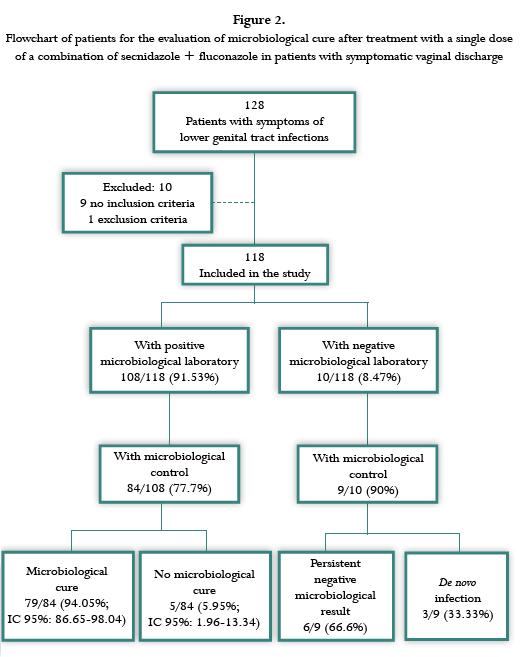
<body><![CDATA[<p><b>RESULTS</b></p>     <p>Between September 1, 2012 and February 15, 2013, 128 women with symptoms of    lower genital tract infections were evaluated. Nine of these women did not meet    the inclusion criteria and one was excluded because she was breast-feeding.    A total of 118 women were included (<a href="#Figure1">figure 1</a>).</p>     <p>       <center>     <a name="Figure1"></a><img src="/img/revistas/rcog/v65n1/v65n1a05f1.jpg">   </center> </p>     <p>The demographic characteristics of the patients are shown in <a href="#Table1">table    1</a>. The median age was 31 years; the mean of BMI was 24.28 kg/m<sup>2 </sup>and    the median of previous pregnancies was 2.0. Fifty-nine patients (50%) reported    previous episodes of genital infections. </p>     <p>       <center>     <a name="Table1"></a><img src="/img/revistas/rcog/v65n1/v65n1a05t1.jpg">   </center> </p>     <p>The most frequent symptom was vaginal discharge (96.6%) followed by foul smell    (57.6%) and pruritus (54.2%). The median duration of symptoms was two months    (range, two days to 12 months). Vaginal discharge was present in all patients    on genital examination. Other signs founded were foul smell (70.3%), erythema    (47.5%) and edema (40.7%). None of the patients had genital ulcers. The amine    test was positive in 48 patients (40.68%), and pH values &gt; 5 were observed    in 93 patients (88.8%). </p>     <p>There was a unique infection in 96 patients and mix infection in 12. The bacterial    vaginosis was diagnosed by the Nugent score, in 62 (57.11%) patients, there    were 46 positive cultures for <i>Candida,</i> of which 30 (65.22%) were <i>Candida    albicans, </i>and<i> </i>16 (34.78%) were other species of <i>Candida</i>. None    of the patients had tricomoniasis. <a href="/img/revistas/rcog/v65n1/v65n1a05t2.jpg" target="_blank">Table    2</a> shows the microbiological laboratory results.</p>     <p>The follow-up evaluation was conducted with a total of 104 women (At the office    in 93 women and via telephone in 11 women) (<a href="#Figure1">figure 1</a>).    A total of 94/104 (90.38%) patients who participated in a follow-up visit, showed    clinical cure. </p>     ]]></body>
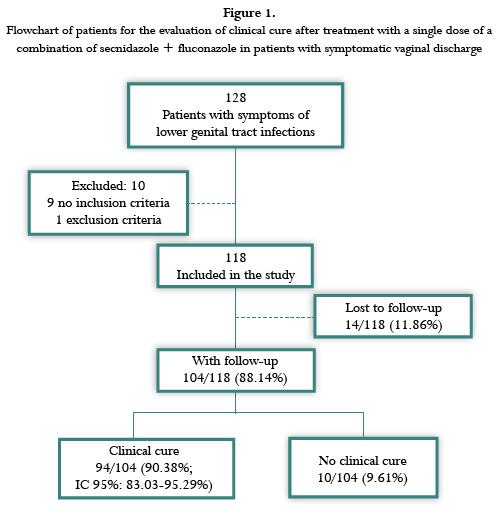
<body><![CDATA[<p>The microbiological analyses corresponding to the index consultation were positive    in 108 of 118 patients (91.53%) patients. In the follow up visit, 93 patients    had microbiological control, microbiological cure was observed in 79 of the    84 (94.05%) patients who had positive results of the cultures taken at the first    visit. Five patients still had an infection: One had candidiasis and four had    BV. One patient who had BV at the time of admission still had BV and also presented    candidiasis. Of the ten patients who had negative microbiological results at    the time of admission, six continued to have negative tests, one was follow    up loss and three had a <i>de novo</i> infection (two candidiasis and one BV)    (<a href="#Figure2">figure 2</a>).</p>     <p>    <center><a name="Figure2"></a><img src="/img/revistas/rcog/v65n1/v65n1a05f2.jpg"></center></p>     <p>In the group of patient with microbiological control, after treatment, 33 of    the 34 patients with candidiasis diagnosed by culture at the time of admission    had negative cultures, founding a microbiological cure rate for candidiasis    of 97.1%, and of the 58 patients with an initial BV diagnosis and with microbiological    control, 55 demonstrated microbiological cure (94.38%). </p>     <p>A second follow-up evaluation was performed face-to-face or over the phone    with 96 patients. At this visit three participants (3.12%) had a syndromic diagnosis    of vaginal discharge, that corresponded in the microbiological results to a    one persistent candidiasis, one recurrent candidiasis (a positive culture at    the time of admission and a negative culture at the first follow-up visit),    and the other patient has recurrent candidiasis plus <i>de novo</i> BV.</p>     <p>Adverse events occurred in 15 patients (16.13%): 12 experienced nausea (12.90%),    three experienced headache (3.23%), three experienced gastritis (3.23%), and    two experienced vomiting (2.15%). Twelve cases (12.90%) were considered drug-related,    and there were no serious adverse events. Five patients (4.76%) had a blood    count at the time of admission that indicated mild leukocytosis, but these blood    counts normalized in the follow-up laboratory test. Two patients (2.11%) who    initially had a normal blood count showed slight changes at the time of the    follow-up visit but did not demonstrate leukopenia or thrombocytopenia.</p>     <p>The median AST level at the time of admission was 18.5 U/L (interquartile range    (IQR): 7-42), and the median ALT level was 18.5 U/L (IQR: 8-77). At the first    follow-up visit, the median AST and ALT levels were 20 U/L (IQR: 10-38) and    18 U/L (IQR: 9-67), without differences with the baseline values (p = 0.0536    for AST and p = 0.8829 for ALT). No patients showed a significant increase in    the blood transaminase levels.</p>     <p><b>DISCUSSION</b></p>     <p>The specific prevalence of the infections found in this study of symptomatic    women with vaginal discharge were 57.11% for BV, 28.81% for candidiasis, and    10.17% for mixed infections (BV plus candidiasis). There were no cases of <i>Trichomonas    </i>infection, and 10 patients (8.47%) had negative laboratory results at the    time of admission. Of the <i>Candida</i> species, 65.22% were <i>Candida albicans</i>,    and the remaining samples were other <i>Candida</i> species. </p>     <p>These results are consistent with those published worldwide. BV and <i>Candida</i>    are the most common causes of vaginal infections in symptomatic women, the prevalence    of BV being 22-50% and the prevalence of <i>Candida</i> 17-39% (12). One study    reported that among women with symptoms of genital tract infections in Colombia,    the prevalence of BV was 39.6%, the prevalence of candidiasis was 11%, and the    prevalence of trichomoniasis was 1% (8). In that study, <i>Candida albicans</i>    accounted for 96.1% of the <i>Candida</i> isolates, a higher proportion than    the founded in the present investigation. This study was not designed to determine    the etiological prevalence of all genital tract infections because the participants    included were patients with symptomatic vaginal discharge who required treatment.  </p>     ]]></body>
<body><![CDATA[<p>In the present study, the overall clinical cure rate with the combination of    oral secnidazole plus fluconazole was 90.38%, and the microbiological cure rate    was 94.05%. Sensitivity analysis: For clinical cure, assuming that all 14 patients    lost to follow-up would not have shown clinical cure, the cure rate would be    79.66% (94/118). Assuming that all 14 patients lost to follow-up were clinically    cured, the cure rate would be 91.52% (108/118).</p>     <p>For microbiological cure, assuming that all 24 patients lost to follow up,    had not demonstrated microbiological cure, the cure rate would be 66.94% (79/118).    Assuming that all 24 patients, who did not have microbiological control, had    demonstrated microbiological cure, the cure rate would be 95.37% (103/108).  </p>     <p>The microbiological cure rate for BV was 94.38%. The reported effectiveness    of BV treatment is similar to the reported effectiveness of metronidazole treatment    in a meta-analysis, which found cure rates of 85% to 87% for treatments with    different schedules (13). A recent meta-analysis on BV treatment for non-pregnant    women concluded that in comparison with a placebo, clindamycin showed a lower    failure rate (RR = 0.25; 95% CI: 0.16-0.37), but clindamycin and metronidazole    had identical rates of failure regardless of the regimen (RR = 1.01; 95% CI:    0.69-1.46) (14). This meta-analysis included only one treatment regimen with    secnidazole. The study compared 1 g vs. 2 g and found clinical cure rates of    95.5 and 97.4%, respectively with similar adverse events (10). The efficacy    observed in the present study is similar to the results reported in the meta-analysis    (15). </p>     <p>With regard to the treatment of candidiasis, the present study found a 97.1%    microbiological cure rate. A systematic review comparing intravaginal treatment    with nitroimidazoles (clotrimazole, miconazole, econazole, and butoconazole)    to oral fluconazole or itraconazole found that both treatments were equally    effective in the short and long term, with cure rates of 82% vs. 83% (OR = 1.03;    95% CI: 0.72-1.49) (16). </p>     <p>Regarding the safety of the combination of oral secnidazole plus fluconazole,    16.13 % of the patients in this study reported no serious adverse events. It    has been reported in the literature that treatments with clindamycin tend to    cause fewer adverse events than those with metronidazole (RR = 0.75; 95% CI:    0.56-1.02) (14). A metallic taste, nausea, and vomiting are more common with    metronidazole treatment (14). </p>     <p>The changes in blood count and liver function tests observed in the present    study did not reach clinical significance. It has been reported that increased    transaminases occurs in 1% to 9% of asymptomatic and apparently healthy individuals.    Likewise, some laboratories consider the normal reference values as under 40    U/L for AST and under 50 U/L for ALT (17). </p>     <p>One of the consequences of BV treatment is <i>Candida albicans </i>superinfection,    which occurred in 3.23% of the patients of the present study. This frequency    is lower than the figures that have been reported in the literature. Studies    have found that <i>Candida </i>superinfection rates were between 15% (13, 18)    to 25% (19) after treatment with metronidazole. </p>     <p>The strengths of this study include the design, the standardization of the    syndromic diagnostic process and of the techniques and interpretation of laboratory    results and the use of gold standard methods for determining the etiologic diagnoses.    The adherence to treatment was 100% because the drug was administered in a controlled    manner during the consultation. </p>     <p> The limitation of the present study is not to have a control group, although    it included etiologic diagnoses and follow-up. The number of patients included    was determined by convenience; however, it was possible to obtain an adequate    number of patients to assess the efficacy of treatment for two types of infections.    Twenty two percent of the patients were lost for the microbiological follow-up,    but a sensitivity analysis for the worst and best scenarios was conducted. </p>     <p><b>CONCLUSION</b></p>     ]]></body>
<body><![CDATA[<p>BV was the most common infection in this study, followed by candidiasis and    mixed infections. A single dose of the combination of oral secnidazole plus    fluconazole achieved clinical and microbiological cure rates greater than 90%    in patients with symptomatic lower genital tract infections. The patients reported    gastrointestinal side effects but there were no serious adverse events. RCT    comparing this combination against single treatment for each type of infection    should be done in order to evaluate its effectiveness. </p>     <p><b>ACKNOWLEDGMENTS</b></p>     <p>The authors wish to thank the Engativ&aacute; Hospital, which provided facilities    for the study, the patients who participated, and the staff members who recruited,    evaluated, and treated the patients (Dr. Tatiana Pacheco, bacteriologist Marleny    Sierra, and Nurse Jenny Bonilla). We also thank to nurse Natalia Calderon, for    coordinating the study and digitizing the database. </p>     <p><b>REFERENCES</b></p>     <!-- ref --><p>1. Sewankambo N, Gray RH, Wawer MJ, et al. HIV and HIV-2 infection associated    with abnormal vaginal flora morphology and bacterial vaginosis. Lancet. 1997;350:546-50.    &nbsp;&nbsp;&nbsp;&nbsp;&nbsp;&nbsp;&nbsp;&nbsp;[&#160;<a href="javascript:void(0);" onclick="javascript: window.open('/scielo.php?script=sci_nlinks&ref=000077&pid=S0034-7434201400010000500001&lng=','','width=640,height=500,resizable=yes,scrollbars=1,menubar=yes,');">Links</a>&#160;]<!-- end-ref --></p>     <!-- ref --><p>2. Hashemi FB, Ghassemi M, Roebuck KA, Spear GT. Activation of human immunodeficiency    virus type 1 expression by <i>Gardnerella vaginalis</i>. J Infect Dis. 1999;179:924-30.    &nbsp;&nbsp;&nbsp;&nbsp;&nbsp;&nbsp;&nbsp;&nbsp;[&#160;<a href="javascript:void(0);" onclick="javascript: window.open('/scielo.php?script=sci_nlinks&ref=000079&pid=S0034-7434201400010000500002&lng=','','width=640,height=500,resizable=yes,scrollbars=1,menubar=yes,');">Links</a>&#160;]<!-- end-ref --></p>     <!-- ref --><p>3. Jackson DJ, Rakwar JP, Bwayo JJ, Kreiss JK, Moses S. Urethral Trichomonas    vaginalis infection and HIV-1 transmission. Lancet. 1997;350: 1076.    &nbsp;&nbsp;&nbsp;&nbsp;&nbsp;&nbsp;&nbsp;&nbsp;[&#160;<a href="javascript:void(0);" onclick="javascript: window.open('/scielo.php?script=sci_nlinks&ref=000081&pid=S0034-7434201400010000500003&lng=','','width=640,height=500,resizable=yes,scrollbars=1,menubar=yes,');">Links</a>&#160;]<!-- end-ref --></p>     ]]></body>
<body><![CDATA[<!-- ref --><p>4. World Health Organization. Guidelines for the management of sexually transmitted    infections 2005. &#91;Visited 2011 nov 11&#93;. Available in: <a href="http://www.who.int/hiv/pub/sti/pub6/en/" target="_blank">http://www.who.int/hiv/pub/sti/pub6/en/</a>.    &nbsp;&nbsp;&nbsp;&nbsp;&nbsp;&nbsp;&nbsp;&nbsp;[&#160;<a href="javascript:void(0);" onclick="javascript: window.open('/scielo.php?script=sci_nlinks&ref=000083&pid=S0034-7434201400010000500004&lng=','','width=640,height=500,resizable=yes,scrollbars=1,menubar=yes,');">Links</a>&#160;]<!-- end-ref -->  </p>     <!-- ref --><p>5. van Dam CJ, Becker KM, Ndowa F, Islam MQ. Syndromic approach to STD case    management: where do we go from here? Sex Transm Infect. 1998;74(Suppl 1):S175-8.    &nbsp;&nbsp;&nbsp;&nbsp;&nbsp;&nbsp;&nbsp;&nbsp;[&#160;<a href="javascript:void(0);" onclick="javascript: window.open('/scielo.php?script=sci_nlinks&ref=000085&pid=S0034-7434201400010000500005&lng=','','width=640,height=500,resizable=yes,scrollbars=1,menubar=yes,');">Links</a>&#160;]<!-- end-ref --></p>     <!-- ref --><p>6. Msuya SE, Uriyo J, Stray-Pedersen B, Sam NE, Mbizvo EM. The effectiveness    of a syndromic approach in managing vaginal infections among pregnant women    in northern Tanzania. East Afr J Public Health. 2009;6:263-7.    &nbsp;&nbsp;&nbsp;&nbsp;&nbsp;&nbsp;&nbsp;&nbsp;[&#160;<a href="javascript:void(0);" onclick="javascript: window.open('/scielo.php?script=sci_nlinks&ref=000087&pid=S0034-7434201400010000500006&lng=','','width=640,height=500,resizable=yes,scrollbars=1,menubar=yes,');">Links</a>&#160;]<!-- end-ref --><!-- ref --><p>7. Rep&uacute;blica de Colombia. Ministerio de Salud. Direcci&oacute;n General de Promoci&oacute;n    y Prevenci&oacute;n. Normas t&eacute;cnicas y gu&iacute;as de atenci&oacute;n. Acuerdo 117/98, Resoluci&oacute;n    412/2000. &#91;Republic of Colombia. Ministry of Health. Promotion and Prevention    Directorate-General. Technical standards and guidelines of care.Agreement 117/98,    Resolution 412/2000.    &nbsp;&nbsp;&nbsp;&nbsp;&nbsp;&nbsp;&nbsp;&nbsp;[&#160;<a href="javascript:void(0);" onclick="javascript: window.open('/scielo.php?script=sci_nlinks&ref=000088&pid=S0034-7434201400010000500007&lng=','','width=640,height=500,resizable=yes,scrollbars=1,menubar=yes,');">Links</a>&#160;]<!-- end-ref -->&#93;      <!-- ref --><p>8. Angel-M&uuml;ller E, Rodr&iacute;guez A, N&uacute;&ntilde;ez-Forero LM, Moyano LF, Gonz&aacute;lez P, Osorio    E, et al. The prevalence of and factors associated with C. Trachomatis, N. Gonorrhoeae,    T. Vaginalis, C. Albicans infection, syphilis, HIV and bacterial vaginosis in    females suffering lower genital tract infection symptoms in three healthcare    attention sites in Bogot&aacute;, Colombia, 2010. Rev Colomb Obstet Ginecol. 2010;63:25-35.    &nbsp;&nbsp;&nbsp;&nbsp;&nbsp;&nbsp;&nbsp;&nbsp;[&#160;<a href="javascript:void(0);" onclick="javascript: window.open('/scielo.php?script=sci_nlinks&ref=000090&pid=S0034-7434201400010000500008&lng=','','width=640,height=500,resizable=yes,scrollbars=1,menubar=yes,');">Links</a>&#160;]<!-- end-ref --><!-- ref --><p>9. De Punzio C, Garutti P, Mollica G et al. Fluconazol 150 mg single dose versus    itraconazol 200 mg per day for 3 days in the treatment of acute vaginal candidiasis:    a double-blind randomized study. Europ J Obstet Gynecol Reprod Biol. 2003;106:193-7.    &nbsp;&nbsp;&nbsp;&nbsp;&nbsp;&nbsp;&nbsp;&nbsp;[&#160;<a href="javascript:void(0);" onclick="javascript: window.open('/scielo.php?script=sci_nlinks&ref=000091&pid=S0034-7434201400010000500009&lng=','','width=640,height=500,resizable=yes,scrollbars=1,menubar=yes,');">Links</a>&#160;]<!-- end-ref --><!-- ref --><p>10. Nu&ntilde;ez JT, G&oacute;mez G. Low-dose secnidazole in the treatment of bacterial vaginosis.    Int J Obstet Gynecol. 2005;88:281-5.    &nbsp;&nbsp;&nbsp;&nbsp;&nbsp;&nbsp;&nbsp;&nbsp;[&#160;<a href="javascript:void(0);" onclick="javascript: window.open('/scielo.php?script=sci_nlinks&ref=000092&pid=S0034-7434201400010000500010&lng=','','width=640,height=500,resizable=yes,scrollbars=1,menubar=yes,');">Links</a>&#160;]<!-- end-ref --> </p>     <!-- ref --><p>11. Nugent RP, Krohn MA, Hillier SL. Reliability of diagnosing bacterial vaginosis    is improved by a standardized method of gram stain interpretation. J Clin Microbiol.    1991;29:297-301.    &nbsp;&nbsp;&nbsp;&nbsp;&nbsp;&nbsp;&nbsp;&nbsp;[&#160;<a href="javascript:void(0);" onclick="javascript: window.open('/scielo.php?script=sci_nlinks&ref=000094&pid=S0034-7434201400010000500011&lng=','','width=640,height=500,resizable=yes,scrollbars=1,menubar=yes,');">Links</a>&#160;]<!-- end-ref --> </p>     <!-- ref --><p>12. Nyirjesy P. Vulvovaginal candidiasis and bacterial vaginosis. Infect Dis    Clin N Am. 2008;22:637-52.    &nbsp;&nbsp;&nbsp;&nbsp;&nbsp;&nbsp;&nbsp;&nbsp;[&#160;<a href="javascript:void(0);" onclick="javascript: window.open('/scielo.php?script=sci_nlinks&ref=000096&pid=S0034-7434201400010000500012&lng=','','width=640,height=500,resizable=yes,scrollbars=1,menubar=yes,');">Links</a>&#160;]<!-- end-ref --> </p>     <!-- ref --><p>13. Lugo-Miro VI, Green M, Mazur L. Comparison of different metronidazole therapeutic    regimens for bacterial vaginosis. A meta-analysis. JAMA. 1992;268: 92-5.    &nbsp;&nbsp;&nbsp;&nbsp;&nbsp;&nbsp;&nbsp;&nbsp;[&#160;<a href="javascript:void(0);" onclick="javascript: window.open('/scielo.php?script=sci_nlinks&ref=000098&pid=S0034-7434201400010000500013&lng=','','width=640,height=500,resizable=yes,scrollbars=1,menubar=yes,');">Links</a>&#160;]<!-- end-ref --> </p>     <!-- ref --><p>14. Oduyebo O, Anorlu RI, Ogunsola FT. The effects of antimicrobial therapy    on bacterial vaginosis in nonpregnant women. Cochrane Database of Systematic    Reviews 2009, Issue 3. Art. No.: CD006055. DOI: 10.1002/14651858. CD006055.    pub2.    &nbsp;&nbsp;&nbsp;&nbsp;&nbsp;&nbsp;&nbsp;&nbsp;[&#160;<a href="javascript:void(0);" onclick="javascript: window.open('/scielo.php?script=sci_nlinks&ref=000100&pid=S0034-7434201400010000500014&lng=','','width=640,height=500,resizable=yes,scrollbars=1,menubar=yes,');">Links</a>&#160;]<!-- end-ref --> </p>     <!-- ref --><p>15. Armstrong NR, Wilson JD. Tinidazole in the treatment of bacterial vaginosis.    Int J Women’s Health. 2009;1:59-65.    &nbsp;&nbsp;&nbsp;&nbsp;&nbsp;&nbsp;&nbsp;&nbsp;[&#160;<a href="javascript:void(0);" onclick="javascript: window.open('/scielo.php?script=sci_nlinks&ref=000102&pid=S0034-7434201400010000500015&lng=','','width=640,height=500,resizable=yes,scrollbars=1,menubar=yes,');">Links</a>&#160;]<!-- end-ref --> </p>     <!-- ref --><p>16. Nurbhai M, Grimshaw J, Watson M, et al. Oral versus intra-vaginal imidazole    and triazole antifungal treatment of uncomplicated vulvovaginal candidiasis    (thrush). In: The Cochrane Library, Issue 4, Chichester: John Wiley & Sons;    2007.    &nbsp;&nbsp;&nbsp;&nbsp;&nbsp;&nbsp;&nbsp;&nbsp;[&#160;<a href="javascript:void(0);" onclick="javascript: window.open('/scielo.php?script=sci_nlinks&ref=000104&pid=S0034-7434201400010000500016&lng=','','width=640,height=500,resizable=yes,scrollbars=1,menubar=yes,');">Links</a>&#160;]<!-- end-ref --> </p>     <!-- ref --><p>17. Aragon G, Younossi ZM. When and how to evaluate mildly elevated liver enzymes    in apparently healthy patients. Cleve Clin J Med. 2010;77:195-204.    &nbsp;&nbsp;&nbsp;&nbsp;&nbsp;&nbsp;&nbsp;&nbsp;[&#160;<a href="javascript:void(0);" onclick="javascript: window.open('/scielo.php?script=sci_nlinks&ref=000106&pid=S0034-7434201400010000500017&lng=','','width=640,height=500,resizable=yes,scrollbars=1,menubar=yes,');">Links</a>&#160;]<!-- end-ref --> </p>     <!-- ref --><p>18. Jerve F, Berdal TB, Boham P, et al. Metronidazole in the treatment of non-specific    vaginitis (NSV). Br J Vener Dis. 1984;60:171-174.    &nbsp;&nbsp;&nbsp;&nbsp;&nbsp;&nbsp;&nbsp;&nbsp;[&#160;<a href="javascript:void(0);" onclick="javascript: window.open('/scielo.php?script=sci_nlinks&ref=000108&pid=S0034-7434201400010000500018&lng=','','width=640,height=500,resizable=yes,scrollbars=1,menubar=yes,');">Links</a>&#160;]<!-- end-ref --> </p>     <!-- ref --><p>19. Hovik P. Nonspecific vaginitis in an outpatient clinic: comparison of three    dose regimens of metronidazole. Scand J Infect Dis Suppl. 1983;40:107-110.    &nbsp;&nbsp;&nbsp;&nbsp;&nbsp;&nbsp;&nbsp;&nbsp;[&#160;<a href="javascript:void(0);" onclick="javascript: window.open('/scielo.php?script=sci_nlinks&ref=000110&pid=S0034-7434201400010000500019&lng=','','width=640,height=500,resizable=yes,scrollbars=1,menubar=yes,');">Links</a>&#160;]<!-- end-ref --></p>     <p><b>Conflict of interest statement and intellectual property.</b> The study:    "Effectiveness and safety of the combination of fluconazole and secnidazole    for the treatment of symptomatic vaginal discharge. Bogot&aacute; D. C., Colombia",    is of intelectual property of the National University of Colombia. It was funded    by Lafrancol S.A.S., which had access to the information only to verify the    quality of the recorded data. The data analysis and results and the preparation    of the manuscript were completely independent from the funding body. The funding    body previously agreed to the publication of the study regardless of the direction    of the results. </font>      ]]></body>
<body><![CDATA[ ]]></body><back>
<ref-list>
<ref id="B1">
<label>1</label><nlm-citation citation-type="journal">
<person-group person-group-type="author">
<name>
<surname><![CDATA[Sewankambo]]></surname>
<given-names><![CDATA[N]]></given-names>
</name>
<name>
<surname><![CDATA[Gray]]></surname>
<given-names><![CDATA[RH]]></given-names>
</name>
<name>
<surname><![CDATA[Wawer]]></surname>
<given-names><![CDATA[MJ]]></given-names>
</name>
</person-group>
<article-title xml:lang="en"><![CDATA[HIV and HIV-2 infection associated with abnormal vaginal flora morphology and bacterial vaginosis]]></article-title>
<source><![CDATA[Lancet.]]></source>
<year>1997</year>
<volume>350</volume>
<page-range>546-50</page-range></nlm-citation>
</ref>
<ref id="B2">
<label>2</label><nlm-citation citation-type="journal">
<person-group person-group-type="author">
<name>
<surname><![CDATA[Hashemi]]></surname>
<given-names><![CDATA[FB]]></given-names>
</name>
<name>
<surname><![CDATA[Ghassemi]]></surname>
<given-names><![CDATA[M]]></given-names>
</name>
<name>
<surname><![CDATA[Roebuck]]></surname>
<given-names><![CDATA[KA]]></given-names>
</name>
<name>
<surname><![CDATA[Spear]]></surname>
<given-names><![CDATA[GT]]></given-names>
</name>
</person-group>
<article-title xml:lang="en"><![CDATA[Activation of human immunodeficiency virus type 1 expression by Gardnerella vaginalis]]></article-title>
<source><![CDATA[J Infect Dis.]]></source>
<year>1999</year>
<volume>179</volume>
<page-range>924-30</page-range></nlm-citation>
</ref>
<ref id="B3">
<label>3</label><nlm-citation citation-type="journal">
<person-group person-group-type="author">
<name>
<surname><![CDATA[Jackson]]></surname>
<given-names><![CDATA[DJ]]></given-names>
</name>
<name>
<surname><![CDATA[Rakwar]]></surname>
<given-names><![CDATA[JP]]></given-names>
</name>
<name>
<surname><![CDATA[Bwayo]]></surname>
<given-names><![CDATA[JJ]]></given-names>
</name>
<name>
<surname><![CDATA[Kreiss]]></surname>
<given-names><![CDATA[JK]]></given-names>
</name>
<name>
<surname><![CDATA[Moses]]></surname>
<given-names><![CDATA[S]]></given-names>
</name>
</person-group>
<article-title xml:lang="en"><![CDATA[Urethral Trichomonas vaginalis infection and HIV-1 transmission]]></article-title>
<source><![CDATA[Lancet.]]></source>
<year>1997</year>
<volume>350</volume>
<page-range>1076</page-range></nlm-citation>
</ref>
<ref id="B4">
<label>4</label><nlm-citation citation-type="">
<collab>World Health Organization</collab>
<source><![CDATA[Guidelines for the management of sexually transmitted infections 2005]]></source>
<year></year>
</nlm-citation>
</ref>
<ref id="B5">
<label>5</label><nlm-citation citation-type="journal">
<person-group person-group-type="author">
<name>
<surname><![CDATA[van Dam]]></surname>
<given-names><![CDATA[CJ]]></given-names>
</name>
<name>
<surname><![CDATA[Becker]]></surname>
<given-names><![CDATA[KM]]></given-names>
</name>
<name>
<surname><![CDATA[Ndowa]]></surname>
<given-names><![CDATA[F]]></given-names>
</name>
<name>
<surname><![CDATA[Islam]]></surname>
<given-names><![CDATA[MQ]]></given-names>
</name>
</person-group>
<article-title xml:lang="en"><![CDATA[Syndromic approach to STD case management: where do we go from here?]]></article-title>
<source><![CDATA[Sex Transm Infect.]]></source>
<year>1998</year>
<volume>74</volume>
<numero>^s1</numero>
<issue>^s1</issue>
<supplement>1</supplement>
<page-range>S175-8</page-range></nlm-citation>
</ref>
<ref id="B6">
<label>6</label><nlm-citation citation-type="journal">
<person-group person-group-type="author">
<name>
<surname><![CDATA[Msuya]]></surname>
<given-names><![CDATA[SE]]></given-names>
</name>
<name>
<surname><![CDATA[Uriyo]]></surname>
<given-names><![CDATA[J]]></given-names>
</name>
<name>
<surname><![CDATA[Stray-Pedersen]]></surname>
<given-names><![CDATA[B]]></given-names>
</name>
<name>
<surname><![CDATA[Sam]]></surname>
<given-names><![CDATA[NE]]></given-names>
</name>
<name>
<surname><![CDATA[Mbizvo]]></surname>
<given-names><![CDATA[EM]]></given-names>
</name>
</person-group>
<article-title xml:lang="en"><![CDATA[The effectiveness of a syndromic approach in managing vaginal infections among pregnant women in northern Tanzania]]></article-title>
<source><![CDATA[East Afr J Public Health.]]></source>
<year>2009</year>
<volume>6</volume>
<page-range>263-7</page-range></nlm-citation>
</ref>
<ref id="B7">
<label>7</label><nlm-citation citation-type="">
<collab>República de Colombia^dMinisterio de Salud. Dirección General de Promoción y Prevención</collab>
<source><![CDATA[Normas técnicas y guías de atención: Acuerdo 117/98, Resolución 412/2000]]></source>
<year></year>
</nlm-citation>
</ref>
<ref id="B8">
<label>8</label><nlm-citation citation-type="journal">
<person-group person-group-type="author">
<name>
<surname><![CDATA[Angel-Müller]]></surname>
<given-names><![CDATA[E]]></given-names>
</name>
<name>
<surname><![CDATA[Rodríguez]]></surname>
<given-names><![CDATA[A]]></given-names>
</name>
<name>
<surname><![CDATA[Núñez-Forero]]></surname>
<given-names><![CDATA[LM]]></given-names>
</name>
<name>
<surname><![CDATA[Moyano]]></surname>
<given-names><![CDATA[LF]]></given-names>
</name>
<name>
<surname><![CDATA[González]]></surname>
<given-names><![CDATA[P]]></given-names>
</name>
<name>
<surname><![CDATA[Osorio]]></surname>
<given-names><![CDATA[E]]></given-names>
</name>
</person-group>
<article-title xml:lang="en"><![CDATA[The prevalence of and factors associated with C. Trachomatis, N. Gonorrhoeae, T. Vaginalis, C. Albicans infection, syphilis, HIV and bacterial vaginosis in females suffering lower genital tract infection symptoms in three healthcare attention sites in Bogotá, Colombia, 2010]]></article-title>
<source><![CDATA[Rev Colomb Obstet Ginecol.]]></source>
<year>2010</year>
<volume>63</volume>
<page-range>25-35</page-range></nlm-citation>
</ref>
<ref id="B9">
<label>9</label><nlm-citation citation-type="journal">
<person-group person-group-type="author">
<name>
<surname><![CDATA[De Punzio]]></surname>
<given-names><![CDATA[C]]></given-names>
</name>
<name>
<surname><![CDATA[Garutti]]></surname>
<given-names><![CDATA[P]]></given-names>
</name>
<name>
<surname><![CDATA[Mollica]]></surname>
<given-names><![CDATA[G]]></given-names>
</name>
</person-group>
<article-title xml:lang="en"><![CDATA[Fluconazol 150 mg single dose versus itraconazol 200 mg per day for 3 days in the treatment of acute vaginal candidiasis: a double-blind randomized study]]></article-title>
<source><![CDATA[Europ J Obstet Gynecol Reprod Biol.]]></source>
<year>2003</year>
<volume>106</volume>
<page-range>193-7</page-range></nlm-citation>
</ref>
<ref id="B10">
<label>10</label><nlm-citation citation-type="journal">
<person-group person-group-type="author">
<name>
<surname><![CDATA[Nuñez]]></surname>
<given-names><![CDATA[JT]]></given-names>
</name>
<name>
<surname><![CDATA[Gómez]]></surname>
<given-names><![CDATA[G]]></given-names>
</name>
</person-group>
<article-title xml:lang="en"><![CDATA[Low-dose secnidazole in the treatment of bacterial vaginosis]]></article-title>
<source><![CDATA[Int J Obstet Gynecol.]]></source>
<year>2005</year>
<volume>88</volume>
<page-range>281-5</page-range></nlm-citation>
</ref>
<ref id="B11">
<label>11</label><nlm-citation citation-type="journal">
<person-group person-group-type="author">
<name>
<surname><![CDATA[Nugent]]></surname>
<given-names><![CDATA[RP]]></given-names>
</name>
<name>
<surname><![CDATA[Krohn]]></surname>
<given-names><![CDATA[MA]]></given-names>
</name>
<name>
<surname><![CDATA[Hillier]]></surname>
<given-names><![CDATA[SL]]></given-names>
</name>
</person-group>
<article-title xml:lang="en"><![CDATA[Reliability of diagnosing bacterial vaginosis is improved by a standardized method of gram stain interpretation]]></article-title>
<source><![CDATA[J Clin Microbiol.]]></source>
<year>1991</year>
<volume>29</volume>
<page-range>297-301</page-range></nlm-citation>
</ref>
<ref id="B12">
<label>12</label><nlm-citation citation-type="journal">
<person-group person-group-type="author">
<name>
<surname><![CDATA[Nyirjesy]]></surname>
<given-names><![CDATA[P]]></given-names>
</name>
</person-group>
<article-title xml:lang="en"><![CDATA[Vulvovaginal candidiasis and bacterial vaginosis]]></article-title>
<source><![CDATA[Infect Dis Clin N Am.]]></source>
<year>2008</year>
<volume>22</volume>
<page-range>637-52</page-range></nlm-citation>
</ref>
<ref id="B13">
<label>13</label><nlm-citation citation-type="journal">
<person-group person-group-type="author">
<name>
<surname><![CDATA[Lugo-Miro]]></surname>
<given-names><![CDATA[VI]]></given-names>
</name>
<name>
<surname><![CDATA[Green]]></surname>
<given-names><![CDATA[M]]></given-names>
</name>
<name>
<surname><![CDATA[Mazur]]></surname>
<given-names><![CDATA[L.]]></given-names>
</name>
</person-group>
<article-title xml:lang="en"><![CDATA[Comparison of different metronidazole therapeutic regimens for bacterial vaginosis.: A meta-analysis]]></article-title>
<source><![CDATA[JAMA.]]></source>
<year>1992</year>
<volume>268</volume>
<page-range>92-5</page-range></nlm-citation>
</ref>
<ref id="B14">
<label>14</label><nlm-citation citation-type="journal">
<person-group person-group-type="author">
<name>
<surname><![CDATA[Oduyebo]]></surname>
<given-names><![CDATA[O]]></given-names>
</name>
<name>
<surname><![CDATA[Anorlu]]></surname>
<given-names><![CDATA[RI]]></given-names>
</name>
<name>
<surname><![CDATA[Ogunsola]]></surname>
<given-names><![CDATA[FT]]></given-names>
</name>
</person-group>
<article-title xml:lang="en"><![CDATA[The effects of antimicrobial therapy on bacterial vaginosis in nonpregnant women]]></article-title>
<source><![CDATA[Cochrane Database of Systematic Reviews]]></source>
<year>2009</year>
<numero>3</numero>
<issue>3</issue>
</nlm-citation>
</ref>
<ref id="B15">
<label>15</label><nlm-citation citation-type="journal">
<person-group person-group-type="author">
<name>
<surname><![CDATA[Armstrong]]></surname>
<given-names><![CDATA[NR]]></given-names>
</name>
<name>
<surname><![CDATA[Wilson]]></surname>
<given-names><![CDATA[JD]]></given-names>
</name>
</person-group>
<article-title xml:lang="en"><![CDATA[Tinidazole in the treatment of bacterial vaginosis]]></article-title>
<source><![CDATA[Int J Women’s Health.]]></source>
<year>2009</year>
<volume>1</volume>
<page-range>59-65</page-range></nlm-citation>
</ref>
<ref id="B16">
<label>16</label><nlm-citation citation-type="book">
<person-group person-group-type="author">
<name>
<surname><![CDATA[Nurbhai]]></surname>
<given-names><![CDATA[M]]></given-names>
</name>
<name>
<surname><![CDATA[Grimshaw]]></surname>
<given-names><![CDATA[J]]></given-names>
</name>
<name>
<surname><![CDATA[Watson]]></surname>
<given-names><![CDATA[M]]></given-names>
</name>
</person-group>
<article-title xml:lang="en"><![CDATA[Oral versus intra-vaginal imidazole and triazole antifungal treatment of uncomplicated vulvovaginal candidiasis (thrush)]]></article-title>
<source><![CDATA[The Cochrane Library]]></source>
<year>2007</year>
<publisher-loc><![CDATA[Chichester ]]></publisher-loc>
<publisher-name><![CDATA[John Wiley & Sons]]></publisher-name>
</nlm-citation>
</ref>
<ref id="B17">
<label>17</label><nlm-citation citation-type="journal">
<person-group person-group-type="author">
<name>
<surname><![CDATA[Aragon]]></surname>
<given-names><![CDATA[G]]></given-names>
</name>
<name>
<surname><![CDATA[Younossi]]></surname>
<given-names><![CDATA[ZM]]></given-names>
</name>
</person-group>
<article-title xml:lang="en"><![CDATA[When and how to evaluate mildly elevated liver enzymes in apparently healthy patients]]></article-title>
<source><![CDATA[Cleve Clin J Med.]]></source>
<year>2010</year>
<volume>77</volume>
<page-range>195-204</page-range></nlm-citation>
</ref>
<ref id="B18">
<label>18</label><nlm-citation citation-type="journal">
<person-group person-group-type="author">
<name>
<surname><![CDATA[Jerve]]></surname>
<given-names><![CDATA[F]]></given-names>
</name>
<name>
<surname><![CDATA[Berdal]]></surname>
<given-names><![CDATA[TB]]></given-names>
</name>
<name>
<surname><![CDATA[Boham]]></surname>
<given-names><![CDATA[P]]></given-names>
</name>
</person-group>
<article-title xml:lang="en"><![CDATA[Metronidazole in the treatment of non-specific vaginitis (NSV)]]></article-title>
<source><![CDATA[Br J Vener Dis.]]></source>
<year>1984</year>
<volume>60</volume>
<page-range>171-174</page-range></nlm-citation>
</ref>
<ref id="B19">
<label>19</label><nlm-citation citation-type="journal">
<person-group person-group-type="author">
<name>
<surname><![CDATA[Hovik]]></surname>
<given-names><![CDATA[P]]></given-names>
</name>
</person-group>
<article-title xml:lang="en"><![CDATA[Nonspecific vaginitis in an outpatient clinic: comparison of three dose regimens of metronidazole]]></article-title>
<source><![CDATA[Scand J Infect Dis Suppl.]]></source>
<year>1983</year>
<volume>40</volume>
<page-range>107-110</page-range></nlm-citation>
</ref>
</ref-list>
</back>
</article>