<?xml version="1.0" encoding="ISO-8859-1"?><article xmlns:mml="http://www.w3.org/1998/Math/MathML" xmlns:xlink="http://www.w3.org/1999/xlink" xmlns:xsi="http://www.w3.org/2001/XMLSchema-instance">
<front>
<journal-meta>
<journal-id>0120-0690</journal-id>
<journal-title><![CDATA[Revista Colombiana de Ciencias Pecuarias]]></journal-title>
<abbrev-journal-title><![CDATA[Rev Colom Cienc Pecua]]></abbrev-journal-title>
<issn>0120-0690</issn>
<publisher>
<publisher-name><![CDATA[Facultad de Ciencias Agrarias, Universidad de Antioquia]]></publisher-name>
</publisher>
</journal-meta>
<article-meta>
<article-id>S0120-06902006000200003</article-id>
<title-group>
<article-title xml:lang="en"><![CDATA[Evaluation of milt quality of the yamú Brycon amazonicus under hormonal induction]]></article-title>
<article-title xml:lang="es"><![CDATA[Evaluación de la calidad seminal del yamú (Brycon amazonicus) bajo inducción hormonal]]></article-title>
</title-group>
<contrib-group>
<contrib contrib-type="author">
<name>
<surname><![CDATA[Pardo-Carrasco]]></surname>
<given-names><![CDATA[Sandra C]]></given-names>
</name>
<xref ref-type="aff" rid="A01"/>
</contrib>
<contrib contrib-type="author">
<name>
<surname><![CDATA[Zaniboni-Filho]]></surname>
<given-names><![CDATA[Evoy]]></given-names>
</name>
<xref ref-type="aff" rid="A02"/>
</contrib>
<contrib contrib-type="author">
<name>
<surname><![CDATA[Arias-Castellanos]]></surname>
<given-names><![CDATA[José A]]></given-names>
</name>
<xref ref-type="aff" rid="A03"/>
</contrib>
<contrib contrib-type="author">
<name>
<surname><![CDATA[Suárez-Mahecha]]></surname>
<given-names><![CDATA[Héctor]]></given-names>
</name>
<xref ref-type="aff" rid="A01"/>
</contrib>
<contrib contrib-type="author">
<name>
<surname><![CDATA[Atencio-García]]></surname>
<given-names><![CDATA[Víctor J]]></given-names>
</name>
<xref ref-type="aff" rid="A01"/>
</contrib>
<contrib contrib-type="author">
<name>
<surname><![CDATA[Cruz-Casallas]]></surname>
<given-names><![CDATA[Pablo E]]></given-names>
</name>
<xref ref-type="aff" rid="A03"/>
</contrib>
</contrib-group>
<aff id="A01">
<institution><![CDATA[,Universidad de Córdoba Departamento de Ciencias Acuícolas Centro de Investigación Piscícola]]></institution>
<addr-line><![CDATA[Montería ]]></addr-line>
<country>Colombia</country>
</aff>
<aff id="A02">
<institution><![CDATA[,Universidade Federal de Santa Catarina Departamento de Aquicultura ]]></institution>
<addr-line><![CDATA[Florianópolis ]]></addr-line>
<country>Brazil</country>
</aff>
<aff id="A03">
<institution><![CDATA[,Universidad de los Llanos Instituto de Acuicultura ]]></institution>
<addr-line><![CDATA[Villavicencio ]]></addr-line>
<country>Colombia</country>
</aff>
<pub-date pub-type="pub">
<day>00</day>
<month>06</month>
<year>2006</year>
</pub-date>
<pub-date pub-type="epub">
<day>00</day>
<month>06</month>
<year>2006</year>
</pub-date>
<volume>19</volume>
<numero>2</numero>
<fpage>134</fpage>
<lpage>139</lpage>
<copyright-statement/>
<copyright-year/>
<self-uri xlink:href="http://www.scielo.org.co/scielo.php?script=sci_arttext&amp;pid=S0120-06902006000200003&amp;lng=en&amp;nrm=iso"></self-uri><self-uri xlink:href="http://www.scielo.org.co/scielo.php?script=sci_abstract&amp;pid=S0120-06902006000200003&amp;lng=en&amp;nrm=iso"></self-uri><self-uri xlink:href="http://www.scielo.org.co/scielo.php?script=sci_pdf&amp;pid=S0120-06902006000200003&amp;lng=en&amp;nrm=iso"></self-uri><abstract abstract-type="short" xml:lang="en"><p><![CDATA[Two-year old and first sexual maturation male Yamú Brycon amazonicus were selected, according to the presence of semen under gentle abdominal pressure (body weight BW 1.300 ± 3 g; Total length TL 41.4 ± 0.2 cm, mean ± SEM). Five treatments were carried out: three with mGnRHa (10, 15 and 20 µg/kg in a single dose), one with carp pituitary extract CPE (4.4 mg/kg in two applications, 10 and 90 % with a 12 h interval) and a treatment control with application only of saline solution (0.9%). The volume, spermatic concentration, spermatocrit, fertility rate, percentage of live spermatozoa, motility and activation time were evaluated. The CPE caused an increase in volume, a decrease in sperm concentration and spermatocrit. A positive linear regression between the spermatocrit and the sperm concentration was found (p<0.05, r= 0.42). The fertility rate was evaluated by the ration of spermatozoa/eggs, which oscillated between 3.06 ± 0.2 x 10⁵ and 6.75 ± 0,3 x 10⁵, without displaying an effect on fertility rate (p>0.05). For the other parameters evaluated, there were no differences, between the hormones utilized, or between them and the control. It was concluded that the CPE influences, the sperm fluidity, increasing the volume and decreasing the concentration, while the mGnRH-a does not cause any quantitative or qualitative changes in the yamú semen.]]></p></abstract>
<abstract abstract-type="short" xml:lang="es"><p><![CDATA[Machos de dos años de edad y primera maduración sexual de yamú Brycon amazonicus fueron seleccionados de acuerdo con la presencia de semen bajo una ligera presión abdominal (peso corporal PC 1300 ± 3 g, longitud total LT 41.4 ± 0.2 cm, media ± SEM). Fueron realizados cinco tratamientos: tres con mGnRH-a (10, 15 y 20 µg/kg en una única aplicación), uno con EPC (4.4 mg/kg en dos aplicaciones, 10 y 90 % con un intervalo de 12 h) y un tratamiento control con solamente aplicación de solución salina (0.9 %). El volumen, la concentración espermática, el espermatocrito, la tasa de fertilidad, el porcentaje de espermatozoides vivos, la motilidad y el tiempo de activación fueron evaluados. El EPC causó un incremento en el volumen de líquido espermático y consiguiente disminución en la concentración espermática y en el espermatocrito. Se halló encontrada una regresión lineal positiva entre el espermatocrito y la concentración espermática (p<0.05, r= 0.42). La tasa de fertilidad se evaluó bajo una proporción de espermatozoides/huevos que osciló entre 3.06 ± 0.2 x 10⁵ y 6.75 ± 0.3 x 10⁵, sin presentar ningún efecto sobre la tasa de fertilidad (p>0.05). Para los otros parámetros evaluados, no hubo diferencia entre los grupos suplementados con hormonas ni entre el grupo control y estos. Se concluyó que el EPC tiene influencia sobre la fluidez del semen, incrementando el volumen de líquido espermático y disminuyendo consecuentemente la concentración espermática, mientras que el mGnRH-a no causa ningún cambio cuantitativo o cualitativo en el semen del Yamú.]]></p></abstract>
<kwd-group>
<kwd lng="en"><![CDATA[artificial reproduction]]></kwd>
<kwd lng="en"><![CDATA[Bryconinae]]></kwd>
<kwd lng="en"><![CDATA[CPE]]></kwd>
<kwd lng="en"><![CDATA[mGnRH]]></kwd>
<kwd lng="en"><![CDATA[semen]]></kwd>
<kwd lng="es"><![CDATA[Bryconinae]]></kwd>
<kwd lng="es"><![CDATA[CPE]]></kwd>
<kwd lng="es"><![CDATA[mGnRH]]></kwd>
<kwd lng="es"><![CDATA[reproducción artificial]]></kwd>
<kwd lng="es"><![CDATA[semen]]></kwd>
</kwd-group>
</article-meta>
</front><body><![CDATA[ <p ><b>Evaluation of milt quality of the yam&uacute; <i>Brycon   amazonicus</i> under hormonal induction </b></p>     <p >&nbsp;</p>     <p >Sandra C Pardo-Carrasco<sup>1</sup>, MVZ, PhD; Evoy Zaniboni-Filho<sup>2</sup>, Ocean, PhD; Jos&eacute; A Arias-Castellanos<sup>3</sup>,Biol. PhD; H&eacute;ctor Su&aacute;rez-Mahecha<sup>1</sup>,MVZ, MSc; V&iacute;ctor J Atencio-Garc&iacute;a<sup>1</sup>, Ing. Pesq., MSc; Pablo E Cruz-Casallas<sup>3</sup>, MVZ, PhD.</p>     <p ><sup>1</sup>Centro de Investigaci&oacute;n Pisc&iacute;cola, Departamento de Ciencias Acu&iacute;colas, FMVZ, Universidad de C&oacute;rdoba, Kra 6 N&#176; 67-103, Monter&iacute;a, Colombia.</p>     <p ><sup>2</sup>Departamento de Aquicultura, Universidade Federal de Santa Catarina, Florian&oacute;polis, Brazil.</p>     <p ><sup>3</sup>Instituto de Acuicultura, Universidad de los Llanos, A.A. 110, Villavicencio, Colombia.</p>     <p >(Recibido: 1 abril, 2005; aceptado: 24 abril, 2006)</p>     <p align="justify">     <p><b><i>Summary</i></b></p>     <p><b><i>Two-year old and first sexual maturation male Yam&uacute; Brycon amazonicus were selected,   according to the presence of semen under gentle abdominal pressure (body weight BW 1.300 &#177; 3 g;   Total length TL 41.4 &#177; 0.2 cm, mean &#177; SEM). Five treatments were carried out: three with mGnRHa   (10, 15 and 20 &#181;g/kg in a single dose), one with carp pituitary extract CPE (4.4 mg/kg in two   applications, 10 and 90 % with a 12 h interval) and a treatment control with application only of   saline solution (0.9%). The volume, spermatic concentration, spermatocrit, fertility rate, percentage   of live spermatozoa, motility and activation time were evaluated. The CPE caused an increase in   volume, a decrease in sperm concentration and spermatocrit. A positive linear regression between   the spermatocrit and the sperm concentration was found (p&#60;0.05, r= 0.42). The fertility rate was   evaluated by the ration of spermatozoa/eggs, which oscillated between 3.06 &#177; 0.2 x 10⁵ and 6.75 &#177;   0,3 x 10⁵, without displaying an effect on fertility rate (p&#62;0.05). For the other parameters evaluated,   there were no differences, between the hormones utilized, or between them and the control. It was   concluded that the CPE influences, the sperm fluidity, increasing the volume and decreasing the   concentration, while the mGnRH-a does not cause any quantitative or qualitative changes in the   yam&uacute; semen.</i></b></p>     ]]></body>
<body><![CDATA[<p><b>Key words: </b><i>artificial reproduction, Bryconinae, CPE, mGnRH, semen</i></p>     <p>&nbsp; </p>     <p align="justify"><b>Introduction</b></p>     <p align="justify">The yam&uacute; <i>Brycon amazonicus</i> (syn = B.   <i>siebenthalae</i>) a species of the Orinoco river basin,   has a high potential for fish culture, because it is   omnivorous and grows fast. Nevertheless, it has not   been possible to offer this fish as a reliable alternative   for cultivation, principally, because the reproductive   techniques and the response of animals to the protocols   used have not been satisfactory. Until now, hormonal   induction studies have been conducted with carp pituitary   extract (CPE), and favorable results have been obtained   in less than 80% of the females treated (8). Problems   with males have been related to the variation in the quality   and quantity of semen obtained after hormonal induction   with CPE, observed through the fertility rates. In addition,   the seminal characteristics after hormonal induction have   not been described for the species.</p>     <p align="justify">This study evaluated some semen physical   characteristics after hormonal induction, and compared   the effect of two inductors, carp pituitary extract (CPE)   and different doses of the mammalian gonadotropinreleasing hormone analogue (mGnRH-a).</p>     <p align="justify">&nbsp;</p>     <p align="justify"><b>Materials and methods</b></p>     <p align="justify">  At the Laboratory of Tropical Fish Reproduction   of the Instituto de Acuicultura of Universidad de los   Llanos, Villavicencio, Colombia (4o 4&#146; 24&#148; N, 73o 34&#146;   57&#148; W, 410 m elevation) male yam&uacute; raised in captivity   since 1997, were kept in nurseries at a density of 300   g/m2, fed with rations of 30% crude protein. When   they reached sexual maturity at two years, with an   average BW 1.300 &#177; 3 g and TL 41.4 &#177; 0.2 cm,   individuals that exhibited presence of semen under the   abdominal pressure were selected. They were weighed,   measured, individually tagged and randomly distributed   in the treatments, six fishes for each one. The mean   temperature, relative humidity and precipitation   conditions through on the experimental period were   26.4 &#176;C, 84.5 % and 516.1 mm, respectively. Water   physical-chemical parameters had small variations, with   an average temperature of 27.6 &#177; 0.1 &#176;C, dissolved oxygen 7.9 &#177; 0.4 mg/L and pH 6.5 &#177; 0.1.</p>     <p align="justify">  The hormones employed were: carp pituitary   extract CPE (Argent, USA) and mGnRH-a (des-   Gly10, [D-Ala6]-LH-RH Ethylamide, Sigma Co., St   Louis, Missouri). Intramuscular applications were   made in the dorsal region. Five treatments were carried out, three with mGnRH-a (10, 15 and 20 &#181;g/   kg body weight BW in a single dose), one with CPE   (4.4 mg/kg BW in two applications, 10% and 90%   with a 12 h interval) and a treatment control of saline   solution (0.9%).</p>     <p align="justify">  Five hours after the last hormonal application, semen   was obtained from each specimen, through gentle   abdominal pressure. Contamination by feces, urine and   blood was avoided. The semen was collected in   mililiters-graded glass tubes, semen volume was   immediately registered and stored under refrigeration   at 5 &#176;C for later analysis. The males that did not release   milt after the five hours were left for another five hours   before considering the result as negative.</p>     ]]></body>
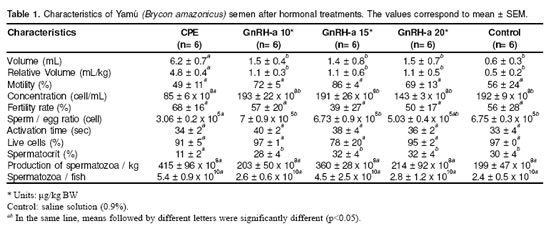
<body><![CDATA[<p align="justify">  Twenty-five &#181;L of semen were placed under a light   microscope (X10) on a slide, and 50 &#181;L of distilled   water were added as a dilutor. The group movement   of the cells was considered, and the percentage of the   field in movement was established according to an   arbitrary scale of 0 to 100%, expressing every 10%   motile increment (0, &#60;5, 10, 20, 30&#133;100%), modified from Vuthiphandchai and Zohar (18). The motility   duration was counted until at least 5% of the semen,   displayed movement (15).</p>     <p align="justify">  The spermatozoa concentration was determined   with a Neubauer chamber. Distilled water was used   as a dilutor in a 1:800 semen-water ratio and mixed   with a vortex. The Neubauer chamber was filled   with the diluted semen; after one minute of rest two   counts of 0.2 mm2 were conducted under a   microscope (X 40).</p>     <p align="justify">  Spermatocrit was measured in semen collected   in capillary tubes 75 mm length and 1.1 mm of inside   diameter, there were 70% filled and sealed, and then   centrifuged by 10 min at 5000 rpm. The spermatocrit   was defined as the percentage expressed ratio   between the volume of sperm and the total volume   of semen (11, 18).</p>     <p align="justify">  A simple linear regression was calculated to   determine if the spermatocrit could be utilised to   estimate the sperm concentration (15). The data from   the spermatocrit for statistical analysis had an angular   transformation (11).</p>     <p align="justify">  The percentage of live spermatozoa was determined   through differential coloration. Milt samples were   stained using an eosine solution, and for contrast stained,   nigrosine (14), based on the principle that only the dead   cells become permeable to the dye nigrosine/eosine.   An analysis was conducted under a microscope (X40)   by the arbitrary counting of 200 cells on the slide (18).</p>     <p align="justify">  Fertility rate was tested with eggs pooled from six   females, obtained by hormonal induction with CPE after   Pardo-Carrasco <i>et al</i>. (8). Three 1.5 L incubators   were utilized for each male with a ratio of eggs to   semen of 5 g / 0.25 mL (9). One hundred eggs were   counted from each incubator six hours after mixed with   the semen. The fertilization rate was determined from   the number of fertilized ova in relation to the total   number of viable eggs. The eggs were defined as   fertilized when they were spherical, translucent and   contained a developing embryo in the blastopore   closure stage. For each fertility test the proportion of   spermatozoa per egg was determined.</p>     <p align="justify">  Data for each parameter evaluated were compared   between treatments using ANOVA to determinate   statistical differences, followed by Tukey comparison   test. Simple regression analyses were conducted   between the evaluated parameters. Values of p&#60; 0.05   were considered significant. For all statistical analysis   Systac Versi&oacute;n 7.0 software (Spss Inc, Illinois, 1997)   was used.</p>     <p align="justify">&nbsp;</p>     <p align="justify"><b>Results</b></p>     <p align="justify">  At the time of semen collection, two males of   treatment 3 (15 &#181;g/kg mGnRH-a) and three control   males, did not release semen. In addition, in some   repetitions of treatments 2 (10 &#181;g/kg mGnRH-a), 3 (15&#181;g/kg mGnRH-a) and 4 (20 &#181;g/kg mGnRH-a), the quantity   of semen was not enough to proceed to all analyses; for   this reason, the number of samples utilized in each analysis   varied. The results for each parameter evaluated in the different treatments are shown in <a href="#t1">table 1</a>.</p>     ]]></body>
<body><![CDATA[<p align="justify">  In treatment 1 (CPE), the average volume of   liberated semen was 6.2 &#177; 0.7 mL, which was   equivalent to 4.8 &#177; 0.4 mL/kg BW, and was greater   (p&#60;0.05) than observed in the other treatments. The   treatments with mGnRH-a obtained similar results to   each other and control.</p>     <p align="justify">  The sperm concentration was lower in the treatment   with CPE (0.85 &#177; 0.06 x 10¹⁰ cell/mL), with a significant   difference between the other treatments and control;   no difference between the mGnRH-a treatments and   control was observed. The total production of   spermatozoa did not differ statistically between any of   the treatments.</p>     <p align="justify">  The spermatocrit varied between 0.6 and 43.3%.   The treatment with CPE allows obtaining values inferior   to that of spermatocrit (p&#60;0.05). A positive linear   correlation was observed between spermatocrit and   the spermatic concentration (p&#60;0.05, r= 0.42). The   motility, cell production per kilogram, activation time,   percentage of live cells and fertility rate were not   different between the treatments.</p>     <p align="justify">&nbsp;</p>     <p align="justify"><b>Discussion</b></p>     <p align="justify">  In general, male fish do not need hormonal induction   to produce sperm, although they can produce very   viscous, scarce and difficult to disperse semen (6) and   frequently of a lower quality (21). This study   demonstrated that treatment with CPE produced an   increase in the volume of semen, released in the Yam&uacute;,   while the treatments with mGnRH-a where ineffective to increase the volume.</p>     <p align="justify">  In the present study, the values of total sperm   production did not exhibit any significant difference   between the treatments; however, the values of sperm   concentration did show a statistical difference,   indicating that in the treatment with CPE the volume   increased without increasing the spermatozoa quantity,   causing a decrease in the sperm concentration,   suggesting that the CPE had more influence on seminal   fluid production that on spermatogenesis. Bedore (2)   evaluated the semen of <i>Brycon orbignyanus </i>under   induction with CPE and without induction, noting that   males treated with CPE had a greater volume, although   the concentration was similar between treated and   control fish. The effect of CPE on increased seminal   volume was observed for <i>Hypophthalmichthys   molitrix</i> (19), and <i>Cyprinus carpio</i> (12). The reduction   in the sperm concentration caused by CPE treatment,   similar to this study results, was registered in <i>Cyprinus   carpio</i> by Reenaselvi <i>et al.</i> (12).</p>     <p align="justify">&nbsp;</p>     <p align="justify"><img src="/img/revistas/rccp/19n2/v19n2a03t01.jpg"><a name="t1"></a></p>     <p align="justify">&nbsp;</p>     ]]></body>
<body><![CDATA[<p align="justify">In this study, mGnRH-a did not have an effect on   any of the seminal parameters evaluated, although there   are reports of the positive effect on other fish species.   Zaniboni-Filho (20) found for the Pacu <i>Piaractus</i> <i>mesopotamicus</i> that males treated with mGnRH-a (5-   10 &#181;g/kg) and CPE (2 mg/kg) had similar semen   production of 13.1 mL/kg and 13.4 mL/kg, respectively.   In addition, in the fertilization trials, the semen produced   with mGnRH-a was similar to that produced with the utilization of CPE. The volume and the fluidity of the   semen of <i>Pleuronectes platessa </i>and<i> Hippoglossus   hippoglossus</i> was significantly increased in treatments   with GnRH-a. (16,17). Tvedt et al (15) reported that   for <i>Hippoglossus hippoglossus</i> the sperm   concentration and spermatocrit decreased after   treatment with GnRH-a, although motility was not   affected. The mGnRH-a in this study was used without   dopamine antagonist, which blocks the negative actions   of dopamine on GnRH- induced LH release (10). It   could be necessary in this species to utilize the LINPE   method (10), which combines GnRH with a dopamine   antagonist, a common practice for African catfish   <i>Clarias gariepinus</i> and carp <i>Cyprinus carpio</i> (4).   It is possible that the males of yam&uacute; did not respond   positively to the hormonal treatment with mGnRH-a   without the dopamine antagonist. Perhaps larger doses or longer response times are needed.</p>     <p align="justify">  According to Billard <i>et al </i>(3), the activation time is   very short in fish, from 20 to 25 sec for trout and a   little more for carp, between 80 and 90 sec. Yam&uacute; had   motility values between 26 and 50 sec, within the values   observed in other the teleost fish species.</p>     <p align="justify">  Aas <i>et al </i>(1) recommended the use of   spermatocrit as a fast and practical method to   determine sperm density, and they found for <i>Salmo   salar</i> a higher correlation between the spermatocrit   and sperm concentration counted by the Burkers   chamber (r= 0.92). Rakitin <i>et al</i>. (11) suggested that   spermatocrit can be used to determine sperm density,   although specific studies would be required to prove   this relationship. This study found a positive linear   correlation (p&#60;0.05, r= 0.42), indicating that   spermatocrit can be used as a practical substitute to   counting method by Neubauer chamber. Tvedt <i>et al</i>  (15) suggest that use of longer 40 min centrifugal   times, to stable readings to allow raise the coefficient   of correlation.</p>     <p align="justify">  In the fertility tests, the sperm/egg ratio used varied   between 3.06 &#177; 0.2 x 10⁵ and 6.75 &#177; 0.3 x 10⁵, without   showing a relationship with fertility (p&#62;0.05, r= 0.119),   indicating the possibility of using as even smaller ratio.   Suquet <i>et al</i> (13) presented a review of the sperm/egg   ratio optimal for several fish species, finding a great   variability that ranges from 1.3 x 10⁴ to 1.6 x 10⁶. These   authors also concluded that the rate of fertility is   affected by the time of contact with the eggs and the   percentage of their viability. These data indicate that   for each species this relationship should be evaluated;   unfortunately, this was not taken into account in our   research.</p>     <p align="justify">  In this study sperm motility varied between &#60;5 and   90% and did not affect fertility (p&#62;0.05, r= 0.145).   According to Levanduski and Cloud (7), immotile   spermatozoa interfered in the interaction of the motile   ones with the eggs, causing a decrease in fertility, but   the fertilization ability was reduced when the proportion   of motile sperm was less than 10%. Billard et al (3)   indicated that motility is highly variable between males   and between successive samples of the same male,   and is not a practical parameter to be used. Aas et al   (1) found that semen motility between 35 and 95% did   not affect the fertilization of <i>Salmo salar</i> eggs.</p>     <p align="justify">  The volume and percentage of live cells in the   semen of yam&uacute; was not related to the fertility rate,   similar to that observed for <i>Salmo salar</i> by Krise<i> et   al</i> (5). This lack of correlation indicates that the   parameters used to evaluate the semen are not good   indicators of quality.</p>     <p align="justify"> An evaluation of the effectiveness of the LINPE   method and identification of the forms of GnRH found   in the brain and pituitary of the yam&uacute; is recommended   to allow better understanding of the problem. Other   parameters should be evaluated, such as the   composition of the seminal plasma, and the use of   biochemical tests that allow determining the fertilization   capacity of the semen.</p>     <p align="justify">  In conclusion, this study showed that CPE was   effective in increasing the volume and decreasing the   spermatic concentration and spermatocrit of <i>B.   amazonicus </i>semen. The use of mGnRH-a did not   affect the production of <i>B. amazonicus</i> semen.</p>     <p align="justify">&nbsp;</p>     <p align="justify"><b>Acknowledgement</b></p>     ]]></body>
<body><![CDATA[<p align="justify">  This study was conducted with COLCIENCIAS   and the Instituto de Investigaciones de la Orinoqu&iacute;a   Colombiana IIOC of Universidad de los Llanos financial   support. We acknowledge the staff of the Instituto de   Acuicultura de la Universidad de los Llanos (IALL)   for the logistical support.</p>     <p align="justify">&nbsp;</p>     <p align="justify"><b><i>Resumen</i></b></p>     <p align="justify"><b><i>  Evaluaci&oacute;n de la calidad seminal del yam&uacute; (Brycon amazonicus) bajo inducci&oacute;n hormonal</i></b></p>     <p align="justify"><b><i> Machos de dos a&ntilde;os de edad y primera maduraci&oacute;n sexual de yam&uacute; Brycon amazonicus fueron   seleccionados de acuerdo con la presencia de semen bajo una ligera presi&oacute;n abdominal (peso   corporal PC 1300 &#177; 3 g, longitud total LT 41.4 &#177; 0.2 cm, media &#177; SEM). Fueron realizados cinco   tratamientos: tres con mGnRH-a (10, 15 y 20 &#181;g/kg en una &uacute;nica aplicaci&oacute;n), uno con EPC (4.4   mg/kg en dos aplicaciones, 10 y 90 % con un intervalo de 12 h) y un tratamiento control con   solamente aplicaci&oacute;n de soluci&oacute;n salina (0.9 %). El volumen, la concentraci&oacute;n esperm&aacute;tica, el   espermatocrito, la tasa de fertilidad, el porcentaje de espermatozoides vivos, la motilidad y el   tiempo de activaci&oacute;n fueron evaluados. El EPC caus&oacute; un incremento en el volumen de l&iacute;quido   esperm&aacute;tico y consiguiente disminuci&oacute;n en la concentraci&oacute;n esperm&aacute;tica y en el espermatocrito.   Se hall&oacute; encontrada una regresi&oacute;n lineal positiva entre el espermatocrito y la concentraci&oacute;n   esperm&aacute;tica (p&#60;0.05, r= 0.42). La tasa de fertilidad se evalu&oacute; bajo una proporci&oacute;n de   espermatozoides/huevos que oscil&oacute; entre 3.06 &#177; 0.2 x 10⁵ y 6.75 &#177; 0.3 x 10⁵, sin presentar ning&uacute;n   efecto sobre la tasa de fertilidad (p&#62;0.05). Para los otros par&aacute;metros evaluados, no hubo diferencia   entre los grupos suplementados con hormonas ni entre el grupo control y estos. Se concluy&oacute; que el   EPC tiene influencia sobre la fluidez del semen, incrementando el volumen de l&iacute;quido esperm&aacute;tico   y disminuyendo consecuentemente la concentraci&oacute;n esperm&aacute;tica, mientras que el mGnRH-a no   causa ning&uacute;n cambio cuantitativo o cualitativo en el semen del Yam&uacute;.</i></b></p>     <p align="justify"><b> Palabras clave: </b><i>Bryconinae, CPE, mGnRH, reproducci&oacute;n artificial, semen</i></p>     <p align="justify">&nbsp;</p>     <p align="justify"><b>  References</b></p>     <!-- ref --><p align="justify">  1. Aas GH, Refstie T, Gjerde B. Evaluation of milt quality of   Atlantic salmon. Aquacult 1991; 95:125-32.&nbsp;&nbsp;&nbsp;&nbsp;&nbsp;&nbsp;&nbsp;&nbsp;[&#160;<a href="javascript:void(0);" onclick="javascript: window.open('/scielo.php?script=sci_nlinks&ref=000061&pid=S0120-0690200600020000300001&lng=','','width=640,height=500,resizable=yes,scrollbars=1,menubar=yes,');">Links</a>&#160;]<!-- end-ref --><!-- ref --><p align="justify">  2. Bedore GA. Caracter&iacute;sticas e criopreserva&ccedil;&atilde;o do s&ecirc;men de   pacu-caranha (<i>Piaractus mesopotamicus</i>) e de Piracanjuba (<i>Brycon orbignyanus</i>). Disserta&ccedil;&atilde;o de mestrado, Universidade   Federal de Minas Gerais, Belo Horizonte, Brasil, 1999.&nbsp;&nbsp;&nbsp;&nbsp;&nbsp;&nbsp;&nbsp;&nbsp;[&#160;<a href="javascript:void(0);" onclick="javascript: window.open('/scielo.php?script=sci_nlinks&ref=000062&pid=S0120-0690200600020000300002&lng=','','width=640,height=500,resizable=yes,scrollbars=1,menubar=yes,');">Links</a>&#160;]<!-- end-ref --><!-- ref --><p align="justify">  3. Billard R, Cosson J, Crim L, Suquet M. Sperm physiology   and quality. In: Bromage NR, Roberts RJ, editors.   Broodstock management and egg and larval quality. London:   Blackwell Science; 1995. p. 25-51.&nbsp;&nbsp;&nbsp;&nbsp;&nbsp;&nbsp;&nbsp;&nbsp;[&#160;<a href="javascript:void(0);" onclick="javascript: window.open('/scielo.php?script=sci_nlinks&ref=000063&pid=S0120-0690200600020000300003&lng=','','width=640,height=500,resizable=yes,scrollbars=1,menubar=yes,');">Links</a>&#160;]<!-- end-ref --><!-- ref --><p align="justify">  4. Crim LW, Peter RE, Van Der Kraak G. The use of LHRH   analogs in aquaculture. In: Vickery BH, Nestor JJ, editors. LHRH and its analogs. Contraceptive and therapeutic   applications, Part 2. Boston: MTP Press limited; 1987. p.   489-98.&nbsp;&nbsp;&nbsp;&nbsp;&nbsp;&nbsp;&nbsp;&nbsp;[&#160;<a href="javascript:void(0);" onclick="javascript: window.open('/scielo.php?script=sci_nlinks&ref=000064&pid=S0120-0690200600020000300004&lng=','','width=640,height=500,resizable=yes,scrollbars=1,menubar=yes,');">Links</a>&#160;]<!-- end-ref --><!-- ref --><p align="justify">  5. Krise W F, Hendrix MA, Bonney WA, Baker-Gordon SE.   Evaluation of sperm-activating solutions in Atlantic salmon <i>Salmo salar </i>fertilization tests. J World Aquacult Soc. 1995;   26: 384-89.&nbsp;&nbsp;&nbsp;&nbsp;&nbsp;&nbsp;&nbsp;&nbsp;[&#160;<a href="javascript:void(0);" onclick="javascript: window.open('/scielo.php?script=sci_nlinks&ref=000065&pid=S0120-0690200600020000300005&lng=','','width=640,height=500,resizable=yes,scrollbars=1,menubar=yes,');">Links</a>&#160;]<!-- end-ref --><!-- ref --><p align="justify">  6. Lam TJ. Applications of endocrinology to fish culture. Can   J Fish Aquatic Sci 1982; 39: 111-37.&nbsp;&nbsp;&nbsp;&nbsp;&nbsp;&nbsp;&nbsp;&nbsp;[&#160;<a href="javascript:void(0);" onclick="javascript: window.open('/scielo.php?script=sci_nlinks&ref=000066&pid=S0120-0690200600020000300006&lng=','','width=640,height=500,resizable=yes,scrollbars=1,menubar=yes,');">Links</a>&#160;]<!-- end-ref --><!-- ref --><p align="justify">  7. Levanduski MJ, Cloud JG. Rainbow trout (<i>Salmo gairdneri</i>)   semen: effect of non-motile sperm on fertility. Aquacult 1988;   75:171-79.&nbsp;&nbsp;&nbsp;&nbsp;&nbsp;&nbsp;&nbsp;&nbsp;[&#160;<a href="javascript:void(0);" onclick="javascript: window.open('/scielo.php?script=sci_nlinks&ref=000067&pid=S0120-0690200600020000300007&lng=','','width=640,height=500,resizable=yes,scrollbars=1,menubar=yes,');">Links</a>&#160;]<!-- end-ref --><!-- ref --><p align="justify"> 8. Pardo-Carrasco SC, Arias JA, Atencio-Garc&iacute;a VJ, Zaniboni-   Filho E, Vasquez-Torres W. Ensayos de reproducci&oacute;n inducida   del yam&uacute; <i>Brycon siebenthalae</i> en los llanos colombianos. En:   Congreso Sur Americano De Acuicultura, <i>Resumos</i>. Recife, 1998; 282 p.&nbsp;&nbsp;&nbsp;&nbsp;&nbsp;&nbsp;&nbsp;&nbsp;[&#160;<a href="javascript:void(0);" onclick="javascript: window.open('/scielo.php?script=sci_nlinks&ref=000068&pid=S0120-0690200600020000300008&lng=','','width=640,height=500,resizable=yes,scrollbars=1,menubar=yes,');">Links</a>&#160;]<!-- end-ref --><!-- ref --><p align="justify">  9. Pardo-Carrasco SC, Su&aacute;rez-Mahecha H, Zaniboni-Filho   E, Arias-Castellanos JA, Atencio-Garc&iacute;a VJ, <i>et al</i>.   Avalia&ccedil;&atilde;o de incubadoras experimentais para pesquisa   em reprodu&ccedil;&atilde;o induzida. En: Simp&oacute;sio Brasileiro de   Aq&uuml;icultura. Florian&oacute;polis: Simbraq 2000, n&atilde;o paginado,   CD-ROM.&nbsp;&nbsp;&nbsp;&nbsp;&nbsp;&nbsp;&nbsp;&nbsp;[&#160;<a href="javascript:void(0);" onclick="javascript: window.open('/scielo.php?script=sci_nlinks&ref=000069&pid=S0120-0690200600020000300009&lng=','','width=640,height=500,resizable=yes,scrollbars=1,menubar=yes,');">Links</a>&#160;]<!-- end-ref --><!-- ref --><p align="justify">  10. Peter RE, Lin HR, Van der Kraak G. Induced ovulation and   spawning of cultured freshwater fish in China: advances in application of GnRH analogues and dopamine antagonists.   Aquacult 1988; 74: 1-10.&nbsp;&nbsp;&nbsp;&nbsp;&nbsp;&nbsp;&nbsp;&nbsp;[&#160;<a href="javascript:void(0);" onclick="javascript: window.open('/scielo.php?script=sci_nlinks&ref=000070&pid=S0120-0690200600020000300010&lng=','','width=640,height=500,resizable=yes,scrollbars=1,menubar=yes,');">Links</a>&#160;]<!-- end-ref --><!-- ref --><p align="justify">  11. Rakitin A, Ferguson MM, Trippel EA. Spermatocrit and   spermatozoa density in Atlantic cod (<i>Gadus morhua</i>):   correlation and variation during the spawning season.   Aquacult 1999; 170: 349-58.&nbsp;&nbsp;&nbsp;&nbsp;&nbsp;&nbsp;&nbsp;&nbsp;[&#160;<a href="javascript:void(0);" onclick="javascript: window.open('/scielo.php?script=sci_nlinks&ref=000071&pid=S0120-0690200600020000300011&lng=','','width=640,height=500,resizable=yes,scrollbars=1,menubar=yes,');">Links</a>&#160;]<!-- end-ref --><!-- ref --><p align="justify">  12. Reenaselvi P, Sukumaran N, Rahman MK. Properties of   common carp (<i>Cyprinus carpio</i>) milt after homoplastic   pituitary administration. J. Aquacult Tropical 1996; 11:   285-89.&nbsp;&nbsp;&nbsp;&nbsp;&nbsp;&nbsp;&nbsp;&nbsp;[&#160;<a href="javascript:void(0);" onclick="javascript: window.open('/scielo.php?script=sci_nlinks&ref=000072&pid=S0120-0690200600020000300012&lng=','','width=640,height=500,resizable=yes,scrollbars=1,menubar=yes,');">Links</a>&#160;]<!-- end-ref --><!-- ref --><p align="justify">  13. Suquet M, Billard R, Cosson J, Normant Y, Fauvel C. Artificial   insemination in turbot (<i>Scophthalmus maximus</i>):   determination of the optimal sperm to egg ratio and time of   gamete contact. Aquacult 1995; 133: 83-90.&nbsp;&nbsp;&nbsp;&nbsp;&nbsp;&nbsp;&nbsp;&nbsp;[&#160;<a href="javascript:void(0);" onclick="javascript: window.open('/scielo.php?script=sci_nlinks&ref=000073&pid=S0120-0690200600020000300013&lng=','','width=640,height=500,resizable=yes,scrollbars=1,menubar=yes,');">Links</a>&#160;]<!-- end-ref --><!-- ref --><p align="justify">  14. Swanson EW, Bearden HJ. An eosin-nigrosin stain for   differentiating live and dead bovine spermatozoa. J Animal   Sci 1951; 10:981-87.&nbsp;&nbsp;&nbsp;&nbsp;&nbsp;&nbsp;&nbsp;&nbsp;[&#160;<a href="javascript:void(0);" onclick="javascript: window.open('/scielo.php?script=sci_nlinks&ref=000074&pid=S0120-0690200600020000300014&lng=','','width=640,height=500,resizable=yes,scrollbars=1,menubar=yes,');">Links</a>&#160;]<!-- end-ref --><!-- ref --><p align="justify"> 15. Tvedt HB, Benfey TJ, Martin-Robichaud DJ, Power J.   The relationship between sperm density, spermatocrit,   sperm motility and fertilization success in Atlantic   halibut, <i>Hippoglossus hipoglossus</i>. Aquacult 2001; 194: 191-200.&nbsp;&nbsp;&nbsp;&nbsp;&nbsp;&nbsp;&nbsp;&nbsp;[&#160;<a href="javascript:void(0);" onclick="javascript: window.open('/scielo.php?script=sci_nlinks&ref=000075&pid=S0120-0690200600020000300015&lng=','','width=640,height=500,resizable=yes,scrollbars=1,menubar=yes,');">Links</a>&#160;]<!-- end-ref --><!-- ref --><p align="justify">16. Vermeirssen ELM, Shields RJ, Quero CM, Scott AP.   Gonadotrophin-releasing hormone agonist raises plasma   concentrations of progestogens and enhances milt fluidity in   male Atlantic halibut (<i>Hippoglossus hippoglossus</i>). Fish Physiol Biochem 2000; 22: 77-87.&nbsp;&nbsp;&nbsp;&nbsp;&nbsp;&nbsp;&nbsp;&nbsp;[&#160;<a href="javascript:void(0);" onclick="javascript: window.open('/scielo.php?script=sci_nlinks&ref=000076&pid=S0120-0690200600020000300016&lng=','','width=640,height=500,resizable=yes,scrollbars=1,menubar=yes,');">Links</a>&#160;]<!-- end-ref --><!-- ref --><p align="justify">  17. Vermeirssen ELM, Scott AP, Mylonas C, Zohar Y.   Gonadotropin-releasing hormone agonist stimulates milt fluidity   and plasma concentrations of 17,20&szlig;- dihydroxylated and 5&szlig;-   reduced, 3a hydroxylated C21 steroids in male plaice (<i>Pleuronectes   platessa</i>). Gen Comp Endocrinol 1998; 112: 163-77.&nbsp;&nbsp;&nbsp;&nbsp;&nbsp;&nbsp;&nbsp;&nbsp;[&#160;<a href="javascript:void(0);" onclick="javascript: window.open('/scielo.php?script=sci_nlinks&ref=000077&pid=S0120-0690200600020000300017&lng=','','width=640,height=500,resizable=yes,scrollbars=1,menubar=yes,');">Links</a>&#160;]<!-- end-ref --><!-- ref --><p align="justify"> 18. Vuthiphandchai V, Zohar Y. Age-related sperm quality of   captive striped bass <i>Morone saxatilis</i>. J World Aquacult Soc 1999; 30: 65-72.&nbsp;&nbsp;&nbsp;&nbsp;&nbsp;&nbsp;&nbsp;&nbsp;[&#160;<a href="javascript:void(0);" onclick="javascript: window.open('/scielo.php?script=sci_nlinks&ref=000078&pid=S0120-0690200600020000300018&lng=','','width=640,height=500,resizable=yes,scrollbars=1,menubar=yes,');">Links</a>&#160;]<!-- end-ref --><!-- ref --><p align="justify"> 19. Yu JYL, Shen ST, Liu CT, Weng CF, Peng HK, <i>et al</i>.   Comparative effects of avian and piscine gonadotrophins   on gonadal steroidogenesis, and of avian and piscine   pituitaries on induction of spermiation and ovulation in   the loach and White silver carp. Aquacult 1995; 135: 59-   72.&nbsp;&nbsp;&nbsp;&nbsp;&nbsp;&nbsp;&nbsp;&nbsp;[&#160;<a href="javascript:void(0);" onclick="javascript: window.open('/scielo.php?script=sci_nlinks&ref=000079&pid=S0120-0690200600020000300019&lng=','','width=640,height=500,resizable=yes,scrollbars=1,menubar=yes,');">Links</a>&#160;]<!-- end-ref --><!-- ref --><p align="justify"> 20. Zaniboni-Filho E. Utiliza&ccedil;&atilde;o do LHRH-a para indu&ccedil;&atilde;o &agrave;   espermia&ccedil;&atilde;o e desova do Pacu-caranha, <i>Piaractus mesopotamicus</i> (HOLMBERG, 1887). Biotemas 1995; 8:   36-45.&nbsp;&nbsp;&nbsp;&nbsp;&nbsp;&nbsp;&nbsp;&nbsp;[&#160;<a href="javascript:void(0);" onclick="javascript: window.open('/scielo.php?script=sci_nlinks&ref=000080&pid=S0120-0690200600020000300020&lng=','','width=640,height=500,resizable=yes,scrollbars=1,menubar=yes,');">Links</a>&#160;]<!-- end-ref --><!-- ref --><p align="justify">  21. Zohar Y, Mylonas C. Endocrine manipulations of spawning   in cultured fish: from hormones to genes. Aquacult 2001;   197: 99-136.&nbsp;&nbsp;&nbsp;&nbsp;&nbsp;&nbsp;&nbsp;&nbsp;[&#160;<a href="javascript:void(0);" onclick="javascript: window.open('/scielo.php?script=sci_nlinks&ref=000081&pid=S0120-0690200600020000300021&lng=','','width=640,height=500,resizable=yes,scrollbars=1,menubar=yes,');">Links</a>&#160;]<!-- end-ref --><p align="justify">&nbsp;</p>     ]]></body>
<body><![CDATA[ ]]></body><back>
<ref-list>
<ref id="B1">
<label>1</label><nlm-citation citation-type="journal">
<person-group person-group-type="author">
<name>
<surname><![CDATA[Aas]]></surname>
<given-names><![CDATA[GH]]></given-names>
</name>
<name>
<surname><![CDATA[Refstie]]></surname>
<given-names><![CDATA[T]]></given-names>
</name>
<name>
<surname><![CDATA[Gjerde]]></surname>
<given-names><![CDATA[B]]></given-names>
</name>
</person-group>
<article-title xml:lang="en"><![CDATA[Evaluation of milt quality of Atlantic salmon]]></article-title>
<source><![CDATA[Aquacult]]></source>
<year>1991</year>
<volume>95</volume>
<page-range>125-32</page-range></nlm-citation>
</ref>
<ref id="B2">
<label>2</label><nlm-citation citation-type="">
<person-group person-group-type="author">
<name>
<surname><![CDATA[Bedore]]></surname>
<given-names><![CDATA[GA]]></given-names>
</name>
</person-group>
<source><![CDATA[Características e criopreservação do sêmen de pacu-caranha (Piaractus mesopotamicus) e de Piracanjuba (Brycon orbignyanus)]]></source>
<year></year>
</nlm-citation>
</ref>
<ref id="B3">
<label>3</label><nlm-citation citation-type="book">
<person-group person-group-type="author">
<name>
<surname><![CDATA[Billard]]></surname>
<given-names><![CDATA[R]]></given-names>
</name>
<name>
<surname><![CDATA[Cosson]]></surname>
<given-names><![CDATA[J]]></given-names>
</name>
<name>
<surname><![CDATA[Crim]]></surname>
<given-names><![CDATA[L]]></given-names>
</name>
<name>
<surname><![CDATA[Suquet]]></surname>
<given-names><![CDATA[M]]></given-names>
</name>
</person-group>
<article-title xml:lang="en"><![CDATA[Sperm physiology and quality]]></article-title>
<person-group person-group-type="editor">
<name>
<surname><![CDATA[Bromage]]></surname>
<given-names><![CDATA[NR]]></given-names>
</name>
<name>
<surname><![CDATA[Roberts]]></surname>
<given-names><![CDATA[RJ]]></given-names>
</name>
</person-group>
<source><![CDATA[Broodstock management and egg and larval quality]]></source>
<year>1995</year>
<page-range>25-51</page-range><publisher-loc><![CDATA[London ]]></publisher-loc>
<publisher-name><![CDATA[Blackwell Science]]></publisher-name>
</nlm-citation>
</ref>
<ref id="B4">
<label>4</label><nlm-citation citation-type="book">
<person-group person-group-type="author">
<name>
<surname><![CDATA[Crim]]></surname>
<given-names><![CDATA[LW]]></given-names>
</name>
<name>
<surname><![CDATA[Peter]]></surname>
<given-names><![CDATA[RE]]></given-names>
</name>
<name>
<surname><![CDATA[Van Der Kraak]]></surname>
<given-names><![CDATA[G]]></given-names>
</name>
</person-group>
<article-title xml:lang="en"><![CDATA[The use of LHRH analogs in aquaculture]]></article-title>
<person-group person-group-type="editor">
<name>
<surname><![CDATA[Vickery]]></surname>
<given-names><![CDATA[BH]]></given-names>
</name>
<name>
<surname><![CDATA[Nestor]]></surname>
<given-names><![CDATA[JJ]]></given-names>
</name>
</person-group>
<source><![CDATA[LHRH and its analogs: Contraceptive and therapeutic applications]]></source>
<year>1987</year>
<volume>2</volume>
<page-range>489-98</page-range><publisher-loc><![CDATA[Boston ]]></publisher-loc>
<publisher-name><![CDATA[MTP Press limited]]></publisher-name>
</nlm-citation>
</ref>
<ref id="B5">
<label>5</label><nlm-citation citation-type="journal">
<person-group person-group-type="author">
<name>
<surname><![CDATA[Krise]]></surname>
</name>
<name>
<surname><![CDATA[Hendrix]]></surname>
<given-names><![CDATA[MA]]></given-names>
</name>
<name>
<surname><![CDATA[Bonney]]></surname>
<given-names><![CDATA[WA]]></given-names>
</name>
<name>
<surname><![CDATA[Gordon]]></surname>
<given-names><![CDATA[SE]]></given-names>
</name>
</person-group>
<article-title xml:lang="en"><![CDATA[Evaluation of sperm-activating solutions in Atlantic salmon Salmo salar fertilization tests]]></article-title>
<source><![CDATA[J World Aquacult Soc]]></source>
<year>1995</year>
<volume>26</volume>
<page-range>384-89</page-range></nlm-citation>
</ref>
<ref id="B6">
<label>6</label><nlm-citation citation-type="journal">
<person-group person-group-type="author">
<name>
<surname><![CDATA[Lam]]></surname>
<given-names><![CDATA[TJ]]></given-names>
</name>
</person-group>
<article-title xml:lang="en"><![CDATA[Applications of endocrinology to fish culture]]></article-title>
<source><![CDATA[Can J Fish Aquatic Sci]]></source>
<year>1982</year>
<volume>39</volume>
<page-range>111-37</page-range></nlm-citation>
</ref>
<ref id="B7">
<label>7</label><nlm-citation citation-type="journal">
<person-group person-group-type="author">
<name>
<surname><![CDATA[Levanduski]]></surname>
<given-names><![CDATA[MJ]]></given-names>
</name>
<name>
<surname><![CDATA[Cloud]]></surname>
<given-names><![CDATA[JG]]></given-names>
</name>
</person-group>
<article-title xml:lang="en"><![CDATA[Rainbow trout (Salmo gairdneri) semen: effect of non-motile sperm on fertility]]></article-title>
<source><![CDATA[Aquacult]]></source>
<year>1988</year>
<volume>75</volume>
<page-range>171-79</page-range></nlm-citation>
</ref>
<ref id="B8">
<label>8</label><nlm-citation citation-type="confpro">
<person-group person-group-type="author">
<name>
<surname><![CDATA[Pardo-Carrasco]]></surname>
<given-names><![CDATA[SC]]></given-names>
</name>
<name>
<surname><![CDATA[Arias]]></surname>
<given-names><![CDATA[JA]]></given-names>
</name>
<name>
<surname><![CDATA[Atencio-García]]></surname>
<given-names><![CDATA[VJ]]></given-names>
</name>
<name>
<surname><![CDATA[Zaniboni- Filho]]></surname>
<given-names><![CDATA[E]]></given-names>
</name>
<name>
<surname><![CDATA[Vasquez-Torres]]></surname>
<given-names><![CDATA[W]]></given-names>
</name>
</person-group>
<source><![CDATA[Ensayos de reproducción inducida del yamú Brycon siebenthalae en los llanos colombianos]]></source>
<year></year>
<conf-name><![CDATA[ Congreso Sur Americano De Acuicultura]]></conf-name>
<conf-date>1998</conf-date>
<conf-loc>Recife </conf-loc>
<page-range>282</page-range></nlm-citation>
</ref>
<ref id="B9">
<label>9</label><nlm-citation citation-type="">
<person-group person-group-type="author">
<name>
<surname><![CDATA[Pardo-Carrasco]]></surname>
<given-names><![CDATA[SC]]></given-names>
</name>
<name>
<surname><![CDATA[Suárez-Mahecha]]></surname>
<given-names><![CDATA[H]]></given-names>
</name>
<name>
<surname><![CDATA[Zaniboni-Filho]]></surname>
<given-names><![CDATA[E]]></given-names>
</name>
<name>
<surname><![CDATA[Arias-Castellanos]]></surname>
<given-names><![CDATA[JA]]></given-names>
</name>
<name>
<surname><![CDATA[Atencio-García]]></surname>
<given-names><![CDATA[VJ]]></given-names>
</name>
</person-group>
<article-title xml:lang="pt"><![CDATA[Avaliação de incubadoras experimentais para pesquisa em reprodução induzida]]></article-title>
<source><![CDATA[Simpósio Brasileiro de Aqüicultura]]></source>
<year>2000</year>
<publisher-loc><![CDATA[Florianópolis ]]></publisher-loc>
</nlm-citation>
</ref>
<ref id="B10">
<label>10</label><nlm-citation citation-type="journal">
<person-group person-group-type="author">
<name>
<surname><![CDATA[Peter]]></surname>
<given-names><![CDATA[RE]]></given-names>
</name>
<name>
<surname><![CDATA[Lin]]></surname>
<given-names><![CDATA[HR]]></given-names>
</name>
<name>
<surname><![CDATA[Van der Kraak]]></surname>
<given-names><![CDATA[G]]></given-names>
</name>
</person-group>
<article-title xml:lang="en"><![CDATA[Induced ovulation and spawning of cultured freshwater fish in China: advances in application of GnRH analogues and dopamine antagonists]]></article-title>
<source><![CDATA[Aquacult]]></source>
<year>1988</year>
<volume>74</volume>
<page-range>1-10</page-range></nlm-citation>
</ref>
<ref id="B11">
<label>11</label><nlm-citation citation-type="journal">
<person-group person-group-type="author">
<name>
<surname><![CDATA[Rakitin]]></surname>
<given-names><![CDATA[A]]></given-names>
</name>
<name>
<surname><![CDATA[Ferguson]]></surname>
<given-names><![CDATA[MM]]></given-names>
</name>
<name>
<surname><![CDATA[Trippel]]></surname>
<given-names><![CDATA[EA]]></given-names>
</name>
</person-group>
<article-title xml:lang="en"><![CDATA[Spermatocrit and spermatozoa density in Atlantic cod (Gadus morhua): correlation and variation during the spawning season]]></article-title>
<source><![CDATA[Aquacult]]></source>
<year>1999</year>
<volume>170</volume>
<page-range>349-58</page-range></nlm-citation>
</ref>
<ref id="B12">
<label>12</label><nlm-citation citation-type="journal">
<person-group person-group-type="author">
<name>
<surname><![CDATA[Reenaselvi]]></surname>
<given-names><![CDATA[P]]></given-names>
</name>
<name>
<surname><![CDATA[Sukumaran]]></surname>
<given-names><![CDATA[N]]></given-names>
</name>
<name>
<surname><![CDATA[Rahman]]></surname>
<given-names><![CDATA[MK]]></given-names>
</name>
</person-group>
<article-title xml:lang="en"><![CDATA[Properties of common carp (Cyprinus carpio) milt after homoplastic pituitary administration]]></article-title>
<source><![CDATA[J. Aquacult Tropical]]></source>
<year>1996</year>
<volume>11</volume>
<page-range>285-89</page-range></nlm-citation>
</ref>
<ref id="B13">
<label>13</label><nlm-citation citation-type="journal">
<person-group person-group-type="author">
<name>
<surname><![CDATA[Suquet]]></surname>
<given-names><![CDATA[M]]></given-names>
</name>
<name>
<surname><![CDATA[Billard]]></surname>
<given-names><![CDATA[R]]></given-names>
</name>
<name>
<surname><![CDATA[Cosson]]></surname>
<given-names><![CDATA[J]]></given-names>
</name>
<name>
<surname><![CDATA[Normant]]></surname>
<given-names><![CDATA[Y]]></given-names>
</name>
<name>
<surname><![CDATA[Fauvel]]></surname>
<given-names><![CDATA[C]]></given-names>
</name>
</person-group>
<article-title xml:lang="en"><![CDATA[Artificial insemination in turbot (Scophthalmus maximus): determination of the optimal sperm to egg ratio and time of gamete contact]]></article-title>
<source><![CDATA[Aquacult]]></source>
<year>1995</year>
<volume>133</volume>
<page-range>83-90</page-range></nlm-citation>
</ref>
<ref id="B14">
<label>14</label><nlm-citation citation-type="journal">
<person-group person-group-type="author">
<name>
<surname><![CDATA[Swanson]]></surname>
<given-names><![CDATA[EW]]></given-names>
</name>
<name>
<surname><![CDATA[Bearden]]></surname>
<given-names><![CDATA[HJ]]></given-names>
</name>
</person-group>
<article-title xml:lang="en"><![CDATA[An eosin-nigrosin stain for differentiating live and dead bovine spermatozoa]]></article-title>
<source><![CDATA[J Animal Sci]]></source>
<year>1951</year>
<volume>10</volume>
<page-range>981-87</page-range></nlm-citation>
</ref>
<ref id="B15">
<label>15</label><nlm-citation citation-type="journal">
<person-group person-group-type="author">
<name>
<surname><![CDATA[Tvedt]]></surname>
<given-names><![CDATA[HB]]></given-names>
</name>
<name>
<surname><![CDATA[Benfey]]></surname>
<given-names><![CDATA[TJ]]></given-names>
</name>
<name>
<surname><![CDATA[Martin-Robichaud]]></surname>
<given-names><![CDATA[DJ]]></given-names>
</name>
<name>
<surname><![CDATA[Power]]></surname>
<given-names><![CDATA[J]]></given-names>
</name>
</person-group>
<article-title xml:lang="en"><![CDATA[The relationship between sperm density, spermatocrit, sperm motility and fertilization success in Atlantic halibut, Hippoglossus hipoglossus]]></article-title>
<source><![CDATA[Aquacult]]></source>
<year>2001</year>
<volume>194</volume>
<page-range>191-200</page-range></nlm-citation>
</ref>
<ref id="B16">
<label>16</label><nlm-citation citation-type="journal">
<person-group person-group-type="author">
<name>
<surname><![CDATA[Vermeirssen]]></surname>
<given-names><![CDATA[ELM]]></given-names>
</name>
<name>
<surname><![CDATA[Shields]]></surname>
<given-names><![CDATA[RJ]]></given-names>
</name>
<name>
<surname><![CDATA[Quero]]></surname>
<given-names><![CDATA[CM]]></given-names>
</name>
<name>
<surname><![CDATA[Scott]]></surname>
<given-names><![CDATA[AP]]></given-names>
</name>
</person-group>
<article-title xml:lang="en"><![CDATA[Gonadotrophin-releasing hormone agonist raises plasma concentrations of progestogens and enhances milt fluidity in male Atlantic halibut (Hippoglossus hippoglossus)]]></article-title>
<source><![CDATA[Fish Physiol Biochem]]></source>
<year>2000</year>
<volume>22</volume>
<page-range>77-87</page-range></nlm-citation>
</ref>
<ref id="B17">
<label>17</label><nlm-citation citation-type="journal">
<person-group person-group-type="author">
<name>
<surname><![CDATA[Vermeirssen]]></surname>
<given-names><![CDATA[ELM]]></given-names>
</name>
<name>
<surname><![CDATA[Scott]]></surname>
<given-names><![CDATA[AP]]></given-names>
</name>
<name>
<surname><![CDATA[Mylonas]]></surname>
<given-names><![CDATA[C]]></given-names>
</name>
<name>
<surname><![CDATA[Zohar]]></surname>
<given-names><![CDATA[Y]]></given-names>
</name>
</person-group>
<article-title xml:lang="en"><![CDATA[Gonadotropin-releasing hormone agonist stimulates milt fluidity and plasma concentrations of 17,20ß- dihydroxylated and 5ß- reduced, 3a hydroxylated C21 steroids in male plaice (Pleuronectes platessa)]]></article-title>
<source><![CDATA[Gen Comp Endocrinol]]></source>
<year>1998</year>
<volume>112</volume>
<page-range>163-77</page-range></nlm-citation>
</ref>
<ref id="B18">
<label>18</label><nlm-citation citation-type="journal">
<person-group person-group-type="author">
<name>
<surname><![CDATA[Vuthiphandchai]]></surname>
<given-names><![CDATA[V]]></given-names>
</name>
<name>
<surname><![CDATA[Zohar]]></surname>
<given-names><![CDATA[Y]]></given-names>
</name>
</person-group>
<article-title xml:lang="en"><![CDATA[Age-related sperm quality of captive striped bass Morone saxatilis]]></article-title>
<source><![CDATA[J World Aquacult Soc]]></source>
<year>1999</year>
<volume>30</volume>
<page-range>65-72</page-range></nlm-citation>
</ref>
<ref id="B19">
<label>19</label><nlm-citation citation-type="journal">
<person-group person-group-type="author">
<name>
<surname><![CDATA[Yu]]></surname>
<given-names><![CDATA[JYL]]></given-names>
</name>
<name>
<surname><![CDATA[Shen]]></surname>
<given-names><![CDATA[ST]]></given-names>
</name>
<name>
<surname><![CDATA[Liu]]></surname>
<given-names><![CDATA[CT]]></given-names>
</name>
<name>
<surname><![CDATA[Weng]]></surname>
<given-names><![CDATA[CF]]></given-names>
</name>
<name>
<surname><![CDATA[Peng]]></surname>
<given-names><![CDATA[HK]]></given-names>
</name>
</person-group>
<article-title xml:lang="en"><![CDATA[Comparative effects of avian and piscine gonadotrophins on gonadal steroidogenesis, and of avian and piscine pituitaries on induction of spermiation and ovulation in the loach and White silver carp]]></article-title>
<source><![CDATA[Aquacult]]></source>
<year>1995</year>
<volume>135</volume>
<page-range>59- 72</page-range></nlm-citation>
</ref>
<ref id="B20">
<label>20</label><nlm-citation citation-type="journal">
<person-group person-group-type="author">
<name>
<surname><![CDATA[Zaniboni-Filho]]></surname>
<given-names><![CDATA[E]]></given-names>
</name>
</person-group>
<article-title xml:lang="pt"><![CDATA[Utilização do LHRH-a para indução à espermiação e desova do Pacu-caranha, Piaractus mesopotamicus (HOLMBERG, 1887)]]></article-title>
<source><![CDATA[Biotemas]]></source>
<year>1995</year>
<volume>8</volume>
<page-range>36-45</page-range></nlm-citation>
</ref>
<ref id="B21">
<label>21</label><nlm-citation citation-type="journal">
<person-group person-group-type="author">
<name>
<surname><![CDATA[Zohar]]></surname>
<given-names><![CDATA[Y]]></given-names>
</name>
<name>
<surname><![CDATA[Mylonas]]></surname>
<given-names><![CDATA[C]]></given-names>
</name>
</person-group>
<article-title xml:lang="en"><![CDATA[Endocrine manipulations of spawning in cultured fish: from hormones to genes]]></article-title>
<source><![CDATA[Aquacult]]></source>
<year>2001</year>
<volume>197</volume>
<page-range>99-136</page-range></nlm-citation>
</ref>
</ref-list>
</back>
</article>
