<?xml version="1.0" encoding="ISO-8859-1"?><article xmlns:mml="http://www.w3.org/1998/Math/MathML" xmlns:xlink="http://www.w3.org/1999/xlink" xmlns:xsi="http://www.w3.org/2001/XMLSchema-instance">
<front>
<journal-meta>
<journal-id>0120-0690</journal-id>
<journal-title><![CDATA[Revista Colombiana de Ciencias Pecuarias]]></journal-title>
<abbrev-journal-title><![CDATA[Rev Colom Cienc Pecua]]></abbrev-journal-title>
<issn>0120-0690</issn>
<publisher>
<publisher-name><![CDATA[Facultad de Ciencias Agrarias, Universidad de Antioquia]]></publisher-name>
</publisher>
</journal-meta>
<article-meta>
<article-id>S0120-06902010000100003</article-id>
<title-group>
<article-title xml:lang="en"><![CDATA[Identification of Mycobacterium avium subspecies paratuberculosis by PCR techniques and establishment of control programs for bovine paratuberculosis in dairy herds]]></article-title>
<article-title xml:lang="es"><![CDATA[Identificación de Mycobacterium avium subspecies paratuberculosis mediante pruebas de PCR y definición de programa de control de la paratuberculosis bovina en hatos lecheros]]></article-title>
<article-title xml:lang="pt"><![CDATA[Identificação de Mycobacterium avium subespécie paratuberculosis por PCR e definição do programa de controle da paratuberculose em rebanhos bovinos leiteiros]]></article-title>
</title-group>
<contrib-group>
<contrib contrib-type="author">
<name>
<surname><![CDATA[Zapata]]></surname>
<given-names><![CDATA[Margarita M]]></given-names>
</name>
<xref ref-type="aff" rid="A01"/>
</contrib>
<contrib contrib-type="author">
<name>
<surname><![CDATA[Arroyave]]></surname>
<given-names><![CDATA[Ofelia]]></given-names>
</name>
<xref ref-type="aff" rid="A01"/>
</contrib>
<contrib contrib-type="author">
<name>
<surname><![CDATA[Ramírez]]></surname>
<given-names><![CDATA[René]]></given-names>
</name>
<xref ref-type="aff" rid="A01"/>
</contrib>
<contrib contrib-type="author">
<name>
<surname><![CDATA[Piedrahita]]></surname>
<given-names><![CDATA[Christian]]></given-names>
</name>
<xref ref-type="aff" rid="A01"/>
</contrib>
<contrib contrib-type="author">
<name>
<surname><![CDATA[Rodas]]></surname>
<given-names><![CDATA[Juan D]]></given-names>
</name>
<xref ref-type="aff" rid="A01"/>
</contrib>
<contrib contrib-type="author">
<name>
<surname><![CDATA[Maldonado]]></surname>
<given-names><![CDATA[Juan G]]></given-names>
</name>
<xref ref-type="aff" rid="A01"/>
</contrib>
</contrib-group>
<aff id="A01">
<institution><![CDATA[,Universidad de Antioquia Facultad de Ciencias Agrarias Escuela de Medicina Veterinaria]]></institution>
<addr-line><![CDATA[Medellín ]]></addr-line>
<country>Colombia</country>
</aff>
<pub-date pub-type="pub">
<day>00</day>
<month>03</month>
<year>2010</year>
</pub-date>
<pub-date pub-type="epub">
<day>00</day>
<month>03</month>
<year>2010</year>
</pub-date>
<volume>23</volume>
<numero>1</numero>
<fpage>17</fpage>
<lpage>27</lpage>
<copyright-statement/>
<copyright-year/>
<self-uri xlink:href="http://www.scielo.org.co/scielo.php?script=sci_arttext&amp;pid=S0120-06902010000100003&amp;lng=en&amp;nrm=iso"></self-uri><self-uri xlink:href="http://www.scielo.org.co/scielo.php?script=sci_abstract&amp;pid=S0120-06902010000100003&amp;lng=en&amp;nrm=iso"></self-uri><self-uri xlink:href="http://www.scielo.org.co/scielo.php?script=sci_pdf&amp;pid=S0120-06902010000100003&amp;lng=en&amp;nrm=iso"></self-uri><abstract abstract-type="short" xml:lang="en"><p><![CDATA[The aim of this study was to establish the protocol of conventional and real time PCR for amplification of Mycobacterium avium subsp. paratuberculosis (MAP) genome from bovine fecal samples, as a way to define strategies for establishing a prevention and control program in a dairy herd at the Universidad de Antioquia (Medellín, Colombia). Fecal samples were individually taken of clinical healthy cows or cows with diarrhea bred in a herd enzootic for Johne's disease, were processed them for culture in liquid Middlebrook 7H9 media supplemented with mycobactin under two different protocols: with or without inhibitors. Fecal samples from clinically healthy cows were used as negative control. Conventional and real time PCR were performed with MAP DNA obtained of fecal or cultured samples. The MAP- specific IS900 segment was amplified by using the respective forward and reverse primers. DNA isolated from a reference MAP strain was used as positive control of PCR. Data were analyzed by descriptive statistics and simple regression analysis between PCR and culture results were performed. All samples cultured in media with or without mycobactin gave a positive result compatible with MAP growth. However, only 13,3% of samples were positive by real time PCR. There was no relationship neither between PCR and culture results, nor between clinical condition of the cow and MAP positivity. These results support the need combine culture of feces with PCR diagnosis for identification of MAP-excreting cows in a dairy herd. Finally, a strategy of prevention and control of bovine paratuberculosis is proposed for this enzootic herd and for dairy herds in Colombia.]]></p></abstract>
<abstract abstract-type="short" xml:lang="es"><p><![CDATA[El objetivo de este trabajo fue establecer un sistema de detección y amplificación del Mycobacterium avium paratuberculosis (MAP) a partir de muestras de materia fecal bovina, mediante el uso de la técnica de PCR en tiempo real, como estrategia de apoyo para el establecimiento de un programa de prevención detección y control de la paratuberculosis bovina en el hato lechero de la Universidad de Antioquia. Muestras de materia fecal fueron tomadas de bovinos provenientes de un hato enzoótico para la enfermedad de Johne, fueron cultivadas en medio de cultivo líquido Middlebrook 7H9 suplementado con micobactina, bajo dos protocolos de aislamiento: con o sin inhibidores. Como control negativo fue utilizada muestras de materia fecal de bovinos clínicamente sanos. Adicionalmente, con el DNA de las muestras aisladas en cultivo y de las muestras de materia fecal, fueron hechas pruebas de PCR convencional y en tiempo real, para la amplificación del elemento de inserción IS900 del MAP, mediante el uso de cebadores específicos para este elemento. Como control positivo se utilizó DNA de MAP de una cepa de referencia. Los resultados fueron evaluados mediante estadística descriptiva y la comparación entre el resultado del cultivo y de la prueba de PCR fue evaluado mediante regresión simple. Los resultados del cultivo bacteriológico, mostraron un total de 15 muestras con crecimiento compatible con MAP, el cual fue verificado por prueba de PCR en el 13.3% de los casos. No hubo correlación entre el resultado de cultivo y la prueba de PCR ni entre el estado clínico y la positividad al MAP. Los resultados confirman la necesidad de combinar el diagnóstico molecular con el cultivo bacteriológico para identificar las vacas positivas en un hato. Finalmente, una estrategia de prevención y control de la enfermedad aplicable a este hato enzoótico y a los hatos lecheros en Colombia es discutida.]]></p></abstract>
<abstract abstract-type="short" xml:lang="pt"><p><![CDATA[O objetivo deste estudo foi estabelecer um sistema de detecção e amplificação do Mycobacterium avium paratuberculosis (MAP) a partir de amostras fecais bovinas, utilizando a técnica de PCR em tempo real, como uma estratégia para apoiar o estabelecimento de um programa rastreio para a prevenção e controle de la paratuberculosis bovina no rebanho leiteiro da Universidade de Antioquia. Foram colhidas amostras de fezes de gado bovino a partir de uma fazenda enzoótica para a doença de Johne, e foram cultivadas em meio de cultura líquida Middlebrook 7H9 suplementado com micobactina, sob dois protocolos de isolamento: com ou sem inibidores. Foram utilizadas como controle negativo amostras fecais de bovinos saudáveis. Além disso, as amostras de DNA isoladas e cultivadas a partir de amostras fecais foram realizadas testes de PCR convencional e em tempo real, para amplificação elemento de inserção IS900 no MAP. Foi utilizado como controle positivo do teste DNA de uma estirpe de referencia. Os resultados foram avaliados por estatística descritiva e as comparações entre os resultados de cultura e teste PCR foram avaliadas por regressão simple. Os resultados de cultura bacteriológica mostraram 100% de crescimento em amostras com MAP, que foi verificada por PCR em 13,3% dos casos. Não houve correlação entre o resultado do cultivo e teste PCR ou entre a clínica e a positividade para MAP. Os resultados confirmam a necessidade de combinar o diagnóstico molecular com cultura bacteriológica para identificação positiva de vacas em um rebanho. Finalmente, uma estratégia de prevenção e controle da doença aplicável neste rebanho enzoótico e os rebanhos leiteiros e na Colômbia é discutida.]]></p></abstract>
<kwd-group>
<kwd lng="en"><![CDATA[bacterial culture]]></kwd>
<kwd lng="en"><![CDATA[paratuberculosis]]></kwd>
<kwd lng="en"><![CDATA[caquexia in cows]]></kwd>
<kwd lng="en"><![CDATA[dairy cows]]></kwd>
<kwd lng="en"><![CDATA[Johne's disease]]></kwd>
<kwd lng="en"><![CDATA[real&ndash;time PCR]]></kwd>
<kwd lng="es"><![CDATA[bovinos de leche]]></kwd>
<kwd lng="es"><![CDATA[caquexia en vacas]]></kwd>
<kwd lng="es"><![CDATA[cultivo bacteriológico]]></kwd>
<kwd lng="es"><![CDATA[enfermedad de Johne]]></kwd>
<kwd lng="es"><![CDATA[paratuberculosis bovina]]></kwd>
<kwd lng="es"><![CDATA[PCR en tiempo real]]></kwd>
<kwd lng="pt"><![CDATA[a doença de Johne]]></kwd>
<kwd lng="pt"><![CDATA[caquexia em vacas]]></kwd>
<kwd lng="pt"><![CDATA[cultura bacteriológica]]></kwd>
<kwd lng="pt"><![CDATA[gado leiteiro]]></kwd>
<kwd lng="pt"><![CDATA[paratuberculose bovina]]></kwd>
<kwd lng="pt"><![CDATA[real-time PCR]]></kwd>
</kwd-group>
</article-meta>
</front><body><![CDATA[ <p align="right"><font face="Verdana, Arial, Helvetica, sans-serif" size="2"><b>Art&iacute;culos originales &nbsp;</b></font></p>     <p><font face="Verdana, Arial, Helvetica, sans-serif" size="4"><b>Identification of Mycobacterium avium subspecies paratuberculosis by PCR techniques and establishment of control programs for bovine paratuberculosis in dairy herds<Sup>&curren; </Sup></b></font></p>     <p><font face="Verdana, Arial, Helvetica, sans-serif" size="3"><b><I>Identificaci&oacute;n de Mycobacterium avium subspecies paratuberculosis mediante pruebas de PCR y definici&oacute;n de programa de control de la paratuberculosis bovina en hatos lecheros </I></b></font></p>     <p><font face="Verdana, Arial, Helvetica, sans-serif" size="3"><b><I>Identifica&ccedil;&atilde;o de Mycobacterium avium subesp&eacute;cie paratuberculosis por PCR e defini&ccedil;&atilde;o do programa de controle da paratuberculose em rebanhos bovinos leiteiros </I></b></font></p>     <p>&nbsp;</p>     <p><font face="Verdana, Arial, Helvetica, sans-serif" size="2">Margarita M Zapata<Sup><I>1</I></Sup>*, MV, MS; Ofelia Arroyave, Bact; Ren&eacute; Ram&iacute;rez<Sup><I>1</I></Sup>, MV; Christian Piedrahita<Sup><I>1</I></Sup>, Microbiol;  Juan D Rodas<Sup><I>1</I></Sup>, MV, MS, PhD; Juan G Maldonado<Sup><I>1</I></Sup>, MVZ, MS, PhD.  </font></p>    <p><font face="Verdana, Arial, Helvetica, sans-serif" size="2"><Sup><I>1</I></Sup><I>Centauro (Grupo de Investigaci&oacute;n en Ciencias Veterinarias), Escuela de Medicina Veterinaria, Facultad de Ciencias Agrarias, y Sede de Investigaci&oacute;n Universitaria (SIU, Laboratorio 233). Universidad de Antioquia. Carrera 75 N&deg; 65-87. Medell&iacute;n, Colombia. </I></font></p>    <p><font face="Verdana, Arial, Helvetica, sans-serif" size="2"><I>(Recibido:15 octubre, 2009; aceptado: 2 febrero, 2010) </I></font></p>     <p>&nbsp;</p><hr size="1">     <p><font face="Verdana, Arial, Helvetica, sans-serif" size="2"><I><b>Summary</b></I></font></p>    ]]></body>
<body><![CDATA[<p><font face="Verdana, Arial, Helvetica, sans-serif" size="2"><I>The aim of this study was to establish the protocol of conventional and real time PCR for amplification of Mycobacterium avium subsp. paratuberculosis (MAP) genome from bovine fecal samples, as a way to define strategies for establishing a prevention and control program in a dairy herd at the Universidad de Antioquia (Medell&iacute;n, Colombia). Fecal samples were individually taken of clinical healthy cows or cows with diarrhea bred in a herd enzootic for Johne's disease, were processed them for culture in liquid Middlebrook 7H9 media supplemented with mycobactin under two different protocols: with or without inhibitors. Fecal samples from clinically healthy cows were used as negative control. Conventional and real time PCR were performed with MAP DNA obtained of fecal or cultured samples. The MAP- specific IS900 segment was amplified by using the respective forward and reverse primers. DNA isolated from a reference MAP strain was used as positive control of PCR. Data were analyzed by descriptive statistics and simple regression analysis between PCR and culture results were performed. All samples cultured in media with or without mycobactin gave a positive result compatible with MAP growth. However, only 13,3% of samples were positive by real time PCR. There was no relationship neither between PCR and </I><i>culture results, nor between clinical condition of the cow and MAP positivity. These results support the need combine culture of feces with PCR diagnosis for identification of MAP-excreting cows in a dairy herd. Finally, a strategy of prevention and control of bovine paratuberculosis is proposed for this enzootic herd and for dairy herds in Colombia. </i></font></p>     <p><font face="Verdana, Arial, Helvetica, sans-serif" size="2"><b>Key words</b>:<i> bacterial culture, bovine paratuberculosis, caquexia in cows, dairy cows, Johne's disease, real&ndash;time PCR. </i></font></p>     <p><font face="Verdana, Arial, Helvetica, sans-serif" size="2">&curren; 	Para citar este art&iacute;culo: Zapata MM, Arroyave O, Ram&iacute;rez R, Piedrahita C, Rodas JD, Maldonado JG. Identifi cation of <I>Mycobacterium avium </I>subspecies <I>paratuberculosis</I> by PCR techniques and establishment of control programs for bovine paratuberculosis in dairy herds. Rev Colomb Cienc Pecu 2010; 23:17-27 </font></p>    <p><font face="Verdana, Arial, Helvetica, sans-serif" size="2">* 	Autor para correspondencia: Margarita Mar&iacute;a Zapata.  Escuela de Medicina Veterinaria. Facultad de Ciencias Agrarias. Universidad de Antioquia. Cra 75 No 65-87, Tel&eacute;fono (057) (4)2199120-2199121. Medell&iacute;n, Colombia. Correo electr&oacute;nico: <a href="mailto: zapatamar@gmail.co"> zapatamar@gmail.co</a>. </font></p>    <p><font face="Verdana, Arial, Helvetica, sans-serif" size="2">&nbsp;</font></p> <hr size="1">     <p><font face="Verdana, Arial, Helvetica, sans-serif" size="2"><I><b>Resumen</b></I></font></p>    <p><font face="Verdana, Arial, Helvetica, sans-serif" size="2"><I>El objetivo de este trabajo fue establecer un sistema de detecci&oacute;n y amplificaci&oacute;n del Mycobacterium avium paratuberculosis (MAP) a partir de muestras de materia fecal bovina, mediante el uso de la t&eacute;cnica de PCR en tiempo real, como estrategia de apoyo para el establecimiento de un programa de prevenci&oacute;n detecci&oacute;n y control de la paratuberculosis bovina en el hato lechero de la Universidad de Antioquia. Muestras de materia fecal fueron tomadas de bovinos provenientes de un hato enzo&oacute;tico para la enfermedad de Johne, fueron cultivadas en medio de cultivo l&iacute;quido Middlebrook 7H9 suplementado con micobactina, bajo dos protocolos de aislamiento: con o sin inhibidores. Como control negativo fue utilizada muestras de materia fecal de bovinos cl&iacute;nicamente sanos. Adicionalmente, con el DNA de las muestras aisladas en cultivo y de las muestras de materia fecal, fueron hechas pruebas de PCR convencional y en tiempo real, para la amplificaci&oacute;n del elemento de inserci&oacute;n IS900 del MAP, mediante el uso de cebadores espec&iacute;ficos para este elemento. Como control positivo se utiliz&oacute; DNA de MAP de una cepa de referencia. Los resultados fueron evaluados mediante estad&iacute;stica descriptiva y la comparaci&oacute;n entre el resultado del cultivo y de la prueba de PCR fue evaluado mediante regresi&oacute;n simple. Los resultados del cultivo bacteriol&oacute;gico, mostraron un total de 15 muestras con crecimiento compatible con MAP, el cual fue verificado por prueba de PCR en el 13.3% de los casos. No hubo correlaci&oacute;n entre el resultado de cultivo y la prueba de PCR ni entre el estado cl&iacute;nico y la positividad al MAP. Los resultados confirman la necesidad de combinar el diagn&oacute;stico molecular con el cultivo bacteriol&oacute;gico para identificar las vacas positivas en un hato. Finalmente, una estrategia de prevenci&oacute;n y control de la enfermedad aplicable a este hato enzo&oacute;tico y a los hatos lecheros en Colombia es discutida. </I></font></p>    <p><font face="Verdana, Arial, Helvetica, sans-serif" size="2"><b>Palabras clave</b>:<I> bovinos de leche, caquexia en vacas, cultivo bacteriol&oacute;gico, enfermedad de Johne, paratuberculosis bovina, PCR en tiempo real. </I></font></p>     <p>&nbsp;</p><hr size="1">     <p><font face="Verdana, Arial, Helvetica, sans-serif" size="2"><I><b>Resumo</b></I></font></p>    ]]></body>
<body><![CDATA[<p><font face="Verdana, Arial, Helvetica, sans-serif" size="2"><I>O objetivo deste estudo foi estabelecer um sistema de detec&ccedil;&atilde;o e amplifica&ccedil;&atilde;o do Mycobacterium avium paratuberculosis (MAP) a partir de amostras fecais bovinas, utilizando a t&eacute;cnica de PCR em tempo real, como uma estrat&eacute;gia para apoiar o estabelecimento de um programa rastreio para a preven&ccedil;&atilde;o e controle de la paratuberculosis bovina no rebanho leiteiro da Universidade de Antioquia. Foram colhidas amostras de fezes de gado bovino a partir de uma fazenda enzo&oacute;tica para a doen&ccedil;a de Johne, e foram cultivadas em meio de cultura l&iacute;quida Middlebrook 7H9 suplementado com micobactina, sob dois protocolos de isolamento: com ou sem inibidores. Foram utilizadas como controle negativo amostras fecais de bovinos saud&aacute;veis. Al&eacute;m disso, as amostras de DNA isoladas e cultivadas a partir de amostras fecais foram realizadas testes de PCR convencional e em tempo real, para amplifica&ccedil;&atilde;o elemento de inser&ccedil;&atilde;o IS900 no MAP. Foi utilizado como controle positivo do teste DNA de uma estirpe de referencia. Os resultados foram avaliados por estat&iacute;stica descritiva e as compara&ccedil;&otilde;es entre os resultados de cultura e teste PCR foram avaliadas por regress&atilde;o simple. Os resultados de cultura bacteriol&oacute;gica mostraram 100% de crescimento em amostras com MAP, que foi verificada por PCR em 13,3% dos casos. N&atilde;o houve correla&ccedil;&atilde;o entre o resultado do cultivo e teste PCR ou entre a cl&iacute;nica e a positividade para MAP. Os resultados confirmam a necessidade de combinar o diagn&oacute;stico molecular com cultura bacteriol&oacute;gica para identifica&ccedil;&atilde;o positiva de vacas em um rebanho. Finalmente, uma estrat&eacute;gia de preven&ccedil;&atilde;o e controle da doen&ccedil;a aplic&aacute;vel neste rebanho enzo&oacute;tico e os rebanhos leiteiros e na Col&ocirc;mbia &eacute; discutida. </I></font></p>    <p><font face="Verdana, Arial, Helvetica, sans-serif" size="2"><b>Palavras chave</b>:<I> a doen&ccedil;a de Johne, caquexia em vacas, cultura bacteriol&oacute;gica, gado leiteiro, paratuberculose bovina, real-time PCR. </I></font></p>     <p><font face="Verdana, Arial, Helvetica, sans-serif" size="2">&nbsp;</font></p> <hr size="1">     <p><font face="Verdana, Arial, Helvetica, sans-serif" size="3"><b>Introduction </b></font></p>    <p><font face="Verdana, Arial, Helvetica, sans-serif" size="2">Bovine paratuberculosis also known as Johne's disease (JD), is a worldwide distributed disease of bovine, particularly of domestic ruminants, that is characterized by a chronic granulomatous inflammation of small intestine. The causing agent of JD is an intracellular bacteria belonging to the avium complex of mycobacterium family, known as <I>Mycobacterium avium</I> subespecies <I>paratuberculosis </I>(MAP) (Sigur&eth;ardottir y Valheim, 2004). Bovine paratuberculosis is an immune-mediated disease of a susceptible host in which clinical signs are mostly related to the host immune response elicited against the MAP. As a consequence, clinical signs of the disease may fl uctuate between episodes of exacerbation and remission of clinical signs (Abalos, 2001; Sweeney, 1996). MAP is an acid-alcohol resistant agent, sharing several characteristics with other members of the avium complex of Mycobacterium genus. MAP has a key genetic difference consisting on the presence of 14 to 18 copies of the insertion sequence 900 (IS900), a characteristic that is usually used as a diagnostic criteria when using PCR techniques for amplification of MAP genome (Bannantine y Stabel 2002; Clarence, 1993). In Addition, MAP exhibits a particular characteristic for growing in culture, consisting of its dependence of mycobactin, a component of the bacterial cell wall that function as an iron chelating agent that is produced by most Mycobacteria but not produced by MAP (Valentin y Goethe, 1999). A key factor determining the permanence of MAP in a herd is that it maintains its infecting potential during long periods of time, although it is susceptible to soil having basic pH and high calcium concentrations (Chi <I>et al.,</I> 2002). The most important route of infection of a cow is the fecal-oral route, through ingestion of MAP contaminated food or milk (Valentin y Goethe, 1999). Excretion of MAP in feces can occur at any time along the course of the disease, although it is rarely detected before the second year of life (Valentin y Goethe, 1999). </font></p>    <p><font face="Verdana, Arial, Helvetica, sans-serif" size="2">Johne's disease has four clinical states that are defined according to the severity of clinical signs, the potential excretion of MAP into the environment, and the probability to diagnose the disease by the current laboratory methods. Stage I, is a silent infection with no clinical signs, and is the characteristic stage of young animals up to two years of age. In this stage MAP infection is only detectable by tissue culture or histopathological examination of tissue samples, MAP could be excreted by feces, but their concentration in fecal samples is under the detection limit of routine laboratory tests (Valentin y Goethe, 1999). Stage II, is characterized by a subclinical infection, with no diarrhea or other clinical signs. Impaired cellular immune responses and MAP specific antibodies could be detected in serum. Mastitis and infertility can also be detected. Affected cows could eliminate MAP but only 15% to 25% are detected by bacterial culture and most of the cows could not be detected by current diagnosis techniques and evolve to clinical stage III, whereas others are culled by other causes not related to Johne 's disease (Valentin y Goethe, 1999). Stage III, or clinical disease is established after a prolonged incubation period lasting between 2 and 10 years, it includes a gradual weight lost, with intermittent episodes of diarrhea especially at the beginning of the signs. Rarely the infected animals stay in this stage for more than 4 months without progression to Stage IV, some few animals go back to Stage II, in which they stay for an undetermined period of time (Valentin y Goethe, 1999). Most animals in stage III can be diagnosed by ELISA test and Agar Gel Immunodifusion (AGID) (Valentin y Goethe, 1999). Stage IV, is the advanced clinical form of the disease. As much as disease progresses lethargy, debility and emaciation increase in the affected animal, with diarrhea and caquexia being the main terminal signs of the disease. Because of impaired milk yield and/or severe weight loss, most affected animals are culled off before they reach stage IV. Some animals in stage II can rapidly progress to stage IV in a few weeks (Valentin y Goethe, 1999). Interestingly, during clinical stages high quantities of MAP can be eliminated in feces and can exceed 1,010 organisms/ gram of feces (B&ouml;gli-Stuber <I>et al.</I>, 2005). It has been established that for each animal exhibiting an advanced stage of the disease there could be 25 subclinical infected animals in a farm (Valentin y Goethe, 1999). Therefore, the early detection of MAP-excreting infected animals is an obligation for establishing strategies of prevention and control on an infected farm (Zapata <I>et al.</I>, 2008). </font></p>    <p><font face="Verdana, Arial, Helvetica, sans-serif" size="2">One of the most limiting factors for culture and isolation of MAP is its low rate of growth in culture, which generally last between 8 to 12 weeks (De Juan, 2006; Valentin y Goethe, 1999), a fact that difficult the implementation of bacterial culture as a current test for MAP diagnosis. For instance, the best approach for detecting infected animals is to combine bacterial culture with molecular techniques such as conventional or real time PCR (Taylor JH, 2009). Because in La Monta&ntilde;a dairy Herd (from Universidad de Antioquia, Medell&iacute;n, Colombia) several cows with clinical signs compatible with Johne's disease have been identified by clinical and histopathology examination (Ram&iacute;rez <I>et al</I>. 2002), the aim of the present study was to detect MAP-secreting cows by amplificaction of the MAPspecific IS900 segment by conventional and real time PCR, as a way to establish a control program for that herd and to provide insights for the study of Johne's disease in dairy herds in Colombia. </font></p>     <p><font face="Verdana, Arial, Helvetica, sans-serif" size="2">&nbsp;</font></p>     <p><font face="Verdana, Arial, Helvetica, sans-serif" size="3"><b>Materials and methods </b></font></p>    <p><font face="Verdana, Arial, Helvetica, sans-serif" size="2"><I>Institutional Board Approval </I></font></p>    ]]></body>
<body><![CDATA[<p><font face="Verdana, Arial, Helvetica, sans-serif" size="2">This study was approved by "Comit&eacute; de &Eacute;tica para la Experimentaci&oacute;n Animal" at the Universidad de Antioquia (Act # 8714028, 2006) </font></p>    <p><font face="Verdana, Arial, Helvetica, sans-serif" size="2"><I>Type of study and sample </I></font></p>    <p><font face="Verdana, Arial, Helvetica, sans-serif" size="2">A descriptive study was performed in which feces from clinical healthy cows or cows exhibiting clinical signs compatible with Johne's disease (chronic emaciation and diarrhea) were sampled and processed for bacterial culture and conventional and real time PCR. In this study cows exhibiting clinical signs compatible with Johne's disease and clinical healthy cows were selected at "La Monta&ntilde;a" dairy herd (Universidad de Antioquia, Medell&iacute;n, Colombia), located at San Pedro de los Milagros Municipality (Antioquia region, Colombia). The farm has an average annual rain fall of 2.500 mm, average temperature of 16 &deg;C, and it is located at 2.360 m above the sea level. </font></p>    <p><font face="Verdana, Arial, Helvetica, sans-serif" size="2"><I>Fecal sampling </I></font></p>    <p><font face="Verdana, Arial, Helvetica, sans-serif" size="2">Fecal samples were taken individually from the rectum of each cow using a plastic glove, previous lavage of perianal region with clean water. Each fecal sample was placed in a sterile plastic recipient and transported to the laboratory under ice temperature in a transport vessel. Once in the laboratory all samples were storage at -20 &ordm;C until processing. </font></p>    <p><font face="Verdana, Arial, Helvetica, sans-serif" size="2"><I>Bacterial culture </I></font></p>    <p><font face="Verdana, Arial, Helvetica, sans-serif" size="2"><I>Sample decontamination</I>. Approximately 2 g of feces were taken with a plastic device and mixed in a glass flask containing 40 ml of sterile distilled water, and shaken 30 min/room temperature. Then, 5 ml of solution were taken from the upper region of suspension and mixed with 0.75% Hexadecylpiridinio-chloride in a glass fl ask. The flask containing that suspension was inverted several times and was left under incubation for 24 h/ room temperature. </font></p>    <p><font face="Verdana, Arial, Helvetica, sans-serif" size="2"><I>Culture media</I>. Liquid media Middlebrook 7H9 Broth base (Becton Dickinson, Franklin Lakes, NJ, USA), was prepared according to manufacturer's instruction. Briefly: 2.35 g of 7H9 Broth base was re-suspended in 450 ml distilled water and added with 2 ml glycerol. The suspension was heated until complete dilution. The media was autoclaved at 15l pounds/121 &ordm;C/10 min, and then cooled to 45 &ordm;C. Under aseptic conditions 1 vial of Middlebrook ADC Growth Supplement was added (Becton Dickinson, Franklin Lakes, NJ, USA) and mixed vigorously. </font></p>    <p><font face="Verdana, Arial, Helvetica, sans-serif" size="2"><I>Sample inoculation in liquid media</I>. From the bottom of the fecal dilution-containing tube that was previously incubated for 24 hours, 0.1 ml of sediment were taken with a sterile Pasteur pipette and was added to the 7H9 liquid mediacontaining tube, and was then supplemented with 1ml/500ml mycobactine (Allied Monitor Inc, Fayette, MO, USA), 10 mg/l Amphotericine-B (Dr. Ehrenstofer GmbH, Augsburg, Germany), 100 mg/l carbeniciline (USP, Rockville, MD, USA), 200.000 U/l Piperaciline (USP, Rockville, MD, USA), and 10 mg/l Trimethoprim (USP, Rockville, MD, USA). Samples were cultured at 37 &deg;C until observation of turbidity. </font></p>    <p><font face="Verdana, Arial, Helvetica, sans-serif" size="2"><I>Acid-alcohol resistant staining</I>. In order to verify the presence of Acid-alcohol resistant (AAR) bacilli, a sample of the sediment of culture was taken with a sterile device and a smear was stained according to the method for Ziehl-Neelsen. </font></p>    ]]></body>
<body><![CDATA[<p><font face="Verdana, Arial, Helvetica, sans-serif" size="2"><I>DNA extraction from fecal samples and from liquid culture media. </I>Total DNA was extracted according to the protocol established for DNA from fecal samples (QIAamp<Sup>&reg;</Sup> DNA Stool Mini Kit, Qiagen, Valencia, California, USA). DNA concentration and purity was determined by optical densities in a Nanodrop&reg; ND 1000 (Thermo Scientific, Wilmington, Denver, USA), samples were stored at -80 &deg;C until processing. </font></p>    <p><font face="Verdana, Arial, Helvetica, sans-serif" size="2"><I>Ampli</I><I>fi</I><I>cation of MAP DNA by PCR </I></font></p>    <p><font face="Verdana, Arial, Helvetica, sans-serif" size="2"><I>Conventional PCR</I>. Conventional PCR was processed in order to verify the specificity of primers chosen for IS900 amplification, before its use in real time PCR. Ten nanograms (10 ng) of DNA from each sample were incubated with IS900 primers F58: ACGTCGGGTATGGCTTTCAT (Forward) and SF109: AATCTCCTTCGGCCATCCA (Reward) (O'Mahony y Hill, 2002). Primers sequence was verified in Silica for corroboration of denaturation, annealing and extension values reported in the literature for these primers. Accordingly, the following values were established in our laboratory: one cycle at 95 &ordm;C/5min; 40 cycles at 95 &ordm;C/30s, 63 &ordm;C/30s and 72 &ordm;C 30s, and a final cycle at 72 &ordm;C /5 min. The mix containing 50 mM de KCl, and 15 mM de MgCl2, was added with the sample DNA. A DNA from a reference MAP strain (ATCC BAA-968) (A gift of Institute of Veterinary Food Sciences, Faculty of Veterinary Medicine. University of Gie&szlig;en, Germany<U>)</U> was used as a positive control. The mix and primers without sample DNA was used as a negative control. </font></p>    <p><font face="Verdana, Arial, Helvetica, sans-serif" size="2"><I>Electroforesis</I>. PCR products were analyzed in 2% agarose (Agarosa I Amresco<Sup>&reg;</Sup> Ohio, USA) added with (5&#65533;l) Ethidium bromide. Gels were run in a Biorat Universal Hood II (laboratory Segrate, Milan Italia) equipment at (100mv) during (60 min). The resulting bars were photographed and recorded for densitometry analysis. </font></p>    <p><font face="Verdana, Arial, Helvetica, sans-serif" size="2"><I>Real time PCR</I>. Five microlitres (5 &mu;l) of purified DNA were added with specific forward and reward primers for amplification of the IS900 MAP sequence, under the following conditions: one cycle at 95 &ordm;C/15 min, 45 cycles at 95 &ordm;C/30 sec, 63 &ordm;C/30 sec, and 72 &ordm;C/30 sec, and a final step at 72 &deg;C/3 min. A 25&mu;l mixed reaction containing 62.5 nM of each primer SF58 (Forward) ACGTCGGGTATGGCTTTCAT and SF109 (Reverse) AATCTCCTTCGGCCATCCA (O'Mahony y Hill, 2002), were added with 5 &mu;l DNA and 15.75 &mu;l SYBR GREEN PCR Master Mix (3mM MgCl<Sub>2</Sub>, 200&mu;M of each dATP, dGTP, dCTP, and 400 &mu;M dUTP, 1.25 IU DNA polymerase and </font></p>    <p><font face="Verdana, Arial, Helvetica, sans-serif" size="2">0.5 IU Uracil N-glucosilasa (UNG). Each sample was processed with a negative control of extraction and both a negative and a positive control were used. For the negative control of extraction an equal volume of deionized distilled water instead of a bacterial suspension was used. Equal volumes of cultured MAP DNA or deionized distilled sterile water were added to positive or negative control, respectively. Detection of the amplified IS900 product was performed with a Corbett 1000 (Corbett Robotics, San Francisco, CA, USA) equipment. The resulting PCR product consisted of a 52 bp DNA fragment (O'Mahony y Hill, 2002). The threshold cycle (Tc) for amplification of samples was compared with the Tc of a standard DNA of MAP obtained by culture. </font></p>    <p><font face="Verdana, Arial, Helvetica, sans-serif" size="2"><I>Statistic analysis </I></font></p>    <p><font face="Verdana, Arial, Helvetica, sans-serif" size="2">Data from the period of time elapsed between sampling and positive culture results, population variables of sampled animals were analyzed by descriptive statistics, and simple regression analysis between PCR and culture results were performed. </font></p>     <p><font face="Verdana, Arial, Helvetica, sans-serif" size="2">&nbsp;</font></p>     <p><font face="Verdana, Arial, Helvetica, sans-serif" size="3"><b>Results </b></font></p>    ]]></body>
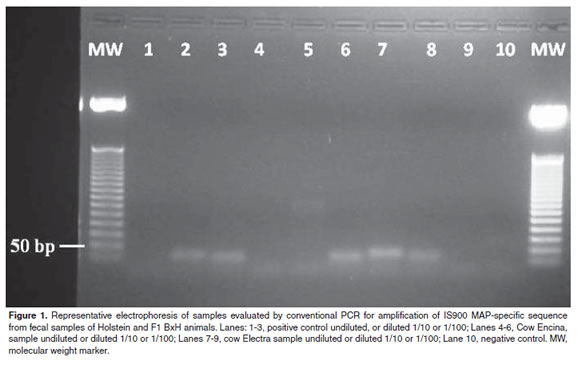
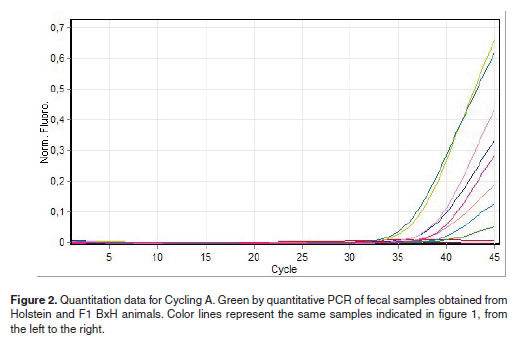
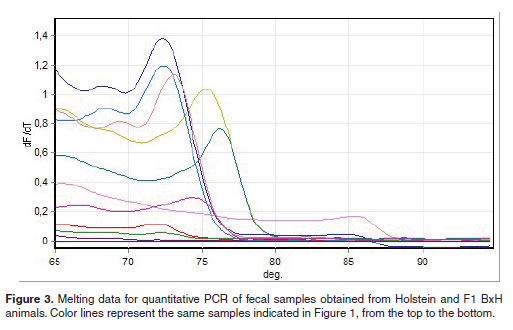
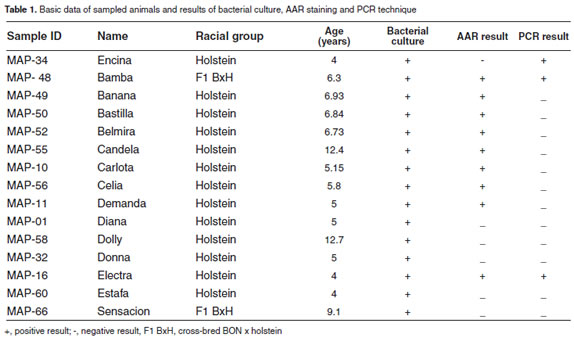
<body><![CDATA[<p><font face="Verdana, Arial, Helvetica, sans-serif" size="2">Basic data from animals sampled in this study is presented in <a href="#t1">table 1</a>. A single fecal sample was processed by PCR for most of the animals but one cow from which three samples were processed (Encina). The average age of sampled cows was 6.7 year (+/- 2.77 S.D.). All cultured samples (el 100%) showed growth of colonies characterized by turbidity of media at week 20th of culture. Aliquots 15 (20%) gave a positive result by real time PCR. of each sample grown in culture were taken for acid-Representative samples processed by conventional alcohol resistant (AAR) staining (Zielh Neelsen) PCR are presented in <a href="#f1">figure 1</a>, in which positive and for real time PCR. A total of 9 out of 15 samples bands migrate near to primer. These samples were (56 %) stained positive for AAR, whereas 3 out of further analyzed by real time PCR (<a href="#f1">Figure 1</a>). </font></p>    <p><font face="Verdana, Arial, Helvetica, sans-serif" size="2"><img src="/img/revistas/rccp/v23n1/v23n1a03t01.jpg"><a name="t1"></a></font></p>     <p><font face="Verdana, Arial, Helvetica, sans-serif" size="2"><img src="/img/revistas/rccp/v23n1/v23n1a03f01.jpg"><a name="f1"></a></font></p>     <p><font face="Verdana, Arial, Helvetica, sans-serif" size="2">The results of real time PCR showed that positive samples reached the amplification threshold beginning after cycle # 32 (<a href="#f2">Figure 2</a>), a finding that could be due to the low quantity of MAP specific DNA present in fecal samples. </font></p>    <p><font face="Verdana, Arial, Helvetica, sans-serif" size="2">In order to verify that primer dimmers were different from positive sample bands, the melting data showed that only positive samples were indeed amplified rather than primer dimmers (<a href="#f3">Figure 3</a>). </font></p>    <p><font face="Verdana, Arial, Helvetica, sans-serif" size="2"><img src="/img/revistas/rccp/v23n1/v23n1a03f02.jpg"><a name="f2"></a></font></p>     <p><font face="Verdana, Arial, Helvetica, sans-serif" size="2"><img src="/img/revistas/rccp/v23n1/v23n1a03f03.jpg"><a name="f3"></a></font></p>     <p><font face="Verdana, Arial, Helvetica, sans-serif" size="2">&nbsp;</font></p>     <p><font face="Verdana, Arial, Helvetica, sans-serif" size="3"><b>Discussion</b></font></p>    <p><font face="Verdana, Arial, Helvetica, sans-serif" size="2">There are two classical techniques for the diagnosis of bovine paratuberculosis including the analysis of serum antibodies by ELISA and bacterial culture from fecal samples. Although both of these techniques are highly sensitive the specificity is low particularly when dealing with asymptomatic (subclinical stages) infected animals which usually excrete low quantities of MAP in feces. The sensitivity of ELISA test can vary between 15% and 95%, depending on the number of bacteria excreted by the infected animal. Bacterial culture is considered the gold standard for MAP detection as it is 100% sensitive (Clark <I>et al</I>, 2008; De Juan et<I> al</I>, 2006), although it is very expensive, and extremely slow for giving a final result a fact that limits its diagnosis potential (Sigur&eth;ardottir y Valheim, 2004; Sweeney, 1996). In agreement with the reports of the literature the results in bacterial culture in the present study, showed that 20 weeks elapsed between the initial time of culture until the time in which an alteration of the media suggestive of MAP growth was observed. Interestingly, samples cultured without adding mycobactin to the media also showed bacterial growth after 20 weeks of culture suggesting other mycobacteria different to MAP could have been grown in culture, probably environmental mycobacteria. Bacterial contamination could be discarded because media did not show the turbidity and change of pH typical of non specific contamination. In fact, culture media was added with three different antibiotics and an antifungal compound suggesting that the observed growth could be related to environmental mycobacteria rather than other to non specific bacterial contamination. </font></p>    ]]></body>
<body><![CDATA[<p><font face="Verdana, Arial, Helvetica, sans-serif" size="2">As PCR was proposed to be the most promising technique to rapidly amplify and detect MAP genome from infected-animal fecal samples, by amplification of IS900 MAP-specific sequence (Bull <I>et al</I>, 2000; Harris y Barletta, 2001), this technique have been developed for a more accurate and rapid than bacterial culture diagnosis of MAP-infected animals (Collins y Stephens, 1993b; G&oacute;ngora y Villamil, 1999; Whitlock y Buergelt, 1996). Bovine paratuberculosis is characterized to be a chronic progressive disease during which MAP excretion in feces is proportionally related to clinical stage of the disease (Crossley <I>et al</I>, 2005; Raizman <I>et al</I>, 2007). However, in the present study cows were positive by PCR instead of being asymptomatic for Johne's disease. This fact could suggest that MAP-infected animals under the conditions of this enzootic herd can excrete considerable quantities of MAP in feces instead of being in a subclinical or early stage of the disease, in agreement with reports by several authors (Raizman <I>et al</I>, 2007, Mercado <I>et al</I>, 2000.). Additional evidence is provided by a case of a cow (Encina), who was sampled during the present study when it had no clinical symptoms compatibles with JD, but it died some weeks after sampling it after a short period of clinical diarrhea. At necropsy this cow exhibited gross macroscopic lesions in ileum and jejunum compatible with JD, and confirmed by histopathology in which abundant AAR positive bacilli were found in lamina propia of ileum and jejunum (Dr. Dubel I. Balvin, Universidad de Antioquia, unpublished case report). Based on this finding and taken into consideration that this herd is considered enzootic for JD, the fi nding of clinical healthy animals that resulted positive for MAP by bacterial culture and/or PCR techniques, are in agreement with the report of the literature about the existence of 25 potentially-infected animals (in subclinical stages of the disease) for each clinical case diagnosed in a herd (Fang <I>et al</I>, 2002). On the other hand, a negative result of a bacterial culture or a PCR performed on fecal samples do not necessary mean that the animal in question is not infected, because other factors related to the clinical stage of the disease and the quantity of excreted mycobacteria at the time of sampling, can be a bias for an appropriate diagnosis of MAP-infected animals. </font></p>    <p><font face="Verdana, Arial, Helvetica, sans-serif" size="2">The results on diagnosis of MAP-infected animals should be interpreted with caution regarding the establishment of a control program for JD in a given herd, because the high variability in the probability of finding MAP-excreted in feces is not a confidence variable to be considered for control purposes or for considering a herd as a MAP-infected or MAP-free herd, excepting when serial samples from the same animal are analyzed. In addition, caution should be kept when analyzing only a portion of the fecal sample that is contaminated with MAP in a given moment, because low excreting animals could not be appropriately detected when only a sample is taken instead of a gross quantity of fecal material because of obvious (economical and practical) limitations. </font></p>    <p><font face="Verdana, Arial, Helvetica, sans-serif" size="2">Several reports have shown the disparity between bacterial culture and PCR results (B&ouml;gli-Stuber <I>et al</I>, 2005; Sevilla, 2007). This is due, at least in part, to the different stages of the disease that are diagnosed for each technique, and its sensitivity. E.g., sensitivity of PCR technique depends on the quantity of DNA present in the sample and the efficiency of the protocol used for DNA extraction its purity, and the presence of PCR inhibitors in the fecal sample. On the other hand, bacterial culture requires a previous treatment of the sample for avoiding contamination by other microorganisms growing faster than MAP (De Juan <I>et al</I>. 2006). In this study we also found such a lack of concordance between bacterial culture and PCR results. This would be due to factors related to the method used for previous decontamination of the sample, the presence of other microorganisms interacting with MAP, metabolic stages of the bacteria, the use of thawed samples, the presence of various strain of MAP, and differences between these, etc. </font></p>    <p><font face="Verdana, Arial, Helvetica, sans-serif" size="2"><I>An integral strategy for identi</I><I>fi</I><I> cation of infected animals in a herd, prevention and control of the disease </I></font></p>    <p><font face="Verdana, Arial, Helvetica, sans-serif" size="2">Because treatments of infected animals suffering Johne's disease are hardly inefficient and expensive (O'Mahony y Hill, 2002), no treatments are recommended for infected animals in a dairy herd. Treated animals may exhibit improvement of their clinical signs but a complete remission of the entity is not achieved, animals can rapidly become ill and MAP can be newly excreted in feces (Collins y Stephens, 1993b; Whipple <I>et al</I>. 1991). Therefore, the best choice for farmers is to define specific strategies for control of the disease in dairies, by avoiding dissemination of JD into the herd and the corresponding economic loss related to milk yield reduction in subclinical or clinical-infected animals, and increased culling rates (O'Mahony y Hill, 2002; Chi <I>et al</I>. 2002; Zapata <I>et al</I>. 2008). Similarly, practices related to replacing culled cows, calving, and management schedules for infected calves or adult animals, as well as preventive veterinary medicine schedules, are of key importance in the establishment of an integrated program for identification of MAP-infected animals, prevention of new infections, and control of the disease (Collins y Stephens, 1993b). </font></p>    <p><font face="Verdana, Arial, Helvetica, sans-serif" size="2"><I>Identi</I><I>fi</I><I>cation of infected animals. </I>The fi rst step is to identify each individual to know is sanitary status regarding MAP infection, the potential and real routes of animal-to-animal infection and environmental borne sources of the agent. MAPinfected animal must be obligatory identified by a combined strategy of at least two diagnosis methods: bacterial culture and PCR testing and/ or ELISA test. The main advantage of PCR consist in its high specificity, sensitivity for detecting subclinical-infected animals, and the low time required to obtain the PCR result (Zapata <I>et al</I>. 2008). In a dairy herd, fecal samples should be taken from each group of animals at six month interval and processed by PCR. Pregnant cows at the last trimester of pregnancy should also be sampled. In addition, only paratuberculosisfree animals should be introduced into the herd as a replacement strategy, for which at least two negative PCR tests with a month interval should be confirmed in the animal (Zapata <I>et al</I>, 2008). </font></p>    <p><font face="Verdana, Arial, Helvetica, sans-serif" size="2"><I>Prevention strategies</I>. Identification of MAPinfected or MAP-free animals would allow to established preventive schedules for avoiding paratuberculosis infection or re-infection in a herd. In a paratuberculosis-free herd, management strategies must be directed to avoid introduction of the agent by keeping the herd in a close-schedule of replacing management. On the contrary, in an infected herd, management schedules should be directed to avoiding dissemination of the agent from infected animals to other individuals or group of non-infected animals into de herd. </font></p>    <p><font face="Verdana, Arial, Helvetica, sans-serif" size="2"><I>Control strategies</I>. In herds in which JD have been diagnosed, the most recommended procedure is to culling off animals that are diagnosed as positive for infection with MAP, based on the strategy of PCR testing. This measure must be accompanied by the implementation of measures directed to avoid new cases and dissemination of the agent to the rest of the animals (Collins y Stephens, 1993b). Some of these measures include: 1) fecal sampling of animals at 6 months interval for detecting MAP genome by PCR, 2) isolation of animal with clinical signs compatible with JD, and testing of fecal samples by PCR, 3) keeping utensils and milking devices clean and free of fecal contamination, 4) keeping away young from adult animals and specially from animal with clinical signs compatible with JD, and 5) culling of MAP positive cows. In addition, pregnant cows with a PCR positive result as well as their positive calves must be culled. For instance it is necessary to feed a calf born from an infected cow with callostrum taken from a negative cow or with milk replacement food. The calf must be sampled twice at its first and second months of life for PCR testing. Only two consecutive negative PCR results must be considered to keep the calf in the herd replacement stock (Sevilla, 2007; Zapata <I>et al,</I> 2008). Finally, in some countries there are commercial vaccines available for MAP. But preventive schedules based on vaccination strategies are not recommended for MAP free herds, because this may reduce the number of animals developing the clinical stages of the disease and the number of infected cows excreting detectable quantities of MAP in fecal samples, but it is rarely effective for prevention of Johne's disease in a herd (Sevilla, 2007). </font></p>     <p><font face="Verdana, Arial, Helvetica, sans-serif" size="2">&nbsp;</font></p>     <p><font face="Verdana, Arial, Helvetica, sans-serif" size="3"><b>Acknowledgements</b></font></p>    ]]></body>
<body><![CDATA[<p><font face="Verdana, Arial, Helvetica, sans-serif" size="2">This project was financed by CODI grant (Mediana cuant&iacute;a 2005, Project Code # E01076). </font></p>     <p><font face="Verdana, Arial, Helvetica, sans-serif" size="2">Authors thanks to Dr. Jorge A. Fern&aacute;ndez-Silva (Universidad de Antioquia and Gie&beta;en Universitat, Germany) for MAP reference strain gift. Dr. Carlos Muskus (Corporation PECET at Universidad de Antioquia), and Dr. Ernesto L&oacute;pez-Rojas (Universidad CES), for technical assistance in PCR protocols and discussion. Special thanks to Bacteriology and Microbiology students from Colegio Mayor de Antioquia and Universidad de Antioquia, respectively, for technical assistance in bacterial culture. </font></p>     <p><font face="Verdana, Arial, Helvetica, sans-serif" size="2">&nbsp;</font></p>     <p><font face="Verdana, Arial, Helvetica, sans-serif" size="3"><b>References</b></font></p>    <!-- ref --><p><font face="Verdana, Arial, Helvetica, sans-serif" size="2">Abalos P. Actualidad en paratuberculosis. Rev Ext Tecnol Vet 2001; 7:9-11. </font>&nbsp;&nbsp;&nbsp;&nbsp;&nbsp;&nbsp;&nbsp;&nbsp;[&#160;<a href="javascript:void(0);" onclick="javascript: window.open('/scielo.php?script=sci_nlinks&ref=000077&pid=S0120-0690201000010000300001&lng=','','width=640,height=500,resizable=yes,scrollbars=1,menubar=yes,');">Links</a>&#160;]<!-- end-ref --><!-- ref --><p><font face="Verdana, Arial, Helvetica, sans-serif" size="2">Bannantine JP, Stabel JR. Killing of Mycobacterium avium subspecies paratuberculosis within macrophages. BMC Microbiology 2002; 2:1471-2180. </font>&nbsp;&nbsp;&nbsp;&nbsp;&nbsp;&nbsp;&nbsp;&nbsp;[&#160;<a href="javascript:void(0);" onclick="javascript: window.open('/scielo.php?script=sci_nlinks&ref=000078&pid=S0120-0690201000010000300002&lng=','','width=640,height=500,resizable=yes,scrollbars=1,menubar=yes,');">Links</a>&#160;]<!-- end-ref --><!-- ref --><p><font face="Verdana, Arial, Helvetica, sans-serif" size="2">B&ouml;gli-Stuber K, Kohler C, Seitert G, Glanemann B, Antognoli MC, Salman MD, Wittenbrink MM, Wittwer M, Wassenaar T, Jemmi T, Bissig-Choisat B. Detection of Mycobacterium avium subspecies paratuberculosis in Swiss dairy cattle by real-time PCR and culture: a comparison of the two assays. J Appl Microbiol 2005; 99:587-597. </font>&nbsp;&nbsp;&nbsp;&nbsp;&nbsp;&nbsp;&nbsp;&nbsp;[&#160;<a href="javascript:void(0);" onclick="javascript: window.open('/scielo.php?script=sci_nlinks&ref=000079&pid=S0120-0690201000010000300003&lng=','','width=640,height=500,resizable=yes,scrollbars=1,menubar=yes,');">Links</a>&#160;]<!-- end-ref --><!-- ref --><p><font face="Verdana, Arial, Helvetica, sans-serif" size="2">Bull TJ, Hermon-Taylor J, Pavlik I, El-Zaatari F, Tizard M. Characterization of IS900 loci in Mycobacterium avium subsp. paratuberculosis and development of multiplex PCR typing. Microbiology 2000; 146:2185-2197. </font>&nbsp;&nbsp;&nbsp;&nbsp;&nbsp;&nbsp;&nbsp;&nbsp;[&#160;<a href="javascript:void(0);" onclick="javascript: window.open('/scielo.php?script=sci_nlinks&ref=000080&pid=S0120-0690201000010000300004&lng=','','width=640,height=500,resizable=yes,scrollbars=1,menubar=yes,');">Links</a>&#160;]<!-- end-ref --><!-- ref --><p><font face="Verdana, Arial, Helvetica, sans-serif" size="2">Chi J, VanLeeuwen JA, Weersink A, Keefe GP. Direct production losses and treatment costs from bovine viral diarrhea virus, bovine leucosis virus, Mycobacterium avium subspecies paratuberculosis, and Neospora cainum. Prev Vet Med 2002; 55:137-153. </font>&nbsp;&nbsp;&nbsp;&nbsp;&nbsp;&nbsp;&nbsp;&nbsp;[&#160;<a href="javascript:void(0);" onclick="javascript: window.open('/scielo.php?script=sci_nlinks&ref=000081&pid=S0120-0690201000010000300005&lng=','','width=640,height=500,resizable=yes,scrollbars=1,menubar=yes,');">Links</a>&#160;]<!-- end-ref --><!-- ref --><p><font face="Verdana, Arial, Helvetica, sans-serif" size="2">Clarence MF, Ed. Paratuberculosis. Enfermedad de Johne. En: El manual Merck de veterinaria. 4a ed. New Jersey EUA: Merck &amp; Co. Inc. 1993. p.462-63. </font>&nbsp;&nbsp;&nbsp;&nbsp;&nbsp;&nbsp;&nbsp;&nbsp;[&#160;<a href="javascript:void(0);" onclick="javascript: window.open('/scielo.php?script=sci_nlinks&ref=000082&pid=S0120-0690201000010000300006&lng=','','width=640,height=500,resizable=yes,scrollbars=1,menubar=yes,');">Links</a>&#160;]<!-- end-ref --><!-- ref --><p><font face="Verdana, Arial, Helvetica, sans-serif" size="2">Clark Jr DL, Koziczkowski JJ, Radcliff RP, Carlson RA, Ellingson J. LE. Detection of Mycobacterium avium Subspecies paratuberculosis: Comparing Fecal Culture Versus Serum Enzyme-Linked Immunosorbent Assay and Direct Fecal Polymerase Chain Reaction. J Dairy Sci. 2008; 91:2620-2627. </font>&nbsp;&nbsp;&nbsp;&nbsp;&nbsp;&nbsp;&nbsp;&nbsp;[&#160;<a href="javascript:void(0);" onclick="javascript: window.open('/scielo.php?script=sci_nlinks&ref=000083&pid=S0120-0690201000010000300007&lng=','','width=640,height=500,resizable=yes,scrollbars=1,menubar=yes,');">Links</a>&#160;]<!-- end-ref --><!-- ref --><p><font face="Verdana, Arial, Helvetica, sans-serif" size="2">Collins DM, Stephens DM y de Lisle GW. Comparison of polymerase chain reaction tests and faecal culture for detecting Mycobacterium paratuberculosis in bovine faeces. Vet. Microbiol 1993b; 36:289-99. </font>&nbsp;&nbsp;&nbsp;&nbsp;&nbsp;&nbsp;&nbsp;&nbsp;[&#160;<a href="javascript:void(0);" onclick="javascript: window.open('/scielo.php?script=sci_nlinks&ref=000084&pid=S0120-0690201000010000300008&lng=','','width=640,height=500,resizable=yes,scrollbars=1,menubar=yes,');">Links</a>&#160;]<!-- end-ref --><!-- ref --><p><font face="Verdana, Arial, Helvetica, sans-serif" size="2">Crossley BM, Zagmutt-Vergara FJ, Fyock TL, Whitlock RH, Gardner IA. Fecal shedding of Mycobacterium avium subsp. paratuberculosis by dairy cows. Vet Microbiol 2005; 107:257-263. </font>&nbsp;&nbsp;&nbsp;&nbsp;&nbsp;&nbsp;&nbsp;&nbsp;[&#160;<a href="javascript:void(0);" onclick="javascript: window.open('/scielo.php?script=sci_nlinks&ref=000085&pid=S0120-0690201000010000300009&lng=','','width=640,height=500,resizable=yes,scrollbars=1,menubar=yes,');">Links</a>&#160;]<!-- end-ref --><!-- ref --><p><font face="Verdana, Arial, Helvetica, sans-serif" size="2">De Juan L, &Aacute;lvarez J, Romero B, Bezos J, Castellanos E. Comparison of Four Different Culture Media for Isolation and Growth of Type II and Type I/III Mycobacterium avium subsp. Paratuberculosis Strains Isolated from Cattle and Goats. Appl Environ Microbiol 2006; 5927-5932. </font>&nbsp;&nbsp;&nbsp;&nbsp;&nbsp;&nbsp;&nbsp;&nbsp;[&#160;<a href="javascript:void(0);" onclick="javascript: window.open('/scielo.php?script=sci_nlinks&ref=000086&pid=S0120-0690201000010000300010&lng=','','width=640,height=500,resizable=yes,scrollbars=1,menubar=yes,');">Links</a>&#160;]<!-- end-ref --><!-- ref --><p><font face="Verdana, Arial, Helvetica, sans-serif" size="2">Fang Y, Wu WH, Pepper JL, Larsen JL, Marras SA, Nelson EA, Epperson WB, Christopher-Hennings J. Comparison of Real-Time, Quantitative PCR with Molecular Beacons to Nested PCR and Culture Methods for Detection of Mycobacterium avium subsp. paratuberculosis in Bovine Fecal Samples. J Clin Microbiol 2002; 287-291. </font>&nbsp;&nbsp;&nbsp;&nbsp;&nbsp;&nbsp;&nbsp;&nbsp;[&#160;<a href="javascript:void(0);" onclick="javascript: window.open('/scielo.php?script=sci_nlinks&ref=000087&pid=S0120-0690201000010000300011&lng=','','width=640,height=500,resizable=yes,scrollbars=1,menubar=yes,');">Links</a>&#160;]<!-- end-ref --><!-- ref --><p><font face="Verdana, Arial, Helvetica, sans-serif" size="2">Faries CF, Roussel AJ, Jordan E, Strokes SR, Magee DD. Bovine Paratuberculosis of beef cattle. A wasting condition, commonly called Johne's disease. Texas Agricultural extension Service. The Texas A&amp;M Univesity system. L-5243. </font>&nbsp;&nbsp;&nbsp;&nbsp;&nbsp;&nbsp;&nbsp;&nbsp;[&#160;<a href="javascript:void(0);" onclick="javascript: window.open('/scielo.php?script=sci_nlinks&ref=000088&pid=S0120-0690201000010000300012&lng=','','width=640,height=500,resizable=yes,scrollbars=1,menubar=yes,');">Links</a>&#160;]<!-- end-ref --><!-- ref --><p><font face="Verdana, Arial, Helvetica, sans-serif" size="2">G&oacute;ngora OA, Villamil JC. La paratuberculosis bovina desde la &oacute;ptica de la salud p&uacute;blica. Holstein Colombia 1999; 147:44-48. </font>&nbsp;&nbsp;&nbsp;&nbsp;&nbsp;&nbsp;&nbsp;&nbsp;[&#160;<a href="javascript:void(0);" onclick="javascript: window.open('/scielo.php?script=sci_nlinks&ref=000089&pid=S0120-0690201000010000300013&lng=','','width=640,height=500,resizable=yes,scrollbars=1,menubar=yes,');">Links</a>&#160;]<!-- end-ref --><!-- ref --><p><font face="Verdana, Arial, Helvetica, sans-serif" size="2">Gonz&aacute;lez J, Geijo MV, Garc&iacute;a-Pariente C, Verna A, Corpa JM, Reyes LE, Ferreras MC, Juste RA, Garc&iacute;a Mar&iacute;n JF, P&eacute;rez V. Histopathological classification of lesions associated with natural paratuberculosis infection in cattle. J Comp Path 2005; 133:184-196. </font>&nbsp;&nbsp;&nbsp;&nbsp;&nbsp;&nbsp;&nbsp;&nbsp;[&#160;<a href="javascript:void(0);" onclick="javascript: window.open('/scielo.php?script=sci_nlinks&ref=000090&pid=S0120-0690201000010000300014&lng=','','width=640,height=500,resizable=yes,scrollbars=1,menubar=yes,');">Links</a>&#160;]<!-- end-ref --><!-- ref --><p><font face="Verdana, Arial, Helvetica, sans-serif" size="2">Harris NB, Barletta RG. Mycobacterium avium subsp. paratuberculosis in Veterinary Medicine. Clin Microbiol Rev 2001; 4:489-512. </font>&nbsp;&nbsp;&nbsp;&nbsp;&nbsp;&nbsp;&nbsp;&nbsp;[&#160;<a href="javascript:void(0);" onclick="javascript: window.open('/scielo.php?script=sci_nlinks&ref=000091&pid=S0120-0690201000010000300015&lng=','','width=640,height=500,resizable=yes,scrollbars=1,menubar=yes,');">Links</a>&#160;]<!-- end-ref --><!-- ref --><p><font face="Verdana, Arial, Helvetica, sans-serif" size="2">Lombard, Jason. How Johne's hurts you in the pocketbook. Hoard's Dairyman. 2006; 402. </font>&nbsp;&nbsp;&nbsp;&nbsp;&nbsp;&nbsp;&nbsp;&nbsp;[&#160;<a href="javascript:void(0);" onclick="javascript: window.open('/scielo.php?script=sci_nlinks&ref=000092&pid=S0120-0690201000010000300016&lng=','','width=640,height=500,resizable=yes,scrollbars=1,menubar=yes,');">Links</a>&#160;]<!-- end-ref --><!-- ref --><p><font face="Verdana, Arial, Helvetica, sans-serif" size="2">Mercado M, Cicuta DS, Boehringer ME, Silvia I. Paratuberculosis en el Ganado lechero de corrientes. C&aacute;tedra de microbiolog&iacute;a. Facultad de Ciencias veterinarias UNNE. En l&iacute;nea. [citado 30 Julio 2009] URL <a href="http://www.inta.gov.ar/ BALCARCE/gsa/ultimas/v_034.pdf" target="_blank">http://www.inta.gov.ar/ BALCARCE/gsa/ultimas/v_034.pdf</a></font>&nbsp;&nbsp;&nbsp;&nbsp;&nbsp;&nbsp;&nbsp;&nbsp;[&#160;<a href="javascript:void(0);" onclick="javascript: window.open('/scielo.php?script=sci_nlinks&ref=000093&pid=S0120-0690201000010000300017&lng=','','width=640,height=500,resizable=yes,scrollbars=1,menubar=yes,');">Links</a>&#160;]<!-- end-ref --><!-- ref --><p><font face="Verdana, Arial, Helvetica, sans-serif" size="2">O'Mahony Jim, Hill Collin. A real time PCR assays for the detection and quantitation of Mycobacterium avium subsp. paratuberculosis using SYBR Green and the Light Cycler. J Microbiol Methods 2002; 51:283-293. </font>&nbsp;&nbsp;&nbsp;&nbsp;&nbsp;&nbsp;&nbsp;&nbsp;[&#160;<a href="javascript:void(0);" onclick="javascript: window.open('/scielo.php?script=sci_nlinks&ref=000094&pid=S0120-0690201000010000300018&lng=','','width=640,height=500,resizable=yes,scrollbars=1,menubar=yes,');">Links</a>&#160;]<!-- end-ref --><!-- ref --><p><font face="Verdana, Arial, Helvetica, sans-serif" size="2">Raizman EA, Wells SJ, Godden SM, Fetrowa J, Oakes M. The associations between culling due to clinical Johne's disease or the detection of Mycobacterium avium subsp. paratuberculosis fecal shedding and the diagnosis of clinical or subclinical diseases in two dairy herds in Minnesota, USA. Prev Vet Med 2007; 166-178. </font>&nbsp;&nbsp;&nbsp;&nbsp;&nbsp;&nbsp;&nbsp;&nbsp;[&#160;<a href="javascript:void(0);" onclick="javascript: window.open('/scielo.php?script=sci_nlinks&ref=000095&pid=S0120-0690201000010000300019&lng=','','width=640,height=500,resizable=yes,scrollbars=1,menubar=yes,');">Links</a>&#160;]<!-- end-ref --><!-- ref --><p><font face="Verdana, Arial, Helvetica, sans-serif" size="2">Ram&iacute;rez VN, Gaviria BG, Restrepo BLF, G&oacute;mez NC. Diagn&oacute;stico epidemiol&oacute;gico referente a varias patolog&iacute;as de bovinos en tres haciendas de la universidad de Antioquia. Facultad de Ciencias Agrarias, Universidad de Antioquia. En l&iacute;nea. [citado 20 mayo 2009]. URL:<a href="http://kogi.udea.edu.co/articulos/Med_Bovina/proyecto%20diagn%F3stico.pdf" target="_blank">http://kogi.udea.edu.co/articulos/Med_Bovina/proyecto20diagnF3stico.pdf</a>. </font>&nbsp;&nbsp;&nbsp;&nbsp;&nbsp;&nbsp;&nbsp;&nbsp;[&#160;<a href="javascript:void(0);" onclick="javascript: window.open('/scielo.php?script=sci_nlinks&ref=000096&pid=S0120-0690201000010000300020&lng=','','width=640,height=500,resizable=yes,scrollbars=1,menubar=yes,');">Links</a>&#160;]<!-- end-ref --><!-- ref --><p><font face="Verdana, Arial, Helvetica, sans-serif" size="2">Sevilla Agirregomoskorta, Iker. Caracterizaci&oacute;n molecular, detecci&oacute;n y resistencia de "Mycobacterium avium" subespecie "paratuberculosis". 1&ordf; ed. - Vitoria-Gasteiz: Servicio Central de Publicaciones del Gobierno Vasco, 2007. Tesis doctoral. </font>&nbsp;&nbsp;&nbsp;&nbsp;&nbsp;&nbsp;&nbsp;&nbsp;[&#160;<a href="javascript:void(0);" onclick="javascript: window.open('/scielo.php?script=sci_nlinks&ref=000097&pid=S0120-0690201000010000300021&lng=','','width=640,height=500,resizable=yes,scrollbars=1,menubar=yes,');">Links</a>&#160;]<!-- end-ref --><!-- ref --><p><font face="Verdana, Arial, Helvetica, sans-serif" size="2">Sigur&eth;ardottir OG, Valheim M, Press CM. Establishment of Mycobacterium avium subsp. paratuberculosis infection in the intestine of ruminants. Adv Drug Deliv Rev 2004; 56:819-834. </font>&nbsp;&nbsp;&nbsp;&nbsp;&nbsp;&nbsp;&nbsp;&nbsp;[&#160;<a href="javascript:void(0);" onclick="javascript: window.open('/scielo.php?script=sci_nlinks&ref=000098&pid=S0120-0690201000010000300022&lng=','','width=640,height=500,resizable=yes,scrollbars=1,menubar=yes,');">Links</a>&#160;]<!-- end-ref --><p><font face="Verdana, Arial, Helvetica, sans-serif" size="2">Soto JP, Kruze J, Leiva S. Aislamiento de Mycobacterium avium subsp. paratuberculosis de fecas en reba&ntilde;os lecheros infectados mediante el M&eacute;todo de Cornell modificado. </font></p>     <p><font face="Verdana, Arial, Helvetica, sans-serif" size="2">Arch med vet [online] 2002; 34:275-282. [citado 30 mayo 2009] URL: <a href="http://www.scielo.cl/scielo.php?script=sci_ arttext&pid=S0301-732X2002000200013&lng=es&nrm=iso" target="_blank">http://www.scielo.cl/scielo.php?script=sci_ arttext&amp;pid=S0301-732X2002000200013&amp;lng=es&amp;nrm=iso</a></font></p>     <!-- ref --><p><font face="Verdana, Arial, Helvetica, sans-serif" size="2">Sweeney RW. Paratuberculosis (Johne's Disease). Vet Clin North Am Food Anim Pract 1996; 12:305-471. </font>&nbsp;&nbsp;&nbsp;&nbsp;&nbsp;&nbsp;&nbsp;&nbsp;[&#160;<a href="javascript:void(0);" onclick="javascript: window.open('/scielo.php?script=sci_nlinks&ref=000101&pid=S0120-0690201000010000300024&lng=','','width=640,height=500,resizable=yes,scrollbars=1,menubar=yes,');">Links</a>&#160;]<!-- end-ref --><!-- ref --><p><font face="Verdana, Arial, Helvetica, sans-serif" size="2">Taylor JH. Mycobacterium avium subspecies paratuberculosis, Crohn's disease and the Doomsday Scenario. Gut Pathogens 2009; 1:15. </font>&nbsp;&nbsp;&nbsp;&nbsp;&nbsp;&nbsp;&nbsp;&nbsp;[&#160;<a href="javascript:void(0);" onclick="javascript: window.open('/scielo.php?script=sci_nlinks&ref=000102&pid=S0120-0690201000010000300025&lng=','','width=640,height=500,resizable=yes,scrollbars=1,menubar=yes,');">Links</a>&#160;]<!-- end-ref --><!-- ref --><p><font face="Verdana, Arial, Helvetica, sans-serif" size="2">Valentin WP, Goethe R. Pathogenesis of Mycobacterium avium subspecies paratuberculosis infections in ruminants: still more questions than answers. Microbes Infect 1999; 1:1121-1127. </font>&nbsp;&nbsp;&nbsp;&nbsp;&nbsp;&nbsp;&nbsp;&nbsp;[&#160;<a href="javascript:void(0);" onclick="javascript: window.open('/scielo.php?script=sci_nlinks&ref=000103&pid=S0120-0690201000010000300026&lng=','','width=640,height=500,resizable=yes,scrollbars=1,menubar=yes,');">Links</a>&#160;]<!-- end-ref --><!-- ref --><p><font face="Verdana, Arial, Helvetica, sans-serif" size="2">Whipple DL, Callihan DR, Jarnagin JL. Cultivation of Mycobacterium paratuberculosis from bovine fecal specimens and a suggested standardized procedure. J Vet Diagn Invest 1991; 3:368-373. </font>&nbsp;&nbsp;&nbsp;&nbsp;&nbsp;&nbsp;&nbsp;&nbsp;[&#160;<a href="javascript:void(0);" onclick="javascript: window.open('/scielo.php?script=sci_nlinks&ref=000104&pid=S0120-0690201000010000300027&lng=','','width=640,height=500,resizable=yes,scrollbars=1,menubar=yes,');">Links</a>&#160;]<!-- end-ref --><!-- ref --><p><font face="Verdana, Arial, Helvetica, sans-serif" size="2">Whitlock R. Buergelt C. Preclinical and clinical manifestations of paratuberculosis Vet Clin North Am 1996; 12:345-56. </font>&nbsp;&nbsp;&nbsp;&nbsp;&nbsp;&nbsp;&nbsp;&nbsp;[&#160;<a href="javascript:void(0);" onclick="javascript: window.open('/scielo.php?script=sci_nlinks&ref=000105&pid=S0120-0690201000010000300028&lng=','','width=640,height=500,resizable=yes,scrollbars=1,menubar=yes,');">Links</a>&#160;]<!-- end-ref --><!-- ref --><p><font face="Verdana, Arial, Helvetica, sans-serif" size="2">Zapata MM, Rodas JD, Maldonado JG. "Paratuberculosis bovina: &iquest;conocemos la situaci&oacute;n real de la enfermedad en la ganader&iacute;a colombiana?" Rev Colomb Cienc Pecu 2008; 21:420-435. </font>&nbsp;&nbsp;&nbsp;&nbsp;&nbsp;&nbsp;&nbsp;&nbsp;[&#160;<a href="javascript:void(0);" onclick="javascript: window.open('/scielo.php?script=sci_nlinks&ref=000106&pid=S0120-0690201000010000300029&lng=','','width=640,height=500,resizable=yes,scrollbars=1,menubar=yes,');">Links</a>&#160;]<!-- end-ref --> ]]></body><back>
<ref-list>
<ref id="B1">
<nlm-citation citation-type="journal">
<person-group person-group-type="author">
<name>
<surname><![CDATA[Abalos]]></surname>
<given-names><![CDATA[P]]></given-names>
</name>
</person-group>
<article-title xml:lang="es"><![CDATA[Actualidad en paratuberculosis]]></article-title>
<source><![CDATA[Rev Ext Tecnol Vet]]></source>
<year>2001</year>
<volume>7</volume>
<page-range>9-11</page-range></nlm-citation>
</ref>
<ref id="B2">
<nlm-citation citation-type="journal">
<person-group person-group-type="author">
<name>
<surname><![CDATA[Bannantine]]></surname>
<given-names><![CDATA[JP]]></given-names>
</name>
<name>
<surname><![CDATA[Stabel]]></surname>
<given-names><![CDATA[JR]]></given-names>
</name>
</person-group>
<article-title xml:lang="en"><![CDATA[Killing of Mycobacterium avium subspecies paratuberculosis within macrophages]]></article-title>
<source><![CDATA[BMC Microbiology]]></source>
<year>2002</year>
<volume>2</volume>
<page-range>1471-2180</page-range></nlm-citation>
</ref>
<ref id="B3">
<nlm-citation citation-type="journal">
<person-group person-group-type="author">
<name>
<surname><![CDATA[Bögli-Stuber]]></surname>
<given-names><![CDATA[K]]></given-names>
</name>
<name>
<surname><![CDATA[Kohler]]></surname>
<given-names><![CDATA[C]]></given-names>
</name>
<name>
<surname><![CDATA[Seitert]]></surname>
<given-names><![CDATA[G]]></given-names>
</name>
<name>
<surname><![CDATA[Glanemann]]></surname>
<given-names><![CDATA[B]]></given-names>
</name>
<name>
<surname><![CDATA[Antognoli]]></surname>
<given-names><![CDATA[MC]]></given-names>
</name>
<name>
<surname><![CDATA[Salman]]></surname>
<given-names><![CDATA[MD]]></given-names>
</name>
</person-group>
<article-title xml:lang="en"><![CDATA[Detection of Mycobacterium avium subspecies paratuberculosis in Swiss dairy cattle by real-time PCR and culture: a comparison of the two assays]]></article-title>
<source><![CDATA[J Appl Microbiol]]></source>
<year>2005</year>
<volume>99</volume>
<page-range>587-597</page-range></nlm-citation>
</ref>
<ref id="B4">
<nlm-citation citation-type="journal">
<person-group person-group-type="author">
<name>
<surname><![CDATA[Bull]]></surname>
<given-names><![CDATA[TJ]]></given-names>
</name>
<name>
<surname><![CDATA[Hermon-Taylor]]></surname>
<given-names><![CDATA[J]]></given-names>
</name>
<name>
<surname><![CDATA[Pavlik]]></surname>
<given-names><![CDATA[I]]></given-names>
</name>
<name>
<surname><![CDATA[El-Zaatari]]></surname>
<given-names><![CDATA[F]]></given-names>
</name>
<name>
<surname><![CDATA[Tizard]]></surname>
<given-names><![CDATA[M]]></given-names>
</name>
</person-group>
<article-title xml:lang="en"><![CDATA[Characterization of IS900 loci in Mycobacterium avium subsp. paratuberculosis and development of multiplex PCR typing]]></article-title>
<source><![CDATA[Microbiology]]></source>
<year>2000</year>
<volume>146</volume>
<page-range>2185-2197</page-range></nlm-citation>
</ref>
<ref id="B5">
<nlm-citation citation-type="journal">
<person-group person-group-type="author">
<name>
<surname><![CDATA[Chi]]></surname>
<given-names><![CDATA[J]]></given-names>
</name>
<name>
<surname><![CDATA[VanLeeuwen]]></surname>
<given-names><![CDATA[JA]]></given-names>
</name>
<name>
<surname><![CDATA[Weersink]]></surname>
<given-names><![CDATA[A]]></given-names>
</name>
<name>
<surname><![CDATA[Keefe]]></surname>
<given-names><![CDATA[GP]]></given-names>
</name>
</person-group>
<article-title xml:lang="en"><![CDATA[Direct production losses and treatment costs from bovine viral diarrhea virus, bovine leucosis virus, Mycobacterium avium subspecies paratuberculosis, and Neospora cainum]]></article-title>
<source><![CDATA[Prev Vet Med]]></source>
<year>2002</year>
<volume>55</volume>
<page-range>137-153</page-range></nlm-citation>
</ref>
<ref id="B6">
<nlm-citation citation-type="book">
<person-group person-group-type="author">
<name>
<surname><![CDATA[Clarence]]></surname>
<given-names><![CDATA[MF]]></given-names>
</name>
</person-group>
<article-title xml:lang="es"><![CDATA[Paratuberculosis: Enfermedad de Johne]]></article-title>
<source><![CDATA[El manual Merck de veterinaria]]></source>
<year>1993</year>
<edition>4</edition>
<page-range>462-63</page-range><publisher-loc><![CDATA[New Jersey ]]></publisher-loc>
<publisher-name><![CDATA[Merck & Co]]></publisher-name>
</nlm-citation>
</ref>
<ref id="B7">
<nlm-citation citation-type="journal">
<person-group person-group-type="author">
<name>
<surname><![CDATA[Clark]]></surname>
<given-names><![CDATA[DL]]></given-names>
</name>
<name>
<surname><![CDATA[Koziczkowski]]></surname>
<given-names><![CDATA[JJ]]></given-names>
</name>
<name>
<surname><![CDATA[Radcliff]]></surname>
<given-names><![CDATA[RP]]></given-names>
</name>
<name>
<surname><![CDATA[Carlson]]></surname>
<given-names><![CDATA[RA]]></given-names>
</name>
<name>
<surname><![CDATA[Ellingson]]></surname>
<given-names><![CDATA[J]]></given-names>
</name>
</person-group>
<article-title xml:lang="en"><![CDATA[Detection of Mycobacterium avium Subspecies paratuberculosis: Comparing Fecal Culture Versus Serum Enzyme-Linked Immunosorbent Assay and Direct Fecal Polymerase Chain Reaction]]></article-title>
<source><![CDATA[J Dairy Sci]]></source>
<year>2008</year>
<volume>91</volume>
<page-range>2620-2627</page-range></nlm-citation>
</ref>
<ref id="B8">
<nlm-citation citation-type="journal">
<person-group person-group-type="author">
<name>
<surname><![CDATA[Collins]]></surname>
<given-names><![CDATA[DM]]></given-names>
</name>
<name>
<surname><![CDATA[Stephens]]></surname>
<given-names><![CDATA[DM]]></given-names>
</name>
<name>
<surname><![CDATA[de Lisle]]></surname>
<given-names><![CDATA[GW]]></given-names>
</name>
</person-group>
<article-title xml:lang="en"><![CDATA[Comparison of polymerase chain reaction tests and faecal culture for detecting Mycobacterium paratuberculosis in bovine faeces]]></article-title>
<source><![CDATA[Vet. Microbiol]]></source>
<year>1993</year>
<month>b</month>
<volume>36</volume>
<page-range>289-99</page-range></nlm-citation>
</ref>
<ref id="B9">
<nlm-citation citation-type="journal">
<person-group person-group-type="author">
<name>
<surname><![CDATA[Crossley]]></surname>
<given-names><![CDATA[BM]]></given-names>
</name>
<name>
<surname><![CDATA[Zagmutt-Vergara]]></surname>
<given-names><![CDATA[FJ]]></given-names>
</name>
<name>
<surname><![CDATA[Fyock]]></surname>
<given-names><![CDATA[TL]]></given-names>
</name>
<name>
<surname><![CDATA[Whitlock]]></surname>
<given-names><![CDATA[RH]]></given-names>
</name>
<name>
<surname><![CDATA[Gardner]]></surname>
<given-names><![CDATA[IA]]></given-names>
</name>
</person-group>
<article-title xml:lang="en"><![CDATA[Fecal shedding of Mycobacterium avium subsp. paratuberculosis by dairy cows]]></article-title>
<source><![CDATA[Vet Microbiol]]></source>
<year>2005</year>
<volume>107</volume>
<page-range>257-263</page-range></nlm-citation>
</ref>
<ref id="B10">
<nlm-citation citation-type="journal">
<person-group person-group-type="author">
<name>
<surname><![CDATA[De Juan]]></surname>
<given-names><![CDATA[L]]></given-names>
</name>
<name>
<surname><![CDATA[Álvarez]]></surname>
<given-names><![CDATA[J]]></given-names>
</name>
<name>
<surname><![CDATA[Romero]]></surname>
<given-names><![CDATA[B]]></given-names>
</name>
<name>
<surname><![CDATA[Bezos]]></surname>
<given-names><![CDATA[J]]></given-names>
</name>
<name>
<surname><![CDATA[Castellanos]]></surname>
<given-names><![CDATA[E]]></given-names>
</name>
</person-group>
<article-title xml:lang="en"><![CDATA[Comparison of Four Different Culture Media for Isolation and Growth of Type II and Type I/III Mycobacterium avium subsp. Paratuberculosis Strains Isolated from Cattle and Goats]]></article-title>
<source><![CDATA[Appl Environ Microbiol]]></source>
<year>2006</year>
<page-range>5927-5932</page-range></nlm-citation>
</ref>
<ref id="B11">
<nlm-citation citation-type="journal">
<person-group person-group-type="author">
<name>
<surname><![CDATA[Fang]]></surname>
<given-names><![CDATA[Y]]></given-names>
</name>
<name>
<surname><![CDATA[Wu]]></surname>
<given-names><![CDATA[WH]]></given-names>
</name>
<name>
<surname><![CDATA[Pepper]]></surname>
<given-names><![CDATA[JL]]></given-names>
</name>
<name>
<surname><![CDATA[Larsen]]></surname>
<given-names><![CDATA[JL]]></given-names>
</name>
<name>
<surname><![CDATA[Marras]]></surname>
<given-names><![CDATA[SA]]></given-names>
</name>
<name>
<surname><![CDATA[Nelson]]></surname>
<given-names><![CDATA[EA]]></given-names>
</name>
<name>
<surname><![CDATA[Epperson]]></surname>
<given-names><![CDATA[WB]]></given-names>
</name>
<name>
<surname><![CDATA[Christopher-Hennings]]></surname>
<given-names><![CDATA[J]]></given-names>
</name>
</person-group>
<article-title xml:lang="en"><![CDATA[Comparison of Real-Time, Quantitative PCR with Molecular Beacons to Nested PCR and Culture Methods for Detection of Mycobacterium avium subsp. paratuberculosis in Bovine Fecal Samples]]></article-title>
<source><![CDATA[J Clin Microbiol]]></source>
<year>2002</year>
<page-range>287-291</page-range></nlm-citation>
</ref>
<ref id="B12">
<nlm-citation citation-type="book">
<person-group person-group-type="author">
<name>
<surname><![CDATA[Faries]]></surname>
<given-names><![CDATA[CF]]></given-names>
</name>
<name>
<surname><![CDATA[Roussel]]></surname>
<given-names><![CDATA[AJ]]></given-names>
</name>
<name>
<surname><![CDATA[Jordan]]></surname>
<given-names><![CDATA[E]]></given-names>
</name>
<name>
<surname><![CDATA[Strokes]]></surname>
<given-names><![CDATA[SR]]></given-names>
</name>
<name>
<surname><![CDATA[Magee]]></surname>
<given-names><![CDATA[DD]]></given-names>
</name>
</person-group>
<source><![CDATA[Bovine Paratuberculosis of beef cattle: A wasting condition, commonly called Johne's disease]]></source>
<year></year>
<publisher-name><![CDATA[Texas Agricultural extension Service. The Texas A&M Univesity system]]></publisher-name>
</nlm-citation>
</ref>
<ref id="B13">
<nlm-citation citation-type="journal">
<person-group person-group-type="author">
<name>
<surname><![CDATA[Góngora]]></surname>
<given-names><![CDATA[OA]]></given-names>
</name>
<name>
<surname><![CDATA[Villamil]]></surname>
<given-names><![CDATA[JC]]></given-names>
</name>
</person-group>
<article-title xml:lang="es"><![CDATA[La paratuberculosis bovina desde la óptica de la salud pública]]></article-title>
<source><![CDATA[Holstein Colombia]]></source>
<year>1999</year>
<volume>147</volume>
<page-range>44-48</page-range></nlm-citation>
</ref>
<ref id="B14">
<nlm-citation citation-type="journal">
<person-group person-group-type="author">
<name>
<surname><![CDATA[González]]></surname>
<given-names><![CDATA[J]]></given-names>
</name>
<name>
<surname><![CDATA[Geijo]]></surname>
<given-names><![CDATA[MV]]></given-names>
</name>
<name>
<surname><![CDATA[García-Pariente]]></surname>
<given-names><![CDATA[C]]></given-names>
</name>
<name>
<surname><![CDATA[Verna]]></surname>
<given-names><![CDATA[A]]></given-names>
</name>
<name>
<surname><![CDATA[Corpa]]></surname>
<given-names><![CDATA[JM]]></given-names>
</name>
<name>
<surname><![CDATA[Reyes]]></surname>
<given-names><![CDATA[LE]]></given-names>
</name>
<name>
<surname><![CDATA[Ferreras]]></surname>
<given-names><![CDATA[MC]]></given-names>
</name>
<name>
<surname><![CDATA[Juste]]></surname>
<given-names><![CDATA[RA]]></given-names>
</name>
<name>
<surname><![CDATA[García Marín]]></surname>
<given-names><![CDATA[JF]]></given-names>
</name>
<name>
<surname><![CDATA[Pérez]]></surname>
<given-names><![CDATA[V]]></given-names>
</name>
</person-group>
<article-title xml:lang="en"><![CDATA[Histopathological classification of lesions associated with natural paratuberculosis infection in cattle]]></article-title>
<source><![CDATA[J Comp Path]]></source>
<year>2005</year>
<volume>133</volume>
<page-range>184-196</page-range></nlm-citation>
</ref>
<ref id="B15">
<nlm-citation citation-type="journal">
<person-group person-group-type="author">
<name>
<surname><![CDATA[Harris]]></surname>
<given-names><![CDATA[NB]]></given-names>
</name>
<name>
<surname><![CDATA[Barletta]]></surname>
<given-names><![CDATA[RG]]></given-names>
</name>
</person-group>
<article-title xml:lang="en"><![CDATA[Mycobacterium avium subsp. paratuberculosis in Veterinary Medicine]]></article-title>
<source><![CDATA[Clin Microbiol Rev]]></source>
<year>2001</year>
<volume>4</volume>
<page-range>489-512</page-range></nlm-citation>
</ref>
<ref id="B16">
<nlm-citation citation-type="book">
<person-group person-group-type="author">
<name>
<surname><![CDATA[Lombard]]></surname>
<given-names><![CDATA[Jason]]></given-names>
</name>
</person-group>
<source><![CDATA[How Johne's hurts you in the pocketbook]]></source>
<year>2006</year>
<page-range>402</page-range><publisher-name><![CDATA[Hoard's Dairyman]]></publisher-name>
</nlm-citation>
</ref>
<ref id="B17">
<nlm-citation citation-type="book">
<person-group person-group-type="author">
<name>
<surname><![CDATA[Mercado]]></surname>
<given-names><![CDATA[M]]></given-names>
</name>
<name>
<surname><![CDATA[Cicuta]]></surname>
<given-names><![CDATA[DS]]></given-names>
</name>
<name>
<surname><![CDATA[Boehringer]]></surname>
<given-names><![CDATA[ME]]></given-names>
</name>
<name>
<surname><![CDATA[Silvia]]></surname>
<given-names><![CDATA[I]]></given-names>
</name>
</person-group>
<source><![CDATA[Paratuberculosis en el Ganado lechero de corrientes. Cátedra de microbiología]]></source>
<year></year>
<publisher-name><![CDATA[Facultad de Ciencias veterinarias UNNE]]></publisher-name>
</nlm-citation>
</ref>
<ref id="B18">
<nlm-citation citation-type="journal">
<person-group person-group-type="author">
<name>
<surname><![CDATA[O'Mahony]]></surname>
<given-names><![CDATA[Jim]]></given-names>
</name>
</person-group>
<article-title xml:lang="en"><![CDATA[A real time PCR assays for the detection and quantitation of Mycobacterium avium subsp. paratuberculosis using SYBR Green and the Light Cycler]]></article-title>
<source><![CDATA[J Microbiol Methods]]></source>
<year>2002</year>
<volume>51</volume>
<page-range>283-293</page-range></nlm-citation>
</ref>
<ref id="B19">
<nlm-citation citation-type="journal">
<person-group person-group-type="author">
<name>
<surname><![CDATA[Raizman]]></surname>
<given-names><![CDATA[EA]]></given-names>
</name>
<name>
<surname><![CDATA[Wells]]></surname>
<given-names><![CDATA[SJ]]></given-names>
</name>
<name>
<surname><![CDATA[Godden]]></surname>
<given-names><![CDATA[SM]]></given-names>
</name>
<name>
<surname><![CDATA[Fetrowa]]></surname>
<given-names><![CDATA[J]]></given-names>
</name>
<name>
<surname><![CDATA[Oakes]]></surname>
<given-names><![CDATA[M]]></given-names>
</name>
</person-group>
<article-title xml:lang="en"><![CDATA[The associations between culling due to clinical Johne's disease or the detection of Mycobacterium avium subsp. paratuberculosis fecal shedding and the diagnosis of clinical or subclinical diseases in two dairy herds in Minnesota, USA]]></article-title>
<source><![CDATA[Prev Vet Med]]></source>
<year>2007</year>
<page-range>166-178</page-range></nlm-citation>
</ref>
<ref id="B20">
<nlm-citation citation-type="book">
<person-group person-group-type="author">
<name>
<surname><![CDATA[Ramírez]]></surname>
<given-names><![CDATA[VN]]></given-names>
</name>
<name>
<surname><![CDATA[Gaviria]]></surname>
<given-names><![CDATA[BG]]></given-names>
</name>
<name>
<surname><![CDATA[Restrepo]]></surname>
<given-names><![CDATA[BLF]]></given-names>
</name>
<name>
<surname><![CDATA[Gómez]]></surname>
<given-names><![CDATA[NC]]></given-names>
</name>
</person-group>
<source><![CDATA[Diagnóstico epidemiológico referente a varias patologías de bovinos en tres haciendas de la universidad de Antioquia]]></source>
<year></year>
<publisher-name><![CDATA[Facultad de Ciencias Agrarias, Universidad de Antioquia]]></publisher-name>
</nlm-citation>
</ref>
<ref id="B21">
<nlm-citation citation-type="book">
<collab>Sevilla Agirregomoskorta</collab>
<source><![CDATA[Caracterización molecular, detección y resistencia de "Mycobacterium avium" subespecie "paratuberculosis"]]></source>
<year>2007</year>
<edition>1</edition>
<publisher-name><![CDATA[Vitoria-Gasteiz: Servicio Central de Publicaciones del Gobierno Vasco]]></publisher-name>
</nlm-citation>
</ref>
<ref id="B22">
<nlm-citation citation-type="journal">
<person-group person-group-type="author">
<name>
<surname><![CDATA[Sigurðardottir]]></surname>
<given-names><![CDATA[OG]]></given-names>
</name>
<name>
<surname><![CDATA[Valheim]]></surname>
<given-names><![CDATA[M]]></given-names>
</name>
<name>
<surname><![CDATA[Press]]></surname>
<given-names><![CDATA[CM]]></given-names>
</name>
</person-group>
<article-title xml:lang="en"><![CDATA[Establishment of Mycobacterium avium subsp. paratuberculosis infection in the intestine of ruminants]]></article-title>
<source><![CDATA[Adv Drug Deliv Rev]]></source>
<year>2004</year>
<volume>56</volume>
<page-range>819-834</page-range></nlm-citation>
</ref>
<ref id="B23">
<nlm-citation citation-type="journal">
<person-group person-group-type="author">
<name>
<surname><![CDATA[Soto]]></surname>
<given-names><![CDATA[JP]]></given-names>
</name>
<name>
<surname><![CDATA[Kruze]]></surname>
<given-names><![CDATA[J]]></given-names>
</name>
<name>
<surname><![CDATA[Leiva]]></surname>
<given-names><![CDATA[S]]></given-names>
</name>
</person-group>
<article-title xml:lang="es"><![CDATA[Aislamiento de Mycobacterium avium subsp. paratuberculosis de fecas en rebaños lecheros infectados mediante el Método de Cornell modificado]]></article-title>
<source><![CDATA[Arch med vet]]></source>
<year>2002</year>
<volume>34</volume>
<page-range>275-282</page-range></nlm-citation>
</ref>
<ref id="B24">
<nlm-citation citation-type="journal">
<person-group person-group-type="author">
<name>
<surname><![CDATA[Sweeney]]></surname>
<given-names><![CDATA[RW]]></given-names>
</name>
</person-group>
<article-title xml:lang="en"><![CDATA[Paratuberculosis (Johne's Disease)]]></article-title>
<source><![CDATA[Vet Clin North Am Food Anim Pract]]></source>
<year>1996</year>
<volume>12</volume>
<page-range>305-471</page-range></nlm-citation>
</ref>
<ref id="B25">
<nlm-citation citation-type="journal">
<person-group person-group-type="author">
<name>
<surname><![CDATA[Taylor]]></surname>
<given-names><![CDATA[JH]]></given-names>
</name>
</person-group>
<article-title xml:lang="en"><![CDATA[Mycobacterium avium subspecies paratuberculosis, Crohn's disease and the Doomsday Scenario]]></article-title>
<source><![CDATA[Gut Pathogens]]></source>
<year>2009</year>
<volume>1</volume>
<page-range>15</page-range></nlm-citation>
</ref>
<ref id="B26">
<nlm-citation citation-type="journal">
<person-group person-group-type="author">
<name>
<surname><![CDATA[Valentin]]></surname>
<given-names><![CDATA[WP]]></given-names>
</name>
<name>
<surname><![CDATA[Goethe]]></surname>
<given-names><![CDATA[R]]></given-names>
</name>
</person-group>
<article-title xml:lang="en"><![CDATA[Pathogenesis of Mycobacterium avium subspecies paratuberculosis infections in ruminants: still more questions than answers]]></article-title>
<source><![CDATA[Microbes Infect]]></source>
<year>1999</year>
<volume>1</volume>
<page-range>1121-1127</page-range></nlm-citation>
</ref>
<ref id="B27">
<nlm-citation citation-type="journal">
<person-group person-group-type="author">
<name>
<surname><![CDATA[Whipple]]></surname>
<given-names><![CDATA[DL]]></given-names>
</name>
<name>
<surname><![CDATA[Callihan]]></surname>
<given-names><![CDATA[DR]]></given-names>
</name>
<name>
<surname><![CDATA[Jarnagin]]></surname>
<given-names><![CDATA[JL]]></given-names>
</name>
</person-group>
<article-title xml:lang="en"><![CDATA[Cultivation of Mycobacterium paratuberculosis from bovine fecal specimens and a suggested standardized procedure]]></article-title>
<source><![CDATA[J Vet Diagn Invest]]></source>
<year>1991</year>
<volume>3</volume>
<page-range>368-373</page-range></nlm-citation>
</ref>
<ref id="B28">
<nlm-citation citation-type="journal">
<person-group person-group-type="author">
<name>
<surname><![CDATA[Whitlock]]></surname>
<given-names><![CDATA[R]]></given-names>
</name>
<name>
<surname><![CDATA[Buergelt]]></surname>
<given-names><![CDATA[C]]></given-names>
</name>
</person-group>
<article-title xml:lang="en"><![CDATA[Preclinical and clinical manifestations of paratuberculosis]]></article-title>
<source><![CDATA[Vet Clin North Am]]></source>
<year>1996</year>
<volume>12</volume>
<page-range>345-56</page-range></nlm-citation>
</ref>
<ref id="B29">
<nlm-citation citation-type="journal">
<person-group person-group-type="author">
<name>
<surname><![CDATA[Zapata]]></surname>
<given-names><![CDATA[MM]]></given-names>
</name>
<name>
<surname><![CDATA[Rodas]]></surname>
<given-names><![CDATA[JD]]></given-names>
</name>
<name>
<surname><![CDATA[Maldonado]]></surname>
<given-names><![CDATA[JG]]></given-names>
</name>
</person-group>
<article-title xml:lang="es"><![CDATA["Paratuberculosis bovina: &iquest;conocemos la situación real de la enfermedad en la ganadería colombiana?"]]></article-title>
<source><![CDATA[Rev Colomb Cienc Pecu]]></source>
<year>2008</year>
<volume>21</volume>
<page-range>420-435</page-range></nlm-citation>
</ref>
</ref-list>
</back>
</article>