<?xml version="1.0" encoding="ISO-8859-1"?><article xmlns:mml="http://www.w3.org/1998/Math/MathML" xmlns:xlink="http://www.w3.org/1999/xlink" xmlns:xsi="http://www.w3.org/2001/XMLSchema-instance">
<front>
<journal-meta>
<journal-id>0120-0690</journal-id>
<journal-title><![CDATA[Revista Colombiana de Ciencias Pecuarias]]></journal-title>
<abbrev-journal-title><![CDATA[Rev Colom Cienc Pecua]]></abbrev-journal-title>
<issn>0120-0690</issn>
<publisher>
<publisher-name><![CDATA[Facultad de Ciencias Agrarias, Universidad de Antioquia]]></publisher-name>
</publisher>
</journal-meta>
<article-meta>
<article-id>S0120-06902010000300002</article-id>
<title-group>
<article-title xml:lang="en"><![CDATA[A program for making completely balanced Latin Square designs employing a systemic method]]></article-title>
<article-title xml:lang="es"><![CDATA[Programa para lograr un balance total en los diseños estadísticos tipo Cuadrado Latino, empleando un método sistémico]]></article-title>
<article-title xml:lang="pt"><![CDATA[Programa para lograr um balanceamento total nos delineamentos estadísticos tipo Quadrado Latino, usando um método sistêmico]]></article-title>
</title-group>
<contrib-group>
<contrib contrib-type="author">
<name>
<surname><![CDATA[Kim]]></surname>
<given-names><![CDATA[Beob G]]></given-names>
</name>
<xref ref-type="aff" rid="A01"/>
</contrib>
<contrib contrib-type="author">
<name>
<surname><![CDATA[Kim]]></surname>
<given-names><![CDATA[Taemin]]></given-names>
</name>
<xref ref-type="aff" rid="A02"/>
</contrib>
</contrib-group>
<aff id="A01">
<institution><![CDATA[,Konkuk University Department of Animal Science and Environment ]]></institution>
<addr-line><![CDATA[ ]]></addr-line>
<country>Korea</country>
</aff>
<aff id="A02">
<institution><![CDATA[,NASA Ames Research Center Intelligent Robotics Group ]]></institution>
<addr-line><![CDATA[ ]]></addr-line>
<country>USA</country>
</aff>
<pub-date pub-type="pub">
<day>00</day>
<month>09</month>
<year>2010</year>
</pub-date>
<pub-date pub-type="epub">
<day>00</day>
<month>09</month>
<year>2010</year>
</pub-date>
<volume>23</volume>
<numero>3</numero>
<fpage>277</fpage>
<lpage>282</lpage>
<copyright-statement/>
<copyright-year/>
<self-uri xlink:href="http://www.scielo.org.co/scielo.php?script=sci_arttext&amp;pid=S0120-06902010000300002&amp;lng=en&amp;nrm=iso"></self-uri><self-uri xlink:href="http://www.scielo.org.co/scielo.php?script=sci_abstract&amp;pid=S0120-06902010000300002&amp;lng=en&amp;nrm=iso"></self-uri><self-uri xlink:href="http://www.scielo.org.co/scielo.php?script=sci_pdf&amp;pid=S0120-06902010000300002&amp;lng=en&amp;nrm=iso"></self-uri><abstract abstract-type="short" xml:lang="en"><p><![CDATA[Animal scientists employ Latin square designs to reduce the required number of animals for detecting statistical differences in animal experiments. Randomization procedures do not balance residual effects that possibly exist in Latin square experiments. A spreadsheet-based program is available for making Latin square designs balanced for the first-order residual effects. The balance of remote residual effects may also be very important to consider when a relatively long latent period exists after a treatment. We have developed a spreadsheet-based program, the Completely Balanced Latin Square Designer (CBLSD), to facilitate the generation of Latin squares (n = prime number &ndash; 1) balanced for immediate and remote carryover effects. The program allows a user to choose the number of treatments that is equal to the number of animals and periods in a square. A user may also input the number of squares. Then, the CBLSD instantly generates a Latin square balanced for the multi-order as well as first-order carryover effects. Also provided is a schedule table for an experiment sorted by period and animal. The CBLSD enables animal experimenters to quickly and accurately make Latin squares balanced for the immediate and remote carryover effects. The program is freely available upon request.]]></p></abstract>
<abstract abstract-type="short" xml:lang="es"><p><![CDATA[El diseño estadístico llamado Cuadrado Latino se utiliza en experimentación con animales con el fin de reducir el número de animales requerido para detectar diferencias significativas entre tratamientos. Los procedimientos comunes de aleatorizacion no balancean los efectos residuales que podrían existir al usar el Cuadrado Latino. Ya se encuentra disponible un programa, basado en una hoja de cálculo, que sirve para balancear Cuadrados Latinos en sus efectos residuales de primer orden. Sin embargo, también se debería realizar el balanceo de los efectos residuales remotos, particularmente cuando existe un periodo latente relativamente prolongado después de un tratamiento. Hemos desarrollado un programa denominado Completely Balanced Latin Square Designer (CBLSD), basado en una hoja de cálculo, para facilitar la generación de Cuadrados Latinos (n = numero primo -1) balanceados para los efectos acumulativos (persistentes) tanto inmediatos como remotos. El programa permite al usuario escoger el número de tratamientos equivalente al número de animales y periodos en un cuadrado. El usuario puede también asignar el numero de cuadrados. El CBLSD instantáneamente genera un Cuadrado Latino balanceado tanto para los efectos persistentes de primer orden, como para los multi-orden. Adicionalmente, se provee una tabla para programar los tratamientos en un experimento organizado por periodo y por animal. El CBLSD permite balancear Cuadrados Latinos rápidamente y con precisión. El programa está disponible de manera gratuita para todos los interesados, mediante solicitud vía email a los autores.]]></p></abstract>
<abstract abstract-type="short" xml:lang="pt"><p><![CDATA[O delineamento estadístico chamado Quadrado Latino é utilizado na experimentação com animais com o propósito de reduzir o número de animais requerido para detectar diferenças significativas entre tratamentos. Os procedimentos comuns de aleatorização não balanceiam os efeitos residuais que poderiam existir ao usar o quadrado latino. Tem-se disponível una planilha eletrônica que serve para balancear quadrados latinos em seus efeitos residuais de primeiro ordem, no entanto, dever-se-ia realizar um balanceio dos efeitos residuais remotos, particularmente quando existe um período latente relativamente prolongado depois de um tratamento. Foi desenvolvido um programa denominado Completely Balanced Latin Square Designer (CBLSD), baseado numa planilha eletrônica para facilitar a geração de quadrados latinos (n = número primo -1) balanceados para os efeitos acumulativos (persistentes), tanto imediatos como remotos. O programa permite ao usuário escolher o número de tratamentos equivalente ao número de animais e períodos em um quadrado. O usuário também pode indicar o número de quadrados. O CBLSD instantaneamente gera um quadrado Latino balanceado para os efeitos persistentes de primeiro ordem e para os multi-ordem. Adicionalmente, tem uma tabela para programar os tratamentos no experimento organizado por períodos e por animais. O CBLSD permite balancear quadrados Latinos rapidamente e com precisão.O programa está disponível de forma gratuita, mediante solicitude via email dos autores.]]></p></abstract>
<kwd-group>
<kwd lng="en"><![CDATA[animal experiment]]></kwd>
<kwd lng="en"><![CDATA[Latin square design]]></kwd>
<kwd lng="en"><![CDATA[remote carryover effect]]></kwd>
<kwd lng="es"><![CDATA[diseño tipo cuadrado latino]]></kwd>
<kwd lng="es"><![CDATA[efecto acumulativo remoto]]></kwd>
<kwd lng="es"><![CDATA[experimentos con animales]]></kwd>
<kwd lng="pt"><![CDATA[delineamento tipo quadrado latino]]></kwd>
<kwd lng="pt"><![CDATA[efeito acumulativo remoto]]></kwd>
<kwd lng="pt"><![CDATA[experimentação animal]]></kwd>
</kwd-group>
</article-meta>
</front><body><![CDATA[ <p align="right"><font face="Verdana, Arial, Helvetica, sans-serif" size="2"><b>Art&iacute;culos originales </b></font></p>     <p align="center"><b><font face="Verdana, Arial, Helvetica, sans-serif" size="4">A program for making completely balanced Latin  Square designs employing a systemic method<Sup><Sup>&curren;  </Sup></Sup></font></b></p>     <p align="center"><b><font face="Verdana, Arial, Helvetica, sans-serif" size="3"><I>Programa para lograr un balance total en los dise&ntilde;os estad&iacute;sticos tipo Cuadrado Latino, empleando un m&eacute;todo sist&eacute;mico </I></font></b></p>     <p align="center"><b><font face="Verdana, Arial, Helvetica, sans-serif" size="3"><I>Programa para lograr um balanceamento total nos delineamentos estad&iacute;sticos tipo Quadrado Latino, usando um m&eacute;todo sist&ecirc;mico </I></font></b></p>     <p align="center">&nbsp;</p>     <p><font face="Verdana, Arial, Helvetica, sans-serif" size="2">Beob G Kim<Sup><I>1</I></Sup>*, PhD; Taemin Kim<Sup><I>2</I></Sup>*<Sup>&dagger;</Sup>, PhD. </font></p>    <p><font face="Verdana, Arial, Helvetica, sans-serif" size="2"><Sup><I>1</I></Sup><I> Department of Animal Science and Environment, Konkuk University, Seoul 143-701, Korea</I><I>.  </I><Sup><I>2 </I></Sup><I>Intelligent Robotics Group, NASA Ames Research Center, MS 269-3, Moffett Field, CA 94035, USA</I><I>.  </I></font></p>    <p><font face="Verdana, Arial, Helvetica, sans-serif" size="2"><I>(Recibido: 25 mayo, 2010; aceptado: 8 junio, 2010) </I></font></p>     <p>&nbsp;</p> <hr size="1">     <p><font face="Verdana, Arial, Helvetica, sans-serif" size="2"><I><b>Summary </b></I></font></p>    ]]></body>
<body><![CDATA[<p><font face="Verdana, Arial, Helvetica, sans-serif" size="2"><I>Animal scientists employ Latin square designs to reduce the required number of animals for detecting statistical differences in animal experiments. Randomization procedures do not balance residual effects that possibly exist in Latin square experiments. A spreadsheet-based program is available for making Latin square designs balanced for the first-order residual effects. The balance of remote residual effects may also be very important to consider when a relatively long latent period exists after a treatment. We have developed a spreadsheet-based program, the Completely Balanced Latin Square Designer (CBLSD), to facilitate the generation of Latin squares (n = prime number &ndash; 1) balanced for immediate and remote carryover effects. The program allows a user to choose the number of treatments that is equal to the number of animals and periods in a square. A user may also input the number of squares. Then, the CBLSD instantly generates a Latin square balanced for the multi-order as well as first-order carryover effects. Also provided is a schedule table for an experiment sorted by period and animal. The CBLSD enables animal experimenters to quickly and accurately make Latin squares balanced for the immediate and remote carryover effects. The program is freely available upon request. </I></font></p>    <p><font face="Verdana, Arial, Helvetica, sans-serif" size="2"><b>Key words:</b> <I>animal experiment, Latin square design, remote carryover effect. </I></font></p>     <p>&nbsp;</p> <hr size="1">     <p><font face="Verdana, Arial, Helvetica, sans-serif" size="2"><I><b>Resumen </b></I></font></p>    <p><font face="Verdana, Arial, Helvetica, sans-serif" size="2"><I>El dise&ntilde;o estad&iacute;stico llamado Cuadrado Latino se utiliza en experimentaci&oacute;n con animales con el fin de reducir el n&uacute;mero de animales requerido para detectar diferencias significativas entre tratamientos. Los procedimientos comunes de aleatorizacion no balancean los efectos residuales que podr&iacute;an existir al usar el Cuadrado Latino. Ya se encuentra disponible un programa, basado en una hoja de c&aacute;lculo, que sirve para balancear Cuadrados Latinos en sus efectos residuales de primer orden. Sin embargo, tambi&eacute;n se deber&iacute;a realizar el balanceo de los efectos residuales remotos, particularmente cuando existe un periodo latente relativamente prolongado despu&eacute;s de un tratamiento. Hemos desarrollado un programa denominado Completely Balanced Latin Square Designer (CBLSD), basado en una hoja de c&aacute;lculo, para facilitar la generaci&oacute;n de Cuadrados Latinos (n = numero primo -1) balanceados para los efectos acumulativos (persistentes) tanto inmediatos como remotos. El programa permite al usuario escoger el n&uacute;mero de tratamientos equivalente al n&uacute;mero de animales y periodos en un cuadrado. El usuario puede tambi&eacute;n asignar el numero de cuadrados. El CBLSD instant&aacute;neamente genera un Cuadrado Latino balanceado tanto para los efectos persistentes de primer orden, como para los multi-orden. Adicionalmente, se provee una tabla para programar los tratamientos en un experimento organizado por periodo y por animal. El CBLSD permite balancear Cuadrados Latinos r&aacute;pidamente y con precisi&oacute;n. El programa est&aacute; disponible de manera gratuita para todos los interesados, mediante solicitud v&iacute;a email a los autores. </I></font></p>    <p><font face="Verdana, Arial, Helvetica, sans-serif" size="2"><b>Palabras clave:</b> <I>dise&ntilde;o tipo cuadrado latino, efecto acumulativo remoto, experimentos con animales. </I></font></p>     <p>&nbsp;</p> <hr size="1">     <p><font face="Verdana, Arial, Helvetica, sans-serif" size="2"><I><b>Resumo </b></I></font></p>    <p><font face="Verdana, Arial, Helvetica, sans-serif" size="2"><I>O delineamento estad&iacute;stico chamado Quadrado Latino &eacute; utilizado na experimenta&ccedil;&atilde;o com animais com o prop&oacute;sito de reduzir o n&uacute;mero de animais requerido para detectar diferen&ccedil;as significativas entre tratamentos. Os procedimentos comuns de aleatoriza&ccedil;&atilde;o n&atilde;o balanceiam os efeitos residuais que poderiam existir ao usar o quadrado latino. Tem-se dispon&iacute;vel una planilha eletr&ocirc;nica que serve para balancear quadrados latinos em seus efeitos residuais de primeiro ordem, no entanto, dever-se-ia realizar um balanceio dos efeitos residuais remotos, particularmente quando existe um per&iacute;odo latente relativamente prolongado depois de um tratamento. Foi desenvolvido um programa denominado Completely Balanced Latin Square Designer (CBLSD), baseado numa planilha eletr&ocirc;nica para facilitar a gera&ccedil;&atilde;o de quadrados latinos (n = n&uacute;mero primo -1) balanceados para os efeitos acumulativos (persistentes), tanto imediatos como remotos. O programa permite ao usu&aacute;rio escolher o n&uacute;mero de tratamentos equivalente ao n&uacute;mero de animais e per&iacute;odos em um quadrado. O usu&aacute;rio tamb&eacute;m pode indicar o n&uacute;mero de quadrados. O CBLSD instantaneamente gera um quadrado Latino balanceado para os efeitos persistentes de primeiro ordem e para os multi-ordem. Adicionalmente, tem uma tabela para programar os tratamentos no experimento organizado por per&iacute;odos e por animais. O CBLSD permite balancear quadrados Latinos rapidamente e com precis&atilde;o.O programa est&aacute; dispon&iacute;vel de forma gratuita, mediante solicitude via email dos autores. </I></font></p>    <p><font face="Verdana, Arial, Helvetica, sans-serif" size="2"><b>Palavras chave:</b> <I>delineamento tipo quadrado latino, efeito acumulativo remoto, experimenta&ccedil;&atilde;o animal. </I></font></p>    ]]></body>
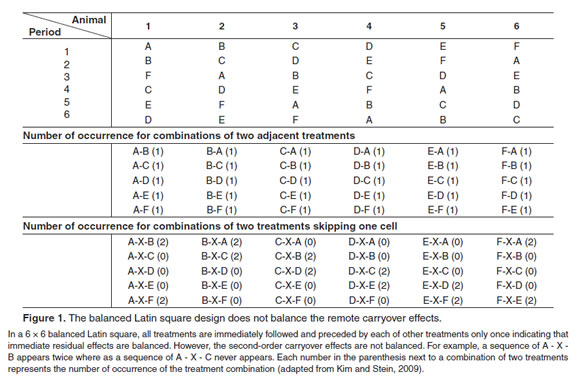
<body><![CDATA[<p><font face="Verdana, Arial, Helvetica, sans-serif" size="2">Part of this work was done while Taemin Kim was at Korea Advanced Institute of Science and Technology, Daejeon 305-701, Korea. </font></p>     <p><font face="Verdana, Arial, Helvetica, sans-serif" size="2"><sup>&curren; </sup>Para citar este art&iacute;culo: Kim BG, Kim T. A program for making completely balanced Latin Square designs employing a systemic method. Rev Colomb Cienc Pecu 2010; 23:277-282. </font></p>     <p><font face="Verdana, Arial, Helvetica, sans-serif" size="2">* 	Autores para correspondencia: Beob G. Kim. Department of Animal Science and Environment, Konkuk University, Seoul 143-701, Korea. E-mail:bgkim@ konkuk.ac.kr; Taemin Kim. Intelligent Robotics Group, NASA Ames Research Center, MS 369-3, Moffett Field, CA 94035, USA.  E-mail: <a href="mailto:taemin.kim@nasa.gov">taemin.kim@nasa.gov</a>. </font></p>     <p><font face="Verdana, Arial, Helvetica, sans-serif" size="2">&nbsp;</font></p> <hr size="1">     <p><font face="Verdana, Arial, Helvetica, sans-serif" size="3"><b>Introduction </b></font></p>     <p><font face="Verdana, Arial, Helvetica, sans-serif" size="2">In animal experiments, the Latin square design    typically employs less number of animals for    difference detection between treatments compared   with other experimental designs. The Latin square   design has been widely used in animal studies   (Pardo et al., 2008; Kim et al., 2009).</font></p>     <p><font face="Verdana, Arial, Helvetica, sans-serif" size="2">Potential carryover effects in Latin square   designs are generally not balanced by randomization   by row, column, or both. A systemic method   presented by Williams (1949) balances out fi rstorder   carryover effects, and a program is available   for making balanced Latin square designs (Kim   and Stein, 2009). However, remote (second,   third, fourth, etc.) carryover effects are still not   balanced in this method. For example, treatment   A is remotely (skipping one period) followed by   treatment B twice whereas treatment A is never   remotely (skipping one period) followed by   treatment C (<a href="#f1">Figure 1</a>). </font></p>     <p align="center"><font face="Verdana, Arial, Helvetica, sans-serif" size="2"><img src="/img/revistas/rccp/v23n3/v23n03a02f01.jpg"><a name="f1"></a></font></p>     <p align="center"><font face="Verdana, Arial, Helvetica, sans-serif" size="2"> </font><font face="Verdana, Arial, Helvetica, sans-serif" size="2"><img src="/img/revistas/rccp/v23n3/v23n03a02f02.jpg"><a name="f2"></a></font></p>     <p><font face="Verdana, Arial, Helvetica, sans-serif" size="2"> </font><font face="Verdana, Arial, Helvetica, sans-serif" size="2">The balance of remote carryover effects is very important particularly when a relatively long latent period exists after a treatment such as infection (Nath <I>et al</I>., 2008). A systemic method is available for balancing the remote as well as the adjacent residual effects (Alimena, 1962). Although this systemic method is not extremely complicated, it is time-consuming to build a large-size Latin square design and is an error-prone procedure. Thus, the objectives are to illustrate the systemic method as it can be understood intuitively and to develop the Completely Balanced Latin Square Designer (CBLSD) to facilitate the generation of Latin squares balanced for remote carryover effect.  </font></p>     ]]></body>
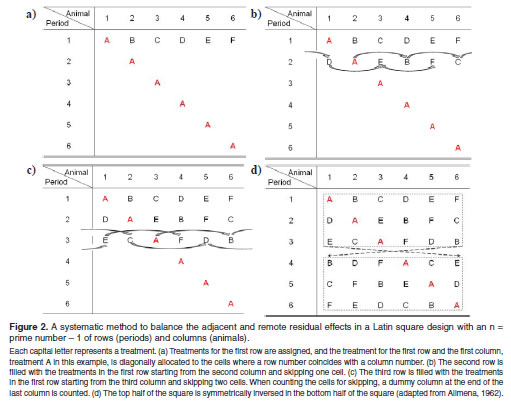
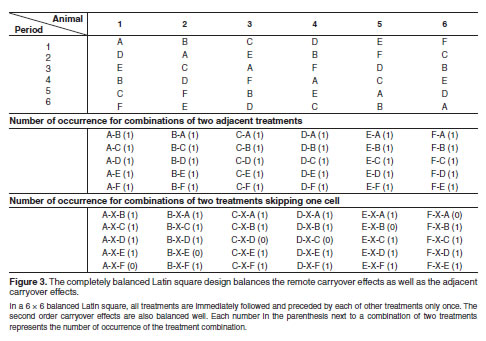
<body><![CDATA[<p><font face="Verdana, Arial, Helvetica, sans-serif" size="2">&nbsp;</font></p>     <p><font face="Verdana, Arial, Helvetica, sans-serif" size="3"><b>A systemic method for completely balanced Latin square designs </b></font></p>     <p><font face="Verdana, Arial, Helvetica, sans-serif" size="2">The systemic method balances the remote residual effects when the number of treatments is a prime number &ndash; 1 such as 2, 4, 6, 10, 12, 16, 18, 22, 28, 30, 36, etc (Alimena, 1962). An example for generating a completely balanced 6 &times; 6 Latin square design using this method is presented in <a href="#f2">Figure 2</a>. In this example, each capital letter represents a treatment. Firstly, treatments for the first row are assigned and can be randomized, and the treatment for the first period (row) and the first animal (column), treatment A, is diagonally allocated to the cells where a row number coincides with a column number (<a href="#f2">Figure 2a</a>). The second period is filled with the treatments assigned in the first period starting from the second animal and skipping one animal (<a href="#f2">Figure 2b</a>). The third period is filled with the treatments assigned in the fi rst period starting from the third animal and skipping two animals (<a href="#f2">Figure 2c</a>). When counting the animals for skipping, a dummy animal (column) at the end of the last animal is counted. The top three periods of the square is symmetrically inversed in the bottom three periods of the square (<a href="#f2">Figure 2d</a>). </font></p>    <p><font face="Verdana, Arial, Helvetica, sans-serif" size="2">The general procedure to generate a completely balanced Latin square of size <I>n</I> can be described in a simple formula. Let <I>i</I>, <I>j</I>, and <I>k</I> be the indices of period, animal, and treatment, respectively. Suppose that the <I>k</I>th treatment is assigned to the <I>j</I>th animal in the <I>i</I>th period, i.e., </font></p>    <p><font face="Verdana, Arial, Helvetica, sans-serif" size="2"><I>Treatment</I> (<I>i</I>, <I>j</I>) = <I>k </I></font></p>    <p><font face="Verdana, Arial, Helvetica, sans-serif" size="2">Then the animal which takes the <I>k</I>th treatment in the <I>i</I>th period is determined as follows: </font></p>    <p><font face="Verdana, Arial, Helvetica, sans-serif" size="2"><I>j</I> = (<I>i</I> &times; <I>k</I>) mod (<I>n</I> + 1) </font></p>    <p><font face="Verdana, Arial, Helvetica, sans-serif" size="2">where mod is the modulo operation. Given two natural numbers, <I>a</I> (the dividend) and <I>m</I> (the divisor), <I>a</I> mod <I>m</I> is the remainder, on division of <I>a</I> by <I>m</I>. This formula refl;ects the exact procedure described above and simplifies the algorithm. </font></p>    <p><font face="Verdana, Arial, Helvetica, sans-serif" size="2">If treatments are assigned using the systemic method illustrated above, the remote carryover effects are balanced in addition to the immediate ones (<a href="#f3">Figure 3</a>). In this example for a 6 &times; 6 balanced Latin square design, all treatments are immediately preceded and followed by all other treatments exactly once. In addition, all treatments are remotely preceded and followed by all other treatments at most once. It is inevitable to have the never-occurring remote combinations because the number of remote carryover combinations is less than the number of all possible combination of two treatments. </font></p>    <p><font face="Verdana, Arial, Helvetica, sans-serif" size="2">&nbsp;</font></p>     ]]></body>
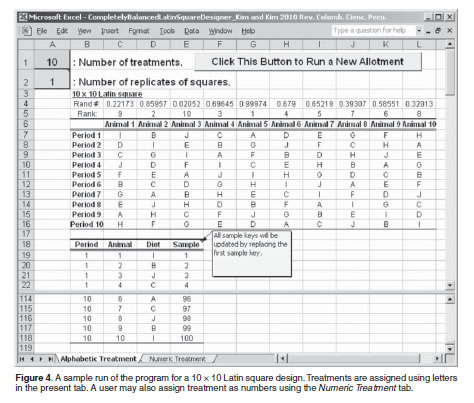
<body><![CDATA[<p><font face="Verdana, Arial, Helvetica, sans-serif" size="3"><b>Program description </b></font></p>     <p><font face="Verdana, Arial, Helvetica, sans-serif" size="2">Using the method described above, a spreadsheet-based program is developed to facilitate the generation of Latin squares balanced for remote and immediate carryover effects (<a href="#f4">Figure 4</a>). The CBLSD has been coded using Visual Basic for Application as an Excel 2003 add-in. The program file runs with no special installation, but a user needs to enable macros to fully use the functions in the CBLSD. </font></p>     <p><font face="Verdana, Arial, Helvetica, sans-serif" size="2">The user chooses the number of treatment (prime number &ndash; 1; i.e., 2, 4, 6, 10, 12, 16, 18, 22, 28, 30, 36, etc.) that coincides with the number of periods and animals and inputs the number of replicates of squares (<a href="#f4">Figure 4</a>). The user then clicks the running button to instantly run an allotment. The treatments for the first period are randomly assigned to the animals based on the random numbers generated, and the treatments for the rest periods are systemically allocated as described in <a href="#f2">Figure 2</a>. Additionally, an experimental schedule is generated. This schedule is sorted by periods and animals, and respective sample numbers are assigned. The sample numbers are consecutive and will be updated by changing the first one. A user may also use the <I>Numeric Treatment</I> tab to assign treatments as numbers. </font></p>     <p align="center"><font face="Verdana, Arial, Helvetica, sans-serif" size="2"><img src="/img/revistas/rccp/v23n3/v23n03a02f03.jpg"><a name="f3"></a></font></p>     <p align="center"><font face="Verdana, Arial, Helvetica, sans-serif" size="2">&nbsp;</font><font face="Verdana, Arial, Helvetica, sans-serif" size="2"><img src="/img/revistas/rccp/v23n3/v23n03a02f04.jpg"><a name="f4"></a></font></p>     <p><font face="Verdana, Arial, Helvetica, sans-serif" size="2">Although the CBLSD balances the remote and adjacent carryover effects, this program can be used when the number of treatments is prime number &ndash; 1. In other cases, the balanced Latin square designer (Kim and Stein, 2009) need to be used to generate Latin squares balanced for only immediate carryover effects. </font></p>     <p><font face="Verdana, Arial, Helvetica, sans-serif" size="2">In conclusion, the spreadsheet-based program introduced in the present paper allows animal researchers to rapidly and accurately generate Latin squares balanced for the remote carryover effects as well as immediate carryover effects. The program is freely available upon request to one of the corresponding authors. </font></p>     <p><font face="Verdana, Arial, Helvetica, sans-serif" size="2">&nbsp;</font></p>     <p><font face="Verdana, Arial, Helvetica, sans-serif" size="3"><b>Acknowledgement </b></font></p>     <p><font face="Verdana, Arial, Helvetica, sans-serif" size="2">The present work was supported by the faculty research fund of Konkuk University in 2010. </font></p>     ]]></body>
<body><![CDATA[<p><font face="Verdana, Arial, Helvetica, sans-serif" size="2">&nbsp;</font></p>     <p><font face="Verdana, Arial, Helvetica, sans-serif" size="3"><b>References </b></font></p>     <!-- ref --><p><font face="Verdana, Arial, Helvetica, sans-serif" size="2">1. Alimena BS. A method of determining unbiased distribution in the Latin square. Psychometrica 1962; 27:315-317. </font>&nbsp;&nbsp;&nbsp;&nbsp;&nbsp;&nbsp;&nbsp;&nbsp;[&#160;<a href="javascript:void(0);" onclick="javascript: window.open('/scielo.php?script=sci_nlinks&ref=000055&pid=S0120-0690201000030000200001&lng=','','width=640,height=500,resizable=yes,scrollbars=1,menubar=yes,');">Links</a>&#160;]<!-- end-ref --><!-- ref --><p><font face="Verdana, Arial, Helvetica, sans-serif" size="2">2. Kim BG, Petersen GI, Hinson RB, Allee GL, Stein HH. Amino acid digestibility and energy concentration in a novel source of high-protein distillers dried grains and their effects on growth performance of pigs. J Anim Sci 2009; 87:4013-4021. </font>&nbsp;&nbsp;&nbsp;&nbsp;&nbsp;&nbsp;&nbsp;&nbsp;[&#160;<a href="javascript:void(0);" onclick="javascript: window.open('/scielo.php?script=sci_nlinks&ref=000056&pid=S0120-0690201000030000200002&lng=','','width=640,height=500,resizable=yes,scrollbars=1,menubar=yes,');">Links</a>&#160;]<!-- end-ref --><!-- ref --><p><font face="Verdana, Arial, Helvetica, sans-serif" size="2">3. Kim BG, Stein HH. A spreadsheet program for making a balanced Latin Square design. Rev Colomb Cienc Pecu 2009; 22:591-596. </font>&nbsp;&nbsp;&nbsp;&nbsp;&nbsp;&nbsp;&nbsp;&nbsp;[&#160;<a href="javascript:void(0);" onclick="javascript: window.open('/scielo.php?script=sci_nlinks&ref=000057&pid=S0120-0690201000030000200003&lng=','','width=640,height=500,resizable=yes,scrollbars=1,menubar=yes,');">Links</a>&#160;]<!-- end-ref --><!-- ref --><p><font face="Verdana, Arial, Helvetica, sans-serif" size="2">4. Nath M, Wolliams JA, Bishop SC. Assessment of the dynamics of microparasite infections in genetically homogeneous and heterogeneous populations using a stochastic epidemic model. J Anim Sci 2008; 86:1747-1757. </font>&nbsp;&nbsp;&nbsp;&nbsp;&nbsp;&nbsp;&nbsp;&nbsp;[&#160;<a href="javascript:void(0);" onclick="javascript: window.open('/scielo.php?script=sci_nlinks&ref=000058&pid=S0120-0690201000030000200004&lng=','','width=640,height=500,resizable=yes,scrollbars=1,menubar=yes,');">Links</a>&#160;]<!-- end-ref --><!-- ref --><p><font face="Verdana, Arial, Helvetica, sans-serif" size="2">5. Pardo O, Carulla JE, Hess HD. Effect of protein and energy relationship on the levels of ammonium rumen and blood urea nitrogen and milk, in dual purpose cows at the llanero foothills, Colombia. Rev Colomb Cienc Pecu 2008; 21:387-397. </font>&nbsp;&nbsp;&nbsp;&nbsp;&nbsp;&nbsp;&nbsp;&nbsp;[&#160;<a href="javascript:void(0);" onclick="javascript: window.open('/scielo.php?script=sci_nlinks&ref=000059&pid=S0120-0690201000030000200005&lng=','','width=640,height=500,resizable=yes,scrollbars=1,menubar=yes,');">Links</a>&#160;]<!-- end-ref --><!-- ref --><p><font face="Verdana, Arial, Helvetica, sans-serif" size="2">6. Williams EJ. Experimental designs balanced for the estimation of residual effects of treatments. Aust J Sci Res 1949; A2:149-168. </font>&nbsp;&nbsp;&nbsp;&nbsp;&nbsp;&nbsp;&nbsp;&nbsp;[&#160;<a href="javascript:void(0);" onclick="javascript: window.open('/scielo.php?script=sci_nlinks&ref=000060&pid=S0120-0690201000030000200006&lng=','','width=640,height=500,resizable=yes,scrollbars=1,menubar=yes,');">Links</a>&#160;]<!-- end-ref --><p><font face="Verdana, Arial, Helvetica, sans-serif" size="2"> </font></p>     ]]></body><back>
<ref-list>
<ref id="B1">
<label>1</label><nlm-citation citation-type="journal">
<person-group person-group-type="author">
<name>
<surname><![CDATA[Alimena]]></surname>
<given-names><![CDATA[BS]]></given-names>
</name>
</person-group>
<article-title xml:lang="en"><![CDATA[A method of determining unbiased distribution in the Latin square]]></article-title>
<source><![CDATA[Psychometrica]]></source>
<year>1962</year>
<volume>27</volume>
<page-range>315-317</page-range></nlm-citation>
</ref>
<ref id="B2">
<label>2</label><nlm-citation citation-type="journal">
<person-group person-group-type="author">
<name>
<surname><![CDATA[Kim]]></surname>
<given-names><![CDATA[BG]]></given-names>
</name>
<name>
<surname><![CDATA[Petersen]]></surname>
<given-names><![CDATA[GI]]></given-names>
</name>
<name>
<surname><![CDATA[Hinson]]></surname>
<given-names><![CDATA[RB]]></given-names>
</name>
<name>
<surname><![CDATA[Allee]]></surname>
<given-names><![CDATA[GL]]></given-names>
</name>
<name>
<surname><![CDATA[Stein]]></surname>
<given-names><![CDATA[HH]]></given-names>
</name>
</person-group>
<article-title xml:lang="en"><![CDATA[Amino acid digestibility and energy concentration in a novel source of high-protein distillers dried grains and their effects on growth performance of pigs]]></article-title>
<source><![CDATA[J Anim Sci]]></source>
<year>2009</year>
<volume>87</volume>
<page-range>4013-4021</page-range></nlm-citation>
</ref>
<ref id="B3">
<label>3</label><nlm-citation citation-type="journal">
<person-group person-group-type="author">
<name>
<surname><![CDATA[Kim]]></surname>
<given-names><![CDATA[BG]]></given-names>
</name>
<name>
<surname><![CDATA[Stein]]></surname>
<given-names><![CDATA[HH]]></given-names>
</name>
</person-group>
<article-title xml:lang="en"><![CDATA[A spreadsheet program for making a balanced Latin Square design]]></article-title>
<source><![CDATA[Rev Colomb Cienc Pecu]]></source>
<year>2009</year>
<volume>22</volume>
<page-range>591-596</page-range></nlm-citation>
</ref>
<ref id="B4">
<label>4</label><nlm-citation citation-type="journal">
<person-group person-group-type="author">
<name>
<surname><![CDATA[Nath]]></surname>
<given-names><![CDATA[M]]></given-names>
</name>
<name>
<surname><![CDATA[Wolliams]]></surname>
<given-names><![CDATA[JA]]></given-names>
</name>
<name>
<surname><![CDATA[Bishop]]></surname>
<given-names><![CDATA[SC]]></given-names>
</name>
</person-group>
<article-title xml:lang="en"><![CDATA[Assessment of the dynamics of microparasite infections in genetically homogeneous and heterogeneous populations using a stochastic epidemic model]]></article-title>
<source><![CDATA[J Anim Sci]]></source>
<year>2008</year>
<volume>86</volume>
<page-range>1747-1757</page-range></nlm-citation>
</ref>
<ref id="B5">
<label>5</label><nlm-citation citation-type="journal">
<person-group person-group-type="author">
<name>
<surname><![CDATA[Pardo]]></surname>
<given-names><![CDATA[O]]></given-names>
</name>
<name>
<surname><![CDATA[Carulla]]></surname>
<given-names><![CDATA[JE]]></given-names>
</name>
<name>
<surname><![CDATA[Hess]]></surname>
<given-names><![CDATA[HD]]></given-names>
</name>
</person-group>
<article-title xml:lang="en"><![CDATA[Effect of protein and energy relationship on the levels of ammonium rumen and blood urea nitrogen and milk, in dual purpose cows at the llanero foothills, Colombia]]></article-title>
<source><![CDATA[Rev Colomb Cienc Pecu]]></source>
<year>2008</year>
<volume>21</volume>
<page-range>387-397</page-range></nlm-citation>
</ref>
<ref id="B6">
<label>6</label><nlm-citation citation-type="journal">
<person-group person-group-type="author">
<name>
<surname><![CDATA[Williams]]></surname>
<given-names><![CDATA[EJ]]></given-names>
</name>
</person-group>
<article-title xml:lang="en"><![CDATA[Experimental designs balanced for the estimation of residual effects of treatments]]></article-title>
<source><![CDATA[Aust J Sci Res]]></source>
<year>1949</year>
<volume>A2</volume>
<page-range>149-168</page-range></nlm-citation>
</ref>
</ref-list>
</back>
</article>