<?xml version="1.0" encoding="ISO-8859-1"?><article xmlns:mml="http://www.w3.org/1998/Math/MathML" xmlns:xlink="http://www.w3.org/1999/xlink" xmlns:xsi="http://www.w3.org/2001/XMLSchema-instance">
<front>
<journal-meta>
<journal-id>0120-0690</journal-id>
<journal-title><![CDATA[Revista Colombiana de Ciencias Pecuarias]]></journal-title>
<abbrev-journal-title><![CDATA[Rev Colom Cienc Pecua]]></abbrev-journal-title>
<issn>0120-0690</issn>
<publisher>
<publisher-name><![CDATA[Facultad de Ciencias Agrarias, Universidad de Antioquia]]></publisher-name>
</publisher>
</journal-meta>
<article-meta>
<article-id>S0120-06902010000300003</article-id>
<title-group>
<article-title xml:lang="en"><![CDATA[Genetic characterization of the Hartón del Valle, Angus, Brangus, Holstein, and Senepol cattle breeds in Colombia, using ten microsatellite markers]]></article-title>
<article-title xml:lang="es"><![CDATA[Caracterización genética de las razas Hartón del Valle, Angus, Brangus, Holstein y Senepol en Colombia, usando 10 marcadores microsatélites]]></article-title>
<article-title xml:lang="pt"><![CDATA[Caracterização genética das raças Hartón del Valle, Angus, Brangus, Holandês e Senepol na Colômbia, usando 10 marcadores microsatélites]]></article-title>
</title-group>
<contrib-group>
<contrib contrib-type="author">
<name>
<surname><![CDATA[Montoya]]></surname>
<given-names><![CDATA[Alba E]]></given-names>
</name>
<xref ref-type="aff" rid="A01"/>
</contrib>
<contrib contrib-type="author">
<name>
<surname><![CDATA[Cerón-Muñoz]]></surname>
<given-names><![CDATA[Mario F]]></given-names>
</name>
<xref ref-type="aff" rid="A01"/>
</contrib>
<contrib contrib-type="author">
<name>
<surname><![CDATA[Moreno]]></surname>
<given-names><![CDATA[Manuel A]]></given-names>
</name>
<xref ref-type="aff" rid="A01"/>
</contrib>
<contrib contrib-type="author">
<name>
<surname><![CDATA[Martínez]]></surname>
<given-names><![CDATA[Edwin]]></given-names>
</name>
<xref ref-type="aff" rid="A01"/>
</contrib>
<contrib contrib-type="author">
<name>
<surname><![CDATA[Corrales]]></surname>
<given-names><![CDATA[Juan D]]></given-names>
</name>
<xref ref-type="aff" rid="A01"/>
</contrib>
<contrib contrib-type="author">
<name>
<surname><![CDATA[Tirado]]></surname>
<given-names><![CDATA[Juan F]]></given-names>
</name>
<xref ref-type="aff" rid="A01"/>
</contrib>
<contrib contrib-type="author">
<name>
<surname><![CDATA[Calvo]]></surname>
<given-names><![CDATA[Samir J]]></given-names>
</name>
<xref ref-type="aff" rid="A01"/>
</contrib>
</contrib-group>
<aff id="A01">
<institution><![CDATA[,Universidad de Antioquia Facultad de Ciencias Agrarias Instituto de Biología]]></institution>
<addr-line><![CDATA[Medellín ]]></addr-line>
<country>Colombia</country>
</aff>
<pub-date pub-type="pub">
<day>00</day>
<month>09</month>
<year>2010</year>
</pub-date>
<pub-date pub-type="epub">
<day>00</day>
<month>09</month>
<year>2010</year>
</pub-date>
<volume>23</volume>
<numero>3</numero>
<fpage>283</fpage>
<lpage>291</lpage>
<copyright-statement/>
<copyright-year/>
<self-uri xlink:href="http://www.scielo.org.co/scielo.php?script=sci_arttext&amp;pid=S0120-06902010000300003&amp;lng=en&amp;nrm=iso"></self-uri><self-uri xlink:href="http://www.scielo.org.co/scielo.php?script=sci_abstract&amp;pid=S0120-06902010000300003&amp;lng=en&amp;nrm=iso"></self-uri><self-uri xlink:href="http://www.scielo.org.co/scielo.php?script=sci_pdf&amp;pid=S0120-06902010000300003&amp;lng=en&amp;nrm=iso"></self-uri><abstract abstract-type="short" xml:lang="en"><p><![CDATA[The objective of this paper is to establish a genetic characterization of the Senepol (S, n=49), Holstein (H, n= 60), Hartón del Valle (HV, n=60), Angus (A, n=61) and Brangus (Br, n=60) cattle breeds in Colombia, by using the following microsatellite markers: SPS115, INRA64, ETH225, ETH10, BM1824, INRA37, TGLA122, TGLA126, INRA32, and BM2113. A total of 142 alleles were obtained for ten analyzed loci, considering the five cattle breeds as a whole. The number of alleles per locus ranged from 9 (INRA64 and 1824) to 22 (TGLA122). The expected heterozygosity was between 0.79 (INRA32) and 0.90 (INRA37) in all the cattle breeds, respectively; and medium heterozygosity was 0.84. The average number of alleles per breed varied from 9.2 in the Senepol breed to 10.3 in the Holstein breed. The expected heterozygosity range varied from 0.75 in the Hartón del Valle breed and 0.82 in the Holstein breed, with an average of 0.79. Hardy Wienberg disequilibrium was observed (p>0.05) when the populations were analyzed with all the markers. All the populations presented a heterozygote deficit, which could be the result of a strong endogamy tendency within all the herds. The markers used in this study allowed a genetic characterization of the analyzed populations. The microsatellites panel in the Hartón del Valle breed should be increased in order to increase the reliability value. Microsatellite panels could solve parenthood cases for the remainder breeds.]]></p></abstract>
<abstract abstract-type="short" xml:lang="es"><p><![CDATA[El objetivo de este trabajo fue caracterizar genéticamente las razas bovinas Senepol (S, n=49), Holstein (H, n= 60), Hartón del Valle (HV, n=60), Angus (A, n=61) y Brangus (Br, n=60) en Colombia, con los marcadores microsatélites SPS115, INRA64, ETH225, ETH10, BM1824, INRA37, TGLA122, TGLA126, INRA32 y BM2113. En total, 142 alelos fueron encontrados en los diez loci analizados, considerando las cinco razas como un todo. El número de alelos por locus estuvo entre 9 (INRA64 y BM1824) y 22 (TGLA122). La Heterocigosidad esperada a través de todas las razas varió entre 0.79 (INRA32) y 0,90 (INRA37) y heterocigosidad media esperada de 0.84. El número promedio de alelos por raza varió de 9.2 en la raza S a 10.3 en la raza H. El rango de la Heterocigosidad esperada entre las razas varió entre 0.75 en la raza HV y 0.82 en la raza H, con una media de 0.79. Al analizar las poblaciones con el total de marcadores, todas se encontraron en desequilibrio de Hardy Weinberg (p>0.05). Todas las poblaciones presentaron un déficit de heterocigotos, para todas las poblaciones, lo que podría ser el resultado de la fuerte tendencia a la endogamia dentro de los diferentes hatos. Los resultados indicaron que los marcadores utilizados en este estudio permitieron caracterizar genéticamente las poblaciones analizadas. En el caso de la Raza HV, se debe aumentar el panel de microsatélites para aumentar el valor de confiabilidad. Para las demás razas el panel de microsatélites permitiría resolver casos de filiación.]]></p></abstract>
<abstract abstract-type="short" xml:lang="pt"><p><![CDATA[O objetivo do presente trabalho foi caracterizar geneticamente as raças Senepol (S, n=49), Holandês (H, n= 60), Hartón del Valle (HV, n=60), Angus (A, n=61) e Brangus (Br, n=60) na Colômbia, com os marcadores microsatélites SPS115, INRA64, ETH225, ETH10, BM1824, INRA37, TGLA122, TGLA126, INRA32 e BM2113. Em total, 142 alelos foram encontrados nos 10 satélites analisados nas cinco raças. O número de alelos esteve entre 9 (INRA64 e BM1824) e 22 (TGLA122). A heterocigosidade esperada a través de todas as raças variou entre 0.79 (INRA32) e 0.90 (INRA37) e heterocigosidade esperada de 0.84. O número médio de alelos por raça variou de 9.2 na raça S a 10.3 na raça H. O rango de heterocigosidade esperada entre raças variou entre 0.75 na raça HV e 0.82 na raça H, com una media de 0.79. Ao analisar as populações com o total de marcadores encontraram-se o desequilíbrio Hardy Weinberg (p>0.05). Todas as populações apresentaram um déficit de heterocigotos, o que poderia ser o resultado da forte tendência de endogamia nos diferentes rebanhos analisados. Os resultados indicaram que os marcadores utilizados em este estúdio permitiram caracterizar geneticamente as populações analisadas. No caso da raça HV deve-se aumentar o número de microsatélites para aumentar o valor de confiabilidade. Para as demais raças os microsatélites analisados permitiriam resolver casos de paternidade.]]></p></abstract>
<kwd-group>
<kwd lng="en"><![CDATA[cattle]]></kwd>
<kwd lng="en"><![CDATA[genetic variability]]></kwd>
<kwd lng="en"><![CDATA[molecular marker]]></kwd>
<kwd lng="es"><![CDATA[ganado]]></kwd>
<kwd lng="en"><![CDATA[marcadores moleculares]]></kwd>
<kwd lng="en"><![CDATA[variabilidad genética]]></kwd>
<kwd lng="pt"><![CDATA[gado]]></kwd>
<kwd lng="pt"><![CDATA[marcador molecular]]></kwd>
<kwd lng="pt"><![CDATA[varibilidade genética]]></kwd>
</kwd-group>
</article-meta>
</front><body><![CDATA[ <p align="center"><font face="Verdana, Arial, Helvetica, sans-serif" size="4"><b>Genetic characterization of the Hart&oacute;n del Valle, Angus, Brangus, Holstein, and Senepol cattle breeds in Colombia, using ten microsatellite markers<Sup>&curren; </Sup></b></font></p>     <p align="center"><b><font face="Verdana, Arial, Helvetica, sans-serif" size="3"><I>Caracterizaci&oacute;n gen&eacute;tica de las razas Hart&oacute;n del Valle, Angus, Brangus, Holstein y Senepol en Colombia, usando 10 marcadores microsat&eacute;lites </I></font></b></p>     <p align="center"><b><font face="Verdana, Arial, Helvetica, sans-serif" size="3"><I>Caracteriza&ccedil;&atilde;o gen&eacute;tica das ra&ccedil;as Hart&oacute;n del Valle, Angus, Brangus, Holand&ecirc;s e Senepol na Col&ocirc;mbia, usando 10 marcadores microsat&eacute;lites </I></font></b><font face="Verdana, Arial, Helvetica, sans-serif" size="2"><I></I></font></p>     <p>&nbsp;</p>     <p><font face="Verdana, Arial, Helvetica, sans-serif" size="2">Alba E Montoya<Sup><I>1,2</I></Sup>, Biol, MSc; Mario F Cer&oacute;n-Mu&ntilde;oz<Sup><I>1,2*</I></Sup>, Zoot, PhD; Manuel A Moreno<Sup><I>1,3</I></Sup>, Biol, PhDc; Edwin  Mart&iacute;nez<Sup><I>1</I></Sup>, Est Biol; Juan D Corrales<Sup><I>1</I></Sup>, Zoot, est MSc; Juan F Tirado<Sup><I>1</I></Sup>, Zoot; Samir J Calvo<Sup><I>1</I></Sup>, Zoot.  </font></p>    <p><font face="Verdana, Arial, Helvetica, sans-serif" size="2"><Sup><I>1</I></Sup><I> Grupo de Gen&eacute;tica, Mejoramiento y Modelaci&oacute;n Animal (GaMMA), Instituto de Biolog&iacute;a, Facultad de Ciencias Agrarias</I><I>,  </I><I>Universidad de Antioquia, Medell&iacute;n, Colombia</I><I>.  </I><Sup><I>2 </I></Sup><I>Docente, Facultad de Ciencias Agrarias, Universidad de  Antioquia, AA 1226, Medell&iacute;n, Colombia</I><I>.  </I><Sup><I>3</I></Sup><I> Docente, Instituto de Biolog&iacute;a, Universidad de Antioquia, AA 1226, Medell&iacute;n, Colombia</I><I>.  </I></font></p>    <p><font face="Verdana, Arial, Helvetica, sans-serif" size="2"><I>(Recibido: 5 septiembre, 2009; aceptado: 18 mayo, 2010) </I></font></p>     <p>&nbsp;</p> <hr size="1">     <p><font face="Verdana, Arial, Helvetica, sans-serif" size="2"><I><b>Summary </b></I></font></p>    <p><font face="Verdana, Arial, Helvetica, sans-serif" size="2"><I>The objective of this paper is to establish a genetic characterization of the Senepol (S, n=49), Holstein (H, n= 60), Hart&oacute;n del Valle (HV, n=60), Angus (A, n=61) and Brangus (Br, n=60) cattle breeds in Colombia, by using the following microsatellite markers: SPS115, INRA64, ETH225, ETH10, BM1824, INRA37, TGLA122, TGLA126, INRA32, and BM2113.  A total of 142 alleles were obtained for ten analyzed loci, considering the five cattle breeds as a whole. The number of alleles per locus ranged from 9 (INRA64 and 1824) to 22 (TGLA122). The expected heterozygosity was between 0.79 (INRA32) and 0.90 (INRA37) in all the cattle breeds, respectively; and medium heterozygosity was 0.84. The average number of alleles per breed varied from 9.2 in the Senepol breed to 10.3 in the Holstein breed. The expected heterozygosity range varied from 0.75 in the Hart&oacute;n del Valle breed and 0.82 in the Holstein breed, with an average of 0.79. Hardy Wienberg disequilibrium was observed (p&gt;0.05) when the populations were analyzed with all the markers. All the populations presented a heterozygote deficit, which could be the result of a strong endogamy tendency within all the herds. The markers used in this study allowed a genetic characterization of the analyzed populations. The microsatellites panel in </I><i>the Hart&oacute;n del Valle breed should be increased in order to increase the reliability value. Microsatellite panels could solve parenthood cases for the remainder breeds. </i></font></p>     ]]></body>
<body><![CDATA[<p><font face="Verdana, Arial, Helvetica, sans-serif" size="2"><b>Key words:</b> <i>cattle, genetic variability, molecular marker. </i></font></p>     <p>&nbsp;</p> <hr size="1">     <p><font face="Verdana, Arial, Helvetica, sans-serif" size="2"><I><b>Resumen </b></I></font></p>    <p><font face="Verdana, Arial, Helvetica, sans-serif" size="2"><I>El objetivo de este trabajo fue caracterizar gen&eacute;ticamente las razas bovinas Senepol (S, n=49), Holstein (H, n= 60), Hart&oacute;n del Valle (HV, n=60), Angus (A, n=61) y Brangus (Br, n=60) en Colombia, con los marcadores microsat&eacute;lites SPS115, INRA64, ETH225, ETH10, BM1824, INRA37, TGLA122, TGLA126, INRA32 y BM2113. En total, 142 alelos fueron encontrados en los diez loci analizados, considerando las cinco razas como un todo. El n&uacute;mero de alelos por locus estuvo entre 9 (INRA64 y BM1824) y 22 (TGLA122). La Heterocigosidad esperada a trav&eacute;s de todas las razas vari&oacute; entre 0.79 (INRA32) y 0,90 (INRA37) y heterocigosidad media esperada de 0.84. El n&uacute;mero promedio de alelos por raza vari&oacute; de 9.2 en la raza S a 10.3 en la raza H. El rango de la Heterocigosidad esperada entre las razas vari&oacute; entre 0.75 en la raza HV y 0.82 en la raza H, con una media de 0.79. Al analizar las poblaciones con el total de marcadores, todas se encontraron en desequilibrio de Hardy Weinberg (p&gt;0.05). Todas las poblaciones presentaron un d&eacute;ficit de heterocigotos, para todas las poblaciones, lo que podr&iacute;a ser el resultado de la fuerte tendencia a la endogamia dentro de los diferentes hatos. Los resultados indicaron que los marcadores utilizados en este estudio permitieron caracterizar gen&eacute;ticamente las poblaciones analizadas. En el caso de la Raza HV, se debe aumentar el panel de microsat&eacute;lites para aumentar el valor de confiabilidad. Para las dem&aacute;s razas el panel de microsat&eacute;lites permitir&iacute;a resolver casos de filiaci&oacute;n. </I></font></p>    <p><font face="Verdana, Arial, Helvetica, sans-serif" size="2"><b>Palabras clave:</b> <I>ganado, marcadores moleculares, variabilidad gen&eacute;tica. </I></font></p>     <p>&nbsp;</p> <hr size="1">     <p><font face="Verdana, Arial, Helvetica, sans-serif" size="2"><I><b>Resumo </b></I></font></p>    <p><font face="Verdana, Arial, Helvetica, sans-serif" size="2"><I>O objetivo do presente trabalho foi caracterizar geneticamente as ra&ccedil;as Senepol (S, n=49), Holand&ecirc;s (H, n= 60), Hart&oacute;n del Valle (HV, n=60), Angus (A, n=61) e Brangus (Br, n=60) na Col&ocirc;mbia, com os marcadores microsat&eacute;lites SPS115, INRA64, ETH225, ETH10, BM1824, INRA37, TGLA122, TGLA126, INRA32 e BM2113. Em total, 142 alelos foram encontrados nos 10 sat&eacute;lites analisados nas cinco ra&ccedil;as. O n&uacute;mero de alelos esteve entre 9 (INRA64 e BM1824) e 22 (TGLA122). A heterocigosidade esperada a trav&eacute;s de todas as ra&ccedil;as variou entre 0.79 (INRA32) e 0.90 (INRA37) e heterocigosidade esperada de 0.84. O n&uacute;mero m&eacute;dio de alelos por ra&ccedil;a variou de 9.2 na ra&ccedil;a S a 10.3 na ra&ccedil;a H. O rango de heterocigosidade esperada entre ra&ccedil;as variou entre 0.75 na ra&ccedil;a HV e 0.82 na ra&ccedil;a H, com una media de 0.79. Ao analisar as popula&ccedil;&otilde;es com o total de marcadores encontraram-se o desequil&iacute;brio Hardy Weinberg (p&gt;0.05). Todas as popula&ccedil;&otilde;es apresentaram um d&eacute;ficit de heterocigotos, o que poderia ser o resultado da forte tend&ecirc;ncia de endogamia nos diferentes rebanhos analisados. Os resultados indicaram que os marcadores utilizados em este est&uacute;dio permitiram caracterizar geneticamente as popula&ccedil;&otilde;es analisadas. No caso da ra&ccedil;a HV deve-se aumentar o n&uacute;mero de microsat&eacute;lites para aumentar o valor de confiabilidade. Para as demais ra&ccedil;as os microsat&eacute;lites analisados permitiriam resolver casos de paternidade. </I></font></p>    <p><font face="Verdana, Arial, Helvetica, sans-serif" size="2"><b>Palavras chave:</b> <I>gado, marcador molecular, varibilidade gen&eacute;tica. </I></font></p>    <p><font face="Verdana, Arial, Helvetica, sans-serif" size="2">&curren; 	Para citar este art&iacute;culo: Montoya AE, Cer&oacute;n-Mu&ntilde;oz MF, Moreno MA, Mart&iacute;nez E, Corrales JD, Tirado JF, Calvo SJ. Genetic characterization of the Hart&oacute;n del Valle, Angus, Brangus, Holstein, and Senepol cattle breeds in Colombia, using ten microsatellite markers. Rev Colomb Cienc Pecu 2010; 23:283-291. </font></p>     ]]></body>
<body><![CDATA[<p><font face="Verdana, Arial, Helvetica, sans-serif" size="2">* 	Autor para correspondencia: Mario F Cer&oacute;n-Mu&ntilde;oz. Escuela de Producci&oacute;n Agropecuaria. Facultad de Ciencias Agrarias, Universidad de Antioquia. AA1226, Medell&iacute;n, Colombia. E-mail: <a href="mailto:mceronm@hotmail.es">mceronm@hotmail.es</a></font></p>     <p><font face="Verdana, Arial, Helvetica, sans-serif" size="2">&nbsp;</font></p> <hr size="1">     <p><font face="Verdana, Arial, Helvetica, sans-serif" size="3"><b>Introduction </b></font></p>     <p><font face="Verdana, Arial, Helvetica, sans-serif" size="2">Livestock breeds have been the product of centuries of natural and artificial selection. Breeds have been selected to fit a wide range of environmental conditions and human needs. The selection of a few highly productive breeds has caused the decrease of many other non-productive breeds (Maudet <I>et al.</I>, 2002). </font></p>    <p><font face="Verdana, Arial, Helvetica, sans-serif" size="2">In Colombia there is a large variety of native and foreign breeds; most of them have adapted to the diversity of geographical conditions of these country.  Therefore, it is thought that these breeds present an enormous genetic diversity due to the fact that they come from different regions could explain their genetic variability. </font></p>     <p><font face="Verdana, Arial, Helvetica, sans-serif" size="2">Microsatellite markers (STR) have made possible the study in numerous breeds around de world, something like that. Currently, there are more than 1200 STR known in cattle (Kappes <I>et al</I>., 1997) some of them approved by the International Society of Animal Genetics (ISAG) and the Food and Agriculture Organization (FAO, 2007). The usefulness of microsatellite markers have been documented in bovine breeds for the estimation of genetic diversity (Ciampolini <I>et al</I>., 1995; Peelman <I>et al</I>., 1998; Zamorano <I>et al</I>., 1998b; Steigleder <I>et al</I>., 2004; Barrera <I>et al</I>., 2006a; Mart&iacute;nez <I>et al</I>., 2006) and the relationships among livestock breeds (Moreno <I>et al</I>., 2001; Hansen <I>et al</I>., 2002; Maudet <I>et al</I>., 2002; Radko <I>et al</I>., 2005; Barrera <I>et al</I>., 2006b), as well as genetic characterization (Zamorano <I>et al</I>., 1998a; Lara <I>et al</I>., 2005; Mart&iacute;nez <I>et al</I>., 2005; Calvo <I>et al</I>., 2009; Mart&iacute;nez <I>et al</I>., 2009), individual profiles, and paternity tests (Giovambattista <I>et al</I>., 2001; Mommens <I>et al.</I>, 1998; Sanz <I>et al</I>., 2002) and genealogical-registries control (Jamieson, 1994). </font></p>    <p><font face="Verdana, Arial, Helvetica, sans-serif" size="2">In general, the distribution of genetic polymorphisms tends to be quite homogeneous among the different populations involved. Nevertheless, in the variability extend, specific characteristics for each population group are usually noted. (Barrera <I>et al.</I>, 2006a; Barrera <I>et al.</I>, 2006b, Calvo <I>et al.</I>, 2009, Hansen <I>et al.</I>, 2002; Mart&iacute;nez <I>et al.</I>, 2009; Maudet <I>et al.</I>, 2002; Mommens <I>et al.</I>, 1998; Moreno <I>et al.</I>, 2001; Radko <I>et al.</I>, 2005; Steigleder <I>et al.</I>, 2004; Zamorano <I>et al.</I>, 1998a; Zamorano <I>et al.</I>, 1998b). This could be achieved through the genetical characterization of the animals in each region. </font></p>    <p><font face="Verdana, Arial, Helvetica, sans-serif" size="2">This paper was conducted to study genetic diversity among the <I>Hart&oacute;n del Valle</I>, <I>Angus</I>, <I>Brangus</I>, <I>Holstein</I>, and <I>Senepol</I> cattle breeds, all of them found in Colombia and well adapted to the diversity of its weather and geographical conditions, using ten microsatellite markers located in different chromosomes. </font></p>    <p><font face="Verdana, Arial, Helvetica, sans-serif" size="2">&nbsp;</font></p>     <p><font face="Verdana, Arial, Helvetica, sans-serif" size="3"><b>Materials and methods </b></font></p>     ]]></body>
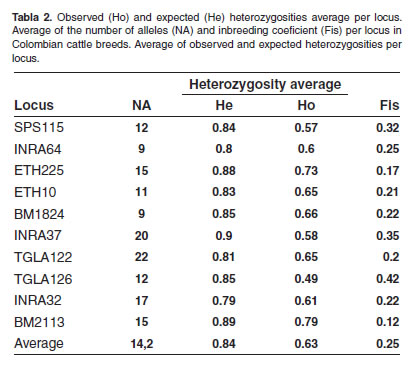
<body><![CDATA[<p><font face="Verdana, Arial, Helvetica, sans-serif" size="2"><I>Population Sample </I></font></p>    <p><font face="Verdana, Arial, Helvetica, sans-serif" size="2">Sample was constituted as follows: <I>Senepol</I> (S, n=49) from Hacienda R&iacute;o Piedras, municipality of Jeric&oacute;, Antioquia; <I>Holstein</I> (H, n= 60) from the municipality of San Pedro de los Milagros, Antioquia; Hart&oacute;n del Valle (HV, n=60) from Hacienda Sanjonhondo, located in Tulu&aacute; municipality, Valle del Cauca;  <I>Angus</I> (A, n=61) and <I>Brangus</I> (Br, n=60), both from Centro de Investigaci&oacute;n en Biotecnolog&iacute;a y Reproducci&oacute;n (Cibre) of the Universidad San Mart&iacute;n in Monter&iacute;a. Blood samples were taken from all specimens and DNA isolation carried out using salting out protocol (Miller <I>et al.</I>, 1988), procedures took place at Animal Genetics Laboratory, Universidad de Antioquia. </font></p>    <p><font face="Verdana, Arial, Helvetica, sans-serif" size="2"><I>Genotyping </I></font></p>    <p><font face="Verdana, Arial, Helvetica, sans-serif" size="2">Ten microsatellite markers were used for this study. These were taken from the ISAG's recommended list for studies on genetic variability (<a href="#t1">Table 1</a>) and were used applying multiplex systems (duplex or triplex) according to each marker's amplifi cation conditions. </font></p>    <p align="center"><font face="Verdana, Arial, Helvetica, sans-serif" size="2"><img src="/img/revistas/rccp/v23n3/v23n03a03t01.jpg"><a name="t1"></a></font></p>     <p><font face="Verdana, Arial, Helvetica, sans-serif" size="2">Amplification conditions included approximately 50 ng of bovine genomic DNA, 10X reaction buffer (10mM Tris-HCL pH 9.0; 50mM KCl; 0.1% Trit&oacute;n &reg; X-100), 1.5 mM of MgCl<Sub>2</Sub>; dNTPs; 0.125 &mu;M of forward and reverse primers and 1 U of <I>Taq</I> DNA Polymerase in a total volume of 15 &mu;L. The reaction was carried out in a T-Personal 48 thermocycler (Biometra GMBH, D-37079 Goettingen, Germany). </font></p>    <p><font face="Verdana, Arial, Helvetica, sans-serif" size="2">INRA32 and BM2113 markers were amplifi ed in duplex reaction at 58 &ordm;C; the rest in duplex or triplex reaction at 56 &ordm;C, under the following conditions: 94 &deg;C for 2 min. for denaturation; next, 35 cycles at 94 &deg;C for 45 s, 45 s for alignment, 72 &deg;C for 45 s and final extension at 72 &deg;C for 15 min. Amplification products were visualized in a 6% denaturing polyacrylamide gels and stained with 1% silver nitrate (Budowle <I>et al.</I>, 1991). Genotypes designation was made by comparison of a molecular ladder.  </font></p>    <p><font face="Verdana, Arial, Helvetica, sans-serif" size="2"><I>Statistical Analysis </I></font></p>    <p><font face="Verdana, Arial, Helvetica, sans-serif" size="2">GDA, Genetic Data Analysis software was used for the genetic analysis (Lewis y Zaykin, 2001). This program allowed the calculation of the average number of alleles, the observed and expected heterozygosities and the <I>Fis</I> per breed and per locus. </font></p>    <p><font face="Verdana, Arial, Helvetica, sans-serif" size="2">Arlequ&iacute;n software (Schneider <I>et al.</I>, 2000) was used for the analysis of allele frequencies (data available at request), observed and expected heterozygosities and <I>Fis analysis. </I></font></p>    ]]></body>
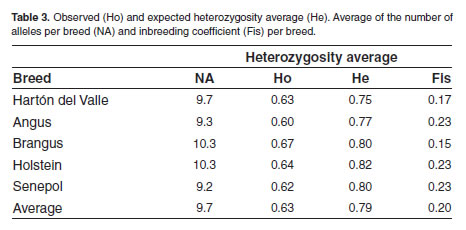
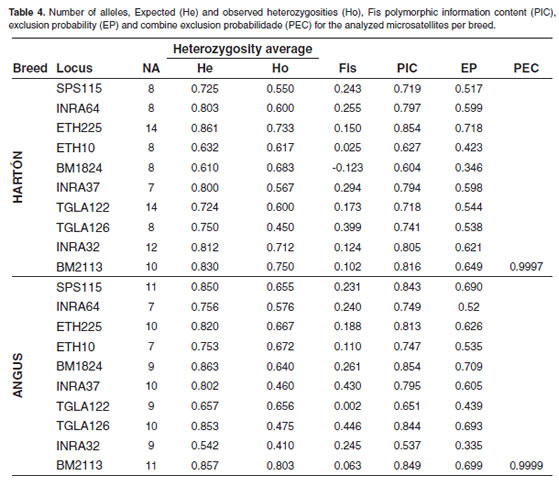
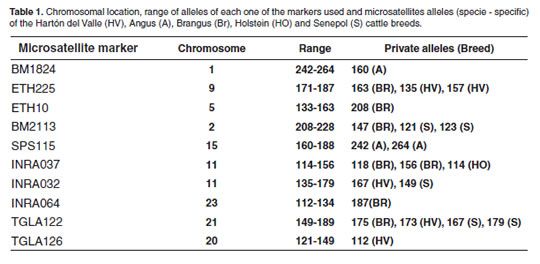
<body><![CDATA[<p><font face="Verdana, Arial, Helvetica, sans-serif" size="2">Polymorphic Information Content (PIC) for each marker was estimated in each breed according to Botstein and White's (1980) description; the exclusion probability (EP) was calculated for both individual markers and for the group of markers per breed, according to Jamieson (1994) suggestion. These procedures were undertaken to determine whether these microsatellite markers are informative to study breed characterization and paternity tests or not. </font></p>    <p><font face="Verdana, Arial, Helvetica, sans-serif" size="2">&nbsp;</font></p>     <p><font face="Verdana, Arial, Helvetica, sans-serif" size="3"><b>Results </b></font></p>     <p><font face="Verdana, Arial, Helvetica, sans-serif" size="2">A total of 142 alleles were found in the ten analyzed loci, considering the five breed as a whole. The number of alleles per loci was between 9 (INRA64 and BM1824) and 22 (TGLA122), with an average of 14.2 (<a href="#t2">Table 2</a>). Expected heterozygosities throughout all the breeds ranked between 0.79 (INRA32) and 0.90 (INRA37), and the average expected heterozygosity was 0.84. </font></p>    <p align="center"><font face="Verdana, Arial, Helvetica, sans-serif" size="2"><img src="/img/revistas/rccp/v23n3/v23n03a03t02.jpg"><a name="t2"></a></font></p>     <p><font face="Verdana, Arial, Helvetica, sans-serif" size="2">The average number of alleles per breed ranked among the breeds ranked between 0.75 in <I>Hart&oacute;n </I>from 9.2 in <I>Senepol</I> breed to 10.3 in <I>Holstein</I> breed <I>del Valle</I> breed and 0.82 in <I>Holstein</I> breed, with an (<a href="#t3">Table 3</a>). The expected heterozygosity range average of 0.79. </font></p>    <p align="center"><font face="Verdana, Arial, Helvetica, sans-serif" size="2"><img src="/img/revistas/rccp/v23n3/v23n03a03t03.jpg"><a name="t3"></a></font></p>     <p><font face="Verdana, Arial, Helvetica, sans-serif" size="2">Values for the number of alleles, expected microsatellite and <I>Angus</I> breed showed the heterozygosity (He), observed heterozygosity lowest one in the INRA32 locus (0.410). A slight (Ho), <I>Fis</I>, polymorphic information content (PIC) heterozygote excess was found in the <I>Brangus</I> breed and exclusion probability (EP) calculated for in the INRA032 locus (-0.023) and in the <I>Hart&oacute;n </I>each marker in each breed are shown in <a href="#t4">table 4</a>. <I>del Valle</I> breed in the BM1824 locus (-0.123). PIC <I>Senepol</I> breed presented the lowest alleles number, varied from 0.537 for INRA32 in <I>Senepol</I> breed and 6 for INRA64 locus. The highest were in <I>Brangus </I>0.899 for INRA37 in the same breed. The lowest for INRA37 and in <I>Holstein</I> for TGLA122, both combined EP was 0.9997 for <I>Hart&oacute;n del Valle </I>with 16. <I>Brangus</I> breed showed the highest breed, the remaining breeds presented values higher observed heterozygosity for the BM2113 (0.845) than 0.9999. </font></p>    <p align="center"><font face="Verdana, Arial, Helvetica, sans-serif" size="2"><img src="/img/revistas/rccp/v23n3/v23n03a03t04.jpg"><a name="t4"></a></font></p>     <p align="center"><font face="Verdana, Arial, Helvetica, sans-serif" size="2"><img src="/img/revistas/rccp/v23n3/v23n03a03t04a.jpg"></font></p>     ]]></body>
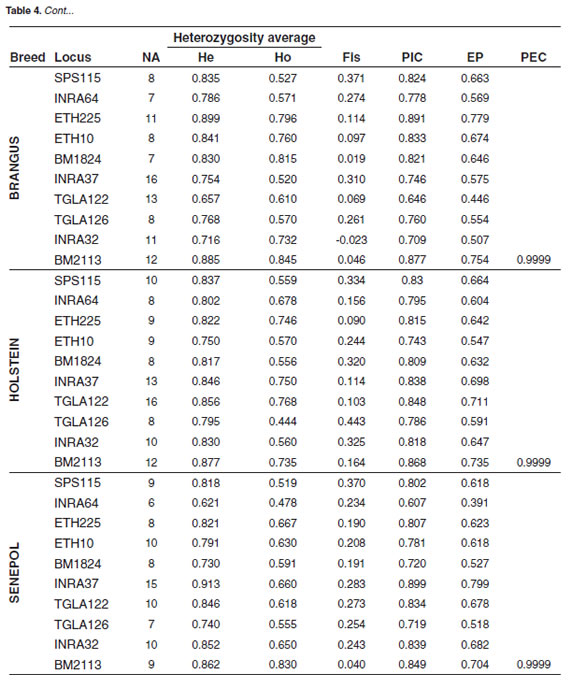
<body><![CDATA[<p><font face="Verdana, Arial, Helvetica, sans-serif" size="2">The results for EHW per breed and per locus showed that most of the loci showed disequilibrium, except for two of them (ETH10 and INRA32) in <I>Hart&oacute;n del Valle</I>, two loci (ETH10 and TGLA122) in <I>Angus</I>, two loci (ETH225 y BM2113) in <I>Holstein</I>, two loci (INRA64 and BM2113) in <I>Senepol</I> and five loci (ETH10, BM1824, TGLA122, INRA32 and BM2113) in <I>Brangus</I> (p&gt;0.05). </font></p>    <p><font face="Verdana, Arial, Helvetica, sans-serif" size="2">When analyzing the ten microsatellites for every breed's specific alleles, a total of three alleles were found in the TGLA122, ETH225 and INRA32 loci for <I>Hart&oacute;n del Valle</I>; 4 alleles in the TGLA126, BM1824 and SPS115 loci for <I>Angus</I>; six alleles in the INRA37, BM2113, TGLA122, ETH225, INRA64 and ETH10 loci for <I>Brangus</I>; three alleles in BM2113, TGLA122 and INRA32 loci in <I>Holstein</I> and one allele in INRA37 in <I>Senepol</I> (<a href="#t1">Table 1</a>). In most of the loci, the allelic frequency varied among breeds. The highest frequency was 0.20 for the 132 allele from the TGLA126 marker in <I>Angus</I> breed. </font></p>    <p><font face="Verdana, Arial, Helvetica, sans-serif" size="2">&nbsp; </font></p>     <p><font face="Verdana, Arial, Helvetica, sans-serif" size="3"><b>Discussion </b></font></p>     <p><font face="Verdana, Arial, Helvetica, sans-serif" size="2">In all the included breeds, all the analyzed microsatellites were polymorphic, showing between 9 (INRA64 y BM1824) and 22 alleles (TGLA122) (<a href="#t2">Table 2</a>).  In a study by Maudet <I>et al.</I> (2002) in native French cattle-breeds, the TGLA122 microsatellite turned out to be the most polymorphic too, with 19 alleles. Heterozygosity per locus was high and ranked between 0.79 and 0.90 (<a href="#t2">Table 2</a>). Thus, it shows the variation degree within and among the different Colombian breeds. The difference between the average number of alleles per locus and the average number of alleles per breed might have resulted from the disparity of the analyzed samples (49 <I>S; </I>60 <I>HV</I>, <I>B</I> and <I>H</I>, and 61<I>A</I>).These results show the great genetic diversity in cattle breeds in Colombia. </font></p>     <p><font face="Verdana, Arial, Helvetica, sans-serif" size="2">Genetic diversity in populations of domestic animals (cattle, buffaloes, goats, guinea pigs, etc.) has great importance from the point of view of conservation of endangered breeds. It is important to preserve genetic diversity in order for the breeds to withstand environmental changes or threats from emergent diseases, to guarantee the future supply of meat for the human population (FAO, 2007). </font></p>    <p><font face="Verdana, Arial, Helvetica, sans-serif" size="2">For most of the systems, <I>Holstein</I> breed showed the highest average number of alleles (<a href="#t3">Table 3</a>), and the highest heterozygote deficit, probably due to the fact that this breed count for a huge number of specimens, but high endogamy is observed because few males are use for breeding with their daughter and granddaughters. </font></p>    <p><font face="Verdana, Arial, Helvetica, sans-serif" size="2"><I>Senepol</I> is a breed recently introduced to our country with a low number of specimens and even less breeding males, therefore a few numbers of alleles per locus are expected in this breed, concordant with our findings that showed a low average number of both alleles and private alleles (species - specific), in addition to the highest heterozygote deficit (<a href="#t3">Table 3</a>). Similar results were found in Hart&oacute;n del Valle breed, which is a Colombian native breed, exclusive to the Valle del Cauca region and represented by a few specimens as well, beside of this fact, this breed has been subject of conservation programs tending to preserve it because its resistance to diseases and high productivity. </font></p>    <p><font face="Verdana, Arial, Helvetica, sans-serif" size="2"><I>Brangus </I>crossbreed, which has been obtained from crosses between <I>Angus</I> and <I>Brahman breeds</I>, exhibited high heterozygosity values, due to the fact that has its origin from two different breeds, increasing the chance that different alleles for each locus enhance the genetic variability in <I>Brangus </I>breed, this might explain why <I>Brangus</I> breed showed the lowest heterozygotes deficit (<a href="#t3">Table 3</a>). </font></p>    <p><font face="Verdana, Arial, Helvetica, sans-serif" size="2">An interesting outcome was the overall defi cit of heterozygotes. For all the populations, the observed heterozygosity (Ho) was lesser than expected, when analyzed per population, as well as per locus (<a href="#t2">Tables 2</a> <a href="#t3">and 3</a>). This might be related with an endogamy tendency in the different herds. Artificial insemination (Maudet <I>et al.</I>, 2002) and embryo transfer techniques also infl;uence genetically these results. </font></p>    ]]></body>
<body><![CDATA[<p><font face="Verdana, Arial, Helvetica, sans-serif" size="2">Most of the loci used in this study have been analyzed in previous studies with different breeds (Barrera <I>et al.</I>, 2006a; Calvo <I>et al.</I>, 2009; Hansen <I>et al.</I>, 2002; Mart&iacute;nez <I>et al.</I>, 2006; Maudet <I>et al.</I>, 2002; Mommens <I>et al.</I>, 1998; Radko <I>et al.</I>, 2005). A deficit of heterozygotes only in the insemination bull population was reported by Maudet <I>et al.</I> (2002). In previous studies a deficit of heterozygotes was found in the Colombian native breeds <I>Romosinuano</I> and <I>Hart&oacute;n del Valle</I>. (Barrera <I>et al.</I>, 2006a), in the Colombian native breeds <I>Romosinuano</I> and <I>BON</I> (Calvo <I>et al.</I>, 2009), A deficit of heterozygotes in Italian cattle breeds analyzed with another kind of microsatellite markers was reported by Ciampolini <I>et al.</I> (1995). All of these deficits have been attributed to the selection criteria for bulls chosen as sires in crossbreeding programs. </font></p>    <p><font face="Verdana, Arial, Helvetica, sans-serif" size="2"><a href="#t4">Table 4</a> shows the PIC values indicating the discriminatory value of each locus; values higher than 0.5 can be considered as highly discriminatory, what means that all of them allow us to value genetic diversity within and among each population. INRA37 marker for <I>Senepol</I> breed presented the highest PIC value and INRA32 for <I>Angus</I> breed presented the lowest one with 0.537. </font></p>    <p><font face="Verdana, Arial, Helvetica, sans-serif" size="2">The results of combined EP indicate that microsatellites panel must be increased for <I>Hart&oacute;n del Valle </I>breed to a reliability minimum value of 0.9999, since its total value was 0.9997. The EP for the remaining breeds is 0.9999 and thus, this microsatellite panel could be useful to solve filiation cases (Martinez <I>et al.</I>, 2005). Hence that the appropriate microsatellite panel for these cattle breeds parentage testing could not be adequate for other cattle breeds or vice versa; the research group considered necessary to establish a set of highly informative markers according to each breed to be evaluated. </font></p>    <p><font face="Verdana, Arial, Helvetica, sans-serif" size="2">Although some private breed alleles were found, its frequency was relatively low, except for allele 132 in <I>Angus</I> breed. Therefore, the possibility of using alleles for characterizing a breed would be, in principle, improbable; however, Hanotte <I>et al.</I> (2000) quoted by Hansen <I>et al.</I> (2002), has shown that it is possible to characterize a breed with relative accuracy in studies involving several cattle breeds. Steigleder <I>et al.</I> (2004) report the 161 allele for the ETH225 marker in the Brazilian native breed as a private allele. Further studies based on analysis involving more microsatellites or increasing the number of specimen are required in order to improve the analysis. </font></p>     <p><font face="Verdana, Arial, Helvetica, sans-serif" size="2">In conclusion, the results obtained with these microsatellites show considerable genetic diversity among the analyzed breads present in Colombia. Furthermore, microsatellites are a powerful tool for genealogy controlling. They also allow to control or organize mating systems in order to preserve their high genetic variability, and reinforce their environmental adaptation to the tropics as well as to solve filiation's cases. The combined power of exclusion for those markers exceeding 0.9999, for most of the analyzed breeds, highly suggests that this panel of markers could be theoretically considered as greatly useful for parentage verification of the analyzed cattle breeds. </font></p>     <p><font face="Verdana, Arial, Helvetica, sans-serif" size="2">&nbsp;</font></p>     <p><font face="Verdana, Arial, Helvetica, sans-serif" size="3"><b>Acknowledgements </b></font></p>     <p><font face="Verdana, Arial, Helvetica, sans-serif" size="2">We would like to thank to CODI, University of Antioquia for supporting our 2006 project <i>Genetic Characterization of the Cattle Breeds Using Ten Microsatellite Markers. </i>We are also grateful to Centro Internacional de Biotecnolog&iacute;a y Reproducci&oacute;n Cibre, Custodiar S.A, Hacienda Sanjonhondo and Corporaci&oacute;n Antioquia Holstein. </font></p>     <p><font face="Verdana, Arial, Helvetica, sans-serif" size="2">&nbsp;</font></p>     <p><font face="Verdana, Arial, Helvetica, sans-serif" size="3"><b>References </b></font></p>     ]]></body>
<body><![CDATA[<!-- ref --><p><font face="Verdana, Arial, Helvetica, sans-serif" size="2">1. Barrera GP, Mart&iacute;nez R, P&eacute;rez JE, Polanco N y Ariza F. Evaluaci&oacute;n de la variabilidad gen&eacute;tica en ganado Criollo Colombiano mediante 12 marcadores microsat&eacute;lites. AGRI 2006a; 38:35-45. <a href="http://www.corpoica.org.co/SitioWeb/Ofertas/ articulo.asp?id=1224" target="_blank">http://www.corpoica.org.co/SitioWeb/Ofertas/ articulo.asp?id=1224</a></font>&nbsp;&nbsp;&nbsp;&nbsp;&nbsp;&nbsp;&nbsp;&nbsp;[&#160;<a href="javascript:void(0);" onclick="javascript: window.open('/scielo.php?script=sci_nlinks&ref=000073&pid=S0120-0690201000030000300001&lng=','','width=640,height=500,resizable=yes,scrollbars=1,menubar=yes,');">Links</a>&#160;]<!-- end-ref --><!-- ref --><p><font face="Verdana, Arial, Helvetica, sans-serif" size="2">2. Barrera GP, Mart&iacute;nez R, Torrijos R y Rom&aacute;n F. Caracterizaci&oacute;n molecular de una poblaci&oacute;n de ganado Caquete&ntilde;o y su relaci&oacute;n filogen&eacute;tica con razas bovinas criollas colombianas. Revista Corpoica - Ciencia y Tecnolog&iacute;a Agropecuaria  2006b; 7:33-41. <a href="http://www.corpoica.org.co/SitioWeb/Archivos/Revista/4_ Molecular_Characterization_Caqueteo.pdf" target="_blank">http://www.corpoica.org.co/SitioWeb/Archivos/Revista/4_ Molecular_Characterization_Caqueteo.pdf</a></font>&nbsp;&nbsp;&nbsp;&nbsp;&nbsp;&nbsp;&nbsp;&nbsp;[&#160;<a href="javascript:void(0);" onclick="javascript: window.open('/scielo.php?script=sci_nlinks&ref=000074&pid=S0120-0690201000030000300002&lng=','','width=640,height=500,resizable=yes,scrollbars=1,menubar=yes,');">Links</a>&#160;]<!-- end-ref --><!-- ref --><p><font face="Verdana, Arial, Helvetica, sans-serif" size="2">3. Botstein D, White RL, Skolnick M, Davis RW. Construction of a genetic linkage map in man using restriction fragment lenght polymorphism. Am J of Hum Genet 1980; 32:314-331. <a href="http://www.ncbi.nlm.nih.gov/pmc/articles/PMC1686077/pdf/ ajhg00189-0020.pdf" target="_blank">http://www.ncbi.nlm.nih.gov/pmc/articles/PMC1686077/pdf/ ajhg00189-0020.pdf</a></font>&nbsp;&nbsp;&nbsp;&nbsp;&nbsp;&nbsp;&nbsp;&nbsp;[&#160;<a href="javascript:void(0);" onclick="javascript: window.open('/scielo.php?script=sci_nlinks&ref=000075&pid=S0120-0690201000030000300003&lng=','','width=640,height=500,resizable=yes,scrollbars=1,menubar=yes,');">Links</a>&#160;]<!-- end-ref --><!-- ref --><p><font face="Verdana, Arial, Helvetica, sans-serif" size="2">4. Budowle B, Chakraborty R, Giusti AM, Eisenberg AJ and Allen RC. Analysis of the VNTR Locus DIS80 by the PCR Followed by High-Resolution PAGE.  Am J Hum Genet 1991; 48:137-144. <a href="http://www.ncbi.nlm.nih.gov/pubmed/1670750" target="_blank">http://www.ncbi.nlm.nih.gov/pubmed/1670750</a>.</font>&nbsp;&nbsp;&nbsp;&nbsp;&nbsp;&nbsp;&nbsp;&nbsp;[&#160;<a href="javascript:void(0);" onclick="javascript: window.open('/scielo.php?script=sci_nlinks&ref=000076&pid=S0120-0690201000030000300004&lng=','','width=640,height=500,resizable=yes,scrollbars=1,menubar=yes,');">Links</a>&#160;]<!-- end-ref --><!-- ref --><p><font face="Verdana, Arial, Helvetica, sans-serif" size="2">5. Calvo SJ, Mart&iacute;nez E, Tirado JF, Corrales JD, Montoya AE, Burgos WO, Cer&oacute;n Mu&ntilde;oz MF, moreno M.  Caracterizaci&oacute;n gen&eacute;tica de las razas criollas BON y Romosinuano. LRRD 2009; 21. <a href="http://www.lrrd.org/lrrd21/4/calv21054.htm" target="_blank">http://www.lrrd.org/lrrd21/4/calv21054.htm</a></font>&nbsp;&nbsp;&nbsp;&nbsp;&nbsp;&nbsp;&nbsp;&nbsp;[&#160;<a href="javascript:void(0);" onclick="javascript: window.open('/scielo.php?script=sci_nlinks&ref=000077&pid=S0120-0690201000030000300005&lng=','','width=640,height=500,resizable=yes,scrollbars=1,menubar=yes,');">Links</a>&#160;]<!-- end-ref --><!-- ref --><p><font face="Verdana, Arial, Helvetica, sans-serif" size="2">6. Ciampolini R, Moazami-Goudarzi K, Vaiman D, Dillmann C, Mazzanti E, Foulley JL, Leveziel H, Cianci D. Individual multilocus genotypes using microsatellite polymorphisms to permit the analysis of the genetic variability within and between Italian beef cattle breeds. J Anim Sci 1995; 73:3259-3268. <a href="http://jas.fass.org/cgi/reprint/73/11/3259" target="_blank">http://jas.fass.org/cgi/reprint/73/11/3259</a></font>&nbsp;&nbsp;&nbsp;&nbsp;&nbsp;&nbsp;&nbsp;&nbsp;[&#160;<a href="javascript:void(0);" onclick="javascript: window.open('/scielo.php?script=sci_nlinks&ref=000078&pid=S0120-0690201000030000300006&lng=','','width=640,height=500,resizable=yes,scrollbars=1,menubar=yes,');">Links</a>&#160;]<!-- end-ref --><!-- ref --><p><font face="Verdana, Arial, Helvetica, sans-serif" size="2">7. FAO. 2007. The State of the World's Animal Genetic Resources for Food and Agriculture, edited by Barbara Rischkowsky &amp; Dafydd Pilling. Rome. </font>&nbsp;&nbsp;&nbsp;&nbsp;&nbsp;&nbsp;&nbsp;&nbsp;[&#160;<a href="javascript:void(0);" onclick="javascript: window.open('/scielo.php?script=sci_nlinks&ref=000079&pid=S0120-0690201000030000300007&lng=','','width=640,height=500,resizable=yes,scrollbars=1,menubar=yes,');">Links</a>&#160;]<!-- end-ref --><!-- ref --><p><font face="Verdana, Arial, Helvetica, sans-serif" size="2">8. Giovambattista G, Ripoli MV, Lir&oacute;n JP, Kienast ME, Villegas EE, Dulout FN, Garc&iacute;a PP.  Aplicaci&oacute;n de las t&eacute;cnicas de polimorfismos de DNA en la resoluci&oacute;n de casos de abigeato, identificaci&oacute;n individual y determinaci&oacute;n de paternidad. Analecta Veterinaria 2001; 21: 5-11. <a href="http://www.sedici.unlp. edu.ar?id=ARG-UNLP-ART-0000000895" target="_blank">http://www.sedici.unlp. edu.ar?id=ARG-UNLP-ART-0000000895</a></font>&nbsp;&nbsp;&nbsp;&nbsp;&nbsp;&nbsp;&nbsp;&nbsp;[&#160;<a href="javascript:void(0);" onclick="javascript: window.open('/scielo.php?script=sci_nlinks&ref=000080&pid=S0120-0690201000030000300008&lng=','','width=640,height=500,resizable=yes,scrollbars=1,menubar=yes,');">Links</a>&#160;]<!-- end-ref --><!-- ref --><p><font face="Verdana, Arial, Helvetica, sans-serif" size="2">9. Hansen C. Shrestha JN, Parker RJ, Crow GH, McAlpine PJ, et. al. Genetic diversity among Canadienne, Brown Swiss, Holstein, and Jersey cattle of Canada based on 15 bovine microsatellite markers. Genome 2002; 45:897-904. <a href="http:// article.pubs.nrc-cnrc.gc.ca/ppv/RPViewDoc?issn=08312796&volume=45&issue=5&startPage=897" target="_blank">http:// article.pubs.nrc-cnrc.gc.ca/ppv/RPViewDoc?issn=08312796&amp;volume=45&amp;issue=5&amp;startPage=897</a></font>&nbsp;&nbsp;&nbsp;&nbsp;&nbsp;&nbsp;&nbsp;&nbsp;[&#160;<a href="javascript:void(0);" onclick="javascript: window.open('/scielo.php?script=sci_nlinks&ref=000081&pid=S0120-0690201000030000300009&lng=','','width=640,height=500,resizable=yes,scrollbars=1,menubar=yes,');">Links</a>&#160;]<!-- end-ref --><!-- ref --><p><font face="Verdana, Arial, Helvetica, sans-serif" size="2">10. Jamieson A. The effectiveness of using codominant polymorphic allelic series for 1 checking pedigrees and 2 distinguishing full-sib pair members. Animal Genetics 1994; 25:37-44. <a href="http://www.ncbi.nlm.nih.gov/pubmed/7943982" target="_blank">http://www.ncbi.nlm.nih.gov/pubmed/7943982</a></font>&nbsp;&nbsp;&nbsp;&nbsp;&nbsp;&nbsp;&nbsp;&nbsp;[&#160;<a href="javascript:void(0);" onclick="javascript: window.open('/scielo.php?script=sci_nlinks&ref=000082&pid=S0120-0690201000030000300010&lng=','','width=640,height=500,resizable=yes,scrollbars=1,menubar=yes,');">Links</a>&#160;]<!-- end-ref --><!-- ref --><p><font face="Verdana, Arial, Helvetica, sans-serif" size="2">11. Kappes SM, Keele JW, Stone RT, Mcgraw RA, Sonstegard TS, Smith P.L., Lopez NL,  Beattie CW. A second generation linkage map of the bovine genome. Genome Research 1997; 7:325-249. <a href="http://genome.cshlp.org/content/7/3/235.full.pdf+html" target="_blank">http://genome.cshlp.org/content/7/3/235.full.pdf+html</a></font>&nbsp;&nbsp;&nbsp;&nbsp;&nbsp;&nbsp;&nbsp;&nbsp;[&#160;<a href="javascript:void(0);" onclick="javascript: window.open('/scielo.php?script=sci_nlinks&ref=000083&pid=S0120-0690201000030000300011&lng=','','width=640,height=500,resizable=yes,scrollbars=1,menubar=yes,');">Links</a>&#160;]<!-- end-ref --><!-- ref --><p><font face="Verdana, Arial, Helvetica, sans-serif" size="2">12. Lara MA, Contel EP, Sereno JR. Caracterizaci&oacute;n Gen&eacute;tica de poblaciones cebu&iacute;nas a trav&eacute;s de marcadores moleculares. Arch Zootec 2005; 54:295-303. <a href="http://www. uco.es/organiza/servicios/publica/az/php/az.php?idioma_ global=0&revista=35&codigo=549" target="_blank">http://www. uco.es/organiza/servicios/publica/az/php/az.php?idioma_ global=0&amp;revista=35&amp;codigo=549</a></font>&nbsp;&nbsp;&nbsp;&nbsp;&nbsp;&nbsp;&nbsp;&nbsp;[&#160;<a href="javascript:void(0);" onclick="javascript: window.open('/scielo.php?script=sci_nlinks&ref=000084&pid=S0120-0690201000030000300012&lng=','','width=640,height=500,resizable=yes,scrollbars=1,menubar=yes,');">Links</a>&#160;]<!-- end-ref --><!-- ref --><p><font face="Verdana, Arial, Helvetica, sans-serif" size="2">13. Lewis PO, Zaykin D. (GDA) Genetic Data Analysis:  Computer program for the analysis of allelic data Version 1.0 2001; <a href="http://lewis.eeb.uconn.edu/lewishome/software.html" target="_blank">http://lewis.eeb.uconn.edu/lewishome/software.html</a></font>&nbsp;&nbsp;&nbsp;&nbsp;&nbsp;&nbsp;&nbsp;&nbsp;[&#160;<a href="javascript:void(0);" onclick="javascript: window.open('/scielo.php?script=sci_nlinks&ref=000085&pid=S0120-0690201000030000300013&lng=','','width=640,height=500,resizable=yes,scrollbars=1,menubar=yes,');">Links</a>&#160;]<!-- end-ref --><!-- ref --><p><font face="Verdana, Arial, Helvetica, sans-serif" size="2">14. Mart&iacute;nez AM, Calder&oacute;n J, Camacho E, Rico C, Vega-Pla JL,Delgado JV.  Caracterizaci&oacute;n gen&eacute;tica de la raza bovina mostrenca con microsat&eacute;lites. Arch Zootec 2005; 54: 357-361.                                                                  <a href="http://redalyc.uaemex.mx/redalyc/pdf/495/49520738.pdf" target="_blank">http://redalyc.uaemex.mx/redalyc/pdf/495/49520738.pdf </a></font>&nbsp;&nbsp;&nbsp;&nbsp;&nbsp;&nbsp;&nbsp;&nbsp;[&#160;<a href="javascript:void(0);" onclick="javascript: window.open('/scielo.php?script=sci_nlinks&ref=000086&pid=S0120-0690201000030000300014&lng=','','width=640,height=500,resizable=yes,scrollbars=1,menubar=yes,');">Links</a>&#160;]<!-- end-ref --><!-- ref --><p><font face="Verdana, Arial, Helvetica, sans-serif" size="2">15. Mart&iacute;nez E, Tirado JF, Cer&oacute;n-Mu&ntilde;oz MF, Moreno M,  Montoya A, Corrales JD, Calvo SJ. Caracterizaci&oacute;n gen&eacute;tica del b&uacute;falo Murrah en Colombia usando marcadores microsat&eacute;lite. Livestock Research for Rural Development 2009; 21. <a href="http://www.lrrd.org/lrrd21/1/mart21014.htm" target="_blank">http://www.lrrd.org/lrrd21/1/mart21014.htm</a></font>&nbsp;&nbsp;&nbsp;&nbsp;&nbsp;&nbsp;&nbsp;&nbsp;[&#160;<a href="javascript:void(0);" onclick="javascript: window.open('/scielo.php?script=sci_nlinks&ref=000087&pid=S0120-0690201000030000300015&lng=','','width=640,height=500,resizable=yes,scrollbars=1,menubar=yes,');">Links</a>&#160;]<!-- end-ref --><!-- ref --><p><font face="Verdana, Arial, Helvetica, sans-serif" size="2">16. Mart&iacute;nez R, Barrera G, Sastre H. Variabilidad y estado gen&eacute;tico de siete subpoblaciones de la raza criolla colombiana Casanare&ntilde;o. Revista Corpoica - Ciencia y Tecnolog&iacute;a Agropecuaria 2006; 7: 5-11 <a href="http://www.corpoica.org.co/SitioWeb/Revistas/verarticulo.asp?id_contenido=209" target="_blank">http://www.corpoica.org.co/SitioWeb/Revistas/verarticulo.asp?id_contenido=209</a></font>&nbsp;&nbsp;&nbsp;&nbsp;&nbsp;&nbsp;&nbsp;&nbsp;[&#160;<a href="javascript:void(0);" onclick="javascript: window.open('/scielo.php?script=sci_nlinks&ref=000088&pid=S0120-0690201000030000300016&lng=','','width=640,height=500,resizable=yes,scrollbars=1,menubar=yes,');">Links</a>&#160;]<!-- end-ref --><!-- ref --><p><font face="Verdana, Arial, Helvetica, sans-serif" size="2">17. Maudet C, Luikart G, Taberlet P. Genetic diversity and assignment tests among seven French cattle breeds based on microsatellite DNA analysis. <I>J Anim Sci 2002;</I> 80:942-950. <a href="http://jas.fass.org/cgi/reprint/80/4/942.pdf" target="_blank">http://jas.fass.org/cgi/reprint/80/4/942.pdf</a></font>&nbsp;&nbsp;&nbsp;&nbsp;&nbsp;&nbsp;&nbsp;&nbsp;[&#160;<a href="javascript:void(0);" onclick="javascript: window.open('/scielo.php?script=sci_nlinks&ref=000089&pid=S0120-0690201000030000300017&lng=','','width=640,height=500,resizable=yes,scrollbars=1,menubar=yes,');">Links</a>&#160;]<!-- end-ref --><!-- ref --><p><font face="Verdana, Arial, Helvetica, sans-serif" size="2">18. Miller SA, Dykes DD, Polesky HF.  A simple salting out procedure for extracting DNA from human nucleated cell. Nucleic Acids Research 1988; 16:1215. <a href="http://www.ncbi.nlm. nih.gov/pmc/articles/PMC334765/pdf/nar00145-0424.pdf" target="_blank">http://www.ncbi.nlm. nih.gov/pmc/articles/PMC334765/pdf/nar00145-0424.pdf</a></font>&nbsp;&nbsp;&nbsp;&nbsp;&nbsp;&nbsp;&nbsp;&nbsp;[&#160;<a href="javascript:void(0);" onclick="javascript: window.open('/scielo.php?script=sci_nlinks&ref=000090&pid=S0120-0690201000030000300018&lng=','','width=640,height=500,resizable=yes,scrollbars=1,menubar=yes,');">Links</a>&#160;]<!-- end-ref --><!-- ref --><p><font face="Verdana, Arial, Helvetica, sans-serif" size="2">19. Mommens G; Van A; Peelman LJ. Effectiveness of bovine microsatellites in resolving paternity cases in <I>American bison, Bison bison</I>. Animal Genetics 1998; 29:12-18. <a href="http:// www3.interscience.wiley.com/cgi-bin/fulltext/119119507/ PDFSTART" target="_blank">http:// www3.interscience.wiley.com/cgi-bin/fulltext/119119507/ PDFSTART</a></font>&nbsp;&nbsp;&nbsp;&nbsp;&nbsp;&nbsp;&nbsp;&nbsp;[&#160;<a href="javascript:void(0);" onclick="javascript: window.open('/scielo.php?script=sci_nlinks&ref=000091&pid=S0120-0690201000030000300019&lng=','','width=640,height=500,resizable=yes,scrollbars=1,menubar=yes,');">Links</a>&#160;]<!-- end-ref --><!-- ref --><p><font face="Verdana, Arial, Helvetica, sans-serif" size="2">20. Moreno F, Bedoya G, Derr J, Carvajal L, Berm&uacute;dez N, Zuluaga N, Ossa J, Berdugo J, Estrada L, Barrera J, Scott D, Linares A. Diversidad gen&eacute;tica y relaciones fi logen&eacute;ticas del ganado criollo colombiano. Revista Corpoica 2001; 3:17-23 <a href="http://www.corpoica.org.co/SitioWeb/Archivos/Revista/3_ Diversidadgenticayrelacion.PDF" target="_blank">http://www.corpoica.org.co/SitioWeb/Archivos/Revista/3_ Diversidadgenticayrelacion.PDF</a></font>&nbsp;&nbsp;&nbsp;&nbsp;&nbsp;&nbsp;&nbsp;&nbsp;[&#160;<a href="javascript:void(0);" onclick="javascript: window.open('/scielo.php?script=sci_nlinks&ref=000092&pid=S0120-0690201000030000300020&lng=','','width=640,height=500,resizable=yes,scrollbars=1,menubar=yes,');">Links</a>&#160;]<!-- end-ref --><!-- ref --><p><font face="Verdana, Arial, Helvetica, sans-serif" size="2">21. Peelman LJ, Mortiaux F, Van A, Dansercoer A, Mommens G, Coopman F, Bouquet Y, Burny A, RenavIle R, Portetelle D. Evaluation of the genetic variability of 23 bovine microsatellite markers in four Belgian cattle breeds. Animal Genetics 1998; 29:161-16. <a href="http://cat.inist.fr/?aModele=afficheN&cpsi dt=2342763" target="_blank">http://cat.inist.fr/?aModele=afficheN&amp;cpsi dt=2342763</a></font>&nbsp;&nbsp;&nbsp;&nbsp;&nbsp;&nbsp;&nbsp;&nbsp;[&#160;<a href="javascript:void(0);" onclick="javascript: window.open('/scielo.php?script=sci_nlinks&ref=000093&pid=S0120-0690201000030000300021&lng=','','width=640,height=500,resizable=yes,scrollbars=1,menubar=yes,');">Links</a>&#160;]<!-- end-ref --><!-- ref --><p><font face="Verdana, Arial, Helvetica, sans-serif" size="2">22. Radko A, Zyga A, Zabek T, Slota E. Genetic variability among Polish Red, Hereford and Holstein-Friesian cattle raised in Poland based on analysis of microsatellite DNA sequences. Short communication. J Appl Genet 2005; 46:89-91. <a href="http://jag.igr.poznan.pl/2005-Volume-46/1/pdf/2005_ Volume_46_1-89-91.pdf" target="_blank">http://jag.igr.poznan.pl/2005-Volume-46/1/pdf/2005_ Volume_46_1-89-91.pdf </a></font>&nbsp;&nbsp;&nbsp;&nbsp;&nbsp;&nbsp;&nbsp;&nbsp;[&#160;<a href="javascript:void(0);" onclick="javascript: window.open('/scielo.php?script=sci_nlinks&ref=000094&pid=S0120-0690201000030000300022&lng=','','width=640,height=500,resizable=yes,scrollbars=1,menubar=yes,');">Links</a>&#160;]<!-- end-ref --><!-- ref --><p><font face="Verdana, Arial, Helvetica, sans-serif" size="2">23. Sanz A, Uffo O, Miranda I, Mart&iacute;nez S. Empleo de los microsat&eacute;lites para determinar paternidad en Bovinos Cubanos. Rev Salud Anim 2002; 24:166-169. <a href="http://www. censa.edu.cu/index2.php?option=com_docman&task=doc_ view&gid=574&Itemid=105" target="_blank">http://www. censa.edu.cu/index2.php?option=com_docman&amp;task=doc_ view&amp;gid=574&amp;Itemid=105</a></font>&nbsp;&nbsp;&nbsp;&nbsp;&nbsp;&nbsp;&nbsp;&nbsp;[&#160;<a href="javascript:void(0);" onclick="javascript: window.open('/scielo.php?script=sci_nlinks&ref=000095&pid=S0120-0690201000030000300023&lng=','','width=640,height=500,resizable=yes,scrollbars=1,menubar=yes,');">Links</a>&#160;]<!-- end-ref --><!-- ref --><p><font face="Verdana, Arial, Helvetica, sans-serif" size="2">24. Steigleder CS, Almeida EA, Weimer TA. Genetic diversity of a Brazilian creole cattle based on fourteen microsatellite <I>loci</I>. <I>Arch Zootec 2004;</I> 53:3-11. <a href="http://redalyc.uaemex.mx/redalyc/ pdf/495/49520101.pdf" target="_blank">http://redalyc.uaemex.mx/redalyc/ pdf/495/49520101.pdf</a></font>&nbsp;&nbsp;&nbsp;&nbsp;&nbsp;&nbsp;&nbsp;&nbsp;[&#160;<a href="javascript:void(0);" onclick="javascript: window.open('/scielo.php?script=sci_nlinks&ref=000096&pid=S0120-0690201000030000300024&lng=','','width=640,height=500,resizable=yes,scrollbars=1,menubar=yes,');">Links</a>&#160;]<!-- end-ref --><!-- ref --><p><font face="Verdana, Arial, Helvetica, sans-serif" size="2">25. Zamorano MJ, G&eacute;nero ER, Rodero A, Vega-Pla JL, Rumiano FJ. Caracterizaci&oacute;n gen&eacute;tica de ganado bovino criollo argentino utilizando microsat&eacute;lites. Arch Zootec 1998a; 47: 273-277. <a href="http://www.uco.es/organiza/servicios/publica/az/ articulos/1998/178-179/pdf/zamoran3.pdf" target="_blank">http://www.uco.es/organiza/servicios/publica/az/ articulos/1998/178-179/pdf/zamoran3.pdf </a></font>&nbsp;&nbsp;&nbsp;&nbsp;&nbsp;&nbsp;&nbsp;&nbsp;[&#160;<a href="javascript:void(0);" onclick="javascript: window.open('/scielo.php?script=sci_nlinks&ref=000097&pid=S0120-0690201000030000300025&lng=','','width=640,height=500,resizable=yes,scrollbars=1,menubar=yes,');">Links</a>&#160;]<!-- end-ref --><!-- ref --><p><font face="Verdana, Arial, Helvetica, sans-serif" size="2">26. Zamorano MJ, Ruiter J, Rodero A, Vega-Pla JL. An&aacute;lisis gen&eacute;tico de marcadores microsat&eacute;lites en dos poblaciones de la raza bovina berrenda en negro. Arch Zootec 1998b; 47:195-200. <a href="http://www.uco.es/organiza/servicios/publica/az/ articulos/1998/178-179/pdf/zamoran2.pdf" target="_blank">http://www.uco.es/organiza/servicios/publica/az/ articulos/1998/178-179/pdf/zamoran2.pdf </a></font>&nbsp;&nbsp;&nbsp;&nbsp;&nbsp;&nbsp;&nbsp;&nbsp;[&#160;<a href="javascript:void(0);" onclick="javascript: window.open('/scielo.php?script=sci_nlinks&ref=000098&pid=S0120-0690201000030000300026&lng=','','width=640,height=500,resizable=yes,scrollbars=1,menubar=yes,');">Links</a>&#160;]<!-- end-ref --> ]]></body><back>
<ref-list>
<ref id="B1">
<label>1</label><nlm-citation citation-type="journal">
<person-group person-group-type="author">
<name>
<surname><![CDATA[Barrera]]></surname>
<given-names><![CDATA[GP]]></given-names>
</name>
<name>
<surname><![CDATA[Martínez]]></surname>
<given-names><![CDATA[R]]></given-names>
</name>
<name>
<surname><![CDATA[Pérez]]></surname>
<given-names><![CDATA[JE]]></given-names>
</name>
<name>
<surname><![CDATA[Polanco]]></surname>
<given-names><![CDATA[N]]></given-names>
</name>
<name>
<surname><![CDATA[Ariza]]></surname>
<given-names><![CDATA[F]]></given-names>
</name>
</person-group>
<article-title xml:lang="es"><![CDATA[Evaluación de la variabilidad genética en ganado Criollo Colombiano mediante 12 marcadores microsatélites]]></article-title>
<source><![CDATA[AGRI]]></source>
<year>2006</year>
<month>a</month>
<volume>38</volume>
<page-range>35-45</page-range></nlm-citation>
</ref>
<ref id="B2">
<label>2</label><nlm-citation citation-type="journal">
<person-group person-group-type="author">
<name>
<surname><![CDATA[Barrera]]></surname>
<given-names><![CDATA[GP]]></given-names>
</name>
<name>
<surname><![CDATA[Martínez]]></surname>
<given-names><![CDATA[R]]></given-names>
</name>
<name>
<surname><![CDATA[Torrijos]]></surname>
<given-names><![CDATA[R]]></given-names>
</name>
<name>
<surname><![CDATA[Román]]></surname>
<given-names><![CDATA[F]]></given-names>
</name>
</person-group>
<article-title xml:lang="es"><![CDATA[Caracterización molecular de una población de ganado Caqueteño y su relación filogenética con razas bovinas criollas colombianas]]></article-title>
<source><![CDATA[Revista Corpoica - Ciencia y Tecnología Agropecuaria]]></source>
<year>2006</year>
<month>b</month>
<volume>7</volume>
<page-range>33-41</page-range></nlm-citation>
</ref>
<ref id="B3">
<label>3</label><nlm-citation citation-type="journal">
<person-group person-group-type="author">
<name>
<surname><![CDATA[Botstein]]></surname>
<given-names><![CDATA[D]]></given-names>
</name>
<name>
<surname><![CDATA[White]]></surname>
<given-names><![CDATA[RL]]></given-names>
</name>
<name>
<surname><![CDATA[Skolnick]]></surname>
<given-names><![CDATA[M]]></given-names>
</name>
<name>
<surname><![CDATA[Davis]]></surname>
<given-names><![CDATA[RW]]></given-names>
</name>
</person-group>
<article-title xml:lang="en"><![CDATA[Construction of a genetic linkage map in man using restriction fragment lenght polymorphism]]></article-title>
<source><![CDATA[Am J of Hum Genet]]></source>
<year>1980</year>
<volume>32</volume>
<page-range>314-331</page-range></nlm-citation>
</ref>
<ref id="B4">
<label>4</label><nlm-citation citation-type="journal">
<person-group person-group-type="author">
<name>
<surname><![CDATA[Budowle]]></surname>
<given-names><![CDATA[B]]></given-names>
</name>
<name>
<surname><![CDATA[Chakraborty]]></surname>
<given-names><![CDATA[R]]></given-names>
</name>
<name>
<surname><![CDATA[Giusti]]></surname>
<given-names><![CDATA[AM]]></given-names>
</name>
<name>
<surname><![CDATA[Eisenberg]]></surname>
<given-names><![CDATA[AJ]]></given-names>
</name>
<name>
<surname><![CDATA[Allen]]></surname>
<given-names><![CDATA[RC]]></given-names>
</name>
</person-group>
<article-title xml:lang="en"><![CDATA[Analysis of the VNTR Locus DIS80 by the PCR Followed by High-Resolution PAGE]]></article-title>
<source><![CDATA[Am J Hum Genet]]></source>
<year>1991</year>
<volume>48</volume>
<page-range>137-144</page-range></nlm-citation>
</ref>
<ref id="B5">
<label>5</label><nlm-citation citation-type="journal">
<person-group person-group-type="author">
<name>
<surname><![CDATA[Calvo]]></surname>
<given-names><![CDATA[SJ]]></given-names>
</name>
<name>
<surname><![CDATA[Martínez]]></surname>
<given-names><![CDATA[E]]></given-names>
</name>
<name>
<surname><![CDATA[Tirado]]></surname>
<given-names><![CDATA[JF]]></given-names>
</name>
<name>
<surname><![CDATA[Corrales]]></surname>
<given-names><![CDATA[JD]]></given-names>
</name>
<name>
<surname><![CDATA[Montoya]]></surname>
<given-names><![CDATA[AE]]></given-names>
</name>
<name>
<surname><![CDATA[Burgos]]></surname>
<given-names><![CDATA[WO]]></given-names>
</name>
<name>
<surname><![CDATA[Cerón Muñoz]]></surname>
<given-names><![CDATA[MF]]></given-names>
</name>
</person-group>
<article-title xml:lang="es"><![CDATA[Caracterización genética de las razas criollas BON y Romosinuano]]></article-title>
<source><![CDATA[LRRD]]></source>
<year>2009</year>
</nlm-citation>
</ref>
<ref id="B6">
<label>6</label><nlm-citation citation-type="journal">
<person-group person-group-type="author">
<name>
<surname><![CDATA[Ciampolini]]></surname>
<given-names><![CDATA[R]]></given-names>
</name>
<name>
<surname><![CDATA[Moazami-Goudarzi]]></surname>
<given-names><![CDATA[K]]></given-names>
</name>
<name>
<surname><![CDATA[Vaiman]]></surname>
<given-names><![CDATA[D]]></given-names>
</name>
<name>
<surname><![CDATA[Dillmann]]></surname>
<given-names><![CDATA[C]]></given-names>
</name>
<name>
<surname><![CDATA[Mazzanti]]></surname>
<given-names><![CDATA[E]]></given-names>
</name>
<name>
<surname><![CDATA[Foulley]]></surname>
<given-names><![CDATA[JL]]></given-names>
</name>
</person-group>
<article-title xml:lang="en"><![CDATA[Individual multilocus genotypes using microsatellite polymorphisms to permit the analysis of the genetic variability within and between Italian beef cattle breeds]]></article-title>
<source><![CDATA[J Anim Sci]]></source>
<year>1995</year>
<volume>73</volume>
<page-range>3259-3268</page-range></nlm-citation>
</ref>
<ref id="B7">
<label>7</label><nlm-citation citation-type="">
<person-group person-group-type="author">
<name>
<surname><![CDATA[Rischkowsky]]></surname>
<given-names><![CDATA[Barbara]]></given-names>
</name>
<name>
<surname><![CDATA[Pilling]]></surname>
<given-names><![CDATA[Dafydd]]></given-names>
</name>
</person-group>
<collab>FAO</collab>
<source><![CDATA[The State of the World's Animal Genetic Resources for Food and Agriculture]]></source>
<year></year>
<publisher-loc><![CDATA[Rome ]]></publisher-loc>
</nlm-citation>
</ref>
<ref id="B8">
<label>8</label><nlm-citation citation-type="journal">
<person-group person-group-type="author">
<name>
<surname><![CDATA[Giovambattista]]></surname>
<given-names><![CDATA[G]]></given-names>
</name>
<name>
<surname><![CDATA[Ripoli]]></surname>
<given-names><![CDATA[MV]]></given-names>
</name>
<name>
<surname><![CDATA[Lirón]]></surname>
<given-names><![CDATA[JP]]></given-names>
</name>
<name>
<surname><![CDATA[Kienast]]></surname>
<given-names><![CDATA[ME]]></given-names>
</name>
<name>
<surname><![CDATA[Villegas]]></surname>
<given-names><![CDATA[EE]]></given-names>
</name>
<name>
<surname><![CDATA[Dulout]]></surname>
<given-names><![CDATA[FN]]></given-names>
</name>
<name>
<surname><![CDATA[García]]></surname>
<given-names><![CDATA[PP]]></given-names>
</name>
</person-group>
<article-title xml:lang="en"><![CDATA[Aplicación de las técnicas de polimorfismos de DNA en la resolución de casos de abigeato, identificación individual y determinación de paternidad]]></article-title>
<source><![CDATA[Analecta Veterinaria]]></source>
<year>2001</year>
<volume>21</volume>
<page-range>5-11</page-range></nlm-citation>
</ref>
<ref id="B9">
<label>9</label><nlm-citation citation-type="journal">
<person-group person-group-type="author">
<name>
<surname><![CDATA[Hansen]]></surname>
<given-names><![CDATA[C]]></given-names>
</name>
<name>
<surname><![CDATA[Shrestha]]></surname>
<given-names><![CDATA[JN]]></given-names>
</name>
<name>
<surname><![CDATA[Parker]]></surname>
<given-names><![CDATA[RJ]]></given-names>
</name>
<name>
<surname><![CDATA[Crow]]></surname>
<given-names><![CDATA[GH]]></given-names>
</name>
<name>
<surname><![CDATA[McAlpine]]></surname>
<given-names><![CDATA[PJ]]></given-names>
</name>
</person-group>
<article-title xml:lang="en"><![CDATA[Genetic diversity among Canadienne, Brown Swiss, Holstein, and Jersey cattle of Canada based on 15 bovine microsatellite markers]]></article-title>
<source><![CDATA[Genome]]></source>
<year>2002</year>
<volume>45</volume>
<page-range>897-904</page-range></nlm-citation>
</ref>
<ref id="B10">
<label>10</label><nlm-citation citation-type="journal">
<person-group person-group-type="author">
<name>
<surname><![CDATA[Jamieson]]></surname>
<given-names><![CDATA[A]]></given-names>
</name>
</person-group>
<article-title xml:lang="en"><![CDATA[The effectiveness of using codominant polymorphic allelic series for 1 checking pedigrees and 2 distinguishing full-sib pair members]]></article-title>
<source><![CDATA[Animal Genetics]]></source>
<year>1994</year>
<volume>25</volume>
<page-range>37-44</page-range></nlm-citation>
</ref>
<ref id="B11">
<label>11</label><nlm-citation citation-type="journal">
<person-group person-group-type="author">
<name>
<surname><![CDATA[Kappes]]></surname>
<given-names><![CDATA[SM]]></given-names>
</name>
<name>
<surname><![CDATA[Keele]]></surname>
<given-names><![CDATA[JW]]></given-names>
</name>
<name>
<surname><![CDATA[Stone]]></surname>
<given-names><![CDATA[RT]]></given-names>
</name>
<name>
<surname><![CDATA[Mcgraw]]></surname>
<given-names><![CDATA[RA]]></given-names>
</name>
<name>
<surname><![CDATA[Sonstegard]]></surname>
<given-names><![CDATA[TS]]></given-names>
</name>
<name>
<surname><![CDATA[Smith]]></surname>
<given-names><![CDATA[P.L]]></given-names>
</name>
<name>
<surname><![CDATA[Lopez]]></surname>
<given-names><![CDATA[NL]]></given-names>
</name>
</person-group>
<article-title xml:lang="en"><![CDATA[A second generation linkage map of the bovine genome]]></article-title>
<source><![CDATA[Genome Research]]></source>
<year>1997</year>
<volume>7</volume>
<page-range>325-249</page-range></nlm-citation>
</ref>
<ref id="B12">
<label>12</label><nlm-citation citation-type="journal">
<person-group person-group-type="author">
<name>
<surname><![CDATA[Lara]]></surname>
<given-names><![CDATA[MA]]></given-names>
</name>
<name>
<surname><![CDATA[Contel]]></surname>
<given-names><![CDATA[EP]]></given-names>
</name>
<name>
<surname><![CDATA[Sereno]]></surname>
<given-names><![CDATA[JR]]></given-names>
</name>
</person-group>
<article-title xml:lang="es"><![CDATA[Caracterización Genética de poblaciones cebuínas a través de marcadores moleculares]]></article-title>
<source><![CDATA[Arch Zootec]]></source>
<year>2005</year>
<volume>54</volume>
<page-range>295-303</page-range></nlm-citation>
</ref>
<ref id="B13">
<label>13</label><nlm-citation citation-type="">
<person-group person-group-type="author">
<name>
<surname><![CDATA[Lewis]]></surname>
<given-names><![CDATA[PO]]></given-names>
</name>
<name>
<surname><![CDATA[Zaykin]]></surname>
<given-names><![CDATA[D]]></given-names>
</name>
</person-group>
<source><![CDATA[Genetic Data Analysis: Computer program for the analysis of allelic data Version 1.0]]></source>
<year>2001</year>
</nlm-citation>
</ref>
<ref id="B14">
<label>14</label><nlm-citation citation-type="journal">
<person-group person-group-type="author">
<name>
<surname><![CDATA[Martínez]]></surname>
<given-names><![CDATA[AM]]></given-names>
</name>
<name>
<surname><![CDATA[Calderón]]></surname>
<given-names><![CDATA[J]]></given-names>
</name>
<name>
<surname><![CDATA[Camacho]]></surname>
<given-names><![CDATA[E]]></given-names>
</name>
<name>
<surname><![CDATA[Rico]]></surname>
<given-names><![CDATA[C]]></given-names>
</name>
<name>
<surname><![CDATA[Vega-Pla]]></surname>
<given-names><![CDATA[JL]]></given-names>
</name>
<name>
<surname><![CDATA[Delgado]]></surname>
<given-names><![CDATA[JV]]></given-names>
</name>
</person-group>
<article-title xml:lang="es"><![CDATA[Caracterización genética de la raza bovina mostrenca con microsatélites]]></article-title>
<source><![CDATA[Arch Zootec]]></source>
<year>2005</year>
<volume>54</volume>
<page-range>357-361</page-range></nlm-citation>
</ref>
<ref id="B15">
<label>15</label><nlm-citation citation-type="journal">
<person-group person-group-type="author">
<name>
<surname><![CDATA[Martínez]]></surname>
<given-names><![CDATA[E]]></given-names>
</name>
<name>
<surname><![CDATA[Tirado]]></surname>
<given-names><![CDATA[JF]]></given-names>
</name>
<name>
<surname><![CDATA[Cerón-Muñoz]]></surname>
<given-names><![CDATA[MF]]></given-names>
</name>
<name>
<surname><![CDATA[Moreno]]></surname>
<given-names><![CDATA[M]]></given-names>
</name>
<name>
<surname><![CDATA[Montoya]]></surname>
<given-names><![CDATA[A]]></given-names>
</name>
</person-group>
<article-title xml:lang="es"><![CDATA[Caracterización genética del búfalo Murrah en Colombia usando marcadores microsatélite]]></article-title>
<source><![CDATA[Livestock Research for Rural Development]]></source>
<year>2009</year>
<volume>21</volume>
</nlm-citation>
</ref>
<ref id="B16">
<label>16</label><nlm-citation citation-type="journal">
<person-group person-group-type="author">
<name>
<surname><![CDATA[Martínez]]></surname>
<given-names><![CDATA[R]]></given-names>
</name>
<name>
<surname><![CDATA[Barrera]]></surname>
<given-names><![CDATA[G]]></given-names>
</name>
<name>
<surname><![CDATA[Sastre]]></surname>
<given-names><![CDATA[H]]></given-names>
</name>
</person-group>
<article-title xml:lang="es"><![CDATA[Variabilidad y estado genético de siete subpoblaciones de la raza criolla colombiana Casanareño]]></article-title>
<source><![CDATA[Revista Corpoica - Ciencia y Tecnología Agropecuaria]]></source>
<year>2006</year>
<volume>7</volume>
<page-range>5-11</page-range></nlm-citation>
</ref>
<ref id="B17">
<label>17</label><nlm-citation citation-type="journal">
<person-group person-group-type="author">
<name>
<surname><![CDATA[Maudet]]></surname>
<given-names><![CDATA[C]]></given-names>
</name>
<name>
<surname><![CDATA[Luikart]]></surname>
<given-names><![CDATA[G]]></given-names>
</name>
<name>
<surname><![CDATA[Taberlet]]></surname>
<given-names><![CDATA[P]]></given-names>
</name>
</person-group>
<article-title xml:lang="en"><![CDATA[Genetic diversity and assignment tests among seven French cattle breeds based on microsatellite DNA analysis]]></article-title>
<source><![CDATA[J Anim Sci]]></source>
<year>2002</year>
<volume>80</volume>
<page-range>942-950</page-range></nlm-citation>
</ref>
<ref id="B18">
<label>18</label><nlm-citation citation-type="journal">
<person-group person-group-type="author">
<name>
<surname><![CDATA[Miller]]></surname>
<given-names><![CDATA[SA]]></given-names>
</name>
<name>
<surname><![CDATA[Dykes]]></surname>
<given-names><![CDATA[DD]]></given-names>
</name>
<name>
<surname><![CDATA[Polesky]]></surname>
<given-names><![CDATA[HF]]></given-names>
</name>
</person-group>
<article-title xml:lang="en"><![CDATA[A simple salting out procedure for extracting DNA from human nucleated cell]]></article-title>
<source><![CDATA[Nucleic Acids Research]]></source>
<year>1988</year>
<volume>16</volume>
<page-range>1215</page-range></nlm-citation>
</ref>
<ref id="B19">
<label>19</label><nlm-citation citation-type="journal">
<person-group person-group-type="author">
<name>
<surname><![CDATA[Mommens]]></surname>
<given-names><![CDATA[G]]></given-names>
</name>
<name>
<surname><![CDATA[Van]]></surname>
<given-names><![CDATA[A]]></given-names>
</name>
<name>
<surname><![CDATA[Peelman]]></surname>
<given-names><![CDATA[LJ]]></given-names>
</name>
</person-group>
<article-title xml:lang="en"><![CDATA[Effectiveness of bovine microsatellites in resolving paternity cases in American bison, Bison bison]]></article-title>
<source><![CDATA[Animal Genetics]]></source>
<year>1998</year>
<volume>29</volume>
<page-range>12-18</page-range></nlm-citation>
</ref>
<ref id="B20">
<label>20</label><nlm-citation citation-type="journal">
<person-group person-group-type="author">
<name>
<surname><![CDATA[Moreno]]></surname>
<given-names><![CDATA[F]]></given-names>
</name>
<name>
<surname><![CDATA[Bedoya]]></surname>
<given-names><![CDATA[G]]></given-names>
</name>
<name>
<surname><![CDATA[Derr]]></surname>
<given-names><![CDATA[J]]></given-names>
</name>
<name>
<surname><![CDATA[Carvajal]]></surname>
<given-names><![CDATA[L]]></given-names>
</name>
<name>
<surname><![CDATA[Bermúdez]]></surname>
<given-names><![CDATA[N]]></given-names>
</name>
<name>
<surname><![CDATA[Zuluaga]]></surname>
<given-names><![CDATA[N]]></given-names>
</name>
<name>
<surname><![CDATA[Ossa]]></surname>
<given-names><![CDATA[J]]></given-names>
</name>
</person-group>
<article-title xml:lang="es"><![CDATA[Diversidad genética y relaciones fi logenéticas del ganado criollo colombiano]]></article-title>
<source><![CDATA[Revista Corpoica]]></source>
<year>2001</year>
<volume>3</volume>
<page-range>17-23</page-range></nlm-citation>
</ref>
<ref id="B21">
<label>21</label><nlm-citation citation-type="journal">
<person-group person-group-type="author">
<name>
<surname><![CDATA[Peelman]]></surname>
<given-names><![CDATA[LJ]]></given-names>
</name>
<name>
<surname><![CDATA[Mortiaux]]></surname>
<given-names><![CDATA[F]]></given-names>
</name>
<name>
<surname><![CDATA[Van]]></surname>
<given-names><![CDATA[A]]></given-names>
</name>
<name>
<surname><![CDATA[Dansercoer]]></surname>
<given-names><![CDATA[A]]></given-names>
</name>
<name>
<surname><![CDATA[Mommens]]></surname>
<given-names><![CDATA[G]]></given-names>
</name>
<name>
<surname><![CDATA[Coopman]]></surname>
<given-names><![CDATA[F]]></given-names>
</name>
<name>
<surname><![CDATA[Bouquet]]></surname>
<given-names><![CDATA[Y]]></given-names>
</name>
<name>
<surname><![CDATA[Burny]]></surname>
<given-names><![CDATA[A]]></given-names>
</name>
<name>
<surname><![CDATA[RenavIle]]></surname>
<given-names><![CDATA[R]]></given-names>
</name>
</person-group>
<article-title xml:lang="en"><![CDATA[Evaluation of the genetic variability of 23 bovine microsatellite markers in four Belgian cattle breeds]]></article-title>
<source><![CDATA[Animal Genetics]]></source>
<year>1998</year>
<volume>29</volume>
<page-range>161-16</page-range></nlm-citation>
</ref>
<ref id="B22">
<label>22</label><nlm-citation citation-type="journal">
<person-group person-group-type="author">
<name>
<surname><![CDATA[Radko]]></surname>
<given-names><![CDATA[A]]></given-names>
</name>
<name>
<surname><![CDATA[Zyga]]></surname>
<given-names><![CDATA[A]]></given-names>
</name>
<name>
<surname><![CDATA[Zabek]]></surname>
<given-names><![CDATA[T]]></given-names>
</name>
<name>
<surname><![CDATA[Slota]]></surname>
<given-names><![CDATA[E]]></given-names>
</name>
</person-group>
<article-title xml:lang="en"><![CDATA[Genetic variability among Polish Red, Hereford and Holstein-Friesian cattle raised in Poland based on analysis of microsatellite DNA sequences: Short communication]]></article-title>
<source><![CDATA[J Appl Genet]]></source>
<year>2005</year>
<volume>46</volume>
<page-range>89-91</page-range></nlm-citation>
</ref>
<ref id="B23">
<label>23</label><nlm-citation citation-type="journal">
<person-group person-group-type="author">
<name>
<surname><![CDATA[Sanz]]></surname>
<given-names><![CDATA[A]]></given-names>
</name>
<name>
<surname><![CDATA[Uffo]]></surname>
<given-names><![CDATA[O]]></given-names>
</name>
<name>
<surname><![CDATA[Miranda]]></surname>
<given-names><![CDATA[I]]></given-names>
</name>
<name>
<surname><![CDATA[Martínez]]></surname>
<given-names><![CDATA[S]]></given-names>
</name>
</person-group>
<article-title xml:lang="es"><![CDATA[Empleo de los microsatélites para determinar paternidad en Bovinos Cubanos]]></article-title>
<source><![CDATA[Rev Salud Anim]]></source>
<year>2002</year>
<volume>24</volume>
<page-range>166-169</page-range></nlm-citation>
</ref>
<ref id="B24">
<label>24</label><nlm-citation citation-type="journal">
<person-group person-group-type="author">
<name>
<surname><![CDATA[Steigleder]]></surname>
<given-names><![CDATA[CS]]></given-names>
</name>
<name>
<surname><![CDATA[Almeida]]></surname>
<given-names><![CDATA[EA]]></given-names>
</name>
<name>
<surname><![CDATA[Weimer]]></surname>
<given-names><![CDATA[TA]]></given-names>
</name>
</person-group>
<article-title xml:lang="en"><![CDATA[Genetic diversity of a Brazilian creole cattle based on fourteen microsatellite loci]]></article-title>
<source><![CDATA[Arch Zootec]]></source>
<year>2004</year>
<volume>53</volume>
<page-range>3-11</page-range></nlm-citation>
</ref>
<ref id="B25">
<label>25</label><nlm-citation citation-type="journal">
<person-group person-group-type="author">
<name>
<surname><![CDATA[Zamorano]]></surname>
<given-names><![CDATA[MJ]]></given-names>
</name>
<name>
<surname><![CDATA[Género]]></surname>
<given-names><![CDATA[ER]]></given-names>
</name>
<name>
<surname><![CDATA[Rodero]]></surname>
<given-names><![CDATA[A]]></given-names>
</name>
<name>
<surname><![CDATA[Vega-Pla]]></surname>
<given-names><![CDATA[JL]]></given-names>
</name>
<name>
<surname><![CDATA[Rumiano]]></surname>
<given-names><![CDATA[FJ]]></given-names>
</name>
</person-group>
<article-title xml:lang="es"><![CDATA[Caracterización genética de ganado bovino criollo argentino utilizando microsatélites]]></article-title>
<source><![CDATA[Arch Zootec]]></source>
<year>1998</year>
<month>a</month>
<volume>47</volume>
<page-range>273-277</page-range></nlm-citation>
</ref>
<ref id="B26">
<label>26</label><nlm-citation citation-type="journal">
<person-group person-group-type="author">
<name>
<surname><![CDATA[Zamorano]]></surname>
<given-names><![CDATA[MJ]]></given-names>
</name>
<name>
<surname><![CDATA[Ruiter]]></surname>
<given-names><![CDATA[J]]></given-names>
</name>
<name>
<surname><![CDATA[Rodero]]></surname>
<given-names><![CDATA[A]]></given-names>
</name>
<name>
<surname><![CDATA[Vega-Pla]]></surname>
<given-names><![CDATA[JL]]></given-names>
</name>
</person-group>
<article-title xml:lang="es"><![CDATA[Análisis genético de marcadores microsatélites en dos poblaciones de la raza bovina berrenda en negro]]></article-title>
<source><![CDATA[Arch Zootec]]></source>
<year>1998</year>
<month>b</month>
<volume>47</volume>
<page-range>195-200</page-range></nlm-citation>
</ref>
</ref-list>
</back>
</article>