<?xml version="1.0" encoding="ISO-8859-1"?><article xmlns:mml="http://www.w3.org/1998/Math/MathML" xmlns:xlink="http://www.w3.org/1999/xlink" xmlns:xsi="http://www.w3.org/2001/XMLSchema-instance">
<front>
<journal-meta>
<journal-id>0120-0690</journal-id>
<journal-title><![CDATA[Revista Colombiana de Ciencias Pecuarias]]></journal-title>
<abbrev-journal-title><![CDATA[Rev Colom Cienc Pecua]]></abbrev-journal-title>
<issn>0120-0690</issn>
<publisher>
<publisher-name><![CDATA[Facultad de Ciencias Agrarias, Universidad de Antioquia]]></publisher-name>
</publisher>
</journal-meta>
<article-meta>
<article-id>S0120-06902010000400004</article-id>
<title-group>
<article-title xml:lang="en"><![CDATA[Phosphorus utilization in growing pigs fed a phosphorus deficient diet supplemented with a rice bran product and amended with phytase]]></article-title>
<article-title xml:lang="es"><![CDATA[Utilización de fosforo en cerdos de ceba alimentados con una dieta baja en fosforo, suplementada con salvado de arroz y fitasa]]></article-title>
<article-title xml:lang="pt"><![CDATA[Utilização do fósforo em suínos alimentados com uma dieta baixa em fósforo, suplementada com farelo de arroz e fitase]]></article-title>
</title-group>
<contrib-group>
<contrib contrib-type="author">
<name>
<surname><![CDATA[Agudelo Trujillo]]></surname>
<given-names><![CDATA[Jorge H]]></given-names>
</name>
<xref ref-type="aff" rid="A01"/>
</contrib>
<contrib contrib-type="author">
<name>
<surname><![CDATA[Lindemann]]></surname>
<given-names><![CDATA[Merlin D]]></given-names>
</name>
<xref ref-type="aff" rid="A02"/>
</contrib>
<contrib contrib-type="author">
<name>
<surname><![CDATA[Cromwell]]></surname>
<given-names><![CDATA[Gary L]]></given-names>
</name>
<xref ref-type="aff" rid="A02"/>
</contrib>
</contrib-group>
<aff id="A01">
<institution><![CDATA[,Universidad de Antioquia Grupo de Investigación en Ciencias Animales (GRICA) ]]></institution>
<addr-line><![CDATA[Medellín ]]></addr-line>
<country>Colombia</country>
</aff>
<aff id="A02">
<institution><![CDATA[,University of Kentucky 2Department of Animal and Food Sciences ]]></institution>
<addr-line><![CDATA[ ]]></addr-line>
<country>USA</country>
</aff>
<pub-date pub-type="pub">
<day>00</day>
<month>12</month>
<year>2010</year>
</pub-date>
<pub-date pub-type="epub">
<day>00</day>
<month>12</month>
<year>2010</year>
</pub-date>
<volume>23</volume>
<numero>4</numero>
<fpage>429</fpage>
<lpage>443</lpage>
<copyright-statement/>
<copyright-year/>
<self-uri xlink:href="http://www.scielo.org.co/scielo.php?script=sci_arttext&amp;pid=S0120-06902010000400004&amp;lng=en&amp;nrm=iso"></self-uri><self-uri xlink:href="http://www.scielo.org.co/scielo.php?script=sci_abstract&amp;pid=S0120-06902010000400004&amp;lng=en&amp;nrm=iso"></self-uri><self-uri xlink:href="http://www.scielo.org.co/scielo.php?script=sci_pdf&amp;pid=S0120-06902010000400004&amp;lng=en&amp;nrm=iso"></self-uri><abstract abstract-type="short" xml:lang="en"><p><![CDATA[Rice bran is not only a source of energy for pigs, it also contains significant amounts of phosphorus (P). However, about 75% of this P is not digested by the pig, unless phytase is added to the diet. Once excreted, P may end up contaminating water bodies and thus causing eutrophication. The objectives of this study were to determine the digestibility of P and other nutrients in a diet supplemented with increasing levels of rice bran (0, 7.5, 15, and 30%), and to evaluate the effects of phytase inclusion on the nutrient digestibility of rice bran. Pigs (n= 24, 87.5 &plusmn; 2.51kg) were confined in individual metabolic crates to determine total tract apparent digestibility and retention of nutrients. The digestibility coefficients found for dry matter, energy, fat, N, and P in the rice bran product used were: 72, 79, 84, 74, and 15%, respectively. Phytase supplementation increased P digestibility (p<0.01) but it did not increase N digestibility (p>0.1); the increase in fecal P excretion that occurred when rice bran was added to the diet was reduced by 26% with phytase supplementation.]]></p></abstract>
<abstract abstract-type="short" xml:lang="es"><p><![CDATA[El salvado de arroz no sólo es una interesante fuente de energía para cerdos, sino que contiene bastante fósforo (P). Sin embargo, cerca del 75% de ese P no es utilizable por los cerdos, a menos que se adicione alguna fitasa a la dieta de estos animales. Al no utilizarse, dicho P es excretado, pudiendo contaminar fuentes de agua y generando eutroficación del recurso hídrico. El objetivo del presente trabajo fue establecer la digestibilidad del P y otros nutrientes en una dieta suplementada con niveles crecientes de salvado de arroz (0, 7.5, 15, y 30%), así como evaluar el efecto de la inclusión de fitasa en la digestibilidad de nutrientes del salvado. Para esto se utilizaron 24 cerdos (87.5 &plusmn; 2.51kg), confinados en jaulas metabólicas individuales, a los que se les calculó digestibilidad total aparente y retención de nutrientes por el método de Colección Total. Los coeficientes de digestibilidad encontrados fueron: 72, 79, 84, 74, y 15% para materia seca, energía, grasa, N y P, respectivamente. La suplementación con fitasa incrementó la digestibilidad del P (p<0.01), pero no incrementó la digestibilidad del N (p>0.1). El incremento observado en la excreción fecal de P al adicionar salvado de arroz a la dieta fue disminuido en 26% con la adición de fitasa.]]></p></abstract>
<abstract abstract-type="short" xml:lang="pt"><p><![CDATA[O farelo de arroz não é apenas uma fonte de energia interessante para os suínos, ele contém suficiente fósforo (P). No entanto, perto do 75% de P não é usado pelos suínos, a menos que adicione-se alguma fitase na dieta desses animais. Quando não for utilizado, o P é excretado e podem contaminar fontes de água e eutrofização dos recursos hídricos. O objectivo deste estudo foi determinar a digestibilidade do P e outros nutrientes de uma dieta suplementada com níveis crescentes de farelo de arroz (0, 7.5, 15 e 30%), e para avaliar o efeito da fitase sobre a digestibilidade de nutrientes de farelo. Para isso, 24 animais (87.5 &plusmn; 2.51 kg), foram confinados em gaiolas metabólicas individuais. Foi calculada a digestibilidade total e retenção de nutrientes pelo método de colheita total. Os coeficientes de digestibilidade encontrados foram: 72, 79, 84, 74 e 15% de matéria seca, energia, gordura, N e P, respectivamente. A suplementação de fitase aumentou o P digestível (p<0.01), porém, aumentou a digestibilidade do N (p>0.1). O aumento observado na excreção fecal de P pela adição de farelo de arroz à dieta foi reduzida em 26% com a adição de fitase.]]></p></abstract>
<kwd-group>
<kwd lng="en"><![CDATA[growing pigs]]></kwd>
<kwd lng="en"><![CDATA[phosphorus]]></kwd>
<kwd lng="en"><![CDATA[phytase]]></kwd>
<kwd lng="en"><![CDATA[rice bran]]></kwd>
<kwd lng="es"><![CDATA[cerdos en crecimiento]]></kwd>
<kwd lng="es"><![CDATA[fitasa]]></kwd>
<kwd lng="es"><![CDATA[fósforo]]></kwd>
<kwd lng="es"><![CDATA[salvado de arroz]]></kwd>
<kwd lng="pt"><![CDATA[farelo de arroz]]></kwd>
<kwd lng="pt"><![CDATA[fitase]]></kwd>
<kwd lng="pt"><![CDATA[fósforo]]></kwd>
<kwd lng="pt"><![CDATA[suínos em crescimento]]></kwd>
</kwd-group>
</article-meta>
</front><body><![CDATA[ <p align="center"><font face="Verdana, Arial, Helvetica, sans-serif" size="4"><b>Phosphorus utilization in growing pigs fed a phosphorus deficient diet supplemented with a rice bran product and amended with phytase</b></font></p>     <p align="center"><b><font face="Verdana, Arial, Helvetica, sans-serif" size="3"><I>Utilizaci&oacute;n de fosforo en cerdos de ceba alimentados con una dieta baja en fosforo, suplementada con salvado de arroz y fitasa </I></font></b></p>     <p align="center"><b><font face="Verdana, Arial, Helvetica, sans-serif" size="3"><I>Utiliza&ccedil;&atilde;o do f&oacute;sforo em su&iacute;nos alimentados com uma dieta baixa em f&oacute;sforo, suplementada com farelo de arroz e fitase </I></font></b><font face="Verdana, Arial, Helvetica, sans-serif" size="2"><I></I></font></p>     <p>&nbsp;</p>     <p><font face="Verdana, Arial, Helvetica, sans-serif" size="2">Jorge H Agudelo Trujillo<Sup><I>1</I></Sup>*, Zoot, PhD; Merlin D Lindemann<Sup><I>2</I></Sup>,  Anim Sci, PhD; Gary L Cromwell<Sup><I>2</I></Sup>, Anim Sci, PhD.  </font></p>    <p><font face="Verdana, Arial, Helvetica, sans-serif" size="2"><Sup><I>1</I></Sup><I>Grupo de Investigaci&oacute;n en Ciencias Animales (GRICA) -Universidad de Antioquia-, </I><I>Cra 75 #65-87, oficina 46-114, Medell&iacute;n, Colombia</I><I>.  </I><Sup><I>2</I></Sup><I>Department of Animal and Food Sciences, University of Kentucky, Lexington, KY, 40546-0215, US</I><I>A  </I></font></p>     <p><font face="Verdana, Arial, Helvetica, sans-serif" size="2"><I>(Received: 2 september, 2010; accepted: 8 november, 2010) </I></font></p>     <p>&nbsp;</p><hr size="1">     <p><font face="Verdana, Arial, Helvetica, sans-serif" size="2"><I><b>Summary</b></I></font></p>    <p><font face="Verdana, Arial, Helvetica, sans-serif" size="2"><I>Rice bran is not only a source of energy for pigs, it also contains significant amounts of phosphorus (P). However, about 75% of this P is not digested by the pig, unless phytase is added to the diet. Once excreted, P may end up contaminating water bodies and thus causing eutrophication. The objectives of this study were to determine the digestibility of P and other nutrients in a diet supplemented with increasing levels of rice bran (0, 7.5, 15, and 30%), and to evaluate the effects of phytase inclusion on the nutrient digestibility of rice bran. Pigs (n= 24, 87.5 &plusmn; 2.51kg) were confined in individual metabolic crates to determine total tract apparent digestibility and retention of nutrients. The digestibility coefficients found for dry matter, energy, fat, N, and P in the rice bran product used were: 72, 79, 84, 74, and 15%, respectively. Phytase supplementation increased P digestibility (p&lt;0.01) but it did not increase N digestibility (p&gt;0.1); the increase in fecal P excretion that occurred when rice bran was added to the diet was reduced by 26% with phytase supplementation. </I></font></p>    ]]></body>
<body><![CDATA[<p><font face="Verdana, Arial, Helvetica, sans-serif" size="2"><b>Key words:</b> <I>growing pigs, phosphorus, phytase, rice bran. </I></font></p>     <p>&nbsp;</p><hr size="1">     <p><font face="Verdana, Arial, Helvetica, sans-serif" size="2"><I><b>Resumen</b></I></font></p>    <p><font face="Verdana, Arial, Helvetica, sans-serif" size="2"><I>El salvado de arroz no s&oacute;lo es una interesante fuente de energ&iacute;a para cerdos, sino que contiene bastante f&oacute;sforo (P). Sin embargo, cerca del 75% de ese P no es utilizable por los cerdos, a menos que se adicione alguna fitasa a la dieta de estos animales. Al no utilizarse, dicho P es excretado, pudiendo contaminar fuentes de agua y generando eutroficaci&oacute;n del recurso h&iacute;drico. El objetivo del presente trabajo fue establecer la digestibilidad del P y otros nutrientes en una dieta suplementada con niveles crecientes de salvado de arroz (0, 7.5, 15, y 30%), as&iacute; como evaluar el efecto de la inclusi&oacute;n de fitasa en la digestibilidad de nutrientes del salvado. Para esto se utilizaron 24 cerdos (87.5 &plusmn; 2.51kg), confinados en jaulas metab&oacute;licas individuales, a los que se les calcul&oacute; digestibilidad total aparente y retenci&oacute;n de nutrientes por el m&eacute;todo de Colecci&oacute;n Total. Los coeficientes de digestibilidad encontrados fueron: 72, 79, 84, 74, y 15% para materia seca, energ&iacute;a, grasa, N y P, respectivamente. La suplementaci&oacute;n con fitasa increment&oacute; la digestibilidad del P (p&lt;0.01), pero no increment&oacute; la digestibilidad del N (p&gt;0.1). El incremento observado en la excreci&oacute;n fecal de P al adicionar salvado de arroz a la dieta fue disminuido en 26% con la adici&oacute;n de fitasa. </I></font></p>    <p><font face="Verdana, Arial, Helvetica, sans-serif" size="2"><b>Palabras clave: </b><I>cerdos en crecimiento, fitasa, f&oacute;sforo, salvado de arroz. </I></font></p>     <p>&nbsp;</p><hr size="1">     <p><font face="Verdana, Arial, Helvetica, sans-serif" size="2"><I><b>Resumo</b></I></font></p>    <p><font face="Verdana, Arial, Helvetica, sans-serif" size="2"><I>O farelo de arroz n&atilde;o &eacute; apenas uma fonte de energia interessante para os su&iacute;nos, ele cont&eacute;m suficiente f&oacute;sforo (P). No entanto, perto do 75% de P n&atilde;o &eacute; usado pelos su&iacute;nos, a menos que adicione-se alguma fitase na dieta desses animais. Quando n&atilde;o for utilizado, o P &eacute; excretado e podem contaminar fontes de &aacute;gua e eutrofiza&ccedil;&atilde;o dos recursos h&iacute;dricos. O objectivo deste estudo foi determinar a digestibilidade do P e outros nutrientes de uma dieta suplementada com n&iacute;veis crescentes de farelo de arroz (0, 7.5, 15 e 30%), e para avaliar o efeito da fitase sobre a digestibilidade de nutrientes de farelo. Para isso, 24 animais (87.5 &plusmn; 2.51 kg), foram confinados em gaiolas metab&oacute;licas individuais. Foi calculada a digestibilidade total e reten&ccedil;&atilde;o de nutrientes pelo m&eacute;todo de colheita total. Os coeficientes de digestibilidade encontrados foram: 72, 79, 84, 74 e 15% de mat&eacute;ria seca, energia, gordura, N e P, respectivamente. A suplementa&ccedil;&atilde;o de fitase aumentou o P digest&iacute;vel (p&lt;0.01), por&eacute;m, aumentou a digestibilidade do N (p&gt;0.1). O aumento observado na excre&ccedil;&atilde;o fecal de P pela adi&ccedil;&atilde;o de farelo de arroz &agrave; dieta foi reduzida em 26% com a adi&ccedil;&atilde;o de fitase. </I></font></p>    <p><font face="Verdana, Arial, Helvetica, sans-serif" size="2"><b>Palavras chave:</b> <I>farelo de arroz, fitase, f&oacute;sforo, su&iacute;nos em crescimento. </I></font></p>     <p><font face="Verdana, Arial, Helvetica, sans-serif" size="2">&curren; To cite this paper:Agudelo JH, Lindemann MD, Cromwell GL. Phosphorus utilization in growing pigs feda phosphorus deficient diet supplemented witha rice bran product and amended with phytase. Rev Colom Cienc Pecu 2010; 23:429-443. </font></p>     ]]></body>
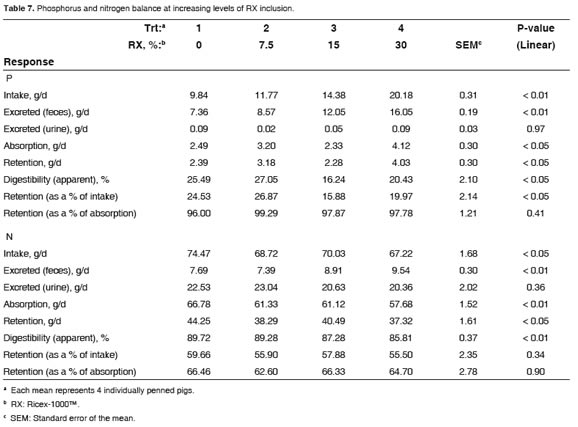
<body><![CDATA[<p><font face="Verdana, Arial, Helvetica, sans-serif" size="2">* 	Corresponding Author: Jorge H Agudelo. Facultad de Ciencias Agrarias. Universidad de Antioquia. Carrera 75 No. 65-87. Ciudadela de Robledo. Medell&iacute;n, Colombia. Tel: (574) 219 91 00. E-mail: <a href="mailto:jorgehat@gmail.com">jorgehat@gmail.com</a></font></p>     <p><font face="Verdana, Arial, Helvetica, sans-serif" size="2">&nbsp;</font></p><hr size="1">     <p><font face="Verdana, Arial, Helvetica, sans-serif" size="3"><b>Introduction</b></font></p>     <p><font face="Verdana, Arial, Helvetica, sans-serif" size="2">Rice bran is a non-traditional, widely available feed ingredient regarded as a source of energy (Agudelo, 2009). It has been reported that up to 30% inclusion of rice bran in diets of growingfinishing pigs does not depress growth performance and increases profit margin (Lekule <I>et al., </I>2001). The energy content of rice bran is equivalent to about 85% of the net energy in corn (2,040 vs. 2,395 kcal/kg, respectively; NRC, 1998). Rice bran also has high levels of P. Among the commonly used feedstuffs for swine listed by the NRC (1998), rice bran has the highest level of total P (1.61%), equivalent to almost six times the amount present in corn (0.28%). Nevertheless, 75% of the P in rice bran is bound as phytic acid, which makes that P unavailable and, thus, it is excreted in pig feces. For this reason, this feedstuff has greater P-polluting potential than corn. </font></p>    <p><font face="Verdana, Arial, Helvetica, sans-serif" size="2">Phosphorus can potentially become an environmental pollutant where inadequate manure fertilization practices are used (Sweeten, 1991; DeLaune <I>et al., </I>2000; Hollis and Curtis, 2001; Strak, 2003; Cheeke, 2004). Swine diets can be supplemented with exogenous phytases in order to improve phytate P utilization, thus reducing P excretion. Most studies using phytase have evaluated the effects of the enzyme on traditional feed ingredients such as corn and soybean meal (SBM). However, there is little research on its effects on nutrient utilization in pigs fed alternative feedstuffs. Concerns regarding pollution of water ecosystems with P from animal manure justify a determination of the nutrient digestibilities in rice bran and of studying the effects of phytase on P utilization in pigs fed rice bran. </font></p>    <p><font face="Verdana, Arial, Helvetica, sans-serif" size="2">This experiment was intended to establish the digestibility of P and other nutrients in a commercial rice bran product, and to evaluate the effects of increasing levels of inclusion of the product in a P-deficient corn-SBM basal diet on nutrient utilization in growing pigs. Another objective was to evaluate the effects of phytase on nutrient utilization with rice bran at the highest inclusion level in the diet. </font></p>     <p><font face="Verdana, Arial, Helvetica, sans-serif" size="2">&nbsp;</font></p>     <p><font face="Verdana, Arial, Helvetica, sans-serif" size="3"><b>Materials and methods </b></font></p>    <p><font face="Verdana, Arial, Helvetica, sans-serif" size="2"><I>Animals and housing conditions </I></font></p>    <p><font face="Verdana, Arial, Helvetica, sans-serif" size="2">A total of 24 crossbred (Yorkshire x Landrace) x Hampshire barrows (87.5 &plusmn; 2.51 kg) were used in the experiment. Pigs were individually confined in metabolism crates. Two groups of 12 pigs were used. Half-sibling pigs (i.e., a common sire) of similar weight within a replicate were allocated to treatments and randomly assigned to crates. The experiment was conducted in environmentally controlled facilities atthe Universityof Kentucky. </font></p>    ]]></body>
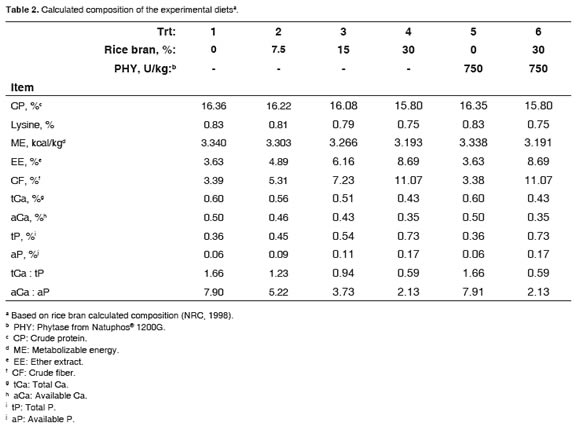
<body><![CDATA[<p><font face="Verdana, Arial, Helvetica, sans-serif" size="2"><I>Dietary treatments </I></font></p>    <p><font face="Verdana, Arial, Helvetica, sans-serif" size="2">Six dietary treatments were used. A basal (B) corn-SBM diet not supplemented with any inorganic source of P was prepared. To prepare the experimental diets, 0, 7.5, 15, and 30% of the basal was replaced with a rice bran product called Ricex-1000&trade; (RX; Ricex Company, El Dorado Hills, CA, USA) resulting in Diets 1, 2, 3, and 4, respectively. Then, fractions of Diets 1 (0% RX) and 4 (30% RX) were blended with 750 phytase units (PU)/kg diet from Natuphos<Sup>&reg; </Sup>1200G (BASF Corp., Mount Olive, NJ, USA) to obtain Diets 5 and 6, respectively. </font></p>    <p><font face="Verdana, Arial, Helvetica, sans-serif" size="2">Ricex-1000&trade; consists of a mix of stable whole rice bran and germ. The product includes energy in the form of vegetable fat (5.500 kcal/kg) plus soluble and insoluble fiber and is guaranteed to have one year of shelf life, based on its high content of natural vitamin E. </font></p>    <p><font face="Verdana, Arial, Helvetica, sans-serif" size="2">Diets 1, 2, 3, and 4 were used to evaluate the effects of increasing levels of RX additions on digestibility, retention and excretion of nutrients in order to calculate the specific RX nutrient digestibility by regression. In addition, Diets 1, 4, 5, and 6 were used to test the effects of phytase (PHY) on the diets containing 0 and 30% RX, having Diets 1 and 4 as controls. </font></p>    <p><font face="Verdana, Arial, Helvetica, sans-serif" size="2">Samples of the experimental diets were analyzed for phytase concentration by BASF Corp. <a href="#t1">Tables 1</a>, <a href="#t2">2</a> and <a href="#t3">3</a> present the composition of the ingredients and diets. </font></p>     <p align="center"><font face="Verdana, Arial, Helvetica, sans-serif" size="2"><img src="/img/revistas/rccp/v23n4/v23n04a04t01.jpg"></font><a name="t1"></a></p>     <p align="center"><font face="Verdana, Arial, Helvetica, sans-serif" size="2"><img src="/img/revistas/rccp/v23n4/v23n04a04t02.jpg"></font><a name="t2"></a></p>     <p align="center"><font face="Verdana, Arial, Helvetica, sans-serif" size="2"><img src="/img/revistas/rccp/v23n4/v23n04a04t03.jpg"></font><a name="t3"></a></p>     <p><font face="Verdana, Arial, Helvetica, sans-serif" size="2"><I>Adaptation and collection procedures </I></font></p>    <p><font face="Verdana, Arial, Helvetica, sans-serif" size="2">Nutrient digestibility was assessed by the total collection method, consisting of a 7-day adaptation period, followed by a 5-day collection period. During the trial pigs were provided feed at 3% of body weight, in a gruel form (1lt water / kg diet), divided in two daily meals. Water was supplied <I>ad </I><I>libitum </I>between meals. Indigo carmine (Aldrich Chemical Company Inc, Milwaukee, WI, USA) was mixed with the experimental diets at a 0.5% inclusion rate to mark the beginning and end of the collection periods. The feces produced during the period between excretion of the initial and final marker were collected daily and kept frozen in labeled plastic bags. Feed intake during the 5-day collection periods was recorded as feed allowance minus feed rejection. The total amount of urine excreted per pig was measured daily and individual urine samples were collected. </font></p>    ]]></body>
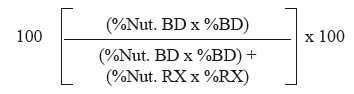
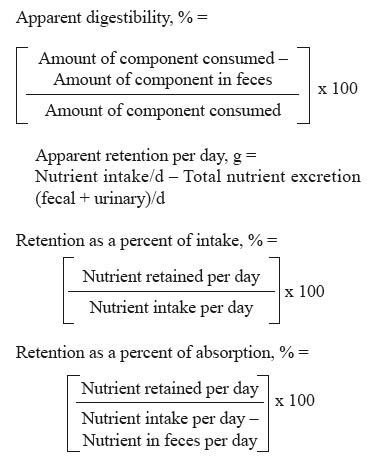
<body><![CDATA[<p><font face="Verdana, Arial, Helvetica, sans-serif" size="2"><I>Sample preparation </I></font></p>    <p><font face="Verdana, Arial, Helvetica, sans-serif" size="2">To obtain representative samples of urine for nutrient analysis, the daily samples were thawed at room temperature and proportionally composited by weight for each pig according to the daily excretion. Composited samples were kept frozen at all times. Frozen feces were dried in a forced-air oven (Tru-Temp, Hotpack Corp., Philadelphia, PA, USA) at 55 <Sup>o</Sup>C for one week, then air equilibrated, weighed, and ground using a Wiley Laboratory Mill (Model 3, Arthur H. Thomas Co., Philadelphia, PA, USA) to pass a 1-mm screen. Ground feces were then thoroughly mixed to obtain a sample which was then re-ground with a high speed grinder (Braun, Type 4041. Model KSM 2(4), Braun Inc., Woburn, MA,USA) and kept inacold room at4to 8 &deg;C until chemical analysis. </font></p>    <p><font face="Verdana, Arial, Helvetica, sans-serif" size="2"><I>Laboratory analysis </I></font></p>    <p><font face="Verdana, Arial, Helvetica, sans-serif" size="2">Feces, experimental diets and feedstuffs (corn, SBM, and RX) were analyzed for DM, energy, fat, N, neutral detergent fiber (NDF), acid detergent fiber (ADF), acid detergent lignin (ADL), P, and Ca. Urine was analyzed for the concentration of energy, N, P, and Ca. Samples were analyzed in duplicate, and analysis was repeated when abnormal variation was observed. Dry matter in feed and feces was assessed according to an adaptation of the AOAC (1995a) method involving overnight drying (105 &ordm;C) the samples in a convection oven (Precision Scientific Co., Chicago, IL, USA) and then calculating moisture contents as the difference between two weights. Gross energy content was assessed by bomb calorimetry (adaptation of the method by the AOAC, 1995a), using a Parr 1261 Isoperibol Bomb Calorimeter (Parr Instruments Company, Moline, IL, USA). Feed and feces samples were assessed in duplicate by a procedure adapted from AOAC (1995a). To measure urine energy, samples were oven dried for two days at 55 &ordm;C in polyethylene bags (Jeb Plastics Inc., Wilmington, DE, USA) prior to combustion. </font></p>    <p><font face="Verdana, Arial, Helvetica, sans-serif" size="2">The known heat of combustion per gram of bag material was subtracted from the total heat observed to obtain the sample energy content. Nitrogen was measured using Dumas methodology in an automatic N analyzer (Model FP-2000, LECO Corp., Saint Joseph, MI, USA). Phosphorus in feed and feces was assessed by gravimetry (modification of method 968.08 from AOAC, 1990). Phosphorus concentration in urine was assessed as inorganic P, initially by a colorimetric procedure using a commercial kit (Procedure No. 360-UVP; Sigma Diagnostics, St. Louis, MO) and then by a modified microscale method for soluble P developed at the University of Kentucky by D'Angelo <I>et al. </I>(2001). Calcium was assessed by Flame Atomic Absorption Spectrophotometry (AA, Thermoelemental SOLAAR M5, Thermo Electron Corp., Verona, WI, USA) according to a modification of the procedure from AOAC (1995b; method 927.02). Fiber fractions (NDF, ADF, and ADL) were sequentially analyzed using gravimetric procedures for detergent fiber described by Harmon (2003). A fiber digester (Ankom 200 Fiber Analyzer, Ankom Techonology Corp., Fairport, NY, USA) was used to separate the NDF and ADF fractions from defatted samples. </font></p>    <p><font face="Verdana, Arial, Helvetica, sans-serif" size="2">Defatting of the samples prior to fiber analysis was conducted to avoid clogging of the filtration device (polymer filter bags) during the detergent procedures. Total fat was assessed by a gravimetric method using a Soxtec Tekator fat extractor (Soxtec System HT 1043 Extraction Unit, Tecator Inc., Herndon, VA, USA).Apparent total tract digestibility and retention were calculated using the formulae: </font></p>     <p><font face="Verdana, Arial, Helvetica, sans-serif" size="2"><img src="/img/revistas/rccp/v23n4/v23n04a04f01.jpg"></font></p>    <p><font face="Verdana, Arial, Helvetica, sans-serif" size="2"><I>Experimental design and statistical analysis </I></font></p>    <p><font face="Verdana, Arial, Helvetica, sans-serif" size="2">Two sets of treatments were separately analyzed according to the objectives. Each set consisted of four diets. The first set consisted of treatments 1, 2, 3, and 4, which had increasing levels of RX (0, 7.5, 15, and 30%, respectively) and was used to indirectly calculate the digestibility of nutrients in the RX product. For each nutrient, the estimation of digestibility in RX was done by regressing the percent of digestibility in these experimental diets on the percent of the nutrient provided by RX to each diet. The formula used to calculate the percent of the nutrient provided by RX was: </font></p>    <p><font face="Verdana, Arial, Helvetica, sans-serif" size="2">Nutrient provided by RX to each experimental diet, </font></p>     ]]></body>
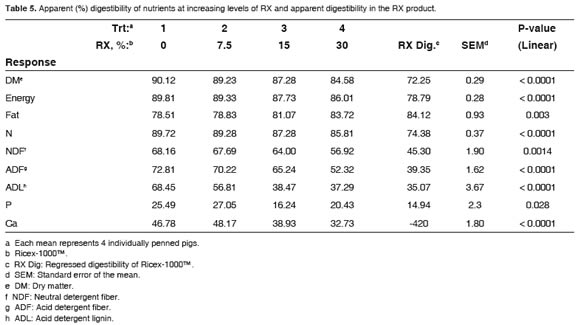
<body><![CDATA[<p><font face="Verdana, Arial, Helvetica, sans-serif" size="2"><img src="/img/revistas/rccp/v23n4/v23n04a04f02.jpg"></font></p>     <p><font face="Verdana, Arial, Helvetica, sans-serif" size="2">%Nut. BD: percent nutrient in the basal diet.     <br> %BD: percent basal diet included in the experimental diet.     <br> %Nut. RX: percent nutrient in RX.     <br> %RX: percent RX included in the experimental diet. </font></p>    <p><font face="Verdana, Arial, Helvetica, sans-serif" size="2">The nutrient contents in the basal diet as well as in RX were analyzed values. The numbers obtained with this formula were plotted against the coefficients of digestibility observed in each diet, in order to obtain regression equations to calculate digestibility in the 100% RX product itself. </font></p>    <p><font face="Verdana, Arial, Helvetica, sans-serif" size="2">The digestibility responses observed in Diets 1, 2, 3, and 4, and the corresponding fraction of nutrients provided by RX in those diets, were also tested for linearity (linear and quadratic trends) using the GLM regression procedure of SAS (SAS, 1990). As the fractions of nutrients provided were not in a regular scale across the diets (<a href="#t5">Table 5</a>), procedure IML of SAS was used to generate the set of contrast coefficients to be used in the regression of each nutrient. </font></p>    <p><font face="Verdana, Arial, Helvetica, sans-serif" size="2">The second set of treatments was: 1) Basal; 4) Basal + 30% RX; 5) Basal + PHY; and 6) Basal + 30% RX + PHY. This group was analyzed as a 2 x 2 factorial arrangement for the main effects of RX (0 or 30%), PHY (0 or 750 PU/kg diet), and the interaction between RX and PHY. The analysis of variance was obtained using the GLM procedure of SAS (SAS, 1998). </font></p>     <p><font face="Verdana, Arial, Helvetica, sans-serif" size="2">&nbsp;</font></p>     <p><font face="Verdana, Arial, Helvetica, sans-serif" size="3"><b>Results </b></font></p>    ]]></body>
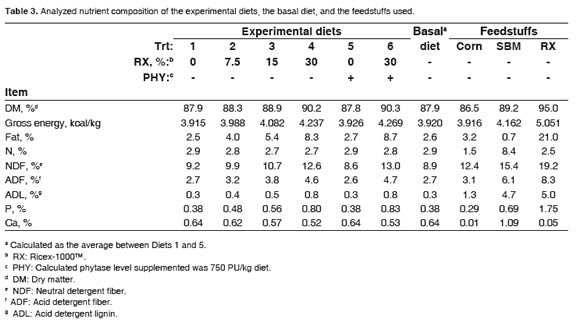
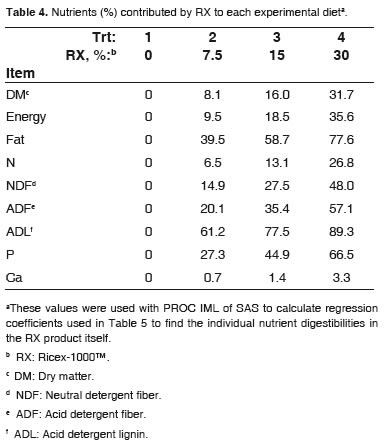
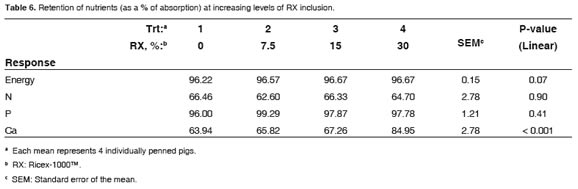
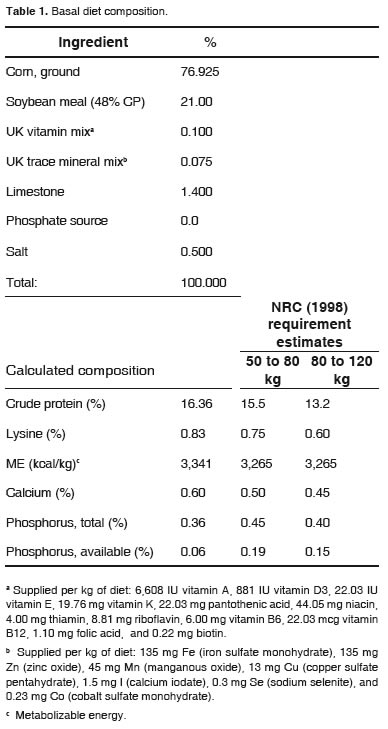
<body><![CDATA[<p><font face="Verdana, Arial, Helvetica, sans-serif" size="2">All pigs gained weight during collections, suggesting that all were in a positive nutrient balance during the experiment. According to the lab assay, PHY was not detected in diets not amended with the enzyme (Diets 1, 2, 3, and 4). The analyzed PHY concentration of Diets 5 and 6 was close to the calculated 750 PU/kg target (614 vs. 738 PU/kg, respectively). </font></p>    <p><font face="Verdana, Arial, Helvetica, sans-serif" size="2"><I>Increasing levels of inclusion of Ricex-1000&trade; in </I><I>the diet </I></font></p>     <p><font face="Verdana, Arial, Helvetica, sans-serif" size="2">The increasing levels of several nutrients in Diets 1 through 4 (i.e., gross energy, fat, fiber, and P) were the result of the increasing levels of added RX. As expected, Diets 1 and 5 had a very similar composition. Similarly, Diets 4 and 6 were very close in composition (<a href="#t3">Table 3</a>). </font></p>    <p><font face="Verdana, Arial, Helvetica, sans-serif" size="2"><a href="#t4">Table 4</a> presents the calculated nutrient contribution of RX to Diets 1, 2, 3, and 4. According to the laboratory analysis, RX contains 21.0% fat, 2.46% N (15.4% CP), 19.2% NDF, and 1.75% P. The NRC (1998) estimates that rice bran contains 13.0% fat, 2.13% N (13.3% CP), 23.7% NDF, and 1.61% P. Comparing the RX product with the NRC (1998) estimate, the major difference is that the RX product that was used contained more fat, while the levels of fiber, N and P were somewhat similar. The primary reason for the difference is that RX contains some of the rice germ. Because nutrient levels vary in any feedstuff, the contribution of nutrients to the total diet will vary. From <a href="#t4">Table 4</a>, it was calculated that at 30% inclusion of RX (Diet 4), this product contributes about 78% of the total fat, 66% of the total P, and abouthalf of thefiberin the diet. </font></p>     <p align="center"><font face="Verdana, Arial, Helvetica, sans-serif" size="2"><img src="/img/revistas/rccp/v23n4/v23n04a04t04.jpg"></font><a name="t4"></a></p>     <p><font face="Verdana, Arial, Helvetica, sans-serif" size="2"><a href="#t5">Table 5</a> presents the digestibility coefficients obtained for Diets 1, 2, 3, and 4. The digestibility of several dietary components, including DM, energy, N, fiber, Ca, and Pdecreased as the proportion of RX in the diet increased from 0 to 30%. The degree of depression in digestibility was much more marked for DM, energy, N, fiber, and Ca (<I>p&lt; </I>0.001). Phosphorus digestibility also decreased linearly with increasing amounts of RX (<I>p&lt; </I>0.05).The quadraticresponse for this nutrient was non significant (<I>p =</I> 0.80). </font></p>    <p align="center"><font face="Verdana, Arial, Helvetica, sans-serif" size="2"><img src="/img/revistas/rccp/v23n4/v23n04a04t05.jpg"></font><a name="t5"></a></p>     <p><font face="Verdana, Arial, Helvetica, sans-serif" size="2"><a href="#t6">Table 6</a> presents retention data (as a % of absorption) for all nutrients assayed. Calcium and Mg were the only nutrients that exhibited increased retention (<I>p&lt;</I> 0.01) as the proportion of RX increased in the diet. </font></p>    <p align="center"><font face="Verdana, Arial, Helvetica, sans-serif" size="2"><img src="/img/revistas/rccp/v23n4/v23n04a04t06.jpg"></font><a name="t6"></a></p>     <p><font face="Verdana, Arial, Helvetica, sans-serif" size="2">Complete balance data are provided in <a href="#t7">Table 7</a> for N and P, the two nutrient elements of primary interest from an environmental stand point. </font></p>    ]]></body>
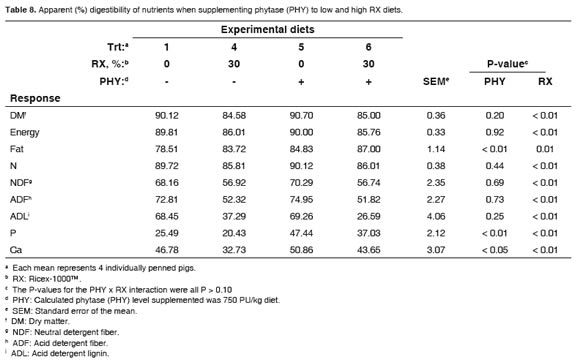
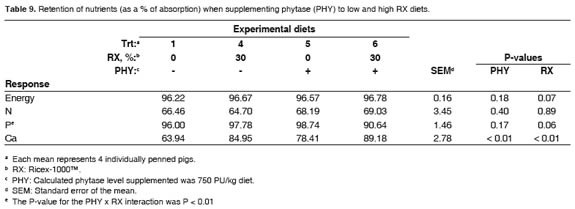
<body><![CDATA[<p align="center"><font face="Verdana, Arial, Helvetica, sans-serif" size="2"><img src="/img/revistas/rccp/v23n4/v23n04a04t07.jpg"></font><a name="t7"></a></p>     <p><font face="Verdana, Arial, Helvetica, sans-serif" size="2"><I>Nutrient digestibility in Ricex-1000&trade; </I></font></p>    <p><font face="Verdana, Arial, Helvetica, sans-serif" size="2"><a href="#t5">Table 5</a> also presents the estimated digestibility coefficients for nutrients contained in RX. </font></p>    <p><font face="Verdana, Arial, Helvetica, sans-serif" size="2">Compared to the basal diet, RX was estimated to have lower digestibility values for most nutrients, including P. Digestibility of Ca and Na in RX were estimated to be negative. Several methods of excluding portions of the data were attempted (in the event that these results were dependent on a single treatment or individual pig), but both values were negative for all combinations of data from the four diets used to calculate digestibility in the RX product. It is noted that these two nutrients from rice bran constituted less than 4% of the total dietary nutrient (<a href="#t4">Table 4</a>). </font></p>    <p><font face="Verdana, Arial, Helvetica, sans-serif" size="2">Digestible and metabolizable energy (DE, and ME, respectively) in the RX product were estimated by regressing the energy contents (DE or ME, in kcal/kg) on the percent of RX substituted in each of the first four diets (Diets 1, 2, 3, and 4). The linear regression estimates were 3.967 and 3.869 kcal/kg of RXforDEandME,respectively(on &lsquo;asfed'basis). </font></p>    <p><font face="Verdana, Arial, Helvetica, sans-serif" size="2"><I>Phytase amendment of the diet containing 30% Ricex-1000&trade; </I></font></p>    <p><font face="Verdana, Arial, Helvetica, sans-serif" size="2"><a href="#t8">Table 8</a> presents the digestibility coefficients for the lowest and highest levels of RX substitution (0 and 30%), amended with 0 and 750 PU, and the corresponding main effects of RX and PHY. Phytase amendment increased the digestibility of P, Ca, and fat. The PHY main effect was strongly significant (<I>p &lt;</I>0.01) for P and fat digestibility, and moderately significant (<I>p&lt;</I>0.05) for Ca digestibility. The relative increase in P digestibility due to the PHY amendment of the 0% RX diet was 87% (from 25.5 to 47.4), and was 81% (from 20.4 to 37.0) in the 30% RX diet. </font></p>    <p><font face="Verdana, Arial, Helvetica, sans-serif" size="2">The magnitude of increase in Ca digestibility due to PHY amendment was 4.1 percentage units for the 0% RX diet, and 10.9 percentage units for the 30% RX diet. The magnitude of increase in fat digestibility due to PHY amendment was 6.3 percentage units for the 0% RX diet, and 3.3 percentage units for the 30% RX diet.  </font></p>     <p align="center"><font face="Verdana, Arial, Helvetica, sans-serif" size="2"><img src="/img/revistas/rccp/v23n4/v23n04a04t08.jpg"></font><a name="t8"></a></p>     <p><font face="Verdana, Arial, Helvetica, sans-serif" size="2"><a href="#t9">Table 9</a> presents the nutrient retention results.   Only Ca retention was increased by the addition of PHY to the diets.</font></p>     ]]></body>
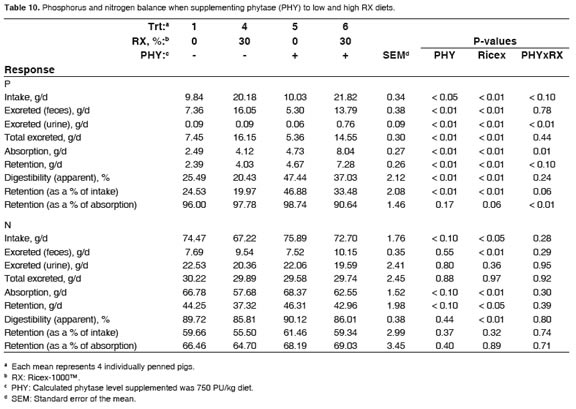
<body><![CDATA[<p><font face="Verdana, Arial, Helvetica, sans-serif" size="2">  <a href="#t10">Table 10</a> shows the P and N balance results,  comparing the effect of PHY and RX. Phosphorus  absorption and retention (as a percent of intake) was  higher (p&lt;0.01) in the PHY supplemented diets.  Fecal excretion of P for the RX-added diet more   than doubled the excretion observed in the 0% RX  diet (7.36 vs. 16.05 g/d, respectively). Part of this  increase in P excretion was then counterbalanced  with PHY supplementation (16.05 vs. 13.79 g/d, respectively).</font></p>     <p align="center"><font face="Verdana, Arial, Helvetica, sans-serif" size="2"><img src="/img/revistas/rccp/v23n4/v23n04a04t09.jpg"></font><a name="t9"></a></p>     <p align="center"><font face="Verdana, Arial, Helvetica, sans-serif" size="2"><img src="/img/revistas/rccp/v23n4/v23n04a04t10.jpg"></font><a name="t10"></a></p>     <p><font face="Verdana, Arial, Helvetica, sans-serif" size="2">&nbsp;</font></p>     <p><font face="Verdana, Arial, Helvetica, sans-serif" size="3"><b>Discussion</b></font></p>    <p><font face="Verdana, Arial, Helvetica, sans-serif" size="2">The decreasing digestibility values observed as RX inclusion level increased agree with those of Campabadal <I>et al. </I>(1976) who reported an almost linear reduction in DM and CP digestibility when increasing levels of rice bran (0, 20, 25, 30, 35, 40, and 45%) were included in a corn-SBM diet for finishing pigs. These results are in general agreement with most research, which demonstrated an inverse relationship between the level of dietary crude fiber and digestibility coefficients for various nutrients in growing pigs (Schulze <I>et al., </I>1994; Lenis <I>et al., </I>1996; Phuc <I>et al., </I>2000; Le Goff and Noblet, 2001; Souffrant, 2001;Wenk, 2001). </font></p>    <p><font face="Verdana, Arial, Helvetica, sans-serif" size="2">Ranjhan <I>et al. </I>(1971) reported that growing pigs fed increasing levels of crude fiber (4.0, 6.8, 8.6, and 11.0%) exhibited an indirect relationship between DM digestibility and the crude fiber content of the diet. The DM digestibility started to be negatively influenced at a dietary level of 6.8% crude fiber. </font></p>    <p><font face="Verdana, Arial, Helvetica, sans-serif" size="2">Other researchers have reported similar findings when the dietary level of cellulose was increased. Farrel and Johnson (1970) reported a decrease in DM and energy digestibility in growing pigs fed diets containing 8 and 26% cellulose. Gargallo and Zimmerman (1981) also reported decreased DM, N, and cellulose digestibility with increasing levels of cellulose in the diet. Kornegay (1978) substituted a basal corn-oats-alfalfa meal-SBM diet with 15 and 30% soybean hulls for growing pigs, finding that as the hulls were substituted for the basal diet, digestibility coefficients for DM, energy, CP, and fat were decreased, while ADF digestibility increased. Lindemann <I>et al. </I>(1986) also reported decreased DM, N, energy, ash, and fiber digestibility with graded levels of peanut hulls (0, 7.5, 15, and 30%) included inthe diet offinishing pigs. </font></p>    <p><font face="Verdana, Arial, Helvetica, sans-serif" size="2">Several possible modes of action have been proposed to explain the decreased digestibility caused by fiber. Some researchers have explained it as a physical entrapment of the nutrient in the bulk of the bolus, with consequent inaccessibility to enzyme action (Bailey <I>et al., </I>1974). It has also been reported that high fiber diets tend to increase the rate of passage through the alimentary canal, decreasing the opportunity for enzymatic digestion and absorption (Gargallo and Zimmerman, 1981; </font></p>    <p><font face="Verdana, Arial, Helvetica, sans-serif" size="2">Wenk, 2001).Whilethe correlationbetween passage rate and nutrient digestibility is evident (Kim <I>et al., </I>2007), the increased rate of passage by high fiber content is not always observed (Lindemann <I>et al., </I>1986). Apparently, fiber can reduce the digestibility of DM and energy because of its resistance to digestion by the endogenous enzymes secreted into the small intestine (Bach-Knudsen and Jansen, 1991), or probably because of the increased viscosity of the intestinal contents produced by certain fiber components, such as gums (Rainbird <I>et al., </I>1984). There is conflicting evidence in the literature regarding the modes of action of fiber in the digestive tract. Bach-Knudsen (2001) explains some of the disagreements between experiments as due to several different fractions that constitute dietary fiber, the different proportions of these fractions present in the feed ingredients used, and the different physiological effects of these fractions. </font></p>    ]]></body>
<body><![CDATA[<p><font face="Verdana, Arial, Helvetica, sans-serif" size="2">In regards to the magnitude of the impact of fiber on energy digestibility, in a series of digestibility studies using a variety of fiber sources, including rice bran substituted at 25% in the diet, Le Goff and Noblet (2001) found that the energy digestibility in growing pigs is reduced by one percentage point for each one percent additional NDF in the diet. In this experiment, although depressed, energy digestibility was not affected by RX addition to the extent estimated by Le Goff and Noblet (2001). </font></p>    <p><font face="Verdana, Arial, Helvetica, sans-serif" size="2">Contrary to the trend in energy digestibility, fat digestibility increased linearly (<I>p&lt;</I>0.01) with increasing levels of RX. These results agree with Campabadal <I>et al. </I>(1976), who reported increased digestibility of EE when increasing levels of rice bran were added to the diet. The effect of increased fat digestibility probably reflects the increasing level of fat intake. In a recent review of experiments with horses, where various feeds were tested, Kronfeld <I>et al</I>. (2004) reported an exponential increase in apparent digestibility of fat as fat content of the diet increased. They also reported a linear (<I>p</I>&lt;0.001) relationship between fat absorbed (g/d), and fat intake(g/d) for 23 differentfeeds. </font></p>    <p><font face="Verdana, Arial, Helvetica, sans-serif" size="2">In this experiment, the lignin content of Diets 1 through 4 increased (<a href="#t3">Table 3</a>), reflecting the RX substitution levels. The apparent digestibility coefficients of lignin decreased as the lignin contents increased, but the values were relatively high for all the diets, ranging from 68.5 to 37.3%. Although lignin is generally considered an indigestible material (Kotb and Luckey, 1972; Schneider and Flatt, 1975), other researchers have observed relatively high digestibility coefficients for lignin. Kornegay (1978) reported 44.1 to 51.2% digestibility coefficients for lignin in his diets containing 15 and 30% SBM hulls, respectively. Lindemann <I>et al. </I>(1986) reported 42.2, 32.4, 30.7, and 21.3% digestibility coefficients for lignin in a basal corn-SBM diet substituted with 0, 7.5, 15, and 30% peanuthulls forfinishing pigs. </font></p>     <p><font face="Verdana, Arial, Helvetica, sans-serif" size="2">Regarding nutrient retention, the increase in Ca retention was likely the response of the pig to the observed decrease in apparent digestibility of the mineral (<a href="#t5">Table 5</a>). The intake of this mineral decreased linearly with increasing levels of RX (<I>p</I>&lt; 0.01), due to the fact that the whole basal diet, which included the limestone supplementation, was substituted with RX. As a result, the level of Ca inclusion was reduced from 0.60% in Diet 1 to 0.43% in Diet 4. Total Ca intake per day dropped linearly (<I>p</I>&lt; 0.01) from 16.5 g in Diet 1 to 13.0 g in Diet 4. Nevertheless, this 21% difference in Ca intake is less than half the difference observed in the amount of Ca absorbed, which dropped 45%, in a linear manner (<I>p</I>< 0.01), from 7.7 to 4.2 g/d for Diets 1 and 4, respectively. It can be assumed that the decrease in absolute absorption of Ca was not only due to a decrease in absolute intake, but also to a concomitant decrease in Ca digestibility, which dropped linearly (<I>p</I>&lt;0.01) from 46.8 to 32.7% for Diets 1 and 4, respectively. The decrease in Ca intake and absorption apparently led to an increase in retention, as evidenced in urinary Ca excretion, which decreased from 2.8 to 0.6 g/d for Diets 1 and 4, respectively. </font></p>    <p><font face="Verdana, Arial, Helvetica, sans-serif" size="2">Regarding nutrient balance, as expected, total P intake/day increased as RX increased. Because most of this P was phytate P, and no phytase was supplemented to these diets, a simultaneous linear increase in fecal excretion was also observed. Fecal P excretion was 118% higher for Diet 4 than for Diet 1 (<I>p&lt;</I>0.01), raising questions on its potential environmental impact. Phosphorus retention (% of intake) decreased linearly (<I>p&lt;</I>0.05) with greater RX, reflecting the same trend observed in the digestibility for this nutrient (<I>p&lt;</I>0.05). The retention (% of intake) and digestibility data were closely related across these diets, which is related to the tight control of urinary P excretion by pigs eating P-deficient diets. This is further supported by the observed lack of increase in urinary P (<I>p=</I>0.97) with increasing RX supplementation. It is interesting to note that P digestibility is not always depressed with fiber supplementation. Kornegay <I>et al. </I>(1995) reported a linear increase in apparent P digestibility by weanling pigs fed increasing levels (0, 8, or 16%) of peanut hulls added to a corn-SBM diet. </font></p>    <p><font face="Verdana, Arial, Helvetica, sans-serif" size="2">The N intake decreased as RX supplementation increased (<I>p&lt;</I>0.05), reflecting the lower CP content of RX, in comparison to the basal diet. The amount of fecal N linearly increased (<I>p&lt;</I>0.01), but the urinary N did not change (<I>p=</I>0.36). Fecal N was 24% higher for Diet 4 than for Diet 1, which raises concerns regarding greater environmental N problems with high levels of RX in pig diets. The higher fecal N excretion observed agrees with the findings of Lenis <I>et al. </I>(1996), who reported an increase in N excretion in the feces of growing pigs fed semi-purified diets with 15% added NDF. The urinary excretion of N reportedly decreased with the NDF-added diet, which was not observed in this experiment. </font></p>    <p><font face="Verdana, Arial, Helvetica, sans-serif" size="2">Regarding the negative digestibility coefficients observed for Ca and Na in RX, a possible reason for this could be the low amounts provided by RX in these experimental diets (<a href="#t4">Table 4</a>), which is in agreement with observations by Schneider and Flatt (1975). Additionally, the Ca:P ratio in the diets may have contributed to the low Ca digestibility observed. It is possible that osmotic imbalances in the gut, derived from the increased fiber intake, may explain the negative digestibility observed for Na (Lindemann <I>et al.,</I> 1986). </font></p>    <p><font face="Verdana, Arial, Helvetica, sans-serif" size="2">It is possible that the comparatively lower improvement in P digestibility observed by the amendment with PHY of the 30% RX diet, compared with the improvement for the amended 0% RX diet was due to an insufficient level of PHY for cleaving all the phytic P present in this diet. </font></p>    <p><font face="Verdana, Arial, Helvetica, sans-serif" size="2">Nevertheless, on a grams/day basis, P absorption in the 30% RX diet amended with PHY almost doubled (4.73 to 8.04 g/d) the increase observed in the 0% RX diet amended with the enzyme (2.49 to 4.12 g/d) (<a href="#t10">Table 10</a>). </font></p>    <p><font face="Verdana, Arial, Helvetica, sans-serif" size="2">Several researchers have reported increased P digestibility in common diets amended with PHY (Jongbloed <I>et al., </I>1992; Cromwell <I>et al., </I>1993; Lei <I>et al., </I>1993; Mroz <I>et al., </I>1994; Cromwell <I>et al., </I>1995; Yi <I>et al., </I>1996; Han <I>et al., </I>1997; Agudelo <I>et al., </I>2007), but the literature is scarce on research using rice bran and the enzyme. </font></p>    ]]></body>
<body><![CDATA[<p><font face="Verdana, Arial, Helvetica, sans-serif" size="2">No research reports were found regarding apparent total tract digestibility of fat when PHY was supplemented to pigs. Akyurek <I>et al. </I>(2005) reported that broiler chicks fed a corn-SBM diet supplemented with PHY had improved ileal crude fat digestibility. Ravindran <I>et al. </I>(2001) reported that mineral-phytate complexes may contribute to the formation of insoluble metallic soaps in the gastrointestinal tract, which is a constraint on lipid utilization. By preventing the formation of mineralphytate complexes, PHY may reduce the degree of soap formation in the gut, enhancing fat utilization. </font></p>    <p><font face="Verdana, Arial, Helvetica, sans-serif" size="2">In this experiment, PHY did not have any effect on the apparent total tract digestibility of N (<I>p=</I>0.44) or on N retention as a percent of absorption (<I>p</I>=0.40), which agrees with several reports (Yi <I>et al., </I>1996; Han <I>et al., </I>1997). Ketaren <I>et al. </I>(1993) reported that PHY addition to diets of growing pigs did not have any effect on the apparent digestibility of protein, although they observed an increase in N retained as a percent of intake. On the other hand, other researchers have reported a positive effect of PHY on N digestibility (Mroz <i>et al., </i>1994; Kemme <i>et al., </i>1999; Zhang and Kornegay, 1999) and retention (Ketaren <i>et al., </i>1993; Mroz <i>et al.,</i> 1994; Li <i>et al.,</i> 1998) in pigs. </font></p>     <p><font face="Verdana, Arial, Helvetica, sans-serif" size="2">In regard to P retention, PHY did not increase retention as a percent of absorption (<i>p=</i>0.17), although there was a numerical difference between Diets 1 and 4, favoring PHY. The enzyme amendment improved absolute retention of P, and decreased P excretion in both diets (<i>p&lt;</i>0.01) (<a href="#t10">Table 10</a>). </font></p>     <p><font face="Verdana, Arial, Helvetica, sans-serif" size="2">In summary, the estimated digestibility coefficients for most RX-derived nutrients in growing pigs were lower than those for the basal low-P corn-SBM diet. The exception is the digestibility of the fat fraction, which is expected to increase with increasing levels of the product in the diet. The amendment of a corn-SBM low P diet containing 30% RX with 750 PU/kg will increase P digestibility. Further research is required to define the optimum level of PHY amendment to such diets in order to release the maximum amount of phytic P. </font></p>     <p><font face="Verdana, Arial, Helvetica, sans-serif" size="2">&nbsp;</font></p>     <p><font face="Verdana, Arial, Helvetica, sans-serif" size="3"><b>Acknowledgements </b></font></p>     <p><font face="Verdana, Arial, Helvetica, sans-serif" size="2">This manuscript is based on research supported in part by the Kentucky Agricultural Experiment Station and it is published by the Kentucky Agricultural Experiment Station as paper number 10-07-105. </font></p>     <p><font face="Verdana, Arial, Helvetica, sans-serif" size="2">Appreciation is expressed to D. Higginbotham for assistance in diet preparation and to Akey Inc. (Lewisburg, OH, USA) for ingredients used in the experiments. Appreciation is further expressed to Ricex Company (El Dorado Hills, CA, USA) for product used in the research. </font></p>     <p><font face="Verdana, Arial, Helvetica, sans-serif" size="2">&nbsp;</font></p>     <p><font face="Verdana, Arial, Helvetica, sans-serif" size="3"><b>References </b></font></p>     ]]></body>
<body><![CDATA[<!-- ref --><p><font face="Verdana, Arial, Helvetica, sans-serif" size="2">1. Agudelo JH. Alternative feedstuffs for swine in Colombia: what are our options? Rev Colomb Cienc Pecu 2009; 22:278-286. </font>&nbsp;&nbsp;&nbsp;&nbsp;&nbsp;&nbsp;&nbsp;&nbsp;[&#160;<a href="javascript:void(0);" onclick="javascript: window.open('/scielo.php?script=sci_nlinks&ref=000113&pid=S0120-0690201000040000400001&lng=','','width=640,height=500,resizable=yes,scrollbars=1,menubar=yes,');">Links</a>&#160;]<!-- end-ref --><!-- ref --><p><font face="Verdana, Arial, Helvetica, sans-serif" size="2">2. Agudelo JH, Lindemann MD, Cromwell GL, Newman MC, and Nimmo RD. Virginiamycin improves phosphorus digestibility and utilization by growing-finishing pigs fed a phosphorusdeficient corn-soybean meal diet. J Anim Sci 2007; 85:2173-2182. </font>&nbsp;&nbsp;&nbsp;&nbsp;&nbsp;&nbsp;&nbsp;&nbsp;[&#160;<a href="javascript:void(0);" onclick="javascript: window.open('/scielo.php?script=sci_nlinks&ref=000114&pid=S0120-0690201000040000400002&lng=','','width=640,height=500,resizable=yes,scrollbars=1,menubar=yes,');">Links</a>&#160;]<!-- end-ref --><!-- ref --><p><font face="Verdana, Arial, Helvetica, sans-serif" size="2">3. Akyurek H, Senkoylu N, and Ozduven ML. Effect of microbial phytase on growth performance and nutrients digestibility in broilers.PakistanJ Nutr2005; 4:22-26. </font>&nbsp;&nbsp;&nbsp;&nbsp;&nbsp;&nbsp;&nbsp;&nbsp;[&#160;<a href="javascript:void(0);" onclick="javascript: window.open('/scielo.php?script=sci_nlinks&ref=000115&pid=S0120-0690201000040000400003&lng=','','width=640,height=500,resizable=yes,scrollbars=1,menubar=yes,');">Links</a>&#160;]<!-- end-ref --><!-- ref --><p><font face="Verdana, Arial, Helvetica, sans-serif" size="2">4. AOAC, Association of Official Analytical Chemists. (AOAC). Official Methods of Analysis, 13th. Ed. Washington, D.C.; 1990. </font>&nbsp;&nbsp;&nbsp;&nbsp;&nbsp;&nbsp;&nbsp;&nbsp;[&#160;<a href="javascript:void(0);" onclick="javascript: window.open('/scielo.php?script=sci_nlinks&ref=000116&pid=S0120-0690201000040000400004&lng=','','width=640,height=500,resizable=yes,scrollbars=1,menubar=yes,');">Links</a>&#160;]<!-- end-ref --><!-- ref --><p><font face="Verdana, Arial, Helvetica, sans-serif" size="2">5. AOAC. Official Methods of Analysis (16th ed.). Association of OfficialAnalytical Chemists.Arlington,VA.;1995a. </font>&nbsp;&nbsp;&nbsp;&nbsp;&nbsp;&nbsp;&nbsp;&nbsp;[&#160;<a href="javascript:void(0);" onclick="javascript: window.open('/scielo.php?script=sci_nlinks&ref=000117&pid=S0120-0690201000040000400005&lng=','','width=640,height=500,resizable=yes,scrollbars=1,menubar=yes,');">Links</a>&#160;]<!-- end-ref --><!-- ref --><p><font face="Verdana, Arial, Helvetica, sans-serif" size="2">6. AOAC. Official Methods of Analysis (16th ed.). Supplement March 1997. Association of Official Analytical Chemists. Arlington,VA.; 1995b. </font>&nbsp;&nbsp;&nbsp;&nbsp;&nbsp;&nbsp;&nbsp;&nbsp;[&#160;<a href="javascript:void(0);" onclick="javascript: window.open('/scielo.php?script=sci_nlinks&ref=000118&pid=S0120-0690201000040000400006&lng=','','width=640,height=500,resizable=yes,scrollbars=1,menubar=yes,');">Links</a>&#160;]<!-- end-ref --><!-- ref --><p><font face="Verdana, Arial, Helvetica, sans-serif" size="2">7. Bach-Knudsen KE, Jansen I. Gastrointestinal implications in pigs of wheat and oat fractions I. Digestibility and bulking properties of polysaccharides and other major constituents. Br. J Nutr 1991; 65:217-232. </font>&nbsp;&nbsp;&nbsp;&nbsp;&nbsp;&nbsp;&nbsp;&nbsp;[&#160;<a href="javascript:void(0);" onclick="javascript: window.open('/scielo.php?script=sci_nlinks&ref=000119&pid=S0120-0690201000040000400007&lng=','','width=640,height=500,resizable=yes,scrollbars=1,menubar=yes,');">Links</a>&#160;]<!-- end-ref --><!-- ref --><p><font face="Verdana, Arial, Helvetica, sans-serif" size="2">8. Bach-Knudsen KE. The nutritional significance of 'dietary fiber'analysis.An Feed SciTech2001; 90:3-20. </font>&nbsp;&nbsp;&nbsp;&nbsp;&nbsp;&nbsp;&nbsp;&nbsp;[&#160;<a href="javascript:void(0);" onclick="javascript: window.open('/scielo.php?script=sci_nlinks&ref=000120&pid=S0120-0690201000040000400008&lng=','','width=640,height=500,resizable=yes,scrollbars=1,menubar=yes,');">Links</a>&#160;]<!-- end-ref --><!-- ref --><p><font face="Verdana, Arial, Helvetica, sans-serif" size="2">9. Bailey RW, Mills SE, Hove EL. Composition of sweet and bitter lupin seed hulls with observations on the apparent digestibility of sweet lupin seed hulls by young rats. J Sci Food Agric 1974; 25:955-961. </font>&nbsp;&nbsp;&nbsp;&nbsp;&nbsp;&nbsp;&nbsp;&nbsp;[&#160;<a href="javascript:void(0);" onclick="javascript: window.open('/scielo.php?script=sci_nlinks&ref=000121&pid=S0120-0690201000040000400009&lng=','','width=640,height=500,resizable=yes,scrollbars=1,menubar=yes,');">Links</a>&#160;]<!-- end-ref --><!-- ref --><p><font face="Verdana, Arial, Helvetica, sans-serif" size="2">10. Campabadal C, Creswell D, Wallace HD, and Combs GE. Nutritional value of rice bran for pigs. Trop Agric (Trinidad) 1976; 53:141-149. </font>&nbsp;&nbsp;&nbsp;&nbsp;&nbsp;&nbsp;&nbsp;&nbsp;[&#160;<a href="javascript:void(0);" onclick="javascript: window.open('/scielo.php?script=sci_nlinks&ref=000122&pid=S0120-0690201000040000400010&lng=','','width=640,height=500,resizable=yes,scrollbars=1,menubar=yes,');">Links</a>&#160;]<!-- end-ref --><!-- ref --><p><font face="Verdana, Arial, Helvetica, sans-serif" size="2">11. Cheeke PR. Contemporary issues in animal agriculture. 3rd ed. Pearson - Prentice Hall. Upper Saddle River, NJ 2004. 449 p. </font>&nbsp;&nbsp;&nbsp;&nbsp;&nbsp;&nbsp;&nbsp;&nbsp;[&#160;<a href="javascript:void(0);" onclick="javascript: window.open('/scielo.php?script=sci_nlinks&ref=000123&pid=S0120-0690201000040000400011&lng=','','width=640,height=500,resizable=yes,scrollbars=1,menubar=yes,');">Links</a>&#160;]<!-- end-ref --><!-- ref --><p><font face="Verdana, Arial, Helvetica, sans-serif" size="2">12. Cromwell GL, Coffey RD, Parker GR, Monegue HJ, Randolph JH. Efficacy of a recombinant-derived phytase in improving the bioavailability of phosphorus in corn-soybean meal diets for pigs. J Anim Sci 1995; 73:2000-2008. </font>&nbsp;&nbsp;&nbsp;&nbsp;&nbsp;&nbsp;&nbsp;&nbsp;[&#160;<a href="javascript:void(0);" onclick="javascript: window.open('/scielo.php?script=sci_nlinks&ref=000124&pid=S0120-0690201000040000400012&lng=','','width=640,height=500,resizable=yes,scrollbars=1,menubar=yes,');">Links</a>&#160;]<!-- end-ref --><!-- ref --><p><font face="Verdana, Arial, Helvetica, sans-serif" size="2">13. Cromwell GL, Coffey RD, Monegue HJ. Phytase ("Natuphos") improves phytate phosphorus utilization in corn- soybean meal for pigs. J Anim Sci 1993; 7l Suppl 1:165 (Abstr.). </font>&nbsp;&nbsp;&nbsp;&nbsp;&nbsp;&nbsp;&nbsp;&nbsp;[&#160;<a href="javascript:void(0);" onclick="javascript: window.open('/scielo.php?script=sci_nlinks&ref=000125&pid=S0120-0690201000040000400013&lng=','','width=640,height=500,resizable=yes,scrollbars=1,menubar=yes,');">Links</a>&#160;]<!-- end-ref --><!-- ref --><p><font face="Verdana, Arial, Helvetica, sans-serif" size="2">14. D'Angelo E, Crutchfield J, Vandiviere M. Rapid, sensitive, microscale determination of phosphate in water and soil. J Environ Qual 2001; 30:2206-2209 </font>&nbsp;&nbsp;&nbsp;&nbsp;&nbsp;&nbsp;&nbsp;&nbsp;[&#160;<a href="javascript:void(0);" onclick="javascript: window.open('/scielo.php?script=sci_nlinks&ref=000126&pid=S0120-0690201000040000400014&lng=','','width=640,height=500,resizable=yes,scrollbars=1,menubar=yes,');">Links</a>&#160;]<!-- end-ref --><!-- ref --><p><font face="Verdana, Arial, Helvetica, sans-serif" size="2">15. DeLaune PB, Moore Jr PA, Daniel TC. Factors affecting phosphorus runoff from pastures. Proceedings of the Thirtieth Mississippi Water Resources Conference. Ballweber, JA (Ed.); 2000.p. 51-60. </font>&nbsp;&nbsp;&nbsp;&nbsp;&nbsp;&nbsp;&nbsp;&nbsp;[&#160;<a href="javascript:void(0);" onclick="javascript: window.open('/scielo.php?script=sci_nlinks&ref=000127&pid=S0120-0690201000040000400015&lng=','','width=640,height=500,resizable=yes,scrollbars=1,menubar=yes,');">Links</a>&#160;]<!-- end-ref --><!-- ref --><p><font face="Verdana, Arial, Helvetica, sans-serif" size="2">16. Farrel DJ, Johnson KA. Utilization of cellulose by pigs and its effects on caecal function. Animal Production 1970; 14:209-217. </font>&nbsp;&nbsp;&nbsp;&nbsp;&nbsp;&nbsp;&nbsp;&nbsp;[&#160;<a href="javascript:void(0);" onclick="javascript: window.open('/scielo.php?script=sci_nlinks&ref=000128&pid=S0120-0690201000040000400016&lng=','','width=640,height=500,resizable=yes,scrollbars=1,menubar=yes,');">Links</a>&#160;]<!-- end-ref --><!-- ref --><p><font face="Verdana, Arial, Helvetica, sans-serif" size="2">17. Gargallo J, Zimmerman DR. Effects of dietary cellulose levels on intact and cecectomized pigs. J Anim Sci 1981; 53:395-402. </font>&nbsp;&nbsp;&nbsp;&nbsp;&nbsp;&nbsp;&nbsp;&nbsp;[&#160;<a href="javascript:void(0);" onclick="javascript: window.open('/scielo.php?script=sci_nlinks&ref=000129&pid=S0120-0690201000040000400017&lng=','','width=640,height=500,resizable=yes,scrollbars=1,menubar=yes,');">Links</a>&#160;]<!-- end-ref --><!-- ref --><p><font face="Verdana, Arial, Helvetica, sans-serif" size="2">18. Han YM, Yang F, Zhou AG, Miller ER, Ku PK, Hogberg MG, Lei XG. Supplemental phytases of microbial and cereal sources improve dietary phytate phosphorus utilization by pigs from weaningthroughfinishing.JAnim Sci1997; 75:1017-1025. </font>&nbsp;&nbsp;&nbsp;&nbsp;&nbsp;&nbsp;&nbsp;&nbsp;[&#160;<a href="javascript:void(0);" onclick="javascript: window.open('/scielo.php?script=sci_nlinks&ref=000130&pid=S0120-0690201000040000400018&lng=','','width=640,height=500,resizable=yes,scrollbars=1,menubar=yes,');">Links</a>&#160;]<!-- end-ref --><!-- ref --><p><font face="Verdana, Arial, Helvetica, sans-serif" size="2">19. Harmon DL. Ruminant Nutrition Laboratory Manual. Department of Animal Science, University of Kentucky. Not published. 2003. </font>&nbsp;&nbsp;&nbsp;&nbsp;&nbsp;&nbsp;&nbsp;&nbsp;[&#160;<a href="javascript:void(0);" onclick="javascript: window.open('/scielo.php?script=sci_nlinks&ref=000131&pid=S0120-0690201000040000400019&lng=','','width=640,height=500,resizable=yes,scrollbars=1,menubar=yes,');">Links</a>&#160;]<!-- end-ref --><!-- ref --><p><font face="Verdana, Arial, Helvetica, sans-serif" size="2">20. Hollis GR Curtis SE. General characteristics of the U.S. swine industry. In: Swine Nutrition, 2nd ed. Lewis, A. J. and L. L. Southern (Eds.). CRC Press LLC, Boca Raton, FL; 2001. p. 19-30. </font>&nbsp;&nbsp;&nbsp;&nbsp;&nbsp;&nbsp;&nbsp;&nbsp;[&#160;<a href="javascript:void(0);" onclick="javascript: window.open('/scielo.php?script=sci_nlinks&ref=000132&pid=S0120-0690201000040000400020&lng=','','width=640,height=500,resizable=yes,scrollbars=1,menubar=yes,');">Links</a>&#160;]<!-- end-ref --><!-- ref --><p><font face="Verdana, Arial, Helvetica, sans-serif" size="2">21. Jongbloed AW, Mroz Z, Kemme PA. The effect of supplementary Aspergillus niger phytase in diets for pigs on concentration and apparent digestibility of dry matter, total phosphorus, and phytic acid in different sections of the alimentary tract. J Anim Sci 1992; 70:1159. </font>&nbsp;&nbsp;&nbsp;&nbsp;&nbsp;&nbsp;&nbsp;&nbsp;[&#160;<a href="javascript:void(0);" onclick="javascript: window.open('/scielo.php?script=sci_nlinks&ref=000133&pid=S0120-0690201000040000400021&lng=','','width=640,height=500,resizable=yes,scrollbars=1,menubar=yes,');">Links</a>&#160;]<!-- end-ref --><!-- ref --><p><font face="Verdana, Arial, Helvetica, sans-serif" size="2">22. Kemme PA, Jongbloed AW, Mroz Z, Kogut J, Beynen AC. Digestibility of nutrients in growing-finishing pigs is affected by Aspergillus niger phytase, phytate and lactic acid levels: 1. Apparent ileal digestibility of amino acids. Livest Prod Sci 1999; 58:107-117. </font>&nbsp;&nbsp;&nbsp;&nbsp;&nbsp;&nbsp;&nbsp;&nbsp;[&#160;<a href="javascript:void(0);" onclick="javascript: window.open('/scielo.php?script=sci_nlinks&ref=000134&pid=S0120-0690201000040000400022&lng=','','width=640,height=500,resizable=yes,scrollbars=1,menubar=yes,');">Links</a>&#160;]<!-- end-ref --><!-- ref --><p><font face="Verdana, Arial, Helvetica, sans-serif" size="2">23. Ketaren PP, Batterham ES, Dettmann EB and Farrell DJ. Phosphorus studies in pigs: 3. Effect of phytase supplementation on the digestibility and availability of phosphorus in soya-bean meal for grower pigs. Br. J of Nutr 1993; 70:289-311. </font>&nbsp;&nbsp;&nbsp;&nbsp;&nbsp;&nbsp;&nbsp;&nbsp;[&#160;<a href="javascript:void(0);" onclick="javascript: window.open('/scielo.php?script=sci_nlinks&ref=000135&pid=S0120-0690201000040000400023&lng=','','width=640,height=500,resizable=yes,scrollbars=1,menubar=yes,');">Links</a>&#160;]<!-- end-ref --><!-- ref --><p><font face="Verdana, Arial, Helvetica, sans-serif" size="2">24. Kim BG, Lindemann MD, Cromwell GL, Balfagon A, Agudelo JH. The correlation between passage rate of digesta and dry matter digestibility in various stages of swine. Livest Sci 2007; 109:81-84. </font>&nbsp;&nbsp;&nbsp;&nbsp;&nbsp;&nbsp;&nbsp;&nbsp;[&#160;<a href="javascript:void(0);" onclick="javascript: window.open('/scielo.php?script=sci_nlinks&ref=000136&pid=S0120-0690201000040000400024&lng=','','width=640,height=500,resizable=yes,scrollbars=1,menubar=yes,');">Links</a>&#160;]<!-- end-ref --><!-- ref --><p><font face="Verdana, Arial, Helvetica, sans-serif" size="2">25. Kornegay ET. Feeding value and digestibility of soybean hulls for swine. J Anim Sci 1978; 47:1272-1280. </font>&nbsp;&nbsp;&nbsp;&nbsp;&nbsp;&nbsp;&nbsp;&nbsp;[&#160;<a href="javascript:void(0);" onclick="javascript: window.open('/scielo.php?script=sci_nlinks&ref=000137&pid=S0120-0690201000040000400025&lng=','','width=640,height=500,resizable=yes,scrollbars=1,menubar=yes,');">Links</a>&#160;]<!-- end-ref --><!-- ref --><p><font face="Verdana, Arial, Helvetica, sans-serif" size="2">26. Kornegay ET, Rhein-Welkel D, Lindemann MD, Wood CM. Performance and nutrient digestibility in weanling pigs as influenced by yeast culture additionsto starter diets containing dried whey or one of two fiber sources. J Anim Sci 1995; 73:1381-1389. </font>&nbsp;&nbsp;&nbsp;&nbsp;&nbsp;&nbsp;&nbsp;&nbsp;[&#160;<a href="javascript:void(0);" onclick="javascript: window.open('/scielo.php?script=sci_nlinks&ref=000138&pid=S0120-0690201000040000400026&lng=','','width=640,height=500,resizable=yes,scrollbars=1,menubar=yes,');">Links</a>&#160;]<!-- end-ref --><!-- ref --><p><font face="Verdana, Arial, Helvetica, sans-serif" size="2">27. Kotb AR, Luckey TD. Markers in nutrition. Nutrition Abstracts and Reviews 1972; 42:813-845. </font>&nbsp;&nbsp;&nbsp;&nbsp;&nbsp;&nbsp;&nbsp;&nbsp;[&#160;<a href="javascript:void(0);" onclick="javascript: window.open('/scielo.php?script=sci_nlinks&ref=000139&pid=S0120-0690201000040000400027&lng=','','width=640,height=500,resizable=yes,scrollbars=1,menubar=yes,');">Links</a>&#160;]<!-- end-ref --><!-- ref --><p><font face="Verdana, Arial, Helvetica, sans-serif" size="2">28. Kronfeld DS, Holland JL, Rich GA, Meacham TN, Fontenot JP, Sklan DJ, Harris PA. Fat digestibility in Equus caballus follows increasing first-order kinetics. JAnim Sci 2004;82:1773-1780. </font>&nbsp;&nbsp;&nbsp;&nbsp;&nbsp;&nbsp;&nbsp;&nbsp;[&#160;<a href="javascript:void(0);" onclick="javascript: window.open('/scielo.php?script=sci_nlinks&ref=000140&pid=S0120-0690201000040000400028&lng=','','width=640,height=500,resizable=yes,scrollbars=1,menubar=yes,');">Links</a>&#160;]<!-- end-ref --><!-- ref --><p><font face="Verdana, Arial, Helvetica, sans-serif" size="2">29. Le Goff G, Noblet J. Comparative total tract digestibility of dietary energy and nutrients in growing pigs and adult sows. J Anim Sci 2001; 79:2418-2427. </font>&nbsp;&nbsp;&nbsp;&nbsp;&nbsp;&nbsp;&nbsp;&nbsp;[&#160;<a href="javascript:void(0);" onclick="javascript: window.open('/scielo.php?script=sci_nlinks&ref=000141&pid=S0120-0690201000040000400029&lng=','','width=640,height=500,resizable=yes,scrollbars=1,menubar=yes,');">Links</a>&#160;]<!-- end-ref --><!-- ref --><p><font face="Verdana, Arial, Helvetica, sans-serif" size="2">30. Lenis NP, Bikker P, van der Meulen J, van Diepen JTh, Bakker JG, Jongbloed AW. Effect of dietary neutral detergent fiber on ileal digestibility and portal flux of nitrogen and amino acids and on nitrogen utilization in growing pigs. J Anim Sci 1996; 74:2687-2699. </font>&nbsp;&nbsp;&nbsp;&nbsp;&nbsp;&nbsp;&nbsp;&nbsp;[&#160;<a href="javascript:void(0);" onclick="javascript: window.open('/scielo.php?script=sci_nlinks&ref=000142&pid=S0120-0690201000040000400030&lng=','','width=640,height=500,resizable=yes,scrollbars=1,menubar=yes,');">Links</a>&#160;]<!-- end-ref --><!-- ref --><p><font face="Verdana, Arial, Helvetica, sans-serif" size="2">31. Lei XG, Ku PK, Miller ER, Yokoyama MT. Supplementing corn-soybean meal diets with microbial phytase linearly improves phytate phosphorus utilization by weanling pigs. J Anim Sci 1993; 71:3359-3367. </font>&nbsp;&nbsp;&nbsp;&nbsp;&nbsp;&nbsp;&nbsp;&nbsp;[&#160;<a href="javascript:void(0);" onclick="javascript: window.open('/scielo.php?script=sci_nlinks&ref=000143&pid=S0120-0690201000040000400031&lng=','','width=640,height=500,resizable=yes,scrollbars=1,menubar=yes,');">Links</a>&#160;]<!-- end-ref --><!-- ref --><p><font face="Verdana, Arial, Helvetica, sans-serif" size="2">32. Lekule FP, Sarwatt SV, Munisi WG. Effect of supplementation of rice bran on growth performance and carcass quality of growing-finishingpigs.TSAP Proceedings; 2001.vol28. </font>&nbsp;&nbsp;&nbsp;&nbsp;&nbsp;&nbsp;&nbsp;&nbsp;[&#160;<a href="javascript:void(0);" onclick="javascript: window.open('/scielo.php?script=sci_nlinks&ref=000144&pid=S0120-0690201000040000400032&lng=','','width=640,height=500,resizable=yes,scrollbars=1,menubar=yes,');">Links</a>&#160;]<!-- end-ref --><!-- ref --><p><font face="Verdana, Arial, Helvetica, sans-serif" size="2">33. Li D, Che X, WangY, Hong C, Thacker PA. Effect of microbial phytase, vitamin D3, and citric acid on growth performance and phosphorus, nitrogen and calcium digestibility in growing pigs. Anim Feed Sci and Tech 1998; 73:173-186. </font>&nbsp;&nbsp;&nbsp;&nbsp;&nbsp;&nbsp;&nbsp;&nbsp;[&#160;<a href="javascript:void(0);" onclick="javascript: window.open('/scielo.php?script=sci_nlinks&ref=000145&pid=S0120-0690201000040000400033&lng=','','width=640,height=500,resizable=yes,scrollbars=1,menubar=yes,');">Links</a>&#160;]<!-- end-ref --><!-- ref --><p><font face="Verdana, Arial, Helvetica, sans-serif" size="2">34. Lindemann MD, Kornegay ET, and Moore RJ. Digestibility and feeding value of peanut hulls for swine. J Anim Sci 1986; 62:412-421. </font>&nbsp;&nbsp;&nbsp;&nbsp;&nbsp;&nbsp;&nbsp;&nbsp;[&#160;<a href="javascript:void(0);" onclick="javascript: window.open('/scielo.php?script=sci_nlinks&ref=000146&pid=S0120-0690201000040000400034&lng=','','width=640,height=500,resizable=yes,scrollbars=1,menubar=yes,');">Links</a>&#160;]<!-- end-ref --><!-- ref --><p><font face="Verdana, Arial, Helvetica, sans-serif" size="2">35. Mroz Z, Jongbloed AW, Kemme PA. Apparent digestibility and retention of nutrients bound to phytate complexes as influenced by microbial phytase and feeding regimen in pigs. J Anim Sci 1994; 72:126. </font>&nbsp;&nbsp;&nbsp;&nbsp;&nbsp;&nbsp;&nbsp;&nbsp;[&#160;<a href="javascript:void(0);" onclick="javascript: window.open('/scielo.php?script=sci_nlinks&ref=000147&pid=S0120-0690201000040000400035&lng=','','width=640,height=500,resizable=yes,scrollbars=1,menubar=yes,');">Links</a>&#160;]<!-- end-ref --><!-- ref --><p><font face="Verdana, Arial, Helvetica, sans-serif" size="2">36. National Research Council. Nutrient Requirements of Swine. 10th ed. Washington, D.C. National Academy Press; 1998 p.189. </font>&nbsp;&nbsp;&nbsp;&nbsp;&nbsp;&nbsp;&nbsp;&nbsp;[&#160;<a href="javascript:void(0);" onclick="javascript: window.open('/scielo.php?script=sci_nlinks&ref=000148&pid=S0120-0690201000040000400036&lng=','','width=640,height=500,resizable=yes,scrollbars=1,menubar=yes,');">Links</a>&#160;]<!-- end-ref --><!-- ref --><p><font face="Verdana, Arial, Helvetica, sans-serif" size="2">37. Phuc BH, Ogle B, Lindberg JE. Effect of replacing soybean protein with cassava leaf protein in cassava root meal based diets for growing pigs on digestibility an N retention. Anim Feed Sci Tech 2000; 83:223-235. </font>&nbsp;&nbsp;&nbsp;&nbsp;&nbsp;&nbsp;&nbsp;&nbsp;[&#160;<a href="javascript:void(0);" onclick="javascript: window.open('/scielo.php?script=sci_nlinks&ref=000149&pid=S0120-0690201000040000400037&lng=','','width=640,height=500,resizable=yes,scrollbars=1,menubar=yes,');">Links</a>&#160;]<!-- end-ref --><!-- ref --><p><font face="Verdana, Arial, Helvetica, sans-serif" size="2">38. Rainbird AL, Low AG, Zebrowska T. Effect of guar gum on glucose and water absorption from isolated loops of jejunum in conscious growing pigs. Br J Nutr 1984; 52:489-498. </font>&nbsp;&nbsp;&nbsp;&nbsp;&nbsp;&nbsp;&nbsp;&nbsp;[&#160;<a href="javascript:void(0);" onclick="javascript: window.open('/scielo.php?script=sci_nlinks&ref=000150&pid=S0120-0690201000040000400038&lng=','','width=640,height=500,resizable=yes,scrollbars=1,menubar=yes,');">Links</a>&#160;]<!-- end-ref --><!-- ref --><p><font face="Verdana, Arial, Helvetica, sans-serif" size="2">39. Ranjhan SK, Gupta BS, Chabbra SS, Dhudapker BS. Effect of various levels of crude fibre and energy in the rations of growing Middle White Yorkshire pigs. Indian JAnim Sci 1971; 41:373-376. </font>&nbsp;&nbsp;&nbsp;&nbsp;&nbsp;&nbsp;&nbsp;&nbsp;[&#160;<a href="javascript:void(0);" onclick="javascript: window.open('/scielo.php?script=sci_nlinks&ref=000151&pid=S0120-0690201000040000400039&lng=','','width=640,height=500,resizable=yes,scrollbars=1,menubar=yes,');">Links</a>&#160;]<!-- end-ref --><!-- ref --><p><font face="Verdana, Arial, Helvetica, sans-serif" size="2">40. Ravindran V, Selle PH, Ravindran G, Morel PC, Kies AK, Bryden WL. Microbial phytase improves performance, apparent metabolizable energy, and ileal amino acid digestibility of broilers fed alysine-deficientdiet. Poult Sci2001; 80:338-344. </font>&nbsp;&nbsp;&nbsp;&nbsp;&nbsp;&nbsp;&nbsp;&nbsp;[&#160;<a href="javascript:void(0);" onclick="javascript: window.open('/scielo.php?script=sci_nlinks&ref=000152&pid=S0120-0690201000040000400040&lng=','','width=640,height=500,resizable=yes,scrollbars=1,menubar=yes,');">Links</a>&#160;]<!-- end-ref --><!-- ref --><p><font face="Verdana, Arial, Helvetica, sans-serif" size="2">41. SAS. SAS/STAT User's Guide: Statistics (Release 6.08). SAS Inst.,Inc.,Cary, NC; 1990. </font>&nbsp;&nbsp;&nbsp;&nbsp;&nbsp;&nbsp;&nbsp;&nbsp;[&#160;<a href="javascript:void(0);" onclick="javascript: window.open('/scielo.php?script=sci_nlinks&ref=000153&pid=S0120-0690201000040000400041&lng=','','width=640,height=500,resizable=yes,scrollbars=1,menubar=yes,');">Links</a>&#160;]<!-- end-ref --><!-- ref --><p><font face="Verdana, Arial, Helvetica, sans-serif" size="2">42. SAS. SAS Inst.,Inc.,Cary, NC; 1998. </font>&nbsp;&nbsp;&nbsp;&nbsp;&nbsp;&nbsp;&nbsp;&nbsp;[&#160;<a href="javascript:void(0);" onclick="javascript: window.open('/scielo.php?script=sci_nlinks&ref=000154&pid=S0120-0690201000040000400042&lng=','','width=640,height=500,resizable=yes,scrollbars=1,menubar=yes,');">Links</a>&#160;]<!-- end-ref --><!-- ref --><p><font face="Verdana, Arial, Helvetica, sans-serif" size="2">43. Schneider BH, Flatt WP. The Evaluation of Feeds Through Digestibility Experiments. The University of Georgia Press 1975; p. 423. </font>&nbsp;&nbsp;&nbsp;&nbsp;&nbsp;&nbsp;&nbsp;&nbsp;[&#160;<a href="javascript:void(0);" onclick="javascript: window.open('/scielo.php?script=sci_nlinks&ref=000155&pid=S0120-0690201000040000400043&lng=','','width=640,height=500,resizable=yes,scrollbars=1,menubar=yes,');">Links</a>&#160;]<!-- end-ref --><!-- ref --><p><font face="Verdana, Arial, Helvetica, sans-serif" size="2">44. Schulze H, van Leeuwenf JP, Verstegen MW, Huismant J, Souffkantt WB, Ahrenss F. Effect of level of dietary neutral detergent fiber on ileal apparent digestibility and ileal nitrogen losses in pigs. J Anim Sci 1994; 72:2362-2368. </font>&nbsp;&nbsp;&nbsp;&nbsp;&nbsp;&nbsp;&nbsp;&nbsp;[&#160;<a href="javascript:void(0);" onclick="javascript: window.open('/scielo.php?script=sci_nlinks&ref=000156&pid=S0120-0690201000040000400044&lng=','','width=640,height=500,resizable=yes,scrollbars=1,menubar=yes,');">Links</a>&#160;]<!-- end-ref --><!-- ref --><p><font face="Verdana, Arial, Helvetica, sans-serif" size="2">45. Souffrant WB. Effect of dietary fibre on ileal digestibility endogenous nitrogen loses in the pig. Anm Feed Sci Tech 2001; 90:93-102. </font>&nbsp;&nbsp;&nbsp;&nbsp;&nbsp;&nbsp;&nbsp;&nbsp;[&#160;<a href="javascript:void(0);" onclick="javascript: window.open('/scielo.php?script=sci_nlinks&ref=000157&pid=S0120-0690201000040000400045&lng=','','width=640,height=500,resizable=yes,scrollbars=1,menubar=yes,');">Links</a>&#160;]<!-- end-ref --><!-- ref --><p><font face="Verdana, Arial, Helvetica, sans-serif" size="2">46. Strak J. The ups and downs of the global pig market. In: Perspectives in Pig Science. Wiseman J, Varley MA, and Kemp B (Eds.). Nottingham University Press. Nottingham, England; 2003. p. 1-10. </font>&nbsp;&nbsp;&nbsp;&nbsp;&nbsp;&nbsp;&nbsp;&nbsp;[&#160;<a href="javascript:void(0);" onclick="javascript: window.open('/scielo.php?script=sci_nlinks&ref=000158&pid=S0120-0690201000040000400046&lng=','','width=640,height=500,resizable=yes,scrollbars=1,menubar=yes,');">Links</a>&#160;]<!-- end-ref --><!-- ref --><p><font face="Verdana, Arial, Helvetica, sans-serif" size="2">47. Sweeten JM. 1991. Livestock and poultry waste management: A national overview. In: National Livestock, Poultry and Aquaculture Waste Management. Blake J, Donald J, and Magette W(Eds.). ASAE, St. Joseph, MI; 1991. p. 4-15. </font>&nbsp;&nbsp;&nbsp;&nbsp;&nbsp;&nbsp;&nbsp;&nbsp;[&#160;<a href="javascript:void(0);" onclick="javascript: window.open('/scielo.php?script=sci_nlinks&ref=000159&pid=S0120-0690201000040000400047&lng=','','width=640,height=500,resizable=yes,scrollbars=1,menubar=yes,');">Links</a>&#160;]<!-- end-ref --><!-- ref --><p><font face="Verdana, Arial, Helvetica, sans-serif" size="2">48. Wenk C. The role of dietary fibre in the digestive physiology of the pig. Anim Feed Sci Tech 2001; 90:21-23. </font>&nbsp;&nbsp;&nbsp;&nbsp;&nbsp;&nbsp;&nbsp;&nbsp;[&#160;<a href="javascript:void(0);" onclick="javascript: window.open('/scielo.php?script=sci_nlinks&ref=000160&pid=S0120-0690201000040000400048&lng=','','width=640,height=500,resizable=yes,scrollbars=1,menubar=yes,');">Links</a>&#160;]<!-- end-ref --><!-- ref --><p><font face="Verdana, Arial, Helvetica, sans-serif" size="2">49. Yi Z, Kornegay ET, Ravindran V, Lindemann MD, Wilson JH. Effectiveness of Natuphos phytase in improving the bioavailabilities of phosphorus and other nutrients in soybean meal-based semipurified diets for young pigs. JAnim Sci 1996; 74:1601-1611. </font>&nbsp;&nbsp;&nbsp;&nbsp;&nbsp;&nbsp;&nbsp;&nbsp;[&#160;<a href="javascript:void(0);" onclick="javascript: window.open('/scielo.php?script=sci_nlinks&ref=000161&pid=S0120-0690201000040000400049&lng=','','width=640,height=500,resizable=yes,scrollbars=1,menubar=yes,');">Links</a>&#160;]<!-- end-ref --><!-- ref --><p><font face="Verdana, Arial, Helvetica, sans-serif" size="2">50. Zhang Z, Kornegay ET. Phytase effects on ileal amino acid digestibility and nitrogen balance in finishing pigs fed a low protein plant-based diet. J Anim Sci 1999; 77(Suppl. 1):175. </font>&nbsp;&nbsp;&nbsp;&nbsp;&nbsp;&nbsp;&nbsp;&nbsp;[&#160;<a href="javascript:void(0);" onclick="javascript: window.open('/scielo.php?script=sci_nlinks&ref=000162&pid=S0120-0690201000040000400050&lng=','','width=640,height=500,resizable=yes,scrollbars=1,menubar=yes,');">Links</a>&#160;]<!-- end-ref --> ]]></body><back>
<ref-list>
<ref id="B1">
<label>1</label><nlm-citation citation-type="journal">
<person-group person-group-type="author">
<name>
<surname><![CDATA[Agudelo]]></surname>
<given-names><![CDATA[JH]]></given-names>
</name>
</person-group>
<article-title xml:lang="en"><![CDATA[Alternative feedstuffs for swine in Colombia: what are our options?]]></article-title>
<source><![CDATA[Rev Colomb Cienc Pecu]]></source>
<year>2009</year>
<volume>22</volume>
<page-range>278-286</page-range></nlm-citation>
</ref>
<ref id="B2">
<label>2</label><nlm-citation citation-type="journal">
<person-group person-group-type="author">
<name>
<surname><![CDATA[Agudelo]]></surname>
<given-names><![CDATA[JH]]></given-names>
</name>
<name>
<surname><![CDATA[Lindemann]]></surname>
<given-names><![CDATA[MD]]></given-names>
</name>
<name>
<surname><![CDATA[Cromwell]]></surname>
<given-names><![CDATA[GL]]></given-names>
</name>
<name>
<surname><![CDATA[Newman]]></surname>
<given-names><![CDATA[MC]]></given-names>
</name>
<name>
<surname><![CDATA[and]]></surname>
<given-names><![CDATA[Nimmo RD]]></given-names>
</name>
</person-group>
<article-title xml:lang="en"><![CDATA[Virginiamycin improves phosphorus digestibility and utilization by growing-finishing pigs fed a phosphorusdeficient corn-soybean meal diet]]></article-title>
<source><![CDATA[J Anim Sci]]></source>
<year>2007</year>
<volume>85</volume>
<page-range>2173-2182</page-range></nlm-citation>
</ref>
<ref id="B3">
<label>3</label><nlm-citation citation-type="journal">
<person-group person-group-type="author">
<name>
<surname><![CDATA[Akyurek]]></surname>
<given-names><![CDATA[H]]></given-names>
</name>
<name>
<surname><![CDATA[Senkoylu]]></surname>
<given-names><![CDATA[N]]></given-names>
</name>
<name>
<surname><![CDATA[Ozduven]]></surname>
<given-names><![CDATA[ML]]></given-names>
</name>
</person-group>
<article-title xml:lang="en"><![CDATA[Effect of microbial phytase on growth performance and nutrients digestibility in broilers]]></article-title>
<source><![CDATA[Pakistan J Nutr]]></source>
<year>2005</year>
<volume>4</volume>
<page-range>22-26</page-range></nlm-citation>
</ref>
<ref id="B4">
<label>4</label><nlm-citation citation-type="">
<collab>AOAC, Association of Official Analytical Chemists</collab>
<source><![CDATA[Official Methods of Analysis]]></source>
<year>1990</year>
<edition>13</edition>
<publisher-loc><![CDATA[Washington ]]></publisher-loc>
</nlm-citation>
</ref>
<ref id="B5">
<label>5</label><nlm-citation citation-type="">
<collab>AOAC</collab>
<source><![CDATA[Official Methods of Analysis]]></source>
<year>1995</year>
<month>a</month>
</nlm-citation>
</ref>
<ref id="B6">
<label>6</label><nlm-citation citation-type="">
<source><![CDATA[]]></source>
<year></year>
</nlm-citation>
</ref>
<ref id="B7">
<label>7</label><nlm-citation citation-type="journal">
<person-group person-group-type="author">
<name>
<surname><![CDATA[Bach-Knudsen]]></surname>
<given-names><![CDATA[KE]]></given-names>
</name>
<name>
<surname><![CDATA[Jansen]]></surname>
<given-names><![CDATA[I]]></given-names>
</name>
</person-group>
<article-title xml:lang="en"><![CDATA[Gastrointestinal implications in pigs of wheat and oat fractions I Digestibility and bulking properties of polysaccharides and other major constituents]]></article-title>
<source><![CDATA[Br J Nutr]]></source>
<year>1991</year>
<volume>65</volume>
<page-range>217-232</page-range></nlm-citation>
</ref>
<ref id="B8">
<label>8</label><nlm-citation citation-type="journal">
<person-group person-group-type="author">
<name>
<surname><![CDATA[Bach-Knudsen]]></surname>
<given-names><![CDATA[KE]]></given-names>
</name>
</person-group>
<article-title xml:lang="en"><![CDATA[The nutritional significance of 'dietary fiber'analysis]]></article-title>
<source><![CDATA[An Feed SciTech]]></source>
<year>2001</year>
<volume>90</volume>
<page-range>3-20</page-range></nlm-citation>
</ref>
<ref id="B9">
<label>9</label><nlm-citation citation-type="journal">
<person-group person-group-type="author">
<name>
<surname><![CDATA[Bailey]]></surname>
<given-names><![CDATA[RW]]></given-names>
</name>
<name>
<surname><![CDATA[Mills]]></surname>
<given-names><![CDATA[SE]]></given-names>
</name>
<name>
<surname><![CDATA[Hove]]></surname>
<given-names><![CDATA[EL]]></given-names>
</name>
</person-group>
<article-title xml:lang="en"><![CDATA[Composition of sweet and bitter lupin seed hulls with observations on the apparent digestibility of sweet lupin seed hulls by young rats]]></article-title>
<source><![CDATA[J Sci Food Agric]]></source>
<year>1974</year>
<volume>25</volume>
<page-range>955-961</page-range></nlm-citation>
</ref>
<ref id="B10">
<label>10</label><nlm-citation citation-type="journal">
<person-group person-group-type="author">
<name>
<surname><![CDATA[Campabadal]]></surname>
<given-names><![CDATA[C]]></given-names>
</name>
<name>
<surname><![CDATA[Creswell]]></surname>
<given-names><![CDATA[D]]></given-names>
</name>
<name>
<surname><![CDATA[Wallace]]></surname>
<given-names><![CDATA[HD]]></given-names>
</name>
<name>
<surname><![CDATA[Combs]]></surname>
<given-names><![CDATA[GE]]></given-names>
</name>
</person-group>
<article-title xml:lang="en"><![CDATA[Nutritional value of rice bran for pigs]]></article-title>
<source><![CDATA[Trop Agric (Trinidad)]]></source>
<year>1976</year>
<volume>53</volume>
<page-range>141-149</page-range></nlm-citation>
</ref>
<ref id="B11">
<label>11</label><nlm-citation citation-type="book">
<person-group person-group-type="author">
<name>
<surname><![CDATA[Cheeke]]></surname>
<given-names><![CDATA[PR]]></given-names>
</name>
</person-group>
<source><![CDATA[Contemporary issues in animal agriculture]]></source>
<year>2004</year>
<edition>3</edition>
<page-range>449</page-range><publisher-name><![CDATA[Pearson - Prentice Hall]]></publisher-name>
</nlm-citation>
</ref>
<ref id="B12">
<label>12</label><nlm-citation citation-type="journal">
<person-group person-group-type="author">
<name>
<surname><![CDATA[Cromwell]]></surname>
<given-names><![CDATA[GL]]></given-names>
</name>
<name>
<surname><![CDATA[Coffey]]></surname>
<given-names><![CDATA[RD]]></given-names>
</name>
<name>
<surname><![CDATA[Parker]]></surname>
<given-names><![CDATA[GR]]></given-names>
</name>
<name>
<surname><![CDATA[Monegue]]></surname>
<given-names><![CDATA[HJ]]></given-names>
</name>
<name>
<surname><![CDATA[Randolph]]></surname>
<given-names><![CDATA[JH]]></given-names>
</name>
</person-group>
<article-title xml:lang="en"><![CDATA[Efficacy of a recombinant-derived phytase in improving the bioavailability of phosphorus in corn-soybean meal diets for pigs]]></article-title>
<source><![CDATA[J Anim Sci]]></source>
<year>1995</year>
<volume>73</volume>
<page-range>2000-2008</page-range></nlm-citation>
</ref>
<ref id="B13">
<label>13</label><nlm-citation citation-type="journal">
<person-group person-group-type="author">
<name>
<surname><![CDATA[Cromwell]]></surname>
<given-names><![CDATA[GL]]></given-names>
</name>
<name>
<surname><![CDATA[Coffey]]></surname>
<given-names><![CDATA[RD]]></given-names>
</name>
<name>
<surname><![CDATA[Monegue]]></surname>
<given-names><![CDATA[HJ]]></given-names>
</name>
</person-group>
<article-title xml:lang="en"><![CDATA[Phytase ("Natuphos";) improves phytate phosphorus utilization in corn- soybean meal for pigs]]></article-title>
<source><![CDATA[J Anim Sci]]></source>
<year>1993</year>
<volume>7</volume>
<numero>^s1</numero>
<issue>^s1</issue>
<supplement>1</supplement>
<page-range>165</page-range></nlm-citation>
</ref>
<ref id="B14">
<label>14</label><nlm-citation citation-type="journal">
<person-group person-group-type="author">
<name>
<surname><![CDATA[D'Angelo]]></surname>
<given-names><![CDATA[E]]></given-names>
</name>
<name>
<surname><![CDATA[Crutchfield]]></surname>
<given-names><![CDATA[J]]></given-names>
</name>
<name>
<surname><![CDATA[Vandiviere]]></surname>
<given-names><![CDATA[M]]></given-names>
</name>
</person-group>
<article-title xml:lang="en"><![CDATA[Rapid, sensitive, microscale determination of phosphate in water and soil]]></article-title>
<source><![CDATA[J Environ Qual]]></source>
<year>2001</year>
<volume>30</volume>
<page-range>2206-2209</page-range></nlm-citation>
</ref>
<ref id="B15">
<label>15</label><nlm-citation citation-type="confpro">
<person-group person-group-type="author">
<name>
<surname><![CDATA[DeLaune]]></surname>
<given-names><![CDATA[PB]]></given-names>
</name>
<name>
<surname><![CDATA[Moore]]></surname>
<given-names><![CDATA[Jr PA]]></given-names>
</name>
<name>
<surname><![CDATA[Daniel]]></surname>
<given-names><![CDATA[TC]]></given-names>
</name>
</person-group>
<source><![CDATA[Factors affecting phosphorus runoff from pastures]]></source>
<year></year>
<conf-name><![CDATA[Thirtieth Mississippi Water Resources Conference]]></conf-name>
<conf-date>2000</conf-date>
<conf-loc> </conf-loc>
<page-range>51-60</page-range></nlm-citation>
</ref>
<ref id="B16">
<label>16</label><nlm-citation citation-type="journal">
<person-group person-group-type="author">
<name>
<surname><![CDATA[Farrel]]></surname>
<given-names><![CDATA[DJ]]></given-names>
</name>
<name>
<surname><![CDATA[Johnson]]></surname>
<given-names><![CDATA[KA]]></given-names>
</name>
</person-group>
<article-title xml:lang="en"><![CDATA[Utilization of cellulose by pigs and its effects on caecal function]]></article-title>
<source><![CDATA[Animal Production]]></source>
<year>1970</year>
<volume>14</volume>
<page-range>209-217</page-range></nlm-citation>
</ref>
<ref id="B17">
<label>17</label><nlm-citation citation-type="journal">
<person-group person-group-type="author">
<name>
<surname><![CDATA[Gargallo]]></surname>
<given-names><![CDATA[J]]></given-names>
</name>
<name>
<surname><![CDATA[Zimmerman]]></surname>
<given-names><![CDATA[DR]]></given-names>
</name>
</person-group>
<article-title xml:lang="en"><![CDATA[Effects of dietary cellulose levels on intact and cecectomized pigs]]></article-title>
<source><![CDATA[J Anim Sci]]></source>
<year>1981</year>
<volume>53</volume>
<page-range>395-402</page-range></nlm-citation>
</ref>
<ref id="B18">
<label>18</label><nlm-citation citation-type="journal">
<person-group person-group-type="author">
<name>
<surname><![CDATA[Han]]></surname>
<given-names><![CDATA[YM]]></given-names>
</name>
<name>
<surname><![CDATA[Yang]]></surname>
<given-names><![CDATA[F]]></given-names>
</name>
<name>
<surname><![CDATA[Zhou]]></surname>
<given-names><![CDATA[AG]]></given-names>
</name>
<name>
<surname><![CDATA[Miller]]></surname>
<given-names><![CDATA[ER]]></given-names>
</name>
<name>
<surname><![CDATA[Ku]]></surname>
<given-names><![CDATA[PK]]></given-names>
</name>
<name>
<surname><![CDATA[Hogberg]]></surname>
<given-names><![CDATA[MG]]></given-names>
</name>
<name>
<surname><![CDATA[Lei]]></surname>
<given-names><![CDATA[XG]]></given-names>
</name>
</person-group>
<article-title xml:lang="en"><![CDATA[Supplemental phytases of microbial and cereal sources improve dietary phytate phosphorus utilization by pigs from weaningthroughfinishing]]></article-title>
<source><![CDATA[JAnim Sci]]></source>
<year>1997</year>
<volume>75</volume>
<page-range>1017-1025</page-range></nlm-citation>
</ref>
<ref id="B19">
<label>19</label><nlm-citation citation-type="book">
<person-group person-group-type="author">
<name>
<surname><![CDATA[Harmon]]></surname>
<given-names><![CDATA[DL]]></given-names>
</name>
</person-group>
<source><![CDATA[Ruminant Nutrition Laboratory Manual]]></source>
<year>2003</year>
<publisher-name><![CDATA[Department of Animal Science, University of Kentucky]]></publisher-name>
</nlm-citation>
</ref>
<ref id="B20">
<label>20</label><nlm-citation citation-type="book">
<person-group person-group-type="author">
<name>
<surname><![CDATA[Hollis]]></surname>
<given-names><![CDATA[GR]]></given-names>
</name>
<name>
<surname><![CDATA[Curtis]]></surname>
<given-names><![CDATA[SE]]></given-names>
</name>
</person-group>
<article-title xml:lang="en"><![CDATA[General characteristics of the U.S. swine industry]]></article-title>
<source><![CDATA[Swine Nutrition]]></source>
<year>2001</year>
<edition>2</edition>
<page-range>19-30</page-range><publisher-loc><![CDATA[Boca Raton^eFL FL]]></publisher-loc>
<publisher-name><![CDATA[CRC Press LLC]]></publisher-name>
</nlm-citation>
</ref>
<ref id="B21">
<label>21</label><nlm-citation citation-type="journal">
<person-group person-group-type="author">
<name>
<surname><![CDATA[Jongbloed]]></surname>
<given-names><![CDATA[AW]]></given-names>
</name>
<name>
<surname><![CDATA[Mroz]]></surname>
<given-names><![CDATA[Z]]></given-names>
</name>
<name>
<surname><![CDATA[Kemme]]></surname>
<given-names><![CDATA[PA]]></given-names>
</name>
</person-group>
<article-title xml:lang="en"><![CDATA[The effect of supplementary Aspergillus niger phytase in diets for pigs on concentration and apparent digestibility of dry matter, total phosphorus, and phytic acid in different sections of the alimentary tract]]></article-title>
<source><![CDATA[J Anim Sci]]></source>
<year>1992</year>
<volume>70</volume>
<page-range>1159</page-range></nlm-citation>
</ref>
<ref id="B22">
<label>22</label><nlm-citation citation-type="journal">
<person-group person-group-type="author">
<name>
<surname><![CDATA[Kemme]]></surname>
<given-names><![CDATA[PA]]></given-names>
</name>
<name>
<surname><![CDATA[Jongbloed]]></surname>
<given-names><![CDATA[AW]]></given-names>
</name>
<name>
<surname><![CDATA[Mroz]]></surname>
<given-names><![CDATA[Z]]></given-names>
</name>
<name>
<surname><![CDATA[Kogut]]></surname>
<given-names><![CDATA[J]]></given-names>
</name>
<name>
<surname><![CDATA[Beynen]]></surname>
<given-names><![CDATA[AC]]></given-names>
</name>
</person-group>
<article-title xml:lang="en"><![CDATA[Digestibility of nutrients in growing-finishing pigs is affected by Aspergillus niger phytase, phytate and lactic acid levels: 1. Apparent ileal digestibility of amino acids]]></article-title>
<source><![CDATA[Livest Prod Sci]]></source>
<year>1999</year>
<volume>58</volume>
<page-range>107-117</page-range></nlm-citation>
</ref>
<ref id="B23">
<label>23</label><nlm-citation citation-type="journal">
<person-group person-group-type="author">
<name>
<surname><![CDATA[Ketaren]]></surname>
<given-names><![CDATA[PP]]></given-names>
</name>
<name>
<surname><![CDATA[Batterham]]></surname>
<given-names><![CDATA[ES]]></given-names>
</name>
<name>
<surname><![CDATA[Dettmann]]></surname>
<given-names><![CDATA[EB]]></given-names>
</name>
<name>
<surname><![CDATA[Farrell]]></surname>
<given-names><![CDATA[DJ]]></given-names>
</name>
</person-group>
<article-title xml:lang="en"><![CDATA[Phosphorus studies in pigs: 3. Effect of phytase supplementation on the digestibility and availability of phosphorus in soya-bean meal for grower pigs]]></article-title>
<source><![CDATA[Br. J of Nutr]]></source>
<year>1993</year>
<volume>70</volume>
<page-range>289-311</page-range></nlm-citation>
</ref>
<ref id="B24">
<label>24</label><nlm-citation citation-type="journal">
<person-group person-group-type="author">
<name>
<surname><![CDATA[Kim]]></surname>
<given-names><![CDATA[BG]]></given-names>
</name>
<name>
<surname><![CDATA[Lindemann]]></surname>
<given-names><![CDATA[MD]]></given-names>
</name>
<name>
<surname><![CDATA[Cromwell]]></surname>
<given-names><![CDATA[GL]]></given-names>
</name>
<name>
<surname><![CDATA[Balfagon]]></surname>
<given-names><![CDATA[A]]></given-names>
</name>
<name>
<surname><![CDATA[Agudelo]]></surname>
<given-names><![CDATA[JH]]></given-names>
</name>
</person-group>
<article-title xml:lang="en"><![CDATA[The correlation between passage rate of digesta and dry matter digestibility in various stages of swine]]></article-title>
<source><![CDATA[Livest Sci]]></source>
<year>2007</year>
<volume>109</volume>
<page-range>81-84</page-range></nlm-citation>
</ref>
<ref id="B25">
<label>25</label><nlm-citation citation-type="journal">
<person-group person-group-type="author">
<name>
<surname><![CDATA[Kornegay]]></surname>
<given-names><![CDATA[ET]]></given-names>
</name>
</person-group>
<article-title xml:lang="en"><![CDATA[Feeding value and digestibility of soybean hulls for swine]]></article-title>
<source><![CDATA[J Anim Sci]]></source>
<year>1978</year>
<volume>47</volume>
<page-range>1272-1280</page-range></nlm-citation>
</ref>
<ref id="B26">
<label>26</label><nlm-citation citation-type="journal">
<person-group person-group-type="author">
<name>
<surname><![CDATA[Kornegay]]></surname>
<given-names><![CDATA[ET]]></given-names>
</name>
<name>
<surname><![CDATA[Rhein-Welkel]]></surname>
<given-names><![CDATA[D]]></given-names>
</name>
<name>
<surname><![CDATA[Lindemann]]></surname>
<given-names><![CDATA[MD]]></given-names>
</name>
<name>
<surname><![CDATA[Wood]]></surname>
<given-names><![CDATA[CM]]></given-names>
</name>
</person-group>
<article-title xml:lang="en"><![CDATA[Performance and nutrient digestibility in weanling pigs as influenced by yeast culture additionsto starter diets containing dried whey or one of two fiber sources]]></article-title>
<source><![CDATA[J Anim Sci]]></source>
<year>1995</year>
<volume>73</volume>
<page-range>1381-1389</page-range></nlm-citation>
</ref>
<ref id="B27">
<label>27</label><nlm-citation citation-type="journal">
<person-group person-group-type="author">
<name>
<surname><![CDATA[Kotb]]></surname>
<given-names><![CDATA[AR]]></given-names>
</name>
<name>
<surname><![CDATA[Luckey]]></surname>
<given-names><![CDATA[TD]]></given-names>
</name>
</person-group>
<article-title xml:lang="en"><![CDATA[Markers in nutrition]]></article-title>
<source><![CDATA[Nutrition Abstracts and Reviews]]></source>
<year>1972</year>
<volume>42</volume>
<page-range>813-845</page-range></nlm-citation>
</ref>
<ref id="B28">
<label>28</label><nlm-citation citation-type="journal">
<person-group person-group-type="author">
<name>
<surname><![CDATA[Kronfeld]]></surname>
<given-names><![CDATA[DS]]></given-names>
</name>
<name>
<surname><![CDATA[Holland]]></surname>
<given-names><![CDATA[JL]]></given-names>
</name>
<name>
<surname><![CDATA[Rich]]></surname>
<given-names><![CDATA[GA]]></given-names>
</name>
<name>
<surname><![CDATA[Meacham]]></surname>
<given-names><![CDATA[TN]]></given-names>
</name>
<name>
<surname><![CDATA[Fontenot]]></surname>
<given-names><![CDATA[JP]]></given-names>
</name>
<name>
<surname><![CDATA[Sklan]]></surname>
<given-names><![CDATA[DJ]]></given-names>
</name>
<name>
<surname><![CDATA[Harris]]></surname>
<given-names><![CDATA[PA]]></given-names>
</name>
</person-group>
<article-title xml:lang="en"><![CDATA[Fat digestibility in Equus caballus follows increasing first-order kinetics]]></article-title>
<source><![CDATA[JAnim Sci]]></source>
<year>2004</year>
<volume>82</volume>
<page-range>1773-1780</page-range></nlm-citation>
</ref>
<ref id="B29">
<label>29</label><nlm-citation citation-type="journal">
<person-group person-group-type="author">
<name>
<surname><![CDATA[Le]]></surname>
<given-names><![CDATA[Goff G]]></given-names>
</name>
<name>
<surname><![CDATA[Noblet]]></surname>
<given-names><![CDATA[J]]></given-names>
</name>
</person-group>
<article-title xml:lang="en"><![CDATA[Comparative total tract digestibility of dietary energy and nutrients in growing pigs and adult sows]]></article-title>
<source><![CDATA[J Anim Sci]]></source>
<year>2001</year>
<volume>79</volume>
<page-range>2418-2427</page-range></nlm-citation>
</ref>
<ref id="B30">
<label>30</label><nlm-citation citation-type="journal">
<person-group person-group-type="author">
<name>
<surname><![CDATA[Lenis]]></surname>
<given-names><![CDATA[NP]]></given-names>
</name>
<name>
<surname><![CDATA[Bikker]]></surname>
<given-names><![CDATA[P]]></given-names>
</name>
<name>
<surname><![CDATA[van]]></surname>
<given-names><![CDATA[der Meulen J]]></given-names>
</name>
<name>
<surname><![CDATA[van]]></surname>
<given-names><![CDATA[Diepen JTh]]></given-names>
</name>
<name>
<surname><![CDATA[Bakker]]></surname>
<given-names><![CDATA[JG]]></given-names>
</name>
<name>
<surname><![CDATA[Jongbloed]]></surname>
<given-names><![CDATA[AW]]></given-names>
</name>
</person-group>
<article-title xml:lang="en"><![CDATA[Effect of dietary neutral detergent fiber on ileal digestibility and portal flux of nitrogen and amino acids and on nitrogen utilization in growing pigs]]></article-title>
<source><![CDATA[J Anim Sci]]></source>
<year>1996</year>
<volume>74</volume>
<page-range>2687-2699</page-range></nlm-citation>
</ref>
<ref id="B31">
<label>31</label><nlm-citation citation-type="journal">
<person-group person-group-type="author">
<name>
<surname><![CDATA[Lei]]></surname>
<given-names><![CDATA[XG]]></given-names>
</name>
<name>
<surname><![CDATA[Ku]]></surname>
<given-names><![CDATA[PK]]></given-names>
</name>
<name>
<surname><![CDATA[Miller]]></surname>
<given-names><![CDATA[ER]]></given-names>
</name>
<name>
<surname><![CDATA[Yokoyama]]></surname>
<given-names><![CDATA[MT]]></given-names>
</name>
</person-group>
<article-title xml:lang="en"><![CDATA[Supplementing corn-soybean meal diets with microbial phytase linearly improves phytate phosphorus utilization by weanling pigs]]></article-title>
<source><![CDATA[J Anim Sci]]></source>
<year>1993</year>
<volume>71</volume>
<page-range>3359-3367</page-range></nlm-citation>
</ref>
<ref id="B32">
<label>32</label><nlm-citation citation-type="">
<person-group person-group-type="author">
<name>
<surname><![CDATA[Lekule]]></surname>
<given-names><![CDATA[FP]]></given-names>
</name>
<name>
<surname><![CDATA[Sarwatt]]></surname>
<given-names><![CDATA[SV]]></given-names>
</name>
<name>
<surname><![CDATA[Munisi]]></surname>
<given-names><![CDATA[WG]]></given-names>
</name>
</person-group>
<source><![CDATA[Effect of supplementation of rice bran on growth performance and carcass quality of growing-finishingpigs]]></source>
<year>2001</year>
<volume>28</volume>
</nlm-citation>
</ref>
<ref id="B33">
<label>33</label><nlm-citation citation-type="journal">
<person-group person-group-type="author">
<name>
<surname><![CDATA[Li]]></surname>
<given-names><![CDATA[D]]></given-names>
</name>
<name>
<surname><![CDATA[Che]]></surname>
<given-names><![CDATA[X]]></given-names>
</name>
<name>
<surname><![CDATA[WangY,]]></surname>
<given-names><![CDATA[Hong C]]></given-names>
</name>
<name>
<surname><![CDATA[Thacker]]></surname>
<given-names><![CDATA[PA]]></given-names>
</name>
</person-group>
<article-title xml:lang="en"><![CDATA[Effect of microbial phytase, vitamin D3, and citric acid on growth performance and phosphorus, nitrogen and calcium digestibility in growing pigs]]></article-title>
<source><![CDATA[Anim Feed Sci and Tech]]></source>
<year>1998</year>
<volume>73</volume>
<page-range>173-186</page-range></nlm-citation>
</ref>
<ref id="B34">
<label>34</label><nlm-citation citation-type="journal">
<person-group person-group-type="author">
<name>
<surname><![CDATA[Lindemann]]></surname>
<given-names><![CDATA[MD]]></given-names>
</name>
<name>
<surname><![CDATA[Kornegay]]></surname>
<given-names><![CDATA[ET]]></given-names>
</name>
<name>
<surname><![CDATA[Moore]]></surname>
<given-names><![CDATA[RJ]]></given-names>
</name>
</person-group>
<article-title xml:lang="en"><![CDATA[Digestibility and feeding value of peanut hulls for swine]]></article-title>
<source><![CDATA[J Anim Sci]]></source>
<year>1986</year>
<volume>62</volume>
<page-range>412-421</page-range></nlm-citation>
</ref>
<ref id="B35">
<label>35</label><nlm-citation citation-type="journal">
<person-group person-group-type="author">
<name>
<surname><![CDATA[Mroz]]></surname>
<given-names><![CDATA[Z]]></given-names>
</name>
<name>
<surname><![CDATA[Jongbloed]]></surname>
<given-names><![CDATA[AW]]></given-names>
</name>
<name>
<surname><![CDATA[Kemme]]></surname>
<given-names><![CDATA[PA]]></given-names>
</name>
</person-group>
<article-title xml:lang="en"><![CDATA[Apparent digestibility and retention of nutrients bound to phytate complexes as influenced by microbial phytase and feeding regimen in pigs]]></article-title>
<source><![CDATA[J Anim Sci]]></source>
<year>1994</year>
<volume>72</volume>
<page-range>126</page-range></nlm-citation>
</ref>
<ref id="B36">
<label>36</label><nlm-citation citation-type="book">
<collab>National Research Council</collab>
<source><![CDATA[Nutrient Requirements of Swine]]></source>
<year>1998</year>
<edition>10</edition>
<page-range>189</page-range><publisher-loc><![CDATA[Washington ]]></publisher-loc>
<publisher-name><![CDATA[National Academy Press]]></publisher-name>
</nlm-citation>
</ref>
<ref id="B37">
<label>37</label><nlm-citation citation-type="journal">
<person-group person-group-type="author">
<name>
<surname><![CDATA[Phuc]]></surname>
<given-names><![CDATA[BH]]></given-names>
</name>
<name>
<surname><![CDATA[Ogle]]></surname>
<given-names><![CDATA[B]]></given-names>
</name>
<name>
<surname><![CDATA[Lindberg]]></surname>
<given-names><![CDATA[JE]]></given-names>
</name>
</person-group>
<article-title xml:lang="en"><![CDATA[Effect of replacing soybean protein with cassava leaf protein in cassava root meal based diets for growing pigs on digestibility an N retention]]></article-title>
<source><![CDATA[Anim Feed Sci Tech]]></source>
<year>2000</year>
<volume>83</volume>
<page-range>223-235</page-range></nlm-citation>
</ref>
<ref id="B38">
<label>38</label><nlm-citation citation-type="journal">
<person-group person-group-type="author">
<name>
<surname><![CDATA[Rainbird]]></surname>
<given-names><![CDATA[AL]]></given-names>
</name>
<name>
<surname><![CDATA[Low]]></surname>
<given-names><![CDATA[AG]]></given-names>
</name>
<name>
<surname><![CDATA[Zebrowska]]></surname>
<given-names><![CDATA[T]]></given-names>
</name>
</person-group>
<article-title xml:lang="en"><![CDATA[Effect of guar gum on glucose and water absorption from isolated loops of jejunum in conscious growing pigs]]></article-title>
<source><![CDATA[Br J Nutr]]></source>
<year>1984</year>
<volume>52</volume>
<page-range>489-498</page-range></nlm-citation>
</ref>
<ref id="B39">
<label>39</label><nlm-citation citation-type="journal">
<person-group person-group-type="author">
<name>
<surname><![CDATA[Ranjhan]]></surname>
<given-names><![CDATA[SK]]></given-names>
</name>
<name>
<surname><![CDATA[Gupta]]></surname>
<given-names><![CDATA[BS]]></given-names>
</name>
<name>
<surname><![CDATA[Chabbra]]></surname>
<given-names><![CDATA[SS]]></given-names>
</name>
<name>
<surname><![CDATA[Dhudapker]]></surname>
<given-names><![CDATA[BS]]></given-names>
</name>
</person-group>
<article-title xml:lang="en"><![CDATA[Effect of various levels of crude fibre and energy in the rations of growing Middle White Yorkshire pigs]]></article-title>
<source><![CDATA[Indian JAnim Sci]]></source>
<year>1971</year>
<volume>41</volume>
<page-range>373-376</page-range></nlm-citation>
</ref>
<ref id="B40">
<label>40</label><nlm-citation citation-type="journal">
<person-group person-group-type="author">
<name>
<surname><![CDATA[Ravindran]]></surname>
<given-names><![CDATA[V]]></given-names>
</name>
<name>
<surname><![CDATA[Selle]]></surname>
<given-names><![CDATA[PH]]></given-names>
</name>
<name>
<surname><![CDATA[Ravindran]]></surname>
<given-names><![CDATA[G]]></given-names>
</name>
<name>
<surname><![CDATA[Morel]]></surname>
<given-names><![CDATA[PC]]></given-names>
</name>
<name>
<surname><![CDATA[Kies]]></surname>
<given-names><![CDATA[AK]]></given-names>
</name>
<name>
<surname><![CDATA[Bryden]]></surname>
<given-names><![CDATA[WL]]></given-names>
</name>
</person-group>
<article-title xml:lang="en"><![CDATA[Microbial phytase improves performance, apparent metabolizable energy, and ileal amino acid digestibility of broilers fed alysine-deficientdiet]]></article-title>
<source><![CDATA[Poult Sci]]></source>
<year>2001</year>
<volume>80</volume>
<page-range>338-344</page-range></nlm-citation>
</ref>
<ref id="B41">
<label>41</label><nlm-citation citation-type="">
<source><![CDATA[]]></source>
<year></year>
</nlm-citation>
</ref>
<ref id="B42">
<label>42</label><nlm-citation citation-type="">
<source><![CDATA[]]></source>
<year></year>
</nlm-citation>
</ref>
<ref id="B43">
<label>43</label><nlm-citation citation-type="book">
<person-group person-group-type="author">
<name>
<surname><![CDATA[Schneider]]></surname>
<given-names><![CDATA[BH]]></given-names>
</name>
<name>
<surname><![CDATA[Flatt]]></surname>
<given-names><![CDATA[WP]]></given-names>
</name>
</person-group>
<source><![CDATA[The Evaluation of Feeds Through Digestibility Experiments]]></source>
<year>1975</year>
<page-range>423</page-range><publisher-name><![CDATA[The University of Georgia Press]]></publisher-name>
</nlm-citation>
</ref>
<ref id="B44">
<label>44</label><nlm-citation citation-type="journal">
<person-group person-group-type="author">
<name>
<surname><![CDATA[Schulze]]></surname>
<given-names><![CDATA[H]]></given-names>
</name>
<name>
<surname><![CDATA[van]]></surname>
<given-names><![CDATA[Leeuwenf JP]]></given-names>
</name>
<name>
<surname><![CDATA[Verstegen]]></surname>
<given-names><![CDATA[MW]]></given-names>
</name>
<name>
<surname><![CDATA[Huismant]]></surname>
<given-names><![CDATA[J]]></given-names>
</name>
<name>
<surname><![CDATA[Souffkantt]]></surname>
<given-names><![CDATA[WB]]></given-names>
</name>
<name>
<surname><![CDATA[Ahrenss]]></surname>
<given-names><![CDATA[F]]></given-names>
</name>
</person-group>
<article-title xml:lang="en"><![CDATA[Effect of level of dietary neutral detergent fiber on ileal apparent digestibility and ileal nitrogen losses in pigs]]></article-title>
<source><![CDATA[J Anim Sci]]></source>
<year>1994</year>
<volume>72</volume>
<page-range>2362-2368</page-range></nlm-citation>
</ref>
<ref id="B45">
<label>45</label><nlm-citation citation-type="journal">
<person-group person-group-type="author">
<name>
<surname><![CDATA[Souffrant]]></surname>
<given-names><![CDATA[WB]]></given-names>
</name>
</person-group>
<article-title xml:lang="en"><![CDATA[Effect of dietary fibre on ileal digestibility endogenous nitrogen loses in the pig]]></article-title>
<source><![CDATA[Anm Feed Sci Tech]]></source>
<year>2001</year>
<volume>90</volume>
<page-range>93-102</page-range></nlm-citation>
</ref>
<ref id="B46">
<label>46</label><nlm-citation citation-type="book">
<person-group person-group-type="author">
<name>
<surname><![CDATA[Strak]]></surname>
<given-names><![CDATA[J]]></given-names>
</name>
</person-group>
<article-title xml:lang="en"><![CDATA[The ups and downs of the global pig market]]></article-title>
<source><![CDATA[Perspectives in Pig Science]]></source>
<year>2003</year>
<page-range>1-10</page-range><publisher-loc><![CDATA[Nottingham ]]></publisher-loc>
<publisher-name><![CDATA[Nottingham University Press]]></publisher-name>
</nlm-citation>
</ref>
<ref id="B47">
<label>47</label><nlm-citation citation-type="">
<person-group person-group-type="author">
<name>
<surname><![CDATA[Sweeten]]></surname>
<given-names><![CDATA[JM]]></given-names>
</name>
</person-group>
<article-title xml:lang="en"><![CDATA[Livestock and poultry waste management: A national overview]]></article-title>
<source><![CDATA[National Livestock, Poultry and Aquaculture Waste Management]]></source>
<year>1991</year>
<page-range>4-15</page-range></nlm-citation>
</ref>
<ref id="B48">
<label>48</label><nlm-citation citation-type="journal">
<person-group person-group-type="author">
<name>
<surname><![CDATA[Wenk]]></surname>
<given-names><![CDATA[C]]></given-names>
</name>
</person-group>
<article-title xml:lang="en"><![CDATA[The role of dietary fibre in the digestive physiology of the pig]]></article-title>
<source><![CDATA[Anim Feed Sci Tech]]></source>
<year>2001</year>
<volume>90</volume>
<page-range>21-23</page-range></nlm-citation>
</ref>
<ref id="B49">
<label>49</label><nlm-citation citation-type="journal">
<person-group person-group-type="author">
<name>
<surname><![CDATA[Yi]]></surname>
<given-names><![CDATA[Z]]></given-names>
</name>
<name>
<surname><![CDATA[Kornegay]]></surname>
<given-names><![CDATA[ET]]></given-names>
</name>
<name>
<surname><![CDATA[Ravindran]]></surname>
<given-names><![CDATA[V]]></given-names>
</name>
<name>
<surname><![CDATA[Lindemann]]></surname>
<given-names><![CDATA[MD]]></given-names>
</name>
<name>
<surname><![CDATA[Wilson]]></surname>
<given-names><![CDATA[JH]]></given-names>
</name>
</person-group>
<article-title xml:lang="en"><![CDATA[Effectiveness of Natuphos phytase in improving the bioavailabilities of phosphorus and other nutrients in soybean meal-based semipurified diets for young pigs]]></article-title>
<source><![CDATA[JAnim Sci]]></source>
<year>1996</year>
<volume>74</volume>
<page-range>1601-1611</page-range></nlm-citation>
</ref>
<ref id="B50">
<label>50</label><nlm-citation citation-type="journal">
<person-group person-group-type="author">
<name>
<surname><![CDATA[Zhang]]></surname>
<given-names><![CDATA[Z]]></given-names>
</name>
<name>
<surname><![CDATA[Kornegay]]></surname>
<given-names><![CDATA[ET]]></given-names>
</name>
</person-group>
<article-title xml:lang="en"><![CDATA[Phytase effects on ileal amino acid digestibility and nitrogen balance in finishing pigs fed a low protein plant-based diet]]></article-title>
<source><![CDATA[J Anim Sci]]></source>
<year>1999</year>
<volume>77</volume>
<numero>^s1</numero>
<issue>^s1</issue>
<supplement>1</supplement>
<page-range>175</page-range></nlm-citation>
</ref>
</ref-list>
</back>
</article>