<?xml version="1.0" encoding="ISO-8859-1"?><article xmlns:mml="http://www.w3.org/1998/Math/MathML" xmlns:xlink="http://www.w3.org/1999/xlink" xmlns:xsi="http://www.w3.org/2001/XMLSchema-instance">
<front>
<journal-meta>
<journal-id>0120-0690</journal-id>
<journal-title><![CDATA[Revista Colombiana de Ciencias Pecuarias]]></journal-title>
<abbrev-journal-title><![CDATA[Rev Colom Cienc Pecua]]></abbrev-journal-title>
<issn>0120-0690</issn>
<publisher>
<publisher-name><![CDATA[Facultad de Ciencias Agrarias, Universidad de Antioquia]]></publisher-name>
</publisher>
</journal-meta>
<article-meta>
<article-id>S0120-06902010000400005</article-id>
<title-group>
<article-title xml:lang="en"><![CDATA[A respiration-metabolism chamber system for measuring gas emission and nutrient digestibility in small ruminant animals]]></article-title>
<article-title xml:lang="es"><![CDATA[Sistema de cámaras respiro-metabólicas para medición de gases y digestibilidad de nutrientes en pequeños rumiantes]]></article-title>
<article-title xml:lang="pt"><![CDATA[Um sistema de câmara de respiração e metabolismo para medição de emissões de gás e digestibilidade de nutrientes em pequenos ruminantes]]></article-title>
</title-group>
<contrib-group>
<contrib contrib-type="author">
<name>
<surname><![CDATA[Li]]></surname>
<given-names><![CDATA[Dong Hua]]></given-names>
</name>
<xref ref-type="aff" rid="A01"/>
</contrib>
<contrib contrib-type="author">
<name>
<surname><![CDATA[Gyun Kim]]></surname>
<given-names><![CDATA[Beob]]></given-names>
</name>
<xref ref-type="aff" rid="A01"/>
</contrib>
<contrib contrib-type="author">
<name>
<surname><![CDATA[Rak Lee]]></surname>
<given-names><![CDATA[Sang]]></given-names>
</name>
<xref ref-type="aff" rid="A01"/>
</contrib>
</contrib-group>
<aff id="A01">
<institution><![CDATA[,Konkuk University Department of Animal Science and Environment ]]></institution>
<addr-line><![CDATA[ ]]></addr-line>
</aff>
<pub-date pub-type="pub">
<day>00</day>
<month>12</month>
<year>2010</year>
</pub-date>
<pub-date pub-type="epub">
<day>00</day>
<month>12</month>
<year>2010</year>
</pub-date>
<volume>23</volume>
<numero>4</numero>
<fpage>444</fpage>
<lpage>450</lpage>
<copyright-statement/>
<copyright-year/>
<self-uri xlink:href="http://www.scielo.org.co/scielo.php?script=sci_arttext&amp;pid=S0120-06902010000400005&amp;lng=en&amp;nrm=iso"></self-uri><self-uri xlink:href="http://www.scielo.org.co/scielo.php?script=sci_abstract&amp;pid=S0120-06902010000400005&amp;lng=en&amp;nrm=iso"></self-uri><self-uri xlink:href="http://www.scielo.org.co/scielo.php?script=sci_pdf&amp;pid=S0120-06902010000400005&amp;lng=en&amp;nrm=iso"></self-uri><abstract abstract-type="short" xml:lang="en"><p><![CDATA[A novel chamber system was developed to measure gas emission from small ruminants and to measure nutrient digestibility simultaneously. Animal behavior can also be easily observed in this system through transparent panels. The system is composed of respiration-metabolism chambers, gas sampling and analysis units, and a data acquisition unit. A recovery test was performed using standard methane (CH4) gas. Values for recovery rate of CH4 gas ranged from 96.7 to 99.6% in 8 replications, and the mean value was 98.1% (coefficient of variation = 1.3%). A preliminary animal experiment was also conducted using 4 Korean native black goats with a mean body weight of 23.5 kg. The goats consumed a 50:50 mixture of forage and concentrate, and daily feed allowance was 2% body weight. Dry matter digestibility was 70.9%, and the mean CH4 gas production was 11.6 g/day that was calculated to be 24.7 g/kg dry matter intake. Using this system, researchers can accurately and efficiently conduct various experiments measuring methane emission, nutrient digestibility, or both in small ruminant animals including goats, sheep, and deer.]]></p></abstract>
<abstract abstract-type="short" xml:lang="es"><p><![CDATA[Se ha desarrollado un sistema de cámaras para medir simultáneamente la emisión de gases de pequeños rumiantes y la digestibilidad de nutrientes dietarios. Gracias a que las cámaras cuentan con paneles transparentes, también se puede observar fácilmente el comportamiento animal. El sistema completo se compone de varias cámaras para respirometría y metabolismo, unidades de muestreo y análisis de gas, así como de una unidad de adquisición de datos. Tras una prueba de recuperación con metano (CH4), se observó que la tasa de recuperación de CH4 fluctuó entre 96.7 y 99.6% en 8 repeticiones, y el valor medio fue del 98,1% (coeficiente de variación = 1,3%). Un experimento preliminar con animales se llevó también a cabo con 4 cabras Coreanas negras nativas de 23.5 kg de peso. Las cabras consumieron una mezcla 50:50 de forraje y concentrado, con un suministro diario de alimento equivalente al 2% del peso corporal. La digestibilidad de la materia seca fue del 70.9%, y la producción media de CH4 fue del 11.6 g / día, correspondiente a 24.7 g / kg de consumo de materia seca. Mediante este sistema se pueden realizar con precisión y eficiencia diversos experimentos de medición de emisiones de metano, digestibilidad de nutrientes, o ambos, en pequeños rumiantes tales como cabras, ovejas y ciervos.]]></p></abstract>
<abstract abstract-type="short" xml:lang="pt"><p><![CDATA[Um curioso sistema de câmara foi desenvolvido para a medição simultânea de emissões de gás para pequenos ruminantes e a digestibilidade de nutrientes. O comportamento dos animais pode ser facilmente observado no sistema a traves de panéis transparentes. O sistema está composto de câmaras de respiração e metabolismos, unidades de amostragem análises de gás e uma unidade de aquisição de datas. Um teste de recuperação foi desenvolvido usando um gás metano estandardizado (CH4). Os valores de recuperação de CH4 variou entre 96.7 a 99.6% em 8 replicações, e a media foi de 98.1% (coeficiente de variação = 1.3%). Um experimento preliminar foi realizado utilizando 4 cabras pretas nativas coreanas com uma media de peso corporal de 23.5 kg. As cabras consumiram uma mistura de forragem e concentrado 50:50, e um suplemento do 2% do peso corporal. A digestibilidade da matéria seca foi de 70.9%, e a media da produção de gás CH4 foi de 11.6 g/dia a qual foi calculada por 24.7 g/kg do consumo de matéria seca. Usando este sistema, pesquisas com exactidão e eficiência podem ser realizadas para a medição de emissões de metano, digestibilidade de nutrientes, ou ambas em pequenos ruminantes incluindo cabras, ovelhas e veados.]]></p></abstract>
<kwd-group>
<kwd lng="en"><![CDATA[digestibility]]></kwd>
<kwd lng="en"><![CDATA[methane]]></kwd>
<kwd lng="en"><![CDATA[respiration-metabolism chamber system]]></kwd>
<kwd lng="en"><![CDATA[small ruminant]]></kwd>
<kwd lng="es"><![CDATA[digestibilidad]]></kwd>
<kwd lng="es"><![CDATA[metano]]></kwd>
<kwd lng="es"><![CDATA[sistema de cámaras de respiración y metabolismo]]></kwd>
<kwd lng="es"><![CDATA[pequeños rumiantes]]></kwd>
<kwd lng="pt"><![CDATA[digestibilidade]]></kwd>
<kwd lng="pt"><![CDATA[metano, sistema de câmara de respiraçao e metabolismo]]></kwd>
<kwd lng="pt"><![CDATA[pequenos ruminantes]]></kwd>
</kwd-group>
</article-meta>
</front><body><![CDATA[ <p align="center"><font face="Verdana, Arial, Helvetica, sans-serif" size="4"><b>A respiration-metabolism chamber system for measuring gas emission and nutrient digestibility in small ruminant animals<Sup><Sup>&curren;</Sup></Sup></b></font></p>     <p align="center"><b><font face="Verdana, Arial, Helvetica, sans-serif" size="3"><I>Sistema de c&aacute;maras respiro-metab&oacute;licas para medici&oacute;n de gases y digestibilidad de nutrientes en peque&ntilde;os rumiantes </I></font></b></p>     <p align="center"><b><font face="Verdana, Arial, Helvetica, sans-serif" size="3"><I>Um sistema de c&acirc;mara de respira&ccedil;&atilde;o e metabolismo para medi&ccedil;&atilde;o de emiss&otilde;es de g&aacute;s e digestibilidade de nutrientes em pequenos ruminantes</I></font></b><font face="Verdana, Arial, Helvetica, sans-serif" size="2"><I></I></font></p>     <p>&nbsp;</p>     <p><font face="Verdana, Arial, Helvetica, sans-serif" size="2">Dong Hua Li<Sup><I>1</I></Sup>,Animal Science, MS; Beob Gyun Kim<Sup><I>1</I></Sup>,Animal Science,    PhD; Sang Rak Lee<Sup><Sup><I>1</I></Sup><Sup>*</Sup></Sup>, Animal Science, PhD.  </font></p>     <p><font face="Verdana, Arial, Helvetica, sans-serif" size="2"><Sup><I>1</I></Sup><I>Department of Animal Science and Environment, Konkuk University, Seoul 143-701, Republic of Korea. </I></font></p>    <p><font face="Verdana, Arial, Helvetica, sans-serif" size="2"><I>(Received: 24 september, 2010; accepted: 3 October, 2010) </I></font></p>     <p>&nbsp;</p><hr size="1">     <p><font face="Verdana, Arial, Helvetica, sans-serif" size="2"><I><b>Summary</b></I></font></p>    <p><font face="Verdana, Arial, Helvetica, sans-serif" size="2"><I>A novel chamber system was developed to measure gas emission from small ruminants and to measure nutrient digestibility simultaneously. Animal behavior can also be easily observed in this system through transparent panels. The system is composed of respiration-metabolism chambers, gas sampling and analysis units, and a data acquisition unit. A recovery test was performed using standard methane </I>(<I>CH</I><Sub><I>4</I></Sub>) <I>gas. Values for recovery rate of CH</I><Sub><I>4 </I></Sub><I>gas ranged from 96.7 to 99.6% in 8 replications, and the mean value was 98.1% (coefficient of variation = 1.3%). A preliminary animal experiment was also conducted using 4 Korean native black goats with a mean body weight of 23.5 kg. The goats consumed a 50:50 mixture of forage and concentrate, and daily feed allowance was 2% body weight. Dry matter digestibility was 70.9%, and the mean CH</I><Sub><I>4 </I></Sub><I>gas production was 11.6 g/day that was calculated to be 24.7 g/kg dry matter intake. Using this system, researchers can accurately and efficiently conduct various experiments measuring methane emission, nutrient digestibility, or both in small ruminant animals including goats, sheep, and deer. </I></font></p>    ]]></body>
<body><![CDATA[<p><font face="Verdana, Arial, Helvetica, sans-serif" size="2"><b>Key words:</b> <I>digestibility, methane, respiration-metabolism chamber system, small ruminant. </I></font></p>     <p>&nbsp;</p><hr size="1">     <p><font face="Verdana, Arial, Helvetica, sans-serif" size="2"><I><b>Resumen</b></I></font></p>    <p><font face="Verdana, Arial, Helvetica, sans-serif" size="2"><I>Se ha desarrollado un sistema de c&aacute;maras para medir simult&aacute;neamente la emisi&oacute;n de gases de peque&ntilde;os rumiantes y la digestibilidad de nutrientes dietarios. Gracias a que las c&aacute;maras cuentan con paneles transparentes, tambi&eacute;n se puede observar f&aacute;cilmente el comportamiento animal. El sistema completo se compone de varias c&aacute;maras para respirometr&iacute;a y metabolismo, unidades de muestreo y an&aacute;lisis de gas, </I><i>as&iacute; como de una unidad de adquisici&oacute;n de datos. Tras una prueba de recuperaci&oacute;n con metano </i>(<i>CH</i><sub><i>4</i></sub>)<i>, se observ&oacute; que la tasa de recuperaci&oacute;n de CH</i><sub><i>4 </i></sub><i>fluctu&oacute; entre 96.7 y 99.6% en 8 repeticiones, y el valor medio fue del 98,1% (coeficiente de variaci&oacute;n = 1,3%). Un experimento preliminar con animales se llev&oacute; tambi&eacute;n a cabo con 4 cabras Coreanas negras nativas de 23.5 kg de peso. Las cabras consumieron una mezcla 50:50 de forraje y concentrado, con un suministro diario de alimento equivalente al 2% del peso corporal. La digestibilidad de la materia seca fue del 70.9%, y la producci&oacute;n media de CH</i><sub><i>4 </i></sub><i>fue del 11.6 g / d&iacute;a, correspondiente a 24.7 g / kg de consumo de materia seca. Mediante este sistema se pueden realizar con precisi&oacute;n y eficiencia diversos experimentos de medici&oacute;n de emisiones de metano, digestibilidad de nutrientes, o ambos, en peque&ntilde;os rumiantes tales como cabras, ovejas y ciervos. </i></font></p>     <p><font face="Verdana, Arial, Helvetica, sans-serif" size="2"><b>Palabras clave:</b> <i>digestibilidad, metano, sistema de c&aacute;maras de respiraci&oacute;n y metabolismo, peque&ntilde;os rumiantes. </i></font></p>     <p>&nbsp;</p><hr size="1">     <p><font face="Verdana, Arial, Helvetica, sans-serif" size="2"><I><b>Resumo</b></I></font></p>     <p><font face="Verdana, Arial, Helvetica, sans-serif" size="2"><I>Um curioso sistema de c&acirc;mara foi desenvolvido para a medi&ccedil;&atilde;o simult&acirc;nea de emiss&otilde;es de g&aacute;s para pequenos ruminantes e a digestibilidade de nutrientes. O comportamento dos animais pode ser facilmente observado no sistema a traves de pan&eacute;is transparentes. O sistema est&aacute; composto de c&acirc;maras de respira&ccedil;&atilde;o e metabolismos, unidades de amostragem an&aacute;lises de g&aacute;s e uma unidade de aquisi&ccedil;&atilde;o de datas. Um teste de recupera&ccedil;&atilde;o foi desenvolvido usando um g&aacute;s metano estandardizado </I>(<I>CH</I><Sub><I>4</I></Sub>)<I>. Os valores de recupera&ccedil;&atilde;o de CH</I><Sub><I>4 </I></Sub><I>variou entre 96.7 a 99.6% em 8 replica&ccedil;&otilde;es, e a media foi de 98.1% (coeficiente de varia&ccedil;&atilde;o = 1.3%). Um experimento preliminar foi realizado utilizando 4 cabras pretas nativas coreanas com uma media de peso corporal de 23.5 kg. As cabras consumiram uma mistura de forragem e concentrado 50:50, e um suplemento do 2% do peso corporal. A digestibilidade da mat&eacute;ria seca foi de 70.9%, e a media da produ&ccedil;&atilde;o de g&aacute;s CH</I><Sub><I>4 </I></Sub><I>foi de 11.6 g/dia a qual foi calculada por 24.7 g/kg do consumo de mat&eacute;ria seca. Usando este sistema, pesquisas com exactid&atilde;o e efici&ecirc;ncia podem ser realizadas para a medi&ccedil;&atilde;o de emiss&otilde;es de metano, digestibilidade de nutrientes, ou ambas em pequenos ruminantes incluindo cabras, ovelhas e veados. </I></font></p>     <p><font face="Verdana, Arial, Helvetica, sans-serif" size="2"><b>Palavras chave:</b> <I>digestibilidade, metano, sistema de c&acirc;mara de respira&ccedil;ao e metabolismo, pequenos ruminantes. </I></font></p>     <p><font face="Verdana, Arial, Helvetica, sans-serif" size="2">&curren; 	To cite this paper: Dong Hua L&#299;, Beob Gyun Kim, Sang-Rak Lee. A respiration-metabolism chamber system for measuring gas emission and nutrient digestibility in small ruminant animals. Rev Colomb Cienc Pecu 2010; 23: 444-450. </font></p>     ]]></body>
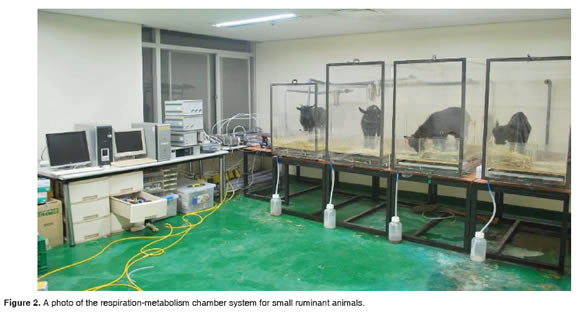
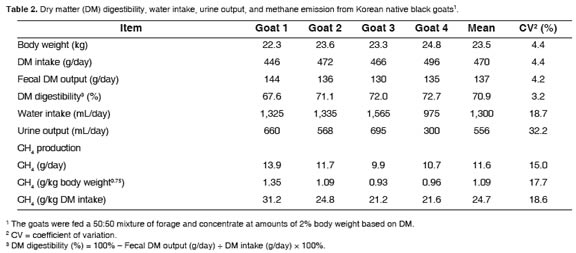
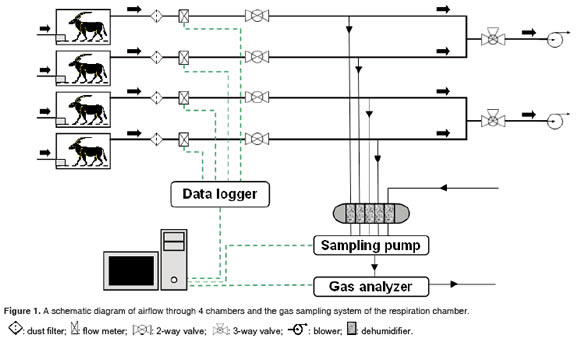
<body><![CDATA[<p><font face="Verdana, Arial, Helvetica, sans-serif" size="2">* Corresponding author: Sang-Rak Lee.Department of Animal Science and Environment, Konkuk University, Seoul 143-701, Republic of Korea. Tel +822 4503696. E-mail: <a href="mailto:leesr@konkuk.ac.kr">leesr@konkuk.ac.kr</a></font></p>     <p><font face="Verdana, Arial, Helvetica, sans-serif" size="2">&nbsp;</font></p><hr size="1">     <p><font face="Verdana, Arial, Helvetica, sans-serif" size="3"><b>Introduction</b></font></p>     <p><font face="Verdana, Arial, Helvetica, sans-serif" size="2">Global heating is of great concern, and greenhouse gases are potentially major contributors to the climate changes. Methane (CH<Sub>4</Sub>) is the second most important greenhouse gas next to carbon dioxide based on the quantity (Martin <I>et al</I>., 2008). The production of CH<Sub><Sub>4 </Sub></Sub>from global ruminant livestock production is estimated to be approximately 80 million tonnes per year (Beauchemin <I>et al</I>., 2008) and is responsible for at least 15% of the total CH<Sub><Sub>4 </Sub></Sub>from human activities including agriculture and industry (Moss <I>et al</I>., 1995). </font></p>    <p><font face="Verdana, Arial, Helvetica, sans-serif" size="2">Two major methods have been employed to measure CH<Sub><Sub>4 </Sub></Sub>emission from animals: 1) the respiration chamber method (McGinn <I>et al</I>., 2004; Beauchemin and McGinn, 2005), and 2) the sulfurhexafluoride tracer method (Swainson <I>et al</I>., 2007; Martin <I>et al</I>., 2008). The first method is generally used in the buildings, and the second is for grazing animals. When a large number of animals are employed for an experiment, the second method is more appropriate, but the chamber method is more frequently used due to the relatively low data variability (Klein and Wright, 2006; Suzuki <I>et al</I>., 2008). </font></p>     <p><font face="Verdana, Arial, Helvetica, sans-serif" size="2">While respiratory systems are relatively easily available for ruminants, systems for both quantifying gas emission and determining nutrient digestibility in small ruminant animals have been rarely documented (Iwasaki <I>et al</I>., 1982). The systems designed for large ruminant animals take large space and high cost, and they may be less efficient and potentially less accurate when used for small ruminant animals. Therefore, a novel chamber system was developed to measure CH<Sub><Sub>4 </Sub></Sub>gas emission from small ruminant animals and to determine nutrient digestibility simultaneously. A recovery test was performed using standard CH<Sub><Sub>4 </Sub></Sub>gas to verify full detection of gas, and a preliminary animal experiment was also conducted. </font></p>     <p><font face="Verdana, Arial, Helvetica, sans-serif" size="2">&nbsp;</font></p>     <p><font face="Verdana, Arial, Helvetica, sans-serif" size="3"><b>Materials and methods </b></font></p>     <p><font face="Verdana, Arial, Helvetica, sans-serif" size="2">The respiration-metabolism chamber system was installed in an environmentally controlled room (ambient temperature, 23 &deg;C; relative humidity, 55%) at Konkuk University. The protocols for animal experiments were reviewed and approved by Institutional Animal Care and Use Committee at Konkuk University. The system is composed of 3 major parts: 1) respiration-metabolism chambers, 2) gas sampling and analysis units, and 3) a data acquisition unit (<a href="#f1">Figures 1</a> and <a href="#f2">2</a>). </font></p>    <p align="center"><font face="Verdana, Arial, Helvetica, sans-serif" size="2"><img src="/img/revistas/rccp/v23n4/v23n04a05f01.jpg"></font><a name="f1"></a></p>     ]]></body>
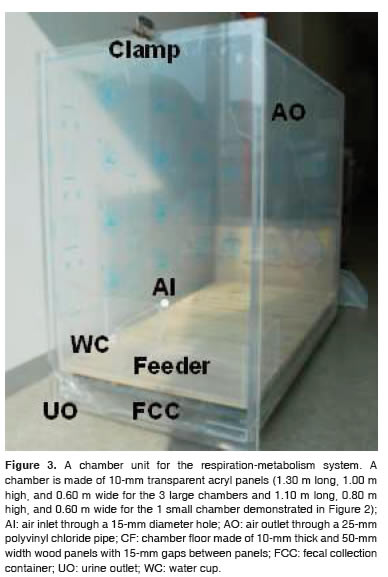
<body><![CDATA[<p align="center"><font face="Verdana, Arial, Helvetica, sans-serif" size="2"><img src="/img/revistas/rccp/v23n4/v23n04a05f02.jpg"></font><a name="f2"></a></p>     <p><font face="Verdana, Arial, Helvetica, sans-serif" size="2"><I>Respiration-metabolism chamber </I></font></p>     <p><font face="Verdana, Arial, Helvetica, sans-serif" size="2">Each chamber was made of 10-mm transparent acryl panels (for the large 3 chambers in <a href="#f2">Figure 2</a>, length, 1.30 m; height, 1.00 m; width, 0.60 m; <a href="#f3">Figure 3</a>). The transparent materials were used to facilitate visual observation of animal behavior. All panels except the front panel were sealed using silicone sealant. The front panel was fastened to the other panels using clamps. A hole of 15-mm diameter on the front panel enabled air inlets into the chamber. On the back panel, another hole was made to connect a 25-mm polyvinyl chloride (PVC) pipe for gas outlets. A screen floor was made of 10-mm thick wood panels. The width of each panel was 50 mm, and the wood panels were spaced by 15 mm as an animal can comfortably stand on and feces and urine canefficiently pass through.Awatercupand afeeder were located on the top of the wood floor. Adrawertype container was placed below the wood floor to facilitate fecal collection. On the front bottom of the chamber,a15-mm hole for urine outlet was located. </font></p>    <p align="center"><font face="Verdana, Arial, Helvetica, sans-serif" size="2"><img src="/img/revistas/rccp/v23n4/v23n04a05f03.jpg"></font><a name="f3"></a></p>     <p><font face="Verdana, Arial, Helvetica, sans-serif" size="2"><I>Gas sampling and analysis unit </I></font></p>    <p><font face="Verdana, Arial, Helvetica, sans-serif" size="2">A ring blower (Model: GR40-610, Dongnam Engineering Co., Ansan, Korea) was equipped to draw air from 2 chambers through the PVC pipe at a rate of approximately 70 L/min (<a href="#f1">Figure 1</a>). Based on our previous test, at this air flow rate, the carbon dioxide concentration in the chamber with a 25-kg goat did not exceed 0.5%, a suggested maximum concentration (Klein and Wright, 2006). The outlet air from a chamber was filtered through an air filter (Model:AF50, SMC Co., Tokyo, Japan) and the flow rate was measured using a standard temperature and pressure corrected-thermal mass flow meter (Model: GFM57,Aalborg Instruments & Controls Inc., Orangeburg, NY, USA). Gas samples were then drawn to a dehumidifier, composed of CaSO<Sub>4</Sub>, and analyzed for CH<Sub><Sub>4 </Sub></Sub>in the non-dispersive infrared gas analyzer with a measuring range of 0 to 2,000 ppm and repeatability of 0.5% (Model: VA-3000, Horiba Stec Co., Kyoto, Japan) through a 6-mm pipe. The sampling pump (Columbus Instruments, Columbus, OH, USA) was used to enable this air flow. </font></p>    <p><font face="Verdana, Arial, Helvetica, sans-serif" size="2">The gas analyzer was calibrated 1 hour prior to the gas measurement. Zero gas of 99.99% N<Sub><Sub>2 </Sub></Sub>gas (Uniongas Co., Yongin, Korea) and span gas of 1,002 ppm (v/v) CH<Sub>4</Sub>(Uniongas Co.,Yongin, Korea) balancedwith N<Sub><Sub>2 </Sub></Sub>wereused for calibration. </font></p>    <p><font face="Verdana, Arial, Helvetica, sans-serif" size="2"><I>Data acquisition unit </I></font></p>    <p><font face="Verdana, Arial, Helvetica, sans-serif" size="2">Air flow rate data measured at the thermal mass flow meter were transferred to the data logger (Columbus Instruments, Columbus, OH, USA) and were saved in the computer every 4 minutes. The CH<Sub><Sub>4 </Sub></Sub>concentrations in air samples were determined and saved in the computer every 10 seconds using software (Type: VA-3000, Horiba Stec Co., Kyoto, Japan). </font></p>    <p><font face="Verdana, Arial, Helvetica, sans-serif" size="2"><I>Recovery test </I></font></p>    ]]></body>
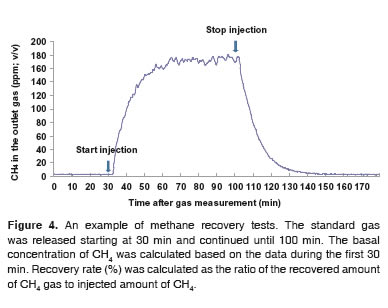
<body><![CDATA[<p><font face="Verdana, Arial, Helvetica, sans-serif" size="2">To validate the detection of CH<Sub><Sub>4 </Sub></Sub>gas in the chamber system, a recovery test was performed. In each test, the concentration of CH<Sub><Sub>4 </Sub></Sub>gas from the chamber was measured for approximately 180 min. Standard CH<Sub><Sub>4 </Sub></Sub>gas (1.67%, v/v) was released into the chamber at the rate of 1 L/min. </font></p>    <p><font face="Verdana, Arial, Helvetica, sans-serif" size="2">The gas release initiated at 30 min and terminated at 100 min. The basal concentration of CH<Sub><Sub>4 </Sub></Sub>from the chamber was estimated based on the CH<Sub><Sub>4 </Sub></Sub>gas emission from the chamber during the first 30 min. Based on the preliminary tests (data not shown), the concentration of CH<Sub><Sub>4 </Sub></Sub>returned to the basal concentration approximately 50 min after the termination of gas injection, and thus, 80 min of further gas analysis after stopping gas injection was assumed to be sufficient. Recovery rate (%) was calculated using recovered amount of CH<Sub><Sub>4 </Sub></Sub>gas and injected amount of CH<Sub><Sub>4 </Sub></Sub>gas. </font></p>    <p><font face="Verdana, Arial, Helvetica, sans-serif" size="2"><I>Animal experiment </I></font></p>    <p><font face="Verdana, Arial, Helvetica, sans-serif" size="2">Four Korean native black goats with a mean body weight (BW) of 23.5 kg (SD = 1.0) were employed in the preliminary animal experiment. The goats were individually housed in each chamber and acclimated to the chamber before the initiation of animal experiment. A mixed feed was prepared using 50% of forages (2 to 5 cm cuts of tall fescue hay) and 50% concentrates (ground corn and soybean meal) on the basis of dry matter (DM).</font></p>     <p><font face="Verdana, Arial, Helvetica, sans-serif" size="2">  The experiment lasted 10 days. The initial 6 days   were an adaptation period to the feed, and during   the following 4 days gas emission was measured   and total feces and urine were collected. The feed   was provided at amounts of 2% BW based on   DM once a day at 1100 h. Water was sufficiently   provided to last at least 24 hours. Shortly after   feeding, the CH4 gas determination initiated and   continued until 1.000 h of the next day. </font></p>     <p><font face="Verdana, Arial, Helvetica, sans-serif" size="2">Methane    concentrations of each chamber were recorded for    4 min, and every 3 consecutive cycles of measuring   gas in 4 chambers methane gas in reference air was   measured for 4-min. In each 4 min measurement,   first 3 min was regarded as a settling period and   last 1 min was used for data calculation. Feces and   urine excreted were collected and water intake was   recorded between 1000 and 1100 h.</font></p>     <p><font face="Verdana, Arial, Helvetica, sans-serif" size="2">Feces were dried in an oven for 24 hours at   60 &deg;C. Ingredient and fecal samples were ground   using a micro hammer mill (Culatti AG, Zurich,    <br>   Switzerland) with a 1-mm screen. Samples were   analyzed for DM by drying the samples for 2 hours   at 135 &deg;C (method 930.15; AOAC, 2005).</font></p>     <p><font face="Verdana, Arial, Helvetica, sans-serif" size="2">&nbsp;</font></p>     <p><font face="Verdana, Arial, Helvetica, sans-serif" size="3"><b>Results and Discussion </b></font></p>    ]]></body>
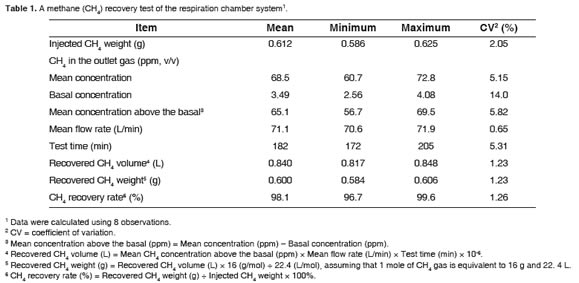
<body><![CDATA[<p><font face="Verdana, Arial, Helvetica, sans-serif" size="2"><I>Recovery test </I></font></p>    <p><font face="Verdana, Arial, Helvetica, sans-serif" size="2">Values for recovery rate of CH<Sub><Sub>4 </Sub></Sub>gas ranged from 96.7 to 99.6% in 8 observations, and the mean value was 98.1% with the coefficient of variation (CV) of 1.3% (<a href="#t1">Table 1</a>). These results demonstrated that the present system is working very accurately and precisely. In the other respiratory system by Klein and Wright (2006), recovery rate of CH<Sub><Sub>4 </Sub></Sub>gas was 101.1% but the variation was larger than in our test (CV = 4.5%; n = 6). The superior gas recovery rate of the present system compared with others may be attributed to the fact that this present system was designed for small ruminants, and thus, was smaller and than other systems designed for large animals. High accuracy of the gas analysis equipment may also be another positive contributor. An example of recovery test results was illustrated in <a href="#f4">figure 4</a>. </font></p>     <p align="center"><font face="Verdana, Arial, Helvetica, sans-serif" size="2"><img src="/img/revistas/rccp/v23n4/v23n04a05f04.jpg"></font><a name="f4"></a></p>     <p><font face="Verdana, Arial, Helvetica, sans-serif" size="2"><I>Animal experiment </I></font></p>     <p><font face="Verdana, Arial, Helvetica, sans-serif" size="2">In the animal experiment, all goats remained healthy and consumed all the daily feed allowance. Dry matter digestibility was 70.9% in goats fed a 50:50 mixture of forage and concentrate at 2% BW (<a href="#t2">Table 2</a>). In our previous experiment, DM digestibility was 68.0% (unpublished data) that is reasonably close to the present results. Islam et al. (2000) conducted an experiment using goats with a mean BW of 24.9 kg and provided 0.49 kg of feed daily. They reported that DM digestibility was 74.7% in goats fed a mixture of 50% Italian ryegrass and 50% corn. Shibata et al. (1992) reported that DM digestibility in goats fed forage and concentrate mixture with ratios of 70:30 and 30:70 was 64.9 and 72.6%, respectively. As DM digestibility can be affected by many factors, our dataappeared tobe within a reasonable range. </font></p>     <p><font face="Verdana, Arial, Helvetica, sans-serif" size="2">The CH<Sub><Sub>4 </Sub></Sub>gas productionwas 24.7 g/kg DM intake on average (<a href="#t2">Table 2</a>). In a similar study conducted by Islam <I>et al</I>. (2000), a CH<Sub><Sub>4 </Sub></Sub>production of 23.5 g/kg DM intake was observed that was very comparable to our data. In other goat experiments, the CH<Sub><Sub>4 </Sub></Sub>gas emission varied from 16.2 to 24.6 g/kg DM intake when using various types of feed and feed intake (Shibata <i>et al</i>., 1992; Puchala <i>et al</i>., 2005; Animut <i>et al</i>., 2008). It seems that CH<sub><sub>4 </sub></sub>emission from goats may vary depending on many factors including feed type and feed intake. </font></p>     <p><font face="Verdana, Arial, Helvetica, sans-serif" size="2">The present novel respiration-metabolism chamber system is appropriate for measuring CH<Sub><Sub>4 </Sub></Sub>gas emission from small ruminants. The present system also enables nutrient digestibility determination and visual observation of animal behavior. </font></p>    <p align="center"><font face="Verdana, Arial, Helvetica, sans-serif" size="2"><img src="/img/revistas/rccp/v23n4/v23n04a05t01.jpg"></font><a name="t1"></a></p>     <p align="center"><font face="Verdana, Arial, Helvetica, sans-serif" size="2"><img src="/img/revistas/rccp/v23n4/v23n04a05t02.jpg"></font><a name="t2"></a></p>     <p><font face="Verdana, Arial, Helvetica, sans-serif" size="2">&nbsp;</font></p>     ]]></body>
<body><![CDATA[<p><font face="Verdana, Arial, Helvetica, sans-serif" size="3"><b>Acknowledgements </b></font></p>    <p><font face="Verdana, Arial, Helvetica, sans-serif" size="2">This work was funded by Rural Development Administration, Republic of Korea, and the project was a subunit of Agenda 5, "Development of Future Agricultural Technology to Adapt Climate Changes." </font></p>     <p><font face="Verdana, Arial, Helvetica, sans-serif" size="2">&nbsp;</font></p>     <p><font face="Verdana, Arial, Helvetica, sans-serif" size="3"><b>References </b></font></p>     <!-- ref --><p><font face="Verdana, Arial, Helvetica, sans-serif" size="2">1. Animut G, Puchala R, Goetsch AL, Patra AK, Sahlu T, Varel VH, Wells J. Methane emission by goats consuming diets with different levels of condensed tannins from lespedeza. Anim Feed SciTechnol2008; 144:212-227. </font>&nbsp;&nbsp;&nbsp;&nbsp;&nbsp;&nbsp;&nbsp;&nbsp;[&#160;<a href="javascript:void(0);" onclick="javascript: window.open('/scielo.php?script=sci_nlinks&ref=000067&pid=S0120-0690201000040000500001&lng=','','width=640,height=500,resizable=yes,scrollbars=1,menubar=yes,');">Links</a>&#160;]<!-- end-ref --><!-- ref --><p><font face="Verdana, Arial, Helvetica, sans-serif" size="2">2. AOAC. Official Methods of Analysis. 18th ed. Association of official analytical chemists,Gaithersburg,MD. 2005. </font>&nbsp;&nbsp;&nbsp;&nbsp;&nbsp;&nbsp;&nbsp;&nbsp;[&#160;<a href="javascript:void(0);" onclick="javascript: window.open('/scielo.php?script=sci_nlinks&ref=000068&pid=S0120-0690201000040000500002&lng=','','width=640,height=500,resizable=yes,scrollbars=1,menubar=yes,');">Links</a>&#160;]<!-- end-ref --><!-- ref --><p><font face="Verdana, Arial, Helvetica, sans-serif" size="2">3. Beauchemin KA, Kreuzer M, O'Mara F, McAllister TA. Nutritional management for enteric methane abatement: a review.Aust JExpAgric 2008; 48:21-27. </font>&nbsp;&nbsp;&nbsp;&nbsp;&nbsp;&nbsp;&nbsp;&nbsp;[&#160;<a href="javascript:void(0);" onclick="javascript: window.open('/scielo.php?script=sci_nlinks&ref=000069&pid=S0120-0690201000040000500003&lng=','','width=640,height=500,resizable=yes,scrollbars=1,menubar=yes,');">Links</a>&#160;]<!-- end-ref --><!-- ref --><p><font face="Verdana, Arial, Helvetica, sans-serif" size="2">4. Beauchemin KA, McGinn SM. Methane emissions from feedlot cattlefed barleyor corndiets.JAnim Sci2005; 83:653-661. </font>&nbsp;&nbsp;&nbsp;&nbsp;&nbsp;&nbsp;&nbsp;&nbsp;[&#160;<a href="javascript:void(0);" onclick="javascript: window.open('/scielo.php?script=sci_nlinks&ref=000070&pid=S0120-0690201000040000500004&lng=','','width=640,height=500,resizable=yes,scrollbars=1,menubar=yes,');">Links</a>&#160;]<!-- end-ref --><!-- ref --><p><font face="Verdana, Arial, Helvetica, sans-serif" size="2">5. Islam M,Abe H, Hayashi Y, Terada F. Effects of feeding Italian ryegrass with corn on rumen environment, nutrient digestibility, methane emission, and energy and nitrogen utilization at two intake levelsbygoats. SmallRuminant Res2000; 38:165-174. </font>&nbsp;&nbsp;&nbsp;&nbsp;&nbsp;&nbsp;&nbsp;&nbsp;[&#160;<a href="javascript:void(0);" onclick="javascript: window.open('/scielo.php?script=sci_nlinks&ref=000071&pid=S0120-0690201000040000500005&lng=','','width=640,height=500,resizable=yes,scrollbars=1,menubar=yes,');">Links</a>&#160;]<!-- end-ref --><!-- ref --><p><font face="Verdana, Arial, Helvetica, sans-serif" size="2">6. Iwasaki K, Haryu T, Tano R, Terada F, Itoh M, Kameoka K. New animal metabolism facility especially the description of respirationalapparatus. BullNat InstAnim Ind1982; 39:41-78. </font>&nbsp;&nbsp;&nbsp;&nbsp;&nbsp;&nbsp;&nbsp;&nbsp;[&#160;<a href="javascript:void(0);" onclick="javascript: window.open('/scielo.php?script=sci_nlinks&ref=000072&pid=S0120-0690201000040000500006&lng=','','width=640,height=500,resizable=yes,scrollbars=1,menubar=yes,');">Links</a>&#160;]<!-- end-ref --><!-- ref --><p><font face="Verdana, Arial, Helvetica, sans-serif" size="2">7. Klein L, Wright A-DG. Construction and operation of opencircuit methane chambers for small ruminants.Aust J ExpAgric 2006; 46:1257-1262. </font>&nbsp;&nbsp;&nbsp;&nbsp;&nbsp;&nbsp;&nbsp;&nbsp;[&#160;<a href="javascript:void(0);" onclick="javascript: window.open('/scielo.php?script=sci_nlinks&ref=000073&pid=S0120-0690201000040000500007&lng=','','width=640,height=500,resizable=yes,scrollbars=1,menubar=yes,');">Links</a>&#160;]<!-- end-ref --><!-- ref --><p><font face="Verdana, Arial, Helvetica, sans-serif" size="2">8. Martin C, Rouel J, Jouany JP, Doreau M, Chilliard Y. Methane output and diet digestibility in response to feeding dairy cows crude linseed, extruded linseed, or linseed oil. JAnim Sci 2008; 86:2642-2650. </font>&nbsp;&nbsp;&nbsp;&nbsp;&nbsp;&nbsp;&nbsp;&nbsp;[&#160;<a href="javascript:void(0);" onclick="javascript: window.open('/scielo.php?script=sci_nlinks&ref=000074&pid=S0120-0690201000040000500008&lng=','','width=640,height=500,resizable=yes,scrollbars=1,menubar=yes,');">Links</a>&#160;]<!-- end-ref --><!-- ref --><p><font face="Verdana, Arial, Helvetica, sans-serif" size="2">9. McGinn SM, Beauchemin KA, Coates T, Colombatto D. Methane emissions from beef cattle: Effects of monensin, sunflower oil, enzymes, yeast, and fumaric acid. J Anim Sci 2004;82:3346-3356. </font>&nbsp;&nbsp;&nbsp;&nbsp;&nbsp;&nbsp;&nbsp;&nbsp;[&#160;<a href="javascript:void(0);" onclick="javascript: window.open('/scielo.php?script=sci_nlinks&ref=000075&pid=S0120-0690201000040000500009&lng=','','width=640,height=500,resizable=yes,scrollbars=1,menubar=yes,');">Links</a>&#160;]<!-- end-ref --><!-- ref --><p><font face="Verdana, Arial, Helvetica, sans-serif" size="2">10. Moss AR, Givens DI, Garnsworthy PC. The effect of supplementing grass silage with barley on digestibility, in sacco degradability, rumen fermentation and methane production in sheep at two levels of intake. Anim Feed Sci Technol 1995; 55:9-33. </font>&nbsp;&nbsp;&nbsp;&nbsp;&nbsp;&nbsp;&nbsp;&nbsp;[&#160;<a href="javascript:void(0);" onclick="javascript: window.open('/scielo.php?script=sci_nlinks&ref=000076&pid=S0120-0690201000040000500010&lng=','','width=640,height=500,resizable=yes,scrollbars=1,menubar=yes,');">Links</a>&#160;]<!-- end-ref --><!-- ref --><p><font face="Verdana, Arial, Helvetica, sans-serif" size="2">11. Puchala R, Min BR, Goetsch AL, Sahlu T. The effect of a condensed tannin-containing forage on methane emission by goats. JAnimSci 2005;83:182-186. </font>&nbsp;&nbsp;&nbsp;&nbsp;&nbsp;&nbsp;&nbsp;&nbsp;[&#160;<a href="javascript:void(0);" onclick="javascript: window.open('/scielo.php?script=sci_nlinks&ref=000077&pid=S0120-0690201000040000500011&lng=','','width=640,height=500,resizable=yes,scrollbars=1,menubar=yes,');">Links</a>&#160;]<!-- end-ref --><!-- ref --><p><font face="Verdana, Arial, Helvetica, sans-serif" size="2">12. Shibata M, Terada F. Iwasaki K. Methane production in heifers, sheep, and goats consuming diets of various hay-concentrate ratios.AnimSciTechnol 1992;63:1221-1227. </font>&nbsp;&nbsp;&nbsp;&nbsp;&nbsp;&nbsp;&nbsp;&nbsp;[&#160;<a href="javascript:void(0);" onclick="javascript: window.open('/scielo.php?script=sci_nlinks&ref=000078&pid=S0120-0690201000040000500012&lng=','','width=640,height=500,resizable=yes,scrollbars=1,menubar=yes,');">Links</a>&#160;]<!-- end-ref --><!-- ref --><p><font face="Verdana, Arial, Helvetica, sans-serif" size="2">13. Suzuki T, Phaowphaisal I, Pholsen P, Narmsilee R, Indramanee S, Nitipot P, Chaokaur A, Sommart K, Khotprom N, Panichpol V, Nishida T. In vivo nutritive value of Pangola grass (<I>Digitaria Eriantha</I>) hay by a novel indirect calorimeter with a ventilated hood inThailand. JpnAgricResQuart 2008; 42:123-129. </font>&nbsp;&nbsp;&nbsp;&nbsp;&nbsp;&nbsp;&nbsp;&nbsp;[&#160;<a href="javascript:void(0);" onclick="javascript: window.open('/scielo.php?script=sci_nlinks&ref=000079&pid=S0120-0690201000040000500013&lng=','','width=640,height=500,resizable=yes,scrollbars=1,menubar=yes,');">Links</a>&#160;]<!-- end-ref --><!-- ref --><p><font face="Verdana, Arial, Helvetica, sans-serif" size="2">14. Swainson NM, Hoskin SO, Clark H, Lopez-Villalobos N. The effect of age on methane emissions from young, weaned red deer (<I>Cervus elaphus</I>) stags grazing perennial ryegrass (<I>Lolium perenne</I>)-based pasture. New Zeal J Agric Res 2007; 50:407-416. </font>&nbsp;&nbsp;&nbsp;&nbsp;&nbsp;&nbsp;&nbsp;&nbsp;[&#160;<a href="javascript:void(0);" onclick="javascript: window.open('/scielo.php?script=sci_nlinks&ref=000080&pid=S0120-0690201000040000500014&lng=','','width=640,height=500,resizable=yes,scrollbars=1,menubar=yes,');">Links</a>&#160;]<!-- end-ref --> ]]></body><back>
<ref-list>
<ref id="B1">
<label>1</label><nlm-citation citation-type="journal">
<person-group person-group-type="author">
<name>
<surname><![CDATA[Animut]]></surname>
<given-names><![CDATA[G]]></given-names>
</name>
<name>
<surname><![CDATA[Puchala]]></surname>
<given-names><![CDATA[R]]></given-names>
</name>
<name>
<surname><![CDATA[Goetsch]]></surname>
<given-names><![CDATA[AL]]></given-names>
</name>
<name>
<surname><![CDATA[Patra]]></surname>
<given-names><![CDATA[AK]]></given-names>
</name>
<name>
<surname><![CDATA[Sahlu]]></surname>
<given-names><![CDATA[T]]></given-names>
</name>
<name>
<surname><![CDATA[Varel]]></surname>
<given-names><![CDATA[VH]]></given-names>
</name>
<name>
<surname><![CDATA[Wells]]></surname>
<given-names><![CDATA[J]]></given-names>
</name>
</person-group>
<article-title xml:lang="en"><![CDATA[Methane emission by goats consuming diets with different levels of condensed tannins from lespedeza]]></article-title>
<source><![CDATA[Anim Feed SciTechnol]]></source>
<year>2008</year>
<volume>144</volume>
<page-range>212-227</page-range></nlm-citation>
</ref>
<ref id="B2">
<label>2</label><nlm-citation citation-type="book">
<collab>AOAC</collab>
<source><![CDATA[Official Methods of Analysis]]></source>
<year>2005</year>
<publisher-loc><![CDATA[18Gaithersburg ]]></publisher-loc>
<publisher-name><![CDATA[Association of official analytical chemists]]></publisher-name>
</nlm-citation>
</ref>
<ref id="B3">
<label>3</label><nlm-citation citation-type="journal">
<person-group person-group-type="author">
<name>
<surname><![CDATA[Beauchemin]]></surname>
<given-names><![CDATA[KA]]></given-names>
</name>
<name>
<surname><![CDATA[Kreuzer]]></surname>
<given-names><![CDATA[M]]></given-names>
</name>
<name>
<surname><![CDATA[O'Mara]]></surname>
<given-names><![CDATA[F]]></given-names>
</name>
<name>
<surname><![CDATA[McAllister]]></surname>
<given-names><![CDATA[TA]]></given-names>
</name>
</person-group>
<article-title xml:lang="en"><![CDATA[Nutritional management for enteric methane abatement: a review]]></article-title>
<source><![CDATA[Aust JexpAgric]]></source>
<year>2008</year>
<volume>48</volume>
<page-range>21-27</page-range></nlm-citation>
</ref>
<ref id="B4">
<label>4</label><nlm-citation citation-type="journal">
<person-group person-group-type="author">
<name>
<surname><![CDATA[Beauchemin]]></surname>
<given-names><![CDATA[KA]]></given-names>
</name>
<name>
<surname><![CDATA[McGinn]]></surname>
<given-names><![CDATA[SM]]></given-names>
</name>
</person-group>
<article-title xml:lang="en"><![CDATA[Methane emissions from feedlot cattlefed barleyor corndiets]]></article-title>
<source><![CDATA[JAnim Sci]]></source>
<year>2005</year>
<volume>83</volume>
<page-range>653-661</page-range></nlm-citation>
</ref>
<ref id="B5">
<label>5</label><nlm-citation citation-type="journal">
<person-group person-group-type="author">
<name>
<surname><![CDATA[Islam]]></surname>
<given-names><![CDATA[M]]></given-names>
</name>
<name>
<surname><![CDATA[Abe]]></surname>
<given-names><![CDATA[H]]></given-names>
</name>
<name>
<surname><![CDATA[Hayashi]]></surname>
<given-names><![CDATA[Y]]></given-names>
</name>
<name>
<surname><![CDATA[Terada]]></surname>
<given-names><![CDATA[F]]></given-names>
</name>
</person-group>
<article-title xml:lang="en"><![CDATA[Effects of feeding Italian ryegrass with corn on rumen environment, nutrient digestibility, methane emission, and energy and nitrogen utilization at two intake levelsbygoats]]></article-title>
<source><![CDATA[SmallRuminant Res]]></source>
<year>2000</year>
<volume>38</volume>
<page-range>165-174</page-range></nlm-citation>
</ref>
<ref id="B6">
<label>6</label><nlm-citation citation-type="journal">
<person-group person-group-type="author">
<name>
<surname><![CDATA[Iwasaki]]></surname>
<given-names><![CDATA[K]]></given-names>
</name>
<name>
<surname><![CDATA[Haryu]]></surname>
<given-names><![CDATA[T]]></given-names>
</name>
<name>
<surname><![CDATA[Tano]]></surname>
<given-names><![CDATA[R]]></given-names>
</name>
<name>
<surname><![CDATA[Terada]]></surname>
<given-names><![CDATA[F]]></given-names>
</name>
<name>
<surname><![CDATA[Itoh]]></surname>
<given-names><![CDATA[M]]></given-names>
</name>
<name>
<surname><![CDATA[Kameoka]]></surname>
<given-names><![CDATA[K]]></given-names>
</name>
</person-group>
<article-title xml:lang="en"><![CDATA[New animal metabolism facility especially the description of respirationalapparatus]]></article-title>
<source><![CDATA[BullNat InstAnim Ind]]></source>
<year>1982</year>
<volume>39</volume>
<page-range>41-78</page-range></nlm-citation>
</ref>
<ref id="B7">
<label>7</label><nlm-citation citation-type="journal">
<person-group person-group-type="author">
<name>
<surname><![CDATA[Klein]]></surname>
<given-names><![CDATA[L]]></given-names>
</name>
<name>
<surname><![CDATA[Wright]]></surname>
<given-names><![CDATA[A-DG]]></given-names>
</name>
</person-group>
<article-title xml:lang="en"><![CDATA[Construction and operation of opencircuit methane chambers for small ruminants]]></article-title>
<source><![CDATA[Aust J ExpAgric]]></source>
<year>2006</year>
<volume>46</volume>
<page-range>1257-1262</page-range></nlm-citation>
</ref>
<ref id="B8">
<label>8</label><nlm-citation citation-type="journal">
<person-group person-group-type="author">
<name>
<surname><![CDATA[Martin]]></surname>
<given-names><![CDATA[C]]></given-names>
</name>
<name>
<surname><![CDATA[Rouel]]></surname>
<given-names><![CDATA[J]]></given-names>
</name>
<name>
<surname><![CDATA[Jouany]]></surname>
<given-names><![CDATA[JP]]></given-names>
</name>
<name>
<surname><![CDATA[Doreau]]></surname>
<given-names><![CDATA[M]]></given-names>
</name>
<name>
<surname><![CDATA[Chilliard]]></surname>
<given-names><![CDATA[Y]]></given-names>
</name>
</person-group>
<article-title xml:lang="en"><![CDATA[Methane output and diet digestibility in response to feeding dairy cows crude linseed, extruded linseed, or linseed oil]]></article-title>
<source><![CDATA[JAnim Sci]]></source>
<year>2008</year>
<volume>86</volume>
<page-range>2642-2650</page-range></nlm-citation>
</ref>
<ref id="B9">
<label>9</label><nlm-citation citation-type="journal">
<person-group person-group-type="author">
<name>
<surname><![CDATA[McGinn]]></surname>
<given-names><![CDATA[SM]]></given-names>
</name>
<name>
<surname><![CDATA[Beauchemin]]></surname>
<given-names><![CDATA[KA]]></given-names>
</name>
<name>
<surname><![CDATA[Coates]]></surname>
<given-names><![CDATA[T]]></given-names>
</name>
<name>
<surname><![CDATA[Colombatto]]></surname>
<given-names><![CDATA[D]]></given-names>
</name>
</person-group>
<article-title xml:lang="en"><![CDATA[Methane emissions from beef cattle: Effects of monensin, sunflower oil, enzymes, yeast, and fumaric acid]]></article-title>
<source><![CDATA[J Anim Sci]]></source>
<year>2004</year>
<volume>82</volume>
<page-range>3346-3356</page-range></nlm-citation>
</ref>
<ref id="B10">
<label>10</label><nlm-citation citation-type="journal">
<person-group person-group-type="author">
<name>
<surname><![CDATA[Moss]]></surname>
<given-names><![CDATA[AR]]></given-names>
</name>
<name>
<surname><![CDATA[Givens]]></surname>
<given-names><![CDATA[DI]]></given-names>
</name>
<name>
<surname><![CDATA[Garnsworthy]]></surname>
<given-names><![CDATA[PC]]></given-names>
</name>
</person-group>
<article-title xml:lang="en"><![CDATA[The effect of supplementing grass silage with barley on digestibility, in sacco degradability, rumen fermentation and methane production in sheep at two levels of intake]]></article-title>
<source><![CDATA[Anim Feed Sci Technol]]></source>
<year>1995</year>
<volume>55</volume>
<page-range>9-33</page-range></nlm-citation>
</ref>
<ref id="B11">
<label>11</label><nlm-citation citation-type="journal">
<person-group person-group-type="author">
<name>
<surname><![CDATA[Puchala]]></surname>
<given-names><![CDATA[R]]></given-names>
</name>
<name>
<surname><![CDATA[Min]]></surname>
<given-names><![CDATA[BR]]></given-names>
</name>
<name>
<surname><![CDATA[Goetsch]]></surname>
<given-names><![CDATA[AL]]></given-names>
</name>
<name>
<surname><![CDATA[Sahlu]]></surname>
<given-names><![CDATA[T]]></given-names>
</name>
</person-group>
<article-title xml:lang="en"><![CDATA[The effect of a condensed tannin-containing forage on methane emission by goats]]></article-title>
<source><![CDATA[JanimSci]]></source>
<year>2005</year>
<volume>83</volume>
<page-range>182-186</page-range></nlm-citation>
</ref>
<ref id="B12">
<label>12</label><nlm-citation citation-type="journal">
<person-group person-group-type="author">
<name>
<surname><![CDATA[Shibata]]></surname>
<given-names><![CDATA[M]]></given-names>
</name>
<name>
<surname><![CDATA[Terada]]></surname>
<given-names><![CDATA[F]]></given-names>
</name>
</person-group>
<article-title xml:lang="en"><![CDATA[Methane production in heifers, sheep, and goats consuming diets of various hay-concentrate ratios]]></article-title>
<source><![CDATA[AnimSciTechnol]]></source>
<year>1992</year>
<volume>63</volume>
<page-range>1221-1227</page-range></nlm-citation>
</ref>
<ref id="B13">
<label>13</label><nlm-citation citation-type="journal">
<person-group person-group-type="author">
<name>
<surname><![CDATA[Suzuki]]></surname>
<given-names><![CDATA[T]]></given-names>
</name>
<name>
<surname><![CDATA[Phaowphaisal]]></surname>
<given-names><![CDATA[I]]></given-names>
</name>
<name>
<surname><![CDATA[Pholsen]]></surname>
<given-names><![CDATA[P]]></given-names>
</name>
<name>
<surname><![CDATA[Narmsilee]]></surname>
<given-names><![CDATA[R]]></given-names>
</name>
<name>
<surname><![CDATA[Indramanee]]></surname>
<given-names><![CDATA[S]]></given-names>
</name>
<name>
<surname><![CDATA[Nitipot]]></surname>
<given-names><![CDATA[P]]></given-names>
</name>
<name>
<surname><![CDATA[Chaokaur]]></surname>
<given-names><![CDATA[A]]></given-names>
</name>
<name>
<surname><![CDATA[Sommart]]></surname>
<given-names><![CDATA[K]]></given-names>
</name>
<name>
<surname><![CDATA[Khotprom]]></surname>
<given-names><![CDATA[N]]></given-names>
</name>
<name>
<surname><![CDATA[Panichpol]]></surname>
<given-names><![CDATA[V]]></given-names>
</name>
<name>
<surname><![CDATA[Nishida]]></surname>
<given-names><![CDATA[T]]></given-names>
</name>
</person-group>
<article-title xml:lang="en"><![CDATA[In vivo nutritive value of Pangola grass (Digitaria Eriantha) hay by a novel indirect calorimeter with a ventilated hood inThailand]]></article-title>
<source><![CDATA[JpnAgricResQuart]]></source>
<year>2008</year>
<volume>42</volume>
<page-range>123-129</page-range></nlm-citation>
</ref>
<ref id="B14">
<label>14</label><nlm-citation citation-type="journal">
<person-group person-group-type="author">
<name>
<surname><![CDATA[Swainson]]></surname>
<given-names><![CDATA[NM]]></given-names>
</name>
<name>
<surname><![CDATA[Hoskin]]></surname>
<given-names><![CDATA[SO]]></given-names>
</name>
<name>
<surname><![CDATA[Clark]]></surname>
<given-names><![CDATA[H]]></given-names>
</name>
<name>
<surname><![CDATA[Lopez-Villalobos]]></surname>
<given-names><![CDATA[N]]></given-names>
</name>
</person-group>
<article-title xml:lang="en"><![CDATA[The effect of age on methane emissions from young, weaned red deer (Cervus elaphus) stags grazing perennial ryegrass (Lolium perenne)-based pasture]]></article-title>
<source><![CDATA[New Zeal J Agric Res]]></source>
<year>2007</year>
<volume>50</volume>
<page-range>407-416</page-range></nlm-citation>
</ref>
</ref-list>
</back>
</article>