<?xml version="1.0" encoding="ISO-8859-1"?><article xmlns:mml="http://www.w3.org/1998/Math/MathML" xmlns:xlink="http://www.w3.org/1999/xlink" xmlns:xsi="http://www.w3.org/2001/XMLSchema-instance">
<front>
<journal-meta>
<journal-id>0120-0690</journal-id>
<journal-title><![CDATA[Revista Colombiana de Ciencias Pecuarias]]></journal-title>
<abbrev-journal-title><![CDATA[Rev Colom Cienc Pecua]]></abbrev-journal-title>
<issn>0120-0690</issn>
<publisher>
<publisher-name><![CDATA[Facultad de Ciencias Agrarias, Universidad de Antioquia]]></publisher-name>
</publisher>
</journal-meta>
<article-meta>
<article-id>S0120-06902011000100002</article-id>
<title-group>
<article-title xml:lang="en"><![CDATA[Production of an extracellular protease by an Antarctic bacterial isolate (Bacillus sp. JSP1)as a potential feed additive]]></article-title>
<article-title xml:lang="es"><![CDATA[Proteasa extracelular de un aislado bacteriano Antartico (Bacillus sp. JSP1) con uso potencial como aditivo alimenticio para animales]]></article-title>
<article-title xml:lang="pt"><![CDATA[Produção de proteasa extracelular por bactérias antárcticas isoladas, Bacillus sp. JSP1 como um aditivo potencial em concentrado]]></article-title>
</title-group>
<contrib-group>
<contrib contrib-type="author">
<name>
<surname><![CDATA[Park]]></surname>
<given-names><![CDATA[Inkyung]]></given-names>
</name>
<xref ref-type="aff" rid="A01"/>
</contrib>
<contrib contrib-type="author">
<name>
<surname><![CDATA[Cho]]></surname>
<given-names><![CDATA[Jaiesoon]]></given-names>
</name>
<xref ref-type="aff" rid="A02"/>
</contrib>
</contrib-group>
<aff id="A01">
<institution><![CDATA[,Konkuk University College of Animal Bioscience and Technology Animal Resources Research Center]]></institution>
<addr-line><![CDATA[Seoul ]]></addr-line>
<country>Korea</country>
</aff>
<aff id="A02">
<institution><![CDATA[,Konkuk University College of Animal Bioscience and Technology Department of Animal Sciences and Environment]]></institution>
<addr-line><![CDATA[Seoul ]]></addr-line>
<country>Korea</country>
</aff>
<pub-date pub-type="pub">
<day>00</day>
<month>03</month>
<year>2011</year>
</pub-date>
<pub-date pub-type="epub">
<day>00</day>
<month>03</month>
<year>2011</year>
</pub-date>
<volume>24</volume>
<numero>1</numero>
<fpage>11</fpage>
<lpage>18</lpage>
<copyright-statement/>
<copyright-year/>
<self-uri xlink:href="http://www.scielo.org.co/scielo.php?script=sci_arttext&amp;pid=S0120-06902011000100002&amp;lng=en&amp;nrm=iso"></self-uri><self-uri xlink:href="http://www.scielo.org.co/scielo.php?script=sci_abstract&amp;pid=S0120-06902011000100002&amp;lng=en&amp;nrm=iso"></self-uri><self-uri xlink:href="http://www.scielo.org.co/scielo.php?script=sci_pdf&amp;pid=S0120-06902011000100002&amp;lng=en&amp;nrm=iso"></self-uri><abstract abstract-type="short" xml:lang="en"><p><![CDATA[Extracellular proteolytic activity was found in JSP1, an Antarctic bacterial isolate. The strain was related to Bacillus sp, based on 16S rRNA gene sequence analysis. The JSP1 protease was partially purified by ammonium sulfate precipitation. Optimal enzyme activity occurred at 40 C and pH 7.4. Enzyme activity was significantly enhanced in the presence of Mg2+ and Ca2+ and was completely inactivated in presence of Cu2+, Zn2+, Hg2+, EDTA and SDS. The enzyme hydrolyzed casein the most effectively among the protein substrates tested. The enzyme also exhibited relatively high activity on keratin and gluten, and was active against peptidyl conjugates such asL-Leu-p-Nitroanilide and N-Succinyl-L-Phe-p-Nitroanilide. This study suggests that JSP1 protease could be utilized as a potential environmentally-friendly feed additive in animal production.]]></p></abstract>
<abstract abstract-type="short" xml:lang="es"><p><![CDATA[Se reporta haber encontrado actividad proteolítica extracelular en una bacteria antártica denominada JSP1. Con base en el análisis de secuencia genética 16S ARNr, la cepa fué relacionada con Bacillus sp. La proteasa JSP1 fué parcialmente purificada por precipitación con sulfato de amonio. La actividad óptima de la enzima se produjo a 40 &ordm;C y pH 7,4. La actividad enzimática fue significativamente mayor en presencia de Mg2+ y Ca2+ y se inactivó completamente en presencia de Cu2+, Zn2+ , Hg2+ , EDTA y SDS. Entre todos los sustratos ensayados, el más eficientemente hidrolizado por la enzima fue la caseína. La enzima tuvo actividad relativamente alta sobre la queratina y el gluten, y participó activamente contra conjugados peptídicos como la L-Leu-p-nitroanilida y la N-succinil-L-fenilalanina-p-nitroanilida. La enzima podría ofrecer potencial para su uso como aditivo alimenticio ecológico en producción animal.]]></p></abstract>
<abstract abstract-type="short" xml:lang="pt"><p><![CDATA[A actividade proteolítica extracelular foi encontrada a partir de uma bactéria antárctica denominada JSP1, mediante uma análises de sequencia do gene 16S rRNA, a cepa foi relacionada para Bacillus sp. A proteasa JSP1 foi parcialmente purificada por precipitação com sulfato de amônia. Uma óptima actividade enzimática ocorreu em 40 &ordm;C e pH 7,4. A actividade da enzima foi significativamente maior na presença de Mg2 + e Ca2 +, e foi completamente inactivada em presença de Cu2 + Zn2 +, Hg2 +, EDTA e SDS. A enzima hidrolisada de caseína foi mais eficaz entre os substratos de proteína testados, apresentando maior actividade na queratina e no glúten e foi activo contra os peptidil conjugados como L-Leu-p Nitroanilida e N-succinil-L-Phe-p-Nitroanilida. A enzima pode ser utilizado como aditivo ambiental na alimentação animal.]]></p></abstract>
<kwd-group>
<kwd lng="en"><![CDATA[antarctic, Bacillus sp]]></kwd>
<kwd lng="en"><![CDATA[feed additive]]></kwd>
<kwd lng="en"><![CDATA[keratin]]></kwd>
<kwd lng="en"><![CDATA[livestock production]]></kwd>
<kwd lng="en"><![CDATA[protease]]></kwd>
<kwd lng="es"><![CDATA[antártida]]></kwd>
<kwd lng="es"><![CDATA[aditivo alimenticio]]></kwd>
<kwd lng="es"><![CDATA[Bacillus sp]]></kwd>
<kwd lng="es"><![CDATA[producción animal]]></kwd>
<kwd lng="es"><![CDATA[proteasa queratina]]></kwd>
<kwd lng="pt"><![CDATA[antarctic]]></kwd>
<kwd lng="pt"><![CDATA[Bacillus sp]]></kwd>
<kwd lng="pt"><![CDATA[feed additive]]></kwd>
<kwd lng="pt"><![CDATA[keratin]]></kwd>
<kwd lng="pt"><![CDATA[livestock production]]></kwd>
<kwd lng="pt"><![CDATA[protease]]></kwd>
</kwd-group>
</article-meta>
</front><body><![CDATA[ <p align="right"><font face="Verdana, Arial, Helvetica, sans-serif" size="2"><b>Art&iacute;culos originales    </b></font></p>     <p align="center"><font face="Verdana, Arial, Helvetica, sans-serif" size="4"><b>Production of an extracellular protease by an Antarctic  bacterial isolate (<i>Bacillus sp</i>. JSP1)as a potential feed  additive<Sup>&curren;</Sup></b></font></p>     <p align="center"><font face="Verdana, Arial, Helvetica, sans-serif" size="3"><b><i>Proteasa extracelular de un aislado  bacteriano Antartico (Bacillus sp. JSP1) con uso potencial como aditivo  alimenticio para animales</i></b></font></p>      <p align="center"><font face="Verdana, Arial, Helvetica, sans-serif" size="3"><b><i>Produ&ccedil;&atilde;o de proteasa extracelular  por bact&eacute;rias ant&aacute;rcticas isoladas, Bacillus sp. JSP1 como um aditivo potencial em  concentrado</i></b></font></p>      <p><font face="Verdana, Arial, Helvetica, sans-serif" size="2">Inkyung Park<i><sup>1</sup></i>,  Animal Scientist, PhD ; Jaiesoon Cho<i><sup>2</sup><sup>*</sup></i>, Feed  Biotechnologist, PhD.</font></p>      <p><font face="Verdana, Arial, Helvetica, sans-serif" size="2"><i><sup>1</sup></i><i>Animal Resources Research Center, College of Animal Bioscience and  Technology, Konkuk University, 1 Hwayang-dong,  Gwangjin-gu, Seoul 143-701, Korea</i></font></p>      <p><font face="Verdana, Arial, Helvetica, sans-serif" size="2"><i><sup>2</sup></i><i>Department of Animal Sciences and Environment, College of Animal  Bioscience and Technology, Konkuk University, 1 Hwayang-dong, Gwangjin-gu,  Seoul 143-701, Korea. </i></font></p>      <p><font face="Verdana, Arial, Helvetica, sans-serif" size="2"><i>(Recibido: 29 julio, 2010; aceptado: 18 enero, 2011)</i></font></p>    <p>&nbsp;</p>  <hr size="1">     <p><font face="Verdana, Arial, Helvetica, sans-serif" size="2"><b><i>Summary</i></b></font></p>      ]]></body>
<body><![CDATA[<p><font face="Verdana, Arial, Helvetica, sans-serif" size="2"><i>Extracellular proteolytic activity was found in JSP1, an Antarctic  bacterial isolate. The strain was related to <u>Bacillus</u> <u>sp,</u> based on 16S rRNA gene sequence analysis. The  JSP1 protease was partially purified by ammonium sulfate precipitation. Optimal  enzyme activity occurred at 40 C and pH 7.4. Enzyme activity was significantly enhanced in the presence  of Mg<sup>2+</sup> and Ca<sup>2+</sup> and was completely inactivated in presence of Cu<sup>2+</sup>, Zn<sup>2+</sup>, Hg<sup>2+</sup>, EDTA and SDS. The enzyme hydrolyzed  casein the most effectively among the protein substrates tested. The enzyme  also exhibited relatively high activity on keratin and gluten, and was active against  peptidyl conjugates such asL-Leu-p-Nitroanilide and N-Succinyl-L-Phe-p-Nitroanilide. This study  suggests that JSP1 protease could be utilized as a potential  environmentally-friendly feed additive in animal production.</i></font></p>      <p><font face="Verdana, Arial, Helvetica, sans-serif" size="2"><b>Key words:</b><i> antarctic, <u>Bacillus</u> <u>sp.</u>,  feed additive, keratin, livestock production, protease. </i></font></p>     <p>&nbsp;</p> <hr size="1">      <p><font face="Verdana, Arial, Helvetica, sans-serif" size="2"><b><i>Resumen</i></b></font></p>      <p><font face="Verdana, Arial, Helvetica, sans-serif" size="2"><i>Se reporta  haber encontrado actividad proteol&iacute;tica extracelular en una bacteria ant&aacute;rtica  denominada JSP1. Con base en el an&aacute;lisis de secuencia gen&eacute;tica 16S ARNr, la  cepa fu&eacute; relacionada con Bacillus sp. La proteasa JSP1 fu&eacute; parcialmente  purificada por precipitaci&oacute;n con sulfato de amonio. La actividad &oacute;ptima de la  enzima se produjo a 40 &ordm;C y pH 7,4. La actividad enzim&aacute;tica fue  significativamente mayor en presencia de Mg<sup>2+</sup> y Ca<sup>2+</sup>  y se  inactiv&oacute; completamente en presencia de Cu<sup>2+</sup>, Zn<sup>2+</sup> , Hg<sup>2+</sup> , EDTA y  SDS. Entre todos los sustratos ensayados, el m&aacute;s eficientemente hidrolizado por  la enzima fue la case&iacute;na. La enzima tuvo actividad relativamente alta sobre la  queratina y el gluten, y particip&oacute; activamente contra conjugados pept&iacute;dicos  como la L-Leu-p-nitroanilida y la N-succinil-L-fenilalanina-p-nitroanilida. La  enzima podr&iacute;a ofrecer potencial para su uso como aditivo alimenticio ecol&oacute;gico  en producci&oacute;n animal. </i></font></p>      <p><font face="Verdana, Arial, Helvetica, sans-serif" size="2"><b>Palabras clave: </b><i>ant&aacute;rtida,  aditivo alimenticio, <u>Bacillus</u> <u>sp.</u>, producci&oacute;n animal, proteasa queratina.</i></font></p>     <p>&nbsp;</p> <hr size="1">      <p><font face="Verdana, Arial, Helvetica, sans-serif" size="2"><b><i>Resumo</i></b></font></p>      <p><font face="Verdana, Arial, Helvetica, sans-serif" size="2"><i>A actividade  proteol&iacute;tica extracelular foi encontrada a partir de uma bact&eacute;ria ant&aacute;rctica  denominada JSP1, mediante uma an&aacute;lises de sequencia do gene 16S rRNA, a cepa  foi relacionada para Bacillus sp. A proteasa JSP1 foi parcialmente purificada  por precipita&ccedil;&atilde;o com sulfato de am&ocirc;nia. Uma &oacute;ptima actividade enzim&aacute;tica  ocorreu em 40 &ordm;C e pH 7,4. A actividade da enzima foi significativamente maior  na presen&ccedil;a de Mg2 + e Ca2 +, e foi completamente  inactivada em presen&ccedil;a de Cu2 + Zn2 +, Hg2 +,  EDTA e SDS. A enzima hidrolisada de case&iacute;na foi mais eficaz entre os substratos  de prote&iacute;na testados, apresentando maior actividade na queratina e no gl&uacute;ten e  foi activo contra os peptidil conjugados como L-Leu-p Nitroanilida e  N-succinil-L-Phe-p-Nitroanilida. A enzima pode ser utilizado como aditivo  ambiental na alimenta&ccedil;&atilde;o animal.</i></font></p>      <p><font face="Verdana, Arial, Helvetica, sans-serif" size="2"><b>Palavras chave:</b><i>antarctic,<u>Bacillus</u> <u>sp.</u>, feed additive, keratin,  livestock production, protease.</i></font></p>     ]]></body>
<body><![CDATA[<p><font face="Verdana, Arial, Helvetica, sans-serif" size="2"><Sup>&curren; </Sup> Para citar este art&iacute;culo: Park I, Cho J. Production of an extracellular protease by Antarctic isolate, Bacillus sp. JSP1 as a potencial feed additive. Rev. Colomb Cienc Pecu 2011; 24:3-10 </font></p>     <p><font face="Verdana, Arial, Helvetica, sans-serif" size="2"><sup>*</sup> Corresponding author: Jaiesoon Cho. Department of Animal Sciences and Environment, College of Animal Bioscience and Technologu, Konkuk University, 1 Hwayang-dond, Gwangjin.gu, Seoul 143-701, Korea Tel) +82-2-450-3375 Fax) +82-2-455-1044. E-mail: <a href="mailto:chojs70@konkuk.ac.kr">chojs70@konkuk.ac.kr </a></font></p>    <p>&nbsp;</p> <hr size="1">     <p><font face="Verdana, Arial, Helvetica, sans-serif" size="3"><b>Introduction</b></font></p>      <p><font face="Verdana, Arial, Helvetica, sans-serif" size="2">Proteases have attracted a great deal of  attention due  to  their   broad  range  of   applications  in  the detergent,  food,   pharmaceutical,  chemical,  leather, paper,  and   pulp,  and  silk   industries  (Rai  and Mukherjee,  2009).   Microbial  proteases  comprise  approximately   40%  of  the   worldwide  production of  enzymes   (Jaouadi  <i>et al.,</i>   2008).  In  the  field  of animal   nutrition,  exogenous  proteases   have  been used  as   feed  additives.  For   instance,  proteases help  degrade   soybean  proteins  such   as  glycinin and  &beta;-conglycinin,  along   with  some  protein   anti-nutritional  factors  (lectins   and  trypsin-inhibitors) in  inadequately   processed  soybean  meal   (Thorpe and  Beal,  2001).   Moreover,  the  combined   use  of proteases  together   with  carbohydrate-degrading enzymes  such as xylanase and amylase was found to enhance the nutritional value of a  corn and soybean meal-based  diet  for   poultry  (Hong  <i>et al.,</i>   2002; Marsman <i>et al.,</i> 1997). </font></p>      <p><font face="Verdana, Arial, Helvetica, sans-serif" size="2">In   particular,  <i>Bacillus </i>species,   a  type  of exogenous   spore-forming  bacteria,  are   prolific producers  of  extracellular   proteases  (Rao  <i>et al.,</i> 1998).   Currently,  <i>Bacillus  licheniformis</i>,  <i>Bacillussubtilis,</i>   and  <i>Bacillus pumilus</i>   are  well-known species  employed   industrially  for  alkaline   protease production  (Gupta  <i>et al.,</i>   2002). Although  they do   not commensally  colonize   the  gastrointestinal  tract, <i>Bacillus </i>species have been  shown   to be  effective  in maintaining a  favorable balance of microflora  in  the  gastrointestinal tract and in improving the production performance  of   farm  animals  (Alexopoulos  <i>et al.,</i> 2004; Kritas and Morrison, 2005). </font></p>      <p><font face="Verdana, Arial, Helvetica, sans-serif" size="2">Some   useful  and  unusual   enzymes  have  been     reported   from  so-called  extremophiles   inhabiting Antarctica  (Demirjian <i>et al.,</i> 2001). Considering  that the number of microbes cultured to date  remains only  a  tiny   fraction of  all microbial  species on   earth,  the  number   of  novel  enzymes   is  expected  to   increase     continuously  (Park  <i>et al.,</i>   2007).  In  this   report,  data are  presented   concerning  general  properties   of  extracellular  proteolytic   activity  derived  from   an  Antarctic bacterial isolate, <i>Bacillus</i> sp. JSP1. </font></p>      <p>&nbsp;</p>      <p><font face="Verdana, Arial, Helvetica, sans-serif" size="3"><b>Materials and methods</b></font></p>    <b>                                                                                             </b>        <p><font face="Verdana, Arial, Helvetica, sans-serif" size="2"><i>Bacterial  strain and culture conditions </i></font></p>       ]]></body>
<body><![CDATA[<p><font face="Verdana, Arial, Helvetica, sans-serif" size="2">A bacterial isolate, JSP1, derived from Antarctic soil  samples   was  supplied  from   Korea  Polar  Research   Institute,  operating  the   King  Sejong  Station (South Korea) in Antarctica.  Screening for protease activity was performed on selective agar plates &#91;1.0%  skim milk (Sigma), 0.45% (NH<sub>4</sub>)<sub>2</sub>SO<sub>4</sub>, 0.05% yeast extract (Difco), 0.07% KH<sub>2</sub>PO<sub>4</sub>, 0.01% MgSO<sub>4</sub>7H<sub>2</sub>O, 0.01% NaCl, 0.01% CaCl<sub>2</sub>2H<sub>2</sub>O, 0.001% MnSO<sub>4</sub>4H<sub>2</sub>O, 0.001% FeSO<sub>4</sub>7H<sub>2</sub>O, and 1.5% bacto agar (Difco), pH 7.4&#93;  at 28 &ordm;C by observing a clear zone of  hydrolyzed casein around the colonies, as previously described (Hutadilok- Towatana <i>et al., </i>1999). </font></p>      <p><font face="Verdana, Arial, Helvetica, sans-serif" size="2">Growth and protease production were investigated  in 100 mL of protease production medium &#91;0.5% skim milk, 0.5% yeast extract,  0.07% KH<sub>2</sub>PO<sub>4</sub>, 0.01% NaCl, 0.01% CaCl<sub>2</sub>2H<sub>2</sub>O, 0.01% MgSO<sub>4</sub>7H<sub>2</sub>O, 0.001% MnSO<sub>4</sub>4H<sub>2</sub>O and 0.001% FeSO<sub>4</sub>7H<sub>2</sub>O (pH 7.4)&#93; in a 500 mL Erlenmeyer   flask, aerobically incubated with vigorous shaking (220 rpm), by monitoring the  absorbance (O.D.600nm)  for the cell growth and protease activity of the culture supernatant at 28 &ordm;C at various time points. </font></p>      <p><font face="Verdana, Arial, Helvetica, sans-serif" size="2"><i>Taxonomic  identification of strain JSP1</i></font></p>      <p><font face="Verdana, Arial, Helvetica, sans-serif" size="2">Genomic DNA was extracted from strain JSP1 using a  FastDNA kit (Qbiogene) according to the manufacturer`s protocol. The 16S rRNA  gene was amplified from genomic DNA by PCR using the universal primers 27F  (5`-AGAGTTTGATCCTGGCTCAG-3`) and 1492R (5`-GGTTACCTTGTTACGACTT-3`) (William <i>et  al., </i>1991). The amplified ed 1,427 bp  sequences were determined by an automated ABI PRISM 3730 XL DNA analyzer  (Applied Biosystems). The resulting sequences were compared with the GenBank  database (NCBI) using BLAST (Altschul <i>et   al., </i>1990).  Sequences showing a relevant degree of similarity were imported into the  CLUSTAL W program (Thompson <i>et  al., </i>1994) and aligned. The evolutionary  distances to other <i>Bacillus  </i>strainswere computed using the Maximum  Composite Likelihood method (Tamura <i>et   al., </i>2004),  and the phylogenetic relationships were determined using the software MEGA,  version 4.0 (Tamura <i>et al., </i>2007).</font></p>      <p><font face="Verdana, Arial, Helvetica, sans-serif" size="2"><i>Nucleotide  sequence accession numbers </i></font></p>      <p><font face="Verdana, Arial, Helvetica, sans-serif" size="2">The nucleotide sequence of the 16S rRNA  gene has been deposited in the GenBank database under Accession No. GU014529. </font></p>      <p><font face="Verdana, Arial, Helvetica, sans-serif" size="2"><i>Partial  purification of the enzyme</i></font></p>      <p><font face="Verdana, Arial, Helvetica, sans-serif" size="2">One liter of protease production medium &#91;0.5%  skim milk, 0.5% yeast extract, 0.07%     KH<sub>2</sub>PO<sub>4</sub>, 0.01% NaCl, 0.01% CaCl<sub>2</sub>2H<sub>2</sub>O, 0.01% MgSO<sub>4</sub>7H<sub>2</sub>O, 0.001% MnSO<sub>4</sub>4H<sub>2</sub>O and 0.001% FeSO<sub>4</sub>7H<sub>2</sub>O (pH 7.4)&#93; in two 2 L Erlenmeyer flasks  was aseptically inoculated with a single colony of strain JSP1 and aerobically  cultivated with vigorous shaking (220 rpm) for 96 h at 28 &ordm;C. The culture medium containing  secreted protease was centrifuged at 9000 g for 30 min at 4 &ordm;C to remove the cells, and proteins in  the supernatant were then precipitated with ammonium sulfate (75% saturation).  The pellet was dissolved in 50 mM Tris-HCl (pH 8.0) and dialyzed overnight  against 50 mM Tris-HCl (pH 7.4) at 4 &ordm;C. The dialyzed solution was used as the  protease source throughout this work to examine its catalytic properties. </font></p>      <p><font face="Verdana, Arial, Helvetica, sans-serif" size="2"><i>Zymography </i></font></p>      <p><font face="Verdana, Arial, Helvetica, sans-serif" size="2">Native Polyacrylamide Gel  Electrophoresis (PAGE) was carried out with a Modular Mini-Protein II  Electrophoresis System (Bio- Rad, Hercules, CA, USA) according to the  manufacturer`s instructions. Zymograms (0.1% casein  in 10% polyacrylamide) were run for 6 h at 4   &ordm;C and 60 V in buffer containing 25 mM Tris-HCl  (pH 8.0) and 125 mM glycine. After electrophoresis, the gel was incubated  overnight at room temperature in calcium proteolysis buffer (20 mM Tris-HCl, 20  mM CaCl<sub>2</sub>  ; pH 7.4) under  gentle shaking. The gel was stained with SimplyBlueSafeStain (Invitrogen) for  30 min and destained overnight. The bands of caseinolytic activity appear white  on a blue-stained background. </font></p>      ]]></body>
<body><![CDATA[<p><font face="Verdana, Arial, Helvetica, sans-serif" size="2"><i>Preparation of keratin substrate</i></font></p>      <p><font face="Verdana, Arial, Helvetica, sans-serif" size="2">Keratin substrate was prepared from  chicken feathers by the modification method of Nam <i>et  al</i>. (2002). Briefly, ground chicken  feathers (1 g) in 50 mL of dimethyl sulfoxide, were solubilized by heat treatment  on a hot plate at 90 &ordm;C  for 2 h. Soluble keratin was then precipitated by addition of cold acetone (200  mL) at -70 &ordm;C for 2 h followed by centrifugation at  10000 g for 20 min. The precipitate was washed twice with distilled water and  then dissolved in 10 mM Tris-HCl buffer (pH 9.0).</font></p>      <p><font face="Verdana, Arial, Helvetica, sans-serif" size="2"><i>Enzyme assay and general catalytic  properties</i></font></p>      <p><font face="Verdana, Arial, Helvetica, sans-serif" size="2">Unless otherwise stated, the assay was performed  at 40 &ordm;C for 1 h in a reaction mixture    containing 460 &mu;L of 50 mM Tris-HCl (pH  7.4), 140 &mu;L of 3% azocasein as a nonspecific substrate, and 100 &mu;L of enzyme.  The reaction was terminated by addition of 700 &mu;L of 10% trichloroacetic acid. One  unit of the azocaseinolytic activity was defined as the amount of enzyme  required to produce an increase in absorbance at 366 nm of 0.01 per minute under  the given assay conditions. Protease substrate specificity was examined with  case in (Sigma, St. Louis, MO, USA), gelatin (Sigma, St. Louis, MO, USA),  collagen (Sigma, St. Louis, MO, USA), bovine serum albumin (Sigma, St. Louis,  MO, USA), gluten (Sigma, St. Louis, MO, USA), and chicken feather keratin by a  modified method of Wang <i>et  al. </i>(2005). Briefly, 200 &mu;L of enzyme was added  to a reaction mixture containing 3% of each substrate in 360 &mu;L of 50 mM  Tris-HCl (pH 7.4) and incubated at 40 &ordm;C. The reaction was stopped by adding  700 &mu;L of 10% trichloroacetic acid and centrifuged at 10000 g for 10 min.</font></p>      <p><font face="Verdana, Arial, Helvetica, sans-serif" size="2">The protein remaining in the supernatant  was determined by Folin-phenol reagent (Folin and Ciocalteau, 1927). One unit  of protease activity was defined as the amount of nzyme that liberated 1&mu;g of  tyrosine per minute under the defined assay conditions. Peptidolytic activity  was also assayed at 40 &ordm;C using 2 mM each of L-Leu-<i>p</i>-Nitroanilide, N-Succinyl-L-Ala-Ala-Ala-<i>p</i>-Nitroanilide, and N-Succinyl-L-Phe-<i>p</i>-Nitroanilide as substrates in 50 mM  Tris-HCl (pH 7.4). The amount of <i>p</i>-Nitroaniline liberated was determined  from the  samples. absorbance at 405 nm.</font></p>      <p><font face="Verdana, Arial, Helvetica, sans-serif" size="2"><i>Determination  of pH and temperature optima on  protease  activity </i></font></p>      <p><font face="Verdana, Arial, Helvetica, sans-serif" size="2">To study the temperature optimum and  enzyme activity, the enzyme reaction mixture was  incubated at different temperatures from 0 to  80 &ordm;C in 50 mM Tris-HCl (pH 7.4) buffer  sing azocasein as a substrate. The pH optimum  for protease activity with azocasein substrate was determined at 40 &ordm;C in 50 mM glycine-HCl (pH 3), 50 mM  sodium acetate (pH 4-5), 50 mM Bis-Tris-HCl (pH 6-7), and 50 mM Tris-HCl (pH  7.4-9.0) buffers.</font></p>      <p><font face="Verdana, Arial, Helvetica, sans-serif" size="2"><i>Effect of  reagents on enzyme activity</i></font></p>      <p><font face="Verdana, Arial, Helvetica, sans-serif" size="2">The effects of metal ions and inhibitors  on protease activity were examined with azocasein as a substrate. Each additive  (5 mM) was pre-incubated with the enzyme for 30 min at 40 &ordm;C before the standard assay was  performed, and the residual activity was measured.</font></p>      <p>&nbsp;</p>      ]]></body>
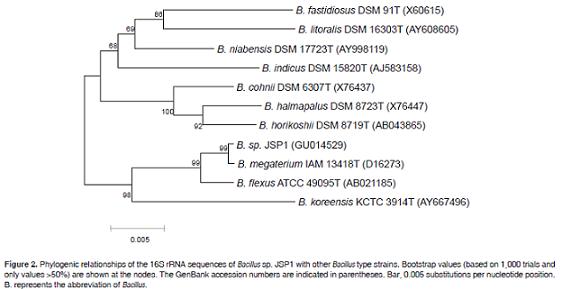
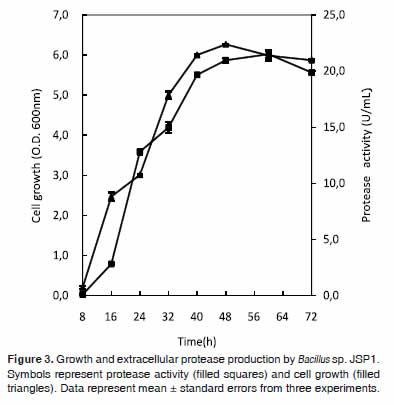
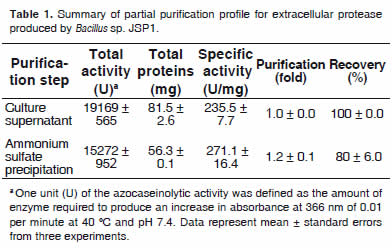
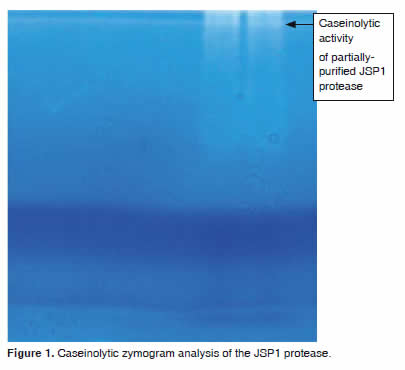
<body><![CDATA[<p><font face="Verdana, Arial, Helvetica, sans-serif" size="3"><b>Results</b></font></p>      <p><font face="Verdana, Arial, Helvetica, sans-serif" size="2"><i>Identification  of isolated strain JSP1, protease production and partial purification of the  enzyme </i></font></p>      <p><font face="Verdana, Arial, Helvetica, sans-serif" size="2">To identify the isolated strain JSP1  that shows protease activity <a href="#f1">(Figure 1)</a>, we cloned its 16S rRNA gene and  compared the sequence with those available in the  database. A phylogenic tree based on the 16S  rRNA gene sequences from 10 bacterial <i>Bacillus  </i>strains  show ed that the JSP1 strain shared 99.7% sequence identity with the type strain, <i>Bacillus megaterium </i>IAM  13418 <a href="#f2">(Figure 2).</a></font></p>      <p align="center"><img src="/img/revistas/rccp/v24n1/a02f1.jpg"><a name="f1"></a></p>      <p align="center"><img src="/img/revistas/rccp/v24n1/a02f2.jpg"></font><a name="f2"></a></p>      <p><font face="Verdana, Arial, Helvetica, sans-serif" size="2">    Therefore, it was named <i>Bacillus sp.</i> JSP1.</font></p>      <p><font face="Verdana, Arial, Helvetica, sans-serif" size="2">Time courses of cell growth and  extracellular protease activity were shown in <a href="#g1">figure 3</a>. Protease activity was  nearly proportional to cell growth during cultivation. The enzyme was steeply  produced after 16 h of incubation, showing a maximum activity (21.5 &plusmn; 0.1 U/mL) at 60 h of incubation.     The partial purification profile of the extracellular  protease produced by <i>Bacillus </i>sp.  JSP1 was summarized in <a href="#t1">table 1</a>.</font></p>      <p></font></p>      <p align="center"><img src="/img/revistas/rccp/v24n1/a02g1.jpg"></font><a name="g1"></a></p>     <p align="center"><img src="/img/revistas/rccp/v24n1/a02t1.jpg"></font><a name="t1"></a></p>     ]]></body>
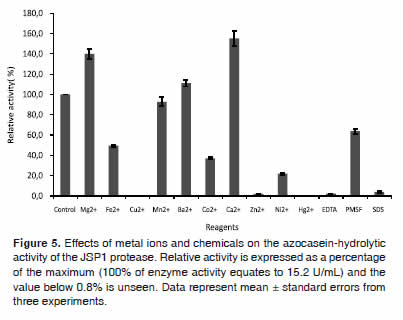
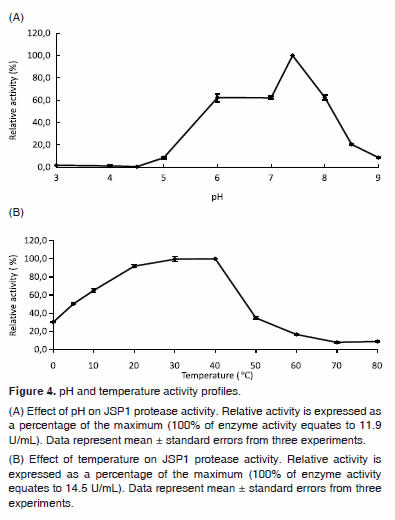
<body><![CDATA[<p><font face="Verdana, Arial, Helvetica, sans-serif" size="2"><i>Effect of pH  and temperature on enzyme activity</i></font></p>      <p><font face="Verdana, Arial, Helvetica, sans-serif" size="2">Optimal protease activity occurred at pH  7.4, while over 60% of the peak activity was achieved between pH 6.0 and 8.0.  However, activity was nearly completely inactivated at acidic pH (pH 3.0-5.0)  and above pH 8.5 <a href="#g2">(Figure 4A)</a>. As shown in <a href="#g2">figure 4B</a>, JSP1 protease showed  optimal activity at 20 &mdash; 40&deg;C and retained more than 35% of the activity  at 5 &mdash; 50&deg;C.</font></p>      <p align="center"><img src="/img/revistas/rccp/v24n1/a02g2.jpg"></font><a name="g2"></a></p>      <p>&nbsp;</p>      <p><font face="Verdana, Arial, Helvetica, sans-serif" size="2"><i>Substrate  specificity</i></font></p>      <p><font face="Verdana, Arial, Helvetica, sans-serif" size="2">JSP1   protease  hydrolyzed  casein   the  most  effectively   among  the  protein   substrates  tested <a href="#t2">(Table 2)</a>. The  enzyme   also  showed  relatively high  activity   on  keratin,  which   is  the  most   abundant  structural  protein   in  skin,  hair,   wool,  and  feathers  (Tatineni <i>et al.,</i> 2008) and gluten, which  is a useful  protein   source  in  cattle   feed  (Firkins  <i>et   al.,</i>  1985;      Ohajuruka  and   Palmquist,  1989).  Low   levels  of hydrolysis  were   observed  with  gelatin,   collagen,  and  bovine   serum  albumin  <a href="#t2">(Table   2)</a>.  Among  the   peptidyl-<i>p</i>-Nitroanilide  substrates   tested,  the  enzyme   was  active  against   L-Leu-<i>p</i>-Nitroanilide   and   N-Succinyl-L-Phe-<i>p</i>-Nitroanilide  which   is  cleaved  by   subtilisin-like  and  chymotrypsin-like  enzymes   (Hutadilok-Towatana  <i>et  al.,</i>   1999),  and  exhibited no activity on  N-Succinyl-L-Ala-Ala-Ala- <i>p</i>-Nitroanilide.</font></p>      <p align="center"><img src="/img/revistas/rccp/v24n1/a02t2.jpg"></font><a name="t2"></a></p>      <p>&nbsp;</p>      <p><font face="Verdana, Arial, Helvetica, sans-serif" size="2"><i>Effect of various reagents on enzyme  activity</i></font></p>      <p><font face="Verdana, Arial, Helvetica, sans-serif" size="2">The   protease  activity  in   the  presence  of   various metal  ions  or   chemicals  was  shown   in  <a href="#g3">figure  5</a>. Amongst the metal ions, Mg<sup>2+</sup> and Ca<sup>2+</sup> were highly effective  at   stimulating  JSP1  proteperase,   increasing activity by 40% and 55%, respectively. In contrast,     enzyme activity  was significantly  reduced   (50-78% of the control activity) in the presence of Fe<sup>2+</sup>, Co<sup>2+</sup>, and   Ni<sup>2+</sup>.   Although  Cu<sup>2+</sup>,   Zn<sup>2+</sup>,   and  Hg<sup>2+</sup>   almost completely   inactivated  the  enzyme,   no  important effect  on   the  activity was  observed with Mn<sup>2+</sup>   and Ba<sup>2+</sup>. The   enzyme was  also  completely   inactivated by EDTA  and  Sodium Dodecyl  Sulfate (SDS),  but moderately  inhibited   by  Phenyl  Methyl   Sulfonyl Fluoride (PMSF).</font></p>      ]]></body>
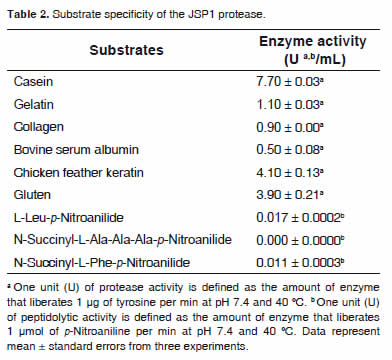
<body><![CDATA[<p align="center"><img src="/img/revistas/rccp/v24n1/a02g3.jpg"></font><a name="g3"></a></p>      <p>&nbsp;</p>      <p><font face="Verdana, Arial, Helvetica, sans-serif" size="3"><b>Discussion</b></font></p>      <p><font face="Verdana, Arial, Helvetica, sans-serif" size="2">In   the  present  study,   the  extracellular  protease secreted  by   an  Antarctic  strain,  <i>Bacillus  </i>sp. JSP1,  was   partially  characterized,  and   most  of  its properties  were   found  to  be   distinct  from  those   of other proteases from <i>Bacillus </i>strains.        The   JSP1  protease  is   nearly  a  neutral   protease, with an optimal pH of 7.4, while most known <i>Bacillus </i>species produce commercial proteases  that are highly active at pH 7.0 and 11.0, with an optimum around pH  8.0-10.0  (Davail  <i>et al.,</i> 1994; Hutadilok-Towatana  <i>et al.,</i> 1999; Jaouadi <i>et al.,</i> 2008).</font></p>      <p><font face="Verdana, Arial, Helvetica, sans-serif" size="2">The   optimum  temperature  of   40  &ordm;C   for  the protease  is   similar  to  the   temperature  (35  &ordm;C)   for the  serine  protease   of  the  psychrophilic   bacterium, <i>Colwellia </i>sp.  NJ341 (Wang <i>et al.,</i> 2005). Moreover, the  JSP1  protease   maintains  30%  of   its  highest activity  at   0  &ordm;C,   which  is  one   of  the  typical characteristics found in cold-active  enzymes (Wang <i>et al.,</i> 2005; Zhang and Zeng, 2008).</font></p>      <p><font face="Verdana, Arial, Helvetica, sans-serif" size="2">The   JSP1  protease  showed   the  highest  activity on   casein,  much  like   the  alkaline  serine   proteases from  <i>Bacillus  pumilus</i> CBS   (Jaouadi  <i>et  al.,  </i>2008), <i>Bacillus   stearothermophilus</i>  F1   (Rahman  <i>et  al., </i>1994) and <i>Bacillus </i>sp. KSM-K16 (Kobayashi <i>et al., </i>1995).   Unexpectedly,  the  enzyme   could  hydrolyze keratin  which,   like  other  insoluble   proteins,  is  an unacceptable  substrate   for  common  proteases   such as  trypsin  and   pepsin  (Letourneau  <i>et   al.,  </i>1998; Papadopoulos  <i>et   al.,  </i>1986). In  the   animal  feed industry, feather  waste can be a potential alternative to   more  costly  dietary   ingredients  for  animal feedstuffs  (Shih,   1993).  Worldwide,  commercial poultry  processing   produces  millions  of   tons  of feathers  per  year, which   are  currently  converted   to feather  meal  through   steam  pressure  and   chemical treatment  (Shih,  1993).   Although  chemical treatment  renders   keratin  waste  more   digestible, it  is  high-priced   and  destroys  certain   amino  acids (Papadopoulos <i>et al., </i>1986). </font></p>      <p><font face="Verdana, Arial, Helvetica, sans-serif" size="2">The nutritional enhancement of feather  meal by the enzymatic treatment might significantly improve amino acid  availability of feather keratin (Odetallah <i>et   al.,</i>  2003).   Until  now,  known   keratinolytic enzymes have been mainly produced by mesophilic fungi  (Santos  <i>et  al.,</i>   1996),  actinomycetes  (B&ouml;ckle <i>et   al.,</i>  1995),   some  thermophilic  <i>Bacillus</i>   sp.  (Kim <i>et  al.,</i>   2001),  and  some   thermophilic  anaerobes (Nam  <i>et   al.,</i>  2002).   To our knowledge, little has been known about keratinolytic  activity   detected  in Antarctic <i>Bacillus </i>strains. </font></p>      <p><font face="Verdana, Arial, Helvetica, sans-serif" size="2">Calcium   ions  are generally known  to be   involved in  maintaining  the   activity  of  <i>Bacillus  </i>serine  proteases  (Hutadilok-Towatana  <i>et   al.,</i>  1999;   Jaouadi <i>et  al.,</i>   2008).  However,  the   JSP1  protease  seems to   belong  to  the   metalloprotease  rather  than   to  the serine  protease   family,  because  the   activity  of  this enzyme was  bly   inhibited  by  a   chelating  agent, EDTA, but only  partially  inhibited by PMSF,  a well-known   inhibitor  of  serine   proteases   (Hutadilok-Towatana  <i>et  al.,</i>   1999).  This  reasoning may   be  also     supported  by   the  observed Zn<sup>2+</sup>-dependent  inhibition, because  excess   zinc  inhibits  some   metalloproteases  (Auld,  1995).   It  is  interesting   that  the  enzyme  exhibited  keratinolytic   activity,  despite  the   fact  that  metalloproteases  are   not  frequently  associated with  keratinolytic   activity  (Tatineni  <i>et   al.,</i>  2008). The   enzyme  was  sensitive   to  anionic  SDS   addition, indicating that hydrogen bonds ay play a pivotal role in  maintaining enzyme activity (Wang <i>et al.,</i> 2005).</font></p>      <p><font face="Verdana, Arial, Helvetica, sans-serif" size="2">The   JSP1 protease may offer potential   for use as an environmentally-friendly feed dditive to improve the  production performance of  farm  animals, due   to its broad substrate specificity and relatively desirable  activity  levels  at   physiologically  relevant  pH  and  temperature.  Additionally,  the   keratinolytic  activity of  the enzyme will help  to conduct biotechnological processes  of   the  keratinous  biomaterials   from poultry  and  leather   industries.  A  more   detailed characterization of the enzyme such as gene cloning,  protein  engineering,  and   fermentation  technology  is warranted   to  maximize  the   catalytic  efficiency and  productive yield of the enzyme.</font></p>      <p>&nbsp;</p>      ]]></body>
<body><![CDATA[<p><font face="Verdana, Arial, Helvetica, sans-serif" size="3"><b>References </b></font></p>      <!-- ref --><p><font face="Verdana, Arial, Helvetica, sans-serif" size="2">1. Alexopoulos C,  Georgoulakis IE, Tzivara A, Kyriakis CS, Govaris A, Kyriakis SC. Field  evaluation of the effect of a probioticcontaining <i>Bacillus  licheniformis </i>and <i>Bacillus subtilis </i>spores on the health  status, performance, and carcass quality of grower and finisher pigs. J Vet Med  A Physiol Pathol Clin Med 2004; 51:306-312.</font>&nbsp;&nbsp;&nbsp;&nbsp;&nbsp;&nbsp;&nbsp;&nbsp;[&#160;<a href="javascript:void(0);" onclick="javascript: window.open('/scielo.php?script=sci_nlinks&ref=000084&pid=S0120-0690201100010000200001&lng=','','width=640,height=500,resizable=yes,scrollbars=1,menubar=yes,');">Links</a>&#160;]<!-- end-ref --><!-- ref --><p><font face="Verdana, Arial, Helvetica, sans-serif" size="2">2. Altschul SF, Gish W,  Miller W, Myers EW, Lipman DJ. Basic local alignment search tool. J Mol Biol  1990; 215:403-410. </font>&nbsp;&nbsp;&nbsp;&nbsp;&nbsp;&nbsp;&nbsp;&nbsp;[&#160;<a href="javascript:void(0);" onclick="javascript: window.open('/scielo.php?script=sci_nlinks&ref=000085&pid=S0120-0690201100010000200002&lng=','','width=640,height=500,resizable=yes,scrollbars=1,menubar=yes,');">Links</a>&#160;]<!-- end-ref --><!-- ref --><p><font face="Verdana, Arial, Helvetica, sans-serif" size="2">3. Auld DS. Removal and  replacement of metal ions in metallopeptidases. Meth Enzymol 1995; 248:228-242.</font>&nbsp;&nbsp;&nbsp;&nbsp;&nbsp;&nbsp;&nbsp;&nbsp;[&#160;<a href="javascript:void(0);" onclick="javascript: window.open('/scielo.php?script=sci_nlinks&ref=000086&pid=S0120-0690201100010000200003&lng=','','width=640,height=500,resizable=yes,scrollbars=1,menubar=yes,');">Links</a>&#160;]<!-- end-ref --><!-- ref --><p><font face="Verdana, Arial, Helvetica, sans-serif" size="2">4. B&ouml;ckle B, Galunski  B, M&uuml;ller R. Characterization of a keratinolytic serine protease from <i>Streptomyces  pactum</i>  DSM40530. Appl  Environ Microbiol 1995; 61:3705-3710.</font>&nbsp;&nbsp;&nbsp;&nbsp;&nbsp;&nbsp;&nbsp;&nbsp;[&#160;<a href="javascript:void(0);" onclick="javascript: window.open('/scielo.php?script=sci_nlinks&ref=000087&pid=S0120-0690201100010000200004&lng=','','width=640,height=500,resizable=yes,scrollbars=1,menubar=yes,');">Links</a>&#160;]<!-- end-ref --><!-- ref --><p><font face="Verdana, Arial, Helvetica, sans-serif" size="2">5. Davail S, Feller G,  Narinx E, Gerday C. Cold adaptation of proteins: purification,  characterization, and sequence of the heat-labile subtilisin from the Antarctic  psychrophile <i>Bacillus  </i>TA41. J Biol Chem 1994; 269:17448-17453.</font>&nbsp;&nbsp;&nbsp;&nbsp;&nbsp;&nbsp;&nbsp;&nbsp;[&#160;<a href="javascript:void(0);" onclick="javascript: window.open('/scielo.php?script=sci_nlinks&ref=000088&pid=S0120-0690201100010000200005&lng=','','width=640,height=500,resizable=yes,scrollbars=1,menubar=yes,');">Links</a>&#160;]<!-- end-ref --><!-- ref --><p><font face="Verdana, Arial, Helvetica, sans-serif" size="2">6. Demirjian DC,  Moris-Varas F, Cassidy CS. Enzymes from extremophiles. Curr Opin Chem Biol  2001; 5:144-151.</font>&nbsp;&nbsp;&nbsp;&nbsp;&nbsp;&nbsp;&nbsp;&nbsp;[&#160;<a href="javascript:void(0);" onclick="javascript: window.open('/scielo.php?script=sci_nlinks&ref=000089&pid=S0120-0690201100010000200006&lng=','','width=640,height=500,resizable=yes,scrollbars=1,menubar=yes,');">Links</a>&#160;]<!-- end-ref --><!-- ref --><p><font face="Verdana, Arial, Helvetica, sans-serif" size="2">7. Firkins JL, Berger  LL, Fahey Jr. GC. Evaluation of wet and dry distillers. grains and wet and dry  corn gluten feeds for ruminants. J Anim Sci 1985; 60:847-860.</font>&nbsp;&nbsp;&nbsp;&nbsp;&nbsp;&nbsp;&nbsp;&nbsp;[&#160;<a href="javascript:void(0);" onclick="javascript: window.open('/scielo.php?script=sci_nlinks&ref=000090&pid=S0120-0690201100010000200007&lng=','','width=640,height=500,resizable=yes,scrollbars=1,menubar=yes,');">Links</a>&#160;]<!-- end-ref --><!-- ref --><p><font face="Verdana, Arial, Helvetica, sans-serif" size="2">8. Folin O, Ciocalteau  V. On tyrosine and tryptophan determinations in proteins. J Biol Chem 1927;  73:627-650.</font>&nbsp;&nbsp;&nbsp;&nbsp;&nbsp;&nbsp;&nbsp;&nbsp;[&#160;<a href="javascript:void(0);" onclick="javascript: window.open('/scielo.php?script=sci_nlinks&ref=000091&pid=S0120-0690201100010000200008&lng=','','width=640,height=500,resizable=yes,scrollbars=1,menubar=yes,');">Links</a>&#160;]<!-- end-ref --><!-- ref --><p><font face="Verdana, Arial, Helvetica, sans-serif" size="2">9. Gupta R, Beg QK,  Lorenz P. Bacterial alkaline protease: molecular approaches and industrial  applications. Appl Microbiol Biotechnol 2002; 59:15-32.</font>&nbsp;&nbsp;&nbsp;&nbsp;&nbsp;&nbsp;&nbsp;&nbsp;[&#160;<a href="javascript:void(0);" onclick="javascript: window.open('/scielo.php?script=sci_nlinks&ref=000092&pid=S0120-0690201100010000200009&lng=','','width=640,height=500,resizable=yes,scrollbars=1,menubar=yes,');">Links</a>&#160;]<!-- end-ref --><!-- ref --><p><font face="Verdana, Arial, Helvetica, sans-serif" size="2">10. Hong D, Burrows H,  Adeola O. Addition of enzymes to starter and grower diets for ducks. Poult Sci  2002; 81:1842-1849.</font>&nbsp;&nbsp;&nbsp;&nbsp;&nbsp;&nbsp;&nbsp;&nbsp;[&#160;<a href="javascript:void(0);" onclick="javascript: window.open('/scielo.php?script=sci_nlinks&ref=000093&pid=S0120-0690201100010000200010&lng=','','width=640,height=500,resizable=yes,scrollbars=1,menubar=yes,');">Links</a>&#160;]<!-- end-ref --><!-- ref --><p><font face="Verdana, Arial, Helvetica, sans-serif" size="2">11. Hutadilok-Towatana  N, Painupong A, Suntinanalert P. Purification and characterization of an extracellular  protease from alkaliphilic and thermophilic <i>Bacillus </i>sp. PS 719. J Biosci  Bioeng 1999; 87:581-587.</font>&nbsp;&nbsp;&nbsp;&nbsp;&nbsp;&nbsp;&nbsp;&nbsp;[&#160;<a href="javascript:void(0);" onclick="javascript: window.open('/scielo.php?script=sci_nlinks&ref=000094&pid=S0120-0690201100010000200011&lng=','','width=640,height=500,resizable=yes,scrollbars=1,menubar=yes,');">Links</a>&#160;]<!-- end-ref --><!-- ref --><p><font face="Verdana, Arial, Helvetica, sans-serif" size="2">12. Jaouadi B,  Ellouz-Chaabouni S, Rhimi M, Bejar S. Biochemical and molecular  characterization of a detergent-stable alkaline protease from <i>Bacillus  pumilus </i>CBS with high  catalytic eficiency. Biochimie 2008; 90:1291-1305.</font>&nbsp;&nbsp;&nbsp;&nbsp;&nbsp;&nbsp;&nbsp;&nbsp;[&#160;<a href="javascript:void(0);" onclick="javascript: window.open('/scielo.php?script=sci_nlinks&ref=000095&pid=S0120-0690201100010000200012&lng=','','width=640,height=500,resizable=yes,scrollbars=1,menubar=yes,');">Links</a>&#160;]<!-- end-ref --><!-- ref --><p><font face="Verdana, Arial, Helvetica, sans-serif" size="2">13. Kim JM, Lim WJ, Suh  HJ. Feather-degrading <i>Bacillus </i>species from poultry  waste. Process Biochem 2001; 37:287-291.</font>&nbsp;&nbsp;&nbsp;&nbsp;&nbsp;&nbsp;&nbsp;&nbsp;[&#160;<a href="javascript:void(0);" onclick="javascript: window.open('/scielo.php?script=sci_nlinks&ref=000096&pid=S0120-0690201100010000200013&lng=','','width=640,height=500,resizable=yes,scrollbars=1,menubar=yes,');">Links</a>&#160;]<!-- end-ref --><!-- ref --><p><font face="Verdana, Arial, Helvetica, sans-serif" size="2">14. Kobayashi T,  Hakamada Y, Adachi S, Hitomi J, Yoshimatsu T, Koike K, Kawai S, Ito S. Purification  and properties of an alkaline protease from alkalophilic <i>Bacillus </i>sp. KSM-K16. Appl Microbiol Biotechnol 1995;  43:473-481.</font>&nbsp;&nbsp;&nbsp;&nbsp;&nbsp;&nbsp;&nbsp;&nbsp;[&#160;<a href="javascript:void(0);" onclick="javascript: window.open('/scielo.php?script=sci_nlinks&ref=000097&pid=S0120-0690201100010000200014&lng=','','width=640,height=500,resizable=yes,scrollbars=1,menubar=yes,');">Links</a>&#160;]<!-- end-ref --><!-- ref --><p><font face="Verdana, Arial, Helvetica, sans-serif" size="2">15. Kritas SK, Morrison  RB. Evaluation of probiotics as a substitute for antibiotics in a large pig  nursery. Vet Rec 2005; 156:447-448.</font>&nbsp;&nbsp;&nbsp;&nbsp;&nbsp;&nbsp;&nbsp;&nbsp;[&#160;<a href="javascript:void(0);" onclick="javascript: window.open('/scielo.php?script=sci_nlinks&ref=000098&pid=S0120-0690201100010000200015&lng=','','width=640,height=500,resizable=yes,scrollbars=1,menubar=yes,');">Links</a>&#160;]<!-- end-ref --><!-- ref --><p><font face="Verdana, Arial, Helvetica, sans-serif" size="2">16. Letourneau F,  Soussotte V, Bressollier P, Branland P, Verneuil B. Keratinolytic activity of <i>Streptomyces  </i>sp. S.K 1-02: A new isolated  strain. Lett Appl Microbiol 1998; 26:77-80.</font>&nbsp;&nbsp;&nbsp;&nbsp;&nbsp;&nbsp;&nbsp;&nbsp;[&#160;<a href="javascript:void(0);" onclick="javascript: window.open('/scielo.php?script=sci_nlinks&ref=000099&pid=S0120-0690201100010000200016&lng=','','width=640,height=500,resizable=yes,scrollbars=1,menubar=yes,');">Links</a>&#160;]<!-- end-ref --><!-- ref --><p><font face="Verdana, Arial, Helvetica, sans-serif" size="2">17. Marsman GIP, Gruppen  H, Van der Poel AFB, Kwakkel RP, Verstegen MWA, Voragen AGJ. The effect of  thermal processing and enzyme treatments of soybean meal on growth performance,  ileal nutrient digestibilities, and chime characteristics in broiler chicks.  Poult Sci 1997; 76:864-872.</font>&nbsp;&nbsp;&nbsp;&nbsp;&nbsp;&nbsp;&nbsp;&nbsp;[&#160;<a href="javascript:void(0);" onclick="javascript: window.open('/scielo.php?script=sci_nlinks&ref=000100&pid=S0120-0690201100010000200017&lng=','','width=640,height=500,resizable=yes,scrollbars=1,menubar=yes,');">Links</a>&#160;]<!-- end-ref --><!-- ref --><p><font face="Verdana, Arial, Helvetica, sans-serif" size="2">18. Nam GW, Lee DW, Lee  HS, Lee NJ, Kim BC, Choe EA, Hwang JK, Suhartono MT, Pyun YR. Native-feather    degradation by <i>Fervidobacterium  islandicum </i>AW-1, a newly isolated  keratinase-producing thermophilic anaerobe. Arch Microbiol 2002; 178:538-547.</font>&nbsp;&nbsp;&nbsp;&nbsp;&nbsp;&nbsp;&nbsp;&nbsp;[&#160;<a href="javascript:void(0);" onclick="javascript: window.open('/scielo.php?script=sci_nlinks&ref=000101&pid=S0120-0690201100010000200018&lng=','','width=640,height=500,resizable=yes,scrollbars=1,menubar=yes,');">Links</a>&#160;]<!-- end-ref --><!-- ref --><p><font face="Verdana, Arial, Helvetica, sans-serif" size="2">19. Odetallah NH, Wang  JJ, Garlich JD, Shih JCH. Keratinase in starter diets improves growth of  broiler chicks. Poult Sci 2003; 82:664-670.</font>&nbsp;&nbsp;&nbsp;&nbsp;&nbsp;&nbsp;&nbsp;&nbsp;[&#160;<a href="javascript:void(0);" onclick="javascript: window.open('/scielo.php?script=sci_nlinks&ref=000102&pid=S0120-0690201100010000200019&lng=','','width=640,height=500,resizable=yes,scrollbars=1,menubar=yes,');">Links</a>&#160;]<!-- end-ref --><!-- ref --><p><font face="Verdana, Arial, Helvetica, sans-serif" size="2">20. Ohajuruka OA,  Palmquist DL. Response of high-producing dairy cows to high levels of dried  corn gluten feed. Anim Feed Sci Tech 1989; 24:191-200.</font>&nbsp;&nbsp;&nbsp;&nbsp;&nbsp;&nbsp;&nbsp;&nbsp;[&#160;<a href="javascript:void(0);" onclick="javascript: window.open('/scielo.php?script=sci_nlinks&ref=000103&pid=S0120-0690201100010000200020&lng=','','width=640,height=500,resizable=yes,scrollbars=1,menubar=yes,');">Links</a>&#160;]<!-- end-ref --><!-- ref --><p><font face="Verdana, Arial, Helvetica, sans-serif" size="2">21. Papadopoulos MC, El  Boushy AR, Roodbeen AE, Ketelaars EH. Effect of processing time and moisture  content on amino acid composition and nitrogen characteristics of feather meal.  Anim Feed Sci Technol 1986; 14:279-290.</font>&nbsp;&nbsp;&nbsp;&nbsp;&nbsp;&nbsp;&nbsp;&nbsp;[&#160;<a href="javascript:void(0);" onclick="javascript: window.open('/scielo.php?script=sci_nlinks&ref=000104&pid=S0120-0690201100010000200021&lng=','','width=640,height=500,resizable=yes,scrollbars=1,menubar=yes,');">Links</a>&#160;]<!-- end-ref --><!-- ref --><p><font face="Verdana, Arial, Helvetica, sans-serif" size="2">22. Park HJ, Jeon JH,  Kang SG, Lee JH, Lee SA, Kim HK. Functional expression and refolding of new  alkaline esterase, EM2L8 from deep-sea sediment metagenome. Protein Expres Purif  2007; 52:340-347.</font>&nbsp;&nbsp;&nbsp;&nbsp;&nbsp;&nbsp;&nbsp;&nbsp;[&#160;<a href="javascript:void(0);" onclick="javascript: window.open('/scielo.php?script=sci_nlinks&ref=000105&pid=S0120-0690201100010000200022&lng=','','width=640,height=500,resizable=yes,scrollbars=1,menubar=yes,');">Links</a>&#160;]<!-- end-ref --><!-- ref --><p><font face="Verdana, Arial, Helvetica, sans-serif" size="2">23. Rahman RNZA, Razak  CZ, Ampon K, Basri M, Zin WM, Yumus W, Salleh AB. Purification and  characterization of a heat-stable alkaline protease from <i>Bacillus  stearothermophilus </i>F1. Appl Microbiol  Biotechnol 1994; 40:822-827.</font>&nbsp;&nbsp;&nbsp;&nbsp;&nbsp;&nbsp;&nbsp;&nbsp;[&#160;<a href="javascript:void(0);" onclick="javascript: window.open('/scielo.php?script=sci_nlinks&ref=000106&pid=S0120-0690201100010000200023&lng=','','width=640,height=500,resizable=yes,scrollbars=1,menubar=yes,');">Links</a>&#160;]<!-- end-ref --><!-- ref --><p><font face="Verdana, Arial, Helvetica, sans-serif" size="2">24. Rai SK, Mukherjee  AK. Ecological significance and some biotechnological application of an organic  stable alkaline serine protease from <i>Bacillus  subtilis </i>strain DM-04. Bioresource  Technol 2009; 100:2642-2645.</font>&nbsp;&nbsp;&nbsp;&nbsp;&nbsp;&nbsp;&nbsp;&nbsp;[&#160;<a href="javascript:void(0);" onclick="javascript: window.open('/scielo.php?script=sci_nlinks&ref=000107&pid=S0120-0690201100010000200024&lng=','','width=640,height=500,resizable=yes,scrollbars=1,menubar=yes,');">Links</a>&#160;]<!-- end-ref --><!-- ref --><p><font face="Verdana, Arial, Helvetica, sans-serif" size="2">25. Rao MB, Tanksale AM,  Ghatge MS, Deshpande VV. Molecular and biotechnological aspects of microbial  proteases. Microbiol Mol Biol Rev 1998; 62:597-635.</font>&nbsp;&nbsp;&nbsp;&nbsp;&nbsp;&nbsp;&nbsp;&nbsp;[&#160;<a href="javascript:void(0);" onclick="javascript: window.open('/scielo.php?script=sci_nlinks&ref=000108&pid=S0120-0690201100010000200025&lng=','','width=640,height=500,resizable=yes,scrollbars=1,menubar=yes,');">Links</a>&#160;]<!-- end-ref --><!-- ref --><p><font face="Verdana, Arial, Helvetica, sans-serif" size="2">26. Santos RMD, Firmino  AAP, S&aacute; CM, Felix CR. Keratinolytic activity of <i>Aspergillus  fumigatus </i>Fresenius. Curr  Microbiol 1996; 33:364-370.</font>&nbsp;&nbsp;&nbsp;&nbsp;&nbsp;&nbsp;&nbsp;&nbsp;[&#160;<a href="javascript:void(0);" onclick="javascript: window.open('/scielo.php?script=sci_nlinks&ref=000109&pid=S0120-0690201100010000200026&lng=','','width=640,height=500,resizable=yes,scrollbars=1,menubar=yes,');">Links</a>&#160;]<!-- end-ref --><!-- ref --><p><font face="Verdana, Arial, Helvetica, sans-serif" size="2">27. Shih JCH. Recent  development in poultry waste digestion and feather utilization- a review. Poult  Sci 1993; 72:1617-1620.</font>&nbsp;&nbsp;&nbsp;&nbsp;&nbsp;&nbsp;&nbsp;&nbsp;[&#160;<a href="javascript:void(0);" onclick="javascript: window.open('/scielo.php?script=sci_nlinks&ref=000110&pid=S0120-0690201100010000200027&lng=','','width=640,height=500,resizable=yes,scrollbars=1,menubar=yes,');">Links</a>&#160;]<!-- end-ref --><!-- ref --><p><font face="Verdana, Arial, Helvetica, sans-serif" size="2">28. Tamura K, Dudley J,  Nei M, Kumar S. MEGA4: Molecular Evolution Genetics Analysis (MEGA) software  version 4.0. Mol Biol Evol 2007; 24:1596-1599.</font>&nbsp;&nbsp;&nbsp;&nbsp;&nbsp;&nbsp;&nbsp;&nbsp;[&#160;<a href="javascript:void(0);" onclick="javascript: window.open('/scielo.php?script=sci_nlinks&ref=000111&pid=S0120-0690201100010000200028&lng=','','width=640,height=500,resizable=yes,scrollbars=1,menubar=yes,');">Links</a>&#160;]<!-- end-ref --><!-- ref --><p><font face="Verdana, Arial, Helvetica, sans-serif" size="2">29. Tamura K, Nei M,  Kumar S. Prospect for inferring very large phylogenies by using the  neighbor-joining methods. Proc Natl Aca Sci USA 2004; 101:11030-11035.</font>&nbsp;&nbsp;&nbsp;&nbsp;&nbsp;&nbsp;&nbsp;&nbsp;[&#160;<a href="javascript:void(0);" onclick="javascript: window.open('/scielo.php?script=sci_nlinks&ref=000112&pid=S0120-0690201100010000200029&lng=','','width=640,height=500,resizable=yes,scrollbars=1,menubar=yes,');">Links</a>&#160;]<!-- end-ref --><!-- ref --><p><font face="Verdana, Arial, Helvetica, sans-serif" size="2">30. Tatineni R,  Doddapaneni KK, Potumarthi RC, Vellanki RN, Kandathil MT, Kolli N, Mangamoori  LN. Purification and characterization of an alkaline keratinase from <i>Streptomyces </i>sp. Bioresour Technol 2008;  99:1596-1602.</font>&nbsp;&nbsp;&nbsp;&nbsp;&nbsp;&nbsp;&nbsp;&nbsp;[&#160;<a href="javascript:void(0);" onclick="javascript: window.open('/scielo.php?script=sci_nlinks&ref=000113&pid=S0120-0690201100010000200030&lng=','','width=640,height=500,resizable=yes,scrollbars=1,menubar=yes,');">Links</a>&#160;]<!-- end-ref --><!-- ref --><p><font face="Verdana, Arial, Helvetica, sans-serif" size="2">31. Thompson JD, Higgins  DG, Gibson TJ. CLUSTAL W: improving the sensitivity of progressive multiple  sequence alignment through sequence weighting, position-specific gap penalties  and weight matrix choice. Nucleic Acids Res 1994; 22:4673-4680.</font>&nbsp;&nbsp;&nbsp;&nbsp;&nbsp;&nbsp;&nbsp;&nbsp;[&#160;<a href="javascript:void(0);" onclick="javascript: window.open('/scielo.php?script=sci_nlinks&ref=000114&pid=S0120-0690201100010000200031&lng=','','width=640,height=500,resizable=yes,scrollbars=1,menubar=yes,');">Links</a>&#160;]<!-- end-ref --><!-- ref --><p><font face="Verdana, Arial, Helvetica, sans-serif" size="2">32. Thorpe J, Beal JD.  Vegetable protein meals and the effects of enzymes. In: Bedford MR, Partridge  GG, editors. Enzymes in Farm Animal Nutrition. Wallingford, Oxon, UK: CABI  Publ; 2001. p.125-143.</font>&nbsp;&nbsp;&nbsp;&nbsp;&nbsp;&nbsp;&nbsp;&nbsp;[&#160;<a href="javascript:void(0);" onclick="javascript: window.open('/scielo.php?script=sci_nlinks&ref=000115&pid=S0120-0690201100010000200032&lng=','','width=640,height=500,resizable=yes,scrollbars=1,menubar=yes,');">Links</a>&#160;]<!-- end-ref --><!-- ref --><p><font face="Verdana, Arial, Helvetica, sans-serif" size="2">33. Wang QF, Miao JL,  Hou YH, Ding Y, Wang GD, Li GY. Purfication and characterization of an  extracellular cold-active serine protease from the psychrophilic bacterium <i>Colwellia </i>sp. NJ341. Biotechnol Lett 2005; 27:1195-1198.</font>&nbsp;&nbsp;&nbsp;&nbsp;&nbsp;&nbsp;&nbsp;&nbsp;[&#160;<a href="javascript:void(0);" onclick="javascript: window.open('/scielo.php?script=sci_nlinks&ref=000116&pid=S0120-0690201100010000200033&lng=','','width=640,height=500,resizable=yes,scrollbars=1,menubar=yes,');">Links</a>&#160;]<!-- end-ref --><!-- ref --><p><font face="Verdana, Arial, Helvetica, sans-serif" size="2">34. William GW, Susan MB,  Dale AP, David JL. 16S ribosomal DNA amplification for phylogenetic study. J  Bacteriol 1991; 173:697-703.</font>&nbsp;&nbsp;&nbsp;&nbsp;&nbsp;&nbsp;&nbsp;&nbsp;[&#160;<a href="javascript:void(0);" onclick="javascript: window.open('/scielo.php?script=sci_nlinks&ref=000117&pid=S0120-0690201100010000200034&lng=','','width=640,height=500,resizable=yes,scrollbars=1,menubar=yes,');">Links</a>&#160;]<!-- end-ref --><!-- ref --><p><font face="Verdana, Arial, Helvetica, sans-serif" size="2">35. Zhang JW, Zeng RY.  Purification and characterization of a coldadapted &#945;.amylase produced by <i>Nocardiopsis </i>sp. 7326 isolated from Prydz bay,  Antarctic. Marine Biotechnol 2008; 10:75-82. </font>&nbsp;&nbsp;&nbsp;&nbsp;&nbsp;&nbsp;&nbsp;&nbsp;[&#160;<a href="javascript:void(0);" onclick="javascript: window.open('/scielo.php?script=sci_nlinks&ref=000118&pid=S0120-0690201100010000200035&lng=','','width=640,height=500,resizable=yes,scrollbars=1,menubar=yes,');">Links</a>&#160;]<!-- end-ref --> ]]></body><back>
<ref-list>
<ref id="B1">
<label>1</label><nlm-citation citation-type="journal">
<person-group person-group-type="author">
<name>
<surname><![CDATA[Alexopoulos]]></surname>
<given-names><![CDATA[C]]></given-names>
</name>
<name>
<surname><![CDATA[Georgoulakis]]></surname>
<given-names><![CDATA[IE]]></given-names>
</name>
<name>
<surname><![CDATA[Tzivara]]></surname>
<given-names><![CDATA[A]]></given-names>
</name>
<name>
<surname><![CDATA[Kyriakis]]></surname>
<given-names><![CDATA[CS]]></given-names>
</name>
<name>
<surname><![CDATA[Govaris]]></surname>
<given-names><![CDATA[A]]></given-names>
</name>
<name>
<surname><![CDATA[Kyriakis]]></surname>
<given-names><![CDATA[SC]]></given-names>
</name>
</person-group>
<article-title xml:lang="en"><![CDATA[Field evaluation of the effect of a probioticcontaining Bacillus licheniformis and Bacillus subtilis spores on the health status, performance, and carcass quality of grower and finisher pigs]]></article-title>
<source><![CDATA[J Vet Med A Physiol Pathol Clin Med]]></source>
<year>2004</year>
<volume>51</volume>
<page-range>306-312</page-range></nlm-citation>
</ref>
<ref id="B2">
<label>2</label><nlm-citation citation-type="journal">
<person-group person-group-type="author">
<name>
<surname><![CDATA[Altschul]]></surname>
<given-names><![CDATA[SF]]></given-names>
</name>
<name>
<surname><![CDATA[Gish]]></surname>
<given-names><![CDATA[W]]></given-names>
</name>
<name>
<surname><![CDATA[Miller]]></surname>
<given-names><![CDATA[W]]></given-names>
</name>
<name>
<surname><![CDATA[Myers]]></surname>
<given-names><![CDATA[EW]]></given-names>
</name>
<name>
<surname><![CDATA[Lipman]]></surname>
<given-names><![CDATA[DJ]]></given-names>
</name>
</person-group>
<article-title xml:lang="en"><![CDATA[Basic local alignment search tool]]></article-title>
<source><![CDATA[J Mol Biol]]></source>
<year>1990</year>
<volume>215</volume>
<page-range>403-410</page-range></nlm-citation>
</ref>
<ref id="B3">
<label>3</label><nlm-citation citation-type="journal">
<person-group person-group-type="author">
<name>
<surname><![CDATA[Auld]]></surname>
<given-names><![CDATA[DS]]></given-names>
</name>
</person-group>
<article-title xml:lang="en"><![CDATA[Removal and replacement of metal ions in metallopeptidases]]></article-title>
<source><![CDATA[Meth Enzymol]]></source>
<year>1995</year>
<volume>248</volume>
<page-range>228-242</page-range></nlm-citation>
</ref>
<ref id="B4">
<label>4</label><nlm-citation citation-type="journal">
<person-group person-group-type="author">
<name>
<surname><![CDATA[Böckle]]></surname>
<given-names><![CDATA[B]]></given-names>
</name>
<name>
<surname><![CDATA[Galunski]]></surname>
<given-names><![CDATA[B]]></given-names>
</name>
<name>
<surname><![CDATA[Müller]]></surname>
<given-names><![CDATA[R]]></given-names>
</name>
</person-group>
<article-title xml:lang="en"><![CDATA[Characterization of a keratinolytic serine protease from Streptomyces pactum DSM40530]]></article-title>
<source><![CDATA[Appl Environ Microbiol]]></source>
<year>1995</year>
<volume>61</volume>
<page-range>3705-3710</page-range></nlm-citation>
</ref>
<ref id="B5">
<label>5</label><nlm-citation citation-type="journal">
<person-group person-group-type="author">
<name>
<surname><![CDATA[Davail]]></surname>
<given-names><![CDATA[S]]></given-names>
</name>
<name>
<surname><![CDATA[Feller]]></surname>
<given-names><![CDATA[G]]></given-names>
</name>
<name>
<surname><![CDATA[Narinx]]></surname>
<given-names><![CDATA[E]]></given-names>
</name>
<name>
<surname><![CDATA[Gerday]]></surname>
<given-names><![CDATA[C]]></given-names>
</name>
</person-group>
<article-title xml:lang="en"><![CDATA[Cold adaptation of proteins: purification, characterization, and sequence of the heat-labile subtilisin from the Antarctic psychrophile Bacillus TA41]]></article-title>
<source><![CDATA[J Biol Chem]]></source>
<year>1994</year>
<volume>269</volume>
<page-range>17448-17453</page-range></nlm-citation>
</ref>
<ref id="B6">
<label>6</label><nlm-citation citation-type="journal">
<person-group person-group-type="author">
<name>
<surname><![CDATA[Demirjian]]></surname>
<given-names><![CDATA[DC]]></given-names>
</name>
<name>
<surname><![CDATA[Moris-Varas]]></surname>
<given-names><![CDATA[F]]></given-names>
</name>
<name>
<surname><![CDATA[Cassidy]]></surname>
<given-names><![CDATA[CS]]></given-names>
</name>
</person-group>
<article-title xml:lang="en"><![CDATA[Enzymes from extremophiles]]></article-title>
<source><![CDATA[Curr Opin Chem Biol]]></source>
<year>2001</year>
<volume>5</volume>
<page-range>144-151</page-range></nlm-citation>
</ref>
<ref id="B7">
<label>7</label><nlm-citation citation-type="journal">
<person-group person-group-type="author">
<name>
<surname><![CDATA[Firkins]]></surname>
<given-names><![CDATA[JL]]></given-names>
</name>
<name>
<surname><![CDATA[Berger]]></surname>
<given-names><![CDATA[LL]]></given-names>
</name>
<name>
<surname><![CDATA[Fahey]]></surname>
<given-names><![CDATA[Jr]]></given-names>
</name>
</person-group>
<article-title xml:lang="en"><![CDATA[GC. Evaluation of wet and dry distillers grains and wet and dry corn gluten feeds for ruminants]]></article-title>
<source><![CDATA[J Anim Sci]]></source>
<year>1985</year>
<volume>60</volume>
<page-range>847-860</page-range></nlm-citation>
</ref>
<ref id="B8">
<label>8</label><nlm-citation citation-type="journal">
<person-group person-group-type="author">
<name>
<surname><![CDATA[Folin]]></surname>
<given-names><![CDATA[O]]></given-names>
</name>
<name>
<surname><![CDATA[Ciocalteau]]></surname>
<given-names><![CDATA[V]]></given-names>
</name>
</person-group>
<article-title xml:lang="en"><![CDATA[On tyrosine and tryptophan determinations in proteins]]></article-title>
<source><![CDATA[J Biol Chem]]></source>
<year>1927</year>
<volume>73</volume>
<page-range>627-650</page-range></nlm-citation>
</ref>
<ref id="B9">
<label>9</label><nlm-citation citation-type="journal">
<person-group person-group-type="author">
<name>
<surname><![CDATA[Gupta]]></surname>
<given-names><![CDATA[R]]></given-names>
</name>
<name>
<surname><![CDATA[Beg]]></surname>
<given-names><![CDATA[QK]]></given-names>
</name>
<name>
<surname><![CDATA[Lorenz]]></surname>
<given-names><![CDATA[P]]></given-names>
</name>
</person-group>
<article-title xml:lang="en"><![CDATA[Bacterial alkaline protease: molecular approaches and industrial applications]]></article-title>
<source><![CDATA[Appl Microbiol Biotechnol]]></source>
<year>2002</year>
<volume>59</volume>
<page-range>15-32</page-range></nlm-citation>
</ref>
<ref id="B10">
<label>10</label><nlm-citation citation-type="journal">
<person-group person-group-type="author">
<name>
<surname><![CDATA[Hong]]></surname>
<given-names><![CDATA[D]]></given-names>
</name>
<name>
<surname><![CDATA[Burrows]]></surname>
<given-names><![CDATA[H]]></given-names>
</name>
<name>
<surname><![CDATA[Adeola]]></surname>
<given-names><![CDATA[O]]></given-names>
</name>
</person-group>
<article-title xml:lang="en"><![CDATA[Addition of enzymes to starter and grower diets for ducks]]></article-title>
<source><![CDATA[Poult Sci]]></source>
<year>2002</year>
<volume>81</volume>
<page-range>1842-1849</page-range></nlm-citation>
</ref>
<ref id="B11">
<label>11</label><nlm-citation citation-type="journal">
<person-group person-group-type="author">
<name>
<surname><![CDATA[Hutadilok-Towatana]]></surname>
<given-names><![CDATA[N]]></given-names>
</name>
<name>
<surname><![CDATA[Painupong]]></surname>
<given-names><![CDATA[A]]></given-names>
</name>
<name>
<surname><![CDATA[Suntinanalert]]></surname>
<given-names><![CDATA[P]]></given-names>
</name>
</person-group>
<article-title xml:lang="en"><![CDATA[Purification and characterization of an extracellular protease from alkaliphilic and thermophilic Bacillus sp. PS 719]]></article-title>
<source><![CDATA[J Biosci Bioeng]]></source>
<year>1999</year>
<volume>87</volume>
<page-range>581-587</page-range></nlm-citation>
</ref>
<ref id="B12">
<label>12</label><nlm-citation citation-type="journal">
<person-group person-group-type="author">
<name>
<surname><![CDATA[Jaouadi]]></surname>
<given-names><![CDATA[B]]></given-names>
</name>
<name>
<surname><![CDATA[Ellouz-Chaabouni]]></surname>
<given-names><![CDATA[S]]></given-names>
</name>
<name>
<surname><![CDATA[Rhimi]]></surname>
<given-names><![CDATA[M]]></given-names>
</name>
<name>
<surname><![CDATA[Bejar]]></surname>
<given-names><![CDATA[S]]></given-names>
</name>
</person-group>
<article-title xml:lang="en"><![CDATA[Biochemical and molecular characterization of a detergent-stable alkaline protease from Bacillus pumilus CBS with high catalytic eficiency]]></article-title>
<source><![CDATA[Biochimie]]></source>
<year>2008</year>
<volume>90</volume>
<page-range>1291-1305</page-range></nlm-citation>
</ref>
<ref id="B13">
<label>13</label><nlm-citation citation-type="journal">
<person-group person-group-type="author">
<name>
<surname><![CDATA[Kim]]></surname>
<given-names><![CDATA[JM]]></given-names>
</name>
<name>
<surname><![CDATA[Lim]]></surname>
<given-names><![CDATA[WJ]]></given-names>
</name>
<name>
<surname><![CDATA[Suh]]></surname>
<given-names><![CDATA[HJ]]></given-names>
</name>
</person-group>
<article-title xml:lang="en"><![CDATA[Feather-degrading Bacillus species from poultry waste]]></article-title>
<source><![CDATA[Process Biochem]]></source>
<year>2001</year>
<volume>37</volume>
<page-range>287-291</page-range></nlm-citation>
</ref>
<ref id="B14">
<label>14</label><nlm-citation citation-type="journal">
<person-group person-group-type="author">
<name>
<surname><![CDATA[Kobayashi]]></surname>
<given-names><![CDATA[T]]></given-names>
</name>
<name>
<surname><![CDATA[Hakamada]]></surname>
<given-names><![CDATA[Y]]></given-names>
</name>
<name>
<surname><![CDATA[Adachi]]></surname>
<given-names><![CDATA[S]]></given-names>
</name>
<name>
<surname><![CDATA[Hitomi]]></surname>
<given-names><![CDATA[J]]></given-names>
</name>
<name>
<surname><![CDATA[Yoshimatsu]]></surname>
<given-names><![CDATA[T]]></given-names>
</name>
<name>
<surname><![CDATA[Koike]]></surname>
<given-names><![CDATA[K]]></given-names>
</name>
<name>
<surname><![CDATA[Kawai]]></surname>
<given-names><![CDATA[S]]></given-names>
</name>
<name>
<surname><![CDATA[Ito]]></surname>
<given-names><![CDATA[S]]></given-names>
</name>
</person-group>
<article-title xml:lang="en"><![CDATA[Purification and properties of an alkaline protease from alkalophilic Bacillus sp KSM-K16]]></article-title>
<source><![CDATA[Appl Microbiol Biotechnol]]></source>
<year>1995</year>
<volume>43</volume>
<page-range>473-481</page-range></nlm-citation>
</ref>
<ref id="B15">
<label>15</label><nlm-citation citation-type="journal">
<person-group person-group-type="author">
<name>
<surname><![CDATA[Kritas]]></surname>
<given-names><![CDATA[SK]]></given-names>
</name>
<name>
<surname><![CDATA[Morrison]]></surname>
<given-names><![CDATA[RB]]></given-names>
</name>
</person-group>
<article-title xml:lang="en"><![CDATA[Evaluation of probiotics as a substitute for antibiotics in a large pig nursery]]></article-title>
<source><![CDATA[Vet Rec]]></source>
<year>2005</year>
<volume>156</volume>
<page-range>447-448</page-range></nlm-citation>
</ref>
<ref id="B16">
<label>16</label><nlm-citation citation-type="journal">
<person-group person-group-type="author">
<name>
<surname><![CDATA[Letourneau]]></surname>
<given-names><![CDATA[F]]></given-names>
</name>
<name>
<surname><![CDATA[Soussotte]]></surname>
<given-names><![CDATA[V]]></given-names>
</name>
<name>
<surname><![CDATA[Bressollier]]></surname>
<given-names><![CDATA[P]]></given-names>
</name>
<name>
<surname><![CDATA[Branland]]></surname>
<given-names><![CDATA[P]]></given-names>
</name>
<name>
<surname><![CDATA[Verneuil]]></surname>
<given-names><![CDATA[B]]></given-names>
</name>
</person-group>
<article-title xml:lang="en"><![CDATA[Keratinolytic activity of Streptomyces sp S.K 1-02: A new isolated strain]]></article-title>
<source><![CDATA[Lett Appl Microbiol]]></source>
<year>1998</year>
<volume>26</volume>
<page-range>77-80</page-range></nlm-citation>
</ref>
<ref id="B17">
<label>17</label><nlm-citation citation-type="journal">
<person-group person-group-type="author">
<name>
<surname><![CDATA[Marsman]]></surname>
<given-names><![CDATA[GIP]]></given-names>
</name>
<name>
<surname><![CDATA[Gruppen]]></surname>
<given-names><![CDATA[H]]></given-names>
</name>
<name>
<surname><![CDATA[Van]]></surname>
<given-names><![CDATA[der Poel AFB]]></given-names>
</name>
<name>
<surname><![CDATA[Kwakkel]]></surname>
<given-names><![CDATA[RP]]></given-names>
</name>
<name>
<surname><![CDATA[Verstegen]]></surname>
<given-names><![CDATA[MWA]]></given-names>
</name>
<name>
<surname><![CDATA[Voragen]]></surname>
<given-names><![CDATA[AGJ]]></given-names>
</name>
</person-group>
<article-title xml:lang="en"><![CDATA[The effect of thermal processing and enzyme treatments of soybean meal on growth performance, ileal nutrient digestibilities, and chime characteristics in broiler chicks]]></article-title>
<source><![CDATA[Poult Sci]]></source>
<year>1997</year>
<volume>76</volume>
<page-range>864-872</page-range></nlm-citation>
</ref>
<ref id="B18">
<label>18</label><nlm-citation citation-type="journal">
<person-group person-group-type="author">
<name>
<surname><![CDATA[Nam]]></surname>
<given-names><![CDATA[GW]]></given-names>
</name>
<name>
<surname><![CDATA[Lee]]></surname>
<given-names><![CDATA[DW]]></given-names>
</name>
<name>
<surname><![CDATA[Lee]]></surname>
<given-names><![CDATA[HS]]></given-names>
</name>
<name>
<surname><![CDATA[Lee]]></surname>
<given-names><![CDATA[NJ]]></given-names>
</name>
<name>
<surname><![CDATA[Kim]]></surname>
<given-names><![CDATA[BC]]></given-names>
</name>
<name>
<surname><![CDATA[Choe]]></surname>
<given-names><![CDATA[EA]]></given-names>
</name>
<name>
<surname><![CDATA[Hwang]]></surname>
<given-names><![CDATA[JK]]></given-names>
</name>
<name>
<surname><![CDATA[Suhartono]]></surname>
<given-names><![CDATA[MT]]></given-names>
</name>
<name>
<surname><![CDATA[Pyun]]></surname>
<given-names><![CDATA[YR]]></given-names>
</name>
</person-group>
<article-title xml:lang="en"><![CDATA[Native-feather degradation by Fervidobacterium islandicum AW-1, a newly isolated keratinase-producing thermophilic anaerobe]]></article-title>
<source><![CDATA[Arch Microbiol]]></source>
<year>2002</year>
<volume>178</volume>
<page-range>538-547</page-range></nlm-citation>
</ref>
<ref id="B19">
<label>19</label><nlm-citation citation-type="journal">
<person-group person-group-type="author">
<name>
<surname><![CDATA[Odetallah]]></surname>
<given-names><![CDATA[NH]]></given-names>
</name>
<name>
<surname><![CDATA[Wang]]></surname>
<given-names><![CDATA[JJ]]></given-names>
</name>
<name>
<surname><![CDATA[Garlich]]></surname>
<given-names><![CDATA[JD]]></given-names>
</name>
<name>
<surname><![CDATA[Shih]]></surname>
<given-names><![CDATA[JCH]]></given-names>
</name>
</person-group>
<article-title xml:lang="en"><![CDATA[Keratinase in starter diets improves growth of broiler chicks]]></article-title>
<source><![CDATA[Poult Sci]]></source>
<year>2003</year>
<volume>82</volume>
<page-range>664-670</page-range></nlm-citation>
</ref>
<ref id="B20">
<label>20</label><nlm-citation citation-type="journal">
<person-group person-group-type="author">
<name>
<surname><![CDATA[Ohajuruka]]></surname>
<given-names><![CDATA[OA]]></given-names>
</name>
<name>
<surname><![CDATA[Palmquist]]></surname>
<given-names><![CDATA[DL]]></given-names>
</name>
</person-group>
<article-title xml:lang="en"><![CDATA[Response of high-producing dairy cows to high levels of dried corn gluten feed]]></article-title>
<source><![CDATA[Anim Feed Sci Tech]]></source>
<year>1989</year>
<volume>24</volume>
<page-range>191-200</page-range></nlm-citation>
</ref>
<ref id="B21">
<label>21</label><nlm-citation citation-type="journal">
<person-group person-group-type="author">
<name>
<surname><![CDATA[Papadopoulos]]></surname>
<given-names><![CDATA[MC]]></given-names>
</name>
<name>
<surname><![CDATA[El]]></surname>
<given-names><![CDATA[Boushy AR]]></given-names>
</name>
<name>
<surname><![CDATA[Roodbeen]]></surname>
<given-names><![CDATA[AE]]></given-names>
</name>
<name>
<surname><![CDATA[Ketelaars]]></surname>
<given-names><![CDATA[EH]]></given-names>
</name>
</person-group>
<article-title xml:lang="en"><![CDATA[Effect of processing time and moisture content on amino acid composition and nitrogen characteristics of feather meal]]></article-title>
<source><![CDATA[Anim Feed Sci Technol]]></source>
<year>1986</year>
<volume>14</volume>
<page-range>279-290</page-range></nlm-citation>
</ref>
<ref id="B22">
<label>22</label><nlm-citation citation-type="journal">
<person-group person-group-type="author">
<name>
<surname><![CDATA[Park]]></surname>
<given-names><![CDATA[HJ]]></given-names>
</name>
<name>
<surname><![CDATA[Jeon]]></surname>
<given-names><![CDATA[JH]]></given-names>
</name>
<name>
<surname><![CDATA[Kang]]></surname>
<given-names><![CDATA[SG]]></given-names>
</name>
<name>
<surname><![CDATA[Lee]]></surname>
<given-names><![CDATA[JH]]></given-names>
</name>
<name>
<surname><![CDATA[Lee]]></surname>
<given-names><![CDATA[SA]]></given-names>
</name>
<name>
<surname><![CDATA[Kim]]></surname>
<given-names><![CDATA[HK]]></given-names>
</name>
</person-group>
<article-title xml:lang="en"><![CDATA[Functional expression and refolding of new alkaline esterase, EM2L8 from deep-sea sediment metagenome]]></article-title>
<source><![CDATA[Protein Expres Purif]]></source>
<year>2007</year>
<volume>52</volume>
<page-range>340-347</page-range></nlm-citation>
</ref>
<ref id="B23">
<label>23</label><nlm-citation citation-type="journal">
<person-group person-group-type="author">
<name>
<surname><![CDATA[Rahman]]></surname>
<given-names><![CDATA[RNZA]]></given-names>
</name>
<name>
<surname><![CDATA[Razak]]></surname>
<given-names><![CDATA[CZ]]></given-names>
</name>
<name>
<surname><![CDATA[Ampon]]></surname>
<given-names><![CDATA[K]]></given-names>
</name>
<name>
<surname><![CDATA[Basri]]></surname>
<given-names><![CDATA[M]]></given-names>
</name>
<name>
<surname><![CDATA[Zin]]></surname>
<given-names><![CDATA[WM]]></given-names>
</name>
<name>
<surname><![CDATA[Yumus]]></surname>
<given-names><![CDATA[W]]></given-names>
</name>
<name>
<surname><![CDATA[Salleh]]></surname>
<given-names><![CDATA[AB]]></given-names>
</name>
</person-group>
<article-title xml:lang="en"><![CDATA[Purification and characterization of a heat-stable alkaline protease from Bacillus stearothermophilus F1]]></article-title>
<source><![CDATA[Appl Microbiol Biotechnol]]></source>
<year>1994</year>
<volume>40</volume>
<page-range>822-827</page-range></nlm-citation>
</ref>
<ref id="B24">
<label>24</label><nlm-citation citation-type="journal">
<person-group person-group-type="author">
<name>
<surname><![CDATA[Rai]]></surname>
<given-names><![CDATA[SK]]></given-names>
</name>
<name>
<surname><![CDATA[Mukherjee]]></surname>
<given-names><![CDATA[AK]]></given-names>
</name>
</person-group>
<article-title xml:lang="en"><![CDATA[Ecological significance and some biotechnological application of an organic stable alkaline serine protease from Bacillus subtilis strain DM-04]]></article-title>
<source><![CDATA[Bioresource Technol]]></source>
<year>2009</year>
<volume>100</volume>
<page-range>2642-2645</page-range></nlm-citation>
</ref>
<ref id="B25">
<label>25</label><nlm-citation citation-type="journal">
<person-group person-group-type="author">
<name>
<surname><![CDATA[Rao]]></surname>
<given-names><![CDATA[MB]]></given-names>
</name>
<name>
<surname><![CDATA[Tanksale]]></surname>
<given-names><![CDATA[AM]]></given-names>
</name>
<name>
<surname><![CDATA[Ghatge]]></surname>
<given-names><![CDATA[MS]]></given-names>
</name>
<name>
<surname><![CDATA[Deshpande]]></surname>
<given-names><![CDATA[VV]]></given-names>
</name>
</person-group>
<article-title xml:lang="en"><![CDATA[Molecular and biotechnological aspects of microbial proteases]]></article-title>
<source><![CDATA[Microbiol Mol Biol Rev]]></source>
<year>1998</year>
<volume>62</volume>
<page-range>597-635</page-range></nlm-citation>
</ref>
<ref id="B26">
<label>26</label><nlm-citation citation-type="journal">
<person-group person-group-type="author">
<name>
<surname><![CDATA[Santos]]></surname>
<given-names><![CDATA[RMD]]></given-names>
</name>
<name>
<surname><![CDATA[Firmino]]></surname>
<given-names><![CDATA[AAP]]></given-names>
</name>
<name>
<surname><![CDATA[Sá]]></surname>
<given-names><![CDATA[CM]]></given-names>
</name>
<name>
<surname><![CDATA[Felix]]></surname>
<given-names><![CDATA[CR]]></given-names>
</name>
</person-group>
<article-title xml:lang="en"><![CDATA[Keratinolytic activity of Aspergillus fumigatus Fresenius]]></article-title>
<source><![CDATA[Curr Microbiol]]></source>
<year>1996</year>
<volume>33</volume>
<page-range>364-370</page-range></nlm-citation>
</ref>
<ref id="B27">
<label>27</label><nlm-citation citation-type="journal">
<person-group person-group-type="author">
<name>
<surname><![CDATA[Shih]]></surname>
<given-names><![CDATA[JCH]]></given-names>
</name>
</person-group>
<article-title xml:lang="en"><![CDATA[Recent development in poultry waste digestion and feather utilization- a review]]></article-title>
<source><![CDATA[Poult Sci]]></source>
<year>1993</year>
<volume>72</volume>
<page-range>1617-1620</page-range></nlm-citation>
</ref>
<ref id="B28">
<label>28</label><nlm-citation citation-type="journal">
<person-group person-group-type="author">
<name>
<surname><![CDATA[Tamura]]></surname>
<given-names><![CDATA[K]]></given-names>
</name>
<name>
<surname><![CDATA[Dudley]]></surname>
<given-names><![CDATA[J]]></given-names>
</name>
<name>
<surname><![CDATA[Nei]]></surname>
<given-names><![CDATA[M]]></given-names>
</name>
<name>
<surname><![CDATA[Kumar]]></surname>
<given-names><![CDATA[S]]></given-names>
</name>
</person-group>
<article-title xml:lang="en"><![CDATA[MEGA4: Molecular Evolution Genetics Analysis (MEGA) software version 4.0]]></article-title>
<source><![CDATA[Mol Biol Evol]]></source>
<year>2007</year>
<volume>24</volume>
<page-range>1596-1599</page-range></nlm-citation>
</ref>
<ref id="B29">
<label>29</label><nlm-citation citation-type="journal">
<person-group person-group-type="author">
<name>
<surname><![CDATA[Tamura]]></surname>
<given-names><![CDATA[K]]></given-names>
</name>
<name>
<surname><![CDATA[Nei]]></surname>
<given-names><![CDATA[M]]></given-names>
</name>
<name>
<surname><![CDATA[Kumar]]></surname>
<given-names><![CDATA[S]]></given-names>
</name>
</person-group>
<article-title xml:lang="en"><![CDATA[Prospect for inferring very large phylogenies by using the neighbor-joining methods]]></article-title>
<source><![CDATA[Proc Natl Aca Sci]]></source>
<year>2004</year>
<volume>101</volume>
<page-range>11030-11035</page-range></nlm-citation>
</ref>
<ref id="B30">
<label>30</label><nlm-citation citation-type="journal">
<person-group person-group-type="author">
<name>
<surname><![CDATA[Tatineni]]></surname>
<given-names><![CDATA[R]]></given-names>
</name>
<name>
<surname><![CDATA[Doddapaneni]]></surname>
<given-names><![CDATA[KK]]></given-names>
</name>
<name>
<surname><![CDATA[Potumarthi]]></surname>
<given-names><![CDATA[RC]]></given-names>
</name>
<name>
<surname><![CDATA[Vellanki]]></surname>
<given-names><![CDATA[RN]]></given-names>
</name>
<name>
<surname><![CDATA[Kandathil]]></surname>
<given-names><![CDATA[MT]]></given-names>
</name>
<name>
<surname><![CDATA[Kolli]]></surname>
<given-names><![CDATA[N]]></given-names>
</name>
<name>
<surname><![CDATA[Mangamoori]]></surname>
<given-names><![CDATA[LN]]></given-names>
</name>
</person-group>
<article-title xml:lang="en"><![CDATA[Purification and characterization of an alkaline keratinase from Streptomyces sp]]></article-title>
<source><![CDATA[Bioresour Technol]]></source>
<year>2008</year>
<volume>99</volume>
<page-range>1596-1602</page-range></nlm-citation>
</ref>
<ref id="B31">
<label>31</label><nlm-citation citation-type="journal">
<person-group person-group-type="author">
<name>
<surname><![CDATA[Thompson]]></surname>
<given-names><![CDATA[JD]]></given-names>
</name>
<name>
<surname><![CDATA[Higgins]]></surname>
<given-names><![CDATA[DG]]></given-names>
</name>
<name>
<surname><![CDATA[Gibson]]></surname>
<given-names><![CDATA[TJ]]></given-names>
</name>
</person-group>
<article-title xml:lang="en"><![CDATA[CLUSTAL W: improving the sensitivity of progressive multiple sequence alignment through sequence weighting, position-specific gap penalties and weight matrix choice]]></article-title>
<source><![CDATA[Nucleic Acids Res]]></source>
<year>1994</year>
<volume>22</volume>
<page-range>4673-4680</page-range></nlm-citation>
</ref>
<ref id="B32">
<label>32</label><nlm-citation citation-type="book">
<person-group person-group-type="author">
<name>
<surname><![CDATA[Thorpe]]></surname>
<given-names><![CDATA[J]]></given-names>
</name>
<name>
<surname><![CDATA[Beal]]></surname>
<given-names><![CDATA[JD]]></given-names>
</name>
</person-group>
<article-title xml:lang="en"><![CDATA[Vegetable protein meals and the effects of enzymes]]></article-title>
<person-group person-group-type="editor">
<name>
<surname><![CDATA[Bedford]]></surname>
<given-names><![CDATA[MR]]></given-names>
</name>
<name>
<surname><![CDATA[Partridge]]></surname>
<given-names><![CDATA[GG]]></given-names>
</name>
</person-group>
<source><![CDATA[Enzymes in Farm Animal Nutrition]]></source>
<year>2001</year>
<page-range>125-143</page-range><publisher-loc><![CDATA[Wallingford ]]></publisher-loc>
<publisher-name><![CDATA[CABI Publ]]></publisher-name>
</nlm-citation>
</ref>
<ref id="B33">
<label>33</label><nlm-citation citation-type="journal">
<person-group person-group-type="author">
<name>
<surname><![CDATA[Wang]]></surname>
<given-names><![CDATA[QF]]></given-names>
</name>
<name>
<surname><![CDATA[Miao]]></surname>
<given-names><![CDATA[JL]]></given-names>
</name>
<name>
<surname><![CDATA[Hou]]></surname>
<given-names><![CDATA[YH]]></given-names>
</name>
<name>
<surname><![CDATA[Ding]]></surname>
<given-names><![CDATA[Y]]></given-names>
</name>
<name>
<surname><![CDATA[Wang]]></surname>
<given-names><![CDATA[GD]]></given-names>
</name>
<name>
<surname><![CDATA[Li]]></surname>
<given-names><![CDATA[GY]]></given-names>
</name>
</person-group>
<article-title xml:lang="en"><![CDATA[Purfication and characterization of an extracellular cold-active serine protease from the psychrophilic bacterium Colwellia s.p NJ341]]></article-title>
<source><![CDATA[Biotechnol Lett]]></source>
<year>2005</year>
<volume>27</volume>
<page-range>1195-1198</page-range></nlm-citation>
</ref>
<ref id="B34">
<label>34</label><nlm-citation citation-type="journal">
<person-group person-group-type="author">
<name>
<surname><![CDATA[William]]></surname>
<given-names><![CDATA[GW]]></given-names>
</name>
<name>
<surname><![CDATA[Susan]]></surname>
<given-names><![CDATA[MB]]></given-names>
</name>
<name>
<surname><![CDATA[Dale]]></surname>
<given-names><![CDATA[AP]]></given-names>
</name>
<name>
<surname><![CDATA[David]]></surname>
<given-names><![CDATA[JL]]></given-names>
</name>
</person-group>
<article-title xml:lang="en"><![CDATA[16S ribosomal DNA amplification for phylogenetic study]]></article-title>
<source><![CDATA[J Bacteriol]]></source>
<year>1991</year>
<volume>173</volume>
<page-range>697-703</page-range></nlm-citation>
</ref>
<ref id="B35">
<label>35</label><nlm-citation citation-type="journal">
<person-group person-group-type="author">
<name>
<surname><![CDATA[Zhang]]></surname>
<given-names><![CDATA[JW]]></given-names>
</name>
<name>
<surname><![CDATA[Zeng]]></surname>
<given-names><![CDATA[RY]]></given-names>
</name>
</person-group>
<article-title xml:lang="en"><![CDATA[Purification and characterization of a coldadapted &#945;. amylase produced by Nocardiopsis sp. 7326 isolated from Prydz bay, Antarctic]]></article-title>
<source><![CDATA[Marine Biotechnol]]></source>
<year>2008</year>
<volume>10</volume>
<page-range>75-82</page-range></nlm-citation>
</ref>
</ref-list>
</back>
</article>