<?xml version="1.0" encoding="ISO-8859-1"?><article xmlns:mml="http://www.w3.org/1998/Math/MathML" xmlns:xlink="http://www.w3.org/1999/xlink" xmlns:xsi="http://www.w3.org/2001/XMLSchema-instance">
<front>
<journal-meta>
<journal-id>0120-0690</journal-id>
<journal-title><![CDATA[Revista Colombiana de Ciencias Pecuarias]]></journal-title>
<abbrev-journal-title><![CDATA[Rev Colom Cienc Pecua]]></abbrev-journal-title>
<issn>0120-0690</issn>
<publisher>
<publisher-name><![CDATA[Facultad de Ciencias Agrarias, Universidad de Antioquia]]></publisher-name>
</publisher>
</journal-meta>
<article-meta>
<article-id>S0120-06902011000200004</article-id>
<title-group>
<article-title xml:lang="en"><![CDATA[Insecticidal activity of a Melinis minutiflora grass extract on Stomoxys calcitrans flies]]></article-title>
<article-title xml:lang="es"><![CDATA[Actividad insecticida de un extracto del pasto Melinis minutiflora sobre moscas Stomoxys calcitrans]]></article-title>
<article-title xml:lang="pt"><![CDATA[Atividade inseticida do extrato do pasto Melinis minutiflora sobre a mosca Stomoxys calcitrans]]></article-title>
</title-group>
<contrib-group>
<contrib contrib-type="author">
<name>
<surname><![CDATA[Tobón]]></surname>
<given-names><![CDATA[Flor A]]></given-names>
</name>
<xref ref-type="aff" rid="A01"/>
</contrib>
</contrib-group>
<aff id="A01">
<institution><![CDATA[,Universidad de Antioquia Facultad de Química y Farmacia Farmochemistry Laboratory]]></institution>
<addr-line><![CDATA[Medellin ]]></addr-line>
<country>Colombia</country>
</aff>
<pub-date pub-type="pub">
<day>00</day>
<month>06</month>
<year>2011</year>
</pub-date>
<pub-date pub-type="epub">
<day>00</day>
<month>06</month>
<year>2011</year>
</pub-date>
<volume>24</volume>
<numero>2</numero>
<fpage>123</fpage>
<lpage>130</lpage>
<copyright-statement/>
<copyright-year/>
<self-uri xlink:href="http://www.scielo.org.co/scielo.php?script=sci_arttext&amp;pid=S0120-06902011000200004&amp;lng=en&amp;nrm=iso"></self-uri><self-uri xlink:href="http://www.scielo.org.co/scielo.php?script=sci_abstract&amp;pid=S0120-06902011000200004&amp;lng=en&amp;nrm=iso"></self-uri><self-uri xlink:href="http://www.scielo.org.co/scielo.php?script=sci_pdf&amp;pid=S0120-06902011000200004&amp;lng=en&amp;nrm=iso"></self-uri><abstract abstract-type="short" xml:lang="en"><p><![CDATA[Several extraction methods were utilized to study the insecticidal activity of a Melinis minutiflora grass extract. Four concentrations (10, 20, 40, 80%) of the product which had the highest yield (i.e., a wax-free hexane extract) were tested to establish its insecticidal activity on S. calcitrans flies (adults and larvae). It is hypothesized that an 80% plant extract has a lethal effect similar to or higher than cypermethrin on flies and larvae. Mortality rates were assessed by survival analysis comparing the Kaplan-Meier mortality curves against the standard pyrethroid (cypermethrin) or against the solvent (ethyl acetate). The median mortality (time to kill 50% of the population) of adult flies exposed to cypermethrin over an eight-hour period was one hour, while it was three hours for the highest concentration of the extract tested. Both medians were significantly lower than those of the other treatments. The median mortality of larvae exposed to cypermethrin for a 30 minute period was four minutes, while it was eight minutes for the highest concentration (80%) of the plant extract. These values were significantly lower than the medians obtained for the other concentrations of the extract. These data suggest that extracts obtained from Melinis minutiflora grass could be a safe substitute for chemical insecticides.]]></p></abstract>
<abstract abstract-type="short" xml:lang="es"><p><![CDATA[Después de evaluar tres métodos para obtener un extracto del pasto Melinis minutiflora, cuatro concentraciones (10, 20, 40, 80%) del producto que tuvo el mayor rendimiento &ndash;un extracto hexanoico libre de ceras&ndash; fueron comparadas para establecer su actividad insecticida sobre moscas Stomoxys calcitrans (adultos y larvas). Se plantea como hipótesis de investigación, que una concentración de 80% del extracto, tiene un efecto letal similar o superior al de la cipermetrina. Las tasas de mortalidad se evaluaron mediante análisis de supervivencia comparando las curvas de mortalidad de Kaplan-Meier para un piretroide (cipermetrina) y el solvente (acetato de etilo). La mediana de la mortalidad (o sea el tiempo requerido para matar el 50% de la población) de las moscas adultas expuestas a cipermetrina durante un período de ocho horas fue de una hora, mientras que fue de tres horas para el extracto al 80%. Ambas medianas fueron significativamente menores que las de los otros tratamientos. La mediana de la mortalidad de larvas expuestas a cipermetrina para un período de 30 minutos fue de cuatro minutos y de ocho minutos para la concentración más alta (80%) del extracto del pasto. Estos valores fueron significativamente menores que las medianas obtenidas para las otras concentraciones del extracto.]]></p></abstract>
<abstract abstract-type="short" xml:lang="pt"><p><![CDATA[Neste trabalho foram testados vários métodos de extração química para obter diferentes extratos do pasto Melinis minutiflora para estabelecer com qual obtém-se maior quantidade e maior atividade inseticida. O extrato obtido em maior quantidade foi o extrato hexânico livre de ceras em 0.60%, o qual determinou-se sua ação inseticida sobre larvas e adultos de S. calcitrans reproduzidas no laboratório. A mortalidade que produzem quatro concentrações (10, 20, 40, 80%) do extrato livre de ceras, percebe-se mediante a análise estatística de sobrevivência comparando as curvas de mortalidade de Kaplan-Meier frente ao padrão de referencia mosquicida cipermetrina (piretroide), e solvente acetato de etilo. As análise estatística da atividade inseticida das concentrações do extrato sobre S. calcitrans adultos em um período de oito horas, expressa pela mediana (tempo no qual se morrem o 50% da população), do efeito inseticida da cipermetrina foi de 1 hora, por enquanto na mediana do efeito inseticida do extrato à concentração de 80% sobre moscas adultas foi de 3.0 horas. Ambas as médias foram significativamente inferiores quando comparados com os dos demais tratamentos. Quanto à atividade inseticida de mortalidade, 50% das larvas expostas à cipermetrina ou acetato de etila por um prazo de 30 minutos a 4 minutos e a eficácia inseticida do extrato a 80% das larvas foi de 8 minutos, valores significativamente inferior ao de outras concentrações.]]></p></abstract>
<kwd-group>
<kwd lng="en"><![CDATA[insecticidal activity]]></kwd>
<kwd lng="en"><![CDATA[Melinis minutiflora]]></kwd>
<kwd lng="en"><![CDATA[Stomoxys calcitrans]]></kwd>
<kwd lng="es"><![CDATA[acción insecticida]]></kwd>
<kwd lng="es"><![CDATA[Melinis minutiflora]]></kwd>
<kwd lng="es"><![CDATA[Stomoxys calcitrans]]></kwd>
<kwd lng="pt"><![CDATA[atividade inseticida]]></kwd>
<kwd lng="pt"><![CDATA[Melinis minutiflora]]></kwd>
<kwd lng="pt"><![CDATA[Stomoxys calcitrans]]></kwd>
</kwd-group>
</article-meta>
</front><body><![CDATA[ <p align="center"><b><font size="4" face="verdana">Insecticidal activity of a <I>Melinis minutiflora</I> grass extract on <I>Stomoxys calcitrans </I>flies<Sup>&curren; </Sup> </font></b>      <P align="center" ><font size="3" face="verdana"><I><b>Actividad insecticida de un extracto del pasto Melinis minutiflora sobre moscas Stomoxys calcitrans </b></I></font></P >     <p align="center"><b><font size="3" face="verdana"><I>Atividade inseticida do extrato do pasto Melinis minutiflora sobre a mosca Stomoxys calcitrans</I></font></b>     <p align="center">     <p align="center"><font size="2" face="verdana">Flor A Tob&oacute;n<Sup><I>1*</I></Sup>, Qca Fc&eacute;utica, MS. </font>     <p align="center"> <font size="2"><font face="verdana">     <P ><Sup><I>1</I></Sup><I> UNI-PLURI/VERSIDAD Research group. Farmochemistry Laboratory, Faculty of Pharmaceutical Chemistry. University of Antioquia, AA 1226, Medellin, Colombia. </I></P >     <P ><I>(Received: 27 october, 2009; accepted: 7 september, 2010)</I></P >     <P >&curren; </B>To cite this article: Tob&oacute;n FA. Insecticidal activity of a <I>Melinis minutiflora</I> grass extract on <I>Stomoxys calcitrans </I>flies. Rev Colomb Cienc Pecu 2011; 24:123-</P >     <P >* 	Corresponding author: Flor A Tob&oacute;n. Farmochemistry Laboratory, Faculty of Pharmaceutical Chemistry. University of Antioquia, AA 1226, Medellin, Colombia. E-mail: <a href="mailto:florato54@gmail.com">florato54@gmail.com</a>. </P > </font></font> <hr >     ]]></body>
<body><![CDATA[<P ><font size="2" face="verdana"><I><b>Summary</b> </I></font></P >     <P ><font size="2" face="verdana"><I>Several extraction methods were utilized to study the insecticidal activity of a Melinis minutiflora grass extract. Four concentrations (10, 20, 40, 80%) of the product which had the highest yield (i.e., a wax-free hexane extract) were tested to establish its insecticidal activity on S. calcitrans flies (adults and larvae). It is hypothesized that an 80% plant extract has a lethal effect similar to or higher than cypermethrin on flies and larvae. Mortality rates were assessed by survival analysis comparing the Kaplan-Meier mortality curves against the standard pyrethroid (cypermethrin) or against the solvent (ethyl acetate). The median mortality (time to kill 50% of the population) of adult flies exposed to cypermethrin over an eight-hour period was one hour, while it was three hours for the highest concentration of the extract tested. Both medians were significantly lower than those of the other treatments. The median mortality of larvae exposed to cypermethrin for a 30 minute period was four minutes, while it was eight minutes for the highest concentration (80%) of the plant extract. These values were significantly lower than the medians obtained for the other concentrations of the extract. These data suggest that extracts obtained from Melinis minutiflora grass could be a safe substitute for chemical insecticides. </I></font></P >     <P ><font size="2" face="verdana"><b>Key words: </b><I>insecticidal activity, Melinis minutiflora</I><B><I>, </I></B><I>Stomoxys calcitrans.</I></font></P > <hr >     <P ><font size="2" face="verdana"><I><b>Resumen</b> </I></font></P >     <P ><font size="2" face="verdana"><I>Despu&eacute;s de evaluar tres m&eacute;todos para obtener un extracto del pasto Melinis minutiflora, cuatro concentraciones (10, 20, 40, 80%) del producto que tuvo el mayor rendimiento &ndash;un extracto hexanoico libre de ceras&ndash; fueron comparadas para establecer su actividad insecticida sobre moscas Stomoxys calcitrans (adultos y larvas). Se plantea como hip&oacute;tesis de investigaci&oacute;n, que una concentraci&oacute;n de 80% del extracto, tiene un efecto letal similar o superior al de la cipermetrina. Las tasas de mortalidad se evaluaron mediante an&aacute;lisis de supervivencia comparando las curvas de mortalidad de Kaplan-Meier para un piretroide (cipermetrina) y el solvente (acetato de etilo). La mediana de la mortalidad (o sea el tiempo requerido para matar el 50% de la poblaci&oacute;n) de las moscas adultas expuestas a cipermetrina durante un per&iacute;odo de ocho horas fue de una hora, mientras que fue de tres horas para el extracto al 80%. Ambas medianas fueron significativamente menores que las de los otros tratamientos. La mediana de la mortalidad de larvas expuestas a cipermetrina para un per&iacute;odo de 30 minutos fue de cuatro minutos y de ocho minutos para la concentraci&oacute;n m&aacute;s alta (80%) del extracto del pasto. Estos valores fueron significativamente menores que las medianas obtenidas para las otras concentraciones del extracto. </I></font></P >     <P ><font size="2" face="verdana"><b>Palabras clave:</b> <I>acci&oacute;n insecticida, Melinis minutiflora, Stomoxys calcitrans.</I></font></P > <hr >     <P ><font size="2" face="verdana"><I><b>Resumo</b> </I></font></P >     <P ><font size="2" face="verdana"><I>Neste trabalho foram testados v&aacute;rios m&eacute;todos de extra&ccedil;&atilde;o qu&iacute;mica para obter diferentes extratos do pasto Melinis minutiflora para estabelecer com qual obt&eacute;m-se maior quantidade e maior atividade inseticida. O extrato obtido em maior quantidade foi o extrato hex&acirc;nico livre de ceras em 0.60%, o qual determinou-se sua a&ccedil;&atilde;o inseticida sobre larvas e adultos de S. calcitrans reproduzidas no laborat&oacute;rio. A mortalidade que produzem quatro concentra&ccedil;&otilde;es (10, 20, 40, 80%) do extrato livre de ceras, percebe-se mediante a an&aacute;lise estat&iacute;stica de sobreviv&ecirc;ncia comparando as curvas de mortalidade de Kaplan-Meier frente ao padr&atilde;o de referencia mosquicida cipermetrina (piretroide), e solvente acetato de etilo. As an&aacute;lise estat&iacute;stica da atividade inseticida das concentra&ccedil;&otilde;es do extrato sobre S. calcitrans adultos em um per&iacute;odo de oito horas, expressa pela mediana (tempo no qual se morrem o 50% da popula&ccedil;&atilde;o), do efeito inseticida da cipermetrina foi de 1 hora, por enquanto na mediana do efeito inseticida do extrato &agrave; concentra&ccedil;&atilde;o de 80% sobre moscas adultas foi de 3.0 horas. Ambas as m&eacute;dias foram significativamente inferiores quando comparados com os dos demais tratamentos. Quanto &agrave; atividade inseticida de mortalidade, 50% das larvas expostas &agrave; cipermetrina ou acetato de etila por um prazo de 30 minutos a 4 minutos e a efic&aacute;cia inseticida do extrato a 80% das larvas foi de 8 minutos, valores significativamente inferior ao de outras concentra&ccedil;&otilde;es. </I></font></P >     <P ><font size="2" face="verdana"><b>Palabras-chave:</b> <I>atividade inseticida, Melinis minutiflora, Stomoxys calcitrans. </I></font></P > <hr >     <p>&nbsp;</p>     ]]></body>
<body><![CDATA[<p><b><font size="3" face="verdana">Introduction </font></b></p>     <P ><font size="2" face="verdana">There is increasing interest in the use of plants as alternative sources of insecticidal agents in the fight against insects, which are the main causes of many tropical diseases (Autran <I>et al.,</I> 2009). One of those plants is <I>M. minutiflora</I> grass. It belongs to the Glumiflorales order, Gramineae family, <I>Melinis genus, minutifl ora s</I>pecies (Secoy and Smith, 1983; Bernal, 1994). It is a resilient, invasive, and fast-growing grass used as fodder. </font></P >     <P ><font size="2" face="verdana">This grass (known by the names &ldquo;Chopin&rdquo; or &ldquo;Yaragu&aacute;&rdquo; in Colombia) seems to be responsible for the decline of ticks in animals that graze on it. It is widely distributed in fertile and well drained lands, but also thrives in poor soils. It grows in warm and temperate climates, between 18.3 and 26.6 &deg;C, and at elevations between 200 and 2.500 meters above sea level. </font></P >     <P ><font size="2" face="verdana">Previous studies revealed biological activity of this plant on arthropods, livestock pests such as ticks (<I>Boophilus microplus)</I>, demonstrating evidence of insecticidal effects (Casta&ntilde;eda, 1982; Ahumada, 1984). It has been also demonstrated that chromatographic fractions of <I>Melinis minutiflora </I>extracts have effective repellent action on the adult <I>Stomoxys calcitrans </I>fly, a hematophagous ectoparasite. This cosmopolitan fl y, widely distributed throughout the world is commonly known as &ldquo;barn fly&rdquo;. It likes to feed on sensitive parts of cattle (spine, bottom of the thighs, legs, nostrils, eyes) and to a lesser extent on horses and humans (Tob&oacute;n, 1986; Sandino, 1986). </font></P >     <P ><font size="2" face="verdana">Bites from <I>S. calcitrans</I> are painful, producing irritability, anxiety, restlessness and feeding difficulties in beef and dairy cattle, leading to various degrees of anaemia, weight loss and decreased milk production (Byford <I>et al.,</I> 1992; Peggy, 1995). <I>S. calcitrans</I> is important in veterinary medicine and medical entomology because of its negative impact on milk and meat production, especially in tropical and subtropical regions. This fly lays eggs on another fl y named <I>Dermatobia hominis</I>, which then contaminates open wounds in humans and animals causing myiasis (Nziani <I>et al.,</I> 1994; Botero and Restrepo, 1995; Carrol, 1996). It can become a direct problem of public health (Metcale and Flint, 1972; Tob&oacute;n, 1986; L&oacute;pez and G&oacute;mez, 1995). </font></P >     <P ><font size="2" face="verdana">The purpose of this study is to contribute to the understanding of the potential effect of <I>M. Minutiflora</I> for controlling <I>S. Calcitrans</I>, considering that this grass could be used as an environmentally-friendly insecticide option. </font></P >     <P >&nbsp;</P >     <P ><b><font size="3" face="verdana">Materials and methods </font></b></P >     <P ><font size="2" face="verdana">Before conducting the experiment, various chemical methods were assayed to obtain the plant product intended to be tested on <I>S. Calcitrans. </I>An extract was obtained from the epicuticular area of <I>M. minutiflora</I> leaves. Two products were obtained from the aerial parts of the plant, i.e., essential oils (by distillation with water steam), and a wax-free hexane extract. Due to the low yield of the other products, only the wax-free extract was later tested for bioactivity against adults and larvae of the insect, which were reproduced in the laboratory. </font></P >     <P ><font size="2" face="verdana">The Lethal Dose, 50% (LD<Sub>50</Sub>) was determined by exposing adults and larvae confined in Petri plates or plastic boxes, respectively, to one of several treatments: the wax-free hexane extract, a control (saline solution), a standard reference (Ciba Geigy, 1985), or a solvent (ethyl acetate). Plates and boxes contained either 1cc or 5 cc of the substance to be tested, respectively. Four solutions of the extract were tested: 10, 20, 40 and 80% wax-free hexane extracts. To prepare the 10% solution, 10 mg of the plant extract were diluted with 90 cc of ethyl acetate solvent. Similarly, the other solutions (i.e., 20, 40 and 80%) were prepared using the corresponding amounts of extract and solvent. Ten adult fl ies or larvae were tested in each plate or plastic container. Each extract solution was compared with the same concentration (i.e., 10 or 20 or 40 or 80%) of cypermethrin or ethyl acetate solvent, and also with a 0.9% isotonic saline solution, as a control. The study had tree replicates per treatment. </font></P >     ]]></body>
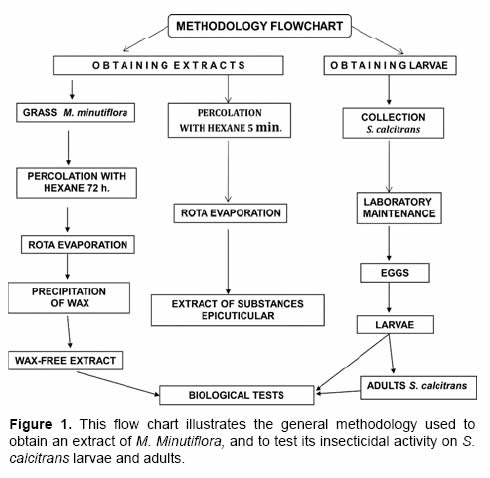
<body><![CDATA[<P ><font size="2" face="verdana">The study started when adults or larvae were confined in the containers or plates. The adults were left for eight hours in the containers, while larvae were left in the plates for 30 minutes. Adult fly mortality was evaluated eight hours after starting the test, while mortality of larvae was evaluated 30 minutes after the test was initiated. This Bioassay was conducted as illustrated in the diagram shown in figure 1. </font></P >     <P align="center" ><font size="2" face="verdana"><img src="/img/revistas/rccp/v24n2/v24n2a04i01.jpg"></font></P >     <P align="center" >&nbsp;</P >     <P >&nbsp;</P >     <P ><font size="2" face="verdana"><I>Collection and processing of plant material </I></font></P >     <P ><font size="2" face="verdana">The process to obtain the extract of <I>M. minutiflora</I> grass was as follows: </font></P >     <P ><font size="2" face="verdana">1) Plant material was collected from natural grasslands in which no agrochemicals have been used. Collection was conducted in rural areas of Marinilla municipality (Antioquia) and San Crist&oacute;bal (Medell&iacute;n), Colombia, 2) The grass was taxonomically identified in the herbarium of the University of Antioquia, 3) Then it was dried in the sun for three hours, and foreign material was eliminated, 4) The plant material was cut into small pieces and kept at room temperature for 5 to 7 days, 5) The material was ground and submitted to Soxhlet extraction with hexane, for 24 hours. Then it was filtered and concentrated in a rotary evaporator (BUCHI Labortechnik AG, Flawil, Switzerland) y 6) The extract was dissolved in ether plus methanol (10 ml). Then it was cooled for 24 hours to precipitate the waxes in order to obtain a wax-free hexane extract (Casta&ntilde;eda, 1982; Ahumada, 1984; Tob&oacute;n, 1986). </font></P >     <P >&nbsp;</P >     <P ><font size="2" face="verdana"><I>Animals </I></font></P >     <P ><font size="2" face="verdana">Flies were produced under laboratory conditions following the recommendations by Tob&oacute;n (1986). Reproduction of the flies was conducted in the farm of the Jaime Isaza Cadavid Polytechnic Institute, located in Marinilla (Colombia) at 2.050 meters of altitude, and at 17.2 &deg;C average temperature. </font></P >     ]]></body>
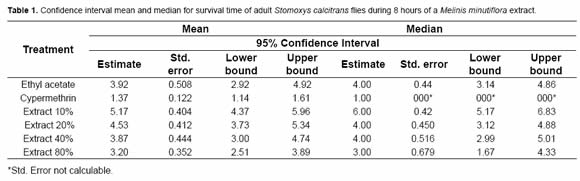
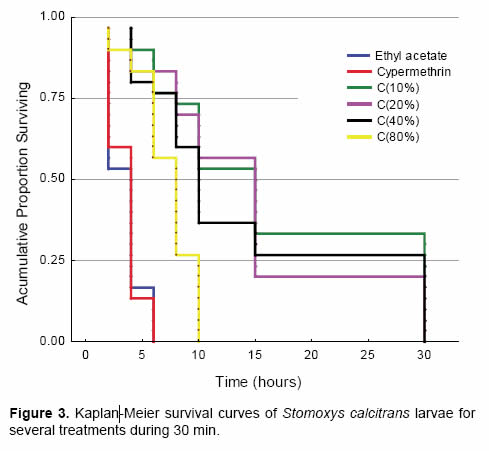
<body><![CDATA[<P ><font size="2" face="verdana">The flies were identified using a stereoscope (International Stereoscopic Union, Zurich, Switzerland) in the entomology laboratory of the School of Medicine, University of Antioquia, following the procedure reported by Harris (1978). </font></P >     <P >&nbsp;</P >     <P ><font size="2" face="verdana"><I>Statistical method </I></font></P >     <P  ><font size="2" face="verdana">Regression analysis was conducted using the Probit analysis (Wardlaw, 1980). The effect of the extracts was compared with that of the standard reference (Ciba Geigy, 1985), the solvent (ethyl acetate) and the saline control through Kaplan and Meier survival curves, using the generalized Gehan test, followed by the Bonferroni least significance difference procedure (Lee, 1980). Statistical probability of p&lt;0.05 was considered significant. Data were analyzed using the Statistica 7.0 program (StatSoft Inc., Tulsa, USA). </font></P >     <P  >&nbsp;</P >     <P  ><b><font size="3" face="verdana">Results </font></b></P >     <P ><font size="2" face="verdana"></B>The hexane epicuticular extract only yielded 0.20%, which was not enough to conduct the tests. The extraction of essential oils yielded even less: 0.02%. The hexane wax-free extract yielded 0.60%, and was later tested for its insecticidal activity against larvae and adult <I>S. Calcitrans. </I>The LD<Sub>50 </Sub>of the plant extract on adult flies was obtained at a concentration of 16.8% (95% CI: 10.5 - 26.9%), according to the Probit method. </font></P >     <P ><font size="2" face="verdana">The effect of the wax-free extract on adult fl ies is shown in figure 2 and table 1 </font></P >     <P align="center" ><font size="2" face="verdana"><img src="/img/revistas/rccp/v24n2/v24n2a04i02.jpg"></font></P >     <P ><font size="2" face="verdana">Figure 2 shows the Kaplan-Meier survival curves of adult <I>S. Calcitrans </I>during 8 hours of exposure to four concentrations of the extract. According to the generalized Gehan test, statistically significant differences in the mortality curves were found (&chi;<Sup>2</Sup>=48.3, p&lt;0.001). The mortality of adult fl ies at 80% concentration was significantly different from that of other concentrations (&chi;<Sup>2</Sup>=11.5, p=0.021)<I>. </I>Mortality had a similar trend for the other treatments (&chi;&sup2; =5.12, p=0.12). </font></P >     ]]></body>
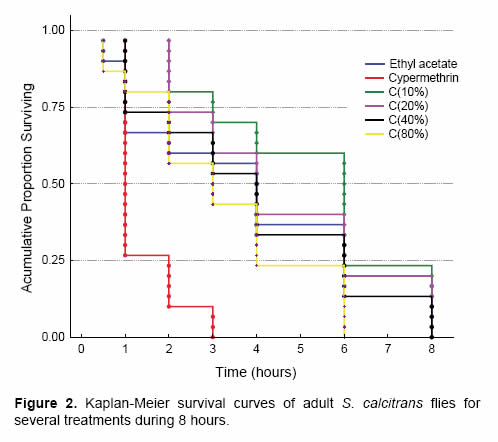
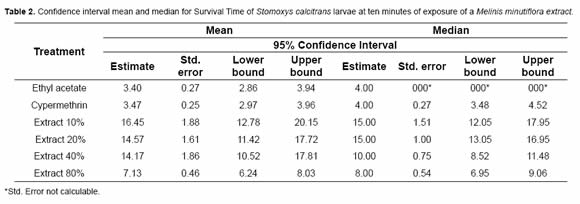
<body><![CDATA[<P align="center"  ><font size="2" face="verdana"><img src="/img/revistas/rccp/v24n2/v24n2a04t01.jpg"  ></font></P >     <P ><font size="2" face="verdana"></font></P >     <P  ><font size="2" face="verdana">Table 1 shows descriptive statistics and mean are significant differences between these curves and median confidence intervals for survival time (&chi;<Sup>2</Sup>=99.0, p&lt;0.001). (adult flies). The median for the 80% concentration of the extract was three hours, meaning that 50% of the population of flies <I>S. calcitrans</I> died during the first three hours after being exposed to this concentration of the extract.</font></P >     <P ><font size="2" face="verdana">The larvae mortality (LD<Sub>50</Sub>) was 17.4% (95% CI: 12.6%, 24.0%) in the first 10 minutes after starting the treatment, according to the Probit method. </font></P >     <P ><font size="2" face="verdana">The effect of the wax-free extract on larvae flies is shown in figure 3 and table 2. Figure 3 shows the survival curves of <I>S. Calcintrans</I> larvae comparing the mortality rates observed for each concentration of the extract. Mortality curves are counted similarly as previously explained for the adult flies, but now it was after only 30 minutes of exposure. The generalized Gehan test indicated that there are signifi cant differences between these curves  (&chi;2=99.0, p&lt;0.001).</font></P >     <P >&nbsp;</P >     <P align="center" ><font size="2" face="verdana"><img src="/img/revistas/rccp/v24n2/v24n2a04i03.jpg"></font></P >     <P  >&nbsp;</P >     <p >&nbsp;</p>     <p align="center"><font size="2" face="verdana"><img src="/img/revistas/rccp/v24n2/v24n2a04t02.jpg"></font></p>     ]]></body>
<body><![CDATA[<P ><font size="2" face="verdana">Table 2 shows descriptive statistics and mean and median confidence intervals for survival time (<I>S. Calcintrans</I> larvae). The median for the 80% concentration of the extract was eight min, meaning that 50% of the population of larvae <I>S. calcitrans </I>died during the first eight min after being exposed to this concentration of the extract.</font></P >     <P >&nbsp;</P >     <P ><b><font size="3" face="verdana">Discussion </font></b></P >     <P ><font size="2" face="verdana">Usually, the insecticidal control of<I> S. calcitrans </I>fly has been directed towards the adult stage, but not to the larvae, using repellent substances that prevent it to attack its host. A variety of chemicals, such as organophosphates, carbamates, organochlorines, arsenic and pyrethroids, commonly used against ticks are also used to repel fl ies. These traditional insecticides have not had a satisfactory response, because they generate resistance. This creates the need to search for bioactive substances naturally present in some plants, such as <I>M. minutiflora</I>, which shows insecticidal activity on larvae and adults of <I>S. calcitrans</I>. The purpose of this study was to explore a <I>M. minutiflora</I> extract as an alternative substance to control <I>S. calcitrans,</I> without the negative impact on the ecosystem generated when traditional insecticides are used (Secoy and Smith, 1983; Albert, 1999; Vallejo; 2000; Austran <I>et al.,</I> 2009). </font></P >     <P ><font size="2" face="verdana">The <I>S. calcitrans</I> bite serves as a mechanical vehicle for transmitting microorganisms that cause infections shared by animals and humans. These include parasites such as <I>Plasmodium falciparum </I>(Malaria), <I>Leishmania braziliensis</I> (Leishmaniosis), <I>Entamoeba histolytica (</I>Amibiosis) and <I>Trypanosoma cruzi</I> (Chagas). Subsequent parasitosis is usually associated with precarious life conditions in human populations. Flies can also transmit some bacteria. Among them <I>S. calcitrans</I> can transmit: <I>Bacillus anthracis</I> (Carbunco or Anthrax), whose spores are resistant to environmental factors. For example, carbunco is an endemic disease and essentially is an occupational hazard of veterinarians and farm workers. Other bacteria transmitted by this fl y are <I>Escherichia coli, Salmonella sp</I>., <I>Staphylococcus epidermidis</I>, S<I>taphylococcus aureus</I> and <I>Streptococcus pyogenes</I>. Its reservoir is usually the man and domestic animals. <I>S. calcitrans</I> can also transmit Arbovirus (yellow fever) (OPS, 1978; V&eacute;lez and Agudelo, 1996; Colombia MSP, 1999; Rodr&iacute;guez and Prado, 2006). </font></P >     <P ><font size="2" face="verdana">It can be inferred that this fly directly and indirectly generates significant economic losses in livestock production. However, the literature does not report accurate data, owing to the difficulty of conducting controlled studies (Pretezelca, 2003; OMS/OPS, 2004; OPS/MSF, 2005). This study was intended to determine the insecticide effect of <I>M. minutiflora</I> on adult flies and larvae of<I> S. calcitrans</I>. </font></P >     <P ><font size="2" face="verdana">The effect was proportional to the time of exposure. That is, the actions on larvae and adult flies varied over time but not with the concentration of the substance. The median for the standard (cypermethrin) was one hour, i.e., after one hour it had already killed 50% of adult flies. The median for the 80% concentration of the wax-free hexane extract was three hours, indicating that this concentration killed 50% of the flies at a time no longer than three hours. </font></P >     <P ><font size="2" face="verdana">The median time of dead for the other concentrations was similar among them, and equal to four hours (X<B>&sup2;</B>=5.12, p=0.12). According to these results, it can be concluded that the treatment that caused the fastest death was cypermethrin, followed by the 80% concentration of the plant extract, and after this, with similar killing times, were the other treatments. The insecticidal effect of the 80% extract on adult flies was 3.2 hours (arithmetic mean), while it was 1.4 hours for cypermethrin. The time range at which mortality occurs in adult <I>S. calcitrans was </I>1.4 to 3.2 hours for either cypermethrin or the grass extract (Tables 1 and 2; Figures 2 and 3). </font></P >     <P ><font size="2" face="verdana">The effect of the plant extract on larvae was between 80% to 100 after 10 minutes, killing 50% of the larvae in eight minutes. Cypermethrin had the highest mortality<I>, </I>followed by the ethyl acetate solvent, and then by the 80% concentration of the plant extract. The 10, 20 and 40% extract concentrations had similar effects on the larvae, but less than the other treatments (&chi;&sup2;=1.24, p=0.54). Both cypermethrin and the solvent ethyl acetate killed 100% of the larvae in six minutes (with a median of 4.0 minutes). The median time of death for the other treatments was about 15 minutes. Similarly, the potency of the extract on the larvae was proportional to the time of exposure for any of the four concentrations tested, where the number of dead larvae varied with time and concentration of the treatment. </font></P >     <P ><font size="2" face="verdana">Survival of adult <I>S. calcitrans</I>, once applied each treatment, was represented by Kaplan and Meier mortality curves, which showed the time of death of flies for a 10-hours period. Similarly, according to the evidence of Gehan test, there were statistically significant differences in the mortality curves (X&sup2;=48.3, p<0.001). See figure 2. It is worth mentioning that at 10 hours, all treatments had a 100% insecticide effect on adult flies. </font></P >     ]]></body>
<body><![CDATA[<P ><font size="2" face="verdana">Survival of <I>S. calcitrans</I> larvae was subject to the same treatments as adult flies, but during a 30-minutes period, and was also represented by Kaplan and Meier mortality curves. At the end of this period, 100% of the larvae had already died in all treatments. </font></P >     <P ><font size="2" face="verdana">The results of this exploratory study suggest that the bioactivity of the 80% free-waxes extract against <I>S. calcitrans</I> adults and larvae was similar to cypermethrin, as outlined in the hypothesis of the study. It is assumed that this extract has a naturally occurring insecticide that could have fewer adverse effects on animals, humans and the ecosystem compared to the harmful effects of cypermethrin and the ethyl acetate solvent. Given that the purpose of the solvent in an insecticide is to increase its lethal power, these results are consistent with our hypothesis, which stated that a high concentration of the extract (80%) has an insecticidal effect similar to cypermethrin, when dissolved in ethyl acetate for a better lethal action. Then, cypermethrin can be interchangeable with the 80% free-wax hexane extract. Although cypermethrin kills in one hour and the 80% extract in three hours, the time difference is not an impediment in the use the extract. It can be considered that the 80% extract effect is also fast. In addition, the plant extract does not have the toxic effects of cypermethrin (dermatitis, asthma, rhinitis), or organochlorines and organophosphate insecticides (neurotoxic, hepatotoxic and nephrotoxic effects). Therefore, the 80% <I>M. minutiflora</I> extract could become an alternative, naturally occurring insecticide, against <I>S. calcitrans </I>infestation in cattle (Vallejo, 2000; Albert, 1999; Organization Pan American Health/OMS, 2004). </font></P >     <P ><font size="2" face="verdana">There were difficulties in reproducing and maintaining the third and fourth stages of larvae, and adults of <I>S. calcitrans</I>, perhaps due to abrupt climatic changes. However, it was possible to standardize the fly population, although there were difficulties in obtaining a higher number of insects to increase the sample size. </font></P >     <P ><font size="2" face="verdana">Once the biological action of the extract is characterized, an active insecticide could be produced, which could be cheaper and safer for humans, animals and the ecosystem (Casta&ntilde;eda, 1982; Ahumada, 1984; Tob&oacute;n, 1986; Sandino, 1986). In this sense, further studies are required to establish the isolation procedure for the most effective <I>M. minutiflora</I> extract, the mechanisms responsible for the pharmacological effects against <I>S. calcitrans </I>flies<I>, </I>and to establish its relative toxicity compared to other pesticides traditionally used. </font></P >     <P >&nbsp;</P >     <p><b><font size="3" face="verdana">Acknowledgments </font></b></p>     <P ><font size="2" face="verdana">We want to thank the University of Antioquia Research Vice-Presidency for funding this study. Thanks also to the Agricultural Research Center (CIAG) from the same university, to the student internship of Pharmaceutical and Laboratory of Specialized Analyses (LEA) at the School of Pharmaceutical Chemistry, to the GIEM and GIBS Research Groups, to Dr. Verdugo, to farm director Roman G&oacute;mez G&oacute;mez, to Oscar Ortega (entomology professor at the Polytechnic Jaime Isaza Cadavid), and to Sandra Liliana Garc&iacute;a C., Jimena Mariana Ram&iacute;rez R., Hernando de Jesus Ceballos M. and Fredy Ernesto Valencia G. </font></P >     <P >&nbsp;</P >     <p><b><font size="3" face="verdana">References </font></b></p>     <!-- ref --><P ><font size="2" face="verdana">1. Ahumada A. Repellent activity and miticide oil and some fraction of the chromatographic <I>Melinis minutiflora</I> on <I>Boophilus microplus</I>. Thesis qualifies for the title of Master of Science Pharmacology. Universidad Nacional de Colombia, Bogot&aacute;, branch. 1984. </font></P >     &nbsp;&nbsp;&nbsp;&nbsp;&nbsp;&nbsp;&nbsp;&nbsp;[&#160;<a href="javascript:void(0);" onclick="javascript: window.open('/scielo.php?script=sci_nlinks&ref=000082&pid=S0120-0690201100020000400001&lng=','','width=640,height=500,resizable=yes,scrollbars=1,menubar=yes,');">Links</a>&#160;]<!-- end-ref --><!-- ref --><P ><font size="2" face="verdana">2. Albert L. Pan American Center of Human Ecology and Health. Pan American Health Organization. World Health Organization. Basic Course in Environmental Toxicology. Mexico DC: Limusa SA, UEHA Noriega Editores; 1999. p.311. </font></P >     &nbsp;&nbsp;&nbsp;&nbsp;&nbsp;&nbsp;&nbsp;&nbsp;[&#160;<a href="javascript:void(0);" onclick="javascript: window.open('/scielo.php?script=sci_nlinks&ref=000083&pid=S0120-0690201100020000400002&lng=','','width=640,height=500,resizable=yes,scrollbars=1,menubar=yes,');">Links</a>&#160;]<!-- end-ref --><!-- ref --><P ><font size="2" face="verdana">3. Autran E, Neves IA, Da Silva CS, Santos GK, Da C&acirc;mara CA, Navarro DM. Chemical composition, oviposition deterrent and larvicidal activities against <I>Aedes aegypti</I> of essential oils from <I>Piper marginatum Jacq</I>. (Piperaceae). Bioresour Technol 2009; 100:2284-2288. </font></P >     &nbsp;&nbsp;&nbsp;&nbsp;&nbsp;&nbsp;&nbsp;&nbsp;[&#160;<a href="javascript:void(0);" onclick="javascript: window.open('/scielo.php?script=sci_nlinks&ref=000084&pid=S0120-0690201100020000400003&lng=','','width=640,height=500,resizable=yes,scrollbars=1,menubar=yes,');">Links</a>&#160;]<!-- end-ref --><!-- ref --><P ><font size="2" face="verdana">4. Bernal E. <I>Melinis minutiflora</I>. En: Pastos y Forrajes Tropicales. 3 ed. Bogot&aacute; DC: Banco Ganadero; 1994. p. 360-365. </font></P >     &nbsp;&nbsp;&nbsp;&nbsp;&nbsp;&nbsp;&nbsp;&nbsp;[&#160;<a href="javascript:void(0);" onclick="javascript: window.open('/scielo.php?script=sci_nlinks&ref=000085&pid=S0120-0690201100020000400004&lng=','','width=640,height=500,resizable=yes,scrollbars=1,menubar=yes,');">Links</a>&#160;]<!-- end-ref --><!-- ref --><P ><font size="2" face="verdana">5. Byford RL, Craig ME, Crosby BL. A review of ectoparasites and their effect on cattle production. J Anim Sci 1992; 70:597-602. </font></P >     &nbsp;&nbsp;&nbsp;&nbsp;&nbsp;&nbsp;&nbsp;&nbsp;[&#160;<a href="javascript:void(0);" onclick="javascript: window.open('/scielo.php?script=sci_nlinks&ref=000086&pid=S0120-0690201100020000400005&lng=','','width=640,height=500,resizable=yes,scrollbars=1,menubar=yes,');">Links</a>&#160;]<!-- end-ref --><!-- ref --><P ><font size="2" face="verdana">6. Botero D, Restrepo M. Artr&oacute;podos de importancia cl&iacute;nica. En: Parasitosis Humanas. 2 ed. Medell&iacute;n: CIB; 1995. p.418. </font></P >     &nbsp;&nbsp;&nbsp;&nbsp;&nbsp;&nbsp;&nbsp;&nbsp;[&#160;<a href="javascript:void(0);" onclick="javascript: window.open('/scielo.php?script=sci_nlinks&ref=000087&pid=S0120-0690201100020000400006&lng=','','width=640,height=500,resizable=yes,scrollbars=1,menubar=yes,');">Links</a>&#160;]<!-- end-ref --><!-- ref --><P ><font size="2" face="verdana">7. Carrol N. Insect Colonization and mass production. 3 ed. New York and London: Edited by Academic Press; 1996. </font></P >     &nbsp;&nbsp;&nbsp;&nbsp;&nbsp;&nbsp;&nbsp;&nbsp;[&#160;<a href="javascript:void(0);" onclick="javascript: window.open('/scielo.php?script=sci_nlinks&ref=000088&pid=S0120-0690201100020000400007&lng=','','width=640,height=500,resizable=yes,scrollbars=1,menubar=yes,');">Links</a>&#160;]<!-- end-ref --><!-- ref --><P ><font size="2" face="verdana">8. Casta&ntilde;eda N. Repellent action and miticide of <I>Melinis minutiflora on Boophilus microplus. </I>Thesis qualifies for the title of Master of Science Pharmacology. Universidad Nacional de Colombia, Bogot&aacute; branch. 1982. </font></P >     &nbsp;&nbsp;&nbsp;&nbsp;&nbsp;&nbsp;&nbsp;&nbsp;[&#160;<a href="javascript:void(0);" onclick="javascript: window.open('/scielo.php?script=sci_nlinks&ref=000089&pid=S0120-0690201100020000400008&lng=','','width=640,height=500,resizable=yes,scrollbars=1,menubar=yes,');">Links</a>&#160;]<!-- end-ref --><!-- ref --><P ><font size="2" face="verdana">9. Colombia Ministry of Health-The Salle University &#91;editorial&#93;. Manual of zoonotic diseases 1999; p.141 &#91;fecha de acceso: 20 junio de 2007&#93; URL: <a href="http://www.wvu.edu/~Agexten/pubnwsltr/TRIM/10627.pdf" target="_blank">http://www.wvu.edu/~Agexten/pubnwsltr/ TRIM/10627.pdf</a>. </font></P >     &nbsp;&nbsp;&nbsp;&nbsp;&nbsp;&nbsp;&nbsp;&nbsp;[&#160;<a href="javascript:void(0);" onclick="javascript: window.open('/scielo.php?script=sci_nlinks&ref=000090&pid=S0120-0690201100020000400009&lng=','','width=640,height=500,resizable=yes,scrollbars=1,menubar=yes,');">Links</a>&#160;]<!-- end-ref --><!-- ref --><P ><font size="2" face="verdana">10. Ciba Geigy (Colombia). Cypermethrin Monograf&iacute;a (Ganaba&ntilde;o<Sup><I>&reg;</I></Sup>). Divisi&oacute;n Veterinaria Bogot&aacute;; 1985. </font></P >     &nbsp;&nbsp;&nbsp;&nbsp;&nbsp;&nbsp;&nbsp;&nbsp;[&#160;<a href="javascript:void(0);" onclick="javascript: window.open('/scielo.php?script=sci_nlinks&ref=000091&pid=S0120-0690201100020000400010&lng=','','width=640,height=500,resizable=yes,scrollbars=1,menubar=yes,');">Links</a>&#160;]<!-- end-ref --><!-- ref --><P ><font size="2" face="verdana">11. Harris R. Stable flies and Horn flies (Subfamily Stomoxydae) in Surveillance and collection of arthropods of veterinary importance. United States, Department of Agriculture. Agriculture Handbook 1978; 518:77-79. </font></P >     &nbsp;&nbsp;&nbsp;&nbsp;&nbsp;&nbsp;&nbsp;&nbsp;[&#160;<a href="javascript:void(0);" onclick="javascript: window.open('/scielo.php?script=sci_nlinks&ref=000092&pid=S0120-0690201100020000400011&lng=','','width=640,height=500,resizable=yes,scrollbars=1,menubar=yes,');">Links</a>&#160;]<!-- end-ref --><!-- ref --><P ><font size="2" face="verdana">12. Lee E. Nonparametric methods for comparing survival distributions Statistical Methods for Survival Data Analysis. California: Lifetime Learning Publications; 1980. p.122-127. </font></P >     &nbsp;&nbsp;&nbsp;&nbsp;&nbsp;&nbsp;&nbsp;&nbsp;[&#160;<a href="javascript:void(0);" onclick="javascript: window.open('/scielo.php?script=sci_nlinks&ref=000093&pid=S0120-0690201100020000400012&lng=','','width=640,height=500,resizable=yes,scrollbars=1,menubar=yes,');">Links</a>&#160;]<!-- end-ref --><!-- ref --><P ><font size="2" face="verdana">13. L&oacute;pez G, G&oacute;mez J. Fly the barn a threat to livestock milk. Monograph ICA, Colombia Polytechnic; 1995. p.5. </font></P >     &nbsp;&nbsp;&nbsp;&nbsp;&nbsp;&nbsp;&nbsp;&nbsp;[&#160;<a href="javascript:void(0);" onclick="javascript: window.open('/scielo.php?script=sci_nlinks&ref=000094&pid=S0120-0690201100020000400013&lng=','','width=640,height=500,resizable=yes,scrollbars=1,menubar=yes,');">Links</a>&#160;]<!-- end-ref --><!-- ref --><P ><font size="2" face="verdana">14. Metcale C, Flint W. Insects that attack animals. In: Insects destructive insects and useful, habits and control. 4 ed. New York: Continental SA Company; 1972. p.1071, 1143, 1174. </font></P >     &nbsp;&nbsp;&nbsp;&nbsp;&nbsp;&nbsp;&nbsp;&nbsp;[&#160;<a href="javascript:void(0);" onclick="javascript: window.open('/scielo.php?script=sci_nlinks&ref=000095&pid=S0120-0690201100020000400014&lng=','','width=640,height=500,resizable=yes,scrollbars=1,menubar=yes,');">Links</a>&#160;]<!-- end-ref --><!-- ref --><P ><font size="2" face="verdana">15. Nziani O, Guglielmone A, Volpogni M. Seasonal distribution of <I>Stomoxys calcitrans </I>in a dairy herd in the province of Santa Fe, Argentina. J Vet Med 1994; 75:330-332. </font></P >     &nbsp;&nbsp;&nbsp;&nbsp;&nbsp;&nbsp;&nbsp;&nbsp;[&#160;<a href="javascript:void(0);" onclick="javascript: window.open('/scielo.php?script=sci_nlinks&ref=000096&pid=S0120-0690201100020000400015&lng=','','width=640,height=500,resizable=yes,scrollbars=1,menubar=yes,');">Links</a>&#160;]<!-- end-ref --><!-- ref --><P ><font size="2" face="verdana">16. Organizaci&oacute;n Panamericana de Salud. El control de las enfermedades transmisibles en el hombre. 20 ed. Publicaci&oacute;n cient&iacute;fica 372/1975. Washington DC: OPS; 1978. p.405. </font></P >     &nbsp;&nbsp;&nbsp;&nbsp;&nbsp;&nbsp;&nbsp;&nbsp;[&#160;<a href="javascript:void(0);" onclick="javascript: window.open('/scielo.php?script=sci_nlinks&ref=000097&pid=S0120-0690201100020000400016&lng=','','width=640,height=500,resizable=yes,scrollbars=1,menubar=yes,');">Links</a>&#160;]<!-- end-ref --><!-- ref --><P ><font size="2" face="verdana">17. Organization Pan American Health/MSF. Consulta t&eacute;cnica regional sobre organizaci&oacute;n y estructura de la atenci&oacute;n m&eacute;dica del enfermo </font><font size="2" face="verdana">o infectado por <I>Trypanosoma cruzi</I> (enfermedad de Chagas). Montevideo, Uruguay, octubre 2005; &#91;fecha de acceso 21 de diciembre de 2007&#93;. URL: <a href="http://www.fac.org.ar/fec/foros/chagas" target="_blank">www.fac.org.ar/fec/foros/chagas</a>. </font></P >     &nbsp;&nbsp;&nbsp;&nbsp;&nbsp;&nbsp;&nbsp;&nbsp;[&#160;<a href="javascript:void(0);" onclick="javascript: window.open('/scielo.php?script=sci_nlinks&ref=000098&pid=S0120-0690201100020000400017&lng=','','width=640,height=500,resizable=yes,scrollbars=1,menubar=yes,');">Links</a>&#160;]<!-- end-ref --><!-- ref --><P ><font size="2" face="verdana">18. Organization Pan American Health/OMS. Enfermedad de Chagas, prevenci&oacute;n y control de Triatominae. Resistencia a insecticida en Per&uacute;/Brasil/ Colombia/ Ecuador/Per&uacute;/Venezuela. Reuni&oacute;n de la Comisi&oacute;n Intergubernamental de la Iniciativa Andina. Lima, Per&uacute; 6 al 7 de mayo de 2004. &#91;fecha de acceso 20 de junio de 2005&#93;. URL: <a href="http://www.paho.org/spanish/ad/ dpc/cd/dch-ipa-v.pdf" target="_blank">http://www.paho.org/spanish/ad/ dpc/cd/dch-ipa-v.pdf</a>. </font></P >     &nbsp;&nbsp;&nbsp;&nbsp;&nbsp;&nbsp;&nbsp;&nbsp;[&#160;<a href="javascript:void(0);" onclick="javascript: window.open('/scielo.php?script=sci_nlinks&ref=000099&pid=S0120-0690201100020000400018&lng=','','width=640,height=500,resizable=yes,scrollbars=1,menubar=yes,');">Links</a>&#160;]<!-- end-ref --><!-- ref --><P ><font size="2" face="verdana">19. Peggy K. Stable Fly Biology and Management. West Virginia University, Extension Service 1995; &#91;fecha de acceso 05 de abril de 2011&#93;. URL: http://webcache.googleusercontent.com/ search?q=cache:QZLu1r_QD6IJ:www.caf.wvu.edu/~forage/ stablefly_mgmt.htm+Peggy+K.+Stable+Fly+Biology+and+M anagement.+West+Virginia+University,+Extension+Service+ 1995&cd=1&hl=es&ct=clnk&client=firefox-a&source=www. google.com </font></P >     &nbsp;&nbsp;&nbsp;&nbsp;&nbsp;&nbsp;&nbsp;&nbsp;[&#160;<a href="javascript:void(0);" onclick="javascript: window.open('/scielo.php?script=sci_nlinks&ref=000100&pid=S0120-0690201100020000400019&lng=','','width=640,height=500,resizable=yes,scrollbars=1,menubar=yes,');">Links</a>&#160;]<!-- end-ref --><!-- ref --><P ><font size="2" face="verdana">20. P&eacute;rez AE. Plantas &Uacute;tiles en Colombia. 14th ed. V&iacute;ctor Hugo (Medell&iacute;n): V&iacute;ctor Hugo; 1990. </font></P >     &nbsp;&nbsp;&nbsp;&nbsp;&nbsp;&nbsp;&nbsp;&nbsp;[&#160;<a href="javascript:void(0);" onclick="javascript: window.open('/scielo.php?script=sci_nlinks&ref=000101&pid=S0120-0690201100020000400020&lng=','','width=640,height=500,resizable=yes,scrollbars=1,menubar=yes,');">Links</a>&#160;]<!-- end-ref --><!-- ref --><P ><font size="2" face="verdana">21. Pretezelca CH. Vectors. Magazine University of Antioquia 2003; 82:91-93. </font></P >     &nbsp;&nbsp;&nbsp;&nbsp;&nbsp;&nbsp;&nbsp;&nbsp;[&#160;<a href="javascript:void(0);" onclick="javascript: window.open('/scielo.php?script=sci_nlinks&ref=000102&pid=S0120-0690201100020000400021&lng=','','width=640,height=500,resizable=yes,scrollbars=1,menubar=yes,');">Links</a>&#160;]<!-- end-ref --><!-- ref --><P ><font size="2" face="verdana">22. Rodr&iacute;guez J, Prado D. Microbiology: the practical and essential. Washington DC: OPS &#91;editorial&#93; 2006. p.248. </font></P >     &nbsp;&nbsp;&nbsp;&nbsp;&nbsp;&nbsp;&nbsp;&nbsp;[&#160;<a href="javascript:void(0);" onclick="javascript: window.open('/scielo.php?script=sci_nlinks&ref=000103&pid=S0120-0690201100020000400022&lng=','','width=640,height=500,resizable=yes,scrollbars=1,menubar=yes,');">Links</a>&#160;]<!-- end-ref --><!-- ref --><P ><font size="2" face="verdana">23. Sandino C. Isolation and identification of some of the components of the oil-free waxes grass <I>Melinis minutiflora</I>. Thesis qualifies for the Chemical-Pharmaceutical. Universidad Nacional de Colombia, Department of Pharmacy, Faculty of Science, Bogot&aacute; branch. 1986. </font></P >     &nbsp;&nbsp;&nbsp;&nbsp;&nbsp;&nbsp;&nbsp;&nbsp;[&#160;<a href="javascript:void(0);" onclick="javascript: window.open('/scielo.php?script=sci_nlinks&ref=000104&pid=S0120-0690201100020000400023&lng=','','width=640,height=500,resizable=yes,scrollbars=1,menubar=yes,');">Links</a>&#160;]<!-- end-ref --><!-- ref --><P ><font size="2" face="verdana">24. Secoy DM, Smith AE. Use of Plants in Control of Agricultural and Domestic Pest. Economic Botany 1983; 37:28-57. </font></P >     &nbsp;&nbsp;&nbsp;&nbsp;&nbsp;&nbsp;&nbsp;&nbsp;[&#160;<a href="javascript:void(0);" onclick="javascript: window.open('/scielo.php?script=sci_nlinks&ref=000105&pid=S0120-0690201100020000400024&lng=','','width=640,height=500,resizable=yes,scrollbars=1,menubar=yes,');">Links</a>&#160;]<!-- end-ref --><!-- ref --><P ><font size="2" face="verdana">25. Tob&oacute;n FA. Repellent activity of oil and some fraction chromatographic from <I>Melinis minutiflora</I> grass on <I>Stomoxys calcitrans</I>. Thesis qualifies for the title of Master of Science Pharmacology. Universidad Nacional de Colombia, Bogot&aacute; branch. 1986. </font></P >     &nbsp;&nbsp;&nbsp;&nbsp;&nbsp;&nbsp;&nbsp;&nbsp;[&#160;<a href="javascript:void(0);" onclick="javascript: window.open('/scielo.php?script=sci_nlinks&ref=000106&pid=S0120-0690201100020000400025&lng=','','width=640,height=500,resizable=yes,scrollbars=1,menubar=yes,');">Links</a>&#160;]<!-- end-ref --><!-- ref --><P ><font size="2" face="verdana">26. Vallejo MC. Chemical pesticides. En: Cordoba D, editor. Toxicology 4 ed. Bogot&aacute; DC: Manual Moderno; 2000. p. 107-120.</font></P >     &nbsp;&nbsp;&nbsp;&nbsp;&nbsp;&nbsp;&nbsp;&nbsp;[&#160;<a href="javascript:void(0);" onclick="javascript: window.open('/scielo.php?script=sci_nlinks&ref=000107&pid=S0120-0690201100020000400026&lng=','','width=640,height=500,resizable=yes,scrollbars=1,menubar=yes,');">Links</a>&#160;]<!-- end-ref --><!-- ref --><P ><font size="2" face="verdana">27. V&eacute;lez ID, Agudelo S. Leishmaniosis. Procedures Manual for the diagnosis of cutaneous Leishmaniosis American. Medell&iacute;n-Colombia: Universidad de Antioquia &#91;editorial&#93; 1996. p.36. </font></P >     &nbsp;&nbsp;&nbsp;&nbsp;&nbsp;&nbsp;&nbsp;&nbsp;[&#160;<a href="javascript:void(0);" onclick="javascript: window.open('/scielo.php?script=sci_nlinks&ref=000108&pid=S0120-0690201100020000400027&lng=','','width=640,height=500,resizable=yes,scrollbars=1,menubar=yes,');">Links</a>&#160;]<!-- end-ref --><!-- ref --><P ><font size="2" face="verdana">28. Wardlaw AC. Estimation of ED<Sub>50</Sub>, LD<Sub>50</Sub> and their confidence limits. En: Practical Statistics for Experimental Biologists. New York: John Wiley &amp; Sons; 1980. p.104-110.</font> </P >     &nbsp;&nbsp;&nbsp;&nbsp;&nbsp;&nbsp;&nbsp;&nbsp;[&#160;<a href="javascript:void(0);" onclick="javascript: window.open('/scielo.php?script=sci_nlinks&ref=000109&pid=S0120-0690201100020000400028&lng=','','width=640,height=500,resizable=yes,scrollbars=1,menubar=yes,');">Links</a>&#160;]<!-- end-ref --> ]]></body><back>
<ref-list>
<ref id="B1">
<label>1</label><nlm-citation citation-type="">
<person-group person-group-type="author">
<name>
<surname><![CDATA[Ahumada]]></surname>
<given-names><![CDATA[A]]></given-names>
</name>
</person-group>
<source><![CDATA[Repellent activity and miticide oil and some fraction of the chromatographic Melinis minutiflora on Boophilus microplus]]></source>
<year></year>
</nlm-citation>
</ref>
<ref id="B2">
<label>2</label><nlm-citation citation-type="book">
<person-group person-group-type="author">
<name>
<surname><![CDATA[Albert]]></surname>
<given-names><![CDATA[L]]></given-names>
</name>
</person-group>
<source><![CDATA[Pan American Center of Human Ecology and Health]]></source>
<year>1999</year>
<page-range>311</page-range><publisher-loc><![CDATA[Mexico ]]></publisher-loc>
<publisher-name><![CDATA[Pan American Health Organization. World Health Organization. Basic Course in Environmental ToxicologyLimusa S]]></publisher-name>
</nlm-citation>
</ref>
<ref id="B3">
<label>3</label><nlm-citation citation-type="journal">
<person-group person-group-type="author">
<name>
<surname><![CDATA[Autran]]></surname>
<given-names><![CDATA[E]]></given-names>
</name>
<name>
<surname><![CDATA[Neves]]></surname>
<given-names><![CDATA[IA]]></given-names>
</name>
<name>
<surname><![CDATA[Da Silva]]></surname>
<given-names><![CDATA[CS]]></given-names>
</name>
<name>
<surname><![CDATA[Santos]]></surname>
<given-names><![CDATA[GK]]></given-names>
</name>
<name>
<surname><![CDATA[Da Câmara]]></surname>
<given-names><![CDATA[CA]]></given-names>
</name>
<name>
<surname><![CDATA[Navarro]]></surname>
<given-names><![CDATA[DM]]></given-names>
</name>
</person-group>
<article-title xml:lang="en"><![CDATA[Chemical composition oviposition deterrent and larvicidal activities against Aedes aegypti of essential oils from Piper marginatum Jacq (Piperaceae)]]></article-title>
<source><![CDATA[Bioresour Technol]]></source>
<year>2009</year>
<volume>100</volume>
<page-range>2284-2288</page-range></nlm-citation>
</ref>
<ref id="B4">
<label>4</label><nlm-citation citation-type="book">
<person-group person-group-type="author">
<name>
<surname><![CDATA[Bernal]]></surname>
<given-names><![CDATA[E]]></given-names>
</name>
</person-group>
<article-title xml:lang="es"><![CDATA[Melinis minutiflora]]></article-title>
<source><![CDATA[Pastos y Forrajes Tropicales]]></source>
<year>1994</year>
<edition>3</edition>
<page-range>360-365</page-range><publisher-loc><![CDATA[Bogotá ]]></publisher-loc>
<publisher-name><![CDATA[Banco Ganadero]]></publisher-name>
</nlm-citation>
</ref>
<ref id="B5">
<label>5</label><nlm-citation citation-type="journal">
<person-group person-group-type="author">
<name>
<surname><![CDATA[Byford]]></surname>
<given-names><![CDATA[RL]]></given-names>
</name>
<name>
<surname><![CDATA[Craig]]></surname>
<given-names><![CDATA[ME]]></given-names>
</name>
<name>
<surname><![CDATA[Crosby]]></surname>
<given-names><![CDATA[BL]]></given-names>
</name>
</person-group>
<article-title xml:lang="en"><![CDATA[A review of ectoparasites and their effect on cattle production]]></article-title>
<source><![CDATA[J Anim Sci]]></source>
<year>1992</year>
<volume>70</volume>
<page-range>597-602</page-range></nlm-citation>
</ref>
<ref id="B6">
<label>6</label><nlm-citation citation-type="book">
<person-group person-group-type="author">
<name>
<surname><![CDATA[Botero]]></surname>
<given-names><![CDATA[D]]></given-names>
</name>
<name>
<surname><![CDATA[Restrepo]]></surname>
<given-names><![CDATA[M]]></given-names>
</name>
</person-group>
<article-title xml:lang="es"><![CDATA[Artrópodos de importancia clínica]]></article-title>
<source><![CDATA[Parasitosis Humanas]]></source>
<year>1995</year>
<edition>2</edition>
<page-range>418</page-range><publisher-loc><![CDATA[Medellín ]]></publisher-loc>
<publisher-name><![CDATA[CIB]]></publisher-name>
</nlm-citation>
</ref>
<ref id="B7">
<label>7</label><nlm-citation citation-type="book">
<person-group person-group-type="author">
<name>
<surname><![CDATA[Carrol]]></surname>
<given-names><![CDATA[N]]></given-names>
</name>
</person-group>
<source><![CDATA[Insect Colonization and mass production]]></source>
<year>1996</year>
<publisher-loc><![CDATA[New York ]]></publisher-loc>
<publisher-name><![CDATA[Edited by Academic Press]]></publisher-name>
</nlm-citation>
</ref>
<ref id="B8">
<label>8</label><nlm-citation citation-type="">
<person-group person-group-type="author">
<name>
<surname><![CDATA[Castañeda]]></surname>
<given-names><![CDATA[N]]></given-names>
</name>
</person-group>
<source><![CDATA[Repellent action and miticide of Melinis minutiflora on Boophilus microplus]]></source>
<year></year>
</nlm-citation>
</ref>
<ref id="B9">
<label>9</label><nlm-citation citation-type="">
<collab>Colombia Ministry of Health-The Salle University</collab>
<source><![CDATA[Manual of zoonotic diseases]]></source>
<year></year>
</nlm-citation>
</ref>
<ref id="B10">
<label>10</label><nlm-citation citation-type="book">
<collab>Ciba Geigy</collab>
<source><![CDATA[Cypermethrin Monografía (Ganabaño®)]]></source>
<year>1985</year>
<publisher-name><![CDATA[División Veterinaria Bogotá]]></publisher-name>
</nlm-citation>
</ref>
<ref id="B11">
<label>11</label><nlm-citation citation-type="book">
<person-group person-group-type="author">
<name>
<surname><![CDATA[Harris]]></surname>
<given-names><![CDATA[R]]></given-names>
</name>
</person-group>
<source><![CDATA[Stable flies and Horn flies (Subfamily Stomoxydae) in Surveillance and collection of arthropods of veterinary importance]]></source>
<year>1978</year>
<page-range>77-79</page-range><publisher-name><![CDATA[United States, Department of Agriculture]]></publisher-name>
</nlm-citation>
</ref>
<ref id="B12">
<label>12</label><nlm-citation citation-type="book">
<person-group person-group-type="author">
<name>
<surname><![CDATA[Lee]]></surname>
<given-names><![CDATA[E]]></given-names>
</name>
</person-group>
<source><![CDATA[Nonparametric methods for comparing survival distributions Statistical Methods for Survival Data Analysis]]></source>
<year>1980</year>
<page-range>122-127</page-range><publisher-loc><![CDATA[^eCalifornia California]]></publisher-loc>
<publisher-name><![CDATA[Lifetime Learning Publications]]></publisher-name>
</nlm-citation>
</ref>
<ref id="B13">
<label>13</label><nlm-citation citation-type="book">
<person-group person-group-type="author">
<name>
<surname><![CDATA[López]]></surname>
<given-names><![CDATA[G]]></given-names>
</name>
<name>
<surname><![CDATA[Gómez]]></surname>
<given-names><![CDATA[J]]></given-names>
</name>
</person-group>
<source><![CDATA[Fly the barn a threat to livestock milk]]></source>
<year>1995</year>
<page-range>5</page-range><publisher-name><![CDATA[Monograph ICA]]></publisher-name>
</nlm-citation>
</ref>
<ref id="B14">
<label>14</label><nlm-citation citation-type="book">
<person-group person-group-type="author">
<name>
<surname><![CDATA[Metcale]]></surname>
<given-names><![CDATA[C]]></given-names>
</name>
<name>
<surname><![CDATA[Flint]]></surname>
<given-names><![CDATA[W]]></given-names>
</name>
</person-group>
<article-title xml:lang="en"><![CDATA[Insects that attack animals]]></article-title>
<source><![CDATA[Insects destructive insects and useful, habits and control]]></source>
<year>1972</year>
<page-range>1071, 1143, 1174</page-range><publisher-loc><![CDATA[New York ]]></publisher-loc>
<publisher-name><![CDATA[Continental SA Company]]></publisher-name>
</nlm-citation>
</ref>
<ref id="B15">
<label>15</label><nlm-citation citation-type="journal">
<person-group person-group-type="author">
<name>
<surname><![CDATA[Nziani]]></surname>
<given-names><![CDATA[O]]></given-names>
</name>
<name>
<surname><![CDATA[Guglielmone]]></surname>
<given-names><![CDATA[A]]></given-names>
</name>
<name>
<surname><![CDATA[Volpogni]]></surname>
<given-names><![CDATA[M]]></given-names>
</name>
</person-group>
<article-title xml:lang="en"><![CDATA[Seasonal distribution of Stomoxys calcitrans in a dairy herd in the province of Santa Fe, Argentina]]></article-title>
<source><![CDATA[J Vet Med]]></source>
<year>1994</year>
<volume>75</volume>
<page-range>330-332</page-range></nlm-citation>
</ref>
<ref id="B16">
<label>16</label><nlm-citation citation-type="">
<collab>Organización Panamericana de Salud</collab>
<source><![CDATA[El control de las enfermedades transmisibles en el hombre]]></source>
<year>1978</year>
<edition>20</edition>
<page-range>405</page-range><publisher-loc><![CDATA[Washington ]]></publisher-loc>
</nlm-citation>
</ref>
<ref id="B17">
<label>17</label><nlm-citation citation-type="">
<collab>Organization Pan American Health/MSF</collab>
<source><![CDATA[Consulta técnica regional sobre organización y estructura de la atención médica del enfermo o infectado por Trypanosoma cruzi (enfermedad de Chagas)]]></source>
<year>2005</year>
<publisher-loc><![CDATA[Montevideo ]]></publisher-loc>
</nlm-citation>
</ref>
<ref id="B18">
<label>18</label><nlm-citation citation-type="confpro">
<collab>Organization Pan American Health/OMS</collab>
<source><![CDATA[Enfermedad de Chagas, prevención y control de Triatominae: Resistencia a insecticida en Perú/Brasil/ Colombia/ Ecuador/Perú/Venezuela]]></source>
<year></year>
<conf-name><![CDATA[ Reunión de la Comisión Intergubernamental de la Iniciativa Andina]]></conf-name>
<conf-date>2004</conf-date>
<conf-loc>Lima </conf-loc>
</nlm-citation>
</ref>
<ref id="B19">
<label>19</label><nlm-citation citation-type="">
<person-group person-group-type="author">
<name>
<surname><![CDATA[Peggy]]></surname>
<given-names><![CDATA[K]]></given-names>
</name>
</person-group>
<source><![CDATA[Stable Fly Biology and Management]]></source>
<year>1995</year>
</nlm-citation>
</ref>
<ref id="B20">
<label>20</label><nlm-citation citation-type="book">
<person-group person-group-type="author">
<name>
<surname><![CDATA[Pérez]]></surname>
<given-names><![CDATA[AE]]></given-names>
</name>
</person-group>
<source><![CDATA[Plantas Útiles en Colombia]]></source>
<year>1990</year>
<edition>14</edition>
<publisher-loc><![CDATA[Medellín ]]></publisher-loc>
<publisher-name><![CDATA[Víctor Hugo]]></publisher-name>
</nlm-citation>
</ref>
<ref id="B21">
<label>21</label><nlm-citation citation-type="journal">
<person-group person-group-type="author">
<name>
<surname><![CDATA[Pretezelca]]></surname>
<given-names><![CDATA[CH]]></given-names>
</name>
</person-group>
<article-title xml:lang="en"><![CDATA[Vectors]]></article-title>
<source><![CDATA[Magazine University of Antioquia]]></source>
<year>2003</year>
<volume>82</volume>
<page-range>91-93</page-range></nlm-citation>
</ref>
<ref id="B22">
<label>22</label><nlm-citation citation-type="">
<person-group person-group-type="author">
<name>
<surname><![CDATA[Rodríguez]]></surname>
<given-names><![CDATA[J]]></given-names>
</name>
<name>
<surname><![CDATA[Prado]]></surname>
<given-names><![CDATA[D]]></given-names>
</name>
</person-group>
<source><![CDATA[Microbiology: the practical and essential]]></source>
<year>2006</year>
<page-range>248</page-range><publisher-loc><![CDATA[Washington ]]></publisher-loc>
</nlm-citation>
</ref>
<ref id="B23">
<label>23</label><nlm-citation citation-type="">
<person-group person-group-type="author">
<name>
<surname><![CDATA[Sandino]]></surname>
<given-names><![CDATA[C]]></given-names>
</name>
</person-group>
<source><![CDATA[Isolation and identification of some of the components of the oil-free waxes grass Melinis minutiflora]]></source>
<year></year>
</nlm-citation>
</ref>
<ref id="B24">
<label>24</label><nlm-citation citation-type="journal">
<person-group person-group-type="author">
<name>
<surname><![CDATA[Secoy]]></surname>
<given-names><![CDATA[DM]]></given-names>
</name>
<name>
<surname><![CDATA[Smith]]></surname>
<given-names><![CDATA[AE]]></given-names>
</name>
</person-group>
<article-title xml:lang="en"><![CDATA[Use of Plants in Control of Agricultural and Domestic Pest]]></article-title>
<source><![CDATA[Economic Botany]]></source>
<year>1983</year>
<volume>37</volume>
<page-range>28-57</page-range></nlm-citation>
</ref>
<ref id="B25">
<label>25</label><nlm-citation citation-type="">
<person-group person-group-type="author">
<name>
<surname><![CDATA[Tobón]]></surname>
<given-names><![CDATA[FA]]></given-names>
</name>
</person-group>
<source><![CDATA[Repellent activity of oil and some fraction chromatographic from Melinis minutiflora grass on Stomoxys calcitrans]]></source>
<year></year>
</nlm-citation>
</ref>
<ref id="B26">
<label>26</label><nlm-citation citation-type="book">
<person-group person-group-type="author">
<name>
<surname><![CDATA[Vallejo]]></surname>
<given-names><![CDATA[MC]]></given-names>
</name>
</person-group>
<article-title xml:lang="en"><![CDATA[Chemical pesticides]]></article-title>
<person-group person-group-type="editor">
<name>
<surname><![CDATA[Cordoba]]></surname>
<given-names><![CDATA[D]]></given-names>
</name>
</person-group>
<source><![CDATA[Toxicology]]></source>
<year>2000</year>
<edition>4</edition>
<page-range>107-120</page-range><publisher-loc><![CDATA[Bogotá ]]></publisher-loc>
<publisher-name><![CDATA[Manual Moderno]]></publisher-name>
</nlm-citation>
</ref>
<ref id="B27">
<label>27</label><nlm-citation citation-type="book">
<person-group person-group-type="author">
<name>
<surname><![CDATA[Vélez]]></surname>
<given-names><![CDATA[ID]]></given-names>
</name>
<name>
<surname><![CDATA[Agudelo]]></surname>
<given-names><![CDATA[S]]></given-names>
</name>
</person-group>
<source><![CDATA[Leishmaniosis: Procedures Manual for the diagnosis of cutaneous Leishmaniosis American]]></source>
<year>1996</year>
<page-range>36</page-range><publisher-loc><![CDATA[Medellín ]]></publisher-loc>
<publisher-name><![CDATA[Universidad de Antioquia]]></publisher-name>
</nlm-citation>
</ref>
<ref id="B28">
<label>28</label><nlm-citation citation-type="book">
<person-group person-group-type="author">
<name>
<surname><![CDATA[Wardlaw]]></surname>
<given-names><![CDATA[AC]]></given-names>
</name>
</person-group>
<article-title xml:lang="en"><![CDATA[Estimation of ED50, LD50 and their confidence limits]]></article-title>
<source><![CDATA[Practical Statistics for Experimental Biologists]]></source>
<year>1980</year>
<page-range>104-110</page-range><publisher-loc><![CDATA[New York ]]></publisher-loc>
<publisher-name><![CDATA[John Wiley & Sons]]></publisher-name>
</nlm-citation>
</ref>
</ref-list>
</back>
</article>