<?xml version="1.0" encoding="ISO-8859-1"?><article xmlns:mml="http://www.w3.org/1998/Math/MathML" xmlns:xlink="http://www.w3.org/1999/xlink" xmlns:xsi="http://www.w3.org/2001/XMLSchema-instance">
<front>
<journal-meta>
<journal-id>0120-0690</journal-id>
<journal-title><![CDATA[Revista Colombiana de Ciencias Pecuarias]]></journal-title>
<abbrev-journal-title><![CDATA[Rev Colom Cienc Pecua]]></abbrev-journal-title>
<issn>0120-0690</issn>
<publisher>
<publisher-name><![CDATA[Facultad de Ciencias Agrarias, Universidad de Antioquia]]></publisher-name>
</publisher>
</journal-meta>
<article-meta>
<article-id>S0120-06902011000300003</article-id>
<title-group>
<article-title xml:lang="en"><![CDATA[Dietary soybean oil and choice white grease improve apparent ileal digestibility of amino acids in swine diets containing corn, soybean meal, and distillers dried grains with solubles]]></article-title>
<article-title xml:lang="es"><![CDATA[Óleo de soja e gordura branca para melhorar a digestibilidade ileal aparente de aminoácidos em dietas de suínos que contem milho, farelo de soja e grãos secos de destilaria com solúveis]]></article-title>
<article-title xml:lang="pt"><![CDATA[El aceite de soya y la grasa blanca mejoran la digestibilidad ileal aparente de los aminoácidos en dietas para cerdos que contienen maíz, soya y granos secos de destilería con solubles (DDGS)]]></article-title>
</title-group>
<contrib-group>
<contrib contrib-type="author">
<name>
<surname><![CDATA[Kil]]></surname>
<given-names><![CDATA[Dong Yong]]></given-names>
</name>
<xref ref-type="aff" rid="A01"/>
</contrib>
<contrib contrib-type="author">
<name>
<surname><![CDATA[Stein]]></surname>
<given-names><![CDATA[Hans H]]></given-names>
</name>
<xref ref-type="aff" rid="A02"/>
</contrib>
</contrib-group>
<aff id="A01">
<institution><![CDATA[,University Anseong Departament of animal Science and Technology ]]></institution>
<addr-line><![CDATA[ ]]></addr-line>
</aff>
<aff id="A02">
<institution><![CDATA[,University of Illinois Department of Animal Sciences ]]></institution>
<addr-line><![CDATA[ ]]></addr-line>
<country>USA</country>
</aff>
<pub-date pub-type="pub">
<day>00</day>
<month>09</month>
<year>2011</year>
</pub-date>
<pub-date pub-type="epub">
<day>00</day>
<month>09</month>
<year>2011</year>
</pub-date>
<volume>24</volume>
<numero>3</numero>
<fpage>248</fpage>
<lpage>253</lpage>
<copyright-statement/>
<copyright-year/>
<self-uri xlink:href="http://www.scielo.org.co/scielo.php?script=sci_arttext&amp;pid=S0120-06902011000300003&amp;lng=en&amp;nrm=iso"></self-uri><self-uri xlink:href="http://www.scielo.org.co/scielo.php?script=sci_abstract&amp;pid=S0120-06902011000300003&amp;lng=en&amp;nrm=iso"></self-uri><self-uri xlink:href="http://www.scielo.org.co/scielo.php?script=sci_pdf&amp;pid=S0120-06902011000300003&amp;lng=en&amp;nrm=iso"></self-uri><abstract abstract-type="short" xml:lang="en"><p><![CDATA[The objective of this experiment was to measure the effects of soybean oil (SBO) and choice white grease (CWG) on apparent ileal digestibility (AID) of amino acids (AA) in corn-soybean meal-distillers dried grains with solubles-based diets fed to growing pigs. Three diets were prepared. The control diet contained corn, soybean meal, distillers dried grains with solubles (DDGS), cornstarch, and no additional fat. Two additional diets were formulated by adding 5% SBO or 5% CWG to the control diet at the expense of cornstarch. Twelve growing barrows with initial body weight of 37.6 kg (standard deviation = 3.22) were equipped with a T-cannula at the end of the ileum and they were allotted to one of three dietary treatments during six experimental periods.The AID of indispensable AA (e.g., arginine, histidine, isoleucine, leucine, phenylalanine, and valine) and dispensable AA (e.g., alanine, aspartic acid, cysteine, and proline) was improved (p<0.10) by the addition of 5% SBO or 5% CWG in the diets. The addition of SBO or CWG improved the AID of AA in a commercial-type diet containing corn, soybean meal, and distillers dried grains with solubles, and the extent of improvement in the AID of AA was comparable between the two sources of dietary fat.]]></p></abstract>
<abstract abstract-type="short" xml:lang="es"><p><![CDATA[El objetivo de este experimento fue medir el efecto del aceite de soya (SBO) y la grasa blanca (grasa de cerdo, CWG) sobre la digestibilidad ileal aparente (DIA) de aminoácidos (AA) en dietas maíz-soya adicionadas con derivados solubles de destilería para cerdos en crecimiento. Tres dietas fueron preparadas. La dieta control contenía maíz, harina de soya, granos secos de destilería con solubles (DDGS), almidón de maíz, y sin grasa adicionada. Dos dietas adicionales fueron formuladas adicionando 5% de SBO o de GTC a la dieta control, a expensas de la fécula de maíz. Doce cerdos machos castrados, con peso inicial de 37.6 kg (desviación estándar =3.22), fueron equipados con una cánula en T en el extremo del íleo y fueron asignados a uno de los tres tratamientos dietarios durante seis periodos experimentales. La DIA de AA esenciales (por ejemplo, arginina, histidina, isoleucina, leucina, fenilalanina y valina) y no esenciales (por ejemplo, alanina, ácido aspártico, cisteína y prolina) se mejoró (p<0.10) mediante la adición de 5% SBO o de 5% de CWG. La adición de SBO o CWG mejoró la DIA de AA en la dieta, y su nivel de mejoría fue similar entre las dos fuentes de grasa.]]></p></abstract>
<abstract abstract-type="short" xml:lang="pt"><p><![CDATA[O objectivo deste experimento foi avaliar o efeito do óleo de soja (SBO) e gordura branca (de suino, CWG) sobre a digestibilidade ileal aparente (AID) de aminoácidos (AA) em dietas com adição de derivados de milho-soja solúvel de destilaria para suínos em crescimento. Três dietas foram preparadas. A dieta controle continha milho, farelo de soja, grãos secos de destilaria com solúveis (DDGS), amido de milho, e não tinha gordura adicionada. As outras duas dietas tinham uma adição de 5% SBO e a outra com 5% de GTC à custa de amido de milho. Doze suínos machos castrados, com peso inicial de 37.6 kg (DP = 3.22) foram equipados com uma cânula T no final do íleo. O núcleo do AA (por exemplo, arginina, histidina, isoleucina, leucina, fenilalanina e valina) e não-essenciais (por exemplo, alanina, ácido aspártico, cisteína e prolina) foi melhorada (p<0.10) pela adição de 5% SBO CWG ou 5%. A adição de SBO ou CWG melhorou de AA na dieta e o nível de melhora foi semelhante entre as duas fontes de gordura.]]></p></abstract>
<kwd-group>
<kwd lng="en"><![CDATA[amino acids]]></kwd>
<kwd lng="en"><![CDATA[apparent ileal digestibility]]></kwd>
<kwd lng="en"><![CDATA[choice white grease]]></kwd>
<kwd lng="en"><![CDATA[soybean oil]]></kwd>
<kwd lng="en"><![CDATA[swine]]></kwd>
<kwd lng="es"><![CDATA[aceite de soya]]></kwd>
<kwd lng="es"><![CDATA[aminoácidos]]></kwd>
<kwd lng="es"><![CDATA[cerdos]]></kwd>
<kwd lng="es"><![CDATA[digestibilidad ileal aparente]]></kwd>
<kwd lng="es"><![CDATA[grasa blanca de cerdo]]></kwd>
<kwd lng="pt"><![CDATA[aminoácidos]]></kwd>
<kwd lng="pt"><![CDATA[digestibilidade ileal aparente]]></kwd>
<kwd lng="pt"><![CDATA[gordura branca de suíno]]></kwd>
<kwd lng="pt"><![CDATA[óleo de soja]]></kwd>
<kwd lng="pt"><![CDATA[suínos]]></kwd>
</kwd-group>
</article-meta>
</front><body><![CDATA[ <p align="right"><font face="Verdana, Arial, Helvetica, sans-serif" size="2"><b>Art&iacute;culos originales</b> </font></p>     <p align="center"><font face="Verdana, Arial, Helvetica, sans-serif" size="4"><b>Dietary soybean oil and choice white grease improve apparent ileal digestibility of amino acids in swine diets containing corn, soybean meal, and distillers dried grains with solubles</b><sup>&curren;</sup></font></p>     <p align="center"><font face="Verdana, Arial, Helvetica, sans-serif" size="3"><b>&Oacute;leo de soja e gordura branca para melhorar a digestibilidade ileal aparente de amino&aacute;cidos em dietas de su&iacute;nos que contem milho, farelo de soja e gr&atilde;os secos de destilaria com sol&uacute;veis </b></font></p>     <p align="center"><font face="Verdana, Arial, Helvetica, sans-serif" size="3"><b>El aceite de soya y la grasa blanca mejoran la digestibilidad ileal aparente de los amino&aacute;cidos en dietas para cerdos que contienen ma&iacute;z, soya y granos secos de destiler&iacute;a con solubles (DDGS)</b></font></p>     <p><font face="Verdana, Arial, Helvetica, sans-serif" size="2"><font face="Verdana, Arial, Helvetica, sans-serif" size="2">Dong Yong Kil   , PhD; Hans H Stein&sup2;   1   * , PhD.</font></p>     <p><font face="Verdana, Arial, Helvetica, sans-serif" size="2"><font face="Verdana, Arial, Helvetica, sans-serif" size="2">1 Departament of animal Science and Technology, Chung - Ang University Anseong, GyeonGi-Do 456-756, Republic of Korea. &sup2;Department of Animal Sciences, University of Illinois, Urbana, IL 61801, USA.</font></p>     <p><font face="Verdana, Arial, Helvetica, sans-serif" size="2"><font face="Verdana, Arial, Helvetica, sans-serif" size="2">(Recibido: 15 febrero, 2011; aceptado: 26 abril, 2011)</font></p><hr size="1">     <p><font face="Verdana, Arial, Helvetica, sans-serif" size="2"><font face="Verdana, Arial, Helvetica, sans-serif" size="2"><b>Summary </b></font></p>     <p><font face="Verdana, Arial, Helvetica, sans-serif" size="2"><font face="Verdana, Arial, Helvetica, sans-serif" size="2">The objective of this experiment was to measure the effects of soybean oil (SBO) and choice white    grease (CWG) on apparent ileal digestibility (AID) of amino acids (AA) in corn-soybean meal-distillers dried grains with solubles-based diets fed to growing pigs. Three diets were prepared. The control diet  contained corn, soybean meal, distillers dried grains with solubles (DDGS), cornstar</font><font face="Verdana, Arial, Helvetica, sans-serif" size="2">ch, and no additional fat. Two additional diets were formulated by adding 5% SBO or 5% CWG to the control diet at the expense of cornstarch. Twelve growing barrows with initial body weight of 37.6 kg (standard deviation = 3.22) were equipped with a T-cannula at the end of the ileum and they were allotted to one of three dietary treatments during six experimental periods.The AID of indispensable AA (e.g., arginine, histidine, isoleucine, leucine,  phenylalanine, and valine) and dispensable AA (e.g., alanine, aspartic acid, cysteine, and proline) was improved (p&lt;0.10) by the addition of 5% SBO or 5% CWG in the diets. The addition of SBO or CWG improved the AID of AA in a commercial-type diet containing corn, soybean meal, and distillers dried grains with solubles, and the extent of improvement in the AID of AA was comparable between the two sources of dietary fat.</font></p>     <p><font face="Verdana, Arial, Helvetica, sans-serif" size="2"><font face="Verdana, Arial, Helvetica, sans-serif" size="2"><b>Key words</b>: amino acids, apparent ileal digestibility, choice white grease, soybean oil, swine.</font></p><hr size="1">     ]]></body>
<body><![CDATA[<p><font face="Verdana, Arial, Helvetica, sans-serif" size="2"><font face="Verdana, Arial, Helvetica, sans-serif" size="2"><b>Resumen </b></font></p>     <p><font face="Verdana, Arial, Helvetica, sans-serif" size="2"><font face="Verdana, Arial, Helvetica, sans-serif" size="2">El objetivo de este experimento fue medir el efecto del aceite de soya (SBO) y la grasa blanca (grasa  de cerdo, CWG) sobre la digestibilidad ileal aparente (DIA) de amino&aacute;cidos (AA) en dietas ma&iacute;z-soya adicionadas con derivados solubles de destiler&iacute;a para cerdos en crecimiento. Tres dietas fueron preparadas. La dieta control conten&iacute;a ma&iacute;z, harina de soya, granos secos de destiler&iacute;a con solubles (DDGS), almid&oacute;n  de ma&iacute;z, y sin grasa adicionada. Dos dietas adicionales fueron formuladas adicionando 5% de SBO o de GTC a la dieta control, a expensas de la f&eacute;cula de ma&iacute;z. Doce cerdos machos castrados, con peso inicial de 37.6 kg (desviaci&oacute;n est&aacute;ndar =3.22), fueron equipados con una c&aacute;nula en T en el extremo del &iacute;leo y fueron asignados a uno de los tres tratamientos dietarios durante seis periodos experimentales. La DIA de AA esenciales (por ejemplo, arginina, histidina, isoleucina, leucina, fenilalanina y valina) y no esenciales  (por ejemplo, alanina, &aacute;cido asp&aacute;rtico, ciste&iacute;na y prolina) se mejor&oacute; (p&lt;0.10) mediante la adici&oacute;n de 5% SBO o de 5% de CWG. La adici&oacute;n de SBO o CWG mejor&oacute; la DIA de AA en la dieta, y su nivel de mejor&iacute;a fue similar entre las dos fuentes de grasa.</font></p>     <p><font face="Verdana, Arial, Helvetica, sans-serif" size="2"><font face="Verdana, Arial, Helvetica, sans-serif" size="2"><b>Palabras clave</b>: aceite de soya, amino&aacute;cidos, cerdos, digestibilidad ileal aparente, grasa blanca de cerdo.</font></p>     <p><font face="Verdana, Arial, Helvetica, sans-serif" size="2">&nbsp;</p> <hr size="1">     <p><font face="Verdana, Arial, Helvetica, sans-serif" size="2"><font face="Verdana, Arial, Helvetica, sans-serif" size="2"><b>Resumo </b></font></p>     <p><font face="Verdana, Arial, Helvetica, sans-serif" size="2"><font face="Verdana, Arial, Helvetica, sans-serif" size="2">O objectivo deste experimento foi avaliar o efeito do &oacute;leo de soja (SBO) e gordura branca (de suino,    CWG) sobre a digestibilidade ileal aparente (AID) de amino&aacute;cidos (AA) em dietas com adi&ccedil;&atilde;o de derivados de milho-soja sol&uacute;vel de destilaria para su&iacute;nos em crescimento. Tr&ecirc;s dietas foram preparadas. A dieta controle continha milho, farelo de soja, gr&atilde;os secos de destilaria com sol&uacute;veis (DDGS), amido de milho, e    n&atilde;o tinha gordura adicionada. As outras duas dietas tinham uma adi&ccedil;&atilde;o de 5% SBO e a outra com 5% de GTC &agrave; custa de amido de milho. Doze su&iacute;nos machos castrados, com peso inicial de 37.6 kg (DP = 3.22) foram equipados com uma c&acirc;nula T no final do &iacute;leo. O n&uacute;cleo do AA (por exemplo, arginina, histidina, isoleucina, leucina, fenilalanina e valina) e n&atilde;o-essenciais (por exemplo, alanina, &aacute;cido asp&aacute;rtico, ciste&iacute;na e prolina) foi melhorada (p&lt;0.10) pela adi&ccedil;&atilde;o de 5% SBO CWG ou 5%. A adi&ccedil;&atilde;o de SBO ou CWG melhorou de AA na dieta e o n&iacute;vel de melhora foi semelhante entre as duas fontes de gordura.  </font></p>     <p><font face="Verdana, Arial, Helvetica, sans-serif" size="2"><font face="Verdana, Arial, Helvetica, sans-serif" size="2"><b>Palavras-chave</b>: amino&aacute;cidos, digestibilidade ileal aparente, gordura branca de su&iacute;no, &oacute;leo de soja, su&iacute;nos.</font></p>     <p><font face="Verdana, Arial, Helvetica, sans-serif" size="2"><sup>&curren;</sup> To cite this article: Kil DY, Stein HH. Dietary soybean oil and choice white grease improve apparent ileal digestibility of amino acids in swine diets containing corn, soybean meal, and distillers dried grains with soluble. Rev Colomb Cienc Pecu 2011; 24:248-253</font></p>      <p><font face="Verdana, Arial, Helvetica, sans-serif" size="2"> <sup> *</sup> Corresponding author: Hans H. Stein, Department of Animal Sciences, University of Illinois, Urbana, IL 61801, USA. Phone, 217 333 0013; fax, 217 333 7088; E-mail: <a href="mailto:hstein@uiuc.edu">hstein@uiuc.edu.</a> </font></p>     <p>&nbsp;</p> <hr size="1">     ]]></body>
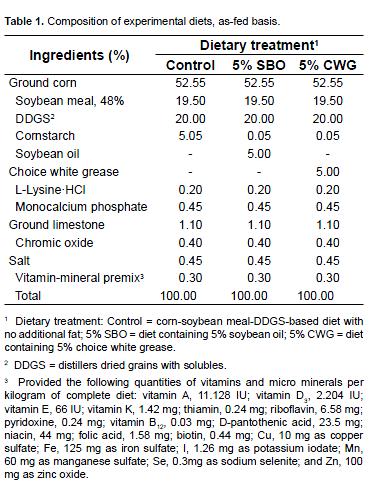
<body><![CDATA[<p><font face="Verdana, Arial, Helvetica, sans-serif" size="2"><font face="Verdana, Arial, Helvetica, sans-serif" size="3"><b>Introduction</b></font></p>     <p><font face="Verdana, Arial, Helvetica, sans-serif" size="2"><font face="Verdana, Arial, Helvetica, sans-serif" size="2">Dietary fat is a valuable ingredient for swine diets because of its high energy value and palatability. Moreover, it has been documented that dietary fat addition improves the apparent ileal digestibility (AID) of amino acids (AA) in soybean meal (Li and Sauer, 1994; Cervantes-Pahm and Stein, 2008), canola meal (Imbeah and Sauer, 1991), and rapeseed meal (Valaja and Siljander-Rasi, 2001) when fed to pigs. However, these experiments have measured the AID of AA in semi-purified diets containing one protein ingredient as a single AA source. To our knowledge, no data pertaining to the effects of dietary fat on the AID of AA in a commercial-type swine diet that was formulated with corn, soybean meal, and distillers dried grains with solubles (DDGS) have been reported. Moreover, most of the previous experiments have used plant oils such as soybean oil (SBO) as additional fat source although animal fat such as choice white grease (CWG) is more frequently   added to swine diets than plant oils. Thus, little is known about the effects of animal fat on the AID of AA in the diet compared with those of plant oils. The objective of this experiment, therefore, was to measure the effects of dietary SBO and CWG on the AID of AA in the diet containing corn, soybean meal, and DDGS by growing pigs.</font></p>     <p><font face="Verdana, Arial, Helvetica, sans-serif" size="2">&nbsp;</p>     <p><font face="Verdana, Arial, Helvetica, sans-serif" size="2"><font face="Verdana, Arial, Helvetica, sans-serif" size="3"><b>Materials and methods</b></font></p>     <p><font face="Verdana, Arial, Helvetica, sans-serif" size="2"><font face="Verdana, Arial, Helvetica, sans-serif" size="2"><i>Animals and housing</i></font></p>     <p><font face="Verdana, Arial, Helvetica, sans-serif" size="2"><font face="Verdana, Arial, Helvetica, sans-serif" size="2">Twelve growing barrows with initial body weight of 37.6 kg (standard deviation = 3.22) were used in this experiment. All pigs used in this experiment were offspring of line 337 boars mated to C22 females (Pig Improvement Company, Hendersonville, TN). A T-cannula was surgically installed in the distal ileum of each pig (Stein <i>et al.</i>, 1998).  Pigs were housed in individual pens (1.2 x 1.5 m) in an environmentally controlled room. Pens were equipped with a feeder, a nipple drinker, and a fully-slatted concrete floor. The animal protocol for this experiment was approved by the Institutional Animal Care and Use Committee at the University of Illinois.</font></p>     <p><font face="Verdana, Arial, Helvetica, sans-serif" size="2"><font face="Verdana, Arial, Helvetica, sans-serif" size="2"><i>Diets and experimental design</i></font></p>     <p><font face="Verdana, Arial, Helvetica, sans-serif" size="2"><font face="Verdana, Arial, Helvetica, sans-serif" size="2">Three diets were prepared (<a href="#t1">Table 1</a>). The control diet contained corn, soybean meal, DDGS, cornstarch, and no additional fat. Two additional diets were formulated by adding 5% SBO or 5% CWG to the control diet at the expense of cornstarch. All diets contained the quantities of metabolizable energy (ME), AA, vitamins, and minerals that were expected to meet or exceed the current requirement estimates (NRC, 1998) (<a href="#t2">Table 2</a>). Chromic oxide (0.40%) was included in all diets as an indigestible index. Each pig was provided in quantities equal to three times the estimated daily maintenance requirement for energy (i.e., 106 kcal ME kg   ; NRC, 1998) in two equal meals at 0900 and 1700. Water was available at all times. There were six experimental periods. Within each period, six of 12 pigs were assigned to one of three dietary treatments. However, all pigs were fed three diets only at one time during the entire experiment (i.e., n=12 for each dietary treatment). The potential carryover effects were balanced by the procedure of Kim and Stein (2009). The initial 5 d of each 7 d period was considered an adaptation period to the diet. Ileal digesta were collected continuously for 8 h on days 6 and 7. Collected samples were stored at -20 &nbsp;C until further chemical analysis. -0.75</font></p>     <p align="center"><a name="t1"><img src="/img/revistas/rccp/v24n3/a03t1.JPG"></a></p>      <p align="center"><a name="t2"><img src="/img/revistas/rccp/v24n3/a02t2.JPG" /></a></p>     ]]></body>
<body><![CDATA[<p><font face="Verdana, Arial, Helvetica, sans-serif" size="2"><font face="Verdana, Arial, Helvetica, sans-serif" size="2"><i>Chemical analysis</i></font></p>     <p><font face="Verdana, Arial, Helvetica, sans-serif" size="2"><font face="Verdana, Arial, Helvetica, sans-serif" size="2">At the end of the experiment, the frozen ileal digesta samples were thawed and mixed within animal and diet, and then an aliquot of subsample was collected for chemical analysis. The subsamples were lyophilized and finely ground before chemical analysis. All samples were analyzed for DM (method 930.15; AOAC, 2005) and CP (method 990.03; AOAC, 2005). Amino acids were analyzed on a Hitachi Amino Acid Analyzer (Model L8800, Hitachi High Technologies America Inc., Pleasanton, CA) using ninhydrin for postcolumn derivatization and norleucine as the internal standard. All samples were hydrolyzed by 6 N HCl for 24 h at 110 &nbsp;C prior to analysis (method 982.30 E; AOAC, 2005).  Methionine and Cysteine were analyzed as methionine sulfone and cysteic acid after cold performic acid oxidation overnight before hydrolysis. Tryptophan was analyzed after NaOH hydrolysis for 22 h at 110 &nbsp;C. The concentrations of Cr in diets and ileal samples were determined by an inductive coupled plasma atomic emission spectrometric method (method 990.08; AOAC, 2005) after nitric acid-perchloric acid wet ash sample preparation (method 968. 088 D; AOAC, 2005). </font></p>     <p><font face="Verdana, Arial, Helvetica, sans-serif" size="2"><font face="Verdana, Arial, Helvetica, sans-serif" size="2"><i>Calculation and statistical analysis</i></font></p>     <p><font face="Verdana, Arial, Helvetica, sans-serif" size="2"><font face="Verdana, Arial, Helvetica, sans-serif" size="2">Values for the AID of AA in three diets were calculated as the following equation (Stein <i>et al.</i>, 2007):</font></p>     <p><font face="Verdana, Arial, Helvetica, sans-serif" size="2"><font face="Verdana, Arial, Helvetica, sans-serif" size="2">AID, % = [1 &#150;&nbsp; (AA  <sub> digesta</sub>   &divide;&nbsp;AA <sub>diet</sub>    ) &nbsp;</font></p>     <p><font face="Verdana, Arial, Helvetica, sans-serif" size="2"><font face="Verdana, Arial, Helvetica, sans-serif" size="2"> (Index   <sub>diet</sub>   &divide;&nbsp;Index   <sub>digesta</sub>   )] &times; 100, </font></p>     <p><font face="Verdana, Arial, Helvetica, sans-serif" size="2"><font face="Verdana, Arial, Helvetica, sans-serif" size="2">Where AA   <sub>digesta</sub> and AA <sub>diet</sub> represent the concentrations of AA (g/kg DM) in digesta and diet, respectively, whereas Index <sub>diet</sub> and Index <sub>digesta</sub> represent the concentrations of index (i.e., Cr, g/kg DM) in diet and digesta, respectively. Data were analyzed by ANOVA using the PROC MIXED procedure of SAS (SAS Institute Inc., Cary, NC). Diet was the fixed effect, whereas pig and period were random effects in the model. LSMEANS procedure was used to calculate least squares mean values for all dietary treatments. When treatment effect was significant (p&lt;0.05), least squares means were compared using the probability of differences (PDIFF) procedure of SAS. The pig was the experimental unit for all analyzes. A probability of p&lt;0.05 was considered statistically significant and 0.05&lt;p&lt;0.10 was accepted as a tendency.</font></p>     <p><font face="Verdana, Arial, Helvetica, sans-serif" size="2">&nbsp;</p>     <p><font face="Verdana, Arial, Helvetica, sans-serif" size="2"><font face="Verdana, Arial, Helvetica, sans-serif" size="3"><b>Results </b></font></p>     <p><font face="Verdana, Arial, Helvetica, sans-serif" size="2"><font face="Verdana, Arial, Helvetica, sans-serif" size="2">The analyzed nutrient composition of all diets was comparable to calculated values (<a href="#t2">Table 2</a>). All pigs remained healthy and readily consumed their daily allowances throughout the experiment. No problems were experienced with the cannulas and ileal digesta collection for all pigs.</font></p>     ]]></body>
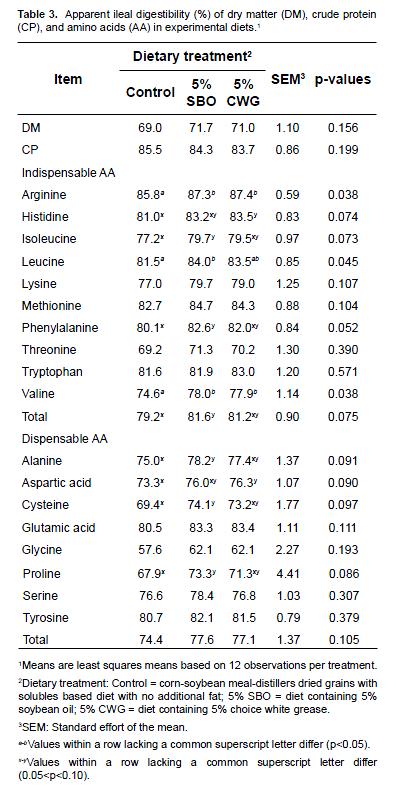
<body><![CDATA[<p><font face="Verdana, Arial, Helvetica, sans-serif" size="2"><font face="Verdana, Arial, Helvetica, sans-serif" size="2">The results of this experiment showed that the AID of DM and CP was not affected by dietary treatment. The AID of arginine and valine in the diet containing 5% SBO (87.3% and 78.0%, respectively) or 5% CWG (87.4 and 77.9%, respectively) was greater (p&lt;0.05) than in the control diet (85.8% and 74.6%, respectively). The value for the AID of leucine was greater (p&lt;0.05) for the diet containing 5% SBO (84.0%) than for the control diet (81.5%). The value for the diet containing 5% CWG (83.5%) was comparable to the value for the diet containing 5% SBO although it was not significantly different from the values for the control diet. There was a tendency for an increase (p&lt;0.10) in the AID of three indispensable AA (histidine, isoleucine, and phenylalanine) and four dispensable AA (alanine, aspartic acid, cysteine, and proline) when 5% SBO or 5% CWG was added to the control diet. The AID of total indispensable AA tended to be greater (p&lt;0.10) in the diet containing 5% SBO or 5% CWG than in the control diet. The AID of total dispensable AA was not different among dietary treatments (<a href="#t3">Table 3</a>).</font></p>     <p align="center"><a name="t3"><img src="/img/revistas/rccp/v24n3/a03t3.JPG" /></a>     <p><font face="Verdana, Arial, Helvetica, sans-serif" size="2">&nbsp;</p>     <p><font face="Verdana, Arial, Helvetica, sans-serif" size="2"><font face="Verdana, Arial, Helvetica, sans-serif" size="3"><b>Discussion</b> </font></p>     <p><font face="Verdana, Arial, Helvetica, sans-serif" size="2"><font face="Verdana, Arial, Helvetica, sans-serif" size="2">The increased AID of most AA by 5% SBO addition as observed in this experiment agrees with Cervantes-Pahm and Stein (2008) who reported that the addition of 7.6% SBO increased the AID of most AA by one to three percentage units in soybean meal. Likewise, increasing addition of canola oil has been reported to increase the AID of AA in soybean meal (Imbeah and Sauer, 1991; Li and Sauer, 1994) and in canola meal (Imbeah and Sauer, 1991), which also supports the result of this experiment. However, our results further indicate that the addition of dietary fat increases the AID of AA in the mixed diets containing corn, soybean meal, and DDGS, which are close to a commercial-type swine diet in many countries. To our knowledge, this observation has never been reported previously. A similar improvement in the AID of most AA as a result of 5% CWG addition compared with 5% SBO addition in the diets also demonstrates that CWG has comparable efficacy to SBO as regards its promoting effects on digestion and absorption of AA. </font></p>     <p><font face="Verdana, Arial, Helvetica, sans-serif" size="2"><font face="Verdana, Arial, Helvetica, sans-serif" size="2">The improvement in the AID of AA as a result of dietary fat addition has been related to slower gastric emptying (Low <i>et al.</i>, 1985) and decreased passage rate of digesta (Valaja and Siljander-Rasi, 2001) due to unknown function of dietary fat in the gastrointestinal tract of pigs. Delayed transition of digesta flow is likely to increase the time for protein digestion and AA absorption (Li and Sauer, 1994) and to improve the digestibility of DM (Kim <i>et al.</i>, 2007).This may be the reason for our observation that the addition of SBO as well as CWG increases the AID of most AA in the diets although gastric emptying and passage rate of digesta were not measured in this experiment. It is also speculated that similar improvement in the AID of most AA between SBO and CWG addition in the diets may be due to the fact that the effects of SBO on the gastrointestinal digesta flow resemble those of CWG. This assumption is supported by Valaja and Siljander-Rasi (2001) who observed that both tallow and rapeseed oil decreased to a similar extent the passage rate of digesta measured in the distal ileum of pigs. The extent of improvement in the AID of AA and the type of individual AA as affected by dietary fat addition varied among experiments. The reason for this variation is not clear; however, it may be associated with differences in animals, the level and source of fat and protein, and other dietary components among experiments.</font></p>     <p><font face="Verdana, Arial, Helvetica, sans-serif" size="2"><font face="Verdana, Arial, Helvetica, sans-serif" size="2">In conclusion, the addition of SBO and CWG improves the AID of most AA in a commercial-type diet containing corn, soybean meal, and DDGS. The extent of improvement in the AID of AA by dietary fat addition was comparable between the 2 sources of dietary fat. Therefore, if dietary fat originated from either plant oils or animal fat is added to swine diets, we may consider the reduced use of the additional AA. The limitation of this experiment, however, is to determine effects of dietary fat on the AID of AA instead of standardized ileal digestibility (SID) of AA. Future research pertaining to the effects of different sources of dietary fat on the SID of AA in swine diets is warranted.</font></p>     <p><font face="Verdana, Arial, Helvetica, sans-serif" size="2">&nbsp;</p>     <p><font face="Verdana, Arial, Helvetica, sans-serif" size="2"><font face="Verdana, Arial, Helvetica, sans-serif" size="3"><b>References</b> </font></p>     <!-- ref --><p><font face="Verdana, Arial, Helvetica, sans-serif" size="2"><font face="Verdana, Arial, Helvetica, sans-serif" size="2">1. AOAC, Association of Official Analytical Chemists. Official methods of Analysis. 18   ed. Gaithersburg, MD; 2005. </font>&nbsp;&nbsp;&nbsp;&nbsp;&nbsp;&nbsp;&nbsp;&nbsp;[&#160;<a href="javascript:void(0);" onclick="javascript: window.open('/scielo.php?script=sci_nlinks&ref=000052&pid=S0120-0690201100030000300001&lng=','','width=640,height=500,resizable=yes,scrollbars=1,menubar=yes,');">Links</a>&#160;]<!-- end-ref --><!-- ref --><p><font face="Verdana, Arial, Helvetica, sans-serif" size="2"><font face="Verdana, Arial, Helvetica, sans-serif" size="2">2. Cervantes-Pahm SK, Stein HH. Effect of dietary soybean oil    th   and soybean protein concentration on the concentration of digestible amino acids in soybean products fed to growing pigs.    J Anim Sci 2008; 86:1841-1849. </font>&nbsp;&nbsp;&nbsp;&nbsp;&nbsp;&nbsp;&nbsp;&nbsp;[&#160;<a href="javascript:void(0);" onclick="javascript: window.open('/scielo.php?script=sci_nlinks&ref=000053&pid=S0120-0690201100030000300002&lng=','','width=640,height=500,resizable=yes,scrollbars=1,menubar=yes,');">Links</a>&#160;]<!-- end-ref --><!-- ref --><p><font face="Verdana, Arial, Helvetica, sans-serif" size="2"><font face="Verdana, Arial, Helvetica, sans-serif" size="2">3. Imbeah M, Sauer WC. The effect of dietary level of fat on    amino acid digestibilities in soybean meal and canola meal and on rate of passage in growing pigs. Livest Prod Sci 1991;    29:227-239. </font>&nbsp;&nbsp;&nbsp;&nbsp;&nbsp;&nbsp;&nbsp;&nbsp;[&#160;<a href="javascript:void(0);" onclick="javascript: window.open('/scielo.php?script=sci_nlinks&ref=000054&pid=S0120-0690201100030000300003&lng=','','width=640,height=500,resizable=yes,scrollbars=1,menubar=yes,');">Links</a>&#160;]<!-- end-ref --><!-- ref --><p><font face="Verdana, Arial, Helvetica, sans-serif" size="2"><font face="Verdana, Arial, Helvetica, sans-serif" size="2">4. Kim BG, Lindemann MD, Cromwell GL, Balfagon A, Agudelo    JH. The correlation between passage rate of digesta and dry matter digestibility in various stages of swine. Livest Sci 2007;    109:81-84. </font>&nbsp;&nbsp;&nbsp;&nbsp;&nbsp;&nbsp;&nbsp;&nbsp;[&#160;<a href="javascript:void(0);" onclick="javascript: window.open('/scielo.php?script=sci_nlinks&ref=000055&pid=S0120-0690201100030000300004&lng=','','width=640,height=500,resizable=yes,scrollbars=1,menubar=yes,');">Links</a>&#160;]<!-- end-ref --><!-- ref --><p><font face="Verdana, Arial, Helvetica, sans-serif" size="2"><font face="Verdana, Arial, Helvetica, sans-serif" size="2">5. Kim BG, Stein HH. A spreadsheet program for making a    balanced Latin square design. Rev Colomb Cienc Pecu 2009; 22:591-596.   </font>&nbsp;&nbsp;&nbsp;&nbsp;&nbsp;&nbsp;&nbsp;&nbsp;[&#160;<a href="javascript:void(0);" onclick="javascript: window.open('/scielo.php?script=sci_nlinks&ref=000056&pid=S0120-0690201100030000300005&lng=','','width=640,height=500,resizable=yes,scrollbars=1,menubar=yes,');">Links</a>&#160;]<!-- end-ref --><!-- ref --><p><font face="Verdana, Arial, Helvetica, sans-serif" size="2"><font face="Verdana, Arial, Helvetica, sans-serif" size="2">6. Li S, Sauer WC. The effect of dietary fat content on amino acid digestibility in young pigs. J Anim Sci 1994; 72:1737-1743.</font>&nbsp;&nbsp;&nbsp;&nbsp;&nbsp;&nbsp;&nbsp;&nbsp;[&#160;<a href="javascript:void(0);" onclick="javascript: window.open('/scielo.php?script=sci_nlinks&ref=000057&pid=S0120-0690201100030000300006&lng=','','width=640,height=500,resizable=yes,scrollbars=1,menubar=yes,');">Links</a>&#160;]<!-- end-ref --><!-- ref --><p><font face="Verdana, Arial, Helvetica, sans-serif" size="2"><font face="Verdana, Arial, Helvetica, sans-serif" size="2">7. Low AG, Pittman RJ, Elliott RJ. Gastric emptying of barley-soya-bean diets in the pig: effects of feeding level,    supplementary maize oil, sucrose or cellulose, and water intake. Br J Nutr 1985; 54:437-447. </font>&nbsp;&nbsp;&nbsp;&nbsp;&nbsp;&nbsp;&nbsp;&nbsp;[&#160;<a href="javascript:void(0);" onclick="javascript: window.open('/scielo.php?script=sci_nlinks&ref=000058&pid=S0120-0690201100030000300007&lng=','','width=640,height=500,resizable=yes,scrollbars=1,menubar=yes,');">Links</a>&#160;]<!-- end-ref --><!-- ref --><p><font face="Verdana, Arial, Helvetica, sans-serif" size="2"><font face="Verdana, Arial, Helvetica, sans-serif" size="2">8. NRC, National Research Council. Nutrient Requirements of Swine. 10   ed. Washington D.C.: National Academic Press; 1998.   th</font>&nbsp;&nbsp;&nbsp;&nbsp;&nbsp;&nbsp;&nbsp;&nbsp;[&#160;<a href="javascript:void(0);" onclick="javascript: window.open('/scielo.php?script=sci_nlinks&ref=000059&pid=S0120-0690201100030000300008&lng=','','width=640,height=500,resizable=yes,scrollbars=1,menubar=yes,');">Links</a>&#160;]<!-- end-ref --><!-- ref --><p><font face="Verdana, Arial, Helvetica, sans-serif" size="2"><font face="Verdana, Arial, Helvetica, sans-serif" size="2">   9. Stein HH, S&egrave;ve B, Fuller MF, Moughan PJ, de Lange CFM. Invited review: Amino acid bioavailability and digestibility in    pig feed ingredients: Terminology and application. J Anim Sci 2007; 85:172-180. </font>&nbsp;&nbsp;&nbsp;&nbsp;&nbsp;&nbsp;&nbsp;&nbsp;[&#160;<a href="javascript:void(0);" onclick="javascript: window.open('/scielo.php?script=sci_nlinks&ref=000060&pid=S0120-0690201100030000300009&lng=','','width=640,height=500,resizable=yes,scrollbars=1,menubar=yes,');">Links</a>&#160;]<!-- end-ref --><!-- ref --><p><font face="Verdana, Arial, Helvetica, sans-serif" size="2"><font face="Verdana, Arial, Helvetica, sans-serif" size="2">10. Stein HH, Shipley CF, Easter RA. Technical Note: A technique for inserting a T-cannula into the distal ileum of pregnant sows.    J Anim Sci 1998; 76:1433-1436. </font>&nbsp;&nbsp;&nbsp;&nbsp;&nbsp;&nbsp;&nbsp;&nbsp;[&#160;<a href="javascript:void(0);" onclick="javascript: window.open('/scielo.php?script=sci_nlinks&ref=000061&pid=S0120-0690201100030000300010&lng=','','width=640,height=500,resizable=yes,scrollbars=1,menubar=yes,');">Links</a>&#160;]<!-- end-ref --><!-- ref --><p><font face="Verdana, Arial, Helvetica, sans-serif" size="2"><font face="Verdana, Arial, Helvetica, sans-serif" size="2">11. Valaja J, Siljander-Rasi H. Dietary fat supplementation affects    apparent ileal digestibility of amino acids and digesta passage rate of rapeseed meal-based diet. In: Linberg JE and Ogle    B editors. Digestive physiology of pigs. New York: CABI Publishing; 2001. p.175-177. </font>&nbsp;&nbsp;&nbsp;&nbsp;&nbsp;&nbsp;&nbsp;&nbsp;[&#160;<a href="javascript:void(0);" onclick="javascript: window.open('/scielo.php?script=sci_nlinks&ref=000062&pid=S0120-0690201100030000300011&lng=','','width=640,height=500,resizable=yes,scrollbars=1,menubar=yes,');">Links</a>&#160;]<!-- end-ref --> ]]></body><back>
<ref-list>
<ref id="B1">
<label>1</label><nlm-citation citation-type="">
<collab>AOAC, Association of Official Analytical Chemists</collab>
<source><![CDATA[Official methods of Analysis]]></source>
<year>2005</year>
<edition>18</edition>
<publisher-loc><![CDATA[Gaithersburg ]]></publisher-loc>
</nlm-citation>
</ref>
<ref id="B2">
<label>2</label><nlm-citation citation-type="journal">
<person-group person-group-type="author">
<name>
<surname><![CDATA[Cervantes-Pahm]]></surname>
<given-names><![CDATA[SK]]></given-names>
</name>
<name>
<surname><![CDATA[Stein]]></surname>
<given-names><![CDATA[HH]]></given-names>
</name>
</person-group>
<article-title xml:lang="en"><![CDATA[Effect of dietary soybean oil th and soybean protein concentration on the concentration of digestible amino acids in soybean products fed to growing pigs]]></article-title>
<source><![CDATA[J Anim Sci]]></source>
<year>2008</year>
<volume>86</volume>
<page-range>1841-1849</page-range></nlm-citation>
</ref>
<ref id="B3">
<label>3</label><nlm-citation citation-type="journal">
<person-group person-group-type="author">
<name>
<surname><![CDATA[Imbeah]]></surname>
<given-names><![CDATA[M]]></given-names>
</name>
<name>
<surname><![CDATA[Sauer]]></surname>
<given-names><![CDATA[WC]]></given-names>
</name>
</person-group>
<article-title xml:lang="en"><![CDATA[The effect of dietary level of fat on amino acid digestibilities in soybean meal and canola meal and on rate of passage in growing pigs]]></article-title>
<source><![CDATA[Livest Prod Sci]]></source>
<year>1991</year>
<volume>29</volume>
<page-range>227-239</page-range></nlm-citation>
</ref>
<ref id="B4">
<label>4</label><nlm-citation citation-type="journal">
<person-group person-group-type="author">
<name>
<surname><![CDATA[Kim]]></surname>
<given-names><![CDATA[BG]]></given-names>
</name>
<name>
<surname><![CDATA[Lindemann]]></surname>
<given-names><![CDATA[MD]]></given-names>
</name>
<name>
<surname><![CDATA[Cromwell]]></surname>
<given-names><![CDATA[GL]]></given-names>
</name>
<name>
<surname><![CDATA[Balfagon]]></surname>
<given-names><![CDATA[A]]></given-names>
</name>
<name>
<surname><![CDATA[Agudelo]]></surname>
<given-names><![CDATA[JH]]></given-names>
</name>
</person-group>
<article-title xml:lang="en"><![CDATA[The correlation between passage rate of digesta and dry matter digestibility in various stages of swine]]></article-title>
<source><![CDATA[Livest Sci]]></source>
<year>2007</year>
<volume>109</volume>
<page-range>81-84</page-range></nlm-citation>
</ref>
<ref id="B5">
<label>5</label><nlm-citation citation-type="journal">
<person-group person-group-type="author">
<name>
<surname><![CDATA[Kim]]></surname>
<given-names><![CDATA[BG]]></given-names>
</name>
<name>
<surname><![CDATA[Stein]]></surname>
<given-names><![CDATA[HH]]></given-names>
</name>
</person-group>
<article-title xml:lang="en"><![CDATA[A spreadsheet program for making a balanced Latin square design]]></article-title>
<source><![CDATA[Rev Colomb Cienc Pecu]]></source>
<year>2009</year>
<volume>22</volume>
<page-range>591-596</page-range></nlm-citation>
</ref>
<ref id="B6">
<label>6</label><nlm-citation citation-type="journal">
<person-group person-group-type="author">
<name>
<surname><![CDATA[Li]]></surname>
<given-names><![CDATA[S]]></given-names>
</name>
<name>
<surname><![CDATA[Sauer]]></surname>
<given-names><![CDATA[WC]]></given-names>
</name>
</person-group>
<article-title xml:lang="en"><![CDATA[The effect of dietary fat content on amino acid digestibility in young pigs]]></article-title>
<source><![CDATA[J Anim Sci]]></source>
<year>1994</year>
<volume>72</volume>
<page-range>1737-1743</page-range></nlm-citation>
</ref>
<ref id="B7">
<label>7</label><nlm-citation citation-type="journal">
<person-group person-group-type="author">
<name>
<surname><![CDATA[Low]]></surname>
<given-names><![CDATA[AG]]></given-names>
</name>
<name>
<surname><![CDATA[Pittman]]></surname>
<given-names><![CDATA[RJ]]></given-names>
</name>
<name>
<surname><![CDATA[Elliott]]></surname>
<given-names><![CDATA[RJ]]></given-names>
</name>
</person-group>
<article-title xml:lang="en"><![CDATA[Gastric emptying of barley-soya-bean diets in the pig: effects of feeding level, supplementary maize oil, sucrose or cellulose, and water intake]]></article-title>
<source><![CDATA[Br J Nutr]]></source>
<year>1985</year>
<volume>54</volume>
<page-range>437-447</page-range></nlm-citation>
</ref>
<ref id="B8">
<label>8</label><nlm-citation citation-type="book">
<collab>NRC, National Research Council</collab>
<source><![CDATA[Nutrient Requirements of Swine]]></source>
<year>1998</year>
<edition>10</edition>
<publisher-loc><![CDATA[Washington ]]></publisher-loc>
<publisher-name><![CDATA[National Academic Press]]></publisher-name>
</nlm-citation>
</ref>
<ref id="B9">
<label>9</label><nlm-citation citation-type="journal">
<person-group person-group-type="author">
<name>
<surname><![CDATA[Stein]]></surname>
<given-names><![CDATA[HH]]></given-names>
</name>
<name>
<surname><![CDATA[Sève]]></surname>
<given-names><![CDATA[B]]></given-names>
</name>
<name>
<surname><![CDATA[Fuller]]></surname>
<given-names><![CDATA[MF]]></given-names>
</name>
<name>
<surname><![CDATA[Moughan]]></surname>
<given-names><![CDATA[PJ]]></given-names>
</name>
<name>
<surname><![CDATA[de]]></surname>
<given-names><![CDATA[Lange CFM]]></given-names>
</name>
</person-group>
<article-title xml:lang="en"><![CDATA[Invited review: Amino acid bioavailability and digestibility in pig feed ingredients: Terminology and application]]></article-title>
<source><![CDATA[J Anim Sci]]></source>
<year>2007</year>
<volume>85</volume>
<page-range>172-180</page-range></nlm-citation>
</ref>
<ref id="B10">
<label>10</label><nlm-citation citation-type="journal">
<person-group person-group-type="author">
<name>
<surname><![CDATA[Stein]]></surname>
<given-names><![CDATA[HH]]></given-names>
</name>
<name>
<surname><![CDATA[Shipley]]></surname>
<given-names><![CDATA[CF]]></given-names>
</name>
<name>
<surname><![CDATA[Easter]]></surname>
<given-names><![CDATA[RA]]></given-names>
</name>
</person-group>
<article-title xml:lang="en"><![CDATA[Technical Note: A technique for inserting a T-cannula into the distal ileum of pregnant sows]]></article-title>
<source><![CDATA[J Anim Sci]]></source>
<year>1998</year>
<volume>76</volume>
<page-range>1433-1436</page-range></nlm-citation>
</ref>
<ref id="B11">
<label>11</label><nlm-citation citation-type="book">
<person-group person-group-type="author">
<name>
<surname><![CDATA[Valaja]]></surname>
<given-names><![CDATA[J]]></given-names>
</name>
<name>
<surname><![CDATA[Siljander-Rasi]]></surname>
<given-names><![CDATA[H]]></given-names>
</name>
</person-group>
<article-title xml:lang="en"><![CDATA[Dietary fat supplementation affects apparent ileal digestibility of amino acids and digesta passage rate of rapeseed meal-based diet]]></article-title>
<person-group person-group-type="editor">
<name>
<surname><![CDATA[Linberg]]></surname>
<given-names><![CDATA[JE]]></given-names>
</name>
</person-group>
<source><![CDATA[Digestive physiology of pigs]]></source>
<year>2001</year>
<page-range>175-177</page-range><publisher-loc><![CDATA[New York ]]></publisher-loc>
<publisher-name><![CDATA[CABI Publishing]]></publisher-name>
</nlm-citation>
</ref>
</ref-list>
</back>
</article>