<?xml version="1.0" encoding="ISO-8859-1"?><article xmlns:mml="http://www.w3.org/1998/Math/MathML" xmlns:xlink="http://www.w3.org/1999/xlink" xmlns:xsi="http://www.w3.org/2001/XMLSchema-instance">
<front>
<journal-meta>
<journal-id>0120-0690</journal-id>
<journal-title><![CDATA[Revista Colombiana de Ciencias Pecuarias]]></journal-title>
<abbrev-journal-title><![CDATA[Rev Colom Cienc Pecua]]></abbrev-journal-title>
<issn>0120-0690</issn>
<publisher>
<publisher-name><![CDATA[Facultad de Ciencias Agrarias, Universidad de Antioquia]]></publisher-name>
</publisher>
</journal-meta>
<article-meta>
<article-id>S0120-06902011000300010</article-id>
<title-group>
<article-title xml:lang="en"><![CDATA[Animal welfare: concepts, study methods and indicators]]></article-title>
<article-title xml:lang="es"><![CDATA[Bienestar animal: conceptos, métodos de estudio e indicadores]]></article-title>
<article-title xml:lang="pt"><![CDATA[Bem-estar animal: conceitos, métodos de estudos e indicadores]]></article-title>
</title-group>
<contrib-group>
<contrib contrib-type="author">
<name>
<surname><![CDATA[Broom]]></surname>
<given-names><![CDATA[Donald M]]></given-names>
</name>
<xref ref-type="aff" rid="A01"/>
</contrib>
</contrib-group>
<aff id="A01">
<institution><![CDATA[,University of Cambridge Department of Veterinary Medicine Centre for Animal Welfare and Anthrozoology]]></institution>
<addr-line><![CDATA[ ]]></addr-line>
<country>United Kingdom</country>
</aff>
<pub-date pub-type="pub">
<day>00</day>
<month>09</month>
<year>2011</year>
</pub-date>
<pub-date pub-type="epub">
<day>00</day>
<month>09</month>
<year>2011</year>
</pub-date>
<volume>24</volume>
<numero>3</numero>
<fpage>306</fpage>
<lpage>321</lpage>
<copyright-statement/>
<copyright-year/>
<self-uri xlink:href="http://www.scielo.org.co/scielo.php?script=sci_arttext&amp;pid=S0120-06902011000300010&amp;lng=en&amp;nrm=iso"></self-uri><self-uri xlink:href="http://www.scielo.org.co/scielo.php?script=sci_abstract&amp;pid=S0120-06902011000300010&amp;lng=en&amp;nrm=iso"></self-uri><self-uri xlink:href="http://www.scielo.org.co/scielo.php?script=sci_pdf&amp;pid=S0120-06902011000300010&amp;lng=en&amp;nrm=iso"></self-uri><abstract abstract-type="short" xml:lang="en"><p><![CDATA[There is now increasing public concern about the welfare of animals in most countries of the world. Applied ethological studies of motivation, cognition and the complexity of social behaviour in animals has resulted in the rapid development of animal welfare science. A definition of animal welfare is: the state of the individual as regards its attempts to cope with its environment. Welfare concerns all of the mechanisms for coping: involving physiology, behaviour, feelings and pathological responses. Welfare is a wider term than health but health is an important part of welfare. In order to enforce laws and standards, animal welfare outcome indicators are useful. Many measures of welfare are now used and indicate how good or how poor the welfare is. The concept of animal welfare and the methods of assessment are now taught in hundreds of universities around the world. In recent years, animal welfare has become established as one of the criteria used to decide on whether a system is sustainable and whether product quality is good. Legislation on how animals should be kept is now referring to welfare outcome indicators and analysis of the scientific literature about animal welfare includes risk assessment and benefit assessment.]]></p></abstract>
<abstract abstract-type="short" xml:lang="es"><p><![CDATA[Actualmente existe una creciente preocupación pública por el bienestar de los animales en la mayoría de los países del mundo. Los estudios etológicos aplicados de motivación, cognición y de complejidad del comportamiento social en los animales, han generado un veloz desarrollo de la ciencia del bienestar animal. Una definición de bienestar animal es: el estado del individuo respecto a sus intentos de enfrentar el ambiente en que se encuentra. El bienestar está relacionado con todos los mecanismos para enfrentarlo: involucrando la fisiología, el comportamiento, las sentimientos y las respuestas patológicas. Bienestar es un término más amplio que salud, pero la salud es una parte importante del bienestar. Con el objetivo de respetar las leyes y normas, el bienestar animal cuenta con algunos indicadores que son de gran utilidad. Gran cantidad de las mediciones del bienestar se utilizan para indicar que tan bueno o que tan pobre es el bienestar. El concepto de bienestar animal y sus métodos de evaluación se enseñan ahora en cientos de universidades de todo el mundo. En los últimos años, el bienestar animal se ha establecido como uno de los criterios utilizados para decidir si un sistema es sostenible y si la calidad del producto es buena. La legislación sobre cómo los animales deben mantenerse ahora se refiere a los indicadores de resultados de bienestar y al análisis de la literatura científica sobre el bienestar animal incluyendo la evaluación de beneficio-riesgo.]]></p></abstract>
<abstract abstract-type="short" xml:lang="pt"><p><![CDATA[Atualmente há uma crescente preocupação pública sobre bem-estar animal na maioria dos países. Aplicados estudos etológicos de cognição, motivação e complexidade do comportamento social nos animais, levaram a um rápido desenvolvimento da ciência do bem-estar animal. A definição de bem-estar animal é o estado do indivíduo em suas tentativas de lidar com o ambiente em que ele está localizado. O bem-estar está relacionada com todos os mecanismos para lidar: envolver a fisiologia, comportamento, sentimentos e resposta patológica. Bem-estar é um termo mais amplo de saúde, mas a saúde é uma parte importante do ser. A fim de respeitar as leis e regulamentos, bem-estar animal tem alguns indicadores que são úteis. Um grande número de medidas a ser utilizado para indicar o quão bom ou quão pobre é o bem- estar. O conceito de bem-estar animal e os seus métodos de avaliação são agora ensinadas em centenas de universidades ao redor do mundo. Nos últimos anos, bem-estar animal foi estabelecida como um dos critérios utilizados para decidir se um sistema é sustentável e se a qualidade do produto é bom. A legislação sobre como os animais devem ser mantidos agora se refere a indicadores de resultados bem-estar e análise da literatura científica sobre bem-estar animal, incluindo a avaliação benefício-risco.]]></p></abstract>
<kwd-group>
<kwd lng="en"><![CDATA[ethics]]></kwd>
<kwd lng="en"><![CDATA[law]]></kwd>
<kwd lng="en"><![CDATA[product quality]]></kwd>
<kwd lng="en"><![CDATA[risk-benefit]]></kwd>
<kwd lng="en"><![CDATA[sustainability]]></kwd>
<kwd lng="es"><![CDATA[calidad del producto]]></kwd>
<kwd lng="es"><![CDATA[ética]]></kwd>
<kwd lng="es"><![CDATA[legislación]]></kwd>
<kwd lng="es"><![CDATA[riesgo-beneficio]]></kwd>
<kwd lng="es"><![CDATA[sostenibilidad]]></kwd>
<kwd lng="pt"><![CDATA[a ética]]></kwd>
<kwd lng="pt"><![CDATA[a lei]]></kwd>
<kwd lng="pt"><![CDATA[o risco-benefício]]></kwd>
<kwd lng="pt"><![CDATA[qualidade do produto]]></kwd>
<kwd lng="pt"><![CDATA[sustentabilidade]]></kwd>
</kwd-group>
</article-meta>
</front><body><![CDATA[ <p align="right"><font face="Verdana, Arial, Helvetica, sans-serif" size="2"><b>Conferencia magistral</b></font></p>     <p align="center"><font face="Verdana, Arial, Helvetica, sans-serif" size="4"><b>Animal welfare: concepts, study methods and indicators</b></font></p>     <p align="center"><font face="Verdana, Arial, Helvetica, sans-serif" size="3"><b>Bienestar animal: conceptos, m&eacute;todos de estudio e indicadores </b></font></p>     <p align="center"><font face="Verdana, Arial, Helvetica, sans-serif" size="3"><b>Bem-estar animal: conceitos, m&eacute;todos de estudos e indicadores</b></font></p>     <p><font face="Verdana, Arial, Helvetica, sans-serif" size="2">Donald	M	Broom</font></p>     <p><font face="Verdana, Arial, Helvetica, sans-serif" size="2">Centre for Animal Welfare and Anthrozoology, Department of Veterinary Medicine, University of Cambridge, Madingley Road, Cambridge CB3 0ES, United Kingdom, <a href="mailto:dmb16@cam.ac.uk">dmb16@cam.ac.uk</a></font></p>     <p>&nbsp;</p> <hr size="1">     <p><font face="Verdana, Arial, Helvetica, sans-serif" size="2"><b>Summary </b></font></p>     <p><font face="Verdana, Arial, Helvetica, sans-serif" size="2">There is now increasing public concern about the welfare of animals in most countries of the world.  Applied ethological studies of motivation, cognition and the complexity of social behaviour in animals has resulted in the rapid development of animal welfare science. A definition of animal welfare is: the state of the individual as regards its attempts to cope with its environment. Welfare concerns all of the mechanisms for coping: involving physiology, behaviour, feelings and pathological responses. Welfare is a wider term than health but health is an important part of welfare. In order to enforce laws and standards, animal welfare outcome indicators are useful. Many measures of welfare are now used and indicate how good or how poor the welfare is. The concept of animal welfare and the methods of assessment are now taught in hundreds of universities around the world. In recent years, animal welfare has become established as one of the criteria used to decide on whether a system is sustainable and whether product quality is good. Legislation on how animals should be kept is now referring to welfare outcome indicators and analysis of the scientific literature about animal welfare includes risk assessment and benefit assessment.</font></p>     <p><font face="Verdana, Arial, Helvetica, sans-serif" size="2"><b>Key words</b>: ethics, law, product quality, risk-benefit, sustainability.</font></p>     ]]></body>
<body><![CDATA[<p>&nbsp;</p> <hr size="1">     <p><font face="Verdana, Arial, Helvetica, sans-serif" size="2"><b>Resumen</b> </font></p>     <p><font face="Verdana, Arial, Helvetica, sans-serif" size="2">Actualmente existe una creciente preocupaci&oacute;n p&uacute;blica por el bienestar de los animales en la mayor&iacute;a  de los pa&iacute;ses del mundo. Los estudios etol&oacute;gicos aplicados de motivaci&oacute;n, cognici&oacute;n y de complejidad del comportamiento social en los animales, han generado un veloz desarrollo de la ciencia del bienestar animal. Una definici&oacute;n de bienestar animal es: el estado del individuo respecto a sus intentos de enfrentar el ambiente en que se encuentra. El bienestar est&aacute; relacionado con todos los mecanismos para enfrentarlo: involucrando la fisiolog&iacute;a, el comportamiento, las sentimientos y las respuestas patol&oacute;gicas. Bienestar es un t&eacute;rmino m&aacute;s amplio que salud, pero la salud es una parte importante del bienestar. Con el objetivo de respetar las leyes y normas, el bienestar animal cuenta con algunos indicadores que son de gran utilidad. Gran cantidad de las mediciones del bienestar se utilizan para indicar que tan bueno o que tan pobre es el bienestar. El concepto de bienestar animal y sus m&eacute;todos de evaluaci&oacute;n se ense&ntilde;an ahora en cientos de universidades de todo el mundo. En los &uacute;ltimos a&ntilde;os, el bienestar animal se ha establecido como uno de los criterios utilizados para decidir si un sistema es sostenible y si la calidad del producto es buena. La legislaci&oacute;n sobre c&oacute;mo los animales deben mantenerse ahora se refiere a los indicadores de resultados de bienestar y al an&aacute;lisis de la literatura cient&iacute;fica sobre el bienestar animal incluyendo la evaluaci&oacute;n de beneficio-riesgo.</font></p>     <p><font face="Verdana, Arial, Helvetica, sans-serif" size="2"><b>Palabras clave</b>: calidad del producto, &eacute;tica, legislaci&oacute;n, riesgo-beneficio, sostenibilidad.</font></p>     <p>&nbsp;</p> <hr size="1">     <p><font face="Verdana, Arial, Helvetica, sans-serif" size="2"><b>Resumo</b> </font></p>     <p><font face="Verdana, Arial, Helvetica, sans-serif" size="2">Atualmente h&aacute; uma crescente preocupa&ccedil;&atilde;o p&uacute;blica sobre bem-estar animal na maioria dos pa&iacute;ses.  Aplicados estudos etol&oacute;gicos de cogni&ccedil;&atilde;o, motiva&ccedil;&atilde;o e complexidade do comportamento social nos animais, levaram a um r&aacute;pido desenvolvimento da ci&ecirc;ncia do bem-estar animal. A defini&ccedil;&atilde;o de bem-estar animal &eacute; o estado do indiv&iacute;duo em suas tentativas de lidar com o ambiente em que ele est&aacute; localizado. O bem-estar est&aacute; relacionada com todos os mecanismos para lidar: envolver a fisiologia, comportamento, sentimentos e resposta patol&oacute;gica. Bem-estar &eacute; um termo mais amplo de sa&uacute;de, mas a sa&uacute;de &eacute; uma parte importante do ser. A fim de respeitar as leis e regulamentos, bem-estar animal tem alguns indicadores que s&atilde;o &uacute;teis. Um grande n&uacute;mero de medidas a ser utilizado para indicar o qu&atilde;o bom ou qu&atilde;o pobre &eacute; o bem- estar. O conceito de bem-estar animal e os seus m&eacute;todos de avalia&ccedil;&atilde;o s&atilde;o agora ensinadas em centenas de universidades ao redor do mundo. Nos &uacute;ltimos anos, bem-estar animal foi estabelecida como um dos crit&eacute;rios utilizados para decidir se um sistema &eacute; sustent&aacute;vel e se a qualidade do produto &eacute; bom. A legisla&ccedil;&atilde;o sobre como os animais devem ser mantidos agora se refere a indicadores de resultados bem-estar e an&aacute;lise da literatura cient&iacute;fica sobre bem-estar animal, incluindo a avalia&ccedil;&atilde;o benef&iacute;cio-risco.</font></p>     <p><font face="Verdana, Arial, Helvetica, sans-serif" size="2"><b>Palavras chave</b>: a &eacute;tica, a lei, o risco-benef&iacute;cio, qualidade do produto, sustentabilidade.</font></p>     <p>&nbsp;</p> <hr size="1">     <p><font face="Verdana, Arial, Helvetica, sans-serif" size="3"><a name="p1" id="p1"></a><a href="#1">Historia y ética del concepto de bienestar animal</a></font>    </p>     ]]></body>
<body><![CDATA[<p><font face="Verdana, Arial, Helvetica, sans-serif" size="3"><a name="p2" id="p2"></a><a href="#2">Ethics and the history of the animal welfare concept</a></font></p>     <p>&nbsp;</p> <hr size="1">     <p>&nbsp;</p>     <p><font face="Verdana, Arial, Helvetica, sans-serif" size="3"></p>     <p><font face="Verdana" size="3"><a name="1" id="1"></a><a href="#p1"><b>Historia y &eacute;tica del concepto de bienestar animal</b></a></font></p>     <p><font face="Verdana, Arial, Helvetica, sans-serif" size="2">Los	animales	siempre	han	tenido	bienestar,	sin	 embargo,	lo	que	los	humanos	saben	del	tema	se	 ha	modificado	con	el	tiempo.	Algunos	animales	 (especialmente	los	que	viven	por	largos	periodos	en	 grupos	sociales)	cuentan	con	estrategias	importantes	y	 eficaces,	que	sirven	para	ayudar	a	los	dem&aacute;s	y	evitar	 el	da&ntilde;ar	a	otros.	Como	resultado,	los	sistemas	morales	 han	evolucionado	tanto	en	humanos	como	en	otros	 animales	sociales.	Esto	es	explicado	con	m&aacute;s	detalle	 por	de	Waal	(1996),	Ridley	(1996)	y	Broom	(2003).</font></p>     <p><font face="Verdana, Arial, Helvetica, sans-serif" size="2">Las	personas	consideran	que	tienen	obligaciones	 respecto	a	otros	individuos,	de	hecho	los	humanos	 y	 otros	 animales	 sociales	 han	 desarrollado	 caracter&iacute;sticas	que	nos	hacen	responsables	a	los	 dem&aacute;s	en	nuestras	sociedades,	de	forma	que	 se	promueven	las	preferencias	de	obediencia	y	 conducta.	Este	punto	de	vista	deontol&oacute;gico	basado	en	 los	deberes,	se	ha	planteado	en	todas	las	sociedades	 humanas	y	los	mecanismos	involucrados	tienen	 paralelos	en	otras	sociedades	animales.	Algunas	 caracter&iacute;sticas	que	se	han	desarrollado,	incluyen	una	 mayor	habilidad	para	evaluar	las	consecuencias	de	 las	acciones	y	para	evaluar	costos	y	beneficios.	La	 posici&oacute;n	filos&oacute;fica	que	subyace	a	&eacute;sta,	es	utilitaria.	 Como	resultado	de	una	combinaci&oacute;n	de	funciones	 basadas	en	la	filosof&iacute;a	consecuencialista,	existe	la	 preocupaci&oacute;n	acerca	del	bienestar	animal	en	todas	las	 sociedades	humanas.</font></p>     <p><font face="Verdana, Arial, Helvetica, sans-serif" size="2">En	algunos	pa&iacute;ses,	el	debate	sobre	el	uso	de	 animales,	se	ha	preocupado	especialmente	sobre	 si	deben	o	no	ser	sacrificados.	Los	fil&oacute;sofos	y	el	 p&uacute;blico	se	han	centrado	en	la	&eacute;tica	del	sacrificio	 de	animales	para	consumo	humano,	ropa	para	los	 humanos,	investigaci&oacute;n	cient&iacute;fica,	o	mascotas	no	 deseadas	(Regan,	1990;	Fraser,	2008);	aunque	el	 sacrificio	es	un	problema	&eacute;tico	importante,	no	es	 asunto	del	bienestar	animal.	Los	problemas	morales	 del	bienestar	animal	se	relacionan	con	lo	que	ocurre	 antes	de	la	muerte,	incluyendo	el	trato	que	se	les	 da	a	los	individuos	durante	la	&uacute;ltima	parte	de	su	 vida,	seguido	por	el	per&iacute;odo	previo	al	sacrificio,	y	 finalmente	el	m&eacute;todo	de	sacrificio.	En	Europa,	la	 mayor&iacute;a	de	los	cursos	universitarios	de	medicina	 veterinaria	y	zootecnia	sobre	c&oacute;mo	deben	tratarse	 y	manejarse	los	animales,	tienen	que	ver	con	el	 bienestar	animal.</font></p>     <p><font face="Verdana, Arial, Helvetica, sans-serif" size="2">En	algunos	pa&iacute;ses,	el	debate	sobre	el	uso	de	 animales,	se	ha	preocupado	especialmente	sobre	 si	deben	o	no	ser	sacrificados.	Los	fil&oacute;sofos	y	el	 p&uacute;blico	se	han	centrado	en	la	&eacute;tica	del	sacrificio	 de	animales	para	consumo	humano,	ropa	para	los	 humanos,	investigaci&oacute;n	cient&iacute;fica,	o	mascotas	no	 deseadas	(Regan,	1990;	Fraser,	2008);	aunque	el	 sacrificio	es	un	problema	&eacute;tico	importante,	no	es	 asunto	del	bienestar	animal.	Los	problemas	morales	 del	bienestar	animal	se	relacionan	con	lo	que	ocurre	 antes	de	la	muerte,	incluyendo	el	trato	que	se	les	 da	a	los	individuos	durante	la	&uacute;ltima	parte	de	su	 vida,	seguido	por	el	per&iacute;odo	previo	al	sacrificio,	y	 finalmente	el	m&eacute;todo	de	sacrificio.	En	Europa,	la	 mayor&iacute;a	de	los	cursos	universitarios	de	medicina	 veterinaria	y	zootecnia	sobre	c&oacute;mo	deben	tratarse	 y	manejarse	los	animales,	tienen	que	ver	con	el	 bienestar	animal.</font></p>     <p><font face="Verdana, Arial, Helvetica, sans-serif" size="2">Harrison	(1964)	se&ntilde;al&oacute;	que	aquellos	que	estaban	 relacionados	con	la	industria	de	producci&oacute;n	animal	 en	ese	momento,	con	frecuencia	trataban	a	los	 animales	como	m&aacute;quinas	inanimadas	en	lugar	de	 individuos	vivos.	W.	H.	Thorpe	(1965),	miembro	 del	gobierno	brit&aacute;nico	&ldquo;Comit&eacute;	Brambell&rdquo;	(creado	 en	respuesta	al	libro	de	Harrison),	fue	qui&eacute;n	enfatiz&oacute;	 que	en	la	ruta	de	mejorar	el	bienestar	animal,	es	 importante	comprender	la	biolog&iacute;a	de	los	animales	 y	que	estos	tienen	necesidades,	y	entre	estas	la	de	 expresar	algunos	comportamientos	particulares.	 Este	punto	de	vista	qued&oacute;	plasmado	en	el	reporte	 Brambell	como	&ldquo;las	cinco	libertades&rdquo;,	sin	embargo,	 el	concepto	de	libertad	tiene	algunas	dificultades	 l&oacute;gicas	y	cient&iacute;ficas	(Broom,	2003).	Hoy	en	d&iacute;a,	 en	los	documentos	cient&iacute;ficos	principalmente,	est&aacute;	 siendo	reemplazado	por	el	concepto	de	<i>necesidades de los animales</i>,	que	es	clave	para	entender	el	 bienestar	animal.	El	desarrollo	del	uso	de	los	 t&eacute;rminos	de	bienestar	y	el	estr&eacute;s	es	discutido	por	 Broom	(2011).</font></p>     ]]></body>
<body><![CDATA[<p><font face="Verdana, Arial, Helvetica, sans-serif" size="2">El	bienestar	animal	es	un	concepto	cient&iacute;fico	que	 describe	una	cualidad	potencialmente	medible	de	 un	animal	vivo	en	un	momento	determinado.	&iquest;Qu&eacute;	 hacen	los	humanos	al	respecto,	o	qu&eacute;	deben	hacer?,		 es	una	cuesti&oacute;n	&eacute;tica	y	se	llama	a	com&uacute;nmente  <i>protecci&oacute;n animal</i>.	 El	 estudio	 cient&iacute;fico	 del	 bienestar	animal	esta	ampliamente	separado	de	la	 &eacute;tica.</font></p>     <p><font face="Verdana, Arial, Helvetica, sans-serif" size="2">Hughes	(1982)	propuso	que	el	sentido	del	 bienestar	animal	era	que	el	animal	estuviera	en	 armon&iacute;a	con	la	naturaleza,	o	con	su	entorno.	Esta	 es	una	idea	importante,	pero	estar	en	armon&iacute;a	es	un	 estado	&uacute;nico,	que	impide	la	medici&oacute;n	cient&iacute;fica.	Por	 consiguiente,	he	definido	el	bienestar	de	la	siguiente	 manera:	&ldquo;el	bienestar	de	un	individuo	es	su	estado	 respecto	a	sus	intentos	de	enfrentar	el	ambiente	 en	que	se	encuentra&rdquo;	(Broom,	1986)	y	explico	el	 concepto	en	Broom	(1988,	1991a,b)	y	Broom	y	 Johnson	(1993,	2000).	Usando	esta	definici&oacute;n,	 pueden	cumplirse	los	aspectos	m&aacute;s	importantes	del	 concepto	de	bienestar	y	ese	bienestar	puede	medirse	 cient&iacute;ficamente	(Duncan,	1993;	Fraser,	2008)	y	 var&iacute;a	en	un	rango	de	muy	bueno	a	muy	pobre. </font></p>     <p><font face="Verdana, Arial, Helvetica, sans-serif" size="2">Los	humanos	y	otros	animales	enfrentan	su	 entorno	con	diferentes	estrategias:	comportamentales,	 fisiol&oacute;gicas,	inmunol&oacute;gicas	y	otros	componentes	que	 son	coordinados	desde	el	cerebro.	En	los	animales	 complejos,	los	sentimientos	como	el	dolor,	el	miedo	 y	las	diversas	formas	de	placer	son	a	menudo	parte	 de	una	estrategia	de	enfrentamiento	y	son	una	parte	 clave	de	su	bienestar	(Cabanac,	1979;	Broom,	1991b,	 1998;	Duncan	y	Petherick,	1991;	Panksepp,	1998,	 2005;	Broom	y	Fraser,	2007;	Broom,	2008).	La	 salud	se	refiere	al	estado	de	los	sistemas	del	cuerpo,	 incluyendo	los	del	cerebro,	que	combaten	agentes	 pat&oacute;genos,	da&ntilde;o	tisular	o	trastornos	fisiol&oacute;gicos;	 por	lo	cual,	la	salud	puede	definirse	como	el	estado	 de	un	animal	en	relaci&oacute;n	a	sus	intentos	de	enfrentar	 la	patolog&iacute;a.	Por	lo	tanto,	la	salud	es	una	parte	 importante	del	bienestar	(Dawkins,	1980,	1990;	 Webster,	1994;	Broom,	2006);	y	algunas	veces	podr&iacute;a	 decirse	que	el	bienestar	durante	largos	per&iacute;odos	de	 tiempo,	podr&iacute;a	llamarse	<i>calidad de vida</i>	(Broom,	 2007). </font></p>     <p><font face="Verdana, Arial, Helvetica, sans-serif" size="2">La	palabra	&ldquo;estr&eacute;s&rdquo;	debe	utilizarse	para	esa	 parte	del	bienestar pobre	que	involucra	una	falla	 para	enfrentar	el	ambiente,	teniendo	en	cuenta	que	 el	uso	p&uacute;blico	com&uacute;n	de	la	palabra	se	refiere	a	un	 efecto	nocivo	sobre	un	individuo	(Broom	y	Johnson,	 2000).	La	referencia	al	estr&eacute;s	como	un	simple	 est&iacute;mulo	que	podr&iacute;a	ser	beneficioso,	o	simplemente	 como	un	evento	que	provoca	la	actividad	de	la	 corteza	suprarrenal,	no	tiene	ning&uacute;n	valor	cient&iacute;fico	 o	pr&aacute;ctico.	Un	indicador	de	adversidad,	es	si	hay	 alg&uacute;n	efecto	sobre	el	desempe&ntilde;o	biol&oacute;gica.	El	estr&eacute;s	 puede	ser	definido	como	un	efecto	ambiental	sobre un	individuo,	que	sobrecarga	sus	sistemas	de	control	 y	reduce	su	desempe&ntilde;o	f&iacute;sico	o	parece	probable	que	 lo	haga.	Usando	esta	definici&oacute;n,	la	relaci&oacute;n	entre	el	 estr&eacute;s	y	el	bienestar	es	muy	clara.	En	primer	lugar,	 mientras	que	el	bienestar	se	refiere	al	estado	de	los	 animales	en	un	rango	de	muy	bueno	a	muy	pobre;	 siempre	que	hay	estr&eacute;s,	el	bienestar	es	pobre.	En	 segundo	lugar,	el	estr&eacute;s	se	refiere	s&oacute;lo	a	situaciones	 en	las	que	falla	la	capacidad	para	enfrentar	el	 ambiente,	mientras	que	el	bienestar	pobre	se	refiere	 al	estado	del	animal,	tanto	por	fallas	para	enfrentar	 su	ambiente,	como	cuando	el	individuo	tiene	 dificultades	para	salir	adelante.</font></p>     <p>&nbsp;</p>     <p><font face="Verdana, Arial, Helvetica, sans-serif" size="3"><b>Evaluaci&oacute;n del bienestar</b></font></p>     <p><font face="Verdana, Arial, Helvetica, sans-serif" size="2">La	evaluaci&oacute;n	del	bienestar	(Broom	y	Johnson,	 2000)	debe	llevarse	a	cabo	de	manera	objetiva,	 sin	tener	en	cuenta	las	preguntas	&eacute;ticas	acerca	 de	los	sistemas,	pr&aacute;cticas	o	condiciones	para	los	 individuos	que	est&aacute;n	siendo	comparados.	Una	 vez	se	ha	obtenido	la	evidencia	cient&iacute;fica	sobre	el	 bienestar,	se	pueden	tomar	las	decisiones	&eacute;ticas.</font></p>     <p><font face="Verdana, Arial, Helvetica, sans-serif" size="2">Gran	parte	de	la	evidencia	usada	en	la	evaluaci&oacute;n	 del	bienestar,	muestra	la	magnitud	de	los	problemas	 de	los	individuos,	pero	tambi&eacute;n	es	importante	 reconocer	y	evaluar	el	bienestar	bueno,	por	ejemplo:	 la	felicidad,	la	satisfacci&oacute;n,	el	control	de	las	 interacciones	con	el	medio	ambiente	y	la	posibilidad	 de	explotar	habilidades.	Se	debe	tratar	de	evaluar	 el	funcionamiento	espec&iacute;fico	del	cerebro,	cuando	 el	bienestar	es	bueno	en	los	seres	humanos	y	otros	 animales	(Broom	y	Zanella,	2004),	as&iacute;	como	los	 m&eacute;todos	de	reconocimiento	cuando	el	bienestar	 es	bueno,	o	es	probable	que	sea	y	los	factores	que	 contribuyen	para	el	bienestar	buen	en	el	hombre	y	 otras	especies.	En	general,	un	bienestar	bueno	y	un	 estatus	positivo	en	cada	uno	de	los	diversos	sistemas	 para	hacer	frente	al	ambiente,	usualmente	tiene	efectos	 que	son	parte	del	sistema	de	refuerzo	positivo,	as&iacute;	 como	el	bienestar	pobre	est&aacute;	asociado	con	varios	 refuerzos	negativos.	Hay	varios	efectos	evidentes	 del	bienestar	bueno	que	deben	identificarse	en	los	 individuos,	para	que	la	evaluaci&oacute;n	del	bienestar	sea	 efectiva	para	todo	el	rango	de	posibilidades	entre	el	 bienestar	muy	bueno	y	el	muy	pobre.</font></p>     <p><font face="Verdana, Arial, Helvetica, sans-serif" size="2">Cada	evaluaci&oacute;n	del	bienestar	de	un	humano	u	otro	 animal	se	refiere	a	un	solo	individuo	y	un	intervalo	de tiempo	concreto.	En	la	evaluaci&oacute;n	global	del	impacto	 de	una	condici&oacute;n	o	tratamiento	sobre	un	individuo,	no	 es	lo	mismo	un	per&iacute;odo	muy	breve	de	un	cierto	grado	 de	bienestar	bueno	o	pobre,	que	un	per&iacute;odo	prolongado.	 Sin	embargo,	una	funci&oacute;n	simple	multiplicativa	del	 grado	m&aacute;ximo	y	la	duraci&oacute;n	suele	ser	insuficiente,	ya	 que	el	efecto	m&aacute;s	severo	del	bienestar	pobre	puede	ser	 breve,	mientras	que	hay	un	efecto	leve	m&aacute;s	prolongado.	 Si	la	intensidad	del	bienestar	pobre	o	bueno	se	grafica	 en	funci&oacute;n	del	tiempo,	la	mejor	valoraci&oacute;n	global	del	 bienestar	para	ese	animal	ser&aacute;	el	&aacute;rea	generada	bajo	la	 curva	(Broom,	2001b).</font></p>     <p><font face="Verdana, Arial, Helvetica, sans-serif" size="2">Los	efectos	sobre	el	bienestar	de	los	animales	que	 se	pueden	describir	incluyen:	enfermedad,	lesi&oacute;n,	 hambre,	est&iacute;mulos	ben&eacute;ficos,	interacciones	sociales	 (positivas	o	negativas),	otras	formas	de	&eacute;xito	en	las	 acciones,	condiciones	de	alojamiento	(positivas	o	 negativas),	malos	tratos	deliberados	o	accidentales,	 manejo	humano	(positivo	o	negativo),	transporte,	 procedimientos	de	laboratorio,	mutilaciones	varias,	 tratamiento	veterinario	(positivo	o	negativo),	cambio	 gen&eacute;tico	por	mejoramiento	convencional	o	de	otra	 &iacute;ndole	(Broom,	2008a,	2010a).</font></p>     ]]></body>
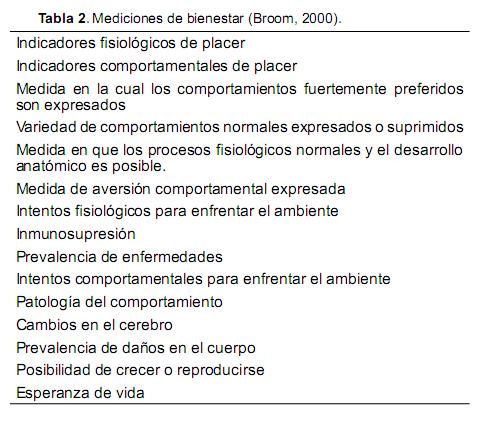
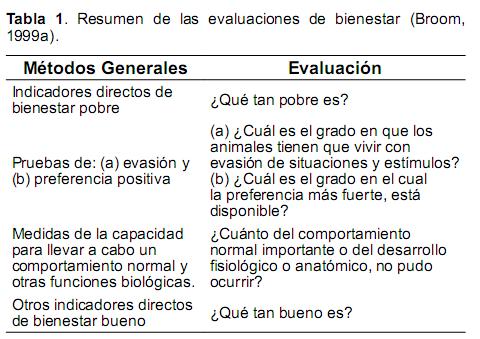
<body><![CDATA[<p><font face="Verdana, Arial, Helvetica, sans-serif" size="2">Varios	indicadores	de	bienestar	son	descritos	 por	Fraser	y	Broom	(2007,	2010).	Existen	 diferencias	entre	los	indicadores	de	bienestar	 para	los	problemas	de	corto	plazo	y	largo	plazo.	 Algunas	medidas	a	corto	plazo,	como	la	frecuencia	 cardiaca	y	la	concentraci&oacute;n	de	cortisol	en	plasma	 son	apropiados	para	evaluar	el	bienestar	durante	 el	manejo	o	transporte,	pero	no	para	evaluar	las	 condiciones	de	alojamiento	a	largo	plazo.	Algunas	 medidas	del	comportamiento,	la	funci&oacute;n	del	sistema	 inmunol&oacute;gico	y	estado	de	la	enfermedad	son	m&aacute;s	 apropiadas	para	problemas	a	largo	plazo.</font></p>     <p><font face="Verdana, Arial, Helvetica, sans-serif" size="2">Los	m&eacute;todos	generales	para	evaluar	el	bienestar	 se	resumen	en	la	<a href="#t1">tabla	1</a>	y	una	lista	de	medidas	de	 bienestar	se	presenta	en	la	<a href="#t2">tabla	2</a>.	La	mayor&iacute;a	 de	los	indicadores	ayudar&aacute;	a	identificar	el	estado	 de	los	animales	siempre	que	sea	en	la	escala	de	 muy	buena	a	muy	pobre.	Algunas	de	las	medidas	 m&aacute;s	relevantes	para	problemas	a	corto	plazo,	 como	las	relacionadas	con	el	manejo	por	parte	 humanos	o	un	breve	per&iacute;odo	de	condiciones	f&iacute;sicas	 adversas,	mientras	que	otras	son	m&aacute;s	apropiadas	 para	problemas	a	largo	plazo.	Estas	son	medidas	 objetivas	del	bienestar	y	es	posible	evaluar	la calidad	de	vida	mediante	el	uso	de	tales	medidas	 y	no	s&oacute;lo	haciendo	preguntas	subjetivas.	Las	 medidas	subjetivas	de	los	seres	humanos	pueden	 ser	incorrectas	o	inconsistentemente	correctas.	 Sin	embargo,	aquellos	que	utilizan	la	metodolog&iacute;a	 utilizada	en	la	investigaci&oacute;n	m&eacute;dica	sobre	el	 bienestar	o	la	calidad	de	vida	y	los	que	eval&uacute;an	el	 bienestar	de	los	animales	no	humanos	tienen	mucho	 que	aprender	unos	de	otros	(ver	Lutgendorf,	2001).	 Para	una	discusi&oacute;n	detallada	de	las	medidas	de	 bienestar,	ver	Broom	y	Johnson,	(2000).</font></p>     <p><font face="Verdana, Arial, Helvetica, sans-serif" size="2">Algunos	de	los	signos	de	bienestar	pobre	surgen	 a	partir	de	mediciones	fisiol&oacute;gicas.	Por	ejemplo,	el	 aumento	del	ritmo	card&iacute;aco,	la	actividad	adrenal,	la	 actividad	adrenal	despu&eacute;s	del	est&iacute;mulo	con	ACTH,	 o	la	reducci&oacute;n	en	la	respuesta	inmunol&oacute;gica	despu&eacute;s	 de	un	reto;	todos	ellos	indicadores	de	que	el	bienestar	 es	m&aacute;s	pobre	que	en	los	individuos	que	no	muestran	 estos	cambios.	Se	debe	tener	cuidado	al	interpretar	 estos	resultados,	al	igual	que	con	muchas	otras	 medidas	descritas	aqu&iacute;.	El	deterioro	de	la	funci&oacute;n	del	 sistema	inmune	y	algunos	de	los	cambios	fisiol&oacute;gicos	 pueden	indicar	lo	que	se	ha	denominado	un	estado	 pre-patol&oacute;gico	(Moberg,	1985).	Como	consecuencia	 de	la	elevada	proporci&oacute;n	de	mecanismos	de	 enfrentamiento	que	afectan	el	funcionamiento	de	los	 centros	superiores	del	cerebro,	algunas	evaluaciones	 del	bienestar	deben	incluir	medidas	de	la	funci&oacute;n	 cerebral	(Broom	y	Zanella,	2004).</font></p>     <p><font face="Verdana, Arial, Helvetica, sans-serif" size="2">Algunos	de	los	signos	de	bienestar	pobre	surgen	 a	partir	de	mediciones	fisiol&oacute;gicas.	Por	ejemplo,	el	 aumento	del	ritmo	card&iacute;aco,	la	actividad	adrenal,	la	 actividad	adrenal	despu&eacute;s	del	est&iacute;mulo	con	ACTH,	 o	la	reducci&oacute;n	en	la	respuesta	inmunol&oacute;gica	despu&eacute;s	 de	un	reto;	todos	ellos	indicadores	de	que	el	bienestar	 es	m&aacute;s	pobre	que	en	los	individuos	que	no	muestran	 estos	cambios.	Se	debe	tener	cuidado	al	interpretar	 estos	resultados,	al	igual	que	con	muchas	otras	 medidas	descritas	aqu&iacute;.	El	deterioro	de	la	funci&oacute;n	del	 sistema	inmune	y	algunos	de	los	cambios	fisiol&oacute;gicos	 pueden	indicar	lo	que	se	ha	denominado	un	estado	 pre-patol&oacute;gico	(Moberg,	1985).	Como	consecuencia	 de	la	elevada	proporci&oacute;n	de	mecanismos	de	 enfrentamiento	que	afectan	el	funcionamiento	de	los	 centros	superiores	del	cerebro,	algunas	evaluaciones	 del	bienestar	deben	incluir	medidas	de	la	funci&oacute;n	 cerebral	(Broom	y	Zanella,	2004).</font></p>     <p><font face="Verdana, Arial, Helvetica, sans-serif" size="2">Las	medidas	de	comportamiento	son	tambi&eacute;n	 de	especial	importancia	para	la	evaluaci&oacute;n	del	 bienestar.	El	hecho	de	que	un	animal	evite	un	objeto	 o	un	evento,	ofrece	informaci&oacute;n	acerca	de	sus	 sentimientos	y	por	lo	tanto	de	su	bienestar.	Mientras	 m&aacute;s	fuerte	sea	la	evasi&oacute;n,	peor	es	el	bienestar	en	 cuanto	el	evento	este	ocurriendo	o	el	objeto	est&eacute;	 presente.	Un	individuo	que	es	completamente	 incapaz	de	adoptar	su	postura	preferida	de	descanso	 a	pesar	de	hacer	repetidos	intentos	tendr&aacute;	menor	 bienestar	que	uno	que	pueda	adoptarla.	Otros	 comportamientos	anormales,	como	las	estereotipias,	 auto-mutilaci&oacute;n,	caudofagia	en	cerdos,	picoteo	 de	plumas	en	gallinas,	o	el	comportamiento	 excesivamente	agresivo	en	perros,	indica	que	el	 bienestar	del	individuo	perpetrador	es	pobre.</font></p>     <p><font face="Verdana, Arial, Helvetica, sans-serif" size="2">En	algunas	de	estas	medidas	fisiol&oacute;gicas	y	de	 comportamiento,	est&aacute;	claro	que	el	individuo	est&aacute; tratando	de	enfrentar	la	adversidad;	en	este	sentido,	 el	grado	de	los	intentos	de	hacer	frente,	puede	 medirse.	En	otros	casos,	sin	embargo,	algunas	de	las	 respuestas	son	solamente	patol&oacute;gicas	y	el	individuo	 falla	enfrentando	el	ambiente.	En	cualquier	caso,	la	 medida	indica	bienestar	pobre.</font></p>     <p><font face="Verdana, Arial, Helvetica, sans-serif" size="2">La	 presencia	 de	 enfermedades,	 lesiones,	 dificultades	de	movimiento	y	crecimiento	anormal,	 indican	un	bienestar	pobre.	Si	dos	sistemas	de	 alojamiento	son	comparados	en	un	experimento	 cuidadosamente	controlado	y	la	incidencia	de	 cualquiera	de	las	anteriores	es	significativamente	 mayor	en	uno	de	ellos,	el	bienestar	de	los	animales	 es	peor	en	ese	sistema.	El	bienestar	de	los	animales	 enfermos	es	peor	que	el	de	un	animal	que	no	est&aacute;	 enfermo,	pero	a&uacute;n	queda	mucho	por	descubrir	acerca	 de	la	magnitud	de	los	efectos	de	la	enfermedad	sobre	 el	bienestar.	Poco	se	sabe	sobre	cu&aacute;nto	sufrimiento	 est&aacute;	asociado	con	diferentes	enfermedades.	Un	 ejemplo	espec&iacute;fico	de	un	efecto	sobre	las	condiciones	 de	alojamiento	que	conducen	a	un	bienestar	pobre,	 es	la	consecuencia	de	la	reducci&oacute;n	extrema	del	 ejercicio	sobre	la	fuerza	de	los	huesos.	En	estudios	en	 gallinas	(Knowles	y	Broom,	1990;	Norgaard	Nielsen,	 1990)	las	aves	alojadas	en	jaulas	que	no	ejercitaron	 suficientemente	sus	alas	y	piernas,	tuvieron	huesos	 considerablemente	m&aacute;s	d&eacute;biles	que	aquellas	ubicadas	 en	perchas	donde	hab&iacute;a	suficiente	espacio	para	hacer	 ejercicio.	Del	mismo	modo,	Marchant	y	Broom	 (1996)	encontraron	que	las	cerdas	en	jaulas	de	 gestaci&oacute;n	ten&iacute;an	los	huesos	de	las	piernas	con	s&oacute;lo	 el	65%	de	fortaleza	comparado	con	las	cerdas	en	 los	sistemas	de	estabulaci&oacute;n	en	grupo.	La	debilidad	 actual	de	los	huesos	indica	que	a	estos	animales	se	les	 dificulta	en	mayor	grado	enfrentar	su	ambiente	y	por	 tanto	el	bienestar	es	m&aacute;s	pobre	en	el	confinamiento.	 Si	los	huesos	de	un	animal	se	rompen	habr&aacute;	mucho	 dolor	y	el	bienestar	ser&aacute;	peor.	El	dolor	puede	ser	 evaluado	por	aversi&oacute;n,	medidas	fisiol&oacute;gicas,	efectos	 de	los	analg&eacute;sicos	(Duncan <i>et al.</i>,	1991;	Stilwell	<i>et al.</i>,	2009)	o	por	la	existencia	de	neuromas	(Gentle,	 1986).	Sea	cual	sea	la	medici&oacute;n,	los	datos	recogidos	 en	los	estudios	de	bienestar	de	los	animales	da	 informaci&oacute;n	sobre	la	posici&oacute;n	del	animal	en	una	 escala	de	bienestar	de	muy	buena	a	muy	pobre.</font></p>     <p><font face="Verdana, Arial, Helvetica, sans-serif" size="2">La	mayor&iacute;a	de	los	indicadores	de	bienestar	 bueno	que	podemos	utilizar	son	obtenidos	por	 estudios	que	demuestran	las	preferencias	positivas La	mayor&iacute;a	de	los	indicadores	de	bienestar	 bueno	que	podemos	utilizar	son	obtenidos	por	 estudios	que	demuestran	las	preferencias	positivas de	los	animales.	En	pruebas operantes	se	impone	 un	costo	para	poder	acceder	a	un	recurso,	exigiendo	 que	se	realice	una	tarea.	El	desempe&ntilde;o	de	la	tarea	 requiere	tiempo	y	esfuerzo,	que	de	otro	modo	 podr&iacute;a	haber	sido	invertido	en	otras	cosas.	La	tarea	 tambi&eacute;n	puede	ser	desagradable	para	el	sujeto.	En	 las	<i>pruebas de preferencia</i>,	se	impone	un	costo	para	 acceder	al	recurso	ha	consumir.	El	animal	tiene	que	 dividir	el	tiempo	entre	el	consumo	de	los	recursos.</font></p>     <p><font face="Verdana, Arial, Helvetica, sans-serif" size="2">&iquest;C&oacute;mo	podemos	conocer	las	necesidades	de	 los	animales	a	trav&eacute;s	ellos	mismos?	&iquest;Qu&eacute;	es	lo	 que	prefieren?	&iquest;Qu&eacute;	tan	fuerte	ser&aacute;	el	esfuerzo	 individual	por	obtener	un	recurso?.	Una	rata	puede	 aprender	f&aacute;cilmente	a	levantar	una	puerta	pesada	y	 la	cantidad	levantada	da	una	indicaci&oacute;n	del	esfuerzo	 por	preferir	un	recurso.	Manser	<i>et al.</i>	(1996),	 estudiando	que	piso	era	el	preferido	por	las	ratas	de	 laboratorio,	encontraron	que	las	ratas	levantan	una	 puerta	mas	pesada	para	llegar	a	un	piso	s&oacute;lido	sobre	 el	cual	pod&iacute;an	descansar	que	para	llegar	a	un	piso	de	 rejilla.	Algunos	t&eacute;rminos	utilizados	en	la	estimaci&oacute;n	 de	la	fuerza	de	motivaci&oacute;n	incluye	los	siguientes	 (Kirkden <i>et al.</i>,	2003):	un	recurso	es	un	bien	o	una	 oportunidad	para	realizar	una	actividad;	la	demanda	 es	una	medida	de	la	cantidad	de	acciones	que	 permiten	obtener	recursos;	el	precio	es	la	cantidad	 de	una	acci&oacute;n	necesarias	para	obtener	una	unidad	 de	recurso;	la	renta	es	la	cantidad	de	tiempo	u	 otra	variable	que	limita	la	acci&oacute;n;	la	elasticidad	 del	precio	de	la	demanda	es	la	tasa	proporcional	a	 la	cual	cambia	el	consumo	o	la	demanda	con	el	 precio;	el	excedente	del	consumidor	es	una	medida	 de	la	cantidad	m&aacute;s	grande	a	la	cual	un	sujeto	esta	 preparado	para	gastar	una	determinada	cantidad	del	 recurso,	que	corresponde	al	&aacute;rea	bajo	la	curva	de	 demanda	inversa.	Cuando	la	demanda	de	un	recurso	 se	mide	en	un	rango	de	precios,	la	importancia	de	 los	recursos	se	indica	mejor	por	el	excedente	del	 consumidor	que	por	la	elasticidad	del	precio	de	la	 demanda	(Kirkden	<i>et al.</i>,	2003).</font></p>     <p><font face="Verdana, Arial, Helvetica, sans-serif" size="2">Un	ejemplo	de	la	utilizaci&oacute;n	de	esta	metodolog&iacute;a	 es	el	trabajo	de	Mason	<i>et al.</i>	(2001).	La	pregunta	 clave	era	determinar	la	fuerza	de	la	preferencia	del	 vis&oacute;n	&mdash;una	especie	parcialmente	acu&aacute;tica&mdash;,	por	 los	diversos	recursos	(como	el	agua	en	la	que	pod&iacute;a	 nadar).	Los	visones	fueron	entrenados	para	llevar	a	 cabo	acciones	operantes	para	llegar	a:	un	nido	extra,	 objetos	varios,	una	plataforma	elevada,	un	t&uacute;nel, una	jaula	vac&iacute;a	y	una	piscina	de	agua	para	nadar	en	 ella.	El	agua	de	la	piscina	tuvo	la	mayor	prioridad	 por	parte	del	vis&oacute;n.</font></p>     ]]></body>
<body><![CDATA[<p><font face="Verdana, Arial, Helvetica, sans-serif" size="2">El	tercer	m&eacute;todo	general	de	evaluaci&oacute;n	delbienestar	listado	en	la	<a href="#t2">tabla	2</a>	involucra	medidas	deque	comportamientos	y	otras	funciones	no	puedenrealizarse	en	las	condiciones	particulares	de	vida.Las	gallinas	prefieren	batir	sus	alas	a	intervalos,pero	no	pueden	hacerlo	en	una	jaula,	mientrasque	los	terneros	y	algunos	animales	de	laboratorioenjaulados	se	esfuerzan	para	asearse	a	fondo,	perono	pueden	hacerlo	en	espacios	peque&ntilde;os	comocajas,	jaulas	o	equipos	de	contenci&oacute;n.</font></p>     <p><font face="Verdana, Arial, Helvetica, sans-serif" size="2">En	todas	las	evaluaciones	de	bienestar,	es	necesario	 tener	en	cuenta	las	variaciones	individuales	en	los	 intentos	para	enfrentar	la	adversidad	y	en	los	efectos	 que	tiene	la	adversidad	en	los	animales.	Cuando	los	 cerdos	son	limitados	en	jaulas	o	contenedores	de	 sujeci&oacute;n	durante	alg&uacute;n	tiempo,	una	proporci&oacute;n	de	 individuos	muestran	altos	niveles	de	estereotipias,	 mientras	que	otros	son	muy	inactivos	y	no	responden	 (Broom,	1987;	Broom	y	Johnson,	2000).	Tambi&eacute;n	 puede	haber	un	cambio	de	comportamiento	anormal	 expresado	por	el	animal,	respecto	al	tiempo	 empleado,	la	condici&oacute;n,	la	cantidad	y	el	tipo	(Cronin	 y	Wiepkema,	1984).	En	ratas,	ratones	y	musara&ntilde;as	 arbor&iacute;colas	se	sabe	que	un	individuo	confinado	 junto	con	un	agresor,	expresa	diferentes	respuestas	 fisiol&oacute;gicas	y	de	comportamiento,	estas	respuestas	han	 sido	clasificadas	como	enfrentamiento	activo	y	pasivo	 (Koolhaas	<i>et al.</i>,	1983). </font></p>     <p><font face="Verdana, Arial, Helvetica, sans-serif" size="2">Los	animales	activos	luchan	sin	desmayo	mientrasque	los	animales	pasivos	se	someten.	Un	estudiode	las	estrategias	adoptadas	por	las	cerdas	en	unasituaci&oacute;n	social	competitiva	mostraron	que	algunascerdas	eran	agresivas	y	exitosas,	una	segundacategor&iacute;a	de	animales	se	defend&iacute;a	en&eacute;rgicamente	siera	atacado,	mientras	que	una	tercera	categor&iacute;a	decerdas	evitaba	la	confrontaci&oacute;n	social	siempre	quefuera	posible.	Estas	categor&iacute;as	de	animales	difierenen	sus	respuestas	adrenales	y	en	el	&eacute;xito	reproductivo(Mendl	<i>et al.</i>,	1992).	Debido	a	las	variaciones	en	lamagnitud	de	las	diferentes	respuestas	fisiol&oacute;gicasy	de	comportamiento	a	los	problemas,	es	necesarioque	cualquier	evaluaci&oacute;n	de	bienestar	incluya	unaamplia	gama	de	medidas.	De	igual	forma,	nuestroconocimiento	de	c&oacute;mo	las	diferentes	medidas	se combinan	para	indicar	la	severidad	del	problema,	 tambi&eacute;n	debe	mejorarse.	Tambi&eacute;n	es	importante	 comprender	las	estrategias	utilizadas	por	los	animales	 ante	diferentes	situaciones,	ya	que	pueden	ser	 distintas	a	las	que	utilizan	los	seres	humanos.	Un	 ejemplo	es	la	respuesta	al	dolor	severo	en	los	ovinos	 y	otras	especies	que	son	presa,	en	las	que	no	es	 adaptativo	mostrar	respuestas	conductuales	evidentes	 (Broom	y	Johnson,	2000).</font></p>     <p>&nbsp;</p>     <p><font face="Verdana, Arial, Helvetica, sans-serif" size="3"><b>Respuesta internacional a los desarrollos de la ciencia del bienestar animal</b></font></p>     <p><font face="Verdana, Arial, Helvetica, sans-serif" size="2">La evaluaci&oacute;n	cient&iacute;fica	del	bienestar	animal	 se	ha	desarrollado	r&aacute;pidamente	en	los	&uacute;ltimos	20	 a&ntilde;os	y	actualmente	se	ense&ntilde;a	en	todas	las	escuelas	 de	veterinaria	en	Europa,	Canad&aacute;,	Australia	y	 Nueva	Zelanda,	en	70	universidades	en	Brasil	y	 en	al	menos	otros	50	pa&iacute;ses.	La	presi&oacute;n	p&uacute;blica	 sobre	gobiernos	y	empresas	comerciales	sobre	la	 salud	humana,	bienestar	animal	y	los	impactos	 ambientales,	ha	incrementado	en	todos	los	pa&iacute;ses.	 Todo	lo	anterior,	ha	resultado	en	c&oacute;digos	de	pr&aacute;cticas,	 leyes	y	mecanismos	para	la	aplicaci&oacute;n	de	las	leyes.	 El	bienestar	animal	es	uno	de	los	temas	que	se	ha	 convertido	en	componente	de	la	calidad	del	producto	 y	de	su	sostenibilidad	(Broom,	2001a,	2002,	2010,	en	 prensa;	Aland	y	Madec,	2009).</font></p>     <p><font face="Verdana, Arial, Helvetica, sans-serif" size="2">El	Organizaci&oacute;n	Mundial	de	Sanidad	Animal	 (OIE,	por	sus	siglas	en	ingl&eacute;s),	la	FAO	y	el	Banco	 Mundial	tienen	pol&iacute;ticas	de	bienestar	animal	 que	influyen	en	todos	los	pa&iacute;ses	del	mundo.	Los	 diferentes	grupos	de	personas,	desde	los	m&aacute;s	 ricos	a	los	m&aacute;s	pobres,	expresan	su	preocupaci&oacute;n	 por	el	bienestar	animal.	Sin	embargo,	existe	una	 variaci&oacute;n	de	la	tasa	de	difusi&oacute;n	del	conocimiento	 cient&iacute;fico	sobre	el	tema	entre	pa&iacute;ses.	Las	leyes	est&aacute;n	 bien	desarrolladas	en	algunos	pa&iacute;ses	y	en	otros,	 carecen	de	ellas.	Existe	una	presi&oacute;n	por	parte	de	 los	consumidores	para	asegurar	que	las	pol&iacute;ticas	 de	compra	de	las	comercializadoras	de	alimentos,	 tengan	en	cuenta	el	bienestar	animal.	Los	c&oacute;digos	de	 bienestar	de	las	empresas	minoristas,	especialmente	 aquellas	que	desean	importar	de	otros	pa&iacute;ses,	 cambian	las	pr&aacute;cticas	en	los	pa&iacute;ses	exportadores.</font></p>     <p>&nbsp;</p>     <p><font face="Verdana, Arial, Helvetica, sans-serif" size="3"><b>Consecuencias de los indicadores de bienestar</b></font></p>     <p><font face="Verdana, Arial, Helvetica, sans-serif" size="2">La	legislaci&oacute;n	sobre	c&oacute;mo	deben	mantenerse	 los	animales	est&aacute;	empezando	a	relacionarse	con	 los	indicadores	de	resultados	del	bienestar.	Es	 posible	que	haya	consecuencias	sobre	el	bienestar	 cuando	hay	un	per&iacute;odo	de	alojamiento,	manejo,	 conducci&oacute;n	de	los	animales,	transporte,	o	cuando	 hay	un	procedimiento	de	selecci&oacute;n	gen&eacute;tica.	Los	 cient&iacute;ficos	del	bienestar	animal	han	evaluado	 algunos	indicadores	de	bienestar,	y	los	resultados	 pueden	ser	utilizados	por	un	inspector	que	est&aacute;	 verificando	el	cumplimiento	de	la	legislaci&oacute;n,	o	un	 c&oacute;digo	de	pr&aacute;cticas.	Por	ejemplo,	la	legislaci&oacute;n	de	 la	Uni&oacute;n	Europea	para	pollos	de	engorde,	cuenta	 con	exigencias	que	obligan	a	los	productores	a	 demostrar	que	los	siguientes	par&aacute;metros	cumplan	los	 criterios	de	bienestar:	incidencia	de	los	trastornos	de	 la	pierna	(que	se	traduce	en	dificultades	para	caminar	 y	da&ntilde;o	tisular);	y	una	cama	de	baja	calidad	(que	 genera	quemaduras	del	corvej&oacute;n	y	ampollas	en	el	 pecho).	La	incidencia	de	quemaduras	en	el	corvej&oacute;n	 detectables	en	pollos	de	engorde	ha	llegado	hasta	 un	80%	(Broom	y	Reefmann,	2005)	en	aves	enteras	 que	se	venden	en	los	supermercados.	Los	resultados	 de	los	indicadores	de	bienestar	son	basados	en	 el	animal,	ya	que	son	medidas	del	animal	y	su	 funcionamiento.	Estas	medidas	son	explicadas	para	 una	amplia	variedad	de	especies	por	Blokhuis	<i>et al.</i>  (2003),	Forkman	y	Keeling	(2009)	y	otras	personas	 involucradas	en	el	proyecto	Welfare	Quality.</font></p>     ]]></body>
<body><![CDATA[<p><font face="Verdana, Arial, Helvetica, sans-serif" size="2">El	trabajo	actual	en	la	Autoridad	Europea	deSeguridad	de	Alimentos	(EFSA,	por	sus	siglasen	ingl&eacute;s)	incluye	la	elaboraci&oacute;n	de	reportes	quedescriban	los	indicadores	de	resultado	de	bienestarque	pueden	utilizarse	para	verificar	el	bienestar	devacas	lecheras,	cerdos	y	pollos.	La	intenci&oacute;n	de	laComisi&oacute;n	Europea	es	tener	en	cuenta	estos	reportesen	la	preparaci&oacute;n	de	la	legislaci&oacute;n	sobre	bienestaranimal.	Dado	que	los	reportes	est&aacute;n	disponiblesen	Internet,	tambi&eacute;n	pueden	ser	utilizados	en	la preparaci&oacute;n	de	est&aacute;ndares	para	la	producci&oacute;n	animalde	las	fincas,	o	en	la	legislaci&oacute;n	en	otros	pa&iacute;ses.</font></p>     <p>&nbsp;</p>     <p><font face="Verdana, Arial, Helvetica, sans-serif" size="3"><b>Evaluaci&oacute;n de riesgo y beneficio en el bienestar animal</b></font></p>     <p><font face="Verdana, Arial, Helvetica, sans-serif" size="2">En	el	an&aacute;lisis	de	la	literatura	cient&iacute;fica	sobre	el	 bienestar	animal	para	la	preparaci&oacute;n	de	estudios cient&iacute;ficos,	se	incluye	alg&uacute;n	tipo	de	evaluaci&oacute;n	de	 riesgos	y	beneficios.	Sin	embargo,	la	evaluaci&oacute;n	 formal	de	riesgos	ha	sido	recientemente	aplicada	al	 bienestar	animal.</font></p>     <p><font face="Verdana, Arial, Helvetica, sans-serif" size="2">El	primer	paso	en	la	evaluaci&oacute;n	de	riesgos	 y	beneficios	es	la	formulaci&oacute;n	del	problema,	 incluyendo	la	poblaci&oacute;n	objetivo.	Por	ejemplo,	 en	una	evaluaci&oacute;n	de	riesgo	sobre	el	bienestar	 en	la	producci&oacute;n	porcina,	el	problema	que	se	 puede	plantear	es	si	los	sistemas	de	alojamiento	 y	las	pr&aacute;cticas	de	manejo	utilizadas	en	la	cr&iacute;a	 de	los	cerdos	supone	un	riesgo	bienestar	pobre.	 Igualmente,	la	evaluaci&oacute;n	del	beneficio	se	refiere	 a	la	probabilidad	de	que	el	bienestar	sea	bueno.	 El	siguiente	paso	es	identificar	los	factores	que	 pueden	afectar	el	bienestar,	es	decir,	en	el	caso	 de	los	riesgos,	los	efectos	negativos	sobre	el	 bienestar.	Esto	se	lleva	a	cabo	teniendo	en	cuenta	 las	necesidades	particulares	de	los	animales	 involucrados.	La	cuesti&oacute;n	clave	es	qu&eacute;	tan	bien	 pueden	adaptarse	los	animales	a	las	condiciones,	 tratamiento	y	manejo.	La	adaptaci&oacute;n	depende	del	 funcionamiento	biol&oacute;gico	de	las	especies	animales	 bajo	estudio.	Los	animales	tienen	un	conjunto	de	 necesidades	que	pueden	ser	identificadas	mediante:	 (i)	entendimiento	de	las	funciones	biol&oacute;gicas	de	 la	especie	animal,	(ii)	descubrir	las	preferencias	 m&aacute;s	importantes	que	tienen	los	animales	respecto	 a	los	recursos	y	el	esfuerzo	para	evitar	o	percibir	 efectos	adversos,	(iii)	comprobar	el	alcance	de	las	 consecuencias	adversas	si	un	recurso	preferido	no	 est&aacute;	presente	o	si	un	factor	evitado	est&aacute;	presente.</font></p>     <p><font face="Verdana, Arial, Helvetica, sans-serif" size="2">Otra	parte	de	la	evaluaci&oacute;n	de	riesgos	y	beneficios	 es	definir	el	escenario	de	exposici&oacute;n.	Es	posible	que	 esto	se	haya	hecho	en	la	formulaci&oacute;n	del	problema	 y	de	la	poblaci&oacute;n	objetivo,	o	puede	tratarse	de	 un	subconjunto	de	los	posibles	escenarios	que	se	 definen	posteriormente.	Una	vez	hecho	esto,	se	deben	 obtener	los	datos	sobre	la	exposici&oacute;n	real	al	factor	 (tal	vez	un	riesgo).	En	algunos	casos,	la	informaci&oacute;n	 cuantitativa	sobre	la	exposici&oacute;n	est&aacute;	disponible,	pero	 en	muchos	otros,	tiene	que	ser	estimado	por	expertos	 familiarizados	con	la	literatura	cient&iacute;fica	y	con	la	 situaci&oacute;n	pr&aacute;ctica.	En	la	realizaci&oacute;n	de	evaluaci&oacute;n	a	 la	exposici&oacute;n,	puede	haber	informaci&oacute;n	precisa	sobre	 el	grado	de	exposici&oacute;n	de	la	poblaci&oacute;n	objetivo	a	 los	factores	que	afectan	el	bienestar.	En	ese	caso,	el	 nivel	de	incertidumbre	es	bajo.	Sin	embargo,	si	los datos	son	escasos	o	inexistentes,	es	posible	utilizarla	opini&oacute;n	de	expertos	para	estimar	la	exposici&oacute;n,y	por	lo	tanto	la	incertidumbre	es	mucho	mayor.	Laestimaci&oacute;n	de	la	incertidumbre	durante	un	ejerciciode	evaluaci&oacute;n	de	riesgos	es	importante	y	est&aacute;	incluidoen	el	c&aacute;lculo	del	riesgo.El	siguiente	paso	en	la	evaluaci&oacute;n	de	riesgos	(o	 beneficios)	se	refiere	a	las	consecuencias	del	factor	 animal	en	el	escenario	considerado.	Con	el	fin	de	 hacer	esto,	primero	es	necesario	(a)	decidir	sobre	las	 medidas	de	bienestar	pobre	o	bienestar	bueno	que	se	 utilizar&aacute;n,	(b)	considerar	una	metodolog&iacute;a	que	sea	 v&aacute;lida	para	poder	usarla,	y	(c)	determinar	a	partir	 de	la	literatura	cient&iacute;fica	las	posibles	consecuencias	 que	se	presenten	en	cada	situaci&oacute;n	investigada.	En	 esta	fase	de	an&aacute;lisis,	como	en	la	evaluaci&oacute;n	de	la	 exposici&oacute;n,	puede	haber	una	buena	informaci&oacute;n	 cient&iacute;fica	y	de	baja	incertidumbre	o	menos	 informaci&oacute;n	buena	y	m&aacute;s	incertidumbre.</font></p>     <p><font face="Verdana, Arial, Helvetica, sans-serif" size="2">El	&uacute;ltimo	paso	en	la	evaluaci&oacute;n	de	riesgos	es	usar	 la	informaci&oacute;n	de	cada	factor	acerca	de	la	exposici&oacute;n	 y	acerca	de	las	consecuencias	para	el	bienestar	 animal.	La	evaluaci&oacute;n	de	riesgos	(o	beneficios)	y	la	 incertidumbre	es	expresada	cuantitativamente	si	es	 posible.	Si	todos	los	aspectos	del	procedimiento	de	 evaluaci&oacute;n	de	riesgo	se	pueden	expresar	en	forma	 cuantitativa,	es	una	evaluaci&oacute;n	cuantitativa	del	riesgo.	 Si	algunos	no,	es	una	evaluaci&oacute;n	de	riesgo	cualitativa	 o	semi-cuantitativa.	En	cualquier	caso,	la	exposici&oacute;n	 y	la	consecuencia	puede	ser	expresada	en	t&eacute;rminos	 num&eacute;ricos,	y	por	lo	tanto	es	una	estimaci&oacute;n	num&eacute;rica	 de	riesgo	o	de	beneficio	producido.	La	validez	del	 n&uacute;mero	es	calificado	por	las	estimaciones	de	la	 incertidumbre	y	por	la	descripci&oacute;n	de	la	metodolog&iacute;a	 utilizada	para	su	obtenci&oacute;n.	Una	vez	que	este	proceso	 de	evaluaci&oacute;n	de	riesgo	y	beneficio	se	ha	completado,	 las	decisiones	al	respecto	se	ven	facilitadas	(Broom,	 2009).	El	cambio	de	la	anterior	revisi&oacute;n	cient&iacute;fica	es	 que	algunos	pasos	de	la	evaluaci&oacute;n	se	realizan	de	una	 manera	m&aacute;s	formal	y	transparente.</font></p>     <p><font face="Verdana, Arial, Helvetica, sans-serif" size="2">&nbsp;</font></p>     <p align="center"><a name="t1"><img src="/img/revistas/rccp/v24n3/a10t1.JPG" /></a>     <p align="center"><a name="t2"><img src="/img/revistas/rccp/v24n3/a10t2.JPG" /></a>      ]]></body>
<body><![CDATA[<p><font face="Verdana, Arial, Helvetica, sans-serif" size="2">&nbsp;</font></p>     <p><font face="Verdana, Arial, Helvetica, sans-serif" size="3"><b><a name="2" id="2"></a><a href="#p2">Ethics and the history of the animal welfare concept</a></b></font></p>     <p><font face="Verdana, Arial, Helvetica, sans-serif" size="2">Animals	have	always	had	welfare,	however,	 what	humans	know	of	it	has	become	modified	over	 time.	Important	and	effective	strategies,	especially	 for	animals	that	live	in	long-lasting	social	groups,	 are	to	help	others	and	not	to	harm	others.	As	a	 result,	moral	systems	have	evolved	in	humans	and	 other	social	animals.	This	is	explained	in	more	 detail	by	de	Waal	(1996),	Ridley	(1996)	and	Broom	 (2003). </font></p>     <p><font face="Verdana, Arial, Helvetica, sans-serif" size="2">People	consider	that	they	have	duties	to	other	 individuals,	indeed	humans	and	other	social	 animals	have	evolved	characteristics	that	make	us	 responsive	to	others	in	our	societies	in	a	way	that	 promotes	dutiful	preferences	and	actions.	Such	 a	duties-based	deontological	view	has	arisen	in	 every	human	society	and	the	mechanisms	involved	 have	parallels	in	other	animal	societies.	Other	 characteristics	that	have	evolved	include	increased	 abilities	to	assess	consequences	of	actions	and	 to	evaluate	costs	and	benefits.	The	philosophical	 position	underlying	this	is	utilitarian.	As	a	result	of	 a	combination	of	duties-based	and	consequentialist	 philosophy,	there	is	concern	about	animal	welfare	in	 every	human	society.</font></p>     <p><font face="Verdana, Arial, Helvetica, sans-serif" size="2">In	some	countries,	discussion	about	the	use	of	 animals	has	concerned	especially	whether	or	not	 they	should	be	killed.	Philosophers	and	the	public	 have	focused	on	the	ethics	of	killing	animals	for	 human	food,	human	clothing,	scientific	research, or	as	unwanted	pets	(Regan,	1990,	Fraser,	2008).	 Although	an	important	ethical	question,	this	is	not	 an	animal	welfare	issue.	Moral	questions	about	 animal	welfare	relate	to	what	happens	before	 death,	including	how	the	individuals	are	treated	 during	the	last	part	of	their	lives,	often	the	pre- slaughter	period,	and	then	the	method	by	which	 they	are	killed.	Most	veterinary	and	animal	science	 university	courses	in	Europe,	concerning	how	 animals	should	be	treated	and	managed,	are	about	 animal	welfare.</font></p>     <p><font face="Verdana, Arial, Helvetica, sans-serif" size="2">Harrison	(1964)	pointed	out	that	those	involved	 in	the	animal	production	industry	at	that	time	often	 treated	animals	like	inanimate	machines	rather	 than	living	individuals.	A	member	of	the	British	 government	&ldquo;Brambell	Committee&rdquo;,	set	up	in	 response	to	Harrison's	book,	was	W.	H.	Thorpe.	He	 emphasised	(1965)	that	in	order	to	improve	animal	 welfare,	an	understanding	of	the	biology	of	the	 animals	is	important	and	that	animals	have	needs,	 including	some	to	show	particular	behaviours.	This	 view	came	to	be	written	in	the	Brambell	report	as	 the	&ldquo;five	freedoms&rdquo;	but	the	concept	of	freedom	 has	some	logical	and	scientific	difficulties	(Broom,	 2003).	It	is	now	mainly	replaced	in	scientific	 documents	by	the	concept	of	needs	of	animals	 which	is	key	to	understanding	animal	welfare.	The	 development	of	usage	of	the	terms	welfare	and	 stress	is	discussed	by	Broom	(2011).</font></p>     <p><font face="Verdana, Arial, Helvetica, sans-serif" size="2">Animal	welfare	is	a	scientific	concept	that	 describes	a	potentially	measurable	quality	of	a	 living	animal	at	a	particular	time.	What	humans	do	 about	it,	or	should	do	about	it,	is	an	ethical	issue	 and	is	often	called	animal	protection.	The	scientific	 study	of	animal	welfare	is	quite	separate	from	 ethics. </font></p>     <p><font face="Verdana, Arial, Helvetica, sans-serif" size="2">Hughes	(1982)	proposed	that	the	meaning	of	 animal	welfare	was	that	the	animal	was	in	harmony	 with	nature,	or	with	its	environment.	This	is	an	 important	idea	but	being	in	harmony	is	a	single	state	 so	it	does	not	allow	scientific	measurement.	Hence	 I	defined	welfare	as	follows:	&ldquo;the	welfare	of	an	 individual	is	its	state	as	regards	its	attempts	to	cope	 with	its	environment&rdquo;	(Broom,	1986)	and	explained	 the	concept	(1988,	1991a,b,	Broom	and	Johnson,	 1993/2000).	 Using	 this	 definition,	 important	 aspects	of	the	concept	of	welfare	can	be	fulfilled	 in	that	welfare	can	be	measured	scientifically (Duncan,	1993,	Fraser,	2008)	and	varies	over	a	 range	from	very	good	to	very	poor.	Humans	and	 other	animals	have	various	strategies	for	coping	 with	their	environment	and	these	have	behavioural,	 physiological,	immunological	and	other	components	 that	are	coordinated	from	the	brain.	In	complex	 animals,	feelings,	such	as	pain,	fear	and	the	various	 forms	of	pleasure	are	often	a	part	of	a	coping	 strategy	and	are	a	key	part	of	welfare	(Cabanac,	 1979,	Broom,	1991b,	1998,	Duncan	and	Petherick,	 1991,	Panksepp,	1998,	2005,	Broom	and	Fraser	 2007,	Broom	2008).	Health	refers	to	the	state	of	 body	systems,	including	those	in	the	brain,	which	 combat	pathogens,	tissue	damage	or	physiological	 disorder	and	health	may	be	defined	as	an	animal's	 state	as	regards	its	attempts	to	cope	with	pathology.	 Hence	health	is	an	important	part	of	welfare	 (Dawkins,	1980,	1990,	Webster,	1994,	Broom,	 2006).	Welfare	over	longer	periods	is	sometimes	 referred	to	as	quality	of	life	(Broom,	2007).</font></p>     <p><font face="Verdana, Arial, Helvetica, sans-serif" size="2">The	word	&ldquo;stress&rdquo;	should	be	used	for	that	 part	of	poor	welfare	that	involves	failure	to	cope,	 as	the	common	public	use	of	the	word	refers	 to	a	deleterious	effect	on	an	individual   (Broom	 and	Johnson,	2000)	Reference	to	stress	as	just	 a	stimulation	that	could	be	beneficial,	or	as	just	 an	event	that	elicits	adrenal	cortex	activity,	is	of	 no	scientific	or	practical	value.	One	indicator	of	 adversity	is	whether	there	is	an	effect	on	biological	 fitness. <i>Stress can be defined as an environmental       effect on an individual which over-taxes its control    systems and reduces its fitness or seems likely to do  so</i>.	Using	this	definition,	the	relationship	between	 stress	and	welfare	is	very	clear.	Firstly,	whilst	 welfare	refers	to	a	range	in	the	state	of	the	animal	 from	very	good	to	very	poor,	whenever	there	is	 stress,	welfare	is	poor.	Secondly,	stress	refers	only	 to	situations	where	there	is	failure	to	cope	but	poor	 welfare	refers	to	the	state	of	the	animal,	both	when	 there	is	failure	to	cope	and	when	the	individual	is	 having	difficulty	in	coping. </font></p>     <p>&nbsp;</p>     ]]></body>
<body><![CDATA[<p><font face="Verdana, Arial, Helvetica, sans-serif" size="3"><b>Welfare assessment</b> </font></p>     <p><font face="Verdana, Arial, Helvetica, sans-serif" size="2">The	assessment	of	welfare	(Broom	and	Johnson	 2000)	should	be	carried	out	in	an	objective	way,	 taking	no	account	of	any	ethical	questions	about the	systems,	practices	or	conditions	for	individuals	 which	are	being	compared.	Once	the	scientific	 evidence	about	welfare	has	been	obtained,	ethical	 decisions	can	be	taken.</font></p>     <p><font face="Verdana, Arial, Helvetica, sans-serif" size="2">Much	of	the	evidence	used	in	welfare	assessment	 indicates	the	extent	of	the	problems	of	individuals	 but	it	is	also	important	to	recognise	and	assess	good	 welfare,	i.e.	happiness,	contentment,	control	of	 interactions	with	the	environment	and	possibilities	 to	exploit	abilities.	We	should	try	to	assess	the	 specific	functioning	of	the	brain	when	welfare	 is	good	in	humans	and	other	animals	(Broom	 and	Zanella,	2004),	as	well	as	the	methods	of	 recognising	when	welfare	is,	or	is	likely	to	be,	 good	and	the	factors	which	contribute	to	good	 welfare	in	man	and	other	species.	Good	welfare	in	 general,	and	a	positive	status	in	each	of	the	various	 coping	systems,	will	usually	have	effects	which	 are	a	part	of	a	positive	reinforcement	system,	just	 as	poor	welfare	is	associated	with	various	negative	 reinforcers.	There	are	various	recognisable	effects	 on	individuals	of	good	welfare.	We	need	to	identify	 these	so	that	the	assessment	of	welfare	is	as	 effective	at	the	good	end	of	the	range	as	at	the	bad  end.</font></p>     <p><font face="Verdana, Arial, Helvetica, sans-serif" size="2">Each	assessment	of	welfare	for	a	human	or	 other	animal	will	pertain	to	single	individual	and	 to	a	particular	time	range.	In	the	overall	assessment	 of	the	impact	of	a	condition	or	treatment	on	an	 individual,	a	very	brief	period	of	a	certain	degree	of	 good	or	poor	welfare	is	not	the	same	as	a	prolonged	 period.	However,	a	simple	multiplicative	function	of	 maximum	degree	and	duration	is	often	not	sufficient	 because	the	most	severe	effect	of	poor	welfare	may	 be	brief	whilst	there	is	a	more	prolonged	milder	 effect.	If	the	intensity	of	the	good	or	poor	welfare	is	 plotted	against	time	the	best	overall	assessment	of	 welfare	for	that	individual	animal	is	the	area	under	 the	curve	thus	produced	(Broom,	2001b).</font></p>     <p><font face="Verdana, Arial, Helvetica, sans-serif" size="2">Effects	on	animal	welfare	which	can	be	 described	 include	 those	 of:	 disease,	 injury,	 starvation,	beneficial	stimulation,	social	interactions	 -	positive	or	negative,	other	forms	of	success	in	 actions,	housing	conditions	-	positive	or	negative,	 deliberate	or	accidental	ill	treatment,	human	 handling	-	positive	or	negative,	transport,	laboratory	 procedures,	 various	 mutilations,	 veterinary treatment	-	positive	or	negative,	genetic	change	 by	conventional	or	other	breeding	(Broom	2008a,	 2010a).</font></p>     <p><font face="Verdana, Arial, Helvetica, sans-serif" size="2">Welfare	indicators	are	described	by	Broom	and	 Fraser	(2007,	2010).	There	are	differences	between	 welfare	indicators	for	short-term	and	long-term	 problems.	Short-term	measures	like	heart-rate	and	 plasma	cortisol	concentration	are	appropriate	for	 assessing	welfare	during	handling	or	transport	but	 not	during	long-term	housing.	Some	measures	of	 behaviour,	immune	system	function	and	disease	 state	are	more	appropriate	for	long-term	problems. </font></p>     <p><font face="Verdana, Arial, Helvetica, sans-serif" size="2">The	general	methods	for	assessing	welfare	are	 summarised	in	table	1	and	a	list	of	measures	of	 welfare	is	presented	in	table	2.	Most	indicators	will	 help	to	pinpoint	the	state	of	the	animal	wherever	it	 is	on	the	scale	from	very	good	to	very	poor.	Some	 measures	are	most	relevant	to	short-term	problems,	 such	as	those	associated	with	human	handling	 or	a	brief	period	of	adverse	physical	conditions,	 whereas	others	are	more	appropriate	to	long-term	 problems.	These	are	objective	measures	of	welfare	 and	it	is	possible	to	assess	quality	of	life	by	the	use	 of	such	measures	and	not	just	by	asking	the	subject	 questions.	Subjective	measures	in	humans	may	be	 incorrect	or	inconsistently	correct.	However,	those	 who	use	the	methodology	used	in	medical	research	 on	welfare/quality	of	life	and	those	who	assess	the	 welfare	of	non-human	animals	have	much	to	learn	 from	one	another	(see	Lutgendorf,	2001).	For	a	 detailed	discussion	of	measures	of	welfare,	see	 Broom	and	Johnson,	(2000).</font></p>     <p><font face="Verdana, Arial, Helvetica, sans-serif" size="2">Some	signs	of	poor	welfare	arise	from	 physiological	 measurements.	 For	 instance	 increased	 heart-rate,	 adrenal	 activity,	 adrenal	 activity	following	ACTH	challenge,	or	reduced	 immunological	response	following	a	challenge,	 can	all	indicate	that	welfare	is	poorer	than	in	 individuals	that	do	not	show	such	changes.	Care	 must	be	taken	when	interpreting	such	results,	as	 with	many	other	measures	described	here.	The	 impaired	immune	system	function	and	some	of	the	 physiological	changes	can	indicate	what	has	been	 termed	a	pre-pathological	state	(Moberg,	1985).	 As	a	consequence	of	the	high	proportion	of	coping	 mechanisms	that	involve	the	functioning	of	higher	 centres	in	the	brain,	some	welfare	assessment should	involve	brain	function	measures	(Broom	and	 Zanella,	2004).	</font></p>     <p><font face="Verdana, Arial, Helvetica, sans-serif" size="2">Behavioural	measures	are	also	of	particular	 value	in	welfare	assessment.	The	fact	that	an	 animal	avoids	an	object	or	event,	strongly	gives	 information	about	its	feelings	and	hence	about	its	 welfare.	The	stronger	the	avoidance	the	worse	the	 welfare	whilst	the	object	is	present	or	the	event	is	 occurring.	An	individual	which	is	completely	unable	 to	adopt	a	preferred	lying	posture	despite	repeated	 attempts	will	be	assessed	as	having	poorer	welfare	 than	one	which	can	adopt	the	preferred	posture.	 Other	abnormal	behaviour	such	as	stereotypies,	self- mutilation,	tail-biting	in	pigs,	feather-pecking	in	 hens,	or	excessively	aggressive	behaviour	in	dogs	 indicates	that	the	perpetrator's	welfare	is	poor.</font></p>     <p><font face="Verdana, Arial, Helvetica, sans-serif" size="2">In	some	of	these	physiological	and	behavioural	 measures	it	is	clear	that	the	individual	is	trying	to	 cope	with	adversity	and	the	extent	of	the	attempts	 to	cope	can	be	measured.	In	other	cases,	however,	 some	responses	are	solely	pathological	and	the	 individual	is	failing	to	cope.	In	either	case	the	 measure	indicates	poor	welfare.</font></p>     ]]></body>
<body><![CDATA[<p><font face="Verdana, Arial, Helvetica, sans-serif" size="2">Disease,	injury,	movement	difficulties	and	growth	 abnormality	all	indicate	poor	welfare.	If	two	housing	 systems	are	compared	in	a	carefully	controlled	 experiment	and	the	incidence	of	any	of	the	above	is	 significantly	increased	in	one	of	them,	the	welfare	of	 the	animals	is	worse	in	that	system.	The	welfare	of	 any	diseased	animal	is	worse	than	that	of	an	animal	 that	is	not	diseased	but	much	remains	to	be	discovered	 about	the	magnitude	of	the	effects	of	disease	on	 welfare.	Little	is	known	about	how	much	suffering	 is	associated	with	different	diseases.	A	specific	 example	of	an	effect	on	housing	conditions	that	 leads	to	poor	welfare	is	the	consequence	of	severely	 reduced	exercise	for	bone	strength.	In	studies	of	hens	 (Knowles	and	Broom,	1990,	Norgaard	Nielsen,	1990)	 those	birds	that	could	not	sufficiently	exercise	their	 wings	and	legs	because	they	were	housed	in	battery	 cages	had	considerably	weaker	bones	than	those	 birds	in	percheries	where	there	was	enough	space	 to	exercise.	Similarly,	Marchant	and	Broom	(1996)	 found	that	sows	in	stalls	had	leg	bones	only	65%	as	 strong	as	sows	in	group-housing	systems.	The	actual	 weakness	of	bones	means	that	the	animals	are	coping	 less	well	with	their	environment	so	welfare	is	poorer in	the	confined	housing.	If	such	an	animal's	bones	are	 broken	there	will	be	considerable	pain	and	the	welfare	 will	be	worse.	Pain	may	be	assessed	by	aversion,	 physiological	measures,	the	effects	of	analgesics	 (e.g.	Duncan	<i>et al.</i>,	1991,	Stilwell <i>et al.</i>,	2009)	or	by	 the	existence	of	neuromas	(Gentle,	1986).	Whatever	 the	measurement,	data	collected	in	studies	of	animal	 welfare	gives	information	about	the	position	of	the	 animal	on	a	scale	of	welfare	from	very	good	to	very	 poor. </font></p>     <p><font face="Verdana, Arial, Helvetica, sans-serif" size="2">The	majority	of	indicators	of	good	welfare	that	 we	can	use	are	obtained	by	studies	demonstrating	 positive	preferences	by	animals.	In	operant	tests	 a	cost	is	imposed	upon	access	to	the	resource	by	 requiring	the	subject	to	perform	a	task.	Performance	 of	the	task	requires	time	and	effort,	which	could	 otherwise	have	been	spent	doing	other	things.	The	 task	may	also	be	unpleasant	to	the	subject.	In	choice	 tests,	a	cost	is	normally	imposed	instead	upon	 consumption.	The	animal	must	divide	time	between	 consuming	the	resources.</font></p>     <p><font face="Verdana, Arial, Helvetica, sans-serif" size="2">How	do	we	find	out	from	animals	what	they	 need?	What	is	preferred?	How	hard	will	the	 individual	work	for	a	resource?	A	rat	can	readily	 learn	to	lift	a	weighted	door	and	the	amount	lifted	 gives	an	indication	of	its	strength	of	preference	for	 the	resource.	Manser	<i>et al.</i>	(1996),	studying	floor	 preferences	of	laboratory	rats,	found	that	rats	would	 lift	a	heavier	door	to	reach	a	solid	floor	on	which	they	 could	rest	than	to	reach	a	grid	floor.	Terminology	 used	in	motivational	strength	estimation	includes	 the	following	(Kirkden	<i>et al.</i>,	2003).	A	resource	is	a	 commodity	or	an	opportunity	to	perform	an	activity.	 The	demand	is	a	measured	amount	of	action	which	 enables	resource	to	be	obtained.	The	price	is	the	 amount	of	that	action	required	for	a	unit	of	resource.	 Income	is	the	amount	of	time	or	other	variable	 limiting	that	action.	The	price	elasticity	of	demand	 is	the	proportional	rate	at	which	consumption	or	 demand	changes	with	price.	The	consumer	surplus	 is	a	measure	of	the	largest	amount	which	a	subject	is	 prepared	to	spend	on	a	given	quantity	of	the	resource.	 It	corresponds	to	an	area	beneath	an	inverse	demand	 curve.	Where	the	demand	for	a	resource	is	measured	 at	a	range	of	prices,	the	importance	of	the	resource	is	 indicated	better	by	the	consumer	surplus	than	by	the	 price	elasticity	of	demand	(Kirkden	<i>et al.</i>,	2003).</font></p>     <p><font face="Verdana, Arial, Helvetica, sans-serif" size="2">An	example	of	the	use	of	this	methodology	is	 the	work	of	Mason	<i>et al.</i>	(2001).	The	key	question	 was	to	ascertain	the	strength	of	preference	of	mink,	 a	partially	aquatic	species,	for	various	resources	 including	water	in	which	they	could	swim.	The	 mink	were	trained	to	perform	operants	to	reach:	 an	extra	nest,	various	objects,	a	raised	platform,	a	 tunnel,	an	empty	cage	and	a	water	pool	to	swim	in.	 The	swimming	water	was	given	very	high	priority	 by	the	mink. </font></p>     <p><font face="Verdana, Arial, Helvetica, sans-serif" size="2">The	third	general	method	of	welfare	assessment	 listed	in	table	2	involves	measuring	what	behaviour	 and	other	functions	cannot	be	carried	out	in	 particular	living	conditions.	Hens	prefer	to	flap	their	 wings	at	intervals	but	cannot	in	a	battery	cage	whilst	 veal	calves	and	some	caged	laboratory	animals	try	 hard	to	groom	themselves	thoroughly	but	cannot	in	 a	small	crate,	cage	or	restraining	apparatus.</font></p>     <p><font face="Verdana, Arial, Helvetica, sans-serif" size="2">In	all	welfare	assessment	it	is	necessary	to	take	 account	of	individual	variation	in	attempts	to	cope	 with	adversity	and	in	the	effects	which	adversity	 has	on	the	animal.	When	pigs	have	been	confined	 in	stalls	or	tethers	for	some	time,	a	proportion	of	 individuals	show	high	levels	of	stereotypies	whilst	 others	are	very	inactive	and	unresponsive	(Broom,	 1987,	Broom	and	Johnson	2000).	There	may	 also	be	a	change	with	time	spent	in	the	condition	 in	the	amount	and	type	of	abnormal	behaviour	 shown	(Cronin	and	Wiepkema,	1984).	In	rats,	 mice	and	tree	shrews	it	is	known	that	different	 physiological	and	behavioural	responses	are	shown	 by	an	individual	confined	with	an	aggressor	and	 these	responses	have	been	categorised	as	active	 and	passive	coping	(Koolhaas	<i>et al.</i>,	1983).	 Active	animals	fight	vigorously	whereas	passive	 animals	submit.	A	study	of	the	strategies	adopted	 by	gilts	in	a	competitive	social	situation	showed	 that	some	sows	were	aggressive	and	successful,	a	 second	category	of	animals	defended	vigorously	 if	attacked	whilst	a	third	category	of	sows	avoided	 social	confrontation	if	possible.	These	categories	 of	animals	differed	in	their	adrenal	responses	and	 in	reproductive	success	(Mendl	<i>et al.</i>,	1992).	As	 a	result	of	differences	in	the	extent	of	different	 physiological	 and	 behavioural	 responses	 to	 problems	it	is	necessary	that	any	assessment	of	 welfare	should	include	a	wide	range	of	measures.	 Our	knowledge	of	how	the	various	measurements combine	to	indicate	the	severity	of	the	problem	 must	also	be	improved.	It	is	also	important	to	 understand	the	strategies	used	by	animals	in	various	 coping	situations	as	these	may	be	different	from	 those	used	by	humans.	An	example	is	the	response	 to	severe	pain	in	sheep	and	some	other	prey	 species,	in	which	it	is	not	adaptive	to	show	obvious	 behavioural	responses	(Broom	and	Johnson,	2000).</font></p>     <p>&nbsp;</p>     <p><font face="Verdana, Arial, Helvetica, sans-serif" size="3"><b>International responses to developments in animal welfare science</b></font></p>     <p><font face="Verdana, Arial, Helvetica, sans-serif" size="2">The	scientific	assessment	of	animal	welfare	 has	developed	very	rapidly	over	the	last	20	years	 and	is	now	taught	in	all	veterinary	schools	in	 Europe,	Canada,	Australia	and	New	Zealand,	in	 70	universities	in	Brazil	and	in	at	least	50	other	 countries.	Public	pressure	on	governments	and	 commercial	companies	concerning	human	health,	 animal	welfare	and	environmental	impacts,	have	 increased	in	all	countries.	This	has	resulted	in	 codes	of	practice,	laws	and	mechanisms	for	the	 enforcement	of	laws.	Animal	welfare	is	among	the	 issues	that	have	become	components	of	product	 quality	and	sustainability	(Broom	2001a,	2002,	 2010,	in	press,	Aland	and	Madec,	2009)). </font></p>     <p><font face="Verdana, Arial, Helvetica, sans-serif" size="2">The	O.I.E.	(World	Organisation	for	AnimalHealth),	F.A.O.	and	World	Bank	all	have	policieson	animal	welfare	that	influence	every	country	inthe	world.	People	ranging	from	the	very	rich	to	thevery	poor	express	concern	about	animal	welfare.However,	there	is	variation	amongst	countries	inthe	rate	of	spread	of	scientific	knowledge	about	thesubject.	Laws	are	well	developed	in	some	countriesand	lacking,	so	far,	in	others.	There	is	pressure	fromconsumers	to	ensure	that	the	purchasing	policiesof	food	retail	and	other	companies	take	account	ofanimal	welfare.	Welfare	codes	of	retail	companies,especially	those	that	want	to	import	from	othercountries,	change	practices	in	those	exportingcountries.</font></p>     ]]></body>
<body><![CDATA[<p>&nbsp;</p>     <p><font face="Verdana, Arial, Helvetica, sans-serif" size="3"><b>Welfare outcome indicators</b></font></p>     <p><font face="Verdana, Arial, Helvetica, sans-serif" size="2">Legislation	on	how	animals	should	be	kept	 is	now	starting	to	refer	to	welfare	outcome	 indicators.	There	may	be	a	welfare	outcome	when there	is	a	period	of	housing	and	management,	oranimal	handling	activity,	or	transport,	or	whenthere	is	a	genetic	selection	procedure.	Animalwelfare	scientists	have	evaluated	welfare	outcomeindicators	and	some	can	be	used	by	an	inspectorwho	is	checking	whether	or	not	there	is	compliancewith	legislation	or	with	a	code	of	practice.	Forexample,	the	European	Union	legislation	on	thekeeping	of	chickens	for	meat	production	requiresthat:	&ldquo;COMPLETE&rdquo;.	In	order	to	comply	with	this,producers	have	to	show	that	the	incidence	of	legdisorders	that	result	in	walking	difficulties	andtissue	damage	that	results	from	a	combination	ofwalking	difficulties	and	poor	quality	litter,	suchas	hock	burn	and	breast	blisters,	are	not	high.	Theincidence	of	detectable	hock	burn	in	meat	chickenscan	be	80%	(Broom	and	Reefmann,	2005)	in	wholebirds	sold	in	supermarkets.	The	welfare	outcomeindicators	are	animal-based,	in	that	they	aremeasures	of	the	animal	and	its	functioning.	Suchmeasures	are	explained	for	a	range	of	species	byBlokhuis	<i>et al.</i>	(2003),	Forkman	and	Keeling	(2009)and	others	involved	in	the	Welfare	Quality	project.</font></p>     <p><font face="Verdana, Arial, Helvetica, sans-serif" size="2">Current	work	in	the	European	Food	Safety	 Authority	(EFSA)	includes	the	preparation	of	 reports	describing	the	welfare	outcome	indicators	 that	can	be	used	to	check	on	the	welfare	of	dairy	 cows,	pigs	and	chickens.	The	intention	of	the	 European	Commission	is	to	take	account	of	these	 reports	in	preparing	further	legislation	on	animal	 welfare.	Since	the	reports	are	available	on	the	 internet,	they	can	also	be	used	by	those	preparing	 standards	for	the	production	of	farm	animals	or	 legislation	in	other	countries.</font></p>     <p>&nbsp;</p>     <p><font face="Verdana, Arial, Helvetica, sans-serif" size="3"><b>Risk and benefit assessment in relation to animal welffare</b></font></p>     <p><font face="Verdana, Arial, Helvetica, sans-serif" size="2">Analysis	of	the	scientific	literature	about	 animal	welfare	for	the	preparation	of	scientific	 reviews	includes	some	risk	assessment	and	benefit	 assessment.	However,	formal	risk	assessment	 has	only	recently	been	applied	to	animal	welfare	 (Smulders	and	Algers,	2009).</font></p>     <p><font face="Verdana, Arial, Helvetica, sans-serif" size="2">The	first	step	in	a	risk	assessment	or	benefit	 assessment	is	to	formulate	the	problem,	including	 the	target	population.	For	example,	for	a	risk assessment	concerning	the	welfare	of	animals	kept	 for	pig	production,	the	problem	posed	is	whether	or	 not	the	housing	and	management	systems	used	in	 the	rearing	of	these	animals	leads	to	a	risk	of	poor	 welfare.	Similarly,	a	benefit	assessment	refers	to	 the	likelihood	that	welfare	is	good.	The	next	step	 is	to	identify	the	factors	that	might	affect	welfare,	 i.e.	the	hazards	in	the	case	of	negative	effects	on	 welfare.	This	is	carried	out	by	considering	the	needs	 of	the	particular	animals	concerned.	The	key	issue	 is	how	well	the	animal	can	adapt	to	the	conditions,	 treatment	and	management.	The	adaptation	depends	 on	the	biological	functioning	of	the	animal	species	 under	consideration.	Animals	have	a	set	of	needs	 that	can	be	identified	by:	(i)	understanding	the	 biological	functioning	of	that	animal	species,	 (ii)	discovering	the	strengths	of	preferences	that	 the	animals	have	for	resources	and	the	strengths	 of	avoidance	of	perceived	harmful	effects,	(iii)	 checking	the	extent	of	adverse	consequences	if	 a	preferred	resource	is	not	present	or	an	avoided	 factor	is	present.	</font></p>     <p><font face="Verdana, Arial, Helvetica, sans-serif" size="2">A	further	part	of	the	risk	and	benefit	assessment	 is	to	define	the	exposure	scenario.	It	may	be	that	this	 has	been	done	in	formulating	the	problem	and	the	 target	population,	or	it	may	be	that	it	is	a	subset	of	 possible	scenarios	which	is	defined	subsequently.	 Once	this	is	done,	data	on	the	actual	exposure	to	 the	factor	(perhaps	a	hazard)	have	to	be	obtained.	In	 some	cases,	quantitative	information	on	exposure	is	 available	but	in	many	others	it	has	to	be	estimated	 by	experts	familiar	with	the	scientific	literature	 and	practical	situation.	In	carrying	out	exposure	 assessment,	there	may	be	accurate	information	on	 the	extent	of	exposure	of	the	target	population	to	 the	factor	affecting	welfare.	In	that	case	the	level	 of	uncertainty	is	low.	However,	if	the	data	are	few	 or	lacking,	expert	opinion	may	be	used	to	estimate	 exposure	and	uncertainty	is	hence	much	higher.	The	 estimation	of	uncertainty	during	the	course	of	a	risk	 assessment	exercise	is	important	and	is	included	in	 the	calculation	of	risk.</font></p>     <p><font face="Verdana, Arial, Helvetica, sans-serif" size="2">The	next	step	in	risk	(or	benefit)	assessment	 concerns	the	consequences	of	the	factor	for	the	 animal	in	the	scenario	under	consideration.	In	 order	to	do	this,	it	is	first	necessary	(a)	to	decide	 on	the	measures	of	poor	welfare	or	good	welfare	 that	will	be	used,	(b)	to	consider	the	methodology that	is	valid	for	use,	and	(c)	to	determine	from	the	 scientific	literature	how	much	the	consequences	are	 shown	in	each	aspect	of	the	situation	investigated.	 In	this	phase	of	analysis,	as	in	exposure	assessment,	 there	may	be	good	scientific	information	and	low	 uncertainty	or	less	good	information	and	more	 uncertainty.	</font></p>     ]]></body>
<body><![CDATA[<p><font face="Verdana, Arial, Helvetica, sans-serif" size="2">The	final	step	in	the	risk	assessment	is	the	use	 of	information,	in	relation	to	each	factor,	about	 exposure	and	about	consequences	for	animal	 welfare.	The	assessment	of	risk	(or	benefit)	and	of	 the	uncertainty	is	expressed	in	a	quantitative	way	 if	possible.	If	all	aspects	of	the	risk	assessment	 procedure	can	be	expressed	in	a	quantitative	way,	it	 is	a	quantitative	risk	assessment.	If	some	cannot,	it	 is	a	qualitative	or	semi-quantitative	risk	assessment.	 In	either	case,	the	exposure	and	the	consequence	 may	be	expressed	in	numerical	terms	and	hence	a	 numerical	estimate	of	risk	or	of	benefit	produced.	 The	validity	of	the	number	is	qualified	by	the	 estimates	of	uncertainty	and	by	the	description	 of	the	methodology	used	for	obtaining	it.	Once	 this	risk	and	benefit	assessment	process	has	been	 completed,	decisions	by	legislators	are	facilitated	 (Broom,	2009).	The	change	from	earlier	scientific	 review	is	that	some	of	the	evaluation	is	done	in	a	 more	formal	and	transparent	way.</font></p>     <p align="center"><img src="/img/revistas/rccp/v24n3/a10t1.JPG" /><a name="t1"></a>     <p align="center"><img src="/img/revistas/rccp/v24n3/a10t2.JPG" /><a name="t2"><a name="t2"></a>     <p>&nbsp;</p>     <p><font face="Verdana, Arial, Helvetica, sans-serif" size="3"><b>Referencias</b></font></p>     <!-- ref --><p><font face="Verdana, Arial, Helvetica, sans-serif" size="2">1. Aland	A,	Madec	F.	(eds.).	Sustainable	Animal	Production.	 Wageningen:	Wageningen	Academic	Publishers;	2009.	496	p. </font>&nbsp;&nbsp;&nbsp;&nbsp;&nbsp;&nbsp;&nbsp;&nbsp;[&#160;<a href="javascript:void(0);" onclick="javascript: window.open('/scielo.php?script=sci_nlinks&ref=000118&pid=S0120-0690201100030001000001&lng=','','width=640,height=500,resizable=yes,scrollbars=1,menubar=yes,');">Links</a>&#160;]<!-- end-ref --><!-- ref --><p><font face="Verdana, Arial, Helvetica, sans-serif" size="2">2. Broom	DM,	Fraser	AF.	Comportamento	e	bem-estar	de	animais	 dom&eacute;sticos	-	4&ordf;	edi&ccedil;&atilde;o.	S&atilde;o	Paulo:	Manole;	2010.	p.	452. </font>&nbsp;&nbsp;&nbsp;&nbsp;&nbsp;&nbsp;&nbsp;&nbsp;[&#160;<a href="javascript:void(0);" onclick="javascript: window.open('/scielo.php?script=sci_nlinks&ref=000119&pid=S0120-0690201100030001000002&lng=','','width=640,height=500,resizable=yes,scrollbars=1,menubar=yes,');">Links</a>&#160;]<!-- end-ref --><!-- ref --><p><font face="Verdana, Arial, Helvetica, sans-serif" size="2">3. Broom	DM,	Fraser	AF.	Domestic	Animal	Behaviour	and	 Welfare,	4th	Edition.	Wallingford:	CABI;	2007. </font>&nbsp;&nbsp;&nbsp;&nbsp;&nbsp;&nbsp;&nbsp;&nbsp;[&#160;<a href="javascript:void(0);" onclick="javascript: window.open('/scielo.php?script=sci_nlinks&ref=000120&pid=S0120-0690201100030001000003&lng=','','width=640,height=500,resizable=yes,scrollbars=1,menubar=yes,');">Links</a>&#160;]<!-- end-ref --><!-- ref --><p><font face="Verdana, Arial, Helvetica, sans-serif" size="2">4. Broom	DM,	Johnson	KG.	Stress	and	Animal	Welfare.	Reprinted	 with	corrections	2000.	Dordrecht:	Kluwer;	1993. </font>&nbsp;&nbsp;&nbsp;&nbsp;&nbsp;&nbsp;&nbsp;&nbsp;[&#160;<a href="javascript:void(0);" onclick="javascript: window.open('/scielo.php?script=sci_nlinks&ref=000121&pid=S0120-0690201100030001000004&lng=','','width=640,height=500,resizable=yes,scrollbars=1,menubar=yes,');">Links</a>&#160;]<!-- end-ref --><!-- ref --><p><font face="Verdana, Arial, Helvetica, sans-serif" size="2">5. Broom	DM,	Reefmann	N.	Chicken	welfare	as	indicated	by	 lesions	on	carcases	in	supermarkets.	Br	Poult	Sci	2005;	46:407- 414. </font>&nbsp;&nbsp;&nbsp;&nbsp;&nbsp;&nbsp;&nbsp;&nbsp;[&#160;<a href="javascript:void(0);" onclick="javascript: window.open('/scielo.php?script=sci_nlinks&ref=000122&pid=S0120-0690201100030001000005&lng=','','width=640,height=500,resizable=yes,scrollbars=1,menubar=yes,');">Links</a>&#160;]<!-- end-ref --><!-- ref --><p><font face="Verdana, Arial, Helvetica, sans-serif" size="2">6. Broom	DM,	Zanella	AJ.	Brain	measures	which	tell	us	about	 animal	welfare.	Anim	Welf	2004;	13:S41-S45.  </font>&nbsp;&nbsp;&nbsp;&nbsp;&nbsp;&nbsp;&nbsp;&nbsp;[&#160;<a href="javascript:void(0);" onclick="javascript: window.open('/scielo.php?script=sci_nlinks&ref=000123&pid=S0120-0690201100030001000006&lng=','','width=640,height=500,resizable=yes,scrollbars=1,menubar=yes,');">Links</a>&#160;]<!-- end-ref --><!-- ref --><p><font face="Verdana, Arial, Helvetica, sans-serif" size="2">7. Broom	DM.	Animal	welfare:	concepts	and	measurement.	J	 Anim	Sci	1991;	69:4167-4175. </font>&nbsp;&nbsp;&nbsp;&nbsp;&nbsp;&nbsp;&nbsp;&nbsp;[&#160;<a href="javascript:void(0);" onclick="javascript: window.open('/scielo.php?script=sci_nlinks&ref=000124&pid=S0120-0690201100030001000007&lng=','','width=640,height=500,resizable=yes,scrollbars=1,menubar=yes,');">Links</a>&#160;]<!-- end-ref --><!-- ref --><p><font face="Verdana, Arial, Helvetica, sans-serif" size="2">8. Broom	DM.	Assessing	welfare	and	suffering.	Behav	Proc	1991;	 25:117-123. </font>&nbsp;&nbsp;&nbsp;&nbsp;&nbsp;&nbsp;&nbsp;&nbsp;[&#160;<a href="javascript:void(0);" onclick="javascript: window.open('/scielo.php?script=sci_nlinks&ref=000125&pid=S0120-0690201100030001000008&lng=','','width=640,height=500,resizable=yes,scrollbars=1,menubar=yes,');">Links</a>&#160;]<!-- end-ref --><!-- ref --><p><font face="Verdana, Arial, Helvetica, sans-serif" size="2">9. Broom	DM.	A	history	of	animal	welfare	science.	Acta	 Biotheoretica	2011;	59:121-137. </font>&nbsp;&nbsp;&nbsp;&nbsp;&nbsp;&nbsp;&nbsp;&nbsp;[&#160;<a href="javascript:void(0);" onclick="javascript: window.open('/scielo.php?script=sci_nlinks&ref=000126&pid=S0120-0690201100030001000009&lng=','','width=640,height=500,resizable=yes,scrollbars=1,menubar=yes,');">Links</a>&#160;]<!-- end-ref --><!-- ref --><p><font face="Verdana, Arial, Helvetica, sans-serif" size="2">10. Broom	DM.	Animal	welfare	and	legislation.	In	Smulders	FJM,	 Algers	B	(eds.)	Welfare	of	Production	Animals:	Assessment	and	 Management	of	Risks,	Food	safety	assurance	and	veterinary	 public	health,	Volume	5.	Wageningen:	Wageningen	Academic	 Publishers;	2009.	pp	339-352.  </font>&nbsp;&nbsp;&nbsp;&nbsp;&nbsp;&nbsp;&nbsp;&nbsp;[&#160;<a href="javascript:void(0);" onclick="javascript: window.open('/scielo.php?script=sci_nlinks&ref=000127&pid=S0120-0690201100030001000010&lng=','','width=640,height=500,resizable=yes,scrollbars=1,menubar=yes,');">Links</a>&#160;]<!-- end-ref --><!-- ref --><p><font face="Verdana, Arial, Helvetica, sans-serif" size="2">11. Broom	DM.	Animal	welfare:	an	aspect	of	care,	sustainability,	 and	food	quality	required	by	the	public.	J	Vet	Med	Edu	2010;	 37:83-88. </font>&nbsp;&nbsp;&nbsp;&nbsp;&nbsp;&nbsp;&nbsp;&nbsp;[&#160;<a href="javascript:void(0);" onclick="javascript: window.open('/scielo.php?script=sci_nlinks&ref=000128&pid=S0120-0690201100030001000011&lng=','','width=640,height=500,resizable=yes,scrollbars=1,menubar=yes,');">Links</a>&#160;]<!-- end-ref --><!-- ref --><p><font face="Verdana, Arial, Helvetica, sans-serif" size="2">12. Broom	DM.	Animal	welfare:	concept	and	role	in	sustainable	 agriculture	and	product	quality.	In	Pond	WG,	Bazer	FW	 and,	Rollin	BE	(eds.)	Animal	welfare	in	animal	agriculture:	 husbandry	and	stewardship	in	animal	production.	Taylor	and	 Francis:	Boca	Raton,	FL.	in	press </font>&nbsp;&nbsp;&nbsp;&nbsp;&nbsp;&nbsp;&nbsp;&nbsp;[&#160;<a href="javascript:void(0);" onclick="javascript: window.open('/scielo.php?script=sci_nlinks&ref=000129&pid=S0120-0690201100030001000012&lng=','','width=640,height=500,resizable=yes,scrollbars=1,menubar=yes,');">Links</a>&#160;]<!-- end-ref --><!-- ref --><p><font face="Verdana, Arial, Helvetica, sans-serif" size="2">13. Broom	DM.	Animal	welfare:	the	concept	and	the	issues.	In	 Dolins	FL	(ed.)	Attitudes	to	Animals:	Views	in	Animal	Welfare.	 Cambridge	(UK),	Cambridge	University	Press;	1999.	pp.	129- 142. </font>&nbsp;&nbsp;&nbsp;&nbsp;&nbsp;&nbsp;&nbsp;&nbsp;[&#160;<a href="javascript:void(0);" onclick="javascript: window.open('/scielo.php?script=sci_nlinks&ref=000130&pid=S0120-0690201100030001000013&lng=','','width=640,height=500,resizable=yes,scrollbars=1,menubar=yes,');">Links</a>&#160;]<!-- end-ref --><!-- ref --><p><font face="Verdana, Arial, Helvetica, sans-serif" size="2">14. Broom	DM.	Applications	of	neurobiological	studies	to	farm	 animal	welfare.	In	Wiepkema	PR,	van	Adrichem	PWM	(eds.)	 Biology	of	Stress	in	Farm	Animals:	an	Integrated	Approach.	 Dordrecht.	The	Netherlands.	Martinus	Nijhoff;	1987.	pp.	101- 110.  </font>&nbsp;&nbsp;&nbsp;&nbsp;&nbsp;&nbsp;&nbsp;&nbsp;[&#160;<a href="javascript:void(0);" onclick="javascript: window.open('/scielo.php?script=sci_nlinks&ref=000131&pid=S0120-0690201100030001000014&lng=','','width=640,height=500,resizable=yes,scrollbars=1,menubar=yes,');">Links</a>&#160;]<!-- end-ref --><!-- ref --><p><font face="Verdana, Arial, Helvetica, sans-serif" size="2">15. Broom	DM.	Behaviour	and	welfare	in	relation	to	pathology.	 Appl	Anim	Behav	Sci	2006;	97:71-83. </font>&nbsp;&nbsp;&nbsp;&nbsp;&nbsp;&nbsp;&nbsp;&nbsp;[&#160;<a href="javascript:void(0);" onclick="javascript: window.open('/scielo.php?script=sci_nlinks&ref=000132&pid=S0120-0690201100030001000015&lng=','','width=640,height=500,resizable=yes,scrollbars=1,menubar=yes,');">Links</a>&#160;]<!-- end-ref --><!-- ref --><p><font face="Verdana, Arial, Helvetica, sans-serif" size="2">16. Broom	DM.	Cognitive	ability	and	awareness	in	domestic	 animals	and	decisions	about	obligations	to	animals.	Appl	Anim	 Behav	Sci	2010;	126:1-11.   </font>&nbsp;&nbsp;&nbsp;&nbsp;&nbsp;&nbsp;&nbsp;&nbsp;[&#160;<a href="javascript:void(0);" onclick="javascript: window.open('/scielo.php?script=sci_nlinks&ref=000133&pid=S0120-0690201100030001000016&lng=','','width=640,height=500,resizable=yes,scrollbars=1,menubar=yes,');">Links</a>&#160;]<!-- end-ref --><!-- ref --><p><font face="Verdana, Arial, Helvetica, sans-serif" size="2">17. Broom	DM.	Consequences	of	biological	engineering	for	 resource	allocation	and	welfare.	In	Rauw	WM	(ed.)	Resource</font><font face="Verdana, Arial, Helvetica, sans-serif" size="2">Allocation	Theory	Applied	to	Farm	Animal	Production,	 Wallingford:	CABI;	2008.	pp.	261-274.  </font>&nbsp;&nbsp;&nbsp;&nbsp;&nbsp;&nbsp;&nbsp;&nbsp;[&#160;<a href="javascript:void(0);" onclick="javascript: window.open('/scielo.php?script=sci_nlinks&ref=000134&pid=S0120-0690201100030001000017&lng=','','width=640,height=500,resizable=yes,scrollbars=1,menubar=yes,');">Links</a>&#160;]<!-- end-ref --><!-- ref --><p><font face="Verdana, Arial, Helvetica, sans-serif" size="2">18. Broom	DM.	Coping,	stress	and	welfare.	In	Broom	DM	(ed.).	 Coping	with	Challenge:	Welfare	in	Animals	Including	Humans.Berlin	(Germany),	Dahlem	University	Press;	2001b.	pp.	1-9. </font>&nbsp;&nbsp;&nbsp;&nbsp;&nbsp;&nbsp;&nbsp;&nbsp;[&#160;<a href="javascript:void(0);" onclick="javascript: window.open('/scielo.php?script=sci_nlinks&ref=000135&pid=S0120-0690201100030001000018&lng=','','width=640,height=500,resizable=yes,scrollbars=1,menubar=yes,');">Links</a>&#160;]<!-- end-ref --><!-- ref --><p><font face="Verdana, Arial, Helvetica, sans-serif" size="2">19. Broom	DM.	Does	present	legislation	help	animal	welfare?	 Landbauforschung	V&ouml;lkenrode	2002;	227:	63-69. </font>&nbsp;&nbsp;&nbsp;&nbsp;&nbsp;&nbsp;&nbsp;&nbsp;[&#160;<a href="javascript:void(0);" onclick="javascript: window.open('/scielo.php?script=sci_nlinks&ref=000136&pid=S0120-0690201100030001000019&lng=','','width=640,height=500,resizable=yes,scrollbars=1,menubar=yes,');">Links</a>&#160;]<!-- end-ref --><!-- ref --><p><font face="Verdana, Arial, Helvetica, sans-serif" size="2">20. Broom	DM.	Indicators	of	poor	welfare.	Br	Vet	J	1986;	142:	 524-526. </font>&nbsp;&nbsp;&nbsp;&nbsp;&nbsp;&nbsp;&nbsp;&nbsp;[&#160;<a href="javascript:void(0);" onclick="javascript: window.open('/scielo.php?script=sci_nlinks&ref=000137&pid=S0120-0690201100030001000020&lng=','','width=640,height=500,resizable=yes,scrollbars=1,menubar=yes,');">Links</a>&#160;]<!-- end-ref --><!-- ref --><p><font face="Verdana, Arial, Helvetica, sans-serif" size="2">21. Broom	DM.	Quality	of	life	means	welfare:	how	is	it	related	to	 other	concepts	and	assessed?	Anim	Welf	2007;	16	suppl.:45-53. </font>&nbsp;&nbsp;&nbsp;&nbsp;&nbsp;&nbsp;&nbsp;&nbsp;[&#160;<a href="javascript:void(0);" onclick="javascript: window.open('/scielo.php?script=sci_nlinks&ref=000138&pid=S0120-0690201100030001000021&lng=','','width=640,height=500,resizable=yes,scrollbars=1,menubar=yes,');">Links</a>&#160;]<!-- end-ref --><!-- ref --><p><font face="Verdana, Arial, Helvetica, sans-serif" size="2">22. Broom	DM.	The	Evolution	of	Morality	and	Religion.	 Cambridge:	Cambridge	University	Press;	2003.	259	p. </font>&nbsp;&nbsp;&nbsp;&nbsp;&nbsp;&nbsp;&nbsp;&nbsp;[&#160;<a href="javascript:void(0);" onclick="javascript: window.open('/scielo.php?script=sci_nlinks&ref=000139&pid=S0120-0690201100030001000022&lng=','','width=640,height=500,resizable=yes,scrollbars=1,menubar=yes,');">Links</a>&#160;]<!-- end-ref --><!-- ref --><p><font face="Verdana, Arial, Helvetica, sans-serif" size="2">23. Broom	DM.	The	scientific	assessment	of	animal	welfare.	Appl	 Anim	Behav	Sci	1988;	20:5-19. </font>&nbsp;&nbsp;&nbsp;&nbsp;&nbsp;&nbsp;&nbsp;&nbsp;[&#160;<a href="javascript:void(0);" onclick="javascript: window.open('/scielo.php?script=sci_nlinks&ref=000140&pid=S0120-0690201100030001000023&lng=','','width=640,height=500,resizable=yes,scrollbars=1,menubar=yes,');">Links</a>&#160;]<!-- end-ref --><!-- ref --><p><font face="Verdana, Arial, Helvetica, sans-serif" size="2">24. Broom	DM.	The	use	of	the	concept	animal	welfare	in	european	 conventions,	regulations	and	directives.	Uppsala:	SLU	Services.	 Food	Chain	2001a:	148-151. </font>&nbsp;&nbsp;&nbsp;&nbsp;&nbsp;&nbsp;&nbsp;&nbsp;[&#160;<a href="javascript:void(0);" onclick="javascript: window.open('/scielo.php?script=sci_nlinks&ref=000141&pid=S0120-0690201100030001000024&lng=','','width=640,height=500,resizable=yes,scrollbars=1,menubar=yes,');">Links</a>&#160;]<!-- end-ref --><!-- ref --><p><font face="Verdana, Arial, Helvetica, sans-serif" size="2">25. Broom	DM.	Welfare	assessment	and	relevant	ethical	decisions:	 key	concepts.	Ann	Rev	Biomed	Sci	2008;	10:T79-T90. </font>&nbsp;&nbsp;&nbsp;&nbsp;&nbsp;&nbsp;&nbsp;&nbsp;[&#160;<a href="javascript:void(0);" onclick="javascript: window.open('/scielo.php?script=sci_nlinks&ref=000142&pid=S0120-0690201100030001000025&lng=','','width=640,height=500,resizable=yes,scrollbars=1,menubar=yes,');">Links</a>&#160;]<!-- end-ref --><!-- ref --><p><font face="Verdana, Arial, Helvetica, sans-serif" size="2">26. Broom	DM.	Welfare,	stress	and	the	evolution	of	feelings.	Adv	 Stud	Behav	1998;	27:371-403. </font>&nbsp;&nbsp;&nbsp;&nbsp;&nbsp;&nbsp;&nbsp;&nbsp;[&#160;<a href="javascript:void(0);" onclick="javascript: window.open('/scielo.php?script=sci_nlinks&ref=000143&pid=S0120-0690201100030001000026&lng=','','width=640,height=500,resizable=yes,scrollbars=1,menubar=yes,');">Links</a>&#160;]<!-- end-ref --><!-- ref --><p><font face="Verdana, Arial, Helvetica, sans-serif" size="2">27. Cabanac	M.	Sensory	pleasure.	Quart	Rev	Biol	1979;	54:1-129. </font>&nbsp;&nbsp;&nbsp;&nbsp;&nbsp;&nbsp;&nbsp;&nbsp;[&#160;<a href="javascript:void(0);" onclick="javascript: window.open('/scielo.php?script=sci_nlinks&ref=000144&pid=S0120-0690201100030001000027&lng=','','width=640,height=500,resizable=yes,scrollbars=1,menubar=yes,');">Links</a>&#160;]<!-- end-ref --><!-- ref --><p><font face="Verdana, Arial, Helvetica, sans-serif" size="2">28. Cronin	GM,	Wiepkema	PR.	An	analysis	of	stereotyped	behaviours    in	tethered	sows.	Ann		Recher	V&eacute;t&eacute;	1984;	15:	263-270.</font>&nbsp;&nbsp;&nbsp;&nbsp;&nbsp;&nbsp;&nbsp;&nbsp;[&#160;<a href="javascript:void(0);" onclick="javascript: window.open('/scielo.php?script=sci_nlinks&ref=000145&pid=S0120-0690201100030001000028&lng=','','width=640,height=500,resizable=yes,scrollbars=1,menubar=yes,');">Links</a>&#160;]<!-- end-ref --><!-- ref --><p><font face="Verdana, Arial, Helvetica, sans-serif" size="2"> 29. Dawkins	MS.	Animal	Suffering:	The	Science	of	Animal    Welfare.	London:	Chapman	and	Hall;	1980.	 </font>&nbsp;&nbsp;&nbsp;&nbsp;&nbsp;&nbsp;&nbsp;&nbsp;[&#160;<a href="javascript:void(0);" onclick="javascript: window.open('/scielo.php?script=sci_nlinks&ref=000146&pid=S0120-0690201100030001000029&lng=','','width=640,height=500,resizable=yes,scrollbars=1,menubar=yes,');">Links</a>&#160;]<!-- end-ref --><!-- ref --><p><font face="Verdana, Arial, Helvetica, sans-serif" size="2">30. Dawkins	MS.	From	an	animal's	point	of	view:	motivation,  fitness	and	animal	welfare.	Behav	Brain	Sci	1990;	13:1-31.</font>&nbsp;&nbsp;&nbsp;&nbsp;&nbsp;&nbsp;&nbsp;&nbsp;[&#160;<a href="javascript:void(0);" onclick="javascript: window.open('/scielo.php?script=sci_nlinks&ref=000147&pid=S0120-0690201100030001000030&lng=','','width=640,height=500,resizable=yes,scrollbars=1,menubar=yes,');">Links</a>&#160;]<!-- end-ref --><!-- ref --><p><font face="Verdana, Arial, Helvetica, sans-serif" size="2"> 31. Duncan	IJH,	Beatty	ER,	Hocking	PM,	Duff	SRI.	Assessment    of	pain	associated	with	degenerative	hip	disorders	in	adult	male	 turkeys.	Res	Vet	Sci	1991;	50:200-203. </font>&nbsp;&nbsp;&nbsp;&nbsp;&nbsp;&nbsp;&nbsp;&nbsp;[&#160;<a href="javascript:void(0);" onclick="javascript: window.open('/scielo.php?script=sci_nlinks&ref=000148&pid=S0120-0690201100030001000031&lng=','','width=640,height=500,resizable=yes,scrollbars=1,menubar=yes,');">Links</a>&#160;]<!-- end-ref --><!-- ref --><p><font face="Verdana, Arial, Helvetica, sans-serif" size="2">32. Duncan	IJH,	Petherick	JC.	The	implications	of	cognitive	 processes	for	animal	welfare.	J	Anim	Sci	1991;	69:5017-502. </font>&nbsp;&nbsp;&nbsp;&nbsp;&nbsp;&nbsp;&nbsp;&nbsp;[&#160;<a href="javascript:void(0);" onclick="javascript: window.open('/scielo.php?script=sci_nlinks&ref=000149&pid=S0120-0690201100030001000032&lng=','','width=640,height=500,resizable=yes,scrollbars=1,menubar=yes,');">Links</a>&#160;]<!-- end-ref --><!-- ref --><p><font face="Verdana, Arial, Helvetica, sans-serif" size="2">33. Duncan	IJH.	Welfare	is	to	do	with	what	animals	feel.	J	Agricul	 Environ	Eth	1993;	6(suppl.	2):8-14. </font>&nbsp;&nbsp;&nbsp;&nbsp;&nbsp;&nbsp;&nbsp;&nbsp;[&#160;<a href="javascript:void(0);" onclick="javascript: window.open('/scielo.php?script=sci_nlinks&ref=000150&pid=S0120-0690201100030001000033&lng=','','width=640,height=500,resizable=yes,scrollbars=1,menubar=yes,');">Links</a>&#160;]<!-- end-ref --><!-- ref --><p><font face="Verdana, Arial, Helvetica, sans-serif" size="2">34. Forkman	B,	Keeling	LJ	(eds).	Assessment	of	Animal	Welfare	 Measures	for	Dairy	Cattle,	Beef	Bulls	and	Veal	Calves.	Welfare	 Quality	Reports	No.11;	2009.	297	p. </font>&nbsp;&nbsp;&nbsp;&nbsp;&nbsp;&nbsp;&nbsp;&nbsp;[&#160;<a href="javascript:void(0);" onclick="javascript: window.open('/scielo.php?script=sci_nlinks&ref=000151&pid=S0120-0690201100030001000034&lng=','','width=640,height=500,resizable=yes,scrollbars=1,menubar=yes,');">Links</a>&#160;]<!-- end-ref --><!-- ref --><p><font face="Verdana, Arial, Helvetica, sans-serif" size="2">35. Fraser	D.	Understanding	Animal	Welfare:	the	Science	in	its	 Cultural	Context.	Chichester:	Wiley	Blackwell;	2008. </font>&nbsp;&nbsp;&nbsp;&nbsp;&nbsp;&nbsp;&nbsp;&nbsp;[&#160;<a href="javascript:void(0);" onclick="javascript: window.open('/scielo.php?script=sci_nlinks&ref=000152&pid=S0120-0690201100030001000035&lng=','','width=640,height=500,resizable=yes,scrollbars=1,menubar=yes,');">Links</a>&#160;]<!-- end-ref --><!-- ref --><p><font face="Verdana, Arial, Helvetica, sans-serif" size="2">36. Gentle	MJ.	Neuroma	formation	following	partial	beak	 amputation	(beak-trimming)	in	the	chicken	Res	Vet	Sci	1986;	 41:383-385. </font>&nbsp;&nbsp;&nbsp;&nbsp;&nbsp;&nbsp;&nbsp;&nbsp;[&#160;<a href="javascript:void(0);" onclick="javascript: window.open('/scielo.php?script=sci_nlinks&ref=000153&pid=S0120-0690201100030001000036&lng=','','width=640,height=500,resizable=yes,scrollbars=1,menubar=yes,');">Links</a>&#160;]<!-- end-ref --><!-- ref --><p><font face="Verdana, Arial, Helvetica, sans-serif" size="2">37. Harrison	R.	Animal	Machines.	London:	Vincent	Stuart;	1964.</font>&nbsp;&nbsp;&nbsp;&nbsp;&nbsp;&nbsp;&nbsp;&nbsp;[&#160;<a href="javascript:void(0);" onclick="javascript: window.open('/scielo.php?script=sci_nlinks&ref=000154&pid=S0120-0690201100030001000037&lng=','','width=640,height=500,resizable=yes,scrollbars=1,menubar=yes,');">Links</a>&#160;]<!-- end-ref --><!-- ref --><p><font face="Verdana, Arial, Helvetica, sans-serif" size="2">38. Hughes	BO.	The	historical	and	ethical	background	of	animalwelfare.	In	How	well	do	our	animals	fare?	Proc.	15th	AnnualConference	of	the	Reading	University	Agricultural	Club,	1981,ed.	J.Uglow,	1-9;	1982. </font>&nbsp;&nbsp;&nbsp;&nbsp;&nbsp;&nbsp;&nbsp;&nbsp;[&#160;<a href="javascript:void(0);" onclick="javascript: window.open('/scielo.php?script=sci_nlinks&ref=000155&pid=S0120-0690201100030001000038&lng=','','width=640,height=500,resizable=yes,scrollbars=1,menubar=yes,');">Links</a>&#160;]<!-- end-ref --><!-- ref --><p><font face="Verdana, Arial, Helvetica, sans-serif" size="2">39. Kirkden	RD,	Edwards	JSS,	Broom	DM.	A	theoreticalcomparison	of	the	consumer	surplus	and	the	elasticities	ofdemand	as	measures	of	motivational	strength.	Anim	Behav2003;	65:	157-178. </font>&nbsp;&nbsp;&nbsp;&nbsp;&nbsp;&nbsp;&nbsp;&nbsp;[&#160;<a href="javascript:void(0);" onclick="javascript: window.open('/scielo.php?script=sci_nlinks&ref=000156&pid=S0120-0690201100030001000039&lng=','','width=640,height=500,resizable=yes,scrollbars=1,menubar=yes,');">Links</a>&#160;]<!-- end-ref --><!-- ref --><p><font face="Verdana, Arial, Helvetica, sans-serif" size="2">40. Knowles	TG,	Broom	DM.	Limb	bone	strength	and	movementin	laying	hens	from	different	housing	systems.	Vet	Rec	1990;126:354-356. </font>&nbsp;&nbsp;&nbsp;&nbsp;&nbsp;&nbsp;&nbsp;&nbsp;[&#160;<a href="javascript:void(0);" onclick="javascript: window.open('/scielo.php?script=sci_nlinks&ref=000157&pid=S0120-0690201100030001000040&lng=','','width=640,height=500,resizable=yes,scrollbars=1,menubar=yes,');">Links</a>&#160;]<!-- end-ref --><!-- ref --><p><font face="Verdana, Arial, Helvetica, sans-serif" size="2">41. Koolhaas	JM,	Schuurmann	T,	Fokema	DS.	Social	behaviourof	rats	as	a	model	for	the	psychophysiology	of	hypertension.   In	Dembrowski	TM,	Schmidt	TH,	Blumchen,	G	(eds.)Biobehavioural	Bases	of	Coronary	Heart	Disease.	Basel(Switzerland),	Karger;	1983.	pp.	391-400. </font>&nbsp;&nbsp;&nbsp;&nbsp;&nbsp;&nbsp;&nbsp;&nbsp;[&#160;<a href="javascript:void(0);" onclick="javascript: window.open('/scielo.php?script=sci_nlinks&ref=000158&pid=S0120-0690201100030001000041&lng=','','width=640,height=500,resizable=yes,scrollbars=1,menubar=yes,');">Links</a>&#160;]<!-- end-ref --><!-- ref --><p><font face="Verdana, Arial, Helvetica, sans-serif" size="2">42. Lutgendorf	SK.	Life,	liberty	and	the	pursuit	of	happiness:	goodwelfare	in	humans	In	Broom	DM	(ed.)	Coping	with	Challenge:Welfare	in	Animals	including	Humans	Dahlem	University	PressBerlin;	2001.	pp.	49-62. </font>&nbsp;&nbsp;&nbsp;&nbsp;&nbsp;&nbsp;&nbsp;&nbsp;[&#160;<a href="javascript:void(0);" onclick="javascript: window.open('/scielo.php?script=sci_nlinks&ref=000159&pid=S0120-0690201100030001000042&lng=','','width=640,height=500,resizable=yes,scrollbars=1,menubar=yes,');">Links</a>&#160;]<!-- end-ref --><!-- ref --><p><font face="Verdana, Arial, Helvetica, sans-serif" size="2">43. Manser	CE,	Elliott	H,	Morris	TH,	Broom	DM.	The	use	of	anovel	operant	test	to	determine	the	strength	of	preference	forflooring	in	laboratory	rats.	Lab	Anim	1996;	30:1-6. </font>&nbsp;&nbsp;&nbsp;&nbsp;&nbsp;&nbsp;&nbsp;&nbsp;[&#160;<a href="javascript:void(0);" onclick="javascript: window.open('/scielo.php?script=sci_nlinks&ref=000160&pid=S0120-0690201100030001000043&lng=','','width=640,height=500,resizable=yes,scrollbars=1,menubar=yes,');">Links</a>&#160;]<!-- end-ref --><!-- ref --><p><font face="Verdana, Arial, Helvetica, sans-serif" size="2">44. Marchant	JN,	Broom	DM.	Effect	of	dry	sow	housing	conditionson	muscle	weight	and	bone	strength.	Anim	Sci	1996;	62:105-113. </font>&nbsp;&nbsp;&nbsp;&nbsp;&nbsp;&nbsp;&nbsp;&nbsp;[&#160;<a href="javascript:void(0);" onclick="javascript: window.open('/scielo.php?script=sci_nlinks&ref=000161&pid=S0120-0690201100030001000044&lng=','','width=640,height=500,resizable=yes,scrollbars=1,menubar=yes,');">Links</a>&#160;]<!-- end-ref --><!-- ref --><p><font face="Verdana, Arial, Helvetica, sans-serif" size="2">45. Mason	GJ,	Cooper	JJ,	Clarebrough	C.	Frustrations	of	furfarmed	mink.	Nature	2001;	410:35-36.   </font>&nbsp;&nbsp;&nbsp;&nbsp;&nbsp;&nbsp;&nbsp;&nbsp;[&#160;<a href="javascript:void(0);" onclick="javascript: window.open('/scielo.php?script=sci_nlinks&ref=000162&pid=S0120-0690201100030001000045&lng=','','width=640,height=500,resizable=yes,scrollbars=1,menubar=yes,');">Links</a>&#160;]<!-- end-ref --><!-- ref --><p><font face="Verdana, Arial, Helvetica, sans-serif" size="2">46. Mendl	M,	Zanella	AJ,	Broom	DM.	Physiological	andreproductive	correlates	of	behavioural	strategies	in	femaledomestic	pigs.	Anim	Behav	1992;	44:1107-1121.</font>&nbsp;&nbsp;&nbsp;&nbsp;&nbsp;&nbsp;&nbsp;&nbsp;[&#160;<a href="javascript:void(0);" onclick="javascript: window.open('/scielo.php?script=sci_nlinks&ref=000163&pid=S0120-0690201100030001000046&lng=','','width=640,height=500,resizable=yes,scrollbars=1,menubar=yes,');">Links</a>&#160;]<!-- end-ref --><!-- ref --><p><font face="Verdana, Arial, Helvetica, sans-serif" size="2">47. Moberg	GP.	Biological	response	to	stress:	key	to	assessmentof	animal	well-being?	In	Moberg	GP.	Animal	Stress	AmericanPhysiological	Society:	Bethesda	Md;	1985.	pp.	27-49. </font>&nbsp;&nbsp;&nbsp;&nbsp;&nbsp;&nbsp;&nbsp;&nbsp;[&#160;<a href="javascript:void(0);" onclick="javascript: window.open('/scielo.php?script=sci_nlinks&ref=000164&pid=S0120-0690201100030001000047&lng=','','width=640,height=500,resizable=yes,scrollbars=1,menubar=yes,');">Links</a>&#160;]<!-- end-ref --><!-- ref --><p><font face="Verdana, Arial, Helvetica, sans-serif" size="2">48. Norgaard-Nielsen	G.	Bone	strength	of	laying	hens	kept	in	analternative	system,	compared	with	hens	in	cages	and	on	deeplitter.	Br	Poult	Sci	1990;	31:	81-89. </font>&nbsp;&nbsp;&nbsp;&nbsp;&nbsp;&nbsp;&nbsp;&nbsp;[&#160;<a href="javascript:void(0);" onclick="javascript: window.open('/scielo.php?script=sci_nlinks&ref=000165&pid=S0120-0690201100030001000048&lng=','','width=640,height=500,resizable=yes,scrollbars=1,menubar=yes,');">Links</a>&#160;]<!-- end-ref --><!-- ref --><p><font face="Verdana, Arial, Helvetica, sans-serif" size="2">49. Panksepp	J.	Affective	consciousness:	core	emotional	feelingsin	animals	and	humans.	Consciousness	and	Cognition	2005;14:30-80. </font>&nbsp;&nbsp;&nbsp;&nbsp;&nbsp;&nbsp;&nbsp;&nbsp;[&#160;<a href="javascript:void(0);" onclick="javascript: window.open('/scielo.php?script=sci_nlinks&ref=000166&pid=S0120-0690201100030001000049&lng=','','width=640,height=500,resizable=yes,scrollbars=1,menubar=yes,');">Links</a>&#160;]<!-- end-ref --><!-- ref --><p><font face="Verdana, Arial, Helvetica, sans-serif" size="2">50. Panksepp	J.	Affective	Neuroscience.	The	Foundation	of	Humanand	Animal	Emotion.	New	York:	O.U.P;	1998. </font>&nbsp;&nbsp;&nbsp;&nbsp;&nbsp;&nbsp;&nbsp;&nbsp;[&#160;<a href="javascript:void(0);" onclick="javascript: window.open('/scielo.php?script=sci_nlinks&ref=000167&pid=S0120-0690201100030001000050&lng=','','width=640,height=500,resizable=yes,scrollbars=1,menubar=yes,');">Links</a>&#160;]<!-- end-ref --><!-- ref --><p><font face="Verdana, Arial, Helvetica, sans-serif" size="2">51. Regan	T.	In	Clarke	S	Linzey	A	(eds.)	Political	Theory	andAnimal	Rights.	London:	Pluto	Press;	1990.	pp.176-186. </font>&nbsp;&nbsp;&nbsp;&nbsp;&nbsp;&nbsp;&nbsp;&nbsp;[&#160;<a href="javascript:void(0);" onclick="javascript: window.open('/scielo.php?script=sci_nlinks&ref=000168&pid=S0120-0690201100030001000051&lng=','','width=640,height=500,resizable=yes,scrollbars=1,menubar=yes,');">Links</a>&#160;]<!-- end-ref --><!-- ref --><p><font face="Verdana, Arial, Helvetica, sans-serif" size="2">52. Ridley	M.	The	Origins	of	Virtue.	London:	Viking;	1996. </font>&nbsp;&nbsp;&nbsp;&nbsp;&nbsp;&nbsp;&nbsp;&nbsp;[&#160;<a href="javascript:void(0);" onclick="javascript: window.open('/scielo.php?script=sci_nlinks&ref=000169&pid=S0120-0690201100030001000052&lng=','','width=640,height=500,resizable=yes,scrollbars=1,menubar=yes,');">Links</a>&#160;]<!-- end-ref --><!-- ref --><p><font face="Verdana, Arial, Helvetica, sans-serif" size="2">53. Smulders	FJM,	Algers	B.	(eds.)	Welfare	of	Production	Animals:   Assessment	and	Management	of	Risks.	Food	safety	assuranceand	veterinary	public	health,	Vol.	5.	Wageningen:	WageningenAcademic	Publishers;	2009. </font>&nbsp;&nbsp;&nbsp;&nbsp;&nbsp;&nbsp;&nbsp;&nbsp;[&#160;<a href="javascript:void(0);" onclick="javascript: window.open('/scielo.php?script=sci_nlinks&ref=000170&pid=S0120-0690201100030001000053&lng=','','width=640,height=500,resizable=yes,scrollbars=1,menubar=yes,');">Links</a>&#160;]<!-- end-ref --><!-- ref --><p><font face="Verdana, Arial, Helvetica, sans-serif" size="2">54. Stilwell	G,	Carvalho	RC,	Lima	MS,	Broom	DM.	Effect	ofcaustic	paste	disbudding,	using	local	anaesthesia	with	andwithout	analgesia,	on	behaviour	and	cortisol	of	calves.	ApplAnim	Behav	Sci	2009;	116:	35-44.  </font>&nbsp;&nbsp;&nbsp;&nbsp;&nbsp;&nbsp;&nbsp;&nbsp;[&#160;<a href="javascript:void(0);" onclick="javascript: window.open('/scielo.php?script=sci_nlinks&ref=000171&pid=S0120-0690201100030001000054&lng=','','width=640,height=500,resizable=yes,scrollbars=1,menubar=yes,');">Links</a>&#160;]<!-- end-ref --><!-- ref --><p><font face="Verdana, Arial, Helvetica, sans-serif" size="2">55. Thorpe	WH.	The	assessment	of	pain	and	distress	in	animalsAppendix	III	in	Report	of	the	Technical	Committee	to	Enquireinto	the	Welfare	of	Animals	Kept	under	Intensive	HusbandryConditions,	F.W.R.	Brambell	(chairman).	London:	H.M.S.O;	1965. </font>&nbsp;&nbsp;&nbsp;&nbsp;&nbsp;&nbsp;&nbsp;&nbsp;[&#160;<a href="javascript:void(0);" onclick="javascript: window.open('/scielo.php?script=sci_nlinks&ref=000172&pid=S0120-0690201100030001000055&lng=','','width=640,height=500,resizable=yes,scrollbars=1,menubar=yes,');">Links</a>&#160;]<!-- end-ref --><!-- ref --><p><font face="Verdana, Arial, Helvetica, sans-serif" size="2">56. Waal	F	de.	Good	Natured.	Cambridge	Mass:	HarvardUniversity	Press.	1996.   </font>&nbsp;&nbsp;&nbsp;&nbsp;&nbsp;&nbsp;&nbsp;&nbsp;[&#160;<a href="javascript:void(0);" onclick="javascript: window.open('/scielo.php?script=sci_nlinks&ref=000173&pid=S0120-0690201100030001000056&lng=','','width=640,height=500,resizable=yes,scrollbars=1,menubar=yes,');">Links</a>&#160;]<!-- end-ref --><!-- ref --><p><font face="Verdana, Arial, Helvetica, sans-serif" size="2">57. Webster	J.	Animal	Welfare:	a	Cool	Eye	towards	Eden.	Oxford:Blackwell;	1994.	273p.</font>&nbsp;&nbsp;&nbsp;&nbsp;&nbsp;&nbsp;&nbsp;&nbsp;[&#160;<a href="javascript:void(0);" onclick="javascript: window.open('/scielo.php?script=sci_nlinks&ref=000174&pid=S0120-0690201100030001000057&lng=','','width=640,height=500,resizable=yes,scrollbars=1,menubar=yes,');">Links</a>&#160;]<!-- end-ref --> ]]></body><back>
<ref-list>
<ref id="B1">
<label>1</label><nlm-citation citation-type="book">
<person-group person-group-type="author">
<name>
<surname><![CDATA[Aland]]></surname>
<given-names><![CDATA[A]]></given-names>
</name>
<name>
<surname><![CDATA[Madec]]></surname>
<given-names><![CDATA[F]]></given-names>
</name>
</person-group>
<source><![CDATA[Sustainable Animal Production]]></source>
<year>2009</year>
<page-range>496</page-range><publisher-loc><![CDATA[Wageningen ]]></publisher-loc>
<publisher-name><![CDATA[Wageningen Academic Publishers]]></publisher-name>
</nlm-citation>
</ref>
<ref id="B2">
<label>2</label><nlm-citation citation-type="">
<person-group person-group-type="author">
<name>
<surname><![CDATA[Broom]]></surname>
<given-names><![CDATA[DM]]></given-names>
</name>
<name>
<surname><![CDATA[Fraser]]></surname>
<given-names><![CDATA[AF]]></given-names>
</name>
</person-group>
<source><![CDATA[Comportamento e bem-estar de animais domésticos]]></source>
<year>2010</year>
<edition>4</edition>
<page-range>452</page-range><publisher-loc><![CDATA[São Paulo ]]></publisher-loc>
</nlm-citation>
</ref>
<ref id="B3">
<label>3</label><nlm-citation citation-type="book">
<person-group person-group-type="author">
<name>
<surname><![CDATA[Broom]]></surname>
<given-names><![CDATA[DM]]></given-names>
</name>
<name>
<surname><![CDATA[Fraser]]></surname>
<given-names><![CDATA[AF]]></given-names>
</name>
</person-group>
<source><![CDATA[Domestic Animal Behaviour and Welfare]]></source>
<year>2007</year>
<edition>4</edition>
<publisher-loc><![CDATA[Wallingford ]]></publisher-loc>
<publisher-name><![CDATA[CABI]]></publisher-name>
</nlm-citation>
</ref>
<ref id="B4">
<label>4</label><nlm-citation citation-type="book">
<person-group person-group-type="author">
<name>
<surname><![CDATA[Broom]]></surname>
<given-names><![CDATA[DM]]></given-names>
</name>
<name>
<surname><![CDATA[Johnson]]></surname>
<given-names><![CDATA[KG]]></given-names>
</name>
</person-group>
<source><![CDATA[Stress and Animal Welfare. Reprinted with corrections 2000]]></source>
<year>1993</year>
<publisher-loc><![CDATA[Dordrecht ]]></publisher-loc>
<publisher-name><![CDATA[Kluwer]]></publisher-name>
</nlm-citation>
</ref>
<ref id="B5">
<label>5</label><nlm-citation citation-type="journal">
<person-group person-group-type="author">
<name>
<surname><![CDATA[Broom]]></surname>
<given-names><![CDATA[DM]]></given-names>
</name>
<name>
<surname><![CDATA[Reefmann]]></surname>
<given-names><![CDATA[N]]></given-names>
</name>
</person-group>
<article-title xml:lang="en"><![CDATA[Chicken welfare as indicated by lesions on carcases in supermarkets]]></article-title>
<source><![CDATA[Br Poult Sci]]></source>
<year>2005</year>
<volume>46</volume>
<page-range>407- 414</page-range></nlm-citation>
</ref>
<ref id="B6">
<label>6</label><nlm-citation citation-type="journal">
<person-group person-group-type="author">
<name>
<surname><![CDATA[Broom]]></surname>
<given-names><![CDATA[DM]]></given-names>
</name>
<name>
<surname><![CDATA[Zanella]]></surname>
<given-names><![CDATA[AJ]]></given-names>
</name>
</person-group>
<article-title xml:lang="en"><![CDATA[Brain measures which tell us about animal welfare]]></article-title>
<source><![CDATA[Anim Welf]]></source>
<year>2004</year>
<volume>13</volume>
<page-range>S41-S45</page-range></nlm-citation>
</ref>
<ref id="B7">
<label>7</label><nlm-citation citation-type="journal">
<person-group person-group-type="author">
<name>
<surname><![CDATA[Broom]]></surname>
<given-names><![CDATA[DM]]></given-names>
</name>
</person-group>
<article-title xml:lang="en"><![CDATA[Animal welfare: concepts and measurement]]></article-title>
<source><![CDATA[J Anim Sci]]></source>
<year>1991</year>
<volume>69</volume>
<page-range>4167-4175</page-range></nlm-citation>
</ref>
<ref id="B8">
<label>8</label><nlm-citation citation-type="journal">
<person-group person-group-type="author">
<name>
<surname><![CDATA[Broom]]></surname>
<given-names><![CDATA[DM]]></given-names>
</name>
</person-group>
<article-title xml:lang="en"><![CDATA[Assessing welfare and suffering]]></article-title>
<source><![CDATA[Behav Proc]]></source>
<year>1991</year>
<volume>25</volume>
<page-range>117-123</page-range></nlm-citation>
</ref>
<ref id="B9">
<label>9</label><nlm-citation citation-type="journal">
<person-group person-group-type="author">
<name>
<surname><![CDATA[Broom]]></surname>
<given-names><![CDATA[DM]]></given-names>
</name>
</person-group>
<article-title xml:lang="en"><![CDATA[A history of animal welfare science]]></article-title>
<source><![CDATA[Acta Biotheoretica]]></source>
<year>2011</year>
<volume>59</volume>
<page-range>121-137</page-range></nlm-citation>
</ref>
<ref id="B10">
<label>10</label><nlm-citation citation-type="book">
<person-group person-group-type="author">
<name>
<surname><![CDATA[Broom]]></surname>
<given-names><![CDATA[DM]]></given-names>
</name>
</person-group>
<article-title xml:lang="en"><![CDATA[Animal welfare and legislation]]></article-title>
<person-group person-group-type="editor">
<name>
<surname><![CDATA[Smulders]]></surname>
<given-names><![CDATA[FJM]]></given-names>
</name>
<name>
<surname><![CDATA[Algers]]></surname>
<given-names><![CDATA[B]]></given-names>
</name>
</person-group>
<source><![CDATA[Welfare of Production Animals: Assessment and Management of Risks, Food safety assurance and veterinary public health]]></source>
<year>2009</year>
<volume>5</volume>
<page-range>339-352</page-range><publisher-loc><![CDATA[Wageningen ]]></publisher-loc>
<publisher-name><![CDATA[Wageningen Academic Publishers]]></publisher-name>
</nlm-citation>
</ref>
<ref id="B11">
<label>11</label><nlm-citation citation-type="journal">
<person-group person-group-type="author">
<name>
<surname><![CDATA[Broom]]></surname>
<given-names><![CDATA[DM]]></given-names>
</name>
</person-group>
<article-title xml:lang="en"><![CDATA[Animal welfare: an aspect of care, sustainability, and food quality required by the public]]></article-title>
<source><![CDATA[J Vet Med Edu]]></source>
<year>2010</year>
<volume>37</volume>
<page-range>83-88</page-range></nlm-citation>
</ref>
<ref id="B12">
<label>12</label><nlm-citation citation-type="book">
<person-group person-group-type="author">
<name>
<surname><![CDATA[Broom]]></surname>
<given-names><![CDATA[DM]]></given-names>
</name>
</person-group>
<article-title xml:lang="en"><![CDATA[Animal welfare: concept and role in sustainable agriculture and product quality]]></article-title>
<person-group person-group-type="editor">
<name>
<surname><![CDATA[Pond]]></surname>
<given-names><![CDATA[WG]]></given-names>
</name>
<name>
<surname><![CDATA[Bazer]]></surname>
<given-names><![CDATA[FW]]></given-names>
</name>
<name>
<surname><![CDATA[Rollin]]></surname>
<given-names><![CDATA[BE]]></given-names>
</name>
</person-group>
<source><![CDATA[Animal welfare in animal agriculture: husbandry and stewardship in animal production]]></source>
<year></year>
<publisher-loc><![CDATA[Boca Raton ]]></publisher-loc>
<publisher-name><![CDATA[Taylor and Francis]]></publisher-name>
</nlm-citation>
</ref>
<ref id="B13">
<label>13</label><nlm-citation citation-type="book">
<person-group person-group-type="author">
<name>
<surname><![CDATA[Broom]]></surname>
<given-names><![CDATA[DM]]></given-names>
</name>
</person-group>
<article-title xml:lang="en"><![CDATA[Animal welfare: the concept and the issues]]></article-title>
<person-group person-group-type="editor">
<name>
<surname><![CDATA[Dolins]]></surname>
<given-names><![CDATA[FL]]></given-names>
</name>
</person-group>
<source><![CDATA[Attitudes to Animals: Views in Animal Welfare]]></source>
<year>1999</year>
<page-range>129- 142</page-range><publisher-name><![CDATA[Cambridge University Press]]></publisher-name>
</nlm-citation>
</ref>
<ref id="B14">
<label>14</label><nlm-citation citation-type="book">
<person-group person-group-type="author">
<name>
<surname><![CDATA[Broom]]></surname>
<given-names><![CDATA[DM]]></given-names>
</name>
</person-group>
<article-title xml:lang="en"><![CDATA[Applications of neurobiological studies to farm animal welfare]]></article-title>
<person-group person-group-type="editor">
<name>
<surname><![CDATA[Wiepkema]]></surname>
<given-names><![CDATA[PR]]></given-names>
</name>
<name>
<surname><![CDATA[van Adrichem]]></surname>
<given-names><![CDATA[PWM]]></given-names>
</name>
</person-group>
<source><![CDATA[Biology of Stress in Farm Animals: an Integrated Approach. Dordrecht]]></source>
<year>1987</year>
<page-range>101- 110</page-range><publisher-name><![CDATA[The Netherlands]]></publisher-name>
</nlm-citation>
</ref>
<ref id="B15">
<label>15</label><nlm-citation citation-type="journal">
<person-group person-group-type="author">
<name>
<surname><![CDATA[Broom]]></surname>
<given-names><![CDATA[DM]]></given-names>
</name>
</person-group>
<article-title xml:lang="en"><![CDATA[Behaviour and welfare in relation to pathology]]></article-title>
<source><![CDATA[Appl Anim Behav Sci]]></source>
<year>2006</year>
<volume>97</volume>
<page-range>71-83</page-range></nlm-citation>
</ref>
<ref id="B16">
<label>16</label><nlm-citation citation-type="journal">
<person-group person-group-type="author">
<name>
<surname><![CDATA[Broom]]></surname>
<given-names><![CDATA[DM]]></given-names>
</name>
</person-group>
<article-title xml:lang="en"><![CDATA[Cognitive ability and awareness in domestic animals and decisions about obligations to animals]]></article-title>
<source><![CDATA[Appl Anim Behav Sci]]></source>
<year>2010</year>
<volume>126</volume>
<page-range>1-11</page-range></nlm-citation>
</ref>
<ref id="B17">
<label>17</label><nlm-citation citation-type="book">
<person-group person-group-type="author">
<name>
<surname><![CDATA[Broom]]></surname>
<given-names><![CDATA[DM]]></given-names>
</name>
</person-group>
<article-title xml:lang="en"><![CDATA[Consequences of biological engineering for resource allocation and welfare]]></article-title>
<person-group person-group-type="editor">
<name>
<surname><![CDATA[Rauw]]></surname>
<given-names><![CDATA[WM]]></given-names>
</name>
</person-group>
<source><![CDATA[ResourceAllocation Theory Applied to Farm Animal Production]]></source>
<year>2008</year>
<page-range>261-274</page-range><publisher-loc><![CDATA[Wallingford ]]></publisher-loc>
<publisher-name><![CDATA[CABI]]></publisher-name>
</nlm-citation>
</ref>
<ref id="B18">
<label>18</label><nlm-citation citation-type="book">
<person-group person-group-type="author">
<name>
<surname><![CDATA[Broom]]></surname>
<given-names><![CDATA[DM]]></given-names>
</name>
</person-group>
<article-title xml:lang="en"><![CDATA[Coping, stress and welfare]]></article-title>
<person-group person-group-type="editor">
<name>
<surname><![CDATA[Broom]]></surname>
<given-names><![CDATA[DM]]></given-names>
</name>
</person-group>
<source><![CDATA[Coping with Challenge: Welfare in Animals Including Humans]]></source>
<year>2001</year>
<page-range>1-9</page-range><publisher-name><![CDATA[Dahlem University Press]]></publisher-name>
</nlm-citation>
</ref>
<ref id="B19">
<label>19</label><nlm-citation citation-type="journal">
<person-group person-group-type="author">
<name>
<surname><![CDATA[Broom]]></surname>
<given-names><![CDATA[DM]]></given-names>
</name>
</person-group>
<article-title xml:lang="en"><![CDATA[Does present legislation help animal welfare?]]></article-title>
<source><![CDATA[Landbauforschung Völkenrode]]></source>
<year>2002</year>
<volume>227</volume>
<page-range>63-69</page-range></nlm-citation>
</ref>
<ref id="B20">
<label>20</label><nlm-citation citation-type="journal">
<person-group person-group-type="author">
<name>
<surname><![CDATA[Broom]]></surname>
<given-names><![CDATA[DM]]></given-names>
</name>
</person-group>
<article-title xml:lang="en"><![CDATA[Indicators of poor welfare]]></article-title>
<source><![CDATA[Br Vet J]]></source>
<year>1986</year>
<volume>142</volume>
<page-range>524-526</page-range></nlm-citation>
</ref>
<ref id="B21">
<label>21</label><nlm-citation citation-type="journal">
<person-group person-group-type="author">
<name>
<surname><![CDATA[Broom]]></surname>
<given-names><![CDATA[DM]]></given-names>
</name>
</person-group>
<article-title xml:lang="en"><![CDATA[Quality of life means welfare: how is it related to other concepts and assessed?]]></article-title>
<source><![CDATA[Anim Welf]]></source>
<year>2007</year>
<volume>16</volume>
<page-range>45-53</page-range></nlm-citation>
</ref>
<ref id="B22">
<label>22</label><nlm-citation citation-type="book">
<person-group person-group-type="author">
<name>
<surname><![CDATA[Broom]]></surname>
<given-names><![CDATA[DM]]></given-names>
</name>
</person-group>
<source><![CDATA[The Evolution of Morality and Religion]]></source>
<year>2003</year>
<page-range>259</page-range><publisher-loc><![CDATA[Cambridge ]]></publisher-loc>
<publisher-name><![CDATA[Cambridge University Press]]></publisher-name>
</nlm-citation>
</ref>
<ref id="B23">
<label>23</label><nlm-citation citation-type="journal">
<person-group person-group-type="author">
<name>
<surname><![CDATA[Broom]]></surname>
<given-names><![CDATA[DM]]></given-names>
</name>
</person-group>
<article-title xml:lang="en"><![CDATA[The scientific assessment of animal welfare]]></article-title>
<source><![CDATA[Appl Anim Behav Sci]]></source>
<year>1988</year>
<volume>20</volume>
<page-range>5-19</page-range></nlm-citation>
</ref>
<ref id="B24">
<label>24</label><nlm-citation citation-type="journal">
<person-group person-group-type="author">
<name>
<surname><![CDATA[Broom]]></surname>
<given-names><![CDATA[DM]]></given-names>
</name>
</person-group>
<article-title xml:lang="en"><![CDATA[The use of the concept animal welfare in european conventions, regulations and directives Uppsala: SLU Services]]></article-title>
<source><![CDATA[Food Chain]]></source>
<year>2001</year>
<month>a</month>
<page-range>148-151</page-range></nlm-citation>
</ref>
<ref id="B25">
<label>25</label><nlm-citation citation-type="journal">
<person-group person-group-type="author">
<name>
<surname><![CDATA[Broom]]></surname>
<given-names><![CDATA[DM]]></given-names>
</name>
</person-group>
<article-title xml:lang="en"><![CDATA[Welfare assessment and relevant ethical decisions: key concepts]]></article-title>
<source><![CDATA[Ann Rev Biomed Sci]]></source>
<year>2008</year>
<volume>10</volume>
<page-range>T79-T90</page-range></nlm-citation>
</ref>
<ref id="B26">
<label>26</label><nlm-citation citation-type="journal">
<person-group person-group-type="author">
<name>
<surname><![CDATA[Broom]]></surname>
<given-names><![CDATA[DM]]></given-names>
</name>
</person-group>
<article-title xml:lang="en"><![CDATA[Welfare, stress and the evolution of feelings]]></article-title>
<source><![CDATA[Adv Stud Behav]]></source>
<year>1998</year>
<volume>27</volume>
<page-range>371-403</page-range></nlm-citation>
</ref>
<ref id="B27">
<label>27</label><nlm-citation citation-type="journal">
<person-group person-group-type="author">
<name>
<surname><![CDATA[Cabanac]]></surname>
<given-names><![CDATA[M]]></given-names>
</name>
</person-group>
<article-title xml:lang="en"><![CDATA[Sensory pleasure]]></article-title>
<source><![CDATA[Quart Rev Biol]]></source>
<year>1979</year>
<volume>54</volume>
<page-range>1-129</page-range></nlm-citation>
</ref>
<ref id="B28">
<label>28</label><nlm-citation citation-type="journal">
<person-group person-group-type="author">
<name>
<surname><![CDATA[Cronin]]></surname>
<given-names><![CDATA[GM]]></given-names>
</name>
<name>
<surname><![CDATA[Wiepkema]]></surname>
<given-names><![CDATA[PR]]></given-names>
</name>
</person-group>
<article-title xml:lang="en"><![CDATA[An analysis of stereotyped behaviours in tethered sows]]></article-title>
<source><![CDATA[Ann Recher Vété]]></source>
<year>1984</year>
<volume>15</volume>
<page-range>263-270</page-range></nlm-citation>
</ref>
<ref id="B29">
<label>29</label><nlm-citation citation-type="book">
<person-group person-group-type="author">
<name>
<surname><![CDATA[Dawkins]]></surname>
<given-names><![CDATA[MS]]></given-names>
</name>
</person-group>
<source><![CDATA[Animal Suffering: The Science of Animal Welfare]]></source>
<year>1980</year>
<publisher-loc><![CDATA[London ]]></publisher-loc>
<publisher-name><![CDATA[Chapman and Hall]]></publisher-name>
</nlm-citation>
</ref>
<ref id="B30">
<label>30</label><nlm-citation citation-type="journal">
<person-group person-group-type="author">
<name>
<surname><![CDATA[Dawkins]]></surname>
<given-names><![CDATA[MS]]></given-names>
</name>
</person-group>
<article-title xml:lang="en"><![CDATA[From an animal's point of view: motivation, fitness and animal welfare]]></article-title>
<source><![CDATA[Behav Brain Sci]]></source>
<year>1990</year>
<volume>13</volume>
<page-range>1-31</page-range></nlm-citation>
</ref>
<ref id="B31">
<label>31</label><nlm-citation citation-type="journal">
<person-group person-group-type="author">
<name>
<surname><![CDATA[Duncan]]></surname>
<given-names><![CDATA[IJH]]></given-names>
</name>
<name>
<surname><![CDATA[Beatty]]></surname>
<given-names><![CDATA[ER]]></given-names>
</name>
<name>
<surname><![CDATA[Hocking]]></surname>
<given-names><![CDATA[PM]]></given-names>
</name>
<name>
<surname><![CDATA[Duff]]></surname>
<given-names><![CDATA[SRI]]></given-names>
</name>
</person-group>
<article-title xml:lang="en"><![CDATA[Assessment of pain associated with degenerative hip disorders in adult male turkeys]]></article-title>
<source><![CDATA[Res Vet Sci]]></source>
<year>1991</year>
<volume>50</volume>
<page-range>200-203</page-range></nlm-citation>
</ref>
<ref id="B32">
<label>32</label><nlm-citation citation-type="journal">
<person-group person-group-type="author">
<name>
<surname><![CDATA[Duncan]]></surname>
<given-names><![CDATA[IJH]]></given-names>
</name>
<name>
<surname><![CDATA[Petherick]]></surname>
<given-names><![CDATA[JC]]></given-names>
</name>
</person-group>
<article-title xml:lang="en"><![CDATA[The implications of cognitive processes for animal welfare]]></article-title>
<source><![CDATA[J Anim Sci]]></source>
<year>1991</year>
<volume>69</volume>
<page-range>5017-502</page-range></nlm-citation>
</ref>
<ref id="B33">
<label>33</label><nlm-citation citation-type="journal">
<person-group person-group-type="author">
<name>
<surname><![CDATA[Duncan]]></surname>
<given-names><![CDATA[IJH]]></given-names>
</name>
</person-group>
<article-title xml:lang="en"><![CDATA[Welfare is to do with what animals feel]]></article-title>
<source><![CDATA[J Agricul Environ Eth]]></source>
<year>1993</year>
<volume>6</volume>
<numero>^s2</numero>
<issue>^s2</issue>
<supplement>2</supplement>
<page-range>8-14</page-range></nlm-citation>
</ref>
<ref id="B34">
<label>34</label><nlm-citation citation-type="book">
<person-group person-group-type="author">
<name>
<surname><![CDATA[Forkman]]></surname>
<given-names><![CDATA[B]]></given-names>
</name>
<name>
<surname><![CDATA[Keeling]]></surname>
<given-names><![CDATA[LJ]]></given-names>
</name>
</person-group>
<source><![CDATA[Assessment of Animal Welfare Measures for Dairy Cattle, Beef Bulls and Veal Calves]]></source>
<year>2009</year>
<volume>11</volume>
<page-range>297</page-range><publisher-name><![CDATA[Welfare Quality Reports]]></publisher-name>
</nlm-citation>
</ref>
<ref id="B35">
<label>35</label><nlm-citation citation-type="book">
<person-group person-group-type="author">
<name>
<surname><![CDATA[Fraser]]></surname>
<given-names><![CDATA[D]]></given-names>
</name>
</person-group>
<source><![CDATA[Understanding Animal Welfare: the Science in its Cultural Context]]></source>
<year>2008</year>
<publisher-loc><![CDATA[Chichester ]]></publisher-loc>
<publisher-name><![CDATA[Wiley Blackwell]]></publisher-name>
</nlm-citation>
</ref>
<ref id="B36">
<label>36</label><nlm-citation citation-type="journal">
<person-group person-group-type="author">
<name>
<surname><![CDATA[Gentle]]></surname>
<given-names><![CDATA[MJ]]></given-names>
</name>
</person-group>
<article-title xml:lang="en"><![CDATA[Neuroma formation following partial beak amputation (beak-trimming) in the chicken]]></article-title>
<source><![CDATA[Res Vet Sci]]></source>
<year>1986</year>
<volume>41</volume>
<page-range>383-385</page-range></nlm-citation>
</ref>
<ref id="B37">
<label>37</label><nlm-citation citation-type="book">
<person-group person-group-type="author">
<name>
<surname><![CDATA[Harrison]]></surname>
<given-names><![CDATA[R]]></given-names>
</name>
</person-group>
<source><![CDATA[Animal Machines]]></source>
<year>1964</year>
<publisher-loc><![CDATA[London ]]></publisher-loc>
<publisher-name><![CDATA[Vincent Stuart]]></publisher-name>
</nlm-citation>
</ref>
<ref id="B38">
<label>38</label><nlm-citation citation-type="confpro">
<person-group person-group-type="author">
<name>
<surname><![CDATA[Hughes]]></surname>
<given-names><![CDATA[BO]]></given-names>
</name>
</person-group>
<source><![CDATA[The historical and ethical background of animalwelfare. In How well do our animals fare?]]></source>
<year></year>
<conf-name><![CDATA[15 AnnualConference of the Reading University Agricultural Club]]></conf-name>
<conf-date>1981</conf-date>
<conf-loc> </conf-loc>
</nlm-citation>
</ref>
<ref id="B39">
<label>39</label><nlm-citation citation-type="journal">
<person-group person-group-type="author">
<name>
<surname><![CDATA[Kirkden]]></surname>
<given-names><![CDATA[RD]]></given-names>
</name>
<name>
<surname><![CDATA[Edwards]]></surname>
<given-names><![CDATA[JSS]]></given-names>
</name>
<name>
<surname><![CDATA[Broom]]></surname>
<given-names><![CDATA[DM]]></given-names>
</name>
</person-group>
<article-title xml:lang="en"><![CDATA[A theoreticalcomparison of the consumer surplus and the elasticities ofdemand as measures of motivational strength]]></article-title>
<source><![CDATA[Anim Behav]]></source>
<year>2003</year>
<volume>65</volume>
<page-range>157-178</page-range></nlm-citation>
</ref>
<ref id="B40">
<label>40</label><nlm-citation citation-type="journal">
<person-group person-group-type="author">
<name>
<surname><![CDATA[Knowles]]></surname>
<given-names><![CDATA[TG]]></given-names>
</name>
<name>
<surname><![CDATA[Broom]]></surname>
<given-names><![CDATA[DM]]></given-names>
</name>
</person-group>
<article-title xml:lang="en"><![CDATA[Limb bone strength and movementin laying hens from different housing systems]]></article-title>
<source><![CDATA[Vet Rec]]></source>
<year>1990</year>
<volume>126</volume>
<page-range>354-356</page-range></nlm-citation>
</ref>
<ref id="B41">
<label>41</label><nlm-citation citation-type="">
<person-group person-group-type="author">
<name>
<surname><![CDATA[Koolhaas]]></surname>
<given-names><![CDATA[JM]]></given-names>
</name>
<name>
<surname><![CDATA[Schuurmann]]></surname>
<given-names><![CDATA[T]]></given-names>
</name>
<name>
<surname><![CDATA[Fokema]]></surname>
<given-names><![CDATA[DS]]></given-names>
</name>
</person-group>
<article-title xml:lang="en"><![CDATA[Social behaviourof rats as a model for the psychophysiology of hypertension]]></article-title>
<person-group person-group-type="editor">
<name>
<surname><![CDATA[Dembrowski]]></surname>
<given-names><![CDATA[TM]]></given-names>
</name>
<name>
<surname><![CDATA[Schmidt]]></surname>
<given-names><![CDATA[TH]]></given-names>
</name>
<name>
<surname><![CDATA[Blumchen]]></surname>
<given-names><![CDATA[G]]></given-names>
</name>
</person-group>
<source><![CDATA[Biobehavioural Bases of Coronary Heart Disease]]></source>
<year>1983</year>
<page-range>391-400</page-range></nlm-citation>
</ref>
<ref id="B42">
<label>42</label><nlm-citation citation-type="book">
<person-group person-group-type="author">
<name>
<surname><![CDATA[Lutgendorf]]></surname>
<given-names><![CDATA[SK]]></given-names>
</name>
</person-group>
<article-title xml:lang="en"><![CDATA[Life, liberty and the pursuit of happiness: goodwelfare in humans]]></article-title>
<person-group person-group-type="editor">
<name>
<surname><![CDATA[Broom]]></surname>
<given-names><![CDATA[DM]]></given-names>
</name>
</person-group>
<source><![CDATA[Coping with Challenge:Welfare in Animals including Humans]]></source>
<year>2001</year>
<page-range>49-62</page-range><publisher-name><![CDATA[Dahlem University PressBerlin]]></publisher-name>
</nlm-citation>
</ref>
<ref id="B43">
<label>43</label><nlm-citation citation-type="journal">
<person-group person-group-type="author">
<name>
<surname><![CDATA[Manser]]></surname>
<given-names><![CDATA[CE]]></given-names>
</name>
<name>
<surname><![CDATA[Elliott]]></surname>
<given-names><![CDATA[H]]></given-names>
</name>
<name>
<surname><![CDATA[Morris]]></surname>
<given-names><![CDATA[TH]]></given-names>
</name>
<name>
<surname><![CDATA[Broom]]></surname>
<given-names><![CDATA[DM]]></given-names>
</name>
</person-group>
<article-title xml:lang="en"><![CDATA[The use of anovel operant test to determine the strength of preference forflooring in laboratory rats]]></article-title>
<source><![CDATA[Lab Anim]]></source>
<year>1996</year>
<volume>30</volume>
<page-range>1-6</page-range></nlm-citation>
</ref>
<ref id="B44">
<label>44</label><nlm-citation citation-type="journal">
<person-group person-group-type="author">
<name>
<surname><![CDATA[Marchant]]></surname>
<given-names><![CDATA[JN]]></given-names>
</name>
<name>
<surname><![CDATA[Broom]]></surname>
<given-names><![CDATA[DM]]></given-names>
</name>
</person-group>
<article-title xml:lang="en"><![CDATA[Effect of dry sow housing conditionson muscle weight and bone strength]]></article-title>
<source><![CDATA[Anim Sci]]></source>
<year>1996</year>
<volume>62</volume>
<page-range>105-113</page-range></nlm-citation>
</ref>
<ref id="B45">
<label>45</label><nlm-citation citation-type="journal">
<person-group person-group-type="author">
<name>
<surname><![CDATA[Mason]]></surname>
<given-names><![CDATA[GJ]]></given-names>
</name>
<name>
<surname><![CDATA[Cooper]]></surname>
<given-names><![CDATA[JJ]]></given-names>
</name>
<name>
<surname><![CDATA[Clarebrough]]></surname>
<given-names><![CDATA[C]]></given-names>
</name>
</person-group>
<article-title xml:lang="en"><![CDATA[Frustrations of furfarmed mink]]></article-title>
<source><![CDATA[Nature]]></source>
<year>2001</year>
<volume>410</volume>
<page-range>35-36</page-range></nlm-citation>
</ref>
<ref id="B46">
<label>46</label><nlm-citation citation-type="journal">
<person-group person-group-type="author">
<name>
<surname><![CDATA[Mendl]]></surname>
<given-names><![CDATA[M]]></given-names>
</name>
<name>
<surname><![CDATA[Zanella]]></surname>
<given-names><![CDATA[AJ]]></given-names>
</name>
<name>
<surname><![CDATA[Broom]]></surname>
<given-names><![CDATA[DM]]></given-names>
</name>
</person-group>
<article-title xml:lang="en"><![CDATA[Physiological andreproductive correlates of behavioural strategies in femaledomestic pigs]]></article-title>
<source><![CDATA[Anim Behav]]></source>
<year>1992</year>
<volume>44</volume>
<page-range>1107-1121</page-range></nlm-citation>
</ref>
<ref id="B47">
<label>47</label><nlm-citation citation-type="book">
<person-group person-group-type="author">
<name>
<surname><![CDATA[Moberg]]></surname>
<given-names><![CDATA[GP]]></given-names>
</name>
</person-group>
<article-title xml:lang="en"><![CDATA[Biological response to stress: key to assessmentof animal well-being?]]></article-title>
<person-group person-group-type="editor">
<name>
<surname><![CDATA[Moberg]]></surname>
<given-names><![CDATA[GP]]></given-names>
</name>
</person-group>
<source><![CDATA[Animal Stress]]></source>
<year>1985</year>
<page-range>27-49</page-range><publisher-name><![CDATA[AmericanPhysiological Society]]></publisher-name>
</nlm-citation>
</ref>
<ref id="B48">
<label>48</label><nlm-citation citation-type="journal">
<person-group person-group-type="author">
<name>
<surname><![CDATA[Norgaard-Nielsen]]></surname>
<given-names><![CDATA[G]]></given-names>
</name>
</person-group>
<article-title xml:lang="en"><![CDATA[Bone strength of laying hens kept in analternative system, compared with hens in cages and on deeplitter]]></article-title>
<source><![CDATA[Br Poult Sci]]></source>
<year>1990</year>
<volume>31</volume>
<page-range>81-89</page-range></nlm-citation>
</ref>
<ref id="B49">
<label>49</label><nlm-citation citation-type="journal">
<person-group person-group-type="author">
<name>
<surname><![CDATA[Panksepp]]></surname>
<given-names><![CDATA[J]]></given-names>
</name>
</person-group>
<article-title xml:lang="en"><![CDATA[Affective consciousness: core emotional feelingsin animals and humans]]></article-title>
<source><![CDATA[Consciousness and Cognition]]></source>
<year>2005</year>
<volume>14</volume>
<page-range>30-80</page-range></nlm-citation>
</ref>
<ref id="B50">
<label>50</label><nlm-citation citation-type="book">
<person-group person-group-type="author">
<name>
<surname><![CDATA[Panksepp]]></surname>
<given-names><![CDATA[J]]></given-names>
</name>
</person-group>
<source><![CDATA[Affective Neuroscience]]></source>
<year>1998</year>
<publisher-loc><![CDATA[The Foundation of Humanand Animal Emotion. New York ]]></publisher-loc>
<publisher-name><![CDATA[O.U.P]]></publisher-name>
</nlm-citation>
</ref>
<ref id="B51">
<label>51</label><nlm-citation citation-type="book">
<person-group person-group-type="author">
<name>
<surname><![CDATA[Regan]]></surname>
<given-names><![CDATA[T]]></given-names>
</name>
</person-group>
<source><![CDATA[Political Theory andAnimal Rights]]></source>
<year>1990</year>
<publisher-loc><![CDATA[London ]]></publisher-loc>
<publisher-name><![CDATA[Pluto Press]]></publisher-name>
</nlm-citation>
</ref>
<ref id="B52">
<label>52</label><nlm-citation citation-type="book">
<person-group person-group-type="author">
<name>
<surname><![CDATA[Ridley]]></surname>
<given-names><![CDATA[M]]></given-names>
</name>
</person-group>
<source><![CDATA[The Origins of Virtue]]></source>
<year>1996</year>
<publisher-loc><![CDATA[London ]]></publisher-loc>
<publisher-name><![CDATA[Viking]]></publisher-name>
</nlm-citation>
</ref>
<ref id="B53">
<label>53</label><nlm-citation citation-type="book">
<person-group person-group-type="author">
<name>
<surname><![CDATA[Smulders]]></surname>
<given-names><![CDATA[FJM]]></given-names>
</name>
<name>
<surname><![CDATA[Algers]]></surname>
<given-names><![CDATA[B]]></given-names>
</name>
</person-group>
<source><![CDATA[Welfare of Production Animals: Assessment and Management of Risks]]></source>
<year>2009</year>
<volume>5</volume>
<publisher-loc><![CDATA[Wageningen ]]></publisher-loc>
<publisher-name><![CDATA[WageningenAcademic Publishers]]></publisher-name>
</nlm-citation>
</ref>
<ref id="B54">
<label>54</label><nlm-citation citation-type="journal">
<person-group person-group-type="author">
<name>
<surname><![CDATA[Stilwell]]></surname>
<given-names><![CDATA[G]]></given-names>
</name>
<name>
<surname><![CDATA[Carvalho]]></surname>
<given-names><![CDATA[RC]]></given-names>
</name>
<name>
<surname><![CDATA[Lima]]></surname>
<given-names><![CDATA[MS]]></given-names>
</name>
<name>
<surname><![CDATA[Broom]]></surname>
<given-names><![CDATA[DM]]></given-names>
</name>
</person-group>
<article-title xml:lang="en"><![CDATA[Effect ofcaustic paste disbudding, using local anaesthesia with andwithout analgesia, on behaviour and cortisol of calves]]></article-title>
<source><![CDATA[ApplAnim Behav Sci]]></source>
<year>2009</year>
<volume>116</volume>
<page-range>35-44</page-range></nlm-citation>
</ref>
<ref id="B55">
<label>55</label><nlm-citation citation-type="">
<person-group person-group-type="author">
<name>
<surname><![CDATA[Thorpe]]></surname>
<given-names><![CDATA[WH]]></given-names>
</name>
</person-group>
<source><![CDATA[The assessment of pain and distress in animalsAppendix III in Report of the Technical Committee to Enquireinto the Welfare of Animals Kept under Intensive HusbandryConditions]]></source>
<year>1965</year>
<publisher-loc><![CDATA[London ]]></publisher-loc>
</nlm-citation>
</ref>
<ref id="B56">
<label>56</label><nlm-citation citation-type="book">
<person-group person-group-type="author">
<name>
<surname><![CDATA[Waal]]></surname>
<given-names><![CDATA[F de]]></given-names>
</name>
</person-group>
<source><![CDATA[Good Natured]]></source>
<year>1996</year>
<publisher-loc><![CDATA[Cambridge Mass ]]></publisher-loc>
<publisher-name><![CDATA[Harvard University Press]]></publisher-name>
</nlm-citation>
</ref>
<ref id="B57">
<label>57</label><nlm-citation citation-type="book">
<person-group person-group-type="author">
<name>
<surname><![CDATA[Webster]]></surname>
<given-names><![CDATA[J]]></given-names>
</name>
</person-group>
<source><![CDATA[Animal Welfare: a Cool Eye towards Eden]]></source>
<year>1994</year>
<page-range>273</page-range><publisher-loc><![CDATA[Oxford ]]></publisher-loc>
<publisher-name><![CDATA[Blackwell]]></publisher-name>
</nlm-citation>
</ref>
</ref-list>
</back>
</article>