<?xml version="1.0" encoding="ISO-8859-1"?><article xmlns:mml="http://www.w3.org/1998/Math/MathML" xmlns:xlink="http://www.w3.org/1999/xlink" xmlns:xsi="http://www.w3.org/2001/XMLSchema-instance">
<front>
<journal-meta>
<journal-id>0120-0690</journal-id>
<journal-title><![CDATA[Revista Colombiana de Ciencias Pecuarias]]></journal-title>
<abbrev-journal-title><![CDATA[Rev Colom Cienc Pecua]]></abbrev-journal-title>
<issn>0120-0690</issn>
<publisher>
<publisher-name><![CDATA[Facultad de Ciencias Agrarias, Universidad de Antioquia]]></publisher-name>
</publisher>
</journal-meta>
<article-meta>
<article-id>S0120-06902011000400002</article-id>
<title-group>
<article-title xml:lang="en"><![CDATA[Sarcopromusca pruna (Diptera: Muscidae): phoretic for Dermatobia hominis (Diptera: Cuterebridae) eggs in Colombia]]></article-title>
<article-title xml:lang="es"><![CDATA[Sarcopromusca pruna (Diptera: Muscidae): forético para los huevos de Dermatobia hominis (Diptera: Cuterebridae) en Colombia]]></article-title>
<article-title xml:lang="pt"><![CDATA[Sarcopromusca pruna (Diptera: Muscidae): forético para os ovos de Dermatobia hominis (Diptera: Cuterebridae) na Colômbia]]></article-title>
</title-group>
<contrib-group>
<contrib contrib-type="author">
<name>
<surname><![CDATA[Cardona Zuluaga]]></surname>
<given-names><![CDATA[Edison A]]></given-names>
</name>
<xref ref-type="aff" rid="A01"/>
</contrib>
</contrib-group>
<aff id="A01">
<institution><![CDATA[,Universidad CES Grupo de investigación INCA-CES ]]></institution>
<addr-line><![CDATA[ ]]></addr-line>
</aff>
<pub-date pub-type="pub">
<day>00</day>
<month>12</month>
<year>2011</year>
</pub-date>
<pub-date pub-type="epub">
<day>00</day>
<month>12</month>
<year>2011</year>
</pub-date>
<volume>24</volume>
<numero>4</numero>
<fpage>577</fpage>
<lpage>584</lpage>
<copyright-statement/>
<copyright-year/>
<self-uri xlink:href="http://www.scielo.org.co/scielo.php?script=sci_arttext&amp;pid=S0120-06902011000400002&amp;lng=en&amp;nrm=iso"></self-uri><self-uri xlink:href="http://www.scielo.org.co/scielo.php?script=sci_abstract&amp;pid=S0120-06902011000400002&amp;lng=en&amp;nrm=iso"></self-uri><self-uri xlink:href="http://www.scielo.org.co/scielo.php?script=sci_pdf&amp;pid=S0120-06902011000400002&amp;lng=en&amp;nrm=iso"></self-uri><abstract abstract-type="short" xml:lang="en"><p><![CDATA[Objective: the finding of Sarcopromusca pruna as a phoretic for Dermatobia hominis eggs is described here. The later is a frequent cattle ectoparasite (human botfly) known as "nuche" in Colombia. Methods: the phoretic flies were captured in a village at San Rafael municipality (Antioquia) using Malaise-typetraps installed during the months of June to August, 2004. Each Sarcopromusca specimen carried a minimum of 19 and, in some cases, up to 23 eggs of D. hominis on the right or left side of the abdominal region. Results and conclusion:This is a new report of Sarcopromusca pruna behaving as a phoretic fly for Dermatobia hominis eggs observed in Colombia.]]></p></abstract>
<abstract abstract-type="short" xml:lang="es"><p><![CDATA[Objetivo: Se describe el hallazgo de Sarcopromusca pruna (S. pruna) como forético de huevos Dermatobia hominis (D. hominis) ectoparásito comúnmente conocido en Colombia como "nuche". Metódo: las moscas foréticas fueron capturadas en una vereda del municipio de San Rafael (Antioquia) usando trampas de intercepción tipo Malaise instaladas durante los meses de junio a agosto de 2004. Cada espécimen de Sarcopromusca transportaba un número mínimo de 19 y en algunos casos hasta 23 huevos de D. hominis en el lado derecho o en el izquierdo de la región abdominal. Resultados y conclusión: este es un nuevo reporte de S. pruna como forético de huevos de Dermatobia hominis en Colombia.]]></p></abstract>
<abstract abstract-type="short" xml:lang="pt"><p><![CDATA[Objetivo: relatamos a descoberta de Sarcopromusca pruna (S. pruna) como forético dos ovos de Dermatobia hominis (D. hominis), ectoparasita comumente conhecido na Colômbia como "nuche" e no Brasil como "mosca-varejeira". Métodos: as moscas foréticas foram capturadas no município de San Rafael (Antioquia), utilizando armadilhas de intercepção tipo Malaise instaladas durante os meses de junho a agosto de 2004. Cada espécime Sarcopromusca carregava entre 19 e 23 ovos de D. hominis no lado direito ou esquerdo da região abdominal. Resultados y conclusões: este é um novo reporte da S. pruna como forético de ovos de Dermatobia hominis na Colômbia.]]></p></abstract>
<kwd-group>
<kwd lng="en"><![CDATA[Dermatobia hominis]]></kwd>
<kwd lng="en"><![CDATA[human botfly]]></kwd>
<kwd lng="en"><![CDATA[Muscidae]]></kwd>
<kwd lng="en"><![CDATA[Oestridae]]></kwd>
<kwd lng="en"><![CDATA[phoretic insects]]></kwd>
<kwd lng="en"><![CDATA[Sarcopromusca pruna]]></kwd>
<kwd lng="es"><![CDATA[Dermatobia hominis]]></kwd>
<kwd lng="es"><![CDATA[insectos foréticos]]></kwd>
<kwd lng="es"><![CDATA[Muscidae]]></kwd>
<kwd lng="es"><![CDATA[Nuche]]></kwd>
<kwd lng="es"><![CDATA[Oestridae]]></kwd>
<kwd lng="es"><![CDATA[Sarcopromusca pruna]]></kwd>
<kwd lng="pt"><![CDATA[insetos foréticos]]></kwd>
<kwd lng="pt"><![CDATA[Oestridae]]></kwd>
<kwd lng="pt"><![CDATA[parasita]]></kwd>
</kwd-group>
</article-meta>
</front><body><![CDATA[ <p align="right"><font face="Verdana, Arial, Helvetica, sans-serif" size="2"><b>Art&iacute;culos originales</b></font></font></p>     <p align="center"><font face="Verdana, Arial, Helvetica, sans-serif" size="4"><b>Sarcopromusca  pruna (Diptera: Muscidae): phoretic for   Dermatobia  hominis (Diptera: Cuterebridae) eggs in Colombia &curren;</b> </font></p>     <p align="center"><font face="Verdana, Arial, Helvetica, sans-serif" size="3"><b>Sarcopromusca pruna  (Diptera: Muscidae): for&eacute;tico para los      huevos de Dermatobia  hominis (Diptera: Cuterebridae) en Colombia</b> </font></p>     <p align="center"><font face="Verdana, Arial, Helvetica, sans-serif" size="3"><b>Sarcopromusca pruna  (Diptera: Muscidae): for&eacute;tico para os ovos de Dermatobia      hominis (Diptera:  Cuterebridae) na Col&ocirc;mbia</b> </font></p>     <p><font face="Verdana, Arial, Helvetica, sans-serif" size="2">Edison  A Cardona Zuluaga<sup>1</sup>, MV, MSc, est PhD</font></p>     <p><font face="Verdana, Arial, Helvetica, sans-serif" size="2"><sup>1</sup>Docente  de Parasitolog&iacute;a Veterinaria. Grupo de investigaci&oacute;n INCA-CES; Universidad CES,  Medell&iacute;n, Colombia  </font></p>     <p><font face="Verdana, Arial, Helvetica, sans-serif" size="2">(Recibido:  18 julio, 2011; aceptado: 25 octubre, 2011) </font></p>     <p></p> <hr size="1" />     <p><font face="Verdana, Arial, Helvetica, sans-serif" size="2"><b>Summary</b> </font></p>     <p><font face="Verdana, Arial, Helvetica, sans-serif" size="2"><b><u>Objective:</u></b>  the finding of <u>Sarcopromusca </u>pruna as a phoretic for <u>Dermatobia hominis</u> eggs is  described      here.  The later is a frequent cattle ectoparasite (human botfly) known as "nuche" in  Colombia. <b><u>Methods:</u></b>  the  phoretic flies were captured in a village at San Rafael municipality  (Antioquia) using Malaise-typetraps installed  during the months of June  to August, 2004. Each  <u>Sarcopromusca</u> specimen carried  a minimum  of 19 and, in some cases, up to 23 eggs of <u>D. hominis</u> on the right or left side  of the abdominal     region.  <b><u>Results and conclusion:</u></b>This is a new report of <u>Sarcopromusca pruna</u> behaving as  a phoretic fly for      <u>Dermatobia  hominis</u> eggs observed in Colombia. </font></p>     ]]></body>
<body><![CDATA[<p><font face="Verdana, Arial, Helvetica, sans-serif" size="2"><b>Key  words: </b>Dermatobia hominis, "human botfly", Muscidae, Oestridae, phoretic  insects, <u>Sarcopromusca </u>     <u>pruna. </u> </font></p>     <p></p> <hr size="1" />     <p><font face="Verdana, Arial, Helvetica, sans-serif" size="2"><b>Resumen</b> </font></p>     <p><font face="Verdana, Arial, Helvetica, sans-serif" size="2"><b><u>Objetivo:</u></b>  Se describe el  hallazgo de <u>Sarcopromusca  pruna</u> (S. pruna) como for&eacute;tico  de huevos <u>Dermatobia hominis</u>  (D. hominis) ectopar&aacute;sito com&uacute;nmente conocido en Colombia  como "nuche".  <b><u>Met&oacute;do:</u></b>  las moscas for&eacute;ticas fueron capturadas en una vereda del municipio de San  Rafael (Antioquia) usando  trampas de intercepci&oacute;n tipo Malaise instaladas durante los meses de junio a  agosto de 2004. Cada esp&eacute;cimen  de <u>Sarcopromusca</u> transportaba un n&uacute;mero m&iacute;nimo de 19 y en algunos casos hasta  23 huevos de <u>D. hominis</u> en el lado derecho o en el izquierdo de la regi&oacute;n  abdominal. <b><u>Resultados y conclusi&oacute;n:</u></b> este es un nuevo reporte de <u>S. pruna</u> como for&eacute;tico de huevos de <u>Dermatobia  hominis</u> en Colombia. </font></p>     <p><font face="Verdana, Arial, Helvetica, sans-serif" size="2"><b>Palabras  clave<i>:</i></b> <u>Dermatobia hominis</u>, insectos for&eacute;ticos, Muscidae, Nuche,  Oestridae, <u>Sarcopromusca pruna</u>.</font></p>     <p></p> <hr size="1" />     <p><font face="Verdana, Arial, Helvetica, sans-serif" size="2"><b>Resumo</b> </font></p>     <p><font face="Verdana, Arial, Helvetica, sans-serif" size="2"><b><u>Objetivo:</u> </b> relatamos a descoberta  de <u>Sarcopromusca pruna</u> (S.  pruna) como for&eacute;tico dos  ovos de <u>Dermatobia hominis</u> (D. hominis), ectoparasita comumente conhecido  na Col&ocirc;mbia como "nuche" e no Brasil como "mosca-varejeira".  <b><u>M&eacute;todos:</u></b> as moscas for&eacute;ticas foram capturadas no munic&iacute;pio de San Rafael (Antioquia),  utilizando armadilhas de  intercep&ccedil;&atilde;o tipo Malaise  instaladas durante os  meses de      junho a agosto de 2004. Cada esp&eacute;cime Sarcopromusca carregava  entre 19 e 23 ovos de D. hominis no lado direito ou esquerdo da regi&atilde;o abdominal. <u><b>Resultados y conclus&otilde;es:</b></u> este &eacute; um novo  reporte da <u>S. pruna</u> como for&eacute;tico de ovos de <u>Dermatobia hominis</u> na Col&ocirc;mbia. </font></p>     <p><font face="Verdana, Arial, Helvetica, sans-serif" size="2"><b>Palavras  chave:</b> insetos for&eacute;ticos, Oestridae, parasita.</font></p>     <p><font face="Verdana, Arial, Helvetica, sans-serif" size="2">&curren; To cite this article: Cardona EA. <i>Sarcopromusca  pruna</i> (Diptera: Muscidae): phoretic for <i>Dermatobia hominis</i> (Diptera:  Cuterebridae) eggs in Colombia.  Rev  Colomb Cienc Pecu 2011; 24:577-584</font></p>     ]]></body>
<body><![CDATA[<p><font face="Verdana, Arial, Helvetica, sans-serif" size="2">* Corresponding author: Edison Alberto  Cardona. Calle 10A # 22-04 | Medell&iacute;n, Colombia. Tel: (57) (4) 444 0555 Ext. 1448 | Fax:  (57) (4) 311 35 05,  Universidad  CES, Medell&iacute;n, Colombia. E-mail: <a href="mailto:ecardonaz@ces.edu.co">ecardonaz@ces.edu.co</a>, <a href="mailto:ediscar08@hotmail.com">ediscar08@hotmail.com</a>.</font></p>     <p><font face="Verdana, Arial, Helvetica, sans-serif" size="2"></font></p> <hr size="1" />     <p><font face="Verdana, Arial, Helvetica, sans-serif" size="3"><b>Introduction</b> </font></p>     <p><font face="Verdana, Arial, Helvetica, sans-serif" size="2"><i>Dermatobia </i> <i>hominis </i> (Linnaeus,  1781)   previously called <i>D. ovaniventris</i> (D. cyaniventris)    is a  fly in the Oestridae family, which in Neotropical    America is distributed  from northern Mexico to    northern Argentina.  In its larval  stages it mainly    affects  cattle, dogs and man, which makes it a major    public health  problem in tropical and  subtropical    America. Nonetheless,  it can also  parasitize cats,    sheep, rabbits  and other animals. (Ribeiro <i>et al</i>.,    2001; Guimar&atilde;es,  1998; Aiello, 1998;  Saavedra y    Schenone, 1998;  Sancho, 1988; Acha y Szyfris,    1986). The <i>Dermatobia</i> larvae cause  myiasis boils    or dermatobiosis, which  is characterized by the    formation of subcutaneous nodules  in the host,    with  one or more larvae inside them. Such myiasis    is known  under different names, depending  on the    region or country. For example,  in Colombia, is    called grub  or "nuche", in  Brazil "berne" and in    Ecuador "tupe". In  Bolivia it is called "hairy worm"   while in Argentina,  Uruguay and Paraguay is called    "ura".  In Peru is known as "mirunta", in Venezuela    is called "macaca  worm", in Mexico and Guatemala   "moyocuil"  or "colmoyote". In English-it is known    as "human  botfly". (Clyti <i>et al; </i>2008;  Guimar&atilde;es    and Papavero,  1998; Gomes <i>et al</i>., 1998;  Fortes,    1997; Urquhart <i>et  al</i>., 1990). </font></p>     <p><font face="Verdana, Arial, Helvetica, sans-serif" size="2">The <i>D. hominis</i> larvae  remain on cattle for  a    period of  40 to 60  days, during which  they cause significant damage  to the skins,  reducing their  commercial value. (Gomes <i>et al</i>., 1988; Moya,    1982; Jobsen y  Mourier, 1972). Losses  caused by    the <i>D. hominis</i> larvae in  cattle are reflected  by a   low milk production,  decreased weight gain  and    therefore meat  production. Leather is  the product    that undergoes a higher depreciation, leading  to    a decreased commercial  value, as the  larvae are    usually located in the skin areas with more value for   the leather industry, which makes it unusable up to a    70%. (Grisi <i>et al</i>., 2002; Ribeiro <i>et al</i>., 2001;  Aiello,    1998; Oliveira, 1991;  Sancho E, 1988;  Gomes <i>et</i>   <i>al</i>., 1988). These authors estimate that the Brazilian    livestock industry,  for example suffers an  annual    loss of around $ 250 million due to the action of <i>D.</i>   <i>hominis.</i> </font></p>     <p><font face="Verdana, Arial, Helvetica, sans-serif" size="2">In  the adult fly, the mouthparts are atrophied and    therefore it does not  feed, getting its  nourishment    only from food reserves  accumulated during the   parasite stage. (Grisi <i>et al</i>., 2002; Pinto <i>et al</i>.,  2002;    Sancho, 1988). </font></p>     <p><font face="Verdana, Arial, Helvetica, sans-serif" size="2">Females do  not lay eggs  directly on vertebrates    tissues, but on  other blood-sucking arthropods,    (mainly smaller flies and  mosquitoes) caught in    flight and on  which abdomens they  deposits and    adhere accumulations of eggs, such  transportation    phenomena is called phoresy  and the vehicles  are   known as phoretic. This particular feature of using    other diptera to carry their eggs  was first recorded in Brazil by Raphael  Morales (1911) cited by Neiva  and Gomes (1917).</font></p>     <p><font face="Verdana, Arial, Helvetica, sans-serif" size="2">There are more than  50 identified species    of Diptera belonging to the  families Muscidae,    Culicidae, Simuliidae,  Anthomyiidae, Tabanidae,    Fanniidae,  Sarcophagidae, Calliphoridae and    Cuterebridae as  phoretic on <i>D. hominis</i>. However,    <i>Sarcopromusca </i> <i>pruna</i>,   <i>Stomoxys </i> <i>calcitrans</i>,    <i>Musca domestica</i>, <i>Fannia  pussio</i> and <i>Haematobia </i>   <i>irritans</i> are  considered the most important species in    transporting <i>D. hominis</i> eggs (Azevedo <i>et al</i>., 2007;    Gomes <i>et al</i>., 2002; Silva <i>et al</i>. 1999; Guimar&atilde;es y    Papavero,1998; Moya,  1982).</font></p>     <p><font face="Verdana, Arial, Helvetica, sans-serif" size="2">In  southern Brazil <i>Fannia tumidifemur</i> (Diptera:    Fanniidae) has been  reported as a vector of <i>D.</i>   <i>hominis</i> eggs  in Paran&aacute; by  Pinto <i>et al.</i> (2002);   <i>F. heydenii </i> (Diptera:  Fanniidae), <i>M. domestica</i>   (Diptera: Muscidae) and  <i>Morellia humeralis</i>   (Diptera: Muscidae)  in Santa Catarina  by Paloshi    <i>et  al. </i>(1991). Finally  Ribeiro <i>et al. </i>(1985) and    Brum <i>et al. </i>(1998) reported in  Rio Grande do Sul    <i>S.  calcitrans</i>, <i>M. domestica </i>and <i>F. punctipennis</i> as    vectors of eggs <i>of  D. hominis</i>.</font></p>     <p><font face="Verdana, Arial, Helvetica, sans-serif" size="2">According to  Silva <i>et al</i>, 1999, <i>Sarcopromusca </i>     <i>pruna, Musca  domestica, S. calcitrans,  H. irritans, </i>      <i>Hydrotaea aenecens </i>and <i>Fannia</i> spp, have been    identified as the most  important vectors of <i>D.</i>   <i>hominis </i>eggs under field conditions in Brazil. While    other  dipterans such as <i>Cochliomyia  macellaria</i>, <i>C. </i>   <i>hominivorax</i>, <i>Chrysomya  albiceps</i> and <i>C.  putoria</i>,    have  been found less  often carrying this fly's eggs    (Paloschi <i>et al</i>., 1991;  Oliveira, 1986; Maia and    Gomes, 1988). </font></p>     ]]></body>
<body><![CDATA[<p><font face="Verdana, Arial, Helvetica, sans-serif" size="2"><i>S. pruna</i>, <i>S.  calcitrans</i>, <i>M. domestica</i>, <i>Fannia </i>     <i>pusio</i> and  <i>H. irritans</i> are  considered the most    important  species transporting this ectoparasite's eggs    in several  tropical countries (Gomes <i>et al</i>., 2002;    Silva and Moya,  1999, Guimar&atilde;es and Papavero,    1998; Sancho, 1988).</font></p>     <p><font face="Verdana, Arial, Helvetica, sans-serif" size="2">According to  Neel (1955) and  Zeledon (1979),    an average of 27  insects was reported as <i>D. hominis</i>   eggs carriers  in Costa Rica. In  Colombia, Bates    (1943) studied the oviposition  behavior of  <i>D.</i>   <i>hominis</i>, on  different diptera species and found that the vectors must have  zoophilic habits, be diurnal,  of moderate activity, and similar or slightly smaller in size than <i>Dermatobia</i>. This  research, similarly  to that of  Mateus in 1967,  describes the vector  species involved in the life cycle of this ectoparasite  in some regions  of Colombia. In  Brazil, work  performed by Oliveira(1986); Maia  and Gomes  (1988), Paloschi <i>et al.,</i> (1991), Brum <i>et al</i>., (1996),  Gomes <i>et al</i>.,  (1998), Rodriguez (1998), Guimar&atilde;es  and Papavero (1998), and more recently, Azevedo <i>et</i> <i>al</i>., (2007) reported diptera species involved  so far in <i>D. hominis</i> life cycle.</font></p>     <p><font face="Verdana, Arial, Helvetica, sans-serif" size="2">Therefore, the  importance of some Muscidae in    transporting <i>D. hominis </i>eggs in  tropical countries    is quite evident.  The scarce and outdated  research    performed in this regard in Colombia, motivated the    development of the present  study, with the  aim of    identifying the main Muscidae  genres and species,    acting as phoretic of <i>D. hominis</i> in an  enzootic   region of Antioquia,  and further comparing  them    with those in other areas in the Department and the   country.</font></p>     <p><font face="Verdana, Arial, Helvetica, sans-serif" size="2"></font></p>     <p><font face="Verdana, Arial, Helvetica, sans-serif" size="3"><b>Materials and methods</b> </font></p>     <p><font face="Verdana, Arial, Helvetica, sans-serif" size="2"><i>Type of study </i>    What performed  a cross sectional  descriptive    study, using the Malaise interception system to trap    diptera from different families, looking for possible    transporters of <i>D. hominis eggs</i>.</font></p>     <p><font face="Verdana, Arial, Helvetica, sans-serif" size="2"><i>Methods </i>    Catches were made  in a village in the    municipality of San Rafael.  This municipality is    located in the  Eastern sub-region of Antioquia,    104 miles from Medellin, latitude:  6&deg; 18&lsquo; N,    length: 75&ordm; 01'  W and at  1,000 above sea level.    The climate is temperate and  the municipality has    an average temperature of  23 &ordm;C (Gobernaci&oacute;n de   Antioquia, 1991)</font></p>     <p><font face="Verdana, Arial, Helvetica, sans-serif" size="2">Here as  well as in  other villages of the    municipality, traditional  and artisanal double   purpose livestock has been practiced, stocking about    two animals per hectare in native grass.  Due to    the fact that adult flies of <i>D. hominis</i> inhabit semiforested areas, we  selected two pastures on the same farm  that were close to shrubs (semi-forested areas) with highly infested  cattle. The parasite burden was  diagnosed quantitatively by  inspection, counting  the number of nodules  by live larvae on the subcutaneous tissue,  on the second and third instars,  with the  corresponding characteristic exudates.  I  observed animals with  an average infestation of 15  to 36 active boils,  and those were deemed as having  a high parasitic  infestation.</font></p>     <p><font face="Verdana, Arial, Helvetica, sans-serif" size="2">Two Malaise  interception traps were installed    from June to  August 2004, selecting  those months    based first on  convenience, and second because they    correspond to the dry  season, and are characterized    by dry  and sunny days,  important factors in  many    flies'  eco-epidemiology. These captures were carried    out as  part of the enrichment  of the collection and    private museum of  veterinary parasitology and    entomology,  as well  as in honor of  the emeritus    professor of  Veterinary Parasitology, at the Faculty    of Agricultural Sciences, University  of Antioquia,    Dr. Jorge Alberto  Quijano Correa. </font></p>     <p><font face="Verdana, Arial, Helvetica, sans-serif" size="2">The traps were examined every two weeks, and    captured insects  were placed in vials  with 70%    ethanol. They were  later taken to the  Veterinary    Parasitology,  laboratory belonging to  Faculty of   Agricultural Sciences,  University of Antioquia,    where the preliminary  identification of morpho-   species was made.</font></p>     ]]></body>
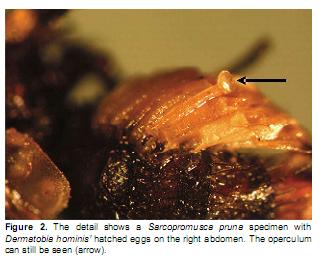
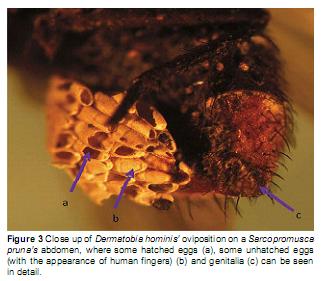
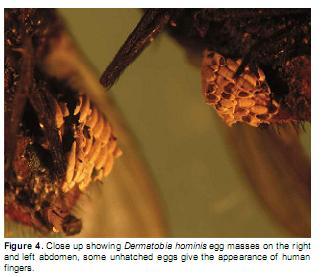
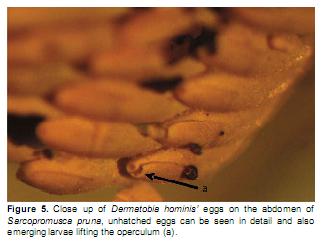
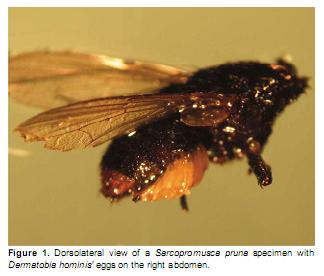
<body><![CDATA[<p><font face="Verdana, Arial, Helvetica, sans-serif" size="2">This identification used  the taxonomic keys    described by  Soulsby, (1976) and the  dichotomous    keys described  by Pratt and  Stojanovicch (1969)    by means  of a NIKON binocular stereomicroscope    model SMZ1.</font></p>     <p><font face="Verdana, Arial, Helvetica, sans-serif" size="2"></font></p>     <p><font face="Verdana, Arial, Helvetica, sans-serif" size="3"><b>Results</b> </font></p>     <p><font face="Verdana, Arial, Helvetica, sans-serif" size="2">Out of the collected  insects only nine specimens    were carrying  <i>D. hominis'</i> eggs  and they all    belonged to  the Muscidae family. From them,    five i.e. 55.56%  of the phoretic corresponded  to <i>S.</i>   <i>pruna</i>,  two (22.22%) to <i>H. irritans</i>, one (11.11%) to    <i>M. domestica</i> and one (11.11%) to <i>S.  calcitrans.</i></font></p>     <p><font face="Verdana, Arial, Helvetica, sans-serif" size="2"><i>Sarcopromusca</i> specimens were confirmed    in their identification and recognized  by Dr.    Claudio Jos&eacute; Barros de  Carvalho from the  Federal    University of Parana, specialist in Muscidae family    systematics. This identification was  carried out    in one of the  practical modules of the Neotropical    Muscidae course  offered in 2006  at the University    of Antioquia.</font></p>     <p><font face="Verdana, Arial, Helvetica, sans-serif" size="2">Dr. Carvalho used his own keys for Neotropical    Region Muscidae's genera and  species, which    includes the number of  species for Brazil and  the   region above mentioned (Carvalho and Couri, 2002;    Couri and Carvalho, 2002). </font></p>     <p><font face="Verdana, Arial, Helvetica, sans-serif" size="2">As shown  in figures 1  to 5, the eggs  were    arranged in clusters  to the right or left  side, only    in the abdominal  region of each  phoretic fly. No    oviposition was found  on both sides  of the same    fly. Egg numbers ranged  between 19 and 23. Some    larvae had not hatched  from their eggs giving the    appearance of human fingers. In other cases  the   operculum from where they  hatched could still  be    seen, as detailed in <a href="#f2">figure 2</a>. In <a href="#f3">figure 3</a>, in addition    to the insect's genitalia, some hatched eggs as well    as some unhatched eggs  (a), giving the appearance   of human fingers  as noted above,  can be seen  in    detail (Figures <a href="#f4">4</a> and <a href="#f5">5</a>).</font></p>     <p align="center"><a name="f1"><img src="/img/revistas/rccp/v24n4/a02f1.JPG" /></a></p>     <p align="center"><a name="f2"><img src="/img/revistas/rccp/v24n4/a02f2.JPG" /></a></p>     <p align="center"><a name="f3"> <img src="/img/revistas/rccp/v24n4/a02f3.JPG" /></a></p>    ]]></body>
<body><![CDATA[<p align="center"><a name="f4"> <img src="/img/revistas/rccp/v24n4/a02f4.JPG" /></a></p>     <p align="center"><a name="f5"><img src="/img/revistas/rccp/v24n4/a02f5.JPG" /> </a></p>    <p></p>     <p><font face="Verdana, Arial, Helvetica, sans-serif" size="3"><b>Discussion</b> </font></p>     <p><font face="Verdana, Arial, Helvetica, sans-serif" size="2">Pedroso de Paiva  (1996) states that  <i>S. pruna</i>   (Shannon and Del Ponte, 1926) (Diptera: Muscidae)   is a species  of fly with a  short life cycle whose    adults feed by licking  the wounds caused by blood-   sucking insects and biting flies such as <i>S. calcitrans</i> .    Therefore, beginning in the 50's and further decades,    several authors including  Neel <i>et al</i>., (1955), Koon    and Banegas (1959),  Lombardero and Fontana    (1968) and Silva <i>et al</i>.  (1989) have stated  that in    Latin America, this fly can be an important phoretic   for <i>D. hominis</i>' eggs.  This study confirms  the    occurrence of <i>S. pruna</i> as foretic for <i>D. hominis</i>'  eggs    in the enzootic  region of Antioquia in  which it was    performed. This in  turn agrees with  Nihei (2005),    Guimar&atilde;es and Papavero's  findings (1998), who    propose that <i>Sarcopromusca</i> and <i>D.  hominis</i> have   similar geographical distribution.</font></p>     <p><font face="Verdana, Arial, Helvetica, sans-serif" size="2">This study's findings, even in its relatively short    period of collection,  are also consistent  with Silva    <i>et al</i>., (1989) who  after two years of  collection,    confirmed the appearance of<i> S.  pruna </i>as the main    transporting host of <i>D.  hominis eggs</i> among  cattle    ranches, in the mid  east of the state of  Bahia   (Brazil). Their study showed the coincidence of two    peaks of abundance of this fly as well as that of <i>D.</i>   <i>hominis</i>. Similarly Azevedo <i>et al</i>., (2007) noted the    occurrence of <i>S.  pruna</i> as phoretic for <i>D.  hominis'</i>   egg in the south of that country.</font></p>     <p><font face="Verdana, Arial, Helvetica, sans-serif" size="2">Silva <i>et al</i>., (1999)  studied under laboratory    conditions, <i>D. hominis</i> oviposition  capacity in four Muscidae  species (<i>M. domestica, S. pruna, H. </i>   <i>irritans and S.  calcitrans</i>) and two Calliphoridae species (<i>C.  macellaria</i> y <i>Lucilia  caprina</i>). They  found in  descending order that  the main phoretic  were members  of the family  Muscidae and M.  <i>domestic</i> (25.0%), <i>S</i>. <i>pruna</i> (16.7%), <i>H</i>. <i>irritans</i> (12.5%) and <i>S.  calcitrans</i> (11.7%). In  this work  <i>M. domestic</i> was  considered the most  important  vector  under laboratory conditions. Such findings  differ from  those of  the present study  under field  conditions in  a specific region  of Antioquia.  Ecoepidemiol&oacute;gic  variables related to  population  dynamics and  biological habits of each  genus of this Diptera family,  may have influenced the results,  such situations in  most cases are difficult to manage  or are not taken into  account in lab studies.</font></p>     <p><font face="Verdana, Arial, Helvetica, sans-serif" size="2">In this  research, eggs were found sometimes    on  the right side and others on the left side of each    phoretic, coinciding  with information reported    by Silva <i>et  al</i>., (1989), who  state that there are no    preferences regarding  the side on which <i>D. hominis</i>   laid eggs on  <i>S.  pruna</i>. The authors  stated that    oviposition  may occur simultaneously on both sides    of the  same fly, and there is  a direct relationship    between  abdomen size and the number of eggs laid.    Simultaneous oviposition  on both sides of the fly's    abdomen was not  proved in this study.</font></p>     <p><font face="Verdana, Arial, Helvetica, sans-serif" size="2">In 2007, Azevedo <i>et al</i>., first reported<i>  S. pruna</i>    as a vector of <i>D.  hominis </i>eggs in  southwestern    Brazil.  The captured fly  was carrying18 eggs  on    the right latero-ventral portion  of the abdomen.    These results are very  close to those obtained  in    this study in which  the number of eggs arranged in    clusters ranged  from 19 to 23. However, top  value    oviposition ranges  found here, markedly  differ   from  those reported by Paloschi <i>et al</i>.,  (1991), who    reported  a similar average of 21.6 but a higher value    up to  55 eggs on  the phoretic's abdomen.  In this    study we  never found more than 23  eggs per fly,    which  also differs with the high values evidenced by    Rodriguez (1998) that  ranged between 7 and 63 <i>D.</i>   <i>hominis'</i> eggs on each vector  fly's abdomen.</font></p>     <p><font face="Verdana, Arial, Helvetica, sans-serif" size="2">In regards to  the presence of vectors  of <i>D.</i>     <i>hominis </i>eggs  there isn't a lot  of known research,   except for the one  that has been conducted for years    in Brazil, and more  recently by researchers such as Paloschi <i>et al</i>., (1991), Brum <i>et al</i>., (1996), Gomes    <i>et al</i>., (1998), Rodriguez (1998), Silva  and Moya  (1999) and Pinto (2001). Their work has shown the epidemiological importance  in dermatobiosis, not  only of <i>Sarcopromuca</i> and  other members of the  Muscidae family but that of the <i>Fannia</i> genus. </font></p>     ]]></body>
<body><![CDATA[<p><font face="Verdana, Arial, Helvetica, sans-serif" size="2">For example, in  Mato Grosso do Sul Gomes      <i>et al</i>., (1998),  found <i>Fannia</i> sp. as  a <i>D. hominis</i>   phoretic, carrying an average of 16.4 eggs. Similarly    Brum <i>et al</i>.,  (1996) reported specimens  of <i>Fannia </i>   <i>punctipennis</i> as phoretics,  in the municipality  of   Pelotas, Rio Grande  do Sul, Brazil. They  averaged    16.3 eggs of <i>D.  hominis</i> on their abdomen. Gomes    <i>et al</i>., (2002)  in Campo Grande,  Mato Grosso do    Sul, Brazil, captured  a total of  40,629 flies of the   Fanniidae family,  belonging to five  species of the   <i>Fannia </i>genus, where  the most common  species was    <i>F. pusio</i>, representing 63.20% of the total, followed by    <i>F. heydenii</i> which represented 28.82% of this family's    phoretics. Besides <i>Fannia</i>  (Diptera: Fanniidae) and    members of the Muscidae family, we have identified    here, as well as in other reported research, more flies    and mosquitoes involved  in transporting <i>D. hominis </i>   eggs, such as members of the families <i>Calliphoridae</i>,    <i>Sarcophagidae</i> and <i>Tabanidae</i>.</font></p>     <p><font face="Verdana, Arial, Helvetica, sans-serif" size="2">As we  see, in different  tropical countries,    where these parasites  have great impact  on the   livestock industry,  several investigations have  been    conducted, aiming to  identify their main  phoretics.    This highlights the need to extend the identification    process of different  dipterans involved in the  life   cycle of <i>D. hominis</i> in  Antioquia as well as in    different areas of the  country where dermatobiosis    is enzootic. In the suggested  studies, it would  also    be interesting to  include the abundance of species,    the phoretic's  seasonality and their  relation to eco-   epidemiological  conditions, in order to  implement    non-chemical measures to  prevent and /  or control    this important parasite in cattle.</font></p>     <p><font face="Verdana, Arial, Helvetica, sans-serif" size="2">In Colombia,  in the Research Centre  -"El    Nus- CORPOICA regional cuatro" (San  Roque,    Antioquia), Mateus (1967)  reported<i> Orthelia </i>   <i>pruna</i>  as the most  common phoretic host for <i>D.</i>   <i>hominis'</i> eggs. Pamplona  (1990), states that <i>S.</i>   <i>pruna</i> is synonymous  with <i>Orthelia pruna</i>  and <i>S.</i>   <i>arcuata</i>, so this finding constitutes a new  report in which  this diptera acts as an egg  carrier of one of the most important myiasis  in Colombian  livestock,  mainly in regions  below 2000 m above  sea level. The  captured specimens are stored in the Museum  Collection of Veterinary Entomology  and  Parasitology,  which the author has dedicated to his  professor, the  emeritus Veterinary Parasitologist  from the Faculty  of Agricultural Sciences,  University of Antioquia,  Doctor Jorge Alberto  Quijano Correa.  These specimens are kept  in vials  with 70% alcohol,  properly labeled.</font></p>     <p></p>     <p><font face="Verdana, Arial, Helvetica, sans-serif" size="3"><b>Acknowledgements</b> </font></p>     <p><font face="Verdana, Arial, Helvetica, sans-serif" size="2">I would like to thank  specially, Professor Claudio    Jos&eacute; Barros de Carvalho,  Department of Zoology    at the <i>Universidade Federal  do Paran&aacute;</i> (Curitiba,    Brazil, <a href="http://zoo.bio.ufpr.br/diptera/diptera-c/index.html" target="_blank">http://zoo.bio.ufpr.br/diptera/diptera-c/index.html</a>) for his valuable assistance in the identification    of <i>S. pruna</i>, and for the time spent in reviewing this    manuscript.</font></p>     <p></p>     <p><font face="Verdana, Arial, Helvetica, sans-serif" size="3"><b>References </b> </font></p>     <!-- ref --><p><font face="Verdana, Arial, Helvetica, sans-serif" size="2">1. Acha PN,  Szyfris B. Zoonosis y  enfermedades transmisibles    comunes al  hombre y los animales. 2&ordf;.  Ed. Organizaci&oacute;n    Panamericana de  la Salud. Publicaci&oacute;n  Cient&iacute;fica No. 503.    1986.  p.889-90.   </font>&nbsp;&nbsp;&nbsp;&nbsp;&nbsp;&nbsp;&nbsp;&nbsp;[&#160;<a href="javascript:void(0);" onclick="javascript: window.open('/scielo.php?script=sci_nlinks&ref=000071&pid=S0120-0690201100040000200001&lng=','','width=640,height=500,resizable=yes,scrollbars=1,menubar=yes,');">Links</a>&#160;]<!-- end-ref --><!-- ref --><p><font face="Verdana, Arial, Helvetica, sans-serif" size="2">2. Aiello SE.  Parasitic Skin Diseases.  In: Aiello, SE. The merck    veterinary manual. Philadelphia: National  Publishing; 1998.    p.631-632.    </font>&nbsp;&nbsp;&nbsp;&nbsp;&nbsp;&nbsp;&nbsp;&nbsp;[&#160;<a href="javascript:void(0);" onclick="javascript: window.open('/scielo.php?script=sci_nlinks&ref=000072&pid=S0120-0690201100040000200002&lng=','','width=640,height=500,resizable=yes,scrollbars=1,menubar=yes,');">Links</a>&#160;]<!-- end-ref --><!-- ref --><p><font face="Verdana, Arial, Helvetica, sans-serif" size="2">3. Azevedo  RR, Duarte JLP, Ribeiro PB,  Kr&uuml;ger RF. Occurrence    of <i>Sarcopromusca pruna</i>  (Diptera) in Southern Brazil  as a    vector of <i>Dermatobia  hominis</i> (Diptera) eggs.  Arq Bras Med    Vet  Zootec 2007; 59:1348-1350.   </font>&nbsp;&nbsp;&nbsp;&nbsp;&nbsp;&nbsp;&nbsp;&nbsp;[&#160;<a href="javascript:void(0);" onclick="javascript: window.open('/scielo.php?script=sci_nlinks&ref=000073&pid=S0120-0690201100040000200003&lng=','','width=640,height=500,resizable=yes,scrollbars=1,menubar=yes,');">Links</a>&#160;]<!-- end-ref --><!-- ref --><p><font face="Verdana, Arial, Helvetica, sans-serif" size="2">4. Bates M.  Mosquitoes as vectors  of <i>Dermatobia</i> in  Eastern    Colombia. <i>Annals  of the Entomological  Society of America </i>   1943;  36:1-24.    </font>&nbsp;&nbsp;&nbsp;&nbsp;&nbsp;&nbsp;&nbsp;&nbsp;[&#160;<a href="javascript:void(0);" onclick="javascript: window.open('/scielo.php?script=sci_nlinks&ref=000074&pid=S0120-0690201100040000200004&lng=','','width=640,height=500,resizable=yes,scrollbars=1,menubar=yes,');">Links</a>&#160;]<!-- end-ref --><!-- ref --><p><font face="Verdana, Arial, Helvetica, sans-serif" size="2">5. Brum JGW, Gentilini F,  Pinto LS, Vianna EES.  <i>Fannia </i>   <i>punctipennis</i> (Diptera: Fanniidae) vetor de ovos da <i>Dermatobia </i>   <i>hominis</i> (Oestridae: Cuterebrinae) em Pelotas,  RS. Rev Bras    Parasitol  Vet 1996; 5:59-60.   </font>&nbsp;&nbsp;&nbsp;&nbsp;&nbsp;&nbsp;&nbsp;&nbsp;[&#160;<a href="javascript:void(0);" onclick="javascript: window.open('/scielo.php?script=sci_nlinks&ref=000075&pid=S0120-0690201100040000200005&lng=','','width=640,height=500,resizable=yes,scrollbars=1,menubar=yes,');">Links</a>&#160;]<!-- end-ref --><!-- ref --><p><font face="Verdana, Arial, Helvetica, sans-serif" size="2">6. Brum JGW,  Vianna ESS, Costa  PRP, Pinto LS,  Jesus LP.    Sinanthropy and  seasonal incidence of <i>Fannia punctipennis</i>   (Diptera:  Fanniidae) em Pelotas, Rio Grande do Sul, Brazil. Rev    Bras  Parasitol Vet 1998; 7:149-150.    </font>&nbsp;&nbsp;&nbsp;&nbsp;&nbsp;&nbsp;&nbsp;&nbsp;[&#160;<a href="javascript:void(0);" onclick="javascript: window.open('/scielo.php?script=sci_nlinks&ref=000076&pid=S0120-0690201100040000200006&lng=','','width=640,height=500,resizable=yes,scrollbars=1,menubar=yes,');">Links</a>&#160;]<!-- end-ref --><!-- ref --><p><font face="Verdana, Arial, Helvetica, sans-serif" size="2">7. Carvalho CJB,  Couri MS. Part  I. Basal groups.  In: Carvalho    CJB.  Muscidae (Diptera) of the Neotropical Region: taxonomy.    Editora Universidade  Federal do Paran&aacute;,  Curitiba; 2002. p17-   132.   </font>&nbsp;&nbsp;&nbsp;&nbsp;&nbsp;&nbsp;&nbsp;&nbsp;[&#160;<a href="javascript:void(0);" onclick="javascript: window.open('/scielo.php?script=sci_nlinks&ref=000077&pid=S0120-0690201100040000200007&lng=','','width=640,height=500,resizable=yes,scrollbars=1,menubar=yes,');">Links</a>&#160;]<!-- end-ref --><!-- ref --><p><font face="Verdana, Arial, Helvetica, sans-serif" size="2">8. Clyti  E, Pages F, Pradinaud R. Update on <i>Dermatobia hominis</i>:    South American  furuncular myiasis. Med Trop  (Mars) 2008;    68:7-10.</font>&nbsp;&nbsp;&nbsp;&nbsp;&nbsp;&nbsp;&nbsp;&nbsp;[&#160;<a href="javascript:void(0);" onclick="javascript: window.open('/scielo.php?script=sci_nlinks&ref=000078&pid=S0120-0690201100040000200008&lng=','','width=640,height=500,resizable=yes,scrollbars=1,menubar=yes,');">Links</a>&#160;]<!-- end-ref --><!-- ref --><p><font face="Verdana, Arial, Helvetica, sans-serif" size="2">9. Couri  MS, Carvalho CJB. Part II. Apical Groups. In Carvalho,  C.J.B. de (Ed) Muscidae (Diptera)  of the Neotropical  Region:  taxonomy<i>. </i>Editora Universidade  Federal do Paran&aacute;, Curitiba;  2002.  P.133-262. </font>&nbsp;&nbsp;&nbsp;&nbsp;&nbsp;&nbsp;&nbsp;&nbsp;[&#160;<a href="javascript:void(0);" onclick="javascript: window.open('/scielo.php?script=sci_nlinks&ref=000079&pid=S0120-0690201100040000200009&lng=','','width=640,height=500,resizable=yes,scrollbars=1,menubar=yes,');">Links</a>&#160;]<!-- end-ref --><!-- ref --><p><font face="Verdana, Arial, Helvetica, sans-serif" size="2">10. Fortes E.  Artropodologia. In: Fortes,  E. Parasitologia    veterin&aacute;ria.  S&atilde;o Paulo: &Iacute;cone; 1997. p.535-539.    </font>&nbsp;&nbsp;&nbsp;&nbsp;&nbsp;&nbsp;&nbsp;&nbsp;[&#160;<a href="javascript:void(0);" onclick="javascript: window.open('/scielo.php?script=sci_nlinks&ref=000080&pid=S0120-0690201100040000200010&lng=','','width=640,height=500,resizable=yes,scrollbars=1,menubar=yes,');">Links</a>&#160;]<!-- end-ref --><!-- ref --><p><font face="Verdana, Arial, Helvetica, sans-serif" size="2">11. Gobernaci&oacute;n de Antioquia.  Construyamos nuestra Antioquia.    Medell&iacute;n;  1991.</font>&nbsp;&nbsp;&nbsp;&nbsp;&nbsp;&nbsp;&nbsp;&nbsp;[&#160;<a href="javascript:void(0);" onclick="javascript: window.open('/scielo.php?script=sci_nlinks&ref=000081&pid=S0120-0690201100040000200011&lng=','','width=640,height=500,resizable=yes,scrollbars=1,menubar=yes,');">Links</a>&#160;]<!-- end-ref --><!-- ref --><p><font face="Verdana, Arial, Helvetica, sans-serif" size="2">12. Gomes RP, Koller  WW, Gomes A, Carvalho  CJ, Zorzatto JR.  D&iacute;pteros fan&iacute;deos  vetores de ovos  de  <i>Dermatobia hominis </i> em Campo Grande, Mato Grosso do  Sul. Pesq Vet Bras 2002;  22:114-118. </font>&nbsp;&nbsp;&nbsp;&nbsp;&nbsp;&nbsp;&nbsp;&nbsp;[&#160;<a href="javascript:void(0);" onclick="javascript: window.open('/scielo.php?script=sci_nlinks&ref=000082&pid=S0120-0690201100040000200012&lng=','','width=640,height=500,resizable=yes,scrollbars=1,menubar=yes,');">Links</a>&#160;]<!-- end-ref --><!-- ref --><p><font face="Verdana, Arial, Helvetica, sans-serif" size="2">   13. Gomes A, Sousa  JC, Resende AM,  Curvo JBE. Distribui&ccedil;&atilde;o    corporal e sazonalidade do berne (larva de <i>Dermatobia hominis</i>)    em bovinos tratados ou n&atilde;o com flor de enxofre. Pesq Agropec    Bras 1988; 23:825-829.</font>&nbsp;&nbsp;&nbsp;&nbsp;&nbsp;&nbsp;&nbsp;&nbsp;[&#160;<a href="javascript:void(0);" onclick="javascript: window.open('/scielo.php?script=sci_nlinks&ref=000083&pid=S0120-0690201100040000200013&lng=','','width=640,height=500,resizable=yes,scrollbars=1,menubar=yes,');">Links</a>&#160;]<!-- end-ref --><!-- ref --><p><font face="Verdana, Arial, Helvetica, sans-serif" size="2">   14. Gomes A, Honer MR,  Koller WW, Silva RL. Vetores de  ovos    de <i>Dermatobia hominis</i> (L.  JR. 1781) (Diptera;  Cuterebridae)   na regi&atilde;o de Cerrados do Mato Grosso do Sul, Brasil. Rev Bras    Parasitol Vet 1998; 7:37-40.</font>&nbsp;&nbsp;&nbsp;&nbsp;&nbsp;&nbsp;&nbsp;&nbsp;[&#160;<a href="javascript:void(0);" onclick="javascript: window.open('/scielo.php?script=sci_nlinks&ref=000084&pid=S0120-0690201100040000200014&lng=','','width=640,height=500,resizable=yes,scrollbars=1,menubar=yes,');">Links</a>&#160;]<!-- end-ref --><!-- ref --><p><font face="Verdana, Arial, Helvetica, sans-serif" size="2">   15. Grisi L, Massard CL, Moya GE, Pereira JB. Impacto econ&ocirc;mico    das principais ectoparasitoses em  bovinos no Brasil.  Hora Vet    2002; 21:8-10.</font>&nbsp;&nbsp;&nbsp;&nbsp;&nbsp;&nbsp;&nbsp;&nbsp;[&#160;<a href="javascript:void(0);" onclick="javascript: window.open('/scielo.php?script=sci_nlinks&ref=000085&pid=S0120-0690201100040000200015&lng=','','width=640,height=500,resizable=yes,scrollbars=1,menubar=yes,');">Links</a>&#160;]<!-- end-ref --><!-- ref --><p><font face="Verdana, Arial, Helvetica, sans-serif" size="2">   16. Guimar&atilde;es JH, Papavero  N. Myiasis caused by  obligatory    parasites. In: Guimar&atilde;es  JH, Papavero N.  Myiasis in man  and    animals in the neotropical region - bibliographic database. S&atilde;o    Paulo: Pl&ecirc;iade; 1998. p.257.</font>&nbsp;&nbsp;&nbsp;&nbsp;&nbsp;&nbsp;&nbsp;&nbsp;[&#160;<a href="javascript:void(0);" onclick="javascript: window.open('/scielo.php?script=sci_nlinks&ref=000086&pid=S0120-0690201100040000200016&lng=','','width=640,height=500,resizable=yes,scrollbars=1,menubar=yes,');">Links</a>&#160;]<!-- end-ref --><!-- ref --><p><font face="Verdana, Arial, Helvetica, sans-serif" size="2">   17. Jobsen JA, Mourier  H. The morphology  of the larval  instars    and pupa of <i>Dermatobia hominis</i> L. Jr. (Diptera:  Cuterebridae).    Entomol Berich 1972; 32:218-224.</font>&nbsp;&nbsp;&nbsp;&nbsp;&nbsp;&nbsp;&nbsp;&nbsp;[&#160;<a href="javascript:void(0);" onclick="javascript: window.open('/scielo.php?script=sci_nlinks&ref=000087&pid=S0120-0690201100040000200017&lng=','','width=640,height=500,resizable=yes,scrollbars=1,menubar=yes,');">Links</a>&#160;]<!-- end-ref --><!-- ref --><p><font face="Verdana, Arial, Helvetica, sans-serif" size="2">   18. Lombardero OJ, Fontana BAJ. La "ura" (<i>Dermatobia hominis) </i>   en la Provincia de Formosa. Gac Vet 1968; 30:297-306. </font>&nbsp;&nbsp;&nbsp;&nbsp;&nbsp;&nbsp;&nbsp;&nbsp;[&#160;<a href="javascript:void(0);" onclick="javascript: window.open('/scielo.php?script=sci_nlinks&ref=000088&pid=S0120-0690201100040000200018&lng=','','width=640,height=500,resizable=yes,scrollbars=1,menubar=yes,');">Links</a>&#160;]<!-- end-ref --><!-- ref --><p><font face="Verdana, Arial, Helvetica, sans-serif" size="2">   19. Maia AAM, Gomes  AG. Vetores de <i>Dermatobia hominis</i>,    Linnaeus Jr., 1781 (Diptera: Cuterebridae) na regi&atilde;o de Uberaba,    Minas Gerais. Rev Fac Med Vet Zootec 1988; 25:47-51.</font>&nbsp;&nbsp;&nbsp;&nbsp;&nbsp;&nbsp;&nbsp;&nbsp;[&#160;<a href="javascript:void(0);" onclick="javascript: window.open('/scielo.php?script=sci_nlinks&ref=000089&pid=S0120-0690201100040000200019&lng=','','width=640,height=500,resizable=yes,scrollbars=1,menubar=yes,');">Links</a>&#160;]<!-- end-ref --><!-- ref --><p><font face="Verdana, Arial, Helvetica, sans-serif" size="2">   20. Mateus G. El nuche y su ciclo de vida. Revista ICA 1967; 2:3-   19.</font>&nbsp;&nbsp;&nbsp;&nbsp;&nbsp;&nbsp;&nbsp;&nbsp;[&#160;<a href="javascript:void(0);" onclick="javascript: window.open('/scielo.php?script=sci_nlinks&ref=000090&pid=S0120-0690201100040000200020&lng=','','width=640,height=500,resizable=yes,scrollbars=1,menubar=yes,');">Links</a>&#160;]<!-- end-ref --><!-- ref --><p><font face="Verdana, Arial, Helvetica, sans-serif" size="2">   21. Moya GE. Estudios  sobre la biolog&iacute;a, morfolog&iacute;a  y    esterilizaci&oacute;n del t&oacute;rsalo, <i>Dermatobia hominis</i> (L.Jr.).  MSc    Thesis, IICA, Turrialba, Costa Rica; 1966. p.63.</font>&nbsp;&nbsp;&nbsp;&nbsp;&nbsp;&nbsp;&nbsp;&nbsp;[&#160;<a href="javascript:void(0);" onclick="javascript: window.open('/scielo.php?script=sci_nlinks&ref=000091&pid=S0120-0690201100040000200021&lng=','','width=640,height=500,resizable=yes,scrollbars=1,menubar=yes,');">Links</a>&#160;]<!-- end-ref --><!-- ref --><p><font face="Verdana, Arial, Helvetica, sans-serif" size="2">   22. Moya GE. O  berne: biologia, comportamento  e controle.    Agroqu&iacute;mica 1982; 17:19-26.</font>&nbsp;&nbsp;&nbsp;&nbsp;&nbsp;&nbsp;&nbsp;&nbsp;[&#160;<a href="javascript:void(0);" onclick="javascript: window.open('/scielo.php?script=sci_nlinks&ref=000092&pid=S0120-0690201100040000200022&lng=','','width=640,height=500,resizable=yes,scrollbars=1,menubar=yes,');">Links</a>&#160;]<!-- end-ref --><!-- ref --><p><font face="Verdana, Arial, Helvetica, sans-serif" size="2">   23. Neel W, Urbina P,  Viale E, Alba j. Ciclo  biol&oacute;gico del torsalo    <i>(Dermatobia hominis </i>L. Jr.). en Turrialba, Costa  Rica. Turrialba    1955; 5:91-104.</font>&nbsp;&nbsp;&nbsp;&nbsp;&nbsp;&nbsp;&nbsp;&nbsp;[&#160;<a href="javascript:void(0);" onclick="javascript: window.open('/scielo.php?script=sci_nlinks&ref=000093&pid=S0120-0690201100040000200023&lng=','','width=640,height=500,resizable=yes,scrollbars=1,menubar=yes,');">Links</a>&#160;]<!-- end-ref --><!-- ref --><p><font face="Verdana, Arial, Helvetica, sans-serif" size="2">24. Neiva  A, Gomez JF. Biologia da mosca do berne, <i>Dermatobia </i>   <i>hominis</i>, observada  em todas as  suas fases. Anais Paulistas  de  Medicina  e Cirurgia 1917; 8:197-209. </font>&nbsp;&nbsp;&nbsp;&nbsp;&nbsp;&nbsp;&nbsp;&nbsp;[&#160;<a href="javascript:void(0);" onclick="javascript: window.open('/scielo.php?script=sci_nlinks&ref=000094&pid=S0120-0690201100040000200024&lng=','','width=640,height=500,resizable=yes,scrollbars=1,menubar=yes,');">Links</a>&#160;]<!-- end-ref --><!-- ref --><p><font face="Verdana, Arial, Helvetica, sans-serif" size="2">   25. Nihei SS.  A review of  the Neotropical genus <i>Sarcopromusca</i>   townsend (Diptera:  Muscidae) with a key  to species and    a redescription of  <i>S.  sarcophagina </i>(Wulp). Zootaxa  2005;    1004:51-64.</font>&nbsp;&nbsp;&nbsp;&nbsp;&nbsp;&nbsp;&nbsp;&nbsp;[&#160;<a href="javascript:void(0);" onclick="javascript: window.open('/scielo.php?script=sci_nlinks&ref=000095&pid=S0120-0690201100040000200025&lng=','','width=640,height=500,resizable=yes,scrollbars=1,menubar=yes,');">Links</a>&#160;]<!-- end-ref --><!-- ref --><p><font face="Verdana, Arial, Helvetica, sans-serif" size="2">   26. Oliveira  GP. Din&aacute;mica parasitaria de bernes  em bovinos. I.    Incid&ecirc;ncia em  rela&ccedil;&atilde;o ao dec&uacute;bito. Pesq Agropec  Bras, Serie    Zootecnia  1991; 26:7-471. </font>&nbsp;&nbsp;&nbsp;&nbsp;&nbsp;&nbsp;&nbsp;&nbsp;[&#160;<a href="javascript:void(0);" onclick="javascript: window.open('/scielo.php?script=sci_nlinks&ref=000096&pid=S0120-0690201100040000200026&lng=','','width=640,height=500,resizable=yes,scrollbars=1,menubar=yes,');">Links</a>&#160;]<!-- end-ref --><!-- ref --><p><font face="Verdana, Arial, Helvetica, sans-serif" size="2">   27. Oliveira  GP. Distribui&ccedil;&atilde;o sazonal  de d&iacute;pteros musc&oacute;ides    sinantr&oacute;picos,  simbovinos e for&eacute;ticos de <i>Dermatobia hominis</i> L.    Jr.,  em S&atilde;o Carlos, Estado de S&atilde;o Paulo. I. Est&aacute;bulo. Arqs Biol    Tecnol  1986; 29:311-325.</font>&nbsp;&nbsp;&nbsp;&nbsp;&nbsp;&nbsp;&nbsp;&nbsp;[&#160;<a href="javascript:void(0);" onclick="javascript: window.open('/scielo.php?script=sci_nlinks&ref=000097&pid=S0120-0690201100040000200027&lng=','','width=640,height=500,resizable=yes,scrollbars=1,menubar=yes,');">Links</a>&#160;]<!-- end-ref --><!-- ref --><p><font face="Verdana, Arial, Helvetica, sans-serif" size="2">   28. Paloschi CG,  Ramos CI, Souza AP,  Bellato V, Sartor AA,    Dalagnol CA. Vetores  de ovos de <i>Dermatobia hominis</i>  no    Planalto  Catarinense. Pesq Agropec Bras 1991; 26:1872-1883.</font>&nbsp;&nbsp;&nbsp;&nbsp;&nbsp;&nbsp;&nbsp;&nbsp;[&#160;<a href="javascript:void(0);" onclick="javascript: window.open('/scielo.php?script=sci_nlinks&ref=000098&pid=S0120-0690201100040000200028&lng=','','width=640,height=500,resizable=yes,scrollbars=1,menubar=yes,');">Links</a>&#160;]<!-- end-ref --><!-- ref --><p><font face="Verdana, Arial, Helvetica, sans-serif" size="2">   29. Pedroso-De-Paiva D.  Aspectos da biologia  de adultos    de <i>Sarcopromusca pruna </i> (Shannon &amp;  Del Ponte, 1926)   (Diptera:Muscidae).  Rev Bras Biol 1996; 56:183-190.</font>&nbsp;&nbsp;&nbsp;&nbsp;&nbsp;&nbsp;&nbsp;&nbsp;[&#160;<a href="javascript:void(0);" onclick="javascript: window.open('/scielo.php?script=sci_nlinks&ref=000099&pid=S0120-0690201100040000200029&lng=','','width=640,height=500,resizable=yes,scrollbars=1,menubar=yes,');">Links</a>&#160;]<!-- end-ref --><!-- ref --><p><font face="Verdana, Arial, Helvetica, sans-serif" size="2">   30. Pinto SB, Rochadelli R, Vendruscolo E,  Soccol VT, Bretanha    PR, Freitag  A, Henemann C, Uemura  M,. Bioecolog&iacute;a de    <i>Dermatobia hominis </i>(Linnaeus  Jr., 1781) em Palotina,  Paran&aacute;,    Brasil.  Cienc Rural 2002; 32:821-827. </font>&nbsp;&nbsp;&nbsp;&nbsp;&nbsp;&nbsp;&nbsp;&nbsp;[&#160;<a href="javascript:void(0);" onclick="javascript: window.open('/scielo.php?script=sci_nlinks&ref=000100&pid=S0120-0690201100040000200030&lng=','','width=640,height=500,resizable=yes,scrollbars=1,menubar=yes,');">Links</a>&#160;]<!-- end-ref --><!-- ref --><p><font face="Verdana, Arial, Helvetica, sans-serif" size="2">   31. Pinto SB.  Aspectos bioecol&oacute;gicos e  imunol&oacute;gicos de    <i>Dermatobia hominis</i> (Linnaeus  Jr., 1781) (Diptera:  Oestridae).   Disserta&ccedil;&atilde;o, Universidade  Federal do Paran&aacute;, Curitiba; 2001.    p.135. </font>&nbsp;&nbsp;&nbsp;&nbsp;&nbsp;&nbsp;&nbsp;&nbsp;[&#160;<a href="javascript:void(0);" onclick="javascript: window.open('/scielo.php?script=sci_nlinks&ref=000101&pid=S0120-0690201100040000200031&lng=','','width=640,height=500,resizable=yes,scrollbars=1,menubar=yes,');">Links</a>&#160;]<!-- end-ref --><!-- ref --><p><font face="Verdana, Arial, Helvetica, sans-serif" size="2">   32. Pratt  H, Stojanovich, CJ.. Pictorial keys arthropods reptils, birds    and mammals  of public-health significance.  U.S. Department    of  health, education, and  welfare public. Health service.  U.S.    Government  printing office Washington; 1969. p.191.</font>&nbsp;&nbsp;&nbsp;&nbsp;&nbsp;&nbsp;&nbsp;&nbsp;[&#160;<a href="javascript:void(0);" onclick="javascript: window.open('/scielo.php?script=sci_nlinks&ref=000102&pid=S0120-0690201100040000200032&lng=','','width=640,height=500,resizable=yes,scrollbars=1,menubar=yes,');">Links</a>&#160;]<!-- end-ref --><!-- ref --><p><font face="Verdana, Arial, Helvetica, sans-serif" size="2">33. Ribeiro PB, Oliveira  CM, Costa PR. Souza FS.  For&eacute;ticos da      <i>Dermatobia hominis </i> (L.  Jr., 1781) (Diptera:Cuterebridae),   no Rio Grande  do Sul, Brasil. Arq Bras  Med Vet Zoot,  1985;    37:507-509. </font>&nbsp;&nbsp;&nbsp;&nbsp;&nbsp;&nbsp;&nbsp;&nbsp;[&#160;<a href="javascript:void(0);" onclick="javascript: window.open('/scielo.php?script=sci_nlinks&ref=000103&pid=S0120-0690201100040000200033&lng=','','width=640,height=500,resizable=yes,scrollbars=1,menubar=yes,');">Links</a>&#160;]<!-- end-ref --><!-- ref --><p><font face="Verdana, Arial, Helvetica, sans-serif" size="2">   34. Ribeiro BCC, Sanavria  A, Oliveira MQ, Souza FS,  Cardoso    PG, Rocco  FS. Inqu&eacute;rito sobre  os casos de  mi&iacute;ases por <i>C. </i>   <i>hominivorax</i> e <i>D. hominis</i> em c&atilde;es e gatos  atendidos no Centro    do Munic&iacute;pio do  Rio de Janeiro  no ano 2000. Universidade    Federal Rural do Rio  de Janeiro; 2001.  In: XI Jornada de    Inicia&ccedil;&atilde;o Cient&iacute;fica da UFRRJ; 2001; 11: 145-148.</font>&nbsp;&nbsp;&nbsp;&nbsp;&nbsp;&nbsp;&nbsp;&nbsp;[&#160;<a href="javascript:void(0);" onclick="javascript: window.open('/scielo.php?script=sci_nlinks&ref=000104&pid=S0120-0690201100040000200034&lng=','','width=640,height=500,resizable=yes,scrollbars=1,menubar=yes,');">Links</a>&#160;]<!-- end-ref --><!-- ref --><p><font face="Verdana, Arial, Helvetica, sans-serif" size="2">   35. Saavedra T, Schenone  H. Tres casos  de miasis forunculosa    producidos por  larvas de  <i>Dermatobia hominis</i>. Bol  Chil    Parasitol 1998; 43:15-17.</font>&nbsp;&nbsp;&nbsp;&nbsp;&nbsp;&nbsp;&nbsp;&nbsp;[&#160;<a href="javascript:void(0);" onclick="javascript: window.open('/scielo.php?script=sci_nlinks&ref=000105&pid=S0120-0690201100040000200035&lng=','','width=640,height=500,resizable=yes,scrollbars=1,menubar=yes,');">Links</a>&#160;]<!-- end-ref --><!-- ref --><p><font face="Verdana, Arial, Helvetica, sans-serif" size="2">   36. Sancho E. <i>Dermatobia</i>,  the neotropical warble fly. Parasitology    Today 1988; 4:242-246.</font>&nbsp;&nbsp;&nbsp;&nbsp;&nbsp;&nbsp;&nbsp;&nbsp;[&#160;<a href="javascript:void(0);" onclick="javascript: window.open('/scielo.php?script=sci_nlinks&ref=000106&pid=S0120-0690201100040000200036&lng=','','width=640,height=500,resizable=yes,scrollbars=1,menubar=yes,');">Links</a>&#160;]<!-- end-ref --><!-- ref --><p><font face="Verdana, Arial, Helvetica, sans-serif" size="2">   37. Silva JVP, Moya GE, De  S LA. Oviposition  capacity of    <i>Dermatobia hominis</i> (Diptera:Cuterebridae) on four  species    of muscidae and two species of calliphoridae under laboratory    conditions. Rev Bras Parasitol Vet 1999a; 8:99-101.</font>&nbsp;&nbsp;&nbsp;&nbsp;&nbsp;&nbsp;&nbsp;&nbsp;[&#160;<a href="javascript:void(0);" onclick="javascript: window.open('/scielo.php?script=sci_nlinks&ref=000107&pid=S0120-0690201100040000200037&lng=','','width=640,height=500,resizable=yes,scrollbars=1,menubar=yes,');">Links</a>&#160;]<!-- end-ref --><!-- ref --><p><font face="Verdana, Arial, Helvetica, sans-serif" size="2">   38. Silva JVP, Moya GE,. Descri&ccedil;&atilde;o in&eacute;dita de Fannia sp. (Diptera:    Fanniidae), como  vetor dos ovos de <i>Dermatobia hominis</i>   (Diptera: Cuterebridae) em  Serop&eacute;dica, RJ. Rev Bras  Cl&iacute;n Vet    1999; 6:173-174.</font>&nbsp;&nbsp;&nbsp;&nbsp;&nbsp;&nbsp;&nbsp;&nbsp;[&#160;<a href="javascript:void(0);" onclick="javascript: window.open('/scielo.php?script=sci_nlinks&ref=000108&pid=S0120-0690201100040000200038&lng=','','width=640,height=500,resizable=yes,scrollbars=1,menubar=yes,');">Links</a>&#160;]<!-- end-ref --><!-- ref --><p><font face="Verdana, Arial, Helvetica, sans-serif" size="2">   39. Silva AAJ, Smith DH, Barbosa  SAJS. <i>Sarcopromusca pruna </i>   (Diptera, Muscidae) as an  egg transport host  of <i>Dermatobia </i>   <i>hominis</i> (Diptera: Cuterebridae) in the Cacau Region of Bahia,   Brazil. <i>Mem Inst. Oswaldo Cruz </i>1989; 84 (supl IV):491-497.</font>&nbsp;&nbsp;&nbsp;&nbsp;&nbsp;&nbsp;&nbsp;&nbsp;[&#160;<a href="javascript:void(0);" onclick="javascript: window.open('/scielo.php?script=sci_nlinks&ref=000109&pid=S0120-0690201100040000200039&lng=','','width=640,height=500,resizable=yes,scrollbars=1,menubar=yes,');">Links</a>&#160;]<!-- end-ref --><!-- ref --><p><font face="Verdana, Arial, Helvetica, sans-serif" size="2">   40. Soulsby EJL. Pathophysiology of Parasitic  Infection. Ed.    Academic Press, New York; 1976. p.258.</font>&nbsp;&nbsp;&nbsp;&nbsp;&nbsp;&nbsp;&nbsp;&nbsp;[&#160;<a href="javascript:void(0);" onclick="javascript: window.open('/scielo.php?script=sci_nlinks&ref=000110&pid=S0120-0690201100040000200040&lng=','','width=640,height=500,resizable=yes,scrollbars=1,menubar=yes,');">Links</a>&#160;]<!-- end-ref --><!-- ref --><p><font face="Verdana, Arial, Helvetica, sans-serif" size="2">   41. Urquhart GM, Armour J, Duncan JL, Dunn AM, Jennings FW.    Entomologia Veterin&aacute;ria. In  Parasitologia Veterin&aacute;ria.  Rio de    Janeiro: Guanabara Koogan; 1990. p.176.</font>&nbsp;&nbsp;&nbsp;&nbsp;&nbsp;&nbsp;&nbsp;&nbsp;[&#160;<a href="javascript:void(0);" onclick="javascript: window.open('/scielo.php?script=sci_nlinks&ref=000111&pid=S0120-0690201100040000200041&lng=','','width=640,height=500,resizable=yes,scrollbars=1,menubar=yes,');">Links</a>&#160;]<!-- end-ref --><!-- ref --><p><font face="Verdana, Arial, Helvetica, sans-serif" size="2">   42. Zeledon R, Jiron  LF. Artropolog&iacute;a M&eacute;dica  y Veterinaria.    Universidad de Costa Rica; 1979. 280p.</font>&nbsp;&nbsp;&nbsp;&nbsp;&nbsp;&nbsp;&nbsp;&nbsp;[&#160;<a href="javascript:void(0);" onclick="javascript: window.open('/scielo.php?script=sci_nlinks&ref=000112&pid=S0120-0690201100040000200042&lng=','','width=640,height=500,resizable=yes,scrollbars=1,menubar=yes,');">Links</a>&#160;]<!-- end-ref --> ]]></body><back>
<ref-list>
<ref id="B1">
<label>1</label><nlm-citation citation-type="book">
<person-group person-group-type="author">
<name>
<surname><![CDATA[Acha]]></surname>
<given-names><![CDATA[PN]]></given-names>
</name>
<name>
<surname><![CDATA[Szyfris]]></surname>
<given-names><![CDATA[B]]></given-names>
</name>
</person-group>
<source><![CDATA[Zoonosis y enfermedades transmisibles comunes al hombre y los animales]]></source>
<year>1986</year>
<edition>2</edition>
<page-range>889-90</page-range><publisher-name><![CDATA[Ed. Organización Panamericana de la Salud]]></publisher-name>
</nlm-citation>
</ref>
<ref id="B2">
<label>2</label><nlm-citation citation-type="book">
<person-group person-group-type="author">
<name>
<surname><![CDATA[Aiello]]></surname>
<given-names><![CDATA[SE]]></given-names>
</name>
</person-group>
<source><![CDATA[Parasitic Skin Diseases]]></source>
<year>1998</year>
<page-range>631-632</page-range><publisher-loc><![CDATA[Philadelphia ]]></publisher-loc>
<publisher-name><![CDATA[National Publishing]]></publisher-name>
</nlm-citation>
</ref>
<ref id="B3">
<label>3</label><nlm-citation citation-type="journal">
<person-group person-group-type="author">
<name>
<surname><![CDATA[Azevedo]]></surname>
<given-names><![CDATA[RR]]></given-names>
</name>
<name>
<surname><![CDATA[Duarte]]></surname>
<given-names><![CDATA[JLP]]></given-names>
</name>
<name>
<given-names><![CDATA[Ribeiro PB]]></given-names>
</name>
<name>
<given-names><![CDATA[Krüger RF]]></given-names>
</name>
</person-group>
<article-title xml:lang="en"><![CDATA[Occurrence of Sarcopromusca pruna (Diptera) in Southern Brazil as a vector of Dermatobia hominis (Diptera) eggs]]></article-title>
<source><![CDATA[Arq Bras Med Vet Zootec]]></source>
<year>2007</year>
<volume>59</volume>
<page-range>1348-1350</page-range></nlm-citation>
</ref>
<ref id="B4">
<label>4</label><nlm-citation citation-type="journal">
<person-group person-group-type="author">
<name>
<surname><![CDATA[Bates]]></surname>
<given-names><![CDATA[M]]></given-names>
</name>
</person-group>
<article-title xml:lang="en"><![CDATA[Mosquitoes as vectors of Dermatobia in Eastern Colombia]]></article-title>
<source><![CDATA[Annals of the Entomological Society of America]]></source>
<year>1943</year>
<volume>36</volume>
<page-range>1-24</page-range></nlm-citation>
</ref>
<ref id="B5">
<label>5</label><nlm-citation citation-type="journal">
<person-group person-group-type="author">
<name>
<surname><![CDATA[Brum]]></surname>
<given-names><![CDATA[JGW]]></given-names>
</name>
<name>
<surname><![CDATA[Gentilini]]></surname>
<given-names><![CDATA[F]]></given-names>
</name>
<name>
<given-names><![CDATA[Pinto LS]]></given-names>
</name>
<name>
<surname><![CDATA[Vianna]]></surname>
<given-names><![CDATA[EES]]></given-names>
</name>
</person-group>
<article-title xml:lang="en"><![CDATA[Fannia punctipennis (Diptera: Fanniidae) vetor de ovos da Dermatobia hominis (Oestridae: Cuterebrinae) em Pelotas, RS]]></article-title>
<source><![CDATA[Rev Bras Parasitol Vet]]></source>
<year>1996</year>
<volume>5</volume>
<page-range>59-60</page-range></nlm-citation>
</ref>
<ref id="B6">
<label>6</label><nlm-citation citation-type="journal">
<person-group person-group-type="author">
<name>
<surname><![CDATA[Brum]]></surname>
<given-names><![CDATA[JGW]]></given-names>
</name>
<name>
<given-names><![CDATA[Vianna ESS]]></given-names>
</name>
<name>
<given-names><![CDATA[Costa PRP]]></given-names>
</name>
<name>
<given-names><![CDATA[Pinto LS]]></given-names>
</name>
<name>
<given-names><![CDATA[Jesus LP]]></given-names>
</name>
</person-group>
<article-title xml:lang="en"><![CDATA[Sinanthropy and seasonal incidence of Fannia punctipennis (Diptera: Fanniidae) em Pelotas, Rio Grande do Sul, Brazil]]></article-title>
<source><![CDATA[Rev Bras Parasitol Vet]]></source>
<year>1998</year>
<volume>7</volume>
<page-range>149-150</page-range></nlm-citation>
</ref>
<ref id="B7">
<label>7</label><nlm-citation citation-type="book">
<person-group person-group-type="author">
<name>
<surname><![CDATA[Carvalho]]></surname>
<given-names><![CDATA[CJB]]></given-names>
</name>
<name>
<surname><![CDATA[Couri]]></surname>
<given-names><![CDATA[MS]]></given-names>
</name>
</person-group>
<article-title xml:lang="es"><![CDATA[Basal groups]]></article-title>
<person-group person-group-type="editor">
<name>
<surname><![CDATA[Carvalho]]></surname>
<given-names><![CDATA[CJB]]></given-names>
</name>
</person-group>
<source><![CDATA[Muscidae (Diptera) of the Neotropical Region: taxonomy]]></source>
<year>2002</year>
<page-range>17- 132</page-range><publisher-name><![CDATA[Editora Universidade Federal do ParanáCuritiba]]></publisher-name>
</nlm-citation>
</ref>
<ref id="B8">
<label>8</label><nlm-citation citation-type="journal">
<person-group person-group-type="author">
<name>
<surname><![CDATA[Clyti]]></surname>
<given-names><![CDATA[E]]></given-names>
</name>
<name>
<surname><![CDATA[Pages]]></surname>
<given-names><![CDATA[F]]></given-names>
</name>
<name>
<surname><![CDATA[Pradinaud]]></surname>
<given-names><![CDATA[R]]></given-names>
</name>
</person-group>
<article-title xml:lang="en"><![CDATA[Update on Dermatobia hominis: South American furuncular myiasis]]></article-title>
<source><![CDATA[Med Trop]]></source>
<year>(Mar</year>
<month>s)</month>
<day> 2</day>
<volume>68</volume>
<page-range>7-10</page-range></nlm-citation>
</ref>
<ref id="B9">
<label>9</label><nlm-citation citation-type="book">
<person-group person-group-type="author">
<name>
<surname><![CDATA[Couri]]></surname>
<given-names><![CDATA[MS]]></given-names>
</name>
<name>
<surname><![CDATA[Carvalho]]></surname>
<given-names><![CDATA[CJB]]></given-names>
</name>
</person-group>
<source><![CDATA[Muscidae (Diptera) of the Neotropical Region: taxonomy]]></source>
<year>2002</year>
<page-range>133-262</page-range><publisher-loc><![CDATA[Federal do Paraná ]]></publisher-loc>
<publisher-name><![CDATA[Curitiba]]></publisher-name>
</nlm-citation>
</ref>
<ref id="B10">
<label>10</label><nlm-citation citation-type="book">
<person-group person-group-type="author">
<name>
<surname><![CDATA[Fortes]]></surname>
<given-names><![CDATA[E]]></given-names>
</name>
</person-group>
<article-title xml:lang="pt"><![CDATA[Artropodologia]]></article-title>
<person-group person-group-type="editor">
<name>
<surname><![CDATA[Fortes]]></surname>
<given-names><![CDATA[E]]></given-names>
</name>
</person-group>
<source><![CDATA[Parasitologia veterinária]]></source>
<year>1997</year>
<page-range>535-539</page-range><publisher-loc><![CDATA[São Paulo ]]></publisher-loc>
<publisher-name><![CDATA[Ícone]]></publisher-name>
</nlm-citation>
</ref>
<ref id="B11">
<label>11</label><nlm-citation citation-type="">
<collab>Gobernación de Antioquia</collab>
<source><![CDATA[Construyamos nuestra Antioquia]]></source>
<year>1991</year>
<publisher-loc><![CDATA[Medellín ]]></publisher-loc>
</nlm-citation>
</ref>
<ref id="B12">
<label>12</label><nlm-citation citation-type="journal">
<person-group person-group-type="author">
<name>
<surname><![CDATA[Gomes]]></surname>
<given-names><![CDATA[RP]]></given-names>
</name>
<name>
<given-names><![CDATA[Koller WW]]></given-names>
</name>
<name>
<given-names><![CDATA[Gomes A]]></given-names>
</name>
<name>
<given-names><![CDATA[Carvalho CJ]]></given-names>
</name>
<name>
<surname><![CDATA[Zorzatto]]></surname>
<given-names><![CDATA[JR]]></given-names>
</name>
</person-group>
<article-title xml:lang="en"><![CDATA[Dípteros fanídeos vetores de ovos de Dermatobia hominis em Campo Grande, Mato Grosso do Sul]]></article-title>
<source><![CDATA[Pesq Vet Bras]]></source>
<year>2002</year>
<volume>22</volume>
<page-range>114-118</page-range></nlm-citation>
</ref>
<ref id="B13">
<label>13</label><nlm-citation citation-type="journal">
<person-group person-group-type="author">
<name>
<surname><![CDATA[Gomes]]></surname>
<given-names><![CDATA[A]]></given-names>
</name>
<name>
<given-names><![CDATA[Sousa JC]]></given-names>
</name>
<name>
<given-names><![CDATA[Resende AM]]></given-names>
</name>
<name>
<given-names><![CDATA[Curvo JBE]]></given-names>
</name>
</person-group>
<article-title xml:lang="pt"><![CDATA[Distribuição corporal e sazonalidade do berne (larva de Dermatobia hominis) em bovinos tratados ou não com flor de enxofre]]></article-title>
<source><![CDATA[Pesq Agropec Bras]]></source>
<year>1988</year>
<volume>23</volume>
<page-range>825-829</page-range></nlm-citation>
</ref>
<ref id="B14">
<label>14</label><nlm-citation citation-type="journal">
<person-group person-group-type="author">
<name>
<surname><![CDATA[Gomes]]></surname>
<given-names><![CDATA[A]]></given-names>
</name>
<name>
<given-names><![CDATA[Honer MR]]></given-names>
</name>
<name>
<given-names><![CDATA[Koller WW]]></given-names>
</name>
<name>
<surname><![CDATA[Silva]]></surname>
<given-names><![CDATA[RL]]></given-names>
</name>
</person-group>
<article-title xml:lang="pt"><![CDATA[Vetores de ovos de Dermatobia hominis (L. JR. 1781) (Diptera; Cuterebridae) na região de Cerrados do Mato Grosso do Sul, Brasil]]></article-title>
<source><![CDATA[Rev Bras Parasitol Vet]]></source>
<year>1998</year>
<volume>7</volume>
<page-range>37-40</page-range></nlm-citation>
</ref>
<ref id="B15">
<label>15</label><nlm-citation citation-type="journal">
<person-group person-group-type="author">
<name>
<surname><![CDATA[Grisi]]></surname>
<given-names><![CDATA[L]]></given-names>
</name>
<name>
<surname><![CDATA[Massard]]></surname>
<given-names><![CDATA[CL]]></given-names>
</name>
<name>
<surname><![CDATA[Moya]]></surname>
<given-names><![CDATA[GE]]></given-names>
</name>
<name>
<surname><![CDATA[Pereira]]></surname>
<given-names><![CDATA[JB]]></given-names>
</name>
</person-group>
<article-title xml:lang="pt"><![CDATA[Impacto econômico das principais ectoparasitoses em bovinos no Brasil]]></article-title>
<source><![CDATA[Hora Vet]]></source>
<year>2002</year>
<volume>21</volume>
<page-range>8-10</page-range></nlm-citation>
</ref>
<ref id="B16">
<label>16</label><nlm-citation citation-type="book">
<person-group person-group-type="author">
<name>
<surname><![CDATA[Guimarães]]></surname>
<given-names><![CDATA[JH]]></given-names>
</name>
<name>
<surname><![CDATA[Papavero]]></surname>
<given-names><![CDATA[N]]></given-names>
</name>
</person-group>
<article-title xml:lang="en"><![CDATA[Myiasis caused by obligatory parasites]]></article-title>
<person-group person-group-type="editor">
<name>
<surname><![CDATA[Guimarães]]></surname>
<given-names><![CDATA[JH]]></given-names>
</name>
<name>
<surname><![CDATA[Papavero]]></surname>
<given-names><![CDATA[N]]></given-names>
</name>
</person-group>
<source><![CDATA[Myiasis in man and animals in the neotropical region - bibliographic database]]></source>
<year>1998</year>
<page-range>257</page-range><publisher-loc><![CDATA[São Paulo ]]></publisher-loc>
<publisher-name><![CDATA[Plêiade]]></publisher-name>
</nlm-citation>
</ref>
<ref id="B17">
<label>17</label><nlm-citation citation-type="journal">
<person-group person-group-type="author">
<name>
<surname><![CDATA[Jobsen]]></surname>
<given-names><![CDATA[JA]]></given-names>
</name>
<name>
<given-names><![CDATA[Mourier H]]></given-names>
</name>
</person-group>
<article-title xml:lang="en"><![CDATA[The morphology of the larval instars and pupa of Dermatobia hominis L Jr (Diptera: Cuterebridae)]]></article-title>
<source><![CDATA[Entomol Berich]]></source>
<year>1972</year>
<volume>32</volume>
<page-range>218-224</page-range></nlm-citation>
</ref>
<ref id="B18">
<label>18</label><nlm-citation citation-type="journal">
<person-group person-group-type="author">
<name>
<surname><![CDATA[Lombardero]]></surname>
<given-names><![CDATA[OJ]]></given-names>
</name>
<name>
<surname><![CDATA[Fontana]]></surname>
<given-names><![CDATA[BAJ]]></given-names>
</name>
</person-group>
<article-title xml:lang="es"><![CDATA[La "ura" (Dermatobia hominis) en la Provincia de Formosa]]></article-title>
<source><![CDATA[Gac Vet]]></source>
<year>1968</year>
<volume>30</volume>
<page-range>297-306</page-range></nlm-citation>
</ref>
<ref id="B19">
<label>19</label><nlm-citation citation-type="journal">
<person-group person-group-type="author">
<name>
<surname><![CDATA[Maia]]></surname>
<given-names><![CDATA[AAM]]></given-names>
</name>
<name>
<given-names><![CDATA[Gomes AG]]></given-names>
</name>
</person-group>
<article-title xml:lang="pt"><![CDATA[Vetores de Dermatobia hominis, Linnaeus Jr, 1781 (Diptera: Cuterebridae) na região de Uberaba, Minas Gerais]]></article-title>
<source><![CDATA[Rev Fac Med Vet Zootec]]></source>
<year>1988</year>
<volume>25</volume>
<page-range>47-51</page-range></nlm-citation>
</ref>
<ref id="B20">
<label>20</label><nlm-citation citation-type="journal">
<person-group person-group-type="author">
<name>
<surname><![CDATA[Mateus]]></surname>
<given-names><![CDATA[G]]></given-names>
</name>
</person-group>
<article-title xml:lang="es"><![CDATA[El nuche y su ciclo de vida]]></article-title>
<source><![CDATA[Revista ICA]]></source>
<year>1967</year>
<volume>2</volume>
<page-range>3- 19</page-range></nlm-citation>
</ref>
<ref id="B21">
<label>21</label><nlm-citation citation-type="">
<person-group person-group-type="author">
<name>
<surname><![CDATA[Moya]]></surname>
<given-names><![CDATA[GE]]></given-names>
</name>
</person-group>
<source><![CDATA[Estudios sobre la biología, morfología y esterilización del tórsalo]]></source>
<year>1966</year>
<page-range>63</page-range><publisher-loc><![CDATA[Costa Rica ]]></publisher-loc>
</nlm-citation>
</ref>
<ref id="B22">
<label>22</label><nlm-citation citation-type="journal">
<person-group person-group-type="author">
<name>
<surname><![CDATA[Moya]]></surname>
<given-names><![CDATA[GE]]></given-names>
</name>
</person-group>
<article-title xml:lang="pt"><![CDATA[O berne: biologia, comportamento e controle]]></article-title>
<source><![CDATA[Agroquímica]]></source>
<year>1982</year>
<volume>17</volume>
<page-range>19-26</page-range></nlm-citation>
</ref>
<ref id="B23">
<label>23</label><nlm-citation citation-type="journal">
<person-group person-group-type="author">
<name>
<surname><![CDATA[Neel]]></surname>
<given-names><![CDATA[W]]></given-names>
</name>
<name>
<given-names><![CDATA[Urbina P]]></given-names>
</name>
<name>
<given-names><![CDATA[Viale E]]></given-names>
</name>
<name>
<surname><![CDATA[Alba]]></surname>
<given-names><![CDATA[j]]></given-names>
</name>
</person-group>
<article-title xml:lang="es"><![CDATA[Ciclo biológico del torsalo (Dermatobia hominis L. Jr.) en Turrialba, Costa Rica]]></article-title>
<source><![CDATA[Turrialba]]></source>
<year>1955</year>
<volume>5</volume>
<page-range>91-104</page-range></nlm-citation>
</ref>
<ref id="B24">
<label>24</label><nlm-citation citation-type="journal">
<person-group person-group-type="author">
<name>
<surname><![CDATA[Neiva]]></surname>
<given-names><![CDATA[A]]></given-names>
</name>
<name>
<surname><![CDATA[Gomez]]></surname>
<given-names><![CDATA[JF]]></given-names>
</name>
</person-group>
<article-title xml:lang="pt"><![CDATA[Biologia da mosca do berne, Dermatobia hominis, observada em todas as suas fases]]></article-title>
<source><![CDATA[Anais Paulistas de Medicina e Cirurgia]]></source>
<year>1917</year>
<volume>8</volume>
<page-range>197-209</page-range></nlm-citation>
</ref>
<ref id="B25">
<label>25</label><nlm-citation citation-type="journal">
<person-group person-group-type="author">
<name>
<surname><![CDATA[Nihei]]></surname>
<given-names><![CDATA[SS]]></given-names>
</name>
</person-group>
<article-title xml:lang="en"><![CDATA[A review of the Neotropical genus Sarcopromusca townsend (Diptera: Muscidae) with a key to species and a redescription of S sarcophagina (Wulp)]]></article-title>
<source><![CDATA[Zootaxa]]></source>
<year>2005</year>
<volume>1004</volume>
<page-range>51-64</page-range></nlm-citation>
</ref>
<ref id="B26">
<label>26</label><nlm-citation citation-type="journal">
<person-group person-group-type="author">
<name>
<surname><![CDATA[Oliveira]]></surname>
<given-names><![CDATA[GP]]></given-names>
</name>
</person-group>
<article-title xml:lang="pt"><![CDATA[Dinámica parasitaria de bernes em bovinos I Incidência em relação ao decúbito]]></article-title>
<source><![CDATA[Pesq Agropec Bras, Serie Zootecnia]]></source>
<year>1991</year>
<volume>26</volume>
<page-range>7-471</page-range></nlm-citation>
</ref>
<ref id="B27">
<label>27</label><nlm-citation citation-type="journal">
<person-group person-group-type="author">
<name>
<surname><![CDATA[Oliveira]]></surname>
<given-names><![CDATA[GP]]></given-names>
</name>
</person-group>
<article-title xml:lang="pt"><![CDATA[Distribuição sazonal de dípteros muscóides sinantrópicos, simbovinos e foréticos de Dermatobia hominis L Jr, em São Carlos, Estado de São Paulo I Estábulo]]></article-title>
<source><![CDATA[Arqs Biol Tecnol]]></source>
<year>1986</year>
<volume>29</volume>
<page-range>311-325</page-range></nlm-citation>
</ref>
<ref id="B28">
<label>28</label><nlm-citation citation-type="journal">
<person-group person-group-type="author">
<name>
<surname><![CDATA[Paloschi]]></surname>
<given-names><![CDATA[CG]]></given-names>
</name>
<name>
<given-names><![CDATA[Ramos CI]]></given-names>
</name>
<name>
<given-names><![CDATA[Souza AP]]></given-names>
</name>
<name>
<given-names><![CDATA[Bellato V]]></given-names>
</name>
<name>
<surname><![CDATA[Sartor]]></surname>
<given-names><![CDATA[AA]]></given-names>
</name>
<name>
<surname><![CDATA[Dalagnol]]></surname>
<given-names><![CDATA[CA]]></given-names>
</name>
</person-group>
<article-title xml:lang="pt"><![CDATA[Vetores de ovos de Dermatobia hominis no Planalto Catarinense]]></article-title>
<source><![CDATA[Pesq Agropec Bras]]></source>
<year>1991</year>
<volume>26</volume>
<page-range>1872-1883</page-range></nlm-citation>
</ref>
<ref id="B29">
<label>29</label><nlm-citation citation-type="journal">
<person-group person-group-type="author">
<name>
<surname><![CDATA[Pedroso-De-Paiva]]></surname>
<given-names><![CDATA[D]]></given-names>
</name>
</person-group>
<article-title xml:lang="pt"><![CDATA[Aspectos da biologia de adultos de Sarcopromusca pruna (Shannon & Del Ponte, 1926) (Diptera:Muscidae)]]></article-title>
<source><![CDATA[Rev Bras Biol]]></source>
<year>1996</year>
<volume>56</volume>
<page-range>183-190</page-range></nlm-citation>
</ref>
<ref id="B30">
<label>30</label><nlm-citation citation-type="journal">
<person-group person-group-type="author">
<name>
<surname><![CDATA[Pinto]]></surname>
<given-names><![CDATA[SB]]></given-names>
</name>
<name>
<surname><![CDATA[Rochadelli]]></surname>
<given-names><![CDATA[R]]></given-names>
</name>
<name>
<surname><![CDATA[Vendruscolo]]></surname>
<given-names><![CDATA[E]]></given-names>
</name>
<name>
<given-names><![CDATA[Soccol VT]]></given-names>
</name>
<name>
<given-names><![CDATA[Bretanha PR]]></given-names>
</name>
<name>
<given-names><![CDATA[Freitag A]]></given-names>
</name>
<name>
<given-names><![CDATA[Henemann C]]></given-names>
</name>
<name>
<surname><![CDATA[Uemura]]></surname>
<given-names><![CDATA[M,]]></given-names>
</name>
</person-group>
<article-title xml:lang="pt"><![CDATA[Bioecología de Dermatobia hominis (Linnaeus Jr, 1781) em Palotina, Paraná, Brasil]]></article-title>
<source><![CDATA[Cienc Rural]]></source>
<year>2002</year>
<volume>32</volume>
<page-range>821-827</page-range></nlm-citation>
</ref>
<ref id="B31">
<label>31</label><nlm-citation citation-type="book">
<person-group person-group-type="author">
<name>
<surname><![CDATA[Pinto]]></surname>
<given-names><![CDATA[SB]]></given-names>
</name>
</person-group>
<source><![CDATA[Aspectos bioecológicos e imunológicos de Dermatobia hominis (Linnaeus Jr., 1781) (Diptera: Oestridae)]]></source>
<year>2001</year>
<page-range>135</page-range><publisher-loc><![CDATA[Curitiba ]]></publisher-loc>
<publisher-name><![CDATA[Universidade Federal do Paraná]]></publisher-name>
</nlm-citation>
</ref>
<ref id="B32">
<label>32</label><nlm-citation citation-type="book">
<person-group person-group-type="author">
<name>
<surname><![CDATA[Pratt]]></surname>
<given-names><![CDATA[H]]></given-names>
</name>
<name>
<surname><![CDATA[Stojanovich]]></surname>
<given-names><![CDATA[CJ]]></given-names>
</name>
</person-group>
<source><![CDATA[Pictorial keys arthropods reptils, birds and mammals of public-health significance]]></source>
<year>1969</year>
<publisher-loc><![CDATA[Washington ]]></publisher-loc>
<publisher-name><![CDATA[Department of health, education, and welfare public. Health service. U.S. Government printing office]]></publisher-name>
</nlm-citation>
</ref>
<ref id="B33">
<label>33</label><nlm-citation citation-type="journal">
<person-group person-group-type="author">
<name>
<surname><![CDATA[Ribeiro]]></surname>
<given-names><![CDATA[PB]]></given-names>
</name>
<name>
<given-names><![CDATA[Oliveira CM]]></given-names>
</name>
<name>
<given-names><![CDATA[Costa PR]]></given-names>
</name>
<name>
<surname><![CDATA[Souza]]></surname>
<given-names><![CDATA[FS]]></given-names>
</name>
</person-group>
<article-title xml:lang="pt"><![CDATA[Foréticos da Dermatobia hominis (L Jr, 1781) (Diptera:Cuterebridae), no Rio Grande do Sul, Brasil]]></article-title>
<source><![CDATA[Arq Bras Med Vet Zoot]]></source>
<year>1985</year>
<volume>37</volume>
<page-range>507-509</page-range></nlm-citation>
</ref>
<ref id="B34">
<label>34</label><nlm-citation citation-type="book">
<person-group person-group-type="author">
<name>
<surname><![CDATA[Ribeiro]]></surname>
<given-names><![CDATA[BCC]]></given-names>
</name>
<name>
<surname><![CDATA[Sanavria]]></surname>
<given-names><![CDATA[A]]></given-names>
</name>
<name>
<surname><![CDATA[Oliveira]]></surname>
<given-names><![CDATA[MQ]]></given-names>
</name>
<name>
<surname><![CDATA[Souza]]></surname>
<given-names><![CDATA[FS]]></given-names>
</name>
<name>
<surname><![CDATA[Cardoso]]></surname>
<given-names><![CDATA[PG]]></given-names>
</name>
<name>
<surname><![CDATA[Rocco]]></surname>
<given-names><![CDATA[FS]]></given-names>
</name>
</person-group>
<source><![CDATA[Inquérito sobre os casos de miíases por C. hominivorax e D. hominis em cães e gatos atendidos no Centro do Município do Rio de Janeiro no ano 2000]]></source>
<year>2001</year>
<publisher-name><![CDATA[Universidade Federal Rural do Rio de Janeiro]]></publisher-name>
</nlm-citation>
</ref>
<ref id="B35">
<label>35</label><nlm-citation citation-type="journal">
<person-group person-group-type="author">
<name>
<surname><![CDATA[Saavedra]]></surname>
<given-names><![CDATA[T]]></given-names>
</name>
<name>
<given-names><![CDATA[Schenone H]]></given-names>
</name>
</person-group>
<article-title xml:lang="es"><![CDATA[Tres casos de miasis forunculosa producidos por larvas de Dermatobia hominis]]></article-title>
<source><![CDATA[Bol Chil Parasitol]]></source>
<year>1998</year>
<volume>43</volume>
<page-range>15-17</page-range></nlm-citation>
</ref>
<ref id="B36">
<label>36</label><nlm-citation citation-type="journal">
<person-group person-group-type="author">
<name>
<surname><![CDATA[Sancho]]></surname>
<given-names><![CDATA[E]]></given-names>
</name>
</person-group>
<article-title xml:lang="en"><![CDATA[Dermatobia, the neotropical warble fly]]></article-title>
<source><![CDATA[Parasitology Today]]></source>
<year>1988</year>
<volume>4</volume>
<page-range>242-246</page-range></nlm-citation>
</ref>
<ref id="B37">
<label>37</label><nlm-citation citation-type="journal">
<person-group person-group-type="author">
<name>
<surname><![CDATA[Silva]]></surname>
<given-names><![CDATA[JVP]]></given-names>
</name>
<name>
<surname><![CDATA[Moya]]></surname>
<given-names><![CDATA[GE]]></given-names>
</name>
<name>
<given-names><![CDATA[De S LA]]></given-names>
</name>
</person-group>
<article-title xml:lang="en"><![CDATA[Oviposition capacity of Dermatobia hominis (Diptera:Cuterebridae) on four species of muscidae and two species of calliphoridae under laboratory conditions]]></article-title>
<source><![CDATA[Rev Bras Parasitol Vet]]></source>
<year>1999</year>
<month>a</month>
<volume>8</volume>
<page-range>99-101</page-range></nlm-citation>
</ref>
<ref id="B38">
<label>38</label><nlm-citation citation-type="journal">
<person-group person-group-type="author">
<name>
<surname><![CDATA[Silva]]></surname>
<given-names><![CDATA[JVP]]></given-names>
</name>
<name>
<surname><![CDATA[Moya]]></surname>
<given-names><![CDATA[GE]]></given-names>
</name>
</person-group>
<article-title xml:lang="pt"><![CDATA[Descrição inédita de Fannia sp (Diptera: Fanniidae), como vetor dos ovos de Dermatobia hominis (Diptera: Cuterebridae) em Seropédica, RJ]]></article-title>
<source><![CDATA[Rev Bras Clín Vet]]></source>
<year>1999</year>
<volume>6</volume>
<page-range>173-174</page-range></nlm-citation>
</ref>
<ref id="B39">
<label>39</label><nlm-citation citation-type="journal">
<person-group person-group-type="author">
<name>
<surname><![CDATA[Silva]]></surname>
<given-names><![CDATA[AAJ]]></given-names>
</name>
<name>
<given-names><![CDATA[Smith DH]]></given-names>
</name>
<name>
<surname><![CDATA[Barbosa]]></surname>
<given-names><![CDATA[SAJS]]></given-names>
</name>
</person-group>
<article-title xml:lang="en"><![CDATA[Sarcopromusca pruna (Diptera, Muscidae) as an egg transport host of Dermatobia hominis (Diptera: Cuterebridae) in the Cacau Region of Bahia, Brazil]]></article-title>
<source><![CDATA[Mem Inst]]></source>
<year>1989</year>
<volume>84</volume>
<numero>^sIV</numero>
<issue>^sIV</issue>
<supplement>IV</supplement>
<page-range>491-497</page-range></nlm-citation>
</ref>
<ref id="B40">
<label>40</label><nlm-citation citation-type="book">
<person-group person-group-type="author">
<name>
<surname><![CDATA[Soulsby]]></surname>
<given-names><![CDATA[EJL]]></given-names>
</name>
</person-group>
<source><![CDATA[Pathophysiology of Parasitic Infection]]></source>
<year>1976</year>
<page-range>258</page-range><publisher-loc><![CDATA[New York ]]></publisher-loc>
<publisher-name><![CDATA[Ed. Academic Press]]></publisher-name>
</nlm-citation>
</ref>
<ref id="B41">
<label>41</label><nlm-citation citation-type="book">
<person-group person-group-type="author">
<name>
<surname><![CDATA[Urquhart]]></surname>
<given-names><![CDATA[GM]]></given-names>
</name>
<name>
<surname><![CDATA[Armour]]></surname>
<given-names><![CDATA[J]]></given-names>
</name>
<name>
<surname><![CDATA[Duncan]]></surname>
<given-names><![CDATA[JL]]></given-names>
</name>
<name>
<surname><![CDATA[Dunn]]></surname>
<given-names><![CDATA[AM]]></given-names>
</name>
<name>
<surname><![CDATA[Jennings]]></surname>
<given-names><![CDATA[FW]]></given-names>
</name>
</person-group>
<source><![CDATA[Entomologia Veterinária: In Parasitologia Veterinária]]></source>
<year>1990</year>
<page-range>176</page-range><publisher-loc><![CDATA[Rio de Janeiro ]]></publisher-loc>
<publisher-name><![CDATA[Guanabara Koogan]]></publisher-name>
</nlm-citation>
</ref>
<ref id="B42">
<label>42</label><nlm-citation citation-type="book">
<person-group person-group-type="author">
<name>
<surname><![CDATA[Zeledon]]></surname>
<given-names><![CDATA[R]]></given-names>
</name>
<name>
<surname><![CDATA[Jiron]]></surname>
<given-names><![CDATA[LF]]></given-names>
</name>
</person-group>
<source><![CDATA[Artropología Médica y Veterinaria]]></source>
<year>1979</year>
<page-range>280</page-range><publisher-name><![CDATA[Universidad de Costa Rica]]></publisher-name>
</nlm-citation>
</ref>
</ref-list>
</back>
</article>