<?xml version="1.0" encoding="ISO-8859-1"?><article xmlns:mml="http://www.w3.org/1998/Math/MathML" xmlns:xlink="http://www.w3.org/1999/xlink" xmlns:xsi="http://www.w3.org/2001/XMLSchema-instance">
<front>
<journal-meta>
<journal-id>0120-0690</journal-id>
<journal-title><![CDATA[Revista Colombiana de Ciencias Pecuarias]]></journal-title>
<abbrev-journal-title><![CDATA[Rev Colom Cienc Pecua]]></abbrev-journal-title>
<issn>0120-0690</issn>
<publisher>
<publisher-name><![CDATA[Facultad de Ciencias Agrarias, Universidad de Antioquia]]></publisher-name>
</publisher>
</journal-meta>
<article-meta>
<article-id>S0120-06902011000400003</article-id>
<title-group>
<article-title xml:lang="en"><![CDATA[Detection of seven viruses and Mycoplasma in fetal bovine serum by real time PCR]]></article-title>
<article-title xml:lang="es"><![CDATA[Detección de siete virus y de Mycoplasma en suero fetal bovino por PCR en tiempo real]]></article-title>
<article-title xml:lang="pt"><![CDATA[Detecção de sete vírus e de Mycoplasma em soro fetal bovino por PCR em tempo real]]></article-title>
</title-group>
<contrib-group>
<contrib contrib-type="author">
<name>
<surname><![CDATA[Cordero Camacho]]></surname>
<given-names><![CDATA[Claudia P]]></given-names>
</name>
<xref ref-type="aff" rid="A01"/>
</contrib>
<contrib contrib-type="author">
<name>
<surname><![CDATA[Escobar Mármol]]></surname>
<given-names><![CDATA[Linamaría]]></given-names>
</name>
<xref ref-type="aff" rid="A01"/>
</contrib>
<contrib contrib-type="author">
<name>
<surname><![CDATA[Carrillo Borda]]></surname>
<given-names><![CDATA[Edward F]]></given-names>
</name>
<xref ref-type="aff" rid="A01"/>
</contrib>
<contrib contrib-type="author">
<name>
<surname><![CDATA[Morantes Medina]]></surname>
<given-names><![CDATA[Sandra J]]></given-names>
</name>
<xref ref-type="aff" rid="A01"/>
</contrib>
<contrib contrib-type="author">
<name>
<surname><![CDATA[Aristizábal Gutiérrez]]></surname>
<given-names><![CDATA[Fabio A]]></given-names>
</name>
<xref ref-type="aff" rid="A01"/>
</contrib>
</contrib-group>
<aff id="A01">
<institution><![CDATA[,Universidad Nacional de Colombia, sede Bogotá Facultad de Ciencias Departamento de Farmacia]]></institution>
<addr-line><![CDATA[ ]]></addr-line>
</aff>
<pub-date pub-type="pub">
<day>00</day>
<month>12</month>
<year>2011</year>
</pub-date>
<pub-date pub-type="epub">
<day>00</day>
<month>12</month>
<year>2011</year>
</pub-date>
<volume>24</volume>
<numero>4</numero>
<fpage>585</fpage>
<lpage>597</lpage>
<copyright-statement/>
<copyright-year/>
<self-uri xlink:href="http://www.scielo.org.co/scielo.php?script=sci_arttext&amp;pid=S0120-06902011000400003&amp;lng=en&amp;nrm=iso"></self-uri><self-uri xlink:href="http://www.scielo.org.co/scielo.php?script=sci_abstract&amp;pid=S0120-06902011000400003&amp;lng=en&amp;nrm=iso"></self-uri><self-uri xlink:href="http://www.scielo.org.co/scielo.php?script=sci_pdf&amp;pid=S0120-06902011000400003&amp;lng=en&amp;nrm=iso"></self-uri><abstract abstract-type="short" xml:lang="en"><p><![CDATA[Objective: real time PCR analysis for the detection of seven bovine pathogenic viruses: Bovine Adenovirus (BAdV), Bovine Viral Diarrhea Virus Types 1 and 2 (BVDV-1 and BVDV-2), Bovine Respiratory Syncytial Virus (BRSV), Vesicular Stomatitis Virus (VSV), Bovine Parainfluenza Virus 3 (BPIV-3), Bovine Herpes Virus-1 (BoHV-1), and Mycoplasma was conducted using fetal bovine serum (FBS, MICROGEN®) obtained in Colombia, aiming to include it as part of the serum quality control. Methods: bovine derived MDBK and human derived HEp-2 cell lines were cultured with the test serum for 21 days, collecting supernatant and cellular samples every 7-days. Once DNA and RNA were extracted, the later was converted into cDNA and both samples were subjected to real time PCR using specific primers and Resolight® (DNA-binding fluorescent dye). Standard curves were generated using serial dilutions of cloned specific viral sequences. Accurate amplification and high efficiency was demonstrated in these reactions. Results: realtime PCR amplification did not show a persistent increase of viral counts in cultures during the 21-day follow-up. However, for vesicular stomatitis virus, a transient increase was observed at 7 and 14 days in both cell lines, but considered as not conclusive for viral presence. Conclusions: real time PCR analysis showed to be a suitable method for viral detection in fetal bovine serum samples and through this method no consistent viral or mycoplasma presence was detected in the MICROGEN® fetal bovine serum.]]></p></abstract>
<abstract abstract-type="short" xml:lang="es"><p><![CDATA[Objetivos: se empleó el método de PCR en tiempo real para detectar los virus patógenos bovinos: Adenovirus bovino (BAdV), virus de la diarrea Viral Bovina tipos 1 y 2 (BVDV-1 y BVDV-2), Virus Respiratorio Sincitial Bovino (BRSV), Virus de la Estomatitis Vesicular (VSV), Virus de la Parainfluenza Bovina tipo 3 (BPIV-3), Herpesvirus Bovino-1 (BoHV-1) y Mycoplasma, en suero fetal bovino (FBS, MICROGEN ®)obtenido en Colombia, con el objetivo de incluir estos análisis en el control de calidad del FBS. Metodos: las líneas celulares MDBK de origen bovino y HEp-2 de origen humano se cultivaron con el FBS MICROGEN® por 21 días, tomando muestras de cultivos y sobrenadantes cada 7 días. Una ves extraido el DNA y RNA, a partir de este último se sintetizó cDNA, y en los dos tipos de muestras se analizó la presencia de los agentes patógenos mencionados por PCR en tiempo real empleando iniciadores específicos para cada uno y Resolight® (colorante fluorescente de unión a DNA). Se generaron curvas estándar con diluciones seriadas de secuencias virales específicas clonadas en plásmidos, que mostraron amplificación específica y altas eficiencias. Resultados: el análisis de los cultivos mantenidos con el FBS en estudio no mostró aumento del número de copias virales detectadas a lo largo del periodo de 21 días de seguimiento, excepto para el virus de la estomatitis vesicular, que mostró un incremento transitorio en los sobrenadantes de los cultivos de las dos líneas celulares a los 7 y 14 días de cultivo, que no se consideró concluyente para la presencia del virus. Conclusiones: el método de PCR en tiempo real mostró utilidad para la detección de virus patógenos y mycoplasma en FBS, y mediante este método no se obtuvieron resultados que permitan concluir que los patógenos virales o los mycoplasmas están presentes en los cultivos mantenidos con el suero fetal bovino MICROGEN®.]]></p></abstract>
<abstract abstract-type="short" xml:lang="pt"><p><![CDATA[Objetivo: Foi utilizado o método de PCR em tempo real para detectar os vírus patogénicos bovinos: Adenovírus Bovino (BAdV), Vírus da Diarreia Viral (BVDV-1 e BVDV-2), Vírus Respiratório Sincicial Bovino (BRSV ), Vírus da Estomatite Vesicular (VSV), Vírus da Parainfluenza Bovina tipo 3 (BPIV- 3), Herpesvírus Bovino-1 (BoHV-1) e Mycoplasma, em soro fetal bovino (FBS, Microgen®) obtido na Colômbia, de modo a incluir esta análise no controle de qualidade FBS. Métodos: as linhas celulares de MDBK de origem bovina e HEp-2 de origem humana foram cultivadas com FBS Microgen® durante 21 dias, tomando amostras de cultura e sobrenadantes cada 7 dias. Uma vez retirado o DNA e RNA, foi sintetizado o cDNA a partir do RNA. Nos dois tipos de amostras foram analisadas para determinar a presença de patógenos mencionados por PCR em tempo real usando primers específicos para cada um e Resolight®(corante fluorescente de união à DNA). As curvas padrão foram geradas com diluições em série de sequências virais específicas, clonadas em Resultados: plasmídeos, que mostram amplificação específica e altas eficiências. a análise das culturas mantidas em FBS em estudo, não mostraram aumento no número de cópias virais detectadas ao longo do período de 21 dias de seguimento, exceto para o vírus da estomatite vesicular, que mostrou um aumento transitório nos sobrenadantes das culturas de duas linhas celulares aos 7 e 14 dias de cultura, que não foi considerado conclusivo para a presença do vírus. Conclusões: O método de PCR em tempo real foi útil para a detecção de vírus patogênicos e mycoplasma em FBS, e por este método foram obtidos resultados que demonstram que patógenos virais ou mycoplasmas estão presentes nas culturas mantidas com soro fetal bovino Microgen®.]]></p></abstract>
<kwd-group>
<kwd lng="en"><![CDATA[bovine virus]]></kwd>
<kwd lng="en"><![CDATA[fetal bovine serum]]></kwd>
<kwd lng="en"><![CDATA[real time PCR]]></kwd>
<kwd lng="en"><![CDATA[viral detection]]></kwd>
<kwd lng="es"><![CDATA[detección viral]]></kwd>
<kwd lng="es"><![CDATA[PCR en tiempo real]]></kwd>
<kwd lng="es"><![CDATA[suero fetal bovino]]></kwd>
<kwd lng="es"><![CDATA[virus bovinos]]></kwd>
<kwd lng="pt"><![CDATA[soro fetal bovino]]></kwd>
<kwd lng="pt"><![CDATA[vírus bovinos]]></kwd>
</kwd-group>
</article-meta>
</front><body><![CDATA[ <p align="center"><font face="Verdana, Arial, Helvetica, sans-serif" size="4"><b>Detection  of seven viruses and</b> <b><i>Mycoplasma</i> in fetal bovine </b>   <b>serum  by real time PCR</b><b>&curren;</b> </font></p>     <p align="center"><font face="Verdana, Arial, Helvetica, sans-serif" size="3"><b><i>Detecci&oacute;n de siete  virus y de <u>Mycoplasma</u> en suero fetal bovino por PCR en tiempo real</i></b> </font></p>     <p align="center"><font face="Verdana, Arial, Helvetica, sans-serif" size="3"><b><i>Detec&ccedil;&atilde;o de sete  v&iacute;rus e de <u>Mycoplasma</u> em soro fetal bovino por PCR em tempo real.</i></b> </font></p>     <p align="center">&nbsp;</p>     <p><font face="Verdana, Arial, Helvetica, sans-serif" size="2">Claudia  P Cordero Camacho<sup>1</sup>, QF, DrSc; Linamar&iacute;a Escobar M&aacute;rmol<sup>1</sup>,  Biol, MSc (C); Edward F Carrillo   Borda<sup>1</sup>,  Biol, DrSc; Sandra J Morantes Medina<sup>1</sup>,  Biol, DrSc (C); Fabio A Aristiz&aacute;bal Guti&eacute;rrez<sup>1</sup>*,  QF, DrSc.</font></p>     <p><font face="Verdana, Arial, Helvetica, sans-serif" size="2"><sup>1</sup> Grupo de Farmacogen&eacute;tica del C&aacute;ncer, Departamento de Farmacia, Facultad de  Ciencias, Universidad Nacional de      Colombia,  sede Bogot&aacute;. </font></p>     <p><font face="Verdana, Arial, Helvetica, sans-serif" size="2">(Recibido:  2 febrero,2011; aceptado: 23 mayo, 2011) </font></p>     <p><font face="Verdana, Arial, Helvetica, sans-serif" size="2">&nbsp;</font></p> <hr size="1" />     <p><font face="Verdana, Arial, Helvetica, sans-serif" size="2"><b>Summary </b> </font></p>     <p><font face="Verdana, Arial, Helvetica, sans-serif" size="2"><b><u>Objective:</u></b>  real&nbsp; time&nbsp; PCR&nbsp;  analysis for the&nbsp; detection&nbsp; of seven bovine&nbsp; pathogenic viruses: Bovine Adenovirus&nbsp; (BAdV), Bovine&nbsp; Viral Diarrhea&nbsp; Virus&nbsp;  Types&nbsp; 1&nbsp; and&nbsp;  2&nbsp; (BVDV-1&nbsp; and&nbsp;  BVDV-2),&nbsp; Bovine Respiratory  Syncytial Virus&nbsp; (BRSV),&nbsp; Vesicular Stomatitis Virus (VSV), Bovine&nbsp; Parainfluenza&nbsp;  Virus&nbsp; 3       (BPIV-3),  Bovine Herpes Virus-1 (BoHV-1), and <u>Mycoplasma</u> was conducted using fetal bovine  serum (FBS,  MICROGEN<sup>&reg;</sup>) obtained in Colombia,&nbsp; aiming&nbsp;  to&nbsp; include it as part of the  serum&nbsp; quality control. <b><u>Methods:</u></b>  bovine derived MDBK and human derived HEp-2 cell lines were cultured with the  test serum for 21 days,  collecting supernatant and cellular samples every 7-days. Once DNA and RNA were  extracted, the later  was converted into cDNA and both samples were subjected to real time PCR using  specific primers and  Resolight<sup>&reg;</sup> (DNA-binding fluorescent dye). Standard curves  were generated using serial dilutions of cloned&nbsp; specific&nbsp;  viral sequences. Accurate amplification&nbsp;  and&nbsp; high&nbsp; efficiency was demonstrated&nbsp; in these reactions.  <b><u>Results:</u></b> 	 realtime PCR amplification did not show a persistent increase of viral  counts in cultures during  the 21-day follow-up. However, for vesicular stomatitis virus, a transient  increase was observed at 7  and 14 days in both cell lines, but considered as not conclusive for viral  presence. <b><u>Conclusions:</u></b> real time  PCR analysis showed to be a suitable method for viral detection in fetal bovine  serum samples and through  this method no consistent viral or mycoplasma presence was detected in the  MICROGEN<sup>&reg;</sup> fetal      bovine  serum.  </font></p>     ]]></body>
<body><![CDATA[<p><font face="Verdana, Arial, Helvetica, sans-serif" size="2"><b>Key  words<i>:</i></b><i> bovine virus, fetal bovine serum, real time PCR, viral detection.</i> </font></p>     <p>&nbsp;</p> <hr size="1" /> <font face="Verdana, Arial, Helvetica, sans-serif" size="2"><b>Resumen </b> </font>     <p><font face="Verdana, Arial, Helvetica, sans-serif" size="2"><b><u>Objetivos:</u></b>&nbsp; se&nbsp;  emple&oacute;&nbsp; el m&eacute;todo&nbsp; de PCR&nbsp;  en tiempo&nbsp; real&nbsp; para&nbsp;  detectar los virus&nbsp; pat&oacute;genos  bovinos:</i></b> Adenovirus&nbsp; bovino&nbsp;  (BAdV), virus&nbsp; de la&nbsp; diarrea&nbsp;  Viral Bovina&nbsp; tipos&nbsp; 1&nbsp;  y&nbsp; 2&nbsp; (BVDV-1&nbsp;  y&nbsp; BVDV-2), Virus</i></b> Respiratorio  Sincitial Bovino (BRSV), Virus de la Estomatitis Vesicular (VSV), Virus de la  Parainfluenza </i></b> Bovina  tipo&nbsp; 3&nbsp;  (BPIV-3),&nbsp; Herpesvirus  Bovino-1&nbsp; (BoHV-1)&nbsp; y <u>Mycoplasma</u>, en suero&nbsp; fetal bovino&nbsp;  (FBS, </i></b> MICROGEN</b> &reg;</i></b>)obtenido  en Colombia, con el objetivo de incluir estos an&aacute;lisis en el control de calidad  del </i></b> FBS.  <b><u>Metodos:</u></b> las l&iacute;neas celulares MDBK de origen&nbsp;  bovino&nbsp; y HEp-2 de origen humano  se cultivaron</i></b> con  el FBS MICROGEN<sup>&reg;</sup> por  21 d&iacute;as, tomando muestras de cultivos y sobrenadantes cada 7 d&iacute;as. Una </i></b> ves  extraido el DNA y RNA, a partir de este &uacute;ltimo se sintetiz&oacute; cDNA, y en los dos  tipos de muestras se </i></b> analiz&oacute;  la presencia de los agentes pat&oacute;genos mencionados por PCR en tiempo real  empleando iniciadores </i></b> espec&iacute;ficos  para cada&nbsp; uno y Resolight<sup>&reg;</sup> (colorante&nbsp; fluorescente&nbsp;  de uni&oacute;n a DNA). Se generaron curvas </i></b> est&aacute;ndar  con diluciones seriadas de secuencias virales espec&iacute;ficas clonadas en  pl&aacute;smidos, que mostraron</i></b> amplificaci&oacute;n  espec&iacute;fica y altas eficiencias. <b><u>Resultados:</u></b> el an&aacute;lisis de los cultivos  mantenidos con el FBS</i></b> en  estudio no mostr&oacute; aumento del n&uacute;mero de copias virales detectadas a lo largo  del periodo de 21 d&iacute;as de </i></b> seguimiento,  excepto para el virus de la estomatitis vesicular, que mostr&oacute; un incremento  transitorio en los</i></b> sobrenadantes  de los cultivos de las dos l&iacute;neas celulares a los 7 y 14 d&iacute;as de cultivo, que  no se consider&oacute; </i></b> concluyente  para la presencia del virus. <b><u>Conclusiones:</u></b> el m&eacute;todo de PCR en tiempo real  mostr&oacute; utilidad </i></b> para  la detecci&oacute;n de virus pat&oacute;genos y mycoplasma en FBS, y mediante este  m&eacute;todo&nbsp; no&nbsp; se&nbsp;  obtuvieron</i></b> resultados&nbsp; que permitan&nbsp;  concluir que&nbsp; los&nbsp; pat&oacute;genos&nbsp;  virales&nbsp; o&nbsp; los&nbsp;  mycoplasmas&nbsp; est&aacute;n&nbsp; presentes&nbsp;  en&nbsp; los </i></b> cultivos  mantenidos con el suero fetal bovino MICROGEN</i></b></i></b><sup>&reg;</sup><i>.</i></b> </font></p>     <p><font face="Verdana, Arial, Helvetica, sans-serif" size="2"><b>Palabras  clave:</b> detecci&oacute;n viral, PCR en tiempo real, suero fetal bovino, virus  bovinos<b>.</b></font></p>     <p>&nbsp;</p> <hr size="1" />     <p><font face="Verdana, Arial, Helvetica, sans-serif" size="2"><b>Resumo</b> </font></p>     <p><font face="Verdana, Arial, Helvetica, sans-serif" size="2"><b><u>Objetivo:</u></b>  Foi utilizado o m&eacute;todo de PCR em tempo real para detectar os v&iacute;rus patog&eacute;nicos  bovinos: </i></b> Adenov&iacute;rus  Bovino (BAdV), V&iacute;rus da Diarreia Viral (BVDV-1 e BVDV-2), V&iacute;rus Respirat&oacute;rio  Sincicial </i></b> Bovino  (BRSV&nbsp; ), V&iacute;rus&nbsp; da&nbsp;  Estomatite&nbsp; Vesicular (VSV),&nbsp; V&iacute;rus&nbsp;  da&nbsp; Parainfluenza&nbsp; Bovina&nbsp;  tipo&nbsp; 3&nbsp; (BPIV-</i></b> 3),&nbsp; Herpesv&iacute;rus&nbsp;  Bovino-1&nbsp; (BoHV-1) e <u>Mycoplasma</u>,  em&nbsp; soro&nbsp;  fetal&nbsp; bovino&nbsp; (FBS,&nbsp;  Microgen</i></b><sup>&reg;</sup>)  obtido&nbsp; na </i></b> Col&ocirc;mbia,&nbsp; de modo a incluir esta&nbsp; an&aacute;lise no controle de qualidade FBS.&nbsp; <b><u>M&eacute;todos:</u></b> as linhas celulares</i></b> de  MDBK de origem bovina e HEp-2 de origem humana foram cultivadas com FBS  Microgen</i></b><sup>&reg;</sup></i></b> durante</i></b> 21 dias,  tomando amostras de cultura e sobrenadantes cada 7 dias. Uma vez retirado o DNA  e RNA, foi </i></b> sintetizado&nbsp; o&nbsp;  cDNA&nbsp; a&nbsp; partir do&nbsp;  RNA.&nbsp; Nos dois&nbsp; tipos&nbsp;  de amostras&nbsp; foram&nbsp; analisadas&nbsp;  para&nbsp; determinar a </i></b> presen&ccedil;a  de pat&oacute;genos mencionados por PCR em tempo real usando primers espec&iacute;ficos para  cada um e </i></b> Resolight<sup>&reg;</sup>(corante fluorescente de uni&atilde;o &agrave; DNA). As curvas padr&atilde;o foram geradas com  dilui&ccedil;&otilde;es em </i></b> s&eacute;rie&nbsp; de sequ&ecirc;ncias virais espec&iacute;ficas, clonadas  em&nbsp; <b><u>Resultados:</u></b> plasm&iacute;deos, que  mostram&nbsp; amplifica&ccedil;&atilde;o </i></b> espec&iacute;fica  e altas efici&ecirc;ncias.&nbsp; a an&aacute;lise das  culturas mantidas em FBS em estudo, n&atilde;o mostraram aumento </i></b> no  n&uacute;mero de c&oacute;pias virais detectadas ao longo do per&iacute;odo de 21 dias de  seguimento, exceto para o v&iacute;rus</i></b> da&nbsp; estomatite&nbsp;  vesicular,&nbsp; que&nbsp; mostrou&nbsp;  um &nbsp;aumento&nbsp; transit&oacute;rio&nbsp;  nos&nbsp; sobrenadantes&nbsp; das&nbsp;  culturas de&nbsp; duas</i></b> linhas  celulares aos 7 e 14 dias de cultura, que n&atilde;o foi considerado conclusivo para a  presen&ccedil;a do v&iacute;rus. </i></b> <b><u>Conclus&otilde;es:</u></b>  O m&eacute;todo de PCR em tempo real foi &uacute;til para a detec&ccedil;&atilde;o de v&iacute;rus patog&ecirc;nicos e  mycoplasma </i></b> em  FBS, e por este m&eacute;todo foram obtidos resultados que demonstram que pat&oacute;genos  virais ou mycoplasmas</i></b> est&atilde;o  presentes nas culturas mantidas com soro fetal bovino Microgen</i></b><sup>&reg;</sup>.</i></b> </font></p>     <p><font face="Verdana, Arial, Helvetica, sans-serif" size="2"><b>Palavras chave:</b> soro fetal bovino, v&iacute;rus bovinos.</font></p>     <p><font face="Verdana, Arial, Helvetica, sans-serif" size="2">&curren;&nbsp; To cite this article: Cordero CP, Escobar L,  Carrillo EF, Morantes SJ, Aristiz&aacute;bal FA. Detection of seven viruses and <i>Mycoplasma</i> in  fetal bovine serum by  real  time PCR. Rev Colomb Cienc Pecu 2011; 24:585-597</font></p>    <p><font face="Verdana, Arial, Helvetica, sans-serif" size="2"> *&nbsp; Corresponding author: Fabio Aristiz&aacute;bal Guti&eacute;rrez. Departamento de  Farmacia, Universidad Nacional de Colombia, sede Bogot&aacute;. Ciudad Universitaria.  Cra  30 #  45-03.Edificio 450. Oficina 206. Bogot&aacute; D.C. Colombia, Suram&eacute;rica.  E-mail:<a href="mailto:cpcorderoc@unal.edu.co">cpcorderoc@unal.edu.co</a>, <a href="mailto:faaristizabalg@bt.unal.edu.co">faaristizabalg@bt.unal.edu.co</a></font></p>     ]]></body>
<body><![CDATA[<p>&nbsp;</p> <hr size="1" />     <p><font face="Verdana, Arial, Helvetica, sans-serif" size="3"><b>Introduction</b> </font></p>     <p><font face="Verdana, Arial, Helvetica, sans-serif" size="2">Fetal&nbsp; bovine&nbsp;  serum&nbsp; (FBS)&nbsp; is&nbsp; an&nbsp; essential  supplement&nbsp; for <i>in&nbsp;  vitro</i>&nbsp; cell&nbsp; culture medium,&nbsp; as&nbsp; a source&nbsp; of&nbsp;  growth&nbsp; factors,&nbsp; vitamins,&nbsp;  minerals&nbsp; and  hormones&nbsp; that&nbsp;  stimulate cell&nbsp;  proliferation.&nbsp; Major concerns&nbsp; on&nbsp; FBS  are related&nbsp; with&nbsp; high&nbsp;  cost&nbsp; and  presence  of bovine&nbsp; viruses&nbsp; and&nbsp; <i>Mycoplasma</i>,&nbsp; non desired&nbsp; agents that&nbsp; may alter normal&nbsp; course of cell  cultures.&nbsp; An&nbsp; alternative to&nbsp; this&nbsp;  potential&nbsp; problem  has&nbsp; been&nbsp; the&nbsp;  use of&nbsp; serum-free media,&nbsp; however,  associated&nbsp; high&nbsp; costs&nbsp;  are a major drawback  (Freshney, 2000). </font></p>     <p><font face="Verdana, Arial, Helvetica, sans-serif" size="2">In&nbsp; Colombia&nbsp;  the&nbsp; FBS requirements&nbsp; have&nbsp;  been  satisfied&nbsp; by&nbsp; international&nbsp;  suppliers&nbsp; as&nbsp; GIBCO-BRL-Invitrogen<sup>&reg;</sup>,&nbsp; SIGMA<sup>&reg;</sup>,&nbsp; Eurobio<sup>&reg;</sup>,&nbsp; Lonza&nbsp;</font><font face="Verdana, Arial, Helvetica, sans-serif" size="2">and&nbsp;  Hyclone<sup>&reg;</sup>,&nbsp; which&nbsp;  accounts&nbsp; for a&nbsp; high&nbsp;  price   of&nbsp;  the product and&nbsp; increases&nbsp; culture maintenance   expenses.&nbsp; As&nbsp; an&nbsp;  alternative&nbsp; to&nbsp; foreign&nbsp;  produced    and&nbsp; imported&nbsp; fetal&nbsp;  bovine serum the&nbsp; Colombian    company MICROGEN<sup>&reg;</sup>  produces a Colombian fetal    bovine serum and offers this product to  the internal    market and the national scientific community. </font></p>     <p><font face="Verdana, Arial, Helvetica, sans-serif" size="2">In&nbsp;  addition&nbsp; to&nbsp; sterility&nbsp;  and&nbsp; basic biochemical  quality&nbsp;  controls, MICROGEN<sup>&reg;</sup> &nbsp; FBS should&nbsp;  be evaluated&nbsp; for&nbsp; culture performance and&nbsp; virus  absence,&nbsp;  in&nbsp; order to&nbsp; ascertain&nbsp;  its&nbsp; suitability&nbsp; for use  in cell cultures. </font></p>     <p><font face="Verdana, Arial, Helvetica, sans-serif" size="2">Viral&nbsp;  detection&nbsp; in&nbsp; bovine&nbsp;  serum was&nbsp; based    on&nbsp; antigen&nbsp; detection&nbsp;  through&nbsp; ELISA&nbsp; and&nbsp;  other   immunological&nbsp; methods;&nbsp; within&nbsp;  the last&nbsp; 15&nbsp; years,    RNA and DNA detection methods by real time RT-   PCR have been proved to be more sensitive as well   as&nbsp; highly&nbsp; specific&nbsp;  (APHIS-USDA, 1995;&nbsp; Kosinova   <i>et al.</i>, 2007; Timsit <i>et al.</i>, 2010).</font></p>     <p><font face="Verdana, Arial, Helvetica, sans-serif" size="2">The present work was intended to establish  a real    time RT-PCR analytical method for the detection of    bovine viruses and mycoplasma and its&nbsp; application    in&nbsp; the analysis&nbsp; of commercial&nbsp;  batches&nbsp; of the    MICROGEN<sup>&reg;</sup>   FBS. </font></p>     <p><font face="Verdana, Arial, Helvetica, sans-serif" size="2">&nbsp;</font></p>     <p><font face="Verdana, Arial, Helvetica, sans-serif" size="3"><b>Materials and methods </b> </font></p>     <p><font face="Verdana, Arial, Helvetica, sans-serif" size="2"><i>Virus selection </i>  </font></p>     ]]></body>
<body><![CDATA[<p><font face="Verdana, Arial, Helvetica, sans-serif" size="2">Bovine&nbsp;  viruses&nbsp; to&nbsp; be&nbsp;  detected&nbsp; in&nbsp; the    MICROGEN<sup>&reg;</sup> &nbsp; FBS were selected&nbsp; based&nbsp;  on&nbsp; the   available&nbsp; Colombian&nbsp; epidemiological&nbsp; information    on bovine viral infections showing high prevalence    (Betancur <i>et al.,</i> 2010, Cajas, <i>et al.</i>, 2003, Piedrahita   <i>et al.</i>,&nbsp;  2010, Vargas&nbsp; <i>et al.</i>,&nbsp; 2009) and on&nbsp;  the&nbsp; list&nbsp; of   viruses&nbsp; analyzed&nbsp; by&nbsp;  GIBCO&nbsp; FBS&nbsp; manufacturer    (GIBCO,&nbsp; 2007).&nbsp; The&nbsp;  seven&nbsp; viruses&nbsp; included&nbsp;  were    BAdV, BVDV-1 and BVDV-2, BRSV, VSV, BPIV-   3, BoHV-1.</font></p>     <p><font face="Verdana, Arial, Helvetica, sans-serif" size="2"><i>Mycoplasma </i>were included as those intracellular   parasites&nbsp; are potential&nbsp; contaminants&nbsp;  of animal    derived&nbsp; products&nbsp; and&nbsp;  some&nbsp; of them can&nbsp; be present </font><font face="Verdana, Arial, Helvetica, sans-serif" size="2">in cattle's blood (Freshney, 2000; Nishizawa, 2010).</font></p>     <p><font face="Verdana, Arial, Helvetica, sans-serif" size="2"><i>Selection of primers for real time PCR</i></font></p>     <p><font face="Verdana, Arial, Helvetica, sans-serif" size="2">Specific&nbsp; primers&nbsp; for real&nbsp;  time&nbsp; PCR-detection  were selected based on previous reports of  real time analysis&nbsp;  for the target&nbsp; viruses&nbsp; and&nbsp;  basic primer- design requirements: selection of  conserved regions  as target sequences, melting temperature  (Tm) close to 60 &deg;C and PCR product length between  100 and  250&nbsp;  bp. Primer3&nbsp; software (Rozen&nbsp; and&nbsp;  Skaletsky,  2000) and the PrimerQuest tool included in  the IDT- SciTools (IDT, 2009), were used for  primers design  and&nbsp;  selection.&nbsp; Primers&nbsp; were synthesized&nbsp; by&nbsp; IDT (IDT, Coralville, IA).</font></p>     <p><font face="Verdana, Arial, Helvetica, sans-serif" size="2"><i>Construction of positive controls</i></font></p>     <p><font face="Verdana, Arial, Helvetica, sans-serif" size="2"> Two&nbsp;  oligonucleotides&nbsp; containing&nbsp; the&nbsp;  target    sequences&nbsp;  of&nbsp; the&nbsp; primers&nbsp;  were&nbsp; designed,&nbsp; synthetized    and&nbsp;  ligated&nbsp; to&nbsp; suitable&nbsp;  vectors.&nbsp; Oligonucleotide   A&nbsp;  (OligoA)&nbsp; containing&nbsp; target&nbsp;  sequences&nbsp; for VSV,    BoHV-1,&nbsp;  BVDV-I&nbsp; and&nbsp; BPIV-3&nbsp;  primers,&nbsp; was&nbsp; cloned    in&nbsp; the&nbsp; pGEM<sup>&reg;</sup>-T&nbsp; Easy&nbsp;  cloning&nbsp; vector (Promega,    Madison, WI). Oligonucleotide B (OligoB),  containing    target&nbsp;  sequences&nbsp; for&nbsp; BAdV, BRSV,&nbsp;  BVDV-2 &nbsp;and    mycoplasma&nbsp; primers&nbsp; was&nbsp;  cloned&nbsp; in&nbsp; the&nbsp;  pCR<sup>&reg;</sup> &nbsp; 2.1-   TOPO<sup>&reg;</sup>&nbsp; cloning&nbsp;  vector&nbsp; (Invitrogen,&nbsp; Carlsbad,CA).    Cloning&nbsp;  procedure&nbsp; was&nbsp; conducted&nbsp;  following    manufacturer's  instructions. &nbsp; Both  recombinant   constructs&nbsp; were&nbsp; transformed&nbsp;  in&nbsp; DH-5&alpha; <i>Escherichia </i>   <i>coli</i>&nbsp; competent&nbsp; cells,&nbsp;  purified&nbsp; with&nbsp; the&nbsp;  Mini-prep    Wizard&nbsp;  (Promega,&nbsp; Madison,&nbsp; WI)&nbsp;  and&nbsp; quantified&nbsp; by    Qubit<sup>&reg;</sup>(Invitrogen, Carlsbad,CA).</font></p>     <p><font face="Verdana, Arial, Helvetica, sans-serif" size="2"><i>Generation of standard curves</i></font></p>     <p><font face="Verdana, Arial, Helvetica, sans-serif" size="2"> A&nbsp; standard&nbsp; curve was&nbsp;  constructed&nbsp; for each&nbsp; one    of the studied bovine viruses and  mycoplasma using    eight&nbsp;  serial&nbsp; 10-fold&nbsp; dilutions&nbsp;  of cloned&nbsp; OligoA&nbsp; or   OligoB. HRM Master, containing the DNA  binding    dye&nbsp; ResoLight<sup>&reg; </sup>(Roche,&nbsp; Mannheim,&nbsp; Germany)   was&nbsp;  used&nbsp; for real&nbsp; time&nbsp;  detection&nbsp; with&nbsp; excitation    wavelength&nbsp;  465&nbsp; nm and&nbsp; emission&nbsp;  wavelength    510&nbsp;  nm.&nbsp; Reactions&nbsp; were carried&nbsp;  out in&nbsp; 10&nbsp; &micro;L&nbsp; final    volume, in the LightCycler 480&nbsp;   Instrument II using    multiwell 96 plates<sup>&reg;</sup>  (Roche,  Mannheim, Germany).</font></p>     <p><font face="Verdana, Arial, Helvetica, sans-serif" size="2">Real&nbsp; time&nbsp; PCR reactions&nbsp;  included&nbsp; 1x&nbsp; HRM    Master Mix,&nbsp; 2.5&nbsp; mM  MgCl<sub>2</sub>,&nbsp; 0.2&nbsp; &micro;M each specific    primer,&nbsp;  2.0&nbsp; &micro;L&nbsp; of quantified&nbsp;  cloned&nbsp; control    oligonucleotide&nbsp; and&nbsp;  ultra pure&nbsp; PCR-grade water&nbsp; to a final volume of 10 &micro;L. Each reaction was carried  out&nbsp;  in&nbsp; triplicate. The real&nbsp; time&nbsp;  PCR amplification  program included: pre-incubation 95 &deg;C for  10 min,  45&nbsp; amplification&nbsp; cycles:&nbsp;  95&deg;C&nbsp; for&nbsp; 10&nbsp;  s,&nbsp; 60&deg;C&nbsp; for 15 s, 72&deg;C for 10 s, followed by one melting cycle:  95&deg;C for 1 min, 40 &deg;C for 1 min, 60 &deg;C for 1 s, 95&deg;C  and cooling to 40 &deg;C. </font></p>     <p><font face="Verdana, Arial, Helvetica, sans-serif" size="2">Amplification&nbsp; curves,&nbsp; Ct&nbsp;  values,&nbsp; slope values    of&nbsp;  the curves&nbsp; and&nbsp; derivative melting&nbsp; curves    were&nbsp;  obtained&nbsp; with&nbsp; the LightCycler 480<sup>&reg;</sup> II data   analysis&nbsp; software&nbsp; (Roche, Mannheim,&nbsp; Germany).    Efficiency&nbsp;  percentage&nbsp; for&nbsp; each&nbsp;  standard&nbsp; curve&nbsp; was    determined by the equation E= (10&nbsp;  <sup>(-1/m)</sup> &ndash; 1) x 100,    where m&nbsp; is&nbsp; the&nbsp;  slope&nbsp; value&nbsp; of&nbsp; the  curve.&nbsp; Ct&nbsp; value   for&nbsp; each&nbsp; reaction,&nbsp;  the amplification&nbsp; cycle at&nbsp; which    fluorescence crosses&nbsp; the&nbsp; threshold&nbsp;  line,&nbsp; was&nbsp; used    as&nbsp;  the&nbsp; measurement&nbsp; parameter&nbsp;  and&nbsp; plotted&nbsp; against    plasmid copy number in the Microsoft Office Excel    application (Microsoft, Redmond, WA).</font></p>     ]]></body>
<body><![CDATA[<p><font face="Verdana, Arial, Helvetica, sans-serif" size="2"><i>Preparation of samples</i>    <i>Cell&nbsp; culture.</i>&nbsp;</font></p>     <p><font face="Verdana, Arial, Helvetica, sans-serif" size="2"> Cultures&nbsp; of cell&nbsp;  lines&nbsp; sensitive&nbsp; to    infection&nbsp; by&nbsp; the&nbsp;  studied&nbsp; viruses&nbsp; were maintained    with&nbsp; reference or test&nbsp; fetal&nbsp;  bovine&nbsp; serum. MDBK    (bovine kidney&nbsp; derived),&nbsp; and&nbsp;  HEp-2&nbsp; (human&nbsp; larynx    cancer derived)&nbsp; cell&nbsp; lines&nbsp;  (ATCC,&nbsp; Manassas,&nbsp; VA)   were maintained in Eagle's MEM medium (SIGMA,    St&nbsp; Louis, MO),&nbsp; supplemented&nbsp;  with&nbsp; penicillin100    U.mL<sup>-1</sup>,&nbsp; streptomycin&nbsp;  100&nbsp; &micro;g. mL<sup>-1</sup>&nbsp; (Gibco-BRL&nbsp; ,    Carlsbad,CA) and 10% reference fetal bovine serum    Certified-FBS&nbsp; (Gibco-BRL<sup>&reg;</sup>,&nbsp; Carlsbad,CA)&nbsp;  or test    FBS&nbsp; MICROGEN<sup>&reg;</sup> &nbsp;  (Microgen, Bogot&aacute;,&nbsp; Colombia).    Cultures&nbsp; were maintained&nbsp; in&nbsp;  75&nbsp; cm<sup>2</sup> culture&nbsp;  flasks    (TPP,&nbsp; Trasadingen,&nbsp; Switzerland) in&nbsp; standard&nbsp;  culture   conditions&nbsp; 37&nbsp; &deg;C, 5&nbsp;  % CO<sub>2</sub>&nbsp; in&nbsp; air, 100% humidity.   Media was changed once a week.</font></p>     <p><font face="Verdana, Arial, Helvetica, sans-serif" size="2">Cell&nbsp; cultures&nbsp; were maintained&nbsp; with&nbsp;  reference    FBS for 7 days or with test FBS MICROGEN<sup>&reg;</sup>  for   14&nbsp; to&nbsp; 21&nbsp;  days.&nbsp; Cellular and&nbsp; supernatant&nbsp;  samples    were&nbsp; taken&nbsp; from each&nbsp;  culture when&nbsp; subcultured&nbsp; at    7, 14 and 21 days of maintenance and processed for   total RNA and DNA extraction. </font></p>     <p><font face="Verdana, Arial, Helvetica, sans-serif" size="2">This&nbsp; cell&nbsp; culture&nbsp;  procedure was&nbsp; based&nbsp; on&nbsp; the    procedure&nbsp; used&nbsp; for&nbsp;  viral&nbsp; testing&nbsp; by&nbsp;  Gibco-BRL<sup>&reg;</sup>  accoding&nbsp; to&nbsp; the&nbsp;  Requirements&nbsp; for ingredients&nbsp; of   animal origin (APHIS-USDA,1995).</font></p>     <p><font face="Verdana, Arial, Helvetica, sans-serif" size="2"><i>RNA&nbsp; and&nbsp; DNA&nbsp;  extraction.</i>&nbsp;  Total&nbsp; RNA&nbsp; and  DNA&nbsp;  were&nbsp; extracted&nbsp; from culture samples&nbsp; using  the&nbsp; phenol-guanidine&nbsp; isothiocyanate-chloroform  method.&nbsp;  1&nbsp; x&nbsp; 10<sup>5</sup>&nbsp; cells&nbsp; (solid&nbsp;  samples)&nbsp; were mixed  with 1 mL of TRIzol<sup>&reg;</sup>  reagent  (Invitrogen, Carlsbad,  CA)&nbsp;  and&nbsp; 1&nbsp; mL&nbsp; of  supernatant&nbsp; (liquid&nbsp; samples) was&nbsp; mixed&nbsp; with&nbsp;  3&nbsp; mL&nbsp; of&nbsp;  TRIzol<sup>&reg;</sup> &nbsp; LS reagent  (Invitrogen,&nbsp; Carlsbad,&nbsp;  CA).&nbsp; Extraction&nbsp; was&nbsp;  made according &nbsp;to&nbsp;  the&nbsp; manufacturer's&nbsp; instructions.&nbsp;  Total  RNA&nbsp;  was&nbsp; resuspended&nbsp; in&nbsp;  20&nbsp; &micro;L&nbsp; of&nbsp;  nuclease-free DEPC-treated&nbsp; water;&nbsp;  DNA&nbsp; was&nbsp; resuspended&nbsp;  in  8&nbsp;  mM NaOH&nbsp; solution&nbsp; added&nbsp;  with HEPES&nbsp; and  EDTA&nbsp;  solutions&nbsp; (Invitrogen, Carlsbad,  CA).&nbsp; RNA  and&nbsp;  DNA &nbsp;samples&nbsp; were&nbsp;  quantified&nbsp; with&nbsp; the&nbsp;  Qubit  fluorometric method (Invitrogen, Carlsbad,  CA).</font></p>     <p><font face="Verdana, Arial, Helvetica, sans-serif" size="2"><i>Reverse&nbsp; transcription. </i>&nbsp;</font><font face="Verdana, Arial, Helvetica, sans-serif" size="2">RNA&nbsp; was&nbsp;  converted into&nbsp;  cDNA&nbsp; using&nbsp; the SuperScript&nbsp; III First-strand    system (Invitrogen,&nbsp; Carlsbad,&nbsp;  CA),&nbsp; following    the manufacturer's  instructions.  Each &nbsp; RT    reaction&nbsp;  included:&nbsp; 1X&nbsp; RT&nbsp;  buffer,&nbsp; 5&nbsp; mM&nbsp;  DTT,    RNAse&nbsp;  inhibitor 40&nbsp; U,&nbsp; dNTPs&nbsp;  0.5&nbsp; mM each,    random&nbsp;  hexamers&nbsp; 50&nbsp; ng,&nbsp;  SuperScript&nbsp; III reverse    transcriptase&nbsp; 200&nbsp; U,&nbsp;  2.5&nbsp; &micro;g&nbsp; total&nbsp;  RNA&nbsp; and&nbsp; DEPC-   treated water for a final volume of 20 &micro;L.  Reactions    were incubated at 25 &deg;C for 5 min, 50 &deg;C  for 60 min    and 70 &deg;C for 15 min. RT products were  diluted 1:2    with DEPC-treated water. A conventional  PCR with    -actin&nbsp;  specific&nbsp; primers&nbsp; was&nbsp;  made to&nbsp; verify&nbsp; cDNA  synthesis, using the RT reaction product  as template. </font></p>     <p><font face="Verdana, Arial, Helvetica, sans-serif" size="2">Similar PCR reactions were made using  genomic    DNA&nbsp;  as&nbsp; template to&nbsp; verify&nbsp;  the&nbsp; suitability&nbsp; of these    samples&nbsp;  as&nbsp; PCR substrates.&nbsp; Each&nbsp;  conventional    PCR reaction contained 1X Taq&nbsp; polymerase buffer,    2mM MgCl<sub>2</sub>, 0.2 mM each  dNTPs, 0.1 &micro;M forward    primer (GGCACCCAGCACAATGAA&nbsp;  GATCAA),    0.1&nbsp; &micro;M reverse primer&nbsp; (ACTCGTCATACTCC    TGCTTGCTGA),&nbsp; 1&micro;L&nbsp;  RT&nbsp; reaction&nbsp; product or   100&nbsp;  ng&nbsp; genomic&nbsp; DNA,&nbsp;  0.5&nbsp; U&nbsp; Go-Taq&nbsp;  polymerase    (Promega,&nbsp;  Madison,&nbsp; WI),&nbsp; and&nbsp;  PCR-grade&nbsp; water    to&nbsp;  25&nbsp; &micro;L&nbsp; final&nbsp;  volume.&nbsp; Amplification&nbsp; reactions    were&nbsp; performed&nbsp; in&nbsp; the  My&nbsp; Cycler<sup>&reg;</sup> &nbsp; thermal cycler   (BIORAD,&nbsp;  Hercules, CA);&nbsp; amplification&nbsp; program    started with a denaturation step of 94 &deg;C  for 2 min,    followed by 40 cycles of 94 &deg;C for 30 s,  60 &deg;C for    15 s, 72 &deg;C for 10 s. PCR products were  evaluated    by&nbsp;  electrophoresis&nbsp; in&nbsp; 2%&nbsp;  agarose&nbsp; gels,&nbsp; stained with&nbsp;  SYBR Safe<sup>&reg;</sup> &nbsp; (Invitrogen,&nbsp;  Carlsbad, CA) and  visualized in a Digimage<sup>&reg;</sup>  (Major Science, Saratoga,  CA)&nbsp; gel&nbsp; documentation &nbsp;system.&nbsp;  The expected  sizes for the PCR products were 121 bp for bovine  derived cells and 133 bp for human derived cells.</font></p>     <p><font face="Verdana, Arial, Helvetica, sans-serif" size="2"><i>Real time PCR Assay </i> </font></p>     <p><font face="Verdana, Arial, Helvetica, sans-serif" size="2">   Real&nbsp;  time&nbsp; PCR detection&nbsp; of the&nbsp;  seven&nbsp; viruses    and&nbsp; mycoplasma were  performed&nbsp; using&nbsp; cDNA    as&nbsp;  template, BAdV,&nbsp; BoHV-1&nbsp; and &nbsp; <i>Mycoplasma </i>   detection&nbsp; was&nbsp; made also&nbsp;  in&nbsp; DNA. Real&nbsp; time   reactions&nbsp; were&nbsp; set&nbsp;  up&nbsp; using&nbsp; the&nbsp;  same conditions    described&nbsp; for the&nbsp; construction&nbsp;  of standard&nbsp; curves,    using 2 &micro;L of diluted cDNA product as template or    10 ng of total DNA. In negative controls nuclease-   free water was added as template instead of sample.    In&nbsp;  positive&nbsp; controls&nbsp; dilutions&nbsp;  of the&nbsp; correspondent    control oligo were added as template. Each  sample    was evaluated in duplicate. For each  reaction the Ct </font><font face="Verdana, Arial, Helvetica, sans-serif" size="2">value was&nbsp;  determined&nbsp; and Tm for the&nbsp; product&nbsp;  was    also observed.</font></p>     <p><font face="Verdana, Arial, Helvetica, sans-serif" size="2">To&nbsp;  avoid&nbsp; cross&nbsp; contamination&nbsp;  all&nbsp; technical    procedures&nbsp;  were held&nbsp; under controlled&nbsp; conditions,    under laminar flow&nbsp; hoods&nbsp;  and&nbsp; carried&nbsp; out&nbsp; in    laboratories&nbsp; where&nbsp;  no&nbsp; other viruses&nbsp; were&nbsp;  under    investigation.</font></p>     ]]></body>
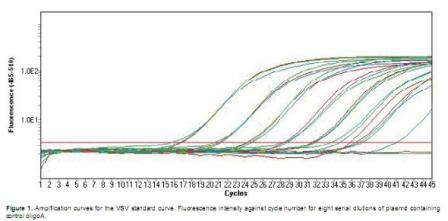
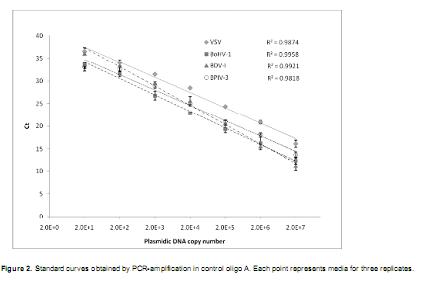
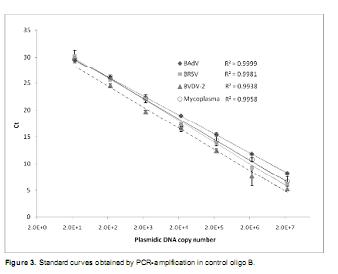
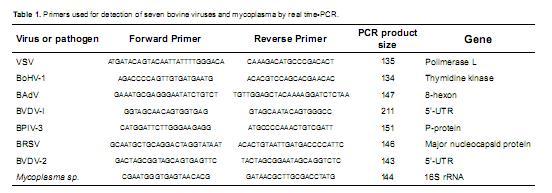
<body><![CDATA[<p><font face="Verdana, Arial, Helvetica, sans-serif" size="2"><i>Statistical analysis </i> </font></p>     <p><font face="Verdana, Arial, Helvetica, sans-serif" size="2">   Linear&nbsp; regression&nbsp; for each&nbsp;  standard&nbsp; curve&nbsp; was    obtained and the concentration of each  sample was    automatically&nbsp; calculated&nbsp;  based&nbsp; on&nbsp; linear equation,    using the LightCycler 480<sup>&reg;</sup>  II  data analysis software   (Roche, Mannheim, Germany).</font></p>     <p>&nbsp;</p>     <p><font face="Verdana, Arial, Helvetica, sans-serif" size="3"><b>Results</b>    </font></p>     <p><font face="Verdana, Arial, Helvetica, sans-serif" size="2"><i>Selection of primers for real time PCR</i>    </font></p>     <p><font face="Verdana, Arial, Helvetica, sans-serif" size="2">The sequences of the specific primers selected for   the real time PCR reactions are presented  in <a href="#t1">table 1</a>.</font></p>    <p align="center"><a name="t1"> <img src="/img/revistas/rccp/v24n4/a03t1.JPG" /></a></p>     <p><font face="Verdana, Arial, Helvetica, sans-serif" size="2"><i>Standard curves</i> </font></p>     <p><font face="Verdana, Arial, Helvetica, sans-serif" size="2">   Standard curves were obtained using each specific    primers pair (<a href="#f1">Table 1</a>) and the correspondent control    oligonucleotide A or B (Figures <a href="#f1">1</a> and <a href="#f2">2</a>).</font></p>     <p><font face="Verdana, Arial, Helvetica, sans-serif" size="2">As&nbsp;  serial&nbsp; dilutions&nbsp; of&nbsp;  the&nbsp; cloned&nbsp; control    oligonucleotides&nbsp; were used&nbsp;  for&nbsp; standard&nbsp; curves'    construction, the amount of template was expressed    as&nbsp; copies&nbsp; number of the&nbsp;  recombinant&nbsp; plasmid  containing&nbsp; the target&nbsp; sequence:&nbsp;  ranging&nbsp; from 2 to&nbsp;  2&nbsp; x&nbsp; 10<sup>7</sup>&nbsp; target&nbsp; copies.&nbsp;  Amplification&nbsp; curves&nbsp; for each&nbsp;  set&nbsp; of&nbsp; serial&nbsp;  dilutions&nbsp; showed&nbsp; that&nbsp;  increasing  C<sub>t</sub> values&nbsp; were obtained as the copy&nbsp; number in&nbsp;  the dilution&nbsp;  decreased&nbsp; (Figure 1).&nbsp; A&nbsp;  linear trend&nbsp; was  observed&nbsp;  for&nbsp; each&nbsp; dilution&nbsp;  series&nbsp; when&nbsp; C<sub>t</sub>&nbsp; values  were&nbsp;  plotted&nbsp; against&nbsp; the copy&nbsp;  number (Figures&nbsp; <a href="#f2">2</a>  and&nbsp;  <a href="#f3">3</a>).&nbsp; Melting&nbsp; curves&nbsp;  obtained&nbsp; for&nbsp; the products    of these reactions showed a unique peak  indicating    the absence&nbsp; of&nbsp;  primer-dimmers&nbsp; and&nbsp; non-specific  amplification (Melting curves not shown). </font></p>    ]]></body>
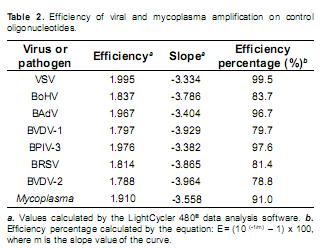
<body><![CDATA[<p align="center"><a name="f1"> <img src="/img/revistas/rccp/v24n4/a03f1.JPG" /></a></p>     <p><font face="Verdana, Arial, Helvetica, sans-serif" size="2">In&nbsp; the&nbsp; standard&nbsp;  curves&nbsp; obtained&nbsp; with&nbsp;  control  oligoA corresponding to VSV, BVDV-1,  BoHV-1 and  BPIV-3, the linear pattern was lost, or no  amplification  was&nbsp; detected,&nbsp; for&nbsp;  the lower dilution&nbsp; (two&nbsp; copies),  therefore 20&nbsp; copies&nbsp; dilution&nbsp;  was&nbsp; considered&nbsp; as&nbsp; the lower detection limit for these three viruses (<a href="#f2">Figure 2</a>).</font></p>     <p><font face="Verdana, Arial, Helvetica, sans-serif" size="2">Small standard deviation values were obtained in    the four data sets and regression coefficient (R<sup>2</sup>) was</font><font face="Verdana, Arial, Helvetica, sans-serif" size="2">above 0.98, indicating high adjustment to  the linear model.</font></p>     <p><font face="Verdana, Arial, Helvetica, sans-serif" size="2">In&nbsp; the standard&nbsp; curves&nbsp;  constructed&nbsp; with&nbsp; oligoB    the linear pattern&nbsp; was&nbsp;  conserved&nbsp; for&nbsp; the&nbsp; 20&nbsp; copies    dilution&nbsp;  but&nbsp; not&nbsp; for two&nbsp;  copies&nbsp; dilution, which    showed lower Ct&nbsp; values than the ones obtained for   the 20 copies dilutions.</font></p>    <p align="center"> <a name="f2"><img src="/img/revistas/rccp/v24n4/a03f2.JPG" /> </a></p>    <p align="center"><a name="f3"> <img src="/img/revistas/rccp/v24n4/a03f3.JPG" /></a></p>     <p><font face="Verdana, Arial, Helvetica, sans-serif" size="2">Based&nbsp; on&nbsp; these results&nbsp;  the&nbsp; detection&nbsp; limit&nbsp;  for BAdV,&nbsp; BRSV&nbsp; and&nbsp;  mycoplasma&nbsp; was&nbsp; established  at 20&nbsp;  copies.&nbsp; For&nbsp; BVDV-2&nbsp;  no&nbsp; amplification&nbsp; was  detected&nbsp; for&nbsp; 2&nbsp;  and&nbsp; 20&nbsp; dilutions&nbsp;  thus&nbsp; the&nbsp; detection  limit was&nbsp; set at&nbsp; 200&nbsp;  copies.&nbsp; Ct&nbsp; values&nbsp;  decreased  proportionally&nbsp; to&nbsp; copy&nbsp;  number increase,&nbsp; including  the highest&nbsp; concentration&nbsp;  (2&nbsp; x&nbsp; 10<sup>7</sup>&nbsp;  copies).&nbsp; Values  over 0.99&nbsp; were obtained&nbsp; for the regression  coefficient (R<sup>2</sup>) of the four series (<a href="#f3">Figure 3</a>).</font></p>    <p align="center"><a name="f1"> <img src="/img/revistas/rccp/v24n4/a03t2.JPG" /></a></p>     <p><font face="Verdana, Arial, Helvetica, sans-serif" size="2">In&nbsp; addition&nbsp; to&nbsp; the  observed&nbsp; linear&nbsp; pattern&nbsp;  in  the standard&nbsp; curves,&nbsp; efficiency&nbsp;  percentage&nbsp; for each&nbsp;  real&nbsp; time PCR&nbsp; data&nbsp;  set&nbsp; was&nbsp; calculated&nbsp;  (<a href="#t2">Table 2</a>). Amplification&nbsp; efficiencies&nbsp;  above 78%&nbsp; were calculated for VSV, BoHV-1, BAdV, BPIV-3,  BRSV,  BVDV-1, BVDV-2 and mycoplasma standard  curves,  indicating&nbsp;  a&nbsp; proper geometrical&nbsp; increase&nbsp;  of the  copy&nbsp;  number along&nbsp; the PCR  processes.&nbsp; Maximum  efficiency&nbsp;  was&nbsp; not&nbsp; obtained&nbsp;  for&nbsp; all&nbsp; reactions&nbsp;  as&nbsp; we  used&nbsp;  the&nbsp; same&nbsp; standardized&nbsp;  primer and&nbsp; magnesium  chloride&nbsp;  concentration&nbsp; in&nbsp; the&nbsp;  seven&nbsp; specific  amplification&nbsp; reactions, looking&nbsp; for&nbsp;  establishment  of homogeneous&nbsp; amplification&nbsp;  conditions&nbsp; which  facilitate the analysis procedure. </font></p>     <p><font face="Verdana, Arial, Helvetica, sans-serif" size="2"><i>Detection of viruses&nbsp; and&nbsp;  <u>mycoplasma&nbsp;</u> in&nbsp; culture </i>    <i>samples</i></font></p>     ]]></body>
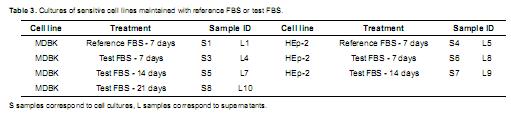
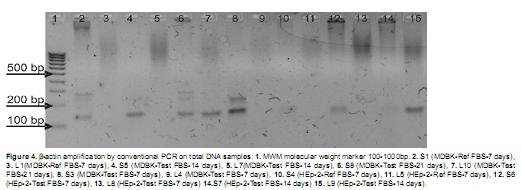
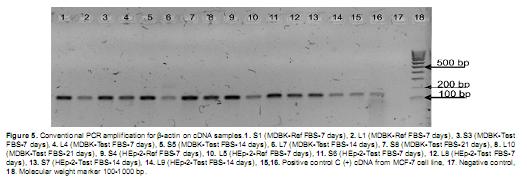
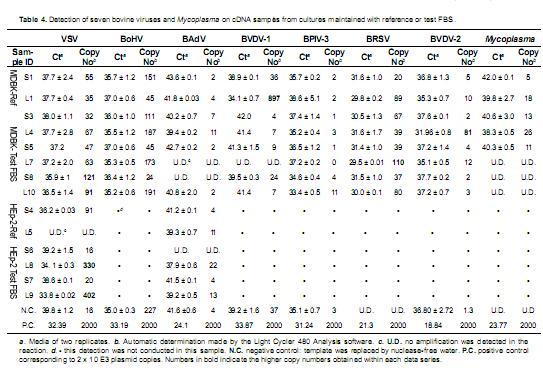
<body><![CDATA[<p><font face="Verdana, Arial, Helvetica, sans-serif" size="2"><i>Culture</i>&nbsp; <i>samples.</i>&nbsp; Fourteen&nbsp;  samples&nbsp; were    obtained&nbsp;  and&nbsp; processed&nbsp; to&nbsp;  isolate total&nbsp; RNA    and&nbsp;  DNA. These 14&nbsp; samples&nbsp; included&nbsp;  cellular   samples,&nbsp;  identified&nbsp; as&nbsp; solid&nbsp;  samples&nbsp; (S)&nbsp; and  supernatant&nbsp; samples,&nbsp;  identified&nbsp; as&nbsp; liquid&nbsp;  samples </font><font face="Verdana, Arial, Helvetica, sans-serif" size="2">(L),&nbsp; derived&nbsp; from MDBK&nbsp;  and&nbsp; HEp-2&nbsp; cell&nbsp;  cultures maintained&nbsp; with&nbsp; reference (GIBCO&nbsp; BRL<sup>&reg;</sup>)  or test  (MICROGEN<sup>&reg;</sup>) FBS (<a href="#t3">Table 3</a>).</font></p>    <p align="center"><a name="t3"> <img src="/img/revistas/rccp/v24n4/a03t3.JPG" /></a></p>     <p><font face="Verdana, Arial, Helvetica, sans-serif" size="2">After conversion&nbsp; of&nbsp; total RNA&nbsp;  to&nbsp; single-strand  cDNA,&nbsp; resultant&nbsp; cDNA&nbsp;  and&nbsp; total DNA&nbsp; (DNA) samples&nbsp; were&nbsp; analyzed&nbsp;  by&nbsp; conventional&nbsp; PCR  amplification for -actin to check for the efficiency  of&nbsp; the&nbsp; reverse&nbsp;  transcription&nbsp; reaction&nbsp; and&nbsp;  for the  suitability&nbsp; of these&nbsp; samples&nbsp;  to&nbsp; be used&nbsp; as&nbsp; PCR  templates. </font></p>     <p><font face="Verdana, Arial, Helvetica, sans-serif" size="2">All total DNA samples from solid samples gave  a positive result for&nbsp; &Beta;-actin amplification but liquid samples,&nbsp;  corresponding&nbsp; to&nbsp; culture&nbsp;  supernatants&nbsp; did  not&nbsp;  show&nbsp; amplification, except&nbsp; for samples&nbsp;  L9&nbsp; and  L10. This&nbsp;  must&nbsp; be related&nbsp; with&nbsp;  the&nbsp; low&nbsp; amount&nbsp;  of nucleic acids&nbsp; present&nbsp;  in&nbsp; the culture supernatant  (<a href="#f4">Figure 4</a>).&nbsp; PCR products&nbsp;  showed&nbsp; sizes&nbsp; between    100-200 bp, which correspond to the  expected sizes    (121&nbsp;  bp&nbsp; for bovine derived&nbsp; cells&nbsp;  and&nbsp; 133&nbsp; bp&nbsp; for    human derived&nbsp; cells).&nbsp;  Size differences&nbsp; between&nbsp; the   products&nbsp;  were&nbsp; not&nbsp; determined&nbsp;  as&nbsp; the&nbsp; resolution&nbsp;  of agarose gels is around 10 bp.</font></p>    <p align="center"><a name="f4"> <img src="/img/revistas/rccp/v24n4/a03f4.JPG" /></a></p>     <p align="center"><a name="f5"><img src="/img/revistas/rccp/v24n4/a03f5.JPG" /></a></p>     <p><font face="Verdana, Arial, Helvetica, sans-serif" size="2">Amplification&nbsp; for &Beta;-actin&nbsp; on&nbsp;  unpurified&nbsp; cDNA  products&nbsp; was&nbsp; positive for&nbsp;  all&nbsp; the tested&nbsp; samples,  indicating&nbsp; a&nbsp; successful&nbsp;  result&nbsp; for&nbsp; the RT&nbsp;  reactions  and&nbsp;  the suitability&nbsp; of&nbsp; synthesized&nbsp;  cDNAs&nbsp; as  PCR templates.&nbsp; Obtained&nbsp; PCR products&nbsp;  were,&nbsp; as  expected, in the 100-200 bp size range (<a href="#f5">Figure 5</a>).</font></p>     <p><font face="Verdana, Arial, Helvetica, sans-serif" size="2"><i>Detection&nbsp; of&nbsp;  bovine&nbsp; viruses. </i>&nbsp;</font><font face="Verdana, Arial, Helvetica, sans-serif" size="2">Once  samples were&nbsp; confirmed&nbsp; to&nbsp;  be&nbsp; useful&nbsp; as&nbsp;  PCR&nbsp; templates,    viral detection was performed according to&nbsp; cellular    sensitivity&nbsp; to&nbsp;  viral&nbsp; infection.&nbsp; cDNA&nbsp;  samples    from MDBK&nbsp; cell&nbsp; line&nbsp;  cultures&nbsp; were analyzed    for&nbsp; detection&nbsp; of&nbsp;  seven&nbsp; pathogenic&nbsp; viruses&nbsp;  and    <i>Mycoplasma</i>,&nbsp; as&nbsp; this&nbsp;  bovine&nbsp; derived&nbsp; cell&nbsp;  line&nbsp; is    sensitive&nbsp; to&nbsp; the&nbsp;  infection&nbsp; of the&nbsp; seven&nbsp;  analyzed    viruses and also to mycoplasma. On cDNA samples    from HEp-2&nbsp; cell&nbsp; line cultures,&nbsp; PCR detection&nbsp;  was    only conducted for VSV and BAdV viruses, as this    cell line&nbsp;  is&nbsp; not&nbsp; sensitive to&nbsp;  infection&nbsp; by&nbsp; the&nbsp;  other    viruses.&nbsp;  Each&nbsp; set&nbsp; of&nbsp;  samples&nbsp; was&nbsp; analyzed&nbsp;  within    the same real&nbsp; time PCR run,&nbsp; including&nbsp;  negative   controls&nbsp;  and&nbsp; positive&nbsp; controls&nbsp;  corresponding&nbsp; to </font><font face="Verdana, Arial, Helvetica, sans-serif" size="2">dilutions of the cloned control oligoA or  oligoB as  corresponded (<a href="#t4">Table 4</a>).</font></p>     <p><font face="Verdana, Arial, Helvetica, sans-serif" size="2">Evaluation&nbsp;  for&nbsp; viral&nbsp; presence&nbsp;  in&nbsp; total&nbsp; DNA    samples&nbsp;  was&nbsp; conducted&nbsp; only&nbsp;  on&nbsp; solid&nbsp; derived    samples&nbsp;  and&nbsp; the&nbsp; liquid&nbsp;  derived&nbsp; samples&nbsp; that    showed&nbsp;  positive amplification&nbsp; for  &Beta;-actin&nbsp; (L9&nbsp; and    L10).&nbsp;  BoHV-1,&nbsp; BAdV&nbsp; and&nbsp; <i>Mycoplasma </i>&nbsp;were&nbsp;  the   only&nbsp;  three&nbsp; pathogens&nbsp; analyzed&nbsp;  in&nbsp; DNA&nbsp; samples    as&nbsp;  BoHV-1,&nbsp; BAdV&nbsp; and&nbsp; <i>Mycoplasma </i>&nbsp;have DNA    genome, while the other viruses have RNA  genome.</font></p>     <p><font face="Verdana, Arial, Helvetica, sans-serif" size="2">Positive&nbsp; controls&nbsp; included&nbsp;  in&nbsp; each&nbsp; sample set    gave positive amplification, the Ct value  obtained for   these standards&nbsp; were used&nbsp;  by&nbsp; the&nbsp; software&nbsp;  to&nbsp; adjust    the data set to the standard curve and calculate  copy    number&nbsp;  for&nbsp; each&nbsp; sample.&nbsp;  For&nbsp; some&nbsp; of the negative    control&nbsp;  reactions&nbsp; a&nbsp; Ct&nbsp;  value was&nbsp; obtained&nbsp; and&nbsp; a    copy&nbsp;  number&nbsp; was&nbsp; calculated.&nbsp;  These results&nbsp; were   considered as noise in the detection, as  Ct values for   negative controls corresponded to late  cycles and the   calculated&nbsp;  copy&nbsp; number were&nbsp; under the&nbsp;  detection    limit observed in the standard curves  (<a href="#t4">Table 4</a>). </font></p>    ]]></body>
<body><![CDATA[<p align="center"><a name="t4"> <img src="/img/revistas/rccp/v24n4/a03t4.JPG" /></a></p>     <p><font face="Verdana, Arial, Helvetica, sans-serif" size="2"><i>Detection&nbsp; of&nbsp; Vesicular&nbsp;  Stomatitis&nbsp; Virus&nbsp; (VSV). </i>  A&nbsp; Ct&nbsp; value of&nbsp;  39.8&nbsp; &plusmn;&nbsp; 1.2&nbsp;  was&nbsp; obtained&nbsp; for the negative control and Ct values for the  samples were  around&nbsp;  this&nbsp; value.&nbsp; The calculated&nbsp; copy&nbsp;  number for  the negative control&nbsp; was&nbsp; 16&nbsp;  viral&nbsp; copies,&nbsp; higher copy&nbsp;  number values&nbsp; were obtained&nbsp; for&nbsp;  samples  derived&nbsp;  from MDBK&nbsp; cultures&nbsp; maintained&nbsp;  with  the reference FBS and&nbsp; test&nbsp;  FBS.&nbsp; Among&nbsp; MDBK  samples&nbsp; the highest&nbsp; copy&nbsp;  number values&nbsp; were obtained&nbsp;  for S8&nbsp; and&nbsp; L10&nbsp;  samples,&nbsp; corresponding  to&nbsp; the&nbsp; culture maintained&nbsp; for 21&nbsp;  days&nbsp; with&nbsp; the test-FBS. These&nbsp; values&nbsp;  showed&nbsp; to&nbsp; be&nbsp;  higher than  copy&nbsp;  number calculated&nbsp; for  cultures&nbsp; maintained  7&nbsp; and&nbsp; 14&nbsp;  days&nbsp; with&nbsp; the test&nbsp;  FBS and&nbsp; 7&nbsp; days&nbsp;  with  the reference FBS,&nbsp; nevertheless,  21&nbsp; days&nbsp;  values  were&nbsp; in&nbsp; the&nbsp;  same order of magnitude.&nbsp; If&nbsp; the&nbsp;  VSV  were&nbsp; actively&nbsp; present&nbsp;  in&nbsp; the culture,&nbsp; a&nbsp;  geometrical  increase in&nbsp; the detected&nbsp; viral copy&nbsp;  number must  have occurred&nbsp; along&nbsp; the&nbsp;  21-day&nbsp; follow-up&nbsp; and  this&nbsp; viral&nbsp; increase might&nbsp; have&nbsp;  been&nbsp; accompanied  by&nbsp;  cytophatic&nbsp; morphological&nbsp; changes&nbsp;  in&nbsp; the&nbsp; cell  culture. As this pattern was not observed  for MDBK  cultures, data are not conclusive for the presence of the VSV.&nbsp;  Within&nbsp; the&nbsp; HEp-2&nbsp;  derived&nbsp; samples,&nbsp; high  copy numbers were calculated for supernatants from  cultures maintained 7 and 14 days with the test FBS.  The&nbsp;  copy&nbsp; number had&nbsp; a&nbsp;  slight&nbsp; increase along&nbsp; the</font><font face="Verdana, Arial, Helvetica, sans-serif" size="2">follow-up&nbsp;  period,&nbsp; but&nbsp; not&nbsp; a  geometrical&nbsp; increase,  in&nbsp;  addition&nbsp; no&nbsp; cytophatic effect&nbsp; was&nbsp;  observed&nbsp; in  these&nbsp;  cultures,&nbsp; thus, these&nbsp; data cannot&nbsp;  support&nbsp; the presence of the viral&nbsp; infection&nbsp;  neither completely  discard&nbsp;  it&nbsp; in&nbsp; the cultures&nbsp;  maintained&nbsp; with&nbsp; the test  FBS. </font></p>     <p><font face="Verdana, Arial, Helvetica, sans-serif" size="2"><i>Detection&nbsp;  of&nbsp; Bovine&nbsp; Herpes&nbsp;  Virus-1&nbsp; (BoHV-1). </i>    Only&nbsp;  samples&nbsp; from&nbsp; MDBK&nbsp;  cultures&nbsp; were&nbsp; tested    for&nbsp;  the BoHV-1&nbsp; presence.&nbsp; A&nbsp; mean&nbsp; Ct&nbsp;  value of    35.0&nbsp;  &plusmn;&nbsp; 0.3,&nbsp; corresponding&nbsp;  to&nbsp; a&nbsp; mean&nbsp;  copy&nbsp; number    of&nbsp;  227&nbsp; copies&nbsp; was&nbsp;  calculated&nbsp; for&nbsp; the negative    control in this data set. Ct values and  copy number   values&nbsp;  calculated&nbsp; for the&nbsp; MDBK&nbsp;  cell&nbsp; line cultures    maintained&nbsp;  with&nbsp; reference-FBS and&nbsp; test-FBS were    close to&nbsp;  the values&nbsp; for the&nbsp; negative control.&nbsp; None   of&nbsp;  the&nbsp; calculated&nbsp; copy&nbsp;  values&nbsp; was&nbsp; higher than&nbsp;  the    calculated for the negative control. In  addition there    was&nbsp;  not&nbsp; and&nbsp; increasing&nbsp;  pattern&nbsp; in&nbsp; the&nbsp;  viral&nbsp; copy    number along the culture follow-up period  with the   test-FBS. These results cannot support the  presence   of&nbsp;  the&nbsp; BoHV-1&nbsp; in&nbsp; the  MDBK&nbsp; cultures&nbsp; treated&nbsp;  with    the reference or test fetal bovine serum. </font></p>     <p><font face="Verdana, Arial, Helvetica, sans-serif" size="2">BoHV-1&nbsp;  detection&nbsp; was&nbsp; also&nbsp;  conducted&nbsp; in    the genomic DNA&nbsp; samples&nbsp;  that&nbsp; gave a positive   amplification&nbsp; for the&nbsp;  &Beta;-actin&nbsp; gene.&nbsp; In&nbsp;  this&nbsp; set of&nbsp; samples&nbsp; no&nbsp;  Ct&nbsp; value was&nbsp; determined&nbsp;  for the negative control reactions. In the DNA  samples, late Ct&nbsp; values&nbsp; matching&nbsp;  with&nbsp; low&nbsp; copy&nbsp;  numbers&nbsp; were  obtained. In sample S5, from the solid sample of the culture held by&nbsp; 14&nbsp; days&nbsp;  with&nbsp; the test-FBS,&nbsp; a&nbsp; copy  number of 190&nbsp; was&nbsp;  obtained,&nbsp; nonetheless,&nbsp; lower  copy&nbsp; numbers&nbsp; were obtained for the corresponding  S5&nbsp; cDNA and S8&nbsp; DNA&nbsp;  and&nbsp; cDNA samples,&nbsp; which  came from the 21-days culture with test-FBS. Thus,  the S5&nbsp; DNA&nbsp; sample&nbsp;  result&nbsp; seems&nbsp; to&nbsp; be&nbsp; a transient  increase in&nbsp; viral&nbsp; copy&nbsp;  number,&nbsp; but&nbsp; cannot&nbsp;  be considered&nbsp; as&nbsp; an&nbsp;  indicator of&nbsp; BoHV-1&nbsp; presence in  the MDBK samples treated with the test-FBS.</font></p>     <p><font face="Verdana, Arial, Helvetica, sans-serif" size="2"><i>Detection&nbsp; of&nbsp; the&nbsp;  Bovine&nbsp; Adenovirus&nbsp; (BAdV).</i>&nbsp; In    this&nbsp; detection&nbsp; a&nbsp;  late&nbsp; mean&nbsp; Ct&nbsp;  value&nbsp; was&nbsp; obtained    for&nbsp; the&nbsp; negative&nbsp;  control&nbsp; 41.6&nbsp; &plusmn;&nbsp;  0.6&nbsp; corresponding    to&nbsp; a&nbsp; copy&nbsp;  number of 4.&nbsp; Ct&nbsp; values&nbsp;  obtained&nbsp; for the   samples were late too. These results indicate that the   presence of the bovine adenovirus was not detected    in&nbsp; the cultures&nbsp; of MDBK&nbsp;  and&nbsp; HEp-2&nbsp; cell&nbsp;  lines    maintained with the reference-FBS or the test-FBS. </font></p>     <p><font face="Verdana, Arial, Helvetica, sans-serif" size="2">Detection of BAdV in the DNA samples showed    amplification&nbsp; with&nbsp; late&nbsp;  Ct&nbsp; values&nbsp; for&nbsp;  samples    obtained&nbsp; from MDBK&nbsp; and&nbsp;  HEp-2&nbsp; cell&nbsp; lines    maintained with the reference and test FBS by 7 and    14 days, but no increment on the copy number was    observed&nbsp; along&nbsp; the&nbsp;  follow-up&nbsp; period.&nbsp; This&nbsp;  results    togheter with&nbsp; the&nbsp; data obtained&nbsp;  for&nbsp; cDNA&nbsp; samples    indicate that&nbsp; BAdV was&nbsp; not detected in&nbsp; the treated    cultures. </font></p>     <p><font face="Verdana, Arial, Helvetica, sans-serif" size="2"><i>Detection&nbsp; of&nbsp; the&nbsp;  Bovine Viral&nbsp; Diarrhea&nbsp; Virus </i>      <i>type&nbsp; 1&nbsp; (BVDV-1).</i>&nbsp; Analysis&nbsp; for BVDV-1&nbsp;  were   carried&nbsp; out&nbsp; in&nbsp;  MDBK&nbsp; samples.&nbsp; A&nbsp;  mean&nbsp; Ct&nbsp; value    of 39.2 &plusmn; 1.6 was obtained for the negative control    and&nbsp; later Ct&nbsp; values&nbsp;  were obtained&nbsp; for&nbsp; the samples,    except&nbsp; for&nbsp; the L1&nbsp;  sample,&nbsp; supernatant&nbsp; from&nbsp;  the   culture maintained&nbsp; with&nbsp; the reference-FBS.&nbsp; The    copy number for this sample was 897. As no further    studies were done with this FBS, this isolated result    is&nbsp; not&nbsp; conclusive for the presence of BVDV-1&nbsp; in    the cultures maintained with the reference FBS. No    viral&nbsp; presence&nbsp; was&nbsp;  detected&nbsp; for&nbsp; MDBK&nbsp;  cultured  with test-FBS.</font></p>     <p><font face="Verdana, Arial, Helvetica, sans-serif" size="2"><i>Detection&nbsp; of&nbsp; Bovine Parainfluenza&nbsp; Virus&nbsp;  3 </i>      <i>(BPIV-3).</i>&nbsp; MDBK&nbsp; cell&nbsp;  line&nbsp; cultures&nbsp; were used&nbsp;  in    this&nbsp;  detection.&nbsp; Late Ct&nbsp; value&nbsp;  corresponding&nbsp; to&nbsp; low    calculated&nbsp;  copy&nbsp; numbers&nbsp; were obtained&nbsp;  for the   negative control, as&nbsp; well&nbsp;  as&nbsp; for&nbsp; the&nbsp;  samples.&nbsp; No    presence of&nbsp; this&nbsp;  virus&nbsp; can&nbsp; be deduced&nbsp;  from&nbsp; these    results (<a href="#t4">Table 4</a>).</font></p>     <p><font face="Verdana, Arial, Helvetica, sans-serif" size="2"><i>Detection&nbsp; of&nbsp; Bovine Respiratory&nbsp; Syncytial </i>      <i>Virus&nbsp;  (BRSV). </i>&nbsp;In&nbsp; the  analysis&nbsp; for&nbsp; this&nbsp;  virus&nbsp; no&nbsp; Ct    value was&nbsp;  obtained&nbsp; for the&nbsp; negative&nbsp;  control.&nbsp; Copy    numbers&nbsp;  as&nbsp; high&nbsp; as&nbsp;  110&nbsp; copies&nbsp; were&nbsp;  calculated    for&nbsp;  the&nbsp; supernatant&nbsp; samples,&nbsp;  but&nbsp; there was&nbsp; not   progressive&nbsp; increase in&nbsp;  the copy&nbsp; number detected    for&nbsp;  samples&nbsp; from 7, 14&nbsp; and&nbsp;  21-days&nbsp; culture. These   results indicate that the high copy number  observed    for sample L7, the supernatant of the  14-day culture    with&nbsp;  test-FBS does&nbsp; not&nbsp; represent&nbsp;  presence of the    respiratory&nbsp; syncytial&nbsp;  virus&nbsp; in&nbsp; this cell&nbsp;  cultures    treated with the test-FBS.</font></p>     <p><font face="Verdana, Arial, Helvetica, sans-serif" size="2"><i>Detection&nbsp; of&nbsp; the&nbsp;  Bovine Viral&nbsp; Diarrhea&nbsp; Virus </i>      <i>type 2 (BVDV-2).</i> PCR reactions for BVDV-2 were   done&nbsp;  on&nbsp; MDBK&nbsp; derived&nbsp;  samples.&nbsp; Copy&nbsp; number    calculated for the negative control&nbsp; and&nbsp;  the samples    were&nbsp;  lower than&nbsp; 10, except&nbsp; for&nbsp;  the&nbsp; sample&nbsp; from    the supernatant&nbsp; of the culture held for 7&nbsp; days&nbsp;  with    the test&nbsp;  FBS (Sample&nbsp; L4)&nbsp; and&nbsp;  lower values&nbsp; were    obtained&nbsp;  for the&nbsp; samples&nbsp; of the&nbsp;  same culture after    14&nbsp;  and&nbsp; 21&nbsp; days&nbsp;  follow-up,&nbsp; indicating&nbsp; that&nbsp;  the L4    sample&nbsp;  value&nbsp; is&nbsp; an&nbsp;  isolated&nbsp; result&nbsp; and &nbsp;cannot&nbsp;  be    considered&nbsp;  as&nbsp; an&nbsp; indicative&nbsp;  for the&nbsp; presence of the   tested virus in the MDBK cultures  maintained with    the test FBS. In addition the calculated  copy number   was below the linear detection limit  established with    the standard curve, indicating that this  result is not a   consistent positive.</font></p>     ]]></body>
<body><![CDATA[<p><font face="Verdana, Arial, Helvetica, sans-serif" size="2"><i>Detection&nbsp;  of&nbsp; <u>Mycoplasma</u></i>.&nbsp;  cDNA&nbsp; and&nbsp; DNA    MDBK derived samples were used in this  detection.    No&nbsp;  amplification&nbsp; was&nbsp; obtained&nbsp;  for&nbsp; the&nbsp; negative   control&nbsp;  reaction&nbsp; and&nbsp; for&nbsp; the&nbsp; DNA&nbsp;  samples.&nbsp; For   cDNA&nbsp;  samples&nbsp; values&nbsp; as&nbsp;  high&nbsp; as&nbsp; 26&nbsp;  copy&nbsp; number    were obtained for the cDNA samples, for  the 7-days    culture,&nbsp;  but&nbsp; there was&nbsp; no&nbsp;  detection&nbsp; in&nbsp; the&nbsp;  samples    from the&nbsp;  14&nbsp; and&nbsp; 21-days&nbsp;  cultures. These&nbsp; results    indicate that&nbsp; <i>Mycoplasma </i>&nbsp;was&nbsp;  not&nbsp; present&nbsp; in&nbsp; the   MDBK&nbsp;  cultures&nbsp; maintained&nbsp; with&nbsp;  reference or test    FBS.</font></p>     <p>&nbsp;</p>     <p><font face="Verdana, Arial, Helvetica, sans-serif" size="3"><b>Discussion</b></font></p>     <p><font face="Verdana, Arial, Helvetica, sans-serif" size="2">Reports&nbsp; on&nbsp; viral&nbsp;  detection&nbsp; by&nbsp; means&nbsp;  of real    time PCR show&nbsp; that&nbsp; this&nbsp;  technique&nbsp; is&nbsp; suitable    for&nbsp;  the&nbsp; detection&nbsp; of&nbsp;  bovine&nbsp; viruses&nbsp; in&nbsp;  different    biological matrices and&nbsp;  demonstrates&nbsp; to&nbsp; be specific   and&nbsp; as&nbsp; sensitive&nbsp;  as,&nbsp; or more sensitive than&nbsp; the    immunological&nbsp; methods&nbsp; like fluorescent&nbsp; antibody    test and immunohistochemistry (Timsit <i>et al.,</i> 2010).</font></p>     <p><font face="Verdana, Arial, Helvetica, sans-serif" size="2">Specificity&nbsp; of the PCR  reaction&nbsp; depends&nbsp; on    primer design&nbsp; and&nbsp;  can&nbsp; be improved&nbsp; by&nbsp; the  use of    probes. Primers used in our analysis were tested for   specificity&nbsp; by&nbsp; BLAST and&nbsp;  no&nbsp; specific&nbsp; probes&nbsp;  were    used,&nbsp; as&nbsp; detection&nbsp;  was&nbsp; made&nbsp; with&nbsp;  the&nbsp; ResoLight<sup>&reg;</sup>  DNA-binding&nbsp; dye.&nbsp; Real-time RT-PCR employing    the non specific fluorescent SYBR Green-I has been    extensively used for bovine viral  detection yielding    satisfactory&nbsp; results&nbsp; and&nbsp;  is&nbsp; also&nbsp; considered&nbsp;  as&nbsp; a   better option&nbsp; over probes-based&nbsp; amplification,&nbsp; as    the result does not rely on the perfect match of the   probes,&nbsp; which&nbsp; can&nbsp;  be&nbsp; hindered&nbsp; by&nbsp;  viral&nbsp; mutations    (Kosinova, &nbsp; <i>et al</i>.,&nbsp; 2007).&nbsp; Here we&nbsp;  replaced&nbsp; the    use&nbsp; of SYBR&nbsp; Green-I by&nbsp;  ResoLight<sup>&reg;</sup>,&nbsp; a new    non&nbsp;  specific&nbsp; DNA-binding&nbsp; fluorescent&nbsp;  dye&nbsp; with&nbsp; a    higher incorporation&nbsp; frequency,  expecting&nbsp; a higher   sensitivity. Despite precaution taken in  the technical    procedures&nbsp; a positive amplification&nbsp; response was    obtained for the negative controls. We consider  that    the highly&nbsp; DNA-incorporation&nbsp; frequency&nbsp;  of the   Resolight&nbsp; ,&nbsp; which&nbsp;  accounts&nbsp; for its&nbsp; high&nbsp;  sensitivity,    might&nbsp; also&nbsp; be&nbsp;  responsible&nbsp; for the&nbsp; high&nbsp;  noise level   detected in these experiments.</font></p>     <p><font face="Verdana, Arial, Helvetica, sans-serif" size="2">The&nbsp; use&nbsp; of cloned&nbsp;  viral&nbsp; sequences&nbsp; as&nbsp; positive    controls&nbsp; is&nbsp; a resource that&nbsp; allows&nbsp;  for&nbsp; generation&nbsp; of    standard&nbsp; curves&nbsp; without&nbsp;  the use&nbsp; of whole active    viruses&nbsp; at&nbsp; the&nbsp;  laboratory. This&nbsp; strategy&nbsp; has&nbsp;  been    used previously and proved to be useful (Kosinova   <i>et al</i>.,&nbsp; 2007;&nbsp; Young&nbsp; <i>et  al.</i>,&nbsp; 2006), in&nbsp; our&nbsp;  work&nbsp; the    constructed&nbsp; control&nbsp;  oligonucleotides&nbsp; A&nbsp; and&nbsp; B    rendered&nbsp;  specific&nbsp; amplification&nbsp; and&nbsp;  high&nbsp; linearity    standard&nbsp;  curves,&nbsp; detecting&nbsp; as&nbsp;  low&nbsp; as&nbsp; 2x10E1    pathogen&nbsp; copies&nbsp; for&nbsp;  six&nbsp; viruses&nbsp; and&nbsp;  mycoplasma   and as low as 2x10E2 for BVDV-2. Detection limits    for bovine viral diarrhea virus by real-time RT-PCR    was&nbsp; established&nbsp; at&nbsp;  1&nbsp; x&nbsp; 10E1&nbsp;  DNA/&micro;L, copies&nbsp; by    other authors, which lies in the same  detection level    (Young <i>et al.</i>, 2006). </font></p>     <p><font face="Verdana, Arial, Helvetica, sans-serif" size="2">For the detection&nbsp; of&nbsp; the seven&nbsp;  selected&nbsp; viruses  and&nbsp; <i>Mycoplasma</i>,&nbsp; we&nbsp;  applied&nbsp; here&nbsp; an&nbsp;  enrichment procedure&nbsp;  in&nbsp; which&nbsp; susceptible cell&nbsp; lines&nbsp;  were cultured&nbsp;  for a&nbsp; 21-day&nbsp; period&nbsp;  with&nbsp; the&nbsp; test&nbsp;  fetal  bovine serum MICROGEN<sup>&reg;</sup>,&nbsp; collecting&nbsp;  cellular&nbsp; and  supernatant&nbsp; samples&nbsp;  each&nbsp; 7&nbsp; days.&nbsp;  This&nbsp; procedure  was&nbsp;  based&nbsp; on&nbsp; the viral&nbsp;  detection&nbsp; test&nbsp; applied&nbsp;  to&nbsp; the reference FBS by&nbsp; the manufacturer&nbsp; (APHIS-USA,  1995). The aim of this protocol was the  generation of  serial data from the same culture, to make  a follow- up&nbsp;  of&nbsp; the&nbsp; culture.&nbsp;  In&nbsp; this&nbsp; way&nbsp;  if&nbsp; the presence of a  target&nbsp;  virus&nbsp; was&nbsp; detected&nbsp;  in&nbsp; a&nbsp; sample,&nbsp;  this&nbsp; could&nbsp; be compared to the previous and following  samples. The  projected result was that an increasing  copy number along the serial samples taken after 7, 14  and 21 days  of culture will account for the presence  of the virus. </font></p>     <p><font face="Verdana, Arial, Helvetica, sans-serif" size="2">Prior to real time PCR viral specific  amplification,    all&nbsp;  samples&nbsp; were subjected&nbsp; to&nbsp;&Beta;-actin&nbsp; PCR    amplification,&nbsp; to&nbsp;  check&nbsp; for&nbsp; the&nbsp;  presence of template    in&nbsp;  samples.&nbsp; Only&nbsp; samples&nbsp;  giving&nbsp; a&nbsp; positive   amplification&nbsp; in&nbsp;  this&nbsp; reaction&nbsp; were&nbsp;  analyzed&nbsp; for   viral&nbsp;  presence,&nbsp; to&nbsp; ensure&nbsp;  that&nbsp; negative&nbsp; results&nbsp;  will    not&nbsp;  account&nbsp; for absence&nbsp; of&nbsp;  template&nbsp; in the&nbsp; samples.    Within&nbsp;  the&nbsp; results&nbsp; obtained&nbsp;  from&nbsp; the&nbsp; real&nbsp;  time PCR    reactions&nbsp;  there were samples&nbsp; with&nbsp; a high&nbsp;  copy    number, but&nbsp; these&nbsp;  were isolated &nbsp;samples&nbsp; and&nbsp; no    increasing&nbsp;  pattern&nbsp; was&nbsp; observed&nbsp;  when&nbsp; compared    within&nbsp;  the&nbsp; sample&nbsp; set.&nbsp;  A&nbsp; persistent&nbsp; high&nbsp;  viral&nbsp; copy    number was calculated for the supernatants  from the    7&nbsp;  and&nbsp; 14-day&nbsp; follow-up&nbsp;  for the&nbsp; VSV, in&nbsp; the HEp-   2&nbsp;  cell&nbsp; line&nbsp; culture maintained&nbsp; with&nbsp;  the&nbsp; test&nbsp; FBS,    nevertheless&nbsp; the&nbsp;  copy&nbsp; number&nbsp; increase was&nbsp;  not    conclusive for viral presence.</font></p>     <p><font face="Verdana, Arial, Helvetica, sans-serif" size="2">VSV is&nbsp;  a&nbsp; highly&nbsp; prevalent&nbsp;  virus&nbsp; in&nbsp; Colombia,    which has gained space since the  eradication of the    foot&nbsp;  and&nbsp; mouth&nbsp; disease&nbsp;  virus&nbsp; (Cajas&nbsp; <i>et al</i>.,&nbsp; 2003).    This&nbsp;  situation&nbsp; explains&nbsp; the&nbsp;  possible viral&nbsp; presence    detected&nbsp;  in&nbsp; the&nbsp; cultures&nbsp;  maintained&nbsp; with&nbsp; test-FBS    (MICROGEN &nbsp; FBS),&nbsp;  even&nbsp; after the&nbsp; filtration&nbsp;  by    0.22&nbsp;  &micro;m&nbsp; filters&nbsp; included&nbsp;  in&nbsp; the&nbsp; FBS production    process.&nbsp;  According&nbsp; to&nbsp; this&nbsp;  the presence&nbsp; VSV&nbsp; in    the Colombian&nbsp; MICROGEN<sup>&reg;</sup>&nbsp;  fetal&nbsp; bovine&nbsp; serum    might&nbsp;  be&nbsp; considered&nbsp; as&nbsp;  one&nbsp; of the&nbsp; highest&nbsp;  risks&nbsp; in    this product and special attention should  be given to    the testing of these virus in future  analysis for other   batches of the product. </font></p>     <p><font face="Verdana, Arial, Helvetica, sans-serif" size="2">Viral&nbsp; analysis&nbsp; carried&nbsp;  out&nbsp; in&nbsp; this&nbsp;  study&nbsp; did  not&nbsp; detect&nbsp; the&nbsp;  presence of&nbsp; the pathogenic bovine  viruses or <i>Mycoplasma</i>&nbsp; in  the tested&nbsp; MICROGEN<sup>&reg;</sup> fetal&nbsp; bovine serum, except&nbsp; for VSV, which&nbsp; was  detected&nbsp; in&nbsp; a&nbsp; low  level.&nbsp; The viral&nbsp; detection  procedure described here should be included in the quality&nbsp;  control&nbsp; analysis&nbsp; of&nbsp;  the&nbsp; MICROGEN<sup>&reg;</sup> fetal  bovine&nbsp; serum,&nbsp; to&nbsp;  ensure&nbsp; the&nbsp; viral&nbsp;  and&nbsp; mycoplasma absence for&nbsp; each&nbsp; batch&nbsp;  of&nbsp; the&nbsp; product&nbsp;  before its  commercialization. </font></p>     ]]></body>
<body><![CDATA[<p>&nbsp;</p>     <p><font face="Verdana, Arial, Helvetica, sans-serif" size="3"><b>Acknowledgment</b> </font></p>     <p><font face="Verdana, Arial, Helvetica, sans-serif" size="2">This&nbsp; work&nbsp; was&nbsp;  supported&nbsp; by&nbsp; the Colombian    Administrative Department&nbsp; of Science, Technology    and Innovation:&nbsp; Colciencias; contract No&nbsp; 038-2007    (ACAC-Colciencias 179-206).</font></p>     <p><font face="Verdana, Arial, Helvetica, sans-serif" size="2">This&nbsp;  work&nbsp; was&nbsp; partially&nbsp;  developed&nbsp; at&nbsp; the    facilities&nbsp;  of&nbsp; the Institute&nbsp; of Biotechnology&nbsp; at&nbsp; the    Universidad Nacional de Colombia, Bogot&aacute; D.C.</font></p>     <p>&nbsp;</p>     <p><font face="Verdana, Arial, Helvetica, sans-serif" size="3"><b>References</b> </font></p>     <!-- ref --><p><font face="Verdana, Arial, Helvetica, sans-serif" size="2">1. Animal and Plant Health Inspection Service  USDA (US). Code    of Federal Regulations, Requirements for  ingredients of animal    origin. Title 9CFR Part, 113.53.  Washington; 1995.   </font>&nbsp;&nbsp;&nbsp;&nbsp;&nbsp;&nbsp;&nbsp;&nbsp;[&#160;<a href="javascript:void(0);" onclick="javascript: window.open('/scielo.php?script=sci_nlinks&ref=000109&pid=S0120-0690201100040000300001&lng=','','width=640,height=500,resizable=yes,scrollbars=1,menubar=yes,');">Links</a>&#160;]<!-- end-ref --><!-- ref --><p><font face="Verdana, Arial, Helvetica, sans-serif" size="2">2. Betancur  C, Orrego A, Gonz&aacute;lez M. Seroepidemiological study    of parainfluenza&nbsp; 3&nbsp;  virus&nbsp; in&nbsp; bovines&nbsp;  with&nbsp; reproductive&nbsp; failure,    from Monter&iacute;a-Colombia. Rev Med Vet 2010;  July/ Dec:63-70.   </font>&nbsp;&nbsp;&nbsp;&nbsp;&nbsp;&nbsp;&nbsp;&nbsp;[&#160;<a href="javascript:void(0);" onclick="javascript: window.open('/scielo.php?script=sci_nlinks&ref=000110&pid=S0120-0690201100040000300002&lng=','','width=640,height=500,resizable=yes,scrollbars=1,menubar=yes,');">Links</a>&#160;]<!-- end-ref --><!-- ref --><p><font face="Verdana, Arial, Helvetica, sans-serif" size="2">3. Cajas&nbsp; JG, Rojas&nbsp;  JA,&nbsp; Almansa&nbsp; JE, Wilches&nbsp;  MT,&nbsp; S&aacute;nchez C,    Acosta&nbsp; O.&nbsp;  Comparaci&oacute;n&nbsp; de&nbsp; la&nbsp;  respuesta&nbsp; inmunol&oacute;gica&nbsp; a&nbsp; las    prote&iacute;nas&nbsp; del&nbsp;  virus&nbsp; de&nbsp; la&nbsp;  estomatitis&nbsp; vesicular&nbsp; entre&nbsp;  bovinos    vacunados&nbsp; e&nbsp;  infectados&nbsp; de&nbsp; manera&nbsp;  natural&nbsp; o&nbsp; inducida.&nbsp;  Rev    Corpoica 2003; 4:1-5.</font>&nbsp;&nbsp;&nbsp;&nbsp;&nbsp;&nbsp;&nbsp;&nbsp;[&#160;<a href="javascript:void(0);" onclick="javascript: window.open('/scielo.php?script=sci_nlinks&ref=000111&pid=S0120-0690201100040000300003&lng=','','width=640,height=500,resizable=yes,scrollbars=1,menubar=yes,');">Links</a>&#160;]<!-- end-ref --><!-- ref --><p><font face="Verdana, Arial, Helvetica, sans-serif" size="2"> 4. Freshney&nbsp;  RI.&nbsp; Culture&nbsp; of&nbsp;  animal&nbsp; cells:&nbsp; a&nbsp;  manual&nbsp; of&nbsp; basic    technique.&nbsp;  4th&nbsp; ed.&nbsp; Hoboken,&nbsp;  (NJ):&nbsp; John&nbsp; Wiley&nbsp;  and&nbsp; Sons&nbsp; Inc;    2000.</font>&nbsp;&nbsp;&nbsp;&nbsp;&nbsp;&nbsp;&nbsp;&nbsp;[&#160;<a href="javascript:void(0);" onclick="javascript: window.open('/scielo.php?script=sci_nlinks&ref=000112&pid=S0120-0690201100040000300004&lng=','','width=640,height=500,resizable=yes,scrollbars=1,menubar=yes,');">Links</a>&#160;]<!-- end-ref --><!-- ref --><p><font face="Verdana, Arial, Helvetica, sans-serif" size="2"> 5. GIBCO Invitrogen Cell Culture. Fetal  Bovine Serum Brochure    B-066802-r1 0407; 2007.   </font>&nbsp;&nbsp;&nbsp;&nbsp;&nbsp;&nbsp;&nbsp;&nbsp;[&#160;<a href="javascript:void(0);" onclick="javascript: window.open('/scielo.php?script=sci_nlinks&ref=000113&pid=S0120-0690201100040000300005&lng=','','width=640,height=500,resizable=yes,scrollbars=1,menubar=yes,');">Links</a>&#160;]<!-- end-ref --><!-- ref --><p><font face="Verdana, Arial, Helvetica, sans-serif" size="2">6. IDT-Integrated DNA Technologies, Inc.  PrimerQuest, SciTools.    &#091;accesed on July 2009&#093; URL:  <a href="http://www.idtdna.com/Scitools/Applications/Primerquest/" target="_blank"> http://www.idtdna.com/Scitools/   Applications/Primerquest/ </a>   </font>&nbsp;&nbsp;&nbsp;&nbsp;&nbsp;&nbsp;&nbsp;&nbsp;[&#160;<a href="javascript:void(0);" onclick="javascript: window.open('/scielo.php?script=sci_nlinks&ref=000114&pid=S0120-0690201100040000300006&lng=','','width=640,height=500,resizable=yes,scrollbars=1,menubar=yes,');">Links</a>&#160;]<!-- end-ref --><!-- ref --><p><font face="Verdana, Arial, Helvetica, sans-serif" size="2">7. Kosinova E, Psikal I, Robesova B, Kovarcik  K. Real-time PCR    for quantitation of bovine viral diarrhea  virus RNA using SYBR    Green I fluorimetry. Vet Med 2007;  52:253-261. </font>&nbsp;&nbsp;&nbsp;&nbsp;&nbsp;&nbsp;&nbsp;&nbsp;[&#160;<a href="javascript:void(0);" onclick="javascript: window.open('/scielo.php?script=sci_nlinks&ref=000115&pid=S0120-0690201100040000300007&lng=','','width=640,height=500,resizable=yes,scrollbars=1,menubar=yes,');">Links</a>&#160;]<!-- end-ref --><!-- ref --><p><font face="Verdana, Arial, Helvetica, sans-serif" size="2">8. Nishizawa&nbsp;  I,&nbsp; Sato&nbsp; M,&nbsp;  Fujihara&nbsp; M, Sato&nbsp; S,&nbsp;  Harasawa R.</font><font face="Verdana, Arial, Helvetica, sans-serif" size="2">Differential&nbsp; detection&nbsp; of&nbsp;  hemotropic&nbsp; <i>Mycoplasma</i>&nbsp; species&nbsp;  in cattle by  melting curve analysis of PCR products. J Vet Med Sci  2010; 72:77-79. </font>&nbsp;&nbsp;&nbsp;&nbsp;&nbsp;&nbsp;&nbsp;&nbsp;[&#160;<a href="javascript:void(0);" onclick="javascript: window.open('/scielo.php?script=sci_nlinks&ref=000116&pid=S0120-0690201100040000300008&lng=','','width=640,height=500,resizable=yes,scrollbars=1,menubar=yes,');">Links</a>&#160;]<!-- end-ref --><!-- ref --><p><font face="Verdana, Arial, Helvetica, sans-serif" size="2">9. Piedrahita&nbsp; L, Montoya,&nbsp;  L&nbsp; Pedraza,&nbsp; F. Bovine&nbsp;  Herpes&nbsp; Virus    type&nbsp; 1&nbsp;  (BoHV-1)&nbsp; as&nbsp; a&nbsp;  possible&nbsp; cause&nbsp; of encephalitis&nbsp; in&nbsp;  cattle    of the&nbsp; Colombian&nbsp;  Magdalena&nbsp; medio&nbsp; region:&nbsp;  serological&nbsp; study    and&nbsp; epidemiological&nbsp; analysis.&nbsp;  Rev&nbsp; Colomb&nbsp; Cienc&nbsp;  Pecu&nbsp; 2010;    23:191-198.   </font>&nbsp;&nbsp;&nbsp;&nbsp;&nbsp;&nbsp;&nbsp;&nbsp;[&#160;<a href="javascript:void(0);" onclick="javascript: window.open('/scielo.php?script=sci_nlinks&ref=000117&pid=S0120-0690201100040000300009&lng=','','width=640,height=500,resizable=yes,scrollbars=1,menubar=yes,');">Links</a>&#160;]<!-- end-ref --><!-- ref --><p><font face="Verdana, Arial, Helvetica, sans-serif" size="2">10. Rozen&nbsp; S,&nbsp;  Skaletsky&nbsp; H. Primer3&nbsp; on&nbsp; the&nbsp; www&nbsp;  for&nbsp; general&nbsp; users    and&nbsp; for&nbsp;  biologist&nbsp; programmers.&nbsp; In:&nbsp;  Krawetz&nbsp; S, Misener&nbsp; S   editors.&nbsp; Bioinformatics&nbsp; Methods&nbsp;  and&nbsp; Protocols:&nbsp; Methods&nbsp;  in    Molecular  Biology. Totowa: Humana Press; 2000. p.365-86.   </font>&nbsp;&nbsp;&nbsp;&nbsp;&nbsp;&nbsp;&nbsp;&nbsp;[&#160;<a href="javascript:void(0);" onclick="javascript: window.open('/scielo.php?script=sci_nlinks&ref=000118&pid=S0120-0690201100040000300010&lng=','','width=640,height=500,resizable=yes,scrollbars=1,menubar=yes,');">Links</a>&#160;]<!-- end-ref --><!-- ref --><p><font face="Verdana, Arial, Helvetica, sans-serif" size="2">11. Timsit&nbsp; E,&nbsp;  Maingourd&nbsp; C,&nbsp; Le&nbsp;  Dr&eacute;an&nbsp; E,&nbsp; Belloc C, Seegers&nbsp; H,    Douart A, Assi&eacute;  S. Evaluation of a commercial real-time reverse    transcription  polymerase chain reaction kit for the diagnosis of    bovine  respiratory syncytial infection. J Vet Diagn Invest 2010;    22:218-241.   </font>&nbsp;&nbsp;&nbsp;&nbsp;&nbsp;&nbsp;&nbsp;&nbsp;[&#160;<a href="javascript:void(0);" onclick="javascript: window.open('/scielo.php?script=sci_nlinks&ref=000119&pid=S0120-0690201100040000300011&lng=','','width=640,height=500,resizable=yes,scrollbars=1,menubar=yes,');">Links</a>&#160;]<!-- end-ref --><!-- ref --><p><font face="Verdana, Arial, Helvetica, sans-serif" size="2">11. Vargas,&nbsp; DS,&nbsp;  Jaime J,&nbsp; Vera VJ.&nbsp; Perspectives&nbsp;  to&nbsp; control&nbsp; bovine    viral&nbsp; diarrhea&nbsp;  virus&nbsp; (BVDV).&nbsp; Rev&nbsp;  Colomb&nbsp; Cienc&nbsp; Pecu&nbsp;  2009;    22:677-688.   </font>&nbsp;&nbsp;&nbsp;&nbsp;&nbsp;&nbsp;&nbsp;&nbsp;[&#160;<a href="javascript:void(0);" onclick="javascript: window.open('/scielo.php?script=sci_nlinks&ref=000120&pid=S0120-0690201100040000300012&lng=','','width=640,height=500,resizable=yes,scrollbars=1,menubar=yes,');">Links</a>&#160;]<!-- end-ref --><!-- ref --><p><font face="Verdana, Arial, Helvetica, sans-serif" size="2">12. Young&nbsp; NJ,&nbsp;  Thomas&nbsp; CJ,&nbsp; Collins&nbsp;  ME, Brownlie&nbsp; J.&nbsp; Real-time    RT-PCR&nbsp; detection&nbsp;  of Bovine&nbsp; Viral&nbsp; Diarrhea&nbsp;  virus&nbsp; in&nbsp; whole    blood using an  external RNA reference. J Virol Methods 2006;    138:218-222.</font>&nbsp;&nbsp;&nbsp;&nbsp;&nbsp;&nbsp;&nbsp;&nbsp;[&#160;<a href="javascript:void(0);" onclick="javascript: window.open('/scielo.php?script=sci_nlinks&ref=000121&pid=S0120-0690201100040000300013&lng=','','width=640,height=500,resizable=yes,scrollbars=1,menubar=yes,');">Links</a>&#160;]<!-- end-ref --><p><font face="Verdana, Arial, Helvetica, sans-serif" size="2">&nbsp;</font></p>     ]]></body>
<body><![CDATA[ ]]></body><back>
<ref-list>
<ref id="B1">
<label>1</label><nlm-citation citation-type="">
<collab>Animal and Plant Health Inspection Service USDA (US)</collab>
<source><![CDATA[Code of Federal Regulations, Requirements for ingredients of animal origin]]></source>
<year>1995</year>
<publisher-loc><![CDATA[Washington ]]></publisher-loc>
</nlm-citation>
</ref>
<ref id="B2">
<label>2</label><nlm-citation citation-type="journal">
<person-group person-group-type="author">
<name>
<surname><![CDATA[Betancur]]></surname>
<given-names><![CDATA[C]]></given-names>
</name>
<name>
<surname><![CDATA[Orrego]]></surname>
<given-names><![CDATA[A]]></given-names>
</name>
<name>
<surname><![CDATA[González]]></surname>
<given-names><![CDATA[M]]></given-names>
</name>
</person-group>
<article-title xml:lang="en"><![CDATA[Seroepidemiological study of parainfluenza 3 virus in bovines with reproductive failure, from Montería-Colombia]]></article-title>
<source><![CDATA[Rev Med Vet]]></source>
<year>2010</year>
<page-range>63-70</page-range></nlm-citation>
</ref>
<ref id="B3">
<label>3</label><nlm-citation citation-type="journal">
<person-group person-group-type="author">
<name>
<surname><![CDATA[Cajas]]></surname>
<given-names><![CDATA[JG]]></given-names>
</name>
<name>
<surname><![CDATA[Rojas]]></surname>
<given-names><![CDATA[JA]]></given-names>
</name>
<name>
<given-names><![CDATA[Almansa JE]]></given-names>
</name>
<name>
<surname><![CDATA[Wilches]]></surname>
<given-names><![CDATA[MT]]></given-names>
</name>
<name>
<given-names><![CDATA[Sánchez C]]></given-names>
</name>
<name>
<surname><![CDATA[Acosta]]></surname>
<given-names><![CDATA[O]]></given-names>
</name>
</person-group>
<article-title xml:lang="es"><![CDATA[Comparación de la respuesta inmunológica a las proteínas del virus de la estomatitis vesicular entre bovinos vacunados e infectados de manera natural o inducida]]></article-title>
<source><![CDATA[Rev Corpoica]]></source>
<year>2003</year>
<volume>4</volume>
<page-range>1-5</page-range></nlm-citation>
</ref>
<ref id="B4">
<label>4</label><nlm-citation citation-type="book">
<person-group person-group-type="author">
<name>
<surname><![CDATA[Freshney]]></surname>
<given-names><![CDATA[RI]]></given-names>
</name>
</person-group>
<source><![CDATA[Culture of animal cells: a manual of basic technique]]></source>
<year>2000</year>
<edition>4</edition>
<publisher-name><![CDATA[John Wiley and Sons Inc]]></publisher-name>
</nlm-citation>
</ref>
<ref id="B5">
<label>5</label><nlm-citation citation-type="">
<source><![CDATA[]]></source>
<year></year>
</nlm-citation>
</ref>
<ref id="B6">
<label>6</label><nlm-citation citation-type="">
<source><![CDATA[]]></source>
<year></year>
</nlm-citation>
</ref>
<ref id="B7">
<label>7</label><nlm-citation citation-type="journal">
<person-group person-group-type="author">
<name>
<surname><![CDATA[Kosinova]]></surname>
<given-names><![CDATA[E]]></given-names>
</name>
<name>
<surname><![CDATA[Psikal]]></surname>
<given-names><![CDATA[I]]></given-names>
</name>
<name>
<surname><![CDATA[Robesova]]></surname>
<given-names><![CDATA[B]]></given-names>
</name>
<name>
<surname><![CDATA[Kovarcik]]></surname>
<given-names><![CDATA[K]]></given-names>
</name>
</person-group>
<article-title xml:lang="en"><![CDATA[Real-time PCR for quantitation of bovine viral diarrhea virus RNA using SYBR Green I fluorimetry]]></article-title>
<source><![CDATA[Vet Med]]></source>
<year>2007</year>
<volume>52</volume>
<page-range>253-261</page-range></nlm-citation>
</ref>
<ref id="B8">
<label>8</label><nlm-citation citation-type="journal">
<person-group person-group-type="author">
<name>
<surname><![CDATA[Nishizawa]]></surname>
<given-names><![CDATA[I]]></given-names>
</name>
<name>
<given-names><![CDATA[Sato M]]></given-names>
</name>
<name>
<given-names><![CDATA[Fujihara M]]></given-names>
</name>
<name>
<surname><![CDATA[Sato]]></surname>
<given-names><![CDATA[S]]></given-names>
</name>
<name>
<given-names><![CDATA[Harasawa R]]></given-names>
</name>
</person-group>
<article-title xml:lang="en"><![CDATA[Differential detection of hemotropic Mycoplasma species in cattle by melting curve analysis of PCR products]]></article-title>
<source><![CDATA[J Vet Med Sci]]></source>
<year>2010</year>
<volume>72</volume>
<page-range>77-79</page-range></nlm-citation>
</ref>
<ref id="B9">
<label>9</label><nlm-citation citation-type="journal">
<person-group person-group-type="author">
<name>
<surname><![CDATA[Piedrahita]]></surname>
<given-names><![CDATA[L]]></given-names>
</name>
<name>
<surname><![CDATA[Montoya,]]></surname>
<given-names><![CDATA[L Pedraza]]></given-names>
</name>
<name>
<given-names><![CDATA[F]]></given-names>
</name>
</person-group>
<article-title xml:lang="en"><![CDATA[Bovine Herpes Virus type 1 (BoHV-1) as a possible cause of encephalitis in cattle of the Colombian Magdalena medio region: serological study and epidemiological analysis]]></article-title>
<source><![CDATA[Rev Colomb Cienc Pecu]]></source>
<year>2010</year>
<volume>23</volume>
<page-range>191-198</page-range></nlm-citation>
</ref>
<ref id="B10">
<label>10</label><nlm-citation citation-type="book">
<person-group person-group-type="author">
<name>
<surname><![CDATA[Rozen]]></surname>
<given-names><![CDATA[S]]></given-names>
</name>
<name>
<surname><![CDATA[Skaletsky]]></surname>
<given-names><![CDATA[H]]></given-names>
</name>
</person-group>
<article-title xml:lang="en"><![CDATA[Primer3 on the www for general users and for biologist programmers]]></article-title>
<person-group person-group-type="editor">
<name>
<surname><![CDATA[Krawetz]]></surname>
<given-names><![CDATA[S]]></given-names>
</name>
<name>
<surname><![CDATA[Misener]]></surname>
<given-names><![CDATA[S]]></given-names>
</name>
</person-group>
<source><![CDATA[Bioinformatics Methods and Protocols: Methods in Molecular Biology]]></source>
<year>2000</year>
<page-range>365-86</page-range><publisher-loc><![CDATA[Totowa ]]></publisher-loc>
<publisher-name><![CDATA[Humana Press]]></publisher-name>
</nlm-citation>
</ref>
<ref id="B11">
<label>11</label><nlm-citation citation-type="journal">
<person-group person-group-type="author">
<name>
<surname><![CDATA[Timsit]]></surname>
<given-names><![CDATA[E]]></given-names>
</name>
<name>
<given-names><![CDATA[Maingourd C]]></given-names>
</name>
<name>
<given-names><![CDATA[Le Dréan E]]></given-names>
</name>
<name>
<given-names><![CDATA[Belloc C]]></given-names>
</name>
<name>
<surname><![CDATA[Seegers]]></surname>
<given-names><![CDATA[H]]></given-names>
</name>
<name>
<surname><![CDATA[Douart]]></surname>
<given-names><![CDATA[A]]></given-names>
</name>
<name>
<surname><![CDATA[Assié]]></surname>
<given-names><![CDATA[S]]></given-names>
</name>
</person-group>
<article-title xml:lang="en"><![CDATA[Evaluation of a commercial real-time reverse transcription polymerase chain reaction kit for the diagnosis of bovine respiratory syncytial infection]]></article-title>
<source><![CDATA[J Vet Diagn Invest]]></source>
<year>2010</year>
<volume>22</volume>
<page-range>218-241</page-range></nlm-citation>
</ref>
<ref id="B12">
<label>11</label><nlm-citation citation-type="journal">
<person-group person-group-type="author">
<name>
<surname><![CDATA[Vargas,]]></surname>
<given-names><![CDATA[DS]]></given-names>
</name>
<name>
<given-names><![CDATA[Jaime J]]></given-names>
</name>
<name>
<given-names><![CDATA[Vera VJ]]></given-names>
</name>
</person-group>
<article-title xml:lang="en"><![CDATA[Perspectives to control bovine viral diarrhea virus (BVDV)]]></article-title>
<source><![CDATA[Rev Colomb Cienc Pecu]]></source>
<year>2009</year>
<volume>22</volume>
<page-range>677-688</page-range></nlm-citation>
</ref>
<ref id="B13">
<label>12</label><nlm-citation citation-type="journal">
<person-group person-group-type="author">
<name>
<surname><![CDATA[Young]]></surname>
<given-names><![CDATA[NJ]]></given-names>
</name>
<name>
<given-names><![CDATA[Thomas CJ]]></given-names>
</name>
<name>
<given-names><![CDATA[Collins ME]]></given-names>
</name>
<name>
<surname><![CDATA[Brownlie]]></surname>
<given-names><![CDATA[J]]></given-names>
</name>
</person-group>
<article-title xml:lang="en"><![CDATA[Real-time RT-PCR detection of Bovine Viral Diarrhea virus in whole blood using an external RNA reference]]></article-title>
<source><![CDATA[J Virol Methods]]></source>
<year>2006</year>
<volume>138</volume>
<page-range>218-222</page-range></nlm-citation>
</ref>
</ref-list>
</back>
</article>