<?xml version="1.0" encoding="ISO-8859-1"?><article xmlns:mml="http://www.w3.org/1998/Math/MathML" xmlns:xlink="http://www.w3.org/1999/xlink" xmlns:xsi="http://www.w3.org/2001/XMLSchema-instance">
<front>
<journal-meta>
<journal-id>0120-0690</journal-id>
<journal-title><![CDATA[Revista Colombiana de Ciencias Pecuarias]]></journal-title>
<abbrev-journal-title><![CDATA[Rev Colom Cienc Pecua]]></abbrev-journal-title>
<issn>0120-0690</issn>
<publisher>
<publisher-name><![CDATA[Facultad de Ciencias Agrarias, Universidad de Antioquia]]></publisher-name>
</publisher>
</journal-meta>
<article-meta>
<article-id>S0120-06902011000400004</article-id>
<title-group>
<article-title xml:lang="en"><![CDATA[Lipopolysaccharide (LPS) from E. coli has detrimental effects on the intestinal morphology of weaned pigs]]></article-title>
<article-title xml:lang="es"><![CDATA[El lipopolisacárido (LPS) de E. coli deteriora los parámetros morfológicos intestinales de cerdos posdestete]]></article-title>
<article-title xml:lang="pt"><![CDATA[O lipopolissacarídeo (LPS) de E. coli afeta negativamente os parâmetros intestinais dos suínos apos desmame]]></article-title>
</title-group>
<contrib-group>
<contrib contrib-type="author">
<name>
<surname><![CDATA[Parra S]]></surname>
<given-names><![CDATA[Jaime]]></given-names>
</name>
<xref ref-type="aff" rid="A01"/>
</contrib>
<contrib contrib-type="author">
<name>
<surname><![CDATA[Agudelo T]]></surname>
<given-names><![CDATA[Jorge]]></given-names>
</name>
<xref ref-type="aff" rid="A02"/>
</contrib>
<contrib contrib-type="author">
<name>
<surname><![CDATA[Ortiz]]></surname>
<given-names><![CDATA[Laura]]></given-names>
</name>
<xref ref-type="aff" rid="A03"/>
</contrib>
<contrib contrib-type="author">
<name>
<surname><![CDATA[Ramírez]]></surname>
<given-names><![CDATA[María C]]></given-names>
</name>
<xref ref-type="aff" rid="A04"/>
</contrib>
<contrib contrib-type="author">
<name>
<surname><![CDATA[Rodríguez]]></surname>
<given-names><![CDATA[Berardo]]></given-names>
</name>
<xref ref-type="aff" rid="A04"/>
</contrib>
<contrib contrib-type="author">
<name>
<surname><![CDATA[López Herrera]]></surname>
<given-names><![CDATA[Albeiro]]></given-names>
</name>
<xref ref-type="aff" rid="A05"/>
</contrib>
</contrib-group>
<aff id="A01">
<institution><![CDATA[,Universidad Nacional de Colombia Facultad de Ciencias Agropecuarias Departamento de Producción Animal]]></institution>
<addr-line><![CDATA[ ]]></addr-line>
</aff>
<aff id="A02">
<institution><![CDATA[,Universidad de Antioquia Facultad de Ciencias Agrarias Grupo de investigación GRICA]]></institution>
<addr-line><![CDATA[ ]]></addr-line>
</aff>
<aff id="A03">
<institution><![CDATA[,Grupo de investigación Quirón  ]]></institution>
<addr-line><![CDATA[ ]]></addr-line>
</aff>
<aff id="A04">
<institution><![CDATA[,Universidad de Antioquia Facultad de Ciencias Agrarias 3Grupo de investigación Quirón]]></institution>
<addr-line><![CDATA[ ]]></addr-line>
</aff>
<aff id="A05">
<institution><![CDATA[,Universidad Nacional de Colombia Facultad de Ciencias Agropecuarias Sede Medellín Departamento de Producción Animal]]></institution>
<addr-line><![CDATA[Medellín ]]></addr-line>
<country>Colombia</country>
</aff>
<pub-date pub-type="pub">
<day>00</day>
<month>12</month>
<year>2011</year>
</pub-date>
<pub-date pub-type="epub">
<day>00</day>
<month>12</month>
<year>2011</year>
</pub-date>
<volume>24</volume>
<numero>4</numero>
<fpage>585</fpage>
<lpage>597</lpage>
<copyright-statement/>
<copyright-year/>
<self-uri xlink:href="http://www.scielo.org.co/scielo.php?script=sci_arttext&amp;pid=S0120-06902011000400004&amp;lng=en&amp;nrm=iso"></self-uri><self-uri xlink:href="http://www.scielo.org.co/scielo.php?script=sci_abstract&amp;pid=S0120-06902011000400004&amp;lng=en&amp;nrm=iso"></self-uri><self-uri xlink:href="http://www.scielo.org.co/scielo.php?script=sci_pdf&amp;pid=S0120-06902011000400004&amp;lng=en&amp;nrm=iso"></self-uri><abstract abstract-type="short" xml:lang="en"><p><![CDATA[Early weaning predisposes the pig intestine to structural and functional alterations, due to the increase in E. coli populations. These bacteria use the lipopolysaccharide (LPS) derived from their cell wall as an important pathogenic factor. Little is known about the effects of LPS on the intestinal morphology. Such knowledge could be helpful in understanding the pathogenesis of post-weaning enteritis, which is needed to design therapeutic strategies. Objective: this study aimed to evaluate the effects of the oral intake of LPSon the morphology of intestinal villi and glands of weaned pigs. Methods: the study used 52 pigs weaned at 21 days. The animals were fed a basal diet added with four levels of LPS (0.0, 0.3, 0.5 and 1.0 &micro;g/mg of food) for 10 days. Pigs were sequentially slaughtered on days 1, 5, 7 and 10 after weaning, and samples of small intestine were taken to evaluate morphological parameters by computerized image analysis. The statistical design used was randomized blocks in a 4x4 factorial arrangement. Results: results showed that LPS decreases the height and area of intestinal villi, and increases the width of the villi and the depth and width of the intestinal glands. These effects probably contribute to a decreased intestinal nutrient absorption and increase co-infection with other pathogens, thus leading to the post-weaning diarrhea syndrome. Conclusions: this study stresses the usefulness of computerized morphometric analysis to evaluate the effect of LPS on intestinal morphology, so it may be used in future studies to investigate the pathophysiology of the causative agents of enteritis and to evaluate therapeutic strategies.]]></p></abstract>
<abstract abstract-type="short" xml:lang="es"><p><![CDATA[El destete precoz de los cerdos predispone al desarrollo de alteraciones estructurales y funcionales en el intestino y a enteritis causadas por la bacteria Escherichia coli; la cual utiliza el LPS de su pared como uno de sus principales factores patogénicos. Debido a que se conoce poco sobre los efectos del LPS sobre los parámetros morfológicos intestinales, y a que ese conocimiento es necesario para comprender la patogenia de las enteritis postdestete y para diseñar estrategias terapéuticas. Objetivo: se realizó este estudio con el objetivo de evaluar el efecto de la administración de LPS de E. coli sobre la morfología de las vellosidades y las glándulas intestinales en cerdos recién destetados. Métodos: El estudio experimental se realizó con 52 cerdos destetados a los 21 días de edad. Los animales fueron alimentados con una dieta basal adicionada con cuatro niveles de LPS (0.0, 0.3, 0.5 y 1.0 &micro;g/mg de alimento) durante 10 días. Los cerdos se sacrificaron escalonadamente los días 1, 5, 7 y 10 posdestete y se tomaron muestras de intestino delgado para determinar algunos parámetros morfológicos mediante análisis computarizado de imágenes. El diseño estadístico empleado fue bloques al azar en un arreglo factorial 4x4. Resultados: como resultados se obtuvo que el LPS disminuye la altura y el área de las vellosidades y aumenta su ancho, así como la profundidad y ancho de las glándulas intestinales. Estos efectos probablemente disminuyen la absorción intestinal de nutrientes, incrementan la co-infección con otros agentes patógenos y la presentación del síndrome de diarrea posdestete. Conclusiones: Este estudio muestra la utilidad del análisis morfométrico computarizado para evaluar el efecto del LPS sobre los parámetros morfológicos intestinales, por lo que podría utilizarse en futuros estudios para investigar la fisiopatología de los agentes causantes de enteritis y para evaluar estrategias terapéuticas.]]></p></abstract>
<abstract abstract-type="short" xml:lang="pt"><p><![CDATA[O desmame precoce dos suínos predispõe o desenvolvimento de alterações estruturais e funcionais no intestino e à enterite causada pela bactéria Escherichia coli, que usa o LPS da parede como um dos principais fatores patogênicos. Devido a que pouco se sabe sobre os efeitos do LPS sobre os parâmetros morfológicos intestinais, e que esse conhecimento é necessário para compreender a patogênese da enterite pós-desmame e projetar estratégias terapéuticas. Objetivo: este estudo foi realizado para avaliar o efeito administração de LPS de E. coli sobre a morfologia das vilosidades e glândulas intestinais em suínos desmamados. Métodos: o estudo experimental foi realizado com 52 leitões desmamados aos 21 dias de idade. Os animais foram alimentados com uma dieta basal suplementada com quatro níveis de LPS (0.0, 0.3, 0.5 e 1.0 &micro;g/mg de alimento) durante 10 dias. Os suínos foram abatidos em escalonadamente aos 1, 5, 7 e 10 dias pós-desmame e foram tomadas amostras do intestino delgado para determinar alguns parâmetros morfológicos através da análise computacional de imagens. O delineamento estatístico utilizado foi em blocos casualizados em um arranjo fatorial 4x4. Resultados: o resultado foi que LPS diminuiu a altura e a área das vilosidades e aumenta sua largura e profundidade e amplitude das glândulas intestinais. Estes efeitos podem diminuir a absorção intestinal de nutrientes, aumento de co-infecção com outros patógenos ea apresentação do pós-desmame síndrome diarréica. Conclusões: este estudo mostra a utilidade da análise morfométrica computadorizada para avaliar o efeito do LPS sobre parâmetros morfológicos intestinais, de modo que poderiam ser utilizados em futuros estudos para pesquisar a fisiopatologia da enterite agentes causadores e avaliar estratégias terapêuticas.]]></p></abstract>
<kwd-group>
<kwd lng="en"><![CDATA[histology]]></kwd>
<kwd lng="en"><![CDATA[LPS lipopolysaccharide]]></kwd>
<kwd lng="en"><![CDATA[morphometry]]></kwd>
<kwd lng="en"><![CDATA[small intestine]]></kwd>
<kwd lng="en"><![CDATA[weaned pigs]]></kwd>
<kwd lng="es"><![CDATA[cerdos destetados]]></kwd>
<kwd lng="es"><![CDATA[histología]]></kwd>
<kwd lng="es"><![CDATA[intestino delgado]]></kwd>
<kwd lng="es"><![CDATA[lipopolisacárido (LPS)]]></kwd>
<kwd lng="es"><![CDATA[morfometría]]></kwd>
<kwd lng="pt"><![CDATA[histologia]]></kwd>
<kwd lng="pt"><![CDATA[intestino delgado]]></kwd>
<kwd lng="pt"><![CDATA[morfometria]]></kwd>
<kwd lng="pt"><![CDATA[suínos desmamados]]></kwd>
</kwd-group>
</article-meta>
</front><body><![CDATA[ <p align="center"><font face="Verdana, Arial, Helvetica, sans-serif" size="4"><b>Lipopolysaccharide (LPS) from<i> E. coli</i> has detrimental  effects </b>      <b>on  the intestinal morphology of weaned pigs</b><b>&curren;</b></font></p>     <p align="center"><font face="Verdana, Arial, Helvetica, sans-serif" size="3"><b>El lipopolisac&aacute;rido  (LPS) de <u>E. coli</u> deteriora los par&aacute;metros morfol&oacute;gicos intestinales de cerdos  posdestete </b></font></p>     <p align="center"><font face="Verdana, Arial, Helvetica, sans-serif" size="3"><strong>O  lipopolissacar&iacute;deo (LPS) de <u>E. coli</u> afeta negativamente os par&acirc;metros  intestinais dos su&iacute;nos apos desmame</strong></i></b></font></b></p>     <p align="center"></p>     <p><font face="Verdana, Arial, Helvetica, sans-serif" size="2">Jaime  Parra S<sup>1</sup><i>*</i>, Zoot, MSc, PhD(c); Jorge Agudelo T<sup>2</sup>,  Zoot, PhD; Laura Ortiz<sup>3</sup>, MV, MsC;   Mar&iacute;a  C Ram&iacute;rez<sup>4</sup>, MV, MS<i>; </i>Berardo Rodr&iacute;guez<sup>4</sup>, MV,  Esp, PhD; Albeiro L&oacute;pez Herrera<sup>5</sup>,  Zoot, MV, MSc, DrSci.</font></p>     <p><font face="Verdana, Arial, Helvetica, sans-serif" size="2"><sup>1</sup></i> Doctorado  en Ciencias Animales, Universidad de Antioquia. Profesor Auxiliar, Departamento  de Producci&oacute;n Animal, </i> Universidad  Nacional de Colombia, Facultad de Ciencias Agropecuarias Sede Medell&iacute;n. AA  1779, Medell&iacute;n, Colombia. </i> Grupo  BIOGEM; </i><sup>2</i></sup>Grupo de investigaci&oacute;n GRICA, Profesor Facultad de Ciencias  Agrarias, Universidad de Antioquia, </i> AA  1226, Medell&iacute;n, Colombia; </i><sup>3</sup></i>Grupo  de investigaci&oacute;n Quir&oacute;n; <sup></i>4</sup></i> Grupo  de investiga ci&oacute;n Quir&oacute;n, Profesor Facultad de </i> Ciencias  Agrarias, Universidad de Antioquia, AA 1226, Medell&iacute;n, Colombia; </i> <sup>4</sup></i>Profesor  Asociado, Departamento de Producci&oacute;n Animal, Universidad Nacional de Colombia,  Facultad de Ciencias </i> Agropecuarias  Sede Medell&iacute;n. AA 1779, Medell&iacute;n, Colombia. Grupo BIOGEM.</i> </font></p>     <p><font face="Verdana, Arial, Helvetica, sans-serif" size="2">(Recibido:  18 marzo, 2011; aceptado: 6 septiembre, 2011)</font></p>     <p></p> <hr size="1" />     <p><font face="Verdana, Arial, Helvetica, sans-serif" size="2"><b>Summary </b> </font></p>     <p><font face="Verdana, Arial, Helvetica, sans-serif" size="2">Early  weaning predisposes the pig intestine to structural and functional alterations,  due to the increase</i></b>      in <u>E.  coli</u> populations. These bacteria use the lipopolysaccharide (LPS) derived from their cell wall as an important  pathogenic factor. Little is known about the effects of LPS on the intestinal  morphology. Such knowledge  could be helpful in understanding the pathogenesis of post-weaning enteritis,  which is needed to  design therapeutic strategies. <b><u>Objective:</u></b> this study aimed to evaluate the  effects of the oral intake of LPSon  the morphology of intestinal villi and glands of weaned pigs. <b><u>Methods:</u></b> the  study used 52 pigs weaned at 21  days. The animals were fed a basal diet added with four levels of LPS (0.0,  0.3, 0.5 and 1.0 &micro;g/mg of food)  for 10 days. Pigs were sequentially slaughtered on days 1, 5, 7 and 10 after  weaning, and samples of  small intestine were taken to evaluate morphological parameters by computerized  image analysis. The statistical  design used was randomized blocks in a 4x4 factorial arrangement. <b><u>Results:</u></b>  results showed that LPS  decreases the height and area of intestinal villi, and increases the width of  the villi and the depth and width of the intestinal glands. These effects probably contribute  to a decreased intestinal  nutrient absorption  and increase co-infection  with other pathogens, thus leading  to the post-weaning  diarrhea syndrome. <u><b>Conclusions:</b></u>  this study stresses the  usefulness of computerized morphometric  analysis to evaluate  the effect of LPS on intestinal morphology, so it may be used in future studies  to investigate the pathophysiology  of the causative agents of enteritis and to evaluate therapeutic strategies. </i></b> </font></p>     ]]></body>
<body><![CDATA[<p><font face="Verdana, Arial, Helvetica, sans-serif" size="2"><b>Key  words<i>:</i></b> <i>histology, LPS lipopolysaccharide, morphometry, small  intestine, weaned pigs.</i></font></p>     <p></p> <hr size="1" />     <p><font face="Verdana, Arial, Helvetica, sans-serif" size="2"><b>Resumen </b> </font></p>     <p><font face="Verdana, Arial, Helvetica, sans-serif" size="2">El  destete precoz de los cerdos predispone al desarrollo de alteraciones  estructurales y funcionales en el  intestino y a enteritis causadas por la bacteria <u>Escherichia coli</u>; la cual  utiliza el LPS de su pared como  uno de sus principales factores patog&eacute;nicos. Debido a que se conoce poco sobre  los efectos del LPS sobre  los par&aacute;metros morfol&oacute;gicos intestinales, y a que ese conocimiento es necesario  para comprender la  patogenia de las enteritis postdestete y para dise&ntilde;ar estrategias terap&eacute;uticas.  <b><u>Objetivo:</u></b> se realiz&oacute; este estudio  con el objetivo de evaluar el efecto de la administraci&oacute;n de LPS de E. coli  sobre la morfolog&iacute;a de las  vellosidades y las gl&aacute;ndulas intestinales en cerdos reci&eacute;n destetados. <b><u>M&eacute;todos:</u></b>  El estudio experimental se  realiz&oacute; con 52 cerdos destetados a los 21 d&iacute;as de edad. Los animales fueron  alimentados con una dieta basal  adicionada con cuatro niveles de LPS (0.0, 0.3, 0.5 y 1.0 &micro;g/mg de alimento)  durante 10 d&iacute;as. Los cerdos  se sacrificaron escalonadamente los d&iacute;as 1, 5, 7 y 10 posdestete y se tomaron  muestras de intestino delgado  para determinar algunos par&aacute;metros morfol&oacute;gicos mediante an&aacute;lisis computarizado  de im&aacute;genes. El  dise&ntilde;o estad&iacute;stico empleado fue bloques al azar en un arreglo factorial 4x4.  <b><u>Resultados:</u></b> como resultados se  obtuvo que el LPS disminuye la altura y el &aacute;rea de las vellosidades y aumenta  su ancho, as&iacute; como la profundidad  y ancho de las gl&aacute;ndulas intestinales. Estos efectos probablemente disminuyen  la absorci&oacute;n intestinal  de nutrientes, incrementan la co-infecci&oacute;n con otros agentes pat&oacute;genos y la  presentaci&oacute;n del s&iacute;ndrome  de diarrea posdestete. <b><u>Conclusiones:</u></b> Este estudio muestra la utilidad del  an&aacute;lisis morfom&eacute;trico computarizado  para evaluar el efecto del LPS sobre los par&aacute;metros morfol&oacute;gicos intestinales,  por lo que podr&iacute;a  utilizarse en futuros estudios para investigar la fisiopatolog&iacute;a de los agentes  causantes de enteritis y  para evaluar estrategias terap&eacute;uticas. </i></b> </font></p>     <p><font face="Verdana, Arial, Helvetica, sans-serif" size="2"><b>Palabras  clave:</b> <i>cerdos destetados, histolog&iacute;a, intestino delgado,  lipopolisac&aacute;rido (LPS), morfometr&iacute;a. </i></font></p>     <p></p> <hr size="1" />     <p><font face="Verdana, Arial, Helvetica, sans-serif" size="2"><b>Resumo</b> </font></p>     <p><font face="Verdana, Arial, Helvetica, sans-serif" size="2">O  desmame precoce dos su&iacute;nos predisp&otilde;e  o desenvolvimento de altera&ccedil;&otilde;es  estruturais e funcionais no  intestino e &agrave; enterite causada pela bact&eacute;ria <u>Escherichia coli</u>, que usa o LPS da  parede como um dos principais  fatores patog&ecirc;nicos. Devido a que pouco se sabe sobre os efeitos do LPS sobre  os par&acirc;metros morfol&oacute;gicos  intestinais, e que esse conhecimento &eacute; necess&aacute;rio para compreender a patog&ecirc;nese  da enterite p&oacute;s-desmame  e projetar estrat&eacute;gias terap&eacute;uticas. <b><u>Objetivo:</u></b> este estudo foi realizado para  avaliar o efeito administra&ccedil;&atilde;o  de LPS de <u>E. coli</u>  sobre a morfologia  das vilosidades e gl&acirc;ndulas intestinais em su&iacute;nos desmamados.  <b><u>M&eacute;todos:</u></b> o estudo experimental foi realizado com 52 leit&otilde;es desmamados aos 21  dias de idade.  Os animais foram alimentados com uma dieta basal suplementada com quatro n&iacute;veis  de LPS (0.0, 0.3,  0.5 e 1.0 &micro;g/mg de alimento) durante 10 dias. Os su&iacute;nos foram abatidos em  escalonadamente aos 1, 5, 7 e 10  dias p&oacute;s-desmame e foram tomadas amostras do intestino delgado para determinar  alguns par&acirc;metros morfol&oacute;gicos  atrav&eacute;s da an&aacute;lise computacional de imagens. O delineamento estat&iacute;stico  utilizado foi em blocos  casualizados em um arranjo fatorial 4x4. <b><u>Resultados:</u></b> o resultado foi que LPS  diminuiu a altura e a  &aacute;rea das vilosidades e aumenta sua largura e profundidade e amplitude das  gl&acirc;ndulas intestinais. Estes efeitos  podem diminuir a absor&ccedil;&atilde;o intestinal de nutrientes, aumento de co-infec&ccedil;&atilde;o com  outros pat&oacute;genos ea  apresenta&ccedil;&atilde;o do p&oacute;s-desmame s&iacute;ndrome diarr&eacute;ica. <b><u>Conclus&otilde;es:</u></b> este estudo mostra  a utilidade da an&aacute;lise morfom&eacute;trica  computadorizada para avaliar o efeito do LPS sobre par&acirc;metros morfol&oacute;gicos  intestinais, de modo  que poderiam ser utilizados em futuros estudos para pesquisar a fisiopatologia  da enterite agentes causadores  e avaliar estrat&eacute;gias terap&ecirc;uticas.</i></b> </font></p>     <p><font face="Verdana, Arial, Helvetica, sans-serif" size="2"><b>Palavras  chave:</b> histologia, intestino delgado, morfometria, su&iacute;nos desmamados.</i></font></p>     <p><font face="Verdana, Arial, Helvetica, sans-serif" size="2">&curren; To cite this article: Parra J, Agudelo J,  Ortiz L, Ram&iacute;rez MC, Rodr&iacute;guez B, L&oacute;pez A. Lipopolysaccharide (LPS) from <i>E</i>. <i>coli</i> has detrimental effects on the  intestinal  morphology of weaned pigs.Rev Colomb Cienc Pecu 2011; 24:598-608</font></p>     ]]></body>
<body><![CDATA[<p><font face="Verdana, Arial, Helvetica, sans-serif" size="2">* Corresponding author: Jaime Parra S. Universidad Nacional de  Colombia, Facultad de Ciencias Agropecuarias Sede Medell&iacute;n. AA 1779, Medell&iacute;n,  Colombia.  E-mail:  <a href="mailto:jeparrasu@unal.edu.co">jeparrasu@unal.edu.co</a></font>.</p>     <p></p> <hr size="1" />     <p><font face="Verdana, Arial, Helvetica, sans-serif" size="3"><b>Introduction </b> </font></p>     <p><font face="Verdana, Arial, Helvetica, sans-serif" size="2">The pig  industry has advanced  in the  development of  precocious genetic lines  with  better  production traits and  the weaning of piglets  at younger ages (7  - 21 days) (Touchette <i>et al</i>.,  2002; G&oacute;mez, 2006).  As a result, piglets are lighter at weaning and  have a less developed  digestive system, which  makes them more  susceptible to  digestive problems  (Reis <i>et al</i>., 2007a).</font></p>     <p><font face="Verdana, Arial, Helvetica, sans-serif" size="2">Early weaning results  in a short period of fasting    right after  weaning, and the disappearance of  the   lactobacilli population  that was predominant  in    stomach and  intestine. This creates  an imbalance   which favors the increase of the <i>E.coli</i>  population,    which cause the  release of lipopolysaccharide (LPS)   from the cell wall of these bacteria (Amador <i>et al</i>.,    2007).</font></p>     <p><font face="Verdana, Arial, Helvetica, sans-serif" size="2">LPSs are  pathogenic compounds that increase    indiscriminate  paracellular transport of molecules    within the intestine,  causing diarrhea, structural and    functional  alterations (Zhenfeng <i>et al</i>., 2008), and in    consequence,  deficient absorption and utilization of    nutrients (Pitman  and Blumberg, 2000; Fan,  2002;    Garc&iacute;a-Herrera <i>et  al</i>., 2003).</font></p>     <p><font face="Verdana, Arial, Helvetica, sans-serif" size="2">Previous studies  have described pre and  post    weaning intestinal  morphology in pigs  (Pluske <i>et</i>   <i>al</i>., 1991; Reis <i>et  al</i>., 2007b; Gomez <i>et  al</i>., 2008),    but little  information exists on the  combined effect    of weaning  and LPS on the  morphology of the   intestine in this  species (Albin <i>et al</i>., 2007).</font></p>     <p><font face="Verdana, Arial, Helvetica, sans-serif" size="2">The prevention  of post-weaning diarrhea    syndrome has  traditionally been based on the dietary    inclusion of  antibiotics, copper, and  zinc. However,    increased bacterial  resistance and environmental    concerns have led  to an international  trend to ban    the use of  antibiotics in animal diets  and to reduce   mineral inclusion  levels. Such policy  changes    require  alternative methods that allow the control of    post weaning  disorders. Therefore, it is necessary    to understand  the detailed mechanisms  causing    structural and  functional alterations in the gut during    this period  in order to develop  comprehensive    management and  control alternatives.</font></p>     <p><font face="Verdana, Arial, Helvetica, sans-serif" size="2">This study  aimed at evaluating  intestine  structural changes,  specifically the effect of supplying LPS from <i>E</i>. <i>coli</i> on the  morphology of  the villi and glands of weaned pigs. The assessment  of these changes  is important to  understand the influence of nutrition  on intestinal development  after weaning, to identify therapeutic targets and to  test therapeutic  strategies aimed to efficiently treat  post-weaning diarrhea.</font></p>     <p></p>     ]]></body>
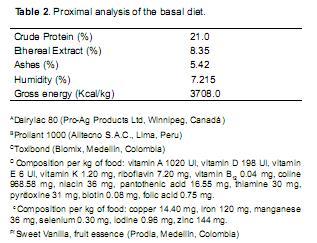
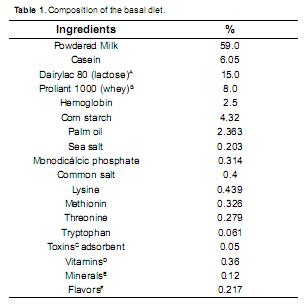
<body><![CDATA[<p><font face="Verdana, Arial, Helvetica, sans-serif" size="3"><b>Materials and methods</b> </font></p>     <p><font face="Verdana, Arial, Helvetica, sans-serif" size="2"><i>Ethical  considerations</i>    All experimental  procedures were conducted    according to guidelines  suggested by "The    International Guiding Principles  for Biomedical   Research Involving Animals"  (CIOMS, 1985).    This research was  approved by the  Animal    Experimentation  Ethics  Committee  of the   Universidad Nacional de  Colombia, Medell&iacute;n    (CEMED 001 from January 26, 2009).</font></p>     <p><font face="Verdana, Arial, Helvetica, sans-serif" size="2"><i>Location</i>    Fieldwork was  conducted in the Centro  San    Pablo of the Universidad  Nacional de Colombia,    Medell&iacute;n, located in the  municipality of R&iacute;o    Negro, at an altitude  of 2100 meters above the sea    level, with average  temperatures between 12 and    18&ordm;C, corresponding to an  area of very humid  low    montane forest (bmh-MB).</font></p>     <p><font face="Verdana, Arial, Helvetica, sans-serif" size="2"><i>Type of study</i>  </font></p>     <p><font face="Verdana, Arial, Helvetica, sans-serif" size="2">Four experimental  diets were evaluated:  a    control diet (basal diet), and three others containing    LPS from  <i>E. coli</i>, serotype  0111: B4 (Sigma-   Aldrich,  Sigma-Aldrich, St Louis,  MO, USA), as    follows:</font></p>     <p><font face="Verdana, Arial, Helvetica, sans-serif" size="2">1. Basal Diet (BD): without LPS.   </font></p>     <p><font face="Verdana, Arial, Helvetica, sans-serif" size="2">2. Diet 1 (D1):  BD plus 0.3  &micro;g of LPS /  mg of    food.   </font></p>     <p><font face="Verdana, Arial, Helvetica, sans-serif" size="2">3. Diet 2 (D2):  BD plus 0.5  &micro;g of LPS /  mg of    food.   </font></p>     <p><font face="Verdana, Arial, Helvetica, sans-serif" size="2">4. Diet 3 (D3):  BD plus 1.0  &micro;g of LPS /  mg of    food.</font></p>     <p><font face="Verdana, Arial, Helvetica, sans-serif" size="2"><i>Animals and diet</i>  The experiment  used 52 pigs  obtained by  alternate  crossing of Duroc  x Landrace. Piglets  were weaned exactly  on their twenty first day after birth, weighing 6.5 &plusmn;  0.5 kg. The weaned pigs were  housed  in groups of eight with <i>ad libitum</i> water, in  a controlled-temperature room at 26  &plusmn; 3 &deg;C.  The  basal diet  consisted of milk and  milk by-products  enriched with  vitamins, minerals, and  lysine- HCL. Diets were  formulated to meet the minimum  nutritional requirements  proposed by the NRC  (1998) (Tables <a href="#t1">1</a> and  <a href="#t2">2</a>).</font></p>     ]]></body>
<body><![CDATA[<p align="center"><a name="t1"><img src="/img/revistas/rccp/v24n4/a04t1.JPG" /></a></p>     <p align="center"><a name="t2"><img src="/img/revistas/rccp/v24n4/a04t2.JPG" /></a></p>     <p><font face="Verdana, Arial, Helvetica, sans-serif" size="2">The amount  of food offered per cage  was  300 g/day; however,  additional food was  supplied  when required. The experimental diets were offered  from days 1 to 10 post weaning. During lactation no  solid food was offered to the piglets.</font></p>     <p><font face="Verdana, Arial, Helvetica, sans-serif" size="2">Throughout the  experimental phase all 52  pigs    were sequentially slaughtered, as follows:  the first    day (day of weaning; day 1), four pigs representing    the reference group were slaughtered to  check    the overall health and  to evaluate the  macro and    microscopic condition of the organs  before the    beginning of the experiment. On  days 5, 7  and 10    post weaning four  pigs were slaughtered in  each    treatment. Diets were  provided from the time of    weaning up to 2.5 hours before slaughter.</font></p>     <p><font face="Verdana, Arial, Helvetica, sans-serif" size="2"><i>Sampling of the small  intestine</i> </font></p>     <p><font face="Verdana, Arial, Helvetica, sans-serif" size="2">The animals  were sedated by  inhalation of  carbon dioxide for 3 minutes, and then slaughtered  by exsanguination through  a section on the jugular vein. After slaughter, the pigs were placed in supine  position to remove  the small intestine  (from the  pyloric junction to  the ileocecal valve)  through an  abdominal incision. The intestine was aligned on a  table, measured without  any tension, divided  into  three sections (duodenum,  jejunum, and ileum) of equal size, and  20 cm sections were taken from  each segment's center. Once the portions were cut,  the content from each one was removed by washing  with cold saline infusion as previously described by  Makkink <i>et al</i>. (1994), and Reis <i>et al</i>. (2005). Then, 1cm long sub-samples were obtained  from each  segment. Samples were preserved in  10% buffered  formalin and subsequently  stored until performing  laboratory determinations.</font></p>     <p><font face="Verdana, Arial, Helvetica, sans-serif" size="2"><i>Histotechnical procedures</i></font></p>     <p><font face="Verdana, Arial, Helvetica, sans-serif" size="2">Samples from three  regions of the small intestine  were processed and  analyzed in the Laboratory of  Animal Pathology at  the University of Antioquia.  The tissues were sliced  in 4 &micro;m  thick cuts, and  stained with hematoxylin-eosin according  to the methodology reported by  Nabuurs <i>et al.</i> (1993).  Three transverse cuts were mounted per slide.</font></p>     <p><font face="Verdana, Arial, Helvetica, sans-serif" size="2"><i>Microscopic</i> <i>evaluation and  morphometric </i>   <i>analysis of images</i> </font></p>     <p><font face="Verdana, Arial, Helvetica, sans-serif" size="2">   The histological  sections were analyzed    quantitatively by  computerized digital image    processing, as  follows: An optical  microscope    (Leica DMLB, Meyer  Instruments, Houston, TX,    USA)  was used  to identify tissue  areas; then, the    corresponding images  were captured with a  three-   megapixel 200X  zoom camera for instant digital    microscopy (Moticam 2300, Motic, Hong  Kong,    China).The images  were analyzed with  Motic<sup>&reg;</sup>  Images Plus  2.0 image treatment  software (Motic,  Hong Kong, China).</font></p>     ]]></body>
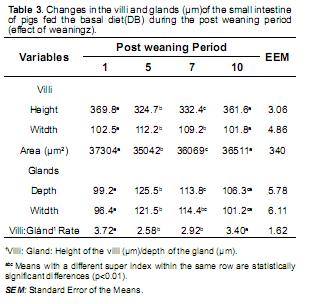
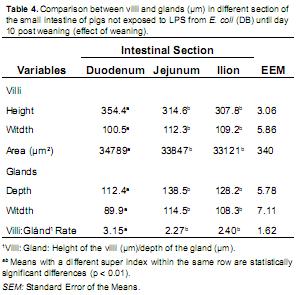
<body><![CDATA[<p><font face="Verdana, Arial, Helvetica, sans-serif" size="2">The morphometric variables measured  in    each tissue  section were: villus  height, width and    area. Intestinal glands'  depth and width  were also    determined, as  previously described by  Nabuurs <i>et</i>   <i>al.</i> (1993)  and Marion <i>et al</i>.  (2002). The average    value for each variable  was calculated after   performing measurements  in eight villi  and their   corresponding intestinal  glands. Due to the  fact    that villus  height may vary  in each intestinal  fold,    being shorter at the  apex, it was required that each    region was  equally represented in the  assessment.    In consequence,  a circular fold of the  mucosa was    chosen, measuring two  villous from the bottom, two    on the right, two  from the left side and two from the   vertex.  This procedure was repeated in each section    of the  small intestine (duodenum, jejunum and    ileum) allowing to  verify the effect of different diets    on the  villi according to  their location. As far as    we are aware, this  analysis has not been performed    previously.</font></p>     <p><font face="Verdana, Arial, Helvetica, sans-serif" size="2"><i>Statistical analysis</i> </font></p>     <p><font face="Verdana, Arial, Helvetica, sans-serif" size="2">The experiment was  conducted as a randomized  block design  (two blocks) in a 4x4  factorial arrangement (four experimental diets  and four  periods after  weaning) (Steel and  Torrie, 1985). The animals were  blocked by initial  weight. Each animal was  assigned one of  16 treatments, and each treatment  had four repetitions. Statistical data analysis was  conducted using the General  Linear  Models procedure (GLM) of SAS program (2006).  A Duncan  test was used  to compare treatment  means (p&lt;0.05).</font></p>     <p></p>     <p> </p>     <p><font face="Verdana, Arial, Helvetica, sans-serif" size="3"><b>Results</b> </font></p>     <p><font face="Verdana, Arial, Helvetica, sans-serif" size="2">Pigs fed  the basal diet  showed good health    condition  and  behaved  normally, whereas    those receiving LPS  showed increases in  rectal    temperature  (above  38&ordm;C)  throughout   the    experiment. However, they  didn&acute;t show any    signs of illness that  would force their retirement    or immediate  slaughter. No food  leftovers were    observed during the experiment.</font></p>     <p><font face="Verdana, Arial, Helvetica, sans-serif" size="2">This study  compared the data obtained  with    the BD in each  of the post weaning  periods and    intestinal sections, in  order to determine the    effect of weaning  on intestinal glands  and villi    morphology (Tables <a href="#t3">3</a>  and <a href="#t4">4</a>). Villi's  height and    area decreased from day one after weaning (p&lt;0.01;    Table 3). Animals with  at least five  days post    weaning had the  lowest values for height  and area   (324.7 &micro;m and  35042 &micro;m<sup>2</sup>, respectively), while    villi&lsquo;s width had  the highest value  (112.2 m).    For gland's width  and depth (<a href="#t3">Table  3</a>) significant    differences were  observed (p&lt;0.01) from day    one, reaching their peak  on day five after  weaning    (43.14 &micro;m<sup>2</sup> and  207.1 &micro;m<sup>2</sup>, respectively). In  each    of the variables  under study a partial  recovery    is shown as  time goes by, specifically on  day 10    after weaning. However,  there were no  statistically    significant differences between days one and 10 post    weaning (p&lt;0.01).</font></p>    <p align="center"><a name="t3"> <img src="/img/revistas/rccp/v24n4/a04t3.JPG" /></a></p>     <p align="center"><a name="t4"><img src="/img/revistas/rccp/v24n4/a04t4.JPG" /></a></p>     ]]></body>
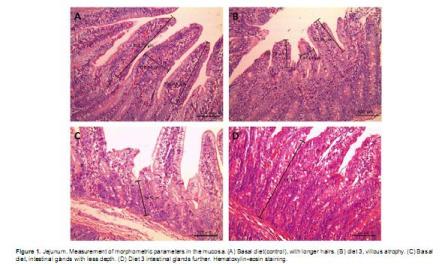
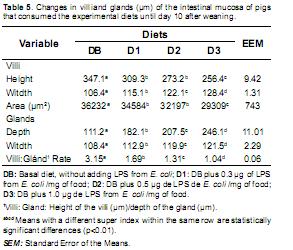
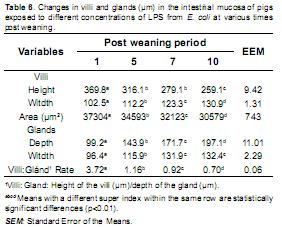
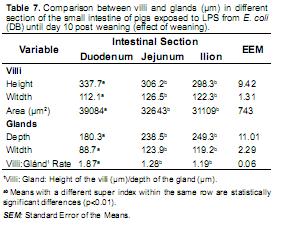
<body><![CDATA[<p><font face="Verdana, Arial, Helvetica, sans-serif" size="2">Significant differences  were found among  sections of  intestine (p&lt;0.01) for  the variables  studied, where  the proximal section (duodenum) showed the highest  values for villi height  and  area (354.4  and 34789 &micro;m<sup>2</sup>, respectively) and the lowest values for gland depth and width (112.4 and 89.9 &micro;m, respectively) (<a href="#t4">Table 4</a>). Jejunum had  the    highest values for villi and glands width, (112.3 and    114.5 &micro;m,  respectively). Nevertheless, there were    no statistically significant  differences between the   middle section (jejunum) and  distal (ileum) for the </font><font face="Verdana, Arial, Helvetica, sans-serif" size="2">studied variables (p&gt;0.01). </font></p>     <p><font face="Verdana, Arial, Helvetica, sans-serif" size="2">The average  values of the  intestinal variables  are presented in Tables  <a href="#t5">5</a>, <a href="#t6">6</a>, and <a href="#t7">7</a>. There was  no  statistical  interaction between the  factors involved  (LPS concentrations and post weaning slaughtering  periods) for any of the variables studied. Significant  decreases were observed  (p&lt;0.01) among diets  regarding villi's height  (Figure 1) and area (<a href="#t5">Table  5</a>). Animals on D3  had the lowest  values for these  traits (256.4 &micro;m, and  29,309 &micro;m<sup>2</sup> respectively)   compared to samples from those on BD (347.1 m    and 36232 &micro;m<sup>2</sup>, respectively). Conversely, villi's    width for animals on  D3 (128.4 m)  showed a    significant increase (p&lt;0.01) in comparison  with    those on BD  (106.4 m). For depth  and width of   the glands, animals on  D3 showed (p&lt;0.01) higher   values (246.1 m and  121.5 m, respectively)   compared to samples  from animals on DB  (111.2    and 108.4 m, respectively).</font></p>     <p align="center"><a name="f1"><img src="/img/revistas/rccp/v24n4/a04f1.JPG" /></a></p>     <p align="center"><a name="t5"><img src="/img/revistas/rccp/v24n4/a04t5.JPG" /></a></p>     <p align="center"><a name="t6"><img src="/img/revistas/rccp/v24n4/a04t6.JPG" /></a></p>     <p align="center"><a name="t7"><img src="/img/revistas/rccp/v24n4/a04t7.JPG" /></a></p>     <p><font face="Verdana, Arial, Helvetica, sans-serif" size="2">During the  post-weaning period (<a href="#t6">Table 6</a>),  villi&lsquo;s height and  area decreased (p&lt;0.01) from  day one, with animals  slaughtered 10 days  after  weaning presenting the  lowest values (259.1  &micro;m  and 30579 &micro;m<sup>2</sup>, respectively), while villi's  width had the highest  values (130.9 &micro;m).  For depth and    breadth of glands (<a href="#t6">Table  6</a>), significant increases    were observed (p&lt;0.01) since day one, reaching the   highest level on  day 10 post  weaning (197.1 and </font><font face="Verdana, Arial, Helvetica, sans-serif" size="2">132.4 &micro;m) </font></p>     <p><font face="Verdana, Arial, Helvetica, sans-serif" size="2">Significant changes  (p&lt;0.01) were observed  among intestinal portions  for the variables  under  study (<a href="#t7">Table 7</a>).  The proximal portion (duodenum) had the highest values  for villi's height  and area (337.7 &micro;m and 39084  &micro;m<sup>2</sup>, respectively) and the  lowest values for glands  depth and width  (180.3  and 88.7 &micro;m, respectively). For width, both in villus  and glands, jejunum  had the highest  values (126.5  and 123.9 &micro;m,  respectively). However, there  were  no statistically significant  differences between the small intestine's mid  (jejunum) and distal  (ileum)  sections for the variables studied (p&gt;0.01)</font></p>     <p></p>     <p><font face="Verdana, Arial, Helvetica, sans-serif" size="3"><b>Discussion</b> </font></p>     ]]></body>
<body><![CDATA[<p><font face="Verdana, Arial, Helvetica, sans-serif" size="2">At weaning, the observed values  for villi's    height and width, as  well as those for depth and    width of glands,  were similar to the ones  reported    by other authors (Nabuurs <i>et al</i>., 1993; Marion <i>et</i>   <i>al</i>., 2002; Reis <i>et al</i>., 2005). It was further verified    that weaning decreases  villi&lsquo;s height and  area, and    induces an increase in  villi&acute;s width. Weaning  also    increases intestinal glands' depth and breadth, which    is in agreement  with previous reports  (Hedemann    <i>et al</i>., 2003). It  was also confirmed  that recovery of these parameters occurs around  day five, which  agrees with previous work (Hedemann <i>et al</i>.  2003;  Vente-Spreeuwenberg <i>et  al</i>. 2004ab)reporting that villi's growth recovery  occurs between 5-8  days  post weaning,  returning to normal  levels between  9-14 days after weaning, under  normal conditions (Nabuurs <i>et al</i>.1993;  Hedemann <i>et al</i>. 2003; Vente-Spreeuwenberg <i>et al</i>., 2004a).</font></p>     <p><font face="Verdana, Arial, Helvetica, sans-serif" size="2">The ratio  between villi's height  and glands'  depth is of great  importance and should be  at a maximum, due to  the fact that  minimum values are associated with a  decrease in digestion and    absorption during  the first week post  weaning.    After  weaning, the ratio between  villi and glands    is  affected by a change in the microbial population,    the intake of  solid food, and allergic  reactions    (Rodrigues <i>et al</i>.,  2007).</font></p>     <p><font face="Verdana, Arial, Helvetica, sans-serif" size="2">Although the  mechanisms underlying the    changes observed  in this study  are not fully    understood at  present, some researchers postulate   that such changes are  due to the fact that piglets are   subjected to  environmental, social and  nutritional    changes at weaning,  which favor the appearance of    various  stress symptoms (Lall&egrave;s <i>et al</i>.,  2004a). Due    to this, the post  weaning period is  characterized    by an  immediate but transient reduction  in food    intake, leading to a  state of malnutrition and stunted    growth. This affects  several aspects of the small    intestine's architecture  and functions, ultimately    causing diarrhea.  Among others, the following    changes have  been reported: villi  atrophy (Van    Beers-Schreurs <i>et  al</i>., 1998), deepening of intestinal    glands, and decreased  digestive enzyme activity    (Vente-Spreeuwemberg <i>et al</i>., 2001;  Hedemann <i>et</i>   <i>al</i>., 2006).</font></p>     <p><font face="Verdana, Arial, Helvetica, sans-serif" size="2">Some research has  shown early signs  of   inflammation after  weaning, including leukocyte   infiltration, increased expression  of several    proinflammatory cytokines,  enhanced cytoprotection    (by over-expression of  heat shock proteins),  tissue   alterations caused  by proteases, and  epithelial   function disorders  related to absorption,  mineral    secretion and  intestinal permeability. Nonetheless,    after these  disorders, there is  an intestinal    regeneration phase,  probably stimulated by the    return of feed  consumption, which leads to a restored    normality in these  parameters (Lall&egrave;s <i>et al</i>., 2004a).</font></p>     <p><font face="Verdana, Arial, Helvetica, sans-serif" size="2">Supplying LPS from <i>E.  coli</i> had an  additive   effect on  these variables, altered  as a result  of    weaning. Such  effect was dose-dependent, since    the greatest changes  occurred with the highest dose    (D3). The  observed shortening of villus'  height is    probably due to a  decrease in villus cells numbers,    from the adverse  effects of LPS, and  alteration in    cell turnover  rate, which were significantly lower   in the  animals on DB.  Similar effects have  been observed after experimental infection of gnotobiotic pigs with <i>E. coli</i> (Willing <i>et al</i>., 2007).</font></p>     <p><font face="Verdana, Arial, Helvetica, sans-serif" size="2">Changes in  villi and glands' morphology&lsquo; (McCracken <i>et al</i>.,  1999; Li <i>et al</i>., 2001) represent  a balance between gland cells production (Nabuurs  <i>et al</i>., 1993; Jin <i>et al</i>., 1994) and loss of villus cells.  The decrease in  villus height reduces  the area for digestion and absorption  of nutrients during  this  period (Rodrigues <i>et al</i>., 2007). The food that is not  digested and absorbed in the small intestine ends up  in the cecum and colon, generating intense activity  and proliferation of  microbial population, mainly  enteropathogenic, which triggers diarrhea processes  that can cause death (Lall&egrave;s <i>et al</i>., 2004b).</font></p>     <p><font face="Verdana, Arial, Helvetica, sans-serif" size="2">The increased  villi&acute;s width observed  during    the post weaning period  agrees with previous    descriptions  (Cranwell, 1995; Yen,  2002). Such    change suggest a compensatory response  to    decreased height (villous atrophy), which occurs in    the days after weaning, as described above (Pluske   <i>et a</i>l.1997; Vente-Spreeuwenberg <i>et al</i>., 2001).</font></p>     <p><font face="Verdana, Arial, Helvetica, sans-serif" size="2">The observed  changes in the glands'  width and    height in jejunum and  ileum have been reported    by some authors  as a normal process  related to    adaptation, which takes  place in the post  weaning    phase, indicating an  accelerated mitotic activity    (Pluske <i>et al</i>. 1997;  Vente-Spreeuwenberg <i>et al</i>.,    2004a). Hedemann <i>et al</i>.  (2003) reported that  the    jejunum&lsquo;s villi are  between 350 to 450 &micro;m long  at    weaning and reduce their  size from then, returning    to their normal  size 14 days  after weaning. In    consequence, villous atrophy  and cell renewal,    which determines their recovery and  growth,    vary according to the  intestinal section (Reis <i>et</i>   <i>al</i>., 2005). In  this study we  observed that these   changes were increased in  jejunum and ileum due   to LPS intake, so these sections are probably more    susceptible to the effect of this bacterial component,    probably due to an  increased specificity for  its    receptors. This hypothesis  must be tested in  future   research.</font></p>     <p><font face="Verdana, Arial, Helvetica, sans-serif" size="2">In the present  study, the effect of <i>E. coli</i>&lsquo;s LPS   on intestinal morphology could be largely due to the    inflammatory response induced  by this component.    LPS is known to  have the ability to activate a variety of signaling  pathways (Amador <i>et al</i>.,  2007; Foot <i>et  al</i>., 2004) through proinflammatory  cytokines such as  IL-8, IL-18 and TNF- (Johnson  <i>et  al</i>., 2005). These  cytokines affect normal  cell  growth and  induce changes in the  intestine's  structure and functional  capacity (Garcia-Herrera  <i>et  al</i>., 2008; Yoo <i>et  al</i>., 2000). In  general, this  may be  attributed to two  factors: 1) inflammation  causes changes  in the intestinal  cells architecture  and normal  functions, promoting the release of inflammatory mediators (Johnson <i>et al</i>., 2005); 2)  enterocytes' normal  physiology can be profoundly  affected by  factors derived from coagulation and  blood complement  system (Yuji <i>et al</i>., 2003).</font></p>     <p><font face="Verdana, Arial, Helvetica, sans-serif" size="2">In addition  to the above, some research  has    shown that  Fas receptors co-stimulation with    TNF or INF on  human enterocytes can  induce   apoptosis (Ruemmele,  1999). Studies performed    on gnotobiotic piglets indicate that conventional <i>E.</i>   <i>coli</i> bacteria, contrary to the <i>L. fermentum</i> bacteria,    increases general  cell turnover by stimulating    apoptosis through  the expression of FasL,  TNF    and increased  cell proliferation. However,  in pigs,    it has  not yet been  established whether a similar    mechanism  causes the decrease  in intestinal villi    cells, and  consequently their atrophy after  LPS    action.</font></p>     ]]></body>
<body><![CDATA[<p><font face="Verdana, Arial, Helvetica, sans-serif" size="2">Another mechanism  that could be  involved    in intestinal  disorders arising from  LPS-induced    inflammation is the  disruption of intestinal    permeability caused  by TNF-. This  cytokine    alters intestinal  permeability through its  effect on    tight junctions'  structure between epithelial  cells    (Fengjun <i>et al</i>., 2005), mainly  in jejunum (Foot <i>et</i>   <i>al</i>., 2004; Lall&egrave;s <i>et  al</i>.2004a). The above mentioned,   combined with <i>E.  coli</i>'s LPS effect, which  causes    the  shortening of actin filaments  within the    enterocyte, could permeate tight junctions structure    to infection-promoting bacteria  and compounds,    leading to inflammation (Berkes <i>et al</i>., 2003).</font></p>     <p><font face="Verdana, Arial, Helvetica, sans-serif" size="2">From this study we  conclude that  <i>E. coli</i>&lsquo;s    LPS has an  effect on intestinal  morphological    parameters, specifically decreasing villi's height and    area, and increasing  glands' depth and width. Such    effect probably  contributes to lowering  intestinal    nutrient absorption, co-infection with  other </font><font face="Verdana, Arial, Helvetica, sans-serif" size="2">pathogens, and onset  of the post-weaning  diarrhea    syndrome.</font></p>     <p><font face="Verdana, Arial, Helvetica, sans-serif" size="2">This  study shows the usefulness of computerized    morphometric analysis  to reliably, objectively and    reproductively evaluate LPS  effects on intestinal    morphological parameters.  In consequence it    could be used  in future research to  investigate the   physiopathology of this  and other enteritis-causing    agents, and for evaluating therapeutic strategies.</font></p>     <p><font face="Verdana, Arial, Helvetica, sans-serif" size="2">From  these findings it is  suggested the need    for more research  on the digestive physiology    associated with pathology,  microbiology and    immunology, in order to improve the understanding    of the mechanisms  responsible for digestive   problems during the critical post-weaning period.</font></p>     <p></p>     <p><font face="Verdana, Arial, Helvetica, sans-serif" size="3"><b>Acknowledgements</b> </font></p>     <p><font face="Verdana, Arial, Helvetica, sans-serif" size="2">The authors  thank the Research Committee    (CODI) of the  University of Antioquia  for co-   funding this research  (code 20096000), and the   Medellin Research Direction  (DIME) of the   National University of Colombia for financing    it (project codes  QUIPU 20301007862 and    20101007950), which made this research possible.</font></p>     <p></p>     <p><font face="Verdana, Arial, Helvetica, sans-serif" size="3"><b>References</b> </font></p>     <!-- ref --><p><font face="Verdana, Arial, Helvetica, sans-serif" size="2">1. Albin DM, Wubben  JE, Rowlett JM, Tappenden  KA, and    Nowak RA. Changes in  small intestinal nutrient  transport and    barrier function after  lipopolysaccharide exposure in  two pig    breeds. J Anim Sci 2007; 85:2517-2523.</font>&nbsp;&nbsp;&nbsp;&nbsp;&nbsp;&nbsp;&nbsp;&nbsp;[&#160;<a href="javascript:void(0);" onclick="javascript: window.open('/scielo.php?script=sci_nlinks&ref=000092&pid=S0120-0690201100040000400001&lng=','','width=640,height=500,resizable=yes,scrollbars=1,menubar=yes,');">Links</a>&#160;]<!-- end-ref --><!-- ref --><p><font face="Verdana, Arial, Helvetica, sans-serif" size="2"> 2. Amador P, Garcia-Herrera J, Marca MC, de la Osada J, Acin S,    Navarro MA, Salvador MT,  Lostao MP and  Rodriguez-Yoldi    MJ. Intestinal D-galactose transport in an endotoxemia model in    the rabbit. J Membr Biol 2007; 2153:125-133.   </font>&nbsp;&nbsp;&nbsp;&nbsp;&nbsp;&nbsp;&nbsp;&nbsp;[&#160;<a href="javascript:void(0);" onclick="javascript: window.open('/scielo.php?script=sci_nlinks&ref=000093&pid=S0120-0690201100040000400002&lng=','','width=640,height=500,resizable=yes,scrollbars=1,menubar=yes,');">Links</a>&#160;]<!-- end-ref --><!-- ref --><p><font face="Verdana, Arial, Helvetica, sans-serif" size="2">3. Berkes, J,  Viswanathan, VK, Savkovic,  SD, and Hecht  G.    Intestinal epithelial responses  to enteric pathogens:  effects on    tight junction barrier,  ion transport, and  inflammation. Gut    2003; 52<b>:</b>439-451.   </font>&nbsp;&nbsp;&nbsp;&nbsp;&nbsp;&nbsp;&nbsp;&nbsp;[&#160;<a href="javascript:void(0);" onclick="javascript: window.open('/scielo.php?script=sci_nlinks&ref=000094&pid=S0120-0690201100040000400003&lng=','','width=640,height=500,resizable=yes,scrollbars=1,menubar=yes,');">Links</a>&#160;]<!-- end-ref --><!-- ref --><p><font face="Verdana, Arial, Helvetica, sans-serif" size="2">4. Council for International  Organizations of Medical  Sciences    (CIOMS). International Guiding  Principles for Biomedical    Research Involving Animals. 1985. Geneva . 28pp.   </font>&nbsp;&nbsp;&nbsp;&nbsp;&nbsp;&nbsp;&nbsp;&nbsp;[&#160;<a href="javascript:void(0);" onclick="javascript: window.open('/scielo.php?script=sci_nlinks&ref=000095&pid=S0120-0690201100040000400004&lng=','','width=640,height=500,resizable=yes,scrollbars=1,menubar=yes,');">Links</a>&#160;]<!-- end-ref --><!-- ref --><p><font face="Verdana, Arial, Helvetica, sans-serif" size="2">5. Cramwell PD. Development  of neonatal gut and enzyme    systems. In Varley MA  Editor. The neonatal pig: development    and survival. UK Cab International, 1995. p. 99-145.   </font>&nbsp;&nbsp;&nbsp;&nbsp;&nbsp;&nbsp;&nbsp;&nbsp;[&#160;<a href="javascript:void(0);" onclick="javascript: window.open('/scielo.php?script=sci_nlinks&ref=000096&pid=S0120-0690201100040000400005&lng=','','width=640,height=500,resizable=yes,scrollbars=1,menubar=yes,');">Links</a>&#160;]<!-- end-ref --><!-- ref --><p><font face="Verdana, Arial, Helvetica, sans-serif" size="2">6. Fan MZ. Growth and ontogeny of the gastrointestinal tract. In:    Xu. RJ, Cranwell P  editors. The neonatal pig.  Gastrointestinal </font><font face="Verdana, Arial, Helvetica, sans-serif" size="2">physiology. and  nutrition. Nottingham University  Press.  2002:31-60.  </font>&nbsp;&nbsp;&nbsp;&nbsp;&nbsp;&nbsp;&nbsp;&nbsp;[&#160;<a href="javascript:void(0);" onclick="javascript: window.open('/scielo.php?script=sci_nlinks&ref=000097&pid=S0120-0690201100040000400006&lng=','','width=640,height=500,resizable=yes,scrollbars=1,menubar=yes,');">Links</a>&#160;]<!-- end-ref --><!-- ref --><p><font face="Verdana, Arial, Helvetica, sans-serif" size="2">7. Garc&iacute;a-Herrera J,  Abad B, Rodr&iacute;guez-Yoldi MJ.  Effect of    lipopolysaccharide on  D-fructose transport across  rabbit    jejunum.  Inflamm Res 2003; 52:177-184.   </font>&nbsp;&nbsp;&nbsp;&nbsp;&nbsp;&nbsp;&nbsp;&nbsp;[&#160;<a href="javascript:void(0);" onclick="javascript: window.open('/scielo.php?script=sci_nlinks&ref=000098&pid=S0120-0690201100040000400007&lng=','','width=640,height=500,resizable=yes,scrollbars=1,menubar=yes,');">Links</a>&#160;]<!-- end-ref --><!-- ref --><p><font face="Verdana, Arial, Helvetica, sans-serif" size="2">8. Garcia-Herrera J,  Marca MC, Brot-Laroche  EGuillen, N, Acin    S, Navarro  MA, de la Osada J,  Rodriguez-Yoldi MJ. Protein    kinases,  TNF- and  proteasome contribute in the inhibition  of    fructose intestinal transport by  sepsis in vivo.  Am J Physiol    Gastrointest  Liver Physiol 2008; 294:G155-G164.   </font>&nbsp;&nbsp;&nbsp;&nbsp;&nbsp;&nbsp;&nbsp;&nbsp;[&#160;<a href="javascript:void(0);" onclick="javascript: window.open('/scielo.php?script=sci_nlinks&ref=000099&pid=S0120-0690201100040000400008&lng=','','width=640,height=500,resizable=yes,scrollbars=1,menubar=yes,');">Links</a>&#160;]<!-- end-ref --><!-- ref --><p><font face="Verdana, Arial, Helvetica, sans-serif" size="2">9. G&oacute;mez  A. Weaning and  the physiology of piglets.  In: I    International Seminar  on sustainable production  systems in    small  animals. Universidad del Cauca. Popay&aacute;n, 2006. 34p.   </font>&nbsp;&nbsp;&nbsp;&nbsp;&nbsp;&nbsp;&nbsp;&nbsp;[&#160;<a href="javascript:void(0);" onclick="javascript: window.open('/scielo.php?script=sci_nlinks&ref=000100&pid=S0120-0690201100040000400009&lng=','','width=640,height=500,resizable=yes,scrollbars=1,menubar=yes,');">Links</a>&#160;]<!-- end-ref --><!-- ref --><p><font face="Verdana, Arial, Helvetica, sans-serif" size="2">10. Gomez  AS, Vergara D, Argote  F. Effect of  diet and age of    weaning on  piglet digestive physiology. Revista Biotecnolog&iacute;a    en el  Sector Agropecuario y Agronindustrial 2008; 6:32-41.   </font>&nbsp;&nbsp;&nbsp;&nbsp;&nbsp;&nbsp;&nbsp;&nbsp;[&#160;<a href="javascript:void(0);" onclick="javascript: window.open('/scielo.php?script=sci_nlinks&ref=000101&pid=S0120-0690201100040000400010&lng=','','width=640,height=500,resizable=yes,scrollbars=1,menubar=yes,');">Links</a>&#160;]<!-- end-ref --><!-- ref --><p><font face="Verdana, Arial, Helvetica, sans-serif" size="2">11. Guerra  ACM, Gal&aacute;n OJA, M&eacute;ndez AJJ, Murillo AE. Evaluaci&oacute;n    del efecto  del extracto de  or&eacute;gano (<i>Oreganum vulgare</i>)  sobre    algunos par&aacute;metros  productivos de cerdos destetos. Revista    Tumbaga  2008; 3:16-29.   </font>&nbsp;&nbsp;&nbsp;&nbsp;&nbsp;&nbsp;&nbsp;&nbsp;[&#160;<a href="javascript:void(0);" onclick="javascript: window.open('/scielo.php?script=sci_nlinks&ref=000102&pid=S0120-0690201100040000400011&lng=','','width=640,height=500,resizable=yes,scrollbars=1,menubar=yes,');">Links</a>&#160;]<!-- end-ref --><!-- ref --><p><font face="Verdana, Arial, Helvetica, sans-serif" size="2">12. Hedemann MS,  Hojsgaard s, Jensen  BB. Small intestine    morphology and  activity of intestinal peptidases  in piglets    around  weaning. J Anim Physiol Anim Nutr 2003; 87:32-41.   </font>&nbsp;&nbsp;&nbsp;&nbsp;&nbsp;&nbsp;&nbsp;&nbsp;[&#160;<a href="javascript:void(0);" onclick="javascript: window.open('/scielo.php?script=sci_nlinks&ref=000103&pid=S0120-0690201100040000400012&lng=','','width=640,height=500,resizable=yes,scrollbars=1,menubar=yes,');">Links</a>&#160;]<!-- end-ref --><!-- ref --><p><font face="Verdana, Arial, Helvetica, sans-serif" size="2">13. Hedemann MS,  Eskildsen M, L&aelig;rke  HN, Pedersen CJ,    Lindberg E,  Laurinen P, Bach KE.  Fiber concentrations and    fiber  properties Intestinal morphology and enzymatic activity in    newly  weaned pigs fed contrasting. J Anim Sci 2006; 84:1375-   1386.   </font>&nbsp;&nbsp;&nbsp;&nbsp;&nbsp;&nbsp;&nbsp;&nbsp;[&#160;<a href="javascript:void(0);" onclick="javascript: window.open('/scielo.php?script=sci_nlinks&ref=000104&pid=S0120-0690201100040000400013&lng=','','width=640,height=500,resizable=yes,scrollbars=1,menubar=yes,');">Links</a>&#160;]<!-- end-ref --><!-- ref --><p><font face="Verdana, Arial, Helvetica, sans-serif" size="2">14. Jin L,  Reynolds LP, Redmer  DA, Caton JS,  Crenshaw JD.    Effects of  dietary fiber on  intestinal growth, cell proliferation,    and morphology  in growing pigs.  J Anim Sci 1994; 72:2270-   2278.   </font>&nbsp;&nbsp;&nbsp;&nbsp;&nbsp;&nbsp;&nbsp;&nbsp;[&#160;<a href="javascript:void(0);" onclick="javascript: window.open('/scielo.php?script=sci_nlinks&ref=000105&pid=S0120-0690201100040000400014&lng=','','width=640,height=500,resizable=yes,scrollbars=1,menubar=yes,');">Links</a>&#160;]<!-- end-ref --><!-- ref --><p><font face="Verdana, Arial, Helvetica, sans-serif" size="2">15. Johnson GB, Brunn  GJ, Samstein B. New  insight into the    pathogenesis  of sepsis and the sepsis syndrome. Surgery 2005;    137:393-395   </font>&nbsp;&nbsp;&nbsp;&nbsp;&nbsp;&nbsp;&nbsp;&nbsp;[&#160;<a href="javascript:void(0);" onclick="javascript: window.open('/scielo.php?script=sci_nlinks&ref=000106&pid=S0120-0690201100040000400015&lng=','','width=640,height=500,resizable=yes,scrollbars=1,menubar=yes,');">Links</a>&#160;]<!-- end-ref --><!-- ref --><p><font face="Verdana, Arial, Helvetica, sans-serif" size="2">16. Lall&egrave;s JPl,  Boudry G, Favier  C, Le Floc'h  N, Luron I,    Montagne  L, Oswald IP, Pi&eacute; S, Piel C and S&egrave;ve B. Gut function    and dysfunction  in young pigs:  physiology. Anim Res  2004a;    53:301-316.   </font>&nbsp;&nbsp;&nbsp;&nbsp;&nbsp;&nbsp;&nbsp;&nbsp;[&#160;<a href="javascript:void(0);" onclick="javascript: window.open('/scielo.php?script=sci_nlinks&ref=000107&pid=S0120-0690201100040000400016&lng=','','width=640,height=500,resizable=yes,scrollbars=1,menubar=yes,');">Links</a>&#160;]<!-- end-ref --><!-- ref --><p><font face="Verdana, Arial, Helvetica, sans-serif" size="2">17. Lall&egrave;s JP, Konstantinov SR,  Rothk&ouml;tter HJ. Bases physio-   logiques, microbiologiques et  immunitaires des troubles    digestifs du  sevrage chez le  porcelet : don n&eacute;es r&eacute;centes    dans le contexte de la  suppression des antibiotiques  additifs    alimentaires.  Journ&eacute;es Recherche Porcine 2004b; 36:139-150.   </font>&nbsp;&nbsp;&nbsp;&nbsp;&nbsp;&nbsp;&nbsp;&nbsp;[&#160;<a href="javascript:void(0);" onclick="javascript: window.open('/scielo.php?script=sci_nlinks&ref=000108&pid=S0120-0690201100040000400017&lng=','','width=640,height=500,resizable=yes,scrollbars=1,menubar=yes,');">Links</a>&#160;]<!-- end-ref --><!-- ref --><p><font face="Verdana, Arial, Helvetica, sans-serif" size="2">18. Li BT,  Van Kessel AG, Caine  WR, Huang SX and  Kirkwood    RN. Small  intestine morphology and  bacterial populations in    ileal  digesta and feches of newly weanead pigs receiving a high    dietary  level of zinc oxide. Can J Anim 2001; 81:511-516.   </font>&nbsp;&nbsp;&nbsp;&nbsp;&nbsp;&nbsp;&nbsp;&nbsp;[&#160;<a href="javascript:void(0);" onclick="javascript: window.open('/scielo.php?script=sci_nlinks&ref=000109&pid=S0120-0690201100040000400018&lng=','','width=640,height=500,resizable=yes,scrollbars=1,menubar=yes,');">Links</a>&#160;]<!-- end-ref --><!-- ref --><p><font face="Verdana, Arial, Helvetica, sans-serif" size="2">19. McCracken BA,  Spurlock ME, Roos MA, Zuckermann    FA, Gaskins  HR. Weaning anorexia  may contribute to local    inflammation in the piglet  small intestine. J Nutr  1999; </font>&nbsp;&nbsp;&nbsp;&nbsp;&nbsp;&nbsp;&nbsp;&nbsp;[&#160;<a href="javascript:void(0);" onclick="javascript: window.open('/scielo.php?script=sci_nlinks&ref=000110&pid=S0120-0690201100040000400019&lng=','','width=640,height=500,resizable=yes,scrollbars=1,menubar=yes,');">Links</a>&#160;]<!-- end-ref --><!-- ref --><p><font face="Verdana, Arial, Helvetica, sans-serif" size="2">20. Makkink CA, Berntsen  PJM, Op Den  Kamp BML, Kemp  B, Verstegen WA. Gastric  protein breakdown and  pancreatic  enzyme activities in  response to two different  dietary protein  sources in newly weaned pigs. J Anim Sci 1994; 72:2843-2850. </font>&nbsp;&nbsp;&nbsp;&nbsp;&nbsp;&nbsp;&nbsp;&nbsp;[&#160;<a href="javascript:void(0);" onclick="javascript: window.open('/scielo.php?script=sci_nlinks&ref=000111&pid=S0120-0690201100040000400020&lng=','','width=640,height=500,resizable=yes,scrollbars=1,menubar=yes,');">Links</a>&#160;]<!-- end-ref --><!-- ref --><p><font face="Verdana, Arial, Helvetica, sans-serif" size="2">21. Marion J, Biernat  M, Thomas F,  Savary G, Le Breton  Y,    Zabielski R, Le Hu&euml;rou-Luron I, Le Dividich J. Small intestine    growth and morphometry  in piglets weaned  at 7 days  of age.    Effects of level  of energy intake.  Reprod. Nutr. Dev  2002;    42:339-354.   </font>&nbsp;&nbsp;&nbsp;&nbsp;&nbsp;&nbsp;&nbsp;&nbsp;[&#160;<a href="javascript:void(0);" onclick="javascript: window.open('/scielo.php?script=sci_nlinks&ref=000112&pid=S0120-0690201100040000400021&lng=','','width=640,height=500,resizable=yes,scrollbars=1,menubar=yes,');">Links</a>&#160;]<!-- end-ref --><!-- ref --><p><font face="Verdana, Arial, Helvetica, sans-serif" size="2">22. Nabuurs MJA, Hoogendoorn A, Van  der Molen EJ, Van  Osta    LM. Villus height and crypt depth  in weanead and unweanead    pigs, reared under various  circumstances in the Netherlands.    Res Vet Sci 1993; 55:78-84.   </font>&nbsp;&nbsp;&nbsp;&nbsp;&nbsp;&nbsp;&nbsp;&nbsp;[&#160;<a href="javascript:void(0);" onclick="javascript: window.open('/scielo.php?script=sci_nlinks&ref=000113&pid=S0120-0690201100040000400022&lng=','','width=640,height=500,resizable=yes,scrollbars=1,menubar=yes,');">Links</a>&#160;]<!-- end-ref --><!-- ref --><p><font face="Verdana, Arial, Helvetica, sans-serif" size="2">23. National Research Council  (NRC). Nutrient Requirements    of Swine. 10th ed. National Academy Press.  Washington: The    Institute, 1998.   </font>&nbsp;&nbsp;&nbsp;&nbsp;&nbsp;&nbsp;&nbsp;&nbsp;[&#160;<a href="javascript:void(0);" onclick="javascript: window.open('/scielo.php?script=sci_nlinks&ref=000114&pid=S0120-0690201100040000400023&lng=','','width=640,height=500,resizable=yes,scrollbars=1,menubar=yes,');">Links</a>&#160;]<!-- end-ref --><!-- ref --><p><font face="Verdana, Arial, Helvetica, sans-serif" size="2">24. Pi&eacute; S, Lall&egrave;s  JP, Blazy F, Laffitte J, S&egrave;ve B, Oswald  IP.    Weaning Is Associated with  an Upregulation of Expression  of    Inflammatory Cytokines in the Intestine of Piglets. J Nutr 2004;    134:641-647.   </font>&nbsp;&nbsp;&nbsp;&nbsp;&nbsp;&nbsp;&nbsp;&nbsp;[&#160;<a href="javascript:void(0);" onclick="javascript: window.open('/scielo.php?script=sci_nlinks&ref=000115&pid=S0120-0690201100040000400024&lng=','','width=640,height=500,resizable=yes,scrollbars=1,menubar=yes,');">Links</a>&#160;]<!-- end-ref --><!-- ref --><p><font face="Verdana, Arial, Helvetica, sans-serif" size="2">25. Pitman RS, Blumberg RS. First line of defense: the role of the    intestinal epithelium as  an active component  of the mucosal    immune system. J Gastroenterol 2000; 35:805-814.   </font>&nbsp;&nbsp;&nbsp;&nbsp;&nbsp;&nbsp;&nbsp;&nbsp;[&#160;<a href="javascript:void(0);" onclick="javascript: window.open('/scielo.php?script=sci_nlinks&ref=000116&pid=S0120-0690201100040000400025&lng=','','width=640,height=500,resizable=yes,scrollbars=1,menubar=yes,');">Links</a>&#160;]<!-- end-ref --><!-- ref --><p><font face="Verdana, Arial, Helvetica, sans-serif" size="2">26. Pluske JR, Hampson  DJ, Williams IH.  Factors influencing the    structure and function of  the small intestine in weaned pigs: a    review. Livest Prod Sci 1997; 51:215-236.   </font>&nbsp;&nbsp;&nbsp;&nbsp;&nbsp;&nbsp;&nbsp;&nbsp;[&#160;<a href="javascript:void(0);" onclick="javascript: window.open('/scielo.php?script=sci_nlinks&ref=000117&pid=S0120-0690201100040000400026&lng=','','width=640,height=500,resizable=yes,scrollbars=1,menubar=yes,');">Links</a>&#160;]<!-- end-ref --><!-- ref --><p><font face="Verdana, Arial, Helvetica, sans-serif" size="2">27. Pluske JR, Williams IH, Aherne  FX. Maintenance of  villous    height and crypt depth in the small intestine of weaned pigs. En:    Manipuilating pig production  III. Products with wheat  gluten    on digestibility of nutrients  and growth performance in nursey    pigs. J Anim Sci 1991; 72:151-159.   </font>&nbsp;&nbsp;&nbsp;&nbsp;&nbsp;&nbsp;&nbsp;&nbsp;[&#160;<a href="javascript:void(0);" onclick="javascript: window.open('/scielo.php?script=sci_nlinks&ref=000118&pid=S0120-0690201100040000400027&lng=','','width=640,height=500,resizable=yes,scrollbars=1,menubar=yes,');">Links</a>&#160;]<!-- end-ref --><!-- ref --><p><font face="Verdana, Arial, Helvetica, sans-serif" size="2">28. Reis STC , Guerrero CMJ, Aguilera BA, Mariscal LG.Effect of    different cereals on  intestinal morphology of weaned  piglets.    Tec Pecu Mex 2005; 43:309-321.   </font>&nbsp;&nbsp;&nbsp;&nbsp;&nbsp;&nbsp;&nbsp;&nbsp;[&#160;<a href="javascript:void(0);" onclick="javascript: window.open('/scielo.php?script=sci_nlinks&ref=000119&pid=S0120-0690201100040000400028&lng=','','width=640,height=500,resizable=yes,scrollbars=1,menubar=yes,');">Links</a>&#160;]<!-- end-ref --><!-- ref --><p><font face="Verdana, Arial, Helvetica, sans-serif" size="2">29. Reis STC, Aguilera, BAM, Aguilera BA, Mariscal LG,    Guerrero CMJ. Morphology  of the digestive tract  of pigs fed    diets containing isolated  or concentrated soy  protein. Arch    Latinoam Prod Anim 2007b, 15:139-146.</font>&nbsp;&nbsp;&nbsp;&nbsp;&nbsp;&nbsp;&nbsp;&nbsp;[&#160;<a href="javascript:void(0);" onclick="javascript: window.open('/scielo.php?script=sci_nlinks&ref=000120&pid=S0120-0690201100040000400029&lng=','','width=640,height=500,resizable=yes,scrollbars=1,menubar=yes,');">Links</a>&#160;]<!-- end-ref --><!-- ref --><p><font face="Verdana, Arial, Helvetica, sans-serif" size="2"> 30. Reis STC, Mariscal  LG, Aguilera BA,  Cervantes JGH.    Digestibility of protein  and energy in  diets for piglets    supplemented with three different types of dried whey. Vet Mex    2007; 38:141-151.   </font>&nbsp;&nbsp;&nbsp;&nbsp;&nbsp;&nbsp;&nbsp;&nbsp;[&#160;<a href="javascript:void(0);" onclick="javascript: window.open('/scielo.php?script=sci_nlinks&ref=000121&pid=S0120-0690201100040000400030&lng=','','width=640,height=500,resizable=yes,scrollbars=1,menubar=yes,');">Links</a>&#160;]<!-- end-ref --><!-- ref --><p><font face="Verdana, Arial, Helvetica, sans-serif" size="2">31. Ruemmele FM, Russo P, Beaulieu JF, Dionne S, Levy E, Lentze    MJ, Seidman EG. Susceptibility to  FAS-induced apoptosis in    human nontumoral enterocytes: Role of costimulatory factors. J    Cell Physiol 1999; 181:45-54.   </font>&nbsp;&nbsp;&nbsp;&nbsp;&nbsp;&nbsp;&nbsp;&nbsp;[&#160;<a href="javascript:void(0);" onclick="javascript: window.open('/scielo.php?script=sci_nlinks&ref=000122&pid=S0120-0690201100040000400031&lng=','','width=640,height=500,resizable=yes,scrollbars=1,menubar=yes,');">Links</a>&#160;]<!-- end-ref --><!-- ref --><p><font face="Verdana, Arial, Helvetica, sans-serif" size="2">32. Rodrigues MMA, Silva  ODA, Taketomi, EA,  Hernandez-   Blazquez FJ. IgA  production, coliforms analysis  and intestinal    mucosa morphology of  piglets that received  probiotics with    viable or inactivated cells. Pesq Vet Bras 2007; 27:241-245.   </font>&nbsp;&nbsp;&nbsp;&nbsp;&nbsp;&nbsp;&nbsp;&nbsp;[&#160;<a href="javascript:void(0);" onclick="javascript: window.open('/scielo.php?script=sci_nlinks&ref=000123&pid=S0120-0690201100040000400032&lng=','','width=640,height=500,resizable=yes,scrollbars=1,menubar=yes,');">Links</a>&#160;]<!-- end-ref --><!-- ref --><p><font face="Verdana, Arial, Helvetica, sans-serif" size="2">33. SAS<sup>&reg;</sup>. SAS/STAT User's  Guide. Institute Inc.  Statistical    Analysis Systems Institute.  Version 9.1th Ed.  Cary, NC.: SAS    Institute Inc. 2006.</font>&nbsp;&nbsp;&nbsp;&nbsp;&nbsp;&nbsp;&nbsp;&nbsp;[&#160;<a href="javascript:void(0);" onclick="javascript: window.open('/scielo.php?script=sci_nlinks&ref=000124&pid=S0120-0690201100040000400033&lng=','','width=640,height=500,resizable=yes,scrollbars=1,menubar=yes,');">Links</a>&#160;]<!-- end-ref --><!-- ref --><p><font face="Verdana, Arial, Helvetica, sans-serif" size="2">34. Steel RG, Torrie  JH. Principles and Procedures  of Statistics: a  biometrical  approach. 2 Ed. New York, US: McGraw-Hill Book  Co.;  1985. </font>&nbsp;&nbsp;&nbsp;&nbsp;&nbsp;&nbsp;&nbsp;&nbsp;[&#160;<a href="javascript:void(0);" onclick="javascript: window.open('/scielo.php?script=sci_nlinks&ref=000125&pid=S0120-0690201100040000400034&lng=','','width=640,height=500,resizable=yes,scrollbars=1,menubar=yes,');">Links</a>&#160;]<!-- end-ref --><!-- ref --><p><font face="Verdana, Arial, Helvetica, sans-serif" size="2">35. Touchette KJ, Carroll  JA, Allee GL,  Matter RL, Dyer CJ,    Beausang,  LA, Zannelli ME. Effect of  spray-dried plasma and    lipopolysaccharide exposure  on weaned pigs:  I. Effects on the    immune  axis of weaned pigs. J Anim Sci 2002; 80:494-501. </font>&nbsp;&nbsp;&nbsp;&nbsp;&nbsp;&nbsp;&nbsp;&nbsp;[&#160;<a href="javascript:void(0);" onclick="javascript: window.open('/scielo.php?script=sci_nlinks&ref=000126&pid=S0120-0690201100040000400035&lng=','','width=640,height=500,resizable=yes,scrollbars=1,menubar=yes,');">Links</a>&#160;]<!-- end-ref --><!-- ref --><p><font face="Verdana, Arial, Helvetica, sans-serif" size="2">36. Van Beers-Schreus, HMG, Nabuurs  MJA, Vellenga L,    Kalsbeek-van der Valk  HJ, Wensing T, Breukink  HJ. Weaning    and the  weanling diet influence  the villous height  and cript    depth  in the small intestine of pigs and alter the concentrations    of  short-chain fatty acids in the large intestine and blood. J Nutr    1998;  128:947-953. </font>&nbsp;&nbsp;&nbsp;&nbsp;&nbsp;&nbsp;&nbsp;&nbsp;[&#160;<a href="javascript:void(0);" onclick="javascript: window.open('/scielo.php?script=sci_nlinks&ref=000127&pid=S0120-0690201100040000400036&lng=','','width=640,height=500,resizable=yes,scrollbars=1,menubar=yes,');">Links</a>&#160;]<!-- end-ref --><!-- ref --><p><font face="Verdana, Arial, Helvetica, sans-serif" size="2">37. Vente-Spreeuwenberg MAM,  Verdonk AC, Gaskins HR,    Verstegen MWA.  Small intestine epithelial  barrier function is    compromised in  pigs with low  feed intake at  weaning. J Nutr    2001;  131:1520-1527. </font>&nbsp;&nbsp;&nbsp;&nbsp;&nbsp;&nbsp;&nbsp;&nbsp;[&#160;<a href="javascript:void(0);" onclick="javascript: window.open('/scielo.php?script=sci_nlinks&ref=000128&pid=S0120-0690201100040000400037&lng=','','width=640,height=500,resizable=yes,scrollbars=1,menubar=yes,');">Links</a>&#160;]<!-- end-ref --><!-- ref --><p><font face="Verdana, Arial, Helvetica, sans-serif" size="2">38. Vente-Spreeuwenberg MAM,  Verdonk JMAJ, Bakker GCM,    Beynen  AC, Verstegen MWA. Effect of dietary protein  source    on  feed intake and small intestine morphology in newly weaned    piglets.  Livest Prod Sci 2004a. 86:169-177. </font>&nbsp;&nbsp;&nbsp;&nbsp;&nbsp;&nbsp;&nbsp;&nbsp;[&#160;<a href="javascript:void(0);" onclick="javascript: window.open('/scielo.php?script=sci_nlinks&ref=000129&pid=S0120-0690201100040000400038&lng=','','width=640,height=500,resizable=yes,scrollbars=1,menubar=yes,');">Links</a>&#160;]<!-- end-ref --><!-- ref --><p><font face="Verdana, Arial, Helvetica, sans-serif" size="2">39. Vente-Spreeuwenberg, MAM, Verdonk  JMAJ, Koninkx,JFJG,    Beynen  AC, Verstegen MWA.  Dietary protein hydrolysates  vs    the  intact proteins do not enhance mucosal integrity and growth    performance  in weaned piglets. Livest Prod Sci 2004b; 85:151-   164.</font>&nbsp;&nbsp;&nbsp;&nbsp;&nbsp;&nbsp;&nbsp;&nbsp;[&#160;<a href="javascript:void(0);" onclick="javascript: window.open('/scielo.php?script=sci_nlinks&ref=000130&pid=S0120-0690201100040000400039&lng=','','width=640,height=500,resizable=yes,scrollbars=1,menubar=yes,');">Links</a>&#160;]<!-- end-ref --><!-- ref --><p>  <font face="Verdana, Arial, Helvetica, sans-serif" size="2">40. Wang Fengjun, Graham WV, Wang Y, Witkowski ED, Schwarz      BT, Turner J.  Interferon- and Tumor  Necrosis Factor-      Synergize to Induce Intestinal Epithelial Barrier Dysfunction by      Up-Regulating Myosin Light  Chain Kinase Expression. Am J      Pathol 2005; 166:409-419. </font>&nbsp;&nbsp;&nbsp;&nbsp;&nbsp;&nbsp;&nbsp;&nbsp;[&#160;<a href="javascript:void(0);" onclick="javascript: window.open('/scielo.php?script=sci_nlinks&ref=000131&pid=S0120-0690201100040000400040&lng=','','width=640,height=500,resizable=yes,scrollbars=1,menubar=yes,');">Links</a>&#160;]<!-- end-ref --><!-- ref --><p><font face="Verdana, Arial, Helvetica, sans-serif" size="2">41. Willing BP, Van  Kessel AG. Enterocyte  proliferation and    apoptosis in the  caudal small intestine  is influenced by the    composition of colonizing  commensal bacteria in the  neonatal    gnotobiotic pig. J. Anim Sci. 2007; 85:3256-3266.</font>&nbsp;&nbsp;&nbsp;&nbsp;&nbsp;&nbsp;&nbsp;&nbsp;[&#160;<a href="javascript:void(0);" onclick="javascript: window.open('/scielo.php?script=sci_nlinks&ref=000132&pid=S0120-0690201100040000400041&lng=','','width=640,height=500,resizable=yes,scrollbars=1,menubar=yes,');">Links</a>&#160;]<!-- end-ref --><!-- ref --><p><font face="Verdana, Arial, Helvetica, sans-serif" size="2"> 42. Yen JT. Anatomy  of the Digestive  System and Nutritional    Physiology. In: Lewis  A.J. and L.L. Southern  (Ed.). Swine    Nutrition 2nd ed. Washington, DC.  USA. CRC Press;  2002. p    31.   </font>&nbsp;&nbsp;&nbsp;&nbsp;&nbsp;&nbsp;&nbsp;&nbsp;[&#160;<a href="javascript:void(0);" onclick="javascript: window.open('/scielo.php?script=sci_nlinks&ref=000133&pid=S0120-0690201100040000400042&lng=','','width=640,height=500,resizable=yes,scrollbars=1,menubar=yes,');">Links</a>&#160;]<!-- end-ref --><!-- ref --><p><font face="Verdana, Arial, Helvetica, sans-serif" size="2">43. Yoo D, W Lo,  S Goodman, W Ali, C  Semrad, M Field.    Interferon-gamma downregulates ion transport in murine small    intestine cultured in  vitro. Am. J. Physiol 2000;  279:G1323-   G1332.   </font>&nbsp;&nbsp;&nbsp;&nbsp;&nbsp;&nbsp;&nbsp;&nbsp;[&#160;<a href="javascript:void(0);" onclick="javascript: window.open('/scielo.php?script=sci_nlinks&ref=000134&pid=S0120-0690201100040000400043&lng=','','width=640,height=500,resizable=yes,scrollbars=1,menubar=yes,');">Links</a>&#160;]<!-- end-ref --><!-- ref --><p><font face="Verdana, Arial, Helvetica, sans-serif" size="2">44. Yuji H, Takashi A,  Hiroshi H, Naotetsu K,  Kenji M, Kenji K,    Kazuhiko T, Kazuwa N. Alterations of Plasma Ghrelin Levels in    Rats with Lipopolysaccharide-Induced Wasting  Syndrome and    Effects of Ghrelin Treatment on the Syndrome. Endocrinology.    2003; 144: 5365-5371.</font>&nbsp;&nbsp;&nbsp;&nbsp;&nbsp;&nbsp;&nbsp;&nbsp;[&#160;<a href="javascript:void(0);" onclick="javascript: window.open('/scielo.php?script=sci_nlinks&ref=000135&pid=S0120-0690201100040000400044&lng=','','width=640,height=500,resizable=yes,scrollbars=1,menubar=yes,');">Links</a>&#160;]<!-- end-ref --><!-- ref --><p><font face="Verdana, Arial, Helvetica, sans-serif" size="2">   45. Zhenfeng Z, Deyuan  O, Xiangshu P, Sung  WK, Yanhong    L, Junjun W. Dietary  Arginine Supplementation Affects    Microvascular  Development in the Small  Intestine of Early-Weaned. Pigs J.Nutr 2008; 138:1304-1309.</font><br clear="all" /> &nbsp;&nbsp;&nbsp;&nbsp;&nbsp;&nbsp;&nbsp;&nbsp;[&#160;<a href="javascript:void(0);" onclick="javascript: window.open('/scielo.php?script=sci_nlinks&ref=000136&pid=S0120-0690201100040000400045&lng=','','width=640,height=500,resizable=yes,scrollbars=1,menubar=yes,');">Links</a>&#160;]<!-- end-ref --> ]]></body><back>
<ref-list>
<ref id="B1">
<label>1</label><nlm-citation citation-type="journal">
<person-group person-group-type="author">
<name>
<surname><![CDATA[Albin]]></surname>
<given-names><![CDATA[DM]]></given-names>
</name>
<name>
<given-names><![CDATA[Wubben JE]]></given-names>
</name>
<name>
<surname><![CDATA[Rowlett]]></surname>
<given-names><![CDATA[JM]]></given-names>
</name>
<name>
<given-names><![CDATA[Tappenden KA]]></given-names>
</name>
<name>
<surname><![CDATA[Nowak]]></surname>
<given-names><![CDATA[RA]]></given-names>
</name>
</person-group>
<article-title xml:lang="en"><![CDATA[Changes in small intestinal nutrient transport and barrier function after lipopolysaccharide exposure in two pig breeds]]></article-title>
<source><![CDATA[J Anim Sci]]></source>
<year>2007</year>
<volume>85</volume>
<page-range>2517-2523</page-range></nlm-citation>
</ref>
<ref id="B2">
<label>2</label><nlm-citation citation-type="journal">
<person-group person-group-type="author">
<name>
<surname><![CDATA[Amador]]></surname>
<given-names><![CDATA[P]]></given-names>
</name>
<name>
<surname><![CDATA[Garcia-Herrera]]></surname>
<given-names><![CDATA[J]]></given-names>
</name>
<name>
<surname><![CDATA[Marca]]></surname>
<given-names><![CDATA[MC]]></given-names>
</name>
<name>
<surname><![CDATA[de]]></surname>
<given-names><![CDATA[la Osada J]]></given-names>
</name>
<name>
<surname><![CDATA[Acin]]></surname>
<given-names><![CDATA[S]]></given-names>
</name>
<name>
<surname><![CDATA[Navarro]]></surname>
<given-names><![CDATA[MA]]></given-names>
</name>
<name>
<given-names><![CDATA[Salvador MT]]></given-names>
</name>
<name>
<surname><![CDATA[Lostao]]></surname>
<given-names><![CDATA[MP]]></given-names>
</name>
<name>
<surname><![CDATA[Rodriguez-Yoldi]]></surname>
<given-names><![CDATA[MJ]]></given-names>
</name>
</person-group>
<article-title xml:lang="en"><![CDATA[Intestinal D-galactose transport in an endotoxemia model in the rabbit]]></article-title>
<source><![CDATA[J Membr Biol]]></source>
<year>2007</year>
<volume>2153</volume>
<page-range>125-133</page-range></nlm-citation>
</ref>
<ref id="B3">
<label>3</label><nlm-citation citation-type="journal">
<person-group person-group-type="author">
<name>
<surname><![CDATA[Berkes,]]></surname>
<given-names><![CDATA[J]]></given-names>
</name>
<name>
<surname><![CDATA[Viswanathan,]]></surname>
<given-names><![CDATA[VK]]></given-names>
</name>
<name>
<given-names><![CDATA[Savkovic]]></given-names>
</name>
<name>
<given-names><![CDATA[SD]]></given-names>
</name>
<name>
<surname><![CDATA[Hecht]]></surname>
<given-names><![CDATA[G]]></given-names>
</name>
</person-group>
<article-title xml:lang="en"><![CDATA[Intestinal epithelial responses to enteric pathogens: effects on tight junction barrier, ion transport, and inflammation]]></article-title>
<source><![CDATA[Gut]]></source>
<year>2003</year>
<volume>52</volume>
<page-range>439-451</page-range></nlm-citation>
</ref>
<ref id="B4">
<label>4</label><nlm-citation citation-type="">
<collab>Council for International Organizations of Medical Sciences</collab>
<source><![CDATA[International Guiding Principles for Biomedical Research Involving Animals]]></source>
<year>1985</year>
<page-range>28</page-range><publisher-loc><![CDATA[Geneva ]]></publisher-loc>
</nlm-citation>
</ref>
<ref id="B5">
<label>5</label><nlm-citation citation-type="book">
<person-group person-group-type="author">
<name>
<surname><![CDATA[Cramwell]]></surname>
<given-names><![CDATA[PD]]></given-names>
</name>
</person-group>
<source><![CDATA[Development of neonatal gut and enzyme systems]]></source>
<year>1995</year>
<page-range>99-145</page-range><publisher-name><![CDATA[UK Cab International]]></publisher-name>
</nlm-citation>
</ref>
<ref id="B6">
<label>6</label><nlm-citation citation-type="book">
<person-group person-group-type="author">
<name>
<surname><![CDATA[Fan]]></surname>
<given-names><![CDATA[MZ]]></given-names>
</name>
</person-group>
<article-title xml:lang="en"><![CDATA[Growth and ontogeny of the gastrointestinal tract]]></article-title>
<person-group person-group-type="editor">
<name>
<surname><![CDATA[Xu]]></surname>
<given-names><![CDATA[RJ]]></given-names>
</name>
<name>
<surname><![CDATA[Cranwell]]></surname>
<given-names><![CDATA[P]]></given-names>
</name>
</person-group>
<source><![CDATA[The neonatal pig: Gastrointestinal physiology. and nutrition]]></source>
<year>2002</year>
<page-range>31-60</page-range><publisher-name><![CDATA[Nottingham University Press.]]></publisher-name>
</nlm-citation>
</ref>
<ref id="B7">
<label>7</label><nlm-citation citation-type="journal">
<person-group person-group-type="author">
<name>
<surname><![CDATA[García-Herrera]]></surname>
<given-names><![CDATA[J]]></given-names>
</name>
<name>
<given-names><![CDATA[Abad B]]></given-names>
</name>
<name>
<given-names><![CDATA[Rodríguez-Yoldi MJ]]></given-names>
</name>
</person-group>
<article-title xml:lang="en"><![CDATA[Effect of lipopolysaccharide on D-fructose transport across rabbit jejunum]]></article-title>
<source><![CDATA[Inflamm Res]]></source>
<year>2003</year>
<volume>52</volume>
<page-range>177-184</page-range></nlm-citation>
</ref>
<ref id="B8">
<label>8</label><nlm-citation citation-type="journal">
<person-group person-group-type="author">
<name>
<surname><![CDATA[Garcia-Herrera]]></surname>
<given-names><![CDATA[J]]></given-names>
</name>
<name>
<given-names><![CDATA[Marca MC]]></given-names>
</name>
<name>
<surname><![CDATA[Brot-Laroche]]></surname>
<given-names><![CDATA[EGuillen]]></given-names>
</name>
<name>
<given-names><![CDATA[N]]></given-names>
</name>
<name>
<surname><![CDATA[Acin]]></surname>
<given-names><![CDATA[S]]></given-names>
</name>
<name>
<given-names><![CDATA[Navarro MA]]></given-names>
</name>
<name>
<surname><![CDATA[de]]></surname>
<given-names><![CDATA[la Osada J]]></given-names>
</name>
<name>
<surname><![CDATA[Rodriguez-Yoldi]]></surname>
<given-names><![CDATA[MJ]]></given-names>
</name>
</person-group>
<article-title xml:lang="en"><![CDATA[Protein kinases, TNF- and proteasome contribute in the inhibition of fructose intestinal transport by sepsis in vivo]]></article-title>
<source><![CDATA[Am J Physiol Gastrointest Liver Physiol]]></source>
<year>2008</year>
<volume>294</volume>
<page-range>G155-G164</page-range></nlm-citation>
</ref>
<ref id="B9">
<label>9</label><nlm-citation citation-type="confpro">
<person-group person-group-type="author">
<name>
<surname><![CDATA[Gómez]]></surname>
<given-names><![CDATA[A]]></given-names>
</name>
</person-group>
<source><![CDATA[Weaning and the physiology of piglets]]></source>
<year></year>
<conf-name><![CDATA[I International Seminar on sustainable production systems in small animals]]></conf-name>
<conf-date>2006</conf-date>
<conf-loc>Popayán </conf-loc>
</nlm-citation>
</ref>
<ref id="B10">
<label>10</label><nlm-citation citation-type="journal">
<person-group person-group-type="author">
<name>
<surname><![CDATA[Gomez]]></surname>
<given-names><![CDATA[AS]]></given-names>
</name>
<name>
<surname><![CDATA[Vergara]]></surname>
<given-names><![CDATA[D]]></given-names>
</name>
<name>
<surname><![CDATA[Argote]]></surname>
<given-names><![CDATA[F]]></given-names>
</name>
</person-group>
<article-title xml:lang="en"><![CDATA[Effectofdietandage of weaningonpigletdigestivephysiology]]></article-title>
<source><![CDATA[RevistaBiotecnología en el Sector Agropecuario y Agronindustrial]]></source>
<year>2008</year>
<volume>6</volume>
<page-range>32-41</page-range></nlm-citation>
</ref>
<ref id="B11">
<label>11</label><nlm-citation citation-type="journal">
<person-group person-group-type="author">
<name>
<surname><![CDATA[Guerra]]></surname>
<given-names><![CDATA[ACM]]></given-names>
</name>
<name>
<surname><![CDATA[Galán]]></surname>
<given-names><![CDATA[OJA]]></given-names>
</name>
<name>
<surname><![CDATA[Méndez]]></surname>
<given-names><![CDATA[AJJ]]></given-names>
</name>
<name>
<surname><![CDATA[Murillo]]></surname>
<given-names><![CDATA[AE]]></given-names>
</name>
</person-group>
<article-title xml:lang="es"><![CDATA[Evaluación del efecto del extracto de orégano (Oreganum vulgare) sobre algunos parámetros productivos de cerdos destetos]]></article-title>
<source><![CDATA[Revista Tumbaga]]></source>
<year>2008</year>
<volume>3</volume>
<page-range>16-29</page-range></nlm-citation>
</ref>
<ref id="B12">
<label>12</label><nlm-citation citation-type="journal">
<person-group person-group-type="author">
<name>
<surname><![CDATA[Hedemann]]></surname>
<given-names><![CDATA[MS]]></given-names>
</name>
<name>
<given-names><![CDATA[Hojsgaard s]]></given-names>
</name>
<name>
<surname><![CDATA[Jensen]]></surname>
<given-names><![CDATA[BB]]></given-names>
</name>
</person-group>
<article-title xml:lang="en"><![CDATA[Small intestine morphology and activity of intestinal peptidases in piglets around weaning]]></article-title>
<source><![CDATA[J Anim Physiol Anim Nutr]]></source>
<year>2003</year>
<volume>87</volume>
<page-range>32-41</page-range></nlm-citation>
</ref>
<ref id="B13">
<label>13</label><nlm-citation citation-type="journal">
<person-group person-group-type="author">
<name>
<surname><![CDATA[Hedemann]]></surname>
<given-names><![CDATA[MS]]></given-names>
</name>
<name>
<surname><![CDATA[Eskildsen]]></surname>
<given-names><![CDATA[M]]></given-names>
</name>
<name>
<surname><![CDATA[Lærke]]></surname>
<given-names><![CDATA[HN]]></given-names>
</name>
<name>
<surname><![CDATA[Pedersen]]></surname>
<given-names><![CDATA[CJ]]></given-names>
</name>
<name>
<surname><![CDATA[Lindberg]]></surname>
<given-names><![CDATA[E]]></given-names>
</name>
<name>
<surname><![CDATA[Laurinen]]></surname>
<given-names><![CDATA[P]]></given-names>
</name>
<name>
<surname><![CDATA[Bach]]></surname>
<given-names><![CDATA[KE]]></given-names>
</name>
</person-group>
<article-title xml:lang="en"><![CDATA[Fiber concentrations and fiber properties Intestinal morphology and enzymatic activity in newly weaned pigs fed contrasting]]></article-title>
<source><![CDATA[J Anim Sci]]></source>
<year>2006</year>
<volume>84</volume>
<page-range>1375- 1386</page-range></nlm-citation>
</ref>
<ref id="B14">
<label>14</label><nlm-citation citation-type="journal">
<person-group person-group-type="author">
<name>
<surname><![CDATA[Jin]]></surname>
<given-names><![CDATA[L]]></given-names>
</name>
<name>
<surname><![CDATA[Reynolds]]></surname>
<given-names><![CDATA[LP]]></given-names>
</name>
<name>
<surname><![CDATA[Redmer]]></surname>
<given-names><![CDATA[DA]]></given-names>
</name>
<name>
<surname><![CDATA[Caton]]></surname>
<given-names><![CDATA[JS]]></given-names>
</name>
<name>
<surname><![CDATA[Crenshaw]]></surname>
<given-names><![CDATA[JD]]></given-names>
</name>
</person-group>
<article-title xml:lang="en"><![CDATA[Effects of dietary fiber on intestinal growth, cell proliferation, and morphology in growing pigs]]></article-title>
<source><![CDATA[J Anim Sci]]></source>
<year>1994</year>
<volume>72</volume>
<page-range>2270- 2278</page-range></nlm-citation>
</ref>
<ref id="B15">
<label>15</label><nlm-citation citation-type="journal">
<person-group person-group-type="author">
<name>
<surname><![CDATA[Johnson]]></surname>
<given-names><![CDATA[GB]]></given-names>
</name>
<name>
<surname><![CDATA[Brunn]]></surname>
<given-names><![CDATA[GJ]]></given-names>
</name>
<name>
<surname><![CDATA[Samstein]]></surname>
<given-names><![CDATA[B]]></given-names>
</name>
</person-group>
<article-title xml:lang="en"><![CDATA[New insight into the pathogenesis of sepsis and the sepsis syndrome]]></article-title>
<source><![CDATA[Surgery]]></source>
<year>2005</year>
<volume>137</volume>
<page-range>393-395</page-range></nlm-citation>
</ref>
<ref id="B16">
<label>16</label><nlm-citation citation-type="journal">
<person-group person-group-type="author">
<name>
<surname><![CDATA[Lallès]]></surname>
<given-names><![CDATA[JPl]]></given-names>
</name>
<name>
<surname><![CDATA[Boudry]]></surname>
<given-names><![CDATA[G]]></given-names>
</name>
<name>
<surname><![CDATA[Favier]]></surname>
<given-names><![CDATA[C]]></given-names>
</name>
<name>
<surname><![CDATA[Le]]></surname>
<given-names><![CDATA[Floc'h N]]></given-names>
</name>
<name>
<surname><![CDATA[Luron]]></surname>
<given-names><![CDATA[I]]></given-names>
</name>
<name>
<surname><![CDATA[Montagne]]></surname>
<given-names><![CDATA[L]]></given-names>
</name>
<name>
<surname><![CDATA[Oswald]]></surname>
<given-names><![CDATA[IP]]></given-names>
</name>
<name>
<surname><![CDATA[Pié]]></surname>
<given-names><![CDATA[S]]></given-names>
</name>
<name>
<surname><![CDATA[Piel]]></surname>
<given-names><![CDATA[C]]></given-names>
</name>
<name>
<surname><![CDATA[Sève]]></surname>
<given-names><![CDATA[B]]></given-names>
</name>
</person-group>
<article-title xml:lang="en"><![CDATA[Gut function and dysfunction in young pigs: physiology]]></article-title>
<source><![CDATA[Anim Res]]></source>
<year>2004</year>
<month>a</month>
<volume>53</volume>
<page-range>301-316</page-range></nlm-citation>
</ref>
<ref id="B17">
<label>17</label><nlm-citation citation-type="journal">
<person-group person-group-type="author">
<name>
<surname><![CDATA[Lallès]]></surname>
<given-names><![CDATA[JP]]></given-names>
</name>
<name>
<surname><![CDATA[Konstantinov]]></surname>
<given-names><![CDATA[SR]]></given-names>
</name>
<name>
<surname><![CDATA[Rothkötter]]></surname>
<given-names><![CDATA[HJ]]></given-names>
</name>
</person-group>
<article-title xml:lang="fr"><![CDATA[Bases physio- logiques, microbiologiques et immunitaires des troubles digestifs du sevrage chez le porcelet : don nées récentes dans le contexte de la suppression des antibiotiques additifs alimentaires]]></article-title>
<source><![CDATA[Journées Recherche Porcine]]></source>
<year>2004</year>
<month>b</month>
<volume>36</volume>
<page-range>139-150</page-range></nlm-citation>
</ref>
<ref id="B18">
<label>18</label><nlm-citation citation-type="journal">
<person-group person-group-type="author">
<name>
<surname><![CDATA[Li]]></surname>
<given-names><![CDATA[BT]]></given-names>
</name>
<name>
<surname><![CDATA[Van]]></surname>
<given-names><![CDATA[Kessel AG]]></given-names>
</name>
<name>
<surname><![CDATA[Caine]]></surname>
<given-names><![CDATA[WR]]></given-names>
</name>
<name>
<surname><![CDATA[Huang]]></surname>
<given-names><![CDATA[SX and Kirkwood RN]]></given-names>
</name>
</person-group>
<article-title xml:lang="en"><![CDATA[Small intestine morphology and bacterial populations in ileal digesta and feches of newly weanead pigs receiving a high dietary level of zinc oxide]]></article-title>
<source><![CDATA[Can J Anim]]></source>
<year>2001</year>
<volume>81</volume>
<page-range>511-516</page-range></nlm-citation>
</ref>
<ref id="B19">
<label>19</label><nlm-citation citation-type="journal">
<person-group person-group-type="author">
<name>
<surname><![CDATA[McCracken]]></surname>
<given-names><![CDATA[BA]]></given-names>
</name>
<name>
<surname><![CDATA[Spurlock]]></surname>
<given-names><![CDATA[ME]]></given-names>
</name>
<name>
<surname><![CDATA[Roos]]></surname>
<given-names><![CDATA[MA]]></given-names>
</name>
<name>
<surname><![CDATA[Zuckermann]]></surname>
<given-names><![CDATA[FA]]></given-names>
</name>
<name>
<surname><![CDATA[Gaskins]]></surname>
<given-names><![CDATA[HR]]></given-names>
</name>
</person-group>
<article-title xml:lang="en"><![CDATA[Weaning anorexia may contribute to local inflammation in the piglet small intestine]]></article-title>
<source><![CDATA[J Nutr]]></source>
<year>1999</year>
</nlm-citation>
</ref>
<ref id="B20">
<label>20</label><nlm-citation citation-type="journal">
<person-group person-group-type="author">
<name>
<surname><![CDATA[Makkink]]></surname>
<given-names><![CDATA[CA]]></given-names>
</name>
<name>
<surname><![CDATA[Berntsen]]></surname>
<given-names><![CDATA[PJM]]></given-names>
</name>
<name>
<surname><![CDATA[Op]]></surname>
<given-names><![CDATA[Den Kamp BML]]></given-names>
</name>
<name>
<surname><![CDATA[Kemp]]></surname>
<given-names><![CDATA[B]]></given-names>
</name>
<name>
<surname><![CDATA[Verstegen]]></surname>
<given-names><![CDATA[WA]]></given-names>
</name>
</person-group>
<article-title xml:lang="en"><![CDATA[Gastric protein breakdown and pancreatic enzyme activities in response to two different dietary protein sources in newly weaned pigs]]></article-title>
<source><![CDATA[J Anim Sci]]></source>
<year>1994</year>
<volume>72</volume>
<page-range>2843-2850</page-range></nlm-citation>
</ref>
<ref id="B21">
<label>21</label><nlm-citation citation-type="journal">
<person-group person-group-type="author">
<name>
<surname><![CDATA[Marion]]></surname>
<given-names><![CDATA[J]]></given-names>
</name>
<name>
<surname><![CDATA[Biernat]]></surname>
<given-names><![CDATA[M]]></given-names>
</name>
<name>
<surname><![CDATA[Thomas]]></surname>
<given-names><![CDATA[F]]></given-names>
</name>
<name>
<surname><![CDATA[Savary]]></surname>
<given-names><![CDATA[G]]></given-names>
</name>
<name>
<surname><![CDATA[Le]]></surname>
<given-names><![CDATA[Breton Y]]></given-names>
</name>
<name>
<surname><![CDATA[Zabielski]]></surname>
<given-names><![CDATA[R]]></given-names>
</name>
<name>
<surname><![CDATA[Le]]></surname>
<given-names><![CDATA[Huërou-Luron I]]></given-names>
</name>
<name>
<surname><![CDATA[Le]]></surname>
<given-names><![CDATA[Dividich J]]></given-names>
</name>
</person-group>
<article-title xml:lang="en"><![CDATA[Small intestine growth and morphometry in piglets weaned at 7 days of age Effects of level of energy intake]]></article-title>
<source><![CDATA[Reprod Nutr. Dev]]></source>
<year>2002</year>
<volume>42</volume>
<page-range>339-354</page-range></nlm-citation>
</ref>
<ref id="B22">
<label>22</label><nlm-citation citation-type="journal">
<person-group person-group-type="author">
<name>
<surname><![CDATA[Nabuurs]]></surname>
<given-names><![CDATA[MJA]]></given-names>
</name>
<name>
<surname><![CDATA[Hoogendoorn]]></surname>
<given-names><![CDATA[A]]></given-names>
</name>
<name>
<surname><![CDATA[Van]]></surname>
<given-names><![CDATA[der Molen EJ]]></given-names>
</name>
<name>
<surname><![CDATA[Van]]></surname>
<given-names><![CDATA[Osta LM]]></given-names>
</name>
</person-group>
<article-title xml:lang="en"><![CDATA[Villus height and crypt depth in weanead and unweanead pigs, reared under various circumstances in the Netherlands]]></article-title>
<source><![CDATA[Res Vet Sci]]></source>
<year>1993</year>
<volume>55</volume>
<page-range>78-84</page-range></nlm-citation>
</ref>
<ref id="B23">
<label>23</label><nlm-citation citation-type="book">
<collab>National Research Council (NRC)</collab>
<source><![CDATA[Nutrient Requirements of Swine]]></source>
<year>1998</year>
<edition>10</edition>
<publisher-loc><![CDATA[Washington ]]></publisher-loc>
<publisher-name><![CDATA[National Academy Press]]></publisher-name>
</nlm-citation>
</ref>
<ref id="B24">
<label>24</label><nlm-citation citation-type="journal">
<person-group person-group-type="author">
<name>
<surname><![CDATA[Pié]]></surname>
<given-names><![CDATA[S]]></given-names>
</name>
<name>
<surname><![CDATA[Lallès]]></surname>
<given-names><![CDATA[JP]]></given-names>
</name>
<name>
<surname><![CDATA[Blazy]]></surname>
<given-names><![CDATA[F]]></given-names>
</name>
<name>
<surname><![CDATA[Laffitte]]></surname>
<given-names><![CDATA[J]]></given-names>
</name>
<name>
<surname><![CDATA[Sève]]></surname>
<given-names><![CDATA[B]]></given-names>
</name>
<name>
<surname><![CDATA[Oswald]]></surname>
<given-names><![CDATA[IP]]></given-names>
</name>
</person-group>
<article-title xml:lang="en"><![CDATA[Weaning Is Associated with an Upregulation of Expression of Inflammatory Cytokines in the Intestine of Piglets]]></article-title>
<source><![CDATA[J Nutr]]></source>
<year>2004</year>
<volume>134</volume>
<page-range>641-647</page-range></nlm-citation>
</ref>
<ref id="B25">
<label>25</label><nlm-citation citation-type="journal">
<person-group person-group-type="author">
<name>
<surname><![CDATA[Pitman]]></surname>
<given-names><![CDATA[RS]]></given-names>
</name>
<name>
<surname><![CDATA[Blumberg]]></surname>
<given-names><![CDATA[RS]]></given-names>
</name>
</person-group>
<article-title xml:lang="en"><![CDATA[First line of defense: the role of the intestinal epithelium as an active component of the mucosal immune system]]></article-title>
<source><![CDATA[J Gastroenterol]]></source>
<year>2000</year>
<volume>35</volume>
<page-range>805-814</page-range></nlm-citation>
</ref>
<ref id="B26">
<label>26</label><nlm-citation citation-type="journal">
<person-group person-group-type="author">
<name>
<surname><![CDATA[Pluske]]></surname>
<given-names><![CDATA[JR]]></given-names>
</name>
<name>
<surname><![CDATA[Hampson]]></surname>
<given-names><![CDATA[DJ]]></given-names>
</name>
<name>
<surname><![CDATA[Williams]]></surname>
<given-names><![CDATA[IH]]></given-names>
</name>
</person-group>
<article-title xml:lang="en"><![CDATA[Factors influencing the structure and function of the small intestine in weaned pigs: a review]]></article-title>
<source><![CDATA[Livest Prod Sci]]></source>
<year>1997</year>
<volume>51</volume>
<page-range>215-236</page-range></nlm-citation>
</ref>
<ref id="B27">
<label>27</label><nlm-citation citation-type="journal">
<person-group person-group-type="author">
<name>
<surname><![CDATA[Pluske]]></surname>
<given-names><![CDATA[JR]]></given-names>
</name>
<name>
<surname><![CDATA[Williams]]></surname>
<given-names><![CDATA[IH]]></given-names>
</name>
<name>
<surname><![CDATA[Aherne]]></surname>
<given-names><![CDATA[FX]]></given-names>
</name>
</person-group>
<article-title xml:lang="en"><![CDATA[Maintenance of villous height and crypt depth in the small intestine of weaned pigs]]></article-title>
<source><![CDATA[J Anim Sci]]></source>
<year>1991</year>
<volume>72</volume>
<page-range>151-159</page-range></nlm-citation>
</ref>
<ref id="B28">
<label>28</label><nlm-citation citation-type="journal">
<person-group person-group-type="author">
<name>
<surname><![CDATA[Reis]]></surname>
<given-names><![CDATA[STC]]></given-names>
</name>
<name>
<surname><![CDATA[Guerrero]]></surname>
<given-names><![CDATA[CMJ]]></given-names>
</name>
<name>
<surname><![CDATA[Aguilera]]></surname>
<given-names><![CDATA[BA]]></given-names>
</name>
<name>
<surname><![CDATA[Mariscal]]></surname>
<given-names><![CDATA[LG]]></given-names>
</name>
</person-group>
<article-title xml:lang="en"><![CDATA[Effect of different cereals on intestinal morphology of weaned piglets]]></article-title>
<source><![CDATA[Tec Pecu Mex]]></source>
<year>2005</year>
<volume>43</volume>
<page-range>309-321</page-range></nlm-citation>
</ref>
<ref id="B29">
<label>29</label><nlm-citation citation-type="journal">
<person-group person-group-type="author">
<name>
<surname><![CDATA[Reis]]></surname>
<given-names><![CDATA[STC]]></given-names>
</name>
<name>
<surname><![CDATA[Aguilera,]]></surname>
<given-names><![CDATA[BAM]]></given-names>
</name>
<name>
<surname><![CDATA[Aguilera]]></surname>
<given-names><![CDATA[BA]]></given-names>
</name>
<name>
<surname><![CDATA[Mariscal]]></surname>
<given-names><![CDATA[LG]]></given-names>
</name>
<name>
<surname><![CDATA[Guerrero]]></surname>
<given-names><![CDATA[CMJ]]></given-names>
</name>
</person-group>
<article-title xml:lang="en"><![CDATA[Morphology of the digestive tract of pigs fed diets containing isolated or concentrated soy protein]]></article-title>
<source><![CDATA[Arch Latinoam Prod Anim]]></source>
<year>2007</year>
<month>b</month>
<volume>15</volume>
<page-range>139-146</page-range></nlm-citation>
</ref>
<ref id="B30">
<label>30</label><nlm-citation citation-type="journal">
<person-group person-group-type="author">
<name>
<surname><![CDATA[Reis]]></surname>
<given-names><![CDATA[STC]]></given-names>
</name>
<name>
<surname><![CDATA[Mariscal]]></surname>
<given-names><![CDATA[LG]]></given-names>
</name>
<name>
<surname><![CDATA[Aguilera]]></surname>
<given-names><![CDATA[BA]]></given-names>
</name>
<name>
<surname><![CDATA[Cervantes]]></surname>
<given-names><![CDATA[JGH]]></given-names>
</name>
</person-group>
<article-title xml:lang="en"><![CDATA[Digestibility of protein and energy in diets for piglets supplemented with three different types of dried whey]]></article-title>
<source><![CDATA[Vet Mex]]></source>
<year>2007</year>
<volume>38</volume>
<page-range>141-151</page-range></nlm-citation>
</ref>
<ref id="B31">
<label>31</label><nlm-citation citation-type="journal">
<person-group person-group-type="author">
<name>
<surname><![CDATA[Ruemmele]]></surname>
<given-names><![CDATA[FM]]></given-names>
</name>
<name>
<surname><![CDATA[Russo]]></surname>
<given-names><![CDATA[P]]></given-names>
</name>
<name>
<surname><![CDATA[Beaulieu]]></surname>
<given-names><![CDATA[JF]]></given-names>
</name>
<name>
<surname><![CDATA[Dionne]]></surname>
<given-names><![CDATA[S]]></given-names>
</name>
<name>
<surname><![CDATA[Levy]]></surname>
<given-names><![CDATA[E]]></given-names>
</name>
<name>
<surname><![CDATA[Lentze]]></surname>
<given-names><![CDATA[MJ]]></given-names>
</name>
<name>
<surname><![CDATA[Seidman]]></surname>
<given-names><![CDATA[EG]]></given-names>
</name>
</person-group>
<article-title xml:lang="en"><![CDATA[Susceptibility to FAS-induced apoptosis in human nontumoral enterocytes: Role of costimulatory factors]]></article-title>
<source><![CDATA[J Cell Physiol]]></source>
<year>1999</year>
<volume>181</volume>
<page-range>45-54</page-range></nlm-citation>
</ref>
<ref id="B32">
<label>32</label><nlm-citation citation-type="journal">
<person-group person-group-type="author">
<name>
<surname><![CDATA[Rodrigues]]></surname>
<given-names><![CDATA[MMA]]></given-names>
</name>
<name>
<surname><![CDATA[Silva]]></surname>
<given-names><![CDATA[ODA]]></given-names>
</name>
<name>
<surname><![CDATA[Taketomi,]]></surname>
<given-names><![CDATA[EA]]></given-names>
</name>
<name>
<surname><![CDATA[Hernandez-]]></surname>
<given-names><![CDATA[Blazquez FJ]]></given-names>
</name>
</person-group>
<article-title xml:lang="en"><![CDATA[IgA production, coliforms analysis and intestinal mucosa morphology of piglets that received probiotics with viable or inactivated cells]]></article-title>
<source><![CDATA[Pesq Vet Bras]]></source>
<year>2007</year>
<volume>27</volume>
<page-range>241-245</page-range></nlm-citation>
</ref>
<ref id="B33">
<label>33</label><nlm-citation citation-type="book">
<collab>SAS</collab>
<source><![CDATA[SAS/STAT User's Guide: Institute Inc. Statistical Analysis Systems Institute]]></source>
<year>2006</year>
<edition>9.1</edition>
<publisher-name><![CDATA[SAS Institute Inc]]></publisher-name>
</nlm-citation>
</ref>
<ref id="B34">
<label>34</label><nlm-citation citation-type="book">
<person-group person-group-type="author">
<name>
<surname><![CDATA[Steel]]></surname>
<given-names><![CDATA[RG]]></given-names>
</name>
<name>
<surname><![CDATA[Torrie]]></surname>
<given-names><![CDATA[JH]]></given-names>
</name>
</person-group>
<source><![CDATA[Principles and Procedures of Statistics: a biometrical approach]]></source>
<year>1985</year>
<edition>2</edition>
<publisher-loc><![CDATA[New York ]]></publisher-loc>
<publisher-name><![CDATA[McGraw-Hill Book Co]]></publisher-name>
</nlm-citation>
</ref>
<ref id="B35">
<label>35</label><nlm-citation citation-type="journal">
<person-group person-group-type="author">
<name>
<surname><![CDATA[Touchette]]></surname>
<given-names><![CDATA[KJ]]></given-names>
</name>
<name>
<surname><![CDATA[Carroll]]></surname>
<given-names><![CDATA[JA]]></given-names>
</name>
<name>
<surname><![CDATA[Allee]]></surname>
<given-names><![CDATA[GL]]></given-names>
</name>
<name>
<surname><![CDATA[Matter]]></surname>
<given-names><![CDATA[RL]]></given-names>
</name>
<name>
<surname><![CDATA[Dyer]]></surname>
<given-names><![CDATA[CJ]]></given-names>
</name>
<name>
<surname><![CDATA[Beausang,]]></surname>
<given-names><![CDATA[LA]]></given-names>
</name>
<name>
<surname><![CDATA[Zannelli]]></surname>
<given-names><![CDATA[ME]]></given-names>
</name>
</person-group>
<article-title xml:lang="en"><![CDATA[Effect of spray-dried plasma and lipopolysaccharide exposure on weaned pigs: I Effects on the immune axis of weaned pigs]]></article-title>
<source><![CDATA[J Anim Sci]]></source>
<year>2002</year>
<volume>80</volume>
<page-range>494-501</page-range></nlm-citation>
</ref>
<ref id="B36">
<label>36</label><nlm-citation citation-type="journal">
<person-group person-group-type="author">
<name>
<surname><![CDATA[Van]]></surname>
<given-names><![CDATA[Beers-Schreus]]></given-names>
</name>
<name>
<surname><![CDATA[HMG,]]></surname>
<given-names><![CDATA[Nabuurs MJA]]></given-names>
</name>
<name>
<surname><![CDATA[Vellenga]]></surname>
<given-names><![CDATA[L]]></given-names>
</name>
<name>
<surname><![CDATA[Kalsbeek-van]]></surname>
<given-names><![CDATA[der Valk HJ]]></given-names>
</name>
<name>
<surname><![CDATA[Wensing]]></surname>
<given-names><![CDATA[T]]></given-names>
</name>
<name>
<surname><![CDATA[Breukink]]></surname>
<given-names><![CDATA[HJ]]></given-names>
</name>
</person-group>
<article-title xml:lang="en"><![CDATA[Weaning and the weanling diet influence the villous height and cript depth in the small intestine of pigs and alter the concentrations of short-chain fatty acids in the large intestine and blood]]></article-title>
<source><![CDATA[J Nutr]]></source>
<year>1998</year>
<volume>128</volume>
<page-range>947-953</page-range></nlm-citation>
</ref>
<ref id="B37">
<label>37</label><nlm-citation citation-type="journal">
<person-group person-group-type="author">
<name>
<surname><![CDATA[Vente-Spreeuwenberg]]></surname>
<given-names><![CDATA[MAM]]></given-names>
</name>
<name>
<surname><![CDATA[Verdonk]]></surname>
<given-names><![CDATA[AC]]></given-names>
</name>
<name>
<surname><![CDATA[Gaskins]]></surname>
<given-names><![CDATA[HR]]></given-names>
</name>
<name>
<surname><![CDATA[Verstegen]]></surname>
<given-names><![CDATA[MWA]]></given-names>
</name>
</person-group>
<article-title xml:lang="en"><![CDATA[Small intestine epithelial barrier function is compromised in pigs with low feed intake at weaning]]></article-title>
<source><![CDATA[J Nutr]]></source>
<year>2001</year>
<volume>131</volume>
<page-range>1520-1527</page-range></nlm-citation>
</ref>
<ref id="B38">
<label>38</label><nlm-citation citation-type="journal">
<person-group person-group-type="author">
<name>
<surname><![CDATA[Vente-Spreeuwenberg]]></surname>
<given-names><![CDATA[MAM]]></given-names>
</name>
<name>
<surname><![CDATA[Verdonk]]></surname>
<given-names><![CDATA[JMAJ]]></given-names>
</name>
<name>
<surname><![CDATA[Bakker]]></surname>
<given-names><![CDATA[GCM]]></given-names>
</name>
<name>
<surname><![CDATA[Beynen]]></surname>
<given-names><![CDATA[AC]]></given-names>
</name>
<name>
<surname><![CDATA[Verstegen]]></surname>
<given-names><![CDATA[MWA]]></given-names>
</name>
</person-group>
<article-title xml:lang="en"><![CDATA[Effect of dietary protein source on feed intake and small intestine morphology in newly weaned piglets]]></article-title>
<source><![CDATA[Livest Prod Sci]]></source>
<year>2004</year>
<month>a</month>
<volume>86</volume>
<page-range>169-177</page-range></nlm-citation>
</ref>
<ref id="B39">
<label>39</label><nlm-citation citation-type="journal">
<person-group person-group-type="author">
<name>
<surname><![CDATA[Vente-Spreeuwenberg,]]></surname>
<given-names><![CDATA[MAM]]></given-names>
</name>
<name>
<surname><![CDATA[Verdonk]]></surname>
<given-names><![CDATA[JMAJ]]></given-names>
</name>
<name>
<surname><![CDATA[Koninkx,JFJG,]]></surname>
<given-names><![CDATA[Beynen AC]]></given-names>
</name>
<name>
<surname><![CDATA[Verstegen]]></surname>
<given-names><![CDATA[MWA]]></given-names>
</name>
</person-group>
<article-title xml:lang="en"><![CDATA[Dietary protein hydrolysates vs the intact proteins do not enhance mucosal integrity and growth performance in weaned piglets]]></article-title>
<source><![CDATA[Livest Prod Sci]]></source>
<year>2004</year>
<month>b</month>
<volume>85</volume>
<page-range>151- 164</page-range></nlm-citation>
</ref>
<ref id="B40">
<label>40</label><nlm-citation citation-type="journal">
<person-group person-group-type="author">
<name>
<surname><![CDATA[Wang]]></surname>
<given-names><![CDATA[Fengjun]]></given-names>
</name>
<name>
<surname><![CDATA[Graham]]></surname>
<given-names><![CDATA[WV]]></given-names>
</name>
<name>
<surname><![CDATA[Wang]]></surname>
<given-names><![CDATA[Y]]></given-names>
</name>
<name>
<surname><![CDATA[Witkowski]]></surname>
<given-names><![CDATA[ED]]></given-names>
</name>
<name>
<surname><![CDATA[Schwarz]]></surname>
<given-names><![CDATA[BT]]></given-names>
</name>
<name>
<surname><![CDATA[Turner]]></surname>
<given-names><![CDATA[J]]></given-names>
</name>
</person-group>
<article-title xml:lang="en"><![CDATA[Interferon- and Tumor Necrosis Factor- Synergize to Induce Intestinal Epithelial Barrier Dysfunction by Up-Regulating Myosin Light Chain Kinase Expression]]></article-title>
<source><![CDATA[Am J Pathol]]></source>
<year>2005</year>
<volume>166</volume>
<page-range>409-419</page-range></nlm-citation>
</ref>
<ref id="B41">
<label>41</label><nlm-citation citation-type="journal">
<person-group person-group-type="author">
<name>
<surname><![CDATA[Willing]]></surname>
<given-names><![CDATA[BP]]></given-names>
</name>
<name>
<surname><![CDATA[Van]]></surname>
<given-names><![CDATA[Kessel AG]]></given-names>
</name>
</person-group>
<article-title xml:lang="en"><![CDATA[Enterocyte proliferation and apoptosis in the caudal small intestine is influenced by the composition of colonizing commensal bacteria in the neonatal gnotobiotic pig]]></article-title>
<source><![CDATA[J Anim Sci]]></source>
<year>2007</year>
<volume>85</volume>
<page-range>3256-3266</page-range></nlm-citation>
</ref>
<ref id="B42">
<label>42</label><nlm-citation citation-type="book">
<person-group person-group-type="author">
<name>
<surname><![CDATA[Yen]]></surname>
<given-names><![CDATA[JT]]></given-names>
</name>
</person-group>
<article-title xml:lang="en"><![CDATA[Anatomy of the Digestive System and Nutritional Physiology]]></article-title>
<person-group person-group-type="editor">
<name>
<surname><![CDATA[Lewis]]></surname>
<given-names><![CDATA[A.J]]></given-names>
</name>
<name>
<surname><![CDATA[Southern]]></surname>
<given-names><![CDATA[L.L]]></given-names>
</name>
</person-group>
<source><![CDATA[Swine Nutrition]]></source>
<year>2002</year>
<edition>2</edition>
<page-range>31</page-range><publisher-loc><![CDATA[Washington ]]></publisher-loc>
<publisher-name><![CDATA[CRC Press]]></publisher-name>
</nlm-citation>
</ref>
<ref id="B43">
<label>43</label><nlm-citation citation-type="journal">
<person-group person-group-type="author">
<name>
<surname><![CDATA[Yoo]]></surname>
<given-names><![CDATA[D]]></given-names>
</name>
<name>
<surname><![CDATA[W]]></surname>
<given-names><![CDATA[Lo]]></given-names>
</name>
<name>
<surname><![CDATA[S]]></surname>
<given-names><![CDATA[Goodman]]></given-names>
</name>
<name>
<surname><![CDATA[W]]></surname>
<given-names><![CDATA[Ali]]></given-names>
</name>
<name>
<surname><![CDATA[C]]></surname>
<given-names><![CDATA[Semrad]]></given-names>
</name>
<name>
<surname><![CDATA[M]]></surname>
<given-names><![CDATA[Field]]></given-names>
</name>
</person-group>
<article-title xml:lang="en"><![CDATA[Interferon-gamma downregulates ion transport in murine small intestine cultured in vitro]]></article-title>
<source><![CDATA[Am J Physiol]]></source>
<year>2000</year>
<volume>279</volume>
<page-range>G1323- G1332</page-range></nlm-citation>
</ref>
<ref id="B44">
<label>44</label><nlm-citation citation-type="journal">
<person-group person-group-type="author">
<name>
<surname><![CDATA[Yuji]]></surname>
<given-names><![CDATA[H]]></given-names>
</name>
<name>
<surname><![CDATA[Takashi]]></surname>
<given-names><![CDATA[A]]></given-names>
</name>
<name>
<surname><![CDATA[Hiroshi]]></surname>
<given-names><![CDATA[H]]></given-names>
</name>
<name>
<surname><![CDATA[Naotetsu]]></surname>
<given-names><![CDATA[K]]></given-names>
</name>
<name>
<surname><![CDATA[Kenji]]></surname>
<given-names><![CDATA[M]]></given-names>
</name>
<name>
<surname><![CDATA[Kenji]]></surname>
<given-names><![CDATA[K]]></given-names>
</name>
<name>
<surname><![CDATA[Kazuhiko]]></surname>
<given-names><![CDATA[T]]></given-names>
</name>
<name>
<surname><![CDATA[Kazuwa]]></surname>
<given-names><![CDATA[N]]></given-names>
</name>
</person-group>
<article-title xml:lang="en"><![CDATA[Alterations of Plasma Ghrelin Levels in Rats with Lipopolysaccharide-Induced Wasting Syndrome and Effects of Ghrelin Treatment on the Syndrome]]></article-title>
<source><![CDATA[Endocrinology]]></source>
<year>2003</year>
<volume>144</volume>
<page-range>5365-5371</page-range></nlm-citation>
</ref>
<ref id="B45">
<label>45</label><nlm-citation citation-type="journal">
<person-group person-group-type="author">
<name>
<surname><![CDATA[Zhenfeng]]></surname>
<given-names><![CDATA[Z]]></given-names>
</name>
<name>
<surname><![CDATA[Deyuan]]></surname>
<given-names><![CDATA[O]]></given-names>
</name>
<name>
<surname><![CDATA[Xiangshu]]></surname>
<given-names><![CDATA[P]]></given-names>
</name>
<name>
<surname><![CDATA[Sung]]></surname>
<given-names><![CDATA[WK]]></given-names>
</name>
<name>
<surname><![CDATA[Yanhong]]></surname>
<given-names><![CDATA[L]]></given-names>
</name>
<name>
<surname><![CDATA[Junjun]]></surname>
<given-names><![CDATA[W]]></given-names>
</name>
</person-group>
<article-title xml:lang="en"><![CDATA[Dietary Arginine Supplementation Affects Microvascular Development in the Small Intestine of Early-Weaned]]></article-title>
<source><![CDATA[Pigs J Nutr]]></source>
<year>2008</year>
<volume>138</volume>
<page-range>1304-1309</page-range></nlm-citation>
</ref>
</ref-list>
</back>
</article>