<?xml version="1.0" encoding="ISO-8859-1"?><article xmlns:mml="http://www.w3.org/1998/Math/MathML" xmlns:xlink="http://www.w3.org/1999/xlink" xmlns:xsi="http://www.w3.org/2001/XMLSchema-instance">
<front>
<journal-meta>
<journal-id>0120-0690</journal-id>
<journal-title><![CDATA[Revista Colombiana de Ciencias Pecuarias]]></journal-title>
<abbrev-journal-title><![CDATA[Rev Colom Cienc Pecua]]></abbrev-journal-title>
<issn>0120-0690</issn>
<publisher>
<publisher-name><![CDATA[Facultad de Ciencias Agrarias, Universidad de Antioquia]]></publisher-name>
</publisher>
</journal-meta>
<article-meta>
<article-id>S0120-06902011000400006</article-id>
<title-group>
<article-title xml:lang="en"><![CDATA[Standardized total tract digestibility of phosphorus in blood products fed to weanling pigs]]></article-title>
<article-title xml:lang="es"><![CDATA[Digestibilidad de tracto-total estandarizada del fósforo en subproductos de sangre para cerdos destetos]]></article-title>
<article-title xml:lang="pt"><![CDATA[Digestibilidade de trato total de fósforo em subprodutos de sangue para leitões desmamados]]></article-title>
</title-group>
<contrib-group>
<contrib contrib-type="author">
<name>
<surname><![CDATA[Almeida]]></surname>
<given-names><![CDATA[Ferdinando N]]></given-names>
</name>
<xref ref-type="aff" rid="A01"/>
</contrib>
<contrib contrib-type="author">
<name>
<surname><![CDATA[Stein]]></surname>
<given-names><![CDATA[Hans H]]></given-names>
</name>
<xref ref-type="aff" rid="A01"/>
</contrib>
</contrib-group>
<aff id="A01">
<institution><![CDATA[,University of Illinois Department of Animal Sciences ]]></institution>
<addr-line><![CDATA[ ]]></addr-line>
<country>USA</country>
</aff>
<pub-date pub-type="pub">
<day>00</day>
<month>12</month>
<year>2011</year>
</pub-date>
<pub-date pub-type="epub">
<day>00</day>
<month>12</month>
<year>2011</year>
</pub-date>
<volume>24</volume>
<numero>4</numero>
<fpage>609</fpage>
<lpage>616</lpage>
<copyright-statement/>
<copyright-year/>
<self-uri xlink:href="http://www.scielo.org.co/scielo.php?script=sci_arttext&amp;pid=S0120-06902011000400006&amp;lng=en&amp;nrm=iso"></self-uri><self-uri xlink:href="http://www.scielo.org.co/scielo.php?script=sci_abstract&amp;pid=S0120-06902011000400006&amp;lng=en&amp;nrm=iso"></self-uri><self-uri xlink:href="http://www.scielo.org.co/scielo.php?script=sci_pdf&amp;pid=S0120-06902011000400006&amp;lng=en&amp;nrm=iso"></self-uri><abstract abstract-type="short" xml:lang="en"><p><![CDATA[Objective: an experiment was conducted to measure the apparent (ATTD) and the standardized (STTD) total tract digestibility of P in spray dried plasma protein (SDPP), and in two sources of dried blood meal fed to weanling pigs. Methods: four diets were formulated. Three diets contained each of the three blood products. The only source of P in these diets was the blood products that were used. Each of three diets contained 60 - 60.4% cornstarch, 15% sucrose, 3% soybean oil, 1.3 or 0.9% limestone, 0.4% salt, and 0.3% vitamin and mineral premix in addition to 20% of each of the test ingredients (SDPP, porcine blood meal, or avian blood meal). The fourth diet was a P-free diet that was used to measure the basal endogenous phosphorus losses from the pigs that were fed this diet. Twenty four weanling pigs (initial BW: 18.8 &plusmn; 3.2 kg) were randomly allotted to the four dietary treatments with six pigs per treatment. Pigs had 5 days of adaptation to diets followed by 5 days of total collection of feces. Results: the ATTD of P was greater (p<0.01) for pigs that were fed SDPP (91.31%) than for pigs that were fed either porcine blood meal (76.46%) or avian blood meal (57.67%), and pigs that were fed porcine blood meal also had greater (p< 0.01) ATTD of P than pigs that were fed avian blood meal. There were no differences in the STTD of P between pigs that were fed porcine blood meal (89.74%) or avian blood meal (86.11%), but the STTD of P in these two ingredients was less (p < 0.05) than the STTD of P in SDPP (102.79%). Conclusions: the present experiment demonstrated that blood products are excellent sources of organic P. Spray dried plasma protein has a greater STTD of P than porcine or avian blood meal.]]></p></abstract>
<abstract abstract-type="short" xml:lang="es"><p><![CDATA[Objetivo: se realizó un experimento para medir la digestibilidad aparente (ATTD) y estandarizada (STTD) de tracto total del fosforo (P), tanto en plasma seco (SDPP) como en dos fuentes de harina de sangre para cerdos recién destetados. Métodos: se formularon cuatro dietas. Tres dietas contenían cada uno de los tres subproductos de sangre. Las únicas fuentes de P en estas dietas fueron los subproductos de sangre utilizados. Cada una de las tres dietas contenía 60% de almidón de maíz, 15% de sacarosa, 3% de aceite de soja, 1.3% de piedra caliza, 0.4% de sal, y 0.3% de premezcla vitamínica y mineral, además de 20% de cada uno de los ingredientes bajo análisis (SDPP, harina de sangre porcina, o harina de sangre aviar). La cuarta dieta era una formulación libre de P, utilizada para medir la pérdida de fósforo endógeno de los cerdos que la consumieron. Veinticuatro cerdos recién destetados (peso inicial: 18.8 &plusmn; 3.2 kg) fueron asignados al azar a los cuatro tratamientos dietarios, con seis cerdos por tratamiento. Los cerdos tuvieron 5 días de adaptación a la dieta, seguidos por 5 días de colección total de heces. Resultados: la ATTD del P fue mayor (p<0.01) para los cerdos que fueron alimentados con SDPP (91.31%) que para los alimentados con harina de sangre porcina (76.46%) o harina de sangre aviar (57.67%). Los cerdos alimentados con harina de sangre porcina también tuvieron una mayor (p<0.01) ATTD del P que los alimentados con harina de sangre aviar. No hubo diferencias en la STTD del P entre los animales alimentados con harina de sangre de porcina (89.74%) y harina de sangre aviar (86.11%), pero la STTD del P en estos dos ingredientes fue menor (p<0.05) que la STTD del P en SDPP (102.79%). Conclusiones: el presente experimento demuestra que los productos sanguíneos son excelente fuente de fosforo orgánico. La proteína de plasma seco tiene una mayor STTD del P en comparación con las harinas de sangre porcina o aviar.]]></p></abstract>
<abstract abstract-type="short" xml:lang="pt"><p><![CDATA[Objetivo: foi realizado um experimento para medir a digestibilidade aparente (ATTD) e padronizada (STTD) do trato total de fósforo (P), no plasma seco (SDPP) e duas fontes de farinha de sangue para suínos recém desmamados. Métodos: quatro dietas foram formuladas. Três dietas contendo cada um dos três produtos derivados do sangue. As únicas fontes de P nestas dietas foram os produtos derivados de sangue utilizados. Cada uma das três dietas continham 60%de amido de milho, sacarose 15%, óleo de soja 3%, calcário 1.3%, 0.4% de sal e 0.3% de pre mistura mineral e vitamínica, além de 20% cada um dos ingredientes sob análise (SDPP, farinha de sangue de suínos ou farinha de sangue de ave). A quarta dieta foi uma formulação P livre, usado para medir a perda de fósforo endógeno em suínos que a consumiram. Vinte e quatro suínos recém-desmamados (peso inicial: 18.8 &plusmn; 3.2 kg) foram divididos aleatoriamente em quatro tratamentos dietéticos, com seis animais por tratamento. Os suínos tiveram 5 dias de adaptação à dieta, seguido por 5 dias de coleta total de fezes. Resultados: a ATTD do P foi maior (p<0.01) para suínos que foram alimentados SDPP (91.31%) do que para aqueles alimentados com farinha de sangue suína (76.46%) ou farinha de sangue de aves (57.67%). Suínos alimentados com farinha de sangue de suínos também tiverem maior (p<0.01) ATTD de P do que aqueles alimentados com farinha de sangue de aves. Não houve diferença na STTD de P entre os animais alimentados com farinha de sangue suína (89.74%) e farinha de sangue de aves (86.11%), mas a STTD de P nestes dois ingredientes foi menor (p<0.05) do que o STTD de P na SDPP (102.79%). Conclusões: este experimento mostra que os produtos de sangue são excelentes fontes de fósforo orgânico. Proteínas plasmáticas secas tem maior STTD do P em comparação com as farinhas de sangue de suínos e aves.]]></p></abstract>
<kwd-group>
<kwd lng="en"><![CDATA[blood products]]></kwd>
<kwd lng="en"><![CDATA[digestibility]]></kwd>
<kwd lng="en"><![CDATA[phosphorus]]></kwd>
<kwd lng="en"><![CDATA[pigs]]></kwd>
<kwd lng="es"><![CDATA[digestibilidade]]></kwd>
<kwd lng="es"><![CDATA[fósforo]]></kwd>
<kwd lng="es"><![CDATA[suínos]]></kwd>
<kwd lng="es"><![CDATA[subproductos de sangue]]></kwd>
<kwd lng="pt"><![CDATA[minerais monogástricos]]></kwd>
<kwd lng="pt"><![CDATA[nutrição]]></kwd>
</kwd-group>
</article-meta>
</front><body><![CDATA[ <p align="center"><font face="Verdana, Arial, Helvetica, sans-serif" size="4"><b>Standardized  total tract digestibility of phosphorus in blood </b>      <b>products  fed to weanling pigs</b><b>&curren;</b><br clear="all" /> </font></p>     <p align="center"><font face="Verdana, Arial, Helvetica, sans-serif" size="3"><b>Digestibilidad de  tracto-total estandarizada del f&oacute;sforo en subproductos de sangre para cerdos  destetos</b> </font></p>     <p align="center"><font face="Verdana, Arial, Helvetica, sans-serif" size="3"><b>Digestibilidade de  trato total de f&oacute;sforo em subprodutos de sangue para leit&otilde;es desmamados</b> </font></p>     <p align="center"></p>     <p><font face="Verdana, Arial, Helvetica, sans-serif" size="2">Ferdinando  N Almeida<sup>1</sup>, Animal Sciences, MS; Hans H Stein<sup>1</sup>*,  Animal Sciences, PhD.</font></p>     <p><font face="Verdana, Arial, Helvetica, sans-serif" size="2"><sup>1</sup>Department  of Animal Sciences, University of Illinois, Urbana, IL 61801, USA.</font></p>     <p><font face="Verdana, Arial, Helvetica, sans-serif" size="2">(Recibido:  25 marzo, 2011; aceptado: 31 mayo, 2011)</i> </font></p>     <p></p> <hr size="1" />     <p><font face="Verdana, Arial, Helvetica, sans-serif" size="2"><b>Summary</i></b> </font></p>     <p><font face="Verdana, Arial, Helvetica, sans-serif" size="2"><b><u>Objective:</u></b>  an experiment was conducted to measure the apparent (ATTD) and the standardized  (STTD)</i></b>  total  tract digestibility of P in spray dried plasma protein (SDPP), and in two  sources of dried blood meal</i></b>  fed  to weanling pigs. <b><u>Methods:</u></b> four diets were formulated. Three diets contained  each of the three blood </i></b>  products.  The only source of P in these diets was the blood products that were used. Each  of three diets </i></b>  contained  60 - 60.4% cornstarch, 15% sucrose, 3% soybean oil, 1.3 or 0.9% limestone, 0.4%  salt, and 0.3% </i></b>  vitamin  and mineral premix in addition to 20% of each of the test ingredients (SDPP,  porcine blood meal, </i></b>  or  avian blood meal). The fourth diet was a P-free diet that was used to measure  the basal endogenous </i></b>  phosphorus  losses from the pigs that were fed this diet.  Twenty four weanling pigs (initial BW: 18.8 &plusmn; </i></b>  3.2  kg) were randomly allotted to the four dietary treatments with six pigs per  treatment. Pigs had 5 days</i></b>  of  adaptation to diets followed by 5 days of total collection of feces. <b><u>Results:</u></b>  the ATTD of P was greater </i></b>  (p&lt;0.01) for  pigs that were fed SDPP  (91.31%) than for pigs that were  fed either porcine blood meal</i></b>  (76.46%)  or avian blood meal (57.67%), and pigs that were fed porcine blood meal also  had greater (p&lt;</i></b>  0.01)  ATTD of P than pigs that were fed avian blood meal. There were no differences  in the STTD of P </i></b>  between  pigs that were fed porcine blood meal  (89.74%) or avian blood meal (86.11%), but the STTD</i></b>  of P  in these two ingredients was less (p &lt; 0.05) than the STTD of P in SDPP  (102.79%). <b><u>Conclusions:</u></b></i></b>  the  present experiment demonstrated that blood products are excellent sources of  organic P. Spray dried </i></b>  plasma  protein has a greater STTD of P than porcine or avian blood meal. </i></b> </font></p>     ]]></body>
<body><![CDATA[<p><font face="Verdana, Arial, Helvetica, sans-serif" size="2"><b>Key  words:</b> blood products, digestibility, phosphorus, pigs.</i> </font></p>     <p></p> <hr size="1" />     <p><font face="Verdana, Arial, Helvetica, sans-serif" size="2"><b>Resumen</b> </font></p>     <p><font face="Verdana, Arial, Helvetica, sans-serif" size="2"><b><u>Objetivo:</u></b>  se realiz&oacute; un  experimento para medir la  digestibilidad aparente (ATTD) y  estandarizada </i></b> (STTD)  de tracto total del fosforo (P), tanto en plasma seco (SDPP) como en dos  fuentes de harina de </i></b> sangre  para cerdos reci&eacute;n destetados. <b><u>M&eacute;todos:</u></b> se formularon cuatro dietas. Tres  dietas conten&iacute;an cada </i></b> uno  de los tres subproductos de sangre. Las &uacute;nicas fuentes de P en estas dietas  fueron los subproductos</i></b> de  sangre utilizados. Cada una de las tres dietas conten&iacute;a 60% de almid&oacute;n de ma&iacute;z,  15% de sacarosa, 3% </i></b> de  aceite de soja, 1.3% de piedra caliza, 0.4% de sal, y 0.3% de premezcla  vitam&iacute;nica y mineral, adem&aacute;s de </i></b> 20%  de cada uno de los ingredientes bajo an&aacute;lisis (SDPP, harina de sangre porcina,  o harina de sangre </i></b> aviar).  La cuarta dieta era una formulaci&oacute;n libre de P, utilizada para medir la p&eacute;rdida  de f&oacute;sforo end&oacute;geno </i></b> de  los cerdos que la consumieron. Veinticuatro cerdos reci&eacute;n destetados (peso  inicial: 18.8 &plusmn; 3.2 kg) fueron</i></b> asignados  al azar a los cuatro tratamientos dietarios, con seis cerdos por tratamiento.  Los cerdos tuvieron 5 </i></b> d&iacute;as  de adaptaci&oacute;n a la dieta, seguidos por 5 d&iacute;as de colecci&oacute;n total de heces.  <b><u>Resultados:</u></b> la ATTD del P fue</i></b> mayor  (p&lt;0.01) para los cerdos que fueron alimentados con SDPP (91.31%) que para  los alimentados con</i></b> harina  de sangre porcina (76.46%) o harina de sangre aviar (57.67%). Los cerdos  alimentados con harina </i></b> de  sangre porcina tambi&eacute;n tuvieron una mayor (p&lt;0.01) ATTD del P que los  alimentados con harina de </i></b> sangre  aviar. No hubo diferencias en la STTD del P entre los animales alimentados con  harina de sangre </i></b> de  porcina (89.74%) y harina de sangre aviar (86.11%), pero la STTD del P en estos  dos ingredientes fue </i></b> menor  (p&lt;0.05) que la STTD del P en SDPP (102.79%). <b><u>Conclusiones:</u></b> el presente  experimento demuestra </i></b> que  los productos sangu&iacute;neos son excelente fuente de fosforo org&aacute;nico. La prote&iacute;na  de plasma seco tiene </i></b> una  mayor STTD del P en comparaci&oacute;n con las harinas de sangre porcina o aviar.</i></b> </font></p>     <p><font face="Verdana, Arial, Helvetica, sans-serif" size="2"><b>Palabras  clave:</b> digestibilidade, f&oacute;sforo, su&iacute;nos, subproductos de sangue<b>.</b></i></font></p>     <p></p> <hr size="1" />     <p><font face="Verdana, Arial, Helvetica, sans-serif" size="2"><b>Resumo</b> </font></p>     <p><font face="Verdana, Arial, Helvetica, sans-serif" size="2"><b><u>Objetivo:</u></b>  foi realizado um experimento para medir a digestibilidade aparente (ATTD) e  padronizada </i></b> (STTD)  do trato total de f&oacute;sforo (P), no plasma seco (SDPP) e duas fontes de farinha  de sangue para </i></b> su&iacute;nos  rec&eacute;m desmamados. <b><u>M&eacute;todos:</u></b> quatro dietas foram formuladas. Tr&ecirc;s dietas contendo  cada um dos </i></b> tr&ecirc;s  produtos derivados do sangue. As &uacute;nicas fontes de P nestas dietas foram os  produtos derivados de </i></b> sangue  utilizados. Cada uma das tr&ecirc;s dietas continham 60%de amido de milho, sacarose  15%, &oacute;leo de soja </i></b> 3%,  calc&aacute;rio 1.3%, 0.4% de sal e 0.3% de pre mistura mineral e vitam&iacute;nica, al&eacute;m de  20% cada um dos </i></b> ingredientes  sob an&aacute;lise (SDPP, farinha de sangue de su&iacute;nos ou farinha de sangue de ave). A  quarta dieta </i></b> foi  uma formula&ccedil;&atilde;o P livre, usado para medir a perda de f&oacute;sforo end&oacute;geno em su&iacute;nos  que a consumiram.</i></b> Vinte  e quatro su&iacute;nos rec&eacute;m-desmamados (peso inicial: 18.8 &plusmn; 3.2 kg) foram divididos  aleatoriamente em </i></b> quatro  tratamentos diet&eacute;ticos, com seis animais por tratamento. Os su&iacute;nos tiveram 5  dias de adapta&ccedil;&atilde;o &agrave; </i></b> dieta,  seguido por 5 dias de coleta total de fezes. <b><u>Resultados:</u></b> a ATTD do P foi maior  (p&lt;0.01) para su&iacute;nos </i></b> que  foram alimentados SDPP (91.31%) do que para aqueles alimentados com farinha de  sangue su&iacute;na </i></b> (76.46%)  ou farinha de sangue de aves (57.67%). Su&iacute;nos alimentados com farinha de sangue  de su&iacute;nos </i></b> tamb&eacute;m  tiverem maior (p&lt;0.01) ATTD de P do que aqueles alimentados com farinha de  sangue de aves. </i></b> N&atilde;o  houve diferen&ccedil;a na STTD de P entre os animais alimentados com farinha de sangue  su&iacute;na (89.74%) e </i></b> farinha  de sangue de aves (86.11%), mas a STTD de P nestes dois ingredientes foi menor  (p&lt;0.05) do que </i></b> o  STTD de P na SDPP (102.79%). <b><u>Conclus&otilde;es:</u></b> este experimento mostra que os  produtos de sangue s&atilde;o </i></b> excelentes  fontes de f&oacute;sforo org&acirc;nico. Prote&iacute;nas plasm&aacute;ticas secas tem maior STTD do P em  compara&ccedil;&atilde;o </i></b> com  as farinhas de sangue de su&iacute;nos e aves.</i></b> </font></p>     <p><font face="Verdana, Arial, Helvetica, sans-serif" size="2"><b>Palavras  chave:</b> minerais monog&aacute;stricos, nutri&ccedil;&atilde;o. </i></font></p>     <p><font face="Verdana, Arial, Helvetica, sans-serif" size="2">&curren; To cite this article: Almeida FN, Stein HH.  Standardized total tract digestibility of phosphorus in blood products fed to  weanling pigs. Rev Colomb Cienc  Pecu  2011; 24:617-622</font></p>     ]]></body>
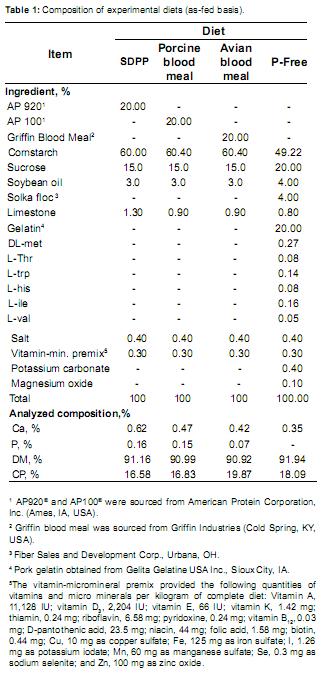
<body><![CDATA[<p><font face="Verdana, Arial, Helvetica, sans-serif" size="2">* Corresponding  author: Hans H Stein. Department of Animal Sciences, University of  Illinois,Urbana, IL 61801, USA. Tel +1 217 333 0013. E-mail:<a href="mailto:hstein@illinois.edu">hstein@illinois.edu</a></font></p>     <p></p> <hr size="1" />     <p><font face="Verdana, Arial, Helvetica, sans-serif" size="3"><b>Introduction</b> </font></p>     <p><font face="Verdana, Arial, Helvetica, sans-serif" size="2">Blood meal  and spray dried  plasma protein    (SDPP)  are often included in diets  fed to weanling    pigs,  and blood products  are considered excellent    sources of protein  (Kramer <i>et al.,</i> 1978; Kats <i>et al.,</i>   1994). Blood  products also provide  P to the diets and P in blood meal has a relative bioavailability of   92% (NRC, 1998). Relative bioavailability values,  however, depend on the standard (e.g., monosodium  phosphate, dicalcium phosphate) to  which the availability is compared.</font></p>     <p><font face="Verdana, Arial, Helvetica, sans-serif" size="2">The standards  used to calculate the relative    bioavailability of P in  feed ingredients is  assumed to be 100%  available. Recent research, however, has shown that the relative bioavailability of P in monocalcium phosphate and dicalcium phosphate relative to monosodium phosphate are 80 and 57%, respectively (Petersen et al., 2011). Thus, these values are believed not to be additive in mixed diets. Apparent total tract digestibility (ATTD) of P has been determined in several feed ingredients (Almeida and Stein, 2010), but these values do not account for the basal endogenous P losses, which may be determined by feeding pigs a P-free diet (Petersen and Stein, 2006). </font></p>     <p><font face="Verdana, Arial, Helvetica, sans-serif" size="2">When ATTD values are corrected for basal endogenous P losses (EPL), values for the standardized total tract digestibility (STTD) of P are calculated. These values are believed to be additive in mixed diets and are also believed to better predict the concentration of digestible P in a particular feed ingredient, thus, allowing for more accurate diet formulations. Consequently, the addition of inorganic P and the excretion of P to the environment may be reduced if values for the STTD of P are used in diet formulation as observed by Almeida and Stein (2010). There are, however, no data for the STTD of P in blood products. The objective of this research was, therefore, to measure the ATTD and the STTD of P in SDPP, and in 2 sources of dried blood meal fed to weanling pigs.</font></p>     <p></p>     <p><font face="Verdana, Arial, Helvetica, sans-serif" size="3"><b> Materials and methods</b></font></p>     <p><font face="Verdana, Arial, Helvetica, sans-serif" size="2"><i>   Diets, animals, and experimental design   </i></font></p>     <p><font face="Verdana, Arial, Helvetica, sans-serif" size="2">Porcine blood meal and SDPP were sourced from American Protein Corporation (Ames, IA, USA) while avian blood meal was sourced from Grif&#64257; n Industries (Cold Spring, KY, USA). Four diets were formulated (<a href="#t1">Table 1</a>). Three diets contained 20% of each of the three blood products. The fourth diet was a P-free diet that was used to measure the basal endogenous loss of P from the pigs (Almeida and Stein, 2010). </font></p>    ]]></body>
<body><![CDATA[<p align="center"><a name="t1"> <img src="/img/revistas/rccp/v24n4/a06t1.JPG" /></a></p>     <p><font face="Verdana, Arial, Helvetica, sans-serif" size="2">Twenty-four weanling pigs (initial BW: 18.8 &ndash; 3.2 kg) were randomly allotted to the four dietary treatments with six pigs per treatment. Pigs were placed in metabolism cages that were equipped with a feeder and a nipple drinker. </font></p>     <p></p>     <p><font face="Verdana, Arial, Helvetica, sans-serif" size="3"><b>Feeding and sample collection</b> </font></p>     <p><font face="Verdana, Arial, Helvetica, sans-serif" size="2">Pigs were fed twice  daily. Feed allowance was    calculated  as 2.5 times  the estimated requirement    for maintenance energy (i.e.,  106 kcal ME per   kg <sup>0.75</sup>;  NRC, 1998). Pigs  were allowed ad libitum   access to water.  The adaptation period to  the diets    consisted of 5 d,  which were followed by  5 d of   total collection of feces using the marker to marker    approach (Adeola, 2001).  Chromic oxide was used    as the marker and  incorporated into the morning    meal  on day sixth.  Fecal collection was  initiated    when  the marker first appeared in  the feces. In the    morning meal of d  11, chromic oxide was again    incorporated into the diet,  and fecal collections    ceased when the marker appeared in the feces. Fecal    materials were collected  twice daily and  stored at    -20 &deg;C immediately after collection. </font></p>     <p><font face="Verdana, Arial, Helvetica, sans-serif" size="2"><i>Sample analysis and data processing</i> </font></p>     <p><font face="Verdana, Arial, Helvetica, sans-serif" size="2">   Diets, ingredients, and  fecal samples were    analyzed  in duplicates for DM  by oven  drying for    2 h at  135&deg;C (method  930.15; AOAC Int., 2007),    and for P  and Ca by inductively coupled  plasma   spectroscopy (method 985.01;  AOAC Int., 2007)    after wet ash sample preparation (method  975.03;    AOAC Int., 2007). Diets  and ingredients were also    analyzed for CP (method 990.03; AOAC Int.,  2007)    using  an Elementar Rapid  N-cube protein/nitrogen    apparatus (Elementar Americas Inc., Mt. Laurel, NJ,    USA). The three blood products were also analyzed    for AA (method  982.30 E (a, b,  c); AOAC Int.,    2007).</font></p>     <p><font face="Verdana, Arial, Helvetica, sans-serif" size="2">The ATTD (%) of P in each diet was calculated    according to the following equation:</font></p>     <p><font face="Verdana, Arial, Helvetica, sans-serif" size="2">       <blockquote>ATTD (%) = &#091;(Pi &ndash; Pf)/Pi&#093; x 100,</blockquote> </font></p>     ]]></body>
<body><![CDATA[<p><font face="Verdana, Arial, Helvetica, sans-serif" size="2">where Pi is the total P intake (g) from d 6 to 11 and    Pf is the total fecal P output (g) originating from the    feed that was provided from d 6 to 11.</font></p>     <p><font face="Verdana, Arial, Helvetica, sans-serif" size="2">The basal endogenous  P losses (mg/kg  of   DMI) were measured from pigs  fed the P-free diet    according to the following equation:</font></p>     <p><font face="Verdana, Arial, Helvetica, sans-serif" size="2">       <blockquote>EPL (mg/kg DMI) = (&#091;Pf/Fi&#093; x 1,000 x 1,000),</blockquote>   </font></p>     <p><font face="Verdana, Arial, Helvetica, sans-serif" size="2">where EPL  is the endogenous  P loss and  Fi is the    total feed (g) intake from d 6 to 11. </font></p>     <p><font face="Verdana, Arial, Helvetica, sans-serif" size="2">The  STTD of P  was calculated using  the    following equation:</font></p>     <p><font face="Verdana, Arial, Helvetica, sans-serif" size="2">       <blockquote>STTD (%) = (&#091;Pi &ndash; &#123;Pf &ndash; EPL&#125;/Pi&#093;) x 100,</blockquote> </font></p>     <p><font face="Verdana, Arial, Helvetica, sans-serif" size="2">where STTD  (%) is the standardized total  tract    digestibility of P.</font></p>     <p><font face="Verdana, Arial, Helvetica, sans-serif" size="2">Data were  analyzed as a  randomized complete    design  using the GLM  procedure of SAS    (SAS Institute Inc., Cary, NC, USA). The Proc    UNIVARIATE  was used to  check for the  presence   of  outliers. Observations were  considered outliers    when  they deviated by  more than three times    the interquartile range  from the median  of the    treatment  group. Treatment means were  calculated    by  the LSMeans procedure and the  LSD LINES    option  was used to  separate mean values that    were  significantly different. Each  pig was the    experimental unit.  Significance among means was    assessed by using an alpha value of 0.05.</font></p>     ]]></body>
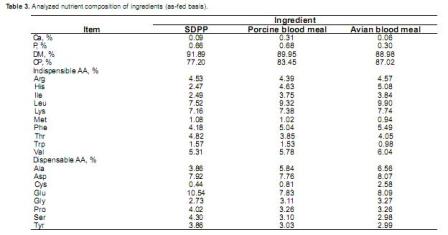
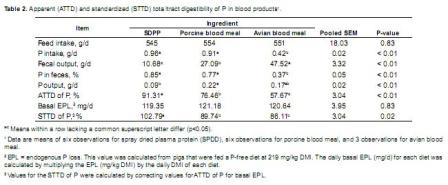
<body><![CDATA[<p><font face="Verdana, Arial, Helvetica, sans-serif" size="2"></font></p>     <p><font face="Verdana, Arial, Helvetica, sans-serif" size="3"><b>Results</b> </font></p>     <p><font face="Verdana, Arial, Helvetica, sans-serif" size="2">No  differences in feed  intake were observed    among  treatments (<a href="#t2">Table 2</a>). Pigs  that were fed    SDPP  or porcine blood meal  consumed more    (p&lt;0.01) P than  pigs that were fed  avian blood    meal  (0.96 or 0.91  vs. 0.42 g/d, respectively). The    concentration of P excreted in the feces  was greater    (p&lt;0.01) for pigs  that were fed SDPP  or porcine   blood meal than for pigs that were fed  avian blood    meal,  however, fecal output  was greater (p&lt;0.01)   for pigs that were fed avian blood meal  (47.52 g/d)    than  for pigs that were  fed porcine blood  meal or    SDPP  (27.09 or 10.68 g/d, respectively), and  pigs    that  were fed porcine blood  meal also had  greater    (p&lt;0.01) fecal output than pigs that  were fed SDPP.    Fecal P output was less (p&lt;0.01) for  pigs that were    fed  SDPP (0.09 g/d) than  for pigs that  were fed    porcine blood meal (0.22  g/d), but not  different    from pigs  that were fed avian  blood meal (0.17    g/d),  and there was no  difference in fecal P  output    between pigs that were fed porcine blood  meal and    pigs fed avian blood meal. </font></p>    <p align="center"><a name="t2"> <img src="/img/revistas/rccp/v24n4/a06t2.JPG" /></a></p>     <p><font face="Verdana, Arial, Helvetica, sans-serif" size="2">The ATTD of  P was greater  (p&lt;0.01) for pigs </font><font face="Verdana, Arial, Helvetica, sans-serif" size="2">that were fed SDPP  (91.31%) than for pigs  fed    either porcine blood  meal (76.46%) or avian blood  meal (57.67%), and pigs that were fed porcine blood  meal also had  greater (p&lt;0.01) ATTD of P than  pigs that were fed  avian blood meal. There were  no differences in the daily basal endogenous losses  of P among  treatments, which were  determined by  feeding a P-free diet. There were  no differences in  the STTD of P between pigs that were fed  porcine blood meal (89.74%) or avian blood meal  (86.11%),  but the STTD of P in these two ingredients  was less  (p&lt;0.05) than the STTD of P in SDPP (102.79%). </font></p>     <p></p>     <p><font face="Verdana, Arial, Helvetica, sans-serif" size="3"><b>Discussion</b> </font></p>     <p><font face="Verdana, Arial, Helvetica, sans-serif" size="2">   Avian blood meal  contained much less  P than    SDPP and porcine blood meal (<a href="#t3">Table 3</a>).  Therefore,    P intake was less for pigs that were fed  avian blood    meal than SDPP or porcine blood meal. The  ATTD    of  P that was  determined for SDPP  and porcine   blood  meal is in  agreement with values  previously    reported for the digestibility of P in SDPP  and blood    meal  (NSNG, 2010). The basal endogenous  losses    of  P that were  determined in this  experiment (219    mg/kg DMI) agree with the value of 211  mg/kg that    was recently reported by Almeida and Stein  (2010).</font></p>    <p align="center"><a name="t3"> <img src="/img/revistas/rccp/v24n4/a06t3.JPG" /></a></p>     <p><font face="Verdana, Arial, Helvetica, sans-serif" size="2">Although there was no  difference in the STTD  of  P between porcine and  avian blood meal,  the  ATTD of P in these ingredients was  different, which  indicates that the ATTD of  P in avian  blood meal  may have been underestimated. In ingredients with  low concentrations of AA  and CP, values for  the apparent ileal digestibility are likely underestimated  because of the  greater contribution of  endogenous  AA  and CP in  digesta (Stein <i>et al.,</i> 2005).  In the  present experiment, the concentration of P in avian  blood  meal diet (0.07%)  was less than  that of  the porcine blood  meal diet (0.15%),  which may  have resulted in a  greater relative contribution  of endogenous P  losses to the  fecal P output  from  pigs  fed the diet containing  the avian blood  meal  compared  with pigs fed  the diet containing  the  porcine blood meal. </font></p>     ]]></body>
<body><![CDATA[<p><font face="Verdana, Arial, Helvetica, sans-serif" size="2">The disadvantage of using  ATTD values (i.e.,    relative underestimation of  digestibility value) can    be ameliorated by correcting ATTD values for basal    EPL, which yields  STTD values that  are believed    to be more  accurate measurements of  dietary P    digestibility. For AA,  values for the standardized    ileal  digestibility are more  additive in mixed  diets    compared with values for apparent ileal digestibility    values (Stein <i>et al.,</i> 2005). Thus, it is believed  that    STTD values for P are also more additive in mixed  diets than values for ATTD. This concept, however, has  not been verified  at this point.  The values for   STTD  of P that were determined in the present    experiment  are in agreement with recent data   (Rostagno <i>et al.,</i> 2011). </font></p>     <p><font face="Verdana, Arial, Helvetica, sans-serif" size="2">The STTD of P  for SDPP indicates that  P in    this  ingredient is completely  digested, whereas    for  porcine blood meal and  avian blood meal,    P  is almost completely  digested. The reason for   the difference between the  STTD of P in  SDPP    compared  with porcine and avian  blood meal may    be that some of the P  in blood meal may originate   from the membranes in blood cells, whereas  no cells    are present in SDPP and all the P,  therefore, is in a    soluble form, which is easily absorbed.</font></p>     <p><font face="Verdana, Arial, Helvetica, sans-serif" size="2">In  conclusion, blood meal  and SDPP are    excellent  sources of highly digestible  P if included    in diets fed to pigs. It is likely that  supplementation    of diets with such ingredients will cause  a reduction    in  the amount of inorganic  P that is  commonly    added  to diet fed to  pigs, therefore, reducing  the    cost  of diets. Spray dried  plasma protein has a   greater STTD of  P than porcine  or avian blood    meal,  but the P  in all three  products has a very    high  digestibility. Inclusion of any of  the three   products  in diets fed  to pigs will,  therefore, result    in  a reduction in  fecal P excretion  leading to less    environmental pollution by swine manure.</font></p>     <p><font face="Verdana, Arial, Helvetica, sans-serif" size="2"></font></p>     <p><font face="Verdana, Arial, Helvetica, sans-serif" size="3"><b>References</b> </font></p>     <!-- ref --><p><font face="Verdana, Arial, Helvetica, sans-serif" size="2">1. Adeola L. Digestion and balance techniques  in pigs. In: Lewis    AJ, Southern LL, editors. Swine Nutrition.  2nd ed. Washington,    DC: CRC Press; 2001. p.903-916.   </font>&nbsp;&nbsp;&nbsp;&nbsp;&nbsp;&nbsp;&nbsp;&nbsp;[&#160;<a href="javascript:void(0);" onclick="javascript: window.open('/scielo.php?script=sci_nlinks&ref=000068&pid=S0120-0690201100040000600001&lng=','','width=640,height=500,resizable=yes,scrollbars=1,menubar=yes,');">Links</a>&#160;]<!-- end-ref --><!-- ref --><p><font face="Verdana, Arial, Helvetica, sans-serif" size="2">2. Almeida FN, Stein HH. Performance and  phosphorus balance of    pigs fed diets formulated on the basis of  values for standardized    total  tract digestibility of  phosphorus. J Anim  Sci 2010;    88:2968-2977.   </font>&nbsp;&nbsp;&nbsp;&nbsp;&nbsp;&nbsp;&nbsp;&nbsp;[&#160;<a href="javascript:void(0);" onclick="javascript: window.open('/scielo.php?script=sci_nlinks&ref=000069&pid=S0120-0690201100040000600002&lng=','','width=640,height=500,resizable=yes,scrollbars=1,menubar=yes,');">Links</a>&#160;]<!-- end-ref --><!-- ref --><p><font face="Verdana, Arial, Helvetica, sans-serif" size="2">3. AOAC Int.  Official Methods of  Analysis. 18th ed.  Rev. 2.    Gaithersburg MD:  Association of official analytical chemists;    2007.</font>&nbsp;&nbsp;&nbsp;&nbsp;&nbsp;&nbsp;&nbsp;&nbsp;[&#160;<a href="javascript:void(0);" onclick="javascript: window.open('/scielo.php?script=sci_nlinks&ref=000070&pid=S0120-0690201100040000600003&lng=','','width=640,height=500,resizable=yes,scrollbars=1,menubar=yes,');">Links</a>&#160;]<!-- end-ref --><!-- ref --><p><font face="Verdana, Arial, Helvetica, sans-serif" size="2"> 4. Kats LJ, Nelssen JL, Tokach MD, Goodband  RD, Weeden TL,    Dritz  SS, Hansen JA,  Friesen KG. The effects  of spray-dried    blood  meal on growth performance  of the early-weaned pig. J    Anim Sci 1994; 72:2860-2869.    </font>&nbsp;&nbsp;&nbsp;&nbsp;&nbsp;&nbsp;&nbsp;&nbsp;[&#160;<a href="javascript:void(0);" onclick="javascript: window.open('/scielo.php?script=sci_nlinks&ref=000071&pid=S0120-0690201100040000600004&lng=','','width=640,height=500,resizable=yes,scrollbars=1,menubar=yes,');">Links</a>&#160;]<!-- end-ref --><!-- ref --><p><font face="Verdana, Arial, Helvetica, sans-serif" size="2">5. Kramer SL, Waibel PE, Behrends BR, El  Kandelgy SM. Amino    acids  in commercially produced  blood meals. J  Agric Food    Chem 1978; 26:979-981.</font>&nbsp;&nbsp;&nbsp;&nbsp;&nbsp;&nbsp;&nbsp;&nbsp;[&#160;<a href="javascript:void(0);" onclick="javascript: window.open('/scielo.php?script=sci_nlinks&ref=000072&pid=S0120-0690201100040000600005&lng=','','width=640,height=500,resizable=yes,scrollbars=1,menubar=yes,');">Links</a>&#160;]<!-- end-ref --><!-- ref --><p><font face="Verdana, Arial, Helvetica, sans-serif" size="2">6. NRC. Nutrient  requirements of swine. 10th rev ed. Washington,  DC: Natl Acad  Press; 1998. </font>&nbsp;&nbsp;&nbsp;&nbsp;&nbsp;&nbsp;&nbsp;&nbsp;[&#160;<a href="javascript:void(0);" onclick="javascript: window.open('/scielo.php?script=sci_nlinks&ref=000073&pid=S0120-0690201100040000600006&lng=','','width=640,height=500,resizable=yes,scrollbars=1,menubar=yes,');">Links</a>&#160;]<!-- end-ref --><!-- ref --><p><font face="Verdana, Arial, Helvetica, sans-serif" size="2">7. NSNG.  National Swine Nutrition Guide.  1st ed. US:  Pork    Center of  Excellence. Ames IA; 2010.   </font>&nbsp;&nbsp;&nbsp;&nbsp;&nbsp;&nbsp;&nbsp;&nbsp;[&#160;<a href="javascript:void(0);" onclick="javascript: window.open('/scielo.php?script=sci_nlinks&ref=000074&pid=S0120-0690201100040000600007&lng=','','width=640,height=500,resizable=yes,scrollbars=1,menubar=yes,');">Links</a>&#160;]<!-- end-ref --><!-- ref --><p><font face="Verdana, Arial, Helvetica, sans-serif" size="2">8. Petersen GI, Pedersen  C, Lindemann MD,  Stein HH. Relative    bioavailability of  phosphorus in inorganic phosphorus sources    fed to growing  pigs. J Anim Sci 2011; 89:460-466.   </font>&nbsp;&nbsp;&nbsp;&nbsp;&nbsp;&nbsp;&nbsp;&nbsp;[&#160;<a href="javascript:void(0);" onclick="javascript: window.open('/scielo.php?script=sci_nlinks&ref=000075&pid=S0120-0690201100040000600008&lng=','','width=640,height=500,resizable=yes,scrollbars=1,menubar=yes,');">Links</a>&#160;]<!-- end-ref --><!-- ref --><p><font face="Verdana, Arial, Helvetica, sans-serif" size="2">9. Petersen GI,  Stein HH. Novel procedure  for estimating    endogenous losses  and measurement of apparent  and true    digestibility of  phosphorus by growing pigs. J Anim Sci 2006;    84:2126-2132.</font>&nbsp;&nbsp;&nbsp;&nbsp;&nbsp;&nbsp;&nbsp;&nbsp;[&#160;<a href="javascript:void(0);" onclick="javascript: window.open('/scielo.php?script=sci_nlinks&ref=000076&pid=S0120-0690201100040000600009&lng=','','width=640,height=500,resizable=yes,scrollbars=1,menubar=yes,');">Links</a>&#160;]<!-- end-ref --><!-- ref --><p><font face="Verdana, Arial, Helvetica, sans-serif" size="2"> 10. Rostagno HH,  Albino LFT, Donzele JL,  Gomes PC, Oliveira    RT, Lopes DC,  Ferreira AS, Barreto SLT, Euclides RF. Brazilian    Tables for  Poultry and Swine.  Composition of Feedstuffs  and    Nutritional  Requirements. 3rd ed. Brazil: UFV Vi&ccedil;osa; 2011.   </font>&nbsp;&nbsp;&nbsp;&nbsp;&nbsp;&nbsp;&nbsp;&nbsp;[&#160;<a href="javascript:void(0);" onclick="javascript: window.open('/scielo.php?script=sci_nlinks&ref=000077&pid=S0120-0690201100040000600010&lng=','','width=640,height=500,resizable=yes,scrollbars=1,menubar=yes,');">Links</a>&#160;]<!-- end-ref --><!-- ref --><p><font face="Verdana, Arial, Helvetica, sans-serif" size="2">11. Stein HH,  Pedersen C, Wirt  AR, Bohlke RA.  Additivity of    values for  apparent and standardized ileal digestibility of amino    acids in  mixed diets fed  to growing pigs. J Anim  Sci 2005;    83:2387-2395.</font>&nbsp;&nbsp;&nbsp;&nbsp;&nbsp;&nbsp;&nbsp;&nbsp;[&#160;<a href="javascript:void(0);" onclick="javascript: window.open('/scielo.php?script=sci_nlinks&ref=000078&pid=S0120-0690201100040000600011&lng=','','width=640,height=500,resizable=yes,scrollbars=1,menubar=yes,');">Links</a>&#160;]<!-- end-ref --> ]]></body><back>
<ref-list>
<ref id="B1">
<label>1</label><nlm-citation citation-type="book">
<person-group person-group-type="author">
<name>
<surname><![CDATA[Adeola]]></surname>
<given-names><![CDATA[L]]></given-names>
</name>
</person-group>
<article-title xml:lang="en"><![CDATA[Digestion and balance techniques in pigs]]></article-title>
<person-group person-group-type="editor">
<name>
<surname><![CDATA[Lewis]]></surname>
<given-names><![CDATA[AJ]]></given-names>
</name>
<name>
<surname><![CDATA[Southern]]></surname>
<given-names><![CDATA[LL]]></given-names>
</name>
</person-group>
<source><![CDATA[Swine Nutrition]]></source>
<year>2001</year>
<edition>2</edition>
<page-range>903-916</page-range><publisher-loc><![CDATA[Washington ]]></publisher-loc>
<publisher-name><![CDATA[CRC Press]]></publisher-name>
</nlm-citation>
</ref>
<ref id="B2">
<label>2</label><nlm-citation citation-type="journal">
<person-group person-group-type="author">
<name>
<surname><![CDATA[Almeida]]></surname>
<given-names><![CDATA[FN]]></given-names>
</name>
<name>
<surname><![CDATA[Stein]]></surname>
<given-names><![CDATA[HH]]></given-names>
</name>
</person-group>
<article-title xml:lang="en"><![CDATA[Performance and phosphorus balance of pigs fed diets formulated on the basis of values for standardized total tract digestibility of phosphorus]]></article-title>
<source><![CDATA[J Anim Sci]]></source>
<year>2010</year>
<volume>88</volume>
<page-range>2968-2977</page-range></nlm-citation>
</ref>
<ref id="B3">
<label>3</label><nlm-citation citation-type="book">
<collab>AOAC Int</collab>
<source><![CDATA[Official Methods of Analysis]]></source>
<year>2007</year>
<edition>18</edition>
<publisher-name><![CDATA[Association of official analytical chemists]]></publisher-name>
</nlm-citation>
</ref>
<ref id="B4">
<label>4</label><nlm-citation citation-type="journal">
<person-group person-group-type="author">
<name>
<surname><![CDATA[Kats]]></surname>
<given-names><![CDATA[LJ]]></given-names>
</name>
<name>
<surname><![CDATA[Nelssen]]></surname>
<given-names><![CDATA[JL]]></given-names>
</name>
<name>
<surname><![CDATA[Tokach]]></surname>
<given-names><![CDATA[MD]]></given-names>
</name>
<name>
<surname><![CDATA[Goodband]]></surname>
<given-names><![CDATA[RD]]></given-names>
</name>
<name>
<surname><![CDATA[Weeden]]></surname>
<given-names><![CDATA[TL]]></given-names>
</name>
<name>
<surname><![CDATA[Dritz]]></surname>
<given-names><![CDATA[SS]]></given-names>
</name>
<name>
<surname><![CDATA[Hansen]]></surname>
<given-names><![CDATA[JA]]></given-names>
</name>
<name>
<surname><![CDATA[Friesen]]></surname>
<given-names><![CDATA[KG]]></given-names>
</name>
</person-group>
<article-title xml:lang="en"><![CDATA[The effects of spray-dried blood meal on growth performance of the early-weaned pig]]></article-title>
<source><![CDATA[J Anim Sci]]></source>
<year>1994</year>
<volume>72</volume>
<page-range>2860-2869</page-range></nlm-citation>
</ref>
<ref id="B5">
<label>5</label><nlm-citation citation-type="journal">
<person-group person-group-type="author">
<name>
<surname><![CDATA[Kramer]]></surname>
<given-names><![CDATA[SL]]></given-names>
</name>
<name>
<surname><![CDATA[Waibel]]></surname>
<given-names><![CDATA[PE]]></given-names>
</name>
<name>
<surname><![CDATA[Behrends]]></surname>
<given-names><![CDATA[BR]]></given-names>
</name>
<name>
<surname><![CDATA[El]]></surname>
<given-names><![CDATA[Kandelgy SM]]></given-names>
</name>
</person-group>
<article-title xml:lang="en"><![CDATA[Amino acids in commercially produced blood meals]]></article-title>
<source><![CDATA[J Agric Food Chem]]></source>
<year>1978</year>
<volume>26</volume>
<page-range>979-981</page-range></nlm-citation>
</ref>
<ref id="B6">
<label>6</label><nlm-citation citation-type="book">
<collab>NRC</collab>
<source><![CDATA[Nutrient requirements of swine]]></source>
<year>1998</year>
<edition>10</edition>
<publisher-loc><![CDATA[Washington ]]></publisher-loc>
<publisher-name><![CDATA[Natl Acad Press]]></publisher-name>
</nlm-citation>
</ref>
<ref id="B7">
<label>7</label><nlm-citation citation-type="book">
<collab>NSNG</collab>
<source><![CDATA[National Swine Nutrition Guide]]></source>
<year>2010</year>
<edition>1</edition>
<publisher-name><![CDATA[Pork Center of Excellence]]></publisher-name>
</nlm-citation>
</ref>
<ref id="B8">
<label>8</label><nlm-citation citation-type="journal">
<person-group person-group-type="author">
<name>
<surname><![CDATA[Petersen]]></surname>
<given-names><![CDATA[GI]]></given-names>
</name>
<name>
<surname><![CDATA[Pedersen]]></surname>
<given-names><![CDATA[C]]></given-names>
</name>
<name>
<surname><![CDATA[Lindemann]]></surname>
<given-names><![CDATA[MD]]></given-names>
</name>
<name>
<surname><![CDATA[Stein]]></surname>
<given-names><![CDATA[HH]]></given-names>
</name>
</person-group>
<article-title xml:lang="en"><![CDATA[Relative bioavailability of phosphorus in inorganic phosphorus sources fed to growing pigs]]></article-title>
<source><![CDATA[J Anim Sci]]></source>
<year>2011</year>
<volume>89</volume>
<page-range>460-466</page-range></nlm-citation>
</ref>
<ref id="B9">
<label>9</label><nlm-citation citation-type="journal">
<person-group person-group-type="author">
<name>
<surname><![CDATA[Petersen]]></surname>
<given-names><![CDATA[GI]]></given-names>
</name>
<name>
<surname><![CDATA[Stein]]></surname>
<given-names><![CDATA[HH]]></given-names>
</name>
</person-group>
<article-title xml:lang="en"><![CDATA[Novel procedure for estimating endogenous losses and measurement of apparent and true digestibility of phosphorus by growing pigs]]></article-title>
<source><![CDATA[J Anim Sci]]></source>
<year>2006</year>
<volume>84</volume>
<page-range>2126-2132</page-range></nlm-citation>
</ref>
<ref id="B10">
<label>10</label><nlm-citation citation-type="book">
<person-group person-group-type="author">
<name>
<surname><![CDATA[Rostagno]]></surname>
<given-names><![CDATA[HH]]></given-names>
</name>
<name>
<surname><![CDATA[Albino]]></surname>
<given-names><![CDATA[LFT]]></given-names>
</name>
<name>
<surname><![CDATA[Donzele]]></surname>
<given-names><![CDATA[JL]]></given-names>
</name>
<name>
<surname><![CDATA[Gomes]]></surname>
<given-names><![CDATA[PC]]></given-names>
</name>
<name>
<surname><![CDATA[Oliveira]]></surname>
<given-names><![CDATA[RT]]></given-names>
</name>
<name>
<surname><![CDATA[Lopes]]></surname>
<given-names><![CDATA[DC]]></given-names>
</name>
<name>
<surname><![CDATA[Ferreira]]></surname>
<given-names><![CDATA[AS]]></given-names>
</name>
<name>
<surname><![CDATA[Barreto]]></surname>
<given-names><![CDATA[SLT]]></given-names>
</name>
<name>
<surname><![CDATA[Euclides]]></surname>
<given-names><![CDATA[RF]]></given-names>
</name>
</person-group>
<source><![CDATA[Brazilian Tables for Poultry and Swine. Composition of Feedstuffs and Nutritional Requirements]]></source>
<year>2011</year>
<edition>3</edition>
<publisher-name><![CDATA[UFV Viçosa]]></publisher-name>
</nlm-citation>
</ref>
<ref id="B11">
<label>11</label><nlm-citation citation-type="journal">
<person-group person-group-type="author">
<name>
<surname><![CDATA[Stein]]></surname>
<given-names><![CDATA[HH]]></given-names>
</name>
<name>
<surname><![CDATA[Pedersen]]></surname>
<given-names><![CDATA[C]]></given-names>
</name>
<name>
<surname><![CDATA[Wirt]]></surname>
<given-names><![CDATA[AR]]></given-names>
</name>
<name>
<surname><![CDATA[Bohlke]]></surname>
<given-names><![CDATA[RA]]></given-names>
</name>
</person-group>
<article-title xml:lang="en"><![CDATA[Additivity of values for apparent and standardized ileal digestibility of amino acids in mixed diets fed to growing pigs]]></article-title>
<source><![CDATA[J Anim Sci]]></source>
<year>2005</year>
<volume>83</volume>
<page-range>2387-2395</page-range></nlm-citation>
</ref>
</ref-list>
</back>
</article>