<?xml version="1.0" encoding="ISO-8859-1"?><article xmlns:mml="http://www.w3.org/1998/Math/MathML" xmlns:xlink="http://www.w3.org/1999/xlink" xmlns:xsi="http://www.w3.org/2001/XMLSchema-instance">
<front>
<journal-meta>
<journal-id>0120-0690</journal-id>
<journal-title><![CDATA[Revista Colombiana de Ciencias Pecuarias]]></journal-title>
<abbrev-journal-title><![CDATA[Rev Colom Cienc Pecua]]></abbrev-journal-title>
<issn>0120-0690</issn>
<publisher>
<publisher-name><![CDATA[Facultad de Ciencias Agrarias, Universidad de Antioquia]]></publisher-name>
</publisher>
</journal-meta>
<article-meta>
<article-id>S0120-06902011000400010</article-id>
<title-group>
<article-title xml:lang="en"><![CDATA[Domestic cat paraplegia compatible with Gurltia paralysans nematode. First cases reported in Colombia]]></article-title>
<article-title xml:lang="es"><![CDATA[Paraplejia en gatos domésticos compatible con el nemátodo Gurltia paralysans. Primer reporte de casos en Colombia]]></article-title>
<article-title xml:lang="pt"><![CDATA[Paraplegia em gatos domésticos compatíveis com o Gurltia paralysans. Primeiro reporte de casos na Colômbia]]></article-title>
</title-group>
<contrib-group>
<contrib contrib-type="author">
<name>
<surname><![CDATA[Alzate Gómez]]></surname>
<given-names><![CDATA[Gildardo]]></given-names>
</name>
<xref ref-type="aff" rid="A01"/>
</contrib>
<contrib contrib-type="author">
<name>
<surname><![CDATA[Aranzazu Taborda]]></surname>
<given-names><![CDATA[Diego]]></given-names>
</name>
<xref ref-type="aff" rid="A01"/>
</contrib>
<contrib contrib-type="author">
<name>
<surname><![CDATA[Alzate G]]></surname>
<given-names><![CDATA[Andrés]]></given-names>
</name>
<xref ref-type="aff" rid="A02"/>
</contrib>
<contrib contrib-type="author">
<name>
<surname><![CDATA[Chaparro Gutiérrez]]></surname>
<given-names><![CDATA[Jenny J]]></given-names>
</name>
<xref ref-type="aff" rid="A01"/>
</contrib>
</contrib-group>
<aff id="A01">
<institution><![CDATA[,Universidad de Antioquia Escuela de Medicina Veterinaria Centauro (Grupo de Investigación en Ciencias Veterinarias)]]></institution>
<addr-line><![CDATA[Medellín ]]></addr-line>
<country>Colombia</country>
</aff>
<aff id="A02">
<institution><![CDATA[,Clínica Veterinaria. Caninos y Felinos  ]]></institution>
<addr-line><![CDATA[Medellín ]]></addr-line>
<country>Colombia</country>
</aff>
<pub-date pub-type="pub">
<day>00</day>
<month>12</month>
<year>2011</year>
</pub-date>
<pub-date pub-type="epub">
<day>00</day>
<month>12</month>
<year>2011</year>
</pub-date>
<volume>24</volume>
<numero>4</numero>
<fpage>663</fpage>
<lpage>669</lpage>
<copyright-statement/>
<copyright-year/>
<self-uri xlink:href="http://www.scielo.org.co/scielo.php?script=sci_arttext&amp;pid=S0120-06902011000400010&amp;lng=en&amp;nrm=iso"></self-uri><self-uri xlink:href="http://www.scielo.org.co/scielo.php?script=sci_abstract&amp;pid=S0120-06902011000400010&amp;lng=en&amp;nrm=iso"></self-uri><self-uri xlink:href="http://www.scielo.org.co/scielo.php?script=sci_pdf&amp;pid=S0120-06902011000400010&amp;lng=en&amp;nrm=iso"></self-uri><abstract abstract-type="short" xml:lang="en"><p><![CDATA[Six cases of cat paraplegia diagnosed in years 2001 and 2002 in Antioquia province (Colombia) are reported in this paper. Diagnosis was supported on clinical exams, radiography, myelogram, necropsy, and histopathology. Clinical signs where ataxia, decreased superficial sensitivity, loss of deep sensitivity, progressive paralysis, hind limb atrophy, and urinary and fecal retention. Necropsy and histopathology analysis revealed the presence of a nematode in the spinal cord meningeal blood vessels at the T10-L4 segment level, causing medullar compression and myelomalacia. Differential diagnose was conducted through the analysis of the parasite's histopathological cuts. Its morphological characteristics differed from those of other possible nematodes such as filarial erratic larve, Ancylostome sp, and Ascaris sp. It was concluded that the nematode is compatible with the one described as Gurltia paralysans.]]></p></abstract>
<abstract abstract-type="short" xml:lang="es"><p><![CDATA[En este trabajo se reportan seis casos de paraplejia en gatos, presentados durante los años 2001 y 2002 en el departamento de Antioquia (Colombia). El diagnóstico se realizó mediante examen clínico, radiografía, mielografía, necropsia e histopatología. Los signos clínicos fueron ataxia, disminución de la sensibilidad superficial, pérdida de la sensibilidad profunda, parálisis progresiva, atrofia de músculos del tren posterior, así como retención urinaria y fecal. La necropsia y el análisis histopatológico mostraron la presencia de un nematodo ubicado en los vasos sanguíneos de las meninges de la médula espinal, a nivel del segmento T10-L4, y el cual produjo compresión medular y mielomalacia. Al hacer diagnóstico diferencial mediante análisis de los cortes histopatológicos del parásito, se encontró que sus características morfológicas diferían de las de otros nematodos posibles, como es el caso de las larvas erráticas de filaria, Ancylostoma sp. y Ascaris sp, por lo cual se concluyó que el nematodo presente es compatible con el descrito como Gurltia paralysans.]]></p></abstract>
<abstract abstract-type="short" xml:lang="pt"><p><![CDATA[Neste trabalho reportam-se seis casos de paraplegia em gatos, apresentados durante os anos 2001 e 2002 no departamento de Antioquia (Colômbia). O diagnóstico foi feito pelo exame clínico, radiografia, mielografia, necropsia e histopatologia. As sinais clínicas foram: ataxia, diminuição da sensibilidade ao toque leve, perda sensorial profunda, paralisia progressiva, atrofia dos músculos na parte traseira, bem como retenção urinária e fecal. A necropsia e a análise histopatológica mostrou a presença de um nematóide localizados nos vasos sanguíneos das meninges da medula espinhal no segmento T10-L4, e que provocou a compressão da medula espinhal e mielomalácia. Ao fazer um diagnóstico diferencial pela análise das amostras do parasita, verificou-se que as suas características morfológicas diferentes às de outros nematóides possíveis, como é o caso das larvas erráticas de filaria, Ancylostoma sp e Ascaris sp, por isso, concluiu-se que este nematóide é compatível com o descrito como Gurltia paralysans.]]></p></abstract>
<kwd-group>
<kwd lng="en"><![CDATA[ataxia]]></kwd>
<kwd lng="en"><![CDATA[metastrongyloidea]]></kwd>
<kwd lng="en"><![CDATA[myelomalacia]]></kwd>
<kwd lng="en"><![CDATA[nematode]]></kwd>
<kwd lng="es"><![CDATA[ataxia]]></kwd>
<kwd lng="es"><![CDATA[metastrongyloidea]]></kwd>
<kwd lng="es"><![CDATA[mielomalacia]]></kwd>
<kwd lng="es"><![CDATA[nematodo]]></kwd>
<kwd lng="pt"><![CDATA[ataxia]]></kwd>
<kwd lng="pt"><![CDATA[metastrongyloidea]]></kwd>
<kwd lng="pt"><![CDATA[mielomalácia]]></kwd>
<kwd lng="pt"><![CDATA[nematóide]]></kwd>
</kwd-group>
</article-meta>
</front><body><![CDATA[ <p align="center"><font face="Verdana, Arial, Helvetica, sans-serif" size="4"><b>Domestic cat paraplegia compatible with</b> <b><i>Gurltia  paralysans</i></b>     <b>nematode.  First cases reported in Colombia</b><b>&curren;</b> </font></p>     <p align="center"><font face="Verdana, Arial, Helvetica, sans-serif" size="3"><b>Paraplejia en gatos  dom&eacute;sticos compatible con el nem&aacute;todo Gurltia paralysans. </i></b>      <b>Primer reporte de  casos en Colombia</b> </font></p>     <p align="center"><font face="Verdana, Arial, Helvetica, sans-serif" size="3"><b>Paraplegia em gatos  dom&eacute;sticos compat&iacute;veis com o Gurltia paralysans. Primeiro reporte de  casos na Col&ocirc;mbia.</b> </font></p>     <p><font face="Verdana, Arial, Helvetica, sans-serif" size="2"></font></p>     <p><font face="Verdana, Arial, Helvetica, sans-serif" size="2">Gildardo  Alzate G&oacute;mez<sup>1*</sup>, MV, Esp C, MSc; Diego Aranzazu Taborda<sup>1</sup>, MV,  Esp C, MSc; Andr&eacute;s  Alzate G<sup>2</sup>, MV; Jenny J Chaparro Guti&eacute;rrez<i>1</i>, MV,  MSc, DrSc</font></p>     <p><font face="Verdana, Arial, Helvetica, sans-serif" size="2"><sup>1</sup>Centauro  (Grupo de Investigaci&oacute;n en Ciencias Veterinarias), Escuela de Medicina  Veterinaria. Universidad de Antioquia     A.A.  1226, Medell&iacute;n, Colombia</font></p>     <p><font face="Verdana, Arial, Helvetica, sans-serif" size="2"><sup>2</sup>Cl&iacute;nica  Veterinaria. Caninos y Felinos, Vel&oacute;dromo. Medell&iacute;n Colombia </font></p>     <p><font face="Verdana, Arial, Helvetica, sans-serif" size="2">(Recibido:  19 mayo, 2011; aceptado: 11 octubre, 2011) </font></p>     <p></p> <hr size="1" />     <p><font face="Verdana, Arial, Helvetica, sans-serif" size="2"><b>Summary</b> </font></p>     ]]></body>
<body><![CDATA[<p><font face="Verdana, Arial, Helvetica, sans-serif" size="2">Six  cases of cat paraplegia diagnosed in years 2001 and 2002 in Antioquia province  (Colombia) are reported  in this paper. Diagnosis was supported on clinical exams, radiography,  myelogram, necropsy, and  histopathology. Clinical signs where ataxia, decreased superficial sensitivity,  loss of deep sensitivity, progressive  paralysis, hind limb atrophy, and urinary and fecal retention. Necropsy and  histopathology analysis  revealed the presence of a nematode in the spinal cord meningeal blood vessels  at the T10-L4 segment  level, causing medullar  compression and myelomalacia.  Differential diagnose was  conducted through  the analysis of the parasite's  histopathological cuts. Its  morphological characteristics differed from  those of other possible nematodes such as filarial erratic larve, <u>Ancylostome  sp</u>, and Ascaris sp. It was concluded  that the nematode is compatible with the one described as <u>Gurltia paralysans</u>.  </font></p>     <p><font face="Verdana, Arial, Helvetica, sans-serif" size="2"><b>Key  words: </b>ataxia, metastrongyloidea, myelomalacia, nematode.  </font></p>     <p></p> <hr size="1" />     <p><font face="Verdana, Arial, Helvetica, sans-serif" size="2"><b>Resumen</b> </font></p>     <p><font face="Verdana, Arial, Helvetica, sans-serif" size="2">En  este trabajo se reportan seis casos de paraplejia en gatos, presentados durante los a&ntilde;os 2001 y 2002 en el departamento de Antioquia (Colombia). El diagn&oacute;stico se realiz&oacute; mediante examen cl&iacute;nico, radiograf&iacute;a, mielograf&iacute;a, necropsia e histopatolog&iacute;a. Los signos  cl&iacute;nicos fueron ataxia, disminuci&oacute;n de la sensibilidad superficial, p&eacute;rdida de la sensibilidad profunda,  par&aacute;lisis progresiva, atrofia de m&uacute;sculos del tren posterior, as&iacute; como retenci&oacute;n urinaria y fecal. La necropsia  y el an&aacute;lisis histopatol&oacute;gico mostraron la presencia de un nematodo ubicado en los vasos sangu&iacute;neos de las  meninges de la m&eacute;dula espinal, a nivel del segmento T10-L4, y el cual produjo compresi&oacute;n medular y  mielomalacia. Al hacer diagn&oacute;stico diferencial mediante an&aacute;lisis de los cortes histopatol&oacute;gicos del  par&aacute;sito, se encontr&oacute; que sus caracter&iacute;sticas  morfol&oacute;gicas difer&iacute;an de las de otros nematodos posibles, como es  el caso de las larvas err&aacute;ticas de filaria, Ancylostoma sp. y  Ascaris sp, por  lo cual se concluy&oacute;  que el nematodo presente es  compatible con el descrito como <u>Gurltia paralysans</u>.  </font></p>     <p><font face="Verdana, Arial, Helvetica, sans-serif" size="2"><b>Palabras  clave:</b> ataxia, metastrongyloidea, mielomalacia, nematodo.  </font></p>     <p></p> <hr size="1" />     <p><font face="Verdana, Arial, Helvetica, sans-serif" size="2"><b>Resumo </b> </font></p>     <p><font face="Verdana, Arial, Helvetica, sans-serif" size="2">Neste  trabalho reportam-se seis casos de paraplegia em gatos, apresentados durante os  anos 2001 e 2002 no departamento de Antioquia (Col&ocirc;mbia). O diagn&oacute;stico foi  feito pelo exame cl&iacute;nico, radiografia, mielografia, necropsia e histopatologia. As sinais  cl&iacute;nicas foram: ataxia,  diminui&ccedil;&atilde;o da sensibilidade ao toque leve, perda sensorial profunda, paralisia progressiva,  atrofia dos m&uacute;sculos na parte traseira, bem como reten&ccedil;&atilde;o urin&aacute;ria e fecal. A necropsia e a an&aacute;lise  histopatol&oacute;gica mostrou a presen&ccedil;a de um nemat&oacute;ide localizados nos vasos sangu&iacute;neos das meninges da medula  espinhal no segmento T10-L4, e que provocou a compress&atilde;o da medula espinhal e mielomal&aacute;cia. Ao  fazer um diagn&oacute;stico diferencial pela an&aacute;lise das amostras do parasita, verificou-se que as suas  caracter&iacute;sticas morfol&oacute;gicas diferentes &agrave;s de outros nemat&oacute;ides poss&iacute;veis, como &eacute; o caso das larvas err&aacute;ticas de  filaria, Ancylostoma sp e Ascaris sp, por isso, concluiu-se que este nemat&oacute;ide &eacute; compat&iacute;vel com o descrito  como <u>Gurltia paralysans</u>. </font></p>     <p><font face="Verdana, Arial, Helvetica, sans-serif" size="2"><b>Palavras  chave:</b> ataxia, metastrongyloidea, mielomal&aacute;cia, nemat&oacute;ide.</font></p>     ]]></body>
<body><![CDATA[<p><font face="Verdana, Arial, Helvetica, sans-serif" size="2">&curren; To cite this article: G&oacute;mez G, Aranzazu D,  Alzate A, Chaparro JJ. Domestic cat paraplegia compatible with <em>Gurltia  paralysans</em> nematode. First cases reported in  Colombia. Rev Colomb Cienc Pecu 2011; 24:663-669.</font></p>     <p><font face="Verdana, Arial, Helvetica, sans-serif" size="2">   * Corresponding author: Gildardo Alzate G&oacute;mez.  Cl&iacute;nica Veterinaria Caninos y Felinos, Medell&iacute;n, Colombia. E-mail:  <a href="mailto:alzategomez@gmail.com">alzategomez@gmail.com</a></font></p>     <p></p> <hr size="1" />     <p><font face="Verdana, Arial, Helvetica, sans-serif" size="3"><b>Introduction</b> </font></p>     <p><font face="Verdana, Arial, Helvetica, sans-serif" size="2">The distribution  and importance of  injuries    produced  by  the Metastrongyloidea family    of nematodes in  domestic carnivores is well    documented (Oliver <i>et  al</i>., 1997; Bowman, 2002).    These parasites  are frequently associated  with    pulmonary tissue,  although it is  usually found    some parasites stages  in blood vessels. There   are  four of these parasites reported  in domestic    cats.  <i>Aelurostrongylus abstrusus</i>  is the most   common among  them. The other three  species are:    <i>Troglostrongylus subcrenatus,  Oslerus rostratus, </i>    <i>and Gurltia paralysans, </i>are sporadically reported    (Bowman <i>et  al</i>., 2002). In years  2001 and 2002  six    cats with  signs of hindlimb weakness;  paraparesis;    mobility difficultly,  and progressive hindlimb muscle    atrophy, they were taken  for medical attention to    the veterinary medical  center, "Caninos y  Felinos".    All of  them underwent support therapy. Only  one    evidenced medical  improvement and survived,    but it  did not show  complete recovery. After   making the clinical  and neurological examination,    complementary laboratory  tests, simple and contrast  radiographies, euthanasia was  performed in the remaining cats due to  the severity of the  disease.    Histopathological studies in four of the five dead cats    showed a nematode parasite compatible with<i> Gurtlia </i>   <i>paralysans</i>, located in  the spinal cord's  venous    plexus. Myelomalacia and a local hemorrhage in the    T<sub>10</sub> &ndash; L<sub>4</sub> segment were also reported. </font></p>     <p></p>     <p><font face="Verdana, Arial, Helvetica, sans-serif" size="3"><b>Case description</b> </font></p>     <p><font face="Verdana, Arial, Helvetica, sans-serif" size="2"><i>Clinical examination</i> </font></p>     <p><font face="Verdana, Arial, Helvetica, sans-serif" size="2">   Five  family related Siamese cats &#091;a six month old    male (A); an  eight month old  female (B); an adult    male (C); an  adult female (D), and  an adult female   (E)&#093;, coming from the municipality of Tarso (state of   Antioquia), and a common adult male of no specific    breed (F) coming from the municipality of Amag&aacute;   (state of Antioquia), were taken to  the Veterinary    clinic "Caninos y Felinos",  located in the  city of   Medell&iacute;n, state of  Antioquia (Colombia), in order to    receive medical attention. They had signs of hindlimb    weakness  (A,B,C,D,E,F); paresis (B,F);  paraparesis    (D,E); ataxia (A,B,D,E,F); signs of pain at the touch    of the spinal cord  (A, B, C, D, E, F);  evidence of    constant anxiety and restlessness (A,B). The clinical   examination showed that  only the locomotive </font><font face="Verdana, Arial, Helvetica, sans-serif" size="2">system was  affected (A, B, D, E).  Neurological examinations (Boyd, 1992)  showed signs associated with upper  motor neuron degeneration  (A, B, C, D, E, F); presence of  normal thoracic spinal and pelvic reflexes. (A, B,  D, E,  F); hindlimb proprioception    partial loss  (C, D, E,  F); decreased superficial    sensitivity  and deep sensitivity loss (A, B, D, E, F);    paraplegia (B, F).  Light abdominal distention (C and    F) and leg muscle  atrophy (C, D, E, F) were found in    some of the animals.</font></p>     <p><font face="Verdana, Arial, Helvetica, sans-serif" size="2"><i>Paraclinical tests</i> </font></p>     ]]></body>
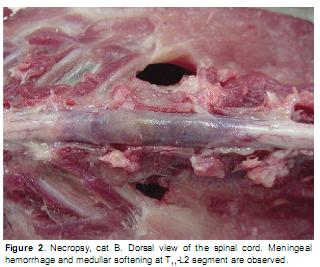
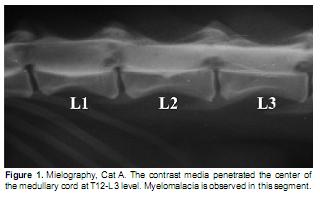
<body><![CDATA[<p><font face="Verdana, Arial, Helvetica, sans-serif" size="2">   Laboratory test,  hemograms, blood chemistry,    and stool  examinations were made. Cats  A, B,    C  and E  did not show  significant alterations.    Cat D evidenced  anemia and the  presence of    Ancylostomes in the  stool examination. Cat    F showed a  mild decrease in the  hemoglobin    and hematocrit  levels, and leukocytosis  with    neutrophilia. A modified  Knott test was  performed    on this animal in  order to search for microfilaria in    circulation,  nonetheless the result was negative.</font></p>     <p><font face="Verdana, Arial, Helvetica, sans-serif" size="2">The  symptoms suggested a medullar injury in the    thoracolumbar region,  therefore lateral and ventral-   dorsal simple  column radiographies were taken.    The differential  diagnoses were medullar  trauma vs.    degenerative bone  injury. Vertebrae bone structure   alterations were  not found in  any of the  cases. In    order to  locate the injury  with higher accuracy,    a mielography  was made (Hern&aacute;ndez,  1992) in    animals A, B, D, E,  and F. 0.3 ml/kg Lopamidol were   administered between  spaces L<sub>5</sub>-L<sub>6</sub>, and  radiography    showed signs  compatible with a  myelomamacia at    T12-L3 (A, B, D, F)  levels and at T11-L4 segment (E);    this explains deep  sensitivity loss (<a href="#f1">Figure 1</a>, cat A).</font></p>    <p align="center"><a name="f1"> <img src="/img/revistas/rccp/v24n4/a10f1.JPG" /></a></p>     <p><font face="Verdana, Arial, Helvetica, sans-serif" size="2"><i>Medical treatment</i> </font></p>     <p><font face="Verdana, Arial, Helvetica, sans-serif" size="2">Cat A's  medical treatment consisted  of cortocosteroids  administration   (Dexametasone,  descending dose,  starting with 1  mg/kg per day) for fifteen days.  After this period of  time no  favorable results were observed, on  the contrary,  paraplegia  manifestation increased by the  loss of  sphincter control. For cat  C a B vitamin complex  and ivermectin (400  mg/kg, subcutaneous  administration) based therapy  was established and  administered twice  within a  two week period.  The  animal was hospitalized  for a month. During this  period of time it recovered its hindlimb mobility and  the level of ataxia was  reduced. This cat  returned  to its natural habitat. A  pyrantel pamoate treatment  was started with  cat D, and an  ivermectine dose  was also administered  (400 mg/kg, subcutaneous  administration). A new  evaluation was done  fifteen days later. An  obvious improvement in the hematocrit and hemoglobin  levels was seen,  while  the stool examination showed  negative results for parasite eggs. Cats D  and E underwent  B complex  therapy, 75 mg/day/animal, for  twenty days, and  ketoprofen (2 mg/kg) for  6 days. No  positive  change was seen  in the locomotive system's  symptomatology (cats  A, D,  E and F).  Cats B and  F did not undergo any treatment due the severity of the cats' symptoms. </font></p>     <p><font face="Verdana, Arial, Helvetica, sans-serif" size="2"><i>Necropsy  findings</i> </font></p>     <p><font face="Verdana, Arial, Helvetica, sans-serif" size="2">   Due to the  seriousness of the cats'symptoms, the    cat owners (A, B,  D, E and F)  decided to practice    euthanasia in the  animals. The recommended    product for the  case was used  (Sodium    Pentobarbital and Fenilhidantoine, 1  mL/5 kg    animal weight dose). The  significant findings in    necropsy were:  meningeal hemorrhage at  T10-L<sub>2</sub>  medullar segment level and  softening of this    region's spinal cord  (<a href="#f2">Figure 2</a>). The hemorrhage    showed morphological suffusion  characteristics,    and it affected  the spinal cord  in different ways  at    T<sub>10</sub> and L<sub>2</sub> segment levels,  with projection towards    the medullar segments  L1-L4 in cats  A and B    and towards segments  L5-L6, in the  remaining    cats (cats E  and F). Cat D  showed less significant    macroscopic injuries, only a low myelomalacia was    observed in segment T10 -L<sub>2</sub>. </font></p>    <p align="center"><a name="f2"> <img src="/img/revistas/rccp/v24n4/a10f2.JPG" /></a></p>     <p><font face="Verdana, Arial, Helvetica, sans-serif" size="2"><i>Histopathology study</i></font></p>     <p><font face="Verdana, Arial, Helvetica, sans-serif" size="2"> Samples were  taken from different  organs    and from the  affected spinal cord. All  tissue   was placed  in formaline 10%  and processed for   histopathology tests  with hematoxiline and  eosine   staining.  Histopathology tests showed  a parasite    with nematode  characteristics (cats A, B, E  and F)   located  in the meningeal blood vessels, which were    dilated and  compressing the medullar cord. No    parasite was found in  cat D's spinal cord.</font></p>     ]]></body>
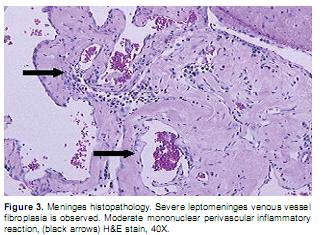
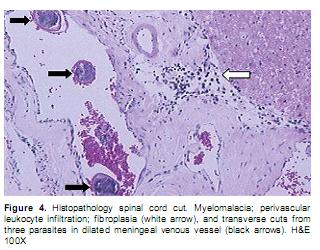
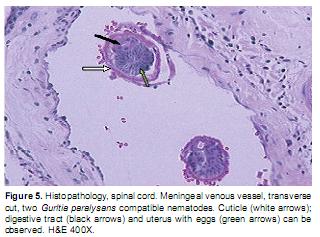
<body><![CDATA[<p><font face="Verdana, Arial, Helvetica, sans-serif" size="2">Nematode  parasite structures, similar to the    descriptions made by Wolffhugel  (1933) for <i>Gurltia </i>   <i>paralysans</i> were observed in the  four positive cases.   When transversal  serial cuts were made to the cord,    hemorrhages mainly  involved peripheral areas related    to the  meninges; they frequently  affected the spinal    cord's white and  gray substances. Other organs  did    not show  significant injuries, or any  other lesion    related  to the parasitic disease. Cat F showed evident    bladder strain with  severe bladder wall hypertrophy. </font></p>     <p><font face="Verdana, Arial, Helvetica, sans-serif" size="2">In general  terms, the microscopic lesions    found in  the spinal cord, in  the cases that  are   being studied,  were characterized by the presence   of hemorrhagic  deposits, related with extended    necrosis of  both white and  gray substances    (panmyelomalacia).  There was also evidence  of    distention; axonal  fragmentation and massive   neuronal necrosis;  severe congestion and moderate mononuclear perivascular infiltration, mainly  linfoplasmocitary type  (<a href="#f3">Figure 3</a>). Leptomeninges (piamater and arachnoidea) showed a chronic  inflammatory process, still  active with moderated  fibroplasia, vascular congestion  with mixed  inflammatory agents  and perivascular location.  Large venous  clots surrounded by  macrophage  charged with  abundant hematic pigment,  having  similar  characteristics to those  of hemosiderin  (<a href="#f4">Figure 4</a>). </font></p>     <p><font face="Verdana, Arial, Helvetica, sans-serif" size="2">In all  of the studied  cases, besides the changes    previously described,  inside the piamater's venous    blood vessels, nematode transverse cuts  were   observed.  In them it was possible to differentiate the cuticle, the digestive  tract, and the uterus,  having a large number of eggs in  its interior. Although these  characteristics correspond to general nematodes, this  parasite had an exclusive intravascular location in the  spinal cord. No parasites with cardiac, pulmonary or  enteral location, such as erratic grub, were observed.  These parasites were  generally accompanied by  abundant fibrin and eosinophil (<a href="#f5">Figure 5</a>). </font></p>     <p align="center"><a name="f3"><img src="/img/revistas/rccp/v24n4/a10f3.JPG" /></a></p>     <p align="center"> <a name="f4"><img src="/img/revistas/rccp/v24n4/a10f4.JPG" /></a></p>     <p align="center"><a name="f5"><img src="/img/revistas/rccp/v24n4/a10f5.JPG" /></a></p>     <p><font face="Verdana, Arial, Helvetica, sans-serif" size="3"><b>Discussion</b> </font></p>     <p><font face="Verdana, Arial, Helvetica, sans-serif" size="2">Wolffhugel (1933),  in Chile, described  the    parasite <i>Gurltia paralysans</i> as  a nematode with    filiform body, belonging  to the Metastrongylidae    superfamily, having  a lipless mouth,  and papillae    with no  oral capsule. The  male shows bursa   copulatrix. The  edge of the bursa is held by  sickle    shaped chitinous  reinforcements. It has  two bristle    shaped spicules  with gubernaculum. At the exit    of the spicules  there are two chitinous  spines. The   female has cranial  vulva to the anus in the terminal    extremity. It is  also oviparous. The female is up to    23 mm long, having a  0.15 mm diameter; the male   is 12 mm long, and up  to 0.102 mm wide.</font></p>     <p><font face="Verdana, Arial, Helvetica, sans-serif" size="2">This species  is called <i>paralysans</i> because of  its    pathogen action  and the clinical  signs it produces    (Wolffhugel,  1933). In the  cases described in  this    report, it was not  possible to isolate whole parasites    from  the examined spinal  cords in order to  define,    using morphological  criteria, the gender and species    of the  parasite present in the meningeal  blood    vessels. Nonetheless,  the tissue's transversal  cuts    that  were observed are similar to the ones published    for <i>Gurltia  paralysans </i>like cases (G&oacute;mez <i>et  al</i>.,    2010;  Wolffhugel, 1933). They are also significantly    different from the  cuts described for  erratic   nematodes located  in blood vessels  and especially    in this  animals' and other  carnivores' nervous    systems  (Sprent, 1955; Dvir <i>et al</i>., 2007; Wessmann    <i>et  al</i>., 2006). Apart from the alteration found in the    medullar cord, in the  studied cases, no  parasites    were observed in  other tissues. </font></p>     <p><font face="Verdana, Arial, Helvetica, sans-serif" size="2">On the other hand, in the different cases described  in this report, there are clinical results  similar to the ones described in  literature (Gomez <i>et al</i>., 2010).  The first  symptoms reported are weakness  of the  hind legs, followed by  uncoordination and ataxia.  The  symptoms remain for several  months before the appearance of muscle  atrophy of the  hind  legs,  distension of the abdomen,  urinary and fecal  retention. Clinical examination  showed abdominal  muscle hypotonia, pelvic  muscle hyporeflexia, and  evidence of superior  motor neuron (SMN) and  inferior motor neuron  (IMN) damage, probably  because of the progressive  myelomalacia in the  spinal cord. Signs such as ascending  dysfunction and  analgesia,  hind legs nociception  and propioception  loss,  dilated anus, decreased perineal  reflex,  distended  bladder, and urethra tone  decrease also  appear. Finally, intercostal muscles fail  causing death  (Bojrab, 1996; Bonagura, 2000; Negrin <i>et al</i>., 2009). </font></p>     ]]></body>
<body><![CDATA[<p><font face="Verdana, Arial, Helvetica, sans-serif" size="2">A large number of the  pathological processes    in  the spinal cord are located  in the T<sub>3</sub>-L<sub>3</sub>  thoracolumbar segments, both  in dogs and  cats.    Because they are  defined syndromes, these   processes  have different etiologies, such  as:    trauma,  intervertebral disc alteration,  neoplasia,    degenerative myelopathies, and infections  (Ettinger    and  Feldman, 2005; Marioni-Henry, 2010).  Most    of  these symptoms are chronic  and degenerative    in  nature. The most significant signs  are related    to  a normal pace  in the front  legs combined with    parapesia, paralysis, or ataxia in the  hind legs.</font></p>     <p><font face="Verdana, Arial, Helvetica, sans-serif" size="2">The spinal reflexes  in the thoracic extremities    are normal  or exaggerated. Muscle atrophy is not    present  in the front legs  either, but is  evident in    the hind  legs to a  different degree, depending  on    the problem and especially  on disuse, as  seen in    cat  F. Bladder activity varies;  bladder distension    because of sphincter control loss is  usually present,    but  evacuation occurs when  it is filled  with urine.    In  a similar manner, defecation  occurs when the   rectum is  filled, independent of time  and place.    All  of these signs conform  to SMN symptoms. In    the parasite reported cases,  they have appeared  in    different  degrees, but follow  a similar behavior   pattern  (Bojrab, 1996; Bonagura,  2000; Ettinger y    Feldman, 2005). Besides hind legs  nociception and    propioception loss, these  signs where described by Wolffhuggel (1933)  as consequences of the pathogen  action of the <i>G. paralysans</i> nematode.  This author reports  that there is no  treatment and  infected animals die in  one or two years. This  data is related  to the information given  by the inhabitants of  the region where  the infected cats  came from. The disease is known as the "renguera"  plague, and the infected  cats that are not  checked  by a veterinarian die approximately a year  after the  beginning of the symptoms. </font></p>     <p><font face="Verdana, Arial, Helvetica, sans-serif" size="2">Ettinger and Feldman (2005)  bring up the    existence of spinal nematodiasis caused by  parasite    erratic migration inside  the rachidian canal.  Its    entrance  route is not known, there have been    reported  cases both in  dogs and cats  , and it has    caused different types  of damage in the  medullar   cord due to infarcts and  myelocompression due to    the formation of granuloma. The parasites that were    isolated  in those cases were <i>Dirofilaria inmitis</i>,    <i>Toxacara  canis, </i>and <i>Ancylostoma caninum</i>.  It is    important to highlight  that these parasites do not    have regular behavior regarding  localization and    type of injury. They  have been identified  based    on their particular morphologic characteristics.    In the cases  reported in this  article, parasites were    identified  by histopathology studies,  and then a    differential study of the  parasites' morphologic   characteristics was made. The  comparison with the   erratic parasites' morphology mentioned by Ettinger   and Feldman (2005),  taking into account  their   localization in the same medullar segment, makes it    possible to conclude that the parasite that was found    is compatible with the descriptions made  for <i>Gurltia </i>   <i>paralysans</i> by Wolffhugel (1933).</font></p>     <p><font face="Verdana, Arial, Helvetica, sans-serif" size="2">There is a  viral entity called  the Borna disease;    disease that affects cats, especially the ones that are young  and have a country  life style. Even  though  this  disease shows some clinical  signs similar to  the ones described in the cases that were  previously  described  (ataxia and loss of  coordination and  jump capacity) due to the spinal cord  disorder, this  disease also affects  the encephalon, developing  symptoms  such as depression  and changes of conduct  (Ettinger and Feldman, 2005). Clinical  expressions such  as these and non  suppurative encephalitis, typical of  this disease, were not  observed in the cases reported in this  paper. </font></p>     <p></p>     <p><font face="Verdana, Arial, Helvetica, sans-serif" size="3"><b>Conclusion</b> </font></p>     <p><font face="Verdana, Arial, Helvetica, sans-serif" size="2">This  is the first time  that the presence of    a  <i>Gurltia paralysans</i> compatible parasite is    documented  in Colombia. Albeit  this parasite was    identified and reported in year 1933 by Wolffhugel    in  Chile, there is  not much information  about it.    There  have been only a few  cases reported around    the world (Gomez <i>et al</i>., 2010), all  of them showing    a  clinical and injury  pattern similar to the  cases    studied  in this report.  Unfortunately, the lack  of   complete samples from the  nematode found in the   studied  spinal cords made  it impossible to  verify    the identity of the parasite by its  morphologic    characteristics. </font></p>     <p><font face="Verdana, Arial, Helvetica, sans-serif" size="2">Besides  the clinical and pathological aspects of    the disease, it is necessary to  investigate and define   other relevant aspects,  such as its  epidemiological    behavior, the parasite's  life cycle, and its  means    of  transmission. In order to do so,  an investigation    project  is being developed  in the Veterinary    Medicine  School of Universidad de Antioquia by    an  interdisciplinary team of veterinary  doctors,    epidemiologists, biologists, and  parasitologists. </font></p>     <p><font face="Verdana, Arial, Helvetica, sans-serif" size="2"></font></p>     <p><font face="Verdana, Arial, Helvetica, sans-serif" size="3"><b>Referencias</b> </font></p>     ]]></body>
<body><![CDATA[<!-- ref --><p><font face="Verdana, Arial, Helvetica, sans-serif" size="2">1. Bojrab MJ.  Fisiopatolog&iacute;a y cl&iacute;nica  quir&uacute;rgica en animales    peque&ntilde;os.  Argentina: Intermedica, 1996. 1173.   </font>&nbsp;&nbsp;&nbsp;&nbsp;&nbsp;&nbsp;&nbsp;&nbsp;[&#160;<a href="javascript:void(0);" onclick="javascript: window.open('/scielo.php?script=sci_nlinks&ref=000063&pid=S0120-0690201100040001000001&lng=','','width=640,height=500,resizable=yes,scrollbars=1,menubar=yes,');">Links</a>&#160;]<!-- end-ref --><!-- ref --><p><font face="Verdana, Arial, Helvetica, sans-serif" size="2">2. Bonagura JS. Kirk&acute;s  current veterinary therapy, small animal    practice.13 ed. USA: WB.Saunders, 2000,  976-977.   </font>&nbsp;&nbsp;&nbsp;&nbsp;&nbsp;&nbsp;&nbsp;&nbsp;[&#160;<a href="javascript:void(0);" onclick="javascript: window.open('/scielo.php?script=sci_nlinks&ref=000064&pid=S0120-0690201100040001000002&lng=','','width=640,height=500,resizable=yes,scrollbars=1,menubar=yes,');">Links</a>&#160;]<!-- end-ref --><!-- ref --><p><font face="Verdana, Arial, Helvetica, sans-serif" size="2">3. Bowman  DD, Hendrix CH, Lindsay DS,  Stephen CB. Feline    Clinical Parasitology. Blackwell  Publishing. USA 2002, p 267-   273.</font>&nbsp;&nbsp;&nbsp;&nbsp;&nbsp;&nbsp;&nbsp;&nbsp;[&#160;<a href="javascript:void(0);" onclick="javascript: window.open('/scielo.php?script=sci_nlinks&ref=000065&pid=S0120-0690201100040001000003&lng=','','width=640,height=500,resizable=yes,scrollbars=1,menubar=yes,');">Links</a>&#160;]<!-- end-ref --><!-- ref --><p><font face="Verdana, Arial, Helvetica, sans-serif" size="2">4. Boyd JS. Atlas de anatom&iacute;a  cl&iacute;nica canina y  felina. Espa&ntilde;a:  Grass Ediciones, 1992. 46,49. </font>&nbsp;&nbsp;&nbsp;&nbsp;&nbsp;&nbsp;&nbsp;&nbsp;[&#160;<a href="javascript:void(0);" onclick="javascript: window.open('/scielo.php?script=sci_nlinks&ref=000066&pid=S0120-0690201100040001000004&lng=','','width=640,height=500,resizable=yes,scrollbars=1,menubar=yes,');">Links</a>&#160;]<!-- end-ref --><!-- ref --><p><font face="Verdana, Arial, Helvetica, sans-serif" size="2">5. Dvir E, Perl  S, Loeb E, Shklar-Hirsch  S, Chai O, Mazaki-   Tovi M, Aroch I,  Shamir MH.. Spinal intramedullary aberrant    <i>Spirocerca lupi</i> migration in  3 dogs. J  Vet Int Med  2007;    21:860-864.</font>&nbsp;&nbsp;&nbsp;&nbsp;&nbsp;&nbsp;&nbsp;&nbsp;[&#160;<a href="javascript:void(0);" onclick="javascript: window.open('/scielo.php?script=sci_nlinks&ref=000067&pid=S0120-0690201100040001000005&lng=','','width=640,height=500,resizable=yes,scrollbars=1,menubar=yes,');">Links</a>&#160;]<!-- end-ref --><!-- ref --><p><font face="Verdana, Arial, Helvetica, sans-serif" size="2">6. Ettinger  SJ, Feldman EC.  Textbook of Veterinary  Internal  Medicine. Diseases of the dog and cat. 6th Ed. Elsevier Saunders  2005, p 842-849.</font>&nbsp;&nbsp;&nbsp;&nbsp;&nbsp;&nbsp;&nbsp;&nbsp;[&#160;<a href="javascript:void(0);" onclick="javascript: window.open('/scielo.php?script=sci_nlinks&ref=000068&pid=S0120-0690201100040001000006&lng=','','width=640,height=500,resizable=yes,scrollbars=1,menubar=yes,');">Links</a>&#160;]<!-- end-ref --><!-- ref --><p><font face="Verdana, Arial, Helvetica, sans-serif" size="2"> 7. Gomez M, Mieres M, Moronic, Mora A, Barrios N, Simeonee    C,  Lindsay D. Meningomyelitis due to nematode  infection in    four cats. Vet Parasitol 2010; 24:327-330.   </font>&nbsp;&nbsp;&nbsp;&nbsp;&nbsp;&nbsp;&nbsp;&nbsp;[&#160;<a href="javascript:void(0);" onclick="javascript: window.open('/scielo.php?script=sci_nlinks&ref=000069&pid=S0120-0690201100040001000007&lng=','','width=640,height=500,resizable=yes,scrollbars=1,menubar=yes,');">Links</a>&#160;]<!-- end-ref --><!-- ref --><p><font face="Verdana, Arial, Helvetica, sans-serif" size="2">8. Hern&aacute;ndez  MM. Radiolog&iacute;a  veterinaria, peque&ntilde;os animales.    Espa&ntilde;a:  Interamericana Mc Graw-Hill, 1992. 46-463.   </font>&nbsp;&nbsp;&nbsp;&nbsp;&nbsp;&nbsp;&nbsp;&nbsp;[&#160;<a href="javascript:void(0);" onclick="javascript: window.open('/scielo.php?script=sci_nlinks&ref=000070&pid=S0120-0690201100040001000008&lng=','','width=640,height=500,resizable=yes,scrollbars=1,menubar=yes,');">Links</a>&#160;]<!-- end-ref --><!-- ref --><p><font face="Verdana, Arial, Helvetica, sans-serif" size="2">9. Marioni-Henry K.  Feline spinal cord diseases.  Vet Clin North    Am Small Anim Pract 2010; 40:1011-28.   </font>&nbsp;&nbsp;&nbsp;&nbsp;&nbsp;&nbsp;&nbsp;&nbsp;[&#160;<a href="javascript:void(0);" onclick="javascript: window.open('/scielo.php?script=sci_nlinks&ref=000071&pid=S0120-0690201100040001000009&lng=','','width=640,height=500,resizable=yes,scrollbars=1,menubar=yes,');">Links</a>&#160;]<!-- end-ref --><!-- ref --><p><font face="Verdana, Arial, Helvetica, sans-serif" size="2">10. Negrin  A, Schatzberg S,  Platt SR. The  paralyzed cat.    Neuroanatomic diagnosis and specific  spinal. J Feline Medicine    &amp; Surgery 2009; 11:361-372</font>&nbsp;&nbsp;&nbsp;&nbsp;&nbsp;&nbsp;&nbsp;&nbsp;[&#160;<a href="javascript:void(0);" onclick="javascript: window.open('/scielo.php?script=sci_nlinks&ref=000072&pid=S0120-0690201100040001000010&lng=','','width=640,height=500,resizable=yes,scrollbars=1,menubar=yes,');">Links</a>&#160;]<!-- end-ref --><!-- ref --><p><font face="Verdana, Arial, Helvetica, sans-serif" size="2">11. Oliver JE,  Lorenz MD, Kornegay  JN. Handbook of veterinary    neurology. USA:  WB Saunders, 1997. 129. </font>&nbsp;&nbsp;&nbsp;&nbsp;&nbsp;&nbsp;&nbsp;&nbsp;[&#160;<a href="javascript:void(0);" onclick="javascript: window.open('/scielo.php?script=sci_nlinks&ref=000073&pid=S0120-0690201100040001000011&lng=','','width=640,height=500,resizable=yes,scrollbars=1,menubar=yes,');">Links</a>&#160;]<!-- end-ref --><!-- ref --><p><font face="Verdana, Arial, Helvetica, sans-serif" size="2">12. Sprent JF. On  the invasion of the central  nervous system by    nematodes I.  The incidence and  pathological significance of    nematodes in  the central nervous  system. Parasitology 1955;    45:1-40.   </font>&nbsp;&nbsp;&nbsp;&nbsp;&nbsp;&nbsp;&nbsp;&nbsp;[&#160;<a href="javascript:void(0);" onclick="javascript: window.open('/scielo.php?script=sci_nlinks&ref=000074&pid=S0120-0690201100040001000012&lng=','','width=640,height=500,resizable=yes,scrollbars=1,menubar=yes,');">Links</a>&#160;]<!-- end-ref --><!-- ref --><p><font face="Verdana, Arial, Helvetica, sans-serif" size="2">13. Wessmann A, Lu  D, Lamb CR,  Smyth B, Mantis  P, Chandler    K, Boag  A, Cherubini GB,  Cappello R.. Brain  and spinal    cord haemorrhages  associated with <i>Angiostrongylus vasorum</i> infection in  four dogs. Vet Rec 2006; 158:858-863.   </font>&nbsp;&nbsp;&nbsp;&nbsp;&nbsp;&nbsp;&nbsp;&nbsp;[&#160;<a href="javascript:void(0);" onclick="javascript: window.open('/scielo.php?script=sci_nlinks&ref=000075&pid=S0120-0690201100040001000013&lng=','','width=640,height=500,resizable=yes,scrollbars=1,menubar=yes,');">Links</a>&#160;]<!-- end-ref --><!-- ref --><p><font face="Verdana, Arial, Helvetica, sans-serif" size="2">14. Wolffhugel K. Paraplejia  cruralis parasitaria felis  causada por    <i>Gurltia  paralysans</i> nov. gen., n. sp. (nematodes).  Rev Chil Hist    Nat 1933; 37:190-192.</font>&nbsp;&nbsp;&nbsp;&nbsp;&nbsp;&nbsp;&nbsp;&nbsp;[&#160;<a href="javascript:void(0);" onclick="javascript: window.open('/scielo.php?script=sci_nlinks&ref=000076&pid=S0120-0690201100040001000014&lng=','','width=640,height=500,resizable=yes,scrollbars=1,menubar=yes,');">Links</a>&#160;]<!-- end-ref --> ]]></body><back>
<ref-list>
<ref id="B1">
<label>1</label><nlm-citation citation-type="book">
<person-group person-group-type="author">
<name>
<surname><![CDATA[Bojrab]]></surname>
<given-names><![CDATA[MJ]]></given-names>
</name>
</person-group>
<source><![CDATA[Fisiopatología y clínica quirúrgica en animales pequeños]]></source>
<year>1996</year>
<page-range>1173</page-range><publisher-name><![CDATA[Intermedica]]></publisher-name>
</nlm-citation>
</ref>
<ref id="B2">
<label>2</label><nlm-citation citation-type="book">
<person-group person-group-type="author">
<name>
<surname><![CDATA[Bonagura]]></surname>
<given-names><![CDATA[JS]]></given-names>
</name>
</person-group>
<source><![CDATA[Kirk&acute;s current veterinary therapy, small animal practice]]></source>
<year>2000</year>
<edition>13</edition>
<page-range>976-977</page-range><publisher-name><![CDATA[WB.Saunders]]></publisher-name>
</nlm-citation>
</ref>
<ref id="B3">
<label>3</label><nlm-citation citation-type="book">
<person-group person-group-type="author">
<name>
<surname><![CDATA[Bowman]]></surname>
<given-names><![CDATA[DD]]></given-names>
</name>
<name>
<surname><![CDATA[Hendrix]]></surname>
<given-names><![CDATA[CH]]></given-names>
</name>
<name>
<surname><![CDATA[Lindsay]]></surname>
<given-names><![CDATA[DS]]></given-names>
</name>
<name>
<surname><![CDATA[Stephen]]></surname>
<given-names><![CDATA[CB]]></given-names>
</name>
</person-group>
<source><![CDATA[Feline Clinical Parasitology]]></source>
<year>2002</year>
<page-range>267- 273</page-range><publisher-name><![CDATA[Blackwell Publishing]]></publisher-name>
</nlm-citation>
</ref>
<ref id="B4">
<label>4</label><nlm-citation citation-type="book">
<person-group person-group-type="author">
<name>
<surname><![CDATA[Boyd]]></surname>
<given-names><![CDATA[JS]]></given-names>
</name>
</person-group>
<source><![CDATA[Atlas de anatomía clínica canina y felina]]></source>
<year>1992</year>
<page-range>46,49</page-range><publisher-name><![CDATA[Grass Ediciones]]></publisher-name>
</nlm-citation>
</ref>
<ref id="B5">
<label>5</label><nlm-citation citation-type="journal">
<person-group person-group-type="author">
<name>
<surname><![CDATA[Dvir]]></surname>
<given-names><![CDATA[E]]></given-names>
</name>
<name>
<surname><![CDATA[Perl]]></surname>
<given-names><![CDATA[S]]></given-names>
</name>
<name>
<surname><![CDATA[Loeb]]></surname>
<given-names><![CDATA[E]]></given-names>
</name>
<name>
<surname><![CDATA[Shklar-Hirsch]]></surname>
<given-names><![CDATA[S]]></given-names>
</name>
<name>
<surname><![CDATA[Chai]]></surname>
<given-names><![CDATA[O]]></given-names>
</name>
<name>
<surname><![CDATA[Mazaki-]]></surname>
<given-names><![CDATA[Tovi M]]></given-names>
</name>
<name>
<surname><![CDATA[Aroch]]></surname>
<given-names><![CDATA[I]]></given-names>
</name>
<name>
<surname><![CDATA[Shamir]]></surname>
<given-names><![CDATA[MH]]></given-names>
</name>
</person-group>
<article-title xml:lang="en"><![CDATA[Spinal intramedullary aberrant Spirocerca lupi migration in 3 dogs]]></article-title>
<source><![CDATA[J Vet Int Med]]></source>
<year>2007</year>
<volume>21</volume>
<page-range>860-864</page-range></nlm-citation>
</ref>
<ref id="B6">
<label>6</label><nlm-citation citation-type="book">
<person-group person-group-type="author">
<name>
<surname><![CDATA[Ettinger]]></surname>
<given-names><![CDATA[SJ]]></given-names>
</name>
<name>
<surname><![CDATA[Feldman]]></surname>
<given-names><![CDATA[EC]]></given-names>
</name>
</person-group>
<source><![CDATA[Textbook of Veterinary Internal Medicine. Diseases of the dog and cat]]></source>
<year>2005</year>
<edition>6</edition>
<page-range>842-849</page-range><publisher-name><![CDATA[Elsevier Saunders]]></publisher-name>
</nlm-citation>
</ref>
<ref id="B7">
<label>7</label><nlm-citation citation-type="journal">
<person-group person-group-type="author">
<name>
<surname><![CDATA[Gomez]]></surname>
<given-names><![CDATA[M]]></given-names>
</name>
<name>
<surname><![CDATA[Mieres]]></surname>
<given-names><![CDATA[M]]></given-names>
</name>
<name>
<surname><![CDATA[Moronic,]]></surname>
<given-names><![CDATA[Mora A]]></given-names>
</name>
<name>
<surname><![CDATA[Barrios]]></surname>
<given-names><![CDATA[N]]></given-names>
</name>
<name>
<surname><![CDATA[Simeonee]]></surname>
<given-names><![CDATA[C]]></given-names>
</name>
<name>
<surname><![CDATA[Lindsay]]></surname>
<given-names><![CDATA[D]]></given-names>
</name>
</person-group>
<article-title xml:lang="en"><![CDATA[Meningomyelitis due to nematode infection in four cats]]></article-title>
<source><![CDATA[Vet Parasitol]]></source>
<year>2010</year>
<volume>24</volume>
<page-range>327-330</page-range></nlm-citation>
</ref>
<ref id="B8">
<label>8</label><nlm-citation citation-type="book">
<person-group person-group-type="author">
<name>
<surname><![CDATA[Hernández]]></surname>
<given-names><![CDATA[MM]]></given-names>
</name>
</person-group>
<source><![CDATA[Radiología veterinaria, pequeños animales]]></source>
<year>1992</year>
<page-range>46-463</page-range><publisher-name><![CDATA[Interamericana Mc Graw-Hill]]></publisher-name>
</nlm-citation>
</ref>
<ref id="B9">
<label>9</label><nlm-citation citation-type="journal">
<person-group person-group-type="author">
<name>
<surname><![CDATA[Marioni-Henry]]></surname>
<given-names><![CDATA[K]]></given-names>
</name>
</person-group>
<article-title xml:lang="en"><![CDATA[Feline spinal cord diseases]]></article-title>
<source><![CDATA[Vet Clin North Am Small Anim Pract]]></source>
<year>2010</year>
<volume>40</volume>
<page-range>1011-28</page-range></nlm-citation>
</ref>
<ref id="B10">
<label>10</label><nlm-citation citation-type="journal">
<person-group person-group-type="author">
<name>
<surname><![CDATA[Negrin]]></surname>
<given-names><![CDATA[A]]></given-names>
</name>
<name>
<surname><![CDATA[Schatzberg]]></surname>
<given-names><![CDATA[S]]></given-names>
</name>
<name>
<surname><![CDATA[Platt]]></surname>
<given-names><![CDATA[SR]]></given-names>
</name>
</person-group>
<article-title xml:lang="en"><![CDATA[The paralyzed cat Neuroanatomic diagnosis and specific spinal]]></article-title>
<source><![CDATA[J Feline Medicine & Surgery]]></source>
<year>2009</year>
<volume>11</volume>
<page-range>361-372</page-range></nlm-citation>
</ref>
<ref id="B11">
<label>11</label><nlm-citation citation-type="book">
<person-group person-group-type="author">
<name>
<surname><![CDATA[Oliver]]></surname>
<given-names><![CDATA[JE]]></given-names>
</name>
<name>
<surname><![CDATA[Lorenz]]></surname>
<given-names><![CDATA[MD]]></given-names>
</name>
<name>
<surname><![CDATA[Kornegay]]></surname>
<given-names><![CDATA[JN]]></given-names>
</name>
</person-group>
<source><![CDATA[Handbook of veterinary neurology]]></source>
<year>1997</year>
<page-range>129</page-range><publisher-name><![CDATA[WB Saunders]]></publisher-name>
</nlm-citation>
</ref>
<ref id="B12">
<label>12</label><nlm-citation citation-type="journal">
<person-group person-group-type="author">
<name>
<surname><![CDATA[Sprent]]></surname>
<given-names><![CDATA[JF]]></given-names>
</name>
</person-group>
<article-title xml:lang="en"><![CDATA[On the invasion of the central nervous system by nematodes I The incidence and pathological significance of nematodes in the central nervous system]]></article-title>
<source><![CDATA[Parasitology]]></source>
<year>1955</year>
<volume>45</volume>
<page-range>1-40</page-range></nlm-citation>
</ref>
<ref id="B13">
<label>13</label><nlm-citation citation-type="journal">
<person-group person-group-type="author">
<name>
<surname><![CDATA[Wessmann]]></surname>
<given-names><![CDATA[A]]></given-names>
</name>
<name>
<surname><![CDATA[Lu]]></surname>
<given-names><![CDATA[D]]></given-names>
</name>
<name>
<surname><![CDATA[Lamb]]></surname>
<given-names><![CDATA[CR]]></given-names>
</name>
<name>
<surname><![CDATA[Smyth]]></surname>
<given-names><![CDATA[B]]></given-names>
</name>
<name>
<surname><![CDATA[Mantis]]></surname>
<given-names><![CDATA[P]]></given-names>
</name>
<name>
<surname><![CDATA[Chandler]]></surname>
<given-names><![CDATA[K]]></given-names>
</name>
<name>
<surname><![CDATA[Boag]]></surname>
<given-names><![CDATA[A]]></given-names>
</name>
<name>
<surname><![CDATA[Cherubini]]></surname>
<given-names><![CDATA[GB]]></given-names>
</name>
<name>
<surname><![CDATA[Cappello]]></surname>
<given-names><![CDATA[R]]></given-names>
</name>
</person-group>
<article-title xml:lang="en"><![CDATA[Brain and spinal cord haemorrhages associated with Angiostrongylus vasorum infection in four dogs]]></article-title>
<source><![CDATA[Vet Rec]]></source>
<year>2006</year>
<volume>158</volume>
<page-range>858-863</page-range></nlm-citation>
</ref>
<ref id="B14">
<label>14</label><nlm-citation citation-type="journal">
<person-group person-group-type="author">
<name>
<surname><![CDATA[Wolffhugel]]></surname>
<given-names><![CDATA[K]]></given-names>
</name>
</person-group>
<article-title xml:lang="es"><![CDATA[Paraplejia cruralis parasitaria felis causada por Gurltia paralysans nov gen, n. sp. (nematodes)]]></article-title>
<source><![CDATA[Rev Chil Hist Nat]]></source>
<year>1933</year>
<volume>37</volume>
<page-range>190-192</page-range></nlm-citation>
</ref>
</ref-list>
</back>
</article>