<?xml version="1.0" encoding="ISO-8859-1"?><article xmlns:mml="http://www.w3.org/1998/Math/MathML" xmlns:xlink="http://www.w3.org/1999/xlink" xmlns:xsi="http://www.w3.org/2001/XMLSchema-instance">
<front>
<journal-meta>
<journal-id>0120-0690</journal-id>
<journal-title><![CDATA[Revista Colombiana de Ciencias Pecuarias]]></journal-title>
<abbrev-journal-title><![CDATA[Rev Colom Cienc Pecua]]></abbrev-journal-title>
<issn>0120-0690</issn>
<publisher>
<publisher-name><![CDATA[Facultad de Ciencias Agrarias, Universidad de Antioquia]]></publisher-name>
</publisher>
</journal-meta>
<article-meta>
<article-id>S0120-06902012000200002</article-id>
<title-group>
<article-title xml:lang="en"><![CDATA[Allelic frequency of the Kappa-Casein gene in Colombian and creole cattle breeds]]></article-title>
<article-title xml:lang="es"><![CDATA[Frecuencia alélica del gen Kappa-Caseína en bovinos criollos y colombianos]]></article-title>
<article-title xml:lang="pt"><![CDATA[Freqüência do alelo de gene de Kappa-Caseína em bovinos crioulos e colombianos]]></article-title>
</title-group>
<contrib-group>
<contrib contrib-type="author">
<name>
<surname><![CDATA[Rosero]]></surname>
<given-names><![CDATA[Jaime A]]></given-names>
</name>
<xref ref-type="aff" rid="A01"/>
</contrib>
<contrib contrib-type="author">
<name>
<surname><![CDATA[Álvarez]]></surname>
<given-names><![CDATA[Luz A]]></given-names>
</name>
<xref ref-type="aff" rid="A02"/>
</contrib>
<contrib contrib-type="author">
<name>
<surname><![CDATA[Muñoz]]></surname>
<given-names><![CDATA[Jaime E]]></given-names>
</name>
<xref ref-type="aff" rid="A03"/>
</contrib>
<contrib contrib-type="author">
<name>
<surname><![CDATA[Durán]]></surname>
<given-names><![CDATA[Carlos V]]></given-names>
</name>
<xref ref-type="aff" rid="A02"/>
</contrib>
<contrib contrib-type="author">
<name>
<surname><![CDATA[G Rodas]]></surname>
<given-names><![CDATA[Ángela]]></given-names>
</name>
<xref ref-type="aff" rid="A03"/>
</contrib>
</contrib-group>
<aff id="A01">
<institution><![CDATA[,National University of Colombia School of Agricultural and Livestock Sciences Dept. of Animal Science]]></institution>
<addr-line><![CDATA[ ]]></addr-line>
</aff>
<aff id="A02">
<institution><![CDATA[,National University of Colombia School of Agricultural and Livestock Sciences ]]></institution>
<addr-line><![CDATA[Palmira ]]></addr-line>
<country>Colombia</country>
</aff>
<aff id="A03">
<institution><![CDATA[,National University of Colombia School of Agricultural and Livestock Sciences ]]></institution>
<addr-line><![CDATA[Palmira ]]></addr-line>
<country>Colombia</country>
</aff>
<pub-date pub-type="pub">
<day>00</day>
<month>06</month>
<year>2012</year>
</pub-date>
<pub-date pub-type="epub">
<day>00</day>
<month>06</month>
<year>2012</year>
</pub-date>
<volume>25</volume>
<numero>2</numero>
<fpage>173</fpage>
<lpage>182</lpage>
<copyright-statement/>
<copyright-year/>
<self-uri xlink:href="http://www.scielo.org.co/scielo.php?script=sci_arttext&amp;pid=S0120-06902012000200002&amp;lng=en&amp;nrm=iso"></self-uri><self-uri xlink:href="http://www.scielo.org.co/scielo.php?script=sci_abstract&amp;pid=S0120-06902012000200002&amp;lng=en&amp;nrm=iso"></self-uri><self-uri xlink:href="http://www.scielo.org.co/scielo.php?script=sci_pdf&amp;pid=S0120-06902012000200002&amp;lng=en&amp;nrm=iso"></self-uri><abstract abstract-type="short" xml:lang="en"><p><![CDATA[Colombia has one of the most genetically diverse creole cattle populations, with eight creole breeds and two improved creole (Colombian) breeds. A high demand for meat and milk has led to the inevitable selection of highly productive cattle and the introduction of foreign breeds. Unfortunately, these breeds are often ill-suited for tropical conditions. These factors threaten the size of the creole livestock population, which is considered part of Colombia's national heritage. Objective: to estimate the allelic frequencies of the Kappa-Casein gene (CNS3) in Colombian creole cattle breeds (GCC). Methods: a total of 354 blood samples were taken from 30 animals of each of the following breeds: Blanco Orejinegro (BON), Caqueteño (CQT), Casanareño (CAS), Horned Costeño (Costeño con Cuernos, CCC), Chino Santandereano (ChS), Hartón del Valle (HV), Romosinuano (ROM), and Sanmartinero (SM), each representing the 8 established ''criollo'' (creole) breeds; the Lucerna (LUC) and Velasquez (VEL) representing the two Colombian improved breeds; and Brahman and Holstein as control breeds. DNA was extracted by a salting-out procedure and a 453 bp fragment on chromosome 6 was amplified by PCR. CSN3 alleles were identified using single strand conformation polymorphism (SSCP) and their sequence compared with those of the Genebank for Bos taurus and Bos indicus. Results: higher frequencies for allele variants of CSN3 A (0.39) and B (0.41) were found relative to the frequencies of I (0.038), G (0.095), A1 (0.025), E (0.006), and N (0.006). The allele of interest (CSN3 B) had a high frequency in the CCC (0.81), ROMO (0.66), CQT (0.55), ChS (0.48), and VEL (0.43) breeds. Conclusions: these findings suggest that Colombian creole breeds harbor a high genetic diversity which enriches its gene pool and warrants future conservation efforts to protect its integrity.]]></p></abstract>
<abstract abstract-type="short" xml:lang="es"><p><![CDATA[Colombia es uno de los países más diversos en recursos genéticos criollos. Posee ochos razas de ganado criollo (GCC) y dos razas de criollo mejorado o razas colombianas. La creciente demanda de alimentos ha generado una forzosa selección de individuos altamente productivos e introducción de razas foráneas (Holstein y Brahman) poco adaptadas a condiciones tropicales, lo que ha puesto en riesgo el tamaño efectivo del ganado criollo, considerado patrimonio nacional. Objetivo: estimar la frecuencia alélica del gen (CNS3) de la Kappa-Caseína en el (GCC). Métodos: se usaron 354 muestras de sangre de ocho razas bovinas criollas (30 individuos por raza): Blanco Orejinegro (BON), Caqueteño (CQT), Casanareño (CAS), Costeño con Cuernos (CCC), Chino Santandereano (ChS), Hartón del Valle (HV), Romosinuano (ROMO) y Sanmartinero (SM), dos colombianas Lucerna (LUC) y Velásquez (VEL) y dos controles Brahman y Holstein. Con el fin de estimar la frecuencia de los alelos k-caseína (k-CN) se amplificó un fragmento de 453 pb para k-CN (cromosoma 6). Los alelos se identificaron mediante la técnica PCR-SSCP. Resultados: se encontró mayor frecuencia para las variantes de k-CN A (0.39) y B (0.41), en comparación a I (0.038), G (0.095), A1 (0.025), E (0.006) y N (0.006). El alelo de interés k-CN B presentó alta frecuencia en las razas CCC (0.81), ROMO (0.66), CQT (0.55), ChS (0.48), y VEL (0.43). Conclusiones: la alta frecuencia del alelo de interés del gen k-CN ratifica al GCC como alternativa viable en esquemas sostenibles de producción de leche de mejor calidad y corrobora la necesidad de evaluación y caracterización de recursos zoogenético, como primer paso para su conservación.]]></p></abstract>
<abstract abstract-type="short" xml:lang="pt"><p><![CDATA[A Colômbia é um dos países mais diversificado em recursos genéticos crioulos, tem oito bovinos da raça nativa e duas raças melhoradas ou raças crioulo colombiano (GCC). A alta demanda por alimentos tem levado a uma seleção forçada das pessoas altamente produtivas e/ou introdução de raças estrangeiras mal adaptados às condições tropicais, que têm prejudicado o tamanho efetivo de animais considerados património crioulo. Objetivo: estimar a frequência do alelo do gene Kappa-Caseína (CNS3) na (GCC). Métodos: foram utilizados 354 amostras de sangue de oito raças nativas (30 indivíduos por raça): Blanco Orejinegro (BON), Caqueteño (CQT), Casanareño (CAS), Costeño con Cuernos (CCC), Chino Santandereano (ChS), Hartón del Valle (HV), Romosinuano (ROM) e Sanmartinero (SM), dois Colombianas Lucerna (LUC) e Velásquez (VEL) e dois controles (Brahman and Holstein). Para estimar a freqüência de alelos de &kappa;-caseína (CSN3), amplificaram um fragmento de 453 pb para CSN3. Os alelos foram identificados por PCR-SSCP. Resultados: encontramos uma maior freqüência de variantes do CSN3 A (0.39) e B (0.41), comparado com I (0.038), G (0.095), A1 (0.025), E (0.006) e N (0.006). O alelo de interesse CSN3 B apresentou alta freqüência em raças CCC (0.81), ROMO (0.66), CQT (0.55), CHS (0.48) e VEL (0.43). Conclusões: estes resultados sugerem que o CCG é um recurso genético, que abriga uma grande diversidade genética e apoia a necessidade de avaliação e caracterização dos recursos genéticos animais como um primeiro passo para a conservação.]]></p></abstract>
<kwd-group>
<kwd lng="en"><![CDATA[genetic variants]]></kwd>
<kwd lng="en"><![CDATA[milk proteins]]></kwd>
<kwd lng="en"><![CDATA[molecular markers]]></kwd>
<kwd lng="en"><![CDATA[PCR-SSCP]]></kwd>
<kwd lng="es"><![CDATA[marcadores moleculares]]></kwd>
<kwd lng="es"><![CDATA[PCR-SSCP]]></kwd>
<kwd lng="es"><![CDATA[proteínas leche]]></kwd>
<kwd lng="es"><![CDATA[variantes genéticas]]></kwd>
<kwd lng="pt"><![CDATA[marcadores moleculares]]></kwd>
<kwd lng="pt"><![CDATA[PCR-SSCP]]></kwd>
<kwd lng="pt"><![CDATA[proteínas do leite]]></kwd>
<kwd lng="pt"><![CDATA[variantes genéticas]]></kwd>
</kwd-group>
</article-meta>
</front><body><![CDATA[ <p align="right"><font face="Verdana, Arial, Helvetica, sans-serif" size="2"><b>ART&Iacute;CULO ORIGINAL</b></font></p>     <p align="right">&nbsp;</p>     <p align="center"><font face="Verdana, Arial, Helvetica, sans-serif" size="4"><b>Allelic frequency of the Kappa&#8211;Casein gene in Colombian  and creole cattle breeds<sup><a href="#*">&curren;</a><a name="*b" id="*b"></a></sup></b></font></p>     <p align="center">&nbsp;</p>     <p align="center"><font face="Verdana, Arial, Helvetica, sans-serif" size="3"><b>Frecuencia al&eacute;lica del gen Kappa&#8211;Case&iacute;na en bovinos criollos y colombianos</b></font></p>     <p align="center">&nbsp;</p>     <p align="center"><font face="Verdana, Arial, Helvetica, sans-serif" size="3"><b>Freq&uuml;&ecirc;ncia do alelo de gene de Kappa&#8211;Case&iacute;na em bovinos crioulos e colombianos</b></font></p>     <p align="center">&nbsp;</p>     <p align="center">&nbsp;</p>     <p><font face="Verdana, Arial, Helvetica, sans-serif" size="2"><b>Jaime A Rosero<sup>1</sup>,  MS student; Luz A &Aacute;lvarez <sup>2*</sup>, MS; Jaime E Mu&ntilde;oz<sup>2</sup>, AgrEng, PhD; Carlos V Dur&aacute;n<sup>2</sup>, MS; &Aacute;ngela G Rodas<sup>3</sup>, MS</b></font><b>.</b></p>     ]]></body>
<body><![CDATA[<p>&nbsp;</p>     <p><font face="Verdana, Arial, Helvetica, sans-serif" size="2">*	 Corresponding 	 author: 	 Luz 	 &Aacute;ngela 	 &Aacute;lvarez 	 Universidad 	 Nacional 	 de 	 Colombia, 	 Sede 	 Palmira. 	 email: 	 <a href="mailto:laalvarezf@palmira.unal.edu.co">laalvarezf@palmira.unal.edu.co</a>.</font></p>     <p><font face="Verdana, Arial, Helvetica, sans-serif" size="2"><sup>1</sup> Palmira Animal Genetics Resource Group, Dept. of Animal Science, School of Agricultural and Livestock Sciences, National University of Colombia, Palmira Campus . </font></p>     <p><font face="Verdana, Arial, Helvetica, sans-serif" size="2"> <sup>2</sup> Professor, School of Agricultural and Livestock Sciences, National University of Colombia AA 237, Palmira, Colombia.</font></p>     <p><font face="Verdana, Arial, Helvetica, sans-serif" size="2"> <sup>3</sup> Research Group on Conservation, Improvement, and Use of ''Hart&oacute;n del Valle'' Creole Cattle and Other Animal Genetic Resources in Southwest Colombia, School of Agricultural and Livestock Sciences, National University of Colombia, Palmira, Colombia.</font></p>     <p>&nbsp;</p>     <p><font face="Verdana, Arial, Helvetica, sans-serif" size="2">(Recibido: 20 marzo, 2010; aceptado: 23 agosto, 2011)</font></p>     <p>&nbsp;</p>     <p>&nbsp;</p> <hr size="1" />     <p><font face="Verdana, Arial, Helvetica, sans-serif" size="2"><b>Summary </b></font></p>     ]]></body>
<body><![CDATA[<p><font face="Verdana, Arial, Helvetica, sans-serif" size="2">Colombia has one of the most genetically diverse creole cattle populations, with eight creole breeds  and two improved creole (Colombian) breeds. A high demand for meat and milk has led to the inevitable selection of highly productive cattle and the introduction of foreign breeds. Unfortunately, these breeds are often ill&#8211;suited for tropical conditions. These factors threaten the size of the creole livestock population, which is considered part of Colombia's national heritage. <b>Objective</b>: to estimate the allelic frequencies of the Kappa&#8211;Casein gene (CNS3) in Colombian creole cattle breeds (GCC). <b>Methods</b>: a total of 354 blood samples were taken from 30 animals of each of the following breeds: Blanco Orejinegro (BON), Caquete&ntilde;o (CQT), Casanare&ntilde;o (CAS), Horned Coste&ntilde;o (Coste&ntilde;o con Cuernos, CCC), Chino Santandereano (ChS), Hart&oacute;n del Valle (HV), Romosinuano (ROM), and Sanmartinero (SM), each representing the 8 established ''criollo'' (creole) breeds; the Lucerna (LUC) and Velasquez (VEL) representing the two Colombian improved breeds; and Brahman and Holstein as control breeds. DNA was extracted by a salting&#8211;out procedure and a 453 bp fragment on chromosome 6 was amplified by PCR. <i>CSN3</i> alleles were identified using single strand conformation polymorphism (SSCP) and their sequence compared with those of the Genebank for Bos taurus and Bos indicus. <b>Results</b>: higher frequencies for allele variants of <i>CSN3</i> A (0.39) and B (0.41) were found relative to the frequencies of I (0.038), G (0.095), A<sub>1</sub> (0.025), E (0.006), and N (0.006). The allele of interest (<i>CSN3</i> B) had a high frequency in the CCC (0.81), ROMO (0.66), CQT (0.55), ChS (0.48), and VEL (0.43) breeds. <b>Conclusions</b>: these findings suggest that Colombian creole breeds harbor a high genetic diversity which enriches its gene pool and warrants future conservation efforts to protect its integrity.</font></p>     <p><font face="Verdana, Arial, Helvetica, sans-serif" size="2"><b>Key words</b>: genetic variants, milk proteins, molecular markers, PCR&#8211;SSCP </font></p> <hr size="1" />     <p><font face="Verdana, Arial, Helvetica, sans-serif" size="2"><b>Resumen</b></font></p>     <p><font face="Verdana, Arial, Helvetica, sans-serif" size="2">Colombia es uno de los pa&iacute;ses m&aacute;s diversos en recursos gen&eacute;ticos criollos. Posee ochos razas de ganado  criollo (GCC) y dos razas de criollo mejorado o razas colombianas. La creciente demanda de alimentos ha generado una forzosa selecci&oacute;n de individuos altamente productivos e introducci&oacute;n de razas for&aacute;neas (Holstein y Brahman) poco adaptadas a condiciones tropicales, lo que ha puesto en riesgo el tama&ntilde;o efectivo del ganado criollo, considerado patrimonio nacional. <b>Objetivo</b>: estimar la frecuencia al&eacute;lica del gen (CNS3) de la Kappa&#8211;Case&iacute;na en el (GCC). <b>M&eacute;todos</b>: se usaron 354 muestras de sangre de ocho razas bovinas criollas (30 individuos por raza): Blanco Orejinegro (BON), Caquete&ntilde;o (CQT), Casanare&ntilde;o (CAS), Coste&ntilde;o con Cuernos (CCC), Chino Santandereano (ChS), Hart&oacute;n del Valle (HV), Romosinuano (ROMO) y Sanmartinero (SM),  dos colombianas Lucerna (LUC) y Vel&aacute;squez (VEL) y dos controles Brahman y Holstein. Con el fin de estimar la frecuencia de los alelos k&#8211;case&iacute;na (k&#8211;CN) se amplific&oacute; un fragmento de 453 pb para k&#8211;CN (cromosoma 6). Los alelos se identificaron mediante la t&eacute;cnica PCR&#8211;SSCP. <b>Resultados</b>: se encontr&oacute; mayor frecuencia para las variantes de k&#8211;CN A (0.39) y B (0.41), en comparaci&oacute;n a I (0.038), G (0.095), A1 (0.025), E (0.006) y N (0.006). El alelo de inter&eacute;s k&#8211;CN B present&oacute; alta  frecuencia en las razas CCC (0.81), ROMO (0.66), CQT (0.55),  ChS (0.48), y VEL (0.43). <b>Conclusiones</b>: la alta frecuencia del alelo de inter&eacute;s del gen k&#8211;CN ratifica al GCC como alternativa viable en esquemas sostenibles de producci&oacute;n de leche de mejor calidad y corrobora la necesidad de evaluaci&oacute;n y caracterizaci&oacute;n de recursos zoogen&eacute;tico, como primer paso para su conservaci&oacute;n. </font></p>     <p><font face="Verdana, Arial, Helvetica, sans-serif" size="2"><b>Palabras clave:</b> marcadores moleculares, PCR&#8211;SSCP, prote&iacute;nas leche, variantes gen&eacute;ticas.</font></p> <hr size="1" />     <p><font face="Verdana, Arial, Helvetica, sans-serif" size="2"><b>Resumo</b></font></p>     <p><font face="Verdana, Arial, Helvetica, sans-serif" size="2"> A Col&ocirc;mbia &eacute; um dos pa&iacute;ses mais diversificado em recursos gen&eacute;ticos crioulos, tem oito bovinos    da ra&ccedil;a nativa e duas ra&ccedil;as melhoradas ou ra&ccedil;as crioulo colombiano (GCC). A alta demanda por alimentos tem levado a uma sele&ccedil;&atilde;o for&ccedil;ada das pessoas altamente produtivas e/ou introdu&ccedil;&atilde;o de ra&ccedil;as estrangeiras mal adaptados &agrave;s condi&ccedil;&otilde;es tropicais, que t&ecirc;m prejudicado o tamanho efetivo de animais considerados patrim&oacute;nio crioulo. <b>Objetivo</b>: estimar a frequ&ecirc;ncia do alelo do gene Kappa&#8211;Case&iacute;na (CNS3) na (GCC). <b>M&eacute;todos</b>: foram utilizados 354 amostras de sangue de oito ra&ccedil;as nativas (30 indiv&iacute;duos por ra&ccedil;a): Blanco Orejinegro (BON), Caquete&ntilde;o (CQT), Casanare&ntilde;o (CAS), Coste&ntilde;o con Cuernos (CCC), Chino Santandereano (ChS), Hart&oacute;n del Valle (HV), Romosinuano (ROM) e Sanmartinero (SM), dois Colombianas Lucerna (LUC) e Vel&aacute;squez (VEL) e dois controles (Brahman and Holstein). Para estimar    a freq&uuml;&ecirc;ncia de alelos de &kappa;&#8211;case&iacute;na (<i>CSN3</i>), amplificaram um fragmento de 453 pb para <i>CSN3</i>. Os alelos  foram identificados por PCR&#8211;SSCP. <b>Resultados</b>: encontramos uma maior freq&uuml;&ecirc;ncia de variantes do <i>CSN3</i> A (0.39) e B (0.41), comparado com I (0.038), G (0.095), A<sub>1</sub> (0.025), E (0.006) e N (0.006). O alelo de interesse <i>CSN3</i> B apresentou alta freq&uuml;&ecirc;ncia em ra&ccedil;as CCC (0.81), ROMO (0.66), CQT (0.55), CHS (0.48) e VEL (0.43). <b>Conclus&otilde;es</b>: estes resultados sugerem que o CCG &eacute; um recurso gen&eacute;tico, que abriga uma grande diversidade gen&eacute;tica e apoia a necessidade de avalia&ccedil;&atilde;o e caracteriza&ccedil;&atilde;o dos recursos gen&eacute;ticos animais como um primeiro passo para a conserva&ccedil;&atilde;o.</font></p>     <p><font face="Verdana, Arial, Helvetica, sans-serif" size="2"><b>Palavras chave:</b> marcadores moleculares, PCR&#8211;SSCP, prote&iacute;nas do leite, variantes gen&eacute;ticas.</font></p> <hr size="1" />     <p>&nbsp;</p>     <p>&nbsp;</p>     ]]></body>
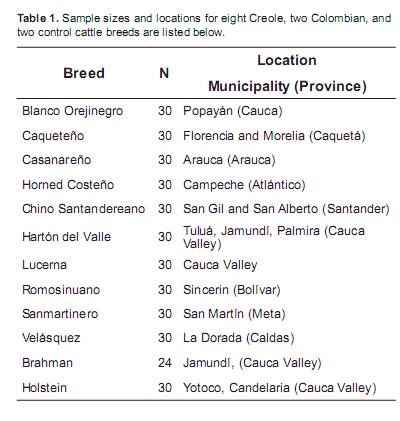
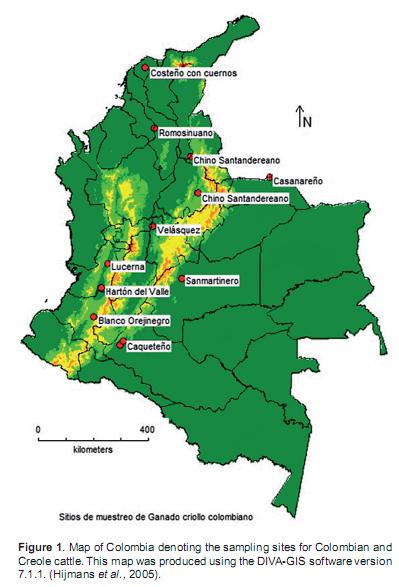
<body><![CDATA[<p><font face="Verdana, Arial, Helvetica, sans-serif" size="3"><b>Introduction</b></font></p>     <p><font face="Verdana, Arial, Helvetica, sans-serif" size="2">Caseins	represent	80%	of	bovine	milk	proteins	 (Fox	 and	 Brodkorb,	 2008).	 The	 <i>CSN3</i> gene in    cattle	has	been	extensively	studied	and	plays	a	role	 in	stabilizing	caseins,	interacting	with	2&#8211;LG,	and	 determining	the	physical	stability	of	some	milk products	during	heat	treatment	(Braunschweig	   <i>et al.</i>,	2000;	Fox	and	Brodkorb,	2008).	Multiple	 variants	of	the	<i>CSN3</i>	gene	have	been	found,    although the A and B alleles are the most common.    Ten	other	allele	variants	have	been	described	and include	the	following:	A<sub>1</sub> C, E, F<sup>1</sup>, F<sup>2</sup>, G<sup>1</sup>, G<sup>2</sup>, H, I, and J (Caroli <i>et al.</i>,	2009).	Of	these,	the	B	allele	is	associated	with	milk	that	has	a	shorter	curdling	 time,	a	higher	protein	percentage,	a	higher	stability	 during	freezing,	a	greater	cheese	yield,	and	a	more	 consistent	curd	formation	(Lunden	<i>et al.</i>,	1997;	 Wedholm <i>et al.</i>,	2006;	Heck	<i>et al.</i>,	2009).</font></p>     <p><font face="Verdana, Arial, Helvetica, sans-serif" size="2">Eight Creole cattle breeds have been recognized    in	Colombia.	These	include	the	Romosinuano	 (ROMO)	and	the	Horned	Coste&ntilde;o	(CCC)	breeds,	 which	are	found	in	the	floodplains	and	the	dry	 plains	in	northern	Colombia	(Atlantic	Coast);	 the	Blanco	Orejinegro	(BON)	and	the	Chino	 Santandereano	(Chino)	breeds,	which	are	found	in	 the	mild	temperate	region	of	the	Colombian	Andes;	 the	Hart&oacute;n	del	Valle	(Hart&oacute;n)	breed,	which	is	found	 in	the	Cauca	River	Valley;	the	Casanare&ntilde;o	(CAS)	 and	the	Sanmartinero	(SM)	breeds,	which	are	found	 in	the	floodplains	and	high	plains	of	the	Colombian	 Orinoqu&iacute;a	region,	respectively;	and	the	Caquete&ntilde;o	 (CQT)	breed,	which	is	found	in	the	Amazon	region	 of	Colombia	(Mart&iacute;nez,	2010).	In	the	1930s	and	 the	1950s,	the	Lucerna	and	the	Vel&aacute;squez	hybrid bovine	breeds	were	developled.	The	Lucerna	 breed	originates	from	the	Cauca	Valley	and	is	the	 product	of	hybridizing	the	Hart&oacute;n	del	Valle,	the	 Holstein,	and	the	Shorthorn	breeds.	The	Vel&aacute;squez	 breed	originates	from	the	Magdalena	Valley	and	is	 the	product	of	hybridizing	the	Romosinuano,	the	 Red	Poll,	and	the	Brahman	breeds	(Pinz&oacute;n,	1991).    Although considered a national resource, these  breeds	are	threatened.	Currently	their	population	of	 18,231	represents	only	0.08%	of	the	country's	total	 bovine	population	(Mart&iacute;nez,	2010). </font></p>     <p><font face="Verdana, Arial, Helvetica, sans-serif" size="2">Assessments	of	<i>CSN3</i> in all but the HV breed    have	not	been	previously	reported	(Naranjo	et al   2007;	D&iacute;az	<i>et al.</i>, 2006).	The	objective	of	this	studywas	to	estimate	the	allelic	frequencies	of	the	Kappa&#8211; Casein gene in eight Creole and two Colombian cattle breeds. </font></p>     <p>&nbsp;</p>     <p><font face="Verdana, Arial, Helvetica, sans-serif" size="3"><b>Materials and methods</b></font></p>     <p><font face="Verdana, Arial, Helvetica, sans-serif" size="2"><i>   Type of study  </i></font></p>     <p><font face="Verdana, Arial, Helvetica, sans-serif" size="2">A	uniform	sample	size	of	30	animals	from	 each	of	the	BON,	CQT,	CAS,	CCC,	ChS,	HV,	 ROMO,	SM,	LUC,	and	VEL	breeds	were	sampled in	different	regions	of	Colombia.	These	sampling	 locations	are	shown	in	<a href="#t1">table	1</a>	and	<a href="#f1">figure	1</a>.	Special	 care	was	taken	to	select	non&#8211;blood	related	animals.	 For	the	control,	Brahman	and	Holstein	DNA	 samples	from	the	National	University	of	Colombia's	 DNA	bank	were	used.</font></p>     <p><font face="Verdana, Arial, Helvetica, sans-serif" size="2">The	BON	breed	is	known	for	its	meat	and	milk	 production	abilities	under	unfavorable	tropical	 conditions.	Its	natural	habitat	is	found	in	the	central	 and	western	mountain	foothills	between	800	and	 1,800	m	above	sea	level,	with	temperatures	between	 18	and	24	&ordm;C	(L&oacute;pez	<i>et al.</i>,	2001).	In	contrast,	the	 CQT	breed	lives	in	the	Caquet&aacute;	region	with	an	 average	annual	temperature	of	26	&deg;C,	and	88%	 relative	humidity	(Mart&iacute;nez,	1999).	The	CAS	 breed	inhabits	the	floodplains	of	the	Arauca	and	 Casanare	provinces.	This	breed	is	primarily	raised	 for	meat,	using	traditional	extensive	production	 methods	(Asocriollo,	2007).	In	contrast,	the	CCC	 breed	inhabits	the	coastal	plains	with	temperatures	 of	approximately	27.5	&deg;C	and	1.233	mm	average	 annual	precipitation	(Wilkins	<i>et al.</i>,	1993).	The	CCC	 breed	is	considered	to	be	one	of	the	best	breeds	for milk	production	in	the	low&#8211;tropics	(CORPOICA,	 2006).	The	ChS	breed	inhabits	the	Lebrija	Valley	 (Santander	province)	(MADR&#8211;Asocriollo,	2003),	 and	the	HV	breed	inhabits	the	Cauca	River	Valley	 between	the	river's	source	in	the	Colombian	Massif	 and	La	Virginia	region	(Risaralda	province)	and	 between	the	hydrological	divides	of	the	Central	and    Western Mountain Ranges (Casas and Valderrama,  1998).	Conversely,	the	ROMO	breed	is	adapted	to	 the	Sin&uacute;	Valley	conditions,	which	has	a	dry	tropical	 forest	(DTF)	climate	and	a	mean	temperature	of	 27.5	&ordm;C	with	83%	relative	humidity	(Mart&iacute;nez,	 1998).	The	SF	breed	inhabits	the	wet	tropical	and	 very	wet	tropical	forest	sub&#8211;regions	of	the	Orinoco,	 which	has	aluminum	rich	soils,	a	mean	temperature	 of	26	&ordm;C,	87%	relative	humidity	during	the	rainy	 season,	and	55%	relative	humidity	during	the	 dry	season	(Mart&iacute;nez	and	Gonz&aacute;lez,	2000).	The	 LUC	breed	originates	from	the	Lucerna	Ranch	in	 Bugalagrande	(Cauca	Valley	province)	(Asocriollo,	 2007),	and	the	VEL	breed	originates	from	the	 Magdalena	River	Valley	in	the	Caldas	province	 (Corpoica,	2006).</font></p>     <p align="center"><a name="f1"><img src="/img/revistas/rccp/v25n2/v25n2a02f1.jpg"></a></p>     ]]></body>
<body><![CDATA[<p align="center"><a name="t1"><img src="/img/revistas/rccp/v25n2/v25n2a02t1.jpg"></a></p>     <p>&nbsp;</p>     <p><font face="Verdana, Arial, Helvetica, sans-serif" size="2"><i>Methods </i></font></p>     <p><font face="Verdana, Arial, Helvetica, sans-serif" size="2"><i>DNA extraction and quantification</i>. The	DNA from	5	mL	of	blood	drawn	from	the	coccygealvein	was	extracted	by	using	the	Salting	Outextraction	protocol	(Miller	<i>et al.</i>,	1988).	The	DNAquality	was	evaluated	by	using	0.8%	agarose	gelsin	a	0.5	X	TBE	buffer	(0.045	M	tris&#8211;borate,	0.001M	EDTA,	pH	8.0)	and	stained	with	ethidiumbromide.	The	DNA	was	quantified	by	comparingwith	known	Lambda	phage	DNA	concentrations.Electrophoresis	was	performed	at	80	volts	(V)	for45	min,	and	gels	were	photographed	under	UV	lightusing	a	Kodak	EDAS	290	digital	camera. </font></p>     <p><font face="Verdana, Arial, Helvetica, sans-serif" size="2"><i>CSN3</i> <i>gene amplification</i>. The	453	bp	DNA	 fragment	on	chromosome	6	was	amplified	(Barroso    <i>et al.</i>,	1998).	Between	20	and	50	ng	of	DNA	was	 mixed	with	a	PCR	buffer	solution	containing	20	 pmol/&mu;l	of	primer	(sense,	5'	&#8211;TGT	GCT	GAG	 TAG	GTA	TCC	TAG	TTA	TGG&#8211;3';	antisense,	5'&#8211; GCG	TTG	TCT	TCT	TTG	ATG	TCT	CCT	TAG&#8211; 3),	25	mM	MgCl   ,	1.25	&micro;M	of	dNTP	Mix	(MBI	 fermentas&#8211;USA),	and	2	U	of	Taq	Polymerase	(MBI	 fermentas&#8211;USA)	with	a	total	volume	of	25	&micro;L.	The	 samples	were	subjected	to	denaturation	for	5	min,	 followed	by	35	cycles	for	1	min	at	94	&deg;C,	1	min	at	 65	&deg;C,	and	2	min	at	72	&deg;C.	At	the	end,	a	final	5	min	 extension	step	at	72	&deg;C	in	a	PTC&#8211;100TM	thermal	 cycler	was	conducted	(MJ	Research,	Inc&#8211;USA). 2</font></p>     <p><font face="Verdana, Arial, Helvetica, sans-serif" size="2"><i>Identification of alleles</i>. Alleles	were	identified    using SSCP (<i>Single Strand Conformation Polymorphism</i>)	as	described	by	Barroso	<i>et al.</i>    (1998).	Two	micro&#8211;liters	of	the	PCR	product	 were	combined	with	8	&mu;l	of	the	denaturing	buffer	 (0.05%	xylene	cyanol,	0.05%	bromophenol	blue,	 5.5	mM	EDTA	pH	8.0),	denatured	at	95	&deg;C	for	5	 min,	and	then	cooled	on	ice	for	2	min.	The	samples	 were	loaded	into	12	x	28	cm	(<i>Camera Biometra</i>,    <sup>&reg;</sup>   G&ouml;ttingen,	Germany)	12%	polyacrylamide	gels	 (acrylamide:	 N,	 N'&#8211;methylene&#8211;bis&#8211;acrylamide	 ratio,	100:1)	with	5%	glycerol	and	a	0.5	X	TBE	 buffer	(0.045	M	tris&#8211;borate,	0.001	M	EDTA,	pH	 8.0).	The	gels	were	run	at	180	V	for	12	hours	(h)	at    12	&deg;C.	The	resulting	bands	were	stained	using	silver	 nitrate.	The	alleles	were	verified	using	PCR&#8211;RFLP  (<i>Polymerase Chain Reaction&#8211;Restriction Fragment Length Polymorphism</i>)	and	the	<i>HindIII, HinfI </i></font><font face="Verdana, Arial, Helvetica, sans-serif" size="2"><i>HaeIII, HhaI, MaeII</i>, and <i>MspI</i> restriction	enzymes.    In	addition,	the	alleles	were	sequenced	and	 compared	with	the	22	available	GenBank	sequences	 and	the	X14908	(Alexander	<i>et al.</i>,	1988)	GenBank	 sequence	for	<i>Bos taurus</i>, and with the two available    sequences	for	<i>Bos indicus</i>. </font></p>     <p><font face="Verdana, Arial, Helvetica, sans-serif" size="2">    <i>Statistical analysis</i>. Allelic	frequencies	were	 determined	by	the	direct	counting	method.	The	 Hardy&#8211;Weinberg	 Equilibrium	 (HWE)	 within	 populations	was	estimated	using	the	F<sub>IS</sub>  coefficient	 test	(Weir	and	Cockerham,	1984)	and	the	exact	test	 (Guo	and	Thompson,	1992).	The	genetic	variability	 for	each	breed	was	calculated	from	the	allele	 number	(AN),	the	expected	heterozygosity	(H<sub>O</sub>),	and	 the	observed	heterozygosity	(H<sub>E</sub>).	The	coefficient	of	 differentiation	(F<sub>ST</sub>  Weir	and	Cockerham,	1984)	and	 AMOVA	method	were	used	as	a	measure	of	genetic	 subdivision	and	breed	differentiation.	All	data	 analysis	was	performed	using	the	Arlequin	Version	 3.1	software	(Excoffier	<i>et al.</i>,	2006). ST; </font></p>     <p>&nbsp;</p>     <p><font face="Verdana, Arial, Helvetica, sans-serif" size="3"><b>Results </b></font></p>     <p align="center"><a name="f2"><img src="/img/revistas/rccp/v25n2/v25n2a02f2.jpg"></a></p>     ]]></body>
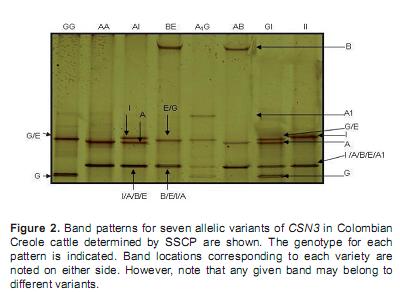
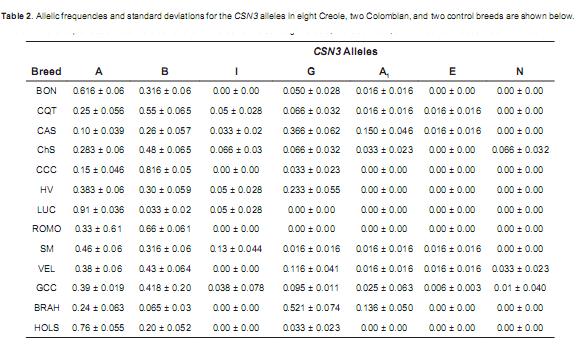
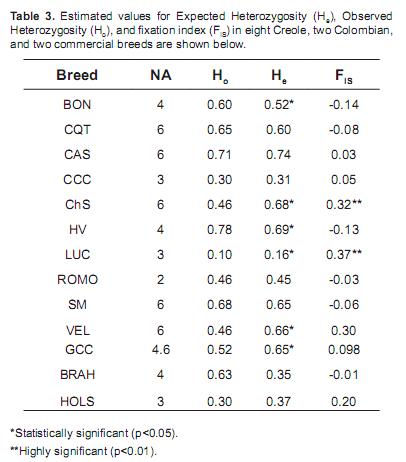
<body><![CDATA[<p><font face="Verdana, Arial, Helvetica, sans-serif" size="2">Seven	mobility	patterns	&#8211;corresponding	to	the	A,    B, A<sub>1</sub>, G, I, and E alleles as well as one allele that    1 could	not	be	identified	(N)&#8211;	were	detected	using	 PCR&#8211;SSCP.	With	the	exception	of	the	N	allele,	 allele	identification	was	verified	through	PCR&#8211; RFLP	and	sequencing.	<a href="#f2">Figure	2</a>	shows	the	detected </font><font face="Verdana, Arial, Helvetica, sans-serif" size="2">mobility	patterns	for	the	<i>CSN3</i> gene belonging to the A, B, A   1 , G, I, and E alleles. </font></p>     <p><font face="Verdana, Arial, Helvetica, sans-serif" size="2"><a href="#t2">Table	2</a>	shows	<i>CSN3</i>	allelic	frequencies	by	 breed.	The	predominant	alleles	in	the	GCC	 population	were	the	B	(0.418	&plusmn;	0.20)	and	the	A	 (0.39	&plusmn;	0.019)	alleles.	Other	alleles	(G,	I,	A<sub>1</sub>, E, and    1   N)	had	low	frequencies	and	represented	only	18%	 of	the	total	frequency.	In	contrast,	the	control	breeds	 had	low	allelic	frequencies	for	B,	with	only	0.20    and 0.065 in the Holstein and the Brahman breeds,  respectively. </font></p>     <p><font face="Verdana, Arial, Helvetica, sans-serif" size="2">The	allele	of	interest	(B)	showed	greater  frequency	in	the	CCC,	ROMO,	CQT,	ChS,	and	VEL	 breeds	than	in	the	BON,	SM,	HV,	and	CAS	breeds.	 The	lowest	B	allele	frequency	was	in	the	LUC	 breed.	Allele	A,	which	was	dominant	in	the	majority	 of	commercial	breeds,	had	a	lower	frequency	in	the	 GCC	breed	(with	the	exception	of	LUC	&#91;0.916	&plusmn;	 0.036&#93;	and	BON	&#91;0.616	&plusmn;	0.063&#93;). </font></p>     <p><font face="Verdana, Arial, Helvetica, sans-serif" size="2">The	I	allele	variant	was	found	in	six	of	the    eight Colombian breeds and had an average value    of	0.038	&plusmn;	0.078.	In	particular,	this	allele	emerged	 in	the	SM	breed	(0.13	&plusmn;	0.044).	The	G	allele	was	 detected	in	eight	breeds	(0.095	&plusmn;	0.01)	and	had	the	 greatest	frequency	in	the	CAS	(0.36	&plusmn;	0.06),	the	 HV	(0.233	&plusmn;	0.055),	and	the	VEL	(0.116	&plusmn;	0.041)	 breeds.	The	A allele	variant	was	identified	in	six	 breeds	(0.025	&plusmn;	0.06),	but	was	most	present	in	the	 CAS	breed	(0.15	&plusmn;	0.046).	The	E	allele	variant	 (0.006	&plusmn;	0.003)	was	found	with	the	same	frequency	 (0.016	&plusmn;	0.016)	in	the	CQT,	the	CAS,	the	SM,	and	 the	VEL	breeds.	The	unidentifiable	variant	(N)	was	 only	present	in	the	ChS	and	the	VEL	breeds.  1</font></p>     <p><font face="Verdana, Arial, Helvetica, sans-serif" size="2">In	the	HOLS	control	breed,	a	greater	proportionof	the	A	allele	variant	was	found	than	the	B	allelevariant.	The	HOLS	control	breed	also	had	a	low	Gallele	frequency.	The	A,	B,	A   , and G allele variants    1 were	detected	in	the	BRAH	control	breed,	of	whichthe	G	allele	was	predominant	(0.52	&plusmn;	0.07).</font></p>     <p align="center"><a name="t2"><img src="/img/revistas/rccp/v25n2/v25n2a02t2.jpg"></a></p>     <p><font face="Verdana, Arial, Helvetica, sans-serif" size="2"><a href="#t3">Table	3</a>	shows	the	number	of	alleles	(NA),	 observed	 heterozygosity	 (H<sub>o</sub>),	 expected	 heterozygosity	(H<sub>e</sub>),	F<sub>is</sub>,	and	the	Hardy	Weinberg	 Equilibrium	(HWE).	The	average	number	of	alleles	 for	the	GCC	breed	was	4.60	&plusmn;	1.57.	A	maximum	of	 six	alleles	were	found	in	the	CQT,	CAS,	ChS,	SM,	 and	VEL	breeds,	and	a	minimum	of	two	alleles	were	 found	in	the	ROMO	breed.</font></p>     <p><font face="Verdana, Arial, Helvetica, sans-serif" size="2">For the GCC breed, the H<sub>e</sub> oscillated between   0.16	and	0.74	and	had	an	average	H<sub>e</sub> of	0.65	 (p&lt;0.05).	The	CAS,	ChS,	HV,	VEL,	and	SM	breeds	 had	the	highest	genetic	diversity	(H<sub>e</sub>),	and	the	LUC	 and	CCC	breeds	had	the	lowest.	The	commercial  breeds all had a low H<sub>e</sub>.	The	HWE	was	not	found	in	 the	BON,	ChS,	HV,	LUC,	and	VEL	breeds.</font></p>     <p><font face="Verdana, Arial, Helvetica, sans-serif" size="2">The	GCC	breed	showed	a	low	global	value	 for	intrapopulational	endogamy	(F<sub>IS</sub>)	that	was	 highly	significant	(F<sub>IS</sub>=0.098,	p&lt;0.01),	and	was	 substantially	different	than	zero	in	the	ChS	and	 LUC	breeds. </font></p>     <p><font face="Verdana, Arial, Helvetica, sans-serif" size="2">The	AMOVA	revealed	that	80%	of	genetic    variance was due to individual variation, while    20%	was	due	to	variation	among	breeds.	The	global value	for	the	coefficient	of	genetic	differentiation	   (F   )	was	0.203	(p&lt;0.01).	This	value	indicated	that	 significant	genetic	differences	were	distinguishable    ST among the studied cattle breeds. </font></p>     ]]></body>
<body><![CDATA[<p align="center"><a name="t3"><img src="/img/revistas/rccp/v25n2/v25n2a02t3.jpg"></a></p>     <p>&nbsp;</p>     <p><font face="Verdana, Arial, Helvetica, sans-serif" size="3"><b>Discussion</b></font></p>     <p><font face="Verdana, Arial, Helvetica, sans-serif" size="2">   According to the Food and Agriculture    Organization	of	the	United	Nations	(FAO,	2007),	 the	inevitable	intensification	of	livestock	systems	 increasingly	depends	upon	the	selection	of	highly	 productive	species.	This	selection	places	less&#8211; productive	but	genetically	valuable	species	at	risk.    As a result, the Colombian Creole SM, ChS, and    CQT	breeds	are	in	a	critical	state,	the	BON,	ROMO,    HV, CCC, and VEL breeds are in a vulnerable state,    and	the	LUC	and	CAS	breeds	are	in	a	threatened    state	(Mart&iacute;nez,	1999;	MADR,	2003).	This	situation	 highlights	the	need	to	evaluate	the	diversity	of	 economically	important	genes	in	order	to	enhance  their value and assure their conservation. </font></p>     <p><font face="Verdana, Arial, Helvetica, sans-serif" size="2">The	alleles	detected	in	this	study	demonstrated	 a	run	pattern	similar	to	that	described	by	Barroso	<i>et al.</i> (1998),	with	the	exception	of	the	unidentified	(N)	 allele.	The	majority	of	studies	using	PCR&#8211;RFLP	only	 identified	the	A	and	B	alleles.	However,	D&iacute;az	<i>et al.</i>    (2006)	found	six	alleles	in	the	HV	breed	and	Ceriotti    <i>et al.</i>	(2004)	found	A,	A   B, and H alleles in the <i>Bos indicus</i> breed and A, B, and E alleles in the <i>Bos taurus</i>,   1      breed.	Likewise,	in	Nari&ntilde;o	province	(Colombia),    Solarte <i>et al.</i>	(2009)	only	detected	A	and	B	alleles	 with	PCR&#8211;SSCP	(1,087	Holstein,	Jersey,	Normande,    Brown Swiss, Simmental, Red Pol, Swedish Red, and  Montbeliard	cattle	and	their	crosses). </font></p>     <p><font face="Verdana, Arial, Helvetica, sans-serif" size="2">According to Prinzenberg <i>et al.</i>	(1999),	the	 PCR&#8211;SSCP	method	may	introduce	genotyping	 errors	because	the	C	allele	can	be	confused	with	 the	B	allele.	Additionally,	the	E,	F,	G,	H,	and	A   1      alleles	can	be	confused	with	the	A	allele.	The	latter	 situation	would	result	in	an	underestimation	of	the	 A	allele,	an	inappropriate	rejection	of	animals,    and increased undesired alleles in animals used    in	industrial	milk	production.	The	degree	of	 polymorphism	detected	in	the	<i>CSN3</i>	gene	confirmed	 that	the	PCR&#8211;SSCP	technique	was	an	efficient	 method	for	identifying	allele	variants,	and	that	the	 sample	size	used	(30	animals)	was	adequate	for	 detecting	the	existing	variability.	The	presence	of    the seven alleles in the <i>CSN3</i> gene demonstrates the  extensive	polymorphism	found	within	the	creole	 breeds.	These	alleles	are	associated	with	a	range	of	 habitats	and	management	and	production	systems.</font></p>     <p><font face="Verdana, Arial, Helvetica, sans-serif" size="2">A	high	B	allele	frequency	is	desirable	in	 industrialized	milk	production	systems.	The	B	allele	 is	related	to	milk	with	high	protein	content,	greater	 freezing&#8211;stability,	higher	cheese	production	(5&#8211;10%),    shorter coagulation time, and more consistent curds    (Van	Eenennaam	and	Medrano,	1990).	It	is	important	 to	highlight	that	the	B	allele	is	predominant	in	the	 GCC	breed	(0.418	&plusmn;	0.20)	and	is	above	55%	in	the	 CCC,	the	ROMO,	and	the	CQT	breeds.	The	low	 frequency	of	the	B	allele	in	the	LUC	breed	is	due	to	 its	genetic	origins	(40%	HOLS,	30%	Shorthorn,	30%	 HV)	and	its	selection	for	achieving	high	milk	yield.	 These	traits	are	related	to	the	<i>CSN3</i> A allele. However,  the	highest	frequencies	of	the	B	allele	were	found	in	 some	meat	producing	breeds	rather	than	milk	or	dual&#8211; purpose	production	breeds.	This	finding	suggests	 a	possible	selection	for	cows	based	on	maternal	 abilities	and	is	expressed	by	the	shorter	standing	time	 for	calves	raised	on	milk	containing	higher	protein.	 For	example,	in	the	HV	breed	milk	contained	3.37%	 protein	and	was	superior	to	that	of	the	Holstein	breed	 milk.	The	composition	was	similar	to	the	Ayrshire	and	 Brown	Swiss	breeds	(Hurtado,	1998).</font></p>     <p><font face="Verdana, Arial, Helvetica, sans-serif" size="2">Creole breeds on the American continent share a common origin with cattle introduced during the    Spanish	conquest	era.	The	average	value	of	the    B allele in the Creole breeds was consistent with    the	values	reported	in	America,	the	Caribbean,	 Cuba	(Uffo	<i>et al.</i>,	2006),	Brazil	(Kemenes	<i>et al.</i>, 1999; Lara <i>et al.</i>,	2002),	Per&uacute;	(Veli	<i>et al.</i>,	2004),    Argentina (Poli <i>et al.</i>, 2002; Lir&oacute;n <i>et al.</i>, 2002;    Mart&iacute;nez	<i>et al.</i>,	2003),	Bolivia	(Lir&oacute;n	<i>et al.</i>,    2002),	and	Uruguay	(Postiglioni	<i>et al.</i>,	2002).	 The	frequency	of	the	B	allele	in	the	Creole	breeds	 was	significantly	higher	(p&lt;0.05)	than	that	of	the	 Holstein	breed	in	Colombian&#8211;like	conditions	(L&oacute;pez    <i>et al.</i>,	1999;	Solarte&#8211;Portilla	<i>et al.</i>, 2009; Vivas    <i>et al.</i>,	2008;	D&iacute;az	<i>et al.</i>,	2006)	and	the	specialized	 breeds	(such	as	the	Holstein,	Guernsey,	Milking	 Shorthorn,	and	Swedish	Red)	from	other	latitudes	 (Van&#8211;Eenennaam	and	Medrano,	1991;	Beja&#8211;Pereira    <i>et al.</i>, 2002; Barreras <i>et al.</i>,	2001;	Tsiaras	<i>et al.</i>, 2005; Caroli <i>et al.</i>,	2004;	Van&#8211;Eenennaam	and    Medrano, 1991; Hall&eacute;n <i>et al.</i>,	2009).	Commercial	 breeds	that	are	selected	for	higher	production	have	 a	lower	proportion	of	the	B	allele.	This	selection	 has	drastically	reduced	the	frequency	of	the	alleles	 that	are	associated	with	milk	quality.	One	method to	overcome	this	problem	is	to	redirect	selection	 schemes	for	specialized	dairy	breeds	(Heck	<i>et al.</i>,  2009).	This	study	demonstrates	that	the	GCC	breed	 may	be	a	sustainable	alternative	for	improving	milk	 quality	in	tropical	climates. </font></p>     <p><font face="Verdana, Arial, Helvetica, sans-serif" size="2">The	frequency	of	the	A	allele	(0.39	&plusmn;	0.019)	 coincided	with	the	reported	range	in	the	Bolivian    Creole breeds (Lir&oacute;n <i>et al.</i>,	2002).	However,	the	 frequency	was	below	that	of	the	breeds	from    Argentina (Poli <i>et al.</i>, 2002; Lir&oacute;n <i>et al.</i>, 2002;  Mart&iacute;nez	<i>et al.</i>,	2003),	Per&uacute;	(Veli	<i>et al.</i>,	2004),	Cuba	 (Uffo	<i>et al.</i>,	2006),	Brazil	(Kemenes	<i>et al.</i>,	1999),	 Africa,	and	Italy	(Ceriotti	<i>et al.</i>,	2004). </font></p>     <p><font face="Verdana, Arial, Helvetica, sans-serif" size="2">The	less	common	G,	I,	A<sub>1</sub>,	E,	and	N	alleles	 represented	18%	of	the	total	frequency,	which    1   demonstrates that the Colombian Creole breeds    maintain	a	high	diversity	in	spite	of	their	small	 population	size.	In	the	HV	breed,	D&iacute;az	<i>et al.</i>,    (2006)	found	that	the	G,	I,	A   , and E alleles    1   represented	22%	of	the	total	frequency.	These	 findings	highlighted	the	importance	of	using	the	 SSCP	technique	to	correctly	identify	<i>CSN3</i> alleles. Although the A and B alleles were dominant in the    GCC	breed,	the	I	allele	was	important	in	the	SM	 breed	(0.13	&plusmn;	0.044),	and	the	G	allele	(listed	as	rare    in <i>B. taurus</i>	&#91;Caroli	<i>et al.</i>,	2009&#93;)	was	abundant	in	 CAS	(0.36),	HV	(0.23),	and	VEL	(0.11)	breeds.    While there is no clear evidence regarding the    impact	of	the	G	allele	on	milk,	Prinzenberg	<i>et al.</i>  (1999)	suggests	that	it	has	a	negative	effect	on	milk	 coagulation	(similar	to	that	of	the	A	allele). </font></p>     ]]></body>
<body><![CDATA[<p><font face="Verdana, Arial, Helvetica, sans-serif" size="2">The	A<sub>1</sub>  allele   was	identified	in	seven	of	the	 twelve	studied	breeds	and	was	most	prominent       in the CAS and BRAH breeds. Prinzenberg and    Erhardt	(1999)	verified	its	specificity	to	zebuine	 cattle	breeds.	Nevertheless,	Barrera	<i>et al.</i>	(2006)	 found	no	genetic	proximity	to	the	BRAH	breed	 using	the	CAS	breed	microsatellite	markers.	The	 VEL	breed	(25%	Red	Brahman)	showed	very    low A<sub>1</sub> allelic	frequency.	In	addition,	the	E	allele	 frequency	was	low	in	the	CQT,	CAS,	SM,	and	VEL	 breeds	(0.016).	The	E	allele	has	been	associated	 with	poor	coagulation	(Ikonen	<i>et al.</i>,	1997;	Hall&eacute;n   <i>et al.</i>,	2007)	and	a	higher	casein	proportion	than	 that	of	the	A	allele	(Heck	<i>et al.</i>,	2009).	The	variant	 (N),	which	could	not	be	identified	using	restriction enzymes	or	sequencing	was	only	found	in	the	 ChS	and	VEL	breeds.	Therefore,	this	band	pattern	 corresponds	to	an	uncharacterized	mutation.	</font></p>     <p><font face="Verdana, Arial, Helvetica, sans-serif" size="2">The	NA	(4.60	&plusmn;	1.57)	was	noticeably	higher	 than	that	reported	for	the	majority	of	breeds	from    the Americas (Lir&oacute;n <i>et al.</i>, 2002; Postiglioni <i>et al.</i>,	2002;	Mart&iacute;nez	<i>et al.</i>,	2003;	Uffo	<i>et al.</i>, 2006, Lara <i>et al.</i>, 2002; Veli <i>et al.</i>,	2004;	Kemenes	<i>et al.</i>,    1999).	This	trend	probably	occurred	because	these	 studies	only	identified	two	alleles.	The	expected	 heterozygosity	(H<sub>e</sub>  =0.65)	was	in	accordance	with	 the	ranges	found	in	the	creole	breeds	from	the     Americas (Lir&oacute;n <i>et al.</i>,	2002;	Mart&iacute;nez	<i>et al.</i>,	2003)	 and	the	native	Portuguese	breeds	(Beja&#8211;Pereira	<i>et al.</i>,	2002),	but	was	considerably	higher	than	the	 estimates	made	for	the	Colombian	Holstein	breeds	 (Solarte&#8211;Portilla	<i>et al.</i>,	2009). </font></p>     <p><font face="Verdana, Arial, Helvetica, sans-serif" size="2">The	high	degree	of	polymorphism	found	in	GCC	 reduces	the	effects	of	genetic	drift	and	inbreeding	 (Harrison	and	Hastings,	1996),	a	process	that	tends	 to	be	common	in	small	populations.	This	process	 brings	about	reduced	biological	performance,	which	 is	 represented	 by	 lower	 survivorship,	 reduced	 reproductive	performance,	low	growth	rates,	and	 difficulty	 in	adapting	 to	environmental	 changes    (Saccheri <i>et al.</i>,	1998).	High	variability	in	the	Creole	 breeds	from	the	Americas	has	been	attributed	to	a	 series	of	causes,	including	low	selection	pressure,	 traditional	 management	 practices,	 introgressive	 hybridization	with	commercial	breeds	(Giovambattista  <i>et al.</i>, 2001; Lir&oacute;n <i>et al.</i>,	2006),	demographic	factors	 caused	by	European	and	African	genes,	and	the	 breadth	of	geographical	origin	(Lir&oacute;n	<i>et al.</i>,	2006).</font></p>     <p><font face="Verdana, Arial, Helvetica, sans-serif" size="2">The	F<sub>ST</sub> value	and	exact	test	used	to	analyze	the	 degree	of	genetic	differentiation	among	the	studied	 Creole	 breeds	 showed	 significant	 differences	 between	the	GCC	breeds.	However,	intrapopulational	 endogamy	estimated	by	F<sub>is</sub> was	not	significant.  </font></p>     <p><font face="Verdana, Arial, Helvetica, sans-serif" size="2">In	conclusion,	a	high	degree	of	diversity	for	the    <i>CSN3</i> locus	was	found	in	the	Colombian	Creole	 Breeds.	In	addition,	a	high	<i>CSN3</i>	B	allele	frequency	 (related	to	milk	quality)	was	found.	A	significant	 percentage	was	also	found	for	other	alleles,	which	 emphasizes	the	importance	of	conserving	the	 Creole	breeds.	These	breeds	contain	a	diverse allele	reservoir.	Accordingly,	they	represent	an	 opportunity	for	developing	production	alternatives	 that avoid genetic erosion. </font></p>     <p>&nbsp;</p>     <p><font face="Verdana, Arial, Helvetica, sans-serif" size="3"><b>Acknowledgements</b></font></p>     <p><font face="Verdana, Arial, Helvetica, sans-serif" size="2">   Financing	was	made	possible	by	the	National	 University	of	Colombia&#8211;Palmira	Campus	Office	of	 Research	(DIPAL)	(Project	20101100727).	In	addition,	 we	acknowledge	 the	 Colombian	 Creole	 Cattle    breeders, including Marino Valderrama and Eduaime  C&aacute;rdenas	(Hart&oacute;n	del	Valle),	Juan	Manuel	Gonz&aacute;les	 and	Julia	Arias	(BON),	Rafael	Torrijos	and	Francisco	 Ram&oacute;n	 (CQT),	 Germ&aacute;n	 Mart&iacute;nez	 (SM),	 Luis	 Fernando	Cala	(ChS),	Arturo	Cabrera	(CCC),	Rodrigo	 Salas	(ROMO),	Jos&eacute;	Antonio	Vel&aacute;squez	(VEL),	and	 Pablo	Canay	and	Arcesio	Salamanca	(CAS).</font></p>     <p>&nbsp;</p>     <p><font face="Verdana, Arial, Helvetica, sans-serif" size="3"><b>References  </b></font></p>     ]]></body>
<body><![CDATA[<!-- ref --><p><font face="Verdana, Arial, Helvetica, sans-serif" size="2">1. Alexander	LJ,	Stewart	AF,	Mackinlay	AG,	Kapelinskaya	TV,	 Tkach	TM,	Gorodetsky	SI.	Isolation	and	characterization	of	the	 bovine	Kappa&#8211;Casein	gene.	Eur	J	Biochem	1988;	178:395&#8211;401. </font>&nbsp;&nbsp;&nbsp;&nbsp;&nbsp;&nbsp;&nbsp;&nbsp;[&#160;<a href="javascript:void(0);" onclick="javascript: window.open('/scielo.php?script=sci_nlinks&ref=000083&pid=S0120-0690201200020000200001&lng=','','width=640,height=500,resizable=yes,scrollbars=1,menubar=yes,');">Links</a>&#160;]<!-- end-ref --><!-- ref --><p><font face="Verdana, Arial, Helvetica, sans-serif" size="2">2. Asocriollo.	Creole	and	Colombian	Breed	Association.	National	 Union	of	Colombian	Livestock	Associations.	2007;	&#91;Access	 date:	June	2011&#93;	URL:	<a href="http://www.unaga.org.co/es/" target="_blank">http://www.unaga.org.co/index.htm</a></font>&nbsp;&nbsp;&nbsp;&nbsp;&nbsp;&nbsp;&nbsp;&nbsp;[&#160;<a href="javascript:void(0);" onclick="javascript: window.open('/scielo.php?script=sci_nlinks&ref=000084&pid=S0120-0690201200020000200002&lng=','','width=640,height=500,resizable=yes,scrollbars=1,menubar=yes,');">Links</a>&#160;]<!-- end-ref --><!-- ref --><p><font face="Verdana, Arial, Helvetica, sans-serif" size="2">3. Barrera	G,	Mart&iacute;nez	R,	P&eacute;rez	JE,	Herazo	T.	<i>Bos taurus</i>  Mitochondrial	DNA	identification	in	Zebu	cattle	populations.	 Corpoica	Journal.	2006;	7:5&#8211;11. </font>&nbsp;&nbsp;&nbsp;&nbsp;&nbsp;&nbsp;&nbsp;&nbsp;[&#160;<a href="javascript:void(0);" onclick="javascript: window.open('/scielo.php?script=sci_nlinks&ref=000085&pid=S0120-0690201200020000200003&lng=','','width=640,height=500,resizable=yes,scrollbars=1,menubar=yes,');">Links</a>&#160;]<!-- end-ref --><!-- ref --><p><font face="Verdana, Arial, Helvetica, sans-serif" size="2">4. Barreras	A,	Robinson	O,	Monge	FJ,	Vizcarra	O,	Navarro	LH.	 Effects	of	genotypes	of	casein	and	serum	proteins	on	milk	 production	in	Holsteins.	Proceeding,	Western	Section.	A	Soc	of	 Anim	Sci	2001;	&#91;Access	date:	June	2011&#93;	URL:	<a href="http://www.asas.org/.../Abstract%2011,%202001%20WSASAS,%20" target="_blank">http://www.asas.org/.../Abstract%2011,%202001%20WSASAS,%20</a></font>&nbsp;&nbsp;&nbsp;&nbsp;&nbsp;&nbsp;&nbsp;&nbsp;[&#160;<a href="javascript:void(0);" onclick="javascript: window.open('/scielo.php?script=sci_nlinks&ref=000086&pid=S0120-0690201200020000200004&lng=','','width=640,height=500,resizable=yes,scrollbars=1,menubar=yes,');">Links</a>&#160;]<!-- end-ref --><!-- ref --><p><font face="Verdana, Arial, Helvetica, sans-serif" size="2">5. Barroso	A,	Dunner	S,	Ca&ntilde;on	J.	Technical	note:	Detection	 of	bovine	kappa&#8211;casein	variants	A,	B,	C	and	E	by	means	 of	polymerase	chain	reaction	single	strand	conformation	 polymorphism	(PCR&#8211;SSCP).	J	Anim	Sci	1998;	76:1535&#8211;1538. </font>&nbsp;&nbsp;&nbsp;&nbsp;&nbsp;&nbsp;&nbsp;&nbsp;[&#160;<a href="javascript:void(0);" onclick="javascript: window.open('/scielo.php?script=sci_nlinks&ref=000087&pid=S0120-0690201200020000200005&lng=','','width=640,height=500,resizable=yes,scrollbars=1,menubar=yes,');">Links</a>&#160;]<!-- end-ref --><!-- ref --><p><font face="Verdana, Arial, Helvetica, sans-serif" size="2">6. Beja&#8211;Pereira	A,	Erhardt	G,	Matos	C,	Gama	L,	Ferrand	N.	 Evidence	for	a	geographical	cline	of	casein	haplotypes	in	 Portuguese	cattle	breeds.	Anim	Genet	2002;	33:295&#8211;300. </font>&nbsp;&nbsp;&nbsp;&nbsp;&nbsp;&nbsp;&nbsp;&nbsp;[&#160;<a href="javascript:void(0);" onclick="javascript: window.open('/scielo.php?script=sci_nlinks&ref=000088&pid=S0120-0690201200020000200006&lng=','','width=640,height=500,resizable=yes,scrollbars=1,menubar=yes,');">Links</a>&#160;]<!-- end-ref --><!-- ref --><p><font face="Verdana, Arial, Helvetica, sans-serif" size="2">7. Braunschweig	M,	Hagger	C,	Stranzinger	G,	Puhan	Z.	 Associations	between	casein	haplotypes	and	milk	production	 traits	of	Swiss	Brown	cattle.	J	Dairy	Sci	2000;	76:1387&#8211;1395.  </font>&nbsp;&nbsp;&nbsp;&nbsp;&nbsp;&nbsp;&nbsp;&nbsp;[&#160;<a href="javascript:void(0);" onclick="javascript: window.open('/scielo.php?script=sci_nlinks&ref=000089&pid=S0120-0690201200020000200007&lng=','','width=640,height=500,resizable=yes,scrollbars=1,menubar=yes,');">Links</a>&#160;]<!-- end-ref --><!-- ref --><p><font face="Verdana, Arial, Helvetica, sans-serif" size="2">8. Caroli A, Chessa S, Bolla P, Budelli E, Gandini G. Genetic    structure	of	milk	protein	polymorphism	and	effects	on	milk	 production	traits	in	local	dairy	cattle.	J	Anim	Breed	Genet	2004;	 121:141&#8211;142. </font>&nbsp;&nbsp;&nbsp;&nbsp;&nbsp;&nbsp;&nbsp;&nbsp;[&#160;<a href="javascript:void(0);" onclick="javascript: window.open('/scielo.php?script=sci_nlinks&ref=000090&pid=S0120-0690201200020000200008&lng=','','width=640,height=500,resizable=yes,scrollbars=1,menubar=yes,');">Links</a>&#160;]<!-- end-ref --><!-- ref --><p><font face="Verdana, Arial, Helvetica, sans-serif" size="2">9. Caroli	AM,	Chessa	S,	Erhardt	GJ.	Invited	review:	milk	protein	 polymorphisms	in	cattle:	Effect	on	animal	breeding	and	human	 nutrition.	J	Dairy	Sci	2009;	92:5335&#8211;5352. </font>&nbsp;&nbsp;&nbsp;&nbsp;&nbsp;&nbsp;&nbsp;&nbsp;[&#160;<a href="javascript:void(0);" onclick="javascript: window.open('/scielo.php?script=sci_nlinks&ref=000091&pid=S0120-0690201200020000200009&lng=','','width=640,height=500,resizable=yes,scrollbars=1,menubar=yes,');">Links</a>&#160;]<!-- end-ref --><!-- ref --><p><font face="Verdana, Arial, Helvetica, sans-serif" size="2">10. Casas I, Valderrama M. Hart&oacute;n del Valle Creole cattle.    Informational	Bulletin.	Asohart&oacute;n.	National	University	of	 Colombia.	Palmira	1998;	p.54. </font>&nbsp;&nbsp;&nbsp;&nbsp;&nbsp;&nbsp;&nbsp;&nbsp;[&#160;<a href="javascript:void(0);" onclick="javascript: window.open('/scielo.php?script=sci_nlinks&ref=000092&pid=S0120-0690201200020000200010&lng=','','width=640,height=500,resizable=yes,scrollbars=1,menubar=yes,');">Links</a>&#160;]<!-- end-ref --><!-- ref --><p><font face="Verdana, Arial, Helvetica, sans-serif" size="2">11. Ceriotti	G,	Marletta	D,	Caroli	A,	Erhardt	G.	Milk	protein	loci	 polymorphism	in	taurine	(<i>Bos taurus</i>)	and	zebu	(<i>Bos indicus</i>)	 populations	bred	in	hot	climate.	J	Anim	Breed	Genet	2004;	 121:404&#8211;415. </font>&nbsp;&nbsp;&nbsp;&nbsp;&nbsp;&nbsp;&nbsp;&nbsp;[&#160;<a href="javascript:void(0);" onclick="javascript: window.open('/scielo.php?script=sci_nlinks&ref=000093&pid=S0120-0690201200020000200011&lng=','','width=640,height=500,resizable=yes,scrollbars=1,menubar=yes,');">Links</a>&#160;]<!-- end-ref --><!-- ref --><p><font face="Verdana, Arial, Helvetica, sans-serif" size="2">12. Colombian	Corporation	for	Livestock	Research&#8211;	Corpoica	and    Asocriollo. Colombian Creole Breeds; 2006. </font>&nbsp;&nbsp;&nbsp;&nbsp;&nbsp;&nbsp;&nbsp;&nbsp;[&#160;<a href="javascript:void(0);" onclick="javascript: window.open('/scielo.php?script=sci_nlinks&ref=000094&pid=S0120-0690201200020000200012&lng=','','width=640,height=500,resizable=yes,scrollbars=1,menubar=yes,');">Links</a>&#160;]<!-- end-ref --><!-- ref --><p><font face="Verdana, Arial, Helvetica, sans-serif" size="2">13. D&iacute;az	HA,	&Aacute;lvarez	LA,	Mu&ntilde;oz	JE,	Posso	A,	Sanabria	HL.	 Genetic	variability	of	milk	proteins	(k&#8211;Casein,	&#946;&#8211;Lactoglobulin	 and	&#945;&#8211;Lactoalbumin)	in	''Hart&oacute;n	Del	Valle''	Creole	cattle.	 Proceedings	of	the	30th	International	Conference	on	Animal Genetics. Porto Seguro, Brazil. Belo Horizonte, Brazil  2006;	&#91;Access	date:	June	2011&#93;	URL:	<a href="http://www.isag.us/Docs/2006ISAG_Proceedings.pdf" target="_blank">http://www.isag.us/Docs/2006ISAG_Proceedings.pdf</a></font>&nbsp;&nbsp;&nbsp;&nbsp;&nbsp;&nbsp;&nbsp;&nbsp;[&#160;<a href="javascript:void(0);" onclick="javascript: window.open('/scielo.php?script=sci_nlinks&ref=000095&pid=S0120-0690201200020000200013&lng=','','width=640,height=500,resizable=yes,scrollbars=1,menubar=yes,');">Links</a>&#160;]<!-- end-ref --><!-- ref --><p><font face="Verdana, Arial, Helvetica, sans-serif" size="2">14. Excoffier	L,	Laval	G,	Schneider	S.	Arlequin	Version	3.1:	An	 Integrated	Software	Package	for	Population	Genetics	Data	 Analysis.	Arlequin	User	Manual.	2006.  </font>&nbsp;&nbsp;&nbsp;&nbsp;&nbsp;&nbsp;&nbsp;&nbsp;[&#160;<a href="javascript:void(0);" onclick="javascript: window.open('/scielo.php?script=sci_nlinks&ref=000096&pid=S0120-0690201200020000200014&lng=','','width=640,height=500,resizable=yes,scrollbars=1,menubar=yes,');">Links</a>&#160;]<!-- end-ref --><!-- ref --><p><font face="Verdana, Arial, Helvetica, sans-serif" size="2">15. FAO.	Global	Plan	of	Action	for	Animal	Genetic	Resources	and	 the	Interlaken	Declaration.	2007;	&#91;Access	Date:	June	2011&#93;	 URL:	<a href="http://www.fao.org/docrep/010/a1404e/a1404e00.HTM" target="_blank">http://www.fao.org/docrep/010/a1404e/a1404e00.HTM</a>. </font>&nbsp;&nbsp;&nbsp;&nbsp;&nbsp;&nbsp;&nbsp;&nbsp;[&#160;<a href="javascript:void(0);" onclick="javascript: window.open('/scielo.php?script=sci_nlinks&ref=000097&pid=S0120-0690201200020000200015&lng=','','width=640,height=500,resizable=yes,scrollbars=1,menubar=yes,');">Links</a>&#160;]<!-- end-ref --><!-- ref --><p><font face="Verdana, Arial, Helvetica, sans-serif" size="2">16. Fox	PF,	Brodkorb	A.	The	casein	micelle:	Historical	aspects,	 current	concepts	and	significance.	Review.	Int	Dairy	J	2008;	 18:677&#8211;684. </font>&nbsp;&nbsp;&nbsp;&nbsp;&nbsp;&nbsp;&nbsp;&nbsp;[&#160;<a href="javascript:void(0);" onclick="javascript: window.open('/scielo.php?script=sci_nlinks&ref=000098&pid=S0120-0690201200020000200016&lng=','','width=640,height=500,resizable=yes,scrollbars=1,menubar=yes,');">Links</a>&#160;]<!-- end-ref --><!-- ref --><p><font face="Verdana, Arial, Helvetica, sans-serif" size="2">17. Guo	S,	Thompson	E.	Performing	the	exact	test	of	Hardy&#8211; Weinberg	proportion	for	multiple	alleles.	Biometrics	1992;	 48:361&#8211;372.  </font>&nbsp;&nbsp;&nbsp;&nbsp;&nbsp;&nbsp;&nbsp;&nbsp;[&#160;<a href="javascript:void(0);" onclick="javascript: window.open('/scielo.php?script=sci_nlinks&ref=000099&pid=S0120-0690201200020000200017&lng=','','width=640,height=500,resizable=yes,scrollbars=1,menubar=yes,');">Links</a>&#160;]<!-- end-ref --><!-- ref --><p><font face="Verdana, Arial, Helvetica, sans-serif" size="2">18. Hall&eacute;n	E,	Allmere	T,	N&auml;slund	J,	Andr&eacute;n	A,	Lund&eacute;n	A.	Effect	 of	genetic	polymorphism	of	milk	proteins	on	rheology	of	 chymosin&#8211;induced	milk	gels.	Int	Dairy	J	2007;	17:791&#8211;799. </font>&nbsp;&nbsp;&nbsp;&nbsp;&nbsp;&nbsp;&nbsp;&nbsp;[&#160;<a href="javascript:void(0);" onclick="javascript: window.open('/scielo.php?script=sci_nlinks&ref=000100&pid=S0120-0690201200020000200018&lng=','','width=640,height=500,resizable=yes,scrollbars=1,menubar=yes,');">Links</a>&#160;]<!-- end-ref --><!-- ref --><p><font face="Verdana, Arial, Helvetica, sans-serif" size="2">19. Hall&eacute;n	E,	Allmere	T,	Lunden	A,	Andren	A.	Effect	of	genetic	 polymorphism	of	milk	proteins	on	rheology	of	acid&#8211;induced	 milk	gels.	Int	Dairy	J	2009;	19:399&#8211;404.  </font>&nbsp;&nbsp;&nbsp;&nbsp;&nbsp;&nbsp;&nbsp;&nbsp;[&#160;<a href="javascript:void(0);" onclick="javascript: window.open('/scielo.php?script=sci_nlinks&ref=000101&pid=S0120-0690201200020000200019&lng=','','width=640,height=500,resizable=yes,scrollbars=1,menubar=yes,');">Links</a>&#160;]<!-- end-ref --><!-- ref --><p><font face="Verdana, Arial, Helvetica, sans-serif" size="2">20. Harrison	S,	Hastings	A.	Genetic	and	evolutionary	consequences	 of	a	metapopulation	structure.	Trends	Ecol	Evol	1996;	11:180&#8211; 183. </font>&nbsp;&nbsp;&nbsp;&nbsp;&nbsp;&nbsp;&nbsp;&nbsp;[&#160;<a href="javascript:void(0);" onclick="javascript: window.open('/scielo.php?script=sci_nlinks&ref=000102&pid=S0120-0690201200020000200020&lng=','','width=640,height=500,resizable=yes,scrollbars=1,menubar=yes,');">Links</a>&#160;]<!-- end-ref --><!-- ref --><p><font face="Verdana, Arial, Helvetica, sans-serif" size="2">21. Heck	JM,	Schennink	A,	Van	Valenberg	HJ,	Bovenhuis	H,	Visker	 MH,	Van	Arendonk	JA,	Van	Hooijdonk	AC.	Effects	of	milk	 protein	variants	on	the	protein	composition	of	bovine	milk.	J	 Dairy	Sci	2009;	92:1192&#8211;1202. </font>&nbsp;&nbsp;&nbsp;&nbsp;&nbsp;&nbsp;&nbsp;&nbsp;[&#160;<a href="javascript:void(0);" onclick="javascript: window.open('/scielo.php?script=sci_nlinks&ref=000103&pid=S0120-0690201200020000200021&lng=','','width=640,height=500,resizable=yes,scrollbars=1,menubar=yes,');">Links</a>&#160;]<!-- end-ref --><!-- ref --><p><font face="Verdana, Arial, Helvetica, sans-serif" size="2">22. Hijmans	RJ,	Guarino	L,	Bussink	C,	Jarvis	A,	O'Brien	R,	 Mathur	P,	Cruz	M,	Barrantes	I,	Rojas	E.	DIVA&#8211;GIS,	User  Manual; 2005. </font>&nbsp;&nbsp;&nbsp;&nbsp;&nbsp;&nbsp;&nbsp;&nbsp;[&#160;<a href="javascript:void(0);" onclick="javascript: window.open('/scielo.php?script=sci_nlinks&ref=000104&pid=S0120-0690201200020000200022&lng=','','width=640,height=500,resizable=yes,scrollbars=1,menubar=yes,');">Links</a>&#160;]<!-- end-ref --><!-- ref --><p><font face="Verdana, Arial, Helvetica, sans-serif" size="2">23. Hurtado	GM.	Physical&#8211;Chemical	characterization	of	Hart&oacute;n	 del	Valle	Creole	cattle	in	two	different	herds	in	Cauca	Valley.	 Directed	study.	National	University	of	Colombia,	Palmira	 Campus	1998;	121	p.</font>&nbsp;&nbsp;&nbsp;&nbsp;&nbsp;&nbsp;&nbsp;&nbsp;[&#160;<a href="javascript:void(0);" onclick="javascript: window.open('/scielo.php?script=sci_nlinks&ref=000105&pid=S0120-0690201200020000200023&lng=','','width=640,height=500,resizable=yes,scrollbars=1,menubar=yes,');">Links</a>&#160;]<!-- end-ref --><!-- ref --><p><font face="Verdana, Arial, Helvetica, sans-serif" size="2"> 24. Ikonen	T,	Ojala	M,	Syvaoja	EL.	Effects	of	composite	casein	 and	beta&#8211;lactoglobulin	genotypes	on	renneting	properties	and	 composition	of	bovine	milk	by	assuming	an	animal	model.	Agri	 Food	Sci	1997;	6:283&#8211;294.</font>&nbsp;&nbsp;&nbsp;&nbsp;&nbsp;&nbsp;&nbsp;&nbsp;[&#160;<a href="javascript:void(0);" onclick="javascript: window.open('/scielo.php?script=sci_nlinks&ref=000106&pid=S0120-0690201200020000200024&lng=','','width=640,height=500,resizable=yes,scrollbars=1,menubar=yes,');">Links</a>&#160;]<!-- end-ref --><!-- ref --><p><font face="Verdana, Arial, Helvetica, sans-serif" size="2">25. Kemenes	PA,	De	Almeida	RL,	De	Magalhaes	RA,	Packer	IU,Razook	AG,	De	Figuereido	LA,	Silva	NA,	Etchegaray	MAL,Coutinho	LL.	k&#8211;casein;	&#946;&#8211;lactoglobulin	and	growth	hormoneallele	frequencies	and	genetic	distance	in	Nelore,	Gyr,	Guzera,   Caracu, Charolais, Canchim and Santa Gertrudis Cattle. Genet  Mol	Biol	1999;	22:539&#8211;541. </font>&nbsp;&nbsp;&nbsp;&nbsp;&nbsp;&nbsp;&nbsp;&nbsp;[&#160;<a href="javascript:void(0);" onclick="javascript: window.open('/scielo.php?script=sci_nlinks&ref=000107&pid=S0120-0690201200020000200025&lng=','','width=640,height=500,resizable=yes,scrollbars=1,menubar=yes,');">Links</a>&#160;]<!-- end-ref --><!-- ref --><p><font face="Verdana, Arial, Helvetica, sans-serif" size="2">26. Lara	MAC,	Gama	LT,	Bufarah	G,	Sereno	JRB,	Celegato	EML, De	Abreu	UP.	Genetic	Polymorphism	at	the	K&#8211;Casein	Locus	inPantaneiro	cattle.	Arch	Zootec	2002;	51:99&#8211;105. </font>&nbsp;&nbsp;&nbsp;&nbsp;&nbsp;&nbsp;&nbsp;&nbsp;[&#160;<a href="javascript:void(0);" onclick="javascript: window.open('/scielo.php?script=sci_nlinks&ref=000108&pid=S0120-0690201200020000200026&lng=','','width=640,height=500,resizable=yes,scrollbars=1,menubar=yes,');">Links</a>&#160;]<!-- end-ref --><!-- ref --><p><font face="Verdana, Arial, Helvetica, sans-serif" size="2">27. Lir&oacute;n	 JP,	 Ripoli	 MV,	 De	 Luca	 JC,	 Peral&#8211;Garcia	 PGiovambattista	G.	Analysis	of	genetic	diversity	and	populationstructure	in	Argentine	and	Bolivian	Creole	cattle	using	five	locirelated	to	milk	production.	Genet	Mol	Biol	2002;	24:413&#8211;419.  </font>&nbsp;&nbsp;&nbsp;&nbsp;&nbsp;&nbsp;&nbsp;&nbsp;[&#160;<a href="javascript:void(0);" onclick="javascript: window.open('/scielo.php?script=sci_nlinks&ref=000109&pid=S0120-0690201200020000200027&lng=','','width=640,height=500,resizable=yes,scrollbars=1,menubar=yes,');">Links</a>&#160;]<!-- end-ref --><!-- ref --><p><font face="Verdana, Arial, Helvetica, sans-serif" size="2">28. L&oacute;pez	M,	Hern&aacute;ndez	V,	Estrada	L.	Correlation	amonghaplotypes	for	k&#8211;casein	and	milk&#8211;production	characteristics	inHolstein	Cattle.	Colombia	Journal	of	Biotechnology	1999;	2:16&#8211;   20. </font>&nbsp;&nbsp;&nbsp;&nbsp;&nbsp;&nbsp;&nbsp;&nbsp;[&#160;<a href="javascript:void(0);" onclick="javascript: window.open('/scielo.php?script=sci_nlinks&ref=000110&pid=S0120-0690201200020000200028&lng=','','width=640,height=500,resizable=yes,scrollbars=1,menubar=yes,');">Links</a>&#160;]<!-- end-ref --><!-- ref --><p><font face="Verdana, Arial, Helvetica, sans-serif" size="2">29. L&oacute;pez	A,	Saldarriaga	OA,	Arango	AE,	Rugeles	MT,	ZuluagaFN,	Olivera	M,	Berm&uacute;dez	N,	Bedoya	G,	Ossa	JE.	BlancoOrejinegro	(BON)	Cattle:	An	alternative	for	Colombianproduction.	Colombia	Journal	of	Livestock	Science	2001;14:121&#8211;128. </font>&nbsp;&nbsp;&nbsp;&nbsp;&nbsp;&nbsp;&nbsp;&nbsp;[&#160;<a href="javascript:void(0);" onclick="javascript: window.open('/scielo.php?script=sci_nlinks&ref=000111&pid=S0120-0690201200020000200029&lng=','','width=640,height=500,resizable=yes,scrollbars=1,menubar=yes,');">Links</a>&#160;]<!-- end-ref --><!-- ref --><p><font face="Verdana, Arial, Helvetica, sans-serif" size="2">30. Lund&eacute;n	A,	Nilsson	M,	Janson	L.	Marked	effect	of &#946;&#8211;lactoglobulin	polymorphism	on	the	ratio	of	casein	to	totalprotein	in	milk.	J	Dairy	Sci	1997;	80:	2996-3005. </font>&nbsp;&nbsp;&nbsp;&nbsp;&nbsp;&nbsp;&nbsp;&nbsp;[&#160;<a href="javascript:void(0);" onclick="javascript: window.open('/scielo.php?script=sci_nlinks&ref=000112&pid=S0120-0690201200020000200030&lng=','','width=640,height=500,resizable=yes,scrollbars=1,menubar=yes,');">Links</a>&#160;]<!-- end-ref --><!-- ref --><p><font face="Verdana, Arial, Helvetica, sans-serif" size="2">31. MADR&#8211;Ministry	of	Agriculture	and	Rural	Development.	Thestate	of	zoogenetic	resources	in	Colombia.	ICA,	CORPOICA,UN,	 ACP,	 FENAVI,	 FAO,	 ASOCRIOLLO,	 UNAGA,FEDEGAN,	INPA	2003. </font>&nbsp;&nbsp;&nbsp;&nbsp;&nbsp;&nbsp;&nbsp;&nbsp;[&#160;<a href="javascript:void(0);" onclick="javascript: window.open('/scielo.php?script=sci_nlinks&ref=000113&pid=S0120-0690201200020000200031&lng=','','width=640,height=500,resizable=yes,scrollbars=1,menubar=yes,');">Links</a>&#160;]<!-- end-ref --><!-- ref --><p><font face="Verdana, Arial, Helvetica, sans-serif" size="2">32. Mart&iacute;nez	G.	Romosinuano	(Romo)	Creole	Cattle.	ColombianLivestock	Institute.	ICA.	AGRI	1998;	24:1&#8211;11. </font>&nbsp;&nbsp;&nbsp;&nbsp;&nbsp;&nbsp;&nbsp;&nbsp;[&#160;<a href="javascript:void(0);" onclick="javascript: window.open('/scielo.php?script=sci_nlinks&ref=000114&pid=S0120-0690201200020000200032&lng=','','width=640,height=500,resizable=yes,scrollbars=1,menubar=yes,');">Links</a>&#160;]<!-- end-ref --><!-- ref --><p><font face="Verdana, Arial, Helvetica, sans-serif" size="2">33. Mart&iacute;nez	G.	Seminario:	Census	and	characterization	ofColombian	and	Creole	cattle	production	systems.	FEDEGAN,ICA,	PRONATTA	and	ASOBON;	1999.  </font>&nbsp;&nbsp;&nbsp;&nbsp;&nbsp;&nbsp;&nbsp;&nbsp;[&#160;<a href="javascript:void(0);" onclick="javascript: window.open('/scielo.php?script=sci_nlinks&ref=000115&pid=S0120-0690201200020000200033&lng=','','width=640,height=500,resizable=yes,scrollbars=1,menubar=yes,');">Links</a>&#160;]<!-- end-ref --><!-- ref --><p><font face="Verdana, Arial, Helvetica, sans-serif" size="2">34. Mart&iacute;nez	G,	Gonz&aacute;lez	HF.	Sanmartinero	(SM)	Creole	cattle	andtheir	productive	potential.	AGRI	2000;	28:7&#8211;17. </font>&nbsp;&nbsp;&nbsp;&nbsp;&nbsp;&nbsp;&nbsp;&nbsp;[&#160;<a href="javascript:void(0);" onclick="javascript: window.open('/scielo.php?script=sci_nlinks&ref=000116&pid=S0120-0690201200020000200034&lng=','','width=640,height=500,resizable=yes,scrollbars=1,menubar=yes,');">Links</a>&#160;]<!-- end-ref --><!-- ref --><p><font face="Verdana, Arial, Helvetica, sans-serif" size="2">35. Mart&iacute;nez	 G.	 National	 action	 plan	 for	 conservation,improvement,	and	sustainable	use	of	Colombian	animal	geneticresources.	FAO&#8211;	MADR;	2010. </font>&nbsp;&nbsp;&nbsp;&nbsp;&nbsp;&nbsp;&nbsp;&nbsp;[&#160;<a href="javascript:void(0);" onclick="javascript: window.open('/scielo.php?script=sci_nlinks&ref=000117&pid=S0120-0690201200020000200035&lng=','','width=640,height=500,resizable=yes,scrollbars=1,menubar=yes,');">Links</a>&#160;]<!-- end-ref --><!-- ref --><p><font face="Verdana, Arial, Helvetica, sans-serif" size="2">36. Martinez	RD,	Giovambattista	G,	Ripoli	MV,	De	Luca	JC,Dulout	FN.	Patagonian	Argentine	Creole	cattle	polymorphism:comparison	with	North&#8211;West	populations	of	this	breed.	Res	VetSci	2003;	74:287&#8211;290.</font>&nbsp;&nbsp;&nbsp;&nbsp;&nbsp;&nbsp;&nbsp;&nbsp;[&#160;<a href="javascript:void(0);" onclick="javascript: window.open('/scielo.php?script=sci_nlinks&ref=000118&pid=S0120-0690201200020000200036&lng=','','width=640,height=500,resizable=yes,scrollbars=1,menubar=yes,');">Links</a>&#160;]<!-- end-ref --><!-- ref --><p><font face="Verdana, Arial, Helvetica, sans-serif" size="2"> 37. Miller	SA,	Dykes	DD,	Polesky	HF.	A	simple	salting	outprocedure	for	extracting	DNA	from	human	nucleated	cells.Nucleic	Acids	Res	1988;	11:1215.</font>&nbsp;&nbsp;&nbsp;&nbsp;&nbsp;&nbsp;&nbsp;&nbsp;[&#160;<a href="javascript:void(0);" onclick="javascript: window.open('/scielo.php?script=sci_nlinks&ref=000119&pid=S0120-0690201200020000200037&lng=','','width=640,height=500,resizable=yes,scrollbars=1,menubar=yes,');">Links</a>&#160;]<!-- end-ref --><!-- ref --><p><font face="Verdana, Arial, Helvetica, sans-serif" size="2">38. Naranjo	J,	Posso	A,	C&aacute;rdenas	H,	Mu&ntilde;oz	J.	Detection	of	kappa&#8211;   casein allelic variants in Hart&oacute;n del Valle Cattle. Acta Agron  2007;	56:43&#8211;47. </font>&nbsp;&nbsp;&nbsp;&nbsp;&nbsp;&nbsp;&nbsp;&nbsp;[&#160;<a href="javascript:void(0);" onclick="javascript: window.open('/scielo.php?script=sci_nlinks&ref=000120&pid=S0120-0690201200020000200038&lng=','','width=640,height=500,resizable=yes,scrollbars=1,menubar=yes,');">Links</a>&#160;]<!-- end-ref --><!-- ref --><p><font face="Verdana, Arial, Helvetica, sans-serif" size="2">39. Pinz&oacute;n	E.	History	of	Colombian	cattle.	(Colombia):	Livestock  Bank;	1991;	8:1.</font>&nbsp;&nbsp;&nbsp;&nbsp;&nbsp;&nbsp;&nbsp;&nbsp;[&#160;<a href="javascript:void(0);" onclick="javascript: window.open('/scielo.php?script=sci_nlinks&ref=000121&pid=S0120-0690201200020000200039&lng=','','width=640,height=500,resizable=yes,scrollbars=1,menubar=yes,');">Links</a>&#160;]<!-- end-ref --><!-- ref --><p><font face="Verdana, Arial, Helvetica, sans-serif" size="2">40. Poli	MA,	Holgado	F,	Rabasa	AE.	Genotype	and	allelic	 frequencies	for	casein	k	and	lactoglobulin	B	genes	in	an	 Argentinean	 Creole	 cattle	 rodeo.	 Third	 Iberoamerican	 Symposium	on	the	conservation	of	local	animal	genetics	and	 rural	development.	School	of	Veterinary	Science&#8211;UDELAR	 2002;	p.12. </font>&nbsp;&nbsp;&nbsp;&nbsp;&nbsp;&nbsp;&nbsp;&nbsp;[&#160;<a href="javascript:void(0);" onclick="javascript: window.open('/scielo.php?script=sci_nlinks&ref=000122&pid=S0120-0690201200020000200040&lng=','','width=640,height=500,resizable=yes,scrollbars=1,menubar=yes,');">Links</a>&#160;]<!-- end-ref --><!-- ref --><p><font face="Verdana, Arial, Helvetica, sans-serif" size="2">41. Postiglioni	AG,	Rinc&oacute;n	L,	Kelly	S,	Llamb&iacute;	G,	Fern&aacute;ndez	M,	 Angelo	G,	Gagliardi	J,	Trujillo	M,	De	Bethencourt	K,	Guevara	 A,	Castellano	Y,	Arruga	MV.	Genetic	biodiversity	in	Uruguayan	 Creole	cattle.	Molecular	marker	analysis.	Zootechnology	 Archives	2002;	51:195&#8211;202. </font>&nbsp;&nbsp;&nbsp;&nbsp;&nbsp;&nbsp;&nbsp;&nbsp;[&#160;<a href="javascript:void(0);" onclick="javascript: window.open('/scielo.php?script=sci_nlinks&ref=000123&pid=S0120-0690201200020000200041&lng=','','width=640,height=500,resizable=yes,scrollbars=1,menubar=yes,');">Links</a>&#160;]<!-- end-ref --><!-- ref --><p><font face="Verdana, Arial, Helvetica, sans-serif" size="2">42. Prinzenberg EM, Erhardt G. A new <i>CSN3</i> allele in Bos indicus    cattle	is	characterized	by	MspI	PCR&#8211;RFLP.	Anim	Genet	1999;	 30:164. </font>&nbsp;&nbsp;&nbsp;&nbsp;&nbsp;&nbsp;&nbsp;&nbsp;[&#160;<a href="javascript:void(0);" onclick="javascript: window.open('/scielo.php?script=sci_nlinks&ref=000124&pid=S0120-0690201200020000200042&lng=','','width=640,height=500,resizable=yes,scrollbars=1,menubar=yes,');">Links</a>&#160;]<!-- end-ref --><!-- ref --><p><font face="Verdana, Arial, Helvetica, sans-serif" size="2">43. Prinzenberg	EM,	Krause	I,	Erhardt	G.	SCCP	analysis	of	the    bovine <i>CSN3</i>	locus	discriminates	six	alleles	corresponding	to	 known	protein	variants	(A,	B,	C,	E,	F,	G)	and	three	new	DNA	 polymorphism	(H,	I,	A ).	Anim	Biotechnol	1999;	10:49&#8211;62. </font>&nbsp;&nbsp;&nbsp;&nbsp;&nbsp;&nbsp;&nbsp;&nbsp;[&#160;<a href="javascript:void(0);" onclick="javascript: window.open('/scielo.php?script=sci_nlinks&ref=000125&pid=S0120-0690201200020000200043&lng=','','width=640,height=500,resizable=yes,scrollbars=1,menubar=yes,');">Links</a>&#160;]<!-- end-ref --><!-- ref --><p><font face="Verdana, Arial, Helvetica, sans-serif" size="2">44. Saccheri	I,	Kuussaari	M,	Kankare	M,	Vikman	P,	Fortelius    1 </font>&nbsp;&nbsp;&nbsp;&nbsp;&nbsp;&nbsp;&nbsp;&nbsp;[&#160;<a href="javascript:void(0);" onclick="javascript: window.open('/scielo.php?script=sci_nlinks&ref=000126&pid=S0120-0690201200020000200044&lng=','','width=640,height=500,resizable=yes,scrollbars=1,menubar=yes,');">Links</a>&#160;]<!-- end-ref --><!-- ref --><p><font face="Verdana, Arial, Helvetica, sans-serif" size="2">45. W,	Hanski	I.	Inbreeding	and	extinction	in	a	butterfly	 metapopulation.	Nature	1998;	392:491&#8211;494. </font>&nbsp;&nbsp;&nbsp;&nbsp;&nbsp;&nbsp;&nbsp;&nbsp;[&#160;<a href="javascript:void(0);" onclick="javascript: window.open('/scielo.php?script=sci_nlinks&ref=000127&pid=S0120-0690201200020000200045&lng=','','width=640,height=500,resizable=yes,scrollbars=1,menubar=yes,');">Links</a>&#160;]<!-- end-ref --><!-- ref --><p><font face="Verdana, Arial, Helvetica, sans-serif" size="2">46. Solarte&#8211;Portilla	CE,	Rosero	CY,	Eraso	JM,	Zambrano	GL,	 C&aacute;rdenas	H,	Burgos	WO.	Allelic	frequencies	of	the	Kappa	 Casein	gene	in	the	Holstein	breed	of	the	Nari&ntilde;o,	Colombia	high	 tropics.	Livestock	Res	Rural	Dev	2009;	21:1&#8211;7. </font>&nbsp;&nbsp;&nbsp;&nbsp;&nbsp;&nbsp;&nbsp;&nbsp;[&#160;<a href="javascript:void(0);" onclick="javascript: window.open('/scielo.php?script=sci_nlinks&ref=000128&pid=S0120-0690201200020000200046&lng=','','width=640,height=500,resizable=yes,scrollbars=1,menubar=yes,');">Links</a>&#160;]<!-- end-ref --><!-- ref --><p><font face="Verdana, Arial, Helvetica, sans-serif" size="2">47. Tsiaras	AM,	Bargouli	GG,	Banos	G,	Boscos	CM.	Effect	of	 Kappa&#8211;Casein	and	Beta&#8211;Lactoglobulin	loci	on	milk	production	 traits	and	reproductive	performance	of	Holstein	cows.	J	Dairy	 Sci	2005;	88:327&#8211;334. </font>&nbsp;&nbsp;&nbsp;&nbsp;&nbsp;&nbsp;&nbsp;&nbsp;[&#160;<a href="javascript:void(0);" onclick="javascript: window.open('/scielo.php?script=sci_nlinks&ref=000129&pid=S0120-0690201200020000200047&lng=','','width=640,height=500,resizable=yes,scrollbars=1,menubar=yes,');">Links</a>&#160;]<!-- end-ref --><!-- ref --><p><font face="Verdana, Arial, Helvetica, sans-serif" size="2">48. Uffo	O,	Mart&iacute;n&#8211;Burriel	I,	Mart&iacute;nez	S,	Ronda	R,	Osta	R,	 Rodellar	C,	Zaragoza	P.	Genetic	characterization	of	six	milk	 proteins	in	three	Cuban	cow	breeds.	AGRI	2006;	39:15&#8211;24. </font>&nbsp;&nbsp;&nbsp;&nbsp;&nbsp;&nbsp;&nbsp;&nbsp;[&#160;<a href="javascript:void(0);" onclick="javascript: window.open('/scielo.php?script=sci_nlinks&ref=000130&pid=S0120-0690201200020000200048&lng=','','width=640,height=500,resizable=yes,scrollbars=1,menubar=yes,');">Links</a>&#160;]<!-- end-ref --><!-- ref --><p><font face="Verdana, Arial, Helvetica, sans-serif" size="2">49. Van&#8211;Eenennaan	A,	Medrano	JF.	Differences	in	allelic	protein	 expression	in	the	milk	of	heterozygous	k&#8211;casein	cows.	J	Dairy	 Sci	1991;	74:1491&#8211;1496. </font>&nbsp;&nbsp;&nbsp;&nbsp;&nbsp;&nbsp;&nbsp;&nbsp;[&#160;<a href="javascript:void(0);" onclick="javascript: window.open('/scielo.php?script=sci_nlinks&ref=000131&pid=S0120-0690201200020000200049&lng=','','width=640,height=500,resizable=yes,scrollbars=1,menubar=yes,');">Links</a>&#160;]<!-- end-ref --><!-- ref --><p><font face="Verdana, Arial, Helvetica, sans-serif" size="2">50. Veli	E,	Rivas	E,	Rivas	V,	Verastegui	M,	Pastor	S.	Evaluation	of	 variability	of	kappa&#8211;casein	genes	in	Creole	cattle	populations	 in	Ticllos	and	Huaschao,	Ancash	region.	INIA	2004;	&#91;Access	 Date:	June	10,	2008&#93;.	URL:<a href="http://www.inia.gob.pe/genetica/zoogeneticos/articulo%20V%20Congreso.pdf" target="_blank">http://www.inia.gob.pe/genetica/zoogeneticos/articulo%20V%20Congreso.pdf</a>. </font>&nbsp;&nbsp;&nbsp;&nbsp;&nbsp;&nbsp;&nbsp;&nbsp;[&#160;<a href="javascript:void(0);" onclick="javascript: window.open('/scielo.php?script=sci_nlinks&ref=000132&pid=S0120-0690201200020000200050&lng=','','width=640,height=500,resizable=yes,scrollbars=1,menubar=yes,');">Links</a>&#160;]<!-- end-ref --><!-- ref --><p><font face="Verdana, Arial, Helvetica, sans-serif" size="2">51. Vivas	NJ,	Vinasco	AM,	&Aacute;lvarez	LA,	Posso	AM,	Mu&ntilde;oz	 JE.	Detection	of	allelic	variants	of	kappa&#8211;casein	using	the	 PCR&#8211;SSCP	technique	on	Holstein	cattle	in	the	Cauca	Valley.		 Colombia	Journal	of	Livestock	Science	2008;	21:155&#8211;156. </font>&nbsp;&nbsp;&nbsp;&nbsp;&nbsp;&nbsp;&nbsp;&nbsp;[&#160;<a href="javascript:void(0);" onclick="javascript: window.open('/scielo.php?script=sci_nlinks&ref=000133&pid=S0120-0690201200020000200051&lng=','','width=640,height=500,resizable=yes,scrollbars=1,menubar=yes,');">Links</a>&#160;]<!-- end-ref --><!-- ref --><p><font face="Verdana, Arial, Helvetica, sans-serif" size="2">52. Wedholm	A,	Larsen	LB,	Lindmark&#8211;Ma	Nsson	H,	Karlsson	AH,	 Andr&eacute;n	A.	Effect	of	Protein	Composition	on	the	Cheese&#8211;Making	 Properties	of	Milk	from	Individual	Dairy	Cows.	J	Dairy	Sci	 2006;	89:3296&#8211;3305.</font>&nbsp;&nbsp;&nbsp;&nbsp;&nbsp;&nbsp;&nbsp;&nbsp;[&#160;<a href="javascript:void(0);" onclick="javascript: window.open('/scielo.php?script=sci_nlinks&ref=000134&pid=S0120-0690201200020000200052&lng=','','width=640,height=500,resizable=yes,scrollbars=1,menubar=yes,');">Links</a>&#160;]<!-- end-ref --><!-- ref --><p><font face="Verdana, Arial, Helvetica, sans-serif" size="2">   53. Weir	BS,	Cockerham	CC.	Estimating	F&#8211;statistics	for	the	analysis	 of	populations	structure.	Evolution	1984;	38:1358&#8211;1370. </font>&nbsp;&nbsp;&nbsp;&nbsp;&nbsp;&nbsp;&nbsp;&nbsp;[&#160;<a href="javascript:void(0);" onclick="javascript: window.open('/scielo.php?script=sci_nlinks&ref=000135&pid=S0120-0690201200020000200053&lng=','','width=640,height=500,resizable=yes,scrollbars=1,menubar=yes,');">Links</a>&#160;]<!-- end-ref --><!-- ref --><p><font face="Verdana, Arial, Helvetica, sans-serif" size="2">54.Wilkins	JV,	Mart&iacute;nez	F,	and	Rojas	F.	Creole	Cattle.	Dialogue	 XXXVI.	Conservation	and	improvement	of	Creole	cattle.	IICA&#8211; PROCISUR;	1993</font>.&nbsp;&nbsp;&nbsp;&nbsp;&nbsp;&nbsp;&nbsp;&nbsp;[&#160;<a href="javascript:void(0);" onclick="javascript: window.open('/scielo.php?script=sci_nlinks&ref=000136&pid=S0120-0690201200020000200054&lng=','','width=640,height=500,resizable=yes,scrollbars=1,menubar=yes,');">Links</a>&#160;]<!-- end-ref --><p>&nbsp;</p>     <p><font face="Verdana, Arial, Helvetica, sans-serif" size="3"><b>Notas</b></font></p>     <p><font face="Verdana, Arial, Helvetica, sans-serif" size="2"><a href="#*b" name="*"><sup>&curren;</sup></a>	 To 	 cite 	 this 	 article:	 Rosero 	 JA, 	 &Aacute;lvarez 	 LA, 	 Mu&ntilde;oz 	 JE, 	 Dur&aacute;n 	 CV, 	 Rodas 	AG. 	 	Allelic 	 frequency 	 of 	 the 	 Kappa&#8211;Casein 	 gene 	 in 	 Colombianbreeds. 		 Rev 	 Colomb 	 Cienc 	 Pecu 	 2012; 	 25:173&#8211;182.</font></p>      ]]></body><back>
<ref-list>
<ref id="B1">
<label>1</label><nlm-citation citation-type="journal">
<person-group person-group-type="author">
<name>
<surname><![CDATA[Alexander]]></surname>
<given-names><![CDATA[LJ]]></given-names>
</name>
<name>
<surname><![CDATA[Stewart]]></surname>
<given-names><![CDATA[AF]]></given-names>
</name>
<name>
<surname><![CDATA[Mackinlay]]></surname>
<given-names><![CDATA[AG]]></given-names>
</name>
<name>
<surname><![CDATA[Kapelinskaya]]></surname>
<given-names><![CDATA[TV]]></given-names>
</name>
<name>
<surname><![CDATA[Tkach]]></surname>
<given-names><![CDATA[TM]]></given-names>
</name>
<name>
<surname><![CDATA[Gorodetsky]]></surname>
<given-names><![CDATA[SI]]></given-names>
</name>
</person-group>
<article-title xml:lang="en"><![CDATA[Isolation and characterization of the bovine Kappa-Casein gene]]></article-title>
<source><![CDATA[Eur J Biochem]]></source>
<year>1988</year>
<volume>178</volume>
<page-range>395-401</page-range></nlm-citation>
</ref>
<ref id="B2">
<label>2</label><nlm-citation citation-type="">
<collab>Asocriollo</collab>
<source><![CDATA[Creole and Colombian Breed Association. National Union of Colombian Livestock Associations]]></source>
<year>2007</year>
</nlm-citation>
</ref>
<ref id="B3">
<label>3</label><nlm-citation citation-type="journal">
<person-group person-group-type="author">
<name>
<surname><![CDATA[Barrera]]></surname>
<given-names><![CDATA[G]]></given-names>
</name>
<name>
<surname><![CDATA[Martínez]]></surname>
<given-names><![CDATA[R]]></given-names>
</name>
<name>
<surname><![CDATA[Pérez]]></surname>
<given-names><![CDATA[JE]]></given-names>
</name>
<name>
<surname><![CDATA[Herazo]]></surname>
<given-names><![CDATA[T]]></given-names>
</name>
</person-group>
<article-title xml:lang="en"><![CDATA[Bos taurus Mitochondrial DNA identification in Zebu cattle populations]]></article-title>
<source><![CDATA[Corpoica Journal]]></source>
<year>2006</year>
<volume>7</volume>
<page-range>5-11</page-range></nlm-citation>
</ref>
<ref id="B4">
<label>4</label><nlm-citation citation-type="journal">
<person-group person-group-type="author">
<name>
<surname><![CDATA[Barreras]]></surname>
<given-names><![CDATA[A]]></given-names>
</name>
<name>
<surname><![CDATA[Robinson]]></surname>
<given-names><![CDATA[O]]></given-names>
</name>
<name>
<surname><![CDATA[Monge]]></surname>
<given-names><![CDATA[FJ]]></given-names>
</name>
<name>
<surname><![CDATA[Vizcarra]]></surname>
<given-names><![CDATA[O]]></given-names>
</name>
<name>
<surname><![CDATA[Navarro]]></surname>
<given-names><![CDATA[LH]]></given-names>
</name>
</person-group>
<article-title xml:lang="en"><![CDATA[Effects of genotypes of casein and serum proteins on milk production in Holsteins. Proceeding, Western Section]]></article-title>
<source><![CDATA[A Soc of Anim Sci]]></source>
<year>2001</year>
</nlm-citation>
</ref>
<ref id="B5">
<label>5</label><nlm-citation citation-type="journal">
<person-group person-group-type="author">
<name>
<surname><![CDATA[Barroso]]></surname>
<given-names><![CDATA[A]]></given-names>
</name>
<name>
<surname><![CDATA[Dunner]]></surname>
<given-names><![CDATA[S]]></given-names>
</name>
<name>
<surname><![CDATA[Cañon]]></surname>
<given-names><![CDATA[J]]></given-names>
</name>
</person-group>
<article-title xml:lang="en"><![CDATA[Technical note: Detection of bovine kappa-casein variants A, B, C and E by means of polymerase chain reaction single strand conformation polymorphism (PCR-SSCP)]]></article-title>
<source><![CDATA[J Anim Sci]]></source>
<year>1998</year>
<volume>76</volume>
<page-range>1535-1538</page-range></nlm-citation>
</ref>
<ref id="B6">
<label>6</label><nlm-citation citation-type="journal">
<person-group person-group-type="author">
<name>
<surname><![CDATA[Beja-Pereira]]></surname>
<given-names><![CDATA[A]]></given-names>
</name>
<name>
<surname><![CDATA[Erhardt]]></surname>
<given-names><![CDATA[G]]></given-names>
</name>
<name>
<surname><![CDATA[Matos]]></surname>
<given-names><![CDATA[C]]></given-names>
</name>
<name>
<surname><![CDATA[Gama]]></surname>
<given-names><![CDATA[L]]></given-names>
</name>
<name>
<surname><![CDATA[Ferrand]]></surname>
<given-names><![CDATA[N]]></given-names>
</name>
</person-group>
<article-title xml:lang="en"><![CDATA[Evidence for a geographical cline of casein haplotypes in Portuguese cattle breeds]]></article-title>
<source><![CDATA[Anim Genet]]></source>
<year>2002</year>
<volume>33</volume>
<page-range>295-300</page-range></nlm-citation>
</ref>
<ref id="B7">
<label>7</label><nlm-citation citation-type="journal">
<person-group person-group-type="author">
<name>
<surname><![CDATA[Braunschweig]]></surname>
<given-names><![CDATA[M]]></given-names>
</name>
<name>
<surname><![CDATA[Hagger]]></surname>
<given-names><![CDATA[C]]></given-names>
</name>
<name>
<surname><![CDATA[Stranzinger]]></surname>
<given-names><![CDATA[G]]></given-names>
</name>
<name>
<surname><![CDATA[Puhan]]></surname>
<given-names><![CDATA[Z]]></given-names>
</name>
</person-group>
<article-title xml:lang="en"><![CDATA[Associations between casein haplotypes and milk production traits of Swiss Brown cattle]]></article-title>
<source><![CDATA[J Dairy Sci]]></source>
<year>2000</year>
<volume>76</volume>
<page-range>1387-1395</page-range></nlm-citation>
</ref>
<ref id="B8">
<label>8</label><nlm-citation citation-type="journal">
<person-group person-group-type="author">
<name>
<surname><![CDATA[Caroli]]></surname>
<given-names><![CDATA[A]]></given-names>
</name>
<name>
<surname><![CDATA[Chessa]]></surname>
<given-names><![CDATA[S]]></given-names>
</name>
<name>
<surname><![CDATA[Bolla]]></surname>
<given-names><![CDATA[P]]></given-names>
</name>
<name>
<surname><![CDATA[Budelli]]></surname>
<given-names><![CDATA[E]]></given-names>
</name>
<name>
<surname><![CDATA[Gandini]]></surname>
<given-names><![CDATA[G]]></given-names>
</name>
</person-group>
<article-title xml:lang="en"><![CDATA[Genetic structure of milk protein polymorphism and effects on milk production traits in local dairy cattle]]></article-title>
<source><![CDATA[J Anim Breed Genet]]></source>
<year>2004</year>
<volume>121</volume>
<page-range>141-142</page-range></nlm-citation>
</ref>
<ref id="B9">
<label>9</label><nlm-citation citation-type="journal">
<person-group person-group-type="author">
<name>
<surname><![CDATA[Caroli]]></surname>
<given-names><![CDATA[AM]]></given-names>
</name>
<name>
<surname><![CDATA[Chessa]]></surname>
<given-names><![CDATA[S]]></given-names>
</name>
<name>
<surname><![CDATA[Erhardt]]></surname>
<given-names><![CDATA[GJ]]></given-names>
</name>
</person-group>
<article-title xml:lang="en"><![CDATA[Invited review: milk protein polymorphisms in cattle: Effect on animal breeding and human nutrition]]></article-title>
<source><![CDATA[J Dairy Sci]]></source>
<year>2009</year>
<volume>92</volume>
<page-range>5335-5352</page-range></nlm-citation>
</ref>
<ref id="B10">
<label>10</label><nlm-citation citation-type="book">
<person-group person-group-type="author">
<name>
<surname><![CDATA[Casas]]></surname>
<given-names><![CDATA[I]]></given-names>
</name>
<name>
<surname><![CDATA[Valderrama]]></surname>
<given-names><![CDATA[M]]></given-names>
</name>
</person-group>
<source><![CDATA[Hartón del Valle Creole cattle]]></source>
<year>1998</year>
<page-range>54</page-range><publisher-loc><![CDATA[Palmira ]]></publisher-loc>
<publisher-name><![CDATA[National University of Colombia]]></publisher-name>
</nlm-citation>
</ref>
<ref id="B11">
<label>11</label><nlm-citation citation-type="journal">
<person-group person-group-type="author">
<name>
<surname><![CDATA[Ceriotti]]></surname>
<given-names><![CDATA[G]]></given-names>
</name>
<name>
<surname><![CDATA[Marletta]]></surname>
<given-names><![CDATA[D]]></given-names>
</name>
<name>
<surname><![CDATA[Caroli]]></surname>
<given-names><![CDATA[A]]></given-names>
</name>
<name>
<surname><![CDATA[Erhardt]]></surname>
<given-names><![CDATA[G]]></given-names>
</name>
</person-group>
<article-title xml:lang="en"><![CDATA[Milk protein loci polymorphism in taurine (Bos taurus) and zebu (Bos indicus) populations bred in hot climate]]></article-title>
<source><![CDATA[J Anim Breed Genet]]></source>
<year>2004</year>
<volume>121</volume>
<page-range>404-415</page-range></nlm-citation>
</ref>
<ref id="B12">
<label>12</label><nlm-citation citation-type="">
<source><![CDATA[Colombian Corporation for Livestock Research- Corpoica and Asocriollo. Colombian Creole Breeds]]></source>
<year>2006</year>
</nlm-citation>
</ref>
<ref id="B13">
<label>13</label><nlm-citation citation-type="">
<person-group person-group-type="author">
<name>
<surname><![CDATA[Díaz]]></surname>
<given-names><![CDATA[HA]]></given-names>
</name>
<name>
<surname><![CDATA[Álvarez]]></surname>
<given-names><![CDATA[LA]]></given-names>
</name>
<name>
<surname><![CDATA[Muñoz]]></surname>
<given-names><![CDATA[JE]]></given-names>
</name>
<name>
<surname><![CDATA[Posso]]></surname>
<given-names><![CDATA[A]]></given-names>
</name>
<name>
<surname><![CDATA[Sanabria]]></surname>
<given-names><![CDATA[HL]]></given-names>
</name>
</person-group>
<source><![CDATA[Genetic variability of milk proteins (k-Casein, &#946;-Lactoglobulin and &#945;-Lactoalbumin) in ''Hartón Del Valle'' Creole cattle]]></source>
<year>2006</year>
<publisher-loc><![CDATA[Belo Horizonte ]]></publisher-loc>
</nlm-citation>
</ref>
<ref id="B14">
<label>14</label><nlm-citation citation-type="">
<person-group person-group-type="author">
<name>
<surname><![CDATA[Excoffier]]></surname>
<given-names><![CDATA[L]]></given-names>
</name>
<name>
<surname><![CDATA[Laval]]></surname>
<given-names><![CDATA[G]]></given-names>
</name>
<name>
<surname><![CDATA[Schneider]]></surname>
<given-names><![CDATA[S]]></given-names>
</name>
</person-group>
<source><![CDATA[Arlequin Version 3.1: An Integrated Software Package for Population Genetics Data Analysis]]></source>
<year>2006</year>
</nlm-citation>
</ref>
<ref id="B15">
<label>15</label><nlm-citation citation-type="">
<collab>FAO</collab>
<source><![CDATA[Global Plan of Action for Animal Genetic Resources and the Interlaken Declaration]]></source>
<year>2007</year>
</nlm-citation>
</ref>
<ref id="B16">
<label>16</label><nlm-citation citation-type="journal">
<person-group person-group-type="author">
<name>
<surname><![CDATA[Fox]]></surname>
<given-names><![CDATA[PF]]></given-names>
</name>
<name>
<surname><![CDATA[Brodkorb]]></surname>
<given-names><![CDATA[A]]></given-names>
</name>
</person-group>
<article-title xml:lang="en"><![CDATA[The casein micelle: Historical aspects, current concepts and significance. Review.]]></article-title>
<source><![CDATA[Int Dairy J]]></source>
<year>2008</year>
<volume>18</volume>
<page-range>677-684</page-range></nlm-citation>
</ref>
<ref id="B17">
<label>17</label><nlm-citation citation-type="journal">
<person-group person-group-type="author">
<name>
<surname><![CDATA[Guo]]></surname>
<given-names><![CDATA[S]]></given-names>
</name>
<name>
<surname><![CDATA[Thompson]]></surname>
<given-names><![CDATA[E]]></given-names>
</name>
</person-group>
<article-title xml:lang="en"><![CDATA[Performing the exact test of Hardy- Weinberg proportion for multiple alleles]]></article-title>
<source><![CDATA[Biometrics]]></source>
<year>1992</year>
<volume>48</volume>
<page-range>361-372</page-range></nlm-citation>
</ref>
<ref id="B18">
<label>18</label><nlm-citation citation-type="journal">
<person-group person-group-type="author">
<name>
<surname><![CDATA[Hallén]]></surname>
<given-names><![CDATA[E]]></given-names>
</name>
<name>
<surname><![CDATA[Allmere]]></surname>
<given-names><![CDATA[T]]></given-names>
</name>
<name>
<surname><![CDATA[Näslund]]></surname>
<given-names><![CDATA[J]]></given-names>
</name>
<name>
<surname><![CDATA[Andrén]]></surname>
<given-names><![CDATA[A]]></given-names>
</name>
<name>
<surname><![CDATA[Lundén]]></surname>
<given-names><![CDATA[A]]></given-names>
</name>
</person-group>
<article-title xml:lang="en"><![CDATA[Effect of genetic polymorphism of milk proteins on rheology of chymosin-induced milk gels]]></article-title>
<source><![CDATA[Int Dairy J]]></source>
<year>2007</year>
<volume>17</volume>
<page-range>791-799</page-range></nlm-citation>
</ref>
<ref id="B19">
<label>19</label><nlm-citation citation-type="journal">
<person-group person-group-type="author">
<name>
<surname><![CDATA[Hallén]]></surname>
<given-names><![CDATA[E]]></given-names>
</name>
<name>
<surname><![CDATA[Allmere]]></surname>
<given-names><![CDATA[T]]></given-names>
</name>
<name>
<surname><![CDATA[Lunden]]></surname>
<given-names><![CDATA[A]]></given-names>
</name>
<name>
<surname><![CDATA[Andren]]></surname>
<given-names><![CDATA[A]]></given-names>
</name>
</person-group>
<article-title xml:lang="en"><![CDATA[Effect of genetic polymorphism of milk proteins on rheology of acid-induced milk gels]]></article-title>
<source><![CDATA[Int Dairy J]]></source>
<year>2009</year>
<volume>19</volume>
<page-range>399-404</page-range></nlm-citation>
</ref>
<ref id="B20">
<label>20</label><nlm-citation citation-type="journal">
<person-group person-group-type="author">
<name>
<surname><![CDATA[Harrison]]></surname>
<given-names><![CDATA[S]]></given-names>
</name>
<name>
<surname><![CDATA[Hastings]]></surname>
<given-names><![CDATA[A]]></given-names>
</name>
</person-group>
<article-title xml:lang="en"><![CDATA[Genetic and evolutionary consequences of a metapopulation structure]]></article-title>
<source><![CDATA[Trends Ecol Evol]]></source>
<year>1996</year>
<volume>11</volume>
<page-range>180- 183</page-range></nlm-citation>
</ref>
<ref id="B21">
<label>21</label><nlm-citation citation-type="journal">
<person-group person-group-type="author">
<name>
<surname><![CDATA[Heck]]></surname>
<given-names><![CDATA[JM]]></given-names>
</name>
<name>
<surname><![CDATA[Schennink]]></surname>
<given-names><![CDATA[A]]></given-names>
</name>
<name>
<surname><![CDATA[Van]]></surname>
<given-names><![CDATA[Valenberg HJ]]></given-names>
</name>
<name>
<surname><![CDATA[Bovenhuis]]></surname>
<given-names><![CDATA[H]]></given-names>
</name>
<name>
<surname><![CDATA[Visker]]></surname>
<given-names><![CDATA[MH]]></given-names>
</name>
<name>
<surname><![CDATA[Van]]></surname>
<given-names><![CDATA[Arendonk JA]]></given-names>
</name>
<name>
<surname><![CDATA[Van]]></surname>
<given-names><![CDATA[Hooijdonk AC]]></given-names>
</name>
</person-group>
<article-title xml:lang="en"><![CDATA[Effects of milk protein variants on the protein composition of bovine milk]]></article-title>
<source><![CDATA[J Dairy Sci]]></source>
<year>2009</year>
<volume>92</volume>
<page-range>1192-1202</page-range></nlm-citation>
</ref>
<ref id="B22">
<label>22</label><nlm-citation citation-type="">
<person-group person-group-type="author">
<name>
<surname><![CDATA[Hijmans]]></surname>
<given-names><![CDATA[RJ]]></given-names>
</name>
<name>
<surname><![CDATA[Guarino]]></surname>
<given-names><![CDATA[L]]></given-names>
</name>
<name>
<surname><![CDATA[Bussink]]></surname>
<given-names><![CDATA[C]]></given-names>
</name>
<name>
<surname><![CDATA[Jarvis]]></surname>
<given-names><![CDATA[A]]></given-names>
</name>
<name>
<surname><![CDATA[O'Brien]]></surname>
<given-names><![CDATA[R]]></given-names>
</name>
<name>
<surname><![CDATA[Mathur]]></surname>
<given-names><![CDATA[P]]></given-names>
</name>
<name>
<surname><![CDATA[Cruz]]></surname>
<given-names><![CDATA[M]]></given-names>
</name>
<name>
<surname><![CDATA[Barrantes]]></surname>
<given-names><![CDATA[I]]></given-names>
</name>
<name>
<surname><![CDATA[Rojas]]></surname>
<given-names><![CDATA[E]]></given-names>
</name>
</person-group>
<source><![CDATA[DIVA-GIS, User Manual]]></source>
<year>2005</year>
</nlm-citation>
</ref>
<ref id="B23">
<label>23</label><nlm-citation citation-type="book">
<person-group person-group-type="author">
<name>
<surname><![CDATA[Hurtado]]></surname>
<given-names><![CDATA[GM]]></given-names>
</name>
</person-group>
<source><![CDATA[Physical-Chemical characterization of Hartón del Valle Creole cattle in two different herds in Cauca Valley. Directed study]]></source>
<year>1998</year>
<page-range>121</page-range><publisher-name><![CDATA[National University of Colombia]]></publisher-name>
</nlm-citation>
</ref>
<ref id="B24">
<label>24</label><nlm-citation citation-type="journal">
<person-group person-group-type="author">
<name>
<surname><![CDATA[Ikonen]]></surname>
<given-names><![CDATA[T]]></given-names>
</name>
<name>
<surname><![CDATA[Ojala]]></surname>
<given-names><![CDATA[M]]></given-names>
</name>
<name>
<surname><![CDATA[Syvaoja]]></surname>
<given-names><![CDATA[EL]]></given-names>
</name>
</person-group>
<article-title xml:lang="en"><![CDATA[Effects of composite casein and beta-lactoglobulin genotypes on renneting properties and composition of bovine milk by assuming an animal model]]></article-title>
<source><![CDATA[Agri Food Sci]]></source>
<year>1997</year>
<volume>6</volume>
<page-range>283-294</page-range></nlm-citation>
</ref>
<ref id="B25">
<label>25</label><nlm-citation citation-type="journal">
<person-group person-group-type="author">
<name>
<surname><![CDATA[Kemenes]]></surname>
<given-names><![CDATA[PA]]></given-names>
</name>
<name>
<surname><![CDATA[De]]></surname>
<given-names><![CDATA[Almeida RL]]></given-names>
</name>
<name>
<surname><![CDATA[De]]></surname>
<given-names><![CDATA[Magalhaes RA]]></given-names>
</name>
<name>
<surname><![CDATA[Packer]]></surname>
<given-names><![CDATA[IU]]></given-names>
</name>
<name>
<surname><![CDATA[Razook]]></surname>
<given-names><![CDATA[AG]]></given-names>
</name>
<name>
<surname><![CDATA[De]]></surname>
<given-names><![CDATA[Figuereido LA]]></given-names>
</name>
<name>
<surname><![CDATA[Silva]]></surname>
<given-names><![CDATA[NA]]></given-names>
</name>
<name>
<surname><![CDATA[Etchegaray]]></surname>
<given-names><![CDATA[MAL]]></given-names>
</name>
<name>
<surname><![CDATA[Coutinho]]></surname>
<given-names><![CDATA[LL]]></given-names>
</name>
</person-group>
<article-title xml:lang="en"><![CDATA[k-casein; &#946;-lactoglobulin and growth hormoneallele frequencies and genetic distance in Nelore, Gyr, Guzera, Caracu, Charolais, Canchim and Santa Gertrudis Cattle]]></article-title>
<source><![CDATA[Genet Mol Biol]]></source>
<year>1999</year>
<volume>22</volume>
<page-range>539-541</page-range></nlm-citation>
</ref>
<ref id="B26">
<label>26</label><nlm-citation citation-type="journal">
<person-group person-group-type="author">
<name>
<surname><![CDATA[Lara]]></surname>
<given-names><![CDATA[MAC]]></given-names>
</name>
<name>
<surname><![CDATA[Gama]]></surname>
<given-names><![CDATA[LT]]></given-names>
</name>
<name>
<surname><![CDATA[Bufarah]]></surname>
<given-names><![CDATA[G]]></given-names>
</name>
<name>
<surname><![CDATA[Sereno]]></surname>
<given-names><![CDATA[JRB]]></given-names>
</name>
<name>
<surname><![CDATA[Celegato]]></surname>
<given-names><![CDATA[EML]]></given-names>
</name>
<name>
<surname><![CDATA[De Abreu]]></surname>
<given-names><![CDATA[UP]]></given-names>
</name>
</person-group>
<article-title xml:lang="en"><![CDATA[Genetic Polymorphism at the K-Casein Locus inPantaneiro cattle]]></article-title>
<source><![CDATA[Arch Zootec]]></source>
<year>2002</year>
<volume>51</volume>
<page-range>99-105</page-range></nlm-citation>
</ref>
<ref id="B27">
<label>27</label><nlm-citation citation-type="journal">
<person-group person-group-type="author">
<name>
<surname><![CDATA[Lirón]]></surname>
<given-names><![CDATA[JP]]></given-names>
</name>
<name>
<surname><![CDATA[Ripoli]]></surname>
<given-names><![CDATA[MV]]></given-names>
</name>
<name>
<surname><![CDATA[De]]></surname>
<given-names><![CDATA[Luca JC]]></given-names>
</name>
<name>
<surname><![CDATA[Peral-Garcia]]></surname>
<given-names><![CDATA[P]]></given-names>
</name>
<name>
<surname><![CDATA[Giovambattista]]></surname>
<given-names><![CDATA[G]]></given-names>
</name>
</person-group>
<article-title xml:lang="en"><![CDATA[Analysis of genetic diversity and populationstructure in Argentine and Bolivian Creole cattle using five locirelated to milk production]]></article-title>
<source><![CDATA[Genet Mol Biol]]></source>
<year>2002</year>
<volume>24</volume>
<page-range>413-419</page-range></nlm-citation>
</ref>
<ref id="B28">
<label>28</label><nlm-citation citation-type="journal">
<person-group person-group-type="author">
<name>
<surname><![CDATA[López]]></surname>
<given-names><![CDATA[M]]></given-names>
</name>
<name>
<surname><![CDATA[Hernández]]></surname>
<given-names><![CDATA[V]]></given-names>
</name>
<name>
<surname><![CDATA[Estrada]]></surname>
<given-names><![CDATA[L]]></given-names>
</name>
</person-group>
<article-title xml:lang="en"><![CDATA[Correlation amonghaplotypes for k-casein and milk-production characteristics inHolstein Cattle]]></article-title>
<source><![CDATA[Colombia Journal of Biotechnology]]></source>
<year>1999</year>
<volume>2</volume>
<page-range>16- 20</page-range></nlm-citation>
</ref>
<ref id="B29">
<label>29</label><nlm-citation citation-type="journal">
<person-group person-group-type="author">
<name>
<surname><![CDATA[López]]></surname>
<given-names><![CDATA[A]]></given-names>
</name>
<name>
<surname><![CDATA[Saldarriaga]]></surname>
<given-names><![CDATA[OA]]></given-names>
</name>
<name>
<surname><![CDATA[Arango]]></surname>
<given-names><![CDATA[AE]]></given-names>
</name>
<name>
<surname><![CDATA[Rugeles]]></surname>
<given-names><![CDATA[MT]]></given-names>
</name>
<name>
<surname><![CDATA[ZuluagaFN,]]></surname>
<given-names><![CDATA[Olivera M]]></given-names>
</name>
<name>
<surname><![CDATA[Bermúdez]]></surname>
<given-names><![CDATA[N]]></given-names>
</name>
<name>
<surname><![CDATA[Bedoya]]></surname>
<given-names><![CDATA[G]]></given-names>
</name>
<name>
<surname><![CDATA[Ossa]]></surname>
<given-names><![CDATA[JE]]></given-names>
</name>
</person-group>
<article-title xml:lang="en"><![CDATA[BlancoOrejinegro (BON) Cattle: An alternative for Colombianproduction]]></article-title>
<source><![CDATA[Colombia Journal of Livestock Science]]></source>
<year>2001</year>
<volume>14</volume>
<page-range>121-128</page-range></nlm-citation>
</ref>
<ref id="B30">
<label>30</label><nlm-citation citation-type="journal">
<person-group person-group-type="author">
<name>
<surname><![CDATA[Lundén]]></surname>
<given-names><![CDATA[A]]></given-names>
</name>
<name>
<surname><![CDATA[Nilsson]]></surname>
<given-names><![CDATA[M]]></given-names>
</name>
<name>
<surname><![CDATA[Janson]]></surname>
<given-names><![CDATA[L]]></given-names>
</name>
</person-group>
<article-title xml:lang="en"><![CDATA[Marked effect of &#946;-lactoglobulin polymorphism on the ratio of casein to totalprotein in milk]]></article-title>
<source><![CDATA[J Dairy Sci]]></source>
<year>1997</year>
<volume>80</volume>
<page-range>2996-3005</page-range></nlm-citation>
</ref>
<ref id="B31">
<label>31</label><nlm-citation citation-type="">
<collab>MADR-Ministry of Agriculture and Rural Development</collab>
<source><![CDATA[Thestate of zoogenetic resources in Colombia. ICA, CORPOICA,UN, ACP, FENAVI, FAO, ASOCRIOLLO, UNAGA,FEDEGAN, INPA]]></source>
<year>2003</year>
</nlm-citation>
</ref>
<ref id="B32">
<label>32</label><nlm-citation citation-type="journal">
<person-group person-group-type="author">
<name>
<surname><![CDATA[Martínez]]></surname>
<given-names><![CDATA[G]]></given-names>
</name>
</person-group>
<article-title xml:lang="en"><![CDATA[Romosinuano (Romo) Creole Cattle. ColombianLivestock Institute. ICA]]></article-title>
<source><![CDATA[AGRI]]></source>
<year>1998</year>
<volume>24</volume>
<page-range>1-11</page-range></nlm-citation>
</ref>
<ref id="B33">
<label>33</label><nlm-citation citation-type="book">
<person-group person-group-type="author">
<name>
<surname><![CDATA[Martínez]]></surname>
<given-names><![CDATA[G]]></given-names>
</name>
</person-group>
<source><![CDATA[Seminario: Census and characterization ofColombian and Creole cattle production systems]]></source>
<year>1999</year>
<publisher-name><![CDATA[FEDEGAN,ICA, PRONATTA and ASOBON]]></publisher-name>
</nlm-citation>
</ref>
<ref id="B34">
<label>34</label><nlm-citation citation-type="journal">
<person-group person-group-type="author">
<name>
<surname><![CDATA[Martínez]]></surname>
<given-names><![CDATA[G]]></given-names>
</name>
<name>
<surname><![CDATA[González]]></surname>
<given-names><![CDATA[HF]]></given-names>
</name>
</person-group>
<article-title xml:lang="en"><![CDATA[Sanmartinero (SM) Creole cattle andtheir productive potential]]></article-title>
<source><![CDATA[AGRI]]></source>
<year>2000</year>
<volume>28</volume>
<page-range>7-17</page-range></nlm-citation>
</ref>
<ref id="B35">
<label>35</label><nlm-citation citation-type="book">
<person-group person-group-type="author">
<name>
<surname><![CDATA[Martínez]]></surname>
<given-names><![CDATA[G]]></given-names>
</name>
</person-group>
<source><![CDATA[National action plan for conservation,improvement, and sustainable use of Colombian animal geneticresources]]></source>
<year>2010</year>
<publisher-name><![CDATA[FAO- MADR]]></publisher-name>
</nlm-citation>
</ref>
<ref id="B36">
<label>36</label><nlm-citation citation-type="journal">
<person-group person-group-type="author">
<name>
<surname><![CDATA[Martinez]]></surname>
<given-names><![CDATA[RD]]></given-names>
</name>
<name>
<surname><![CDATA[Giovambattista]]></surname>
<given-names><![CDATA[G]]></given-names>
</name>
<name>
<surname><![CDATA[Ripoli]]></surname>
<given-names><![CDATA[MV]]></given-names>
</name>
<name>
<surname><![CDATA[De]]></surname>
<given-names><![CDATA[Luca JC]]></given-names>
</name>
<name>
<surname><![CDATA[Dulout]]></surname>
<given-names><![CDATA[FN]]></given-names>
</name>
</person-group>
<article-title xml:lang="en"><![CDATA[Patagonian Argentine Creole cattle polymorphism:comparison with North-West populations of this breed]]></article-title>
<source><![CDATA[Res VetSci]]></source>
<year>2003</year>
<volume>74</volume>
<page-range>287-290</page-range></nlm-citation>
</ref>
<ref id="B37">
<label>37</label><nlm-citation citation-type="journal">
<person-group person-group-type="author">
<name>
<surname><![CDATA[Miller]]></surname>
<given-names><![CDATA[SA]]></given-names>
</name>
<name>
<surname><![CDATA[Dykes]]></surname>
<given-names><![CDATA[DD]]></given-names>
</name>
<name>
<surname><![CDATA[Polesky]]></surname>
<given-names><![CDATA[HF]]></given-names>
</name>
</person-group>
<article-title xml:lang="en"><![CDATA[A simple salting outprocedure for extracting DNA from human nucleated cells]]></article-title>
<source><![CDATA[Nucleic Acids Res]]></source>
<year>1988</year>
<volume>11</volume>
<page-range>1215</page-range></nlm-citation>
</ref>
<ref id="B38">
<label>38</label><nlm-citation citation-type="journal">
<person-group person-group-type="author">
<name>
<surname><![CDATA[Naranjo]]></surname>
<given-names><![CDATA[J]]></given-names>
</name>
<name>
<surname><![CDATA[Posso]]></surname>
<given-names><![CDATA[A]]></given-names>
</name>
<name>
<surname><![CDATA[Cárdenas]]></surname>
<given-names><![CDATA[H]]></given-names>
</name>
<name>
<surname><![CDATA[Muñoz]]></surname>
<given-names><![CDATA[J]]></given-names>
</name>
</person-group>
<article-title xml:lang="en"><![CDATA[Detection of kappa- casein allelic variants in Hartón del Valle Cattle]]></article-title>
<source><![CDATA[Acta Agron]]></source>
<year>2007</year>
<volume>56</volume>
<page-range>43-47</page-range></nlm-citation>
</ref>
<ref id="B39">
<label>39</label><nlm-citation citation-type="book">
<person-group person-group-type="author">
<name>
<surname><![CDATA[Pinzón]]></surname>
<given-names><![CDATA[E]]></given-names>
</name>
</person-group>
<source><![CDATA[History of Colombian cattle]]></source>
<year>1991</year>
<volume>8</volume>
<page-range>1</page-range><publisher-name><![CDATA[Livestock Bank]]></publisher-name>
</nlm-citation>
</ref>
<ref id="B40">
<label>40</label><nlm-citation citation-type="confpro">
<person-group person-group-type="author">
<name>
<surname><![CDATA[Poli]]></surname>
<given-names><![CDATA[MA]]></given-names>
</name>
<name>
<surname><![CDATA[Holgado]]></surname>
<given-names><![CDATA[F]]></given-names>
</name>
<name>
<surname><![CDATA[Rabasa]]></surname>
<given-names><![CDATA[AE]]></given-names>
</name>
</person-group>
<source><![CDATA[Genotype and allelic frequencies for casein k and lactoglobulin B genes in an Argentinean Creole cattle rodeo]]></source>
<year></year>
<conf-name><![CDATA[Third Iberoamerican Symposium on the conservation of local animal genetics and rural development]]></conf-name>
<conf-date>2002</conf-date>
<conf-loc> </conf-loc>
<page-range>12</page-range></nlm-citation>
</ref>
<ref id="B41">
<label>41</label><nlm-citation citation-type="journal">
<person-group person-group-type="author">
<name>
<surname><![CDATA[Postiglioni]]></surname>
<given-names><![CDATA[AG]]></given-names>
</name>
<name>
<surname><![CDATA[Rincón]]></surname>
<given-names><![CDATA[L]]></given-names>
</name>
<name>
<surname><![CDATA[Kelly]]></surname>
<given-names><![CDATA[S]]></given-names>
</name>
<name>
<surname><![CDATA[Llambí]]></surname>
<given-names><![CDATA[G]]></given-names>
</name>
<name>
<surname><![CDATA[Fernández]]></surname>
<given-names><![CDATA[M]]></given-names>
</name>
<name>
<surname><![CDATA[Angelo]]></surname>
<given-names><![CDATA[G]]></given-names>
</name>
<name>
<surname><![CDATA[Gagliardi]]></surname>
<given-names><![CDATA[J]]></given-names>
</name>
<name>
<surname><![CDATA[Trujillo]]></surname>
<given-names><![CDATA[M]]></given-names>
</name>
<name>
<surname><![CDATA[De]]></surname>
<given-names><![CDATA[Bethencourt K]]></given-names>
</name>
<name>
<surname><![CDATA[Guevara]]></surname>
<given-names><![CDATA[A]]></given-names>
</name>
<name>
<surname><![CDATA[Castellano]]></surname>
<given-names><![CDATA[Y]]></given-names>
</name>
<name>
<surname><![CDATA[Arruga]]></surname>
<given-names><![CDATA[MV]]></given-names>
</name>
</person-group>
<article-title xml:lang="en"><![CDATA[Genetic biodiversity in Uruguayan Creole cattle. Molecular marker analysis]]></article-title>
<source><![CDATA[Zootechnology Archives]]></source>
<year>2002</year>
<volume>51</volume>
<page-range>195-202</page-range></nlm-citation>
</ref>
<ref id="B42">
<label>42</label><nlm-citation citation-type="journal">
<person-group person-group-type="author">
<name>
<surname><![CDATA[Prinzenberg]]></surname>
<given-names><![CDATA[EM]]></given-names>
</name>
<name>
<surname><![CDATA[Erhardt]]></surname>
<given-names><![CDATA[G]]></given-names>
</name>
</person-group>
<article-title xml:lang="en"><![CDATA[A new CSN3 allele in Bos indicus cattle is characterized by MspI PCR-RFLP]]></article-title>
<source><![CDATA[Anim Genet]]></source>
<year>1999</year>
<volume>30</volume>
<page-range>164</page-range></nlm-citation>
</ref>
<ref id="B43">
<label>43</label><nlm-citation citation-type="journal">
<person-group person-group-type="author">
<name>
<surname><![CDATA[Prinzenberg]]></surname>
<given-names><![CDATA[EM]]></given-names>
</name>
<name>
<surname><![CDATA[Krause]]></surname>
<given-names><![CDATA[I]]></given-names>
</name>
<name>
<surname><![CDATA[Erhardt]]></surname>
<given-names><![CDATA[G]]></given-names>
</name>
</person-group>
<article-title xml:lang="en"><![CDATA[SCCP analysis of the bovine CSN3 locus discriminates six alleles corresponding to known protein variants (A, B, C, E, F, G) and three new DNA polymorphism (H, I, A )]]></article-title>
<source><![CDATA[Anim Biotechnol]]></source>
<year>1999</year>
<volume>10</volume>
<page-range>49-62</page-range></nlm-citation>
</ref>
<ref id="B44">
<label>44</label><nlm-citation citation-type="">
<source><![CDATA[]]></source>
<year></year>
</nlm-citation>
</ref>
<ref id="B45">
<label>45</label><nlm-citation citation-type="journal">
<person-group person-group-type="author">
<name>
<surname><![CDATA[W,]]></surname>
<given-names><![CDATA[Hanski I]]></given-names>
</name>
</person-group>
<article-title xml:lang="en"><![CDATA[Inbreeding and extinction in a butterfly metapopulation]]></article-title>
<source><![CDATA[Nature]]></source>
<year>1998</year>
<volume>392</volume>
<page-range>491-494</page-range></nlm-citation>
</ref>
<ref id="B46">
<label>46</label><nlm-citation citation-type="journal">
<person-group person-group-type="author">
<name>
<surname><![CDATA[Solarte-Portilla]]></surname>
<given-names><![CDATA[CE]]></given-names>
</name>
<name>
<surname><![CDATA[Rosero]]></surname>
<given-names><![CDATA[CY]]></given-names>
</name>
<name>
<surname><![CDATA[Eraso]]></surname>
<given-names><![CDATA[JM]]></given-names>
</name>
<name>
<surname><![CDATA[Zambrano]]></surname>
<given-names><![CDATA[GL]]></given-names>
</name>
<name>
<surname><![CDATA[Cárdenas]]></surname>
<given-names><![CDATA[H]]></given-names>
</name>
<name>
<surname><![CDATA[Burgos]]></surname>
<given-names><![CDATA[WO]]></given-names>
</name>
</person-group>
<article-title xml:lang="en"><![CDATA[Allelic frequencies of the Kappa Casein gene in the Holstein breed of the Nariño, Colombia high tropics]]></article-title>
<source><![CDATA[Livestock Res Rural Dev]]></source>
<year>2009</year>
<volume>21</volume>
<page-range>1-7</page-range></nlm-citation>
</ref>
<ref id="B47">
<label>47</label><nlm-citation citation-type="journal">
<person-group person-group-type="author">
<name>
<surname><![CDATA[Tsiaras]]></surname>
<given-names><![CDATA[AM]]></given-names>
</name>
<name>
<surname><![CDATA[Bargouli]]></surname>
<given-names><![CDATA[GG]]></given-names>
</name>
<name>
<surname><![CDATA[Banos]]></surname>
<given-names><![CDATA[G]]></given-names>
</name>
<name>
<surname><![CDATA[Boscos]]></surname>
<given-names><![CDATA[CM]]></given-names>
</name>
</person-group>
<article-title xml:lang="en"><![CDATA[Effect of Kappa-Casein and Beta-Lactoglobulin loci on milk production traits and reproductive performance of Holstein cows]]></article-title>
<source><![CDATA[J Dairy Sci]]></source>
<year>2005</year>
<volume>88</volume>
<page-range>327-334</page-range></nlm-citation>
</ref>
<ref id="B48">
<label>48</label><nlm-citation citation-type="journal">
<person-group person-group-type="author">
<name>
<surname><![CDATA[Uffo]]></surname>
<given-names><![CDATA[O]]></given-names>
</name>
<name>
<surname><![CDATA[Martín-Burriel]]></surname>
<given-names><![CDATA[I]]></given-names>
</name>
<name>
<surname><![CDATA[Martínez]]></surname>
<given-names><![CDATA[S]]></given-names>
</name>
<name>
<surname><![CDATA[Ronda]]></surname>
<given-names><![CDATA[R]]></given-names>
</name>
<name>
<surname><![CDATA[Osta]]></surname>
<given-names><![CDATA[R]]></given-names>
</name>
<name>
<surname><![CDATA[Rodellar]]></surname>
<given-names><![CDATA[C]]></given-names>
</name>
<name>
<surname><![CDATA[Zaragoza]]></surname>
<given-names><![CDATA[P]]></given-names>
</name>
</person-group>
<article-title xml:lang="en"><![CDATA[Genetic characterization of six milk proteins in three Cuban cow breeds]]></article-title>
<source><![CDATA[AGRI]]></source>
<year>2006</year>
<volume>39</volume>
<page-range>15-24</page-range></nlm-citation>
</ref>
<ref id="B49">
<label>49</label><nlm-citation citation-type="journal">
<person-group person-group-type="author">
<name>
<surname><![CDATA[Van-Eenennaan]]></surname>
<given-names><![CDATA[A]]></given-names>
</name>
<name>
<surname><![CDATA[Medrano]]></surname>
<given-names><![CDATA[JF]]></given-names>
</name>
</person-group>
<article-title xml:lang="en"><![CDATA[Differences in allelic protein expression in the milk of heterozygous k-casein cows]]></article-title>
<source><![CDATA[J Dairy Sci]]></source>
<year>1991</year>
<volume>74</volume>
<page-range>1491-1496</page-range></nlm-citation>
</ref>
<ref id="B50">
<label>50</label><nlm-citation citation-type="book">
<person-group person-group-type="author">
<name>
<surname><![CDATA[Veli]]></surname>
<given-names><![CDATA[E]]></given-names>
</name>
<name>
<surname><![CDATA[Rivas]]></surname>
<given-names><![CDATA[E]]></given-names>
</name>
<name>
<surname><![CDATA[Rivas]]></surname>
<given-names><![CDATA[V]]></given-names>
</name>
<name>
<surname><![CDATA[Verastegui]]></surname>
<given-names><![CDATA[M]]></given-names>
</name>
<name>
<surname><![CDATA[Pastor]]></surname>
<given-names><![CDATA[S]]></given-names>
</name>
</person-group>
<source><![CDATA[Evaluation of variability of kappa-casein genes in Creole cattle populations in Ticllos and Huaschao, Ancash region]]></source>
<year>2004</year>
<publisher-name><![CDATA[INIA]]></publisher-name>
</nlm-citation>
</ref>
<ref id="B51">
<label>51</label><nlm-citation citation-type="journal">
<person-group person-group-type="author">
<name>
<surname><![CDATA[Vivas]]></surname>
<given-names><![CDATA[NJ]]></given-names>
</name>
<name>
<surname><![CDATA[Vinasco]]></surname>
<given-names><![CDATA[AM]]></given-names>
</name>
<name>
<surname><![CDATA[Álvarez]]></surname>
<given-names><![CDATA[LA]]></given-names>
</name>
<name>
<surname><![CDATA[Posso]]></surname>
<given-names><![CDATA[AM]]></given-names>
</name>
<name>
<surname><![CDATA[Muñoz]]></surname>
<given-names><![CDATA[JE]]></given-names>
</name>
</person-group>
<article-title xml:lang="en"><![CDATA[Detection of allelic variants of kappa-casein using the PCR-SSCP technique on Holstein cattle in the Cauca Valley]]></article-title>
<source><![CDATA[Colombia Journal of Livestock Science]]></source>
<year>2008</year>
<volume>21</volume>
<page-range>155-156</page-range></nlm-citation>
</ref>
<ref id="B52">
<label>52</label><nlm-citation citation-type="journal">
<person-group person-group-type="author">
<name>
<surname><![CDATA[Wedholm]]></surname>
<given-names><![CDATA[A]]></given-names>
</name>
<name>
<surname><![CDATA[Larsen]]></surname>
<given-names><![CDATA[LB]]></given-names>
</name>
<name>
<surname><![CDATA[Lindmark-Ma]]></surname>
<given-names><![CDATA[Nsson H]]></given-names>
</name>
<name>
<surname><![CDATA[Karlsson]]></surname>
<given-names><![CDATA[AH]]></given-names>
</name>
<name>
<surname><![CDATA[Andrén]]></surname>
<given-names><![CDATA[A]]></given-names>
</name>
</person-group>
<article-title xml:lang="en"><![CDATA[Effect of Protein Composition on the Cheese-Making Properties of Milk from Individual Dairy Cows]]></article-title>
<source><![CDATA[J Dairy Sci]]></source>
<year>2006</year>
<volume>89</volume>
<page-range>3296-3305</page-range></nlm-citation>
</ref>
<ref id="B53">
<label>53</label><nlm-citation citation-type="journal">
<person-group person-group-type="author">
<name>
<surname><![CDATA[Weir]]></surname>
<given-names><![CDATA[BS]]></given-names>
</name>
<name>
<surname><![CDATA[Cockerham]]></surname>
<given-names><![CDATA[CC]]></given-names>
</name>
</person-group>
<article-title xml:lang="en"><![CDATA[Estimating F-statistics for the analysis of populations structure]]></article-title>
<source><![CDATA[Evolution]]></source>
<year>1984</year>
<volume>38</volume>
<page-range>1358-1370</page-range></nlm-citation>
</ref>
<ref id="B54">
<label>54</label><nlm-citation citation-type="book">
<person-group person-group-type="author">
<name>
<surname><![CDATA[Wilkins]]></surname>
<given-names><![CDATA[JV]]></given-names>
</name>
<name>
<surname><![CDATA[Martínez]]></surname>
<given-names><![CDATA[F]]></given-names>
</name>
<name>
<surname><![CDATA[Rojas]]></surname>
<given-names><![CDATA[F]]></given-names>
</name>
</person-group>
<source><![CDATA[Creole Cattle. Dialogue XXXVI. Conservation and improvement of Creole cattle]]></source>
<year>1993</year>
<publisher-name><![CDATA[IICA- PROCISUR]]></publisher-name>
</nlm-citation>
</ref>
</ref-list>
</back>
</article>