<?xml version="1.0" encoding="ISO-8859-1"?><article xmlns:mml="http://www.w3.org/1998/Math/MathML" xmlns:xlink="http://www.w3.org/1999/xlink" xmlns:xsi="http://www.w3.org/2001/XMLSchema-instance">
<front>
<journal-meta>
<journal-id>0120-0690</journal-id>
<journal-title><![CDATA[Revista Colombiana de Ciencias Pecuarias]]></journal-title>
<abbrev-journal-title><![CDATA[Rev Colom Cienc Pecua]]></abbrev-journal-title>
<issn>0120-0690</issn>
<publisher>
<publisher-name><![CDATA[Facultad de Ciencias Agrarias, Universidad de Antioquia]]></publisher-name>
</publisher>
</journal-meta>
<article-meta>
<article-id>S0120-06902012000200003</article-id>
<title-group>
<article-title xml:lang="en"><![CDATA[Genetic variability of Senepol cattle in Colombia using molecular markers]]></article-title>
<article-title xml:lang="es"><![CDATA[Variabilidad genética de bovinos Senepol en Colombia por marcadores moleculares]]></article-title>
<article-title xml:lang="pt"><![CDATA[Variabilidade genética de gado Senepol na Colômbia por marcadores moleculares]]></article-title>
</title-group>
<contrib-group>
<contrib contrib-type="author">
<name>
<surname><![CDATA[C Sepúlveda]]></surname>
<given-names><![CDATA[Jeannie]]></given-names>
</name>
<xref ref-type="aff" rid="A01"/>
</contrib>
<contrib contrib-type="author">
<name>
<surname><![CDATA[Ángel-Marín]]></surname>
<given-names><![CDATA[Paula A]]></given-names>
</name>
<xref ref-type="aff" rid="A01"/>
</contrib>
</contrib-group>
<aff id="A01">
<institution><![CDATA[,Universidad de Antioquia Facultad de Ciencias Agrarias e Instituto de Biología Breeding and Modeling group]]></institution>
<addr-line><![CDATA[Medellín ]]></addr-line>
<country>Colombia</country>
</aff>
<pub-date pub-type="pub">
<day>00</day>
<month>06</month>
<year>2012</year>
</pub-date>
<pub-date pub-type="epub">
<day>00</day>
<month>06</month>
<year>2012</year>
</pub-date>
<volume>25</volume>
<numero>2</numero>
<fpage>183</fpage>
<lpage>190</lpage>
<copyright-statement/>
<copyright-year/>
<self-uri xlink:href="http://www.scielo.org.co/scielo.php?script=sci_arttext&amp;pid=S0120-06902012000200003&amp;lng=en&amp;nrm=iso"></self-uri><self-uri xlink:href="http://www.scielo.org.co/scielo.php?script=sci_abstract&amp;pid=S0120-06902012000200003&amp;lng=en&amp;nrm=iso"></self-uri><self-uri xlink:href="http://www.scielo.org.co/scielo.php?script=sci_pdf&amp;pid=S0120-06902012000200003&amp;lng=en&amp;nrm=iso"></self-uri><abstract abstract-type="short" xml:lang="en"><p><![CDATA[The Senepol beef cattle breed was introduced into Colombia through the use of artificial insemination and embryo transfer from a small nucleus of animals. Objective: to estimate the genetic variability of Senepol cattle in Colombia by heterologous microsatellites and to estimate gene and genotypic frequencies of single nucleotide polymorphic markers through calpastatin (CAST1), calpain (CALP316), and leptin (PB) genes. Methods: 412 blood samples from 28 herds were genotyped for population genetic structure with the STR: INRA32, BM2113, ETH10, BM1824, INRA037, ETH225, INRA064, SPS115, TGLA126, and TGLA122 microsatellite markers. Three SNPs of calpastatin, calpain, and leptin genes were used. Results: all microsatellites and SNP markers were polymorphic. The number of alleles ranged from 4 (BM1824) to 11 (INRA37), and the observed heterozygosity varied between 0.21 (INRA64) and 0.89 (BM2113). Combined probability of exclusion for the microsatellites was higher than 99.99%, indicating the usefulness of this set of markers for parentage testing in Senepol. Conclusions: despite being a small and closed population, this nucleus presents high genetic variability and low inbreeding.]]></p></abstract>
<abstract abstract-type="short" xml:lang="es"><p><![CDATA[El ganado Senepol fue introducido en Colombia mediante el uso de la inseminación artificial y transferencia de embriones de un pequeño núcleo de los animales. Objetivo: estimar la variabilidad genética del ganado Senepol de Colombia por medio de marcadores microsatélites y estimar las frecuencias alélicas y genotípicas de SNPs en los genes que codifican para la calpastatina (CAST1), calpaína (CALP316) y leptina (PB). Métodos: 412 muestras de sangre de animales pertenecientes a 28 fincas fueron analizados para los STRs: INRA32, BM2113, ETH10, BM1824, INRA037, ETH225, INRA064, SPS115, TGLA126 y TGLA122 y los tres SNPs. Resultados: los microsatélites y los SNPs fueron polimórficos. El número de alelos de los microsatélites variaron entre 4 (BM1824) y 11 (INRA37), la heterocigosidad observada varió entre 0.21 (INRA64) y 0.89 (BM2113). La probabilidad de exclusión para el total de microsatélites fue mayor que 99.99%, indicando que el conjunto de microsatélites pueden ser usados para pruebas de filiación. Conclusiones: a pesar de ser una población pequeña y cerrada, este núcleo presenta una alta variabilidad genética y baja consanguinidad.]]></p></abstract>
<abstract abstract-type="short" xml:lang="pt"><p><![CDATA[O gado Senepol foi introduzido na Colômbia mediante o uso da inseminação artificial e a transferência de embriões de um núcleo pequeno de animais. Objetivo: estimar a variabilidade genética do gado Senepol da Colômbia mediante marcadores microsatélites e estimar as frequências alélicas e genotípicas dos SNPs dos genes de calpastatina (CAST1), calpaina (CALP316) e leptina (PB). Métodos: 412 amostras de sangue de animais pertencentes a 28 rebanhos foram analisadas para os STRs INRA32, BM2113, ETH10, BM1824, INRA037, ETH225, INRA064, SPS115, TGLA126 e TGLA122 e os três SNPs. Resultados: os microsatélites e os SNPs foram polimórficos. O número de alelos dos microsatélites variaram entre 4 (BM1824) e 11 (INRA37), a heterocigosidade observada variou entre 0,21 (INRA64) e 0,89 (BM2113). A probabilidade de exclusão para o total de microsatélites polimórficos foi maior que 99.99%, indicando que o conjunto de microsatélites podem ser usados para testes de filiação. Conclusões: embora seja uma população pequena e fechada, o núcleo apresenta uma alta variabilidade genética e baixa consanguinidade.]]></p></abstract>
<kwd-group>
<kwd lng="en"><![CDATA[beef cattle]]></kwd>
<kwd lng="en"><![CDATA[genetic diversity]]></kwd>
<kwd lng="en"><![CDATA[genetic structure]]></kwd>
<kwd lng="en"><![CDATA[microsatellite marker]]></kwd>
<kwd lng="es"><![CDATA[diversidad genética]]></kwd>
<kwd lng="es"><![CDATA[estructura genética]]></kwd>
<kwd lng="es"><![CDATA[ganado carne]]></kwd>
<kwd lng="es"><![CDATA[marcadores microsatélites]]></kwd>
<kwd lng="pt"><![CDATA[diversidade genética]]></kwd>
<kwd lng="pt"><![CDATA[estrutura genética]]></kwd>
<kwd lng="pt"><![CDATA[gado de corte]]></kwd>
<kwd lng="pt"><![CDATA[marcadores microsatélites]]></kwd>
</kwd-group>
</article-meta>
</front><body><![CDATA[ <p align="right"><font face="Verdana, Arial, Helvetica, sans-serif" size="2"><b>ART&Iacute;CULO ORIGINAL</b></font></p>     <p align="right">&nbsp;</p>     <p align="center"><font face="Verdana, Arial, Helvetica, sans-serif" size="4"><b>Genetic variability of Senepol cattle in Colombia using molecular markers<sup><a href="#*">&curren;</a><a name="*b"></a></sup></b></font></p>     <p align="center">&nbsp;</p>     <p align="center"><font face="Verdana, Arial, Helvetica, sans-serif" size="3"><b>Variabilidad gen&eacute;tica de bovinos Senepol en Colombia por marcadores moleculares </b></font></p>     <p align="center">&nbsp;</p>     <p align="center"><font face="Verdana, Arial, Helvetica, sans-serif" size="3"><b>Variabilidade gen&eacute;tica de gado Senepol na Col&ocirc;mbia por marcadores moleculares</b></font></p>     <p align="center">&nbsp;</p>     <p align="center">&nbsp;</p>     <p><font face="Verdana, Arial, Helvetica, sans-serif" size="2"><b>Jeannie C Sep&uacute;lveda<sup>1</sup>, Zoot; Paula A &Aacute;ngel&#8211;Mar&iacute;n<sup>1</sup>, Lic Biol, MSc; Alejandra Toro<sup>1</sup>, Zoot; Juan D Corrales<sup>1</sup>, Zoot, MS; Manuel A Moreno<sup>1</sup>, Biol, DrSc (c); Mario F Cer&oacute;n&#8211;Mu&ntilde;oz<sup>1</sup>, Zoot, DrSc</b></font></p>     ]]></body>
<body><![CDATA[<p>&nbsp;</p>     <p><font face="Verdana, Arial, Helvetica, sans-serif" size="2">*  Corresponding author: Mario Fernando Cer&oacute;n Mu&ntilde;oz. Facultad de Ciencias Agrarias. Universidad de Antioquia. Carrera 75 No. 65&#8211;87. Ciudadela de Robledo. Medell&iacute;n, Colombia. Tel (574)2199140. E&#8211;mail: <a href="mailto:cerongamma@gmail.com">cerongamma@gmail.com</a>.</font></p>     <p><font face="Verdana, Arial, Helvetica, sans-serif" size="2"><sup>1</sup> Animal Genetic, Breeding and Modeling group (GaMMA), Facultad de Ciencias Agrarias e Instituto de Biolog&iacute;a, Universidad de Antioquia, Medell&iacute;n Colombia.</font></p>     <p>&nbsp;</p>     <p><font face="Verdana, Arial, Helvetica, sans-serif" size="2">   (Recibido: 10 diciembre, 2011; aceptado: 24 abril, 2012)</font></p>     <p>&nbsp;</p>     <p>&nbsp;</p> <hr size="1" />     <p><font face="Verdana, Arial, Helvetica, sans-serif" size="2"><b>Summary </b></font></p>     <p><font face="Verdana, Arial, Helvetica, sans-serif" size="2">The Senepol beef cattle breed was introduced into Colombia through the use of artificial insemination    and embryo transfer from a small nucleus of animals. <b><u>Objective:</u></b> to estimate the genetic variability of Senepol cattle in Colombia by heterologous microsatellites and to estimate gene and genotypic frequencies of single nucleotide polymorphic markers through calpastatin (CAST1), calpain (CALP316), and leptin    (PB) genes. <b><u>Methods:</u></b> 412 blood samples from 28 herds were genotyped for population genetic structure with the STR: INRA32, BM2113, ETH10, BM1824, INRA037, ETH225, INRA064, SPS115, TGLA126, and TGLA122 microsatellite markers. Three SNPs of calpastatin, calpain, and  leptin genes were used. <b><u>Results:</u></b> all microsatellites and SNP markers were polymorphic. The number of alleles ranged from 4 (BM1824) to 11 (INRA37), and the observed heterozygosity varied between 0.21 (INRA64) and 0.89 (BM2113). Combined probability of exclusion for the microsatellites was higher than 99.99%, indicating    the usefulness of this set of markers for parentage testing in Senepol. <b><u>Conclusions:</u></b> despite being a small and closed population, this nucleus presents high genetic variability and low inbreeding. </font></p>     <p><font face="Verdana, Arial, Helvetica, sans-serif" size="2"><b>Key words:</b> beef cattle, genetic diversity, genetic structure, microsatellite marker. </font></p> <hr size="1" />     ]]></body>
<body><![CDATA[<p><font face="Verdana, Arial, Helvetica, sans-serif" size="2"><b>Resumen </b></font></p>     <p><font face="Verdana, Arial, Helvetica, sans-serif" size="2">El ganado Senepol fue introducido en Colombia mediante el uso de la inseminaci&oacute;n artificial y  transferencia de embriones de un peque&ntilde;o n&uacute;cleo de los animales. <b><u>Objetivo:</u></b> estimar la variabilidad gen&eacute;tica del ganado Senepol de Colombia por medio de marcadores microsat&eacute;lites y estimar las frecuencias al&eacute;licas y genot&iacute;picas de SNPs en los genes que codifican para la calpastatina (CAST1), calpa&iacute;na (CALP316) y leptina (PB). <b><u>M&eacute;todos:</u></b> 412 muestras de sangre de animales pertenecientes a 28 fincas fueron analizados para los STRs: INRA32, BM2113, ETH10, BM1824, INRA037, ETH225, INRA064, SPS115, TGLA126  y TGLA122 y los tres SNPs. <b><u>Resultados:</u></b> los microsat&eacute;lites y los SNPs fueron polim&oacute;rficos. El n&uacute;mero de alelos de los microsat&eacute;lites variaron entre 4 (BM1824) y 11 (INRA37), la heterocigosidad observada vari&oacute; entre 0.21 (INRA64) y 0.89 (BM2113). La probabilidad de exclusi&oacute;n para el total de microsat&eacute;lites fue mayor que 99.99%, indicando que el conjunto de microsat&eacute;lites pueden ser usados para pruebas de filiaci&oacute;n. <b><u>Conclusiones:</u></b> a pesar de ser una poblaci&oacute;n peque&ntilde;a y cerrada, este n&uacute;cleo presenta una alta  variabilidad gen&eacute;tica y baja consanguinidad.</font></p>     <p><font face="Verdana, Arial, Helvetica, sans-serif" size="2"><b>Palabras clave:</b> diversidad gen&eacute;tica, estructura gen&eacute;tica, ganado carne, marcadores microsat&eacute;lites. </font></p> <hr size="1" />     <p><font face="Verdana, Arial, Helvetica, sans-serif" size="2"><b>Resumo </b></font></p>     <p><font face="Verdana, Arial, Helvetica, sans-serif" size="2">O gado Senepol foi introduzido na Col&ocirc;mbia mediante o uso da insemina&ccedil;&atilde;o artificial e a transfer&ecirc;ncia    de embri&otilde;es de um n&uacute;cleo pequeno de animais. <b><u>Objetivo:</u></b> estimar a variabilidade gen&eacute;tica do gado Senepol da Col&ocirc;mbia mediante marcadores microsat&eacute;lites e estimar as frequ&ecirc;ncias al&eacute;licas e genot&iacute;picas dos    SNPs dos genes de calpastatina (CAST1), calpaina (CALP316) e leptina (PB). <b><u>M&eacute;todos:</u></b> 412 amostras de sangue de animais pertencentes a 28 rebanhos foram analisadas para os STRs INRA32, BM2113, ETH10, BM1824, INRA037, ETH225, INRA064, SPS115, TGLA126 e TGLA122 e os tr&ecirc;s SNPs. <b><u>Resultados:</u></b> os microsat&eacute;lites e os SNPs foram polim&oacute;rficos. O n&uacute;mero de alelos dos microsat&eacute;lites variaram entre 4 (BM1824) e 11 (INRA37), a heterocigosidade observada variou entre 0,21 (INRA64) e 0,89 (BM2113).  A probabilidade de exclus&atilde;o para o total de microsat&eacute;lites polim&oacute;rficos foi maior que 99.99%, indicando que o conjunto de microsat&eacute;lites podem ser usados para testes de filia&ccedil;&atilde;o. <b><u>Conclus&otilde;es:</u></b> embora seja uma popula&ccedil;&atilde;o pequena e fechada, o n&uacute;cleo apresenta uma alta variabilidade gen&eacute;tica e baixa consanguinidade.</font></p>     <p><font face="Verdana, Arial, Helvetica, sans-serif" size="2"><b>Palavras chave</b>: diversidade gen&eacute;tica, estrutura gen&eacute;tica, gado de corte, marcadores microsat&eacute;lites.</font></p> <hr size="1" />     <p>&nbsp;</p>     <p>&nbsp;</p>     <p><font face="Verdana, Arial, Helvetica, sans-serif" size="3"><b>Introduction</b></font></p>     <p><font face="Verdana, Arial, Helvetica, sans-serif" size="2">   The Senepol beef cattle breed was first developed in 1918 in St Croix, US Virgin Islands located in the central Caribbean region, by crossing Red Poll and N&nbsp;Dama cattle. The purpose of this crossbreed was to satisfy specific needs such as adaptation to tropical conditions and to meet meat quality and production objectives (Thrift <i>et al.</i>, 1986). Only two Red Poll sires were used to start this crossbred (L&oacute;pez, 2002). Senepol entered Colombia from Brazil, The Virgin Islands, and Venezuela, becoming dispersed throughout the territory by means of embryo transfer from a small number of donor cows as well as artificial insemination (S&aacute;nchez, 2010).</font></p>     ]]></body>
<body><![CDATA[<p><font face="Verdana, Arial, Helvetica, sans-serif" size="2">Due to the small group of sires and cows used for breeding, it is probable that inbreeding would be found in the population. The use of microsatellite markers (STRs) allows for the study of the genetic diversity and population structure as well as the estimation of inbreeding coefficients (Parker <i>et al.</i>, 1998).</font></p>     <p><font face="Verdana, Arial, Helvetica, sans-serif" size="2">The STR markers are characterized by having a highly variable DNA sequence, which allows for establishing differences among individuals within and between populations (Parker <i>et al.</i>, 1998; Aranguren M&eacute;ndez <i>et al.</i>, 2005; Bowling, 2001). They are also useful for genetic population studies, individual identification, genetic diversity analysis, marker&#8211;assisted selection, and detection of genes responsible for economically important characteristics, such as calpain, calpastatin, and leptin (Motter <i>et al.</i>, 2009; Casas, 2006; Giblin <i>et al.</i>, 2010).</font></p>     <p><font face="Verdana, Arial, Helvetica, sans-serif" size="2">A variety of studies report that the calpastatin protein is an endogenous inhibitor that plays an important role in regulating calpains. These studies, conducted in beef cattle, aimed to determine the physiological role played by calpastatin in tenderness in addition to the genetic implications of this gene (Killefer and Koohmaraie, 1994; Koohmaraie, 1994; Lonergan <i>et al.</i>, 1995; Boehm  <i>et al.</i>, 1998). Calpastatin is found throughout the tissues where calpains are expressed, including skeletal muscle. Its expression is even higher than that of calpains (Emori <i>et al.</i>, 1987). </font></p>     <p><font face="Verdana, Arial, Helvetica, sans-serif" size="2">Previous mapping and association studies (Smith    <i>et al.</i>, 2000; Motter <i>et al.</i>, 2009; Parra&#8211;Bracamonte  <i>et al.</i>, 2007) have shown changes in meat tenderness in <i>Bos taurus</i> associated to a cistein&#8211;specific calcium&#8211;dependent protein within the photolytic system of calpains (&igrave;&#8211;calpain&#8211;CAPN1) as the underlying mechanism of postmortem proteolysis in association with its calpastatin inhibitor (Koohmaraie, 1996; Page <i>et al.</i>, 2004).</font></p>     <p><font face="Verdana, Arial, Helvetica, sans-serif" size="2">On the other hand, leptin regulates energy intake in mammals (Hossner, 1998; Geary <i>et al.</i>, 2003). It is released from fat tissue and can also regulate appetite, energy balance, and body mass in animals (Houseknecht <i>et al.</i>, 1998). Several studies have reported an association between leptin and carcass quality in cattle (Wegner <i>et al.</i>, 2001; Geary <i>et al.</i>, 2003; Giblin <i>et al.</i>, 2010; Ruiz <i>et al.</i>, 2009).</font></p>     <p><font face="Verdana, Arial, Helvetica, sans-serif" size="2">The aim of this study was to conduct a geneticcharacterization of Senepol cattle by usingmolecular STR markers and determine the allelic and genotypic frequencies for calpain, calpastatin,and leptin SNPs.</font></p>     <p>&nbsp;</p>     <p><font face="Verdana, Arial, Helvetica, sans-serif" size="3"><b>Materials and methods </b></font></p>     <p><font face="Verdana, Arial, Helvetica, sans-serif" size="2"><i>Population sample</i></font></p>     <p><font face="Verdana, Arial, Helvetica, sans-serif" size="2">Blood samples (B) from 412 cows and sires from 28 herds (H) located in Antioquia (B=81, H=9), Atl&aacute;ntico (B=6, H=1), Boyac&aacute; (B=8, H=1), Casanare (B=22, H=2), C&nbsp;rdoba (B=114, H=2), Cundinamarca (B=85, H=6), Meta (B=59, H=3), Santander (B=16, H=1), Sucre (B=4, H=1), and Tolima (B=17, H=2) provinces were analyzed. The DNA isolation was conducted using a salting&#8211; out protocol (Miller <i>et al.</i>, 1998) and preserved at &#8211;20 &nbsp;C in Buffer TE and pH 8.0 (Tris&#8211;EDTA). Procedures took place in the Animal Genetics Laboratory, University of Antioquia, Colombia.</font></p>     ]]></body>
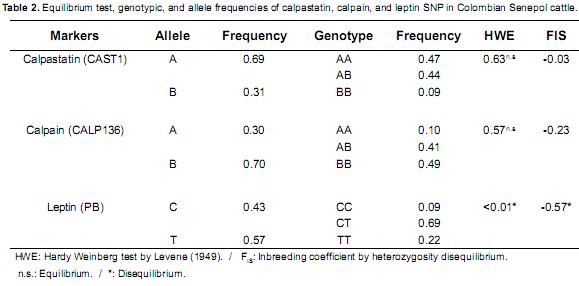
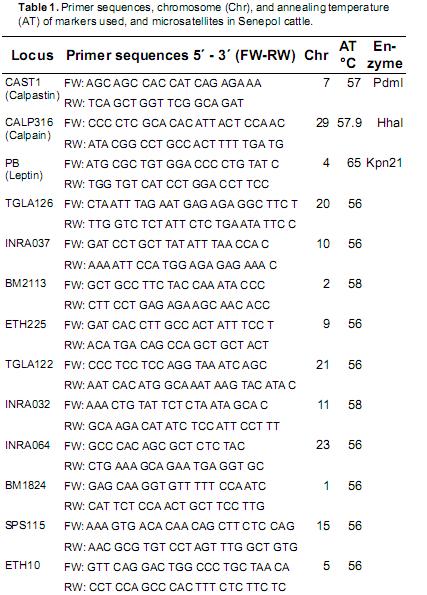
<body><![CDATA[<p><font face="Verdana, Arial, Helvetica, sans-serif" size="2"><i>Genotyping  </i></font></p>     <p><font face="Verdana, Arial, Helvetica, sans-serif" size="2">The INRA32, BM2113, ETH10, BM1824,INRA037, ETH225, INRA064, SPS115, TGLA126,and TGLA122 microsatellite markers were used in this study. They were taken from the InternationalSociety for Animal Genetic (ISAG) recommendedlist for studies on genetic variability (<a href="#t1">Table 1</a>), andwere used applying multiplex systems (duplex ortriplex) according to each marker&nbsp;s amplificationconditions in 6% polyacrylamide gels followedby silver nitrate staining (Budowle <i>et al.</i>, 1991).The SNP's products were separated and visualizedon 2% low&#8211;melting point agarose gels for calpainand calpastatin, while 3% low&#8211;melting pointagarose gels were used for leptin. All amplificationand restriction reactions were conducted in aThermocycler BioRAd C 1000&reg;. The resultswere verified by sequencing at Macrogen&reg; labs(Rockville, MD, USA).</font></p>     <p align="center"><a name="t1"><img src="/img/revistas/rccp/v25n2/v25n2a03t1.jpg"></a></p>     <p><font face="Verdana, Arial, Helvetica, sans-serif" size="2"><i>Statistical analysis </i></font></p>     <p><font face="Verdana, Arial, Helvetica, sans-serif" size="2">   The genetic diversity, mean number of alleles per locus (na), effective number of alleles per locus (ne), observed heterozygosity (Ho), expected heterozygosity (He), and Hardy&#8211;Weinberg equilibrium test (HWE) were estimated by the Popgene simulation program for population genetics (Yeh and Yang, 1999).</font></p>     <p><font face="Verdana, Arial, Helvetica, sans-serif" size="2">The percentage of polymorphic loci (Kallinowski   <i>et al.</i>, 2007), the polymorphic information content(PIC) for each marker (Botstein <i>et al.</i>, 1980)and the non&#8211;exclusion parentage probabilities of first, second, and both parents (Ne&#8211;1p, Ne&#8211;2p, andNe&#8211;pp, respectively) by each microsatellite and bythe total were estimated using Cervus 3.0 software (Kallinowski <i>et al.</i>, 2007). The population structurewas obtained with the R<sub>ST</sub> index (Slatkin, 1995;modified by Goodman, 1997) assuming stepwisemutations &#8211;regarded as a more suitable index for microsatellites&#8211; and by using the Fstat software (Goudet, 2001). The above procedures were conducted to determine if these microsatellites are informative in studies to characterize populationgenetics and paternity testing. </font></p>     <p>&nbsp;</p>     <p><font face="Verdana, Arial, Helvetica, sans-serif" size="3"><b>Results</b></font></p>     <p><font face="Verdana, Arial, Helvetica, sans-serif" size="2">   The SNP's favorable allelic and genotypicfrequencies were CAST1 (A=0.69 and AA=0.47),CALP316 (A= 0.30 and AA=0.10) and PB(T = 0.57 and TT = 0.23). Genotype AA was lowerthan heterozygote AB in the calpain gene. A higher frequency for the favorable genotypes AA and AB was observed for calpastatin gene. Leptin SNPshowed Hardy Weinberg disequilibrium and had thehighest heterozygote excess (<a href="#t2">Table 2</a>). </font></p>     <p align="center"><a name="t2"><img src="/img/revistas/rccp/v25n2/v25n2a03t2.jpg"></a></p>     ]]></body>
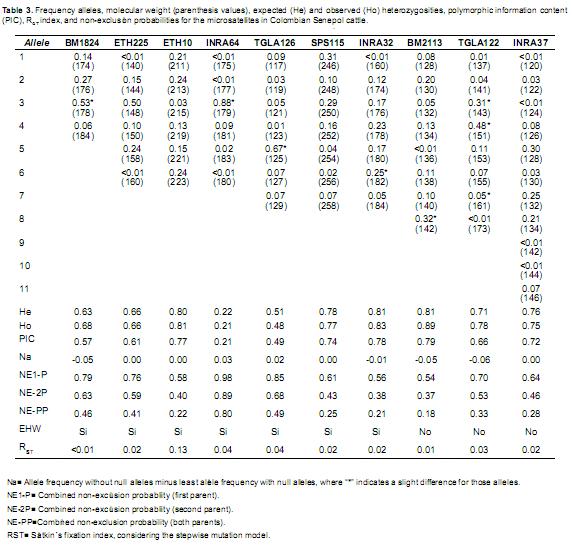
<body><![CDATA[<p align="center"><a name="t3"><img src="/img/revistas/rccp/v25n2/v25n2a03t3.jpg" /></a></p>     <p><font face="Verdana, Arial, Helvetica, sans-serif" size="2">Regarding STR markers, the allele frequencies per locus, number of alleles, expected and observed heterozygosities (He and Ho, respectively), R<sub>ST</sub> index, polymorphic information content (PIC), and non&#8211;exclusion pattern probabilities are presented in tables <a href="#t3">3 </a>and <a href="#t4">4</a>. The number of alleles varied between 4 and 11 (BM1824 and INRA37, respectively). The INRA64 and BM2113 STR showed the lowest and highest Ho (0.21 and 0.89, respectively). According to the Hardy Weinberg test results, seven microsatellites were in equilibrium (p&gt;0.05), suggesting that these alleles are uniformly segregated in the studied population. Negligible differences were observed between allele frequencies, both with and without null alleles for nine microsatellites (&#8211;0.05 to 0.05), and a moderate to negligible difference (0.06) for TGLA122, which did not affect the analyses. </font></p>     <p><font face="Verdana, Arial, Helvetica, sans-serif" size="2">High He and Ho were observed (0.51 0.89) for nine microsatellites (except INRA64The polymorphic information content indexwere greater than 0.50 (0.57 to 0.79) for eigmicrosatellites (except for INRA64: 0.21 anTGLA126: 0.49). The R<sub>ST</sub> indexes obtained were close to zero (&lt;0.04) in nine microsatellites, whit reached 0.13 in ETH10, meaning that there ano differences between subpopulations (herdsThe RST index for the microsatellite sets was 0.0 (<a href="#t4">Table 4</a>).  </font></p>     <p><font face="Verdana, Arial, Helvetica, sans-serif" size="2">The probability for not excluding a false candidate parent of a tested offspring without genotype information of any true parent (NE&#8211;1P) varied between 0.54 (BM2113) and 0.98 (INRA64). The non&#8211;exclusion probability for one candidate parent, given the genotype of a known parent of the opposite sex (NE&#8211;2P), varied between 0.37 (BM2113) and 0.89 (INRA64), and the non&#8211; exclusion probability for both parents (NE&#8211;PP) varied between 0.18 (BM2113) and 0.80 (INRA64). The total non&#8211;exclusion probability for NE&#8211;1P, NE&#8211;2P, and NE&#8211;PP microsatellites was close to zero (Table 4). Therefore, a 98, 99, and 99% probability to exclude a first, second, and both false parents, respectively, could be expected by using the entire set of ten microsatellite loci. </font></p>     <p align="center"><a name="t4"><img src="/img/revistas/rccp/v25n2/v25n2a03t4.jpg"></a></p>     <p>&nbsp;</p>     <p><font face="Verdana, Arial, Helvetica, sans-serif" size="3"><b>Discussion</b></font></p>     <p><font face="Verdana, Arial, Helvetica, sans-serif" size="2">   The heterozygote (CT) excess and the high frequency of the TT genotype for leptin in the analyzed population showed Hardy Weinberg deviations (p&lt;0.05). The high frequency of the T allele is possibly due to selection procedures focused on reaching high body fat accretion. These results are similar to those from association studies conducted in <i>Bos taurus</i>, where carcasses from individuals having the T allele are fattier than animals with CC genotype (Buchanan <i>et al.</i>, 2002, Kononoff <i>et al.</i>, 2005). </font></p>     <p><font face="Verdana, Arial, Helvetica, sans-serif" size="2">The heterozygote's excess (CT) of the leptin gene offers the opportunity to design Senepol breeding programs using genotyped dams and sires intended for increasing the frequency of TT genotypes when the goals are selection for high feed efficiency and weight gain (Buchanan <i>et al.</i>, 2002; Cer&nbsp;n&#8211;Mu&aacute;oz <i>et al.</i>, 2009; Giblin <i>et al.</i>, 2010). </font></p>     <p><font face="Verdana, Arial, Helvetica, sans-serif" size="2">Calpain and calpastatin genes exhibited HW equilibrium (p&gt;0.05) in the analyzed population, which indicates a possible lack of selection for meat tenderness. Nevertheless, the high frequency of animals carrying the favorable allele (A) for both genes could be useful for designing selection and breeding programs directed towards meat quality improvement (Lara <i>et al.</i>, 2005; Chung    <i>et al.</i>, 2001) due to the fact that both enzymes are responsible for the meat tenderization process (Page  <i>et al.</i>, 2002; Delgado <i>et al.</i>, 2001). The calpain gene in Charolais, Senepol, and Senepol x Charolais was associated with daily weight gain at 205 and 240 d, estimated live weight at 205 d, weaning age, trimming weight, individual muscle weight, and Warner Bratzler force (measured at 0 d post mortem), among other measurements (Bosques&#8211; Mendez, 2008).</font></p>     ]]></body>
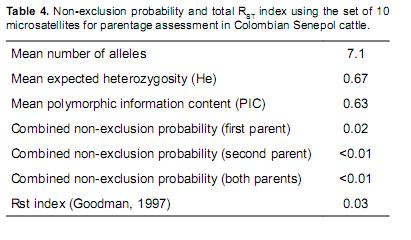
<body><![CDATA[<p><font face="Verdana, Arial, Helvetica, sans-serif" size="2">Results from the microsatellite panel (<a href="#t3">Table 3</a>) showed that Colombia&nbsp;s Senepol population has high genetic diversity. It is worth noticing that this basic panel (average He=0.67, Ho=0.69 and PIC=0.63) is informative and adequate for genetic population studies (Botstein <i>et al.</i>, 1980; Bowcock  <i>et al.</i>, 1994). </font></p>     <p><font face="Verdana, Arial, Helvetica, sans-serif" size="2">The exclusion probability of the whole polymorphic microsatellite markers was higher than 98% (with NE&#8211;1P=0.02, N&#8211;2P&lt;0.01, and N&#8211;PP &lt;0.01), indicating the usefulness of this set of markers for parentage testing of Senepol breeds in Colombia. </font></p>     <p><font face="Verdana, Arial, Helvetica, sans-serif" size="2">The R<sub>ST</sub> average for the ten microsatellites evaluated was 0.03 by the Goodman (1972) method, ndicating that 3% of the genetic variability could be due to genetic differences among herds, and to he fact that there is a high genetic flux between herds (genetic material exchange). The reason for his variability could be the high heterozygosis in he Colombian Senepol population, despite being conformed by a small nucleus and a small number of breeders.  </font></p>     <p>&nbsp;</p>     <p><font face="Verdana, Arial, Helvetica, sans-serif" size="3"><b>Acknowledgements</b></font></p>     <p><font face="Verdana, Arial, Helvetica, sans-serif" size="2">   This research was funded by the University of Antioquia (CODI menor&#8211;2009), the ColombianSenepol Cattle Breeders Association (Asosenepol)and by the Animal Genetics, Breeding, andModeling Research Group (GaMMA&#8211;UdeA).</font></p>     <p>&nbsp;</p>     <p><font face="Verdana, Arial, Helvetica, sans-serif" size="3"><b>References</b></font></p>     <!-- ref --><p><font face="Verdana, Arial, Helvetica, sans-serif" size="2">   1. Aranguren M&eacute;ndez JA, Rom&aacute;n Bravo R, Isea W, Villasmil YJordana J. Los microsat&eacute;lites (STR's), marcadores moleculares   de ADN por excelencia para programas de conservaci&oacute;n: unarevisi&nbsp;n. Facultad de Ciencias Veterinarias, La Universidad de Zulia. Arch Latinoam Prod Anim 2005; 13:1&#8211;6.</font>&nbsp;&nbsp;&nbsp;&nbsp;&nbsp;&nbsp;&nbsp;&nbsp;[&#160;<a href="javascript:void(0);" onclick="javascript: window.open('/scielo.php?script=sci_nlinks&ref=000071&pid=S0120-0690201200020000300001&lng=','','width=640,height=500,resizable=yes,scrollbars=1,menubar=yes,');">Links</a>&#160;]<!-- end-ref --><!-- ref --><p><font face="Verdana, Arial, Helvetica, sans-serif" size="2">2. Boehm ML, Kendall TL, Thompson VF, Goll DE. Changes in   the Calpains and Calpastatin During Postmortem Storage of Bovine Muscle. J Anim Sci 1998; 76:2415&#8211;2434. </font>&nbsp;&nbsp;&nbsp;&nbsp;&nbsp;&nbsp;&nbsp;&nbsp;[&#160;<a href="javascript:void(0);" onclick="javascript: window.open('/scielo.php?script=sci_nlinks&ref=000072&pid=S0120-0690201200020000300002&lng=','','width=640,height=500,resizable=yes,scrollbars=1,menubar=yes,');">Links</a>&#160;]<!-- end-ref --><!-- ref --><p><font face="Verdana, Arial, Helvetica, sans-serif" size="2">3. Bosques&#8211;M&eacute;ndez JH. Segregaci&oacute;n de polimorfismosidentificados en los genes de mu&#8211;calpaina y calpastatina y su   relaci&oacute;n con el crecimiento corporal y caracteristicas de la canalde bovinos para carne en Puerto Rico. University of Puerto Rico. Thesis. 2008. <a href="http://gradworks.umi.com/14/51/1451308.html" target="_blank">http://gradworks.umi.com/14/51/1451308.html</a></font>&nbsp;&nbsp;&nbsp;&nbsp;&nbsp;&nbsp;&nbsp;&nbsp;[&#160;<a href="javascript:void(0);" onclick="javascript: window.open('/scielo.php?script=sci_nlinks&ref=000073&pid=S0120-0690201200020000300003&lng=','','width=640,height=500,resizable=yes,scrollbars=1,menubar=yes,');">Links</a>&#160;]<!-- end-ref --><!-- ref --><p><font face="Verdana, Arial, Helvetica, sans-serif" size="2">   4. Botstein D, White RL. Construction of a genetic linkage map inman using restriction fragment length polymorphism. Am j hum   genet 1980; 32:314&#8211;33. </font>&nbsp;&nbsp;&nbsp;&nbsp;&nbsp;&nbsp;&nbsp;&nbsp;[&#160;<a href="javascript:void(0);" onclick="javascript: window.open('/scielo.php?script=sci_nlinks&ref=000074&pid=S0120-0690201200020000300004&lng=','','width=640,height=500,resizable=yes,scrollbars=1,menubar=yes,');">Links</a>&#160;]<!-- end-ref --><!-- ref --><p><font face="Verdana, Arial, Helvetica, sans-serif" size="2">5. Bowcock AM, Ruiz&#8211;Linares A, Tomfohrde J, Minch E, Kidd JR   Cavalli&#8211;Sforza LL. High resolution of human evolutionary treeswith polymorphic microsatellites. Nature 1994; 368:455&nbsp;457.</font>&nbsp;&nbsp;&nbsp;&nbsp;&nbsp;&nbsp;&nbsp;&nbsp;[&#160;<a href="javascript:void(0);" onclick="javascript: window.open('/scielo.php?script=sci_nlinks&ref=000075&pid=S0120-0690201200020000300005&lng=','','width=640,height=500,resizable=yes,scrollbars=1,menubar=yes,');">Links</a>&#160;]<!-- end-ref --><!-- ref --><p><font face="Verdana, Arial, Helvetica, sans-serif" size="2">6. Bowling AT. Historical development and application of molecular genetic tests for horse identification and parentage  control. Livest Prod Sci 2001; 72:11&#8211;116. </font>&nbsp;&nbsp;&nbsp;&nbsp;&nbsp;&nbsp;&nbsp;&nbsp;[&#160;<a href="javascript:void(0);" onclick="javascript: window.open('/scielo.php?script=sci_nlinks&ref=000076&pid=S0120-0690201200020000300006&lng=','','width=640,height=500,resizable=yes,scrollbars=1,menubar=yes,');">Links</a>&#160;]<!-- end-ref --><!-- ref --><p><font face="Verdana, Arial, Helvetica, sans-serif" size="2">7. Buchanan FC, Fitzsimmons CJ, Van Kessel AG, Thue TD,    Windkelman&#8211;Sim CD, Schmutz SM. Association of a missense mutation in the bovine leptin gene with carcass fat content and    leptin mRNA levels. Genet Sel Evol 2002, 34:105&#8211;116. </font>&nbsp;&nbsp;&nbsp;&nbsp;&nbsp;&nbsp;&nbsp;&nbsp;[&#160;<a href="javascript:void(0);" onclick="javascript: window.open('/scielo.php?script=sci_nlinks&ref=000077&pid=S0120-0690201200020000300007&lng=','','width=640,height=500,resizable=yes,scrollbars=1,menubar=yes,');">Links</a>&#160;]<!-- end-ref --><!-- ref --><p><font face="Verdana, Arial, Helvetica, sans-serif" size="2">8. Budowle B, Chakraborty R, Giusti AM, Eisenberg AJ, Allen    RC. Analysis of the VNTR locus D1S80 by the PCR followed by high&#8211;resolution PAGE. Am J Hum Genet 1991; 48:137&#8211;144.</font>&nbsp;&nbsp;&nbsp;&nbsp;&nbsp;&nbsp;&nbsp;&nbsp;[&#160;<a href="javascript:void(0);" onclick="javascript: window.open('/scielo.php?script=sci_nlinks&ref=000078&pid=S0120-0690201200020000300008&lng=','','width=640,height=500,resizable=yes,scrollbars=1,menubar=yes,');">Links</a>&#160;]<!-- end-ref --><!-- ref --><p><font face="Verdana, Arial, Helvetica, sans-serif" size="2">   9. Casas E. Aplicaci&oacute;n de la gen&nbsp;mica para identificar genes que influyen sobre caracter&nbsp;sticas econ&nbsp;micamente importantes en    animales. Arch Latinoam Prod Anim 2006; 14:24&#8211;31. </font>&nbsp;&nbsp;&nbsp;&nbsp;&nbsp;&nbsp;&nbsp;&nbsp;[&#160;<a href="javascript:void(0);" onclick="javascript: window.open('/scielo.php?script=sci_nlinks&ref=000079&pid=S0120-0690201200020000300009&lng=','','width=640,height=500,resizable=yes,scrollbars=1,menubar=yes,');">Links</a>&#160;]<!-- end-ref --><!-- ref --><p><font face="Verdana, Arial, Helvetica, sans-serif" size="2">10. Cer&oacute;n&#8211;Mu&ntilde;oz MF, Montoya Atehortua AE, Trujillo Bravo E,    Ram&iacute;rez Toro EJ, Monsalve Fonnegra ZI. Marcadores del Gen Leptina en Bovinos Cruzados con Angus, Cebce, Romosinuano    y Blanco Orejinegro. Rev Cient&iacute;fica, FCV&#8211;LUZ 2009: 19: 371&#8211; 381.</font>&nbsp;&nbsp;&nbsp;&nbsp;&nbsp;&nbsp;&nbsp;&nbsp;[&#160;<a href="javascript:void(0);" onclick="javascript: window.open('/scielo.php?script=sci_nlinks&ref=000080&pid=S0120-0690201200020000300010&lng=','','width=640,height=500,resizable=yes,scrollbars=1,menubar=yes,');">Links</a>&#160;]<!-- end-ref --><!-- ref --><p><font face="Verdana, Arial, Helvetica, sans-serif" size="2">   11. Chung HY, Davis ME, Hines HC. Relationship of two PCR&#8211; RFLP in the bovine calpastatin gene with calpastatin activity,    meat tenderness and carcass traits. Ohio Agricultural Research Development Center 2001; 181:7&#8211;34.</font>&nbsp;&nbsp;&nbsp;&nbsp;&nbsp;&nbsp;&nbsp;&nbsp;[&#160;<a href="javascript:void(0);" onclick="javascript: window.open('/scielo.php?script=sci_nlinks&ref=000081&pid=S0120-0690201200020000300011&lng=','','width=640,height=500,resizable=yes,scrollbars=1,menubar=yes,');">Links</a>&#160;]<!-- end-ref --><!-- ref --><p><font face="Verdana, Arial, Helvetica, sans-serif" size="2">   12. Delgado EF, Geesink GH, Marchello JA, Goll DE, Koohmaraie M. Properties of myofibril&#8211;bound calpain activity in    longissimus muscle of callipyge and normal sheep. J Anim Sci 2001; 79:2097&#8211;2107.</font>&nbsp;&nbsp;&nbsp;&nbsp;&nbsp;&nbsp;&nbsp;&nbsp;[&#160;<a href="javascript:void(0);" onclick="javascript: window.open('/scielo.php?script=sci_nlinks&ref=000082&pid=S0120-0690201200020000300012&lng=','','width=640,height=500,resizable=yes,scrollbars=1,menubar=yes,');">Links</a>&#160;]<!-- end-ref --><!-- ref --><p><font face="Verdana, Arial, Helvetica, sans-serif" size="2">   13. Emori Y, Kawasaki H, Imajoh S, Imahori K Suzuki K. Endogenous inhibitor forcalcium&#8211;dependent cysteine protease    contains four internal repeats that could be responsible for its multiple reactive sites. Proc Natl Acad Sci 1987; 84:3590&#8211;3594.</font>&nbsp;&nbsp;&nbsp;&nbsp;&nbsp;&nbsp;&nbsp;&nbsp;[&#160;<a href="javascript:void(0);" onclick="javascript: window.open('/scielo.php?script=sci_nlinks&ref=000083&pid=S0120-0690201200020000300013&lng=','','width=640,height=500,resizable=yes,scrollbars=1,menubar=yes,');">Links</a>&#160;]<!-- end-ref --><!-- ref --><p><font face="Verdana, Arial, Helvetica, sans-serif" size="2">   14. Geary TW, McFadin EL, MacNeil MD, Grings EE, Short RE, Funston RN, Keisler DH. Leptin as a predictor of carcass    composition in beef cattle. J Anim Sci 2003, 81:1&#8211;8. </font>&nbsp;&nbsp;&nbsp;&nbsp;&nbsp;&nbsp;&nbsp;&nbsp;[&#160;<a href="javascript:void(0);" onclick="javascript: window.open('/scielo.php?script=sci_nlinks&ref=000084&pid=S0120-0690201200020000300014&lng=','','width=640,height=500,resizable=yes,scrollbars=1,menubar=yes,');">Links</a>&#160;]<!-- end-ref --><!-- ref --><p><font face="Verdana, Arial, Helvetica, sans-serif" size="2">15. Giblin L, Butler ST, Kearney BM, Waters SM, Callanan MJ,    Berry DP. Association of bovine leptin polymorphisms with energy output and energy storage traits in progeny tested    Holstein&#8211;Friesian dairy cattle sires. BMC Genetics 2010, 11:73. </font>&nbsp;&nbsp;&nbsp;&nbsp;&nbsp;&nbsp;&nbsp;&nbsp;[&#160;<a href="javascript:void(0);" onclick="javascript: window.open('/scielo.php?script=sci_nlinks&ref=000085&pid=S0120-0690201200020000300015&lng=','','width=640,height=500,resizable=yes,scrollbars=1,menubar=yes,');">Links</a>&#160;]<!-- end-ref --><!-- ref --><p><font face="Verdana, Arial, Helvetica, sans-serif" size="2">16. Goodman SJ. RST&#8211;calc: a collection of computer programs    for calculating estimates of genetic differentiation from microsatellite data and determining their significance. Mol Ecol    1997, 6:881&#8211;887. </font>&nbsp;&nbsp;&nbsp;&nbsp;&nbsp;&nbsp;&nbsp;&nbsp;[&#160;<a href="javascript:void(0);" onclick="javascript: window.open('/scielo.php?script=sci_nlinks&ref=000086&pid=S0120-0690201200020000300016&lng=','','width=640,height=500,resizable=yes,scrollbars=1,menubar=yes,');">Links</a>&#160;]<!-- end-ref --><!-- ref --><p><font face="Verdana, Arial, Helvetica, sans-serif" size="2">17. Goudet J. FSTAT: a program to estimate and test gene    diversities and fixation indices (version 2.9.3). 2001, <a href="http:// www2.unil.ch/popgen/softwares/fstat.htm" target="_blank">http:// www2.unil.ch/popgen/softwares/fstat.htm</a>. </font>&nbsp;&nbsp;&nbsp;&nbsp;&nbsp;&nbsp;&nbsp;&nbsp;[&#160;<a href="javascript:void(0);" onclick="javascript: window.open('/scielo.php?script=sci_nlinks&ref=000087&pid=S0120-0690201200020000300017&lng=','','width=640,height=500,resizable=yes,scrollbars=1,menubar=yes,');">Links</a>&#160;]<!-- end-ref --><!-- ref --><p><font face="Verdana, Arial, Helvetica, sans-serif" size="2">18. Hartl DL, Clark AG. Principles of population genetics. 2nd ed. Sinauer Associates, Sunderland, MA. 1989.</font>&nbsp;&nbsp;&nbsp;&nbsp;&nbsp;&nbsp;&nbsp;&nbsp;[&#160;<a href="javascript:void(0);" onclick="javascript: window.open('/scielo.php?script=sci_nlinks&ref=000088&pid=S0120-0690201200020000300018&lng=','','width=640,height=500,resizable=yes,scrollbars=1,menubar=yes,');">Links</a>&#160;]<!-- end-ref --><!-- ref --><p><font face="Verdana, Arial, Helvetica, sans-serif" size="2">   19. Hossner KL. Cellular, molecular and physiological aspects of leptin: Potential application in animal production. Can J Anim    Sci 1998; 78:463&#8211;472. </font>&nbsp;&nbsp;&nbsp;&nbsp;&nbsp;&nbsp;&nbsp;&nbsp;[&#160;<a href="javascript:void(0);" onclick="javascript: window.open('/scielo.php?script=sci_nlinks&ref=000089&pid=S0120-0690201200020000300019&lng=','','width=640,height=500,resizable=yes,scrollbars=1,menubar=yes,');">Links</a>&#160;]<!-- end-ref --><!-- ref --><p><font face="Verdana, Arial, Helvetica, sans-serif" size="2">20. Houseknecht KL, Baile CA, Matteri RL, Spurlock ME. The    biology of leptin: a review. J Anim Sci 1998; 76:1405&#8211;1420. </font>&nbsp;&nbsp;&nbsp;&nbsp;&nbsp;&nbsp;&nbsp;&nbsp;[&#160;<a href="javascript:void(0);" onclick="javascript: window.open('/scielo.php?script=sci_nlinks&ref=000090&pid=S0120-0690201200020000300020&lng=','','width=640,height=500,resizable=yes,scrollbars=1,menubar=yes,');">Links</a>&#160;]<!-- end-ref --><!-- ref --><p><font face="Verdana, Arial, Helvetica, sans-serif" size="2">21. ISAG/FAO. Secondary Guidelines for Development of National Farm Animal Genetic Resources Management Plans    Measurement of Domestic Animal Diversity (MoDAD): Recommended Microsatellite Markers New Microsatellite    marker sets &nbsp; Recommendations of joint ISAG/FAO Standing Committee. 2004 <a href="http://www.fao.org/ag/againfo/programmes/es/lead/toolbox/Indust/LossAgEA.htm" target="_blank">http://www.fao.org/ag/againfo/programmes/es/lead/toolbox/Indust/LossAgEA.htm</a> </font>&nbsp;&nbsp;&nbsp;&nbsp;&nbsp;&nbsp;&nbsp;&nbsp;[&#160;<a href="javascript:void(0);" onclick="javascript: window.open('/scielo.php?script=sci_nlinks&ref=000091&pid=S0120-0690201200020000300021&lng=','','width=640,height=500,resizable=yes,scrollbars=1,menubar=yes,');">Links</a>&#160;]<!-- end-ref --><!-- ref --><p><font face="Verdana, Arial, Helvetica, sans-serif" size="2">22. Jamieson A, Taylor C. Comparisons of three probability    formulae for parentage exclusion. Anim Genet 1997; 28:397&#8211; 400. </font>&nbsp;&nbsp;&nbsp;&nbsp;&nbsp;&nbsp;&nbsp;&nbsp;[&#160;<a href="javascript:void(0);" onclick="javascript: window.open('/scielo.php?script=sci_nlinks&ref=000092&pid=S0120-0690201200020000300022&lng=','','width=640,height=500,resizable=yes,scrollbars=1,menubar=yes,');">Links</a>&#160;]<!-- end-ref --><!-- ref --><p><font face="Verdana, Arial, Helvetica, sans-serif" size="2">23. Kalinowski ST, Taper ML , Marshall TC. Revising how the computer program CERVUS accommodates genotyping error    increases success in paternity assignment. Mol Ecol 2007; 16:1099&#8211;1006. </font>&nbsp;&nbsp;&nbsp;&nbsp;&nbsp;&nbsp;&nbsp;&nbsp;[&#160;<a href="javascript:void(0);" onclick="javascript: window.open('/scielo.php?script=sci_nlinks&ref=000093&pid=S0120-0690201200020000300023&lng=','','width=640,height=500,resizable=yes,scrollbars=1,menubar=yes,');">Links</a>&#160;]<!-- end-ref --><!-- ref --><p><font face="Verdana, Arial, Helvetica, sans-serif" size="2">24. Killefer J, Koohmaraie M. Bovine skeletal muscle calpastatin: cloning, sequence analysis, and steady&#8211;state mRNA expression.    J Anim Sci 1994; 72:606&#8211;614.</font>&nbsp;&nbsp;&nbsp;&nbsp;&nbsp;&nbsp;&nbsp;&nbsp;[&#160;<a href="javascript:void(0);" onclick="javascript: window.open('/scielo.php?script=sci_nlinks&ref=000094&pid=S0120-0690201200020000300024&lng=','','width=640,height=500,resizable=yes,scrollbars=1,menubar=yes,');">Links</a>&#160;]<!-- end-ref --><!-- ref --><p><font face="Verdana, Arial, Helvetica, sans-serif" size="2"> 25. Kononoff PJ, Deobald HM, Stewart EL, Laycock AD,    Marquess FLS. The effect of a leptin single nucleotide polymorphism on quality grade, yield grade, and carcass weight    of beef cattle. J Anim Sci 2005; 83:927&#8211;932.</font>&nbsp;&nbsp;&nbsp;&nbsp;&nbsp;&nbsp;&nbsp;&nbsp;[&#160;<a href="javascript:void(0);" onclick="javascript: window.open('/scielo.php?script=sci_nlinks&ref=000095&pid=S0120-0690201200020000300025&lng=','','width=640,height=500,resizable=yes,scrollbars=1,menubar=yes,');">Links</a>&#160;]<!-- end-ref --><!-- ref --><p><font face="Verdana, Arial, Helvetica, sans-serif" size="2"> 26. Koohmaraie M. Muscle proteinases and meat aging. Meat Sci    1994; 36:93&#8211;104. </font>&nbsp;&nbsp;&nbsp;&nbsp;&nbsp;&nbsp;&nbsp;&nbsp;[&#160;<a href="javascript:void(0);" onclick="javascript: window.open('/scielo.php?script=sci_nlinks&ref=000096&pid=S0120-0690201200020000300026&lng=','','width=640,height=500,resizable=yes,scrollbars=1,menubar=yes,');">Links</a>&#160;]<!-- end-ref --><!-- ref --><p><font face="Verdana, Arial, Helvetica, sans-serif" size="2">27. Koohmaraie M. Biochemical factors regulating the toughening    and tenderization process of meat. Meat Sci 1996; 43:193&#8211;20. </font>&nbsp;&nbsp;&nbsp;&nbsp;&nbsp;&nbsp;&nbsp;&nbsp;[&#160;<a href="javascript:void(0);" onclick="javascript: window.open('/scielo.php?script=sci_nlinks&ref=000097&pid=S0120-0690201200020000300027&lng=','','width=640,height=500,resizable=yes,scrollbars=1,menubar=yes,');">Links</a>&#160;]<!-- end-ref --><!-- ref --><p><font face="Verdana, Arial, Helvetica, sans-serif" size="2">28. Lara MAC, Nardon RF, Bufarah G, Demarchi JJAA, Sereno    JR, Santos SA, Abreu UGP. Polimorfismo del Gen Calpa&nbsp;na en Razas Vacunas por la T&eacute;cnica PCR&#8211;RFLP. Arch Zootec 2005;    54:305&#8211;310. </font>&nbsp;&nbsp;&nbsp;&nbsp;&nbsp;&nbsp;&nbsp;&nbsp;[&#160;<a href="javascript:void(0);" onclick="javascript: window.open('/scielo.php?script=sci_nlinks&ref=000098&pid=S0120-0690201200020000300028&lng=','','width=640,height=500,resizable=yes,scrollbars=1,menubar=yes,');">Links</a>&#160;]<!-- end-ref --><!-- ref --><p><font face="Verdana, Arial, Helvetica, sans-serif" size="2">29. Levene H. On a matching problem in genetics. Ann Math Stat  1949; 20:91&#8211;94.</font>&nbsp;&nbsp;&nbsp;&nbsp;&nbsp;&nbsp;&nbsp;&nbsp;[&#160;<a href="javascript:void(0);" onclick="javascript: window.open('/scielo.php?script=sci_nlinks&ref=000099&pid=S0120-0690201200020000300029&lng=','','width=640,height=500,resizable=yes,scrollbars=1,menubar=yes,');">Links</a>&#160;]<!-- end-ref --><!-- ref --><p><font face="Verdana, Arial, Helvetica, sans-serif" size="2"> 30. Lonergan SM, Ernst CW, Bishop MD, Calkins CR, Koohmaraie    M. Relationship of restriction fragment length polymorphisms (RFLP) at the bovine calpastatin locus to calpastatin activity  and meat tenderness. J Anim Sci 1995; 73:3608&#8211;3612. </font>&nbsp;&nbsp;&nbsp;&nbsp;&nbsp;&nbsp;&nbsp;&nbsp;[&#160;<a href="javascript:void(0);" onclick="javascript: window.open('/scielo.php?script=sci_nlinks&ref=000100&pid=S0120-0690201200020000300030&lng=','','width=640,height=500,resizable=yes,scrollbars=1,menubar=yes,');">Links</a>&#160;]<!-- end-ref --><!-- ref --><p><font face="Verdana, Arial, Helvetica, sans-serif" size="2">31. L&oacute;pez D. Senepo. Sitio Argentino de Producci&oacute;n Animal. 2002.    <a href="http://www.produccionbovina.com/informacion_tecnica/raza_ senepol/01&#8211;senepol.pdf" target="_blank">http://www.produccionbovina.com/informacion_tecnica/raza_ senepol/01&#8211;senepol.pdf</a> </font>&nbsp;&nbsp;&nbsp;&nbsp;&nbsp;&nbsp;&nbsp;&nbsp;[&#160;<a href="javascript:void(0);" onclick="javascript: window.open('/scielo.php?script=sci_nlinks&ref=000101&pid=S0120-0690201200020000300031&lng=','','width=640,height=500,resizable=yes,scrollbars=1,menubar=yes,');">Links</a>&#160;]<!-- end-ref --><!-- ref --><p><font face="Verdana, Arial, Helvetica, sans-serif" size="2">32. Miller SA, Dykes DD, Poletsky HF. A simple salting out procedure for extracting DNA from human nucleated cells. Nucl    Acid Res 1988; 16:1215. </font>&nbsp;&nbsp;&nbsp;&nbsp;&nbsp;&nbsp;&nbsp;&nbsp;[&#160;<a href="javascript:void(0);" onclick="javascript: window.open('/scielo.php?script=sci_nlinks&ref=000102&pid=S0120-0690201200020000300032&lng=','','width=640,height=500,resizable=yes,scrollbars=1,menubar=yes,');">Links</a>&#160;]<!-- end-ref --><!-- ref --><p><font face="Verdana, Arial, Helvetica, sans-serif" size="2">33. Motter MM, Corva P., Krause M, P&eacute;rez C, Soria L. Rol de    la Calpastatina en la variabilidad de la Terneza de la Carne Bovina. J Basic &amp; Appl Genet 2009; 20:15&#8211;24. </font>&nbsp;&nbsp;&nbsp;&nbsp;&nbsp;&nbsp;&nbsp;&nbsp;[&#160;<a href="javascript:void(0);" onclick="javascript: window.open('/scielo.php?script=sci_nlinks&ref=000103&pid=S0120-0690201200020000300033&lng=','','width=640,height=500,resizable=yes,scrollbars=1,menubar=yes,');">Links</a>&#160;]<!-- end-ref --><!-- ref --><p><font face="Verdana, Arial, Helvetica, sans-serif" size="2">   34. Page BT, Casas E, Heaton MP, Cullen NG, Hyndman DL, Morris CA, Crawford AM, Wheeler TL, Koohmaraie M, Keele    JW, Smith TP. Evaluation of single&#8211;nucleotide polymorphisms in CAPN1 for association with meat tenderness in cattle. J    Anim Sci 2002; 80:3077&#8211;3085. </font>&nbsp;&nbsp;&nbsp;&nbsp;&nbsp;&nbsp;&nbsp;&nbsp;[&#160;<a href="javascript:void(0);" onclick="javascript: window.open('/scielo.php?script=sci_nlinks&ref=000104&pid=S0120-0690201200020000300034&lng=','','width=640,height=500,resizable=yes,scrollbars=1,menubar=yes,');">Links</a>&#160;]<!-- end-ref --><!-- ref --><p><font face="Verdana, Arial, Helvetica, sans-serif" size="2">35. Page BT, Casas E, Quaas RL, Thallman RM, Wheeler TL,    Shackelford SD, Koohmaraie M, White SN, Bennett GL, Keele JW, Dikeman ME, Smith TP. Association of markers in the bovine CAPN1 gene with meat tenderness in large crossbred populations that sample influential industry sires. J Anim Sci    2004; 82:3474&#8211;3481. </font>&nbsp;&nbsp;&nbsp;&nbsp;&nbsp;&nbsp;&nbsp;&nbsp;[&#160;<a href="javascript:void(0);" onclick="javascript: window.open('/scielo.php?script=sci_nlinks&ref=000105&pid=S0120-0690201200020000300035&lng=','','width=640,height=500,resizable=yes,scrollbars=1,menubar=yes,');">Links</a>&#160;]<!-- end-ref --><!-- ref --><p><font face="Verdana, Arial, Helvetica, sans-serif" size="2">36. Parker PG, Snow AA, SCHUG MD, Booton GC, Fuerst PA.    What molecules can tell us about populations: choosing and using a molecular marker. Ecology 1998; 79:361&#8211;382.</font>&nbsp;&nbsp;&nbsp;&nbsp;&nbsp;&nbsp;&nbsp;&nbsp;[&#160;<a href="javascript:void(0);" onclick="javascript: window.open('/scielo.php?script=sci_nlinks&ref=000106&pid=S0120-0690201200020000300036&lng=','','width=640,height=500,resizable=yes,scrollbars=1,menubar=yes,');">Links</a>&#160;]<!-- end-ref --><!-- ref --><p><font face="Verdana, Arial, Helvetica, sans-serif" size="2"> 37. Parra&#8211;Bracamonte GM, Sifuentes&#8211;Rinc&oacute;n AM, Cienfuegos&#8211; Rivas EG, Tewolde&#8211;Medhin A, Mart&iacute;nez&#8211;Gonz&aacute;lez JC. </font><font face="Verdana, Arial, Helvetica, sans-serif" size="2">Polimorfismo en el gen de la &#956;&#8211;calpa&iacute;na en ganado Brahman de registro de M&eacute;xico. Asociaci&oacute;n Latinoamericana de Producci&oacute;n  Animal 2007; 15: 32&#8211;37. </font>&nbsp;&nbsp;&nbsp;&nbsp;&nbsp;&nbsp;&nbsp;&nbsp;[&#160;<a href="javascript:void(0);" onclick="javascript: window.open('/scielo.php?script=sci_nlinks&ref=000107&pid=S0120-0690201200020000300037&lng=','','width=640,height=500,resizable=yes,scrollbars=1,menubar=yes,');">Links</a>&#160;]<!-- end-ref --><!-- ref --><p><font face="Verdana, Arial, Helvetica, sans-serif" size="2">38. Ru&iacute;z B, Herrera JG, Rojas RI, Ru&nbsp;z H, Mendoza P, Oliva MA, </font><font face="Verdana, Arial, Helvetica, sans-serif" size="2">Guti&eacute;rrez FA, Aguilar G, Bautiasta GU, Ibarra CE. Estimaci&oacute;n de polimorfismos del gen de leptina de sementales en el    sistema doble prop&nbsp;sito bovino, en villaflores, Chiapas M&eacute;xico. REDVET 2009., 10:12. <a href="http://www.veterinaria.org/revistas/redvet/n121209.html" target="_blank">http://www.veterinaria.org/revistas/redvet/n121209.html</a></font>&nbsp;&nbsp;&nbsp;&nbsp;&nbsp;&nbsp;&nbsp;&nbsp;[&#160;<a href="javascript:void(0);" onclick="javascript: window.open('/scielo.php?script=sci_nlinks&ref=000108&pid=S0120-0690201200020000300038&lng=','','width=640,height=500,resizable=yes,scrollbars=1,menubar=yes,');">Links</a>&#160;]<!-- end-ref --><!-- ref --><p><font face="Verdana, Arial, Helvetica, sans-serif" size="2">39. S&aacute;nchez R. Asosenepol, la alternativa para el tr&nbsp;pico bajo. 2010. Suganado.com URL:<a href="http://suganado.com/noticias_detalle" target="_blank">http://suganado.com/noticias_detalle</a>. php?Id_Noticia=263 </font>&nbsp;&nbsp;&nbsp;&nbsp;&nbsp;&nbsp;&nbsp;&nbsp;[&#160;<a href="javascript:void(0);" onclick="javascript: window.open('/scielo.php?script=sci_nlinks&ref=000109&pid=S0120-0690201200020000300039&lng=','','width=640,height=500,resizable=yes,scrollbars=1,menubar=yes,');">Links</a>&#160;]<!-- end-ref --><!-- ref --><p><font face="Verdana, Arial, Helvetica, sans-serif" size="2">40. Slatkin M. A measure of population subdivision based on    microsatellite allele frequencies. Genetics 1995; 139:457&#8211;462. </font>&nbsp;&nbsp;&nbsp;&nbsp;&nbsp;&nbsp;&nbsp;&nbsp;[&#160;<a href="javascript:void(0);" onclick="javascript: window.open('/scielo.php?script=sci_nlinks&ref=000110&pid=S0120-0690201200020000300040&lng=','','width=640,height=500,resizable=yes,scrollbars=1,menubar=yes,');">Links</a>&#160;]<!-- end-ref --><!-- ref --><p><font face="Verdana, Arial, Helvetica, sans-serif" size="2">41. Smith TP, Casas E, Rexroad CE, Kappes SM, Keele JW. Bovine    CAPN1 maps to a region of BTA29 containing a quantitative trait locus for meat tenderness. J Anim Sci 2000; 78:2589&#8211;2594. </font>&nbsp;&nbsp;&nbsp;&nbsp;&nbsp;&nbsp;&nbsp;&nbsp;[&#160;<a href="javascript:void(0);" onclick="javascript: window.open('/scielo.php?script=sci_nlinks&ref=000111&pid=S0120-0690201200020000300041&lng=','','width=640,height=500,resizable=yes,scrollbars=1,menubar=yes,');">Links</a>&#160;]<!-- end-ref --><!-- ref --><p><font face="Verdana, Arial, Helvetica, sans-serif" size="2">42. Thrift EA, Franke DE, Aaron DK. Preweaning breed&#8211;of&#8211;sire comparisons involving the senepol breed of cattle. J Anim Sci    1986; 62:1247&#8211;1254. </font>&nbsp;&nbsp;&nbsp;&nbsp;&nbsp;&nbsp;&nbsp;&nbsp;[&#160;<a href="javascript:void(0);" onclick="javascript: window.open('/scielo.php?script=sci_nlinks&ref=000112&pid=S0120-0690201200020000300042&lng=','','width=640,height=500,resizable=yes,scrollbars=1,menubar=yes,');">Links</a>&#160;]<!-- end-ref --><!-- ref --><p><font face="Verdana, Arial, Helvetica, sans-serif" size="2">43. Wegner J, Huff P, Xie CP, Schneider F, Teuscher F, Mir PS, Mir    Z, Kazala EC, Weselake RJ, Ender K. Relationship of plasma leptin concentration to intramuscular fat content in beef from    crossbred Wagyu cattle. Can J Anim Sci 2001; 81:451&#8211;457.</font>&nbsp;&nbsp;&nbsp;&nbsp;&nbsp;&nbsp;&nbsp;&nbsp;[&#160;<a href="javascript:void(0);" onclick="javascript: window.open('/scielo.php?script=sci_nlinks&ref=000113&pid=S0120-0690201200020000300043&lng=','','width=640,height=500,resizable=yes,scrollbars=1,menubar=yes,');">Links</a>&#160;]<!-- end-ref --><!-- ref --><p><font face="Verdana, Arial, Helvetica, sans-serif" size="2">44. Weir BS, Cockerham CC. Estimating F&#8211;Statistics for the    Analysis of Population Structure. Evolution 1984; 38:1358&#8211; 1370.</font>&nbsp;&nbsp;&nbsp;&nbsp;&nbsp;&nbsp;&nbsp;&nbsp;[&#160;<a href="javascript:void(0);" onclick="javascript: window.open('/scielo.php?script=sci_nlinks&ref=000114&pid=S0120-0690201200020000300044&lng=','','width=640,height=500,resizable=yes,scrollbars=1,menubar=yes,');">Links</a>&#160;]<!-- end-ref --><p>&nbsp;</p>     <p><font face="Verdana, Arial, Helvetica, sans&ndash;serif" size="3"><b>Notas</b></font></p>     <p><font face="Verdana, Arial, Helvetica, sans-serif" size="4"><b><sup><a href="#*b" name="*">&curren;</a></sup></b></font><font face="Verdana, Arial, Helvetica, sans-serif" size="2"> To cite this article: Sep&uacute;lveda JC, &Aacute;ngel&#8211;Mar&iacute;n PA, Toro A, Corrales JD, Moreno MA, Cer&oacute;n&#8211;Mu&ntilde;oz MF. Genetic variability of Senepol cattle in Colombia using molecular markers. Rev Colomb Cienc Pecu 2012; 25:183&#8211;190. </font></p>      ]]></body><back>
<ref-list>
<ref id="B1">
<label>1</label><nlm-citation citation-type="journal">
<person-group person-group-type="author">
<name>
<surname><![CDATA[Aranguren]]></surname>
<given-names><![CDATA[Méndez JA]]></given-names>
</name>
<name>
<surname><![CDATA[Román]]></surname>
<given-names><![CDATA[Bravo R]]></given-names>
</name>
<name>
<surname><![CDATA[Isea]]></surname>
<given-names><![CDATA[W]]></given-names>
</name>
<name>
<surname><![CDATA[Villasmil]]></surname>
<given-names><![CDATA[YJordana J]]></given-names>
</name>
</person-group>
<article-title xml:lang="es"><![CDATA[Los microsatélites (STR's), marcadores moleculares de ADN por excelencia para programas de conservación: unarevisi n. Facultad de Ciencias Veterinarias, La Universidad de Zulia]]></article-title>
<source><![CDATA[Arch Latinoam Prod Anim]]></source>
<year>2005</year>
<volume>13</volume>
<page-range>1-6</page-range></nlm-citation>
</ref>
<ref id="B2">
<label>2</label><nlm-citation citation-type="journal">
<person-group person-group-type="author">
<name>
<surname><![CDATA[Boehm]]></surname>
<given-names><![CDATA[ML]]></given-names>
</name>
<name>
<surname><![CDATA[Kendall]]></surname>
<given-names><![CDATA[TL]]></given-names>
</name>
<name>
<surname><![CDATA[Thompson]]></surname>
<given-names><![CDATA[VF]]></given-names>
</name>
<name>
<surname><![CDATA[Goll]]></surname>
<given-names><![CDATA[DE]]></given-names>
</name>
</person-group>
<article-title xml:lang="en"><![CDATA[Changes in the Calpains and Calpastatin During Postmortem Storage of Bovine Muscle]]></article-title>
<source><![CDATA[J Anim Sci]]></source>
<year>1998</year>
<volume>76</volume>
<page-range>2415-2434</page-range></nlm-citation>
</ref>
<ref id="B3">
<label>3</label><nlm-citation citation-type="book">
<person-group person-group-type="author">
<name>
<surname><![CDATA[Bosques-Méndez]]></surname>
<given-names><![CDATA[JH]]></given-names>
</name>
</person-group>
<source><![CDATA[Segregación de polimorfismosidentificados en los genes de mu-calpaina y calpastatina y su relación con el crecimiento corporal y caracteristicas de la canalde bovinos para carne en Puerto Rico]]></source>
<year>2008</year>
<publisher-name><![CDATA[University of Puerto Rico]]></publisher-name>
</nlm-citation>
</ref>
<ref id="B4">
<label>4</label><nlm-citation citation-type="journal">
<person-group person-group-type="author">
<name>
<surname><![CDATA[Botstein]]></surname>
<given-names><![CDATA[D]]></given-names>
</name>
<name>
<surname><![CDATA[White]]></surname>
<given-names><![CDATA[RL]]></given-names>
</name>
</person-group>
<article-title xml:lang="en"><![CDATA[Construction of a genetic linkage map inman using restriction fragment length polymorphism]]></article-title>
<source><![CDATA[Am j hum genet]]></source>
<year>1980</year>
<volume>32</volume>
<page-range>314-33</page-range></nlm-citation>
</ref>
<ref id="B5">
<label>5</label><nlm-citation citation-type="journal">
<person-group person-group-type="author">
<name>
<surname><![CDATA[Bowcock]]></surname>
<given-names><![CDATA[AM]]></given-names>
</name>
<name>
<surname><![CDATA[Ruiz-Linares]]></surname>
<given-names><![CDATA[A]]></given-names>
</name>
<name>
<surname><![CDATA[Tomfohrde]]></surname>
<given-names><![CDATA[J]]></given-names>
</name>
<name>
<surname><![CDATA[Minch]]></surname>
<given-names><![CDATA[E]]></given-names>
</name>
<name>
<surname><![CDATA[Kidd]]></surname>
<given-names><![CDATA[JR]]></given-names>
</name>
<name>
<surname><![CDATA[Cavalli-Sforza]]></surname>
<given-names><![CDATA[LL]]></given-names>
</name>
</person-group>
<article-title xml:lang="en"><![CDATA[High resolution of human evolutionary treeswith polymorphic microsatellites]]></article-title>
<source><![CDATA[Nature]]></source>
<year>1994</year>
<volume>368</volume>
<page-range>455 457</page-range></nlm-citation>
</ref>
<ref id="B6">
<label>6</label><nlm-citation citation-type="journal">
<person-group person-group-type="author">
<name>
<surname><![CDATA[Bowling]]></surname>
<given-names><![CDATA[AT]]></given-names>
</name>
</person-group>
<article-title xml:lang="en"><![CDATA[Historical development and application of molecular genetic tests for horse identification and parentage control]]></article-title>
<source><![CDATA[Livest Prod Sci]]></source>
<year>2001</year>
<volume>72</volume>
<page-range>11-116</page-range></nlm-citation>
</ref>
<ref id="B7">
<label>7</label><nlm-citation citation-type="journal">
<person-group person-group-type="author">
<name>
<surname><![CDATA[Buchanan]]></surname>
<given-names><![CDATA[FC]]></given-names>
</name>
<name>
<surname><![CDATA[Fitzsimmons]]></surname>
<given-names><![CDATA[CJ]]></given-names>
</name>
<name>
<surname><![CDATA[Van Kessel]]></surname>
<given-names><![CDATA[AG]]></given-names>
</name>
<name>
<surname><![CDATA[Thue]]></surname>
<given-names><![CDATA[TD]]></given-names>
</name>
<name>
<surname><![CDATA[Windkelman-Sim]]></surname>
<given-names><![CDATA[CD]]></given-names>
</name>
<name>
<surname><![CDATA[Schmutz]]></surname>
<given-names><![CDATA[SM]]></given-names>
</name>
</person-group>
<article-title xml:lang="en"><![CDATA[Association of a missense mutation in the bovine leptin gene with carcass fat content and leptin mRNA levels]]></article-title>
<source><![CDATA[Genet Sel Evol]]></source>
<year>2002</year>
<volume>34</volume>
<page-range>105-116</page-range></nlm-citation>
</ref>
<ref id="B8">
<label>8</label><nlm-citation citation-type="journal">
<person-group person-group-type="author">
<name>
<surname><![CDATA[Budowle]]></surname>
<given-names><![CDATA[B]]></given-names>
</name>
<name>
<surname><![CDATA[Chakraborty]]></surname>
<given-names><![CDATA[R]]></given-names>
</name>
<name>
<surname><![CDATA[Giusti]]></surname>
<given-names><![CDATA[AM]]></given-names>
</name>
<name>
<surname><![CDATA[Eisenberg]]></surname>
<given-names><![CDATA[AJ]]></given-names>
</name>
<name>
<surname><![CDATA[Allen]]></surname>
<given-names><![CDATA[RC]]></given-names>
</name>
</person-group>
<article-title xml:lang="en"><![CDATA[Analysis of the VNTR locus D1S80 by the PCR followed by high-resolution PAGE]]></article-title>
<source><![CDATA[Am J Hum Genet]]></source>
<year>1991</year>
<volume>48</volume>
<page-range>137-144</page-range></nlm-citation>
</ref>
<ref id="B9">
<label>9</label><nlm-citation citation-type="journal">
<person-group person-group-type="author">
<name>
<surname><![CDATA[Casas]]></surname>
<given-names><![CDATA[E]]></given-names>
</name>
</person-group>
<article-title xml:lang="es"><![CDATA[Aplicación de la gen mica para identificar genes que influyen sobre caracter sticas econ micamente importantes en animales]]></article-title>
<source><![CDATA[Arch Latinoam Prod Anim]]></source>
<year>2006</year>
<volume>14</volume>
<page-range>24-31</page-range></nlm-citation>
</ref>
<ref id="B10">
<label>10</label><nlm-citation citation-type="journal">
<person-group person-group-type="author">
<name>
<surname><![CDATA[Cerón-Muñoz]]></surname>
<given-names><![CDATA[MF]]></given-names>
</name>
<name>
<surname><![CDATA[Montoya Atehortua]]></surname>
<given-names><![CDATA[AE]]></given-names>
</name>
<name>
<surname><![CDATA[Trujillo Bravo]]></surname>
<given-names><![CDATA[E]]></given-names>
</name>
<name>
<surname><![CDATA[Ramírez Toro]]></surname>
<given-names><![CDATA[EJ]]></given-names>
</name>
<name>
<surname><![CDATA[Monsalve Fonnegra]]></surname>
<given-names><![CDATA[ZI]]></given-names>
</name>
</person-group>
<article-title xml:lang="es"><![CDATA[Marcadores del Gen Leptina en Bovinos Cruzados con Angus, Cebce, Romosinuano y Blanco Orejinegro]]></article-title>
<source><![CDATA[Rev Científica, FCV-LUZ]]></source>
<year>2009</year>
<volume>19</volume>
<page-range>371- 381</page-range></nlm-citation>
</ref>
<ref id="B11">
<label>11</label><nlm-citation citation-type="journal">
<person-group person-group-type="author">
<name>
<surname><![CDATA[Chung]]></surname>
<given-names><![CDATA[HY]]></given-names>
</name>
<name>
<surname><![CDATA[Davis]]></surname>
<given-names><![CDATA[ME]]></given-names>
</name>
<name>
<surname><![CDATA[Hines]]></surname>
<given-names><![CDATA[HC]]></given-names>
</name>
</person-group>
<article-title xml:lang="en"><![CDATA[Relationship of two PCR- RFLP in the bovine calpastatin gene with calpastatin activity, meat tenderness and carcass traits]]></article-title>
<source><![CDATA[Ohio Agricultural Research Development Center]]></source>
<year>2001</year>
<volume>181</volume>
<page-range>7-34</page-range></nlm-citation>
</ref>
<ref id="B12">
<label>12</label><nlm-citation citation-type="journal">
<person-group person-group-type="author">
<name>
<surname><![CDATA[Delgado]]></surname>
<given-names><![CDATA[EF]]></given-names>
</name>
<name>
<surname><![CDATA[Geesink]]></surname>
<given-names><![CDATA[GH]]></given-names>
</name>
<name>
<surname><![CDATA[Marchello]]></surname>
<given-names><![CDATA[JA]]></given-names>
</name>
<name>
<surname><![CDATA[Goll]]></surname>
<given-names><![CDATA[DE]]></given-names>
</name>
<name>
<surname><![CDATA[Koohmaraie]]></surname>
<given-names><![CDATA[M]]></given-names>
</name>
</person-group>
<article-title xml:lang="en"><![CDATA[Properties of myofibril-bound calpain activity in longissimus muscle of callipyge and normal sheep]]></article-title>
<source><![CDATA[J Anim Sci]]></source>
<year>2001</year>
<volume>79</volume>
<page-range>2097-2107</page-range></nlm-citation>
</ref>
<ref id="B13">
<label>13</label><nlm-citation citation-type="journal">
<person-group person-group-type="author">
<name>
<surname><![CDATA[Emori]]></surname>
<given-names><![CDATA[Y]]></given-names>
</name>
<name>
<surname><![CDATA[Kawasaki]]></surname>
<given-names><![CDATA[H]]></given-names>
</name>
<name>
<surname><![CDATA[Imajoh]]></surname>
<given-names><![CDATA[S]]></given-names>
</name>
<name>
<surname><![CDATA[Imahori K]]></surname>
<given-names><![CDATA[Suzuki K]]></given-names>
</name>
</person-group>
<article-title xml:lang="en"><![CDATA[Endogenous inhibitor forcalcium-dependent cysteine protease contains four internal repeats that could be responsible for its multiple reactive sites]]></article-title>
<source><![CDATA[Proc Natl Acad Sci]]></source>
<year>1987</year>
<volume>84</volume>
<page-range>3590-3594</page-range></nlm-citation>
</ref>
<ref id="B14">
<label>14</label><nlm-citation citation-type="journal">
<person-group person-group-type="author">
<name>
<surname><![CDATA[Geary]]></surname>
<given-names><![CDATA[TW]]></given-names>
</name>
<name>
<surname><![CDATA[McFadin]]></surname>
<given-names><![CDATA[EL]]></given-names>
</name>
<name>
<surname><![CDATA[MacNeil]]></surname>
<given-names><![CDATA[MD]]></given-names>
</name>
<name>
<surname><![CDATA[Grings]]></surname>
<given-names><![CDATA[EE]]></given-names>
</name>
<name>
<surname><![CDATA[Short]]></surname>
<given-names><![CDATA[RE]]></given-names>
</name>
<name>
<surname><![CDATA[Funston]]></surname>
<given-names><![CDATA[RN]]></given-names>
</name>
<name>
<surname><![CDATA[Keisler]]></surname>
<given-names><![CDATA[DH]]></given-names>
</name>
</person-group>
<article-title xml:lang="en"><![CDATA[Leptin as a predictor of carcass composition in beef cattle]]></article-title>
<source><![CDATA[J Anim Sci]]></source>
<year>2003</year>
<volume>81</volume>
<page-range>1-8</page-range></nlm-citation>
</ref>
<ref id="B15">
<label>15</label><nlm-citation citation-type="journal">
<person-group person-group-type="author">
<name>
<surname><![CDATA[Giblin]]></surname>
<given-names><![CDATA[L]]></given-names>
</name>
<name>
<surname><![CDATA[Butler]]></surname>
<given-names><![CDATA[ST]]></given-names>
</name>
<name>
<surname><![CDATA[Kearney]]></surname>
<given-names><![CDATA[BM]]></given-names>
</name>
<name>
<surname><![CDATA[Waters]]></surname>
<given-names><![CDATA[SM]]></given-names>
</name>
<name>
<surname><![CDATA[Callanan]]></surname>
<given-names><![CDATA[MJ]]></given-names>
</name>
<name>
<surname><![CDATA[Berry]]></surname>
<given-names><![CDATA[DP]]></given-names>
</name>
</person-group>
<article-title xml:lang="en"><![CDATA[Association of bovine leptin polymorphisms with energy output and energy storage traits in progeny tested Holstein-Friesian dairy cattle sires]]></article-title>
<source><![CDATA[BMC Genetics]]></source>
<year>2010</year>
<volume>11</volume>
<page-range>73</page-range></nlm-citation>
</ref>
<ref id="B16">
<label>16</label><nlm-citation citation-type="journal">
<person-group person-group-type="author">
<name>
<surname><![CDATA[Goodman]]></surname>
<given-names><![CDATA[SJ]]></given-names>
</name>
</person-group>
<article-title xml:lang="en"><![CDATA[RST-calc: a collection of computer programs for calculating estimates of genetic differentiation from microsatellite data and determining their significance]]></article-title>
<source><![CDATA[Mol Ecol]]></source>
<year>1997</year>
<volume>6</volume>
<page-range>881-887</page-range></nlm-citation>
</ref>
<ref id="B17">
<label>17</label><nlm-citation citation-type="">
<person-group person-group-type="author">
<name>
<surname><![CDATA[Goudet]]></surname>
<given-names><![CDATA[J]]></given-names>
</name>
</person-group>
<source><![CDATA[FSTAT: a program to estimate and test gene diversities and fixation indices (version 2.9.3)]]></source>
<year>2001</year>
</nlm-citation>
</ref>
<ref id="B18">
<label>18</label><nlm-citation citation-type="book">
<person-group person-group-type="author">
<name>
<surname><![CDATA[Hartl]]></surname>
<given-names><![CDATA[DL]]></given-names>
</name>
<name>
<surname><![CDATA[Clark]]></surname>
<given-names><![CDATA[AG]]></given-names>
</name>
</person-group>
<source><![CDATA[Principles of population genetics]]></source>
<year>1989</year>
<edition>2</edition>
<publisher-loc><![CDATA[Sunderland ]]></publisher-loc>
<publisher-name><![CDATA[Sinauer Associates]]></publisher-name>
</nlm-citation>
</ref>
<ref id="B19">
<label>19</label><nlm-citation citation-type="journal">
<person-group person-group-type="author">
<name>
<surname><![CDATA[Hossner]]></surname>
<given-names><![CDATA[KL]]></given-names>
</name>
</person-group>
<article-title xml:lang="en"><![CDATA[Cellular, molecular and physiological aspects of leptin: Potential application in animal production]]></article-title>
<source><![CDATA[Can J Anim Sci]]></source>
<year>1998</year>
<volume>78</volume>
<page-range>463-472</page-range></nlm-citation>
</ref>
<ref id="B20">
<label>20</label><nlm-citation citation-type="journal">
<person-group person-group-type="author">
<name>
<surname><![CDATA[Houseknecht]]></surname>
<given-names><![CDATA[KL]]></given-names>
</name>
<name>
<surname><![CDATA[Baile]]></surname>
<given-names><![CDATA[CA]]></given-names>
</name>
<name>
<surname><![CDATA[Matteri]]></surname>
<given-names><![CDATA[RL]]></given-names>
</name>
<name>
<surname><![CDATA[Spurlock]]></surname>
<given-names><![CDATA[ME]]></given-names>
</name>
</person-group>
<article-title xml:lang="en"><![CDATA[The biology of leptin: a review]]></article-title>
<source><![CDATA[J Anim Sci]]></source>
<year>1998</year>
<volume>76</volume>
<page-range>1405-1420</page-range></nlm-citation>
</ref>
<ref id="B21">
<label>21</label><nlm-citation citation-type="">
<collab>ISAG/FAO</collab>
<source><![CDATA[Secondary Guidelines for Development of National Farm Animal Genetic Resources Management Plans Measurement of Domestic Animal Diversity (MoDAD): Recommended Microsatellite Markers New Microsatellite marker sets Recommendations of joint ISAG/FAO Standing Committee]]></source>
<year>2004</year>
</nlm-citation>
</ref>
<ref id="B22">
<label>22</label><nlm-citation citation-type="journal">
<person-group person-group-type="author">
<name>
<surname><![CDATA[Jamieson]]></surname>
<given-names><![CDATA[A]]></given-names>
</name>
<name>
<surname><![CDATA[Taylor]]></surname>
<given-names><![CDATA[C]]></given-names>
</name>
</person-group>
<article-title xml:lang="en"><![CDATA[Comparisons of three probability formulae for parentage exclusion]]></article-title>
<source><![CDATA[Anim Genet]]></source>
<year>1997</year>
<volume>28</volume>
<page-range>397- 400</page-range></nlm-citation>
</ref>
<ref id="B23">
<label>23</label><nlm-citation citation-type="journal">
<person-group person-group-type="author">
<name>
<surname><![CDATA[Kalinowski]]></surname>
<given-names><![CDATA[ST]]></given-names>
</name>
<name>
<surname><![CDATA[Taper]]></surname>
<given-names><![CDATA[ML]]></given-names>
</name>
<name>
<surname><![CDATA[Marshall]]></surname>
<given-names><![CDATA[TC]]></given-names>
</name>
</person-group>
<article-title xml:lang="en"><![CDATA[Revising how the computer program CERVUS accommodates genotyping error increases success in paternity assignment]]></article-title>
<source><![CDATA[Mol Ecol]]></source>
<year>2007</year>
<volume>16</volume>
<page-range>1099-1006</page-range></nlm-citation>
</ref>
<ref id="B24">
<label>24</label><nlm-citation citation-type="journal">
<person-group person-group-type="author">
<name>
<surname><![CDATA[Killefer]]></surname>
<given-names><![CDATA[J]]></given-names>
</name>
<name>
<surname><![CDATA[Koohmaraie]]></surname>
<given-names><![CDATA[M]]></given-names>
</name>
</person-group>
<article-title xml:lang="en"><![CDATA[Bovine skeletal muscle calpastatin: cloning, sequence analysis, and steady-state mRNA expression]]></article-title>
<source><![CDATA[J Anim Sci]]></source>
<year>1994</year>
<volume>72</volume>
<page-range>606-614</page-range></nlm-citation>
</ref>
<ref id="B25">
<label>25</label><nlm-citation citation-type="journal">
<person-group person-group-type="author">
<name>
<surname><![CDATA[Kononoff]]></surname>
<given-names><![CDATA[PJ]]></given-names>
</name>
<name>
<surname><![CDATA[Deobald]]></surname>
<given-names><![CDATA[HM]]></given-names>
</name>
<name>
<surname><![CDATA[Stewart]]></surname>
<given-names><![CDATA[EL]]></given-names>
</name>
<name>
<surname><![CDATA[Laycock]]></surname>
<given-names><![CDATA[AD]]></given-names>
</name>
<name>
<surname><![CDATA[Marquess]]></surname>
<given-names><![CDATA[FLS]]></given-names>
</name>
</person-group>
<article-title xml:lang="en"><![CDATA[The effect of a leptin single nucleotide polymorphism on quality grade, yield grade, and carcass weight of beef cattle]]></article-title>
<source><![CDATA[J Anim Sci]]></source>
<year>2005</year>
<volume>83</volume>
<page-range>927-932</page-range></nlm-citation>
</ref>
<ref id="B26">
<label>26</label><nlm-citation citation-type="journal">
<person-group person-group-type="author">
<name>
<surname><![CDATA[Koohmaraie]]></surname>
<given-names><![CDATA[M]]></given-names>
</name>
</person-group>
<article-title xml:lang="en"><![CDATA[Muscle proteinases and meat aging]]></article-title>
<source><![CDATA[Meat Sci]]></source>
<year>1994</year>
<volume>36</volume>
<page-range>93-104</page-range></nlm-citation>
</ref>
<ref id="B27">
<label>27</label><nlm-citation citation-type="journal">
<person-group person-group-type="author">
<name>
<surname><![CDATA[Koohmaraie]]></surname>
<given-names><![CDATA[M]]></given-names>
</name>
</person-group>
<article-title xml:lang="en"><![CDATA[Biochemical factors regulating the toughening and tenderization process of meat]]></article-title>
<source><![CDATA[Meat Sci]]></source>
<year>1996</year>
<volume>43</volume>
<page-range>193-20</page-range></nlm-citation>
</ref>
<ref id="B28">
<label>28</label><nlm-citation citation-type="journal">
<person-group person-group-type="author">
<name>
<surname><![CDATA[Lara]]></surname>
<given-names><![CDATA[MAC]]></given-names>
</name>
<name>
<surname><![CDATA[Nardon]]></surname>
<given-names><![CDATA[RF]]></given-names>
</name>
<name>
<surname><![CDATA[Bufarah]]></surname>
<given-names><![CDATA[G]]></given-names>
</name>
<name>
<surname><![CDATA[Demarchi]]></surname>
<given-names><![CDATA[JJAA]]></given-names>
</name>
<name>
<surname><![CDATA[Sereno]]></surname>
<given-names><![CDATA[JR]]></given-names>
</name>
<name>
<surname><![CDATA[Santos]]></surname>
<given-names><![CDATA[SA]]></given-names>
</name>
<name>
<surname><![CDATA[Abreu]]></surname>
<given-names><![CDATA[UGP]]></given-names>
</name>
</person-group>
<article-title xml:lang="en"><![CDATA[Polimorfismo del Gen Calpa na en Razas Vacunas por la Técnica PCR-RFLP]]></article-title>
<source><![CDATA[Arch Zootec]]></source>
<year>2005</year>
<volume>54</volume>
<page-range>305-310</page-range></nlm-citation>
</ref>
<ref id="B29">
<label>29</label><nlm-citation citation-type="journal">
<person-group person-group-type="author">
<name>
<surname><![CDATA[Levene]]></surname>
<given-names><![CDATA[H]]></given-names>
</name>
</person-group>
<article-title xml:lang="en"><![CDATA[On a matching problem in genetics]]></article-title>
<source><![CDATA[Ann Math Stat]]></source>
<year>1949</year>
<volume>20</volume>
<page-range>91-94</page-range></nlm-citation>
</ref>
<ref id="B30">
<label>30</label><nlm-citation citation-type="journal">
<person-group person-group-type="author">
<name>
<surname><![CDATA[Lonergan]]></surname>
<given-names><![CDATA[SM]]></given-names>
</name>
<name>
<surname><![CDATA[Ernst]]></surname>
<given-names><![CDATA[CW]]></given-names>
</name>
<name>
<surname><![CDATA[Bishop]]></surname>
<given-names><![CDATA[MD]]></given-names>
</name>
<name>
<surname><![CDATA[Calkins]]></surname>
<given-names><![CDATA[CR]]></given-names>
</name>
<name>
<surname><![CDATA[Koohmaraie]]></surname>
<given-names><![CDATA[M]]></given-names>
</name>
</person-group>
<article-title xml:lang="en"><![CDATA[Relationship of restriction fragment length polymorphisms (RFLP) at the bovine calpastatin locus to calpastatin activity and meat tenderness]]></article-title>
<source><![CDATA[J Anim Sci]]></source>
<year>1995</year>
<volume>73</volume>
<page-range>3608-3612</page-range></nlm-citation>
</ref>
<ref id="B31">
<label>31</label><nlm-citation citation-type="">
<person-group person-group-type="author">
<name>
<surname><![CDATA[López]]></surname>
<given-names><![CDATA[D]]></given-names>
</name>
</person-group>
<source><![CDATA[Senepo. Sitio Argentino de Producción Animal]]></source>
<year>2002</year>
</nlm-citation>
</ref>
<ref id="B32">
<label>32</label><nlm-citation citation-type="journal">
<person-group person-group-type="author">
<name>
<surname><![CDATA[Miller]]></surname>
<given-names><![CDATA[SA]]></given-names>
</name>
<name>
<surname><![CDATA[Dykes]]></surname>
<given-names><![CDATA[DD]]></given-names>
</name>
<name>
<surname><![CDATA[Poletsky]]></surname>
<given-names><![CDATA[HF]]></given-names>
</name>
</person-group>
<article-title xml:lang="en"><![CDATA[A simple salting out procedure for extracting DNA from human nucleated cells]]></article-title>
<source><![CDATA[Nucl Acid Res]]></source>
<year>1988</year>
<volume>16</volume>
<page-range>1215</page-range></nlm-citation>
</ref>
<ref id="B33">
<label>33</label><nlm-citation citation-type="journal">
<person-group person-group-type="author">
<name>
<surname><![CDATA[Motter]]></surname>
<given-names><![CDATA[MM]]></given-names>
</name>
<name>
<surname><![CDATA[Corva]]></surname>
<given-names><![CDATA[P.]]></given-names>
</name>
<name>
<surname><![CDATA[Krause]]></surname>
<given-names><![CDATA[M]]></given-names>
</name>
<name>
<surname><![CDATA[Pérez]]></surname>
<given-names><![CDATA[C]]></given-names>
</name>
<name>
<surname><![CDATA[Soria]]></surname>
<given-names><![CDATA[L]]></given-names>
</name>
</person-group>
<article-title xml:lang="es"><![CDATA[Rol de la Calpastatina en la variabilidad de la Terneza de la Carne Bovina]]></article-title>
<source><![CDATA[J Basic & Appl Genet]]></source>
<year>2009</year>
<volume>20</volume>
<page-range>15-24</page-range></nlm-citation>
</ref>
<ref id="B34">
<label>34</label><nlm-citation citation-type="journal">
<person-group person-group-type="author">
<name>
<surname><![CDATA[Page]]></surname>
<given-names><![CDATA[BT]]></given-names>
</name>
<name>
<surname><![CDATA[Casas]]></surname>
<given-names><![CDATA[E]]></given-names>
</name>
<name>
<surname><![CDATA[Heaton]]></surname>
<given-names><![CDATA[MP]]></given-names>
</name>
<name>
<surname><![CDATA[Cullen]]></surname>
<given-names><![CDATA[NG]]></given-names>
</name>
<name>
<surname><![CDATA[Hyndman]]></surname>
<given-names><![CDATA[DL]]></given-names>
</name>
<name>
<surname><![CDATA[Morris]]></surname>
<given-names><![CDATA[CA]]></given-names>
</name>
<name>
<surname><![CDATA[Crawford]]></surname>
<given-names><![CDATA[AM]]></given-names>
</name>
<name>
<surname><![CDATA[Wheeler]]></surname>
<given-names><![CDATA[TL]]></given-names>
</name>
<name>
<surname><![CDATA[Koohmaraie]]></surname>
<given-names><![CDATA[M]]></given-names>
</name>
<name>
<surname><![CDATA[Keele]]></surname>
<given-names><![CDATA[JW]]></given-names>
</name>
<name>
<surname><![CDATA[Smith]]></surname>
<given-names><![CDATA[TP]]></given-names>
</name>
</person-group>
<article-title xml:lang="en"><![CDATA[Evaluation of single-nucleotide polymorphisms in CAPN1 for association with meat tenderness in cattle]]></article-title>
<source><![CDATA[J Anim Sci]]></source>
<year>2002</year>
<volume>80</volume>
<page-range>3077-3085</page-range></nlm-citation>
</ref>
<ref id="B35">
<label>35</label><nlm-citation citation-type="journal">
<person-group person-group-type="author">
<name>
<surname><![CDATA[Page]]></surname>
<given-names><![CDATA[BT]]></given-names>
</name>
<name>
<surname><![CDATA[Casas]]></surname>
<given-names><![CDATA[E]]></given-names>
</name>
<name>
<surname><![CDATA[Quaas]]></surname>
<given-names><![CDATA[RL]]></given-names>
</name>
<name>
<surname><![CDATA[Thallman]]></surname>
<given-names><![CDATA[RM]]></given-names>
</name>
<name>
<surname><![CDATA[Wheeler]]></surname>
<given-names><![CDATA[TL]]></given-names>
</name>
<name>
<surname><![CDATA[Shackelford]]></surname>
<given-names><![CDATA[SD]]></given-names>
</name>
<name>
<surname><![CDATA[Koohmaraie]]></surname>
<given-names><![CDATA[M]]></given-names>
</name>
<name>
<surname><![CDATA[White]]></surname>
<given-names><![CDATA[SN]]></given-names>
</name>
<name>
<surname><![CDATA[Bennett]]></surname>
<given-names><![CDATA[GL]]></given-names>
</name>
<name>
<surname><![CDATA[Keele]]></surname>
<given-names><![CDATA[JW]]></given-names>
</name>
<name>
<surname><![CDATA[Dikeman]]></surname>
<given-names><![CDATA[ME]]></given-names>
</name>
<name>
<surname><![CDATA[Smith]]></surname>
<given-names><![CDATA[TP]]></given-names>
</name>
</person-group>
<article-title xml:lang="en"><![CDATA[Association of markers in the bovine CAPN1 gene with meat tenderness in large crossbred populations that sample influential industry sires]]></article-title>
<source><![CDATA[J Anim Sci]]></source>
<year>2004</year>
<volume>82</volume>
<page-range>3474-3481</page-range></nlm-citation>
</ref>
<ref id="B36">
<label>36</label><nlm-citation citation-type="journal">
<person-group person-group-type="author">
<name>
<surname><![CDATA[Parker]]></surname>
<given-names><![CDATA[PG]]></given-names>
</name>
<name>
<surname><![CDATA[Snow]]></surname>
<given-names><![CDATA[AA]]></given-names>
</name>
<name>
<surname><![CDATA[SCHUG]]></surname>
<given-names><![CDATA[MD]]></given-names>
</name>
<name>
<surname><![CDATA[Booton]]></surname>
<given-names><![CDATA[GC]]></given-names>
</name>
<name>
<surname><![CDATA[Fuerst]]></surname>
<given-names><![CDATA[PA]]></given-names>
</name>
</person-group>
<article-title xml:lang="en"><![CDATA[What molecules can tell us about populations: choosing and using a molecular marker]]></article-title>
<source><![CDATA[Ecology]]></source>
<year>1998</year>
<volume>79</volume>
<page-range>361-382</page-range></nlm-citation>
</ref>
<ref id="B37">
<label>37</label><nlm-citation citation-type="journal">
<person-group person-group-type="author">
<name>
<surname><![CDATA[Parra-Bracamonte]]></surname>
<given-names><![CDATA[GM]]></given-names>
</name>
<name>
<surname><![CDATA[Sifuentes-Rincón]]></surname>
<given-names><![CDATA[AM]]></given-names>
</name>
<name>
<surname><![CDATA[Cienfuegos-]]></surname>
<given-names><![CDATA[Rivas EG]]></given-names>
</name>
<name>
<surname><![CDATA[Tewolde-Medhin]]></surname>
<given-names><![CDATA[A]]></given-names>
</name>
<name>
<surname><![CDATA[Martínez-González]]></surname>
<given-names><![CDATA[JC]]></given-names>
</name>
</person-group>
<article-title xml:lang="es"><![CDATA[Polimorfismo en el gen de la &#956;-calpaína en ganado Brahman de registro de México]]></article-title>
<source><![CDATA[Asociación Latinoamericana de Producción Animal]]></source>
<year>2007</year>
<volume>15</volume>
<page-range>32-37</page-range></nlm-citation>
</ref>
<ref id="B38">
<label>38</label><nlm-citation citation-type="">
<person-group person-group-type="author">
<name>
<surname><![CDATA[Ruíz]]></surname>
<given-names><![CDATA[B]]></given-names>
</name>
<name>
<surname><![CDATA[Herrera]]></surname>
<given-names><![CDATA[JG]]></given-names>
</name>
<name>
<surname><![CDATA[Rojas]]></surname>
<given-names><![CDATA[RI]]></given-names>
</name>
<name>
<surname><![CDATA[Ru z]]></surname>
<given-names><![CDATA[H]]></given-names>
</name>
<name>
<surname><![CDATA[Mendoza]]></surname>
<given-names><![CDATA[P]]></given-names>
</name>
<name>
<surname><![CDATA[Oliva]]></surname>
<given-names><![CDATA[MA]]></given-names>
</name>
<name>
<surname><![CDATA[Gutiérrez]]></surname>
<given-names><![CDATA[FA]]></given-names>
</name>
<name>
<surname><![CDATA[Aguilar]]></surname>
<given-names><![CDATA[G]]></given-names>
</name>
<name>
<surname><![CDATA[Bautiasta]]></surname>
<given-names><![CDATA[GU]]></given-names>
</name>
<name>
<surname><![CDATA[Ibarra]]></surname>
<given-names><![CDATA[CE]]></given-names>
</name>
</person-group>
<source><![CDATA[Estimación de polimorfismos del gen de leptina de sementales en el sistema doble prop sito bovino, en villaflores]]></source>
<year></year>
<publisher-loc><![CDATA[Chiapas ]]></publisher-loc>
</nlm-citation>
</ref>
<ref id="B39">
<label>39</label><nlm-citation citation-type="">
<person-group person-group-type="author">
<name>
<surname><![CDATA[Sánchez]]></surname>
<given-names><![CDATA[R.]]></given-names>
</name>
</person-group>
<source><![CDATA[Asosenepol, la alternativa para el tr pico bajo]]></source>
<year>2010</year>
</nlm-citation>
</ref>
<ref id="B40">
<label>40</label><nlm-citation citation-type="journal">
<person-group person-group-type="author">
<name>
<surname><![CDATA[Slatkin]]></surname>
<given-names><![CDATA[M]]></given-names>
</name>
</person-group>
<article-title xml:lang="en"><![CDATA[A measure of population subdivision based on microsatellite allele frequencies]]></article-title>
<source><![CDATA[Genetics]]></source>
<year>1995</year>
<volume>139</volume>
<page-range>457-462</page-range></nlm-citation>
</ref>
<ref id="B41">
<label>41</label><nlm-citation citation-type="journal">
<person-group person-group-type="author">
<name>
<surname><![CDATA[Smith]]></surname>
<given-names><![CDATA[TP]]></given-names>
</name>
<name>
<surname><![CDATA[Casas]]></surname>
<given-names><![CDATA[E]]></given-names>
</name>
<name>
<surname><![CDATA[Rexroad]]></surname>
<given-names><![CDATA[CE]]></given-names>
</name>
<name>
<surname><![CDATA[Kappes]]></surname>
<given-names><![CDATA[SM]]></given-names>
</name>
<name>
<surname><![CDATA[Keele]]></surname>
<given-names><![CDATA[JW]]></given-names>
</name>
</person-group>
<article-title xml:lang="en"><![CDATA[Bovine CAPN1 maps to a region of BTA29 containing a quantitative trait locus for meat tenderness]]></article-title>
<source><![CDATA[J Anim Sci]]></source>
<year>2000</year>
<volume>78</volume>
<page-range>2589-2594</page-range></nlm-citation>
</ref>
<ref id="B42">
<label>42</label><nlm-citation citation-type="journal">
<person-group person-group-type="author">
<name>
<surname><![CDATA[Thrift]]></surname>
<given-names><![CDATA[EA]]></given-names>
</name>
<name>
<surname><![CDATA[Franke]]></surname>
<given-names><![CDATA[DE]]></given-names>
</name>
<name>
<surname><![CDATA[Aaron]]></surname>
<given-names><![CDATA[DK]]></given-names>
</name>
</person-group>
<article-title xml:lang="en"><![CDATA[Preweaning breed-of-sire comparisons involving the senepol breed of cattle]]></article-title>
<source><![CDATA[J Anim Sci]]></source>
<year>1986</year>
<volume>62</volume>
<page-range>1247-1254</page-range></nlm-citation>
</ref>
<ref id="B43">
<label>43</label><nlm-citation citation-type="journal">
<person-group person-group-type="author">
<name>
<surname><![CDATA[Wegner]]></surname>
<given-names><![CDATA[J]]></given-names>
</name>
<name>
<surname><![CDATA[Huff]]></surname>
<given-names><![CDATA[P]]></given-names>
</name>
<name>
<surname><![CDATA[Xie]]></surname>
<given-names><![CDATA[CP]]></given-names>
</name>
<name>
<surname><![CDATA[Schneider]]></surname>
<given-names><![CDATA[F]]></given-names>
</name>
<name>
<surname><![CDATA[Teuscher]]></surname>
<given-names><![CDATA[F]]></given-names>
</name>
<name>
<surname><![CDATA[Mir]]></surname>
<given-names><![CDATA[PS]]></given-names>
</name>
<name>
<surname><![CDATA[Mir]]></surname>
<given-names><![CDATA[Z]]></given-names>
</name>
<name>
<surname><![CDATA[Kazala]]></surname>
<given-names><![CDATA[EC]]></given-names>
</name>
<name>
<surname><![CDATA[Weselake]]></surname>
<given-names><![CDATA[RJ]]></given-names>
</name>
<name>
<surname><![CDATA[Ender]]></surname>
<given-names><![CDATA[K]]></given-names>
</name>
</person-group>
<article-title xml:lang="en"><![CDATA[Relationship of plasma leptin concentration to intramuscular fat content in beef from crossbred Wagyu cattle]]></article-title>
<source><![CDATA[Can J Anim Sci]]></source>
<year>2001</year>
<volume>81</volume>
<page-range>451-457</page-range></nlm-citation>
</ref>
<ref id="B44">
<label>44</label><nlm-citation citation-type="journal">
<person-group person-group-type="author">
<name>
<surname><![CDATA[Weir]]></surname>
<given-names><![CDATA[BS]]></given-names>
</name>
<name>
<surname><![CDATA[Cockerham]]></surname>
<given-names><![CDATA[CC]]></given-names>
</name>
</person-group>
<article-title xml:lang="en"><![CDATA[Estimating F-Statistics for the Analysis of Population Structure]]></article-title>
<source><![CDATA[Evolution]]></source>
<year>1984</year>
<volume>38</volume>
<page-range>1358- 1370</page-range></nlm-citation>
</ref>
</ref-list>
</back>
</article>