<?xml version="1.0" encoding="ISO-8859-1"?><article xmlns:mml="http://www.w3.org/1998/Math/MathML" xmlns:xlink="http://www.w3.org/1999/xlink" xmlns:xsi="http://www.w3.org/2001/XMLSchema-instance">
<front>
<journal-meta>
<journal-id>0120-0690</journal-id>
<journal-title><![CDATA[Revista Colombiana de Ciencias Pecuarias]]></journal-title>
<abbrev-journal-title><![CDATA[Rev Colom Cienc Pecua]]></abbrev-journal-title>
<issn>0120-0690</issn>
<publisher>
<publisher-name><![CDATA[Facultad de Ciencias Agrarias, Universidad de Antioquia]]></publisher-name>
</publisher>
</journal-meta>
<article-meta>
<article-id>S0120-06902012000300002</article-id>
<title-group>
<article-title xml:lang="en"><![CDATA[Effects of group size on agonistic behaviors of commercially housed growing pigs]]></article-title>
<article-title xml:lang="es"><![CDATA[Efecto del tamaño del grupo sobre la conducta agonística de cerdos en crecimiento alojados en instalaciones comerciales]]></article-title>
<article-title xml:lang="pt"><![CDATA[Efeitos do tamanho do grupo sobre a conduta agonística de suínos em crescimento alojados em instalações comerciais]]></article-title>
</title-group>
<contrib-group>
<contrib contrib-type="author">
<name>
<surname><![CDATA[Rhim]]></surname>
<given-names><![CDATA[Shin-Jae]]></given-names>
</name>
<xref ref-type="aff" rid="A01"/>
</contrib>
</contrib-group>
<aff id="A01">
<institution><![CDATA[,Chung-Ang University School of Bioresource and Bioscience ]]></institution>
<addr-line><![CDATA[ ]]></addr-line>
<country>Korea</country>
</aff>
<pub-date pub-type="pub">
<day>00</day>
<month>09</month>
<year>2012</year>
</pub-date>
<pub-date pub-type="epub">
<day>00</day>
<month>09</month>
<year>2012</year>
</pub-date>
<volume>25</volume>
<numero>3</numero>
<fpage>353</fpage>
<lpage>359</lpage>
<copyright-statement/>
<copyright-year/>
<self-uri xlink:href="http://www.scielo.org.co/scielo.php?script=sci_arttext&amp;pid=S0120-06902012000300002&amp;lng=en&amp;nrm=iso"></self-uri><self-uri xlink:href="http://www.scielo.org.co/scielo.php?script=sci_abstract&amp;pid=S0120-06902012000300002&amp;lng=en&amp;nrm=iso"></self-uri><self-uri xlink:href="http://www.scielo.org.co/scielo.php?script=sci_pdf&amp;pid=S0120-06902012000300002&amp;lng=en&amp;nrm=iso"></self-uri><abstract abstract-type="short" xml:lang="en"><p><![CDATA[Objective: this study was conducted to understand the effects of group size on the agonistic behaviors of pigs reared at differing pen densities. Methods: thirty groups of pigs (a total of 350 individuals) housed at low, medium, and high group density (5, 10, or 20 individuals in 6.0 m x 6.0 m pens) were consecutively observed for 10 h on days 30, 90, and 180 with the aid of video technology. Results: the frequency of vocalizations was lower at low group density and higher at high group density on all investigated days. Pigs housed at high group density showed significantly more agonistic behaviors than those at low group density. Conclusions: the study reveals a higher level of aggression in older pigs and at high group density. It is concluded that group density is a major cause of the observed agonistic behaviors.]]></p></abstract>
<abstract abstract-type="short" xml:lang="es"><p><![CDATA[Objetivo: este estudio busca comprender los efectos del tamaño del grupo sobre los comportamientos agonísticos de cerdos criados en corrales bajo diferentes densidades de animales por unidad de espacio. Métodos: treinta grupos de cerdos (un total de 350 animales) alojados en baja, media y alta densidad de animales (5, 10 ó 20 animales en corrales de 6.0 x 6.0 m) fueron observados durante 10 horas consecutivas en los días 30, 90, y 180 con la ayuda de tecnología de vídeo. Resultados: la frecuencia de vocalizaciones fue menor en el grupo de baja densidad de animales, y mayor en el grupo de alta densidad durante todos los días estudiados. Los cerdos alojados en grupos con alta densidad animal mostraron un comportamiento significativamente más agonístico que aquellos en baja densidad. Conclusiones: este estudio revela que existe un mayor nivel de agresión en los cerdos más viejos y en grupos con mayor densidad de animales. Se concluye que la densidad de alojamiento es una causa importante de la conducta agonística observada.]]></p></abstract>
<abstract abstract-type="short" xml:lang="pt"><p><![CDATA[Objetivo: este estudo busca compreender os efeitos do tamanho do grupo acerca dos comportamentos agonísticos dos suínos criados em corrais sobre diferentes densidades de animais por unidade de espaço. Métodos: trinta grupos de suínos (um total de 350 animais) alojados em baixa, meia e alta densidade de animais (5, 10 ou 20 animais em corrais de 6.0 x 6.0 m) foram observados durante 10 horas consecutivas nos dias 30, 90 e 180 com a ajuda de tecnologia de vídeo. Resultados: a frequência de vocalizações foi menor no grupo de baixa densidade de animais, e maior no grupo de alta densidade durante todos os dias estudados. Os suínos alojados em grupos com alta densidade animal mostraram um comportamento significativamente mais agonístico que aqueles em baixa densidade. Conclusões: este estudo revela que existe um maior nível de agressão nos suínos mais velhos e em grupos com maior densidade de animais. Concluiu-se que a densidade de alojamento é uma causa importante da conduta agonística observada.]]></p></abstract>
<kwd-group>
<kwd lng="en"><![CDATA[aggression]]></kwd>
<kwd lng="en"><![CDATA[housing]]></kwd>
<kwd lng="en"><![CDATA[pen density]]></kwd>
<kwd lng="en"><![CDATA[swine]]></kwd>
<kwd lng="en"><![CDATA[vocalization]]></kwd>
<kwd lng="es"><![CDATA[agresividad]]></kwd>
<kwd lng="es"><![CDATA[alojamiento]]></kwd>
<kwd lng="es"><![CDATA[densidad en corral]]></kwd>
<kwd lng="es"><![CDATA[porcino]]></kwd>
<kwd lng="es"><![CDATA[vocalización]]></kwd>
<kwd lng="pt"><![CDATA[agressividade]]></kwd>
<kwd lng="pt"><![CDATA[alojamento]]></kwd>
<kwd lng="pt"><![CDATA[comportamento agonístico]]></kwd>
<kwd lng="pt"><![CDATA[densidade]]></kwd>
<kwd lng="pt"><![CDATA[suíno]]></kwd>
</kwd-group>
</article-meta>
</front><body><![CDATA[  <font face="Verdana, Arial, Helvetica, sans-serif"size="2">      <p align="right"><b>ART&Iacute;CULOS ORIGINALES </b></p>     <p align="center">&nbsp;</p>     <p align="center"><font size="4"><b>Effects of group size on agonistic behaviors of commercially   housed growing pigs<sup><a href="#0">&curren;</a><a name="b0"> </a></sup></b></font></p>     <p align="center">&nbsp;</p>     <p align="center"><font size="3"><b>Efecto del tama&ntilde;o del grupo sobre la conducta agon&iacute;stica de cerdos en crecimiento alojados en instalaciones comerciales</b></font></p>     <p align="center">&nbsp;</p>     <p align="center"><font size="3"><b>Efeitos do tamanho do grupo sobre a conduta agon&iacute;stica de su&iacute;nos em crescimento alojados em instala&ccedil;&otilde;es comerciais</b></font></p>     <p>&nbsp;</p>     <p>&nbsp;</p>     ]]></body>
<body><![CDATA[<p>Shin-Jae Rhim<sup>1*</sup>, PhD.</p>     <p>&nbsp;</p>     <p>   * Corresponding author: Shin-Jae Rhim, School of Bioresource and Bioscience, Chung-Ang University, Ansung 456-756, Korea, Tel: +82-31-670-4842, Fax: +82-31-676-4842, E-mail: <a href="mailto:sjrhim@cau.ac.kr.">sjrhim@cau.ac.kr</a>.</p> <sup>1</sup>School of Bioresource and Bioscience, Chung-Ang University, Ansung 446-756, Korea.     <p>&nbsp;</p>     <p>(Recibido: 29 marzo, 2012; aceptado: 30 abril, 2012)</p>     <p>&nbsp;</p> <hr noshade size="1">     <p><b><b>Summary</b></b></p>     <p><b><u> Objective:</u></b> this study was conducted to understand the effects of group size on the agonistic behaviors   of pigs reared at differing pen densities. <b><u>Methods:</u></b> thirty groups of pigs (a total of 350 individuals) housed   at low, medium, and high group density (5, 10, or 20 individuals in 6.0 m x 6.0 m pens) were consecutively   observed for 10 h on days 30, 90, and 180 with the aid of video technology. <b><u>Results:</u></b> the frequency of   vocalizations was lower at low group density and higher at high group density on all investigated days.   Pigs housed at high group density showed significantly more agonistic behaviors than those at low group   density. <b><u>Conclusions:</u></b> the study reveals a higher level of aggression in older pigs and at high group density. It is concluded that group density is a major cause of the observed agonistic behaviors.</p>     <p><b>Key words:</b> aggression, housing, pen density, swine, vocalization.</p>  <hr noshade size="1">     <p><b>Resumen</b></p>     ]]></body>
<body><![CDATA[<p><b><u>Objetivo:</u></b> este estudio busca comprender los efectos del tama&ntilde;o del grupo sobre los comportamientos   agon&iacute;sticos de cerdos criados en corrales bajo diferentes densidades de animales por unidad de espacio.   <b><u>M&eacute;todos:</u></b> treinta grupos de cerdos (un total de 350 animales) alojados en baja, media y alta densidad de   animales (5, 10 &oacute; 20 animales en corrales de 6.0 x 6.0 m) fueron observados durante 10 horas consecutivas   en los d&iacute;as 30, 90, y 180 con la ayuda de tecnolog&iacute;a de v&iacute;deo. <b><u>Resultados:</u></b> la frecuencia de vocalizaciones   fue menor en el grupo de baja densidad de animales, y mayor en el grupo de alta densidad durante todos   los d&iacute;as estudiados. Los cerdos alojados en grupos con alta densidad animal mostraron un comportamiento significativamente m&aacute;s agon&iacute;stico que aquellos en baja densidad. <b><u>Conclusiones:</u></b> este estudio revela que existe un mayor nivel de agresi&oacute;n en los cerdos m&aacute;s viejos y en grupos con mayor densidad de animales. Se concluye que la densidad de alojamiento es una causa importante de la conducta agon&iacute;stica observada.</p>     <p><b>Palabras clave:</b> agresividad, alojamiento, densidad en corral, porcino, vocalizaci&oacute;n.</p>  <hr noshade size="1">     <p><b>Resumo</b></p>     <p><b><u>Objetivo:</u></b> este estudo busca compreender os efeitos do tamanho do grupo acerca dos comportamentos   agon&iacute;sticos dos su&iacute;nos criados em corrais sobre diferentes densidades de animais por unidade de espa&ccedil;o.   <b><u>M&eacute;todos:</u></b> trinta grupos de su&iacute;nos (um total de 350 animais) alojados em baixa, meia e alta densidade de   animais (5, 10 ou 20 animais em corrais de 6.0 x 6.0 m) foram observados durante 10 horas consecutivas   nos dias 30, 90 e 180 com a ajuda de tecnologia de v&iacute;deo. <b><u>Resultados:</u></b> a frequ&ecirc;ncia de vocaliza&ccedil;&otilde;es foi   menor no grupo de baixa densidade de animais, e maior no grupo de alta densidade durante todos os   dias estudados. Os su&iacute;nos alojados em grupos com alta densidade animal mostraram um comportamento   significativamente mais agon&iacute;stico que aqueles em baixa densidade. <b><u>Conclus&otilde;es:</u></b> este estudo revela que   existe um maior n&iacute;vel de agress&atilde;o nos su&iacute;nos mais velhos e em grupos com maior densidade de animais. Concluiu-se que a densidade de alojamento &eacute; uma causa importante da conduta agon&iacute;stica observada.</p>     <p><b>Palavras chave:</b> agressividade, alojamento, comportamento agon&iacute;stico, densidade, su&iacute;no.</p>  <hr noshade size="1">     <p>&nbsp;</p>     <p>&nbsp;</p>     <p><font size="3"><b>Introduction</b></font></p>     <p>Mixing pigs is a common practice in modern   swine husbandry. With the development of group   housing systems for pigs, the benefits of group   housing have been addressed in previous research   (Weng <i>et al</i>., 2009; Baxter <i>et al</i>., 2010). However,   the effects of group housing on behavior and   welfare of pigs have not been well documented   (Hillmann <i>et al</i>., 2003). The post-weaning   regrouping of pigs is an especially highly stressful   event and is one of the major welfare concerns   of the pig industry (Arey, 1999). When mixing,   nearly all unfamiliar individuals are involved in   agonistic interactions (Frazer and Broom, 1997).   The number of aggressive interactions following   grouping correlates with the amount of lesions   found on pigs (Barnett <i>et al</i>., 1992) and can provide   a useful measure of welfare (Barnett <i>et al.</i>, 1996).   Aggression among pigs can be perpetuated and the   welfare of subordinate group members may then   suffer as a result of competition for food and space (Petheric and Blackshaw, 1987).</p>     <p>Anil <i>et al.</i> (2006) showed that the process of   mixing unacquainted sows is associated with an   increased stress level, which leads to a rise in   salivary cortisol concentration. Lower ranking   animals may be especially affected by impaired   welfare due to social stress, which influences   physiological and reproductive parameters (Hoy <i>et al.</i>, 2009; Strawford, 2006). Under natural conditions unfamiliar pigs are hardly ever integrated into an established group (Gonyou, 2001).</p>     ]]></body>
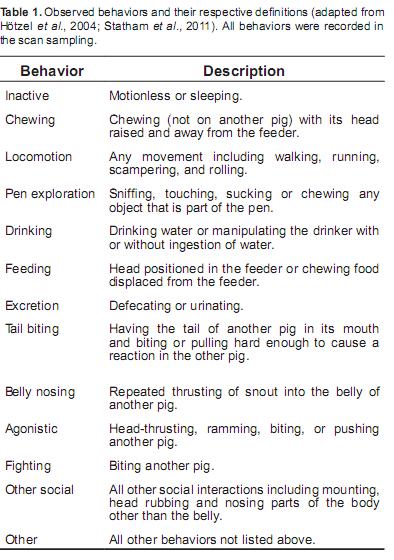
<body><![CDATA[<p>Aggressive behavior can be observed in various   behavioral contexts and occurs, for example, while   competing for limited resources (Csermely and   Wood-Gush, 1987) or in order to secure the social   position of an individual animal and to establish   a social structure within a group of individuals   (Hagelso Giersing and Studnitz, 1996). Agonistic   behaviors, such as opposing aggression and   defensiveness, are part of the normal behavior   patterns of pigs. As agonistic interactions inevitably   occur when unfamiliar sows are grouped (Mendl   and Deag, 1995; D'Eath and Turner, 2009), great   challenges arise from keeping sows in groups   (Gonyou, 2003). Severe manifestations of social   stress can lead to delayed estrous, aborted fetuses,   increased farrowing time, and failure to lactate (Varley and Stedman, 1993).</p>     <p>There is little evidence of an optimum group   size at which fighting and aggression between pigs   is minimized. Similarly, there is little evidence of   an optimum space allowance to reduce fighting,   although the provision of more space can decrease   the levels of aggression over the long term. More   work is needed to determine whether pigs adopt   different agonistic strategies according to group   size and composition. This study was conducted in order to assess the effects of group size (confined or loose housing) on agonistic behavior of pigs that are mixed during the growing period.</p>     <p>&nbsp;</p>     <p><font size="3"><b>Methods</b></font></p>     <p>The experiment was conducted at a commercial   swine farm located in Ansung (Gyeonggi Province,   Korea) using a total of 350 pigs (Yorkshire x   Landrace). Pigs were farrowed in 6.0 m x 6.0 m pens   with solid concrete flooring and a heat lamp. Piglets   were weaned at 20 (&plusmn; 1.2) days of age and mixed at   different densities: five (low density), ten (medium   density), or twenty (high density) individuals in   a 6.0 m x 6.0 m pen. The environmental control   systems were the same among all housing facilities.   The temperature in each room was controlled by   ventilation fans and heaters and was maintained at   approximately 20 &plusmn; 2 &ordm;C. Pigs had <i>ad libitum</i> access to feed and water.</p>     <p>Ten replicates of each treatment were evaluated   during 2006 and 2007. Two wide angle video   cameras were installed at opposing corners at   the ceiling of the stable so that the pen could be   observed from two directions. The behavior of the   pigs in the group was video-recorded continuously   for 10 h per day during three non-consecutive days.   Behaviors were analyzed from images digitally   recorded from 08:00 to 18:00 h on days 30, 90,   and 180 (day 0 = birth day). Video tapes were   analyzed using a video recorder with jog-shuttle   function. Instantaneous scan sampling was carried   out at 2-min intervals. All video recordings were   viewed by a trained observer who was blinded to   the treatments to eliminate subjective bias and interindividual discrepancy (Li and Wang, 2011).</p>     <p>Vocalizations were registered by direct   observation from the videos. Occurrences of the   following behaviors were recorded: inactivity,   chewing on other animals, locomotion, pen   exploration, drinking, feeding, excretion, tail biting,   belly nosing, agonistic behavior, fighting, and   other social interactions and behaviors (<a href="#t1">Table 1</a>).   The frequency and duration (in seconds) of these   behaviors was recorded from the videos on days 30,   90, and 180, together with which individual pigs were performing and receiving the behavior.</p>     <p align="center"><a name="t1"></a> <img src="/img/revistas/rccp/v25n3/v25n3a02t1.jpg" /></p>     <p>All agonistic interactions were registered by   recording the time of occurrence, the pigs involved,   and the dominant and defeated animal resulting   from the interaction. In this context, agonistic   behavior was defined as follows: aggressive   behavior between two pigs involving physical   contact (biting, knocking, or lateral fighting with   the opponents standing in antiparallel position,   both performing bites or knocks) starting with the   first physical contact and ending with submissive   behavior (escape) shown by one of the opponents,   or when both pigs moved away from each other (Borberg and Hoy, 2009; Krauss and Hoy, 2011).</p>     <p>In particular, fighting behavior within agonistic   interactions was monitored. Fighting was   considered to have begun when a pig bit another pig   and the fight lasted for more than 1 s, and to have   terminated when the pigs were separated for 5 s   after a fight (Samarakone and Gonyou, 2009). The   number of fights, duration of fights, and latency to   the first fight was registered. Behavioral time values presented are the means and standard errors of the relative frequencies of each behavior, by calculating results obtained from each observation of each group.</p>     ]]></body>
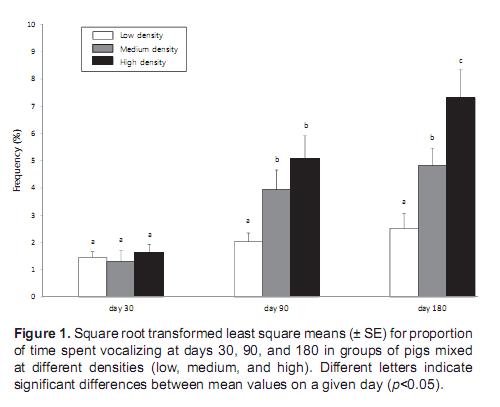
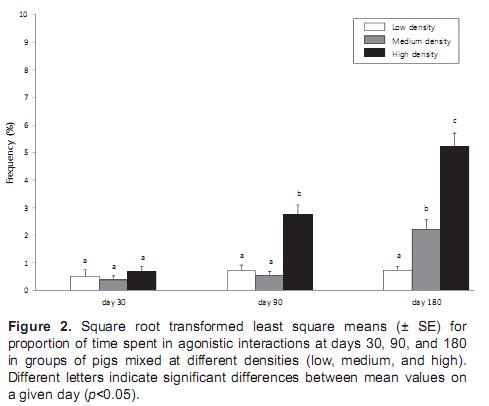
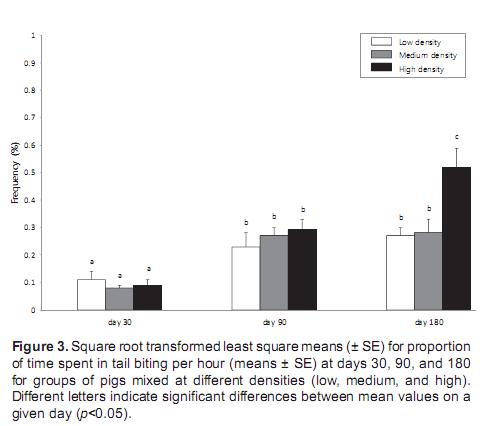
<body><![CDATA[<p>All data were analyzed by using the Glimmix   procedure of the SAS software (SAS Inst. Cary,   NY) with the pen as the experimental unit. The   residual data sets were tested for normal distribution   using the Univariate Procedure of SAS. The data   were not distributed normally and were transformed   using the logarithm (<i>X</i>' = log 10(<i>X</i> + 0.5) + 0.5)   to achieve normal distribution (Zar, 1999). The   data were analyzed by ANOVA. Tukey's <i>post hoc</i>  tests were used to determine pair-wise differences between treatments. <i>P</i> values are presented.</p>     <p>&nbsp;</p>     <p><font size="3"><b>Results</b></font></p>     <p>The frequency of vocalizations was significantly   affected by density (ANOVA, <i>F</i><sub>2,18</sub> = 21.3, <i>p</i>&lt;0.001)   and time (<i>F</i><sub>2,18</sub> = 9.7, <i>p</i>&lt;0.05). At medium and high   density, the frequency of vocalizations was highest   on day 180 and lowest on day 30. The frequency   of vocalization on day 180 was higher at the high   group density than at low and medium densities (Tukey's test, <i>p</i>&lt;0.01) (<a href="#f1">Figure 1</a>).</p>     <p align="center"><a name="f1"></a><img src="/img/revistas/rccp/v25n3/v25n3a02f1.jpg"></p>     <p>The agonistic interactions among pigs were also   significantly affected by density (<i>F</i><sub>2,18</sub> = 6.4, <i>p</i>&lt;0.05)   and time (<i>F</i><sub>2,18</sub> = 17.5, <i>p</i>&lt;0.01). On day 30, the time   spent in agonistic interactions was not significantly   different among the density groups (<i>F</i><sub>2,18</sub> = -2.5,   <i>p</i>=0.21). However, on day 90 (<i>F</i><sub>2,18</sub> = 5.6, <i>p</i>&lt;0.05)   and day 180 (<i>F</i><sub>2,18</sub> = 19.2, <i>p</i>&lt;0.01) agonistic   interactions were significantly different among the   density groups. Agonistic interaction was greater on day 180 than on days 30 and 90 (<i>p</i>&lt;0.05) (<a href="#f2">Figure 2</a>).</p>     <p align="center"><a name="f2"></a><img src="/img/revistas/rccp/v25n3/v25n3a02f2.jpg"></p>     <p>On day 30, fight latency (<i>F</i><sub>2,18</sub> = -2.6, <i>p</i>=0.12),   total duration of fighting (<i>F</i><sub>2,18</sub> = -4.3, <i>p</i>=0.34),   and fight frequency (<i>F</i><sub>2,18</sub> = -9.4, <i>p</i>=0.31) were not   significantly different among the density groups.   At day 90, fight latency (<i>F</i><sub>2,18</sub> = 6.9, <i>p</i>&lt;0.05) and   total duration of fighting (<i>F</i><sub>2,18</sub> = 3.8, <i>p</i>&lt;0.05)   were significantly higher in the high-density group   compared with groups in the low and medium   densities (<i>p</i>&lt;0.05). Fight frequency was not   significantly different among the density groups   on day 90 (<i>F</i><sub>2,18</sub> = -3.7, <i>p</i>=0.37). All variables   (fight latency, <i>F</i><sub>2,18</sub> = 6.5, <i>p</i>&lt;0.05; total duration of   fighting, <i>F</i><sub>2,18</sub> = 18.2, <i>p</i>&lt;0.01; fight frequency, <i>F</i><sub>2,18</sub> =   12.7, <i>p</i>&lt;0.01) were significantly different among the   density groups on day 180 with higher values in the high-density group (<i>p</i>&lt;0.05) (<a href="/img/revistas/rccp/v25n3/v25n3a02t2.jpg" target="_blank">Table 2</a>).</p>     <p>Frequency of tail biting did not differ among the   density groups on day 30 (<i>F</i><sub>2,18</sub> = 0.2, <i>p</i>=0.26) and   day 90 (<i>F</i><sub>2,18</sub> = 1.3, <i>p</i>=0.14), but was significantly   higher on day 90 compared with day 30 (<i>p</i>&lt;0.05).   On day 180, tail biting frequency was significantly   different among the density groups (<i>F</i><sub>2,18</sub> = 7.2,   <i>p</i>&lt;0.05), with a significantly higher frequency of   tail biting among pigs in the high-density group   than in those at low and medium densities (<i>p</i>&lt;0.05).   There was no difference in tail biting frequency   between the low and medium densities (<a href="#f3">Figure 3</a>).   Both density (ANOVA, <i>F</i><sub>2,18</sub> = 5.3, <i>p</i>&lt;0.05) and day   (<i>F</i><sub>2,18</sub> = 4.7, <i>p</i>&lt;0.05) had a significant effect on tail   biting, but there was no interaction between these factors (<i>F</i><sub>2,18</sub> = 0.5, <i>p</i>=0.08).</p>     <p align="center"><a name="f3"></a><img src="/img/revistas/rccp/v25n3/v25n3a02f3.jpg"></p>     ]]></body>
<body><![CDATA[<p>&nbsp;</p>     <p><font size="3"><b>Discussion</b></font></p>     <p>   The main objective of this study was to conduct   a detailed investigation of the effect of group size on   the agonistic behavior of pigs at different ages. Of   particular interest was the impact that high density   had on vocalization, agonistic interactions, fighting,   and tail biting. The results of this study indicate   that agonistic behavior increases as pigs grow.   In particular, the older pigs (day 180) in the highdensity   group were more aggressive than those at   low density.</p>     <p>Generally, fighting occurs between pigs that   are unfamiliar with each other (Arey and Edwards,   1998). Fighting establishes relative social ranking   (Meese and Ewbank, 1973) thereby reducing   the need for outright aggression to settle future   disputes between animals; however, there is a   higher level of agonistic behavior among pigs in   the groups of medium and high densities. Spacing   between individual animals in a test pen with the   high density group was previously shown to be   associated with agonistic behavior (Rushen, 1988;   Moorse <i>et al.</i>, 1994; Jensen <i>et al.</i>, 1996). Thus,   aggressive interactions may continue between   familiar animals, but they do so at much lower   levels unless resources such as food (Baxter, 1989) or space (Arey <i>et al.</i>, 1992) become limited.</p>     <p>Fighting for resources among pigs usually   lasts longer than fighting for dominance hierarchy   (Langbein and Puppe, 2004). In the present study, fighting among pigs in the high-density group was Fighting for resources among pigs usually lasts longer than fighting for dominance hierarchy (Langbein and Puppe, 2004). In the present study, fighting among pigs in the high-density group wasmore vigorous on day 180, with longer duration and higher fight frequency. On day 30, few fights among pigs were observed for all three densities because pen size was large enough for the piglets. However, by day 180 the older pigs were suffering from space stress and the number and frequency of agonistic interactions were higher at high group density compared with low group density.</p>     <p>Vocalization may be an indicator of status for   pigs (Rhim <i>et al.</i>, 2008). A large number of calls occurred in the groups that were housed at high   density. Moreover, vocalization increased with the   age of the pigs. The frequency of vocalization was the highest in the high-density group on day 180.</p>     <p>In conventional swine production, pigs are   usually mixed at weaning and during the early   growing stage to efficiently utilize housing   facilities. Mixing of unacquainted pigs induces   aggression and, consequently, can result in injuries   (O'Connell <i>et al.</i>, 2005). Mixing can also cause   a setback in growth rate (Li and Johnston, 2009).   Since fights among older pigs are more intensive   and cause more injuries than fights among younger   pigs (Weary <i>et al.</i>, 2002), animals in commercial   growing systems may modify their behavioral response to mixing during later stages of production.</p>     <p>It was observed in the present study that limiting   space tends to increase aggression among growing   pigs. In addition, aggression levels are greater at   higher stocking rates. The aggression that occurs   during mixing results in stress responses, and   such responses could have detrimental effects on productive parameters.</p>     <p>&nbsp;</p>     <p><font size="3"><b>References</b></font></p>     ]]></body>
<body><![CDATA[<!-- ref --><p>1. Anil L, Anil SS, Baidoo SK, Waler RD. Effect of group size and   structure on the welfare and performance of pregnant sows in   pens with electronic sow feeders. Can J Vet Res 2006; 70:128-136.&nbsp;&nbsp;&nbsp;&nbsp;&nbsp;&nbsp;&nbsp;&nbsp;[&#160;<a href="javascript:void(0);" onclick="javascript: window.open('/scielo.php?script=sci_nlinks&ref=000063&pid=S0120-0690201200030000200001&lng=','','width=640,height=500,resizable=yes,scrollbars=1,menubar=yes,');">Links</a>&#160;]<!-- end-ref --><!-- ref --><p>   2. Arey DS. Time course for the formation and disruption of social   organization in group-housed sows. Appl Anim Behav Sci 1999;   62:199-207.&nbsp;&nbsp;&nbsp;&nbsp;&nbsp;&nbsp;&nbsp;&nbsp;[&#160;<a href="javascript:void(0);" onclick="javascript: window.open('/scielo.php?script=sci_nlinks&ref=000064&pid=S0120-0690201200030000200002&lng=','','width=640,height=500,resizable=yes,scrollbars=1,menubar=yes,');">Links</a>&#160;]<!-- end-ref --><!-- ref --><p>   3. Arey DS, Edwards SA. Factors influencing aggression between   sows after mixing and the consequences for welfare and   production. Livest Prod Sci 1998; 56:61-70.&nbsp;&nbsp;&nbsp;&nbsp;&nbsp;&nbsp;&nbsp;&nbsp;[&#160;<a href="javascript:void(0);" onclick="javascript: window.open('/scielo.php?script=sci_nlinks&ref=000065&pid=S0120-0690201200030000200003&lng=','','width=640,height=500,resizable=yes,scrollbars=1,menubar=yes,');">Links</a>&#160;]<!-- end-ref --><!-- ref --><p>4. Arey DS, Petchey AM, Fowler VR. The peri-parturient   behaviour of sows housed in pairs. Appl Anim Behav Sci 1992; 34:49-59.&nbsp;&nbsp;&nbsp;&nbsp;&nbsp;&nbsp;&nbsp;&nbsp;[&#160;<a href="javascript:void(0);" onclick="javascript: window.open('/scielo.php?script=sci_nlinks&ref=000066&pid=S0120-0690201200030000200004&lng=','','width=640,height=500,resizable=yes,scrollbars=1,menubar=yes,');">Links</a>&#160;]<!-- end-ref --><!-- ref --><p>   5. Barnett JL, Cronin GM, McCalum TH, Newman EA, Hennessy   DP. Effects of grouping unfamiliar adult pigs after dark, after   treatment with amperozide and by using pens with stalls, on   aggression, skin lesions and plasma cortisol concentration. Appl   Anim Behav Sci 1996; 50:121-133.&nbsp;&nbsp;&nbsp;&nbsp;&nbsp;&nbsp;&nbsp;&nbsp;[&#160;<a href="javascript:void(0);" onclick="javascript: window.open('/scielo.php?script=sci_nlinks&ref=000067&pid=S0120-0690201200030000200005&lng=','','width=640,height=500,resizable=yes,scrollbars=1,menubar=yes,');">Links</a>&#160;]<!-- end-ref --><!-- ref --><p>   6. Barnett JL, Hemsworth PH, Cronin GM, Newman EA,   McCallum TH, Chilton D. Effects of pen size, partial stalls   and method of feeding on welfare-related behavioural and   physiological responses of group-housed pigs. Appl Anim   Behav Sci 1992; 34:207-220.&nbsp;&nbsp;&nbsp;&nbsp;&nbsp;&nbsp;&nbsp;&nbsp;[&#160;<a href="javascript:void(0);" onclick="javascript: window.open('/scielo.php?script=sci_nlinks&ref=000068&pid=S0120-0690201200030000200006&lng=','','width=640,height=500,resizable=yes,scrollbars=1,menubar=yes,');">Links</a>&#160;]<!-- end-ref --><!-- ref --><p>   7. Baxter EM, Lawrence AB, Edwards SA. Alternative farrowing   systems: design criteria for farrowing systems based on the   biological needs of sows and piglets. Animal 2010; 5:580-600.&nbsp;&nbsp;&nbsp;&nbsp;&nbsp;&nbsp;&nbsp;&nbsp;[&#160;<a href="javascript:void(0);" onclick="javascript: window.open('/scielo.php?script=sci_nlinks&ref=000069&pid=S0120-0690201200030000200007&lng=','','width=640,height=500,resizable=yes,scrollbars=1,menubar=yes,');">Links</a>&#160;]<!-- end-ref --><!-- ref --><p>   8. Baxter MR. Design of a new feeder for pigs. Farm Build Progr   1989; 96:19-22.&nbsp;&nbsp;&nbsp;&nbsp;&nbsp;&nbsp;&nbsp;&nbsp;[&#160;<a href="javascript:void(0);" onclick="javascript: window.open('/scielo.php?script=sci_nlinks&ref=000070&pid=S0120-0690201200030000200008&lng=','','width=640,height=500,resizable=yes,scrollbars=1,menubar=yes,');">Links</a>&#160;]<!-- end-ref --><!-- ref --><p>   9. Borberg C, Hoy S. Mixing of sows with or without the presence   of a boar. Livest Sci 2009; 125:314-317.&nbsp;&nbsp;&nbsp;&nbsp;&nbsp;&nbsp;&nbsp;&nbsp;[&#160;<a href="javascript:void(0);" onclick="javascript: window.open('/scielo.php?script=sci_nlinks&ref=000071&pid=S0120-0690201200030000200009&lng=','','width=640,height=500,resizable=yes,scrollbars=1,menubar=yes,');">Links</a>&#160;]<!-- end-ref --><!-- ref --><p>   10. Csermely D, Wood-Gush DGM. Aggressive behavior of   grouped sows in different contexts. Appl Anim Behav Sci 1987;   17:368-369.&nbsp;&nbsp;&nbsp;&nbsp;&nbsp;&nbsp;&nbsp;&nbsp;[&#160;<a href="javascript:void(0);" onclick="javascript: window.open('/scielo.php?script=sci_nlinks&ref=000072&pid=S0120-0690201200030000200010&lng=','','width=640,height=500,resizable=yes,scrollbars=1,menubar=yes,');">Links</a>&#160;]<!-- end-ref --><!-- ref --><p>   11. D'Eath RB, Turner SP. The natural behavior of the pig. In:   Marchant-Forde JN (Ed). The welfare of pigs. New York:   Springer; 2009. p 13-45.&nbsp;&nbsp;&nbsp;&nbsp;&nbsp;&nbsp;&nbsp;&nbsp;[&#160;<a href="javascript:void(0);" onclick="javascript: window.open('/scielo.php?script=sci_nlinks&ref=000073&pid=S0120-0690201200030000200011&lng=','','width=640,height=500,resizable=yes,scrollbars=1,menubar=yes,');">Links</a>&#160;]<!-- end-ref --><!-- ref --><p>   12. Frazer AF, Broom DM. Farm animal behaviour and welfare.   Oxon: CABI Publishing; 1997.&nbsp;&nbsp;&nbsp;&nbsp;&nbsp;&nbsp;&nbsp;&nbsp;[&#160;<a href="javascript:void(0);" onclick="javascript: window.open('/scielo.php?script=sci_nlinks&ref=000074&pid=S0120-0690201200030000200012&lng=','','width=640,height=500,resizable=yes,scrollbars=1,menubar=yes,');">Links</a>&#160;]<!-- end-ref --><!-- ref --><p>   13. Gonyou HW. The social behavior of pigs. In: Keeling LJ,   Gonyou HW (Ed). Social behavior in farm animals. Oxon:   CABI Publishing; 2001. p 147-176.&nbsp;&nbsp;&nbsp;&nbsp;&nbsp;&nbsp;&nbsp;&nbsp;[&#160;<a href="javascript:void(0);" onclick="javascript: window.open('/scielo.php?script=sci_nlinks&ref=000075&pid=S0120-0690201200030000200013&lng=','','width=640,height=500,resizable=yes,scrollbars=1,menubar=yes,');">Links</a>&#160;]<!-- end-ref --><!-- ref --><p>   14. Gonyou HW. Group housing: alternative systems, alternative   management. Adv Pork Prod 2003; 14:10-107.&nbsp;&nbsp;&nbsp;&nbsp;&nbsp;&nbsp;&nbsp;&nbsp;[&#160;<a href="javascript:void(0);" onclick="javascript: window.open('/scielo.php?script=sci_nlinks&ref=000076&pid=S0120-0690201200030000200014&lng=','','width=640,height=500,resizable=yes,scrollbars=1,menubar=yes,');">Links</a>&#160;]<!-- end-ref --><!-- ref --><p>   15. Hagelso Giersing M, Studnitz M. Characterization and   investigation of aggressive behaviour in the pig. Acta Agric   Scand A: Anim Sci Suppl 1996; 27:56-60.&nbsp;&nbsp;&nbsp;&nbsp;&nbsp;&nbsp;&nbsp;&nbsp;[&#160;<a href="javascript:void(0);" onclick="javascript: window.open('/scielo.php?script=sci_nlinks&ref=000077&pid=S0120-0690201200030000200015&lng=','','width=640,height=500,resizable=yes,scrollbars=1,menubar=yes,');">Links</a>&#160;]<!-- end-ref --><!-- ref --><p>   16. Hillmann E, von Hollen F, Bunger B, Todt D, Schrader L.   Farrowing conditions affect the reactions of piglets towards   novel environment and social confrontation at weaning. Appl   Anim Behav Sci 2003; 81:99-109.&nbsp;&nbsp;&nbsp;&nbsp;&nbsp;&nbsp;&nbsp;&nbsp;[&#160;<a href="javascript:void(0);" onclick="javascript: window.open('/scielo.php?script=sci_nlinks&ref=000078&pid=S0120-0690201200030000200016&lng=','','width=640,height=500,resizable=yes,scrollbars=1,menubar=yes,');">Links</a>&#160;]<!-- end-ref --><!-- ref --><p>17. Hoy S, Bauer J, Borberg C, Chonsch L, Weirich C. Impact of rank position on fertility of sows. Livest Sci 2009; 126:69-72.&nbsp;&nbsp;&nbsp;&nbsp;&nbsp;&nbsp;&nbsp;&nbsp;[&#160;<a href="javascript:void(0);" onclick="javascript: window.open('/scielo.php?script=sci_nlinks&ref=000079&pid=S0120-0690201200030000200017&lng=','','width=640,height=500,resizable=yes,scrollbars=1,menubar=yes,');">Links</a>&#160;]<!-- end-ref --><!-- ref --><p>   18. H&ouml;tzel MJ, Machado Filho LCP, Wolf FM, Costa OAD. 2004.   Behaviour of sows and piglets reared in intensive outdoor or   indoor systems. Appl Anim Behav Sci 2004; 86:27-39.&nbsp;&nbsp;&nbsp;&nbsp;&nbsp;&nbsp;&nbsp;&nbsp;[&#160;<a href="javascript:void(0);" onclick="javascript: window.open('/scielo.php?script=sci_nlinks&ref=000080&pid=S0120-0690201200030000200018&lng=','','width=640,height=500,resizable=yes,scrollbars=1,menubar=yes,');">Links</a>&#160;]<!-- end-ref --><!-- ref --><p>   19. Jensen P, Forkman B, Yngvesson J, Furuhaug IL. Assessment in   pig conflicts. In: Duncan IJH, Widowski TM, Waley DB (Ed).   The 30<sup>th</sup> International Congress of the International Society for   Applied Ethology. Guelph: The Colonel K.L. Campbell Centre   for Study of Animal Welfare; 1996.&nbsp;&nbsp;&nbsp;&nbsp;&nbsp;&nbsp;&nbsp;&nbsp;[&#160;<a href="javascript:void(0);" onclick="javascript: window.open('/scielo.php?script=sci_nlinks&ref=000081&pid=S0120-0690201200030000200019&lng=','','width=640,height=500,resizable=yes,scrollbars=1,menubar=yes,');">Links</a>&#160;]<!-- end-ref --><!-- ref --><p>20. Krauss V, Hoy S. Dry sows in dynamic groups: an investigation   of social behavior when introducing new sows. Appl Anim Behav Sci 2011; 130:20-27.&nbsp;&nbsp;&nbsp;&nbsp;&nbsp;&nbsp;&nbsp;&nbsp;[&#160;<a href="javascript:void(0);" onclick="javascript: window.open('/scielo.php?script=sci_nlinks&ref=000082&pid=S0120-0690201200030000200020&lng=','','width=640,height=500,resizable=yes,scrollbars=1,menubar=yes,');">Links</a>&#160;]<!-- end-ref --><!-- ref --><p>   21. Langbein J, Puppe B. Analysing dominance relationships   by sociometric methods &#8211; a plea for a more standardized and   precise approach in farm animals. Appl Anim Behav Sci 2004;   87:293-315.&nbsp;&nbsp;&nbsp;&nbsp;&nbsp;&nbsp;&nbsp;&nbsp;[&#160;<a href="javascript:void(0);" onclick="javascript: window.open('/scielo.php?script=sci_nlinks&ref=000083&pid=S0120-0690201200030000200021&lng=','','width=640,height=500,resizable=yes,scrollbars=1,menubar=yes,');">Links</a>&#160;]<!-- end-ref --><!-- ref --><p>   22. Li Y, Wang L. Effects of previous housing system on agonistic   behaviors of growing pigs at mixing. Appl Anim Behav Sci   2011; 132:20-26.&nbsp;&nbsp;&nbsp;&nbsp;&nbsp;&nbsp;&nbsp;&nbsp;[&#160;<a href="javascript:void(0);" onclick="javascript: window.open('/scielo.php?script=sci_nlinks&ref=000084&pid=S0120-0690201200030000200022&lng=','','width=640,height=500,resizable=yes,scrollbars=1,menubar=yes,');">Links</a>&#160;]<!-- end-ref --><!-- ref --><p>   23. Li YZ, Johnston LJ. Behavior and performance of pigs previously   housed in large groups. J Anim Sci 2009; 87:1472-1478.&nbsp;&nbsp;&nbsp;&nbsp;&nbsp;&nbsp;&nbsp;&nbsp;[&#160;<a href="javascript:void(0);" onclick="javascript: window.open('/scielo.php?script=sci_nlinks&ref=000085&pid=S0120-0690201200030000200023&lng=','','width=640,height=500,resizable=yes,scrollbars=1,menubar=yes,');">Links</a>&#160;]<!-- end-ref --><!-- ref --><p>   24. Meese GB, Ewbank R. The establishment and nature of the   dominance hierarchy in the domesticated pig. Anim Behav   1973; 21:326-334.&nbsp;&nbsp;&nbsp;&nbsp;&nbsp;&nbsp;&nbsp;&nbsp;[&#160;<a href="javascript:void(0);" onclick="javascript: window.open('/scielo.php?script=sci_nlinks&ref=000086&pid=S0120-0690201200030000200024&lng=','','width=640,height=500,resizable=yes,scrollbars=1,menubar=yes,');">Links</a>&#160;]<!-- end-ref --><!-- ref --><p>   25. Mendl M, Deag JM. How useful are the concepts of alternative   strategy and coping strategy in applied studies of social   behavior? Appl Anim Behav Sci 1995; 44:1107-1121.&nbsp;&nbsp;&nbsp;&nbsp;&nbsp;&nbsp;&nbsp;&nbsp;[&#160;<a href="javascript:void(0);" onclick="javascript: window.open('/scielo.php?script=sci_nlinks&ref=000087&pid=S0120-0690201200030000200025&lng=','','width=640,height=500,resizable=yes,scrollbars=1,menubar=yes,');">Links</a>&#160;]<!-- end-ref --><!-- ref --><p>   26. Moore AS, Gonyou HW, Stookey JM, McLaren DG. Effect of   group composition and pen size on behaviour, productivity and   immune response of growing pigs. Appl Anim Behav Sci 1994;   40:13-30.&nbsp;&nbsp;&nbsp;&nbsp;&nbsp;&nbsp;&nbsp;&nbsp;[&#160;<a href="javascript:void(0);" onclick="javascript: window.open('/scielo.php?script=sci_nlinks&ref=000088&pid=S0120-0690201200030000200026&lng=','','width=640,height=500,resizable=yes,scrollbars=1,menubar=yes,');">Links</a>&#160;]<!-- end-ref --><!-- ref --><p>   27. O'Connell NE, Beattie VE, Watt D. Influence of regrouping   strategy on performance, behaviour and carcass parameters in   pigs. Livest Prod Sci 2005; 97:107-115.&nbsp;&nbsp;&nbsp;&nbsp;&nbsp;&nbsp;&nbsp;&nbsp;[&#160;<a href="javascript:void(0);" onclick="javascript: window.open('/scielo.php?script=sci_nlinks&ref=000089&pid=S0120-0690201200030000200027&lng=','','width=640,height=500,resizable=yes,scrollbars=1,menubar=yes,');">Links</a>&#160;]<!-- end-ref --><!-- ref --><p>   28. Petheric JC, Blackshaw JK. A review of the factors influencing   the aggressive and agonistic behaviour of the domestic pig. Aust   J Exp Agric 1987; 27:605-611.&nbsp;&nbsp;&nbsp;&nbsp;&nbsp;&nbsp;&nbsp;&nbsp;[&#160;<a href="javascript:void(0);" onclick="javascript: window.open('/scielo.php?script=sci_nlinks&ref=000090&pid=S0120-0690201200030000200028&lng=','','width=640,height=500,resizable=yes,scrollbars=1,menubar=yes,');">Links</a>&#160;]<!-- end-ref --><!-- ref --><p>   29. Rhim SJ, Kim MJ, Lee JY, Kim NR, Kang JH. Characteristics   of estrus-related vocalizations of sows after artificial   insemination. J Anim Sci &amp; Technol 2008; 50:401-406.&nbsp;&nbsp;&nbsp;&nbsp;&nbsp;&nbsp;&nbsp;&nbsp;[&#160;<a href="javascript:void(0);" onclick="javascript: window.open('/scielo.php?script=sci_nlinks&ref=000091&pid=S0120-0690201200030000200029&lng=','','width=640,height=500,resizable=yes,scrollbars=1,menubar=yes,');">Links</a>&#160;]<!-- end-ref --><!-- ref --><p>30. Rushen J. Assessment of fighting ability or simple habituation:   what cause young pigs (<i>Sus scrofa</i>) to stop fighting. Aggress Behav 1988; 14:155-167.&nbsp;&nbsp;&nbsp;&nbsp;&nbsp;&nbsp;&nbsp;&nbsp;[&#160;<a href="javascript:void(0);" onclick="javascript: window.open('/scielo.php?script=sci_nlinks&ref=000092&pid=S0120-0690201200030000200030&lng=','','width=640,height=500,resizable=yes,scrollbars=1,menubar=yes,');">Links</a>&#160;]<!-- end-ref --><!-- ref --><p>   31. Samarakone TS, Gonyou HY. Domestic pigs alter their social   strategy in response to social group size. Appl Anim Behav Sci   2009; 121:8-15.&nbsp;&nbsp;&nbsp;&nbsp;&nbsp;&nbsp;&nbsp;&nbsp;[&#160;<a href="javascript:void(0);" onclick="javascript: window.open('/scielo.php?script=sci_nlinks&ref=000093&pid=S0120-0690201200030000200031&lng=','','width=640,height=500,resizable=yes,scrollbars=1,menubar=yes,');">Links</a>&#160;]<!-- end-ref --><!-- ref --><p>   32. Statham P, Green L, Bichard M, Mendl M. A longitudinal study   of the effects of providing straw at different stages of life on   tail-biting and other behaviour in commercially housed pigs.   Appl Anim Behav Sci 2011; 134:100-108.&nbsp;&nbsp;&nbsp;&nbsp;&nbsp;&nbsp;&nbsp;&nbsp;[&#160;<a href="javascript:void(0);" onclick="javascript: window.open('/scielo.php?script=sci_nlinks&ref=000094&pid=S0120-0690201200030000200032&lng=','','width=640,height=500,resizable=yes,scrollbars=1,menubar=yes,');">Links</a>&#160;]<!-- end-ref --><!-- ref --><p>   33. Strawford ML. Social factors that affect the behavior and   productivity of gestating sows in an electronic sow feeding   system. Thesis of MSc, University of Saskatchewan, Saskatoon,   2006.&nbsp;&nbsp;&nbsp;&nbsp;&nbsp;&nbsp;&nbsp;&nbsp;[&#160;<a href="javascript:void(0);" onclick="javascript: window.open('/scielo.php?script=sci_nlinks&ref=000095&pid=S0120-0690201200030000200033&lng=','','width=640,height=500,resizable=yes,scrollbars=1,menubar=yes,');">Links</a>&#160;]<!-- end-ref --><!-- ref --><p>   34. Varley M, Stedman R. Stress and reproduction. In: Cole   DJA, Wiseman J, Varley MA (Ed). Principles of pig science.   Nottingham: Nottingham University Press; 1993. p 277-296.&nbsp;&nbsp;&nbsp;&nbsp;&nbsp;&nbsp;&nbsp;&nbsp;[&#160;<a href="javascript:void(0);" onclick="javascript: window.open('/scielo.php?script=sci_nlinks&ref=000096&pid=S0120-0690201200030000200034&lng=','','width=640,height=500,resizable=yes,scrollbars=1,menubar=yes,');">Links</a>&#160;]<!-- end-ref --><!-- ref --><p>   35. Weary DM, Pajor EA, Bonenfant M, Fraser D, Kramer DL.   Alternative housing for sows and litters. Part 4: effects of sowcontrolled   housing combined with a communal piglet area on   pre- and post- weaning behaviour and performance. Appl Anim   Behav Sci 2002; 76:279-290.&nbsp;&nbsp;&nbsp;&nbsp;&nbsp;&nbsp;&nbsp;&nbsp;[&#160;<a href="javascript:void(0);" onclick="javascript: window.open('/scielo.php?script=sci_nlinks&ref=000097&pid=S0120-0690201200030000200035&lng=','','width=640,height=500,resizable=yes,scrollbars=1,menubar=yes,');">Links</a>&#160;]<!-- end-ref --><!-- ref --><p>   36. Weng RC, Edwards SA, Hsia LC. Effect of individual, group   or ESF housing in pregnancy and individual or group housing   in lactation on sow behavior. Asian-Aust J Anim Sci 2009;   22:1574-1580.&nbsp;&nbsp;&nbsp;&nbsp;&nbsp;&nbsp;&nbsp;&nbsp;[&#160;<a href="javascript:void(0);" onclick="javascript: window.open('/scielo.php?script=sci_nlinks&ref=000098&pid=S0120-0690201200030000200036&lng=','','width=640,height=500,resizable=yes,scrollbars=1,menubar=yes,');">Links</a>&#160;]<!-- end-ref --><!-- ref --><p>   37. Zar JH. Biostatistical analysis, 4<sup>th</sup> ed. Upper Saddler River:   Prentice-Hall Inc.; 1999.&nbsp;&nbsp;&nbsp;&nbsp;&nbsp;&nbsp;&nbsp;&nbsp;[&#160;<a href="javascript:void(0);" onclick="javascript: window.open('/scielo.php?script=sci_nlinks&ref=000099&pid=S0120-0690201200030000200037&lng=','','width=640,height=500,resizable=yes,scrollbars=1,menubar=yes,');">Links</a>&#160;]<!-- end-ref --><p>&nbsp;</p>     <p><font size="3"><b>Notas</b></font></p>     <p><sup><a href="#b0">&curren;</a></sup><a name="0"></a> To cite this article: Shin-Jae R. Effects of group size on agonistic behaviors of commercially housed growing pigs. Rev Colomb Cienc Pecu 2012; 25:353-359.</p> </font>     ]]></body>
<body><![CDATA[ ]]></body><back>
<ref-list>
<ref id="B1">
<label>1</label><nlm-citation citation-type="journal">
<person-group person-group-type="author">
<name>
<surname><![CDATA[Anil]]></surname>
<given-names><![CDATA[L]]></given-names>
</name>
<name>
<surname><![CDATA[Anil]]></surname>
<given-names><![CDATA[SS]]></given-names>
</name>
<name>
<surname><![CDATA[Baidoo]]></surname>
<given-names><![CDATA[SK]]></given-names>
</name>
<name>
<surname><![CDATA[Waler]]></surname>
<given-names><![CDATA[RD.]]></given-names>
</name>
</person-group>
<article-title xml:lang="en"><![CDATA[Effect of group size and structure on the welfare and performance of pregnant sows in pens with electronic sow feeders]]></article-title>
<source><![CDATA[Can J Vet Res]]></source>
<year>2006</year>
<volume>70</volume>
<page-range>128-136</page-range></nlm-citation>
</ref>
<ref id="B2">
<label>2</label><nlm-citation citation-type="journal">
<person-group person-group-type="author">
<name>
<surname><![CDATA[Arey]]></surname>
<given-names><![CDATA[DS.]]></given-names>
</name>
</person-group>
<article-title xml:lang="en"><![CDATA[Time course for the formation and disruption of social organization in group-housed sows]]></article-title>
<source><![CDATA[Appl Anim Behav Sci]]></source>
<year>1999</year>
<volume>62</volume>
<page-range>199-207</page-range></nlm-citation>
</ref>
<ref id="B3">
<label>3</label><nlm-citation citation-type="journal">
<person-group person-group-type="author">
<name>
<surname><![CDATA[Arey]]></surname>
<given-names><![CDATA[DS]]></given-names>
</name>
<name>
<surname><![CDATA[Edwards]]></surname>
<given-names><![CDATA[SA]]></given-names>
</name>
</person-group>
<article-title xml:lang="en"><![CDATA[Factors influencing aggression between sows after mixing and the consequences for welfare and production]]></article-title>
<source><![CDATA[Livest Prod Sci]]></source>
<year>1998</year>
<volume>56</volume>
<page-range>61-70</page-range></nlm-citation>
</ref>
<ref id="B4">
<label>4</label><nlm-citation citation-type="journal">
<person-group person-group-type="author">
<name>
<surname><![CDATA[Arey]]></surname>
<given-names><![CDATA[DS]]></given-names>
</name>
<name>
<surname><![CDATA[Petchey]]></surname>
<given-names><![CDATA[AM]]></given-names>
</name>
<name>
<surname><![CDATA[Fowler]]></surname>
<given-names><![CDATA[VR.]]></given-names>
</name>
</person-group>
<article-title xml:lang="en"><![CDATA[The peri-parturient behaviour of sows housed in pairs]]></article-title>
<source><![CDATA[Appl Anim Behav Sci]]></source>
<year>1992</year>
<volume>34</volume>
<page-range>49-59</page-range></nlm-citation>
</ref>
<ref id="B5">
<label>5</label><nlm-citation citation-type="journal">
<person-group person-group-type="author">
<name>
<surname><![CDATA[Barnett]]></surname>
<given-names><![CDATA[JL]]></given-names>
</name>
<name>
<surname><![CDATA[Cronin]]></surname>
<given-names><![CDATA[GM]]></given-names>
</name>
<name>
<surname><![CDATA[McCalum]]></surname>
<given-names><![CDATA[TH]]></given-names>
</name>
<name>
<surname><![CDATA[Newman]]></surname>
<given-names><![CDATA[EA]]></given-names>
</name>
<name>
<surname><![CDATA[Hennessy]]></surname>
<given-names><![CDATA[DP]]></given-names>
</name>
</person-group>
<article-title xml:lang="en"><![CDATA[Effects of grouping unfamiliar adult pigs after dark, after treatment with amperozide and by using pens with stalls, on aggression, skin lesions and plasma cortisol concentration]]></article-title>
<source><![CDATA[Appl Anim Behav Sci]]></source>
<year>1996</year>
<volume>50</volume>
<page-range>121-133</page-range></nlm-citation>
</ref>
<ref id="B6">
<label>6</label><nlm-citation citation-type="journal">
<person-group person-group-type="author">
<name>
<surname><![CDATA[Barnett]]></surname>
<given-names><![CDATA[JL]]></given-names>
</name>
<name>
<surname><![CDATA[Hemsworth]]></surname>
<given-names><![CDATA[PH]]></given-names>
</name>
<name>
<surname><![CDATA[Cronin]]></surname>
<given-names><![CDATA[GM]]></given-names>
</name>
<name>
<surname><![CDATA[Newman]]></surname>
<given-names><![CDATA[EA]]></given-names>
</name>
<name>
<surname><![CDATA[McCallum]]></surname>
<given-names><![CDATA[TH]]></given-names>
</name>
<name>
<surname><![CDATA[Chilton]]></surname>
<given-names><![CDATA[D]]></given-names>
</name>
</person-group>
<article-title xml:lang="en"><![CDATA[Effects of pen size, partial stalls and method of feeding on welfare-related behavioural and physiological responses of group-housed pigs]]></article-title>
<source><![CDATA[Appl Anim Behav Sci]]></source>
<year>1992</year>
<volume>34</volume>
<page-range>207-220</page-range></nlm-citation>
</ref>
<ref id="B7">
<label>7</label><nlm-citation citation-type="journal">
<person-group person-group-type="author">
<name>
<surname><![CDATA[Baxter]]></surname>
<given-names><![CDATA[EM]]></given-names>
</name>
<name>
<surname><![CDATA[Lawrence]]></surname>
<given-names><![CDATA[AB]]></given-names>
</name>
<name>
<surname><![CDATA[Edwards]]></surname>
<given-names><![CDATA[SA.]]></given-names>
</name>
</person-group>
<article-title xml:lang="en"><![CDATA[Alternative farrowing systems: design criteria for farrowing systems based on the biological needs of sows and piglets]]></article-title>
<source><![CDATA[Animal]]></source>
<year>2010</year>
<volume>5</volume>
<page-range>580-600</page-range></nlm-citation>
</ref>
<ref id="B8">
<label>8</label><nlm-citation citation-type="journal">
<person-group person-group-type="author">
<name>
<surname><![CDATA[Baxter]]></surname>
<given-names><![CDATA[MR]]></given-names>
</name>
</person-group>
<article-title xml:lang="en"><![CDATA[Design of a new feeder for pigs]]></article-title>
<source><![CDATA[Farm Build Progr]]></source>
<year>1989</year>
<volume>96</volume>
<page-range>19-22</page-range></nlm-citation>
</ref>
<ref id="B9">
<label>9</label><nlm-citation citation-type="journal">
<person-group person-group-type="author">
<name>
<surname><![CDATA[Borberg]]></surname>
<given-names><![CDATA[C]]></given-names>
</name>
<name>
<surname><![CDATA[Hoy]]></surname>
<given-names><![CDATA[S]]></given-names>
</name>
</person-group>
<article-title xml:lang="en"><![CDATA[Mixing of sows with or without the presence of a boar]]></article-title>
<source><![CDATA[Livest Sci]]></source>
<year>2009</year>
<volume>125</volume>
<page-range>314-317</page-range></nlm-citation>
</ref>
<ref id="B10">
<label>10</label><nlm-citation citation-type="journal">
<person-group person-group-type="author">
<name>
<surname><![CDATA[Csermely]]></surname>
<given-names><![CDATA[D]]></given-names>
</name>
<name>
<surname><![CDATA[Wood-Gush]]></surname>
<given-names><![CDATA[DGM]]></given-names>
</name>
</person-group>
<article-title xml:lang="en"><![CDATA[Aggressive behavior of grouped sows in different contexts]]></article-title>
<source><![CDATA[Appl Anim Behav Sci]]></source>
<year>1987</year>
<volume>17</volume>
<page-range>368-369</page-range></nlm-citation>
</ref>
<ref id="B11">
<label>11</label><nlm-citation citation-type="book">
<person-group person-group-type="author">
<name>
<surname><![CDATA[D'Eath]]></surname>
<given-names><![CDATA[RB]]></given-names>
</name>
<name>
<surname><![CDATA[Turner]]></surname>
<given-names><![CDATA[SP.]]></given-names>
</name>
</person-group>
<article-title xml:lang="en"><![CDATA[The natural behavior of the pig]]></article-title>
<person-group person-group-type="editor">
<name>
<surname><![CDATA[Marchant-Forde]]></surname>
<given-names><![CDATA[JN]]></given-names>
</name>
</person-group>
<source><![CDATA[The welfare of pigs]]></source>
<year>2009</year>
<page-range>13-45</page-range><publisher-loc><![CDATA[New York ]]></publisher-loc>
<publisher-name><![CDATA[Springer]]></publisher-name>
</nlm-citation>
</ref>
<ref id="B12">
<label>12</label><nlm-citation citation-type="book">
<person-group person-group-type="author">
<name>
<surname><![CDATA[Frazer]]></surname>
<given-names><![CDATA[AF]]></given-names>
</name>
<name>
<surname><![CDATA[Broom]]></surname>
<given-names><![CDATA[DM.]]></given-names>
</name>
</person-group>
<source><![CDATA[Farm animal behaviour and welfare]]></source>
<year>1997</year>
<publisher-loc><![CDATA[Oxon ]]></publisher-loc>
<publisher-name><![CDATA[CABI Publishing]]></publisher-name>
</nlm-citation>
</ref>
<ref id="B13">
<label>13</label><nlm-citation citation-type="book">
<person-group person-group-type="author">
<name>
<surname><![CDATA[Gonyou]]></surname>
<given-names><![CDATA[HW.]]></given-names>
</name>
</person-group>
<article-title xml:lang="en"><![CDATA[The social behavior of pigs]]></article-title>
<person-group person-group-type="editor">
<name>
<surname><![CDATA[Keeling]]></surname>
<given-names><![CDATA[LJ]]></given-names>
</name>
<name>
<surname><![CDATA[Gonyou]]></surname>
<given-names><![CDATA[HW]]></given-names>
</name>
</person-group>
<source><![CDATA[Social behavior in farm animals]]></source>
<year>2001</year>
<page-range>147-176</page-range><publisher-loc><![CDATA[Oxon ]]></publisher-loc>
<publisher-name><![CDATA[CABI Publishing]]></publisher-name>
</nlm-citation>
</ref>
<ref id="B14">
<label>14</label><nlm-citation citation-type="journal">
<person-group person-group-type="author">
<name>
<surname><![CDATA[Gonyou]]></surname>
<given-names><![CDATA[HW]]></given-names>
</name>
</person-group>
<article-title xml:lang="en"><![CDATA[Group housing: alternative systems, alternative management]]></article-title>
<source><![CDATA[Adv Pork Prod]]></source>
<year>2003</year>
<volume>14</volume>
<page-range>10-107</page-range></nlm-citation>
</ref>
<ref id="B15">
<label>15</label><nlm-citation citation-type="journal">
<person-group person-group-type="author">
<name>
<surname><![CDATA[Hagelso]]></surname>
<given-names><![CDATA[Giersing M]]></given-names>
</name>
<name>
<surname><![CDATA[Studnitz]]></surname>
<given-names><![CDATA[M]]></given-names>
</name>
</person-group>
<article-title xml:lang="en"><![CDATA[Characterization and investigation of aggressive behaviour in the pig]]></article-title>
<source><![CDATA[Acta Agric Scand A: Anim Sci Suppl]]></source>
<year>1996</year>
<volume>27</volume>
<page-range>56-60</page-range></nlm-citation>
</ref>
<ref id="B16">
<label>16</label><nlm-citation citation-type="journal">
<person-group person-group-type="author">
<name>
<surname><![CDATA[Hillmann]]></surname>
<given-names><![CDATA[E]]></given-names>
</name>
<name>
<surname><![CDATA[von Hollen]]></surname>
<given-names><![CDATA[F]]></given-names>
</name>
<name>
<surname><![CDATA[Bunger]]></surname>
<given-names><![CDATA[B]]></given-names>
</name>
<name>
<surname><![CDATA[Todt]]></surname>
<given-names><![CDATA[D]]></given-names>
</name>
<name>
<surname><![CDATA[Schrader]]></surname>
<given-names><![CDATA[L]]></given-names>
</name>
</person-group>
<article-title xml:lang="en"><![CDATA[Farrowing conditions affect the reactions of piglets towards novel environment and social confrontation at weaning]]></article-title>
<source><![CDATA[Appl Anim Behav Sci]]></source>
<year>2003</year>
<volume>81</volume>
<page-range>99-109</page-range></nlm-citation>
</ref>
<ref id="B17">
<label>17</label><nlm-citation citation-type="journal">
<person-group person-group-type="author">
<name>
<surname><![CDATA[Hoy]]></surname>
<given-names><![CDATA[S]]></given-names>
</name>
<name>
<surname><![CDATA[Bauer]]></surname>
<given-names><![CDATA[J]]></given-names>
</name>
<name>
<surname><![CDATA[Borberg]]></surname>
<given-names><![CDATA[C]]></given-names>
</name>
<name>
<surname><![CDATA[Chonsch]]></surname>
<given-names><![CDATA[L]]></given-names>
</name>
<name>
<surname><![CDATA[Weirich]]></surname>
<given-names><![CDATA[C]]></given-names>
</name>
</person-group>
<article-title xml:lang="en"><![CDATA[Impact of rank position on fertility of sows]]></article-title>
<source><![CDATA[Livest Sci]]></source>
<year>2009</year>
<volume>126</volume>
<page-range>69-72</page-range></nlm-citation>
</ref>
<ref id="B18">
<label>18</label><nlm-citation citation-type="journal">
<person-group person-group-type="author">
<name>
<surname><![CDATA[Hötzel]]></surname>
<given-names><![CDATA[MJ]]></given-names>
</name>
<name>
<surname><![CDATA[Machado]]></surname>
<given-names><![CDATA[Filho LCP]]></given-names>
</name>
<name>
<surname><![CDATA[Wolf]]></surname>
<given-names><![CDATA[FM]]></given-names>
</name>
<name>
<surname><![CDATA[Costa]]></surname>
<given-names><![CDATA[OAD]]></given-names>
</name>
</person-group>
<article-title xml:lang="en"><![CDATA[Behaviour of sows and piglets reared in intensive outdoor or indoor systems]]></article-title>
<source><![CDATA[Appl Anim Behav Sci]]></source>
<year>2004</year>
<month>20</month>
<day>04</day>
<volume>86</volume>
<page-range>27-39</page-range></nlm-citation>
</ref>
<ref id="B19">
<label>19</label><nlm-citation citation-type="confpro">
<person-group person-group-type="author">
<name>
<surname><![CDATA[Jensen]]></surname>
<given-names><![CDATA[P]]></given-names>
</name>
<name>
<surname><![CDATA[Forkman]]></surname>
<given-names><![CDATA[B]]></given-names>
</name>
<name>
<surname><![CDATA[Yngvesson]]></surname>
<given-names><![CDATA[J]]></given-names>
</name>
<name>
<surname><![CDATA[Furuhaug]]></surname>
<given-names><![CDATA[IL.]]></given-names>
</name>
</person-group>
<article-title xml:lang="en"><![CDATA[Assessment in pig conflicts]]></article-title>
<person-group person-group-type="editor">
<name>
<surname><![CDATA[Duncan]]></surname>
<given-names><![CDATA[IJH]]></given-names>
</name>
<name>
<surname><![CDATA[Widowski]]></surname>
<given-names><![CDATA[TM]]></given-names>
</name>
<name>
<surname><![CDATA[Waley]]></surname>
<given-names><![CDATA[DB]]></given-names>
</name>
</person-group>
<source><![CDATA[]]></source>
<year></year>
<conf-name><![CDATA[30th International Congress of the International Society for Applied Ethology]]></conf-name>
<conf-date>1996</conf-date>
<conf-loc>Guelph </conf-loc>
</nlm-citation>
</ref>
<ref id="B20">
<label>20</label><nlm-citation citation-type="journal">
<person-group person-group-type="author">
<name>
<surname><![CDATA[Krauss]]></surname>
<given-names><![CDATA[V]]></given-names>
</name>
<name>
<surname><![CDATA[Hoy]]></surname>
<given-names><![CDATA[S]]></given-names>
</name>
</person-group>
<article-title xml:lang="en"><![CDATA[Dry sows in dynamic groups: an investigation of social behavior when introducing new sows]]></article-title>
<source><![CDATA[Appl Anim Behav Sci]]></source>
<year>2011</year>
<volume>130</volume>
<page-range>20-27</page-range></nlm-citation>
</ref>
<ref id="B21">
<label>21</label><nlm-citation citation-type="journal">
<person-group person-group-type="author">
<name>
<surname><![CDATA[Langbein]]></surname>
<given-names><![CDATA[J]]></given-names>
</name>
<name>
<surname><![CDATA[Puppe]]></surname>
<given-names><![CDATA[B]]></given-names>
</name>
</person-group>
<article-title xml:lang="en"><![CDATA[Analysing dominance relationships by sociometric methods - a plea for a more standardized and precise approach in farm animals]]></article-title>
<source><![CDATA[Appl Anim Behav Sci]]></source>
<year>2004</year>
<volume>87</volume>
<page-range>293-315</page-range></nlm-citation>
</ref>
<ref id="B22">
<label>22</label><nlm-citation citation-type="journal">
<person-group person-group-type="author">
<name>
<surname><![CDATA[Li]]></surname>
<given-names><![CDATA[Y]]></given-names>
</name>
<name>
<surname><![CDATA[Wang]]></surname>
<given-names><![CDATA[L]]></given-names>
</name>
</person-group>
<article-title xml:lang="en"><![CDATA[Effects of previous housing system on agonistic behaviors of growing pigs at mixing]]></article-title>
<source><![CDATA[Appl Anim Behav Sci]]></source>
<year>2011</year>
<volume>132</volume>
<page-range>20-26</page-range></nlm-citation>
</ref>
<ref id="B23">
<label>23</label><nlm-citation citation-type="journal">
<person-group person-group-type="author">
<name>
<surname><![CDATA[Li]]></surname>
<given-names><![CDATA[YZ]]></given-names>
</name>
<name>
<surname><![CDATA[Johnston]]></surname>
<given-names><![CDATA[LJ]]></given-names>
</name>
</person-group>
<article-title xml:lang="en"><![CDATA[Behavior and performance of pigs previously housed in large groups]]></article-title>
<source><![CDATA[J Anim Sci]]></source>
<year>2009</year>
<volume>87</volume>
<page-range>1472-1478</page-range></nlm-citation>
</ref>
<ref id="B24">
<label>24</label><nlm-citation citation-type="journal">
<person-group person-group-type="author">
<name>
<surname><![CDATA[Meese]]></surname>
<given-names><![CDATA[GB]]></given-names>
</name>
<name>
<surname><![CDATA[Ewbank]]></surname>
<given-names><![CDATA[R]]></given-names>
</name>
</person-group>
<article-title xml:lang="en"><![CDATA[The establishment and nature of the dominance hierarchy in the domesticated pig]]></article-title>
<source><![CDATA[Anim Behav]]></source>
<year>1973</year>
<volume>21</volume>
<page-range>326-334</page-range></nlm-citation>
</ref>
<ref id="B25">
<label>25</label><nlm-citation citation-type="journal">
<person-group person-group-type="author">
<name>
<surname><![CDATA[Mendl]]></surname>
<given-names><![CDATA[M]]></given-names>
</name>
<name>
<surname><![CDATA[Deag]]></surname>
<given-names><![CDATA[JM]]></given-names>
</name>
</person-group>
<article-title xml:lang="en"><![CDATA[How useful are the concepts of alternative strategy and coping strategy in applied studies of social behavior?]]></article-title>
<source><![CDATA[Appl Anim Behav Sci]]></source>
<year>1995</year>
<volume>44</volume>
<page-range>1107-1121</page-range></nlm-citation>
</ref>
<ref id="B26">
<label>26</label><nlm-citation citation-type="journal">
<person-group person-group-type="author">
<name>
<surname><![CDATA[Moore]]></surname>
<given-names><![CDATA[AS]]></given-names>
</name>
<name>
<surname><![CDATA[Gonyou]]></surname>
<given-names><![CDATA[HW]]></given-names>
</name>
<name>
<surname><![CDATA[Stookey]]></surname>
<given-names><![CDATA[JM]]></given-names>
</name>
<name>
<surname><![CDATA[McLaren]]></surname>
<given-names><![CDATA[DG]]></given-names>
</name>
</person-group>
<article-title xml:lang="en"><![CDATA[Effect of group composition and pen size on behaviour, productivity and immune response of growing pigs]]></article-title>
<source><![CDATA[Appl Anim Behav Sci]]></source>
<year>1994</year>
<volume>40</volume>
<page-range>13-30</page-range></nlm-citation>
</ref>
<ref id="B27">
<label>27</label><nlm-citation citation-type="journal">
<person-group person-group-type="author">
<name>
<surname><![CDATA[O'Connell]]></surname>
<given-names><![CDATA[NE]]></given-names>
</name>
<name>
<surname><![CDATA[Beattie]]></surname>
<given-names><![CDATA[VE]]></given-names>
</name>
<name>
<surname><![CDATA[Watt]]></surname>
<given-names><![CDATA[D]]></given-names>
</name>
</person-group>
<article-title xml:lang="en"><![CDATA[Influence of regrouping strategy on performance, behaviour and carcass parameters in pigs]]></article-title>
<source><![CDATA[Livest Prod Sci]]></source>
<year>2005</year>
<volume>97</volume>
<page-range>107-115</page-range></nlm-citation>
</ref>
<ref id="B28">
<label>28</label><nlm-citation citation-type="journal">
<person-group person-group-type="author">
<name>
<surname><![CDATA[Petheric]]></surname>
<given-names><![CDATA[JC]]></given-names>
</name>
<name>
<surname><![CDATA[Blackshaw]]></surname>
<given-names><![CDATA[JK]]></given-names>
</name>
</person-group>
<article-title xml:lang="en"><![CDATA[A review of the factors influencing the aggressive and agonistic behaviour of the domestic pig]]></article-title>
<source><![CDATA[Aust J Exp Agric]]></source>
<year>1987</year>
<volume>27</volume>
<page-range>605-611</page-range></nlm-citation>
</ref>
<ref id="B29">
<label>29</label><nlm-citation citation-type="journal">
<person-group person-group-type="author">
<name>
<surname><![CDATA[Rhim]]></surname>
<given-names><![CDATA[SJ]]></given-names>
</name>
<name>
<surname><![CDATA[Kim]]></surname>
<given-names><![CDATA[MJ]]></given-names>
</name>
<name>
<surname><![CDATA[Lee]]></surname>
<given-names><![CDATA[JY]]></given-names>
</name>
<name>
<surname><![CDATA[Kim]]></surname>
<given-names><![CDATA[NR]]></given-names>
</name>
<name>
<surname><![CDATA[Kang]]></surname>
<given-names><![CDATA[JH]]></given-names>
</name>
</person-group>
<article-title xml:lang="en"><![CDATA[Characteristics of estrus-related vocalizations of sows after artificial insemination]]></article-title>
<source><![CDATA[J Anim Sci & Technol]]></source>
<year>2008</year>
<volume>50</volume>
<page-range>401-406</page-range></nlm-citation>
</ref>
<ref id="B30">
<label>30</label><nlm-citation citation-type="journal">
<person-group person-group-type="author">
<name>
<surname><![CDATA[Rushen]]></surname>
<given-names><![CDATA[J]]></given-names>
</name>
</person-group>
<article-title xml:lang="en"><![CDATA[Assessment of fighting ability or simple habituation: what cause young pigs (Sus scrofa) to stop fighting]]></article-title>
<source><![CDATA[Aggress Behav]]></source>
<year>1988</year>
<volume>14</volume>
<page-range>155-167</page-range></nlm-citation>
</ref>
<ref id="B31">
<label>31</label><nlm-citation citation-type="journal">
<person-group person-group-type="author">
<name>
<surname><![CDATA[Samarakone]]></surname>
<given-names><![CDATA[TS]]></given-names>
</name>
<name>
<surname><![CDATA[Gonyou]]></surname>
<given-names><![CDATA[HY]]></given-names>
</name>
</person-group>
<article-title xml:lang="en"><![CDATA[Domestic pigs alter their social strategy in response to social group size]]></article-title>
<source><![CDATA[Appl Anim Behav Sci]]></source>
<year>2009</year>
<volume>121</volume>
<page-range>8-15</page-range></nlm-citation>
</ref>
<ref id="B32">
<label>32</label><nlm-citation citation-type="journal">
<person-group person-group-type="author">
<name>
<surname><![CDATA[Statham]]></surname>
<given-names><![CDATA[P]]></given-names>
</name>
<name>
<surname><![CDATA[Green]]></surname>
<given-names><![CDATA[L]]></given-names>
</name>
<name>
<surname><![CDATA[Bichard]]></surname>
<given-names><![CDATA[M]]></given-names>
</name>
<name>
<surname><![CDATA[Mendl]]></surname>
<given-names><![CDATA[M]]></given-names>
</name>
</person-group>
<article-title xml:lang="en"><![CDATA[A longitudinal study of the effects of providing straw at different stages of life on tail-biting and other behaviour in commercially housed pigs]]></article-title>
<source><![CDATA[Appl Anim Behav Sci]]></source>
<year>2011</year>
<volume>134</volume>
<page-range>100-108</page-range></nlm-citation>
</ref>
<ref id="B33">
<label>33</label><nlm-citation citation-type="">
<person-group person-group-type="author">
<name>
<surname><![CDATA[Strawford]]></surname>
<given-names><![CDATA[ML.]]></given-names>
</name>
</person-group>
<source><![CDATA[Social factors that affect the behavior and productivity of gestating sows in an electronic sow feeding system]]></source>
<year></year>
</nlm-citation>
</ref>
<ref id="B34">
<label>34</label><nlm-citation citation-type="book">
<person-group person-group-type="author">
<name>
<surname><![CDATA[Varley]]></surname>
<given-names><![CDATA[M]]></given-names>
</name>
<name>
<surname><![CDATA[Stedman]]></surname>
<given-names><![CDATA[R.]]></given-names>
</name>
</person-group>
<article-title xml:lang="en"><![CDATA[Stress and reproduction]]></article-title>
<person-group person-group-type="editor">
<name>
<surname><![CDATA[Cole]]></surname>
<given-names><![CDATA[DJA]]></given-names>
</name>
<name>
<surname><![CDATA[Wiseman]]></surname>
<given-names><![CDATA[J]]></given-names>
</name>
<name>
<surname><![CDATA[Varley]]></surname>
<given-names><![CDATA[MA]]></given-names>
</name>
</person-group>
<source><![CDATA[Principles of pig science]]></source>
<year>1993</year>
<page-range>277-296</page-range><publisher-loc><![CDATA[Nottingham ]]></publisher-loc>
<publisher-name><![CDATA[Nottingham University Press]]></publisher-name>
</nlm-citation>
</ref>
<ref id="B35">
<label>35</label><nlm-citation citation-type="journal">
<person-group person-group-type="author">
<name>
<surname><![CDATA[Weary]]></surname>
<given-names><![CDATA[DM]]></given-names>
</name>
<name>
<surname><![CDATA[Pajor]]></surname>
<given-names><![CDATA[EA]]></given-names>
</name>
<name>
<surname><![CDATA[Bonenfant]]></surname>
<given-names><![CDATA[M]]></given-names>
</name>
<name>
<surname><![CDATA[Fraser]]></surname>
<given-names><![CDATA[D]]></given-names>
</name>
<name>
<surname><![CDATA[Kramer]]></surname>
<given-names><![CDATA[DL]]></given-names>
</name>
</person-group>
<article-title xml:lang="en"><![CDATA[Alternative housing for sows and litters. Part 4: effects of sowcontrolled housing combined with a communal piglet area on pre- and post- weaning behaviour and performance]]></article-title>
<source><![CDATA[Appl Anim Behav Sci]]></source>
<year>2002</year>
<volume>76</volume>
<page-range>279-290</page-range></nlm-citation>
</ref>
<ref id="B36">
<label>36</label><nlm-citation citation-type="journal">
<person-group person-group-type="author">
<name>
<surname><![CDATA[Weng]]></surname>
<given-names><![CDATA[RC]]></given-names>
</name>
<name>
<surname><![CDATA[Edwards]]></surname>
<given-names><![CDATA[SA]]></given-names>
</name>
<name>
<surname><![CDATA[Hsia]]></surname>
<given-names><![CDATA[LC]]></given-names>
</name>
</person-group>
<article-title xml:lang="en"><![CDATA[Effect of individual, group or ESF housing in pregnancy and individual or group housing in lactation on sow behavior]]></article-title>
<source><![CDATA[Asian-Aust J Anim Sci]]></source>
<year>2009</year>
<volume>22</volume>
<page-range>1574-1580</page-range></nlm-citation>
</ref>
<ref id="B37">
<label>37</label><nlm-citation citation-type="book">
<person-group person-group-type="author">
<name>
<surname><![CDATA[Zar]]></surname>
<given-names><![CDATA[JH.]]></given-names>
</name>
</person-group>
<source><![CDATA[Biostatistical analysis]]></source>
<year>1999</year>
<edition>4th</edition>
<publisher-loc><![CDATA[Upper Saddler River ]]></publisher-loc>
<publisher-name><![CDATA[Prentice-Hall Inc.]]></publisher-name>
</nlm-citation>
</ref>
</ref-list>
</back>
</article>