<?xml version="1.0" encoding="ISO-8859-1"?><article xmlns:mml="http://www.w3.org/1998/Math/MathML" xmlns:xlink="http://www.w3.org/1999/xlink" xmlns:xsi="http://www.w3.org/2001/XMLSchema-instance">
<front>
<journal-meta>
<journal-id>0120-0690</journal-id>
<journal-title><![CDATA[Revista Colombiana de Ciencias Pecuarias]]></journal-title>
<abbrev-journal-title><![CDATA[Rev Colom Cienc Pecua]]></abbrev-journal-title>
<issn>0120-0690</issn>
<publisher>
<publisher-name><![CDATA[Facultad de Ciencias Agrarias, Universidad de Antioquia]]></publisher-name>
</publisher>
</journal-meta>
<article-meta>
<article-id>S0120-06902012000300003</article-id>
<title-group>
<article-title xml:lang="en"><![CDATA[Chemical alterations in soils fertirrigated with wastewater from swine facilities]]></article-title>
<article-title xml:lang="es"><![CDATA[Alteraciones químicas en suelos fertirrigados con aguas residuales porcícolas]]></article-title>
<article-title xml:lang="pt"><![CDATA[Alterações químicas em solos fertirrigados com águas residuais suinicolas]]></article-title>
</title-group>
<contrib-group>
<contrib contrib-type="author">
<name>
<surname><![CDATA[Rodrigues de Souza]]></surname>
<given-names><![CDATA[José Antonio]]></given-names>
</name>
<xref ref-type="aff" rid="A01"/>
</contrib>
<contrib contrib-type="author">
<name>
<surname><![CDATA[Moreira]]></surname>
<given-names><![CDATA[Débora Astoni]]></given-names>
</name>
<xref ref-type="aff" rid="A01"/>
</contrib>
<contrib contrib-type="author">
<name>
<surname><![CDATA[Oliveira Batista]]></surname>
<given-names><![CDATA[Rafael]]></given-names>
</name>
<xref ref-type="aff" rid="A01"/>
</contrib>
<contrib contrib-type="author">
<name>
<surname><![CDATA[Osorio Saraz]]></surname>
<given-names><![CDATA[Jairo Alexander]]></given-names>
</name>
<xref ref-type="aff" rid="A02"/>
</contrib>
<contrib contrib-type="author">
<name>
<surname><![CDATA[Zapata Marín]]></surname>
<given-names><![CDATA[Olga Lucía]]></given-names>
</name>
<xref ref-type="aff" rid="A01"/>
</contrib>
</contrib-group>
<aff id="A01">
<institution><![CDATA[,Universidad Federal de Viçosa Brasil Departamento de Ingeniería Agrícola ]]></institution>
<addr-line><![CDATA[ ]]></addr-line>
</aff>
<aff id="A02">
<institution><![CDATA[,Universidad Nacional de Colombia Departamento de Ingeniería Agrícola y de Alimentos ]]></institution>
<addr-line><![CDATA[ ]]></addr-line>
</aff>
<pub-date pub-type="pub">
<day>00</day>
<month>09</month>
<year>2012</year>
</pub-date>
<pub-date pub-type="epub">
<day>00</day>
<month>09</month>
<year>2012</year>
</pub-date>
<volume>25</volume>
<numero>3</numero>
<fpage>360</fpage>
<lpage>368</lpage>
<copyright-statement/>
<copyright-year/>
<self-uri xlink:href="http://www.scielo.org.co/scielo.php?script=sci_arttext&amp;pid=S0120-06902012000300003&amp;lng=en&amp;nrm=iso"></self-uri><self-uri xlink:href="http://www.scielo.org.co/scielo.php?script=sci_abstract&amp;pid=S0120-06902012000300003&amp;lng=en&amp;nrm=iso"></self-uri><self-uri xlink:href="http://www.scielo.org.co/scielo.php?script=sci_pdf&amp;pid=S0120-06902012000300003&amp;lng=en&amp;nrm=iso"></self-uri><abstract abstract-type="short" xml:lang="en"><p><![CDATA[The increasing size of swine farms poses an environmental risk to water bodies, considering that manure is generally applied to croplands without appropriate agronomic criteria. Objective: the present work aimed to evaluate various chemical changes occurring in soils fertirrigated with filtrated wastewater from swine facilities (FWS). Methods: 21 drainage lysimeters filled with Dystrophic Red-Yellow Latossoil were cultivated with tomato plants in protected environments, and fertirrigated with several doses of FWS, with and without fertilizer addition. Treatments were: T1: control (provided the recommended irrigation and fertilization needs for tomato plants). Treatments T2, T3, and T4, provided 100, 150, and 200% of recommended nitrogen (N), respectively, by adding filtered swine wastewater. Treatments T5, T6, and T7 provided equivalent N percentages with fertilizer addition. The experiment was conducted in a completely randomized design (seven treatments and three replications). Results: compared with initial conditions, an increase in the concentration of available phosphorus was observed, mainly in the superficial layers. The FWS addition resulted in increments in N concentration in the superficial layers, while chemical fertilizer application resulted in larger displacements in the soil profile. Conclusion: chemical fertilization was more effective than FWS for ionizing the soil solution.]]></p></abstract>
<abstract abstract-type="short" xml:lang="es"><p><![CDATA[El aumento en el tamaño de las granjas porcinas supone un riesgo ambiental para los cuerpos de agua, teniendo en cuenta que el estiércol se aplica generalmente a las tierras de cultivo sin adecuados criterios agronómicos. Objetivo: el presente trabajo tuvo como objetivo evaluar los diversos cambios químicos que ocurren en los suelos fertirrigados con aguas residuales de instalaciones porcícolas (FWS). Métodos: 21 lisímetros de drenaje llenos con Latosuelo distrófico rojo-amarillo fueron cultivados con plantas de tomate en ambientes protegidos, y fertirrigados con varias dosis de FWS, con y sin adición de fertilizante. Los tratamientos fueron: T1: control (proveía la irrigación y fertilización recomendada para las necesidades de las plantas de tomate). Los tratamientos T2, T3 y T4 suministraron el 100, 150 y 200%, respectivamente, del nitrógeno (N) recomendado, mediante la adición de las aguas residuales filtradas. Los tratamientos T5, T6 y T7 proporcionaron los mismos porcentajes de N mediante la adición de fertilizantes. El experimento se realizó en un diseño completamente al azar (siete tratamientos y tres repeticiones). Resultados: al comparar con las condiciones iniciales, se observó un aumento en la concentración de fósforo disponible, sobre todo en las capas superficiales. La adición de FWS resultó en incrementos en la concentración de N en las capas superficiales, mientras que la aplicación de fertilizantes químicos resultó en grandes desplazamientos en el perfil del suelo. Conclusión: la fertilización química fue más eficaz que el FWS para ionizar la solución del suelo.]]></p></abstract>
<abstract abstract-type="short" xml:lang="pt"><p><![CDATA[O incremento de tamanho das granjas de suínos supõe um risco ambiental para os corpos de água, tendo em conta que as fezes dos porcos aplicam-se geralmente em terras para culturas sem ter em conta critérios agronômicos adequados. Objetivo: este trabalho teve como objetivo avaliar a alteração química que ocorre em solos adubados com irrigação de água residuária de suinocultura filtrada (FWS). Métodos: 21 lisímetros de drenagem cheios com latossolo distrófico vermelho-amarelo foram cultivados com tomateiros em ambientes protegidos e fertirrigados com varias doses de FWS, com e sem adição de adubo químico. Os tratamentos foram: T1: controle (ministrou-se a irrigação e fertilização recomendada para as necessidades do tomateiro). Os tratamentos T2, T3 e T4 ministraram 100, 150 e 200%, respectivamente, do nitrogênio (N) recomendado, por médio da adição de águas residuais filtradas. Os tratamentos T5, T6 e T7 proporcionaram as mesmas percentagens de N por médio da adição de adubos químicos. O experimento se analisou com um modelo completamente aleatorizado (sete tratamentos e três repetições). Resultados: ao comparar as condições iniciais, observou-se um aumento na concentração de fósforo disponível, principalmente nas capas superficiais. A adição de FWS resultou em incrementos da concentração de N nas capas superficiais, enquanto a aplicação de adubos químicos resultou em grandes deslocamentos no perfil do solo. Conclusão: A adubação química foi mais eficaz que o FWS para ionizar a solução do solo.]]></p></abstract>
<kwd-group>
<kwd lng="en"><![CDATA[chemical alterations]]></kwd>
<kwd lng="en"><![CDATA[fertirrigation]]></kwd>
<kwd lng="en"><![CDATA[nitrogen]]></kwd>
<kwd lng="en"><![CDATA[phosphorus]]></kwd>
<kwd lng="es"><![CDATA[alteración química]]></kwd>
<kwd lng="es"><![CDATA[fertilización por riego]]></kwd>
<kwd lng="es"><![CDATA[nitrógeno]]></kwd>
<kwd lng="es"><![CDATA[fósforo]]></kwd>
<kwd lng="pt"><![CDATA[adubação por irrigação]]></kwd>
<kwd lng="pt"><![CDATA[alteração química]]></kwd>
<kwd lng="pt"><![CDATA[fósforo]]></kwd>
<kwd lng="pt"><![CDATA[nitrogênio]]></kwd>
</kwd-group>
</article-meta>
</front><body><![CDATA[  <font face="Verdana, Arial, Helvetica, sans-serif"size="2">      <p align="right"><b>ART&Iacute;CULOS ORIGINALES </b></p>     <p>&nbsp;</p>     <p align="center"><font size="4"><b>Chemical alterations in soils fertirrigated   with wastewater from swine facilities<sup><a href="#0">&curren;</a></sup><a name="b0"></a></b></font></p>     <p>&nbsp;</p> </font> <b>     <p align="center"><font size="3" face="Verdana, Arial, Helvetica, sans-serif">Alteraciones qu&iacute;micas en suelos fertirrigados con aguas residuales porc&iacute;colas</font></p>     <p align="center">&nbsp;</p>     <p align="center"><font size="3" face="Verdana, Arial, Helvetica, sans-serif">Altera&ccedil;&otilde;es qu&iacute;micas em solos fertirrigados com &aacute;guas residuais suinicolas</font></p> </b><font face="Verdana, Arial, Helvetica, sans-serif"size="2">     <p>&nbsp;</p>     <p>&nbsp;</p>     ]]></body>
<body><![CDATA[<p>Jos&eacute; Antonio Rodrigues de Souza<sup>1</sup>, Ing, Msc, PhD; D&eacute;bora Astoni Moreira<sup>1*</sup>, Ing, Msc, PhD; Rafael Oliveira Batista<sup>1</sup>,   Ing, Msc, PhD; Jairo Alexander Osorio Saraz<sup>2</sup>, Ing, Msc, PhD; Olga Luc&iacute;a Zapata Mar&iacute;n<sup>1</sup>, Adm Gest Amb, Msc.</p>     <p>&nbsp;</p>     <p>* Corresponding author: D&eacute;bora Astoni Moreira. Departamento de Ingenier&iacute;a Agr&iacute;cola y de Alimentos Universidad Federal de Vicosa &#8211; Brasil. E-mail: <a href="mailto:deboraastoni@yahoo.com.br">deboraastoni@yahoo.com.br</a></p>     <p><font size="2" face="Verdana, Arial, Helvetica, sans-serif"><sup>1</sup>Universidad Federal de Vi&ccedil;osa Brasil, Departamento de Ingenier&iacute;a Agr&iacute;cola.</font></p> </font>     <p> <font size="2" face="Verdana, Arial, Helvetica, sans-serif"><sup>2</sup>Universidad Nacional de Colombia &ndash; Sede Medell&iacute;n, Departamento de Ingenier&iacute;a Agr&iacute;cola y de Alimentos.</font></p> <font face="Verdana, Arial, Helvetica, sans-serif"size="2">       <p>&nbsp;  </p>       <p>(Recibido: 6 junio, 2011; aceptado: 20 febrero, 2012)</p>     <p>&nbsp;</p>    <hr noshade size="1">       <p><b>Summary</b></p>       <p>The increasing size of swine farms poses an environmental risk to water bodies, considering that   manure is generally applied to croplands without appropriate agronomic criteria. <b><u> Objective:</u></b> the present   work aimed to evaluate various chemical changes occurring in soils fertirrigated with filtrated wastewater   from swine facilities (FWS). <b><u>Methods:</u></b> 21 drainage lysimeters filled with Dystrophic Red-Yellow Latossoil   were cultivated with tomato plants in protected environments, and fertirrigated with several doses of FWS,   with and without fertilizer addition. Treatments were: T1: control (provided the recommended irrigation   and fertilization needs for tomato plants). Treatments T2, T3, and T4, provided 100, 150, and 200% of   recommended nitrogen (N), respectively, by adding filtered swine wastewater. Treatments T5, T6, and T7   provided equivalent N percentages with fertilizer addition. The experiment was conducted in a completely   randomized design (seven treatments and three replications). <b><u>Results:</u></b> compared with initial conditions, an   increase in the concentration of available phosphorus was observed, mainly in the superficial layers. The   FWS addition resulted in increments in N concentration in the superficial layers, while chemical fertilizer   application resulted in larger displacements in the soil profile. <b><u>Conclusion:</u></b> chemical fertilization was more effective than FWS for ionizing the soil solution.</p>       ]]></body>
<body><![CDATA[<p><b>Key words:</b> chemical alterations, fertirrigation, nitrogen, phosphorus.</p>    <hr noshade size="1">       <p><b>Resumen</b></p>       <p>El aumento en el tama&ntilde;o de las granjas porcinas supone un riesgo ambiental para los cuerpos de agua,   teniendo en cuenta que el esti&eacute;rcol se aplica generalmente a las tierras de cultivo sin adecuados criterios   agron&oacute;micos. <b><u>Objetivo:</u></b> el presente trabajo tuvo como objetivo evaluar los diversos cambios qu&iacute;micos que   ocurren en los suelos fertirrigados con aguas residuales de instalaciones porc&iacute;colas (FWS). <b><u>M&eacute;todos:</u></b> 21   lis&iacute;metros de drenaje llenos con Latosuelo distr&oacute;fico rojo-amarillo fueron cultivados con plantas de tomate   en ambientes protegidos, y fertirrigados con varias dosis de FWS, con y sin adici&oacute;n de fertilizante. Los   tratamientos fueron: T1: control (prove&iacute;a la irrigaci&oacute;n y fertilizaci&oacute;n recomendada para las necesidades   de las plantas de tomate). Los tratamientos T2, T3 y T4 suministraron el 100, 150 y 200%, respectivamente,   del nitr&oacute;geno (N) recomendado, mediante la adici&oacute;n de las aguas residuales filtradas. Los tratamientos T5,   T6 y T7 proporcionaron los mismos porcentajes de N mediante la adici&oacute;n de fertilizantes. El experimento   se realiz&oacute; en un dise&ntilde;o completamente al azar (siete tratamientos y tres repeticiones). <b><u>Resultados:</u></b> al   comparar con las condiciones iniciales, se observ&oacute; un aumento en la concentraci&oacute;n de f&oacute;sforo disponible,   sobre todo en las capas superficiales. La adici&oacute;n de FWS result&oacute; en incrementos en la concentraci&oacute;n   de N en las capas superficiales, mientras que la aplicaci&oacute;n de fertilizantes qu&iacute;micos result&oacute; en grandes   desplazamientos en el perfil del suelo. <b><u>Conclusi&oacute;n:</u></b> la fertilizaci&oacute;n qu&iacute;mica fue m&aacute;s eficaz que el FWS para ionizar la soluci&oacute;n del suelo.</p>       <p><b>Palabras clave:</b> alteraci&oacute;n qu&iacute;mica, fertilizaci&oacute;n por riego, nitr&oacute;geno, f&oacute;sforo.</p>    <hr noshade size="1">       <p><b>Resumo</b></p>       <p>O incremento de tamanho das granjas de su&iacute;nos sup&otilde;e um risco ambiental para os corpos de &aacute;gua,   tendo em conta que as fezes dos porcos aplicam-se geralmente em terras para culturas sem ter em conta   crit&eacute;rios agron&ocirc;micos adequados. <b><u>Objetivo:</u></b> este trabalho teve como objetivo avaliar a altera&ccedil;&atilde;o qu&iacute;mica   que ocorre em solos adubados com irriga&ccedil;&atilde;o de &aacute;gua residu&aacute;ria de suinocultura filtrada (FWS). <b><u>M&eacute;todos:</u></b>   21 lis&iacute;metros de drenagem cheios com latossolo distr&oacute;fico vermelho-amarelo foram cultivados com   tomateiros em ambientes protegidos e fertirrigados com varias doses de FWS, com e sem adi&ccedil;&atilde;o de adubo   qu&iacute;mico. Os tratamentos foram: T1: controle (ministrou-se a irriga&ccedil;&atilde;o e fertiliza&ccedil;&atilde;o recomendada para as   necessidades do tomateiro). Os tratamentos T2, T3 e T4 ministraram 100, 150 e 200%, respectivamente, do   nitrog&ecirc;nio (N) recomendado, por m&eacute;dio da adi&ccedil;&atilde;o de &aacute;guas residuais filtradas. Os tratamentos T5, T6 e T7   proporcionaram as mesmas percentagens de N por m&eacute;dio da adi&ccedil;&atilde;o de adubos qu&iacute;micos. O experimento   se analisou com um modelo completamente aleatorizado (sete tratamentos e tr&ecirc;s repeti&ccedil;&otilde;es). <b><u>Resultados:</u></b>   ao comparar as condi&ccedil;&otilde;es iniciais, observou-se um aumento na concentra&ccedil;&atilde;o de f&oacute;sforo dispon&iacute;vel,   principalmente nas capas superficiais. A adi&ccedil;&atilde;o de FWS resultou em incrementos da concentra&ccedil;&atilde;o de N   nas capas superficiais, enquanto a aplica&ccedil;&atilde;o de adubos qu&iacute;micos resultou em grandes deslocamentos no perfil do solo. <b><u>Conclus&atilde;o:</u></b> A aduba&ccedil;&atilde;o qu&iacute;mica foi mais eficaz que o FWS para ionizar a solu&ccedil;&atilde;o do solo.</p>       <p><b>Palavras chave:</b> aduba&ccedil;&atilde;o por irriga&ccedil;&atilde;o, altera&ccedil;&atilde;o qu&iacute;mica, f&oacute;sforo, nitrog&ecirc;nio.</p>    <hr noshade size="1">       <p>&nbsp;</p>       <p>&nbsp;</p>       <p><font size="3"><b>Introduction</b></font></p>       ]]></body>
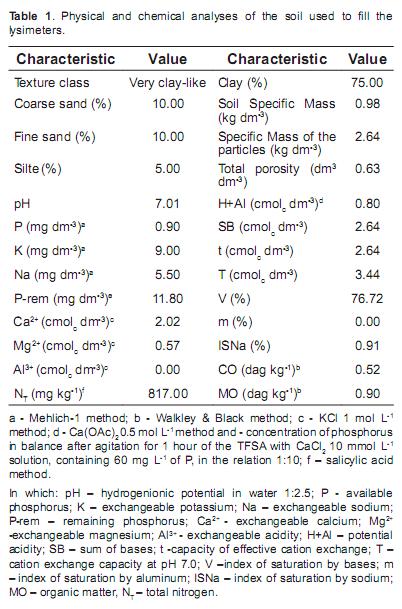
<body><![CDATA[<p>Until the 1970s, swine feces were not a major   problem for pig farmers, since farm animal   concentration was low and the soils had the   capacity to absorb all nutrients present in the added   manure. However, as production aiming to meet the   population demand for pork meat increased, most   farmers began to adopt a feedlot-type regimen,   which consequently increased the volume of waste   produced per unit of area. Waste started to leak into   watercourses without previous treatment, becoming   a pollution source for water bodies and a risk factor for animal and human health.</p>       <p>The pollutant capacity of swine waste is much   higher than that of other animal species. The   biochemical oxygen demand of swine feces from   pregnant and lactating sows, averaging 196 kg live   weight, varies from 170 to 380 g/day, while human waste averages 45 to 75 g/day(Perdomo <i><i>et al.</i></i>, 1998).</p>       <p>   Aware of the environmental damage caused by   the discharge of wastewaters into water bodies and rising concerns regarding environmental quality,   swine producers have begun seeking specific   solutions for the treatment, placement, and reuse of   residues.</p>       <p>In spite of the advantages in using swine manure   as soil fertilizer as well as the existing reports   pertaining to the chemical effects of soil deposition,   most research does not consider agronomic   criteria in order for the calculation of the film to   be applied. Considering that plants play a vital   role in the technical viability and sustainability   of the treatment system, the present work aims at   evaluating the chemical changes in a Dystrophic   Red-Yellow Latossoil cultivated with tomato plants (<i>Lycopersicon esculentum</i> Mill).</p>       <p>&nbsp;</p>       <p><font size="3"><b>Materials and methods</b></font></p>       <p>The experiment was conducted at the Lysimeter   Station of the <i>&Aacute;rea Experimental de Hidr&aacute;ulica,   Irriga&ccedil;&atilde;o e Drenagem</i> (Experimental Area of   Hydraulics, Irrigation and Drainage), at the Federal   University of Vi&ccedil;osa (UFV) campus in Vi&ccedil;osa (MG, Brazil) from September 2007 to May 2008.</p>       <p>Twenty one drainage lysimeters were used in   protected environments. Lysimeters were filled with   Dystrophic Red-Yellow Latossoil previously airdried,   harrowed, sieved in a 0.004 m mesh sieve,   acidity adjusted and homogenized up until the   formation of the profile of 0.60 m. <a href="#t1">Table 1</a> presents   the physical and chemical characteristics of the soil used to fill the lysimeters.</p>       <p align="center"><a name="t1"></a><img src="/img/revistas/rccp/v25n3/v25n3a03t1.jpg"></p> </font>    <p><font size="2" face="Verdana, Arial, Helvetica, sans-serif">After the formation of four definite leaves, the   saplings of tomato plants (<i>Lycopersicon esculentum</i>  Mill; hybrid Fanny TY), were transplanted into   furrows of 0.15 m depth, with 1.00 x 0.50 m spacing, totaling four plants per lysimeter.</font></p>       ]]></body>
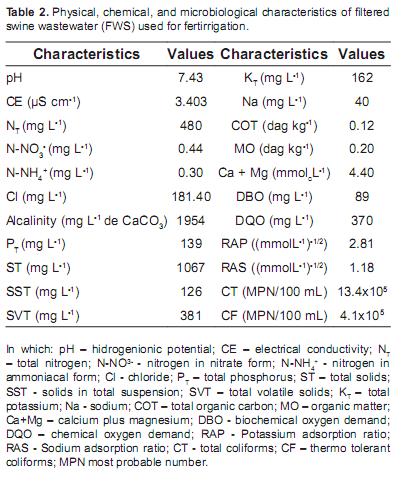
<body><![CDATA[<p><font size="2" face="Verdana, Arial, Helvetica, sans-serif">The plants were conducted with a single stem,     without tip pruning, without removing the first     inflorescence, maintaining only six inflorescences     per plant, which were vertically staked with     polypropylene cord, starting the binding 10 days     after transplanting (DAT), as recommended by     Perdomo <i>et al.</i> (1998).</font></p> <font face="Verdana, Arial, Helvetica, sans-serif"size="2">    <p>The treatments comprised the control (T1   &#8211; recommended tomato plant irrigation and   fertilization) and fertirrigation with filtered swine   wastewater, providing 100%, 150%, and 200%   of the nitrogen dose recommended for tomato   plants without additional fertilization (T2, T3, and   T4) and with addition of fertilization (T5, T6, and   T7), respectively. The experiment was conducted   in a completely randomized design with seven treatments and three replications.</p>       <p>Wastewater from the swine facilities at the   Department of Animal Science, UFV, was used   for fertirrigations. Wastewater was conducted to a   tank (339 h average hydraulic detention time). The   effluents were submitted to a sequential filtering   procedure by passing through 2 10-mesh stainless   steel screens and 1 25-mesh stainless steel screen.   The filtered swine manure (ARSF) was pumped into   the wastewater reservoir of the lysimeter station to be used for fertirrigation.</p>        <p><a href="#t2">Table 2</a> presents the physical, chemical, and   microbiological characteristics of the ARSF, while  <a href="/img/revistas/rccp/v25n3/v25n3a03t3.jpg" target="_blank">table 3</a> presents the chemical characteristics of the irrigation water.</p>       <p align="center"><a name="t2"></a><img src="/img/revistas/rccp/v25n3/v25n3a03t2.jpg"></p>       <p>To calculate the ARSF films, nitrogen was taken   as the reference nutrient, whose films, necessary for   applying the different percentages of nitrogen, were   calculated by means of equation 1, recommended by the EPA (1981).</p>     <p align="center"><img src="/img/revistas/rccp/v25n3/v25n3a03g1.jpg"></p>       <p>in which:</p>       <p>Lw - application of annual laminae, cm year<sup> -1</sup>;</p>       <p>Cp - nitrogen concentration in the percolation water,     mg L<sup>-1</sup>;</p>       ]]></body>
<body><![CDATA[<p>PR - local precipitation, cm year <sup>-1</sup>;</p>       <p>ET - evapotranspiration, cm year <sup>-1</sup>;</p>       <p>U - nitrogen absorption, kg ha<sup>-1</sup> year <sup>-1</sup>;</p>       <p>Cn - nitrogen concentration in the wastewater, mg     L<sup>-1</sup>; and</p>       <p>F - nitrogen portion removed by denitrification and     volatilization, adimensional.</p>       <p>This method considered Cp as 10 mg L<sup>-1</sup>  (CONAMA, 2008), null PR-ET (handling in a   greenhouse and evapotranspiration reposition), U   equivalent to 400 kg ha<sup>-1</sup> (tomato plant cultivated in a greenhouse, vertically staked (CFSEMG, 1999), f equivalent to 20% (Matos, 2007), and Cn achieved in bimonthly evaluations.</p>       <p>The complementary chemical fertilization was   calculated by subtracting from P and K values   (CONAMA, 2008). The amount of these nutrients comes from the different films of the ARSF applied.</p>       <p>Therefore, 261.10, 229.80 and 181.4 g furrow<sup>-1</sup>  of ''super-simple'' and 49.70, 40.90 and 32.70 g   furrow<sup>-1</sup> of potassium chloride were added to the   soils under treatments 5, 6, and 7, respectively. In   the soils submitted to the control treatment, 100   g furrow<sup>-1</sup> of ammonium sulfate, 375 g furrow<sup>-1</sup>   of ''super-simple,'' and 69 g furrow<sup>-1</sup> of potassium chloride were added.</p>     <p>The meteorological variables necessary for   determining the evapotranspirometric demand   were obtained using a greenhouse-installed Davis   automatic station. Reposition of tomato plants'   evapotranspirometric demand was determined   considering the evapotranspiration (ETc), obtained   by multiplying the reference evapotranspiration   (ET0) by the plant cultivation coefficients (Kc;   Moreira, 2002), the shaded area percentage, the   localization coefficient proposed by Keller <i>et al.</i>, 1990, and the efficiency of the application system.</p>     <p>Irrigation water and fertirrigation application   were carried out by dripping using a 0.016   m-diameter polyethylene hose with emitters spaced   0.50 m (one emitter per plant) and 1.90 L h<sup>-1</sup> flow, with 10 MPa operating pressure.</p>     ]]></body>
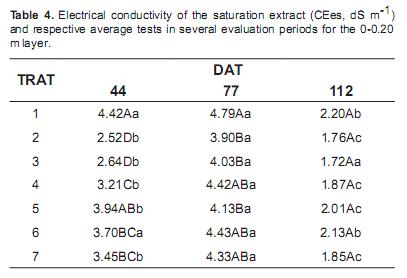
<body><![CDATA[<p>Fertirrigations considered reposition of 100, 150,   and 200% of daily ETc for treatments receiving   100, 150, and 200% N, respectively, by means of   the ARS films, thus making the plants' most needed nutrients available in a timely manner.</p>     <p>After transplanting the saplings, fertirrigation   started with daily applications of ARSF films,   which concluded 68 days after transplant (DAT),   then totaling 114.29, 171.43, and 228.58 mm,   corresponding to 100, 150, and 200% of the N   required, calculated in equation 1. After this   period only water was applied to replace the   evapotranspirometric demand by the plants. Thus,   when clean water is prevented from passing through   polyethylene lines during ARSF application period,   biofilm formation and, consequently clogging of drippers, are reduced (Batista, 2007).</p>     <p>Soil samples were collected in each lysimeter   during transplanting (0 DAT), in the middle (60   DAT), and end (120 DAT) of the tomato plant cycle   using a Dutch auger 0.10 m far from the plant stem,   in the strips of 0.18-0.22; 0.38-0.42, and 0.56-0.60   m depths, except for the samples used to determine   electrical conductivity of the saturated soil-paste   extract (CEes). These were collected in the 0-0.20   m layer, during periods 44, 77, and 112 DAT,   corresponding to the formation of the first and sixth   inflorescences and final phase of the plant cycle. These samples were identified and analyzed for CEes, phosphorus (P), and total nitrogen at the Soil Fertility and Soil Physics Laboratory of the Soils Department at UFV (Embrapa, 1997).</p>     <p>&nbsp;</p>     <p><font size="3"><b>Results</b></font></p>     <p><i>Effects on electrical conductivity</i></p>     <p>When the applications of ARSF films were   finished (68 DAT) films of irrigation water totaling   97 mm were applied, yielding an ETc of 211.62   mm. It was verified that even with the application of   200% of the ETc daily, the films were not enough to   produce effluents in the lysimeters and subsequently   guarantee that the entire ARSF was available for the plants.</p>     <p>According to the classification proposed   by Embrapa (1997), due to the low electrical   conductivity and the sodium adsorption ratio, the   water used for irrigation presented high risk of   sodicity and no risk of soil salinization, while the   ARSF presented a high risk of salinization. However,   regarding the potential to cause reduction in the soil   infiltration capacity, these guidelines should not be   used for ARSF because they do not include the solid organic elements contained in the wastewater.</p>     <p><a href="#t4">Table 4</a> presents the soil electrical conductivity   in different periods in the 0-0.20 m layer for the different treatments.</p>     <p align="center"><a name="t4"></a><img src="/img/revistas/rccp/v25n3/v25n3a03t4.jpg"></p>     ]]></body>
<body><![CDATA[<p>Averages followed by at least one same lower   case letter in the lines indicate that for the treatment   (TRAT) the evaluations at the time (DAT) do not differ according to the Tukey test at 5% of probability.</p>     <p>In table 4, it can be observed that the CEes   increased with the increase in the ARSF films   applied. However, when the chemical fertilization   was added, the opposite behavior occurred. The   treatments that received the smallest ARSF films   but the highest quantities of additional chemical   fertilization presented the highest CEes. Treatment 1   verifies that the chemical fertilization was generally   more effective in increasing the CEes of the soil   than the ARSF. This fact may be associated to the   presence of ions, which take part in organic chains   or are complexed/chelated. In this condition they are not detected by the conductivimeter electrode.</p>     <p>The application of ARSF films during   transplanting (68 DAT) and their suppression after   this period when only irrigation water was applied,   and the end of the chemical fertilization (90 DAT),   carried out in treatment 1, were responsible for   the salinity reduction observed in the evaluation performed 112 DAT.</p>     <p><i>Phosphorus</i></p>     <p><a href="/img/revistas/rccp/v25n3/v25n3a03f1.jpg" target="_blank">Figure 1</a> presents phosphorus variations   available with depth and time in the treated soils.   It can be noted that P concentration presented a   negative linear relation with depth and a quadratic   relation with time, except for the soils in treatments   1, 2, and 5, which had a positive linear relationship.   It is also observed that compared to the initial   conditions, there was an increase in available P concentration, mainly in the superficial layers.</p>     <p>According to Ayers <i>et al.</i> (1991) and Scalopi   <i>et al.</i> (1986), the low P concentration available   in the lower layers is due to the low mobility of   this nutrient, which is probably adsorbed by the   soil particles and absorbed by the plants while the   remaining is precipitated. For Ceretta <i>et al.</i> (2005),   the available P content usually tends to decrease   with depth, following the content of soil organic matter.</p>     <p>The application of daily ARSF films during   transplanting until 68 DAT and its suppression   after this period may have been responsible for the   quadratic effect on time, while the positive linear   behavior observed in the soils under treatments 2   and 5 may have been a consequence of the virus   symptoms presented by the tomato plants cultivated   in these soils, which hindered their development and yield, thus causing lower absorption of this nutrient.</p>     <p>Tom&eacute; (1997) studied the effects of applying   various ARS films in soil cultivated with maize and,   according to King <i>et al.</i> (1985), Freitas <i>et al.</i> (2004),   Montavalli <i>et al.</i> (2002), Queiroz <i>et al.</i> (2004), and   Oliveira (2006), soils cultivated with forage plants   also presented increases in available P concentration   in the superficial layers and achieved higher values when the highest films were applied.</p>     <p>At the end of the experimental period, at   the depth of 0.10 m, reductions were observed   in available P concentrations, compared to the   control and the reductions of 10.85, 30.98, 17.05,   54.20, and 59.20% were obtained in treatments   2, 3, 4, 6, and 7, respectively. A 25.63% increase   was observed in the soils of treatment 5. Thus,   the highest ARSF films provided increments in   P absorption by the plant, except for the soils in   treatments 2 and 5 because of disease symptoms.   The films were intensified by the nutrient balance via the fertilization addition.</p>     <p>Regarding the interpretation of P availability   suggested by CFSEMG (1999), the plots of   soil showed very low P availability prior to the   experiment. After the experiment the soils had low   (treatments 6 and 7), average (treatment 3), good   (treatments 1, 2, and 4), and very good (treatment 5) P availability, as measured at a depth of 0.10 m.</p>     ]]></body>
<body><![CDATA[<p><i>Nitrogen</i></p>     <p><a href="/img/revistas/rccp/v25n3/v25n3a03f2.jpg" target="_blank">Figure 2</a> shows variations in total N   concentration according to soil depth and time. It   can be observed that in the soils of those treatments   where ARSF was applied, N concentration   showed a negative linear relation with depth and a   quadratic relation with time, except for the soils   under treatments 2 and 5, whose relation was linear   positive. For soil in treatment 1, a quadratic relation   with depth and a linear positive relation with time were observed.</p>     <p>The predominance of organic nitrogen (99%)   added to the soils under ARSF application may   have been responsible for the increase in the   concentration of this nutrient in the superficial   layers, while the quadratic effect on time may be   related to the ARSF application until 68 DAT and its suppression after this period.</p>     <p>The positive linear relation with time, observed   in soils under treatments 2 and 5, is probably   related to the virus symptoms presented by the   tomato plants cultivated in these lysimeters, which   resulted in a lower development of the plants and   consequently lower values for plant growth, dry   matter production, fruit nutrient concentration and yield.</p>     <p>The use of ammonium sulfate as a source of N   in treatment 1 resulted in a high mobility of this   element in the soil. The liming and application of   irrigation films may have caused the quadratic effect   observed with the depth in the soil profile, favoring   NH<sub>4</sub><sup>+</sup> and NO<sub>3</sub><sup>-</sup> displacement. The variation in time   may have been caused by the split application   of N, according to CFSEMG's (1999) suggested recommendations for tomato plants.</p>     <p>Scalopi (1986) analyzed the alterations caused   by ARS application in soil cultivated with natural   pasture (Berwanger <i>et al.</i>, 2008) by applying   ARS in the arable soil for eight consecutive years,   observing low N mobility in the soil profile, and   achieving higher values in the superficial layers, which were increased by ARS addition.</p>     <p>It can also be observed that the maximum N   concentration values in soils receiving ARSF occurred in the higher layers, following the   application of all the films, except for the soils   under treatments 2 and 5, in which the maximum   values occurred at the end of the experimental   period. In the soils under treatment 1, the   maximum value was also observed at the end of   the experimental period, but in the lower layers,   which indicates a higher tendency of groundwater contamination.</p>     <p>At the end of the experimental period, an   increase in N concentration at a depth of 0.10 m was observed for soils under treatments 1, 2, 3, 4, 5, 6, and 7 (11.00, 36.17, 13.83, 26.00, 27.21, 4.41, and 9.77%, respectively) compared to the initial conditions. Therefore, it is possible to argue that except for soils submitted to treatments 2 and 5, higher ARSF films provided higher increases in N concentration, with lower values observed when complementary fertilization was used, which, due to nutrient balance, favored higher plant absorption.</p>     <p>According to Dal Bosco <i>et al.</i> (2008), one of the   problems with fertilization is the unbalanced use of   nitrogen and potassium, which causes damage to agricultural production.</p>     <p>&nbsp;</p>     ]]></body>
<body><![CDATA[<p><font size="3"><b>Discussion</b></font></p>     <p>   Under the experimental conditions used, it can   be concluded that chemical fertilization was more   effective for ionizing the soil solution than the   wastewater from filtered swine manure (ARSF).   The soils receiving lower ARSF films and higher   amounts of chemical fertilization had higher CEes   values. Compared to the initial conditions, there   was an increase in the concentration of available   P, mainly in the superficial layers. The addition of   ARSF resulted in increased N concentration in   the superficial layers, while chemical fertilization resulted in a higher displacement in the soil profile.</p>     <p>&nbsp;</p>     <p><font size="3"><b>References</b></font></p>     <!-- ref --><p>1. Ayers RS, Westcot DW. A qualidade da &aacute;gua na agricultura:   UFPB. Estudos FAO: Irriga&ccedil;&atilde;o e drenagem. Campina Grande Brasil; 1991.&nbsp;&nbsp;&nbsp;&nbsp;&nbsp;&nbsp;&nbsp;&nbsp;[&#160;<a href="javascript:void(0);" onclick="javascript: window.open('/scielo.php?script=sci_nlinks&ref=000097&pid=S0120-0690201200030000300001&lng=','','width=640,height=500,resizable=yes,scrollbars=1,menubar=yes,');">Links</a>&#160;]<!-- end-ref --><!-- ref --><p>   2. Batista RO. Desempenho de sistema de irriga&ccedil;&atilde;o por   gotejamento utilizado na aplica&ccedil;&atilde;o de &aacute;gua residu&aacute;ria de   suinocultura. Tese Doutorado em Engenharia Agr&iacute;cola. Universidade Federal de Vi&ccedil;osa, Vi&ccedil;osa, MG. UFV. 2007.&nbsp;&nbsp;&nbsp;&nbsp;&nbsp;&nbsp;&nbsp;&nbsp;[&#160;<a href="javascript:void(0);" onclick="javascript: window.open('/scielo.php?script=sci_nlinks&ref=000098&pid=S0120-0690201200030000300002&lng=','','width=640,height=500,resizable=yes,scrollbars=1,menubar=yes,');">Links</a>&#160;]<!-- end-ref --><!-- ref --><p>   3. Berwanger AL, Ceretta CA, Rheinheimer D. Altera&ccedil;&otilde;es e   transfer&ecirc;ncias de f&oacute;sforo do solo para o meio aqu&aacute;tico com o   uso de dejeto l&iacute;quido de su&iacute;nos. R Bras Ci Solo 2008; 32:2525- 2532.&nbsp;&nbsp;&nbsp;&nbsp;&nbsp;&nbsp;&nbsp;&nbsp;[&#160;<a href="javascript:void(0);" onclick="javascript: window.open('/scielo.php?script=sci_nlinks&ref=000099&pid=S0120-0690201200030000300003&lng=','','width=640,height=500,resizable=yes,scrollbars=1,menubar=yes,');">Links</a>&#160;]<!-- end-ref --><!-- ref --><p>   4. Ceretta CA, Basso CJ, Vieira FCB, Herbes MG, Moreira   ICL, Berwanger AL. Dejeto l&iacute;quido de su&iacute;nos: I &#8211; perdas de   nitrog&ecirc;nio e f&oacute;sforo na solu&ccedil;&atilde;o escoada na superf&iacute;cie do solo, sob plantio direto. Ci&ecirc;ncia Rural 2005; 35:1296-1304.&nbsp;&nbsp;&nbsp;&nbsp;&nbsp;&nbsp;&nbsp;&nbsp;[&#160;<a href="javascript:void(0);" onclick="javascript: window.open('/scielo.php?script=sci_nlinks&ref=000100&pid=S0120-0690201200030000300004&lng=','','width=640,height=500,resizable=yes,scrollbars=1,menubar=yes,');">Links</a>&#160;]<!-- end-ref --><!-- ref --><p>   5. Ribeiro A. Recomenda&ccedil;&otilde;es para o uso de corretivos e   fertilizantes em Minas Gerais. CFSEMG - Comiss&atilde;o   de Fertilidade do Solo do Estado de Minas Gerais.&#8211; 5&ordf; aproxima&ccedil;&atilde;o; 1999.&nbsp;&nbsp;&nbsp;&nbsp;&nbsp;&nbsp;&nbsp;&nbsp;[&#160;<a href="javascript:void(0);" onclick="javascript: window.open('/scielo.php?script=sci_nlinks&ref=000101&pid=S0120-0690201200030000300005&lng=','','width=640,height=500,resizable=yes,scrollbars=1,menubar=yes,');">Links</a>&#160;]<!-- end-ref --><!-- ref --><p>   6. Conselho Nacional Do Meio Ambiente &#8211; CONAMA (2005).   Resolu&ccedil;&atilde;o n&ordm; 357, de 17 de mar&ccedil;o de 2005. Disp&otilde;e sobre a   classifica&ccedil;&atilde;o dos corpos de &aacute;gua e diretrizes ambientais para   o seu enquadramento, bem como estabelece as condi&ccedil;&otilde;es e   padr&otilde;es de lan&ccedil;amento de efluentes. Bras&iacute;lia, 2005. &#91;Acesso em:   04 out. 2008&#93; URL: <a href="http://www.siam.mg.gov.br/sla/download.pdf?idNorma=2747" target="_blank">http://www.siam.mg.gov.br/sla/download.pdf?idNorma=2747</a>.&nbsp;&nbsp;&nbsp;&nbsp;&nbsp;&nbsp;&nbsp;&nbsp;[&#160;<a href="javascript:void(0);" onclick="javascript: window.open('/scielo.php?script=sci_nlinks&ref=000102&pid=S0120-0690201200030000300006&lng=','','width=640,height=500,resizable=yes,scrollbars=1,menubar=yes,');">Links</a>&#160;]<!-- end-ref --><!-- ref --><p>7. Freitas WR, Oliveira R, Pinto FA, Cecon PR, Galv&atilde;o JC.   Efeito da aplica&ccedil;&atilde;o de &aacute;guas residu&aacute;rias de suinocultura sobre   a produ&ccedil;&atilde;o do milho para silagem. Rev Bras Eng Agr&iacute;c Ambien 2004; 8:25-36.&nbsp;&nbsp;&nbsp;&nbsp;&nbsp;&nbsp;&nbsp;&nbsp;[&#160;<a href="javascript:void(0);" onclick="javascript: window.open('/scielo.php?script=sci_nlinks&ref=000103&pid=S0120-0690201200030000300007&lng=','','width=640,height=500,resizable=yes,scrollbars=1,menubar=yes,');">Links</a>&#160;]<!-- end-ref --><!-- ref --><p>   8. Dal Bosco TC, Sampaio SC, IOST C, Silva LN, Carnellosi   CF, Ebert DC, Schreiner JS. Utiliza&ccedil;&atilde;o de &aacute;gua residu&aacute;ria de   suinocultura em propriedade agr&iacute;cola &#8211; estudo de caso. Rev Irriga, Botucatu 2008; 13:139-144.&nbsp;&nbsp;&nbsp;&nbsp;&nbsp;&nbsp;&nbsp;&nbsp;[&#160;<a href="javascript:void(0);" onclick="javascript: window.open('/scielo.php?script=sci_nlinks&ref=000104&pid=S0120-0690201200030000300008&lng=','','width=640,height=500,resizable=yes,scrollbars=1,menubar=yes,');">Links</a>&#160;]<!-- end-ref --><!-- ref --><p>   9. Embrapa. Manual de m&eacute;todos de an&aacute;lise do solo. 2 ed. Rio de   Janeiro: EMBRAPA - Centro Nacional de Pesquisa de Solos; 1997.&nbsp;&nbsp;&nbsp;&nbsp;&nbsp;&nbsp;&nbsp;&nbsp;[&#160;<a href="javascript:void(0);" onclick="javascript: window.open('/scielo.php?script=sci_nlinks&ref=000105&pid=S0120-0690201200030000300009&lng=','','width=640,height=500,resizable=yes,scrollbars=1,menubar=yes,');">Links</a>&#160;]<!-- end-ref --><!-- ref --><p>   10. Keller J, Bliesner RD. Sprinkle and trickle irrigation. New York: Van Nostrand Reinold; 1990.&nbsp;&nbsp;&nbsp;&nbsp;&nbsp;&nbsp;&nbsp;&nbsp;[&#160;<a href="javascript:void(0);" onclick="javascript: window.open('/scielo.php?script=sci_nlinks&ref=000106&pid=S0120-0690201200030000300010&lng=','','width=640,height=500,resizable=yes,scrollbars=1,menubar=yes,');">Links</a>&#160;]<!-- end-ref --><!-- ref --><p>   11. King LD, Westerman PW, Cummings GA, Overcash   M.R. Burns JC. Swine lagoon effluent applied to ''Coastal'   Bermudagrass: II. Effects on soil. J Environ Quality 1985; 14:14-21.&nbsp;&nbsp;&nbsp;&nbsp;&nbsp;&nbsp;&nbsp;&nbsp;[&#160;<a href="javascript:void(0);" onclick="javascript: window.open('/scielo.php?script=sci_nlinks&ref=000107&pid=S0120-0690201200030000300011&lng=','','width=640,height=500,resizable=yes,scrollbars=1,menubar=yes,');">Links</a>&#160;]<!-- end-ref --><!-- ref --><p>   12. Matos AT. Disposi&ccedil;&atilde;o de &aacute;guas residu&aacute;rias no solo. Vi&ccedil;osa, MG: AEAGRI; 2007.&nbsp;&nbsp;&nbsp;&nbsp;&nbsp;&nbsp;&nbsp;&nbsp;[&#160;<a href="javascript:void(0);" onclick="javascript: window.open('/scielo.php?script=sci_nlinks&ref=000108&pid=S0120-0690201200030000300012&lng=','','width=640,height=500,resizable=yes,scrollbars=1,menubar=yes,');">Links</a>&#160;]<!-- end-ref --><!-- ref --><p>   13. Montavalli PP, Miles RJ. Soil phosphorus fractions alter 111   years of animal manure and fertilizer applications. Biologic Fertility Soils 2002; 36:35-42.&nbsp;&nbsp;&nbsp;&nbsp;&nbsp;&nbsp;&nbsp;&nbsp;[&#160;<a href="javascript:void(0);" onclick="javascript: window.open('/scielo.php?script=sci_nlinks&ref=000109&pid=S0120-0690201200030000300013&lng=','','width=640,height=500,resizable=yes,scrollbars=1,menubar=yes,');">Links</a>&#160;]<!-- end-ref --><!-- ref --><p>   14. Moreira HM. Desempenho de m&eacute;todos de manejo de irriga&ccedil;&atilde;o   para a cultura do tomateiro cultivado em campo e em casa   de vegeta&ccedil;&atilde;o. Teses Mestrado em Engenharia Agr&iacute;cola, Universidade Federal de Vi&ccedil;osa, Vi&ccedil;osa, MG. 2002.&nbsp;&nbsp;&nbsp;&nbsp;&nbsp;&nbsp;&nbsp;&nbsp;[&#160;<a href="javascript:void(0);" onclick="javascript: window.open('/scielo.php?script=sci_nlinks&ref=000110&pid=S0120-0690201200030000300014&lng=','','width=640,height=500,resizable=yes,scrollbars=1,menubar=yes,');">Links</a>&#160;]<!-- end-ref --><!-- ref --><p>   15. Oliveira W. Uso de agua residu&aacute;ria da suinocultura em   pastagens da <i>Brachi&aacute;ria decumbens</i> e Grama Estrela <i>Cynodom   plesctostachyum</i>. Teses Mestrado em Agronomia. Escola   Superior de Agricultura ''Luiz de Queiroz'', Universidade de   S&atilde;o Paulo Piracicaba, SP ESALQ, S&atilde;o Paulo Piracicaba, SP. 2006.&nbsp;&nbsp;&nbsp;&nbsp;&nbsp;&nbsp;&nbsp;&nbsp;[&#160;<a href="javascript:void(0);" onclick="javascript: window.open('/scielo.php?script=sci_nlinks&ref=000111&pid=S0120-0690201200030000300015&lng=','','width=640,height=500,resizable=yes,scrollbars=1,menubar=yes,');">Links</a>&#160;]<!-- end-ref --><!-- ref --><p>   16. Perdomo C, Lima, GJ. Considera&ccedil;&otilde;es sobre a quest&atilde;o dos   dejetos e o meio ambiente. In: Suinocultura intensiva: produ&ccedil;&atilde;o, manejo e sa&uacute;de do rebanho. Bras&iacute;lia: EMBRAPA &#8211; SPI; 1998.&nbsp;&nbsp;&nbsp;&nbsp;&nbsp;&nbsp;&nbsp;&nbsp;[&#160;<a href="javascript:void(0);" onclick="javascript: window.open('/scielo.php?script=sci_nlinks&ref=000112&pid=S0120-0690201200030000300016&lng=','','width=640,height=500,resizable=yes,scrollbars=1,menubar=yes,');">Links</a>&#160;]<!-- end-ref --><!-- ref --><p>   17. Queiroz FM, Matos AT, Pereira OG, Oliveira RA.   Caracter&iacute;sticas qu&iacute;micas de solo submetido ao tratamento com   esterco l&iacute;quido de su&iacute;nos e cultivado com gram&iacute;neas forrageiras. Ci&ecirc;ncia Rural, Santa Maria 2004; 34:1487-1492.&nbsp;&nbsp;&nbsp;&nbsp;&nbsp;&nbsp;&nbsp;&nbsp;[&#160;<a href="javascript:void(0);" onclick="javascript: window.open('/scielo.php?script=sci_nlinks&ref=000113&pid=S0120-0690201200030000300017&lng=','','width=640,height=500,resizable=yes,scrollbars=1,menubar=yes,');">Links</a>&#160;]<!-- end-ref --><!-- ref --><p>   18. Scalopi EJ, Baptistela JR. Considera&ccedil;&otilde;es sobre aplica&ccedil;&atilde;o   de efluentes ao solo. In: Congresso Nacional de Irriga&ccedil;&atilde;o e Drenagem. Anais ABID Bras&iacute;lia 1986; 1049-1066.&nbsp;&nbsp;&nbsp;&nbsp;&nbsp;&nbsp;&nbsp;&nbsp;[&#160;<a href="javascript:void(0);" onclick="javascript: window.open('/scielo.php?script=sci_nlinks&ref=000114&pid=S0120-0690201200030000300018&lng=','','width=640,height=500,resizable=yes,scrollbars=1,menubar=yes,');">Links</a>&#160;]<!-- end-ref --><!-- ref --><p>   19. Tom&eacute; Jr JB. Manual para a interpreta&ccedil;&atilde;o de an&aacute;lise de solo. Gua&iacute;ba: Agropecu&aacute;ria; 1997.&nbsp;&nbsp;&nbsp;&nbsp;&nbsp;&nbsp;&nbsp;&nbsp;[&#160;<a href="javascript:void(0);" onclick="javascript: window.open('/scielo.php?script=sci_nlinks&ref=000115&pid=S0120-0690201200030000300019&lng=','','width=640,height=500,resizable=yes,scrollbars=1,menubar=yes,');">Links</a>&#160;]<!-- end-ref --><p>&nbsp;</p>     <p><font size="3"><b>Notas</b></font></p>     <p><sup><a href="#b0">&curren;</a></sup><a name="0"></a> To cite this article: Rodrigues de Souza JA, Astoni D, Oliveira R, Osorio J&Aacute;, Zapata OL. Chemical alterations in soils fertirrigated with wastewater from   swine production facilities. Rev Colomb Cienc Pecu 2012; 25:360-368</p> </font>      ]]></body><back>
<ref-list>
<ref id="B1">
<label>1</label><nlm-citation citation-type="book">
<person-group person-group-type="author">
<name>
<surname><![CDATA[Ayers]]></surname>
<given-names><![CDATA[RS]]></given-names>
</name>
<name>
<surname><![CDATA[Westcot]]></surname>
<given-names><![CDATA[DW.]]></given-names>
</name>
</person-group>
<source><![CDATA[A qualidade da água na agricultura]]></source>
<year>1991</year>
<publisher-loc><![CDATA[Campina Grande ]]></publisher-loc>
<publisher-name><![CDATA[UFPB. Estudos FAO: Irrigação e drenagem.]]></publisher-name>
</nlm-citation>
</ref>
<ref id="B2">
<label>2</label><nlm-citation citation-type="">
<person-group person-group-type="author">
<name>
<surname><![CDATA[Batista]]></surname>
<given-names><![CDATA[RO.]]></given-names>
</name>
</person-group>
<source><![CDATA[Desempenho de sistema de irrigação por gotejamento utilizado na aplicação de água residuária de suinocultura]]></source>
<year></year>
</nlm-citation>
</ref>
<ref id="B3">
<label>3</label><nlm-citation citation-type="journal">
<person-group person-group-type="author">
<name>
<surname><![CDATA[Berwanger]]></surname>
<given-names><![CDATA[AL]]></given-names>
</name>
<name>
<surname><![CDATA[Ceretta]]></surname>
<given-names><![CDATA[CA]]></given-names>
</name>
<name>
<surname><![CDATA[Rheinheimer]]></surname>
<given-names><![CDATA[D]]></given-names>
</name>
</person-group>
<article-title xml:lang="pt"><![CDATA[Alterações e transferências de fósforo do solo para o meio aquático com o uso de dejeto líquido de suínos]]></article-title>
<source><![CDATA[R Bras Ci Solo]]></source>
<year>2008</year>
<volume>32</volume>
<page-range>2525- 2532</page-range></nlm-citation>
</ref>
<ref id="B4">
<label>4</label><nlm-citation citation-type="journal">
<person-group person-group-type="author">
<name>
<surname><![CDATA[Ceretta]]></surname>
<given-names><![CDATA[CA]]></given-names>
</name>
<name>
<surname><![CDATA[Basso]]></surname>
<given-names><![CDATA[CJ]]></given-names>
</name>
<name>
<surname><![CDATA[Vieira]]></surname>
<given-names><![CDATA[FCB]]></given-names>
</name>
<name>
<surname><![CDATA[Herbes]]></surname>
<given-names><![CDATA[MG]]></given-names>
</name>
<name>
<surname><![CDATA[Moreira]]></surname>
<given-names><![CDATA[ICL]]></given-names>
</name>
<name>
<surname><![CDATA[Berwanger]]></surname>
<given-names><![CDATA[AL]]></given-names>
</name>
</person-group>
<article-title xml:lang="pt"><![CDATA[Dejeto líquido de suínos: I - perdas de nitrogênio e fósforo na solução escoada na superfície do solo, sob plantio direto]]></article-title>
<source><![CDATA[Ciência Rural]]></source>
<year>2005</year>
<volume>35</volume>
<page-range>1296-1304</page-range></nlm-citation>
</ref>
<ref id="B5">
<label>5</label><nlm-citation citation-type="book">
<person-group person-group-type="author">
<name>
<surname><![CDATA[Ribeiro]]></surname>
<given-names><![CDATA[A.]]></given-names>
</name>
</person-group>
<source><![CDATA[Recomendações para o uso de corretivos e fertilizantes em Minas Gerais]]></source>
<year>1999</year>
<publisher-name><![CDATA[CFSEMG - Comissão de Fertilidade do Solo do Estado de Minas Gerais]]></publisher-name>
</nlm-citation>
</ref>
<ref id="B6">
<label>6</label><nlm-citation citation-type="">
<collab>Conselho Nacional Do Meio Ambiente - CONAMA (2005)</collab>
<source><![CDATA[Resolução nº 357, de 17 de março de 2005. Dispõe sobre a classificação dos corpos de água e diretrizes ambientais para o seu enquadramento, bem como estabelece as condições e padrões de lançamento de efluentes]]></source>
<year>2005</year>
<publisher-loc><![CDATA[Brasília ]]></publisher-loc>
</nlm-citation>
</ref>
<ref id="B7">
<label>7</label><nlm-citation citation-type="journal">
<person-group person-group-type="author">
<name>
<surname><![CDATA[Freitas]]></surname>
<given-names><![CDATA[WR]]></given-names>
</name>
<name>
<surname><![CDATA[Oliveira]]></surname>
<given-names><![CDATA[R]]></given-names>
</name>
<name>
<surname><![CDATA[Pinto]]></surname>
<given-names><![CDATA[FA]]></given-names>
</name>
<name>
<surname><![CDATA[Cecon]]></surname>
<given-names><![CDATA[PR]]></given-names>
</name>
<name>
<surname><![CDATA[Galvão]]></surname>
<given-names><![CDATA[JC]]></given-names>
</name>
</person-group>
<article-title xml:lang="pt"><![CDATA[Efeito da aplicação de águas residuárias de suinocultura sobre a produção do milho para silagem]]></article-title>
<source><![CDATA[Rev Bras Eng Agríc Ambien]]></source>
<year>2004</year>
<volume>8</volume>
<page-range>25-36</page-range></nlm-citation>
</ref>
<ref id="B8">
<label>8</label><nlm-citation citation-type="journal">
<person-group person-group-type="author">
<name>
<surname><![CDATA[Dal Bosco]]></surname>
<given-names><![CDATA[TC]]></given-names>
</name>
<name>
<surname><![CDATA[Sampaio]]></surname>
<given-names><![CDATA[SC]]></given-names>
</name>
<name>
<surname><![CDATA[IOST]]></surname>
<given-names><![CDATA[C]]></given-names>
</name>
<name>
<surname><![CDATA[Silva]]></surname>
<given-names><![CDATA[LN]]></given-names>
</name>
<name>
<surname><![CDATA[Carnellosi]]></surname>
<given-names><![CDATA[CF]]></given-names>
</name>
<name>
<surname><![CDATA[Ebert]]></surname>
<given-names><![CDATA[DC]]></given-names>
</name>
<name>
<surname><![CDATA[Schreiner]]></surname>
<given-names><![CDATA[JS]]></given-names>
</name>
</person-group>
<article-title xml:lang="pt"><![CDATA[Utilização de água residuária de suinocultura em propriedade agrícola - estudo de caso]]></article-title>
<source><![CDATA[Rev Irriga, Botucatu]]></source>
<year>2008</year>
<volume>13</volume>
<page-range>139-144</page-range></nlm-citation>
</ref>
<ref id="B9">
<label>9</label><nlm-citation citation-type="book">
<collab>Embrapa</collab>
<source><![CDATA[Manual de métodos de análise do solo]]></source>
<year>1997</year>
<edition>2</edition>
<publisher-loc><![CDATA[Rio de Janeiro ]]></publisher-loc>
<publisher-name><![CDATA[EMBRAPA - Centro Nacional de Pesquisa de Solos]]></publisher-name>
</nlm-citation>
</ref>
<ref id="B10">
<label>10</label><nlm-citation citation-type="book">
<person-group person-group-type="author">
<name>
<surname><![CDATA[Keller]]></surname>
<given-names><![CDATA[J]]></given-names>
</name>
<name>
<surname><![CDATA[Bliesner]]></surname>
<given-names><![CDATA[RD.]]></given-names>
</name>
</person-group>
<source><![CDATA[Sprinkle and trickle irrigation]]></source>
<year>1990</year>
<publisher-loc><![CDATA[New York ]]></publisher-loc>
<publisher-name><![CDATA[Van Nostrand Reinold]]></publisher-name>
</nlm-citation>
</ref>
<ref id="B11">
<label>11</label><nlm-citation citation-type="journal">
<person-group person-group-type="author">
<name>
<surname><![CDATA[King]]></surname>
<given-names><![CDATA[LD]]></given-names>
</name>
<name>
<surname><![CDATA[Westerman]]></surname>
<given-names><![CDATA[PW]]></given-names>
</name>
<name>
<surname><![CDATA[Cummings]]></surname>
<given-names><![CDATA[GA]]></given-names>
</name>
<name>
<surname><![CDATA[Overcash]]></surname>
<given-names><![CDATA[M.R]]></given-names>
</name>
<name>
<surname><![CDATA[Burns]]></surname>
<given-names><![CDATA[JC.]]></given-names>
</name>
</person-group>
<article-title xml:lang="en"><![CDATA[Swine lagoon effluent applied to ''Coastal' Bermudagrass: II. Effects on soil]]></article-title>
<source><![CDATA[J Environ Quality]]></source>
<year>1985</year>
<volume>14</volume>
<page-range>14-21</page-range></nlm-citation>
</ref>
<ref id="B12">
<label>12</label><nlm-citation citation-type="book">
<person-group person-group-type="author">
<name>
<surname><![CDATA[Matos]]></surname>
<given-names><![CDATA[AT.]]></given-names>
</name>
</person-group>
<source><![CDATA[Disposição de águas residuárias no solo]]></source>
<year>2007</year>
<publisher-loc><![CDATA[Viçosa^eMG MG]]></publisher-loc>
<publisher-name><![CDATA[AEAGRI]]></publisher-name>
</nlm-citation>
</ref>
<ref id="B13">
<label>13</label><nlm-citation citation-type="journal">
<person-group person-group-type="author">
<name>
<surname><![CDATA[Montavalli]]></surname>
<given-names><![CDATA[PP]]></given-names>
</name>
<name>
<surname><![CDATA[Miles]]></surname>
<given-names><![CDATA[RJ]]></given-names>
</name>
</person-group>
<article-title xml:lang="en"><![CDATA[Soil phosphorus fractions alter 111 years of animal manure and fertilizer applications]]></article-title>
<source><![CDATA[Biologic Fertility Soils]]></source>
<year>2002</year>
<volume>36</volume>
<page-range>35-42</page-range></nlm-citation>
</ref>
<ref id="B14">
<label>14</label><nlm-citation citation-type="">
<person-group person-group-type="author">
<name>
<surname><![CDATA[Moreira]]></surname>
<given-names><![CDATA[HM.]]></given-names>
</name>
</person-group>
<source><![CDATA[Desempenho de métodos de manejo de irrigação para a cultura do tomateiro cultivado em campo e em casa de vegetação]]></source>
<year></year>
</nlm-citation>
</ref>
<ref id="B15">
<label>15</label><nlm-citation citation-type="">
<person-group person-group-type="author">
<name>
<surname><![CDATA[Oliveira]]></surname>
<given-names><![CDATA[W.]]></given-names>
</name>
</person-group>
<source><![CDATA[Uso de agua residuária da suinocultura em pastagens da Brachiária decumbens e Grama Estrela Cynodom plesctostachyum]]></source>
<year></year>
</nlm-citation>
</ref>
<ref id="B16">
<label>16</label><nlm-citation citation-type="book">
<person-group person-group-type="author">
<name>
<surname><![CDATA[Perdomo]]></surname>
<given-names><![CDATA[C]]></given-names>
</name>
<name>
<surname><![CDATA[Lima]]></surname>
<given-names><![CDATA[GJ.]]></given-names>
</name>
</person-group>
<article-title xml:lang="pt"><![CDATA[Considerações sobre a questão dos dejetos e o meio ambiente]]></article-title>
<source><![CDATA[Suinocultura intensiva: produção, manejo e saúde do rebanho]]></source>
<year>1998</year>
<publisher-loc><![CDATA[Brasília ]]></publisher-loc>
<publisher-name><![CDATA[EMBRAPA - SPI]]></publisher-name>
</nlm-citation>
</ref>
<ref id="B17">
<label>17</label><nlm-citation citation-type="journal">
<person-group person-group-type="author">
<name>
<surname><![CDATA[Queiroz]]></surname>
<given-names><![CDATA[FM]]></given-names>
</name>
<name>
<surname><![CDATA[Matos]]></surname>
<given-names><![CDATA[AT]]></given-names>
</name>
<name>
<surname><![CDATA[Pereira]]></surname>
<given-names><![CDATA[OG]]></given-names>
</name>
<name>
<surname><![CDATA[Oliveira]]></surname>
<given-names><![CDATA[RA]]></given-names>
</name>
</person-group>
<article-title xml:lang="pt"><![CDATA[Características químicas de solo submetido ao tratamento com esterco líquido de suínos e cultivado com gramíneas forrageiras]]></article-title>
<source><![CDATA[Ciência Rural, Santa Maria]]></source>
<year>2004</year>
<volume>34</volume>
<page-range>1487-1492</page-range></nlm-citation>
</ref>
<ref id="B18">
<label>18</label><nlm-citation citation-type="confpro">
<person-group person-group-type="author">
<name>
<surname><![CDATA[Scalopi]]></surname>
<given-names><![CDATA[EJ]]></given-names>
</name>
<name>
<surname><![CDATA[Baptistela]]></surname>
<given-names><![CDATA[JR.]]></given-names>
</name>
</person-group>
<article-title xml:lang="pt"><![CDATA[Considerações sobre aplicação de efluentes ao solo]]></article-title>
<source><![CDATA[]]></source>
<year></year>
<conf-name><![CDATA[ Congresso Nacional de Irrigação e Drenagem]]></conf-name>
<conf-date>1986</conf-date>
<conf-loc>Brasília </conf-loc>
<page-range>1049-1066</page-range></nlm-citation>
</ref>
<ref id="B19">
<label>19</label><nlm-citation citation-type="book">
<person-group person-group-type="author">
<name>
<surname><![CDATA[Tomé]]></surname>
<given-names><![CDATA[Jr JB.]]></given-names>
</name>
</person-group>
<source><![CDATA[Manual para a interpretação de análise de solo]]></source>
<year>1997</year>
<publisher-loc><![CDATA[Guaíba ]]></publisher-loc>
<publisher-name><![CDATA[Agropecuária]]></publisher-name>
</nlm-citation>
</ref>
</ref-list>
</back>
</article>