<?xml version="1.0" encoding="ISO-8859-1"?><article xmlns:mml="http://www.w3.org/1998/Math/MathML" xmlns:xlink="http://www.w3.org/1999/xlink" xmlns:xsi="http://www.w3.org/2001/XMLSchema-instance">
<front>
<journal-meta>
<journal-id>0120-0690</journal-id>
<journal-title><![CDATA[Revista Colombiana de Ciencias Pecuarias]]></journal-title>
<abbrev-journal-title><![CDATA[Rev Colom Cienc Pecua]]></abbrev-journal-title>
<issn>0120-0690</issn>
<publisher>
<publisher-name><![CDATA[Facultad de Ciencias Agrarias, Universidad de Antioquia]]></publisher-name>
</publisher>
</journal-meta>
<article-meta>
<article-id>S0120-06902012000400002</article-id>
<title-group>
<article-title xml:lang="en"><![CDATA[Characterization and genetic evaluation of Holstein cattle in Nariño, Colombia]]></article-title>
<article-title xml:lang="es"><![CDATA[Caracterización y evaluación genética del ganado Holstein en Nariño, Colombia]]></article-title>
<article-title xml:lang="pt"><![CDATA[Avaliação e caracterização do gado Holandês, no departamento de Nariño, Colômbia]]></article-title>
</title-group>
<contrib-group>
<contrib contrib-type="author">
<name>
<surname><![CDATA[Solarte Portilla]]></surname>
<given-names><![CDATA[Carlos E]]></given-names>
</name>
<xref ref-type="aff" rid="A01"/>
<xref ref-type="aff" rid="A02"/>
</contrib>
<contrib contrib-type="author">
<name>
<surname><![CDATA[Zambrano Burbano]]></surname>
<given-names><![CDATA[Gema L]]></given-names>
</name>
<xref ref-type="aff" rid="A01"/>
</contrib>
</contrib-group>
<aff id="A01">
<institution><![CDATA[,University of Nariño Faculty of Animal Science ]]></institution>
<addr-line><![CDATA[ ]]></addr-line>
</aff>
<aff id="A02">
<institution><![CDATA[,University of Nariño Faculty of Animal Science ]]></institution>
<addr-line><![CDATA[Pasto ]]></addr-line>
<country>Colombia</country>
</aff>
<pub-date pub-type="pub">
<day>00</day>
<month>12</month>
<year>2012</year>
</pub-date>
<pub-date pub-type="epub">
<day>00</day>
<month>12</month>
<year>2012</year>
</pub-date>
<volume>25</volume>
<numero>4</numero>
<fpage>539</fpage>
<lpage>547</lpage>
<copyright-statement/>
<copyright-year/>
<self-uri xlink:href="http://www.scielo.org.co/scielo.php?script=sci_arttext&amp;pid=S0120-06902012000400002&amp;lng=en&amp;nrm=iso"></self-uri><self-uri xlink:href="http://www.scielo.org.co/scielo.php?script=sci_abstract&amp;pid=S0120-06902012000400002&amp;lng=en&amp;nrm=iso"></self-uri><self-uri xlink:href="http://www.scielo.org.co/scielo.php?script=sci_pdf&amp;pid=S0120-06902012000400002&amp;lng=en&amp;nrm=iso"></self-uri><abstract abstract-type="short" xml:lang="en"><p><![CDATA[Objective: to characterize and genetically evaluate the Holstein population located in the high tropics of Nariño province, Colombia, in order to propose an improvement program that meets the region's needs and conditions. Methods: first, values of heritability (h²), repeatability (R), and genetic correlations (&#1043;) between milk production (PL), milk fat percentage (PG), milk protein percentaje (PP), open days (DIAB), number of services per conception (SPC), calving interval (IEP), and several shape or phenotypic variables were estimated. Historical information was collected from 296 farms between 1999 and 2006. Subsequently, the milk production control was conducted until 2010. An Animal Model was used to estimate the genetic parameters and genetic value. Results: a group of 22 males and 350 females was identified for the highest genetic values for productive and reproductive traits as well as anatomical conformation. Conclusion: intensive dissemination of this animal group to initiate the Holstein breeding improvement process in the dairy areas of Nariño was recommended.]]></p></abstract>
<abstract abstract-type="short" xml:lang="es"><p><![CDATA[Objetivo: caracterizar y evaluar genéticamente la población Holstein en el Trópico Alto de Nariño, para proponer un programa de mejoramiento acorde con las necesidades y condiciones de esta región. Métodos: primero se estimaron los valores de heredabilidad (h²), repetibilidad (R), y correlaciones genéticas (&#1043;) entre las variables producción de leche (PL), porcentaje de grasa en leche (PG), porcentaje de proteína en leche (PP), días abiertos (DIAB), numero de servicios por concepción (SPC), intervalo entre partos (IEP), y algunas variables de conformación o tipo. La información histórica se recolectó en 296 fincas entre los años 1999 y 2006. Posteriormente se efectuó el control de producción hasta el año 2010. Para la estimación de los parámetros y del valor genético se utilizó un Modelo Animal. Resultados: se identificó un grupo de 22 machos y 350 hembras con los valores genéticos más altos para los rasgos productivos, reproductivos, y de conformación anatómica. Conclusión: se recomendó la difusión intensiva de este grupo de animales con el fin de iniciar el proceso de mejoramiento genético del ganado Holstein en la cuenca lechera de Nariño.]]></p></abstract>
<abstract abstract-type="short" xml:lang="pt"><p><![CDATA[Objetivo: caracterizar e avaliar geneticamente o gado Holandês no Trópico Alto de Nariño (Colômbia), com o intuito de propor um programa de melhoramento que esteja de acordo com as necessidades e condições da região. Métodos: estimaram-se os valores de herdabilidade (h²), repetibilidade (R) e correlações genéticas (&#1043;) entre as variáveis: produção de leite (PL), percentagem de gordura (PG), percentagem de proteína (PP), dias abertos (DIAB), serviços por concepção (SPC), intervalo entre partos (IEP) e algumas características de avaliação lineal ou tipo. As informações históricas foram coletadas em 296 fazendas entre 1999 e 2006; após o controle de produção realizado até 2010. Para estimar os parâmetros e os valores genéticos, foi utilizado um modelo animal. Resultados: foi identificado um grupo composto por 22 machos e 350 fêmeas com maiores valores genéticos para as características de produção, reprodução e conformação anatômica. Conclusão: recomendou-se a divulgação intensiva desse grupo de animais com o objetivo de fazer um programa de melhoramento genético do gado Holandês na região leiteira de Nariño.]]></p></abstract>
<kwd-group>
<kwd lng="en"><![CDATA[animal model]]></kwd>
<kwd lng="en"><![CDATA[BLUP]]></kwd>
<kwd lng="en"><![CDATA[genetic improvement]]></kwd>
<kwd lng="en"><![CDATA[milk production]]></kwd>
<kwd lng="es"><![CDATA[BLUP]]></kwd>
<kwd lng="es"><![CDATA[mejoramiento genético]]></kwd>
<kwd lng="es"><![CDATA[modelo animal]]></kwd>
<kwd lng="es"><![CDATA[producción de leche]]></kwd>
<kwd lng="pt"><![CDATA[BLUP]]></kwd>
<kwd lng="pt"><![CDATA[melhoramento genético]]></kwd>
<kwd lng="pt"><![CDATA[modelo animal]]></kwd>
<kwd lng="pt"><![CDATA[produção de leite]]></kwd>
</kwd-group>
</article-meta>
</front><body><![CDATA[ <font face="Verdana, Arial, Helvetica, sans-serif" size="2">     <p align="right"><b>ORIGINAL  ARTICLES</b></p>     <p align="center">&nbsp;</p>     <p align="center"><font size="4"><b>Characterization and genetic evaluation of Holstein cattle   in Nari&ntilde;o, Colombia<sup><a href="#0">&curren;</a><a name="b0"></a></sup></b></font></p>     <p align="center">&nbsp;</p>     <p align="center"><b><font size="3">Caracterizaci&oacute;n y evaluaci&oacute;n gen&eacute;tica del ganado Holstein en Nari&ntilde;o, Colombia</font></b></p>     <p>&nbsp;</p>     <p align="center"><b><font size="3">Avalia&ccedil;&atilde;o e caracteriza&ccedil;&atilde;o do gado Holand&ecirc;s, no departamento de Nari&ntilde;o, Col&ocirc;mbia</font></b></p>     <p>&nbsp;</p>     <p>&nbsp;</p>     ]]></body>
<body><![CDATA[<p><b>Carlos E Solarte Portilla<sup>1*</sup>, MSc, Dr.Sc; Gema L Zambrano Burbano<sup>1</sup>, Zoot.</b></p>     <p>&nbsp;</p>     <p><sup>1</sup> Breeding Program University of Nari&ntilde;o, Animal Production and Health Research Group, Faculty of Animal Science, University of Nari&ntilde;o.</p>     <p>* Corresponding author: Carlos E Solarte Portilla. Breeding Program University of Nari&ntilde;o, Animal Production and Health Research Group, Faculty of Animal Science, University of Nari&ntilde;o, Pasto, Colombia (092) (7) 314482. A. A. 1175. E-mail: <a href="mailto:csolarte@hotmail.com">csolarte@hotmail.com</a></p>     <p>&nbsp;</p>     <p>(Received: 7 november, 2011; accepted: 14 june, 2012)</p>     <p>&nbsp; </p> </font> <hr size="1" /> <font face="Verdana, Arial, Helvetica, sans-serif" size="2">     <p><b>Summary</b></p>     <p><b>Objective:</b> to characterize and genetically evaluate the Holstein population located in the high tropics of Nari&ntilde;o province, Colombia, in order to propose an improvement program that meets the region's needs and conditions. <b>Methods:</b> first, values of heritability (h<sup>2</sup>), repeatability (R), and genetic correlations (&#1043;) between milk production (PL), milk fat percentage (PG), milk protein percentaje (PP), open days (DIAB), number of services per conception (SPC), calving interval (IEP), and several shape or phenotypic variables were estimated. Historical information was collected from 296 farms between 1999 and 2006. Subsequently, the milk production control was conducted until 2010. An Animal Model was used to estimate the genetic parameters and genetic value. <b>Results:</b> a group of 22 males and 350 females was identified for the highest genetic values for productive and reproductive traits as well as anatomical conformation. <b>Conclusion:</b> intensive dissemination of this animal group to initiate the Holstein breeding improvement process in the dairy areas of Nari&ntilde;o was recommended.</p>     <p><b>Key words:</b> animal model, BLUP, genetic improvement, milk production.</p> </font> <hr size="1" /> <font face="Verdana, Arial, Helvetica, sans-serif" size="2">     ]]></body>
<body><![CDATA[<p><b>Resumen</b></p>     <p><b>Objetivo:</b> caracterizar y evaluar gen&eacute;ticamente la poblaci&oacute;n Holstein en el Tr&oacute;pico Alto de Nari&ntilde;o, para proponer un programa de mejoramiento acorde con las necesidades y condiciones de esta regi&oacute;n. <b>M&eacute;todos:</b> primero se estimaron los valores de heredabilidad (h<sup>2</sup>), repetibilidad (R), y correlaciones gen&eacute;ticas (&#1043;) entre las variables producci&oacute;n de leche (PL), porcentaje de grasa en leche (PG), porcentaje de prote&iacute;na en leche (PP), d&iacute;as abiertos (DIAB), numero de servicios por concepci&oacute;n (SPC), intervalo entre partos (IEP), y algunas variables de conformaci&oacute;n o tipo. La informaci&oacute;n hist&oacute;rica se recolect&oacute; en 296 fincas entre los a&ntilde;os 1999 y 2006. Posteriormente se efectu&oacute; el control de producci&oacute;n hasta el a&ntilde;o 2010. Para la estimaci&oacute;n de los par&aacute;metros y del valor gen&eacute;tico se utiliz&oacute; un Modelo Animal. <b>Resultados:</b> se identific&oacute; un grupo de 22 machos y 350 hembras con los valores gen&eacute;ticos m&aacute;s altos para los rasgos productivos, reproductivos, y de conformaci&oacute;n anat&oacute;mica. <b>Conclusi&oacute;n:</b> se recomend&oacute; la difusi&oacute;n intensiva de este grupo de animales con el fin de iniciar el proceso de mejoramiento gen&eacute;tico del ganado Holstein en la cuenca lechera de Nari&ntilde;o.</p>     <p><b>Palabras clave:</b> BLUP, mejoramiento gen&eacute;tico, modelo animal, producci&oacute;n de leche.</p> </font> <hr size="1" /> <font face="Verdana, Arial, Helvetica, sans-serif" size="2">     <p><b>Resumo</b></p>     <p><b>Objetivo:</b> caracterizar e avaliar geneticamente o gado Holand&ecirc;s no Tr&oacute;pico Alto de Nari&ntilde;o (Col&ocirc;mbia), com o intuito de propor um programa de melhoramento que esteja de acordo com as necessidades e condi&ccedil;&otilde;es da regi&atilde;o. <b>M&eacute;todos:</b> estimaram-se os valores de herdabilidade (h<sup>2</sup>), repetibilidade (R) e correla&ccedil;&otilde;es gen&eacute;ticas (&#1043;) entre as vari&aacute;veis: produ&ccedil;&atilde;o de leite (PL), percentagem de gordura (PG), percentagem de prote&iacute;na (PP), dias abertos (DIAB), servi&ccedil;os por concep&ccedil;&atilde;o (SPC), intervalo entre partos (IEP) e algumas caracter&iacute;sticas de avalia&ccedil;&atilde;o lineal ou tipo. As informa&ccedil;&otilde;es hist&oacute;ricas foram coletadas em 296 fazendas entre 1999 e 2006; ap&oacute;s o controle de produ&ccedil;&atilde;o realizado at&eacute; 2010. Para estimar os par&acirc;metros e os valores gen&eacute;ticos, foi utilizado um modelo animal. <b>Resultados:</b> foi identificado um grupo composto por 22 machos e 350 f&ecirc;meas com maiores valores gen&eacute;ticos para as caracter&iacute;sticas de produ&ccedil;&atilde;o, reprodu&ccedil;&atilde;o e conforma&ccedil;&atilde;o anat&ocirc;mica. <b>Conclus&atilde;o:</b> recomendou-se a divulga&ccedil;&atilde;o intensiva desse grupo de animais com o objetivo de fazer um programa de melhoramento gen&eacute;tico do gado Holand&ecirc;s na regi&atilde;o leiteira de Nari&ntilde;o.</p>     <p><b>Palavras chave:</b> BLUP, melhoramento gen&eacute;tico, modelo animal, produ&ccedil;&atilde;o de leite.</p> </font> <hr size="1" /> <font face="Verdana, Arial, Helvetica, sans-serif" size="2">     <p>&nbsp;</p>     <p>&nbsp;</p>     <p><b><font size="3">Introduction</font></b></p>     <p>   Milk production in the Nari&ntilde;o province is one of the most important regional economic activities, representing 23% of its GDP (Viloria, 2007). According to the classification established by the Cooperativa de Productos L&aacute;cteos de Nari&ntilde;o (Col&aacute;cteos), the herds are concentrated in the Andean region where there are many non-mechanized farms, fairly technologically advanced farms, and a minority with high technological development. Holstein is the predominant cattle breed in this area.</p>     ]]></body>
<body><![CDATA[<p>Holstein was introduced to Nari&ntilde;o during the early twentieth century with the primary objective of increasing milk production, a trend that continues today. Throughout the decades, farmers have preferred to use semen imported mainly from the U.S., Canada, and Holland. However, due to the new demands of national and international markets, in recent years farmers have shown interest in modifying the genetic management of the herd to improve milk fat and protein content, as well as several anatomical features related to health and productivity. An evaluation process was conducted for this purpose.</p>     <p>The evaluation started with a general characterization of milk production systems, an estimation of genetic parameters for productive, reproductive, and anatomical variables, as well as identification of the animals with the highest genetic merit for traits of interest. Once this information was gathered, an intensive dissemination of high merit animals was proposed by using reproductive biotechnologies. To accomplish this, a selection process including clearly defined targets and objectives was initiated for the first time in the region. The process considers that animals should be selected in the same environment where they will develop their production process in order to minimize the effects of genotype-environment interactions.</p>     <p>&nbsp;</p>     <p><b><font size="3">Materials and methods</font></b></p>     <p><i>Location</i></p>     <p>The information was collected in 296 herds located in three dairy districts: Pasto, Pupiales, and Guachucal municipalities, from which 50, 133, and 113 farms, were studied, respectively (<a href="/img/revistas/rccp/v25n4/v25n4a2f1.jpg" target="_blank">Figure 1</a>). The life-zone of the studied region corresponds to a lower montane rain forest (bh - M) and sub-Andean drylands (p - SA) characterized by the presence of natural pastures and secondary forest (Evaluation of World-Wide Forestry Resources, 2000).</p>      <p><i>Characterization of Production Systems</i></p>     <p>Variables considered for each farm were altitude above sea level (ASNM), total farm area (ATF), area devoted to livestock (ATG), rainfall (PV), temperature (T), solar brightness (BS), general characteristics of soils and grassland (CSYP), calves and heifers raising system (SCTYN), management of mature cows (MVA), milking system and its routine (SYRO), common diseases (EMF), and main culling reasons (PCD). The variables evaluated for the production process were milk production (PL, liters), milk fat percentage (PG), milk protein percentage (PP), calving interval (IEP), days open (DIAB), and number of services per conception (SPC). Due to their importance in the overall health of the animal and udder, linear classification traits included chest width (AP), udder depth (PDU), and suspensory ligament (LIS).</p>     <p><i>Sampling and Data Adjustments</i></p>     <p>Milk production data were adjusted to 305 days and to adult equivalent using the factors obtained by Ceron <i>et al.</i> (2003) and extending only lactations above 150 days. A total of 2,372 complete lactations were assessed, averaging 1.98 lactations per cow. A total of 7,846 animals were included in the pedigree file for all traits. The records were adjusted to adulthood in the model, obtaining results at the lowest estimation error.</p>     ]]></body>
<body><![CDATA[<p>The fat and protein production records were adjusted to 305 days and adult equivalent using the factors given by Schutz (2004). Milk samples were collected monthly from a single lactation using the procedures by ICAR (2009). Each sample of whole milk was evaluated in an industrial-type analyzer (EKOMILK). The values were compared in each district laboratory using the Gerber butyrometric method (BSI, 1955) for fat, and the Kjeldahl method (BSI, 1966) for protein.</p>     <p><i>Type Traits</i></p>     <p>The score for anatomical characteristics was assigned by expert Holstein judges. In total, 812 cows were classified and used for determining fat and protein content, assuming that suitable females would be selected from this group.</p>     <p><i>Linear Models of Genetic Evaluation</i></p>     <p><i>Case 1</i>. Multi-trait analysis without permanent environmental effect, including three variables for each analysis.</p>     <p>The model was as follows</p>     <p align="center"><img src="/img/revistas/rccp/v25n4/v25n4a2g1.jpg"></p>     <p>Where:</p>     <p><i>y<sub>i</sub></i> = vector of observations for the <i>ith</i> trait, <i><b>&beta;</b><sub>i</sub></i> = vector of fixed effects for the <i>ith</i> trait, <i><b>a</b><sub>i</sub></i> = vector of random effects of animal for the <i>ith</i> trait, <i><b>e</b><sub>i</sub></i> = vector of random residual effects for the <i>ith</i> trait, <b><i>X</i><i><sub>i</sub></i></b> and <b><i>Z</i><i><sub>i</sub></i></b> are incidence matrices relating the records of the ith trait with fixed and random effects, respectively.</p>     <p>The fixed effect for PL, PG, and PP was herd-year-season (HAE) and included only first lactation data previously adjusted to 305 days and adult equivalent. Adjusted records corresponded only to animals that did not fully lactate in the corresponding farm for reasons other than voluntary culling, or animals that did not finish lactation when the sum was done. Fixed effects for conformation traits were herd-year-classifier (HAC), and age at classification as a covariate. Fixed effects for reproductive traits were herd-year-season (HAE), and animal age as a covariate. Data solely corresponded to reproductive events occurring between the first and second parity.</p>     ]]></body>
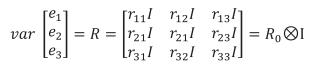
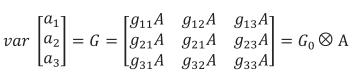
<body><![CDATA[<p>It is assumed that</p>     <p align="center"><img src="/img/revistas/rccp/v25n4/v25n4a2g2.jpg"></p>     <p>Where:</p>     <p>g<sub>ij</sub> = ij-th element of the G<sub>0</sub> matrix containing the variances and covariances for random effects of animal for each of the traits included in the analyses.</p>     <p><i>A</i> = additive relationship matrix.</p>     <p><img src="/img/revistas/rccp/v25n4/v25n4a2g3.jpg"> = Kronecker product operator.</p>     <p>Also,</p>     <p align="center"><img src="/img/revistas/rccp/v25n4/v25n4a2g4.jpg"></p>     <p>Where:</p>     <p>r<sub>ij</sub> = ij-th element of the R<sub>0</sub> variance and covariance matrix of residual effects for each of the traits included in the analyses.</p>     ]]></body>
<body><![CDATA[<p><i>I</i> = identity matrix</p>     <p><i>Case 2</i>. Multi-trait model with permanent environmental effect.</p>     <p>The model was as follows</p>     <p align="center"><img src="/img/revistas/rccp/v25n4/v25n4a2g5.jpg" /></p>     <p>Where:</p>     <p><i><b>y<sub>i</sub></b></i> = vector of observations for the <i>ith</i> trait,   <i><b>&beta;<sub>i</sub></b></i> = vector of fixed effects for the ith feature, <i><b>a<sub>i</sub></b></i> = vector of animal random effects for the <i>ith</i> feature, pi = vector of random permanent environmental and non-additive genetic effects, <b><i>e<sub>i</sub></i></b> = vector of random residual effects for the <i>ith</i> feature, <b><i>X<sub>i</sub></i></b>, <b><i>Z<sub>i</sub></i></b> y <i><b>W<sub>i</sub></b></i> are incidence matrices relating the records of the <i>ith</i> trait with fixed, random, and permanent environment effects, respectively.</p>     <p>Fixed effects for PL were herd-year-season (HAE) and lactation. Adjustment of the records was done in the same manner described for case 1. For IEP, DIAB, and SPC, the effects were those specified for PL.</p>     <p>It is assumed that</p>     <p align="center"><img src="/img/revistas/rccp/v25n4/v25n4a2g6.jpg"></p>     <p>Where:</p>     ]]></body>
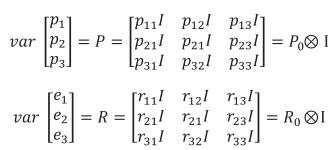
<body><![CDATA[<p>g<sub>ij</sub> = ij-th element of the G<sub>0</sub> matrix containing variances and covariances for random effects of animal for each trait included in the analyses.</p>     <p>A = additive relationship matrix.</p>     <p><img src="/img/revistas/rccp/v25n4/v25n4a2g3.jpg"> = Kronecker product operator.</p>     <p>Also,</p>     <p align="center"><img src="/img/revistas/rccp/v25n4/v25n4a2g7.jpg"></p>     <p>Where:</p>     <p>p<sub>ij</sub> = ij-th element of the P<sub>0</sub> variances and covariances matrix for the random effects of permanent environmental and non-additive genetic included in the analyses.</p>     <p><i>P</i> = permanent environmental matrix</p>     <p>r<sub>ij</sub> = ij-th element of the R<sub>0</sub> variances and covariances matrix of residual effects for each of the traits included in the analyses.</p>     <p><i>I</i> = identity matrix.</p>     ]]></body>
<body><![CDATA[<p>The (co) variance components in each model were obtained with the ASREML (VSN International, 2009) and MTDFREML (Boldman <i>et al.</i>, 1993) software. The significance of fixed effects was previously established with the GLM procedure of SAS (SAS, 2009).</p>     <p><i>Estimation of Breeding Value</i></p>     <p>Assessment models for this purpose were exactly the same used in the calculation of the (co) variance components, obtaining the breeding value of each individual, with the corresponding reliability and standard error.</p>     <p>&nbsp;</p>     <p><b><font size="3">Results</font></b></p>     <p><i>   Characterization of the Milk Production Systems  </i></p>     <p>As shown in <a href="/img/revistas/rccp/v25n4/v25n4a2t1.jpg" target="_blank">table 1</a>, the average ASNM is above 3,000 m with frequent occurrence of frost, which creates complexity for this region's dairy herds. Ideally, the land at this altitude should be devoted exclusively to the preservation of ecosystems rather than agriculture or livestock.</p>     <p>These results confirm the smallholder nature of the region, where many farmers earn their income from very small areas exclusively devoted to cattle and few producers use more than 14 ha devoted to this activity. Therefore, the need to transfer appropriate technologies for these production systems seeking to improve the income of smallholder farmers is urgent, thereby contributing to the region's social stability.</p>     <p><i>Soil and grassland</i>. Soils in the area are acidic, deep, moderately coarse textured, imperfectly drained, with low moisture retention, high organic matter content, and low to moderate fertility (IGAC, 1999). Most of the region is dominated by moderately broken and undulating terrain surfaces, although farms in the Guachucal district have mostly flat surfaces. In general, forages are deficient in protein, energy, calcium, and zinc, and possess excess potassium (Col&aacute;cteos, 2009).</p>     <p><i>Productive and reproductive variables</i>. <a href="/img/revistas/rccp/v25n4/v25n4a2t2.jpg" target="_blank">Table 2</a> shows the principle PL statistics.</p>     ]]></body>
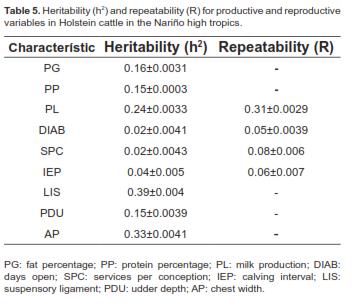
<body><![CDATA[<p>The average PL was 13 l / cow / day, which is lower than the national average reported for this breed and other Colombian provinces such as Antioquia, Valle, and Cundinamarca (Restrepo <i>et al.</i>, 2008; Ceron <i>et al.</i>, 2001). Similarly, this breed has higher production levels in Venezuela, Mexico, and the United States than those calculated in this study (Valle, 1995; Palacios <i>et al.</i>, 2001; Heins <i>et al.</i>, 2006). Therefore, it is necessary to improve this trait in the selection process proposed for the area.</p>     <p>Protein and fat percentages (<a href="/img/revistas/rccp/v25n4/v25n4a2t3.jpg" target="_blank">Table 3</a>) are below the Argentine and Venezuelan national averages (Quijano, 2007; Vera <i>et al.</i>, 2008; Valle, 1996) and are similar to those of the U.S. (Powell, 2003). These results may be partially explained by the preferential use of U.S. sperm in most technologically advanced areas of the region. This reaffirms the need to reorient the selection process in order to improve both traits, which are closely linked with compositional quality, industrial performance, and increased income from milk sales.</p>     <p>Calving interval (IEP), open days (DIAB), and services per conception (SPC) are the most important variables related to fertility and reproduction, as reported in <a href="/img/revistas/rccp/v25n4/v25n4a2t4.jpg" target="_blank">table 4</a>.</p>     <p>These results are higher than the ideal for an optimum process, reflecting the prevalence of reproductive problems. The IEP is greater than that indicated by Fedegan (2007) for Colombian regions with similar production conditions, and is also higher than countries such as Costa Rica and Canada (Cede&ntilde;o and Vargas, 2004; Raheja <i>et al.</i>, 1987). The DIAB average is higher than that in Colombia, Costa Rica, and the U.S. (Quijano and Montoya, 2000; Godinez and Soto, 1995; Heins <i>et al.</i>, 2006). The SPC results are consistent with reports by Morante and Trejo (2003) in Honduras and by Alvarez <i>et al.</i> (1982) in Mexico.</p>     <p><i>Genetic Parameters</i></p>     <p><i>Heritability (h<sup>2</sup>) and repeatability (R) of productive and reproductive variables</i>. <a href="#t5">Table 5</a> presents heritability and repeatability results for productive and reproductive variables with the corresponding standard error for each.</p>     <p align="center"><a name="t5"></a><img src="/img/revistas/rccp/v25n4/v25n4a2t5.jpg"></p>     <p>The PL heritability calculated in this study is similar to that reported by Kaya <i>et al.</i> (2003) in western Turkey farms, higher than that observed by Bilal <i>et al.</i> (2008) in Pakistan, and lower than those reported in Colombia by Ceron <i>et al.</i> (2001) in their study on four specialized dairy regions: Cundinamarca, Valle del Cauca, Antioquia, and Nari&ntilde;o. This variation can be attributed to the influence of several factors, including sample size and environmental variations between study locations, implying that it is advisable to estimate genetic parameters in each environment and conduct recalculations as the selection process develops.</p>     <p>In general, heritability for PP and PG is lower than that calculated in other Colombian regions and abroad, a fact explained by the sample size and the difficulties of building the pedigree due to lack of information on the parents in many farms of this region. It is also important to simultaneously consider both environmental and genetic aspects because phenotype is the result of the joint action of genes and the environment, where environment is understood as all nonhereditary factors.</p>     <p>The heritability values for reproductive variables confirm the weak influence of the additive effect of genes on these traits, coinciding with the results obtained by different researchers such as Price <i>et al.</i> (2001), Veerkamp <i>et al.</i> (2001), and Restrepo <i>et al.</i> (2008), so it is not appropriate to attempt to improve these traits by selection.</p>     ]]></body>
<body><![CDATA[<p><i>Genetic correlations between productive, reproductive, and conformation or type variables</i>. <a href="/img/revistas/rccp/v25n4/v25n4a2t6.jpg" target="_blank">Table 6</a> shows the genetic correlations values estimated in this study for productive and reproductive variables. Only genetic correlations are included due to their great significance for breeding programs.</p>     <p>Standard error of genetic correlations between production traits ranged between 0.0032 and 0.0038. These errors ranged between 0.0037 and 0.005 for production and conformation characteristics. The highest values were observed between productive and reproductive traits, fluctuating from 0.004 to 0.005. These results indicate a negative correlation between milk production and fat and protein percentages, which concurs with the majority of literature reports (Ochoa, 1991; Welper and Freeman, 1992; Spelman and Garrick, 1997). Regarding the association of reproductive traits and milk production, a negative correlation between them was observed. These results are similar to those calculated by Restrepo <i>et al.</i> (2008) and Philipsson <i>et al.</i> (1994). Additionally, reports by Caraviello <i>et al.</i> (2004) and Sewalem <i>et al.</i> (2004) proved low genetic influence of reproduction on production traits. Therefore, their improvement should be carried out through nutritional and management strategies, as well as by identifying gene actions other than the additive ones. On the other hand, the high standard errors found in these correlations do not ensure that a genetic association between milk production and reproductive variables exists.</p>     <p>&nbsp;</p>     <p><b><font size="3">Discussion</font></b></p>     <p>According to these results, specialized milk production systems in the Nari&ntilde;o high tropics develop mainly on small farms (22.19 has average), confirming the smallholder nature of a region with unique environmental conditions in the Colombian territory. This reality requires the generation of technological developments in accordance with the aforementioned characteristics.</p>     <p>Average productions, as well as fat and milk protein percentages, are below national and international data. There is also low reproductive efficiency, with long calving intervals and a high number of services per conception. This scenario reveals the need to comprehensively review the production processes, emphasizing the selection of animals best suited to the region's conditions. It should be considered that the Holstein breed was introduced to the area a century ago, but had not been evaluated or selected, thus losing the adaptive advantages of many animals that were discarded for breeding. Parallel to the selection program for breeding purposes, it is urgent to design and implement plans for a more efficient reproductive management. These plans should include heat detection, effective artificial insemination practice, and veterinary follow-ups for the early detection and monitoring of reproductive diseases, nutritional management, and implementation of corrective measures. These practices would help to improve productivity and profitability of the herds.</p>     <p>&nbsp;</p>     <p><b><font size="3">Acknowledgements</font></b></p>     <p>Thanks to Nari&ntilde;o University, the Nari&ntilde;o Dairy Cooperative (Col&aacute;cteos), and the Colombian Ministry of Agriculture and Rural Development for their valuable support in conducting this work.</p>     <p>&nbsp;</p>     ]]></body>
<body><![CDATA[<p><b><font size="3">References  </font></b></p>     <!-- ref --><p>1. &Aacute;lvarez RA, Hern&aacute;ndez RE, Valencia ZM. An&aacute;lisis de los par&aacute;metros reproductivos y de producci&oacute;n de las razas Holstein, Suizo pardo y Holstein-Ceb&uacute; en el tr&oacute;pico. En: Memorias del VIII Congreso Nacional de BUITRIA. Veracruz, M&eacute;xico. Asociaci&oacute;n Mexicana de M&eacute;dicos Veterinarios especialistas en bovinos y peque&ntilde;os rumiantes. M&eacute;xico DF 1982; 63-69.    &nbsp;&nbsp;&nbsp;&nbsp;&nbsp;&nbsp;&nbsp;&nbsp;[&#160;<a href="javascript:void(0);" onclick="javascript: window.open('/scielo.php?script=sci_nlinks&ref=000114&pid=S0120-0690201200040000200001&lng=','','width=640,height=500,resizable=yes,scrollbars=1,menubar=yes,');">Links</a>&#160;]<!-- end-ref --></p>     <!-- ref --><p>2. Bilal G, Khan MS, Bajwa IR, Shafiq M. Genetic control of test-day milk yield in sahiwal cattle. Pak Vet J 2008; 28:21-24.    &nbsp;&nbsp;&nbsp;&nbsp;&nbsp;&nbsp;&nbsp;&nbsp;[&#160;<a href="javascript:void(0);" onclick="javascript: window.open('/scielo.php?script=sci_nlinks&ref=000116&pid=S0120-0690201200040000200002&lng=','','width=640,height=500,resizable=yes,scrollbars=1,menubar=yes,');">Links</a>&#160;]<!-- end-ref --></p>     <!-- ref --><p>3. B.S.I British Standards Instituttion. Method for determination of fat in milk and milk products. Gerber 1955.    &nbsp;&nbsp;&nbsp;&nbsp;&nbsp;&nbsp;&nbsp;&nbsp;[&#160;<a href="javascript:void(0);" onclick="javascript: window.open('/scielo.php?script=sci_nlinks&ref=000118&pid=S0120-0690201200040000200003&lng=','','width=640,height=500,resizable=yes,scrollbars=1,menubar=yes,');">Links</a>&#160;]<!-- end-ref --></p>     <!-- ref --><p>4. Caraviello DZ, Weigel KA, Gianola D. Analysis of the relationship between type traits and functional survival in Holstein cattle using a Weibull proportional hazard model. J Dairy Sci 2004; 87:2677-2686.    &nbsp;&nbsp;&nbsp;&nbsp;&nbsp;&nbsp;&nbsp;&nbsp;[&#160;<a href="javascript:void(0);" onclick="javascript: window.open('/scielo.php?script=sci_nlinks&ref=000120&pid=S0120-0690201200040000200004&lng=','','width=640,height=500,resizable=yes,scrollbars=1,menubar=yes,');">Links</a>&#160;]<!-- end-ref --></p>     <!-- ref --><p>5. Cede&ntilde;o DA, Vargas B. Efecto de la raza y el manejo sobre la vida productiva del bovino lechero en Costa Rica. Arch Zootec 2004; 53:129-140.    &nbsp;&nbsp;&nbsp;&nbsp;&nbsp;&nbsp;&nbsp;&nbsp;[&#160;<a href="javascript:void(0);" onclick="javascript: window.open('/scielo.php?script=sci_nlinks&ref=000122&pid=S0120-0690201200040000200005&lng=','','width=640,height=500,resizable=yes,scrollbars=1,menubar=yes,');">Links</a>&#160;]<!-- end-ref --></p>     <!-- ref --><p>6. Cer&oacute;n-Mu&ntilde;oz M, Tonhati H, Costa C, Solarte C, Benavides O. Factores de ajuste para producci&oacute;n de leche en bovinos Holstein colombiano. Rev Colomb Cienc Pecu 2003; 16:26-32.    &nbsp;&nbsp;&nbsp;&nbsp;&nbsp;&nbsp;&nbsp;&nbsp;[&#160;<a href="javascript:void(0);" onclick="javascript: window.open('/scielo.php?script=sci_nlinks&ref=000124&pid=S0120-0690201200040000200006&lng=','','width=640,height=500,resizable=yes,scrollbars=1,menubar=yes,');">Links</a>&#160;]<!-- end-ref --></p>     <!-- ref --><p>7. Cer&oacute;n MF, Tonhati H, Costa C, Benavides F. Interacci&oacute;n genotipo ambiente en ganado Holstein colombiano. Arch Latinoam Prod Anim 2001; 9:74-78.    &nbsp;&nbsp;&nbsp;&nbsp;&nbsp;&nbsp;&nbsp;&nbsp;[&#160;<a href="javascript:void(0);" onclick="javascript: window.open('/scielo.php?script=sci_nlinks&ref=000126&pid=S0120-0690201200040000200007&lng=','','width=640,height=500,resizable=yes,scrollbars=1,menubar=yes,');">Links</a>&#160;]<!-- end-ref --></p>     <!-- ref --><p>8. Corea-Guill&eacute;n EE, Alvarado-Paname&ntilde;o JF, Leyton-Barrientos LV. Efecto del cambio en la condici&oacute;n corporal, raza y n&uacute;mero de partos en el desempe&ntilde;o reproductivo de vacas lecheras. Agronom&iacute;a Mesoamericana 2008; 19:251-259.    &nbsp;&nbsp;&nbsp;&nbsp;&nbsp;&nbsp;&nbsp;&nbsp;[&#160;<a href="javascript:void(0);" onclick="javascript: window.open('/scielo.php?script=sci_nlinks&ref=000128&pid=S0120-0690201200040000200008&lng=','','width=640,height=500,resizable=yes,scrollbars=1,menubar=yes,');">Links</a>&#160;]<!-- end-ref --></p>     <!-- ref --><p>9. Evaluaci&oacute;n de los recursos forestales mundiales. Informe Principal 2000.    &nbsp;&nbsp;&nbsp;&nbsp;&nbsp;&nbsp;&nbsp;&nbsp;[&#160;<a href="javascript:void(0);" onclick="javascript: window.open('/scielo.php?script=sci_nlinks&ref=000130&pid=S0120-0690201200040000200009&lng=','','width=640,height=500,resizable=yes,scrollbars=1,menubar=yes,');">Links</a>&#160;]<!-- end-ref --></p>     <!-- ref --><p>10. Falconer DS, Mackay FC. Introduction to quantitative genetics. Fourth edition. London: Longman; 1996. 459p.    &nbsp;&nbsp;&nbsp;&nbsp;&nbsp;&nbsp;&nbsp;&nbsp;[&#160;<a href="javascript:void(0);" onclick="javascript: window.open('/scielo.php?script=sci_nlinks&ref=000132&pid=S0120-0690201200040000200010&lng=','','width=640,height=500,resizable=yes,scrollbars=1,menubar=yes,');">Links</a>&#160;]<!-- end-ref --></p>     <!-- ref --><p>11. God&iacute;nez J, Soto H. An&aacute;lisis gen&eacute;tico de la producci&oacute;n l&aacute;ctea, los d&iacute;as abiertos y el intervalo entre partos en el hato Holstein nacional. Escuela de Zootecnia, Universidad de Costa Rica 1995.    &nbsp;&nbsp;&nbsp;&nbsp;&nbsp;&nbsp;&nbsp;&nbsp;[&#160;<a href="javascript:void(0);" onclick="javascript: window.open('/scielo.php?script=sci_nlinks&ref=000134&pid=S0120-0690201200040000200011&lng=','','width=640,height=500,resizable=yes,scrollbars=1,menubar=yes,');">Links</a>&#160;]<!-- end-ref --></p>     <!-- ref --><p>12. Heins L, Heins B, Seykora T. Production of pure Holstein versus crossbreds of Holstein with Normande, Montbeliarde and scandinavian red. J Dairy Sci 2006; 89:2799-2804.    &nbsp;&nbsp;&nbsp;&nbsp;&nbsp;&nbsp;&nbsp;&nbsp;[&#160;<a href="javascript:void(0);" onclick="javascript: window.open('/scielo.php?script=sci_nlinks&ref=000136&pid=S0120-0690201200040000200012&lng=','','width=640,height=500,resizable=yes,scrollbars=1,menubar=yes,');">Links</a>&#160;]<!-- end-ref --></p>     <!-- ref --><p>13. ICAR-International committee for animal recording. International Agreement of recording practices 2009.    &nbsp;&nbsp;&nbsp;&nbsp;&nbsp;&nbsp;&nbsp;&nbsp;[&#160;<a href="javascript:void(0);" onclick="javascript: window.open('/scielo.php?script=sci_nlinks&ref=000138&pid=S0120-0690201200040000200013&lng=','','width=640,height=500,resizable=yes,scrollbars=1,menubar=yes,');">Links</a>&#160;]<!-- end-ref --></p>     <!-- ref --><p>14. IDEAM. Instituto de hidrolog&iacute;a, meteorolog&iacute;a y estudios ambientales de Colombia. Sistema de informaci&oacute;n ambiental 2006.    &nbsp;&nbsp;&nbsp;&nbsp;&nbsp;&nbsp;&nbsp;&nbsp;[&#160;<a href="javascript:void(0);" onclick="javascript: window.open('/scielo.php?script=sci_nlinks&ref=000140&pid=S0120-0690201200040000200014&lng=','','width=640,height=500,resizable=yes,scrollbars=1,menubar=yes,');">Links</a>&#160;]<!-- end-ref --></p>     <!-- ref --><p>15. IGAC-Instituto Geogr&aacute;fico Agust&iacute;n Codazzi 1999.    &nbsp;&nbsp;&nbsp;&nbsp;&nbsp;&nbsp;&nbsp;&nbsp;[&#160;<a href="javascript:void(0);" onclick="javascript: window.open('/scielo.php?script=sci_nlinks&ref=000142&pid=S0120-0690201200040000200015&lng=','','width=640,height=500,resizable=yes,scrollbars=1,menubar=yes,');">Links</a>&#160;]<!-- end-ref --></p>     <!-- ref --><p>16. Kaya U, Yavuz A, Uzmay C. Estimation of breeding values for dairy cattle using Test-Day Milk yields. Turk J Vet Anim Sci 2003; 27:459-464.    &nbsp;&nbsp;&nbsp;&nbsp;&nbsp;&nbsp;&nbsp;&nbsp;[&#160;<a href="javascript:void(0);" onclick="javascript: window.open('/scielo.php?script=sci_nlinks&ref=000144&pid=S0120-0690201200040000200016&lng=','','width=640,height=500,resizable=yes,scrollbars=1,menubar=yes,');">Links</a>&#160;]<!-- end-ref --></p>     <!-- ref --><p>17. Morante L, Trejo C. Evaluaci&oacute;n del comportamiento productivo y reproductivo de cruces raciales en 13 fincas lecheras de honduras. Tesis Ingeniero Agr&oacute;nomo Zamorano, Honduras 2003.    &nbsp;&nbsp;&nbsp;&nbsp;&nbsp;&nbsp;&nbsp;&nbsp;[&#160;<a href="javascript:void(0);" onclick="javascript: window.open('/scielo.php?script=sci_nlinks&ref=000146&pid=S0120-0690201200040000200017&lng=','','width=640,height=500,resizable=yes,scrollbars=1,menubar=yes,');">Links</a>&#160;]<!-- end-ref --></p>     <!-- ref --><p>18. Mu&ntilde;oz MCR, Murillo MAL, Romero JAM, S&aacute;nchez LF. Evaluaci&oacute;n de la eficiencia reproductiva de las primeras tres lactancias en un hato del estado de M&eacute;xico. En: Memorias del XXV Congreso Nacional de Buiatr&iacute;a; agosto 16-18; Boca del R&iacute;o (Veracruz) M&eacute;xico. M&eacute;xico (DF): Asociaci&oacute;n Mexicana de M&eacute;dicos Veterinarios Especialistas en Bovinos, AC 2001; 269.    &nbsp;&nbsp;&nbsp;&nbsp;&nbsp;&nbsp;&nbsp;&nbsp;[&#160;<a href="javascript:void(0);" onclick="javascript: window.open('/scielo.php?script=sci_nlinks&ref=000148&pid=S0120-0690201200040000200018&lng=','','width=640,height=500,resizable=yes,scrollbars=1,menubar=yes,');">Links</a>&#160;]<!-- end-ref --></p>     <!-- ref --><p>19. Ochoa GP. Mejoramiento gen&eacute;tico del Ganado bovino productor de leche. Departamento de gen&eacute;tica y bioestad&iacute;stica. UNAM C. M&eacute;xico. D.F. 1991; 67-88p.    &nbsp;&nbsp;&nbsp;&nbsp;&nbsp;&nbsp;&nbsp;&nbsp;[&#160;<a href="javascript:void(0);" onclick="javascript: window.open('/scielo.php?script=sci_nlinks&ref=000150&pid=S0120-0690201200040000200019&lng=','','width=640,height=500,resizable=yes,scrollbars=1,menubar=yes,');">Links</a>&#160;]<!-- end-ref --></p>     <!-- ref --><p>20. Palacios EA, Rodr&iacute;guez AF, Castro JJ. Evaluaci&oacute;n gen&eacute;tica de un hato Holstein en baja California Sur, utilizando un modelo animal con mediciones repetidas. Agrociencia 2001; 35:347-353.    &nbsp;&nbsp;&nbsp;&nbsp;&nbsp;&nbsp;&nbsp;&nbsp;[&#160;<a href="javascript:void(0);" onclick="javascript: window.open('/scielo.php?script=sci_nlinks&ref=000152&pid=S0120-0690201200040000200020&lng=','','width=640,height=500,resizable=yes,scrollbars=1,menubar=yes,');">Links</a>&#160;]<!-- end-ref -->  </p>     <!-- ref --><p>21. Philipsson J, Banos G, Arnason T. Present and future uses of selection index methodology in dairy cattle. J Dairy Sci 1994; 77:3252-3261.    &nbsp;&nbsp;&nbsp;&nbsp;&nbsp;&nbsp;&nbsp;&nbsp;[&#160;<a href="javascript:void(0);" onclick="javascript: window.open('/scielo.php?script=sci_nlinks&ref=000154&pid=S0120-0690201200040000200021&lng=','','width=640,height=500,resizable=yes,scrollbars=1,menubar=yes,');">Links</a>&#160;]<!-- end-ref --></p>     <!-- ref --><p>22. Powell RL. Programas Gen&eacute;ticos para el Ganado Lechero en Estados Unidos. Laboratorio del Programa de Mejoramiento Animal. Servicio de Investigaci&oacute;n Agropecuaria del Departamento de Agricultura de Estados Unidos USDA, Beltsville 2003.    &nbsp;&nbsp;&nbsp;&nbsp;&nbsp;&nbsp;&nbsp;&nbsp;[&#160;<a href="javascript:void(0);" onclick="javascript: window.open('/scielo.php?script=sci_nlinks&ref=000156&pid=S0120-0690201200040000200022&lng=','','width=640,height=500,resizable=yes,scrollbars=1,menubar=yes,');">Links</a>&#160;]<!-- end-ref --></p>     <!-- ref --><p>23. Price JE, Coffey MP, Brotherstone S. The genetic relationship between calving interval body condition score and linear type and management in registered Holstein. J Dairy Sci 2001; 83:2664- 2671.    &nbsp;&nbsp;&nbsp;&nbsp;&nbsp;&nbsp;&nbsp;&nbsp;[&#160;<a href="javascript:void(0);" onclick="javascript: window.open('/scielo.php?script=sci_nlinks&ref=000158&pid=S0120-0690201200040000200023&lng=','','width=640,height=500,resizable=yes,scrollbars=1,menubar=yes,');">Links</a>&#160;]<!-- end-ref -->  </p>     <!-- ref --><p>24. Quijano JB. Resultados del programa de cruzamiento de la raza criolla Colombiana Blanco Orejinegro (BON) con la raza Holstein en el centro Paysand&uacute; Universidad Nacional de Colombia-sede Medell&iacute;n 2007.    &nbsp;&nbsp;&nbsp;&nbsp;&nbsp;&nbsp;&nbsp;&nbsp;[&#160;<a href="javascript:void(0);" onclick="javascript: window.open('/scielo.php?script=sci_nlinks&ref=000160&pid=S0120-0690201200040000200024&lng=','','width=640,height=500,resizable=yes,scrollbars=1,menubar=yes,');">Links</a>&#160;]<!-- end-ref -->  </p>     <!-- ref --><p>25. Quijano BJ, Montoya SC. Comparaci&oacute;n productiva de vacas Holstein y F1 BON x Holstein en el Centro Paysandu: producci&oacute;n y calidad de la leche. Rev Fac Nal Agronom 2000; 53:1115-1128.    &nbsp;&nbsp;&nbsp;&nbsp;&nbsp;&nbsp;&nbsp;&nbsp;[&#160;<a href="javascript:void(0);" onclick="javascript: window.open('/scielo.php?script=sci_nlinks&ref=000162&pid=S0120-0690201200040000200025&lng=','','width=640,height=500,resizable=yes,scrollbars=1,menubar=yes,');">Links</a>&#160;]<!-- end-ref -->  </p>     <!-- ref --><p>26. Raheja KL, Burnside EB, Shaeffer LR. Relationship between fertility and production traits in Holstein dairy cattle in different parities. Annual Meeting Southern Division. American Dairy Science Association 1987; 82:382-231.    &nbsp;&nbsp;&nbsp;&nbsp;&nbsp;&nbsp;&nbsp;&nbsp;[&#160;<a href="javascript:void(0);" onclick="javascript: window.open('/scielo.php?script=sci_nlinks&ref=000164&pid=S0120-0690201200040000200026&lng=','','width=640,height=500,resizable=yes,scrollbars=1,menubar=yes,');">Links</a>&#160;]<!-- end-ref -->  </p>     <!-- ref --><p>27. Restrepo G, Pizarro EJ, Quijano JH. &Iacute;ndices de Selecci&oacute;n y niveles independientes de descarte para dos caracter&iacute;sticas productivas y reproductivas en un hato Holstein (Bos taurus). Rev Colomb Cienc Pecu 2008; 21:239-250.    &nbsp;&nbsp;&nbsp;&nbsp;&nbsp;&nbsp;&nbsp;&nbsp;[&#160;<a href="javascript:void(0);" onclick="javascript: window.open('/scielo.php?script=sci_nlinks&ref=000166&pid=S0120-0690201200040000200027&lng=','','width=640,height=500,resizable=yes,scrollbars=1,menubar=yes,');">Links</a>&#160;]<!-- end-ref -->  </p>     <!-- ref --><p>28. SAS. Institute INC versi&oacute;n 9.2 2009.    &nbsp;&nbsp;&nbsp;&nbsp;&nbsp;&nbsp;&nbsp;&nbsp;[&#160;<a href="javascript:void(0);" onclick="javascript: window.open('/scielo.php?script=sci_nlinks&ref=000168&pid=S0120-0690201200040000200028&lng=','','width=640,height=500,resizable=yes,scrollbars=1,menubar=yes,');">Links</a>&#160;]<!-- end-ref -->  </p>     <!-- ref --><p>29. Schuzt MM. Age-Season Standardization for yield traits. Department of Animal Sciences. Animal improvement programs laboratory, ARS-USDA, Beltsville 2004.    &nbsp;&nbsp;&nbsp;&nbsp;&nbsp;&nbsp;&nbsp;&nbsp;[&#160;<a href="javascript:void(0);" onclick="javascript: window.open('/scielo.php?script=sci_nlinks&ref=000170&pid=S0120-0690201200040000200029&lng=','','width=640,height=500,resizable=yes,scrollbars=1,menubar=yes,');">Links</a>&#160;]<!-- end-ref -->  </p>     <!-- ref --><p>30. Spelman RJ, Garrick DJ. Utilisation of Marker Assisted selection in a commercial dairy cow population. Livestock Prod Sci 1997; 47:139-147.    &nbsp;&nbsp;&nbsp;&nbsp;&nbsp;&nbsp;&nbsp;&nbsp;[&#160;<a href="javascript:void(0);" onclick="javascript: window.open('/scielo.php?script=sci_nlinks&ref=000172&pid=S0120-0690201200040000200030&lng=','','width=640,height=500,resizable=yes,scrollbars=1,menubar=yes,');">Links</a>&#160;]<!-- end-ref -->  </p>     <!-- ref --><p>31. Sewalem A, Kistemaker G, Miglior F, Van Doormaal B. Analysis of the relationship between type traits and functional survival in Canadian Holsteins using a Weibull proportional hazards model. J Dairy Sci 2004; 87:3938-3846.    &nbsp;&nbsp;&nbsp;&nbsp;&nbsp;&nbsp;&nbsp;&nbsp;[&#160;<a href="javascript:void(0);" onclick="javascript: window.open('/scielo.php?script=sci_nlinks&ref=000174&pid=S0120-0690201200040000200031&lng=','','width=640,height=500,resizable=yes,scrollbars=1,menubar=yes,');">Links</a>&#160;]<!-- end-ref --></p>     <!-- ref --><p>32. Valle A. Duraci&oacute;n de gestaci&oacute;n, producci&oacute;n de leche e intervalo entre partos de vacas Holstein de distintas procedencias. FONAIAP-CENIAP. Unidad de Apoyo de Estad&iacute;stica, Maracay, Venezuela. Zootecnia Tropical 1995; 13:199-214.    &nbsp;&nbsp;&nbsp;&nbsp;&nbsp;&nbsp;&nbsp;&nbsp;[&#160;<a href="javascript:void(0);" onclick="javascript: window.open('/scielo.php?script=sci_nlinks&ref=000176&pid=S0120-0690201200040000200032&lng=','','width=640,height=500,resizable=yes,scrollbars=1,menubar=yes,');">Links</a>&#160;]<!-- end-ref -->  </p>     <!-- ref --><p>33. Valle A. Importancia del porcentaje de &aacute;rea negra en animales Holstein sobre el proceso adaptativo VI componentes de la leche. Zootecnia Tropical 1996; 14:3-15.    &nbsp;&nbsp;&nbsp;&nbsp;&nbsp;&nbsp;&nbsp;&nbsp;[&#160;<a href="javascript:void(0);" onclick="javascript: window.open('/scielo.php?script=sci_nlinks&ref=000178&pid=S0120-0690201200040000200033&lng=','','width=640,height=500,resizable=yes,scrollbars=1,menubar=yes,');">Links</a>&#160;]<!-- end-ref -->  </p>     <!-- ref --><p>34. Veerkamp RF, Koenen EPC, De Jong G. Genetic correlations among body condition score, yield, and fertility in first-parity cows estimated by random regression models. J Dairy Sci 2001; 84:2327&#8211;2335.    &nbsp;&nbsp;&nbsp;&nbsp;&nbsp;&nbsp;&nbsp;&nbsp;[&#160;<a href="javascript:void(0);" onclick="javascript: window.open('/scielo.php?script=sci_nlinks&ref=000180&pid=S0120-0690201200040000200034&lng=','','width=640,height=500,resizable=yes,scrollbars=1,menubar=yes,');">Links</a>&#160;]<!-- end-ref -->  </p>     <!-- ref --><p>35. Vera MG, Romero L, Comer&oacute;n E, Maciel M. Heterosis en los contenidos de porcentaje de grasa y prote&iacute;na en leche logrado por cruzamiento alterno rotacional de dos razas lecheras bovina tecnolog&iacute;a. INTA Rafaela 2008; 16:12-18.    &nbsp;&nbsp;&nbsp;&nbsp;&nbsp;&nbsp;&nbsp;&nbsp;[&#160;<a href="javascript:void(0);" onclick="javascript: window.open('/scielo.php?script=sci_nlinks&ref=000182&pid=S0120-0690201200040000200035&lng=','','width=640,height=500,resizable=yes,scrollbars=1,menubar=yes,');">Links</a>&#160;]<!-- end-ref -->  </p>     <!-- ref --><p>36. Welper RD, Freeman AE. Genetic parameters for yield traits of Holsteins, including lactose and somatic cell score. J Dairy Sci 1992; 75:1342-1348.    &nbsp;&nbsp;&nbsp;&nbsp;&nbsp;&nbsp;&nbsp;&nbsp;[&#160;<a href="javascript:void(0);" onclick="javascript: window.open('/scielo.php?script=sci_nlinks&ref=000184&pid=S0120-0690201200040000200036&lng=','','width=640,height=500,resizable=yes,scrollbars=1,menubar=yes,');">Links</a>&#160;]<!-- end-ref -->  </p>     <!-- ref --><p>37. Viloria J. Econom&iacute;a del Departamento de Nari&ntilde;o: ruralidad y aislamiento geogr&aacute;fico. Banco de la Rep&uacute;blica, Centro de Estudios Econ&oacute;micos Regionales (CEER) - Cartagena Colombia 2007; 87.    &nbsp;&nbsp;&nbsp;&nbsp;&nbsp;&nbsp;&nbsp;&nbsp;[&#160;<a href="javascript:void(0);" onclick="javascript: window.open('/scielo.php?script=sci_nlinks&ref=000186&pid=S0120-0690201200040000200037&lng=','','width=640,height=500,resizable=yes,scrollbars=1,menubar=yes,');">Links</a>&#160;]<!-- end-ref --></p>     <p>&nbsp;</p>     <p><b><font size="3">Nota al pie </font></b></p>     <p><sup><a href="#b0">&curren;</a><a name="0"></a></sup> To cite this article: Solarte CE, Zambrano GL. Characterization and Genetic Evaluation of Holstein Cattle in Nari&ntilde;o, Colombia. Rev Colomb Cienc Pecu 2012; 25:539-547.</p>     <p>&nbsp;</p> </font>      ]]></body><back>
<ref-list>
<ref id="B1">
<label>1</label><nlm-citation citation-type="book">
<person-group person-group-type="author">
<name>
<surname><![CDATA[Álvarez]]></surname>
<given-names><![CDATA[RA]]></given-names>
</name>
<name>
<surname><![CDATA[Hernández]]></surname>
<given-names><![CDATA[RE]]></given-names>
</name>
<name>
<surname><![CDATA[Valencia]]></surname>
<given-names><![CDATA[ZM.]]></given-names>
</name>
</person-group>
<article-title xml:lang="es"><![CDATA[Análisis de los parámetros reproductivos y de producción de las razas Holstein, Suizo pardo y Holstein-Cebú en el trópico]]></article-title>
<source><![CDATA[Memorias del VIII Congreso Nacional de BUITRIA]]></source>
<year>1982</year>
<page-range>63-69</page-range><publisher-loc><![CDATA[Veracruz ]]></publisher-loc>
<publisher-name><![CDATA[Asociación Mexicana de Médicos Veterinarios especialistas en bovinos y pequeños rumiantes]]></publisher-name>
</nlm-citation>
</ref>
<ref id="B2">
<label>2</label><nlm-citation citation-type="journal">
<person-group person-group-type="author">
<name>
<surname><![CDATA[Bilal]]></surname>
<given-names><![CDATA[G]]></given-names>
</name>
<name>
<surname><![CDATA[Khan]]></surname>
<given-names><![CDATA[MS]]></given-names>
</name>
<name>
<surname><![CDATA[Bajwa]]></surname>
<given-names><![CDATA[IR]]></given-names>
</name>
<name>
<surname><![CDATA[Shafiq]]></surname>
<given-names><![CDATA[M]]></given-names>
</name>
</person-group>
<article-title xml:lang="en"><![CDATA[Genetic control of test-day milk yield in sahiwal cattle]]></article-title>
<source><![CDATA[PakVet J]]></source>
<year>2008</year>
<volume>28</volume>
<page-range>21-24</page-range></nlm-citation>
</ref>
<ref id="B3">
<label>3</label><nlm-citation citation-type="">
<collab>B.S.I British Standards Instituttion</collab>
<source><![CDATA[Method for determination of fat in milk and milk products]]></source>
<year>1955</year>
<publisher-loc><![CDATA[Gerber ]]></publisher-loc>
</nlm-citation>
</ref>
<ref id="B4">
<label>4</label><nlm-citation citation-type="journal">
<person-group person-group-type="author">
<name>
<surname><![CDATA[Caraviello]]></surname>
<given-names><![CDATA[DZ]]></given-names>
</name>
<name>
<surname><![CDATA[Weigel]]></surname>
<given-names><![CDATA[KA]]></given-names>
</name>
<name>
<surname><![CDATA[Gianola]]></surname>
<given-names><![CDATA[D]]></given-names>
</name>
</person-group>
<article-title xml:lang="en"><![CDATA[Analysis of the relationship between type traits and functional survival in Holstein cattle using a Weibull proportional hazard model]]></article-title>
<source><![CDATA[J Dairy Sci]]></source>
<year>2004</year>
<volume>87</volume>
<page-range>2677-2686</page-range></nlm-citation>
</ref>
<ref id="B5">
<label>5</label><nlm-citation citation-type="journal">
<person-group person-group-type="author">
<name>
<surname><![CDATA[Cedeño]]></surname>
<given-names><![CDATA[DA]]></given-names>
</name>
<name>
<surname><![CDATA[Vargas]]></surname>
<given-names><![CDATA[B]]></given-names>
</name>
</person-group>
<article-title xml:lang="es"><![CDATA[Efecto de la raza y el manejo sobre la vida productiva del bovino lechero en Costa Rica]]></article-title>
<source><![CDATA[Arch Zootec]]></source>
<year>2004</year>
<volume>53</volume>
<page-range>129-140</page-range></nlm-citation>
</ref>
<ref id="B6">
<label>6</label><nlm-citation citation-type="journal">
<person-group person-group-type="author">
<name>
<surname><![CDATA[Cerón-Muñoz]]></surname>
<given-names><![CDATA[M]]></given-names>
</name>
<name>
<surname><![CDATA[Tonhati]]></surname>
<given-names><![CDATA[H]]></given-names>
</name>
<name>
<surname><![CDATA[Costa]]></surname>
<given-names><![CDATA[C]]></given-names>
</name>
<name>
<surname><![CDATA[Solarte]]></surname>
<given-names><![CDATA[C]]></given-names>
</name>
<name>
<surname><![CDATA[Benavides]]></surname>
<given-names><![CDATA[O]]></given-names>
</name>
</person-group>
<article-title xml:lang="es"><![CDATA[Factores de ajuste para producción de leche en bovinos Holstein colombiano]]></article-title>
<source><![CDATA[Rev Colomb Cienc Pecu]]></source>
<year>2003</year>
<volume>16</volume>
<page-range>26-32</page-range></nlm-citation>
</ref>
<ref id="B7">
<label>7</label><nlm-citation citation-type="journal">
<person-group person-group-type="author">
<name>
<surname><![CDATA[Cerón]]></surname>
<given-names><![CDATA[MF]]></given-names>
</name>
<name>
<surname><![CDATA[Tonhati]]></surname>
<given-names><![CDATA[H]]></given-names>
</name>
<name>
<surname><![CDATA[Costa]]></surname>
<given-names><![CDATA[C]]></given-names>
</name>
<name>
<surname><![CDATA[Benavides]]></surname>
<given-names><![CDATA[F]]></given-names>
</name>
</person-group>
<article-title xml:lang="es"><![CDATA[Interacción genotipo ambiente en ganado Holstein colombiano]]></article-title>
<source><![CDATA[Arch Latinoam Prod Anim]]></source>
<year>2001</year>
<volume>9</volume>
<page-range>74-78</page-range></nlm-citation>
</ref>
<ref id="B8">
<label>8</label><nlm-citation citation-type="journal">
<person-group person-group-type="author">
<name>
<surname><![CDATA[Corea-Guillén]]></surname>
<given-names><![CDATA[EE]]></given-names>
</name>
<name>
<surname><![CDATA[Alvarado-Panameño]]></surname>
<given-names><![CDATA[JF]]></given-names>
</name>
<name>
<surname><![CDATA[Leyton-Barrientos]]></surname>
<given-names><![CDATA[LV]]></given-names>
</name>
</person-group>
<article-title xml:lang="es"><![CDATA[Efecto del cambio en la condición corporal, raza y número de partos en el desempeño reproductivo de vacas lecheras]]></article-title>
<source><![CDATA[Agronomía Mesoamericana]]></source>
<year>2008</year>
<volume>19</volume>
<page-range>251-259</page-range></nlm-citation>
</ref>
<ref id="B9">
<label>9</label><nlm-citation citation-type="book">
<source><![CDATA[Evaluación de los recursos forestales mundiales]]></source>
<year>2000</year>
<publisher-name><![CDATA[Informe Principal]]></publisher-name>
</nlm-citation>
</ref>
<ref id="B10">
<label>10</label><nlm-citation citation-type="book">
<person-group person-group-type="author">
<name>
<surname><![CDATA[Falconer]]></surname>
<given-names><![CDATA[DS]]></given-names>
</name>
<name>
<surname><![CDATA[Mackay]]></surname>
<given-names><![CDATA[FC.]]></given-names>
</name>
</person-group>
<source><![CDATA[Introduction to quantitative genetics]]></source>
<year>1996</year>
<edition>Fourth</edition>
<publisher-loc><![CDATA[London ]]></publisher-loc>
<publisher-name><![CDATA[Longman]]></publisher-name>
</nlm-citation>
</ref>
<ref id="B11">
<label>11</label><nlm-citation citation-type="book">
<person-group person-group-type="author">
<name>
<surname><![CDATA[Godínez]]></surname>
<given-names><![CDATA[J]]></given-names>
</name>
<name>
<surname><![CDATA[Soto]]></surname>
<given-names><![CDATA[H.]]></given-names>
</name>
</person-group>
<source><![CDATA[Análisis genético de la producción láctea, los días abiertos y el intervalo entre partos en el hato Holstein nacional]]></source>
<year>1995</year>
<publisher-name><![CDATA[Escuela de Zootecnia, Universidad de Costa Rica]]></publisher-name>
</nlm-citation>
</ref>
<ref id="B12">
<label>12</label><nlm-citation citation-type="journal">
<person-group person-group-type="author">
<name>
<surname><![CDATA[Heins]]></surname>
<given-names><![CDATA[L]]></given-names>
</name>
<name>
<surname><![CDATA[Heins]]></surname>
<given-names><![CDATA[B]]></given-names>
</name>
<name>
<surname><![CDATA[Seykora]]></surname>
<given-names><![CDATA[T]]></given-names>
</name>
</person-group>
<article-title xml:lang="en"><![CDATA[Production of pure Holstein versus crossbreds of Holstein with Normande, Montbeliarde and scandinavian red]]></article-title>
<source><![CDATA[J Dairy Sci]]></source>
<year>2006</year>
<volume>89</volume>
<page-range>2799-2804</page-range></nlm-citation>
</ref>
<ref id="B13">
<label>13</label><nlm-citation citation-type="">
<collab>ICAR-International committee for animal recording</collab>
<source><![CDATA[International Agreement of recording practices]]></source>
<year>2009</year>
</nlm-citation>
</ref>
<ref id="B14">
<label>14</label><nlm-citation citation-type="">
<collab>IDEAM. Instituto de hidrología, meteorología y estudios ambientales de Colombia</collab>
<source><![CDATA[Sistema de información ambiental]]></source>
<year>2006</year>
</nlm-citation>
</ref>
<ref id="B15">
<label>15</label><nlm-citation citation-type="">
<collab>IGAC</collab>
<source><![CDATA[Instituto Geográfico Agustín Codazzi]]></source>
<year>1999</year>
</nlm-citation>
</ref>
<ref id="B16">
<label>16</label><nlm-citation citation-type="journal">
<person-group person-group-type="author">
<name>
<surname><![CDATA[Kaya]]></surname>
<given-names><![CDATA[U]]></given-names>
</name>
<name>
<surname><![CDATA[Yavuz]]></surname>
<given-names><![CDATA[A]]></given-names>
</name>
<name>
<surname><![CDATA[Uzmay]]></surname>
<given-names><![CDATA[C]]></given-names>
</name>
</person-group>
<article-title xml:lang="en"><![CDATA[Estimation of breeding values for dairy cattle using Test-Day Milk yields]]></article-title>
<source><![CDATA[Turk J Vet Anim Sci]]></source>
<year>2003</year>
<volume>27</volume>
<page-range>459-464</page-range></nlm-citation>
</ref>
<ref id="B17">
<label>17</label><nlm-citation citation-type="">
<person-group person-group-type="author">
<name>
<surname><![CDATA[Morante]]></surname>
<given-names><![CDATA[L]]></given-names>
</name>
<name>
<surname><![CDATA[Trejo]]></surname>
<given-names><![CDATA[C.]]></given-names>
</name>
</person-group>
<source><![CDATA[Evaluación del comportamiento productivo y reproductivo de cruces raciales en 13 fincas lecheras de honduras]]></source>
<year></year>
</nlm-citation>
</ref>
<ref id="B18">
<label>18</label><nlm-citation citation-type="confpro">
<person-group person-group-type="author">
<name>
<surname><![CDATA[Muñoz]]></surname>
<given-names><![CDATA[MCR]]></given-names>
</name>
<name>
<surname><![CDATA[Murillo]]></surname>
<given-names><![CDATA[MAL]]></given-names>
</name>
<name>
<surname><![CDATA[Romero]]></surname>
<given-names><![CDATA[JAM]]></given-names>
</name>
<name>
<surname><![CDATA[Sánchez]]></surname>
<given-names><![CDATA[LF.]]></given-names>
</name>
</person-group>
<article-title xml:lang="es"><![CDATA[Evaluación de la eficiencia reproductiva de las primeras tres lactancias en un hato del estado de México]]></article-title>
<source><![CDATA[]]></source>
<year></year>
<conf-name><![CDATA[XXV Congreso Nacional de Buiatría]]></conf-name>
<conf-date>2001</conf-date>
<conf-loc>Boca del Río Veracruz</conf-loc>
<page-range>269</page-range></nlm-citation>
</ref>
<ref id="B19">
<label>19</label><nlm-citation citation-type="book">
<person-group person-group-type="author">
<name>
<surname><![CDATA[Ochoa]]></surname>
<given-names><![CDATA[GP.]]></given-names>
</name>
</person-group>
<source><![CDATA[Mejoramiento genético del Ganado bovino productor de leche. Departamento de genética y bioestadística]]></source>
<year>1991</year>
<page-range>67-88</page-range><publisher-loc><![CDATA[México^eD.F. D.F.]]></publisher-loc>
<publisher-name><![CDATA[UNAM C]]></publisher-name>
</nlm-citation>
</ref>
<ref id="B20">
<label>20</label><nlm-citation citation-type="journal">
<person-group person-group-type="author">
<name>
<surname><![CDATA[Palacios]]></surname>
<given-names><![CDATA[EA]]></given-names>
</name>
<name>
<surname><![CDATA[Rodríguez]]></surname>
<given-names><![CDATA[AF]]></given-names>
</name>
<name>
<surname><![CDATA[Castro]]></surname>
<given-names><![CDATA[JJ]]></given-names>
</name>
</person-group>
<article-title xml:lang="es"><![CDATA[Evaluación genética de un hato Holstein en baja California Sur, utilizando un modelo animal con mediciones repetidas]]></article-title>
<source><![CDATA[Agrociencia]]></source>
<year>2001</year>
<volume>35</volume>
<page-range>347-353</page-range></nlm-citation>
</ref>
<ref id="B21">
<label>21</label><nlm-citation citation-type="journal">
<person-group person-group-type="author">
<name>
<surname><![CDATA[Philipsson]]></surname>
<given-names><![CDATA[J]]></given-names>
</name>
<name>
<surname><![CDATA[Banos]]></surname>
<given-names><![CDATA[G]]></given-names>
</name>
<name>
<surname><![CDATA[Arnason]]></surname>
<given-names><![CDATA[T]]></given-names>
</name>
</person-group>
<article-title xml:lang="en"><![CDATA[Present and future uses of selection index methodology in dairy cattle]]></article-title>
<source><![CDATA[J Dairy Sci]]></source>
<year>1994</year>
<volume>77</volume>
<page-range>3252-3261</page-range></nlm-citation>
</ref>
<ref id="B22">
<label>22</label><nlm-citation citation-type="book">
<person-group person-group-type="author">
<name>
<surname><![CDATA[Powell]]></surname>
<given-names><![CDATA[RL.]]></given-names>
</name>
</person-group>
<source><![CDATA[Programas Genéticos para el Ganado Lechero en Estados Unidos. Laboratorio del Programa de Mejoramiento Animal]]></source>
<year>2003</year>
<publisher-loc><![CDATA[Beltsville ]]></publisher-loc>
<publisher-name><![CDATA[Servicio de Investigación Agropecuaria del Departamento de Agricultura de Estados Unidos USDA]]></publisher-name>
</nlm-citation>
</ref>
<ref id="B23">
<label>23</label><nlm-citation citation-type="journal">
<person-group person-group-type="author">
<name>
<surname><![CDATA[Price]]></surname>
<given-names><![CDATA[JE]]></given-names>
</name>
<name>
<surname><![CDATA[Coffey]]></surname>
<given-names><![CDATA[MP]]></given-names>
</name>
<name>
<surname><![CDATA[Brotherstone]]></surname>
<given-names><![CDATA[S]]></given-names>
</name>
</person-group>
<article-title xml:lang="en"><![CDATA[The genetic relationship between calving interval body condition score and linear type and management in registered Holstein]]></article-title>
<source><![CDATA[J Dairy Sci]]></source>
<year>2001</year>
<volume>83</volume>
<page-range>2664- 2671</page-range></nlm-citation>
</ref>
<ref id="B24">
<label>24</label><nlm-citation citation-type="">
<person-group person-group-type="author">
<name>
<surname><![CDATA[Quijano]]></surname>
<given-names><![CDATA[JB]]></given-names>
</name>
</person-group>
<source><![CDATA[Resultados del programa de cruzamiento de la raza criolla Colombiana Blanco Orejinegro (BON) con la raza Holstein en el centro Paysandú Universidad Nacional de Colombia-sede Medellín]]></source>
<year>2007</year>
</nlm-citation>
</ref>
<ref id="B25">
<label>25</label><nlm-citation citation-type="journal">
<person-group person-group-type="author">
<name>
<surname><![CDATA[Quijano]]></surname>
<given-names><![CDATA[BJ]]></given-names>
</name>
<name>
<surname><![CDATA[Montoya]]></surname>
<given-names><![CDATA[SC]]></given-names>
</name>
</person-group>
<article-title xml:lang="es"><![CDATA[Comparación productiva de vacas Holstein y F1 BON x Holstein en el Centro Paysandu: producción y calidad de la leche]]></article-title>
<source><![CDATA[Rev Fac Nal Agronom]]></source>
<year>2000</year>
<volume>53</volume>
<page-range>1115-1128</page-range></nlm-citation>
</ref>
<ref id="B26">
<label>26</label><nlm-citation citation-type="journal">
<person-group person-group-type="author">
<name>
<surname><![CDATA[Raheja]]></surname>
<given-names><![CDATA[KL]]></given-names>
</name>
<name>
<surname><![CDATA[Burnside]]></surname>
<given-names><![CDATA[EB]]></given-names>
</name>
<name>
<surname><![CDATA[Shaeffer]]></surname>
<given-names><![CDATA[LR]]></given-names>
</name>
</person-group>
<article-title xml:lang="en"><![CDATA[Relationship between fertility and production traits in Holstein dairy cattle in different parities]]></article-title>
<source><![CDATA[Annual Meeting Southern Division. American Dairy Science Association]]></source>
<year>1987</year>
<volume>82</volume>
<page-range>382-231</page-range></nlm-citation>
</ref>
<ref id="B27">
<label>27</label><nlm-citation citation-type="journal">
<person-group person-group-type="author">
<name>
<surname><![CDATA[Restrepo]]></surname>
<given-names><![CDATA[G]]></given-names>
</name>
<name>
<surname><![CDATA[Pizarro]]></surname>
<given-names><![CDATA[EJ]]></given-names>
</name>
<name>
<surname><![CDATA[Quijano]]></surname>
<given-names><![CDATA[JH]]></given-names>
</name>
</person-group>
<article-title xml:lang="es"><![CDATA[Índices de Selección y niveles independientes de descarte para dos características productivas y reproductivas en un hato Holstein (Bos taurus)]]></article-title>
<source><![CDATA[Rev Colomb Cienc Pecu]]></source>
<year>2008</year>
<volume>21</volume>
<page-range>239-250</page-range></nlm-citation>
</ref>
<ref id="B28">
<label>28</label><nlm-citation citation-type="">
<collab>SAS</collab>
<source><![CDATA[Institute INC versión 9.2]]></source>
<year>2009</year>
</nlm-citation>
</ref>
<ref id="B29">
<label>29</label><nlm-citation citation-type="book">
<person-group person-group-type="author">
<name>
<surname><![CDATA[Schuzt]]></surname>
<given-names><![CDATA[MM.]]></given-names>
</name>
</person-group>
<source><![CDATA[Age-Season Standardization for yield traits. Department of Animal Sciences]]></source>
<year>2004</year>
<publisher-loc><![CDATA[Beltsville ]]></publisher-loc>
<publisher-name><![CDATA[Animal improvement programs laboratory, ARS-USDA]]></publisher-name>
</nlm-citation>
</ref>
<ref id="B30">
<label>30</label><nlm-citation citation-type="journal">
<person-group person-group-type="author">
<name>
<surname><![CDATA[Spelman]]></surname>
<given-names><![CDATA[RJ]]></given-names>
</name>
<name>
<surname><![CDATA[Garrick]]></surname>
<given-names><![CDATA[DJ]]></given-names>
</name>
</person-group>
<article-title xml:lang="en"><![CDATA[Utilisation of Marker Assisted selection in a commercial dairy cow population]]></article-title>
<source><![CDATA[Livestock Prod Sci]]></source>
<year>1997</year>
<volume>47</volume>
<page-range>139-147</page-range></nlm-citation>
</ref>
<ref id="B31">
<label>31</label><nlm-citation citation-type="journal">
<person-group person-group-type="author">
<name>
<surname><![CDATA[Sewalem]]></surname>
<given-names><![CDATA[A]]></given-names>
</name>
<name>
<surname><![CDATA[Kistemaker]]></surname>
<given-names><![CDATA[G]]></given-names>
</name>
<name>
<surname><![CDATA[Miglior]]></surname>
<given-names><![CDATA[F]]></given-names>
</name>
<name>
<surname><![CDATA[Van Doormaal]]></surname>
<given-names><![CDATA[B]]></given-names>
</name>
</person-group>
<article-title xml:lang="en"><![CDATA[Analysis of the relationship between type traits and functional survival in Canadian Holsteins using a Weibull proportional hazards model]]></article-title>
<source><![CDATA[J Dairy Sci]]></source>
<year>2004</year>
<volume>87</volume>
<page-range>3938-3846</page-range></nlm-citation>
</ref>
<ref id="B32">
<label>32</label><nlm-citation citation-type="journal">
<person-group person-group-type="author">
<name>
<surname><![CDATA[Valle]]></surname>
<given-names><![CDATA[A]]></given-names>
</name>
</person-group>
<article-title xml:lang="es"><![CDATA[Duración de gestación, producción de leche e intervalo entre partos de vacas Holstein de distintas procedencias. FONAIAP-CENIAP. Unidad de Apoyo de Estadística, Maracay, Venezuela.]]></article-title>
<source><![CDATA[Zootecnia Tropical.]]></source>
<year>1995</year>
<volume>13</volume>
<page-range>199-214</page-range></nlm-citation>
</ref>
<ref id="B33">
<label>33</label><nlm-citation citation-type="journal">
<person-group person-group-type="author">
<name>
<surname><![CDATA[Valle]]></surname>
<given-names><![CDATA[A]]></given-names>
</name>
</person-group>
<article-title xml:lang="es"><![CDATA[Importancia del porcentaje de área negra en animales Holstein sobre el proceso adaptativo VI componentes de la leche]]></article-title>
<source><![CDATA[Zootecnia Tropical]]></source>
<year>1996</year>
<volume>14</volume>
<page-range>3-15</page-range></nlm-citation>
</ref>
<ref id="B34">
<label>34</label><nlm-citation citation-type="journal">
<person-group person-group-type="author">
<name>
<surname><![CDATA[Veerkamp]]></surname>
<given-names><![CDATA[RF]]></given-names>
</name>
<name>
<surname><![CDATA[Koenen]]></surname>
<given-names><![CDATA[EPC]]></given-names>
</name>
<name>
<surname><![CDATA[De Jong]]></surname>
<given-names><![CDATA[G]]></given-names>
</name>
</person-group>
<article-title xml:lang="en"><![CDATA[Genetic correlations among body condition score, yield, and fertility in first-parity cows estimated by random regression models]]></article-title>
<source><![CDATA[J Dairy Sci]]></source>
<year>2001</year>
<volume>84</volume>
<page-range>2327-2335</page-range></nlm-citation>
</ref>
<ref id="B35">
<label>35</label><nlm-citation citation-type="journal">
<person-group person-group-type="author">
<name>
<surname><![CDATA[Vera]]></surname>
<given-names><![CDATA[MG]]></given-names>
</name>
<name>
<surname><![CDATA[Romero]]></surname>
<given-names><![CDATA[L]]></given-names>
</name>
<name>
<surname><![CDATA[Comerón]]></surname>
<given-names><![CDATA[E]]></given-names>
</name>
<name>
<surname><![CDATA[Maciel]]></surname>
<given-names><![CDATA[M]]></given-names>
</name>
</person-group>
<article-title xml:lang="es"><![CDATA[Heterosis en los contenidos de porcentaje de grasa y proteína en leche logrado por cruzamiento alterno rotacional de dos razas lecheras bovina tecnología]]></article-title>
<source><![CDATA[INTA Rafaela]]></source>
<year>2008</year>
<volume>16</volume>
<page-range>12-18</page-range></nlm-citation>
</ref>
<ref id="B36">
<label>36</label><nlm-citation citation-type="journal">
<person-group person-group-type="author">
<name>
<surname><![CDATA[Welper]]></surname>
<given-names><![CDATA[RD]]></given-names>
</name>
<name>
<surname><![CDATA[Freeman]]></surname>
<given-names><![CDATA[AE]]></given-names>
</name>
</person-group>
<article-title xml:lang="en"><![CDATA[Genetic parameters for yield traits of Holsteins, including lactose and somatic cell score]]></article-title>
<source><![CDATA[J Dairy Sci]]></source>
<year>1992</year>
<volume>75</volume>
<page-range>1342-1348</page-range></nlm-citation>
</ref>
<ref id="B37">
<label>37</label><nlm-citation citation-type="book">
<person-group person-group-type="author">
<name>
<surname><![CDATA[Viloria]]></surname>
<given-names><![CDATA[J.]]></given-names>
</name>
</person-group>
<source><![CDATA[Economía del Departamento de Nariño: ruralidad y aislamiento geográfico]]></source>
<year>2007</year>
<page-range>87</page-range><publisher-loc><![CDATA[Cartagena ]]></publisher-loc>
<publisher-name><![CDATA[Banco de la República, Centro de Estudios Económicos Regionales (CEER)]]></publisher-name>
</nlm-citation>
</ref>
</ref-list>
</back>
</article>