<?xml version="1.0" encoding="ISO-8859-1"?><article xmlns:mml="http://www.w3.org/1998/Math/MathML" xmlns:xlink="http://www.w3.org/1999/xlink" xmlns:xsi="http://www.w3.org/2001/XMLSchema-instance">
<front>
<journal-meta>
<journal-id>0120-0690</journal-id>
<journal-title><![CDATA[Revista Colombiana de Ciencias Pecuarias]]></journal-title>
<abbrev-journal-title><![CDATA[Rev Colom Cienc Pecua]]></abbrev-journal-title>
<issn>0120-0690</issn>
<publisher>
<publisher-name><![CDATA[Facultad de Ciencias Agrarias, Universidad de Antioquia]]></publisher-name>
</publisher>
</journal-meta>
<article-meta>
<article-id>S0120-06902012000400004</article-id>
<title-group>
<article-title xml:lang="en"><![CDATA[Postweaning growth of performance-tested buffaloes (Bubalus bubalis, Artiodactyla, Bovidae) reared under no-milking versus a dual-purpose system]]></article-title>
<article-title xml:lang="es"><![CDATA[Crecimiento posdestete de búfalos (Bubalus bubalis, Artiodactyla, Bovidae) sometidos a pruebas de desempeño provenientes de dos sistemas de manejo predestete: cría sin ordeño y doble propósito]]></article-title>
<article-title xml:lang="es"><![CDATA[Crescimento pós-desmame para búfalo (Bubalus bubalis, Artiodactyla, Bovidae) emprovas de desempenho a partir dedois sistemas de manejo pré-desmame: sem ordenha e dupla aptidão]]></article-title>
</title-group>
<contrib-group>
<contrib contrib-type="author">
<name>
<surname><![CDATA[Bolívar Vergara]]></surname>
<given-names><![CDATA[Diana M]]></given-names>
</name>
<xref ref-type="aff" rid="A01"/>
<xref ref-type="aff" rid="A02"/>
<xref ref-type="aff" rid="A05"/>
</contrib>
<contrib contrib-type="author">
<name>
<surname><![CDATA[Cerón-Muñoz]]></surname>
<given-names><![CDATA[Mario F]]></given-names>
</name>
<xref ref-type="aff" rid="A01"/>
<xref ref-type="aff" rid="A03"/>
</contrib>
<contrib contrib-type="author">
<name>
<surname><![CDATA[Elzo]]></surname>
<given-names><![CDATA[Mauricio A]]></given-names>
</name>
<xref ref-type="aff" rid="A04"/>
</contrib>
</contrib-group>
<aff id="A01">
<institution><![CDATA[,University of Antioquia  ]]></institution>
<addr-line><![CDATA[ ]]></addr-line>
<country>Colombia</country>
</aff>
<aff id="A02">
<institution><![CDATA[,National University of Colombia Faculty of Agricultural Sciences ]]></institution>
<addr-line><![CDATA[Medellín Antioquia]]></addr-line>
<country>Colombia</country>
</aff>
<aff id="A03">
<institution><![CDATA[,University of Antioquia Faculty of Agricultural Sciences ]]></institution>
<addr-line><![CDATA[Medellín Antioquia]]></addr-line>
<country>Colombia</country>
</aff>
<aff id="A04">
<institution><![CDATA[,University of Florida Department of Animal Science ]]></institution>
<addr-line><![CDATA[Gainesville FL]]></addr-line>
<country>USA</country>
</aff>
<aff id="A05">
<institution><![CDATA[,National University of Colombia Faculty of Agricultural Sciences ]]></institution>
<addr-line><![CDATA[Medellín Antioquia]]></addr-line>
<country>Colombia</country>
</aff>
<pub-date pub-type="pub">
<day>00</day>
<month>12</month>
<year>2012</year>
</pub-date>
<pub-date pub-type="epub">
<day>00</day>
<month>12</month>
<year>2012</year>
</pub-date>
<volume>25</volume>
<numero>4</numero>
<fpage>566</fpage>
<lpage>576</lpage>
<copyright-statement/>
<copyright-year/>
<self-uri xlink:href="http://www.scielo.org.co/scielo.php?script=sci_arttext&amp;pid=S0120-06902012000400004&amp;lng=en&amp;nrm=iso"></self-uri><self-uri xlink:href="http://www.scielo.org.co/scielo.php?script=sci_abstract&amp;pid=S0120-06902012000400004&amp;lng=en&amp;nrm=iso"></self-uri><self-uri xlink:href="http://www.scielo.org.co/scielo.php?script=sci_pdf&amp;pid=S0120-06902012000400004&amp;lng=en&amp;nrm=iso"></self-uri><abstract abstract-type="short" xml:lang="en"><p><![CDATA[Objective: the objective of this study was to compare growth traits in buffaloes reared in farms using a pre-weaning management system with no milking (NM), or a dual-purpose system (DP: meat and milk production). Methods: performance tests were conducted at the Experimental Station of the University of Antioquia, located in Barbosa (Antioquia, Colombia). Buffaloes were confined and fed with fresh Maralfalfa grass (Pennisetum sp.) ad libitum, plus two kilograms of mixed plus two 2 kilograms of concentrate supplement per day. Weight, ultrasound, and bovinometric measurements were taken every 14 d. Bovinometric measurements were chest girth (CG), height at withers (HW), and height at sacrum (HS). Ultrasound measurements were Longissimus muscle area (REA) and rump fat thickness (RFT). Traits were analyzed using a linear regression and second order polynomial model using unstructured variance-covariance matrices and accounting for relationships among animals. Results: all the traits in DP animals, as well as RFT, HW, and HS in NM animals fit well with a second-order regression mixed model. Weight, CG, and REA in NM animals fit well with a first-order regression mixed model. The rate of increase for HW and HS declined at the end of the test in NM animals, while weight, CG, RFT, and REA did not. The DP buffaloes displayed an accelerated rate of increase for all traits towards the end of the evaluation. The non-zero estimates of genetic variances for random regression effects suggests that these characteristics may be improved genetically in Colombia. Environmental and genetic differences among farms may have influenced the high variability among individuals for the intercept. Conclusions: the linear regression variances were small for all traits, suggesting that although selection of animals within these performance tests is possible, expected changes in the buffalo population will be small.]]></p></abstract>
<abstract abstract-type="short" xml:lang="es"><p><![CDATA[Objetivo: el objetivo de este estudio fue comparar características de crecimiento de búfalos sometidos a pruebas de desempeño, pertenecientes a dos sistemas de producción: cría sin ordeño (CSO) y doble propósito (DP). Métodos: las pruebas se realizaron en la Estación Experimental de la Universidad de Antioquia, ubicada en Barbosa, Colombia. Los animales fueron confinados y alimentados con pasto Maralfalfa (Pennisetum sp.) y dos kilogramos de un suplemento concentrado por día. El peso, las medidas de ultrasonido y bovinométricas fueron tomadas cada 14 días. Las medidas bovinométricas fueron perímetro torácico (PT), altura a la cruz (AC) y altura al sacro (AS). Las medidas por ultrasonido fueron área del músculo Longissimus (AOL) y espesor de grasa de la cadera (EGC). Las características fueron analizadas utilizando un modelo de regresión lineal mixto de primer orden y polinomial de segundo orden, con matrices de varianzas y covarianzas sin estructura, teniendo en cuenta la matriz de parentesco entre los animales. Resultados: todas las características en los animales provenientes del sistema DP y las caracteristicas EGC, AC y AS en animales de CSO, presentaron un mejor ajuste al modelo de regresión de segundo orden. El peso, PT y AOL en animales de CSO ajustaron mejor con un modelo de regresión de primer orden. La tasa de incremento de AC y AS en los búfalos de CSO declinó al final de la prueba, mientras que las otras características no presentaron disminución. Los búfalos del sistema DP aceleraron la tasa de incremento para todas las características al final de la evaluación. Las varianzas genéticas estimadas para los coeficientes de regresión fueron diferentes de cero, sugiriendo que estas características pueden ser mejoradas genéticamente en Colombia. Diferencias ambientales y genéticas entre fincas pueden haber influido en la alta variabilidad del intercepto entre los individuos. Conclusiones: las varianzas de los coeficientes de la regresión lineal fueron pequeñas para todas las características, sugiriendo que, aunque la selección de animales en pruebas de desempeño es posible, los cambios esperados en la población de búfalos serán pequeños.]]></p></abstract>
<abstract abstract-type="short" xml:lang="pt"><p><![CDATA[Objetivo: o objetivo deste estudo foi comparar as características de crescimento de búfalos submetidos em testes de desempenho. Estes búfalos foram provenientes de fazendas de gado de corte (CSO) ou dupla aptidão (DP). Métodos: as provas foram conduzidas na Estação Experimental da Universidade de Antioquia, localizada no município de Barbosa, na Colômbia. Os animais foram confinados e alimentados com capim Maralfalfa (Pennisetum sp.) e dois kg de suplemento por dia. Medidas morfométricas, de pesagem e ultrassom foram realizadas a cada 14 dias. As medidas morfométricas foram: perímetro torácico (PT), altura de cernelha (AC) e altura da garupa (AS). As mensurações de ultrassom foram: área do olho do lombo (AOL) e espessura de gordura na anca (EGA). As características foram analisadas utilizando um modelo de regressão linear misto de primeira ordem e polinomial de segunda ordem, com uma matriz de variância e covariância não estruturada, tendo em conta a matriz de parentesco entre os animais. Resultados: todas as características em búfalos provenientes do sistema DP e as características EGA, AC e AS em búfalos do sistema CSO, apresentaram um melhor ajuste em regressões de segunda ordem. O Peso, PT e AOL em animais provenientes do sistema CSO, ajustaram se melhor em regressões de primeira ordem. Em animais do sistema CSO a taxa de incremento da AC e AS diminuiu no final do período, as outras características não apresentaram diminuição. Os búfalos do sistema DP apresentaram um aumento considerável de todas as características ao final da avaliação. A variância genética estimada para os coeficientes de regressão foram diferentes de zero, o que sugere que estas características podem ser melhoradas geneticamente na Colômbia. Diferenças ambientais e genéticas entre as fazendas podem ter influenciado na alta variabilidade do intercepto entre os indivíduos. Conclusões: as variâncias do coeficiente de regressão linear foram pequenas para todas as características, sugerindo que, embora a seleção de animais em testes de desempenho seja possível, as mudanças esperadas na população de búfalos serão pequenas.]]></p></abstract>
<kwd-group>
<kwd lng="en"><![CDATA[beef cattle]]></kwd>
<kwd lng="en"><![CDATA[bovinometric]]></kwd>
<kwd lng="en"><![CDATA[genetic improvement]]></kwd>
<kwd lng="en"><![CDATA[growth]]></kwd>
<kwd lng="en"><![CDATA[mixed models]]></kwd>
<kwd lng="en"><![CDATA[performance test]]></kwd>
<kwd lng="es"><![CDATA[bovinometría]]></kwd>
<kwd lng="es"><![CDATA[crecimiento]]></kwd>
<kwd lng="es"><![CDATA[ganado de carne]]></kwd>
<kwd lng="es"><![CDATA[mejoramiento genético]]></kwd>
<kwd lng="es"><![CDATA[modelos mixtos]]></kwd>
<kwd lng="es"><![CDATA[pruebas de desempeño]]></kwd>
<kwd lng="pt"><![CDATA[crescimento]]></kwd>
<kwd lng="pt"><![CDATA[gado de corte]]></kwd>
<kwd lng="pt"><![CDATA[melhoramento genético]]></kwd>
<kwd lng="pt"><![CDATA[modelos mistos]]></kwd>
<kwd lng="pt"><![CDATA[morfometría bufalina]]></kwd>
<kwd lng="pt"><![CDATA[testes de desempenho]]></kwd>
</kwd-group>
</article-meta>
</front><body><![CDATA[ <font face="Verdana, Arial, Helvetica, sans-serif" size="2">     <p align="right"><b>ORIGINAL  ARTICLES</b></p>     <p align="center">&nbsp;</p>     <p align="center"><font size="4"><b>Postweaning growth of performance-tested buffaloes</b> (<i>Bubalus   bubalis, Artiodactyla, Bovidae</i>) <b>reared under no-milking versus a     dual-purpose system</b><sup><a href="#0">&curren;</a></sup><a name="b0"></a></font></p>     <p align="center">&nbsp;</p>     <p align="center"><font size="3"><b>Crecimiento posdestete de b&uacute;falos</b> (<i>Bubalus bubalis, Artiodactyla, Bovidae</i>) <b>sometidos a pruebas de desempe&ntilde;o provenientes de dos sistemas de manejo predestete: cr&iacute;a sin orde&ntilde;o y doble prop&oacute;sito</b></font></p>     <p>&nbsp;</p>     <p align="center"><font size="3"><b>Crescimento p&oacute;s-desmame para b&uacute;falo</b> (<i>Bubalus bubalis, Artiodactyla, Bovidae</i>) <b>emprovas de   desempenho a partir dedois sistemas de manejo pr&eacute;-desmame: sem ordenha e dupla aptid&atilde;o</b></font></p> </font>    <p align="center">&nbsp;</p>     <p align="center">&nbsp;</p> <font face="Verdana, Arial, Helvetica, sans-serif" size="2">    ]]></body>
<body><![CDATA[<p><b>Diana M Bol&iacute;var Vergara <sup>1,2,*</sup>, Zoot, MSc, cPhD; Mario F Cer&oacute;n-Mu&ntilde;oz<sup>1,3</sup>, Zoot, MSc, PhD; Mauricio A Elzo<sup>4</sup>, MV, PhD.</b></p>     <p>&nbsp;</p>     <p><sup>1</sup>Genetics, Animal-Improvement, and Modeling Research Group, GaMMA, University of Antioquia, Colombia.</p>     <p><sup>2</sup> Faculty of Agricultural Sciences, National University of Colombia, A.A. 1779, Medell&iacute;n, Antioquia, Colombia.</p>     <p><sup>3</sup> Faculty of Agricultural Sciences, University of Antioquia,A.A. 1226,Medell&iacute;n, Antioquia, Colombia.</p>     <p><sup>4</sup> Department of Animal Science, University of Florida, Gainesville, FL 32611-0910, USA. </p>     <p>   * Corresponding autor: Diana M. Bol&iacute;var Vergara. Faculty of Agricultural Sciences, National University of Colombia, A.A. 1779, Medell&iacute;n, Antioquia, Colombia. E-mail: <a href="mailto:dmboliva@unal.edu.co">dmboliva@unal.edu.co</a>; <a href="mailto:dianamariabolivar@gmail.com">dianamariabolivar@gmail.com</a></p>     <p>&nbsp;</p>     <p>(Received: 23 august, 2011; accepted: 16 december, 2011)</p>     <p>&nbsp;</p> </font> <hr size="1" /> <font face="Verdana, Arial, Helvetica, sans-serif" size="2">     ]]></body>
<body><![CDATA[<p><b>Summary</b></p>     <p><b>Objective:</b> the objective of this study was to compare growth traits in buffaloes reared in farms using   a pre-weaning management system with no milking (NM), or a dual-purpose system (DP: meat and milk   production). <b>Methods:</b> performance tests were conducted at the Experimental Station of the University of   Antioquia, located in Barbosa (Antioquia, Colombia). Buffaloes were confined and fed with fresh Maralfalfa   grass (<i>Pennisetum</i> sp.) ad libitum, plus two kilograms of mixed plus two 2 kilograms of concentrate   supplement per day. Weight, ultrasound, and bovinometric measurements were taken every 14 d. Bovinometric   measurements were chest girth (CG), height at withers (HW), and height at sacrum (HS). Ultrasound   measurements were Longissimus muscle area (REA) and rump fat thickness (RFT). Traits were analyzed   using a linear regression and second order polynomial model using unstructured variance-covariance matrices   and accounting for relationships among animals. <b>Results:</b> all the traits in DP animals, as well as RFT, HW,   and HS in NM animals fit well with a second-order regression mixed model. Weight, CG, and REA in NM   animals fit well with a first-order regression mixed model. The rate of increase for HW and HS declined at   the end of the test in NM animals, while weight, CG, RFT, and REA did not. The DP buffaloes displayed an   accelerated rate of increase for all traits towards the end of the evaluation. The non-zero estimates of genetic   variances for random regression effects suggests that these characteristics may be improved genetically in   Colombia. Environmental and genetic differences among farms may have influenced the high variability among individuals for the intercept. <b>Conclusions:</b> the linear regression variances were small for all traits, suggesting that although selection of animals within these performance tests is possible, expected changes in the buffalo population will be small.</p>     <p><b>Key words:</b> beef cattle, bovinometric, genetic improvement, growth, mixed models, performance test.</p> </font> <hr size="1" /> <font face="Verdana, Arial, Helvetica, sans-serif" size="2">     <p><b>Resumen</b></p>     <p><b>Objetivo:</b> el objetivo de este estudio fue comparar caracter&iacute;sticas de crecimiento de b&uacute;falos sometidos a   pruebas de desempe&ntilde;o, pertenecientes a dos sistemas de producci&oacute;n: cr&iacute;a sin orde&ntilde;o (CSO) y doble prop&oacute;sito   (DP). <b>M&eacute;todos:</b> las pruebas se realizaron en la Estaci&oacute;n Experimental de la Universidad de Antioquia, ubicada en   Barbosa, Colombia. Los animales fueron confinados y alimentados con pasto Maralfalfa (<i>Pennisetum</i> sp.) y dos   kilogramos de un suplemento concentrado por d&iacute;a. El peso, las medidas de ultrasonido y bovinom&eacute;tricas fueron   tomadas cada 14 d&iacute;as. Las medidas bovinom&eacute;tricas fueron per&iacute;metro tor&aacute;cico (PT), altura a la cruz (AC) y altura   al sacro (AS). Las medidas por ultrasonido fueron &aacute;rea del m&uacute;sculo Longissimus (AOL) y espesor de grasa de   la cadera (EGC). Las caracter&iacute;sticas fueron analizadas utilizando un modelo de regresi&oacute;n lineal mixto de primer   orden y polinomial de segundo orden, con matrices de varianzas y covarianzas sin estructura, teniendo en cuenta   la matriz de parentesco entre los animales. <b>Resultados:</b> todas las caracter&iacute;sticas en los animales provenientes   del sistema DP y las caracteristicas EGC, AC y AS en animales de CSO, presentaron un mejor ajuste al modelo   de regresi&oacute;n de segundo orden. El peso, PT y AOL en animales de CSO ajustaron mejor con un modelo de   regresi&oacute;n de primer orden. La tasa de incremento de AC y AS en los b&uacute;falos de CSO declin&oacute; al final de la prueba,   mientras que las otras caracter&iacute;sticas no presentaron disminuci&oacute;n. Los b&uacute;falos del sistema DP aceleraron la tasa   de incremento para todas las caracter&iacute;sticas al final de la evaluaci&oacute;n. Las varianzas gen&eacute;ticas estimadas para los   coeficientes de regresi&oacute;n fueron diferentes de cero, sugiriendo que estas caracter&iacute;sticas pueden ser mejoradas   gen&eacute;ticamente en Colombia. Diferencias ambientales y gen&eacute;ticas entre fincas pueden haber influido en la alta   variabilidad del intercepto entre los individuos. <b>Conclusiones:</b> las varianzas de los coeficientes de la regresi&oacute;n   lineal fueron peque&ntilde;as para todas las caracter&iacute;sticas, sugiriendo que, aunque la selecci&oacute;n de animales en pruebas   de desempe&ntilde;o es posible, los cambios esperados en la poblaci&oacute;n de b&uacute;falos ser&aacute;n peque&ntilde;os.</p>     <p><b>Palabras clave:</b> bovinometr&iacute;a, crecimiento, ganado de carne, mejoramiento gen&eacute;tico, modelos mixtos, pruebas de desempe&ntilde;o.</p> </font> <hr size="1" /> <font face="Verdana, Arial, Helvetica, sans-serif" size="2">     <p><b>Resumo</b></p>     <p><b>Objetivo:</b> o objetivo deste estudo foi comparar as caracter&iacute;sticas de crescimento de b&uacute;falos submetidos em   testes de desempenho. Estes b&uacute;falos foram provenientes de fazendas de gado de corte (CSO) ou dupla aptid&atilde;o   (DP). <b>M&eacute;todos:</b> as provas foram conduzidas na Esta&ccedil;&atilde;o Experimental da Universidade de Antioquia, localizada   no munic&iacute;pio de Barbosa, na Col&ocirc;mbia. Os animais foram confinados e alimentados com capim Maralfalfa   (<i>Pennisetum</i> sp.) e dois kg de suplemento por dia. Medidas morfom&eacute;tricas, de pesagem e ultrassom foram   realizadas a cada 14 dias. As medidas morfom&eacute;tricas foram: per&iacute;metro tor&aacute;cico (PT), altura de cernelha (AC) e   altura da garupa (AS). As mensura&ccedil;&otilde;es de ultrassom foram: &aacute;rea do olho do lombo (AOL) e espessura de gordura   na anca (EGA). As caracter&iacute;sticas foram analisadas utilizando um modelo de regress&atilde;o linear misto de primeira   ordem e polinomial de segunda ordem, com uma matriz de vari&acirc;ncia e covari&acirc;ncia n&atilde;o estruturada, tendo em   conta a matriz de parentesco entre os animais. <b>Resultados:</b> todas as caracter&iacute;sticas em b&uacute;falos provenientes do   sistema DP e as caracter&iacute;sticas EGA, AC e AS em b&uacute;falos do sistema CSO, apresentaram um melhor ajuste em   regress&otilde;es de segunda ordem. O Peso, PT e AOL em animais provenientes do sistema CSO, ajustaram se melhor   em regress&otilde;es de primeira ordem. Em animais do sistema CSO a taxa de incremento da AC e AS diminuiu no   final do per&iacute;odo, as outras caracter&iacute;sticas n&atilde;o apresentaram diminui&ccedil;&atilde;o. Os b&uacute;falos do sistema DP apresentaram   um aumento consider&aacute;vel de todas as caracter&iacute;sticas ao final da avalia&ccedil;&atilde;o. A vari&acirc;ncia gen&eacute;tica estimada para os   coeficientes de regress&atilde;o foram diferentes de zero, o que sugere que estas caracter&iacute;sticas podem ser melhoradas   geneticamente na Col&ocirc;mbia. Diferen&ccedil;as ambientais e gen&eacute;ticas entre as fazendas podem ter influenciado na   alta variabilidade do intercepto entre os indiv&iacute;duos. <b>Conclus&otilde;es:</b> as vari&acirc;ncias do coeficiente de regress&atilde;o   linear foram pequenas para todas as caracter&iacute;sticas, sugerindo que, embora a sele&ccedil;&atilde;o de animais em testes de   desempenho seja poss&iacute;vel, as mudan&ccedil;as esperadas na popula&ccedil;&atilde;o de b&uacute;falos ser&atilde;o pequenas.</p>     <p><b>Palavras chave:</b> crescimento, gado de corte, melhoramento gen&eacute;tico, modelos mistos, morfometr&iacute;a bufalina, testes de desempenho.</p> </font> <hr size="1" /> <font face="Verdana, Arial, Helvetica, sans-serif" size="2">     <p>&nbsp;</p>     ]]></body>
<body><![CDATA[<p>&nbsp;</p>     <p><b><font size="3">Introduction</font></b></p>     <p>Performance tests are commonly used to initiate   the evaluation process of economically important   traits in beef cattle, particularly in countries where   it is difficult to collect reliable information in the   field. Performance tests evaluate animals under the   same environmental conditions, thus performance   differences among animals are highly associated   to their genetic differences (Pereira <i>et al.</i>, 1999;   Nephawe<i>et al.</i>, 2006). These tests play an important   role when genetic evaluation systems are initially   implemented in a population usually due to poor   genetic connectivity among farms, which negatively   affects genetic evaluations of animals across herds (Razook <i>et al.</i>, 1997).</p>     <p>The first performance tests to evaluate   postyearling growth in buffaloes from two   preweaning rearing systems were recently   conducted in Colombia. These preweaning rearing   systems were: a) no-milking (NM), whose objective   was to obtain a high weaning weight of the calf   and a high slaughter weight at an early age, and b)   dual purpose system (DP), where buffalo cows are   milked once a day, thus calves attain lower weaning   weights and reach slaughter weight at a later age, compared with the NM system.</p>     <p>Traits evaluated in buffalo performance tests   included body weight, and bovinometric and   ultrasound measurements. These traits can be used   to statistically analyze growth in buffaloes as well   as to determine the existence of variability among   individual animal growth curves within a population (France <i>et al.</i>, 1996; El Halimi, 2005).</p>     <p>The objective of this study was to compare   post-yearling growth in buffaloes coming from preweaning   systems with and without cow milking   using weight, ultrasound, and bovinometric measurements taken at a performance test station.</p>     <p>&nbsp;</p>     <p><b><font size="3">Materials and methods</font></b></p>     <p><i>Location</i></p>     <p>Performance tests were conducted at the   Experimental Station of the University of Antioquia,   located in Barbosa (Antioquia, Colombia), an area   classified as subtropical wet forest (altitude: 1300 m   above sea level, temperature: 23 &deg;C, precipitation: 1800 mm / year).</p>     ]]></body>
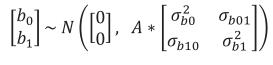
<body><![CDATA[<p><i>Animals and Diets</i></p>     <p>A total of 122 animals from nine Colombian   municipalities were evaluated at the Experimental   Station. 45 animals came from NM herds located   in Buenavista and Ayapel (both in C&oacute;rdoba   province), Cimitarra (Santander), and Norcasia   (Caldas). The other 77 animals came from DP herds   located in Monter&iacute;a, Buenavista, Montel&iacute;bano,   Tierralta, Ayapel (all in C&oacute;rdoba), Barrancabermeja   (Santander), and Puerto Nare (Antioquia). Animals shared a high proportion of Murrah breed.</p>     <p>Four post-yearling performance tests were   conducted, two for NM buffaloes (first: between July   and October 2009; second: August and December   2010), and another two for DP buffaloes (first:   between December 2009 and April 2010; second:   February and May 2011). The number of buffaloes   participating in each performance test, duration of   each test, means and standard deviations for age, and initial and final weight are presented in <a href="/img/revistas/rccp/v25n4/v25n4a4t1.jpg" target="_blank">table 1</a>.</p>     <p>Animals were housed in individual pens   (16 m<sup>2</sup>), each equipped with a feeder and water   dispenser. Pens had cement floor, no bedding, and   were partially roofed (4 m<sup>2</sup>). The diet consisted of   fresh Maralfalfa grass (<i>Pennisetum</i> sp.) offered <i>ad   libitum</i>, and 2 kg of a concentrate supplement per   day. The supplement was composed of corn (50%),   extruded soybean (15%), soybean (10%), extruded   corn (10%), homogeneous mix of extruded corn   and soybean meal (10%), mineral salt containing   phosphorus (8%), calcium carbonate (1%), and 2%   of a vitamin and mineral premix. <a href="/img/revistas/rccp/v25n4/v25n4a4t2.jpg" target="_blank">Table 2</a> shows the   chemical composition of Maralfalfa grass and the concentrate supplement.</p>     <p><i>Measured traits</i></p>     <p>Weight, ultrasound, and bovinometric   measurements were taken every 14 d. Animals were   weighted after a 12-hours fast. The bovinometric   measurements were chest girth (CG), height at withers   (HW), and height at sacrum (HS). A measuring tape   and a bovinometric rule were used to measure height   and chest girth. The ultrasound measurements taken   were longissimus muscle area (REA) and rump fat   thickness (RFT). Ultrasound measurements were   taken using an Akila-Pro ultrasound equipment   (Esaote Europe BV, Maastricht, The Netherlands)   with a 3.5 MHz (18 cm) transducer. Images were   measured with Eview software (Pie Medical,   Maastricht, the Netherlands). To assess REA, an   image was taken between the 12<sup>th</sup> and 13<sup>th</sup> rib,   perpendicular to the loin muscle. To measure RFT the   image was taken from the tip of the hip, towards the back region between the iliac and ischial tuberosities (Perkins <i>et al.</i>, 1992; Realini <i>et al.</i>, 2001; Jorge <i>et al.</i>, 2005). All characteristics were measured by the same persons. Ultrasound data correspond to the average measured by two technicians.</p>     <p><i>Statistical Analysis</i></p>     <p>Traits were analyzed using animal mixed   models with fixed and random first and second   order regression effects. Models used unstructured   variance and covariance matrices (different   variances and covariances between random   parameters), as described by Littell <i>et al.</i> (2004).   Performance tests data for NM and DP preweaning   systems were analyzed separately, because animals   started their tests at substantially different ages. The mixed model was:</p>     <p align="center"><i>y<sub>ijk</sub></i> = (<i>&beta;</i><sub>0</sub>+ <i>b<sub>0i:k</sub></i>  ) + (<i>&beta;</i><sub>1</sub>+ b<i><sub>1i:k</sub></i> ) <i>X<sub>j</sub></i> + &beta;<sub>2</sub> X<sub>j</sub><sup>2</sup> + <i>T<sub>k</sub>+e<sub>ij</sub></i></p>     <p>Where, <i>y<sub>ijk</sub></i> = trait (weight, ultrasound and   bovinometric) measured at the j-th age of the i-th   animal in k-th test; <i>&beta;</i><sub>0</sub>, <i>&beta;</i><sub>1</sub> and <i>&beta;</i><sub>2</sub>= intercept, linear,   and quadratic regression coefficients for all animals;   <i>X<sub>j</sub></i> = is the j-th age; <i>T<sub>k</sub></i> = fixed effect of test (two tests   by production system); and <i>e<sub>ij</sub></i> = residual associated   with the individual variability of the observations   not explained by the model, where <i>e<sub>ij</sub></i> ~ N(0,&sigma;<i><sub>e</sub></i><sup>2</sup>); b<sub>0<i>i:k</i></sub>  and b<sub>1<i>i:k</i></sub> = intercept and linear regression coefficient   of the i-th animal, representing random deviations from <i>&beta;</i><sub>0</sub> and <i>&beta;</i><sub>1</sub> coefficients, respectively, where:</p>     ]]></body>
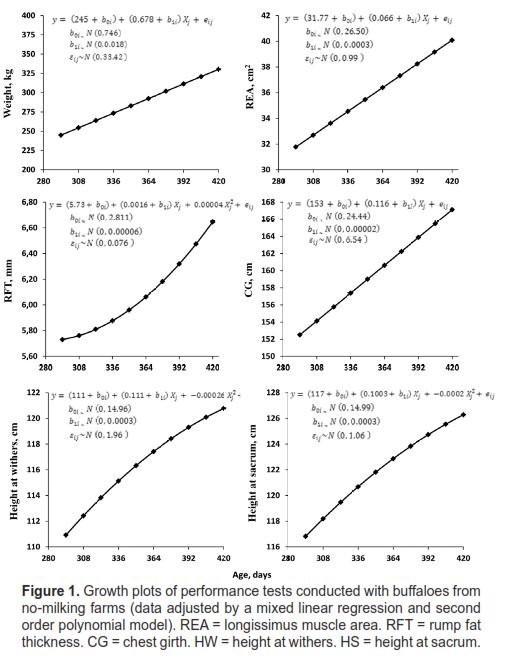
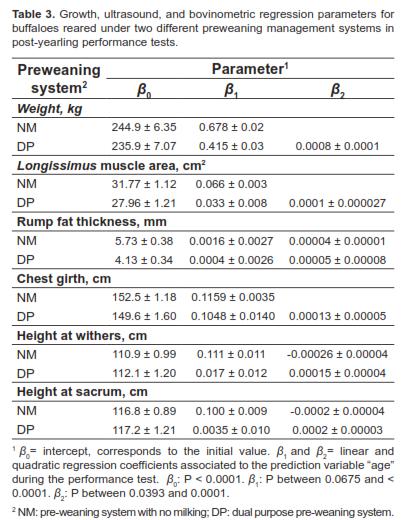
<body><![CDATA[<p align="center"><img src="/img/revistas/rccp/v25n4/v25n4a4g1.jpg" /></p>     <p>The relationship matrix (A) between animals   contained 120 animals in the NM analysis (10   half-siblings) and 192 animals in DP analysis (41   half-siblings). The b<sub>2<i>i:k</i></sub> random effect of the i-th   animal was not included in the final model because   convergence was not achieved when this effect was   included in preliminary runs. Computations were   performed with the MIXED procedure of SAS (SAS   Inst. Inc., Cary, NC). The relationship matrix was   included in the mixed model equations using the   option LData within the RANDOM statement of the MIXED procedure.</p>     <p>&nbsp;</p>     <p><b><font size="3">Results</font></b></p>     <p><i>Growth Curves</i></p>     <p>All traits in the DP system, as well as RFT, HW   and HS in the NM system, showed a good fit with   a second-order regression mixed-model. These traits   showed a high significance level for parameters   <i>&beta;</i><sub>0</sub> (P &lt; 0.0001) and <i>&beta;</i><sub>2</sub>(P &lt; 0.0001); while <i>&beta;</i><sub>1</sub> was highly significant (P &lt; 0.0001) for all traits, except   RFT in NM system and RFT, HS and HW in the DP   system (P &gt; 0.05). On the other hand, weight, CG,   and REA for the NM system fit well with a firstorder   regression mixed-model (<i>&beta;</i><sub>2</sub> had no significant   effect with P &gt; 0.05), and the estimated parameters   (<i>&beta;</i><sub>0</sub> and <i>&beta;</i><sub>1</sub>) were highly significant (P &lt;0.0001). The correlation obtained between predicted and actual values fluctuated between 0.95 and 0.99 (P&lt;0.0001), with distribution of residuals around zero. A normal distribution of residuals was obtained with these models, where most residuals showed a good fit.</p>     <p>Performance test results for bovinometric traits   for NM animals were: CG = 173.6&plusmn;5.68 cm, HW =   122.8&plusmn;3.81 cm, and HS = 128.2&plusmn;3.01 cm. The DP   animals, which were older, had CG = 172.8&plusmn;7.97 cm, HW =121.4&plusmn;4.07 cm, and HS = 126.6&plusmn;4.25 cm.</p>     <p>Animals from the NM system had a negative   <i>&beta;</i><sub>2</sub> for HW (P&lt;0.0001) and HS (P=0.0005), which   indicates a deceleration in the rate of increase   towards the end of the assessed period. On the other   hand, CG continued to increase at a rate of 0.116   cm/d (P &lt;0.0001) until the end of the performance test (<a href="#t3">Table 3</a>, <a href="#f1">Figure 1</a>).</p>     <p align="center"><a name="t3"></a><img src="/img/revistas/rccp/v25n4/v25n4a4t3.jpg"></p>     <p align="center"><a name="f1"></a><img src="/img/revistas/rccp/v25n4/v25n4a4f1.jpg"></p>     ]]></body>
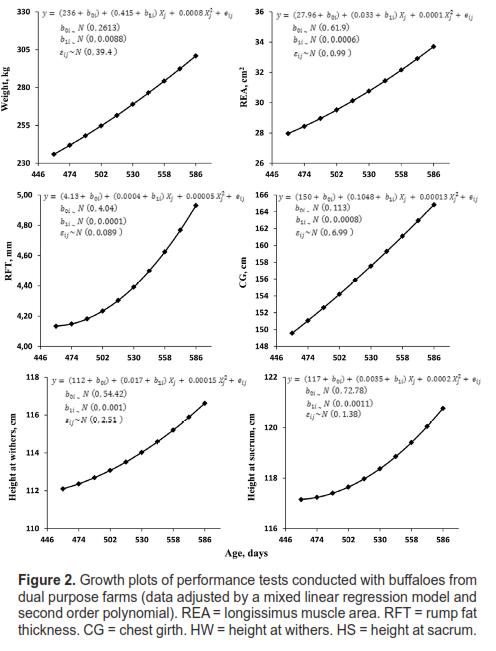
<body><![CDATA[<p>The rate of fat deposition continued to increase   until the end of the test and had a positive   &beta;<sub>2</sub>(P&lt;0.0001). Similarly, muscle (REA) continued to grow linearly (P&lt;0.0001) (<a href="#t3">Table 3</a>, <a href="#f1">Figure 1</a>).</p>     <p>Animals from the DP system had positive   <i>&beta;</i><sub>2</sub> (P &lt;0.0001 to P=0.0119) for all traits. This   indicates that the animals had a positive rate of   increase at the beginning of the performance test,   associated to <i>&beta;</i><sub>1</sub>, followed by an increased (not   decrease, as occured with NM animals, despite their   older age). At the end of the tests, animals from the   first and second tests were 18 and 19 months old,   respectively, and their rate of increase remained positive.</p>     <p>The DP buffaloes showed lower growth during   the first 28 d of the performance test (<a href="#f2">Figure 2</a>).   When growth curves were analyzed without taking   into account the measurements made during this   period (results not shown), higher growth rates   were observed for weight (478 g/d, P&lt;0.0001),   REA (0.04 cm2/d, P=0.0001), fat (0.009 mm/d,   P=0.0044), HW (0.1163 cm/d, P&lt;0.0001), and HS (0.1116 cm/d, P&lt;0.0001).</p>     <p align="center"><a name="f2"></a><img src="/img/revistas/rccp/v25n4/v25n4a4f2.jpg"></p>     <p><i>Genetic Variation</i></p>     <p>Variance components due to b<sub>0</sub>, b<sub>1</sub>, and residual   effects, were estimated in order to obtain some   information on the variability among animals in these four performance tests.</p>     <p><a href="/img/revistas/rccp/v25n4/v25n4a4t4.jpg" target="_blank">Table 4</a> presents the estimates of variance and   covariance components obtained for growth,   ultrasound, and bovinometric traits using data   from the NM and DP performance tests. Estimates   of animal variance components due to b<sub>0</sub> and b<sub>1</sub>  were non-zero for all traits, which, according   to the performance tests, suggests the existence   of genetic variation among buffaloes. Negative   correlations between b<sub>0<i>i</i></sub> and b<sub>1<i>i</i></sub> were estimated   for all traits in both production systems (<a href="#t5">Table   5</a>), indicating that animals entering the test with   higher initial values had lower growth rates during the performance test.</p>     <p align="center"><a name="t5"></a><img src="/img/revistas/rccp/v25n4/v25n4a5t5.jpg"></p>     <p>&nbsp;</p>     <p><b><font size="3">Discussion</font></b></p>     ]]></body>
<body><![CDATA[<p><i>   Growth Curves</i></p>     <p>All traits fit a first or second order regression   mixed model. A normal distribution of residuals   was obtained with these models, where most   residuals fit well. There were some exceptions   outside the curve, indicating they were either   overestimated (at the beginning of the performance   test) or underestimated (at the end of the test). The   outliers could be caused by the heterogeneity among individuals.</p>     <p>Bovinometric measurements obtained at the   end of the tests were lower than those reported   by Louren&ccedil;o <i>et al.</i> (2010) for animals submitted   to two weight gain trials in Brazil, which resulted   in CG = 183.07 and 178.58 cm, HW = 130.94 and   128.06 cm, and HS = 134.5 and 130.90 cm for the   first and second tests, respectively. In contrast, DP   animals in this study showed higher value for CG,   HW and HS than those reported by Crudeli <i>et al.</i>   (2007) in buffaloes grazing on native pastures,   which at 18 months of age resulted in CG = 166.76, HS = 122.63 cm, and HW = 119.18 cm.</p>     <p>The rate of increase for HW and HS declined at   the end of the test in the NM system, while weight,   CG, RFT, and REA did not. This is consistent with   the growth waves previously described for cattle   (Bergand Butterfield, 1976). The B wave (from   the limbs towards the back), which corresponds to   growth in height, develops early. On the contrary,   the C wave (from the back towards the sternum) is   delayed. In addition, the muscle and fat deposition   occur at a later age, where fat tissue is the last to   accumulate in the animal (Berg and Butterfield, 1976).</p>     <p>The DP buffaloes accelerated the rate of increase   for all the traits towards the end of the evaluation   (not decreased, as it happened to NM animals),   despite of the older age (18 and 19 months in the   first and second test, respectively). These animals   showed little growth during the first 28 d of the   performance test. This could have happened for   two reasons: firstly, DP buffaloes were accustomed   to a different production system, managed under   grazing conditions, with different climate and   forage species, thus they needed to get accustomed   to a new system (confinement, cut grass, climate)   and a new group of animals; secondly, the first   performance test for DP animals started at the   beginning of the drought season, which was   particularly intense. The total precipitation during   the four months of the test was less than half of that   in previous years (199 mm vs. 584 mm; Institute of   Hydrology, Meteorology and Environmental Studies   -IDEAM; station 27015150, El Progreso, Barbosa,   Antioquia, Colombia). These conditions negatively   affected the production and nutritional quality of the grass.</p>     <p>A key factor to consider during a performance   test is the quality of the diet. The intention of these   four performance tests was to offer a diet with a   nutritional value similar to the medium-quality   grass, so it would not greatly diverge from grasses   generally used in Colombia. This was aimed to   reduce the probability of a genotype-environment   interaction (when the offspring of the best animals   chosen under particular feeding conditions do not   perform well under different conditions). However,   pasture quality declined substantially at the first   performance test for DP buffaloes (<a href="/img/revistas/rccp/v25n4/v25n4a2t2.jpg" target="_blank">Table 2</a>),   mainly reflected in its lower protein and high lignin contents.</p>     <p>During the performance tests with NM animals,   an adequate growth was observed from the outset   of the tests, indicating that the diet was adequate.   These animals entered the tests at a younger   age and had recently been weaned and therefore   required a higher quality diet. Precipitation was   adequate during the time the tests were conducted,   resulting in adequate grass quality and animal   growth. On the other hand, the DP animals were   older and had already overcomed the weaning   stress, therefore, they required a lower quality diet.   For this reason, fast growth was expected from the   beginning of the tests. However, results showed   that the diet provided to DP buffaloes was not   adequate, reflecting an insufficient production and   pasture quality during their first performance test,   due to the low precipitation observed during that   period. These results demonstrate the importance   of providing homogenized rations to ensure a   consistent nutritional intake, independent of weather conditions.</p>     <p>The initial weight of NM buffaloes (261 and   294 kg, for first and second test, respectively) was   similar to that reported by Louren&ccedil;o <i>et al.</i> (2010)   for Murrah buffaloes in two weight-gain trials   conducted by the Eastern Amazon Embrapa in   Bel&eacute;m (Par&aacute;, Brazil). Their animals belonged to   farms that had genetic improvement programs, and   initial weights averaged 265 kg and 273 kg during   the first and second tests, while age ranged from   213 d to 303 d. Considering that Brazil is one of   the top buffalo producers and that it has conducted   extensive breeding research, it could be argued that   animals in the first test had high genetic potential.   The initial weight estimated in the present study for   NM animals was lower (245 kg) than that reported   by Louren&ccedil;o <i>et al.</i> (2010), because the initial age   considered was the minimum age (235 d). The   initial weight of DP buffaloes in the present work   was lower (240 and 274 kg, for the first and second   test, respectively), and the animals were also older   (first test: 426 d; second test: 484 d) compared with   those reported by Louren&ccedil;o <i>et al.</i> (2010), because   they were managed under a different production   system (with cow-milking), which led to lower weights and older weaning ages.</p>     <p>Crudeli <i>et al.</i> (2007) reported a mean weaning   weight of 282.4 kg at seven months of age for 170   Mediterranean buffaloes in Argentina, which   is higher than the weight at the begining of the   performance tests in the present study. However,   they also reported 335.9 kg at 18 months of age,   which was lower to that of the performance tests   for NM buffaloes at 13 and 14 months of age (342   and 357 kg, Table 1). This is a good indicator of the   genetic growth potential of NM animals and of the   adequate handling offered during the performance   test. At the end of the first test, DP animals (18   months of age) continued to show lower weights   (314 kg, Table 1) than NM animals. Malhado <i>et al.</i>   (2008) reported lower average weight for yearling   Murrah buffaloes (229.65kg), but a similar average   weight for DP animals at 18 months of age (317.17   kg). Mean weight at the end of second test for DP   animals was higher than the weight reported for Malhado <i>et al.</i> (2008).</p>     <p>The daily gain obtained by Louren&ccedil;o <i>et al.</i>   (2010) was 911 and 969 g/d for the first and second weight-gain trials (224 d, excluding the adaptation   period), which was higher to that obtained for NM   (678 g) and DP (415 g) buffaloes. These results can   be explained by the diet used (similar nutritional   value of medium-quality grass). The daily gains   obtained by Louren&ccedil;o <i>et al.</i> (2010) during the   adaptation period of their two trials (70 d) were also   low (257 and 285 g), reaffirming the importance of taking this period into account.</p>     ]]></body>
<body><![CDATA[<p><i>Genetic Variation</i></p>     <p>Non-zero estimates of genetic variances for   b<sub>0</sub> and b<sub>1</sub> suggested that growth, ultrasound, and   bovinometric traits may be genetically improved   in Colombia. However, the high estimates of   variances due to b0 represented not only genetic   differences among individual animals, but may also   have included maternal effects, and pre-weaning   environmental differences (management, nutrition,   climate) among farms supplying buffaloes for the   NM and DP performance tests. These differences   among animals due to genetic differences   among herds, maternal effects, and preweaning   environmental differences among herds are usually   referred to as residual effects due to herd of origin,   which could potentially be minimized by using an   adaptation period (Schenkel <i>et al.</i>, 2004; Nephawe <i>et al.</i>, 2006).</p>     <p>Thus, an aspect to consider during performance   tests is the exclusion of the effect of herd of origin   that remains during the test (Schenkel <i>et al.</i>,   2004; Nephawe <i>et al.</i>, 2006). Studies have shown   significant effect of herd of origin on performance   of bulls in the test after the adaptation period   (Tong <i>et al.</i>, 1986; Amal and Crow 1987; Liu and   Makarechian, 1993; Schenkel <i>et al.</i>, 2002, 2004),   and the existence of a negative correlation between   weight gain before and after weaning, indicating   the presence of compensatory gain during the test   (Tong, 1982; De Rose <i>et al.</i>, 1988; Tong <i>et al.</i>, 1986).</p>     <p>Altough it is undeniable that the herd of   origin can have an effect on performance tests   results, it is important to note that this effect has   two components: environmental and genetic.   The environmental effect can be minimized or   eliminated by a suitable adaptation period, but   the genetic component due to genetic differences   among herds will remain. Animals from farms   with high selection pressure for growth traits   are expected to have a higher weight at the same   age than animals from farms that do not have   a breeding program, and these differences may   remain throughout the test. This is a relevant   issue because the effect of herd of origin may   remain until the end of the test. The problem is   how to separate these two components. The DP   buffaloes entered the tests at a similar age (first   test: maximum difference was 77 d; second test:   maximum difference was 115 d). However, their   initial weight ranged between 170 and 322 kg (first   test) and between 210 and 465 kg (second test),   and this difference persisted until the end of the   test, although the coefficient of variation decreased   from 19% to 13%. Similarly, NM buffaloes entered   their performance tests with a maximum age   difference of 73 and 68 d, for first and second test,   respectively, but their initial weight difference was   91 kg (first test: ranging from 215 to 306 kg) and it   increased to 168 kg (ranging from 298 to 412 kg)   at the end of this test. The difference in the second   test for the NM animals was 80 kg (ranging from 254 to 334 kg) and it increased to 99 kg.</p>     <p>These results indicate that although the effect   of herd of origin was important during the test,   NM animals under performance tests expressed   their own ability to grow under the environmental   conditions provided by the test. This did not   happen in the performance test for the DP animals,   likely because the diet supplied to buffaloes in the   first test prevented them from expressing their   individual growth potential. According to Pereira   (1999), the lower the animal weight variations   are at the beginning of the performance test, the   lower the effects of the previous environment and   the greater the possibility of test success. Three   aspects were considered here with the aim of   reducing the weight variation at the beginning of   the performance tests: 1) Low variation in initial   age (maximum difference 73 d and 68 d of the two   test for NM, and 77 d of the first test for DP). This   age difference was smaller than the range used   in other performance test stations (except for the second test of DP animals: 115 d); e.g., 90 d in the Central Station in Ontario, Canada (Schenkel <i>et al.</i>, 2004), the Sert&atilde;ozinho Experimental Station for Animal Husbandry in Sao Paulo, Brazil (Razook <i>et al.</i>,1997), and the Brazilian Association of Zebu Breeders (ABCZ, 2003), but greater than the age difference of 60 d for Zebu cattle performance tests in Colombia (ASOCEB&Uacute;, 2007); 2) Pre-selection of participating animals based on their performance in contemporary groups in the herd of origin. Weaning weight was taken into account for the tests of NM animals. Milk yield of the mother and weaning weight were considered for the tests of DP animals; and 3) Tests were conducted independently for animals from NM and DP production systems. In spite of these measures, there was high variation among weights in the NM and DP performance tests in this study. As indicated above, pre-weaning herd environmental conditions, maternal environmental effects, and genetic differences among herds may have contributed to these differences.</p>     <p>Lastly, linear regression variances were small   for all traits, suggesting that although selection of   animals within these performance tests is possible,   expected changes in the buffalo population will be   small. Larger samples of buffaloes in performance   tests and better accounting for preweaning   environmental conditions and genetic differences   among herds will improve chances of identifying   the best buffaloes in performance tests in Colombia.   Although the evaluated animal sample is too   small to be able to successfully identify the best   buffaloes in Colombia, performance tests can be   a good alternative to begin a breeding program   for this species in the country. These tests plus the   evaluation of all animals in all farms in Colombia   using an in-farm genetic evaluation program would   allow the accurate assessment of genetic variability   and provide buffalo producers with accurate genetic evaluations across all Colombian environments.</p>     <p>In conclusion, the regression mixed models of   first and second order were adequate to describe   buffalo growth in terms of weight, ultrasound,   and bovinometric traits. The NM animals showed   an adequate growth rate during the test, while   growth of DP buffaloes was limited by the supply   of low quality forage. To obtain higher growth   rates during performance tests, good quality diets   and completely mixed and homogenized rations   must be supplied to ensure consistent nutritional   value throughout the test, independent of the   weather conditions. It was not possible to entirely   separate genetic and environmental components.   Environmental and genetic differences among farms   (herd of origin effect) may have influenced the high   variability among individuals for the intercept.   Slope variances were low for all traits. The random   parameters of intercept and growth rate showed a   negative correlation, indicating that animals with   higher initial weights had lower growth rates during the performance test.</p>     <p>&nbsp;</p>     <p><b><font size="3">Acknowledgments</font></b></p>     <p>Project funded by the Colombian Ministry of   Agriculture and Rural Development, the University   of Antioquia, Lasallian University Corporation, and   the Colombian Association of Buffalo Breeders.   Agreement beetwen University of Antioquia and   Fundaci&oacute;n Universitaria San Mart&iacute;n for training   graduate students. The authors thank all the   people who contributed to the project, especially   undergraduate and MS students from the University   of Antioquia for their work at the Experimental   Station, and Sustainability Project 2011-2012   (Estrategia de sostenibilidad CODI 2011-2012, University of Antioquia).</p>     ]]></body>
<body><![CDATA[<p>&nbsp;</p>     <p><b><font size="3">References</font></b></p>     <!-- ref --><p>1. Amal S, Crow GH. Herd of origin effects on the performance of   station-tested beef bulls. Can J Anim Sci 1987; 67:349-358.    &nbsp;&nbsp;&nbsp;&nbsp;&nbsp;&nbsp;&nbsp;&nbsp;[&#160;<a href="javascript:void(0);" onclick="javascript: window.open('/scielo.php?script=sci_nlinks&ref=000095&pid=S0120-0690201200040000400001&lng=','','width=640,height=500,resizable=yes,scrollbars=1,menubar=yes,');">Links</a>&#160;]<!-- end-ref --></p>     <!-- ref --><p>   2. Asociaci&oacute;n Colombiana de Criadores Ceb&uacute; (ASOCEB&Uacute;).   Reglamento de pruebas de comportamiento y selecci&oacute;n de   pastoreo. Proceso T&eacute;cnico. 2007; [January 15, 2011] URL:   <a href="http://www.asocebu.com/getdoc/0f97d8b8-c6c4-4445-b62a-11b602e62ade/RTEC_004.aspx" target="_blank">http://www.asocebu.com/getdoc/0f97d8b8-c6c4-4445-b62a-11b602e62ade/RTEC_004.aspx</a>&nbsp;&nbsp;&nbsp;&nbsp;&nbsp;&nbsp;&nbsp;&nbsp;[&#160;<a href="javascript:void(0);" onclick="javascript: window.open('/scielo.php?script=sci_nlinks&ref=000097&pid=S0120-0690201200040000400002&lng=','','width=640,height=500,resizable=yes,scrollbars=1,menubar=yes,');">Links</a>&#160;]<!-- end-ref --><!-- ref --><p>   3. Associa&ccedil;&atilde;o Brasileira dos Criadores de Zebu. Programa de   melhoramento gen&eacute;tico das ra&ccedil;as zebu&iacute;nas. Minist&eacute;rio da   agricultura, pecu&aacute;ria e abastecimento. 2003; [March 5, 2011]   URL:<a href="http://www.abcz.org.br/Content/arquivos/AreaTecnica/Manual/RegulamentoPMGZ.pdf" target="_blank">http://www.abcz.org.br/site/tecnica/regulamento_cl.pdf</a>.    &nbsp;&nbsp;&nbsp;&nbsp;&nbsp;&nbsp;&nbsp;&nbsp;[&#160;<a href="javascript:void(0);" onclick="javascript: window.open('/scielo.php?script=sci_nlinks&ref=000098&pid=S0120-0690201200040000400003&lng=','','width=640,height=500,resizable=yes,scrollbars=1,menubar=yes,');">Links</a>&#160;]<!-- end-ref --></p>     <!-- ref --><p>4. Berg RT, Butterfield RM. New concepts of cattle growth.   Sidney Univ. Press. Australia. 1976; [April 15, 2011] URL:   <a href="http://ecommons.library.cornell.edu/handle/1813/1008" target="_blank">http://ecommons.library.cornell.edu/handle/1813/1008</a>.    &nbsp;&nbsp;&nbsp;&nbsp;&nbsp;&nbsp;&nbsp;&nbsp;[&#160;<a href="javascript:void(0);" onclick="javascript: window.open('/scielo.php?script=sci_nlinks&ref=000100&pid=S0120-0690201200040000400004&lng=','','width=640,height=500,resizable=yes,scrollbars=1,menubar=yes,');">Links</a>&#160;]<!-- end-ref --></p>     <!-- ref --><p>   5. Crudeli G, Pochon D, Olazarri M, Monz&oacute;n N, Chaparro L,   Flores S, Pati&ntilde;o E, Cedr&eacute;s J. Morphometric evaluation of male   Mediterranean buffaloes in Northern Corrientes, Argentina. Ital   J Anim Sci. 2007; 2 suppl 6:1281-1283.    &nbsp;&nbsp;&nbsp;&nbsp;&nbsp;&nbsp;&nbsp;&nbsp;[&#160;<a href="javascript:void(0);" onclick="javascript: window.open('/scielo.php?script=sci_nlinks&ref=000102&pid=S0120-0690201200040000400005&lng=','','width=640,height=500,resizable=yes,scrollbars=1,menubar=yes,');">Links</a>&#160;]<!-- end-ref --></p>     <!-- ref --><p>6. De Rose EP, Wilton JW, Schaeffer LR. Accounting for pretest   environment and selection in estimating breeding values for station-tested beef bulls. J Anim Sci 1988; 66:635- 639.    &nbsp;&nbsp;&nbsp;&nbsp;&nbsp;&nbsp;&nbsp;&nbsp;[&#160;<a href="javascript:void(0);" onclick="javascript: window.open('/scielo.php?script=sci_nlinks&ref=000104&pid=S0120-0690201200040000400006&lng=','','width=640,height=500,resizable=yes,scrollbars=1,menubar=yes,');">Links</a>&#160;]<!-- end-ref --></p>     <!-- ref --><p>   7. El Halimi R. Nonlinear mixed-effects models and   nonparametric inference. A Method Based on Bootstrap for   the Analysis of Non-normal Repeated Measures Data in   Biostatistical Practice. PhD Dissertation. Dept. Statistics, Univ.   Barcelona, Barcelona, Spain. 2005. 247p.    &nbsp;&nbsp;&nbsp;&nbsp;&nbsp;&nbsp;&nbsp;&nbsp;[&#160;<a href="javascript:void(0);" onclick="javascript: window.open('/scielo.php?script=sci_nlinks&ref=000106&pid=S0120-0690201200040000400007&lng=','','width=640,height=500,resizable=yes,scrollbars=1,menubar=yes,');">Links</a>&#160;]<!-- end-ref --></p>     <!-- ref --><p>   8. France J, Dijkstra J, Dhanoa M. Growth functions and their   application in animal sciences. Ann Zootech 1996; 45:165-174.    &nbsp;&nbsp;&nbsp;&nbsp;&nbsp;&nbsp;&nbsp;&nbsp;[&#160;<a href="javascript:void(0);" onclick="javascript: window.open('/scielo.php?script=sci_nlinks&ref=000108&pid=S0120-0690201200040000400008&lng=','','width=640,height=500,resizable=yes,scrollbars=1,menubar=yes,');">Links</a>&#160;]<!-- end-ref --></p>     <!-- ref --><p>   9. Jorge AM, Andrighetto C, Domingues DM, Golfetto C, Freitas   VAD. Caracter&iacute;sticas Quantitativas da Carca&ccedil;a de Bubalinos   de Tr&ecirc;s Grupos Gen&eacute;ticos Terminados em Confinamento e   Abatidos em Diferentes Est&aacute;dios de Maturidade. Rev Bras   Zootec 2005; 34 suppl:2376-2381.    &nbsp;&nbsp;&nbsp;&nbsp;&nbsp;&nbsp;&nbsp;&nbsp;[&#160;<a href="javascript:void(0);" onclick="javascript: window.open('/scielo.php?script=sci_nlinks&ref=000110&pid=S0120-0690201200040000400009&lng=','','width=640,height=500,resizable=yes,scrollbars=1,menubar=yes,');">Links</a>&#160;]<!-- end-ref --></p>     <!-- ref --><p>   10. Littell RC, Pendergast J, Natarajan R. Modeling covariance   structure in the Analysis of Repeated Measures Data. In:   Statistical Modelling of Complex Medical Data in Medicine,   R. B. D'Agostino, Editor. USA: Wiley-Blackwell; 2004. 2:159-   186.    &nbsp;&nbsp;&nbsp;&nbsp;&nbsp;&nbsp;&nbsp;&nbsp;[&#160;<a href="javascript:void(0);" onclick="javascript: window.open('/scielo.php?script=sci_nlinks&ref=000112&pid=S0120-0690201200040000400010&lng=','','width=640,height=500,resizable=yes,scrollbars=1,menubar=yes,');">Links</a>&#160;]<!-- end-ref --></p>     <!-- ref --><p>   11. Liu MF, Makarechian M. Optimum test period and associations   between standard 140-day test period and shorter test periods   for growth rate in station tested beef bulls. J Anim Breed Genet   1993; 110:312-317.    &nbsp;&nbsp;&nbsp;&nbsp;&nbsp;&nbsp;&nbsp;&nbsp;[&#160;<a href="javascript:void(0);" onclick="javascript: window.open('/scielo.php?script=sci_nlinks&ref=000114&pid=S0120-0690201200040000400011&lng=','','width=640,height=500,resizable=yes,scrollbars=1,menubar=yes,');">Links</a>&#160;]<!-- end-ref --></p>     <!-- ref --><p>   12. Louren&ccedil;o JJ, da Costa NM, Ara&uacute;jo CV, Dutra S, Rossetto   GA, Nah&uacute;m BdeS, Silveira de MJC, Brand&atilde;o LdeM. Sistema   silvipastoril na produ&ccedil;&atilde;o sustent&aacute;vel de b&uacute;falos para carne na   pequena propriedade da amaz&ocirc;nia oriental. Bioclimatologia   Animal, Quinta-Feira. 2010; [Enero 12, 2011] URL: <a href="http://www.bioclimatologia.ufc.br/lourenco.pdf" target="_blank">http://www.bioclimatologia.ufc.br/lorenco.pdf</a>.    &nbsp;&nbsp;&nbsp;&nbsp;&nbsp;&nbsp;&nbsp;&nbsp;[&#160;<a href="javascript:void(0);" onclick="javascript: window.open('/scielo.php?script=sci_nlinks&ref=000116&pid=S0120-0690201200040000400012&lng=','','width=640,height=500,resizable=yes,scrollbars=1,menubar=yes,');">Links</a>&#160;]<!-- end-ref --></p>     <!-- ref --><p>   13. Malhado CHM, Ramos AA, Carneiro PLS, Souza JC, Wechsler   FS, Eler JP, Azev&ecirc;do DMMR, Sereno JRB. Modelos no lineales   para describir el crecimiento de bufalinos de la raza Murrah.   Arch Zootec 2008; 57:497-503.    &nbsp;&nbsp;&nbsp;&nbsp;&nbsp;&nbsp;&nbsp;&nbsp;[&#160;<a href="javascript:void(0);" onclick="javascript: window.open('/scielo.php?script=sci_nlinks&ref=000118&pid=S0120-0690201200040000400013&lng=','','width=640,height=500,resizable=yes,scrollbars=1,menubar=yes,');">Links</a>&#160;]<!-- end-ref --></p>     <!-- ref --><p>   14. Nephawe KA, Maiwashe A, Theron HE. The effect of herd of   origin by year on post-weaning traits of young beef bulls at   centralized testing centres in South Africa. S Afr J Anim Sci   2006; 36:33-39.    &nbsp;&nbsp;&nbsp;&nbsp;&nbsp;&nbsp;&nbsp;&nbsp;[&#160;<a href="javascript:void(0);" onclick="javascript: window.open('/scielo.php?script=sci_nlinks&ref=000120&pid=S0120-0690201200040000400014&lng=','','width=640,height=500,resizable=yes,scrollbars=1,menubar=yes,');">Links</a>&#160;]<!-- end-ref --></p>     <!-- ref --><p>   15. Pereira JCC. Melhoramento Gen&eacute;tico Aplicado a Produ&ccedil;&atilde;o   Animal. FEP-MVZ Ed. Belo Horizonte, Minas Gerais, Brazil.   1999. 496 p.    &nbsp;&nbsp;&nbsp;&nbsp;&nbsp;&nbsp;&nbsp;&nbsp;[&#160;<a href="javascript:void(0);" onclick="javascript: window.open('/scielo.php?script=sci_nlinks&ref=000122&pid=S0120-0690201200040000400015&lng=','','width=640,height=500,resizable=yes,scrollbars=1,menubar=yes,');">Links</a>&#160;]<!-- end-ref --></p>     <!-- ref --><p>   16. Perkins TL, Green RD, Hamlin KE. Evaluation of ultrasonic   estimates of carcass fat thickness and longissimus muscle area   in beef cattle. J Anim Sci 1992; 70:1002-1010.    &nbsp;&nbsp;&nbsp;&nbsp;&nbsp;&nbsp;&nbsp;&nbsp;[&#160;<a href="javascript:void(0);" onclick="javascript: window.open('/scielo.php?script=sci_nlinks&ref=000124&pid=S0120-0690201200040000400016&lng=','','width=640,height=500,resizable=yes,scrollbars=1,menubar=yes,');">Links</a>&#160;]<!-- end-ref --></p>     <!-- ref --><p>   17. Razook AG, Figueiredo LLa, Cyrillo JNSG, Pacola LJ,   Bonilha NLM, Trovo JBF, Ruggieri LaC, Mercadante MYZ.   Prueba de Ganancia de Peso Normas adoptadas por la Estaci&oacute;n   Experimental de Zootecnia de Sert&atilde;ozinho. Nova Odessa, Sao   Paulo, Brazil, Inst. Zootec Tech Bull 1997. 40 p.    &nbsp;&nbsp;&nbsp;&nbsp;&nbsp;&nbsp;&nbsp;&nbsp;[&#160;<a href="javascript:void(0);" onclick="javascript: window.open('/scielo.php?script=sci_nlinks&ref=000126&pid=S0120-0690201200040000400017&lng=','','width=640,height=500,resizable=yes,scrollbars=1,menubar=yes,');">Links</a>&#160;]<!-- end-ref --></p>     <!-- ref --><p>   18. Realini CE, Williams RE, Pringle TD, Bertrand JK. Gluteus   medius and rump fat depths as additional live animal ultrasound   measurements for predicting retail product and trimmable fat in   beef carcasses. J Anim Sci 2001; 79:1378-1385.    &nbsp;&nbsp;&nbsp;&nbsp;&nbsp;&nbsp;&nbsp;&nbsp;[&#160;<a href="javascript:void(0);" onclick="javascript: window.open('/scielo.php?script=sci_nlinks&ref=000128&pid=S0120-0690201200040000400018&lng=','','width=640,height=500,resizable=yes,scrollbars=1,menubar=yes,');">Links</a>&#160;]<!-- end-ref --></p>     <!-- ref --><p>   19. Schenkel FS, Miller SP, Jamrozik J, Wilton JW . Two step and   random regression analyses of weight gain of station tested beef   bulls. J Anim Sci 2002; 80:1497- 1507.    &nbsp;&nbsp;&nbsp;&nbsp;&nbsp;&nbsp;&nbsp;&nbsp;[&#160;<a href="javascript:void(0);" onclick="javascript: window.open('/scielo.php?script=sci_nlinks&ref=000130&pid=S0120-0690201200040000400019&lng=','','width=640,height=500,resizable=yes,scrollbars=1,menubar=yes,');">Links</a>&#160;]<!-- end-ref --></p>     <!-- ref --><p>   20. Schenkel FS, Miller SP, Wilton JW. Herd of origin effect on   weight gain of station-tested beef bulls. Livest Prod Sci 2004;   86:93-103.    &nbsp;&nbsp;&nbsp;&nbsp;&nbsp;&nbsp;&nbsp;&nbsp;[&#160;<a href="javascript:void(0);" onclick="javascript: window.open('/scielo.php?script=sci_nlinks&ref=000132&pid=S0120-0690201200040000400020&lng=','','width=640,height=500,resizable=yes,scrollbars=1,menubar=yes,');">Links</a>&#160;]<!-- end-ref --></p>     <!-- ref --><p>   21. Tong AKW. Effects of initial age and weight on test daily gains   of station-tested bulls. Can J Anim Sci 1982; 62:671-678.    &nbsp;&nbsp;&nbsp;&nbsp;&nbsp;&nbsp;&nbsp;&nbsp;[&#160;<a href="javascript:void(0);" onclick="javascript: window.open('/scielo.php?script=sci_nlinks&ref=000134&pid=S0120-0690201200040000400021&lng=','','width=640,height=500,resizable=yes,scrollbars=1,menubar=yes,');">Links</a>&#160;]<!-- end-ref --></p>     <!-- ref --><p>   22. Tong AKW, Newman JA, Rahnefeld GW. Pretest herd effects   on station performance test. Can J Anim Sci 1986; 66:925-935.    &nbsp;&nbsp;&nbsp;&nbsp;&nbsp;&nbsp;&nbsp;&nbsp;[&#160;<a href="javascript:void(0);" onclick="javascript: window.open('/scielo.php?script=sci_nlinks&ref=000136&pid=S0120-0690201200040000400022&lng=','','width=640,height=500,resizable=yes,scrollbars=1,menubar=yes,');">Links</a>&#160;]<!-- end-ref --></p>     <p>&nbsp;</p>     <p><b><font size="3">Notas al pie </font></b></p>     <p><sup><a href="#b0">&curren;</a><a name="0"></a></sup> To cite this article: Bol&iacute;var DM, Cer&oacute;n-Mu&ntilde;&oacute;z MF, Elzo MA. Postweaning growth of performance-tested buffaloes (Bubalus bubalis, Artiodactyla, Bovidae) reared under no-milking versus a dual-purpose system. Rev Colomb Cienc Pecu 2012; 25:566-576.</p> </font>      ]]></body><back>
<ref-list>
<ref id="B1">
<label>1</label><nlm-citation citation-type="journal">
<person-group person-group-type="author">
<name>
<surname><![CDATA[Amal]]></surname>
<given-names><![CDATA[S]]></given-names>
</name>
<name>
<surname><![CDATA[Crow]]></surname>
<given-names><![CDATA[GH]]></given-names>
</name>
</person-group>
<article-title xml:lang="en"><![CDATA[Herd of origin effects on the performance of station-tested beef bulls]]></article-title>
<source><![CDATA[Can J Anim Sci]]></source>
<year>1987</year>
<volume>67</volume>
<page-range>349-358</page-range></nlm-citation>
</ref>
<ref id="B2">
<label>2</label><nlm-citation citation-type="">
<collab>Asociación Colombiana de Criadores Cebú (ASOCEBÚ)</collab>
<source><![CDATA[Reglamento de pruebas de comportamiento y selección de pastoreo. Proceso Técnico]]></source>
<year>2007</year>
</nlm-citation>
</ref>
<ref id="B3">
<label>3</label><nlm-citation citation-type="">
<collab>Associação Brasileira dos Criadores de Zebu</collab>
<source><![CDATA[Programa de melhoramento genético das raças zebuínas. Ministério da agricultura, pecuária e abastecimento]]></source>
<year>2003</year>
</nlm-citation>
</ref>
<ref id="B4">
<label>4</label><nlm-citation citation-type="book">
<person-group person-group-type="author">
<name>
<surname><![CDATA[Berg]]></surname>
<given-names><![CDATA[RT]]></given-names>
</name>
<name>
<surname><![CDATA[Butterfield]]></surname>
<given-names><![CDATA[RM.]]></given-names>
</name>
</person-group>
<source><![CDATA[New concepts of cattle growth]]></source>
<year>1976</year>
<publisher-name><![CDATA[Sidney Univ. Press]]></publisher-name>
</nlm-citation>
</ref>
<ref id="B5">
<label>5</label><nlm-citation citation-type="journal">
<person-group person-group-type="author">
<name>
<surname><![CDATA[Crudeli]]></surname>
<given-names><![CDATA[G]]></given-names>
</name>
<name>
<surname><![CDATA[Pochon]]></surname>
<given-names><![CDATA[D]]></given-names>
</name>
<name>
<surname><![CDATA[Olazarri]]></surname>
<given-names><![CDATA[M]]></given-names>
</name>
<name>
<surname><![CDATA[Monzón]]></surname>
<given-names><![CDATA[N]]></given-names>
</name>
<name>
<surname><![CDATA[Chaparro]]></surname>
<given-names><![CDATA[L]]></given-names>
</name>
<name>
<surname><![CDATA[Flores]]></surname>
<given-names><![CDATA[S]]></given-names>
</name>
<name>
<surname><![CDATA[Patiño]]></surname>
<given-names><![CDATA[E]]></given-names>
</name>
<name>
<surname><![CDATA[Cedrés]]></surname>
<given-names><![CDATA[J.]]></given-names>
</name>
</person-group>
<article-title xml:lang="en"><![CDATA[Morphometric evaluation of male Mediterranean buffaloes in Northern Corrientes, Argentina]]></article-title>
<source><![CDATA[Ital J Anim Sci.]]></source>
<year>2007</year>
<volume>2</volume>
<numero>^s6</numero>
<issue>^s6</issue>
<supplement>6</supplement>
<page-range>1281-1283</page-range></nlm-citation>
</ref>
<ref id="B6">
<label>6</label><nlm-citation citation-type="journal">
<person-group person-group-type="author">
<name>
<surname><![CDATA[De Rose]]></surname>
<given-names><![CDATA[EP]]></given-names>
</name>
<name>
<surname><![CDATA[Wilton]]></surname>
<given-names><![CDATA[JW]]></given-names>
</name>
<name>
<surname><![CDATA[Schaeffer]]></surname>
<given-names><![CDATA[LR]]></given-names>
</name>
</person-group>
<article-title xml:lang="en"><![CDATA[Accounting for pretest environment and selection in estimating breeding values for station-tested beef bulls]]></article-title>
<source><![CDATA[J Anim Sci]]></source>
<year>1988</year>
<volume>66</volume>
<page-range>635- 639</page-range></nlm-citation>
</ref>
<ref id="B7">
<label>7</label><nlm-citation citation-type="">
<person-group person-group-type="author">
<name>
<surname><![CDATA[El Halimi]]></surname>
<given-names><![CDATA[R.]]></given-names>
</name>
</person-group>
<source><![CDATA[Nonlinear mixed-effects models and nonparametric inference. A Method Based on Bootstrap for the Analysis of Non-normal Repeated Measures Data in Biostatistical Practice]]></source>
<year></year>
</nlm-citation>
</ref>
<ref id="B8">
<label>8</label><nlm-citation citation-type="journal">
<person-group person-group-type="author">
<name>
<surname><![CDATA[France]]></surname>
<given-names><![CDATA[J]]></given-names>
</name>
<name>
<surname><![CDATA[Dijkstra]]></surname>
<given-names><![CDATA[J]]></given-names>
</name>
<name>
<surname><![CDATA[Dhanoa]]></surname>
<given-names><![CDATA[M]]></given-names>
</name>
</person-group>
<article-title xml:lang="en"><![CDATA[Growth functions and their application in animal sciences]]></article-title>
<source><![CDATA[Ann Zootech]]></source>
<year>1996</year>
<volume>45</volume>
<page-range>165-174</page-range></nlm-citation>
</ref>
<ref id="B9">
<label>9</label><nlm-citation citation-type="journal">
<person-group person-group-type="author">
<name>
<surname><![CDATA[Jorge]]></surname>
<given-names><![CDATA[AM]]></given-names>
</name>
<name>
<surname><![CDATA[Andrighetto]]></surname>
<given-names><![CDATA[C]]></given-names>
</name>
<name>
<surname><![CDATA[Domingues]]></surname>
<given-names><![CDATA[DM]]></given-names>
</name>
<name>
<surname><![CDATA[Golfetto]]></surname>
<given-names><![CDATA[C]]></given-names>
</name>
<name>
<surname><![CDATA[Freitas]]></surname>
<given-names><![CDATA[VAD.]]></given-names>
</name>
</person-group>
<article-title xml:lang="pt"><![CDATA[Características Quantitativas da Carcaça de Bubalinos de Três Grupos Genéticos Terminados em Confinamento e Abatidos em Diferentes Estádios de Maturidade]]></article-title>
<source><![CDATA[Rev Bras Zootec.]]></source>
<year>2005</year>
<numero>^s34</numero>
<issue>^s34</issue>
<supplement>34</supplement>
<page-range>2376-2381</page-range></nlm-citation>
</ref>
<ref id="B10">
<label>10</label><nlm-citation citation-type="book">
<person-group person-group-type="author">
<name>
<surname><![CDATA[Littell]]></surname>
<given-names><![CDATA[RC]]></given-names>
</name>
<name>
<surname><![CDATA[Pendergast]]></surname>
<given-names><![CDATA[J]]></given-names>
</name>
<name>
<surname><![CDATA[Natarajan]]></surname>
<given-names><![CDATA[R.]]></given-names>
</name>
</person-group>
<article-title xml:lang="en"><![CDATA[Modeling covariance structure in the Analysis of Repeated Measures Data]]></article-title>
<person-group person-group-type="editor">
<name>
<surname><![CDATA[D'Agostino]]></surname>
<given-names><![CDATA[R. B.]]></given-names>
</name>
</person-group>
<source><![CDATA[Statistical Modelling of Complex Medical Data in Medicine]]></source>
<year>2004</year>
<volume>2</volume>
<page-range>159- 186</page-range><publisher-name><![CDATA[Wiley-Blackwell]]></publisher-name>
</nlm-citation>
</ref>
<ref id="B11">
<label>11</label><nlm-citation citation-type="journal">
<person-group person-group-type="author">
<name>
<surname><![CDATA[Liu]]></surname>
<given-names><![CDATA[MF]]></given-names>
</name>
<name>
<surname><![CDATA[Makarechian]]></surname>
<given-names><![CDATA[M]]></given-names>
</name>
</person-group>
<article-title xml:lang="en"><![CDATA[Optimum test period and associations between standard 140-day test period and shorter test periods for growth rate in station tested beef bulls]]></article-title>
<source><![CDATA[J Anim Breed Genet]]></source>
<year>1993</year>
<volume>110</volume>
<page-range>312-317</page-range></nlm-citation>
</ref>
<ref id="B12">
<label>12</label><nlm-citation citation-type="">
<person-group person-group-type="author">
<name>
<surname><![CDATA[Lourenço]]></surname>
<given-names><![CDATA[JJ]]></given-names>
</name>
<name>
<surname><![CDATA[da Costa]]></surname>
<given-names><![CDATA[NM]]></given-names>
</name>
<name>
<surname><![CDATA[Araújo]]></surname>
<given-names><![CDATA[CV]]></given-names>
</name>
<name>
<surname><![CDATA[Dutra]]></surname>
<given-names><![CDATA[S]]></given-names>
</name>
<name>
<surname><![CDATA[Rossetto]]></surname>
<given-names><![CDATA[GA]]></given-names>
</name>
<name>
<surname><![CDATA[Nahúm]]></surname>
<given-names><![CDATA[BdeS]]></given-names>
</name>
<name>
<surname><![CDATA[Silveira de]]></surname>
<given-names><![CDATA[MJC]]></given-names>
</name>
<name>
<surname><![CDATA[Brandão]]></surname>
<given-names><![CDATA[LdeM.]]></given-names>
</name>
</person-group>
<source><![CDATA[Sistema silvipastoril na produção sustentável de búfalos para carne na pequena propriedade da amazônia oriental. Bioclimatologia Animal, Quinta-Feira]]></source>
<year>2010</year>
</nlm-citation>
</ref>
<ref id="B13">
<label>13</label><nlm-citation citation-type="journal">
<person-group person-group-type="author">
<name>
<surname><![CDATA[Malhado]]></surname>
<given-names><![CDATA[CHM]]></given-names>
</name>
<name>
<surname><![CDATA[Ramos]]></surname>
<given-names><![CDATA[AA]]></given-names>
</name>
<name>
<surname><![CDATA[Carneiro]]></surname>
<given-names><![CDATA[PLS]]></given-names>
</name>
<name>
<surname><![CDATA[Souza]]></surname>
<given-names><![CDATA[JC]]></given-names>
</name>
<name>
<surname><![CDATA[Wechsler]]></surname>
<given-names><![CDATA[FS]]></given-names>
</name>
<name>
<surname><![CDATA[Eler]]></surname>
<given-names><![CDATA[JP]]></given-names>
</name>
<name>
<surname><![CDATA[Azevêdo]]></surname>
<given-names><![CDATA[DMMR]]></given-names>
</name>
<name>
<surname><![CDATA[Sereno]]></surname>
<given-names><![CDATA[JRB]]></given-names>
</name>
</person-group>
<article-title xml:lang="pt"><![CDATA[Modelos no lineales para describir el crecimiento de bufalinos de la raza Murrah]]></article-title>
<source><![CDATA[Arch Zootec]]></source>
<year>2008</year>
<volume>57</volume>
<page-range>497-503</page-range></nlm-citation>
</ref>
<ref id="B14">
<label>14</label><nlm-citation citation-type="journal">
<person-group person-group-type="author">
<name>
<surname><![CDATA[Nephawe]]></surname>
<given-names><![CDATA[KA]]></given-names>
</name>
<name>
<surname><![CDATA[Maiwashe]]></surname>
<given-names><![CDATA[A]]></given-names>
</name>
<name>
<surname><![CDATA[Theron]]></surname>
<given-names><![CDATA[HE]]></given-names>
</name>
</person-group>
<article-title xml:lang="en"><![CDATA[The effect of herd of origin by year on post-weaning traits of young beef bulls at centralized testing centres in South Africa]]></article-title>
<source><![CDATA[S Afr J Anim Sci]]></source>
<year>2006</year>
<volume>36</volume>
<page-range>33-39</page-range></nlm-citation>
</ref>
<ref id="B15">
<label>15</label><nlm-citation citation-type="book">
<person-group person-group-type="author">
<name>
<surname><![CDATA[Pereira]]></surname>
<given-names><![CDATA[JCC.]]></given-names>
</name>
</person-group>
<source><![CDATA[Melhoramento Genético Aplicado a Produção Animal]]></source>
<year>1999</year>
<publisher-loc><![CDATA[Belo Horizonte^eMinas Gerais Minas Gerais]]></publisher-loc>
<publisher-name><![CDATA[FEP-MVZ Ed.]]></publisher-name>
</nlm-citation>
</ref>
<ref id="B16">
<label>16</label><nlm-citation citation-type="journal">
<person-group person-group-type="author">
<name>
<surname><![CDATA[Perkins]]></surname>
<given-names><![CDATA[TL]]></given-names>
</name>
<name>
<surname><![CDATA[Green]]></surname>
<given-names><![CDATA[RD]]></given-names>
</name>
<name>
<surname><![CDATA[Hamlin]]></surname>
<given-names><![CDATA[KE]]></given-names>
</name>
</person-group>
<article-title xml:lang="en"><![CDATA[Evaluation of ultrasonic estimates of carcass fat thickness and longissimus muscle area in beef cattle]]></article-title>
<source><![CDATA[J Anim Sci]]></source>
<year>1992</year>
<volume>70</volume>
<page-range>1002-1010</page-range></nlm-citation>
</ref>
<ref id="B17">
<label>17</label><nlm-citation citation-type="book">
<person-group person-group-type="author">
<name>
<surname><![CDATA[Razook]]></surname>
<given-names><![CDATA[AG]]></given-names>
</name>
<name>
<surname><![CDATA[Figueiredo]]></surname>
<given-names><![CDATA[LLa]]></given-names>
</name>
<name>
<surname><![CDATA[Cyrillo]]></surname>
<given-names><![CDATA[JNSG]]></given-names>
</name>
<name>
<surname><![CDATA[Pacola]]></surname>
<given-names><![CDATA[LJ]]></given-names>
</name>
<name>
<surname><![CDATA[Bonilha]]></surname>
<given-names><![CDATA[NLM]]></given-names>
</name>
<name>
<surname><![CDATA[Trovo]]></surname>
<given-names><![CDATA[JBF]]></given-names>
</name>
<name>
<surname><![CDATA[Ruggieri]]></surname>
<given-names><![CDATA[LaC]]></given-names>
</name>
<name>
<surname><![CDATA[Mercadante]]></surname>
<given-names><![CDATA[MYZ]]></given-names>
</name>
</person-group>
<source><![CDATA[Prueba de Ganancia de Peso Normas adoptadas por la Estación Experimental de Zootecnia de Sertãozinho]]></source>
<year>1997</year>
<page-range>40</page-range><publisher-loc><![CDATA[Nova Odessa^eSao Paulo Sao Paulo]]></publisher-loc>
<publisher-name><![CDATA[Inst. Zootec Tech Bull]]></publisher-name>
</nlm-citation>
</ref>
<ref id="B18">
<label>18</label><nlm-citation citation-type="journal">
<person-group person-group-type="author">
<name>
<surname><![CDATA[Realini]]></surname>
<given-names><![CDATA[CE]]></given-names>
</name>
<name>
<surname><![CDATA[Williams]]></surname>
<given-names><![CDATA[RE]]></given-names>
</name>
<name>
<surname><![CDATA[Pringle]]></surname>
<given-names><![CDATA[TD]]></given-names>
</name>
<name>
<surname><![CDATA[Bertrand]]></surname>
<given-names><![CDATA[JK]]></given-names>
</name>
</person-group>
<article-title xml:lang="en"><![CDATA[Gluteus medius and rump fat depths as additional live animal ultrasound measurements for predicting retail product and trimmable fat in beef carcasses]]></article-title>
<source><![CDATA[J Anim Sci]]></source>
<year>2001</year>
<volume>79</volume>
<page-range>1378-1385</page-range></nlm-citation>
</ref>
<ref id="B19">
<label>19</label><nlm-citation citation-type="journal">
<person-group person-group-type="author">
<name>
<surname><![CDATA[Schenkel]]></surname>
<given-names><![CDATA[FS]]></given-names>
</name>
<name>
<surname><![CDATA[Miller]]></surname>
<given-names><![CDATA[SP]]></given-names>
</name>
<name>
<surname><![CDATA[Jamrozik]]></surname>
<given-names><![CDATA[J]]></given-names>
</name>
<name>
<surname><![CDATA[Wilton]]></surname>
<given-names><![CDATA[JW]]></given-names>
</name>
</person-group>
<article-title xml:lang="en"><![CDATA[Two step and random regression analyses of weight gain of station tested beef bulls]]></article-title>
<source><![CDATA[J Anim Sci]]></source>
<year>2002</year>
<volume>80</volume>
<page-range>1497- 1507</page-range></nlm-citation>
</ref>
<ref id="B20">
<label>20</label><nlm-citation citation-type="journal">
<person-group person-group-type="author">
<name>
<surname><![CDATA[Schenkel]]></surname>
<given-names><![CDATA[FS]]></given-names>
</name>
<name>
<surname><![CDATA[Miller]]></surname>
<given-names><![CDATA[SP]]></given-names>
</name>
<name>
<surname><![CDATA[Wilton]]></surname>
<given-names><![CDATA[JW]]></given-names>
</name>
</person-group>
<article-title xml:lang="en"><![CDATA[Herd of origin effect on weight gain of station-tested beef bulls]]></article-title>
<source><![CDATA[Livest Prod Sci]]></source>
<year>2004</year>
<volume>86</volume>
<page-range>93-103</page-range></nlm-citation>
</ref>
<ref id="B21">
<label>21</label><nlm-citation citation-type="journal">
<person-group person-group-type="author">
<name>
<surname><![CDATA[Tong]]></surname>
<given-names><![CDATA[AKW]]></given-names>
</name>
</person-group>
<article-title xml:lang="en"><![CDATA[Effects of initial age and weight on test daily gains of station-tested bulls]]></article-title>
<source><![CDATA[Can J Anim Sci]]></source>
<year>1982</year>
<volume>62</volume>
<page-range>671-678</page-range></nlm-citation>
</ref>
<ref id="B22">
<label>22</label><nlm-citation citation-type="journal">
<person-group person-group-type="author">
<name>
<surname><![CDATA[Tong]]></surname>
<given-names><![CDATA[AKW]]></given-names>
</name>
<name>
<surname><![CDATA[Newman]]></surname>
<given-names><![CDATA[JA]]></given-names>
</name>
<name>
<surname><![CDATA[Rahnefeld]]></surname>
<given-names><![CDATA[GW]]></given-names>
</name>
</person-group>
<article-title xml:lang="en"><![CDATA[Pretest herd effects on station performance test]]></article-title>
<source><![CDATA[Can J Anim Sci]]></source>
<year>1986</year>
<volume>66</volume>
<page-range>925-935</page-range></nlm-citation>
</ref>
</ref-list>
</back>
</article>