<?xml version="1.0" encoding="ISO-8859-1"?><article xmlns:mml="http://www.w3.org/1998/Math/MathML" xmlns:xlink="http://www.w3.org/1999/xlink" xmlns:xsi="http://www.w3.org/2001/XMLSchema-instance">
<front>
<journal-meta>
<journal-id>0120-0690</journal-id>
<journal-title><![CDATA[Revista Colombiana de Ciencias Pecuarias]]></journal-title>
<abbrev-journal-title><![CDATA[Rev Colom Cienc Pecua]]></abbrev-journal-title>
<issn>0120-0690</issn>
<publisher>
<publisher-name><![CDATA[Facultad de Ciencias Agrarias, Universidad de Antioquia]]></publisher-name>
</publisher>
</journal-meta>
<article-meta>
<article-id>S0120-06902012000400005</article-id>
<title-group>
<article-title xml:lang="en"><![CDATA[Bacillus strains as feed additives: In vitro evaluation of its potential probiotic properties]]></article-title>
<article-title xml:lang="es"><![CDATA[Bacilos utilizados como aditivos para piensos: Evaluación in vitro de sus potenciales propiedades probióticas]]></article-title>
<article-title xml:lang="pt"><![CDATA[Bacilos utilizados como aditivos para concentrados: Avaliação in vitro de suas propriedades probióticas]]></article-title>
</title-group>
<contrib-group>
<contrib contrib-type="author">
<name>
<surname><![CDATA[Lee]]></surname>
<given-names><![CDATA[Jaekoo]]></given-names>
</name>
<xref ref-type="aff" rid="A01"/>
</contrib>
<contrib contrib-type="author">
<name>
<surname><![CDATA[Park]]></surname>
<given-names><![CDATA[Inkyung]]></given-names>
</name>
<xref ref-type="aff" rid="A01"/>
</contrib>
<contrib contrib-type="author">
<name>
<surname><![CDATA[Choi]]></surname>
<given-names><![CDATA[Yunjaie]]></given-names>
</name>
<xref ref-type="aff" rid="A02"/>
</contrib>
<contrib contrib-type="author">
<name>
<surname><![CDATA[Cho]]></surname>
<given-names><![CDATA[Jaiesoon]]></given-names>
</name>
<xref ref-type="aff" rid="A01"/>
<xref ref-type="aff" rid="A03"/>
</contrib>
</contrib-group>
<aff id="A01">
<institution><![CDATA[,Konkuk University College of Animal Bioscience and Technology Department of Animal Sciences and Environment]]></institution>
<addr-line><![CDATA[ ]]></addr-line>
<country>South Korea</country>
</aff>
<aff id="A02">
<institution><![CDATA[,Seoul National University Department of Agricultural Biotechnology ]]></institution>
<addr-line><![CDATA[ ]]></addr-line>
<country>South Korea</country>
</aff>
<aff id="A03">
<institution><![CDATA[,Konkuk University College of Animal Bioscience and Technology Department of Animal Sciences and Environment]]></institution>
<addr-line><![CDATA[ ]]></addr-line>
<country>South Korea</country>
</aff>
<pub-date pub-type="pub">
<day>00</day>
<month>12</month>
<year>2012</year>
</pub-date>
<pub-date pub-type="epub">
<day>00</day>
<month>12</month>
<year>2012</year>
</pub-date>
<volume>25</volume>
<numero>4</numero>
<fpage>577</fpage>
<lpage>585</lpage>
<copyright-statement/>
<copyright-year/>
<self-uri xlink:href="http://www.scielo.org.co/scielo.php?script=sci_arttext&amp;pid=S0120-06902012000400005&amp;lng=en&amp;nrm=iso"></self-uri><self-uri xlink:href="http://www.scielo.org.co/scielo.php?script=sci_abstract&amp;pid=S0120-06902012000400005&amp;lng=en&amp;nrm=iso"></self-uri><self-uri xlink:href="http://www.scielo.org.co/scielo.php?script=sci_pdf&amp;pid=S0120-06902012000400005&amp;lng=en&amp;nrm=iso"></self-uri><abstract abstract-type="short" xml:lang="en"><p><![CDATA[Background: much recent attention has been devoted to the genuine value of Bacillus species as multifunctional probiotic products, which produce various extracellular enzymes that enhance feed digestibility as well as many antimicrobial compounds for the purpose of improving animal performance. Objective: to describe novel, in vitro potential probiotic properties such as acid tolerance, bile tolerance, safety, and antimicrobial activity of mesophilic and psychrophilic Bacillus strains in conjunction with their extracellular enzymatic activities. Methods: four Bacillus strains (B. sp. T3, B. sp. T4, B. sp. SM2, and B. sp. JSP1) isolated from different sources were used. Strains were identified according to 16S rDNA sequences. Escherichia coli K88, E. coli O157:H7, Salmonella enteritidis KCCM 12021, Enterococcus faecalis, Listeria monocytogenes, and Staphylococcus aureus were used as indicator bacteria for the antimicrobial activity trial. Strains were activated and cultured in tryptic soy broth (pH 7.0) or broth solidified with 1.5% agar. Results: B. sp. JSP1 was fully resistant to both pH 2 and 3, whereas B. sp. SM2 showed relatively good viability at pH 3. All strains tolerated oxgall (0.3%) bile salt and were not cytotoxic to the HEK 293 human embryonic kidney cells. Three strains, except B. sp. T3, displayed differential production of extracellular enzymes including amylase, xylanase, cellulase, protease, phytase, and &alpha;-galactosidase. In particular, B. sp. SM2 inhibited six indicator pathogens: Escherichia coli K88, E. coli O157:H7, Salmonella enteritidis, Enterococcus faecalis, Listeria monocytogenes, and Staphylococcus aureus. Conclusion: the single use of B. sp. SM2 or the mixed use of the strain combined with acid or bile tolerant Bacillus strains secreting extracellular enzymes may be an alternative to antibiotics as a feed additive in farm animal production.]]></p></abstract>
<abstract abstract-type="short" xml:lang="es"><p><![CDATA[Antecedentes: recientemente el valor de las especies de Bacillus como productos probióticos multifuncionales ha recibido bastante atención, debido a que estos producen varias enzimas extracelulares que potencian la digestibilidad de los alimentos, así como también compuestos antimicrobianos que mejoran el desempeño del animal. Objetivo: describir y evaluar potenciales propiedades probióticas ''in vitro'' -tales como acidez, tolerancia a la bilis, seguridad y actividad antimicrobiana- de cuatro cepas de Bacilos (B. sp. T3, B. sp. T4, B. sp. SM2 y B. sp. JSP1) aisladas de diferentes fuentes, en conjunción con sus actividades enzimáticas extracelulares. Métodos: se usaron cuatro cepas de Bacillus (B. sp. T3, B. sp. T4, B. sp. SM2, and B. sp. JSP1) aisladas de diferentes fuentes. Las cepas se identificaron de acuerdo a secuencias 16S rDNA. Escherichia coli K88, E. coli O157:H7, Salmonella enteritidis KCCM 12021, Enterococcus faecalis, Listeria monocytogenes, y Staphylococcus aureus fueron empleadas como bacterias indicadoras para el ensayo de actividad antimicrobiana. Las cepas fueron activadas y cultivadas en caldo soya tripticasa (PH 7.0) o caldo solidificado con 1.5% de agar. Resultados: el B. sp. JSP1 resultó totalmente resistente tanto a pH 2 como a pH 3, mientras que el B. sp. SM2 mostró viabilidad relativamente alta a pH 3. Todas las cepas toleraron oxgall (0.3%) de sales biliares y no resultaron citotóxicas para las células humanas HEK 293 de riñón embrionario. Tres cepas, con excepción de B. sp. T3, presentaron producción diferencial de enzimas extracelulares -incluyendo amilasa, xilanasa, celulasa, proteasa, fitasa y &alpha;-galactosidasa. En particular, el B. sp. SM2 inhibió seis indicadores patógenos (Escherichia coli K88, E. coli O157: H7, Salmonella enteritidis, Enterococcus faecalis, Listeria monocytogenes y Staphylococcus aureus). Conclusiones: el uso específico de B. sp. SM2, o el uso combinado de esta cepa junto con cepas secretoras de enzimas extracelulares y tolerantes a ácidos o bilis puede ser una alternativa para reemplazar los antibióticos frecuentemente usados como aditivos en alimentación animal.]]></p></abstract>
<abstract abstract-type="short" xml:lang="pt"><p><![CDATA[Antecedentes: o valor das espécies de Bacillus como produtos probióticos multifuncionais tem recebido bastante atenção recentemente, devido a que produzem várias enzimas extracelulares que potenciam a digestibilidade dos alimentos, como também compostos antimicrobianos que melhoram o desempenho do animal. Objetivo: descrever e avaliar as propriedades potenciais ''in vitro'' - como acidez, tolerância à bile, segurança e atividade antimicrobial- de quatro cepas de Bacilos (B. sp. T3, B. sp. T4, B. sp. SM2, and B. sp. JSP1) isoladas de diferentes fontes, em conjunto com as suas atividades enzimáticas extracelulares. Métodos: foram usadas quatro cepas de Bacillus (B. sp. T3, B. sp. T4, B. sp. SM2, and B. sp. JSP1) isoladas de diferentes fontes. As cepas foram identificadas de acordo às sequências 16S rDNA. As seguintes bactérias foram empregadas como indicadoras no teste de atividade antimicrobiana: Escherichia coli K88, E. coli O157:H7, Salmonella enteritidis KCCM 12021, Enterococcus faecalis, Listeria monocytogenes, y Staphylococcus aureus. As cepas foram ativadas e cultivadas em caldo soja tripticase (pH 7.0) ou caldo solidificado com 1.5 de Agar. Resultados: o B. sp. JSP1 foi totalmente resistente tanto no pH 2.0 como no pH 3.0, enquanto que o B. sp. SM2 mostrou viabilidade relativamente alta no pH 3.0. Todas as cepas toleraram oxgall (0.3%) de sais biliares e não foram citotóxicas para as células humanas HEK 293 de rim embrionário. Tres cepas, com exceção de B. sp. T3, apresentaram produção diferenciada de enzimas extracelulares -incluindo amilase, xilanase, celulase, protease, fitase e &alpha;-galactosidase. Particularmente, o B. sp, SM2 inibiu seis indicadores patógenos (Escherichia coli K88, E. coli O157: H7, Salmonella enteritidis, Enterococcus faecalis, Listeria monocytogenes y Staphylococcus aureus). Conclusões: O uso específico de B. sp. SM2 ou o uso combinado desta cepa junto com as cepas secretoras de enzimas extracelulares e tolerantes a ácidos ou bile, pode ser uma alternativa para substituir os antibióticos frequentemente usados como aditivos na alimentação animal.]]></p></abstract>
<kwd-group>
<kwd lng="en"><![CDATA[acid tolerance]]></kwd>
<kwd lng="en"><![CDATA[animal performance]]></kwd>
<kwd lng="en"><![CDATA[antimicrobial]]></kwd>
<kwd lng="en"><![CDATA[bile tolerance]]></kwd>
<kwd lng="en"><![CDATA[enzymes]]></kwd>
<kwd lng="es"><![CDATA[antimicrobianos]]></kwd>
<kwd lng="es"><![CDATA[desempeño animal]]></kwd>
<kwd lng="es"><![CDATA[enzimas]]></kwd>
<kwd lng="es"><![CDATA[tolerancia a la acidez]]></kwd>
<kwd lng="es"><![CDATA[tolerancia a la bilis]]></kwd>
<kwd lng="pt"><![CDATA[antimicrobianos]]></kwd>
<kwd lng="pt"><![CDATA[desempenho animal]]></kwd>
<kwd lng="pt"><![CDATA[enzimas]]></kwd>
<kwd lng="pt"><![CDATA[tolerância à acidez]]></kwd>
<kwd lng="pt"><![CDATA[tolerância à bile]]></kwd>
</kwd-group>
</article-meta>
</front><body><![CDATA[ <font face="Verdana, Arial, Helvetica, sans-serif" size="2">     <p align="right"><b>ORIGINAL  ARTICLES</b></p>     <p align="center">&nbsp;</p>     <p align="center"><b><font size="4"><i>Bacillus</i> strains as feed additives: <i>In vitro</i> evaluation of its potential   probiotic properties<sup><a href="#0">&curren;</a><a name="b0"></a></sup></font></b></p>     <p align="center">&nbsp;</p>     <p align="center"><font size="3"><b>Bacilos utilizados como aditivos para piensos: Evaluaci&oacute;n in vitro de sus potenciales propiedades probi&oacute;ticas</b></font></p>     <p align="center">&nbsp;</p>     <p align="center"><font size="3"><b>Bacilos utilizados como aditivos para concentrados: Avalia&ccedil;&atilde;o in vitro de suas propriedades probi&oacute;ticas</b></font></p>     <p>&nbsp;</p>     <p>&nbsp;</p>     ]]></body>
<body><![CDATA[<p><b>Jaekoo Lee<sup>1,&sect;</sup>, MSc; Inkyung Park<sup>1,&sect;</sup>, PhD; Yunjaie Choi<sup>2</sup>, PhD; Jaiesoon Cho<sup>1,*</sup>, PhD.</b></p>     <p>&nbsp;</p>     <p><sup>1</sup>Department of Animal Sciences and Environment, College of Animal Bioscience and Technology, Konkuk University, South Korea.</p>     <p><sup>2</sup>Department of Agricultural Biotechnology, Seoul National University, South Korea.</p>     <p><sup>*</sup> Corresponding author: Jaiesoon Cho. Department of Animal Sciences and Environment, College of Animal Bioscience and Technology, Konkuk University, South Korea. Tel: +82-2-450-3375. Fax: +82-2-455-1044. E-mail: <a href="mailto:chojs70@konkuk.ac.kr">chojs70@konkuk.ac.kr</a></p>     <p>   <sup>&sect;</sup> These authors equally contributed to this work.</p>     <p>&nbsp;</p>     <p>(Received: 12 january, 2012; accepted: 10 april, 2012) </p>     <p>&nbsp;</p> </font> <hr size="1" /> <font face="Verdana, Arial, Helvetica, sans-serif" size="2">     <p><b>Summary</b></p>     ]]></body>
<body><![CDATA[<p><b>Background:</b> much recent attention has been devoted to the genuine value of <i>Bacillus</i> species as   multifunctional probiotic products, which produce various extracellular enzymes that enhance feed   digestibility as well as many antimicrobial compounds for the purpose of improving animal performance.   Objective: to describe novel, in vitro potential probiotic properties such as acid tolerance, bile tolerance,   safety, and antimicrobial activity of mesophilic and psychrophilic <i>Bacillus</i> strains in conjunction with their   extracellular enzymatic activities. Methods: four <i>Bacillus</i> strains (<i>B</i>. sp. T3, <i>B</i>. sp. T4, <i>B</i>. sp. SM2, and <i>B</i>. sp.   JSP1) isolated from different sources were used. Strains were identified according to 16S rDNA sequences.   <i>Escherichia coli</i> K88, <i>E. coli</i> O157:H7, <i>Salmonella enteritidis</i> KCCM 12021, <i>Enterococcus faecalis</i>, <i>Listeria monocytogenes</i>, and <i>Staphylococcus aureus</i> were used as indicator bacteria for the antimicrobial activity trial.   Strains were activated and cultured in tryptic soy broth (pH 7.0) or broth solidified with 1.5% agar. <b>Results:</b>  <i>B</i>. sp. JSP1 was fully resistant to both pH 2 and 3, whereas <i>B</i>. sp. SM2 showed relatively good viability at pH   3. All strains tolerated oxgall (0.3%) bile salt and were not cytotoxic to the HEK 293 human embryonic kidney   cells. Three strains, except <i>B</i>. sp. T3, displayed differential production of extracellular enzymes including   amylase, xylanase, cellulase, protease, phytase, and &alpha;&#8211;galactosidase. In particular, <i>B</i>. sp. SM2 inhibited six   indicator pathogens: <i>Escherichia coli</i> K88, <i>E. coli</i> O157:H7, <i>Salmonella enteritidis</i>, <i>Enterococcus faecalis</i>,   <i>Listeria monocytogenes</i>, and <i>Staphylococcus aureus</i>. Conclusion: the single use of <i>B.</i> sp. SM2 or the mixed   use of the strain combined with acid or bile tolerant <i>Bacillus</i> strains secreting extracellular enzymes may be an alternative to antibiotics as a feed additive in farm animal production.</p>     <p><b>Key words:</b> acid tolerance, animal performance, antimicrobial, bile tolerance, enzymes.</p> </font> <hr size="1" /> <font face="Verdana, Arial, Helvetica, sans-serif" size="2">     <p><b>Resumen</b></p>     <p><b>Antecedentes:</b> recientemente el valor de las especies de <i>Bacillus</i> como productos probi&oacute;ticos   multifuncionales ha recibido bastante atenci&oacute;n, debido a que estos producen varias enzimas extracelulares   que potencian la digestibilidad de los alimentos, as&iacute; como tambi&eacute;n compuestos antimicrobianos que mejoran   el desempe&ntilde;o del animal. <b>Objetivo:</b> describir y evaluar potenciales propiedades probi&oacute;ticas ''in vitro'' -tales   como acidez, tolerancia a la bilis, seguridad y actividad antimicrobiana- de cuatro cepas de Bacilos (<i>B.</i> sp. T3, <i>B.</i> sp. T4, <i>B.</i> sp. SM2 y <i>B.</i> sp. JSP1) aisladas de diferentes fuentes, en conjunci&oacute;n con sus actividades   enzim&aacute;ticas extracelulares. <b>M&eacute;todos:</b> se usaron cuatro cepas de <i>Bacillus</i> (<i>B.</i> sp. T3, <i>B.</i> sp. T4, <i>B.</i> sp. SM2,   and <i>B.</i> sp. JSP1) aisladas de diferentes fuentes. Las cepas se identificaron de acuerdo a secuencias 16S rDNA.   <i>Escherichia coli</i> K88, <i>E. coli</i> O157:H7, <i>Salmonella enteritidis</i> KCCM 12021, <i>Enterococcus faecalis</i>, <i>Listeria monocytogenes</i>, y <i>Staphylococcus aureus</i> fueron empleadas como bacterias indicadoras para el ensayo de   actividad antimicrobiana. Las cepas fueron activadas y cultivadas en caldo soya tripticasa (PH 7.0) o caldo   solidificado con 1.5% de agar. <b>Resultados:</b> el <i>B.</i> sp. JSP1 result&oacute; totalmente resistente tanto a pH 2 como a   pH 3, mientras que el <i>B.</i> sp. SM2 mostr&oacute; viabilidad relativamente alta a pH 3. Todas las cepas toleraron oxgall   (0.3%) de sales biliares y no resultaron citot&oacute;xicas para las c&eacute;lulas humanas HEK 293 de ri&ntilde;&oacute;n embrionario.   Tres cepas, con excepci&oacute;n de <i>B.</i> sp. T3, presentaron producci&oacute;n diferencial de enzimas extracelulares   -incluyendo amilasa, xilanasa, celulasa, proteasa, fitasa y &alpha;&#8211;galactosidasa. En particular, el <i>B.</i> sp. SM2 inhibi&oacute;   seis indicadores pat&oacute;genos (<i>Escherichia coli</i> K88, <i>E. coli</i> O157: H7, <i>Salmonella enteritidis</i>, <i>Enterococcus faecalis</i>, <i>Listeria monocytogenes</i> y <i>Staphylococcus aureus</i>). <b>Conclusiones:</b> el uso espec&iacute;fico de <i>B.</i> sp. SM2,   o el uso combinado de esta cepa junto con cepas secretoras de enzimas extracelulares y tolerantes a &aacute;cidos   o bilis puede ser una alternativa para reemplazar los antibi&oacute;ticos frecuentemente usados como aditivos en alimentaci&oacute;n animal.</p>     <p><b>Palabras clave:</b> antimicrobianos, desempe&ntilde;o animal, enzimas, tolerancia a la acidez, tolerancia a la bilis.</p> </font> <hr size="1" /> <font face="Verdana, Arial, Helvetica, sans-serif" size="2">     <p><b>Resumo</b></p>     <p><b>Antecedentes:</b> o valor das esp&eacute;cies de <i>Bacillus</i> como produtos probi&oacute;ticos multifuncionais tem recebido   bastante aten&ccedil;&atilde;o recentemente, devido a que produzem v&aacute;rias enzimas extracelulares que potenciam a   digestibilidade dos alimentos, como tamb&eacute;m compostos antimicrobianos que melhoram o desempenho do   animal. <b>Objetivo:</b> descrever e avaliar as propriedades potenciais ''<i>in vitro</i>'' &#8211; como acidez, toler&acirc;ncia &agrave; bile,   seguran&ccedil;a e atividade antimicrobial- de quatro cepas de Bacilos (<i>B.</i> sp. T3, <i>B.</i> sp. T4, <i>B.</i> sp. SM2, and <i>B.</i> sp. JSP1) isoladas de diferentes fontes, em conjunto com as suas atividades enzim&aacute;ticas extracelulares. M&eacute;todos:   foram usadas quatro cepas de <i>Bacillus</i> (<i>B.</i> sp. T3, <i>B.</i> sp. T4, <i>B.</i> sp. SM2, and <i>B.</i> sp. JSP1) isoladas de diferentes   fontes. As cepas foram identificadas de acordo &agrave;s sequ&ecirc;ncias 16S rDNA. As seguintes bact&eacute;rias foram   empregadas como indicadoras no teste de atividade antimicrobiana: <i>Escherichia coli</i> K88, <i>E. coli</i> O157:H7,   <i>Salmonella enteritidis</i> KCCM 12021, <i>Enterococcus faecalis</i>, <i>Listeria monocytogenes</i>, y <i>Staphylococcus aureus</i>. As cepas foram ativadas e cultivadas em caldo soja tripticase (pH 7.0) ou caldo solidificado com 1.5   de Agar. <b>Resultados:</b> o <i>B.</i> sp. JSP1 foi totalmente resistente tanto no pH 2.0 como no pH 3.0, enquanto que   o <i>B.</i> sp. SM2 mostrou viabilidade relativamente alta no pH 3.0. Todas as cepas toleraram oxgall (0.3%) de   sais biliares e n&atilde;o foram citot&oacute;xicas para as c&eacute;lulas humanas HEK 293 de rim embrion&aacute;rio. Tres cepas, com   exce&ccedil;&atilde;o de <i>B.</i> sp. T3, apresentaram produ&ccedil;&atilde;o diferenciada de enzimas extracelulares &#8211;incluindo amilase,   xilanase, celulase, protease, fitase e &alpha;&#8211;galactosidase. Particularmente, o B. sp, SM2 inibiu seis indicadores   pat&oacute;genos (<i>Escherichia coli</i> K88, <i>E. coli</i> O157: H7, <i>Salmonella enteritidis</i>, <i>Enterococcus faecalis</i>, <i>Listeria monocytogenes</i> y <i>Staphylococcus aureus</i>). <b>Conclus&otilde;es:</b> O uso espec&iacute;fico de <i>B.</i> sp. SM2 ou o uso combinado   desta cepa junto com as cepas secretoras de enzimas extracelulares e tolerantes a &aacute;cidos ou bile, pode ser uma alternativa para substituir os antibi&oacute;ticos frequentemente usados como aditivos na alimenta&ccedil;&atilde;o animal.</p>     <p><b>Palavras chave:</b> antimicrobianos, desempenho animal, enzimas, toler&acirc;ncia &agrave; acidez, toler&acirc;ncia &agrave; bile.</p> </font> <hr size="1" /> <font face="Verdana, Arial, Helvetica, sans-serif" size="2">     <p>&nbsp;</p>     <p>&nbsp;</p>     ]]></body>
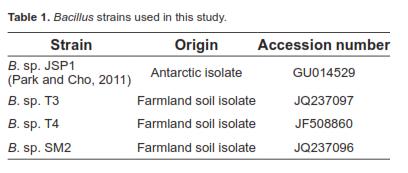
<body><![CDATA[<p><b><font size="3">Introduction</font></b></p>     <p>Although the use of antibiotics as a feed   additive has greatly contributed to improving   growth performance and controlling disease in   farm animals, their overuse has been an important   factor in the development of antibiotic resistance   and the persistence of antibiotic residues in animal   products (Chen <i>et al.</i>, 2009). The resulting health   concerns have prompted countries such as South   Korea and members of the European Economic   Union to ban the use of antibiotics as feed additives   (Phillips, 2007; Chen <i>et al.</i>, 2009; Lee <i>et al.</i>, 2011).   An active area of research is the discovery or   synthesis of compounds that can have antibiotic-like   effects without the undesirable problems caused by antibiotics (Turner <i>et al.</i>, 2001).</p>     <p>Probiotics are live microbial feed supplements   that can beneficially affect the host animal by   improving intestinal balance (Fuller, 1989).   Lactic acid, bacteria, and bifidobacteria have been   intensively employed as probiotic strains due to   their recognition as members of the indigenous   microflora of the animals, safety, and the evidence   supporting their positive role (Gaggia <i>et al.</i>,   2011). However, much recent attention has been   devoted to the genuine value of <i>Bacillus</i> species in   probiotic products (Cutting, 2011). <i>Bacillus</i> species,   which generate dormant spores resistant to heat,   radiation, desiccation, enzymatic degradation, and   the stomach's acidic conditions (Hong <i>et al.</i>, 2005,   Leser <i>et al.</i>, 2008), produce various extracellular   enzymes that enhance feed digestibility, as well as   many antimicrobial compounds (Leser <i>et al.</i>, 2008;   Sutyak <i>et al.</i>, 2008). The species also stimulates the   immune system of host animals (Schierack <i>et al.</i>,   2007; Huang <i>et al.</i>, 2008; Sun <i>et al.</i>, 2010), thereby   improving growth performance, feed conversion   ratio, and meat quality in animals (Davis <i>et al.</i>,   2008; Vila <i>et al.</i>, 2009; Sun <i>et al.</i>, 2010; Zhou <i>et al.</i>, 2010). However, since all <i>Bacillus</i> strains do not   equally possess these probiotic competencies, the   selection of appropriate <i>Bacillus</i> strains is essential   for the effectiveness of probiotic supplements for use in animal feed (Guo <i>et al.</i>, 2006).</p>     <p>The present study describes novel in vitro   potential probiotic properties such as acid tolerance,   bile tolerance, safety, and antimicrobial activity   of mesophilic and psychrophilic <i>Bacillus</i> strains   in conjunction with their extracellular enzymatic activities.</p>     <p>&nbsp;</p>     <p><font size="3"><b>Materials and methods</b></font></p>     <p><i>   Bacterial strains and maintenance</i></p>     <p>The <i>Bacillus</i> strains used in this experiment were   identified by 16S rDNA sequences. They have been   deposited in the NCBI database under the accession   numbers listed in <a href="#t1">table 1</a>. <i>Escherichia coli</i> K88, <i>E. coli</i> O157:H7, <i>Salmonella enteritidis</i> KCCM 12021,   <i>Enterococcus faecalis</i>, <i>Listeria monocytogenes</i>,   and <i>Staphylococcus aureus</i>, kindly provided by   Seoul National University (Seoul, South Korea),   were used as indicator bacteria for the antimicrobial   activity trial. Unless otherwise stated, all strains   were routinely activated and cultured in tryptic soy   broth (pH 7.0) (BD Science, Sparks, MD, USA)   or broth solidified by the inclusion of 1.5% agar   (BD Science). Unless otherwise stated, general   chemicals were purchased from Sigma-Aldrich (St. Louis, MO, USA).</p>     <p align="center"><a name="t1"></a><img src="/img/revistas/rccp/v25n4/v25n4a5t1.jpg"></p>     <p><i>Enzyme production</i></p>     ]]></body>
<body><![CDATA[<p>To investigate the production of various   extracellular enzymes in each <i>Bacillus</i> strain, the following media were used:</p>     <p>1. <i>Cellulase</i>: 0.5% carboxymethyl cellulose, 0.5%   yeast extract (BD Science), 0.45% (NH<sub>4</sub>)<sub>2</sub>SO<sub>4</sub>,   0.01% CaCl<sub>2</sub>&#8729;2H<sub>2</sub>O, 0.01% MgSO<sub>4</sub>&#8729;7H<sub>2</sub>O, 0.01%   NaCl, 0.07% KH<sub>2</sub>PO<sub>4</sub>, 0.001% MnSO<sub>4</sub>&#8729;4H<sub>2</sub>O, 0.001% FeSO<sub>4</sub>&#8729;7H<sub>2</sub>O, pH 6.5.</p>     <p>   2. <i>Xylanase</i>: 0.5% xylan, 0.45% (NH<sub>4</sub>)<sub>2</sub>SO<sub>4</sub>,   0.05% yeast extract, 0.01% CaCl<sub>2</sub>&#8729;2H<sub>2</sub>O, 0.01%   MgSO<sub>4</sub>&#8729;7H<sub>2</sub>O, 0.01% NaCl, 0.07% KH<sub>2</sub>PO<sub>4</sub>, 0.001% MnSO<sub>4</sub>&#8729;4H<sub>2</sub>O, 0.001% FeSO<sub>4</sub>&#8729;7H<sub>2</sub>O, pH   6.5.</p>     <p>   3. <i>Amylase</i>: 0.5% starch, 0.5% yeast extract,   0.45% (NH<sub>4</sub>)<sub>2</sub>SO<sub>4</sub>, 0.01% CaCl<sub>2</sub>&#8729;2H<sub>2</sub>O, 0.01%   MgSO<sub>4</sub>&#8729;7H<sub>2</sub>O, 0.01% NaCl, 0.07% KH<sub>2</sub>PO<sub>4</sub>,   0.001% MnSO<sub>4</sub>&#8729;4H<sub>2</sub>O, 0.001% FeSO<sub>4</sub>&#8729;7H<sub>2</sub>O, pH   7.4.</p>     <p>   4. <i>Protease:</i> 1.0% skim milk, 0.05% yeast extract,   0.45% (NH<sub>4</sub>)<sub>2</sub>SO<sub>4</sub>, 0.01% CaCl<sub>2</sub>&#8729;2H<sub>2</sub>O, 0.01%   MgSO<sub>4</sub>&#8729;7H<sub>2</sub>O, 0.01% NaCl, 0.07% KH<sub>2</sub>PO<sub>4</sub>,   0.001% MnSO<sub>4</sub>&#8729;4H<sub>2</sub>O, 0.001% FeSO<sub>4</sub>&#8729;7H<sub>2</sub>O, pH   6.5.</p>     <p>   5. <i>Phytase:</i> 1.0% wheat bran extract, 0.04%   (NH<sub>4</sub>)<sub>2</sub>SO<sub>4</sub>, 0.02% MgSO<sub>4</sub>&#8729;7H<sub>2</sub>O, 0.05% KH<sub>2</sub>PO<sub>4</sub>,   0.04% K<sub>2</sub>HPO<sub>4</sub>, 1.0% casein hydrolysate, 0.2%   CaCl<sub>2</sub>, pH 6.5.</p>     <p>   6. <i>&alpha;-galactosidase</i>: 1% tryptone (BD Science),   0.5% yeast extract, 1% NaCl, 1% galactose,   pH 7.2. Each <i>Bacillus</i> strain was aerobically   cultivated in 100 mL Erlenmeyer flasks   containing the appropriate enzyme production   medium (25 mL) at 30 &deg;C for 96 h, culture   supernatants were subsequently assessed for   enzyme activity.</p>     <p><i>Enzyme assays</i></p>     <p>Cellulase, xylanase, and amylase activities were   determined at 30 &deg;C by measuring the release of   reducing sugar from carboxymethyl cellulose, beech   wood xylan, and starch, respectively, in 0.6 mL of   50 mM sodium phosphate (pH 6.0), according to   the dinitrosalicylic acid (DNS) method (Miller,   1959). An &alpha;-galactosidase activity was determined   at 30 &deg;C by measuring the release of <i>p</i>-nitrophenol   from <i>p</i>-nitrophenyl-&alpha;-D-galactopyranoside (Sigma-   Aldrich, St. Louis, MO, USA) in 0.8 mL of 50 mM   sodium phosphate (pH 6.0) as previously described   (Patil <i>et al.</i>, 2010). Protease activity was tested at   30 &deg;C in 0.36 mL of 50 mM sodium phosphate   (pH 6.0) using azocasein as substrate as previously   described (Hutadilok-Towatana <i>et al.</i>, 1999).   Phytase activity was measured at 30 &deg;C by   testing inorganic phosphate release from phytate   dodecasodium salt (Sigma-Aldrich) in 0.8 mL of 50   mM bis-tris (pH 6.0) as previously described (Cho   <i>et al.</i>, 2006). One unit (U) of each enzyme activity   was defined as the release of 1 &mu;mol of product per min under the trial conditions.</p>     <p><i>Acid tolerance test</i></p> </font>     ]]></body>
<body><![CDATA[<p><font size="2" face="Verdana, Arial, Helvetica, sans-serif">The survival rate of each <i>Bacillus</i> strain under   simulated gastric conditions was investigated as   previously described (Kim <i>et al.</i>, 2007) with the   following modifications: 0.1 mL of cultures grown   in tryptic soy broth for 24 h at 37 &deg;C, representing   about 10<sup>8</sup> colony forming units (CFU)/mL, were   transferred to 0.9 mL of synthetic gastric juice   [0.5% NaCl, 0.1% peptone (BD Science), 0.3%   pepsin] whose pH was adjusted to 2 and 3 using   1 N HCl, then incubated for 0, 30, 60, 90, and 120   min at 37 &deg;C. Viable cells were enumerated by   plating 10-fold dilutions of the culture in phosphate   buffered saline (PBS; 0.144% Na<sub>2</sub>HPO<sub>4</sub>, 0.024%   KH<sub>2</sub>PO<sub>4</sub>, 0.5% NaCl; pH 7.4) on tryptic soy agar and incubating plates at 37 &deg;C for 24 h.</font></p> <font face="Verdana, Arial, Helvetica, sans-serif" size="2">    <p><i>Bile resistance test</i></p>     <p>   Bile tolerance was determined as previously   described (Kheadr <i>et al.</i>, 2007) with the following   modifications: 10 mL of cultures (about 10<sup>8</sup> CFU/   mL) of each <i>Bacillus</i> strain grown in tryptic soy   broth (pH 7.0) for 24 h at 37 &deg;C, was spun down   at 5,000 &times; g for 20 min at 4 &deg;C. Cell pellets were   washed with PBS, collected by centrifugation   (5,000 &times; g, 20 min, 4 &deg;C), and resuspended in tryptic   soy broth (pH 7.0) containing 0.3% oxgall (BD   Science). Bacterial suspensions were incubated   for 0, 1, 2, 3, and 4 h at 37 &deg;C. Viable cells were   counted by plating 10-fold dilutions of the culture   in PBS on tryptic soy agar and incubating plates at   37 &deg;C for 24 h.</p>     <p><i>Antimicrobial activity assay</i></p>     <p>The inhibition test was performed by modified   methods of earlier studies (Sugita <i>et al.</i>, 1998; Guo   <i>et al.</i>, 2006). Tested <i>Bacillus</i> strains were amplified   at 37 &deg;C for 24 h by streaking each pure colony onto   fresh tryptic soy agar. Then, large colonies of tested   strains were created on tryptic soy agar by spotting   the isolates with sterile toothpicks. After incubating at 37 &deg;C for 24 h, the strains were killed by exposure to chloroform vapor for 30 min. The chloroform was then evaporated for 20 min. Indicator bacteria were incubated for 24 h at 37 &deg;C in tryptic soy broth and diluted until the absorbance at 600 nm (A<sub>600</sub>) reached 0.5. The cultures were diluted 100-fold and suspended in tryptic soy soft agar (tryptic soy broth + 0.7% agar), which were poured over the tryptic soy agar plates. After incubation at 37 &deg;C for 24 h, the inhibition zones around the spots were measured.</p>     <p><i>Cell cytotoxicity test</i></p>     <p>HEK 293 human embryonic kidney cells (cat   no. CRL-1573; ATCC, Manassas, VA, USA)   were maintained in DMEM medium (Hyclone,   Logan, UT, USA) supplemented with 10% fetal   bovine serum (FBS; Gibco Invitrogen, Carlsbad,   CA, USA). Cultures were incubated at 37 &deg;C in a   humidified atmosphere containing 5% CO<sub>2</sub>. Cell   cytotoxicity was examined using the EZ-Cytox cell   viability kit (Daeil Lab, Seoul, Korea) according to   manufacturer instructions. Initially, the cells were   seeded into 96-well culture plates at 1&times;10<sup>5</sup> cells/mL   and maintained in FBS-supplemented DMEM. The   samples included negative control (10 &mu;L of PBS)   and cell-free culture supernatant fluids (10 &mu;L) of   <i>Bacillus</i> strains obtained at 1, 3, and 5 days (SM2,   JSP1, T3, T4, respectively) cultured in the tryptic   soy broth. When the HEK293 cells reached 70%   confluence, the wells were inoculated aseptically   with 10 &mu;L of the samples and the plates were   incubated at 37 &deg;C for 48 h. Then, the EZ-Cytox kit   reagents were added to the medium before the cells   were incubated for 30 min. The optical density was   determined at 450 nm using a microplate reader (Bio-Tek, Winooski, VT, USA).</p>     <p><i>Statistical analysis</i></p>     <p>Results were presented as the mean &plusmn; standard   error of three experiments. P values &lt; 0.05 or 0.01   were regarded as statistically different between   means using a student's <i>t</i>-test.</p>     <p>&nbsp;</p>     ]]></body>
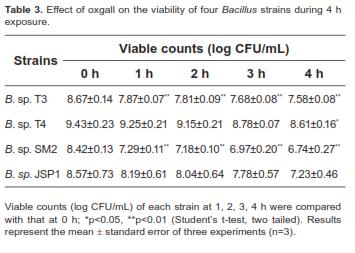
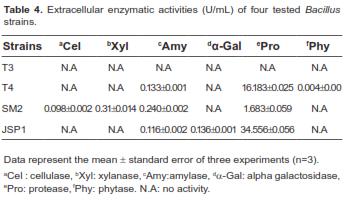
<body><![CDATA[<p><b><font size="3">Results</font></b></p>     <p><i>Acid tolerance</i></p>     <p>Generally, all tested <i>Bacillus</i> strains exhibited   lower cell viabilities in synthetic gastric fluid at pH   2 than at pH 3 (<a href="/img/revistas/rccp/v25n4/v25n4a5t2.jpg" target="_blank">Table 2</a>). Particularly an Antarctic   isolate, <i>Bacillus</i> JSP1, showed the best survival rate   of all strains, retaining 65% and 55% of its initial   cell numbers during 120 min incubation at pH 2 and   pH 3, respectively. <i>Bacillus</i> sp. T3 and <i>Bacillus</i> sp.   T4 were the most acid-sensitive strains. In addition,   <i>Bacillus</i> sp. SM2 showed relatively good cell   viability, retaining 49% of its initial cell numbers   during 120 min incubation at pH 3, although   viability was drastically reduced during 30 min incubation at pH 2.</p>     <p><i>Bile tolerance</i></p>     <p>   All tested <i>Bacillus</i> strains were resistant to   oxgall bile salt (<a href="#t3">Table 3</a>); viability was reduced by   only 9%-20%, even at 4 h exposure.</p>     <p align="center"><a name="t3"></a><img src="/img/revistas/rccp/v25n4/v25n4a5t3.JPG" /></p>     <p><i>Enzymatic activities</i></p>     <p>   As shown in <a href="#t4">table 4</a>, no enzymatic activities   were detected in <i>Bacillus</i> sp. T3. However, other   <i>Bacillus</i> strains commonly possessed amylase and   protease activities. Phytase activity was detected   only in <i>Bacillus</i> sp. T4. Interestingly, <i>Bacillus</i> sp.   JSP1 produced greater concentrations of protease   compared to other strains, and &alpha;&#8211;galactosidase   activity, which is involved in the removal of   galacto-oligosaccharides such as raffinose and   stachyose, acting as an anti-nutritive factor in   soybean meal (Anderson and Wolf, 1995), was   detected only in strain JSP1. Unlike other strains,   <i>Bacillus</i> sp. SM2 also produced additional   carbohydrase, such as cellulase and xylanase, that   can degrade non-starch polysaccharides.</p>     <p align="center"><a name="t4"></a><img src="/img/revistas/rccp/v25n4/v25n4a5t4.jpg" /></p>     <p><i>Antimicrobial activity</i></p>     ]]></body>
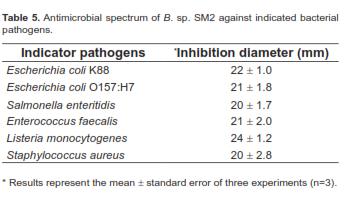
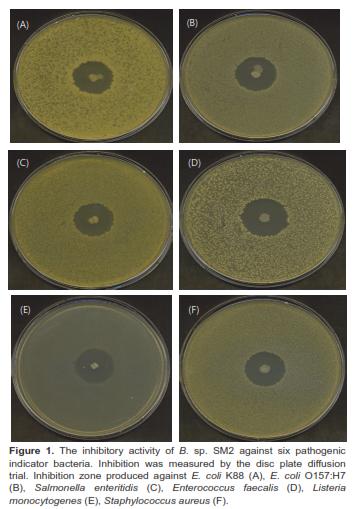
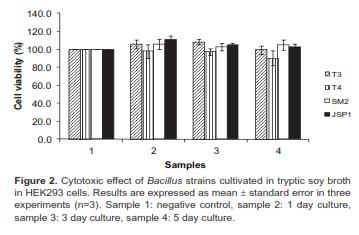
<body><![CDATA[<p><i>Bacillus</i> sp. SM2 showed inhibitory effects   against the six indicator pathogens (<a href="#f1">Figure 1</a>),   producing the largest inhibition zone with <i>Listeria monocytogenes</i> (<a href="#t5">Table 5</a>). However, the other   <i>Bacillus</i> strains did not inhibit the growth of the six pathogens.</p>     <p align="center"><a name="t5"></a><img src="/img/revistas/rccp/v25n4/v25n4a5t5.jpg"></p>     <p align="center"><a name="f1"></a><img src="/img/revistas/rccp/v25n4/v25n4a5f1.jpg"></p>     <p><i>Cell cytotoxicity trial</i></p>     <p>There was no deleterious effect of treatment with   cell-free culture supernatants on viability of <i>Bacillus</i>   strains (<a href="#f2">Figure 2</a>), which indicated an inability to produce enterotoxins.</p>     <p align="center"><a name="f2"></a><img src="/img/revistas/rccp/v25n4/v25n4a5f2.jpg" /></p>     <p>&nbsp;</p>     <p><b><font size="3">Discussion</font></b></p> </font>     <p><font size="2" face="Verdana, Arial, Helvetica, sans-serif">   Differential survivability of <i>Bacillus</i> strains   tested at pH 2 and pH 3 was observed (<a href="/img/revistas/rccp/v25n4/v25n4a5t2.jpg" target="_blank">Table 2</a>),   indicating that the acid tolerance is strain-specific,   which may be closely associated with previous   findings that <i>Bacillus</i> species spores are not equally   resistant to simulated gastric fluid (Guo <i>et al.</i>,   2006). In addition, Taheri <i>et al.</i> (2009) reported   that it is preferable to examine the survivability of   the <i>Lacto</i><i>bacillus</i> strains under the retention time   of feed and pH (90 min, pH 2.6) in the gizzard   when considering the application of probiotics in   chickens. Similarly, <i>Bacillus</i> sp. JSP1 and <i>Bacillus</i>   sp. SM2 might be promising candidates as chicken   probiotics because they maintained high cell   viabilities during 90 min incubation at pH 3 (<a href="/img/revistas/rccp/v25n4/v25n4a5t2.jpg" target="_blank">Table   2</a>). Nevertheless, acid tolerance does not appear to   be a critical factor for selection of probiotic strains   because buffered food or encapsulated delivery   systems can improve acid-sensitive strain viabilities   during gastric transit (Huang and Adams, 2004).</font></p> <font face="Verdana, Arial, Helvetica, sans-serif" size="2"> </font>    <p><font size="2" face="Verdana, Arial, Helvetica, sans-serif">Bile tolerance is necessary for probiotic strains   to colonize the small intestine and is potentially   more important in probiotic selection than gastric   survival (Huang and Adams, 2004). All tested   <i>Bacillus</i> strains displayed high levels of bile   tolerance with slight loss of viability at 4 h exposure   to 0.3% bile salt (<a href="#t3">Table 3</a>), the intestinal bile acid   concentration in humans, also widely-applied to   other monogastrics, such as pigs and chickens   (Kim <i>et al.</i>, 2007; Taheri <i>et al.</i>, 2009). <i>B. subtilis</i>  MA139 and <i>Bacillus</i> sp. 634 also tolerate simulated   intestinal fluid with 0.3% bile salts, suggesting that   their spores should be able to germinate without   being inhibited by the presence of bile salts in the   small intestine (Guo <i>et al.</i>, 2006). Accordingly, low   numbers of <i>B. cereus</i> var. <i>toyoi</i> spores were found   in the pigs' stomach following oral administration,   followed by a rapid increase of spore numbers   in the duodenum and jejunum (Jadamus <i>et al.</i>,   2001). On the other hand, in probiotic strains   such as <i>Lacto</i><i>bacillus</i> and <i>Bifidobacterium</i>, the   resistance against bile salt was strongly implicated   in the presence of their bile salt hydrolase activity   (Tanaka <i>et al.</i>, 1999; Kim <i>et al.</i>, 2004). However, it   is still unclear that <i>Bacillus</i> strains possess bile salt hydrolase activity resistant to bile salts.</font></p> <font face="Verdana, Arial, Helvetica, sans-serif" size="2"></font>    ]]></body>
<body><![CDATA[<p><font size="2" face="Verdana, Arial, Helvetica, sans-serif">Generally, <i>Bacillus</i> species are attractive sources   of various extracellular hydrolytic enzymes, which   may aid in nutrient digestion and utilization of   feed (Davis <i>et al.</i>, 2008). Dietary supplementation   with B. subtilis, which secretes protease, amylase,   and lipase, improves growth performance in   broiler chicks (Santoso <i>et al.</i>, 2001). Moreover,   a great deal of interest has focused on screening   <i>Lacto</i><i>bacillus</i> strains that can produce &alpha;-amylase,   phytase, xylanase, &beta;-glucanase or cellulase for the   purpose of improving probiotic efficacy (Taheri   <i>et al.</i>, 2009), which could improve the digestion   or feed conversion ratio in chickens and pigs (Lee   <i>et al.</i>, 2001; Liu <i>et al.</i>, 2007, Yu <i>et al.</i>, 2008). In   this regard, our results (Table 4) suggest that the   combination among <i>Bacillus</i> strains producing   different extracellular enzymes may generate   a synergistic-mediated improvement of the   production performance and nutrient digestibility of monogastric animals.</font></p> <font face="Verdana, Arial, Helvetica, sans-serif" size="2">    <p>The main function of probiotics is to inhibit   pathogens, which is an important criterion for   screening potential probiotic strains (Guo <i>et al.</i>, 2006). <i>Bacillus</i> sp. SM2 had a relatively   broad range of antibacterial activities because   the strain was not only effective against Grampositive   bacteria (<i>Enterococcus faecalis</i>, <i>Listeria monocytogenes</i>, and <i>Staphylococcus aureus</i>), but also Gram-negative bacteria (<i>E. coli</i> K88, <i>E. coli</i> O157:H7, and <i>Salmonella enteritidis</i>) (<a href="#t5">Table 5</a> and <a href="#f1">Figure 1</a>). Thus, strain SM2 may be strategically applied to reduce environmental mastitis caused by the opportunistic pathogen <i>Enterococcus faecalis</i> in cattle (Petersson-Wolfe <i>et al.</i>, 2008), diarrhea caused by <i>E. coli</i> K88 and <i>E. coli</i> O157:H7 in piglets and calves (Guo <i>et al.</i>, 2006; Gaggia <i>et al.</i>, 2011), and the prevalence of <i>Salmonella</i> in poultry (Vila <i>et al.</i>, 2009). Although the mechanism of SM2 antibacterial activities remains unclear, earlier studies reported that some <i>Bacillus</i> strains could produce bacteriocins or bacteriocin-like substances to kill bacterial pathogens (Sugita <i>et al.</i>, 1998; Sutyak <i>et al.</i>, 2008). The production of bacteriocins by strain SM2 should be assessed.</p>     <p>The use of <i>Bacillus</i> species as probiotics raises   the question of safety because some <i>Bacillus</i> species   including <i>B. anthracis</i>, <i>B. cereus</i>, <i>B. thuringiensis</i>,   <i>B. pseudomycoides</i>, and <i>B. weihenstephanesis</i>  are pathogenic (Hong <i>et al.</i>, 2008). In particular,   B. cereus is a well-documented food-poisoning   bacterium that causes illness due to the production   of one or more enterotoxins (Granum and Lund   1997; Granum 2002; Guinebretiere <i>et al.</i>, 2002;   From <i>et al.</i>, 2005). However, pathogenicity is   rather strain-specific, as some varieties of B. cereus   produce no enterotoxins; indeed, some are presently   used as probiotics for both humans and animals   (Hong <i>et al.</i>, 2008). Thus, all <i>Bacillus</i> strains tested   in this study seem to be appropriate for the probable   bio-safe utilization as probiotics, based on the strains cytotoxic-free potential (<a href="#f2">Figure 2</a>).</p>     <p>Today, the use of <i>Bacillus</i> species as probiotic   supplements in animal feed is expanding rapidly   due to the ease of bulk production and the assurance   of stability (Cutting, 2011). <i>Bacillus</i> sp. SM2 can   be an alternative to antibiotic growth promoter but   the use of the strain SM2 in combination of other   <i>Bacillus</i> spp. may offer additional benefits. Further   research on additive effects of the combination of   <i>Bacillus</i> spp. used in this experiment is needed. This would be a useful future experiment.</p>     <p>&nbsp;</p>     <p><font size="3"><b>Acknowledgement</b></font></p>     <p>    This research was supported by Technology   Development Program for Agriculture and   Forestry, Ministry for Food, Agriculture, Forestry,   and Fisheries, Republic of Korea (Project No.   610005031SB130).</p>     <p>&nbsp;</p>     <p><font size="3"><b>References</b></font></p>     <!-- ref --><p>   1. Anderson RL, Wolf WJ. Compositional changes in trypsin   inhibitors, phytic acid, saponins and isoflavones related to   soybean processing. J Nutr 1995; 125:581S-588S.    &nbsp;&nbsp;&nbsp;&nbsp;&nbsp;&nbsp;&nbsp;&nbsp;[&#160;<a href="javascript:void(0);" onclick="javascript: window.open('/scielo.php?script=sci_nlinks&ref=000092&pid=S0120-0690201200040000500001&lng=','','width=640,height=500,resizable=yes,scrollbars=1,menubar=yes,');">Links</a>&#160;]<!-- end-ref --></p>     <!-- ref --><p>   2. Chen KL, Kho WL, You SH, Yeh RH, Tang SW, Hsieh CW.   Effects of <i>Bacillus</i> <i>subtilis</i> var. <i>natto</i> and <i>Saccharomyces   cerevisiae</i> mixed fermented feed on the enhanced growth   performance of broilers. Poult Sci 2009; 88:309-315.    &nbsp;&nbsp;&nbsp;&nbsp;&nbsp;&nbsp;&nbsp;&nbsp;[&#160;<a href="javascript:void(0);" onclick="javascript: window.open('/scielo.php?script=sci_nlinks&ref=000094&pid=S0120-0690201200040000500002&lng=','','width=640,height=500,resizable=yes,scrollbars=1,menubar=yes,');">Links</a>&#160;]<!-- end-ref --></p>     <!-- ref --><p>   3. Cho J, Choi K, Darden T, Reynolds PR, Petitte JN, Shears SB.   Avian multiple inositol polyphosphate phosphatase is an active   phytase that can be engineered to help ameliorate the planet's   phosphate crisis. J Biotechnol 2006; 126:248-259.    &nbsp;&nbsp;&nbsp;&nbsp;&nbsp;&nbsp;&nbsp;&nbsp;[&#160;<a href="javascript:void(0);" onclick="javascript: window.open('/scielo.php?script=sci_nlinks&ref=000096&pid=S0120-0690201200040000500003&lng=','','width=640,height=500,resizable=yes,scrollbars=1,menubar=yes,');">Links</a>&#160;]<!-- end-ref --></p>     <!-- ref --><p>   4. Cutting SM. <i>Bacillus</i> probiotics. Food Microbiol 2011; 28:214-   220.    &nbsp;&nbsp;&nbsp;&nbsp;&nbsp;&nbsp;&nbsp;&nbsp;[&#160;<a href="javascript:void(0);" onclick="javascript: window.open('/scielo.php?script=sci_nlinks&ref=000098&pid=S0120-0690201200040000500004&lng=','','width=640,height=500,resizable=yes,scrollbars=1,menubar=yes,');">Links</a>&#160;]<!-- end-ref --></p>     <!-- ref --><p>   5. Davis ME, Parrott T, Brown DC, de Rodas BZ, Johnson ZB,   Maxwell CV, Rehberger T. Effect of a <i>Bacillus</i>-based directfed   microbial feed supplement on growth performance and pen   cleaning characteristics of growing-finishing pigs. J Anim Sci   2008; 86:1459-1467.    &nbsp;&nbsp;&nbsp;&nbsp;&nbsp;&nbsp;&nbsp;&nbsp;[&#160;<a href="javascript:void(0);" onclick="javascript: window.open('/scielo.php?script=sci_nlinks&ref=000100&pid=S0120-0690201200040000500005&lng=','','width=640,height=500,resizable=yes,scrollbars=1,menubar=yes,');">Links</a>&#160;]<!-- end-ref --></p>     <!-- ref --><p>   6. From C, Pukall R, Schumann P, Hormazabal V, Granum   PE. Toxin producing ability among <i>Bacillus</i> spp. outside the   <i>Bacillus</i> <i>cereus</i> group. Appl Environ Microbiol 2005; 71:1178-   1183.    &nbsp;&nbsp;&nbsp;&nbsp;&nbsp;&nbsp;&nbsp;&nbsp;[&#160;<a href="javascript:void(0);" onclick="javascript: window.open('/scielo.php?script=sci_nlinks&ref=000102&pid=S0120-0690201200040000500006&lng=','','width=640,height=500,resizable=yes,scrollbars=1,menubar=yes,');">Links</a>&#160;]<!-- end-ref --></p>     <!-- ref --><p>   7. Fuller R. Probiotics in man and animals. J Appl Bacteriol 1989;   66:365-378.    &nbsp;&nbsp;&nbsp;&nbsp;&nbsp;&nbsp;&nbsp;&nbsp;[&#160;<a href="javascript:void(0);" onclick="javascript: window.open('/scielo.php?script=sci_nlinks&ref=000104&pid=S0120-0690201200040000500007&lng=','','width=640,height=500,resizable=yes,scrollbars=1,menubar=yes,');">Links</a>&#160;]<!-- end-ref --></p> </font>     <!-- ref --><p><font size="2" face="Verdana, Arial, Helvetica, sans-serif">   8. Gaggia F, Gioia DD, Baffoni L, Biavati B. The role of   protective and probiotic cultures in food and feed and their   impact in food safety. Trends Food Sci Tech 2011; 22:S58-S66.    &nbsp;&nbsp;&nbsp;&nbsp;&nbsp;&nbsp;&nbsp;&nbsp;[&#160;<a href="javascript:void(0);" onclick="javascript: window.open('/scielo.php?script=sci_nlinks&ref=000106&pid=S0120-0690201200040000500008&lng=','','width=640,height=500,resizable=yes,scrollbars=1,menubar=yes,');">Links</a>&#160;]<!-- end-ref --></font></p> <font face="Verdana, Arial, Helvetica, sans-serif" size="2">     <!-- ref --><p>   9. Granum PE. <i>Bacillus</i> <i>cereus</i> and food poisoning. In: Berkeley   R, Heyndrickx M, Logan NA, de Vos P, editors. In Applications   and Systematices of <i>Bacillus</i> and Relatives. Oxford:Blackwell   Science; 2002. p.37-46.    &nbsp;&nbsp;&nbsp;&nbsp;&nbsp;&nbsp;&nbsp;&nbsp;[&#160;<a href="javascript:void(0);" onclick="javascript: window.open('/scielo.php?script=sci_nlinks&ref=000108&pid=S0120-0690201200040000500009&lng=','','width=640,height=500,resizable=yes,scrollbars=1,menubar=yes,');">Links</a>&#160;]<!-- end-ref --></p>     <!-- ref --><p>   10. Granum PE, Lund T. <i>Bacillus</i> <i>cereus</i> and its food poisoning   toxins. FEMS Microbiol Lett 1997; 157:223-228.    &nbsp;&nbsp;&nbsp;&nbsp;&nbsp;&nbsp;&nbsp;&nbsp;[&#160;<a href="javascript:void(0);" onclick="javascript: window.open('/scielo.php?script=sci_nlinks&ref=000110&pid=S0120-0690201200040000500010&lng=','','width=640,height=500,resizable=yes,scrollbars=1,menubar=yes,');">Links</a>&#160;]<!-- end-ref --></p>     <!-- ref --><p>   11. Guinebretiere MH, Broussolle V, Nguyen-The C.   Enterotoxigenic profiles of food poisoning and food borne   <i>Bacillus</i> <i>cereus</i> strains. J Clin Microbiol 2002; 40:3053-3056.    &nbsp;&nbsp;&nbsp;&nbsp;&nbsp;&nbsp;&nbsp;&nbsp;[&#160;<a href="javascript:void(0);" onclick="javascript: window.open('/scielo.php?script=sci_nlinks&ref=000112&pid=S0120-0690201200040000500011&lng=','','width=640,height=500,resizable=yes,scrollbars=1,menubar=yes,');">Links</a>&#160;]<!-- end-ref --></p>     <!-- ref --><p>   12. Guo X, Li D, Lu W, Piao X, Chen X. Screening of <i>Bacillus</i>   strains as potential probiotics and subsequent confirmation of   the in vivo effectiveness of <i>Bacillus</i> <i>subtilis</i> MA139 in pigs.   Antonie van Leeuwenhoek 2006; 90:139-146.    &nbsp;&nbsp;&nbsp;&nbsp;&nbsp;&nbsp;&nbsp;&nbsp;[&#160;<a href="javascript:void(0);" onclick="javascript: window.open('/scielo.php?script=sci_nlinks&ref=000114&pid=S0120-0690201200040000500012&lng=','','width=640,height=500,resizable=yes,scrollbars=1,menubar=yes,');">Links</a>&#160;]<!-- end-ref --></p>     <!-- ref --><p>13. Hong HA, Duc LH, Cutting SM. The use of bacterial spore formers as probiotics. FEMS Microbiol Rev 2005; 29:813-835.    &nbsp;&nbsp;&nbsp;&nbsp;&nbsp;&nbsp;&nbsp;&nbsp;[&#160;<a href="javascript:void(0);" onclick="javascript: window.open('/scielo.php?script=sci_nlinks&ref=000116&pid=S0120-0690201200040000500013&lng=','','width=640,height=500,resizable=yes,scrollbars=1,menubar=yes,');">Links</a>&#160;]<!-- end-ref --></p>     <!-- ref --><p>   14. Hong HA, Huang JM, Khaneja R, Hiep LV, Urdaci MC, Cutting   SM. The safety of <i>Bacillus</i> <i>subtilis</i> and <i>Bacillus</i> <i>indicus</i> as food   probiotics. J Appl Microbiol 2008; 105:510-520.    &nbsp;&nbsp;&nbsp;&nbsp;&nbsp;&nbsp;&nbsp;&nbsp;[&#160;<a href="javascript:void(0);" onclick="javascript: window.open('/scielo.php?script=sci_nlinks&ref=000118&pid=S0120-0690201200040000500014&lng=','','width=640,height=500,resizable=yes,scrollbars=1,menubar=yes,');">Links</a>&#160;]<!-- end-ref --></p>     <!-- ref --><p>   15. Huang JM, La Ragione RM, Nunez A, Cutting SM.   Immunostimulatory activity of <i>Bacillus</i> spores. FEMS Immunol   Med Microbiol 2008; 53:195-203.    &nbsp;&nbsp;&nbsp;&nbsp;&nbsp;&nbsp;&nbsp;&nbsp;[&#160;<a href="javascript:void(0);" onclick="javascript: window.open('/scielo.php?script=sci_nlinks&ref=000120&pid=S0120-0690201200040000500015&lng=','','width=640,height=500,resizable=yes,scrollbars=1,menubar=yes,');">Links</a>&#160;]<!-- end-ref --></p>     <!-- ref --><p>   16. Huang Y, Adams MC. <i>In vitro</i> assessment of upper   gastrointestinal tolerance of potential probiotic dairy   propionibacteria. Int J Food Microbiol 2004; 91:253-260.    &nbsp;&nbsp;&nbsp;&nbsp;&nbsp;&nbsp;&nbsp;&nbsp;[&#160;<a href="javascript:void(0);" onclick="javascript: window.open('/scielo.php?script=sci_nlinks&ref=000122&pid=S0120-0690201200040000500016&lng=','','width=640,height=500,resizable=yes,scrollbars=1,menubar=yes,');">Links</a>&#160;]<!-- end-ref --></p>     <!-- ref --><p>   17. Hutadilok-Towatana N, Painupong A, Suntinanalert P.   Purification and characterization of an extracellular protease   from alkaliphilic and thermophilic <i>Bacillus</i> sp. PS 719. J Biosci   Bioeng 1999; 87:581-587.    &nbsp;&nbsp;&nbsp;&nbsp;&nbsp;&nbsp;&nbsp;&nbsp;[&#160;<a href="javascript:void(0);" onclick="javascript: window.open('/scielo.php?script=sci_nlinks&ref=000124&pid=S0120-0690201200040000500017&lng=','','width=640,height=500,resizable=yes,scrollbars=1,menubar=yes,');">Links</a>&#160;]<!-- end-ref --></p>     <!-- ref --><p>   18. Jadamus A, Vahjen W, Simon O. Growth behavior of a spore   forming probiotic strain in the gastrointestinal tract of broiler   chickens and piglets. Arch Anim Nutr 2001; 54:1-17.    &nbsp;&nbsp;&nbsp;&nbsp;&nbsp;&nbsp;&nbsp;&nbsp;[&#160;<a href="javascript:void(0);" onclick="javascript: window.open('/scielo.php?script=sci_nlinks&ref=000126&pid=S0120-0690201200040000500018&lng=','','width=640,height=500,resizable=yes,scrollbars=1,menubar=yes,');">Links</a>&#160;]<!-- end-ref --></p>     <!-- ref --><p>   19. Kheadr E, Dabour N, Le Lay C, Lacroix C, Fliss I. Antibiotic   susceptibility profile of bifidobacteria as affected by oxgall,   acid, and hydrogen peroxide stress. Antimicrob Agents   Chemother 2007; 51:169-174.    &nbsp;&nbsp;&nbsp;&nbsp;&nbsp;&nbsp;&nbsp;&nbsp;[&#160;<a href="javascript:void(0);" onclick="javascript: window.open('/scielo.php?script=sci_nlinks&ref=000128&pid=S0120-0690201200040000500019&lng=','','width=640,height=500,resizable=yes,scrollbars=1,menubar=yes,');">Links</a>&#160;]<!-- end-ref --></p>     <!-- ref --><p>   20. Kim GB, Miyamoto CM, Meighen EA, Lee BH. Cloning and   characterization of the bile salt hydrolase genes (<i>bsh</i>) from   <i>Bifidobacterium bifidum</i> strains. Appl Environ Microbiol 2004;   70:5603-5612.    &nbsp;&nbsp;&nbsp;&nbsp;&nbsp;&nbsp;&nbsp;&nbsp;[&#160;<a href="javascript:void(0);" onclick="javascript: window.open('/scielo.php?script=sci_nlinks&ref=000130&pid=S0120-0690201200040000500020&lng=','','width=640,height=500,resizable=yes,scrollbars=1,menubar=yes,');">Links</a>&#160;]<!-- end-ref --></p> </font>    <!-- ref --><p><font size="2" face="Verdana, Arial, Helvetica, sans-serif">   21. Kim PI, Jung MY, Chang YH, Kim S, Kim SJ, Park YH.   Probiotic properties of <i>Lactobacillus</i> and <i>Bifidobacterium</i>  strains isolated from porcine gastrointestinal tract. Appl   Microbiol Biotechnol 2007; 74:1103-1111.    &nbsp;&nbsp;&nbsp;&nbsp;&nbsp;&nbsp;&nbsp;&nbsp;[&#160;<a href="javascript:void(0);" onclick="javascript: window.open('/scielo.php?script=sci_nlinks&ref=000132&pid=S0120-0690201200040000500021&lng=','','width=640,height=500,resizable=yes,scrollbars=1,menubar=yes,');">Links</a>&#160;]<!-- end-ref --></font></p> <font face="Verdana, Arial, Helvetica, sans-serif" size="2">     <!-- ref --><p>   22. Lee CY, Lim JW, Ko YH, Kang SY, Park MJ, Ko T, Lee JH,   Hyun Y, Jeong KS, Jang IS. Intestinal growth and development   of weaning pigs in response to dietary supplementation of   antibiotics, phytogenic products and brewer's yeast plus   <i>Bacillus</i> spores. J Anim Sci Tech (Kor) 2011; 53:227-235.    &nbsp;&nbsp;&nbsp;&nbsp;&nbsp;&nbsp;&nbsp;&nbsp;[&#160;<a href="javascript:void(0);" onclick="javascript: window.open('/scielo.php?script=sci_nlinks&ref=000134&pid=S0120-0690201200040000500022&lng=','','width=640,height=500,resizable=yes,scrollbars=1,menubar=yes,');">Links</a>&#160;]<!-- end-ref --></p>     <!-- ref --><p>   23. Lee HS, Gilliland SE, Carter S. Amylolytic cultures of   Lacto<i>Bacillus</i> acidophilus: Potential probiotics to improve   dietary starch utilization. J Food Sci 2001; 66:338-344.    &nbsp;&nbsp;&nbsp;&nbsp;&nbsp;&nbsp;&nbsp;&nbsp;[&#160;<a href="javascript:void(0);" onclick="javascript: window.open('/scielo.php?script=sci_nlinks&ref=000136&pid=S0120-0690201200040000500023&lng=','','width=640,height=500,resizable=yes,scrollbars=1,menubar=yes,');">Links</a>&#160;]<!-- end-ref --></p>     <!-- ref --><p>   24. Leser TD, Knarreborg A, Worm J. Germination and outgrowth   of <i>Bacillus</i> <i>subtilis</i> and <i>Bacillus</i> <i>licheniformis</i> spores in the   gastrointestinal tract of pigs. J Appl Microbiol 2008; 104:1025-   1033.    &nbsp;&nbsp;&nbsp;&nbsp;&nbsp;&nbsp;&nbsp;&nbsp;[&#160;<a href="javascript:void(0);" onclick="javascript: window.open('/scielo.php?script=sci_nlinks&ref=000138&pid=S0120-0690201200040000500024&lng=','','width=640,height=500,resizable=yes,scrollbars=1,menubar=yes,');">Links</a>&#160;]<!-- end-ref --></p> </font>    <!-- ref --><p><font size="2" face="Verdana, Arial, Helvetica, sans-serif">   25. Liu JR, Lai SF, Yu B. Evaluation of an intestinal <i>Lacto</i><i>bacillus</i>   <i>reuteri</i> strain expressing rumen fungal xylanase as a probiotic   for broiler chickens fed on a wheat-based diet. Br Poult Sci   2007; 48:507-514.    &nbsp;&nbsp;&nbsp;&nbsp;&nbsp;&nbsp;&nbsp;&nbsp;[&#160;<a href="javascript:void(0);" onclick="javascript: window.open('/scielo.php?script=sci_nlinks&ref=000140&pid=S0120-0690201200040000500025&lng=','','width=640,height=500,resizable=yes,scrollbars=1,menubar=yes,');">Links</a>&#160;]<!-- end-ref --></font></p> <font face="Verdana, Arial, Helvetica, sans-serif" size="2">     <!-- ref --><p>   26. Miller GL. Use of dinitrosalicyclic acid reagent for   determination of reducing sugar. Anal Chem 1959; 31:426-428.    &nbsp;&nbsp;&nbsp;&nbsp;&nbsp;&nbsp;&nbsp;&nbsp;[&#160;<a href="javascript:void(0);" onclick="javascript: window.open('/scielo.php?script=sci_nlinks&ref=000142&pid=S0120-0690201200040000500026&lng=','','width=640,height=500,resizable=yes,scrollbars=1,menubar=yes,');">Links</a>&#160;]<!-- end-ref --></p>     <!-- ref --><p>   27. Park I, Cho J. Production of an extracellular protease by an   Antarctic bacterial isolate (<i>Bacillus</i> sp. JSP1) as a potential feed   additive. Rev Colomb Cienc Pecu 2011; 24:3-10.    &nbsp;&nbsp;&nbsp;&nbsp;&nbsp;&nbsp;&nbsp;&nbsp;[&#160;<a href="javascript:void(0);" onclick="javascript: window.open('/scielo.php?script=sci_nlinks&ref=000144&pid=S0120-0690201200040000500027&lng=','','width=640,height=500,resizable=yes,scrollbars=1,menubar=yes,');">Links</a>&#160;]<!-- end-ref --></p>     <!-- ref --><p>   28. Patil AG, Praveen Kumar SK, Mulimani VH, Veeranagouda Y,   Lee K. &#913;-galactosidase from <i>Bacillus</i> <i>megaterium</i> VHM1 and   its application in removal of flatulence-causing factors from   soymilk. J Microbiol Biotechnol 2010; 20:1546-1554.    &nbsp;&nbsp;&nbsp;&nbsp;&nbsp;&nbsp;&nbsp;&nbsp;[&#160;<a href="javascript:void(0);" onclick="javascript: window.open('/scielo.php?script=sci_nlinks&ref=000146&pid=S0120-0690201200040000500028&lng=','','width=640,height=500,resizable=yes,scrollbars=1,menubar=yes,');">Links</a>&#160;]<!-- end-ref --></p>     <!-- ref --><p>   29. Petersson-Wolfe CS, Adams S, Wolf SL, Hogan JS. Genomic   typing of enterococci isolated from bovine mammary glands   and environmental sources. J Dairy Sci 2008; 91:615-619.    &nbsp;&nbsp;&nbsp;&nbsp;&nbsp;&nbsp;&nbsp;&nbsp;[&#160;<a href="javascript:void(0);" onclick="javascript: window.open('/scielo.php?script=sci_nlinks&ref=000148&pid=S0120-0690201200040000500029&lng=','','width=640,height=500,resizable=yes,scrollbars=1,menubar=yes,');">Links</a>&#160;]<!-- end-ref --></p>     <!-- ref --><p>   30. Phillips I. Withdrawal of growth-promoting antibiotics in   Europe and its effects in relation to human health. Int J   Antimicrob Agents 2007; 30:101-107.    &nbsp;&nbsp;&nbsp;&nbsp;&nbsp;&nbsp;&nbsp;&nbsp;[&#160;<a href="javascript:void(0);" onclick="javascript: window.open('/scielo.php?script=sci_nlinks&ref=000150&pid=S0120-0690201200040000500030&lng=','','width=640,height=500,resizable=yes,scrollbars=1,menubar=yes,');">Links</a>&#160;]<!-- end-ref --></p>     <!-- ref --><p>   31. Santoso U, Tanaka K, Ohtania S. Effect of fermented product   from <i>Bacillus</i> <i>subtilis</i> on feed efficiency, lipid accumulation and   ammonia production in broiler chicks. Asian-Aust J Anim Sci   2001; 14:333-337.    &nbsp;&nbsp;&nbsp;&nbsp;&nbsp;&nbsp;&nbsp;&nbsp;[&#160;<a href="javascript:void(0);" onclick="javascript: window.open('/scielo.php?script=sci_nlinks&ref=000152&pid=S0120-0690201200040000500031&lng=','','width=640,height=500,resizable=yes,scrollbars=1,menubar=yes,');">Links</a>&#160;]<!-- end-ref --></p>     <!-- ref --><p>   32. Schierack P, Wieler LH, Taras D, Herwig V, Tachu B, Hlinak   A, Schmidt MFG, Scharek L. <i>Bacillus</i> <i>cereus</i> var. <i>toyoi</i>  enhanced systemic immune response in piglets. Vet Immunol   Immunopathol 2007; 118:1-11.    &nbsp;&nbsp;&nbsp;&nbsp;&nbsp;&nbsp;&nbsp;&nbsp;[&#160;<a href="javascript:void(0);" onclick="javascript: window.open('/scielo.php?script=sci_nlinks&ref=000154&pid=S0120-0690201200040000500032&lng=','','width=640,height=500,resizable=yes,scrollbars=1,menubar=yes,');">Links</a>&#160;]<!-- end-ref --></p>     <!-- ref --><p>   33. Sugita H, Hirose Y, Matsuo N, Deguchi Y. Production of   the antibacterial substance by <i>Bacillus</i> sp. strain NM12, an   intestinal bacterium of Japanese coastal fish. Aquaculture 1998;   165:269-280.    &nbsp;&nbsp;&nbsp;&nbsp;&nbsp;&nbsp;&nbsp;&nbsp;[&#160;<a href="javascript:void(0);" onclick="javascript: window.open('/scielo.php?script=sci_nlinks&ref=000156&pid=S0120-0690201200040000500033&lng=','','width=640,height=500,resizable=yes,scrollbars=1,menubar=yes,');">Links</a>&#160;]<!-- end-ref --></p>     <!-- ref --><p>   34. Sun P, Wang JQ, Zhang HT. Effects of <i>Bacillus</i> <i>subtilis</i> natto   on performance and immune function of preweaning calves. J   Dairy Sci 2010; 93:5851-5855.    &nbsp;&nbsp;&nbsp;&nbsp;&nbsp;&nbsp;&nbsp;&nbsp;[&#160;<a href="javascript:void(0);" onclick="javascript: window.open('/scielo.php?script=sci_nlinks&ref=000158&pid=S0120-0690201200040000500034&lng=','','width=640,height=500,resizable=yes,scrollbars=1,menubar=yes,');">Links</a>&#160;]<!-- end-ref --></p>     <!-- ref --><p>   35. Sutyak KE, Wirawan RE, Aroutcheva AA, Chikindas ML.   Isolation of the <i>Bacillus</i> <i>subtilis</i> antimicrobial peptide subtilosin   from the dairy product-derived <i>Bacillus</i> amyloliquefaciens. J   Appl Microbiol 2008; 104:1067-1074.    &nbsp;&nbsp;&nbsp;&nbsp;&nbsp;&nbsp;&nbsp;&nbsp;[&#160;<a href="javascript:void(0);" onclick="javascript: window.open('/scielo.php?script=sci_nlinks&ref=000160&pid=S0120-0690201200040000500035&lng=','','width=640,height=500,resizable=yes,scrollbars=1,menubar=yes,');">Links</a>&#160;]<!-- end-ref --></p>     <!-- ref --><p>   36. Taheri HR, Moravej H, Tabandeh F, Zaghari M, Shivazad M.   Screening of lactic acid bacteria toward their selection as a   source of chicken probiotic. Poult Sci 2009; 88:1586-1593.    &nbsp;&nbsp;&nbsp;&nbsp;&nbsp;&nbsp;&nbsp;&nbsp;[&#160;<a href="javascript:void(0);" onclick="javascript: window.open('/scielo.php?script=sci_nlinks&ref=000162&pid=S0120-0690201200040000500036&lng=','','width=640,height=500,resizable=yes,scrollbars=1,menubar=yes,');">Links</a>&#160;]<!-- end-ref --></p>     <!-- ref --><p>   37. Tanaka H, Doesburg K, Iwasaki T, Mierau I. Screening of lactic   acid bacteria for bile salt hydrolase activity. J Dairy Sci 1999;   82:2530-2535.    &nbsp;&nbsp;&nbsp;&nbsp;&nbsp;&nbsp;&nbsp;&nbsp;[&#160;<a href="javascript:void(0);" onclick="javascript: window.open('/scielo.php?script=sci_nlinks&ref=000164&pid=S0120-0690201200040000500037&lng=','','width=640,height=500,resizable=yes,scrollbars=1,menubar=yes,');">Links</a>&#160;]<!-- end-ref --></p>     <!-- ref --><p>   38. Turner JL, Dritz SS, Minton JE. Review: alternatives to   conventional antimicrobials in swine diets. Prof Anim Sci 2001;   17:217-226.    &nbsp;&nbsp;&nbsp;&nbsp;&nbsp;&nbsp;&nbsp;&nbsp;[&#160;<a href="javascript:void(0);" onclick="javascript: window.open('/scielo.php?script=sci_nlinks&ref=000166&pid=S0120-0690201200040000500038&lng=','','width=640,height=500,resizable=yes,scrollbars=1,menubar=yes,');">Links</a>&#160;]<!-- end-ref --></p>     <!-- ref --><p>   39. Vila B, Fontgibell A, Badiola I, Esteve-Garcia E, Jimenez G,   Castilo M, Brufau J. Reduction of <i>Salmonella enterica</i> var.   <i>Enteritidis</i> colonization and invasion by <i>Bacillus</i> <i>cereus</i> var.   toyoi inclusion in poultry feeds. Poult Sci 2009; 88:975-979.    &nbsp;&nbsp;&nbsp;&nbsp;&nbsp;&nbsp;&nbsp;&nbsp;[&#160;<a href="javascript:void(0);" onclick="javascript: window.open('/scielo.php?script=sci_nlinks&ref=000168&pid=S0120-0690201200040000500039&lng=','','width=640,height=500,resizable=yes,scrollbars=1,menubar=yes,');">Links</a>&#160;]<!-- end-ref --></p> </font>    <!-- ref --><p><font size="2" face="Verdana, Arial, Helvetica, sans-serif">   40. Yu B, Liu JR, Hsiao FS, Chiou PWS. Evaluation of       <i>Lactobacillus</i> <i>reuteri</i> Pg4 strain expressing heterologous &#914;&#8211;   glucanase as a probiotic in a barley-base poultry diet. Anim   Feed Sci Technol 2008; 141:82-91.    &nbsp;&nbsp;&nbsp;&nbsp;&nbsp;&nbsp;&nbsp;&nbsp;[&#160;<a href="javascript:void(0);" onclick="javascript: window.open('/scielo.php?script=sci_nlinks&ref=000170&pid=S0120-0690201200040000500040&lng=','','width=640,height=500,resizable=yes,scrollbars=1,menubar=yes,');">Links</a>&#160;]<!-- end-ref --></font></p> <font face="Verdana, Arial, Helvetica, sans-serif" size="2">     <!-- ref --><p>   41. Zhou X, Wang Y, Gu Q, Li W. Effect of dietary probiotic,   <i>Bacillus</i> <i>coagulans</i>, on growth performance, chemical   composition, and meat quality of Guangxi Yellow chicken.   Poult Sci 2010; 89:588-593.    &nbsp;&nbsp;&nbsp;&nbsp;&nbsp;&nbsp;&nbsp;&nbsp;[&#160;<a href="javascript:void(0);" onclick="javascript: window.open('/scielo.php?script=sci_nlinks&ref=000172&pid=S0120-0690201200040000500041&lng=','','width=640,height=500,resizable=yes,scrollbars=1,menubar=yes,');">Links</a>&#160;]<!-- end-ref --></p>     <p>&nbsp;</p>     <p><font size="3"><b>Notas al pie </b></font></p>     <p><sup><a href="#b0">&curren;</a><a name="0"></a></sup> To cite this article: Lee J, Park I, Choi Y, Cho J. <i>Bacillus</i> strains as feed additives: <i>In vitro</i> evaluation of its potential probiotic properties. Rev Colomb Cienc Pecu 2012; 25:577-585.</p> </font>      ]]></body><back>
<ref-list>
<ref id="B1">
<label>1</label><nlm-citation citation-type="journal">
<person-group person-group-type="author">
<name>
<surname><![CDATA[Anderson]]></surname>
<given-names><![CDATA[RL]]></given-names>
</name>
<name>
<surname><![CDATA[Wolf]]></surname>
<given-names><![CDATA[WJ]]></given-names>
</name>
</person-group>
<article-title xml:lang="en"><![CDATA[Compositional changes in trypsin inhibitors, phytic acid, saponins and isoflavones related to soybean processing]]></article-title>
<source><![CDATA[J Nutr]]></source>
<year>1995</year>
<volume>125</volume>
<page-range>581S-588S</page-range></nlm-citation>
</ref>
<ref id="B2">
<label>2</label><nlm-citation citation-type="journal">
<person-group person-group-type="author">
<name>
<surname><![CDATA[Chen]]></surname>
<given-names><![CDATA[KL]]></given-names>
</name>
<name>
<surname><![CDATA[Kho]]></surname>
<given-names><![CDATA[WL]]></given-names>
</name>
<name>
<surname><![CDATA[You]]></surname>
<given-names><![CDATA[SH]]></given-names>
</name>
<name>
<surname><![CDATA[Yeh]]></surname>
<given-names><![CDATA[RH]]></given-names>
</name>
<name>
<surname><![CDATA[Tang]]></surname>
<given-names><![CDATA[SW]]></given-names>
</name>
<name>
<surname><![CDATA[Hsieh]]></surname>
<given-names><![CDATA[CW]]></given-names>
</name>
</person-group>
<article-title xml:lang="en"><![CDATA[Effects of Bacillus subtilis var. natto and Saccharomyces cerevisiae mixed fermented feed on the enhanced growth performance of broilers]]></article-title>
<source><![CDATA[Poult Sci.]]></source>
<year>2009</year>
<volume>88</volume>
<page-range>309-315</page-range></nlm-citation>
</ref>
<ref id="B3">
<label>3</label><nlm-citation citation-type="journal">
<person-group person-group-type="author">
<name>
<surname><![CDATA[Cho]]></surname>
<given-names><![CDATA[J]]></given-names>
</name>
<name>
<surname><![CDATA[Choi]]></surname>
<given-names><![CDATA[K]]></given-names>
</name>
<name>
<surname><![CDATA[Darden]]></surname>
<given-names><![CDATA[T]]></given-names>
</name>
<name>
<surname><![CDATA[Reynolds]]></surname>
<given-names><![CDATA[PR]]></given-names>
</name>
<name>
<surname><![CDATA[Petitte]]></surname>
<given-names><![CDATA[JN]]></given-names>
</name>
<name>
<surname><![CDATA[Shears]]></surname>
<given-names><![CDATA[SB]]></given-names>
</name>
</person-group>
<article-title xml:lang="en"><![CDATA[Avian multiple inositol polyphosphate phosphatase is an active phytase that can be engineered to help ameliorate the planet's phosphate crisis]]></article-title>
<source><![CDATA[J Biotechnol]]></source>
<year>2006</year>
<volume>126</volume>
<page-range>248-259</page-range></nlm-citation>
</ref>
<ref id="B4">
<label>4</label><nlm-citation citation-type="journal">
<person-group person-group-type="author">
<name>
<surname><![CDATA[Cutting]]></surname>
<given-names><![CDATA[SM]]></given-names>
</name>
</person-group>
<article-title xml:lang="en"><![CDATA[Bacillus probiotics]]></article-title>
<source><![CDATA[Food Microbiol]]></source>
<year>2011</year>
<volume>28</volume>
<page-range>214- 220</page-range></nlm-citation>
</ref>
<ref id="B5">
<label>5</label><nlm-citation citation-type="journal">
<person-group person-group-type="author">
<name>
<surname><![CDATA[Davis]]></surname>
<given-names><![CDATA[ME]]></given-names>
</name>
<name>
<surname><![CDATA[Parrott]]></surname>
<given-names><![CDATA[T]]></given-names>
</name>
<name>
<surname><![CDATA[Brown]]></surname>
<given-names><![CDATA[DC]]></given-names>
</name>
<name>
<surname><![CDATA[de Rodas]]></surname>
<given-names><![CDATA[BZ]]></given-names>
</name>
<name>
<surname><![CDATA[Johnson]]></surname>
<given-names><![CDATA[ZB]]></given-names>
</name>
<name>
<surname><![CDATA[Maxwell]]></surname>
<given-names><![CDATA[CV]]></given-names>
</name>
<name>
<surname><![CDATA[Rehberger]]></surname>
<given-names><![CDATA[T]]></given-names>
</name>
</person-group>
<article-title xml:lang="en"><![CDATA[Effect of a Bacillus-based directfed microbial feed supplement on growth performance and pen cleaning characteristics of growing-finishing pigs]]></article-title>
<source><![CDATA[J Anim Sci]]></source>
<year>2008</year>
<volume>86</volume>
<page-range>1459-1467</page-range></nlm-citation>
</ref>
<ref id="B6">
<label>6</label><nlm-citation citation-type="journal">
<person-group person-group-type="author">
<name>
<surname><![CDATA[From]]></surname>
<given-names><![CDATA[C]]></given-names>
</name>
<name>
<surname><![CDATA[Pukall]]></surname>
<given-names><![CDATA[R]]></given-names>
</name>
<name>
<surname><![CDATA[Schumann]]></surname>
<given-names><![CDATA[P]]></given-names>
</name>
<name>
<surname><![CDATA[Hormazabal]]></surname>
<given-names><![CDATA[V]]></given-names>
</name>
<name>
<surname><![CDATA[Granum]]></surname>
<given-names><![CDATA[PE]]></given-names>
</name>
</person-group>
<article-title xml:lang="en"><![CDATA[Toxin producing ability among Bacillus spp. outside the Bacillus cereus group]]></article-title>
<source><![CDATA[Appl Environ Microbiol]]></source>
<year>2005</year>
<volume>71</volume>
<page-range>1178- 1183</page-range></nlm-citation>
</ref>
<ref id="B7">
<label>7</label><nlm-citation citation-type="journal">
<person-group person-group-type="author">
<name>
<surname><![CDATA[Fuller]]></surname>
<given-names><![CDATA[R]]></given-names>
</name>
</person-group>
<article-title xml:lang="en"><![CDATA[Probiotics in man and animals]]></article-title>
<source><![CDATA[J Appl Bacteriol]]></source>
<year>1989</year>
<volume>66</volume>
<page-range>365-378</page-range></nlm-citation>
</ref>
<ref id="B8">
<label>8</label><nlm-citation citation-type="journal">
<person-group person-group-type="author">
<name>
<surname><![CDATA[Gaggia]]></surname>
<given-names><![CDATA[F]]></given-names>
</name>
<name>
<surname><![CDATA[Gioia]]></surname>
<given-names><![CDATA[DD]]></given-names>
</name>
<name>
<surname><![CDATA[Baffoni]]></surname>
<given-names><![CDATA[L]]></given-names>
</name>
<name>
<surname><![CDATA[Biavati]]></surname>
<given-names><![CDATA[B]]></given-names>
</name>
</person-group>
<article-title xml:lang="en"><![CDATA[The role of protective and probiotic cultures in food and feed and their impact in food safety]]></article-title>
<source><![CDATA[Trends Food Sci Tech]]></source>
<year>2011</year>
<volume>22</volume>
<page-range>S58-S66</page-range></nlm-citation>
</ref>
<ref id="B9">
<label>9</label><nlm-citation citation-type="book">
<person-group person-group-type="author">
<name>
<surname><![CDATA[Granum]]></surname>
<given-names><![CDATA[PE.]]></given-names>
</name>
</person-group>
<article-title xml:lang="en"><![CDATA[Bacillus cereus and food poisoning]]></article-title>
<person-group person-group-type="editor">
<name>
<surname><![CDATA[Berkeley]]></surname>
<given-names><![CDATA[R]]></given-names>
</name>
<name>
<surname><![CDATA[Heyndrickx]]></surname>
<given-names><![CDATA[M]]></given-names>
</name>
<name>
<surname><![CDATA[Logan]]></surname>
<given-names><![CDATA[NA]]></given-names>
</name>
<name>
<surname><![CDATA[de Vos]]></surname>
<given-names><![CDATA[P]]></given-names>
</name>
</person-group>
<source><![CDATA[In Applications and Systematices of Bacillus and Relatives]]></source>
<year>2002</year>
<page-range>37-46</page-range><publisher-loc><![CDATA[Oxford ]]></publisher-loc>
<publisher-name><![CDATA[Blackwell Science]]></publisher-name>
</nlm-citation>
</ref>
<ref id="B10">
<label>10</label><nlm-citation citation-type="journal">
<person-group person-group-type="author">
<name>
<surname><![CDATA[Granum]]></surname>
<given-names><![CDATA[PE]]></given-names>
</name>
<name>
<surname><![CDATA[Lund]]></surname>
<given-names><![CDATA[T]]></given-names>
</name>
</person-group>
<article-title xml:lang="en"><![CDATA[Bacillus cereus and its food poisoning toxins]]></article-title>
<source><![CDATA[FEMS Microbiol Lett]]></source>
<year>1997</year>
<volume>157</volume>
<page-range>223-228</page-range></nlm-citation>
</ref>
<ref id="B11">
<label>11</label><nlm-citation citation-type="journal">
<person-group person-group-type="author">
<name>
<surname><![CDATA[Guinebretiere]]></surname>
<given-names><![CDATA[MH]]></given-names>
</name>
<name>
<surname><![CDATA[Broussolle]]></surname>
<given-names><![CDATA[V]]></given-names>
</name>
<name>
<surname><![CDATA[Nguyen-The]]></surname>
<given-names><![CDATA[C]]></given-names>
</name>
</person-group>
<article-title xml:lang="en"><![CDATA[Enterotoxigenic profiles of food poisoning and food borne Bacillus cereus strains]]></article-title>
<source><![CDATA[J Clin Microbiol]]></source>
<year>2002</year>
<volume>40</volume>
<page-range>3053-3056</page-range></nlm-citation>
</ref>
<ref id="B12">
<label>12</label><nlm-citation citation-type="journal">
<person-group person-group-type="author">
<name>
<surname><![CDATA[Guo]]></surname>
<given-names><![CDATA[X]]></given-names>
</name>
<name>
<surname><![CDATA[Li]]></surname>
<given-names><![CDATA[D]]></given-names>
</name>
<name>
<surname><![CDATA[Lu]]></surname>
<given-names><![CDATA[W]]></given-names>
</name>
<name>
<surname><![CDATA[Piao]]></surname>
<given-names><![CDATA[X]]></given-names>
</name>
<name>
<surname><![CDATA[Chen]]></surname>
<given-names><![CDATA[X]]></given-names>
</name>
</person-group>
<article-title xml:lang="en"><![CDATA[Screening of Bacillus strains as potential probiotics and subsequent confirmation of the in vivo effectiveness of Bacillus subtilis MA139 in pigs]]></article-title>
<source><![CDATA[Antonie van Leeuwenhoek]]></source>
<year>2006</year>
<volume>90</volume>
<page-range>139-146</page-range></nlm-citation>
</ref>
<ref id="B13">
<label>13</label><nlm-citation citation-type="journal">
<person-group person-group-type="author">
<name>
<surname><![CDATA[Hong]]></surname>
<given-names><![CDATA[HA]]></given-names>
</name>
<name>
<surname><![CDATA[Duc]]></surname>
<given-names><![CDATA[LH]]></given-names>
</name>
<name>
<surname><![CDATA[Cutting]]></surname>
<given-names><![CDATA[SM]]></given-names>
</name>
</person-group>
<article-title xml:lang="en"><![CDATA[The use of bacterial spore formers as probiotics]]></article-title>
<source><![CDATA[FEMS Microbiol Rev]]></source>
<year>2005</year>
<volume>29</volume>
<page-range>813-835</page-range></nlm-citation>
</ref>
<ref id="B14">
<label>14</label><nlm-citation citation-type="journal">
<person-group person-group-type="author">
<name>
<surname><![CDATA[Hong]]></surname>
<given-names><![CDATA[HA]]></given-names>
</name>
<name>
<surname><![CDATA[Huang]]></surname>
<given-names><![CDATA[JM]]></given-names>
</name>
<name>
<surname><![CDATA[Khaneja]]></surname>
<given-names><![CDATA[R]]></given-names>
</name>
<name>
<surname><![CDATA[Hiep]]></surname>
<given-names><![CDATA[LV]]></given-names>
</name>
<name>
<surname><![CDATA[Urdaci]]></surname>
<given-names><![CDATA[MC]]></given-names>
</name>
<name>
<surname><![CDATA[Cutting]]></surname>
<given-names><![CDATA[SM]]></given-names>
</name>
</person-group>
<article-title xml:lang="en"><![CDATA[The safety of Bacillus subtilis and Bacillus indicus as food probiotics]]></article-title>
<source><![CDATA[J Appl Microbiol]]></source>
<year>2008</year>
<volume>105</volume>
<page-range>510-520</page-range></nlm-citation>
</ref>
<ref id="B15">
<label>15</label><nlm-citation citation-type="journal">
<person-group person-group-type="author">
<name>
<surname><![CDATA[Huang]]></surname>
<given-names><![CDATA[JM]]></given-names>
</name>
<name>
<surname><![CDATA[La Ragione]]></surname>
<given-names><![CDATA[RM]]></given-names>
</name>
<name>
<surname><![CDATA[Nunez]]></surname>
<given-names><![CDATA[A]]></given-names>
</name>
<name>
<surname><![CDATA[Cutting]]></surname>
<given-names><![CDATA[SM]]></given-names>
</name>
</person-group>
<article-title xml:lang="en"><![CDATA[Immunostimulatory activity of Bacillus spores]]></article-title>
<source><![CDATA[FEMS Immunol Med Microbiol]]></source>
<year>2008</year>
<volume>53</volume>
<page-range>195-203</page-range></nlm-citation>
</ref>
<ref id="B16">
<label>16</label><nlm-citation citation-type="journal">
<person-group person-group-type="author">
<name>
<surname><![CDATA[Huang]]></surname>
<given-names><![CDATA[Y]]></given-names>
</name>
<name>
<surname><![CDATA[Adams]]></surname>
<given-names><![CDATA[MC]]></given-names>
</name>
</person-group>
<article-title xml:lang="en"><![CDATA[In vitro assessment of upper gastrointestinal tolerance of potential probiotic dairy propionibacteria]]></article-title>
<source><![CDATA[Int J Food Microbiol]]></source>
<year>2004</year>
<volume>91</volume>
<page-range>253-260</page-range></nlm-citation>
</ref>
<ref id="B17">
<label>17</label><nlm-citation citation-type="journal">
<person-group person-group-type="author">
<name>
<surname><![CDATA[Hutadilok-Towatana]]></surname>
<given-names><![CDATA[N]]></given-names>
</name>
<name>
<surname><![CDATA[Painupong]]></surname>
<given-names><![CDATA[A]]></given-names>
</name>
<name>
<surname><![CDATA[Suntinanalert]]></surname>
<given-names><![CDATA[P]]></given-names>
</name>
</person-group>
<article-title xml:lang="en"><![CDATA[Purification and characterization of an extracellular protease from alkaliphilic and thermophilic Bacillus sp. PS 719.]]></article-title>
<source><![CDATA[J Biosci Bioeng.]]></source>
<year>1999</year>
<volume>87</volume>
<page-range>581-587</page-range></nlm-citation>
</ref>
<ref id="B18">
<label>18</label><nlm-citation citation-type="journal">
<person-group person-group-type="author">
<name>
<surname><![CDATA[Jadamus]]></surname>
<given-names><![CDATA[A]]></given-names>
</name>
<name>
<surname><![CDATA[Vahjen]]></surname>
<given-names><![CDATA[W]]></given-names>
</name>
<name>
<surname><![CDATA[Simon]]></surname>
<given-names><![CDATA[O]]></given-names>
</name>
</person-group>
<article-title xml:lang="en"><![CDATA[Growth behavior of a spore forming probiotic strain in the gastrointestinal tract of broiler chickens and piglets]]></article-title>
<source><![CDATA[Arch Anim Nutr]]></source>
<year>2001</year>
<volume>54</volume>
<page-range>1-17</page-range></nlm-citation>
</ref>
<ref id="B19">
<label>19</label><nlm-citation citation-type="journal">
<person-group person-group-type="author">
<name>
<surname><![CDATA[Kheadr]]></surname>
<given-names><![CDATA[E]]></given-names>
</name>
<name>
<surname><![CDATA[Dabour]]></surname>
<given-names><![CDATA[N]]></given-names>
</name>
<name>
<surname><![CDATA[Le Lay]]></surname>
<given-names><![CDATA[C]]></given-names>
</name>
<name>
<surname><![CDATA[Lacroix]]></surname>
<given-names><![CDATA[C]]></given-names>
</name>
<name>
<surname><![CDATA[Fliss]]></surname>
<given-names><![CDATA[I.]]></given-names>
</name>
</person-group>
<article-title xml:lang="en"><![CDATA[Antibiotic susceptibility profile of bifidobacteria as affected by oxgall, acid, and hydrogen peroxide stress]]></article-title>
<source><![CDATA[Antimicrob Agents Chemother]]></source>
<year>2007</year>
<volume>51</volume>
<page-range>169-174</page-range></nlm-citation>
</ref>
<ref id="B20">
<label>20</label><nlm-citation citation-type="journal">
<person-group person-group-type="author">
<name>
<surname><![CDATA[Kim]]></surname>
<given-names><![CDATA[GB]]></given-names>
</name>
<name>
<surname><![CDATA[Miyamoto]]></surname>
<given-names><![CDATA[CM]]></given-names>
</name>
<name>
<surname><![CDATA[Meighen]]></surname>
<given-names><![CDATA[EA]]></given-names>
</name>
<name>
<surname><![CDATA[Lee]]></surname>
<given-names><![CDATA[BH]]></given-names>
</name>
</person-group>
<article-title xml:lang="en"><![CDATA[Cloning and characterization of the bile salt hydrolase genes (bsh) from Bifidobacterium bifidum strains]]></article-title>
<source><![CDATA[Appl Environ Microbiol]]></source>
<year>2004</year>
<volume>70</volume>
<page-range>5603-5612</page-range></nlm-citation>
</ref>
<ref id="B21">
<label>21</label><nlm-citation citation-type="journal">
<person-group person-group-type="author">
<name>
<surname><![CDATA[Kim]]></surname>
<given-names><![CDATA[PI]]></given-names>
</name>
<name>
<surname><![CDATA[Jung]]></surname>
<given-names><![CDATA[MY]]></given-names>
</name>
<name>
<surname><![CDATA[Chang]]></surname>
<given-names><![CDATA[YH]]></given-names>
</name>
<name>
<surname><![CDATA[Kim]]></surname>
<given-names><![CDATA[S]]></given-names>
</name>
<name>
<surname><![CDATA[Kim]]></surname>
<given-names><![CDATA[SJ]]></given-names>
</name>
<name>
<surname><![CDATA[Park]]></surname>
<given-names><![CDATA[YH]]></given-names>
</name>
</person-group>
<article-title xml:lang="en"><![CDATA[Probiotic properties of Lactobacillus and Bifidobacterium strains isolated from porcine gastrointestinal tract]]></article-title>
<source><![CDATA[Appl Microbiol Biotechnol]]></source>
<year>2007</year>
<volume>74</volume>
<page-range>1103-1111</page-range></nlm-citation>
</ref>
<ref id="B22">
<label>22</label><nlm-citation citation-type="journal">
<person-group person-group-type="author">
<name>
<surname><![CDATA[Lee]]></surname>
<given-names><![CDATA[CY]]></given-names>
</name>
<name>
<surname><![CDATA[Lim]]></surname>
<given-names><![CDATA[JW]]></given-names>
</name>
<name>
<surname><![CDATA[Ko]]></surname>
<given-names><![CDATA[YH]]></given-names>
</name>
<name>
<surname><![CDATA[Kang]]></surname>
<given-names><![CDATA[SY]]></given-names>
</name>
<name>
<surname><![CDATA[Park]]></surname>
<given-names><![CDATA[MJ]]></given-names>
</name>
<name>
<surname><![CDATA[Ko]]></surname>
<given-names><![CDATA[T]]></given-names>
</name>
<name>
<surname><![CDATA[Lee]]></surname>
<given-names><![CDATA[JH]]></given-names>
</name>
<name>
<surname><![CDATA[Hyun]]></surname>
<given-names><![CDATA[Y]]></given-names>
</name>
<name>
<surname><![CDATA[Jeong]]></surname>
<given-names><![CDATA[KS]]></given-names>
</name>
<name>
<surname><![CDATA[Jang]]></surname>
<given-names><![CDATA[IS]]></given-names>
</name>
</person-group>
<article-title xml:lang="en"><![CDATA[Intestinal growth and development of weaning pigs in response to dietary supplementation of antibiotics, phytogenic products and brewer's yeast plus Bacillus spores]]></article-title>
<source><![CDATA[J Anim Sci Tech]]></source>
<year>2011</year>
<volume>53</volume>
<page-range>227-235</page-range></nlm-citation>
</ref>
<ref id="B23">
<label>23</label><nlm-citation citation-type="journal">
<person-group person-group-type="author">
<name>
<surname><![CDATA[Lee]]></surname>
<given-names><![CDATA[HS]]></given-names>
</name>
<name>
<surname><![CDATA[Gilliland]]></surname>
<given-names><![CDATA[SE]]></given-names>
</name>
<name>
<surname><![CDATA[Carter]]></surname>
<given-names><![CDATA[S]]></given-names>
</name>
</person-group>
<article-title xml:lang="en"><![CDATA[Amylolytic cultures of LactoBacillus acidophilus: Potential probiotics to improve dietary starch utilization]]></article-title>
<source><![CDATA[J Food Sci]]></source>
<year>2001</year>
<volume>66</volume>
<page-range>338-344</page-range></nlm-citation>
</ref>
<ref id="B24">
<label>24</label><nlm-citation citation-type="journal">
<person-group person-group-type="author">
<name>
<surname><![CDATA[Leser]]></surname>
<given-names><![CDATA[TD]]></given-names>
</name>
<name>
<surname><![CDATA[Knarreborg]]></surname>
<given-names><![CDATA[A]]></given-names>
</name>
<name>
<surname><![CDATA[Worm]]></surname>
<given-names><![CDATA[J]]></given-names>
</name>
</person-group>
<article-title xml:lang="en"><![CDATA[Germination and outgrowth of Bacillus subtilis and Bacillus licheniformis spores in the gastrointestinal tract of pigs]]></article-title>
<source><![CDATA[J Appl Microbiol]]></source>
<year>2008</year>
<volume>104</volume>
<page-range>1025- 1033</page-range></nlm-citation>
</ref>
<ref id="B25">
<label>25</label><nlm-citation citation-type="journal">
<person-group person-group-type="author">
<name>
<surname><![CDATA[Liu]]></surname>
<given-names><![CDATA[JR]]></given-names>
</name>
<name>
<surname><![CDATA[Lai]]></surname>
<given-names><![CDATA[SF]]></given-names>
</name>
<name>
<surname><![CDATA[Yu]]></surname>
<given-names><![CDATA[B]]></given-names>
</name>
</person-group>
<article-title xml:lang="en"><![CDATA[Evaluation of an intestinal Lactobacillus reuteri strain expressing rumen fungal xylanase as a probiotic for broiler chickens fed on a wheat-based diet]]></article-title>
<source><![CDATA[Br Poult Sci]]></source>
<year>2007</year>
<volume>48</volume>
<page-range>507-514</page-range></nlm-citation>
</ref>
<ref id="B26">
<label>26</label><nlm-citation citation-type="journal">
<person-group person-group-type="author">
<name>
<surname><![CDATA[Miller]]></surname>
<given-names><![CDATA[GL]]></given-names>
</name>
</person-group>
<article-title xml:lang="en"><![CDATA[Use of dinitrosalicyclic acid reagent for determination of reducing sugar]]></article-title>
<source><![CDATA[Anal Chem]]></source>
<year>1959</year>
<volume>31</volume>
<page-range>426-428</page-range></nlm-citation>
</ref>
<ref id="B27">
<label>27</label><nlm-citation citation-type="journal">
<person-group person-group-type="author">
<name>
<surname><![CDATA[Park]]></surname>
<given-names><![CDATA[I]]></given-names>
</name>
<name>
<surname><![CDATA[Cho]]></surname>
<given-names><![CDATA[J]]></given-names>
</name>
</person-group>
<article-title xml:lang="en"><![CDATA[Production of an extracellular protease by an Antarctic bacterial isolate (Bacillus sp. JSP1) as a potential feed additive]]></article-title>
<source><![CDATA[Rev Colomb Cienc Pecu]]></source>
<year>2011</year>
<volume>24</volume>
<page-range>3-10</page-range></nlm-citation>
</ref>
<ref id="B28">
<label>28</label><nlm-citation citation-type="journal">
<person-group person-group-type="author">
<name>
<surname><![CDATA[Patil]]></surname>
<given-names><![CDATA[AG]]></given-names>
</name>
<name>
<surname><![CDATA[Praveen Kumar]]></surname>
<given-names><![CDATA[SK]]></given-names>
</name>
<name>
<surname><![CDATA[Mulimani]]></surname>
<given-names><![CDATA[VH]]></given-names>
</name>
<name>
<surname><![CDATA[Veeranagouda]]></surname>
<given-names><![CDATA[Y]]></given-names>
</name>
<name>
<surname><![CDATA[Lee]]></surname>
<given-names><![CDATA[K]]></given-names>
</name>
</person-group>
<article-title xml:lang="en"><![CDATA[&#913;-galactosidase from Bacillus megaterium VHM1 and its application in removal of flatulence-causing factors from soymilk]]></article-title>
<source><![CDATA[J Microbiol Biotechnol]]></source>
<year>2010</year>
<volume>20</volume>
<page-range>1546-1554</page-range></nlm-citation>
</ref>
<ref id="B29">
<label>29</label><nlm-citation citation-type="journal">
<person-group person-group-type="author">
<name>
<surname><![CDATA[Petersson-Wolfe]]></surname>
<given-names><![CDATA[CS]]></given-names>
</name>
<name>
<surname><![CDATA[Adams]]></surname>
<given-names><![CDATA[S]]></given-names>
</name>
<name>
<surname><![CDATA[Wolf]]></surname>
<given-names><![CDATA[SL]]></given-names>
</name>
<name>
<surname><![CDATA[Hogan]]></surname>
<given-names><![CDATA[JS]]></given-names>
</name>
</person-group>
<article-title xml:lang="en"><![CDATA[Genomic typing of enterococci isolated from bovine mammary glands and environmental sources]]></article-title>
<source><![CDATA[J Dairy Sci]]></source>
<year>2008</year>
<volume>91</volume>
<page-range>615-619</page-range></nlm-citation>
</ref>
<ref id="B30">
<label>30</label><nlm-citation citation-type="journal">
<person-group person-group-type="author">
<name>
<surname><![CDATA[Phillips]]></surname>
<given-names><![CDATA[I]]></given-names>
</name>
</person-group>
<article-title xml:lang="en"><![CDATA[Withdrawal of growth-promoting antibiotics in Europe and its effects in relation to human health]]></article-title>
<source><![CDATA[Int J Antimicrob Agents]]></source>
<year>2007</year>
<volume>30</volume>
<page-range>101-107</page-range></nlm-citation>
</ref>
<ref id="B31">
<label>31</label><nlm-citation citation-type="journal">
<person-group person-group-type="author">
<name>
<surname><![CDATA[Santoso]]></surname>
<given-names><![CDATA[U]]></given-names>
</name>
<name>
<surname><![CDATA[Tanaka]]></surname>
<given-names><![CDATA[K]]></given-names>
</name>
<name>
<surname><![CDATA[Ohtania]]></surname>
<given-names><![CDATA[S]]></given-names>
</name>
</person-group>
<article-title xml:lang="en"><![CDATA[Effect of fermented product from Bacillus subtilis on feed efficiency, lipid accumulation and ammonia production in broiler chicks]]></article-title>
<source><![CDATA[Asian-Aust J Anim Sci]]></source>
<year>2001</year>
<volume>14</volume>
<page-range>333-337</page-range></nlm-citation>
</ref>
<ref id="B32">
<label>32</label><nlm-citation citation-type="journal">
<person-group person-group-type="author">
<name>
<surname><![CDATA[Schierack]]></surname>
<given-names><![CDATA[P]]></given-names>
</name>
<name>
<surname><![CDATA[Wieler]]></surname>
<given-names><![CDATA[LH]]></given-names>
</name>
<name>
<surname><![CDATA[Taras]]></surname>
<given-names><![CDATA[D]]></given-names>
</name>
<name>
<surname><![CDATA[Herwig]]></surname>
<given-names><![CDATA[V]]></given-names>
</name>
<name>
<surname><![CDATA[Tachu]]></surname>
<given-names><![CDATA[B]]></given-names>
</name>
<name>
<surname><![CDATA[Hlinak]]></surname>
<given-names><![CDATA[A]]></given-names>
</name>
<name>
<surname><![CDATA[Schmidt]]></surname>
<given-names><![CDATA[MFG]]></given-names>
</name>
<name>
<surname><![CDATA[Scharek]]></surname>
<given-names><![CDATA[L]]></given-names>
</name>
</person-group>
<article-title xml:lang="en"><![CDATA[Bacillus cereus var. toyoi enhanced systemic immune response in piglets]]></article-title>
<source><![CDATA[Vet Immunol Immunopathol]]></source>
<year>2007</year>
<volume>118</volume>
<page-range>1-11</page-range></nlm-citation>
</ref>
<ref id="B33">
<label>33</label><nlm-citation citation-type="journal">
<person-group person-group-type="author">
<name>
<surname><![CDATA[Sugita]]></surname>
<given-names><![CDATA[H]]></given-names>
</name>
<name>
<surname><![CDATA[Hirose]]></surname>
<given-names><![CDATA[Y]]></given-names>
</name>
<name>
<surname><![CDATA[Matsuo]]></surname>
<given-names><![CDATA[N]]></given-names>
</name>
<name>
<surname><![CDATA[Deguchi]]></surname>
<given-names><![CDATA[Y]]></given-names>
</name>
</person-group>
<article-title xml:lang="en"><![CDATA[Production of the antibacterial substance by Bacillus sp. strain NM12, an intestinal bacterium of Japanese coastal fish]]></article-title>
<source><![CDATA[Aquaculture]]></source>
<year>1998</year>
<volume>165</volume>
<page-range>269-280</page-range></nlm-citation>
</ref>
<ref id="B34">
<label>34</label><nlm-citation citation-type="journal">
<person-group person-group-type="author">
<name>
<surname><![CDATA[Sun]]></surname>
<given-names><![CDATA[P]]></given-names>
</name>
<name>
<surname><![CDATA[Wang]]></surname>
<given-names><![CDATA[JQ]]></given-names>
</name>
<name>
<surname><![CDATA[Zhang]]></surname>
<given-names><![CDATA[HT]]></given-names>
</name>
</person-group>
<article-title xml:lang="en"><![CDATA[Effects of Bacillus subtilis natto on performance and immune function of preweaning calves]]></article-title>
<source><![CDATA[J Dairy Sci]]></source>
<year>2010</year>
<volume>93</volume>
<page-range>5851-5855</page-range></nlm-citation>
</ref>
<ref id="B35">
<label>35</label><nlm-citation citation-type="journal">
<person-group person-group-type="author">
<name>
<surname><![CDATA[Sutyak]]></surname>
<given-names><![CDATA[KE]]></given-names>
</name>
<name>
<surname><![CDATA[Wirawan]]></surname>
<given-names><![CDATA[RE]]></given-names>
</name>
<name>
<surname><![CDATA[Aroutcheva]]></surname>
<given-names><![CDATA[AA]]></given-names>
</name>
<name>
<surname><![CDATA[Chikindas]]></surname>
<given-names><![CDATA[ML]]></given-names>
</name>
</person-group>
<article-title xml:lang="en"><![CDATA[Isolation of the Bacillus subtilis antimicrobial peptide subtilosin from the dairy product-derived Bacillus amyloliquefaciens]]></article-title>
<source><![CDATA[J Appl Microbiol]]></source>
<year>2008</year>
<volume>104</volume>
<page-range>1067-1074</page-range></nlm-citation>
</ref>
<ref id="B36">
<label>36</label><nlm-citation citation-type="journal">
<person-group person-group-type="author">
<name>
<surname><![CDATA[Taheri]]></surname>
<given-names><![CDATA[HR]]></given-names>
</name>
<name>
<surname><![CDATA[Moravej]]></surname>
<given-names><![CDATA[H]]></given-names>
</name>
<name>
<surname><![CDATA[Tabandeh]]></surname>
<given-names><![CDATA[F]]></given-names>
</name>
<name>
<surname><![CDATA[Zaghari]]></surname>
<given-names><![CDATA[M]]></given-names>
</name>
<name>
<surname><![CDATA[Shivazad]]></surname>
<given-names><![CDATA[M]]></given-names>
</name>
</person-group>
<article-title xml:lang="en"><![CDATA[Screening of lactic acid bacteria toward their selection as a source of chicken probiotic]]></article-title>
<source><![CDATA[Poult Sci]]></source>
<year>2009</year>
<volume>88</volume>
<page-range>1586-1593</page-range></nlm-citation>
</ref>
<ref id="B37">
<label>37</label><nlm-citation citation-type="journal">
<person-group person-group-type="author">
<name>
<surname><![CDATA[Tanaka]]></surname>
<given-names><![CDATA[H]]></given-names>
</name>
<name>
<surname><![CDATA[Doesburg]]></surname>
<given-names><![CDATA[K]]></given-names>
</name>
<name>
<surname><![CDATA[Iwasaki]]></surname>
<given-names><![CDATA[T]]></given-names>
</name>
<name>
<surname><![CDATA[Mierau]]></surname>
<given-names><![CDATA[I]]></given-names>
</name>
</person-group>
<article-title xml:lang="en"><![CDATA[Screening of lactic acid bacteria for bile salt hydrolase activity]]></article-title>
<source><![CDATA[J Dairy Sci]]></source>
<year>1999</year>
<volume>82</volume>
<page-range>2530-2535</page-range></nlm-citation>
</ref>
<ref id="B38">
<label>38</label><nlm-citation citation-type="journal">
<person-group person-group-type="author">
<name>
<surname><![CDATA[Turner]]></surname>
<given-names><![CDATA[JL]]></given-names>
</name>
<name>
<surname><![CDATA[Dritz]]></surname>
<given-names><![CDATA[SS]]></given-names>
</name>
<name>
<surname><![CDATA[Minton]]></surname>
<given-names><![CDATA[JE]]></given-names>
</name>
</person-group>
<article-title xml:lang="en"><![CDATA[Review: alternatives to conventional antimicrobials in swine diets]]></article-title>
<source><![CDATA[Prof Anim Sci]]></source>
<year>2001</year>
<volume>17</volume>
<page-range>217-226</page-range></nlm-citation>
</ref>
<ref id="B39">
<label>39</label><nlm-citation citation-type="journal">
<person-group person-group-type="author">
<name>
<surname><![CDATA[Vila]]></surname>
<given-names><![CDATA[B]]></given-names>
</name>
<name>
<surname><![CDATA[Fontgibell]]></surname>
<given-names><![CDATA[A]]></given-names>
</name>
<name>
<surname><![CDATA[Badiola]]></surname>
<given-names><![CDATA[I]]></given-names>
</name>
<name>
<surname><![CDATA[Esteve-Garcia]]></surname>
<given-names><![CDATA[E]]></given-names>
</name>
<name>
<surname><![CDATA[Jimenez]]></surname>
<given-names><![CDATA[G]]></given-names>
</name>
<name>
<surname><![CDATA[Castilo]]></surname>
<given-names><![CDATA[M]]></given-names>
</name>
<name>
<surname><![CDATA[Brufau]]></surname>
<given-names><![CDATA[J]]></given-names>
</name>
</person-group>
<article-title xml:lang="en"><![CDATA[Reduction of Salmonella enterica var. Enteritidis colonization and invasion by Bacillus cereus var. toyoi inclusion in poultry feeds]]></article-title>
<source><![CDATA[Poult Sci]]></source>
<year>2009</year>
<volume>88</volume>
<page-range>975-979</page-range></nlm-citation>
</ref>
<ref id="B40">
<label>40</label><nlm-citation citation-type="journal">
<person-group person-group-type="author">
<name>
<surname><![CDATA[Yu]]></surname>
<given-names><![CDATA[B]]></given-names>
</name>
<name>
<surname><![CDATA[Liu]]></surname>
<given-names><![CDATA[JR]]></given-names>
</name>
<name>
<surname><![CDATA[Hsiao]]></surname>
<given-names><![CDATA[FS]]></given-names>
</name>
<name>
<surname><![CDATA[Chiou]]></surname>
<given-names><![CDATA[PWS]]></given-names>
</name>
</person-group>
<article-title xml:lang="en"><![CDATA[Evaluation of Lactobacillus reuteri Pg4 strain expressing heterologous &#914;- glucanase as a probiotic in a barley-base poultry diet]]></article-title>
<source><![CDATA[Anim Feed Sci Technol]]></source>
<year>2008</year>
<volume>141</volume>
<page-range>82-91</page-range></nlm-citation>
</ref>
<ref id="B41">
<label>41</label><nlm-citation citation-type="journal">
<person-group person-group-type="author">
<name>
<surname><![CDATA[Zhou]]></surname>
<given-names><![CDATA[X]]></given-names>
</name>
<name>
<surname><![CDATA[Wang]]></surname>
<given-names><![CDATA[Y]]></given-names>
</name>
<name>
<surname><![CDATA[Gu]]></surname>
<given-names><![CDATA[Q]]></given-names>
</name>
<name>
<surname><![CDATA[Li]]></surname>
<given-names><![CDATA[W]]></given-names>
</name>
</person-group>
<article-title xml:lang="en"><![CDATA[Effect of dietary probiotic, Bacillus coagulans, on growth performance, chemical composition, and meat quality of Guangxi Yellow chicken]]></article-title>
<source><![CDATA[Poult Sci]]></source>
<year>2010</year>
<volume>89</volume>
<page-range>588-593</page-range></nlm-citation>
</ref>
</ref-list>
</back>
</article>