<?xml version="1.0" encoding="ISO-8859-1"?><article xmlns:mml="http://www.w3.org/1998/Math/MathML" xmlns:xlink="http://www.w3.org/1999/xlink" xmlns:xsi="http://www.w3.org/2001/XMLSchema-instance">
<front>
<journal-meta>
<journal-id>0120-0690</journal-id>
<journal-title><![CDATA[Revista Colombiana de Ciencias Pecuarias]]></journal-title>
<abbrev-journal-title><![CDATA[Rev Colom Cienc Pecua]]></abbrev-journal-title>
<issn>0120-0690</issn>
<publisher>
<publisher-name><![CDATA[Facultad de Ciencias Agrarias, Universidad de Antioquia]]></publisher-name>
</publisher>
</journal-meta>
<article-meta>
<article-id>S0120-06902012000400006</article-id>
<title-group>
<article-title xml:lang="en"><![CDATA[Forage intake of the collared peccary (Pecari tajacu)]]></article-title>
<article-title xml:lang="es"><![CDATA[Consumo de forraje del pecarí de collar (Pecari tajacu)]]></article-title>
<article-title xml:lang="pt"><![CDATA[O consumo de forragem pelo cateto (Pecari tajacu)]]></article-title>
</title-group>
<contrib-group>
<contrib contrib-type="author">
<name>
<surname><![CDATA[Montes Pérez]]></surname>
<given-names><![CDATA[Rubén C]]></given-names>
</name>
<xref ref-type="aff" rid="A01"/>
<xref ref-type="aff" rid="A03"/>
</contrib>
<contrib contrib-type="author">
<name>
<surname><![CDATA[Mora Camacho]]></surname>
<given-names><![CDATA[Odeisi]]></given-names>
</name>
<xref ref-type="aff" rid="A02"/>
</contrib>
<contrib contrib-type="author">
<name>
<surname><![CDATA[Mukul Yerves]]></surname>
<given-names><![CDATA[José M]]></given-names>
</name>
<xref ref-type="aff" rid="A01"/>
</contrib>
</contrib-group>
<aff id="A01">
<institution><![CDATA[,Universidad Autónoma de Yucatán  ]]></institution>
<addr-line><![CDATA[ ]]></addr-line>
</aff>
<aff id="A02">
<institution><![CDATA[,Universidad Pedagógica y Tecnológica de Colombia Facultad de Medicina Veterinaria y Zootecnia ]]></institution>
<addr-line><![CDATA[ ]]></addr-line>
</aff>
<aff id="A03">
<institution><![CDATA[,Universidad Autónoma de Yucatán  ]]></institution>
<addr-line><![CDATA[Mérida Yucatán]]></addr-line>
<country>México</country>
</aff>
<pub-date pub-type="pub">
<day>00</day>
<month>12</month>
<year>2012</year>
</pub-date>
<pub-date pub-type="epub">
<day>00</day>
<month>12</month>
<year>2012</year>
</pub-date>
<volume>25</volume>
<numero>4</numero>
<fpage>586</fpage>
<lpage>591</lpage>
<copyright-statement/>
<copyright-year/>
<self-uri xlink:href="http://www.scielo.org.co/scielo.php?script=sci_arttext&amp;pid=S0120-06902012000400006&amp;lng=en&amp;nrm=iso"></self-uri><self-uri xlink:href="http://www.scielo.org.co/scielo.php?script=sci_abstract&amp;pid=S0120-06902012000400006&amp;lng=en&amp;nrm=iso"></self-uri><self-uri xlink:href="http://www.scielo.org.co/scielo.php?script=sci_pdf&amp;pid=S0120-06902012000400006&amp;lng=en&amp;nrm=iso"></self-uri><abstract abstract-type="short" xml:lang="en"><p><![CDATA[Objective: to evaluate voluntary intake of four forage species by collared peccary (Pecari tajacu) under confinement. Methods: four peccaries underwent a consumption test to assess their preference among four forages (Leucaena leucocephala, Guazuma ulmifolia, Brosimum alicastrum and Pennisetum purpureum). The experiment was divided into two phases. The first consisted of an adaptation period of 4 days during which they were offered 1 kg of each forage in different feeders for 4 hours, then removing and weighing the remaining forage to determine consumption. The voluntary intake test was assessed in the second phase using a Latin square design (4x4). Forage intake was analyzed using the Statgraphics 5.1 software. Results: highly significant differences (p <0.01) between consumption of each forage were observed, being G. ulmifolia the most consumed (170.18 g dry matter), followed by L. leucocephala, and B. alicastrum (132.19 and 98.37 g dry matter, respectively). The least consumed was P. purpureum (21.65 g dry matter). Conclusions: considering its high consumption and moisture content, G. ulmifolia could be successfully used as cut fodder for peccaries under confinement.]]></p></abstract>
<abstract abstract-type="short" xml:lang="es"><p><![CDATA[Objetivo: evaluar el consumo voluntario de cuatro especies de plantas forrajeras por el pecarí de collar bajo confinamiento (Pecari tajacu). Métodos: cuatro pecaríes fueron sometidos a una prueba de consumo en cautiverio para evaluar su preferencia entre cuatro sustratos forrajeros (Leucaena leucocephala, Guazuma ulmifolia, Brosimum alicastrum y Pennisetum purpureum). El experimento se dividió en dos fases. La primera consistió en un periodo de adaptación de 4 días, durante los cuales se les ofreció 1 kg de cada forraje en diferentes comederos durante 4 horas, retirando luego el forraje y pesando el remanente para determinar su consumo. La prueba de consumo voluntario se ejecutó en la segunda fase mediante un diseño de cuadrado latino (4x4). El consumo de forraje se analizó mediante el software Statgraphics 5.1. Resultados: se encontraron diferencias altamente significativas (p<0.01) entre los consumos de cada forraje, siendo G. ulmifolia el más consumido (170.179 g materia seca), seguido de L. leucocephala, y B. alicastrum (132.19 y 98.37 g de materia seca, respectivamente), siendo P. purpureum el menos consumido (21.65g materia seca). Conclusiones: por su alto consumo y gran contenido de humedad, G. ulmifolia podría utilizarse exitosamente como forraje cortado para pecaríes bajo confinamiento.]]></p></abstract>
<abstract abstract-type="short" xml:lang="pt"><p><![CDATA[Objetivo: avaliar o consumo voluntário de quatro espécies de plantas forrageiras pelos catetos sob confinamento (Pecari tajacu). Métodos: quatro catetos foram submetidos a uma prova de consumo em cativeiro para avaliar sua preferência entre quatro substratos forrageiros (Leucaena leucocephala, Guazuma ulmifolia, Brosimum alicastrum e Pennisetum purpureum). O experimento dividiu-se em duas fases. A primeira consistiu num período de adaptação de 4 dias, durante os quais foi oferecido 1 kg de cada forragem em diferentes comedouros durante 4 horas, retirando depois a forragem e pesando o remanente para determinar o consumo. A prova de consumo voluntário executou-se na segunda fase mediante um desenho de quadrado latino (4x4). O consumo de forragem analisou-se mediante o software Statgraphics 5.1. Resultados: Foram encontradas diferenças altamente significativas (P <0.01) entre o consumo de cada forragem, sendo G. ulmifolia o mais consumido (170.179 g de matéria seca), seguido por L. leucocephala e B. alicastrum (132.19 e 98.37 g de matéria seca, respectivamente), e P. purpureum o menos consumido (matéria seca 21.65g). Conclusões: Devido ao consumo elevado e ao alto teor de umidade, G. ulmifolia poderia ser utilizado com sucesso como forragem cortado para catetos em confinamento.]]></p></abstract>
<kwd-group>
<kwd lng="en"><![CDATA[confinement]]></kwd>
<kwd lng="en"><![CDATA[native fodder]]></kwd>
<kwd lng="en"><![CDATA[peccaries]]></kwd>
<kwd lng="en"><![CDATA[voluntary intake]]></kwd>
<kwd lng="es"><![CDATA[consumo voluntario]]></kwd>
<kwd lng="es"><![CDATA[forraje nativo]]></kwd>
<kwd lng="es"><![CDATA[pecaríes]]></kwd>
<kwd lng="es"><![CDATA[zoocriadero]]></kwd>
<kwd lng="pt"><![CDATA[catetos]]></kwd>
<kwd lng="pt"><![CDATA[consumo voluntário]]></kwd>
<kwd lng="pt"><![CDATA[forragem nativa]]></kwd>
<kwd lng="pt"><![CDATA[zoo-criadouro]]></kwd>
</kwd-group>
</article-meta>
</front><body><![CDATA[ <font face="Verdana, Arial, Helvetica, sans-serif" size="2">     <p align="right"><b>ORIGINAL  ARTICLES</b></p>     <p align="center"><font size="4"><b>Forage intake of the collared peccary</b> (<i>Pecari tajacu</i>)<a href="#0"><sup>&curren;</sup></a><a name="b0"></a></font></p>     <p align="center">&nbsp;</p>     <p align="center"><font size="3"><b>Consumo de forraje del pecar&iacute; de collar</b> (<i><u>Pecari tajacu</u></i>)</font></p>     <p align="center">&nbsp;</p>     <p align="center"><font size="3"><b>O consumo de forragem pelo cateto</b> (<i><u>Pecari tajacu</u></i>)</font></p>     <p align="center">&nbsp;</p>     <p align="center">&nbsp;</p>     <p><b>Rub&eacute;n C Montes P&eacute;rez<sup>1*</sup>, Biol, Dr; Odeisi Mora Camacho<sup>2</sup>, MVZ; Jos&eacute; M Mukul Yerves<sup>1</sup>, MVZ, MSc.</b></p>     ]]></body>
<body><![CDATA[<p>&nbsp;</p>     <p><sup>1</sup> Campus de Ciencias Biol&oacute;gicas y Agropecuarias, Universidad Aut&oacute;noma de Yucat&aacute;n; </p>     <p><sup>2</sup> Facultad de Medicina Veterinaria y   Zootecnia, Universidad Pedag&oacute;gica y Tecnol&oacute;gica de Colombia.</p>     <p><sup>*</sup> Corresponding author: Rub&eacute;n C Montes P&eacute;rez. Campus de Ciencias Biol&oacute;gicas y Agropecuarias, Universidad Aut&oacute;noma de Yucat&aacute;n. Apartado Postal 4-116. Itzimna. CP. 97100. M&eacute;rida, Yucat&aacute;n, M&eacute;xico. Email: <a href="mailto:mperez@uady.mx">mperez@uady.mx</a></p>     <p></p>     <p>(Received: 24 june, 2011; accepted: 15 may, 2012) </p>     <p>&nbsp;</p> </font> <hr size="1" /> <font face="Verdana, Arial, Helvetica, sans-serif" size="2">     <p><b>Summary</b></p>     <p><b>Objective:</b> to evaluate voluntary intake of four forage species by collared peccary (<i>Pecari tajacu</i>) under   confinement. <b>Methods:</b> four peccaries underwent a consumption test to assess their preference among four   forages (<i>Leucaena leucocephala</i>, <i>Guazuma ulmifolia</i>, <i>Brosimum alicastrum</i> and <i>Pennisetum purpureum</i>).   The experiment was divided into two phases. The first consisted of an adaptation period of 4 days during   which they were offered 1 kg of each forage in different feeders for 4 hours, then removing and weighing the   remaining forage to determine consumption. The voluntary intake test was assessed in the second phase using   a Latin square design (4x4). Forage intake was analyzed using the Statgraphics 5.1 software. <b>Results:</b> highly   significant differences (p &lt;0.01) between consumption of each forage were observed, being G. <i>ulmifolia</i> the   most consumed (170.18 g dry matter), followed by <i>L. leucocephala</i>, and <i>B. alicastrum</i> (132.19 and 98.37 g dry   matter, respectively). The least consumed was <i>P. purpureum</i> (21.65 g dry matter). Conclusions: considering   its high consumption and moisture content, G. <i>ulmifolia</i> could be successfully used as cut fodder for peccaries under confinement.</p>     <p><b>Key words:</b> confinement, native fodder, peccaries, voluntary intake.</p> </font> <hr size="1" /> <font face="Verdana, Arial, Helvetica, sans-serif" size="2">     ]]></body>
<body><![CDATA[<p><b>Resumen</b></p>     <p>   <b>Objetivo:</b> evaluar el consumo voluntario de cuatro especies de plantas forrajeras por el pecar&iacute; de collar   bajo confinamiento (<i>Pecari tajacu</i>). M&eacute;todos: cuatro pecar&iacute;es fueron sometidos a una prueba de consumo   en cautiverio para evaluar su preferencia entre cuatro sustratos forrajeros (<i>Leucaena leucocephala</i>, <i>Guazuma ulmifolia</i>, <i>Brosimum alicastrum</i> y <i>Pennisetum purpureum</i>). El experimento se dividi&oacute; en dos fases. La   primera consisti&oacute; en un periodo de adaptaci&oacute;n de 4 d&iacute;as, durante los cuales se les ofreci&oacute; 1 kg de cada   forraje en diferentes comederos durante 4 horas, retirando luego el forraje y pesando el remanente para   determinar su consumo. La prueba de consumo voluntario se ejecut&oacute; en la segunda fase mediante un dise&ntilde;o de cuadrado latino (4x4). El consumo de forraje se analiz&oacute; mediante el software Statgraphics 5.1. <b>Resultados:</b>  se encontraron diferencias altamente significativas (p&lt;0.01) entre los consumos de cada forraje, siendo G.   <i>ulmifolia</i> el m&aacute;s consumido (170.179 g materia seca), seguido de <i>L. leucocephala</i>, y <i>B. alicastrum</i> (132.19 y   98.37 g de materia seca, respectivamente), siendo <i>P. purpureum</i> el menos consumido (21.65g materia seca).   <b>Conclusiones:</b> por su alto consumo y gran contenido de humedad, G. <i>ulmifolia</i> podr&iacute;a utilizarse exitosamente   como forraje cortado para pecar&iacute;es bajo confinamiento.</p>     <p><b>Palabras clave:</b> consumo voluntario, forraje nativo, pecar&iacute;es, zoocriadero.</p> </font> <hr size="1" /> <font face="Verdana, Arial, Helvetica, sans-serif" size="2">     <p><b>Resumo</b></p>     <p>   <b>Objetivo:</b> avaliar o consumo volunt&aacute;rio de quatro esp&eacute;cies de plantas forrageiras pelos catetos sob   confinamento (<i>Pecari tajacu</i>). <b>M&eacute;todos:</b> quatro catetos foram submetidos a uma prova de consumo em   cativeiro para avaliar sua prefer&ecirc;ncia entre quatro substratos forrageiros (<i>Leucaena leucocephala</i>, <i>Guazuma ulmifolia</i>, <i>Brosimum alicastrum</i> e <i>Pennisetum purpureum</i>). O experimento dividiu-se em duas fases. A   primeira consistiu num per&iacute;odo de adapta&ccedil;&atilde;o de 4 dias, durante os quais foi oferecido 1 kg de cada forragem   em diferentes comedouros durante 4 horas, retirando depois a forragem e pesando o remanente para determinar   o consumo. A prova de consumo volunt&aacute;rio executou-se na segunda fase mediante um desenho de quadrado   latino (4x4). O consumo de forragem analisou-se mediante o software Statgraphics 5.1. <b>Resultados:</b> Foram   encontradas diferen&ccedil;as altamente significativas (P &lt;0.01) entre o consumo de cada forragem, sendo G.   <i>ulmifolia</i> o mais consumido (170.179 g de mat&eacute;ria seca), seguido por <i>L. leucocephala</i> e <i>B. alicastrum</i> (132.19   e 98.37 g de mat&eacute;ria seca, respectivamente), e <i>P. purpureum</i> o menos consumido (mat&eacute;ria seca 21.65g).<b> Conclus&otilde;es:</b> Devido ao consumo elevado e ao alto teor de umidade, G. <i>ulmifolia</i> poderia ser utilizado com   sucesso como forragem cortado para catetos em confinamento.</p>     <p>   <b>Palavras chave:</b> catetos, consumo volunt&aacute;rio, forragem nativa, zoo-criadouro.</p> </font> <hr size="1" /> <font face="Verdana, Arial, Helvetica, sans-serif" size="2">     <p>&nbsp;</p>     <p>&nbsp;</p>     <p><b><font size="3">Introduction</font></b></p>     <p>   The digestive tract of the collared peccary   (<i>Pecari tajacu</i>) is anatomically and physiologically   similar to ruminants, as it has three compartments in   the stomach: one on the left side, one intermediate,   and one on the right side. The left side has two   diverticula where fiber fermentation occurs. The   intermediate compartment leads to the esophagus.   The right compartment shows glandular and nonglandular   regions similar to monogastric animals.   Given the above, it is assumed that this species has   an intermediate digestive physiology resembling   traits of both polygastric and monogastric animals   (Gisela <i>et al.</i>, 2003).</p>     ]]></body>
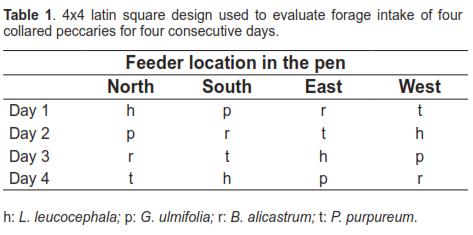
<body><![CDATA[<p>The nutritional requirements of collared   peccaries have been studied by Zervanos (1972),   who reported that the digestible energy requirement   of the peccary is 198 kcal / day / kg of metabolic   weight during winter and 153 kcal / day / kg of   metabolic weight during summer. Carl and Brown   (1985) mentioned that the peccary requires 6.8%   crude protein to meet its maintenance requirements,   while Sowls (1997) reported that it requires 10 to 15% dietary crude protein for growth.</p>     <p>Some studies suggest that domesticated   herbivorous species such as the collared peccary   have the ability to select their food based on the   energy and protein content of the diet. These   animals tend to maximize or minimize their intake   of these nutrients according to their needs and   the concentration of anti-nutritional substances (Cassini, 1994).</p>     <p>There is little information about the collared   peccary's preference of native forages, which is   important when formulating diets that include local   and readily available feedstuffs (Mukul, 2003; Montes, 2005).</p>     <p>Based on the above, the objective of this study   was to evaluate preferences among several fodder   plant species (<i>Leucaena leucocephala</i>, <i>Guazuma ulmifolia</i>, <i>Brosimum alicastrum</i>, and <i>Penisetum   purpureum</i>) as a feed source for collared peccaries (<i>P. tajacu</i>) in captivity.</p>     <p>&nbsp;</p>     <p><b><font size="3">Materials and methods</font></b></p>     <p>The study was conducted at the Xmatkuil   Management and Wildlife Conservation Unit,   Municipality of Merida, Yucatan, Mexico. The   Unit is located 10 meters above sea level at the   Faculty of Veterinary Medicine of the Autonomous   University of Yucatan. The region's climate is subhumid   tropical, with rains in the summer, according   to K&ouml;ppen Awoig climate classification modified by   Garcia (1988). The maximum temperature varies   between 35 and 40 &deg;C and the average annual   temperature is 27 &deg;C. The relative humidity varies   from 65 to 90% (average 80%) and annual rainfall   is 935.5 mm. There are two seasons: rainy (June to   November) and dry (December to May) (Garcia, 1988).</p>     <p>Four unneutered, adult male collared peccaries   (<i>P. tajacu</i>) were used. Their average weight was   20 &plusmn; 1.8 kg. The animals were housed in a 100 m2   pen. The pen had a tin roof, feeders, drinking water supply, and a pond.</p>     <p>The experiment was divided into two stages.   The first phase was an adjustment period. At this   stage the animals were weighed and identified with   ear tags. Subsequently, four 60 x 40 cm feeders   were placed in the pen. Each feeder contained   one of the substrates under evaluation: Huaxin   (<i>L. leucocephala</i>), Pixoy (G. <i>ulmifolia</i>), Ramon   (B. <i>alicastrum</i>), or Taiwan grass (<i>P. purpureum</i>).   Feed was placed in the pen for 3 to 4 hours.   Subsequently, rejected feed was removed and   weighed to determine the amount of dry matter   intake. Following this, a basal diet was offered. This   diet consisted of pumpkin (<i>Cucurbita sp</i>), papaya   (<i>Carica papaya</i>), cabbage (<i>Brassica oleracea</i>),   chayote (<i>S. edule</i>), and commercial pig-feed   (Lorgam, Mexico) with 9.5% crude protein. This   process was repeated during the four-day adaptation period.</p>     <p>During the second stage the same individuals   were used in a 4x4 latin square design with two   replicates. The treatments corresponded to each   of the four substrates: <i>L. leucocephala</i> (h), G.   <i>ulmifolia</i> (p), <i>B. alicastrum</i> (r) and <i>P. purpureum</i> (t),   which were randomly placed in the North, South,   East, or West position for four consecutive days,   respectively. The location of fodders was changed   according to the Latin square design shown in <a href="#t1">table 1</a>.</p>     ]]></body>
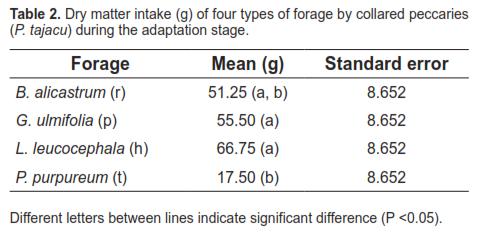
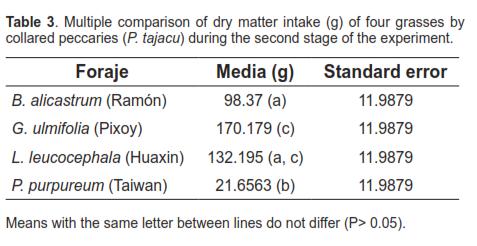
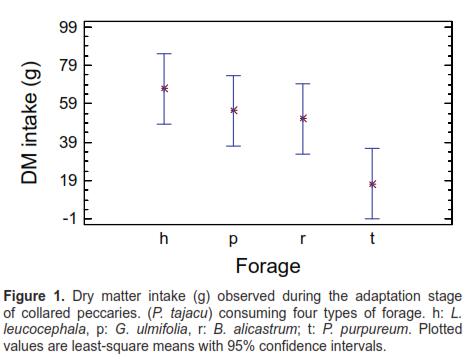
<body><![CDATA[<p align="center"><a name="t1"></a><img src="/img/revistas/rccp/v25n4/v25n4a6t1.jpg" /></p>     <p>Estimation of dry matter content of the feed   was conducted according to the report by Castillo   <i>et al.</i> (2009). Forage intake was estimated from   the difference between dry matter offered and   rejected in each treatment. The sources of variation   for the variance analysis were days, feeder   location, replicate, and forage. The multiple means   comparisons were conducted with the Tukey test   (Steel and Torrie, 1985). The Statgraphics 5.1 software was used for the statistical analysis.</p>     <p>&nbsp;</p>     <p><b><font size="3">Results</font></b></p>     <p>   Forage dry matter intake during the adaptation   phase is shown in <a href="#f1">figure 1</a>.</p>     <p align="center"><a name="f1"></a><img src="/img/revistas/rccp/v25n4/v25n4a6f1.jpg" /></p>     <p><a href="#t2">Table 2</a> shows means and standard errors of   dry matter intake for the tested forage during the   adaptation phase and the statistical differences between them.</p>     <p align="center"><a name="t2"></a><img src="/img/revistas/rccp/v25n4/v25n4a6t2.jpg" /></p>     <p>Differences in forage intake were detected   during the second stage. Intake was highest for   Pixoy (G. <i>ulmifolia</i>) and lowest for Taiwan grass (<i>P. purpureum</i>), as shown in <a href="#f2">figure 2</a>.</p>     <p align="center"><a name="f2"></a><img src="/img/revistas/rccp/v25n4/v25n4a7f2.jpg" /></p>     ]]></body>
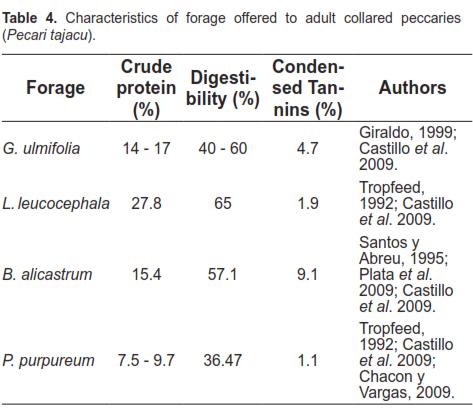
<body><![CDATA[<p>Analysis of variance showed highly significant   differences for dry matter intake between treatments   (P &lt;0.01). The multiple means comparison showed   that G. <i>ulmifolia</i> forage was the most consumed,   followed by <i>L. leucocephala</i> and <i>B. alicastrum</i>,   while <i>P. purpureum</i> was consumed the least. These results are shown in <a href="#t3">table 3</a>.</p>     <p align="center"><a name="t3"></a><img src="/img/revistas/rccp/v25n4/v25n4a6t3.jpg" /></p>     <p>&nbsp;</p>     <p><font size="3"><b>Discussion</b></font></p>     <p>Mean dry matter intake of <i>B. alicastrum</i>, G.   <i>ulmifolia</i>, and <i>L. leucocephala</i> showed no significant   differences during the adaptation stage. There   was only a difference between the last two and <i>P.   purpureum</i>. Dry matter intakes were relatively lower   than those recorded in the second stage. Given the   short period of time in which forage was offered,   these results were expected for this stage. Moreover,   at this stage the aim was not to evaluate forage   preference but introducing the feed substrates to the   animals prior to the second stage, as recommended   in related studies (Garcia <i>et al.</i>, 2008a; Garcia <i>et al.</i> 2008b). In the second stage, the Latin square   design lasted four days, with periods of four hours   each, replicated twice, with significant differences at   1%. This is consistent with the statistical inference   principle, which states that design accuracy improves   by increasing the number of replicas, allowing the   detection of significant differences in the response variables (Wackerly <i>et al.</i>, 2002).</p>     <p>In the second stage, intake differences were   observed for two occasions of tree foraging. The   Ramon (<i>B. alicastrum</i>) as Huaxin (<i>L. leucocephala</i>)   and Pixoy (<i>G. ulmifolia</i>) are native forage that have   been traditionally used for feeding cattle and pigs   in Yucatan (Acosta <i>et al.</i>, 1998). However, they are   not widely used in commercial livestock operations.   Despite this, they have high amounts of crude   protein and condensed tannins in comparison to   Taiwan grass (<i>P. purpureum</i>). <a href="#t4">Table 4</a> shows some characteristics of the tree forage tested in this study.</p>     <p align="center"><a name="t4"></a><img src="/img/revistas/rccp/v25n4/v25n4a6t4.jpg" /></p>     <p><i>G. ulmifolia</i> has relatively high moisture content   (34.98%) compared to <i>B. alicastrum</i> (10%) and <i>L.   leucocephala</i> (3.3%) (Medina, 2000). It is therefore   expected to retain moisture for longer periods   of time, which is an advantage due to the high   temperature conditions in the area where water   loss is significant when cut forage is offered. These   characteristics could explain why <i>G. ulmifolia</i>  forage was most preferred by peccaries. These   results are in agreement with studies by Martinez-   Romero and Mandujano (1995), and Garcia <i>et al.</i>   (1992), who reported that the peccary eats mostly   leaves and branches of <i>B. alicastrum</i> during most   of the year, and fruits of <i>G. ulmifolia</i> in the fruiting season.</p>     <p>Possible causes for the increased intake of   native forage compared with <i>P. purpureum</i> are the   relatively high content of crude protein and the   amount of condensed tannins. Castillo <i>et al.</i> (2009)   reported that there is a positive linear relationship   between amount of crude protein and condensed   tannins with dry matter intake of four types of   forage tested for white-tailed deer (<i>Odocoileus   virginianus</i>). Although the collared peccary seems   to be monogastric, its stomach produces volatile   fatty acids (VFA), such as acetic, propionic, and   butyric, in amounts similar to bovines fed ryegrass   (<i>Lolium multiflorum</i>). For this reason, the peccary   has been considered a pseudo-ruminant (Sowls,   1997). It is therefore possible that peccaries have   an intermediary metabolism similar to that of   ruminants. Oliveira <i>et al.</i> (2009) indicated that P.   tajacu is able to use urea added to diets based on   corn, soybean, and Taiwan grass (<i>P. purpureum</i>).   They reported greater weight for the animals fed   urea compared with the control group (23.25 vs 22.08 kg, respectively).</p>     <p>The forage protein and dry matter content may   not be a limiting factor as peccaries have low   protein requirements (6.8%) in desert climates and   prairies of Texas (Carl and Brown, 1985). Arboreal   substrates offered in this evaluation had crude   protein (CP) levels exceeding the requirements,   except for Taiwan grass, which has minimal. This   suggests that native tree forage, rather than being   a basal diet food, can be given as a supplement   to the animals daily diet. Lopez <i>et al.</i> (2006)   note that under free-living conditions the whitelipped   peccaries (<i>Tayassu peccary</i>) are capable of   consuming a wide variety of foliage and fruit in   the rainforest of Costa Rica. The annual average   of crude protein thereof is 7.8%. During the   rainy season, when the feed supply is greater and   higher CP levels exist, peccaries reproduction   increases and lactation improves. This is the case   of <i>B. costaricensis</i> (15.9%) and <i>Ficus sp</i> (16.2%),   indicating that the <i>Tayassuidae</i> family is highly   adapted and resilient to changes of the floristic composition of its habitat.</p>     ]]></body>
<body><![CDATA[<p>Therefore, the diet formulation for confined   peccaries could be based on low-cost and   nutritionally adequate fruits, supplementing protein   with native forage such as those mentioned here.   This allows the producer to obtain crude protein   at a lower cost than that offered by the balanced   products in the market. Another advantage is that   seeds of this native forage are readily available and   very drought resistant. Taiwan grass would be less   useful since it requires an adequate irrigation system   to ensure optimal growth (Espinoza <i>et al.</i>, 2001).   The forage yield (biomass per hectare) and growth   in order from highest to lowest is <i>L. leucocephala</i>,   <i>G. ulmifolia</i>, and <i>B. alicastrum</i>. The latter requires   a period of 3-4 years to reach optimum performance (Monforte, 2002).</p>     <p>&nbsp;</p>     <p><b><font size="3">References</font></b></p>     <!-- ref --><p>   1. Acosta BLE, Flores GJS, G&oacute;mez PA. Uso y manejo de plantas   forrajeras para cr&iacute;a de animales dentro del solar en una   comunidad maya en Yucat&aacute;n. Etnoflora Yucatanense, Fasc&iacute;culo   14. Yucat&aacute;n M&eacute;xico: Universidad Aut&oacute;noma de Yucat&aacute;n; 1998.    &nbsp;&nbsp;&nbsp;&nbsp;&nbsp;&nbsp;&nbsp;&nbsp;[&#160;<a href="javascript:void(0);" onclick="javascript: window.open('/scielo.php?script=sci_nlinks&ref=000066&pid=S0120-0690201200040000600001&lng=','','width=640,height=500,resizable=yes,scrollbars=1,menubar=yes,');">Links</a>&#160;]<!-- end-ref --></p>     <!-- ref --><p>   2. Carl GR, Brown DR. Protein requirements of adult collared   peccaries. J Wild Manage 1985; 49:351-355.    &nbsp;&nbsp;&nbsp;&nbsp;&nbsp;&nbsp;&nbsp;&nbsp;[&#160;<a href="javascript:void(0);" onclick="javascript: window.open('/scielo.php?script=sci_nlinks&ref=000068&pid=S0120-0690201200040000600002&lng=','','width=640,height=500,resizable=yes,scrollbars=1,menubar=yes,');">Links</a>&#160;]<!-- end-ref --></p>     <!-- ref --><p>   3. Cassini M. Behavorial mechanisms of selection of diet   components and their ecological implications in herbivorous   mammals. J Mamm 1994; 75:733-740.    &nbsp;&nbsp;&nbsp;&nbsp;&nbsp;&nbsp;&nbsp;&nbsp;[&#160;<a href="javascript:void(0);" onclick="javascript: window.open('/scielo.php?script=sci_nlinks&ref=000070&pid=S0120-0690201200040000600003&lng=','','width=640,height=500,resizable=yes,scrollbars=1,menubar=yes,');">Links</a>&#160;]<!-- end-ref --></p>     <!-- ref --><p>   4. Castillo LFI, Montes PRC, Rodr&iacute;guez MCE. Preferencias de   consumo de cuatro forrajes por venado cola blanca (<i>Odocoileus   virginianus</i>) mantenidos en cautiverio en Yucat&aacute;n. Ciencia y   Agricultura 2009; 7:75-82.    &nbsp;&nbsp;&nbsp;&nbsp;&nbsp;&nbsp;&nbsp;&nbsp;[&#160;<a href="javascript:void(0);" onclick="javascript: window.open('/scielo.php?script=sci_nlinks&ref=000072&pid=S0120-0690201200040000600004&lng=','','width=640,height=500,resizable=yes,scrollbars=1,menubar=yes,');">Links</a>&#160;]<!-- end-ref --></p>     <!-- ref --><p>   5. Chacon HPA, Vargas RCF. Digestibilidad y calidad del   <i>Pennisetum purpureum</i> cv. King grass a tres edades de rebrote.   Agronom&iacute;a Mesoamericana 2009; 20:399-408.    &nbsp;&nbsp;&nbsp;&nbsp;&nbsp;&nbsp;&nbsp;&nbsp;[&#160;<a href="javascript:void(0);" onclick="javascript: window.open('/scielo.php?script=sci_nlinks&ref=000074&pid=S0120-0690201200040000600005&lng=','','width=640,height=500,resizable=yes,scrollbars=1,menubar=yes,');">Links</a>&#160;]<!-- end-ref --></p>     <!-- ref --><p>6. Espinoza F, Argenti P, Gil J, Le&oacute;n L, Perdomo E. Evaluaci&oacute;n   del pasto King grass (<i>Pennisetum purpureum</i> cv. King grass) en   asociaci&oacute;n con leguminosas forrajeras. Zootecnia Trop 2001; 19:59-71.    &nbsp;&nbsp;&nbsp;&nbsp;&nbsp;&nbsp;&nbsp;&nbsp;[&#160;<a href="javascript:void(0);" onclick="javascript: window.open('/scielo.php?script=sci_nlinks&ref=000076&pid=S0120-0690201200040000600006&lng=','','width=640,height=500,resizable=yes,scrollbars=1,menubar=yes,');">Links</a>&#160;]<!-- end-ref --></p>     <!-- ref --><p>   7. Garc&iacute;a SCLC, Casta&ntilde;eda MA, Santill&aacute;n AS. Requerimientos de   h&aacute;bitat y estudio preliminar sobre los h&aacute;bitos de alimentaci&oacute;n   del pecar&iacute; de collar (<i>Dicotyles tajacu</i>) en condiciones de   semicautiverio en el estado de Yucat&aacute;n. En: Memorias del X   Simposio sobre Fauna Silvestre ''Gral. MV. Manuel Valtierra''.   M&eacute;xico: UNAM y Gobierno del estado de Guerrero; 1992:271-   281.    &nbsp;&nbsp;&nbsp;&nbsp;&nbsp;&nbsp;&nbsp;&nbsp;[&#160;<a href="javascript:void(0);" onclick="javascript: window.open('/scielo.php?script=sci_nlinks&ref=000078&pid=S0120-0690201200040000600007&lng=','','width=640,height=500,resizable=yes,scrollbars=1,menubar=yes,');">Links</a>&#160;]<!-- end-ref --></p>     <!-- ref --><p>   8. Garc&iacute;a E. Modificaciones al sistema de clasificaci&oacute;n clim&aacute;tica   de K&ouml;ppen. 4<sup>a</sup> edici&oacute;n. M&eacute;xico, D.F: Instituto de Geograf&iacute;a,   Universidad Nacional Aut&oacute;noma de M&eacute;xico; 1988.    &nbsp;&nbsp;&nbsp;&nbsp;&nbsp;&nbsp;&nbsp;&nbsp;[&#160;<a href="javascript:void(0);" onclick="javascript: window.open('/scielo.php?script=sci_nlinks&ref=000080&pid=S0120-0690201200040000600008&lng=','','width=640,height=500,resizable=yes,scrollbars=1,menubar=yes,');">Links</a>&#160;]<!-- end-ref --></p>     <!-- ref --><p>   9. Garc&iacute;a DE, Medina GM, Clavero T, Humbr&iacute;a J, Baldizan A,   Dom&iacute;nguez C. Preferencia de &aacute;rboles forrajeros por cabras en   la zona baja de los andes venezolanos. Rev Cientif FCV-LUZ   2008a; XVIII: 549-555.    &nbsp;&nbsp;&nbsp;&nbsp;&nbsp;&nbsp;&nbsp;&nbsp;[&#160;<a href="javascript:void(0);" onclick="javascript: window.open('/scielo.php?script=sci_nlinks&ref=000082&pid=S0120-0690201200040000600009&lng=','','width=640,height=500,resizable=yes,scrollbars=1,menubar=yes,');">Links</a>&#160;]<!-- end-ref --></p>     <!-- ref --><p>   10. Garc&iacute;a DE, Medina MG, Cova LJ, Humbr&iacute;a J, Torres A,   Moratinos P. Preferencia caprina por especies forrajeras con   amplia distribuci&oacute;n en el estado Trujillo, Venezuela. Arch   Zootec 2008b; 57:403-413.    &nbsp;&nbsp;&nbsp;&nbsp;&nbsp;&nbsp;&nbsp;&nbsp;[&#160;<a href="javascript:void(0);" onclick="javascript: window.open('/scielo.php?script=sci_nlinks&ref=000084&pid=S0120-0690201200040000600010&lng=','','width=640,height=500,resizable=yes,scrollbars=1,menubar=yes,');">Links</a>&#160;]<!-- end-ref --></p>     <!-- ref --><p>   11. Giraldo A. Potencial del gu&aacute;cimo (<i>Guazuma ulmifolia</i>) en   sistemas silvopastoriles. En: Memorias de la Conferencia   Electr&oacute;nica Agroforester&iacute;a para la Producci&oacute;n Animal en   Am&eacute;rica Latina. S&aacute;nchez MD y Rosales M, editores. Roma:   Estudio FAO Producci&oacute;n y Sanidad Animal, 1999. p. 295-308.    &nbsp;&nbsp;&nbsp;&nbsp;&nbsp;&nbsp;&nbsp;&nbsp;[&#160;<a href="javascript:void(0);" onclick="javascript: window.open('/scielo.php?script=sci_nlinks&ref=000086&pid=S0120-0690201200040000600011&lng=','','width=640,height=500,resizable=yes,scrollbars=1,menubar=yes,');">Links</a>&#160;]<!-- end-ref --></p>     <!-- ref --><p>   12. Gisela C, Garc&iacute;a C, Leal LM. Morfolog&iacute;a del est&oacute;mago e   intestino grueso del b&aacute;quiro de collar (<i>Tayassu tajacu</i>). Vet Trop   2003; 28:117-134.    &nbsp;&nbsp;&nbsp;&nbsp;&nbsp;&nbsp;&nbsp;&nbsp;[&#160;<a href="javascript:void(0);" onclick="javascript: window.open('/scielo.php?script=sci_nlinks&ref=000088&pid=S0120-0690201200040000600012&lng=','','width=640,height=500,resizable=yes,scrollbars=1,menubar=yes,');">Links</a>&#160;]<!-- end-ref --></p>     <!-- ref --><p>   13. L&oacute;pez TM, Altrichter M, S&aacute;enz J, Eduarte E. Valor nutricional   de los alimentos de <i>Tayassu pecari</i> (Artiodactyla: Tayassuidae)   en el Parque Nacional Corcovado, Costa Rica. Rev Biol Trop   2006; 54:687-700.    &nbsp;&nbsp;&nbsp;&nbsp;&nbsp;&nbsp;&nbsp;&nbsp;[&#160;<a href="javascript:void(0);" onclick="javascript: window.open('/scielo.php?script=sci_nlinks&ref=000090&pid=S0120-0690201200040000600013&lng=','','width=640,height=500,resizable=yes,scrollbars=1,menubar=yes,');">Links</a>&#160;]<!-- end-ref --></p>     <!-- ref --><p>   14. Mart&iacute;nez-Romero LE, Mandujano S. H&aacute;bitos alimenticios   del pecar&iacute; de collar (<i>Pecari tajacu</i>) en un bosque tropical   caducifolio de Jalisco, M&eacute;xico. Acta Zool Mex (n.s.) 1995;   64:1-20.    &nbsp;&nbsp;&nbsp;&nbsp;&nbsp;&nbsp;&nbsp;&nbsp;[&#160;<a href="javascript:void(0);" onclick="javascript: window.open('/scielo.php?script=sci_nlinks&ref=000092&pid=S0120-0690201200040000600014&lng=','','width=640,height=500,resizable=yes,scrollbars=1,menubar=yes,');">Links</a>&#160;]<!-- end-ref --></p>     <!-- ref --><p>   15. Medina PA. Evaluaci&oacute;n agron&oacute;mica de cinco especies de &aacute;rboles forrajeros en la zona henequenera de Yucat&aacute;n. Tesis profesional. Universidad Aut&oacute;noma de Chapingo, M&eacute;rida. 2000.    &nbsp;&nbsp;&nbsp;&nbsp;&nbsp;&nbsp;&nbsp;&nbsp;[&#160;<a href="javascript:void(0);" onclick="javascript: window.open('/scielo.php?script=sci_nlinks&ref=000094&pid=S0120-0690201200040000600015&lng=','','width=640,height=500,resizable=yes,scrollbars=1,menubar=yes,');">Links</a>&#160;]<!-- end-ref --></p>     <!-- ref --><p>   16. Monforte C. Efecto de la carga animal y la suplementaci&oacute;n   con follaje de Leucaena sobre los cambios de peso vivo y el   comportamiento reproductivo de vacas cruzadas (<i>Bos taurus</i>  x <i>Bos indicus</i>) en la zona centro del estado de Yucat&aacute;n. Tesis   profesional. Universidad Aut&oacute;noma de Yucat&aacute;n, M&eacute;rida; 2002.    &nbsp;&nbsp;&nbsp;&nbsp;&nbsp;&nbsp;&nbsp;&nbsp;[&#160;<a href="javascript:void(0);" onclick="javascript: window.open('/scielo.php?script=sci_nlinks&ref=000096&pid=S0120-0690201200040000600016&lng=','','width=640,height=500,resizable=yes,scrollbars=1,menubar=yes,');">Links</a>&#160;]<!-- end-ref --></p>     <!-- ref --><p>   17. Montes PRC. Manual para la crianza del kitam o pecar&iacute; de   collar (<i>Pecari tajacu</i>) en corral. M&eacute;rida, Yucat&aacute;n, M&eacute;xico:   Consejo Editorial de la Universidad Aut&oacute;noma de Yucat&aacute;n;   2005.    &nbsp;&nbsp;&nbsp;&nbsp;&nbsp;&nbsp;&nbsp;&nbsp;[&#160;<a href="javascript:void(0);" onclick="javascript: window.open('/scielo.php?script=sci_nlinks&ref=000098&pid=S0120-0690201200040000600017&lng=','','width=640,height=500,resizable=yes,scrollbars=1,menubar=yes,');">Links</a>&#160;]<!-- end-ref --></p> </font>     <!-- ref --><p><font size="2" face="Verdana, Arial, Helvetica, sans-serif">   18. Mukul YJM. Algunas variables fisiol&oacute;gicas y cambios de peso   en pecar&iacute;es de collar (<i>Pecari tajacu</i>) alimentados con dietas   de ma&iacute;z, ram&oacute;n y calabaza. Tesis profesional. Facultad de   Medicina Veterinaria y Zootecnia. Universidad Aut&oacute;noma de   Yucat&aacute;n, M&eacute;rida; 2003.    &nbsp;&nbsp;&nbsp;&nbsp;&nbsp;&nbsp;&nbsp;&nbsp;[&#160;<a href="javascript:void(0);" onclick="javascript: window.open('/scielo.php?script=sci_nlinks&ref=000100&pid=S0120-0690201200040000600018&lng=','','width=640,height=500,resizable=yes,scrollbars=1,menubar=yes,');">Links</a>&#160;]<!-- end-ref --></font></p> <font face="Verdana, Arial, Helvetica, sans-serif" size="2">     <!-- ref --><p>   19. Oliveira EG, Santos ACF, D&iacute;as JCT, Rezende RP, Nogueira-   Filho SLG, Gross E. The influence of urea feeding on the   bacterial and archaeal community in the forestomach of collared   peccary (Artiodactyla, tayassuidae). J Appl Microbiol 2009;   107:1711-1718.    &nbsp;&nbsp;&nbsp;&nbsp;&nbsp;&nbsp;&nbsp;&nbsp;[&#160;<a href="javascript:void(0);" onclick="javascript: window.open('/scielo.php?script=sci_nlinks&ref=000102&pid=S0120-0690201200040000600019&lng=','','width=640,height=500,resizable=yes,scrollbars=1,menubar=yes,');">Links</a>&#160;]<!-- end-ref --></p>     <!-- ref --><p>   20. Plata FX, Ebergeny S, Resendiz JL, Villarreal O, B&aacute;rcena R,   Viccon JA, Mendoza GD. Palatabilidad y composici&oacute;n qu&iacute;mica   de alimentos consumidos en cautiverio por el venado cola   blanca de Yucat&aacute;n (<i>Odocoileus virginianus yucatanensis</i>). Arc   Med Vet 2009; 41:123-129&nbsp;&nbsp;&nbsp;&nbsp;&nbsp;&nbsp;&nbsp;&nbsp;[&#160;<a href="javascript:void(0);" onclick="javascript: window.open('/scielo.php?script=sci_nlinks&ref=000104&pid=S0120-0690201200040000600020&lng=','','width=640,height=500,resizable=yes,scrollbars=1,menubar=yes,');">Links</a>&#160;]<!-- end-ref --><!-- ref --><p>   21. Santos RRH, Abreu ESJ. Evaluaci&oacute;n nutricia de la <i>Leucaena leucocephala</i> y del <i>Brosimum alicastrum</i> y su empleo en la   alimentaci&oacute;n en cerdos. Vet Mex 1995, 26:1.    &nbsp;&nbsp;&nbsp;&nbsp;&nbsp;&nbsp;&nbsp;&nbsp;[&#160;<a href="javascript:void(0);" onclick="javascript: window.open('/scielo.php?script=sci_nlinks&ref=000105&pid=S0120-0690201200040000600021&lng=','','width=640,height=500,resizable=yes,scrollbars=1,menubar=yes,');">Links</a>&#160;]<!-- end-ref --></p>     <!-- ref --><p>   22. Sowls L. Javelinas and other Peccaries their biology,   management, and use. Tucson Arizona: Texas A &amp; M University   press college station;1997.    &nbsp;&nbsp;&nbsp;&nbsp;&nbsp;&nbsp;&nbsp;&nbsp;[&#160;<a href="javascript:void(0);" onclick="javascript: window.open('/scielo.php?script=sci_nlinks&ref=000107&pid=S0120-0690201200040000600022&lng=','','width=640,height=500,resizable=yes,scrollbars=1,menubar=yes,');">Links</a>&#160;]<!-- end-ref --></p>     <!-- ref --><p>   23. Steel GDR, Torrie HJ. Bioestad&iacute;stica: Principios y   Procedimientos. 2<sup>a</sup> ed. (1<sup>a</sup> ed. en espa&ntilde;ol). Bogot&aacute;: McGraw-   Hill Latinoamericana; 1985.    &nbsp;&nbsp;&nbsp;&nbsp;&nbsp;&nbsp;&nbsp;&nbsp;[&#160;<a href="javascript:void(0);" onclick="javascript: window.open('/scielo.php?script=sci_nlinks&ref=000109&pid=S0120-0690201200040000600023&lng=','','width=640,height=500,resizable=yes,scrollbars=1,menubar=yes,');">Links</a>&#160;]<!-- end-ref --></p>     <!-- ref --><p>   24. Tropfeed (Tropical feeds). Version 3.1 Software developing by   Oxford Computer Journals. Rome: FAO; 1992.    &nbsp;&nbsp;&nbsp;&nbsp;&nbsp;&nbsp;&nbsp;&nbsp;[&#160;<a href="javascript:void(0);" onclick="javascript: window.open('/scielo.php?script=sci_nlinks&ref=000111&pid=S0120-0690201200040000600024&lng=','','width=640,height=500,resizable=yes,scrollbars=1,menubar=yes,');">Links</a>&#160;]<!-- end-ref --></p>     ]]></body>
<body><![CDATA[<!-- ref --><p>   25. Wackerly DD, Mendenhall III W, Scheaffer RL. Estad&iacute;stica   matem&aacute;tica con aplicaciones. 6<sup>a</sup> ed. M&eacute;xico D.F.: Thomson.   2002.    &nbsp;&nbsp;&nbsp;&nbsp;&nbsp;&nbsp;&nbsp;&nbsp;[&#160;<a href="javascript:void(0);" onclick="javascript: window.open('/scielo.php?script=sci_nlinks&ref=000113&pid=S0120-0690201200040000600025&lng=','','width=640,height=500,resizable=yes,scrollbars=1,menubar=yes,');">Links</a>&#160;]<!-- end-ref --></p>     <!-- ref --><p>   26. Zervanos SM. Thermoregulation and water relations of the   collared peccary (<i>Tayassu tajacu</i>). Doctor of Philosophy Thesis.   Arizona State University, Tempe. 1972.    &nbsp;&nbsp;&nbsp;&nbsp;&nbsp;&nbsp;&nbsp;&nbsp;[&#160;<a href="javascript:void(0);" onclick="javascript: window.open('/scielo.php?script=sci_nlinks&ref=000115&pid=S0120-0690201200040000600026&lng=','','width=640,height=500,resizable=yes,scrollbars=1,menubar=yes,');">Links</a>&#160;]<!-- end-ref --></p>     <p>&nbsp;</p>     <p><b><font size="3">Notas al pie</font></b> </p>     <p><sup><a href="#b0">&curren;</a><a name="0"></a></sup> To cite this article: Montes RC, Mora O, Mukul JM. Forage Intake of the Collared peccary (Pecari tajacu). Rev Colomb Cienc Pecu 2012; 25:586-591.</p>     <p>&nbsp;</p> </font>      ]]></body><back>
<ref-list>
<ref id="B1">
<label>1</label><nlm-citation citation-type="book">
<person-group person-group-type="author">
<name>
<surname><![CDATA[Acosta]]></surname>
<given-names><![CDATA[BLE]]></given-names>
</name>
<name>
<surname><![CDATA[Flores]]></surname>
<given-names><![CDATA[GJS]]></given-names>
</name>
<name>
<surname><![CDATA[Gómez]]></surname>
<given-names><![CDATA[PA.]]></given-names>
</name>
</person-group>
<source><![CDATA[Uso y manejo de plantas forrajeras para cría de animales dentro del solar en una comunidad maya en Yucatán. Etnoflora Yucatanense, Fascículo 14.]]></source>
<year>1998</year>
<publisher-loc><![CDATA[Yucatán ]]></publisher-loc>
<publisher-name><![CDATA[Universidad Autónoma de Yucatán]]></publisher-name>
</nlm-citation>
</ref>
<ref id="B2">
<label>2</label><nlm-citation citation-type="journal">
<person-group person-group-type="author">
<name>
<surname><![CDATA[Carl]]></surname>
<given-names><![CDATA[GR]]></given-names>
</name>
<name>
<surname><![CDATA[Brown]]></surname>
<given-names><![CDATA[DR]]></given-names>
</name>
</person-group>
<article-title xml:lang="en"><![CDATA[Protein requirements of adult collared peccaries]]></article-title>
<source><![CDATA[J Wild Manage]]></source>
<year>1985</year>
<volume>49</volume>
<page-range>351-355</page-range></nlm-citation>
</ref>
<ref id="B3">
<label>3</label><nlm-citation citation-type="journal">
<person-group person-group-type="author">
<name>
<surname><![CDATA[Cassini]]></surname>
<given-names><![CDATA[M]]></given-names>
</name>
</person-group>
<article-title xml:lang="en"><![CDATA[Behavorial mechanisms of selection of diet components and their ecological implications in herbivorous mammals]]></article-title>
<source><![CDATA[J Mamm]]></source>
<year>1994</year>
<volume>75</volume>
<page-range>733-740</page-range></nlm-citation>
</ref>
<ref id="B4">
<label>4</label><nlm-citation citation-type="journal">
<person-group person-group-type="author">
<name>
<surname><![CDATA[Castillo]]></surname>
<given-names><![CDATA[LFI]]></given-names>
</name>
<name>
<surname><![CDATA[Montes]]></surname>
<given-names><![CDATA[PRC]]></given-names>
</name>
<name>
<surname><![CDATA[Rodríguez]]></surname>
<given-names><![CDATA[MCE]]></given-names>
</name>
</person-group>
<article-title xml:lang="es"><![CDATA[Preferencias de consumo de cuatro forrajes por venado cola blanca (Odocoileus virginianus) mantenidos en cautiverio en Yucatán]]></article-title>
<source><![CDATA[Ciencia y Agricultura]]></source>
<year>2009</year>
<volume>7</volume>
<page-range>75-82</page-range></nlm-citation>
</ref>
<ref id="B5">
<label>5</label><nlm-citation citation-type="journal">
<person-group person-group-type="author">
<name>
<surname><![CDATA[Chacon]]></surname>
<given-names><![CDATA[HPA]]></given-names>
</name>
<name>
<surname><![CDATA[Vargas]]></surname>
<given-names><![CDATA[RCF]]></given-names>
</name>
</person-group>
<article-title xml:lang="es"><![CDATA[Digestibilidad y calidad del Pennisetum purpureum cv. King grass a tres edades de rebrote]]></article-title>
<source><![CDATA[Agronomía Mesoamericana]]></source>
<year>2009</year>
<volume>20</volume>
<page-range>399-408</page-range></nlm-citation>
</ref>
<ref id="B6">
<label>6</label><nlm-citation citation-type="journal">
<person-group person-group-type="author">
<name>
<surname><![CDATA[Espinoza]]></surname>
<given-names><![CDATA[F]]></given-names>
</name>
<name>
<surname><![CDATA[Argenti]]></surname>
<given-names><![CDATA[P]]></given-names>
</name>
<name>
<surname><![CDATA[Gil]]></surname>
<given-names><![CDATA[J]]></given-names>
</name>
<name>
<surname><![CDATA[León]]></surname>
<given-names><![CDATA[L]]></given-names>
</name>
<name>
<surname><![CDATA[Perdomo]]></surname>
<given-names><![CDATA[E]]></given-names>
</name>
</person-group>
<article-title xml:lang="es"><![CDATA[Evaluación del pasto King grass (Pennisetum purpureum cv. King grass) en asociación con leguminosas forrajeras]]></article-title>
<source><![CDATA[Zootecnia Trop]]></source>
<year>2001</year>
<volume>19</volume>
<page-range>59-71</page-range></nlm-citation>
</ref>
<ref id="B7">
<label>7</label><nlm-citation citation-type="book">
<person-group person-group-type="author">
<name>
<surname><![CDATA[García]]></surname>
<given-names><![CDATA[SCLC]]></given-names>
</name>
<name>
<surname><![CDATA[Castañeda]]></surname>
<given-names><![CDATA[MA]]></given-names>
</name>
<name>
<surname><![CDATA[Santillán]]></surname>
<given-names><![CDATA[AS.]]></given-names>
</name>
</person-group>
<article-title xml:lang="es"><![CDATA[Requerimientos de hábitat y estudio preliminar sobre los hábitos de alimentación del pecarí de collar (Dicotyles tajacu) en condiciones de semicautiverio en el estado de Yucatán]]></article-title>
<source><![CDATA[Memorias del X Simposio sobre Fauna Silvestre ''Gral. MV. Manuel Valtierra'']]></source>
<year>1992</year>
<page-range>271- 281</page-range><publisher-loc><![CDATA[México ]]></publisher-loc>
<publisher-name><![CDATA[UNAM y Gobierno del estado de Guerrero]]></publisher-name>
</nlm-citation>
</ref>
<ref id="B8">
<label>8</label><nlm-citation citation-type="book">
<person-group person-group-type="author">
<name>
<surname><![CDATA[García]]></surname>
<given-names><![CDATA[E.]]></given-names>
</name>
</person-group>
<source><![CDATA[Modificaciones al sistema de clasificación climática de Köppen]]></source>
<year>1988</year>
<edition>4ª</edition>
<publisher-loc><![CDATA[México^eD.F D.F]]></publisher-loc>
<publisher-name><![CDATA[Instituto de Geografía, Universidad Nacional Autónoma de México]]></publisher-name>
</nlm-citation>
</ref>
<ref id="B9">
<label>9</label><nlm-citation citation-type="journal">
<person-group person-group-type="author">
<name>
<surname><![CDATA[García]]></surname>
<given-names><![CDATA[DE]]></given-names>
</name>
<name>
<surname><![CDATA[Medina]]></surname>
<given-names><![CDATA[GM]]></given-names>
</name>
<name>
<surname><![CDATA[Clavero]]></surname>
<given-names><![CDATA[T]]></given-names>
</name>
<name>
<surname><![CDATA[Humbría]]></surname>
<given-names><![CDATA[J]]></given-names>
</name>
<name>
<surname><![CDATA[Baldizan]]></surname>
<given-names><![CDATA[A]]></given-names>
</name>
<name>
<surname><![CDATA[Domínguez]]></surname>
<given-names><![CDATA[C]]></given-names>
</name>
</person-group>
<article-title xml:lang="es"><![CDATA[Preferencia de árboles forrajeros por cabras en la zona baja de los andes venezolanos]]></article-title>
<source><![CDATA[Rev Cientif FCV-LUZ]]></source>
<year>2008</year>
<month>a</month>
<volume>XVIII</volume>
<page-range>549-555</page-range></nlm-citation>
</ref>
<ref id="B10">
<label>10</label><nlm-citation citation-type="journal">
<person-group person-group-type="author">
<name>
<surname><![CDATA[García]]></surname>
<given-names><![CDATA[DE]]></given-names>
</name>
<name>
<surname><![CDATA[Medina]]></surname>
<given-names><![CDATA[MG]]></given-names>
</name>
<name>
<surname><![CDATA[Cova]]></surname>
<given-names><![CDATA[LJ]]></given-names>
</name>
<name>
<surname><![CDATA[Humbría]]></surname>
<given-names><![CDATA[J]]></given-names>
</name>
<name>
<surname><![CDATA[Torres]]></surname>
<given-names><![CDATA[A]]></given-names>
</name>
<name>
<surname><![CDATA[Moratinos]]></surname>
<given-names><![CDATA[P]]></given-names>
</name>
</person-group>
<article-title xml:lang="es"><![CDATA[Preferencia caprina por especies forrajeras con amplia distribución en el estado Trujillo, Venezuela]]></article-title>
<source><![CDATA[Arch Zootec]]></source>
<year>2008</year>
<month>b</month>
<volume>57</volume>
<page-range>403-413</page-range></nlm-citation>
</ref>
<ref id="B11">
<label>11</label><nlm-citation citation-type="book">
<person-group person-group-type="author">
<name>
<surname><![CDATA[Giraldo]]></surname>
<given-names><![CDATA[A.]]></given-names>
</name>
</person-group>
<article-title xml:lang="es"><![CDATA[Potencial del guácimo (Guazuma ulmifolia) en sistemas silvopastoriles]]></article-title>
<person-group person-group-type="editor">
<name>
<surname><![CDATA[Sánchez]]></surname>
<given-names><![CDATA[MD]]></given-names>
</name>
<name>
<surname><![CDATA[Rosales]]></surname>
<given-names><![CDATA[M]]></given-names>
</name>
</person-group>
<source><![CDATA[Memorias de la Conferencia Electrónica Agroforestería para la Producción Animal en América Latina]]></source>
<year>1999</year>
<page-range>295-308</page-range><publisher-loc><![CDATA[Roma ]]></publisher-loc>
<publisher-name><![CDATA[Estudio FAO Producción y Sanidad Animal]]></publisher-name>
</nlm-citation>
</ref>
<ref id="B12">
<label>12</label><nlm-citation citation-type="journal">
<person-group person-group-type="author">
<name>
<surname><![CDATA[Gisela]]></surname>
<given-names><![CDATA[C]]></given-names>
</name>
<name>
<surname><![CDATA[García]]></surname>
<given-names><![CDATA[C]]></given-names>
</name>
<name>
<surname><![CDATA[Leal]]></surname>
<given-names><![CDATA[LM]]></given-names>
</name>
</person-group>
<article-title xml:lang="es"><![CDATA[Morfología del estómago e intestino grueso del báquiro de collar (Tayassu tajacu)]]></article-title>
<source><![CDATA[Vet Trop]]></source>
<year>2003</year>
<volume>28</volume>
<page-range>117-134</page-range></nlm-citation>
</ref>
<ref id="B13">
<label>13</label><nlm-citation citation-type="journal">
<person-group person-group-type="author">
<name>
<surname><![CDATA[López]]></surname>
<given-names><![CDATA[TM]]></given-names>
</name>
<name>
<surname><![CDATA[Altrichter]]></surname>
<given-names><![CDATA[M]]></given-names>
</name>
<name>
<surname><![CDATA[Sáenz]]></surname>
<given-names><![CDATA[J]]></given-names>
</name>
<name>
<surname><![CDATA[Eduarte]]></surname>
<given-names><![CDATA[E]]></given-names>
</name>
</person-group>
<article-title xml:lang="es"><![CDATA[Valor nutricional de los alimentos de Tayassu pecari (Artiodactyla: Tayassuidae) en el Parque Nacional Corcovado, Costa Rica]]></article-title>
<source><![CDATA[Rev Biol Trop]]></source>
<year>2006</year>
<volume>54</volume>
<page-range>687-700</page-range></nlm-citation>
</ref>
<ref id="B14">
<label>14</label><nlm-citation citation-type="journal">
<person-group person-group-type="author">
<name>
<surname><![CDATA[Martínez-Romero]]></surname>
<given-names><![CDATA[LE]]></given-names>
</name>
<name>
<surname><![CDATA[Mandujano]]></surname>
<given-names><![CDATA[S.]]></given-names>
</name>
</person-group>
<article-title xml:lang="es"><![CDATA[Hábitos alimenticios del pecarí de collar (Pecari tajacu) en un bosque tropical caducifolio de Jalisco, México]]></article-title>
<source><![CDATA[Acta Zool Mex]]></source>
<year>1995</year>
<volume>64</volume>
<page-range>1-20</page-range></nlm-citation>
</ref>
<ref id="B15">
<label>15</label><nlm-citation citation-type="">
<person-group person-group-type="author">
<name>
<surname><![CDATA[Medina]]></surname>
<given-names><![CDATA[PA.]]></given-names>
</name>
</person-group>
<source><![CDATA[Evaluación agronómica de cinco especies de árboles forrajeros en la zona henequenera de Yucatán]]></source>
<year></year>
</nlm-citation>
</ref>
<ref id="B16">
<label>16</label><nlm-citation citation-type="">
<person-group person-group-type="author">
<name>
<surname><![CDATA[Monforte]]></surname>
<given-names><![CDATA[C.]]></given-names>
</name>
</person-group>
<source><![CDATA[Efecto de la carga animal y la suplementación con follaje de Leucaena sobre los cambios de peso vivo y el comportamiento reproductivo de vacas cruzadas (Bos taurus x Bos indicus) en la zona centro del estado de Yucatán]]></source>
<year></year>
</nlm-citation>
</ref>
<ref id="B17">
<label>17</label><nlm-citation citation-type="book">
<person-group person-group-type="author">
<name>
<surname><![CDATA[Montes]]></surname>
<given-names><![CDATA[PRC.]]></given-names>
</name>
</person-group>
<source><![CDATA[Manual para la crianza del kitam o pecarí de collar (Pecari tajacu) en corral]]></source>
<year>2005</year>
<publisher-loc><![CDATA[Mérida^eYucatán Yucatán]]></publisher-loc>
<publisher-name><![CDATA[Consejo Editorial de la Universidad Autónoma de Yucatán]]></publisher-name>
</nlm-citation>
</ref>
<ref id="B18">
<label>18</label><nlm-citation citation-type="">
<person-group person-group-type="author">
<name>
<surname><![CDATA[Mukul]]></surname>
<given-names><![CDATA[YJM.]]></given-names>
</name>
</person-group>
<source><![CDATA[Algunas variables fisiológicas y cambios de peso en pecaríes de collar (Pecari tajacu) alimentados con dietas de maíz, ramón y calabaza]]></source>
<year></year>
</nlm-citation>
</ref>
<ref id="B19">
<label>19</label><nlm-citation citation-type="journal">
<person-group person-group-type="author">
<name>
<surname><![CDATA[Oliveira]]></surname>
<given-names><![CDATA[EG]]></given-names>
</name>
<name>
<surname><![CDATA[Santos]]></surname>
<given-names><![CDATA[ACF]]></given-names>
</name>
<name>
<surname><![CDATA[Días]]></surname>
<given-names><![CDATA[JCT]]></given-names>
</name>
<name>
<surname><![CDATA[Rezende]]></surname>
<given-names><![CDATA[RP]]></given-names>
</name>
<name>
<surname><![CDATA[Nogueira-Filho]]></surname>
<given-names><![CDATA[SLG]]></given-names>
</name>
<name>
<surname><![CDATA[Gross]]></surname>
<given-names><![CDATA[E]]></given-names>
</name>
</person-group>
<article-title xml:lang="en"><![CDATA[The influence of urea feeding on the bacterial and archaeal community in the forestomach of collared peccary (Artiodactyla, tayassuidae)]]></article-title>
<source><![CDATA[J Appl Microbiol]]></source>
<year>2009</year>
<volume>107</volume>
<page-range>1711-1718</page-range></nlm-citation>
</ref>
<ref id="B20">
<label>20</label><nlm-citation citation-type="journal">
<person-group person-group-type="author">
<name>
<surname><![CDATA[Plata]]></surname>
<given-names><![CDATA[FX]]></given-names>
</name>
<name>
<surname><![CDATA[Ebergeny]]></surname>
<given-names><![CDATA[S]]></given-names>
</name>
<name>
<surname><![CDATA[Resendiz]]></surname>
<given-names><![CDATA[JL]]></given-names>
</name>
<name>
<surname><![CDATA[Villarreal]]></surname>
<given-names><![CDATA[O]]></given-names>
</name>
<name>
<surname><![CDATA[Bárcena]]></surname>
<given-names><![CDATA[R]]></given-names>
</name>
<name>
<surname><![CDATA[Viccon]]></surname>
<given-names><![CDATA[JA]]></given-names>
</name>
<name>
<surname><![CDATA[Mendoza]]></surname>
<given-names><![CDATA[GD]]></given-names>
</name>
</person-group>
<article-title xml:lang="es"><![CDATA[Palatabilidad y composición química de alimentos consumidos en cautiverio por el venado cola blanca de Yucatán (Odocoileus virginianus yucatanensis)]]></article-title>
<source><![CDATA[Arc Med Vet]]></source>
<year>2009</year>
<volume>41</volume>
<page-range>123-129</page-range></nlm-citation>
</ref>
<ref id="B21">
<label>21</label><nlm-citation citation-type="journal">
<person-group person-group-type="author">
<name>
<surname><![CDATA[Santos]]></surname>
<given-names><![CDATA[RRH]]></given-names>
</name>
<name>
<surname><![CDATA[Abreu]]></surname>
<given-names><![CDATA[ESJ.]]></given-names>
</name>
</person-group>
<article-title xml:lang="es"><![CDATA[Evaluación nutricia de la Leucaena leucocephala y del Brosimum alicastrum y su empleo en la alimentación en cerdos]]></article-title>
<source><![CDATA[Vet Mex]]></source>
<year>1995</year>
<volume>26</volume>
<page-range>1</page-range></nlm-citation>
</ref>
<ref id="B22">
<label>22</label><nlm-citation citation-type="book">
<person-group person-group-type="author">
<name>
<surname><![CDATA[Sowls]]></surname>
<given-names><![CDATA[L.]]></given-names>
</name>
</person-group>
<source><![CDATA[Javelinas and other Peccaries their biology, management, and use]]></source>
<year>1997</year>
<publisher-loc><![CDATA[Tucson^eArizona Arizona]]></publisher-loc>
<publisher-name><![CDATA[Texas A & M University press college station]]></publisher-name>
</nlm-citation>
</ref>
<ref id="B23">
<label>23</label><nlm-citation citation-type="book">
<person-group person-group-type="author">
<name>
<surname><![CDATA[Steel]]></surname>
<given-names><![CDATA[GDR]]></given-names>
</name>
<name>
<surname><![CDATA[Torrie]]></surname>
<given-names><![CDATA[HJ.]]></given-names>
</name>
</person-group>
<source><![CDATA[Bioestadística: Principios y Procedimientos]]></source>
<year>1985</year>
<edition>2ª</edition>
<publisher-loc><![CDATA[Bogotá ]]></publisher-loc>
<publisher-name><![CDATA[McGraw- Hill Latinoamericana]]></publisher-name>
</nlm-citation>
</ref>
<ref id="B24">
<label>24</label><nlm-citation citation-type="book">
<collab>Tropfeed (Tropical feeds)</collab>
<source><![CDATA[Version 3.1 Software developing by Oxford Computer Journals]]></source>
<year>1992</year>
<publisher-loc><![CDATA[Rome ]]></publisher-loc>
<publisher-name><![CDATA[FAO]]></publisher-name>
</nlm-citation>
</ref>
<ref id="B25">
<label>25</label><nlm-citation citation-type="book">
<person-group person-group-type="author">
<name>
<surname><![CDATA[Wackerly]]></surname>
<given-names><![CDATA[DD]]></given-names>
</name>
<name>
<surname><![CDATA[Mendenhall]]></surname>
<given-names><![CDATA[III W]]></given-names>
</name>
<name>
<surname><![CDATA[Scheaffer]]></surname>
<given-names><![CDATA[RL.]]></given-names>
</name>
</person-group>
<source><![CDATA[Estadística matemática con aplicaciones]]></source>
<year>2002</year>
<publisher-loc><![CDATA[México^eD.F. D.F.]]></publisher-loc>
<publisher-name><![CDATA[Thomson]]></publisher-name>
</nlm-citation>
</ref>
<ref id="B26">
<label>26</label><nlm-citation citation-type="">
<person-group person-group-type="author">
<name>
<surname><![CDATA[Zervanos]]></surname>
<given-names><![CDATA[SM.]]></given-names>
</name>
</person-group>
<source><![CDATA[Thermoregulation and water relations of the collared peccary (Tayassu tajacu)]]></source>
<year></year>
</nlm-citation>
</ref>
</ref-list>
</back>
</article>