<?xml version="1.0" encoding="ISO-8859-1"?><article xmlns:mml="http://www.w3.org/1998/Math/MathML" xmlns:xlink="http://www.w3.org/1999/xlink" xmlns:xsi="http://www.w3.org/2001/XMLSchema-instance">
<front>
<journal-meta>
<journal-id>0120-0690</journal-id>
<journal-title><![CDATA[Revista Colombiana de Ciencias Pecuarias]]></journal-title>
<abbrev-journal-title><![CDATA[Rev Colom Cienc Pecua]]></abbrev-journal-title>
<issn>0120-0690</issn>
<publisher>
<publisher-name><![CDATA[Facultad de Ciencias Agrarias, Universidad de Antioquia]]></publisher-name>
</publisher>
</journal-meta>
<article-meta>
<article-id>S0120-06902012000400007</article-id>
<title-group>
<article-title xml:lang="en"><![CDATA[Ruminant feces used as inoculum for the in vitro gas production technique]]></article-title>
<article-title xml:lang="es"><![CDATA[Heces de rumiantes como fuente de inóculo para la técnica in vitro de producción de gases]]></article-title>
<article-title xml:lang="pt"><![CDATA[Fezes de ruminantes como fonte de inoculo para a técnica in vitro de produção de gases]]></article-title>
</title-group>
<contrib-group>
<contrib contrib-type="author">
<name>
<surname><![CDATA[Posada]]></surname>
<given-names><![CDATA[Sandra L]]></given-names>
</name>
<xref ref-type="aff" rid="A01"/>
<xref ref-type="aff" rid="A03"/>
</contrib>
<contrib contrib-type="author">
<name>
<surname><![CDATA[Noguera]]></surname>
<given-names><![CDATA[Ricardo R]]></given-names>
</name>
<xref ref-type="aff" rid="A01"/>
</contrib>
<contrib contrib-type="author">
<name>
<surname><![CDATA[Segura]]></surname>
<given-names><![CDATA[Juan A]]></given-names>
</name>
<xref ref-type="aff" rid="A02"/>
</contrib>
</contrib-group>
<aff id="A01">
<institution><![CDATA[,University of Antioquia Faculty of Agricultural Sciences ]]></institution>
<addr-line><![CDATA[Medellín ]]></addr-line>
<country>Colombia</country>
</aff>
<aff id="A02">
<institution><![CDATA[,National University of Colombia Faculty of Agricultural Sciences ]]></institution>
<addr-line><![CDATA[Medellín ]]></addr-line>
<country>Colombia</country>
</aff>
<aff id="A03">
<institution><![CDATA[,University of Antioquia. Faculty of Agrarian Sciences ]]></institution>
<addr-line><![CDATA[ ]]></addr-line>
</aff>
<pub-date pub-type="pub">
<day>00</day>
<month>12</month>
<year>2012</year>
</pub-date>
<pub-date pub-type="epub">
<day>00</day>
<month>12</month>
<year>2012</year>
</pub-date>
<volume>25</volume>
<numero>4</numero>
<fpage>592</fpage>
<lpage>602</lpage>
<copyright-statement/>
<copyright-year/>
<self-uri xlink:href="http://www.scielo.org.co/scielo.php?script=sci_arttext&amp;pid=S0120-06902012000400007&amp;lng=en&amp;nrm=iso"></self-uri><self-uri xlink:href="http://www.scielo.org.co/scielo.php?script=sci_abstract&amp;pid=S0120-06902012000400007&amp;lng=en&amp;nrm=iso"></self-uri><self-uri xlink:href="http://www.scielo.org.co/scielo.php?script=sci_pdf&amp;pid=S0120-06902012000400007&amp;lng=en&amp;nrm=iso"></self-uri><abstract abstract-type="short" xml:lang="en"><p><![CDATA[Background: ruminal feed fermentation can be studied through in vitro gas production. However, this technique requires fistulated animals from which to obtain the inoculum, which limits its use. Objective: the objective of this experiment was to evaluate the usefulness of feces instead of rumen fluid as the inoculum of reference, by determining the precision and accuracy resulting from both methods. Methods: six forage species (Gliricidia sepium, Panicum maximum, Pennisetum clandestinum, Lolium sp., Morus alba and Cynodon nlemfuensis) were incubated with bovine rumen fluid or feces to quantify gas production and dry matter degradation over time. Bacteria, fungi, and protozoa counts were assessed in both inocula. Results: cumulative gas production and gas production rate were higher for the ruminal inoculum during the initial incubation period. Ruminal liquid showed lower variability compared to its own mean. Conclusions: according to the Bland-Altman analysis, inocula are not interchangeable. The difference in gas production kinetics between both inoculum sources reflected a longer time to colonize the substrate and lower microbial concentration in the fecal fluid, which resulted useful solely in determining the extent of dry matter degradation.]]></p></abstract>
<abstract abstract-type="short" xml:lang="es"><p><![CDATA[Antecedentes: la fermentación ruminal de los alimentos puede ser estudiada a través de la técnica in vitro de producción de gases. No obstante, una de las limitaciones de la técnica es el requerimiento de animales fistulados para la obtención del inóculo. Objetivo: el objetivo de este experimento fue evaluar la utilización de las heces respecto al inóculo de referencia, líquido ruminal, a través de la determinación de la precisión y la exactitud. Métodos: para ello seis especies forrajeras (Gliricidia sepium, Panicum maximum, Pennisetum clandestinum, Lolium sp., Morus alba y Cynodon nlemfuensis) fueron incubadas con líquido ruminal y heces bovinas, cuantificando la producción de gas y la degradación de la materia seca en el tiempo. En los dos inóculos se realizó conteo de bacterias, hongos y protozoos. Resultados: la producción acumulativa de gas y la tasa de producción de gas durante el período inicial de incubación fueron superiores con el inóculo ruminal. En el análisis de repetibilidad, el líquido ruminal exhibió menor variabilidad respecto el valor medio obtenido. Conclusiones: el análisis de Bland-Altman permitió concluir que los dos inóculos no son intercambiables. La diferencia en la cinética de producción de gas entre ambas fuentes de inóculo reflejó el mayor tiempo de colonización del sustrato y la menor concentración de microorganismos en el fluido fecal, resultando sólo de utilidad para determinar la extensión de la degradación de la materia seca.]]></p></abstract>
<abstract abstract-type="short" xml:lang="pt"><p><![CDATA[Antecedentes: a fermentação ruminal dos alimentos no rúmen pode ser estudada através da técnica in vitro de produção de gases. No entanto, uma das limitações da técnica é a exigência de animais fistulados para obter o inóculo. Objetivo: o objetivo deste experimento foi avaliar o uso das fezes em comparação ao inóculo de referência, líquido ruminal, através da determinação da precisão e exatidão. Metodos: seis forragens (Gliricidia sepium, Panicum maximum, Pennisetum clandestinum, Lolium sp., Morus alba e Cynodon nlemfuensis) foram incubadas com líquido ruminal e fezes bovinas, quantificando a produção de gás e a degradação da matéria seca no tempo. Contagem de bactérias, fungos e protozoários foi feita nos dois inóculos. Resultados: a produção acumulativa de gás e a taxa de produção de gás durante o período inicial de incubação foram maiores com o inoculo ruminal. Na análise de repetibilidade, o inoculo ruminal mostrou menor variabilidade ao redor do valor médio obtido. Conclusiones: a análise de Bland-Altman permitiu concluir que os dois inóculos não são intercambiáveis. A diferença na cinética de produção de gás entre as duas fontes de inóculo refletiu o maior tempo de colonização do substrato e a menor concentração de microorganismos no fluido fecal, resultando apenas útil para determinar a extensão da degradação da matéria seca.]]></p></abstract>
<kwd-group>
<kwd lng="en"><![CDATA[accuracy]]></kwd>
<kwd lng="en"><![CDATA[fistulation]]></kwd>
<kwd lng="en"><![CDATA[microbial density]]></kwd>
<kwd lng="en"><![CDATA[precision]]></kwd>
<kwd lng="en"><![CDATA[rumen fermentation]]></kwd>
<kwd lng="es"><![CDATA[densidad microbiológica]]></kwd>
<kwd lng="es"><![CDATA[exactitud]]></kwd>
<kwd lng="es"><![CDATA[fermentación ruminal]]></kwd>
<kwd lng="es"><![CDATA[fistulación]]></kwd>
<kwd lng="es"><![CDATA[precisión]]></kwd>
<kwd lng="pt"><![CDATA[densidade microbiológica]]></kwd>
<kwd lng="pt"><![CDATA[exatidão]]></kwd>
<kwd lng="pt"><![CDATA[fermentação ruminal]]></kwd>
<kwd lng="pt"><![CDATA[fistulação]]></kwd>
<kwd lng="pt"><![CDATA[precisão]]></kwd>
</kwd-group>
</article-meta>
</front><body><![CDATA[ <font face="Verdana, Arial, Helvetica, sans-serif" size="2">     <p align="right"><b>ORIGINAL  ARTICLES</b></p>     <p align="center">&nbsp;</p>     <p align="center"><font size="4"><b>Ruminant feces used as inoculum for the <i>in vitro</i> gas production   technique<sup><a href="#0">&curren;</a><a name="b0"></a></sup></b></font></p>     <p align="center">&nbsp;</p>     <p align="center"><font size="3"><b>Heces de rumiantes como fuente de in&oacute;culo para la t&eacute;cnica in vitro de producci&oacute;n de gases</b></font></p>     <p>&nbsp;</p>     <p align="center"><font size="3"><b>Fezes de ruminantes como fonte de inoculo para a t&eacute;cnica in vitro de produ&ccedil;&atilde;o de gases</b></font></p>     <p>&nbsp;</p>     <p>&nbsp;</p>     ]]></body>
<body><![CDATA[<p><b>Sandra L Posada<sup>1*</sup>, Zoot, PhD; Ricardo R Noguera<sup>1</sup>, Zoot, PhD; Juan A Segura<sup>2</sup>, Zoot, MSc.</b></p>     <p>&nbsp;</p>     <p><sup>1</sup>GRICA research group, Faculty of Agricultural Sciences, University of Antioquia, AA 1226, Medell&iacute;n, Colombia.</p>     <p><sup>2</sup>Department of Animal Production, Faculty of Agricultural Sciences, National University of Colombia (Medell&iacute;n,   Colombia). </p>     <p>* Corresponding author: Sandra L Posada. Faculty of Agrarian Sciences, University of Antioquia. Tel: (054) 2196524. Email: <a href="mailto:slposada@gmail.com">slposada@agronica.udea.edu.co</a>, <a href="mailto:slposada@gmail.com">slposada@gmail.com</a></p>     <p>&nbsp;</p>     <p>(Received: 16 september, 2011; accepted: 2 february, 2012)</p>     <p>&nbsp;</p> </font> <hr size="1" /> <font face="Verdana, Arial, Helvetica, sans-serif" size="2">     <p><b>Summary</b></p>     <p>   <b>Background:</b> ruminal feed fermentation can be studied through <i>in vitro</i> gas production. However, this   technique requires fistulated animals from which to obtain the inoculum, which limits its use. <b>Objective:</b> the   objective of this experiment was to evaluate the usefulness of feces instead of rumen fluid as the inoculum   of reference, by determining the precision and accuracy resulting from both methods. <b>Methods:</b> six forage   species (<i>Gliricidia sepium</i>, <i>Panicum maximum</i>, <i>Pennisetum clandestinum</i>, <i>Lolium</i> sp., <i>Morus alba</i> and   <i>Cynodon nlemfuensis</i>) were incubated with bovine rumen fluid or feces to quantify gas production and dry   matter degradation over time. Bacteria, fungi, and protozoa counts were assessed in both inocula. <b>Results:</b>  cumulative gas production and gas production rate were higher for the ruminal inoculum during the initial   incubation period. Ruminal liquid showed lower variability compared to its own mean. <b>Conclusions:</b>  according to the Bland-Altman analysis, inocula are not interchangeable. The difference in gas production   kinetics between both inoculum sources reflected a longer time to colonize the substrate and lower microbial   concentration in the fecal fluid, which resulted useful solely in determining the extent of dry matter degradation.</p>     ]]></body>
<body><![CDATA[<p>   <b>Key words:</b> accuracy, fistulation, microbial density, precision , rumen fermentation.</p> </font> <hr size="1" /> <font face="Verdana, Arial, Helvetica, sans-serif" size="2">     <p><b>Resumen</b></p>     <p>   <b>Antecedentes:</b> la fermentaci&oacute;n ruminal de los alimentos puede ser estudiada a trav&eacute;s de la t&eacute;cnica <b>in vitro</b>  de producci&oacute;n de gases. No obstante, una de las limitaciones de la t&eacute;cnica es el requerimiento de animales   fistulados para la obtenci&oacute;n del in&oacute;culo. <b>Objetivo:</b> el objetivo de este experimento fue evaluar la utilizaci&oacute;n de las heces respecto al in&oacute;culo de referencia, l&iacute;quido ruminal, a trav&eacute;s de la determinaci&oacute;n de la precisi&oacute;n y   la exactitud. <b>M&eacute;todos:</b> para ello seis especies forrajeras (<i>Gliricidia sepium</i>, <i>Panicum maximum</i>, <i>Pennisetum   clandestinum</i>, <i>Lolium</i> sp., <i>Morus alba</i> y <i>Cynodon nlemfuensis</i>) fueron incubadas con l&iacute;quido ruminal y heces   bovinas, cuantificando la producci&oacute;n de gas y la degradaci&oacute;n de la materia seca en el tiempo. En los dos   in&oacute;culos se realiz&oacute; conteo de bacterias, hongos y protozoos. <b>Resultados:</b> la producci&oacute;n acumulativa de gas y   la tasa de producci&oacute;n de gas durante el per&iacute;odo inicial de incubaci&oacute;n fueron superiores con el in&oacute;culo ruminal.   En el an&aacute;lisis de repetibilidad, el l&iacute;quido ruminal exhibi&oacute; menor variabilidad respecto el valor medio obtenido.   <b>Conclusiones:</b> el an&aacute;lisis de Bland-Altman permiti&oacute; concluir que los dos in&oacute;culos no son intercambiables.   La diferencia en la cin&eacute;tica de producci&oacute;n de gas entre ambas fuentes de in&oacute;culo reflej&oacute; el mayor tiempo de   colonizaci&oacute;n del sustrato y la menor concentraci&oacute;n de microorganismos en el fluido fecal, resultando s&oacute;lo de   utilidad para determinar la extensi&oacute;n de la degradaci&oacute;n de la materia seca.</p>     <p><b>Palabras clave:</b> densidad microbiol&oacute;gica, exactitud, fermentaci&oacute;n ruminal, fistulaci&oacute;n, precisi&oacute;n.</p> </font> <hr size="1" /> <font face="Verdana, Arial, Helvetica, sans-serif" size="2">     <p><b>Resumo</b></p>     <p>   <b>Antecedentes:</b> a fermenta&ccedil;&atilde;o ruminal dos alimentos no r&uacute;men pode ser estudada atrav&eacute;s da t&eacute;cnica in vitro   de produ&ccedil;&atilde;o de gases. No entanto, uma das limita&ccedil;&otilde;es da t&eacute;cnica &eacute; a exig&ecirc;ncia de animais fistulados para obter   o in&oacute;culo. <b>Objetivo</b>: o objetivo deste experimento foi avaliar o uso das fezes em compara&ccedil;&atilde;o ao in&oacute;culo de   refer&ecirc;ncia, l&iacute;quido ruminal, atrav&eacute;s da determina&ccedil;&atilde;o da precis&atilde;o e exatid&atilde;o. Metodos: seis forragens (<i>Gliricidia   sepium, Panicum maximum, Pennisetum clandestinum, Lolium</i> sp., <i>Morus alba e Cynodon nlemfuensis</i>) foram   incubadas com l&iacute;quido ruminal e fezes bovinas, quantificando a produ&ccedil;&atilde;o de g&aacute;s e a degrada&ccedil;&atilde;o da mat&eacute;ria seca   no tempo. Contagem de bact&eacute;rias, fungos e protozo&aacute;rios foi feita nos dois in&oacute;culos. <b>Resultados:</b> a produ&ccedil;&atilde;o   acumulativa de g&aacute;s e a taxa de produ&ccedil;&atilde;o de g&aacute;s durante o per&iacute;odo inicial de incuba&ccedil;&atilde;o foram maiores com   o inoculo ruminal. Na an&aacute;lise de repetibilidade, o inoculo ruminal mostrou menor variabilidade ao redor do   valor m&eacute;dio obtido. <b>Conclusiones:</b> a an&aacute;lise de Bland-Altman permitiu concluir que os dois in&oacute;culos n&atilde;o s&atilde;o   intercambi&aacute;veis. A diferen&ccedil;a na cin&eacute;tica de produ&ccedil;&atilde;o de g&aacute;s entre as duas fontes de in&oacute;culo refletiu o maior   tempo de coloniza&ccedil;&atilde;o do substrato e a menor concentra&ccedil;&atilde;o de microorganismos no fluido fecal, resultando   apenas &uacute;til para determinar a extens&atilde;o da degrada&ccedil;&atilde;o da mat&eacute;ria seca.</p>     <p>   <b>Palavras chave:</b> densidade microbiol&oacute;gica, exatid&atilde;o, fermenta&ccedil;&atilde;o ruminal, fistula&ccedil;&atilde;o, precis&atilde;o.</p> </font> <hr size="1" /> <font face="Verdana, Arial, Helvetica, sans-serif" size="2">     <p>&nbsp;</p>     <p>&nbsp;</p>     <p><font size="3"><b>Introduction</b></font></p>     ]]></body>
<body><![CDATA[<p>   Ruminal feed fermentation can be studied   through <i>in vivo</i>, <i>in situ</i>, and <i>in vitro</i> methods. A   limitation of the in vitro gas production technique,   shared by other bioassay methods (Tilley and   Terry, 1963; Orskov <i>et al.</i>, 1980), is the need for   rumen-fistulated animals from which to obtain the   inoculum. Fistulation is an invasive procedure under   restrictive legislation in many countries because   of ethical considerations related to animal welfare.   This technique also has the limitations associated to   surgical procedures, including the risk of infections,   and the high costs of maintaining the animals. In   this context, there is a need to evaluate alternative   sources of inoculum to substitute rumen fluid, and   one option is the use of feces. Other researchers   suggest that feces have potential use as alternative   inoculum replacing ruminal liquid for the <i>in vitro</i>  gas production technique. Nevertheless, those   studies are based on regression and correlation;   statistical techniques which give an idea of   association, but do not ensure concordance between   variables, making it impossible to determine if both   inocula can be interchangeable. Thus, the objective   of this experiment was to evaluate the reliability of   feces as inoculum source for in vitro gas production   compared to ruminal fluid, by determining statistical   precision and accuracy.</p>     <p>&nbsp;</p>     <p><font size="3"><b>Materials and methods</b></font></p>     <p><i>   Evaluation parameters</i></p>     <p>Two experiments were conducted. The first   experiment set precision as the evaluation parameter for both sources of inoculum. Precision represents   the approximate matching between a series of   measurements obtained from a homogeneous sample,   under defined conditions (Godden <i>et al.</i>, 2000;   Bendicho <i>et al.</i>, 2001). Statistical repeatability is   one of the most commonly used ways to measure   precision. Repeatability is defined as the degree of   rapprochement between independent test results   obtained by the same method and analyst, on the   same sample in a particular laboratory, using the   same equipment and within a short time interval   (Pinto <i>et al.</i>, 2000; Rodriguez <i>et al.</i>, 2001). The   second experiment was designed to determine   accuracy as the evaluation parameter for fecal   versus ruminal inocula. Accuracy is determined by   comparing the values obtained with the proposed   method against the reference values of the standard   method (Godden <i>et al.</i>, 2000).</p>     <p><i>Substrates, preparation of culture medium and inoculum</i></p>     <p>Six forage species were used: Matarrat&oacute;n   (<i>Gliricidia sepium</i>), Guinea grass (<i>Panicum   maximum</i>), Kikuyu grass (<i>Pennisetum   clandestinum</i>), Ryegrass (<i>Lolium sp</i>.), Mulberry   (Morera, <i>Morus alba</i>), and Star grass (Estrella,   <i>Cynodon nlemfuensis</i>). Dry matter (DM) percentage   of the substrates was determined according to the procedures described by AOAC (1990).</p>     <p>The culture medium was prepared in accordance   with recommendations by Mauricio <i>et al.</i> (2001).   Ruminal fluid and feces were used as sources of   inoculum. Both inoculum sources were obtained   from three fistulated Holstein cows (mean weight   600 Kg), located at the National University of   Colombia (Paysandu facilities) in a tropical moist   forest. Animals were grazing on Kikuyo when   grass was 45 days old, and had mineralized salt <i>ad   libitum</i>. Inocula were collected at 6:30 a.m. Rumen   fluid was manually removed and stored in thermal   containers pre-warmed with water (40 &deg;C). Ruminal   liquid was filtered in the laboratory (Biorum   Research Lab, National University of Colombia)   through cotton cloths. The solid material remaining   in the cloths was then blended with some rumen   fluid for 20 seconds, filtered again, and transferred   to an Erlenmeyer, where it was continuously saturated with CO2 into a water bath (39 &deg;C).</p>     <p>Feces were collected <i>per rectum</i> and stored in   pre-warmed thermal containers. A total of 300 ml   of sample was diluted in 150 ml of anaerobic buffer.   The resulting suspension was squeezed through   cotton cloths and the solids remaining in the cloth   were homogenized in a blender with 150 ml of   the same buffer. Inocula obtained from the three   animals were mixed in the same proportion before being added to the incubation flasks.</p>     <p><i>Microbial counts</i></p>     ]]></body>
<body><![CDATA[<p>Once prepared, inocula were sampled to determine   microbial density. According to protocols established   by BIORUM (2004), total bacteria growing on   glucose, fungi growing on glucose and cellobiose,   and total protozoa were determined in both inocula.   Inocula were diluted in liquid medium at a ratio of   10<sup>-5</sup> and 10<sup>-1</sup> for cultivation of bacteria and fungi,   respectively. These dilutions were grown on solid   medium, and counting of colony-forming units (CFU)   and thallus-forming units (TFU) was conducted at   72 and 96 hours, respectively. For quantification of   protozoa, 5 ml of rumen fluid or feces were mixed   with 5 ml formalin (10% v/v) in acetic acid (2%   v/v). The sample was incubated at room temperature   for 12 h and then 9 ml of glycerol 30% v/v were   added, obtaining a 5 x 10<sup>-2</sup> final dilution. Counts were   performed in Neubauer chambers (in nine cells from two chambers, in duplicate).</p>     <p><i>Inoculation and reading of pressure</i></p>     <p>Incubation was conducted in 100 ml glass flasks,   adding each with 0.5 g of substrate (ground to 1   mm), 45 ml of medium, and 5 ml of rumen fluid or   feces. Then flasks were transferred to a forced-air   oven at 39 &deg;C (time zero). Simultaneously, a series   of blank flasks were used to correct for the gas   production caused by fermentation of inoculum and   medium. These flasks contained culture medium and   inoculum, but no substrate. A sample from each of   the six forage species was incubated in Experiment   one, replicating six times per inoculum, and using   six blanks per inoculum, for a total of 84 incubation   flasks. In Experiment two, a total of 648 flasks were   incubated, using 96 flasks per forage (4 samples/   forage x 12 replicates/sample x 2 inocula) and 72   flasks for the blanks (2 inocula x 36 replications/ inoculum).</p>     <p>Gas pressure (psi) was measured with a T443A   transducer connected to a digital meter (Bailey and   Mackey, England). Readings were taken at 2, 4, 6,   8, 10, 12, 15, 19, 24, 30, 36, 48, 72, and 96 h. The   volume of gas produced (V, ml) was obtained by   replacing the pressure data (P) from the regression   equation V = -0.1375 + (5.1385 * P) + (0.0777 * P2), previously determined by Posada <i>et al.</i> (2006).</p>     <p><i>Dry matter (DM) degradation and partitioning factor (PF)</i></p>     <p>Gas production kinetics was evaluated   simultaneously with the DM degradation process.   To do this, the content of each bottle was filtered   (filter paper porosity: 20 &mu;m) at 6, 12, 24, 48, 72,   and 96 h using a vacuum pump. Degraded DM was   determined at 110 &deg;C at constant weight. In order to   study variations in microbial biomass production, the   partition factor (PF) was obtained for both inocula at   the same times established for the filtration. The PF is   the relationship between substrate degraded (mg) and volume of gas produced (ml).</p>     <p><i>Statistical analysis</i></p>     <p><i>Experiment one</i>. The evaluation of both   inoculum sources included a repeatability analysis   based on data dispersion. Mean, standard deviation   (SD), variance, and variation coefficient (CV) were   calculated from gas production measurements at   different times for each inoculum (ISO 5725, 1994).   A t-test and F-test were conducted to determine   mean gas production differences and homogeneity   of variances between both inoculum sources, respectively.</p>     <p><i>Experiment two</i>. The evaluation of fecal   inoculum with respect to the reference inoculum   (rumen fluid) included an accuracy analysis.   Regression and correlation analysis of gas   production and DM degradation for both inocula   were conducted. Interchangeability between both   inocula was assessed using the Bland-Altman   method (Altman and Bland, 1983; Bland and Altman, 1986).</p>     <p>Cumulative gas production and gas production   rate were analyzed with a mixed-model of repeated   measures, where inoculum source and incubation   time represented fixed effects, while substrate was   considered a random effect. Dry matter digestibility   and PF were analyzed under a completely   randomized design using a general linear model and   the Tukey comparison test. All statistical procedures   were conducted using the SAS program (SAS, 2001) with a 5% significance level.</p>     ]]></body>
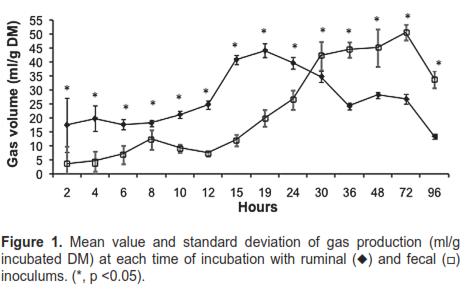
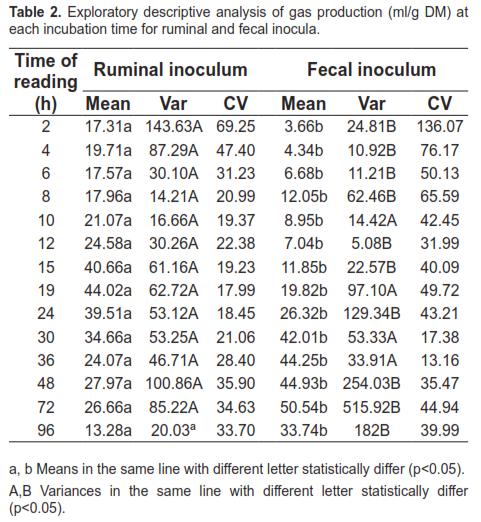
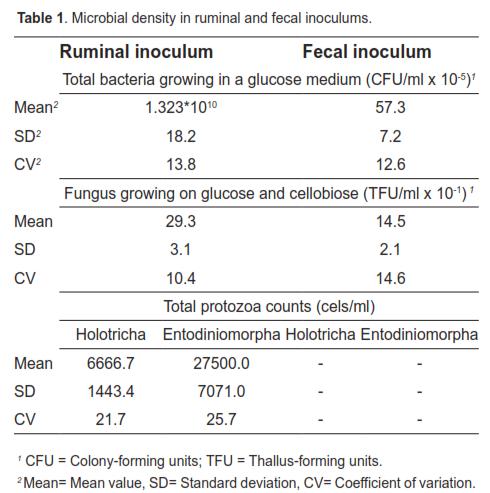
<body><![CDATA[<p>&nbsp;</p>     <p><font size="3"><b>Results</b></font></p>     <p><i>   Microbial density</i></p>     <p>   Microbial density data for each inoculum are   presented in <a href="#t1">table 1</a>. Protozoa were not found in   the fecal inoculum. Holotricha counts considerably   exceeded entodinomorphs in the rumen inocula.</p>     <p align="center"><a name="t1"></a><img src="/img/revistas/rccp/v25n4/v25n4a7t1.jpg" /></p>     <p><i>Determination of precision</i></p>     <p>   <a href="#f1">Figure 1</a> and <a href="#t2">table 2</a> show average gas   production values (ml/g incubated DM) of all   substrates at each reading time for both inoculum   sources. The gas volume recorded for ruminal   inoculum was higher up until 24 h. After 30 h, fecal   inoculum values were higher. Statistical differences   were found at all times measured (p &lt;0.05),   according to the t-test.</p>     <p align="center"><a name="f1"></a><img src="/img/revistas/rccp/v25n4/v25n4a7f1.jpg" /></p>     <p align="center"><a name="t2"></a><img src="/img/revistas/rccp/v25n4/v25n4a7t2.jpg" /></p>     <p><a href="#t2">Table 2</a> also shows CVs and variances of gas   production obtained with both inocula for the various incubation times. The fecal inoculum   showed higher CVs in 11 of the 14 analyzed hours.   Homogeneity of variances was found only at 10, 19, 30, and 36 h of incubation.</p>     ]]></body>
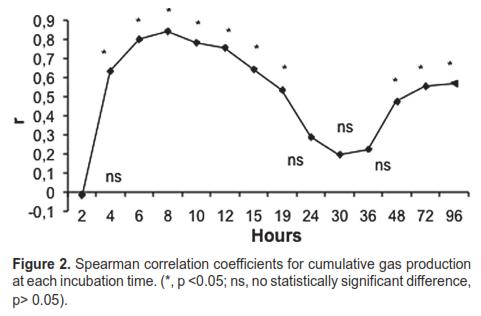
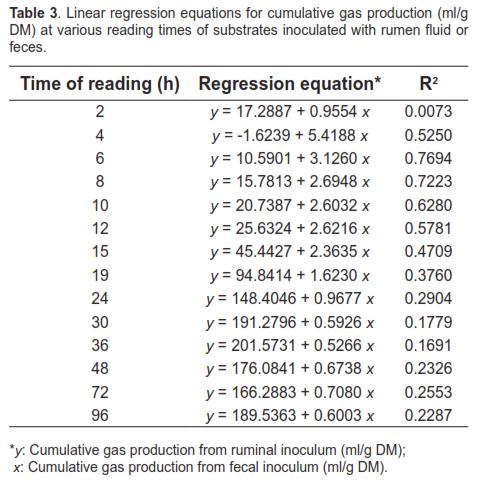
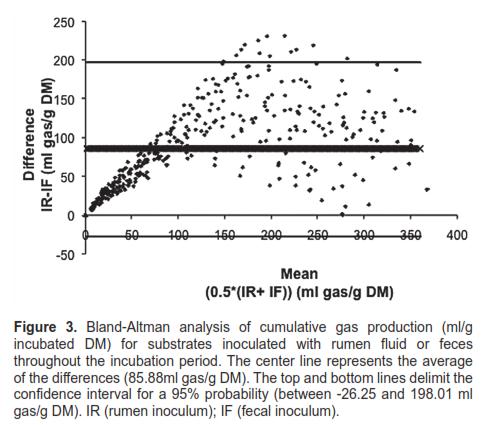
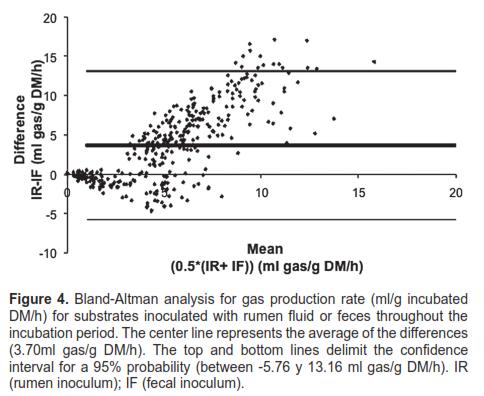
<body><![CDATA[<p><i>Determination of accuracy</i></p>     <p>   The correlation coefficient for cumulative gas   production observed for both inocula is shown   in <a href="#f2">figure 2</a>. The level of association was low and   not significant (p&gt; 0.05) at 2, 24, 30, and 36 h.   Correlations were significant (p &lt;0.05) and positive   in the remaining hours.</p>     <p align="center"><a name="f2"></a><img src="/img/revistas/rccp/v25n4/v25n4a7f2.jpg" /></p>     <p>Linear regression analysis between cumulative gas   production with ruminal inoculum (y) and cumulative   gas production with fecal inoculum (x) is presented   in <a href="#t3">table 3</a>. The equations obtained were characterized   by low coefficients of determination (R<sup>2</sup>), with values above 50% only between 4 and 12 h.</p>     <p align="center"><a name="t3"></a><img src="/img/revistas/rccp/v25n4/v25n4a7t3.jpg" /></p>     <p><a href="/img/revistas/rccp/v25n4/v25n4a7t4.jpg" target="_blank">Table 4</a> shows the average cumulative gas   production and gas production rate observed with   rumen fluid and feces at several incubation times.   Cumulative gas production for ruminal liquid   was greater than for fecal fluid throughout and the   differences increased as incubation time advanced,   up to 24 h (p &lt;0.05). Gas production rates for feces   were higher than those for rumen fluid only after 30 h (p &lt;0.05).</p>     <p>The level of agreement between inocula,   measured through the Bland-Altman   interchangeability test, is shown in figures <a href="#f3">3</a>  and <a href="#f4">4</a>. When this test was applied to cumulative   gas production (<a href="#f3">Figure 3</a>) and gas production   rate (<a href="#f4">Figure 4</a>), 96.67 and 95.56% of the data,   respectively, were included within the 95%   confidence interval (degree of agreement). The   Spearman correlation coefficient (r; cumulative gas   production= 0.7137; gas production rate = 0.7383)   and regression slope (b) were statistically significant   (p &lt;0.0001) in the regression and correlation   analysis for the differences (y) and average values (x) between the two inocula.</p>     <p align="center"><a name="f3"></a><img src="/img/revistas/rccp/v25n4/v25n4a7f3.jpg" /></p>     <p align="center"><a name="f4"></a><img src="/img/revistas/rccp/v25n4/v25n4a7f4.jpg" /></p>     <p>Regarding cumulative gas production (<a href="#f3">Figure 3</a>),   the observed differences were all positive, favoring   the rumen inoculum&mdash;all measurements were   above zero at the y-axis. Likewise, the data show   high dispersion toward the upper limit of the mean differences, which illustrates the variability of the differences as fermentation progresses. In <a href="#f4">figure 4</a>, the x-axis is not directly related with time, as in <a href="#f3">figure 3</a>. The smallest differences in gas production rates were observed at an advanced stage of the fermentation process.</p>     ]]></body>
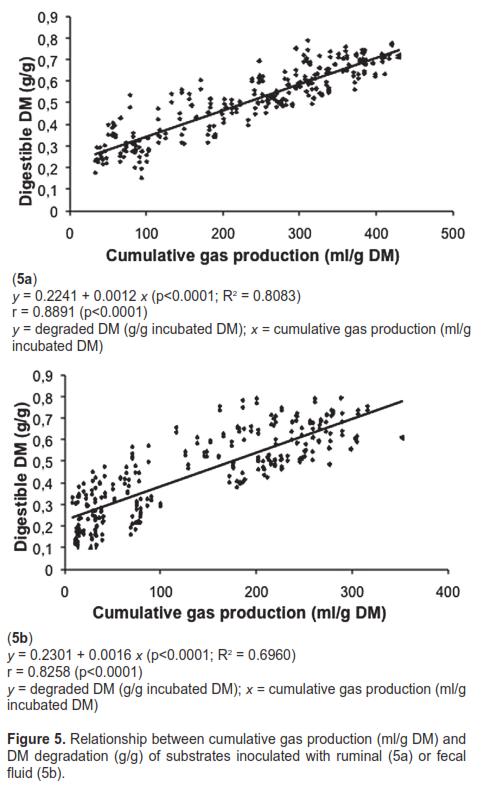
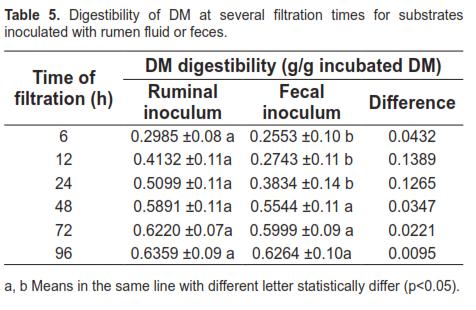
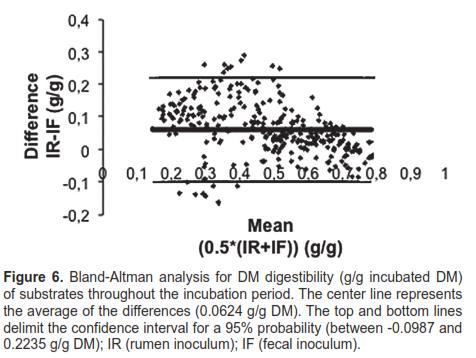
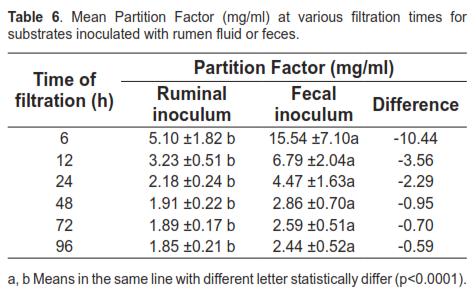
<body><![CDATA[<p><i>Description of DM degradation</i></p>     <p>   The relationship between cumulative gas   production (ml/g incubated DM) (<i>x</i>) and DM   degradation (g/g incubated DM) (<i>y</i>) at different   filtration times (6, 12, 24, 48, 72, and 96 h) is shown   in <a href="#f5">figure 5</a><a href="·f5"></a> for the 24 substrates tested. The ruminal   inoculum had a higher R<sup>2</sup> (0.8083 vs. 0.6960).</p>     <p align="center"><a name="f5"></a><img src="/img/revistas/rccp/v25n4/v25n4a7f5.jpg" /></p>     <p>Using linear regression and correlation analysis   between DM degraded with ruminal (y) and fecal   inoculum (x), expressed in g/g incubated DM for   the 24 substrates, the equation obtained was: Y =   0.1755 + 0.7483 X (p &lt;0.0001, R<sup>2</sup> = 0.8118) and r was: 0.9160 (p &lt;0.0001).</p>     <p>When ruminal fluid and feces were compared for   their ability to degrade DM in all substrates (<a href="#t5">Table   5</a>), it was found that mean values were different   (p &lt;0.05) only at 6, 12, and 24 h, but not at the end   of the fermentation process (p&gt; 0.05), meaning that   the extent of degradation was similar between both inocula.</p>     <p align="center"><a name="t5"></a><img src="/img/revistas/rccp/v25n4/v25n4a7t5.jpg" /></p>     <p>The agreement for DM digestibility with both   inocula, assessed by Bland-Altman analysis, is   shown in <a href="#f6">figure 6</a>. 94.1% of the data were included   within a 95% confidence interval, and 80.2% of   the differences were positive, favoring the ruminal   inoculum, with a tendency to decrease as incubation time progressed.</p>     <p align="center"><a name="f6"></a><img src="/img/revistas/rccp/v25n4/v25n4a7f6.jpg" /></p>     <p><a href="#t6">Table 6</a> shows the average PF with both   inoculum sources at different filtration times for the   24 substrates tested. Increased PF was associated   with the use of fecal fluid and the initial incubation times.</p>     <p align="center"><a name="t6"></a><img src="/img/revistas/rccp/v25n4/v25n4a7t6.jpg" /></p>     ]]></body>
<body><![CDATA[<p>&nbsp;</p>     <p><font size="3"><b>Discussion</b></font></p>     <p>   <i>Microbial density</i></p>     <p>The period during which bacteria adhere to the   substrate with little or no digestion is referred to as   colonization time. Results shown in <a href="#f1">figure 1</a> indicate   a longer colonization (lag phase) of the insoluble   substrate when fecal inoculum was used. The longer   colonization time required for this inoculum is   explained by its lower microbial density (<a href="#t1">Table 1</a>).   The low bacterial concentration in feces may be due   to the type of substrate available for fermentation   in the lower intestine. According to Hoover and   Stokes (1991), the digestion-rate of carbohydrates   (which is directly related to the proportion of   starches, pectins, and sugars) is the main factor   controlling the available energy for microbial   growth. Given that most ingested carbohydrates are   fermented in rumen and reticulum, fermentation   in cecum and colon is restricted to slowly   digested residues, mainly fiber, resulting in   reduced nutrient availability for microbial growth.   Mauricio <i>et al.</i> (1998, 2001) argue that the reduced   fermentation capacity in cecum and colon, relative   to that occurring in the rumen, may be due to a   combination of several factors including substrates   of lower nutritional value and shorter retention   time, which result in a lower microbial population.   In this context, according to McAllister <i>et al.</i>   (1994), fungi and protozoa require longer digesta   retention, since their generation times range from   5 to 14 and 24 to 30 h, respectively. While in this   study the low microbial concentration in fecal   inoculum reflected a longer colonization time,   this can also be the result of lower enzymatic   activity associated with the use of feces. This was   evidenced by Michlet-Doreau <i>et al.</i> (2002) who   compared cellulolytic microbial ecosystems in   rumen and cecum, reporting increased ruminal   enzyme activity (polysaccharidase, glycosylase)   without a parallel difference in RNA for the three   main cellulolytic bacterial species (<i>Fibrobacter   succinogenes, Ruminococcus flavefaciens</i>, and   <i>Ruminococcus albus</i>). The discrepancy between   cellulolytic activity of rumen and cecum microbes   was explained by the hypothetical differences   in physical and chemical conditions in each   compartment, including pH. Martin (1994) points   out that those changes in environmental conditions   can affect the transport of carbon, nitrogen, and   energy by microorganisms.</p>     <p>Considering that protozoa are sensitive to low   pH (Hungate, 1966; Mould <i>et al.</i>, 2005), the passage   of digesta through the abomasum may explain   the absence of these microorganisms in the fecal   inoculum. The findings of this study coincide with   those of Kern <i>et al.</i> (1974), who compared the   microorganisms in rumen and cecum of cattle and   found no protozoa in the latter compartment. The   presence of fungi in feces can be explained by: a)   their ability to survive under extreme conditions   (Mauricio, 1999), and b) the absence of protozoa   in the fecal inoculum, considering that protozoa   consume fungal zoospores (Akin and Borneman, 1990).</p>     <p><i>Determination of precision</i></p>     <p>   Homogeneity of variances for 10, 19, 30 and 36   hours incubation time indicates that gas production   SD was similar for these incubation periods.   However, as the means were different (p&lt;0.05), it is   concluded that CV is the most appropriate criterion   to assess repeatability (<a href="#t2">Table 2</a>).</p>     <p>As the substrate was the same for both inocula,   the higher CV obtained for feces (<a href="#t2">Table 2</a>) can be solely explained by the characteristics of the inocula. Due to the fact that microbial density is higher in ruminal inoculum at the time of inoculation, fermentation is more uniform and the rate of microbial growth and gas production is more constant. The lower CV values obtained for the ruminal inoculum make it the inoculum of choice under similar experimental conditions.</p>     <p>The high CV obtained during the first hours may   be based on two premises: a) the ability of microbes   to colonize the substrate, which is determined by   the microbial population size and the chemical,   anatomical, and morphological composition of   the forage; b) gas production is proportional to the   amount of metabolic products generated during   microbial growth and this, in turn, is affected by   the amount of substrate that has been degraded. As   incubation time elapses, it is likely that conditions   for microbial growth stabilize, ensuring a more   homogeneous colonization and degradation of materials.</p>     <p><i>Determination of accuracy</i></p>     ]]></body>
<body><![CDATA[<p>According to the correlation coefficient   (criterion for assessing the degree of association   between cumulative gas production for both   inocula, <a href="#f2">Figure 2</a>), there was no correspondence   or definite tendencies among continuous values at   the measured times. The values for the coefficient   of determination (R<sup>2</sup>) obtained from the linear   regression analysis between cumulative gas   production with both inocula (<a href="#t3">Table 3</a>) correspond   with the trend shown in <a href="#f2">figure 2</a>, so it can be   concluded that the obtained models only provide good estimates at the start of fermentation.</p>     <p>Goncalves and Borba (1996) compared sheep's   ruminal fluid and feces in their ability to ferment   different materials, and reported that total gas   production from ruminal fluid was higher than that   from fecal fluid, which is consistent with the results   shown in <a href="/img/revistas/rccp/v25n4/v25n4a7t4.jpg" target="_blank">table 4</a>. The difference in gas production   kinetics with both inocula ratifies the longer time   required to colonize insoluble substrate by microbes and their low concentration in fecal inoculum.</p>     <p>Since regression and correlation analysis   discussed so far measure the degree of relationship,   but not the degree of matching, a third statistical   approach was used to determine the level of   agreement between inocula: the Bland-Altman   interchangeability test (Figures <a href="#f3">3</a> and <a href="#f4">4</a>). In this   test&mdash;based on the regression and correlation   analysis for the differences (y) and means (x)   between both inocula&mdash;the Spearman correlation   coefficient (r) and the regression slope (b) were   statistically significant. The statistical significance   of r and b indicates that discrepancy between   ruminal and fecal inocula was not constant   throughout the range or distribution interval,   but varied with the increase of the mean values.   Therefore, it can be concluded that ruminal and fecal inocula are not interchangeable.</p>     <p><i>Description of DM degradation</i></p>     <p>After evaluating the potential of feces to ferment   tropical leguminous shrubs using the technique by   Tilley and Terry (1963), Jones and Barnes (1996)   concluded that DM digestibility was 3.5% units   lower than that using ruminal fluid. These authors   found a high r-value (0.98) for DM degradability   between both inocula, which was close to the result   obtained in the present study (0.9160). However,   <a href="#f5">figure 5</a> shows that the percentage of variability   in DM digestibility attributable to cumulative gas   production was higher with ruminal inoculum,   which is confirmed by the smaller dispersion of the data in the regression curve.</p>     <p>Once regression and correlation analysis   for the differences (y) and means (x) in DM   digestibility between both inocula was conducted,   the Spearman correlation coefficient (r) (-0.5011)   and the regression slope (b) were highly significant   (p &lt;0.0001). The statistical significance of r and   b indicates that discrepancy between ruminal   and fecal inocula was not maintained constant   throughout the range or distribution interval,   and therefore inocula are not interchangeable to   determine DM digestibility in time (degradation kinetics).</p>     <p>The relationship between substrate degraded   (mg) and gas produced (ml) may reflect variations   in microbial biomass production. This ratio is defined as the partitioning factor (PF) (Posada and Noguera, 2005; Lopez <i>et al.</i>, 1998). As gas production was higher with ruminal inoculum while DM degradation remained similar for both inocula, the PF for fecal fluid is higher (Table 6). Increased PF indicates higher biomass production per ATP generated (<sup>Y</sup>ATP) (Bl&uuml;mmel <i>et al.</i>, 1997) and higher efficiency of microbial protein synthesis (Makkar, 2001; Getachew <i>et al.</i>, 1998). These results could be associated with the lower competition occurring among microbial populations in the fecal inoculum, given their lower density. Conversely, the higher microbial density and diversity in ruminal inoculum leads to rapid depletion of available substrates for microbial growth. Because microbial growth efficiency depends on the availability of fermentable substrate&mdash;which, in turn, is used up during the incubation period&mdash; the highest PF were recorded in the initial stages, in agreement with reports by Lopez <i>et al.</i> (1998). The higher microbial growth efficiency of fecal inoculum during early fermentation leads to a closer relationship between microbial biomass and the substrate available for degradation, which would explain the lack of statistical difference in DM digestibility after 48 h of incubation (<a href="#t5">Table 5</a>). According to this study, it can be concluded that fecal inoculum is useful only to determine endpoint DM digestibility (or the extent of degradation) and cannot be used to describe degradation kinetics.</p>     <p>While other researchers report that feces are   potential alternative inoculum to ruminal fluid for   <i>in vitro</i> gas production, our results do not validate   this claim. Their statistical approach is based on   regression and correlation analysis, which gives   an idea of the degree of association between   variables, but does not measure matching or   concordance between them, making it impossible to   determine whether both inocula can be considered   as equivalent. Method comparison studies should   rely on those statistical techniques that allow direct   comparison of the results, determining to what   extent one method can be replaced by another with   sufficient accuracy. The Bland-Altman method   applied in this study allows for the conclusion that   feces were not comparable to ruminal fluid for DM degradation kinetics evaluation.</p>     <p>Precision, defined as the degree of   rapprochement between values obtained from   repeated measurements, is not equivalent to   accuracy, which refers to how close together are   reference and measured values. The higher CVs   observed for fecal inoculum (Experiment 1) could   have negatively affected the accuracy results in   Experiment two. This can be explained by the   fact that a set of values showing high repeatability   (precision) may or may not be accurate, but a set   of non-repeatable data can never be exact, thus   increasing the absolute error or the difference between experimental and reference values.</p>     <p>As the differences in colonization time and   fermentation dynamics are due to the smaller size and   &#8211;possibly- activity of fecal microbial populations,   an increase in fecal fermentation activity through   a pre-incubation process in a nitrogen and energy   enriched medium merits further investigation. This   pre-incubation procedure could be used to increase   microbial density of the fecal inoculum, allowing   us to replace the ruminal fluid, given the current limitations for using surgically fitted animals.</p>     ]]></body>
<body><![CDATA[<p>&nbsp;</p>     <p><b><font size="3">Acknowledgements</font></b></p>     <p>   The authors thank the Sustainability Project   2011-2012 (Estrategia de Sostenibilidad CODI   2011-2012, University of Antioquia), the faculty   members at the University of Antioquia and the   National University of Colombia (Medell&iacute;n,   Colombia) for providing resources and spaces   required to conduct this study.</p>     <p>&nbsp;</p>     <p><font size="3"><b>References</b></font></p>     <!-- ref --><p>   1. Akin DE, Borneman WS. Role of rumen fungi in fiber   degradation. J Dairy Sci 1990; 73:3023-3032.    &nbsp;&nbsp;&nbsp;&nbsp;&nbsp;&nbsp;&nbsp;&nbsp;[&#160;<a href="javascript:void(0);" onclick="javascript: window.open('/scielo.php?script=sci_nlinks&ref=000108&pid=S0120-0690201200040000700001&lng=','','width=640,height=500,resizable=yes,scrollbars=1,menubar=yes,');">Links</a>&#160;]<!-- end-ref --></p>     <!-- ref --><p>   2. Altman DG, Bland JM. Measurement in medicine: The analysis   of method comparison studies. The Statistician 1983; 32:307-   317.    &nbsp;&nbsp;&nbsp;&nbsp;&nbsp;&nbsp;&nbsp;&nbsp;[&#160;<a href="javascript:void(0);" onclick="javascript: window.open('/scielo.php?script=sci_nlinks&ref=000110&pid=S0120-0690201200040000700002&lng=','','width=640,height=500,resizable=yes,scrollbars=1,menubar=yes,');">Links</a>&#160;]<!-- end-ref --></p>     <!-- ref --><p>   3. Association of Official Analytical Chemist. Official Methods of   Analysis. 15 th. ed. Arlington: AOAC; 1990.    &nbsp;&nbsp;&nbsp;&nbsp;&nbsp;&nbsp;&nbsp;&nbsp;[&#160;<a href="javascript:void(0);" onclick="javascript: window.open('/scielo.php?script=sci_nlinks&ref=000112&pid=S0120-0690201200040000700003&lng=','','width=640,height=500,resizable=yes,scrollbars=1,menubar=yes,');">Links</a>&#160;]<!-- end-ref --></p>     <!-- ref --><p>   4. Bendicho S, Trigueros MC, Hern&aacute;ndez T, Mart&iacute;n O. Validation   and comparison of analytical methods based on the release of   p-nitrophenol to determine lipase activity in milk. J Dairy Sci   2001; 84:1590-1596.    &nbsp;&nbsp;&nbsp;&nbsp;&nbsp;&nbsp;&nbsp;&nbsp;[&#160;<a href="javascript:void(0);" onclick="javascript: window.open('/scielo.php?script=sci_nlinks&ref=000114&pid=S0120-0690201200040000700004&lng=','','width=640,height=500,resizable=yes,scrollbars=1,menubar=yes,');">Links</a>&#160;]<!-- end-ref --></p>     <!-- ref --><p>5. BIORUM. Grupo Interinstitucional de Biotecnolog&iacute;a Ruminal.   Manual de Procedimientos, Parte I: Microbiota. Universidad Nacional de Colombia, sede Medell&iacute;n. Mayo de 2004, 29 p.    &nbsp;&nbsp;&nbsp;&nbsp;&nbsp;&nbsp;&nbsp;&nbsp;[&#160;<a href="javascript:void(0);" onclick="javascript: window.open('/scielo.php?script=sci_nlinks&ref=000116&pid=S0120-0690201200040000700005&lng=','','width=640,height=500,resizable=yes,scrollbars=1,menubar=yes,');">Links</a>&#160;]<!-- end-ref --></p>     <!-- ref --><p>   6. Bland JM, Altman DG. Statistical methods for assessing   agreement between two methods of clinical measurement. The   Lancet 1986; 1:307-310.    &nbsp;&nbsp;&nbsp;&nbsp;&nbsp;&nbsp;&nbsp;&nbsp;[&#160;<a href="javascript:void(0);" onclick="javascript: window.open('/scielo.php?script=sci_nlinks&ref=000118&pid=S0120-0690201200040000700006&lng=','','width=640,height=500,resizable=yes,scrollbars=1,menubar=yes,');">Links</a>&#160;]<!-- end-ref --></p>     <!-- ref --><p>   7. Bl&uuml;mmel M, Makkar HPS, Becker K. <i>In vitro</i> gas production: a   technique revisited. J Anim Physiol Anim Nutr 1997; 77:24-34.    &nbsp;&nbsp;&nbsp;&nbsp;&nbsp;&nbsp;&nbsp;&nbsp;[&#160;<a href="javascript:void(0);" onclick="javascript: window.open('/scielo.php?script=sci_nlinks&ref=000120&pid=S0120-0690201200040000700007&lng=','','width=640,height=500,resizable=yes,scrollbars=1,menubar=yes,');">Links</a>&#160;]<!-- end-ref --></p>     <!-- ref --><p>   8. Getachew G, Bl&uuml;mmel M, Makkar HPS, Becker K. <i>In vitro</i>  measuring techniques for assessment of nutritional quality of   feeds: a review. Anim Feed Sci Tech 1998; 72:261-281.    &nbsp;&nbsp;&nbsp;&nbsp;&nbsp;&nbsp;&nbsp;&nbsp;[&#160;<a href="javascript:void(0);" onclick="javascript: window.open('/scielo.php?script=sci_nlinks&ref=000122&pid=S0120-0690201200040000700008&lng=','','width=640,height=500,resizable=yes,scrollbars=1,menubar=yes,');">Links</a>&#160;]<!-- end-ref --></p>     <!-- ref --><p>   9. Godden SM, Lissemore KD, Kelton DF, Lumsden JH, Leslie   KE, Walton JS. Analytic validation of an infrared milk urea   assay and effects of sample acquisition factors on milk urea   results. J Dairy Sci 2000; 83:435-442.    &nbsp;&nbsp;&nbsp;&nbsp;&nbsp;&nbsp;&nbsp;&nbsp;[&#160;<a href="javascript:void(0);" onclick="javascript: window.open('/scielo.php?script=sci_nlinks&ref=000124&pid=S0120-0690201200040000700009&lng=','','width=640,height=500,resizable=yes,scrollbars=1,menubar=yes,');">Links</a>&#160;]<!-- end-ref --></p>     <!-- ref --><p>   10. Gon&ccedil;alves LMBO, Borba AES. Study of gas production   capacity by three sources of inocula. J Agr Sci 1996; 127:511-   515.    &nbsp;&nbsp;&nbsp;&nbsp;&nbsp;&nbsp;&nbsp;&nbsp;[&#160;<a href="javascript:void(0);" onclick="javascript: window.open('/scielo.php?script=sci_nlinks&ref=000126&pid=S0120-0690201200040000700010&lng=','','width=640,height=500,resizable=yes,scrollbars=1,menubar=yes,');">Links</a>&#160;]<!-- end-ref --></p>     <!-- ref --><p>   11. Hoover WH, Stokes SR. Balancing carbohydrates and proteins   for optimum rumen microbial yield. J Dairy Sci 1991; 74:3630-   3644.    &nbsp;&nbsp;&nbsp;&nbsp;&nbsp;&nbsp;&nbsp;&nbsp;[&#160;<a href="javascript:void(0);" onclick="javascript: window.open('/scielo.php?script=sci_nlinks&ref=000128&pid=S0120-0690201200040000700011&lng=','','width=640,height=500,resizable=yes,scrollbars=1,menubar=yes,');">Links</a>&#160;]<!-- end-ref --></p>     <!-- ref --><p>   12. Hungate RE. The Rumen and its Microbes. Academic Press,   New York. 1966. 533 p.    &nbsp;&nbsp;&nbsp;&nbsp;&nbsp;&nbsp;&nbsp;&nbsp;[&#160;<a href="javascript:void(0);" onclick="javascript: window.open('/scielo.php?script=sci_nlinks&ref=000130&pid=S0120-0690201200040000700012&lng=','','width=640,height=500,resizable=yes,scrollbars=1,menubar=yes,');">Links</a>&#160;]<!-- end-ref --></p>     <!-- ref --><p>   13. ISO 5725-2, 1994. Accuracy (trueness and precision) of   measurement methods and results-Part 2: Basic methods for   determination of repeatability and reproducibility of a standard   measurement method. Int. Org. Stand. Gen&egrave;ve, Switzerland.    &nbsp;&nbsp;&nbsp;&nbsp;&nbsp;&nbsp;&nbsp;&nbsp;[&#160;<a href="javascript:void(0);" onclick="javascript: window.open('/scielo.php?script=sci_nlinks&ref=000132&pid=S0120-0690201200040000700013&lng=','','width=640,height=500,resizable=yes,scrollbars=1,menubar=yes,');">Links</a>&#160;]<!-- end-ref -->  </p>     <!-- ref --><p>14. Jones RJ, Barnes P. In vitro digestibility assessment of tropical   shrub legumes using rumen fluid or fecal fluid as the inoculum   source. Trop Grasslands 1996; 30:374-377.    &nbsp;&nbsp;&nbsp;&nbsp;&nbsp;&nbsp;&nbsp;&nbsp;[&#160;<a href="javascript:void(0);" onclick="javascript: window.open('/scielo.php?script=sci_nlinks&ref=000134&pid=S0120-0690201200040000700014&lng=','','width=640,height=500,resizable=yes,scrollbars=1,menubar=yes,');">Links</a>&#160;]<!-- end-ref --></p>     <!-- ref --><p>   15. Kern DL, Slyter LL, Leffel EC, Weaver JM, Oltjen RR. Ponies   vs. steers: microbial and chemical characteristics of internal   ingesta. J Anim Sci 1974; 38:559-564.    &nbsp;&nbsp;&nbsp;&nbsp;&nbsp;&nbsp;&nbsp;&nbsp;[&#160;<a href="javascript:void(0);" onclick="javascript: window.open('/scielo.php?script=sci_nlinks&ref=000136&pid=S0120-0690201200040000700015&lng=','','width=640,height=500,resizable=yes,scrollbars=1,menubar=yes,');">Links</a>&#160;]<!-- end-ref --></p>     <!-- ref --><p>   16. L&oacute;pez S, Carro MD, Gonz&aacute;lez JS, Ovejero FJ. Comparison of   different <i>in vitro</i> and <i>in situ</i> methods to estimate the extent and   rate of degradation of hays in the rumen. Anim Feed Sci Tech   1998; 73:99-113.    &nbsp;&nbsp;&nbsp;&nbsp;&nbsp;&nbsp;&nbsp;&nbsp;[&#160;<a href="javascript:void(0);" onclick="javascript: window.open('/scielo.php?script=sci_nlinks&ref=000138&pid=S0120-0690201200040000700016&lng=','','width=640,height=500,resizable=yes,scrollbars=1,menubar=yes,');">Links</a>&#160;]<!-- end-ref --></p>     <!-- ref --><p>   17. Makkar H. Recent advances in <i>in vitro</i> gas method for   evaluation of nutritional quality of feed resources. 2001;   [October 20, 2012] URL: <a href="http://www.fao.org/DOCREP/ARTICLE/AGRIPPA/570_EN_toc.htm" target="_blank">http://www.fao.org/DOCREP/ARTICLE/AGRIPPA/570_EN_toc.htm</a>&nbsp;&nbsp;&nbsp;&nbsp;&nbsp;&nbsp;&nbsp;&nbsp;[&#160;<a href="javascript:void(0);" onclick="javascript: window.open('/scielo.php?script=sci_nlinks&ref=000140&pid=S0120-0690201200040000700017&lng=','','width=640,height=500,resizable=yes,scrollbars=1,menubar=yes,');">Links</a>&#160;]<!-- end-ref --><!-- ref --><p>   18. Martin SA. Nutrient transport by ruminal bacteria: A review. J   Anim Sci 1994; 72:3019-3031.    &nbsp;&nbsp;&nbsp;&nbsp;&nbsp;&nbsp;&nbsp;&nbsp;[&#160;<a href="javascript:void(0);" onclick="javascript: window.open('/scielo.php?script=sci_nlinks&ref=000141&pid=S0120-0690201200040000700018&lng=','','width=640,height=500,resizable=yes,scrollbars=1,menubar=yes,');">Links</a>&#160;]<!-- end-ref --></p>     ]]></body>
<body><![CDATA[<!-- ref --><p>   19. Mauricio RM. Comparison of bovine rumen liquor and bovine   faeces as inoculum for an <i>In Vitro</i> gas production technique for   evaluating forage. Ph.D. Thesis. The University of Reading,   Reading, UK, pp. 281, 1999.    &nbsp;&nbsp;&nbsp;&nbsp;&nbsp;&nbsp;&nbsp;&nbsp;[&#160;<a href="javascript:void(0);" onclick="javascript: window.open('/scielo.php?script=sci_nlinks&ref=000143&pid=S0120-0690201200040000700019&lng=','','width=640,height=500,resizable=yes,scrollbars=1,menubar=yes,');">Links</a>&#160;]<!-- end-ref --></p>     <!-- ref --><p>   20. Mauricio RM, Mould F, Owen E. Comparison of rumen liquor   and faeces from cows as sources of microorganisms for the <i>in   vitro</i> gas production technique. Arq Bras Med Zootec 1998;   50:569-572.    &nbsp;&nbsp;&nbsp;&nbsp;&nbsp;&nbsp;&nbsp;&nbsp;[&#160;<a href="javascript:void(0);" onclick="javascript: window.open('/scielo.php?script=sci_nlinks&ref=000145&pid=S0120-0690201200040000700020&lng=','','width=640,height=500,resizable=yes,scrollbars=1,menubar=yes,');">Links</a>&#160;]<!-- end-ref --></p>     <!-- ref --><p>   21. Mauricio RM, Owen E, Mould FL, Givens I, Theodorou MK,   France J, Davies DR, Dhanoa MS. Comparison of bovine   rumen liquor and bovine faeces as inoculum for an <i>in vitro</i> gas   production technique for evaluating forages. Anim Feed Sci   Tech 2001; 89:33-48.    &nbsp;&nbsp;&nbsp;&nbsp;&nbsp;&nbsp;&nbsp;&nbsp;[&#160;<a href="javascript:void(0);" onclick="javascript: window.open('/scielo.php?script=sci_nlinks&ref=000147&pid=S0120-0690201200040000700021&lng=','','width=640,height=500,resizable=yes,scrollbars=1,menubar=yes,');">Links</a>&#160;]<!-- end-ref --></p>     <!-- ref --><p>   22. McAllister TA, Bae HD, Jones GA, Cheng KJ. Microbial   attachment and feed digestion in the rumen. J Anim Sci 1994;   72:3004-3018.    &nbsp;&nbsp;&nbsp;&nbsp;&nbsp;&nbsp;&nbsp;&nbsp;[&#160;<a href="javascript:void(0);" onclick="javascript: window.open('/scielo.php?script=sci_nlinks&ref=000149&pid=S0120-0690201200040000700022&lng=','','width=640,height=500,resizable=yes,scrollbars=1,menubar=yes,');">Links</a>&#160;]<!-- end-ref --></p>     <!-- ref --><p>   23. Michalet-Doreau B, Fernandez I, Fonty G. A comparison   of enzymatic and molecular approaches to characterize the   cellulolytic microbial ecosystems of the rumen and the cecum. J   Anim Sci 2002; 80:790-796.    &nbsp;&nbsp;&nbsp;&nbsp;&nbsp;&nbsp;&nbsp;&nbsp;[&#160;<a href="javascript:void(0);" onclick="javascript: window.open('/scielo.php?script=sci_nlinks&ref=000151&pid=S0120-0690201200040000700023&lng=','','width=640,height=500,resizable=yes,scrollbars=1,menubar=yes,');">Links</a>&#160;]<!-- end-ref --></p>     ]]></body>
<body><![CDATA[<!-- ref --><p>   24. Mould FL, Kliem KE, Morgan R, Mauricio RM. In vitro   microbial inoculum: A review of its function and properties.   Anim Feed Sci Tech 2005; 123:31-50.    &nbsp;&nbsp;&nbsp;&nbsp;&nbsp;&nbsp;&nbsp;&nbsp;[&#160;<a href="javascript:void(0);" onclick="javascript: window.open('/scielo.php?script=sci_nlinks&ref=000153&pid=S0120-0690201200040000700024&lng=','','width=640,height=500,resizable=yes,scrollbars=1,menubar=yes,');">Links</a>&#160;]<!-- end-ref --></p>     <!-- ref --><p>   25. Orskov ER, DeB Hovell FD, Mould F. Uso de la t&eacute;cnica de la   bolsa de nylon para la evaluaci&oacute;n de alimentos. Prod Anim Trop   1980; 5:213-223.    &nbsp;&nbsp;&nbsp;&nbsp;&nbsp;&nbsp;&nbsp;&nbsp;[&#160;<a href="javascript:void(0);" onclick="javascript: window.open('/scielo.php?script=sci_nlinks&ref=000155&pid=S0120-0690201200040000700025&lng=','','width=640,height=500,resizable=yes,scrollbars=1,menubar=yes,');">Links</a>&#160;]<!-- end-ref --></p>     <!-- ref --><p>   26. Pinto M, Carrasco E, Fraser B, Barriga C. Validaci&oacute;n del   m&eacute;todo butirom&eacute;trico de Gerber por comparaci&oacute;n con el   m&eacute;todo de referencia de R&ouml;seGottlieb para la determinaci&oacute;n de   la materia grasa en leche. Agro sur 2000; 28.    &nbsp;&nbsp;&nbsp;&nbsp;&nbsp;&nbsp;&nbsp;&nbsp;[&#160;<a href="javascript:void(0);" onclick="javascript: window.open('/scielo.php?script=sci_nlinks&ref=000157&pid=S0120-0690201200040000700026&lng=','','width=640,height=500,resizable=yes,scrollbars=1,menubar=yes,');">Links</a>&#160;]<!-- end-ref --></p>     <!-- ref --><p>   27. Posada SL, Noguera RR. T&eacute;cnica in vitro de producci&oacute;n de   gases: Una herramienta para la evaluaci&oacute;n de alimentos para   rumiantes. Livest Res Rural Development 2005; 17.    &nbsp;&nbsp;&nbsp;&nbsp;&nbsp;&nbsp;&nbsp;&nbsp;[&#160;<a href="javascript:void(0);" onclick="javascript: window.open('/scielo.php?script=sci_nlinks&ref=000159&pid=S0120-0690201200040000700027&lng=','','width=640,height=500,resizable=yes,scrollbars=1,menubar=yes,');">Links</a>&#160;]<!-- end-ref --></p>     <!-- ref --><p>   28. Posada SL, Noguera R, Bol&iacute;var D. Relaci&oacute;n entre presi&oacute;n   y volumen para la implementaci&oacute;n de la t&eacute;cnica <i>in Vitro</i> de   producci&oacute;n de gases en Medell&iacute;n, Colombia. Rev Colomb Cienc   Pecu 2006; 19:407-414.    &nbsp;&nbsp;&nbsp;&nbsp;&nbsp;&nbsp;&nbsp;&nbsp;[&#160;<a href="javascript:void(0);" onclick="javascript: window.open('/scielo.php?script=sci_nlinks&ref=000161&pid=S0120-0690201200040000700028&lng=','','width=640,height=500,resizable=yes,scrollbars=1,menubar=yes,');">Links</a>&#160;]<!-- end-ref --></p>     ]]></body>
<body><![CDATA[<!-- ref --><p>   29. Rodr&iacute;guez N, Lorente A, Vel&aacute;squez Y, Gonz&aacute;lez E.   Confiabilidad del m&eacute;todo slott modificado por laboratorios   Heiga para la determinaci&oacute;n directa de la creatinina. Revista de   la Facultad de Farmacia 2001; 42: 67-71.    &nbsp;&nbsp;&nbsp;&nbsp;&nbsp;&nbsp;&nbsp;&nbsp;[&#160;<a href="javascript:void(0);" onclick="javascript: window.open('/scielo.php?script=sci_nlinks&ref=000163&pid=S0120-0690201200040000700029&lng=','','width=640,height=500,resizable=yes,scrollbars=1,menubar=yes,');">Links</a>&#160;]<!-- end-ref --></p>     <!-- ref --><p>   30. Statistical Analysis Systems. SAS<sup>&reg;</sup>, versi&oacute;n 8.2 para Windows,.   User's Guide. Statistics. Statistical Analysis Systems Institute.   Inc., Cary, NC. 2001.    &nbsp;&nbsp;&nbsp;&nbsp;&nbsp;&nbsp;&nbsp;&nbsp;[&#160;<a href="javascript:void(0);" onclick="javascript: window.open('/scielo.php?script=sci_nlinks&ref=000165&pid=S0120-0690201200040000700030&lng=','','width=640,height=500,resizable=yes,scrollbars=1,menubar=yes,');">Links</a>&#160;]<!-- end-ref --></p>     <!-- ref --><p>   31. Tilley JMA, Terry RA. A two stage technique for the in vitro   digestion of forage crops. J Br Grassl Soc 1963; 18:104-111.    &nbsp;&nbsp;&nbsp;&nbsp;&nbsp;&nbsp;&nbsp;&nbsp;[&#160;<a href="javascript:void(0);" onclick="javascript: window.open('/scielo.php?script=sci_nlinks&ref=000167&pid=S0120-0690201200040000700031&lng=','','width=640,height=500,resizable=yes,scrollbars=1,menubar=yes,');">Links</a>&#160;]<!-- end-ref --></p>     <p>&nbsp;</p>     <p><font size="3"><b>Notas al pie </b></font></p>     <p><sup><a href="#b0">&curren;</a><a name="0"></a></sup> To cite this article: Posada SL, Noguera RR, Segura JA. Ruminant feces used as inoculum for the in vitro gas production technique. Rev Colomb Cienc Pecu 2012; 25:592-602.</p> </font>      ]]></body><back>
<ref-list>
<ref id="B1">
<label>1</label><nlm-citation citation-type="journal">
<person-group person-group-type="author">
<name>
<surname><![CDATA[Akin]]></surname>
<given-names><![CDATA[DE]]></given-names>
</name>
<name>
<surname><![CDATA[Borneman]]></surname>
<given-names><![CDATA[WS]]></given-names>
</name>
</person-group>
<article-title xml:lang="en"><![CDATA[Role of rumen fungi in fiber degradation]]></article-title>
<source><![CDATA[J Dairy Sci]]></source>
<year>1990</year>
<volume>73</volume>
<page-range>3023-3032</page-range></nlm-citation>
</ref>
<ref id="B2">
<label>2</label><nlm-citation citation-type="journal">
<person-group person-group-type="author">
<name>
<surname><![CDATA[Altman]]></surname>
<given-names><![CDATA[DG]]></given-names>
</name>
<name>
<surname><![CDATA[Bland]]></surname>
<given-names><![CDATA[JM]]></given-names>
</name>
</person-group>
<article-title xml:lang="en"><![CDATA[Measurement in medicine: The analysis of method comparison studies]]></article-title>
<source><![CDATA[The Statistician]]></source>
<year>1983</year>
<volume>32</volume>
<page-range>307- 317</page-range></nlm-citation>
</ref>
<ref id="B3">
<label>3</label><nlm-citation citation-type="book">
<collab>Association of Official Analytical Chemist</collab>
<source><![CDATA[Official Methods of Analysis]]></source>
<year>1990</year>
<edition>15</edition>
<publisher-loc><![CDATA[Arlington ]]></publisher-loc>
<publisher-name><![CDATA[AOAC]]></publisher-name>
</nlm-citation>
</ref>
<ref id="B4">
<label>4</label><nlm-citation citation-type="journal">
<person-group person-group-type="author">
<name>
<surname><![CDATA[Bendicho]]></surname>
<given-names><![CDATA[S]]></given-names>
</name>
<name>
<surname><![CDATA[Trigueros]]></surname>
<given-names><![CDATA[MC]]></given-names>
</name>
<name>
<surname><![CDATA[Hernández]]></surname>
<given-names><![CDATA[T]]></given-names>
</name>
<name>
<surname><![CDATA[Martín]]></surname>
<given-names><![CDATA[O]]></given-names>
</name>
</person-group>
<article-title xml:lang="en"><![CDATA[Validation and comparison of analytical methods based on the release of p-nitrophenol to determine lipase activity in milk]]></article-title>
<source><![CDATA[J Dairy Sci]]></source>
<year>2001</year>
<volume>84</volume>
<page-range>1590-1596</page-range></nlm-citation>
</ref>
<ref id="B5">
<label>5</label><nlm-citation citation-type="book">
<collab>BIORUM. Grupo Interinstitucional de Biotecnología Ruminal</collab>
<source><![CDATA[Manual de Procedimientos, Parte I: Microbiota]]></source>
<year>Mayo</year>
<month> d</month>
<day>e </day>
<page-range>29</page-range><publisher-name><![CDATA[Universidad Nacional de Colombia, sede Medellín]]></publisher-name>
</nlm-citation>
</ref>
<ref id="B6">
<label>6</label><nlm-citation citation-type="journal">
<person-group person-group-type="author">
<name>
<surname><![CDATA[Bland]]></surname>
<given-names><![CDATA[JM]]></given-names>
</name>
<name>
<surname><![CDATA[Altman]]></surname>
<given-names><![CDATA[DG]]></given-names>
</name>
</person-group>
<article-title xml:lang="en"><![CDATA[Statistical methods for assessing agreement between two methods of clinical measurement]]></article-title>
<source><![CDATA[The Lancet]]></source>
<year>1986</year>
<volume>1</volume>
<page-range>307-310</page-range></nlm-citation>
</ref>
<ref id="B7">
<label>7</label><nlm-citation citation-type="journal">
<person-group person-group-type="author">
<name>
<surname><![CDATA[Blümmel]]></surname>
<given-names><![CDATA[M]]></given-names>
</name>
<name>
<surname><![CDATA[Makkar]]></surname>
<given-names><![CDATA[HPS]]></given-names>
</name>
<name>
<surname><![CDATA[Becker]]></surname>
<given-names><![CDATA[K]]></given-names>
</name>
</person-group>
<article-title xml:lang="en"><![CDATA[In vitro gas production: a technique revisited]]></article-title>
<source><![CDATA[J Anim Physiol Anim Nutr]]></source>
<year>1997</year>
<volume>77</volume>
<page-range>24-34</page-range></nlm-citation>
</ref>
<ref id="B8">
<label>8</label><nlm-citation citation-type="journal">
<person-group person-group-type="author">
<name>
<surname><![CDATA[Getachew]]></surname>
<given-names><![CDATA[G]]></given-names>
</name>
<name>
<surname><![CDATA[Blümmel]]></surname>
<given-names><![CDATA[M]]></given-names>
</name>
<name>
<surname><![CDATA[Makkar]]></surname>
<given-names><![CDATA[HPS]]></given-names>
</name>
<name>
<surname><![CDATA[Becker]]></surname>
<given-names><![CDATA[K]]></given-names>
</name>
</person-group>
<article-title xml:lang="en"><![CDATA[In vitro measuring techniques for assessment of nutritional quality of feeds: a review]]></article-title>
<source><![CDATA[Anim Feed Sci Tech]]></source>
<year>1998</year>
<volume>72</volume>
<page-range>261-281</page-range></nlm-citation>
</ref>
<ref id="B9">
<label>9</label><nlm-citation citation-type="journal">
<person-group person-group-type="author">
<name>
<surname><![CDATA[Godden]]></surname>
<given-names><![CDATA[SM]]></given-names>
</name>
<name>
<surname><![CDATA[Lissemore]]></surname>
<given-names><![CDATA[KD]]></given-names>
</name>
<name>
<surname><![CDATA[Kelton]]></surname>
<given-names><![CDATA[DF]]></given-names>
</name>
<name>
<surname><![CDATA[Lumsden]]></surname>
<given-names><![CDATA[JH]]></given-names>
</name>
<name>
<surname><![CDATA[Leslie]]></surname>
<given-names><![CDATA[KE]]></given-names>
</name>
<name>
<surname><![CDATA[Walton]]></surname>
<given-names><![CDATA[JS]]></given-names>
</name>
</person-group>
<article-title xml:lang="en"><![CDATA[Analytic validation of an infrared milk urea assay and effects of sample acquisition factors on milk urea results]]></article-title>
<source><![CDATA[J Dairy Sci]]></source>
<year>2000</year>
<volume>83</volume>
<page-range>435-442</page-range></nlm-citation>
</ref>
<ref id="B10">
<label>10</label><nlm-citation citation-type="journal">
<person-group person-group-type="author">
<name>
<surname><![CDATA[Gonçalves]]></surname>
<given-names><![CDATA[LMBO]]></given-names>
</name>
<name>
<surname><![CDATA[Borba]]></surname>
<given-names><![CDATA[AES]]></given-names>
</name>
</person-group>
<article-title xml:lang="en"><![CDATA[Study of gas production capacity by three sources of inocula]]></article-title>
<source><![CDATA[J Agr Sci]]></source>
<year>1996</year>
<volume>127</volume>
<page-range>511- 515</page-range></nlm-citation>
</ref>
<ref id="B11">
<label>11</label><nlm-citation citation-type="journal">
<person-group person-group-type="author">
<name>
<surname><![CDATA[Hoover]]></surname>
<given-names><![CDATA[WH]]></given-names>
</name>
<name>
<surname><![CDATA[Stokes]]></surname>
<given-names><![CDATA[SR]]></given-names>
</name>
</person-group>
<article-title xml:lang="en"><![CDATA[Balancing carbohydrates and proteins for optimum rumen microbial yield]]></article-title>
<source><![CDATA[J Dairy Sci]]></source>
<year>1991</year>
<volume>74</volume>
<page-range>3630- 3644</page-range></nlm-citation>
</ref>
<ref id="B12">
<label>12</label><nlm-citation citation-type="book">
<person-group person-group-type="author">
<name>
<surname><![CDATA[Hungate]]></surname>
<given-names><![CDATA[RE.]]></given-names>
</name>
</person-group>
<source><![CDATA[The Rumen and its Microbes]]></source>
<year>1966</year>
<publisher-loc><![CDATA[New York ]]></publisher-loc>
<publisher-name><![CDATA[Academic Press]]></publisher-name>
</nlm-citation>
</ref>
<ref id="B13">
<label>13</label><nlm-citation citation-type="book">
<source><![CDATA[ISO 5725-2, 1994. Accuracy (trueness and precision) of measurement methods and results-Part 2: Basic methods for determination of repeatability and reproducibility of a standard measurement method]]></source>
<year></year>
<publisher-loc><![CDATA[Genève ]]></publisher-loc>
<publisher-name><![CDATA[Int. Org. Stand]]></publisher-name>
</nlm-citation>
</ref>
<ref id="B14">
<label>14</label><nlm-citation citation-type="journal">
<person-group person-group-type="author">
<name>
<surname><![CDATA[Jones]]></surname>
<given-names><![CDATA[RJ]]></given-names>
</name>
<name>
<surname><![CDATA[Barnes]]></surname>
<given-names><![CDATA[P]]></given-names>
</name>
</person-group>
<article-title xml:lang="en"><![CDATA[In vitro digestibility assessment of tropical shrub legumes using rumen fluid or fecal fluid as the inoculum source]]></article-title>
<source><![CDATA[Trop Grasslands]]></source>
<year>1996</year>
<volume>30</volume>
<page-range>374-377</page-range></nlm-citation>
</ref>
<ref id="B15">
<label>15</label><nlm-citation citation-type="journal">
<person-group person-group-type="author">
<name>
<surname><![CDATA[Kern]]></surname>
<given-names><![CDATA[DL]]></given-names>
</name>
<name>
<surname><![CDATA[Slyter]]></surname>
<given-names><![CDATA[LL]]></given-names>
</name>
<name>
<surname><![CDATA[Leffel]]></surname>
<given-names><![CDATA[EC]]></given-names>
</name>
<name>
<surname><![CDATA[Weaver]]></surname>
<given-names><![CDATA[JM]]></given-names>
</name>
<name>
<surname><![CDATA[Oltjen]]></surname>
<given-names><![CDATA[RR]]></given-names>
</name>
</person-group>
<article-title xml:lang="en"><![CDATA[Ponies vs. steers: microbial and chemical characteristics of internal ingesta]]></article-title>
<source><![CDATA[J Anim Sci]]></source>
<year>1974</year>
<volume>38</volume>
<page-range>559-564</page-range></nlm-citation>
</ref>
<ref id="B16">
<label>16</label><nlm-citation citation-type="journal">
<person-group person-group-type="author">
<name>
<surname><![CDATA[López]]></surname>
<given-names><![CDATA[S]]></given-names>
</name>
<name>
<surname><![CDATA[Carro]]></surname>
<given-names><![CDATA[MD]]></given-names>
</name>
<name>
<surname><![CDATA[González]]></surname>
<given-names><![CDATA[JS]]></given-names>
</name>
<name>
<surname><![CDATA[Ovejero]]></surname>
<given-names><![CDATA[FJ]]></given-names>
</name>
</person-group>
<article-title xml:lang="en"><![CDATA[Comparison of different in vitro and in situ methods to estimate the extent and rate of degradation of hays in the rumen]]></article-title>
<source><![CDATA[Anim Feed Sci Tech]]></source>
<year>1998</year>
<volume>73</volume>
<page-range>99-113</page-range></nlm-citation>
</ref>
<ref id="B17">
<label>17</label><nlm-citation citation-type="">
<person-group person-group-type="author">
<name>
<surname><![CDATA[Makkar]]></surname>
<given-names><![CDATA[H.]]></given-names>
</name>
</person-group>
<source><![CDATA[Recent advances in in vitro gas method for evaluation of nutritional quality of feed resources]]></source>
<year>2001</year>
</nlm-citation>
</ref>
<ref id="B18">
<label>18</label><nlm-citation citation-type="journal">
<person-group person-group-type="author">
<name>
<surname><![CDATA[Martin]]></surname>
<given-names><![CDATA[SA]]></given-names>
</name>
</person-group>
<article-title xml:lang="en"><![CDATA[Nutrient transport by ruminal bacteria: A review]]></article-title>
<source><![CDATA[J Anim Sci]]></source>
<year>1994</year>
<volume>72</volume>
<page-range>3019-3031</page-range></nlm-citation>
</ref>
<ref id="B19">
<label>19</label><nlm-citation citation-type="">
<person-group person-group-type="author">
<name>
<surname><![CDATA[Mauricio]]></surname>
<given-names><![CDATA[RM.]]></given-names>
</name>
</person-group>
<source><![CDATA[Comparison of bovine rumen liquor and bovine faeces as inoculum for an In Vitro gas production technique for evaluating forage]]></source>
<year>1999</year>
<page-range>281</page-range></nlm-citation>
</ref>
<ref id="B20">
<label>20</label><nlm-citation citation-type="journal">
<person-group person-group-type="author">
<name>
<surname><![CDATA[Mauricio]]></surname>
<given-names><![CDATA[RM]]></given-names>
</name>
<name>
<surname><![CDATA[Mould]]></surname>
<given-names><![CDATA[F]]></given-names>
</name>
<name>
<surname><![CDATA[Owen]]></surname>
<given-names><![CDATA[E]]></given-names>
</name>
</person-group>
<article-title xml:lang="en"><![CDATA[Comparison of rumen liquor and faeces from cows as sources of microorganisms for the in vitro gas production technique]]></article-title>
<source><![CDATA[Arq Bras Med Zootec]]></source>
<year>1998</year>
<volume>50</volume>
<page-range>569-572</page-range></nlm-citation>
</ref>
<ref id="B21">
<label>21</label><nlm-citation citation-type="journal">
<person-group person-group-type="author">
<name>
<surname><![CDATA[Mauricio]]></surname>
<given-names><![CDATA[RM]]></given-names>
</name>
<name>
<surname><![CDATA[Owen]]></surname>
<given-names><![CDATA[E]]></given-names>
</name>
<name>
<surname><![CDATA[Mould]]></surname>
<given-names><![CDATA[FL]]></given-names>
</name>
<name>
<surname><![CDATA[Givens]]></surname>
<given-names><![CDATA[I]]></given-names>
</name>
<name>
<surname><![CDATA[Theodorou]]></surname>
<given-names><![CDATA[MK]]></given-names>
</name>
<name>
<surname><![CDATA[France]]></surname>
<given-names><![CDATA[J]]></given-names>
</name>
<name>
<surname><![CDATA[Davies]]></surname>
<given-names><![CDATA[DR]]></given-names>
</name>
<name>
<surname><![CDATA[Dhanoa]]></surname>
<given-names><![CDATA[MS]]></given-names>
</name>
</person-group>
<article-title xml:lang="en"><![CDATA[Comparison of bovine rumen liquor and bovine faeces as inoculum for an in vitro gas production technique for evaluating forages]]></article-title>
<source><![CDATA[Anim Feed Sci Tech]]></source>
<year>2001</year>
<volume>89</volume>
<page-range>33-48</page-range></nlm-citation>
</ref>
<ref id="B22">
<label>22</label><nlm-citation citation-type="journal">
<person-group person-group-type="author">
<name>
<surname><![CDATA[McAllister]]></surname>
<given-names><![CDATA[TA]]></given-names>
</name>
<name>
<surname><![CDATA[Bae]]></surname>
<given-names><![CDATA[HD]]></given-names>
</name>
<name>
<surname><![CDATA[Jones]]></surname>
<given-names><![CDATA[GA]]></given-names>
</name>
<name>
<surname><![CDATA[Cheng]]></surname>
<given-names><![CDATA[KJ]]></given-names>
</name>
</person-group>
<article-title xml:lang="en"><![CDATA[Microbial attachment and feed digestion in the rumen]]></article-title>
<source><![CDATA[J Anim Sci]]></source>
<year>1994</year>
<volume>72</volume>
<page-range>3004-3018</page-range></nlm-citation>
</ref>
<ref id="B23">
<label>23</label><nlm-citation citation-type="journal">
<person-group person-group-type="author">
<name>
<surname><![CDATA[Michalet-Doreau]]></surname>
<given-names><![CDATA[B]]></given-names>
</name>
<name>
<surname><![CDATA[Fernandez]]></surname>
<given-names><![CDATA[I]]></given-names>
</name>
<name>
<surname><![CDATA[Fonty]]></surname>
<given-names><![CDATA[G]]></given-names>
</name>
</person-group>
<article-title xml:lang="en"><![CDATA[A comparison of enzymatic and molecular approaches to characterize the cellulolytic microbial ecosystems of the rumen and the cecum]]></article-title>
<source><![CDATA[J Anim Sci]]></source>
<year>2002</year>
<volume>80</volume>
<page-range>790-796</page-range></nlm-citation>
</ref>
<ref id="B24">
<label>24</label><nlm-citation citation-type="journal">
<person-group person-group-type="author">
<name>
<surname><![CDATA[Mould]]></surname>
<given-names><![CDATA[FL]]></given-names>
</name>
<name>
<surname><![CDATA[Kliem]]></surname>
<given-names><![CDATA[KE]]></given-names>
</name>
<name>
<surname><![CDATA[Morgan]]></surname>
<given-names><![CDATA[R]]></given-names>
</name>
<name>
<surname><![CDATA[Mauricio]]></surname>
<given-names><![CDATA[RM]]></given-names>
</name>
</person-group>
<article-title xml:lang="en"><![CDATA[In vitro microbial inoculum: A review of its function and properties]]></article-title>
<source><![CDATA[Anim Feed Sci Tech]]></source>
<year>2005</year>
<volume>123</volume>
<page-range>31-50</page-range></nlm-citation>
</ref>
<ref id="B25">
<label>25</label><nlm-citation citation-type="journal">
<person-group person-group-type="author">
<name>
<surname><![CDATA[Orskov]]></surname>
<given-names><![CDATA[ER]]></given-names>
</name>
<name>
<surname><![CDATA[DeB]]></surname>
<given-names><![CDATA[Hovell FD]]></given-names>
</name>
<name>
<surname><![CDATA[Mould]]></surname>
<given-names><![CDATA[F]]></given-names>
</name>
</person-group>
<article-title xml:lang="es"><![CDATA[Uso de la técnica de la bolsa de nylon para la evaluación de alimentos]]></article-title>
<source><![CDATA[Prod Anim Trop]]></source>
<year>1980</year>
<volume>5</volume>
<page-range>213-223</page-range></nlm-citation>
</ref>
<ref id="B26">
<label>26</label><nlm-citation citation-type="journal">
<person-group person-group-type="author">
<name>
<surname><![CDATA[Pinto]]></surname>
<given-names><![CDATA[M]]></given-names>
</name>
<name>
<surname><![CDATA[Carrasco]]></surname>
<given-names><![CDATA[E]]></given-names>
</name>
<name>
<surname><![CDATA[Fraser]]></surname>
<given-names><![CDATA[B]]></given-names>
</name>
<name>
<surname><![CDATA[Barriga]]></surname>
<given-names><![CDATA[C.]]></given-names>
</name>
</person-group>
<article-title xml:lang="es"><![CDATA[Validación del método butirométrico de Gerber por comparación con el método de referencia de RöseGottlieb para la determinación de la materia grasa en leche]]></article-title>
<source><![CDATA[Agro sur.]]></source>
<year>2000</year>
<page-range>28</page-range></nlm-citation>
</ref>
<ref id="B27">
<label>27</label><nlm-citation citation-type="journal">
<person-group person-group-type="author">
<name>
<surname><![CDATA[Posada]]></surname>
<given-names><![CDATA[SL]]></given-names>
</name>
<name>
<surname><![CDATA[Noguera]]></surname>
<given-names><![CDATA[RR.]]></given-names>
</name>
</person-group>
<article-title xml:lang="es"><![CDATA[Técnica in vitro de producción de gases: Una herramienta para la evaluación de alimentos para rumiantes]]></article-title>
<source><![CDATA[Livest Res Rural Development]]></source>
<year>2005</year>
<page-range>17</page-range></nlm-citation>
</ref>
<ref id="B28">
<label>28</label><nlm-citation citation-type="journal">
<person-group person-group-type="author">
<name>
<surname><![CDATA[Posada]]></surname>
<given-names><![CDATA[SL]]></given-names>
</name>
<name>
<surname><![CDATA[Noguera]]></surname>
<given-names><![CDATA[R]]></given-names>
</name>
<name>
<surname><![CDATA[Bolívar]]></surname>
<given-names><![CDATA[D]]></given-names>
</name>
</person-group>
<article-title xml:lang="es"><![CDATA[Relación entre presión y volumen para la implementación de la técnica in Vitro de producción de gases en Medellín, Colombia]]></article-title>
<source><![CDATA[Rev Colomb Cienc Pecu]]></source>
<year>2006</year>
<volume>19</volume>
<page-range>407-414</page-range></nlm-citation>
</ref>
<ref id="B29">
<label>29</label><nlm-citation citation-type="journal">
<person-group person-group-type="author">
<name>
<surname><![CDATA[Rodríguez]]></surname>
<given-names><![CDATA[N]]></given-names>
</name>
<name>
<surname><![CDATA[Lorente]]></surname>
<given-names><![CDATA[A]]></given-names>
</name>
<name>
<surname><![CDATA[Velásquez]]></surname>
<given-names><![CDATA[Y]]></given-names>
</name>
<name>
<surname><![CDATA[González]]></surname>
<given-names><![CDATA[E]]></given-names>
</name>
</person-group>
<article-title xml:lang="es"><![CDATA[Confiabilidad del método slott modificado por laboratorios Heiga para la determinación directa de la creatinina]]></article-title>
<source><![CDATA[Revista de la Facultad de Farmacia]]></source>
<year>2001</year>
<volume>42</volume>
<page-range>67-71</page-range></nlm-citation>
</ref>
<ref id="B30">
<label>30</label><nlm-citation citation-type="book">
<collab>Statistical Analysis Systems. SAS®, versión 8.2 para Windows</collab>
<source><![CDATA[User's Guide. Statistics]]></source>
<year>2001</year>
<publisher-loc><![CDATA[Cary^eNC NC]]></publisher-loc>
<publisher-name><![CDATA[Statistical Analysis Systems Institute. Inc.]]></publisher-name>
</nlm-citation>
</ref>
<ref id="B31">
<label>31</label><nlm-citation citation-type="journal">
<person-group person-group-type="author">
<name>
<surname><![CDATA[Tilley]]></surname>
<given-names><![CDATA[JMA]]></given-names>
</name>
<name>
<surname><![CDATA[Terry]]></surname>
<given-names><![CDATA[RA]]></given-names>
</name>
</person-group>
<article-title xml:lang="en"><![CDATA[A two stage technique for the in vitro digestion of forage crops]]></article-title>
<source><![CDATA[J Br Grassl Soc]]></source>
<year>1963</year>
<volume>18</volume>
<page-range>104-111</page-range></nlm-citation>
</ref>
</ref-list>
</back>
</article>