<?xml version="1.0" encoding="ISO-8859-1"?><article xmlns:mml="http://www.w3.org/1998/Math/MathML" xmlns:xlink="http://www.w3.org/1999/xlink" xmlns:xsi="http://www.w3.org/2001/XMLSchema-instance">
<front>
<journal-meta>
<journal-id>0120-0690</journal-id>
<journal-title><![CDATA[Revista Colombiana de Ciencias Pecuarias]]></journal-title>
<abbrev-journal-title><![CDATA[Rev Colom Cienc Pecua]]></abbrev-journal-title>
<issn>0120-0690</issn>
<publisher>
<publisher-name><![CDATA[Facultad de Ciencias Agrarias, Universidad de Antioquia]]></publisher-name>
</publisher>
</journal-meta>
<article-meta>
<article-id>S0120-06902012000400009</article-id>
<title-group>
<article-title xml:lang="en"><![CDATA[Identification of Brucella canis Group 2 in colombian kennels]]></article-title>
<article-title xml:lang="es"><![CDATA[Identificación de Brucella canis Grupo 2 en criaderos de perros en Colombia]]></article-title>
<article-title xml:lang="pt"><![CDATA[Identificação de Brucella canis Grupo 2 em criadouros de cães na Colômbia]]></article-title>
</title-group>
<contrib-group>
<contrib contrib-type="author">
<name>
<surname><![CDATA[Ortiz]]></surname>
<given-names><![CDATA[Luisa F]]></given-names>
</name>
<xref ref-type="aff" rid="A01"/>
</contrib>
<contrib contrib-type="author">
<name>
<surname><![CDATA[Muskus]]></surname>
<given-names><![CDATA[Carlos]]></given-names>
</name>
<xref ref-type="aff" rid="A02"/>
</contrib>
<contrib contrib-type="author">
<name>
<surname><![CDATA[Sánchez]]></surname>
<given-names><![CDATA[Miryan M]]></given-names>
</name>
<xref ref-type="aff" rid="A03"/>
</contrib>
<contrib contrib-type="author">
<name>
<surname><![CDATA[Olivera]]></surname>
<given-names><![CDATA[Martha]]></given-names>
</name>
<xref ref-type="aff" rid="A03"/>
<xref ref-type="aff" rid="A04"/>
</contrib>
</contrib-group>
<aff id="A01">
<institution><![CDATA[,Universidad de Antioquia Facultad de Ciencias Agrarias ]]></institution>
<addr-line><![CDATA[Medellín ]]></addr-line>
<country>Colombia</country>
</aff>
<aff id="A02">
<institution><![CDATA[,Universidad de Antioquia  ]]></institution>
<addr-line><![CDATA[Medellín ]]></addr-line>
<country>Colombia</country>
</aff>
<aff id="A03">
<institution><![CDATA[,Universidad de Antioquia Facultad de Ciencias Agrarias ]]></institution>
<addr-line><![CDATA[Medellín ]]></addr-line>
<country>Colombia</country>
</aff>
<aff id="A04">
<institution><![CDATA[,Universidad de Antioquia  ]]></institution>
<addr-line><![CDATA[Medellín ]]></addr-line>
<country>Colombia</country>
</aff>
<pub-date pub-type="pub">
<day>00</day>
<month>12</month>
<year>2012</year>
</pub-date>
<pub-date pub-type="epub">
<day>00</day>
<month>12</month>
<year>2012</year>
</pub-date>
<volume>25</volume>
<numero>4</numero>
<fpage>615</fpage>
<lpage>619</lpage>
<copyright-statement/>
<copyright-year/>
<self-uri xlink:href="http://www.scielo.org.co/scielo.php?script=sci_arttext&amp;pid=S0120-06902012000400009&amp;lng=en&amp;nrm=iso"></self-uri><self-uri xlink:href="http://www.scielo.org.co/scielo.php?script=sci_abstract&amp;pid=S0120-06902012000400009&amp;lng=en&amp;nrm=iso"></self-uri><self-uri xlink:href="http://www.scielo.org.co/scielo.php?script=sci_pdf&amp;pid=S0120-06902012000400009&amp;lng=en&amp;nrm=iso"></self-uri><abstract abstract-type="short" xml:lang="en"><p><![CDATA[Background: recently, isolates of Brucella canis (B. canis ) were classified into two groups, Group 1 and Group 2, based on a 794 bp deletion in the polysaccharide deacetylase gene in Group 1, or absence of this deletion in Group 2. In Colombia, B. canis was first isolated from sick or clinically healthy seropositive dogs in 2005. Objective: to determine Brucella canis genotype in isolates from Medellín Metropolitan Area. Methods: 49 isolates from a study involving 193 dogs in 10 kennels were analyzed by Polymerase Chain Reaction (PCR) using three primer pairs of eight previously reported. Results: all isolates were positive for 152, 272, and 794 bp fragments, indicating that they belong to Group 2. Conclusion: this article presents strong evidence based on the new molecular marker used to classify B. canis isolates from Medellín (Colombia) into Group 2. This is a pioneer molecular study on the presence of B. canis in Colombia and it would be interesting to apply this method to characterize the infection epidemiology and explore its domestic clinical dynamics.]]></p></abstract>
<abstract abstract-type="short" xml:lang="es"><p><![CDATA[Antecedentes: recientemente, las cepas de Brucella canis (B. canis ) fueron clasificadas dentro de dos grupos, Grupo 1 y Grupo 2, de acuerdo a la presencia o ausencia de una deleción de 794 bp en el gen de la polisacárido deacetilasa, respectivamente. En Colombia Brucella canis se aisló por primera vez en 2005 de perros seropositivos, enfermos o clínicamente sanos. Objetivo: determinar el genotipo de aislamientos de Brucella canis provenientes del Area Metropolitana de Medellín. Método: 49 aislamientos de un estudio con 193 perros en 10 criaderos fueron sometidos a tres Reacciones en Cadena de la Polimerasa (PCR) simple, empleando 3 pares de cebadores de 8 previamente reportados. Resultados: todos los aislamientos amplificaron los fragmentos de 152, 272 y 794 bp, indicando que pertenecen al Grupo 2. Conclusiones: este artículo presenta evidencia sólida para clasificar las cepas de Brucella canis aisladas en Medellín (Colombia) en el Grupo 2, basado en el uso del nuevo marcador molecular. Este es un estudio molecular pionero de B. canis en Colombia y sería interesante aplicar este método para caracterizar la dinámica epidemiológica y clínica de la infección en el país.]]></p></abstract>
<abstract abstract-type="short" xml:lang="pt"><p><![CDATA[Antecedentes: atualmente, as cepas de Brucella canis foram classificadas em dois grupos, chamados de grupo 1 e 2, de acordo com a presença de uma deleção de 794 pb em seu genoma. No ano 2005, isolaram-se a Brucella canis pela primeira vez na Colômbia, obtida de cães doentes e soropositivos. Neste artigo descrevem-se a classificação de cepas de B. canis isolados em Medellín (Colômbia), de acordo com a nova norma. Objetivo: determinar o genotipo de isolamentos de Brucella canis a partir de amostras da Área Metropolitana de Medellín. Métodos: neste estudo utilizaram-se 49 isolamentos obtidos de 193 cães de 10 criadouros diferentes, os quais foram submetidos para três analises de Reação em Cadeia da Polimerase PCR simples com a utilização de três pares primers dos anteriormente informados. Resultados: todos os isolamentos analisados amplificaram fragmentos de 152, 272 e 749 pb, comprovando que pertencem ao grupo 2. Conclusões: este artigo apresenta evidencia solida para clasificar as cepas de Brucella canis isoladas em Medellín (Colombia) no grupo 2, baseados no uso do novo marcador molecular. Seria de grande importância que os estudos de epidemiologia molecular ampliarem-se para outras áreas de pesquisa na Colômbia, com a finalidade de seguir os patrões das infecções e fazer as correlações clinicas.]]></p></abstract>
<kwd-group>
<kwd lng="en"><![CDATA[molecular marker]]></kwd>
<kwd lng="en"><![CDATA[PCR]]></kwd>
<kwd lng="en"><![CDATA[zoonoses]]></kwd>
<kwd lng="es"><![CDATA[marcador molecular]]></kwd>
<kwd lng="es"><![CDATA[PCR]]></kwd>
<kwd lng="es"><![CDATA[zoonosis]]></kwd>
<kwd lng="pt"><![CDATA[marcador molecular]]></kwd>
<kwd lng="pt"><![CDATA[PCR]]></kwd>
<kwd lng="pt"><![CDATA[zoonose]]></kwd>
</kwd-group>
</article-meta>
</front><body><![CDATA[ <font face="Verdana, Arial, Helvetica, sans-serif" size="2">     <p align="right"><b>ORIGINAL  ARTICLES</b></p>     <p align="center">&nbsp;</p>     <p align="center"><font size="4"><b>Identification of <i><i>Brucella canis</i> </i> Group 2 in colombian kennels</b><sup><a href="#0">&curren;</a><a name="b0"></a></sup></font></p>     <p align="center">&nbsp;</p>     <p align="center"><font size="3"><b>Identificaci&oacute;n de <u><i>Brucella canis</i> </u> Grupo 2 en criaderos de perros en Colombia</b></font></p>     <p align="center">&nbsp;</p>     <p align="center"><font size="3"><b>Identifica&ccedil;&atilde;o de <u><i>Brucella canis</i> </u> Grupo 2 em criadouros de c&atilde;es na Col&ocirc;mbia</b></font></p>     <p>&nbsp;</p>     <p>&nbsp;</p>     ]]></body>
<body><![CDATA[<p><b>Luisa F Ortiz<sup>1</sup>, MyB; Carlos Muskus<sup>2</sup>, Bact, PhD; Miryan M S&aacute;nchez<sup>3</sup>, Bact, Ms; Martha Olivera<sup>3*</sup>, MV, PhD.</b></p>     <p>&nbsp;</p>     <p><sup>1</sup> Universidad de Antioquia, Facultad de Ciencias Agrarias, Grupo Biog&eacute;nesis. Carrera 75 # 65-87, Medell&iacute;n, Colombia.</p>     <p>   <sup>2</sup> Universidad de Antioquia, Programa de Estudio y Control de Enfermedades Tropicales (PECET), Sede de Investigaci&oacute;n Universitaria (SIU). Calle 62 # 52-59, Lab. 632. Medell&iacute;n, Colombia.</p>     <p>   <sup>3</sup> Universidad de Antioquia, Facultad de Ciencias Agrarias, Grupo Vericel. Carrera 75 # 65-87. Medell&iacute;n, Colombia.</p>     <p><sup>*</sup> Corresponding author: Martha Olivera. Universidad de Antioquia, Facultad de Ciencias Agrarias, Grupo Vericel. Carrera 75 # 65-87. Medell&iacute;n, Colombia. E-mail: <a href="mailto:syngamia@gmail.com">syngamia@gmail.com</a></p>     <p>&nbsp;  </p>     <p>(Received: 1 december, 2011; accepted: 1 august , 2012) </p> </font>     <p>&nbsp;</p> <hr size="1" /> <font face="Verdana, Arial, Helvetica, sans-serif" size="2">     <p><b>Summary</b></p>     ]]></body>
<body><![CDATA[<p><b>Background:</b> recently, isolates of <i><i>Brucella canis</i> </i> (<i><i>B. canis</i> </i>) were classified into two groups, Group 1 and Group 2, based on a 794 bp deletion in the polysaccharide deacetylase gene in Group 1, or absence of this deletion in Group 2. In Colombia, <i><i>B. canis</i> </i> was first isolated from sick or clinically healthy seropositive dogs in 2005. <b>Objective:</b> to determine <i><i>Brucella canis</i> </i> genotype in isolates from Medell&iacute;n Metropolitan Area. Methods: 49 isolates from a study involving 193 dogs in 10 kennels were analyzed by Polymerase Chain Reaction (PCR) using three primer pairs of eight previously reported. <b>Results:</b> all isolates were positive for 152, 272, and 794 bp fragments, indicating that they belong to Group 2. <b>Conclusion:</b> this article presents strong evidence based on the new molecular marker used to classify <i><i>B. canis</i> </i> isolates from Medell&iacute;n (Colombia) into Group 2. This is a pioneer molecular study on the presence of <i><i>B. canis</i> </i> in Colombia and it would be interesting to apply this method to characterize the infection epidemiology and explore its domestic clinical dynamics.</p>     <p><b>Key words:</b> molecular marker, PCR, zoonoses.</p> </font> <hr size="1" /> <font face="Verdana, Arial, Helvetica, sans-serif" size="2">     <p><b>Resumen</b></p>     <p><b>Antecedentes:</b> recientemente, las cepas de <i><i>Brucella canis</i> </i> (<i><i>B. canis</i> </i>) fueron clasificadas dentro de dos grupos, Grupo 1 y Grupo 2, de acuerdo a la presencia o ausencia de una deleci&oacute;n de 794 bp en el gen de la polisac&aacute;rido deacetilasa, respectivamente. En Colombia <i><i>Brucella canis</i> </i> se aisl&oacute; por primera vez en 2005 de perros seropositivos, enfermos o cl&iacute;nicamente sanos. <b>Objetivo:</b> determinar el genotipo de aislamientos de <i><i>Brucella canis</i> </i> provenientes del Area Metropolitana de Medell&iacute;n. <b>M&eacute;todo:</b> 49 aislamientos de un estudio con 193 perros en 10 criaderos fueron sometidos a tres Reacciones en Cadena de la Polimerasa (PCR) simple, empleando 3 pares de cebadores de 8 previamente reportados. <b>Resultados:</b> todos los aislamientos amplificaron los fragmentos de 152, 272 y 794 bp, indicando que pertenecen al Grupo 2. <b>Conclusiones:</b> este art&iacute;culo presenta evidencia s&oacute;lida para clasificar las cepas de <i><i>Brucella canis</i> </i> aisladas en Medell&iacute;n (Colombia) en el Grupo 2, basado en el uso del nuevo marcador molecular. Este es un estudio molecular pionero de <i><i>B. canis</i> </i> en Colombia y ser&iacute;a interesante aplicar este m&eacute;todo para caracterizar la din&aacute;mica epidemiol&oacute;gica y cl&iacute;nica de la infecci&oacute;n en el pa&iacute;s.</p>     <p><b>Palabras clave:</b> marcador molecular, PCR, zoonosis.</p> </font> <hr size="1" /> <font face="Verdana, Arial, Helvetica, sans-serif" size="2">     <p><b>Resumo</b></p>     <p>   <b>Antecedentes:</b> atualmente, as cepas de <i><i>Brucella canis</i> </i> foram classificadas em dois grupos, chamados de grupo 1 e 2, de acordo com a presen&ccedil;a de uma dele&ccedil;&atilde;o de 794 pb em seu genoma. No ano 2005, isolaram-se a <i><i>Brucella canis</i> </i> pela primeira vez na Col&ocirc;mbia, obtida de c&atilde;es doentes e soropositivos. Neste artigo descrevem-se a classifica&ccedil;&atilde;o de cepas de <i><i>B. canis</i> </i> isolados em Medell&iacute;n (Col&ocirc;mbia), de acordo com a nova norma. <b>Objetivo:</b> determinar o genotipo de isolamentos de <i><i>Brucella canis</i> </i> a partir de amostras da &Aacute;rea Metropolitana de Medell&iacute;n. <b>M&eacute;todos:</b> neste estudo utilizaram-se 49 isolamentos obtidos de 193 c&atilde;es de 10 criadouros diferentes, os quais foram submetidos para tr&ecirc;s analises de Rea&ccedil;&atilde;o em Cadeia da Polimerase PCR simples com a utiliza&ccedil;&atilde;o de tr&ecirc;s pares primers dos anteriormente informados. <b>Resultados:</b> todos os isolamentos analisados amplificaram fragmentos de 152, 272 e 749 pb, comprovando que pertencem ao grupo 2. <b>Conclus&otilde;es:</b> este artigo apresenta evidencia solida para clasificar as cepas de <i><i>Brucella canis</i> </i> isoladas em Medell&iacute;n (Colombia) no grupo 2, baseados no uso do novo marcador molecular. Seria de grande import&acirc;ncia que os estudos de epidemiologia molecular ampliarem-se para outras &aacute;reas de pesquisa na Col&ocirc;mbia, com a finalidade de seguir os patr&otilde;es das infec&ccedil;&otilde;es e fazer as correla&ccedil;&otilde;es clinicas.</p>     <p>   <b>Palavras chave:</b> marcador molecular, PCR, zoonose.</p> </font> <hr size="1" /> <font face="Verdana, Arial, Helvetica, sans-serif" size="2">     <p>&nbsp;</p>     <p>&nbsp;</p>     ]]></body>
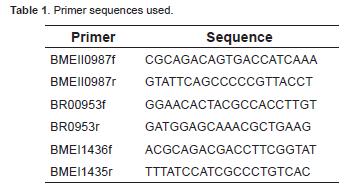
<body><![CDATA[<p><b><font size="3">Introduction</font></b></p>     <p>   <i>Brucella canis</i> (<i>B. canis</i>) bacteria target androgen-dependent organs, causing reproductive failure and infertility in dogs. It was first isolated in Colombia from seropositive sick dogs in 2005 (Giraldo <i>et al.</i>, 2009). This pathogen was also isolated from an owner whose kennel tested positive (Olivera and Di Lorenzo, 2009). So far, 49 isolates from 10 kennels and one isolate from a person in Medellin have been identified in Colombia. A deletion in a specific region of certain <i>B. canis</i> genomes can occur, consequently affecting their band pattern and differentiating them from <i>Brucella suis</i> (<i>B. suis</i>) (Garc&iacute;a-Yoldi <i>et al.</i>, 2006). Such isolates have been classified as <i>B. canis</i> Group 1. Isolates not presenting this deletion are classified as <i>B. canis</i> Group 2 (Koylass <i>et al.</i>, 2010). The objective of this communication is to report that <i>B. canis</i> isolates from Medellin metropolitan area belong to the Group 2 genotype. Our results suggest that this is currently either the predominant or the sole group in this region of Colombia.</p>     <p>&nbsp;</p>     <p><b><font size="3">Materials and methods</font></b></p>     <p><i>   Bacterial isolates, strains, and DNA extraction</i></p>     <p>   A set of 49 <i>B. canis</i> isolates from blood were used. Isolates were identified by biochemical tests and confirmed by Argentina's Administraci&oacute;n Nacional de Laboratorios e Institutos de Salud ''<i>Dr. Carlos G. Malbr&aacute;n</i>'' (Malbr&aacute;n Institute). Dogs located throughout Medell&iacute;n's metropolitan area were used in this study. Genomic DNA was extracted using the boiling method (Queipo-Ortu&ntilde;o <i>et al.</i>, 2008) where five colonies were picked from tryptic soy agar (Difco, BD Diagnostic Systems, Sparks, MD, USA), cultured and suspended in 200 &mu;l distilled water aliquots, boiled for 10 min, then centrifuged for 5 min at 20.000 x g. The resulting supernatants were used for PCR. The DNA concentration and quality was measured by the Nanodrop system at 260/280 (Rossetti <i>et al.</i>, 2009).</p>     <p><i>Primer selection</i></p>     <p>   Extracted DNA, purified from the isolates, was amplified in three simple PCRs using three primer pairs selected from the eigth used by Garc&iacute;a-Yoldi <i>et al.</i> (2006). Primer sequences are presented in <a href="#t1">table 1</a>.</p>     <p align="center"><a name="t1"></a><img src="/img/revistas/rccp/v25n4/v25n4a9t1.jpg" /></p>     <p>The first primer pair used was the genus-specific BMEII0987f and BMEII0987r, which amplified a 152 bp fragment in all <i>Brucella</i> species except <i>B. neotomae</i>. The second pair consisted of primers BR00953f and BR0953r, which amplified a 272 bp fragment in <i>B. canis</i>, <i>B. suis</i>, and <i>B. neotomae</i>. The last pair was the species-specific BMEI1436f and BMEI1435r, which amplify a 794 bp fragment in <i>B. suis</i>, but not in <i>B. canis</i> ATCC 23365.</p>     ]]></body>
<body><![CDATA[<p><i>PCR procedure</i></p>     <p>   The PCRs were performed using 25 &mu;l containing 3 &mu;l of 1 ng/&mu;l DNA template, 0.625 &mu;l of 0.25 &mu;M of each primer, 0.2 &mu;l of <i>Taq</i> DNA polymerase (5 UI/&mu;l, Fermentas Taq DNA polymerase recombinant, Foster City, CA, USA), 3 &mu;l of 3 mM MgCl<sub>2</sub> (Fermentas), 2.5 &mu;l of 10X buffer with Tris-HCl, Triton X-100, and KCl (pH 8.8) (Fermentas), 0.5 &mu;l of 10 mM of each dNTP, completing with distilled water. Amplification was run in a PTC 200 thermocycler (Perkin-Elmer Inc., San Jose, CA, USA) for 25 cycles, as reported by Garc&iacute;a-Yoldi <i>et al.</i> (2006). Water was added in the negative control, and DNA from the attenuated Carmichael <i>B. canis</i> <i>M</i>- (a less mucoid <i>B. canis</i> strain used as antigen for serologic diagnosis of canine brucellosis) served as positive control (Carmichael and Joubert, 1987). The PCR products were analyzed in 1% agarose gels containing 0.5 &mu;g/ml ethidium bromide and detected under UV light using a photo-gel imaging system (Transilluminator Mini Benchtop Model <i>M-10E</i>, UVP, Upland, CA, USA).</p>     <p><i>Sequencing of 794 bp amplicon</i></p>     <p>   The 794 bp amplicon of the 12 genes <i>virB</i> from 10 field isolates was automatically sequenced using the forward primer by Macrogen Company (Korea). Sequencing was conducted using the BigDye&trade; terminator kit (ABI, Foster City, CA, USA) cycling conditions (Tiller <i>et al.</i>, 2010). The reaction products were purified by ethanol precipitation and analyzed with the automatic sequencer 3730XL (<a href="http://www.macrogen.com/eng/index/" target="_blank">www.macrogen.com</a>). The 794 bp fragment sequences were analyzed using the ClustalW software (Hall, 1999). These sequences were compared with the sequences reported in GenBank for <i>B. canis</i> ATCC 23365 and <i>B. canis</i> HSK A52141 (<a href="/img/revistas/rccp/v25n4/v25n4a9f2.jpg" target="_blank">Figure 2</a>).</p>     <p>&nbsp;</p>     <p><b><font size="3">Results</font></b></p>     <p>   The three fragments (152, 272, and 794 bp) were amplified by PCR in all 49 isolates (<a href="/img/revistas/rccp/v25n4/v25n4a9f1.jpg" target="_blank">Figure 1</a>).</p>     <p><i>DNA sequence analysis of the 794 bp fragment</i></p>     <p>   The sequences obtained in this study revealed high homology with <i>B. canis</i> HSK A52141, but not with <i>B. canis</i> ATCC 23365, which presents a deletion in the region of polysaccharide deacetylase gene and does not align with the other strains, as shown in <a href="/img/revistas/rccp/v25n4/v25n4a9f2.jpg" target="_blank">figure 2</a>.</p>     <p>&nbsp;</p>     ]]></body>
<body><![CDATA[<p><b><font size="3">Discussion</font></b></p>     <p>When a new canine pathogen was isolated from dog abortions in 1969, the question arose as to whether this bacterium should be designated as <i>B. suis</i> biotype 5 or <i>B. canis</i> . Eventually these isolates were designated <i>B. canis</i> due to the lack of lipopolysaccharide antigen associated with smooth agglutinogen and endotoxin, and also because it does not utilize erythritol (Jones <i>et al.</i>, 1968); thus differing significantly from <i>B. suis</i>. This classification was adopted by the International Committee on Bacteriological Nomenclature's subcommittee on taxonomy of <i>Brucella</i> for the <i>B. canis</i> strains RM6/66 ATCC 23365 and NCTC 10854 (Banai and Corbel, 2010).</p>     <p>For many years the only listed strain in GeneBank was <i>B. canis</i> ATCC 23365. This made the molecular classification of <i>B. canis</i> strains difficult due to existing similarities between <i>B. canis</i> and <i>B. suis</i> and their high degree of genetic homology. Clarification was offered by Garc&iacute;a-Yoldi <i>et al.</i> (2006) who published a method for identifying and differentiating all <i>Brucella</i> species using a deletion in the <i>B. canis</i> genome that differentiates it from <i>B. suis</i>. However, Koylass <i>et al.</i> (2010) demonstrated that not all <i>B. canis</i> strains have this deletion. Currently, two <i>B. canis</i> groups are recognized: Group 1, which carries the deletion, and Group 2, which lacks it. This gap is due to the impossibility for the primers that amplify the 794 bp fragment to anneal to this region. The 49 isolates tested in the current study do not present the deletion. Therefore, we concluded that the isolates studied in Medellin belong to <i>B. canis</i> Group 2 genotype.</p>     <p>Amplification of the 794 bp product suggests that we are in the presence of either <i>B. suis</i> or <i>B. canis</i> Group 2. The likeliness that <i>B. suis</i> was the infectious agent in our set of isolates was ruled out because these isolates were obtained from dogs and they were biochemically typified as <i>B. canis</i> by the internationally recognized Malbr&aacute;n Institute (Argentina).</p>     <p>Kim <i>et al.</i> (2011) sequenced the <i>B. canis</i> HSK A52141 strain. It differs from the ATTTCC prototype and, as shown in figure 2, the alignment of the corresponding fragment in our study indicates complete homology, indicating that <i>B. canis</i> HSK A52141 and our isolates belong to the same group. On the other hand, Gyuranecz <i>et al.</i> (2011) recently reported that some dog isolates, initially confused with B. suis when studied by the Bruce-ladder technique, were finally identified as <i>B. canis</i> Group 2 when analyzed by single nucleotide polymorphism (SNP).</p>     <p>Clinical, pathological, or epidemiological canine brucellosis patterns have not been characterized in Colombia, notwithstanding the fact that the bacterium's presence has been documented. Standardization of serological, bacteriological, and molecular techniques is very important for these purposes as well as for basic phylogenetic studies and to compare cross antigenicity and pathogenicity of Group 1 and 2 in dogs and human isolates.</p>     <p>&nbsp;</p>     <p><font size="3"><b>Acknowledgments</b></font></p>     <p>   This work was supported by the Estrategia de Sostenibilidad 2009-2010 (University of Antioquia), the Biog&eacute;nesis Research Group (University of Antioquia), and a COLCIENCIAS research grant for PhD students and Young Scientists.</p>     <p>&nbsp;</p>     ]]></body>
<body><![CDATA[<p><font size="3"><b>References</b></font></p>     <!-- ref --><p>   1. Anonymous. Normal automatic sequencing. 2012; [July 24<sup>th</sup>, 2012] URL: <a href="http://www.macrogen.com/eng/index/" target="_blank">www.macrogen.com</a>  &nbsp;&nbsp;&nbsp;&nbsp;&nbsp;&nbsp;&nbsp;&nbsp;[&#160;<a href="javascript:void(0);" onclick="javascript: window.open('/scielo.php?script=sci_nlinks&ref=000064&pid=S0120-0690201200040000900001&lng=','','width=640,height=500,resizable=yes,scrollbars=1,menubar=yes,');">Links</a>&#160;]<!-- end-ref --><!-- ref --><p>2. Banai M, Corbel M. Taxonomy of <i>Brucella</i>. Open Vet Sci J 2010; 4:85-101.    &nbsp;&nbsp;&nbsp;&nbsp;&nbsp;&nbsp;&nbsp;&nbsp;[&#160;<a href="javascript:void(0);" onclick="javascript: window.open('/scielo.php?script=sci_nlinks&ref=000065&pid=S0120-0690201200040000900002&lng=','','width=640,height=500,resizable=yes,scrollbars=1,menubar=yes,');">Links</a>&#160;]<!-- end-ref --></p> </font>     <!-- ref --><p><font size="2" face="Verdana, Arial, Helvetica, sans-serif">   3. Carmichael L, Joubert J. A rapid slide agglutination test for the serodiagnosis of <i>Brucella canis</i> infection that employs a variant (M-) organism as antigen. Cornell Vet 1987; 77:3.    &nbsp;&nbsp;&nbsp;&nbsp;&nbsp;&nbsp;&nbsp;&nbsp;[&#160;<a href="javascript:void(0);" onclick="javascript: window.open('/scielo.php?script=sci_nlinks&ref=000067&pid=S0120-0690201200040000900003&lng=','','width=640,height=500,resizable=yes,scrollbars=1,menubar=yes,');">Links</a>&#160;]<!-- end-ref --></font></p> <font face="Verdana, Arial, Helvetica, sans-serif" size="2">     <!-- ref --><p>   4. Garc&iacute;a-Yoldi D, Mar&iacute;n C, de Miguel M, Munoz P, Vizmanos J, Lopez-Goni I. Multiplex PCR assay for the identification and differentiation of all <i>Brucella</i> species and the vaccine strains <i>Brucella abortus</i> S19 and RB51 and Brucella melitensis. Rev Clin Chem 2006; 52:779.    &nbsp;&nbsp;&nbsp;&nbsp;&nbsp;&nbsp;&nbsp;&nbsp;[&#160;<a href="javascript:void(0);" onclick="javascript: window.open('/scielo.php?script=sci_nlinks&ref=000069&pid=S0120-0690201200040000900004&lng=','','width=640,height=500,resizable=yes,scrollbars=1,menubar=yes,');">Links</a>&#160;]<!-- end-ref --></p>     <!-- ref --><p>   5. Giraldo C, Ruiz-Cort&eacute;s T, Olivera M. <i>Brucella canis</i> in Medell&iacute;n (Colombia), a current problem. Revista U.D.C.A. Actualidad &amp; Divulgaci&oacute;n Cient&iacute;fica 2009; 12:51-57.    &nbsp;&nbsp;&nbsp;&nbsp;&nbsp;&nbsp;&nbsp;&nbsp;[&#160;<a href="javascript:void(0);" onclick="javascript: window.open('/scielo.php?script=sci_nlinks&ref=000071&pid=S0120-0690201200040000900005&lng=','','width=640,height=500,resizable=yes,scrollbars=1,menubar=yes,');">Links</a>&#160;]<!-- end-ref --></p>     ]]></body>
<body><![CDATA[<!-- ref --><p>   6. Gyuranecz M, Szeredi L, Ronai Z, Denes B, Dencso L, Dan A, Palmai N, Hauser Z, Lami E, Makrai L. Detection of <i>Brucella canis</i> -induced reproductive diseases in a kennel. J Vet Diagn Invest 2011; 23:143.    &nbsp;&nbsp;&nbsp;&nbsp;&nbsp;&nbsp;&nbsp;&nbsp;[&#160;<a href="javascript:void(0);" onclick="javascript: window.open('/scielo.php?script=sci_nlinks&ref=000073&pid=S0120-0690201200040000900006&lng=','','width=640,height=500,resizable=yes,scrollbars=1,menubar=yes,');">Links</a>&#160;]<!-- end-ref --></p>     <!-- ref --><p>   7. Hall T.A. BioEdit: a user-friendly biological sequence alignment editor and analysis program for Windows 95/98/NT. Nucl Acids Symp Ser 1999; 41:95-98.    &nbsp;&nbsp;&nbsp;&nbsp;&nbsp;&nbsp;&nbsp;&nbsp;[&#160;<a href="javascript:void(0);" onclick="javascript: window.open('/scielo.php?script=sci_nlinks&ref=000075&pid=S0120-0690201200040000900007&lng=','','width=640,height=500,resizable=yes,scrollbars=1,menubar=yes,');">Links</a>&#160;]<!-- end-ref --></p>     <!-- ref --><p>   8. Jones LM, Zanardi M, Leong D, Wilson JB. Taxonomic Position in the Genus Brucella of the Causative Agent of Canine Abortion. J Bacteriol 1968; 95:625-630.    &nbsp;&nbsp;&nbsp;&nbsp;&nbsp;&nbsp;&nbsp;&nbsp;[&#160;<a href="javascript:void(0);" onclick="javascript: window.open('/scielo.php?script=sci_nlinks&ref=000077&pid=S0120-0690201200040000900008&lng=','','width=640,height=500,resizable=yes,scrollbars=1,menubar=yes,');">Links</a>&#160;]<!-- end-ref --></p>     <!-- ref --><p>   9. Kim JS, Jeong W, Kim H, Baek JH, Vinuselvi P, Lee SK, Kim JW, Kim JY, Jung SC, Her M, An DJ. <i>Brucella canis</i> HSK A52141 complete genome. [March 15th, 2012). URL: <a href="http://www.ncbi.nlm.nih.gov/genome?term=Brucella%20canis%20HSK%20A52141%20complete%20genome" target="_blank">http://www.ncbi.nlm.nih.gov/genome?term=Brucella%20canis%20HSK%20A52141%20complete%20genome </a>.    &nbsp;&nbsp;&nbsp;&nbsp;&nbsp;&nbsp;&nbsp;&nbsp;[&#160;<a href="javascript:void(0);" onclick="javascript: window.open('/scielo.php?script=sci_nlinks&ref=000079&pid=S0120-0690201200040000900009&lng=','','width=640,height=500,resizable=yes,scrollbars=1,menubar=yes,');">Links</a>&#160;]<!-- end-ref -->  </p>     <!-- ref --><p>10. Koylass M.S, King A.C, Edwards-Smallbone J, Gopaul K.K, Perrett L.L, Whatmore A.M. Comparative performance of SNP typing and ''Bruce-ladder'' in the discrimination of <i>Brucella suis</i> and <i>Brucella canis</i>. Vet Microbiol 2010; 142:450-454.    &nbsp;&nbsp;&nbsp;&nbsp;&nbsp;&nbsp;&nbsp;&nbsp;[&#160;<a href="javascript:void(0);" onclick="javascript: window.open('/scielo.php?script=sci_nlinks&ref=000081&pid=S0120-0690201200040000900010&lng=','','width=640,height=500,resizable=yes,scrollbars=1,menubar=yes,');">Links</a>&#160;]<!-- end-ref --></p>     ]]></body>
<body><![CDATA[<!-- ref --><p>   11. Olivera M, Di Lorenzo C. Aislamiento de <i>Brucella canis</i> en un humano conviviente con caninos infectados. Informe de un caso. Colomb M&eacute;d 2009; 40:218-220.    &nbsp;&nbsp;&nbsp;&nbsp;&nbsp;&nbsp;&nbsp;&nbsp;[&#160;<a href="javascript:void(0);" onclick="javascript: window.open('/scielo.php?script=sci_nlinks&ref=000083&pid=S0120-0690201200040000900011&lng=','','width=640,height=500,resizable=yes,scrollbars=1,menubar=yes,');">Links</a>&#160;]<!-- end-ref --></p>     <!-- ref --><p>   12. Queipo-Ortu&ntilde;o MI, Colmenero JD, Macias M, Bravo JM, Morata P. Preparation of Bacterial DNA Template by Boiling and Effect of Immunoglobulin G as an Inhibitor in Real-Time PCR for Serum Samples from Patients with Brucellosis. Clin Vaccine Immunol 2008; 15:293-296.    &nbsp;&nbsp;&nbsp;&nbsp;&nbsp;&nbsp;&nbsp;&nbsp;[&#160;<a href="javascript:void(0);" onclick="javascript: window.open('/scielo.php?script=sci_nlinks&ref=000085&pid=S0120-0690201200040000900012&lng=','','width=640,height=500,resizable=yes,scrollbars=1,menubar=yes,');">Links</a>&#160;]<!-- end-ref --></p>     <!-- ref --><p>   13. Rajashekara G, Glasner JD, Glover DA, Splitter GA. Comparative whole-genome hybridization reveals genomic islands in <i>Brucella</i> species. J Bacteriol 2004; 186:5040.    &nbsp;&nbsp;&nbsp;&nbsp;&nbsp;&nbsp;&nbsp;&nbsp;[&#160;<a href="javascript:void(0);" onclick="javascript: window.open('/scielo.php?script=sci_nlinks&ref=000087&pid=S0120-0690201200040000900013&lng=','','width=640,height=500,resizable=yes,scrollbars=1,menubar=yes,');">Links</a>&#160;]<!-- end-ref --></p>     <!-- ref --><p>   14. Rossetti CA, Galindo CL, Lawhon SD, Garner HR, Adams LG. Brucella melitensis global gene expression study provides novel information on growth phase-specific gene regulation with potential insights for understanding Brucella: host initial interactions. BMC Microbiol 2009; 9:81-94.    &nbsp;&nbsp;&nbsp;&nbsp;&nbsp;&nbsp;&nbsp;&nbsp;[&#160;<a href="javascript:void(0);" onclick="javascript: window.open('/scielo.php?script=sci_nlinks&ref=000089&pid=S0120-0690201200040000900014&lng=','','width=640,height=500,resizable=yes,scrollbars=1,menubar=yes,');">Links</a>&#160;]<!-- end-ref --></p>     <!-- ref --><p>   15. Tiller RV, Gee JE, Lonsway DR, Gribble S, Bell SC, Jenninson AV, Bates J, Coulter C, Hoffmaster AR, De BK. Identification of an unusual Brucella strain (BO2) from a lung biopsy in a 52 year-old patient with chronic destructive pneumonia. BMC Microbiol 2010; 10:23-33.    &nbsp;&nbsp;&nbsp;&nbsp;&nbsp;&nbsp;&nbsp;&nbsp;[&#160;<a href="javascript:void(0);" onclick="javascript: window.open('/scielo.php?script=sci_nlinks&ref=000091&pid=S0120-0690201200040000900015&lng=','','width=640,height=500,resizable=yes,scrollbars=1,menubar=yes,');">Links</a>&#160;]<!-- end-ref --></p>     ]]></body>
<body><![CDATA[<p>&nbsp;</p>     <p><font size="3"><b>Notas al pie </b></font></p>     <p><sup><a href="#b0">&curren;</a><a name="0"></a></sup> To cite this article: Ort&iacute;z LF, Muskus C, S&aacute;nchez MM, Olivera M. Identification of <i>Brucella canis</i> Group 2 in colombian kennels. Rev Colomb Cienc Pecu 2012; 25:615-619.</p>     <p>&nbsp;</p> </font>      ]]></body><back>
<ref-list>
<ref id="B1">
<label>1</label><nlm-citation citation-type="">
<person-group person-group-type="author">
<name>
</name>
<name>
</name>
</person-group>
<source><![CDATA[Normal automatic sequencing]]></source>
<year>2012</year>
</nlm-citation>
</ref>
<ref id="B2">
<label>2</label><nlm-citation citation-type="journal">
<person-group person-group-type="author">
<name>
<surname><![CDATA[Banai]]></surname>
<given-names><![CDATA[M]]></given-names>
</name>
<name>
<surname><![CDATA[Corbel]]></surname>
<given-names><![CDATA[M]]></given-names>
</name>
</person-group>
<article-title xml:lang="en"><![CDATA[Taxonomy of Brucella]]></article-title>
<source><![CDATA[Open Vet Sci J]]></source>
<year>2010</year>
<volume>4</volume>
<page-range>85-101</page-range></nlm-citation>
</ref>
<ref id="B3">
<label>3</label><nlm-citation citation-type="journal">
<person-group person-group-type="author">
<name>
<surname><![CDATA[Carmichael]]></surname>
<given-names><![CDATA[L]]></given-names>
</name>
<name>
<surname><![CDATA[Joubert]]></surname>
<given-names><![CDATA[J]]></given-names>
</name>
</person-group>
<article-title xml:lang="en"><![CDATA[A rapid slide agglutination test for the serodiagnosis of Brucella canis infection that employs a variant (M-) organism as antigen]]></article-title>
<source><![CDATA[Cornell Vet]]></source>
<year>1987</year>
<volume>77</volume>
<page-range>3</page-range></nlm-citation>
</ref>
<ref id="B4">
<label>4</label><nlm-citation citation-type="journal">
<person-group person-group-type="author">
<name>
<surname><![CDATA[García-Yoldi]]></surname>
<given-names><![CDATA[D]]></given-names>
</name>
<name>
<surname><![CDATA[Marín]]></surname>
<given-names><![CDATA[C]]></given-names>
</name>
<name>
<surname><![CDATA[de Miguel]]></surname>
<given-names><![CDATA[M]]></given-names>
</name>
<name>
<surname><![CDATA[Munoz]]></surname>
<given-names><![CDATA[P]]></given-names>
</name>
<name>
<surname><![CDATA[Vizmanos]]></surname>
<given-names><![CDATA[J]]></given-names>
</name>
<name>
<surname><![CDATA[Lopez-Goni]]></surname>
<given-names><![CDATA[I]]></given-names>
</name>
</person-group>
<article-title xml:lang="en"><![CDATA[Multiplex PCR assay for the identification and differentiation of all Brucella species and the vaccine strains Brucella abortus S19 and RB51 and Brucella melitensis]]></article-title>
<source><![CDATA[Rev Clin Chem]]></source>
<year>2006</year>
<volume>52</volume>
<page-range>779</page-range></nlm-citation>
</ref>
<ref id="B5">
<label>5</label><nlm-citation citation-type="journal">
<person-group person-group-type="author">
<name>
<surname><![CDATA[Giraldo]]></surname>
<given-names><![CDATA[C]]></given-names>
</name>
<name>
<surname><![CDATA[Ruiz-Cortés]]></surname>
<given-names><![CDATA[T]]></given-names>
</name>
<name>
<surname><![CDATA[Olivera]]></surname>
<given-names><![CDATA[M]]></given-names>
</name>
</person-group>
<article-title xml:lang="en"><![CDATA[Brucella canis in Medellín (Colombia), a current problem]]></article-title>
<source><![CDATA[Revista U.D.C.A. Actualidad & Divulgación Científica]]></source>
<year>2009</year>
<volume>12</volume>
<page-range>51-57</page-range></nlm-citation>
</ref>
<ref id="B6">
<label>6</label><nlm-citation citation-type="journal">
<person-group person-group-type="author">
<name>
<surname><![CDATA[Gyuranecz]]></surname>
<given-names><![CDATA[M]]></given-names>
</name>
<name>
<surname><![CDATA[Szeredi]]></surname>
<given-names><![CDATA[L]]></given-names>
</name>
<name>
<surname><![CDATA[Ronai]]></surname>
<given-names><![CDATA[Z]]></given-names>
</name>
<name>
<surname><![CDATA[Denes]]></surname>
<given-names><![CDATA[B]]></given-names>
</name>
<name>
<surname><![CDATA[Dencso]]></surname>
<given-names><![CDATA[L]]></given-names>
</name>
<name>
<surname><![CDATA[Dan]]></surname>
<given-names><![CDATA[A]]></given-names>
</name>
<name>
<surname><![CDATA[Palmai]]></surname>
<given-names><![CDATA[N]]></given-names>
</name>
<name>
<surname><![CDATA[Hauser]]></surname>
<given-names><![CDATA[Z]]></given-names>
</name>
<name>
<surname><![CDATA[Lami]]></surname>
<given-names><![CDATA[E]]></given-names>
</name>
<name>
<surname><![CDATA[Makrai]]></surname>
<given-names><![CDATA[L]]></given-names>
</name>
</person-group>
<article-title xml:lang="en"><![CDATA[Detection of Brucella canis -induced reproductive diseases in a kennel]]></article-title>
<source><![CDATA[J Vet Diagn Invest]]></source>
<year>2011</year>
<volume>23</volume>
<page-range>143</page-range></nlm-citation>
</ref>
<ref id="B7">
<label>7</label><nlm-citation citation-type="journal">
<person-group person-group-type="author">
<name>
<surname><![CDATA[Hall]]></surname>
<given-names><![CDATA[T.A]]></given-names>
</name>
</person-group>
<article-title xml:lang="en"><![CDATA[BioEdit: a user-friendly biological sequence alignment editor and analysis program for Windows 95/98/NT]]></article-title>
<source><![CDATA[Nucl Acids Symp Ser]]></source>
<year>1999</year>
<volume>41</volume>
<page-range>95-98</page-range></nlm-citation>
</ref>
<ref id="B8">
<label>8</label><nlm-citation citation-type="journal">
<person-group person-group-type="author">
<name>
<surname><![CDATA[Jones]]></surname>
<given-names><![CDATA[LM]]></given-names>
</name>
<name>
<surname><![CDATA[Zanardi]]></surname>
<given-names><![CDATA[M]]></given-names>
</name>
<name>
<surname><![CDATA[Leong]]></surname>
<given-names><![CDATA[D]]></given-names>
</name>
<name>
<surname><![CDATA[Wilson]]></surname>
<given-names><![CDATA[JB]]></given-names>
</name>
</person-group>
<article-title xml:lang="en"><![CDATA[Taxonomic Position in the Genus Brucella of the Causative Agent of Canine Abortion]]></article-title>
<source><![CDATA[J Bacteriol]]></source>
<year>1968</year>
<volume>95</volume>
<page-range>625-630</page-range></nlm-citation>
</ref>
<ref id="B9">
<label>9</label><nlm-citation citation-type="">
<person-group person-group-type="author">
<name>
<surname><![CDATA[Kim]]></surname>
<given-names><![CDATA[JS]]></given-names>
</name>
<name>
<surname><![CDATA[Jeong]]></surname>
<given-names><![CDATA[W]]></given-names>
</name>
<name>
<surname><![CDATA[Kim]]></surname>
<given-names><![CDATA[H]]></given-names>
</name>
<name>
<surname><![CDATA[Baek]]></surname>
<given-names><![CDATA[JH]]></given-names>
</name>
<name>
<surname><![CDATA[Vinuselvi]]></surname>
<given-names><![CDATA[P]]></given-names>
</name>
<name>
<surname><![CDATA[Lee]]></surname>
<given-names><![CDATA[SK]]></given-names>
</name>
<name>
<surname><![CDATA[Kim]]></surname>
<given-names><![CDATA[JW]]></given-names>
</name>
<name>
<surname><![CDATA[Kim]]></surname>
<given-names><![CDATA[JY]]></given-names>
</name>
<name>
<surname><![CDATA[Jung]]></surname>
<given-names><![CDATA[SC]]></given-names>
</name>
<name>
<surname><![CDATA[Her]]></surname>
<given-names><![CDATA[M]]></given-names>
</name>
<name>
<surname><![CDATA[An]]></surname>
<given-names><![CDATA[DJ.]]></given-names>
</name>
</person-group>
<source><![CDATA[Brucella canis HSK A52141 complete genome]]></source>
<year></year>
</nlm-citation>
</ref>
<ref id="B10">
<label>10</label><nlm-citation citation-type="journal">
<person-group person-group-type="author">
<name>
<surname><![CDATA[Koylass]]></surname>
<given-names><![CDATA[M.S]]></given-names>
</name>
<name>
<surname><![CDATA[King]]></surname>
<given-names><![CDATA[A.C]]></given-names>
</name>
<name>
<surname><![CDATA[Edwards-Smallbone]]></surname>
<given-names><![CDATA[J]]></given-names>
</name>
<name>
<surname><![CDATA[Gopaul]]></surname>
<given-names><![CDATA[K.K]]></given-names>
</name>
<name>
<surname><![CDATA[Perrett]]></surname>
<given-names><![CDATA[L.L]]></given-names>
</name>
<name>
<surname><![CDATA[Whatmore]]></surname>
<given-names><![CDATA[A.M]]></given-names>
</name>
</person-group>
<article-title xml:lang="en"><![CDATA[Comparative performance of SNP typing and ''Bruce-ladder'' in the discrimination of Brucella suis and Brucella canis]]></article-title>
<source><![CDATA[Vet Microbiol]]></source>
<year>2010</year>
<volume>142</volume>
<page-range>450-454</page-range></nlm-citation>
</ref>
<ref id="B11">
<label>11</label><nlm-citation citation-type="journal">
<person-group person-group-type="author">
<name>
<surname><![CDATA[Olivera]]></surname>
<given-names><![CDATA[M]]></given-names>
</name>
<name>
<surname><![CDATA[Di Lorenzo]]></surname>
<given-names><![CDATA[C]]></given-names>
</name>
</person-group>
<article-title xml:lang="es"><![CDATA[Aislamiento de Brucella canis en un humano conviviente con caninos infectados. Informe de un caso]]></article-title>
<source><![CDATA[Colomb Méd]]></source>
<year>2009</year>
<volume>40</volume>
<page-range>218-220</page-range></nlm-citation>
</ref>
<ref id="B12">
<label>12</label><nlm-citation citation-type="journal">
<person-group person-group-type="author">
<name>
<surname><![CDATA[Queipo-Ortuño]]></surname>
<given-names><![CDATA[MI]]></given-names>
</name>
<name>
<surname><![CDATA[Colmenero]]></surname>
<given-names><![CDATA[JD]]></given-names>
</name>
<name>
<surname><![CDATA[Macias]]></surname>
<given-names><![CDATA[M]]></given-names>
</name>
<name>
<surname><![CDATA[Bravo]]></surname>
<given-names><![CDATA[JM]]></given-names>
</name>
<name>
<surname><![CDATA[Morata]]></surname>
<given-names><![CDATA[P]]></given-names>
</name>
</person-group>
<article-title xml:lang="en"><![CDATA[Preparation of Bacterial DNA Template by Boiling and Effect of Immunoglobulin G as an Inhibitor in Real-Time PCR for Serum Samples from Patients with Brucellosis]]></article-title>
<source><![CDATA[Clin Vaccine Immunol]]></source>
<year>2008</year>
<volume>15</volume>
<page-range>293-296</page-range></nlm-citation>
</ref>
<ref id="B13">
<label>13</label><nlm-citation citation-type="journal">
<person-group person-group-type="author">
<name>
<surname><![CDATA[Rajashekara]]></surname>
<given-names><![CDATA[G]]></given-names>
</name>
<name>
<surname><![CDATA[Glasner]]></surname>
<given-names><![CDATA[JD]]></given-names>
</name>
<name>
<surname><![CDATA[Glover]]></surname>
<given-names><![CDATA[DA]]></given-names>
</name>
<name>
<surname><![CDATA[Splitter]]></surname>
<given-names><![CDATA[GA]]></given-names>
</name>
</person-group>
<article-title xml:lang="en"><![CDATA[Comparative whole-genome hybridization reveals genomic islands in Brucella species]]></article-title>
<source><![CDATA[J Bacteriol]]></source>
<year>2004</year>
<volume>186</volume>
<page-range>5040</page-range></nlm-citation>
</ref>
<ref id="B14">
<label>14</label><nlm-citation citation-type="journal">
<person-group person-group-type="author">
<name>
<surname><![CDATA[Rossetti]]></surname>
<given-names><![CDATA[CA]]></given-names>
</name>
<name>
<surname><![CDATA[Galindo]]></surname>
<given-names><![CDATA[CL]]></given-names>
</name>
<name>
<surname><![CDATA[Lawhon]]></surname>
<given-names><![CDATA[SD]]></given-names>
</name>
<name>
<surname><![CDATA[Garner]]></surname>
<given-names><![CDATA[HR]]></given-names>
</name>
<name>
<surname><![CDATA[Adams]]></surname>
<given-names><![CDATA[LG]]></given-names>
</name>
</person-group>
<article-title xml:lang="en"><![CDATA[Brucella melitensis global gene expression study provides novel information on growth phase-specific gene regulation with potential insights for understanding Brucella: host initial interactions]]></article-title>
<source><![CDATA[BMC Microbiol]]></source>
<year>2009</year>
<volume>9</volume>
<page-range>81-94</page-range></nlm-citation>
</ref>
<ref id="B15">
<label>15</label><nlm-citation citation-type="journal">
<person-group person-group-type="author">
<name>
<surname><![CDATA[Tiller]]></surname>
<given-names><![CDATA[RV]]></given-names>
</name>
<name>
<surname><![CDATA[Gee]]></surname>
<given-names><![CDATA[JE]]></given-names>
</name>
<name>
<surname><![CDATA[Lonsway]]></surname>
<given-names><![CDATA[DR]]></given-names>
</name>
<name>
<surname><![CDATA[Gribble]]></surname>
<given-names><![CDATA[S]]></given-names>
</name>
<name>
<surname><![CDATA[Bell]]></surname>
<given-names><![CDATA[SC]]></given-names>
</name>
<name>
<surname><![CDATA[Jenninson]]></surname>
<given-names><![CDATA[AV]]></given-names>
</name>
<name>
<surname><![CDATA[Bates]]></surname>
<given-names><![CDATA[J]]></given-names>
</name>
<name>
<surname><![CDATA[Coulter]]></surname>
<given-names><![CDATA[C]]></given-names>
</name>
<name>
<surname><![CDATA[Hoffmaster]]></surname>
<given-names><![CDATA[AR]]></given-names>
</name>
<name>
<surname><![CDATA[De]]></surname>
<given-names><![CDATA[BK]]></given-names>
</name>
</person-group>
<article-title xml:lang="en"><![CDATA[Identification of an unusual Brucella strain (BO2) from a lung biopsy in a 52 year-old patient with chronic destructive pneumonia]]></article-title>
<source><![CDATA[BMC Microbiol]]></source>
<year>2010</year>
<volume>10</volume>
<page-range>23-33</page-range></nlm-citation>
</ref>
</ref-list>
</back>
</article>
