<?xml version="1.0" encoding="ISO-8859-1"?><article xmlns:mml="http://www.w3.org/1998/Math/MathML" xmlns:xlink="http://www.w3.org/1999/xlink" xmlns:xsi="http://www.w3.org/2001/XMLSchema-instance">
<front>
<journal-meta>
<journal-id>0120-0690</journal-id>
<journal-title><![CDATA[Revista Colombiana de Ciencias Pecuarias]]></journal-title>
<abbrev-journal-title><![CDATA[Rev Colom Cienc Pecua]]></abbrev-journal-title>
<issn>0120-0690</issn>
<publisher>
<publisher-name><![CDATA[Facultad de Ciencias Agrarias, Universidad de Antioquia]]></publisher-name>
</publisher>
</journal-meta>
<article-meta>
<article-id>S0120-06902013000100002</article-id>
<title-group>
<article-title xml:lang="en"><![CDATA[Effect of cyclicity and Equine Chorionic Gonadotropin (eCG) in fixed-time artificial insemination programs in Bos indicus cattle]]></article-title>
<article-title xml:lang="es"><![CDATA[Efecto de la ciclicidad y la eCG en programas de inseminación artificial a tiempo fijo en ganado Bos indicus]]></article-title>
<article-title xml:lang="pt"><![CDATA[Efeito da eCG e a ciclicidade em programas de inseminação artificial em tempo fixo em gado Bos indicus]]></article-title>
</title-group>
<contrib-group>
<contrib contrib-type="author">
<name>
<surname><![CDATA[Salgado]]></surname>
<given-names><![CDATA[Roger D]]></given-names>
</name>
<xref ref-type="aff" rid="A01"/>
<xref ref-type="aff" rid="A02"/>
</contrib>
<contrib contrib-type="author">
<name>
<surname><![CDATA[Maza]]></surname>
<given-names><![CDATA[Libardo A]]></given-names>
</name>
<xref ref-type="aff" rid="A01"/>
</contrib>
<contrib contrib-type="author">
<name>
<surname><![CDATA[Vergara]]></surname>
<given-names><![CDATA[Oscar D]]></given-names>
</name>
<xref ref-type="aff" rid="A01"/>
</contrib>
</contrib-group>
<aff id="A02">
<institution><![CDATA[,Universidad de Córdoba Facultad de Medicina Veterinaria y Zootecnia ]]></institution>
<addr-line><![CDATA[Montería ]]></addr-line>
<country>Colombia</country>
</aff>
<aff id="A01">
<institution><![CDATA[,Universidad de Córdoba Facultad de Medicina Veterinaria y Zootecnia Departamento de Ciencias Pecuarias]]></institution>
<addr-line><![CDATA[Monteria ]]></addr-line>
<country>Colombia</country>
</aff>
<pub-date pub-type="pub">
<day>00</day>
<month>03</month>
<year>2013</year>
</pub-date>
<pub-date pub-type="epub">
<day>00</day>
<month>03</month>
<year>2013</year>
</pub-date>
<volume>26</volume>
<numero>1</numero>
<fpage>9</fpage>
<lpage>14</lpage>
<copyright-statement/>
<copyright-year/>
<self-uri xlink:href="http://www.scielo.org.co/scielo.php?script=sci_arttext&amp;pid=S0120-06902013000100002&amp;lng=en&amp;nrm=iso"></self-uri><self-uri xlink:href="http://www.scielo.org.co/scielo.php?script=sci_abstract&amp;pid=S0120-06902013000100002&amp;lng=en&amp;nrm=iso"></self-uri><self-uri xlink:href="http://www.scielo.org.co/scielo.php?script=sci_pdf&amp;pid=S0120-06902013000100002&amp;lng=en&amp;nrm=iso"></self-uri><abstract abstract-type="short" xml:lang="en"><p><![CDATA[Background: fixed-time artificial insemination programs (FTAI) in Bos indicus heifers have low pregnancy rates. Objective: the aim of this study was to evaluate the effect of cyclicity and equine chorionic gonadotropin (eCG) treatment in fixed-time artificial insemination (FTAI) programs in Bos indicus cattle. Methods: a total of 100 heifers were assigned to four treatments using a completely randomized design with a 2 x 2 factorial arrangement, where one of the factors was ovarian status (cyclic or acyclic) and the other was eCG use (with and without eCG). Follicular growth, ovulation, and pregnancy rates were evaluated using analysis of variance or X² test. Results: no effect (p&gt;0.05) of cyclicity on follicular diameter was observed while eCG showed a significant effect (p<0.05). Cyclicity status and eCG use had no significant effect (p&gt;0.05) on ovulation or pregnancy rates. Conclusions: the eCG application at the time of intravaginal device (IVD) withdrawal increased the size of the ovulatory follicle on insemination day. However, the ovarian state and the use of eCG did not affect ovulation and pregnancy rates of the heifers.]]></p></abstract>
<abstract abstract-type="short" xml:lang="es"><p><![CDATA[Antecedentes: los programas de inseminación artificial a tiempo fijo en novillas Bos indicus presentan bajas tasas de preñez. Objetivo: el objetivo de esta investigación fue evaluar el efecto de la ciclicidad y de la hormona gonadotropina coriónica equina (eCG) en programas de inseminación artificial a tiempo fijo (IATF) en ganado Bos indicus. Métodos: se utilizaron 100 novillas y se conformaron cuatro tratamientos utilizando un diseño completamente aleatorizado, con arreglo factorial 2 x 2 con dos categorías, según el estado ovárico (cíclicas y acíclicas) y la utilización de eCG (con y sin eCG). El crecimiento folicular, tasas de ovulación y de preñez se analizaron a través de análisis de varianza. Resultados: no se presentó efecto significativo (p&gt;0,05) de la ciclicidad sobre el diámetro folicular; mientras que la eCG sí presentó efecto significativo (p<0,05). La ciclicidad y la aplicación de eCG no tuvieron efecto significativo (p&gt;0,05) sobre las tasas de ovulación y de preñez. Conclusiones: la aplicación de eCG al momento de retirar el dispositivo intravaginal (DIV), aumentó el tamaño del folículo ovulatorio el día de la inseminación; sin embargo, el estado ovárico y el uso de eCG no afectaron las tasas de ovulación y de preñez en las novillas del presente estudio.]]></p></abstract>
<abstract abstract-type="short" xml:lang="pt"><p><![CDATA[Antecedentes: os programas de inseminação artificial em tempo fixo feitos em novilhas Bos indicus apresentam baixa taxa de prenhez. Objetivo: o objetivo desta pesquisa foi avaliar o efeito da ciclicidade e da gonadotrofina coriônica equina (eCG) em programas de inseminação artificial em tempo fixo (IATF) em gado Bos indicus . Métodos: utilizaram-se 100 novilhas divididas em quatro tratamentos utilizando um delineamento inteiramente casualizado com arranjo fatorial 2 x 2 com duas categorias de acordo como o status ovariano (cíclico e acíclico) e o uso de eCG (com e sem eCG). O crescimento folicular, a taxa de ovulação e a taxa de prenhez analizaram-se usando análise de variância. Resultados: não houve efeito significativo (p&gt;0,05) da ciclicidade sobre o diâmetro folicular, en quanto que a eCG apresentou efeito significativo (p <0,05). A ciclicidade e a aplicação de eCG não tiveram efeito significativo (p&gt; 0,05) sobre a taxas de ovulação e prenhez. Conclusões: a aplicação de eCG no momento da remoção do dispositivo intravaginal (DIV), aumentou o tamanho do folículo ovulatório no dia da inseminação, embora, o status do ovário e o uso de eCG não afetaram as taxas de ovulação e prenhez nas novilhas avaliadas nesta pesquisa.]]></p></abstract>
<kwd-group>
<kwd lng="en"><![CDATA[follicular growth]]></kwd>
<kwd lng="en"><![CDATA[heifers]]></kwd>
<kwd lng="en"><![CDATA[ovulation]]></kwd>
<kwd lng="en"><![CDATA[pregnancy]]></kwd>
<kwd lng="es"><![CDATA[crecimiento folicular]]></kwd>
<kwd lng="es"><![CDATA[novillas]]></kwd>
<kwd lng="es"><![CDATA[ovulación]]></kwd>
<kwd lng="es"><![CDATA[preñez]]></kwd>
<kwd lng="pt"><![CDATA[crescimento folicular]]></kwd>
<kwd lng="pt"><![CDATA[novilhas]]></kwd>
<kwd lng="pt"><![CDATA[ovulação]]></kwd>
<kwd lng="pt"><![CDATA[prenhez]]></kwd>
</kwd-group>
</article-meta>
</front><body><![CDATA[ <font size="2" face="Verdana, Arial, Helvetica, sans-serif">     <p align="right"><b>ORIGINALS ARTICLES</b></p>     <p>&nbsp;</p>     <p align="center"><b><font size="4">Effect of cyclicity and Equine Chorionic Gonadotropin (eCG) in   fixed-time artificial insemination programs in <i><i>Bos indicus</i>  </i> cattle<sup><a href="#1">&curren;</a><a name="b1"></a></sup></font></b></p>     <p>&nbsp;</p>     <p align="center"><b><font size="3">Efecto de la ciclicidad y la eCG en programas de inseminaci&oacute;n artificial a tiempo fijo en ganado <u><i>Bos indicus</i>  </u></font></b></p>     <p>&nbsp;</p>     <p align="center"><b><font size="3">Efeito da eCG e a ciclicidade em programas de insemina&ccedil;&atilde;o artificial em tempo fixo em gado <u><i>Bos indicus</i>  </u></font></b></p>     <p>&nbsp;</p>     <p>&nbsp;</p>     ]]></body>
<body><![CDATA[<p><b>Roger D Salgado<sup>1*</sup>, MVZ, MSc; Libardo A Maza<sup>1</sup>, MVZ, MSc; Oscar D Vergara<sup>1</sup>, Zoot, Dr Sc.</b></p>     <p><sup>*</sup> Corresponding author: Roger D Salgado. University of Cordoba. Berastegui campus, Faculty of Veterinary Medecine and Husbandry, Animal Reproduction   Laboratory. P.O. Box 354. Monter&iacute;a, Colombia. E-mail: <a href="mailto:rodasaot@yahoo.es">rodasaot@yahoo.es</a></p>     <p><sup>1</sup> Grupo de Investigaci&oacute;n en Producci&oacute;n Animal, Departamento de Ciencias Pecuarias, Facultad de Medicina Veterinaria y Zootecnia, Universidad de C&oacute;rdoba, AA 354, Monteria, Colombia.</p>     <p>&nbsp;  </p>     <p>(Received: November 3, 2011; accepted: April 23, 2012)</p>     <p>&nbsp;</p> </font> <hr size="1"> <font size="2" face="Verdana, Arial, Helvetica, sans-serif">     <p><b>Summary</b></p>     <p><b>Background:</b> fixed-time artificial insemination programs (FTAI) in <i>Bos indicus</i>  heifers have low   pregnancy rates. <b>Objective:</b> the aim of this study was to evaluate the effect of cyclicity and equine chorionic   gonadotropin (eCG) treatment in fixed-time artificial insemination (FTAI) programs in <i>Bos indicus</i>  cattle.   <b>Methods:</b> a total of 100 heifers were assigned to four treatments using a completely randomized design with   a 2 x 2 factorial arrangement, where one of the factors was ovarian status (cyclic or acyclic) and the other   was eCG use (with and without eCG). Follicular growth, ovulation, and pregnancy rates were evaluated using   analysis of variance or X<sup>2</sup> test. <b>Results:</b> no effect (p&gt;0.05) of cyclicity on follicular diameter was observed   while eCG showed a significant effect (p&lt;0.05). Cyclicity status and eCG use had no significant effect   (p&gt;0.05) on ovulation or pregnancy rates. <b>Conclusions:</b> the eCG application at the time of intravaginal device   (IVD) withdrawal increased the size of the ovulatory follicle on insemination day. However, the ovarian state and the use of eCG did not affect ovulation and pregnancy rates of the heifers.</p>     <p><b>Key words:</b> follicular growth, heifers, ovulation, pregnancy.</p> </font> <hr size="1"> <font size="2" face="Verdana, Arial, Helvetica, sans-serif">     <p><b>Resumen</b></p>     ]]></body>
<body><![CDATA[<p><b>Antecedentes:</b> los programas de inseminaci&oacute;n artificial a tiempo fijo en novillas <i>Bos indicus</i>  presentan   bajas tasas de pre&ntilde;ez. <b>Objetivo:</b> el objetivo de esta investigaci&oacute;n fue evaluar el efecto de la ciclicidad y de la   hormona gonadotropina cori&oacute;nica equina (eCG) en programas de inseminaci&oacute;n artificial a tiempo fijo (IATF) en ganado <i>Bos indicus</i>. <b>M&eacute;todos:</b> se utilizaron 100 novillas y se conformaron cuatro tratamientos utilizando   un dise&ntilde;o completamente aleatorizado, con arreglo factorial 2 x 2 con dos categor&iacute;as, seg&uacute;n el estado ov&aacute;rico   (c&iacute;clicas y ac&iacute;clicas) y la utilizaci&oacute;n de eCG (con y sin eCG). El crecimiento folicular, tasas de ovulaci&oacute;n y de   pre&ntilde;ez se analizaron a trav&eacute;s de an&aacute;lisis de varianza. <b>Resultados:</b> no se present&oacute; efecto significativo (p&gt;0,05)   de la ciclicidad sobre el di&aacute;metro folicular; mientras que la eCG s&iacute; present&oacute; efecto significativo (p&lt;0,05). La   ciclicidad y la aplicaci&oacute;n de eCG no tuvieron efecto significativo (p&gt;0,05) sobre las tasas de ovulaci&oacute;n y de   pre&ntilde;ez. <b>Conclusiones:</b> la aplicaci&oacute;n de eCG al momento de retirar el dispositivo intravaginal (DIV), aument&oacute;   el tama&ntilde;o del fol&iacute;culo ovulatorio el d&iacute;a de la inseminaci&oacute;n; sin embargo, el estado ov&aacute;rico y el uso de eCG no   afectaron las tasas de ovulaci&oacute;n y de pre&ntilde;ez en las novillas del presente estudio.</p>     <p><b>Palabras clave:</b> crecimiento folicular, novillas, ovulaci&oacute;n, pre&ntilde;ez.</p> </font> <hr size="1"> <font size="2" face="Verdana, Arial, Helvetica, sans-serif">     <p><b>Resumo</b></p>     <p><b>Antecedentes:</b> os programas de insemina&ccedil;&atilde;o artificial em tempo fixo feitos em novilhas <i>Bos indicus</i>  apresentam baixa taxa de prenhez. <b>Objetivo:</b> o objetivo desta pesquisa foi avaliar o efeito da ciclicidade   e da gonadotrofina cori&ocirc;nica equina (eCG) em programas de insemina&ccedil;&atilde;o artificial em tempo fixo (IATF)   em gado <i>Bos indicus</i>  . <b>M&eacute;todos:</b> utilizaram-se 100 novilhas divididas em quatro tratamentos utilizando um   delineamento inteiramente casualizado com arranjo fatorial 2 x 2 com duas categorias de acordo como o status   ovariano (c&iacute;clico e ac&iacute;clico) e o uso de eCG (com e sem eCG). O crescimento folicular, a taxa de ovula&ccedil;&atilde;o   e a taxa de prenhez analizaram-se usando an&aacute;lise de vari&acirc;ncia. <b>Resultados:</b> n&atilde;o houve efeito significativo   (p&gt;0,05) da ciclicidade sobre o di&acirc;metro folicular, en quanto que a eCG apresentou efeito significativo (p &lt;0,05). A ciclicidade e a aplica&ccedil;&atilde;o de eCG n&atilde;o tiveram efeito significativo (p&gt; 0,05) sobre a taxas de ovula&ccedil;&atilde;o e prenhez. <b>Conclus&otilde;es:</b> a aplica&ccedil;&atilde;o de eCG no momento da remo&ccedil;&atilde;o do dispositivo intravaginal (DIV), aumentou o tamanho do fol&iacute;culo ovulat&oacute;rio no dia da insemina&ccedil;&atilde;o, embora, o status do ov&aacute;rio e o uso de eCG n&atilde;o afetaram as taxas de ovula&ccedil;&atilde;o e prenhez nas novilhas avaliadas nesta pesquisa.</p>     <p><b>Palavras chave:</b> crescimento folicular, novilhas, ovula&ccedil;&atilde;o, prenhez.</p> </font> <hr size="1"> <font size="2" face="Verdana, Arial, Helvetica, sans-serif">     <p>&nbsp;</p>     <p>&nbsp;</p>     <p><b><font size="3">Introduction</font></b></p>     <p>   There are two main methods used to synchronize   estrogen levels in bovines: by shortening the luteal   phase through the use of luteolytic agents such   as PGF2&alpha;, or artificially expanding the corpus   luteum life through progestagen (Richardson <i>et al.</i>, 2002). Besides changing the sensibility to   progesterone and estrogen in the central nervous   system, recent research suggests that manipulating   and synchronizing the follicular growth wave is   also required (Garcia <i>et al.</i>, 2004). Therefore, the   use of equine chorionic gonadotropin (eCG) at the   end of the treatment is a proposed alternative to   synchronize ovulation (Baruselli <i>et al.</i>, 2004). The   eCG is a glycoprotein characterized by a long halflife.   It has a similar effect to FSH and can be used   to stimulate follicular growth in cattle (Murphy and   Martinuk, 1991; Yavas and Walton, 2000).</p>     <p>Regarding the use of eCG in <i>Bos indicus</i>  heifers,   significant differences have been reported in favor   of using eCG, which is probably associated with   the presence of prepubertal animals (Williams <i>et al.</i>,   2002). Following the above, the aim of this study   was to evaluate the effect of cyclicity and eCG on   follicular dynamic, ovulation, and pregnancy rate   of <i>Bos indicus</i>  heifers under fixed-time artificial insemination (FTAI) programs.</p>     ]]></body>
<body><![CDATA[<p>&nbsp;</p>     <p><b><font size="3">Materials and Methods</font></b></p>     <p><i>Location</i> </p>     <p>This study was conducted in La Macarena   Farm (Tierra Alta municipality, C&oacute;rdoba province,   Colombia), located at 8&deg;18' N and 76&deg;04' W, at 52 m   above sea level, with an annual average temperature   of 28 &deg;C, and 1680 mm annual precipitation.</p>     <p><i>Animals</i></p>     <p>A total of 150 Brahman heifers were evaluated.   From these animals, 100 were selected with a   3.5 corporal condition score (1 to 5 scale). These animals weighed more than 350 kg and were clinically healthy with a normal reproductive tract and proper development of uterine horns.</p>     <p>The presence of a corpus luteum or a follicle   greater than 10 mm was used to classify the ovarian   status. Ovaries were evaluated by two 12-day   interval tests using a 7.5 MHz ALOKA SSD 500   ultrasound and lineal transducer (Hitachi Aloka   Medical, Ltd, Tokyo, Japan). Animals with a   corpus luteum and follicle smaller than 10 mm or   absence thereof were classified as acyclic and those   diagnosed with corpus luteum and follicle greater than 10 mm were considered as cyclic.</p>     <p>   <i>Treatments</i></p>     <p>   A completely randomized design in a 2 x 2   factorial arrangement was used in which one   factor was ovarian state (cyclic or acyclic) and the   other was the use or non-use of eCG. Twenty five   heifers were included in each treatment (T), which   were randomly assigned to groups according to the   following combinations: T1 (Cyclic heifer with   eCG); T2 (Cyclic heifer without eCG); T3 (Acyclic   heifer with eCG); T4 (Acyclic heifer without eCG).</p>     <p><i>FTAI Protocol</i></p>     ]]></body>
<body><![CDATA[<p>All heifers underwent the following FTAI   protocol. Day 0: introduction of an intra-vaginal   device (IVD) containing 1 g progesterone, and   2 mg estradiol benzoate (EB) injection. Day 8:   removal of the IVD plus application of 150 &micro;g   (D+) cloprostenol and application of 400 IU of eCG   (Novormon, Syntex, Argentina) according to the   treatment group. Day 9: intramuscular injection of 1   mg of EB. Day 10: artificial insemination 30 hours after the EB.</p>     <p><i>Data collection</i></p>     <p>Follicular size was assessed for the presence of   corpus luteum by reproductive ultrasonography   on day 8 after removing the IVD, and 3 days after   artificial insemination. The pregnancy rate was evaluated 45 days post-insemination.</p>     <p><i>Statistical analysis</i></p>     <p>Data were analyzed with InfoStat Sotfware   (2008) using the following statistic model:</p>     <p>Y<sub>ijk</sub>= u + T<sub>j</sub> + B<sub>j</sub> + (TB)<sub>ij</sub> + E<sub>ijk</sub></p>     <p>Where:</p>     <p>Y<sub>ijk</sub>: k-th observed value in the j-th level of cyclicity   and i-th level of eCG.</p>     <p>&mu;: overall average.</p>     <p>T<sub>i</sub>: effect of i-th level of eCG.</p>     ]]></body>
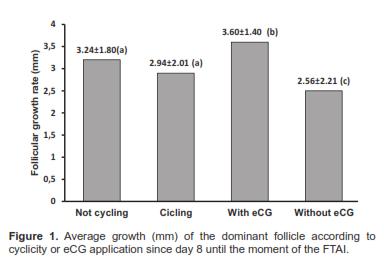
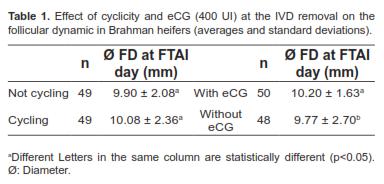
<body><![CDATA[<p>B<sub>j</sub>: effect of j-th level of cyclicity.</p>     <p>(TB)<sub>ij</sub>: interaction of i-th level of eCG with the j-th   level of cyclicity.</p>     <p>E<sub>ij</sub>: random error associated with each observation.</p>     <p>&nbsp;</p>     <p><b><font size="3">Results</font></b></p>     <p>   <i>Effect of cyclicity and eCG on the follicular   dynamic in Brahman heifers</i></p>     <p>Statistical analysis showed no significant effect   (p&gt;0.05) for the interaction of the factors under   study. For this reason, the factors were analyzed   separately. The cyclicity effect was not significant   (p&gt;0.05) for follicular growth on the day of the   FTAI, while application of 400 UI of eCG on the   FTAI day had a significant effect over follicular growth in the heifers (p&lt;0.05) (<a href="#t1">Table 1</a>).</p>     <p align="center"><a name="t1"></a><img src="/img/revistas/rccp/v26n1/v26n1a2t1.jpg"></p>     <p>The ovarian function (cycling and not cycling)   at the start of treatment showed that this had no   significant effect (p&gt;0.05) on follicular growth rate   at the day of FTAI. On the contrary, the use of 400   IU eCG on IVD withdrawal day was significant   (p&lt;0.05). Heifers receiving eCG had higher   follicular growth rate than those not receiving eCG (<a href="#f1">Figure 1</a>).</p>     <p align="center"><a name="f1"></a><img src="/img/revistas/rccp/v26n1/v26n1a2f1.jpg"></p>     ]]></body>
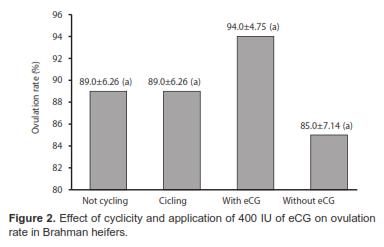
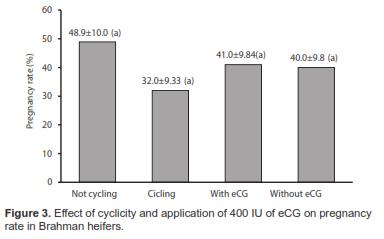
<body><![CDATA[<p><i>Effect of cyclicity and eCG on ovulation rate in   Brahman heifers</i></p>     <p>Cyclicity and eCG application had no significant   effect (p&gt;0.05) on the ovulation rate across treatments (<i><a href="#f2">Figure 2</a></i>).</p>     <p align="center"><a name="f2"></a><img src="/img/revistas/rccp/v26n1/v26n1a2f2.jpg"></p>     <p><i>Effect of cyclicity and eCG on pregnancy rate in Brahman heifers</i></p>     <p>   Cyclicity and eCG application had no significant   effect (p&gt;0.05) on pregnancy rate on the day of   FTAI (<a href="#f3">Figure 3</a>).</p>     <p align="center"><a name="f3"></a><img src="/img/revistas/rccp/v26n1/v26n1a2f3.jpg"></p>     <p>&nbsp;</p>     <p><b>Discussion</b></p>     <p><i>Effect of cyclicity and eCG on follicular dynamic   in Brahman heifers</i></p>     <p>   The ovarian state of the heifers at the start of the   treatment did not affect the pre-ovulatory follicle   diameter on the day of FTAI. Similar results were   reported by S&aacute; Filho <i>et al.</i> (2005, 2010), who found   no significant differences in follicular growth   with respect to cyclicity in <i>Bos indicus</i>  heifers   synchronized with Crestar.</p>     ]]></body>
<body><![CDATA[<p>Administration of eCG at the time of IVD   removal showed greater follicular growth rate on   the FTAI day (3.60 vs 2.56 mm) indicating an   effect of eCG on follicular growth. These results are   similar to those reported by S&aacute; Filho <i>et al.</i> (2005,   2010) who found follicular growth differences with   respect to the use of eCG (2.0 mm vs 1.3 mm) in <i>Bos indicus</i>  heifers.</p> </font>    <p><font size="2" face="Verdana, Arial, Helvetica, sans-serif">The positive effect of eCG application on   follicular growth was also reported by S&aacute; Filho   <i>et al.</i> (2004) for <i>Bos indicus</i>  cattle in anestrus,   synchronized with Crestar and eCG, verifying that   application of the hormone at the time of removal   of the ear implant increased the dominant follicle   diameter to 1.22 &plusmn; 0.06 mm, while those who   did not receive eCG dominant follicle diameter   was 1.04 &plusmn; 0.07 mm. This positive effect could be   explained because eCG's chemical composition   includes approximately 80% FSH, so that its   implementation would promote follicular growth   and thus the preovulatory follicle will have a larger   follicular diameter, higher ovulatory capacity, larger   corpus luteum, and increased progesterone levels (S&aacute; Filho <i>et al.</i>, 2010).</font></p> <font size="2" face="Verdana, Arial, Helvetica, sans-serif">    <p><i>Effect of cyclicity and eCG on ovulation rate in Brahman heifers</i></p>     <p>   This study found no significant effect (p&gt;0.05)   of ovarian status and eCG on ovulation. This is in   agreement with Figueira <i>et al.</i> (2011). However,   there were high ovulation rates ranging from 85   to 94%, which could be attributed to the dominant   follicle diameter in the different treatments   (approximately 10 mm). This could be supported by the results published by Gimenes <i>et al.</i> (2008),   who found ovulatory capacity greater than 80% in   <i>Bos indicus</i>  heifers when the dominant follicle had a   diameter greater than 8.5 mm.</p>     <p>The results of this study differ with Baruselli <i>et al.</i> (2004) and S&aacute; Filho <i>et al.</i> (2010), who used IVD   in FTAI protocols in Nellore heifers. They found   that eCG application at the moment of IVD removal   has a significant effect (p&lt;0.05) on the ovulation   rate. Although 400 IU eCG application had no effect   on ovulation and pregnancy rates in this study, there was a trend of higher rates with this treatment.</p>     <p><i>Effect of cyclicity and eCG on pregnancy rate in Brahman heifers</i></p>     <p>   Cyclicity and eCG use yielded pregnancy rates   between 32% to 48%. However, no significant   effect was found for the factors evaluated on   the pregnancy rate (p&gt;0.05). These results were   similar to those of M&aacute;rques <i>et al.</i> (2005), Butler <i>et al.</i> (2011), and Figueira <i>et al.</i> (2011), who found   no significant effect (p&gt;0.05) of ovarian status   and eCG on pregnancy rate in Nellore heifers. On   the contrary, S&aacute; Filho <i>et al.</i> (2005) reported that   in addition to cyclicity, eCG also has a significant   effect on pregnancy rate (p&lt;0.05) in <i>Bos indicus</i>  heifers.</p>     <p>In this study, no significant statistical differences   could be attributed to homogeneity of the groups   of heifers used in reference to weight, age, uterine   development, corporal condition (&ge; 3.5; in a scale   of 1 a 5), so that these females would not need the   extra stimulation that eCG offers for follicular   growth because they were in good nutritional status (Baruselli <i>et al.</i>, 2004).</p>     <p>In conclusion, eCG application increased   dominant follicle growth rate from the time of   bovine IVD removal (day 8) to the FTAI (day 10).   However, ovulation and pregnancy rates were   achieved with equal efficiency with or without eCG   application. Additional research is required on the   use of this hormone as a tool in FTAI protocols in <i>Bos indicus</i>  heifers.</p>     <p>&nbsp;</p> </font> <hr size="1"> <font size="2" face="Verdana, Arial, Helvetica, sans-serif">     ]]></body>
<body><![CDATA[<p><b><font size="3">Notas al pie</font></b></p>     <p><sup><a href="#b1">&curren;</a></sup><a name="1"></a> To cite this article: Salgado RD, Maza LA, Vergara OD. Effect of cyclicity and Equine Chorionic Gonadotropin (eCG) in fixed-time artificial insemination programs in <i>Bos indicus</i>  cattle. Rev Colomb Cienc Pecu 2013; 26:9-14.</p>  </font> <hr size="1">  <font size="2" face="Verdana, Arial, Helvetica, sans-serif">     <p>&nbsp;</p>     <p><b><font size="3">Acknowledgments</font></b></p>     <p>We are grateful to the Tropical Animal   Reproduction Biotechnology Laboratory of   University of Cordoba (Colombia) for providing   the materials required for this study. We also thank   Macarena Farm managers for allowing the use of   their facilities, and to veterinarians Daime Garc&eacute;s   and Fabi&aacute;n Jaramillo for their contribution to this research.</p>     <p>&nbsp; </p>     <p><b><font size="3">References</font></b></p>     <!-- ref --><p>Baruselli PS, Re&iacute;s EL, Marques MO, Nasser LF, Bo GA.   The use of hormonal treatments to improve reproductive   performance of anestrous beef cattle in tropical climates. Anim   Reprod Sci 2004; 82-83:479-486.    &nbsp;&nbsp;&nbsp;&nbsp;&nbsp;&nbsp;&nbsp;&nbsp;[&#160;<a href="javascript:void(0);" onclick="javascript: window.open('/scielo.php?script=sci_nlinks&ref=000090&pid=S0120-0690201300010000200001&lng=','','width=640,height=500,resizable=yes,scrollbars=1,menubar=yes,');">Links</a>&#160;]<!-- end-ref --></p>     <!-- ref --><p>Butler SAA, Atkinson PC, Boe-Hansen GB, Burns BM,   Dawson K, Bo GA, McGowan MR. Pregnancy rates after fixed-time artificial insemination of Brahman heifers treated to   synchronize ovulation with low-dose intravaginal progesterone   releasing devices, with or without eCG. Theriogen 2011;   76:1416-1423.    &nbsp;&nbsp;&nbsp;&nbsp;&nbsp;&nbsp;&nbsp;&nbsp;[&#160;<a href="javascript:void(0);" onclick="javascript: window.open('/scielo.php?script=sci_nlinks&ref=000092&pid=S0120-0690201300010000200002&lng=','','width=640,height=500,resizable=yes,scrollbars=1,menubar=yes,');">Links</a>&#160;]<!-- end-ref --></p>     <!-- ref --><p>Figueira PM, Ereno RL, Satrapa RA, Pinheiro VG, Trinca LA,   Barros CM. Neither plasma progesterone concentrations nor   exogenous eCG affects rates of ovulation or pregnancy in fixedtime   artificial insemination (FTAI) protocols for puberal Nellore   heifers. Theriogen 2011; 75:17-23.    &nbsp;&nbsp;&nbsp;&nbsp;&nbsp;&nbsp;&nbsp;&nbsp;[&#160;<a href="javascript:void(0);" onclick="javascript: window.open('/scielo.php?script=sci_nlinks&ref=000094&pid=S0120-0690201300010000200003&lng=','','width=640,height=500,resizable=yes,scrollbars=1,menubar=yes,');">Links</a>&#160;]<!-- end-ref --></p>     <!-- ref --><p>Garc&iacute;a FE, Cordero MJL, Hizarza EA, Peralta OJ, Ortega   CM, C&aacute;rdenas M, Gutierrez CG, S&aacute;nchez TE. Induction of   a new follicular wave in Holstein heifers synchronized with   norgestomet. Anim Reprod Sci 2004; 80:47-57.    &nbsp;&nbsp;&nbsp;&nbsp;&nbsp;&nbsp;&nbsp;&nbsp;[&#160;<a href="javascript:void(0);" onclick="javascript: window.open('/scielo.php?script=sci_nlinks&ref=000096&pid=S0120-0690201300010000200004&lng=','','width=640,height=500,resizable=yes,scrollbars=1,menubar=yes,');">Links</a>&#160;]<!-- end-ref --></p>     <!-- ref --><p>Gimenes LU, S&aacute; Filho MF, Carvalho NA, Torres-J&uacute;nior JR,   Souza AH, Madureira EH, Trinca LA, Sartorelli ES, Barros   CM, Carvalho JB, Mapletoft RJ, Baruselli PS. Follicle deviation   and ovulatory capacity in <i>Bos indicus</i>  heifers. Theriogen 2008;   69:852-858.    &nbsp;&nbsp;&nbsp;&nbsp;&nbsp;&nbsp;&nbsp;&nbsp;[&#160;<a href="javascript:void(0);" onclick="javascript: window.open('/scielo.php?script=sci_nlinks&ref=000098&pid=S0120-0690201300010000200005&lng=','','width=640,height=500,resizable=yes,scrollbars=1,menubar=yes,');">Links</a>&#160;]<!-- end-ref --></p>     <!-- ref --><p>InfoStat. User Manual. Grupo InfoStat, FCA, Universidad   Nacional de C&oacute;rdoba, Argentina; 2008.    &nbsp;&nbsp;&nbsp;&nbsp;&nbsp;&nbsp;&nbsp;&nbsp;[&#160;<a href="javascript:void(0);" onclick="javascript: window.open('/scielo.php?script=sci_nlinks&ref=000100&pid=S0120-0690201300010000200006&lng=','','width=640,height=500,resizable=yes,scrollbars=1,menubar=yes,');">Links</a>&#160;]<!-- end-ref --></p>     <p>Marques MO, S&aacute; Filho MF, Gimenes LU, Figueiredo TB,   S&oacute;ria GF, Baruselli PS. Efeito do tratamento com PGF2&alpha; na   inser&ccedil;&atilde;o e/ou tratamento com eCG na remo&ccedil;&atilde;o do dispositivo   intravaginal de progesterona na taxa de concep&ccedil;&atilde;o &agrave;   insemina&ccedil;&atilde;o artificial em tempo fixo em novilhas nelore. Acta   Sci Vet 2005; 33 Supl 1:287.</p>     ]]></body>
<body><![CDATA[<!-- ref --><p>Murphy BD, Martinuk SD. Equine chrononic gonadotropin.   endocr. Rev 1991; 12:27-44.    &nbsp;&nbsp;&nbsp;&nbsp;&nbsp;&nbsp;&nbsp;&nbsp;[&#160;<a href="javascript:void(0);" onclick="javascript: window.open('/scielo.php?script=sci_nlinks&ref=000103&pid=S0120-0690201300010000200008&lng=','','width=640,height=500,resizable=yes,scrollbars=1,menubar=yes,');">Links</a>&#160;]<!-- end-ref --></p>     <p>Richardson AM, Hensley BA, Marple TJ, Johnson SK,   Stevenson JS. Characteristics of estrus before and after first   insemination and fertility of heifers after synchronized estrus   using GnRH, PGF2&alpha;, and progesterone. J Anim Sci 2002; 80:2792-2800.</p>     <!-- ref --><p>S&aacute; Filho MF, Penteado L, Reis EL, Gimenes LU, Baruselli PS.   Efeito da ciclicidade e do tratamento com eCG na din&acirc;mica   folicular e na taxa de concep&ccedil;&atilde;o de novilhas nelore tratadas com   implante auricular de norgestomet e benzoato de estradiol. Acta   Sci Vet 2005; 33:266.    &nbsp;&nbsp;&nbsp;&nbsp;&nbsp;&nbsp;&nbsp;&nbsp;[&#160;<a href="javascript:void(0);" onclick="javascript: window.open('/scielo.php?script=sci_nlinks&ref=000106&pid=S0120-0690201300010000200010&lng=','','width=640,height=500,resizable=yes,scrollbars=1,menubar=yes,');">Links</a>&#160;]<!-- end-ref --></p>     <!-- ref --><p>S&aacute; Filho MF, Torres-J&uacute;niorb JRS, Penteadoc L, Gimenesa   LU,Ferreiraa RM, Ayresa H, Castro E, Paula LA, Salesa JNS,   Baruselli PS. Equine chorionic gonadotropin improves the   efficacy of a progestin-based fixed-time artificial insemination   protocol in Nelore (<i>Bos indicus</i>  ) heifers. Animl Reprod Sci 2010; 118:182-187.    &nbsp;&nbsp;&nbsp;&nbsp;&nbsp;&nbsp;&nbsp;&nbsp;[&#160;<a href="javascript:void(0);" onclick="javascript: window.open('/scielo.php?script=sci_nlinks&ref=000108&pid=S0120-0690201300010000200011&lng=','','width=640,height=500,resizable=yes,scrollbars=1,menubar=yes,');">Links</a>&#160;]<!-- end-ref --></p>     <!-- ref --><p>S&aacute; Filho MF, Reis EL, Viel Jr JO, Nichi M, Madureira EH,   Baruselli OS. Follicular dynamics of lactating anestrous beef   cows treated with progestagen, eCG and GnRH. Acta Sci Vet   2004; 32:235.    &nbsp;&nbsp;&nbsp;&nbsp;&nbsp;&nbsp;&nbsp;&nbsp;[&#160;<a href="javascript:void(0);" onclick="javascript: window.open('/scielo.php?script=sci_nlinks&ref=000110&pid=S0120-0690201300010000200012&lng=','','width=640,height=500,resizable=yes,scrollbars=1,menubar=yes,');">Links</a>&#160;]<!-- end-ref --></p>     <!-- ref --><p>Williams SW, Stanko RL, Amstalden M, Williams GL.   Comparison of three approaches for synchronization of   ovulation for timed artificial insemination in Bos indicusin fluenced cattie managed on the Texas gulf coast. J Anim Sci   2002; 80:1173-1178.    &nbsp;&nbsp;&nbsp;&nbsp;&nbsp;&nbsp;&nbsp;&nbsp;[&#160;<a href="javascript:void(0);" onclick="javascript: window.open('/scielo.php?script=sci_nlinks&ref=000112&pid=S0120-0690201300010000200013&lng=','','width=640,height=500,resizable=yes,scrollbars=1,menubar=yes,');">Links</a>&#160;]<!-- end-ref --></p>     <!-- ref --><p>Yavas Y, Walton JS. Post-partum acyclicity in suckled beef   cows: a review. Theriogen 2000; 54:25-55.    &nbsp;&nbsp;&nbsp;&nbsp;&nbsp;&nbsp;&nbsp;&nbsp;[&#160;<a href="javascript:void(0);" onclick="javascript: window.open('/scielo.php?script=sci_nlinks&ref=000114&pid=S0120-0690201300010000200014&lng=','','width=640,height=500,resizable=yes,scrollbars=1,menubar=yes,');">Links</a>&#160;]<!-- end-ref --></p>     <p>&nbsp;</p> </font>      ]]></body><back>
<ref-list>
<ref id="B1">
<nlm-citation citation-type="journal">
<person-group person-group-type="author">
<name>
<surname><![CDATA[Baruselli]]></surname>
<given-names><![CDATA[PS]]></given-names>
</name>
<name>
<surname><![CDATA[Reís]]></surname>
<given-names><![CDATA[EL]]></given-names>
</name>
<name>
<surname><![CDATA[Marques]]></surname>
<given-names><![CDATA[MO]]></given-names>
</name>
<name>
<surname><![CDATA[Nasser]]></surname>
<given-names><![CDATA[LF]]></given-names>
</name>
<name>
<surname><![CDATA[Bo]]></surname>
<given-names><![CDATA[GA]]></given-names>
</name>
</person-group>
<article-title xml:lang="en"><![CDATA[The use of hormonal treatments to improve reproductive performance of anestrous beef cattle in tropical climates]]></article-title>
<source><![CDATA[Anim Reprod Sci]]></source>
<year>2004</year>
<volume>82-83</volume>
<page-range>479-486</page-range></nlm-citation>
</ref>
<ref id="B2">
<nlm-citation citation-type="journal">
<person-group person-group-type="author">
<name>
<surname><![CDATA[Butler]]></surname>
<given-names><![CDATA[SAA]]></given-names>
</name>
<name>
<surname><![CDATA[Atkinson]]></surname>
<given-names><![CDATA[PC]]></given-names>
</name>
<name>
<surname><![CDATA[Boe-Hansen]]></surname>
<given-names><![CDATA[GB]]></given-names>
</name>
<name>
<surname><![CDATA[Burns]]></surname>
<given-names><![CDATA[BM]]></given-names>
</name>
<name>
<surname><![CDATA[Dawson]]></surname>
<given-names><![CDATA[K]]></given-names>
</name>
<name>
<surname><![CDATA[Bo]]></surname>
<given-names><![CDATA[GA]]></given-names>
</name>
<name>
<surname><![CDATA[McGowan]]></surname>
<given-names><![CDATA[MR]]></given-names>
</name>
</person-group>
<article-title xml:lang="en"><![CDATA[Pregnancy rates after fixed-time artificial insemination of Brahman heifers treated to synchronize ovulation with low-dose intravaginal progesterone releasing devices, with or without eCG]]></article-title>
<source><![CDATA[Theriogen]]></source>
<year>2011</year>
<volume>76</volume>
<page-range>1416-1423</page-range></nlm-citation>
</ref>
<ref id="B3">
<nlm-citation citation-type="journal">
<person-group person-group-type="author">
<name>
<surname><![CDATA[Figueira]]></surname>
<given-names><![CDATA[PM]]></given-names>
</name>
<name>
<surname><![CDATA[Ereno]]></surname>
<given-names><![CDATA[RL]]></given-names>
</name>
<name>
<surname><![CDATA[Satrapa]]></surname>
<given-names><![CDATA[RA]]></given-names>
</name>
<name>
<surname><![CDATA[Pinheiro]]></surname>
<given-names><![CDATA[VG]]></given-names>
</name>
<name>
<surname><![CDATA[Trinca]]></surname>
<given-names><![CDATA[LA]]></given-names>
</name>
<name>
<surname><![CDATA[Barros]]></surname>
<given-names><![CDATA[CM]]></given-names>
</name>
</person-group>
<article-title xml:lang="en"><![CDATA[Neither plasma progesterone concentrations nor exogenous eCG affects rates of ovulation or pregnancy in fixedtime artificial insemination (FTAI) protocols for puberal Nellore heifers]]></article-title>
<source><![CDATA[Theriogen]]></source>
<year>2011</year>
<volume>75</volume>
<page-range>17-23</page-range></nlm-citation>
</ref>
<ref id="B4">
<nlm-citation citation-type="journal">
<person-group person-group-type="author">
<name>
<surname><![CDATA[García]]></surname>
<given-names><![CDATA[FE]]></given-names>
</name>
<name>
<surname><![CDATA[Cordero]]></surname>
<given-names><![CDATA[MJL]]></given-names>
</name>
<name>
<surname><![CDATA[Hizarza]]></surname>
<given-names><![CDATA[EA]]></given-names>
</name>
<name>
<surname><![CDATA[Peralta]]></surname>
<given-names><![CDATA[OJ]]></given-names>
</name>
<name>
<surname><![CDATA[Ortega]]></surname>
<given-names><![CDATA[CM]]></given-names>
</name>
<name>
<surname><![CDATA[Cárdenas]]></surname>
<given-names><![CDATA[M]]></given-names>
</name>
<name>
<surname><![CDATA[Gutierrez]]></surname>
<given-names><![CDATA[CG]]></given-names>
</name>
<name>
<surname><![CDATA[Sánchez]]></surname>
<given-names><![CDATA[TE]]></given-names>
</name>
</person-group>
<article-title xml:lang="en"><![CDATA[Induction of a new follicular wave in Holstein heifers synchronized with norgestomet]]></article-title>
<source><![CDATA[Anim Reprod Sci]]></source>
<year>2004</year>
<volume>80</volume>
<page-range>47-57</page-range></nlm-citation>
</ref>
<ref id="B5">
<nlm-citation citation-type="journal">
<person-group person-group-type="author">
<name>
<surname><![CDATA[Gimenes]]></surname>
<given-names><![CDATA[LU]]></given-names>
</name>
<name>
<surname><![CDATA[Sá Filho]]></surname>
<given-names><![CDATA[MF]]></given-names>
</name>
<name>
<surname><![CDATA[Carvalho]]></surname>
<given-names><![CDATA[NA]]></given-names>
</name>
<name>
<surname><![CDATA[Torres-Júnior]]></surname>
<given-names><![CDATA[JR]]></given-names>
</name>
<name>
<surname><![CDATA[Souza]]></surname>
<given-names><![CDATA[AH]]></given-names>
</name>
<name>
<surname><![CDATA[Madureira]]></surname>
<given-names><![CDATA[EH]]></given-names>
</name>
<name>
<surname><![CDATA[Trinca]]></surname>
<given-names><![CDATA[LA]]></given-names>
</name>
<name>
<surname><![CDATA[Sartorelli]]></surname>
<given-names><![CDATA[ES]]></given-names>
</name>
<name>
<surname><![CDATA[Barros]]></surname>
<given-names><![CDATA[CM]]></given-names>
</name>
<name>
<surname><![CDATA[Carvalho]]></surname>
<given-names><![CDATA[JB]]></given-names>
</name>
<name>
<surname><![CDATA[Mapletoft]]></surname>
<given-names><![CDATA[RJ]]></given-names>
</name>
<name>
<surname><![CDATA[Baruselli]]></surname>
<given-names><![CDATA[PS]]></given-names>
</name>
</person-group>
<article-title xml:lang="en"><![CDATA[Follicle deviation and ovulatory capacity in Bos indicus heifers]]></article-title>
<source><![CDATA[Theriogen]]></source>
<year>2008</year>
<volume>69</volume>
<page-range>852-858</page-range></nlm-citation>
</ref>
<ref id="B6">
<nlm-citation citation-type="book">
<collab>InfoStat</collab>
<source><![CDATA[User Manual. Grupo InfoStat, FCA]]></source>
<year>2008</year>
<publisher-name><![CDATA[Universidad Nacional de Córdoba]]></publisher-name>
</nlm-citation>
</ref>
<ref id="B7">
<nlm-citation citation-type="journal">
<person-group person-group-type="author">
<name>
<surname><![CDATA[Marques]]></surname>
<given-names><![CDATA[MO]]></given-names>
</name>
<name>
<surname><![CDATA[Sá Filho]]></surname>
<given-names><![CDATA[MF]]></given-names>
</name>
<name>
<surname><![CDATA[Gimenes]]></surname>
<given-names><![CDATA[LU]]></given-names>
</name>
<name>
<surname><![CDATA[Figueiredo]]></surname>
<given-names><![CDATA[TB]]></given-names>
</name>
<name>
<surname><![CDATA[Sória]]></surname>
<given-names><![CDATA[GF]]></given-names>
</name>
<name>
<surname><![CDATA[Baruselli]]></surname>
<given-names><![CDATA[PS]]></given-names>
</name>
</person-group>
<article-title xml:lang="pt"><![CDATA[Efeito do tratamento com PGF2&alpha; na inserção e/ou tratamento com eCG na remoção do dispositivo intravaginal de progesterona na taxa de concepção à inseminação artificial em tempo fixo em novilhas nelore]]></article-title>
<source><![CDATA[Acta Sci Vet]]></source>
<year>2005</year>
<volume>33</volume>
<numero>^s1</numero>
<issue>^s1</issue>
<supplement>1</supplement>
<page-range>287</page-range></nlm-citation>
</ref>
<ref id="B8">
<nlm-citation citation-type="journal">
<person-group person-group-type="author">
<name>
<surname><![CDATA[Murphy]]></surname>
<given-names><![CDATA[BD]]></given-names>
</name>
<name>
<surname><![CDATA[Martinuk]]></surname>
<given-names><![CDATA[SD]]></given-names>
</name>
</person-group>
<article-title xml:lang="en"><![CDATA[Equine chrononic gonadotropin]]></article-title>
<source><![CDATA[endocr. Rev]]></source>
<year>1991</year>
<volume>12</volume>
<page-range>27-44</page-range></nlm-citation>
</ref>
<ref id="B9">
<nlm-citation citation-type="journal">
<person-group person-group-type="author">
<name>
<surname><![CDATA[Richardson]]></surname>
<given-names><![CDATA[AM]]></given-names>
</name>
<name>
<surname><![CDATA[Hensley]]></surname>
<given-names><![CDATA[BA]]></given-names>
</name>
<name>
<surname><![CDATA[Marple]]></surname>
<given-names><![CDATA[TJ]]></given-names>
</name>
<name>
<surname><![CDATA[Johnson]]></surname>
<given-names><![CDATA[SK]]></given-names>
</name>
<name>
<surname><![CDATA[Stevenson]]></surname>
<given-names><![CDATA[JS]]></given-names>
</name>
</person-group>
<article-title xml:lang="en"><![CDATA[Characteristics of estrus before and after first insemination and fertility of heifers after synchronized estrus using GnRH, PGF2&alpha;, and progesterone]]></article-title>
<source><![CDATA[J Anim Sci]]></source>
<year>2002</year>
<volume>80</volume>
<page-range>2792-2800</page-range></nlm-citation>
</ref>
<ref id="B10">
<nlm-citation citation-type="journal">
<person-group person-group-type="author">
<name>
<surname><![CDATA[Sá Filho]]></surname>
<given-names><![CDATA[MF]]></given-names>
</name>
<name>
<surname><![CDATA[Penteado]]></surname>
<given-names><![CDATA[L]]></given-names>
</name>
<name>
<surname><![CDATA[Reis]]></surname>
<given-names><![CDATA[EL]]></given-names>
</name>
<name>
<surname><![CDATA[Gimenes]]></surname>
<given-names><![CDATA[LU]]></given-names>
</name>
<name>
<surname><![CDATA[Baruselli]]></surname>
<given-names><![CDATA[PS]]></given-names>
</name>
</person-group>
<article-title xml:lang="pt"><![CDATA[Efeito da ciclicidade e do tratamento com eCG na dinâmica folicular e na taxa de concepção de novilhas nelore tratadas com implante auricular de norgestomet e benzoato de estradiol]]></article-title>
<source><![CDATA[Acta Sci Vet]]></source>
<year>2005</year>
<volume>33</volume>
<page-range>266</page-range></nlm-citation>
</ref>
<ref id="B11">
<nlm-citation citation-type="journal">
<person-group person-group-type="author">
<name>
<surname><![CDATA[Sá Filho]]></surname>
<given-names><![CDATA[MF]]></given-names>
</name>
<name>
<surname><![CDATA[Torres-Júniorb]]></surname>
<given-names><![CDATA[JRS]]></given-names>
</name>
<name>
<surname><![CDATA[Penteadoc]]></surname>
<given-names><![CDATA[L]]></given-names>
</name>
<name>
<surname><![CDATA[Gimenesa]]></surname>
<given-names><![CDATA[LU]]></given-names>
</name>
<name>
<surname><![CDATA[Ferreiraa]]></surname>
<given-names><![CDATA[RM]]></given-names>
</name>
<name>
<surname><![CDATA[Ayresa]]></surname>
<given-names><![CDATA[H]]></given-names>
</name>
<name>
<surname><![CDATA[Castro]]></surname>
<given-names><![CDATA[E]]></given-names>
</name>
<name>
<surname><![CDATA[Paula]]></surname>
<given-names><![CDATA[LA]]></given-names>
</name>
<name>
<surname><![CDATA[Salesa]]></surname>
<given-names><![CDATA[JNS]]></given-names>
</name>
<name>
<surname><![CDATA[Baruselli]]></surname>
<given-names><![CDATA[PS]]></given-names>
</name>
</person-group>
<article-title xml:lang="en"><![CDATA[Equine chorionic gonadotropin improves the efficacy of a progestin-based fixed-time artificial insemination protocol in Nelore (Bos indicus ) heifers]]></article-title>
<source><![CDATA[Animl Reprod Sci]]></source>
<year>2010</year>
<volume>118</volume>
<page-range>182-187</page-range></nlm-citation>
</ref>
<ref id="B12">
<nlm-citation citation-type="journal">
<person-group person-group-type="author">
<name>
<surname><![CDATA[Sá Filho]]></surname>
<given-names><![CDATA[MF]]></given-names>
</name>
<name>
<surname><![CDATA[Reis]]></surname>
<given-names><![CDATA[EL]]></given-names>
</name>
<name>
<surname><![CDATA[Viel]]></surname>
<given-names><![CDATA[Jr JO]]></given-names>
</name>
<name>
<surname><![CDATA[Nichi]]></surname>
<given-names><![CDATA[M]]></given-names>
</name>
<name>
<surname><![CDATA[Madureira]]></surname>
<given-names><![CDATA[EH]]></given-names>
</name>
<name>
<surname><![CDATA[Baruselli]]></surname>
<given-names><![CDATA[OS]]></given-names>
</name>
</person-group>
<article-title xml:lang="en"><![CDATA[Follicular dynamics of lactating anestrous beef cows treated with progestagen, eCG and GnRH]]></article-title>
<source><![CDATA[Acta Sci Vet]]></source>
<year>2004</year>
<volume>32</volume>
<page-range>235</page-range></nlm-citation>
</ref>
<ref id="B13">
<nlm-citation citation-type="journal">
<person-group person-group-type="author">
<name>
<surname><![CDATA[Williams]]></surname>
<given-names><![CDATA[SW]]></given-names>
</name>
<name>
<surname><![CDATA[Stanko]]></surname>
<given-names><![CDATA[RL]]></given-names>
</name>
<name>
<surname><![CDATA[Amstalden]]></surname>
<given-names><![CDATA[M]]></given-names>
</name>
<name>
<surname><![CDATA[Williams]]></surname>
<given-names><![CDATA[GL]]></given-names>
</name>
</person-group>
<article-title xml:lang="en"><![CDATA[Comparison of three approaches for synchronization of ovulation for timed artificial insemination in Bos indicusin fluenced cattie managed on the Texas gulf coast]]></article-title>
<source><![CDATA[J Anim Sci]]></source>
<year>2002</year>
<volume>80</volume>
<page-range>1173-1178</page-range></nlm-citation>
</ref>
<ref id="B14">
<nlm-citation citation-type="journal">
<person-group person-group-type="author">
<name>
<surname><![CDATA[Yavas]]></surname>
<given-names><![CDATA[Y]]></given-names>
</name>
<name>
<surname><![CDATA[Walton]]></surname>
<given-names><![CDATA[JS]]></given-names>
</name>
</person-group>
<article-title xml:lang="en"><![CDATA[Post-partum acyclicity in suckled beef cows: a review]]></article-title>
<source><![CDATA[Theriogen]]></source>
<year>2000</year>
<volume>54</volume>
<page-range>25-55</page-range></nlm-citation>
</ref>
</ref-list>
</back>
</article>