<?xml version="1.0" encoding="ISO-8859-1"?><article xmlns:mml="http://www.w3.org/1998/Math/MathML" xmlns:xlink="http://www.w3.org/1999/xlink" xmlns:xsi="http://www.w3.org/2001/XMLSchema-instance">
<front>
<journal-meta>
<journal-id>0120-0690</journal-id>
<journal-title><![CDATA[Revista Colombiana de Ciencias Pecuarias]]></journal-title>
<abbrev-journal-title><![CDATA[Rev Colom Cienc Pecua]]></abbrev-journal-title>
<issn>0120-0690</issn>
<publisher>
<publisher-name><![CDATA[Facultad de Ciencias Agrarias, Universidad de Antioquia]]></publisher-name>
</publisher>
</journal-meta>
<article-meta>
<article-id>S0120-06902013000100003</article-id>
<title-group>
<article-title xml:lang="en"><![CDATA[Quantitative and qualitative characteristics of elephant grass (Pennisetum purpureum Schum) clones in the semi-arid lands of Pernambuco (Brazil)]]></article-title>
<article-title xml:lang="es"><![CDATA[Características cuantitativas y cualitativas de clones pasto elefante (Pennisetum purpureum Schum) en las tierras semi-áridas de Pernambuco (Brasil)]]></article-title>
<article-title xml:lang="pt"><![CDATA[Características quantitativas e qualitativas de clones de capim-elefante (Pennisetum purpureum Schum) no semi-árido pernambucano (Brasil)]]></article-title>
</title-group>
<contrib-group>
<contrib contrib-type="author">
<name>
<surname><![CDATA[Ferreira]]></surname>
<given-names><![CDATA[Geane DG]]></given-names>
</name>
<xref ref-type="aff" rid="A01"/>
<xref ref-type="aff" rid="A05"/>
</contrib>
<contrib contrib-type="author">
<name>
<surname><![CDATA[Santos]]></surname>
<given-names><![CDATA[Mércia VF]]></given-names>
</name>
<xref ref-type="aff" rid="A02"/>
</contrib>
<contrib contrib-type="author">
<name>
<surname><![CDATA[Lira]]></surname>
<given-names><![CDATA[Mário A]]></given-names>
</name>
<xref ref-type="aff" rid="A03"/>
</contrib>
<contrib contrib-type="author">
<name>
<surname><![CDATA[Melo]]></surname>
<given-names><![CDATA[Alexandre CL]]></given-names>
</name>
<xref ref-type="aff" rid="A02"/>
</contrib>
<contrib contrib-type="author">
<name>
<surname><![CDATA[Almeida]]></surname>
<given-names><![CDATA[Omer C]]></given-names>
</name>
<xref ref-type="aff" rid="A01"/>
</contrib>
<contrib contrib-type="author">
<name>
<surname><![CDATA[Ribeiro]]></surname>
<given-names><![CDATA[Carlos R]]></given-names>
</name>
<xref ref-type="aff" rid="A01"/>
</contrib>
<contrib contrib-type="author">
<name>
<surname><![CDATA[Oliveira]]></surname>
<given-names><![CDATA[Ronaldo L]]></given-names>
</name>
<xref ref-type="aff" rid="A04"/>
</contrib>
<contrib contrib-type="author">
<name>
<surname><![CDATA[Palmieri]]></surname>
<given-names><![CDATA[Adriana D]]></given-names>
</name>
<xref ref-type="aff" rid="A04"/>
</contrib>
</contrib-group>
<aff id="A05">
<institution><![CDATA[,Federal Rural University of Pernambuco/Academic Unit of Garanhuns- UFRPE/UAG  ]]></institution>
<addr-line><![CDATA[ ]]></addr-line>
<country>Brazil</country>
</aff>
<aff id="A01">
<institution><![CDATA[,Federal Rural University of Pernambuco/Academic Unit of Garanhuns- UFRPE/UAG  ]]></institution>
<addr-line><![CDATA[Garanhuns PE]]></addr-line>
<country>Brazil</country>
</aff>
<aff id="A02">
<institution><![CDATA[,Federal Rural University of Pernambuco - UFRPE Animal Husbandry Department ]]></institution>
<addr-line><![CDATA[Recife ]]></addr-line>
<country>Brazil</country>
</aff>
<aff id="A03">
<institution><![CDATA[,Agronomic Institute of Pernambuco  ]]></institution>
<addr-line><![CDATA[Recife ]]></addr-line>
<country>Brazil</country>
</aff>
<aff id="A04">
<institution><![CDATA[,Federal University of Bahia  ]]></institution>
<addr-line><![CDATA[Salvador ]]></addr-line>
<country>Brazil</country>
</aff>
<pub-date pub-type="pub">
<day>00</day>
<month>03</month>
<year>2013</year>
</pub-date>
<pub-date pub-type="epub">
<day>00</day>
<month>03</month>
<year>2013</year>
</pub-date>
<volume>26</volume>
<numero>1</numero>
<fpage>15</fpage>
<lpage>23</lpage>
<copyright-statement/>
<copyright-year/>
<self-uri xlink:href="http://www.scielo.org.co/scielo.php?script=sci_arttext&amp;pid=S0120-06902013000100003&amp;lng=en&amp;nrm=iso"></self-uri><self-uri xlink:href="http://www.scielo.org.co/scielo.php?script=sci_abstract&amp;pid=S0120-06902013000100003&amp;lng=en&amp;nrm=iso"></self-uri><self-uri xlink:href="http://www.scielo.org.co/scielo.php?script=sci_pdf&amp;pid=S0120-06902013000100003&amp;lng=en&amp;nrm=iso"></self-uri><abstract abstract-type="short" xml:lang="en"><p><![CDATA[Background: the efficient use of good quality forage represents one of many ways to improve animal productivity and, consequently, reduce the feed costs of dairy farming. Between the wide variety of studies aiming to improve the nutritional value of forage, histological studies, allow for both the comparison of species or cultivars and the monitoring of tissue aging within the plant. Objective: the present work aimed to characterize the stem morphology of Pennisetum clones (Itambé IV-46, Itambé I-1.20, Itambé I-1.4, Milheto x Buaçu/112-23.4, Cuba-116-29.3, CAC-262-12.102, Roxo of Botucatu x CAC-282-18.29, Taiwan-146-2.6, Itambé I-1.5, Pusa Napier or 419-76 x Buaçu/122-11.2, Taiwan-146-2.03, Taiwan-146-2.85, Itambé II-2.46, Pusa Napier or 419-76 x Cuba-116-12.3 and Pusa Napier or 412-76 x Buaçu/122-8.22) into three strata (basal, medium and apical) and three tillers of the plant using histological sections. Methods: the material was collected in a previously established area at the Experimental Station of São Bento do Una at the Agronomic Institute of Pernambuco. The materials were distributed in a completely randomized 15 x 3 x 3 factorial design (14 clones and one hybrid, three layers of stem and three tillers). The samples were collected during the dry season beginning in August 2008. Results: there were significant differences (p<0.05) among the clones evaluated, and the average values for the lignified cells in the cortex region ranged from 2.21 to 4.21 for the Taiwan-146-2.6 and Roxo of Botucatu x CAC-282-18.29 clones; however, this was not different from the other clones in the medullary region. The Itambé II-2.46 clone showed the highest absolute value in the percentage of phloem in the cortex region (2.32%) and a high value, with significant differences, in the medullary region (1.59%) compared to the other clones. Conclusion: the highest values of cellulose in the medium and apical regions of the studied stems represent a benefit to grazing animals.]]></p></abstract>
<abstract abstract-type="short" xml:lang="es"><p><![CDATA[Antecedentes: el uso eficiente de forraje de buena calidad es una de las muchas maneras de mejorar la productividad animal y por lo tanto reducir el costo de la alimentación del ganado lechero. Entre la variedad de estudios que permiten mejorar el valor nutritivo del forraje, los estudios histológicos se destacan, porque permiten tanto la comparación de especies o cultivares y el seguimiento del envejecimiento de los tejidos con la madurez de la planta. Objetivo: el presente trabajo tuvo como objetivo caracterizar la morfología del tallo de los clones de Pennisetum (Itambé IV-46, I-Itambé 1.20, Itambé I-1.4, Milheto x Buaçu/112-23.4, Cuba- 116-29.3, el CAC-262-12.102, Roxo de Botucatu x CAC-282-18.29, Taiwán-146-2.6, Itambé I-1.5, Pusa Napier o 419-76 x Buaçu/122-11.2, Taiwan-146-2.03, Taiwán-146-2.85, Itambé II-2.46 , Pusa Napier 419-76 x Cuba-116-12.3 y Napier Pusa o 412-76 x Buaçu/122-8.22) en tres estratos (basal, medio y apical) y tres tallos de la planta con los cortes histológicos. Métodos: el material se recogió en una zona ya establecida en la Estación Experimental de São Bento do Una en el Instituto Agronómico de Pernambuco. Los materiales se distribuyeron en un diseño factorial completamente al azar de 15 x 3 x 3 (14 clones y un híbrido, tres capas de la madre y los tallos de tres). Las muestras fueron recolectadas durante la estación seca comenzando en agosto de 2008. Resultados: hubo diferencias significativas (p<0,05) entre los clones evaluados, y los valores promedio de las células lignificadas en la región de la corteza variaron desde 2,21 hasta 4,21 para los clones Taiwán-146-2.6 y Roxo de Botucatu X CAC-282-18.29, sin embargo, esto no fue diferente de los otros clones en la región medular. El clon Itambé II-2.46 mostró el mayor valor absoluto en el porcentaje de floema en la región de la corteza (2,32%) y un alto valor, con diferencias significativas, en la región medular (1,59%) en comparación con los otros clones. Conclusión: los valores más altos de celulosa en las regiones media y apical de los tallos estudiados representa un beneficio para los animales de pastoreo.]]></p></abstract>
<abstract abstract-type="short" xml:lang="pt"><p><![CDATA[Antecedentes: o uso eficiente de forragem de boa qualidade representa uma das muitas maneiras de melhorar a produtividade animal e, consequentemente, reduzir os custos de alimentação da pecuária leiteira. Entre a variedade de estudos com o objetivo de melhorar o valor nutritivo da forragem, os estudos histológicos destacam-se, o que permite tanto a comparação de espécies ou cultivares e acompanhamento do envelhecimento dos tecidos com a maturidade da planta. Objetivo: o presente trabalho teve como objetivo caracterizar a morfologia do caule de Pennisetum clones (IV-46 Itambé, Itambé I-1.20, Itambé I-1.4, Milheto x Buaçu/112-23.4, Cuba-116-29.3, CAC-262-12,102, Roxo de Botucatu x CAC-282-18,29, Taiwan-146-2.6, Itambé I-1.5, Pusa Napier ou 419-76 x Buaçu/122-11.2, Taiwan-146-2.03, Taiwan-146-2.85, Itambé II-2,46 , Pusa Napier ou 419-76 x Cuba-116-12.3 e Pusa Napier ou 412-76 x Buaçu/122-8.22) em três estratos (basal, média e apical) e três perfilhos da planta, utilizando cortes histológicos. Métodos: o material foi coletado em uma área já estabelecida na Estação Experimental de São Bento do Una, no Instituto Agronômico de Pernambuco). Os materiais foram distribuídos em um inteiramente casualizado 15 x 3 x fatorial 3 (14 clones e um híbrido, três camadas de tronco e três perfilhos). As amostras foram coletadas durante a estação seca início em agosto de 2008. Resultados: houve diferenças significativas (p<0,05) entre os clones avaliados, e os valores médios para as células lignificadas na região do córtex variou 2,21-4,21 para o Taiwan-146-2,6 e Roxo de Botucatu X CAC-282-18,29 clones, no entanto, isto não era diferente dos outros clones da região medular. O clone II-Itambé 2,46 apresentaram o maior valor absoluto da percentagem de floema na região córtex (2,32%) e um valor elevado, com diferenças significativas, na região medular (1,59%) em comparação com os outros clones. Conclusão: os valores mais elevados de celulose nas regiões média e apical das hastes estudadas contribuir para características positivas para animais em pastejo.]]></p></abstract>
<kwd-group>
<kwd lng="en"><![CDATA[cellulose]]></kwd>
<kwd lng="en"><![CDATA[hemicellulose]]></kwd>
<kwd lng="en"><![CDATA[histological]]></kwd>
<kwd lng="en"><![CDATA[lignin]]></kwd>
<kwd lng="es"><![CDATA[celulosa]]></kwd>
<kwd lng="es"><![CDATA[hemicelulosa]]></kwd>
<kwd lng="es"><![CDATA[histológico]]></kwd>
<kwd lng="es"><![CDATA[lignina]]></kwd>
<kwd lng="pt"><![CDATA[cellulose]]></kwd>
<kwd lng="pt"><![CDATA[hemicellulose]]></kwd>
<kwd lng="pt"><![CDATA[histológico]]></kwd>
<kwd lng="pt"><![CDATA[lignina]]></kwd>
</kwd-group>
</article-meta>
</front><body><![CDATA[ <font size="2" face="Verdana, Arial, Helvetica, sans-serif">     <p align="right"><b>ORIGINALS ARTICLES</b></p>     <p>&nbsp;</p>     <p align="center"><b><font size="4">Quantitative and qualitative characteristics of elephant grass   (<i><i>Pennisetum purpureum</i>  </i> Schum) clones in the semi-arid lands of   Pernambuco (Brazil)<sup><a href="#1">&curren;</a></sup></font></b><a name="b1"></a></p>     <p>&nbsp;</p>     <p align="center"><b><font size="3">Caracter&iacute;sticas cuantitativas y cualitativas de clones pasto elefante (<i><u><i>Pennisetum purpureum</i>  </u></i> Schum) en   las tierras semi-&aacute;ridas de Pernambuco (Brasil)</font></b></p>     <p align="center">&nbsp;</p>     <p align="center"><b><font size="3">Caracter&iacute;sticas quantitativas e qualitativas de clones de capim-elefante (<i><u><i>Pennisetum purpureum</i>  </u></i> Schum)   no semi-&aacute;rido pernambucano (Brasil)</font></b></p>     <p>&nbsp;</p>     <p>&nbsp;</p>     ]]></body>
<body><![CDATA[<p><b>Geane DG Ferreira<sup>1*</sup>, Zoot, Msc, PhD; M&eacute;rcia VF Santos<sup>2</sup>, Zoot, Msc, PhD; M&aacute;rio A Lira<sup>3</sup>, Agron, Msc, PhD;   Alexandre CL Melo<sup>2</sup>, Agron, Msc, PhD; Omer C Almeida<sup>1</sup>, Zoot, Msc, PhD; Carlos R Ribeiro<sup>1</sup>, Agron, Msc, PhD; Ronaldo L Oliveira<sup>4</sup>, Zoot, Msc, PhD; Adriana D Palmieri<sup>4</sup>, Zoot, Msc.</b> </p>     <p>* Corresponding author: Geane Dias Gon&ccedil;alves Ferreira, Federal Rural University of Pernambuco/Academic Unit of Garanhuns- UFRPE/UAG, Bom Pastor   Avenue, Bairro Boa Vista, CEP: 55292-901, Garanhuns-PE, Brazil. E-mail: <a href="mailto:ferreiragdg@yahoo.com.br">ferreiragdg@yahoo.com.br</a></p>     <p><sup>1</sup>Federal Rural University of Pernambuco/Academic Unit of Garanhuns- UFRPE/UAG, Bom Pastor Avenue, Bairro Boa Vista, CEP:   55292-901, Garanhuns-PE, Brazil.</p>     <p><sup>2</sup>Federal Rural University of Pernambuco &#150; UFRPE, Animal Husbandry Department. Dom Manoel de Medeiros Street, Bairro Dois   Irm&atilde;os, CEP: 52171-900, Recife- PE, Brazil.</p>     <p><sup>3</sup>Agronomic Institute of Pernambuco (IPA), 1371 General San Martin Avenue, Bairro Bongi, CEP: 50761-000, Recife &#150; PE, Brazil.</p>     <p><sup>4</sup>Federal University of Bahia &#150; UFBA, 500 Adhemar de Barros Avenue, Bairro Ondina, CEP:40170-110, Salvador &#150; BA, Brazil.  </p>     <p>&nbsp;</p>     <p>(Received: November 3, 2011; accepted: September 12, 2012)</p>     <p>&nbsp;</p> </font> <hr size="1"> <font size="2" face="Verdana, Arial, Helvetica, sans-serif">     <p><b>Summary</b></p>     ]]></body>
<body><![CDATA[<p><b>Background:</b> the efficient use of good quality forage represents one of many ways to improve animal   productivity and, consequently, reduce the feed costs of dairy farming. Between the wide variety of studies   aiming to improve the nutritional value of forage, histological studies, allow for both the comparison of   species or cultivars and the monitoring of tissue aging within the plant. <b>Objective:</b> the present work aimed to   characterize the stem morphology of <i>Pennisetum</i> clones (Itamb&eacute; IV-46, Itamb&eacute; I-1.20, Itamb&eacute; I-1.4, Milheto   x Bua&ccedil;u/112-23.4, Cuba-116-29.3, CAC-262-12.102, Roxo of Botucatu x CAC-282-18.29, Taiwan-146-2.6,   Itamb&eacute; I-1.5, Pusa Napier or 419-76 x Bua&ccedil;u/122-11.2, Taiwan-146-2.03, Taiwan-146-2.85, Itamb&eacute; II-2.46,   Pusa Napier or 419-76 x Cuba-116-12.3 and Pusa Napier or 412-76 x Bua&ccedil;u/122-8.22) into three strata (basal,   medium and apical) and three tillers of the plant using histological sections. <b>Methods:</b> the material was   collected in a previously established area at the Experimental Station of S&atilde;o Bento do Una at the Agronomic   Institute of Pernambuco. The materials were distributed in a completely randomized 15 x 3 x 3 factorial design (14 clones and one hybrid, three layers of stem and three tillers). The samples were collected during the dry season beginning in August 2008. <b>Results:</b> there were significant differences (p&lt;0.05) among the clones evaluated, and the average values for the lignified cells in the cortex region ranged from 2.21 to 4.21 for the Taiwan-146-2.6 and Roxo of Botucatu x CAC-282-18.29 clones; however, this was not different from the other clones in the medullary region. The Itamb&eacute; II-2.46 clone showed the highest absolute value in the percentage of phloem in the cortex region (2.32%) and a high value, with significant differences, in the medullary region (1.59%) compared to the other clones. <b>Conclusion:</b> the highest values of cellulose in the medium and apical regions of the studied stems represent a benefit to grazing animals.</p>     <p><b>Key words:</b> cellulose, hemicellulose, histological, lignin.</p> </font> <hr size="1"> <font size="2" face="Verdana, Arial, Helvetica, sans-serif">     <p><b>Resumen</b></p>     <p><b>Antecedentes:</b> el uso eficiente de forraje de buena calidad es una de las muchas maneras de mejorar la   productividad animal y por lo tanto reducir el costo de la alimentaci&oacute;n del ganado lechero. Entre la variedad   de estudios que permiten mejorar el valor nutritivo del forraje, los estudios histol&oacute;gicos se destacan, porque   permiten tanto la comparaci&oacute;n de especies o cultivares y el seguimiento del envejecimiento de los tejidos con   la madurez de la planta. <b>Objetivo:</b> el presente trabajo tuvo como objetivo caracterizar la morfolog&iacute;a del tallo   de los clones de <i>Pennisetum</i> (Itamb&eacute; IV-46, I-Itamb&eacute; 1.20, Itamb&eacute; I-1.4, Milheto x Bua&ccedil;u/112-23.4, Cuba-   116-29.3, el CAC-262-12.102, Roxo de Botucatu x CAC-282-18.29, Taiw&aacute;n-146-2.6, Itamb&eacute; I-1.5, Pusa   Napier o 419-76 x Bua&ccedil;u/122-11.2, Taiwan-146-2.03, Taiw&aacute;n-146-2.85, Itamb&eacute; II-2.46 , Pusa Napier 419-76   x Cuba-116-12.3 y Napier Pusa o 412-76 x Bua&ccedil;u/122-8.22) en tres estratos (basal, medio y apical) y tres   tallos de la planta con los cortes histol&oacute;gicos. <b>M&eacute;todos:</b> el material se recogi&oacute; en una zona ya establecida en   la Estaci&oacute;n Experimental de S&atilde;o Bento do Una en el Instituto Agron&oacute;mico de Pernambuco. Los materiales se   distribuyeron en un dise&ntilde;o factorial completamente al azar de 15 x 3 x 3 (14 clones y un h&iacute;brido, tres capas   de la madre y los tallos de tres). Las muestras fueron recolectadas durante la estaci&oacute;n seca comenzando en   agosto de 2008. <b>Resultados:</b> hubo diferencias significativas (p&lt;0,05) entre los clones evaluados, y los valores   promedio de las c&eacute;lulas lignificadas en la regi&oacute;n de la corteza variaron desde 2,21 hasta 4,21 para los clones   Taiw&aacute;n-146-2.6 y Roxo de Botucatu X CAC-282-18.29, sin embargo, esto no fue diferente de los otros clones   en la regi&oacute;n medular. El clon Itamb&eacute; II-2.46 mostr&oacute; el mayor valor absoluto en el porcentaje de floema en   la regi&oacute;n de la corteza (2,32%) y un alto valor, con diferencias significativas, en la regi&oacute;n medular (1,59%)   en comparaci&oacute;n con los otros clones. <b>Conclusi&oacute;n:</b> los valores m&aacute;s altos de celulosa en las regiones media y apical de los tallos estudiados representa un beneficio para los animales de pastoreo.</p>     <p><b>Palabras clave:</b> celulosa, hemicelulosa, histol&oacute;gico, lignina.</p> </font> <hr size="1"> <font size="2" face="Verdana, Arial, Helvetica, sans-serif">     <p><b>Resumo</b></p>     <p><b>Antecedentes:</b> o uso eficiente de forragem de boa qualidade representa uma das muitas maneiras de   melhorar a produtividade animal e, consequentemente, reduzir os custos de alimenta&ccedil;&atilde;o da pecu&aacute;ria   leiteira. Entre a variedade de estudos com o objetivo de melhorar o valor nutritivo da forragem, os estudos   histol&oacute;gicos destacam-se, o que permite tanto a compara&ccedil;&atilde;o de esp&eacute;cies ou cultivares e acompanhamento do   envelhecimento dos tecidos com a maturidade da planta. <b>Objetivo:</b> o presente trabalho teve como objetivo   caracterizar a morfologia do caule de <i>Pennisetum</i> clones (IV-46 Itamb&eacute;, Itamb&eacute; I-1.20, Itamb&eacute; I-1.4, Milheto   x Bua&ccedil;u/112-23.4, Cuba-116-29.3, CAC-262-12,102, Roxo de Botucatu x CAC-282-18,29, Taiwan-146-2.6,   Itamb&eacute; I-1.5, Pusa Napier ou 419-76 x Bua&ccedil;u/122-11.2, Taiwan-146-2.03, Taiwan-146-2.85, Itamb&eacute; II-2,46 ,   Pusa Napier ou 419-76 x Cuba-116-12.3 e Pusa Napier ou 412-76 x Bua&ccedil;u/122-8.22) em tr&ecirc;s estratos (basal,   m&eacute;dia e apical) e tr&ecirc;s perfilhos da planta, utilizando cortes histol&oacute;gicos. <b>M&eacute;todos:</b> o material foi coletado   em uma &aacute;rea j&aacute; estabelecida na Esta&ccedil;&atilde;o Experimental de S&atilde;o Bento do Una, no Instituto Agron&ocirc;mico de   Pernambuco). Os materiais foram distribu&iacute;dos em um inteiramente casualizado 15 x 3 x fatorial 3 (14 clones   e um h&iacute;brido, tr&ecirc;s camadas de tronco e tr&ecirc;s perfilhos). As amostras foram coletadas durante a esta&ccedil;&atilde;o seca   in&iacute;cio em agosto de 2008. <b>Resultados:</b> houve diferen&ccedil;as significativas (p&lt;0,05) entre os clones avaliados, e   os valores m&eacute;dios para as c&eacute;lulas lignificadas na regi&atilde;o do c&oacute;rtex variou 2,21-4,21 para o Taiwan-146-2,6 e   Roxo de Botucatu X CAC-282-18,29 clones, no entanto, isto n&atilde;o era diferente dos outros clones da regi&atilde;o   medular. O clone II-Itamb&eacute; 2,46 apresentaram o maior valor absoluto da percentagem de floema na regi&atilde;o   c&oacute;rtex (2,32%) e um valor elevado, com diferen&ccedil;as significativas, na regi&atilde;o medular (1,59%) em compara&ccedil;&atilde;o   com os outros clones. <b>Conclus&atilde;o:</b> os valores mais elevados de celulose nas regi&otilde;es m&eacute;dia e apical das hastes estudadas contribuir para caracter&iacute;sticas positivas para animais em pastejo.</p>     <p><b>Palavras chave:</b> cellulose, hemicellulose, histol&oacute;gico, lignina.</p> </font> <hr size="1"> <font size="2" face="Verdana, Arial, Helvetica, sans-serif">     <p>&nbsp;</p>     <p>&nbsp;</p>     ]]></body>
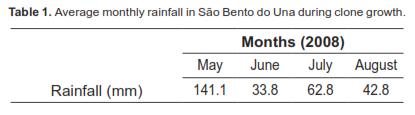
<body><![CDATA[<p><b><font size="3">Introduction</font></b></p>     <p>   The efficient use of good quality forage   represents one of many ways to improve animal   productivity and, consequently, reduce feed costs   of dairy farming. Among the diversity of forage   species, elephant grass (<i>Pennisetum purpureum</i>  Schum) is noteworthy due to its high productive   potential, for presenting various kinds of genetic   materials such as varieties and clones, and for   expanding its adaptability to very diverse climate   conditions (C&oacute;ser <i>et al.</i>, 1989). Between the variety   of studies aiming to improve the nutritional value   of forage and to understand the factors limiting   their digestibility, histological studies, allow for   both the comparison of species or cultivars and   the monitoring of tissue aging with plant maturity,   are noteworthy. Currently, plant anatomy has   become an important tool for various grass studies,   allowing the correlation of structures with chemical   composition and utilization by the animal (Ferreira   <i>et al.</i>, 2007, 2010). The cell wall constituents,   cellulose and hemicellulose, represent most of the   available substrates for rumen fermentation and are   the main energy source for ruminants. However,   the presence of lignin influences the digestibility of   these compounds (Alves de Brito <i>et al.</i>, 2002).</p>     <p>Qualitative and quantitative anatomy studies of   the forage can contribute to a better understanding   of the factors involved in ruminant tissue digestion.   Generally, grasses have great genetic variability   regarding anatomical configuration and tissue   degeneration (Grabber <i>et al.</i>, 2004). According to   Mello <i>et al.</i> (2002), the proportion of sclerenchyma   is the anatomical characteristic most correlated with   dry matter digestibility. Positive and significant   correlations were observed between the proportion   of parenchyma sheath in the vascular bundles,   lignified vascular tissue and sclerenchyma to neutral   detergent fiber, acid detergent fiber, and lignin,   while the proportions of mesophyll and epidermis   correlated negatively with these components. In this   way, anatomical characterization of a forage species   and its organs complement previous knowledge and   contributes to a better understanding of the factors involved in their digestion by ruminants.</p>     <p>The objective of this study was to structurally   characterize the stem morphology of elephant grass   clones in three layers (basal, medium, and apical region) and three tillers of the plant.</p>     <p>&nbsp;</p>     <p><b><font size="3">Materials and methods</font></b></p>     <p>The experiment was conducted at the   experimental station of S&atilde;o Bento de Una, at the   Agronomic Institute of Pernambuco (AIP), located   in the S&atilde;o Bento do Una municipality (latitude   -8.52&deg;, longitude 36.46&deg; and an altitude of 631   m). The histological analysis was performed at   the Animal Nutrition Laboratory, Federal Rural   University of Pernambuco/Academic Unit of   Garanhuns (UFRPE/UAG) in Garanhuns, PE (Brazil).</p>     <p>The rainfall data observed during the   experimental period were collected at the   Meteorological Station of PCD (LAMEPE/ITEP), S&atilde;o Bento do Una (<a href="#t1">Table 1</a>).</p>     <p align="center"><a name="t1"></a><img src="/img/revistas/rccp/v26n1/v26n1a3t1.jpg"></p>     <p>The sectors consisted of a single clump with 1   m x 1 m spacing, and fertilization was performed   with 100 kg P2O5, according to soil analysis. The   vegetable material was collected using the method   of direct cut in August 2008, at the beginning of the   dry season in the region. The samples constituted   of fresh stems &#8211;corresponding to the basal tillers&#8211;   and were collected at random. Each tiller was   divided into three strata (basal, medium, and apical   region) considering the first (basal) and the last   (apical) visible knots on the tiller. Samples were   identified and stored for 48 hours in polyethylene   jars containing fixation solution composed of 90%   alcohol (50%), 5% acetic acid, 5% formaldehyde.   Next, each sample was removed from the solution,   washed in distilled water, and reimmersed in 70% alcohol for future histological evaluations.</p>     ]]></body>
<body><![CDATA[<p>The stem dehydration began by gradually   removing water with the purpose of avoiding cellular plasmolysis. For each sample, cuts   were made at approximately 7 &mu;m on a manual   microtome and the sections were incubated in a   Pisgah solution diluted to 1:8 (Tolivia and Tolivia,   1987) and individually placed between a slide and   a coverslip for future measurements. The images   were captured by a video camera attached to the   microscope and used to determine the amount   of lignin and cellulose in the cortex and medulla   regions of the stem. The number of red and blue   cells of the general view from the cortex and from   the medullar region was evaluated through a score   system from 1 to 5 (Ferreira <i>et al.</i>, 2007), with 1   indicating regions completely covered by red blood   cells (rich in lignin) and 5 indicating regions fully   covered by blue cells (rich in cellulose) between   vascular bundles with the help of three trained   raters. The Sigma Scan Pro 5 program was used   to measure the proportions of each tissue found in   stem (% phloem in the cortex and medullar region,   % of xylem and sclerenchyma in the cortex and   medullar region, and % of parenchyma in the cortex and medullar region).</p>     <p>Fourteen clones of elephant grass (Itamb&eacute; IV-   46, Itamb&eacute; I-1.20, Itamb&eacute; I-1.4, Cuba-116-29.3,   CAC-262-12.102, Roxo of Botucatu x CAC-282-   18.29, Taiwan-146-2.6, Itamb&eacute; I-1.5, Pusa Napier   or 419-76 x Bua&ccedil;u/122-11.2, Taiwan-146-2.03,   Taiwan-146-2.85, Itamb&eacute; II-2.46, Pusa Napier or   419-76 x Cuba-116-12.3 and Pusa Napier or 412-   76 x Bua&ccedil;u/122-8.22), and one hybrid (Milheto x   Bua&ccedil;u/112-23.4) were distributed in a completely   randomized 15 x 3 x 3 factorial design (14 clones   and one hybrid, three layers of stem, and three tillers) according to the model:</p>     <p>Y<sub>ijk</sub> = &mu; + C<sub>i</sub> + P<sub>j</sub> + E<sub>k</sub> + C<sub>i</sub>*P<sub>j</sub> + e<sub>ijklm</sub></p>     <p>where:</p>     <p>Y<sub>ijk</sub> = all observations effect.</p>     <p>&mu; = general constant.</p>     <p>C<sub>i</sub> = clone and hybrid i effect.</p>     <p>i = 1, 2, 3&hellip;15.</p>     <p>P<sub>j</sub> = random variable effect &#8211; tiller j.</p>     <p>j = 1, 2 and 3.</p>     ]]></body>
<body><![CDATA[<p>E<sub>k</sub> = stratum k effect.</p>     <p>k = 1, 2 and 3.</p>     <p>C<sub>i</sub>*E<sub>k</sub> = effect of the interaction between clone i and   stratum k.</p>     <p>eijkl = random error associated with each observation   Yijk.</p>     <p>   The data were submitted a Tukey test yielding   5% probability when the T test was significant.</p>     <p>&nbsp;</p>     <p><b><font size="3">Results</font></b></p>     <p>The clone factor presented a significant effect   (p&lt;0.05) over most of the evaluated histological   characteristics (<a href="/img/revistas/rccp/v26n1/v26n1a3t2.jpg" target="_blank">Table 2</a>). The average values for   the lignified cells in the cortex region ranged from   2.21 to 4.21 for clones Taiwan-146-2.6 and Roxo   of Botucatu CAC-282-X 18.29, respectively.   There was no difference (p&gt;0.05) for the values of   lignified cells in the medullary region (<a href="/img/revistas/rccp/v26n1/v26n1a3t2.jpg" target="_blank">Table 2</a>).   It was observed that clone Taiwan-146-2.85 cells showed virtually no lignin in the cell wall.</p>     <p>Even though it was not significant, the clone   Itamb&eacute; II-2.46 presented a higher concentration   of phloem in the cortex region (2.32%) and   significantly higher values (p&lt;0.05) in the medullar   region (1.59%). The Itamb&eacute; II-2.46 clone (Table   2) also showed a low percentage of xylem and   sclerenchyma fibers, both in the region of the cortex   (15.40%) and in the medullary region (9.64%) in   relation to the hybrid Milheto X Bua&ccedil;u/112-23.4   (29.23%) for the cortex region and no significant   difference (p&gt;0.05) either in the medullary region   (11.59%). The Itamb&eacute; II-2.46 clone also showed   high percentages of parenchyma and sclerenchyma   tissues, both in the region of the cortex and in the   medullar region (<a href="/img/revistas/rccp/v26n1/v26n1a3t2.jpg" target="_blank">Table 2</a>), even though the same   clone showed low values for stem diameter and length of the radius.</p>     <p>Average values showed (<a href="/img/revistas/rccp/v26n1/v26n1a3t3.jpg" target="_blank">Table 3</a>) that all clones   had a higher cellulose concentration (p&lt;0.05) in the   apical and medium strata, associated with higher   levels of lignin in the basal layer. The Itamb&eacute; II-   2.46 and Pusa Napier or 412-76 X Bua&ccedil;u/122-8.22   clones presented higher values (p&lt;0.05) of phloem   in the apical stratum in relation to the other strata,   and at the same time did not differ in all strata of the medullary region (Table 3).</p>     ]]></body>
<body><![CDATA[<p>   There were few significant differences (p&lt;0.05)   between tillers in the studied variables (<a href="/img/revistas/rccp/v26n1/v26n1a3t4.jpg" target="_blank">Table 4</a>).</p>     <p>&nbsp;</p>     <p><b><font size="3">Discussion</font></b></p>     <p>It is noteworthy that the time between cuts is a   management factor that contributes to determining   production and forage quality, as concluded by   Gon&ccedil;alves <i>et al.</i> (2002), who found that shorter   time between cuts was associated with a higher   nutritional value. Santos <i>et al.</i> (2008), working with five elephant-grass clones at 120 days old, observed   values ranging from 2.73 to 3.85 for clones   Taiwan-146-2.26 and Bua&ccedil;u/112 x Cubra 116-15.2, respectively.</p>     <p>The cortex with higher lignin values was   composed of non-digestible lignified sclerenchyma   cells and parenchyma filler, characterized as living   cells, showing lignified primary and secondary cell   walls. Therefore, the degree of lignification of the   cell wall is also a limiting factor in the digestibility   of forage. However, according to Silva <i>et al.</i>   (2006), histological studies have shown that tissues   containing lignin are little or practically undegraded   by rumen microorganisms. Although, in addition,   some non-lignified tissues also have low ruminal   digestion due to the binding of these components with low molecular weight molecules.</p>     <p>Phloem is a vascular tissue composed of sieve   elements (living cells without nuclei and vacuoles,   generally elongated, containing a primary wall with   riddled areas), parenchymal cells (intermediate role   of reservation) and fibers (sclerenchyma cells). The   phloem allows for the fast transportation (around   1 m /h) of phloem sap, which contains   approximately 250 mg of sugar/liter, other nutritious substances and hormones (Grenet, 1997).</p>     <p>The xylem is composed of lignified elements   and may contain fibers, vessels and parenchyma   cells (Larrosa and Duarte, 2005). The tracheids   and xylem vessels are lignified water-conducting   elements. Some tracheids are also supporting   tissues. The xylem has the function of conducting   crude sap and water. According to Esau (1965), the   fibers and xylem sclerenchyma serve to support and   store starch. Tissues formed by cells with a thick   secondary wall, such as sclerenchyma and xylem,   are the main contributors to the low quality of   forage. Paciullo <i>et al.</i> (2002), studying three-stem   forage from the C4 group, found that the xylem and   sclerenchyma fibers did not disappear after 46 hours of <i>in vitro</i> incubation.</p>     <p>According to &Aacute;lves de Brito and Rodella (2002),   the largest diameter of the internode causes stem to   be more resistant to seizure, suggesting a greater   number of vascular bundles and, consequently, a   higher percentage of lignified tissues. This is in   agreement with Mello <i>et al.</i> (2002), who found in   a study of 71 elephant-grass clones that the clones   that showed larger diameters were more resistant to drought.</p>     <p>The stem diameter ranged from 5.80 to 13.74   mm for the Taiwan-146-2.03 and Itamb&eacute; I-1.20   clones, respectively. However, the values were   lower than those reported by Mello <i>et al.</i> (2002)   for clones of smaller and larger diameter. The filler   parenchyma cells have been characterized as living   cells, generally polyhedral in shape, with lignified   primary and secondary walls (Krans and Pisaneschi, 1998).</p>     <p>It was observed that all clones had a higher   cellulose concentration in apical and medium strata   (<a href="/img/revistas/rccp/v26n1/v26n1a3t3.jpg" target="_blank">Table 3</a>). This higher proportion of cellulose in   the medium and apical strata is positive because,   although animals show little selectivity in grazing   due to how they perceive the food (through the oral   apparatus, tongue and lower incisors), they tend to   consume the higher parts of the plants formed by leaves and immature stems (Santos <i>et al.</i>, 2008).</p>     ]]></body>
<body><![CDATA[<p>Some clones had low percentages of combined   xylem and sclerenchyma fibers in the three extracts   tested. Conversely, the same clones showed high   percentages of parenchyma plus sclerenchyma,   both in the region of the cortex and in the medullar   region. As cells increase with age, the deposition of   phenolic compounds in the secondary wall cell in the   formation of cell walls begins. However, there are   certain cells that deposit only primary wall leading   to a consequent lack of lamellae and lignin. These   cells, located mainly in certain areas of parenchymal   forage, present few problems regarding rumen degradation (Wilson and Mertes, 1995).</p>     <p>As observed in <a href="/img/revistas/rccp/v26n1/v26n1a3t4.jpg" target="_blank">table 4</a>, there were few   significant differences (p&lt;0.05) between tillers   in the studied variables (e.g., in the proportion of   lignified cells in the cortex and medullar region).   These differences may have been derived from   tillers in the plants of different ages and, therefore,   with different degrees of lignification. As the   tiller ages, there is greater deposition of lignin   in cell walls. Paciullo <i>et al.</i> (2002) registered a   significant increase in sclerenchyma areas with the   development of the stems, and a greater proportion   of xylem. In mature stems, the epidermis,   sclerenchyma, xylem and the parenchyma cells near   the sclerenchyma remain undigested. According   to Alves de Brito <i>et al.</i> (2004), the degradation   of tissue obeys the following order: parenchyma   tissue &gt; phloem &gt; epidermis &gt; parenchyma sheath   cells &gt; xylem and sclerenchyma. The decrease   in parenchyma digestion, associated with the age   of the stem, can be attributed to the progressive deposition of phenolic compounds in the cell walls.</p>     <p>The high values of cellulose in the middle and   apical regions of the studied stems lead to positive   characteristics for grazing animals if the basal   region is not consumed by the animals. Among   tillers studied, there was variation which yielded   a consistent effect upon anatomical features.   Depending upon the presence or absence of lignin   and cellulose, clones evaluated differed with   more pronounced proportions in the cortex region,   highlighting a positive reaction to safranin for the presence of phenolic compounds in wall cells.</p>     <p>&nbsp;</p> </font> <hr size="1"> <font size="2" face="Verdana, Arial, Helvetica, sans-serif">     <p><b><font size="3">Notas al pie </font></b></p>     <p><sup><a name="1"></a><a href="#b1">&curren;</a></sup> To cite this article: Ferreira GDG, Santos MVF, Lira MA, Melo ACL, Almeida OC, Ribeiro CR, Oliveira RL, Palmieri AD. Quantitative and qualitative characteristics of elephant grass (Pennisetum purpureum Schum) clones in the semi-arid lands of Pernambuco. Rev Colomb Cienc Pecu 2013; 26:15-23.</p> </font> <hr size="1"> <font size="2" face="Verdana, Arial, Helvetica, sans-serif">     <p>&nbsp;</p>     <p><b><font size="3">Acknowledgements</font></b></p>     <p>The authors thank the Foundation for Science   and Technology of Pernambuco State (FACEPE) for   funding the project, and the Agronomic Institute of Pernambuco (IPA) for their research support.</p>     <p>&nbsp;</p>     ]]></body>
<body><![CDATA[<p><b><font size="3">References</font></b></p>     <!-- ref --><p>Alves de Brito CJ, Rodella RA, Deschamps FC. Quantitative   Anatomy of Leaves and Stems of <i>Brachiaria brizantha</i> (Hochst.   ex A. Rich.) Stapf and <i>B. humidicola</i> (Rendle) Schweic. Rev   Bras Zootec 2004; 33:519-528.    &nbsp;&nbsp;&nbsp;&nbsp;&nbsp;&nbsp;&nbsp;&nbsp;[&#160;<a href="javascript:void(0);" onclick="javascript: window.open('/scielo.php?script=sci_nlinks&ref=000084&pid=S0120-0690201300010000300001&lng=','','width=640,height=500,resizable=yes,scrollbars=1,menubar=yes,');">Links</a>&#160;]<!-- end-ref --></p>     <!-- ref --><p>Alves de Brito CJF, Rodella RA. Leaf and stem morphoanatomical   characterization of <i>Brachiaria brizantha</i> (Hochst.   ex A. Rich.) Stapf and <i>B. humidicola</i> (Rendle) Schweick.   (Poaceae). Rev Bras Bot 2002; 25:221-228.    &nbsp;&nbsp;&nbsp;&nbsp;&nbsp;&nbsp;&nbsp;&nbsp;[&#160;<a href="javascript:void(0);" onclick="javascript: window.open('/scielo.php?script=sci_nlinks&ref=000086&pid=S0120-0690201300010000300002&lng=','','width=640,height=500,resizable=yes,scrollbars=1,menubar=yes,');">Links</a>&#160;]<!-- end-ref --></p>     <!-- ref --><p>Krans JE, Pisaneschi J. Atlas Vegetal. S&atilde;o Paulo; &#91;April,08,2010&#93;   URL: <a href="http://atlasveg.ib.usp.br/Caule/ca1-mono.html" target="_blank">http://atlasveg.ib.usp.br/Caule/ca1-mono.html</a>&nbsp;&nbsp;&nbsp;&nbsp;&nbsp;&nbsp;&nbsp;&nbsp;[&#160;<a href="javascript:void(0);" onclick="javascript: window.open('/scielo.php?script=sci_nlinks&ref=000088&pid=S0120-0690201300010000300003&lng=','','width=640,height=500,resizable=yes,scrollbars=1,menubar=yes,');">Links</a>&#160;]<!-- end-ref --><!-- ref --><p>Esau K, Wiley J. Plant Anatomy. 2nd ed. New York (NY): New   York Wiley; 1965.    &nbsp;&nbsp;&nbsp;&nbsp;&nbsp;&nbsp;&nbsp;&nbsp;[&#160;<a href="javascript:void(0);" onclick="javascript: window.open('/scielo.php?script=sci_nlinks&ref=000089&pid=S0120-0690201300010000300004&lng=','','width=640,height=500,resizable=yes,scrollbars=1,menubar=yes,');">Links</a>&#160;]<!-- end-ref --></p>     <!-- ref --><p>Ferreira GDG, Emile JC, Barri&egrave;re Y, Jobim CC. Morphoanatomical   characterization of corn hybrids stems, in order to evaluate silage   quality. Acta Sci Anim Sci 2007; 29:249-254.    &nbsp;&nbsp;&nbsp;&nbsp;&nbsp;&nbsp;&nbsp;&nbsp;[&#160;<a href="javascript:void(0);" onclick="javascript: window.open('/scielo.php?script=sci_nlinks&ref=000091&pid=S0120-0690201300010000300005&lng=','','width=640,height=500,resizable=yes,scrollbars=1,menubar=yes,');">Links</a>&#160;]<!-- end-ref --></p>     ]]></body>
<body><![CDATA[<!-- ref --><p>Ferreira GDG, Cunha MV, Silva DKA, Santos MVF, Magalh&atilde;es   ALR, Lira MA, Dubeux J&uacute;nior JCB. Histology of the stems of   elephant grass clones in the wasteland of Pernambuco. Rev Bras   Sa&uacute;de Prod Ani 2010; 11:36-47.    &nbsp;&nbsp;&nbsp;&nbsp;&nbsp;&nbsp;&nbsp;&nbsp;[&#160;<a href="javascript:void(0);" onclick="javascript: window.open('/scielo.php?script=sci_nlinks&ref=000093&pid=S0120-0690201300010000300006&lng=','','width=640,height=500,resizable=yes,scrollbars=1,menubar=yes,');">Links</a>&#160;]<!-- end-ref --></p>     <!-- ref --><p>Grenet E. Aspects microscopiques de la d&eacute;gradation   micronienne d&ecirc;s tissus v&eacute;g&eacute;taux dans le rumen. INRA Prod   Anim 1997; 10:241-249.    &nbsp;&nbsp;&nbsp;&nbsp;&nbsp;&nbsp;&nbsp;&nbsp;[&#160;<a href="javascript:void(0);" onclick="javascript: window.open('/scielo.php?script=sci_nlinks&ref=000095&pid=S0120-0690201300010000300007&lng=','','width=640,height=500,resizable=yes,scrollbars=1,menubar=yes,');">Links</a>&#160;]<!-- end-ref --></p>     <!-- ref --><p>Gon&ccedil;alves GD, Santos GT, Cecato U, Jobim CC, Damasceno   JC, Branco AF, Faria KP. Cynodon production and nutritive   value at different harvesting ages through year season. Acta Sci   Ani Sci 2002; 24:1163-1174.    &nbsp;&nbsp;&nbsp;&nbsp;&nbsp;&nbsp;&nbsp;&nbsp;[&#160;<a href="javascript:void(0);" onclick="javascript: window.open('/scielo.php?script=sci_nlinks&ref=000097&pid=S0120-0690201300010000300008&lng=','','width=640,height=500,resizable=yes,scrollbars=1,menubar=yes,');">Links</a>&#160;]<!-- end-ref --></p>     <!-- ref --><p>Grabber JH, Ralph J, Lapierre C, Barri&egrave;rre Y. Genetic and   molecular basis of grass cell-wall degradability. I. lignin-cell   wall matrix interactions. C R Biol 2004; 327:455-465.    &nbsp;&nbsp;&nbsp;&nbsp;&nbsp;&nbsp;&nbsp;&nbsp;[&#160;<a href="javascript:void(0);" onclick="javascript: window.open('/scielo.php?script=sci_nlinks&ref=000099&pid=S0120-0690201300010000300009&lng=','','width=640,height=500,resizable=yes,scrollbars=1,menubar=yes,');">Links</a>&#160;]<!-- end-ref --></p>     <!-- ref --><p>Larrosa CRR, Duarte MR. Contribui&ccedil;&atilde;o ao estudo anat&ocirc;mico do   caule de <i>Himatanthus sucuuba</i> (Spruce ex M&uuml;ll. Arg.) Woodson,   Apocynaceae. Rev Bras Farmacogn 2005; 15:110-114.    &nbsp;&nbsp;&nbsp;&nbsp;&nbsp;&nbsp;&nbsp;&nbsp;[&#160;<a href="javascript:void(0);" onclick="javascript: window.open('/scielo.php?script=sci_nlinks&ref=000101&pid=S0120-0690201300010000300010&lng=','','width=640,height=500,resizable=yes,scrollbars=1,menubar=yes,');">Links</a>&#160;]<!-- end-ref --></p>     ]]></body>
<body><![CDATA[<!-- ref --><p>Mello ACL, Lira MA, Dubeux J&uacute;nior JCB, Santos MVF, Freitas   EV. Characterization and selection of elephant grass clones   (<i>Pennisetum purpureum</i> Schum.) at the Pernambuco Forest   Zone. Rev Bras Zootec 2002; 31:30-42.    &nbsp;&nbsp;&nbsp;&nbsp;&nbsp;&nbsp;&nbsp;&nbsp;[&#160;<a href="javascript:void(0);" onclick="javascript: window.open('/scielo.php?script=sci_nlinks&ref=000103&pid=S0120-0690201300010000300011&lng=','','width=640,height=500,resizable=yes,scrollbars=1,menubar=yes,');">Links</a>&#160;]<!-- end-ref --></p>     <!-- ref --><p>Paciullo DSC. Anatomical Traits Related With Nutritive Value   of Forage Grasses. Cienc Rural 2002; 32:357-364.    &nbsp;&nbsp;&nbsp;&nbsp;&nbsp;&nbsp;&nbsp;&nbsp;[&#160;<a href="javascript:void(0);" onclick="javascript: window.open('/scielo.php?script=sci_nlinks&ref=000105&pid=S0120-0690201300010000300012&lng=','','width=640,height=500,resizable=yes,scrollbars=1,menubar=yes,');">Links</a>&#160;]<!-- end-ref --></p>     <!-- ref --><p>Paciullo DSC, Gomide JA, Silva EAM, Queiroz DS, Gomide   CAM. In Vitro Digestion of Leaf Blade and Stem Tissues of   Tropical Forage Grasses According to Stages of Developmen.   Rev Bras Zootec 2002; 31:900-907.    &nbsp;&nbsp;&nbsp;&nbsp;&nbsp;&nbsp;&nbsp;&nbsp;[&#160;<a href="javascript:void(0);" onclick="javascript: window.open('/scielo.php?script=sci_nlinks&ref=000107&pid=S0120-0690201300010000300013&lng=','','width=640,height=500,resizable=yes,scrollbars=1,menubar=yes,');">Links</a>&#160;]<!-- end-ref --></p>     <!-- ref --><p>Santos KC, Batista Filho AFB, Ferreira GDG. Avalia&ccedil;&otilde;es   histol&oacute;gicas de clones de capim-elefante no Agreste de   Pernambuco. In: V CONGRESO NORDESTINO DE   PRODU&Ccedil;&Atilde;O ANIMAL, 2008, Aracaju: Sociedade Nordestina   de Produ&ccedil;&atilde;o Animal.    &nbsp;&nbsp;&nbsp;&nbsp;&nbsp;&nbsp;&nbsp;&nbsp;[&#160;<a href="javascript:void(0);" onclick="javascript: window.open('/scielo.php?script=sci_nlinks&ref=000109&pid=S0120-0690201300010000300014&lng=','','width=640,height=500,resizable=yes,scrollbars=1,menubar=yes,');">Links</a>&#160;]<!-- end-ref --></p>     <!-- ref --><p>Silva AV, Pereira OG, Valadares Filho SC, Garcia R, Cecon PR,   Ferreira CLLF. Consumo e digestibilidade doa nutrients em   bovinos recebendo dietas contend silagens de Milho e sorgo,   com e sem inoculante microbiano. Rev Bras Zootec 2006;   35:2469-2478.    &nbsp;&nbsp;&nbsp;&nbsp;&nbsp;&nbsp;&nbsp;&nbsp;[&#160;<a href="javascript:void(0);" onclick="javascript: window.open('/scielo.php?script=sci_nlinks&ref=000111&pid=S0120-0690201300010000300015&lng=','','width=640,height=500,resizable=yes,scrollbars=1,menubar=yes,');">Links</a>&#160;]<!-- end-ref --></p>     ]]></body>
<body><![CDATA[<!-- ref --><p>Tolivia D, Tolivia JF. A new polychromatic method for   simultaneous and differential stainning of plant tissue. J   Microsc 1987; 148:113-117.    &nbsp;&nbsp;&nbsp;&nbsp;&nbsp;&nbsp;&nbsp;&nbsp;[&#160;<a href="javascript:void(0);" onclick="javascript: window.open('/scielo.php?script=sci_nlinks&ref=000113&pid=S0120-0690201300010000300016&lng=','','width=640,height=500,resizable=yes,scrollbars=1,menubar=yes,');">Links</a>&#160;]<!-- end-ref --></p>     <!-- ref --><p>Wilson JR, Mertens DR. Cell wall accessibility and cell   structure limitations to microbial digestion of forage. Crop Sci 1995; 35:251-259.    &nbsp;&nbsp;&nbsp;&nbsp;&nbsp;&nbsp;&nbsp;&nbsp;[&#160;<a href="javascript:void(0);" onclick="javascript: window.open('/scielo.php?script=sci_nlinks&ref=000115&pid=S0120-0690201300010000300017&lng=','','width=640,height=500,resizable=yes,scrollbars=1,menubar=yes,');">Links</a>&#160;]<!-- end-ref --></p>     <p>&nbsp;</p> </font>      ]]></body><back>
<ref-list>
<ref id="B1">
<nlm-citation citation-type="journal">
<person-group person-group-type="author">
<name>
<surname><![CDATA[Alves de Brito]]></surname>
<given-names><![CDATA[CJ]]></given-names>
</name>
<name>
<surname><![CDATA[Rodella]]></surname>
<given-names><![CDATA[RA]]></given-names>
</name>
<name>
<surname><![CDATA[Deschamps]]></surname>
<given-names><![CDATA[FC]]></given-names>
</name>
</person-group>
<article-title xml:lang="en"><![CDATA[Quantitative Anatomy of Leaves and Stems of Brachiaria brizantha (Hochst. ex A. Rich.) Stapf and B. humidicola (Rendle) Schweic]]></article-title>
<source><![CDATA[Rev Bras Zootec]]></source>
<year>2004</year>
<volume>33</volume>
<page-range>519-528</page-range></nlm-citation>
</ref>
<ref id="B2">
<nlm-citation citation-type="journal">
<person-group person-group-type="author">
<name>
<surname><![CDATA[Alves de Brito]]></surname>
<given-names><![CDATA[CJF]]></given-names>
</name>
<name>
<surname><![CDATA[Rodella]]></surname>
<given-names><![CDATA[RA]]></given-names>
</name>
</person-group>
<article-title xml:lang="en"><![CDATA[Leaf and stem morphoanatomical characterization of Brachiaria brizantha (Hochst. ex A. Rich.) Stapf and B. humidicola (Rendle) Schweick. (Poaceae)]]></article-title>
<source><![CDATA[Rev Bras Bot]]></source>
<year>2002</year>
<volume>25</volume>
<page-range>221-228</page-range></nlm-citation>
</ref>
<ref id="B3">
<nlm-citation citation-type="">
<person-group person-group-type="author">
<name>
<surname><![CDATA[Krans]]></surname>
<given-names><![CDATA[JE]]></given-names>
</name>
<name>
<surname><![CDATA[Pisaneschi]]></surname>
<given-names><![CDATA[J]]></given-names>
</name>
</person-group>
<source><![CDATA[Atlas Vegetal]]></source>
<year></year>
<publisher-loc><![CDATA[São Paulo ]]></publisher-loc>
</nlm-citation>
</ref>
<ref id="B4">
<nlm-citation citation-type="book">
<person-group person-group-type="author">
<name>
<surname><![CDATA[Esau]]></surname>
<given-names><![CDATA[K]]></given-names>
</name>
<name>
<surname><![CDATA[Wiley]]></surname>
<given-names><![CDATA[J]]></given-names>
</name>
</person-group>
<source><![CDATA[Plant Anatomy]]></source>
<year>1965</year>
<edition>2</edition>
<publisher-loc><![CDATA[New York^eNY NY]]></publisher-loc>
<publisher-name><![CDATA[New York Wiley]]></publisher-name>
</nlm-citation>
</ref>
<ref id="B5">
<nlm-citation citation-type="journal">
<person-group person-group-type="author">
<name>
<surname><![CDATA[Ferreira]]></surname>
<given-names><![CDATA[GDG]]></given-names>
</name>
<name>
<surname><![CDATA[Emile]]></surname>
<given-names><![CDATA[JC]]></given-names>
</name>
<name>
<surname><![CDATA[Barrière]]></surname>
<given-names><![CDATA[Y]]></given-names>
</name>
<name>
<surname><![CDATA[Jobim]]></surname>
<given-names><![CDATA[CC]]></given-names>
</name>
</person-group>
<article-title xml:lang="en"><![CDATA[Morphoanatomical characterization of corn hybrids stems, in order to evaluate silage quality]]></article-title>
<source><![CDATA[Acta Sci Anim Sci]]></source>
<year>2007</year>
<volume>29</volume>
<page-range>249-254</page-range></nlm-citation>
</ref>
<ref id="B6">
<nlm-citation citation-type="journal">
<person-group person-group-type="author">
<name>
<surname><![CDATA[Ferreira]]></surname>
<given-names><![CDATA[GDG]]></given-names>
</name>
<name>
<surname><![CDATA[Cunha]]></surname>
<given-names><![CDATA[MV]]></given-names>
</name>
<name>
<surname><![CDATA[Silva]]></surname>
<given-names><![CDATA[DKA]]></given-names>
</name>
<name>
<surname><![CDATA[Santos]]></surname>
<given-names><![CDATA[MVF]]></given-names>
</name>
<name>
<surname><![CDATA[Magalhães]]></surname>
<given-names><![CDATA[ALR]]></given-names>
</name>
<name>
<surname><![CDATA[Lira]]></surname>
<given-names><![CDATA[MA]]></given-names>
</name>
<name>
<surname><![CDATA[Dubeux]]></surname>
<given-names><![CDATA[Júnior JCB]]></given-names>
</name>
</person-group>
<article-title xml:lang="en"><![CDATA[Histology of the stems of elephant grass clones in the wasteland of Pernambuco]]></article-title>
<source><![CDATA[Rev Bras Saúde Prod Ani]]></source>
<year>2010</year>
<volume>11</volume>
<page-range>36-47</page-range></nlm-citation>
</ref>
<ref id="B7">
<nlm-citation citation-type="journal">
<person-group person-group-type="author">
<name>
<surname><![CDATA[Grenet]]></surname>
<given-names><![CDATA[E]]></given-names>
</name>
</person-group>
<article-title xml:lang="fr"><![CDATA[Aspects microscopiques de la dégradation micronienne dês tissus végétaux dans le rumen]]></article-title>
<source><![CDATA[INRA Prod Anim]]></source>
<year>1997</year>
<volume>10</volume>
<page-range>241-249</page-range></nlm-citation>
</ref>
<ref id="B8">
<nlm-citation citation-type="journal">
<person-group person-group-type="author">
<name>
<surname><![CDATA[Gonçalves]]></surname>
<given-names><![CDATA[GD]]></given-names>
</name>
<name>
<surname><![CDATA[Santos]]></surname>
<given-names><![CDATA[GT]]></given-names>
</name>
<name>
<surname><![CDATA[Cecato]]></surname>
<given-names><![CDATA[U]]></given-names>
</name>
<name>
<surname><![CDATA[Jobim]]></surname>
<given-names><![CDATA[CC]]></given-names>
</name>
<name>
<surname><![CDATA[Damasceno]]></surname>
<given-names><![CDATA[JC]]></given-names>
</name>
<name>
<surname><![CDATA[Branco]]></surname>
<given-names><![CDATA[AF]]></given-names>
</name>
<name>
<surname><![CDATA[Faria]]></surname>
<given-names><![CDATA[KP]]></given-names>
</name>
</person-group>
<article-title xml:lang="en"><![CDATA[Cynodon production and nutritive value at different harvesting ages through year season]]></article-title>
<source><![CDATA[Acta Sci Ani Sci]]></source>
<year>2002</year>
<volume>24</volume>
<page-range>1163-1174</page-range></nlm-citation>
</ref>
<ref id="B9">
<nlm-citation citation-type="journal">
<person-group person-group-type="author">
<name>
<surname><![CDATA[Grabber]]></surname>
<given-names><![CDATA[JH]]></given-names>
</name>
<name>
<surname><![CDATA[Ralph]]></surname>
<given-names><![CDATA[J]]></given-names>
</name>
<name>
<surname><![CDATA[Lapierre]]></surname>
<given-names><![CDATA[C]]></given-names>
</name>
<name>
<surname><![CDATA[Barrièrre]]></surname>
<given-names><![CDATA[Y]]></given-names>
</name>
</person-group>
<article-title xml:lang="en"><![CDATA[Genetic and molecular basis of grass cell-wall degradability. I. lignin-cell wall matrix interactions]]></article-title>
<source><![CDATA[C R Biol]]></source>
<year>2004</year>
<volume>327</volume>
<page-range>455-465</page-range></nlm-citation>
</ref>
<ref id="B10">
<nlm-citation citation-type="journal">
<person-group person-group-type="author">
<name>
<surname><![CDATA[Larrosa]]></surname>
<given-names><![CDATA[CRR]]></given-names>
</name>
<name>
<surname><![CDATA[Duarte]]></surname>
<given-names><![CDATA[MR]]></given-names>
</name>
</person-group>
<article-title xml:lang="pt"><![CDATA[Contribuição ao estudo anatômico do caule de Himatanthus sucuuba (Spruce ex Müll. Arg.) Woodson, Apocynaceae]]></article-title>
<source><![CDATA[Rev Bras Farmacogn]]></source>
<year>2005</year>
<volume>15</volume>
<page-range>110-114</page-range></nlm-citation>
</ref>
<ref id="B11">
<nlm-citation citation-type="journal">
<person-group person-group-type="author">
<name>
<surname><![CDATA[Mello]]></surname>
<given-names><![CDATA[ACL]]></given-names>
</name>
<name>
<surname><![CDATA[Lira]]></surname>
<given-names><![CDATA[MA]]></given-names>
</name>
<name>
<surname><![CDATA[Dubeux]]></surname>
<given-names><![CDATA[Júnior JCB]]></given-names>
</name>
<name>
<surname><![CDATA[Santos]]></surname>
<given-names><![CDATA[MVF]]></given-names>
</name>
<name>
<surname><![CDATA[Freitas]]></surname>
<given-names><![CDATA[EV]]></given-names>
</name>
</person-group>
<article-title xml:lang="en"><![CDATA[Characterization and selection of elephant grass clones (Pennisetum purpureum Schum.) at the Pernambuco Forest Zone]]></article-title>
<source><![CDATA[Rev Bras Zootec]]></source>
<year>2002</year>
<volume>31</volume>
<page-range>30-42</page-range></nlm-citation>
</ref>
<ref id="B12">
<nlm-citation citation-type="journal">
<person-group person-group-type="author">
<name>
<surname><![CDATA[Paciullo]]></surname>
<given-names><![CDATA[DSC]]></given-names>
</name>
</person-group>
<article-title xml:lang="en"><![CDATA[Anatomical Traits Related With Nutritive Value of Forage Grasses]]></article-title>
<source><![CDATA[Cienc Rural]]></source>
<year>2002</year>
<volume>32</volume>
<page-range>357-364</page-range></nlm-citation>
</ref>
<ref id="B13">
<nlm-citation citation-type="journal">
<person-group person-group-type="author">
<name>
<surname><![CDATA[Paciullo]]></surname>
<given-names><![CDATA[DSC]]></given-names>
</name>
<name>
<surname><![CDATA[Gomide]]></surname>
<given-names><![CDATA[JA]]></given-names>
</name>
<name>
<surname><![CDATA[Silva]]></surname>
<given-names><![CDATA[EAM]]></given-names>
</name>
<name>
<surname><![CDATA[Queiroz]]></surname>
<given-names><![CDATA[DS]]></given-names>
</name>
<name>
<surname><![CDATA[Gomide]]></surname>
<given-names><![CDATA[CAM]]></given-names>
</name>
</person-group>
<article-title xml:lang="en"><![CDATA[In Vitro Digestion of Leaf Blade and Stem Tissues of Tropical Forage Grasses According to Stages of Developmen]]></article-title>
<source><![CDATA[Rev Bras Zootec]]></source>
<year>2002</year>
<volume>31</volume>
<page-range>900-907</page-range></nlm-citation>
</ref>
<ref id="B14">
<nlm-citation citation-type="confpro">
<person-group person-group-type="author">
<name>
<surname><![CDATA[Santos]]></surname>
<given-names><![CDATA[KC]]></given-names>
</name>
<name>
<surname><![CDATA[Batista Filho]]></surname>
<given-names><![CDATA[AFB]]></given-names>
</name>
<name>
<surname><![CDATA[Ferreira]]></surname>
<given-names><![CDATA[GDG]]></given-names>
</name>
</person-group>
<article-title xml:lang="en"><![CDATA[Avaliações histológicas de clones de capim-elefante no Agreste de Pernambuco]]></article-title>
<source><![CDATA[]]></source>
<year></year>
<conf-name><![CDATA[V CONGRESO NORDESTINO DE PRODUÇÃO ANIMAL]]></conf-name>
<conf-date>2008</conf-date>
<conf-loc>Aracaju </conf-loc>
</nlm-citation>
</ref>
<ref id="B15">
<nlm-citation citation-type="journal">
<person-group person-group-type="author">
<name>
<surname><![CDATA[Silva]]></surname>
<given-names><![CDATA[AV]]></given-names>
</name>
<name>
<surname><![CDATA[Pereira]]></surname>
<given-names><![CDATA[OG]]></given-names>
</name>
<name>
<surname><![CDATA[Valadares Filho]]></surname>
<given-names><![CDATA[SC]]></given-names>
</name>
<name>
<surname><![CDATA[Garcia]]></surname>
<given-names><![CDATA[R]]></given-names>
</name>
<name>
<surname><![CDATA[Cecon]]></surname>
<given-names><![CDATA[PR]]></given-names>
</name>
<name>
<surname><![CDATA[Ferreira]]></surname>
<given-names><![CDATA[CLLF]]></given-names>
</name>
</person-group>
<article-title xml:lang="pt"><![CDATA[Consumo e digestibilidade doa nutrients em bovinos recebendo dietas contend silagens de Milho e sorgo, com e sem inoculante microbiano]]></article-title>
<source><![CDATA[Rev Bras Zootec]]></source>
<year>2006</year>
<volume>35</volume>
<page-range>2469-2478</page-range></nlm-citation>
</ref>
<ref id="B16">
<nlm-citation citation-type="journal">
<person-group person-group-type="author">
<name>
<surname><![CDATA[Tolivia]]></surname>
<given-names><![CDATA[D]]></given-names>
</name>
<name>
<surname><![CDATA[Tolivia]]></surname>
<given-names><![CDATA[JF]]></given-names>
</name>
</person-group>
<article-title xml:lang="en"><![CDATA[A new polychromatic method for simultaneous and differential stainning of plant tissue]]></article-title>
<source><![CDATA[J Microsc]]></source>
<year>1987</year>
<volume>148</volume>
<page-range>113-117</page-range></nlm-citation>
</ref>
<ref id="B17">
<nlm-citation citation-type="journal">
<person-group person-group-type="author">
<name>
<surname><![CDATA[Wilson]]></surname>
<given-names><![CDATA[JR]]></given-names>
</name>
<name>
<surname><![CDATA[Mertens]]></surname>
<given-names><![CDATA[DR]]></given-names>
</name>
</person-group>
<article-title xml:lang="en"><![CDATA[Cell wall accessibility and cell structure limitations to microbial digestion of forage]]></article-title>
<source><![CDATA[Crop Sci]]></source>
<year>1995</year>
<volume>35</volume>
<page-range>251-259</page-range></nlm-citation>
</ref>
</ref-list>
</back>
</article>
