<?xml version="1.0" encoding="ISO-8859-1"?><article xmlns:mml="http://www.w3.org/1998/Math/MathML" xmlns:xlink="http://www.w3.org/1999/xlink" xmlns:xsi="http://www.w3.org/2001/XMLSchema-instance">
<front>
<journal-meta>
<journal-id>0120-0690</journal-id>
<journal-title><![CDATA[Revista Colombiana de Ciencias Pecuarias]]></journal-title>
<abbrev-journal-title><![CDATA[Rev Colom Cienc Pecua]]></abbrev-journal-title>
<issn>0120-0690</issn>
<publisher>
<publisher-name><![CDATA[Facultad de Ciencias Agrarias, Universidad de Antioquia]]></publisher-name>
</publisher>
</journal-meta>
<article-meta>
<article-id>S0120-06902013000100004</article-id>
<title-group>
<article-title xml:lang="en"><![CDATA[Vocalization and behavior of Holstein cows and calves after partial and complete separation]]></article-title>
<article-title xml:lang="es"><![CDATA[Vocalización y comportamiento de vacas y terneros Holstein luego de separación parcial y total]]></article-title>
<article-title xml:lang="pt"><![CDATA[Vocalização e comportamento de bezerros e vacas Holandesas após separação parcial e completa]]></article-title>
</title-group>
<contrib-group>
<contrib contrib-type="author">
<name>
<surname><![CDATA[Shin-Jae]]></surname>
<given-names><![CDATA[Rhim]]></given-names>
</name>
<xref ref-type="aff" rid="A01"/>
</contrib>
</contrib-group>
<aff id="A01">
<institution><![CDATA[,Chung-Ang University School of Bioresource and Bioscience ]]></institution>
<addr-line><![CDATA[ ]]></addr-line>
<country>Korea</country>
</aff>
<pub-date pub-type="pub">
<day>00</day>
<month>03</month>
<year>2013</year>
</pub-date>
<pub-date pub-type="epub">
<day>00</day>
<month>03</month>
<year>2013</year>
</pub-date>
<volume>26</volume>
<numero>1</numero>
<fpage>24</fpage>
<lpage>29</lpage>
<copyright-statement/>
<copyright-year/>
<self-uri xlink:href="http://www.scielo.org.co/scielo.php?script=sci_arttext&amp;pid=S0120-06902013000100004&amp;lng=en&amp;nrm=iso"></self-uri><self-uri xlink:href="http://www.scielo.org.co/scielo.php?script=sci_abstract&amp;pid=S0120-06902013000100004&amp;lng=en&amp;nrm=iso"></self-uri><self-uri xlink:href="http://www.scielo.org.co/scielo.php?script=sci_pdf&amp;pid=S0120-06902013000100004&amp;lng=en&amp;nrm=iso"></self-uri><abstract abstract-type="short" xml:lang="en"><p><![CDATA[Background: a potential negative impact on the welfare and growth of the calf occurs when it is separated from its mother. Objective: this study was conducted in order to understand how the vocal and behavioral characteristics of cows and calves differ between partial and complete separations. Methods: 30 cows and their calves (60 study participants in total) housed in different barns were observed for 10 consecutive hours using video technology on days 1, 6, and 11 after partial and complete separations. Results: vocalization frequency was higher (p<0.05) following partial separation for both cows and calves. After complete separation, cows exhibited significantly more (p<0.05) lying behavior as well as fewer (p<0.05) standing and sniffing behaviors. Conclusions: the study revealed higher intensity and occurrence of vocalization levels and behavioral changes in cows and calves following partial separation. It is concluded that partial separation could imply higher interaction between cows and calves and also greater animal welfare challenges in comparison with complete separation.]]></p></abstract>
<abstract abstract-type="short" xml:lang="es"><p><![CDATA[Antecedentes: un posible impacto negativo sobre el bienestar y el crecimiento del ternero se produce cuando este se separa de su madre. Objetivo: este estudio tuvo como objetivo comprender como las características vocales y de comportamiento de vacas y terneros difieren luego de la separación parcial o completa entre ambos. Métodos: 30 vacas y sus terneros (60 animales en total) alojados en establos separados fueron observados durante 10 horas consecutivas utilizando tecnología de vídeo durante los días 1, 6, y 11 después de separacion parcial o completa. Resultados: la frecuencia de vocalización fue mayor (p <0,05) tras la separación parcial de vacas y ternero. Después de la separación completa, las vacas yacían más en el piso (p <0,05), permanecían menos tiempo de pie y tenían menos comportamiento de olfateo (p <0,05). Conclusiones: el estudio reveló una mayor intensidad y frecuencia de vocalizaciones y cambios de comportamiento en las vacas y los terneros tras la separación parcial. Se concluye que la separación parcial podría implicar una mayor interacción entre las vacas y los terneros y también mayores desafíos de bienestar animal en comparación con la separación completa.]]></p></abstract>
<abstract abstract-type="short" xml:lang="pt"><p><![CDATA[Antecedentes: um possível impacto negativo no bem-estar e crescimento ocorre quando o bezerro é separado de sua mãe. Objetivo: descrever as características comportamentais e emissões vocais de bezerros e vacas Holandesas após separação parcial e completa. Métodos: 30 vacas e seus bezerros (para um total de 60 amostras no estudo) localizados em diferentes lugares foram observados consecutivamente usando a tecnologia do vídeo por 10 h nos dias 1, 6 e 11 em separações completas e parciais. Resultados: a frequência de emissões vocais foi maior tanto nas vacas quanto nos bezerros (p<0,05) após uma separação parcial. Após uma separação completa, as vacas exibiram com uma frequência significativamente maior o comportamento de estar deitadas (p<0,05), tanto quanto significativamente menor (p<0,05) o comportamento de estar paradas e de cheirar. Conclusões: a pesquisa revelou maiores níveis de vocalização e comportamento nas vacas e bezerros após a separação parcial. Conclui-se com estes resultados que a separação parcial permite uma maior interação entre a vaca e o ternero, fato que implica um maior desafio em relação ao bem-estar animal comparado com a separação completa.]]></p></abstract>
<kwd-group>
<kwd lng="en"><![CDATA[animal welfare]]></kwd>
<kwd lng="en"><![CDATA[behavior]]></kwd>
<kwd lng="en"><![CDATA[cattle]]></kwd>
<kwd lng="en"><![CDATA[video technology]]></kwd>
<kwd lng="en"><![CDATA[vocal characteristics]]></kwd>
<kwd lng="es"><![CDATA[bienestar animal]]></kwd>
<kwd lng="es"><![CDATA[características vocales]]></kwd>
<kwd lng="es"><![CDATA[comportamiento]]></kwd>
<kwd lng="es"><![CDATA[ganado]]></kwd>
<kwd lng="es"><![CDATA[tecnología de video]]></kwd>
<kwd lng="pt"><![CDATA[bem-estar animal]]></kwd>
<kwd lng="pt"><![CDATA[comportamento]]></kwd>
<kwd lng="pt"><![CDATA[gado de leite]]></kwd>
<kwd lng="pt"><![CDATA[tecnologia de vídeo]]></kwd>
<kwd lng="pt"><![CDATA[vocalização]]></kwd>
</kwd-group>
</article-meta>
</front><body><![CDATA[ <font size="2" face="Verdana, Arial, Helvetica, sans-serif">     <p align="right"><b>ORIGINALS ARTICLES</b></p>     <p>&nbsp;</p>     <p align="center"><b><font size="4">Vocalization and behavior of Holstein cows and calves after   partial and complete separation<sup><a href="#1">&curren;</a><a name="b1"></a></sup></font></b></p>     <p>&nbsp;  </p>     <p align="center"><b><font size="3">Vocalizaci&oacute;n y comportamiento de vacas y terneros Holstein luego de separaci&oacute;n parcial y total </font></b></p>     <p>&nbsp;</p>     <p align="center"><b><font size="3">Vocaliza&ccedil;&atilde;o e comportamento de bezerros e vacas Holandesas ap&oacute;s separa&ccedil;&atilde;o parcial e completa</font></b></p>     <p>&nbsp;</p>     <p>&nbsp;</p>     ]]></body>
<body><![CDATA[<p><b>Shin-Jae Rhim1*, PhD.</b></p>     <p>   * Corresponding author: Shin-Jae Rhim, School of Bioresource and Bioscience, Chung-Ang University, Ansung 456-756, Korea. Tel: 82-31-670-4842, Fax: 82-31-676-4842. <a href="mailto:E-mail:sjrhim@cau.ac.kr">E-mail: sjrhim@cau.ac.kr</a></p>     <p><sup>1</sup>School of Bioresource and Bioscience, Chung-Ang University, Ansung 456-756, Korea.  </p>     <p>&nbsp;</p>     <p>(Received: May 22, 2012; accepted: July 3, 2012) </p>     <p>&nbsp;</p> </font> <hr size="1"> <font size="2" face="Verdana, Arial, Helvetica, sans-serif">     <p><b>Summary</b></p>     <p>   <b>Background:</b> a potential negative impact on the welfare and growth of the calf occurs when it is separated   from its mother. <b>Objective:</b> this study was conducted in order to understand how the vocal and behavioral   characteristics of cows and calves differ between partial and complete separations. <b>Methods:</b> 30 cows and   their calves (60 study participants in total) housed in different barns were observed for 10 consecutive hours   using video technology on days 1, 6, and 11 after partial and complete separations. <b>Results:</b> vocalization   frequency was higher (p&lt;0.05) following partial separation for both cows and calves. After complete   separation, cows exhibited significantly more (p&lt;0.05) lying behavior as well as fewer (p&lt;0.05) standing   and sniffing behaviors. <b>Conclusions:</b> the study revealed higher intensity and occurrence of vocalization   levels and behavioral changes in cows and calves following partial separation. It is concluded that partial   separation could imply higher interaction between cows and calves and also greater animal welfare challenges   in comparison with complete separation.</p>     <p>   <b>Key words:</b> animal welfare, behavior, cattle, video technology, vocal characteristics.</p> </font> <hr size="1"> <font size="2" face="Verdana, Arial, Helvetica, sans-serif">     <p><b>Resumen</b></p>     ]]></body>
<body><![CDATA[<p><b>Antecedentes:</b> un posible impacto negativo sobre el bienestar y el crecimiento del ternero se produce   cuando este se separa de su madre. <b>Objetivo:</b> este estudio tuvo como objetivo comprender como las   caracter&iacute;sticas vocales y de comportamiento de vacas y terneros difieren luego de la separaci&oacute;n parcial   o completa entre ambos. <b>M&eacute;todos:</b> 30 vacas y sus terneros (60 animales en total) alojados en establos   separados fueron observados durante 10 horas consecutivas utilizando tecnolog&iacute;a de v&iacute;deo durante los d&iacute;as   1, 6, y 11 despu&eacute;s de separacion parcial o completa. <b>Resultados:</b> la frecuencia de vocalizaci&oacute;n fue mayor   (p &lt;0,05) tras la separaci&oacute;n parcial de vacas y ternero. Despu&eacute;s de la separaci&oacute;n completa, las vacas yac&iacute;an   m&aacute;s en el piso (p &lt;0,05), permanec&iacute;an menos tiempo de pie y ten&iacute;an menos comportamiento de olfateo (p &lt;0,05). <b>Conclusiones:</b> el estudio revel&oacute; una mayor intensidad y frecuencia de vocalizaciones y cambios de   comportamiento en las vacas y los terneros tras la separaci&oacute;n parcial. Se concluye que la separaci&oacute;n parcial   podr&iacute;a implicar una mayor interacci&oacute;n entre las vacas y los terneros y tambi&eacute;n mayores desaf&iacute;os de bienestar   animal en comparaci&oacute;n con la separaci&oacute;n completa.</p>     <p><b>Palabras clave:</b> bienestar animal, caracter&iacute;sticas vocales, comportamiento, ganado, tecnolog&iacute;a de video.</p> </font> <hr size="1"> <font size="2" face="Verdana, Arial, Helvetica, sans-serif">     <p><b>Resumo</b></p>     <p>   <b>Antecedentes:</b> um poss&iacute;vel impacto negativo no bem-estar e crescimento ocorre quando o bezerro &eacute;   separado de sua m&atilde;e. <b>Objetivo:</b> descrever as caracter&iacute;sticas comportamentais e emiss&otilde;es vocais de bezerros   e vacas Holandesas ap&oacute;s separa&ccedil;&atilde;o parcial e completa. <b>M&eacute;todos:</b> 30 vacas e seus bezerros (para um total   de 60 amostras no estudo) localizados em diferentes lugares foram observados consecutivamente usando a   tecnologia do v&iacute;deo por 10 h nos dias 1, 6 e 11 em separa&ccedil;&otilde;es completas e parciais. <b>Resultados:</b> a frequ&ecirc;ncia   de emiss&otilde;es vocais foi maior tanto nas vacas quanto nos bezerros (p&lt;0,05) ap&oacute;s uma separa&ccedil;&atilde;o parcial. Ap&oacute;s   uma separa&ccedil;&atilde;o completa, as vacas exibiram com uma frequ&ecirc;ncia significativamente maior o comportamento   de estar deitadas (p&lt;0,05), tanto quanto significativamente menor (p&lt;0,05) o comportamento de estar paradas   e de cheirar. <b>Conclus&otilde;es:</b> a pesquisa revelou maiores n&iacute;veis de vocaliza&ccedil;&atilde;o e comportamento nas vacas e   bezerros ap&oacute;s a separa&ccedil;&atilde;o parcial. Conclui-se com estes resultados que a separa&ccedil;&atilde;o parcial permite uma   maior intera&ccedil;&atilde;o entre a vaca e o ternero, fato que implica um maior desafio em rela&ccedil;&atilde;o ao bem-estar animal   comparado com a separa&ccedil;&atilde;o completa.</p>     <p>   <b>Palavras chave:</b> bem-estar animal, comportamento, gado de leite, tecnologia de v&iacute;deo, vocaliza&ccedil;&atilde;o.</p> </font> <hr size="1"> <font size="2" face="Verdana, Arial, Helvetica, sans-serif">     <p>&nbsp;</p>     <p>&nbsp;</p>     <p><b><font size="3">Introduction</font></b></p>     <p>   In intensive dairy farming, it is common to   remove the calf from the cow immediately or   shortly after parturition and to rear the calf on whole   milk or a milk substitute using buckets or nipples   (Khan <i>et al.</i>, 2007; Budzynska and Weary, 2008;   Fr&ouml;berg <i>et al.</i>, 2008). The milk-feeding period is   very critical (Svensson <i>et al.</i>, 2003), as calves at this   age are at greatest risk for diarrhea and respiratory   diseases (Lundborg <i>et al.</i>, 2005). Handling the calf   immediately following birth is necessary for routine   management procedures (Turner and Lawrence,   2007; Fr&ouml;berg and Lidfors, 2009). Housing the   calves in individual booths is thought to help control   disease, abnormal sucking behavior, and feed intake   (Nielsen, 2009; Duve and Jensen, 2011).</p>     <p>There are indications that early interactions   between cow and calf resulting from the calf's   colostrum intake extend beyond the immune   system benefits (Krohn <i>et al.</i>, 1999). Cow and   calf separation can cause stress, particularly if the   separation occurs after a substantial period of time   together. Following initial separation, the cow   makes attempts to reunite with the calf through   increased locomotion and vocalization and can even   resort to breaking separation fences (Phillips, 2002).   Social isolation is stressful for calves (Raussi <i>et al.</i>,   2003) and may inhibit the acquisition of essential   social skills needed to cope in a group environment,   which all dairy cattle are subjected to later in life   (Veissier <i>et al.</i>, 1994). Growing up without contact   with the mother has severe consequences for young animals (Roth <i>et al.</i>, 2009).</p>     ]]></body>
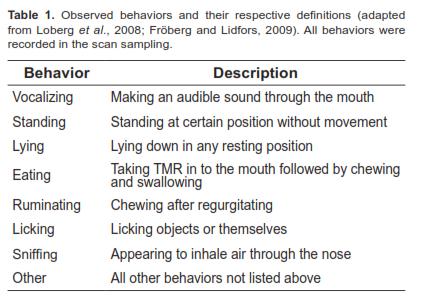
<body><![CDATA[<p>A potentially negative impact on calf welfare   occurs when it is separated from its mother. Early   separation can result in adverse effects such as   the thwarting of maternal behavior, which can   eventually lead to isolation of the neonate (Flower   and Weary, 2003). Responses to separation within   the first 10 minutes, including increased heart rate   and vocalization, are quite mild (Hopster <i>et al.</i>,   1995). When cows and their calves are separated,   they spend a long time pacing the field boundaries   in an attempt to reunite as well as standing and   watching each other (Price <i>et al.</i>, 2001). Moreover,   the management system can influence cow and calf   behavior. Calves raised in isolation can excessively   lick themselves as well as foreign objects. (Stephens, 1982; Wood-Gush <i>et al.</i>, 1984).</p>     <p>No study in South Korea has been conducted   on the behavioral research of Holstein cows and calves after separations. This study focused on   investigating differences in the vocal and behavioral   stress of Holstein cows and calves as a result of different separation methods.</p>     <p>&nbsp;</p>     <p><b><font size="3">Methods</font></b></p>     <p>   This study was carried out at the experimental   research station of Chung-Ang University, located   in Ansung, Gyeonggi Province, Korea. A total of   30 cows and 30 calves were observed. All of the   cows gave birth to their calves in separate calving   pens (3.0 x 3.0 m). Calves were separated from their   mothers on the day of birth using either partial or   complete separation methods. For partial separation,   the calf was housed in a barn (3.0 x 3.0 m) adjacent   to the cow barn (6.0 x 6.0 m), with no visible   contact with the mother. The barns were separated   by a solid wood wall, which visually isolated the   cow and calf. However, they could recognize each   other via auditory and olfactory senses through the   barrier. During complete separation the calf was   isolated in a separate barn (3.0 x 3.0 m) located a far   distance from the other.</p>     <p>Calves were bottle fed whole milk while cows   were fed a total mixed ration (TMR) twice a day   along with full access to water. Cows were machine   milked by the staff twice daily at 06:00 and 16:00.   All cows and calves were kept in an enclosed   barn on deep litter without access to a barnyard or   pasture and their health was monitored throughout the study, at least two times weekly.</p>     <p>Fifteen replicates of each treatment were   evaluated during 2007 and 2008. Two wideangle   video cameras were installed at the corner   of the ceiling. Cow and calf behavior was videorecorded   continuously for 10 h per day over 3   non-consecutive days. Behaviors were analyzed   based on images and vocalizations digitally   recorded from 08:00 to 18:00 h on days 1, 6, and 11   (day 0 = day of birth). Video was analyzed using a   jog-shuttle function. Instantaneous scan sampling   was carried out at 2 min intervals. In order to   eliminate subjective bias and potential discrepancies   among individuals, all video recordings were   viewed by a trained observer with no knowledge of the treatment (Li and Wang, 2011).</p>     <p>Vocalizations were determined based on direct   video observation. The following behaviors were   recorded: standing, lying, eating, ruminating, licking,   sniffing, among others (<a href="#t1">Table 1</a>). The frequency and   duration (in minutes) of these behaviors was recorded   from video recordings of days 1, 6, and 11 following separation.</p>     <p align="center"><a name="t1"></a><img src="/img/revistas/rccp/v26n1/v26n1a4t1.jpg"></p>     <p>All data were analyzed using the Glimmix   procedure of the SAS software (SAS Inst. Cary,   NY, USA) with the pen serving as the experimental   unit. The residual data sets were tested for normal   distribution using the Univariate procedure of SAS.   The data were log-transformed to follow normal   distribution (Zar, 1999) and analyzed by ANOVA.   Tukey's post hoc tests were used to determine   pair-wise differences between treatments; significance was declared at p&lt;0.05.</p>     ]]></body>
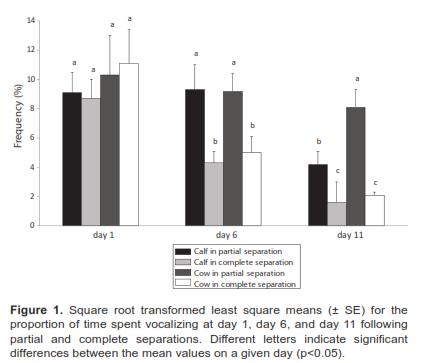
<body><![CDATA[<p>&nbsp;</p>     <p><b><font size="3">Results</font></b></p>     <p>Separation exhibited a significant impact on   the frequency of vocalizations for calves under   partial (ANOVA, <i>F</i><sub>2,28</sub> = 8.59, p&lt;0.05) and complete   (<i>F</i><sub>2,28</sub> = 17.26, p&lt;0.001) separation periods. During   partial separation, calf vocalization frequency was   greater on days 1 and 6 (Tukey's test, p&lt;0.05).   Also, the calf vocalization frequency was higher on   day 1 and lower on day 11 (p&lt;0.01). There were no   differences in cow vocalization frequency undergoing   partial separation (<i>F</i><sub>2,28</sub> = -2.14, p = 0.27). However,   cow vocalization frequency differed significantly on days 1, 6, and 11 during complete separation   (<i>F</i><sub>2,28</sub> = 19.35, p&lt;0.001). Vocalization frequency was   higher on day 1 than days 6 and 11 (p&lt;0.01). There   were no differences in vocalization frequency for cows   and calves on day 1 under both partial and complete   separations. However, vocalization frequency was   significantly different under partial and complete   separation conditions for cows and calves (<a href="#f1">Figure 1</a>).</p>     <p align="center"><a name="f1"></a><img src="/img/revistas/rccp/v26n1/v26n1a4f1.jpg"></p>     <p>Total duration of standing for cows was   significantly different in partial (<i>F</i><sub>2,28</sub> = 6.91,   p&lt;0.05) versus complete (<i>F</i><sub>2,28</sub> = 9.47, p&lt;0.05)   separations at days 1, 6, and 11 following   separation. The duration of standing time was long   at day 1 and short at day 11 in both cases (p&lt;0.05).   Time spent lying was significantly different among   days 1, 6, and 11 in partial (<i>F</i><sub>2,28</sub> = 8.16, p&lt;0.05) and   complete (<i>F</i><sub>2,28</sub> = 12.38, p&lt;0.05) separations. The   duration of lying was higher in day 11 and lower in   day 1 for both separations (p&lt;0.05). The frequency   of sniffing was not significantly different for partial   (<i>F</i><sub>2,28</sub> = -10.23, p= 0.58) and complete (<i>F</i><sub>2,28</sub> = -15.39, p= 0.76) separations on days 1, 6, and 11 (<a href="/img/revistas/rccp/v26n1/v26n1a4t2.jpg" target="_blank">Table 2</a>).</p>     <p>For calves, the total duration of standing was   different for partial (<i>F</i><sub>2,28</sub> = 5.23, p&lt;0.05) and   complete (<i>F</i><sub>2,28</sub> = 6.42, p&lt;0.05) separation between   days 1, 6, and day 11 following separation. The   duration of standing was higher on day 1 and lower   on day 11 for both partial (p&lt;0.05) and complete   (p&lt;0.05) separations. However, the duration of lying   increased as time passed. During partial separation,   the frequency of licking (<i>F</i><sub>2,28</sub> = -4.15, p= 0.45) and   sniffing (<i>F</i><sub>2,28</sub> = -7.52, p = 0.67) was not significantly   different according to the day. However, licking and   sniffing frequency was higher on day 1 (p&lt;0.05) and lower on day 11 (p&lt;0.05) (<a href="/img/revistas/rccp/v26n1/v26n1a4t3.jpg" target="_blank">Table 3</a>).</p>     <p>&nbsp;</p>     <p><b><font size="3">Discussion</font></b></p>     <p>Cows and calves in this study demonstrated a   strong vocal response following separation, with   many demonstrating peak response on the first day   following separation in both partial and complete   separations. During complete separation, vocalization   decreased as time passed, as compared with partial   separation. Future studies on this topic should continue   to monitor vocal responses until a clear trend towards   baseline levels is shown. Following separation, all   cows demonstrated vocalizations, indicating that cows   respond maternally in looking for their calves (Hopster <i>et al.</i>, 1995; Loberg <i>et al.</i>, 2008).</p>     <p>Cattle are known to respond vocally, physically,   and psychologically to stressful situations (Watts and   Stookey, 2000). Previous studies suggest that calves   are often highly vocal following separation after   weaning (Thomas <i>et al.</i>, 2001; Jasper <i>et al.</i>, 2008).   Separation can be highly stressful for the calves.   Watts (2001) observed pairs naturally separated under   extensive pasture conditions, reporting that both cows   and calves demonstrated an increase in their rate of   vocalization and spent more time walking, which culminated in reunion and nursing.</p>     ]]></body>
<body><![CDATA[<p>Domesticated animals in intensive husbandry   settings often demonstrate behaviors that occur   outside of their normal functional context. For   example, calves reared separately from their   mothers and hand-fed milk will occasionally suck   on objects in the pen or at other calves (Mason and Rushen, 2006; Rushen <i>et al.</i>, 2008).</p>     <p>During this study, the total duration of standing   during partial separation was greater for the cows   in days 6 and 11 than in complete separation. Most   of this behavior involved standing with the head   toward the wooden wall. This behavior suggests the   cow's willingness to reunite with the calf. Calves   tended to stand with their head toward the wooden wall during partial separation.</p>     <p>Partial separation may facilitate the attachment   between dam and calf. Vocal and olfactory senses   may have interfered with attachment. Time lying   down increased for cows and calves in the days   following both types of separation, suggesting   a gradual adaptation to their new environments.   During complete separation, the vocalization   frequencies of cows and calves significantly   declined at days 6 and 11, suggesting adaptation   following separation between dams and their calves.   According to the results observed in this study, partial separation is good for calf welfare.</p>     <p>Vocalization and behaviors such as lying,   standing, and sniffing may be alternative responses   to separation. There is evidence of consistent   yet unique differences among calf response to   diverse challenges (van Reenen <i>et al.</i>, 2004). No   physiological measures were taken in this study,   but other physiological research has supported   the hypothesis that separation is a stressful   experience for both mother and young. Lefcourt   and Elsasser (1995) reported increases in peripheral   catecholamine concentrations in beef calves as well   as increases in epinephrine concentrations in dams in response to separation.</p>     <p>Under commercial conditions, the dairy cow   and calf should be separated in order for the cow   to be milked. One current argument against early   cow-calf contact is that the immediate distress of   separation remains high (Flower and Weary, 2001).   Because separation is linked to distress, it has been   suggested that the cow and calf should have the   opportunity to stay together for some time. The   question of how to balance the positive effects of   early cow-calf contact against the negative effects   of distress following separation remains to be   answered. Further research is needed to determine   the underlying biological characteristics of the cows   and calves that are behaviorally observed during long term studies following separation.</p>     <p>&nbsp;</p> </font> <hr size="1"> <font size="2" face="Verdana, Arial, Helvetica, sans-serif">     <p><b><font size="3">Notas al pie </font></b></p>     <p><sup><a name="1"></a><a href="#b1">&curren;</a></sup> To cite this article: Rhim SJ. Vocalization and behavior of Holstein cows and calves after partial and complete separation. Rev Colomb Cienc Pecu 2013;   26:24-29.</p> </font> <hr size="1"> <font size="2" face="Verdana, Arial, Helvetica, sans-serif">     <p>&nbsp;</p>     <p><b><font size="3">References</font></b></p>     ]]></body>
<body><![CDATA[<!-- ref --><p>Budzynska M, Weary DM. Weaning distress in dairy calves:   effects of alternative weaning procedures. Appl Anim Behav Sci   2008; 112:33-39.    &nbsp;&nbsp;&nbsp;&nbsp;&nbsp;&nbsp;&nbsp;&nbsp;[&#160;<a href="javascript:void(0);" onclick="javascript: window.open('/scielo.php?script=sci_nlinks&ref=000063&pid=S0120-0690201300010000400001&lng=','','width=640,height=500,resizable=yes,scrollbars=1,menubar=yes,');">Links</a>&#160;]<!-- end-ref --></p>     <!-- ref --><p>Duve LR, Jensen MB. The level of social contact affects social   behaviour in preweaned dairy calves. Appl Anim Behav Sci   2011; 135:34-43.    &nbsp;&nbsp;&nbsp;&nbsp;&nbsp;&nbsp;&nbsp;&nbsp;[&#160;<a href="javascript:void(0);" onclick="javascript: window.open('/scielo.php?script=sci_nlinks&ref=000065&pid=S0120-0690201300010000400002&lng=','','width=640,height=500,resizable=yes,scrollbars=1,menubar=yes,');">Links</a>&#160;]<!-- end-ref --></p>     <!-- ref --><p>Flower FC, Weary DM. Effects of early separation on the dairy   cow and calf: 2. Separation at 1 day and 2 weeks after birth. Appl Anim Behav Sci 2001; 70:275-284.    &nbsp;&nbsp;&nbsp;&nbsp;&nbsp;&nbsp;&nbsp;&nbsp;[&#160;<a href="javascript:void(0);" onclick="javascript: window.open('/scielo.php?script=sci_nlinks&ref=000067&pid=S0120-0690201300010000400003&lng=','','width=640,height=500,resizable=yes,scrollbars=1,menubar=yes,');">Links</a>&#160;]<!-- end-ref --></p>     <!-- ref --><p>Flower FC, Weary DM. The effects of early separation on the   dairy cow and calf. Anim Welfare 2003; 12:339-348.    &nbsp;&nbsp;&nbsp;&nbsp;&nbsp;&nbsp;&nbsp;&nbsp;[&#160;<a href="javascript:void(0);" onclick="javascript: window.open('/scielo.php?script=sci_nlinks&ref=000069&pid=S0120-0690201300010000400004&lng=','','width=640,height=500,resizable=yes,scrollbars=1,menubar=yes,');">Links</a>&#160;]<!-- end-ref --></p>     <!-- ref --><p>Fr&ouml;berg S, Gratte E, Svennersten-Sjaunja K, Olsson I, Berg C,   Orihuela A, Galin CS, Garc&iacute;a B, Lidfors L. Effect of suckling   ('restricted suckling') on dairy cows' udder health and milk letdown   and their calves' weight gain, feed intake and behaviour.   Appl Anim Behav Sci 2008; 113:1-14.    &nbsp;&nbsp;&nbsp;&nbsp;&nbsp;&nbsp;&nbsp;&nbsp;[&#160;<a href="javascript:void(0);" onclick="javascript: window.open('/scielo.php?script=sci_nlinks&ref=000071&pid=S0120-0690201300010000400005&lng=','','width=640,height=500,resizable=yes,scrollbars=1,menubar=yes,');">Links</a>&#160;]<!-- end-ref --></p>     ]]></body>
<body><![CDATA[<!-- ref --><p>Fr&ouml;berg S, Lidfors L. Behaviour of dairy calves suckling   the dam in a barn with automatic milking or being fed milk   substitute from an automatic feeder in a group pen. Appl Anim   Behav Sci 2009; 117:150-158.    &nbsp;&nbsp;&nbsp;&nbsp;&nbsp;&nbsp;&nbsp;&nbsp;[&#160;<a href="javascript:void(0);" onclick="javascript: window.open('/scielo.php?script=sci_nlinks&ref=000073&pid=S0120-0690201300010000400006&lng=','','width=640,height=500,resizable=yes,scrollbars=1,menubar=yes,');">Links</a>&#160;]<!-- end-ref --></p>     <!-- ref --><p>Hopster H, O'Connell JM, Blokhuis HJ. Acute effects of cowscalf   separation on heart-rate, plasma-cortisol and behavior in   multiparous dairy-cows. Appl Anim Behav Sci 1995; 44:1-8.    &nbsp;&nbsp;&nbsp;&nbsp;&nbsp;&nbsp;&nbsp;&nbsp;[&#160;<a href="javascript:void(0);" onclick="javascript: window.open('/scielo.php?script=sci_nlinks&ref=000075&pid=S0120-0690201300010000400007&lng=','','width=640,height=500,resizable=yes,scrollbars=1,menubar=yes,');">Links</a>&#160;]<!-- end-ref --></p>     <!-- ref --><p>Jasper J, Budzynska M, Weary DM. Weaning distress in dairy   calves: acute behavioural responses by limit-fed calves. Appl   Anim Behav Sci 2008; 110:136-143.    &nbsp;&nbsp;&nbsp;&nbsp;&nbsp;&nbsp;&nbsp;&nbsp;[&#160;<a href="javascript:void(0);" onclick="javascript: window.open('/scielo.php?script=sci_nlinks&ref=000077&pid=S0120-0690201300010000400008&lng=','','width=640,height=500,resizable=yes,scrollbars=1,menubar=yes,');">Links</a>&#160;]<!-- end-ref --></p>     <!-- ref --><p>Khan MA, Lee HJ, Lee WS, Kim HS, Kim SB, Ki KS, Ha   JK, Lee HG, Choi YJ. Pre- and postweaning performance   of Holstein female calves fed milk through step-down and   conventional methods. J Dairy Sci 2007; 90:876-885.    &nbsp;&nbsp;&nbsp;&nbsp;&nbsp;&nbsp;&nbsp;&nbsp;[&#160;<a href="javascript:void(0);" onclick="javascript: window.open('/scielo.php?script=sci_nlinks&ref=000079&pid=S0120-0690201300010000400009&lng=','','width=640,height=500,resizable=yes,scrollbars=1,menubar=yes,');">Links</a>&#160;]<!-- end-ref --></p>     <!-- ref --><p>Krohn CC, Foldager J, Mogensen L. Long-term effect of   colostrum feeding methods on behaviour in female dairy calves.   Acta Agric Scand (Section A: Anim Sci) 1999; 49:57-64.    &nbsp;&nbsp;&nbsp;&nbsp;&nbsp;&nbsp;&nbsp;&nbsp;[&#160;<a href="javascript:void(0);" onclick="javascript: window.open('/scielo.php?script=sci_nlinks&ref=000081&pid=S0120-0690201300010000400010&lng=','','width=640,height=500,resizable=yes,scrollbars=1,menubar=yes,');">Links</a>&#160;]<!-- end-ref --></p>     ]]></body>
<body><![CDATA[<!-- ref --><p>Lefcourt AM, Elsasser TH. Adrenal responses of Angus x   Hereford cattle to the stress of weaning. J Anim Sci 1995;   73:2669-2676.    &nbsp;&nbsp;&nbsp;&nbsp;&nbsp;&nbsp;&nbsp;&nbsp;[&#160;<a href="javascript:void(0);" onclick="javascript: window.open('/scielo.php?script=sci_nlinks&ref=000083&pid=S0120-0690201300010000400011&lng=','','width=640,height=500,resizable=yes,scrollbars=1,menubar=yes,');">Links</a>&#160;]<!-- end-ref --></p>     <!-- ref --><p>Li Y, Wang L. Effects of previous housing system on agonistic   behaviors of growing pigs at mixing. Appl Anim Behav Sci   2011; 132:20-26.    &nbsp;&nbsp;&nbsp;&nbsp;&nbsp;&nbsp;&nbsp;&nbsp;[&#160;<a href="javascript:void(0);" onclick="javascript: window.open('/scielo.php?script=sci_nlinks&ref=000085&pid=S0120-0690201300010000400012&lng=','','width=640,height=500,resizable=yes,scrollbars=1,menubar=yes,');">Links</a>&#160;]<!-- end-ref --></p>     <!-- ref --><p>Loberg J, Hernandez CE, Thierfelder T, Jensen MB, Berg   C, Lidfors L. Weaning and separation in two steps &#8211; a way to   decrease stress in dairy calves suckled by foster cows. Appl   Anim Behav Sci 2008; 111:222-234.    &nbsp;&nbsp;&nbsp;&nbsp;&nbsp;&nbsp;&nbsp;&nbsp;[&#160;<a href="javascript:void(0);" onclick="javascript: window.open('/scielo.php?script=sci_nlinks&ref=000087&pid=S0120-0690201300010000400013&lng=','','width=640,height=500,resizable=yes,scrollbars=1,menubar=yes,');">Links</a>&#160;]<!-- end-ref --></p>     <!-- ref --><p>Lundborg GK, Svensson EC, Oltenacu PA. Herd-level risk   factors for infectious diseases in Swedish dairy calves age 0-90   days. Prev Vet Med 2005; 68:123-143.    &nbsp;&nbsp;&nbsp;&nbsp;&nbsp;&nbsp;&nbsp;&nbsp;[&#160;<a href="javascript:void(0);" onclick="javascript: window.open('/scielo.php?script=sci_nlinks&ref=000089&pid=S0120-0690201300010000400014&lng=','','width=640,height=500,resizable=yes,scrollbars=1,menubar=yes,');">Links</a>&#160;]<!-- end-ref --></p>     <!-- ref --><p>Mason G, Rushen J. Stereotypic animal behaviour:   fundamentals and implications for animal welfare. 2<sup>nd</sup> ed.   Oxford: CABI; 2006. 241 p.    &nbsp;&nbsp;&nbsp;&nbsp;&nbsp;&nbsp;&nbsp;&nbsp;[&#160;<a href="javascript:void(0);" onclick="javascript: window.open('/scielo.php?script=sci_nlinks&ref=000091&pid=S0120-0690201300010000400015&lng=','','width=640,height=500,resizable=yes,scrollbars=1,menubar=yes,');">Links</a>&#160;]<!-- end-ref --></p>     ]]></body>
<body><![CDATA[<!-- ref --><p>Nielsen SS. Use of diagnostics for risk-based control of   paratuberculosis in dairy herds. In Pract 2009; 31:150-154.    &nbsp;&nbsp;&nbsp;&nbsp;&nbsp;&nbsp;&nbsp;&nbsp;[&#160;<a href="javascript:void(0);" onclick="javascript: window.open('/scielo.php?script=sci_nlinks&ref=000093&pid=S0120-0690201300010000400016&lng=','','width=640,height=500,resizable=yes,scrollbars=1,menubar=yes,');">Links</a>&#160;]<!-- end-ref --></p>     <!-- ref --><p>Phillips C. Cattle behaviour &amp; welfare. Oxford: Blackwell   Publishing; 2002. 264 p.    &nbsp;&nbsp;&nbsp;&nbsp;&nbsp;&nbsp;&nbsp;&nbsp;[&#160;<a href="javascript:void(0);" onclick="javascript: window.open('/scielo.php?script=sci_nlinks&ref=000095&pid=S0120-0690201300010000400017&lng=','','width=640,height=500,resizable=yes,scrollbars=1,menubar=yes,');">Links</a>&#160;]<!-- end-ref --></p>     <!-- ref --><p>Price EO, Harris JE, Borgward RE, Sween ML. Fenceline   contact reduces the negative effects on weaning on the behavior   and growth of beef calves. In: Garner J, Mench J, Heekin   S, editors. The 35<sup>th</sup> International Congress of ISAE. Davis:   International Society for Applied Ethology; 2001. 41 p.    &nbsp;&nbsp;&nbsp;&nbsp;&nbsp;&nbsp;&nbsp;&nbsp;[&#160;<a href="javascript:void(0);" onclick="javascript: window.open('/scielo.php?script=sci_nlinks&ref=000097&pid=S0120-0690201300010000400018&lng=','','width=640,height=500,resizable=yes,scrollbars=1,menubar=yes,');">Links</a>&#160;]<!-- end-ref --></p>     <!-- ref --><p>Raussi S, Lesink BJ, Boissy A, Pyykk&ouml;nen M, Veissier L.   The effect of contact with conspecifics and humans on calves'   behaviour and stress responses. Anim Welfare 2003; 12:191-   203.    &nbsp;&nbsp;&nbsp;&nbsp;&nbsp;&nbsp;&nbsp;&nbsp;[&#160;<a href="javascript:void(0);" onclick="javascript: window.open('/scielo.php?script=sci_nlinks&ref=000099&pid=S0120-0690201300010000400019&lng=','','width=640,height=500,resizable=yes,scrollbars=1,menubar=yes,');">Links</a>&#160;]<!-- end-ref --></p>     <!-- ref --><p>Roth BA, Barth K, Gygax L, Hillmann E. Influence of artificial   vs. mother-bonded rearing on sucking behaviour, health and   weight gain in calves. Appl Anim Behav Sci 2009; 119:143-150.    &nbsp;&nbsp;&nbsp;&nbsp;&nbsp;&nbsp;&nbsp;&nbsp;[&#160;<a href="javascript:void(0);" onclick="javascript: window.open('/scielo.php?script=sci_nlinks&ref=000101&pid=S0120-0690201300010000400020&lng=','','width=640,height=500,resizable=yes,scrollbars=1,menubar=yes,');">Links</a>&#160;]<!-- end-ref --></p>     ]]></body>
<body><![CDATA[<!-- ref --><p>Rushen J, de Passill&eacute; AM. The motivation of non-nutritive   sucking in calves <i>Bos taurus</i>. Anim Behav 2008; 49:1503-1510.    &nbsp;&nbsp;&nbsp;&nbsp;&nbsp;&nbsp;&nbsp;&nbsp;[&#160;<a href="javascript:void(0);" onclick="javascript: window.open('/scielo.php?script=sci_nlinks&ref=000103&pid=S0120-0690201300010000400021&lng=','','width=640,height=500,resizable=yes,scrollbars=1,menubar=yes,');">Links</a>&#160;]<!-- end-ref --></p>     <!-- ref --><p>Stephens DB. A review of some behavioural and physiological   studied which are relevant to the welfare of young calves. In:   Signoret JP, editors. Welfare and husbandry of calves. Hague:   Martinus Nijhoff Publishing; 1982. p. 47-69.    &nbsp;&nbsp;&nbsp;&nbsp;&nbsp;&nbsp;&nbsp;&nbsp;[&#160;<a href="javascript:void(0);" onclick="javascript: window.open('/scielo.php?script=sci_nlinks&ref=000105&pid=S0120-0690201300010000400022&lng=','','width=640,height=500,resizable=yes,scrollbars=1,menubar=yes,');">Links</a>&#160;]<!-- end-ref --></p>     <!-- ref --><p>Svensson C, Lundborg K, Emanuelson U, Olsson S. Morbidity   in Swedish dairy calves from birth to 90 days of age and   individual calf-level risk factors for infectious diseases. Prev   Vet Med 2003; 58:179-197.    &nbsp;&nbsp;&nbsp;&nbsp;&nbsp;&nbsp;&nbsp;&nbsp;[&#160;<a href="javascript:void(0);" onclick="javascript: window.open('/scielo.php?script=sci_nlinks&ref=000107&pid=S0120-0690201300010000400023&lng=','','width=640,height=500,resizable=yes,scrollbars=1,menubar=yes,');">Links</a>&#160;]<!-- end-ref --></p>     <!-- ref --><p>Thomas TJ, Weary DM, Appleby MC. Newborn and 5-weekold   calves vocalize in response to milk deprivation. Appl Anim   Behav Sci 2001; 74:165-173.    &nbsp;&nbsp;&nbsp;&nbsp;&nbsp;&nbsp;&nbsp;&nbsp;[&#160;<a href="javascript:void(0);" onclick="javascript: window.open('/scielo.php?script=sci_nlinks&ref=000109&pid=S0120-0690201300010000400024&lng=','','width=640,height=500,resizable=yes,scrollbars=1,menubar=yes,');">Links</a>&#160;]<!-- end-ref --></p>     <!-- ref --><p>Turner SP, Lawrence AB. Relationship between maternal   defense aggression, fear of handling and other maternal care   traits in beef cows. Livest Sci 2007; 106:182-188.    &nbsp;&nbsp;&nbsp;&nbsp;&nbsp;&nbsp;&nbsp;&nbsp;[&#160;<a href="javascript:void(0);" onclick="javascript: window.open('/scielo.php?script=sci_nlinks&ref=000111&pid=S0120-0690201300010000400025&lng=','','width=640,height=500,resizable=yes,scrollbars=1,menubar=yes,');">Links</a>&#160;]<!-- end-ref --></p>     ]]></body>
<body><![CDATA[<!-- ref --><p>Van Reenen CG, Engel B, Ruis-Heutinck LF, van der Werf   JTN, Buist WG, Jones RB, Blokhuis HJ. Behavioural reactivity   of heifer calves in potentially alarming test situations: a   multivariate and correlational analysis. Appl Anim Behav Sci   2004; 85:11-30.    &nbsp;&nbsp;&nbsp;&nbsp;&nbsp;&nbsp;&nbsp;&nbsp;[&#160;<a href="javascript:void(0);" onclick="javascript: window.open('/scielo.php?script=sci_nlinks&ref=000113&pid=S0120-0690201300010000400026&lng=','','width=640,height=500,resizable=yes,scrollbars=1,menubar=yes,');">Links</a>&#160;]<!-- end-ref --></p>     <!-- ref --><p>Veissier K, Gesmier V, Neindre P, Gautier JY, Bertand G. The   effects of rearing in individual crates on subsequent social   behaviour of veal calves. Appl Anim Behav Sci 1994; 41:199-   210.    &nbsp;&nbsp;&nbsp;&nbsp;&nbsp;&nbsp;&nbsp;&nbsp;[&#160;<a href="javascript:void(0);" onclick="javascript: window.open('/scielo.php?script=sci_nlinks&ref=000115&pid=S0120-0690201300010000400027&lng=','','width=640,height=500,resizable=yes,scrollbars=1,menubar=yes,');">Links</a>&#160;]<!-- end-ref --></p>     <!-- ref --><p>Watts JM. Vocal behaviour and welfare in cattle. Ph.D.   dissertation, University of Saskatchewan, Saskatoon; 2001. 217   p.    &nbsp;&nbsp;&nbsp;&nbsp;&nbsp;&nbsp;&nbsp;&nbsp;[&#160;<a href="javascript:void(0);" onclick="javascript: window.open('/scielo.php?script=sci_nlinks&ref=000117&pid=S0120-0690201300010000400028&lng=','','width=640,height=500,resizable=yes,scrollbars=1,menubar=yes,');">Links</a>&#160;]<!-- end-ref --></p>     <!-- ref --><p>Watts JM, Stookey JM. Vocal behaviour in cattle: the animal's   commentary on its biological processes and welfare. Appl Anim   Behav Sci 2000; 67:15-33.    &nbsp;&nbsp;&nbsp;&nbsp;&nbsp;&nbsp;&nbsp;&nbsp;[&#160;<a href="javascript:void(0);" onclick="javascript: window.open('/scielo.php?script=sci_nlinks&ref=000119&pid=S0120-0690201300010000400029&lng=','','width=640,height=500,resizable=yes,scrollbars=1,menubar=yes,');">Links</a>&#160;]<!-- end-ref --></p>     <!-- ref --><p>Wood-Gush DGM, Hunt K, Carson K, Dennison SGC. The   early behaviour of suckler calves in the field. Biol Behav 1984; 9:295-306.    &nbsp;&nbsp;&nbsp;&nbsp;&nbsp;&nbsp;&nbsp;&nbsp;[&#160;<a href="javascript:void(0);" onclick="javascript: window.open('/scielo.php?script=sci_nlinks&ref=000121&pid=S0120-0690201300010000400030&lng=','','width=640,height=500,resizable=yes,scrollbars=1,menubar=yes,');">Links</a>&#160;]<!-- end-ref --></p>     ]]></body>
<body><![CDATA[<!-- ref --><p>   Zar JH. Biostatistical analysis. 4<sup>th</sup> ed. Upper Saddler River:   Prentice-Hall Inc.; 1999. 663 p.    &nbsp;&nbsp;&nbsp;&nbsp;&nbsp;&nbsp;&nbsp;&nbsp;[&#160;<a href="javascript:void(0);" onclick="javascript: window.open('/scielo.php?script=sci_nlinks&ref=000123&pid=S0120-0690201300010000400031&lng=','','width=640,height=500,resizable=yes,scrollbars=1,menubar=yes,');">Links</a>&#160;]<!-- end-ref --></p>     <p>&nbsp;</p> </font>      ]]></body><back>
<ref-list>
<ref id="B1">
<nlm-citation citation-type="journal">
<person-group person-group-type="author">
<name>
<surname><![CDATA[Budzynska]]></surname>
<given-names><![CDATA[M]]></given-names>
</name>
<name>
<surname><![CDATA[Weary]]></surname>
<given-names><![CDATA[DM]]></given-names>
</name>
</person-group>
<article-title xml:lang="en"><![CDATA[Weaning distress in dairy calves: effects of alternative weaning procedures]]></article-title>
<source><![CDATA[Appl Anim Behav Sci]]></source>
<year>2008</year>
<volume>112</volume>
<page-range>33-39</page-range></nlm-citation>
</ref>
<ref id="B2">
<nlm-citation citation-type="journal">
<person-group person-group-type="author">
<name>
<surname><![CDATA[Duve]]></surname>
<given-names><![CDATA[LR]]></given-names>
</name>
<name>
<surname><![CDATA[Jensen]]></surname>
<given-names><![CDATA[MB]]></given-names>
</name>
</person-group>
<article-title xml:lang="en"><![CDATA[The level of social contact affects social behaviour in preweaned dairy calves]]></article-title>
<source><![CDATA[Appl Anim Behav Sci]]></source>
<year>2011</year>
<volume>135</volume>
<page-range>34-43</page-range></nlm-citation>
</ref>
<ref id="B3">
<nlm-citation citation-type="journal">
<person-group person-group-type="author">
<name>
<surname><![CDATA[Flower]]></surname>
<given-names><![CDATA[FC]]></given-names>
</name>
<name>
<surname><![CDATA[Weary]]></surname>
<given-names><![CDATA[DM]]></given-names>
</name>
</person-group>
<article-title xml:lang="en"><![CDATA[Effects of early separation on the dairy cow and calf: 2. Separation at 1 day and 2 weeks after birth]]></article-title>
<source><![CDATA[Appl Anim Behav Sci]]></source>
<year>2001</year>
<volume>70</volume>
<page-range>275-284</page-range></nlm-citation>
</ref>
<ref id="B4">
<nlm-citation citation-type="journal">
<person-group person-group-type="author">
<name>
<surname><![CDATA[Flower]]></surname>
<given-names><![CDATA[FC]]></given-names>
</name>
<name>
<surname><![CDATA[Weary]]></surname>
<given-names><![CDATA[DM]]></given-names>
</name>
</person-group>
<article-title xml:lang="en"><![CDATA[The effects of early separation on the dairy cow and calf]]></article-title>
<source><![CDATA[Anim Welfare]]></source>
<year>2003</year>
<volume>12</volume>
<page-range>339-348</page-range></nlm-citation>
</ref>
<ref id="B5">
<nlm-citation citation-type="journal">
<person-group person-group-type="author">
<name>
<surname><![CDATA[Fröberg]]></surname>
<given-names><![CDATA[S]]></given-names>
</name>
<name>
<surname><![CDATA[Gratte]]></surname>
<given-names><![CDATA[E]]></given-names>
</name>
<name>
<surname><![CDATA[Svennersten-Sjaunja]]></surname>
<given-names><![CDATA[K]]></given-names>
</name>
<name>
<surname><![CDATA[Olsson]]></surname>
<given-names><![CDATA[I]]></given-names>
</name>
<name>
<surname><![CDATA[Berg]]></surname>
<given-names><![CDATA[C]]></given-names>
</name>
<name>
<surname><![CDATA[Orihuela]]></surname>
<given-names><![CDATA[A]]></given-names>
</name>
<name>
<surname><![CDATA[Galin]]></surname>
<given-names><![CDATA[CS]]></given-names>
</name>
<name>
<surname><![CDATA[García]]></surname>
<given-names><![CDATA[B]]></given-names>
</name>
<name>
<surname><![CDATA[Lidfors]]></surname>
<given-names><![CDATA[L]]></given-names>
</name>
</person-group>
<article-title xml:lang="en"><![CDATA[Effect of suckling ('restricted suckling') on dairy cows' udder health and milk letdown and their calves' weight gain, feed intake and behaviour]]></article-title>
<source><![CDATA[Appl Anim Behav Sci]]></source>
<year>2008</year>
<volume>113</volume>
<page-range>1-14</page-range></nlm-citation>
</ref>
<ref id="B6">
<nlm-citation citation-type="journal">
<person-group person-group-type="author">
<name>
<surname><![CDATA[Fröberg]]></surname>
<given-names><![CDATA[S]]></given-names>
</name>
<name>
<surname><![CDATA[Lidfors]]></surname>
<given-names><![CDATA[L]]></given-names>
</name>
</person-group>
<article-title xml:lang="en"><![CDATA[Behaviour of dairy calves suckling the dam in a barn with automatic milking or being fed milk substitute from an automatic feeder in a group pen]]></article-title>
<source><![CDATA[Appl Anim Behav Sci]]></source>
<year>2009</year>
<volume>117</volume>
<page-range>150-158</page-range></nlm-citation>
</ref>
<ref id="B7">
<nlm-citation citation-type="journal">
<person-group person-group-type="author">
<name>
<surname><![CDATA[Hopster]]></surname>
<given-names><![CDATA[H]]></given-names>
</name>
<name>
<surname><![CDATA[O'Connell]]></surname>
<given-names><![CDATA[JM]]></given-names>
</name>
<name>
<surname><![CDATA[Blokhuis]]></surname>
<given-names><![CDATA[HJ]]></given-names>
</name>
</person-group>
<article-title xml:lang="en"><![CDATA[Acute effects of cowscalf separation on heart-rate, plasma-cortisol and behavior in multiparous dairy-cows]]></article-title>
<source><![CDATA[Appl Anim Behav Sci]]></source>
<year>1995</year>
<volume>44</volume>
<page-range>1-8</page-range></nlm-citation>
</ref>
<ref id="B8">
<nlm-citation citation-type="journal">
<person-group person-group-type="author">
<name>
<surname><![CDATA[Jasper]]></surname>
<given-names><![CDATA[J]]></given-names>
</name>
<name>
<surname><![CDATA[Budzynska]]></surname>
<given-names><![CDATA[M]]></given-names>
</name>
<name>
<surname><![CDATA[Weary]]></surname>
<given-names><![CDATA[DM]]></given-names>
</name>
</person-group>
<article-title xml:lang="en"><![CDATA[Weaning distress in dairy calves: acute behavioural responses by limit-fed calves]]></article-title>
<source><![CDATA[Appl Anim Behav Sci]]></source>
<year>2008</year>
<volume>110</volume>
<page-range>136-143</page-range></nlm-citation>
</ref>
<ref id="B9">
<nlm-citation citation-type="journal">
<person-group person-group-type="author">
<name>
<surname><![CDATA[Khan]]></surname>
<given-names><![CDATA[MA]]></given-names>
</name>
<name>
<surname><![CDATA[Lee]]></surname>
<given-names><![CDATA[HJ]]></given-names>
</name>
<name>
<surname><![CDATA[Lee]]></surname>
<given-names><![CDATA[WS]]></given-names>
</name>
<name>
<surname><![CDATA[Kim]]></surname>
<given-names><![CDATA[HS]]></given-names>
</name>
<name>
<surname><![CDATA[Kim]]></surname>
<given-names><![CDATA[SB]]></given-names>
</name>
<name>
<surname><![CDATA[Ki]]></surname>
<given-names><![CDATA[KS]]></given-names>
</name>
<name>
<surname><![CDATA[Ha]]></surname>
<given-names><![CDATA[JK]]></given-names>
</name>
<name>
<surname><![CDATA[Lee]]></surname>
<given-names><![CDATA[HG]]></given-names>
</name>
<name>
<surname><![CDATA[Choi]]></surname>
<given-names><![CDATA[YJ]]></given-names>
</name>
</person-group>
<article-title xml:lang="en"><![CDATA[Pre- and postweaning performance of Holstein female calves fed milk through step-down and conventional methods]]></article-title>
<source><![CDATA[J Dairy Sci]]></source>
<year>2007</year>
<volume>90</volume>
<page-range>876-885</page-range></nlm-citation>
</ref>
<ref id="B10">
<nlm-citation citation-type="journal">
<person-group person-group-type="author">
<name>
<surname><![CDATA[Krohn]]></surname>
<given-names><![CDATA[CC]]></given-names>
</name>
<name>
<surname><![CDATA[Foldager]]></surname>
<given-names><![CDATA[J]]></given-names>
</name>
<name>
<surname><![CDATA[Mogensen]]></surname>
<given-names><![CDATA[L]]></given-names>
</name>
</person-group>
<article-title xml:lang="en"><![CDATA[Long-term effect of colostrum feeding methods on behaviour in female dairy calves]]></article-title>
<source><![CDATA[Acta Agric Scand (Section A: Anim Sci)]]></source>
<year>1999</year>
<volume>49</volume>
<page-range>57-64</page-range></nlm-citation>
</ref>
<ref id="B11">
<nlm-citation citation-type="journal">
<person-group person-group-type="author">
<name>
<surname><![CDATA[Lefcourt]]></surname>
<given-names><![CDATA[AM]]></given-names>
</name>
<name>
<surname><![CDATA[Elsasser]]></surname>
<given-names><![CDATA[TH]]></given-names>
</name>
</person-group>
<article-title xml:lang="en"><![CDATA[Adrenal responses of Angus x Hereford cattle to the stress of weaning]]></article-title>
<source><![CDATA[J Anim Sci]]></source>
<year>1995</year>
<volume>73</volume>
<page-range>2669-2676</page-range></nlm-citation>
</ref>
<ref id="B12">
<nlm-citation citation-type="journal">
<person-group person-group-type="author">
<name>
<surname><![CDATA[Li]]></surname>
<given-names><![CDATA[Y]]></given-names>
</name>
<name>
<surname><![CDATA[Wang]]></surname>
<given-names><![CDATA[L]]></given-names>
</name>
</person-group>
<article-title xml:lang="en"><![CDATA[Effects of previous housing system on agonistic behaviors of growing pigs at mixing]]></article-title>
<source><![CDATA[Appl Anim Behav Sci]]></source>
<year>2011</year>
<volume>132</volume>
<page-range>20-26</page-range></nlm-citation>
</ref>
<ref id="B13">
<nlm-citation citation-type="journal">
<person-group person-group-type="author">
<name>
<surname><![CDATA[Loberg]]></surname>
<given-names><![CDATA[J]]></given-names>
</name>
<name>
<surname><![CDATA[Hernandez]]></surname>
<given-names><![CDATA[CE]]></given-names>
</name>
<name>
<surname><![CDATA[Thierfelder]]></surname>
<given-names><![CDATA[T]]></given-names>
</name>
<name>
<surname><![CDATA[Jensen]]></surname>
<given-names><![CDATA[MB]]></given-names>
</name>
<name>
<surname><![CDATA[Berg]]></surname>
<given-names><![CDATA[C]]></given-names>
</name>
<name>
<surname><![CDATA[Lidfors]]></surname>
<given-names><![CDATA[L]]></given-names>
</name>
</person-group>
<article-title xml:lang="en"><![CDATA[Weaning and separation in two steps - a way to decrease stress in dairy calves suckled by foster cows]]></article-title>
<source><![CDATA[Appl Anim Behav Sci]]></source>
<year>2008</year>
<volume>111</volume>
<page-range>222-234</page-range></nlm-citation>
</ref>
<ref id="B14">
<nlm-citation citation-type="journal">
<person-group person-group-type="author">
<name>
<surname><![CDATA[Lundborg]]></surname>
<given-names><![CDATA[GK]]></given-names>
</name>
<name>
<surname><![CDATA[Svensson]]></surname>
<given-names><![CDATA[EC]]></given-names>
</name>
<name>
<surname><![CDATA[Oltenacu]]></surname>
<given-names><![CDATA[PA]]></given-names>
</name>
</person-group>
<article-title xml:lang="en"><![CDATA[Herd-level risk factors for infectious diseases in Swedish dairy calves age 0-90 days]]></article-title>
<source><![CDATA[Prev Vet Med]]></source>
<year>2005</year>
<volume>68</volume>
<page-range>123-143</page-range></nlm-citation>
</ref>
<ref id="B15">
<nlm-citation citation-type="book">
<person-group person-group-type="author">
<name>
<surname><![CDATA[Mason]]></surname>
<given-names><![CDATA[G]]></given-names>
</name>
<name>
<surname><![CDATA[Rushen]]></surname>
<given-names><![CDATA[J]]></given-names>
</name>
</person-group>
<source><![CDATA[Stereotypic animal behaviour: fundamentals and implications for animal welfare]]></source>
<year>2006</year>
<edition>2</edition>
<page-range>241</page-range><publisher-loc><![CDATA[Oxford ]]></publisher-loc>
<publisher-name><![CDATA[CABI]]></publisher-name>
</nlm-citation>
</ref>
<ref id="B16">
<nlm-citation citation-type="journal">
<person-group person-group-type="author">
<name>
<surname><![CDATA[Nielsen]]></surname>
<given-names><![CDATA[SS]]></given-names>
</name>
</person-group>
<article-title xml:lang="en"><![CDATA[Use of diagnostics for risk-based control of paratuberculosis in dairy herds]]></article-title>
<source><![CDATA[In Pract]]></source>
<year>2009</year>
<volume>31</volume>
<page-range>150-154</page-range></nlm-citation>
</ref>
<ref id="B17">
<nlm-citation citation-type="book">
<person-group person-group-type="author">
<name>
<surname><![CDATA[Phillips]]></surname>
<given-names><![CDATA[C]]></given-names>
</name>
</person-group>
<source><![CDATA[Cattle behaviour & welfare]]></source>
<year>2002</year>
<page-range>264</page-range><publisher-loc><![CDATA[Oxford ]]></publisher-loc>
<publisher-name><![CDATA[Blackwell Publishing]]></publisher-name>
</nlm-citation>
</ref>
<ref id="B18">
<nlm-citation citation-type="">
<person-group person-group-type="author">
<name>
<surname><![CDATA[Price]]></surname>
<given-names><![CDATA[EO]]></given-names>
</name>
<name>
<surname><![CDATA[Harris]]></surname>
<given-names><![CDATA[JE]]></given-names>
</name>
<name>
<surname><![CDATA[Borgward]]></surname>
<given-names><![CDATA[RE]]></given-names>
</name>
<name>
<surname><![CDATA[Sween]]></surname>
<given-names><![CDATA[ML]]></given-names>
</name>
</person-group>
<article-title xml:lang="en"><![CDATA[Fenceline contact reduces the negative effects on weaning on the behavior and growth of beef calves]]></article-title>
<person-group person-group-type="editor">
<name>
<surname><![CDATA[Garner]]></surname>
<given-names><![CDATA[J]]></given-names>
</name>
<name>
<surname><![CDATA[Mench]]></surname>
<given-names><![CDATA[J]]></given-names>
</name>
<name>
<surname><![CDATA[Heekin]]></surname>
<given-names><![CDATA[S]]></given-names>
</name>
</person-group>
<source><![CDATA[The 35th International Congress of ISAE. Davis: International Society for Applied Ethology]]></source>
<year>2001</year>
<page-range>41</page-range></nlm-citation>
</ref>
<ref id="B19">
<nlm-citation citation-type="journal">
<person-group person-group-type="author">
<name>
<surname><![CDATA[Raussi]]></surname>
<given-names><![CDATA[S]]></given-names>
</name>
<name>
<surname><![CDATA[Lesink]]></surname>
<given-names><![CDATA[BJ]]></given-names>
</name>
<name>
<surname><![CDATA[Boissy]]></surname>
<given-names><![CDATA[A]]></given-names>
</name>
<name>
<surname><![CDATA[Pyykkönen]]></surname>
<given-names><![CDATA[M]]></given-names>
</name>
<name>
<surname><![CDATA[Veissier]]></surname>
<given-names><![CDATA[L]]></given-names>
</name>
</person-group>
<article-title xml:lang="en"><![CDATA[The effect of contact with conspecifics and humans on calves' behaviour and stress responses]]></article-title>
<source><![CDATA[Anim Welfare]]></source>
<year>2003</year>
<volume>12</volume>
<page-range>191- 203</page-range></nlm-citation>
</ref>
<ref id="B20">
<nlm-citation citation-type="journal">
<person-group person-group-type="author">
<name>
<surname><![CDATA[Roth]]></surname>
<given-names><![CDATA[BA]]></given-names>
</name>
<name>
<surname><![CDATA[Barth]]></surname>
<given-names><![CDATA[K]]></given-names>
</name>
<name>
<surname><![CDATA[Gygax]]></surname>
<given-names><![CDATA[L]]></given-names>
</name>
<name>
<surname><![CDATA[Hillmann]]></surname>
<given-names><![CDATA[E]]></given-names>
</name>
</person-group>
<article-title xml:lang="en"><![CDATA[Influence of artificial vs. mother-bonded rearing on sucking behaviour, health and weight gain in calves]]></article-title>
<source><![CDATA[Appl Anim Behav Sci]]></source>
<year>2009</year>
<volume>119</volume>
<page-range>143-150</page-range></nlm-citation>
</ref>
<ref id="B21">
<nlm-citation citation-type="journal">
<person-group person-group-type="author">
<name>
<surname><![CDATA[Rushen]]></surname>
<given-names><![CDATA[J]]></given-names>
</name>
<name>
<surname><![CDATA[de Passillé]]></surname>
<given-names><![CDATA[AM]]></given-names>
</name>
</person-group>
<article-title xml:lang="en"><![CDATA[The motivation of non-nutritive sucking in calves Bos taurus]]></article-title>
<source><![CDATA[Anim Behav]]></source>
<year>2008</year>
<volume>49</volume>
<page-range>1503-1510</page-range></nlm-citation>
</ref>
<ref id="B22">
<nlm-citation citation-type="book">
<person-group person-group-type="author">
<name>
<surname><![CDATA[Stephens]]></surname>
<given-names><![CDATA[DB]]></given-names>
</name>
</person-group>
<article-title xml:lang="en"><![CDATA[A review of some behavioural and physiological studied which are relevant to the welfare of young calves]]></article-title>
<person-group person-group-type="editor">
<name>
<surname><![CDATA[Signoret]]></surname>
<given-names><![CDATA[JP]]></given-names>
</name>
</person-group>
<source><![CDATA[Welfare and husbandry of calves]]></source>
<year>1982</year>
<page-range>47-69</page-range><publisher-loc><![CDATA[Hague ]]></publisher-loc>
<publisher-name><![CDATA[Martinus Nijhoff Publishing]]></publisher-name>
</nlm-citation>
</ref>
<ref id="B23">
<nlm-citation citation-type="journal">
<person-group person-group-type="author">
<name>
<surname><![CDATA[Svensson]]></surname>
<given-names><![CDATA[C]]></given-names>
</name>
<name>
<surname><![CDATA[Lundborg]]></surname>
<given-names><![CDATA[K]]></given-names>
</name>
<name>
<surname><![CDATA[Emanuelson]]></surname>
<given-names><![CDATA[U]]></given-names>
</name>
<name>
<surname><![CDATA[Olsson]]></surname>
<given-names><![CDATA[S]]></given-names>
</name>
</person-group>
<article-title xml:lang="en"><![CDATA[Morbidity in Swedish dairy calves from birth to 90 days of age and individual calf-level risk factors for infectious diseases]]></article-title>
<source><![CDATA[Prev Vet Med]]></source>
<year>2003</year>
<volume>58</volume>
<page-range>179-197</page-range></nlm-citation>
</ref>
<ref id="B24">
<nlm-citation citation-type="journal">
<person-group person-group-type="author">
<name>
<surname><![CDATA[Thomas]]></surname>
<given-names><![CDATA[TJ]]></given-names>
</name>
<name>
<surname><![CDATA[Weary]]></surname>
<given-names><![CDATA[DM]]></given-names>
</name>
<name>
<surname><![CDATA[Appleby]]></surname>
<given-names><![CDATA[MC]]></given-names>
</name>
</person-group>
<article-title xml:lang="en"><![CDATA[Newborn and 5-weekold calves vocalize in response to milk deprivation]]></article-title>
<source><![CDATA[Appl Anim Behav Sci]]></source>
<year>2001</year>
<volume>74</volume>
<page-range>165-173</page-range></nlm-citation>
</ref>
<ref id="B25">
<nlm-citation citation-type="journal">
<person-group person-group-type="author">
<name>
<surname><![CDATA[Turner]]></surname>
<given-names><![CDATA[SP]]></given-names>
</name>
<name>
<surname><![CDATA[Lawrence]]></surname>
<given-names><![CDATA[AB]]></given-names>
</name>
</person-group>
<article-title xml:lang="en"><![CDATA[Relationship between maternal defense aggression, fear of handling and other maternal care traits in beef cows]]></article-title>
<source><![CDATA[Livest Sci]]></source>
<year>2007</year>
<volume>106</volume>
<page-range>182-188</page-range></nlm-citation>
</ref>
<ref id="B26">
<nlm-citation citation-type="journal">
<person-group person-group-type="author">
<name>
<surname><![CDATA[Van Reenen]]></surname>
<given-names><![CDATA[CG]]></given-names>
</name>
<name>
<surname><![CDATA[Engel]]></surname>
<given-names><![CDATA[B]]></given-names>
</name>
<name>
<surname><![CDATA[Ruis-Heutinck]]></surname>
<given-names><![CDATA[LF]]></given-names>
</name>
<name>
<surname><![CDATA[van der Werf]]></surname>
<given-names><![CDATA[JTN]]></given-names>
</name>
<name>
<surname><![CDATA[Buist]]></surname>
<given-names><![CDATA[WG]]></given-names>
</name>
<name>
<surname><![CDATA[Jones]]></surname>
<given-names><![CDATA[RB]]></given-names>
</name>
<name>
<surname><![CDATA[Blokhuis]]></surname>
<given-names><![CDATA[HJ]]></given-names>
</name>
</person-group>
<article-title xml:lang="en"><![CDATA[Behavioural reactivity of heifer calves in potentially alarming test situations: a multivariate and correlational analysis]]></article-title>
<source><![CDATA[Appl Anim Behav Sci]]></source>
<year>2004</year>
<volume>85</volume>
<page-range>11-30</page-range></nlm-citation>
</ref>
<ref id="B27">
<nlm-citation citation-type="journal">
<person-group person-group-type="author">
<name>
<surname><![CDATA[Veissier]]></surname>
<given-names><![CDATA[K]]></given-names>
</name>
<name>
<surname><![CDATA[Gesmier]]></surname>
<given-names><![CDATA[V]]></given-names>
</name>
<name>
<surname><![CDATA[Neindre]]></surname>
<given-names><![CDATA[P]]></given-names>
</name>
<name>
<surname><![CDATA[Gautier]]></surname>
<given-names><![CDATA[JY]]></given-names>
</name>
<name>
<surname><![CDATA[Bertand]]></surname>
<given-names><![CDATA[G]]></given-names>
</name>
</person-group>
<article-title xml:lang="en"><![CDATA[The effects of rearing in individual crates on subsequent social behaviour of veal calves]]></article-title>
<source><![CDATA[Appl Anim Behav Sci]]></source>
<year>1994</year>
<volume>41</volume>
<page-range>199- 210</page-range></nlm-citation>
</ref>
<ref id="B28">
<nlm-citation citation-type="">
<person-group person-group-type="author">
<name>
<surname><![CDATA[Watts]]></surname>
<given-names><![CDATA[JM]]></given-names>
</name>
</person-group>
<source><![CDATA[Vocal behaviour and welfare in cattle. Ph.D. dissertation, University of Saskatchewan, Saskatoon]]></source>
<year>2001</year>
<page-range>217</page-range></nlm-citation>
</ref>
<ref id="B29">
<nlm-citation citation-type="journal">
<person-group person-group-type="author">
<name>
<surname><![CDATA[Watts]]></surname>
<given-names><![CDATA[JM]]></given-names>
</name>
<name>
<surname><![CDATA[Stookey]]></surname>
<given-names><![CDATA[JM]]></given-names>
</name>
</person-group>
<article-title xml:lang="en"><![CDATA[Vocal behaviour in cattle: the animal's commentary on its biological processes and welfare]]></article-title>
<source><![CDATA[Appl Anim Behav Sci]]></source>
<year>2000</year>
<volume>67</volume>
<page-range>15-33</page-range></nlm-citation>
</ref>
<ref id="B30">
<nlm-citation citation-type="journal">
<person-group person-group-type="author">
<name>
<surname><![CDATA[Wood-Gush]]></surname>
<given-names><![CDATA[DGM]]></given-names>
</name>
<name>
<surname><![CDATA[Hunt]]></surname>
<given-names><![CDATA[K]]></given-names>
</name>
<name>
<surname><![CDATA[Carson]]></surname>
<given-names><![CDATA[K]]></given-names>
</name>
<name>
<surname><![CDATA[Dennison]]></surname>
<given-names><![CDATA[SGC]]></given-names>
</name>
</person-group>
<article-title xml:lang="en"><![CDATA[The early behaviour of suckler calves in the field]]></article-title>
<source><![CDATA[Biol Behav]]></source>
<year>1984</year>
<volume>9</volume>
<page-range>295-306</page-range></nlm-citation>
</ref>
<ref id="B31">
<nlm-citation citation-type="book">
<person-group person-group-type="author">
<name>
<surname><![CDATA[Zar]]></surname>
<given-names><![CDATA[JH]]></given-names>
</name>
</person-group>
<source><![CDATA[Biostatistical analysis]]></source>
<year>1999</year>
<edition>4</edition>
<page-range>663</page-range><publisher-name><![CDATA[Prentice-Hall Inc.]]></publisher-name>
</nlm-citation>
</ref>
</ref-list>
</back>
</article>