<?xml version="1.0" encoding="ISO-8859-1"?><article xmlns:mml="http://www.w3.org/1998/Math/MathML" xmlns:xlink="http://www.w3.org/1999/xlink" xmlns:xsi="http://www.w3.org/2001/XMLSchema-instance">
<front>
<journal-meta>
<journal-id>0120-0690</journal-id>
<journal-title><![CDATA[Revista Colombiana de Ciencias Pecuarias]]></journal-title>
<abbrev-journal-title><![CDATA[Rev Colom Cienc Pecua]]></abbrev-journal-title>
<issn>0120-0690</issn>
<publisher>
<publisher-name><![CDATA[Facultad de Ciencias Agrarias, Universidad de Antioquia]]></publisher-name>
</publisher>
</journal-meta>
<article-meta>
<article-id>S0120-06902013000100005</article-id>
<title-group>
<article-title xml:lang="en"><![CDATA[Melting ulcer in a colt: clinical management and evolution]]></article-title>
<article-title xml:lang="es"><![CDATA[Úlcera fundente en un potro: manejo clínico y evolución]]></article-title>
<article-title xml:lang="pt"><![CDATA[Úlcera colagenolítica em um potro: manejo clínico e evolução]]></article-title>
</title-group>
<contrib-group>
<contrib contrib-type="author">
<name>
<surname><![CDATA[Estrada]]></surname>
<given-names><![CDATA[Rubén D]]></given-names>
</name>
</contrib>
<contrib contrib-type="author">
<name>
<surname><![CDATA[Penagos]]></surname>
<given-names><![CDATA[Susana]]></given-names>
</name>
<xref ref-type="aff" rid="A02"/>
</contrib>
<contrib contrib-type="author">
<name>
<surname><![CDATA[Viera]]></surname>
<given-names><![CDATA[Elizabeth]]></given-names>
</name>
<xref ref-type="aff" rid="A02"/>
</contrib>
<contrib contrib-type="author">
<name>
<surname><![CDATA[Angulo]]></surname>
<given-names><![CDATA[Paula A]]></given-names>
</name>
<xref ref-type="aff" rid="A02"/>
</contrib>
<contrib contrib-type="author">
<name>
<surname><![CDATA[Arias]]></surname>
<given-names><![CDATA[Maria P]]></given-names>
</name>
<xref ref-type="aff" rid="A01"/>
<xref ref-type="aff" rid="A02"/>
</contrib>
</contrib-group>
<aff id="A01">
<institution><![CDATA[,Universidad CES Facultad de Medicina Veterinaria y Zootecnia ]]></institution>
<addr-line><![CDATA[Medellín ]]></addr-line>
<country>Colombia</country>
</aff>
<aff id="A02">
<institution><![CDATA[,Universidad CES Facultad de Medicina Veterinaria y Zootecnia ]]></institution>
<addr-line><![CDATA[Medellín ]]></addr-line>
<country>Colombia</country>
</aff>
<pub-date pub-type="pub">
<day>00</day>
<month>03</month>
<year>2013</year>
</pub-date>
<pub-date pub-type="epub">
<day>00</day>
<month>03</month>
<year>2013</year>
</pub-date>
<volume>26</volume>
<numero>1</numero>
<fpage>31</fpage>
<lpage>36</lpage>
<copyright-statement/>
<copyright-year/>
<self-uri xlink:href="http://www.scielo.org.co/scielo.php?script=sci_arttext&amp;pid=S0120-06902013000100005&amp;lng=en&amp;nrm=iso"></self-uri><self-uri xlink:href="http://www.scielo.org.co/scielo.php?script=sci_abstract&amp;pid=S0120-06902013000100005&amp;lng=en&amp;nrm=iso"></self-uri><self-uri xlink:href="http://www.scielo.org.co/scielo.php?script=sci_pdf&amp;pid=S0120-06902013000100005&amp;lng=en&amp;nrm=iso"></self-uri><abstract abstract-type="short" xml:lang="en"><p><![CDATA[Anamnesis: a colt showing a whitish coloration accompanied by abundant secretion on the left eye was examined. Clinical and laboratory findings: at ophthalmological examination, signs of melting ulcer were observed. Culture isolation revealed positive growing of Flavobacterium sp. and Gram-negative rods. Treatment approach: several keratectomies and tarsorrhaphies, as well as exhaustive antiproteinases, antiinflammatory, and antibiotic treatments, were conducted. Treatment focused on reducing inflammatory response, eliminating infective organisms, and promoting epithelial healing. Colt showed complete recovery of vision after 3 months. Conclusions: clinical management of melting ulcer implies exhaustive, though unexpensive, treatment.]]></p></abstract>
<abstract abstract-type="short" xml:lang="es"><p><![CDATA[Anamnesis: se examinó un potro que presentó una coloración blanquecina acompañada de abundante secreción en el ojo izquierdo. Hallazgos clínicos y de laboratorio: al examen oftalmológico se observaron signos de ulcera fundente. El aislamiento por cultivo mostró crecimiento de Flavobacterium sp. y cocos Gram negativos. Abordaje terapéutico: se realizaron varias queratectomías y tarsorrafias, además de un tratamiento exhaustivo con antiproteinasas, antiinflamatorios y antibióticos enfocado a reducir la respuesta inflamatoria, eliminar los microorganismos infecciosos y promover la cicatrización epitelial. 3 meses después, el potro mostró recuperación completa de la visión. Conclusiones: el manejo clínico de la úlcera fundente es demandante, pero no es un tratamiento costoso.]]></p></abstract>
<abstract abstract-type="short" xml:lang="pt"><p><![CDATA[Antecedentes: foi examinado um potro que apresentava uma coloração esbranquiçada acompanhada por abundante secreção no olho esquerdo. Achados clínicos e de laboratório: ao exame oftalmológico foram encontrados sinais de úlcera colagenolítica. O isolamento por cultura apresentou crescimento de Flavobacterium sp. e cocos Gram negativos. Abordagem terapêutica: foram realizadas várias ceratectomias e tarsorrafias, além da instauração de um tratamento exaustivo com antiproteinases, anti-inflamatórios e antibióticos voltado para a redução da resposta inflamatória, a remoção de micro-organismos infecciosos e a estimulação da cicatrização epitelial. 3 meses depois o potro apresentou completa recuperação da visão. Conclusões: o manejo clínico da úlcera colagenolítica é exigente, mas não é um tratamento caro.]]></p></abstract>
<kwd-group>
<kwd lng="en"><![CDATA[cornea]]></kwd>
<kwd lng="en"><![CDATA[keratectomy]]></kwd>
<kwd lng="en"><![CDATA[keratomalacia]]></kwd>
<kwd lng="en"><![CDATA[ophthalmology]]></kwd>
<kwd lng="en"><![CDATA[tarsorrhaphy]]></kwd>
<kwd lng="es"><![CDATA[córnea]]></kwd>
<kwd lng="es"><![CDATA[keratomalacia]]></kwd>
<kwd lng="es"><![CDATA[oftalmología]]></kwd>
<kwd lng="es"><![CDATA[queratectomía]]></kwd>
<kwd lng="es"><![CDATA[tarsorrafia]]></kwd>
<kwd lng="pt"><![CDATA[ceratectomia]]></kwd>
<kwd lng="pt"><![CDATA[ceratomalacia]]></kwd>
<kwd lng="pt"><![CDATA[córnea]]></kwd>
<kwd lng="pt"><![CDATA[oftalmologia]]></kwd>
<kwd lng="pt"><![CDATA[tarsorrafia]]></kwd>
</kwd-group>
</article-meta>
</front><body><![CDATA[ <font size="2" face="Verdana, Arial, Helvetica, sans-serif">     <p align="right"><b>ORIGINALS ARTICLES</b></p>     <p>&nbsp;</p>     <p align="center"><b><font size="4">Melting ulcer in a colt: clinical management and evolution<sup><a href="#1">&curren;</a><a name="b1"></a></sup></font></b></p>     <p>&nbsp;</p>     <p align="center"><b><font size="3">&Uacute;lcera fundente en un potro: manejo cl&iacute;nico y evoluci&oacute;n</font></b></p>     <p>&nbsp;</p>     <p align="center"><b><font size="3">&Uacute;lcera colagenol&iacute;tica em um potro: manejo cl&iacute;nico e evolu&ccedil;&atilde;o</font></b></p>     <p>&nbsp;</p>     <p>&nbsp;</p>     ]]></body>
<body><![CDATA[<p><b>Rub&eacute;n D Estrada<sup>1</sup>, MV; Susana Penagos<sup>2</sup>, est MV; Elizabeth Viera<sup>2</sup>, est MV; Paula A Angulo<sup>2</sup>, est MV;   Maria P Arias<sup>2*</sup>, MV, MS, PhD.</b></p>     <p>   * Corresponding Author: Mar&iacute;a Patricia Arias Guti&eacute;rrez. Faculty of Veterinary Medicine and Animal Science. Universidad CES. Calle 10 No. 22-04. Medell&iacute;n,   Colombia. AA 054591. E-mail: <a href="#mailto:marias@ces.edu.co">marias@ces.edu.co</a></p>     <p><sup>1</sup>MV Actividad independiente.</p>     <p><sup>2</sup>Facultad de Medicina Veterinaria y Zootecnia, Universidad CES, AA 054591, Medell&iacute;n, Colombia.</p>     <p>&nbsp;</p>     <p>(Received: June 1, 2012; accepted: November 19, 2012)</p>     <p>&nbsp;</p> </font> <hr size="1"> <font size="2" face="Verdana, Arial, Helvetica, sans-serif">     <p><b>Summary</b></p>     <p><b>Anamnesis:</b> a colt showing a whitish coloration accompanied by abundant secretion on the left eye   was examined. <b>Clinical and laboratory findings:</b> at ophthalmological examination, signs of melting ulcer   were observed. Culture isolation revealed positive growing of <i>Flavobacterium</i> sp. and Gram-negative rods.   <b>Treatment approach:</b> several keratectomies and tarsorrhaphies, as well as exhaustive antiproteinases, antiinflammatory,   and antibiotic treatments, were conducted. Treatment focused on reducing inflammatory   response, eliminating infective organisms, and promoting epithelial healing. Colt showed complete recovery   of vision after 3 months. <b>Conclusions:</b> clinical management of melting ulcer implies exhaustive, though unexpensive, treatment.</p>     <p>   <b>Key words:</b> cornea, keratectomy, keratomalacia, ophthalmology, tarsorrhaphy.</p> </font> <hr size="1"> <font size="2" face="Verdana, Arial, Helvetica, sans-serif">     ]]></body>
<body><![CDATA[<p><b>Resumen</b></p>     <p>   <b>Anamnesis:</b> se examin&oacute; un potro que present&oacute; una coloraci&oacute;n blanquecina acompa&ntilde;ada de abundante   secreci&oacute;n en el ojo izquierdo. <b>Hallazgos cl&iacute;nicos y de laboratorio:</b> al examen oftalmol&oacute;gico se observaron   signos de ulcera fundente. El aislamiento por cultivo mostr&oacute; crecimiento de <i>Flavobacterium</i> sp. y cocos   Gram negativos. <b>Abordaje terap&eacute;utico:</b> se realizaron varias queratectom&iacute;as y tarsorrafias, adem&aacute;s de un   tratamiento exhaustivo con antiproteinasas, antiinflamatorios y antibi&oacute;ticos enfocado a reducir la respuesta   inflamatoria, eliminar los microorganismos infecciosos y promover la cicatrizaci&oacute;n epitelial. 3 meses despu&eacute;s,   el potro mostr&oacute; recuperaci&oacute;n completa de la visi&oacute;n. <b>Conclusiones:</b> el manejo cl&iacute;nico de la &uacute;lcera fundente es   demandante, pero no es un tratamiento costoso.</p>     <p>   <b>Palabras Clave:</b> c&oacute;rnea, keratomalacia, oftalmolog&iacute;a, queratectom&iacute;a, tarsorrafia.</p> </font> <hr size="1"> <font size="2" face="Verdana, Arial, Helvetica, sans-serif">     <p><b>Resumo</b></p>     <p>   <b>Antecedentes:</b> foi examinado um potro que apresentava uma colora&ccedil;&atilde;o esbranqui&ccedil;ada acompanhada   por abundante secre&ccedil;&atilde;o no olho esquerdo. <b>Achados cl&iacute;nicos e de laborat&oacute;rio:</b> ao exame oftalmol&oacute;gico   foram encontrados sinais de &uacute;lcera colagenol&iacute;tica. O isolamento por cultura apresentou crescimento de   <i>Flavobacterium</i> sp. e cocos Gram negativos. <b>Abordagem terap&ecirc;utica:</b> foram realizadas v&aacute;rias ceratectomias   e tarsorrafias, al&eacute;m da instaura&ccedil;&atilde;o de um tratamento exaustivo com antiproteinases, anti-inflamat&oacute;rios e   antibi&oacute;ticos voltado para a redu&ccedil;&atilde;o da resposta inflamat&oacute;ria, a remo&ccedil;&atilde;o de micro-organismos infecciosos   e a estimula&ccedil;&atilde;o da cicatriza&ccedil;&atilde;o epitelial. 3 meses depois o potro apresentou completa recupera&ccedil;&atilde;o da vis&atilde;o.   <b>Conclus&otilde;es:</b> o manejo cl&iacute;nico da &uacute;lcera colagenol&iacute;tica &eacute; exigente, mas n&atilde;o &eacute; um tratamento caro.</p>     <p><b>Palavras chave:</b> ceratectomia, ceratomalacia, c&oacute;rnea, oftalmologia, tarsorrafia.</p> </font> <hr size="1"> <font size="2" face="Verdana, Arial, Helvetica, sans-serif">     <p>&nbsp;</p>     <p>&nbsp;</p>     <p><b><font size="3">Introduction</font></b></p>     <p>   Keratomalacia, clinically known as ''melting   ulcer'', is a progressive destruction of the corneal   stroma, leading to liquefactive necrosis with   collagen fragmentation and loss of keratocytes   (Brooks, 2004). The pathologic stromal collagen   and proteoglycans degradation is a consequence   of an imbalance in proteinases and proteinase   inhibitors activity (Ollivier <i>et al.</i>, 2007).   Therefore, treatment with antiproteinases is highly   recommended to speed healing, minimize corneal   scarring, and slow ulcer progression (Ollivier,   2005; Kernacki <i>et al.</i>, 1999). In 2011, a colt with   corneal opacity arrived to the veterinary clinic at   CES University (Medell&iacute;n, Antioquia province,   Colombia). Some keratectomies and tarsorrhaphies   were performed, accompanied by an intensive   treatment. The colt remained hospitalized for 27   days after which ulcer resolution was observed. 3   months later the colt showed complete recovery.   The aim of this report is to describe the exhaustive   but successful clinical management of melting ulcer   in a colt.</p>     ]]></body>
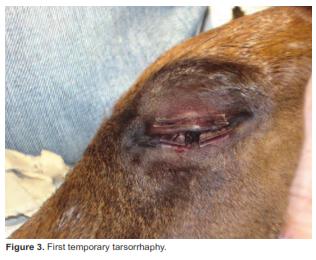
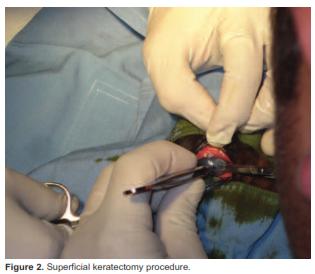
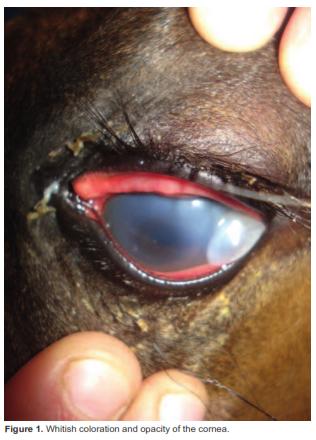
<body><![CDATA[<p>&nbsp;</p>     <p><b><font size="3">   Patient examination  </font></b></p>     <p><i>Anamnesis</i> </p>     <p>A 6-day-old colt was examined due to a whitish   coloration accompanied by abundant secretion   on the left eye. After physical examination, the   veterinarian recommended hospitalization for   intensive treatment.</p>     <p><i>Clinical findings</i></p>     <p>   The colt's weight was 42 kg. He was alert and   docile. His left eye was whitish with secretion and   presented protrusion of the corneal epithelium in the   lateral portion (<a href="#f1">Figure 1</a>). Physical parameters and   hydration status were normal.</p>     <p align="center"><a name="f1"></a><img src="/img/revistas/rccp/v26n1/v26n1a5f1.jpg"></p>     <p>After physical examination, the colt was   sedated with 0.5 mg/kg xylazine IV and an auriculopalpebral nerve block was performed   with 2 ml (40 mg) lidocaine to evaluate cornea   damage, revealing corneal opacity and partial   stromal liquefaction. Afterwards, the patient was   anesthetized with 2.2 mg/kg ketamine and a surgical   excision of a cornea portion was performed to remove the melting tissue (<a href="#f2">Figure 2</a>).</p>     <p align="center"><a name="f2"></a><img src="/img/revistas/rccp/v26n1/v26n1a5f2.jpg"></p>     <p>A temporary tarsorrhaphy was performed in   order to protect the eye surface from drying and to   prevent trauma. Both eyelids were stitched together   with the removal of some tissue (<a href="#f3">Figure 3</a>); this   procedure was performed according to the technique described by Ollivier (2005).</p>     ]]></body>
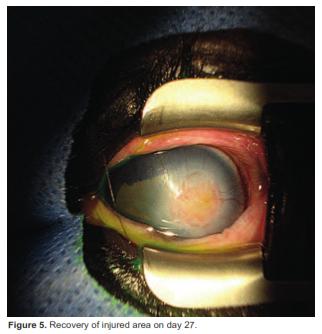
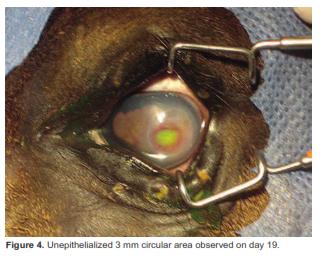
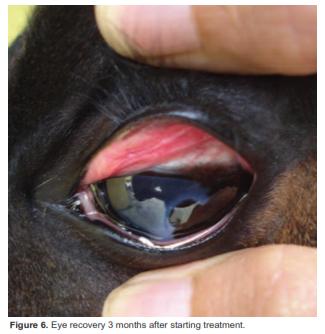
<body><![CDATA[<p align="center"><a name="f3"></a><img src="/img/revistas/rccp/v26n1/v26n1a5f3.jpg"></p>     <p><i>Diagnostic aids</i></p>     <p>   Hemogram and blood chemistry were conducted.   Ocular secretion samples were cultured for   microorganism isolation and antibiogram. Isolation   revealed positive <i>Flavobacterium</i> sp. and Gramnegative   rods sensitive to all antibiotics. Hemogram   parameters and IgG were normal.</p>     <p>&nbsp;  </p>     <p><b><font size="3">Treatment approach</font></b></p>     <p>   After tarsorrhaphy, a topical antiproteinase,   antibiotic, and anti-inflammatory therapy was started.   Eyelids were slightly separated in the lateral canthus   and Ciprofloxacin, Serum, EDTA, Atropine and   Diclofenac drops were instilled holding the head   until the drops descended across the ocular surface.   Medical management is summarized in <a href="/img/revistas/rccp/v26n1/v26n1a5t1.jpg" target="_blank">table 1</a>.</p>     <p>The colt was alert during the second day   of hospitalization. Itraconazole at a dose of   2 mg/kg each 48 hours was administered for 8 days   to avoid fungal infections. On day 10 the colt was   nursing as always but the affected eye still showed   abundant secretion; he was sedated again to make   another ophthalmic evaluation. The tarsorrhaphy   was removed, an ophthalmic lavage with sodium   chloride 0.9% solution was performed and a new   keratectomy was done due to persistent stromal   liquefaction. A new tarsorrhaphy was performed.   As Gram-negative bacilli were isolated, antibiotic treatment continued as previously described.</p>     <p>On day 19 the colt was sedated again for a   third ophthalmic evaluation, tarsorrhaphy was   removed and a fluorescein staining was performed   to evaluate complete healing of corneal ulceration.   An unepithelialized 3 mm circular area and corneal   vascularization were detected (<a href="#f4">Figure 4</a>). As corneal   ulceration remained, the treatment continued and a third tarsorrhaphy was performed.</p>     <p align="center"><a name="f4"></a><img src="/img/revistas/rccp/v26n1/v26n1a5f4.jpg"></p>     <p>On day 27 another ophthalmic evaluation   revealed absence of the ulcer (<a href="#f5">Figure 5</a>). The patient   was discharged with indications of performing   ambulatory treatment for three months (<a href="/img/revistas/rccp/v26n1/v26n1a5t2.jpg" target="_blank">Table 2</a>).   On March 15, the colt showed complete recovery (<a href="#f6">Figure 6</a>).</p>     ]]></body>
<body><![CDATA[<p align="center"><a name="f5"></a><img src="/img/revistas/rccp/v26n1/v26n1a5f5.jpg"></p>     <p align="center"><a name="f6"></a><img src="/img/revistas/rccp/v26n1/v26n1a5f6.jpg"></p>     <p>&nbsp;</p>     <p><b><font size="3">Discussion</font></b></p>     <p>   Equine melting ulcer is a multi-causal injury that   may partially or completely affect corneal stroma.   Trauma is the most common cause of corneal damage   in horses due to their prominence and lateral position.   Trauma usually occurs as a consequence of grazing   or physical activity (Ollivier, 2005). Frequently, an   initial corneal injury may complicate a melting ulcer,   which is described as an imbalance of collagenollysis   and repair of the corneal stromal extracellular matrix   (Brooks, 1999). The colt was extremely vigorous   and housed in a stall with his mother; therefore, it is   very possible that a physical trauma caused the initial   ulcerative keratitis and melting ulcer worsened the   damage. In this case, laceration with severe depth and   perforating corneal damage extending to 30% of the   corneal surface occurred. Proteinases and proteinase   inhibitors play an important role in healing corneal   wounds (Sivak and Fini, 2002). Proteinases, naturally   expressed in normal tissue, participate in remodeling   the corneal stroma, while natural proteinase inhibitors   prevent excessive degradation (Twining <i>et al.</i>, 1994).   Therefore, a predominant proteinases activity causes   pathological stromal collagen degradation.</p>     <p>Melting ulcer is an ophthalmic emergency   in horses (Couture <i>et al.</i>, 2006) and most of the   animals that do not receive opportune treatment   may lose vision. In general, horses suffer more   rapid collagen degradation and a higher degree of   collagenolysis than humans and bovines (Twining   <i>et al.</i>, 1994). Thus, an accurate treatment that   focuses on restoring the balance between proteolytic   enzymes and proteinase inhibitors should be   implemented as soon as possible in order to avoid   devastating consequences (Solomon <i>et al.</i>, 2000).   This colt's injury was discovered on the sixth day of   life; his early hospitalization and treatment allowed for complete recovery of corneal integrity.</p>     <p>Invasion of bacteria into the cornea induces host   leukocytes to arrive to the damaged tissue and to   release proteases. Antiproteinase medications reduce   tear proteases produced by leucocytes and accelerate   cornea healing (Ollivier <i>et al.</i>, 2003). In humans,   ophthalmologic antiproteinases are commonly used   as part of medical treatment of corneal degeneration   since 1990s (Hibbetts <i>et al.</i>, 1999). In horses, some   antiproteinases such as serum, acetylcysteine, EDTA   and doxycycline have been proven in vitro (Ollivier   <i>et al.</i>, 2003) and <i>in vivo</i> (Baker <i>et al.</i>, 2008). In these   cases, serum and EDTA were used for preventing   destruction of the cornea. EDTA inhibits matrix   metalloproteinases and serum contains a1-antitrypsin,   which inhibits serine proteinases (Ollivier, 2005;   Couture <i>et al.</i>, 2006; Haffner <i>et al.</i>, 2003). These   medications combined altogether helped to enhance   the stroma healing in the present case, concluding   with a satisfactory evolution, considering the severity of the injury.</p>     <p>The use of topical non-steroidal anti-inflammatory   drugs (NSAIDs) in ophthalmology is controversial.   Diclofenac stabilizes blood-aqueous barrier decreasing   uveal exudation and inhibiting miosis occurring after   some surgeries; it also relieves post-operative ocular   pain, photophobia and inflammation (Dwyer, 2012);   however some ophthalmologists have noticed delayed   cornea epithelialization due to its use (Abelson and   Lilyestrom, 2007). Others describe stinging and   conjunctival hyperemia as their most common side   effects (Abelson and Lilyestrom, 2007). As long-term   corticosteroid administration may be deleterious in   foals, some ophthalmologists recommend the use of   NSAIDs with subconjunctival corticosteroids (Severin,   1998). In this case, diclofenac reduced pain and   inflammation, and cornea delayed epithelization was not observed because of its use.</p>     <p>Harmless bacteria, fungi, viruses or parasites may   become opportunistic pathogens in the ulcerated   cornea. Gram-positive bacteria predominate as normal   flora in cornea and conjunctiva, while Gram-negative   bacteria and fungi are the most frequently isolated   pathogens from ulcerated cornea in horses (Whitley   and Moore, 1984; Moore <i>et al.</i>, 1983). In concordance   with the aforementioned findings, <i>Flavobacterium</i> sp.   and Gram-negative rods were isolated from cultures.   Topical chloramphenicol, gentamicin, ciprofloxacin   and amikacin are recommended for the treatment   of bacterial ulcers (Brooks <i>et al.</i>, 2000; Davidson,   1991; Sweeney and Irby, 1996). Mills (2003) reported   the use of systemic and topic antibiotics in stromal   keratomalacia as useful, but Brooks (2004) reports that   topical antibiotics according with sensitivity testing   are sufficient to control ophthalmic infections. In this patient, ophthalmic Ciprofloxacin every 2 hours was sufficient to control the infection. This treatment functions very well if the horse is hospitalized. If hospitalization is not possible, a person responsible for administering treatment must be present.</p>     <p>In this colt, melting ulcer was treated as an   ophthalmic emergency; therefore, the prompt   diagnosis and treatment were clue factors for   preventing serious complications and devastating   consequences that could lead to vision loss.</p>     ]]></body>
<body><![CDATA[<p>&nbsp;</p>     <p><b><font size="3">Conclusions</font></b></p>     <p>   Because of the rapid corneal tissue destruction,   the patient should be intensively treated with   antibiotics&#8212;depending on the results of corneal   culture&#8212;, anti-inflammatory drugs, and topical   antiproteases, which are crucial for recovery.   Frequent administration of medication required   for keratitis therapy can often fatigue the owners.   Therefore, hospitalization of these patients is   recommended. Although clinical melting ulcer   management is exhaustive and requires intensive   care, it is not an expensive treatment.</p>     <p>&nbsp;</p> </font> <hr size="1"> <font size="2" face="Verdana, Arial, Helvetica, sans-serif">     <p><b><font size="3">Notas al pie </font></b></p>     <p><sup><a name="1"></a><a href="#b1">&curren;</a></sup> To cite this article: Estrada R, Penagos S, Viera E, Angulo P, Arias MP. Melting ulcer in a colt: clinical management and evolution. Rev Colomb Cienc Pecu 2013; 26:31-36.</p> </font> <hr size="1"> <font size="2" face="Verdana, Arial, Helvetica, sans-serif">     <p>&nbsp;  </p>     <p><b><font size="3">Ackonowledgemnts  </font></b></p>     <p>Special thanks to Nelson Pinto for his valuable   assistance.</p>     <p>&nbsp;</p>     ]]></body>
<body><![CDATA[<p><b><font size="3">References</font></b></p>     <!-- ref --><p>Abelson MB, Lilyestrom L. Melting away the myths of NSAIDs:   An in-depth look at NSAIDs and the risk of side effects   associated with their use. Rev Ophthalmol 2007; 14:124-127.    &nbsp;&nbsp;&nbsp;&nbsp;&nbsp;&nbsp;&nbsp;&nbsp;[&#160;<a href="javascript:void(0);" onclick="javascript: window.open('/scielo.php?script=sci_nlinks&ref=000074&pid=S0120-0690201300010000500001&lng=','','width=640,height=500,resizable=yes,scrollbars=1,menubar=yes,');">Links</a>&#160;]<!-- end-ref --></p>     <!-- ref --><p>Baker A, Plummer CE, Szabo NJ, Barrie KP, Brooks DE.   Doxycycline levels in preocular tear film of horses following   oral administration. Vet Ophthalmol 2008; 11:381-385.    &nbsp;&nbsp;&nbsp;&nbsp;&nbsp;&nbsp;&nbsp;&nbsp;[&#160;<a href="javascript:void(0);" onclick="javascript: window.open('/scielo.php?script=sci_nlinks&ref=000076&pid=S0120-0690201300010000500002&lng=','','width=640,height=500,resizable=yes,scrollbars=1,menubar=yes,');">Links</a>&#160;]<!-- end-ref --></p>     <!-- ref --><p>Brooks DE. Equine ophthalmology. In: Gelatt KN, editor.   Veterinary Ophthalmology. 3rd ed. Philadelphia: Lippincott   Williams &amp; Wilkins; 1999. p.1053-1116.    &nbsp;&nbsp;&nbsp;&nbsp;&nbsp;&nbsp;&nbsp;&nbsp;[&#160;<a href="javascript:void(0);" onclick="javascript: window.open('/scielo.php?script=sci_nlinks&ref=000078&pid=S0120-0690201300010000500003&lng=','','width=640,height=500,resizable=yes,scrollbars=1,menubar=yes,');">Links</a>&#160;]<!-- end-ref --></p>     <!-- ref --><p>Brooks DE. Inflammatory stromal keratopathies: medical   management of stromal keratomalacia, stromal abscesses,   eosinophilic keratitis, and band keratopathy in the horse. Vet   Clin Equine 2004; 20:345-360.    &nbsp;&nbsp;&nbsp;&nbsp;&nbsp;&nbsp;&nbsp;&nbsp;[&#160;<a href="javascript:void(0);" onclick="javascript: window.open('/scielo.php?script=sci_nlinks&ref=000080&pid=S0120-0690201300010000500004&lng=','','width=640,height=500,resizable=yes,scrollbars=1,menubar=yes,');">Links</a>&#160;]<!-- end-ref --></p>     <!-- ref --><p>Brooks DE, Andrew SD, Biros DJ, Denis HM, Cutler TJ,   Strubbe DT, Gelatt KN. Ulcerative keratitis caused by betahemolytic   <i>Streptococcus equi</i> in 11 horses. Vet Ophthalmol   2000; 3:121-125.    &nbsp;&nbsp;&nbsp;&nbsp;&nbsp;&nbsp;&nbsp;&nbsp;[&#160;<a href="javascript:void(0);" onclick="javascript: window.open('/scielo.php?script=sci_nlinks&ref=000082&pid=S0120-0690201300010000500005&lng=','','width=640,height=500,resizable=yes,scrollbars=1,menubar=yes,');">Links</a>&#160;]<!-- end-ref --></p>     <!-- ref --><p>Couture S, Doucet M, Moreau M, Carrier M. Topical effect of   various agents on gelatinase activity in the tear film of normal   dogs. Vet Ophthalmol 2006; 9:157-164.    &nbsp;&nbsp;&nbsp;&nbsp;&nbsp;&nbsp;&nbsp;&nbsp;[&#160;<a href="javascript:void(0);" onclick="javascript: window.open('/scielo.php?script=sci_nlinks&ref=000084&pid=S0120-0690201300010000500006&lng=','','width=640,height=500,resizable=yes,scrollbars=1,menubar=yes,');">Links</a>&#160;]<!-- end-ref --><!-- ref -->Davidson MG. Equine ophthalmology. In: Gelatt KN, editor.   Veterinary Ophthalmology. 2nd ed. Philadelphia: Lea &amp;   Febiger; 1991. p.576-610.    &nbsp;&nbsp;&nbsp;&nbsp;&nbsp;&nbsp;&nbsp;&nbsp;[&#160;<a href="javascript:void(0);" onclick="javascript: window.open('/scielo.php?script=sci_nlinks&ref=000085&pid=S0120-0690201300010000500007&lng=','','width=640,height=500,resizable=yes,scrollbars=1,menubar=yes,');">Links</a>&#160;]<!-- end-ref --></p>     <!-- ref --><p>Dwyer AE. Ophthalmology in equine ambulatory practice. Vet   Clin North Am Equine Pract 2012; 28:155-174.    &nbsp;&nbsp;&nbsp;&nbsp;&nbsp;&nbsp;&nbsp;&nbsp;[&#160;<a href="javascript:void(0);" onclick="javascript: window.open('/scielo.php?script=sci_nlinks&ref=000087&pid=S0120-0690201300010000500008&lng=','','width=640,height=500,resizable=yes,scrollbars=1,menubar=yes,');">Links</a>&#160;]<!-- end-ref --></p>     <!-- ref --><p>Haffner JC, Fecteau KA, Eiler H. Inhibition of collagenase   breakdown of equine corneas by tetanus antitoxin, equine serum   and acetylcysteine. Vet Ophthalmol 2003; 6:67-72.    &nbsp;&nbsp;&nbsp;&nbsp;&nbsp;&nbsp;&nbsp;&nbsp;[&#160;<a href="javascript:void(0);" onclick="javascript: window.open('/scielo.php?script=sci_nlinks&ref=000089&pid=S0120-0690201300010000500009&lng=','','width=640,height=500,resizable=yes,scrollbars=1,menubar=yes,');">Links</a>&#160;]<!-- end-ref --></p>     <!-- ref --><p>Hibbetts K, Hines B, Williams D. An overview of proteinase   inhibitors. J Vet Intern Med 1999; 13:302-308.    &nbsp;&nbsp;&nbsp;&nbsp;&nbsp;&nbsp;&nbsp;&nbsp;[&#160;<a href="javascript:void(0);" onclick="javascript: window.open('/scielo.php?script=sci_nlinks&ref=000091&pid=S0120-0690201300010000500010&lng=','','width=640,height=500,resizable=yes,scrollbars=1,menubar=yes,');">Links</a>&#160;]<!-- end-ref --></p>     ]]></body>
<body><![CDATA[<!-- ref --><p>Kernacki KA, Barrett R, Hazlett LD. Evidence for TIMP-1   protection against <i>P. aeruginosa</i> induced corneal ulceration and   perforation. IOVS 1999; 40:3168-3176.    &nbsp;&nbsp;&nbsp;&nbsp;&nbsp;&nbsp;&nbsp;&nbsp;[&#160;<a href="javascript:void(0);" onclick="javascript: window.open('/scielo.php?script=sci_nlinks&ref=000093&pid=S0120-0690201300010000500011&lng=','','width=640,height=500,resizable=yes,scrollbars=1,menubar=yes,');">Links</a>&#160;]<!-- end-ref --></p>     <!-- ref --><p>Mills R. View 1. Corneal scraping and combination antibiotic   therapy is indicated. Br J Ophthalmol 2003; 87:1167-1169.    &nbsp;&nbsp;&nbsp;&nbsp;&nbsp;&nbsp;&nbsp;&nbsp;[&#160;<a href="javascript:void(0);" onclick="javascript: window.open('/scielo.php?script=sci_nlinks&ref=000095&pid=S0120-0690201300010000500012&lng=','','width=640,height=500,resizable=yes,scrollbars=1,menubar=yes,');">Links</a>&#160;]<!-- end-ref --></p>     <!-- ref --><p>Moore CP, Fales WH, Whittington P, Bauer L. Bacterial and   fungal isolates form Equidae with ulcerative keratitis. J Am Vet   Med Assoc 1983; 182:600-603.    &nbsp;&nbsp;&nbsp;&nbsp;&nbsp;&nbsp;&nbsp;&nbsp;[&#160;<a href="javascript:void(0);" onclick="javascript: window.open('/scielo.php?script=sci_nlinks&ref=000097&pid=S0120-0690201300010000500013&lng=','','width=640,height=500,resizable=yes,scrollbars=1,menubar=yes,');">Links</a>&#160;]<!-- end-ref --></p>     <!-- ref --><p>Ollivier FJ. Medical and surgical management of melting   corneal ulcers exhibiting hyperproteinase activity in the horse.   In: Clinical Techniques in Equine Practice. Philadelphia:   Elsevier; 2005. p. 50-71.    &nbsp;&nbsp;&nbsp;&nbsp;&nbsp;&nbsp;&nbsp;&nbsp;[&#160;<a href="javascript:void(0);" onclick="javascript: window.open('/scielo.php?script=sci_nlinks&ref=000099&pid=S0120-0690201300010000500014&lng=','','width=640,height=500,resizable=yes,scrollbars=1,menubar=yes,');">Links</a>&#160;]<!-- end-ref --></p>     <!-- ref --><p>Ollivier FJ, Brooks DE, Kallberg ME, Komaromy AM,   Lassaline ME, Andrew SE, Gelatt KN, Stevens GR, Blalock   TD, Setten GV, Schultz GS. Evaluation of various compounds   to inhibit activity of matrix metalloproteinases in the tear film   of horses with ulcerative keratitis. Am J Vet Res 2003; 64:1081-   1087.    &nbsp;&nbsp;&nbsp;&nbsp;&nbsp;&nbsp;&nbsp;&nbsp;[&#160;<a href="javascript:void(0);" onclick="javascript: window.open('/scielo.php?script=sci_nlinks&ref=000101&pid=S0120-0690201300010000500015&lng=','','width=640,height=500,resizable=yes,scrollbars=1,menubar=yes,');">Links</a>&#160;]<!-- end-ref --></p>     ]]></body>
<body><![CDATA[<!-- ref --><p>Ollivier FJ, Gilger BC, Barrie KP, Kallberg ME, Plummer CE,   O'Reilly S, Gelatt KN, Brooks DE. Proteinases of the cornea   and preocular tear film. Vet Ophthalmol 2007; 10:199-206.    &nbsp;&nbsp;&nbsp;&nbsp;&nbsp;&nbsp;&nbsp;&nbsp;[&#160;<a href="javascript:void(0);" onclick="javascript: window.open('/scielo.php?script=sci_nlinks&ref=000103&pid=S0120-0690201300010000500016&lng=','','width=640,height=500,resizable=yes,scrollbars=1,menubar=yes,');">Links</a>&#160;]<!-- end-ref --></p>     <!-- ref --><p>Severin GA. Equine Ophthalmology. Proceedings of the Annual   Convention of the AAEP 1998; 24:105-124.    &nbsp;&nbsp;&nbsp;&nbsp;&nbsp;&nbsp;&nbsp;&nbsp;[&#160;<a href="javascript:void(0);" onclick="javascript: window.open('/scielo.php?script=sci_nlinks&ref=000105&pid=S0120-0690201300010000500017&lng=','','width=640,height=500,resizable=yes,scrollbars=1,menubar=yes,');">Links</a>&#160;]<!-- end-ref --></p>     <!-- ref --><p>Sivak JM, Fini ME. MMPs in the eye: emerging roles for matrix   metalloproteinases in ocular physiology. Progress in Retina and   Eye Research 2002; 21:1-14.    &nbsp;&nbsp;&nbsp;&nbsp;&nbsp;&nbsp;&nbsp;&nbsp;[&#160;<a href="javascript:void(0);" onclick="javascript: window.open('/scielo.php?script=sci_nlinks&ref=000107&pid=S0120-0690201300010000500018&lng=','','width=640,height=500,resizable=yes,scrollbars=1,menubar=yes,');">Links</a>&#160;]<!-- end-ref --></p>     <!-- ref --><p>Solomon A, Rosenblatt M, Li DQ, Liu Z, Monroy D, Ji Z,   Lokeshwar BL, Pflugfelder SC. Doxycycline inhibition of   interleukin 1 in the corneal epithelium. IOVS 2000; 41:2544-2557.    &nbsp;&nbsp;&nbsp;&nbsp;&nbsp;&nbsp;&nbsp;&nbsp;[&#160;<a href="javascript:void(0);" onclick="javascript: window.open('/scielo.php?script=sci_nlinks&ref=000109&pid=S0120-0690201300010000500019&lng=','','width=640,height=500,resizable=yes,scrollbars=1,menubar=yes,');">Links</a>&#160;]<!-- end-ref --></p>     <!-- ref --><p>Sweeney CR, Irby NL. Topical treatment of Pseudomonas spinfected   corneal ulcers in horses: 70 cases (1977&#8211;1994). J Am   Vet Med Assoc 1996; 209:954-957.    &nbsp;&nbsp;&nbsp;&nbsp;&nbsp;&nbsp;&nbsp;&nbsp;[&#160;<a href="javascript:void(0);" onclick="javascript: window.open('/scielo.php?script=sci_nlinks&ref=000111&pid=S0120-0690201300010000500020&lng=','','width=640,height=500,resizable=yes,scrollbars=1,menubar=yes,');">Links</a>&#160;]<!-- end-ref --></p>     ]]></body>
<body><![CDATA[<!-- ref --><p>Twining SS, Fukuchi T, Yue BY, Wilson PM, Zhou X, Loushin   G. Alpha 2-macroglobulin is present in and synthesized by the   cornea. IOVS 1994; 35:3226-3233.    &nbsp;&nbsp;&nbsp;&nbsp;&nbsp;&nbsp;&nbsp;&nbsp;[&#160;<a href="javascript:void(0);" onclick="javascript: window.open('/scielo.php?script=sci_nlinks&ref=000113&pid=S0120-0690201300010000500021&lng=','','width=640,height=500,resizable=yes,scrollbars=1,menubar=yes,');">Links</a>&#160;]<!-- end-ref --></p>     <!-- ref --><p>Whitley RD, Moore CP. Microbiology of the equine eye health and   disease. Vet Clin North Am-Large Anim Pract 1984; 6;451-466.    &nbsp;&nbsp;&nbsp;&nbsp;&nbsp;&nbsp;&nbsp;&nbsp;[&#160;<a href="javascript:void(0);" onclick="javascript: window.open('/scielo.php?script=sci_nlinks&ref=000115&pid=S0120-0690201300010000500022&lng=','','width=640,height=500,resizable=yes,scrollbars=1,menubar=yes,');">Links</a>&#160;]<!-- end-ref --></p>     <p>&nbsp;</p> </font>      ]]></body><back>
<ref-list>
<ref id="B1">
<nlm-citation citation-type="journal">
<person-group person-group-type="author">
<name>
<surname><![CDATA[Abelson]]></surname>
<given-names><![CDATA[MB]]></given-names>
</name>
<name>
<surname><![CDATA[Lilyestrom]]></surname>
<given-names><![CDATA[L]]></given-names>
</name>
</person-group>
<article-title xml:lang="en"><![CDATA[Melting away the myths of NSAIDs: An in-depth look at NSAIDs and the risk of side effects associated with their use]]></article-title>
<source><![CDATA[Rev Ophthalmol]]></source>
<year>2007</year>
<volume>14</volume>
<page-range>124-127</page-range></nlm-citation>
</ref>
<ref id="B2">
<nlm-citation citation-type="journal">
<person-group person-group-type="author">
<name>
<surname><![CDATA[Baker]]></surname>
<given-names><![CDATA[A]]></given-names>
</name>
<name>
<surname><![CDATA[Plummer]]></surname>
<given-names><![CDATA[CE]]></given-names>
</name>
<name>
<surname><![CDATA[Szabo]]></surname>
<given-names><![CDATA[NJ]]></given-names>
</name>
<name>
<surname><![CDATA[Barrie]]></surname>
<given-names><![CDATA[KP]]></given-names>
</name>
<name>
<surname><![CDATA[Brooks]]></surname>
<given-names><![CDATA[DE]]></given-names>
</name>
</person-group>
<article-title xml:lang="en"><![CDATA[Doxycycline levels in preocular tear film of horses following oral administration]]></article-title>
<source><![CDATA[Vet Ophthalmol]]></source>
<year>2008</year>
<volume>11</volume>
<page-range>381-385</page-range></nlm-citation>
</ref>
<ref id="B3">
<nlm-citation citation-type="book">
<person-group person-group-type="author">
<name>
<surname><![CDATA[Brooks]]></surname>
<given-names><![CDATA[DE]]></given-names>
</name>
</person-group>
<article-title xml:lang="en"><![CDATA[Equine ophthalmology]]></article-title>
<person-group person-group-type="editor">
<name>
<surname><![CDATA[Gelatt]]></surname>
<given-names><![CDATA[KN]]></given-names>
</name>
</person-group>
<source><![CDATA[Veterinary Ophthalmology]]></source>
<year>1999</year>
<edition>3</edition>
<page-range>1053-1116</page-range><publisher-loc><![CDATA[Philadelphia ]]></publisher-loc>
<publisher-name><![CDATA[Lippincott Williams & Wilkins]]></publisher-name>
</nlm-citation>
</ref>
<ref id="B4">
<nlm-citation citation-type="journal">
<person-group person-group-type="author">
<name>
<surname><![CDATA[Brooks]]></surname>
<given-names><![CDATA[DE]]></given-names>
</name>
</person-group>
<article-title xml:lang="en"><![CDATA[Inflammatory stromal keratopathies: medical management of stromal keratomalacia, stromal abscesses, eosinophilic keratitis, and band keratopathy in the horse]]></article-title>
<source><![CDATA[Vet Clin Equine]]></source>
<year>2004</year>
<volume>20</volume>
<page-range>345-360</page-range></nlm-citation>
</ref>
<ref id="B5">
<nlm-citation citation-type="journal">
<person-group person-group-type="author">
<name>
<surname><![CDATA[Brooks]]></surname>
<given-names><![CDATA[DE]]></given-names>
</name>
<name>
<surname><![CDATA[Andrew]]></surname>
<given-names><![CDATA[SD]]></given-names>
</name>
<name>
<surname><![CDATA[Biros]]></surname>
<given-names><![CDATA[DJ]]></given-names>
</name>
<name>
<surname><![CDATA[Denis]]></surname>
<given-names><![CDATA[HM]]></given-names>
</name>
<name>
<surname><![CDATA[Cutler]]></surname>
<given-names><![CDATA[TJ]]></given-names>
</name>
<name>
<surname><![CDATA[Strubbe]]></surname>
<given-names><![CDATA[DT]]></given-names>
</name>
<name>
<surname><![CDATA[Gelatt]]></surname>
<given-names><![CDATA[KN]]></given-names>
</name>
</person-group>
<article-title xml:lang="en"><![CDATA[Ulcerative keratitis caused by betahemolytic Streptococcus equi in 11 horses]]></article-title>
<source><![CDATA[Vet Ophthalmol]]></source>
<year>2000</year>
<volume>3</volume>
<page-range>121-125</page-range></nlm-citation>
</ref>
<ref id="B6">
<nlm-citation citation-type="journal">
<person-group person-group-type="author">
<name>
<surname><![CDATA[Couture]]></surname>
<given-names><![CDATA[S]]></given-names>
</name>
<name>
<surname><![CDATA[Doucet]]></surname>
<given-names><![CDATA[M]]></given-names>
</name>
<name>
<surname><![CDATA[Moreau]]></surname>
<given-names><![CDATA[M]]></given-names>
</name>
<name>
<surname><![CDATA[Carrier]]></surname>
<given-names><![CDATA[M]]></given-names>
</name>
</person-group>
<article-title xml:lang="en"><![CDATA[Topical effect of various agents on gelatinase activity in the tear film of normal dogs]]></article-title>
<source><![CDATA[Vet Ophthalmol]]></source>
<year>2006</year>
<volume>9</volume>
<page-range>157-164</page-range></nlm-citation>
</ref>
<ref id="B7">
<nlm-citation citation-type="book">
<person-group person-group-type="author">
<name>
<surname><![CDATA[Davidson]]></surname>
<given-names><![CDATA[MG]]></given-names>
</name>
</person-group>
<article-title xml:lang="en"><![CDATA[Equine ophthalmology]]></article-title>
<person-group person-group-type="editor">
<name>
<surname><![CDATA[Gelatt]]></surname>
<given-names><![CDATA[KN]]></given-names>
</name>
</person-group>
<source><![CDATA[Veterinary Ophthalmology]]></source>
<year>1991</year>
<edition>2</edition>
<page-range>576-610</page-range><publisher-loc><![CDATA[Philadelphia ]]></publisher-loc>
<publisher-name><![CDATA[Lea & Febiger]]></publisher-name>
</nlm-citation>
</ref>
<ref id="B8">
<nlm-citation citation-type="journal">
<person-group person-group-type="author">
<name>
<surname><![CDATA[Dwyer]]></surname>
<given-names><![CDATA[AE]]></given-names>
</name>
</person-group>
<article-title xml:lang="en"><![CDATA[Ophthalmology in equine ambulatory practice]]></article-title>
<source><![CDATA[Vet Clin North Am Equine Pract]]></source>
<year>2012</year>
<volume>28</volume>
<page-range>155-174</page-range></nlm-citation>
</ref>
<ref id="B9">
<nlm-citation citation-type="journal">
<person-group person-group-type="author">
<name>
<surname><![CDATA[Haffner]]></surname>
<given-names><![CDATA[JC]]></given-names>
</name>
<name>
<surname><![CDATA[Fecteau]]></surname>
<given-names><![CDATA[KA]]></given-names>
</name>
<name>
<surname><![CDATA[Eiler]]></surname>
<given-names><![CDATA[H]]></given-names>
</name>
</person-group>
<article-title xml:lang="en"><![CDATA[Inhibition of collagenase breakdown of equine corneas by tetanus antitoxin, equine serum and acetylcysteine]]></article-title>
<source><![CDATA[Vet Ophthalmol]]></source>
<year>2003</year>
<volume>6</volume>
<page-range>67-72</page-range></nlm-citation>
</ref>
<ref id="B10">
<nlm-citation citation-type="journal">
<person-group person-group-type="author">
<name>
<surname><![CDATA[Hibbetts]]></surname>
<given-names><![CDATA[K]]></given-names>
</name>
<name>
<surname><![CDATA[Hines]]></surname>
<given-names><![CDATA[B]]></given-names>
</name>
<name>
<surname><![CDATA[Williams]]></surname>
<given-names><![CDATA[D]]></given-names>
</name>
</person-group>
<article-title xml:lang="en"><![CDATA[An overview of proteinase inhibitors]]></article-title>
<source><![CDATA[J Vet Intern Med]]></source>
<year>1999</year>
<volume>13</volume>
<page-range>302-308</page-range></nlm-citation>
</ref>
<ref id="B11">
<nlm-citation citation-type="journal">
<person-group person-group-type="author">
<name>
<surname><![CDATA[Kernacki]]></surname>
<given-names><![CDATA[KA]]></given-names>
</name>
<name>
<surname><![CDATA[Barrett]]></surname>
<given-names><![CDATA[R]]></given-names>
</name>
<name>
<surname><![CDATA[Hazlett]]></surname>
<given-names><![CDATA[LD]]></given-names>
</name>
</person-group>
<article-title xml:lang="en"><![CDATA[Evidence for TIMP-1 protection against P. aeruginosa induced corneal ulceration and perforation]]></article-title>
<source><![CDATA[IOVS]]></source>
<year>1999</year>
<volume>40</volume>
<page-range>3168-3176</page-range></nlm-citation>
</ref>
<ref id="B12">
<nlm-citation citation-type="journal">
<person-group person-group-type="author">
<name>
<surname><![CDATA[Mills]]></surname>
<given-names><![CDATA[R]]></given-names>
</name>
</person-group>
<article-title xml:lang="en"><![CDATA[View 1. Corneal scraping and combination antibiotic therapy is indicated]]></article-title>
<source><![CDATA[Br J Ophthalmol]]></source>
<year>2003</year>
<volume>87</volume>
<page-range>1167-1169</page-range></nlm-citation>
</ref>
<ref id="B13">
<nlm-citation citation-type="journal">
<person-group person-group-type="author">
<name>
<surname><![CDATA[Moore]]></surname>
<given-names><![CDATA[CP]]></given-names>
</name>
<name>
<surname><![CDATA[Fales]]></surname>
<given-names><![CDATA[WH]]></given-names>
</name>
<name>
<surname><![CDATA[Whittington]]></surname>
<given-names><![CDATA[P]]></given-names>
</name>
<name>
<surname><![CDATA[Bauer]]></surname>
<given-names><![CDATA[L]]></given-names>
</name>
</person-group>
<article-title xml:lang="en"><![CDATA[Bacterial and fungal isolates form Equidae with ulcerative keratitis]]></article-title>
<source><![CDATA[J Am Vet Med Assoc]]></source>
<year>1983</year>
<volume>182</volume>
<page-range>600-603</page-range></nlm-citation>
</ref>
<ref id="B14">
<nlm-citation citation-type="book">
<person-group person-group-type="author">
<name>
<surname><![CDATA[Ollivier]]></surname>
<given-names><![CDATA[FJ]]></given-names>
</name>
</person-group>
<article-title xml:lang="en"><![CDATA[Medical and surgical management of melting corneal ulcers exhibiting hyperproteinase activity in the horse]]></article-title>
<source><![CDATA[Clinical Techniques in Equine Practice]]></source>
<year>2005</year>
<page-range>50-71</page-range><publisher-loc><![CDATA[Philadelphia ]]></publisher-loc>
<publisher-name><![CDATA[Elsevier]]></publisher-name>
</nlm-citation>
</ref>
<ref id="B15">
<nlm-citation citation-type="journal">
<person-group person-group-type="author">
<name>
<surname><![CDATA[Ollivier]]></surname>
<given-names><![CDATA[FJ]]></given-names>
</name>
<name>
<surname><![CDATA[Brooks]]></surname>
<given-names><![CDATA[DE]]></given-names>
</name>
<name>
<surname><![CDATA[Kallberg]]></surname>
<given-names><![CDATA[ME]]></given-names>
</name>
<name>
<surname><![CDATA[Komaromy]]></surname>
<given-names><![CDATA[AM]]></given-names>
</name>
<name>
<surname><![CDATA[Lassaline]]></surname>
<given-names><![CDATA[ME]]></given-names>
</name>
<name>
<surname><![CDATA[Andrew]]></surname>
<given-names><![CDATA[SE]]></given-names>
</name>
<name>
<surname><![CDATA[Gelatt]]></surname>
<given-names><![CDATA[KN]]></given-names>
</name>
<name>
<surname><![CDATA[Stevens]]></surname>
<given-names><![CDATA[GR]]></given-names>
</name>
<name>
<surname><![CDATA[Blalock]]></surname>
<given-names><![CDATA[TD]]></given-names>
</name>
<name>
<surname><![CDATA[Setten]]></surname>
<given-names><![CDATA[GV]]></given-names>
</name>
<name>
<surname><![CDATA[Schultz]]></surname>
<given-names><![CDATA[GS]]></given-names>
</name>
</person-group>
<article-title xml:lang="en"><![CDATA[Evaluation of various compounds to inhibit activity of matrix metalloproteinases in the tear film of horses with ulcerative keratitis]]></article-title>
<source><![CDATA[Am J Vet Res]]></source>
<year>2003</year>
<volume>64</volume>
<page-range>1081- 1087</page-range></nlm-citation>
</ref>
<ref id="B16">
<nlm-citation citation-type="journal">
<person-group person-group-type="author">
<name>
<surname><![CDATA[Ollivier]]></surname>
<given-names><![CDATA[FJ]]></given-names>
</name>
<name>
<surname><![CDATA[Gilger]]></surname>
<given-names><![CDATA[BC]]></given-names>
</name>
<name>
<surname><![CDATA[Barrie]]></surname>
<given-names><![CDATA[KP]]></given-names>
</name>
<name>
<surname><![CDATA[Kallberg]]></surname>
<given-names><![CDATA[ME]]></given-names>
</name>
<name>
<surname><![CDATA[Plummer]]></surname>
<given-names><![CDATA[CE]]></given-names>
</name>
<name>
<surname><![CDATA[O'Reilly]]></surname>
<given-names><![CDATA[S]]></given-names>
</name>
<name>
<surname><![CDATA[Gelatt]]></surname>
<given-names><![CDATA[KN]]></given-names>
</name>
<name>
<surname><![CDATA[Brooks]]></surname>
<given-names><![CDATA[DE]]></given-names>
</name>
</person-group>
<article-title xml:lang="en"><![CDATA[Proteinases of the cornea and preocular tear film]]></article-title>
<source><![CDATA[Vet Ophthalmol]]></source>
<year>2007</year>
<volume>10</volume>
<page-range>199-206</page-range></nlm-citation>
</ref>
<ref id="B17">
<nlm-citation citation-type="journal">
<person-group person-group-type="author">
<name>
<surname><![CDATA[Severin]]></surname>
<given-names><![CDATA[GA]]></given-names>
</name>
</person-group>
<article-title xml:lang="en"><![CDATA[Equine Ophthalmology]]></article-title>
<source><![CDATA[Proceedings of the Annual Convention of the AAEP]]></source>
<year>1998</year>
<volume>24</volume>
<page-range>105-124</page-range></nlm-citation>
</ref>
<ref id="B18">
<nlm-citation citation-type="journal">
<person-group person-group-type="author">
<name>
<surname><![CDATA[Sivak]]></surname>
<given-names><![CDATA[JM]]></given-names>
</name>
<name>
<surname><![CDATA[Fini]]></surname>
<given-names><![CDATA[ME]]></given-names>
</name>
</person-group>
<article-title xml:lang="en"><![CDATA[MMPs in the eye: emerging roles for matrix metalloproteinases in ocular physiology]]></article-title>
<source><![CDATA[Progress in Retina and Eye Research]]></source>
<year>2002</year>
<volume>21</volume>
<page-range>1-14</page-range></nlm-citation>
</ref>
<ref id="B19">
<nlm-citation citation-type="journal">
<person-group person-group-type="author">
<name>
<surname><![CDATA[Solomon]]></surname>
<given-names><![CDATA[A]]></given-names>
</name>
<name>
<surname><![CDATA[Rosenblatt]]></surname>
<given-names><![CDATA[M]]></given-names>
</name>
<name>
<surname><![CDATA[Li]]></surname>
<given-names><![CDATA[DQ]]></given-names>
</name>
<name>
<surname><![CDATA[Liu]]></surname>
<given-names><![CDATA[Z]]></given-names>
</name>
<name>
<surname><![CDATA[Monroy]]></surname>
<given-names><![CDATA[D]]></given-names>
</name>
<name>
<surname><![CDATA[Ji]]></surname>
<given-names><![CDATA[Z]]></given-names>
</name>
<name>
<surname><![CDATA[Lokeshwar]]></surname>
<given-names><![CDATA[BL]]></given-names>
</name>
<name>
<surname><![CDATA[Pflugfelder]]></surname>
<given-names><![CDATA[SC]]></given-names>
</name>
</person-group>
<article-title xml:lang="en"><![CDATA[Doxycycline inhibition of interleukin 1 in the corneal epithelium]]></article-title>
<source><![CDATA[IOVS]]></source>
<year>2000</year>
<volume>41</volume>
<page-range>2544-2557</page-range></nlm-citation>
</ref>
<ref id="B20">
<nlm-citation citation-type="journal">
<person-group person-group-type="author">
<name>
<surname><![CDATA[Sweeney]]></surname>
<given-names><![CDATA[CR]]></given-names>
</name>
<name>
<surname><![CDATA[Irby]]></surname>
<given-names><![CDATA[NL]]></given-names>
</name>
</person-group>
<article-title xml:lang="en"><![CDATA[Topical treatment of Pseudomonas spinfected corneal ulcers in horses: 70 cases (1977-1994)]]></article-title>
<source><![CDATA[J Am Vet Med Assoc]]></source>
<year>1996</year>
<volume>209</volume>
<page-range>954-957</page-range></nlm-citation>
</ref>
<ref id="B21">
<nlm-citation citation-type="journal">
<person-group person-group-type="author">
<name>
<surname><![CDATA[Twining]]></surname>
<given-names><![CDATA[SS]]></given-names>
</name>
<name>
<surname><![CDATA[Fukuchi]]></surname>
<given-names><![CDATA[T]]></given-names>
</name>
<name>
<surname><![CDATA[Yue]]></surname>
<given-names><![CDATA[BY]]></given-names>
</name>
<name>
<surname><![CDATA[Wilson]]></surname>
<given-names><![CDATA[PM]]></given-names>
</name>
<name>
<surname><![CDATA[Zhou]]></surname>
<given-names><![CDATA[X]]></given-names>
</name>
<name>
<surname><![CDATA[Loushin]]></surname>
<given-names><![CDATA[G]]></given-names>
</name>
</person-group>
<article-title xml:lang="en"><![CDATA[Alpha 2-macroglobulin is present in and synthesized by the cornea]]></article-title>
<source><![CDATA[IOVS]]></source>
<year>1994</year>
<volume>35</volume>
<page-range>3226-3233</page-range></nlm-citation>
</ref>
<ref id="B22">
<nlm-citation citation-type="journal">
<person-group person-group-type="author">
<name>
<surname><![CDATA[Whitley]]></surname>
<given-names><![CDATA[RD]]></given-names>
</name>
<name>
<surname><![CDATA[Moore]]></surname>
<given-names><![CDATA[CP]]></given-names>
</name>
</person-group>
<article-title xml:lang="en"><![CDATA[Microbiology of the equine eye health and disease]]></article-title>
<source><![CDATA[Vet Clin North Am-Large Anim Pract]]></source>
<year>1984</year>
<volume>6</volume>
<page-range>;451-466</page-range></nlm-citation>
</ref>
</ref-list>
</back>
</article>