<?xml version="1.0" encoding="ISO-8859-1"?><article xmlns:mml="http://www.w3.org/1998/Math/MathML" xmlns:xlink="http://www.w3.org/1999/xlink" xmlns:xsi="http://www.w3.org/2001/XMLSchema-instance">
<front>
<journal-meta>
<journal-id>0120-0690</journal-id>
<journal-title><![CDATA[Revista Colombiana de Ciencias Pecuarias]]></journal-title>
<abbrev-journal-title><![CDATA[Rev Colom Cienc Pecua]]></abbrev-journal-title>
<issn>0120-0690</issn>
<publisher>
<publisher-name><![CDATA[Facultad de Ciencias Agrarias, Universidad de Antioquia]]></publisher-name>
</publisher>
</journal-meta>
<article-meta>
<article-id>S0120-06902013000200003</article-id>
<title-group>
<article-title xml:lang="en"><![CDATA[Distribution of conjugated linoleic acid (CLA) isomers and other fatty acids in polar and neutral fractions of milk from cows fed different lipid supplements]]></article-title>
<article-title xml:lang="es"><![CDATA[Distribución de isómeros de ácido linoléico conjugado (CLA) y ácidos grasos en las fracciones neutra y polar de la leche de vacas alimentadas con diferentes suplementos lipídicos]]></article-title>
<article-title xml:lang="pt"><![CDATA[Distribuição de isômeros do acido linoleico conjugado (CLA) e outros ácidos graxos nas frações polares e neutras no leite de vacas alimentadas com diferentes suplementos lipídicos]]></article-title>
</title-group>
<contrib-group>
<contrib contrib-type="author">
<name>
<surname><![CDATA[Angulo]]></surname>
<given-names><![CDATA[Joaquín]]></given-names>
</name>
<xref ref-type="aff" rid="A02"/>
<xref ref-type="aff" rid="A03"/>
</contrib>
<contrib contrib-type="author">
<name>
<surname><![CDATA[Olivera]]></surname>
<given-names><![CDATA[Martha]]></given-names>
</name>
<xref ref-type="aff" rid="A01"/>
</contrib>
<contrib contrib-type="author">
<name>
<surname><![CDATA[Mahecha]]></surname>
<given-names><![CDATA[Liliana]]></given-names>
</name>
<xref ref-type="aff" rid="A03"/>
</contrib>
<contrib contrib-type="author">
<name>
<surname><![CDATA[Nuernberg]]></surname>
<given-names><![CDATA[Gerd]]></given-names>
</name>
<xref ref-type="aff" rid="A05"/>
</contrib>
<contrib contrib-type="author">
<name>
<surname><![CDATA[Dannenberger]]></surname>
<given-names><![CDATA[Dirk]]></given-names>
</name>
<xref ref-type="aff" rid="A04"/>
</contrib>
<contrib contrib-type="author">
<name>
<surname><![CDATA[Nuernberg]]></surname>
<given-names><![CDATA[Karin]]></given-names>
</name>
<xref ref-type="aff" rid="A04"/>
<xref ref-type="aff" rid="A01"/>
</contrib>
</contrib-group>
<aff id="A01">
<institution><![CDATA[,Institute for Farm Animal Biology FBN  ]]></institution>
<addr-line><![CDATA[Dummerstorf ]]></addr-line>
<country>Germany</country>
</aff>
<aff id="A02">
<institution><![CDATA[,Universidad de Antioquia Facultad de Ciencias Agrarias ]]></institution>
<addr-line><![CDATA[Medellín ]]></addr-line>
<country>Colombia</country>
</aff>
<aff id="A03">
<institution><![CDATA[,Universidad de Antioquia Facultad de Ciencias Agrarias ]]></institution>
<addr-line><![CDATA[Medellín ]]></addr-line>
<country>Colombia</country>
</aff>
<aff id="A04">
<institution><![CDATA[,Institute for Farm Animal Biology FBN  ]]></institution>
<addr-line><![CDATA[Dummerstorf ]]></addr-line>
<country>Germany</country>
</aff>
<aff id="A05">
<institution><![CDATA[,Institute for Farm Animal Biology FBN  ]]></institution>
<addr-line><![CDATA[Dummerstorf ]]></addr-line>
<country>Germany</country>
</aff>
<pub-date pub-type="pub">
<day>00</day>
<month>06</month>
<year>2013</year>
</pub-date>
<pub-date pub-type="epub">
<day>00</day>
<month>06</month>
<year>2013</year>
</pub-date>
<volume>26</volume>
<numero>2</numero>
<fpage>79</fpage>
<lpage>89</lpage>
<copyright-statement/>
<copyright-year/>
<self-uri xlink:href="http://www.scielo.org.co/scielo.php?script=sci_arttext&amp;pid=S0120-06902013000200003&amp;lng=en&amp;nrm=iso"></self-uri><self-uri xlink:href="http://www.scielo.org.co/scielo.php?script=sci_abstract&amp;pid=S0120-06902013000200003&amp;lng=en&amp;nrm=iso"></self-uri><self-uri xlink:href="http://www.scielo.org.co/scielo.php?script=sci_pdf&amp;pid=S0120-06902013000200003&amp;lng=en&amp;nrm=iso"></self-uri><abstract abstract-type="short" xml:lang="en"><p><![CDATA[Background: milk fatty acid composition has become very important for consumers due to the positive relationship that has been found between some fatty acids and human health. In recent years, content and fatty acid composition in the different fractions of milk lipids has also become important due to reported potential technological and sensory implications. Objective: the aim of this study was to evaluate the effect of dietary supplementation with several lipid supplements on the proportion of neutral (triglycerides) and polar lipids (phospholipids) of milk fat, alterations of the fatty acid composition and Conjugated Linolenic Acid isomers (CLA) of total milk lipids. Methods: 18 first lactation German Holstein cows were assigned to three dietary treatments for 10 weeks as follows: Rumen-stable fractionated palm fat, linseed oil plus algae, and sunflower oil plus algae. Results: dietary polyunsaturated fat supplements increased the proportion of phospholipids and decreased triglycerides in milk fat compared to Rumen-stable fractionated palm fat. Long chain polyunsaturated fatty acids were preferentially deposited into phospholipids. Diet effect was more pronounced in triglycerides than in phospholipids. Plant oil/algae supplemented diets induced lower proportions of total saturated fatty acids and higher proportions of total unsaturated fatty acids in triglycerides. Conclusions: linseed oil plus algae feeding generated the best results in reference to fatty acids related to human health. Sunflower oil plus algae caused accumulation of CLAtrans-10,cis-12, CLAtrans-7,cis-9, CLAtrans-7,trans-9 and CLAtrans-10,trans-12 and decrease of CLAtrans-9,trans-11 in total milk fat, whereas linseed oil plus algae increased CLAtrans-12,trans-14, CLAtrans-11,trans-13, and CLAtrans-11,cis-13 deposition compared to rumen-stable fractionated palm fat.]]></p></abstract>
<abstract abstract-type="short" xml:lang="es"><p><![CDATA[Antecedentes: la composición de ácidos grasos de la leche ha tomado gran importancia para los consumidores a causa de la relación positiva que se ha encontrado entre algunos ácidos grasos y la salud humana. En los últimos años, el contenido y composición de ácidos grasos en las diferentes fracciones de los lípidos de la leche también ha tomado importancia debido a las posibles implicaciones tecnológicas y sensoriales que se han reportado. Objetivo: el objetivo del presente estudio fue evaluar los cambios en la proporción de lípidos neutros (triglicéridos) y lípidos polares (fosfolípidos) y alteraciones de la composición de ácidos grasos e isómeros del Ácido Linoléico Conjugado (CLA) del total de lípidos de la leche como resultado de la suplementación dietaria con diferentes suplementos lipídicos. Métodos: 18 vacas Holstein Alemán de primera lactancia fueron asignadas a tres tratamientos dietarios durante 10 semanas, así: grasa de palma fraccionada y estable al rumen, aceite de lino más alga, y aceite de girasol más alga. Resultados: la suplementación con ácidos grasos poliinsaturados incrementó la proporción de fosfolípidos y disminuyó la de triglicéridos en la grasa de la leche comparado con grasa de palma fraccionada y estable al rumen. Los ácidos grasos poliinsaturados de cadena larga fueron preferencialmente depositados en los fosfolípidos. El efecto de la dieta fue más pronunciado en los triglicéridos que en los fosfolípidos. Las dietas suplementadas con aceite vegetal y alga indujeron a menores proporciones de ácidos grasos saturados y mayores proporciones de ácidos grasos insaturados en los triglicéridos. Conclusiones: la suplementación con aceite de lino más alga generó los mejores resultados respecto a la composición de ácidos grasos relacionados con la salud humana. El aceite de girasol más alga causó una acumulación de isomeros CLAtrans-10,cis-12, CLAtrans-7,cis-9, CLAtrans- 7,trans-9 y CLAtrans-10,trans-12 y disminuyó CLAtrans-9,trans-11 en la grasa total de la leche mientras que el aceite de lino más alga incrementó CLAtrans-12,trans-14, CLAtrans-11,trans-13, y CLAtrans-11,cis-13 comparado con la grasa de palma fraccionada y estable al rumen.]]></p></abstract>
<abstract abstract-type="short" xml:lang="pt"><p><![CDATA[Antecedentes: a composição de ácidos graxos do leite tem-se tornado muito importante para os consumidores devido à relação positiva encontrada entre alguns ácidos graxos e a saúde humana. Nos últimos anos, o conteúdo e composição dos ácidos graxos nas diferentes frações lipídicas no leite também se tornaram importantes devido às consequências tecnológicas e sensoriais que tem sido reportada recentemente. Objetivo: realizou-se um estudo para avaliar as mudanças na proporção de lipídios neutros (triglicerídeos) e polares (fosfolipídios) na gordura do leite e as alterações da composição dos ácidos graxos e os isômeros do Ácido Linoleico Conjugado (CLA) no total dos lipídeos do leite como resultado da suplementação na dieta com diferentes suplementos lipídeos. Métodos: 18 vacas Holandesas na Alemanha, todas de primeira lactação foram avaliadas em três tratamentos com regimes alimentares diferentes durante 10 semanas, assim: óleo de palma fracionada e estável no rúmen, óleo de linhaça mais algas e óleo de girassol mais algas. Resultados: a suplementação com ácidos graxos poli-insaturados incrementou a proporção de fosfolipídios e diminuiu a proporção de triglicerídeos na gordura do leite, comparado com o óleo de palma fracionada e estável no rúmen. Os ácidos graxos poliinsaturados de cadeia longa foram preferencialmente depositados nos fosfolipídios. O efeito da dieta foi mais pronunciado nos triglicerídeos que nos fosfolipídios. As dietas que foram suplementadas com óleo vegetal mais algas reduziram a proporção de ácidos graxos saturados, e aumentaram a proporção de ácidos graxos insaturados nos triglicerídeos. Conclusões: a suplementação com óleo de linhaça mais alga gerou os melhores resultados respeito à composição dos ácidos graxos relacionados com a saúde humana. O óleo de girassol mais alga causaram uma acumulação de CLAtrans-10, cis-12, CLAtrans-7, cis-9, CLAtrans-7, trans-9 e CLAtrans-10, trans-12 e diminuiu CLAtrans-9, trans-11 na gordura total do leite, enquanto que óleo de linhaça mais alga aumentou a deposição de CLAtrans-12, trans-14, CLAtrans-11, trans-13, e CLAtrans-11, cis-13, em comparação com o óleo de palma fracionada e estável no rúmen.]]></p></abstract>
<kwd-group>
<kwd lng="en"><![CDATA[algae]]></kwd>
<kwd lng="en"><![CDATA[linseed oil]]></kwd>
<kwd lng="en"><![CDATA[phospholipids]]></kwd>
<kwd lng="en"><![CDATA[sunflower oil]]></kwd>
<kwd lng="en"><![CDATA[triglycerides]]></kwd>
<kwd lng="es"><![CDATA[aceite de girasol]]></kwd>
<kwd lng="es"><![CDATA[aceite de linaza]]></kwd>
<kwd lng="es"><![CDATA[algas]]></kwd>
<kwd lng="es"><![CDATA[fosfolípidos]]></kwd>
<kwd lng="es"><![CDATA[triglicéridos]]></kwd>
<kwd lng="pt"><![CDATA[algas]]></kwd>
<kwd lng="pt"><![CDATA[fosfolipídios]]></kwd>
<kwd lng="pt"><![CDATA[óleo de girassol]]></kwd>
<kwd lng="pt"><![CDATA[óleo de linhaça]]></kwd>
<kwd lng="pt"><![CDATA[triglicerídeos]]></kwd>
</kwd-group>
</article-meta>
</front><body><![CDATA[ <font face="Verdana, Arial, Helvetica, sans-serif" size="2">     <p align="right"><b>ORIGINAL ARTICLES</b></p>     <p align="center">&nbsp;</p>     <p align="center"><b><font size="4">Distribution of conjugated linoleic acid (CLA) isomers and   other fatty acids in polar and neutral fractions of milk from   cows fed different lipid supplements<sup><a href="#1">&curren;</a><a name="b1"></a></sup></font></b></p>     <p align="center">&nbsp;</p>     <p align="center"><b><font size="3">Distribuci&oacute;n de is&oacute;meros de &aacute;cido linol&eacute;ico conjugado (CLA) y &aacute;cidos grasos en las fracciones neutra y   polar de la leche de vacas alimentadas con diferentes suplementos lip&iacute;dicos</font></b></p>     <p align="center">&nbsp;</p>     <p align="center"><b><font size="3">Distribui&ccedil;&atilde;o de is&ocirc;meros do acido linoleico conjugado (CLA) e outros &aacute;cidos graxos nas fra&ccedil;&otilde;es polares   e neutras no leite de vacas alimentadas com diferentes suplementos lip&iacute;dicos</font></b></p>     <p>&nbsp;</p>     <p>&nbsp;</p>     ]]></body>
<body><![CDATA[<p><b>Joaqu&iacute;n Angulo <sup>1,2</sup>, Zoot, Esp, MSc, Dr. Sci; Martha Olivera<sup>1</sup>, MV, Dr. Sci; Liliana Mahecha<sup>2</sup>, Zoot, Dr. Agric;   Gerd Nuernberg<sup>4</sup>, Statis, Dr. Sci; Dirk Dannenberger<sup>3</sup>, Chemist, Dr. Ren; Karin Nuernberg<sup>3*</sup>, Chemist, Dr. Ren.</b></p>     <p>* Corresponding author: Karin Nuernberg. Muscle Biology and Growth Unit, Leibniz Institute for Farm Animal Biology FBN, 18196 Dummerstorf, Germany. Phone: +49 38208 68857. Fax: +49 38208 68852. e-mail address: <a href="mailto:knuernbg@fbn-dummerstorf.de">knuernbg@fbn-dummerstorf.de</a></p>     <p>1 Grupo de Investigaci&oacute;n BIOGENESIS, Facultad de Ciencias Agrarias, Universidad de Antioquia, AA 1226 Medell&iacute;n, Colombia. </p>     <p>2 Grupo de Investigaci&oacute;n GRICA, Facultad de Ciencias Agrarias, Universidad de Antioquia, AA 1226 Medell&iacute;n, Colombia. </p>     <p>3 Muscle Biology and Growth Unit, Leibniz Institute for Farm Animal Biology FBN, 18196 Dummerstorf, Germany. </p>     <p>4 Genetics and Biometry Research Unit, Leibniz Institute for Farm Animal Biology FBN, 18196 Dummerstorf, Germany.</p>     <p>&nbsp;</p>     <p>(Received: February 8, 2012; accepted: November 16, 2012 )</p>     <p>&nbsp;</p> <hr size="1" />     <p><b>Summary</b></p>     ]]></body>
<body><![CDATA[<p><b>Background:</b> milk fatty acid composition has become very important for consumers due to the positive   relationship that has been found between some fatty acids and human health. In recent years, content and fatty   acid composition in the different fractions of milk lipids has also become important due to reported potential   technological and sensory implications. <b>Objective</b>: the aim of this study was to evaluate the effect of dietary   supplementation with several lipid supplements on the proportion of neutral (triglycerides) and polar lipids   (phospholipids) of milk fat, alterations of the fatty acid composition and Conjugated Linolenic Acid isomers   (CLA) of total milk lipids. <b>Methods</b>: 18 first lactation German Holstein cows were assigned to three dietary   treatments for 10 weeks as follows: Rumen-stable fractionated palm fat, linseed oil plus algae, and sunflower   oil plus algae. <b>Results</b>: dietary polyunsaturated fat supplements increased the proportion of phospholipids   and decreased triglycerides in milk fat compared to Rumen-stable fractionated palm fat. Long chain   polyunsaturated fatty acids were preferentially deposited into phospholipids. Diet effect was more pronounced   in triglycerides than in phospholipids. Plant oil/algae supplemented diets induced lower proportions of total   saturated fatty acids and higher proportions of total unsaturated fatty acids in triglycerides. <b>Conclusions</b>:   linseed oil plus algae feeding generated the best results in reference to fatty acids related to human health. Sunflower oil plus algae caused accumulation of CLAtrans-10,cis-12, CLAtrans-7,cis-9, CLAtrans-7,trans-9 and CLAtrans-10,trans-12 and decrease of CLAtrans-9,trans-11 in total milk fat, whereas linseed oil plus algae increased CLAtrans-12,trans-14, CLAtrans-11,trans-13, and CLAtrans-11,<i>cis-</i>13 deposition compared to rumen-stable fractionated palm fat.</p>     <p><b>Key words:</b> algae, linseed oil, phospholipids, sunflower oil, triglycerides.</p> <hr size="1" />     <p><b>Resumen</b></p>     <p><b>Antecedentes</b>: la composici&oacute;n de &aacute;cidos grasos de la leche ha tomado gran importancia para los   consumidores a causa de la relaci&oacute;n positiva que se ha encontrado entre algunos &aacute;cidos grasos y la salud   humana. En los &uacute;ltimos a&ntilde;os, el contenido y composici&oacute;n de &aacute;cidos grasos en las diferentes fracciones de   los l&iacute;pidos de la leche tambi&eacute;n ha tomado importancia debido a las posibles implicaciones tecnol&oacute;gicas y   sensoriales que se han reportado. <b>Objetivo</b>: el objetivo del presente estudio fue evaluar los cambios en la   proporci&oacute;n de l&iacute;pidos neutros (triglic&eacute;ridos) y l&iacute;pidos polares (fosfol&iacute;pidos) y alteraciones de la composici&oacute;n   de &aacute;cidos grasos e is&oacute;meros del &Aacute;cido Linol&eacute;ico Conjugado (CLA) del total de l&iacute;pidos de la leche como   resultado de la suplementaci&oacute;n dietaria con diferentes suplementos lip&iacute;dicos. <b>M&eacute;todos</b>: 18 vacas Holstein   Alem&aacute;n de primera lactancia fueron asignadas a tres tratamientos dietarios durante 10 semanas, as&iacute;: grasa de   palma fraccionada y estable al rumen, aceite de lino m&aacute;s alga, y aceite de girasol m&aacute;s alga. <b>Resultados</b>: la   suplementaci&oacute;n con &aacute;cidos grasos poliinsaturados increment&oacute; la proporci&oacute;n de fosfol&iacute;pidos y disminuy&oacute; la de   triglic&eacute;ridos en la grasa de la leche comparado con grasa de palma fraccionada y estable al rumen. Los &aacute;cidos   grasos poliinsaturados de cadena larga fueron preferencialmente depositados en los fosfol&iacute;pidos. El efecto de   la dieta fue m&aacute;s pronunciado en los triglic&eacute;ridos que en los fosfol&iacute;pidos. Las dietas suplementadas con aceite   vegetal y alga indujeron a menores proporciones de &aacute;cidos grasos saturados y mayores proporciones de &aacute;cidos   grasos insaturados en los triglic&eacute;ridos. <b>Conclusiones</b>: la suplementaci&oacute;n con aceite de lino m&aacute;s alga gener&oacute;   los mejores resultados respecto a la composici&oacute;n de &aacute;cidos grasos relacionados con la salud humana. El aceite   de girasol m&aacute;s alga caus&oacute; una acumulaci&oacute;n de isomeros CLAtrans-10,cis-12, CLAtrans-7,cis-9, CLAtrans-   7,trans-9 y CLAtrans-10,trans-12 y disminuy&oacute; CLAtrans-9,trans-11 en la grasa total de la leche mientras que   el aceite de lino m&aacute;s alga increment&oacute; CLAtrans-12,trans-14, CLAtrans-11,trans-13, y CLAtrans-11,<i>cis-</i>13   comparado con la grasa de palma fraccionada y estable al rumen.</p>     <p><b>Palabras clave:</b> aceite de girasol, aceite de linaza, algas, fosfol&iacute;pidos, triglic&eacute;ridos.</p> <hr size="1" />     <p><b>Resumo</b></p>     <p><b>Antecedentes:</b> a composi&ccedil;&atilde;o de &aacute;cidos graxos do leite tem-se tornado muito importante para os   consumidores devido &agrave; rela&ccedil;&atilde;o positiva encontrada entre alguns &aacute;cidos graxos e a sa&uacute;de humana. Nos &uacute;ltimos anos, o conte&uacute;do e composi&ccedil;&atilde;o dos &aacute;cidos graxos nas diferentes fra&ccedil;&otilde;es lip&iacute;dicas no leite tamb&eacute;m se tornaram importantes devido &agrave;s consequ&ecirc;ncias tecnol&oacute;gicas e sensoriais que tem sido reportada recentemente. <b>Objetivo:</b> realizou-se um estudo para avaliar as mudan&ccedil;as na propor&ccedil;&atilde;o de lip&iacute;dios neutros (triglicer&iacute;deos) e polares (fosfolip&iacute;dios) na gordura do leite e as altera&ccedil;&otilde;es da composi&ccedil;&atilde;o dos &aacute;cidos graxos e os is&ocirc;meros do &Aacute;cido Linoleico Conjugado (CLA) no total dos lip&iacute;deos do leite como resultado da suplementa&ccedil;&atilde;o na dieta com diferentes suplementos lip&iacute;deos. <b>M&eacute;todos:</b> 18 vacas Holandesas na Alemanha, todas de primeira lacta&ccedil;&atilde;o foram avaliadas em tr&ecirc;s tratamentos com regimes alimentares diferentes durante 10 semanas, assim: &oacute;leo de palma fracionada e est&aacute;vel no r&uacute;men, &oacute;leo de linha&ccedil;a mais algas e &oacute;leo de girassol mais algas. <b>Resultados:</b> a suplementa&ccedil;&atilde;o com &aacute;cidos graxos poli-insaturados incrementou a propor&ccedil;&atilde;o de fosfolip&iacute;dios e diminuiu a propor&ccedil;&atilde;o de triglicer&iacute;deos na gordura do leite, comparado com o &oacute;leo de palma fracionada e est&aacute;vel no r&uacute;men. Os &aacute;cidos graxos poliinsaturados de cadeia longa foram preferencialmente depositados nos fosfolip&iacute;dios. O efeito da dieta foi mais pronunciado nos triglicer&iacute;deos que nos fosfolip&iacute;dios. As dietas que foram suplementadas com &oacute;leo vegetal mais algas reduziram a propor&ccedil;&atilde;o de &aacute;cidos graxos saturados, e aumentaram a propor&ccedil;&atilde;o de &aacute;cidos graxos insaturados nos triglicer&iacute;deos. <b>Conclus&otilde;es:</b> a suplementa&ccedil;&atilde;o com &oacute;leo de linha&ccedil;a mais alga gerou os melhores resultados respeito &agrave; composi&ccedil;&atilde;o dos &aacute;cidos graxos relacionados com a sa&uacute;de humana. O &oacute;leo de girassol mais alga causaram uma acumula&ccedil;&atilde;o de CLAtrans-10,  cis-12, CLAtrans-7, cis-9, CLAtrans-7, trans-9 e CLAtrans-10, trans-12 e diminuiu CLAtrans-9, trans-11   na gordura total do leite, enquanto que &oacute;leo de linha&ccedil;a mais alga aumentou a deposi&ccedil;&atilde;o de CLAtrans-12,   trans-14, CLAtrans-11, trans-13, e CLAtrans-11, cis-13, em compara&ccedil;&atilde;o com o &oacute;leo de palma fracionada e   est&aacute;vel no r&uacute;men.</p>     <p><b>Palavras chave:</b> algas, fosfolip&iacute;dios, &oacute;leo de girassol, &oacute;leo de linha&ccedil;a, triglicer&iacute;deos.</p> <hr size="1" />     <p>&nbsp;</p>     <p>&nbsp;</p>     ]]></body>
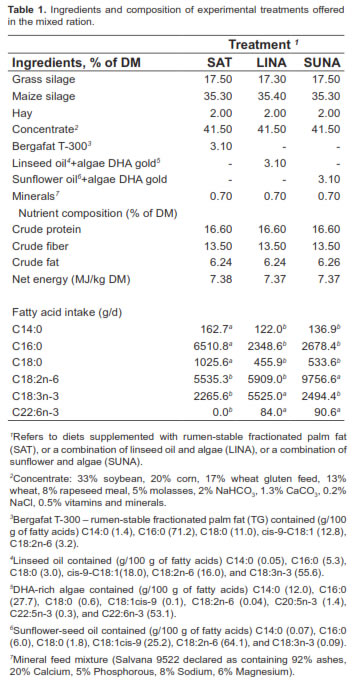
<body><![CDATA[<p><b><font size="3">Introduction </font></b></p>     <p>There is a recent trend toward increased   consumption of milk products with a higher content   of healthier fatty acids (FA), such as linolenic and   docosahexaenoic acid, associated with reduced   cardiovascular problems and mortality (Palmquist,   2009); rumenic acid (<i>cis-</i>9, <i>trans-</i>11, CLA), shown   to have anticancerogenic properties in animal   models (Wahle <i>et al.</i>, 2004); and <i>trans-</i>vaccenic   acid (C18:1<i>trans-</i>11, TVA), the main precursor   of rumenic acid, which is synthesized from TVA   in humans (Adolf <i>et al.</i>, 2000). Most research   has focused on two isomers, rumenic acid and   CLA<i>trans-</i>10, <i>cis-</i>12 (Khanal and Dhiman, 2004).   Studies on pure single isomers showed that the   biological activities of such isomers are different   (Banni <i>et al.</i>, 2001; Martin and Valeille, 2002).   Therefore, it is important to separate the individual   CLA isomers (Dannenberger <i>et al.</i>, 2004). Likewise,   the decrease in total saturated fatty acids (SFA)   has also been considered important because of its   negative effects on cholesterol levels (Parodi, 2005).   Dietary plant oil supplementation has an enhancing   effect on the levels of milk rumenic acid and   TVA (Ollier <i>et al.</i>, 2009) being the highest levels   accumulated when vegetable oils were used together   with fish oil (Abu-Ghazaleh and Holmes, 2007; Cruz-Hernandez <i>et al.</i>, 2007).</p>     <p>Most studies have focused on dietary effects   upon FA composition of total bovine milk fat   (Shingfield <i>et al.</i>, 2006; Mahecha <i>et al.</i>, 2008).   However, few studies have evaluated these effects in   different milk fat lipid fractions (Smith <i>et al.</i>, 1977;   L&oacute;pez <i>et al.</i>, 2008). Bovine milk lipids are largely   composed of triglycerides (TG) and minor amounts   of diacylglycerols (DG), monoacylglycerols, free   FA (FFA), phospholipids (PL), and sterols (Jensen,   2002). Altering the proportion of the milk lipid   fractions (Russell <i>et al.</i>, 2010) as well as their FA   composition (Vanderghem <i>et al.</i>, 2010) is of great   importance because of health, technology, and   sensory consequences. The FA characteristics and   distribution in the lipid fractions influence physical   properties of milk fat, thereby altering its melting point (Chilliard and Ferlay, 2004).</p>     <p>The present study evaluated the effects   of feeding different lipid supplements on the   proportion of milk TG and PL, on the FA   composition of both fractions, and on CLA isomer distribution of total milk fat.</p>     <p>&nbsp;</p>     <p><b><font size="3">Materials and Methods</font></b></p>     <p><i>Animals and diets</i></p>     <p>All experimental procedures were approved by   the Animal Care Committee of the Leibniz Institute   for Farm Animal Biology (FBN) in accordance with   the Use of Vertebrates for Scientific Purposes Act of   1985. Eighteen mid-lactation primiparous German   Holstein dairy cows, averaging 91.6 days in milk   (DIM) (standard error of the mean: 7.8 days), were   divided into three groups and offered one of the   following experimental diets for 10 weeks: rumenstable   fractionated palm fat (SAT), linseed oil plus   algae (LINA), and sunflower oil plus algae (SUNA).   SAT included grass silage, maize silage, hay, a mineral   feed mixture (Salvana 9522, Salvana, Sparrieshoop,   Germany) and a concentrate mixture (MF 2000,   Vollkraft, G&uuml;strow, Germany) supplemented with   rumen-stable fractionated palm fat (SAT; Bergafat   T-300, Dr. Pieper Technologie, 16818, Wuthenow, Germany; 3.1% basal diet dry matter &#91;DM&#93;).</p>     <p>The differentiator of SAT among the other   two dietary treatments was the type of lipid   supplementation used for the concentrate mixture.   LINA included a combination of linseed oil   (D&ouml;rnthaler &Ouml;hlm&uuml;hle, D&ouml;rnthal, Germany; 2.7%   basal diet DM) and alga (Docosahexaenoic acid,   DHA; Gold, Novus Europe, Brussels, Belgium; 0.4%   basal diet DM) while SUNA included a combination   of sunflower oil (Teutoburger &Ouml;lm&uuml;hle, Ibbenb&uuml;ren,   Germany; 2.7% basal diet DM) and algae (DHA Gold,   Novus Europe, Brussels, Belgium; 0.4% basal diet   DM). Data on ingredients and nutritional composition   of diets were previously published by Angulo <i>et al.</i>   (2012a, b) and are shown in <a href="#t1">table 1</a>. Animals (first   lactation; 92 days in milk) were randomly assigned   to three groups of six cows. Milk samples were   collected from morning milking on the last day of   the experimental period to determine TG and PL for   analysis of fatty acid composition and the CLA isomer HPLC. Samples were analyzed in triplicate.</p>     <p align="center"><a name="t1"></a><img src="/img/revistas/rccp/v26n2/v26n2a3t1.jpg"></p>     ]]></body>
<body><![CDATA[<p><i>Separation of lipid classes and fatty acid analyses</i></p>     <p>TG and PL of the extracted milk fat were   separated using thin layer chromatography   (TLC). Fat extraction was previously described   by Duske <i>et al.</i> (2009). TLC pre-coated silica gel   SIL G-25 plates (20x20 cm, Macherey-Nagel,   D&uuml;ren, Germany) were pre-washed using the   solvent mixture n-hexane/diethyl ether/acetic acid   (70:30:2, v/v/v) and dried at 110 &ordm;C for 90 min   before use. Lipid extracts and a standard solution (25 mg TLC standard 18 - 5C &#91;Nu-Check Prep Inc., Elysian, MN, USA&#93; /10 mL chloroform/methanol 2:1 v/v) were automatically and rapidly deposited on the plates using the CAMAG Automatic TLC Sampler ATS 4 (CAMAG, Berlin, Germany). After sample application the plates were placed in a chromatography glass chamber containing about 50 mL of an <i>n</i>-hexane/diethyl ether/acetic acid (70:30:2, v/v/v) mixture. The migration time was close to 1 h until the solvent ascended to 1 cm below the top of the plate. After plate-drying all lipid classes were viewed under ultraviolet (UV) light after being sprayed with a solution of 0.1 % 2.7-dichlorofluorescein and the lipid fractions were scraped off. Samples were stored at -20 &ordm;C for fatty acid analyses as described by Angulo <i>et al.</i> (2011).</p>     <p><i>Milk CLA isomer analyses</i></p>     <p>Identification and quantification analyses of the   CLA isomers in milk fat extracts were performed   by Ag<sup>+</sup>-HPLC and involved an HPLC system (LC   10A, Shimadzu, Japan) equipped with a pump   (LC-10AD VP), autosampler (SIL-10AF), 50 &micro;L injection loop, a photodiode array detector   (SPD-M 10Avp, Shimadzu, Japan), and a Shimadzu   CLASS-VP software system (Version 6.12 SP4).   Four ChromSpher 5 Lipids analytical silver ionimpregnated   columns (4.6 mm i.d. &times; 250 mm   stainless steel; 5 &mu;m particle size; Chrompack-   Varian, Santa Clara, CA, USA) were used in series.   The mobile phase (0.1% acetonitrile in <i>n</i>-hexane)   was prepared fresh daily and pumped at a flow rate   of 1.0 mL/min. The detector was operated at 233 nm   to identify CLA isomers based on the measurement   of the integrated area under the 233 nm peaks   attributed to conjugated dienes. The identification   and calibration of CLA isomers was made using   the retention time of individual CLA methyl   esters (CLA<i>cis-</i>9,<i>trans-</i>11, CLA<i>trans-</i>9,<i>trans-</i>11,   CLA<i>trans-</i>10,<i>cis-</i>12, CLA<i>cis-</i>9,<i>cis-</i>11 and CLA<i>cis-</i> 11,<i>trans-</i>13) at different levels.</p>     <p><i>Statistical analysis</i></p>     <p>The following model for the analysis of variance   with the fixed factor diet (D) was used: </p>     <p>Y<sub>ij</sub>= &mu; + D<sub>i</sub> + E<sub>ij</sub></p>     <p>&micro;= overall mean </p>     <p>D<sub>i</sub>= diet effect (i=3)</p>     <p>E<sub>ij</sub>= residual error</p>     ]]></body>
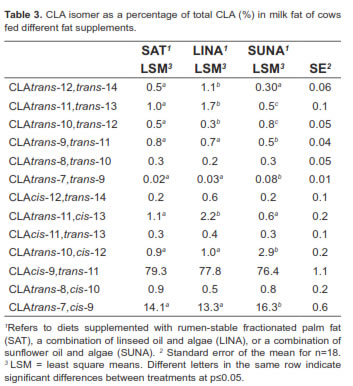
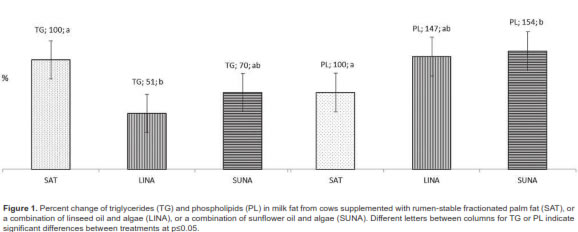
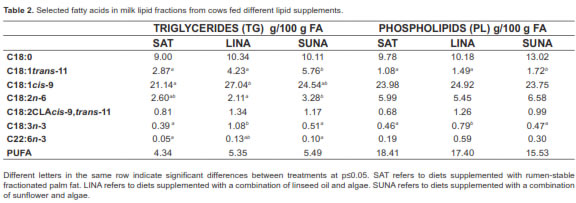
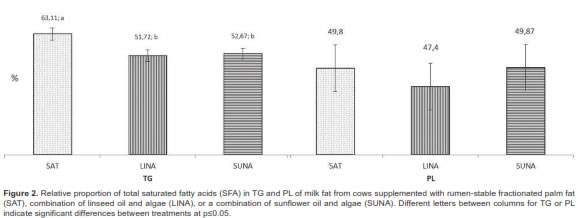
<body><![CDATA[<p>All of the data were analyzed by the leastsquares   mean method using the GLM procedures of   SAS<sup>&reg;</sup> 2009. Treatment means were compared using   the least-squares mean procedure (SAS Institute) with the significance level set at p&le;0.05.</p>     <p>&nbsp;</p>     <p><b><font size="3">Results </font></b></p>     <p>In this study the effect of diet on milk PL and   TG proportions was evaluated. It was demonstrated   that supplementation of lactating cows with <i>n</i>-3 FA   plus DHA-rich algae (LINA) tended to increase   (p=0.08) the proportion of PL and decreased   significantly the proportion of TG compared to   SAT (p&le;0.05). Supplementing lactating cows with   a diet composed of <i>n</i>-6 FA plus DHA-rich algae   (SUNA) significantly increased the proportion of   PL (p&le;0.05) and did not significantly affect the proportion of TG compared to SAT (<a href="#f1">Figure 1</a>).</p>     <p align="center"><a name="f1"></a><img src="/img/revistas/rccp/v26n2/v26n2a3f1.jpg"></p>     <p>This study also analyzed the distribution of   FA in milk TG and PL. PUFA were preferentially   deposited into PL (17%) rather than into TG (5%).   PUFA of PL were composed mainly of long chain   PUFA (LCPUFA, 8.7%) whereas they comprised   only 0.34% of the total PUFA in TG. Linoleic   acid and DHA were some of the LCPUFA more   incorporated into PL than into TG. Oleic acid was   incorporated in similar proportions into TG and   PL (on average 24.24% and 24.22%, respectively)   being the most abundant fatty acid in PL and   the second most abundant in TG. Linolenic acid   and CLA<i>cis-</i>9,<i>trans-</i>11 were on average also   incorporated in similar proportions into TG and PL   (Linolenic acid 0.7% and 0.6%, respectively, while   CLA<i>cis-</i>9, <i>trans-</i>11 1.1 and 1.0%, respectively)   while TVA was incorporated on average as 4.29% of   the total FA into TG and as 1.43% of the total FA into PL.</p>     <p>The relative amount of FA in TG and PL is   shown in <a href="#t2">table 2</a>. Linolenic acid and TVA were   significantly increased by LINA and SUNA,   respectively, compared to SAT in both TG and   PL. The increase observed in TVA SUNA did not   parallel changes in CLA<i>cis-</i>9,<i>trans-</i>11. There was a   tendency for DHA to increase (p=0.08) in the milk   of cows fed with LINA in TG but not in PL. Both   PUFA diets decreased the proportion of SFA in TG   but not in PL (<a href="#f2">Figure 2)</a>, and only LINA increased total unsaturated fatty acids (UFA) in TG.</p>     <p align="center"><a name="t2"></a><img src="/img/revistas/rccp/v26n2/v26n2a3t2.jpg"></p>     <p align="center"><a name="f2"></a><img src="/img/revistas/rccp/v26n2/v26n2a3f2.jpg"></p>     <p>The distribution of single CLA isomers (% of   total CLA isomers) analyzed by Silver-ion-HPLC   in milk fat was also affected by fat supplementation   (<a href="#t3">Table 3</a>). CLA<i>trans-</i>11,<i>cis-</i>13 isomer significantly   increased with LINA compared to SAT and SUNA.   Proportions of CLA<i>trans-</i>10, <i>cis-</i>12 in milk fat were   enhanced in response to SUNA supplementation   compared to SAT. The relative proportion of   CLA<i>trans-</i>7,<i>cis-</i>9 was also increased in total milk   fat of the SUNA group. In the present study, a   relationship was calculated between milk fat (%)   and CLA<i>trans-</i>10,<i>cis-</i>12 and CLA<i>trans-</i>7,<i>cis-</i>9 with r = -0.5 and r = -0.25, respectively.</p>     ]]></body>
<body><![CDATA[<p align="center"><a name="t3"></a><img src="/img/revistas/rccp/v26n2/v26n2a3t3.jpg"></p>     <p>&nbsp;</p>     <p><b><font size="3">Discussion </font></b></p>     <p>Considering that 98% of milk fat is TG (Jensen,   2002), the decrease of milk fat in the LINA (2.3%)   and SUNA (2.2%) groups compared to the SAT   (3.7%) group (Angulo <i>et al.</i>, 2012b) mainly   reflects the decrease of TG (p&lt;0.05). The decrease   of milk fat could have a negative impact because   the fat content of milk can represent up to 50%   of the total value of milk in some markets and,   therefore, a decrease in milk fat may have negative   economic consequences for farmers. However, this   is important for specific newly emerging markets in   search of light milk fat. New Zealand scientists are   breeding a herd of cows that produce lower-fat milk   following the discovery of a natural gene mutation   in one animal (Michigan Dairy Review, 2007).   Feeding strategies to induce milk fat depression   (MFD) could be used as a practical tool by the dairy   industry in situations that favor the production of   low fat milk. It is important to seek alternatives that   lead to an increasing milk yield without altering   milk protein when MFD is caused. In the present   study, as reported Angulo <i>et al.</i> (2012b), plant   oil/algae diets decreased milk fat (SAT 3.67%;   LINA 2.31%; SUNA 2.17%), did not alter milk   protein (SAT 3.26%; LINA 3.15%; SUNA 3.18%),   and did not significantly alter mild yield (SAT   29.11; LINA 32.92; SUNA 35.0, kg/cow/d). Further   research is needed to improve milk yield and/or to   obtain a higher proportion of milk fat in order to maintain milk fat yield.</p>     <p>Similar to our results, L&oacute;pez <i>et al.</i> (2008)   also found an increase of PL (+18%) in milk   from cows fed a diet rich in polyunsaturated   fatty acids (PUFA). Technological, sensorial, and   nutritional consequences of the increase of PL in   the lipid composition of milk induced by dietary   manipulation have gained importance in recent   years. Emulsifying properties and acid tolerance   are two of the most important characteristics of   cream. The effects of the buttermilk component,   especially its PL, on the emulsifying properties and   acid tolerance of cream were investigated by Ihara   <i>et al.</i> (2011). Buttermilk with a higher PL content   improved the emulsifying properties and acid   tolerance of cream. Unexpectedly, the addition of   PL or lysophospholipids did not improve the acid   tolerance of cream, a finding that was attributable to   the formation of PL complexes and protein in milk   fat. Implementing these findings may result in highquality   cooking cream. Likewise, current research   on bioactive molecules in milk has demonstrated   the health advantages of bovine milk and its   components for pharmaceutical purposes. Russell   <i>et al.</i> (2010) monitored changes in skin morphology   upon skin exposure to UV light and evaluated the   potential of milk PL in preventing photodamage   to skin-equivalent models. The results suggest that   milk PL act on skin cells in a protective manner   against the effect of UV radiation. According to this   research, the potential of increasing PL in milk for pharmaceutical use is beginning to emerge.</p>     <p>The average distribution of PUFA between   TG and PL corresponds to that reported by Jensen   (2002), being higher in PL (17.1%) than in TG   (5.1%). LCPUFA are the structural and functional   components of membranes that play a major role   in maintaining viable cell membranes (Martonosi,   1975). Interestingly, CLA<i>cis-</i>9,<i>trans-</i>11 was   distributed in a similar way between TG and PL.   Considering that approximately 98% of milk   fat is TG (Jensen, 2002), the obtained CLA<i>cis-</i>   9,<i>trans-</i>11 contents show higher incorporation   into TG. Contarini <i>et al.</i> (2009) found that 95 to   97% of CLA<i>cis-</i>9,<i>trans-</i>11 in bovine milk was   incorporated in the TG fraction. Banni <i>et al.</i> (2001)   reported incorporation of CLA<i>cis-</i>9,<i>trans-</i>11   into various lipid fractions in the livers of rats fed   either a high or low CLA diet. Apparently, the   presence of CLA<i>cis-</i>9,<i>trans-</i>11 in PL membranes   is related to the chemical and biological properties   of cellular membranes (Soveral <i>et al.</i>, 2009; Amar&uacute;   and Field, 2009). <i>In vitro</i> studies with mammary   carcinoma cells have demonstrated that CLA in PL   can decrease other FA oxidation and eicosanoids   synthesis, and inhibit cell proliferation (Kelley <i>et al.</i>, 2007). Similarly, Ip <i>et al.</i> (1991) reported that   synthetically prepared CLA is an effective agent   for inhibiting mammary tumor development in   rats. CLA incorporation into PL increased with   dietary intake; CLA feeding resulted in a decrease   in the extent of lipid peroxidation in the mammary   gland. However, there is no final conclusion about   the effect of CLA on human cancer (Kelley <i>et al.</i>, 2007).</p>     <p>The diets had a significant effect on the   proportion of some fatty acids in TG and PL,   which are important for human health. The downregulation   of stearoyl-CoA desaturase (SCD)   mRNA by PUFA treatments compared to SAT,   as reported by Angulo <i>et al.</i> (2012b) in the same   study, has been suggested as a possible explanation   for the increase of TVA without a clear increase of   CLA<i>cis-</i>9,<i>trans-</i>11. In general, PL was more stable   than TG to changes by PUFA supplementation and   only minor changes were detected. Barbano and   Sherbon (1981) and Sleigh <i>et al.</i> (1976) reported   little change in fatty acid composition of bovine   milk PL in response to the protected unsaturated   diet in contrast to milk diglycerides and TG.   However, another study (Smith <i>et al.</i>, 1977) found   that phospholipids obtained from cows fed protected   sunflower/soy bean oil supplements contained   a higher proportion of linoleic acid than the   phospholipids from regular milk diets. Production   of TG with a higher proportion of unsaturated   FA found in the present study is important for   technological applications. Double bonds produce   a bend in the fatty acid molecule. Molecules with   many such bends cannot be packed as closely   together as straight molecules; therefore, these fats   are less dense. As a result, TG containing more   unsaturated fatty acids are softer and melt more   readily at lower temperatures (Webb <i>et al.</i>, 2008).   Hence, LINA might be used to produce a softer milk fat that spreads as easily as margarine.</p>     <p>In reference to CLA distribution and contrary to   other studies (Cruz-Hernandez <i>et al.</i>, 2007; Bernard   <i>et al.</i>, 2009) no significant dietary effect was found   for the most abundant CLA<i>cis-</i>9, <i>trans-</i>11 (%),   although there was an increase of TVA in milk   TG. The increased level of CLA<i>cis-</i>9, <i>trans-</i>11 in   milk with sunflower, fish, or plant oil supplement   decreased with the duration of the feeding period   (Cruz-Hernandez <i>et al.</i>, 2007; Roy <i>et al.</i>, 2006).   In the present trial, cows were fed longer (70 d)   when compared to the trials by Cruz-Hernadez   <i>et al.</i> (2007) (38 d) and Roy <i>et al.</i> (2006) (20 d).   Therefore, a direct comparison of the results seems   to be difficult. The type of forage and the proportion   of concentrate in the basal diets (Shingfield <i>et al.</i>,   2005, Abu-Ghazaleh and Holmes, 2007) as well as   the variation among animals (Kelly <i>et al.</i>, 1998)   have also been reported to affect the distribution of single CLA isomers in milk fat.</p>     <p>In agreement with Kraft <i>et al.</i> (2003), CLA<i>trans-</i>   11,<i>cis-</i>13 was the second most abundant CLA   isomer found in milk. These authors hypothesized   that linolenic acid is an indirect precursor of   CLA<i>trans-</i>11,<i>cis-</i>13. Indeed, in the present study,   this CLA isomer increased significantly with LINA   compared to SAT and SUNA, and was identified   in milk by Kraft <i>et al.</i> (2003) as an indicator of   pasture feeding. The highest relative proportion   of CLA<i>trans-</i>11,<i>trans-</i>13 was also measured in   milk in the LINA group. This CLA isomer was   the most abundant isomer among the trans, <i>trans-</i>   CLA. The higher proportion of CLA<i>trans-</i>10,<i>cis-</i>12   in milk fat in response to SUNA compared to   SAT is concordant with goat milk (Bernard <i>et al.</i>,   2009), cow milk (Roy <i>et al.</i>, 2006), and ewe milk   (Hervas <i>et al.</i>, 2008) studies. On the contrary,   Cruz-Hernandez <i>et al.</i> (2007) found a reduction   of this CLA<i>trans-</i>10,<i>cis-</i>12 in milk fat from cows   fed sunflower and fish oil. CLA<i>trans-</i>7,<i>cis-</i>9 is   another FA related to MFD and was increased in   SUNA group. CLA<i>cis-</i>9, <i>trans-</i>11 and CLA<i>trans-</i>   7,<i>cis-</i>9 are the most prevalent CLA isomers in   milk. CLA<i>trans-</i>7,<i>cis-</i>9 in milk fat originates   almost exclusively from endogenous synthesis via   SCD (Corl <i>et al.</i>, 2002). Kadegowda <i>et al.</i> (2008)   reported that in addition to CLA<i>trans-</i>10,<i>cis-</i>12,   CLA<i>trans-</i>7,<i>cis-</i>9 was also negatively correlated   with percentage of milk fat when evaluated in   three experiments using the principal component   analysis. Dietary C18:1<i>trans-</i>7 induced conversion   to CLA<i>trans-</i>7,<i>cis-</i>9 and MFD in lactating mice (Kadegowda <i>et al.</i>, 2010).</p>     <p>The effect of diet on milk CLA distribution   (proportion) was similar to the results obtained   by Angulo <i>et al.</i> (2012b), with the exception of   CLA<i>trans-</i>10,<i>cis-</i>12 and CLA<i>trans-</i>7,<i>cis-</i>9. The   output of these fatty acids increased with LINA   and SUNA compared to SAT (0.119, 0.285, 0.062;   1.520, 1.620, 1.000; g/d, respectively). Conversely,   the proportion of these fatty acids only increased   with SUNA. Fatty acid output, expressed as   amount of fatty acids in milk (g/d) is considered   more appropriate to explain gene expression and to understand MFD than their proportions in milk (Glasser <i>et al.</i>, 2007). Accordingly, the authors speculate that milk fat synthesis might be mediated not only by CLA<i>trans-</i>10,<i>cis-</i>12, but also by CLA<i>trans-</i>7,<i>cis-</i>9. The effect of PUFA diets on CLA<i>trans-</i>10,<i>cis-</i>12 and CLA<i>trans-</i>7,<i>cis-</i>9 and their relationship with milk fat were concordant with the negative correlation found between these FA and milk fat.</p>     ]]></body>
<body><![CDATA[<p>In summary, linseed/algae feeding tended to   increase the proportion of PL while significantly   decreasing the proportion of TG in bovine milk,   producing TG with high proportion of TVA,   oleic acid, linolenic acid, DHA, and UFA, and a   low proportion of SFA. Sunflower/algae feeding   significantly increased PL. The commercial and   technological applications of this finding are to   be explored. Sunflower/algae feeding caused   accumulation of CLA<i>trans-</i>10,<i>cis-</i>12, CLA<i>trans-</i>7,   <i>cis-</i>9, CLA<i>trans-</i>7,<i>trans-</i>9, CLA<i>trans-</i>10,<i>trans-</i>12,   and a decrease of CLA<i>trans-</i>9,<i>trans-</i>11 in total   milk fat, whereas LINA increased the CLA<i>trans-</i>   12,<i>trans-</i>14, CLA<i>trans-</i>11,<i>trans-</i>13, and the   CLA<i>trans-</i>11,<i>cis-</i>13 deposition compared to SAT.   Further studies should be conducted in order to   understand the relationship between these isomers   and gene expression of mammary lipogenic enzymes under specific conditions.</p>     <p>&nbsp;</p> <hr size="1">    <p><b><font size="3">Notes</font></b></p>     <p><sup><a name="1"></a><a href="#b1">&curren;</a></sup> To cite this article: Angulo J, Olivera M, Mahecha L, Nuernberg G, Dannenberger D, Nuernberg K. Distribution of conjugated linoleic acid (CLA) isomers and other fatty acids in polar and neutral fractions of milk from cows fed different lipid supplements. Rev Colomb Cienc Pecu 2013; 26:79-89.</p> <hr size="1">     <p>&nbsp;</p>     <p><b><font size="3">Acknowledgements </font></b></p>     <p>This study was supported by COLCIENCIAS   (Colombia, project 111545221319), by the   Universidad de Antioquia (Medellin, Colombia),   and by the European Union (EU project FOODCT-   2006-36241). The authors wish to thank the   Sustainability Project 2011-2012 (Estrategia de   Sostenibilidad CODI 2011-2012, Universidad de   Antioquia) for collaborating with resources needed   to conduct this study. These results are a subset of findings from an ongoing larger experiment at the   Leibniz Institute for Farm Biology FBN. We also   thank B. Jentz, H. Rooch, and M. Dahm from the   Muscle Biology and Growth Research Unit for their technical assistance.</p>     <p>&nbsp;</p>     <p><b><font size="3">References </font></b></p>     <!-- ref --><p>Abu-Ghazaleh AA, Holmes LD. Diet supplementation with fish   oil and sunflower oil to increase conjugated linoleic acid levels   in milk fat of partially grazing dairy cows. J Dairy Sci 2007;   90:2897-2904.    &nbsp;&nbsp;&nbsp;&nbsp;&nbsp;&nbsp;&nbsp;&nbsp;[&#160;<a href="javascript:void(0);" onclick="javascript: window.open('/scielo.php?script=sci_nlinks&ref=000082&pid=S0120-0690201300020000300001&lng=','','width=640,height=500,resizable=yes,scrollbars=1,menubar=yes,');">Links</a>&#160;]<!-- end-ref --> </p>     <!-- ref --><p>Adolf R, Duval S, Emeken E. Biosynthesis of conjugated   linoleic acid in humans. Lipids Online 2000; Lipids 2000;   35:131-135.    &nbsp;&nbsp;&nbsp;&nbsp;&nbsp;&nbsp;&nbsp;&nbsp;[&#160;<a href="javascript:void(0);" onclick="javascript: window.open('/scielo.php?script=sci_nlinks&ref=000084&pid=S0120-0690201300020000300002&lng=','','width=640,height=500,resizable=yes,scrollbars=1,menubar=yes,');">Links</a>&#160;]<!-- end-ref --> </p>     <!-- ref --><p>Amar&uacute; D, Field C. Conjugated Linoleic Acid Decreases MCF-   7 Human Breast Cancer Cell Growth and Insulin-Like Growth   Factor-1 Receptor Levels. Lipids Online 2009; 44:449-458.    &nbsp;&nbsp;&nbsp;&nbsp;&nbsp;&nbsp;&nbsp;&nbsp;[&#160;<a href="javascript:void(0);" onclick="javascript: window.open('/scielo.php?script=sci_nlinks&ref=000086&pid=S0120-0690201300020000300003&lng=','','width=640,height=500,resizable=yes,scrollbars=1,menubar=yes,');">Links</a>&#160;]<!-- end-ref --> </p>     <!-- ref --><p>Angulo J, Nuernberg G, Mahecha L, Olivera M, Dannenberger   D. Manual of lipid extraction, methylation and gas   chromatography, for the study of different tissues in ruminant   research. 1st ed. Medell&iacute;n: Biog&eacute;nesis; 2011. 42 p.    &nbsp;&nbsp;&nbsp;&nbsp;&nbsp;&nbsp;&nbsp;&nbsp;[&#160;<a href="javascript:void(0);" onclick="javascript: window.open('/scielo.php?script=sci_nlinks&ref=000088&pid=S0120-0690201300020000300004&lng=','','width=640,height=500,resizable=yes,scrollbars=1,menubar=yes,');">Links</a>&#160;]<!-- end-ref --> </p>     <!-- ref --><p>Angulo J, Hiller B, Olivera M, Mahecha L, Nuernberg G,   Dannenberger D, Losand B, Nuernberg K. Dietary fatty acid   intervention of lactating cows simultaneously improves lipid   profiles of meat and milk. J Sci Food Agr 2012a; 92:2968-74.    &nbsp;&nbsp;&nbsp;&nbsp;&nbsp;&nbsp;&nbsp;&nbsp;[&#160;<a href="javascript:void(0);" onclick="javascript: window.open('/scielo.php?script=sci_nlinks&ref=000090&pid=S0120-0690201300020000300005&lng=','','width=640,height=500,resizable=yes,scrollbars=1,menubar=yes,');">Links</a>&#160;]<!-- end-ref --> </p>     <!-- ref --><p>Angulo J, Mahecha L, Nuernberg K, Nuernberg G,   Dannenberger D, Olivera M, Boutinaud M. Leroux C, Albrecht   E, Bernard L. Effects of polyunsaturated fatty acids from plant   oils and algae on milk fat yield and composition are mediated   by mammary lipogenic and SREBF1 gene expression. Animal   2012b; 6:1961-72.    &nbsp;&nbsp;&nbsp;&nbsp;&nbsp;&nbsp;&nbsp;&nbsp;[&#160;<a href="javascript:void(0);" onclick="javascript: window.open('/scielo.php?script=sci_nlinks&ref=000092&pid=S0120-0690201300020000300006&lng=','','width=640,height=500,resizable=yes,scrollbars=1,menubar=yes,');">Links</a>&#160;]<!-- end-ref --> </p>     <!-- ref --><p>Banni S, Carta G, Angioni E, Murru M, Scanu P, Melis MP,   Bauman DE, Fischer SM, Ip CL. Distribution of conjugated   linoleic acid and metabolites in different lipid fractions in the   rat liver. J Lipid Res 2001; 42:1056-1061.    &nbsp;&nbsp;&nbsp;&nbsp;&nbsp;&nbsp;&nbsp;&nbsp;[&#160;<a href="javascript:void(0);" onclick="javascript: window.open('/scielo.php?script=sci_nlinks&ref=000094&pid=S0120-0690201300020000300007&lng=','','width=640,height=500,resizable=yes,scrollbars=1,menubar=yes,');">Links</a>&#160;]<!-- end-ref --> </p>     <!-- ref --><p>Barbano DM, Sherbon JW. Polyunsaturated Protected Lipid:   Effect on milk phospholipids polyunsaturated protected lipid:   effect on milk phospholipids. J Dairy Sci 1981; 64:2170-2174.    &nbsp;&nbsp;&nbsp;&nbsp;&nbsp;&nbsp;&nbsp;&nbsp;[&#160;<a href="javascript:void(0);" onclick="javascript: window.open('/scielo.php?script=sci_nlinks&ref=000096&pid=S0120-0690201300020000300008&lng=','','width=640,height=500,resizable=yes,scrollbars=1,menubar=yes,');">Links</a>&#160;]<!-- end-ref --> </p>     <!-- ref --><p>Bernard L, Leroux Ch, Faulconnier Y, Durand D, Shingfield KJ,   Chilliard Y. Effect of sunflower-seed oil or linseed oil on milk   fatty acid secretion and lipogenic gene expression in goats fed   hay-based diets. J Dairy Res 2009; 76:241-248.    &nbsp;&nbsp;&nbsp;&nbsp;&nbsp;&nbsp;&nbsp;&nbsp;[&#160;<a href="javascript:void(0);" onclick="javascript: window.open('/scielo.php?script=sci_nlinks&ref=000098&pid=S0120-0690201300020000300009&lng=','','width=640,height=500,resizable=yes,scrollbars=1,menubar=yes,');">Links</a>&#160;]<!-- end-ref --> </p>     <!-- ref --><p>Chilliard Y, Ferlay A. Dietary lipids and forages interactions   on cow and goat milk fatty acid composition and sensory   properties. Reprod Nutr Dev 2004; 44:467-492.    &nbsp;&nbsp;&nbsp;&nbsp;&nbsp;&nbsp;&nbsp;&nbsp;[&#160;<a href="javascript:void(0);" onclick="javascript: window.open('/scielo.php?script=sci_nlinks&ref=000100&pid=S0120-0690201300020000300010&lng=','','width=640,height=500,resizable=yes,scrollbars=1,menubar=yes,');">Links</a>&#160;]<!-- end-ref --> </p>     <!-- ref --><p>Contarini G, Pelizzola V, Povolo M. Content of conjugated   linoleic acid in neutral and polar lipid fractions of milk of   different ruminant species. Int Dairy J 2009; 19:342-34.    &nbsp;&nbsp;&nbsp;&nbsp;&nbsp;&nbsp;&nbsp;&nbsp;[&#160;<a href="javascript:void(0);" onclick="javascript: window.open('/scielo.php?script=sci_nlinks&ref=000102&pid=S0120-0690201300020000300011&lng=','','width=640,height=500,resizable=yes,scrollbars=1,menubar=yes,');">Links</a>&#160;]<!-- end-ref --> </p>     <!-- ref --><p>Corl BA, Baumgard LH, Griinari JM, Delmonto P, Morehouse   KM, Yurawecz MP, Mauman DE. Trans-7, <i>cis-</i>9 CLA is   synthesized endogenously by delta9-desaturase in dairy cows.   Lipids 2002; 37:681-688.    &nbsp;&nbsp;&nbsp;&nbsp;&nbsp;&nbsp;&nbsp;&nbsp;[&#160;<a href="javascript:void(0);" onclick="javascript: window.open('/scielo.php?script=sci_nlinks&ref=000104&pid=S0120-0690201300020000300012&lng=','','width=640,height=500,resizable=yes,scrollbars=1,menubar=yes,');">Links</a>&#160;]<!-- end-ref --> </p>     <!-- ref --><p>Cruz-Hernandez C, Kramer JKG, Kennelly JJ, Glimm DR,   Sorensen BM, Okine EK, Goonewardene LA, Weselake RJ.   Evaluating the conjugated linoleic acid and trans 18:1 isomers   in milk fat of dairy cows fed increasing amounts of sunflower   oil and a constant level of fish oil. J Dairy Sci 2007; 90:3786- 3801.    &nbsp;&nbsp;&nbsp;&nbsp;&nbsp;&nbsp;&nbsp;&nbsp;[&#160;<a href="javascript:void(0);" onclick="javascript: window.open('/scielo.php?script=sci_nlinks&ref=000106&pid=S0120-0690201300020000300013&lng=','','width=640,height=500,resizable=yes,scrollbars=1,menubar=yes,');">Links</a>&#160;]<!-- end-ref --></p>     <!-- ref --><p>Dannenberger D, Nuernberg G, Scollan N, Sschabbel W,   Steinharth H, Ender K, Nuernberg K. Effect of diet on the   deposition of n-3 fatty acids, conjugated linoleic and C18:1trans   fatty acid isomers in muscle lipids of German Holstein bulls. J   Agric Food Chem 2004; 52:6607- 6615.    &nbsp;&nbsp;&nbsp;&nbsp;&nbsp;&nbsp;&nbsp;&nbsp;[&#160;<a href="javascript:void(0);" onclick="javascript: window.open('/scielo.php?script=sci_nlinks&ref=000108&pid=S0120-0690201300020000300014&lng=','','width=640,height=500,resizable=yes,scrollbars=1,menubar=yes,');">Links</a>&#160;]<!-- end-ref --> </p>     <!-- ref --><p>Duske K, Hammon HM, Langhof A.K, Bellmann O, Losand B.   Metabolism and lactation performance in dairy cows fed a diet   containing rumen-protected fat during the last twelve weeks of   gestation. J Dairy Sci 2009; 92:1670-1684.    &nbsp;&nbsp;&nbsp;&nbsp;&nbsp;&nbsp;&nbsp;&nbsp;[&#160;<a href="javascript:void(0);" onclick="javascript: window.open('/scielo.php?script=sci_nlinks&ref=000110&pid=S0120-0690201300020000300015&lng=','','width=640,height=500,resizable=yes,scrollbars=1,menubar=yes,');">Links</a>&#160;]<!-- end-ref --> </p>     <!-- ref --><p>Glasser F, Doreau M, Ferlay A, Chilliard Y. Technical note:   estimation of milk fatty acid yield from milk fat data. J Dairy   Sci 2007; 90: 2302&#8211;2304.    &nbsp;&nbsp;&nbsp;&nbsp;&nbsp;&nbsp;&nbsp;&nbsp;[&#160;<a href="javascript:void(0);" onclick="javascript: window.open('/scielo.php?script=sci_nlinks&ref=000112&pid=S0120-0690201300020000300016&lng=','','width=640,height=500,resizable=yes,scrollbars=1,menubar=yes,');">Links</a>&#160;]<!-- end-ref --> </p>     <!-- ref --><p>Hervas G, Luna P, Mantecon A.R, Castanares N, De la Fuente   MA, Juarez M, Frutos, P. Effect of diet supplementation with   sunflower oil on milk production, fatty acid profile and ruminal   fermentation in lactating dairy ewes. J Dairy Sci 2008; 75:399-   405.    &nbsp;&nbsp;&nbsp;&nbsp;&nbsp;&nbsp;&nbsp;&nbsp;[&#160;<a href="javascript:void(0);" onclick="javascript: window.open('/scielo.php?script=sci_nlinks&ref=000114&pid=S0120-0690201300020000300017&lng=','','width=640,height=500,resizable=yes,scrollbars=1,menubar=yes,');">Links</a>&#160;]<!-- end-ref --> </p>     <!-- ref --><p>Ihara K, Ochi H, Saito H, Iwatsuki K. Effects of buttermilk   powders on emulsification properties and acid tolerance of   cream. J Food Sci 2011; 76:C265-C271.    &nbsp;&nbsp;&nbsp;&nbsp;&nbsp;&nbsp;&nbsp;&nbsp;[&#160;<a href="javascript:void(0);" onclick="javascript: window.open('/scielo.php?script=sci_nlinks&ref=000116&pid=S0120-0690201300020000300018&lng=','','width=640,height=500,resizable=yes,scrollbars=1,menubar=yes,');">Links</a>&#160;]<!-- end-ref --> </p>     <!-- ref --><p>Ip Cl, Chin SF, Scimeca J, Pariza M. Mammary cancer   prevention by conjugated dienoic derivative of linoleic acid.   Cancer Res 1991; 51:6118-6124.    &nbsp;&nbsp;&nbsp;&nbsp;&nbsp;&nbsp;&nbsp;&nbsp;[&#160;<a href="javascript:void(0);" onclick="javascript: window.open('/scielo.php?script=sci_nlinks&ref=000118&pid=S0120-0690201300020000300019&lng=','','width=640,height=500,resizable=yes,scrollbars=1,menubar=yes,');">Links</a>&#160;]<!-- end-ref --> </p>     <!-- ref --><p>Jensen R. The composition of bovine milk lipids: January 1995   to December 2000. J Dairy Sci 2002; 85:295-350.    &nbsp;&nbsp;&nbsp;&nbsp;&nbsp;&nbsp;&nbsp;&nbsp;[&#160;<a href="javascript:void(0);" onclick="javascript: window.open('/scielo.php?script=sci_nlinks&ref=000120&pid=S0120-0690201300020000300020&lng=','','width=640,height=500,resizable=yes,scrollbars=1,menubar=yes,');">Links</a>&#160;]<!-- end-ref --> </p>     <!-- ref --><p>Kadegowda A.K.G, Connor E.E, Teter B.B, Sampugna J,   Delmonte P, Piperova L.S, Erdman R.A. Dietary trans fatty acid   isomers differ in their effects on mammary lipid metabolism   as well as lipogenic gene expression in lactating mice. J Nutr   2010; 140:919-224.    &nbsp;&nbsp;&nbsp;&nbsp;&nbsp;&nbsp;&nbsp;&nbsp;[&#160;<a href="javascript:void(0);" onclick="javascript: window.open('/scielo.php?script=sci_nlinks&ref=000122&pid=S0120-0690201300020000300021&lng=','','width=640,height=500,resizable=yes,scrollbars=1,menubar=yes,');">Links</a>&#160;]<!-- end-ref --> </p>     <!-- ref --><p>Kadegowda AKG, Piperova LS, Erdmann RA. Principal   component and multivariate analysis of milk long-chain fatty   acid composition during diet-induced milk fat depression. J   Dairy Sci 2008; 91:749-759.    &nbsp;&nbsp;&nbsp;&nbsp;&nbsp;&nbsp;&nbsp;&nbsp;[&#160;<a href="javascript:void(0);" onclick="javascript: window.open('/scielo.php?script=sci_nlinks&ref=000124&pid=S0120-0690201300020000300022&lng=','','width=640,height=500,resizable=yes,scrollbars=1,menubar=yes,');">Links</a>&#160;]<!-- end-ref --> </p>     <!-- ref --><p>Khanal RC and Dhiman TR. Biosynthesis of Conjugated   Linoleic Acid (CLA): A Review. Pakistan J Nutr 2004; 3:72-81.    &nbsp;&nbsp;&nbsp;&nbsp;&nbsp;&nbsp;&nbsp;&nbsp;[&#160;<a href="javascript:void(0);" onclick="javascript: window.open('/scielo.php?script=sci_nlinks&ref=000126&pid=S0120-0690201300020000300023&lng=','','width=640,height=500,resizable=yes,scrollbars=1,menubar=yes,');">Links</a>&#160;]<!-- end-ref --> </p>     <!-- ref --><p>Kaylegian KE, Lindsay RC. Milk fat usage and modification.   In: Handbook of Milkfat Fractionation Technology and   Application. Illinois: Am Oil Chem Soc Press; 1995. p. 1-18.    &nbsp;&nbsp;&nbsp;&nbsp;&nbsp;&nbsp;&nbsp;&nbsp;[&#160;<a href="javascript:void(0);" onclick="javascript: window.open('/scielo.php?script=sci_nlinks&ref=000128&pid=S0120-0690201300020000300024&lng=','','width=640,height=500,resizable=yes,scrollbars=1,menubar=yes,');">Links</a>&#160;]<!-- end-ref --> </p>     <!-- ref --><p>Kelley NS, Hubbard NE, Erickson KL. Conjugated linoleic acid   isomers and cancer. J Nutr 2007; 137:2599-2607.    &nbsp;&nbsp;&nbsp;&nbsp;&nbsp;&nbsp;&nbsp;&nbsp;[&#160;<a href="javascript:void(0);" onclick="javascript: window.open('/scielo.php?script=sci_nlinks&ref=000130&pid=S0120-0690201300020000300025&lng=','','width=640,height=500,resizable=yes,scrollbars=1,menubar=yes,');">Links</a>&#160;]<!-- end-ref --> </p>     <!-- ref --><p>Kelly M, Berry J, Dwyer D, Griinari JM, Chouinard Y, Van   Amburgh M, Bauman DE. Dietary fatty acid sources affect   conjugated linoleic acid concentrations in milk from lactating   dairy cows. J Nutr 1998; 128:881-885.    &nbsp;&nbsp;&nbsp;&nbsp;&nbsp;&nbsp;&nbsp;&nbsp;[&#160;<a href="javascript:void(0);" onclick="javascript: window.open('/scielo.php?script=sci_nlinks&ref=000132&pid=S0120-0690201300020000300026&lng=','','width=640,height=500,resizable=yes,scrollbars=1,menubar=yes,');">Links</a>&#160;]<!-- end-ref --> </p>     <!-- ref --><p>Kraft J, Collomb M, M&ouml;ckel P, Sieber R, Jahreis G. Differences   in CLA isomer distribution of cow's milk lipids. Lipids 2003;   38:657-664.    &nbsp;&nbsp;&nbsp;&nbsp;&nbsp;&nbsp;&nbsp;&nbsp;[&#160;<a href="javascript:void(0);" onclick="javascript: window.open('/scielo.php?script=sci_nlinks&ref=000134&pid=S0120-0690201300020000300027&lng=','','width=640,height=500,resizable=yes,scrollbars=1,menubar=yes,');">Links</a>&#160;]<!-- end-ref --> </p>     <!-- ref --><p>Lopez Ch, Briard-Bion V, Menard O, Rousseau F, Pradel   Ph, Besle JM. Phospholipid, sphingolipid, and fatty acid compositions of the milk fat globule membrane are modified by diet. J Agr Food Chem 2008; 56:5226-5236.    &nbsp;&nbsp;&nbsp;&nbsp;&nbsp;&nbsp;&nbsp;&nbsp;[&#160;<a href="javascript:void(0);" onclick="javascript: window.open('/scielo.php?script=sci_nlinks&ref=000136&pid=S0120-0690201300020000300028&lng=','','width=640,height=500,resizable=yes,scrollbars=1,menubar=yes,');">Links</a>&#160;]<!-- end-ref --> </p>     <!-- ref --><p>Mahecha L, Angulo J, Salazar B, Cer&oacute;n M, Gallo J, Molina CH,   Molina EJ, Suarez JF, Lopera JJ, Olivera M. Supplementation   with bypass fat in silvopastoral systems diminishes the ratio of   milk saturated/unsaturated fatty acids. Trop Anim Health Prod   2008; 40:209-216.    &nbsp;&nbsp;&nbsp;&nbsp;&nbsp;&nbsp;&nbsp;&nbsp;[&#160;<a href="javascript:void(0);" onclick="javascript: window.open('/scielo.php?script=sci_nlinks&ref=000138&pid=S0120-0690201300020000300029&lng=','','width=640,height=500,resizable=yes,scrollbars=1,menubar=yes,');">Links</a>&#160;]<!-- end-ref --> </p>     <!-- ref --><p>Martin C.J and Valeille K. Conjugated linoleic acids: all the   same or to everyone its own function. Reprod Nutr DeV 2002;   42:525-536.    &nbsp;&nbsp;&nbsp;&nbsp;&nbsp;&nbsp;&nbsp;&nbsp;[&#160;<a href="javascript:void(0);" onclick="javascript: window.open('/scielo.php?script=sci_nlinks&ref=000140&pid=S0120-0690201300020000300030&lng=','','width=640,height=500,resizable=yes,scrollbars=1,menubar=yes,');">Links</a>&#160;]<!-- end-ref --> </p>     <!-- ref --><p>Martonosi A. 1975. Membrane transport during development in   animals. Biochim Biophys Acta 1975; 415:311-33.    &nbsp;&nbsp;&nbsp;&nbsp;&nbsp;&nbsp;&nbsp;&nbsp;[&#160;<a href="javascript:void(0);" onclick="javascript: window.open('/scielo.php?script=sci_nlinks&ref=000142&pid=S0120-0690201300020000300031&lng=','','width=640,height=500,resizable=yes,scrollbars=1,menubar=yes,');">Links</a>&#160;]<!-- end-ref --> </p>     <!-- ref --><p>Cows in New Zealand produce low-fat milk naturally. Michigan   Dairy Review 2007; 12:3.    &nbsp;&nbsp;&nbsp;&nbsp;&nbsp;&nbsp;&nbsp;&nbsp;[&#160;<a href="javascript:void(0);" onclick="javascript: window.open('/scielo.php?script=sci_nlinks&ref=000144&pid=S0120-0690201300020000300032&lng=','','width=640,height=500,resizable=yes,scrollbars=1,menubar=yes,');">Links</a>&#160;]<!-- end-ref --> </p>     <!-- ref --><p>Ollier S, Leroux C, De la Foye A, Bernard L, Rouel J, Chillard   Y. Whole intact rapeseeds or sunflower oil in high-forage or high-concentrate diets affects milk yield, milk composition, and mammary gene expression profile in goats. J Dairy Sci 2009; 892:5544-5560.    &nbsp;&nbsp;&nbsp;&nbsp;&nbsp;&nbsp;&nbsp;&nbsp;[&#160;<a href="javascript:void(0);" onclick="javascript: window.open('/scielo.php?script=sci_nlinks&ref=000146&pid=S0120-0690201300020000300033&lng=','','width=640,height=500,resizable=yes,scrollbars=1,menubar=yes,');">Links</a>&#160;]<!-- end-ref --> </p>     <!-- ref --><p>Palmquist DL. Omega-3 fatty acids in metabolism, health, and   nutrition and for modified animal product foods. Professional Animal Scientist 2009; 25:207-249.    &nbsp;&nbsp;&nbsp;&nbsp;&nbsp;&nbsp;&nbsp;&nbsp;[&#160;<a href="javascript:void(0);" onclick="javascript: window.open('/scielo.php?script=sci_nlinks&ref=000148&pid=S0120-0690201300020000300034&lng=','','width=640,height=500,resizable=yes,scrollbars=1,menubar=yes,');">Links</a>&#160;]<!-- end-ref --> </p>     <!-- ref --><p>Parodi PW. Dairy product consumption and the risk of breast   cancer. J Am Coll Nutr 2005; 24:556S-568S.    &nbsp;&nbsp;&nbsp;&nbsp;&nbsp;&nbsp;&nbsp;&nbsp;[&#160;<a href="javascript:void(0);" onclick="javascript: window.open('/scielo.php?script=sci_nlinks&ref=000150&pid=S0120-0690201300020000300035&lng=','','width=640,height=500,resizable=yes,scrollbars=1,menubar=yes,');">Links</a>&#160;]<!-- end-ref --> </p>     <!-- ref --><p>Roy A, Ferlay A, Shingfield KJ, Chilliard Y. Examination of the   persistency of milk fatty acid composition responses to plant   oils in cows given different basal diets, with particular emphasis   on <i>trans-</i>C18:1 fatty acids and isomers of conjugated linoleic   acid. Anim Sci 2006; 82:479-492.    &nbsp;&nbsp;&nbsp;&nbsp;&nbsp;&nbsp;&nbsp;&nbsp;[&#160;<a href="javascript:void(0);" onclick="javascript: window.open('/scielo.php?script=sci_nlinks&ref=000152&pid=S0120-0690201300020000300036&lng=','','width=640,height=500,resizable=yes,scrollbars=1,menubar=yes,');">Links</a>&#160;]<!-- end-ref --> </p>     <!-- ref --><p>Russell A, Laubscher A, Jimenez-Flores R, Laiho L.   Investigating the protective properties of milk phospholipids   against ultraviolet light exposure in a skin equivalent model.   Proc of SPIE Vol. 75692Z-1. 2010.    &nbsp;&nbsp;&nbsp;&nbsp;&nbsp;&nbsp;&nbsp;&nbsp;[&#160;<a href="javascript:void(0);" onclick="javascript: window.open('/scielo.php?script=sci_nlinks&ref=000154&pid=S0120-0690201300020000300037&lng=','','width=640,height=500,resizable=yes,scrollbars=1,menubar=yes,');">Links</a>&#160;]<!-- end-ref --> </p>     <!-- ref --><p>Shingfield KJ, Reynolds CK, Hervas G, Griinari JM, Grandison   AS, Beever DE. Examination of the persistency of milk fatty   acid composition responses to fish oil and sunflower oil in the   diet of dairy cows. J Dairy Sci 2006; 89:714-732.    &nbsp;&nbsp;&nbsp;&nbsp;&nbsp;&nbsp;&nbsp;&nbsp;[&#160;<a href="javascript:void(0);" onclick="javascript: window.open('/scielo.php?script=sci_nlinks&ref=000156&pid=S0120-0690201300020000300038&lng=','','width=640,height=500,resizable=yes,scrollbars=1,menubar=yes,');">Links</a>&#160;]<!-- end-ref --> </p>     <!-- ref --><p>Shingfield KJ, Reynolds C.K, Lupoli B, Toivonen V, Yurawecz   M.P, Delmonte P, Griinari JM, Grandison AS, Beever DE.   Effect of forage type and proportion of concentrate in the diet   on milk fatty acid composition in cows given sunflower oil and   fish oil. Anim Sci 2005; 80:225-238.    &nbsp;&nbsp;&nbsp;&nbsp;&nbsp;&nbsp;&nbsp;&nbsp;[&#160;<a href="javascript:void(0);" onclick="javascript: window.open('/scielo.php?script=sci_nlinks&ref=000158&pid=S0120-0690201300020000300039&lng=','','width=640,height=500,resizable=yes,scrollbars=1,menubar=yes,');">Links</a>&#160;]<!-- end-ref --> </p>     <!-- ref --><p>Smith LM, Bianco DH, Dunkley WL. Composition of milk fat   globules with increased linoleic acid. J Am Oil Chem Soc 1977;   54:132-137.    &nbsp;&nbsp;&nbsp;&nbsp;&nbsp;&nbsp;&nbsp;&nbsp;[&#160;<a href="javascript:void(0);" onclick="javascript: window.open('/scielo.php?script=sci_nlinks&ref=000160&pid=S0120-0690201300020000300040&lng=','','width=640,height=500,resizable=yes,scrollbars=1,menubar=yes,');">Links</a>&#160;]<!-- end-ref --> </p>     <!-- ref --><p>Sleigh RW, Bain JM, Burley RW. Study of cow's milk   containing high levels of linoleic acid: isolation and properties   of the fat-globule membrane. J Dairy Res 1976; 43:389-400.    &nbsp;&nbsp;&nbsp;&nbsp;&nbsp;&nbsp;&nbsp;&nbsp;[&#160;<a href="javascript:void(0);" onclick="javascript: window.open('/scielo.php?script=sci_nlinks&ref=000162&pid=S0120-0690201300020000300041&lng=','','width=640,height=500,resizable=yes,scrollbars=1,menubar=yes,');">Links</a>&#160;]<!-- end-ref --> </p>     <!-- ref --><p>Soveral G, Martins AP, Martins SV, Lopes PA, Alfaia Cr, Prates   J, Moura T. Effect of dietary conjugated linoleic acid isomers on water and glycerol permeability of kidney membranes   Biochem Bioph Res Co 2009; 383:108-112.    &nbsp;&nbsp;&nbsp;&nbsp;&nbsp;&nbsp;&nbsp;&nbsp;[&#160;<a href="javascript:void(0);" onclick="javascript: window.open('/scielo.php?script=sci_nlinks&ref=000164&pid=S0120-0690201300020000300042&lng=','','width=640,height=500,resizable=yes,scrollbars=1,menubar=yes,');">Links</a>&#160;]<!-- end-ref --> </p>     <!-- ref --><p>Vanderghem C, Bodson P, Danthine S, Paquot M, Deroanne C,   Blecker C. Milk fat globule membrane and buttermilks: from   composition to valorization. BASE 2010; 14:485-500.    &nbsp;&nbsp;&nbsp;&nbsp;&nbsp;&nbsp;&nbsp;&nbsp;[&#160;<a href="javascript:void(0);" onclick="javascript: window.open('/scielo.php?script=sci_nlinks&ref=000166&pid=S0120-0690201300020000300043&lng=','','width=640,height=500,resizable=yes,scrollbars=1,menubar=yes,');">Links</a>&#160;]<!-- end-ref --> </p>     <!-- ref --><p>Wahle KW, Heys SD, Rotondo D. Conjugated linoleic acids:   Are they beneficial or detrimental to health? ProgLipid Res 2004; 43:553-587.    &nbsp;&nbsp;&nbsp;&nbsp;&nbsp;&nbsp;&nbsp;&nbsp;[&#160;<a href="javascript:void(0);" onclick="javascript: window.open('/scielo.php?script=sci_nlinks&ref=000168&pid=S0120-0690201300020000300044&lng=','','width=640,height=500,resizable=yes,scrollbars=1,menubar=yes,');">Links</a>&#160;]<!-- end-ref --> </p>     <!-- ref --><p>Webb FS, Whitney E, Sizer FS, Whitney EN. Nutrition:   concepts and controversies 2008; 10:595.    &nbsp;&nbsp;&nbsp;&nbsp;&nbsp;&nbsp;&nbsp;&nbsp;[&#160;<a href="javascript:void(0);" onclick="javascript: window.open('/scielo.php?script=sci_nlinks&ref=000170&pid=S0120-0690201300020000300045&lng=','','width=640,height=500,resizable=yes,scrollbars=1,menubar=yes,');">Links</a>&#160;]<!-- end-ref --></p>     <p>&nbsp;</p> </font>    ]]></body>
<body><![CDATA[ ]]></body><back>
<ref-list>
<ref id="B1">
<nlm-citation citation-type="journal">
<person-group person-group-type="author">
<name>
<surname><![CDATA[Abu-Ghazaleh]]></surname>
<given-names><![CDATA[AA]]></given-names>
</name>
<name>
<surname><![CDATA[Holmes]]></surname>
<given-names><![CDATA[LD.]]></given-names>
</name>
</person-group>
<article-title xml:lang="en"><![CDATA[Diet supplementation with fish oil and sunflower oil to increase conjugated linoleic acid levels in milk fat of partially grazing dairy cows]]></article-title>
<source><![CDATA[J Dairy Sci]]></source>
<year>2007</year>
<volume>90</volume>
<page-range>2897-2904</page-range></nlm-citation>
</ref>
<ref id="B2">
<nlm-citation citation-type="journal">
<person-group person-group-type="author">
<name>
<surname><![CDATA[Adolf]]></surname>
<given-names><![CDATA[R]]></given-names>
</name>
<name>
<surname><![CDATA[Duval]]></surname>
<given-names><![CDATA[S]]></given-names>
</name>
<name>
<surname><![CDATA[Emeken]]></surname>
<given-names><![CDATA[E.]]></given-names>
</name>
</person-group>
<article-title xml:lang="en"><![CDATA[Biosynthesis of conjugated linoleic acid in humans]]></article-title>
<source><![CDATA[Lipids Online]]></source>
<year>2000</year>
<volume>35</volume>
<page-range>131-135</page-range></nlm-citation>
</ref>
<ref id="B3">
<nlm-citation citation-type="journal">
<person-group person-group-type="author">
<name>
<surname><![CDATA[Amarú]]></surname>
<given-names><![CDATA[D]]></given-names>
</name>
<name>
<surname><![CDATA[Field]]></surname>
<given-names><![CDATA[C.]]></given-names>
</name>
</person-group>
<article-title xml:lang="en"><![CDATA[Conjugated Linoleic Acid Decreases MCF- 7 Human Breast Cancer Cell Growth and Insulin-Like Growth Factor-1 Receptor Levels]]></article-title>
<source><![CDATA[Lipids Online]]></source>
<year>2009</year>
<volume>44</volume>
<page-range>449-458</page-range></nlm-citation>
</ref>
<ref id="B4">
<nlm-citation citation-type="book">
<person-group person-group-type="author">
<name>
<surname><![CDATA[Angulo]]></surname>
<given-names><![CDATA[J]]></given-names>
</name>
<name>
<surname><![CDATA[Nuernberg]]></surname>
<given-names><![CDATA[G]]></given-names>
</name>
<name>
<surname><![CDATA[Mahecha]]></surname>
<given-names><![CDATA[L]]></given-names>
</name>
<name>
<surname><![CDATA[Olivera]]></surname>
<given-names><![CDATA[M]]></given-names>
</name>
<name>
<surname><![CDATA[Dannenberger]]></surname>
<given-names><![CDATA[D.]]></given-names>
</name>
</person-group>
<source><![CDATA[Manual of lipid extraction, methylation and gas chromatography, for the study of different tissues in ruminant research]]></source>
<year>2011</year>
<edition>1st</edition>
<page-range>42</page-range><publisher-loc><![CDATA[Medellín ]]></publisher-loc>
<publisher-name><![CDATA[Biogénesis]]></publisher-name>
</nlm-citation>
</ref>
<ref id="B5">
<nlm-citation citation-type="journal">
<person-group person-group-type="author">
<name>
<surname><![CDATA[Angulo]]></surname>
<given-names><![CDATA[J]]></given-names>
</name>
<name>
<surname><![CDATA[Hiller]]></surname>
<given-names><![CDATA[B]]></given-names>
</name>
<name>
<surname><![CDATA[Olivera]]></surname>
<given-names><![CDATA[M]]></given-names>
</name>
<name>
<surname><![CDATA[Mahecha]]></surname>
<given-names><![CDATA[L]]></given-names>
</name>
<name>
<surname><![CDATA[Nuernberg]]></surname>
<given-names><![CDATA[G]]></given-names>
</name>
<name>
<surname><![CDATA[Dannenberger]]></surname>
<given-names><![CDATA[D]]></given-names>
</name>
<name>
<surname><![CDATA[Losand]]></surname>
<given-names><![CDATA[B]]></given-names>
</name>
<name>
<surname><![CDATA[Nuernberg]]></surname>
<given-names><![CDATA[K.]]></given-names>
</name>
</person-group>
<article-title xml:lang="en"><![CDATA[Dietary fatty acid intervention of lactating cows simultaneously improves lipid profiles of meat and milk]]></article-title>
<source><![CDATA[J Sci Food Agr]]></source>
<year>2012</year>
<volume>92</volume>
<page-range>2968-74</page-range></nlm-citation>
</ref>
<ref id="B6">
<nlm-citation citation-type="journal">
<person-group person-group-type="author">
<name>
<surname><![CDATA[Angulo]]></surname>
<given-names><![CDATA[J]]></given-names>
</name>
<name>
<surname><![CDATA[Mahecha]]></surname>
<given-names><![CDATA[L]]></given-names>
</name>
<name>
<surname><![CDATA[Nuernberg]]></surname>
<given-names><![CDATA[K]]></given-names>
</name>
<name>
<surname><![CDATA[Nuernberg]]></surname>
<given-names><![CDATA[G]]></given-names>
</name>
<name>
<surname><![CDATA[Dannenberger]]></surname>
<given-names><![CDATA[D]]></given-names>
</name>
<name>
<surname><![CDATA[Olivera]]></surname>
<given-names><![CDATA[M]]></given-names>
</name>
<name>
<surname><![CDATA[Boutinaud]]></surname>
<given-names><![CDATA[M.]]></given-names>
</name>
<name>
<surname><![CDATA[Leroux]]></surname>
<given-names><![CDATA[C]]></given-names>
</name>
<name>
<surname><![CDATA[Albrecht]]></surname>
<given-names><![CDATA[E]]></given-names>
</name>
<name>
<surname><![CDATA[Bernard]]></surname>
<given-names><![CDATA[L.]]></given-names>
</name>
</person-group>
<article-title xml:lang="en"><![CDATA[Effects of polyunsaturated fatty acids from plant oils and algae on milk fat yield and composition are mediated by mammary lipogenic and SREBF1 gene expression]]></article-title>
<source><![CDATA[Animal]]></source>
<year>2012</year>
<volume>6</volume>
<page-range>1961-72</page-range></nlm-citation>
</ref>
<ref id="B7">
<nlm-citation citation-type="journal">
<person-group person-group-type="author">
<name>
<surname><![CDATA[Banni]]></surname>
<given-names><![CDATA[S]]></given-names>
</name>
<name>
<surname><![CDATA[Carta]]></surname>
<given-names><![CDATA[G]]></given-names>
</name>
<name>
<surname><![CDATA[Angioni]]></surname>
<given-names><![CDATA[E]]></given-names>
</name>
<name>
<surname><![CDATA[Murru]]></surname>
<given-names><![CDATA[M]]></given-names>
</name>
<name>
<surname><![CDATA[Scanu]]></surname>
<given-names><![CDATA[P]]></given-names>
</name>
<name>
<surname><![CDATA[Melis]]></surname>
<given-names><![CDATA[MP]]></given-names>
</name>
<name>
<surname><![CDATA[Bauman]]></surname>
<given-names><![CDATA[DE]]></given-names>
</name>
<name>
<surname><![CDATA[Fischer]]></surname>
<given-names><![CDATA[SM]]></given-names>
</name>
<name>
<surname><![CDATA[Ip]]></surname>
<given-names><![CDATA[CL.]]></given-names>
</name>
</person-group>
<article-title xml:lang="en"><![CDATA[Distribution of conjugated linoleic acid and metabolites in different lipid fractions in the rat liver]]></article-title>
<source><![CDATA[J Lipid Res]]></source>
<year>2001</year>
<volume>42</volume>
<page-range>1056-1061</page-range></nlm-citation>
</ref>
<ref id="B8">
<nlm-citation citation-type="journal">
<person-group person-group-type="author">
<name>
<surname><![CDATA[Barbano]]></surname>
<given-names><![CDATA[DM]]></given-names>
</name>
<name>
<surname><![CDATA[Sherbon]]></surname>
<given-names><![CDATA[JW.]]></given-names>
</name>
</person-group>
<article-title xml:lang="en"><![CDATA[Polyunsaturated Protected Lipid: Effect on milk phospholipids polyunsaturated protected lipid: effect on milk phospholipids]]></article-title>
<source><![CDATA[J Dairy Sci]]></source>
<year>1981</year>
<volume>64</volume>
<page-range>2170-2174</page-range></nlm-citation>
</ref>
<ref id="B9">
<nlm-citation citation-type="journal">
<person-group person-group-type="author">
<name>
<surname><![CDATA[Bernard]]></surname>
<given-names><![CDATA[L]]></given-names>
</name>
<name>
<surname><![CDATA[Leroux]]></surname>
<given-names><![CDATA[Ch]]></given-names>
</name>
<name>
<surname><![CDATA[Faulconnier]]></surname>
<given-names><![CDATA[Y]]></given-names>
</name>
<name>
<surname><![CDATA[Durand]]></surname>
<given-names><![CDATA[D]]></given-names>
</name>
<name>
<surname><![CDATA[Shingfield]]></surname>
<given-names><![CDATA[KJ]]></given-names>
</name>
<name>
<surname><![CDATA[Chilliard]]></surname>
<given-names><![CDATA[Y.]]></given-names>
</name>
</person-group>
<article-title xml:lang="en"><![CDATA[Effect of sunflower-seed oil or linseed oil on milk fatty acid secretion and lipogenic gene expression in goats fed hay-based diets]]></article-title>
<source><![CDATA[J Dairy Res]]></source>
<year>2009</year>
<volume>76</volume>
<page-range>241-248</page-range></nlm-citation>
</ref>
<ref id="B10">
<nlm-citation citation-type="journal">
<person-group person-group-type="author">
<name>
<surname><![CDATA[Chilliard]]></surname>
<given-names><![CDATA[Y]]></given-names>
</name>
<name>
<surname><![CDATA[Ferlay]]></surname>
<given-names><![CDATA[A.]]></given-names>
</name>
</person-group>
<article-title xml:lang="en"><![CDATA[Dietary lipids and forages interactions on cow and goat milk fatty acid composition and sensory properties]]></article-title>
<source><![CDATA[Reprod Nutr Dev]]></source>
<year>2004</year>
<volume>44</volume>
<page-range>467-492</page-range></nlm-citation>
</ref>
<ref id="B11">
<nlm-citation citation-type="journal">
<person-group person-group-type="author">
<name>
<surname><![CDATA[Contarini]]></surname>
<given-names><![CDATA[G]]></given-names>
</name>
<name>
<surname><![CDATA[Pelizzola]]></surname>
<given-names><![CDATA[V]]></given-names>
</name>
<name>
<surname><![CDATA[Povolo]]></surname>
<given-names><![CDATA[M.]]></given-names>
</name>
</person-group>
<article-title xml:lang="en"><![CDATA[Content of conjugated linoleic acid in neutral and polar lipid fractions of milk of different ruminant species]]></article-title>
<source><![CDATA[Int Dairy J]]></source>
<year>2009</year>
<volume>19</volume>
<page-range>342-34</page-range></nlm-citation>
</ref>
<ref id="B12">
<nlm-citation citation-type="journal">
<person-group person-group-type="author">
<name>
<surname><![CDATA[Corl]]></surname>
<given-names><![CDATA[BA]]></given-names>
</name>
<name>
<surname><![CDATA[Baumgard]]></surname>
<given-names><![CDATA[LH]]></given-names>
</name>
<name>
<surname><![CDATA[Griinari]]></surname>
<given-names><![CDATA[JM]]></given-names>
</name>
<name>
<surname><![CDATA[Delmonto]]></surname>
<given-names><![CDATA[P]]></given-names>
</name>
<name>
<surname><![CDATA[Morehouse]]></surname>
<given-names><![CDATA[KM]]></given-names>
</name>
<name>
<surname><![CDATA[Yurawecz]]></surname>
<given-names><![CDATA[MP]]></given-names>
</name>
<name>
<surname><![CDATA[Mauman]]></surname>
<given-names><![CDATA[DE.]]></given-names>
</name>
</person-group>
<article-title xml:lang="en"><![CDATA[Trans-7, cis-9 CLA is synthesized endogenously by delta9-desaturase in dairy cows]]></article-title>
<source><![CDATA[Lipids]]></source>
<year>2002</year>
<volume>37</volume>
<page-range>681-688</page-range></nlm-citation>
</ref>
<ref id="B13">
<nlm-citation citation-type="journal">
<person-group person-group-type="author">
<name>
<surname><![CDATA[Cruz-Hernandez]]></surname>
<given-names><![CDATA[C]]></given-names>
</name>
<name>
<surname><![CDATA[Kramer]]></surname>
<given-names><![CDATA[JKG]]></given-names>
</name>
<name>
<surname><![CDATA[Kennelly]]></surname>
<given-names><![CDATA[JJ]]></given-names>
</name>
<name>
<surname><![CDATA[Glimm]]></surname>
<given-names><![CDATA[DR]]></given-names>
</name>
<name>
<surname><![CDATA[Sorensen]]></surname>
<given-names><![CDATA[BM]]></given-names>
</name>
<name>
<surname><![CDATA[Okine]]></surname>
<given-names><![CDATA[EK]]></given-names>
</name>
<name>
<surname><![CDATA[Goonewardene]]></surname>
<given-names><![CDATA[LA]]></given-names>
</name>
<name>
<surname><![CDATA[Weselake]]></surname>
<given-names><![CDATA[RJ.]]></given-names>
</name>
</person-group>
<article-title xml:lang="en"><![CDATA[Evaluating the conjugated linoleic acid and trans 18: 1 isomers in milk fat of dairy cows fed increasing amounts of sunflower oil and a constant level of fish oil]]></article-title>
<source><![CDATA[J Dairy Sci]]></source>
<year>2007</year>
<volume>90</volume>
<page-range>3786- 3801</page-range></nlm-citation>
</ref>
<ref id="B14">
<nlm-citation citation-type="journal">
<person-group person-group-type="author">
<name>
<surname><![CDATA[Dannenberger]]></surname>
<given-names><![CDATA[D]]></given-names>
</name>
<name>
<surname><![CDATA[Nuernberg]]></surname>
<given-names><![CDATA[G]]></given-names>
</name>
<name>
<surname><![CDATA[Scollan]]></surname>
<given-names><![CDATA[N]]></given-names>
</name>
<name>
<surname><![CDATA[Sschabbel]]></surname>
<given-names><![CDATA[W]]></given-names>
</name>
<name>
<surname><![CDATA[Steinharth]]></surname>
<given-names><![CDATA[H]]></given-names>
</name>
<name>
<surname><![CDATA[Ender]]></surname>
<given-names><![CDATA[K]]></given-names>
</name>
<name>
<surname><![CDATA[Nuernberg]]></surname>
<given-names><![CDATA[K.]]></given-names>
</name>
</person-group>
<article-title xml:lang="en"><![CDATA[Effect of diet on the deposition of n-3 fatty acids, conjugated linoleic and C18:1trans fatty acid isomers in muscle lipids of German Holstein bulls]]></article-title>
<source><![CDATA[J Agric Food Chem]]></source>
<year>2004</year>
<volume>52</volume>
<page-range>6607- 6615</page-range></nlm-citation>
</ref>
<ref id="B15">
<nlm-citation citation-type="journal">
<person-group person-group-type="author">
<name>
<surname><![CDATA[Duske]]></surname>
<given-names><![CDATA[K]]></given-names>
</name>
<name>
<surname><![CDATA[Hammon]]></surname>
<given-names><![CDATA[HM]]></given-names>
</name>
<name>
<surname><![CDATA[Langhof]]></surname>
<given-names><![CDATA[A.K]]></given-names>
</name>
<name>
<surname><![CDATA[Bellmann]]></surname>
<given-names><![CDATA[O]]></given-names>
</name>
<name>
<surname><![CDATA[Losand]]></surname>
<given-names><![CDATA[B.]]></given-names>
</name>
</person-group>
<article-title xml:lang="en"><![CDATA[Metabolism and lactation performance in dairy cows fed a diet containing rumen-protected fat during the last twelve weeks of gestation]]></article-title>
<source><![CDATA[J Dairy Sci]]></source>
<year>2009</year>
<volume>92</volume>
<page-range>1670-1684</page-range></nlm-citation>
</ref>
<ref id="B16">
<nlm-citation citation-type="journal">
<person-group person-group-type="author">
<name>
<surname><![CDATA[Glasser]]></surname>
<given-names><![CDATA[F]]></given-names>
</name>
<name>
<surname><![CDATA[Doreau]]></surname>
<given-names><![CDATA[M]]></given-names>
</name>
<name>
<surname><![CDATA[Ferlay]]></surname>
<given-names><![CDATA[A]]></given-names>
</name>
<name>
<surname><![CDATA[Chilliard]]></surname>
<given-names><![CDATA[Y.]]></given-names>
</name>
</person-group>
<article-title xml:lang="en"><![CDATA[Technical note: estimation of milk fatty acid yield from milk fat data]]></article-title>
<source><![CDATA[J Dairy Sci]]></source>
<year>2007</year>
<volume>90</volume>
<page-range>2302-2304</page-range></nlm-citation>
</ref>
<ref id="B17">
<nlm-citation citation-type="journal">
<person-group person-group-type="author">
<name>
<surname><![CDATA[Hervas]]></surname>
<given-names><![CDATA[G]]></given-names>
</name>
<name>
<surname><![CDATA[Luna]]></surname>
<given-names><![CDATA[P]]></given-names>
</name>
<name>
<surname><![CDATA[Mantecon]]></surname>
<given-names><![CDATA[A.R]]></given-names>
</name>
<name>
<surname><![CDATA[Castanares]]></surname>
<given-names><![CDATA[N]]></given-names>
</name>
<name>
<surname><![CDATA[De la Fuente]]></surname>
<given-names><![CDATA[MA]]></given-names>
</name>
<name>
<surname><![CDATA[Juarez]]></surname>
<given-names><![CDATA[M]]></given-names>
</name>
<name>
<surname><![CDATA[Frutos]]></surname>
<given-names><![CDATA[P.]]></given-names>
</name>
</person-group>
<article-title xml:lang="en"><![CDATA[Effect of diet supplementation with sunflower oil on milk production, fatty acid profile and ruminal fermentation in lactating dairy ewes]]></article-title>
<source><![CDATA[J Dairy Sci]]></source>
<year>2008</year>
<volume>75</volume>
<page-range>399- 405</page-range></nlm-citation>
</ref>
<ref id="B18">
<nlm-citation citation-type="journal">
<person-group person-group-type="author">
<name>
<surname><![CDATA[Ihara]]></surname>
<given-names><![CDATA[K]]></given-names>
</name>
<name>
<surname><![CDATA[Ochi]]></surname>
<given-names><![CDATA[H]]></given-names>
</name>
<name>
<surname><![CDATA[Saito]]></surname>
<given-names><![CDATA[H]]></given-names>
</name>
<name>
<surname><![CDATA[Iwatsuki]]></surname>
<given-names><![CDATA[K.]]></given-names>
</name>
</person-group>
<article-title xml:lang="en"><![CDATA[Effects of buttermilk powders on emulsification properties and acid tolerance of cream]]></article-title>
<source><![CDATA[J Food Sci]]></source>
<year>2011</year>
<volume>76</volume>
<page-range>C265-C271</page-range></nlm-citation>
</ref>
<ref id="B19">
<nlm-citation citation-type="journal">
<person-group person-group-type="author">
<name>
<surname><![CDATA[Ip]]></surname>
<given-names><![CDATA[Cl]]></given-names>
</name>
<name>
<surname><![CDATA[Chin]]></surname>
<given-names><![CDATA[SF]]></given-names>
</name>
<name>
<surname><![CDATA[Scimeca]]></surname>
<given-names><![CDATA[J]]></given-names>
</name>
<name>
<surname><![CDATA[Pariza]]></surname>
<given-names><![CDATA[M.]]></given-names>
</name>
</person-group>
<article-title xml:lang="en"><![CDATA[Mammary cancer prevention by conjugated dienoic derivative of linoleic acid]]></article-title>
<source><![CDATA[Cancer Res]]></source>
<year>1991</year>
<volume>51</volume>
<page-range>6118-6124</page-range></nlm-citation>
</ref>
<ref id="B20">
<nlm-citation citation-type="journal">
<person-group person-group-type="author">
<name>
<surname><![CDATA[Jensen]]></surname>
<given-names><![CDATA[R.]]></given-names>
</name>
</person-group>
<article-title xml:lang="en"><![CDATA[The composition of bovine milk lipids: January 1995 to December 2000]]></article-title>
<source><![CDATA[J Dairy Sci]]></source>
<year>2002</year>
<volume>85</volume>
<page-range>295-350</page-range></nlm-citation>
</ref>
<ref id="B21">
<nlm-citation citation-type="journal">
<person-group person-group-type="author">
<name>
<surname><![CDATA[Kadegowda]]></surname>
<given-names><![CDATA[A.K.G]]></given-names>
</name>
<name>
<surname><![CDATA[Connor]]></surname>
<given-names><![CDATA[E.E]]></given-names>
</name>
<name>
<surname><![CDATA[Teter]]></surname>
<given-names><![CDATA[B.B]]></given-names>
</name>
<name>
<surname><![CDATA[Sampugna]]></surname>
<given-names><![CDATA[J]]></given-names>
</name>
<name>
<surname><![CDATA[Delmonte]]></surname>
<given-names><![CDATA[P]]></given-names>
</name>
<name>
<surname><![CDATA[Piperova]]></surname>
<given-names><![CDATA[L.S]]></given-names>
</name>
<name>
<surname><![CDATA[Erdman]]></surname>
<given-names><![CDATA[R.A.]]></given-names>
</name>
</person-group>
<article-title xml:lang="en"><![CDATA[Dietary trans fatty acid isomers differ in their effects on mammary lipid metabolism as well as lipogenic gene expression in lactating mice]]></article-title>
<source><![CDATA[J Nutr]]></source>
<year>2010</year>
<volume>140</volume>
<page-range>919-224</page-range></nlm-citation>
</ref>
<ref id="B22">
<nlm-citation citation-type="journal">
<person-group person-group-type="author">
<name>
<surname><![CDATA[Kadegowda]]></surname>
<given-names><![CDATA[AKG]]></given-names>
</name>
<name>
<surname><![CDATA[Piperova]]></surname>
<given-names><![CDATA[LS]]></given-names>
</name>
<name>
<surname><![CDATA[Erdmann]]></surname>
<given-names><![CDATA[RA.]]></given-names>
</name>
</person-group>
<article-title xml:lang="en"><![CDATA[Principal component and multivariate analysis of milk long-chain fatty acid composition during diet-induced milk fat depression]]></article-title>
<source><![CDATA[J Dairy Sci]]></source>
<year>2008</year>
<volume>91</volume>
<page-range>749-759</page-range></nlm-citation>
</ref>
<ref id="B23">
<nlm-citation citation-type="journal">
<person-group person-group-type="author">
<name>
<surname><![CDATA[Khanal]]></surname>
<given-names><![CDATA[RC]]></given-names>
</name>
<name>
<surname><![CDATA[Dhiman]]></surname>
<given-names><![CDATA[TR.]]></given-names>
</name>
</person-group>
<article-title xml:lang="en"><![CDATA[Biosynthesis of Conjugated Linoleic Acid (CLA): A Review]]></article-title>
<source><![CDATA[Pakistan J Nutr]]></source>
<year>2004</year>
<volume>3</volume>
<page-range>72-81</page-range></nlm-citation>
</ref>
<ref id="B24">
<nlm-citation citation-type="book">
<person-group person-group-type="author">
<name>
<surname><![CDATA[Kaylegian]]></surname>
<given-names><![CDATA[KE]]></given-names>
</name>
<name>
<surname><![CDATA[Lindsay]]></surname>
<given-names><![CDATA[RC.]]></given-names>
</name>
</person-group>
<article-title xml:lang="en"><![CDATA[Milk fat usage and modification]]></article-title>
<source><![CDATA[Handbook of Milkfat Fractionation Technology and Application]]></source>
<year>1995</year>
<edition>Illinois</edition>
<page-range>1-18</page-range><publisher-name><![CDATA[Am Oil Chem Soc Press]]></publisher-name>
</nlm-citation>
</ref>
<ref id="B25">
<nlm-citation citation-type="journal">
<person-group person-group-type="author">
<name>
<surname><![CDATA[Kelley]]></surname>
<given-names><![CDATA[NS]]></given-names>
</name>
<name>
<surname><![CDATA[Hubbard]]></surname>
<given-names><![CDATA[NE]]></given-names>
</name>
<name>
<surname><![CDATA[Erickson]]></surname>
<given-names><![CDATA[KL.]]></given-names>
</name>
</person-group>
<article-title xml:lang="en"><![CDATA[Conjugated linoleic acid isomers and cancer]]></article-title>
<source><![CDATA[J Nutr]]></source>
<year>2007</year>
<volume>137</volume>
<page-range>2599-2607</page-range></nlm-citation>
</ref>
<ref id="B26">
<nlm-citation citation-type="journal">
<person-group person-group-type="author">
<name>
<surname><![CDATA[Kelly]]></surname>
<given-names><![CDATA[M]]></given-names>
</name>
<name>
<surname><![CDATA[Berry]]></surname>
<given-names><![CDATA[J]]></given-names>
</name>
<name>
<surname><![CDATA[Dwyer]]></surname>
<given-names><![CDATA[D]]></given-names>
</name>
<name>
<surname><![CDATA[Griinari]]></surname>
<given-names><![CDATA[JM]]></given-names>
</name>
<name>
<surname><![CDATA[Chouinard]]></surname>
<given-names><![CDATA[Y]]></given-names>
</name>
<name>
<surname><![CDATA[Van Amburgh]]></surname>
<given-names><![CDATA[M]]></given-names>
</name>
<name>
<surname><![CDATA[Bauman]]></surname>
<given-names><![CDATA[DE.]]></given-names>
</name>
</person-group>
<article-title xml:lang="en"><![CDATA[Dietary fatty acid sources affect conjugated linoleic acid concentrations in milk from lactating dairy cows]]></article-title>
<source><![CDATA[J Nutr]]></source>
<year>1998</year>
<volume>128</volume>
<page-range>881-885</page-range></nlm-citation>
</ref>
<ref id="B27">
<nlm-citation citation-type="journal">
<person-group person-group-type="author">
<name>
<surname><![CDATA[Kraft]]></surname>
<given-names><![CDATA[J]]></given-names>
</name>
<name>
<surname><![CDATA[Collomb]]></surname>
<given-names><![CDATA[M]]></given-names>
</name>
<name>
<surname><![CDATA[Möckel]]></surname>
<given-names><![CDATA[P]]></given-names>
</name>
<name>
<surname><![CDATA[Sieber]]></surname>
<given-names><![CDATA[R]]></given-names>
</name>
<name>
<surname><![CDATA[Jahreis]]></surname>
<given-names><![CDATA[G.]]></given-names>
</name>
</person-group>
<article-title xml:lang="en"><![CDATA[Differences in CLA isomer distribution of cow's milk lipids]]></article-title>
<source><![CDATA[Lipids]]></source>
<year>2003</year>
<volume>38</volume>
<page-range>657-664</page-range></nlm-citation>
</ref>
<ref id="B28">
<nlm-citation citation-type="journal">
<person-group person-group-type="author">
<name>
<surname><![CDATA[Lopez]]></surname>
<given-names><![CDATA[Ch]]></given-names>
</name>
<name>
<surname><![CDATA[Briard-Bion]]></surname>
<given-names><![CDATA[V]]></given-names>
</name>
<name>
<surname><![CDATA[Menard]]></surname>
<given-names><![CDATA[O]]></given-names>
</name>
<name>
<surname><![CDATA[Rousseau]]></surname>
<given-names><![CDATA[F]]></given-names>
</name>
<name>
<surname><![CDATA[Pradel]]></surname>
<given-names><![CDATA[Ph]]></given-names>
</name>
<name>
<surname><![CDATA[Besle]]></surname>
<given-names><![CDATA[JM.]]></given-names>
</name>
</person-group>
<article-title xml:lang="en"><![CDATA[Phospholipid, sphingolipid, and fatty acid compositions of the milk fat globule membrane are modified by diet]]></article-title>
<source><![CDATA[J Agr Food Chem]]></source>
<year>2008</year>
<volume>56</volume>
<page-range>5226-5236</page-range></nlm-citation>
</ref>
<ref id="B29">
<nlm-citation citation-type="journal">
<person-group person-group-type="author">
<name>
<surname><![CDATA[Mahecha]]></surname>
<given-names><![CDATA[L]]></given-names>
</name>
<name>
<surname><![CDATA[Angulo]]></surname>
<given-names><![CDATA[J]]></given-names>
</name>
<name>
<surname><![CDATA[Salazar]]></surname>
<given-names><![CDATA[B]]></given-names>
</name>
<name>
<surname><![CDATA[Cerón]]></surname>
<given-names><![CDATA[M]]></given-names>
</name>
<name>
<surname><![CDATA[Gallo]]></surname>
<given-names><![CDATA[J]]></given-names>
</name>
<name>
<surname><![CDATA[Molina]]></surname>
<given-names><![CDATA[CH]]></given-names>
</name>
<name>
<surname><![CDATA[Molina]]></surname>
<given-names><![CDATA[EJ]]></given-names>
</name>
<name>
<surname><![CDATA[Suarez]]></surname>
<given-names><![CDATA[JF]]></given-names>
</name>
<name>
<surname><![CDATA[Lopera]]></surname>
<given-names><![CDATA[JJ]]></given-names>
</name>
<name>
<surname><![CDATA[Olivera]]></surname>
<given-names><![CDATA[M.]]></given-names>
</name>
</person-group>
<article-title xml:lang="en"><![CDATA[Supplementation with bypass fat in silvopastoral systems diminishes the ratio of milk saturated/unsaturated fatty acids]]></article-title>
<source><![CDATA[Trop Anim Health Prod]]></source>
<year>2008</year>
<volume>40</volume>
<page-range>209-216</page-range></nlm-citation>
</ref>
<ref id="B30">
<nlm-citation citation-type="journal">
<person-group person-group-type="author">
<name>
<surname><![CDATA[Martin]]></surname>
<given-names><![CDATA[C.J]]></given-names>
</name>
<name>
<surname><![CDATA[Valeille]]></surname>
<given-names><![CDATA[K.]]></given-names>
</name>
</person-group>
<article-title xml:lang="en"><![CDATA[Conjugated linoleic acids: all the same or to everyone its own function]]></article-title>
<source><![CDATA[Reprod Nutr DeV]]></source>
<year>2002</year>
<volume>42</volume>
<page-range>525-536</page-range></nlm-citation>
</ref>
<ref id="B31">
<nlm-citation citation-type="journal">
<person-group person-group-type="author">
<name>
<surname><![CDATA[Martonosi]]></surname>
<given-names><![CDATA[A.]]></given-names>
</name>
</person-group>
<article-title xml:lang="en"><![CDATA[Membrane transport during development in animals]]></article-title>
<source><![CDATA[Biochim Biophys Acta]]></source>
<year>1975</year>
<month>19</month>
<day>75</day>
<volume>415</volume>
<page-range>311-33</page-range></nlm-citation>
</ref>
<ref id="B32">
<nlm-citation citation-type="journal">
<article-title xml:lang="en"><![CDATA[Cows in New Zealand produce low-fat milk naturally]]></article-title>
<source><![CDATA[Michigan Dairy Review]]></source>
<year>2007</year>
<volume>12</volume>
<page-range>3</page-range></nlm-citation>
</ref>
<ref id="B33">
<nlm-citation citation-type="journal">
<person-group person-group-type="author">
<name>
<surname><![CDATA[Ollier]]></surname>
<given-names><![CDATA[S]]></given-names>
</name>
<name>
<surname><![CDATA[Leroux]]></surname>
<given-names><![CDATA[C]]></given-names>
</name>
<name>
<surname><![CDATA[De la Foye]]></surname>
<given-names><![CDATA[A]]></given-names>
</name>
<name>
<surname><![CDATA[Bernard]]></surname>
<given-names><![CDATA[L]]></given-names>
</name>
<name>
<surname><![CDATA[Rouel]]></surname>
<given-names><![CDATA[J]]></given-names>
</name>
<name>
<surname><![CDATA[Chillard]]></surname>
<given-names><![CDATA[Y.]]></given-names>
</name>
</person-group>
<article-title xml:lang="en"><![CDATA[Whole intact rapeseeds or sunflower oil in high-forage or high-concentrate diets affects milk yield, milk composition, and mammary gene expression profile in goats]]></article-title>
<source><![CDATA[J Dairy Sci]]></source>
<year>2009</year>
<volume>892</volume>
<page-range>5544-5560</page-range></nlm-citation>
</ref>
<ref id="B34">
<nlm-citation citation-type="journal">
<person-group person-group-type="author">
<name>
<surname><![CDATA[Palmquist]]></surname>
<given-names><![CDATA[DL]]></given-names>
</name>
</person-group>
<article-title xml:lang="en"><![CDATA[Omega-3 fatty acids in metabolism, health, and nutrition and for modified animal product foods]]></article-title>
<source><![CDATA[Professional Animal Scientist]]></source>
<year>2009</year>
<volume>25</volume>
<page-range>207-249</page-range></nlm-citation>
</ref>
<ref id="B35">
<nlm-citation citation-type="journal">
<person-group person-group-type="author">
<name>
<surname><![CDATA[Parodi]]></surname>
<given-names><![CDATA[PW.]]></given-names>
</name>
</person-group>
<article-title xml:lang="en"><![CDATA[Dairy product consumption and the risk of breast cancer]]></article-title>
<source><![CDATA[J Am Coll Nutr]]></source>
<year>2005</year>
<volume>24</volume>
<page-range>556S-568S</page-range></nlm-citation>
</ref>
<ref id="B36">
<nlm-citation citation-type="journal">
<person-group person-group-type="author">
<name>
<surname><![CDATA[Roy]]></surname>
<given-names><![CDATA[A]]></given-names>
</name>
<name>
<surname><![CDATA[Ferlay]]></surname>
<given-names><![CDATA[A]]></given-names>
</name>
<name>
<surname><![CDATA[Shingfield]]></surname>
<given-names><![CDATA[KJ]]></given-names>
</name>
<name>
<surname><![CDATA[Chilliard]]></surname>
<given-names><![CDATA[Y.]]></given-names>
</name>
</person-group>
<article-title xml:lang="en"><![CDATA[Examination of the persistency of milk fatty acid composition responses to plant oils in cows given different basal diets, with particular emphasis on trans-C18:1 fatty acids and isomers of conjugated linoleic acid]]></article-title>
<source><![CDATA[Anim Sci]]></source>
<year>2006</year>
<volume>82</volume>
<page-range>479-492</page-range></nlm-citation>
</ref>
<ref id="B37">
<nlm-citation citation-type="journal">
<person-group person-group-type="author">
<name>
<surname><![CDATA[Russell]]></surname>
<given-names><![CDATA[A]]></given-names>
</name>
<name>
<surname><![CDATA[Laubscher]]></surname>
<given-names><![CDATA[A]]></given-names>
</name>
<name>
<surname><![CDATA[Jimenez-Flores]]></surname>
<given-names><![CDATA[R]]></given-names>
</name>
<name>
<surname><![CDATA[Laiho]]></surname>
<given-names><![CDATA[L.]]></given-names>
</name>
</person-group>
<article-title xml:lang="en"><![CDATA[Investigating the protective properties of milk phospholipids against ultraviolet light exposure in a skin equivalent model]]></article-title>
<source><![CDATA[Proc of SPIE]]></source>
<year>2010</year>
<volume>75692Z-1</volume>
</nlm-citation>
</ref>
<ref id="B38">
<nlm-citation citation-type="journal">
<person-group person-group-type="author">
<name>
<surname><![CDATA[Shingfield]]></surname>
<given-names><![CDATA[KJ]]></given-names>
</name>
<name>
<surname><![CDATA[Reynolds]]></surname>
<given-names><![CDATA[CK]]></given-names>
</name>
<name>
<surname><![CDATA[Hervas]]></surname>
<given-names><![CDATA[G]]></given-names>
</name>
<name>
<surname><![CDATA[Griinari]]></surname>
<given-names><![CDATA[JM]]></given-names>
</name>
<name>
<surname><![CDATA[Grandison]]></surname>
<given-names><![CDATA[AS]]></given-names>
</name>
<name>
<surname><![CDATA[Beever]]></surname>
<given-names><![CDATA[DE.]]></given-names>
</name>
</person-group>
<article-title xml:lang="en"><![CDATA[Examination of the persistency of milk fatty acid composition responses to fish oil and sunflower oil in the diet of dairy cows]]></article-title>
<source><![CDATA[J Dairy Sci]]></source>
<year>2006</year>
<volume>89</volume>
<page-range>714-732</page-range></nlm-citation>
</ref>
<ref id="B39">
<nlm-citation citation-type="journal">
<person-group person-group-type="author">
<name>
<surname><![CDATA[Shingfield]]></surname>
<given-names><![CDATA[KJ]]></given-names>
</name>
<name>
<surname><![CDATA[Reynolds]]></surname>
<given-names><![CDATA[C.K]]></given-names>
</name>
<name>
<surname><![CDATA[Lupoli]]></surname>
<given-names><![CDATA[B]]></given-names>
</name>
<name>
<surname><![CDATA[Toivonen]]></surname>
<given-names><![CDATA[V]]></given-names>
</name>
<name>
<surname><![CDATA[Yurawecz]]></surname>
<given-names><![CDATA[M.P]]></given-names>
</name>
<name>
<surname><![CDATA[Delmonte]]></surname>
<given-names><![CDATA[P]]></given-names>
</name>
<name>
<surname><![CDATA[Griinari]]></surname>
<given-names><![CDATA[JM]]></given-names>
</name>
<name>
<surname><![CDATA[Grandison]]></surname>
<given-names><![CDATA[AS]]></given-names>
</name>
<name>
<surname><![CDATA[Beever]]></surname>
<given-names><![CDATA[DE.]]></given-names>
</name>
</person-group>
<article-title xml:lang="en"><![CDATA[Effect of forage type and proportion of concentrate in the diet on milk fatty acid composition in cows given sunflower oil and fish oil]]></article-title>
<source><![CDATA[Anim Sci]]></source>
<year>2005</year>
<volume>80</volume>
<page-range>225-238</page-range></nlm-citation>
</ref>
<ref id="B40">
<nlm-citation citation-type="journal">
<person-group person-group-type="author">
<name>
<surname><![CDATA[Smith]]></surname>
<given-names><![CDATA[LM]]></given-names>
</name>
<name>
<surname><![CDATA[Bianco]]></surname>
<given-names><![CDATA[DH]]></given-names>
</name>
<name>
<surname><![CDATA[Dunkley]]></surname>
<given-names><![CDATA[WL.]]></given-names>
</name>
</person-group>
<article-title xml:lang="en"><![CDATA[Composition of milk fat globules with increased linoleic acid]]></article-title>
<source><![CDATA[J Am Oil Chem Soc]]></source>
<year>1977</year>
<volume>54</volume>
<page-range>132-137</page-range></nlm-citation>
</ref>
<ref id="B41">
<nlm-citation citation-type="journal">
<person-group person-group-type="author">
<name>
<surname><![CDATA[Sleigh]]></surname>
<given-names><![CDATA[RW]]></given-names>
</name>
<name>
<surname><![CDATA[Bain]]></surname>
<given-names><![CDATA[JM]]></given-names>
</name>
<name>
<surname><![CDATA[Burley]]></surname>
<given-names><![CDATA[RW.]]></given-names>
</name>
</person-group>
<article-title xml:lang="en"><![CDATA[Study of cow's milk containing high levels of linoleic acid: isolation and properties of the fat-globule membrane]]></article-title>
<source><![CDATA[J Dairy Res]]></source>
<year>1976</year>
<volume>43</volume>
<page-range>389-400</page-range></nlm-citation>
</ref>
<ref id="B42">
<nlm-citation citation-type="journal">
<person-group person-group-type="author">
<name>
<surname><![CDATA[Soveral]]></surname>
<given-names><![CDATA[G]]></given-names>
</name>
<name>
<surname><![CDATA[Martins]]></surname>
<given-names><![CDATA[AP]]></given-names>
</name>
<name>
<surname><![CDATA[Martins]]></surname>
<given-names><![CDATA[SV]]></given-names>
</name>
<name>
<surname><![CDATA[Lopes]]></surname>
<given-names><![CDATA[PA]]></given-names>
</name>
<name>
<surname><![CDATA[Alfaia]]></surname>
<given-names><![CDATA[Cr]]></given-names>
</name>
<name>
<surname><![CDATA[Prates]]></surname>
<given-names><![CDATA[J]]></given-names>
</name>
<name>
<surname><![CDATA[Moura]]></surname>
<given-names><![CDATA[T.]]></given-names>
</name>
</person-group>
<article-title xml:lang="en"><![CDATA[Effect of dietary conjugated linoleic acid isomers on water and glycerol permeability of kidney membranes]]></article-title>
<source><![CDATA[Biochem Bioph Res Co]]></source>
<year>2009</year>
<volume>383</volume>
<page-range>108-112</page-range></nlm-citation>
</ref>
<ref id="B43">
<nlm-citation citation-type="journal">
<person-group person-group-type="author">
<name>
<surname><![CDATA[Vanderghem]]></surname>
<given-names><![CDATA[C]]></given-names>
</name>
<name>
<surname><![CDATA[Bodson]]></surname>
<given-names><![CDATA[P]]></given-names>
</name>
<name>
<surname><![CDATA[Danthine]]></surname>
<given-names><![CDATA[S]]></given-names>
</name>
<name>
<surname><![CDATA[Paquot]]></surname>
<given-names><![CDATA[M]]></given-names>
</name>
<name>
<surname><![CDATA[Deroanne]]></surname>
<given-names><![CDATA[C]]></given-names>
</name>
<name>
<surname><![CDATA[Blecker]]></surname>
<given-names><![CDATA[C.]]></given-names>
</name>
</person-group>
<article-title xml:lang="en"><![CDATA[Milk fat globule membrane and buttermilks: from composition to valorization]]></article-title>
<source><![CDATA[BASE]]></source>
<year>2010</year>
<volume>14</volume>
<page-range>485-500</page-range></nlm-citation>
</ref>
<ref id="B44">
<nlm-citation citation-type="journal">
<person-group person-group-type="author">
<name>
<surname><![CDATA[Wahle]]></surname>
<given-names><![CDATA[KW]]></given-names>
</name>
<name>
<surname><![CDATA[Heys]]></surname>
<given-names><![CDATA[SD]]></given-names>
</name>
<name>
<surname><![CDATA[Rotondo]]></surname>
<given-names><![CDATA[D.]]></given-names>
</name>
</person-group>
<article-title xml:lang="en"><![CDATA[Conjugated linoleic acids: Are they beneficial or detrimental to health?]]></article-title>
<source><![CDATA[ProgLipid Res]]></source>
<year>2004</year>
<volume>43</volume>
<page-range>553-587</page-range></nlm-citation>
</ref>
<ref id="B45">
<nlm-citation citation-type="journal">
<person-group person-group-type="author">
<name>
<surname><![CDATA[Webb]]></surname>
<given-names><![CDATA[FS]]></given-names>
</name>
<name>
<surname><![CDATA[Whitney]]></surname>
<given-names><![CDATA[E]]></given-names>
</name>
<name>
<surname><![CDATA[Sizer]]></surname>
<given-names><![CDATA[FS]]></given-names>
</name>
<name>
<surname><![CDATA[Whitney]]></surname>
<given-names><![CDATA[EN]]></given-names>
</name>
</person-group>
<article-title xml:lang="en"><![CDATA[Nutrition]]></article-title>
<source><![CDATA[concepts and controversies]]></source>
<year>2008</year>
<volume>10</volume>
<page-range>595</page-range></nlm-citation>
</ref>
</ref-list>
</back>
</article>