<?xml version="1.0" encoding="ISO-8859-1"?><article xmlns:mml="http://www.w3.org/1998/Math/MathML" xmlns:xlink="http://www.w3.org/1999/xlink" xmlns:xsi="http://www.w3.org/2001/XMLSchema-instance">
<front>
<journal-meta>
<journal-id>0120-0690</journal-id>
<journal-title><![CDATA[Revista Colombiana de Ciencias Pecuarias]]></journal-title>
<abbrev-journal-title><![CDATA[Rev Colom Cienc Pecua]]></abbrev-journal-title>
<issn>0120-0690</issn>
<publisher>
<publisher-name><![CDATA[Facultad de Ciencias Agrarias, Universidad de Antioquia]]></publisher-name>
</publisher>
</journal-meta>
<article-meta>
<article-id>S0120-06902013000200005</article-id>
<title-group>
<article-title xml:lang="en"><![CDATA[Increase in post-thaw viability by adding seminal plasma proteins to Sanmartinero and Zebu sperm]]></article-title>
<article-title xml:lang="es"><![CDATA[Incremento en la viabilidad espermática post-descongelación por la adición de proteínas del plasma seminal a semen de toros Sanmartinero y Cebú]]></article-title>
<article-title xml:lang="pt"><![CDATA[Aumento da viabilidade espermática pós-descongelamento, com a adição de proteínas do plasma seminal de sêmen de touros das raças Sanmartinero e Zebu]]></article-title>
</title-group>
<contrib-group>
<contrib contrib-type="author">
<name>
<surname><![CDATA[Rueda]]></surname>
<given-names><![CDATA[Fabián L]]></given-names>
</name>
<xref ref-type="aff" rid="A01"/>
</contrib>
<contrib contrib-type="author">
<name>
<surname><![CDATA[Herrera]]></surname>
<given-names><![CDATA[Rocío F]]></given-names>
</name>
<xref ref-type="aff" rid="A01"/>
</contrib>
<contrib contrib-type="author">
<name>
<surname><![CDATA[Arbeláez]]></surname>
<given-names><![CDATA[Luis F]]></given-names>
</name>
<xref ref-type="aff" rid="A02"/>
</contrib>
<contrib contrib-type="author">
<name>
<surname><![CDATA[Garcés]]></surname>
<given-names><![CDATA[Tatiana]]></given-names>
</name>
<xref ref-type="aff" rid="A02"/>
</contrib>
<contrib contrib-type="author">
<name>
<surname><![CDATA[Velasquez]]></surname>
<given-names><![CDATA[Henry]]></given-names>
</name>
<xref ref-type="aff" rid="A03"/>
</contrib>
<contrib contrib-type="author">
<name>
<surname><![CDATA[Peña]]></surname>
<given-names><![CDATA[Miguel A]]></given-names>
</name>
<xref ref-type="aff" rid="A03"/>
</contrib>
<contrib contrib-type="author">
<name>
<surname><![CDATA[Cardozo]]></surname>
<given-names><![CDATA[Jaime A]]></given-names>
</name>
<xref ref-type="aff" rid="A01"/>
<xref ref-type="aff" rid="A04"/>
</contrib>
</contrib-group>
<aff id="A04">
<institution><![CDATA[,Corporación Colombiana de Investigación Agropecuaria CORPOICA  ]]></institution>
<addr-line><![CDATA[ ]]></addr-line>
</aff>
<aff id="A01">
<institution><![CDATA[,Corporación Colombiana de Investigación Agropecuaria CORPOICA  ]]></institution>
<addr-line><![CDATA[Mosquera Cundinamarca]]></addr-line>
<country>Colombia</country>
</aff>
<aff id="A02">
<institution><![CDATA[,Universidad de Pamplona  ]]></institution>
<addr-line><![CDATA[Pamplona Norte de Santander]]></addr-line>
<country>Colombia</country>
</aff>
<aff id="A03">
<institution><![CDATA[,Corporación Colombiana de Investigación Agropecuaria CORPOICA  ]]></institution>
<addr-line><![CDATA[Villavicencio Meta]]></addr-line>
<country>Colombia</country>
</aff>
<pub-date pub-type="pub">
<day>00</day>
<month>06</month>
<year>2013</year>
</pub-date>
<pub-date pub-type="epub">
<day>00</day>
<month>06</month>
<year>2013</year>
</pub-date>
<volume>26</volume>
<numero>2</numero>
<fpage>98</fpage>
<lpage>107</lpage>
<copyright-statement/>
<copyright-year/>
<self-uri xlink:href="http://www.scielo.org.co/scielo.php?script=sci_arttext&amp;pid=S0120-06902013000200005&amp;lng=en&amp;nrm=iso"></self-uri><self-uri xlink:href="http://www.scielo.org.co/scielo.php?script=sci_abstract&amp;pid=S0120-06902013000200005&amp;lng=en&amp;nrm=iso"></self-uri><self-uri xlink:href="http://www.scielo.org.co/scielo.php?script=sci_pdf&amp;pid=S0120-06902013000200005&amp;lng=en&amp;nrm=iso"></self-uri><abstract abstract-type="short" xml:lang="en"><p><![CDATA[Background: cryopreservation decreases sperm viability by approximately 50%. Objective: the objective of this study was to determine the effect of the addition of seminal plasma proteins on post-thawing sperm viability in Sanmartinero and Zebu semen. Methods: semen samples from 10 bulls of each breed were used, and seminal plasma was subjected to two-dimensional electrophoresis to establish the relationship between the relative amount of each protein spot and sperm viability. Then, seminal plasma was subjected to exclusion chromatography to separate the fraction containing these proteins. This fraction was added in doses of 0.5, 1.0, 1.5 and 2.0 mg, to 1 x 10(6). Sperm was thawed and incubated at 37 °C for 1 h to determine its effect on postthaw viability. Sperm were frozen using two media (citrate-fructose-yolk and Bioxcell®). Results: we found one protein spot (16.20 kDa, PI 5.5) in Sanmartinero seminal plasma that correlated (r = 0.64 p<0.001) with viability. This spot was found in 21-25 chromatography fractions. The percentage of post-thaw viable sperm increased 20% (p<0.05) at 1.0 and 1.5 mg of the fraction when sperm was frozen using citrate-fructose-yolk; it increased 25% (p<0.01) with 0.5 mg when it was frozen with Bioxcell® media. Addition of 0.5 mg of the fraction to semen cryopreserved with Bioxcell® resulted in a greater (p<0.05) percentage increase of viable sperm in Sanmartinero semen (23 ± 8.3%) compared with Zebu semen (6.0 ± 2.0%). Conclusions: these results show that seminal plasma proteins decrease cryopreservation damage in sperm. The effect depends on the cryoprotectant dose as well as the breed of bull.]]></p></abstract>
<abstract abstract-type="short" xml:lang="es"><p><![CDATA[Antecedentes: la criopreservación disminuye la viabilidad espermática por debajo del 50%. Objetivo: el objetivo de esta investigación fue determinar el efecto de la adición de proteínas del plasma seminal sobre la viabilidad espermática post-descongelación de semen de toros Sanmartinero y Cebú. Métodos: se colectó semen de 10 toros de cada raza, y el plasma seminal se sometió a electroforesis bidimensional, para establecer la relación entre la cantidad relativa de cada punto de proteína y la viabilidad espermática. Identificados dichos puntos, el plasma seminal se sometió a cromatografía de exclusión para separar la fracción que contenía estas proteínas. Esta se adicionó en dosis de 0,5, 1,0, 1,5 y 2,0 mg, a muestras de 1 x 10(6) espermatozoides, descongelados e incubados a 37 °C durante 1 hora, para determinar su efecto en la viabilidad post-descongelación. Los espermatozoides se congelaron usando dos medios (citrato-fructosa-yema y Bioxcell®). Resultados: se encontró un punto de proteína (16,20 kDa, punto Isoeléctrico 5,5) en plasma de toros Sanmartinero, que correlacionó (r = 0,64 p<0,001) con la viabilidad. Este punto de proteína se encontró en la fracción 21-25 de la cromatografía. El porcentaje de espermatozoides viables post-descongelación aumentó 20% (p<0,05) con dosis de 1 y 1,5 mg de la fracción, cuando los espermatozoides se congelaron en medio citrato-fructosa-yema; y 25% (p<0,01) con dosis de 0,5 mg cuando se congelaron en medio Bioxcell®. La adición de 0,5 mg de la fracción a semen descongelado previamente criopreservado en medio Bioxcell®, evidenció un incremento mayor (p<0,05) en el porcentaje de espermatozoides viables de semen de toros Sanmartinero (23 ± 8,3 %), que en semen de toros Cebú (6,0 ± 2,0%). Conclusiones: los resultados anteriores demuestran que las proteínas del plasma seminal disminuyen el daño en los espermatozoides por la criopreservación, y que el efecto de estas proteínas depende del medio de congelación, la dosis adicionada y la raza de los toros.]]></p></abstract>
<abstract abstract-type="short" xml:lang="pt"><p><![CDATA[Antecedentes: a criopreservação diminui a viabilidade espermática abaixo de um 50%. Objetivo: o objetivo desta pesquisa foi determinar o efeito da adição de proteínas do plasma seminal na viabilidade espermática pós-descongelamento de sêmen de touros das raças Sanmartinero y Zebú. Métodos: coletou-se sêmen de 10 touros de cada raça, as amostras do plasma seminal foram submetidas à eletroforese bidimensional, para estabelecer a relação entre a quantidade relativa de cada ponto de proteína e a viabilidade espermática. Ao serem identificados os pontos, o plasma seminal também foi submetido ao processo de cromatografia por exclusão para separar a fração que continha as proteínas. A fração foi adicionada nas doses de 0,5, 1,0, 1,5 y 2,0 mg, amostras de 1 x 10⁶ espermatozoides, em descongelamento e incubados à temperatura de 37 ° C durante 1 hora, para determinar o efeito na viabilidade pós-descongelamento. Os espermatozoides foram congelados utilizando dois meios (Citrato- frutose-gema e Bioxcell®). Resultados: encontrou-se um ponto de proteína (16,20 kDa, ponto Isoelétrico 5,5) no plasma de touro Sanmartinero, que correlacionou (r=0,64 p<0,001) com a viabilidade. Esse ponto de proteína foi encontrado na fração 21-25 da cromatografia. O percentagem de espermatozoides viáveis pós-descongelamento aumentou em 20% (p<0,05) nas doses de 1 y 1,5 mg da fração, quando os espermatozoides foram congelados em meio de citrato-frutose-gema; e 25% (p<0,01) com doses de 0,5 mg congelados em meio Bioxcell®. A adição de 0,5 mg da fração ao sêmen descongelado e previamente criopreservado em meio Bioxcell®, evidenciou um incremento maior (p<0,05) no percentagem de espermatozoides viáveis do sêmen de touros Sanmartinero (23 ± 8,3 %), do que em sêmen de touros zebu (6,0 ± 2,0%). Conclusões: os anteriores resultados demonstram que as proteínas do plasma seminal diminuem o dano nos espermatozoides pela criopreservação e que o efeito destas proteínas depende do meio de congelação, a dose adicionada e a raça dos touros.]]></p></abstract>
<kwd-group>
<kwd lng="en"><![CDATA[creole bulls]]></kwd>
<kwd lng="en"><![CDATA[cryopreservation]]></kwd>
<kwd lng="en"><![CDATA[proteins]]></kwd>
<kwd lng="en"><![CDATA[seminal quality]]></kwd>
<kwd lng="en"><![CDATA[sperm membrane]]></kwd>
<kwd lng="es"><![CDATA[calidad seminal]]></kwd>
<kwd lng="es"><![CDATA[criopreservación]]></kwd>
<kwd lng="es"><![CDATA[membrana espermática]]></kwd>
<kwd lng="es"><![CDATA[proteínas]]></kwd>
<kwd lng="es"><![CDATA[toros criollos]]></kwd>
<kwd lng="pt"><![CDATA[criopreservação]]></kwd>
<kwd lng="pt"><![CDATA[membrana espermática]]></kwd>
<kwd lng="pt"><![CDATA[proteínas]]></kwd>
<kwd lng="pt"><![CDATA[qualidade seminal]]></kwd>
<kwd lng="pt"><![CDATA[touros mestiços]]></kwd>
</kwd-group>
</article-meta>
</front><body><![CDATA[ <font face="Verdana, Arial, Helvetica, sans-serif" size="2">     <p align="right"><b>ORIGINAL ARTICLES</b></p>     <p>&nbsp;</p>     <p align="center"><b><font size="4">Increase in post-thaw viability by adding seminal plasma proteins   to Sanmartinero and Zebu sperm<sup><a href="#1">&curren;</a><a name="b1"></a></sup></font></b></p>     <p align="center">&nbsp;  </p>     <p align="center"><b><font size="3">Incremento en la viabilidad esperm&aacute;tica post-descongelaci&oacute;n por la adici&oacute;n de prote&iacute;nas del plasma   seminal a semen de toros Sanmartinero y Ceb&uacute;</font></b></p>     <p align="center">&nbsp;</p>     <p align="center"><b><font size="3">Aumento da viabilidade esperm&aacute;tica p&oacute;s-descongelamento, com a adi&ccedil;&atilde;o de prote&iacute;nas do plasma seminal   de s&ecirc;men de touros das ra&ccedil;as Sanmartinero e Zebu</font></b></p>     <p>&nbsp;</p>     <p>&nbsp;</p>     ]]></body>
<body><![CDATA[<p><b>Fabi&aacute;n L Rueda<sup>1</sup>, Lic Qu&iacute;mica, MSc; Roc&iacute;o F Herrera<sup>1</sup>, Zoot; Luis F Arbel&aacute;ez<sup>2</sup>, Med, MSc, PhD; Tatiana   Garc&eacute;s<sup>2</sup>, Biol; Henry Velasquez<sup>3</sup>, MVZ, MSc; Miguel A Pe&ntilde;a<sup>3</sup>, MVZ; Jaime A Cardozo<sup>1*</sup>, MVZ, MSc, PhD.</b></p>     <p>* Corresponding author: Jaime A Cardozo. Laboratorio de Microbiolog&iacute;a Molecular, Centro de Biotecnolog&iacute;a y Bioindustria, Corporaci&oacute;n Colombiana de Investigaci&oacute;n Agropecuaria CORPOICA. Numero de tel&eacute;fono: 0057 1 4227300 ext 1312, email: <a href="mailto:jcardozo@corpoica.org.co">jcardozo@corpoica.org.co</a>, <a href="mailto:jcardozoc@gmail.com">jcardozoc@gmail.com</a></p>     <p>1 Laboratorio de Microbiolog&iacute;a Molecular, Centro de Biotecnolog&iacute;a Y Bioindustria, Corporaci&oacute;n Colombiana de   Investigaci&oacute;n Agropecuaria CORPOICA, Mosquera, Cundinamarca, Colombia. </p>     <p>2 Laboratorio del Grupo de Investigaci&oacute;n en Qu&iacute;mica, Universidad de Pamplona, Ciudad Universitaria, Pamplona, Norte de   Santander, Colombia. </p>     <p>3Centro de Reproducci&oacute;n Integral Animal (CRIA), Centro de Investigaci&oacute;n La Libertad, Corporaci&oacute;n Colombiana de   Investigaci&oacute;n Agropecuaria CORPOICA, Villavicencio, Meta, Colombia.</p>     <p>&nbsp;</p>     <p>(Received: November 18, 2011; accepted: October 15, 2012)</p>     <p>&nbsp;</p> <hr size="1">     <p><b>Summary</b></p>     <p><b>Background:</b> cryopreservation decreases sperm viability by approximately 50%. <b>Objective:</b> the objective   of this study was to determine the effect of the addition of seminal plasma proteins on post-thawing sperm   viability in Sanmartinero and Zebu semen. <b>Methods:</b> semen samples from 10 bulls of each breed were used,   and seminal plasma was subjected to two-dimensional electrophoresis to establish the relationship between   the relative amount of each protein spot and sperm viability. Then, seminal plasma was subjected to exclusion   chromatography to separate the fraction containing these proteins. This fraction was added in doses of 0.5, 1.0,   1.5 and 2.0 mg, to 1 x 10<sup>6</sup>. Sperm was thawed and incubated at 37 &deg;C for 1 h to determine its effect on postthaw   viability. Sperm were frozen using two media (citrate-fructose-yolk and Bioxcell<sup>&reg;</sup>). <b>Results:</b> we found   one protein spot (16.20 kDa, PI 5.5) in Sanmartinero seminal plasma that correlated (r = 0.64 p&lt;0.001) with   viability. This spot was found in 21-25 chromatography fractions. The percentage of post-thaw viable sperm   increased 20% (p&lt;0.05) at 1.0 and 1.5 mg of the fraction when sperm was frozen using citrate-fructose-yolk;   it increased 25% (p&lt;0.01) with 0.5 mg when it was frozen with Bioxcell<sup>&reg;</sup> media. Addition of 0.5 mg of the   fraction to semen cryopreserved with Bioxcell<sup>&reg;</sup> resulted in a greater (p&lt;0.05) percentage increase of viable   sperm in Sanmartinero semen (23 &plusmn; 8.3%) compared with Zebu semen (6.0 &plusmn; 2.0%). <b>Conclusions:</b> these results show that seminal plasma proteins decrease cryopreservation damage in sperm. The effect depends on   the cryoprotectant dose as well as the breed of bull.</p>     ]]></body>
<body><![CDATA[<p><b>Key words:</b> creole bulls, cryopreservation, proteins, seminal quality, sperm membrane.</p> <hr size="1">     <p><b>Resumen</b></p>     <p><b>Antecedentes:</b> la criopreservaci&oacute;n disminuye la viabilidad esperm&aacute;tica por debajo del 50%. <b>Objetivo:</b>  el objetivo de esta investigaci&oacute;n fue determinar el efecto de la adici&oacute;n de prote&iacute;nas del plasma seminal   sobre la viabilidad esperm&aacute;tica post-descongelaci&oacute;n de semen de toros Sanmartinero y Ceb&uacute;. M&eacute;todos:   se colect&oacute; semen de 10 toros de cada raza, y el plasma seminal se someti&oacute; a electroforesis bidimensional,   para establecer la relaci&oacute;n entre la cantidad relativa de cada punto de prote&iacute;na y la viabilidad esperm&aacute;tica.   Identificados dichos puntos, el plasma seminal se someti&oacute; a cromatograf&iacute;a de exclusi&oacute;n para separar la   fracci&oacute;n que conten&iacute;a estas prote&iacute;nas. Esta se adicion&oacute; en dosis de 0,5, 1,0, 1,5 y 2,0 mg, a muestras de 1   x 10<sup>6</sup> espermatozoides, descongelados e incubados a 37 &deg;C durante 1 hora, para determinar su efecto en la   viabilidad post-descongelaci&oacute;n. Los espermatozoides se congelaron usando dos medios (citrato-fructosa-yema   y Bioxcell<sup>&reg;</sup>). <b>Resultados:</b> se encontr&oacute; un punto de prote&iacute;na (16,20 kDa, punto Isoel&eacute;ctrico 5,5) en plasma de   toros Sanmartinero, que correlacion&oacute; (r = 0,64 p&lt;0,001) con la viabilidad. Este punto de prote&iacute;na se encontr&oacute;   en la fracci&oacute;n 21-25 de la cromatograf&iacute;a. El porcentaje de espermatozoides viables post-descongelaci&oacute;n   aument&oacute; 20% (p&lt;0,05) con dosis de 1 y 1,5 mg de la fracci&oacute;n, cuando los espermatozoides se congelaron   en medio citrato-fructosa-yema; y 25% (p&lt;0,01) con dosis de 0,5 mg cuando se congelaron en medio   Bioxcell<sup>&reg;</sup>. La adici&oacute;n de 0,5 mg de la fracci&oacute;n a semen descongelado previamente criopreservado en medio   Bioxcell<sup>&reg;</sup>, evidenci&oacute; un incremento mayor (p&lt;0,05) en el porcentaje de espermatozoides viables de semen   de toros Sanmartinero (23 &plusmn; 8,3 %), que en semen de toros Ceb&uacute; (6,0 &plusmn; 2,0%). <b>Conclusiones:</b> los resultados   anteriores demuestran que las prote&iacute;nas del plasma seminal disminuyen el da&ntilde;o en los espermatozoides por   la criopreservaci&oacute;n, y que el efecto de estas prote&iacute;nas depende del medio de congelaci&oacute;n, la dosis adicionada y la raza de los toros.</p>     <p><b>Palabras clave:</b> calidad seminal, criopreservaci&oacute;n, membrana esperm&aacute;tica, prote&iacute;nas, toros criollos.</p> <hr size="1">     <p><b>Resumo</b></p>     <p><b>Antecedentes:</b> a criopreserva&ccedil;&atilde;o diminui a viabilidade esperm&aacute;tica abaixo de um 50%. <b>Objetivo:</b> o   objetivo desta pesquisa foi determinar o efeito da adi&ccedil;&atilde;o de prote&iacute;nas do plasma seminal na viabilidade   esperm&aacute;tica p&oacute;s-descongelamento de s&ecirc;men de touros das ra&ccedil;as Sanmartinero y Zeb&uacute;. <b>M&eacute;todos:</b> coletou-se   s&ecirc;men de 10 touros de cada ra&ccedil;a, as amostras do plasma seminal foram submetidas &agrave; eletroforese bidimensional,   para estabelecer a rela&ccedil;&atilde;o entre a quantidade relativa de cada ponto de prote&iacute;na e a viabilidade esperm&aacute;tica.   Ao serem identificados os pontos, o plasma seminal tamb&eacute;m foi submetido ao processo de cromatografia   por exclus&atilde;o para separar a fra&ccedil;&atilde;o que continha as prote&iacute;nas. A fra&ccedil;&atilde;o foi adicionada nas doses de 0,5, 1,0,   1,5 y 2,0 mg, amostras de 1 x 10⁶ espermatozoides, em descongelamento e incubados &agrave; temperatura de 37 &deg;   C durante 1 hora, para determinar o efeito na viabilidade p&oacute;s-descongelamento. Os espermatozoides foram   congelados utilizando dois meios (Citrato- frutose-gema e Bioxcell<sup>&reg;</sup>). <b>Resultados:</b> encontrou-se um ponto   de prote&iacute;na (16,20 kDa, ponto Isoel&eacute;trico 5,5) no plasma de touro Sanmartinero, que correlacionou (r=0,64   p&lt;0,001) com a viabilidade. Esse ponto de prote&iacute;na foi encontrado na fra&ccedil;&atilde;o 21-25 da cromatografia. O   percentagem de espermatozoides vi&aacute;veis p&oacute;s-descongelamento aumentou em 20% (p&lt;0,05) nas doses de   1 y 1,5 mg da fra&ccedil;&atilde;o, quando os espermatozoides foram congelados em meio de citrato-frutose-gema; e   25% (p&lt;0,01) com doses de 0,5 mg congelados em meio Bioxcell<sup>&reg;</sup>. A adi&ccedil;&atilde;o de 0,5 mg da fra&ccedil;&atilde;o ao s&ecirc;men   descongelado e previamente criopreservado em meio Bioxcell<sup>&reg;</sup>, evidenciou um incremento maior (p&lt;0,05)   no percentagem de espermatozoides vi&aacute;veis do s&ecirc;men de touros Sanmartinero (23 &plusmn; 8,3 %), do que em s&ecirc;men   de touros zebu (6,0 &plusmn; 2,0%). Conclus&otilde;es: os anteriores resultados demonstram que as prote&iacute;nas do plasma   seminal diminuem o dano nos espermatozoides pela criopreserva&ccedil;&atilde;o e que o efeito destas prote&iacute;nas depende   do meio de congela&ccedil;&atilde;o, a dose adicionada e a ra&ccedil;a dos touros.</p>     <p><b>Palavras chave:</b> criopreserva&ccedil;&atilde;o, membrana esperm&aacute;tica, prote&iacute;nas, qualidade seminal, touros mesti&ccedil;os.</p> <hr size="1">     <p>&nbsp;</p>     <p>&nbsp;</p>     <p><b><font size="3">Introduction </font></b></p>     ]]></body>
<body><![CDATA[<p>During the cryopreservation process, distribution   of phospholipids and proteins in spermatozoa   membrane is altered. It causes premature sperm   capacitation and decreased viability (Pursel, 1983).   Seminal plasma (SP) is a vehicle to transport   spermatozoa, and contains proteins whose functions   and structures have allowed their use for increasing   post thawing sperm viability (Killian <i>et al.</i>, 1993;   Barrios <i>et al.</i>, 2000; Moura <i>et al.</i>, 2006). </p>     <p>A group of acidic low molecular weight   proteins (13-16 kDa) have been described to   adsorb to plasma membrane, thereby regulating   the capacitation process (Manjunath <i>et al.</i>, 1987;   Gwathmey, 2003; Manjunath <i>et al.</i>, 2009). These   proteins have been used in research to protect sperm   against cold shock and oxidative stress (Calvete <i>et al.</i>, 1996).</p>     <p>It has been shown that <i>in vitro</i> sperm incubation   with low molecular weight SP proteins may   counteract the deleterious effects observed in sperm   cells subjected to cold shock or cryopreservation   (Cross, 1993; Barrios <i>et al.</i>, 2000). Although   damage reduction has been attempted by using   several diluents such as egg yolk&#8212;its LDL content   has proved to have a cryoprotective effect (Pace and   Graham, 1974; Moussa <i>et al.</i>, 2002)&#8212;the use of   egg yolk may increase the risk of microbiological   contamination with the subsequent production of endotoxins.</p>     <p>Barrios (2000) demonstrated through scanning   electron microscopy that a fraction of seminal   plasma containing low seminal plasma proteins   from rams has repairing effects on the membrane   of sperm subjected to cold shock. That study also   showed that <i>in vitro</i> incubation of ram sperm with   low weight seminal plasma proteins increases the   percent of sperm viability, compared with sperm   incubated without proteins.</p>     <p>Indeed, it is possible that seminal plasma   proteins could be used to reverse the damage caused   by cryopreservation processes in spermatozoa of   Sanmartinero Creole and Zebu bulls. The objective of the present study was to evaluate the addition of low molecular weight seminal plasma proteins to sperm on the percentage of post-thaw sperm viability for both breeds.</p>     <p>&nbsp;</p>     <p><b><font size="3">Materials and methods </font></b></p>     <p><i>Experimental units and seminal quality</i></p>     <p>Frozen semen from 10 Sanmartinero bulls   and 10 Zebu bulls was used (3 straws from   each bull). Animals were aged 3 to 4 years old   and remained under <i>Brachiaria decumbens</i>  grazing meadows at La Libertad research center   of the Colombian Corporation for Agricultural   Research (CORPOICA). Semen was collected by   electroejaculation and seminal quality parameters   were assessed (sperm viability, motility, and   concentration). Sperm concentration was   determined by spectrometry through a Spermacue   (Minitube, Verona WI, USA). Sperm viability was   measured through spermatozoa count subjected   to Carboxy Fluorescein Diacetate (CFDA) and   Propiduim Iodide staining (Harrison and Vickers,   1990) in which, under fluorescence microscopy,   spermatozoa with integral membrane turns into   a green color and spermatozoa with membrane   damage turns into a red color. Sperm motility was   determined through optical microscopy, analyzing   8 &mu;l with 40x objective in several optical fields. All   experiments including animals were approved by   CORPOICA's bioethical committee act of SI-F-16 of February 7, 2005.</p>     <p><i>Semen cryopreservation</i></p>     ]]></body>
<body><![CDATA[<p>Cryopreservation was performed using two   different diluents: citrate-fructose with egg   yolk (CFY) and Bioxcell<sup>&reg;</sup> (IMV Technologies,   L'Aigle cedex, France). The CFY diluent was   prepared using 300 mM Tris (Sigma, St Louis,   MO, USA), 0.17M sodium citrate, 70 mM   fructose (Sigma, St Louis, MO, USA), 100 IU/   ml penicillin, 1 mg streptomycin (MP Biomedicals   INC, Eschwege, Germany), and 20% egg yolk   (A fraction of diluent), while the B fraction was   prepared with 86% of the A fraction and 14%   glycerol (Mallinckrodt Baker, Xalostoc, M&eacute;xico).   Temperature was progressively decreased from   37 &ordm;C to 5 &ordm;C (approx. 0.5 &ordm;C per min). When temperature reached 5 &ordm;C the B fraction was added   (same amount as the A fraction) and semen was   maintained at this temperature during 4 h. Bioxcell<sup>&reg;</sup>   commercial diluent was used in the same way   replacing fractions A and B for fractions 1 and   2, according to the manufacturer's instructions.   Semen was frozen at 70 x 10<sup>6</sup> spz per milliliter   in 0.5 ml straws sealed by ultrasound, and was   carried in liquid nitrogen vapors during 10 min until   -120 &ordm;C was reached. Then, straws were introduced   into liquid nitrogen until -196 &ordm;C. Only semen with   post-thaw progressive motility between 30 to 40%   after 48 h was used, in agreement with the minimal   frozen semen parameters described by Barth in   1990.</p>     <p><i>Seminal plasma separation and protein quantification</i></p>     <p>Seminal plasma was obtained through   semen centrifugation at to 10000 g during 5   min at 4 &ordm;C. Supernatant was centrifuged twice   and the new supernatant was filtered through   a 0.22 &mu;m Millipore membrane. Then, 5 &mu;M   phenylmetylsoulfonyl fluoride (PMSF) was   added (1.0 &micro;l per milliliter of seminal plasma) as   a protease inhibitor, and the mixture was stored at   -20 &ordm;C. Seminal plasma protein quantification was   conducted through a NanoDrop spectrophotometer   (Thermo Fisher Scientific, Schwerte, Germany)   using molar absorption coefficient (&epsilon;1% = 6.67   M-1cm-1) of bovine serum albumin BSA (Pace <i>et al.</i>, 1995).</p>     <p><i>Size exclusion chromatography</i></p>     <p>Seminal plasma proteins were separated by   size exclusion chromatography (SEC) through   a low pressure BioLogic LP chromatographic   system (Bio-Rad, Hercules, CA, USA), using a 1 x   120 column filled with 79 ml of Sephacryl S-200   HR (Amersham Pharmacia Biotech, Piscataway,   NJ, USA), previously washed with 100 ml of   0.1 M NaOH and 2 L water type III. Column was   equilibrated with 0.5 M Phosphate Buffer pH 8.0   and the flow was increased from 0.25 ml/min to   1 ml/min. 1 ml of seminal plasma was added to   the top of the column and eluted at a 0.5 ml/min flow. 4 ml fractions were collected. The protein amount of each fraction was measured through a NanoDrop spectrometer. Fractions with low weight seminal plasma proteins were concentrated through Amicon ultrafiltration cells (EMS Millipore Corp, Billerica, MA, USA) using cellulose membranes. Concentrated fractions were filtrated with 3 kDa micro filters to eliminate salts, lyophilized during 24 h, and stored at -20 &ordm;C.</p>     <p><i>Unidimensional electrophoresis (1D SDS PAGE)</i></p>     <p>Fractions obtained by SEC were subjected to   1D SDS PAGE, according to the Laemmli method   (Laemmli, 1970). 5 &mu;g protein from fraction 21-25   were used, diluted 1:1 with denaturing buffer (20%   Glycerol, 2% SDS, 0.5 M Tris-HCl pH 6.8, 10% &beta;-mercaptoethanol, and 0.05% bromophenol blue). Samples were incubated at 98 &ordm;C during 5 min and electrophoresis was conducted at 250 V, 0.04 &Omega;.   Bands were visualized with Coomassie Brilliant Blue staining R-250 (Bio-Rad, Hercules, CA, USA).</p>     <p><i>Two-dimensional electrophoresis (2D SDS PAGE)</i></p>     <p>Fractions containing low molecular weight   proteins from seminal plasma were subjected to   2D SDS PAGE. Separation was made, first by   isoelectric point in an <i>IEF protean</i> (Bio-Rad,   Hercules, CA, USA) using 8 cm pH immobilized   strips with 4-7 pH range. Strips were hydrated   overnight with 100 &mu;g protein and hydration buffer   (8M Urea Bio-Rad, Hercules, CA, USA; 4% p/v   CHAPS Sigma, St. Louis, MO, USA; 50 mM   dithiothreitol (DTT), and 2% v/v ampholytes Bio- Rad, Hercules, CA, USA).</p>     <p>Molecular weight separation was carried out   in polyacrylamide gels with 10 to 20% gradient   concentration. Strips were fixed to gels with 1%   agarose containing 2% bromophenol blue. Run was   done in a Bio-Rad Mini Protean Cell at 85 V during   180 min. Spots were visualized with Coomassie Brilliant Blue staining.</p>     ]]></body>
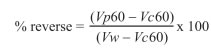
<body><![CDATA[<p><i>Gels scanning and image analysis</i></p>     <p>Images were captured trough a Gel Doc XR   Gel Documentation system (Bio Rad, Hercules,   CA, USA). Image analysis was performed through Quantity One and PD Quest software.</p>     <p><i>Protein addition to thawed semen</i></p>     <p>To estimate the effect of low molecular weight   proteins in post-thaw sperm viability, each straw   was separated in 1 million sperms per milliliter   aliquots and was assigned to one treatment: T1   (no added protein), T2 (1.0 mg total proteins from   seminal plasma), T3 (0.5 mg proteins separated by   SEC), T4 (1.0 mg proteins), T5 (1.5 mg proteins)   and T6 (2.0 mg protein. The fraction (called 21-   25) was re-suspended in Human Tubular Fluid   Medium (mHTF). Each aliquot was incubated at   37 &ordm;C during 1 h. At the end of incubation, sperm   viability was determined through CFDA staining.   Increase in sperm viability was calculated relative   to T1 (without protein) and reverse of damage was   determined through the equation developed by Barrios in 2000, as follows:</p>     <p align="center"><img src="/img/revistas/rccp/v26n2/v26n2a5g1.jpg"></p>     <p>Where: </p>     <p><i>V<sub>w</sub></i> = sperm viability of fresh sample before freezing   process;</p>     <p><i>V<sub>c60</sub></i> = sperm viability of sample without proteins   added;</p>     <p><i>V<sub>p60</sub></i> = sperm viability of sample after 1 h treatment</p>     <p>The percentage represents relation between   cells with viability restored and cells theoretically recoverable.</p>     ]]></body>
<body><![CDATA[<p><i>Statistical analysis</i></p>     <p>A completely randomized factorial design (4   x 2) was used to analyze the data, according to the following model:</p>     <p align="center">Y<sub>ij</sub>= &mu; + &alpha;<sub>i</sub> + &beta;<sub>j</sub>+ (&alpha;<sub>i</sub>&beta;<sub>j</sub>)+E<sub>ij</sub></p>     <p>Where: </p>     <p>Y<sub>ij</sub> = recovery percentage;</p>     <p>&micro; = total media l; </p>     <p>&alpha;<sub>i</sub>: = doses effect of protein added;</p>     <p>&beta;<sub>j</sub> = breed effect;</p>     <p>(&alpha;i&beta;<sub>j</sub>) = interaction effect;</p>     <p>E<sub>ij</sub> = experimental error.</p>     ]]></body>
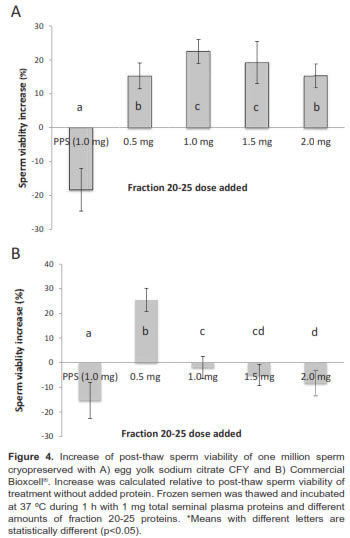
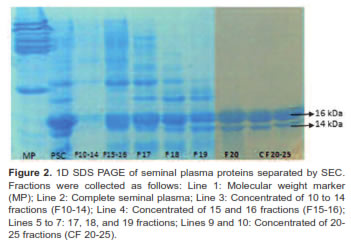
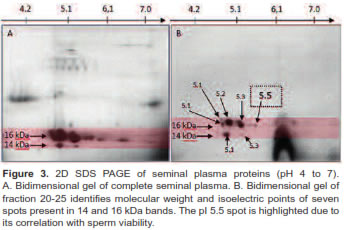
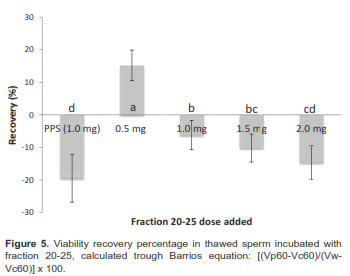
<body><![CDATA[<p>A Tukey comparison test was conducted to   evaluate recovery percentage differences between treatments.</p>     <p>&nbsp;</p>     <p><b><font size="3">Results </font></b></p>     <p><i>Seminal plasma proteins separation by SEC and SDS PAGE</i></p>     <p>Chromatography showed five protein peaks   (<a href="/img/revistas/rccp/v26n2/v26n2a5f1.jpg" target="_blank">Figure 1</a>). We found proteins with different   molecular weight to determine separation grade and to identify interest proteins from 10-25 fraction.</p>     <p>A concentrated sample from 20-25 fractions   was identified as the fraction with low molecular   weight proteins ranging from 14 to 16 KDa (<a href="#f2">Figure   2</a>). Separation by isoelectric point demonstrates the   presence of seven spots (<a href="#f3">Figure 3</a>). In this study we   used a concentrated from fractions 20-25 containing   a protein spot of 15.46 kDa and a 5.5 isoelectric   point. This spot has a positive correlation with   sperm viability (r = 0.51 p&lt;0.001) in Sanmartinero   semen and similar characteristics of BSP proteins (Barajas <i>et al.</i>, 2009).</p>     <p align="center"><a name="f2"></a><img src="/img/revistas/rccp/v26n2/v26n2a5f2.jpg"></p>     <p align="center"><a name="f3"></a><img src="/img/revistas/rccp/v26n2/v26n2a5f3.jpg"></p>     <p><i>Addition of fraction 21-25</i></p>     <p>When we evaluated the effect of adding fraction   21-25 in different doses (0.5, 1, 1.5, and 2 mg/ml)   to thawed sperm (previously cryopreserved with   two different media) and incubated at 37 &ordm;C during   1 h, we observed an increase of post-thaw sperm   viability against samples without added proteins.   Although dose effect depends on diluent, sperm   viability post-thaw significantly decreased when   complete seminal plasma was added to sperm   previously frozen with CFY and Bioxcell<sup>&reg;</sup> diluents (<a href="#f4">Figure 4</a>).</p>     ]]></body>
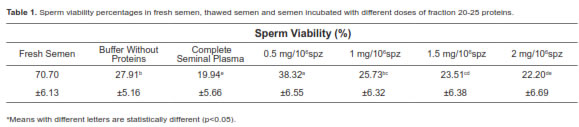
<body><![CDATA[<p align="center"><a name="f4"></a><img src="/img/revistas/rccp/v26n2/v26n2a5f4.jpg"></p>     <p align="center">&nbsp;</p>     <p>The post-thaw sperm viability of treatment   without protein added was 39.8 &plusmn; 8.2%. When   sperm previously frozen with CFY was incubated   with fraction 20-25 in concentrations between 1.0   and 1.5 mg, samples presented a 22.0 &plusmn; 6.5% sperm   viability increase relative to samples without protein   added. Doses greater and lesser than 1.5 mg (0.5 mg and 2.0 mg) were less effective.</p>     <p>Moreover, incubation of thawed samples   (previously frozen with Commercial Bioxcell<sup>&reg;</sup>   medium) evidenced different results. 0.5 mg   protein from fraction 21-25 was better to obtain   a 25.2 &plusmn; 5.3% increase. Greater amounts showed   a deleterious effect (e.g. when 1.0 mg of complete seminal plasma proteins was added).</p>     <p>We evaluated the reverse effect as the ability of   proteins to regenerate sperm viability considering   the damage since sample collection as a correction   in the equation generated by Barrios (2000). This   equation incorporates sperm viability before   cryopreservation, which eliminates individual variance between animals.</p>     <p>Sperm viability of fresh samples was 70.7 &plusmn; 6.1%   higher than post-thawed sperm viability (28.0 &plusmn; 5.2%   decrease of approx. 40%). The addition of fraction   20-25, using 0.5 mg/million sperm and Bioxcell<sup>&reg;</sup>   as cryoprotector medium presented higher sperm viability compared with other doses (<a href="#t1">Table 1</a>).</p>     <p align="center"><a name="t1"></a><img src="/img/revistas/rccp/v26n2/v26n2a5t1.jpg"></p>     <p>When analysis contemplates sperm viability   decrease relative to fresh sample through equation   &#91;(Vp60-Vc60)/(Vw-Vc60)&#93; x 100, it showed that the   percentage of viability recovery was approximately   15.23% and it was only positive with a 0.5 mg dose (<a href="#f5">Figure 5</a>).</p>     <p align="center"><a name="f5"></a><img src="/img/revistas/rccp/v26n2/v26n2a5f5.jpg"></p>     <p>When differences between races were evaluated,   the sperm viability decreased, due to the freezing   process, from 70. 6 &plusmn; 7.4 % (fresh samples) to 29.8   &plusmn; 5.3% (thawed samples) in Sanmartinero semen   (57.68%), while it decreased in Zebu from 70.8 &plusmn;   4.6% to 26.75 &plusmn; 4.3% (62.21%), differences being   not significant. Comparing post-thaw sperm viability   of samples incubated with 0.5 mg protein from   fraction 20-25 between breeds, sperm viability from   Sanmartinero bulls increased to 38 %, while no significant effect was observed in Zebu semen.</p>     ]]></body>
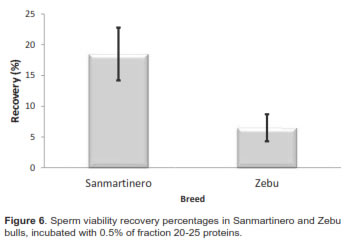
<body><![CDATA[<p>In regard to recovery percentage compared   between breeds, when 0.5 mg protein from fraction   20-25 was added, recovery in Sanmartinero bulls   was 18.03% while it was 6.8% in Zebu bulls significantly different (p&lt;0.05).</p>     <p align="center"><a name="f6"></a><img src="/img/revistas/rccp/v26n2/v26n2a5f6.jpg"></p>     <p>&nbsp;</p>     <p><b><font size="3">Discussion </font></b></p>     <p><i>Addition of seminal plasma proteins from fraction 20-25 to thawed sperm</i></p>     <p>A chromatographic fraction of seminal plasma   proteins containing one protein spot of 16.20 kDa   and pI 5.5 was used in this work, similar with   those reported for BSP proteins (Moura <i>et al.</i>,   2006). When samples were evaluated without   breed discrimination a 20% increase in post-thaw   sperm viability was observed when 1.0 to 1.5 mg per million of spermatozoa were used. This is the optimal dose when CTY was used. However, there was a similar effect of viability increase when using a lower dose (0.5 mg per million of spermatozoa) combined with commercial Bioxcell<sup>&reg;</sup> use. This indicates the possibility that Bioxcell<sup>&reg;</sup> medium contains some substance that interacts with seminal plasma proteins from fractions 21-25.</p>     <p>Furthermore, the addition of complete seminal   plasma proteins seems to have the opposite effect,   decreasing sperm viability after thawing. This is in   agreement with the report by Baas (1983) which   demonstrated that sperm integrity and motility can   regenerate only when seminal plasma was subjected   to ultrafiltration and protein fraction with molecular   weight was lower than 50 kDa. The same work   established that an excess of complete seminal   plasma has a negative effect on sperm viability   and also that the presence of low molecular weight   proteins has a stimulating effect on bovine semen viability.</p>     <p>Barrios (2000) established that adding complete   seminal plasma proteins did not decrease postthaw   sperm viability; it had a lower effect relative   to proteins between 14 and 20 kDa. His work also   demonstrated that addition of proteins larger than   60 kDa did not have a recovery effect in sperm membrane after a cold shock.</p>     <p>Moreover, low weight seminal plasma   proteins prevent deleterious effects when they   are added before the cryopreservation process. A   work with ram semen demonstrated that protein   addition before decreasing sperm temperature to   5 &ordm;C increased semen viability from 26% to 34%,   preserving membrane integrity (Perez-Pe <i>et al.</i>,   2001) and showing a reverse and protective effect   against cold shock. Data showed a 15% percent   recovery when 0.5 mg/million sperm was used.   Greater doses had no effect or negatively affected   post-thaw sperm viability. Recovery studies with   ram semen showed the optimal dose to obtain high   recovery percentages was 0.5 mg/million sperm.   However, greater doses up to 2.5 mg/million sperm   did not show negative effects (Barrios, 2000). It has   been shown that seminal plasma can repress and   revert sperm capacitation, in other words inactivate   sperm previously capacitated (Cross, 1993). This   may be due to an adsorption effect of some seminal   plasma proteins, such as the BSP proteins (possibly   contained in fraction 21-25). These proteins bind to   membrane phospholipids (Manjunath <i>et al.</i>, 2009;   Manjunath, 1987; Manjunath <i>et al.</i>, 1993; Souza   <i>et al.</i>, 2008; Moura <i>et al.</i>, 2007; Swamy, 2004),   which could explain the recovery effect observed   when fraction 20-25 protein was added. Since BSP   are major seminal plasma proteins (Manjunath <i>et al.</i>, 2009; Moura <i>et al.</i>, 2007; Manjunath, 1997)   their structure, amount in seminal plasma, and   interaction with female tract fluids regulate sperm   capacitation. It might be possible that a higher dose   of these proteins prematurely capacitate instead of   inhibiting sperm capacitation, which could explain   the negative effect when doses greater than 0.5 ml/   million sperm from fraction 20-25 were added. This   indicates that although there is a recovery effect, it depends on the doses added.</p>     <p><i>Post-thaw sperm viability and recovery of sperm viability in Sanmatinero and Zebu semen</i></p>     ]]></body>
<body><![CDATA[<p>It has been reported that sperm percentage with   undamaged membrane dramatically decreases after   freeze-thaw processing. This deleterious effect   has been demonstrated in ovine (Ashworth and   Harrison, 1994; Watson, 2000; Gunay <i>et al.</i>, 2006)   and bovine semen (Jobim <i>et al.</i>, 2004, Rubio <i>et al.</i>,   2009). In bull semen, it was found that the decrease   of sperm viability can reach between 40% and   60% during evaluation processes between sample collection and post-thaw (Rubio <i>et al.</i>, 2009).</p>     <p>When differences in sperm viability decrease   after thawing between Sanmartinero and Zebu   breeds were evaluated, it was determined that   Sanmartinero samples decreased from 70.6 &plusmn;   7.4% to 29.8 &plusmn; 5.3% after thawing (57.68%).   Meanwhile, Zebu semen viability decreased from   70.8 &plusmn; 4.6% to 26.7 &plusmn; 4.3% (62.2%). No significant   differences in viability after thawing were observed   in either breed. It was possible to demonstrate that   the addition of a low molecular weight protein   group was only effective for the recovery of   sperm membrane damage when it was added to   Sanmartinero semen. Even if there was an effect   on Zebu semen, it was not enough to be considered significant.</p>     <p>In conclusion, the use of fractions 20-25 proteins   in cryopreserved sperm, thawed and incubated for   1 h at 37&deg;C, increased the percentages of post-thaw   sperm viability when cryopreservation media were   used. However, the minimal dose required to have   a significant effect varies according to the diluent   used, indicating that the increase in post-thaw sperm   viability as well as the dose required of fraction   20-25 depends on the diluent used for sperm   cryopreservation. Furthermore, we were able to   demonstrate that when using a commercial freezing   medium, post-thaw viability of samples subjected   to doses greater than 0.5 mg per million sperm,   decreased significantly, probably due to interactions between proteins and commercial additives.</p>     <p>Although there is a reversion effect on the   damage caused by cryopreservation on sperm   membrane, Sanmartinero sperm was more capable   of improving its viability when incubated with   fraction 20-25, in comparison with Zebu sperm.   This may be because decrease in post freezing   sperm viability in Zebu bulls is higher than Sanmartinero.</p>     <p>&nbsp;</p> <hr size="1">    <p><b><font size="3">Notes</font></b></p>     <p><sup><a name="1"></a><a href="#b1">&curren;</a></sup> To cite this article: Rueda FL, Herrera RF, Arbel&aacute;ez LF, Garc&eacute;s T, Velasquez H, Pe&ntilde;a MA, Cardozo JA. Increase in post-thaw viability by adding seminal plasma proteins to Sanmartinero and Zebu sperm. Rev Colomb Cienc Pecu 2013; 26:98-107.</p> <hr size="1">     <p>&nbsp;</p>     <p>&nbsp;</p>     <p><b><font size="3">Acknowledgements </font></b></p>     ]]></body>
<body><![CDATA[<p>The authors give special thanks to Samuel   Correa, Gustavo Quijano, and Eliana Neira. This   work was funded by the Ministry of Agriculture   and Rural Development (MARD, agreement 517-   2007), the Colombian Corporation of Agricultural   Research, the National Livestock Federation   (FEDEGAN), and the Inter-American Institute for Cooperation on Agriculture (IICA).</p>     <p>&nbsp;</p>     <p><b><font size="3">References </font></b></p>     <!-- ref --><p>Ashworth PJC, Harrison RAP, Miller NGA, Plummer JM,   Watson PF. Survival of ram spermatozoa at high dilution:   protective effect of simple constituents of culture media as   compared with seminal plasma. Reprod Fert Develop 1994;   6:173-80.    &nbsp;&nbsp;&nbsp;&nbsp;&nbsp;&nbsp;&nbsp;&nbsp;[&#160;<a href="javascript:void(0);" onclick="javascript: window.open('/scielo.php?script=sci_nlinks&ref=000116&pid=S0120-0690201300020000500001&lng=','','width=640,height=500,resizable=yes,scrollbars=1,menubar=yes,');">Links</a>&#160;]<!-- end-ref --> </p>     <!-- ref --><p>Baas JW, Molan PC, Shannon P. Factors in seminal plasma of   bulls that affect the viability and motility of spermatozoa. J   Reprod Fertil 1983; 68:275-80.    &nbsp;&nbsp;&nbsp;&nbsp;&nbsp;&nbsp;&nbsp;&nbsp;[&#160;<a href="javascript:void(0);" onclick="javascript: window.open('/scielo.php?script=sci_nlinks&ref=000118&pid=S0120-0690201300020000500002&lng=','','width=640,height=500,resizable=yes,scrollbars=1,menubar=yes,');">Links</a>&#160;]<!-- end-ref --> </p>     <!-- ref --><p>Barajas DP, Coy P, Vel&aacute;squez JG, Rueda F, Herrera R, Cardozo   JA. Prote&iacute;nas del plasma seminal asociadas con la fertilidad de   toros criollos Sanmartinero y Ceb&uacute; en condiciones del tr&oacute;pico   colombiano. Memorias Simposio de recursos gen&eacute;ticos para   Am&eacute;rica Latina y el Caribe SIRGELAC 2009; 153-154.    &nbsp;&nbsp;&nbsp;&nbsp;&nbsp;&nbsp;&nbsp;&nbsp;[&#160;<a href="javascript:void(0);" onclick="javascript: window.open('/scielo.php?script=sci_nlinks&ref=000120&pid=S0120-0690201300020000500003&lng=','','width=640,height=500,resizable=yes,scrollbars=1,menubar=yes,');">Links</a>&#160;]<!-- end-ref --></p>     <!-- ref --><p>Barrios B, Perez-Pe R, Gallego M. Seminal plasma proteins   revert the cold-shock damage on ram sperm membrane. Biol   Reprod 2000; 63:1531-1537.    &nbsp;&nbsp;&nbsp;&nbsp;&nbsp;&nbsp;&nbsp;&nbsp;[&#160;<a href="javascript:void(0);" onclick="javascript: window.open('/scielo.php?script=sci_nlinks&ref=000122&pid=S0120-0690201300020000500004&lng=','','width=640,height=500,resizable=yes,scrollbars=1,menubar=yes,');">Links</a>&#160;]<!-- end-ref --> </p>     <!-- ref --><p>Barth AD. Evaluaci&oacute;n de semen bovino congelado. CABIA   1990; 21:28-36.    &nbsp;&nbsp;&nbsp;&nbsp;&nbsp;&nbsp;&nbsp;&nbsp;[&#160;<a href="javascript:void(0);" onclick="javascript: window.open('/scielo.php?script=sci_nlinks&ref=000124&pid=S0120-0690201300020000500005&lng=','','width=640,height=500,resizable=yes,scrollbars=1,menubar=yes,');">Links</a>&#160;]<!-- end-ref --> </p>     <!-- ref --><p>Calvete J, Varela P, Sanz L, Romero A. A procedure for the   large-scale isolation of major bovine Seminal plasma proteins.   Protein Expres Purif 1996; 8:48-56.    &nbsp;&nbsp;&nbsp;&nbsp;&nbsp;&nbsp;&nbsp;&nbsp;[&#160;<a href="javascript:void(0);" onclick="javascript: window.open('/scielo.php?script=sci_nlinks&ref=000126&pid=S0120-0690201300020000500006&lng=','','width=640,height=500,resizable=yes,scrollbars=1,menubar=yes,');">Links</a>&#160;]<!-- end-ref --> </p>     <!-- ref --><p>Cross NL. Multiple effects of seminal plasma on the acrosome   reaction of human sperm. Mol Reprod Dev 1993; 35:316-323.    &nbsp;&nbsp;&nbsp;&nbsp;&nbsp;&nbsp;&nbsp;&nbsp;[&#160;<a href="javascript:void(0);" onclick="javascript: window.open('/scielo.php?script=sci_nlinks&ref=000128&pid=S0120-0690201300020000500007&lng=','','width=640,height=500,resizable=yes,scrollbars=1,menubar=yes,');">Links</a>&#160;]<!-- end-ref --> </p>     <!-- ref --><p>Gunay U, Dogan I, Nur Z. Influence of bull seminal plasma on   post-thaw ram semen parameters and fertility. B Vet I Pulawy   2006; 50:503-507.    &nbsp;&nbsp;&nbsp;&nbsp;&nbsp;&nbsp;&nbsp;&nbsp;[&#160;<a href="javascript:void(0);" onclick="javascript: window.open('/scielo.php?script=sci_nlinks&ref=000130&pid=S0120-0690201300020000500008&lng=','','width=640,height=500,resizable=yes,scrollbars=1,menubar=yes,');">Links</a>&#160;]<!-- end-ref --> </p>     <!-- ref --><p>Gwathmey TM. PDC-109 (BSP-A1/A2) promotes bull sperm   binding to oviductal epithelium in vitro and may be involved   in forming the oviductal sperm reservoir. Biol Reprod 2003;   69:809-815.    &nbsp;&nbsp;&nbsp;&nbsp;&nbsp;&nbsp;&nbsp;&nbsp;[&#160;<a href="javascript:void(0);" onclick="javascript: window.open('/scielo.php?script=sci_nlinks&ref=000132&pid=S0120-0690201300020000500009&lng=','','width=640,height=500,resizable=yes,scrollbars=1,menubar=yes,');">Links</a>&#160;]<!-- end-ref --> </p>     <!-- ref --><p>Harrison RA, Vickers S. Use of fluorescent probes to assess   membrane integrity in mammalian spermatozoa. J Reprod Ferti   1990; 88:342-353.    &nbsp;&nbsp;&nbsp;&nbsp;&nbsp;&nbsp;&nbsp;&nbsp;[&#160;<a href="javascript:void(0);" onclick="javascript: window.open('/scielo.php?script=sci_nlinks&ref=000134&pid=S0120-0690201300020000500010&lng=','','width=640,height=500,resizable=yes,scrollbars=1,menubar=yes,');">Links</a>&#160;]<!-- end-ref --> </p>     <!-- ref --><p>Jobim M, Oberst E. Two-dimensional polyacrylamide gel   electrophoresis of bovine seminal plasma proteins and their   relation with semen freezability. Theriogenology 2004; 61:255-   266.    &nbsp;&nbsp;&nbsp;&nbsp;&nbsp;&nbsp;&nbsp;&nbsp;[&#160;<a href="javascript:void(0);" onclick="javascript: window.open('/scielo.php?script=sci_nlinks&ref=000136&pid=S0120-0690201300020000500011&lng=','','width=640,height=500,resizable=yes,scrollbars=1,menubar=yes,');">Links</a>&#160;]<!-- end-ref --> </p>     <!-- ref --><p>Killian J, Chapman D, Rogowsky L. Fertility-Associated   Proteins in Holstein Bull Seminal Plasma. Biol Reprod 1993;   49:1202-1207.    &nbsp;&nbsp;&nbsp;&nbsp;&nbsp;&nbsp;&nbsp;&nbsp;[&#160;<a href="javascript:void(0);" onclick="javascript: window.open('/scielo.php?script=sci_nlinks&ref=000138&pid=S0120-0690201300020000500012&lng=','','width=640,height=500,resizable=yes,scrollbars=1,menubar=yes,');">Links</a>&#160;]<!-- end-ref --> </p>     <!-- ref --><p>Manjunath P, Sairam M. Purification and Biochemical   characterization of three major acidic proteins (BSP A1, A2 y   A3) in bovine seminal plasma. J Biochem 1987; 241:685-692.    &nbsp;&nbsp;&nbsp;&nbsp;&nbsp;&nbsp;&nbsp;&nbsp;[&#160;<a href="javascript:void(0);" onclick="javascript: window.open('/scielo.php?script=sci_nlinks&ref=000140&pid=S0120-0690201300020000500013&lng=','','width=640,height=500,resizable=yes,scrollbars=1,menubar=yes,');">Links</a>&#160;]<!-- end-ref --> </p>     <!-- ref --><p>Manjunath P. Purification of four gelatin-binding proteins from   bovine seminal plasma by affinity chromatography. Biosciences   Rep 1987; 7:231-238.    &nbsp;&nbsp;&nbsp;&nbsp;&nbsp;&nbsp;&nbsp;&nbsp;[&#160;<a href="javascript:void(0);" onclick="javascript: window.open('/scielo.php?script=sci_nlinks&ref=000142&pid=S0120-0690201300020000500014&lng=','','width=640,height=500,resizable=yes,scrollbars=1,menubar=yes,');">Links</a>&#160;]<!-- end-ref --> </p>     <!-- ref --><p>Manjunath P, Chadonet E. Major proteins of bovine seminal   vesicles bind to spermatozoa. Biol Reprod 1993; 49:27-37.    &nbsp;&nbsp;&nbsp;&nbsp;&nbsp;&nbsp;&nbsp;&nbsp;[&#160;<a href="javascript:void(0);" onclick="javascript: window.open('/scielo.php?script=sci_nlinks&ref=000144&pid=S0120-0690201300020000500015&lng=','','width=640,height=500,resizable=yes,scrollbars=1,menubar=yes,');">Links</a>&#160;]<!-- end-ref --> </p>     <!-- ref --><p>Manjunath P, Therien I. Role of seminal plasma phospholipids   binding proteins in seperm membrane lipids modification that   occurs during capacitation. J reprod immunol 2002; 53:109-19.    &nbsp;&nbsp;&nbsp;&nbsp;&nbsp;&nbsp;&nbsp;&nbsp;[&#160;<a href="javascript:void(0);" onclick="javascript: window.open('/scielo.php?script=sci_nlinks&ref=000146&pid=S0120-0690201300020000500016&lng=','','width=640,height=500,resizable=yes,scrollbars=1,menubar=yes,');">Links</a>&#160;]<!-- end-ref --> </p>     <!-- ref --><p>Manjunath P, Lefebvre J, Wright W. New Nomenclature for   Mammalian BSP Genes. Biol reprod 2009; 80:394-397.    &nbsp;&nbsp;&nbsp;&nbsp;&nbsp;&nbsp;&nbsp;&nbsp;[&#160;<a href="javascript:void(0);" onclick="javascript: window.open('/scielo.php?script=sci_nlinks&ref=000148&pid=S0120-0690201300020000500017&lng=','','width=640,height=500,resizable=yes,scrollbars=1,menubar=yes,');">Links</a>&#160;]<!-- end-ref --> </p>     <!-- ref --><p>Moura A, Koc H. Identification of prote&iacute;ns in accessory Sex   Gland Fluid associated with fertility indexes of dairy bulls. J   Androl 2006; 27:201-212.    &nbsp;&nbsp;&nbsp;&nbsp;&nbsp;&nbsp;&nbsp;&nbsp;[&#160;<a href="javascript:void(0);" onclick="javascript: window.open('/scielo.php?script=sci_nlinks&ref=000150&pid=S0120-0690201300020000500018&lng=','','width=640,height=500,resizable=yes,scrollbars=1,menubar=yes,');">Links</a>&#160;]<!-- end-ref --> </p>     <!-- ref --><p>Moura A, Chapman D, Koc H, Killian G.A. Comprehensive   proteomic analysis of the accessory sex gland fluid from mature   Holstein bulls. Anim Reprod Sci 2007; 98:169-188.    &nbsp;&nbsp;&nbsp;&nbsp;&nbsp;&nbsp;&nbsp;&nbsp;[&#160;<a href="javascript:void(0);" onclick="javascript: window.open('/scielo.php?script=sci_nlinks&ref=000152&pid=S0120-0690201300020000500019&lng=','','width=640,height=500,resizable=yes,scrollbars=1,menubar=yes,');">Links</a>&#160;]<!-- end-ref --> </p>     <!-- ref --><p>Moussa M, Matinet V, Trimeche A, Tainturier D, Anton M.   Low density lipoproteins extracted from hen egg yolk by an easy method: cryoprotective effect on frozen-thawed bull   semen. Theriogenology 2002; 57:1695-706.    &nbsp;&nbsp;&nbsp;&nbsp;&nbsp;&nbsp;&nbsp;&nbsp;[&#160;<a href="javascript:void(0);" onclick="javascript: window.open('/scielo.php?script=sci_nlinks&ref=000154&pid=S0120-0690201300020000500020&lng=','','width=640,height=500,resizable=yes,scrollbars=1,menubar=yes,');">Links</a>&#160;]<!-- end-ref --> </p>     <!-- ref --><p>Pace MM, Graham EF.Components in egg yolk which protect   bovine sperm during freezing. J Anim Sci 1974; 39:1144-1149.    &nbsp;&nbsp;&nbsp;&nbsp;&nbsp;&nbsp;&nbsp;&nbsp;[&#160;<a href="javascript:void(0);" onclick="javascript: window.open('/scielo.php?script=sci_nlinks&ref=000156&pid=S0120-0690201300020000500021&lng=','','width=640,height=500,resizable=yes,scrollbars=1,menubar=yes,');">Links</a>&#160;]<!-- end-ref --> </p>     <!-- ref --><p>P&eacute;rez-PeR, Cebri&aacute;n-P&eacute;rez JA, Mui&ntilde;o-Blanco T. Semen plasma   prevent cold shock membrane damage to ram spermatozoa.   Theriogenology 2001; 56:425-435.    &nbsp;&nbsp;&nbsp;&nbsp;&nbsp;&nbsp;&nbsp;&nbsp;[&#160;<a href="javascript:void(0);" onclick="javascript: window.open('/scielo.php?script=sci_nlinks&ref=000158&pid=S0120-0690201300020000500022&lng=','','width=640,height=500,resizable=yes,scrollbars=1,menubar=yes,');">Links</a>&#160;]<!-- end-ref --> </p>     <!-- ref --><p>Pursel VG. Effect of processing of semen on capacitation time   of fresh and frozen-thawed boar spermatozoa. J Anim Sci 1983;   56:1161-1166.    &nbsp;&nbsp;&nbsp;&nbsp;&nbsp;&nbsp;&nbsp;&nbsp;[&#160;<a href="javascript:void(0);" onclick="javascript: window.open('/scielo.php?script=sci_nlinks&ref=000160&pid=S0120-0690201300020000500023&lng=','','width=640,height=500,resizable=yes,scrollbars=1,menubar=yes,');">Links</a>&#160;]<!-- end-ref --> </p>     <!-- ref --><p>Rubio J, Quintero A, Gonzales D. Effect of Cryopreservation   on Integrity of Plasmatic and Acrosomal Membrane of Bulls   Sperm. Rev Cient Fac Cien V 2009; 29:382-389.    &nbsp;&nbsp;&nbsp;&nbsp;&nbsp;&nbsp;&nbsp;&nbsp;[&#160;<a href="javascript:void(0);" onclick="javascript: window.open('/scielo.php?script=sci_nlinks&ref=000162&pid=S0120-0690201300020000500024&lng=','','width=640,height=500,resizable=yes,scrollbars=1,menubar=yes,');">Links</a>&#160;]<!-- end-ref --> </p>     <!-- ref --><p>Sanchez S. Interaction of PDC 109, the major secretory proteins   from bull seminal vesicles, with bovine sperm membrane. J   Androl 2004; 25:234-244.    &nbsp;&nbsp;&nbsp;&nbsp;&nbsp;&nbsp;&nbsp;&nbsp;[&#160;<a href="javascript:void(0);" onclick="javascript: window.open('/scielo.php?script=sci_nlinks&ref=000164&pid=S0120-0690201300020000500025&lng=','','width=640,height=500,resizable=yes,scrollbars=1,menubar=yes,');">Links</a>&#160;]<!-- end-ref --> </p>     <!-- ref --><p>Swamy M. Interaction of bovine seminal plasma proteins with   model membranes and sperm plasma membranes. Curr Sci   India 2004; 87:203-211.    &nbsp;&nbsp;&nbsp;&nbsp;&nbsp;&nbsp;&nbsp;&nbsp;[&#160;<a href="javascript:void(0);" onclick="javascript: window.open('/scielo.php?script=sci_nlinks&ref=000166&pid=S0120-0690201300020000500026&lng=','','width=640,height=500,resizable=yes,scrollbars=1,menubar=yes,');">Links</a>&#160;]<!-- end-ref --> </p>     <!-- ref --><p>Watson PF. The causes of reduced fertility with cryopreserved   semen. Anim Reprod Sci 2000; 60-61:481-492.    &nbsp;&nbsp;&nbsp;&nbsp;&nbsp;&nbsp;&nbsp;&nbsp;[&#160;<a href="javascript:void(0);" onclick="javascript: window.open('/scielo.php?script=sci_nlinks&ref=000168&pid=S0120-0690201300020000500027&lng=','','width=640,height=500,resizable=yes,scrollbars=1,menubar=yes,');">Links</a>&#160;]<!-- end-ref --></p>     <p>&nbsp;</p> </font>     ]]></body><back>
<ref-list>
<ref id="B1">
<nlm-citation citation-type="journal">
<person-group person-group-type="author">
<name>
<surname><![CDATA[Ashworth]]></surname>
<given-names><![CDATA[PJC]]></given-names>
</name>
<name>
<surname><![CDATA[Harrison]]></surname>
<given-names><![CDATA[RAP]]></given-names>
</name>
<name>
<surname><![CDATA[Miller]]></surname>
<given-names><![CDATA[NGA]]></given-names>
</name>
<name>
<surname><![CDATA[Plummer]]></surname>
<given-names><![CDATA[JM]]></given-names>
</name>
<name>
<surname><![CDATA[Watson]]></surname>
<given-names><![CDATA[PF.]]></given-names>
</name>
</person-group>
<article-title xml:lang="en"><![CDATA[Survival of ram spermatozoa at high dilution: protective effect of simple constituents of culture media as compared with seminal plasma]]></article-title>
<source><![CDATA[Reprod Fert Develop]]></source>
<year>1994</year>
<volume>6</volume>
<page-range>173-80</page-range></nlm-citation>
</ref>
<ref id="B2">
<nlm-citation citation-type="journal">
<person-group person-group-type="author">
<name>
<surname><![CDATA[Baas]]></surname>
<given-names><![CDATA[JW]]></given-names>
</name>
<name>
<surname><![CDATA[Molan]]></surname>
<given-names><![CDATA[PC]]></given-names>
</name>
<name>
<surname><![CDATA[Shannon]]></surname>
<given-names><![CDATA[P.]]></given-names>
</name>
</person-group>
<article-title xml:lang="en"><![CDATA[Factors in seminal plasma of bulls that affect the viability and motility of spermatozoa]]></article-title>
<source><![CDATA[J Reprod Fertil]]></source>
<year>1983</year>
<volume>68</volume>
<page-range>275-80</page-range></nlm-citation>
</ref>
<ref id="B3">
<nlm-citation citation-type="">
<person-group person-group-type="author">
<name>
<surname><![CDATA[Barajas]]></surname>
<given-names><![CDATA[DP]]></given-names>
</name>
<name>
<surname><![CDATA[Coy]]></surname>
<given-names><![CDATA[P]]></given-names>
</name>
<name>
<surname><![CDATA[Velásquez]]></surname>
<given-names><![CDATA[JG]]></given-names>
</name>
<name>
<surname><![CDATA[Rueda]]></surname>
<given-names><![CDATA[F]]></given-names>
</name>
<name>
<surname><![CDATA[Herrera]]></surname>
<given-names><![CDATA[R]]></given-names>
</name>
<name>
<surname><![CDATA[Cardozo]]></surname>
<given-names><![CDATA[JA.]]></given-names>
</name>
</person-group>
<source><![CDATA[Proteínas del plasma seminal asociadas con la fertilidad de toros criollos Sanmartinero y Cebú en condiciones del trópico colombiano. Memorias Simposio de recursos genéticos para América Latina y el Caribe SIRGELAC]]></source>
<year>2009</year>
<page-range>153-154</page-range></nlm-citation>
</ref>
<ref id="B4">
<nlm-citation citation-type="journal">
<person-group person-group-type="author">
<name>
<surname><![CDATA[Barrios]]></surname>
<given-names><![CDATA[B]]></given-names>
</name>
<name>
<surname><![CDATA[Perez-Pe]]></surname>
<given-names><![CDATA[R]]></given-names>
</name>
<name>
<surname><![CDATA[Gallego]]></surname>
<given-names><![CDATA[M.]]></given-names>
</name>
</person-group>
<article-title xml:lang="en"><![CDATA[Seminal plasma proteins revert the cold-shock damage on ram sperm membrane]]></article-title>
<source><![CDATA[Biol Reprod]]></source>
<year>2000</year>
<volume>63</volume>
<page-range>1531-1537</page-range></nlm-citation>
</ref>
<ref id="B5">
<nlm-citation citation-type="journal">
<person-group person-group-type="author">
<name>
<surname><![CDATA[Barth]]></surname>
<given-names><![CDATA[AD.]]></given-names>
</name>
</person-group>
<article-title xml:lang="es"><![CDATA[Evaluación de semen bovino congelado]]></article-title>
<source><![CDATA[CABIA]]></source>
<year>1990</year>
<volume>21</volume>
<page-range>28-36</page-range></nlm-citation>
</ref>
<ref id="B6">
<nlm-citation citation-type="journal">
<person-group person-group-type="author">
<name>
<surname><![CDATA[Calvete]]></surname>
<given-names><![CDATA[J]]></given-names>
</name>
<name>
<surname><![CDATA[Varela]]></surname>
<given-names><![CDATA[P]]></given-names>
</name>
<name>
<surname><![CDATA[Sanz]]></surname>
<given-names><![CDATA[L]]></given-names>
</name>
<name>
<surname><![CDATA[Romero]]></surname>
<given-names><![CDATA[A.]]></given-names>
</name>
</person-group>
<article-title xml:lang="en"><![CDATA[A procedure for the large-scale isolation of major bovine Seminal plasma proteins]]></article-title>
<source><![CDATA[Protein Expres Purif]]></source>
<year>1996</year>
<volume>8</volume>
<page-range>48-56</page-range></nlm-citation>
</ref>
<ref id="B7">
<nlm-citation citation-type="journal">
<person-group person-group-type="author">
<name>
<surname><![CDATA[Cross]]></surname>
<given-names><![CDATA[NL.]]></given-names>
</name>
</person-group>
<article-title xml:lang="en"><![CDATA[Multiple effects of seminal plasma on the acrosome reaction of human sperm]]></article-title>
<source><![CDATA[Mol Reprod Dev]]></source>
<year>1993</year>
<volume>35</volume>
<page-range>316-323</page-range></nlm-citation>
</ref>
<ref id="B8">
<nlm-citation citation-type="journal">
<person-group person-group-type="author">
<name>
<surname><![CDATA[Gunay]]></surname>
<given-names><![CDATA[U]]></given-names>
</name>
<name>
<surname><![CDATA[Dogan]]></surname>
<given-names><![CDATA[I]]></given-names>
</name>
<name>
<surname><![CDATA[Nur]]></surname>
<given-names><![CDATA[Z.]]></given-names>
</name>
</person-group>
<article-title xml:lang="en"><![CDATA[Influence of bull seminal plasma on post-thaw ram semen parameters and fertility]]></article-title>
<source><![CDATA[B Vet I Pulawy]]></source>
<year>2006</year>
<volume>50</volume>
<page-range>503-507</page-range></nlm-citation>
</ref>
<ref id="B9">
<nlm-citation citation-type="journal">
<person-group person-group-type="author">
<name>
<surname><![CDATA[Gwathmey]]></surname>
<given-names><![CDATA[TM]]></given-names>
</name>
</person-group>
<article-title xml:lang="en"><![CDATA[PDC-109 (BSP-A1/A2) promotes bull sperm binding to oviductal epithelium in vitro and may be involved in forming the oviductal sperm reservoir]]></article-title>
<source><![CDATA[Biol Reprod]]></source>
<year>2003</year>
<volume>69</volume>
<page-range>809-815</page-range></nlm-citation>
</ref>
<ref id="B10">
<nlm-citation citation-type="journal">
<person-group person-group-type="author">
<name>
<surname><![CDATA[Harrison]]></surname>
<given-names><![CDATA[RA]]></given-names>
</name>
<name>
<surname><![CDATA[Vickers]]></surname>
<given-names><![CDATA[S.]]></given-names>
</name>
</person-group>
<article-title xml:lang="en"><![CDATA[Use of fluorescent probes to assess membrane integrity in mammalian spermatozoa]]></article-title>
<source><![CDATA[J Reprod Ferti]]></source>
<year>1990</year>
<volume>88</volume>
<page-range>342-353</page-range></nlm-citation>
</ref>
<ref id="B11">
<nlm-citation citation-type="journal">
<person-group person-group-type="author">
<name>
<surname><![CDATA[Jobim]]></surname>
<given-names><![CDATA[M]]></given-names>
</name>
<name>
<surname><![CDATA[Oberst]]></surname>
<given-names><![CDATA[E.]]></given-names>
</name>
</person-group>
<article-title xml:lang="en"><![CDATA[Two-dimensional polyacrylamide gel electrophoresis of bovine seminal plasma proteins and their relation with semen freezability]]></article-title>
<source><![CDATA[Theriogenology]]></source>
<year>2004</year>
<volume>61</volume>
<page-range>255- 266</page-range></nlm-citation>
</ref>
<ref id="B12">
<nlm-citation citation-type="journal">
<person-group person-group-type="author">
<name>
<surname><![CDATA[Killian]]></surname>
<given-names><![CDATA[J]]></given-names>
</name>
<name>
<surname><![CDATA[Chapman]]></surname>
<given-names><![CDATA[D]]></given-names>
</name>
<name>
<surname><![CDATA[Rogowsky]]></surname>
<given-names><![CDATA[L]]></given-names>
</name>
</person-group>
<article-title xml:lang="en"><![CDATA[Fertility-Associated Proteins in Holstein Bull Seminal Plasma]]></article-title>
<source><![CDATA[Biol Reprod]]></source>
<year>1993</year>
<volume>49</volume>
<page-range>1202-1207</page-range></nlm-citation>
</ref>
<ref id="B13">
<nlm-citation citation-type="journal">
<person-group person-group-type="author">
<name>
<surname><![CDATA[Manjunath]]></surname>
<given-names><![CDATA[P]]></given-names>
</name>
<name>
<surname><![CDATA[Sairam]]></surname>
<given-names><![CDATA[M.]]></given-names>
</name>
</person-group>
<article-title xml:lang="en"><![CDATA[Purification and Biochemical characterization of three major acidic proteins (BSP A1, A2 y A3) in bovine seminal plasma]]></article-title>
<source><![CDATA[J Biochem]]></source>
<year>1987</year>
<volume>241</volume>
<page-range>685-692</page-range></nlm-citation>
</ref>
<ref id="B14">
<nlm-citation citation-type="journal">
<person-group person-group-type="author">
<name>
<surname><![CDATA[Manjunath]]></surname>
<given-names><![CDATA[P.]]></given-names>
</name>
</person-group>
<article-title xml:lang="en"><![CDATA[Purification of four gelatin-binding proteins from bovine seminal plasma by affinity chromatography]]></article-title>
<source><![CDATA[Biosciences Rep]]></source>
<year>1987</year>
<volume>7</volume>
<page-range>231-238</page-range></nlm-citation>
</ref>
<ref id="B15">
<nlm-citation citation-type="journal">
<person-group person-group-type="author">
<name>
<surname><![CDATA[Manjunath]]></surname>
<given-names><![CDATA[P]]></given-names>
</name>
<name>
<surname><![CDATA[Chadonet]]></surname>
<given-names><![CDATA[E.]]></given-names>
</name>
</person-group>
<article-title xml:lang="en"><![CDATA[Major proteins of bovine seminal vesicles bind to spermatozoa]]></article-title>
<source><![CDATA[Biol Reprod]]></source>
<year>1993</year>
<volume>49</volume>
<page-range>27-37</page-range></nlm-citation>
</ref>
<ref id="B16">
<nlm-citation citation-type="journal">
<person-group person-group-type="author">
<name>
<surname><![CDATA[Manjunath]]></surname>
<given-names><![CDATA[P]]></given-names>
</name>
<name>
<surname><![CDATA[Therien]]></surname>
<given-names><![CDATA[I.]]></given-names>
</name>
</person-group>
<article-title xml:lang="en"><![CDATA[Role of seminal plasma phospholipids binding proteins in seperm membrane lipids modification that occurs during capacitation]]></article-title>
<source><![CDATA[J reprod immunol]]></source>
<year>2002</year>
<volume>53</volume>
<page-range>109-19</page-range></nlm-citation>
</ref>
<ref id="B17">
<nlm-citation citation-type="journal">
<person-group person-group-type="author">
<name>
<surname><![CDATA[Manjunath]]></surname>
<given-names><![CDATA[P]]></given-names>
</name>
<name>
<surname><![CDATA[Lefebvre]]></surname>
<given-names><![CDATA[J]]></given-names>
</name>
<name>
<surname><![CDATA[Wright]]></surname>
<given-names><![CDATA[W.]]></given-names>
</name>
</person-group>
<article-title xml:lang="en"><![CDATA[New Nomenclature for Mammalian BSP Genes]]></article-title>
<source><![CDATA[Biol reprod]]></source>
<year>2009</year>
<volume>80</volume>
<page-range>394-397</page-range></nlm-citation>
</ref>
<ref id="B18">
<nlm-citation citation-type="journal">
<person-group person-group-type="author">
<name>
<surname><![CDATA[Moura]]></surname>
<given-names><![CDATA[A]]></given-names>
</name>
<name>
<surname><![CDATA[Koc]]></surname>
<given-names><![CDATA[H.]]></given-names>
</name>
</person-group>
<article-title xml:lang="en"><![CDATA[Identification of proteíns in accessory Sex Gland Fluid associated with fertility indexes of dairy bulls]]></article-title>
<source><![CDATA[J Androl]]></source>
<year>2006</year>
<volume>27</volume>
<page-range>201-212</page-range></nlm-citation>
</ref>
<ref id="B19">
<nlm-citation citation-type="journal">
<person-group person-group-type="author">
<name>
<surname><![CDATA[Moura]]></surname>
<given-names><![CDATA[A]]></given-names>
</name>
<name>
<surname><![CDATA[Chapman]]></surname>
<given-names><![CDATA[D]]></given-names>
</name>
<name>
<surname><![CDATA[Koc]]></surname>
<given-names><![CDATA[H]]></given-names>
</name>
<name>
<surname><![CDATA[Killian]]></surname>
<given-names><![CDATA[G.A.]]></given-names>
</name>
</person-group>
<article-title xml:lang="en"><![CDATA[Comprehensive proteomic analysis of the accessory sex gland fluid from mature Holstein bulls]]></article-title>
<source><![CDATA[Anim Reprod Sci]]></source>
<year>2007</year>
<volume>98</volume>
<page-range>169-188</page-range></nlm-citation>
</ref>
<ref id="B20">
<nlm-citation citation-type="journal">
<person-group person-group-type="author">
<name>
<surname><![CDATA[Moussa]]></surname>
<given-names><![CDATA[M]]></given-names>
</name>
<name>
<surname><![CDATA[Matinet]]></surname>
<given-names><![CDATA[V]]></given-names>
</name>
<name>
<surname><![CDATA[Trimeche]]></surname>
<given-names><![CDATA[A]]></given-names>
</name>
<name>
<surname><![CDATA[Tainturier]]></surname>
<given-names><![CDATA[D]]></given-names>
</name>
<name>
<surname><![CDATA[Anton]]></surname>
<given-names><![CDATA[M.]]></given-names>
</name>
</person-group>
<article-title xml:lang="en"><![CDATA[Low density lipoproteins extracted from hen egg yolk by an easy method: cryoprotective effect on frozen-thawed bull semen]]></article-title>
<source><![CDATA[Theriogenology]]></source>
<year>2002</year>
<volume>57</volume>
<page-range>1695-706</page-range></nlm-citation>
</ref>
<ref id="B21">
<nlm-citation citation-type="journal">
<person-group person-group-type="author">
<name>
<surname><![CDATA[Pace]]></surname>
<given-names><![CDATA[MM]]></given-names>
</name>
<name>
<surname><![CDATA[Graham]]></surname>
<given-names><![CDATA[EF.]]></given-names>
</name>
</person-group>
<source><![CDATA[J Anim Sci]]></source>
<year>1974</year>
<volume>39</volume>
<page-range>1144-1149</page-range></nlm-citation>
</ref>
<ref id="B22">
<nlm-citation citation-type="journal">
<person-group person-group-type="author">
<name>
<surname><![CDATA[Pérez]]></surname>
<given-names><![CDATA[PeR]]></given-names>
</name>
<name>
<surname><![CDATA[Cebrián-Pérez]]></surname>
<given-names><![CDATA[JA]]></given-names>
</name>
<name>
<surname><![CDATA[Muiño-Blanco]]></surname>
<given-names><![CDATA[T.]]></given-names>
</name>
</person-group>
<article-title xml:lang="en"><![CDATA[Semen plasma prevent cold shock membrane damage to ram spermatozoa]]></article-title>
<source><![CDATA[Theriogenology]]></source>
<year>2001</year>
<volume>56</volume>
<page-range>425-435</page-range></nlm-citation>
</ref>
<ref id="B23">
<nlm-citation citation-type="journal">
<person-group person-group-type="author">
<name>
<surname><![CDATA[Pursel]]></surname>
<given-names><![CDATA[VG.]]></given-names>
</name>
</person-group>
<article-title xml:lang="en"><![CDATA[Effect of processing of semen on capacitation time of fresh and frozen-thawed boar spermatozoa]]></article-title>
<source><![CDATA[J Anim Sci]]></source>
<year>1983</year>
<volume>56</volume>
<page-range>1161-1166</page-range></nlm-citation>
</ref>
<ref id="B24">
<nlm-citation citation-type="journal">
<person-group person-group-type="author">
<name>
<surname><![CDATA[Rubio]]></surname>
<given-names><![CDATA[J]]></given-names>
</name>
<name>
<surname><![CDATA[Quintero]]></surname>
<given-names><![CDATA[A]]></given-names>
</name>
<name>
<surname><![CDATA[Gonzales]]></surname>
<given-names><![CDATA[D.]]></given-names>
</name>
</person-group>
<article-title xml:lang="en"><![CDATA[Effect of Cryopreservation on Integrity of Plasmatic and Acrosomal Membrane of Bulls Sperm]]></article-title>
<source><![CDATA[Rev Cient Fac Cien V]]></source>
<year>2009</year>
<volume>29</volume>
<page-range>382-389</page-range></nlm-citation>
</ref>
<ref id="B25">
<nlm-citation citation-type="journal">
<person-group person-group-type="author">
<name>
<surname><![CDATA[Sanchez]]></surname>
<given-names><![CDATA[S.]]></given-names>
</name>
</person-group>
<article-title xml:lang="en"><![CDATA[Interaction of PDC 109, the major secretory proteins from bull seminal vesicles, with bovine sperm membrane]]></article-title>
<source><![CDATA[J Androl]]></source>
<year>2004</year>
<volume>25</volume>
<page-range>234-244</page-range></nlm-citation>
</ref>
<ref id="B26">
<nlm-citation citation-type="journal">
<person-group person-group-type="author">
<name>
<surname><![CDATA[Swamy]]></surname>
<given-names><![CDATA[M.]]></given-names>
</name>
</person-group>
<article-title xml:lang="en"><![CDATA[Interaction of bovine seminal plasma proteins with model membranes and sperm plasma membranes]]></article-title>
<source><![CDATA[Curr Sci India]]></source>
<year>2004</year>
<volume>87</volume>
<page-range>203-211</page-range></nlm-citation>
</ref>
<ref id="B27">
<nlm-citation citation-type="journal">
<person-group person-group-type="author">
<name>
<surname><![CDATA[Watson]]></surname>
<given-names><![CDATA[PF.]]></given-names>
</name>
</person-group>
<article-title xml:lang="en"><![CDATA[The causes of reduced fertility with cryopreserved semen]]></article-title>
<source><![CDATA[Anim Reprod Sci]]></source>
<year>2000</year>
<volume>60-61</volume>
<page-range>481-492</page-range></nlm-citation>
</ref>
</ref-list>
</back>
</article>