<?xml version="1.0" encoding="ISO-8859-1"?><article xmlns:mml="http://www.w3.org/1998/Math/MathML" xmlns:xlink="http://www.w3.org/1999/xlink" xmlns:xsi="http://www.w3.org/2001/XMLSchema-instance">
<front>
<journal-meta>
<journal-id>0120-0690</journal-id>
<journal-title><![CDATA[Revista Colombiana de Ciencias Pecuarias]]></journal-title>
<abbrev-journal-title><![CDATA[Rev Colom Cienc Pecua]]></abbrev-journal-title>
<issn>0120-0690</issn>
<publisher>
<publisher-name><![CDATA[Facultad de Ciencias Agrarias, Universidad de Antioquia]]></publisher-name>
</publisher>
</journal-meta>
<article-meta>
<article-id>S0120-06902013000200006</article-id>
<title-group>
<article-title xml:lang="en"><![CDATA[Intestinal expression of pro-infiammatory cytokines induced by oral intake of lipopolysaccharide (LPS) from E. coli in weaned pigs]]></article-title>
<article-title xml:lang="es"><![CDATA[Expresión intestinal de citoquinas proinflamatorias inducidas mediante ingestión de lipopolisacáridos de E. coli en lechones recién destetados]]></article-title>
<article-title xml:lang="pt"><![CDATA[Expressão intestinal de citocinas pró-inflamatórias induzida pela ingestão de lipopolissacarídeo de E. coli em leitões recém desmamados]]></article-title>
</title-group>
<contrib-group>
<contrib contrib-type="author">
<name>
<surname><![CDATA[Parra S]]></surname>
<given-names><![CDATA[Jaime]]></given-names>
</name>
<xref ref-type="aff" rid="A01"/>
</contrib>
<contrib contrib-type="author">
<name>
<surname><![CDATA[Agudelo T]]></surname>
<given-names><![CDATA[Jorge]]></given-names>
</name>
<xref ref-type="aff" rid="A02"/>
</contrib>
<contrib contrib-type="author">
<name>
<surname><![CDATA[Sanín P]]></surname>
<given-names><![CDATA[David]]></given-names>
</name>
<xref ref-type="aff" rid="A03"/>
</contrib>
<contrib contrib-type="author">
<name>
<surname><![CDATA[Forero D]]></surname>
<given-names><![CDATA[Jorge]]></given-names>
</name>
<xref ref-type="aff" rid="A01"/>
</contrib>
<contrib contrib-type="author">
<name>
<surname><![CDATA[Muskus L]]></surname>
<given-names><![CDATA[Carlos]]></given-names>
</name>
<xref ref-type="aff" rid="A04"/>
</contrib>
<contrib contrib-type="author">
<name>
<surname><![CDATA[López Herrera]]></surname>
<given-names><![CDATA[Albeiro]]></given-names>
</name>
<xref ref-type="aff" rid="A01"/>
</contrib>
</contrib-group>
<aff id="A01">
<institution><![CDATA[,Universidad Nacional de Colombia Sede Medellín  ]]></institution>
<addr-line><![CDATA[Medellín ]]></addr-line>
<country>Colombia</country>
</aff>
<aff id="A02">
<institution><![CDATA[,Universidad de Antioquia Facultad de Ciencias Agrarias ]]></institution>
<addr-line><![CDATA[Medellín ]]></addr-line>
<country>Colombia</country>
</aff>
<aff id="A03">
<institution><![CDATA[,York University  ]]></institution>
<addr-line><![CDATA[ ]]></addr-line>
<country>England</country>
</aff>
<aff id="A04">
<institution><![CDATA[,Universidad de Antioquia Facultad de Ciencias Básicas Biomédicas ]]></institution>
<addr-line><![CDATA[Medellín ]]></addr-line>
<country>Colombia</country>
</aff>
<pub-date pub-type="pub">
<day>00</day>
<month>06</month>
<year>2013</year>
</pub-date>
<pub-date pub-type="epub">
<day>00</day>
<month>06</month>
<year>2013</year>
</pub-date>
<volume>26</volume>
<numero>2</numero>
<fpage>108</fpage>
<lpage>118</lpage>
<copyright-statement/>
<copyright-year/>
<self-uri xlink:href="http://www.scielo.org.co/scielo.php?script=sci_arttext&amp;pid=S0120-06902013000200006&amp;lng=en&amp;nrm=iso"></self-uri><self-uri xlink:href="http://www.scielo.org.co/scielo.php?script=sci_abstract&amp;pid=S0120-06902013000200006&amp;lng=en&amp;nrm=iso"></self-uri><self-uri xlink:href="http://www.scielo.org.co/scielo.php?script=sci_pdf&amp;pid=S0120-06902013000200006&amp;lng=en&amp;nrm=iso"></self-uri><abstract abstract-type="short" xml:lang="en"><p><![CDATA[Background: treatments with lipopolysaccharide (LPS) from E. coli are an accepted way of inducing inflammation in immunological studies since they have the ability to activate a coordinate series of signs through the synthesis of pro-inflammatory cytokines such as interleukin 8 (IL-8), IL-18 and tumor necrosis factor alpha (TNF-&alpha;), which can cause significant changes in intestinal structure and functionality. Objective: the aim of this study was to evaluate the effect of adding LPS of E. coli on pro-inflammatory cytokine gene expression IL-8, IL-18 and TNF-&alpha; in early-weaned pigs. Methods: fieldwork was conducted at Centro San Pablo, belonging to the Universidad Nacional de Colombia with 32 pigs at 21 days of age, with 6.5 ± 0.5 kg of weight. Animals were fed with a basal diet supplemented with two levels of inclusion of LPS of E. coli serotype 0111:B4 (0 to 0.3 &mu;g/mg of food). Pigs were slaughtered in stages on days 1, 5, 7 and 10 postweaning and complete extraction of small intestine was made. Gene expression was evaluated by qPCR. Blocks at random in a factorial arrangement 2 x 4 were used as statistical design. Results: the basal diet (without addition of LPS) presented increase in mRNA expression (p<0.01) of all the cytokines in jejunum for each post-weaning day, which suggests an inflammatory response and extensive tissue damage in pigs after early weaning. In diet 1 (with consumption of 0.3 &mu;g LPS / mg diet) cytokines TNF-&alpha;, IL-8 and IL- 18 showed a significant increase in their levels of expression (p<0.01). All cytokines presented significant increase (p<0.01) in jejunum for each post-weaning day. Conclusion: The increase observed in the expression of TNF-&alpha; can be involved in the development of post-weaning diarrhea.]]></p></abstract>
<abstract abstract-type="short" xml:lang="es"><p><![CDATA[Antecedentes: los tratamientos con lipopolisacáridos (LPS) de E. coli son una forma aceptada para inducción de inflamación en estudios inmunológicos ya que tienen la capacidad de activar una gran variedad de rutas de señalización a través de la síntesis de citoquinas proinflamatorias, tales como interleuquina 8 (IL- 8), IL-18 y factor de necrosis tumoral alfa (TNF-&alpha;), las cuales pueden provocar cambios importantes en la estructura y funcionalidad intestinal. Objetivo: el presente estudio tuvo como objetivo evaluar el efecto de la adición de LPS de E. coli sobre la expresión génica de las citoquinas proinflamatorias IL-8, IL-18, y TNF-&alpha; en lechones recién destetados. Métodos: este trabajo se realizó con 32 lechones de 21 días de edad, con un peso de 6,5 ± 0,5 kg en el Centro San Pablo, perteneciente a la Universidad Nacional de Colombia. Los animales fueron alimentados con una dieta basal adicionada con dos niveles de inclusión de LPS de E. coli serotipo 0111:B4 (0 y 0,3 &mu;g/mg de alimento). Los animales se sacrificaron escalonadamente los días 1, 5, 7 y 10 posdestete, y se realizó extracción completa del intestino delgado. Se evaluó la expresión génica por qPCR. El diseño estadístico empleado fue de bloques al azar en un arreglo factorial de 2X4. Resultados: la dieta basal (sin adición de LPS) presentó incremento en la expresión de mRNA (p<0,01) de todas las citoquinas en yeyuno para cada día posdestete, lo que sugiere una respuesta inflamatoria y grandes daños tisulares en el lechón luego del destete precoz. En la dieta 1 (con consumo de 0,3 µg LPS /mg dieta) las citoquinas TNF-&alpha;, IL-8, e IL-18 presentaron incrementos significativos en sus niveles de expresión (p<0,01). Todas las citoquinas presentaron incremento significativo (p<0,01) en yeyuno para cada uno de los días posdestete. Conclusión: el incremento observado en la expresión de TNF-&alpha; puede estar implicado en el desarrollo de diarreas posdestete.]]></p></abstract>
<abstract abstract-type="short" xml:lang="pt"><p><![CDATA[Antecedentes: os tratamentos com lipopolissacarídeos (LPS) de E.coli são uma forma aceita de indução de inflamação para estudos imunológicos quanto que têm a capacidade de ativar uma grande variedade de vias de sinalização através da síntese de citocinas pró-inflamatórias tais como a interleucina 8 (IL-8), IL-18 e fator de necrose tumoral alfa (TNF-&alpha;), o que pode causar alterações importantes na estrutura e funcionalidade do intestino. Objetivo: o presente estudo teve como objetivo a adição de LPS de E. coli sobre a expressão génica das citocinas pró-inflamatórias IL-8, IL-18 e TNF-&alpha; em leitões desmamados. Métodos: este trabalho foi feito com 32 leitões de 21 dias de idade, com um peso de 6,5 ± 0,5 kg no Centro San Pablo, pertencente à Universidade Nacional de Colômbia. Os animais foram alimentados com uma dieta basal adicionada com dois níveis de inclusão de LPS de E. coli serotipo 0111:B4 (0 y 0,3 &mu;g/mg de alimento). Os animais foram sacrificados nos dias 5, 7 e 10 após o desmame, e foi realizada a remoção completa do intestino delgado. A expressão do gene foi avaliada por qPCR. O desenho estatístico empregado foi de bloco ao acaso num fatorial de 2x4. Resultados: a dieta basal (sem LPS adicionado) mostrou aumento da expressão de mRNA (p<0,01) de todas as citocinas no jejuno para cada dia após o desmame, sugerindo uma resposta inflamatória e grande danos teciduais no porco após o desmame precoce. Na dieta 1 (com um consumo de 0,3 mg de LPS / mg dieta) citocinas TNF-a, IL-8 e IL-18 mostraram aumentos significativos nos níveis de expressão (p<0,01). Todas as citocinas mostraram aumento significativo (p<0,01) no jejuno, para cada um dos dias após o desmame. Conclusão: o aumento observado na expressão de TNF-&alpha; pode estar envolvido no desenvolvimento de diarreia pós-desmame.]]></p></abstract>
<kwd-group>
<kwd lng="en"><![CDATA[gut immunology]]></kwd>
<kwd lng="en"><![CDATA[intestinal villi]]></kwd>
<kwd lng="en"><![CDATA[pig weaning]]></kwd>
<kwd lng="en"><![CDATA[RT-PCR]]></kwd>
<kwd lng="en"><![CDATA[TNF-&alpha;]]></kwd>
<kwd lng="es"><![CDATA[destete]]></kwd>
<kwd lng="es"><![CDATA[inmunologia intestinal]]></kwd>
<kwd lng="es"><![CDATA[RT-PCR]]></kwd>
<kwd lng="es"><![CDATA[TNF-&alpha;]]></kwd>
<kwd lng="es"><![CDATA[vellosidad intestinal]]></kwd>
<kwd lng="pt"><![CDATA[desmame]]></kwd>
<kwd lng="pt"><![CDATA[imunologia intestinal]]></kwd>
<kwd lng="pt"><![CDATA[RT-PCR]]></kwd>
<kwd lng="pt"><![CDATA[TNF-&alpha;]]></kwd>
<kwd lng="pt"><![CDATA[vilosidades intestinais]]></kwd>
</kwd-group>
</article-meta>
</front><body><![CDATA[ <font face="Verdana, Arial, Helvetica, sans-serif" size="2">     <p align="right"><b>ORIGINAL ARTICLES</b></p>     <p align="center">&nbsp;</p>     <p align="center"><b><font size="4">Intestinal expression of pro-infiammatory cytokines induced   by oral intake of lipopolysaccharide (LPS) from <i>E. coli</i> in   weaned pigs<sup><a href="#1">&curren;</a><a name="b1" id="b1"></a></sup></font></b></p>     <p align="center">&nbsp;</p>     <p align="center"><b><font size="3">Expresi&oacute;n intestinal de citoquinas proinflamatorias inducidas mediante ingesti&oacute;n de lipopolisac&aacute;ridos de   <u>E. coli</u> en lechones reci&eacute;n destetados</font></b></p>     <p>&nbsp;</p>     <p align="center"><b><font size="3">Express&atilde;o intestinal de citocinas pr&oacute;-inflamat&oacute;rias induzida pela ingest&atilde;o de lipopolissacar&iacute;deo de   E. coli em leit&otilde;es rec&eacute;m desmamados</font></b></p>     <p>&nbsp;</p>     <p>&nbsp;</p>     ]]></body>
<body><![CDATA[<p><b>Jaime Parra S<sup>1</sup>, Zoot, MSc, PhD; Jorge Agudelo T<sup>2</sup>, Zoot, PhD; David San&iacute;n P<sup>3</sup>, Ing Biol, PhD (c); Jorge Forero   D<sup>1</sup>, Bact, MSc, PhD(c); Carlos Muskus L<sup>4</sup>, Bact, MSc, PhD; Albeiro L&oacute;pez Herrera<sup>1</sup>, Zoot, MV, MSc, DrSci.</b></p>     <p>* Corresponding author: Jaime Parra. Universidad Nacional de Colombia, Facultad de Ciencias Agropecuarias, Departamento de Producci&oacute;n Animal, AA 1779, Medell&iacute;n, Colombia. e-mail: <a href="mailto:jeparrasu@unal.edu.co">jeparrasu@unal.edu.co</a></p>     <p>1 Grupo de investigaci&oacute;n BIOGEM, Departamento de Producci&oacute;n Animal, Universidad Nacional de Colombia Sede   Medell&iacute;n, Facultad de Ciencias Agropecuarias, AA 1779, Medell&iacute;n, Colombia. </p>     <p>2 Grupo de investigaci&oacute;n GRICA, Facultad de Ciencias Agrarias, Universidad de Antioquia, AA 1226, Medell&iacute;n, Colombia. </p>     <p>3 York University, England. </p>     <p>4 Grupo de Investigacion PECET, Facultad de Ciencias B&aacute;sicas Biom&eacute;dicas, Universidad de Antioquia, AA 1226, Medell&iacute;n,   Colombia. </p>     <p>&nbsp;</p>     <p>(Received: June 14, 2012; accepted: March 14, 2013)</p>     <p>&nbsp;</p> <hr size="1" />     <p><b>Summary</b></p>     ]]></body>
<body><![CDATA[<p><b>Background:</b> treatments with lipopolysaccharide (LPS) from <i>E. coli</i> are an accepted way of inducing   inflammation in immunological studies since they have the ability to activate a coordinate series of signs   through the synthesis of pro-inflammatory cytokines such as interleukin 8 (IL-8), IL-18 and tumor necrosis   factor alpha (TNF-&alpha;), which can cause significant changes in intestinal structure and functionality. <b>Objective:</b>  the aim of this study was to evaluate the effect of adding LPS of <i>E. coli</i> on pro-inflammatory cytokine gene   expression IL-8, IL-18 and TNF-&alpha; in early-weaned pigs. <b>Methods:</b> fieldwork was conducted at Centro San   Pablo, belonging to the Universidad Nacional de Colombia with 32 pigs at 21 days of age, with 6.5 &plusmn; 0.5   kg of weight. Animals were fed with a basal diet supplemented with two levels of inclusion of LPS of <i>E.   coli</i> serotype 0111:B4 (0 to 0.3 &mu;g/mg of food). Pigs were slaughtered in stages on days 1, 5, 7 and 10 postweaning   and complete extraction of small intestine was made. Gene expression was evaluated by qPCR.   Blocks at random in a factorial arrangement 2 x 4 were used as statistical design. <b>Results:</b> the basal diet   (without addition of LPS) presented increase in mRNA expression (p&lt;0.01) of all the cytokines in jejunum for each post-weaning day, which suggests an inflammatory response and extensive tissue damage in pigs   after early weaning. In diet 1 (with consumption of 0.3 &mu;g LPS / mg diet) cytokines TNF-&alpha;, IL-8 and IL-   18 showed a significant increase in their levels of expression (p&lt;0.01). All cytokines presented significant   increase (p&lt;0.01) in jejunum for each post-weaning day. <b>Conclusion:</b> The increase observed in the expression   of TNF-&alpha; can be involved in the development of post-weaning diarrhea.</p>     <p><b>Key words:</b> gut immunology, intestinal villi, pig weaning, RT-PCR, TNF-&alpha;.</p> <hr size="1" />     <p><b>Resumen</b></p>     <p><b>Antecedentes:</b> los tratamientos con lipopolisac&aacute;ridos (LPS) de <i>E. coli</i> son una forma aceptada para   inducci&oacute;n de inflamaci&oacute;n en estudios inmunol&oacute;gicos ya que tienen la capacidad de activar una gran variedad   de rutas de se&ntilde;alizaci&oacute;n a trav&eacute;s de la s&iacute;ntesis de citoquinas proinflamatorias, tales como interleuquina 8 (IL-   8), IL-18 y factor de necrosis tumoral alfa (TNF-&alpha;), las cuales pueden provocar cambios importantes en la   estructura y funcionalidad intestinal. <b>Objetivo:</b> el presente estudio tuvo como objetivo evaluar el efecto de la   adici&oacute;n de LPS de <i>E. coli</i> sobre la expresi&oacute;n g&eacute;nica de las citoquinas proinflamatorias IL-8, IL-18, y TNF-&alpha; en   lechones reci&eacute;n destetados. <b>M&eacute;todos:</b> este trabajo se realiz&oacute; con 32 lechones de 21 d&iacute;as de edad, con un peso   de 6,5 &plusmn; 0,5 kg en el Centro San Pablo, perteneciente a la Universidad Nacional de Colombia. Los animales   fueron alimentados con una dieta basal adicionada con dos niveles de inclusi&oacute;n de LPS de <i>E. coli</i> serotipo   0111:B4 (0 y 0,3 &mu;g/mg de alimento). Los animales se sacrificaron escalonadamente los d&iacute;as 1, 5, 7 y 10   posdestete, y se realiz&oacute; extracci&oacute;n completa del intestino delgado. Se evalu&oacute; la expresi&oacute;n g&eacute;nica por qPCR.   El dise&ntilde;o estad&iacute;stico empleado fue de bloques al azar en un arreglo factorial de 2X4. <b>Resultados:</b> la dieta   basal (sin adici&oacute;n de LPS) present&oacute; incremento en la expresi&oacute;n de mRNA (p&lt;0,01) de todas las citoquinas   en yeyuno para cada d&iacute;a posdestete, lo que sugiere una respuesta inflamatoria y grandes da&ntilde;os tisulares   en el lech&oacute;n luego del destete precoz. En la dieta 1 (con consumo de 0,3 &micro;g LPS /mg dieta) las citoquinas   TNF-&alpha;, IL-8, e IL-18 presentaron incrementos significativos en sus niveles de expresi&oacute;n (p&lt;0,01). Todas las   citoquinas presentaron incremento significativo (p&lt;0,01) en yeyuno para cada uno de los d&iacute;as posdestete.   <b>Conclusi&oacute;n:</b> el incremento observado en la expresi&oacute;n de TNF-&alpha; puede estar implicado en el desarrollo de   diarreas posdestete.</p>     <p><b>Palabras clave:</b> destete, inmunologia intestinal, RT-PCR, TNF-&alpha;, vellosidad intestinal.</p> <hr size="1" />     <p><b>Resumo</b></p>     <p><b>Antecedentes:</b> os tratamentos com lipopolissacar&iacute;deos (LPS) de E.coli s&atilde;o uma forma aceita de indu&ccedil;&atilde;o   de inflama&ccedil;&atilde;o para estudos imunol&oacute;gicos quanto que t&ecirc;m a capacidade de ativar uma grande variedade de   vias de sinaliza&ccedil;&atilde;o atrav&eacute;s da s&iacute;ntese de citocinas pr&oacute;-inflamat&oacute;rias tais como a interleucina 8 (IL-8), IL-18 e   fator de necrose tumoral alfa (TNF-&alpha;), o que pode causar altera&ccedil;&otilde;es importantes na estrutura e funcionalidade   do intestino. Objetivo: o presente estudo teve como objetivo a adi&ccedil;&atilde;o de LPS de <i>E. coli</i> sobre a express&atilde;o   g&eacute;nica das citocinas pr&oacute;-inflamat&oacute;rias IL-8, IL-18 e TNF-&alpha; em leit&otilde;es desmamados. M&eacute;todos: este trabalho   foi feito com 32 leit&otilde;es de 21 dias de idade, com um peso de 6,5 &plusmn; 0,5 kg no Centro San Pablo, pertencente &agrave; Universidade Nacional de Col&ocirc;mbia. Os animais foram alimentados com uma dieta basal adicionada com dois n&iacute;veis de inclus&atilde;o de LPS de <i>E. coli</i> serotipo 0111:B4 (0 y 0,3 &mu;g/mg de alimento). Os animais foram sacrificados nos dias 5, 7 e 10 ap&oacute;s o desmame, e foi realizada a remo&ccedil;&atilde;o completa do intestino delgado. A express&atilde;o do gene foi avaliada por qPCR. O desenho estat&iacute;stico empregado foi de bloco ao acaso num fatorial de 2x4. Resultados: a dieta basal (sem LPS adicionado) mostrou aumento da express&atilde;o de mRNA (p&lt;0,01) de todas as citocinas no jejuno para cada dia ap&oacute;s o desmame, sugerindo uma resposta inflamat&oacute;ria e grande danos teciduais no porco ap&oacute;s o desmame precoce. Na dieta 1 (com um consumo de 0,3 mg de LPS / mg dieta) citocinas TNF-a, IL-8 e IL-18 mostraram aumentos significativos nos n&iacute;veis de express&atilde;o (p&lt;0,01). Todas as citocinas mostraram aumento significativo (p&lt;0,01) no jejuno, para cada um dos dias ap&oacute;s o desmame. Conclus&atilde;o: o aumento observado na express&atilde;o de TNF-&alpha; pode estar envolvido no desenvolvimento de diarreia p&oacute;s-desmame.</p>     <p><b>Palavras chave:</b> desmame, imunologia intestinal, RT-PCR, TNF-&alpha;, vilosidades intestinais.</p> <hr size="1" />     <p>&nbsp;</p>     <p>&nbsp;</p>     ]]></body>
<body><![CDATA[<p><b><font size="3">Introduction </font></b></p>     <p>The intestinal epithelium plays an active role in   defending the body against infections. It serves as a   dynamic barrier, regulating the uptake of nutrients   and water, and preventing the absorption of bacteria   and endotoxins normally found in the intestinal   lumen (Pie <i>et al.</i>, 2004). Intestinal epithelial cells   can activate immune and inflammatory responses   by producing cytokines&#8212;peptides that are crucial   for the recruitment and activation of neutrophils,   macrophages, T and B cells and dendritic cells (Pie   <i>et al.</i>, 2004). Some cytokines -such as interleukin 8   (IL-8), IL-18, and tumor necrosis factor (TNF-&alpha;)-   are constitutively expressed by intestinal epithelial   cells under normal physiological conditions.   However, they are abundantly over-expressed in   response to microbial infections (Stadnyk, 2002;   Gopal <i>et al.</i>, 2008) and during various physiological   processes triggered by the weaning (Pie <i>et al.</i>, 2004; Garriga <i>et al.</i>, 2005).</p>     <p>Early weaning is considered to have a negative   impact on pig performance (Gomez <i>et al.</i>, 2008).   Immediately after weaning, pigs enter a fasting   period that leads to a reduction of gastrointestinal   tract lactobacilli, thus increasing <i>E. coli</i>   populations, which in turn release pro-inflammatory   lipopolysaccharide (LPS) from their cell walls   (Amador <i>et al.</i>, 2007). The LPS are recognized by   specific receptors on the cell membrane and activate   various cellular signaling pathways (Chow <i>et al.</i>, 1995).</p>     <p>Once initiated, this cascade of reactions can   lead to a septic state and to an unregulated systemic   response that may progress to failure of multiple   organs. A large number of cytokines have been   implicated in such adverse effects, including TNF-&alpha;   and interleukin (IL) (Asaduzzaman <i>et al.</i>, 2008).   The release of these pro-inflammatory cytokines   causes changes in the structure and functional   capacity of the intestine (Garc&iacute;a-Herrera <i>et al.</i>, 2008).</p>     <p>The administration of LPS from <i>E. coli</i> is one   of the most used models to study acute infection   processes, because LPS response is highly   reproducible, without the side effects commonly   associated with chronic infections (Albin <i>et al.</i>,   2007). This study aimed to evaluate the effect of   oral administration of LPS from <i>E. coli</i> on gene   expression of pro-inflammatory cytokines IL-8, IL-18 and TNF-&alpha; in weaned pigs.</p>     <p>&nbsp;</p>     <p><b><font size="3">Materials and Methods </font></b></p>     <p><i>Ethical considerations</i></p>     <p>All experimental procedures were conducted   according to the guidelines suggested by the   International Guiding Principles for Biomedical   Research Involving Animals (CIOMS, 1985). This   research was approved by the Ethics Committee for   Animal Research of the Universidad Nacional de   Colombia, Medell&iacute;n (CEMED 001 Act of January 26, 2009).</p>     <p><i>Location</i></p>     ]]></body>
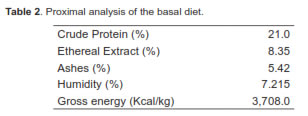
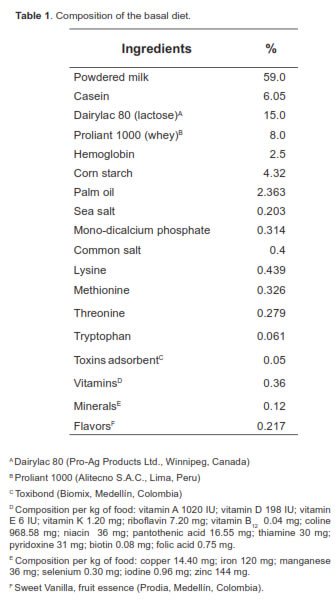
<body><![CDATA[<p>The animal work was conducted at the San Pablo   Center of the Universidad Nacional de Colombia,   Medell&iacute;n, located in Rio Negro, Antioquia, at 2,100   meters of altitude, corresponding to tropical lowermontane   wet forest (LM-wf) zone, with average   annual temperatures between 12 and 18 &deg;C.</p>     <p><i>Animals and diet</i></p>     <p>A total of 32 piglets were used; animals were a   Duroc x Landrace crossbred and, each was weaned   exactly at 21 days of age, weighing 6.5 &plusmn; 0.5 kg. The   pigs were housed in collective cages (four animals per   cage) located in a room with controlled temperature   (26 &plusmn; 3 &deg;C). The animals were supplied water <i>ad   libitum</i> throughout the experiment. The basal diet   (BD) offered contained milk and milk derivatives,   and was enriched with vitamins, minerals, and   lysine-HCL. The diet was balanced to meet all the   minimum nutritional requirements proposed by NRC   (1998) (Tables <a href="#t1">1</a> and <a href="#t2">2</a>). Two experimental diets were   evaluated. The control diet (basal) was compared   against the same diet added with LPS of <i>E. coli</i> in   concentrations of 0.3 &micro;g/mg of feed. Each pen was   offered 300 g feed/day. However, extra feed was   offered when pigs required it. The experimental diets   were offered from days 1 to 10 after weaning. No solid food was offered to the piglets during lactation.</p>     <p align="center"><a name="t1"></a><img src="/img/revistas/rccp/v26n2/v26n2a6t1.jpg"></p>     <p align="center"><a name="t2"></a><img src="/img/revistas/rccp/v26n2/v26n2a6t2.jpg"></p>     <p><i>Treatments</i></p>     <p>Two experimental diets were tested: a basal   diet (BD) and the BD added with LPS of <i>E. coli</i>   (serotype 0111: B4; Sigma-Aldrich, St. Louis, MO,   USA) as follows: </p>     <p>1. BD: Basal Diet (BD; no addition of LPS from <i>E. coli</i>). </p>     <p>2. BD+LPS: BD added with 0.3 &mu;g of LPS from <i>E. coli</i>/mg of feed.</p>     <p><i>Clinical evaluation</i></p>     ]]></body>
<body><![CDATA[<p>Before starting the experiment, all animals   were clinically evaluated and laboratory monitored   to avoid including previously sick or diarrheic   pigs. Such monitoring was also conducted three   times daily throughout the study, keeping records   of any health alteration. Rectal temperature was   measured daily at 8:00 am using a rectal mercury   thermometer. The reference temperature was   38 &deg;C. Consistency of the stools was daily assessed   by direct observation, assigning them a number   from 0 to 3 according with fecal appearance: A   0 value indicates normal feces, and therefore no   diarrhea presence. A value of 1 describes a slightly   pasty diarrhea, 2 value indicates a moderate, semiliquid   diarrhea, and 3 value severe, very liquid   diarrhea. Daily grades during the experimental   period were added together and an index of diarrhea   severity was estimated (Reis de Souza <i>et al.</i>, 2010). This index is expressed by the following equation:</p>     <p>DSI = dFC/Ep </p>     <p>Where: </p>     <p>DSI= Diarrhea severity index. </p>     <p>dFC= Daily fecal consistency grade. </p>     <p>Ep= Experimental period (days).</p>     <p><i>Sampling of intestinal tissue</i></p>     <p>The pigs were slaughtered as follows: eight   pigs were slaughtered on the weaning day to   check the overall health status of the organs   before LPS consumption. Two more pigs from   each treatment were slaughtered on days 5, 7, and   10 after weaning. All piglets were slaughtered   2.5 hours after their last meal. Pigs were sedated   via CO<sub>2</sub> inhalation for 3 minutes before being   humanely killed by exsanguination through   sectioning of the jugular vein. The small intestine   was removed from the pyloric junction to the   ileocecal valve. The mesentery was longitudinally   cut with blunt scissors. Then, the intestine was   weighed, measured and lined up without any   strain over a table, and divided into three segments   (duodenum, jejunum, and ileum) of equal size.   20 cm were cut from the center of each segment,   and the digesta was removed by rinsing it with cold saline infusion (Makkink <i>et al.</i>, 1994; Reis <i>et al.</i>, 2005). Subsamples (1 cm) were then obtained from each segment and were prepared for total RNA extraction. Samples were preserved in liquid nitrogen and RNA was stored in a freezer at -70 oC until laboratory analyses.</p>     <p><i>RNA extraction</i></p>     <p>Total RNA was extracted from intestinal samples   (25 mg) using a commercial kit (Tissue &amp; Cells   ULTRACLEANTM RNA Isolation Kit, MO, USA;   BIO Laboratories Inc., San Diego, CA, USA). The   tissue was macerated in stone mortars using liquid   nitrogen. Work surfaces were previously treated   with diethylpyrocarbonate (DEPC) to remove   possible RNases. The RNA samples were kept   stored at -70 &deg;C throughout the experiment and only   aliquots on ice were taken for analysis. Integrity   of the extracted material was evaluated running   the samples on 1% agarose gel with ethidium   bromide staining (100V for 50 min). Ribosomal   RNA (rRNA) bands were observed, along with   the presence of messenger RNA (mRNA). The   extraction was repeated under identical conditions   when enough amount of material was not observed, or not clear rRNA bands were detected.</p>     ]]></body>
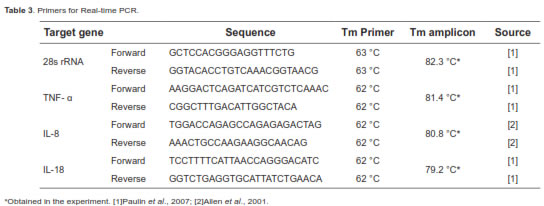
<body><![CDATA[<p><i>RNA quantification</i></p>     <p>Purified samples of total RNA were quantified   using 1&mu;L of the solution in a Nanodrop 1000   (Thermo Fisher Scientific Inc, Waltham, MA, USA).   It was assessed at a rate of 260/230 in order to   detect the presence of any potential pollutants. The   solution in which RNA was stored during the last extraction step was used as a blank.</p>     <p><i>Complementary DNA (cDNA) synthesis</i></p>     <p>   The cDNA was synthesized from total RNA   using a commercial kit (QuantiTect<sup>&reg;</sup> Reverse   Transcription Kit; QIAGEN, Valencia, CA, USA).   This kit uses random hexamer and poly-thymidine   primers to maximize the retro-transcription reaction,   obtaining both rRNA and mRNA. The same amount   of sample was used for all reverse transcription   reactions (1&mu;g of RNA in each reaction) based   on the quantification results. The remaining   genomic DNA was removed followed by the   addition of enzyme and triphosphate nucleotides   to synthesize cDNA according to manufacturer's   recommendations. The obtained cDNA was stored   at -20 &deg;C.</p>     <p><i>Cytokine mRNA quantification</i></p>     <p>The primers for the genes of interest and   constitutive expression of rRNA are shown in <a href="#t3">table   3</a>. These primers were taken from the literature,   verifying that its design had been carried out at   the edges intron/exon to avoid amplification from   genomic DNA. Additionally, they underwent   several bioinformatic analyses to verify their   specificity with the mRNA or rRNA fragment   studied and the absence of secondary structures,   such as the formation of lenses or dimers with   themselves or with the other primer. Additionally,   primers with Tm above 60 &deg;C were used to amplify   fragments with less than 150 base pairs, as several   researchers have recommended (Bustin, 2000; Kubista <i>et al.</i>, 2006).</p>     <p align="center"><a name="t3"></a><img src="/img/revistas/rccp/v26n2/v26n2a6t3.jpg"></p>     <p>A commercial kit was used for the qPCR   (QuantiFastTM SYBR<sup>&reg;</sup> Green PCR kit, QIAGEN,   Valencia, CA, USA) in a Smart Cycler<sup>&reg;</sup> (Cepheid   Inc., Sunnyvale, CA, USA). All qPCR reactions   were run with 0.1 &micro;M of each primer and 1 &micro;L of   cDNA, starting with a five-minute activation of   the enzyme and then 40 cycles with two stages.   The first stage was held at 95 &deg;C for 15 seconds.   The second stage was held at 60 &deg;C for 30 seconds   (62 &deg;C for 28s rRNA). A denaturation curve was   generated at the conclusion of the run to find the Tm   of the amplified fragment and confirm its identity. </p>     <p><i>Standardization strategy, data management and   relative quantification</i></p>     <p>A relative quantification method was used to   determine the level of expression of each gene.   The method included the use of a constitutively   expressed gene (28s ribosomal RNA) following the   recommendations of several researchers regarding   the choice of gene and overall standardization   strategy (Dheda <i>et al.</i>, 2005; Huggett <i>et al.</i>,   2005; Muller <i>et al.</i>, 2002; Vandesompele <i>et al.</i>,   2002). The amounts of material from which RNA   was extracted, the amount of RNA in reverse   transcription reaction, and the amount of cDNA   for PCR amplification were identical for all   samples. The chosen constitutive expression gene   was validated in previous studies under similar   experimental conditions (Paulin <i>et al.</i>, 2007). The   results were analyzed with the assumption-free   method, which employs fluorescence data for each   qPCR reaction to establish the reaction zone in   which there was exponential kinetics (Ramakers   <i>et al.</i>, 2003). Based on this region, a linear   regression was established that fit the data thereby   obtaining the reaction efficiency from the slope   of the line and the intercept (N<sub>0</sub>) as an estimate of   the initial concentration in terms of fluorescence   of SYBR Green. The software recommended by   the equipment manufacturer was used for these   calculations (LinRegPCR 11.0). The N<sub>0</sub> values of   each cytokine gene were expressed in arbitrary   fluorescence units and were normalized using   the corresponding N<sub>0</sub> value for the constitutive expression gene in each animal.</p>     ]]></body>
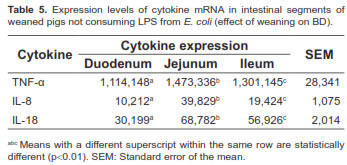
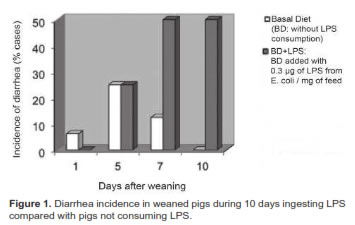
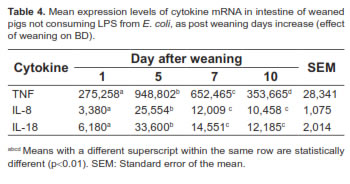
<body><![CDATA[<p><i>Statistical design</i></p>     <p>The experiment followed a randomized block   design (two blocks) in a 2 x 4 factorial arrangement   (two experimental diets by four periods after   weaning; Steel and Torrie, 1985). Animals were   blocked by initial weight. Each animal was assigned   one of eight treatments and each treatment had four   replicates. Statistical analysis was conducted using   the General Linear Model procedure (GLM) of   SAS (2006). Differences between treatment means   were determined by least squares and analyzed by   ANOVA. The Duncan test was used to compare   treatment means (p&lt;0.05).</p>     <p>&nbsp;</p>     <p><b><font size="3">Results </font></b></p>     <p>Pigs fed the basal diet maintained normal body   temperature, while animals that received LPS had   rectal temperatures above 38 &deg;C throughout the   experiment. However, pigs fed LPS did not show   symptoms of disease, so none required slaughter or   exclusion from the experiment. No leftovers were observed during the experiment.</p>     <p>Both treatments had increasing numbers of   diarrhea cases during the first 5 days after weaning   (<a href="#f1">Figure 1</a>). Beginning on day 5, diarrhea incidence   started to decline in BD, reaching its lowest level   on day 10 after weaning. The opposite occurred in   pigs exposed to LPS (BD+LPS), in which diarrhea   continued to increase from the fifth day, rapidly   reaching its peak at day 7, and remaining high   until the end of the test (day 10). The incidence of   diarrhea was much higher in BD+LPS compared   with BD, particularly from day 5 until day 10 after weaning (<a href="#f1">Figure 1</a>).</p>     <p align="center"><a name="f1"></a><img src="/img/revistas/rccp/v26n2/v26n2a6f1.jpg"></p>     <p>An increase in mRNA expression of cytokines   TNF-&alpha;, IL-8, and IL-18 was observed from days 1   to 5 after weaning (p&lt;0.01; <a href="#t4">Table 4</a>). All variables   under study showed a partial recovery from days   5 to 10. However, a statistical difference was observed between days 1 and 10 (p&lt;0.01).</p>     <p align="center"><a name="t4"></a><img src="/img/revistas/rccp/v26n2/v26n2a6t4.jpg"></p>     <p>The expression of these cytokines in different   parts of the small intestine of pigs not consuming   LPS was also assessed. Significant differences   (p&lt;0.01) were found in transcription levels of   cytokines for selected intestinal segments. The   middle part of the intestine (jejunum) showed the highest gene expression for all cytokines (<a href="#t5">Table 5</a>).</p>     ]]></body>
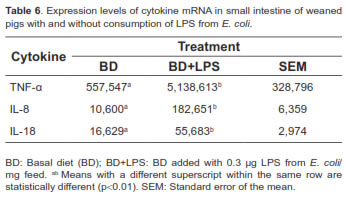
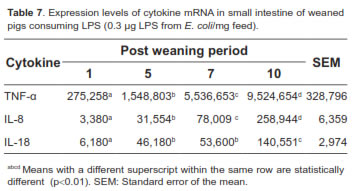
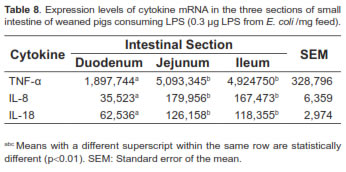
<body><![CDATA[<p align="center"><a name="t5"></a><img src="/img/revistas/rccp/v26n2/v26n2a6t5.jpg"></p>     <p>No statistical interaction was observed between   LPS concentration and post-weaning period of   slaughtering for any of the variables under the   present study, therefore it was unnecessary to analyze those two factors independently.</p>     <p>Tables <a href="#t6">6</a>, <a href="#t7">7</a> and <a href="#t8">8</a> show the overall mRNA   cytokine expression in both treatments, cytokine   expression according to the length of exposure   to LPS, and the expression in the intestinal   segments of pigs consuming LPS, respectively. The   expression of cytokines TNF-&alpha;, IL-8, and IL-18 was   significantly higher for BD+LPS (p&lt;0.01; <a href="#t6">Table 6</a>).   Intestinal production of TNF-&alpha;, IL-8 and IL-18, as   measured by mRNA expression, significantly raised   with increasing exposure to LPS (p&lt;0.01), reaching its peak on day 10 post-weaning (<a href="#t7">Table 7</a>).</p>     <p align="center"><a name="t6"></a><img src="/img/revistas/rccp/v26n2/v26n2a6t6.jpg"></p>     <p align="center"><a name="t7"></a><img src="/img/revistas/rccp/v26n2/v26n2a6t7.jpg"></p>     <p>The middle intestine (jejunum) of piglets   consuming LPS showed higher cytokines   production, particularly TNF-&alpha;, whereas duodenum   had the lowest production (<a href="#t8">Table 8</a>). However, there   were no statistically significant differences between   jejunum and ileum for the different variables studied (p&gt;0.01).</p>     <p align="center"><a name="t8"></a><img src="/img/revistas/rccp/v26n2/v26n2a6t8.jpg"></p>     <p>&nbsp;</p>     <p><b><font size="3">Discussion </font></b></p>     <p>Literature is scarce on reports evaluating gene   expression of proinflammatory cytokines in weaned piglets. However, <i>in vivo</i> and <i>in vitro</i> studies have shown that after a bacterial infection in pigs, LPS has the ability to activate a variety of signaling pathways through the uncontrolled synthesis of proinflammatory cytokines such as IL-8, IL-18 and TNF-&alpha; (Johnson <i>et al.</i>, 2005), which can influence the integrity and functional capacity of intestinal cells, permeability to macromolecules and transport of ions and nutrients (Bauer <i>et al.</i>, 2006; Liu <i>et al.</i>, 2008). Total, efficient, and proper intestinal recovery may take several weeks (Yoo <i>et al.</i>, 2000; Garc&iacute;a-Herrera <i>et al.</i>, 2008).</p>     ]]></body>
<body><![CDATA[<p>Proinflammatory cytokines play an important   role in intestinal physiology and may act on the   intestinal barrier increasing epithelial ion secretion,   specifically chlorine (Cl<sup>-</sup>). The increased secretion   of Cl<sup>-</sup> in the crypts and decreased absorption of   sodium (Na+) by the intestinal villi promote fluid   loss in the small intestine. Both processes depend   on the Na<sup>+</sup> / K<sup>+</sup>-ATPase, located in the basolateral   membrane and whose functional activity is affected   by TNF-&alpha; (McKay and Baird, 1999; Pie <i>et al.</i>,   2004). Gene expression of TNF-&alpha; decreases the   Na<sup>+</sup> / K<sup>+</sup>-ATPase activity (Yu and Perdue, 2000)   causing fluid accumulation in the small intestine.   These factors combined appear to trigger bacterial   endotoxin induced diarrhea in rabbits and pigs (Garc&iacute;a-Herrera <i>et al.</i>, 2003, 2008).</p>     <p>The increased expression of TNF-&alpha; observed   in this study may contribute to the development of   post-weaning diarrhea; this factor stimulates Clsecretion   in the ileum (Musch <i>et al.</i>, 2002; Bertelsen <i>et al.</i>, 2004) and colon (Schmitz <i>et al.</i>, 1996).</p>     <p>In addition to its role in epithelial ion transport,   proinflammatory cytokines are also involved in   the integrity of the intestinal tissues (Williams,   2001), altering intestinal permeability through its   effect on the structure of tight junctions between   epithelial cells (McKay and Baird, 1999; Bruewer   <i>et al.</i>, 2003; Ma <i>et al.</i>, 2004; Wang <i>et al.</i>, 2005),   mainly at the jejunum (Spreeuwenberg <i>et al.</i>, 2001;   Pie <i>et al.</i>, 2004; Lall&egrave;s <i>et al.</i>, 2004). The LPS   released into the gut cause the shortening of actin   filaments in the enterocyte, disrupting the structure   of tight junctions and causing the internalization of   occludin. Under these circumstances, the intestinal   barrier may be affected, decreasing transepithelial   resistance (Berkes <i>et al.</i>, 2003) and thus increasing   indiscriminate paracellular transport of molecules,   allowing gastrointestinal pathogens to access the   systemic circulation (Garc&iacute;a-Herrera <i>et al.</i>, 2003; Pitman and Blumberg, 2000).</p>     <p>At the time of weaning, over-expressed mRNA   of proinflammatory cytokines, especially TNF-&alpha;,   may influence the integrity of intestinal epithelium,   favoring the emergence of bacterial infections   and diarrhea and increasing the transepithelial   transport of microorganisms. In the presence of   inflammatory processes, including those caused   by bacterial infections, proinflammatory cytokines   have been implicated in increasing apoptosis rates   in intestinal epithelium (Ramachandran <i>et al.</i>,   2000), eliminating and controlling the number of   cells in the proliferation area of intestinal crypts   (Potten, 1992). Furthermore, TNF-&alpha; and IL-8 have   mitotic effects on intestinal mucosa (Zachrisson   <i>et al.</i>, 2001; Schaeffer <i>et al.</i>, 2006), causing the   conversion of intestinal stem cells into secreting   cells, thus decreasing the number of absorptive cells   in the intestinal mucosa (Van <i>et al.</i>, 2005). This can   lead to high malnutrition and mortality of pigs at this stage.</p>     <p>The immune response in the gastrointestinal   tract is a constant balance between proinflammatory   cytokine (IL-6, IL-8, IL-18, IL-12, TNF-&alpha;) and   inflammatory cytokine release (IL-1RA, IL-4, IL   -10). Under chronic inflammatory conditions, T   helper type 1 lymphocytes (LTh1) induce the release   of significant levels of proinflammatory cytokines,   such as IL-12, IL-18 and TNF-&alpha; (Pizarro <i>et al.</i>,   1999; Reuter and Pizarro, 2004; Cavani <i>et al.</i>, 2000)   and, in turn, suppress IL-10 by LTh2 production.   Because of this, the activation of antigen-presenting   cells, dendritic cell maturation, and intolerance   to specific antigens are all increased, and the   proliferation of T cells is limited (Enk <i>et al.</i>, 1993;   Caux <i>et al.</i>, 1994). Inhibition of T cells leads to   increased chloride secretion, and therefore to the   onset of diarrhea (Xu and Verstraete, 2001). The IL-   10 is a key molecule for the induction of T cells and   the prevention of intestinal inflammation (Le&oacute;n <i>et al.</i>, 2006).</p>     <p>The differential expression of proinflammatory   cytokines in different parts of the intestinal tract   of pigs occurs in response to intestinal disorders   caused by stress and intestinal infections associated   with the weaning (Oswald <i>et al.</i>, 2001; Fournout   <i>et al.</i>, 2000). These inflammatory responses may   reflect, at least in part, anatomical and functional   differences between sections of the intestine   (Beagley <i>et al.</i>, 1995). However, the anatomical   changes that occur at weaning can be observed   regardless of the weaning age, though its size may vary (Cera <i>et al.</i>, 1988; Pluske <i>et al.</i>, 2003).</p>     <p>The data from this study suggest that weaning is   associated with increased intestinal inflammation,   mainly caused by the expression of proinflammatory   cytokines. An increase in proinflammatory   cytokine expression was observed until day 5 after   weaning. However, a decrease in the expression   of these cytokines was noted after the fifth postweaning   day, without returning to the values   found on day 1 after weaning. Therefore, we   found a clear relationship between the expression   of proinflammatory cytokines (TNF-&alpha;) and the incidence of diarrhea during the weaning stage.</p>     <p>Animals consuming BD+LPS presented an   excessive inflammatory response due to the overexpression   of proinflammatory cytokines. The   mRNA expression of TNF-&alpha;, IL-8, and IL-18   increased by 922%, 1723%, and 335%, respectively,   compared to BD, which coincides with the   high rates of diarrhea observed during the postweaning   period. Considering the advantages of this   inflammation model, it is necessary to conduct more   studies in order to confirm the validity of the results observed.</p>     <p>&nbsp;</p> <hr size="1" />    <p><b><font size="3">Notes</font></b></p>     ]]></body>
<body><![CDATA[<p><sup><a name="1" id="1"></a><a href="#b1">&curren;</a></sup> To cite this article: Parra J, Agudelo J, San&iacute;n D, Forero J, Muskus C, L&oacute;pez A. Intestinal expression of pro-inflammatory cytokines induced by oral intake of lipopolysaccharide (LPS) from E. coli in weaned pigs. Rev Colomb Cienc Pecu 2013; 26:108-118.</p> <hr size="1" />     <p>&nbsp;</p>     <p><b><font size="3">References </font></b></p>     <!-- ref --><p>Albin DM, Wubben JE, Rowlett JM, Tappenden KA, Nowak   RA. Changes in small intestinal nutrient transport and barrier   function after lipopolysaccharide exposure in two pig breeds J   Anim Sci 2007; 85:2517-2523.    &nbsp;&nbsp;&nbsp;&nbsp;&nbsp;&nbsp;&nbsp;&nbsp;[&#160;<a href="javascript:void(0);" onclick="javascript: window.open('/scielo.php?script=sci_nlinks&ref=000106&pid=S0120-0690201300020000600001&lng=','','width=640,height=500,resizable=yes,scrollbars=1,menubar=yes,');">Links</a>&#160;]<!-- end-ref --> </p>     <!-- ref --><p>Allen DG, Rivier, JE, Monteiro-Riviere NA. Cytokine induction   as a measure of cutaneous toxicity in primary and immortalized   porcine keratinocytes exposed to jet fuels, and their relationship   to normal human epidermal keratinocytes. Toxicol Lett 2001;   119:209-217.    &nbsp;&nbsp;&nbsp;&nbsp;&nbsp;&nbsp;&nbsp;&nbsp;[&#160;<a href="javascript:void(0);" onclick="javascript: window.open('/scielo.php?script=sci_nlinks&ref=000108&pid=S0120-0690201300020000600002&lng=','','width=640,height=500,resizable=yes,scrollbars=1,menubar=yes,');">Links</a>&#160;]<!-- end-ref --> </p>     <!-- ref --><p>Amador P, Garc&iacute;a-Herrera J, Marca MC, de la Osada J, Acin S,   Navarro MA, Salvador MT, Lostao MP, Rodriguez-Yoldi MJ.   Intestinal D-galactose transport in an endotoxemia model in the   rabbit. J Membr Biol 2007; 215:125-133.    &nbsp;&nbsp;&nbsp;&nbsp;&nbsp;&nbsp;&nbsp;&nbsp;[&#160;<a href="javascript:void(0);" onclick="javascript: window.open('/scielo.php?script=sci_nlinks&ref=000110&pid=S0120-0690201300020000600003&lng=','','width=640,height=500,resizable=yes,scrollbars=1,menubar=yes,');">Links</a>&#160;]<!-- end-ref --> </p>     <!-- ref --><p>Asaduzzaman M, Zhang S, Lavasani S, Wang Y, Thorlacius   H. Lfa-1 and Mac-1 Mediate Pulmonary Recruitment of   Neutrophils and Tissue Damage in Abdominal Sepsis. Shock   2008; 30:254-259.    &nbsp;&nbsp;&nbsp;&nbsp;&nbsp;&nbsp;&nbsp;&nbsp;[&#160;<a href="javascript:void(0);" onclick="javascript: window.open('/scielo.php?script=sci_nlinks&ref=000112&pid=S0120-0690201300020000600004&lng=','','width=640,height=500,resizable=yes,scrollbars=1,menubar=yes,');">Links</a>&#160;]<!-- end-ref --> </p>     <!-- ref --><p>Bauer E, Williams BA, Martin HS, Verstegen WA, Mosenthin   R. Influence of the gastrointestinal microbiota on development   of the immune system in young animals. Curr Issues Intestinal   Microbiol 2006; 7:35-52.    &nbsp;&nbsp;&nbsp;&nbsp;&nbsp;&nbsp;&nbsp;&nbsp;[&#160;<a href="javascript:void(0);" onclick="javascript: window.open('/scielo.php?script=sci_nlinks&ref=000114&pid=S0120-0690201300020000600005&lng=','','width=640,height=500,resizable=yes,scrollbars=1,menubar=yes,');">Links</a>&#160;]<!-- end-ref --> </p>     <!-- ref --><p>Beagley K, Fujihashi K, Lagoo AS, Lagoo-Deenadaylan S,   Black CA, Murray AM, Sharmanov AT, Yamamoto M, McGhee   JR, Elson CO. Differences in intraepithelial lymphocyte T cell   subsets isolated from murine small versus large intestine. J   Immunol 1995; 154:5611-5619.    &nbsp;&nbsp;&nbsp;&nbsp;&nbsp;&nbsp;&nbsp;&nbsp;[&#160;<a href="javascript:void(0);" onclick="javascript: window.open('/scielo.php?script=sci_nlinks&ref=000116&pid=S0120-0690201300020000600006&lng=','','width=640,height=500,resizable=yes,scrollbars=1,menubar=yes,');">Links</a>&#160;]<!-- end-ref --> </p>     <!-- ref --><p>Berkes J, Viswanathan VK, Savkovic SD, Hecht G. Intestinal   epithelial responses to enteric pathogens: effects on tight   junction barrier, ion transport, and inflammation. Gut 2003;   52:439-451.    &nbsp;&nbsp;&nbsp;&nbsp;&nbsp;&nbsp;&nbsp;&nbsp;[&#160;<a href="javascript:void(0);" onclick="javascript: window.open('/scielo.php?script=sci_nlinks&ref=000118&pid=S0120-0690201300020000600007&lng=','','width=640,height=500,resizable=yes,scrollbars=1,menubar=yes,');">Links</a>&#160;]<!-- end-ref --> </p>     <!-- ref --><p>Bertelsen LS, Eckmann L, Barrett KE. Prolonged interferon-&#947;   exposure decreases ion transport, NKCC1, and Na+-K+-ATPase   expression in human intestinal xenografts in vivo. Am J Physiol   Gastrointest Liver Physiol 2004; 286:G157-G165.    &nbsp;&nbsp;&nbsp;&nbsp;&nbsp;&nbsp;&nbsp;&nbsp;[&#160;<a href="javascript:void(0);" onclick="javascript: window.open('/scielo.php?script=sci_nlinks&ref=000120&pid=S0120-0690201300020000600008&lng=','','width=640,height=500,resizable=yes,scrollbars=1,menubar=yes,');">Links</a>&#160;]<!-- end-ref --> </p>     <!-- ref --><p>Bruewer M, Luegering A, Kucharzik T, Parkos CA, Madara   JL, Hopkins AM, Nusrat A. Proinflammatory cytokines   disrupt epithelial barrier function by apoptosis-independent   mechanisms. J Immunol 2003; 6164-6172.    &nbsp;&nbsp;&nbsp;&nbsp;&nbsp;&nbsp;&nbsp;&nbsp;[&#160;<a href="javascript:void(0);" onclick="javascript: window.open('/scielo.php?script=sci_nlinks&ref=000122&pid=S0120-0690201300020000600009&lng=','','width=640,height=500,resizable=yes,scrollbars=1,menubar=yes,');">Links</a>&#160;]<!-- end-ref --> </p>     <!-- ref --><p>Bustin S.A. Absolute quantification of mRNA using real-time   reverse transcription polymerase chain reaction assays. J Mol   Endocrinol 2000; 25:169-193.    &nbsp;&nbsp;&nbsp;&nbsp;&nbsp;&nbsp;&nbsp;&nbsp;[&#160;<a href="javascript:void(0);" onclick="javascript: window.open('/scielo.php?script=sci_nlinks&ref=000124&pid=S0120-0690201300020000600010&lng=','','width=640,height=500,resizable=yes,scrollbars=1,menubar=yes,');">Links</a>&#160;]<!-- end-ref --> </p>     <!-- ref --><p>Cavani A, Nasorri F, Prezzi C, Sebastiani S, Albanesi C,   Girolomoni G. Human CD4+ T lymphocytes with remarkable   regulatory functions on dendritic cells and nickel-specific Th1   immune responses. J Investig Dermatol 2000; 114:295-302.    &nbsp;&nbsp;&nbsp;&nbsp;&nbsp;&nbsp;&nbsp;&nbsp;[&#160;<a href="javascript:void(0);" onclick="javascript: window.open('/scielo.php?script=sci_nlinks&ref=000126&pid=S0120-0690201300020000600011&lng=','','width=640,height=500,resizable=yes,scrollbars=1,menubar=yes,');">Links</a>&#160;]<!-- end-ref --> </p>     <!-- ref --><p>Caux C, Massacrier C, Vanbervliet B, Dubois B, Van Kooten   C, Durand I, Banchereau J. Activation of human dendritic cells   through CD40 cross-linking. J Exp Med 1994; 180:1263-1272.    &nbsp;&nbsp;&nbsp;&nbsp;&nbsp;&nbsp;&nbsp;&nbsp;[&#160;<a href="javascript:void(0);" onclick="javascript: window.open('/scielo.php?script=sci_nlinks&ref=000128&pid=S0120-0690201300020000600012&lng=','','width=640,height=500,resizable=yes,scrollbars=1,menubar=yes,');">Links</a>&#160;]<!-- end-ref --> </p>     <!-- ref --><p>Cera KR, Mahan DC, Cross RF, Reinhart GA, Whitmoyer RE.   Effect of age, weaning and postweaning diet on small intestinal   growth and jejunal morphology in young swine. J Anim Sci   1988; 66:574-584.    &nbsp;&nbsp;&nbsp;&nbsp;&nbsp;&nbsp;&nbsp;&nbsp;[&#160;<a href="javascript:void(0);" onclick="javascript: window.open('/scielo.php?script=sci_nlinks&ref=000130&pid=S0120-0690201300020000600013&lng=','','width=640,height=500,resizable=yes,scrollbars=1,menubar=yes,');">Links</a>&#160;]<!-- end-ref --> </p>     <!-- ref --><p>Chow CW, Grinstein S, Rotstein OD. Signaling events in   monocytes and macrophages. New Horiz 1995; 3:342-35.    &nbsp;&nbsp;&nbsp;&nbsp;&nbsp;&nbsp;&nbsp;&nbsp;[&#160;<a href="javascript:void(0);" onclick="javascript: window.open('/scielo.php?script=sci_nlinks&ref=000132&pid=S0120-0690201300020000600014&lng=','','width=640,height=500,resizable=yes,scrollbars=1,menubar=yes,');">Links</a>&#160;]<!-- end-ref --></p>     <!-- ref --><p>Council for International Organizations of Medical Sciences   (CIOMS). International guiding principles for biomedical   research involving animals. 1985. Geneva. 28pp.    &nbsp;&nbsp;&nbsp;&nbsp;&nbsp;&nbsp;&nbsp;&nbsp;[&#160;<a href="javascript:void(0);" onclick="javascript: window.open('/scielo.php?script=sci_nlinks&ref=000134&pid=S0120-0690201300020000600015&lng=','','width=640,height=500,resizable=yes,scrollbars=1,menubar=yes,');">Links</a>&#160;]<!-- end-ref --> </p>     <!-- ref --><p>Dheda K, Huggett JF, Chang JS, Kim LU, Bustin SA, Johnson   MA, Rook GA, Zumla A. The implications of using an   inappropriate reference gene for real-time reverse transcription PCR data normalization. Anal Biochem 2005; 344:141-143.    &nbsp;&nbsp;&nbsp;&nbsp;&nbsp;&nbsp;&nbsp;&nbsp;[&#160;<a href="javascript:void(0);" onclick="javascript: window.open('/scielo.php?script=sci_nlinks&ref=000136&pid=S0120-0690201300020000600016&lng=','','width=640,height=500,resizable=yes,scrollbars=1,menubar=yes,');">Links</a>&#160;]<!-- end-ref --></p>     <!-- ref --><p>Enk AH, Angeloni VL, Udey MC, Katz SI. Inhibition of   Langerhans cell antigen-presenting function by IL-10. A role   for IL-10 in induction of tolerance. J Immunol 1993; 151:2390-   2398.    &nbsp;&nbsp;&nbsp;&nbsp;&nbsp;&nbsp;&nbsp;&nbsp;[&#160;<a href="javascript:void(0);" onclick="javascript: window.open('/scielo.php?script=sci_nlinks&ref=000138&pid=S0120-0690201300020000600017&lng=','','width=640,height=500,resizable=yes,scrollbars=1,menubar=yes,');">Links</a>&#160;]<!-- end-ref --> </p>     <!-- ref --><p>Fournout S, Dozois C.M, Odin M, Desautels C, Peres S, Herault   F, Daigle F, Segafredo C, Laffitte J, Oswald E, Fairbrother JM,   Oswald IP. Lack of a role of cytotoxic necrotizing factor 1   toxin from <i>Escherichia coli</i> in bacterial pathogenicity and host   cytokine response in infected germfree piglets. Infect Immun   2000; 68:839-847.    &nbsp;&nbsp;&nbsp;&nbsp;&nbsp;&nbsp;&nbsp;&nbsp;[&#160;<a href="javascript:void(0);" onclick="javascript: window.open('/scielo.php?script=sci_nlinks&ref=000140&pid=S0120-0690201300020000600018&lng=','','width=640,height=500,resizable=yes,scrollbars=1,menubar=yes,');">Links</a>&#160;]<!-- end-ref --></p>     <!-- ref --><p>Garc&iacute;a-Herrera J, Abad B, Rodr&iacute;guez-Yoldi MJ. Effect of   lipopolysaccharide on D-fructose transport across rabbit   jejunum. Inflamm Res 2003; 52:177-184.    &nbsp;&nbsp;&nbsp;&nbsp;&nbsp;&nbsp;&nbsp;&nbsp;[&#160;<a href="javascript:void(0);" onclick="javascript: window.open('/scielo.php?script=sci_nlinks&ref=000142&pid=S0120-0690201300020000600019&lng=','','width=640,height=500,resizable=yes,scrollbars=1,menubar=yes,');">Links</a>&#160;]<!-- end-ref --> </p>     <!-- ref --><p>Garc&iacute;a-Herrera J, Marca MC, Brot-Laroche EGuillen, N, Acin   S, Navarro MA, de la Osada J, Rodriguez-Yoldi MJ. Protein   kinases, TNF-&#945; and proteasome contribute in the inhibition of   fructose intestinal transport by sepsis in vivo. Am J Physiol   Gastrointest Liver Physiol 2008; 294:G155-G164.    &nbsp;&nbsp;&nbsp;&nbsp;&nbsp;&nbsp;&nbsp;&nbsp;[&#160;<a href="javascript:void(0);" onclick="javascript: window.open('/scielo.php?script=sci_nlinks&ref=000144&pid=S0120-0690201300020000600020&lng=','','width=640,height=500,resizable=yes,scrollbars=1,menubar=yes,');">Links</a>&#160;]<!-- end-ref --> </p>     <!-- ref --><p>Garriga C, Perez-Bosque A, Amat C, Campbell JM, Russell   L, Polo J, Planas JM, Moreto M. Spray-dried porcine plasma   reduces the effects of staphylococcal enterotoxin B on glucose   transport in rat intestine. J Nutr 2005; 135:1653-1658.    &nbsp;&nbsp;&nbsp;&nbsp;&nbsp;&nbsp;&nbsp;&nbsp;[&#160;<a href="javascript:void(0);" onclick="javascript: window.open('/scielo.php?script=sci_nlinks&ref=000146&pid=S0120-0690201300020000600021&lng=','','width=640,height=500,resizable=yes,scrollbars=1,menubar=yes,');">Links</a>&#160;]<!-- end-ref --> </p>     <!-- ref --><p>G&oacute;mez IAS, Vergara D, Argote F. Efecto de la dieta y edad   del destete sobre la fisiolog&iacute;a digestiva del lech&oacute;n. Revista   Biotecnolog&iacute;a en el Sector Agropecuario y Agroindustrial   2008; 6:32-41.    &nbsp;&nbsp;&nbsp;&nbsp;&nbsp;&nbsp;&nbsp;&nbsp;[&#160;<a href="javascript:void(0);" onclick="javascript: window.open('/scielo.php?script=sci_nlinks&ref=000148&pid=S0120-0690201300020000600022&lng=','','width=640,height=500,resizable=yes,scrollbars=1,menubar=yes,');">Links</a>&#160;]<!-- end-ref --> </p>     <!-- ref --><p>Gopal R, Birdsell D, Monroy FP. Regulation of toll-like   receptors in intestinal epithelial cells by stress and <i>Toxoplasma   gondii</i> infection. Parasite Immunol 2008; 11-12:63-576.    &nbsp;&nbsp;&nbsp;&nbsp;&nbsp;&nbsp;&nbsp;&nbsp;[&#160;<a href="javascript:void(0);" onclick="javascript: window.open('/scielo.php?script=sci_nlinks&ref=000150&pid=S0120-0690201300020000600023&lng=','','width=640,height=500,resizable=yes,scrollbars=1,menubar=yes,');">Links</a>&#160;]<!-- end-ref --></p>     <!-- ref --><p>Huggett J, Dheda K, Bustin S, Zumla A. Real-time RT-PCR   normalization; strategies and considerations. Gennes Immun.   2005; 6:279-284.    &nbsp;&nbsp;&nbsp;&nbsp;&nbsp;&nbsp;&nbsp;&nbsp;[&#160;<a href="javascript:void(0);" onclick="javascript: window.open('/scielo.php?script=sci_nlinks&ref=000152&pid=S0120-0690201300020000600024&lng=','','width=640,height=500,resizable=yes,scrollbars=1,menubar=yes,');">Links</a>&#160;]<!-- end-ref --> </p>     <!-- ref --><p>Johnson GB, Brunn GJ, Samstein B. New insight into the   pathogenesis of sepsis and the sepsis syndrome. Surgery 2005;   137:393-395.    &nbsp;&nbsp;&nbsp;&nbsp;&nbsp;&nbsp;&nbsp;&nbsp;[&#160;<a href="javascript:void(0);" onclick="javascript: window.open('/scielo.php?script=sci_nlinks&ref=000154&pid=S0120-0690201300020000600025&lng=','','width=640,height=500,resizable=yes,scrollbars=1,menubar=yes,');">Links</a>&#160;]<!-- end-ref --> </p>     <!-- ref --><p>Kubista M, Andrade JM, Bengtsson M, Forootan A, Jon&aacute;k   J, Lind K, Sindelka R, Sj&ouml;back R, Sj&ouml;green B, Str&ouml;mbom L,   Stahlberg A, Zoric N. The real-time polymerase chain reaction.   Mol Aspects Med 2006; 27:95-125.    &nbsp;&nbsp;&nbsp;&nbsp;&nbsp;&nbsp;&nbsp;&nbsp;[&#160;<a href="javascript:void(0);" onclick="javascript: window.open('/scielo.php?script=sci_nlinks&ref=000156&pid=S0120-0690201300020000600026&lng=','','width=640,height=500,resizable=yes,scrollbars=1,menubar=yes,');">Links</a>&#160;]<!-- end-ref --> </p>     <!-- ref --><p>Lall&egrave;s JPl, Boudry G, Favier C, Le Floc'h N, Luron I,   Montagne L, Oswald IP, Pi&eacute; S, Piel C, S&egrave;ve B. Gut function and   dysfunction in young pigs: physiology. Anim Res 2004; 53:301-   316.    &nbsp;&nbsp;&nbsp;&nbsp;&nbsp;&nbsp;&nbsp;&nbsp;[&#160;<a href="javascript:void(0);" onclick="javascript: window.open('/scielo.php?script=sci_nlinks&ref=000158&pid=S0120-0690201300020000600027&lng=','','width=640,height=500,resizable=yes,scrollbars=1,menubar=yes,');">Links</a>&#160;]<!-- end-ref --> </p>     <!-- ref --><p>Liu Y, Huang J, Hou Y, Zhu H, Zhao S, Ding B, Yin Y, Yi G,   Shi J, Fan W. Dietary arginine supplementation alleviates   intestinal mucosal disruption induced by Escherichia coli   lipopolysaccharide in weaned pigs. Brit J Nutr 2008; 100:552-   560.    &nbsp;&nbsp;&nbsp;&nbsp;&nbsp;&nbsp;&nbsp;&nbsp;[&#160;<a href="javascript:void(0);" onclick="javascript: window.open('/scielo.php?script=sci_nlinks&ref=000160&pid=S0120-0690201300020000600028&lng=','','width=640,height=500,resizable=yes,scrollbars=1,menubar=yes,');">Links</a>&#160;]<!-- end-ref --> </p>     <!-- ref --><p>Le&oacute;n AJ, Garrote JA, Arranza E. Citocinas en la patogenia de   la enfermedad inflamatoria intestinal. Med Clin (Barc) 2006;   127:145-152.    &nbsp;&nbsp;&nbsp;&nbsp;&nbsp;&nbsp;&nbsp;&nbsp;[&#160;<a href="javascript:void(0);" onclick="javascript: window.open('/scielo.php?script=sci_nlinks&ref=000162&pid=S0120-0690201300020000600029&lng=','','width=640,height=500,resizable=yes,scrollbars=1,menubar=yes,');">Links</a>&#160;]<!-- end-ref --> </p>     <!-- ref --><p>Ma TY, Iwamoto GK, Hoa NT, Akotia V, Pedram A, Boivin MA   Said HM. TNF-alpha-induced increase in intestinal epithelial   tight junction permeability requires NF-kappa B activation. Am   J Physiol 2004; 286:G367-G376.    &nbsp;&nbsp;&nbsp;&nbsp;&nbsp;&nbsp;&nbsp;&nbsp;[&#160;<a href="javascript:void(0);" onclick="javascript: window.open('/scielo.php?script=sci_nlinks&ref=000164&pid=S0120-0690201300020000600030&lng=','','width=640,height=500,resizable=yes,scrollbars=1,menubar=yes,');">Links</a>&#160;]<!-- end-ref --> </p>     <!-- ref --><p>Makkink CA, Berntsen PJM, op den Kamp BML, Kemp B,   Verstegen WA. Gastric protein breakdown and pancreatic   enzyme activities in response to two different dietary protein   sources in newly weaned pigs. J Anim Sci 1994; 72:2843-2850.    &nbsp;&nbsp;&nbsp;&nbsp;&nbsp;&nbsp;&nbsp;&nbsp;[&#160;<a href="javascript:void(0);" onclick="javascript: window.open('/scielo.php?script=sci_nlinks&ref=000166&pid=S0120-0690201300020000600031&lng=','','width=640,height=500,resizable=yes,scrollbars=1,menubar=yes,');">Links</a>&#160;]<!-- end-ref --> </p>     <!-- ref --><p>McKay DM, Baird AW. Cytokine regulation of epithelial   permeability and ion transport. Gut 1999; 44:283-289.    &nbsp;&nbsp;&nbsp;&nbsp;&nbsp;&nbsp;&nbsp;&nbsp;[&#160;<a href="javascript:void(0);" onclick="javascript: window.open('/scielo.php?script=sci_nlinks&ref=000168&pid=S0120-0690201300020000600032&lng=','','width=640,height=500,resizable=yes,scrollbars=1,menubar=yes,');">Links</a>&#160;]<!-- end-ref --> </p>     <!-- ref --><p>Muller PY, Janovjak H, Miserez AR, Dobbie Z. Processing of   gene expression data generated by quantitative real time RTPCR.   Biotechniques 2002; 32:1372-1379.    &nbsp;&nbsp;&nbsp;&nbsp;&nbsp;&nbsp;&nbsp;&nbsp;[&#160;<a href="javascript:void(0);" onclick="javascript: window.open('/scielo.php?script=sci_nlinks&ref=000170&pid=S0120-0690201300020000600033&lng=','','width=640,height=500,resizable=yes,scrollbars=1,menubar=yes,');">Links</a>&#160;]<!-- end-ref --> </p>     <!-- ref --><p>Musch MW, Clarke LL, Mamah D, Gawenis LR, Zhang Z,   Ellsworth W, Shalowitz D, Mittal N, Efthimiou P, Alnadjim   Z, Hurst SD, Chang EB, Barrett TA. T cell activation causes   diarrhea by increasing intestinal permeability and inhibiting   epithelial Na+ /K+ -ATPase. J Clin Invest 2002; 110:1739-1747.    &nbsp;&nbsp;&nbsp;&nbsp;&nbsp;&nbsp;&nbsp;&nbsp;[&#160;<a href="javascript:void(0);" onclick="javascript: window.open('/scielo.php?script=sci_nlinks&ref=000172&pid=S0120-0690201300020000600034&lng=','','width=640,height=500,resizable=yes,scrollbars=1,menubar=yes,');">Links</a>&#160;]<!-- end-ref --> </p>     <!-- ref --><p>National Research Council (NRC). Nutrient Requirements of   Swine. 10th ed. Washington: National Academy Press,1998.    &nbsp;&nbsp;&nbsp;&nbsp;&nbsp;&nbsp;&nbsp;&nbsp;[&#160;<a href="javascript:void(0);" onclick="javascript: window.open('/scielo.php?script=sci_nlinks&ref=000174&pid=S0120-0690201300020000600035&lng=','','width=640,height=500,resizable=yes,scrollbars=1,menubar=yes,');">Links</a>&#160;]<!-- end-ref --></p>     <!-- ref --><p>Oswald IP, Dozois CM, Barlagne R, Fournout S, Johansen MV,   Bogh HO. Cytokine mRNA expression in pigs infected with   Schistosoma japonicum. Parasitology 2001; 122:299-307.    &nbsp;&nbsp;&nbsp;&nbsp;&nbsp;&nbsp;&nbsp;&nbsp;[&#160;<a href="javascript:void(0);" onclick="javascript: window.open('/scielo.php?script=sci_nlinks&ref=000176&pid=S0120-0690201300020000600036&lng=','','width=640,height=500,resizable=yes,scrollbars=1,menubar=yes,');">Links</a>&#160;]<!-- end-ref --> </p>     <!-- ref --><p>Paulin SM, Jagannathan A, Campbell J, Wallis TS, Stevens MP.   Net replication of Salmonella enterica serovars Typhimurium   and Choleraesuis in porcine intestinal mucosa and nodes is   associated with their differential virulence. Infect Immun 2007;   75:3950-3960.    &nbsp;&nbsp;&nbsp;&nbsp;&nbsp;&nbsp;&nbsp;&nbsp;[&#160;<a href="javascript:void(0);" onclick="javascript: window.open('/scielo.php?script=sci_nlinks&ref=000178&pid=S0120-0690201300020000600037&lng=','','width=640,height=500,resizable=yes,scrollbars=1,menubar=yes,');">Links</a>&#160;]<!-- end-ref --> </p>     <!-- ref --><p>Pi&eacute; S, Lall&egrave;s JP, Blazy F, Laffitte J, S&egrave;ve B, Oswald IP.   Weaning is sssociated with an upregulation of expression of   inflammatory cytokines in the intestine of piglets. J Nutr 2004;   134:641-647.    &nbsp;&nbsp;&nbsp;&nbsp;&nbsp;&nbsp;&nbsp;&nbsp;[&#160;<a href="javascript:void(0);" onclick="javascript: window.open('/scielo.php?script=sci_nlinks&ref=000180&pid=S0120-0690201300020000600038&lng=','','width=640,height=500,resizable=yes,scrollbars=1,menubar=yes,');">Links</a>&#160;]<!-- end-ref --> </p>     <!-- ref --><p>Pitman RS, Blumberg RS. First line of defense: the role of the   intestinal epithelium as an active component of the mucosal   immune system. J Gastroenterol 2000; 35:805-814.    &nbsp;&nbsp;&nbsp;&nbsp;&nbsp;&nbsp;&nbsp;&nbsp;[&#160;<a href="javascript:void(0);" onclick="javascript: window.open('/scielo.php?script=sci_nlinks&ref=000182&pid=S0120-0690201300020000600039&lng=','','width=640,height=500,resizable=yes,scrollbars=1,menubar=yes,');">Links</a>&#160;]<!-- end-ref --> </p>     <!-- ref --><p>Pizarro TT, Michie MH, Bentz M, Woraratanadharm J, Smith   MF. Jr, Foley E, Moskaluk CA, Bickston SJ, Cominelli F.   IL-18, a novel immunoregulatory cytokine, is upregulated   in Crohn's disease: expression and localization in intestinal   mucosal cells. J Immunol 1999; 162:6829-6835.    &nbsp;&nbsp;&nbsp;&nbsp;&nbsp;&nbsp;&nbsp;&nbsp;[&#160;<a href="javascript:void(0);" onclick="javascript: window.open('/scielo.php?script=sci_nlinks&ref=000184&pid=S0120-0690201300020000600040&lng=','','width=640,height=500,resizable=yes,scrollbars=1,menubar=yes,');">Links</a>&#160;]<!-- end-ref --> </p>     <!-- ref --><p>Pluske JR, Kerton DJ, Cranwell PD, Campbell RG, Mullan BP,   King RH, Power GN, Pierzynowski SG, Westrom B, Rippe   C, Peulen O, Dunshea FR. Age, sex, and weight at weaning   influence organ weight and gastrointestinal development of   weanling pigs. Aust J Agric Res 2003; 54:515-527.    &nbsp;&nbsp;&nbsp;&nbsp;&nbsp;&nbsp;&nbsp;&nbsp;[&#160;<a href="javascript:void(0);" onclick="javascript: window.open('/scielo.php?script=sci_nlinks&ref=000186&pid=S0120-0690201300020000600041&lng=','','width=640,height=500,resizable=yes,scrollbars=1,menubar=yes,');">Links</a>&#160;]<!-- end-ref --> </p>     <!-- ref --><p>Potten CS. The significance of spontaneous and induced   apoptosis in the gastrointestinal tract of mice. Cancer Metastasis   Rev 1992; 11:179-195.    &nbsp;&nbsp;&nbsp;&nbsp;&nbsp;&nbsp;&nbsp;&nbsp;[&#160;<a href="javascript:void(0);" onclick="javascript: window.open('/scielo.php?script=sci_nlinks&ref=000188&pid=S0120-0690201300020000600042&lng=','','width=640,height=500,resizable=yes,scrollbars=1,menubar=yes,');">Links</a>&#160;]<!-- end-ref --> </p>     <!-- ref --><p>Ramachandran A, Madesh M, Balasubramanian KA. Apoptosis   in the intestinal epithelium: its relevance in normal and   pathophysiological conditions. J Gastroenterol Hepatol 2000; 15:109-120.    &nbsp;&nbsp;&nbsp;&nbsp;&nbsp;&nbsp;&nbsp;&nbsp;[&#160;<a href="javascript:void(0);" onclick="javascript: window.open('/scielo.php?script=sci_nlinks&ref=000190&pid=S0120-0690201300020000600043&lng=','','width=640,height=500,resizable=yes,scrollbars=1,menubar=yes,');">Links</a>&#160;]<!-- end-ref --></p>     <!-- ref --><p>Ramakers C, Ruijter JM, Deprez RH, Moorman AF.   Assumption-free analysis of quantitative real-time polymerase   chain reaction (PCR) data. Neurosci Lett 2003; 339:62-66.    &nbsp;&nbsp;&nbsp;&nbsp;&nbsp;&nbsp;&nbsp;&nbsp;[&#160;<a href="javascript:void(0);" onclick="javascript: window.open('/scielo.php?script=sci_nlinks&ref=000192&pid=S0120-0690201300020000600044&lng=','','width=640,height=500,resizable=yes,scrollbars=1,menubar=yes,');">Links</a>&#160;]<!-- end-ref --> </p>     <!-- ref --><p>Reis STC, Guerrero CMJ, Aguilera BA, Mariscal LG. Effect of   different cereals on intestinal morphology of weaned piglets.   Tec Pecu Mex 2005; 43:309-321.    &nbsp;&nbsp;&nbsp;&nbsp;&nbsp;&nbsp;&nbsp;&nbsp;[&#160;<a href="javascript:void(0);" onclick="javascript: window.open('/scielo.php?script=sci_nlinks&ref=000194&pid=S0120-0690201300020000600045&lng=','','width=640,height=500,resizable=yes,scrollbars=1,menubar=yes,');">Links</a>&#160;]<!-- end-ref --> </p>     <!-- ref --><p>Reis STC, Mariscal LG, Escobar GK. Algunos factores   fisiol&oacute;gicos y nutricionales que afectan la incidencia de diarreas   posdestete en lechones. Vet M&eacute;x 2010; 41:275-288.    &nbsp;&nbsp;&nbsp;&nbsp;&nbsp;&nbsp;&nbsp;&nbsp;[&#160;<a href="javascript:void(0);" onclick="javascript: window.open('/scielo.php?script=sci_nlinks&ref=000196&pid=S0120-0690201300020000600046&lng=','','width=640,height=500,resizable=yes,scrollbars=1,menubar=yes,');">Links</a>&#160;]<!-- end-ref --> </p>     <!-- ref --><p>Reuter BK, Pizarro TT. Commentary: the role of the IL-18   system and other members of the IL-1R/TLR superfamily in   innate mucosal immunity and the pathogenesis of inflammatory   bowel disease: friend or foe? Eur J Immunol 2004; 34:2347-   2355.    &nbsp;&nbsp;&nbsp;&nbsp;&nbsp;&nbsp;&nbsp;&nbsp;[&#160;<a href="javascript:void(0);" onclick="javascript: window.open('/scielo.php?script=sci_nlinks&ref=000198&pid=S0120-0690201300020000600047&lng=','','width=640,height=500,resizable=yes,scrollbars=1,menubar=yes,');">Links</a>&#160;]<!-- end-ref --> </p>     <!-- ref --><p>SAS<sup>&reg;</sup>. SAS/STAT User's Guide. Institute Inc. Statistical   Analysis Systems Institute. Version 9.1th Ed. Cary, NC: SAS   Institute Inc. 2006.    &nbsp;&nbsp;&nbsp;&nbsp;&nbsp;&nbsp;&nbsp;&nbsp;[&#160;<a href="javascript:void(0);" onclick="javascript: window.open('/scielo.php?script=sci_nlinks&ref=000200&pid=S0120-0690201300020000600048&lng=','','width=640,height=500,resizable=yes,scrollbars=1,menubar=yes,');">Links</a>&#160;]<!-- end-ref --> </p>     <!-- ref --><p>Schaeffer C, Habold C, Martin E, Lignot JH, Kedinger M,   Foltzer-Jourdainne C. Cytokine expression in rat colon during   postnatal development: regulation by glucocorticoids. J Pediatr   Gastroenterol Nutr 2006; 43:439-450.    &nbsp;&nbsp;&nbsp;&nbsp;&nbsp;&nbsp;&nbsp;&nbsp;[&#160;<a href="javascript:void(0);" onclick="javascript: window.open('/scielo.php?script=sci_nlinks&ref=000202&pid=S0120-0690201300020000600049&lng=','','width=640,height=500,resizable=yes,scrollbars=1,menubar=yes,');">Links</a>&#160;]<!-- end-ref --> </p>     <!-- ref --><p>Schmitz H, Fromm M, Bode H, Scholz P, Riecken EO,   Schulzke JD. Tumor necrosis factor-alpha induces Cl- and K+   secretion in human colon driven by prostaglandin E2. Am J   Physiol 1996; 271:G669-G674.    &nbsp;&nbsp;&nbsp;&nbsp;&nbsp;&nbsp;&nbsp;&nbsp;[&#160;<a href="javascript:void(0);" onclick="javascript: window.open('/scielo.php?script=sci_nlinks&ref=000204&pid=S0120-0690201300020000600050&lng=','','width=640,height=500,resizable=yes,scrollbars=1,menubar=yes,');">Links</a>&#160;]<!-- end-ref --> </p>     <!-- ref --><p>Spreeuwenberg MAA, Verdonk JMAJ, Gaskins HR,   Verstegen MWA. Small intestinal epithelial barrier function is   compromised in pigs with low feed intake at weaning. J Nutr   2001; 131:1520-1527.    &nbsp;&nbsp;&nbsp;&nbsp;&nbsp;&nbsp;&nbsp;&nbsp;[&#160;<a href="javascript:void(0);" onclick="javascript: window.open('/scielo.php?script=sci_nlinks&ref=000206&pid=S0120-0690201300020000600051&lng=','','width=640,height=500,resizable=yes,scrollbars=1,menubar=yes,');">Links</a>&#160;]<!-- end-ref --> </p>     <!-- ref --><p>Stadnyk AW. Intestinal epithelial cells as a source of   inflammatory cytokines and chemokines. Can J Gastroenterol   2002; 16:241-246.    &nbsp;&nbsp;&nbsp;&nbsp;&nbsp;&nbsp;&nbsp;&nbsp;[&#160;<a href="javascript:void(0);" onclick="javascript: window.open('/scielo.php?script=sci_nlinks&ref=000208&pid=S0120-0690201300020000600052&lng=','','width=640,height=500,resizable=yes,scrollbars=1,menubar=yes,');">Links</a>&#160;]<!-- end-ref --> </p>     <!-- ref --><p>Steel RG, Torrie JH. Principles and Procedures of Statistics: a   biometrical approach. 2nd Ed. New York: McGraw-Hill; 1985.    &nbsp;&nbsp;&nbsp;&nbsp;&nbsp;&nbsp;&nbsp;&nbsp;[&#160;<a href="javascript:void(0);" onclick="javascript: window.open('/scielo.php?script=sci_nlinks&ref=000210&pid=S0120-0690201300020000600053&lng=','','width=640,height=500,resizable=yes,scrollbars=1,menubar=yes,');">Links</a>&#160;]<!-- end-ref --> </p>     <!-- ref --><p>Vandesompele J, De Preter K, Pattyn F, Poppe B, Van Roy N,   De Paepe A, Speleman F. Accurate normalization of real-time   quantitative RT-PCR data by geometric averaging of multiple   internal control genes. Genome Biol 2002; 3: research 0034.1-   0034.11 &nbsp;&nbsp;&nbsp;&nbsp;&nbsp;&nbsp;&nbsp;&nbsp;[&#160;<a href="javascript:void(0);" onclick="javascript: window.open('/scielo.php?script=sci_nlinks&ref=000212&pid=S0120-0690201300020000600054&lng=','','width=640,height=500,resizable=yes,scrollbars=1,menubar=yes,');">Links</a>&#160;]<!-- end-ref --><!-- ref --><p>Van JH, Jay P, Gregorieff A, van Gijn ME, Jonkheer S, Hatzis P,   Thiele A, Van den Born M, Begthel H, Brabletz T, Taketo MM,   Clevers H. WNT signalling induces maturation of Paneth cells   in intestinal crypts. Nat Cell Biol 2005; 7:381-386.    &nbsp;&nbsp;&nbsp;&nbsp;&nbsp;&nbsp;&nbsp;&nbsp;[&#160;<a href="javascript:void(0);" onclick="javascript: window.open('/scielo.php?script=sci_nlinks&ref=000213&pid=S0120-0690201300020000600055&lng=','','width=640,height=500,resizable=yes,scrollbars=1,menubar=yes,');">Links</a>&#160;]<!-- end-ref --> </p>     <!-- ref --><p>Wang F, Graham WV, Wang Y, Witkowski ED, Schwarz BT,   Turner J. Interferon-&#947; and tumor necrosis factor-&#945; synergize to   induce intestinal epithelial barrier dysfunction by up-regulating   myosin light chain kinase expression. Am J Pathol 2005;   166:409-419.    &nbsp;&nbsp;&nbsp;&nbsp;&nbsp;&nbsp;&nbsp;&nbsp;[&#160;<a href="javascript:void(0);" onclick="javascript: window.open('/scielo.php?script=sci_nlinks&ref=000215&pid=S0120-0690201300020000600056&lng=','','width=640,height=500,resizable=yes,scrollbars=1,menubar=yes,');">Links</a>&#160;]<!-- end-ref --> </p>     <!-- ref --><p>Williams DA. Inflammatory cytokines and mucosal injury. J   Natl Cancer Inst Monogr 2001; 29:26-30.    &nbsp;&nbsp;&nbsp;&nbsp;&nbsp;&nbsp;&nbsp;&nbsp;[&#160;<a href="javascript:void(0);" onclick="javascript: window.open('/scielo.php?script=sci_nlinks&ref=000217&pid=S0120-0690201300020000600057&lng=','','width=640,height=500,resizable=yes,scrollbars=1,menubar=yes,');">Links</a>&#160;]<!-- end-ref --> </p>     <!-- ref --><p>Xu J, Verstraete W. Evaluation of nitric oxide production by   lactobacilli. Appl Microbiol Biotechnol 2001; 56:504-507.    &nbsp;&nbsp;&nbsp;&nbsp;&nbsp;&nbsp;&nbsp;&nbsp;[&#160;<a href="javascript:void(0);" onclick="javascript: window.open('/scielo.php?script=sci_nlinks&ref=000219&pid=S0120-0690201300020000600058&lng=','','width=640,height=500,resizable=yes,scrollbars=1,menubar=yes,');">Links</a>&#160;]<!-- end-ref --> </p>     <!-- ref --><p>Yoo D, Lo W, Goodman S, Ali W, Semrad C, Field M.   Interferon-gamma down regulates ion transport in murine   small intestine cultured in vitro. Am J Physiol 2000;   279:G1323-G1332.    &nbsp;&nbsp;&nbsp;&nbsp;&nbsp;&nbsp;&nbsp;&nbsp;[&#160;<a href="javascript:void(0);" onclick="javascript: window.open('/scielo.php?script=sci_nlinks&ref=000221&pid=S0120-0690201300020000600059&lng=','','width=640,height=500,resizable=yes,scrollbars=1,menubar=yes,');">Links</a>&#160;]<!-- end-ref --> </p>     ]]></body>
<body><![CDATA[<!-- ref --><p>Yu LC, Perdue MH. Immunologically mediated transport of   ions and macromolecules. Ann NY Acad Sci 2000; 915:247-   259.    &nbsp;&nbsp;&nbsp;&nbsp;&nbsp;&nbsp;&nbsp;&nbsp;[&#160;<a href="javascript:void(0);" onclick="javascript: window.open('/scielo.php?script=sci_nlinks&ref=000223&pid=S0120-0690201300020000600060&lng=','','width=640,height=500,resizable=yes,scrollbars=1,menubar=yes,');">Links</a>&#160;]<!-- end-ref --> </p>     <!-- ref --><p>Zachrisson K, Neopikhanov V, Wretlind B, Uribe A. Mitogenic   action of tumour necrosis factor-alpha and interleukin-8 on   explants of human duodenal mucosa. Cytokine 2001; 15:148- 155.    &nbsp;&nbsp;&nbsp;&nbsp;&nbsp;&nbsp;&nbsp;&nbsp;[&#160;<a href="javascript:void(0);" onclick="javascript: window.open('/scielo.php?script=sci_nlinks&ref=000225&pid=S0120-0690201300020000600061&lng=','','width=640,height=500,resizable=yes,scrollbars=1,menubar=yes,');">Links</a>&#160;]<!-- end-ref --></p> </font>     ]]></body><back>
<ref-list>
<ref id="B1">
<nlm-citation citation-type="journal">
<person-group person-group-type="author">
<name>
<surname><![CDATA[Albin]]></surname>
<given-names><![CDATA[DM]]></given-names>
</name>
<name>
<surname><![CDATA[Wubben]]></surname>
<given-names><![CDATA[JE]]></given-names>
</name>
<name>
<surname><![CDATA[Rowlett]]></surname>
<given-names><![CDATA[JM]]></given-names>
</name>
<name>
<surname><![CDATA[Tappenden]]></surname>
<given-names><![CDATA[KA]]></given-names>
</name>
<name>
<surname><![CDATA[Nowak]]></surname>
<given-names><![CDATA[RA]]></given-names>
</name>
</person-group>
<article-title xml:lang="en"><![CDATA[Changes in small intestinal nutrient transport and barrier function after lipopolysaccharide exposure in two pig breeds]]></article-title>
<source><![CDATA[J Anim Sci]]></source>
<year>2007</year>
<volume>85</volume>
<page-range>2517-2523</page-range></nlm-citation>
</ref>
<ref id="B2">
<nlm-citation citation-type="journal">
<person-group person-group-type="author">
<name>
<surname><![CDATA[Allen]]></surname>
<given-names><![CDATA[DG]]></given-names>
</name>
<name>
<surname><![CDATA[Rivier]]></surname>
<given-names><![CDATA[JE]]></given-names>
</name>
<name>
<surname><![CDATA[Monteiro-Riviere]]></surname>
<given-names><![CDATA[NA.]]></given-names>
</name>
</person-group>
<article-title xml:lang="en"><![CDATA[Cytokine induction as a measure of cutaneous toxicity in primary and immortalized porcine keratinocytes exposed to jet fuels, and their relationship to normal human epidermal keratinocytes]]></article-title>
<source><![CDATA[Toxicol Lett]]></source>
<year>2001</year>
<volume>119</volume>
<page-range>209-217</page-range></nlm-citation>
</ref>
<ref id="B3">
<nlm-citation citation-type="journal">
<person-group person-group-type="author">
<name>
<surname><![CDATA[Amador]]></surname>
<given-names><![CDATA[P]]></given-names>
</name>
<name>
<surname><![CDATA[García-Herrera]]></surname>
<given-names><![CDATA[J]]></given-names>
</name>
<name>
<surname><![CDATA[Marca]]></surname>
<given-names><![CDATA[MC]]></given-names>
</name>
<name>
<surname><![CDATA[de la Osada]]></surname>
<given-names><![CDATA[J]]></given-names>
</name>
<name>
<surname><![CDATA[Acin]]></surname>
<given-names><![CDATA[S]]></given-names>
</name>
<name>
<surname><![CDATA[Navarro]]></surname>
<given-names><![CDATA[MA]]></given-names>
</name>
<name>
<surname><![CDATA[Salvador]]></surname>
<given-names><![CDATA[MT]]></given-names>
</name>
<name>
<surname><![CDATA[Lostao]]></surname>
<given-names><![CDATA[MP]]></given-names>
</name>
<name>
<surname><![CDATA[Rodriguez-Yoldi]]></surname>
<given-names><![CDATA[MJ.]]></given-names>
</name>
</person-group>
<article-title xml:lang="en"><![CDATA[Intestinal D-galactose transport in an endotoxemia model in the rabbit]]></article-title>
<source><![CDATA[J Membr Biol]]></source>
<year>2007</year>
<volume>215</volume>
<page-range>125-133</page-range></nlm-citation>
</ref>
<ref id="B4">
<nlm-citation citation-type="journal">
<person-group person-group-type="author">
<name>
<surname><![CDATA[Asaduzzaman]]></surname>
<given-names><![CDATA[M]]></given-names>
</name>
<name>
<surname><![CDATA[Zhang]]></surname>
<given-names><![CDATA[S]]></given-names>
</name>
<name>
<surname><![CDATA[Lavasani]]></surname>
<given-names><![CDATA[S]]></given-names>
</name>
<name>
<surname><![CDATA[Wang]]></surname>
<given-names><![CDATA[Y]]></given-names>
</name>
<name>
<surname><![CDATA[Thorlacius]]></surname>
<given-names><![CDATA[H.]]></given-names>
</name>
</person-group>
<article-title xml:lang="en"><![CDATA[Lfa-1 and Mac-1 Mediate Pulmonary Recruitment of Neutrophils and Tissue Damage in Abdominal Sepsis]]></article-title>
<source><![CDATA[Shock]]></source>
<year>2008</year>
<volume>30</volume>
<page-range>254-259</page-range></nlm-citation>
</ref>
<ref id="B5">
<nlm-citation citation-type="journal">
<person-group person-group-type="author">
<name>
<surname><![CDATA[Bauer]]></surname>
<given-names><![CDATA[E]]></given-names>
</name>
<name>
<surname><![CDATA[Williams]]></surname>
<given-names><![CDATA[BA]]></given-names>
</name>
<name>
<surname><![CDATA[Martin]]></surname>
<given-names><![CDATA[HS]]></given-names>
</name>
<name>
<surname><![CDATA[Verstegen]]></surname>
<given-names><![CDATA[WA]]></given-names>
</name>
<name>
<surname><![CDATA[Mosenthin]]></surname>
<given-names><![CDATA[R.]]></given-names>
</name>
</person-group>
<article-title xml:lang="en"><![CDATA[Influence of the gastrointestinal microbiota on development of the immune system in young animals]]></article-title>
<source><![CDATA[Curr Issues Intestinal Microbiol]]></source>
<year>2006</year>
<volume>7</volume>
<page-range>35-52</page-range></nlm-citation>
</ref>
<ref id="B6">
<nlm-citation citation-type="journal">
<person-group person-group-type="author">
<name>
<surname><![CDATA[Beagley]]></surname>
<given-names><![CDATA[K]]></given-names>
</name>
<name>
<surname><![CDATA[Fujihashi]]></surname>
<given-names><![CDATA[K]]></given-names>
</name>
<name>
<surname><![CDATA[Lagoo]]></surname>
<given-names><![CDATA[AS]]></given-names>
</name>
<name>
<surname><![CDATA[Lagoo-Deenadaylan]]></surname>
<given-names><![CDATA[S]]></given-names>
</name>
<name>
<surname><![CDATA[Black]]></surname>
<given-names><![CDATA[CA]]></given-names>
</name>
<name>
<surname><![CDATA[Murray]]></surname>
<given-names><![CDATA[AM]]></given-names>
</name>
<name>
<surname><![CDATA[Sharmanov]]></surname>
<given-names><![CDATA[AT]]></given-names>
</name>
<name>
<surname><![CDATA[Yamamoto]]></surname>
<given-names><![CDATA[M]]></given-names>
</name>
<name>
<surname><![CDATA[McGhee]]></surname>
<given-names><![CDATA[JR]]></given-names>
</name>
<name>
<surname><![CDATA[Elson]]></surname>
<given-names><![CDATA[CO.]]></given-names>
</name>
</person-group>
<article-title xml:lang="en"><![CDATA[Differences in intraepithelial lymphocyte T cell subsets isolated from murine small versus large intestine]]></article-title>
<source><![CDATA[J Immunol]]></source>
<year>1995</year>
<volume>154</volume>
<page-range>5611-5619</page-range></nlm-citation>
</ref>
<ref id="B7">
<nlm-citation citation-type="journal">
<person-group person-group-type="author">
<name>
<surname><![CDATA[Berkes]]></surname>
<given-names><![CDATA[J]]></given-names>
</name>
<name>
<surname><![CDATA[Viswanathan]]></surname>
<given-names><![CDATA[VK]]></given-names>
</name>
<name>
<surname><![CDATA[Savkovic]]></surname>
<given-names><![CDATA[SD]]></given-names>
</name>
<name>
<surname><![CDATA[Hecht]]></surname>
<given-names><![CDATA[G.]]></given-names>
</name>
</person-group>
<article-title xml:lang="en"><![CDATA[Intestinal epithelial responses to enteric pathogens: effects on tight junction barrier, ion transport, and inflammation]]></article-title>
<source><![CDATA[Gut]]></source>
<year>2003</year>
<volume>52</volume>
<page-range>439-451</page-range></nlm-citation>
</ref>
<ref id="B8">
<nlm-citation citation-type="journal">
<person-group person-group-type="author">
<name>
<surname><![CDATA[Bertelsen]]></surname>
<given-names><![CDATA[LS]]></given-names>
</name>
<name>
<surname><![CDATA[Eckmann]]></surname>
<given-names><![CDATA[L]]></given-names>
</name>
<name>
<surname><![CDATA[Barrett]]></surname>
<given-names><![CDATA[KE.]]></given-names>
</name>
</person-group>
<article-title xml:lang="en"><![CDATA[Prolonged interferon-&#947; exposure decreases ion transport, NKCC1, and Na+-K+-ATPase expression in human intestinal xenografts in vivo]]></article-title>
<source><![CDATA[Am J Physiol Gastrointest Liver Physiol]]></source>
<year>2004</year>
<volume>286</volume>
<page-range>G157-G165</page-range></nlm-citation>
</ref>
<ref id="B9">
<nlm-citation citation-type="journal">
<person-group person-group-type="author">
<name>
<surname><![CDATA[Bruewer]]></surname>
<given-names><![CDATA[M]]></given-names>
</name>
<name>
<surname><![CDATA[Luegering]]></surname>
<given-names><![CDATA[A]]></given-names>
</name>
<name>
<surname><![CDATA[Kucharzik]]></surname>
<given-names><![CDATA[T]]></given-names>
</name>
<name>
<surname><![CDATA[Parkos]]></surname>
<given-names><![CDATA[CA]]></given-names>
</name>
<name>
<surname><![CDATA[Madara]]></surname>
<given-names><![CDATA[JL]]></given-names>
</name>
<name>
<surname><![CDATA[Hopkins]]></surname>
<given-names><![CDATA[AM]]></given-names>
</name>
<name>
<surname><![CDATA[Nusrat]]></surname>
<given-names><![CDATA[A.]]></given-names>
</name>
</person-group>
<article-title xml:lang="en"><![CDATA[Proinflammatory cytokines disrupt epithelial barrier function by apoptosis-independent mechanisms]]></article-title>
<source><![CDATA[J Immunol]]></source>
<year>2003</year>
<page-range>6164-6172</page-range></nlm-citation>
</ref>
<ref id="B10">
<nlm-citation citation-type="journal">
<person-group person-group-type="author">
<name>
<surname><![CDATA[Bustin]]></surname>
<given-names><![CDATA[S.A.]]></given-names>
</name>
</person-group>
<article-title xml:lang="en"><![CDATA[Absolute quantification of mRNA using real-time reverse transcription polymerase chain reaction assays]]></article-title>
<source><![CDATA[J Mol Endocrinol]]></source>
<year>2000</year>
<volume>25</volume>
<page-range>169-193</page-range></nlm-citation>
</ref>
<ref id="B11">
<nlm-citation citation-type="journal">
<person-group person-group-type="author">
<name>
<surname><![CDATA[Cavani]]></surname>
<given-names><![CDATA[A]]></given-names>
</name>
<name>
<surname><![CDATA[Nasorri]]></surname>
<given-names><![CDATA[F]]></given-names>
</name>
<name>
<surname><![CDATA[Prezzi]]></surname>
<given-names><![CDATA[C]]></given-names>
</name>
<name>
<surname><![CDATA[Sebastiani]]></surname>
<given-names><![CDATA[S]]></given-names>
</name>
<name>
<surname><![CDATA[Albanesi]]></surname>
<given-names><![CDATA[C]]></given-names>
</name>
<name>
<surname><![CDATA[Girolomoni]]></surname>
<given-names><![CDATA[G.]]></given-names>
</name>
</person-group>
<article-title xml:lang="en"><![CDATA[Human CD4+ T lymphocytes with remarkable regulatory functions on dendritic cells and nickel-specific Th1 immune responses]]></article-title>
<source><![CDATA[J Investig Dermatol]]></source>
<year>2000</year>
<volume>114</volume>
<page-range>295-302</page-range></nlm-citation>
</ref>
<ref id="B12">
<nlm-citation citation-type="journal">
<person-group person-group-type="author">
<name>
<surname><![CDATA[Caux]]></surname>
<given-names><![CDATA[C]]></given-names>
</name>
<name>
<surname><![CDATA[Massacrier]]></surname>
<given-names><![CDATA[C]]></given-names>
</name>
<name>
<surname><![CDATA[Vanbervliet]]></surname>
<given-names><![CDATA[B]]></given-names>
</name>
<name>
<surname><![CDATA[Dubois]]></surname>
<given-names><![CDATA[B]]></given-names>
</name>
<name>
<surname><![CDATA[Van Kooten]]></surname>
<given-names><![CDATA[C]]></given-names>
</name>
<name>
<surname><![CDATA[Durand]]></surname>
<given-names><![CDATA[I]]></given-names>
</name>
<name>
<surname><![CDATA[Banchereau]]></surname>
<given-names><![CDATA[J.]]></given-names>
</name>
</person-group>
<article-title xml:lang="en"><![CDATA[Activation of human dendritic cells through CD40 cross-linking]]></article-title>
<source><![CDATA[J Exp Med]]></source>
<year>1994</year>
<volume>180</volume>
<page-range>1263-1272</page-range></nlm-citation>
</ref>
<ref id="B13">
<nlm-citation citation-type="journal">
<person-group person-group-type="author">
<name>
<surname><![CDATA[Cera]]></surname>
<given-names><![CDATA[KR]]></given-names>
</name>
<name>
<surname><![CDATA[Mahan]]></surname>
<given-names><![CDATA[DC]]></given-names>
</name>
<name>
<surname><![CDATA[Cross]]></surname>
<given-names><![CDATA[RF]]></given-names>
</name>
<name>
<surname><![CDATA[Reinhart]]></surname>
<given-names><![CDATA[GA]]></given-names>
</name>
<name>
<surname><![CDATA[Whitmoyer]]></surname>
<given-names><![CDATA[RE.]]></given-names>
</name>
</person-group>
<article-title xml:lang="en"><![CDATA[Effect of age, weaning and postweaning diet on small intestinal growth and jejunal morphology in young swine]]></article-title>
<source><![CDATA[J Anim Sci]]></source>
<year>1988</year>
<volume>66</volume>
<page-range>574-584</page-range></nlm-citation>
</ref>
<ref id="B14">
<nlm-citation citation-type="journal">
<person-group person-group-type="author">
<name>
<surname><![CDATA[Chow]]></surname>
<given-names><![CDATA[CW]]></given-names>
</name>
<name>
<surname><![CDATA[Grinstein]]></surname>
<given-names><![CDATA[S]]></given-names>
</name>
<name>
<surname><![CDATA[Rotstein]]></surname>
<given-names><![CDATA[OD.]]></given-names>
</name>
</person-group>
<article-title xml:lang="en"><![CDATA[Signaling events in monocytes and macrophages]]></article-title>
<source><![CDATA[New Horiz]]></source>
<year>1995</year>
<volume>3</volume>
<page-range>342-35</page-range></nlm-citation>
</ref>
<ref id="B15">
<nlm-citation citation-type="">
<collab>Council for International Organizations of Medical Sciences (CIOMS)</collab>
<source><![CDATA[International guiding principles for biomedical research involving animals]]></source>
<year>1985</year>
<page-range>28</page-range><publisher-loc><![CDATA[Geneva ]]></publisher-loc>
</nlm-citation>
</ref>
<ref id="B16">
<nlm-citation citation-type="journal">
<person-group person-group-type="author">
<name>
<surname><![CDATA[Dheda]]></surname>
<given-names><![CDATA[K]]></given-names>
</name>
<name>
<surname><![CDATA[Huggett]]></surname>
<given-names><![CDATA[JF]]></given-names>
</name>
<name>
<surname><![CDATA[Chang]]></surname>
<given-names><![CDATA[JS]]></given-names>
</name>
<name>
<surname><![CDATA[Kim]]></surname>
<given-names><![CDATA[LU]]></given-names>
</name>
<name>
<surname><![CDATA[Bustin]]></surname>
<given-names><![CDATA[SA]]></given-names>
</name>
<name>
<surname><![CDATA[Johnson]]></surname>
<given-names><![CDATA[MA]]></given-names>
</name>
<name>
<surname><![CDATA[Rook]]></surname>
<given-names><![CDATA[GA]]></given-names>
</name>
<name>
<surname><![CDATA[Zumla]]></surname>
<given-names><![CDATA[A.]]></given-names>
</name>
</person-group>
<article-title xml:lang="en"><![CDATA[The implications of using an inappropriate reference gene for real-time reverse transcription PCR data normalization]]></article-title>
<source><![CDATA[Anal Biochem]]></source>
<year>2005</year>
<volume>344</volume>
<page-range>141-143</page-range></nlm-citation>
</ref>
<ref id="B17">
<nlm-citation citation-type="journal">
<person-group person-group-type="author">
<name>
<surname><![CDATA[Enk]]></surname>
<given-names><![CDATA[AH]]></given-names>
</name>
<name>
<surname><![CDATA[Angeloni]]></surname>
<given-names><![CDATA[VL]]></given-names>
</name>
<name>
<surname><![CDATA[Udey]]></surname>
<given-names><![CDATA[MC]]></given-names>
</name>
<name>
<surname><![CDATA[Katz]]></surname>
<given-names><![CDATA[SI]]></given-names>
</name>
</person-group>
<article-title xml:lang="en"><![CDATA[Inhibition of Langerhans cell antigen-presenting function by IL-10. A role for IL-10 in induction of tolerance]]></article-title>
<source><![CDATA[J Immunol]]></source>
<year>1993</year>
<volume>151</volume>
<page-range>2390- 2398</page-range></nlm-citation>
</ref>
<ref id="B18">
<nlm-citation citation-type="journal">
<person-group person-group-type="author">
<name>
<surname><![CDATA[Fournout]]></surname>
<given-names><![CDATA[S]]></given-names>
</name>
<name>
<surname><![CDATA[Dozois]]></surname>
<given-names><![CDATA[C.M]]></given-names>
</name>
<name>
<surname><![CDATA[Odin]]></surname>
<given-names><![CDATA[M]]></given-names>
</name>
<name>
<surname><![CDATA[Desautels]]></surname>
<given-names><![CDATA[C]]></given-names>
</name>
<name>
<surname><![CDATA[Peres]]></surname>
<given-names><![CDATA[S]]></given-names>
</name>
<name>
<surname><![CDATA[Herault]]></surname>
<given-names><![CDATA[F]]></given-names>
</name>
<name>
<surname><![CDATA[Daigle]]></surname>
<given-names><![CDATA[F]]></given-names>
</name>
<name>
<surname><![CDATA[Segafredo]]></surname>
<given-names><![CDATA[C]]></given-names>
</name>
<name>
<surname><![CDATA[Laffitte]]></surname>
<given-names><![CDATA[J]]></given-names>
</name>
<name>
<surname><![CDATA[Oswald]]></surname>
<given-names><![CDATA[E]]></given-names>
</name>
<name>
<surname><![CDATA[Fairbrother]]></surname>
<given-names><![CDATA[JM]]></given-names>
</name>
<name>
<surname><![CDATA[Oswald]]></surname>
<given-names><![CDATA[IP.]]></given-names>
</name>
</person-group>
<article-title xml:lang="en"><![CDATA[Lack of a role of cytotoxic necrotizing factor 1 toxin from Escherichia coli in bacterial pathogenicity and host cytokine response in infected germfree piglets]]></article-title>
<source><![CDATA[Infect Immun]]></source>
<year>2000</year>
<volume>68</volume>
<page-range>839-847</page-range></nlm-citation>
</ref>
<ref id="B19">
<nlm-citation citation-type="journal">
<person-group person-group-type="author">
<name>
<surname><![CDATA[García-Herrera]]></surname>
<given-names><![CDATA[J]]></given-names>
</name>
<name>
<surname><![CDATA[Abad]]></surname>
<given-names><![CDATA[B]]></given-names>
</name>
<name>
<surname><![CDATA[Rodríguez-Yoldi]]></surname>
<given-names><![CDATA[MJ.]]></given-names>
</name>
</person-group>
<article-title xml:lang="en"><![CDATA[Effect of lipopolysaccharide on D-fructose transport across rabbit jejunum]]></article-title>
<source><![CDATA[Inflamm Res]]></source>
<year>2003</year>
<volume>52</volume>
<page-range>177-184</page-range></nlm-citation>
</ref>
<ref id="B20">
<nlm-citation citation-type="journal">
<person-group person-group-type="author">
<name>
<surname><![CDATA[García-Herrera]]></surname>
<given-names><![CDATA[J]]></given-names>
</name>
<name>
<surname><![CDATA[Marca]]></surname>
<given-names><![CDATA[MC]]></given-names>
</name>
<name>
<surname><![CDATA[Brot-Laroche]]></surname>
<given-names><![CDATA[E]]></given-names>
</name>
<name>
<surname><![CDATA[Guillen]]></surname>
<given-names><![CDATA[N]]></given-names>
</name>
<name>
<surname><![CDATA[Acin]]></surname>
<given-names><![CDATA[S]]></given-names>
</name>
<name>
<surname><![CDATA[Navarro]]></surname>
<given-names><![CDATA[MA]]></given-names>
</name>
<name>
<surname><![CDATA[de la Osada]]></surname>
<given-names><![CDATA[J]]></given-names>
</name>
<name>
<surname><![CDATA[Rodriguez-Yoldi]]></surname>
<given-names><![CDATA[MJ.]]></given-names>
</name>
</person-group>
<article-title xml:lang="en"><![CDATA[Protein kinases, TNF-&#945; and proteasome contribute in the inhibition of fructose intestinal transport by sepsis in vivo]]></article-title>
<source><![CDATA[Am J Physiol Gastrointest Liver Physiol]]></source>
<year>2008</year>
<volume>294</volume>
<page-range>G155-G164</page-range></nlm-citation>
</ref>
<ref id="B21">
<nlm-citation citation-type="journal">
<person-group person-group-type="author">
<name>
<surname><![CDATA[Garriga]]></surname>
<given-names><![CDATA[C]]></given-names>
</name>
<name>
<surname><![CDATA[Perez-Bosque]]></surname>
<given-names><![CDATA[A]]></given-names>
</name>
<name>
<surname><![CDATA[Amat]]></surname>
<given-names><![CDATA[C]]></given-names>
</name>
<name>
<surname><![CDATA[Campbell]]></surname>
<given-names><![CDATA[JM]]></given-names>
</name>
<name>
<surname><![CDATA[Russell]]></surname>
<given-names><![CDATA[L]]></given-names>
</name>
<name>
<surname><![CDATA[Polo]]></surname>
<given-names><![CDATA[J]]></given-names>
</name>
<name>
<surname><![CDATA[Planas]]></surname>
<given-names><![CDATA[JM]]></given-names>
</name>
<name>
<surname><![CDATA[Moreto]]></surname>
<given-names><![CDATA[M.]]></given-names>
</name>
</person-group>
<article-title xml:lang="en"><![CDATA[Spray-dried porcine plasma reduces the effects of staphylococcal enterotoxin B on glucose transport in rat intestine]]></article-title>
<source><![CDATA[J Nutr]]></source>
<year>2005</year>
<volume>135</volume>
<page-range>1653-1658</page-range></nlm-citation>
</ref>
<ref id="B22">
<nlm-citation citation-type="journal">
<person-group person-group-type="author">
<name>
<surname><![CDATA[Gómez]]></surname>
<given-names><![CDATA[IAS]]></given-names>
</name>
<name>
<surname><![CDATA[Vergara]]></surname>
<given-names><![CDATA[D]]></given-names>
</name>
<name>
<surname><![CDATA[Argote]]></surname>
<given-names><![CDATA[F.]]></given-names>
</name>
</person-group>
<article-title xml:lang="es"><![CDATA[Efecto de la dieta y edad del destete sobre la fisiología digestiva del lechón]]></article-title>
<source><![CDATA[Revista Biotecnología en el Sector Agropecuario y Agroindustrial]]></source>
<year>2008</year>
<volume>6</volume>
<page-range>32-41</page-range></nlm-citation>
</ref>
<ref id="B23">
<nlm-citation citation-type="journal">
<person-group person-group-type="author">
<name>
<surname><![CDATA[Gopal]]></surname>
<given-names><![CDATA[R]]></given-names>
</name>
<name>
<surname><![CDATA[Birdsell]]></surname>
<given-names><![CDATA[D]]></given-names>
</name>
<name>
<surname><![CDATA[Monroy]]></surname>
<given-names><![CDATA[FP.]]></given-names>
</name>
</person-group>
<article-title xml:lang="en"><![CDATA[Regulation of toll-like receptors in intestinal epithelial cells by stress and Toxoplasma gondii infection]]></article-title>
<source><![CDATA[Parasite Immunol]]></source>
<year>2008</year>
<volume>11-12</volume>
<page-range>63-576</page-range></nlm-citation>
</ref>
<ref id="B24">
<nlm-citation citation-type="journal">
<person-group person-group-type="author">
<name>
<surname><![CDATA[Huggett]]></surname>
<given-names><![CDATA[J]]></given-names>
</name>
<name>
<surname><![CDATA[Dheda]]></surname>
<given-names><![CDATA[K]]></given-names>
</name>
<name>
<surname><![CDATA[Bustin]]></surname>
<given-names><![CDATA[S]]></given-names>
</name>
<name>
<surname><![CDATA[Zumla]]></surname>
<given-names><![CDATA[A.]]></given-names>
</name>
</person-group>
<article-title xml:lang="en"><![CDATA[Real-time RT-PCR normalization; strategies and considerations]]></article-title>
<source><![CDATA[Gennes Immun.]]></source>
<year>2005</year>
<volume>6</volume>
<page-range>279-284</page-range></nlm-citation>
</ref>
<ref id="B25">
<nlm-citation citation-type="journal">
<person-group person-group-type="author">
<name>
<surname><![CDATA[Johnson]]></surname>
<given-names><![CDATA[GB]]></given-names>
</name>
<name>
<surname><![CDATA[Brunn]]></surname>
<given-names><![CDATA[GJ]]></given-names>
</name>
<name>
<surname><![CDATA[Samstein]]></surname>
<given-names><![CDATA[B.]]></given-names>
</name>
</person-group>
<article-title xml:lang="en"><![CDATA[New insight into the pathogenesis of sepsis and the sepsis syndrome]]></article-title>
<source><![CDATA[Surgery]]></source>
<year>2005</year>
<volume>137</volume>
<page-range>393-395</page-range></nlm-citation>
</ref>
<ref id="B26">
<nlm-citation citation-type="journal">
<person-group person-group-type="author">
<name>
<surname><![CDATA[Kubista]]></surname>
<given-names><![CDATA[M]]></given-names>
</name>
<name>
<surname><![CDATA[Andrade]]></surname>
<given-names><![CDATA[JM]]></given-names>
</name>
<name>
<surname><![CDATA[Bengtsson]]></surname>
<given-names><![CDATA[M]]></given-names>
</name>
<name>
<surname><![CDATA[Forootan]]></surname>
<given-names><![CDATA[A]]></given-names>
</name>
<name>
<surname><![CDATA[Jonák]]></surname>
<given-names><![CDATA[J]]></given-names>
</name>
<name>
<surname><![CDATA[Lind]]></surname>
<given-names><![CDATA[K]]></given-names>
</name>
<name>
<surname><![CDATA[Sindelka]]></surname>
<given-names><![CDATA[R]]></given-names>
</name>
<name>
<surname><![CDATA[Sjöback]]></surname>
<given-names><![CDATA[R]]></given-names>
</name>
<name>
<surname><![CDATA[Sjögreen]]></surname>
<given-names><![CDATA[B]]></given-names>
</name>
<name>
<surname><![CDATA[Strömbom]]></surname>
<given-names><![CDATA[L]]></given-names>
</name>
<name>
<surname><![CDATA[Stahlberg]]></surname>
<given-names><![CDATA[A]]></given-names>
</name>
<name>
<surname><![CDATA[Zoric]]></surname>
<given-names><![CDATA[N.]]></given-names>
</name>
</person-group>
<article-title xml:lang="en"><![CDATA[The real-time polymerase chain reaction]]></article-title>
<source><![CDATA[Mol Aspects Med]]></source>
<year>2006</year>
<volume>27</volume>
<page-range>95-125</page-range></nlm-citation>
</ref>
<ref id="B27">
<nlm-citation citation-type="journal">
<person-group person-group-type="author">
<name>
<surname><![CDATA[Lallès]]></surname>
<given-names><![CDATA[JPl]]></given-names>
</name>
<name>
<surname><![CDATA[Boudry]]></surname>
<given-names><![CDATA[G]]></given-names>
</name>
<name>
<surname><![CDATA[Favier]]></surname>
<given-names><![CDATA[C]]></given-names>
</name>
<name>
<surname><![CDATA[Le Floc'h]]></surname>
<given-names><![CDATA[N]]></given-names>
</name>
<name>
<surname><![CDATA[Luron]]></surname>
<given-names><![CDATA[I]]></given-names>
</name>
<name>
<surname><![CDATA[Montagne]]></surname>
<given-names><![CDATA[L]]></given-names>
</name>
<name>
<surname><![CDATA[Oswald]]></surname>
<given-names><![CDATA[IP]]></given-names>
</name>
<name>
<surname><![CDATA[Pié]]></surname>
<given-names><![CDATA[S]]></given-names>
</name>
<name>
<surname><![CDATA[Piel]]></surname>
<given-names><![CDATA[C]]></given-names>
</name>
<name>
<surname><![CDATA[Sève]]></surname>
<given-names><![CDATA[B.]]></given-names>
</name>
</person-group>
<article-title xml:lang="en"><![CDATA[Gut function and dysfunction in young pigs: physiology]]></article-title>
<source><![CDATA[Anim Res]]></source>
<year>2004</year>
<volume>53</volume>
<page-range>301- 316</page-range></nlm-citation>
</ref>
<ref id="B28">
<nlm-citation citation-type="journal">
<person-group person-group-type="author">
<name>
<surname><![CDATA[Liu]]></surname>
<given-names><![CDATA[Y]]></given-names>
</name>
<name>
<surname><![CDATA[Huang]]></surname>
<given-names><![CDATA[J]]></given-names>
</name>
<name>
<surname><![CDATA[Hou]]></surname>
<given-names><![CDATA[Y]]></given-names>
</name>
<name>
<surname><![CDATA[Zhu]]></surname>
<given-names><![CDATA[H]]></given-names>
</name>
<name>
<surname><![CDATA[Zhao]]></surname>
<given-names><![CDATA[S]]></given-names>
</name>
<name>
<surname><![CDATA[Ding]]></surname>
<given-names><![CDATA[B]]></given-names>
</name>
<name>
<surname><![CDATA[Yin]]></surname>
<given-names><![CDATA[Y]]></given-names>
</name>
<name>
<surname><![CDATA[Yi]]></surname>
<given-names><![CDATA[G]]></given-names>
</name>
<name>
<surname><![CDATA[Shi]]></surname>
<given-names><![CDATA[J]]></given-names>
</name>
<name>
<surname><![CDATA[Fan]]></surname>
<given-names><![CDATA[W.]]></given-names>
</name>
</person-group>
<article-title xml:lang="en"><![CDATA[Dietary arginine supplementation alleviates intestinal mucosal disruption induced by Escherichia coli lipopolysaccharide in weaned pigs]]></article-title>
<source><![CDATA[Brit J Nutr]]></source>
<year>2008</year>
<volume>100</volume>
<page-range>552- 560</page-range></nlm-citation>
</ref>
<ref id="B29">
<nlm-citation citation-type="journal">
<person-group person-group-type="author">
<name>
<surname><![CDATA[León]]></surname>
<given-names><![CDATA[AJ]]></given-names>
</name>
<name>
<surname><![CDATA[Garrote]]></surname>
<given-names><![CDATA[JA]]></given-names>
</name>
<name>
<surname><![CDATA[Arranza]]></surname>
<given-names><![CDATA[E.]]></given-names>
</name>
</person-group>
<article-title xml:lang="es"><![CDATA[Citocinas en la patogenia de la enfermedad inflamatoria intestinal]]></article-title>
<source><![CDATA[Med Clin]]></source>
<year>2006</year>
<volume>127</volume>
<page-range>145-152</page-range><publisher-loc><![CDATA[Barc ]]></publisher-loc>
</nlm-citation>
</ref>
<ref id="B30">
<nlm-citation citation-type="journal">
<person-group person-group-type="author">
<name>
<surname><![CDATA[Ma]]></surname>
<given-names><![CDATA[TY]]></given-names>
</name>
<name>
<surname><![CDATA[Iwamoto]]></surname>
<given-names><![CDATA[GK]]></given-names>
</name>
<name>
<surname><![CDATA[Hoa]]></surname>
<given-names><![CDATA[NT]]></given-names>
</name>
<name>
<surname><![CDATA[Akotia]]></surname>
<given-names><![CDATA[V]]></given-names>
</name>
<name>
<surname><![CDATA[Pedram]]></surname>
<given-names><![CDATA[A]]></given-names>
</name>
<name>
<surname><![CDATA[Boivin]]></surname>
<given-names><![CDATA[MA]]></given-names>
</name>
<name>
<surname><![CDATA[Said]]></surname>
<given-names><![CDATA[HM.]]></given-names>
</name>
</person-group>
<article-title xml:lang="en"><![CDATA[TNF-alpha-induced increase in intestinal epithelial tight junction permeability requires NF-kappa B activation]]></article-title>
<source><![CDATA[Am J Physiol]]></source>
<year>2004</year>
<volume>286</volume>
<page-range>G367-G376</page-range></nlm-citation>
</ref>
<ref id="B31">
<nlm-citation citation-type="journal">
<person-group person-group-type="author">
<name>
<surname><![CDATA[Makkink]]></surname>
<given-names><![CDATA[CA]]></given-names>
</name>
<name>
<surname><![CDATA[Berntsen]]></surname>
<given-names><![CDATA[PJM]]></given-names>
</name>
<name>
<surname><![CDATA[op den Kamp]]></surname>
<given-names><![CDATA[BML]]></given-names>
</name>
<name>
<surname><![CDATA[Kemp]]></surname>
<given-names><![CDATA[B]]></given-names>
</name>
<name>
<surname><![CDATA[Verstegen]]></surname>
<given-names><![CDATA[WA.]]></given-names>
</name>
</person-group>
<article-title xml:lang="en"><![CDATA[Gastric protein breakdown and pancreatic enzyme activities in response to two different dietary protein sources in newly weaned pigs]]></article-title>
<source><![CDATA[J Anim Sci]]></source>
<year>1994</year>
<volume>72</volume>
<page-range>2843-2850</page-range></nlm-citation>
</ref>
<ref id="B32">
<nlm-citation citation-type="journal">
<person-group person-group-type="author">
<name>
<surname><![CDATA[McKay]]></surname>
<given-names><![CDATA[DM]]></given-names>
</name>
<name>
<surname><![CDATA[Baird]]></surname>
<given-names><![CDATA[AW]]></given-names>
</name>
</person-group>
<article-title xml:lang="en"><![CDATA[Cytokine regulation of epithelial permeability and ion transport]]></article-title>
<source><![CDATA[Gut]]></source>
<year>1999</year>
<volume>44</volume>
<page-range>283-289</page-range></nlm-citation>
</ref>
<ref id="B33">
<nlm-citation citation-type="journal">
<person-group person-group-type="author">
<name>
<surname><![CDATA[Muller]]></surname>
<given-names><![CDATA[PY]]></given-names>
</name>
<name>
<surname><![CDATA[Janovjak]]></surname>
<given-names><![CDATA[H]]></given-names>
</name>
<name>
<surname><![CDATA[Miserez]]></surname>
<given-names><![CDATA[AR]]></given-names>
</name>
<name>
<surname><![CDATA[Dobbie]]></surname>
<given-names><![CDATA[Z.]]></given-names>
</name>
</person-group>
<article-title xml:lang="en"><![CDATA[Processing of gene expression data generated by quantitative real time RTPCR]]></article-title>
<source><![CDATA[Biotechniques]]></source>
<year>2002</year>
<volume>32</volume>
<page-range>1372-1379</page-range></nlm-citation>
</ref>
<ref id="B34">
<nlm-citation citation-type="journal">
<person-group person-group-type="author">
<name>
<surname><![CDATA[Musch]]></surname>
<given-names><![CDATA[MW]]></given-names>
</name>
<name>
<surname><![CDATA[Clarke]]></surname>
<given-names><![CDATA[LL]]></given-names>
</name>
<name>
<surname><![CDATA[Mamah]]></surname>
<given-names><![CDATA[D]]></given-names>
</name>
<name>
<surname><![CDATA[Gawenis]]></surname>
<given-names><![CDATA[LR]]></given-names>
</name>
<name>
<surname><![CDATA[Zhang]]></surname>
<given-names><![CDATA[Z]]></given-names>
</name>
<name>
<surname><![CDATA[Ellsworth]]></surname>
<given-names><![CDATA[W]]></given-names>
</name>
<name>
<surname><![CDATA[Shalowitz]]></surname>
<given-names><![CDATA[D]]></given-names>
</name>
<name>
<surname><![CDATA[Mittal]]></surname>
<given-names><![CDATA[N]]></given-names>
</name>
<name>
<surname><![CDATA[Efthimiou]]></surname>
<given-names><![CDATA[P]]></given-names>
</name>
<name>
<surname><![CDATA[Alnadjim]]></surname>
<given-names><![CDATA[Z]]></given-names>
</name>
<name>
<surname><![CDATA[Hurst]]></surname>
<given-names><![CDATA[SD]]></given-names>
</name>
<name>
<surname><![CDATA[Chang]]></surname>
<given-names><![CDATA[EB]]></given-names>
</name>
<name>
<surname><![CDATA[Barrett]]></surname>
<given-names><![CDATA[TA.]]></given-names>
</name>
</person-group>
<article-title xml:lang="en"><![CDATA[T cell activation causes diarrhea by increasing intestinal permeability and inhibiting epithelial Na+ /K+ -ATPase]]></article-title>
<source><![CDATA[J Clin Invest]]></source>
<year>2002</year>
<volume>110</volume>
<page-range>1739-1747</page-range></nlm-citation>
</ref>
<ref id="B35">
<nlm-citation citation-type="book">
<collab>National Research Council (NRC)</collab>
<source><![CDATA[Nutrient Requirements of Swine]]></source>
<year>1998</year>
<edition>10th</edition>
<publisher-loc><![CDATA[Washington ]]></publisher-loc>
<publisher-name><![CDATA[National Academy Press]]></publisher-name>
</nlm-citation>
</ref>
<ref id="B36">
<nlm-citation citation-type="journal">
<person-group person-group-type="author">
<name>
<surname><![CDATA[Oswald]]></surname>
<given-names><![CDATA[IP]]></given-names>
</name>
<name>
<surname><![CDATA[Dozois]]></surname>
<given-names><![CDATA[CM]]></given-names>
</name>
<name>
<surname><![CDATA[Barlagne]]></surname>
<given-names><![CDATA[R]]></given-names>
</name>
<name>
<surname><![CDATA[Fournout]]></surname>
<given-names><![CDATA[S]]></given-names>
</name>
<name>
<surname><![CDATA[Johansen]]></surname>
<given-names><![CDATA[MV]]></given-names>
</name>
<name>
<surname><![CDATA[Bogh]]></surname>
<given-names><![CDATA[HO.]]></given-names>
</name>
</person-group>
<article-title xml:lang="en"><![CDATA[Cytokine mRNA expression in pigs infected with Schistosoma japonicum]]></article-title>
<source><![CDATA[Parasitology]]></source>
<year>2001</year>
<volume>122</volume>
<page-range>299-307</page-range></nlm-citation>
</ref>
<ref id="B37">
<nlm-citation citation-type="journal">
<person-group person-group-type="author">
<name>
<surname><![CDATA[Paulin]]></surname>
<given-names><![CDATA[SM]]></given-names>
</name>
<name>
<surname><![CDATA[Jagannathan]]></surname>
<given-names><![CDATA[A]]></given-names>
</name>
<name>
<surname><![CDATA[Campbell]]></surname>
<given-names><![CDATA[J]]></given-names>
</name>
<name>
<surname><![CDATA[Wallis]]></surname>
<given-names><![CDATA[TS]]></given-names>
</name>
<name>
<surname><![CDATA[Stevens]]></surname>
<given-names><![CDATA[MP.]]></given-names>
</name>
</person-group>
<article-title xml:lang="en"><![CDATA[Net replication of Salmonella enterica serovars Typhimurium and Choleraesuis in porcine intestinal mucosa and nodes is associated with their differential virulence]]></article-title>
<source><![CDATA[Infect Immun]]></source>
<year>2007</year>
<volume>75</volume>
<page-range>3950-3960</page-range></nlm-citation>
</ref>
<ref id="B38">
<nlm-citation citation-type="journal">
<person-group person-group-type="author">
<name>
<surname><![CDATA[Pié]]></surname>
<given-names><![CDATA[S]]></given-names>
</name>
<name>
<surname><![CDATA[Lallès]]></surname>
<given-names><![CDATA[JP]]></given-names>
</name>
<name>
<surname><![CDATA[Blazy]]></surname>
<given-names><![CDATA[F]]></given-names>
</name>
<name>
<surname><![CDATA[Laffitte]]></surname>
<given-names><![CDATA[J]]></given-names>
</name>
<name>
<surname><![CDATA[Sève]]></surname>
<given-names><![CDATA[B]]></given-names>
</name>
<name>
<surname><![CDATA[Oswald]]></surname>
<given-names><![CDATA[IP.]]></given-names>
</name>
</person-group>
<article-title xml:lang="en"><![CDATA[Weaning is sssociated with an upregulation of expression of inflammatory cytokines in the intestine of piglets]]></article-title>
<source><![CDATA[J Nutr]]></source>
<year>2004</year>
<volume>134</volume>
<page-range>641-647</page-range></nlm-citation>
</ref>
<ref id="B39">
<nlm-citation citation-type="journal">
<person-group person-group-type="author">
<name>
<surname><![CDATA[Pitman]]></surname>
<given-names><![CDATA[RS]]></given-names>
</name>
<name>
<surname><![CDATA[Blumberg]]></surname>
<given-names><![CDATA[RS.]]></given-names>
</name>
</person-group>
<article-title xml:lang="en"><![CDATA[First line of defense: the role of the intestinal epithelium as an active component of the mucosal immune system]]></article-title>
<source><![CDATA[J Gastroenterol]]></source>
<year>2000</year>
<volume>35</volume>
<page-range>805-814</page-range></nlm-citation>
</ref>
<ref id="B40">
<nlm-citation citation-type="journal">
<person-group person-group-type="author">
<name>
<surname><![CDATA[Pizarro]]></surname>
<given-names><![CDATA[TT]]></given-names>
</name>
<name>
<surname><![CDATA[Michie]]></surname>
<given-names><![CDATA[MH]]></given-names>
</name>
<name>
<surname><![CDATA[Bentz]]></surname>
<given-names><![CDATA[M]]></given-names>
</name>
<name>
<surname><![CDATA[Woraratanadharm]]></surname>
<given-names><![CDATA[J]]></given-names>
</name>
<name>
<surname><![CDATA[Smith]]></surname>
<given-names><![CDATA[MF. Jr]]></given-names>
</name>
<name>
<surname><![CDATA[Foley]]></surname>
<given-names><![CDATA[E]]></given-names>
</name>
<name>
<surname><![CDATA[Moskaluk]]></surname>
<given-names><![CDATA[CA]]></given-names>
</name>
<name>
<surname><![CDATA[Bickston]]></surname>
<given-names><![CDATA[SJ]]></given-names>
</name>
<name>
<surname><![CDATA[Cominelli]]></surname>
<given-names><![CDATA[F.]]></given-names>
</name>
</person-group>
<article-title xml:lang="en"><![CDATA[IL-18, a novel immunoregulatory cytokine, is upregulated in Crohn's disease: expression and localization in intestinal mucosal cells]]></article-title>
<source><![CDATA[J Immunol]]></source>
<year>1999</year>
<volume>162</volume>
</nlm-citation>
</ref>
<ref id="B41">
<nlm-citation citation-type="journal">
<person-group person-group-type="author">
<name>
<surname><![CDATA[Pluske]]></surname>
<given-names><![CDATA[JR]]></given-names>
</name>
<name>
<surname><![CDATA[Kerton]]></surname>
<given-names><![CDATA[DJ]]></given-names>
</name>
<name>
<surname><![CDATA[Cranwell]]></surname>
<given-names><![CDATA[PD]]></given-names>
</name>
<name>
<surname><![CDATA[Campbell]]></surname>
<given-names><![CDATA[RG]]></given-names>
</name>
<name>
<surname><![CDATA[Mullan]]></surname>
<given-names><![CDATA[BP]]></given-names>
</name>
<name>
<surname><![CDATA[King]]></surname>
<given-names><![CDATA[RH]]></given-names>
</name>
<name>
<surname><![CDATA[Power]]></surname>
<given-names><![CDATA[GN]]></given-names>
</name>
<name>
<surname><![CDATA[Pierzynowski]]></surname>
<given-names><![CDATA[SG]]></given-names>
</name>
<name>
<surname><![CDATA[Westrom]]></surname>
<given-names><![CDATA[B]]></given-names>
</name>
<name>
<surname><![CDATA[Rippe]]></surname>
<given-names><![CDATA[C]]></given-names>
</name>
<name>
<surname><![CDATA[Peulen]]></surname>
<given-names><![CDATA[O]]></given-names>
</name>
<name>
<surname><![CDATA[Dunshea]]></surname>
<given-names><![CDATA[FR.]]></given-names>
</name>
</person-group>
<article-title xml:lang="en"><![CDATA[Age, sex, and weight at weaning influence organ weight and gastrointestinal development of weanling pigs]]></article-title>
<source><![CDATA[Aust J Agric Res]]></source>
<year>2003</year>
<volume>54</volume>
<page-range>515-527</page-range></nlm-citation>
</ref>
<ref id="B42">
<nlm-citation citation-type="journal">
<person-group person-group-type="author">
<name>
<surname><![CDATA[Potten]]></surname>
<given-names><![CDATA[CS.]]></given-names>
</name>
</person-group>
<article-title xml:lang="en"><![CDATA[The significance of spontaneous and induced apoptosis in the gastrointestinal tract of mice]]></article-title>
<source><![CDATA[Cancer Metastasis Rev]]></source>
<year>1992</year>
<volume>11</volume>
<page-range>179-195</page-range></nlm-citation>
</ref>
<ref id="B43">
<nlm-citation citation-type="journal">
<person-group person-group-type="author">
<name>
<surname><![CDATA[Ramachandran]]></surname>
<given-names><![CDATA[A]]></given-names>
</name>
<name>
<surname><![CDATA[Madesh]]></surname>
<given-names><![CDATA[M]]></given-names>
</name>
<name>
<surname><![CDATA[Balasubramanian]]></surname>
<given-names><![CDATA[KA.]]></given-names>
</name>
</person-group>
<article-title xml:lang="en"><![CDATA[Apoptosis in the intestinal epithelium: its relevance in normal and pathophysiological conditions]]></article-title>
<source><![CDATA[J Gastroenterol Hepatol]]></source>
<year>2000</year>
<volume>15</volume>
<page-range>109-120</page-range></nlm-citation>
</ref>
<ref id="B44">
<nlm-citation citation-type="journal">
<person-group person-group-type="author">
<name>
<surname><![CDATA[Ramakers]]></surname>
<given-names><![CDATA[C]]></given-names>
</name>
<name>
<surname><![CDATA[Ruijter]]></surname>
<given-names><![CDATA[JM]]></given-names>
</name>
<name>
<surname><![CDATA[Deprez]]></surname>
<given-names><![CDATA[RH]]></given-names>
</name>
<name>
<surname><![CDATA[Moorman]]></surname>
<given-names><![CDATA[AF.]]></given-names>
</name>
</person-group>
<article-title xml:lang="en"><![CDATA[Assumption-free analysis of quantitative real-time polymerase chain reaction (PCR) data]]></article-title>
<source><![CDATA[Neurosci Lett]]></source>
<year>2003</year>
<volume>339</volume>
<page-range>62-66</page-range></nlm-citation>
</ref>
<ref id="B45">
<nlm-citation citation-type="journal">
<person-group person-group-type="author">
<name>
<surname><![CDATA[Reis]]></surname>
<given-names><![CDATA[STC]]></given-names>
</name>
<name>
<surname><![CDATA[Guerrero]]></surname>
<given-names><![CDATA[CMJ]]></given-names>
</name>
<name>
<surname><![CDATA[Aguilera]]></surname>
<given-names><![CDATA[BA]]></given-names>
</name>
<name>
<surname><![CDATA[Mariscal]]></surname>
<given-names><![CDATA[LG.]]></given-names>
</name>
</person-group>
<article-title xml:lang="en"><![CDATA[Effect of different cereals on intestinal morphology of weaned piglets]]></article-title>
<source><![CDATA[Tec Pecu Mex]]></source>
<year>2005</year>
<volume>43</volume>
<page-range>309-321</page-range></nlm-citation>
</ref>
<ref id="B46">
<nlm-citation citation-type="journal">
<person-group person-group-type="author">
<name>
<surname><![CDATA[Reis]]></surname>
<given-names><![CDATA[STC]]></given-names>
</name>
<name>
<surname><![CDATA[Mariscal]]></surname>
<given-names><![CDATA[LG]]></given-names>
</name>
<name>
<surname><![CDATA[Escobar]]></surname>
<given-names><![CDATA[GK.]]></given-names>
</name>
</person-group>
<article-title xml:lang="es"><![CDATA[Algunos factores fisiológicos y nutricionales que afectan la incidencia de diarreas posdestete en lechones]]></article-title>
<source><![CDATA[Vet Méx]]></source>
<year>2010</year>
<volume>41</volume>
<page-range>275-288</page-range></nlm-citation>
</ref>
<ref id="B47">
<nlm-citation citation-type="journal">
<person-group person-group-type="author">
<name>
<surname><![CDATA[Reuter]]></surname>
<given-names><![CDATA[BK]]></given-names>
</name>
<name>
<surname><![CDATA[Pizarro]]></surname>
<given-names><![CDATA[TT.]]></given-names>
</name>
</person-group>
<article-title xml:lang="en"><![CDATA[Commentary: the role of the IL-18 system and other members of the IL-1R/TLR superfamily in innate mucosal immunity and the pathogenesis of inflammatory bowel disease: friend or foe?]]></article-title>
<source><![CDATA[Eur J Immunol]]></source>
<year>2004</year>
<volume>34</volume>
<page-range>2347- 2355</page-range></nlm-citation>
</ref>
<ref id="B48">
<nlm-citation citation-type="book">
<collab>SAS®. SAS/STAT User's Guide. Institute Inc.</collab>
<source><![CDATA[Statistical Analysis Systems Institute. Version 9]]></source>
<year>2006</year>
<edition>1th</edition>
<publisher-loc><![CDATA[Cary^eNC NC]]></publisher-loc>
<publisher-name><![CDATA[SAS Institute Inc]]></publisher-name>
</nlm-citation>
</ref>
<ref id="B49">
<nlm-citation citation-type="journal">
<person-group person-group-type="author">
<name>
<surname><![CDATA[Schaeffer]]></surname>
<given-names><![CDATA[C]]></given-names>
</name>
<name>
<surname><![CDATA[Habold]]></surname>
<given-names><![CDATA[C]]></given-names>
</name>
<name>
<surname><![CDATA[Martin]]></surname>
<given-names><![CDATA[E]]></given-names>
</name>
<name>
<surname><![CDATA[Lignot]]></surname>
<given-names><![CDATA[JH]]></given-names>
</name>
<name>
<surname><![CDATA[Kedinger]]></surname>
<given-names><![CDATA[M]]></given-names>
</name>
<name>
<surname><![CDATA[Foltzer-Jourdainne]]></surname>
<given-names><![CDATA[C.]]></given-names>
</name>
</person-group>
<article-title xml:lang="en"><![CDATA[Cytokine expression in rat colon during postnatal development: regulation by glucocorticoids]]></article-title>
<source><![CDATA[J Pediatr Gastroenterol Nutr]]></source>
<year>2006</year>
<volume>43</volume>
<page-range>439-450</page-range></nlm-citation>
</ref>
<ref id="B50">
<nlm-citation citation-type="journal">
<person-group person-group-type="author">
<name>
<surname><![CDATA[Schmitz]]></surname>
<given-names><![CDATA[H]]></given-names>
</name>
<name>
<surname><![CDATA[Fromm]]></surname>
<given-names><![CDATA[M]]></given-names>
</name>
<name>
<surname><![CDATA[Bode]]></surname>
<given-names><![CDATA[H]]></given-names>
</name>
<name>
<surname><![CDATA[Scholz]]></surname>
<given-names><![CDATA[P]]></given-names>
</name>
<name>
<surname><![CDATA[Riecken]]></surname>
<given-names><![CDATA[EO]]></given-names>
</name>
<name>
<surname><![CDATA[Schulzke]]></surname>
<given-names><![CDATA[JD.]]></given-names>
</name>
</person-group>
<article-title xml:lang="en"><![CDATA[Tumor necrosis factor-alpha induces Cl- and K+ secretion in human colon driven by prostaglandin E2]]></article-title>
<source><![CDATA[Am J Physiol]]></source>
<year>1996</year>
<volume>271</volume>
<page-range>G669-G674</page-range></nlm-citation>
</ref>
<ref id="B51">
<nlm-citation citation-type="journal">
<person-group person-group-type="author">
<name>
<surname><![CDATA[Spreeuwenberg]]></surname>
<given-names><![CDATA[MAA]]></given-names>
</name>
<name>
<surname><![CDATA[Verdonk]]></surname>
<given-names><![CDATA[JMAJ]]></given-names>
</name>
<name>
<surname><![CDATA[Gaskins]]></surname>
<given-names><![CDATA[HR]]></given-names>
</name>
<name>
<surname><![CDATA[Verstegen]]></surname>
<given-names><![CDATA[MWA.]]></given-names>
</name>
</person-group>
<article-title xml:lang="en"><![CDATA[Small intestinal epithelial barrier function is compromised in pigs with low feed intake at weaning]]></article-title>
<source><![CDATA[J Nutr]]></source>
<year>2001</year>
<volume>131</volume>
<page-range>1520-1527</page-range></nlm-citation>
</ref>
<ref id="B52">
<nlm-citation citation-type="journal">
<person-group person-group-type="author">
<name>
<surname><![CDATA[Stadnyk]]></surname>
<given-names><![CDATA[AW]]></given-names>
</name>
</person-group>
<article-title xml:lang="en"><![CDATA[Intestinal epithelial cells as a source of inflammatory cytokines and chemokines]]></article-title>
<source><![CDATA[Can J Gastroenterol]]></source>
<year>2002</year>
<volume>16</volume>
<page-range>241-246</page-range></nlm-citation>
</ref>
<ref id="B53">
<nlm-citation citation-type="book">
<person-group person-group-type="author">
<name>
<surname><![CDATA[Steel]]></surname>
<given-names><![CDATA[RG]]></given-names>
</name>
<name>
<surname><![CDATA[Torrie]]></surname>
<given-names><![CDATA[JH.]]></given-names>
</name>
</person-group>
<source><![CDATA[Principles and Procedures of Statistics: a biometrical approach]]></source>
<year>1985</year>
<edition>2nd</edition>
<publisher-loc><![CDATA[New York ]]></publisher-loc>
<publisher-name><![CDATA[McGraw-Hill]]></publisher-name>
</nlm-citation>
</ref>
<ref id="B54">
<nlm-citation citation-type="journal">
<person-group person-group-type="author">
<name>
<surname><![CDATA[Vandesompele]]></surname>
<given-names><![CDATA[J]]></given-names>
</name>
<name>
<surname><![CDATA[De Preter]]></surname>
<given-names><![CDATA[K]]></given-names>
</name>
<name>
<surname><![CDATA[Pattyn]]></surname>
<given-names><![CDATA[F]]></given-names>
</name>
<name>
<surname><![CDATA[Poppe]]></surname>
<given-names><![CDATA[B]]></given-names>
</name>
<name>
<surname><![CDATA[Van Roy]]></surname>
<given-names><![CDATA[N]]></given-names>
</name>
<name>
<surname><![CDATA[De Paepe]]></surname>
<given-names><![CDATA[A]]></given-names>
</name>
<name>
<surname><![CDATA[Speleman]]></surname>
<given-names><![CDATA[F.]]></given-names>
</name>
</person-group>
<article-title xml:lang="en"><![CDATA[Accurate normalization of real-time quantitative RT-PCR data by geometric averaging of multiple internal control genes]]></article-title>
<source><![CDATA[Genome Biol]]></source>
<year>2002</year>
<volume>3</volume>
</nlm-citation>
</ref>
<ref id="B55">
<nlm-citation citation-type="journal">
<person-group person-group-type="author">
<name>
<surname><![CDATA[Van]]></surname>
<given-names><![CDATA[JH]]></given-names>
</name>
<name>
<surname><![CDATA[Jay]]></surname>
<given-names><![CDATA[P]]></given-names>
</name>
<name>
<surname><![CDATA[Gregorieff]]></surname>
<given-names><![CDATA[A]]></given-names>
</name>
<name>
<surname><![CDATA[van Gijn]]></surname>
<given-names><![CDATA[ME]]></given-names>
</name>
<name>
<surname><![CDATA[Jonkheer]]></surname>
<given-names><![CDATA[S]]></given-names>
</name>
<name>
<surname><![CDATA[Hatzis]]></surname>
<given-names><![CDATA[P]]></given-names>
</name>
<name>
<surname><![CDATA[Thiele]]></surname>
<given-names><![CDATA[A]]></given-names>
</name>
<name>
<surname><![CDATA[Van den Born]]></surname>
<given-names><![CDATA[M]]></given-names>
</name>
<name>
<surname><![CDATA[Begthel]]></surname>
<given-names><![CDATA[H]]></given-names>
</name>
<name>
<surname><![CDATA[Brabletz]]></surname>
<given-names><![CDATA[T]]></given-names>
</name>
<name>
<surname><![CDATA[Taketo]]></surname>
<given-names><![CDATA[MM]]></given-names>
</name>
<name>
<surname><![CDATA[Clevers]]></surname>
<given-names><![CDATA[H.]]></given-names>
</name>
</person-group>
<article-title xml:lang="en"><![CDATA[WNT signalling induces maturation of Paneth cells in intestinal crypts]]></article-title>
<source><![CDATA[Nat Cell Biol]]></source>
<year>2005</year>
<volume>7</volume>
<page-range>381-386</page-range></nlm-citation>
</ref>
<ref id="B56">
<nlm-citation citation-type="journal">
<person-group person-group-type="author">
<name>
<surname><![CDATA[Wang]]></surname>
<given-names><![CDATA[F]]></given-names>
</name>
<name>
<surname><![CDATA[Graham]]></surname>
<given-names><![CDATA[WV]]></given-names>
</name>
<name>
<surname><![CDATA[Wang]]></surname>
<given-names><![CDATA[Y]]></given-names>
</name>
<name>
<surname><![CDATA[Witkowski]]></surname>
<given-names><![CDATA[ED]]></given-names>
</name>
<name>
<surname><![CDATA[Schwarz]]></surname>
<given-names><![CDATA[BT]]></given-names>
</name>
<name>
<surname><![CDATA[Turner]]></surname>
<given-names><![CDATA[J.]]></given-names>
</name>
</person-group>
<article-title xml:lang="en"><![CDATA[Interferon-&#947; and tumor necrosis factor-&#945; synergize to induce intestinal epithelial barrier dysfunction by up-regulating myosin light chain kinase expression]]></article-title>
<source><![CDATA[Am J Pathol]]></source>
<year>2005</year>
<volume>166</volume>
<page-range>409-419</page-range></nlm-citation>
</ref>
<ref id="B57">
<nlm-citation citation-type="journal">
<person-group person-group-type="author">
<name>
<surname><![CDATA[Williams]]></surname>
<given-names><![CDATA[DA.]]></given-names>
</name>
</person-group>
<article-title xml:lang="en"><![CDATA[Inflammatory cytokines and mucosal injury]]></article-title>
<source><![CDATA[J Natl Cancer Inst Monogr]]></source>
<year>2001</year>
<volume>29</volume>
<page-range>26-30</page-range></nlm-citation>
</ref>
<ref id="B58">
<nlm-citation citation-type="journal">
<person-group person-group-type="author">
<name>
<surname><![CDATA[Xu]]></surname>
<given-names><![CDATA[J]]></given-names>
</name>
<name>
<surname><![CDATA[Verstraete]]></surname>
<given-names><![CDATA[W.]]></given-names>
</name>
</person-group>
<article-title xml:lang="en"><![CDATA[Evaluation of nitric oxide production by lactobacilli]]></article-title>
<source><![CDATA[Appl Microbiol Biotechnol]]></source>
<year>2001</year>
<volume>56</volume>
<page-range>504-507</page-range></nlm-citation>
</ref>
<ref id="B59">
<nlm-citation citation-type="journal">
<person-group person-group-type="author">
<name>
<surname><![CDATA[Yoo]]></surname>
<given-names><![CDATA[D]]></given-names>
</name>
<name>
<surname><![CDATA[Lo]]></surname>
<given-names><![CDATA[W]]></given-names>
</name>
<name>
<surname><![CDATA[Goodman]]></surname>
<given-names><![CDATA[S]]></given-names>
</name>
<name>
<surname><![CDATA[Ali]]></surname>
<given-names><![CDATA[W]]></given-names>
</name>
<name>
<surname><![CDATA[Semrad]]></surname>
<given-names><![CDATA[C]]></given-names>
</name>
<name>
<surname><![CDATA[Field]]></surname>
<given-names><![CDATA[M.]]></given-names>
</name>
</person-group>
<article-title xml:lang="en"><![CDATA[Interferon-gamma down regulates ion transport in murine small intestine cultured in vitro]]></article-title>
<source><![CDATA[Am J Physiol]]></source>
<year>2000</year>
<volume>279</volume>
<page-range>G1323-G1332</page-range></nlm-citation>
</ref>
<ref id="B60">
<nlm-citation citation-type="journal">
<person-group person-group-type="author">
<name>
<surname><![CDATA[Yu]]></surname>
<given-names><![CDATA[LC]]></given-names>
</name>
<name>
<surname><![CDATA[Perdue]]></surname>
<given-names><![CDATA[MH.]]></given-names>
</name>
</person-group>
<article-title xml:lang="en"><![CDATA[Immunologically mediated transport of ions and macromolecules]]></article-title>
<source><![CDATA[Ann NY Acad Sci]]></source>
<year>2000</year>
<volume>915</volume>
<page-range>247- 259</page-range></nlm-citation>
</ref>
<ref id="B61">
<nlm-citation citation-type="journal">
<person-group person-group-type="author">
<name>
<surname><![CDATA[Zachrisson]]></surname>
<given-names><![CDATA[K]]></given-names>
</name>
<name>
<surname><![CDATA[Neopikhanov]]></surname>
<given-names><![CDATA[V]]></given-names>
</name>
<name>
<surname><![CDATA[Wretlind]]></surname>
<given-names><![CDATA[B]]></given-names>
</name>
<name>
<surname><![CDATA[Uribe]]></surname>
<given-names><![CDATA[A.]]></given-names>
</name>
</person-group>
<article-title xml:lang="en"><![CDATA[Mitogenic action of tumour necrosis factor-alpha and interleukin-8 on explants of human duodenal mucosa]]></article-title>
<source><![CDATA[Cytokine]]></source>
<year>2001</year>
<volume>15</volume>
<page-range>148- 155</page-range></nlm-citation>
</ref>
</ref-list>
</back>
</article>