<?xml version="1.0" encoding="ISO-8859-1"?><article xmlns:mml="http://www.w3.org/1998/Math/MathML" xmlns:xlink="http://www.w3.org/1999/xlink" xmlns:xsi="http://www.w3.org/2001/XMLSchema-instance">
<front>
<journal-meta>
<journal-id>0120-0690</journal-id>
<journal-title><![CDATA[Revista Colombiana de Ciencias Pecuarias]]></journal-title>
<abbrev-journal-title><![CDATA[Rev Colom Cienc Pecua]]></abbrev-journal-title>
<issn>0120-0690</issn>
<publisher>
<publisher-name><![CDATA[Facultad de Ciencias Agrarias, Universidad de Antioquia]]></publisher-name>
</publisher>
</journal-meta>
<article-meta>
<article-id>S0120-06902013000200007</article-id>
<title-group>
<article-title xml:lang="en"><![CDATA[Reducing the incidence of intramammary infection in heifers by using prepartum systemic tylosin therapy: initial results of a single herd pilot study]]></article-title>
<article-title xml:lang="es"><![CDATA[Reducción en la incidencia de infecciones intramamarias en novillas con el uso de tylosina sistémica preparto: resultados iniciales de un estudio piloto en un hato lechero]]></article-title>
<article-title xml:lang="pt"><![CDATA[Redução da incidência de infecção intramamária em novilhas através do uso tilosina sistêmica préparto: resultados iniciais de um único estudo em um rebanho piloto]]></article-title>
</title-group>
<contrib-group>
<contrib contrib-type="author">
<name>
<surname><![CDATA[Contreras]]></surname>
<given-names><![CDATA[Genaro Andres]]></given-names>
</name>
<xref ref-type="aff" rid="A01"/>
<xref ref-type="aff" rid="A02"/>
</contrib>
<contrib contrib-type="author">
<name>
<surname><![CDATA[Munoz]]></surname>
<given-names><![CDATA[J David]]></given-names>
</name>
<xref ref-type="aff" rid="A03"/>
</contrib>
<contrib contrib-type="author">
<name>
<surname><![CDATA[Sears]]></surname>
<given-names><![CDATA[Phil M]]></given-names>
</name>
<xref ref-type="aff" rid="A02"/>
</contrib>
</contrib-group>
<aff id="A01">
<institution><![CDATA[,Michigan State University Department of Large Animal Clinical Sciences ]]></institution>
<addr-line><![CDATA[East Lansing Michigan]]></addr-line>
</aff>
<aff id="A02">
<institution><![CDATA[,Michigan State University Department of Large Animal Clinical Sciences ]]></institution>
<addr-line><![CDATA[East Lansing Michigan]]></addr-line>
<country>USA</country>
</aff>
<aff id="A03">
<institution><![CDATA[,Michigan State University Department of Large Animal Clinical Sciences ]]></institution>
<addr-line><![CDATA[East Lansing Michigan]]></addr-line>
<country>USA</country>
</aff>
<pub-date pub-type="pub">
<day>00</day>
<month>06</month>
<year>2013</year>
</pub-date>
<pub-date pub-type="epub">
<day>00</day>
<month>06</month>
<year>2013</year>
</pub-date>
<volume>26</volume>
<numero>2</numero>
<fpage>119</fpage>
<lpage>126</lpage>
<copyright-statement/>
<copyright-year/>
<self-uri xlink:href="http://www.scielo.org.co/scielo.php?script=sci_arttext&amp;pid=S0120-06902013000200007&amp;lng=en&amp;nrm=iso"></self-uri><self-uri xlink:href="http://www.scielo.org.co/scielo.php?script=sci_abstract&amp;pid=S0120-06902013000200007&amp;lng=en&amp;nrm=iso"></self-uri><self-uri xlink:href="http://www.scielo.org.co/scielo.php?script=sci_pdf&amp;pid=S0120-06902013000200007&amp;lng=en&amp;nrm=iso"></self-uri><abstract abstract-type="short" xml:lang="en"><p><![CDATA[Background: mastitis in heifers is recognized as an important problem that impacts animal health and wellbeing and reduces milk quality and lifetime productivity. Objective: to assess the effectiveness of intramuscular administration of tylosin (20 g) as a method to prevent and treat intramammary infections (IMI) in heifers. Methods: heifers from a commercial farm in Michigan, due to calve within 14 to 18 d, were assigned randomly to one of two treatment groups. The control group (n=108 heifers) received no antibiotic treatment or teat sealants to prevent IMI. The tylosin group (n=112 heifers) was injected intramuscularly with 20 g of tylosin. Quarter milk samples were taken in duplicate for bacterial culture from all functional quarters at 2 to 6 d (sample 1) and 7 to 15 d (sample 2) after calving. Representative isolates from sample 1 were speciated. Somatic cell counts and milk production were recorded. Results: in sample 1, 42% of the heifers, and 16.5% of the quarters were infected. Coagulase-negative staphylococci (CNS) and streptococci infected 10.8% and 3.6% of the quarters, respectively. No antibiotic residues were detected at either sample 1 or sample 2. No differences were observed in Somatic Cell Count (SCC) and milk production between tylosin treated animals and controls, however, uninfected heifers had a lower somatic cell score (SCS). At the heifer level, tylosin did not reduce significantly IMI infection rate caused by Gram-positive bacteria. At the quarter level, tylosin reduced levels of IMI caused by CNS. Conclusion: tylosin administration to primigravid heifers 2 weeks before expected calving should not be advised without first evaluating udder health, management and economic implications on each individual dairy farm should be taken into account.]]></p></abstract>
<abstract abstract-type="short" xml:lang="es"><p><![CDATA[Antecedentes: la mastitis en novillas es reconocida como un problema importante que afecta la salud y el bienestar animal reduciendo la calidad de la leche y la productividad durante la vida de la vaca. Objetivo: evaluar la efectividad de la administración vía intramuscular de tylosina (20 g) como un método para prevenir y tratar infecciones intramamarias (IMI) en novillas. Métodos: novillas de un hato lechero comercial en Michigan, con fecha tentativa de parto 14 a 18 d después del inicio del estudio, fueron asignadas al azar a uno de dos tratamientos. El grupo control (n=108 novillas) no recibió antibióticos o sellantes de pezón para prevenir IMI. Los animales en el grupo tylosina (n=112) fueron inyectados vía intramuscular con 20 g de tylosina. Muestras de leche fueron tomadas en duplicado de cada uno de los cuartos funcionales a los 2-6 d (muestra 1) y a los 7-15 d (muestra 2) después del parto para cultivo bacteriológico. Las colonias representativas de la muestra 1 fueron clasificadas. Los recuentos de células somáticas y la producción de leche fueron evaluados. Resultados: en la muestra 1, el 42% de las novillas y el 16,5% de los cuartos estaban infectados. Estafilocococoagulasa negativos (CNS) y estreptococos infectaron el 10,8% y el 3,6% de los cuartos, respectivamente. No se encontraron residuos de antibióticos en ninguna de las muestras. No se observaron diferencias en el Recuento de células somáticas (SCC) o producción de leche entre los animales tratados con tylosina y los controles; sin embargo, las novillas no infectadas tuvieron un recuento de células somáticas más bajo. A nivel de novillas, el tratamiento con tylosina no redujo la tasa de IMI causada por bacterias Gram-positivas. A nivel de cuartos, la tylosina redujo los niveles de IMI causados por SCN. Conclusión: la administración de tylosina en novillas primigravidas 2 semanas antes del parto no debe ser formulada sin previa evaluación de la salud de la ubre y de las implicaciones de manejo y económicas pertinentes para cada hato.]]></p></abstract>
<abstract abstract-type="short" xml:lang="pt"><p><![CDATA[Antecedentes: a mastite em novilhas é reconhecida como um dos principais problemas que afetam a saúde e o bem-estar animal e reduz a qualidade do leite e a produtividade ao longo da vida da vaca. Objetivo: avaliar a efetividade da administração de tilosina (20 g) via intramuscular como um método para prevenir e tratar as infecções intramamárias (IMI) em novilhas. Métodos: novilhas de um rebanho leiteiro comercial de Michigan, com a data de parto prevista para 14 a 18 dias após o início do estudo, foram escolhidas ao azar para um dos tratamentos. O grupo controle (n=108 novilhas) não recebeu antibióticos ou desinfetantes de mamilos para prevenir a IMI. Os animais do grupo tilosina (n=112) receberam 20 g de tilosina via intramuscular. As amostras de leite de cada um dos quartos para o cultivo bacteriológico foram obtidas em duplicado de todos os quartos funcionais 2-6 d (amostra 1) e a 7-15 d (amostra 2) depois do parto. As colônias representativas da amostra 1 foram classificadas. As contagens de células somáticas e a produção de leite foram avaliadas. Resultados: na amostra 1, 42% das novilhas e 16,5% dos quartos estavam infectados. Staphylococos coagulase negativos (CNS) e estreptococos infectaram 10,8% e 3,6% dos quartos, respectivamente. Não se encontraram resíduos de antibióticos em nenhuma das amostras. Não se observaram diferenças na contagem de células somáticas (SCC) ou na produção de leite entre os animais tratados com tilosina e os controles, no entanto, as novilhas não infectadas apresentaram uma contagem de células somáticas mais baixa. Enquanto a novilhas, o tratamento com a tilosina não reduziu a taxa de IMI causada por bactérias Gram-positivas. No nível de quartos, a tilosina reduziu os níveis de IMI causadas por CNS. Conclusão: a administração de tilosina às novilhas de primeira gestação, duas semanas antes do parto, não deve ser indicada sem uma avaliação prévia da saúde da glândula mamária e as implicações no manejo e na economia pertinente a cada rebanho.]]></p></abstract>
<kwd-group>
<kwd lng="en"><![CDATA[coagulase negative staphylococcus]]></kwd>
<kwd lng="en"><![CDATA[macrolides]]></kwd>
<kwd lng="en"><![CDATA[mastitis]]></kwd>
<kwd lng="es"><![CDATA[staphylococcus coagulasa negativo]]></kwd>
<kwd lng="es"><![CDATA[macrólidos]]></kwd>
<kwd lng="es"><![CDATA[mastitis]]></kwd>
<kwd lng="pt"><![CDATA[Staphylococcus coagulase negativo]]></kwd>
<kwd lng="pt"><![CDATA[macrolídeos]]></kwd>
<kwd lng="pt"><![CDATA[mastite]]></kwd>
</kwd-group>
</article-meta>
</front><body><![CDATA[ <font face="Verdana, Arial, Helvetica, sans-serif" size="2">     <p align="right"><b>ORIGINAL ARTICLES</b></p>     <p align="center">&nbsp;</p>     <p align="center"><b><font size="4">Reducing the incidence of intramammary infection in heifers   by using prepartum systemic tylosin therapy: initial results of a   single herd pilot study<sup><a href="#1">&curren;</a><a name="b1" id="b1"></a></sup></font></b></p>     <p>&nbsp;</p>     <p align="center"><b><font size="3">Reducci&oacute;n en la incidencia de infecciones intramamarias en novillas con el uso de tylosina sist&eacute;mica   preparto: resultados iniciales de un estudio piloto en un hato lechero </font></b></p>     <p>&nbsp;</p>     <p align="center"><b><font size="3">Redu&ccedil;&atilde;o da incid&ecirc;ncia de infec&ccedil;&atilde;o intramam&aacute;ria em novilhas atrav&eacute;s do uso tilosina sist&ecirc;mica pr&eacute;parto:   resultados iniciais de um &uacute;nico estudo em um rebanho piloto </font></b></p>     <p>&nbsp;</p>     <p>&nbsp;</p>     ]]></body>
<body><![CDATA[<p><b>Genaro Andres Contreras<sup>1*</sup>, MV, MS, PhD; J David Munoz<sup>2</sup>, Ing Ag; Phil M Sears<sup>1</sup>, DVM, PhD.</b></p>     <p>* Corresponding author: Genaro Andres Contreras. Department of Large Animal Clinical Sciences, Michigan State University, East Lansing, Michigan 48824. 517-353-6869. Fax 517-353-6869. e-mail: <a href="mailto:contrera@cvm.msu.edu">contrera@cvm.msu.edu</a></p>     <p>1 Department of Large Animal Clinical Science, Michigan State University, East Lansing, Michigan, USA. </p>     <p>2 Department of Crop and Soil Sciences, Michigan State University, East Lansing, Michigan, USA. </p>     <p>&nbsp;</p>     <p>(Received: June 6, 2012; accepted: January 28, 2013)</p>     <p>&nbsp;</p> <hr size="1" />     <p><b>Summary</b></p>     <p><b>Background:</b> mastitis in heifers is recognized as an important problem that impacts animal health and   wellbeing and reduces milk quality and lifetime productivity. <b>Objective:</b> to assess the effectiveness of   intramuscular administration of tylosin (20 g) as a method to prevent and treat intramammary infections   (IMI) in heifers. <b>Methods:</b> heifers from a commercial farm in Michigan, due to calve within 14 to 18 d, were   assigned randomly to one of two treatment groups. The control group (n=108 heifers) received no antibiotic   treatment or teat sealants to prevent IMI. The tylosin group (n=112 heifers) was injected intramuscularly   with 20 g of tylosin. Quarter milk samples were taken in duplicate for bacterial culture from all functional   quarters at 2 to 6 d (sample 1) and 7 to 15 d (sample 2) after calving. Representative isolates from sample 1   were speciated. Somatic cell counts and milk production were recorded. <b>Results:</b> in sample 1, 42% of the   heifers, and 16.5% of the quarters were infected. Coagulase-negative staphylococci (CNS) and streptococci   infected 10.8% and 3.6% of the quarters, respectively. No antibiotic residues were detected at either sample 1   or sample 2. No differences were observed in Somatic Cell Count (SCC) and milk production between tylosin   treated animals and controls, however, uninfected heifers had a lower somatic cell score (SCS). At the heifer   level, tylosin did not reduce significantly IMI infection rate caused by Gram-positive bacteria. At the quarter   level, tylosin reduced levels of IMI caused by CNS. <b>Conclusion:</b> tylosin administration to primigravid heifers 2 weeks before expected calving should not be advised without first evaluating udder health, management and   economic implications on each individual dairy farm should be taken into account.</p>     <p><b>Key words:</b> coagulase negative staphylococcus, macrolides, mastitis.</p> <hr size="1" />     ]]></body>
<body><![CDATA[<p><b>Resumen</b></p>     <p><b>Antecedentes:</b> la mastitis en novillas es reconocida como un problema importante que afecta la salud y   el bienestar animal reduciendo la calidad de la leche y la productividad durante la vida de la vaca. <b>Objetivo:</b>  evaluar la efectividad de la administraci&oacute;n v&iacute;a intramuscular de tylosina (20 g) como un m&eacute;todo para prevenir   y tratar infecciones intramamarias (IMI) en novillas. <b>M&eacute;todos:</b> novillas de un hato lechero comercial en   Michigan, con fecha tentativa de parto 14 a 18 d despu&eacute;s del inicio del estudio, fueron asignadas al azar a uno   de dos tratamientos. El grupo control (n=108 novillas) no recibi&oacute; antibi&oacute;ticos o sellantes de pez&oacute;n para prevenir   IMI. Los animales en el grupo tylosina (n=112) fueron inyectados v&iacute;a intramuscular con 20 g de tylosina.   Muestras de leche fueron tomadas en duplicado de cada uno de los cuartos funcionales a los 2-6 d (muestra   1) y a los 7-15 d (muestra 2) despu&eacute;s del parto para cultivo bacteriol&oacute;gico. Las colonias representativas de la   muestra 1 fueron clasificadas. Los recuentos de c&eacute;lulas som&aacute;ticas y la producci&oacute;n de leche fueron evaluados.   <b>Resultados:</b> en la muestra 1, el 42% de las novillas y el 16,5% de los cuartos estaban infectados. Estafilocococoagulasa   negativos (CNS) y estreptococos infectaron el 10,8% y el 3,6% de los cuartos, respectivamente.   No se encontraron residuos de antibi&oacute;ticos en ninguna de las muestras. No se observaron diferencias en el   Recuento de c&eacute;lulas som&aacute;ticas (SCC) o producci&oacute;n de leche entre los animales tratados con tylosina y los   controles; sin embargo, las novillas no infectadas tuvieron un recuento de c&eacute;lulas som&aacute;ticas m&aacute;s bajo. A nivel   de novillas, el tratamiento con tylosina no redujo la tasa de IMI causada por bacterias Gram-positivas. A nivel   de cuartos, la tylosina redujo los niveles de IMI causados por SCN. <b>Conclusi&oacute;n:</b> la administraci&oacute;n de tylosina   en novillas primigravidas 2 semanas antes del parto no debe ser formulada sin previa evaluaci&oacute;n de la salud   de la ubre y de las implicaciones de manejo y econ&oacute;micas pertinentes para cada hato.</p>     <p><b>Palabras clave:</b> staphylococcus coagulasa negativo, macr&oacute;lidos, mastitis.</p> <hr size="1" />     <p><b>Resumo</b></p>     <p><b>Antecedentes:</b> a mastite em novilhas &eacute; reconhecida como um dos principais problemas que afetam a   sa&uacute;de e o bem-estar animal e reduz a qualidade do leite e a produtividade ao longo da vida da vaca. <b>Objetivo:</b>  avaliar a efetividade da administra&ccedil;&atilde;o de tilosina (20 g) via intramuscular como um m&eacute;todo para prevenir e   tratar as infec&ccedil;&otilde;es intramam&aacute;rias (IMI) em novilhas. <b>M&eacute;todos:</b> novilhas de um rebanho leiteiro comercial de   Michigan, com a data de parto prevista para 14 a 18 dias ap&oacute;s o in&iacute;cio do estudo, foram escolhidas ao azar para   um dos tratamentos. O grupo controle (n=108 novilhas) n&atilde;o recebeu antibi&oacute;ticos ou desinfetantes de mamilos   para prevenir a IMI. Os animais do grupo tilosina (n=112) receberam 20 g de tilosina via intramuscular. As   amostras de leite de cada um dos quartos para o cultivo bacteriol&oacute;gico foram obtidas em duplicado de todos   os quartos funcionais 2-6 d (amostra 1) e a 7-15 d (amostra 2) depois do parto. As col&ocirc;nias representativas   da amostra 1 foram classificadas. As contagens de c&eacute;lulas som&aacute;ticas e a produ&ccedil;&atilde;o de leite foram avaliadas.   <b>Resultados:</b> na amostra 1, 42% das novilhas e 16,5% dos quartos estavam infectados. Staphylococos coagulase   negativos (CNS) e estreptococos infectaram 10,8% e 3,6% dos quartos, respectivamente. N&atilde;o se encontraram   res&iacute;duos de antibi&oacute;ticos em nenhuma das amostras. N&atilde;o se observaram diferen&ccedil;as na contagem de c&eacute;lulas   som&aacute;ticas (SCC) ou na produ&ccedil;&atilde;o de leite entre os animais tratados com tilosina e os controles, no entanto, as   novilhas n&atilde;o infectadas apresentaram uma contagem de c&eacute;lulas som&aacute;ticas mais baixa. Enquanto a novilhas,   o tratamento com a tilosina n&atilde;o reduziu a taxa de IMI causada por bact&eacute;rias Gram-positivas. No n&iacute;vel de   quartos, a tilosina reduziu os n&iacute;veis de IMI causadas por CNS. <b>Conclus&atilde;o:</b> a administra&ccedil;&atilde;o de tilosina &agrave;s   novilhas de primeira gesta&ccedil;&atilde;o, duas semanas antes do parto, n&atilde;o deve ser indicada sem uma avalia&ccedil;&atilde;o pr&eacute;via   da sa&uacute;de da gl&acirc;ndula mam&aacute;ria e as implica&ccedil;&otilde;es no manejo e na economia pertinente a cada rebanho.</p>     <p><b>Palavras chave:</b> Staphylococcus coagulase negativo, macrol&iacute;deos, mastite.</p> <hr size="1" />     <p>&nbsp;</p>     <p>&nbsp;</p>     <p><b><font size="3">Introduction </font></b></p>     <p>While mastitis in heifers is recognized as a   problem, most dairymen often view heifers at   parturition as free of intramammary infections   (IMI). Mastitis in heifers is highly prevalent in dairy   herds in North America. In a study that included   farms in six states and one province (Borm <i>et al.</i>, 2006) as many as 63% of the heifers and 34%   of their quarters had IMI at calving. IMI during   lactogenesis can impair mammary development and   cause a decrease in milk yield during the productive   life at the heifer level (Contreras, 2009). At the herd   level, IMI could cause an increase in somatic cell   counts (SCC) and clinical mastitis cases (Trinidad <i>et al.</i>, 1990a).</p>     ]]></body>
<body><![CDATA[<p>The predominant pathogen causing IMI in   heifers from breeding age to first parturition are the   coagulase negative staphylococci (CNS), although   different factors such as season, geographical   location and the herd-status prevalence regarding   contagious agents that cause mastitis modify the   etiology of the disease (Contreras and Rodr&iacute;guez, 2011).</p>     <p>To prevent and treat IMI in heifers, infusion of   antibiotics in the mammary gland before calving   was proposed (Borm <i>et al.</i>, 2006; Oliver <i>et al.</i>,   2003). Intramammary antibiotics are usually   effective in reducing IMI, but economic benefits can   differ among farms depending on the prevalence   (Borm <i>et al.</i>, 2006). Furthermore, intramammary   antibiotic infusions in heifers result in additional   labor. In an effort to diminish the losses by disease,   antibiotic administration immediately after calving,   either intramammary (Kreiger <i>et al.</i>, 2007; Oliver   <i>et al.</i>, 2007) or systemic (Kreiger <i>et al.</i>, 2007) has   been attempted, but issues regarding antibiotic residues in milk were reported.</p>     <p>In contrast, systemic administration to heifers   before calving could offer advantages related to its   relative lower cost and easier to administer when   compared to intramammary infusion. Tylosin has   been used in the treatment of clinical mastitis in   mature cows (McDougall <i>et al.</i>, 2007). The major   advantage of this antimicrobial is its excellent   diffusion into the mammary gland, which is   related to its basic pK (pH at which concentrations   of dissociated and undissociated antibiotic are   equal), resulting in a very high milk-to-plasma   concentration ratio of 5:1 (Omura, 1984; Riviere,   1999). In this study, we analyzed the effectiveness   of tylosin injected intramuscularly at a dose of 20 g   to prepartum heifers 14 to 18 d before the expected calving for reducing IMI.</p>     <p>&nbsp;</p>     <p><b><font size="3">Materials and methods </font></b></p>     <p><i>Animals</i></p>     <p>Heifers from a commercial farm in Michigan,   due to calve within 12 to 18 d, were selected every   week during 8 weeks in the spring of 2007. Animals   were housed in a free-stall barn with sand bedding.   The Michigan State University Animal Care and   Use Committee approved animal procedures. A   completely randomized design that included a   systemic antibiotic treatment group and a negative   control group was used. Before randomization,   animals were properly identified and their gestational   stage was confirmed. Heifers then were assigned   randomly to one of two treatment groups. The control   group (n=108 heifers), reflecting standard practice   on the farm, received no antibiotic treatment or teat   sealants to prevent IMI. The tylosin group (n=112   heifers) received 20 g of tylosin (Elanco, Greenfield,   IN). Injections were administered intramuscularly in   the neck and the 20 g dose was divided among three different sites.</p>     <p><i>Sampling</i></p>     <p>Quarter milk samples were taken in duplicate   following National Mastitis Council guidelines   (Hogan <i>et al.</i>, 1999) from all functional quarters at   2 to 6 d (sample 1) and 7 to 15 d (sample 2) after   calving. Samples were stored in a container at 5 &deg;C   and processed within 3 h after collected. A 10 mL   aliquot from each sample was cultured on blood   agar containing 0.1% esculin at 37 &deg;C for 24h.   Colonies were tentatively identified at 24 h and   48 h as CNS, streptococci, <i>Staphylococcus aureus</i>,   coliform, or others. A presumptive diagnosis was   made based on colony growth, morphology and   appearance, pattern of hemolysis, and catalase reaction.</p>     <p>Staphylococcal isolates were tested for coagulase   production using the tube coagulase test. Gramnegative   bacteria were plated on MacConkey   agar to facilitate identification. For speciation,   biochemical tests were performed on representative   positive cultures from sample 1 of streptococci   and staphylococci isolates by using the API20   Strep SYSTEM and the API-Staph SYSTEM,   (BioMerieux, Hazelwood, MO, USA). A heifer   was considered infected if at least one quarter was   infected at sample 1; considered newly infected   if it was negative for all quarters at sample 1 but   infected at sample 2; and was spontaneously cured   if it was infected at sample 1 but negative at sample   2. Quarters were considered infected if at sample   1, five or more Colony Forming Units (CFU) of   the same kind were identified, and were considered   contaminated if three or more different colony   types were present on both duplicate samples. A   new infection was considered when a quarter was   negative at sample 1 but was positive at sample 2.   A quarter was considered spontaneously cured if it was infected at sample 1 but negative at sample 2.</p>     ]]></body>
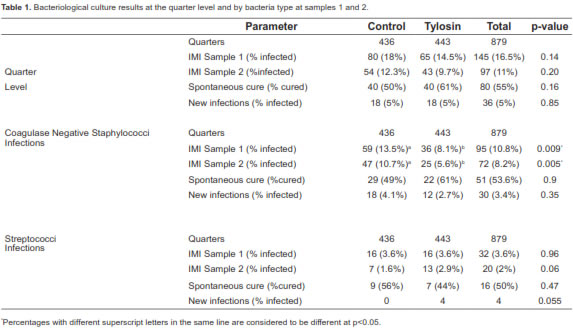
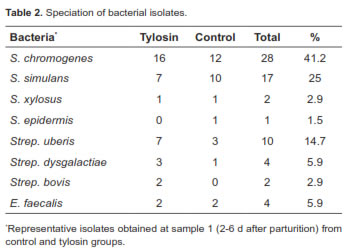
<body><![CDATA[<p>Two composite milk (3 ml) samples were   collected during sampling 1 and 2. One of the   samples was used to perform antibiotic residue   test with the Delvotest<sup>&reg;</sup> (DMS food specialties,   Parsippany, NJ, USA) and the second sample   was used to determine SCC at the regional Dairy   Herd Improvement (DHI) laboratory. Dairy Herd   Improvement tests were used to monitor SCC and   milk production during lactation. Milk production   records were collected by DHI personnel and total   production was calculated as projected to 305 d   mature equivalent (ME) by a herd management   software based on milk production at DHI test taken between 180 and 200 d in milk (DIM) after calving.</p>     <p>Minimal inhibition concentration (MIC) values   for the following representative isolates were   determined using the Sensititre<sup>&reg;</sup> system (Trek<sup>&reg;</sup>   diagnostics, Cleveland, OH, USA): 6 Streptococcus   uberis, 6 <i>Enterococcus faecalis</i>, 10 <i>Staphylococcus   chromogenes</i>, and 10 <i>Staphylococcus simulans</i>.   The following antimicrobials were included in   the Sensititre<sup>&reg;</sup> plate format: ampicillin, ceftiofur,   chlortetracycline, clindamycin, danofloxacin,   enrofloxacin, gentamicin, neomycin, oxytetracycline,   penicillin, spectinomycin, sulphadimethoxime, trimethropin/sulphamethoxazole, and tylosin.</p>     <p><i>Statistical Analysis</i></p>     <p>Culture results were analyzed under a   generalized linear mixed model (PROC   GLIMMIX<sup>f</sup>). The response variable was expressed   as the number of cases assuming a binary   distribution using a logit transform as the link   function. Treatment was included as a fixed effect.   Clustering among quarters within the same cow   was included as random effect. SCC scores were   analyzed using a linear mixed model with a repeated   measures structure (PROC MIXED; SAS Inst. Inc., Cary NC) following the equation:</p>     <p align="center"><i>Y<sub>ijk</sub> = &mu;+G<sub>i</sub> +I<sub>J</sub>+G<sub>i</sub>  <sup>*</sup>I<sub>j</sub>+S<sub>k</sub>+S<sub>k</sub>*G<sub>i</sub>+S<sub>k</sub>  <sup>*</sup>I<sub>j</sub>+S<sub>k</sub>  <sup>*</sup>G<sub>i</sub> <sup>*</sup>I<sub>j</sub>+E<sub>ijk</sub></i></p>     <p>Where <i>Y<sub>ijk</sub></i> is the dependent variable SCC score   for a heifer in group <i>G<sub>i</sub></i>, with infection status <i>I<sub>j</sub></i>,   at sample <i>S<sub>k</sub></i> as repeated measure, and <i>E<sub>ijk</sub></i> is the   random error assumed to be correlated. ''Compound   symmetry'' or ''Autoregressive'' heterogeneous   or homogeneous was chosen as the best variance/   covariance structure based on the lower Akaike   information criteria (AIC), indicating equal or   unequal variances across time. The Satterthwaite's   method for approximate degrees of freedom was used. Significance level was set at alpha = 0.05.</p>     <p>&nbsp;</p>     <p><b><font size="3">Results </font></b></p>     <p>A total of 92 (42%) heifers had an IMI at sample   1. 50 (46%) heifers were infected in the control   group, and 42 (38%) in the tylosin group (p=0.18).   In sample 2, 76 (34.5%) heifers were infected: 43   (40%) in the control group and 33 (29%) in the   tylosin group (p=0.10). Spontaneous cures were   observed in 19 heifers (38%) from the control   group and 21 animals (50%) from the tylosin group.   Furthermore, in both groups, 11% of the heifers   acquired a new IMI in the first week after calving.</p>     <p>At sample 1, 145/879 (16.5%) quarters were   infected. At sample 2, 97/879 (11%) quarters had   an IMI. The quarter spontaneous cure rate for tylosin group was 61%, and 50% for control group. New infections accounted for 5% of the quarters and no statistical difference was found between groups (<a href="#t1">Table 1</a>). Remarkably, the tylosin group had fewer CNS infections in sample 1 (36 quarters; 8.1%) than the control group (59 quarters; 13.5%) and this difference was significant (p&lt;0.01; <a href="#t1">Table 1</a>). At sample 2, CNS infected 25 quarters (5.6%) in the tylosin group and 47 quarters (10.7%) in the controls. This difference in infection rate was significant (p&lt;0.01), but could be related to the initial lower prevalence of CNS IMI in the tylosin group at sample 1. Spontaneous cure for CNS was 61% for tylosin and 49% for the controls.</p>     ]]></body>
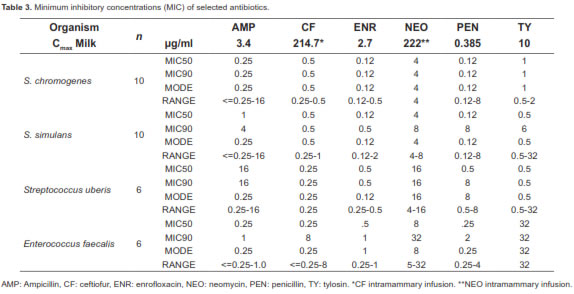
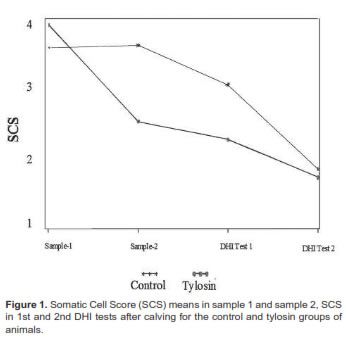
<body><![CDATA[<p align="center"><a name="t1"></a><img src="/img/revistas/rccp/v26n2/v26n2a7t1.jpg"></p>     <p>Bacterial speciation results are shown in   <a href="#t2">table 2</a>. <i>Staphylococcus chromogenes</i> was the   most prevalent species among CNS in this study,   representing 41.2% of CNS infections. In contrast, <i>S. simulans</i> affected 25% of the quarters in this trial.</p>     <p align="center"><a name="t2"></a><img src="/img/revistas/rccp/v26n2/v26n2a7t2.jpg"></p>     <p>Streptococci infections accounted for   32/145 (22%) of all IMI after calving. Over   all, streptococci infected 3.6% of the quarters   at sample 1 and 2% at sample 2 (<a href="#t1">Table 1</a>). The   streptococcal infection rate was equal for both   groups (3.6%) at sample 1, but was slightly   higher at sample 2 for tylosin (2.9%) than for   control (1.6%). <i>Streptococcus uberis</i> was the   most prevalent streptococcal infection, followed   by <i>Strep. dysgalactiae</i>. Spontaneous cures for   streptococcal infection accounted for 44% of   the quarters in the tylosin group and 56% in the   control group. Four new infections were found in the tylosin group, and none in the control group.</p>     <p>Contagious pathogens, <i>Streptococcus agalactiae</i>  and <i>Staphylococci aureus</i> were absent from the   study animals. Coliform bacteria infected a total of 18/879 quarters at sample 1, eight in the control group and 10 in tylosin treated heifers (results not included in <a href="#t1">Table 1</a>). Seven quarters were infected at sample 2, three in the control group, and four in the tylosin group.</p>     <p>MICs are reported on <a href="#t3">table 3</a>. Tylosin was   effective in inhibiting CNS growth. However, this   macrolide's activity against enterococci was poor,   and although it had a MIC90 0.5 mg/ml, for <i>Strep.   uberis</i>, the enterococci isolates were resistant   (MIC90 32 mg/ml) to this macrolide (<a href="#t3">Table 3</a>).</p>     <p align="center"><a name="t3"></a><img src="/img/revistas/rccp/v26n2/v26n2a7t3.jpg"></p>     <p>The Log scores for SCC results are shown in   <a href="#f1">figure 1</a>. Antibiotic treatment was not a significant   (p=0.17) source of SCS variation. The tylosin   group had a higher score (4.2 &plusmn; 3) than the control   group (3.7 &plusmn; 2.3) in sample 1. In contrast, the 1st   and 2nd DHI tests for both groups had similar   means for the somatic cell scores in sample 2.   The tylosin group had an average milk projection   at 305 d of 9515 &plusmn; 1847 kg in the first test and   10,556 &plusmn; 1790 kg in the second test. Similarly,   the control group had 9495 &plusmn; 1658 kg in the first,   and 10346&plusmn; kg in the second test. No difference in milk yield was found between the two groups.</p>     <p align="center"><a name="f1"></a><img src="/img/revistas/rccp/v26n2/v26n2a7f1.jpg"></p>     <p>&nbsp;</p>     ]]></body>
<body><![CDATA[<p><b><font size="3">Discussion </font></b></p>     <p>At the heifer level, the prevalence of IMI   observed in this study is similar to previous reports   with heifers housed under different environments   (Borm <i>et al.</i>, 2006; Trinidad <i>et al.</i>, 1990b). Results   in the present study indicate that, at the heifer level,   tylosin administration to prepartum heifers did not   significantly reduce IMI caused by gram-positive bacteria.</p>     <p>Similar to previous studies (Fox <i>et al.</i>, 1995;   Oliver <i>et al.</i>, 2003; Trinidad <i>et al.</i>, 1990b), CNS   was the principal agent causing IMI in heifers.   Consistent with other reports (Aarestrup and Jensen,   1997; Middleton <i>et al.</i>, 2005; Oliver <i>et al.</i>, 2007),   spontaneous cure for CNS was observed in more   than half of the group (61% for tylosin and 49%   for controls). Remarkably, tylosin had high efficacy   against CNS and decreased the infection rate due to   these microbes in the treated heifers. Further studies   are needed to evaluate economic and physiological   implications of transient infections of CNS during   the first week of lactation in heifers, since at least   half of the CNS infections will clear without   antibiotic intervention. </p>     <p>Bacterial speciation results (<a href="#t2">Table 2</a>) are similar to   those reported by Aarestrup and Jensen (1997). In their   study, there was a higher prevalence of <i>S. chromogenes</i>  (15% of the quarters) in the first 2 weeks after calving,   probably reflecting the normal presence of this species   on the skin. In the present study, <i>S. simulans</i> affected   25% of the quarters and only 3% in Aarestrup and   Jensen's trials (1997) but were persistent several   weeks after calving. Both CNS are reported to be   highly prevalent around parturition in mature dairy cows as well (Taponen <i>et al.</i>, 2007).</p>     <p>In contrast to the results from this clinical trial,   studies with pasture-grazed heifers in New Zealand   (Compton <i>et al.</i>, 2007) revealed a higher infection   rate by <i>Strep. uberis</i> (10% of the quarters) during   the first week after calving, reflecting changes in   IMI prevalence due to the housing system. Thus,   it is necessary to evaluate tylosin use in animals   housed in different conditions such as pasture   and dry-lots to determine its efficiency against streptococcal and CNS infections.</p>     <p>Regarding MIC (<a href="#t3">Table 3</a>), it is presumable that   peak milk concentration in tylosin-treated animals   was higher than previously reported, therefore   achieving bactericidal activity, which was observed   for macrolides when used in high concentrations   (Diarra <i>et al.</i>, 1999). Effectiveness of systemic   treatment with tylosin varies depending on the   dose and time interval between administration   and calving. Parker <i>et al.</i> (2008) compared a   commercial teat sealant, tylosin (5 g of tylosin base   IM for 3 d at 24 h intervals) or a combination of   both in pasture-grazed heifers in New Zealand. The   teat sealant reduced the risk of new IMI by 74%   and reduced the risk on new IMI with <i>Strep uberis</i>  by 70%. Tylosin did not have any effect in reducing risks.</p>     <p>Differences in response to tylosin treatment   between the present study and Parker <i>et al.</i> (2008)   could have been related to the relative low dose   used in New Zealand and the timing of treatment   (27 d before expected calving). A higher dose with   a single injection was used in this trial, and the   treatment was administered close to the scheduled   calving date (14 d). Tylosin's peak concentration   in milk was reported to be 10 mg/ml after a single   injection at a dose of 20 mg/kg BW (Ziv and   Sulman, 1973), and 18 mg/ml after three repeated   injections at a dose of 10 mg/kg BW (el-Sayed <i>et al.</i>, 1986). In the present work, tylosin dose was   based on the average calving weight of heifers   (600 kg) at 33 mg/kg. Despite of the relative high   dose used, antibiotic residues were not found in the   composite samples taken from sample 1 and sample   2. It is unknown if the use of tylosin as a systemic   treatment to eliminate or prevent IMI in heifers at   calving is dose and time sensitive, thus further   studies are needed to evaluate the extended therapy   at different doses with this macrolide to improve   its response. Because of logistic limitations of the   study, multiple administrations and dosage based on individual weight was not possible.</p>     <p>Systemic administration of tylosin was effective   in treating heifers for IMI caused by CNS at the   quarter level, but its routine use in this farm as   a prophylactic may not be economically sound   and could promote the development of bacterial resistance to macrolide antibiotics. Transient IMI occurs early in lactation with at least half of the infections cleared without antibiotic intervention. Therefore tylosin administration to primigravid heifers 2 wk before parturition should not be advised without a previous analysis of udder health, management, and economic implications in each individual farm. Furthermore, in this study 10% of the heifers acquired IMI within the first week after calving. Therefore, special attention has to be given to environmental and housing conditions. Antibiotic therapy will not replace poor management in a close-up, calving or fresh groups.</p>     <p>&nbsp;</p> <hr size="1" />    <p><b><font size="3">Notes</font></b></p>     ]]></body>
<body><![CDATA[<p><sup><a name="1" id="1"></a><a href="#b1">&curren;</a></sup> To cite this article: Contreras GA, Munoz JD, Sears PM. Reducing the incidence of intramammary infection in heifers by using prepartum systemic tylosin therapy: initial results of a single herd pilot study. Rev Colomb Cienc Pecu 2013; 26:119-126.</p> <hr size="1" />     <p>&nbsp;</p>     <p><b><font size="3">Acknowledgments </font></b></p>     <p>The American Association of Bovine   Practitioners (AABP) funded this study through its research assistantship for graduate students.</p>     <p>&nbsp;</p>     <p><b><font size="3">References </font></b></p>     <!-- ref --><p>Aarestrup FM, Jensen NE. Prevalence and Duration of   Intramammary Infection in Danish Heifers During the   Peripartum Period. J Dairy Sci 1997; 80:307-312.    &nbsp;&nbsp;&nbsp;&nbsp;&nbsp;&nbsp;&nbsp;&nbsp;[&#160;<a href="javascript:void(0);" onclick="javascript: window.open('/scielo.php?script=sci_nlinks&ref=000079&pid=S0120-0690201300020000700001&lng=','','width=640,height=500,resizable=yes,scrollbars=1,menubar=yes,');">Links</a>&#160;]<!-- end-ref --> </p>     <!-- ref --><p>Borm AA, Fox LK, Leslie KE, Hogan JS, Andrew SM, Moyes   KM, Oliver SP, Schukken YH, Hancock DD, Gaskins CT,   Owens WE, Norman C. Effects of prepartum intramammary   antibiotic therapy on udder health, milk production, and   reproductive performance in dairy heifers. J Dairy Sci 2006;   89:2090-2098.    &nbsp;&nbsp;&nbsp;&nbsp;&nbsp;&nbsp;&nbsp;&nbsp;[&#160;<a href="javascript:void(0);" onclick="javascript: window.open('/scielo.php?script=sci_nlinks&ref=000081&pid=S0120-0690201300020000700002&lng=','','width=640,height=500,resizable=yes,scrollbars=1,menubar=yes,');">Links</a>&#160;]<!-- end-ref --> </p>     ]]></body>
<body><![CDATA[<!-- ref --><p>Compton CWR, Heuer C, Parker K, McDougall S.   Epidemiology of mastitis in pasture grazed peripartum dairy   heifers and its effects on productivity. J Dairy Sci 2007;   90:4157-4170.    &nbsp;&nbsp;&nbsp;&nbsp;&nbsp;&nbsp;&nbsp;&nbsp;[&#160;<a href="javascript:void(0);" onclick="javascript: window.open('/scielo.php?script=sci_nlinks&ref=000083&pid=S0120-0690201300020000700003&lng=','','width=640,height=500,resizable=yes,scrollbars=1,menubar=yes,');">Links</a>&#160;]<!-- end-ref --> </p>     <!-- ref --><p>Contreras G, Rodr&iacute;guez J. Mastitis: Comparative etiology and   epidemiology. J Mammary Gland Biol 2011; 16: 339-356.    &nbsp;&nbsp;&nbsp;&nbsp;&nbsp;&nbsp;&nbsp;&nbsp;[&#160;<a href="javascript:void(0);" onclick="javascript: window.open('/scielo.php?script=sci_nlinks&ref=000085&pid=S0120-0690201300020000700004&lng=','','width=640,height=500,resizable=yes,scrollbars=1,menubar=yes,');">Links</a>&#160;]<!-- end-ref --> </p>     <!-- ref --><p>Contreras GA. Alternative strategies in the management of   heifers' mastitis. Alternativas en el manejo de la mastitis en   Novillas. Revista MVZ Cordoba 2009; 14:1642-1653.    &nbsp;&nbsp;&nbsp;&nbsp;&nbsp;&nbsp;&nbsp;&nbsp;[&#160;<a href="javascript:void(0);" onclick="javascript: window.open('/scielo.php?script=sci_nlinks&ref=000087&pid=S0120-0690201300020000700005&lng=','','width=640,height=500,resizable=yes,scrollbars=1,menubar=yes,');">Links</a>&#160;]<!-- end-ref --> </p>     <!-- ref --><p>Diarra MS, Malouin F, Jacques M. Postantibiotic and   physiological effects of tilmicosin, tylosin, and apramycin at   subminimal and suprainhibitory concentrations on some swine   and bovine respiratory tract pathogens. Int J Antimicrob Ag   1999; 12: 229-237.    &nbsp;&nbsp;&nbsp;&nbsp;&nbsp;&nbsp;&nbsp;&nbsp;[&#160;<a href="javascript:void(0);" onclick="javascript: window.open('/scielo.php?script=sci_nlinks&ref=000089&pid=S0120-0690201300020000700006&lng=','','width=640,height=500,resizable=yes,scrollbars=1,menubar=yes,');">Links</a>&#160;]<!-- end-ref --> </p>     <!-- ref --><p>el-Sayed M, el-Attar H, Atef M, Yousif M. Pharmacokinetic   profile of tylosin in mastitic cows. Dtsch Tierarztl Wochenschr   1986; 93:326-328.    &nbsp;&nbsp;&nbsp;&nbsp;&nbsp;&nbsp;&nbsp;&nbsp;[&#160;<a href="javascript:void(0);" onclick="javascript: window.open('/scielo.php?script=sci_nlinks&ref=000091&pid=S0120-0690201300020000700007&lng=','','width=640,height=500,resizable=yes,scrollbars=1,menubar=yes,');">Links</a>&#160;]<!-- end-ref --> </p>     ]]></body>
<body><![CDATA[<!-- ref --><p>Fox LK, Chester ST, Hallberg JW, Nickerson SC, Pankey JW,   Weaver LD. Survey of intramammary infections in dairy heifers   at breeding age and first parturition. J Dairy Sci 1995; 78:1619-   1628.    &nbsp;&nbsp;&nbsp;&nbsp;&nbsp;&nbsp;&nbsp;&nbsp;[&#160;<a href="javascript:void(0);" onclick="javascript: window.open('/scielo.php?script=sci_nlinks&ref=000093&pid=S0120-0690201300020000700008&lng=','','width=640,height=500,resizable=yes,scrollbars=1,menubar=yes,');">Links</a>&#160;]<!-- end-ref --> </p>     <!-- ref --><p>Hogan J, Gonzalez R, Harmon R, Nickerson SC, Oliver S,   Pankey J. Laboratory handbook on bovine mastitis. The   National Mastitis Council, Inc, Madison, WI. 1999.    &nbsp;&nbsp;&nbsp;&nbsp;&nbsp;&nbsp;&nbsp;&nbsp;[&#160;<a href="javascript:void(0);" onclick="javascript: window.open('/scielo.php?script=sci_nlinks&ref=000095&pid=S0120-0690201300020000700009&lng=','','width=640,height=500,resizable=yes,scrollbars=1,menubar=yes,');">Links</a>&#160;]<!-- end-ref --> </p>     <!-- ref --><p>Kreiger M, Friton GM, Hofer J, Fuchs K, Winter P. Effects of   periparturient systemic treatment with penethamate hydriodide   on udder health and milk yield of dairy heifers. J Dairy Res   2007; 74:392-398.    &nbsp;&nbsp;&nbsp;&nbsp;&nbsp;&nbsp;&nbsp;&nbsp;[&#160;<a href="javascript:void(0);" onclick="javascript: window.open('/scielo.php?script=sci_nlinks&ref=000097&pid=S0120-0690201300020000700010&lng=','','width=640,height=500,resizable=yes,scrollbars=1,menubar=yes,');">Links</a>&#160;]<!-- end-ref --> </p>     <!-- ref --><p>McDougall S, Agnew KE, Cursons R, Hou XX, Compton   CRW. Parenteral treatment of clinical mastitis with tylosin base   or penethamate hydriodide in dairy cattle. J Dairy Sci 2007;   90:779-789.    &nbsp;&nbsp;&nbsp;&nbsp;&nbsp;&nbsp;&nbsp;&nbsp;[&#160;<a href="javascript:void(0);" onclick="javascript: window.open('/scielo.php?script=sci_nlinks&ref=000099&pid=S0120-0690201300020000700011&lng=','','width=640,height=500,resizable=yes,scrollbars=1,menubar=yes,');">Links</a>&#160;]<!-- end-ref --> </p>     <!-- ref --><p>Middleton JR, Timms LL, Bader GR, Lakritz J, Luby CD,   Steevens BJ. Effect of prepartum intramammary treatment with   pirlimycin hydrochloride on prevalence of early first-lactation   mastitis in dairy heifers. J Am Vet Med Assoc 2005; 227:1969-   1974.    &nbsp;&nbsp;&nbsp;&nbsp;&nbsp;&nbsp;&nbsp;&nbsp;[&#160;<a href="javascript:void(0);" onclick="javascript: window.open('/scielo.php?script=sci_nlinks&ref=000101&pid=S0120-0690201300020000700012&lng=','','width=640,height=500,resizable=yes,scrollbars=1,menubar=yes,');">Links</a>&#160;]<!-- end-ref --> </p>     ]]></body>
<body><![CDATA[<!-- ref --><p>Oliver SP, Headrick SI, Gillespie BE, Lewis MJ, Johnson   DL, Lamar KC, Moorehead H, Dowlen HH, Hallberg JW.   Intramammary infections in heifers during early lactation   following intramammary infusion of pirlimycin hydrochloride   or penicillin-novobiocin at the first milking after parturition. J   Dairy Res 2007; 74:211-217.    &nbsp;&nbsp;&nbsp;&nbsp;&nbsp;&nbsp;&nbsp;&nbsp;[&#160;<a href="javascript:void(0);" onclick="javascript: window.open('/scielo.php?script=sci_nlinks&ref=000103&pid=S0120-0690201300020000700013&lng=','','width=640,height=500,resizable=yes,scrollbars=1,menubar=yes,');">Links</a>&#160;]<!-- end-ref --> </p>     <!-- ref --><p>Oliver SP, Lewis MJ, Gillespie BE, Dowlen HH, Jaenicke EC,   Roberts RK. Prepartum antibiotic treatment of heifers: milk   production, milk quality and economic benefit. J Dairy Sci   2003; 86:1187-1193.    &nbsp;&nbsp;&nbsp;&nbsp;&nbsp;&nbsp;&nbsp;&nbsp;[&#160;<a href="javascript:void(0);" onclick="javascript: window.open('/scielo.php?script=sci_nlinks&ref=000105&pid=S0120-0690201300020000700014&lng=','','width=640,height=500,resizable=yes,scrollbars=1,menubar=yes,');">Links</a>&#160;]<!-- end-ref --> </p>     <!-- ref --><p>Omura S. Macrolide antibiotics macrolide antibiotics,   chemistry, biology and practice. Orlando: Academic Press;   1984. p 302-338.    &nbsp;&nbsp;&nbsp;&nbsp;&nbsp;&nbsp;&nbsp;&nbsp;[&#160;<a href="javascript:void(0);" onclick="javascript: window.open('/scielo.php?script=sci_nlinks&ref=000107&pid=S0120-0690201300020000700015&lng=','','width=640,height=500,resizable=yes,scrollbars=1,menubar=yes,');">Links</a>&#160;]<!-- end-ref --> </p>     <!-- ref --><p>Parker KI, Compton CWR, Anniss FM, Heuer C, McDougall   S. Quarter-level analysis of subclinical and clinical mastitis   in primiparous heifers following the use of a teat sealant or   an injectable antibiotic, or both, precalving. J Dairy Sci 2008;   91:169-181.    &nbsp;&nbsp;&nbsp;&nbsp;&nbsp;&nbsp;&nbsp;&nbsp;[&#160;<a href="javascript:void(0);" onclick="javascript: window.open('/scielo.php?script=sci_nlinks&ref=000109&pid=S0120-0690201300020000700016&lng=','','width=640,height=500,resizable=yes,scrollbars=1,menubar=yes,');">Links</a>&#160;]<!-- end-ref --> </p>     <!-- ref --><p>Riviere J. Comparative pharmacokinetics: principles,   techniques, and applications. Ames: Iowa State University   Press; 1999.    &nbsp;&nbsp;&nbsp;&nbsp;&nbsp;&nbsp;&nbsp;&nbsp;[&#160;<a href="javascript:void(0);" onclick="javascript: window.open('/scielo.php?script=sci_nlinks&ref=000111&pid=S0120-0690201300020000700017&lng=','','width=640,height=500,resizable=yes,scrollbars=1,menubar=yes,');">Links</a>&#160;]<!-- end-ref --> </p>     ]]></body>
<body><![CDATA[<!-- ref --><p>Taponen S, Koort J, Bjorkroth J, Saloniemi H, Pyorala S.   Bovine intramammary infections caused by coagulase-negative   Staphylococci may persist throughout lactation according to   amplified fragment length polymorphism-based analysis. J   Dairy Sci 2007; 90:3301-3307.    &nbsp;&nbsp;&nbsp;&nbsp;&nbsp;&nbsp;&nbsp;&nbsp;[&#160;<a href="javascript:void(0);" onclick="javascript: window.open('/scielo.php?script=sci_nlinks&ref=000113&pid=S0120-0690201300020000700018&lng=','','width=640,height=500,resizable=yes,scrollbars=1,menubar=yes,');">Links</a>&#160;]<!-- end-ref --> </p>     <!-- ref --><p>Trinidad P, Nickerson SC, Adkinson RW. Histopathology of   Staphylococcal mastitis in unbreed dairy heifers. J Dairy Sci   1990a; 73:639-647.    &nbsp;&nbsp;&nbsp;&nbsp;&nbsp;&nbsp;&nbsp;&nbsp;[&#160;<a href="javascript:void(0);" onclick="javascript: window.open('/scielo.php?script=sci_nlinks&ref=000115&pid=S0120-0690201300020000700019&lng=','','width=640,height=500,resizable=yes,scrollbars=1,menubar=yes,');">Links</a>&#160;]<!-- end-ref --> </p>     <!-- ref --><p>Trinidad P, Nickerson SC, Alley TK. Prevalence of   intramammary infection and teat canal colonization in unbreed   and primigravid dairy heifers. J Dairy Sci 1990b; 73:107-114.    &nbsp;&nbsp;&nbsp;&nbsp;&nbsp;&nbsp;&nbsp;&nbsp;[&#160;<a href="javascript:void(0);" onclick="javascript: window.open('/scielo.php?script=sci_nlinks&ref=000117&pid=S0120-0690201300020000700020&lng=','','width=640,height=500,resizable=yes,scrollbars=1,menubar=yes,');">Links</a>&#160;]<!-- end-ref --> </p>     <!-- ref --><p>Ziv G and Sulman F. Serum and milk concentrations of   spectinomycin and tylosin in cows and ewes. Am J Vet Res 1973; 34:329-333.    &nbsp;&nbsp;&nbsp;&nbsp;&nbsp;&nbsp;&nbsp;&nbsp;[&#160;<a href="javascript:void(0);" onclick="javascript: window.open('/scielo.php?script=sci_nlinks&ref=000119&pid=S0120-0690201300020000700021&lng=','','width=640,height=500,resizable=yes,scrollbars=1,menubar=yes,');">Links</a>&#160;]<!-- end-ref --></p>     <p>&nbsp;</p> </font>     ]]></body><back>
<ref-list>
<ref id="B1">
<nlm-citation citation-type="journal">
<person-group person-group-type="author">
<name>
<surname><![CDATA[Aarestrup]]></surname>
<given-names><![CDATA[FM]]></given-names>
</name>
<name>
<surname><![CDATA[Jensen]]></surname>
<given-names><![CDATA[NE.]]></given-names>
</name>
</person-group>
<article-title xml:lang="en"><![CDATA[Prevalence and Duration of Intramammary Infection in Danish Heifers During the Peripartum Period]]></article-title>
<source><![CDATA[J Dairy Sci]]></source>
<year>1997</year>
<volume>80</volume>
<page-range>307-312</page-range></nlm-citation>
</ref>
<ref id="B2">
<nlm-citation citation-type="journal">
<person-group person-group-type="author">
<name>
<surname><![CDATA[Borm]]></surname>
<given-names><![CDATA[AA]]></given-names>
</name>
<name>
<surname><![CDATA[Fox]]></surname>
<given-names><![CDATA[LK]]></given-names>
</name>
<name>
<surname><![CDATA[Leslie]]></surname>
<given-names><![CDATA[KE]]></given-names>
</name>
<name>
<surname><![CDATA[Hogan]]></surname>
<given-names><![CDATA[JS]]></given-names>
</name>
<name>
<surname><![CDATA[Andrew]]></surname>
<given-names><![CDATA[SM]]></given-names>
</name>
<name>
<surname><![CDATA[Moyes]]></surname>
<given-names><![CDATA[KM]]></given-names>
</name>
<name>
<surname><![CDATA[Oliver]]></surname>
<given-names><![CDATA[SP]]></given-names>
</name>
<name>
<surname><![CDATA[Schukken]]></surname>
<given-names><![CDATA[YH]]></given-names>
</name>
<name>
<surname><![CDATA[Hancock]]></surname>
<given-names><![CDATA[DD]]></given-names>
</name>
<name>
<surname><![CDATA[Gaskins]]></surname>
<given-names><![CDATA[CT]]></given-names>
</name>
<name>
<surname><![CDATA[Owens]]></surname>
<given-names><![CDATA[WE]]></given-names>
</name>
<name>
<surname><![CDATA[Norman]]></surname>
<given-names><![CDATA[C.]]></given-names>
</name>
</person-group>
<article-title xml:lang="en"><![CDATA[Effects of prepartum intramammary antibiotic therapy on udder health, milk production, and reproductive performance in dairy heifers]]></article-title>
<source><![CDATA[J Dairy Sci]]></source>
<year>2006</year>
<volume>89</volume>
<page-range>2090-2098</page-range></nlm-citation>
</ref>
<ref id="B3">
<nlm-citation citation-type="journal">
<person-group person-group-type="author">
<name>
<surname><![CDATA[Compton]]></surname>
<given-names><![CDATA[CWR]]></given-names>
</name>
<name>
<surname><![CDATA[Heuer]]></surname>
<given-names><![CDATA[C]]></given-names>
</name>
<name>
<surname><![CDATA[Parker]]></surname>
<given-names><![CDATA[K]]></given-names>
</name>
<name>
<surname><![CDATA[McDougall]]></surname>
<given-names><![CDATA[S.]]></given-names>
</name>
</person-group>
<article-title xml:lang="en"><![CDATA[Epidemiology of mastitis in pasture grazed peripartum dairy heifers and its effects on productivity]]></article-title>
<source><![CDATA[J Dairy Sci]]></source>
<year>2007</year>
<volume>90</volume>
<page-range>4157-4170</page-range></nlm-citation>
</ref>
<ref id="B4">
<nlm-citation citation-type="journal">
<person-group person-group-type="author">
<name>
<surname><![CDATA[Contreras]]></surname>
<given-names><![CDATA[G]]></given-names>
</name>
<name>
<surname><![CDATA[Rodríguez]]></surname>
<given-names><![CDATA[J.]]></given-names>
</name>
</person-group>
<article-title xml:lang="en"><![CDATA[Mastitis: Comparative etiology and epidemiology]]></article-title>
<source><![CDATA[J Mammary Gland Biol]]></source>
<year>2011</year>
<volume>16</volume>
<page-range>339-356</page-range></nlm-citation>
</ref>
<ref id="B5">
<nlm-citation citation-type="journal">
<person-group person-group-type="author">
<name>
<surname><![CDATA[Contreras]]></surname>
<given-names><![CDATA[GA.]]></given-names>
</name>
</person-group>
<article-title xml:lang="en"><![CDATA[Alternative strategies in the management of heifers' mastitis]]></article-title>
<source><![CDATA[Revista MVZ Cordoba]]></source>
<year>2009</year>
<volume>14</volume>
<page-range>1642-1653</page-range></nlm-citation>
</ref>
<ref id="B6">
<nlm-citation citation-type="journal">
<person-group person-group-type="author">
<name>
<surname><![CDATA[Diarra]]></surname>
<given-names><![CDATA[MS]]></given-names>
</name>
<name>
<surname><![CDATA[Malouin]]></surname>
<given-names><![CDATA[F]]></given-names>
</name>
<name>
<surname><![CDATA[Jacques]]></surname>
<given-names><![CDATA[M.]]></given-names>
</name>
</person-group>
<article-title xml:lang="en"><![CDATA[Postantibiotic and physiological effects of tilmicosin, tylosin, and apramycin at subminimal and suprainhibitory concentrations on some swine and bovine respiratory tract pathogens]]></article-title>
<source><![CDATA[Int J Antimicrob Ag]]></source>
<year>1999</year>
<volume>12</volume>
<page-range>229-237</page-range></nlm-citation>
</ref>
<ref id="B7">
<nlm-citation citation-type="journal">
<person-group person-group-type="author">
<name>
<surname><![CDATA[el-Sayed]]></surname>
<given-names><![CDATA[M]]></given-names>
</name>
<name>
<surname><![CDATA[el-Attar]]></surname>
<given-names><![CDATA[H]]></given-names>
</name>
<name>
<surname><![CDATA[Atef]]></surname>
<given-names><![CDATA[M]]></given-names>
</name>
<name>
<surname><![CDATA[Yousif]]></surname>
<given-names><![CDATA[M.]]></given-names>
</name>
</person-group>
<article-title xml:lang="en"><![CDATA[Pharmacokinetic profile of tylosin in mastitic cows]]></article-title>
<source><![CDATA[Dtsch Tierarztl Wochenschr]]></source>
<year>1986</year>
<volume>93</volume>
<page-range>326-328</page-range></nlm-citation>
</ref>
<ref id="B8">
<nlm-citation citation-type="journal">
<person-group person-group-type="author">
<name>
<surname><![CDATA[Fox]]></surname>
<given-names><![CDATA[LK]]></given-names>
</name>
<name>
<surname><![CDATA[Chester]]></surname>
<given-names><![CDATA[ST]]></given-names>
</name>
<name>
<surname><![CDATA[Hallberg]]></surname>
<given-names><![CDATA[JW]]></given-names>
</name>
<name>
<surname><![CDATA[Nickerson]]></surname>
<given-names><![CDATA[SC]]></given-names>
</name>
<name>
<surname><![CDATA[Pankey]]></surname>
<given-names><![CDATA[JW]]></given-names>
</name>
<name>
<surname><![CDATA[Weaver]]></surname>
<given-names><![CDATA[LD]]></given-names>
</name>
</person-group>
<article-title xml:lang="en"><![CDATA[Survey of intramammary infections in dairy heifers at breeding age and first parturition]]></article-title>
<source><![CDATA[J Dairy Sci]]></source>
<year>1995</year>
<volume>78</volume>
<page-range>1619- 1628</page-range></nlm-citation>
</ref>
<ref id="B9">
<nlm-citation citation-type="book">
<person-group person-group-type="author">
<name>
<surname><![CDATA[Hogan]]></surname>
<given-names><![CDATA[J]]></given-names>
</name>
<name>
<surname><![CDATA[Gonzalez]]></surname>
<given-names><![CDATA[R]]></given-names>
</name>
<name>
<surname><![CDATA[Harmon]]></surname>
<given-names><![CDATA[R]]></given-names>
</name>
<name>
<surname><![CDATA[Nickerson]]></surname>
<given-names><![CDATA[SC]]></given-names>
</name>
<name>
<surname><![CDATA[Oliver]]></surname>
<given-names><![CDATA[S]]></given-names>
</name>
<name>
<surname><![CDATA[Pankey]]></surname>
<given-names><![CDATA[J.]]></given-names>
</name>
</person-group>
<source><![CDATA[Laboratory handbook on bovine mastitis]]></source>
<year>1999</year>
<publisher-loc><![CDATA[Madison^eWI WI]]></publisher-loc>
<publisher-name><![CDATA[The National Mastitis Council, Inc]]></publisher-name>
</nlm-citation>
</ref>
<ref id="B10">
<nlm-citation citation-type="journal">
<person-group person-group-type="author">
<name>
<surname><![CDATA[Kreiger]]></surname>
<given-names><![CDATA[M]]></given-names>
</name>
<name>
<surname><![CDATA[Friton]]></surname>
<given-names><![CDATA[GM]]></given-names>
</name>
<name>
<surname><![CDATA[Hofer]]></surname>
<given-names><![CDATA[J]]></given-names>
</name>
<name>
<surname><![CDATA[Fuchs]]></surname>
<given-names><![CDATA[K]]></given-names>
</name>
<name>
<surname><![CDATA[Winter]]></surname>
<given-names><![CDATA[P.]]></given-names>
</name>
</person-group>
<article-title xml:lang="en"><![CDATA[Effects of periparturient systemic treatment with penethamate hydriodide on udder health and milk yield of dairy heifers]]></article-title>
<source><![CDATA[J Dairy Res]]></source>
<year>2007</year>
<volume>74</volume>
<page-range>392-398</page-range></nlm-citation>
</ref>
<ref id="B11">
<nlm-citation citation-type="journal">
<person-group person-group-type="author">
<name>
<surname><![CDATA[McDougall]]></surname>
<given-names><![CDATA[S]]></given-names>
</name>
<name>
<surname><![CDATA[Agnew]]></surname>
<given-names><![CDATA[KE]]></given-names>
</name>
<name>
<surname><![CDATA[Cursons]]></surname>
<given-names><![CDATA[R]]></given-names>
</name>
<name>
<surname><![CDATA[Hou]]></surname>
<given-names><![CDATA[XX]]></given-names>
</name>
<name>
<surname><![CDATA[Compton]]></surname>
<given-names><![CDATA[CRW.]]></given-names>
</name>
</person-group>
<article-title xml:lang="en"><![CDATA[Parenteral treatment of clinical mastitis with tylosin base or penethamate hydriodide in dairy cattle]]></article-title>
<source><![CDATA[J Dairy Sci]]></source>
<year>2007</year>
<volume>90</volume>
<page-range>779-789</page-range></nlm-citation>
</ref>
<ref id="B12">
<nlm-citation citation-type="journal">
<person-group person-group-type="author">
<name>
<surname><![CDATA[Middleton]]></surname>
<given-names><![CDATA[JR]]></given-names>
</name>
<name>
<surname><![CDATA[Timms]]></surname>
<given-names><![CDATA[LL]]></given-names>
</name>
<name>
<surname><![CDATA[Bader]]></surname>
<given-names><![CDATA[GR]]></given-names>
</name>
<name>
<surname><![CDATA[Lakritz]]></surname>
<given-names><![CDATA[J]]></given-names>
</name>
<name>
<surname><![CDATA[Luby]]></surname>
<given-names><![CDATA[CD]]></given-names>
</name>
<name>
<surname><![CDATA[Steevens]]></surname>
<given-names><![CDATA[BJ.]]></given-names>
</name>
</person-group>
<article-title xml:lang="en"><![CDATA[Effect of prepartum intramammary treatment with pirlimycin hydrochloride on prevalence of early first-lactation mastitis in dairy heifers]]></article-title>
<source><![CDATA[J Am Vet Med Assoc]]></source>
<year>2005</year>
<volume>227</volume>
<page-range>1969- 1974</page-range></nlm-citation>
</ref>
<ref id="B13">
<nlm-citation citation-type="journal">
<person-group person-group-type="author">
<name>
<surname><![CDATA[Oliver]]></surname>
<given-names><![CDATA[SP]]></given-names>
</name>
<name>
<surname><![CDATA[Headrick]]></surname>
<given-names><![CDATA[SI]]></given-names>
</name>
<name>
<surname><![CDATA[Gillespie]]></surname>
<given-names><![CDATA[BE]]></given-names>
</name>
<name>
<surname><![CDATA[Lewis]]></surname>
<given-names><![CDATA[MJ]]></given-names>
</name>
<name>
<surname><![CDATA[Johnson]]></surname>
<given-names><![CDATA[DL]]></given-names>
</name>
<name>
<surname><![CDATA[Lamar]]></surname>
<given-names><![CDATA[KC]]></given-names>
</name>
<name>
<surname><![CDATA[Moorehead]]></surname>
<given-names><![CDATA[H]]></given-names>
</name>
<name>
<surname><![CDATA[Dowlen]]></surname>
<given-names><![CDATA[HH]]></given-names>
</name>
<name>
<surname><![CDATA[Hallberg]]></surname>
<given-names><![CDATA[JW.]]></given-names>
</name>
</person-group>
<article-title xml:lang="en"><![CDATA[Intramammary infections in heifers during early lactation following intramammary infusion of pirlimycin hydrochloride or penicillin-novobiocin at the first milking after parturition]]></article-title>
<source><![CDATA[J Dairy Res]]></source>
<year>2007</year>
<volume>74</volume>
<page-range>211-217</page-range></nlm-citation>
</ref>
<ref id="B14">
<nlm-citation citation-type="journal">
<person-group person-group-type="author">
<name>
<surname><![CDATA[Oliver]]></surname>
<given-names><![CDATA[SP]]></given-names>
</name>
<name>
<surname><![CDATA[Lewis]]></surname>
<given-names><![CDATA[MJ]]></given-names>
</name>
<name>
<surname><![CDATA[Gillespie]]></surname>
<given-names><![CDATA[BE]]></given-names>
</name>
<name>
<surname><![CDATA[Dowlen]]></surname>
<given-names><![CDATA[HH]]></given-names>
</name>
<name>
<surname><![CDATA[Jaenicke]]></surname>
<given-names><![CDATA[EC]]></given-names>
</name>
<name>
<surname><![CDATA[Roberts]]></surname>
<given-names><![CDATA[RK]]></given-names>
</name>
</person-group>
<article-title xml:lang="en"><![CDATA[Prepartum antibiotic treatment of heifers: milk production, milk quality and economic benefit]]></article-title>
<source><![CDATA[J Dairy Sci]]></source>
<year>2003</year>
<volume>86</volume>
<page-range>1187-1193</page-range></nlm-citation>
</ref>
<ref id="B15">
<nlm-citation citation-type="book">
<person-group person-group-type="author">
<name>
<surname><![CDATA[Omura]]></surname>
<given-names><![CDATA[S]]></given-names>
</name>
</person-group>
<source><![CDATA[Macrolide antibiotics macrolide antibiotics, chemistry, biology and practice]]></source>
<year>1984</year>
<page-range>302-338</page-range><publisher-loc><![CDATA[Orlando ]]></publisher-loc>
<publisher-name><![CDATA[Academic Press]]></publisher-name>
</nlm-citation>
</ref>
<ref id="B16">
<nlm-citation citation-type="journal">
<person-group person-group-type="author">
<name>
<surname><![CDATA[Parker]]></surname>
<given-names><![CDATA[KI]]></given-names>
</name>
<name>
<surname><![CDATA[Compton]]></surname>
<given-names><![CDATA[CWR]]></given-names>
</name>
<name>
<surname><![CDATA[Anniss]]></surname>
<given-names><![CDATA[FM]]></given-names>
</name>
<name>
<surname><![CDATA[Heuer]]></surname>
<given-names><![CDATA[C]]></given-names>
</name>
<name>
<surname><![CDATA[McDougall]]></surname>
<given-names><![CDATA[S.]]></given-names>
</name>
</person-group>
<article-title xml:lang="en"><![CDATA[Quarter-level analysis of subclinical and clinical mastitis in primiparous heifers following the use of a teat sealant or an injectable antibiotic, or both, precalving]]></article-title>
<source><![CDATA[J Dairy Sci]]></source>
<year>2008</year>
<volume>91</volume>
<page-range>169-181</page-range></nlm-citation>
</ref>
<ref id="B17">
<nlm-citation citation-type="book">
<person-group person-group-type="author">
<name>
<surname><![CDATA[Riviere]]></surname>
<given-names><![CDATA[J]]></given-names>
</name>
</person-group>
<source><![CDATA[Comparative pharmacokinetics: principles, techniques, and applications]]></source>
<year>1999</year>
<publisher-loc><![CDATA[Ames ]]></publisher-loc>
<publisher-name><![CDATA[Iowa State University Press]]></publisher-name>
</nlm-citation>
</ref>
<ref id="B18">
<nlm-citation citation-type="journal">
<person-group person-group-type="author">
<name>
<surname><![CDATA[Taponen]]></surname>
<given-names><![CDATA[S]]></given-names>
</name>
<name>
<surname><![CDATA[Koort]]></surname>
<given-names><![CDATA[J]]></given-names>
</name>
<name>
<surname><![CDATA[Bjorkroth]]></surname>
<given-names><![CDATA[J]]></given-names>
</name>
<name>
<surname><![CDATA[Saloniemi]]></surname>
<given-names><![CDATA[H]]></given-names>
</name>
<name>
<surname><![CDATA[Pyorala]]></surname>
<given-names><![CDATA[S.]]></given-names>
</name>
</person-group>
<article-title xml:lang="en"><![CDATA[Bovine intramammary infections caused by coagulase-negative Staphylococci may persist throughout lactation according to amplified fragment length polymorphism-based analysis]]></article-title>
<source><![CDATA[J Dairy Sci]]></source>
<year>2007</year>
<volume>90</volume>
<page-range>3301-3307</page-range></nlm-citation>
</ref>
<ref id="B19">
<nlm-citation citation-type="journal">
<person-group person-group-type="author">
<name>
<surname><![CDATA[Trinidad]]></surname>
<given-names><![CDATA[P]]></given-names>
</name>
<name>
<surname><![CDATA[Nickerson]]></surname>
<given-names><![CDATA[SC]]></given-names>
</name>
<name>
<surname><![CDATA[Adkinson]]></surname>
<given-names><![CDATA[RW.]]></given-names>
</name>
</person-group>
<article-title xml:lang="en"><![CDATA[Histopathology of Staphylococcal mastitis in unbreed dairy heifers]]></article-title>
<source><![CDATA[J Dairy Sci]]></source>
<year>1990</year>
<volume>73</volume>
<page-range>639-647</page-range></nlm-citation>
</ref>
<ref id="B20">
<nlm-citation citation-type="journal">
<person-group person-group-type="author">
<name>
<surname><![CDATA[Trinidad]]></surname>
<given-names><![CDATA[P]]></given-names>
</name>
<name>
<surname><![CDATA[Nickerson]]></surname>
<given-names><![CDATA[SC]]></given-names>
</name>
<name>
<surname><![CDATA[Alley]]></surname>
<given-names><![CDATA[TK]]></given-names>
</name>
</person-group>
<article-title xml:lang="en"><![CDATA[Prevalence of intramammary infection and teat canal colonization in unbreed and primigravid dairy heifers]]></article-title>
<source><![CDATA[J Dairy Sci]]></source>
<year>1990</year>
<volume>73</volume>
<page-range>107-114</page-range></nlm-citation>
</ref>
<ref id="B21">
<nlm-citation citation-type="journal">
<person-group person-group-type="author">
<name>
<surname><![CDATA[Ziv]]></surname>
<given-names><![CDATA[G]]></given-names>
</name>
<name>
<surname><![CDATA[Sulman]]></surname>
<given-names><![CDATA[F.]]></given-names>
</name>
</person-group>
<article-title xml:lang="en"><![CDATA[Serum and milk concentrations of spectinomycin and tylosin in cows and ewes]]></article-title>
<source><![CDATA[Am J Vet Res]]></source>
<year>1973</year>
<volume>34</volume>
<page-range>329-333</page-range></nlm-citation>
</ref>
</ref-list>
</back>
</article>