<?xml version="1.0" encoding="ISO-8859-1"?><article xmlns:mml="http://www.w3.org/1998/Math/MathML" xmlns:xlink="http://www.w3.org/1999/xlink" xmlns:xsi="http://www.w3.org/2001/XMLSchema-instance">
<front>
<journal-meta>
<journal-id>0120-0690</journal-id>
<journal-title><![CDATA[Revista Colombiana de Ciencias Pecuarias]]></journal-title>
<abbrev-journal-title><![CDATA[Rev Colom Cienc Pecua]]></abbrev-journal-title>
<issn>0120-0690</issn>
<publisher>
<publisher-name><![CDATA[Facultad de Ciencias Agrarias, Universidad de Antioquia]]></publisher-name>
</publisher>
</journal-meta>
<article-meta>
<article-id>S0120-06902013000200008</article-id>
<title-group>
<article-title xml:lang="en"><![CDATA[Osmoregulation of juvenile marine goliath grouper (Epinephelus itajara) in low-salinity water]]></article-title>
<article-title xml:lang="es"><![CDATA[Osmorregulación de juveniles del mero guasa juvenil (Epinephelus itajara) en aguas de baja salinidad]]></article-title>
<article-title xml:lang="pt"><![CDATA[Osmorregulação de juvenis do peixe garupa (Epinephelus itajara) em águas de baixa salinidade]]></article-title>
</title-group>
<contrib-group>
<contrib contrib-type="author">
<name>
<surname><![CDATA[García]]></surname>
<given-names><![CDATA[Lury N]]></given-names>
</name>
<xref ref-type="aff" rid="A01"/>
</contrib>
<contrib contrib-type="author">
<name>
<surname><![CDATA[Sierra]]></surname>
<given-names><![CDATA[Clara L]]></given-names>
</name>
<xref ref-type="aff" rid="A02"/>
</contrib>
<contrib contrib-type="author">
<name>
<surname><![CDATA[Perez]]></surname>
<given-names><![CDATA[Jeiver]]></given-names>
</name>
<xref ref-type="aff" rid="A02"/>
</contrib>
<contrib contrib-type="author">
<name>
<surname><![CDATA[Esquivel]]></surname>
<given-names><![CDATA[Frank]]></given-names>
</name>
<xref ref-type="aff" rid="A02"/>
</contrib>
<contrib contrib-type="author">
<name>
<surname><![CDATA[Chapman]]></surname>
<given-names><![CDATA[Frank A]]></given-names>
</name>
<xref ref-type="aff" rid="A03"/>
<xref ref-type="aff" rid="A04"/>
</contrib>
</contrib-group>
<aff id="A04">
<institution><![CDATA[,University of Florida  ]]></institution>
<addr-line><![CDATA[Gainesville Florida]]></addr-line>
</aff>
<aff id="A01">
<institution><![CDATA[,Universidad del Pacífico  ]]></institution>
<addr-line><![CDATA[Buenaventura Valle del Cauca]]></addr-line>
<country>Colombia</country>
</aff>
<aff id="A02">
<institution><![CDATA[,Universidad del Pacífico  ]]></institution>
<addr-line><![CDATA[Morindo Córdoba]]></addr-line>
<country>Colombia</country>
</aff>
<aff id="A03">
<institution><![CDATA[,University of Florida  ]]></institution>
<addr-line><![CDATA[Gainesville Florida]]></addr-line>
<country>USA</country>
</aff>
<pub-date pub-type="pub">
<day>00</day>
<month>06</month>
<year>2013</year>
</pub-date>
<pub-date pub-type="epub">
<day>00</day>
<month>06</month>
<year>2013</year>
</pub-date>
<volume>26</volume>
<numero>2</numero>
<fpage>127</fpage>
<lpage>135</lpage>
<copyright-statement/>
<copyright-year/>
<self-uri xlink:href="http://www.scielo.org.co/scielo.php?script=sci_arttext&amp;pid=S0120-06902013000200008&amp;lng=en&amp;nrm=iso"></self-uri><self-uri xlink:href="http://www.scielo.org.co/scielo.php?script=sci_abstract&amp;pid=S0120-06902013000200008&amp;lng=en&amp;nrm=iso"></self-uri><self-uri xlink:href="http://www.scielo.org.co/scielo.php?script=sci_pdf&amp;pid=S0120-06902013000200008&amp;lng=en&amp;nrm=iso"></self-uri><abstract abstract-type="short" xml:lang="en"><p><![CDATA[Background: goliath grouper (Epinephelus itajara) is an economically valuable marine species and an excellent candidate for domestication for aquaculture purposes. If this grouper can osmoregulate in lowsalinity water, its cultivation can provide socio-economic benefits, for both coastal communities and the mainland agricultural sector. Objective: to evaluate the osmoregulatory capacity of juvenile goliath grouper when exposed to low-salinity water. Methods: juvenile goliath grouper (Epinephelus itajara) were either directly or gradually transferred from seawater to freshwater to test osmoregulatory ability. Body weight was assessed during acclimation and blood samples were taken to measure total osmolality and electrolytes. Results: all fish survived the transfer to freshwater and were maintained for up to 12 days after termination of the acclimation trials which lasted 72 hours. Juvenile goliath grouper were hyposmotic (342-462 mosmol/kg) to seawater and hyperosmotic (272-292 mosmol/kg) to freshwater. The gills and kidneys were found to have principal roles in the osmoregulatory processes. Numerous chloride cells were found on superficial regions of the gill filament epithelium, most likely serving to eliminate the excess of electrolytes while in seawater. The kidneys had numerous nephrons to make urine and retain electrolytes while in freshwater. Conclusions: these observations lead to the conclusions that juvenile goliath grouper have the ability to osmoregulate in freshwater and should be considered a marine euryhaline species. Such adaptability opens for consideration the possibility that goliath grouper could be successfully farmed in brackish water or even in freshwater.]]></p></abstract>
<abstract abstract-type="short" xml:lang="es"><p><![CDATA[Antecedentes: el mero guasa Epinephelus itajara es una especie marina de gran valor comercial y un excelente candidato a domesticar con fines acuícolas. Si el mero guasa puede osmoregular en agua de baja salinidad, su cultivo puede proporcionar beneficios socio económicos, tanto para las comunidades costeras, como al sector agropecuario en tierra firme. Objetivo: evaluar el efecto en la osmoregulación de juveniles de mero guasa expuestos a aguas de baja salinidad. Métodos: juveniles de mero guasa mantenidos en agua de mar fueron transferidos directamente o de manera gradual a agua dulce para poner a prueba su capacidad osmorreguladora. Durante el proceso de aclimatación se les evaluó el peso corporal y se extrajo sangre para medir la osmolalidad total y electrolitos. Resultados: todos los peces sobrevivieron la transferencia al agua dulce y durante 12 días más, después de la finalización de los ensayos de aclimatación que tuvieron una duración de 72 horas. Juveniles de mero guasa fueron hiposmóticos (342-462 mosmol/kg) respecto al agua de mar e hiperosmóticos (272-292 mosmol/kg) respecto al agua dulce. La histología de branquias y riñones reveló que estos órganos son de gran importancia en los procesos osmorregulatorios. Un gran número de células de cloruro fueron localizadas como parte del epitelio de los filamentos branquiales; estas células trabajan para librar al cuerpo del exceso de electrolitos mientras los peces se encuentran en el mar. En el riñón se observaron numerosas nefronas y túbulos colectores para la formación de orina y retención de electrolitos; tejidos esenciales si estos peces permanecen en agua dulce. Conclusión: estas observaciones llevan a la conclusión de que los juveniles de mero guasa tienen la capacidad de osmorregular en agua dulce y debe ser considerada una especie marina eurihalina. Tal adaptabilidad supone la posibilidad de que el mero guasa podría ser cultivado en agua salobre o incluso en agua dulce.]]></p></abstract>
<abstract abstract-type="short" xml:lang="pt"><p><![CDATA[Antecedentes: o peixe garoupa Epinephelus itajara é uma espécie marinha de muito valor comercial a qual seria ótimo ter domesticada para sua produção industrial na aquicultura. Se o peixe garoupa pode osmoregular em água de baixa salinidade, sua cultura pode proporcionar benefícios socioeconômicos, tanto para as comunidades costeiras, quanto para o sector agrícola no interior do continente. Objetivo: avaliar a osmoregulação de juvenis do peixe garoupa expostos a águas de baixa salinidade. Métodos: juvenis do peixe Garoupa mantidos no mar foram transferidos direta ou gradualmente para água doce testando assim sua capacidade osmorregulatória. Durante o processo de aclimatização, foi avaliado o peso corporal e amostras de sangue foram coletadas para medir a osmolalidade total e alguns eletrólitos. Resultados: todos os peixes sobreviveram à transferência para água doce 12 dias mais após a conclusão dos estudos de aclimatação que se fizeram durante um período de 72 horas. Juvenis do peixe garupa foram hiposmoticos (342-462 mosmol/kg) com respeito à água marinha e hiperosmóticos (272-292 mosmol/kg) com respeito à água doce. Histologia das brânquias e os rins revelaram que estes órgãos são de grande importância nos processos de osmoregulaçao. Um grande número de células de cloreto foi localizado como parte do epitélio dos filamentos branquiais; estas células trabalham no organismo para livrar o corpo do excesso de eletrólitos enquanto os peixes estão no mar. Nos rins foram observados numerosos néfrons e ductos recoletores para a formação de urina e retenção de eletrólitos; tecidos essenciais no caso de que estes peixes permaneçam em água doce. Conclusão: estas observações levam à conclusão de que os juvenis do peixe garupa tem a capacidade de osmoregular em água doce e deve ser considerado uma espécie marinha eurialina. A adaptabilidade deste peixe em água doce supõe a possibilidade de que o peixe garupa poderia ser cultivado nesta água em criadouros no interior do continente.]]></p></abstract>
<kwd-group>
<kwd lng="en"><![CDATA[chloride cells]]></kwd>
<kwd lng="en"><![CDATA[conservation aquaculture]]></kwd>
<kwd lng="en"><![CDATA[euryhaline]]></kwd>
<kwd lng="en"><![CDATA[nephrons]]></kwd>
<kwd lng="en"><![CDATA[salinity tolerance]]></kwd>
<kwd lng="es"><![CDATA[acuicultura de conservación]]></kwd>
<kwd lng="es"><![CDATA[células de cloruro]]></kwd>
<kwd lng="es"><![CDATA[eurihalino]]></kwd>
<kwd lng="es"><![CDATA[nefronas]]></kwd>
<kwd lng="es"><![CDATA[tolerancia a la salinidad]]></kwd>
<kwd lng="pt"><![CDATA[aqüicultura de conservação]]></kwd>
<kwd lng="pt"><![CDATA[células de cloreto]]></kwd>
<kwd lng="pt"><![CDATA[eurialina]]></kwd>
<kwd lng="pt"><![CDATA[néfrons]]></kwd>
<kwd lng="pt"><![CDATA[tolerância à salinidade]]></kwd>
</kwd-group>
</article-meta>
</front><body><![CDATA[ <font face="Verdana, Arial, Helvetica, sans-serif" size="2">     <p align="right"><b>ORIGINAL ARTICLES</b></p>     <p align="center">&nbsp;</p>     <p align="center"><b><font size="4">Osmoregulation of juvenile marine goliath grouper   (<i>Epinephelus itajara</i>) in low-salinity water<sup><a href="#1">&curren;</a><a name="b1" id="b1"></a></sup></font></b></p>     <p align="center">&nbsp;</p>     <p align="center"><font size="3"><b>Osmorregulaci&oacute;n de juveniles del mero guasa juvenil (<u>Epinephelus itajara</u>) en aguas de baja salinidad</b></font></p>     <p align="center">&nbsp;</p>     <p align="center"><b><font size="3">Osmorregula&ccedil;&atilde;o de juvenis do peixe garupa (<u>Epinephelus itajara</u>) em &aacute;guas de baixa salinidade</font></b></p>     <p align="center">&nbsp;</p>     <p align="center">&nbsp;</p>     ]]></body>
<body><![CDATA[<p><b>Lury N Garc&iacute;a<sup>1</sup>, Ing Pesq, MSc; Clara L Sierra<sup>2</sup>, Bi&oacute;l; Jeiver Perez<sup>2</sup>, Bi&oacute;l; Frank Esquivel<sup>2</sup>, Bi&oacute;l; Frank A Chapman<sup>3*</sup>, Bi&oacute;l, MSc, PhD.</b></p>     <p>* Corresponding author: Frank A Chapman, University of Florida, Fisheries and Aquatic Sciences, 7922 NW 71st Street, Gainesville, Florida 32653, USA. e-mail: <a href="mailto:fchapman@ufl.edu">fchapman@ufl.edu</a></p>     <p>1 Programa de Tecnolog&iacute;a en Acuicultura, Universidad del Pac&iacute;fico, Av Sim&oacute;n Bol&iacute;var # 54A-10 Los Laureles, Buenaventura,   Valle del Cauca, Colombia. </p>     <p>2 CVS, Calle 29 No. 2-43 Ed. Morindo, C&oacute;rdoba, Colombia. </p>     <p>3 Fisheries and Aquatic Sciences, University of Florida, 7922 NW 71st Street, Gainesville, Florida 32653, USA.</p>     <p>&nbsp;  </p>     <p>(Received: December 15, 2011; accepted: November 15, 2012) </p>     <p>&nbsp;</p> <hr size="1" />     <p><b>Summary</b></p>     <p><b>Background:</b> goliath grouper (<i>Epinephelus itajara</i>) is an economically valuable marine species and an   excellent candidate for domestication for aquaculture purposes. If this grouper can osmoregulate in lowsalinity   water, its cultivation can provide socio-economic benefits, for both coastal communities and the   mainland agricultural sector. <b>Objective:</b> to evaluate the osmoregulatory capacity of juvenile goliath grouper   when exposed to low-salinity water. <b>Methods</b>: juvenile goliath grouper (<i>Epinephelus itajara</i>) were either   directly or gradually transferred from seawater to freshwater to test osmoregulatory ability. Body weight   was assessed during acclimation and blood samples were taken to measure total osmolality and electrolytes.   <b>Results:</b> all fish survived the transfer to freshwater and were maintained for up to 12 days after termination of   the acclimation trials which lasted 72 hours. Juvenile goliath grouper were hyposmotic (342-462 mosmol/kg)   to seawater and hyperosmotic (272-292 mosmol/kg) to freshwater. The gills and kidneys were found to have   principal roles in the osmoregulatory processes. Numerous chloride cells were found on superficial regions   of the gill filament epithelium, most likely serving to eliminate the excess of electrolytes while in seawater.   The kidneys had numerous nephrons to make urine and retain electrolytes while in freshwater. Conclusions:   these observations lead to the conclusions that juvenile goliath grouper have the ability to osmoregulate in   freshwater and should be considered a marine euryhaline species. Such adaptability opens for consideration   the possibility that goliath grouper could be successfully farmed in brackish water or even in freshwater.</p>     ]]></body>
<body><![CDATA[<p><b>Key words:</b> chloride cells, conservation aquaculture, euryhaline, nephrons, salinity tolerance.</p> <hr size="1" />     <p><b>Resumen</b></p>     <p><b>Antecedentes:</b> el mero guasa <i>Epinephelus itajara</i> es una especie marina de gran valor comercial y un   excelente candidato a domesticar con fines acu&iacute;colas. Si el mero guasa puede osmoregular en agua de baja   salinidad, su cultivo puede proporcionar beneficios socio econ&oacute;micos, tanto para las comunidades costeras,   como al sector agropecuario en tierra firme. <b>Objetivo:</b> evaluar el efecto en la osmoregulaci&oacute;n de juveniles   de mero guasa expuestos a aguas de baja salinidad. <b>M&eacute;todos:</b> juveniles de mero guasa mantenidos en agua   de mar fueron transferidos directamente o de manera gradual a agua dulce para poner a prueba su capacidad   osmorreguladora. Durante el proceso de aclimataci&oacute;n se les evalu&oacute; el peso corporal y se extrajo sangre para   medir la osmolalidad total y electrolitos. <b>Resultados:</b> todos los peces sobrevivieron la transferencia al agua   dulce y durante 12 d&iacute;as m&aacute;s, despu&eacute;s de la finalizaci&oacute;n de los ensayos de aclimataci&oacute;n que tuvieron una   duraci&oacute;n de 72 horas. Juveniles de mero guasa fueron hiposm&oacute;ticos (342-462 mosmol/kg) respecto al agua   de mar e hiperosm&oacute;ticos (272-292 mosmol/kg) respecto al agua dulce. La histolog&iacute;a de branquias y ri&ntilde;ones   revel&oacute; que estos &oacute;rganos son de gran importancia en los procesos osmorregulatorios. Un gran n&uacute;mero de   c&eacute;lulas de cloruro fueron localizadas como parte del epitelio de los filamentos branquiales; estas c&eacute;lulas   trabajan para librar al cuerpo del exceso de electrolitos mientras los peces se encuentran en el mar. En el ri&ntilde;&oacute;n   se observaron numerosas nefronas y t&uacute;bulos colectores para la formaci&oacute;n de orina y retenci&oacute;n de electrolitos;   tejidos esenciales si estos peces permanecen en agua dulce. <b>Conclusi&oacute;n:</b> estas observaciones llevan a la   conclusi&oacute;n de que los juveniles de mero guasa tienen la capacidad de osmorregular en agua dulce y debe   ser considerada una especie marina eurihalina. Tal adaptabilidad supone la posibilidad de que el mero guasa   podr&iacute;a ser cultivado en agua salobre o incluso en agua dulce.</p>     <p><b>Palabras clave:</b> acuicultura de conservaci&oacute;n, c&eacute;lulas de cloruro, eurihalino, nefronas, tolerancia a la   salinidad.</p> <hr size="1" />     <p><b>Resumo</b></p>     <p><b>Antecedentes:</b> o peixe garoupa <i>Epinephelus itajara</i> &eacute; uma esp&eacute;cie marinha de muito valor comercial   a qual seria &oacute;timo ter domesticada para sua produ&ccedil;&atilde;o industrial na aquicultura. Se o peixe garoupa pode   osmoregular em &aacute;gua de baixa salinidade, sua cultura pode proporcionar benef&iacute;cios socioecon&ocirc;micos, tanto   para as comunidades costeiras, quanto para o sector agr&iacute;cola no interior do continente. <b>Objetivo:</b> avaliar a   osmoregula&ccedil;&atilde;o de juvenis do peixe garoupa expostos a &aacute;guas de baixa salinidade. <b>M&eacute;todos:</b> juvenis do peixe   Garoupa mantidos no mar foram transferidos direta ou gradualmente para &aacute;gua doce testando assim sua   capacidade osmorregulat&oacute;ria. Durante o processo de aclimatiza&ccedil;&atilde;o, foi avaliado o peso corporal e amostras   de sangue foram coletadas para medir a osmolalidade total e alguns eletr&oacute;litos. <b>Resultados:</b> todos os peixes   sobreviveram &agrave; transfer&ecirc;ncia para &aacute;gua doce 12 dias mais ap&oacute;s a conclus&atilde;o dos estudos de aclimata&ccedil;&atilde;o que se   fizeram durante um per&iacute;odo de 72 horas. Juvenis do peixe garupa foram hiposmoticos (342-462 mosmol/kg)   com respeito &agrave; &aacute;gua marinha e hiperosm&oacute;ticos (272-292 mosmol/kg) com respeito &agrave; &aacute;gua doce. Histologia das   br&acirc;nquias e os rins revelaram que estes &oacute;rg&atilde;os s&atilde;o de grande import&acirc;ncia nos processos de osmoregula&ccedil;ao.   Um grande n&uacute;mero de c&eacute;lulas de cloreto foi localizado como parte do epit&eacute;lio dos filamentos branquiais;   estas c&eacute;lulas trabalham no organismo para livrar o corpo do excesso de eletr&oacute;litos enquanto os peixes est&atilde;o no   mar. Nos rins foram observados numerosos n&eacute;frons e ductos recoletores para a forma&ccedil;&atilde;o de urina e reten&ccedil;&atilde;o   de eletr&oacute;litos; tecidos essenciais no caso de que estes peixes permane&ccedil;am em &aacute;gua doce. <b>Conclus&atilde;o:</b> estas   observa&ccedil;&otilde;es levam &agrave; conclus&atilde;o de que os juvenis do peixe garupa tem a capacidade de osmoregular em &aacute;gua doce e deve ser considerado uma esp&eacute;cie marinha eurialina. A adaptabilidade deste peixe em &aacute;gua doce sup&otilde;e a possibilidade de que o peixe garupa poderia ser cultivado nesta &aacute;gua em criadouros no interior do   continente.</p>     <p><b>Palavras chave:</b> aq&uuml;icultura de conserva&ccedil;&atilde;o, c&eacute;lulas de cloreto, eurialina, n&eacute;frons, toler&acirc;ncia &agrave;   salinidade.</p> <hr size="1" />     <p>&nbsp;</p>     <p>&nbsp;</p>     <p><b><font size="3">Introduction </font></b></p>     ]]></body>
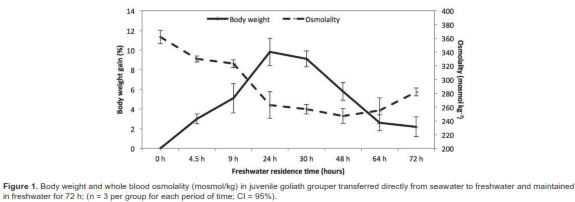
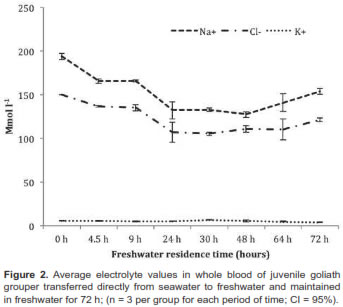
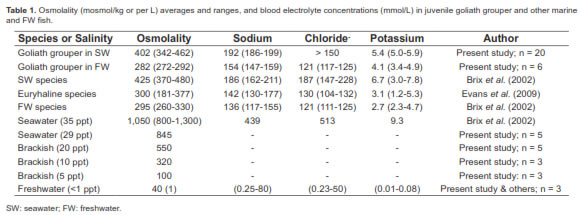
<body><![CDATA[<p>Aquaculture is one of the fastest-growing   segments of agriculture, advancing worldwide at   a rate of approximately 6.5 to 8.3 percent per year   (FAO, 2010). However, unlike terrestrial animals, the   process of domestication of many aquatic organisms   remains in its infancy. Most commercially grown fish and shellfish species are primarily collected   from the wild. Understanding biological functions,   mainly reproduction, genetics, nutrition, health, and   environmental physiology, are necessary in order to   prioritize the selection of species for domestication.   Knowledge of environmental physiology is necessary   to determine optimal environmental conditions in   order to achieve the best animal performance and stock health.</p>     <p>Groupers have traditionally been among the   world's most valuable fishery commodities,   especially in tropical countries, both for their meat   and recreational value. They are also an important   component of commercial and sport fisheries in   both the Atlantic and Pacific coasts of Colombia.   The goliath grouper <i>Epinephelus itajara</i>, or <i>mero   guasa</i> as it is known in Colombia, is the largest   grouper in the Western Atlantic Ocean, reaching   455 kg and over 2.5 m in body size (Bullock <i>et al.</i>,   1992). Goliath grouper, however, has been over-   fished throughout much of its natural range and   many populations have become threatened to the   point of extinction. For example, in Brazil and the   USA the species is legally protected from fishing   and in Colombia it is listed in the Red Book of   threatened marine species&#8212;those requiring urgent   and efficient protective measures (Mej&iacute;a and Acero,   2002; Hostim-Silva 2005; NMFS, 2006). This   species is also listed as critically endangered by the   International Union for Conservation of Nature and Natural Resources (IUCN, 2011).</p>     <p>The conservation and restoration efforts   for goliath grouper will ultimately depend on   appropriate management rules and aquaculture   management practices within the fisheries.   Aquaculture conservation programs can produce   juveniles of the species that can be used to   augment populations in the wild. Development of   commercial ventures for the cultivation of goliath   grouper can greatly reduce pressure on wild   populations. Farming goliath grouper can also be   a beneficial and valuable agricultural alternative in   rural coastal areas. Preliminary studies documented   that wild- caught goliath grouper juveniles   acclimated well to captivity and grew fairly quickly   when properly fed (Torossi, 1982; Cervigon,   1983; Botero and Ospina, 2003). Furthermore,   ecological investigations indicated goliath grouper   is a relatively hardy species since the juveniles live   primarily within the mangrove biome characterized   by extreme fluctuations in water quality (Smith,   1971; Bullock <i>et al.</i>, 1992; Sadovy and Eklund,   1999; Eklund, 2005; Frias-Torres, 2006; Koenig <i>et al.</i>, 2007).</p>     <p>The objective of this study was to determine if   juvenile goliath grouper can osmoregulate in water   that is less concentrated in solutes than their own   body fluids or that of their marine environment.   Temperature, salinity, dissolved oxygen, dissolved   salts and ions, ammonia, and pH are probably the   main physical and chemical factors that affect or   limit the distribution of fishes in nature as well as   their optimal performance under culture conditions   (Moyle and Cech, 1982; Timmons <i>et al.</i>, 2002).   Although primarily a marine species, goliath   grouper may have the osmoregulatory capacity to   thrive in very low salinity water or even freshwater.   If goliath grouper can osmoregulate in low salinity   water, its aquaculture can become a technically and   economically viable proposition in inland areas,   especially for intensive farming operations with   traditional land-based production systems. As far as   we know, this is the first study of its kind carried out on the species.</p>     <p>&nbsp;</p>     <p><font size="3"><b>Materials and methods</b></font></p>     <p>Juvenile goliath groupers were collected in the   coastal waters of Puerto Cispat&aacute; in the Atlantic   coast of Colombia. They were fished in shallow   water over sand flats with baited hooks and in   mangrove sites with dip nets and bare hands as the fish hid within the cavity of rubber tires formerly   placed there to create hiding places for them. After   collection, the fish were immediately transported to   a fish camp on stilts where they were held in cages constantly exposed to seawater (26 to 32 parts per   thousand &#91;ppt&#93; at 28 to 32 &ordm;C), and fed twice daily   with fresh pieces of cut baitfish until the experiment   began. Immediately prior to each trial, groups of   fish were removed from the cages and transferred to   a laboratory where they were kept in a ceramic tiled   tank (3.0 x 1.2 x 0.6 m; 2,462 L) that served as an   acclimation system and container for the trials.</p>     <p>A continuous supply of filtered and aerated   seawater and freshwater was available throughout   the study. Fish were maintained at 28 to 29 &ordm;C   in the tank and exposed to natural light. Fish   were held in this tank without feed for 24 h until   trials commenced. For the experimental trials,   the juvenile grouper (n= 50; total length= 29.3 &plusmn;   2.6 cm, standard length= 23.6 &plusmn; 2.2 cm, and total   weight= 424.9 &plusmn; 125.9 g) were randomly selected,   divided into experimental groups, and transferred   from the ceramic tiled tank to circular, 800 L plastic   water storage tanks that served as experimental   containers. Each tank was fitted with a submersible   water pump to achieve constant water circulation   and aeration. Water in the tanks was maintained at   ambient temperature (28 to 29 &ordm;C), and exchanged   twice daily when the fish holding period was   extended beyond 24 h. Water quality in all tanks   was monitored twice daily for total ammonianitrogen   using a portable MI405 ammonia detector (Milwaukee-Martini, Rocky Mount, NC, USA).</p>     <p>Temperature, salinity, and dissolved oxygen   were measured using a YSI 85 handheld   multiparameter instrument (YSI, Yellow Springs,   OH, USA), while pH was measured using a digital   ISFET meter (IQ Scientific, San Diego, CA, USA).   Fish were acclimated to the conditions of the   experimental tanks for 24 h before each trial began.   Fish were not fed 24 h before experiments or during   trials in order to reduce interference with blood tests and maintain water quality.</p>     <p>The experiments were divided into two groups.   Group 1: the experiment involved measuring   osmolality and blood electrolytes of juvenile goliath   groupers (n= 20; 24.4 &plusmn; 2.4 cm standard length, and   401.0 &plusmn; 103.9 g) held in natural seawater (SW) in   which they normally live, and those acclimated to   freshwater (FW). The fish were acclimated to FW   following a protocol we developed and successfully   tested. Briefly, the fish (n= 6; 24.7 &plusmn; 0.7 cm standard   length, and 565 &plusmn; 63.4 g) were gradually transferred   over a period of 3 to 4 days from full strength   natural SW to FW. Initial salinity of 29 ppt was   reduced to 20 ppt. After 12 h salinity was reduced   to 15 ppt, and after 24 h to 8 ppt. The fish were held   at 8 ppt for 48 h then transferred directly to FW.   The original salinity was reduced by dilution from   one concentration to the next over a 1 h period.   A salinity refractometer was used to determine concentration.</p>     ]]></body>
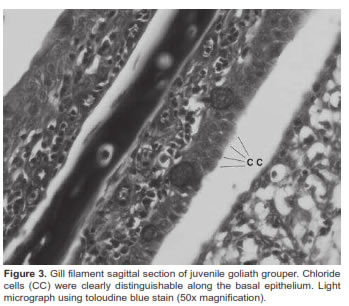
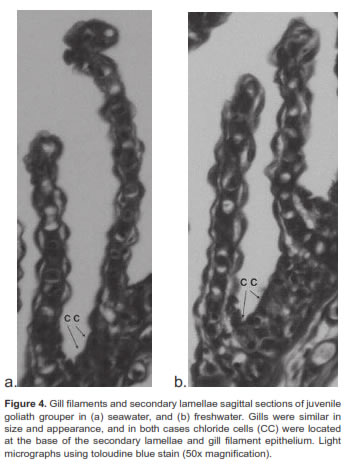
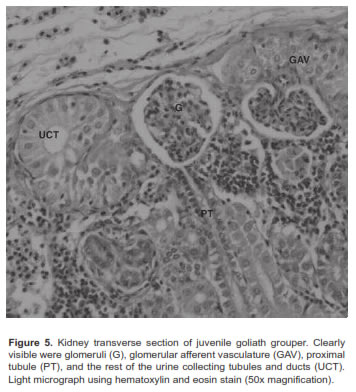
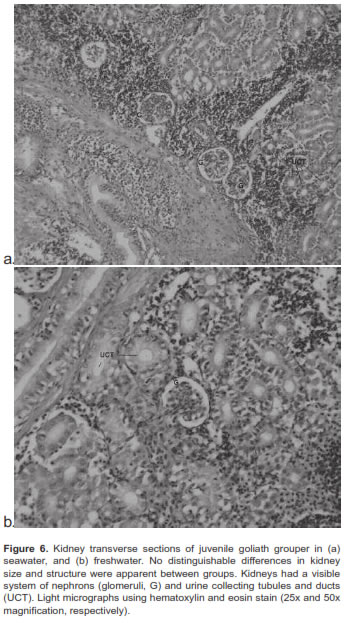
<body><![CDATA[<p>Group 2: to determine osmoregulatory capability,   fish (n= 24; 22.9 &plusmn; 2.1 cm standard length, and   436.6 &plusmn; 138.0 g) were transferred directly from   natural SW (29 ppt) to FW (&lt;1 ppt). Three fish   were weighed and blood sampled at the beginning   (0 h), then 4.5, 9, 24, 30, 48, 64, and 72 h into the   experiment. The fish were weighed in a tarred   plastic pitcher to determine changes in total body   weight (TW &plusmn; 0.1 g) and were measured for   standard length (SL) and total length (TL) on a   calibrated board (&plusmn; 1 mm). To draw blood, fish   were killed by decapitation followed by quickly   cutting the caudal peduncle thereafter. Blood   from individual fish was collected directly from   the bleeding caudal vessels into heparinized   Caraway capillary tubes. Osmolality (mosmol/   kg), sodium (Na<sup>+</sup>), potassium (K<sup>+</sup>), and chloride   (Cl<sup>-</sup>) were measured in fresh whole blood directly   from the capillary tube using a Wescor 5500 vapor   pressure osmometer (Wescor, Logan, UT, USA)   and a Medica Easy Electrolytes analyzer (Medica,   Bedford, MA, USA), respectively. Pieces of gill and   kidney were removed from five of the fish kept in natural SW and five of the fish acclimated to FW.</p>     <p>Tissue samples were transferred to 10% neutral   buffered formalin for preservation, embedded in   paraffin, sectioned, and stained with hematoxylin   and eosin, using standard histology methods   (Bancroft and Gamble, 2002); some of the gill   tissue samples were further stained with toluidine   blue to identify chloride cells. Sections (4-5 &mu;m)   of gill filaments and kidneys were examined using   light microscopy to identify general structural   features of the tissues, presence of chloride cells, and to determine if they displayed gross morphological effects of FW. Data were organized in Excel application spreadsheets (Microsoft, Redmond, WA, USA) and analyzed using JMP statistical software (SAS, Cary, NC, USA). Comparisons between means (mean &plusmn; standard deviation) were made with the t-test and analysis of variance procedure was conducted with the Tukey's multiple comparison post test at a 95% level of confidence.</p>     <p>&nbsp;</p>     <p><b><font size="3">Results </font></b></p>     <p>All juvenile fish survived in SW and FW with   no signs of distress throughout the entirety of the   experiment. They were maintained intermittently   from a minimum of 72 h up to 12 d. The SW   adapted juvenile fish had blood osmolalities   between 342 and 462 mosmol/kg, and sodium ion   concentrations around 186 to 189 mmol/L, chloride   levels above 150 mmol/L, and 5.0-5.9 mmol/L of   potassium (<a href="#t1">Table 1</a>). Once SW adapted fish were   transferred directly to FW there was a rapid weight   gain (up to approximately 10%), and a significant   tendency of blood osmolality to decline during the following 24 h (<a href="#f1">Figure 1</a>).</p>     <p>There was also a noticeable decrease in ion   concentrations (<a href="#f2">Figure 2</a>). At 30 h individual fish   stopped gaining weight and there were apparent   concomitant ionic readjustments. By 48 h blood   osmolality had leveled off while ions began to be   retained. Restoration of hydromineral balance was   apparent after 72 h. In juvenile fish kept in FW, the   experimental osmolality values ranged between   272 and 292 mosmol/kg, for sodium 147 to 159   mmol/L, chloride 117 to 125 mmol/L, and 3.4 to 4.9   mmol/L for potassium (<a href="#t1">Table 1</a>). Overall, the FW   adapted fish had slight but significantly lower solute   concentrations and osmolality values than those in   SW (<a href="#t1">Table 1</a>). Although these fish were not sampled   again, they were maintained in FW for 12 additional days without apparent ill effects.</p>     <p align="center"><a name="t1"></a><img src="/img/revistas/rccp/v26n2/v26n2a8t1.jpg"></p>     <p align="center"><a name="f1"></a><img src="/img/revistas/rccp/v26n2/v26n2a8f1.jpg"></p>     <p align="center"><a name="f2"></a><img src="/img/revistas/rccp/v26n2/v26n2a8f2.jpg"></p>     <p>Chloride or mitochondrial rich cells (MRC) were   primarily located at the base of the gill filament in   juvenile goliath grouper (<a href="#f3">Figure 3</a>). In both SW and   FW acclimated fish, the MRC were agglomerated   at the base of the gill filament epithelium and were   difficult to distinguish in the lamellae (<a href="#f4">Figure 4</a>).   However, during acclimation from SW to FW we   did not detect changes in the size or number of MRC   in the gill filament. Histologic examination of renal   tissue from juvenile goliath grouper indicated they   possessed a well differentiated kidney structure. The   renal corpuscle, the renal tubule, and the collecting   duct system of the kidney were clearly distinguished   by light microscopy (<a href="#f5">Figure 5</a>). No evident   differences were observed histologically between the kidneys of SW and FW acclimated fish (<a href="#f6">Figure 6</a>).</p>     ]]></body>
<body><![CDATA[<p align="center"><a name="f3"></a><img src="/img/revistas/rccp/v26n2/v26n2a8f3.jpg"></p>     <p align="center"><a name="f4"></a><img src="/img/revistas/rccp/v26n2/v26n2a8f4.jpg"></p>     <p align="center"><a name="f5"></a><img src="/img/revistas/rccp/v26n2/v26n2a8f5.jpg"></p>     <p align="center"><a name="f6"></a><img src="/img/revistas/rccp/v26n2/v26n2a8f6.jpg"></p>     <p>&nbsp;</p>     <p><b><font size="3">Discussion</font></b></p>     <p>Juvenile goliath grouper certainly has the basic   anatomical structures (gill and kidney) and active   mechanism for regulating body water and ion   concentrations to adapt to low salinity water. Blood   osmolality values were little affected, if at all, by   the external medium osmolality as they remained   close to one third of normal seawater (hyposmotic)   and above that of freshwater (hyperosmotic).   Therefore, rather than stenohaline, goliath grouper   may be considered euryhaline. Although there were   statistically significant differences for mean whole   blood osmolarities and ion concentrations in fish   kept in saltwater with respect to those in freshwater,   all levels fell within the expected normal osmolarity   ranges and ion concentrations found in blood of   marine and freshwater adapted fish.</p>     <p>It was apparent that during the 72 h acclimation   period juvenile goliath grouper underwent   significant variations in water balance, resulting   in considerable alterations in osmolality and   most ionic concentrations. Body weight gain   was probably correlated to changes in bulk water   absorption or osmotic water gain as has been   well documented in most animals (Evans, 2009).   Likewise, excess water diluted extracellular   osmolality as reflected in the decreased plasma osmolality and ion concentration levels observed.</p>     <p>However, after 48 h juvenile goliath grouper   appeared to stabilize or compensate for osmotic   water gain and diffusional ion loss, and its   recovery was initiated. Interestingly, potassium ion   concentration was very well sustained throughout   the period of acclimation. However, the highest   concentration of potassium in the body of animals   is inside the cells (intracellular fluid compartment,   ICF), instead of outside the cells (extracellular   fluid compartment, ECF), where the other principal   ions are contained (Tasker, 1980; Evans, 2009).   Since cell volume control is primarily regulated by   the gain or loss of primary ions such as Na<sup>+</sup>, and   Cl<sup>-</sup> in the ECF, and K<sup>+</sup> together with hundreds of   millimolar molecules (organic osmolytes) within   the ICF, the effect of external osmotic changes   at the intracellular level can lag behind relative   to electrolyte uptake in the ECF (Tasker, 1980;   Choe and Strange, 2009). The 72 h allocated to   the acclimation experiments was sufficient time   for the fish to acclimate to low salinity water. It   is known that salinity tolerance of fish can be   determined using standard or modified LC50 acute   toxicity testing methods (Kefford <i>et al.</i>, 2004). Fish   exposed beyond the tolerated salinity range died   within 48 to 72 h, but those fish that tolerated a   wide salinity range had a mean survival of at least   90% at 72 h (Kefford <i>et al.</i>, 2004). No juvenile   goliath grouper died during the experiments as they   gradually acclimated from seawater to freshwater.   As predicted, indicators of osmoregulatory capacity   in the juvenile goliath grouper could be measured within 48 and 72 h.</p>     <p>Most studies indicate that the principal   osmoregulatory organs in fish are the gills, kidney,   and gut (Evans and Claiborne, 2009). Microscopic   examination of gills and kidney tissues of SW and   FW acclimated juvenile goliath grouper revealed   they had all the characteristics of well-developed   organs to adapt to water of different salinity.   Chloride cells or MRC were observed along the   filamental epithelium of the gill similar to that of   other marine fish species. Given the ionic gradient   across the gill in SW, chloride cells or MRC have   been identified to function as the main organ in salt   excretion (Evans and Claiborne, 2009). However,   no apparent differences in gross histology of gill   tissues (e.g., number of chloride cells; p&gt;0.05)   were observed between SW and FW acclimated   fish. While behavioral and physiological changes   at osmoregulatory compensation tend to occur   between 48 and 72 h, identifiable structural or   histological changes such as proliferation or   disruption of chloride cells may become visible   later. For example, the number of chloride cells in   the gill filament or lamellae in anadromous salmon   were observed to be continuously replaced by   newly-differentiated cells, but, depending on their   location, the total numbers observed could remain   constant (Uchida and Kaneko, 1996). Thus, changes   in total number of chloride cells in gills of juvenile   goliath grouper may become apparent only after   wide differences between net turnover rate and   net synthesis rate or chloride cell degradation take   place, which could take longer than the 3 d duration   of this experiment. In contrast to the function of   the gill in SW, the kidney may play the dominant   role in the osmoregulatory mechanism of juvenile   goliath grouper in FW to compensate for osmotic   water gain and diffusional ion loss. Juvenile goliath   grouper kidneys possessed well-organized renal   corpuscles, tubules for reabsorption of electrolytes,   and a collecting duct system for eliminating large   quantities of dilute urine, typical of kidney tissue   of freshwater species. Although not evaluated in   this study, the gut could also play a significant   role in juvenile goliath grouper osmotic and ionic   regulation as it does in most other fish. For example,   SW fish must drink seawater to offset osmotic and   renal loss of fluid while in FW fish the gut serves   as site for Cl<sup>-</sup> and K<sup>+</sup> reabsorption (Evans and Claiborne, 2009).</p>     ]]></body>
<body><![CDATA[<p>The osmoregulatory capability of juvenile   goliath grouper may explain their abundant presence   in estuaries and the extent of their euryhalinity.   Such osmoregulatory capability also indicates the   potential for growing the species not only in marine   environments but also in brackish and freshwater   conditions. For many years, several grouper   species have been cultivated on a commercial   scale primarily in China, Japan, Taiwan, Southeast   Asia, and the Middle East, but such practice relies   primarily on the collection of juveniles from the   wild followed by growth in captivity to reach   marketable size (Tupper <i>et al.</i>, 2008). Sustainable   aquaculture practices, however, must depend on   a reliable supply of juvenile grouper raised in   hatcheries and obtained from domestic stocks. One   of the ultimate goals of this study was to begin   investigations on the possibility of raising goliath   grouper in brackish or freshwater conditions.   Aquaculture of marine species in coastal areas   or inland is an attractive proposition, especially   for reducing the inherent risks of offshore cage   culture regarding activities such as maintenance   and repair of production structures, husbandry of   the stock, disease transmission to natural stocks,   pollution of the benthic community, and genetic   and ecological impacts due to escapement. Conflicts   of ownership, public perception, and technical   issues in site selection are the main difficulties of   offshore aquaculture facilities. One of the benefits   identified with the culture of marine grouper species   in lower salinity water was an observed reduction   in the incidence of disease; however, the studied   species succumbed in lower than 5 ppt salinities   (Woo and Wu, 1982; Wu and Woo, 1983). This   is the first study to document the osmoregulatory   capacity of juvenile goliath grouper in low salinity   water and freshwater. Inland aquaculture of goliath   grouper in brackish or freshwater systems may   have far-reaching implications on the local farming   landscape, be important to the socioeconomic   well-being of communities, while causing minimal impact to the environment.</p>     <p>&nbsp;</p> <hr size="1" />    <p><b><font size="3">Notes</font></b></p>     <p><sup><a name="1" id="1"></a><a href="#b1">&curren;</a></sup>To cite this article: Garc&iacute;a LN, Sierra CL, Perez J, Esquivel F, Chapman FA. Osmoregulation of juvenile marine goliath grouper (<i>Epinephelus itajara</i>) in lowsalinity water. Rev Colomb Cienc Pecu 2013; 26:127-135.</p> <hr size="1" />     <p>&nbsp;</p>     <p><b><font size="3">Acknowledgments </font></b></p>     <p>We wish to thank the fisherman on the scene   for their support, Professor V. Atencio from   Universidad de C&oacute;rdoba, and also the Corporaci&oacute;n Para el Desarrollo de los Valles del Sin&uacute; y San Jorge   (CVS) in Puerto Cispat&aacute; (Colombia) for allowing us   to use their facilities. This study is part of the thesis   by L.N. Garc&iacute;a, to be submitted to the Universidad   Cat&oacute;lica del Norte in Coquimbo (Chile), in partial   fulfillment of the requirements for the degree of   Mag&iacute;ster en Acuicultura. This study was funded in   part by the University of Florida and Universidad   del Pac&iacute;fico (Colombia).</p>     <p>&nbsp;</p>     <p><b><font size="3">References </font></b></p>     <!-- ref --><p>Bancroft JD, Gamble B. Theory and practice of histological   techniques. Philadelphia (PA): Churchill Livingstone; 2002.    &nbsp;&nbsp;&nbsp;&nbsp;&nbsp;&nbsp;&nbsp;&nbsp;[&#160;<a href="javascript:void(0);" onclick="javascript: window.open('/scielo.php?script=sci_nlinks&ref=000072&pid=S0120-0690201300020000800001&lng=','','width=640,height=500,resizable=yes,scrollbars=1,menubar=yes,');">Links</a>&#160;]<!-- end-ref --></p>     <!-- ref --><p>Botero J, Ospina J F. Crecimiento y desempe&ntilde;o general   de juveniles silvestres de mero guasa <i>Epinephelus itajara</i>  (Lichtenstein) mantenidos en jaulas flotantes bajo diferentes   condiciones de cultivo. Bol Invest Mar Costeras 2003; 32:25-   36.    &nbsp;&nbsp;&nbsp;&nbsp;&nbsp;&nbsp;&nbsp;&nbsp;[&#160;<a href="javascript:void(0);" onclick="javascript: window.open('/scielo.php?script=sci_nlinks&ref=000074&pid=S0120-0690201300020000800002&lng=','','width=640,height=500,resizable=yes,scrollbars=1,menubar=yes,');">Links</a>&#160;]<!-- end-ref --></p>     <!-- ref --><p>Bullock LH, Murphy MD, Godcharles MF, Mitchell ME. Age,   growth, and reproduction of jewfish Epinephelus itajara in the   eastern Gulf of Mexico. Fish Bull 1992; 90:243-249.    &nbsp;&nbsp;&nbsp;&nbsp;&nbsp;&nbsp;&nbsp;&nbsp;[&#160;<a href="javascript:void(0);" onclick="javascript: window.open('/scielo.php?script=sci_nlinks&ref=000076&pid=S0120-0690201300020000800003&lng=','','width=640,height=500,resizable=yes,scrollbars=1,menubar=yes,');">Links</a>&#160;]<!-- end-ref --></p>     <!-- ref --><p>Cervigon F. La acuicultura en Venezuela: estado actual y   perspectivas. Caracas (Venezuela): Editorial Artes; 1983.    &nbsp;&nbsp;&nbsp;&nbsp;&nbsp;&nbsp;&nbsp;&nbsp;[&#160;<a href="javascript:void(0);" onclick="javascript: window.open('/scielo.php?script=sci_nlinks&ref=000078&pid=S0120-0690201300020000800004&lng=','','width=640,height=500,resizable=yes,scrollbars=1,menubar=yes,');">Links</a>&#160;]<!-- end-ref --></p>     <!-- ref --><p>Choe K and Strange K. Volume regulation and osmosensing   in animal cells. In: Evans DH, editor. Osmotic and ionic   regulation: cells and animals. Boca Raton: CRC Press; 2009.   p.37-67.    &nbsp;&nbsp;&nbsp;&nbsp;&nbsp;&nbsp;&nbsp;&nbsp;[&#160;<a href="javascript:void(0);" onclick="javascript: window.open('/scielo.php?script=sci_nlinks&ref=000080&pid=S0120-0690201300020000800005&lng=','','width=640,height=500,resizable=yes,scrollbars=1,menubar=yes,');">Links</a>&#160;]<!-- end-ref --></p>     <!-- ref --><p>Eklund AM. Habitat affinities of juvenile goliath grouper to   assess estuarine conditions. In: Bortone SA, editor. Estuarine   indicators. Boca Raton: CRC Press; 2005. p.393-407.    &nbsp;&nbsp;&nbsp;&nbsp;&nbsp;&nbsp;&nbsp;&nbsp;[&#160;<a href="javascript:void(0);" onclick="javascript: window.open('/scielo.php?script=sci_nlinks&ref=000082&pid=S0120-0690201300020000800006&lng=','','width=640,height=500,resizable=yes,scrollbars=1,menubar=yes,');">Links</a>&#160;]<!-- end-ref --></p>     <!-- ref --><p>Evans DH. Osmotic and ionic regulation: cells and animals.   Boca Raton (FL): CRC Press; 2009.    &nbsp;&nbsp;&nbsp;&nbsp;&nbsp;&nbsp;&nbsp;&nbsp;[&#160;<a href="javascript:void(0);" onclick="javascript: window.open('/scielo.php?script=sci_nlinks&ref=000084&pid=S0120-0690201300020000800007&lng=','','width=640,height=500,resizable=yes,scrollbars=1,menubar=yes,');">Links</a>&#160;]<!-- end-ref --></p>     <!-- ref --><p>Evans DH, Claiborne JB. Osmotic and ionic regulation in   fishes. In: Evans DH, editor. Osmotic and ionic regulation: cells   and animals. Boca Raton: CRC Press; 2009. p.295-366.    &nbsp;&nbsp;&nbsp;&nbsp;&nbsp;&nbsp;&nbsp;&nbsp;[&#160;<a href="javascript:void(0);" onclick="javascript: window.open('/scielo.php?script=sci_nlinks&ref=000086&pid=S0120-0690201300020000800008&lng=','','width=640,height=500,resizable=yes,scrollbars=1,menubar=yes,');">Links</a>&#160;]<!-- end-ref --></p>     <!-- ref --><p>Evans DH, Piermarini PM, Choe KP. The multifunctional fish   gill: dominant site of gas exchange, osmoregulation, acid-base   regulation, and excretion of nitrogenous waste. Physiol Rev   2005; 85:97-177&nbsp;&nbsp;&nbsp;&nbsp;&nbsp;&nbsp;&nbsp;&nbsp;[&#160;<a href="javascript:void(0);" onclick="javascript: window.open('/scielo.php?script=sci_nlinks&ref=000088&pid=S0120-0690201300020000800009&lng=','','width=640,height=500,resizable=yes,scrollbars=1,menubar=yes,');">Links</a>&#160;]<!-- end-ref --><!-- ref --><p>FAO. FAO Yearbook of fishery and aquaculture statistics, 2008.   Rome: FAO; 2010.    &nbsp;&nbsp;&nbsp;&nbsp;&nbsp;&nbsp;&nbsp;&nbsp;[&#160;<a href="javascript:void(0);" onclick="javascript: window.open('/scielo.php?script=sci_nlinks&ref=000089&pid=S0120-0690201300020000800010&lng=','','width=640,height=500,resizable=yes,scrollbars=1,menubar=yes,');">Links</a>&#160;]<!-- end-ref --></p>     <!-- ref --><p>Frias-Torres S. Habitat use of juvenile goliath grouper   <i>Epinephelus itajara</i> in the Florida Keys, USA. Endang Species   Res 2006; 2:1-6.    &nbsp;&nbsp;&nbsp;&nbsp;&nbsp;&nbsp;&nbsp;&nbsp;[&#160;<a href="javascript:void(0);" onclick="javascript: window.open('/scielo.php?script=sci_nlinks&ref=000091&pid=S0120-0690201300020000800011&lng=','','width=640,height=500,resizable=yes,scrollbars=1,menubar=yes,');">Links</a>&#160;]<!-- end-ref --></p>     ]]></body>
<body><![CDATA[<!-- ref --><p>Hostim-Silva M. The ''lord of the rock's'' conservation program   in Brazil: the need for a new perception of marine fishes. Coral   Reefs 2005; 24:74.    &nbsp;&nbsp;&nbsp;&nbsp;&nbsp;&nbsp;&nbsp;&nbsp;[&#160;<a href="javascript:void(0);" onclick="javascript: window.open('/scielo.php?script=sci_nlinks&ref=000093&pid=S0120-0690201300020000800012&lng=','','width=640,height=500,resizable=yes,scrollbars=1,menubar=yes,');">Links</a>&#160;]<!-- end-ref --></p>     <!-- ref --><p>IUCN. <i>Epinephelus itajara</i>. The IUCN red list of threatened   species. Version 2011.2. International Union for Conservation   of Nature and Natural resources, IUCN, 2011 &#91;Access date: November, 2011&#93;. URL: <a href="http://www.iucnredlist.org/apps/redlist/details/195409/0" target="_blank">http://www.iucnredlist.org/apps/redlist/details/195409/0</a>&nbsp;&nbsp;&nbsp;&nbsp;&nbsp;&nbsp;&nbsp;&nbsp;[&#160;<a href="javascript:void(0);" onclick="javascript: window.open('/scielo.php?script=sci_nlinks&ref=000095&pid=S0120-0690201300020000800013&lng=','','width=640,height=500,resizable=yes,scrollbars=1,menubar=yes,');">Links</a>&#160;]<!-- end-ref --><!-- ref --><p>Kefford BJ, Papas PJ, Metzeling L, Nugegoda D. Do laboratory   salinity tolerances of freshwater animals correspond with their field salinity?. Environ Pollut 2004; 129:355-362.    &nbsp;&nbsp;&nbsp;&nbsp;&nbsp;&nbsp;&nbsp;&nbsp;[&#160;<a href="javascript:void(0);" onclick="javascript: window.open('/scielo.php?script=sci_nlinks&ref=000096&pid=S0120-0690201300020000800014&lng=','','width=640,height=500,resizable=yes,scrollbars=1,menubar=yes,');">Links</a>&#160;]<!-- end-ref --></p>     <!-- ref --><p>Koenig CC, Coleman FC, Eklund AM, Schull J, Ueland J.   Mangroves as essential nursery habitat for goliath grouper   (<i>Epinephelus itajara</i>). Bull Mar Sci 2007; 80:567-586.    &nbsp;&nbsp;&nbsp;&nbsp;&nbsp;&nbsp;&nbsp;&nbsp;[&#160;<a href="javascript:void(0);" onclick="javascript: window.open('/scielo.php?script=sci_nlinks&ref=000098&pid=S0120-0690201300020000800015&lng=','','width=640,height=500,resizable=yes,scrollbars=1,menubar=yes,');">Links</a>&#160;]<!-- end-ref --></p>     <!-- ref --><p>Mej&iacute;a LS, Acero A. Libro rojo de peces marinos de Colombia.   INVEMAR; 2002.    &nbsp;&nbsp;&nbsp;&nbsp;&nbsp;&nbsp;&nbsp;&nbsp;[&#160;<a href="javascript:void(0);" onclick="javascript: window.open('/scielo.php?script=sci_nlinks&ref=000100&pid=S0120-0690201300020000800016&lng=','','width=640,height=500,resizable=yes,scrollbars=1,menubar=yes,');">Links</a>&#160;]<!-- end-ref --></p>     <!-- ref --><p>Moyle PB and Cech JJ. Fishes: an introduction to ichthyology.   Englewood Cliffs (NJ): Prentice-Hall; 1982.    &nbsp;&nbsp;&nbsp;&nbsp;&nbsp;&nbsp;&nbsp;&nbsp;[&#160;<a href="javascript:void(0);" onclick="javascript: window.open('/scielo.php?script=sci_nlinks&ref=000102&pid=S0120-0690201300020000800017&lng=','','width=640,height=500,resizable=yes,scrollbars=1,menubar=yes,');">Links</a>&#160;]<!-- end-ref --></p>     <!-- ref --><p>NMFS. Status report on the continental United States distinct   population segment of the goliath grouper (<i>Epinephelus   itajara</i>). National Marine Fisheries Service, NMFS; 2006;   &#91;Accessed date: November 2011&#93; URL: <a href="http://sero.nmfs.noaa.gov/pr/pdf/Final_Status_Report_on_the_Goliath_Grouper.pdf" target="_blank">http://sero.nmfs.noaa.gov/pr/pdf/Final_Status_Report_on_the_Goliath_Grouper.pdf</a>&nbsp;&nbsp;&nbsp;&nbsp;&nbsp;&nbsp;&nbsp;&nbsp;[&#160;<a href="javascript:void(0);" onclick="javascript: window.open('/scielo.php?script=sci_nlinks&ref=000104&pid=S0120-0690201300020000800018&lng=','','width=640,height=500,resizable=yes,scrollbars=1,menubar=yes,');">Links</a>&#160;]<!-- end-ref --><!-- ref --><p>Okada T, Yoneshima H, Mukai Y, Sawada Y. Tolerance limits   of young kelp grouper <i>Epinephelus moara</i> for environmental   stresses. Bull Fish Lab Kiniki Univ 1996; 5:139-146.    &nbsp;&nbsp;&nbsp;&nbsp;&nbsp;&nbsp;&nbsp;&nbsp;[&#160;<a href="javascript:void(0);" onclick="javascript: window.open('/scielo.php?script=sci_nlinks&ref=000105&pid=S0120-0690201300020000800019&lng=','','width=640,height=500,resizable=yes,scrollbars=1,menubar=yes,');">Links</a>&#160;]<!-- end-ref --></p>     <!-- ref --><p>Sadovy Y, Eklund AM. Synopsis of biological information on   the Nassau grouper, <i>Epinephelus striatus</i> (Bloch 1792) and   the jewfish, <i>E. itajara</i> (Lichtenstein 1822). NOAA Tech. Rep.   NMFS 146; 1999.    &nbsp;&nbsp;&nbsp;&nbsp;&nbsp;&nbsp;&nbsp;&nbsp;[&#160;<a href="javascript:void(0);" onclick="javascript: window.open('/scielo.php?script=sci_nlinks&ref=000107&pid=S0120-0690201300020000800020&lng=','','width=640,height=500,resizable=yes,scrollbars=1,menubar=yes,');">Links</a>&#160;]<!-- end-ref --></p>     <!-- ref --><p>Smith CL. A revision of the American groupers: <i>Epinephelus</i>  and allied genera. Bull Am Mus Nat Hist 1971; 146(2):67-242.    &nbsp;&nbsp;&nbsp;&nbsp;&nbsp;&nbsp;&nbsp;&nbsp;[&#160;<a href="javascript:void(0);" onclick="javascript: window.open('/scielo.php?script=sci_nlinks&ref=000109&pid=S0120-0690201300020000800021&lng=','','width=640,height=500,resizable=yes,scrollbars=1,menubar=yes,');">Links</a>&#160;]<!-- end-ref --></p>     <!-- ref --><p>Tasker, JB. Fluids, electrolytes, and acid-base balance. In:   Kaneko JJ, editor. Clinical biochemistry of domestic animals.   Third edition. New York: Academic Pres; 1980. p.401-446.    &nbsp;&nbsp;&nbsp;&nbsp;&nbsp;&nbsp;&nbsp;&nbsp;[&#160;<a href="javascript:void(0);" onclick="javascript: window.open('/scielo.php?script=sci_nlinks&ref=000111&pid=S0120-0690201300020000800022&lng=','','width=640,height=500,resizable=yes,scrollbars=1,menubar=yes,');">Links</a>&#160;]<!-- end-ref --></p>     ]]></body>
<body><![CDATA[<!-- ref --><p>Timmons MB, Ebeling JM, Wheaton FW, Summerfelt ST, Vinci   BJ. Recirculating aquaculture systems. 2<sup>nd</sup> ed. Ithaca (NY):   Cayuga Aqua Ventures; 2002.    &nbsp;&nbsp;&nbsp;&nbsp;&nbsp;&nbsp;&nbsp;&nbsp;[&#160;<a href="javascript:void(0);" onclick="javascript: window.open('/scielo.php?script=sci_nlinks&ref=000113&pid=S0120-0690201300020000800023&lng=','','width=640,height=500,resizable=yes,scrollbars=1,menubar=yes,');">Links</a>&#160;]<!-- end-ref --></p>     <!-- ref --><p>Torossi SC. 1982: Aspectos biol&oacute;gicos y ensayo de cultivo del   mero guasa <i>Epinephelus itajara</i> (Lichtenstein, 1822) (Pisces:   Serranidae) en la laguna de la Restinga (Isla de Margarita-   Venezuela). Tesis de Grado, Universidad de Oriente, Venezuela.    &nbsp;&nbsp;&nbsp;&nbsp;&nbsp;&nbsp;&nbsp;&nbsp;[&#160;<a href="javascript:void(0);" onclick="javascript: window.open('/scielo.php?script=sci_nlinks&ref=000115&pid=S0120-0690201300020000800024&lng=','','width=640,height=500,resizable=yes,scrollbars=1,menubar=yes,');">Links</a>&#160;]<!-- end-ref --></p>     <!-- ref --><p>Tupper M, Sheriff N. Capture-based aquaculture of groupers.   In: Lovatelli A and Holthus PF, editors. Capture-based   aquaculture, global overview. FAO Fisheries Technical Paper,   no. 508. Rome: FAO; 2008. p.217-253.    &nbsp;&nbsp;&nbsp;&nbsp;&nbsp;&nbsp;&nbsp;&nbsp;[&#160;<a href="javascript:void(0);" onclick="javascript: window.open('/scielo.php?script=sci_nlinks&ref=000117&pid=S0120-0690201300020000800025&lng=','','width=640,height=500,resizable=yes,scrollbars=1,menubar=yes,');">Links</a>&#160;]<!-- end-ref --></p>     <!-- ref --><p>Uchida K, Kaneko T. Enhanced chloride cell turnover in the   gills of chum salmon fry in seawater. Zool Sci 1996; 13:655- 660.    &nbsp;&nbsp;&nbsp;&nbsp;&nbsp;&nbsp;&nbsp;&nbsp;[&#160;<a href="javascript:void(0);" onclick="javascript: window.open('/scielo.php?script=sci_nlinks&ref=000119&pid=S0120-0690201300020000800026&lng=','','width=640,height=500,resizable=yes,scrollbars=1,menubar=yes,');">Links</a>&#160;]<!-- end-ref --></p>     <!-- ref --><p>   Woo NYS, Wu RSS. Metabolic and osmoregulatory changes in   response to reduced salinities in the red grouper <i>Epinephelus   akaara</i> (Temminck &amp; Schlegel), and the black sea bream,   <i>Mylio macrocephalus</i> (Basilewsky). J Exp Mar Biol Ecol 1982;   65:139-161.    &nbsp;&nbsp;&nbsp;&nbsp;&nbsp;&nbsp;&nbsp;&nbsp;[&#160;<a href="javascript:void(0);" onclick="javascript: window.open('/scielo.php?script=sci_nlinks&ref=000121&pid=S0120-0690201300020000800027&lng=','','width=640,height=500,resizable=yes,scrollbars=1,menubar=yes,');">Links</a>&#160;]<!-- end-ref --></p>     ]]></body>
<body><![CDATA[<!-- ref --><p>   Wu RSS, Woo NYS. Tolerance of hypo-osmotic salinities in   thirteen species of adult marine fish: implications for estuarine fish culture. Aquaculture 1983; 32:175-181.    &nbsp;&nbsp;&nbsp;&nbsp;&nbsp;&nbsp;&nbsp;&nbsp;[&#160;<a href="javascript:void(0);" onclick="javascript: window.open('/scielo.php?script=sci_nlinks&ref=000123&pid=S0120-0690201300020000800028&lng=','','width=640,height=500,resizable=yes,scrollbars=1,menubar=yes,');">Links</a>&#160;]<!-- end-ref --></p>     <p>&nbsp;</p> </font>      ]]></body><back>
<ref-list>
<ref id="B1">
<nlm-citation citation-type="book">
<person-group person-group-type="author">
<name>
<surname><![CDATA[Bancroft]]></surname>
<given-names><![CDATA[JD]]></given-names>
</name>
<name>
<surname><![CDATA[Gamble]]></surname>
<given-names><![CDATA[B.]]></given-names>
</name>
</person-group>
<source><![CDATA[Theory and practice of histological techniques]]></source>
<year>2002</year>
<publisher-loc><![CDATA[Philadelphia^ePA PA]]></publisher-loc>
<publisher-name><![CDATA[Churchill Livingstone]]></publisher-name>
</nlm-citation>
</ref>
<ref id="B2">
<nlm-citation citation-type="journal">
<person-group person-group-type="author">
<name>
<surname><![CDATA[Botero]]></surname>
<given-names><![CDATA[J]]></given-names>
</name>
<name>
<surname><![CDATA[Ospina]]></surname>
<given-names><![CDATA[J F.]]></given-names>
</name>
</person-group>
<article-title xml:lang="es"><![CDATA[Crecimiento y desempeño general de juveniles silvestres de mero guasa Epinephelus itajara (Lichtenstein) mantenidos en jaulas flotantes bajo diferentes condiciones de cultivo]]></article-title>
<source><![CDATA[Bol Invest Mar Costeras]]></source>
<year>2003</year>
<volume>32</volume>
<page-range>25- 36</page-range></nlm-citation>
</ref>
<ref id="B3">
<nlm-citation citation-type="journal">
<person-group person-group-type="author">
<name>
<surname><![CDATA[Bullock]]></surname>
<given-names><![CDATA[LH]]></given-names>
</name>
<name>
<surname><![CDATA[Murphy]]></surname>
<given-names><![CDATA[MD]]></given-names>
</name>
<name>
<surname><![CDATA[Godcharles]]></surname>
<given-names><![CDATA[MF]]></given-names>
</name>
<name>
<surname><![CDATA[Mitchell]]></surname>
<given-names><![CDATA[ME.]]></given-names>
</name>
</person-group>
<article-title xml:lang="en"><![CDATA[Age, growth, and reproduction of jewfish Epinephelus itajara in the eastern Gulf of Mexico]]></article-title>
<source><![CDATA[Fish Bull]]></source>
<year>1992</year>
<volume>90</volume>
<page-range>243-249</page-range></nlm-citation>
</ref>
<ref id="B4">
<nlm-citation citation-type="book">
<person-group person-group-type="author">
<name>
<surname><![CDATA[Cervigon]]></surname>
<given-names><![CDATA[F.]]></given-names>
</name>
</person-group>
<source><![CDATA[La acuicultura en Venezuela: estado actual y perspectivas]]></source>
<year>1983</year>
<publisher-loc><![CDATA[Caracas ]]></publisher-loc>
<publisher-name><![CDATA[Editorial Artes]]></publisher-name>
</nlm-citation>
</ref>
<ref id="B5">
<nlm-citation citation-type="book">
<person-group person-group-type="author">
<name>
<surname><![CDATA[Choe]]></surname>
<given-names><![CDATA[K]]></given-names>
</name>
<name>
<surname><![CDATA[Strange]]></surname>
<given-names><![CDATA[K.]]></given-names>
</name>
</person-group>
<article-title xml:lang="en"><![CDATA[Volume regulation and osmosensing in animal cells]]></article-title>
<person-group person-group-type="editor">
<name>
<surname><![CDATA[Evans]]></surname>
<given-names><![CDATA[DH]]></given-names>
</name>
</person-group>
<source><![CDATA[Osmotic and ionic regulation: cells and animals]]></source>
<year>2009</year>
<page-range>37-67</page-range><publisher-loc><![CDATA[Boca Raton ]]></publisher-loc>
<publisher-name><![CDATA[CRC Press]]></publisher-name>
</nlm-citation>
</ref>
<ref id="B6">
<nlm-citation citation-type="book">
<person-group person-group-type="author">
<name>
<surname><![CDATA[Eklund]]></surname>
<given-names><![CDATA[AM.]]></given-names>
</name>
</person-group>
<article-title xml:lang="en"><![CDATA[Habitat affinities of juvenile goliath grouper to assess estuarine conditions]]></article-title>
<person-group person-group-type="editor">
<name>
<surname><![CDATA[Bortone]]></surname>
<given-names><![CDATA[SA]]></given-names>
</name>
</person-group>
<source><![CDATA[Estuarine indicators]]></source>
<year>2005</year>
<page-range>393-407</page-range><publisher-loc><![CDATA[Boca Raton ]]></publisher-loc>
<publisher-name><![CDATA[CRC Press]]></publisher-name>
</nlm-citation>
</ref>
<ref id="B7">
<nlm-citation citation-type="book">
<person-group person-group-type="author">
<name>
<surname><![CDATA[Evans]]></surname>
<given-names><![CDATA[DH.]]></given-names>
</name>
</person-group>
<source><![CDATA[Osmotic and ionic regulation: cells and animals]]></source>
<year>2009</year>
<publisher-loc><![CDATA[Boca Raton^eFL FL]]></publisher-loc>
<publisher-name><![CDATA[CRC Press]]></publisher-name>
</nlm-citation>
</ref>
<ref id="B8">
<nlm-citation citation-type="book">
<person-group person-group-type="author">
<name>
<surname><![CDATA[Evans]]></surname>
<given-names><![CDATA[DH]]></given-names>
</name>
<name>
<surname><![CDATA[Claiborne]]></surname>
<given-names><![CDATA[JB.]]></given-names>
</name>
</person-group>
<article-title xml:lang="en"><![CDATA[Osmotic and ionic regulation in fishes]]></article-title>
<person-group person-group-type="editor">
<name>
<surname><![CDATA[Evans]]></surname>
<given-names><![CDATA[DH]]></given-names>
</name>
</person-group>
<source><![CDATA[Osmotic and ionic regulation: cells and animals]]></source>
<year>2009</year>
<page-range>295-366</page-range><publisher-loc><![CDATA[Boca Raton ]]></publisher-loc>
<publisher-name><![CDATA[CRC Press]]></publisher-name>
</nlm-citation>
</ref>
<ref id="B9">
<nlm-citation citation-type="journal">
<person-group person-group-type="author">
<name>
<surname><![CDATA[Evans]]></surname>
<given-names><![CDATA[DH]]></given-names>
</name>
<name>
<surname><![CDATA[Piermarini]]></surname>
<given-names><![CDATA[PM]]></given-names>
</name>
<name>
<surname><![CDATA[Choe]]></surname>
<given-names><![CDATA[KP]]></given-names>
</name>
</person-group>
<article-title xml:lang="en"><![CDATA[The multifunctional fish gill: dominant site of gas exchange, osmoregulation, acid-base regulation, and excretion of nitrogenous waste]]></article-title>
<source><![CDATA[Physiol Rev]]></source>
<year>2005</year>
<volume>85</volume>
<page-range>97-177</page-range></nlm-citation>
</ref>
<ref id="B10">
<nlm-citation citation-type="book">
<collab>FAO</collab>
<source><![CDATA[FAO Yearbook of fishery and aquaculture statistics, 2008]]></source>
<year>2010</year>
<publisher-loc><![CDATA[Rome ]]></publisher-loc>
<publisher-name><![CDATA[FAO]]></publisher-name>
</nlm-citation>
</ref>
<ref id="B11">
<nlm-citation citation-type="journal">
<person-group person-group-type="author">
<name>
<surname><![CDATA[Frias-Torres]]></surname>
<given-names><![CDATA[S.]]></given-names>
</name>
</person-group>
<article-title xml:lang="en"><![CDATA[Habitat use of juvenile goliath grouper Epinephelus itajara in the Florida Keys, USA]]></article-title>
<source><![CDATA[Endang Species Res]]></source>
<year>2006</year>
<volume>2</volume>
<page-range>1-6</page-range></nlm-citation>
</ref>
<ref id="B12">
<nlm-citation citation-type="journal">
<person-group person-group-type="author">
<name>
<surname><![CDATA[Hostim-Silva]]></surname>
<given-names><![CDATA[M.]]></given-names>
</name>
</person-group>
<article-title xml:lang="en"><![CDATA[The ''lord of the rock's'' conservation program in Brazil: the need for a new perception of marine fishes]]></article-title>
<source><![CDATA[Coral Reefs]]></source>
<year>2005</year>
<volume>24</volume>
<page-range>74</page-range></nlm-citation>
</ref>
<ref id="B13">
<nlm-citation citation-type="">
<collab>IUCN</collab>
<source><![CDATA[Epinephelus itajara. The IUCN red list of threatened species. Version 2011.2. International Union for Conservation of Nature and Natural resources, IUCN, 2011]]></source>
<year>Nove</year>
<month>mb</month>
<day>er</day>
</nlm-citation>
</ref>
<ref id="B14">
<nlm-citation citation-type="journal">
<person-group person-group-type="author">
<name>
<surname><![CDATA[Kefford]]></surname>
<given-names><![CDATA[BJ]]></given-names>
</name>
<name>
<surname><![CDATA[Papas]]></surname>
<given-names><![CDATA[PJ]]></given-names>
</name>
<name>
<surname><![CDATA[Metzeling]]></surname>
<given-names><![CDATA[L]]></given-names>
</name>
<name>
<surname><![CDATA[Nugegoda]]></surname>
<given-names><![CDATA[D.]]></given-names>
</name>
</person-group>
<article-title xml:lang="en"><![CDATA[Do laboratory salinity tolerances of freshwater animals correspond with their field salinity?]]></article-title>
<source><![CDATA[Environ Pollut]]></source>
<year>2004</year>
<volume>129</volume>
<page-range>355-362</page-range></nlm-citation>
</ref>
<ref id="B15">
<nlm-citation citation-type="journal">
<person-group person-group-type="author">
<name>
<surname><![CDATA[Koenig]]></surname>
<given-names><![CDATA[CC]]></given-names>
</name>
<name>
<surname><![CDATA[Coleman]]></surname>
<given-names><![CDATA[FC]]></given-names>
</name>
<name>
<surname><![CDATA[Eklund]]></surname>
<given-names><![CDATA[AM]]></given-names>
</name>
<name>
<surname><![CDATA[Schull]]></surname>
<given-names><![CDATA[J]]></given-names>
</name>
<name>
<surname><![CDATA[Ueland]]></surname>
<given-names><![CDATA[J.]]></given-names>
</name>
</person-group>
<article-title xml:lang="en"><![CDATA[Mangroves as essential nursery habitat for goliath grouper (Epinephelus itajara)]]></article-title>
<source><![CDATA[Bull Mar Sci]]></source>
<year>2007</year>
<volume>80</volume>
<page-range>567-586</page-range></nlm-citation>
</ref>
<ref id="B16">
<nlm-citation citation-type="book">
<person-group person-group-type="author">
<name>
<surname><![CDATA[Mejía]]></surname>
<given-names><![CDATA[LS]]></given-names>
</name>
<name>
<surname><![CDATA[Acero]]></surname>
<given-names><![CDATA[A.]]></given-names>
</name>
</person-group>
<source><![CDATA[Libro rojo de peces marinos de Colombia]]></source>
<year>2002</year>
<publisher-name><![CDATA[INVEMAR]]></publisher-name>
</nlm-citation>
</ref>
<ref id="B17">
<nlm-citation citation-type="book">
<person-group person-group-type="author">
<name>
<surname><![CDATA[Moyle]]></surname>
<given-names><![CDATA[PB]]></given-names>
</name>
<name>
<surname><![CDATA[Cech]]></surname>
<given-names><![CDATA[JJ.]]></given-names>
</name>
</person-group>
<source><![CDATA[Fishes: an introduction to ichthyology]]></source>
<year>1982</year>
<publisher-loc><![CDATA[Englewood Cliffs^eNJ NJ]]></publisher-loc>
<publisher-name><![CDATA[Prentice-Hall]]></publisher-name>
</nlm-citation>
</ref>
<ref id="B18">
<nlm-citation citation-type="book">
<collab>NMFS</collab>
<source><![CDATA[Status report on the continental United States distinct population segment of the goliath grouper (Epinephelus itajara)]]></source>
<year>2006</year>
<publisher-name><![CDATA[National Marine Fisheries Service, NMFS]]></publisher-name>
</nlm-citation>
</ref>
<ref id="B19">
<nlm-citation citation-type="journal">
<person-group person-group-type="author">
<name>
<surname><![CDATA[Okada]]></surname>
<given-names><![CDATA[T]]></given-names>
</name>
<name>
<surname><![CDATA[Yoneshima]]></surname>
<given-names><![CDATA[H]]></given-names>
</name>
<name>
<surname><![CDATA[Mukai]]></surname>
<given-names><![CDATA[Y]]></given-names>
</name>
<name>
<surname><![CDATA[Sawada]]></surname>
<given-names><![CDATA[Y.]]></given-names>
</name>
</person-group>
<article-title xml:lang="en"><![CDATA[Tolerance limits of young kelp grouper Epinephelus moara for environmental stresses]]></article-title>
<source><![CDATA[Bull Fish Lab Kiniki Univ]]></source>
<year>1996</year>
<volume>5</volume>
<page-range>139-146</page-range></nlm-citation>
</ref>
<ref id="B20">
<nlm-citation citation-type="journal">
<person-group person-group-type="author">
<name>
<surname><![CDATA[Sadovy]]></surname>
<given-names><![CDATA[Y]]></given-names>
</name>
<name>
<surname><![CDATA[Eklund]]></surname>
<given-names><![CDATA[AM.]]></given-names>
</name>
</person-group>
<article-title xml:lang="en"><![CDATA[Synopsis of biological information on the Nassau grouper, Epinephelus striatus (Bloch 1792) and the jewfish, E. itajara (Lichtenstein 1822)]]></article-title>
<source><![CDATA[NOAA Tech. Rep. NMFS]]></source>
<year>1999</year>
<volume>146</volume>
</nlm-citation>
</ref>
<ref id="B21">
<nlm-citation citation-type="journal">
<person-group person-group-type="author">
<name>
<surname><![CDATA[Smith]]></surname>
<given-names><![CDATA[CL.]]></given-names>
</name>
</person-group>
<article-title xml:lang="en"><![CDATA[A revision of the American groupers: Epinephelus and allied genera]]></article-title>
<source><![CDATA[Bull Am Mus Nat Hist]]></source>
<year>1971</year>
<volume>146</volume>
<numero>2</numero>
<issue>2</issue>
<page-range>67-242</page-range></nlm-citation>
</ref>
<ref id="B22">
<nlm-citation citation-type="book">
<person-group person-group-type="author">
<name>
<surname><![CDATA[Tasker]]></surname>
<given-names><![CDATA[JB]]></given-names>
</name>
</person-group>
<article-title xml:lang="en"><![CDATA[Fluids, electrolytes, and acid-base balance]]></article-title>
<person-group person-group-type="editor">
<name>
<surname><![CDATA[Kaneko]]></surname>
<given-names><![CDATA[JJ]]></given-names>
</name>
</person-group>
<source><![CDATA[Clinical biochemistry of domestic animals]]></source>
<year>1980</year>
<edition>Third</edition>
<page-range>401-446</page-range><publisher-loc><![CDATA[New York ]]></publisher-loc>
<publisher-name><![CDATA[Academic Pres]]></publisher-name>
</nlm-citation>
</ref>
<ref id="B23">
<nlm-citation citation-type="book">
<person-group person-group-type="author">
<name>
<surname><![CDATA[Timmons]]></surname>
<given-names><![CDATA[MB]]></given-names>
</name>
<name>
<surname><![CDATA[Ebeling]]></surname>
<given-names><![CDATA[JM]]></given-names>
</name>
<name>
<surname><![CDATA[Wheaton]]></surname>
<given-names><![CDATA[FW]]></given-names>
</name>
<name>
<surname><![CDATA[Summerfelt]]></surname>
<given-names><![CDATA[ST]]></given-names>
</name>
<name>
<surname><![CDATA[Vinci]]></surname>
<given-names><![CDATA[BJ]]></given-names>
</name>
</person-group>
<source><![CDATA[Recirculating aquaculture systems]]></source>
<year>2002</year>
<edition>2nd</edition>
<publisher-loc><![CDATA[Ithaca^eNY NY]]></publisher-loc>
<publisher-name><![CDATA[Cayuga Aqua Ventures]]></publisher-name>
</nlm-citation>
</ref>
<ref id="B24">
<nlm-citation citation-type="">
<person-group person-group-type="author">
<name>
<surname><![CDATA[Torossi]]></surname>
<given-names><![CDATA[SC]]></given-names>
</name>
</person-group>
<source><![CDATA[1982: Aspectos biológicos y ensayo de cultivo del mero guasa Epinephelus itajara (Lichtenstein, 1822) (Pisces: Serranidae) en la laguna de la Restinga (Isla de Margarita- Venezuela)]]></source>
<year></year>
</nlm-citation>
</ref>
<ref id="B25">
<nlm-citation citation-type="book">
<person-group person-group-type="author">
<name>
<surname><![CDATA[Tupper]]></surname>
<given-names><![CDATA[M]]></given-names>
</name>
<name>
<surname><![CDATA[Sheriff]]></surname>
<given-names><![CDATA[N.]]></given-names>
</name>
</person-group>
<article-title xml:lang="en"><![CDATA[Capture-based aquaculture of groupers]]></article-title>
<person-group person-group-type="editor">
<name>
<surname><![CDATA[Lovatelli]]></surname>
<given-names><![CDATA[A]]></given-names>
</name>
<name>
<surname><![CDATA[Holthus]]></surname>
<given-names><![CDATA[PF]]></given-names>
</name>
</person-group>
<source><![CDATA[Capture-based aquaculture, global overview]]></source>
<year>2008</year>
<volume>508</volume>
<page-range>217-253</page-range><publisher-loc><![CDATA[Rome ]]></publisher-loc>
<publisher-name><![CDATA[FAO]]></publisher-name>
</nlm-citation>
</ref>
<ref id="B26">
<nlm-citation citation-type="journal">
<person-group person-group-type="author">
<name>
<surname><![CDATA[Uchida]]></surname>
<given-names><![CDATA[K]]></given-names>
</name>
<name>
<surname><![CDATA[Kaneko]]></surname>
<given-names><![CDATA[T.]]></given-names>
</name>
</person-group>
<article-title xml:lang="en"><![CDATA[Enhanced chloride cell turnover in the gills of chum salmon fry in seawater]]></article-title>
<source><![CDATA[Zool Sci]]></source>
<year>1996</year>
<volume>13</volume>
<page-range>655- 660</page-range></nlm-citation>
</ref>
<ref id="B27">
<nlm-citation citation-type="journal">
<person-group person-group-type="author">
<name>
<surname><![CDATA[Woo]]></surname>
<given-names><![CDATA[NYS]]></given-names>
</name>
<name>
<surname><![CDATA[Wu]]></surname>
<given-names><![CDATA[RSS]]></given-names>
</name>
</person-group>
<article-title xml:lang="en"><![CDATA[Metabolic and osmoregulatory changes in response to reduced salinities in the red grouper Epinephelus akaara (Temminck & Schlegel), and the black sea bream, Mylio macrocephalus (Basilewsky)]]></article-title>
<source><![CDATA[J Exp Mar Biol Ecol]]></source>
<year>1982</year>
<volume>65</volume>
<page-range>139-161</page-range></nlm-citation>
</ref>
<ref id="B28">
<nlm-citation citation-type="journal">
<person-group person-group-type="author">
<name>
<surname><![CDATA[Wu]]></surname>
<given-names><![CDATA[RSS]]></given-names>
</name>
<name>
<surname><![CDATA[Woo]]></surname>
<given-names><![CDATA[NYS]]></given-names>
</name>
</person-group>
<article-title xml:lang="en"><![CDATA[Tolerance of hypo-osmotic salinities in thirteen species of adult marine fish: implications for estuarine fish culture]]></article-title>
<source><![CDATA[Aquaculture]]></source>
<year>1983</year>
<volume>32</volume>
<page-range>175-181</page-range></nlm-citation>
</ref>
</ref-list>
</back>
</article>