<?xml version="1.0" encoding="ISO-8859-1"?><article xmlns:mml="http://www.w3.org/1998/Math/MathML" xmlns:xlink="http://www.w3.org/1999/xlink" xmlns:xsi="http://www.w3.org/2001/XMLSchema-instance">
<front>
<journal-meta>
<journal-id>0120-0690</journal-id>
<journal-title><![CDATA[Revista Colombiana de Ciencias Pecuarias]]></journal-title>
<abbrev-journal-title><![CDATA[Rev Colom Cienc Pecua]]></abbrev-journal-title>
<issn>0120-0690</issn>
<publisher>
<publisher-name><![CDATA[Facultad de Ciencias Agrarias, Universidad de Antioquia]]></publisher-name>
</publisher>
</journal-meta>
<article-meta>
<article-id>S0120-06902013000300002</article-id>
<title-group>
<article-title xml:lang="en"><![CDATA[Comparison of methods to determine total edible meat in the male Holstein cattle carcass]]></article-title>
<article-title xml:lang="es"><![CDATA[Comparación de métodos para determinar el total de carne aprovechable en la canal de machos Holstein]]></article-title>
<article-title xml:lang="pt"><![CDATA[Comparação de métodos para determinar o total de carne aproveitável na carcaça de bezerros holandeses]]></article-title>
</title-group>
<contrib-group>
<contrib contrib-type="author">
<name>
<surname><![CDATA[Posada]]></surname>
<given-names><![CDATA[Sandra L]]></given-names>
</name>
<xref ref-type="aff" rid="A01"/>
<xref ref-type="aff" rid="A02"/>
</contrib>
<contrib contrib-type="author">
<name>
<surname><![CDATA[Rosero Noguera]]></surname>
<given-names><![CDATA[Ricardo]]></given-names>
</name>
<xref ref-type="aff" rid="A02"/>
</contrib>
<contrib contrib-type="author">
<name>
<surname><![CDATA[Valásquez]]></surname>
<given-names><![CDATA[Raúl]]></given-names>
</name>
<xref ref-type="aff" rid="A03"/>
</contrib>
<contrib contrib-type="author">
<name>
<surname><![CDATA[Hoyos]]></surname>
<given-names><![CDATA[Alvaro]]></given-names>
</name>
<xref ref-type="aff" rid="A02"/>
</contrib>
<contrib contrib-type="author">
<name>
<surname><![CDATA[Cerón]]></surname>
<given-names><![CDATA[Juan Manuel]]></given-names>
</name>
<xref ref-type="aff" rid="A04"/>
</contrib>
</contrib-group>
<aff id="A01">
<institution><![CDATA[,Universidad de Antioquia Facultad de Ciencias Agrarias ]]></institution>
<addr-line><![CDATA[Medellin ]]></addr-line>
<country>Colombia</country>
</aff>
<aff id="A02">
<institution><![CDATA[,Universidad de Antioquia Facultad de Ciencias Agrarias ]]></institution>
<addr-line><![CDATA[Medellín ]]></addr-line>
<country>Colombia</country>
</aff>
<aff id="A03">
<institution><![CDATA[,Universidad de Antioquia Facultad de Ciencias Agrarias ]]></institution>
<addr-line><![CDATA[Medellín ]]></addr-line>
<country>Colombia</country>
</aff>
<aff id="A04">
<institution><![CDATA[,Cooperativa Lechera de Antioquia  ]]></institution>
<addr-line><![CDATA[Medellín ]]></addr-line>
<country>Colombia</country>
</aff>
<pub-date pub-type="pub">
<day>00</day>
<month>09</month>
<year>2013</year>
</pub-date>
<pub-date pub-type="epub">
<day>00</day>
<month>09</month>
<year>2013</year>
</pub-date>
<volume>26</volume>
<numero>3</numero>
<fpage>159</fpage>
<lpage>168</lpage>
<copyright-statement/>
<copyright-year/>
<self-uri xlink:href="http://www.scielo.org.co/scielo.php?script=sci_arttext&amp;pid=S0120-06902013000300002&amp;lng=en&amp;nrm=iso"></self-uri><self-uri xlink:href="http://www.scielo.org.co/scielo.php?script=sci_abstract&amp;pid=S0120-06902013000300002&amp;lng=en&amp;nrm=iso"></self-uri><self-uri xlink:href="http://www.scielo.org.co/scielo.php?script=sci_pdf&amp;pid=S0120-06902013000300002&amp;lng=en&amp;nrm=iso"></self-uri><abstract abstract-type="short" xml:lang="en"><p><![CDATA[Background: the objective of beef cattle farming is to produce young animals with adequate proportions of meat, fat and bone. In many countries, including Colombia, research on carcass quality and performance has focused on Bos indicus, resulting in little information available on Bos taurus breeds, particularly Holstein. Objective: to compare several methods for determining total edible meat (TEM) in the carcass of intact Holstein males slaughtered at 330 kg and 26 months of age. Methods: the TEM was determined by the direct method (true-TEM), and also by two indirect methods based on equations. One equation involving carcass measurements was proposed by the Instituto de Ciencia y Tecnología de Alimentos (ICTA). The other equation is based on the muscle proportion between ribs 9-11. Results: variance analysis detected statistically significant difference (p<0.05) among all methods. The relationship between true-TEM and that estimated by indirect methods was high (r =0.9756). However, according to Bland-Altman interchangeability analysis, the direct method is not interchangeable with the prediction by ICTA. The TEM variability obtained by the three methods was similar (average CV = 18.15%). Conclusion: according to this study, the method based on the muscle proportion between ribs 9-11 is useful for estimating TEM in Holstein bull carcasses.]]></p></abstract>
<abstract abstract-type="short" xml:lang="es"><p><![CDATA[Antecedentes: el objetivo de la ganaderia de carne es producir animales jóvenes para sacrificio, con proporciones adecuadas de carne, hueso y grasa. En países como Colombia, las investigaciones sobre calidad y rendimiento en canal se han concentrado en ganado Bos indicus, existiendo muy poca información sobre razas Bos taurus, particularmente Holstein. Objetivo: comparar varios métodos para determinar el total de carne aprovechable (TEM) en la canal de machos Holstein enteros, sacrificados a un peso aproximado de 330 Kg y 26 meses de edad. Métodos: la determinación del TEM se realizó mediante el método directo (TEM real) y dos métodos indirectos basados en el empleo de ecuaciones, a saber, la ecuación propuesta por el Instituto de Ciencia y Tecnología de Alimentos (ICTA) utilizando mediciones realizadas en la canal, y la basada en la proporción de músculo presente en la sección comprendida entre las costillas 9 y 11. Resultados: el análisis de varianza permitió detectar diferencia estadística significativa (p<0,05) entre todos los métodos evaluados. La relación entre el TEM real y el estimado desde los métodos indirectos fue alta (r =0,9756). Sin embargo, el análisis de intercambiabilidad de Bland-Altman permitió concluir que el método directo no es intercambiable con la predicción realizada a partir del sistema ICTA. La variabilidad del TEM obtenido por los tres métodos fue similar (CV medio =18,15%). Conclusión: de acuerdo con este estudio, el método basado en la proporción de músculo entre las costillas 9 y 11 es útil para estimar el TEM en la canal de machos Holstein.]]></p></abstract>
<abstract abstract-type="short" xml:lang="pt"><p><![CDATA[Antecedentes: o objetivo do sector pecuário é produzir animais jovens, que assegurem proporções adequadas de carne, osso e gordura no momento do abate. Na Colômbia, as pesquisas sobre qualidade e rendimento da carcaça têm-se centrado em gado Bos indicus, e pouca informação existe na raça Holstein. Objetivo: comparar vários métodos de determinação do total de carne aproveitável (TEM) na carcaça de bezerros não castrados Holstein, abatidos, aproximadamente, aos 330 Kg de peso e 26 meses de idade. Métodos: o TEM foi determinado através do método directo (TEM real) e de dois métodos indirectos baseados no uso de equações, a saber, a equação proposta pelo Instituto de Ciencia y Tecnología de Alimentos (ICTA) usando mensurações feitas na carcaça, e a equação baseada na proporção de músculo presente na secção entre a 9&ordf; y 11&ordf; costela. Resultados: a análise de variância permitiu detectar diferença estatisticamente significante (p<0,05) entre todos os métodos avaliados. A relação entre o TEM real e o predito desde os métodos indirectos foi elevada (r = 0,9756). No entanto, a análise de Bland-Altman permitiu concluir que o método directo não pode se substituir pela predição feita a partir do sistema ICTA. A variabilidade do TEM obtido desde os três métodos foi similar (média CV =18.15%). Conclusão: de acordo com este estudo, o método baseado na proporção de músculo entre a 9&ordf; y 11&ordf; costela é útil para estimar TEM na carcaça de machos Holstein.]]></p></abstract>
<kwd-group>
<kwd lng="en"><![CDATA[animal slaughter]]></kwd>
<kwd lng="en"><![CDATA[bio-modeling]]></kwd>
<kwd lng="en"><![CDATA[Bos taurus]]></kwd>
<kwd lng="en"><![CDATA[carcass conformation]]></kwd>
<kwd lng="en"><![CDATA[growth measurements]]></kwd>
<kwd lng="es"><![CDATA[biomodelación]]></kwd>
<kwd lng="es"><![CDATA[Bos taurus]]></kwd>
<kwd lng="es"><![CDATA[conformación de canales]]></kwd>
<kwd lng="es"><![CDATA[crecimiento sacrificio animal]]></kwd>
<kwd lng="pt"><![CDATA[abate animal]]></kwd>
<kwd lng="pt"><![CDATA[Bos taurus]]></kwd>
<kwd lng="pt"><![CDATA[biomodelação]]></kwd>
<kwd lng="pt"><![CDATA[conformação de carcaça]]></kwd>
<kwd lng="pt"><![CDATA[crescimento]]></kwd>
</kwd-group>
</article-meta>
</front><body><![CDATA[  <font size="2" face="Verdana, Arial, Helvetica, sans-serif">     <p align="right"><b>ORIGINAL ARTICLES</b></p>     <p align="right">&nbsp;</p>     <p align="center"><b><font size="4">Comparison of methods to determine total edible meat in the male Holstein cattle carcass<sup><a name="b1"></a><a href="#1">&curren;</a></sup></font></b></p>     <p>&nbsp;</p>     <p align="center"><b><font size="3">Comparaci&oacute;n de m&eacute;todos para determinar el total de carne aprovechable en la canal de machos Holstein</font></b></p>     <p>&nbsp;</p>     <p align="center"><b><font size="3">Compara&ccedil;&atilde;o de m&eacute;todos para determinar o total de carne aproveit&aacute;vel na carca&ccedil;a de bezerros   holandeses</font></b></p>     <p>&nbsp;</p>     <p>&nbsp;</p>     ]]></body>
<body><![CDATA[<p><b>Sandra L Posada<sup>1*</sup>, Zoot, MSc, PhD; Ricardo Rosero Noguera<sup>1</sup>, Zoot, MSc, PhD; Ra&uacute;l Val&aacute;squez<sup>2</sup>,   Zoot, MSc; Alvaro Hoyos<sup>1</sup>, Zoot; Juan Manuel Cer&oacute;n<sup>3</sup>, Zoot.</b></p>     <p> * Corresponding author: Sandra Lucia Posada Ochoa. Grupo de Investigaci&oacute;n en Ciencias Agrarias-GRICA, Facultad de Ciencias Agrarias, Universidad de Antioquia. Carrera 75 N &ordm; 65-87, AA 1226, Medellin, Colombia. E-mail: <a href="mailto:slposada@gmail.com">slposada@gmail.com</a></p>     <p><sup>1</sup>Grupo de Investigaci&oacute;n en Ciencias Agrarias (GRICA), Facultad de Ciencias Agrarias, Universidad de Antioquia, AA 1226, Medell&iacute;n, Colombia.</p>     <p>   <sup>2</sup> Departamento de Producci&oacute;n Animal, Facultad de Ciencias Agropecuarias, Universidad Nacional de Colombia, Medell&iacute;n,   Colombia.</p>     <p>   <sup>3</sup> Cooperativa Lechera de Antioquia (COLANTA), Medell&iacute;n, Colombia. </p>     <p>&nbsp;</p>     <p>(Received: February 13, 2012; accepted: November 16, 2012)</p>     <p>&nbsp;</p> <hr size="1" />     <p><b>Summary</b></p>     <p><b>Background:</b> the objective of beef cattle farming is to produce young animals with adequate proportions   of meat, fat and bone. In many countries, including Colombia, research on carcass quality and performance   has focused on <i>Bos indicus</i>, resulting in little information available on <i>Bos taurus</i> breeds, particularly   Holstein. <b>Objective:</b> to compare several methods for determining total edible meat (TEM) in the carcass of   intact Holstein males slaughtered at 330 kg and 26 months of age. <b>Methods:</b> the TEM was determined by   the direct method (true-TEM), and also by two indirect methods based on equations. One equation involving   carcass measurements was proposed by the Instituto de Ciencia y Tecnolog&iacute;a de Alimentos (ICTA). The other   equation is based on the muscle proportion between ribs 9-11. <b>Results:</b> variance analysis detected statistically   significant difference (p&lt;0.05) among all methods. The relationship between true-TEM and that estimated by   indirect methods was high (r =0.9756). However, according to Bland-Altman interchangeability analysis, the   direct method is not interchangeable with the prediction by ICTA. The TEM variability obtained by the three   methods was similar (average CV = 18.15%). <b>Conclusion:</b> according to this study, the method based on the muscle proportion between ribs 9-11 is useful for estimating TEM in Holstein bull carcasses.</p>     ]]></body>
<body><![CDATA[<p>   <b>Keywords:</b> animal slaughter, bio-modeling, <u>Bos taurus</u>, carcass conformation, growth measurements.</p> <hr size="1" />     <p><b>Resumen</b></p>     <p><b>Antecedentes:</b> el objetivo de la ganaderia de carne es producir animales j&oacute;venes para sacrificio, con   proporciones adecuadas de carne, hueso y grasa. En pa&iacute;ses como Colombia, las investigaciones sobre calidad   y rendimiento en canal se han concentrado en ganado <i>Bos indicus</i>, existiendo muy poca informaci&oacute;n sobre   razas <i>Bos taurus</i>, particularmente Holstein. <b>Objetivo:</b> comparar varios m&eacute;todos para determinar el total de   carne aprovechable (TEM) en la canal de machos Holstein enteros, sacrificados a un peso aproximado de   330 Kg y 26 meses de edad. <b>M&eacute;todos:</b> la determinaci&oacute;n del TEM se realiz&oacute; mediante el m&eacute;todo directo   (TEM real) y dos m&eacute;todos indirectos basados en el empleo de ecuaciones, a saber, la ecuaci&oacute;n propuesta por   el Instituto de Ciencia y Tecnolog&iacute;a de Alimentos (ICTA) utilizando mediciones realizadas en la canal, y la   basada en la proporci&oacute;n de m&uacute;sculo presente en la secci&oacute;n comprendida entre las costillas 9 y 11. <b>Resultados:</b>  el an&aacute;lisis de varianza permiti&oacute; detectar diferencia estad&iacute;stica significativa (p&lt;0,05) entre todos los m&eacute;todos   evaluados. La relaci&oacute;n entre el TEM real y el estimado desde los m&eacute;todos indirectos fue alta (r =0,9756).   Sin embargo, el an&aacute;lisis de intercambiabilidad de Bland-Altman permiti&oacute; concluir que el m&eacute;todo directo no   es intercambiable con la predicci&oacute;n realizada a partir del sistema ICTA. La variabilidad del TEM obtenido   por los tres m&eacute;todos fue similar (CV medio =18,15%). <b>Conclusi&oacute;n:</b> de acuerdo con este estudio, el m&eacute;todo   basado en la proporci&oacute;n de m&uacute;sculo entre las costillas 9 y 11 es &uacute;til para estimar el TEM en la canal de machos Holstein.</p>     <p>   <b>Palabras clave:</b> biomodelaci&oacute;n, <u>Bos taurus</u>, conformaci&oacute;n de canales, crecimiento sacrificio animal.</p> <hr size="1" />     <p><b>Resumo</b></p>     <p><b>Antecedentes:</b> o objetivo do sector pecu&aacute;rio &eacute; produzir animais jovens, que assegurem propor&ccedil;&otilde;es   adequadas de carne, osso e gordura no momento do abate. Na Col&ocirc;mbia, as pesquisas sobre qualidade e   rendimento da carca&ccedil;a t&ecirc;m-se centrado em gado <i>Bos indicus</i>, e pouca informa&ccedil;&atilde;o existe na ra&ccedil;a Holstein.   <b>Objetivo:</b> comparar v&aacute;rios m&eacute;todos de determina&ccedil;&atilde;o do total de carne aproveit&aacute;vel (TEM) na carca&ccedil;a de   bezerros n&atilde;o castrados Holstein, abatidos, aproximadamente, aos 330 Kg de peso e 26 meses de idade.   <b>M&eacute;todos:</b> o TEM foi determinado atrav&eacute;s do m&eacute;todo directo (TEM real) e de dois m&eacute;todos indirectos baseados   no uso de equa&ccedil;&otilde;es, a saber, a equa&ccedil;&atilde;o proposta pelo Instituto de Ciencia y Tecnolog&iacute;a de Alimentos (ICTA)   usando mensura&ccedil;&otilde;es feitas na carca&ccedil;a, e a equa&ccedil;&atilde;o baseada na propor&ccedil;&atilde;o de m&uacute;sculo presente na sec&ccedil;&atilde;o entre   a 9&ordf; y 11&ordf; costela. <b>Resultados:</b> a an&aacute;lise de vari&acirc;ncia permitiu detectar diferen&ccedil;a estatisticamente significante   (p&lt;0,05) entre todos os m&eacute;todos avaliados. A rela&ccedil;&atilde;o entre o TEM real e o predito desde os m&eacute;todos indirectos   foi elevada (r = 0,9756). No entanto, a an&aacute;lise de Bland-Altman permitiu concluir que o m&eacute;todo directo n&atilde;o   pode se substituir pela predi&ccedil;&atilde;o feita a partir do sistema ICTA. A variabilidade do TEM obtido desde os tr&ecirc;s   m&eacute;todos foi similar (m&eacute;dia CV =18.15%). <b>Conclus&atilde;o:</b> de acordo com este estudo, o m&eacute;todo baseado na   propor&ccedil;&atilde;o de m&uacute;sculo entre a 9&ordf; y 11&ordf; costela &eacute; &uacute;til para estimar TEM na carca&ccedil;a de machos Holstein.</p>     <p><b>Palavras chave:</b> abate animal, <u>Bos taurus</u>, biomodela&ccedil;&atilde;o, conforma&ccedil;&atilde;o de carca&ccedil;a, crescimento.</p> <hr size="1" />     <p>&nbsp;</p>     <p>&nbsp;</p>     <p><b><font size="3">Introduction</font></b></p>     ]]></body>
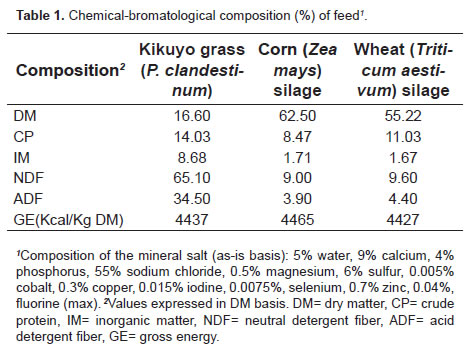
<body><![CDATA[<p>   The beef cattle industry seeks to produce highperforming   animals to be slaughtered at a young   age, ensuring carcasses have adequate proportions   of meat, bone and fat. Total edible meat (TEM)   is the most relevant of those fractions (Brito and   Sampaio, 2001), as its protein is what gives the   product its nutritional value (Diaz-Chiron, 2001).   Quantifying TEM allows paying producers on a   differentiated base and also to infer to what extent   the livestock sector is adequately addressing its   market requirements.</p>     <p>Carcass composition is influenced by age, breed,   weight, sex, and nutritional status of the animal   (Veras <i>et al.</i>, 2001). Proportions of carcass tissues can   be calculated by direct or indirect methods. Direct   methods are very accurate but laborious, involving   dissection, separation, and weighing of tissues   (Veras <i>et al.</i>, 2001). Conversely, indirect methods   use equations to predict composition based on the   carcass or its parts (Veras <i>et al.</i>, 2001; Brito and   Sampaio, 2001). Indirect methods include the use   of specific gravity (Alhassan <i>et al.</i>, 1975; Hedrick,   1983), the composition of the section between ribs 9-11 (Hankins and Howe, 1946), and ultrasonography (Berg <i>et al.</i>, 1997). Upon applying equations described in other studies, some researchers have detected discrepancies between actual and predicted values (Kempster, 1981) because the equations must be used under the same circumstances of breed, age at slaughter, husbandry, and animal handling conditions. Indirect methods used in this study sought to predict TEM from evaluations routinely conducted during carcass processing without having weighed all meat cuts. In general, studies on carcass quality and yield have focused on <i>Bos indicus</i> cattle (Fernandez and Jaramillo, 1997; Correa, 1998; Vasquez <i>et al.</i>, 2005). There is little information for non-beef cattle breeds, such as the Holstein, whose males are slaughtered at a young age. The aim of this study was to compare different methods for determining TEM in the carcass of Holstein bulls raised for meat production.</p>     <p>&nbsp;</p>     <p><b><font size="3">Materials and methods</font></b></p>     <p>   <i>Location</i></p>     <p>The animals were fattened at Los Dolores   farm, located in Abejorral municipality (Antioquia,   Colombia), in an area corresponding to lower montane   rain forest (bh-MB; Holdridge, 2000). Slaughtering   was carried out in Frigocolanta, a commercial   slaughterhouse owned by Cooperativa Lechera de   Antioquia (Colanta), located in Santa Rosa de Osos   municipality (Antioquia, Colombia). The distance and   transport time from the farm to the slaughterhouse was 183 km and 12 hours, respectively.</p>     <p><i>Animals and management</i></p>     <p>A total of 28 intact Holstein males were used.   The animals were fed on a rotational grazing system   with Kikuyu grass (<i>Pennisetum clandestinum</i>) and   supplemented daily with 1 kg of reconstituted grain   silage (corn and wheat). Mineral salt and water were   offered <i>ad libitum</i> throughout the production cycle.   The chemical composition of the feed is presented in <a href="#t1">table 1</a>.</p>     <p>Animals were slaughtered at 26 months of age,   weighing approximately 330 kg. Prior to transport   to the slaughterhouse, the animals were fasted for 6   hours, and then weighed to determine body weight   on the farm (BWF). Once in the slaughterhouse,   animals were weighed again to record the weight   at the arrival (BWS) and to calculate weight losses   during transport. Then, animals were housed in   groups of 14 bulls (3.5 m<sup>2</sup>/animal) and spent another   12 hours without feed but with free access to drinking water.</p>     <p align="center"><a name="t1"></a><img src="/img/revistas/rccp/v26n3/v26n3a2t1.jpg"/></p>     ]]></body>
<body><![CDATA[<p>Animal slaughter was conducted according to the   procedures regularly followed by the slaughterhouse,   using a captive bolt stunner to numb and immediately   kill the animals. Hot carcass weight (HCW) was   measured approximately 15 minutes <i>post mortem.</i>  Then, carcasses were kept at 6 &deg;C for 24 hours and   weighed to obtain cold carcass weight (CCW).   Carcass yield was calculated based on the CCW and   the BWS. The following measurements were taken   in the cooler in accordance with the procedures   stated by the ICTA system for carcass classification   (Amador <i>et al.</i>, 1995): carcass length (CL), leg   circumference (LC), backfat thickness (G1 and   G2), and cartilage quantification (CAR1, CAR2   and CAR3). The carcass compactness index (CCI)   was calculated using CL and CCW, according to   the methodology proposed by Bianchi <i>et al.</i> (2006), where CCI = CCW/CL (kg/cm).</p>     <p>Before deboning, a sample from the left carcass   was collected and weighed. The sample was taken   between ribs 9-11 (HH section). Then, dissection   and prediction of carcass proportions of muscle,   fat and bone was conducted, using the equations proposed by Hankins and Howe (1946):</p>     <p>Muscle proportion: Y = 8.16 + 0.80 X</p>     <p>Adipose tissue proportion: Y = 3.54 + 0.80 X</p>     <p>Bone proportion: Y = 5.52 + 0.57 X</p>     <p>   Where X = percentage of components in the HH   section.</p>     <p>   During deboning, cuts were weighed using a   scale (accuracy: 0.2 kg).</p>     <p><i>Determination of total edible meat (TEM)</i></p>     <p>The TEM was determined by a direct method   and two indirect methods. For the direct method,   cuts obtained during carcass deboning were weighed   to obtain the true-TEM. On the other hand, the   indirect methods were based on equations, namely,   the system proposed by the ICTA (Amador <i>et al.</i>,   1995), in which: TEM (kg) = &#91;- 40.82 + (0.567 *   CCW) - (1,770 * G1) - (2,781 * G2) + (0.248 * CL)   + (0.247 * LC)&#93;, and also on the equation described   by Hankins and Howe (1946), which is based on the proportion of muscle in the HH section.</p>     <p><i>Statistical Analysis</i></p>     ]]></body>
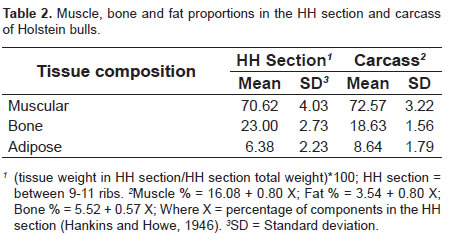
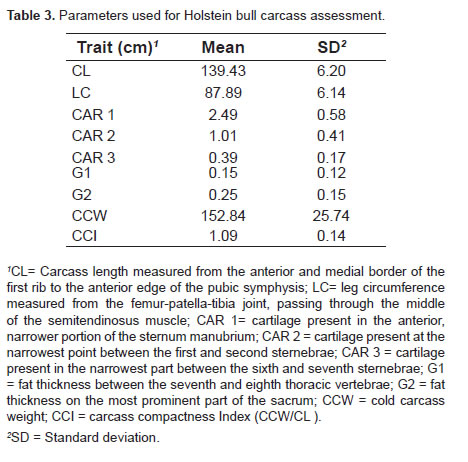
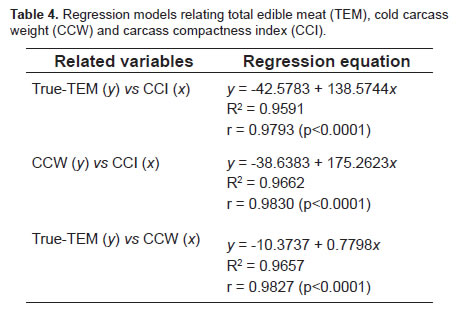
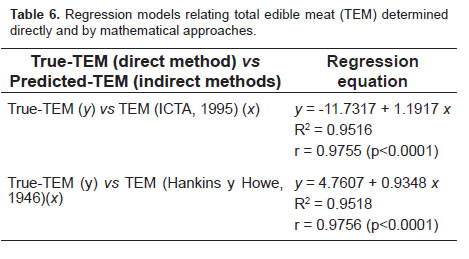
<body><![CDATA[<p>Several statistical procedures were performed   to analyze the TEM value obtained by the direct   (true-TEM) and indirect methods. A completely   randomized design was used to evaluate the   treatment effect (represented by the estimation   methods) on TEM, using CCW as a covariate and   the Tukey test for comparison of means. Spearman   correlation analysis and linear regression were   used to evaluate the degree of relationship between   methods. Finally, the Bland-Altman analysis was   used to assess interchangeability between methods (Bland and Altman, 1986).</p>     <p>Spearman correlation analysis and multiple   regression (Backware method) were conducted for   true-TEM and the following variables: CL, LC, G1,   G2, CAR1, and CAR3 CAR2. Simple regression and   Spearman correlation analysis were also conducted   between true-TEM, CCI and CCW. These analyses   were complemented by descriptive statistics (mean   and standard deviation). All statistical procedures   were done with the SAS statistical program (2001), with a 5% significance level.</p>     <p>&nbsp;</p>     <p><b><font size="3">Results </font></b></p>     <p>Muscle, fat and bone tissue means (%) obtained   in the carcass and HH section are presented in <a href="#t2">table 2</a>. The coefficients of variation (CV) for the   respective tissues were 5.71%, 11.86%, and 35.03%   in section HH, and 4.44%, 8.36%, and 20.68% in   the carcass.</p>     <p align="center"><a name="t2"></a><img src="/img/revistas/rccp/v26n3/v26n3a2t2.jpg"/></p>     <p>Means and standard deviation of the parameters   proposed by ICTA (Amador <i>et al.</i>, 1995) are   presented in <a href="#t3">table 3</a>. The CL and LC traits showed   very low dispersion around the mean (CV &lt; 10%),   while ossification-related measures showed greater   variability (CV: 35.90%), although lower than that   of fat cover at G1 and G2, whose CV were 80.21%   and 63.01% respectively. The CCW and CCI values,   shown in the same table, had a CV of 16.85% and 13.22%, respectively.</p>     <p align="center"><a name="t3"></a><img src="/img/revistas/rccp/v26n3/v26n3a2t3.jpg"/></p>     <p><a href="#t4">Table 4</a> presents the regression models used   to predict true-TEM and CCW from CCI, and the   equation to estimate true-TEM from CCW. The intercept and regression slope were statistically significant (p&lt;0.05) in all cases, and the coefficient of determination (R<sup>2</sup>) exceeded 95%. The Spearman's correlation coefficient (r) between these variables was high, greater than 95%, and highly significant (p&lt;0.0001).</p>     <p align="center"><a name="t4"></a><img src="/img/revistas/rccp/v26n3/v26n3a2t4.jpg"/></p>     ]]></body>
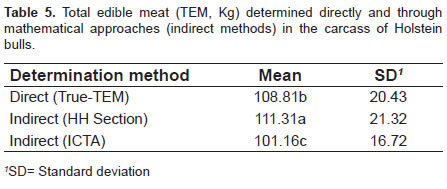
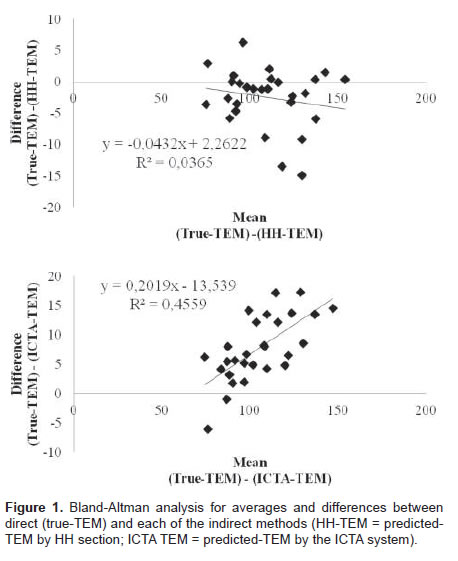
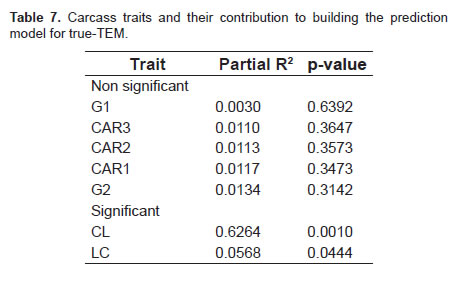
<body><![CDATA[<p><a href="#t5">Table 5</a> shows the true-TEM obtained by   dissection and separation of all body parts, the   estimated using the ICTA system (Amador et al.,   1995), and the estimate from HH section (Hankins and Howe, 1946).</p>     <p align="center"><a name="t5"></a><img src="/img/revistas/rccp/v26n3/v26n3a2t5.jpg"/></p>     <p>Analysis of variance found statistically   significant difference (p&lt;0.05) between the direct   and each of the indirect methods, as well as among   the latter. Regarding variability around the mean   value, the three methods showed a similar pattern:   the CV ranged between 16.53% and 19.16% for   the TEM estimation with ICTA system and HH   section, respectively, while the true-TEM had an intermediate value.</p>     <p>The degree of relationship between the true-   TEM (<i>y</i>) and each of the indirect methods (<i>x</i>) was   high, and the Spearman correlation coefficients (r)   were virtually identical (r = 0.9755 and 0.9756)   (<a href="#t6">Table 6</a>). The linear regression equations relating   these variables are shown in the same table,   where regression slopes were highly significant (p&lt;0.0001).</p>     <p align="center"><a name="t6"></a><img src="/img/revistas/rccp/v26n3/v26n3a2t6.jpg"/></p>     <p><a href="#f1">Figure 1</a> shows the level of agreement between the   direct (true-TEM) and each of the indirect methods,   assessed with the Bland-Altman interchangeability   test. The Spearman correlation coefficient (r = 0.6752)   and the regression slope (&beta; = 0.2019) were statistically   significant (p&lt;0.0001) when assessed in the regression   and correlation analysis for differences (y) and means   (x) between true and predicted-TEM by the ICTA.   When the same analyses were performed between   true and predicted-TEM using the HH section,   neither the correlation coefficient (r = -0.1912) nor   the regression slope (&beta; = -0.0432) were statistically   significant (p&gt;0.05), indicating that both methods are interchangeable for estimating TEM.</p>     <p align="center"><a name="f1"></a><img src="/img/revistas/rccp/v26n3/v26n3a2f1.jpg"/></p>     <p>The multiple regression equation obtained by   the true-TEM (<i>y</i>) and the carcass classification   traits proposed by the ICTA (<i>x</i>) corresponded to:   y = -248.52 + (1.88 * CL) + (1.08 * LC), where   the intercept (<i>&beta;0</i>) and the coefficients (<i>&beta;1</i> and <i>&beta;2</i>)   were statistically significant (<a href="#t7">Table 7</a>). The R<sup>2</sup>  maximum for the resulting regression equation was   0.6832, with CL and LC being the only statistically significant variables (p&lt;0.05).</p>     <p align="center"><a name="t7"></a><img src="/img/revistas/rccp/v26n3/v26n3a2t7.jpg"/></p>     <p>Spearman correlations between true-TEM-CL   (r= 0.7915) and true-TEM-LC (r = 0.7120) were   significant (p&lt;0.0001). The relationship between   true-TEM and each of the evaluation points for   cover fat (G1 and G2) was also significant (p&lt;0.05),   although smaller in magnitude (r = 0.3997 and   0.5450, respectively). The Spearman correlation   coefficient was not significant (p&gt;0.05) between   true-TEM and CAR, CAR3, and CAR2 (data not shown in table).</p>     ]]></body>
<body><![CDATA[<p>&nbsp;</p>     <p><b><font size="3">Discussion</font></b></p>     <p>   <i>Carcass yield</i></p>     <p>   Noguera <i>et al.</i> (2012) evaluated the effect of   animal transport on live weight and carcass yield.   They reported 8.40 &plusmn; 1.10% of BWF as the weight   loss after an eight-hour trip to the slaughterhouse,   slightly higher than the range suggested by   Siemens (1996) for Holstein steers (between   5.5% and 7% of body weight). Carcass yield was   50.60 &plusmn; 1.60%, which is consistent with the   percentages reported by Gorrachategui (1997)   for dairy cattle performance (50% to 53%). Jorge   <i>et al.</i> (2009) reported 47.0%, 47.3% and 48.2%   carcass yield for Holstein steers slaughtered at 450   kg, 510 kg and 600 kg, respectively, slightly lower values than those obtained in the present work. In   general, experimental results show greater carcass   yield for beef-type breeds compared to dairy breeds   or mestizos (Peron <i>et al.</i>, 1993a; Leme <i>et al.</i>,   2000; Fernandes <i>et al.</i>, 2004). Considering dietary   factors, Danner <i>et al.</i> (1980) noted the inverse linear   relationship between the size of organs and carcass   yield. Grazing animals whose diet is primarily   forage &#8212;as in this study&#8212; have high abdominal capacity, large organs and low meat yield.</p>     <p><i>Carcass composition</i></p>     <p>According to Carvalho <i>et al.</i> (2003), tissue   accumulation in animals follow certain patterns   of priority; first the viscera grows, then the bone   and muscle tissue, and finally the adipose tissue.   Carvalho <i>et al.</i> (2003) evaluated tissue composition   of Holstein calves slaughtered at 87 kg. They   found 55.98%, 31.92%, and 7.2% muscle, bone,   and adipose tissue, respectively, determined in the   HH-section. In Holstein calves slaughtered at 170   kg, Almeida J&uacute;nior <i>et al.</i> (2008) found 61.57%,   19.97%, and 17.76% for muscle, bone, and fat,   respectively. Signoretti <i>et al.</i> (1999) evaluated   Holstein calves slaughtered at 190 kg, obtaining   similar means: 59.60% for muscle, 18.51% for   bone and 21.80% for fat. Rodrigues Filho <i>et al.</i>   (2003) evaluated Holstein males slaughtered at 215   kg, reporting 64.78% muscle, 17.28% bone, and   18.15% fat. Finally, Zea <i>et al.</i> (2008) in 370 kg, 410   kg, and 450 kg Holstein bulls found percentages   of muscle, bone, and fat, fluctuating between   72.31% to 72.93%, 22.22% to 22.49%, and 4.57%   to 5.47%, respectively, which closely resembles   those observed in the present study, specifically the   muscle and fat components (<a href="#t2">Table 2</a>). According   to the trend presented in the cited studies, muscle   tissue increases with body weight at slaughter.   Animals slaughtered at an older age are more likely   to deposit muscle tissue, following the growth   sequence described by Scanes (2003): first nerve, then bone, followed by muscle and adipose tissue.</p>     <p>The similarity between bone tissue predicted   from HH section in this study and the percentage   referenced in the literature (Junior Almeida <i>et al.</i>,   2008; Zea <i>et al.</i>, 2008; Rodrigues Filho <i>et al.</i>, 2003; Signoretti <i>et al.</i>, 1999) could be due to the fact that bone proportion in the carcass has the lowest percentage change and slowly decreases as total weight increases. The bone proportion observed by the cited researchers and the present study were relatively similar, although the slaughter weights varied greatly (between 170 kg and 450 kg). This is because bone tissue grows faster at an early age, muscle tissue at an intermediate age, and adipose tissue at an older age (Berg and Butterfield, 1979).</p>     <p>Finally, this study showed a low fat percentage   compared to the previously cited reports. This could   be a result of differences in nutritional management,   since the animals were kept in pasture and wet grain   silage represented only 1 kg/day. The high CV for   this component (CV = 35.03%) is supported by   Prescott (1982), who argues that fat is the carcass   component with the highest quantitative variability,   even in animals of the same weight. Genotype and   sexual condition of animals in this study may also   have determined the predicted fat percentage from   HH section. <i>Bos taurus</i> breeds and intact animals   have less fat deposition in the carcass. At a similar   gain rate, larger breeds at maturity &#8212;that is, more   delayed for adipose tissue deposition&#8212; have a   higher percentage of protein in relation to fat,   reflecting increased muscle tissue and reduced   adipose tissue (Toelle <i>et al.</i>, 1986). Furthermore,   taurine breeds have more abundant internal fat   deposits versus peripheral fat in comparison to Zebu   (Peron <i>et al.</i>, 1993b). Regarding sexual condition,   intact males have less body fat than castrated males.   The low fat deposition and increased protein gain   in intact animals is explained by the secretion of   androgenic hormones, which are steroid substances   with pronounced anabolic effects (Guiroy <i>et al.</i>, 2002).</p>     <p><i>Carcass evaluation according to the ICTA system</i></p>     <p>The study of carcass traits is important for the   farmer and the meat packing industry. It allows   the farmer to monitor the final product's quality   and allows the packer to evaluate the purchased   product. The carcass has edible and inedible   meat, with bones representing the majority of the   inedible portion. As the animal grows, the amount   of cartilage decreases to form bone, leading to a   decrease in the CAR values (1, 2 and 3). Cartilage   quantification at the anatomical sites described   by ICTA allowed determining animal age (2 to 3   years), although with a high variability (<a href="#t3">Table 3</a>).   Nevertheless, this variability was not a constraint to   establish the ossification age because of the range   the system assigns to each parameter (CAR 1 = 1.0   to 3.0; CAR 2 = 0.5 to 1.0; CAR 3 = 0.3 to 0.6, for   animals between 2 and 3 years of age). However,   variability for CAR 2 led to a value outside the proposed reference limits.</p>     ]]></body>
<body><![CDATA[<p>According to the total fat coverage and   intermuscular fat determined at G1 and G2 sites,   carcasses in this study had a low degree of finish   (grade 0; <a href="#t3">Table 3</a>). Variability in this parameter may   lead to bias in carcass classification, considering   that standard deviation for G1 and G2 would allow   assigning a grade 1 scoring. Fat coverage, besides   being an indication of carcass composition in   terms of fat percentage (Nunes de Souza, 2010) is   associated with quality, as it protects meat against   redness by dehydration and cooling. According   to Pereira <i>et al.</i> (2008) and Jorge <i>et al.</i> (2009), fat   coverage should be between 3 mm and 6 mm.   According to this, the average value observed in   this study ensured low water loss during cooling and low carcass weight loss.</p>     <p>Contrary to the parameters used to assess   cartilage tissue and degree of finish, dispersion   around the mean was very low for LC and CL   (<a href="#t3">Table 3</a>). The LC measures carcass conformation   degree, thus assessing muscle development.   According to the ICTA system, high conformation   implies the animal is better suited for meat   production, larger cuts and higher proportion of   meat per carcass are obtained, and higher carcass   quality and commercial value can be expected. The   average LC value found in the present study (87.89   cm) implies an excellent carcass conformation   degree (greater than 80 cm) according to the ICTA rating scale.</p>     <p>The CCI (which is the relationship between   CCW and CL) is more interesting than CL alone.   The higher the CCI the greater the amount of   muscle tissue and therefore the greater the carcass   yield (Urrutia <i>et al.</i>, 2010). The regression and correlation analysis (<a href="#t4">Table 4</a>) confirmed the positive and significant relationship between CCW-CCI and true-TEM-CCI, in agreement with Urrutia <i>et al.</i>, 2010. According to Soria <i>et al.</i> (2011) CCI is related to muscularity, allowing comparing carcasses regardless of their weight. The mean value for this variable (1.09 kg/cm; Table 3) is below the values reported by Urrutia <i>et al.</i> (2010) (between 2.19 and 2.33), and Carballo <i>et al.</i> (2004). Working with cattle, the latter authors indicated that CCI was between 1.81 and 1.95 for the highest conformation carcasses, while the lowest conformation fluctuated between 1.38 and 1.57 kg/cm. The low values in this study are possibly due to the early age at which animals were slaughtered and their genetic group, as both traits may affect the degree of muscle tissue deposition.</p>     <p><i>Determination of total edible meat</i></p>     <p>The analysis of variance detected statistically   significant difference between all TEM methods   (<a href="#t5">Table 5</a>). The regression analysis and Spearman   correlation (<a href="#t6">Table 6</a>) shows a strong relationship   between the direct and indirect methods. These   results, however, should be taken with discretion,   considering regression-correlation analysis   assesses the relationship degree, but not matching   (interchangeability) between methods. The Bland-   Altman test (<a href="#f1">Figure 1</a>) is based on correlation and   regression analysis for differences (<i>y</i>) and means   (<i>x</i>) between the methods compared. In this test,   the Spearman correlation coefficient (<i>r</i>) and the   regression slope (<i>&beta;</i>) were statistically significant   when true-TEM was compared with predicted-   TEM by the ICTA. Statistical significance of <i>r</i> and   <i>&beta;</i> indicates that the discrepancy between direct   and indirect methods proposed by the ICTA was   not constant throughout the distribution range,   but showed a tendency to increase with increasing   values. When the direct method (true-TEM) was   contrasted with the indirect based on HH section   composition, the differences had a tendency to   decrease with increasing average values. However,   both <i>r</i> and <i>&beta;</i> were not statistically significant,   leading to the conclusion that both methods can   be interchanged. The trend in the Bland-Altman   interchangeability test corresponds with the mean   values in the evaluation methods. As shown in <a href="#t5">table 5</a>, the TEM value estimated by ICTA was 7.03% lower than the true value, while predicted-TEM from HH section was 2.30% higher. While the three methods were statistically different, the lowest difference between the direct and the HH section method is in agreement with the interchangeability registered. In the Bland-Altman test, the differences (residuals) between true-TEM and ICTA TEM were mostly positive, which is why the points are above zero in the abscissa (<a href="#f1">Figure 1</a>), concluding that the ICTA system underestimates the true values. The opposite situation occurred for residuals between true-TEM and TEM estimated from HH section.</p>     <p>Finally, it is important to highlight the statistical   significance of CL and LC independent variables   in the multiple regression equation used to predict   true-TEM (<a href="#t7">Table 7</a>). This corresponds with the   positive and relatively high correlation presented   between these variables (<i>r</i> = 0.7915 for CL true-   TEM; <i>r</i> = 0.7120 for LC true-TEM), which did not   happen between true-TEM and G1, G2, CAR 1,   CAR 2, and CAR 3. Velasquez and Alvarez (2004)   also reported a positive correlation between LC and   TEM (<i>r</i> = 0.62), though it was smaller than that in the present study.</p>     <p>According to this study, the method based on   the muscle proportion between ribs 9-11 is useful   for estimating carcass TEM in male Holstein cattle.   However, more studies are needed to validate this   conclusion. Furthermore, a greater age at slaughter   is proposed in order to obtain a better degree of   finish and more edible meat, considering that   Holstein (<i>Bos taurus</i>) arrives to maturity later than Zebu (Toelle <i>et al.</i>, 1986).</p>     <p>&nbsp;</p> </font> <hr size="1" /> <font size="2" face="Verdana, Arial, Helvetica, sans-serif">     <p><b><font size="3">Notas</font></b></p> <a name="1"></a><a href="#b1">&curren;</a> To cite this article: Posada SL, Rosero R, Val &aacute;squez R, Hoyos A, Cer&oacute;n JM. Comparison of methods to determine total edible meat in the male Holstein cattle carcass. Rev Colomb Cienc Pecu 2013; 26:159-168.  </font> <hr size="1" /> <font size="2" face="Verdana, Arial, Helvetica, sans-serif">     <p>&nbsp;</p>     ]]></body>
<body><![CDATA[<p>&nbsp;</p>     <p><b><font size="3">Acknowledgements</font></b></p>     <p>   The authors wish to thank Cooperativa Lechera   COLANTA (Colombia) for the use of their slaughter   facilities, and Carlos Vel&aacute;squez, Santiago Berrio   and FRIGOCOLANTA staff for their collaboration.   Appreciation is also expressed to Proyecto de   Sostenibilidad 2011-2012 (CODI, Universidad de   Antioquia, Colombia) and Ministerio de Agricultura   y Desarrollo Rural for providing funds to conduct   this study.</p>     <p>&nbsp;</p>     <p><b><font size="3">References</font></b></p>     <!-- ref --><p>   Alhasssan WS, Buchanan-Smith JG, Usborne WR, Ashton GC,   Smith GC. Predicting empty body composition of cattle from   carcass weight and rib cut composition. Can J Anim Sci 1975;   55:369-376.    &nbsp;&nbsp;&nbsp;&nbsp;&nbsp;&nbsp;&nbsp;&nbsp;[&#160;<a href="javascript:void(0);" onclick="javascript: window.open('/scielo.php?script=sci_nlinks&ref=000098&pid=S0120-0690201300030000200001&lng=','','width=640,height=500,resizable=yes,scrollbars=1,menubar=yes,');">Links</a>&#160;]<!-- end-ref --></p>     <!-- ref --><p>   Almeida J&uacute;nior GA, Costa C, De Carvalho SMR, Persichetti   J&uacute;nior P, Panichi A. Composi&ccedil;&atilde;o f&iacute;sico-qu&iacute;mica de carca&ccedil;as de   bezerros holandeses alimentados ap&oacute;s o desaleitamento com   silagem de gr&atilde;os &uacute;midos ou gr&atilde;os secos de milho ou sorgo. Rev   Bras Zootec 2008; 37:164-170.    &nbsp;&nbsp;&nbsp;&nbsp;&nbsp;&nbsp;&nbsp;&nbsp;[&#160;<a href="javascript:void(0);" onclick="javascript: window.open('/scielo.php?script=sci_nlinks&ref=000100&pid=S0120-0690201300030000200002&lng=','','width=640,height=500,resizable=yes,scrollbars=1,menubar=yes,');">Links</a>&#160;]<!-- end-ref --></p>     <!-- ref --><p>   Amador I, Palacios A, Maldonado M. Sistema ICTA de   clasificaci&oacute;n de canales y cortes de carne bovina. Cartilla gu&iacute;a.   Ministerio de Agricultura y Desarrollo Rural, ICTA-UN, SENA,   IICA, FEDEFONDOS (Eds.). Colombia; 1995.    &nbsp;&nbsp;&nbsp;&nbsp;&nbsp;&nbsp;&nbsp;&nbsp;[&#160;<a href="javascript:void(0);" onclick="javascript: window.open('/scielo.php?script=sci_nlinks&ref=000102&pid=S0120-0690201300030000200003&lng=','','width=640,height=500,resizable=yes,scrollbars=1,menubar=yes,');">Links</a>&#160;]<!-- end-ref --></p>     <!-- ref --><p>   Berg RT, Butterfield RM. Nuevos conceptos sobre desarrollo de   ganado vacuno. Zaragoza: Acribia; 1979.    &nbsp;&nbsp;&nbsp;&nbsp;&nbsp;&nbsp;&nbsp;&nbsp;[&#160;<a href="javascript:void(0);" onclick="javascript: window.open('/scielo.php?script=sci_nlinks&ref=000104&pid=S0120-0690201300030000200004&lng=','','width=640,height=500,resizable=yes,scrollbars=1,menubar=yes,');">Links</a>&#160;]<!-- end-ref --></p>     <!-- ref --><p>   Berg EP, Neary MK, Forrest JC, Thomas DL, Kauffman RG.   Evaluation of electronic technology to assess lamb carcass   composition. J Anim Sci 1997; 75:2433-2444.    &nbsp;&nbsp;&nbsp;&nbsp;&nbsp;&nbsp;&nbsp;&nbsp;[&#160;<a href="javascript:void(0);" onclick="javascript: window.open('/scielo.php?script=sci_nlinks&ref=000106&pid=S0120-0690201300030000200005&lng=','','width=640,height=500,resizable=yes,scrollbars=1,menubar=yes,');">Links</a>&#160;]<!-- end-ref --></p>     <!-- ref --><p>   Bianchi G, Garibotto G, Feed O, Bentancur O, Franco J. Efecto   del peso al sacrificio sobre la calidad de la canal y de la carne de   corderos Corriedale puros y cruza. Arch Med Vet 2006; 38:161-   165.    &nbsp;&nbsp;&nbsp;&nbsp;&nbsp;&nbsp;&nbsp;&nbsp;[&#160;<a href="javascript:void(0);" onclick="javascript: window.open('/scielo.php?script=sci_nlinks&ref=000108&pid=S0120-0690201300030000200006&lng=','','width=640,height=500,resizable=yes,scrollbars=1,menubar=yes,');">Links</a>&#160;]<!-- end-ref --></p>     <!-- ref --><p>   Bland JM, Altman DG. Statistical methods for assessing   agreement between two methods of clinical measurement. The   Lancet 1986; 1:307-310.    &nbsp;&nbsp;&nbsp;&nbsp;&nbsp;&nbsp;&nbsp;&nbsp;[&#160;<a href="javascript:void(0);" onclick="javascript: window.open('/scielo.php?script=sci_nlinks&ref=000110&pid=S0120-0690201300030000200007&lng=','','width=640,height=500,resizable=yes,scrollbars=1,menubar=yes,');">Links</a>&#160;]<!-- end-ref --></p>     <!-- ref --><p>   Brito RM, Sampaio AAM. Efeito de fontes de prote&iacute;na nas   caracter&iacute;sticas da carca&ccedil;a e avalia&ccedil;&atilde;o do rendimento de carne   aproveit&aacute;vel estimada por meio de equa&ccedil;&otilde;es de regress&atilde;o linear   m&uacute;ltipla em touros &frac34; Canchim &frac14; Nelore. ARS Veterinaria   2001; 17:64-70.    &nbsp;&nbsp;&nbsp;&nbsp;&nbsp;&nbsp;&nbsp;&nbsp;[&#160;<a href="javascript:void(0);" onclick="javascript: window.open('/scielo.php?script=sci_nlinks&ref=000112&pid=S0120-0690201300030000200008&lng=','','width=640,height=500,resizable=yes,scrollbars=1,menubar=yes,');">Links</a>&#160;]<!-- end-ref --></p>     <!-- ref --><p>   Carballo JA, Oliete B, Moreno T, S&aacute;nchez L, Monserrat L.   Categorizaci&oacute;n de las canales de ternero producidas en Galicia.   Arch Zootec 2004; 53:119-128.    &nbsp;&nbsp;&nbsp;&nbsp;&nbsp;&nbsp;&nbsp;&nbsp;[&#160;<a href="javascript:void(0);" onclick="javascript: window.open('/scielo.php?script=sci_nlinks&ref=000114&pid=S0120-0690201300030000200009&lng=','','width=640,height=500,resizable=yes,scrollbars=1,menubar=yes,');">Links</a>&#160;]<!-- end-ref --></p>     <!-- ref --><p>   Carvalho PA, S&aacute;nchez LMB, Velho JP, Vi&eacute;gas J, Jauris GC,   Rodrigues MB. Caracter&iacute;sticas quantitativas, composi&ccedil;&atilde;o f&iacute;sica   tecidual eregional da carca&ccedil;a de bezerros machos de origem   leiteira aonascimento, 50 e 110 dias de idade. Rev Bras Zootec   2003; 32:1476-1483.    &nbsp;&nbsp;&nbsp;&nbsp;&nbsp;&nbsp;&nbsp;&nbsp;[&#160;<a href="javascript:void(0);" onclick="javascript: window.open('/scielo.php?script=sci_nlinks&ref=000116&pid=S0120-0690201300030000200010&lng=','','width=640,height=500,resizable=yes,scrollbars=1,menubar=yes,');">Links</a>&#160;]<!-- end-ref --></p>     <!-- ref --><p>   Correa D. Influencia del sexo y la condici&oacute;n sexual, en el   rendimiento en canal y en carne de bovinos. Trabajo de grado   (Zootecnia), Facultad de Ciencias Agropecuarias, Universidad   Nacional de Colombia (Medell&iacute;n); 1998.    &nbsp;&nbsp;&nbsp;&nbsp;&nbsp;&nbsp;&nbsp;&nbsp;[&#160;<a href="javascript:void(0);" onclick="javascript: window.open('/scielo.php?script=sci_nlinks&ref=000118&pid=S0120-0690201300030000200011&lng=','','width=640,height=500,resizable=yes,scrollbars=1,menubar=yes,');">Links</a>&#160;]<!-- end-ref --></p>     <!-- ref --><p>   Danner ML, Fox DG, Black JR. Effect of feeding system on   performance and carcass grade of yearling steers, steers calves   and heifer calves. J Anim Sci 1980; 50:394-404.    &nbsp;&nbsp;&nbsp;&nbsp;&nbsp;&nbsp;&nbsp;&nbsp;[&#160;<a href="javascript:void(0);" onclick="javascript: window.open('/scielo.php?script=sci_nlinks&ref=000120&pid=S0120-0690201300030000200012&lng=','','width=640,height=500,resizable=yes,scrollbars=1,menubar=yes,');">Links</a>&#160;]<!-- end-ref --></p>     <!-- ref --><p>   D&iacute;az-Chir&oacute;n MT. Caracter&iacute;sticas de la canal y de la carne de   corderos lechales manchegos. Correlaciones y ecuaciones   de predicci&oacute;n. Tesis de Doctorado, Facultad de Veterinaria,   Universidad Complutense de Madrid (Espa&ntilde;a); 2001.    &nbsp;&nbsp;&nbsp;&nbsp;&nbsp;&nbsp;&nbsp;&nbsp;[&#160;<a href="javascript:void(0);" onclick="javascript: window.open('/scielo.php?script=sci_nlinks&ref=000122&pid=S0120-0690201300030000200013&lng=','','width=640,height=500,resizable=yes,scrollbars=1,menubar=yes,');">Links</a>&#160;]<!-- end-ref --></p>     <!-- ref --><p>   Fernandes HJ, Paulino MF, Martins RGR, Valadares Filho SC,   Torres RA, Paiva LM, Da Silva AT. Composi&ccedil;&atilde;o corporal de   garrotes inteiros de tr&ecirc;s grupos gen&eacute;ticos nas fases de recria e   termina&ccedil;&atilde;o. Rev Bras Zootec 2004; 33:1581-1590.    &nbsp;&nbsp;&nbsp;&nbsp;&nbsp;&nbsp;&nbsp;&nbsp;[&#160;<a href="javascript:void(0);" onclick="javascript: window.open('/scielo.php?script=sci_nlinks&ref=000124&pid=S0120-0690201300030000200014&lng=','','width=640,height=500,resizable=yes,scrollbars=1,menubar=yes,');">Links</a>&#160;]<!-- end-ref --></p>     <!-- ref --><p>   Fern&aacute;ndez A, Jaramillo L. El beneficio integral de la carne y   su incremento en la rentabilidad. En: Memorias del Seminario ''Carne y Leche'', Competitividad en su Producci&oacute;n. Medell&iacute;n, 1997. pp. 35-39.    &nbsp;&nbsp;&nbsp;&nbsp;&nbsp;&nbsp;&nbsp;&nbsp;[&#160;<a href="javascript:void(0);" onclick="javascript: window.open('/scielo.php?script=sci_nlinks&ref=000126&pid=S0120-0690201300030000200015&lng=','','width=640,height=500,resizable=yes,scrollbars=1,menubar=yes,');">Links</a>&#160;]<!-- end-ref --></p>     <!-- ref --><p>   Gorrachategui M. Influencia de la nutrici&oacute;n y otros factores   en el rendimiento de la canal en terneros. XIII Curso de   Especializaci&oacute;n FEDNA. Ib&eacute;rica de Nutrici&oacute;n Animal SL 1997;   &#91;access date: february 6, 2012&#93; URL: http://www1.etsia.upm.es/fedna/capitulos/97CAP_VI.pdf&nbsp;&nbsp;&nbsp;&nbsp;&nbsp;&nbsp;&nbsp;&nbsp;[&#160;<a href="javascript:void(0);" onclick="javascript: window.open('/scielo.php?script=sci_nlinks&ref=000128&pid=S0120-0690201300030000200016&lng=','','width=640,height=500,resizable=yes,scrollbars=1,menubar=yes,');">Links</a>&#160;]<!-- end-ref --><!-- ref --><p>   Guiroy PJ, Tedeschi LO, Fox DG, Hutcheson JP. The effects of   implant strategy on finished body weight of beef cattle. J Anim   Sci 2002; 80:1791-1800.    &nbsp;&nbsp;&nbsp;&nbsp;&nbsp;&nbsp;&nbsp;&nbsp;[&#160;<a href="javascript:void(0);" onclick="javascript: window.open('/scielo.php?script=sci_nlinks&ref=000129&pid=S0120-0690201300030000200017&lng=','','width=640,height=500,resizable=yes,scrollbars=1,menubar=yes,');">Links</a>&#160;]<!-- end-ref --></p>     <!-- ref --><p>   Hankins OG, Howe PE. Estimation of the composition of beef   carcasses and cuts. Washington, D.C. (Tech. Bulletin - USDA,   926); 1946.    &nbsp;&nbsp;&nbsp;&nbsp;&nbsp;&nbsp;&nbsp;&nbsp;[&#160;<a href="javascript:void(0);" onclick="javascript: window.open('/scielo.php?script=sci_nlinks&ref=000131&pid=S0120-0690201300030000200018&lng=','','width=640,height=500,resizable=yes,scrollbars=1,menubar=yes,');">Links</a>&#160;]<!-- end-ref --></p>     ]]></body>
<body><![CDATA[<!-- ref --><p>   Hedrick HB. Methods of estimating live animal and carcass   composition. J Anim Sci 1983; 57:1316-1327.    &nbsp;&nbsp;&nbsp;&nbsp;&nbsp;&nbsp;&nbsp;&nbsp;[&#160;<a href="javascript:void(0);" onclick="javascript: window.open('/scielo.php?script=sci_nlinks&ref=000133&pid=S0120-0690201300030000200019&lng=','','width=640,height=500,resizable=yes,scrollbars=1,menubar=yes,');">Links</a>&#160;]<!-- end-ref --></p>     <!-- ref --><p>   Holdridge LR. Ecolog&iacute;a basada en zonas de vida. 5th ed. San   Jos&eacute; de Costa Rica: Instituto Interamericano de Cooperaci&oacute;n   para la Agricultura, IICA.; 2000.    &nbsp;&nbsp;&nbsp;&nbsp;&nbsp;&nbsp;&nbsp;&nbsp;[&#160;<a href="javascript:void(0);" onclick="javascript: window.open('/scielo.php?script=sci_nlinks&ref=000135&pid=S0120-0690201300030000200020&lng=','','width=640,height=500,resizable=yes,scrollbars=1,menubar=yes,');">Links</a>&#160;]<!-- end-ref --></p>     <!-- ref --><p>   Jorge JRV, Zeoula LM, Prado IN, Silva RR, Andrade RV,   Macedo LMA, Prado JM, Bublitz EE, Marques JA. Gordura   protegida sobre o desempenho, carca&ccedil;a e composi&ccedil;&atilde;o qu&iacute;mica   da carne de novilhos holand&eacute;s. Arch Zootec 2009; 58:371-382.    &nbsp;&nbsp;&nbsp;&nbsp;&nbsp;&nbsp;&nbsp;&nbsp;[&#160;<a href="javascript:void(0);" onclick="javascript: window.open('/scielo.php?script=sci_nlinks&ref=000137&pid=S0120-0690201300030000200021&lng=','','width=640,height=500,resizable=yes,scrollbars=1,menubar=yes,');">Links</a>&#160;]<!-- end-ref --></p>     <!-- ref --><p>   Kempster AJ. The indirect evaluation of sheep carcass   composition in breeding schemes, population studies and   experiments. Liv Prod Sci 1981; 8:263-271&nbsp;&nbsp;&nbsp;&nbsp;&nbsp;&nbsp;&nbsp;&nbsp;[&#160;<a href="javascript:void(0);" onclick="javascript: window.open('/scielo.php?script=sci_nlinks&ref=000139&pid=S0120-0690201300030000200022&lng=','','width=640,height=500,resizable=yes,scrollbars=1,menubar=yes,');">Links</a>&#160;]<!-- end-ref --><!-- ref --><p>   Leme PR, Boin C, Margarido RCC, Tedeschi LO, O'farril   JC, Alleoni GF, Albino LF. Desempenho em confinamento e   caracter&iacute;sticas de carca&ccedil;a de bovinos machos de diferentes   cruzamentos abatidos em tr&ecirc;s faixas de peso. Rev Bras Zootec   2000; 29 Suppl 2:2347-2353.    &nbsp;&nbsp;&nbsp;&nbsp;&nbsp;&nbsp;&nbsp;&nbsp;[&#160;<a href="javascript:void(0);" onclick="javascript: window.open('/scielo.php?script=sci_nlinks&ref=000140&pid=S0120-0690201300030000200023&lng=','','width=640,height=500,resizable=yes,scrollbars=1,menubar=yes,');">Links</a>&#160;]<!-- end-ref --></p>     <!-- ref --><p>   Noguera RR, Vel&aacute;squez R, Hoyos A, Posada SL, P&eacute;rez E.   Efecto del transporte sobre el peso vivo, rendimiento en canal   y algunos aspectos de calidad de carne en machos Holstein.   Livest Res Rural Dev 2012; 24, Article #81 &#91;access date:   september 19 2012&#93; URL: <a href="http://www.lrrd.org/lrrd24/5/nogu24081.htm" target="_blank">http://www.lrrd.org/lrrd24/5/nogu24081.htm</a>&nbsp;&nbsp;&nbsp;&nbsp;&nbsp;&nbsp;&nbsp;&nbsp;[&#160;<a href="javascript:void(0);" onclick="javascript: window.open('/scielo.php?script=sci_nlinks&ref=000142&pid=S0120-0690201300030000200024&lng=','','width=640,height=500,resizable=yes,scrollbars=1,menubar=yes,');">Links</a>&#160;]<!-- end-ref --><!-- ref --><p>   Nunes de Souza DD. Avalia&ccedil;&atilde;o das caracter&iacute;sticas de tourinhos   F1 Guzer&aacute;-Nelore e F2 Pardo Sui&ccedil;o-Guzer&aacute;-Nelore terminados   em confinamento. Disserta&ccedil;&atilde;o de Mestrado, Programa de p&oacute;sgradua&ccedil;&atilde;o   em Zoot&ecirc;cnia, Universidade Federal Rural do Rio de   Janeiro (Brasil); 2010.    &nbsp;&nbsp;&nbsp;&nbsp;&nbsp;&nbsp;&nbsp;&nbsp;[&#160;<a href="javascript:void(0);" onclick="javascript: window.open('/scielo.php?script=sci_nlinks&ref=000143&pid=S0120-0690201300030000200025&lng=','','width=640,height=500,resizable=yes,scrollbars=1,menubar=yes,');">Links</a>&#160;]<!-- end-ref --></p>     <!-- ref --><p>   Pereira A, Brondani IL, Restle J, Glasenapp LF, Oliveira L,   Lopes da Silveira SR. Caracter&iacute;sticas quantitativas da carca&ccedil;a   de novilhos jovens e superjovens com peso de abate similares.   Ci&ecirc;nc Anim Bras 2008; 9:300-308.    &nbsp;&nbsp;&nbsp;&nbsp;&nbsp;&nbsp;&nbsp;&nbsp;[&#160;<a href="javascript:void(0);" onclick="javascript: window.open('/scielo.php?script=sci_nlinks&ref=000145&pid=S0120-0690201300030000200026&lng=','','width=640,height=500,resizable=yes,scrollbars=1,menubar=yes,');">Links</a>&#160;]<!-- end-ref --></p>     <!-- ref --><p>   Peron AJ, Fontes CAA, Lana RP, Paulino MF, Queiroz AC,   Freitas JA. Rendimento de carca&ccedil;a e de seus cortes b&aacute;sicos e &aacute;rea corporal de bovinos de cinco grupos gen&eacute;ticos, submetidos   a alimenta&ccedil;&atilde;o restrita e ad libitum. Rev Soc Bras Zoot 1993a;   22:238-247&nbsp;&nbsp;&nbsp;&nbsp;&nbsp;&nbsp;&nbsp;&nbsp;[&#160;<a href="javascript:void(0);" onclick="javascript: window.open('/scielo.php?script=sci_nlinks&ref=000147&pid=S0120-0690201300030000200027&lng=','','width=640,height=500,resizable=yes,scrollbars=1,menubar=yes,');">Links</a>&#160;]<!-- end-ref --><!-- ref --><p>   Peron AJ, Fontes CAA, Lana RP, Silva DJ, Queiroz AC,   Paulino M. Tamanho de &oacute;rg&atilde;os internos e distribui&ccedil;&atilde;o da   gordura corporal em novilhos de cinco grupos gen&eacute;ticos,   submetidos a alimenta&ccedil;&atilde;o restrita e ad libitum. Rev Soc Bras   Zoot 1993b; 22:813-819.    &nbsp;&nbsp;&nbsp;&nbsp;&nbsp;&nbsp;&nbsp;&nbsp;[&#160;<a href="javascript:void(0);" onclick="javascript: window.open('/scielo.php?script=sci_nlinks&ref=000148&pid=S0120-0690201300030000200028&lng=','','width=640,height=500,resizable=yes,scrollbars=1,menubar=yes,');">Links</a>&#160;]<!-- end-ref --></p>     <!-- ref --><p>   Prescott JHD. Crecimiento y desarrollo en los corderos. En:   British Council, editor. Manejo y enfermedades de las ovejas. 1st   ed. Zaragoza: Acribia; 1982. p.351-369&nbsp;&nbsp;&nbsp;&nbsp;&nbsp;&nbsp;&nbsp;&nbsp;[&#160;<a href="javascript:void(0);" onclick="javascript: window.open('/scielo.php?script=sci_nlinks&ref=000150&pid=S0120-0690201300030000200029&lng=','','width=640,height=500,resizable=yes,scrollbars=1,menubar=yes,');">Links</a>&#160;]<!-- end-ref --><!-- ref --><p>   Rodrigues Filho M, Mancio AB, Lana RP, Cecon PR, Silva   FF, Barreto NE, Veloso CM. Desempenho e caracter&iacute;sticas   de carca&ccedil;a de novilhos de origem leiteira, alimentados com   diferentes n&iacute;veis de concentrado e de cama de frango. Rev Bras   Zootec 2003; 32:672-682.    &nbsp;&nbsp;&nbsp;&nbsp;&nbsp;&nbsp;&nbsp;&nbsp;[&#160;<a href="javascript:void(0);" onclick="javascript: window.open('/scielo.php?script=sci_nlinks&ref=000151&pid=S0120-0690201300030000200030&lng=','','width=640,height=500,resizable=yes,scrollbars=1,menubar=yes,');">Links</a>&#160;]<!-- end-ref --></p>     ]]></body>
<body><![CDATA[<!-- ref --><p>   SAS/STAT: Guide for Personal Computer &#91;programa   de ordenador&#93;. Versi&oacute;n 8.2. Cary (NC): SAS Institute   Incorporation; 2001.    &nbsp;&nbsp;&nbsp;&nbsp;&nbsp;&nbsp;&nbsp;&nbsp;[&#160;<a href="javascript:void(0);" onclick="javascript: window.open('/scielo.php?script=sci_nlinks&ref=000153&pid=S0120-0690201300030000200031&lng=','','width=640,height=500,resizable=yes,scrollbars=1,menubar=yes,');">Links</a>&#160;]<!-- end-ref --></p>     <!-- ref --><p>   Scanes CG. Biology of growth of domestic animals. USA: Iowa   State Press; 2003.    &nbsp;&nbsp;&nbsp;&nbsp;&nbsp;&nbsp;&nbsp;&nbsp;[&#160;<a href="javascript:void(0);" onclick="javascript: window.open('/scielo.php?script=sci_nlinks&ref=000155&pid=S0120-0690201300030000200032&lng=','','width=640,height=500,resizable=yes,scrollbars=1,menubar=yes,');">Links</a>&#160;]<!-- end-ref --></p>     <!-- ref --><p>   Siemens MG. Manging Holstein steers for beef production.   Cooperative Extension Publications 1996; &#91;access date:   february 6, 2012&#93; URL: <a href="http://learningstore.uwex.edu/assets/pdfs/A3659.pdf" target="_blank">http://learningstore.uwex.edu/assets/pdfs/A3659.pdf</a>&nbsp;&nbsp;&nbsp;&nbsp;&nbsp;&nbsp;&nbsp;&nbsp;[&#160;<a href="javascript:void(0);" onclick="javascript: window.open('/scielo.php?script=sci_nlinks&ref=000157&pid=S0120-0690201300030000200033&lng=','','width=640,height=500,resizable=yes,scrollbars=1,menubar=yes,');">Links</a>&#160;]<!-- end-ref --><!-- ref --><p>   Signotetti RD, Silva JFC, Valadares Filho SC, Pereira JC,   Ara&uacute;jo GGL, Cecon PR, Queiroz AC, Muniz EB. Crescimento,   convers&atilde;o alimentar e rendimento de carca&ccedil;a de bezerros da   ra&ccedil;a holandesa alimentados com dietas contendo diferentes   n&iacute;veis de volumoso. Rev Bras Zootec 1999; 28:185-194.    &nbsp;&nbsp;&nbsp;&nbsp;&nbsp;&nbsp;&nbsp;&nbsp;[&#160;<a href="javascript:void(0);" onclick="javascript: window.open('/scielo.php?script=sci_nlinks&ref=000158&pid=S0120-0690201300030000200034&lng=','','width=640,height=500,resizable=yes,scrollbars=1,menubar=yes,');">Links</a>&#160;]<!-- end-ref --></p>     <!-- ref --><p>   Soria ETV, Pe&ntilde;a JAP, Lozano MSR, Medina DM.   Comportamiento productivo y caracter&iacute;sticas de la canal en   corderos provenientes de la cruza de ovejas Katahdin con   machos de cuatro razas c&aacute;rnicas especializadas. Rev Mex Cienc   Pecu 2011; 2:247-258.    &nbsp;&nbsp;&nbsp;&nbsp;&nbsp;&nbsp;&nbsp;&nbsp;[&#160;<a href="javascript:void(0);" onclick="javascript: window.open('/scielo.php?script=sci_nlinks&ref=000160&pid=S0120-0690201300030000200035&lng=','','width=640,height=500,resizable=yes,scrollbars=1,menubar=yes,');">Links</a>&#160;]<!-- end-ref --></p>     <!-- ref --><p>   Toelle VD, Tess MW, Johnson T, Andersen BB. Lean and fat   growth patterns of serially slaughtered beef bulls fed different   energy levels. J Anim Sci 1986; 63:1347-1360.    &nbsp;&nbsp;&nbsp;&nbsp;&nbsp;&nbsp;&nbsp;&nbsp;[&#160;<a href="javascript:void(0);" onclick="javascript: window.open('/scielo.php?script=sci_nlinks&ref=000162&pid=S0120-0690201300030000200036&lng=','','width=640,height=500,resizable=yes,scrollbars=1,menubar=yes,');">Links</a>&#160;]<!-- end-ref --></p>     <!-- ref --><p>   Urrutia GRT, Escalante AS, Palma MGV, Pellat RP, Guzm&aacute;n   DAP. Caracterizaci&oacute;n de canales y de carne de bovino de   animales engordados en la zona centro de Sonora. Rev Mex   Cienc Pecu 2010; 1:157-168.    &nbsp;&nbsp;&nbsp;&nbsp;&nbsp;&nbsp;&nbsp;&nbsp;[&#160;<a href="javascript:void(0);" onclick="javascript: window.open('/scielo.php?script=sci_nlinks&ref=000164&pid=S0120-0690201300030000200037&lng=','','width=640,height=500,resizable=yes,scrollbars=1,menubar=yes,');">Links</a>&#160;]<!-- end-ref --></p>     <!-- ref --><p>   V&aacute;squez R, Pulido JI, Abuabara Y, Mart&iacute;nez R, Abad&iacute;a B,   Arreaza LC, Silva J, S&aacute;nchez LE, Ballesteros HH, Mu&ntilde;oz   C, Rivero T, Nivia A, Barrera G. Patrones tecnol&oacute;gicos y   calidad de la carne bovina en el caribe colombiano. Corpoica,   Colciencias, Fedeg&aacute;n 2005; &#91;access date: february 6, de 2012&#93;   URL: <a href="http://200.75.42.3/SitioWeb/Archivos/Publicaciones/Patronestecnolgicosycalidad.pdf" target="_blank">http://200.75.42.3/SitioWeb/Archivos/Publicaciones/Patronestecnolgicosycalidad.pdf</a>&nbsp;&nbsp;&nbsp;&nbsp;&nbsp;&nbsp;&nbsp;&nbsp;[&#160;<a href="javascript:void(0);" onclick="javascript: window.open('/scielo.php?script=sci_nlinks&ref=000166&pid=S0120-0690201300030000200038&lng=','','width=640,height=500,resizable=yes,scrollbars=1,menubar=yes,');">Links</a>&#160;]<!-- end-ref --><!-- ref --><p>   Vel&aacute;squez JC, &Aacute;lvarez LA. Relaci&oacute;n de medidas   bovinom&eacute;tricas y de composici&oacute;n corporal in vivo con el peso   de la canal en novillos Brahman en el valle del Sin&uacute;. Acta   Agron 2004; 53:61-68.    &nbsp;&nbsp;&nbsp;&nbsp;&nbsp;&nbsp;&nbsp;&nbsp;[&#160;<a href="javascript:void(0);" onclick="javascript: window.open('/scielo.php?script=sci_nlinks&ref=000167&pid=S0120-0690201300030000200039&lng=','','width=640,height=500,resizable=yes,scrollbars=1,menubar=yes,');">Links</a>&#160;]<!-- end-ref --></p>     <!-- ref --><p>   V&eacute;ras ASC, Valadares Filho SC, Coelho da Silva JF, Paulino   MF, Cecon PR, Valadares RFD, Ferreira MA, Silva CM, Silva   BC. Predi&ccedil;&atilde;o da Composi&ccedil;&atilde;o Qu&iacute;mica Corporal de Bovinos   Nelore e F1 Simental x Nelore a partir da Composi&ccedil;&atilde;o Qu&iacute;mica   da Se&ccedil;&atilde;o Hankins e Howe (Se&ccedil;&atilde;o HH). Rev Bras Zootec 2001;   30 Supl:1112-1119.    &nbsp;&nbsp;&nbsp;&nbsp;&nbsp;&nbsp;&nbsp;&nbsp;[&#160;<a href="javascript:void(0);" onclick="javascript: window.open('/scielo.php?script=sci_nlinks&ref=000169&pid=S0120-0690201300030000200040&lng=','','width=640,height=500,resizable=yes,scrollbars=1,menubar=yes,');">Links</a>&#160;]<!-- end-ref --></p>     <!-- ref --><p>   Zea J, D&iacute;az MD, Carballo JA. Efecto del peso de sacrificio y   la raza en la canal de terneros alimentados con ensilados. Arch   Zootec 2008; 57:295-306.    &nbsp;&nbsp;&nbsp;&nbsp;&nbsp;&nbsp;&nbsp;&nbsp;[&#160;<a href="javascript:void(0);" onclick="javascript: window.open('/scielo.php?script=sci_nlinks&ref=000171&pid=S0120-0690201300030000200041&lng=','','width=640,height=500,resizable=yes,scrollbars=1,menubar=yes,');">Links</a>&#160;]<!-- end-ref --></p> </font>     ]]></body>
<body><![CDATA[ ]]></body><back>
<ref-list>
<ref id="B1">
<nlm-citation citation-type="journal">
<person-group person-group-type="author">
<name>
<surname><![CDATA[Alhasssan]]></surname>
<given-names><![CDATA[WS]]></given-names>
</name>
<name>
<surname><![CDATA[Buchanan-Smith]]></surname>
<given-names><![CDATA[JG]]></given-names>
</name>
<name>
<surname><![CDATA[Usborne]]></surname>
<given-names><![CDATA[WR]]></given-names>
</name>
<name>
<surname><![CDATA[Ashton]]></surname>
<given-names><![CDATA[GC]]></given-names>
</name>
<name>
<surname><![CDATA[Smith]]></surname>
<given-names><![CDATA[GC]]></given-names>
</name>
</person-group>
<article-title xml:lang="en"><![CDATA[Predicting empty body composition of cattle from carcass weight and rib cut composition]]></article-title>
<source><![CDATA[Can J Anim Sci]]></source>
<year>1975</year>
<volume>55</volume>
<page-range>369-376</page-range></nlm-citation>
</ref>
<ref id="B2">
<nlm-citation citation-type="journal">
<person-group person-group-type="author">
<name>
<surname><![CDATA[Almeida Júnior]]></surname>
<given-names><![CDATA[GA]]></given-names>
</name>
<name>
<surname><![CDATA[Costa]]></surname>
<given-names><![CDATA[C]]></given-names>
</name>
<name>
<surname><![CDATA[De Carvalho]]></surname>
<given-names><![CDATA[SMR]]></given-names>
</name>
<name>
<surname><![CDATA[Persichetti Júnior]]></surname>
<given-names><![CDATA[P]]></given-names>
</name>
<name>
<surname><![CDATA[Panichi]]></surname>
<given-names><![CDATA[A]]></given-names>
</name>
</person-group>
<article-title xml:lang="pt"><![CDATA[Composição físico-química de carcaças de bezerros holandeses alimentados após o desaleitamento com silagem de grãos úmidos ou grãos secos de milho ou sorgo]]></article-title>
<source><![CDATA[Rev Bras Zootec]]></source>
<year>2008</year>
<volume>37</volume>
<page-range>164-170</page-range></nlm-citation>
</ref>
<ref id="B3">
<nlm-citation citation-type="book">
<person-group person-group-type="author">
<name>
<surname><![CDATA[Amador]]></surname>
<given-names><![CDATA[I]]></given-names>
</name>
<name>
<surname><![CDATA[Palacios]]></surname>
<given-names><![CDATA[A]]></given-names>
</name>
<name>
<surname><![CDATA[Maldonado]]></surname>
<given-names><![CDATA[M]]></given-names>
</name>
</person-group>
<source><![CDATA[Sistema ICTA de clasificación de canales y cortes de carne bovina. Cartilla guía]]></source>
<year>1995</year>
<publisher-name><![CDATA[Ministerio de Agricultura y Desarrollo Rural, ICTA-UN, SENA, IICA, FEDEFONDOS]]></publisher-name>
</nlm-citation>
</ref>
<ref id="B4">
<nlm-citation citation-type="book">
<person-group person-group-type="author">
<name>
<surname><![CDATA[Berg]]></surname>
<given-names><![CDATA[RT]]></given-names>
</name>
<name>
<surname><![CDATA[Butterfield]]></surname>
<given-names><![CDATA[RM]]></given-names>
</name>
</person-group>
<source><![CDATA[Nuevos conceptos sobre desarrollo de ganado vacuno]]></source>
<year>1979</year>
<publisher-loc><![CDATA[Zaragoza ]]></publisher-loc>
<publisher-name><![CDATA[Acribia]]></publisher-name>
</nlm-citation>
</ref>
<ref id="B5">
<nlm-citation citation-type="journal">
<person-group person-group-type="author">
<name>
<surname><![CDATA[Berg]]></surname>
<given-names><![CDATA[EP]]></given-names>
</name>
<name>
<surname><![CDATA[Neary]]></surname>
<given-names><![CDATA[MK]]></given-names>
</name>
<name>
<surname><![CDATA[Forrest]]></surname>
<given-names><![CDATA[JC]]></given-names>
</name>
<name>
<surname><![CDATA[Thomas]]></surname>
<given-names><![CDATA[DL]]></given-names>
</name>
<name>
<surname><![CDATA[Kauffman]]></surname>
<given-names><![CDATA[RG]]></given-names>
</name>
</person-group>
<article-title xml:lang="en"><![CDATA[Evaluation of electronic technology to assess lamb carcass composition]]></article-title>
<source><![CDATA[J Anim Sci]]></source>
<year>1997</year>
<volume>75</volume>
<page-range>2433-2444</page-range></nlm-citation>
</ref>
<ref id="B6">
<nlm-citation citation-type="journal">
<person-group person-group-type="author">
<name>
<surname><![CDATA[Bianchi]]></surname>
<given-names><![CDATA[G]]></given-names>
</name>
<name>
<surname><![CDATA[Garibotto]]></surname>
<given-names><![CDATA[G]]></given-names>
</name>
<name>
<surname><![CDATA[Feed]]></surname>
<given-names><![CDATA[O]]></given-names>
</name>
<name>
<surname><![CDATA[Bentancur]]></surname>
<given-names><![CDATA[O]]></given-names>
</name>
<name>
<surname><![CDATA[Franco]]></surname>
<given-names><![CDATA[J.]]></given-names>
</name>
</person-group>
<article-title xml:lang="es"><![CDATA[Efecto del peso al sacrificio sobre la calidad de la canal y de la carne de corderos Corriedale puros y cruza]]></article-title>
<source><![CDATA[Arch Med Vet]]></source>
<year>2006</year>
<volume>38</volume>
<page-range>161- 165</page-range></nlm-citation>
</ref>
<ref id="B7">
<nlm-citation citation-type="journal">
<person-group person-group-type="author">
<name>
<surname><![CDATA[Bland]]></surname>
<given-names><![CDATA[JM]]></given-names>
</name>
<name>
<surname><![CDATA[Altman]]></surname>
<given-names><![CDATA[DG]]></given-names>
</name>
</person-group>
<article-title xml:lang="en"><![CDATA[Statistical methods for assessing agreement between two methods of clinical measurement]]></article-title>
<source><![CDATA[The Lancet]]></source>
<year>1986</year>
<volume>1</volume>
<page-range>307-310</page-range></nlm-citation>
</ref>
<ref id="B8">
<nlm-citation citation-type="journal">
<person-group person-group-type="author">
<name>
<surname><![CDATA[Brito]]></surname>
<given-names><![CDATA[RM]]></given-names>
</name>
<name>
<surname><![CDATA[Sampaio]]></surname>
<given-names><![CDATA[AAM]]></given-names>
</name>
</person-group>
<article-title xml:lang="pt"><![CDATA[Efeito de fontes de proteína nas características da carcaça e avaliação do rendimento de carne aproveitável estimada por meio de equações de regressão linear múltipla em touros &frac34; Canchim &frac14; Nelore]]></article-title>
<source><![CDATA[ARS Veterinaria]]></source>
<year>2001</year>
<volume>17</volume>
<page-range>64-70</page-range></nlm-citation>
</ref>
<ref id="B9">
<nlm-citation citation-type="journal">
<person-group person-group-type="author">
<name>
<surname><![CDATA[Carballo]]></surname>
<given-names><![CDATA[JA]]></given-names>
</name>
<name>
<surname><![CDATA[Oliete]]></surname>
<given-names><![CDATA[B]]></given-names>
</name>
<name>
<surname><![CDATA[Moreno]]></surname>
<given-names><![CDATA[T]]></given-names>
</name>
<name>
<surname><![CDATA[Sánchez]]></surname>
<given-names><![CDATA[L]]></given-names>
</name>
<name>
<surname><![CDATA[Monserrat]]></surname>
<given-names><![CDATA[L]]></given-names>
</name>
</person-group>
<article-title xml:lang="es"><![CDATA[Categorización de las canales de ternero producidas en Galicia]]></article-title>
<source><![CDATA[Arch Zootec]]></source>
<year>2004</year>
<volume>53</volume>
<page-range>119-128</page-range></nlm-citation>
</ref>
<ref id="B10">
<nlm-citation citation-type="journal">
<person-group person-group-type="author">
<name>
<surname><![CDATA[Carvalho]]></surname>
<given-names><![CDATA[PA]]></given-names>
</name>
<name>
<surname><![CDATA[Sánchez]]></surname>
<given-names><![CDATA[LMB]]></given-names>
</name>
<name>
<surname><![CDATA[Velho]]></surname>
<given-names><![CDATA[JP]]></given-names>
</name>
<name>
<surname><![CDATA[Viégas]]></surname>
<given-names><![CDATA[J]]></given-names>
</name>
<name>
<surname><![CDATA[Jauris]]></surname>
<given-names><![CDATA[GC]]></given-names>
</name>
<name>
<surname><![CDATA[Rodrigues]]></surname>
<given-names><![CDATA[MB]]></given-names>
</name>
</person-group>
<article-title xml:lang="pt"><![CDATA[Características quantitativas, composição física tecidual eregional da carcaça de bezerros machos de origem leiteira aonascimento, 50 e 110 dias de idade]]></article-title>
<source><![CDATA[Rev Bras Zootec]]></source>
<year>2003</year>
<volume>32</volume>
<page-range>1476-1483</page-range></nlm-citation>
</ref>
<ref id="B11">
<nlm-citation citation-type="">
<person-group person-group-type="author">
<name>
<surname><![CDATA[Correa]]></surname>
<given-names><![CDATA[D]]></given-names>
</name>
</person-group>
<source><![CDATA[Influencia del sexo y la condición sexual, en el rendimiento en canal y en carne de bovinos]]></source>
<year></year>
</nlm-citation>
</ref>
<ref id="B12">
<nlm-citation citation-type="journal">
<person-group person-group-type="author">
<name>
<surname><![CDATA[Danner]]></surname>
<given-names><![CDATA[ML]]></given-names>
</name>
<name>
<surname><![CDATA[Fox]]></surname>
<given-names><![CDATA[DG]]></given-names>
</name>
<name>
<surname><![CDATA[Black]]></surname>
<given-names><![CDATA[JR]]></given-names>
</name>
</person-group>
<article-title xml:lang="en"><![CDATA[Effect of feeding system on performance and carcass grade of yearling steers, steers calves and heifer calves]]></article-title>
<source><![CDATA[J Anim Sci]]></source>
<year>1980</year>
<volume>50</volume>
<page-range>394-404</page-range></nlm-citation>
</ref>
<ref id="B13">
<nlm-citation citation-type="">
<person-group person-group-type="author">
<name>
<surname><![CDATA[Díaz-Chirón]]></surname>
<given-names><![CDATA[MT]]></given-names>
</name>
</person-group>
<source><![CDATA[Características de la canal y de la carne de corderos lechales manchegos. Correlaciones y ecuaciones de predicción]]></source>
<year></year>
</nlm-citation>
</ref>
<ref id="B14">
<nlm-citation citation-type="journal">
<person-group person-group-type="author">
<name>
<surname><![CDATA[Fernandes]]></surname>
<given-names><![CDATA[HJ]]></given-names>
</name>
<name>
<surname><![CDATA[Paulino]]></surname>
<given-names><![CDATA[MF]]></given-names>
</name>
<name>
<surname><![CDATA[Martins]]></surname>
<given-names><![CDATA[RGR]]></given-names>
</name>
<name>
<surname><![CDATA[Valadares Filho]]></surname>
<given-names><![CDATA[SC]]></given-names>
</name>
<name>
<surname><![CDATA[Torres]]></surname>
<given-names><![CDATA[RA]]></given-names>
</name>
<name>
<surname><![CDATA[Paiva]]></surname>
<given-names><![CDATA[LM]]></given-names>
</name>
<name>
<surname><![CDATA[Da Silva]]></surname>
<given-names><![CDATA[AT]]></given-names>
</name>
</person-group>
<article-title xml:lang="pt"><![CDATA[Composição corporal de garrotes inteiros de três grupos genéticos nas fases de recria e terminação]]></article-title>
<source><![CDATA[Rev Bras Zootec]]></source>
<year>2004</year>
<volume>33</volume>
<page-range>1581-1590</page-range></nlm-citation>
</ref>
<ref id="B15">
<nlm-citation citation-type="">
<person-group person-group-type="author">
<name>
<surname><![CDATA[Fernández]]></surname>
<given-names><![CDATA[A]]></given-names>
</name>
<name>
<surname><![CDATA[Jaramillo]]></surname>
<given-names><![CDATA[L]]></given-names>
</name>
</person-group>
<article-title xml:lang="es"><![CDATA[El beneficio integral de la carne y su incremento en la rentabilidad]]></article-title>
<source><![CDATA[Memorias del Seminario ''Carne y Leche'', Competitividad en su Producción]]></source>
<year>1997</year>
<page-range>35-39</page-range><publisher-loc><![CDATA[Medellín ]]></publisher-loc>
</nlm-citation>
</ref>
<ref id="B16">
<nlm-citation citation-type="confpro">
<person-group person-group-type="author">
<name>
<surname><![CDATA[Gorrachategui]]></surname>
<given-names><![CDATA[M]]></given-names>
</name>
</person-group>
<source><![CDATA[Influencia de la nutrición y otros factores en el rendimiento de la canal en terneros]]></source>
<year></year>
<conf-name><![CDATA[XIII Curso de Especialización FEDNA]]></conf-name>
<conf-date>1997</conf-date>
<conf-loc> </conf-loc>
</nlm-citation>
</ref>
<ref id="B17">
<nlm-citation citation-type="journal">
<person-group person-group-type="author">
<name>
<surname><![CDATA[Guiroy]]></surname>
<given-names><![CDATA[PJ]]></given-names>
</name>
<name>
<surname><![CDATA[Tedeschi]]></surname>
<given-names><![CDATA[LO]]></given-names>
</name>
<name>
<surname><![CDATA[Fox]]></surname>
<given-names><![CDATA[DG]]></given-names>
</name>
<name>
<surname><![CDATA[Hutcheson]]></surname>
<given-names><![CDATA[JP]]></given-names>
</name>
</person-group>
<article-title xml:lang="en"><![CDATA[The effects of implant strategy on finished body weight of beef cattle]]></article-title>
<source><![CDATA[J Anim Sci]]></source>
<year>2002</year>
<volume>80</volume>
<page-range>1791-1800</page-range></nlm-citation>
</ref>
<ref id="B18">
<nlm-citation citation-type="">
<person-group person-group-type="author">
<name>
<surname><![CDATA[Hankins]]></surname>
<given-names><![CDATA[OG]]></given-names>
</name>
<name>
<surname><![CDATA[Howe]]></surname>
<given-names><![CDATA[PE]]></given-names>
</name>
</person-group>
<source><![CDATA[Estimation of the composition of beef carcasses and cuts]]></source>
<year>1946</year>
<publisher-loc><![CDATA[Washington^eD.C. D.C.]]></publisher-loc>
</nlm-citation>
</ref>
<ref id="B19">
<nlm-citation citation-type="journal">
<person-group person-group-type="author">
<name>
<surname><![CDATA[Hedrick]]></surname>
<given-names><![CDATA[HB]]></given-names>
</name>
</person-group>
<article-title xml:lang="en"><![CDATA[Methods of estimating live animal and carcass composition]]></article-title>
<source><![CDATA[J Anim Sci]]></source>
<year>1983</year>
<volume>57</volume>
<page-range>1316-1327</page-range></nlm-citation>
</ref>
<ref id="B20">
<nlm-citation citation-type="book">
<person-group person-group-type="author">
<name>
<surname><![CDATA[Holdridge]]></surname>
<given-names><![CDATA[LR]]></given-names>
</name>
</person-group>
<source><![CDATA[Ecología basada en zonas de vida]]></source>
<year>2000</year>
<edition>5th</edition>
<publisher-loc><![CDATA[San José ]]></publisher-loc>
<publisher-name><![CDATA[Instituto Interamericano de Cooperación para la Agricultura, IICA]]></publisher-name>
</nlm-citation>
</ref>
<ref id="B21">
<nlm-citation citation-type="journal">
<person-group person-group-type="author">
<name>
<surname><![CDATA[Jorge]]></surname>
<given-names><![CDATA[JRV]]></given-names>
</name>
<name>
<surname><![CDATA[Zeoula]]></surname>
<given-names><![CDATA[LM]]></given-names>
</name>
<name>
<surname><![CDATA[Prado]]></surname>
<given-names><![CDATA[IN]]></given-names>
</name>
<name>
<surname><![CDATA[Silva]]></surname>
<given-names><![CDATA[RR]]></given-names>
</name>
<name>
<surname><![CDATA[Andrade]]></surname>
<given-names><![CDATA[RV]]></given-names>
</name>
<name>
<surname><![CDATA[Macedo]]></surname>
<given-names><![CDATA[LMA]]></given-names>
</name>
<name>
<surname><![CDATA[Prado]]></surname>
<given-names><![CDATA[JM]]></given-names>
</name>
<name>
<surname><![CDATA[Bublitz]]></surname>
<given-names><![CDATA[EE]]></given-names>
</name>
<name>
<surname><![CDATA[Marques]]></surname>
<given-names><![CDATA[JA]]></given-names>
</name>
</person-group>
<article-title xml:lang="pt"><![CDATA[Gordura protegida sobre o desempenho, carcaça e composição química da carne de novilhos holandés]]></article-title>
<source><![CDATA[Arch Zootec]]></source>
<year>2009</year>
<volume>58</volume>
<page-range>371-382</page-range></nlm-citation>
</ref>
<ref id="B22">
<nlm-citation citation-type="journal">
<person-group person-group-type="author">
<name>
<surname><![CDATA[Kempster]]></surname>
<given-names><![CDATA[AJ]]></given-names>
</name>
</person-group>
<article-title xml:lang="en"><![CDATA[The indirect evaluation of sheep carcass composition in breeding schemes, population studies and experiments]]></article-title>
<source><![CDATA[Liv Prod Sci]]></source>
<year>1981</year>
<volume>8</volume>
<page-range>263-271</page-range></nlm-citation>
</ref>
<ref id="B23">
<nlm-citation citation-type="journal">
<person-group person-group-type="author">
<name>
<surname><![CDATA[Leme]]></surname>
<given-names><![CDATA[PR]]></given-names>
</name>
<name>
<surname><![CDATA[Boin]]></surname>
<given-names><![CDATA[C]]></given-names>
</name>
<name>
<surname><![CDATA[Margarido]]></surname>
<given-names><![CDATA[RCC]]></given-names>
</name>
<name>
<surname><![CDATA[Tedeschi]]></surname>
<given-names><![CDATA[LO]]></given-names>
</name>
<name>
<surname><![CDATA[O'farril]]></surname>
<given-names><![CDATA[JC]]></given-names>
</name>
<name>
<surname><![CDATA[Alleoni]]></surname>
<given-names><![CDATA[GF]]></given-names>
</name>
<name>
<surname><![CDATA[Albino]]></surname>
<given-names><![CDATA[LF]]></given-names>
</name>
</person-group>
<article-title xml:lang="pt"><![CDATA[Desempenho em confinamento e características de carcaça de bovinos machos de diferentes cruzamentos abatidos em três faixas de peso]]></article-title>
<source><![CDATA[Rev Bras Zootec]]></source>
<year>2000</year>
<volume>29</volume>
<numero>^s2</numero>
<issue>^s2</issue>
<supplement>2</supplement>
<page-range>2347-2353</page-range></nlm-citation>
</ref>
<ref id="B24">
<nlm-citation citation-type="journal">
<person-group person-group-type="author">
<name>
<surname><![CDATA[Noguera]]></surname>
<given-names><![CDATA[RR]]></given-names>
</name>
<name>
<surname><![CDATA[Velásquez]]></surname>
<given-names><![CDATA[R]]></given-names>
</name>
<name>
<surname><![CDATA[Hoyos]]></surname>
<given-names><![CDATA[A]]></given-names>
</name>
<name>
<surname><![CDATA[Posada]]></surname>
<given-names><![CDATA[SL]]></given-names>
</name>
<name>
<surname><![CDATA[Pérez]]></surname>
<given-names><![CDATA[E]]></given-names>
</name>
</person-group>
<article-title xml:lang="es"><![CDATA[Efecto del transporte sobre el peso vivo, rendimiento en canal y algunos aspectos de calidad de carne en machos Holstein]]></article-title>
<source><![CDATA[Livest Res Rural Dev]]></source>
<year>2012</year>
<volume>24</volume>
</nlm-citation>
</ref>
<ref id="B25">
<nlm-citation citation-type="">
<person-group person-group-type="author">
<name>
<surname><![CDATA[Nunes de Souza]]></surname>
<given-names><![CDATA[DD]]></given-names>
</name>
</person-group>
<source><![CDATA[Avaliação das características de tourinhos F1 Guzerá-Nelore e F2 Pardo Suiço-Guzerá-Nelore terminados em confinamento]]></source>
<year></year>
</nlm-citation>
</ref>
<ref id="B26">
<nlm-citation citation-type="journal">
<person-group person-group-type="author">
<name>
<surname><![CDATA[Pereira]]></surname>
<given-names><![CDATA[A]]></given-names>
</name>
<name>
<surname><![CDATA[Brondani]]></surname>
<given-names><![CDATA[IL]]></given-names>
</name>
<name>
<surname><![CDATA[Restle]]></surname>
<given-names><![CDATA[J]]></given-names>
</name>
<name>
<surname><![CDATA[Glasenapp]]></surname>
<given-names><![CDATA[LF]]></given-names>
</name>
<name>
<surname><![CDATA[Oliveira]]></surname>
<given-names><![CDATA[L]]></given-names>
</name>
<name>
<surname><![CDATA[Lopes da Silveira]]></surname>
<given-names><![CDATA[SR]]></given-names>
</name>
</person-group>
<article-title xml:lang="pt"><![CDATA[Características quantitativas da carcaça de novilhos jovens e superjovens com peso de abate similares]]></article-title>
<source><![CDATA[Ciênc Anim Bras]]></source>
<year>2008</year>
<volume>9</volume>
<page-range>300-308</page-range></nlm-citation>
</ref>
<ref id="B27">
<nlm-citation citation-type="journal">
<person-group person-group-type="author">
<name>
<surname><![CDATA[Peron]]></surname>
<given-names><![CDATA[AJ]]></given-names>
</name>
<name>
<surname><![CDATA[Fontes]]></surname>
<given-names><![CDATA[CAA]]></given-names>
</name>
<name>
<surname><![CDATA[Lana]]></surname>
<given-names><![CDATA[RP]]></given-names>
</name>
<name>
<surname><![CDATA[Paulino]]></surname>
<given-names><![CDATA[MF]]></given-names>
</name>
<name>
<surname><![CDATA[Queiroz]]></surname>
<given-names><![CDATA[AC]]></given-names>
</name>
<name>
<surname><![CDATA[Freitas]]></surname>
<given-names><![CDATA[JA]]></given-names>
</name>
</person-group>
<article-title xml:lang="pt"><![CDATA[Rendimento de carcaça e de seus cortes básicos e área corporal de bovinos de cinco grupos genéticos, submetidos a alimentação restrita e ad libitum]]></article-title>
<source><![CDATA[Rev Soc Bras Zoot]]></source>
<year>1993</year>
<volume>22</volume>
<page-range>238-247</page-range></nlm-citation>
</ref>
<ref id="B28">
<nlm-citation citation-type="journal">
<person-group person-group-type="author">
<name>
<surname><![CDATA[Peron]]></surname>
<given-names><![CDATA[AJ]]></given-names>
</name>
<name>
<surname><![CDATA[Fontes]]></surname>
<given-names><![CDATA[CAA]]></given-names>
</name>
<name>
<surname><![CDATA[Lana]]></surname>
<given-names><![CDATA[RP]]></given-names>
</name>
<name>
<surname><![CDATA[Silva]]></surname>
<given-names><![CDATA[DJ]]></given-names>
</name>
<name>
<surname><![CDATA[Queiroz]]></surname>
<given-names><![CDATA[AC]]></given-names>
</name>
<name>
<surname><![CDATA[Paulino]]></surname>
<given-names><![CDATA[M]]></given-names>
</name>
</person-group>
<article-title xml:lang="pt"><![CDATA[Tamanho de órgãos internos e distribuição da gordura corporal em novilhos de cinco grupos genéticos, submetidos a alimentação restrita e ad libitum]]></article-title>
<source><![CDATA[Rev Soc Bras Zoot]]></source>
<year>1993</year>
<volume>22</volume>
<page-range>813-819</page-range></nlm-citation>
</ref>
<ref id="B29">
<nlm-citation citation-type="book">
<person-group person-group-type="author">
<name>
<surname><![CDATA[Prescott]]></surname>
<given-names><![CDATA[JHD]]></given-names>
</name>
</person-group>
<article-title xml:lang="es"><![CDATA[Crecimiento y desarrollo en los corderos]]></article-title>
<collab>British Council</collab>
<source><![CDATA[Manejo y enfermedades de las ovejas]]></source>
<year>1982</year>
<edition>1st</edition>
<page-range>351-369</page-range><publisher-loc><![CDATA[Zaragoza ]]></publisher-loc>
<publisher-name><![CDATA[Acribia]]></publisher-name>
</nlm-citation>
</ref>
<ref id="B30">
<nlm-citation citation-type="journal">
<person-group person-group-type="author">
<name>
<surname><![CDATA[Rodrigues Filho]]></surname>
<given-names><![CDATA[M]]></given-names>
</name>
<name>
<surname><![CDATA[Mancio]]></surname>
<given-names><![CDATA[AB]]></given-names>
</name>
<name>
<surname><![CDATA[Lana]]></surname>
<given-names><![CDATA[RP]]></given-names>
</name>
<name>
<surname><![CDATA[Cecon]]></surname>
<given-names><![CDATA[PR]]></given-names>
</name>
<name>
<surname><![CDATA[Silva]]></surname>
<given-names><![CDATA[FF]]></given-names>
</name>
<name>
<surname><![CDATA[Barreto]]></surname>
<given-names><![CDATA[NE]]></given-names>
</name>
<name>
<surname><![CDATA[Veloso]]></surname>
<given-names><![CDATA[CM]]></given-names>
</name>
</person-group>
<article-title xml:lang="pt"><![CDATA[Desempenho e características de carcaça de novilhos de origem leiteira, alimentados com diferentes níveis de concentrado e de cama de frango]]></article-title>
<source><![CDATA[Rev Bras Zootec]]></source>
<year>2003</year>
<volume>32</volume>
<page-range>672-682</page-range></nlm-citation>
</ref>
<ref id="B31">
<nlm-citation citation-type="book">
<collab>SAS/STAT</collab>
<source><![CDATA[Guide for Personal Computer]]></source>
<year>2001</year>
<publisher-name><![CDATA[SAS Institute Incorporation]]></publisher-name>
</nlm-citation>
</ref>
<ref id="B32">
<nlm-citation citation-type="book">
<person-group person-group-type="author">
<name>
<surname><![CDATA[Scanes]]></surname>
<given-names><![CDATA[CG]]></given-names>
</name>
</person-group>
<source><![CDATA[Biology of growth of domestic animals]]></source>
<year>2003</year>
<publisher-name><![CDATA[Iowa State Press]]></publisher-name>
</nlm-citation>
</ref>
<ref id="B33">
<nlm-citation citation-type="">
<person-group person-group-type="author">
<name>
<surname><![CDATA[Siemens]]></surname>
<given-names><![CDATA[MG]]></given-names>
</name>
</person-group>
<source><![CDATA[Manging Holstein steers for beef production. Cooperative Extension Publications 1996]]></source>
<year></year>
</nlm-citation>
</ref>
<ref id="B34">
<nlm-citation citation-type="journal">
<person-group person-group-type="author">
<name>
<surname><![CDATA[Signotetti]]></surname>
<given-names><![CDATA[RD]]></given-names>
</name>
<name>
<surname><![CDATA[Silva]]></surname>
<given-names><![CDATA[JFC]]></given-names>
</name>
<name>
<surname><![CDATA[Valadares Filho]]></surname>
<given-names><![CDATA[SC]]></given-names>
</name>
<name>
<surname><![CDATA[Pereira]]></surname>
<given-names><![CDATA[JC]]></given-names>
</name>
<name>
<surname><![CDATA[Araújo]]></surname>
<given-names><![CDATA[GGL]]></given-names>
</name>
<name>
<surname><![CDATA[Cecon]]></surname>
<given-names><![CDATA[PR]]></given-names>
</name>
<name>
<surname><![CDATA[Queiroz]]></surname>
<given-names><![CDATA[AC]]></given-names>
</name>
<name>
<surname><![CDATA[Muniz]]></surname>
<given-names><![CDATA[EB]]></given-names>
</name>
</person-group>
<article-title xml:lang="pt"><![CDATA[Crescimento, conversão alimentar e rendimento de carcaça de bezerros da raça holandesa alimentados com dietas contendo diferentes níveis de volumoso]]></article-title>
<source><![CDATA[Rev Bras Zootec]]></source>
<year>1999</year>
<volume>28</volume>
<page-range>185-194</page-range></nlm-citation>
</ref>
<ref id="B35">
<nlm-citation citation-type="journal">
<person-group person-group-type="author">
<name>
<surname><![CDATA[Soria]]></surname>
<given-names><![CDATA[ETV]]></given-names>
</name>
<name>
<surname><![CDATA[Peña]]></surname>
<given-names><![CDATA[JAP]]></given-names>
</name>
<name>
<surname><![CDATA[Lozano]]></surname>
<given-names><![CDATA[MSR]]></given-names>
</name>
<name>
<surname><![CDATA[Medina]]></surname>
<given-names><![CDATA[DM]]></given-names>
</name>
</person-group>
<article-title xml:lang="es"><![CDATA[Comportamiento productivo y características de la canal en corderos provenientes de la cruza de ovejas Katahdin con machos de cuatro razas cárnicas especializadas]]></article-title>
<source><![CDATA[Rev Mex Cienc Pecu]]></source>
<year>2011</year>
</nlm-citation>
</ref>
<ref id="B36">
<nlm-citation citation-type="journal">
<person-group person-group-type="author">
<name>
<surname><![CDATA[Toelle]]></surname>
<given-names><![CDATA[VD]]></given-names>
</name>
<name>
<surname><![CDATA[Tess]]></surname>
<given-names><![CDATA[MW]]></given-names>
</name>
<name>
<surname><![CDATA[Johnson]]></surname>
<given-names><![CDATA[T]]></given-names>
</name>
<name>
<surname><![CDATA[Andersen]]></surname>
<given-names><![CDATA[BB]]></given-names>
</name>
</person-group>
<article-title xml:lang="en"><![CDATA[Lean and fat growth patterns of serially slaughtered beef bulls fed different energy levels]]></article-title>
<source><![CDATA[J Anim Sci]]></source>
<year>1986</year>
<volume>63</volume>
<page-range>1347-1360</page-range></nlm-citation>
</ref>
<ref id="B37">
<nlm-citation citation-type="journal">
<person-group person-group-type="author">
<name>
<surname><![CDATA[Urrutia]]></surname>
<given-names><![CDATA[GRT]]></given-names>
</name>
<name>
<surname><![CDATA[Escalante]]></surname>
<given-names><![CDATA[AS]]></given-names>
</name>
<name>
<surname><![CDATA[Palma]]></surname>
<given-names><![CDATA[MGV]]></given-names>
</name>
<name>
<surname><![CDATA[Pellat]]></surname>
<given-names><![CDATA[RP]]></given-names>
</name>
<name>
<surname><![CDATA[Guzmán]]></surname>
<given-names><![CDATA[DAP]]></given-names>
</name>
</person-group>
<article-title xml:lang="es"><![CDATA[Caracterización de canales y de carne de bovino de animales engordados en la zona centro de Sonora]]></article-title>
<source><![CDATA[Rev Mex Cienc Pecu]]></source>
<year>2010</year>
<volume>1</volume>
<page-range>157-168</page-range></nlm-citation>
</ref>
<ref id="B38">
<nlm-citation citation-type="book">
<person-group person-group-type="author">
<name>
<surname><![CDATA[Vásquez]]></surname>
<given-names><![CDATA[R]]></given-names>
</name>
<name>
<surname><![CDATA[Pulido]]></surname>
<given-names><![CDATA[JI]]></given-names>
</name>
<name>
<surname><![CDATA[Abuabara]]></surname>
<given-names><![CDATA[Y]]></given-names>
</name>
<name>
<surname><![CDATA[Martínez]]></surname>
<given-names><![CDATA[R]]></given-names>
</name>
<name>
<surname><![CDATA[Abadía]]></surname>
<given-names><![CDATA[B]]></given-names>
</name>
<name>
<surname><![CDATA[Arreaza]]></surname>
<given-names><![CDATA[LC]]></given-names>
</name>
<name>
<surname><![CDATA[Silva]]></surname>
<given-names><![CDATA[J]]></given-names>
</name>
<name>
<surname><![CDATA[Sánchez]]></surname>
<given-names><![CDATA[LE]]></given-names>
</name>
<name>
<surname><![CDATA[Ballesteros]]></surname>
<given-names><![CDATA[HH]]></given-names>
</name>
<name>
<surname><![CDATA[Muñoz]]></surname>
<given-names><![CDATA[C]]></given-names>
</name>
<name>
<surname><![CDATA[Rivero]]></surname>
<given-names><![CDATA[T]]></given-names>
</name>
<name>
<surname><![CDATA[Nivia]]></surname>
<given-names><![CDATA[A]]></given-names>
</name>
<name>
<surname><![CDATA[Barrera]]></surname>
<given-names><![CDATA[G]]></given-names>
</name>
</person-group>
<source><![CDATA[Patrones tecnológicos y calidad de la carne bovina en el caribe colombiano]]></source>
<year>2005</year>
<publisher-name><![CDATA[Corpoica, Colciencias, Fedegán]]></publisher-name>
</nlm-citation>
</ref>
<ref id="B39">
<nlm-citation citation-type="journal">
<person-group person-group-type="author">
<name>
<surname><![CDATA[Velásquez]]></surname>
<given-names><![CDATA[JC]]></given-names>
</name>
<name>
<surname><![CDATA[Álvarez]]></surname>
<given-names><![CDATA[LA]]></given-names>
</name>
</person-group>
<article-title xml:lang="es"><![CDATA[Relación de medidas bovinométricas y de composición corporal in vivo con el peso de la canal en novillos Brahman en el valle del Sinú]]></article-title>
<source><![CDATA[Acta Agron]]></source>
<year>2004</year>
<volume>53</volume>
<page-range>61-68</page-range></nlm-citation>
</ref>
<ref id="B40">
<nlm-citation citation-type="journal">
<person-group person-group-type="author">
<name>
<surname><![CDATA[Véras]]></surname>
<given-names><![CDATA[ASC]]></given-names>
</name>
<name>
<surname><![CDATA[Valadares Filho]]></surname>
<given-names><![CDATA[SC]]></given-names>
</name>
<name>
<surname><![CDATA[Coelho da Silva]]></surname>
<given-names><![CDATA[JF]]></given-names>
</name>
<name>
<surname><![CDATA[Paulino]]></surname>
<given-names><![CDATA[MF]]></given-names>
</name>
<name>
<surname><![CDATA[Cecon]]></surname>
<given-names><![CDATA[PR]]></given-names>
</name>
<name>
<surname><![CDATA[Valadares]]></surname>
<given-names><![CDATA[RFD]]></given-names>
</name>
<name>
<surname><![CDATA[Ferreira]]></surname>
<given-names><![CDATA[MA]]></given-names>
</name>
<name>
<surname><![CDATA[Silva]]></surname>
<given-names><![CDATA[CM]]></given-names>
</name>
<name>
<surname><![CDATA[Silva]]></surname>
<given-names><![CDATA[BC]]></given-names>
</name>
</person-group>
<article-title xml:lang="pt"><![CDATA[Predição da Composição Química Corporal de Bovinos Nelore e F1 Simental x Nelore a partir da Composição Química da Seção Hankins e Howe (Seção HH)]]></article-title>
<source><![CDATA[Rev Bras Zootec]]></source>
<year>2001</year>
<volume>30</volume>
<numero>^sSupl</numero>
<issue>^sSupl</issue>
<supplement>Supl</supplement>
<page-range>1112-1119</page-range></nlm-citation>
</ref>
<ref id="B41">
<nlm-citation citation-type="journal">
<person-group person-group-type="author">
<name>
<surname><![CDATA[Zea]]></surname>
<given-names><![CDATA[J]]></given-names>
</name>
<name>
<surname><![CDATA[Díaz]]></surname>
<given-names><![CDATA[MD]]></given-names>
</name>
<name>
<surname><![CDATA[Carballo]]></surname>
<given-names><![CDATA[JA]]></given-names>
</name>
</person-group>
<article-title xml:lang="es"><![CDATA[Efecto del peso de sacrificio y la raza en la canal de terneros alimentados con ensilados]]></article-title>
<source><![CDATA[Arch Zootec]]></source>
<year>2008</year>
<volume>57</volume>
<page-range>295-306</page-range></nlm-citation>
</ref>
</ref-list>
</back>
</article>